Naar de inhoud

op wereldreis

geniet mee van onze avonturen
seniorennet.beseniorennet.be
Een jaar lang op wereldreis : ikzelf (Katlijn) ben een Vlaamse Belg. Mijn vriend Andrew (een Canadees) is de schrijver van dit blog ... daardoor zal de hele blog in het Engels zijn

The Other Thirty Percent

A bus ride through the gorgeous and rugged juggle hills is the quintessential Laos experience. A rusty ‘nam-era bus. Broken windows and the haze of road dust they let in. A crowd of backpackers piled in the back lazing off crooked seat backs and stacks of rice bags. An Asian bus driver that, paradoxically, drives in an almost sensible laid-back manner. Regular coffee breaks. Communities of stilt houses and thatched roofs rolling slowly by. Their tribal residents decorated in an other-worldly array of colors, styles, and names: The Black Hmong, the Red Dzao, the Akha. This is Indochina in low gear.

Our bus turned a corner, lumbered quietly down a dirt road, and squeaked to slow halt. Its crusty payload of international backpackers hesitated and blinked their eyes before squirming out from between their rice sacks and torn seat cushions. In the sunny quiet, we slowly and deliberately set about the solemn ceremony of unloading our enormous luggage, mounting up, and setting off in small teams to uncover the cheapest hotel deal in town and brag about our ruthless providence later.

Katlijn and I teamed up with an Israeli ex-fighter jet pilot and a tattooed Aussie beach enthusiast- typical backpacker circuit company. As we explored the wanting hotel scene, we remarked to each other how amazingly easy backpackers could go about their business here. In other parts of Asia, our bus would have been surrounded by a sea of slippery touts and over-eager hoteliers. They’d not only unload our bags for us, they’d run off with them to their hostels cleverly forcing us to take up chase. Not in Laos. It seemed the local business community couldn’t be bothered badgering backpackers. Sure, they’d make a token effort to rip us off, but it was done in such a half-ass lazy manner and with so much free lao-lao, that we’d feel almost obligated to give them our money.

There isn’t much reason to come to a place like Phonsavan. Indeed, very little reason at all. Nevertheless, I forced Katlijn to accompany me all the way out here just so I could witness first-hand their main tourist attraction: a grassy field full of broken stone jars called, rather uninspiringly, “The Plain of Jars”. Imagine that ! A plain of… jars ! Of all things ! I found that interesting. There is this place, deep in the farthest reaches of Asia’s mystical backyard, witnessed each day by only a handful of dusty backpackers who actually have the time for this sort of thing, full of giant stone jars so old they pre-date the birth of Christ by more than 1000 years. Oddly, these jars are found nowhere else but here, their extinct society would have devoted massive amounts of resources to their construction, and archaeologists haven’t the foggiest inkling what they are for. That’s incredible ! How can it be that everyone knows Stonehenge, but nobody has even heard of Laos’ giant jars ?

Several theories have been proposed to explain the origin of the plain of jars. The Akha people believe the stone jars were used to ferment lao-lao rice wine, while archaeologists think they may be part of an ancient burial ritual.


A german backpacker puts forth a third alternative.


As we wandered happily about the mysterious plain of jars, we began to notice, for the first time, the ubiquitous presence of the following signs posted all over Laos: (see on top)


And so, I think this is as good a time as any, to finally broach the topic. After all, I know what you are thinking: all these colorful tribal people and stone jars are fine… but, really, doesn’t Laos have something to do with the Vietnam War ? Come to think of it, if it’s the “Vietnam” War what did “Laos” and “Cambodia” have to do with it at all ? And if this was part of the “cold” war, why all the napalm ? And was it a “conflict” or a “war” and what’s the difference ?


If you ever find yourself asking questions like these, then you are probably a closet Vietnam War ignoramus and that’s nothing to be ashamed of. After all, between all the double-speak that developed to explain the unthinkable and all the stoned journalists telling the story, it isn’t surprising nobody really understands what happened anymore. However, the details of Laos’ tragic story seems to occupy a particularly nebulous realm in the already foggy place of the American-Vietnam psyche.


Vietnam era bombies: small clusters of metal balls packed together in clay and gunpowder. Thousands of these were dropped at a time to engulf several football fields of area in a deadly spray of shrapnel.


Despite all the confusion, the story line is very simple. The infamous “domino theory” was coined by John F. Kennedy to garner popular support for his increasingly hawkish interpretation of events in Laos, not Vietnam. These comments were made in response to political events developing in favor of a communist-inspired resistance government called the Pathet Lao. To prevent further escalation, a 14-nation conference was held to create the Geneva Accord of 1962 which strictly forbid the presence of foreign military in Laos. The tragic story is that everybody violated this accord for a very long time.


Bomber releasing bombies over a target.


It would be unseemly to announce in public the wanton dismissal of a major international agreement, so the war was conducted in secret. The “Secret War” lasted nine years and involved foreign superpowers (America, China, USSR) playing off native Laotian pawns (Thai-Hmong tribal groups and the Pathet Lao) against one another, while committing air support and ground troops of their own. The war was such an embarrassing secret that the name of the country was banished from all official communications; participants darkly referred to activities in Laos as “the other theater”. Pilots directly involved in the bombing, were asked to dress in civilian clothes so they could not be traced back to the United States. Since the war was in violation of a Geneva accord anyhow, it made sense to ignore the rest of the international rules of engagements while they were at it and what happened in “the other theater” was so horrible it had to be obscured in a confusing array of nebulous euphemisms forever. However, I will refrain here from the stylized diction of the stoned ‘nam embedded journalist, and stick with the facts:


  • On average, one planeload of bombs was dropped on Laos every eight minutes, 24 hours a day, for nine years at a cost of 2 million US dollars per day.
  • Between 1964-1968, nearly half a million tons of ordnance and 200,000 gallons of agent orange had been let loose on the country. At about this time, bombing was halted in Vietnam increasing the available air power to drum Laos.
  • By the war’s end, approximately 1.9 million tons of ordinance had been dropped on Laos, or over half a ton of explosives for every man, woman and child living in Laos.
  • On a per-capita basis, Laos is the most heavily bombed country in the history of warfare. 

During the secret war, seventy-percent of the ordinance detonated successfully. In addition to an astonishing inefficiency, this figure highlights another issue: what about the other thirty percent ? And finally, brings us back to those signs and the subject of this post.

The short answer is that it has been re-integrated back into the local economy. True, some of it still goes off from time to time when a decades-old bomb sunk in the muddy rice fields meets a farmer’s plough or a tourist’s hiking boot; Laos is no place to wander off the beaten path. However, the vast majority of it is meticulously recovered and sold-off as scrap-metal for such mundane items as village flower pots, kitchen ladles, and thatched-roof supports. There were so many bombs dropped on such a poor country, that the left-over ordinance has become a commonplace commodity occupying the most mundane and banal items of daily village life. The locals barely notice that their tulips are growing out of bullet-ridden army helmets and that their families live in homes curiously cobbled together by spent artillery shells.


An abandoned soviet tank in Laos has since been picked clean by scavengers and resold as scrap-metal.


House support, fence, and herb-garden built out of spent artillery shells and bomb cartridges.

In addition to an increase in demand from American journalists and GIs, a newly-formed landscape of bomb craters created a boom for the local opium and heroine industry. Runoff collected in the bomb craters provided a perfect nursery for growing opium poppies. Poppies were grown in these bomb craters long after the war until the industry was made illegal in Laos only five years ago.


Not to undermine the problem of unexploded ordinance in Laos. American bombs of the era were designed to maim, not kill, and this cruel logic is still being unearthed more than thirty years later. The Laotian scrap-metal trade is as wicked as the war that initiated it. After all, who better to find and dig up lethal baseball-like bombies than the little fingers of child-labour ? The small cadre of Western volunteers trying hard to dismantle and remove dangerous ordinance from Laotian communities are often disheartened by the angry looks of villagers watching on as potentially useful and profitable commodities are taken away from them.


The mysterious stone jars were badly damaged during the bombing of Laos, irreparably complicating the process of understanding the past. Today, there exists a field of mostly smashed jars lying about a forgotten backwater of Laos: a kind of shrine to wasted resources attended to regularly by a clergy of gap-year backpackers.


Hoe vind je dit bericht? 4 stemmen
Geschreven door andrew om 00:00 Reageer op dit bericht

The Bumps


As I sipped from a cup of coffee and sunk my teeth into a bacon and egg bagel sandwich, the portly American manager badgered her Lao employees then complained about them to her disinterested breakfast clients.

“You have no idea how hard it is in Laos to find someone who can get up on time and decently work a latte machine!” It was a modern-time American mass-consumer echo of the French Indochina rice-listening parable.

The manager continued waddling through the café, occasionally asking us about our order. “Is your coffee hot? Are your eggs cooked?” Truth be told, my mug was lukewarm and my sandwich downright runny. I cravenly hid behind my precious week-old English language newspaper feeling faintly sorry for everyone involved in this scene.

We were in Luang Prabang, Laos’ foremost tourist showpiece. It was the home of the Lao monarchy, until the end of the Vietnam War when communist inspired Pathet Lao forces rounded the royal family up and locked them away in a nearby cave. For the next four years, they slowly starved to death. However, that was then and this is now. Since the fall of the Soviet bloc governments and the opening of legalized private enterprise in communist Laos, Luang Prabang has transformed itself into a premiere South East Asian tourist mecca- and all the dodgy coffee shops, pizza restaurants, and smoky sports bars that entails.
Not to mention the backpackers. Loads of them. 


The Luang Prabang night market sells a decent array of local tribal crafts.


Katlijn on a sunny day by the Mekong. 

But I’m not here to disparage Luang Prabang. Despite the annoying preponderance of western youth backpacker culture, it is still a sunny happy place nestled between green mountains at the confluence of the Khan and Mekong Rivers. No trip to Laos is complete without a day or two spent strolling through the relaxed palm-lined streets, the dignified crumble of stately French colonial buildings, and the gleaming rooftops of an ancient Buddhist heritage.


A bird's-eye view of the KhanRiver winding through Luang Prabang and the surrounding mountains.


Wat Xieng Thong's elegant roof-top sweeping low to the ground is typical of classic Lao temple architecture. 

Starting from the snowy peaks of the Tibetan plateau and making its way to the delta region of Vietnam, the Mekong is one of the world’s great rivers. There are two ways to visit the Mekong from Luang Prabang: a twelve-hour leisurely float through a serene world of fishing traps and rolling jungle scenery, or a harrowing forty minute white-knuckler as your speed-boat hurtles up-river and the Mekong valley rockets past you. The former involves a good book, plenty of time for self-reflection, and a slow numbing of the senses brought on by a full-day of continuous on-board boozing. The latter involves a crash helmet, frequent collision, and a suicidal disposition. Wisely, we opted for a delightful twelve hour drift into a quiet lao-lao induced coma.


Making its way through Tibet, China, Myanmar, and Vietnam, the Mekong's famous waters have flowed past some of the most dramatic and bloodiest events in human history. 

We came to sometime after sunset at a tiny fishing village called Pakbeng. Arriving from the other direction was a larger, and much louder, boat loaded with what sounded like a cargo of backpacking frat boys. Alas, the quiet lao-lao induced coma can only be enjoyed going up-river as the down-river boat takes on all the backpackers riding in from Thailand. Not much can be said of Pakbeng itself, except for one thing: I have checked my diary carefully now and shortly after we spent a night at one of Pakbeng’s many cruddy hotels, I had my first occurrence of a mysterious re-occurring skin irritation Katlijn and I subsequently referred to as “the bumps”.

Mysterious re-occurring skin irritations are, as you might imagine, an integral part of the South East Asia low-budget travel experience. Backpackers, in general, attribute any skin irritation to a generic phenomenon they call “bed bugs”. Despite having no idea what bed bugs actually are, backpackers nevertheless always arrive at this diagnosis with certainty, though the details of the inevitably woeful prognosis vary in a unique kind of morbidly creative flourish especially reserved for this sort of ailment (“they carry diseases”, “they lay eggs… underneath your skin”, “they’re still living…in your sleeping bag !”).

Bed bugs have therefore taken on the stuff of legend. Probably because of this odious and inflated reputation, nobody seems to ever have had bed bugs though, oddly enough, they “know somebody” who did and so can rattle off a long list of potential remedies that run the entire gamut of common sense from skin ointments to setting fire to your entire backpack.

Unfortunately, there was no shameful hiding my bed bugs from the frat boys the next morning. I didn’t have a choice- I was covered in the bumps. While a few of my fellow backpackers treated me and my potentially contaminated backpack like the bubonic plague, most were genuinely understanding and the ensuing debate on the nature of bed bugs and potential solutions to the problem served as an effective ice breaker. Together with our new-found friends, we whiled away twelve hours together on the Mekong playing cards underneath a steady stream of drunken backpackers making their way to the on-board bathroom. Needless to say, we saw a lot more cards and booze than scenery on the return journey.


Not for the faint of heart, Luang Prabang's morning market stocks some curious produce. 

Alarmed by my rapidly spreading bed bugs and the developing backpacker lore surrounding them, Katlijn and I made our way to the local hospital back in Luang Prabang. South East Asian former communist block medical facilities are, in a word, deplorable. Any self-respecting tour guide will tell you to take you and your mysterious re-occuring skin irritations straight to Bangkok if symptoms persist- and with good reason. The local Laotian hospital looked like a converted bomb shelter with all the clinical sterility of your local fast-food burrito outlet. I tripped over an obsolete French medical text on the way in and we made our way through an eerily vacant cement bunker towards a very bored and unimpressed receptionist. She eventually led us to an examination room filled with a collection of macabre medieval medical contraptions. We were left a long time alone with our thoughts of all the sawed off limbs and leechings that probably occured in this very room.
“Whatever you do,” Katlijn warned me, “ don’t let them stick anything in you.”

A nurse finally came in to examine me. She proceeded to poke at the red bumps on my leg and give me a blank look. Finally, she muttered a few consoling words in French and suggested I go home and take a shower.

The backpacker circuit concensus for a bad case of bed bugs seems to be tiger-balm, though in my experience, this remedy has about the medical efficacy of a particularly stinky placebo. However, I was desperately itchy and willing to heed any medical advice I could get, no matter how dubious but just short of burning my backpack. I had a long scolding hot shower and bathed my entire body in about half a bottle of tiger balm. Within moments of lying down in bed, a painful burning sensation seized control of my entire body which, in all honesty, was moderately more pleasant than my untreated bed bugs.

The next morning, I found myself reeking of Menthol hiding behind a two-week old English language newspaper listening to a corpulent American woman berate her lethargic Lao employees to a motley crew of indifferent backpackers nursing their hangover with mugs of lukewarm lattes.

As much as I loved sunny happy days on the banks of the Mekong at Luang Prabang, I desperately needed a change in scenery. It was time to move on.

Hoe vind je dit bericht? 2 stemmen
Geschreven door andrew om 00:00 Reageer op dit bericht

Party-on Aka dudes ! Part 1


"One Chinese does work of two Vietnamese. One Vietnamese does work of four Cambodians. Eight Laotians like one Cambodian," explained our Laotian waiter while beaming with pride at his restaurant's lackluster service. In a similar vane, a famous colonial proverb from the days of French Indochina roughly translates to, "The Vietnamese plant the rice, the Cambodians watch it grow, and the Laotians listen to it grow." It is a well-known fact, not to mention a source of great national pride, that Laos is THE laid-back land of under-achieving layabouts.

At least this is the image of Laos which is carried around the globe by legions of crusty-haired, guitar-toting travelers who inevitably flock here to fill their days with such noble pursuits as hanging in a hammock and drinking from those wonderfully Asian super-sized bottles of Beer Lao. So successful is Laos' anti-tourist campaign, that it has become a staple in the South East Asia low-budget travel circuit and a kind of modern hippie pilgrimage site trying desperately to rekindle the magic of 1960s Shangri-La. In other words, contrary to the undiscovered country you might expect to find, there are a lot of backpackers here.

Unlike Thailand, Vietnam, and parts of Cambodia, Laos doesn't yet have the infrastructure to cater to anyone but the ubiquitous backpacker, but this is all changing. Snaking through the hills of Northern Laos, past charming thatched huts of ancient tribal people watching curiously from the roadside, is a sleek two-lane highway- as refined and modern as anywhere in the world. Laos just happens to exist along the shortest path between two of the world's great emerging economies of Thailand and China and, fortunately for a land of rice listeners, huge amounts of money is coming in from abroad to upgrade Laos' roads and facilitate their trade.


Our shiny black minivan glided into the remote town of Muang Sing, just south of the Chinese border. After dropping us off amid this backwater, we watched in silence as the anachronistic van glided further north disappearing into the horizon with its valuable payload of Singaporean and Malaysian businessmen. We silently turned around and walked into town through endless fields of rice paddies and the prevalent stench of farm animals.


A carved wooden gate is typical of Aka villages in Northern Laos. Interestingly, the appropriate etiquette is to walk around the gate rather than through the gate. These entrance-ways are reserved for use by their animist spirits.


Many of the carvings around these doors represent phallic symbols of fertility.


Muang Sing was the starting point for our trek to visit the Aka people, one of Laos' many remote semi-nomadic tribes occupying the picturesque hills along the Mekong River. Our guides were a good-natured farmer/teacher named Saw who loves British Premiere League soccer, and his trusted side-kick who loves green soccer socks pulled up to his thighs. They cooked us our food, guided us through the jungle, and spoke English, Lao and the local tribal languages. Like most Laotians, they smiled a lot and professed to the national ideal of working as little as possible and indulging in plenty of Lao Lao.


"Lao Lao" is the most important word in a Laos backpacker's local vocabulary. In it's simplest form, it roughly translates to "a dodgy rice spirit aged in rusty Vietnam war-era scrap metal." However, it can be used strike up a conversation with just about anybody in Laos who doesn't speak your language. Merely mention the word in passing to a random bent-over rice crone, and you will almost certainly be rewarded with a toothless grin, a tour of his personal shrapnel ridden distillery, followed by several drunken hours in a joyous linguistic exchange of profanities and Lao Lao synonyms. Truth be told, Lao Lao tastes like a bad sake with bits of rust floating about in it. However, the fact that it is often served to you out of a spent artillery shell using an old American GI helmet adds a certain macabre charm to the entire binge drinking experience, somehow making the whole language exchange with your new Laotian farmer friend all the more funny.


In addition to our guide, Saw, we were accompanied by a Scottish backpacker, James, an Aussie couple, Mark and Sara, and a token tribal guy who didn't really do much, but served the important role of earning the trekking company a coveted spot in the Lonely Planet's eco-friendly tourist page.


Our party from left to right: James, Saw, Katlijn, Mark, Sarah, the token Aka guy, and Saw's side-kick.


Mark crouching between our guides, Saw and his side-kick.


Our first day in the Lao jungle helped us better appreciate how miserable life must have been during the war: the pouring rain, the dangerously steep and slippery jungle terrain, the manically delusional Asians: "breaking your bone not possible !" Saw persisted in the face of commonsense. It was like a real-life 'Nam experience. James even slipped in the mud and impaled himself on a bamboo stick.


After a long, wet, eight-hour slog we were delighted to stumble into a clearing at a remote Aka village. Gazing for the first time at a Laotian tribal village in the heart of a green tangle is truly one of the Indochina's most inspiring experiences. A gorgeous patch of bamboo huts and water buffaloes amid the green jungle-clad remoteness. Thin muscled bodies of men returning at dawn from their work. The full splendor of an ancient and forgotten slash-and-burn agricultural society unveiling in the sunset.


Arrival at our first remote Aka village.


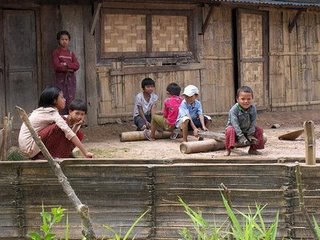
James entertaining the local Aka kids. He was delighted to find one of the locals selling Beer Lao to passing travellers.


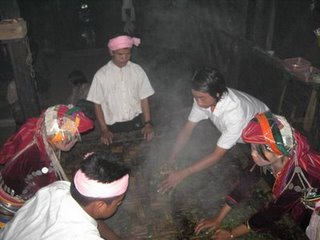
Aka villagers making green tea. 


Hoe vind je dit bericht? 3 stemmen
Geschreven door andrew om 15:45 1 reactie Reageer op dit bericht

Party-on Aka dudes ! Part 2


The villagers had built a special bamboo stilt house for visitors, which transforms into a kind of foreigner animal house whenever Western backpackers pass by. We announced our presence with some awkward naked fumbling at the village shower, soon attracting a devoted crowd of Lao-Lao toting party goers who followed us back to our thatched abode and the most happening club-scene in the jungle. Our Scottish friend, James, was in his element here: a master at the art of drunken linguistic exchanges, he used a tiny picture book to teach the Aka people a remarkably diverse and creative anthology of drinking games. As our evening descended into bizarre blend of Scottish bar culture and Aka fart jokes, a number of pretty young tribal girls joined us to end the evening with a traditional massage. Lying on my stomach with a tiny girl crawling up and down my spine, I vaguely remember James' robust Scottish accent bellowing proposals to his masseuse, until this whole weird surreal world started spinning about me in a metallic rice-wine induced deluge, and I passed out for the night.


Massage is an important part of Aka culture. It is tradition, not only for each village girl to massage weary travellers, but also her father-in-law.


Slightly inebriated, Saw and his side-kick sit in the animal house and show off their tasty Lao mealtime creation.


The Aka village under a blue sky, shortly before we departed the next morning.

Our second day of slogging through the jungle began in the aftermath of a night's worth of Lao Lao and rust-poisoning reverberating through my skull, but ended more pleasantly with gorgeous panoramic views and sunshine. Though I never thought it possible, the second Aka village we arrived at late the next day was miraculously more gorgeous than the first.


Banana leaf lunch-time in the jungle. Absolutely delicious !


Water buffaloes bathing in the mud: an integral part of the tribal economy.


Aka swing set with tribal village in the background. Teenage Aka boys and girls meet and flirt with each other in this swing set during special inter-village celebrations. About six months before marriage, a new thatched hut is built for the girl, and her secret fiance is tacitly allowed to sneak out to stay with her over night. Most Aka girls are married by the time they are fifteen years old.

Saw instructed us to walk another half hour to find the village shower: a small waterfall descending a steep embankment. We arrived during the height of the tribal bath time and were met with a god-like display of finely toned, muscled, and bronzed naked men- perfect specimens of human beings that look like Michelangelo sculptures come to life. These were bodies that could only have been conceived from a life-time of natural foods and manual labour.


As we self-consciously stripped our clothing off, I heard Mark's disheartened Aussie accent mumble under his breath, "bloody oath, it looks like a body building convention here." Needless to say, our white, hairy bellies fumbling between their sculpted Asian pecs, was a damning testimonial to Western decadence.


James allays the pain with a giant bottle of Beer Lao while Mark and Sarah attend to his recently impaled hand. When James fell on the hard bamboo pole and needed stitches, Saw suggested he visit an Aka doctor who turned out to be the village tailor. Fortunately for James, Mark and Sarah had brought along their first-aid kit.


Aka village school. Very few skilled teachers are willing to hike out to these communities. Our guide, Saw, was such a teacher and use to hike 68 kilometers in one day to reach remote villages to teach their children.

While Saw swung lazily in his hammock, we spent the night slowly acclimatizing to the Aka's noble way of life: admiring a spectacular night-time electrical storm, sipping idly from giant bottles of Beer Lao, and letting the local ladies kneed our weary calf muscles. We all looked at each other thoroughly contented. It occurred to me, with great surprise, that somehow our pilgrimage deep into the dark Aka heart of the Lao jungle, far away from the backpacker circuit, together with our tribal hosts, we had somehow managed to rekindle the magic of Shangri-La.


Our post jungle trek celebration with Lao-style home-made flat noodle soup.

Hoe vind je dit bericht? 2 stemmen
Geschreven door andrew om 00:00 Reageer op dit bericht

Into The Backyard of Asia


Arrival into Bangkok after being smack in the middle of the third world is always a bit of a shock. The remote drone of modern multi-lane freeways, the banal scent of air-conditioned taxi cabs, the prevalence of American fast-food culture. However, nothing says, "look, I'm back to civilization !" quite like setting foot into the gay swank of an ex-pat luxury apartment. The roof-top pool, the fuzzy clean carpets, the fluffy white towels: post-Myanmar cyclone R-and-R in Geert's apartment is surely backpacking at its most decadent and debauched.


However, Katlijn and I were determined not to succumb to the comforting dystopia of a Thai fat cat. After a night out bowling with Geert's friends, a spicy dinner with some money boys, and a much-needed appointment with their hair-dresser, we were once again ready to head off into the big-backpacked, dingy-hotelled, noodles-for-breakfast universe that is budget travelling in Indochina.


The ruins of Sukhothai, Siam's first capital, is an obligatory stop when travelling to North Thailand. The elegant lines of the standing Buddha are typical of Buddhist imagery from this era.


A Giant Buddha statue and reliefs near Sukhothai.


While I can understand the allure of green jungles, white beaches, and bronzed Thai girls for the Western vacationer, and yes, the food is great and the sun always shines, Thailand has nevertheless always fallen short of truly capturing my imagination: too modern to be a great third-world destination, too sleazy to be a great first-world destination, and too many backpackers to be a great backpacker destination, it always struck me as Asia-minus, somehow watered-down for mass-tourism and mass-consumption. As Katlijn idly noted on our characteristically clean, punctual and spacious Thai bus while gazing blankly at a shoddy Chinese music video production on a flat screen TV, "it doesn't even feel like we're travelling anymore..." Somehow during our visits to India and Myanmar, the world "travelling" had taken on a darker and more nefarious connotation.


In a desperate bid to re-discover the true Asia and get back to the dirty business of real travelling, Katlijn and I had decided to deliberately avoid any place where a tourist might want to visit: we headed straight for Laos.


The Htin tribal people are particularly skilled at manipulating bamboo to make everything needed around the house.


A tattooed elderly of the Mlabri tribe: probably the most primitive people we visited in Asia. The Mlabri are still mostly hunter-gatherers living deep in the jungle of North Thailand. It is hard to imagine such a primitive people only a day's drive from Bangkok.

The slash-and-burn agricultural practices of the other tribes in the area have destroyed much of the habitat needed to sustain hunter-gatherers, and the Mlabri people are in decline. As their lifestyle is not conducive to a Thailand embracing the future, the government is trying to encourage the nearby Hmong and Htin tribes to teach them how to build thatched huts so they stay in one place. Many of the Mlabri are having difficulty adjusting to this sedentary lifestyle and come across quite depressed.


Pork fat cooked on an open fire in a bamboo pole is a real Mlabri treat enjoyed by both young and old. Like this old man, many of the Mlabri people do not wear clothes.

Andrew tries his hand at getting a fire started with flint (harder than it looks).


Laos ! The backyard of Asia ! A country that only barely manages to occupy a vague association in the deepest recesses of the Western collective mind: "Laos ? Doesn't that have something to do with Vietnam ?" Always over-shadowed by its more famous neighbours: it isn't the economic miracle of Vietnam, it lacks the captivatingly abominable history of Cambodia, and even during its grand moment in the international consciousness, it was but a tragic side-show in a larger war. Digging deeper into its history, it only becomes more apparent that not much was ever said of Laos. The British thought of it as buffer state, while their French colonial counterparts pronounced it "useless."


But how does Lao food taste ? Who lives there ? What is the capital of Laos, anyway ? Like us, you probably never bothered to ask these questions, but are doing so now. And so, as we stepped off the bus and settled ourselves into a sheltered long boat destined for the far side of the Mekong river, Katlijn nudged me in the ribs and whispered eagerly, 

"Look, just across the river. THAT'S LAOS !" 

My god, she was right. In an instant, the overwhelming feeling of cynicism that Thailand always seems to bring out in me, vanished. I couldn't have been more thrilled. We were going to Laos.

Hoe vind je dit bericht? 1 stem
Geschreven door andrew om 00:00 Reageer op dit bericht

There was a big storm in Yangon


"There was a big storm in Yangon."

That's what a Mandalay hotel owner told me when I enquired about some images of fallen trees I saw in The New Light of Myanmar newspaper. It didn't sound like anything to worry about at the time.


Our thirty-day visa was about to expire so Katlijn and I had arranged for a flight to a town called Tachilek on the Thai-Myanmar border. We planned to cross by land into North Thailand, hitch a bus east, and slowly make our way into Laos. Our travel guide had warned us that the local travel agents and government officials in Tachilek were notoriously corrupt, regularly telling travellers that the border is either closed or that they had to pay through the nose to cross into Thailand. Thus, we didn't believe a word the Myanmar officials told us when they said we wouldn't be able to leave the country.


Andrew getting help from the Bagan locals to fix his rickety Burmese rental bike.

As Katlijn and I fought with the airport police to let us into Tachilek, we watched in wonder at a group of armed military personnel in green uniforms posing for a picture in front of aid boxes apparently bound for some place called "The Delta Region". At long last, we reached an uneasy compromise with the airport police: they would let us visit the city if we took their friend's taxi at only a slightly extortionate rate. We threw our cumbersome backpacks into the truck, and sped into town.


All-aboard Pyin U Lwin's morning rush-hour pickup service.  

With an abundance of newly paved roads and cell-phones, Tachilek is Burma's most Thai city. However, unless you are an aging expat on a Visa border-run, Tachilek has little to offer except perhaps South East Asia's premier shopping destination for cheap cigarettes and dodgy Chinese imports. Within moments of arriving, we knew we didn't want to linger long.

A typical street in Myanmar.

Before us lay a short bridge spanning a small river into Thailand. Bright Thai flags and royal yellow ribbons decorated the Thai half of the bridge, while the Myanmar half matched this with somber ruddy flags and silver helmeted police guards.


"What do you mean you won't let us cross into Thailand !?" Katlijn demanded.


The grumpy passport official shook his head. "No go to Thailand from here."


"Can't go to Thailand !?" I barked back, "Everyone here speaks Thai, all the money is Thai, that gentleman behind me is trying to sell me fake viagra! This bloody well is Thailand! Just let us cross the damn bridge!"


Dinner for two, Myanmar-style.

Katlijn and I were adamant. There was no way we would pay the bribe. However, unlike previous experiences, our usual tactics of escalating loss-of-face didn't seem to be working this time around. A sympathetic Thai woman even offered us her cell-phone so we could make empty threats to contact our embassy. At one point, I actually managed to get hold of somebody at an embassy in Yangon. The direness of our predicament was made clear to us as I tried desperately to explain our situation in faltering school boy French to a befuddled Parisian embassy worker while a group of Burmese military personnel listened in unimpressed. It was clearly time to throw in the towel.


"Wow, these guys are good." Katlijn observed as we glumly walked back into the charmless town of Tachilek through a dense mob of pirated DVD salesmen and porn magazine peddlers.


The bridge to Thailand: so close, yet so far away...

"Why don't you just give them a bribe ?" Suggested the kindly Thai woman. In fact, that was the suggestion of nearly everybody we talked to from restaurant workers to hoteliers. They even suggested an appropriate amount (about thirty dollars to start with) and persuasive techniques (display the money to the official while asking for his stamp). Following the same advice from local travel agents, we marched back to the bridge to pay-off the officials.


At this juncture, we'd like to apologize to the staff at the Tachilek Myanmar-Thai border crossing because, frankly, we really did think you were a bunch of corrupt military bastards. However, after two officials refused us, nay "freaked-out" would perhaps be more appropriate, when we casually waved a fan of bills on the table while motioning conspiratorially towards the stamp, I am guessing you truly were not able to let us cross into Thailand. As it turned out, there was actually a law requiring us to leave through our port of entry, and as foreigners, we were likely closely monitored. We apologize for any trouble we might have caused you, but we really badly wanted to leave Tachilek as you might have guessed from the rather sizable sums and varieties of money we were heaping in front of you.

Frustrated and dejected, I slumped down on the bed of an uninspiring over-priced Tachilek hotel room. Outside our window on a yellow poster just across the river, I could see the smug face of the King snickering at me from Thailand. The only redeeming feature of being stuck in the nether-region between Thailand and Myanmar is the noticeable absence of government censorship. I flipped on the television to BBC and, for the first time, learned that the "big storm" we had heard about was, in fact, a "deadly cyclone".


"You don't suppose they heard about this back home, do you ?" wondered Katlijn sheepishly.


A ten dollar, thirty second phone call to Canada quickly confirmed that, indeed, they had. Over the roaring static of my overseas connection I could barely make out the distant panicked sound of my mother picking up the phone in the middle of the night. It turned out that our families had mobilized at least four foreign embassies who had been searching for us to no avail for several days causing serious distress on the home-front. I'm guessing the remote Pa Laung tea outposts between Namhsan and Hsipaw weren't exactly the first places they would have looked.


"CAN'T LEAVE MYANMAR ! HAVE TO FLY TO YANGON !" I yelled across the planet.


"But Yangon is a bloody disaster zone..." echoed back the faint, though distinctly alarmed, voice of my mother half a world away.


It sounded like a good argument to us. Katlijn and I marched back to the the bridge.


"... so you see, you have to let us cross the bridge because, well, I don't know where you get your news from, but I have have it from some very reliable sources that Yangon is a bloody disaster zone."


"Airport fine !" announced the grumpy guard. Katlijn and I launched a final spirited protest, but it was clear that our campaign to cross that bridge was in its last throes. When asked who made up these ridiculous rules, a couple of them were genuinely sympathetic and thumbed behind them to the picture of Senior General Than Shwe hanging on the wall.


"He does."

As I reclined back into the corrupt passenger seat of a corrupt Air Bagan airplane, it occurred to me that the one of the great tragedies of Myanmar is how we are always fighting with the wrong people. We roared off the ground leaving behind, hopefully forever, the frenetic sleaze of Tachilek.


Guard tower reflected on the water surrounding the Glass Palace in Mandalay. The last king of Burma, King Thibaw, lived here before being ousted by the British and exiled to India where he died of old age.

The plane landed in the ancient capital Mandalay, home to Burma's final dynasty. Then took off again, flying over the former capitals Sagaing, Inwa, and Amarapura. Past Bagan and Taungoo and Bago, all once thriving bright capitals since destroyed and forgotten. Finally, we touched down into Myanamar's most recent addition to its long and complex history of fading ex-capitals.


Post-hurricane Yangon looked like the disaster zone we had heard about: largely without electricity, filled with collapsed buildings, dirt and rubble everywhere, potholes in the street, and street urchins drinking unclean water- which is to say it hadn't changed much since the last time we were here. Truth be told, Yangon always looks a bit like it has been recently ravaged by a cyclone.


The most noticeable difference was that the formidable trees that once lined its streets, providing respite from the cruel April sun and adding to the city's dignified, if somewhat unkept charm, had all been sadly blown over. Many of them caused significant damage to nearby properties, the rest had mostly been cut up and cleared off the road. Despite some of the doomsday prediction I had seen on the television, the airport was functioning normally and, only days after the tragedy, Yangon was largely up-and-running again.


This massive old tree was up-rooted by the storm and hurled like a projectile into a house. In the aftermath of the storm, Burma received significant aid from their traditional allies of Russia and China. However, their neighbors in India and Thailand are so dependent on Myanmar, both for their natural resources and as an ally to quell their own smoldering insurgencies, that they lack the political clout to convince the junta to receive much-needed aid from most of the rest of the world.  

The source of Yangon's rapid clean-up still remains a great mystery to me. The military police who roamed the streets were organized into largely feckless work gangs consisting of one poor sod with a hacksaw and about twenty cheroot-smoking layabouts watching him cut branches. A CNN reporter tried to explain the contradiction by suggesting he heard eye-witness accounts about armies of axe wielding monks diligently cleaning the streets by night- an account which, in our experience, sounded laughably ridiculous.


That isn't to say there was no damage to the city. The hotel we stayed in had a tree in its roof, and we talked to several distraught locals who lost their homes. While Yangon may have fared better than expected, the same cannot be said of the surrounding Delta region. For obvious reasons, we were not able to visit, but one of our backpacker friends was in Yangon during the cyclone filming a documentary on Myanmar. He made it outside Yangon and got footage of nearby villages. According to him, where there used to be small communities of precarious houses, there was now nothing left except for several neatly stacked bundles of bamboo poles and orderly piles of thatch materials.


"... And the worst part of it was, all the people came running up to me when I got my camera out and kept smiling the whole time, and, you know how its, some of the kids toyed with my leg hair and whatnot. I just couldn't sell this stuff to any of the major networks ! 'Can't you just look a little upset for the camera ?' I kept asking 'Why are you smiling !?' your whole village was just wiped out by a cyclone !' "


A smiling people ruled by brutes, grasping out for a sense of inclusion in the world, a victim of its own wealth, Myanmar is, in the end, a paradox.


Hoe vind je dit bericht? 3 stemmen
Geschreven door andrew om 00:00 2 reacties Reageer op dit bericht

Off the beaten path : Part 1

The Train Ride 


A small mound of Burmese shrimp chips, smelly fish snacks, and beer cans wobbled precariously down the centre of the isle in cadence with the dangerous back and forth lurching of our Burmese train carriage. The packaged food mound rolled over a dense crowd of old crones sitting limply on the floor, all their bodies moving together side-to-side against the adjacent seat cushions in a kind of sea-sick narrow-gauge train rave. The mound stopped beside Katlijn's bobbing sleeping head. Astonishingly, a smiling face popped out from behind the plastic baggies of red chilli sauce and through the thick stench of dried prawn flakes.

Just as two scrawny arms emerged from the pile of dubious Burmese treats, the entire mound exploded.

Every crone in the train rave swivelled their heads in a single group motion at the former lump of smoked sea goodies, its shell of dodgy snack bags blown clear away revealing only its skeleton: a spindly Burmese kid with two thin outstretched arms holding the twisted remains of a couple of old plastic bottles- their entire contents had exploded forth on top of Katlijn.

Katlijn blinked and grimaced in her sleep, slowly awakening from her slumber, trying to discern nightmare from reality. A familiar flash of insight settled over her, a relapse, a recurrence: the whole stinking wobbling humiliation of it all. She was drenched in an oily fermented bath of whatever rank-smelling liquid Burmese people drink with their salty fish nuts.


An oddly familiar old monk with giant spectacles and splotches of grey hair sprouts turned around and clarified the situation: "Palm wine," he began- a poor man's spirit even by Myanmar standards. "All this train rocking must have caused it to burst from the plastic containers," he wisely explained.


Surrounding her was a sea of huddled old crones, and one terrified boy covered in soggy fish bits, smiling nervously at her, all waiting expectantly for her reaction. Everybody seemed to grasp what had happened but Katlijn; being on the receiving end of a massive palm wine explosion, it appeared, was perfectly normal- a kind of Burmese public transportation rite-of-passage.

Katlijn, to her credit, resisted the temptation to heap racist expletives at the poor terrified Burmese kid and, in a remarkable feat of equanimity that even raised the eyebrows of our kindly old monk friend, smiled with all the grace and humility she could muster, untied her hefty backpack from the shelf, found a reasonably clean set of North Fakes, slowly rocked and swayed her way through the grinning, toothless, undulating crones, and locked herself into the ridiculously dark and tiny confine of the Burmese public train toilet facilities.


The monk smiled warmly after her in approval and there was an audible murmur of relief among the squatting crones. The skeletal boy, saved from a gargantuan loss-of-face, seemed to relax a bit and even tried half-heartedly to sell me a few dried crab-sticks.


Katlijn later told me that as she crouched naked in the toilet room, swinging wildly against the slimy walls, washing off the stench of palm wine from her hair using the train's only semi-functioning bum-gun, she realized that this very moment was the ultimate low point in her world trip.

Off the Beaten Path


We arrived in the late afternoon at Hsipaw, a gorgeous town surrounded by rice-paddies. A pleasant place where the backpacker-friendly locals introduced themselves as "Mister- something" to help tourists remember them. There was Mister Charles, the hotelier. There was the paranoid Mister Books, who sold books. There was even a grubby street vendor calling himself Mister Bean, "I sell the best beans in Hsipaw !"

There were also more tourists in Hsipaw than anywhere else in the north

Shan State. Hsipaw, it turned out, was a burgeoning Burmese backpacker town. I don't have anything against backpackers, but the same conversations we have together were starting to get old: where we are from, where we are going to, and how truly sick to death we all are of instant Chinese noodles. We wanted new conversation, new experiences, new people, an undiscovered country. We wanted to be in the same illusive place all the other backpackers wanted to be, but paradoxically couldn't find: out in the sticks, the boondocks, Woop Woop, off the beaten path.

Just as a giant cyclone smashed through
Yangon, days before Myanmar
would briefly enter the ephemeral space of international consciousness, Katlijn and I, in our own private quest to realize the great backpacker dream, hired two biker kids to drive us out of Hsipaw.

To drive us not just off the beaten path, but as far away from it as we could get. We wanted to be as far away from the beaten path (while still outside rifle range of the nearest insurgency and armed opium plantation) that we could possibly be. And this, we learned, was a place in
Myanmar
called Namsan.

The Motorbike Ride
                

The road-not-taken turns out to be full of massive ruts and, on the back of a flimsy made-in-china motorbike, a thoroughly harrowing ass-numbing experience. It is a road so old and forgotten it hadn't been maintained since the age of empires, often causing us to cling to our underage drivers for fear of our lives as we skidded along the muddy potholes in the pouring rain. We stopped once to watch a local bus unloaded all its passengers before crossing a water-logged wooden bridge that sagged and groaned in imminent collapse. When it was our turn to cross the rotting colonial-era infrastructure, my driver clenched the accelerator inducing a sad painful wine from our flimsy hog, while yelling over his shoulder "too risky to cross with passengers !"

Ignoring his own advice, we slowly sputtered our way to the other side.

The Challenge


Though the old road from Hsipaw to Namsan is only 80 km long, it took us five hours and a two motorbike breakdowns to make it all the way up. We donated $1 to the nefarious regime for the privilege of spending a night at the only guesthouse in town.

Namsan itself is a charming village of wooden houses set atop a world of stunning forested hills accompanied by the soundtrack of distant cow bells. If not for its population of Palaung tea pickers and Chinese shop-keepers, Namsan might look like a centuries-old
New World pioneer settlement, though the locals prefer to call it "The Switzerland of Myanmar". Out in the distance we gazed over a real no-man's land, apparently one of the least visited places on the planet. Somewhere out there, beyond those hills, grew nearly half the world's opium and the Burmese government waged a brutal, unknown, and ancient conflict against renegade Shan hill tribes still struggling for their independence.


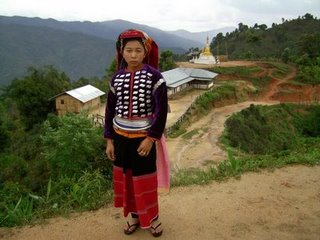
Palaung woman in traditional hand-woven tribal clothes.


It wasn't long before we were introduced to the town's only English speaking locals. A jovial old woman calling herself "Macy" spoke impeccable English and was eager to invite us for a little conversation practice with her young students over the obligatory pot of Burmese green tea. "Sandy" guided us around the hills and introduced us to the local factory workers at the tea plantations. Despite the incredible hospitality of the towns-people, a suppressed fear kept gnawing at us from the back of our minds: we would soon have to endure the muddy five hour spank of the road-not-taken back to civilization.

Over the mechanical clatter of nineteenth century imperial tea machines, we brought this fear up with the town mayor and a gang of curious factory workers. They could instantly relate: even they avoided crossing that old bridge if at all possible and wanted nothing more than to help us find a way around it. The mayor proudly handed us a dusty old English-language encyclopaedia volume (letters C-D) written more than seventy years ago- a bit of light reading material while they hammered out a plan. A huge raucous debate soon ensued all around us as everyone collaborated furiously trying to figure out what do with us. Katlijn and I thumbed sheepishly through the fusty encyclopaedia, until finally they reached some sort of consensus. Taking great pride in his achievement, the mayor presented us a crumpled old Chinese Valentine. He opened up the heart-shaped card revealing a sophisticated drawing of boxes and lines labelled with that mysterious sequence of shapes and squiggles we had come to recognize as Burmese text.


Palaung factory workers drying and sorting tea leaves over a thatched bamboo table.


After a lot of hand waving, shouting, and charades, we gathered that they had, in fact, drawn us a map of the region describing a network of tiny backwater villages, monasteries, and shrines that would lead us back to civilization. Every time we walked into a new box on the map, we were to turn the card over and show the nearest crone the squiggles written on the back.
Sandy explained that those squiggles roughly translated as "take me to your leader."

Everyone insisted that if a stranger walks into a Palaung tribal village, the locals would not only be delighted, they would feed us, give us a bed to sleep on, and point us to the next box on our map. It was more than just hospitality: it was a cultural and religious obligation. The Buddhist monks and villagers had to help us, there was no need to bring food or water for the journey. Thus, we were faced with the following challenge:


Could a couple of dumb white backpackers with no knowledge of the local language or culture survive the three day journey back to civilization, bypassing entirely the road-not-taken, with nothing more than plain old Burmese hospitality and a map scribbled on the back of a tatty piece of Asian Kitsch ?


Armed with only this, a lot of water purification tablets, and some emergency instant Chinese noodle packs, Katlijn and I set forth to find out.


The Hospitality


We began the journey with some trepidation. A close inspection of the map revealed that few factory workers could agree upon which boxes should be connected together. In fact, the entire card was riddled with scratched out lines and alarming little question marks. To make matters worse, nobody seemed to know what kind of distances were involved. One line between two boxes could take anywhere from one hour to a full day depending on which puzzled monk we showed our card to. Clearly, we were going to be relying a lot on Burmese hospitality.


We put this hospitality to test when we arrived wearily at the first box on our map: a village consisting of a handful of thatched bamboo huts and the unlikely demographic of about fifty toddlers and four old crones. The kids went absolutely ballistic when we stumbled into town, crying out Burmese greetings while tugging relentlessly on my leg hairs. They sat us down in one of the houses, poured us a cup of bitterly green Burmese tea, and prepared us a feast.


We would have been content just to receive some hot water for our instant noodles, but they spent a good hour cooking us an assortment of local Palaung fare which they arrayed for us on a tree stump: rice, vegetables, spicy fish sauce, chunks of raw sugar, and a salad made from tea leaves. As we sat with a family shovelling this into our mouths with our fingers, the entire village came out to watch us eat. Some food tasted great and went down easily, other dishes required considerable determination to get through without wincing in front of our gathering hosts. Tea leaf salad was particularly challenging. Having the consistency of spinach but tasting something like a used Lipton tea bag, I imagine it would take a lifetime of cultural up-bringing to fully acquire a taste for it.


In retrospect, despite the fact that we didn't know what we were eating most of the time, we couldn't understand a word anybody was saying to us, and palm wine featured prominently on the menu, the home-cooked meals we shared with the Palaung tribes were some of the finest dining experiences we ever had.

Hoe vind je dit bericht?
Geschreven door andrew om 00:00 Reageer op dit bericht

Off the beaten path : Part 2

The Shower


The roads were lined with friendly tea pickers plucking leaves from the myriad of tea plants covering the hills around us. There was no shortage of people to ask for directions. Unfortunately, the accuracy and consistency of the answers we got left much to be desired. Talk to anyone who has been to the orient: never ask directions from a local. It's hard enough getting them to read a proper map, but trying to get your average tea-plucker to make sense of whatever nonsense was scribbled on our fading Valentine card was a thoroughly frustrating endeavour generally culminating in a lot of confused head scratching and a vague wave in a random direction. It wasn't long before we found ourselves way off the dirt roads, tripping over the steep dry scrub growing between tea-plantations: not exactly where one wants to be in a country boasting the world's highest rate of poisonous snake fatalities.


Covered in sweat and dust, we miraculously stumbled out into a clearing and found our way to a wild-west town full of old ramshackle wooden buildings. The town turned out to be "Kunh he" and, encouragingly, had several signs vaguely resembling the text written in the second box of our map. Too tired for basic formalities, I simply shoved the grimy Valentine card into the hands of the nearest resident and pointed to the text which we believe read "take me to your leader". We were soon brought to a beautiful old monastery and introduced to a young monk calling himself "Ken".


"Would you like to wash ?" Ken managed in his best English. There was nothing in the world I wanted more than a good shower. Ken asked me to follow him.

After twenty minutes of walking down a steep hill in my underwear and towel wondering what the residents of Kung He were thinking in selecting this location for their public toilet facilities, we emerged into a clearing full of half naked villagers sitting around a large cement bunker with three wooden pegs sticking out of it. It seemed somehow natural that the whole village had turned up to watch me shower.


"Would you like to wash ?" Ken asked again.

"Yes, please." I replied

There was a long silence while I stared at Ken and the grinning villagers, trying to examine them for some hint as to where I might find the shower facilities. I turned towards the cement bunker.

"Is the shower in there somewhere ?"


Ken motioned me towards the cement bunker, so I walked over to it not quite knowing what to do. I turned around and faced the villagers who weren't even trying to stifle their snickering. "Sorry, I just don't know how this thing works."

"Would you like to wash ?" Ken repeated. Ken had an irritating way of repeating unhelpful things.


"Look, Ken," I began while adjusting the towel around my waist, "do you even know what 'wash' means ? I mean, is this thing even a shower ? Are we even in the right place here ?"

"You wash !" Ken encouraged me.

Hoping for the best, I pulled at one of the wooden pegs. Suddenly, the peg popped out and the entire contents of the cement bunker gushed out at me in a freezing cold torrent of water that threw me off balance. The next thing I remember is lying on the ground in my underwear while Ken and the entire village joined each other in uproariously laughter.


The rest of my bathroom shenanigans, which consisted of the seemingly innocuous acts of brushing my teeth with a toothbrush and washing myself with soap, elicited nothing but more giggles from the villagers every time I peered behind me. Perhaps to save what little dignity I had left, Ken finally came over to show me how it was done. He cautiously pried open the second peg, picked up a smooth round rock, and fiercely scrubbed himself red. He was particular attentive to the top of his head, on which he used the stone to polish each of his tiny gray Buddhist sprouts. After that, he produced a ghastly metal implement which, to my amazement, he shoved deep inside his mouth and thrusted painfully about.

It suddenly became clear to me that out here, I was the one that didn't know what 'wash' meant.

The Evening Cinema


I learned from Ken on our hike back to the monastery that Palaung tribal villages have only one shower for the entire community and about two regular showering times each day, hence my supportive crowd. Back at the temple, we discovered that there is also a single television for the entire village. This television is generally occupied by a gang of couch potato monks who spend the best part of the day glued to the screen watching Thai kick-boxing.


Ken was a slavishly devoted host, but alas, no great chef. He prepared our Chinese instant noodle packs for dinner. It was a bit of a let-down from our lunch experience, but the upshot was we wouldn't have to suffer through another bowl tea salad. As we ate dinner, we watched as most of the villagers quietly filed one by one into the temple's TV room for the evening's entertainment. Ken asked us to follow them inside where an odd assortment of Buddhist relics, incense sticks, and prayer beads were arranged haphazardly around an old television set, a dusty DVD player, and a satellite dish. Ken handed us a binder containing the monastery's DVD collection and urged us to select a movie for the whole village to watch. Everyone smiled at us eagerly as Katlijn opened to the selection on the first page, 

"Jaws","Freddy Versus Jason"," Alien"... 

We looked up at the quaint tribal villagers and saffron-robed monks smiling expectantly at us. None of these titles seemed appropriate so we turned the page and kept looking. 

"Halloween", "Evil Dead II", "Alien versus Predator"... 

"Keep looking," began Katlijn nervously eying the countless children climbing around us, "I don't think we can show them this. It's a monastery, after all." We turned the page,

"Rosemary's baby", "The Exorcist", "The Omen"...

Everyone kept waiting for a decision. Some of the kids were getting impatient and began tugging on my arm hair.

"Night of the living dead", "Hostel", "The Texas Chainsaw Massacre"... 

Our awkward situation grew dire. 

"Wicker Man","Hell Raiser","Jack the Ripper"...

"Just what kind of monks are you !?" I cried out in exasperation, flipping frantically through Ken's macabre collection. Finally, there it was on the last page: the DVD cover for "Narnia". By some miracle, C.S. Lewis had come to our rescue. Katlijn jumped up enthusiastically and announced our selection. 

Ken ran off to find the DVD and hit the play button. "It's a good one for children," began Katlijn hopefully to a room full of tribal people who nodded eagerly back to her in non-comprehension. 

While the villagers and their children watched the movie with all the seriousness and intensity of discerning film critics, I thought I heard a few groans emanating from the general vicinity of the monks' section when the Disney logo came up. A couple of monks left the room after only a few minutes, and I think I caught one rolling his eyes at us. I guess you just can't please everyone.

The generator cut out halfway through the film and the villagers filed back home. Ken showed us to the meditation hall where he had set us up on the floor with some cosy mats, candles, and blankets. Since I was sleeping in the room anyway, I asked if I could join their morning meditation.  

"Not so many monks here meditate in the early morning," he explained. Somehow, I wasn't surprised.


Katlijn and I prepared our beds while a group of monks tip-toed mischievously back out to the television room with an old car battery. I blew out the candle. As I closed me eyes and fell into sleep after a long day, I could hear the soundtrack of James Bond drifting in from the room next door.


The Tea Pickers


To Ken's credit, he actually did get up to meditate the next morning, though I had the sneaking suspicion that this was for my benefit only. With characteristic devotion, he prepared us our noodles for breakfast and took it upon himself to guide us to the next box on our map. Ken was very eager to connect with us, but after several hours of repetitive conversation, we were forced to come to the conclusion that he really hadn't the foggiest clue what we were saying. Though we liked Ken a lot, and I am certain he would have dutifully followed us all the way back to civilization, we finally had to ask him to leave so we could continue peacefully on our own. 

The next line on our map turned out to be a steep up-hill ascent winding through the hills of scattered tribal villages. Groups of tea pickers lined the roads smiling, waving, and occasionally inviting us up to come join them in their work. After a long hike, we arrived at a village called "Kon Haut" and collapsed in front of an old wooden table at a long forgotten tea house. Within moments, a young teenage boy came running out to us.

The young boy introduced himself as "Anderson" and spoke excellent English. Anderson's soft voice and gentle mannerism instantly qualified him as our favorite Burmese person. He insisted on being our guide to his small village and offered us room and board at his wooden house on stilts. As with all the tribal people we met in this part of Myanmar, he and his family adamantly refused any monetary compensation. 

Anderson's tiny self-contained village was a gorgeous collection of ancient wooden houses perched on top of a high hill offering a spectacular vista of the surrounding forests and tea plantations. Like all the other villages in the area, every resident grew and picked tea for a living. The Palaung people have been doing this for many centuries, forever as far as the people here knew. Anderson's family owns five small plantations located in disparate parts of the forest. During picking season, they get up at four each morning, hike several hours to their plantation, pick tea until the late afternoon, and walk back before dinner time. All this plucking resulted in some truly spectacular finger callouses, which Anderson and his friends enthusiastically showed us with immense satisfaction. A day's picking will yield about two large sacks of green tea leaves worth a couple of US dollars. This is enough money for Anderson's family to live comfortably out here.


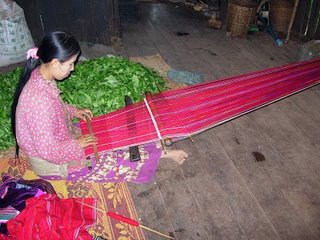
Palaung woman sitting on her floor weaving a dress beside a pile of freshly picked tea leaves.

Anderson introduced us to his friends at the village monastery- a gorgeous two-century-old wooden structure filled with colorful Palaung tribal decorations. Buddhist monasteries, it turns out, serve as the local teenage hangout where young layabouts partake in some serious loafing with the novice monks. We felt very hip chilling with the cool tribal kids, though the boys insisted Katlijn sit on the floor below the men as part of the local Buddhist tradition. The monastery had only three senior monks, three novice monks, and two nuns living next door. The nuns do all the cleaning, cooking, and maintenance for the monastery. It remains unclear to us what monks actually do. 

By the late afternoon, we felt we were starting to get the hang of Palaung village life. After hiking out to the cement bunker, I managed to clean myself with only minimal ridicule. Katlijn might have fared pretty well herself, had she not wore her longyi upside-down. Anderson's family meal of rice, potatoes, and dried chili-prawns was beginning to taste downright homey, and (I dare say) I believe I even started developing a vague appreciation for that insufferable tea salad. Sipping daintily on freshly picked tea, we idly watched the villagers file out to the monastery while chatting casually with our hosts over what lurid film they might be showing at the cinema tonight. Somehow, this forgotten Palaung backwater was starting to feel like home.


At night, we lay together under the stars with Anderson and he explained to us that he didn't want to pick tea leaves his whole life. He had always wanted to be an English-speaking guide and meet with people from the West. 

We retired back inside Anderson's house where he prepared our beds on the floor, just beside the rest of his family who also slept on the floor together with us. In the corner of the room were all of Anderson's possessions: a tiny wooden desk which he barely fit into and a small shelf of old worn-out English language texts that he had collected over the years. As Katlijn and I drifted off to sleep, I watched Anderson's gentle silhouette flickering in the dying candle-light, hunched over his little desk quietly studying a crumbling English book. 

Back to Civilization

  Hsipaw market.

Early the next morning, we awoke to the sublimely soothing chanting of Anderson's mother lighting a candle in the family's Buddhist shrine. One of Anderson's friends picked us up, a tough-looking but exceptionally sweet teenager calling himself "Jackson". Katlijn and I piled on the back of his bike and waved goodbye to our good friend Anderson before roaring off motor-cross style to the next box on our card.

Jackson showed us a short-cut through the hills and told us we'd be back to civilization in only five hours at a good walking pace. Of course, we knew better by now and weren't in the least bit surprised when, ten hours later, we finally limped our way past Mister Charles' Hotel, waved a tired "hello" to the cravenly Mister Books, and felt an exhausted euphoria when we heard a familiar voice yell out to us in the distance, "Tell your friends ! I've got the best beans in Hsipaw!" After a long journey off the beaten path, we were back home with the rest of the backpackers. 

Given the utility of whatever was scribbled on the back of our tatty piece of Asian Kitsch, it was clear that only Burmese hospitality saw us through our challenge. As we lay down in the comforts of a real bed and rested our aching muscles, I felt an unconscious smile slowly form while I thought about how, on a future day, long after our world travels have ended, when the stress of modern civilization feels too heavy and the accelerated time of the new globalized planet too dizzying, we'll be able to think back to our memories of the motley people of the Palaung tribes, and be comforted by the fact that there is still a timeless place like this left in the world.

Note: Sadly, the photos we took of the area around Namsan in the Shan state of Myanmar were stored on an unreliable media (CD-Rom) inside an even more unreliable plastic casing (made-in-Vietnam) and we can no longer access them. Furthermore, we were unable to find on the internet any images of the villages or areas in the Shan state we trekked through on this trip. However, we were able to find some photographs taken of palaung tribal people in other parts of Myanmar. We selected a few of these based on how well they represented the things and people we saw on our trip. If you see your photo posted here, we thank you very much and you may leave a comment with us below. We do have a backup of all our photographs stored in the safe-haven of Geert's gay-chique apartment in Bangkok. We will update this entry again with our original pictures of the people and places of this story, as soon as we are able to retrieve our backup in a couple of months. In the mean time, we finally caught up with the rest of the twenty-first century backpackers and bought a portable hard-drive.

Hoe vind je dit bericht?
Geschreven door andrew om 00:00 Reageer op dit bericht

Bagan Sunset


"Spotty","deplorable", "horrid".

This is just a sample of the derogatory adjectives I found while researching
Myanmar's dubious government-operated "budget" airline safety record: a history of downed planes and missing tourists so extensive it rivals even the world's great socialist "no-frills" commercial airliners of Africa and Russia. Myanmar Airways claims its record has improved dramatically after they dropped a rule requiring that planes take off on time regardless of the flight mechanics' advice- certainly little consolation.


Our other option was the decidedly safer "Air Bagan", privately owned and operated by Tay Za: Burma's most flamboyant and nefarious business tycoon who not only hordes the profits of Myanmar teak-wood industry, he also has close ties to Burma's massive illegal opium industry (surpassed only by that of Afghanistan). Naturally, he is a close friend to the military junta having paid for the current Senior General Than Shwe's daughter's notoriously extravagant $300,000 wedding.


Alas, we chose to patron Tay Za's Air Bagan and may we burn in hell. It was either that or face the sprawling twenty-four hour odyssey of crossing the entire country in the hot stuffy confinement of a Myanmar pickup truck. Somehow, eternal damnation didn't seem so bad anymore.

Our plane touched down into the cruel dusty furnace of April in Bagan, and by night-fall we found ourselves wandering the desolate streets of a third-world tourist dystopia. New Bagan is the brainchild of a military junta that gave all the residents of the original city one week's notice to pack up and move their lives to this more convenient location. The paved streets and ritzy hotels around us are widely believed to be the product of government enforced slave labour in a failed effort to bolster their tourist industry.

These days, New Bagan is downright spooky. A loud wind howls across dark empty roads in the night. Swanky western-style cocktail bars are populated only by dusty horse and carriage drivers pestering us to rent their services. Vacant luxury resorts sit sadly idle next to the murky green waters of their forgotten algae-ridden pools. Tourists don't seem to come here anymore. Too spooky.


Long boat on the Irrawaddy near Bagan.


Myanmar has a complicated and turbulent history consisting of periods of disunity and warring ethnic groups alternating with more prosperous periods of Burmese domination when rival ethnic groups were controlled with either the carrot of autonomy or the stick of force. It is tempting to consider today's predominantly Burmese junta as a continuation of this pattern. History repeating itself. While the military junta is rightfully despised, people are reluctant to consider the possibility that when junta is gone so will be the uneasy Union of Myanmar it barely managed to cobble together.


Each Burmese Empire had its capital. If the modern ghost metropolis of Naypyidaw is the unlikely capital of today's military junta, Bagan was the capital of the very first Burmese empire more than one thousand years ago. Alone and sadly outnumbered by the hotel staff, we checked out and began our hot and sweaty exploration of this more ancient Myanmar.


Marco Polo was the first Westerner to see Bagan (13th century). He described it as "one of the finest sights in the world." He also claimed that many of the towers were covered in gold a finger thick.

There use to be more than 13,000 temples in Bagan, but only 2,200 remain today. This is more than all the Cathedrals in Europe.

Touring Bagan is as exhausting as it is exhilarating. Temperatures soar well into the mid-forties, and the barren landscape provides no respite from the sun. Literally thousands of temples are strewn across a forty square kilometer requiring long hot bike rides between the sites accessible by road, and dusty pony rides for the rest. Each temple is home to gangs of touts either hawking the same paintings and postcards, or trying to barter them off to us in exchange for various personal items. 

Covered in sweat and sun-screen on our second day of plodding along sandy roads on clunky third-world rental bikes, we collapsed inside a dingy Burmese restaurant suffering from a mild case of heat stroke and a major case of temple overdose. The Lonely Planet describes Burmese cuisine as a "curious" mix of Indian and Chinese influences which seems to be true since the food they served us had all the greasiness of Chinese take-away with all the cleanliness of an Indian hole in the wall.

Most Burmese restaurants serve a large variety of foods arrayed unattractively in plastic pales at the entrance. The food in each pale is actually intentionally covered in a thin layer of grease in order to keep the many nearby flies out.


Nevertheless, Bagan at dusk is positively magical. We climbed atop lonely nondescript pagoda number 384 somewhere in the middle of the ancient city. A gang of souvenir hawking pre-teen touts was there to join us as we sat down together for the evening's spectacle. Sunset over Bagan is perhaps
South East Asia's most awe-inspiring sight. Even the grubby kid shoving postcards into my hands while tugging at my wrist found himself stopping momentarily to bask in the terracotta colors of twilight. Unlike other preeminent ancient cities of the world, the view before us was neither shrouded in jungle nor banalized by popular media. At sunset, the full extant of a massive ancient martian world lies unhidden, disappearing with the sun into the horizon.


Hoe vind je dit bericht?
Geschreven door andrew om 00:00 Reageer op dit bericht

Walking to Inle Lake


A clear brisk morning. The pleasant scent of coriander chutney and naan bread roasting on an open fire. A piping hot mug of Nescafe "Turbo" 3-in-1 coffee mix. Kalaw, perched high above the cruel heat of April, seemed to us the only sane place to be at a time like this. Slowly, our dreams of Air Asia travel agents whisking us away from Myanmar to a distant discount tropical paradise were fading, and a renewed determination to understand the Burmese paradox settled into our imaginations. 


The Indian family we stayed with showered us with as much conversation as they did chapattis. They had been living up here for a century. Like many of today's Burmese Indians and Chinese, they were originally brought here by the British to help develop and modernize the new colony. More experienced than the locals in the ways of the West, they became the advantaged elite fueling a deep resentment among the indigenous Burmese population. During the heady days of World War II and Burma's independence, anti-Muslim riots and institutionalized oppression forced many Indians to flee the country in a deadly mass exodus. Though the regime never fully got over its outdated anti-India propaganda machine, among the common people, this animosity has all but evaporated. Today, our hosts wouldn't dream of returning to India and insist the Burmese people are the world's friendliest, a different species entirely from the regime, living in a parallel world. 


Kalaw was an old British army outpost still used by the junta's military today. Some fading colonial era buildings decay into the landscape, while others have been renovated and still serve as homes to wealthy generals.


Our various commutes on Myanmar's dodgy public transport services had left us non-plussed, and we decided to walk the rest of the way through the Shan hills to our ultimate destination at Inle Lake. Besides, what better way to keep money from the hands of the regime and, perhaps even more nefarious, the various local bus, pickup, and converted garbage truck mafias. The India family lent us the services of their son, Rambo, to guide us on our scenic trek through the Burmese hills.


Our awesome Burmese Indian guide to the hills around Kalaw, the soft-spoken Rambo. Fluent in Hindi, English, and the local tribal languages, not to mention an Indian roti connoisseur, he was indispensable.


The area's rich rust-hewed volcanic soil allows a diversity of crops to grow supporting an array of colorful tribal communities.


Myanmar's hills are home to some 135 different tribal groups, each having their own distinct language, customs, dress and specializations. Some of these ethnic groups number less than one thousand people and have been living in the same semi-nomadic self-sufficient ways for centuries. As we meandered down the hills, these exotically clothed people punctuated the fertile red soil, pastoral hills and tiny thatched hut villages with brilliant colours re-creating all around us a forgotten time.


Scenes of rural village life in the Shan hills.


Hoe vind je dit bericht? 1 stem
Geschreven door andrew om 00:00 Reageer op dit bericht

Meer van op wereldreis

↑ Terug naar de berichten