Naar de inhoud

op wereldreis

geniet mee van onze avonturen
akke.beakke.be
Een jaar lang op wereldreis : ikzelf (Katlijn) ben een Vlaamse Belg. Mijn vriend Andrew (een Canadees) is de schrijver van dit blog ... daardoor zal de hele blog in het Engels zijn

Archief

Part 2


More scenes of rural village life in the Shan hills.


 Kalaw's colorful tribal people.

 As usual with Indian-led trekking campaigns, mealtimes were a highlight of the day. In Canada, a backpacker meal typically consists of a bag of freeze-dried food, often marketed by weight and volume rather than taste and style. Packages are known to contain "calories per ounce" information along with a lexicon of similar metrics presumably inspired by the cattle fodder industry. In Belgium, people actually embark on overnight treks with nothing but a giant piece of salami, a hefty wheel of Gouda cheese, and a pair of long Baguettes that stick out of their bags like bazookas. I've seen Europeans last weeks on the trail eating only this.


Trekking with Indians is a whole different story. A pack of rice, some dried lentils, and a few zip lock baggies full of spices is turned into a deliciously dense spicy daal within minutes of the water boiling. And while you are gobbling that down, your guide is making fresh bread on an open fire out of a Tupperware container full of flour. All this and you're only paying twelve dollars a day for the food, accommodation, a professional cook, and a translator. Quite simply, Indian backpackers are making the rest of us look bad. As I thought about my fellow countrymen eating straight out of a soggy carb-loaded bag with a hard plastic spork, and those trail-side Belgians furiously chewing stale bread while attacking flimsy chunks of sweaty cheese with a pocket knife, I couldn't help but feel a tinge of shame for Western trekking culinary traditions.


Burmese-style backpacker checker board.

Hoe vind je dit bericht? 1 stem
Geschreven door andrew om 00:00 Reageer op dit bericht

Part 3

Between bouts of sticky-fingered curry-eating gluttony, Rambo helped us chat with the locals. The cool easy-going hills of Kalaw bare little resemblance to the sweltering politically charged atmosphere of Yangon. While intensely curious of the outside world coming to visit them, the tribal people are entirely unaware and apathetic of their politics. Some are eager to exploit the tourist trade, but most live, trade, and marry within the confines of the hill communities and have limited interaction with the rest of the world. Unlike treks through remote areas of India, the tribal kids living here have not yet learned to pester foreigners for pens and candy.


After a while, one learns to recognize most of the region's tribal groups based on their occupation or clothing. For example, the Pa-O women shown here always dress in black robes and bright head scarves.


The Pulaung tribes specialize in growing tea. This old man from the Pulaung tribe invited us inside for a pot. He didn't know how old he was. Many people in the village didn't seem to keep track of their own age.


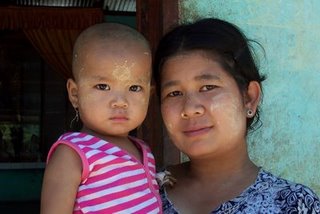
A Pulaung mother with a beautiful smile.


A Pulaung child borrowing one of grandpa's cherished green cheroots.


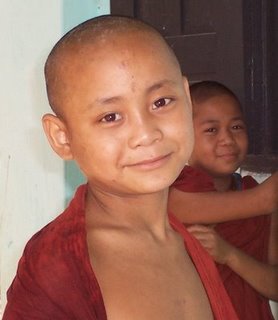
Rest and accommodation normally took place on the hard bamboo floor of a tribal hut together with a large family who all slept in the same room. On our second night, however, we had the luxury of staying at one of the village monasteries populated entirely by pint-sized monks in training and an aging abbot suffering from diabetes. Fortunately, the little ten year-old monks do the best they can to care for their teacher: massaging his feet every night while taking charge of daily business to ensure their spiritual operation is kept clean and running smoothly.

Before we went to bed, tribal people from nearby villages hiked out to the monastery and sat cross-legged together with the young monks to watch "Apocalypse Now" on what is likely the only DVD player in the area. The audience, clad in variegated tribal clothes and saffron monk robes, took everything in with a fascinated silence.


The monastery we stayed at. The architecture and corrugated tin roof are typical of Myanmar's many rural monasteries.


Young monk-trainees proudly doing their morning chores.

On our third day of hiking, we marched into Inle Lake and hired a boat to take us to a cozy guesthouse at a village called Nyaung Shwe. Inle Lake is one of Myanmar's main attractions: an idyllic mosaic of lake-side villages, rice paddies, and rolling hills. The region is notably wealthier than other places in Myanmar, the extra income from the tourist industry having transformed it into a kind of rural utopia complete with paved roads, a small airport, and other public facilities. Of course, this situation won't last much longer if foreign countries continue to discourage people from visiting here.


The lake supports a thriving farming community producing a wide range of vegetables and flowers cultivated on floating islands in the shallow edges of the lake. The men add to the islands by driving bamboo stakes into the lake bottom and piling up mud and lake vegetation.


Inle lake's most notable tribal folk are the Intha people, who are easily identified on the water by their novel (and apparently more efficient) paddling technique involving the ankles, legs and arms.


Proponents of Burmese tourism often cite Inle Lake as an example of how well-behaved the junta can be when there are foreign tourists watching and therefore argue in favor of expanding the areas accessible to visitors. Some human rights activists, however, fear that visitors plying the beaten path to areas like Inle Lake will develop huge misconception about the reality of life for most of Myanmar's rural poor. Furthermore, the impact of tourism on the Burmese tribal communities has never been studied.

Despite improvements to Inle Lake's infrastructure, not everything has been brought up to date. While indulging ourselves in some Western-style food at one of Inle Lake's many restaurants, Katlijn chipped her tooth forcing us to consider the frightening prospect of Burmese dental care. Our friendly guesthouse owner, ever trying to be helpful, recommended his dentist to us. Just before we were about to leave he asked, "You go to get your tooth pulled ?"

"No, we just want somebody to take a look at it."


"Oh," he replied confused, "if” you no want your tooth pulled, no go to Burmese dentist."

Needless to say, Katlijn decided to wait until we got back to
Thailand for her dental work. However, it was somehow comforting to know that despite the inevitable encroachment of tourism, politics, and other modernizing forces into the traditional tribal way of life here, at least dental work was still done the old-fashion way.


Hoe vind je dit bericht?
Geschreven door andrew om 00:00 Reageer op dit bericht

Breakdown to Kalaw


I sat in the shadow of the ticketing office listening to Katlijn argue with the local bus tout.
"Is it a big bus with air-conditioning ?" She asked.

"Yes," said the tout. 

"Does the air-condition work ?" She asked. 

"I think so," said the tout doubtfully, looking away. 

Katlijn narrowed her eyes and looked penetratingly at the ticket man, then began slowly and carefully in a menacing whisper, "But will they turn it on ?" 

The tout looked uncomfortable and shuffled his feet a bit, realizing she was on to him. "You'll have to ask the driver." 

"Show me a picture of the bus !" Katlijn demanded. 

The tout produced a glossy poster of a hotel-sized luxury vehicle filled with happy smiling passengers toasting each other with champagne flutes, marvelling at a highly improbable backdrop including the temples of Bagan reflecting off of Inle Lake surrounded by tropical birds and what appeared to be several extinct species of orang-utan. Honestly, I don't know why she bothers. This tout was going to rip us off and there was nothing we could do about it. 

At long last, a dark noxious fog of belched out low-grade diesel exhaust ushered in our aging transport, clunking and sputtering its way towards us a good two hours behind schedule, an old tenth-hand rust-bucket long since discarded by its last owner in the West. Perhaps that same owner might one day visit this part of the world and feel a tinge of nostalgia and pride to see his or her faithful old rusty steed having a second-life in the orient as an integral part of the local Myanmar bus-scam. But to us, it was just another dirty van without a single functioning door or window, crammed full of betel-nut spitting crones all covered in a thick layer of Burmese road dust.


Katlijn had a small breakdown when it stopped in front of us, which began with "Is that our bus !?" and ended with a flurry of racist expletives heaped on an uncomprehending ticket salesman. All the while, the tout kept insisting it had "excellent air-suspension" as though this outright junk-heap had some deeper soulful charm hidden just beneath the surface, if only we would take the time to discover it.


Burmese kids hiding under a table of fresh durians.


We were heading north now, en-route to Kalaw the hard way. Sane travellers take the plane at this point, but we were determined to stay on our pathetic budget and keep our money from falling into junta hands, even if it meant the occasional mental breakdown and momentary lapse of sanity. I found a small extra chair just behind the driver which had been crazy-glued to the floor, while Katlijn preferred the broken padded cushion that hung loosely at an obtuse angle from its seat back. There is never enough space on a bus like this one, so babies are passed around like carry-on baggage and it wasn't so unusual for one to end up in Katlijn's lap. They don't use diapers in the third world.


I was worried about Katlijn. She was in a miserable mood right now, secretly plotting an escape from the country. I saw her the other day checking out low-cost Air Asia flights leaving Yangon for Phuket, certainly an act of extreme desperation. The heat was really getting to both of us. During our truck's second breakdown, while the driver tinkered with the engine using a plastic pale full of rusting tools, we found ourselves sitting out under the stars along the highway. It occurred to us both that even in the middle of the night, Myanmar was still hot as hell.


With the likely prospect of our aged bus' post-retirement career in the Myanmar bus-scam business sputtering to a final ignoble conclusion, we decided to get off at a town called Taungoo and head to a private guesthouse boasting an excellent reputation among Burma's controversial guidebooks. It was indeed a lovely place, constructed from varnished teak wood, tastefully decorated, and cheerfully managed. Of course, none of this mattered to us because it no longer had air-conditioning. The friendly doctor who owned the guesthouse apologized profusely and tried to explain.

In case we weren't confused enough already, the junta had recently moved their capital to a place called "Naypyitaw", not far from here. Depending on who we talk to, the capital city of either Myanmar or Burma could be Yangon, Rangoon, or even Naypyitaw. By all accounts, Naypyitaw is a brightly lit fantasy city of modern shopping malls, six-lane highways, and twenty-four hour electricity, except that almost nobody lives there. Access to the new capital is strictly controlled, only the military top-brass and necessary government personnel are allowed inside. The city is also home to a number of five-star hotels catering to unscrupulous tourists who describe it like an empty high-tech ghost-metropolis straight out of a bad episode of the Twilight Zone.

Like most of Myanmar's population, the doctor got her news from a daily BBC Burmese radio broadcast squawked at her through an old plastic Zenith radio. The BBC has proposed a variety of disparate explanations for moving the capital to a place truly out in the sticks, including a paranoid regime trying to distance itself from politically charged activists in Yangon, a better command centre for conducting their war against nearby Karen insurgents, or even a more easily defensible location in the event of a future American pre-emptive strike. Of course, BBC really has no idea what the regime is thinking, it could have just been the whim of some flaky numerologist. Regardless, the new capital consumes most of the region's power, allotting our teak wood hotel along with the rest of Taungoo only three hours of electricity per day.

Taungoo local selling us some juicy lychees wrapped in a banana leaf. 

Curiously, the only exception to the three hour electricity rule occurs whenever a British Premiere League soccer game is televised. Our hotel owner speculates that the junta provides electricity during televised soccer matches purely as a security measure. The Burmese are fanatical British soccer zealots hungry for outside information regarding the world of professional footy. They may have passively accepted a hundred years of colonial rule and fifty years of brutal oppression at the hands of a ruthless military junta, but take away their evening soccer match and they'd riot.

Though our hotel had its own generator, it didn't produce a high enough voltage to operate the air-conditioner or to provide a sufficient angular momentum for the over-head fan to be effective. As a result, it got so sweltering hot in our room that we eventually decided to sleep outside underneath a mosquito net. 

Perhaps the friendly doctor felt sorry for us when she found us the next morning lying naked on her hotel patio. She put together a truly amazing breakfast made up entirely of fruit from her exotic garden. Over heaps of lychees, mangosteens, and passion fruit, Katlijn told me about a bizarre dream she had of a mysterious Burmese metropolis, somewhere not far away, populated entirely by Air Asia travel agents and empty air-conditioned hotel rooms. I'm no shrink, but this was clearly not the sign of a healthy subconscious.

A pineapple growing in the doctor's garden.

The local Taungoo train station looked like a refugee camp. Making our way through the dense crowd of uniformed military personnel, saffron-robed monks, and gangs of children trying to pull at my leg hairs was a real challenge. We were eventually shuffled into a small office where the local train officer handed us a couple of post-it notes he had just scribbled on, and showed us to the appropriate platform. When our train finally lumbered down its narrow track two hours late, I remember voicing my worst fear, "these people aren't all getting on that are they ?", before it was realized by a chaotic surge of humanity converging on every malfunctioning orifice of the antiquated train. 

We watched in stunned amazement at the spectacle. Everyone elbowed their way to the front, huge bottlenecks formed around the doors, monk bottoms and sandaled feet disappeared through the windows. Unable to physically get close enough to the train to board, we enlisted the help of an armed guard who, by some miracle, actually understood whatever was scribbled on our post-it notes. He successfully cleared the way and even scared a few old crones out of our seats for us. Every once in a while, a military junta really does come in handy. 

Once inside, we were on our own. It took us ten minutes to get from the door to our seats. There were moments when I thought we'd never make it through the thick jungle of bodies inside. There wasn't enough space on my piece of bench for me to sit down and nowhere else for me to go. I ended up standing on my seat for fifteen minutes until Katlijn, uncovering a remarkable latent talent for human Tetris, barked orders at our fellow passengers until there was enough room for me to squeeze down with them.

The conditions on-board wouldn't satisfy an animal rights activist. The temperature outside pushed forty degrees, but it was several degrees warmer than that in the train. The entire cabin stank of Chinese fried noodles and body odor. There were people everywhere: crones squatting under my bench and kids lying horizontal on the baggage shelves. At each train stop, new passengers had to clamber through the windows because the door was plugged air-tight with human bodies. Before jumping in themselves, mothers would pass up their diaper-less baby through the window. The little tike was then tossed about the cabin like a hot potato until a suitable nook or cranny could be found for him. Somehow, Katlijn found herself in charge of this operation, possibly owing to her previously demonstrated Tetris genius.


As the narrow gauge train swung precariously back and forth along the bumpy tracks, we couldn't help but be impressed by the impeccably well behaved kids. While Katlijn and I had to fight back a childhood urge to throw the mother of all temper tantrums, there wasn't a single crying baby on the train. It's like they were too young to understand the whole stinking wobbling humiliation of it all.


We survived under these conditions for six long hot hours. Finally, our train swung into the town of Thazi where we saw a friendly-looking Burmese man running beside us calling out our names. Apparently, the good doctor from Taungoo had given him the heads up that a couple of white tourists were coming his way. Private hotel owners in this part of the country were now working together to make sure we didn't accidentally end up off the private hotel circuit and into a government-run facility.  

Thazi turned out to be a dusty outback stuck in a Burmese time-warp. Horse and carriage were still being used to shuttle passengers into a wild west town from a fully functioning antique train station. Our inn keeper explained that not all was right in Thazi. Bad press, human rights activists, and the riot last September had destroyed the tourist trade. Now there were only two licensed hotels left in town, and not enough room for the both of them.


The hotel wasn't much to look at. A giant jumble of cables, industrial sized electronic parts, and large rusting metal boxes outfitted with retro wooden dials and knobs hummed ominously in the corner of the lobby. If every truck driver in Myanmar is a car mechanic, every hotel manager is an electrician. Power outages were frequent, and generators are generally of the DIY variety. While showing off his electromechanical baby, he explained how they had to pay a $760 license to cater to foreign tourists, give up ten percent of their revenue, and pay regular bribes to the corrupt police who ran the neighboring junta hotel like a gang of bandits. For his part, he fudged the tax records in the giant spell-book and showed me how he steals electricity from the train station to get by.

The local bus service finally rolled into town late the next morning: a massive steel lorry filled with passengers where the trash compactor used to be. In essence, the final leg of our journey to Kalaw was undertaken in a gigantic human garbage truck.

We adamantly refused to be stuffed into the back, choosing to pay extra for the privilege of squishing into the front seat with three others passengers over joining the eight men clinging to the roof top. The truck cruised around Thazi picking up more people until its entire volume was filled. We then drove around for another hour picking up cargo. I'm certain that if the garbage compactor was still intact, our incorrigible driver would have used it. 

The passengers themselves didn't seem to care, dutifully compliant when the truck driver ordered them to squish themselves into a more efficient arrangement between steel drums of fermenting rice and large sacs of garlic. I asked a nearby passenger why we kept stopping to pick up more cargo, and he simply deadpanned "greedy" in reply.

There's always room for one more on our dump truck.


It was brutally hot where we were sitting, and I didn't even want to think of the poor sods exposed in the back. Our dump truck broke down three times, leaving us to bake helplessly on the side of the road waiting for our greasy driver to emerge from beneath the engine with his pillow case full of dodgy tools. In the meantime, Katlijn's mental health grew dire, her mind being corrupted by a loathsome animosity towards the evil chauffeur. In a twisted form of psychological torture, she kept repeating "How much longer ? How much longer ? How much..." to the superstitious bus driver which absolutely infuriated him.


Around mid-afternoon, the driver brought our rusting junk bucket to the side of the road so he could enjoy a luxuriously long cup of coffee while the rest of us rot like garbage waiting for him. I got outside and opened the back of the truck which would have revealed a scene of people trafficking during a war-time evacuation, except that every single one of them was beaming at me with a dazzling Burmese smile. Was I going crazy ? 

"Why are you smiling !?" I shouted and emphasized my words for effect, "It's more than forty degrees outside ! You are stuffed in the back of a garbage truck ! The driver is enjoying a long cup of coffee ! This really does suck ! I'm not crazy here !" Inexplicably, they kept smiling at me, joyfully oblivious to anything I was saying, somehow unable to perceive the gross unfairness of it all. I could almost hear the start of a Rod Sterling voice-over.


Mysteriously satisfied customers smiling down at us from the rooftop.

I stormed off to find Katlijn glaring menacingly from across the table at our selfish bus driver who was mustachioed in guilt by a Nescafe 3-in-1 instant coffee mix. "Are you done yet ? Are you done yet ? Are you..." I felt just a bit saner knowing that I wasn't the only person going mad around here.


The driver eventually finished his coffee and several hours later, having teetered clear off the edge of reason, Katlijn and I finally arrived in Kalaw. We were as happy to get rid of the bus driver as he was to get rid of us. I waved goodbye to the passengers piled on top of each other in the back of the rusty garbage truck, then watched their smiling faces disappear into the sunset.


Kalaw was a world away from Thazi: a gorgeous town, complete with paved roads and street lights, clearly benefiting from the large number of military generals living here. But none of this mattered to us. At an altitude of 1320, it had one of the most pleasant climates in the country. We felt a cool mountain breeze blow across us, cooling our minds back to a reasonable state of sanity. We wouldn't even need the air-conditioner tonight.


Orange sunset over Kalaw after a long day.

Hoe vind je dit bericht? 1 stem
Geschreven door andrew om 00:00 Reageer op dit bericht

Like Burmese Roller Coaster


If you aren't out throwing water at people, there are only two things to do in Myanmar during Buddhist New Year: stay home or seek refuge in a monastery. We considered the latter prospect, hoping to continue our meditation training from India. After all, Myanmar is a world center for meditation studies. While Buddhism's popularity waned in India, the original meditation techniques were painstakingly kept alive in Myanmar from teacher to pupil through an oral tradition. The government even issues special sixty-day "meditation visas" to people all over the world allowing them entry into the country for learning these techniques, and every Burmese citizen is required by law to spend time at a monastery for basic training. Unfortunately, the monasteries were completely full: wearing monk robes and sleeping in a monastery generally renders one exempt from the water throwing yahoos, making Buddhist New Year a particularly popular time for peaceful contemplation.

The festival had grown into an out-of-control multi-day extravaganza, and our options were now limited: being pelted with fire hoses or baking in the safety of our sweltering guesthouse. We were desperate to get out of Yangon and see the country. After significant research and a lot of charades with the train officers, we finally came up with a third option: a pilgrimage to Kyaiktio, the Golden Rock.


Pious Burmese head out in droves to visit the Golden Rock for Buddhist New Year. It is perhaps the holiest and most auspicious location in the country to wash away last year's sins. It was also the only location in Myanmar currently being serviced by some semblance of functioning public transportation. We wrapped our bulging backpacks in water-proof plastic sheets and set off on our quest.


A tasty Burmese snack.


Walking to the train station was a frustrating wet experience. The water fight had grown old fast: we were tired of stumbling about in wet feet and soggy underwear. In the Inye Lake area, "Happy New Year" was the usual warning sign preceding a good hosing. For some reason, the kids downtown preferred to joyfully ask us "Are you happy !?", before proceeding to throw a bucket of ice water in our faces. The other pilgrims on the train simply laughed at us when we sat down in the passenger wagon, wringing our socks out.


Myanmar's much maligned trains should only be used as a last resort. The entire system is antiquated: from the 1940s meter gauge train tracks to an unreliable ticketing system run by opportunistic coolies keeping track of things with fading pens and old bits of scrap paper hanging out of their back pockets. A valid ticket could easily look like a crumpled piece of toilet paper with somebody's signature scribbled in pencil. The train ride itself is always a harrowing experience, as the entire cabin wobbles precariously back and forth along the narrow tracks. Train derailments are disconcertingly frequent under this technology.


Fortunately, we arrived safely at the city of Bago, two hours east of Yangon. We found a crumbling hotel room shrouded in a thick layer of mildew, its malfunctioning shower facilities forcing hotel guests to make the dubious choice between being blasted across the bathroom floor by a high-pressure beam of cold water or huddling underneath a scorching hot dribble. The beetle nut chewing hotel manager admitted his rooms could use another coating of paint, but he swore on his father's grave he had the best generator in Bago, capable of delivering twenty-four hour air-conditioning. We were sold.

     One of Bago's many golden stupas framed against the Burmese-blue sky.


Checking in at a private guesthouse requires writing your name and passport number on a giant wizard's spell book. Apparently, these over-sized records are used to ensure the regime gets its ten percent hotel tax. According to the manager, our hotel was owned by a crooked business man running an illegal gambling ring. "Not to worry," he explained between audibly juicy betel-nut mastications, "this hotel is one of his legal business fronts. We only fudge the guest lists a little bit." In true form, he also knew exactly how to visit Bago without paying the extortionate government fees. 

Bago is the Disneyworld of Buddhist relics, an amusement park of stupas and giant Buddha statues. It was once the capital of the Mon province, home of the ancient and defiant Mon people who arrived here around 1500 BC. Though brutally repressed for centuries for thumbing their noses at both the Burmese and the British regimes, their impact on the region can't be understated: the Mon are responsible for introducing Buddhism to South East Asia, and they have littered the landscape with some of its most hallowed monuments, including the famous Shwedagon pagoda in Yangon and our destination, the Golden Rock.


With the connivance of the local monks, our hotel manager confidently led us through various back doors into some of these monuments while telling us extraordinary tales of giant eight-meter Buddhas, a mysterious cult of Burmese numerologists who had learned to fly, and his very own pursuit of the philosopher's stone. I don't think we learned a thing from him, but his was a riveting narrative nonetheless, certainly better than a stodgy old government-approved tour.


The footprint of Buddha, one of the main artistic vehicles for demonstrating the Buddha's presence in Asia. In Myanmar, his footprint has small pictures depicting all the different reincarnations of the Buddha before attaining enlightenment.


True to his word, the twenty-four hour air-conditioning was fabulous: a miracle of biblical proportions in this country. The next morning, the hotel manager got us in contact with a shady character calling himself "Mister Joe". Technically, foreigners are not allowed to spend the night near the Golden Rock, but Mister Joe insisted the police never check. He sold us expensive tickets for an "easy" three hour truck ride to Kyaiktio.

When it comes to travelling around Myanmar, our experiences so far indicated nothing is "easy". Katlijn decided to double-checked with our hotel manager, "How long will it take us to get to the Golden Rock ?"

The manager opened his mouth in alarm revealing all six of his remaining crimson teeth, "In Myanmar, you never ever ask how long it takes ! It's bad luck !" He refused to tell us and stormed off angrily. The truck driver gave us a dirty look, like we had just condemned them all to death.

The Burmese have taken carpooling to a whole new level. The pickup truck stopped every few blocks to pick up more passengers until every cubic inch of volume was filled with body parts. A close inspection would reveal that we were arranged on top of each other in four layers: a few fragile old crones curled themselves up at our feet on the floor of the truck, Katlijn and I squished together with other passengers on the benches, their kids sat on our laps, while their husbands rode on the roof. A few deadbeats hung out the back with their feet on the bumper. As our rusty old pickup lumbered down the bumpy road, the Mon people periodically hosed us down and launched water balloons at us with slingshots.


In the dark, damp wetness of the enclosed pickup, packed shoulder to shoulder with the other miserable passengers, I felt the onset of a claustrophobia-induced panic. Desperate for fresh air, I poked my head outside and saw, for the first time, a ghastly new weapon in the week long water war. We were heading straight for it.


"You'd better take a look at this," I warned Katlijn.


She poked her head the other side. "WHAT IS THAT !?" She yelled back in alarm.


The other passengers saw it too, and pretty soon murmurs of alarm spread like wild-fire through the tiny space in the back of our truck. Everyone inside grabbed each other. The deadbeats hung on for dear life. Katlijn, in a cowardly act of self-preservation, actually grabbed a monk and used him as a human shield, hoping his monk status would protect them both.


I ducked my head, shut my eyes tight, and thrust my index fingers deep into my ear canals. Barely audible now, I thought I heard someone whisper, "Are you happy ?"


Everything happened fast. A gang of Mon kids jumped in front of the truck to slow it down, while about fifteen of their buddies positioned the weapon over top of our pickup: a long, wide-diameter, corrugated plastic tube that looked alarmingly like a broken sewage pipe belching forth a geyser of polluted water and noxious filth. With considerable effort, they ran beside our truck while simultaneously turning over the gurgling tube into an upside-down brownish fountain instantly flooding our cabin in a sickly warm foul-smelling ooze.


The aftermath is still a bit of a blur. I remember bits of algae hanging from the ceiling, a few aging crones coughing and wheezing in a pool of rancid liquid, and a wisely equanimous monk giving Katlijn a long, sad, pitiful look of sympathy, certain her ignominious act had just condemned her to be reincarnated as a fish.
 

Six hours and one more breakdown later, our clunky pickup finally choked and sputtered into a town called "Kingpun". We were close to our goal now, at the base of the mountain home to the illustrious Golden Rock. We celebrated by devouring some fried noodles at the local Chinese restaurant and transferred to a larger pickup truck capable of making the ascent. The back of the truck contained rows of small wooden benches that seated about sixty. After waiting a long time in the heat for enough passengers to fill the benches well beyond this already inflated capacity, the driver suddenly gunned the accelerator and we set off at a break-neck speed startling everyone on board.


Buddhists on pilgrimage to the Golden Rock being herded like cattle into pickup trucks.


Even by third-world standards, our driver was a maniac. The giant truck roared down the serpentine mountain road, careening dangerously close to cliff edges. Each high-speed hair-pin turn sent me toppling over fellow passengers, and each bump thrusted my bruised knees painfully against the wooden boards in front of us. Kids lined the roadside, laughing uproariously at our predicament while whipping us with buckets of freezing cold pond scum.


Slowly, I felt the last traces of my pathos for this country slipping away from me. I turned to my right side and saw an elderly monk look straight into my heart with his over-size Dalai Lama spectacles. He seemed to have notice my waning empathy as well. His tiny grey sprouts of hair fluttered and whistled in the howling wind. With his wizened old hands, he slowly and deliberately demonstrated how to hold on to the shoulders of the person in front of me for support. He smiled broadly revealing a rare un-betel-nut-stained set of reasonably straight teeth, then laughed loudly and with a hoot, yelled out,

"LIKE BURMESE ROLLER COASTER !"


Everyone started doing the same. Hands on each others backs, individual passengers connected as one, we rocketed our way up the mountain until our perilous truck ride to Kyaiktio finally came to an end. In an outpouring of collective relief, we all spilled out of the back of the truck. The Golden Rock was close now. The anticipation palpable.


A steep path led up the mountain crowded with monks and families making the final push in the late-afternoon sun. For forty-five minutes, we slogged through the wet Burmese heat. We saw our old monk friend cheerfully float by us in a stretcher, still smiling and waving. The clever fellow had hired a couple of coolies to carry him up. At long last, melting into a pool of our own perspiration, we caught sight of the Golden Rock itself. 

"It's a rock," stated Katlijn underwhelmed. 

"But it's one of the most sacred places in all of Myanmar !" I tried to convince her the trip was worth it.


"It's not even gold," she observed pointing across the rope, "look the paint is peeling." I approached the precariously perched rock to investigate. Indeed, it needed another coating of yellow paint to maintain the illusion. Finally, I had to admit it: whoever said "it's the journey not the destination" surely must have had the Golden Rock in mind.

The Gold Rock is perched precariously on the mountain. Legend has it that a single hair of Buddha holds it in place. 

A bit deflated from the long day and its anti-climax, we spent the evening walking around the area, by now crowded with monks and families setting up blankets and pillows for the night. We were very nervous. Tourists weren't really supposed to be out here at night and Mister Joe's promise of no police was clearly an empty sales pitch. They were everywhere.

   More interesting than the Golden Rock is the out-pouring of faith going on around it. Thousands of Buddhists from all over Asia gather on New Years to light incense, give offerings, and meditate together.


Some of the wealthier families slept in shelters, but nobody wanted to take us in, fearing trouble with the law. As inconspicuously as possible we crept into a nearby temple full of friendly people who smiled warmly at us. We set up our sleeping bags and exchanged food with our neighbours. Then, in a hopeless attempt to fit in, we joined the others in meditation.

Naturally, the only two white people on the mountain sitting in a lotus posture is anything but inconspicuously. When Katlijn came out of her meditative state, she was met with a room filled with huge Burmese smiles and pairs of warm beady eyes staring at us intensely. They had been watching us the entire time in respectful and curious silence. Even people from outside the temple were huddling over each other by the doorway to gaze at the two of us: hairy-legged, Teva-sandaled, sweaty white yogics in fading Nepalese trekking shirts- certainly a more profoundly bizarre spectacle than the Golden Rock.

It wasn't long before the police found us.

The Burmese police never do anything alone. There are no edgy Hollywood police mavericks here, no Burmese Dirty Harry, no Thanakha-wearing Starsky and Hutch. I remember watching the junta after the cyclone ravaged Yangon. They were a model of inefficiency. It would take twenty of them to cut a tree branch: one to saw away, one to take a picture, and eighteen to stand around and loiter. Thus, it is no surprise that an entire battalion of green-uniformed men with sparkling metal helmets marched into the scene of our dramatic arrest.

"Um..." the poor guard began bashfully, clearly terrified by the prospect of having to speak English in front of so many on-lookers, "are you happy ?"

"We're happy," I began hopefully. The growing crowd of smiling spectators murmured in approval.


"Yup," Katlijn, already condemned to life as a fish, finished my lie, "nobody here but us Buddhist pilgrims."

The police noticeably relaxed. They couldn't decipher any obvious political motivation behind our illegal infiltration of the Golden Rock. "I'm sorry to have to do this," he really was, "but I need to take you outside the premises to a government hotel."


And so ended our pilgrimage to the Golden Rock: we were charged an exhorbitant fee to stay at a dingy government hotel on the mountain, which we turned down in favor of being robbed blind by an even dingier privately-owned hotel.
 

Over luke-warm glass of imitation Burmese coca-cola, we toasted in the New Year.

Hoe vind je dit bericht? 1 stem
Geschreven door andrew om 00:00 Reageer op dit bericht

Two Burmese Orphanages : Part 2


One of the pythons died recently. Nu thought it was the soapy water; apparently, the orphans even shower together with the pythons. In any case, the abbot was absolutely distraught over the constrictor's demise and hasn't talked much since. I didn't believe her until they brought us to their meditation hall containing a dozen malingering monks swinging lazily in their hammocks, a few golden shrines, and one giant four-meter snake curled around a statue of Buddha. Beside the meditation hall, Nu showed us a small wooden shrine containing the dead python recently stuffed and mummified by the abbot.


Some of the kids get courses in traditional music. They were kind enough to put on a small show for our benefit.


We donated money to the monastery together with some children's clothing we bought in Yangon. The abbot chanted us a blessing for our generosity, but the monks couldn't come up with a way to distribute the clothing fairly. After much discussion, they contrived the following: we should give the clothes as a gift to a group of teenage orphans who performed traditional music for us. The performance was excellent, but it was both sad and embarrassing having to give baby clothes to each overly-gracious teenager individually- especially since there were bound to be younger kids in the monastery who also needed them.


Andrew giving tiny T-shirts and shorts to the orphan teens. They were very kind about it, and some of them really made an outstanding effort to squeeze into them.


By the early afternoon, the water festival had rendered Yangon's normally unreliable public transportation completely in-operable. Nu managed to arrange a horse and carriage for us, still a principle means of transportation in many parts of Myanmar. As we trotted off down the dirt road, the children ran after us, waving, smiling, and laughing.


Along the way, Nu told us that she takes care of a couple of orphans at home. It turns out that adopting orphans is very common in Myanmar, nearly all the hotel and guesthouse owners we stayed with across the country had an adopted son or daughter. Obtaining an orphan in Myanmar is extremely easy: walk up to your nearest monastery, give a donation of about one hundred dollars to the overwhelmed abbot, then walk home with the child of your choice. The system is clearly open to abuse, and it's hard to imagine this happens while elsewhere, so many qualified parents are enduring agonizing years of red tape to adopt a child.


The second orphanage we visited was run by nuns- all women in pink robes. In contrast to the carefree anarchy of the monastery, the nunnery had a fussy orderliness and the staff busied themselves with military discipline. The concrete dormitories positively gleamed.


Upon our arrival, a regiment of tiny bald little girls in meticulously kept pink robes were ordered to march before us and array themselves in perfect ranks. They were clean, healthy, and impeccably well-behaved. At the head-nun's orders, the children erupted into a perfectly synchronized chant of Buddhist mantras. It was an impressive and provocative display for our benefit, but there was something oddly robotic in their empty stares and mechanical high-pitch tones- their grim faces, starched uniforms, and shaved heads resembling more a miniature boot-camp than a kindergarten. It just didn't feel like New Years in April anymore.


We donated money to the head nun, and she gave us a blessing in the form of a Buddhist chant. She looked thin and exhausted. Life isn't easy for a nun. Though apparently not a part of the original Buddhist teachings, women are treated as inferior to men in many Buddhist sects. They receive even less attention in the West. While the image of a monk has become an icon of unfailing wisdom and infinite serenity, their female counterparts are virtually ignored. As a result of this hierarchy, most people want to donate their money to monasteries run by monks, often leaving the nuns with very meager alms. There was no New Years banquet here.


The system is far from perfect, but

Myanmar's monasteries and nunneries do a great deal of good for children who have nowhere else to go. Indeed, the entire country couldn't function without these refugees, scattered ubiquitously across the Burmese landscape. Simultaneously fallible and heroic, these orphanages provided us a true human face to the children as well as Myanmar's well-intentioned monks and nuns.


Hoe vind je dit bericht?
Geschreven door andrew om 00:00 Reageer op dit bericht

Two Burmese Orphanages : Part 1


 By the morning of the second day of the water festival, Yangon looked like a war zone. The streets were empty save for pickups carrying gangs of water-gun toting teens careening about in the ghostly wet streets. Over an egg breakfast, several backpackers cowered on a guesthouse patio showing off their hose welts and complaining about their predicament. The entire country was shut down in a water-logged state of nation-wide binge drinking. Nobody could get in or out of Yangon. In fact, nobody could leave within a few block of our guesthouse without being blasted by high-pressure ice water.


Andrew hanging out with the other stranded travellers at our Yangon guesthouse.


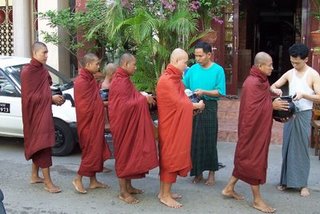
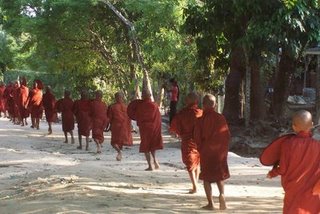
A long line of saffron robed monks strolled by for their morning alms. They live off the donations given to them by the rest of the community, devoting the rest of their time to meditation, study, and the sharing of Buddhist values. We were glad somebody was happy: people are particularly generous for Buddhist New Years alms, and nobody wanted the bad karma of hosing down a monk.


We decided to join up with our Yangon guide, Nu, to visit orphanages across the river. Trying our best to avoid any further engagements, we ran, ducked, and crept down back-alleys to a bus stop where Nu flagged down a pickup truck and pushed us on board. The passengers rolled their eyes when they clapped eyes on our white skin, knowing their dry pickup would now be targeted by every drunken Yangon yahoo with a water gun. To make matters worse, we didn't actually fit on the truck and a few previously comfortable commuters were asked to ride on the bumper and hang out the back for our sake. Clinging for dear life to the back of a truck while being fired upon with riot hoses is fine for the locals, but such activities are considered too dangerous for white tourists. The junta wants nothing to tarnish their beloved tourist industry, and the driver would stand to get into serious trouble if anything happened to us.


It wasn't long before we were spotted by the yahoos. "Here they come," muttered Katlijn.


I poked my head outside to see the approaching ambush: a couple of bucket-toting kids and some whisky-drinking Indians on hose duty. "You know the drill," I replied dryly.

We clasped our hands over are ears, shut our eyes, and ducked underneath the bench.

"Happy New Years !"


And with that, our driver hit the accelerator and we roared through the deluge. The velocity of the truck working against that of the incoming water buckets produced a loud smacking sound when the freezing water splashed against our backs. A frail old woman sitting across from us got a particularly violent slap to the face. Everyone on board remained exceptionally friendly with us, but we feared our popularity would start to wane after a few more of these incidences. We chose to step off as soon as we were close enough to the orphanage to walk the rest of the way.


The post-colonial renaming plague sweeping across Asia has also struck the country of Myanmar in a devastating wave of utter confusion. The British invented the name "Burma" after the "Burman" people who are the dominant ethnic group. However, the political situation in the country is far messier than this colonial-era name implies. Over one hundred different ethnic groups are known to live in Myanmar, and there are at least one hundred and nine different languages spoken in the country. Many of these ethnic groups have been fighting each other for centuries and are also sworn enemies of the predominantly Burmese military junta. To help pacify some of these people, the junta changed the name of the country to the more inclusive "Union of Myanmar". Americans and British do not view the military regime as the country's legal governing body with authority to change the country's name and therefore continue to use the old British name "Burma". Thus, we now have the awkward choice of selecting the imperialist name of "Burma", or recognizing a brutal military regime by using the less racy "Union of Myanmar".

Changing the name of the country and providing other political incentives was not enough to placate all the ethnic groups wanting either more autonomy or outright independence. For the last fifty years, the military junta has been battling several disparate insurgencies in various parts of the country, and there are credible reports of retaliatory killings, rapes, and other atrocities committed by the army against civilians. Most of this fighting is contained in remote mountain regions so nobody really knows what is going on. However, there is a constant stream of traumatized orphans fleeing these contested regions who, if they are lucky, may eventually find themselves in the sanctuary of a monastery. Soaking wet and fearing rejection by our fellow commuters, Nu took us to visit two of these.


The first orphanage was run by monks- all men in saffron robes. The monks shared their food with us: a huge banquet provided by today's bloated New Year's alms. It was probably the tastiest and most glutinous feast we ever ate in Myanmar. So much for the middle road !


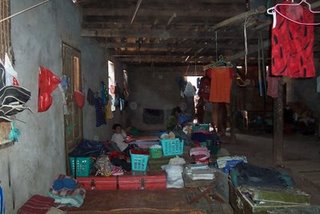
Children's dormitories. Each child has his or her own space with a bed and a metal chest containing their belongings. They sleep and do their homework here. It is possible to obtain a high school degree at the monastery, but we only met one girl who made it that far in her studies.


The orphanage was basically a ramshackle arrangement of dilapidated monasteries and concrete dormitories with corrugated tin roofs providing shade for several dozing monks. While perhaps more spiritually advanced than your average layabout, Myanmar's monks could certainly loaf about with the best of us. They had all the laid-back attitude and Eastern philosophical bent of a Berkeley hippie, but without the free-love, drugs, and poor hygiene. Otherwise, while the compound definitely lacked a woman's touch, it had a kind of fun chaotic air as the children's variegated smiles of multiple ethnic origins ran amok in celebration of Buddhist New Years. The kids went absolutely wild when we showed up, desperate to bless us with a cup of scented water, gawk at our giant white bodies, and pull my exotic arm and leg hairs- a favorite feature of mine with Burmese children guaranteed to produce squeals of glee. The monks had built them a little wooden platform on the road where they could participate in the water festival like other kids in Yangon. Fortunately for us, there was just enough discipline at the monastery to forbid the use of fire hoses.


Not all was right at the monastery. Some of the little girls were covered in scabs, and another didn't speak at all but stared blankly forward in a permanently heartbreaking forlorn expression. The abbot looked positively exhausted and depressed. Nu insisted he was normally a loquacious host and provided the following bizarre explanation for his current mood:


The monastery owns two giant pet pythons. The pythons slither freely around the compound and the kids are allowed to "play" with them, presumably unsupervised by the looks of the place. While that all sounded pretty scary to me, snakes are held in high esteem by Buddhists. Besides, we are told the children love them to pieces.


Hoe vind je dit bericht? 1 stem
Geschreven door andrew om 00:00 Reageer op dit bericht

New Years in April

T.S. Elliot must have had the weather in mind when he wrote that "April is the cruelest month". Temperatures in Myanmar soar into the mid-forties. Regular power outages all over the country render not only the air-conditioning useless, but also the overhead fans, and refrigerators. I've spent hours wandering the sunny streets desperately searching for a cold drink, sadly longing for ice-cubes only having to settle for yet another warm glass of imitation Burmese Coca-cola. There is no respite from the heat.  

Until the water festival.

The Buddha couldn't have been more merciful in setting up his New Years celebration in the middle of April: a time when we are told to wash away the sins of last year with a bucket of cool water, so we can begin our next year of debauchery cleansed and refreshed. In the past, this meant three days of daintily pouring perfumed water from a small silver bowl on friends and neighbours. Unfortunately, things have gone sadly downhill in modern times. Maybe it's global warming. Today's Buddhist New Year Festival is a ruthless ten day water war waged all over the country, with next year's debauchery getting a formidable head start.


Girl dancers in traditional clothing line up with silver bowls of perfumed water for the opening ceremony in Yangon.


Nu took us to Yangon's New Year's opening ceremony. Along the way, small children and gangs of adorable young street kids asked us respectfully if they could please pour a bit of water on us. The chance to pour water on a white backpacker was an opportunity so exciting and novel it never failed to illicit shrills of enjoyment. We were only too happy to oblige. Behind them, however, their older siblings prepared more formidable instruments of water warfare. Their hungry smiles were laced with menace. They wanted nothing more than to wipe out all traces of last year's sins. However, for now, tradition protected us. They would have to hold their fire until after the opening ceremonies.


During the opening ceremony, a line dance of men and women gracefully poured water on each other.

Without the foggiest clue what was going on, a few police kicked several old ladies out of their plastic toy chairs, and we were ushered to sit in their places. Sweating profusely in our stinky Teva sandals and the same Nepal Trekking shirts we had been wearing for the last six months, we found ourselves in the seat of honour next to Yangon's City Mayor and some of Myanmar's most famous young film talents. In a pathetic and hopeless attempt to look important, we tried to chat with our Burmese-speaking neighbours until the opening ceremony began: a kind of dance and theatre show that looked suspiciously like last night's strip-tease.


Burmese film stars looking cool for the water festival. 

Among other Burmese celebrities, we ran into Mo Win, a world-famous photographer now living in Yangon. He and his French wife invited us for a ride in the back of their white pickup truck to see the water festival at nearby Inye Lake. Along the way, we picked up a few more Americans and squeezed together in the back. The opening formalities were over, and it wasn't long before we were assaulted by gangs of water throwing, whisky-swilling hooligans dressed up like British punk rockers.


The water fight had begun, and foreigners were not exempt. Indeed, we soon discovered that a clunky old pickup truck full of white-faces was considered a unique find and a primary target deserving special attention. While the morning's cute kids with cups of water were all in good fun, now that their older siblings had taken over it became a dangerous sport. Though previously impossible to find, garbage pales of freezing cold ice water now seemed to be everywhere, their contents pumped out at us with painfully high-pressure fire hoses. As our truck skidded down the windy roads, every turn was manned by adolescents with exotic water guns whipping us with buckets of high velocity ice water of questionable purity.


A pickup truck full of Indian immigrants preparing for an ambush. Ear protection is of paramount importance when attacked with a fire hose. 

Mercifully, Mo Win ground his aging white pickup to a halt outside his gorgeous mansion. Soaking wet, freezing cold, and covered in red fire-hose-induced welts, we piled out of the back and ran through his gates to safety. Within minutes, we were in the serenity of his grassy yard, underneath the shade of his giant mango tree, eating its fruit freshly picked and prepared by his servants. Moments later, a couple more of his Burmese employees produced copious amounts of food, cool frothy mugs filled with beer, and a bottle of quality French wine.

"It's safe in here, we can talk." Interestingly, he was referring to a draconian law in
Myanmar prohibiting groups of more than five people meeting together for discussion, rather than the ruthless gangs of water throwing Burmese punkers outside.
`

Mo Win is on his third marriage to a much younger French girl. He has to "upgrade" every few years, in his own words. With a long dark mane of black hair he looks young for his years, and likes nothing more than the sound of his own voice; fortunately for him, he does exude a certain charm. He summarizes life under the regime like this:
"We live our lives, and the government officials live theirs. We don't really mix. My art isn't political and I don't involve myself in politics. If I did, I'd be counting beads." The Lady, Aung San Suu Kyi, is one of his biggest fans and the NLD once asked him to photograph her. "I told them to stuff it ! Are they crazy !?", he exclaimed, "I'd be counting beads !"

The Burmese have mastered the art of Asian collective resourcefulness. In their close-knit community, everyone knows a friend of a friend to get things done. As a gifted photographer who lived most of his life in

France, Mo Win is a bit of a foreigner in his own land. His son once chastised him for being too honest on his tax returns, and demanded he get a local to do it properly. The Americans we picked up study Buddhism and do volunteer aid work. Locals help them to stay in the country for prolonged periods by arranging them business visas through a fake company.


Our gang gearing up for another forray: stuffing our valuables into water-tight ziplock bags and applying another coating of water-proof sunscreen.

Mo Win insisted we finish our drinks and set off once more, determined to show us the water festival at Inye Lake. We crowded back into the pickup truck, our ranks now swelling to include several of Mo Win's Burmese wine-pouring coolies and a couple of bottles of scotch. As the truck rounded each corner, cries of "Happy New Year" were followed by such a relentless barage of water balloons, ice buckets, and fire hoses we'd periodically lose passengers out the back.


Inye Lake turned out to be the main front in Yangon's water battle: a chaotic honking gridlock consisting of bumper-to-bumper pickup trucks carrying a cargo of water guns, hoses, and comatose old men still clutching emptied bottles of Jack Daniels. Through the polluted haze of low-grade Russian diesel exhaust, a motley crew of revelers held hands with green-haired teenagers dressed in studded leather and Union Jacks, dancing in the flooded streets to the rhythm of Burmese covers of Western Hip-hop. A virtual monsoon of water rained down from large wooden structures temporarily constructed to cater to throngs of Burmese kids who had paid good money to dump tanks of ice water and fire riot-pressure water hoses into the chaos below them.


Our rusty old pickup broke-down along the way so I had to jump out of the truck and push. The Yangon sewage system was overwhelmed by the deluge, and I splashed down into a knee deep river of chocolate water carrying past a detritus of mixed filth in its formidable current. With the men out of the truck, the two girls were exposed and abandoned in the back.

If the exotic site of a pickup truck full of white foreigners induced shrieks of enjoyment, cries of laughter, and buckets of ice water, the dream-like scene of two white girls in wet T-shirts dancing on a truck induced instant euphoria in the general vicinity. While two of Mo Win's coolies poured copious quantities of scotch down my throat, I caught a glimpse of an entire block of fire-hoses beaming down on Katlijn as she desperately swam across a pool of rank liquid spilling out of the back of the pickup in muddy cascade of garbage.


Other events that evening were so surreal I'm not sure anymore whether they actually happened or were some water-logged product of my inebriated and over-stimulated brain. I seem to recall a midget Asian rapper busting out a Burmese translation of government censored Eminem lyrics flanked by a troupe of background dancers that included a seven-foot albino giant break-dancing with an afro-wig. It was like a David Lynch film on crack.`

Sometime late that night, we finally made it back to our certified non-government operated hotel room for a cold shower and a non-functioning air-conditioner. Maybe it was just an emotional release during a week's time when the junta relaxes its grip and it temporarily becomes socially acceptable to make a complete ass of yourself, or maybe it is just a lot of experience with riot police. Whatever it is, the Burmese really know how to throw a good water fight.

Hoe vind je dit bericht?
Geschreven door andrew om 00:00 Reageer op dit bericht

Cell phones


We spent our first night in Myanmar at a Burmese strip bar. Our evening began with a pleasant stroll along the tree-lined sidewalks of Yangon's deteriorating colonial metropolis. The bustling sidewalk was full of the exotic medieval. Everyone was trying to sell us something: a juicy betel-nut fix, skewered crickets, spare auto-parts.


A typically busy sidewalk scene in Yangon. Girl's roast meat on an open fire. A boy with a white tank-top and brown traditional Burmese longyi looks for new customers. Poor, wealthy, old, and young come to sit as equals on the tiny red plastic chairs and gossip over a hot cup of bitter green tea.

`

Quite suddenly, a respectable looking chap, sporting a neatly ironed pair of longyi and a fancy cell-phone, emerged from the chaos and accosted us in miraculously perfect English. He wanted to tell us what was going on in his country and to describe what happened during the riots last September. He explained how we couldn't do this on the street because somebody might be listening in on our conversation; the regime is known to throw English-speaking students like him in jail. Katlijn and I were both excited by our piece of espionage. I thought this sort of unlikely plotline only happened in James Bond films. Feeling like a couple of secret agents, we followed our new friend into one of the city's many holes in the wall.


Inside was perhaps the world's most pathetic strip bar. In place of the rowdy testosterone-charged seediness of a Las Vegas club, the crowd of beer-swelling Burmese men couldn't look less manly squatting down on the tiny, knee-high, red plastic chairs seen throughout Myanmar's tea shops. The smiling face of a Chinese girl peeled off the wall along with the rest of last year's calendar poster. She looked positively lonely pasted against the massive windowless concrete. As in other Asian holes-in-the-wall, the decor was so sparse and pathetic it only accentuated the gloom. On stage, was a line of pretty Burmese girls dancing to the emotionless din of muzak, barely discernible through the crackle of the 70s-era audio technology. Like all strip bars in Myanmar, the dancers remained fully clothed thus emphasizing the "tease" portion of their profession. As we sat on our miniature table, it occurred to me that James Bond wouldn't be caught dead squatting in one of these ridiculous toy chairs in a dodgy place like this.


Beer is a government sponsored joint-venture in Myanmar. As we were trying to direct our money as much as possible to local people, we refrained from ordering a pint of the only redeeming feature in this establishment. Instead, we spent the whole evening talking about Myanmar. He explained how he was a student participating in the riots that were broadcasted around the world last September; the first since "8-8-88". He described a surreal moment when the protesters and the police met on the broad-boulevard surrounding the Shwedagon Pagoda. Both sides faced each other in total silence listening earnestly to a Buddhist monk give an eloquent sermon through an old megaphone. When the sermon stopped, the police began firing into the crowd.


Kippling wrote the following upon seeing the Shwedagon Pagoda: "Then, a golden mystery upheaved itself on the horizon, a beautiful winking wonder that blazed in the sun, of a shape that was neither Muslim dome nor Hindu temple-spire. It stood upon a green knoll, and below it were lines of warehouses, sheds, and mills. Under what new god, thought I, are we irrepressible English sitting now?"


Images of the Shwedagon Pagoda are similar to those found in Nepal and Tibet: ordinary Burmese men and women meditate near the giant stupa, while saffron robed monks walk clockwise around the giant structure. Myanmar and Tibet share both political and cultural parallels.


The Shwedagon Pagoda is surrounded by eight planetary posts corresponding to the eight days of the week in a Buddhist calendar. There are eight days in the ancient Buddhist calendars because Wednesday is divided into two separate days (AM and PM). Each planetary post has a different animal sign. Devotees (and the odd tourist) pour water over their birth sign. According to our best estimates, Andrew was born the same day as Buddha, Wednesday morning, marked by an elephant with tusks.


The dazzling golden Shwedagon Pagoda is undoubtedly Yangon's best known-symbol, but its origin is controversial. According to Buddhist records, it was originally built over 2500 years ago before the historical Buddha died in 486 BC. However, archeologist now believe the current stupa was actually built between the 6th-10th century AD.

We agreed to meet our new friend the next day, but after waiting a long time, he never showed up. Instead, we found our way to a gorgeous green neighbourhood full of embassies and mansions that contrasted jarringly with the downtown area. Home to military generals and diplomats, it was clear that not everyone in Myanmar was poor. There were police stationed regularly on the sidewalk to patrol this portion of the city giving it an uneasy totalitarian air. We decided it would be a good idea to register with the French embassy before setting off.

On the way back to our hotel, we passed an aging old crone sitting on the sidewalk shading herself from the intense sun and oppressive April heat with a small umbrella. She carried a dusty old rotary-dial telephone in her lap. It's hard to imagine how she ekes out a living doing this, but in our experience, people like her constitute some of the most reliable pay-phones in the country. We had a telephone number we found on the internet of somebody named "Thiri" who gave revealing tours of the city. As Aung San Suu Kyi once said, "approach the Burmese telephone with a prayer," so it was something of a miracle when a kind voice crackled through on the other end. We agreed to meet in half an hour.


A gang of Burmese street-kids. They can speak surprisingly good English- better than many people with the benefit of parents and an education. Amazingly, they don't ask for money but seem genuinely interested in just hanging out with foreign backpackers. Street-wise and friendly, they'll never let a Yangon cabbie rip you off.


Thiri turned out to be a kind-hearted little Burmese lady with a working knowledge of English and characteristic bright smile. Like our friend from the tease-club, she wanted to take us to a place where it was "safe" to talk. On the second floor of a sleepy old guesthouse, we conversed a long time about Myanmar and she confirmed most of the things our friend told us the night before. These conversations were new and exotic to us at this time. However, they soon became a regular feature of our travels through Myanmar. Not a day would pass without somebody telling us their story.


She was certain our hotel was operated by the government and suggested we move to another facility. Like most Western visitors to the country, we wanted to cater privately-owned facilities only and minimize money going to the regime.


"Didn't you think it was odd when they were the only hotel allowed to have a taxi waiting for you at the airport ? Why on earth did you decide to go there ?"


I felt a bit sheepish telling her my outdated guidebook recommended it as a decent private hotel. I wondered if James Bond ever used the Lonely Planet.


She went on to tell us that the government has spies everywhere. They could be dressed as monks, taxi drivers, and shop-owners. She warned us to be careful of what we say about her to other people. Some people will tell us the same things she tells us, even slander the regime, and talk about their participation in the riots. Then, they'll report any potentially useful information we provide to the authorities.
 

"How are we supposed to know who we should and shouldn't talk to ?" We asked.


She explained that as an outsider, we'll never really know for sure, but there is one tell-tale sign: cell-phones. Special permission is required to own a cell-phone in Myanmar. It costs a normal citizen about $2000 to buy one- a fortune by Myanmar standards. Unless they are employed by the government, there is absolutely no way to afford it.


"In Yangon," she finished, "never trust a monk with a cell-phone."


Myanmar was a world away from Thailand. I thought back to our absent friend this morning. We had a lot to learn about this country.


A small plastic chair, a table, an umbrella, and an aging mechanical typewriter make up this old man's office. He has setup his buisness just outside a government office, earning a living by typing out the formidable documentation required for requesting governement cell phones.

Hoe vind je dit bericht?
Geschreven door andrew om 00:00 Reageer op dit bericht

The Burmese Paradox : Part 2

Comparing the two neighbours today, and it is hard to fathom what happened. Thailand's new capital at Bangkok is a booming hive of modernity sprouting towering skyscrapers and high-tech Starbucks-studded mega-malls. Meanwhile, Myanmar's aged ex-capital at Yangon is a dusty grid of crumbling British colonial buildings struggling to maintain their dignity in slow decay. Somehow, in the last century, something went wrong in Myanmar.


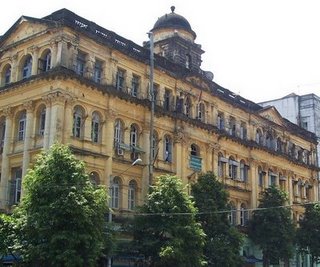
Yangon's crumbling city hall.


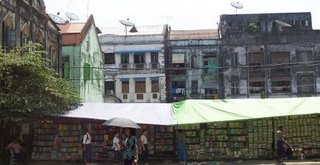
A woman walks past an outdoor Burmese book market shielding herself from the relentless Myanmar sun.

Sadly uncared for and somehow anachronistic in downtown Yangon, the bright greens, yellows, and turquoise of Britain's influence still radiate a melancholy beauty. 


Fortunately for us, it is much easier for a tourist to enter Myanmar than an aid worker. Within days of applying for permission to visit Myanmar, we found a hotel taxi waiting for us at Yangon airport to take us to "The Motherland 2" hotel. We were soon stumbling apprehensively through Yangon's dark and potholed checkerboard of Technicolor colonial buildings- vestiges of British rule when Burma was considered part of its Indian colony. Yangon's rooftops became a jungle of antennas after the military junta recently allowed BBC and National Geographic to reach households. Long isolated from the rest of the world, Yangon's skyline is a powerful testament to a beleaguered colonized people grasping for knowledge and a sense of inclusion into the outside world. There was something of South East Asia in the smiling faces around us. Something of India in the crowded concrete holes in the wall full of tea-drinking beetle-nut spewing coolies. But then there are regional touches all its own: green cheroot cigars hanging from wizened grandmothers, yellow thanakha drying on a baby's face, green uniforms and metal helmets worn by the government's ubiquitous police.


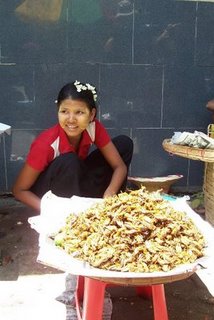
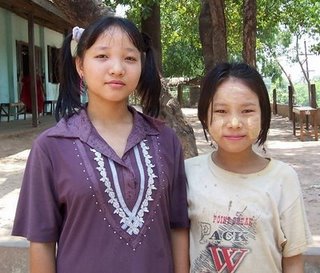
Burmese women are among the world's most beautiful- shown here selling roasted crickets with characteristic smile. The next time Myanmar shows up on the news, watch for the pale yellow paint on the faces of nearly all Burmese women and children. It is a paste derived from tree bark, called thanakha, and is a form of sunscreen. As far as I know, the Burmese are the only people in the region to wear sun block.


Myanmar never really made it on the tourist radar map- odd considering it has vast stretches of white-sand beaches that rival Thailand's, a temple complex more vast and exotic than Angkor Wat, and huge tracks of unspoiled nature which are among the least-visited places on the planet. Nevertheless, these obvious draws are probably not why a small cadre of crusty backpackers visit Myanmar each year- indeed, they probably never even knew about it since traveling to this land is discouraged by self-respecting foreign travel agents. Rather, they come because they shouldn't be here. And this is how visitors feel their first night in Yangon: the exhilaration of witnessing the forbidden as pairs of warm and curious eyes follow them with mixed feelings from the bustling sidewalk market places.


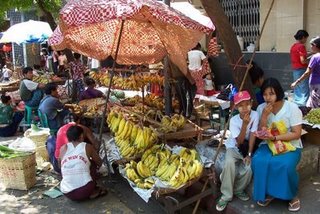
Sidewalk banana store.


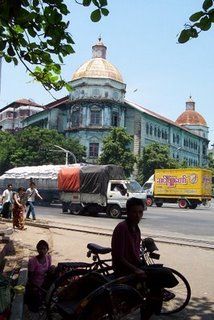
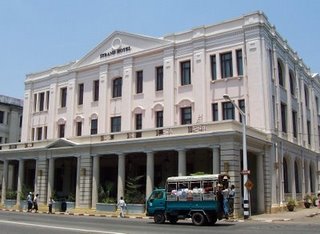
What passes for public transportation in Yangon (an old pickup crammed so full of people they are forced to hang out the back) drives past the colonial-era Strand Hotel. This gorgeous hotel was perhaps the most luxurious in the British Empire, catering exclusively to white clientele.

Burmese people weren't allowed inside the Strand Hotel until its independence in 1948. Myanmar has always had an abundance of natural resources, and this wealth can be found in some parts of Yangon and other major cities. The problem is that throughout its recent history, the money has been horded by those in power and never made its way to the general populace.

The people of Myanmar are among the world's most friendly and hospitable, but somehow their government is among the world's most ruthless and oppressive. Britain's rapid withdrawal from its former colonies resulted in many tumultous years in Burma, until a military strong man by the name of General Ne Win seized control in 1962. Since then, he and his military junta have accumulated a long list of human rights abuses and a history of tragic mis-management along their bizarre march towards a Burmese Socialist Utopia.


Just how crazy is General Win ?


He believes that the number "9" is an auspicious figure with magical properties. As his incompetent rule continued to erode the country's former wealth until Burma became one of the ten poorest countries on earth, he devised the following economic policy:


On September 9th (the 9th day of the 9th month), he invalidated all 50 and 100 Kyat notes, replacing them with 90 and 45 kyat notes (9 + 0 = 9, 4 + 5 = 9, and like all numbers with this property, evenly divisible by 9) . It is tempting to attribute this decision to a naive, though well-intentioned, autocratic nut-head infatuated with numerology. However, this interpretation is far too generous. It was later revealed that he changed the currency to add up to 9 only because his astrologer told him he would live to be 90 (there's that number 9 again !) if he did this. Regardless, many people lost their fortunes overnight.


Understandably upset, students all over the country protested on August 8, 1988. This event is called "8-8-88" or "four eights uprising" by the people of Myanmar referring to its date. Ever superstitious, many people in Myanmar believe the number "8" is also thought to have magical powers. The regime reacted with a spree of killings and arrests so terrifying that there wouldn't be another large scale protest for nearly twenty years. In a seemingly miraculous change of face, the junta agreed to open elections in 1992. Not surprisingly, their rival party, the National League for Democracy (NLD), won eighty percent of the parliamentary seats. Having exposed themselves, these representatives were promptly arrested and their supporters harassed. The spiritual and political leader of the NLD, Aung San Suu Kyi, remains under house arrest to this day. 

The beautiful and eloquent Aung San Suu Kyi has won both the Nobel Peace prize and the hearts of her people. She is one of the most prolific and well-respected modern writers on democracy and human rights. Aung San Suu Kyi doesn't want us to visit her country.
"The Lady", as Aung San Suu Kyi is referred to in Myanmar, believes tourism brings both respectability and economic aid to a nefarious regime. She thinks tourists are shuttled in air-conditioned tour buses between the government-approved attraction, don't have an opportunity to interact with local people, and will therefore bring home a distorted and incomplete view of the country. She has also suggested irresponsible mass-tourism will devalue and comodify Myanmar's traditions. In her own words, "to suggest that there's anything new that tourists can teach the people of Burma about their situation is not simply patronising - it's also racist."
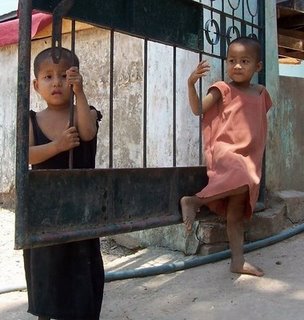
Ironically, it is the reclusive military junta that wants us to visit. In their words, "tourism will replace criticism from abroad".

Others argue they are both wrong: tourism will heighten public awareness abroad, bring much-needed money to the people, and provide a meaningful cultural and language exchange.

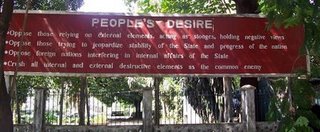
The People's Desire, as dictated by the military junta, is posted in all of Myanmar's public parks and published daily in the country's propaganda-ridden newspapers.

General Ne Win's military junta remains in power today. His legacy is a country who's formidable wealth of natural resources benefits only a small number of government officials and their Chinese patrons, while much of the rest of the population lives in poverty. Of course, Myanmar's political situation is more complicated than one man and nobody really knows the ultimate reason for the divergent fates of Thailand and Myanmar. Nevertheless, the Burmese people offer their own theory: ever superstitious and mystical, they believe Ne Win was the reincarnation of a Thai prince defeated and executed by the Burmese who swore an oath of vengeance and put a curse on the Burmese nation. General Ne Win died six years ago, having lived to see his 90th birthday.

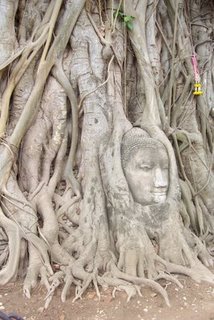
Ayathuya is home to one of Thailand's most famous images: the head of Buddha wrapped in the roots of a Bodhi tree. The combination of Buddhist imagery and nature is considered particularly auspicious.

Hoe vind je dit bericht?
Geschreven door andrew om 00:00 Reageer op dit bericht

The Burmese Paradox : Part 1


Burma is a wealthy country.


It's rich portfolio of resources- oil, natural gas, teak wood, fisheries, minerals, and arable lands- is the envy of the region. Two centuries ago, they were an empire to be awed and feared. Long before Siam changed its name to Thailand, King Ayathuya of Burma marched his considerable army into the Mekong Valley and razed Siam's thriving seaport capital of Ayathuya to the ground. He wrote a triumphant letter to their king exclaiming:


"There is no rival for our glory and our karma; to place you beside us is to compare the great Galon of Vishnu with a swallow; the sun with a firefly; the divine hamadryad of the heavens with an earthworm; Dhataratha, the Mamsa king, with a dung beetle."


Thai monks studying the remains of a Buddhist image in the ruins of Ayathuya. The ancient city, still a source of national pride in Thailand, was destroyed by their powerful neighbors in Burma.


For hundreds of years, Ayathuya was the most prosperous merchant city in the region, accepting traffic and trade from as far away as Portugal. The Burmese entered Thailand and ransacked the city so thoroughly, nearly all official archives were lost and many details of Thailand's history remain vague.

Stupa reflecting in the water. Today, all that remains of Ayathuya are the brooding ruins of its once formidable religious sites.


Broken Buddha images in Ayathuya.


Hoe vind je dit bericht?
Geschreven door andrew om 00:00 Reageer op dit bericht

Meer van op wereldreis

↑ Terug naar de berichten