Naar de inhoud

op wereldreis

geniet mee van onze avonturen
akke.beakke.be
Een jaar lang op wereldreis : ikzelf (Katlijn) ben een Vlaamse Belg. Mijn vriend Andrew (een Canadees) is de schrijver van dit blog ... daardoor zal de hele blog in het Engels zijn

Archief

God's Own Country


                         56585-3e540589b4a28ff7ef241d64a060906d.JPG

Worn and dilapidated gravestone of a forgotten Dutch trainer in the corner of Kochi's graveyard.

A long overnight train ride away from Arun's tasty idli breakfasts and Bangaluru's appalling traffic conditions lies the amazingly laid-back town of Kochi, deep in the heart of what is known in India as "God's own country", Kerala. In the thirty minutes it took us to circumnavigate the charming, albeit touristy, 16th century trading center, we took in such diverse colonial remnants as giant Chinese fishing nets, white washed Portuguese cottages, British Raj mansions, Muslim mosques, and Jewish synagogues. Drinking outstanding tea and devouring some of South India's spiciest seafood curry creations in the shadow of the town's abundant foliage, the collective relief of India's weary travellers was almost palpable.

While colonialists somehow managed to sew a European country village into the fabric of a tropical Indian coastal landscape and culture, vestiges of Kerala's native traditions were kept alive. Our favourite Indian art form is, without a doubt, Kathakali. Developed at roughly the same time Shakespeare penned his great plays, Kathakali is South India's own unique form of theatre. To the beat of four drummer's complex rhythms and the exotic melancholic voice of a lone male singer, players dance and act out the great Indian Hindu epics in long drawn out performances that last more than twelve hours. In place of words or song, the story is told through a system of dramatic bodily gestures and evocative, even frightening, facial and eye movements. During the climax, performances become extremely intense. The drummers are drenched in their own sweat as their pounding sends the dancers into aggressive motions, contorting their faces into countenances made more ominously expressive through the use of dies which turn the whites of their eyes a deep crimson.

56585-c54fdb4f6af5cce597688c50050822fa.JPG

Kathakali performers study 12 years of dancing, theater, and make-up to master their art form. Preparation before a performance lasts several hours. Paint, elaborate costumes, decorated headpieces and meditation are required to transform themselves physically and mentally into the gods and demons they play.

The stories are a tad on the grizzly side. The performance we saw featured the hero literally eating the intestines of the villain in an act that was made more horrific by the simplicity of the props: a very long white cord and a lot of thin red paint. The final scene had the hero's exotic facial paints covered in fake blood dripping from his mouth, which he wiped off and ran through his wife's hair, with the villain on his back writhing about the stage floor in his own intestines kicking about in a pool of thin red liquid. Personally, I think Shakespeare would have loved it.

To tell you the truth, twelve hours of this sort of entertainment would be a bit much for even the most sadistic of Western horror freaks and shorter, feature film length, adaptations have been developed for the area's tourists. Interestingly, these adaptations are considered a major affront to many of Kerala's people. Kathakali is more than theatre, it is considered an act of worship and an important religious ceremony. Kathakali artists participating in curtailed tourist performances consider it offensive to their gods and often do so only out of desperation to support their families. Some performers have found this type of livelihood so despicable they have become depressed and resorted to alcoholism.

                                                                      56585-eb77b8e24b90d6557639e4c93cab77a9.JPG

A Kathakali demon dancing in full regalia. Tourism is a mixed blessing for Kerala's theater tradition. While the money keeps their intense art form alive, its presentation must be modified to suit a Western audience. These adaptations are considered blasphemy to serious students of this religious musical theatre.

Hoe vind je dit bericht?
Geschreven door andrew om 00:00 Reageer op dit bericht

Conflict in Bengaluru

                          56434-d8f8dedc0591f3b913dbcdf0fdea2687.jpg

The 15th century ruins of Vijayanagar's Hindu Empire.

Far away from Goa's former paradise, in a quiet boulder strewn wasteland, lie the brooding remains of one of India's greatest forgotten empires. According to ancient Hindu legend, Hampi is the realm of the monkey gods who aided Rama in his fight against the demons. It later became the vast capital of Vijayanagar's wealthy empire, formed in the 14th century as an alliance between lesser Hindu Kingdoms to counter the Muslim threat from the North. For hundreds of years, it was the front in a campaign between Hindus and Muslims trying to out-atrocity each other with increasing effectiveness in the struggle for the soul of south India.

56434-efaf98db2eac3a61946ca0282ae6ddd4.jpg

                                             Virupaksha temple towers 50 meters above the Hampi Bazaar

                                            56434-792069df363c9e9a3737d98e38ffb46e.jpg

Hampi's ruins nestled in the surrounding landscape of giant granite boulders.

56434-efc7da8df082905ed77570509e96f33c.jpg


Ruins hidden between banana plants.

While Hindus and Muslims continue to wage conflict in other parts of the subcontinent, Hampi's role as a modern battleground continues: pitting those who want to protect what little is left of a collapsed empire against those seeking to profit from its lingering ruins. As we groggily gazed out the door of our grungy sleeper bus at the theatre before us, it was clear who was winning. Without a choice, we dove into the turbulent sea of touts blocking our exit at the door, their hands moving about in a flurry holding above them small white business cards that seemed to float above the vast ocean like flotsam undulating in choppy waters. Our bodies fully submerged, we suddenly sensed the presence of an underwater beast. A hundred pairs of eyes fixating greedily on our backpacks that bobbed above us like towering buoys. Numerous hands grasping at our money belts. A multiplicity of mouths loudly querying our country of origin. The countless bodies of hired cabbies fusing together into a single multi-limbed organism that fed lustfully around the aging corpse of a dusty tourist bus whose innards trickled out of a small wound on the front-side and were sucked into the writhing monster. We were in the midst of a close evolutionary cousin to the Indian queue beast that had been domesticated by baksheesh paying hotel owners into a formidable war animal. Each of its brains had been selected and conditioned for the sole purpose of consuming dusty backpackers that emerged tired, weakened, and bruised from a relentless overnight suspension-less bus ride.

But Katlijn and I, hardened by our own struggles against Mumbai's cheeky cabbies and Varanasi's midnight hand squishers, persevered. Swimming desperately against the tide of the monster, we managed to escape its groping tentacles and emerged safely at a guest house one block away. Others were less fortunate. As we looked back, we saw the beast herding blurry-eyed travellers, unaware of what was happening to them, into over-stuffed rickshaws for deportation to the nearest scam.

56434-ea0323f5ac1a2b11042a523c8a2c49a1.jpg


56434-5f732a84bfba6ba0230e11ef4e49ba38.jpg

Ancient Hindu temple architecture. Before its sudden destruction in the 16th century at the hands of Muslims, the city of Vijayanagar covered 650 square kilometers and had a population of over 500,000.

Based in the safety of our guesthouse, we spent a couple of days exploring the crumbling ruins of India's magic. With only 58 of 550 monuments protected as a world heritage and the local businesses constructing new facilities, it may not be long before the war would finally be lost and new India's rampant tourist empire would destroy Hampi's heritage, just as an alliance of Islamic sultanates did more than 400 years ago. For now, however, Hampi remains a fascinating and mystical place. I cannot think of very many things more enjoyable then renting a bike and peddling about the weirdly balanced rocks and lush banana plantations trying to fathom the beauty of the atmospheric landscape when it was home to an ancient civilization and a vast temple complex. We could have spent days in the blissful company of the these ruins and a dilapidated Indian basket bicycle, but Katlijn contracted an alarmingly high fever forcing us to consider the possibility of malaria. As alluring as it was to lose ourselves in south India's turbulent history, we set off to Bengaluru in search of what we really needed: modern medicine.

56434-d89f8359edc7d84465db4be60b9b9420.jpg

Sunset over Hampi.

My old floorball pal, Arun, and his lovely and very pregnant Belgian wife, Ellen, were very kind to let us take refuge at their home while Katlijn's temperature crept back to normal under the powerful spell of Arun's home cooked idlis and sambar. In addition to their generous hospitality, Arun and Ellen showed us the other side of India: their charming apartment, the possibility of decent Italian food in a modern Indian city, and supermarkets stocking exotic eastern fair beside more familiar western food items. They have nothing but praise for the emerging cosmopolitanism of former Bangalore, describing it as the perfect compromise between the warring faction's of new India comfort and old India simplicity. However, as I walked down the aisles of Arun's neighborhood food store, I studied the western items closely. Looking down at the jar of Ragu Spaghetti sauce I held in my hands, I realized that Bangaluru was finishing for me a process that began with Mumbai's coffee franchises and continued with Goa's uber-tourism: India losing its magic.

This was it, Bengaluru: center of the flat world, the silicon-coated hive of new India from which the IT money marches forth en route to Bikaner and the furthest reaches of the land, slowly silently dominating the entire planet while nobody is looking. And what does this new world power look like ? A giant traffic jam. A rush hour like no other. A perpetual twenty four hour gridlock with high and low tides that fluctuate between flooding the entire city and just the most important parts of it.

The groan of Bengaluru's creaking infrastructure buckling under the weight of so many vehicles can be heard in the conversations of the city denizens. When they aren't talking cricket and chip design, they are invariably talking traffic. Bengalurians are traffic gurus. Facing the overwhelming congestion on a daily basis, they have garnered a deeper understanding and appreciation of the very nature of traffic that cannot possibly be understood by you or me. Monk-like, driving aloof through the chaos, the city's commuters appear lost in equanimously observation over its impermanent processes. Later, they litter their conversation with tips on new-found insights: how best to time your departure to the office and the present state of street conditions that fluctuate under near constant construction.

There are no bovines strutting through the shroud of the city's formidable air pollution. Bengaluru is no place for cows. And with India's magic tragically disappearing in the clogged and polluted arteries of the world's most important IT boom town, Katlijn and I suddenly felt a burning desire to rekindle our spirituality.

Siddhartha Guatama, the historical Buddha, is considered by Buddhists to be the premiere scientist of his day with an intense curiosity of nature. All the major moments in his life (birth, enlightenment and death) took place outdoors, symbolically, under the cover a Bunyan tree. Critical of the unfair caste system and the unquestioned superstitions of the Hindu religion, he decided to try the following instead: sit still and objectively observe sensations on his own body. He reasoned these experiences represented the only reliable truth which, good or bad, needed to be acknowledged without bias. Through this process and living a moral life, he claims to have attained enlightenment which he later described to his students like this:

"Through countless births in the cycle of existence, I have run, not finding although seeking the builder of this house; and again and again I faced the suffering of new birth. Oh house builder ! You have been seen ! You shall not build a house again for me. All your beams are broken, the ridgepole is shattered. The mind has become freed from conditioning; the end of craving has been reached"

Which I thought was a tantalizing passage. After all, assuming he's not crazy, what did he experience and who or what is he referring to as "house builder" anyhow ? We figured this was exactly the kind of thing we needed to think about for ten days in order to feel again India's vanishing mysticism. Thus, under the guidance of Myanmar's great guru, Goenkaji, we set about learning Buddha's 2500 year-old vippassana meditation technique, still practiced today by the Dalai Lama.

The small male area where I confined myself for ten days to learn Buddhist meditation techniques. A volunteer hit the gong to signal the beginning and ending of our meditations sessions and meal times.

Consistent with the Buddha's original methods, Katlijn and I were separated into female and male dorm rooms, and everyone took a vow of noble silence where communication was forbidden for ten days. During this time, we were expected to live the life of monks following a rigorous schedule where we got up at four each morning and logged more than ten hours of meditation each day. All food was provided and prepared at no cost. The experience of living in the charity of others is integral to the teaching and therefore the course is, by necessity, free of charge.

56434-134166cbbb3aa78cb0865b8c0dff70e2.jpg

Meditating is more difficult than it appears and certainly doesn't reflect the very relaxing image we had of people in peaceful contemplation. At least the first steps are more like a mental battle ground. Before each session, I saw students marching up and down the grounds, stretching their muscles as if readying for a fight, even air boxing to pump themselves up for another long hard sitting.

If you think it's easy, try this: sit cross legged, your back perfectly straight, and your chin held high, then think about absolutely nothing else besides your breathing for one hour without moving a muscle. I give you one minute before your mind wanders away from the present to some unpleasant past or future experience, and about five minutes before you can think of nothing else but that agonizing pain forming in your lower back and that irritating itch on the tip of your nostril, both of which you should be observing with perfect equanimity.

`After torturing myself with this process for about thirty hours over the course of three days, I lasted long enough to sense the entire weight of my torso pushing down on my thighs and a tiny trickle of blood still circulating through the tips of my toes. At some point, the guru instructed me to absolutely force myself, no matter what, to stay in this position for a full hour. He dubbed this "strong determination" and it typically resulted in me limping painfully away from the meditation hall holding the railing for support.

I'm not sure how, but I mastered this pain after about seven days to the point where it became possible to sit still for a full hour with only minor discomfort. By the eighth day, some of the sensation could even be described as pleasant: the throbbing in my skull, the tingling in my toes, that soft tickling behind my ears. But this too, is a danger. Just as we were told not to let our minds succumb to the aversion of pain, so too should we never crave whatever pleasant sensations may temporarily flowing through our bodies. Both of these emotions are, ultimately, misery.

According to the Buddha, it is by developing the capacity to remain focused and objective in observing ongoing processes in our minds, ping-ponging between aversion and craving, moving restlessly between connectionless events of past and future, that you can be trained to discover the middle road and understand for yourself, experientially rather than intellectually, the necessity of compassion.

To be honest, I don't know if I bought into it all either, but certainly the nightly lectures on Buddhist philosophy and the experience of learning to meditate was stimulating enough for me to recommend a course in the technique to anyone. And just to ensure I end this lengthy entry by giving you something magical to contemplate, consider the following mysterious facts:

  • Two thousand years before the advent of modern science, Siddhartha Guatama taught that the body was actually made up of trillions of vibrating particles he called, kappa.
  • Long before Freud, Buddhist monks, through their system of objective self-contemplation, discovered and wrote about the sub-conscious.
  • Brain scans of monks during meditation reveal abnormal brain patterns and a substantially higher level of activity in areas of the brain responsible for compassion.

As we rode out of the city's choking traffic, it suddenly occurred to us that we had a new found appreciation for one of India's greatest and lasting contributions to civilization and we felt cautiously optimistic with the knowledge that mysticism could be found even in the depths of Bengaluru's IT madness.

56434-11991d15f6b374fd94b1be9dc8471259.jpg

Hoe vind je dit bericht?
Geschreven door andrew om 00:00 Reageer op dit bericht

Portugal's Paradise Lost


                    56422-d8f8dedc0591f3b913dbcdf0fdea2687.jpg

Sunset over Goa

By the time I boarded the night train in Mumbai's Victoria terminal, the busiest train station in Asia, my long campaign against Delhi-belly was almost won and I even managed a good night sleep before arriving in Goa. A rickshaw brought us to Anjuna beach where we began our ritual search for a decent budget room. Along the way, we met up with party-Dean whose presence in the hash-fueled hippy holiday pilgrimage of Goa was entirely predictable. He was nursing a beer at Anjuna's cleanest 30 Rupee eatery while he gave us the low down on the late-night beach side shindigs.

The budget rooms in Goa range from the dank and stinky to the downright scary. As we swung open the creaking doors, an ancient mildewy marijuana haze would issue forth from dark cave-like hovels revealing the blinking startled eyes of crusty backpackers who looked like they hadn't seen the light of day for years. Out of the dark murkiness, an intoxicated voice somewhere deep inside informed us through the cobwebs, "Yeah, man. For only 100 Rupees, this place is a steal !"

Miraculously, we stumbled across a family who, for almost no money at all, rented us a private room in their house, invited us to their dining room table each night for a much appreciated home-cooked Goan meal, and effectively adopted us for a week. Rather than hanging out with Party Dean and Goa's stoned beach bum crowd, we spent much of our days just relaxing on their patio with the mother and playing with her child, while granny was more than happy to fetch us a bucket of hot water when we needed to shower. This was budget travelling at its best !

56422-ae040a3d9b415ba24d436e0954ead4d4.jpg

Our life in Goa revolved around this little man called "Om".


To be frank, the Goan beaches themselves are a bit shocking. They teem with fat topless Germans and the gangs of young Indian men who come just to stare at them, while drunken leathered ex-hippies lament endlessly about how awesome Goa used to be to anyone polite enough to listen to them. Walking down the beach at sunset is done to the throbbing beat of techno emanating from the nearby Western oriented development while constantly vigilant to avoid the unpleasant feeling of slowly sinking your bare feet into the gooey softness of newly deposited dung piles left behind by Goan cows which (god bless them) strut emphatically up and down the coast turning their noses up at the invading European tourist hordes.

56422-85c727ce8f7f880a65fc7d883966c7c5.jpg

And what about Goa as the party place of all-night, open-air raves where the world's young bronzed travellers drink and smoke the night away ? This ended years ago with the enforcement of a government ban on loud music past 10pm at night. It wasn't unusual to find ourselves whiling away the evening at an empty ocean side bar feeling positively lonely as we watched the cows casually stroll by. Meanwhile disappointed party-seeking backpackers were being robbed by the exorbitant cover charge of the only nearby night club that is allowed to be open, or they were negotiating with the beach-side traffickers before holing themselves up again in a dingy budget hermitage.

                                                                    56422-b84953dfc2eb08d90841bac351f995fd.jpg

Anjuna beach feels a bit like an Indian Costa Del Sol with scantily clad Western women being hustled by beach touts and hopeful Indian masseuses.

56422-1b580ae131f2210352ddab527c79e559.jpg

Relaxed liquor laws makes Goa an affordable spot to kick back on the beach with a beer.

56422-8b95209b87f05be2d84695c5112ab165.jpg

Goa's dusk colors.

To be fair, those that can stomach lying on the beaches all day with a backdrop of all-inclusive package holiday development often love the place. However, it wasn't long before we felt impelled to escape.

Riding a motorcycle through the small villages and back country is a completely different experience guaranteed to re-affirm one's faith in Goa. While occasionally stopping to feast on the outstanding local coconut milk seafood curries and spicy fish creations, we weaved through the back roads between the palm groves, lagoons, and green rice paddies of some of south India's finest scenery.

56422-3653e221b004ad3b79eec35b66e944c6.jpg

                                                     Images of our Goan back-country motorbike trips.

Britain was neither the first colonial power to arrive in India nor were they the last to leave. Both of these honors go to Portugal who controlled Goa from 1510 until 1961. During its heyday in the 16th century when Portugal had a monopoly over Indian and far-East trade, the majesty and splendor of "Golden Goa" was said to rival Lisbon itself with a population exceeding that of London. However, if it weren't for a couple of impressive cathedrals that survived intact, Katlijn and I would have difficulty believing this now as our motorbike roared past crumbling church remains drowning in the surrounding jungle of palm trees. Without the resources to maintain its overseas empire, Portugal's Indian colony was eventually eclipsed by that of Britain and Old Goa was forgotten.

56422-511ea310e1e2b3b228fa6dd133bd9ab8.jpg

Atmospheric white-washed churches dot the tropical green landscape. Goa was the most successful of Europe's India colonies at converting the locals: today more than 30% of Goa's population is catholic.

56422-c97e6adec66d20a75c33aa815402bf85.jpgAging gracefully with their red-tiled roofs, these old

Portuguese houses reminisce over Goa's current capital of Panaji. Panaji is one of our favourite anachronisms in India blending the pastel shades of the Mediterranean with noisy India, it is probably the only place on the sub-continent serving delicious and authentic Portuguese food.

Hoe vind je dit bericht?
Geschreven door andrew om 00:00 Reageer op dit bericht

Bollywood

                       56416-734b4525d066ace7f1d15e31cb29e374.jpg

                            Mumbai's Victoria Train Station: vestiges of British India

While I lay awake in the white city - bollywood overnight express bus, bouncing painfully off the walls of its claustrophobic sleeping capsules, I mentally cursed that slippery little tout who convinced us its superior suspension was worth the extra money. Somehow, I managed to make it through the night and found myself staring out the window at dawn hanging over the city of Mumbai.

I remember once while travelling to Orchha, stepping off our bus in search of a toilet, an old crone pointed me to the back of a concrete roadside restaurant where I saw a thin aging man disappear behind a crack in the crumbling wall. I followed behind him and quite suddenly emerged into the light to find a large open field full of reeking garbage, families of wild boars feasting on rotting rice, and several squatting men, women, and children straining their bare bottoms in the heat. It looked like the apocalypse. It was as though in the last few hours, sometime after we got on the bus at Kajuraho and got off the bus at this nameless highway restaurant, some sort of great cataclysm had occurred which reduced civilization to defecating in their own trash.

Arriving in Mumbai, was exactly the opposite experience. The contrast between north and south India, old and new India, poor and rich India, never felt so vivid. Rajasthan's desert streets and potholes were replaced with modern highways and lane markings. It was as though, sometime between getting on the bus at Udaipur and getting off the bus at this nameless city bus stop, civilization had miraculously reconstructed itself and I found myself once again staring down a long clean avenue full of trendy coffee shops all trying to out-Starbucks each other.

56416-7f62ebb2858f93d8beb1098d82aeb9bd.jpg

Mumbai looked so clean and modern that I decided it was safe enough to try their medical facilities. The fact is, my bowels, which were waging a long and ultimately unsuccessful war against North Indian gastronomy, had begun to make alarming gargling noises that sounded to us like its last throes. Surrender was imminent and it was time to seek medical reinforcement. After I described my symptoms and had a brief checkup, the doctor asked me if I had eaten a hamburger in the last few days.

"Yes," I admitted before hastily adding, "but only out of curiosity and I couldn't finish the whole thing !"

"mmm hmmmm," the doctor replied and slowly, wisely, nodded his head: this, apparently, explained everything. He informed me I would continue to have more bowel movements then set me up with some antibiotics and the usual remedies for a serious case of the runs. Drinking regularly from my dense solution of electrolyte water, I lethargically set out to explore Mumbai: the first in our trilogy of colonial-era cities.

                                                                 56416-6db46cafaefde8bd812fc7bf2bef10ee.jpg

Renowned for their abysmal map reading ability and tenable grasp of the English language, Mumbai cabbies are among the world's cheekiest. Despite whatever nonsense they tell you, it isn't that far, their taxi meter works just fine, and your hotel did not burn down recently.

In 1661, a small inconsequential region inhabited by fishing folk, called "Bombay" by the Portuguese, was given freely to the British royal family by Portugal as part of a marriage dowry sealing the fate of India and sentencing them to a future of tea times, driving on the wrong side of the road, and soporific cricket matches. Bombay was leased to the British East India Company for the paltry annual rent of only 10 UK pounds a year. Queen Elizabeth I granted a charter to this company effectively giving them a monopoly on British trade with India. In fact, for nearly 250 years this private commercial trading company, and not the British government as is commonly believed, 'ruled' British India specifically for the purpose of making profit from iron and coal mining, as well as tea, coffee, and cotton plantations. Bombay flourished into the principle port for trade with British India complete with impressive cathedrals, steam engines, and a cosmopolitan business and culinary culture. Bombay also became a major player in the independence movement where Mahatma Ghandi launched his Quit India campaign in 1942 urging the British to leave India immediately. Bombay has recently been renamed "Mumbai" by its nationalist Hindu government referring to an earlier pre-colonial name.

56416-5a9faf82821b1a7b8eaf85cac4737d61.jpg

Every Saturday, Mumbai's young and old, gather at Maidan park which transforms itself into a garage league cricket battle ground hosting more than twenty simultaneous matches at a time.

                                               56416-e9c79329e1814a2a7fe4364bf022b15c.jpg

Bombay laundry.

Today, with a population of 16.4 million, Mumbai is a surging out of control mass of humanity haphazardly blending all of India's extremes. The touristy Colaba district is a pleasant mix of gorgeous colonial buildings, Indian open air markets, and relatively orderly streets crowded with signature black and yellow cabs. A walk down to Chowpatty beach reveals an attractive place to watch the sunset against the city's modern skyscrapers. Nevertheless, this New India often feels like a thin veneer belying the fact that over fifty five percent of its residence live in slums. Just a few blocks away from the tourist safe havens, we stumbled into sizable shanty towns that contrasted jarringly with the pristine gourmet multi-cultural dining experiences just a stone's throw away. In fact, Mumbai's Dharavi slum is the largest in Asia and is by itself home to more than one million of the world's poorest. Something in between Hollywood and Glasgow, Hindu and Islam, Britain and India, swish bars and poverty, Mumbai is, after all, a memorable and inspirational place containing all the beauty and the ugliness of the human condition.

                                                                                            56416-941f359cfc28745a850630e939c924fc.jpg

Hoe vind je dit bericht?
Geschreven door andrew om 00:00 Reageer op dit bericht

What's cooking in the white city ?

         55784-2f9fadfa5c7c628633669827f0771ddb.jpg

White City Sadhus.'

Riding a rickshaw into picturesque Udaipur, we were struck by three things: the bright gleam of Rajasthan's "white city", the influx of foreign tourists, and the number of hotels advertising a seven o'clock viewing of "Octopussy". Every massive tourist draw in India seems to need a gimmick to help fleece the tourists of their money and their dignity, and Udaipur's happens to be a cheesy 80s James Bond installment which was filmed at many of the nearby attractions including the lake palace (Octopussy's secret layer where she trains an all-woman army of deadly kung fu super models) and the mountain side monsoon palace (where double-o-seven once again woos the master villain's gorgeous crony while slyly planting one of Q's ingenious tracking gadgets: the oldest trick in the James Bond mythology).

55784-d8f8dedc0591f3b913dbcdf0fdea2687.jpg

Sunset over the white city from one of its many roof-top restaurants.

55784-29521499abc3c5b8d1776c552ab0487a.jpg

Jagniwas, the Lake Palace Hotel island, was originally built by Udaipur's Maharaja in 1754. Formerly the royal summer palace, today it is the ultimate in luxury hotels.

Often referred to as the Venice of the East, the white city is a postcard come to life with two fairy-tale castles reflecting off the water, scores of temples, cenotaphs, and havelis, and an amazing vantage point to watch it all, sipping on a banana lassi, as the sun sets over Lake Pichola. Over its 500 year history, Udaipur was the epitome of Rajasthani people: embodying patriotic fervour and an aching love of independence by fiercely resisting the Muslim might of the Mughals and never sending their maharaja into negotiation in rebuke of British hegemony. This was a Rajasthani warrior-state that made no compromises.

55784-ae040a3d9b415ba24d436e0954ead4d4.jpg

Udaipur and its 500 year old city palace.

55784-b68d3537f00817e84aef72c79308f067.jpg'

The white city reflecting off Lake Pichola.

55784-446a652befc95d4637341481b1adddb7.jpg

The cenotaphs of Ahar is a city of hundreds of domes built over the last 350 years commemorating Udaipurs deceased maharajas and dignitaries.

Today, Udaipur is an international destination unto itself. It spans the gamut from abject poverty to filthy rich: India's penniless smack their dirty underwear against the concrete lake-side ghats while they gaze at a majestic island palace only 20 meters away where the world's wealthiest pay five thousand dollars a night to be pampered beyond imagining.

At roughly seven o'clock, just as Roger Moore strolled into the ritual gun barrel sequence, I made the all-too-common Indian tourist blunder of ordering a hamburger out of curiosity. Sinking my teeth into the soggy no-beef patty from one of Udaipur's many budget rooftop eateries, I too gazed across the lake at the palace hotel imagining the rich and famous dining on gourmet butter chicken, drinking martinis, and watching "Octopussy".

55784-fb0bd80a2eb03dd85f99b4d01b316eb7.jpg

Udaipur city residences.


55784-85c727ce8f7f880a65fc7d883966c7c5.jpg

Basket weavers living in the old city.

By the next morning, whatever poisonous cow meat substitute that oozes forth from Udaipur's hamburgers began to pollute my gut. With my digestive track audibly bubbling and gurgling in protest, we began our first Indian cooking lesson under the competent tutelage of our great teacher, Shashi. While we discovered the ancient secrets to making a decent mango chutney and perfected the difficult art of creating perfectly rounded and puffed chapattis, Shashi recounted to us her story.

.Shashi was originally born in a small town of Rajasthan and was excited to move to the big city of Udaipur through an arranged marriage to work at her husband's family owned restaurant. A picture of her husband hangs over her kitchen, and their two children were often nearby, occasionally helping us to chop some coriander or crush some herbs.

Tragically, her husband died a couple of years ago. As a member of India's highest Brahmin caste, tradition forced her into a full year of mourning during which time she was not able to leave her house or work. With no income or belongings, she and her children were disowned by the husband's family- a fate that is still very common among rural Indian women and is the main reason for the begging widows which live invisibly in Indian city streets and slums. Though sadly underpaid, she made enough money to support her children as a cleaning lady working under the cover of night, and secretly doing the laundry of the region's foreign hotel guests. These arrangements were made by day through her sixteen year old son.

                                            '55784-866b1d721620ca62fb900c2a9814adff.jpg

                                Ghat-side laundry. Shashi made 1 Rupee to wash five pairs of underwear.

About a year ago, she got the idea of using the cooking skills she learned from her mother and her husband's restaurant to teach foreigners. Despite having no knowledge of the English language whatsoever, she managed to convince a couple of Aussie tourists to pay her a handsome sum of money for a cooking lesson by mime. This was so much fun for both her and the Aussies that she has made it a full time career. As her various clients taught her the words to her mime, her English has improved to the point where only a small amount of body language is still necessary. Nowadays, she makes enough money to support her family, her children are back in school and she even has good relations with much of her husband's family again.

                                              'Interestingly, Shashi said that one of the most difficult things for her to learn about and accept in her life was frying an egg. While she can speak stoically about her experiences locked in her dark house mourning for her husband, her little eyes suddenly become huge and she gasps loudly when describing the first time she cracked an egg over a frying pan, "disgusting !" The Brahmin caste are strict vegetarians which (in India) means they also don't eat eggs. Her mother would never have allowed it. As a restaurant worker and cooking teacher for foreigners, she had to learn to make foods with eggs. While she manages, she considers the scent of eggs cooking in her kitchen one of the most unbearable aspects of her new life.

Hoe vind je dit bericht?
Geschreven door andrew om 00:00 Reageer op dit bericht

Bikaner express train to the blue city

                          55747-7f32a0212ec2b373913fdf690896aafc.jpg

Indian lentil salesman. North Indians prefer bread while south Indians prefer rice, but as in Nepal, they are united in their love for lentils. Literally hundreds of varieties of lentils exist, and some form of bhat (curried lentils) is served each meal.

The general dearth of water in the desert makes a five day trek a sweaty dirty business to say the least, so we were very happy to get back to Bikaner and finally enjoy that piping hot bucket of water and that pristine sand-less, camel-crap-less Tandoori chicken we had been dreaming about during long bouts of camel induced crotch pounding. We selected a very clean and modern restaurant that looked something like what we might find in Western Europe, though the rat scurrying around the tables combined with the unconcerned looks on the waiters’ faces was a dead giveaway that we were still in Rajasthan.

Bikaner is a hopeful desert outpost town that is trying to get on the beaten tourist path, but hasn’t quite made it yet. In deference to their burgeoning tourist business, we spent several days trying to make sense of their attractions: a crumbling fort, a few dilapidated havelis, and a dubious dancing camel show, before we finally gave up and found ourselves staring at the bland concrete hulk of a large, mostly empty, junk-country shopping mall. We have come across several of these ghost malls in north India and each time find ourselves lost in thought, gazing at some poor visionary’s failed business enterprise: there is nothing more depressing than a poorly executed attempt at mimicking the western excess of a massive shopping complex.

Katlijn bought a salwar in Bikaner. In addition to being attractive and more comfortable, Indians genuinely appreciated her wearing the local clothing and we were subjected to significantly less staring.

In Singapore, they have malls so herculean they have the combined excess of ten ordinary malls into one massive shopping center of mythical proportions that assault the senses with entire districts full of flashing advertising screens, exhausting supplies of expensive consumer goods, and mammoth American-style food courts. It is as though they had begun by carefully studying the very essence of western culture and then decided to quite deliberately go about reproducing it by marshaling all their greatest engineers and artisans, gathering their wisest philosophers, and focusing their tremendous Eastern assiduity to the task of constructing stunningly sophisticated consumer meccas having more Starbucks per unit volume than anywhere else in the universe: a place more western than the west could ever be.


Indian attempts at reproducing this type of western consumer excess are, thankfully, abysmal failures. Wandering around places like Bikaner always brings to mind the same questions: where is all that IT money going to anyhow? Isn’t India supposed to be running the planet in a few decades ? And when they do, will there still be errant cows wandering the streets? God, I hope so.

In Delhi, they tried to get rid of the cows. Several years ago, the nation realized that Western cities don’t have street cows, decided they were an embarrassment to the New India’s modern image, and embarked on an ambitious multi-million dollar program to rid “smelly” Delhi of its wonderfully robust bovines. What about holy cows and holy rats !? Such a shameless rebuke of centuries of Hindu heritage ! Fortunately, the government failed utterly at the task having under-estimated the monumental scale of the problem. Despite persistent effort, cows are still regularly seen obstructing traffic, strutting rebelliously down busy Delhi traffic arteries in defiance of Indian persecution. And I sincerely hope that when India’s IT money finally beats a path to Bikaner’s swirling desert outpost to transform the sad, dusty concrete shopping complex we were staring at into a bustling modern commercial metropolis, the cows will still be there meandering serenely down the crowded ultra-modern neon-lit shopping halls of a unique Indian creation- not another western strip mall clone, but something the world has never seen before: a modern city that actually looks original, a New India with its very own futuristic vision of next-generation rickshaws, touts, and food wallahs.

With this optimistic vision in my mind, we proceeded to Bikaner's crusty train station and waited several hours for our train to arrive. When asked where the train was, the station master told us it would arrive "in time" which is as close to "on time" as you get in North India and is a good indication your train will come sometime before dark. The train broke down on us again somewhere in the middle of the desert and we tried to pass the time reading our books over the general raucous accumulating around us.

Interestingly, if you are the only person on an empty bus or train in India, Indian passengers will come and sit right beside you instead of selecting one of the many empty seats. This is especially true if you are quietly reading a book which, in my experience, results in a large crowd of men invading my personal space and breathing down my back while they read carefully over my shoulder. According to several sources we have asked, many Indians simply do not understand why someone would sit by themselves and read a book- it is just not done here. Apparantly, we look very lonely and either they want to keep us company by engaging us in conversation ("Canada !? Beautiful country. My sister....") , or they are so intensely interested in what could possibly keep us occupied that they want to grab our books from our hands and rifle through them. Trying to read the Lonely Planet Guide to India is particularly challenging as surrounding passengers want nothing more than to pass the book around the train taking turns looking things up. Our i-pod is another object of immense fascination and complete strangers see absolutely no problem with borrowing our earphones for the duration of our trip while occasionally demanding that we change the song for them. After a few weeks in India, it occurs to us that we have completely lost our privacy. Our business and our belongings have now become public property.

55747-0ca99859ed26da7d69eb92b5f5157056.jpg

55747-9e407fe64c683480495b66f76592f650.jpg


An Indian bangle maker and salesman. Bangles are worn by most Indian women, especially during pregnancy when their rustling sound can be heard and later recognized by the baby.

Another Indian train peculiarity is the male Indian cross-dressers that go up and down the hallway generally annoying the passengers and asking for money. Whenever one walks into our train car, every nearby man, woman, and child gets up to stare at us. To the general annoyance of the transvestite beggars, a man wearing a bra and pantyhose is completely uninteresting compared to a white tourist's reaction to the situation- especially if they react by sticking their noses deeply into a massive Indian guide book desperately trying to pretend the text is so absorbing they don't even notice the fake bosoms heaving above them or the growing circus of spectators.

Faced with these experiences, we were glad to finally arrive in Jodhpur, Rajasthan's "Blue City". We tugged our junk-country earphones out of a pair of hairy ears, wrested control of our thick guidebook, and hoisted our bulging backpacks off the train. It wasn't long before we found a nice family-run guesthouse with a gorgeous rooftop view of Jodhpur's looming cliff-side fortress.

55747-811d773f9079b8bd0397fbee777ed8d6.jpg


Glorious Meherangarh fort reigning over the blue city.

55747-10d6d4954c17997d990b9209bf0ecd87.jpg


Mughal influenced architecture inside one of the fort's many palaces. These windows are specially designed so that women can surreptitiously peer down on the courtyard, while the men below are not able to see up through the windows at the women.

55747-f38d5ea2a419011ec336bd5c2f1bdbcc.jpg


Tragic tiny hand prints of all the Maharaja's widows who performed sati (ritual self-immolation) when their husband died in 1843. Obviously, this Indian tradition is now forbidden by law though a very small number of incidents still occur each year in remote isolated villages.

55747-2d40b1e1edf3681ec070b9d8141df977.jpg

View of Jodhpur from the ramparts. Jodhpur is called the "blue city" due to the indigo hue of the rambling buildings that make up the old city. This colour represents the Brahmin caste which constitutes most of the city's population.

We met up with a nice couple, Doug and Lee, both retired teachers from Berkeley, California, who are on their own six month world trip. In the evening, they shared dinner with us as well as interesting experiences including living abroad (Malaysia and Africa), travelling, and teaching Steve Jobs' children in California. They also kept us company while we explored the impressive forts, cenotaphs, and markets in what was our favourite of Rajasthan's colourful desert cities.

55747-70e6d7a9f778ed8c03e633de106211e1.jpg

Milky white marble memorials and cenotaphs to Jodhpur's past Maharajas near Fort Meherangarh.

55747-b2085eed2b808733c50d06235c669a85.jpg

Rajasthan is considered a living study in ethno-musicology. The harsh desert climate contrasts dramatically with a sophisticated culture of music, dance, and dazzling clothing often having symbolic significance. The happy pink-and-gold combination seen here may only be worn by a woman who has borne a son.

Hoe vind je dit bericht? 3 stemmen
Geschreven door andrew om 00:00 1 reactie Reageer op dit bericht

Rats and camels

                            55663-9e109102930cb0ee11ced5ec1c06b865.jpg

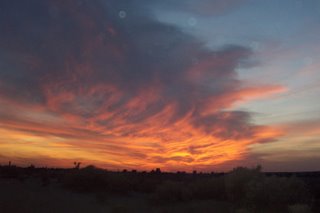
Sunset over the Great Thar Desert.

Immediately following our hyper-dramatic Hindi film experience at the Pink City's Raj Mandir meringue inspired cinema, we caught a night train to Rajhastan's desert outpost town of Bikaner travelling, as always, in India's second lowest train class. Our usual strategy is to reserve, using India's miraculously functioning on-line ticketing service, the two top bunks allowing us to go to bed whenever we want to without disturbing the passengers below us. Unfortunately, the little-used Jaipur-Bikaner line runs an older and smaller model of train with low ceilings that force us to squeeze our bodies through a tiny crack separating the bed from the grungy ventilation fans, leaving us only just barely enough room to lie flat on our backs, occasionally being woken by the sensation of our noses rubbing against the dirty roof-top. Despite expensive ear-plugs, sleeping medication, and junk-country earphones, we are forced to endure yet another restless night when our carriage is invaded, at some ungodly hour of the morning, by a gang of yapping old Indian women.

As later explained to us by a friend of ours from Bangalore: Indians believe that it is their birth-right to make noise. It is not that they are trying to be rude; the entire concept of shutting off the light being quiet for others trying to sleep is, to them, such an abstract metaphysical paradigm as to be simply unfathomable to the sub-continent's general populace. It is not just the gangs of old Indian crones which seem to haunt the wakeful halls of every late-night sleeper train in the country, even the men running the hotels spend hours chattering in Hindi to each other into the wee hours of the morning. And what on earth are they talking about, anyway ? Where I come from, adult men just don't have that much to say to each other and certainly don't stay up all night giggling like school girls.

At times, Katlijn will be driven mad by the hotel men whose incessant gossiping simply overwhelms her specially molded high-end India-traveller's ear protection. Finally, in a fit of insanity, she will throw her ear plugs angrily at the door and storm out into the neighbouring hotel lobby to find six loitering men locked in loquacious banter, and frantically yells out to them:

"Oi ! We're trying to sleep in here !"

The hotel men stare at each other, exchanging blank looks- their brains, having been conditioned to a lifetime of whining scooters, quarrelling urban farm animals, and obnoxious horn blasts, are now no longer capable of even grasping the basic notion of noise pollution. Instead, after a brief pause, their Hindi chattering starts up again more intently as they desperately try to sort out, by group consensus, what the problem could possibly be, until finally they seem to settle on a theory, a plausible hypotheses: their best guess at what her frantic late-night fussing might be referring to. The oldest turns down the volume of the blaring Indian pop music, and asks, in his best English,

"Hot water bucket ?"

As I mentioned already, we don't get a lot of sleep in India. We finally arrived at Bikaner the next morning and groggily squeezed our way out of our claustrophobic train coffin, hauled our gigantic dusty backpacks from out beneath two loudly snoring old crones, and made our way to Vino's fabulous Bikaner Camel Safari Guest House: a sandy desert budget accommodation that seems to be managed and operated entirely by children.

After a brief visit to Bikaner's old city, we made arrangements with Vino for a five day camel safari through the Thar Desert. We were ready to go by the next morning and met up with Steve, a chatty Swiss backpacker who will keep us company the first couple of days. Steve is an economist taking several months off for long-term travel and proving, yet again, that the world's backpackers are quite an agreeable and varied people.

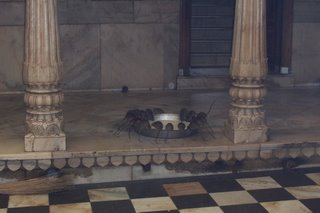
We started our desert trek at Kani Mata Temple, a peculiar and remote 14th century holy outpost in the middle of the sand dunes whose explicit purpose and ardent cult of followers is devoted solely to the worship of rodents. It seems that the cadre of Hindu holy animals knows no bounds: cows, monkeys, elephants, bulls, tigers and more. But, seriously, rats !? Just when we thought India's penchant for superstition could not possibly be stretched any further, we find ourselves in a temple, whose floors look alive with the scurrying of countless holy rodents, where it is considered auspicious for one to scamper over your bare feet and especially good fortune if you can spot a big, fat, fluffy, white one. We made our way carefully around the premises, together with a few barefooted devotees- their eyes peeled for white rats hoping that they might be so blessed as to feel the tickling of rat whiskers between their toes- all the while wondering if this temple was really built here for the explicit purpose of worshipping rats, or whether they simply got deified as the pragmatic solution to an ancient and uncontainable infestation.
                                             55663-b5f5fe54279157340a3f147e00c830c2.jpg

According to devotees of the affectionately titled "rat temple", the holy rats seen here (called kabas) are the reincarnation of dead storytellers brought here to deprive Yama, the Hindu god of Death, of human souls.

After visiting the rat temple, we met up with our desert guides, the camelman and the cook. Despite spending every second together for five long hot days, we had a tough time making any kind of connection with them given their tenable grasp of our language and our entire ignorance of whatever Rajasthani tongue they communicated with. In fact, we never even learned their names, having given up after making a hash with the pronunciation and finally settling on calling the camelman the "white guy" and then referring to the cook at all times relative to the camelman as simply "the other guy".
                                                                       55663-91988203359da634d2e8023967e02f43.jpg

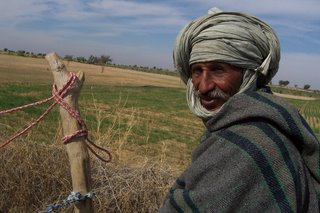
Our camelman, the white guy, so-named for his white turban and white loin cloth which he wore and washed daily.

We had three camels with us: Steve's camel, our riding camel we named "Alice", and a strapping young male camel we named "Orneel de Kameel",who carried the cart while periodically sticking its tongue out at passing lady camels who, without fail, would saunter giddily towards Orneel's manly camel stench, unable to contain their passion at such witty flirtation. All over the Great Thar Desert, camelmen would have to chase after young virgin camels who had fallen under the powerful spell of Orneel's wooful raspberries.

From the very beginning, it was obvious that sitting on a camel for five days was going to be a supremely uncomfortable experience. The camelman had Alice lie on the ground so I could get on the saddle. Before I even had a chance to sit down, Alice, upon feeling my legs brush against his side, would suddenly let out a gaping camel groan of disapproval and lurch upwards, slamming its hard backside into my unsuspecting crotch while stretching my stiff legs sideways dangerously beyond the safety zone of my admittedly limited flexibility. This would be followed by several hours of stoically enduring the graceless back-and-forth saunter of Alice slowly rocking my testes into numbness until, mercifully, it was time for me to get off and begin the long and painful process of returning circulation to the lower half of my body. Camels also do not make a smooth transition from the standing to sitting position. Instead, they sort of fold themselves up in several fast jerking motions like a collapsible lawn chair, each fold giving the rider the sensation of freefall and each time landing, inevitably, hard on his crotch. By the time we finally got off, our legs had been reduced to a senseless oblivion: two heavy weights swinging lifeless from our torsos waddling awkwardly about the desert.

The first few days we enjoyed taking turns riding the camel and lying down in the back of the cart peacefully reading a book. However, it wasn't long before we began fighting over who got to lie down in the cart and who had to receive a three hour crotch pummeling. Finally, perhaps out of compassion, the camel man let us both lie down in the camel cart while Alice, bareback and unburdened, trotted happily behind us with a smug look of victory.

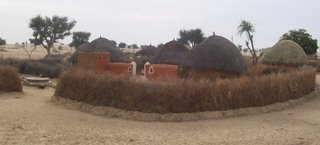
During our trek, we enjoyed the quiet peacefulness of the scrubby desert’s understated beauty punctuated by the occasional viper, vulture, and gazelle. We often passed secluded families living in tiny isolated mud huts, or even small mud villages sprouting sleepy rural desert communities.

                                           .55663-1192abe26967ee810fcedabf5279c569.jpg
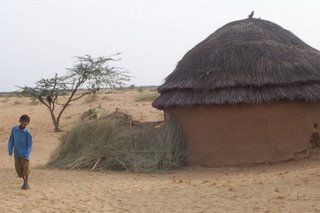
Rajasthani boy and his mud home.

55663-05876752189e0f082d273220fb35563f.jpg

Thar Desert village.

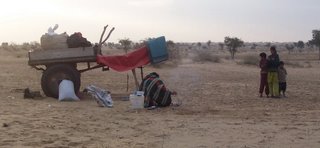
The people of the Thar desert were exceptionally curious of us, especially the young children. While we stopped for tea or meals, small groups of brothers and sisters would huddle together and plant themselves at a safe distance to apprehensively study us in great detail like tiny fledgling scientists. Astonishingly, these profoundly patient children could go about their staring business uninterrupted for many hours in such a deep and pure state of meditation that, I must presume, it did not even occur to them to ask me for a pen. In the few cases they did ask us for something, it was never money, toys, or pens, but empty plastic water bottles of all things. In fact, empty plastic bottles were a trophy so deeply coveted by desert children, it drove them to acts of camel cart thievery that forced our poor nameless cook to be constantly vigilant and, when necessary, jump off and chase after them.

The larger Thar Desert villages each have a long trough of water for the camels. As we waited for Alice and Orneel to drink their share, the entire population of the village, often numbering in the hundreds, would emerge from their mud houses and rush down the street cheering our arrival at what felt like a royal welcome. When our camels were finished and we would continue on our way, the children would run after us into the desert for a while yelling "ta-ta !" and erupting into tearful laughter every time we responded to them.

The cook picked up pieces of valuable dried wood along the way which he would use, together with camel droppings, to make a fire. From time to time, he would also jump off the cart and disappear into a seemingly random mud hut in the middle of nowhere with an empty bottle and some supplies, then appear again sometime later behind us, running along the sandy trail in his sandals to catch up, the bottles now full of the desert goat milk he uses for our obligatory morning, afternoon, and evening chai. At some of the larger villages, he could be seen with the locals trading for supplies and, especially, flour for making his delicious chapattis. Furthermore, many of the locals supplied us with water from their personal wells. In return, our operation ran a kind of desert taxi service between the tiny villages as the camelman would allow complete strangers to ride on the cart with us along the empty roads. In many cases, our friends would join us for a hot cup of chai and even sit around the campfires at night, together with their sons and daughters, always staring at us, always smiling, while our cook and the camelman eyed our empty plastic containers nervously.
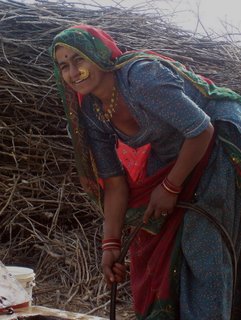
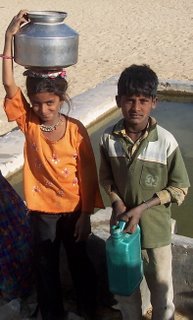
55663-240db9c7448d2d810030aecfde32fc0b.jpg        55663-8b6206dfda10107dfe634517a3214531.jpg

                                                                     Desert characters.

Despite working in the remote seclusion of the desert, the cook produced some extraordinarily delightful Indian vegetable curries making each mealtime an experience Katlijn and I, saddle-sore, would very much look forward to. While one cannot deny his obvious culinary talents, he did not run the most sanitary of kitchens and the small number of pots and pans he carried with us often served multiple purposes including wash board and portable camel latrine. At one point, we watched in horror as he used his dirty shirt sleeve to rub a large pile of green droppings off the pan and into the fire, mix and pound the dough on the same pan, then roast his superbly shaped chapattis directly on the smouldering camel dung. Furthermore, due to the difficulties inherent in finding water in the desert, after every meal, we washed our dishes in dirt we scooped from the ground. To be fair, a sand-wash is an amazingly effective desert camping trick which I suggest you all try at home if you don't believe me, the only drawback being chewing on the little bits of sand that perennially find their way into every bite.
55663-2c60f186dd9afbaeea434b8e264b80dc.jpg

The cook concocting another one of his delicious stews while desert children nervously study our camp.
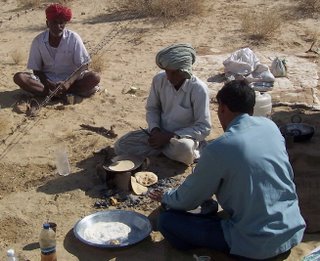
55663-b6e3dca37a77e5eb89d0d90df7805c61.jpg

The cook pounds and shapes the dough as the camelman cooks the result on a tawa then puffs up the final chapatti directly on the coals. An old local man in a red turban enjoys a hot metal cup of chai while quietly watching them at work.

Evening in the desert is a particularly magical time as the dark blue sky transforms itself into the deep crimsons, violets, and yellows of some of the world's most spectacular sunsets. At night, we sleep in the open sand gazing at the brightly lit stars above us, while each morning the cook wakes us up with breakfast in bed. Sipping on hot chai while crunching down on our sandy toast, the Thar Desert entertains us again with another inspired sunrise, worlds away from the late night gossip of India's hotelmen.


Despite hot weather during the day, the desert temperature drops rapidly at night. Underneath two layers of blankets and our sleeping bags, while isolating ourselves from the ground with two more layers of blankets, we slept comfortably beneath the stars.


Hoe vind je dit bericht? 2 stemmen
Geschreven door andrew om 00:00 Reageer op dit bericht

Elephants in the Pink City


55642-098367b6b4114f8b5443a623cc77c928.jpg

A sari shop in India. The line of male tailors on the left display a huge variety of fabrics to the women sitting on the right. The fabrics can be cut into saris or other clothing items. Shops like this are seen all over India and, by tradition, all the fabric tailors and shopkeepers are men while their clientele are all women.

After a long bus ride, we arrived in Jaipur mid-afternoon. All the hotels recommended in our guidebook were fully booked so we had to wander around the crowds with our giant tout-magnet backpacks looking around for a reasonably clean place to stay. In the end, we settled for an over-priced room, with two drab beds and a snowy television, ran by an old Indian fart and his five hapless cronies. As a word of advice: never stay at a venue in India in which the front lobby is occupied twenty four hours a day by six loitering men. As we waited an eternity for a luke-warm bucket of water, staring vacantly out our comically minuscule window, occasionally going downstairs to the lobby to check the progress of our simple cornflakes breakfast (only to find six loitering men staring vacantly at the peeling paint of our stodgy hotel), we began to wonder just how many men it takes to do absolutely nothing.

A much better alternative is to find a hotel run by an Indian woman. At Keoladio Nation Park, for example, our astute hotel lady single-handedly did everyone's laundry, cooked all our food, fixed the plumbing, and helped her kids with their homework while still finding enough time and energy to skillfully hustle us out of 50 Rupees for a pair of foggy binoculars and a crumbling bird book. You had to admire her.

Jaipur was our first stop on our tour of the province of Rajasthan. This state in North-East India, bordering Pakistan, has been doggedly controlled by the Rajput people for more than 1000 years. They are a Hindu warrior clan, constantly fighting, if not with the Muslim Mughals and the Western British, then against each other. Much of their bellicose way of life feels a bit like that of the Japanese Samurai: hierarchical while emphasizing honour and chivalry in combat- demanding ritual mass suicide by self-immolation over surrender. The practice of warfare was such a common occurrence that it became highly ritualized and enshrined in their culture: philosophy as well as an art form developed around combat with beautifully carved swords, gorgeously decorated armour, and vivid paintings. They were such a staunchly proud and recalcitrant opponent, that they managed to retain significantly more independence than the rest of India as both the Mughals and the British found it wiser to make special arrangements with the Rajputs rather than embarking on a long internecine struggle. Unfortunately, this independence ultimately proved to be the beginning of the end for these desert people. The Rajput rulers eventually became corrupt and lived a lavish life-style while the general population lived in poverty. When India finally gained its independence in 1947, Rajasthan had one of the sub-continent's lowest rates of life expectancy and literacy. It remains to this day one of the poorest states in India.

55642-5e6a0268a880c04d0aa452b2b0c37fc4.jpg

Jaipur's impressive hilltop Amber Fort. All of the major cities in Rajasthan have sprawling walled fortresses that served to protect the various city-states.

55642-011337f75a5e97018fca25fb49f6dc56.jpg

Entrance to Amber Fort's inner palace.

55642-d23aa549dc485e93e865b431ea917949.jpg

The palace architecture is a mixture of Rajput and Mughal styles.

We embarked on a long hot walking tour of a desert city that seemed to be choking under the malodorous fumes of diesel fuel, camel carts, and permanently clogged traffic arteries. The 18th century Jantar Mantar observatory provided an interesting diversion- it looks a bit like an amusement park full of mammoth experimental art sculptures. However, each construction has a specific purpose for tracking the motion of planets and stars, including a 27 meter high sundial which can be used to tell the time accurately to within 2 seconds. Unfortunately, we can't tell you what other amazing feats of mathematics and engineering were on display as our guide turned out to be completely stoned, speaking in an incoherent babble while puttering around the observatory in a kind of hashish induced slow-motion.

Upon exiting the observatory, Katlijn made the well-intentioned mistake of offering a begging boy one of our bananas. Upon grasping the fruit in his little hands, his eyes went wide, astonished at such good fortune, his whole face lighting up to assume the childlike expression of barely contained excitement normally reserved for unwrapping Christmas gifts. He quickly ran down the street screaming with glee, summoning his friends and family, who began to emerge wraith-like, previously invisible, from some secret place in between the cluttered jumble of concrete junk-peddling holes in the wall. It wasn't long before Katlijn was surrounded by street people beseeching her for free bananas. Without enough supply to meet the exponentially growing demand, we had to beat a hasty retreat into a street full of rampaging rickshaws and honking motorcycles. A lone police officer stood uselessly in the middle of the chaos, looking positively stranded, staring vacantly at the emerging traffic situation.

At what point did we start snapping at people asking for bananas ?

When was the exact moment that penniless widows abruptly vanish from our view ?

Why do children constantly ask me for pens ?

What the hell is wrong with this place !?

Through the smoggy crush of the Pink City's rush-hour vehicle hordes, the streets bursting at the seems with staring masses and Indian queue beasts, between cars and trucks, careening cycle rickshaws and high-speed scooters, slowly making its way between the fruit wallahs and stray dogs, quite suddenly, an enormous elephant smugly lumbers down the road. Above us, literally hundreds of kites fill the skies for the kite festival. Somehow, the magic of the sublimely foreign scene before us, or perhaps just the serene expression on the elephant's face, filled me with a renewed empathy for this country and made me realize how lucky we are to be travelling to a place which can only be experienced and not easily explained.

55642-27f8677e9725f34e68673ffedda69af7.jpg

A fruit stand in Jaipur. Jaipur is nicknamed the "pink" city due to the predominantly pink colour of the buildings in its old city. The coral colors are particularly vivid just before sunset.

To celebrate my renewed faith in, or perhaps just temporarily prolonged tolerance for, the confounding process that is travelling through India, I decided to take Katlijn out for what is perhaps the world's most dubious "dinner and a movie" date: McDonald's and a Bollywood film.

While some cultures have a problem with culinary fusion, I am personally all for it. Other than tasting good, I believe there should be no rules defining whether or not different schools of gastronomy should be combined together. Despite this, I must make exception for the shameless combination of the well-respected centuries-old Indian culinary tradition with an American fast-food laboratory product designed at minimum cost for mass consumption: an ill-conceived fusion clearly demonstrated in such Frankenstein creations as the "Chicken Maharaja Mac". Certainly, the line of vegetarian potato burger products featured in Indian McDonald's, the "McAloo Tikkas", are a testament to globalization gone awry. However, to India McDonald's credit, they have exceptionally clean toilet facilities. Say what you will about their nefarious influence on global eating trends, even in a country not exactly renowned for its cleanliness, the MacDonald's bathrooms positively sparkle and may possibly harbor the sub-continents only functioning automated hand dryers.

Jaipur is home to India's number one Hindi cinema: the world-famous Raj Mandir- a massive, sublimely ugly, green and white cinema complex with bizarre architectural motifs that seem to have been inspired by marsh mellows and lemon meringue pies. Katlijn was allowed to get our tickets from the "ladies queue", as oppose to the much longer and more unruly "men's queue". She similarly helped a gang of Indian boys get tickets for the show who returned her kindness by explaining to us what was going on during the film. Ultimately, it was not as bad as we thought, and a few of the musical numbers were downright catchy. If you can't make sense of India's Bollywood film mania, it is probably you have never seen one of these films live at an actual Bollywood cinema. The raucous crowd booing the villains, cheering the heroes, and joining together in group gut-laughter magically turn the absurdity of the underlying script into a genuinely entertaining experience. Like its American counterpart, Bollywood films are full of a lot of beautiful people, classy cars, and opulence. However, it feels more artificial and jarring coming from Hindi cinema as it is so obviously at odds with the reality we had seen in North India. Where are the betel-nut stained teeth and the invisible beggars ? How come there are no dogs barking or monkeys dancing and why don't Bollywoods stars ever haggle with rickshaw touts ? Despite the dramatic music and emotionally exhausting story, culled of errant cows and lumbering elephants, Bollywood's watered-down version of India feels a bit empty compared to the real thing.


55642-4a3e489caebd4acc6e5dcc62d8a066b8.jpg

Hoe vind je dit bericht?
Geschreven door andrew om 00:00 Reageer op dit bericht

Beware of touts

                                     55592-3155731769149d82dc934084f9989829.jpg 

One of several pythons we spotted at Keoladeo National Park. The large bulge seen about a meter from the snake's mouth is a recently eaten animal that is currently being digested by the snake.


A King Cobra bite will kill a fully grown adult human being in less than ten minutes without an appropriate anti-venom. Pythons grow as long as 7 meters and are fully capable of constricting, suffocating, and then consuming large mammals including jackals, deer, and tourists. Depending on the time of year, both of these snakes are seen with alarming regularity throughout Keoladio National Park. At the entrance, there is an enormous yellow warning sign that reads in dramatic bold red characters: 


"BEWARE OF TOUTS !" 


Not a word of caution for unsuspecting birders about the giant snakes. Not a single suggestion can be found anywhere regarding appropriate course of action when the largest venomous snakes in the world stand a meter and a half high, their throats flared in striking position. However, the sign expounds in great detail who to call when the indigenous species of commission foraging rickshaw wallahs takes you to the wrong hotel. It is very clear, in massive crimson letters, italicized for emphasis, that "absolutely under no circumstances" should one "accept tea from strangers".  


Marvelling at the ridiculousness of this piece of advice from India's forestry ministries, I began to wonder whether or not we had come to the right place for a little vacation from Agra's Taj Mahal touts and the energy sapping experiences of haggling with hotel managers, finding our way around dusty labyrinthine alleyways, and digesting countless flea-ridden chapatti. However, we didn't start to get really worried until the forest ranger/tout manning the park entrance stopped us from entering because we were not allowed to bring our binoculars inside. 


"But it's a bloody bird-watching reserve !" Katlijn tried to explain, clearly exasperated, with stress on the word "bird" fruitlessly emphasizing the particular difficulties inherent in this activity without binoculars, given the small size and tendency of its object to flock far away from people in the camouflaged and remote sanctuary of trees. 


The so-called forest "ranger" tells us that we must pay him 20 Rupees to use the park's binoculars on top of the entry fee (outrageously inflated 20 fold for foreign tourists), and it was just too bad we already had a pair from our hotel owner who just "should have known better". This was one scam too many for Katlijn, the straw that broke the camel's back, and the subsequent tirade this unleashed from her mouth sent flocks of storks and cormorants scattering off the ground in alarm. This was followed by a long and unpleasant round of haggling over the illusive price of a pair of binoculars, the entrance fees, and a couple of dodgy Indian mountain bikes. However, once we were in the park, it was indeed quite peaceful and pleasant- our serenity only interrupted once by a poor little boy who made the mistake of asking Katlijn where she was from and suggested she give him her pen.


                                  55592-9117b906486533d71d3e804c83433f08.jpg

A blue bull drinking waters in the marshy grasslands. 

We managed to spot a lot of wildlife including blue bulls, several species of deer, Indian mud turtles, jungle cats, and jackals. However, the real draw at Keoladeo Park are the 500 species of migratory birds, especially water birds, which frequent the area. It is in some ways an artificial sanctuary since it was once an arid region which filled with water only during the monsoon season and dried up afterwards. One of the maharajas artificially diverted water to the region from a nearby canal in order to attract more ducks for the purpose of entertaining his guests with duck hunting. His actions were very successful not only at creating one of the world's easiest duck shoots, but also at attracting all sorts of different types of water birds. It is now a protected area frequented by serious bird geeks, with an artificial ecology that is still sustained by diverting water from nearby canals and dams.

                                 55592-d7326514d2f8841b5477256eacd106a8.jpg

Katlijn bird-watching at Keoladeo National Park.  

Our bird-identifying skills leave much to be desired, and the dusty, tattered 1940s British Colonial era "Bird's of India" book, also given to us by our hotel owner, was of little use. Thus, Katlijn was forced to swallow her pride, make amends with the Park tout, and ask him for his help in identifying birds. Together, we spent many hours spotting countless different varieties of herons, geese, owls, woodpeckers, and kingfishers before coming back and exchanging information with the birders staying at our hotel. 

Just before leaving, we realized our hotel lady was attempting to charge us a fee for the binoculars and her crumbling bird book. When we tried to explain we weren't allowed to use them in the park, she simply smiled and gave us the infamous Indian head wobble- perhaps the most mysterious and infuriating gesticulations on the sub-continent: a gentle cranial motion which, in the ambiguous hands of a skillful tout, means neither "yes" nor "no", but rather something more along the lines of, "I entirely agree with you, sir. Life really does suck". We finally acquiesce, once again, in defeat. They should have made that warning sign bigger.

                                55592-56bc54af3353c4153f8a426bd198196d.jpg

Indian man getting a deep and thorough ear cleaning by one of the local touts.

Hoe vind je dit bericht? 1 stem
Geschreven door andrew om 00:00 Reageer op dit bericht

Saranath's Queue Beast and the Taj Mahal


Before leaving Varanasi, we made a brief stop at Saranath, an important Buddhist pilgrimage site. It is the place where Siddhartha Gotama, the first Buddha, gave his teachings describing the four noble truths and the basic tenets of Buddhism. For this reason, it was also once the site of an impressive temple complex. However, there is scant evidence of this now. These days, the most remarkable thing about Saranath is the long and very intense staring we are subjected to by the masses of middle-class Indian families that picnic here on the grassy lawns.

Don't get me wrong, I'm all for a bit of staring. We look different, we speak different, we come from a different place. For the most part, I can relate to their curious- trying to gather their courage to talk with us. However, Indians take staring to a whole new level.

On a recent bus ride, a man sitting in a seat in front of us turned around, rested his head on his cushion and stared at me, without pause, for ten minutes straight. I tried to stare back at him, but found it impossible to hold his gaze. I swear, he didn't so much as blink ! Most irritating are small packs of middle-class Indian teenage boys who find following a couple of white tourists around a park and staring at them to be a day filling activity so immensely fascinating it warrants repeated photography. Katlijn is a particularly popular target. Even after asking the boys not to photograph her, they'll hide behind pillars and bushes, snapping her picture paparazzi style.

ATTENTION INDIANS:

If you are reading this blog, please leave me a comment below answering the following question: what on earth do you do with photographs of random white tourists !? Honestly, we have no idea.

The troubling thing is that most Indians know about as much about the West as we know about India, which is to say, pretty much nothing at all. For example, we once met an Indian on the train who was shocked that we stayed at cheap hotel rooms, did not travel first class, and used an unfashionably low budget cell phone. His impression of foreigners is that we just give money away freely to anyone who asks because we have so much of it. More insulting: our understanding is that many Indian males still think white women are sex-craved targets willing to have pre-marital escapades with any Indian man- an attitude which is clearly reinforced by much of the popular Indian media. We are very often asked about our marital status and, on the rare occasions we tell Nepali and Indian people that we are not married, they tend to shake their head and nudge each other as if confirming their basest pre-conceptions. The problem then with staring, is not so much the staring, it is thinking about what the other person is thinking about- pitting one set of misconceptions against the other.

The only other remarkable thing about Saranath are the locals attempting to "line up" for tickets. There is no actual line, but a massive tangle of bodies elbowing, shoving, and pressing up against each other. At the ticket gate, hundreds of hands can be seen holding onto the booth's bars, white knuckled, pulling the rest of their bodies to the front of the horde. There are so many bodies pressed so tightly against one another that it no longer resembles a crowd of individuals, but one single multi-headed, multi-limbed monster surging up against a poor emaciated ticket wallah cowering inside a ramshackle booth, locked in a life or death struggle with the beast, desperately trying to stave off its many thrashing appendages with nothing more than tiny stubs of paper. Interestingly, women are actually allowed to go, automatically, to the front of the queue-beast. Of course, I have never met a western woman willing to test this theory given the monster's many groping hands and its multiplicity of male brains.

We escaped the monstrous, staring crowd in the early evening to arrive at Varanasi's train station. At night, Indian train stations look like refugee camps full of hundreds of weary Indians sleeping on the concrete ground waiting for their train to arrive. In our experience, nothing ever seems to work as expected in India, so we were positively astounded to find our names listed properly on the side of the correct train car. How could it be that our information was sent from an Internet form to some remote Indian operator, having filtered through the creaking Indian train system bureaucracy (presumably oiled by countless 5 rupee basksheesh) to arrive at the Varanasi station manger who paid off some tout to paste it on the side of a train so it was hanging right in front of us ? And this is not an isolated event ! Our names are always there: spelled correctly and pasted firmly on the side of the correct train car. How all these multitudinous transactions occur without problem, while I can't even get hotel owners to bring me a bucket of hot water, is truly one of the great mysteries of India.


Indian trains have about 6-8 classes to accommodate the budget and comfort requirements of all travelers. We are budget travelers and therefore ride in the "sleeper class" which is the second lowest class (even we don't travel with the lowest class which is a kind of repository of all the worst rumours you have ever heard about India). Trying to overcome the snoring passengers around me, I stuffed my imitation Sony earphones from Nepal deep into my ears for a bit of music. However, no matter how hard I pushed, the right ear piece produced nothing more than an annoying buzzing, while the left one gave only a distant hum. Whenever something like this happens, Katlijn likes to make the following remark: "junk country !" which succinctly summarizes the quality of the merchandise we have purchased since landing in Nepal. Without functional earphones, I took a few sleeping pills and let the gentle motion of the train rock me to sleep.

We began our post-Varanasi, post-queue-beast encounter by visiting the erotic temples of Kajuraho. These temples were the result of a mysterious creative burst occurring between 950-1050 AD by the Chandelan people, one of the last early Hindu empires in North India. Nobody knows why they bothered to make such an extensive temple complex in a place with absolutely no strategic value at all. I can tell you from our long overnight train-ride and subsequent 6 hour bus experience that it truly is in the middle of nowhere. If not for the temples, the small band of locals who man this outpost attraction would never be here. They constantly complain about the lack of rainfall and are more reluctant than usual to provide us a bucket of hot water- it hasn't rained here for three years !

55578-4ac3c51fb64391477a9637f0a9224cbd.JPG


55578-cdb255155a6a86b04b6ef17ec739bf34.JPG       55578-b95cbbc4efe5e260ed81ac06cf7dc831.JPG

Most tour books erroneously refer to the Kajuraho temples as "erotic" temples. Admittedly, a few of the thousands of fine sculptures that cover these temples are of rather shocking threesomes and foursomes. However, the vast majority simply depict women in daily life. The reason for sculpting such lurid scenes and the artists' original intent in general remains a mystery to Indo-Aryan scholars.

Shortly after the completion of the Kajuraho temples, they were abandoned for the nearby forts to help ward off the various groups of Muslims invading from Afghanistan. This was the beginning of centuries of Hindu-Muslim conflicts which continue to this day in various forms, including present tensions along the Pakistan-India border. It would be another 800 years before the temples were accidentally rediscovered by a lost British colonist. We spent a couple of very happy days biking around the temple grounds, absorbing the beautiful architecture and exquisite carvings- definitely the most impressive we have seen in all of India.

We continued on to a city called Orcha where we met up with Party-Dean, the Aussie backpacker, and the German couple, Karsten and his wife Julianna. Party-Dean is to us representative of the younger generation of 20-something ultra-low-budget travelers you have heard about: living the good life while hauling their backpack around the globe. However, Party-Dean is the minority: the reality is that the backpacking scene has changed over the years. They aren't the ragged bums we were initially afraid we'd have to deal with. Nowadays, the vast majority of modern backpackers are an older more sophisticated sort and range anywhere from their late twenties to early sixties. They travel cheap, but still have enough money to occasionally splurge on a truly awesome Tandoori Chicken. Most of them are professionals taking a couple of years off, confident they can return and find work again with no problems. Karsten and Julianna, for example, have been traveling for two and a half years and will shortly go back to Germany to continue their careers. Of the very few young backpackers we do encounter, they are not nearly as annoying as we thought. Party-Dean is actually a pretty nice guy, not to mention the fact that his frugal life style has taught him the very useful ability to ferret out any given city's cheapest 30-rupee quality Indian eatery.


We spent several days exploring the ruined forts of Orcha with the German couple and Party-Dean. The most successful of the Muslim invaders were the Mughals who arrived around 1500 AD into India. At one point, their empire contained most of the sub-continent and their legacy can be seen in the many old forts and cenotaphs of most North Indian cities. Orcha's forts, though massive, are less famous and some are in a state of near collapse. Nevertheless, we had a great time clambering over their impressive, atmospheric remains.

                                                                        55578-58b5eaaad11d4e0449aad57ce013db4e.JPG


55578-45d642af679bdcf747d3557b525cfb9e.JPG

Orcha's Forts and Cenotaphs are fine examples of Mughal architecture.

Undoubtedly, the most famous Mughal legacy is the Taj Mahal, located in Agra, just south of Delhi. It is one of the seven wonders of the world and, if you will pardon the cliche, is in fact as beautiful as they say it is. It was built by the great Mughal emperor Shah Jahan between 1631-1653. He was so grieved by the loss of his second wife, who died giving birth to her fourteenth son, he built this massive white marble masterpiece in her memory. It is said that he actually had plans to build an identical Taj in black marble, exactly opposite the current white Taj. Fortunately, one of his many sons over-threw him by force and locked him in the Agra fort before he could deplete the empire of the considerable resources required to complete his mad, though inspired, vision. Shah Jahan together with his wife, Mumtaz Jahan, are currently buried together beneath the gorgeous domed roof of the Taj Mahal.

55578-24ca8bccc6adf5e37ff59fec1bc8907b.JPG

While you have undoubtedly seen pictures of the Taj Mahal, you have probably never seen it from this angle. Most photographs of the Taj Mahal are taken from the front garden since this was the view intended by its architect. We chose to photograph it here from the backside not only for the nice reflection in the surrounding waters, but because this angle reveals one aspect of the architect's creativity: the Taj Mahal is built on a platform several meters above the ground so that, whenever we look at it, the building is always framed against the sky enhancing its beauty. Another important feature, seen here but omitted by most photographs, are the red sandstone structures on either side which complete the frame and contrast nicely with the white marble of the main building.

In addition to the Taj Mahal, Agra is famous for its touts which rival those of Varanasi. The Agra rickshaw touts are particularly renowned for their exceptional skills at shuttling tourists for hours between commission peddling shops while never actually taking them to the Taj Mahal. Our particular tout managed this by using the excuse of a city-wide rickshaw strike. Nevertheless, he did take us to a few interesting places with some chatty craftsmen which almost made his hustle worth our time.

55578-880cceb7405e6c81073b7d09060d0b5a.JPG

If you get close enough to the Taj Mahal, you will see that its marble exterior is decorated with inlaid gems. Agra is world-famous for this art form. Even though the cost of marble items with inlaid gems is well above our price range this year, these craftsmen are happy to show us their trade.

                                                                55578-b09a1f45382f4f4fa293b1b4a2276bcf.jpg

It takes this carpet weaver more than a month to make a full sized carpet. Every carpet pattern is different and for each pattern, he invents a new song with mnemonic lyrics that help him remember the order in which to weave different colours of thread. He sits for hours singing this song in complete concentration, while his hands move in a blur steadily weaving the carpet imperceptibly longer and longer.

55578-4f19c38e022eb8e5fd5ffdfe072f74ed.JPG

Katlijn gets a little help trying on this red sari.

Hoe vind je dit bericht?
Geschreven door andrew om 00:00 Reageer op dit bericht

Meer van op wereldreis

↑ Terug naar de berichten