Naar de inhoud

UFO'S of UAP'S, ASTRONOMIE, RUIMTEVAART, ARCHEOLOGIE, OUDHEIDKUNDE, SF-SNUFJES EN ANDERE ESOTERISCHE WETENSCHAPPEN - DE ALLERLAATSTE NIEUWTJES

UFO's of UAP'S in België en de rest van de wereld
akke.beakke.be
Ontdek de Fascinerende Wereld van UFO's en UAP's: Jouw Bron voor Onthullende Informatie! Ben jij ook gefascineerd door het onbekende? Wil je meer weten over UFO's en UAP's, niet alleen in België, maar over de hele wereld? Dan ben je op de juiste plek! België: Het Kloppend Hart van UFO-onderzoek In België is BUFON (Belgisch UFO-Netwerk) dé autoriteit op het gebied van UFO-onderzoek. Voor betrouwbare en objectieve informatie over deze intrigerende fenomenen, bezoek je zeker onze Facebook-pagina en deze blog. Maar dat is nog niet alles! Ontdek ook het Belgisch UFO-meldpunt en Caelestia, twee organisaties die diepgaand onderzoek verrichten, al zijn ze soms kritisch of sceptisch. Nederland: Een Schat aan Informatie Voor onze Nederlandse buren is er de schitterende website www.ufowijzer.nl, beheerd door Paul Harmans. Deze site biedt een schat aan informatie en artikelen die je niet wilt missen! Internationaal: MUFON - De Wereldwijde Autoriteit Neem ook een kijkje bij MUFON (Mutual UFO Network Inc.), een gerenommeerde Amerikaanse UFO-vereniging met afdelingen in de VS en wereldwijd. MUFON is toegewijd aan de wetenschappelijke en analytische studie van het UFO-fenomeen, en hun maandelijkse tijdschrift, The MUFON UFO-Journal, is een must-read voor elke UFO-enthousiasteling. Bezoek hun website op www.mufon.com voor meer informatie. Samenwerking en Toekomstvisie Sinds 1 februari 2020 is Pieter niet alleen ex-president van BUFON, maar ook de voormalige nationale directeur van MUFON in Vlaanderen en Nederland. Dit creëert een sterke samenwerking met de Franse MUFON Reseau MUFON/EUROP, wat ons in staat stelt om nog meer waardevolle inzichten te delen. Let op: Nepprofielen en Nieuwe Groeperingen Pas op voor een nieuwe groepering die zich ook BUFON noemt, maar geen enkele connectie heeft met onze gevestigde organisatie. Hoewel zij de naam geregistreerd hebben, kunnen ze het rijke verleden en de expertise van onze groep niet evenaren. We wensen hen veel succes, maar we blijven de autoriteit in UFO-onderzoek! Blijf Op De Hoogte! Wil jij de laatste nieuwtjes over UFO's, ruimtevaart, archeologie, en meer? Volg ons dan en duik samen met ons in de fascinerende wereld van het onbekende! Sluit je aan bij de gemeenschap van nieuwsgierige geesten die net als jij verlangen naar antwoorden en avonturen in de sterren! Heb je vragen of wil je meer weten? Aarzel dan niet om contact met ons op te nemen! Samen ontrafelen we het mysterie van de lucht en daarbuiten.

Archief

Glowing 'mother orb' launched swarm of mystery objects near secret US site, Pentagon files reveal

Glowing 'mother orb' launched swarm of mystery objects near secret US site, Pentagon files reveal

A glowing 'mother orb' seen near a secret US site is at the center of a newly released Pentagon report.

The document was among a fresh tranche of UFO records released by the Trump administration on Friday, shedding new light on one of the government's still-unsolved aerial mysteries.

Written by the director of the Pentagon's All-domain Anomaly Resolution Office (AARO), the memo details a bizarre two-day encounter in October 2023 during which six federal agents reported witnessing luminous objects behaving in ways investigators have yet to explain.

AARO concluded that 40 percent of the reported activity remains unresolved after its initial analysis.

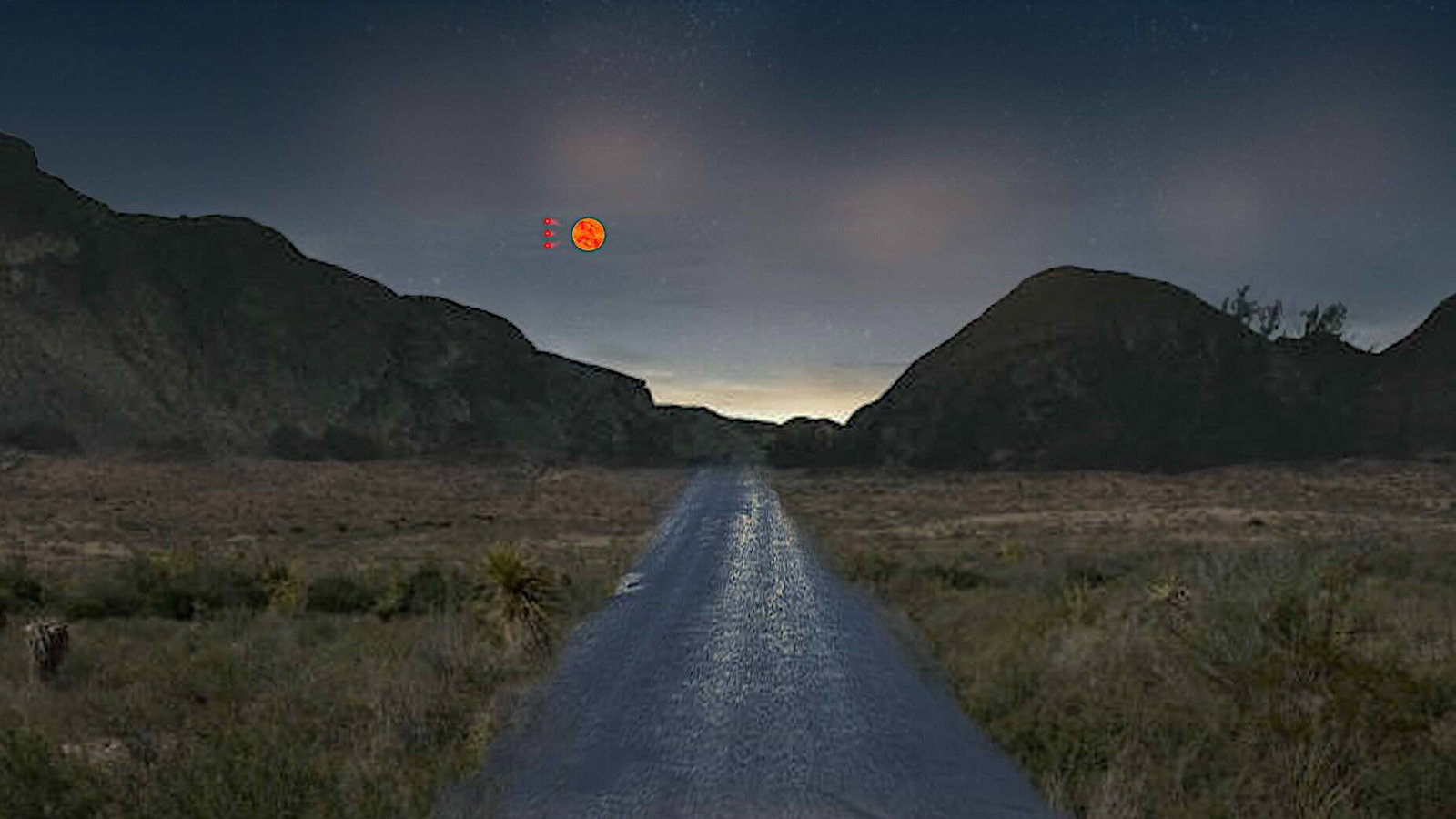
'The phenomena's most distinctive reported feature was the repeating nature of their pattern of behavior, in which a luminous orange "mother orb" appeared to produce smaller red "orbs," one after another, multiple times over a period of several hours,' reads the memo signed by AARO director Jon T Kosloski.

Witnesses said the glowing orange sphere would appear for one to two seconds, release a cluster of two to four smaller red lights and then vanish.

The smaller objects were reported to move horizontally, change altitude and, in at least one case, remain suspended above a ridgeline for hours before disappearing.

Despite reviewing radar data, flight records and other available information, investigators were unable to fully account for a significant portion of the sightings.

Pictured is an artistic impression of the "mother orb" releasing the smaller "orbs" as reported by the federal agents

Pictured is an artistic impression of the "mother orb" releasing the smaller "orbs" as reported by the federal agents

Secretary of War Pete Hegseth said in a Friday statement: 'The Department of War is in lockstep with President Trump to bring unprecedented transparency regarding our government’s understanding of Unidentified Anomalous Phenomena (UAP).

'These files, hidden behind classifications, have long fueled justified speculation, and it’s time the American people see it for themselves. 

'This release of declassified documents demonstrates the Trump Administration’s earnest commitment to unprecedented transparency.'

READ MORE

article image

While the new report does not provide a location of the incident, subsequent FBI interviews noted it took place over Cheyenne Mountain near Colorado Springs, Colorado.

Cheyenne Mountain Complex is a fortified underground bunker located in Colorado Springs, Colorado. Buried beneath 2,000 feet of granite.


UFO Files: High-Speed Orb Splits In Two During Secret 2025 Mission Near U.S. Govt Site, Reveal Docs
Hoe vind je dit bericht?
Geschreven door peter om 23:11 Stuur door

Steven Spielberg claims aliens have already visited Earth - now scientists say he might be right

While Steven Spielberg has created some of the best aliens in cinema, the 79–year–old director now claims he also knows a thing or two about real–life extraterrestrials.

In an interview promoting his latest sci–fi blockbuster, Disclosure Day, Mr Spielberg says he is certain that aliens have already visited our planet.

Speaking to CBS News, he said: 'I absolutely think that they have been here, and they are here. And who knows, maybe they've always been here.'

The director of Close Encounters of the Third Kind added that this view is 'based on the circumstantial evidence of everything that I've gathered throughout my whole life, everybody I've listened to and every documentary I've ever watched and all the testimonies in Congress that I've heard.'

Now, some scientists say there could be a kernel of truth behind Mr Spielberg's wacky claims.

Dr Jacco van Loon, an astrophysicist from Keele University, told the Daily Mail: 'It is a possibility.'

He added: 'If they visited a billion years ago, they would have encountered seas with microbial life, and bare land.

'While they may not have left artefacts on Earth, one interesting possibility that has been considered is that they may have left artefacts on the Moon or elsewhere in the Solar System, to monitor Earth or simply as waste.'

In an interview promoting his latest sci-fi blockbuster, Disclosure Day, Steven Spielberg says he is certain that aliens have already visited our planet

In an interview promoting his latest sci–fi blockbuster, Disclosure Day, Steven Spielberg says he is certain that aliens have already visited our planet

While it is widely considered likely that life exists somewhere in the universe, the biggest barrier to any advanced civilisation visiting Earth is the enormous distances between stars.

For many scientists, this is an insurmountable barrier to any chance of an alien civilisation travelling to Earth.

Dr Thomas Haworth, an astrophysicist from Queen Mary University, told the Daily Mail: 'We have a feeling that the term "astronomical" means large, but it's quite hard to convey just how large distances are in space.

'To get to the nearest known star with planets, Proxima Centauri, would take the Parker Solar Probe – the fastest spacecraft humans have launched – 6,500 years.

'Although I am sure that life is out there, the odds of life being on the planets next door are low. When we look to other planets, the distances and timescales just get larger and larger, making it harder and harder to travel.'

In science fiction, writers have found a way around this problem by introducing the concept of 'faster than light' travel through wormholes or other exotic technologies.

By jumping faster than the speed of light, alien civilisations would theoretically be able to reduce the vast distances between habitable worlds to manageable trips.

However, in the real world, these modes of transportation remain a total fantasy.

Scientists dispute Mr Spielberg's claims, pointing out that it would take over 6,500 years to reach Earth from Proxima Centauri (pictured), the nearest star with planets

Scientists dispute Mr Spielberg's claims, pointing out that it would take over 6,500 years to reach Earth from Proxima Centauri (pictured), the nearest star with planets

Dr William Alston, an astronomer from University of Hertfordshire, told the Daily Mail: 'The speed of light appears to be the ultimate speed limit in the Universe.

'Nothing with mass can accelerate up to or beyond it, so even the most advanced spacecraft would take a long time to cross interstellar distances. This means that visiting other worlds is not just an engineering challenge, but limited by fundamental physics.'

The only way for an alien civilisation to visit our planet would be for extraterrestrials to settle in for a journey that could take thousands of years to complete.

Even for a civilisation with abundant resources, this would take colossal amounts of energy and resources while achieving very little.

Dr van Loon points out that this massive journey could be made a little easier by the relativistic effects which kick in as a spacecraft approaches near–light–speed.

'Time for the traveller then slows down, which means that they can get to their destination much quicker than someone left behind would see them move,' he says.

'The problem is that the traveller would lose connection with their home, since those left behind would age a lot more than they would.'

However, assuming that a civilisation didn't care about these consequences and had some way of extending their lives for the journey, that means it is at least somewhat theoretically plausible for an alien civilisation to travel to Earth.

The director of Disclosure Day (pictured) says that his UFO claims are 'based on the circumstantial evidence of everything that I’ve gathered throughout my whole life'

The director of Disclosure Day (pictured) says that his UFO claims are 'based on the circumstantial evidence of everything that I've gathered throughout my whole life'

Where do scientists think are the most likely places to find alien life?

  • Mars 
  • TRAPPIST–1e
  • K2–18b
  • Kepler–62e and Kepler–62f
  • Enceladus
  • Titan 

The big problem for Spielberg is that there is no reason that they would, or any evidence to suggest that they have.

Professor Michael Garrett, a leading expert on the Search for Extraterrestrial Intelligence (SETI) from the University of Manchester, told the Daily Mail: 'Spielberg makes wonderful films, and Disclosure Day is a brilliant slice of cinema, but it's storytelling, not science.

'Earth is a beautiful little blue dot. But in cosmic terms, we are just one of hundreds of billions of planets in our own Milky Way Galaxy.

'The notion that aliens would single us out, cross trillions of miles of space, and then mostly buzz around airbases and farmers' fields rather than introducing themselves to a head of state is a bit far–fetched.'

Despite decades of investigation, scientists have yet to come up with any convincing proof for the existence of alien life.

Radio telescopes have failed to find 'technosignatures' of advanced civilisations, and the 'evidence' for the alien origins of UFO sightings is poor at best.

'If aliens had genuinely visited Earth, we'd have more than blurry video clips and bar–room anecdotes to work with,' says Professor Garrett.

Likewise, Professor Carol Oliver, of UNSW Sydney, told the Daily Mail: 'Steven Spielberg and other people have a need to not be alone.

Scientists point out that there is 'not a shred of credible evidence' for the existence of aliens, and that the world's radio telescopes have not managed to pick up a signal from another civilisation. Pictured: The Green Bank Observatory, West Virginia, USA

Scientists point out that there is 'not a shred of credible evidence' for the existence of aliens, and that the world's radio telescopes have not managed to pick up a signal from another civilisation. Pictured: The Green Bank Observatory, West Virginia, USA

Scientists question why aliens would travel for thousands of years just to 'buzz around airbases and farmers’ fields'. Pictured: A still from Disclosure Day

Scientists question why aliens would travel for thousands of years just to 'buzz around airbases and farmers' fields'. Pictured: A still from Disclosure Day

'But there is not a single shred of credible evidence that they [aliens] are visiting us now or have visited us in the past.'

article image

Professor Oliver says that people are 'undoubtedly' seeing lights in the sky and that UAPs (Unidentified Aerial Phenomena) do need to be investigated.

However, she says that people should 'apply a little bit of critical thinking' when considering the possibility of aliens visiting Earth.

Even if a light in the sky is hard to explain right away, the impossible distances between the stars simply make almost any other non–alien explanation more likely.

Professor Oliver adds: 'You can't just simply give it an alien explanation, because you don't understand it.'

WHAT DID BUZZ ALDRIN SAY ABOUT HIS 'UFO ENCOUNTER'?

While UFO enthusiasts have long clung to Buzz Aldrin's story of a strange light appearing alongside his spacecraft in 1969, the Apollo 11 astronaut does not think what he saw was an alien.

During a 2014 Q&A on Reddit, he explained:

'On Apollo 11 in route to the Moon, I observed a light out the window that appeared to be moving alongside us. There were many explanations of what that could be, other than another spacecraft from another country or another world - it was either the rocket we had separated from, or the 4 panels that moved away when we extracted the lander from the rocket and we were nose to nose with the two spacecraft. 

'So in the close vicinity, moving away, were 4 panels. And i feel absolutely convinced that we were looking at the sun reflected off of one of these panels. Which one? I don't know. So technically, the definition could be "unidentified."

'We well understood exactly what that was. And when we returned, we debriefed and explained exactly what we had observed. 

'And I felt that this had been distributed to the outside world, the outside audience, and apparently it wasn't, and so many years later, I had the time in an interview to disclose these observations, on another country's television network. And the UFO people in the United States were very very angry with me, that i had not given them the information. It was not an alien. Extraordinary observations require extraordinary evidence. 

'That's what Carl Sagan said. There may be aliens in our Milky Way galaxy, and there are billions of other galaxies. The probability is almost CERTAIN that there is life somewhere in space. 

'It was not that remarkable, that special, that unusual, that life here on earth evolved gradually, slowly, to where we are today.

But the distances involved in where some evidence of life may be, they may be hundreds of light years away.'

RELATED VIDEOS
Does Steven Spielberg Believe in Aliens?
Steven Spielberg talks "Disclosure Day" and says aliens "have been here and they are here"

Steven Spielberg on the Real Life Evidence That Inspired 'Disclosure Day'

{ https://www.dailymail.com/sciencetech/index.html }

Hoe vind je dit bericht?
Geschreven door peter om 22:19 Stuur door

NASA's 'Son of Concorde' breaks the sound barrier: $247 million supersonic jet hits 713mph during test flight - paving the way for flights from London to New York in under 4 hours

NASA's 'Son of Concorde' supersonic aircraft has broken the sound barrier for the first time, paving the way for ultra–fast air travel.

The $247 million jet, dubbed X–59, hit a top speed of Mach 1.1, or 713 miles per hour (1,150 km/h), during a test flight on Friday, June 5.

Test pilot Jim 'Clue' Less took off and landed from Edwards Air Force Base, California, soaring to 43,400 feet (13,200m) before setting the new speed record

While the flight lasted just 81 minutes, this is the first step towards supersonic flights from London to New York in under four hours since Concorde was retired.

However, the space agency has plans to push its experimental aeroplane even further.

NASA administrator Jared Isaacman says that X–59 will fly again and hit Mach 1.4, or 925 miles per hour (1,490 km/h), within 'the coming days'.

These flights will test whether the jet's unconventional design really does reduce the sonic boom to a quiet 'thump' as NASA hopes.

Mr Isaacman says: 'X–59 is getting ready for its quiet supersonic debut.'

NASA's 'Son of Concorde' supersonic jet (pictured) has broken the sound barrier for the first time, hitting a top speed of 713 miles per hour (1,150 km/h)

NASA's 'Son of Concorde' supersonic jet (pictured) has broken the sound barrier for the first time, hitting a top speed of 713 miles per hour (1,150 km/h)

The X–59 has been designed to solve one of the big problems with supersonic flights, which is the intolerable volume of the deafening sonic boom.

As a jet moves through the sky, it pushes the air out of the way like a boat moving through water, creating ripples in the form of sound waves.

At supersonic speeds, the plane outruns this wake of sound waves, causing the ripples to bunch up and compress into a single massive shockwave.

That means supersonic jets, like the Concorde, are constantly trailing a wake of powerful shockwaves, which are heard as a 'boom' when the craft passes overhead.

Because these booms can be as loud as 110 decibels – similar to a loud rock concert – supersonic flights are generally banned over populated areas.

To solve this problem, NASA has been working to develop 'Quiet SuperSonic Technology (Quesst)' that would muffle the boom into a muted 'thump'.

The X–59 supersonic jet is the culmination of that effort, and should make supersonic flight quiet enough to pass over populated areas.

The aircraft has been developed by American aerospace firm Lockheed Martin's 'Skunk Works' division after being awarded the $247.5 million design contract by NASA in 2016.

Test pilot Jim 'Clue' Less took off and landed from Edwards Air Force Base, California, soaring to 43,400 feet (13,200m) before setting the new speed record. Pictured: The pilot's view from inside the cockpit

Test pilot Jim 'Clue' Less took off and landed from Edwards Air Force Base, California, soaring to 43,400 feet (13,200m) before setting the new speed record. Pictured: The pilot's view from inside the cockpit 

X–59: Key specs 

  • Manufacturer: Lockheed Martin
  • Length: 99.7 feet (30 metres) 
  • Wingspan: 29.7 feet (9.0 metres)
  • Max. airspeed: 1,218 mph
  • Program cost: $247.5m (£187.5m)
  • First flight: October 28, 2025 

It features a radically redesigned geometry in which every feature is designed to diffuse and muffle the sonic boom.

The most obvious difference from a normal jet is the thin, tapered nose, which accounts for almost a third of the plane's entire length and is shaped to break up the shockwave.

The downside of this novel design is that the cockpit is located around halfway down the length of the vehicle and doesn't have any forward–facing windows.

Instead, the single pilot uses a system of cameras and augmented reality displays, known as the eXternal Vision System, to see out the front.

According to NASA, this reduces the volume of the shockwave heard at the ground to something between distant thunder and a car door shutting 20 feet (six metres) away. 

Mr Isaacman says: 'I'm grateful to the NASA team and Lockheed Martin Skunk Works for their help getting us to this point, and I hope this is the first of many collaborations as we rebuild NASA's X–plane portfolio.'

Since its first flight in October 2025, the Son of Concorde has already undergone dozens of increasingly demanding tests in a process known as 'envelope expansion'.

This first supersonic flight is just the latest milestone in that gradual process, taking NASA's quiet jet into its next phase of testing.

Part of the reason that Concorde was eventually discontinued was that the sonic boom produced by breaking the sound barrier could be extremely loud for people on the ground

Part of the reason that Concorde was eventually discontinued was that the sonic boom produced by breaking the sound barrier could be extremely loud for people on the ground 

During the test, the experimental aircraft was chased by a supersonic F15 jet equipped with a probe to record the shockwave

During the test, the experimental aircraft was chased by a supersonic F15 jet equipped with a probe to record the shockwave

During the test, the X–59 was monitored by a NASA F 15 chase plane, which flew nearby to monitor its progress.

The loud sonic boom from the F15 covered up the sound produced by the X–59, meaning that NASA couldn't be sure how quiet it was.

However, the chase jet is equipped with a specialised probe to take initial measurements of the X–59's shock waves.

Michael Kratsios, Assistant to the President for Science and Technology and Director of the Office of Science and Technology Policy, says: 'The X–59's first supersonic flight is a testament to America's enduring leadership in science, engineering.'

In the next few days, NASA will send the X–59 on its first 'mission conditions' flight, reaching a cruising speed of Mach 1.4 at 55,000 feet (16,764 metres).

While these flights will also be accompanied by a chase plane, it will be a major step towards testing the quiet sonic boom.

This test is important because those speeds and altitudes are what the X–59 will be tested at when it is allowed to fly over several US communities.

Finally, test pilots will push the jet to its absolute limit, reaching a top speed of Mach 1.6 at 60,000 feet – around twice the height and speed of a commercial airline.

According to NASA, the sonic thump produced by X-59 passing overhead will be quieter than the sound of a car door shutting 20 feet away

According to NASA, the sonic thump produced by X–59 passing overhead will be quieter than the sound of a car door shutting 20 feet away 

The X-59's aerodynamic profile has been designed so that it breaks up the shockwave formed by passing the sound barrier and is much quieter in flight. Pictured: The sonic boom from a scale model of the aircraft during wind tunnel tests

The X–59's aerodynamic profile has been designed so that it breaks up the shockwave formed by passing the sound barrier and is much quieter in flight. Pictured: The sonic boom from a scale model of the aircraft during wind tunnel tests 

article image

After that flight, NASA will move into the next stage of testing, focusing on its sound profile in order to verify its quiet thump capability.

The plane will be flown over populated areas of the US to see how people perceive the thump of X–59 passing overhead.

NASA says that it will share this data with US and international regulators to 'help establish new data–driven noise standards to enable a future viable market for supersonic commercial flight over land'.

In the future, that could open the door to commercial supersonic flights that don't cause major inconveniences for those on the ground.

The history of Concorde  

Concorde was a turbojet–powered supersonic passenger jet that was operated from 1976 until 2003.

It had a maximum speed over twice the speed of sound at Mach 2.04 (1,354mph or 2,180k per hour at cruise altitude) and could seat 92 to 128 passengers.

It was first flown in 1969, but needed further tests to establish it as viable as a commercial aircraft. Concorde entered service in 1976.

It is one of only two supersonic transports to have been operated commercially. The other is the Soviet–built Tupolev Tu–144, which ran as a passenger aircraft only for a few years in the 1970s due to safety issues.

Concorde was the world¿s first supersonic airliner and operated for 27 years, but it was grounded in October 2003. Pictured is British Airways Concorde G-BOAB taking off with its landing gear still extended over the Cotswolds town of Fairford, Gloucestershire on July 20, 1996, during the annual RAF Fairford airshow

Concorde was the world's first supersonic airliner and operated for 27 years, but it was grounded in October 2003. Pictured is British Airways Concorde G–BOAB taking off with its landing gear still extended over the Cotswolds town of Fairford, Gloucestershire on July 20, 1996, during the annual RAF Fairford airshow

Concorde was jointly developed and manufactured by Aérospatiale and the British Aircraft Corporation (BAC) under an Anglo–French treaty. Concorde's name, meaning harmony or union, reflected the cooperation on the project between the UK and France.   

Concorde was retired in 2003 due to a general downturn in the commercial aviation industry after its only crash in 2000, the September 11 attacks in 2001, and a decision by Airbus, the successor to Aérospatiale and BAC, to discontinue maintenance support. 

It wasn't the first plane to break the sound barrier, however; that achievement was managed by the Bell X–1, piloted by Chuck Yeager, in October 1947.

The legendary rocket engine–powered aircraft, designed and built in 1945, achieved a speed of 700 miles (1,127 kilometers) per hour.

{ https://www.dailymail.com/sciencetech/index.html }

Hoe vind je dit bericht?
Geschreven door peter om 21:54 Stuur door

June 15, 2026, UAP Paranormal Alien Sighting News.

White UFO Over Salt Lake City, Utah USA June 15, 2026, UAP Paranormal Alien Sighting News.

IMG_5465.PNG

Date of sighting: June 15, 2026
Location of sighting: Salt Lake City, Utah, USA
This report just in from my son in SLC, Utah. He states: "I was outside by my car holding up my sunglasses to clean off the lenses when I noticed these white objects in the sky." 
 
I have to say this is very similar to some of the Dept of War files dropped in the second file set. Often UFOs will shapeshift and even many smaller UFOs will unite into a group, but there is almost always a single UFO section that remains disconnected from the group, as you see in the video and photo. This my friends, is a genuine alien craft, not far from the famous Skin Walker Ranch too.
Scott C. Waring - UFO Sightings Daily

White UFO Over Salt Lake City, Utah USA June 15, 2026, UAP Paranormal Alien Sighting News.

{ https://www.ufosightingsdaily.com/ }

Hoe vind je dit bericht?
Geschreven door peter om 21:23 Stuur door

Ancient Humonoid-Cat Skull Found On Mars By Curiosity Rover, NASA Source, UFO UAP Sighting News.

Ancient Humonoid-Cat Skull Found On Mars By Curiosity Rover, NASA Source, UFO UAP Sighting News.

fossil,%20skull,%20mars.png
Date of discovery: June 15, 2026 (Taiwan Time)
Location of discovery: Mars Sol 665 Curiosity rover
Source: 
Now finding fossils on Mars in NASA photos is old hat for us UFO researchers, however this particular skull is unlike any I have ever found before. Its nose area is two full pieces of bone and its forehead area has four finger-like ridges going up. Its mouth has a strong thick jaw bone and has canine like long protruding teeth growing from top down, two...one on each side. 
 
Fossil life is some of the most indisputable evidence of alien life that one can find, the NASA source solidifies this proof.
 
I also found a carved tunnel object and a round fossil next to a leg fossil. 
Scott C. Waring - UFO Sightings Daily 
Mars,%20fossil.png

Screenshot%202026-06-15%20at%2012.20.30%E2%80%AFPM.png

Screenshot%202026-06-15%20at%2012.20.39%E2%80%AFPM.png

Mars,%20life.jpg

{ https://www.ufosightingsdaily.com/ }

Hoe vind je dit bericht?
Geschreven door peter om 21:17 Stuur door

Sea Fossils Seen By Mars Rover, NASA Photo Index, Signs of past life! UFO UAP Sighting News.

fossil,%20mars.png
 
Date of discovery: June 15, 2026
Location of discovery: Mars Sol 664
Source: 
I found these shell fossils in a NASA rover photo which is proof of ancient life and a past sea long ago. Such sea fossils can last millions of years before being broken down by nature. I have found many fossils, this coral like fossil is a rare one. 
 
Oh, and Midnightplanets website is an official lesser known site of NASA. 
Scott C. Waring - UFO Sightings Daily
fossil,%20sea,%20maras.jpg

 RELATED VIDEOS

NASA’s Curiosity Rover Finds Organic Molecule on Mars, Deepening Life Clues |Vantage |Firstpost | 4K

NASA Mars Rover Capture Most Stunning Bizzare 360° Footage of Whale Rock|Latest Images 2026

NASA Perseverance Rover on Sol 1792 captured this on martian surface #mars

{ https://www.ufosightingsdaily.com/ }

Hoe vind je dit bericht?
Geschreven door peter om 21:06 Stuur door

NASA Study Challenges Theories on Where the Ingredients for Life Came From

NASA Study Challenges Theories on Where the Ingredients for Life Came From

Scientists have found new evidence of how the ingredients for life came to Earth. Credit: NASA Scientists have found new evidence of how the ingredients for life came to Earth. Credit: NASA

The question of how life began here on Earth, or how simple organisms emerged from chemical compounds, remains a bit of a mystery. While scientists have confirmed through fossil evidence and the geological record that life began roughly 4 billion years ago on the seafloor (around hydrothermal vents), it is still unclear how the ingredients for life came to Earth. The generally-held view is that they were brought here by comets and asteroids from the outer Solar System, which also delivered Earth's surface water.

This theory states that planetesimals delivered these elements to the inner Solar System during the Late Heavy Bombardment, thought to have occurred between 4.1 and 3.8 billion years ago. However, a new NASA-supported study is providing new information about how primordial Earth acquired life-essential elements (LEEs). Their findings, published in the journal Science Advances, indicate that Jupiter likely played a key role in the process.

The research team hails from Rice University's Department of Earth, Environmental and Planetary Sciences. As they indicate, the timing of the deliver of LEEs to Earth remains debated, as does the geochemistry of the planetesimals involved. Traditional models attribute it to outer Solar System chondrites, stony meteorites that formed two to four million years after the first solids formed in the Solar System. However, as the team noted, this accretion age rules them out as the earliest source of LEEs.

Artist's impression of a circumsolar debris disk, from which systems of planets form. Credit: NASA

*Artist's impression of a circumsolar debris disk, from which systems of planets form.

Credit: NASA*

To break it down, all life on Earth requires the same basic elements, known by the acronym CHNOPS: carbon, hydrogen, nitrogen, oxygen, phosphorus, and sulfur. These elements formed through the fusion of hydrogen and helium in the first generation of stars (Population III), which were then dispersed throughout the cosmos as clouds of gas and dust when these massive stars went supernova at the end of their short lifespans (tens of millions of years). These and other heavy elements (including silica, iron, and various metals) then coalesced to form subsequent generations of stars and planets.

Roughly 4.6 billion years ago, the Sun formed from a collection of this gas and dust (nebula), experiencing gravitational collapse at the center. The remaining material formed a disk around the new star, slowly accreting to form the Solar planets and planetesimals. What material remained, in the form of asteroids and comets, settled into different orbits, most into the Main Asteroid Belt and the Kuiper Belt. Others, meanwhile, fell into the orbits of planets - like Near-Earth Asteroids (NEAs) or Jupiter's Trojan and Greek populations.

Over time, many of these objects have crossed Earth's orbit, impacted the surface, and were recovered as meteorites. The study of these objects provides a window into the early Solar System, a much more chaotic time when Earth was still in formation. Meteorites fall into two categories, both of which originated from planetesimals that formed at different times in our system. These include dense metallic objects (iron meteorites) and stony chondrites, the latter of which constitute the majority of those found on Earth.

The oldest planetesimals are the source of iron meteorites, while chondrites originate from the second generation that formed 2-3 million years later. While some evidence points to chondrites from the outer Solar System delivering the ingredients for life late in Earth's formation, scientists continue to debate which type of meteorites delivered Earth's stock of LEEs. The new study suggests that things might have happened differently than traditional models suggest.

Using laboratory experiments and geochemical models, the team reconstructed a map of phosphorus-nitrogen (P/N) ratios across the early Solar System. Their results showed that during the first generation of planetesimals (iron), objects had a higher ratio of P/N in the outer Solar System, which decreased toward the inner Solar System. This trend was reversed in the second generation, where chondrites had higher P/N ratios in the inner Solar System.

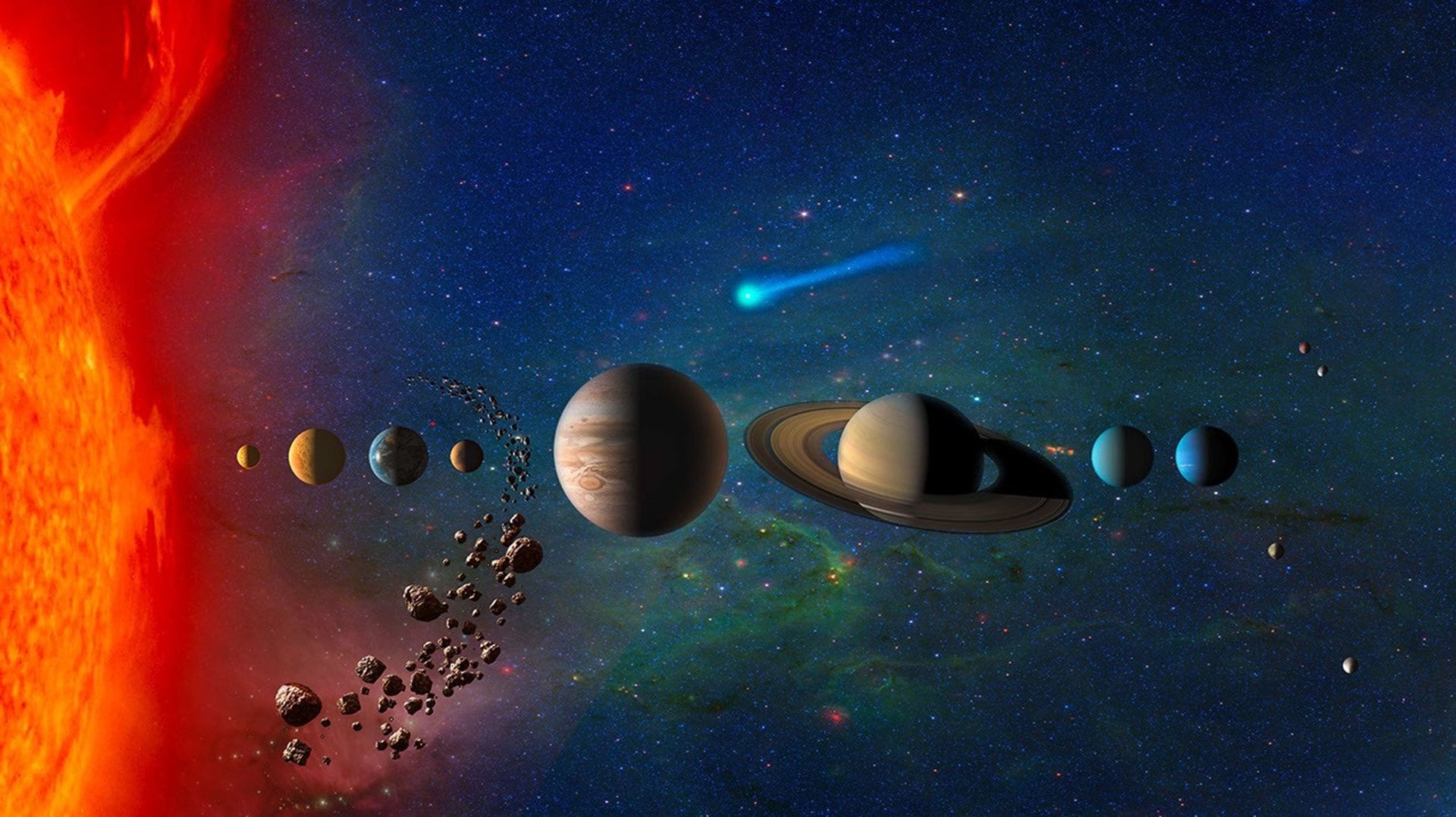
An illustration of our solar system. The asteroid belt lies between Mars and Jupiter, separating our system into the inner and outer regions. NASA/JPL-Caltech

*An illustration of our solar system. The asteroid belt lies between Mars and Jupiter, separating our system into the inner and outer regions.

NASA/JPL-Caltech*

The team theorized that during the first generation, an outward flow of material raised the P/N ratio in the outer Solar System. This changed with the arrival of Jupiter, whose gravitational influence restricted the movement of phosphorus and nitrogen from the inner to outer Solar System. This meant that when the second generation of planetesimals appeared, those that orbited within the inner Solar System were left with a higher P/N ratio than their counterparts that orbited farther from the Sun.

These results suggest that, contrary to previous models, Earth acquired its phosphorus and nitrogen (both essential to life) primarily from the inner Solar System, without additional contributions from the outer Solar System. Their findings are reinforced by geochemical accretion models showing that Earth’s present-day P/N signature is best reproduced by inner Solar System planetesimals, regardless of whether they are related to iron or chondrite meteorites. As Rajdeep Dasgupta of Rice University, the senior author on the study, said in a NASA press release:

For our own solar system, Jupiter's presence and growth history, indeed, seem to have played a critical role in determining the distribution of the basic chemical ingredients necessary for habitable worlds. It remains an open question whether a life-essential element budget similar to Earth's can be established without a Jupiter-like planet in the population.

“The study suggests that Earth acquired its inventory of the life-essential elements phosphorus and nitrogen primarily from the inner solar system, without requiring a significant contribution from outer solar system chondrites,” added Pathak. As for the other LEEs, the means through which they were delivered to Earth billions of years ago remain to be seen and will be the subject of future research.

Further Reading: 

RELATED VIDEOS

NASA Study Challenges Theories on Where the Ingredients for Life Came From

NASA Found the Ingredients for Life Inside an Asteroid

The Unimaginable Origin of Life on Earth: Unveiling Ancient Secrets

{ https://www.universetoday.com/ }

Hoe vind je dit bericht?
Geschreven door peter om 01:08 Stuur door

The Pentagon Just Released Its Third Batch of UAP Files—What Have We Learned from the PURSUE Releases So Far?

An artistic rendering of a UAP incident reported near a sensitive national security site in the western United States
(Image Credit: DoW)

The Pentagon Just Released Its Third Batch of UAP Files—What Have We Learned from the PURSUE Releases So Far?

A disc-like object observed producing “beams” while it hovered above an airport in Zimbabwe in 2008, an object resembling a flying “potato” over the Cheyenne Mountains in 2022, and alleged “orbs” observed by U.S. personnel are all among the sightings included in the Pentagon’s latest release of files related to UAP encounters.

The documents, which appeared on the Department of War’s website on Friday, are just the latest in a series of rolling releases by the Pentagon under the Trump Administration.

“As the unprecedented levels of interest in both this topic and the Trump administration’s historic transparency effort continue, WAR.GOV/UFO has received over 1.7 billion hits worldwide since the site’s launch on May 8, 2026,” read a statement provided by Assistant to the Secretary of War for Public Affairs and Chief Pentagon Spokesman Sean Parnell.

“The Department of War and our agency partners are actively working on the next release of UAP files,” Parnell said.

However, as more videos and documents continue to surface, a fundamental question arises: what, if anything, do they reveal about UAP, and how the United States intelligence community collects and processes information about these objects, whatever their origins may be?

What the Latest PURSUE Release Reveals

Within the latest batch of files from what the Pentagon characterizes as the Presidential Unsealing and Reporting System for UAP Encounters (PURSUE), a previously unreleased file from the U.S. Central Intelligence Agency (CIA) describes an unusual observation of an object that reportedly hovered above the Harare International Airport in Zimbabwe in 2008.

“Individuals debated if the sighting was an advanced reconnaissance device of a foreign government or of extraterrestrial origins,” a short description provided with the document states. Although no video or other supplemental data is provided, the written account that the document contains, which features partial redactions, states that observers described a “disc-like” object possessing a hollow center and “a series of rotating lights on the underside of the airframe.” As the lighting shifted colors, the object reportedly ascended quickly and was soon out of sight.

“Regardless of the origins,” the document states, the incident reportedly “resulted in the decision to place the Zimbabwe [redacted] on high alert.”

Another series of documents describes an observation of an object shaped like a “potato” that was observed near Colorado Springs in 2024.

Witnesses at the time described seeing “distinct edges” on the object, which “appeared to look painted in a creamy/whitish opalescent color.”

UAP PURSUE Release 03

A digital rendering of an unresolved UAP Report from Colorado Springs in 2022

(Image Credit: U.S. Department of War).

“It was somewhat translucent with a slight shimmer,” the report states. “The object was made up of what can best be described as articulating fish scales or panels that were non-symmetrical, non-overlapping, and irregular shaped. The object itself was perfectly still but each panel on the object shifted in slow waves starting at different points of origin but at the same time.”

According to an assessment of the sighting by the All-domain Anomaly Resolution Office, which currently leads the Pentagon’s investigations into UAP, “Analysis possibly indicates that the positioning on the sun in relation to Cheyenne Mountain would allow for backscattering of sunlight reflecting off snow-covered ground.”

“This reflection could illuminate low-level clouds in the vicinity,” according to the assessment, which was produced by one of AARO’s intelligence community (IC) partners, adding that such conditions “might account for the visibility of the object followed by its sudden disappearance.”

The report concedes that the analyst had “low confidence in this assessment” based on limited information made available about witnesses at the time, such as their individual field of view, as well as the level of cloud cover over the area at the time.

Another pair of documents describes what sounds like a very intriguing observation of an “intense bright light” seen hovering below the tree line near the observer’s backyard. Emerging from their vehicle, the witness observed a “strange light” that they estimated to be approximately one meter in diameter. The object was described as a “brilliant and beautiful” reddish color the observer had never seen before, adding that “inside the red sphere, at the center, there appeared to be what [redacted] described as a ‘white plasma sun’ about the size of a basketball.”

In this instance, the written accounts were not alone: a supplemental video indeed shows a pair of objects matching the description provided, which look suspiciously like candle balloons, also known as “sky lanterns,” drifting along with the breeze. Additionally, the footage bears a resemblance to a video released by an aviation safety advocacy group last year (and in fact, it may be the same video), which was also quickly assessed to have been sky lanterns, rather than anomalous UAP “orbs.”

In short, the latest Pentagon releases—as with most other recent releases of government data related to UAP—feature some interesting stories, though the majority of the “new” data remains underwhelming.

Hopeful—but Skeptical—Ufologists

In a posting on his X account, prominent skeptic Mick West noted that in advance of the Pentagon’s second PURSUE release, “ufologists (myself included) were hopeful we’d get some amazing evidence.”

“All 46 videos have been released,” West wrote. “None of them are amazing. Maybe it’s time to consider that this might be the best they have.”

Whether or not the videos we’ve now seen are indeed among the best examples of UAP in the Pentagon’s holdings, West isn’t wrong to point out the obvious: the current examples the Pentagon has provided fail to establish that there is anything truly extraordinary about the objects these videos convey.

West places himself in the commendable position of being among the hopeful “ufologists” that he says are eager to see better data on these phenomena. I can affirm that this author is among those ranks as well, having followed the subject for decades; beyond that, and reporting on the subject where warranted for The Debrief, I have also managed an independent UAP sightings reporting website for the last two years, as a self-funded citizen science effort to collect data on possible UAP observations and make it freely available to the public. Unlike a few similar sites and apps that crowd-source data on possible UAP sightings, I also work to assess the data and resolve cases whenever enough information has been provided to make that feasible.

Like Mick West would probably tell you, I can confirm that the majority of UAP sightings have prosaic explanations, which can often be determined using weather data, aviation tracking sites, astronomical software, rocket launch data, and other online resources that are generally free to the public. After attempting to resolve UAP sighting reports, there is, however, a residuum of unresolved cases that remain intriguing.

Assessing UAP videos to determine whether they document real anomalous phenomena, or simply misidentifications of known objects, often carries a very negative stigma, partially because it has an equally negative term attached to it: “debunking.” The negative association here is unfortunate, since the careful study and interpretation of purported UAP imagery and, when warranted by evidence, its classification as either misidentified known phenomena or genuine unresolved cases, is one of the most beneficial ways we can work toward advancing our understanding of the UAP issue.

Equally unfortunate is the fact that, all too often, what we get instead when it comes to UAP releases is just the opposite: imagery and other data (sometimes including official U.S. government materials released through unauthorized channels) that have undergone virtually no assessment, and which feature scant accompanying details required to help contextualize the sightings.

What we are left with are usually blurry videos and images of objects that end up seeing wide circulation, often with the help of the most ardent promoters of UAP (many of whom also happen to be equally skilled at self-promotion). Beyond making a poor case for the legitimate study of UAP, such instances invite criticism—although not so much from the hopeful, skeptically-minded “ufologists” genuinely interested in viewing quality UAP data. Rather, the most frequent attacks originate from ideological, self-branded “skeptics” whose real focus appears to be aimed at superficially undermining the topic and its proponents using rhetoric heavily dipped in ad hominem, all as a means of driving engagement through their social media accounts.

Who can really blame them? Such high-traffic social media engagement can reportedly be quite profitable these days, and let’s face it: few among the most active voices in the online UAP fracas these days appear to be above engaging in a bit of good old-fashioned grifting—including the ones who often complain the loudest when they see others doing it.

Fundamentally, though, none of this advances our knowledge about UAP. Answers to questions about what these objects are, as well as what they aren’t, and whether any good evidence exists for truly “anomalous” behaviors often associated with these objects by those who witness them, remain void from such contentious prattling—just as it apparently remains absent from the vast majority of the new records released by the Pentagon.

However, that isn’t to say there aren’t at least a few intriguing data points that have emerged from the recent releases.

An Intriguing UAP Case from the Second PURSUE Release

In the second batch of videos released by the Department of War, one potentially intriguing example of an unidentified flying object seems to have gone mostly overlooked.

The case involves imagery from the holdings of the All-domain Anomaly Resolution Office that was originally captured on April 12, 2021. Labeled “Spherical UAP [CALLSIGN] 2021/04/12 vid 0,” the footage, according to details provided at the time of its release, “is likely derived from a full-motion video camera and an infrared sensor aboard a U.S. military platform operating within the United States Central Command area of responsibility in 2021. A user uploaded this video to a classified network in June 2024.”

According to a short description provided by the Department of War, “An area of contrast enters the sensor field-of-view from the upper right corner of the frame, exiting in the bottom right corner of the screen. The sensor pans to track the area of contrast, centering it within the sensor field-of-view.”

“The sensor changes modes as the area of contrast becomes indistinct against the background,” the summary concludes.

However, viewing the footage reveals something slightly more intriguing than this description alone conveys. The footage appears to show a small, light-colored object moving above a rugged desert terrain, presumably somewhere in the Middle East. As the object is being filmed using the electro-optical system on board a United States military drone, at one point, the object can be seen as it begins to descend in altitude, an elevation change made apparent by the shadow the object casts against the terrain below it (as can be seen in the still frame from the footage featured below). At this point, the object engages in a sudden change in direction and appears to enter a shadowed area of the landscape, at which time its brightness (seemingly due to reflectivity of its surface) is significantly diminished by the surrounding shadow, and the object becomes indiscernible.

UAP Pentagon PURSUE

Screen capture from the Pentagon UAP video titled DOW-UAP-PR061, “Spherical UAP [CALLSIGN] 2021/04/12 vid 0”, where the object’s shadow can be discerned against the nearby landscape (to the left of the small white object, seen just above and to the right of the center of the frame

(Image Credit: U.S. Department of War).

The most intriguing aspect of this behavior is the object’s apparent movement into what we might interpret as a position of concealment. In doing so, the object not only appears to “hide,” but it also demonstrates an obvious change in direction that is suggestive of controlled motion. This is significant for a few reasons: one is that in many purported UAP videos, a phenomenon known as the parallax effect can (and often does) lead to an optical illusion where a slow-moving or even stationary object can have the appearance of moving. This illusion is caused by differences in relative speed between objects closer to the camera and those further distant, causing any closer objects to appear to be moving faster than those in the background (a good explainer on parallax effect and its relationship to UAP sightings can be read here, made available at the website of the All-domain Anomaly Resolution Office).

In the case of the “Spherical UAP” featured in the video from the second PURSUE release, perhaps some degree of motion parallax cannot be ruled out. However, the object’s descent just before changing direction and entering the rugged portion of terrain cast in shadow appears to clearly demonstrate in this case that the object is engaged in movement, which equally appears to convey intelligent control. Finally, an interpretation that the object may be taking a position of concealment, if correct, may indicate that the object and/or its operators had been aware that it was being observed.

Does anything conveyed in this video offer proof of extraterrestrial technology? Absolutely not. Are there any obvious signs of extraordinary capabilities being demonstrated by this object? No, there aren’t. What this video does demonstrate, however, is footage of an object that appears to be engaged in behaviors that clearly show movement beyond the capabilities of most simple balloons.

In the case of the DOW-UAP-PR061, “Spherical UAP [CALLSIGN] 2021/04/12 vid 0” footage, the object not only demonstrates changes in its direction of motion, but also appears to conceal itself. Obviously, a better interpretation than “balloon” in this instance might be some kind of unmanned aerial system, although what limited information the footage conveys is simply too indistinct to be able to tell. Altogether, it simply remains “unidentified anomalous phenomena” in the purest sense: some kind of object engaging in what appears to be controlled flight, while not exhibiting any otherwise extraordinary capabilities.

However, all of this raises another important question about UAP reports: why do we always have to assume that an object must display “otherworldly” or otherwise extraordinary capabilities for it to qualify as a “genuine” UAP?

The Problem of Conditioning

Another intriguing phenomenon related to the recent release of UAP information by the Pentagon involves the similarity in responses to these releases from both UAP advocates and UAP skeptics.

Some proponents of genuine anomalous UAP have expressed frustration over the Department of War’s release of several dozens of videos, all of which all fail to reveal any “classic” UFO shapes like flying saucers or giant black triangles, nor any confirmation of extraterrestrial technologies detailed in the troves of formerly classified documents included with the releases.

Meanwhile, skeptics essentially argue the same thing: so far, these videos show nothing particularly remarkable, and clearly fail to prove that extraterrestrials have visited Earth.

In short, the fundamental premise of most “believers” and “skeptics” appears to be the same: “UAPs either must represent evidence of extraterrestrials, or else they are unimportant.”

This premise fails to acknowledge several important issues, such as 1) that many ideas about how UAP are supposed to look and behave are based on presumptions about how we expect any technologies produced by extraterrestrials advanced enough to traverse interstellar distances would appear to us, 2) that UAP could still represent a genuine mystery, even if they aren’t evidence of extraterrestrial technologies, and 3) that even if most UAP turned out to be technologies of earthly origin, they could still represent a security concern, and hence warrant U.S. government investigation.

Clearly, it should be acknowledged that there is also witness testimony—some of it quite compelling—that describes unusual characteristics associated with UAP, such as extreme acceleration, erratic movement, exceptional agility/maneuverability, environmental effects, and other capabilities which could only be characterized as “anomalous.” Such descriptions are also part of what informs many of our expectations about how UAPs are supposed to behave. However, it is important to recognize that just because such eyewitness descriptions exist, it does not necessarily mean that we can—or should—attribute such capabilities to all UAP observations, and thereby use such presumptions as a gauge for their credibility on a case-by-case basis.

How the All-domain Anomaly Resolution Office Characterizes UAP

A careful review of resources made available by the Pentagon’s All-domain Anomaly Resolution Office (AARO) helps to shed further light on the attributes of what it characterizes as UAP.

A page dedicated to education and resources at AARO’s website lists a small collection of studies detailing current state-of-the-art technologies related to spherical drones, novel propulsion systems, and other technologies, which it says represent “advanced propulsion systems that are consistent with UAP observations.” The obvious implication of providing such resources involves the consideration that at least some UAP appear to operate in ways consistent with known earthly technologies, albeit ones that are still in their emergent stages.

AARO also gives us the following definition of UAP, according to an AARO Mission Brief featured at its website: “Unidentified Anomalous Phenomena (UAP) are sources of anomalous detections in one or more domains (i.e., airborne, seaborne, spaceborne, and/or transmedium) that are not yet attributable to known actors and that demonstrate behaviors that are not readily understood by sensors or observers.”

The brief goes on to define “anomalous detections” as “phenomena appearing to demonstrate capabilities or material properties exceeding the known state-of-the-art,” adding that UAP “may consist of one or more objects and may persist over an extended period,” are mainly “attributable to domain-awareness gaps, and in at least some cases “may represent advanced capabilities operating in domain awareness gaps.”

The AARO Mission Brief also separates the misidentification of known objects such as balloons and drones, as well as developmental or experimental platforms, from “genuine” UAP, which it clearly defines as AARO’s designated mission area.

According to past information produced by AARO under the tenure of its inaugural director, Dr. Sean Kirkpatrick, typically reported UAP characteristics include appearances of generally round objects roughly 1-4 meters in size, possessing white, silver, or translucent coloration. Performance altitudes, on average, fall within 10,000 to 30,000 feet, and velocities of the objects range from hovering in a stationary position to movement at speeds of up to Mach 2 (1534.54 miles per hour).

AARO UAP target package Above: Table featuring commonly attributed UAP characteristics based on AARO data available in 2023 (Image Credit: U.S. Department of War/All-domain Anomaly Resolution Office).

Despite such capabilities, no kind of thermal exhaust has been associated with these objects, and their propulsion systems remain unknown. Additional signatures associated with such genuinely anomalous UAP, according to AARO, include “intermittent, X-Band (8-12 GHz)” radar, as well as radio frequency emissions in the 1-3 GHz and 8-12 GHZ ranges. While no thermal exhaust evidencing propulsion is evident, intermittent shortwave infrared and medium-wave infrared thermal signatures are occasionally detectable.

“That’s what we’re looking for and trying to understand what that is,” Kirkpatrick told U.S. Senators during an April 2023 hearing that first revealed the AARO technical data described above.

Given the specificity of such technical information (all of which, as cited above, relates to AARO materials produced in 2023 during its early period in operation), one must wonder how such details could be derived from any of the videos or other materials the Department of War has released under the recent PURSUE initiative. The obvious implication is that the data described above must have other, better-quality sources, which have not yet been released by AARO or the Department of War.

What This All Means, for Now

Of course, AARO also maintains that it has found no evidence of extraterrestrial technologies in its UAP investigations. All this taken together, a few things can be concluded based on the totality of AARO’s findings since its investigations began: 1) some objects appear to be genuinely anomalous, which AARO calls UAP, 2) AARO takes its investigations of these objects seriously, 3) studies involving breakthrough or disruptive technologies available at its website imply that AARO may suspect some UAP of being related to such developments, and are therefore not currently misidentifications of well-known objects or technologies, but possible “breakthrough” technologies whose origins remain unattributed, and 4) specific details about appearance and operational characteristics of AARO’s UAP “target package” strongly suggest the existence of higher quality UAP data that likely remains classified.

If it ends up being true that additional, higher-quality UAP data exists in U.S. government holdings—data from which AARO’s own technical attributes for genuinely “anomalous” UAP are derived—it therefore stands to reason that the recent batches of imagery fall significantly short of being the “best data” that has been obtained about these objects. Still, some of the videos, such as DOW-UAP-PR061 (described earlier in this article), nonetheless appear to match the so-called “target package” for genuine UAP first characterized by Kirkpatrick in 2023, even if they aren’t the most astonishing UAP videos in existence. Again, we should consider the conditioning outlined earlier, which has helped to encourage the public’s never-ending expectation for “extraordinary” revelations, most of which end up falling flat once they do finally come to light.

The bigger questions, for now, are whether such examples of higher-quality UAP data do indeed exist, and if so, whether they will be made public in any future releases.

“We are collecting as much data as possible, following the data where it leads, and sharing our findings whenever possible,” AARO states on its website. “We will not rush to conclusions in our analysis. In many cases, observed phenomena are classified as ‘unidentified’ simply because sensors were not able to collect enough information to make a positive attribution.”

Arguably, if there are better quality UAP materials in AARO’s holdings, there are probably very reasonable considerations for why that information has not yet been released, which may include uncertainty about whether some data could involve potentially sensitive information about experimental U.S. technologies or those of foreign adversaries, the release of which could have implications that, for now, may warrant secrecy.

In conclusion, although most of the videos in the recent Pentagon UAP releases provide too little data to draw any firm conclusions, arguably, some of the most important considerations are made evident by what the recent releases don’t contain—especially when compared to the information AARO uses as the basis for what it calls “genuine” UAP.

To borrow that overused X-Files quip once again, “the truth is out there.” Whether we’ll be seeing the best data that supports that truth any time soon is another question entirely.

  • Micah Hanks is the Editor-in-Chief and Co-Founder of The Debrief. A longtime reporter on science, defense, and technology with a focus on space and astronomy, he can be reached at micah@thedebrief.org. Follow him on X @MicahHanks, and at micahhanks.com.

RELATED VIDEOS

PURSUE Release 03: All 9 Pentagon UAP Videos Back to Back | Complete Declassified Archive


“PENTAGON UAP DROP 3 JUST DROPPED - All 6 Videos: Orbs Launching Smaller Orbs, FBI Agents Baffled!”

Declassified UAP Files: The Best Footage from the Pentagon

{ https://thedebrief.org/category/science/ }

Hoe vind je dit bericht?
Geschreven door peter om 00:50 Stuur door

Hikers caught bright triangular UAP over Chilean Mountains

Hikers caught bright triangular UAP over Chilean Mountains

A group of hikers were trekking through the mountains of Chile when they noticed a brilliant light shimmering in the distance high above the peaks. 
triangular%20UAP%20Chile.jpg

They quickly grabbed their cameras and began recording. The footage appears to show a triangular object surrounded by a strange energy field, possibly magnetic or plasma-like in nature, emitting an intense light that flickers and shimmers in the sky. 
Some skeptics suggest the object could simply be sunlight reflecting off something on the ground. However, the footage appears to show it hovering at a considerable altitude above the mountains. Others argue that the triangular shape is not the object's true form at all, but rather the result of the camera being out of focus, causing the shape of the camera's aperture to become visible. 
To this day, it remains unclear what was captured on camera. Was it a secret piece of advanced technology, a rare atmospheric phenomenon, an out-of-focus optical effect, or something far more mysterious?

{ https://ufosightingshotspot.blogspot.com/ }

Hoe vind je dit bericht?
Geschreven door peter om 00:19 Stuur door

The 20 best Alien & UFO documentaries for those who want to believe and to freak You out tonight

The 10 Best Alien & UFO Documentaries To Freak You Out Tonight

The 20 best Alien & UFO documentaries for those who want to believe and to freak You out tonight

Story by Katie Rife, Kevin Jacobsen

After seeing Steven Spielberg's "Disclosure Day," check out these real-life accounts of strange aerial sightings.

Bill Ryan in 'Mirage Men'; a former student in 'Ariel Phenomenon'; Christo Roppolo in 'Curse of the Man Who Sees UFOs' Credit: Perception Management Productions/YouTube; String Theory Films, LLC; Virgil Films
Bill Ryan in 'Mirage Men'; a former student in 'Ariel Phenomenon'; Christo Roppolo in 'Curse of the Man Who Sees UFOs'
Credit: Perception Management Productions/YouTube; String Theory Films, LLC; Virgil Films© Perception Management Productions/YouTube; String Theory Films, LLC; Virgil Films

What is it about UFOs that we humans find so fascinating? Is it the desire to know that there may be life beyond our planet? Is there something about these flying objects being unidentified that makes us feel like amateur detectives? Is it the conspiracy element that drives us to seek answers that the government may be covering up?

No matter what drives our interest, it's the intangible mystery of it all that connects UFO enthusiasts. For decades, documentarians have been intrigued by stories of UFO sightings, from centuries-spanning intros to the subject like UFOs: The Secret History (2010), to character-driven pieces such as Curse of the Man Who Sees UFOs (2016), to the prolific works of James Fox.

Ahead, we're looking at some of the best UFO documentaries that explore what may be out there, for those of us who want to believe.

1. Ariel Phenomenon (2022)

A former student in 'Ariel Phenomenon' Credit: String Theory Films, LLC

A former student in 'Ariel Phenomenon'
Credit: String Theory Films, LLC

Director Randall Nickerson spent more than a decade gathering material for this documentary, which tells the story of a massive otherworldly sighting and the psychological effects of not being believed. On Sept. 16, 1994, 60 children claimed they saw a UFO on their school grounds in rural Zimbabwe; their accounts were dismissed, but the group is still sticking to their story nearly 30 years later. Ariel Phenomenon follows one of those witnesses as she returns to the site of the event as an adult, bringing in a BBC reporter and a Harvard professor to corroborate her story — and those of her classmates — for the first time. —Katie Rife

  • Where to watch Ariel Phenomenon: Amazon Prime Video (to buy)

2. Curse of the Man Who Sees UFOs (2016)

Christo Roppolo in 'Curse of the Man Who Sees UFOs' Credit: Virgil Films

Christo Roppolo in 'Curse of the Man Who Sees UFOs'
Credit: Virgil Films

If the title of this documentary isn't enough to sell you on it, the highly entertaining story therein surely will. The cursed man who sees UFOs is Christo Roppolo, an eccentric Californian who claims to have videotaped multiple sightings over the years. Director Justin Gaar joins him on various pursuits to capture more footage, and he (and most viewers) find it impossible not to be charmed by Roppolo's enthusiasm. As the film shifts to a more poignant meditation on Roppolo's life beyond his hunt for aliens, Gaar shows how investigating the human observer is just as fascinating as what they observe. —Kevin Jacobsen

  • Where to watch Curse of the Man Who Sees UFOs: Tubi

3. I Know What I Saw (2009)

James Fox (right) in 'I Know What I Saw' Credit: UFOTV/Amazon

James Fox (right) in 'I Know What I Saw'
Credit: UFOTV/Amazon

James Fox is a mainstay of the UFO sighting scene, and his film for the History Channel is considered one of the most thorough and well-researched documentaries on the “nuts and bolts” side of extraterrestrial research. Fox’s focus here is on the link between the U.S. military and the UFO phenomenon: What do they know, how long have they known it, and why aren’t they sharing this information with the public? His approach is straightforward and fact-based, utilizing footage from congressional hearings and press conferences, along with interviews with retired military and government officials, to lend an air of legitimacy to the subject. —K.R.

  • Where to watch I Know What I Saw: Amazon Prime Video

4. Love & Saucers (2017)

David Huggins in 'Love & Saucers' Credit: Curator Pictures/Amazon

David Huggins in 'Love & Saucers'
Credit: Curator Pictures/Amazon

David Huggins, a New Jersey-based artist who claims to have had a consensual sexual relationship with a female alien that lasted for several years, could be nothing more than a joke. What makes this documentary about Huggins so good, though, is that it doesn’t treat him as one, instead using his story as a jumping-off point into an earnest exploration of the nature of belief and, indeed, of reality itself. Sequences of Huggins explaining his artwork — a series of paintings depicting his encounters that numbers in the hundreds — to skeptical gallery-hoppers skillfully strike a tricky tonal balance, and the addition of a religious studies professor who compares Huggins’ experiences to those of medieval saints brings a fresh, fascinating perspective. —K.R.

  • Where to watch Love & Saucers: Fandango at Home

5.  Mirage Men (2013)

Bill Ryan in 'Mirage Men' Credit: Perception Management Productions/ Youtube

Bill Ryan in 'Mirage Men'

Credit: Perception Management Productions/ Youtube

This provocative documentary, based on the book of the same name by Mark Pilkington and John Lundberg, presents a radical alternative theory of UFOs: that they’re all lies. What the directors posit is that, 60 years ago, the U.S. military deliberately concocted the extraterrestrial phenomenon as a way to distract the public from classified weapons research, and that the government has been manipulating belief in aliens ever since. Interviews with former members of the AFOSI (Air Force Office of Special Investigations) officers support Pilkington and Lundberg’s case, and the film has a spooky aura that makes you feel as if you’re being watched. But by whom? —K.R.

  • Where to watch Mirage Men: Tubi

6. Moment of Contact (2022)

James Fox (right) in 'Moment of Contact' Credit: James Fox Productions/YouTube

James Fox (right) in 'Moment of Contact'
Credit: James Fox Productions/YouTube

Another documentary investigation of a global extraterrestrial event, this film focuses on the Varginha UFO Incident, which began in the winter of 1996 when three teenage girls saw a four-foot-tall creature with a huge head and red eyes they described as “the devil” in Varginha, Brazil. Things get even weirder from there as documentarian James Fox shines a light on a lesser-known example of a so-called UFO “flap” in his deep-dive, interview-based style. —K.R.

  • Where to watch Moment of Contact: Tubi

7. Out of the Blue (2003)

Bill George in 'Out of the Blue' Credit: UFOTV/YouTube

Bill George in 'Out of the Blue'
Credit: UFOTV/YouTube

Billing itself as “the definitive investigation of the UFO phenomenon,” this 2003 film was originally produced for the Sci-Fi Channel, and its reputation has only grown in the years since its release. It also marked the directorial debut of James Fox, a name that appears multiple times on this list. Fans praise the documentary for the depth of its research and its level-headed approach to what can be a very out-there topic. It’s convinced of the existence of UFOs, and argues this point passionately, which was a risky stance to take 20-plus years ago — but, given revelations since, it’s a stance that’s aged as well as the documentary itself. —K.R.

  • Where to watch Out of the Blue: Amazon Prime Video

8. The Phenomenon (2020)

Garry Nolan in 'The Phenomenon' Credit: 1091/YouTube

Garry Nolan in 'The Phenomenon'
Credit: 1091/YouTube

Documentarian and UFO expert James Fox’s 2020 follow-up to I Know What I Saw incorporates new information that’s come to light in the decade since that previous film’s release, creating an informative overview of what we know about what the U.S. government knows about UFOs (or, to use the more official term, UAPs — unidentified anomalous phenomena). The documentary covers revelations from The New York Times’ bombshell 2017 investigation into the Pentagon’s clandestine UFO program, pairing it with new evidence for a movie that comes with the endorsement of both Jacques Vallée (a scientist/UFOlogist) and now-deceased U.S. Senator Harry Reid. —K.R.

  • Where to watch The Phenomenon: Amazon Prime Video

9. UFOs: The Secret History (2010)

A diagram from 'UFOs: The Secret History' Credit: UFOTV

A diagram from 'UFOs: The Secret History'
Credit: UFOTV

If you're looking for a primer on the history of unidentified flying objects and our cultural understanding of them, this is where to start. Director David Cherniack doesn't resort to sensationalist storytelling; rather, he treats the subject with earnest sincerity as we learn about 19th-century sightings, explore what might really have happened in Roswell, and hear modern-day accounts. Bolstered by expert analysis, the film provides a fascinating look into governmental cover-ups over the years and humanity's natural curiosity for what may be out there. —K.J.

  • Where to watch UFOs: The Secret History: Amazon Prime Video

10. Unacknowledged (2017)

Steven M. Greer in 'Unacknowledged' Credit: The Orchard

Steven M. Greer in 'Unacknowledged'
Credit: The Orchard

UFOlogist Steven M. Greer is the founder of the Disclosure Project, a group that advocates for classified information on extraterrestrials to be made available to the public. This crowdfunded 2017 documentary is part of that mission, collecting theories and stories from the early-‘60s through the present day that all point toward a government cover-up of the truth about aliens. Like I Know What I Saw, this film relies heavily on interviews with retired military personnel to give it credibility, along with archival footage to bolster Greer’s convincing case. —K.R.

  • Where to watch Unacknowledged: Amazon Prime Video

11. Unsolved Mysteries, "Something in the Sky" (2022)

A reenactment in the 'Unsolved Mysteries' episode 'Something in the Sky' Credit: Netflix

A reenactment in the 'Unsolved Mysteries' episode 'Something in the Sky'
Credit: Netflix

The long-running newsmagazine show has performed dozens of investigations into extraterrestrial encounters, but this 2022 episode, part of the revival series on Netflix, is among the best. Its focus is on the UFO sightings that occurred all over West Michigan in 1994, where multiple people — including a National Weather Service meteorologist — saw what they described as clusters of lights flying over Lake Michigan before abruptly disappearing. This episode, the second episode of Volume 3, is structured around first-person interviews, and while it offers no clear answers, it’s pretty darn compelling. —K.R.

  • Where to watch Unsolved Mysteries: Netflix

12. Witness of Another World (2018)

Young Juan in 'Witness of Another World' Credit: 1091/YouTube

Young Juan in 'Witness of Another World'
Credit: 1091/YouTube

Like Ariel Phenomenon and Love & Saucers, this UFO documentary from director Alan Stivelman focuses on the human consequences of extraterrestrial contact. The film follows Juan, an Argentinian gaucho whose life was so shattered by an alien encounter that he still lives as a hermit and refuses to talk about what happened to him even 30 years later. Astronomer and UFOlogist Jacques Vallée appears to shed additional light on Juan’s story, and dramatic effects sequences dramatize the emotional impact of his close encounter. —K.R.

  • Where to watch Witness of Another World: Fandango at Home (to rent)

13. The Age of Disclosure  (2026)


What makes The Age of Disclosure so unique is that it’s told from the perspective of government and military officials. Instead of interviewing the usual crackpot weirdos that so many UFO documentaries do, The Age of Disclosure features interviews with senators like Kirsten Gillibrand, ex-CIA officials, Navy pilots, and former NORAD director James D. Cobb. 

The major point that The Age of Disclosure wants to reveal is how deep the US government and military truly are in the search for aliens and UFO technology, and how desperate both are to keep American citizens in the dark. Whether it’s to protect secret info from foreign governments or to keep society from devolving into panic, the documentary claims there is a lot that the average person doesn’t know. It’s a seriously compelling and shocking documentary purely because of the number of big-name figures it was able to attract. If you liked the conspiracy aspect of Close Encounters of the Third Kind (1977), you’ll love the alleged real conspiracies happening in our government right now that The Age of Disclosure uncovers. 

14. The Manhattan Alien Abduction ( 2024 )

The Manhattan Alien Abduction

The three-part docuseries The Manhattan Alien Abduction tells the wild story of Linda Napolitano, who claims that in 1989 aliens abducted her in the middle of Manhattan. The story also purports that dozens of witnesses have stepped forward to corroborate her claims. 

But there are cracks in the tale, like how none of the witnesses have ever publicly identified themselves, and one woman who claims to know for certain that Napolitano is making it all up. That makes this Netflix docuseries so gripping because it isn’t just an abduction story; it also examines whether there’s a potential hoax and scam behind it all. If you loved Hulu’s crypto-turned-cartel docuseries Sasquatch (2021), you’re going to love all the questions, conflicts, and mysteries in The Manhattan Alien Abduction.

15. The Mothman of Point Pleasant ( 2017 )

The Mothman of Point Pleasant

The Mothman is one of the wildest and strangest stories in American history. Here are the facts: Starting in late 1966, in Point Pleasant, West Virginia, dozens of locals started seeing a strange winged creature. Soon after, UFO sightings spiked, residents claimed ominous men in black visited them, and some even got phone calls from a strange man who identified himself as Indrid Cold. The hysteria continued to grow for a year until December 1967, when the Silver Bridge connecting Point Pleasant to Gallipolis, Ohio, collapsed into the river below, killing 46 people, all while the Mothman allegedly flew overhead. 

Was the Mothman a cryptid, an alien, or just a sandhill crane? Why so many UFO sightings? Who were the men in black? Were they from the government or aliens themselves? Or was the entire thing a case of mass hysteria? If so, how could it all culminate in a very real disaster? Nobody knows for sure, but everyone has theories. For a complete timeline of events, including interviews with locals, newspaper transcripts, and more, The Mothman of Point Pleasant is a great documentary to watch. If you loved 2002’s The Mothman Prophecies, check out this doc to discover the true story that inspired it. 

16. The Program ( 2024 )

The Program

In 2017, The New York Times broke a story about how the US government had secretly been looking into the possibilities of UFOs. Since then, we’ve found ourselves in a new era of alien obsession and ufology. The main difference is that this time, members of Congress and the military are also asking these questions. 

The Program is a documentary about the alleged government/military cover-up of UFOs and alien encounters. It shows real footage from congressional hearings with people who claim to have in-depth knowledge that, until recently, was purposefully being suppressed. For fans who loved The Age of Disclosure and its deep dive into the government’s potential knowledge of UFOs, The Program will be an engrossing watch you don’t want to miss. 

17. Travis: The True Story of Travis Walton  ( 2015 )

Travis: The True Story of Travis Walton

One of the most famous alien abduction stories ever is that of Travis Walton. In 1975, he and a group of workers were driving through the forest when they reported a bright light in the sky. Walton allegedly ran toward the light and was beamed up. He then went missing for six days before returning to society and giving an in-depth abduction story that involved alien probing and more. His story became the basis for the 1993 film Fire in the Sky. 

Travis: The Trust Story of Travis Walton pulls back the Hollywood glamour and presents the timeline of events told by Walton himself, as well as numerous paranormal researchers and skeptics. It also dives into the mental struggles that Walton has had throughout his life, dealing with the fame and scrutiny that came with his story. If you’re a fan of Fire in the Sky, you’ll want to check out the true story behind it. 

18. The Rendlesham UFO: The British Roswell (2025 )

The Rendlesham UFO: The British Roswell

In 1980, a well-documented UFO sighting happened at the RAF Woodbridge base in England’s Rendlesham Forest. Military personnel reported seeing strange lights in the forest, and when they investigated, it turned out to be a UFO. The official report from the RAF says the lights were able to break apart and fly off in different directions, and the areas they touched tested positive for radiation. 

The Rendlesham UFO - The British Roswell sees a group of investigators travel to the forest to commune with whatever entity caused the ordeal. The film mixes mysticism with ufology to create a unique, new-age alien documentary unlike any other. For enthusiasts who believe that UFOs and metaphysics are intertwined, this is a great watch. 

19. The Phoenix Lights - Beyond Top Secret - Expanded and Updated (2018 )

The Phoenix Lights - Beyond Top Secret - Expanded and Updated

One of the most well-documented UFO encounters ever happened in 1997 over Phoenix, Arizona. For almost two hours, residents of Phoenix saw strange glowing orbs in the sky, all moving synchronously. With dozens of eye-witness videos and thousands of reports made to the police (including one by Kurt Russell), there’s no denying that something was over the Arizona skies that night. 

Even wilder, there’s still no formal explanation for the events. Skeptics point to the large number of Air Force bases near Phoenix and say it could have been the Air Force flying jets… but the military has never said it was flying jets that evening, especially completely silent ones (and if you live near an Air Force base like me, you know how loud fighter jets are). For a documentary that explores one of the wildest mass UFO sightings in human history, you need to watch The Phoenix Lights - Beyond Top Secret. If you love the historical inspiration behind the film Battle: Los Angeles (2011), but want something more rooted in history, this documentary will definitely make your jaw drop.

20. Moment of Contact ( 2022 )

Moment of Contact

In 1996, an alleged alien encounter happened in Varginha, Brazil, where a group of girls said they spotted some kind of injured creature, and shortly after, witnessed tons of military personnel throughout the town. Skeptics say it was all a misunderstanding and that the girls likely saw a disabled homeless man covered in dirt. But believers say it’s the biggest alien cover-up since Roswell. 

Moment of Contact sheds light on this story and follows a team of filmmakers as they head to Brazil and search for answers. If you’ve ever seen The Cove (2009) and love the way it’s filmed like a real movie following the documentary crew on their journey, you’ll enjoy the similar vibe of Moment of Contact. Even for non-believers, it’s a fun adventure to watch the crew search for clues and information from the infamous 1996 event. 


Top 20 Alien Documentaries You HAVE to See

{ https://ew.com/ }

Hoe vind je dit bericht?
Geschreven door peter om 23:36 Stuur door

Meer van UFO'S of UAP'S, ASTRONOMIE, RUIMTEVAART, ARCHEOLOGIE, OUDHEIDKUNDE, SF-SNUFJES EN ANDERE ESOTERISCHE WETENSCHAPPEN - DE ALLERLAATSTE NIEUWTJES

↑ Terug naar de berichten