Naar de inhoud

UFO'S of UAP'S, ASTRONOMIE, RUIMTEVAART, ARCHEOLOGIE, OUDHEIDKUNDE, SF-SNUFJES EN ANDERE ESOTERISCHE WETENSCHAPPEN - DE ALLERLAATSTE NIEUWTJES

UFO's of UAP'S in België en de rest van de wereld
akke.beakke.be
Ontdek de Fascinerende Wereld van UFO's en UAP's: Jouw Bron voor Onthullende Informatie! Ben jij ook gefascineerd door het onbekende? Wil je meer weten over UFO's en UAP's, niet alleen in België, maar over de hele wereld? Dan ben je op de juiste plek! België: Het Kloppend Hart van UFO-onderzoek In België is BUFON (Belgisch UFO-Netwerk) dé autoriteit op het gebied van UFO-onderzoek. Voor betrouwbare en objectieve informatie over deze intrigerende fenomenen, bezoek je zeker onze Facebook-pagina en deze blog. Maar dat is nog niet alles! Ontdek ook het Belgisch UFO-meldpunt en Caelestia, twee organisaties die diepgaand onderzoek verrichten, al zijn ze soms kritisch of sceptisch. Nederland: Een Schat aan Informatie Voor onze Nederlandse buren is er de schitterende website www.ufowijzer.nl, beheerd door Paul Harmans. Deze site biedt een schat aan informatie en artikelen die je niet wilt missen! Internationaal: MUFON - De Wereldwijde Autoriteit Neem ook een kijkje bij MUFON (Mutual UFO Network Inc.), een gerenommeerde Amerikaanse UFO-vereniging met afdelingen in de VS en wereldwijd. MUFON is toegewijd aan de wetenschappelijke en analytische studie van het UFO-fenomeen, en hun maandelijkse tijdschrift, The MUFON UFO-Journal, is een must-read voor elke UFO-enthousiasteling. Bezoek hun website op www.mufon.com voor meer informatie. Samenwerking en Toekomstvisie Sinds 1 februari 2020 is Pieter niet alleen ex-president van BUFON, maar ook de voormalige nationale directeur van MUFON in Vlaanderen en Nederland. Dit creëert een sterke samenwerking met de Franse MUFON Reseau MUFON/EUROP, wat ons in staat stelt om nog meer waardevolle inzichten te delen. Let op: Nepprofielen en Nieuwe Groeperingen Pas op voor een nieuwe groepering die zich ook BUFON noemt, maar geen enkele connectie heeft met onze gevestigde organisatie. Hoewel zij de naam geregistreerd hebben, kunnen ze het rijke verleden en de expertise van onze groep niet evenaren. We wensen hen veel succes, maar we blijven de autoriteit in UFO-onderzoek! Blijf Op De Hoogte! Wil jij de laatste nieuwtjes over UFO's, ruimtevaart, archeologie, en meer? Volg ons dan en duik samen met ons in de fascinerende wereld van het onbekende! Sluit je aan bij de gemeenschap van nieuwsgierige geesten die net als jij verlangen naar antwoorden en avonturen in de sterren! Heb je vragen of wil je meer weten? Aarzel dan niet om contact met ons op te nemen! Samen ontrafelen we het mysterie van de lucht en daarbuiten.

Categorie: Myths, legends, unknown cultures and civilizations

'Charred remains of Noah's Ark' discovered as researchers unearth burnt wood 30 feet underground

'Charred remains of Noah's Ark' discovered as researchers unearth burnt wood 30 feet underground

A vast, ship-shaped formation in eastern Turkey has long fueled speculation that the remains of Noah's Ark could lie hidden beneath its surface.

According to the Bible, the vessel sheltered Noah, his family and animals during a catastrophic flood, dated by some biblical chronologies to more than 4,300 years ago.

Now, researchers investigating the Durupınar Formation near Mount Ararat have reported finding charred wood underground, raising hopes that it could offer a clue to the biblical mystery. The samples have been sent for testing to establish their age and identify the type of wood.

Andrew Jones, founder of Noah's Ark Scans and vice president of the project, told the Daily Mail that both charred and uncharred wood had been recovered nearly 30 feet underground, adding that 'it is possible that we have found the charred remains of Noah's Ark.' 

He also acknowledged it might instead come from a shepherd's campfire 'he unwittingly decided to start while using the ark for shelter centuries ago.'

The team suggested the wood could have been burned deliberately or exposed to lightning or volcanic activity.

The discovery follows radar scans that Dr Khosrow Bakhtar, a veteran US defense scientist, said revealed patterns resembling chambers and corridors inside the roughly 515-foot-long formation.

'This is the most significant finding of 45 years of my career. It's not geologic related, because we masked all the geologic features,' Bakhtar said.

An international team are '100 percent confident' that the formation is a 'man-made object'

An international team are '100 percent confident' that the formation is a 'man-made object'

The wood's burned appearance has drawn particular interest because the Bible describes Noah being instructed to coat the ark inside and out with pitch, a waterproofing substance that can catch fire.

The team suggested that the burning may also have helped preserve the material, as charring can slow the breakdown of wood in soil.

If the samples eventually prove to be connected to the ark, a fire that damaged the vessel may have helped preserve traces of it.

The formation's location and boat-like outline have long fueled comparisons with the biblical account, which places the ark's resting place in the 'mountains of Ararat.'

The Durupınar Formation lies about 18 miles south of Mount Ararat, Turkey's highest peak.

Researchers also point to its roughly 515-foot length, which they say corresponds to the vessel described in Genesis. 

Using their conversion of biblical measurements, the ark would have measured approximately 515 feet long, 86 feet wide and 52 feet tall.

Two other major anomalies measured approximately 26 feet and 39 feet high, while another distinct underground feature stood about 23 feet high.

A radar scan of Turkey’s Durupınar Formation shows underground features that researchers interpret as possible buried passageways at the suspected Noah’s Ark site

A radar scan of Turkey's Durupınar Formation shows underground features that researchers interpret as possible buried passageways at the suspected Noah's Ark site

The team found pottery that they say predates what biblical scholars call the Great Flood. Pictured right is the Turkish archaeologist leading the project, Dr Cenker Atila from Sivas Cumhuriyet University

The team found pottery that they say predates what biblical scholars call the Great Flood. Pictured right is the Turkish archaeologist leading the project, Dr Cenker Atila from Sivas Cumhuriyet University

article image

At several locations, the radar detected a layer measuring 16 to 20 feet thick, approximately 16 feet beneath the surface.

The latest investigation builds on a 2019 radar survey that detected straight lines and angular patterns the team interpreted as possible walls, passageways and compartments.

In 2026, Bakhtar examined the formation using a more powerful radar system developed through US Air Force research, capable of reaching deeper underground.

The team reported detecting large underground boundaries and spaces that it interpreted as possible sediment-filled chambers, corridors and tunnels.

Five prominent features appeared to form a possible tunnel system stretching roughly 151 feet, with an average height of more than 14 feet.

Researchers also identified a thick underground layer that appeared to contain three separate sublayers, drawing comparisons with the Bible's description of an ark built with three decks.

'In our holy books, Noah's Ark had three levels; in our radar studies, we also identified a formation with three levels,' said Dr Cenker Atila, an archaeologist at Sivas Cumhuriyet University in Turkey.

The team claims it has '100 percent confirmed' that the formation is a 'man-made object' rather than a natural geological feature.

Jones, who has investigated the area for nearly 30 years, told the Daily Mail that neither radar surveys nor drilling inside the formation had detected limestone or solid bedrock.

A group of researchers think a formation in the Turkish mountains could be the remains of Noah's Ark

A group of researchers think a formation in the Turkish mountains could be the remains of Noah's Ark 

Further studies using infrared thermography (IRT) could show a ship-shaped hull under the soil

Further studies using infrared thermography (IRT) could show a ship-shaped hull under the soil

The radar captured 'a series of right angles' about 20 feet down, which researchers believe could be rooms that held animals on the ark

The radar captured 'a series of right angles' about 20 feet down, which researchers believe could be rooms that held animals on the ark

'This destroys the theory that the site is a solid limestone block shaped into a boat by glaciers and weathering after coming down the mountainside, and it also refutes the theory that this is bedrock around which mud flowed to form the shape,' he said.

However, ruling out those explanations would not, by itself, establish that the formation was built by people.

Radar readings are also not photographs of exposed rooms or passageways. They show how signals respond to different materials and boundaries underground, which must be physically examined to establish what produced them.

The team is using the scans to identify promising locations for further drilling.

Jones acknowledged that the findings have not definitively identified the formation as the biblical vessel.

'I firmly believe the Durupınar Formation represents the buried remains of Noah's Ark,' he said, describing the scans as a 'compelling new line of evidence' rather than definitive proof.

Lauren Witzke, director of marketing and fundraising for Noah's Ark Scans, said the formation's exposed upper section was deteriorating.

The team pulled samples from the ground, finding charred and uncharred pieces of wood, which have been sent for testing to determine their age

The team pulled samples from the ground, finding charred and uncharred pieces of wood, which have been sent for testing to determine their age 

'article image

The top, and most exposed, tier is decaying, and the hardened mudflow encasing the rims of the boat are basically the only thing holding it together,' she said.

Witzke said the lower sections appeared better preserved and suggested drilling may have reached a floor of petrified wood. Those descriptions remain the team's interpretation, with laboratory testing of the recovered samples still pending.

The team also reported finding pottery outside the formation dating from the Chalcolithic, or Copper Age, through the Iron Age.

Researchers said the artifacts indicate that people occupied or visited the mountainside over a long period and could help guide further archaeological work.

Witzke suggested some pottery might have been connected to supplies carried aboard the ark or used by Noah's family after leaving it. Jones acknowledged that pottery alone cannot establish either connection.

The Durupinar Formation lies about 18 miles south of Mount Ararat, Turkey's highest peak

The Durupinar Formation lies about 18 miles south of Mount Ararat, Turkey's highest peak

The site has attracted attention for decades. Local accounts say heavy rain and earthquakes exposed its unusual outline in 1948, when a Kurdish shepherd reportedly noticed it.

It gained wider recognition in 1959 after Turkish Army Captain İlhan Durupınar spotted its ship-like shape in aerial survey photographs.

Earlier investigators reported finding soil and rocks and concluded that the formation was natural. The current team argues that its new scans and recovered samples warrant further investigation.

'What excites me most about this phase is that we are transitioning from remote imaging to collecting physical samples deep within the site, allowing us to scientifically evaluate hypotheses that have been debated for decades,' Jones said.

RELATED

Did They Just Find WOOD Beneath the Noah's Ark Site?!

🚨ALERT: MASSIVE Noah’s Ark Discovery, They Found WOOD Deep Inside!

Scientists Went 60 Feet Inside Noah’s Ark — What They Found SHOCKED Everyone!

{ https://www.dailymail.com/sciencetech/index.html }

Hoe vind je dit bericht?
Geschreven door peter om 22:09 Stuur door

Secret British Intelligence Files Reveal Experts Believed Loch Ness Monster Footage Showed Living Creature

Loch Ness Monster intelligence files

Illustrative image only.

Secret British Intelligence Files Reveal Experts Believed Loch Ness Monster Footage Showed Living Creature

British military intelligence specialists examining mysterious footage from Loch Ness concluded that an unidentified object moving through the water was probably a living creature, according to historical intelligence assessments that have returned to the spotlight following newly reported revelations about government correspondence.

The findings emerged from an investigation conducted during the 1960s by Britain’s Joint Air Reconnaissance Intelligence Centre, known as JARIC. The organization, which specialized in analyzing aerial reconnaissance imagery, was asked to examine film recorded by investigators searching for evidence of the legendary Loch Ness Monster. Its conclusions would become some of the most intriguing official assessments ever associated with the mystery.

Fresh attention has been drawn to the investigation following a report published by The Times on October 25, 2026, describing correspondence involving Lord Shackleton, a British defence minister, and Loch Ness researcher David James. The reported exchange suggests that government officials were concerned about publicity surrounding the Ministry of Defence’s involvement in examining the mysterious footage.

The correspondence has resurfaced through research discussed in a new book by veteran Loch Ness investigator Adrian Shine, published on October 20. Although the original intelligence assessments have been known for decades, the reported ministerial involvement adds another dimension to a case that has fascinated investigators for more than 60 years.

The story begins on April 23, 1960, when aeronautical engineer and former RAF pilot Tim Dinsdale was overlooking Loch Ness from elevated ground near Foyers, on the eastern shore of the Scottish lake. Dinsdale had travelled to the Highlands specifically to investigate reports of a large unidentified animal, spending several days searching the water through binoculars.

During his final day at the loch, he noticed a dark object moving across the distant surface. Its shape and behaviour appeared sufficiently unusual for him to retrieve his 16mm cine camera and begin recording. The resulting footage showed an indistinct object travelling through the water, producing a visible wake as it moved away from the camera.

Dinsdale believed the recording might show the creature that witnesses had described for generations. The film attracted considerable interest and became one of the most influential pieces of evidence presented by supporters of the Loch Ness Monster’s existence. Its apparent movement, considerable distance from the camera and lack of clearly identifiable features also made it difficult to interpret.

In the years that followed, the Loch Ness Phenomena Investigation Bureau pursued a more organized investigation of sightings and photographic evidence. The group submitted Dinsdale’s film to JARIC, seeking a technical assessment from specialists trained to interpret images and identify objects under challenging viewing conditions.

The intelligence analysts examined the available footage, studying the apparent dimensions, movement and characteristics of the object. Their work resulted in a photographic interpretation report issued in February 1966, which contained a conclusion that would subsequently feature prominently in discussions about the mystery.

  • The analysts considered the object to be probably animate, suggesting that what appeared in the film could have been something living rather than an inanimate object moving across the water.

The assessment did not establish the existence of the Loch Ness Monster, identify an unknown species or determine exactly what Dinsdale had filmed. Nevertheless, the conclusion represented an important development for researchers who had struggled to obtain technical evaluations of the material gathered during their investigations.

Records preserved in the University of East Anglia’s British Archive for Contemporary Writing provide independent documentation of the intelligence involvement. Its Loch Ness investigation collection contains 39 items dating from 1961 to 1966, including correspondence, reports and material associated with official examinations of the film evidence.

Among the preserved material are photographic interpretation reports numbered 65/269 and 66/1, alongside correspondence connected to David James and the Royal Navy’s Chief Scientist. Contemporary newspaper reports from February 1966 also recorded the involvement of RAF specialists and the possibility that their assessment supported claims of an unidentified living creature in the loch.

The archive demonstrates that the military analysis was part of a documented investigation rather than a claim introduced through modern retellings of the legend. Government-linked specialists examined the material, prepared formal assessments and communicated their findings to those involved in the search.

What has attracted renewed interest in October 2026 is the reported correspondence surrounding the Ministry of Defence’s association with the investigation.

According to The Times, Lord Shackleton communicated with David James in January 1967 and urged discretion over the government’s involvement. The newspaper’s account suggests that officials were reluctant to have the Ministry of Defence publicly associated with an investigation into the Loch Ness Monster, particularly given the potential for ridicule and unwelcome publicity.

The reported request raises questions about how the authorities viewed the work being conducted by their own intelligence specialists. The technical assessment had already received public attention, yet the correspondence suggests there was sensitivity about the department’s official connection to the investigation.

There is an important distinction between an attempt to avoid publicity and evidence of a coordinated government cover-up. The reported correspondence does not demonstrate that officials possessed definitive proof of an unknown animal or deliberately concealed such a discovery. It does, however, suggest that the investigation prompted discussions beyond the military analysts who examined the footage.

The full wording and context of the January 1967 communication have not been independently established from a publicly accessible original document. Until that material can be examined directly, the specific details of the exchange remain attributable to the reporting by The Times and the historical research behind Shine’s new book.

Dinsdale’s footage was not the only recording to attract attention during the organized Loch Ness investigations. In 1967, researcher Richard Raynor filmed an unusual disturbance moving across Dores Bay, adding another controversial piece of visual evidence to the growing collection of reported sightings.

The images appeared to show something travelling through the water, although the precise nature of the disturbance was difficult to establish. Some researchers considered the recording further evidence of unidentified animals, while Raynor subsequently proposed that red-breasted merganser ducks swimming together could explain what his camera had captured.

The competing interpretations exposed a persistent problem with the investigations. Objects photographed at considerable distances could appear larger or more unusual than they actually were. Water conditions, camera limitations, viewing angles and the absence of recognizable reference points complicated efforts to establish their identity.

Similar questions were raised about the Dinsdale recording. One alternative explanation proposed that the object could have been a motorboat, its shape distorted by distance and perspective as it moved across the loch. Determining whether the footage showed a vessel or an animal became central to subsequent technical examinations.

In 2003, Adrian Shine published a detailed reassessment of the Dinsdale film, revisiting the analysis undertaken decades earlier. His research considered the camera position, apparent dimensions of the object, movement across the water and the uncertainties involved in interpreting the recording.

The examination challenged the idea that the original intelligence conclusion could be treated as definitive identification of an unknown creature. Even specialists experienced in image interpretation were dependent on the quality and limitations of the original film, leaving room for explanations that differed significantly from Dinsdale’s interpretation.

Shine, who began investigating Loch Ness in 1973, subsequently became one of the most prominent researchers associated with the mystery. His work has included extensive scientific surveys and decades of historical investigation, with particular attention paid to understanding why witnesses might report unusual objects or animals in the water.

His latest book, A Naturalist’s View of the Loch Ness Enigma, examines the mystery through historical records, eyewitness testimony and scientific investigation. Published on October 20, 2026, it has helped bring renewed attention to the official documents and correspondence surrounding the intelligence assessments.

In an interview published by The Press and Journal on October 20, Shine discussed his long involvement with the investigation and his conclusion that the legendary monster does not exist in the form popularly imagined. His position is especially relevant because it separates the historical significance of the military assessment from claims that the assessment proved the existence of an unidentified creature.

The central question surrounding the newly highlighted files is therefore not whether Britain’s intelligence specialists conclusively discovered the Loch Ness Monster. Their own assessment stopped well short of such a finding. What the documents establish is that professional analysts examined footage of an unidentified object and considered a living explanation plausible.

The reported government correspondence introduces a further question about the official response. If the footage warranted examination by military intelligence specialists, why were senior figures reportedly concerned about public acknowledgment of the Ministry of Defence’s involvement?

For decades, reports from Loch Ness have been challenged as mistaken identity, unusual natural phenomena or elaborate storytelling. Yet the surviving records show that Britain’s military intelligence specialists once examined one of the most famous recordings and concluded that the object was probably alive.

Nearly 60 years later, the renewed attention surrounding those documents has exposed a chapter of the Loch Ness mystery involving military analysts, government correspondence and reported efforts to discourage publicity. Whatever Dinsdale captured on his camera in April 1960, the evidence eventually reached far beyond the shores of Loch Ness and into the offices of Britain’s defence establishment.

Source:

RELATED

The Nessie File: The Government's Secret Hunt
The Loch Ness Monster Evidence Was Re-Examined — The Real Answer Is Stranger Than the Legend
"The Loch Ness Monster: The Real Case File (Sightings, Hoaxes and Science)"

{ https://www.abovethenormnews.com/ }

Hoe vind je dit bericht?
Geschreven door peter om 21:41 Stuur door

Path Jesus may have walked to his crucifixion unearthed after 2,000 years

Path Jesus may have walked to his crucifixion unearthed after 2,000 years

A church in Jerusalem stands over the sites where Christians believe Jesus was crucified and buried - and a discovery beneath it may shed new light on his final journey to the cross. 

The Church of the Holy Sepulchre dates back to the fourth century, when Roman Emperor Constantine ordered a church built around the burial place believed to be Jesus' tomb.

Archaeologists have uncovered plant remains suggesting parts of the site were once cultivated, echoing the Gospel of John's description of a garden containing a new tomb near the place of crucifixion.

A newly published archaeological report details another intriguing discovery: a stone-paved road with a broad, shallow step edged with larger stones.

The surviving section measures roughly 10 by 12 feet and lies beneath a Crusader-era walkway inside the church. Its original edges no longer survive, but its curve and pronounced slope suggest it climbed toward the southwest.

Professor Francesca Romana Stasolla, who leads the excavation, wrote: 'One possibility – at present no more than a hypothesis – is that this was a suburban road ascending toward the area of the Calvary, assuming that the site functioned as a place of public executions.' The Bible says Jesus was crucified on Calvary.

Stasolla considered whether it served Roman construction crews, but the step would have hindered carts hauling heavy building materials. Its construction and dimensions also made it unlikely to have been merely a small path leading to nearby tombs.

Roman executions were public spectacles, and an approach road needed to accommodate spectators whose presence added to the humiliation of the condemned.

Archaeologists uncovered an ancient road under the church, which could have been taken by Jesus to the cross nearly 2,000 years ago

Archaeologists uncovered an ancient road under the church, which could have been taken by Jesus to the cross nearly 2,000 years ago

'What is certain is that the place of execution must have been public and accessible,' Stasolla of Sapienza University of Rome in Italy wrote.

Although ancient accounts describe mass crucifixions around Jerusalem, archaeologists have yet to securely identify a designated execution ground.

The road was found in an early Roman phase predating Emperor Hadrian's second-century redevelopment of Jerusalem, leaving open the possibility that it was in use during Jesus' lifetime. 

Researchers also considered whether the road served construction crews during Emperor Hadrian's redevelopment, when the area was incorporated into the city. 

Such service routes, known as 'strade di lizza,' were used to transport building materials.

However, the road's step makes that explanation unlikely, as it would have obstructed carts and made hauling large architectural pieces either uphill or downhill difficult.

The stretch of road was abandoned during the construction of Constantine's church complex in the fourth century. 

Christians were already visiting places associated with Jesus' suffering and death, but those pilgrimages did not yet follow a defined route.

Israel has closed the Church of the Holy Sepulchre indefinitely due to escalating security concerns as the war in Iran intensifies

Israel has closed the Church of the Holy Sepulchre indefinitely due to escalating security concerns as the war in Iran intensifies

It was during the Middle Ages, particularly the Crusader period, that the Via Dolorosa became established as a sequence of streets commemorating Jesus' journey from the Roman governor's headquarters to Calvary.

Stasolla led the excavation from May 2022 to October 2025, but the broader project began in 2019, and her team continues studying the finds and documentation after the digging ended. 

In April 2025, she and her team announced they had uncovered remnants of an ancient garden beneath the foundation of the Church of the Holy Sepulchre.

The analysis dated the remains to the pre-Christian era, around the time of Jesus' crucifixion and burial. Historians generally date his death to around 33 AD.

The discovery adds new detail to the longstanding debate over the location of Jesus’ burial.

Archeologists were excavating the floor of the church (pictured) when the uncovered signs of an ancient garden that is mentioned in the Bible as where Jesus was laid to rest

Archeologists were excavating the floor of the church (pictured) when the uncovered signs of an ancient garden that is mentioned in the Bible as where Jesus was laid to rest

There is a long-held debate over where Jesus was laid to rest. Some say the church while others believe he was put inside an ancient rock-cut tomb, known as the Garden Tomb (pictured), which aligns with Biblical text

There is a long-held debate over where Jesus was laid to rest. Some say the church while others believe he was put inside an ancient rock-cut tomb, known as the Garden Tomb (pictured), which aligns with Biblical text

Many scholars favor the Church of the Holy Sepulchre, citing evidence that the surrounding area contained rock-cut tombs during the period in which Jesus lived. The Garden Tomb, another ancient burial site in Jerusalem, remains an alternative location favored by some Christians.

The original Holy Sepulchre church was commissioned by Roman Emperor Constantine I and inaugurated in AD 335, roughly 300 years after Jesus’ death.

Ancient accounts describe Roman religious structures associated with the worship of Venus being cleared from the site, exposing a tomb identified by Christians as Jesus’ burial place.

Stasolla suggested that knowledge of the tomb’s location may have passed down through generations of the early Christian community. Constantine’s builders cut away the surrounding rock, preserving the burial chamber and making it a focal point of the new sanctuary.

The team also uncovered part of a circular base made from reused marble beneath the shrine enclosing the revered tomb. Measuring approximately 20 feet in diameter, the base may belong partly or entirely to a later rebuilding rather than Constantine’s original construction.

Analyses of the mortar joining its slabs are underway to help establish the sequence in which the structure was built and altered.

Jesus Walked This Ancient Path in Jerusalem The Night He Died

{ https://www.dailymail.com/sciencetech/index.html }

Hoe vind je dit bericht?
Geschreven door peter om 22:15 Stuur door

From the Shroud of Turin to Noah's Ark... experts reveal science that proves the Bible is true

New Evidence Could Change the Shroud of Turin Debate

From the Shroud of Turin to Noah's Ark... experts reveal science that proves the Bible is true

It is the most printed book of all time, and it's also the most debated. For some, the Bible is a collection of parables: a series of deeply resonant stories, designed to guide you throughout your life. Yet for others it is a historical document, whose power is only enhanced by its factual accuracy.

Jeremiah J Johnston, a New Testament scholar, pastor and writer, has no doubt in his mind as to where the book belongs on his shelves. It is historical fact, he insists.

'For too long, skeptics have claimed that the Gospels are pious legends, faith-based fiction or the mythologized memoirs of early communities,' he writes in The Jesus Discoveries, published earlier this year. 'But nothing could be further from the truth.'

'The Christian faith is grounded in events that occurred in real places, involving real people and leaving real evidence. And with striking clarity, archaeology, textual discoveries and historical records are beginning to tell the story again.'

Johnston, a 45-year-old theologian and author, is a pillar of one of America's largest megachurches – the Prestonwood Baptist Church, in Plano, Texas, which regularly attracts 17,000 people a week.

A lifetime spent investigating Biblical texts has convinced Johnston of the historical accuracy of the book, he told the Daily Mail. And he has set out to explain why.

'The Bible is the most enduring and influential collection of ancient writings known to humanity,' he writes. 'Yet what makes it distinct is not simply its literary value, but the historical claims it makes. It doesn't present itself as myth, fable or detached philosophy.'

And in his 20-plus years of studies, he has since come to find that one relic many believe to be forged is in fact proof of 'the living God in the course of real history.'
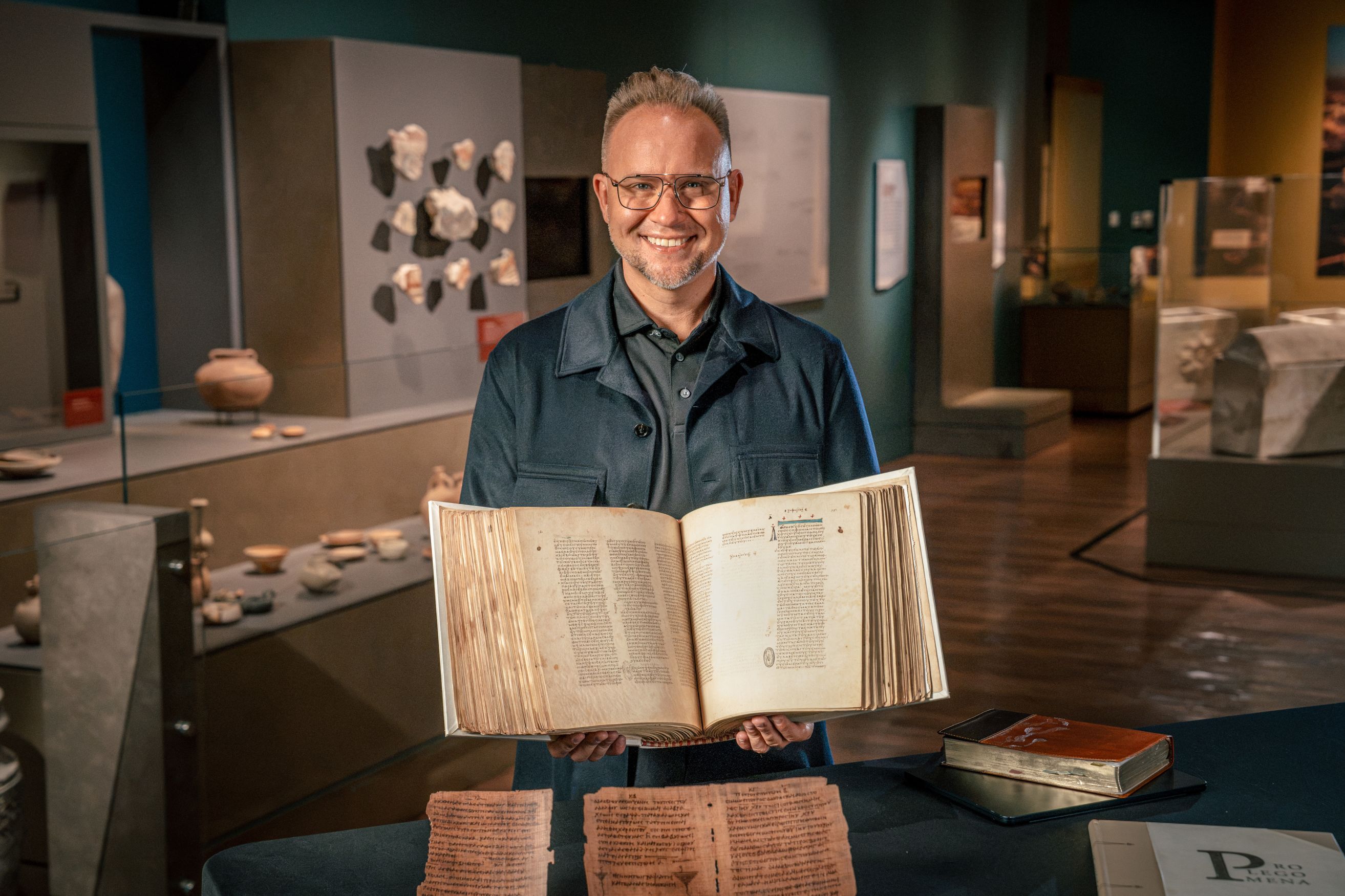
Courtesy of Jeremiah J Johnston

An unabashed enthusiast, he peppers his speech with gleeful yelps, telling the Daily Mail that a Roman coin was 'the coolest thing in the world,' and calling the Dead Sea Scrolls 'the most astounding Biblical discovery of all time.'

There remain, of course, many Biblical mysteries yet to be solved.

Chief among them is perhaps the existence or otherwise of Noah's Ark. Johnston is dismissive of claims that the remains of the Ark have been found.

Andrew Jones, who runs Noah’s Ark Scans, caused a stir earlier this year when he discussed his team's work investigating a site in Turkey which for 60 years has been rumored to be the resting place of the Ark.

Jones and his team claimed they have '100 percent confirmed' that the mound is not a natural geological feature but a 'man-made object' below the surface.

'I firmly believe the Durupınar Formation represents the buried remains of Noah's Ark,' Jones told the Daily Mail.

Geologists argue that the boat-shaped mound near Mount Ararat, in eastern Turkey, is natural. But Jones and his supporters claim it could be the remnants of the Biblical boat.

Johnston has been vocal in disavowing Jones's research, saying there was rare unanimity among Bible scholars that the Turkish site was incorrect.

'The one thing all of us get along about is 100 percent certainty this geological formation in eastern Turkey is not the spot of Noah's Ark.'

He said that the scientific techniques Jones was using were inaccurate in a mountainous area, and insisted the Turkish formations were natural.

'The scientific consensus is not even close,' he said in a YouTube video in April. 'I'm talking about conservative, moderate – but even liberal, atheist, agnostic archaeologists all know that this is just to sell books. This is sensationalism that catches fire because Christians want it to be true.'

Yet he remained adamant that the discoveries he documented were, indeed, proof of the Bible's accuracy. 

'Stones are still speaking. Inscriptions are still uncovered,' he writes. 'Manuscripts, ossuaries, graffiti and government records - all are emerging from the dust of time and converging with the Gospels' witness.

'These findings don't replace Scripture, but they do reinforce and illuminate it. And they help us see the figure of Jesus in sharper historical focus.'
'The Shroud Has Been Debunked'? New Shroud of Turin 3D 'Discovery ...

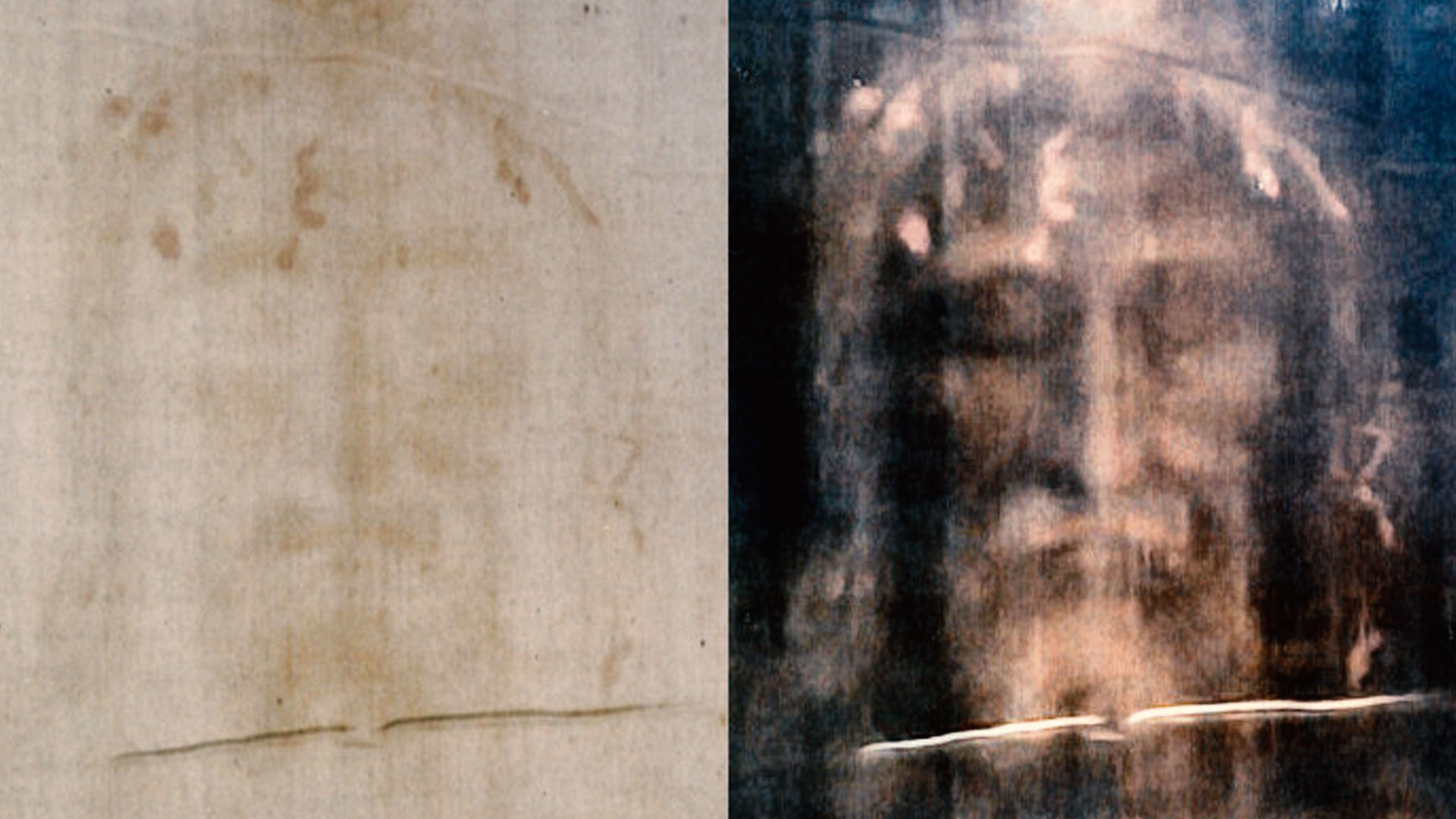
The Shroud of Turin

Johnston arrived in Britain to study the New Testament at Middlesex University. The PhD student started out as a Turin Shroud skeptic, believing it was a medieval forgery as others had told him.

But he has since changed his mind and become one of the foremost advocates for the authenticity of the cloth – convinced it is the very shroud which covered the body of Jesus when he was taken down from the cross.

Johnston dismisses claims that the cloth is a forgery, arguing that the analyzed samples of the material, which were not taken from the center of the fabric but rather plucked from the edges, where it had been patched up, put its authenticity into question.

Certainly, there is no debate that the shroud has been altered.

It first emerged in France in around 1355, when it was put on display in a church in the village of Lirey, 120 miles southeast of Paris. The cloth was moved to the city of Chambery in 1502 and was damaged in a fire 30 years later. Nuns of the Poor Clares of Chambéry did their best to salvage the cloth over a two-week period that included much mending – and prayer.

Ultimately, in 1578, the relic was moved to a cathedral in the northern Italian city of Turin, where it remains to this day.

In 1988, scientists from three countries – teams from the British Museum, the University of Arizona and the Eidgenoessische Technische Hochschule in Zurich – carbon dated postage stamp-sized segments of the cloth.

The scientific methods measuring the remaining radioactive carbon inside the material all concluded the pieces date back to medieval times.

The scientists insisted that the samples came from the main part of the cloth.

But Johnston does not accept this as fact.

He further argues in the book that the marks on the cloth are AB-type blood stains – a blood type common to at least 11 percent of Middle Eastern Jews, of which Jesus was one.

He claims there are high levels of bilirubin in the marks, the yellow pigment in bile, which he suggests shows trauma at the time of death, noting that anyone attempting a medieval forgery, even if they did paint in blood, would not be aware of the significance.

To bolster his case that the fabric came from the Middle East, Johnston notes that an Eidgenoessische criminologist and botanist, Max Frei-Sulzer, concluded in the 1970s that the shroud bore traces of 58 different species, many of which exist in the area around Jerusalem -including gundelia tournefortii – a thistle from the daisy family, and anthemis, or chamomile.

Frei-Sulzer's methods have been questioned, but the scientist, who died in 1983, has not been discredited.

Johnston claims the shroud shows signs of an intense explosion of light, which he claims is 'proof' of the resurrection.

He calls it 'a supernatural eruption that left evidence scorched into the very fabric of his burial shroud.'

Johnston writes: 'The shroud may be the photographic negative of the single most explosive event in the history of creation: the moment when death itself lost its sting and life eternal burst forth from a dark tomb.'
Courtesy of Jeremiah J Johnston

The Sudarium of Oviedo

Johnston told the Daily Mail that the sudarium, a Latin word describing a sweat cloth, or face towel, used to wipe the face of a recently-deceased person, was 'the nail in the coffin' for the 1988 carbon dating of the Turin Shroud.

He argues that the linen cloth, moved from the Middle East to Spain in around 600AD, features corresponding marks to the Turin Shroud. And he claims that both the Turin Shroud and the sudarium have marks made by the same blood type, AB. Furthermore, he argues that the stains bear traces of lung fluid, expelled when a person is crucified.

Wikimedia Commons

'I love the second cloth because I feel like nobody talks about it,' he told the Daily Mail. 'I feel like this has just been lost.

'And I think it's such a huge piece of the Shroud of Turin, and I mean, it's mentioned in the Bible as well.'

Critics, however, say the evidence that it was actually placed on Jesus's face is flimsy.

Courtesy of Jeremiah J Johnston

De Agostini via Getty Images

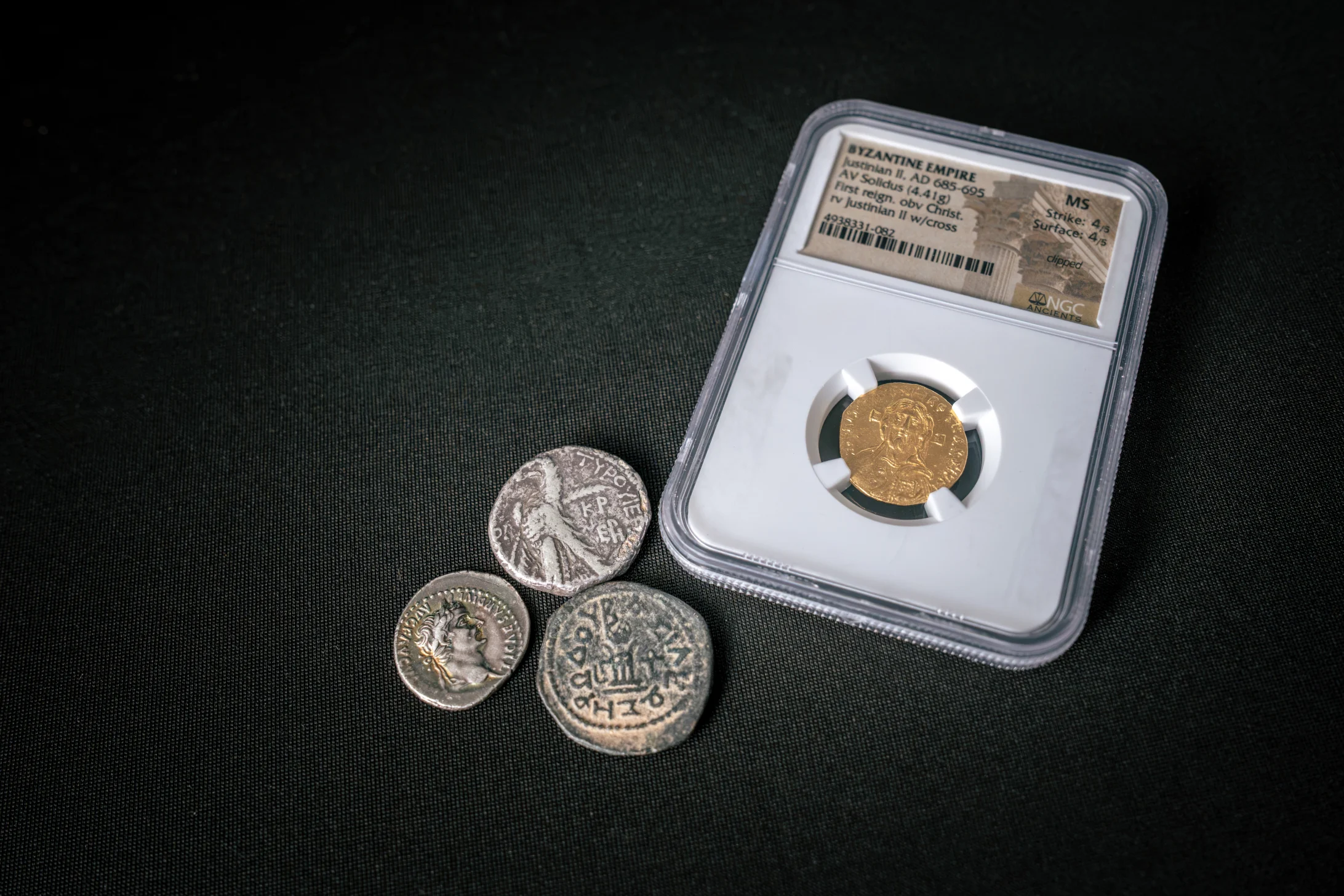
Roman Coin

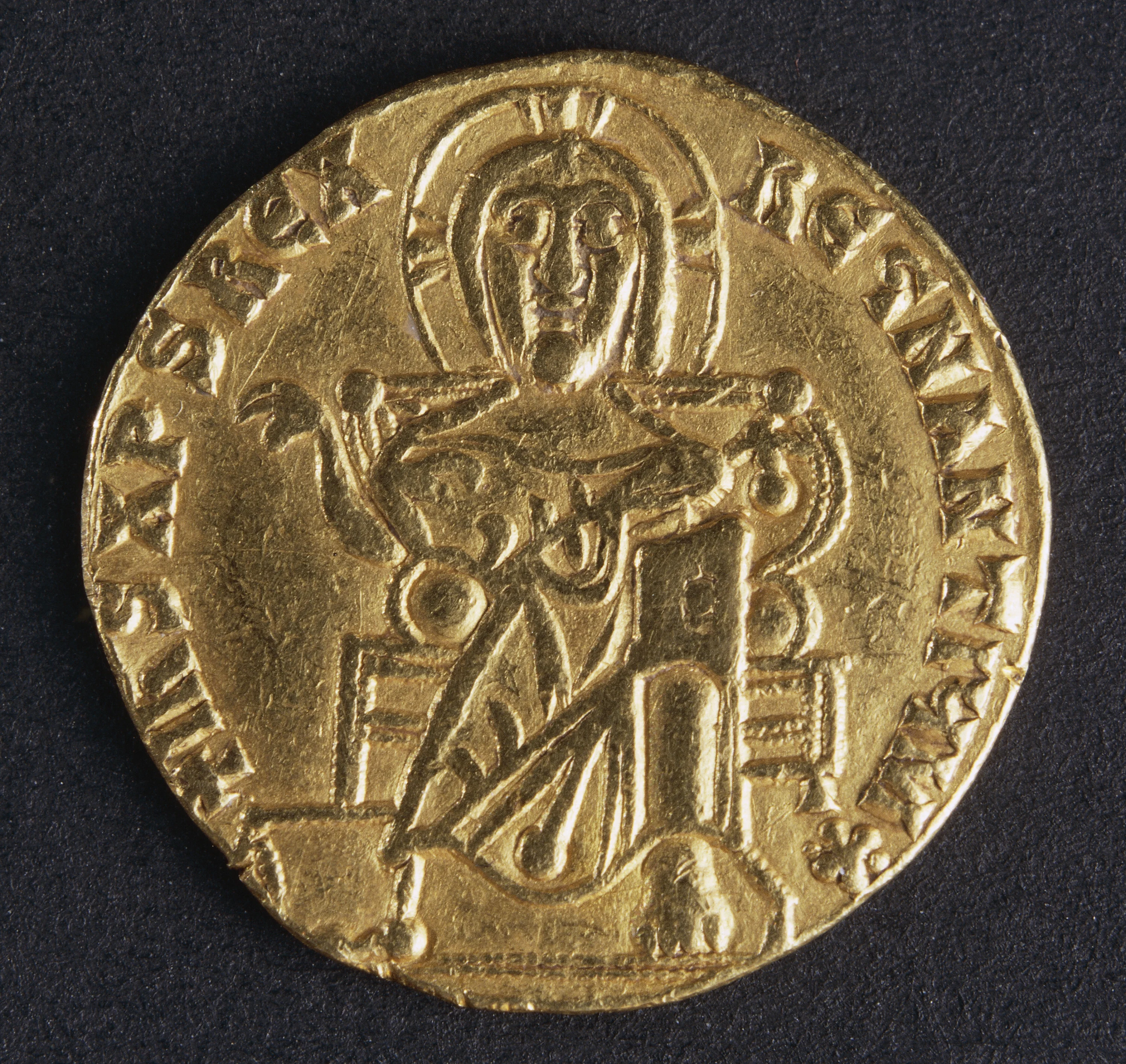
The Texan scholar called the Roman coin 'the coolest thing in the world,' writing in his book that it was 'the first state-issued portrait of Christ to circulate as currency.'

He writes: 'Coins are tiny sermons. They are mass-produced, transportable, and unforgettable. They crystallize a creed in metal.' 

The gold piece was created under the Emperor Justinian II, a devout Christian who ruled from 685 to 695 AD and again from 705 to 711 AD.

Christianity had become the official religion of the Roman Empire in 313 AD.

Johnston says the coin marks the first time the emperor himself is not depicted on the coin.

'The front bears the face of Jesus Christ and the reverse shows the emperor calling himself "Servant of Christ,"' writes Johnston. 'It is difficult to overstate how audacious this was.'

And he agrees with the late Alan Whanger, a Duke University professor who died in 2017, that the coin's image bears direct correlation to the Turin Shroud.

Whanger, quoted by Johnston, said he found 'massive evidence that the coin image is an extraordinarily accurate reproduction of the Shroud face, which could only have been accomplished by the artist die cutter looking directly at the Shroud face as the model for the coin.'

The coin alone is evidence of early Christianity. But it is hard to see why Johnston believes the coin reinforces historical fact.

Yet he argues that the two elements - the shroud and the coin - combine to show that the Bible was a historical text, rather than a collection of parables.

The Palatine Graffiti 

Johnston also seizes on ancient Roman graffiti - or graffito, as it is known in the singular form - as yet more evidence of the Bible as historical fact.

He writes about a carving in a wall, created around 200 AD and discovered in 1857. The carving shows a man being crucified, with the head of a donkey on his body. The mocking caption, in ancient Greek, reads: 'Alexamenos worships his God.'

Wikimedia Commons

For Johnston, this finding is more evidence that the Scriptures are an accurate record depicting history, though it's never entirely clear how his conclusion that the image created approximately 200 years after Jesus' death, proves it.

'He has the head of a jackass, if you will,' Johnston told the Daily Mail.

Bridgeman via Getty Images

'They were mocking the Christian movement, and this is in the Second Century, and by mocking it, they only prove that the Bible stands true: that the best established fact in the ancient world is that Jesus died by Roman crucifixion at the hands of Pontius Pilate under the Emperor Tiberius Caesar on Friday April 3rd AD 33.'

Reuters

The Dead Sea Scrolls 

Perhaps Johnston's greatest enthusiasm is reserved for the Dead Sea Scrolls, which he told the Daily Mail were 'the most astounding Biblical discovery of all time.'

The thousands of parchment and papyrus fragments were found hidden in a series of caves 13 miles east of Jerusalem by a Bedouin shepherd in 1947.

The documents, believed to have been created between the third century BC and 70 AD, are a series of letters, calendars and descriptions of rituals for worship.

AFP via Getty Images

About 230 of the manuscripts are referred to as 'biblical scrolls,' according to the Israel Antiquities Authority, and these texts are now part of the Hebrew Bible.

For Johnston, the fact that the scrolls are an almost contemporary telling of the Bible proves that it was a historical document, and not a 'fairytale,' which evolved over time. Scrolls predicting Christ's birth – and his crucifixion – support this reading of the tome.

'It confirms the reliability of the Bible, the prophecy predictions of the Messiah as well, and it shows that our text is stable,' he told the Daily Mail.

RELATED

9 Biblical Structures Science Still Can’t Explain

New DNA Study Stuns Scientists — The Shroud of Turin, Jesus' Blood & the Mystery of the Crucifixion

The Jesus Discoveries: The PROOF Of Christ with Dr. Jeremiah Johnson | Blurry Creatures

{ https://www.dailymail.com/news/index.html }

Hoe vind je dit bericht?
Geschreven door peter om 19:34 Stuur door

EXCLUSIVE - I was secretly poisoned by my husband and died. Then I met Jesus and made a shocking discovery in heaven

EXCLUSIVE - I was secretly poisoned by my husband and died. Then I met Jesus and made a shocking discovery in heaven

A wife and mother in California claims that a murder plot by her husband led to a divine encounter with the Holy Spirit that changed her perception of heaven.

Ana Christina told the Daily Mail she filed for divorce from her husband, 'Sam,' in December 2008 but had forgotten to cancel her million-dollar life insurance policy. 

Ana Christina, who changed her and her children's names to protect their identities, believed this was the motivation that drove Sam to attempt to kill her weeks later.

Before moving out of their Irvine, California home, Sam allegedly began lacing Christina's coffee with rat poison, which caused her to grow increasingly sick until she woke up paralyzed on January 9, 2009.

As she lay sick, Ana Christina, who was 49 at the time, said Jesus arrived in the bedroom to escort her spirit into the afterlife, reuniting her with her late sister Nadia in heaven. Nadia had died by suicide at the age of 35.

Seeing her sister was like a sigh of relief, as Christina had always wondered where Nadia would end up because of the church's teachings about suicide.

'Because at church, they tell you [if] you commit suicide, it's a sin, it's an unforgivable sin, and I discovered that it's not,' said Christina.

Christina claims that when she returned from the afterlife hours after the attack began, she was miraculously cured of the poisoning. This shocked Sam, she said, and motivated him to quickly flee the US after police chose not to investigate her claims.

Ana Christina told the Daily Mail she returned from what she considered the afterlife healed after she was allegedly poisoned by her ex-husband

Ana Christina told the Daily Mail she returned from what she considered the afterlife healed after she was allegedly poisoned by her ex-husband

'I believe it's a blessing in disguise that he just left the country,' Christina told the Daily Mail.

'Because if he had done time for an attempted murder... he would have gotten about 10 years. And then, he would be out in the streets, taking revenge. But him fleeing the country and being away, I don't have to live watching my back.'

Christina was the breadwinner of the family when she and Sam agreed to amicably divorce in 2008.

However, Sam was the beneficiary of the life insurance policy Christina forgot to cancel when they filed the paperwork to end their marriage.

While Sam stayed in their home for three more weeks while the divorce was finalized, Christina claimed he began to slip rat poison into her coffee, causing her to gradually become deathly ill.

'I believe he started putting it in my coffee every day. Little by little, that's how I didn't notice, and that's when my body started to break down. I started getting sick, and I had to stay at home for a long time,' Christina said.

After receiving a call in early January 2009 that her brother overseas had fallen ill, Christina booked a flight for an extended visit, but she alleged that before she could leave, Sam prepared her favorite meal and laced it with a massive dose of poison. 

Christina said she met her late sister (left) who had died by suicide in the afterlife, changing her view on what the Christian faith teaches about self-harm

Christina said she met her late sister (left) who had died by suicide in the afterlife, changing her view on what the Christian faith teaches about self-harm

By that night, Christina said the poison left her fully paralyzed in bed, comparing the pain she felt in her body to a sledgehammer breaking her bones.

That is when she said she heard a clear divine voice, telling her she was dying but this would not be the end. 

She claimed that Sam found her in the bedroom the next morning unable to move, powerless to stop him from forcing Xanax down her throat through her locked teeth. 

As Christina said she felt her body die while being suffocated, she told the Daily Mail it was like removing a heavy coat as her spirit left her body on the floor.

There was no darkness or sense of an ending, Christina continued, revealing that she then saw Jesus, who extended his hand to escort her into the afterlife.

Later she was reunited with her parents and Nadia.  

'You know, God is a very compassionate God, a very loving God that understands what we go through and does not judge us the way we judge each other. He's a very compassionate Lord, and he knew what Nadia was going through,' Christina said.

Christina (left) claimed she also encountered her mother (right) during her near-death experience

Christina (left) claimed she also encountered her mother (right) during her near-death experience

article image

Her family urged her toward a banquet she had seen in the afterlife, but she said she would be pulled back to Earth before she could join them.

Still in shock, Christina claimed she could not speak but used hand gestures to signal to Sam that she knew what he had tried to do. 

'The look on his face was just priceless. You can just imagine. This man thought he finished me off. I'm done. I think it took him about eight hours to finish me off, and here I am, as strong as a horse in front of him,' Christina recalled. 

Christina revealed that she and her children have moved on from the incident, and Sam left the US within a year of the alleged attack and their divorce.

Although she was a Christian before her near-death experience, she said the experience completely changed her relationship with God.

'I was actually a born-again Christian before my encounter. But I was nothing like what I am now,' Christina explained.

Her experience even spurred her to set up her own ministry in Africa, with all the proceeds of the book she wrote about her encounter, My Sweet Encounter With Death, going to support that church.

Christina's claims about the incident were met with skepticism, even from her own children, leading authorities to side with Sam and call for a psychiatric evaluation for his alleged victim.

Christina said the near-death experience was a blessing. Her ex-husband fled the country, allowing her and her daughters to carry on with their lives

Christina said the near-death experience was a blessing. Her ex-husband fled the country, allowing her and her daughters to carry on with their lives 

However, two months after her January 2009 near-death experience, Christina said she underwent a full forensic hair analysis that found dangerously high levels of the rat poison ingredient barium in her body.

The levels were up to 2,700 times higher than the medically safe limit, she said.  Christina believed God left that amount in her body as a sign that her claims were factual.

Christina said she took the results to the Irvine Police Department, asking them to open an investigation, but was turned away.

The Irvine Police Department has told the Daily Mail it is looking into the circumstances that led detectives not to pursue the case.

RELATED

Near Death Experience: Poisoned to Death by Husband..Then Meets Jesus in Heaven!

Poisoned to Death - She Sees Jesus, Angels, Abraham & A Freaky Dude

{ https://www.dailymail.com/sciencetech/index.html }

Hoe vind je dit bericht?
Geschreven door peter om 21:01 Stuur door

Bigfoot sightings across 14 US states reveal an eerie pattern sparking claims a creature is hiding nearby

Bigfoot sightings across 14 US states reveal an eerie pattern sparking claims a creature is hiding nearby

An eerie pattern in thousands of reported Bigfoot sightings across the US has raised the unsettling possibility that a mysterious creature is lurking close to humans.

Independent researcher and retired police officer Bruce Champagne examined 5,834 reports across 14 states before singling out 25 accounts he believes offer the clearest evidence of an unknown creature prowling near cities and towns at night for a specific purpose.

According to Champagne, witnesses most often reported seeing Bigfoot along quiet paths, roaming up to a mile into towns and cities on winter nights. 

The study described this as cautious, repeated behavior rather than random accidents on the edges of the woods.

Champagne called the alleged creature's movements: 'A pattern of rare, apparently intentional, largely solitary, nocturnal, corridor-based incursions that may be consistent with flexible decision-making.'

Bigfoot is believed to be a huge, hairy, ape-like creature, or species of creatures, that walks like a human and hides in remote forests throughout North America.

The first widely publicized modern report of Bigfoot came in 1958, when Humboldt Times journalist Andrew Genzoli published a letter from a reader describing massive, mysterious footprints found near a logging site in Bluff Creek, California.

Despite thousands of alleged sightings, eyewitness testimonies, photographs and footprint discoveries across the country, there has never been any physical evidence presented publicly that scientists have said proves the Bigfoot species exists.

The Bigfoot urban incursions were distributed across 14 US states, with the highest concentrations in Illinois, Ohio, Utah, New Jersey and Colorado

The Bigfoot urban incursions were distributed across 14 US states, with the highest concentrations in Illinois, Ohio, Utah, New Jersey and Colorado

A trail of 35-45 clear, pristine footprints in Washington in 1996, shared by Jeff Meldrum, Bigfoot expert and author of Sasquatch: Legend Meets Science

A trail of 35-45 clear, pristine footprints in Washington in 1996, shared by Jeff Meldrum, Bigfoot expert and author of Sasquatch: Legend Meets Science

Champagne focused on Bigfoot sightings that occurred at least a quarter-mile inside densely populated areas - meaning they had at least 1,600 residents per square kilometer (0.38 square miles).

The 25 accounts described large, ape-like creatures spotted at least a quarter of a mile inside towns and cities by witnesses deemed highly credible in Champagne’s analysis.

The reports spanned 14 US states, with the highest numbers coming from Illinois, Ohio, Utah, New Jersey and Colorado. Sightings peaked between 2006 and 2015, according to the research.

Champagne compared the reported behavior with that of other intelligent animals, including great apes, when they encounter humans.

He argued that the alleged creatures’ strong preference for traveling at night suggested they understood the risks of using urban walkways during the day.

'The patterning observed here suggests that urban incursions, while uncommon, are behaviorally structured events that merit further comparative and field-based investigation,' Champagne concluded.

The study found the creatures often traveled stealthily along drainage ditches and railway lines.

On average, they ventured 1.75 miles into the cities and towns they were exploring at night. However, at least one sighting found an alleged Bigfoot walked nearly eight miles into town, although the exact date and location were not revealed in the report.

Bigfoot as seen in the 1967 Patterson-Gimlin Film, which depicts a suspected Sasquatch that was spotted in Bluff Creek, California

Bigfoot as seen in the 1967 Patterson-Gimlin Film, which depicts a suspected Sasquatch that was spotted in Bluff Creek, California

A new study found Bigfoot sightings were more common in winter and during the night between midnight and 3am

A new study found Bigfoot sightings were more common in winter and during the night between midnight and 3am

article image

Among other wildlife species, run-ins with humans often occur because of environmental stresses, such as animals searching for food in the winter when supplies become scarce.

Champagne suggested the same thing might be happening with Bigfoot sightings, as the creatures come out of hiding when their food sources run low during the cold, winter months.

Champagne’s research focused on accounts documented in three major databases, Oregonbigfoot.com, the Green Archive and the Bigfoot Field Researchers Organization (BFRO).

BFRO is the most widely cited and comprehensive public collection of Bigfoot reports in the US.

According to their records, which date back to 1904, Washington state has seen the most Bigfoot sightings, with more than 700 on record. California ranks second with nearly 500 sightings on record.

Champagne assessed reports on the basis of whether multiple witnesses were present, how credible the observers were, how close the witnesses allegedly got to the creature and how long the encounters lasted.

Champaign found that 36 percent of all Bigfoot encounters happened in winter, followed by autumn (27%), summer (23%) and spring (14%).

The creatures were described as 'massive' by 40 percent of witness accounts, however, one in five people called Bigfoot 'lightly built.'

Typical Bigfoot sightings also described a creature that stood up to 15 feet tall, with footprints measuring up to 24 inches long and eight inches wide.

They were most often seen prowling between midnight and 3am local time.

{ https://www.dailymail.com/sciencetech/index.html }

Hoe vind je dit bericht?
Geschreven door peter om 20:36 Stuur door

Mysterious Race Of Underground People Lived In the Arctic Along With Nenets

Mysterious Race Of Underground People Lived In the Arctic Along With Nenets

Mysterious Race Of Underground People Lived In the Arctic Along With Nenets

There is no doubt that thousands of years ago, the Arctic region was inhabited by the Samoyedic ethnic group known as “Nenets” who live in tents. But there is a legend that there had lived a mysterious race called “Sikhirtya” or “Sihirtia” or “Sirtia” before the arrival of Nenets.

According to a Nenets’ legend, Sihirtians had light blue eyes, blonde hairs and they were very small in size. They used to live underground in the stunning daylight and only in the dark or in mist, they came out of their caves, using dogs and mammoths instead of deers for traveling in a search for prey. Sihirtians had supernatural abilities and mastered blacksmithing, fishing, and hunting.

Sikhirtya
 Sikhirtya statue made by Nenets artist Evgeniy Salind

Sikhirtya statue

 Sikhirtya statue made by Nenets artist Evgeniy Salinder

It is believed that Sihirtians were not the indigenous people, they came to the North from over the sea thousands of years ago to Yamal and later spread their culture to the peninsula. They were highly skilled in comparison to Nenets. Sihirtians did not live in tents like Nenets but in dugouts that had the entrance from the top. The Nenets said that the Sihirtians had underground storerooms with strict security to the entrance.

Read also:

Sikhirtya figures

Sikhirtya figures at Siberian museums

At first, Nenets and Sihirtians had no cultural or personal clash, but the Nenets increased the number of deers they need grassy land for their herd to feed. Sihirtians might have been skilled but they lacked the fighting skills, due to which they had to abandon their earthen houses and went to dungeons to graze their mammoths.

Nenet People

Nenet People of Siberia

In 2017, during an archeology expedition in the Tazovsky peninsula, a grave of the young child was discovered, he died between the age of three and seven in the late 15th or early 16th centuries. After excavating the burial, a team of researchers led by Alexander Tkachev of the Museum of Archaeology and Ethnography of Tyumen State University found that ‘elite’ headgear embellished with bronze decorations and iron rings on his grave. Such evidence helped the experts to confirm that the grave belonged to the indigenous Sihirtian people.

“When we dug down, we thought the grave was almost empty, but then we saw two knives and were very surprised. When we noticed the pieces of fur and woolen cloth along with the decorations – and understood it was impressive headwear – we were really shocked,” Tkachev said.

Sikhirtya underground people

Indeed, archeologists have discovered 4000-year-old sites in the Arctic region, dating back to the bronze age. They unearthed metal pendants, carved tools, and ancient pottery that belonged to the non-Samoyed race. French explorer Pierre-Martin de la Martinierre described Nenets as the sorcerers in his “Voyage des pais septentrionaux,” publhsed in 1671. Besides, during his trip from Copenhagen to the Russian coast, he met mysterious short people who wore the white fur of polar bears and lived in homes of fishbones and moss.

Among many Nenets’ folklore, there is a story when two sisters saw an extremely small man with white hair on a fog-like cloud, floating towards them, who could communicate with fish. In another story, when one family stopped to give rest to their reindeer, they spotted a beautiful tiny girl in a shiny silver button dress who was asleep on the grass.


According to some myth, the people of Sikhirtya went underground, lived there and most probably still resting there. While others say that some Sihirtians mixed with the Nenets, others left their homes or died.

RELATED


The Nenets survive beyond the Arctic Circle in Russia's Arctic without water, electricity, or roads.

How do people live in the harsh conditions of the Russian North with low temperatures in the tundra?

{ https://howandwhys.com/ }

Hoe vind je dit bericht?
Geschreven door peter om 21:15 Stuur door

Pastor who sparked doomsday panic claims the Rapture is just DAYS away

Pastor who sparked doomsday panic claims the Rapture is just DAYS away

The Christian pastor who sparked panic with a failed prediction of the Rapture has made a new claim that the end-times belief is near.

Pastor Joshua Mhlakela, a South African preacher, recently said he has calculated the exact time of the biblical event in which believers are lifted into the clouds to meet Jesus Christ, claiming that it will happen between October 12 and 13.

The Rapture is a belief held by some Christians called 'eschatology,' which is the study of end-times events, marking the Second Coming of Jesus and Judgment Day for non-believers.

Mhlakela has claimed in multiple interviews and his own videos online that both God and Jesus have appeared to him in visions, revealing when the Rapture would take place and what the fallout on Earth would look like.

The controversial pastor declared: 'God told me because there's no other date coming out, 12 to 13 October, which is the true feast of trumpets, which is when I will be meeting my savior face to face in the rapture.' 

Mhlakela has drawn widespread skepticism and criticism for his wild predictions, including incorrectly marking the date of the Rapture multiple times in 2025.

He sent social media into a frenzy when he alleged the biblical event would take place on September 23, 2025, convincing scores of believers who watched his predictions online to sell their homes and cars and even quit their jobs.

'There's no other final. I mean, there's no other rapture date. This is the final date for me,' Mhlakela claimed in an interview on September 17.

Pastor Joshua Mhlakela (Pictured) has falsely predicted the biblical event known as the Rapture. He recently said it will now start on October 12, 2026

Pastor Joshua Mhlakela (Pictured) has falsely predicted the biblical event known as the Rapture. He recently said it will now start on October 12, 2026

The Rapture is considered a kind of rescue, where believers are instantly taken away from Earth to avoid a coming period of intense suffering called the Tribulation (Stock Image)

The Rapture is considered a kind of rescue, where believers are instantly taken away from Earth to avoid a coming period of intense suffering called the Tribulation

(Stock Image)

The pastor claimed his previous false predictions were not errors, but the work of God, who was delaying the final judgement to give humanity more time to repent.

He said the delay was actually fulfilling Scripture, which says the Tribulation days will be shortened for the sake of the 'elect' - meaning the people God has chosen before Jesus returns.

This event is thought to be a kind of rescue, where believers are instantly taken up from Earth into Heaven to avoid a coming period of intense suffering called the Tribulation.

Biblical texts describe the Tribulation as a seven-year period of chaos and disasters, where evil rules on Earth before Jesus returns again to set up a peaceful kingdom.

Mhlakela has said that his first visions of Jesus came to him in 2018, when he warned that the Rapture would come on September 23, 2025, during the Jewish Feast of Trumpets, also known as Rosh Hashanah.

Some Christians have tied the annual holiday to the prophecy that Jesus will return to Earth 'with the voice of the archangel and with the trumpet call of God.'

However, Mhlakela now says the date of the Feast of Trumpets has been off by one month, pushing the actual time of the Rapture roughly 30 days past the annual celebration of Rosh Hashanah.

'Many are saying Feast of Trumpets is September when you Google [it's] September 11. [This] is not Feast of Trumpets. The true Feast of Trumpets is actually in October,' Mhlakela claimed during his interview with CettwinzTV.

Many Christians have pushed back on claims the Rapture's date has been revealed, saying that date-setting goes against the teachings of Jesus (Stock Image)

Many Christians have pushed back on claims the Rapture's date has been revealed, saying that date-setting goes against the teachings of Jesus (Stock Image) 

Read More

article image

The pastor explained that his new calculation for the Rapture was based on additional visions from Jesus which pointed him toward later days.

According to Mhlakela, a vision involving two full moons convinced him the calendar itself was off by about a month because the current celebration of Passover was taking place under the astrological sign of Pisces.

He tied that gap to the Exodus story of Israel’s departure from Egypt, saying the 'true' Passover must fall when the sun is in Aries, just as it is said to have taken place during the biblical Exodus.

The pastor then applied that same one-month shift to his new Feast of Trumpets date in mid-October.

However, the Bible did not document the sun being in Aries during the Exodus. It only said Passover falls in the first month of spring, with the Aries link coming from later writers such as Josephus, a first-century Jewish historian - not from the Exodus account itself.

Moreover, Mhlakela's end times predictions continue to receive pushback from many Christians who believe setting a definitive date for the Second Coming of Jesus goes against the teachings of the Bible.

Vladimir Savchuk, a pastor, author, and YouTube preacher, said last September: 'If someone sets the date, they are directly contradicting Jesus's word.'

He further debunked the Rapture claims by noting that Scripture says the son of perdition must be revealed first, referring to a figure often interpreted as the Antichrist.

'2 Thessalonians 2:3, it says clearly that Jesus is not returning until the Antichrist is revealed, and that has not happened yet,' Savchuk explained.

Hoe vind je dit bericht?
Geschreven door peter om 18:16 Stuur door

EXCLUSIVE - I was an atheist until Satan appeared and tried to convince me that Christianity is a cult. Now I'm a pastor... there are signs everywhere that we are living in the final days

EXCLUSIVE - I was an atheist until Satan appeared and tried to convince me that Christianity is a cult. Now I'm a pastor... there are signs everywhere that we are living in the final days

A Christian pastor who believed there was no God and was desperately trying to stay out of jail as a teenager has described how a terrifying encounter with Satan changed his life forever.

Bishop Alan DiDio of Revival Nation Church in North Carolina told the Daily Mail that he was 17 years old in 1998 when a demonic presence started speaking to him while he was attending a gathering for his friend's Christian youth group.

He said the voice had lingered in the back of his mind for days, but at the gathering it became as clear as someone speaking aloud, telling him not to believe in God or go near Christians.

As the voice overwhelmed him, DiDio said he instinctively responded to Satan's voice by claiming his soul belonged to Jesus, an act which he claimed miraculously filled his mind with the teachings of Christianity, despite having barely read the Bible.

'I just said, "Satan, you can't have me anymore. Jesus, I'm all yours." And it immediately stopped, and it never came back again,' he recalled, believing that he had received a 'download' of knowledge from Heaven which made it clear he was supposed to share his experience with other Christians.

DiDio said: 'If you hear the voice of Satan, all of a sudden the supernatural becomes very, very real to you. And if Satan is real, then Jesus is real.'

The shocking incident not only caused DiDio to embrace Christianity, but inspired him to take up ministry work, where he found others had experienced what they believed to be demonic encounters – something he believes is part of a spiritual battle taking place across Earth.

DiDio claimed that the demon he confronted as a teen had likely been stalking him for years as he faced arrests for petty crimes, and now theorizes that demons are 'assigned' to mortals on Earth to steer them away from the word of God in this ongoing war between good and evil.

Alan DiDio as a teenager around the time of his demonic encounter    Pictured: Bishop Alan DiDio of Revival Nation Church

Left: Alan DiDio around the time of his demonic encounter as a teen. Right: Today, Alan DiDio is the lead pastor at Revival Nation Church in North Carolina

{ https://www.dailymail.com/sciencetech/index.html }

Hoe vind je dit bericht?
Geschreven door peter om 17:46 Stuur door

EXCLUSIVE - Has Noah’s Ark finally been found? Researchers claim mysterious underground structure is man-made after dramatic new scans

EXCLUSIVE - Has Noah’s Ark finally been found? Researchers claim mysterious underground structure is man-made after dramatic new scans

A team scanning a boat-shaped hill in eastern Turkey has announced that new radar images show a large man-made structure underground, not just natural rock. 

On Wednesday, private research group Noah’s Ark Scans released a preliminary report about their work at the Durupınar Formation in Turkey's Ağrı Province, claiming that the 515-foot boat-shaped mound contained a 'man-made object.'

The scans were conducted by Dr Khosrow Bakhtar, an engineer who spent decades building detection systems for US defense agencies, including the Air Force, Navy and NORAD.

He used a system he invented called BakhtarRadar, originally developed to find buried tunnels and hidden structures, to scan beneath the boat-shaped Durupınar mound and see whether it was solid natural rock or a man-made structure.

That process has now concluded that the object under the Durupınar mound is not a natural rock formation, but a large organized man-made object with corridors, chambers and hallways inside.

In a statement sent to the Daily Mail, Dr Bakhtar said: 'Whatever the object is beneath the surface is extraordinary.'

'In forty years of this work, I have never seen anything like it. It could be a ship. It could be a spaceship. What I can say from the radar is that it is organized, it is structural, and a solid geological mass would not have returned such a strong signature.'

According to the Bible, the massive vessel saved humanity and every kind of animal from annihilation during a catastrophic flood that some biblical chronologies place more than 4,300 years ago. 

The ship-shaped mound believed to be the rest place of Noah's Ark in Turkey

The ship-shaped mound believed to be the rest place of Noah's Ark in Turkey

New scans of the Noah's Ark site revealed material that was determined to be something other than natural geological material such as rock

New scans of the Noah's Ark site revealed material that was determined to be something other than natural geological material such as rock 

Bakhtar said the new radar images do not look like ordinary rock, mudflow or a solid natural hill in Turkey.

Instead, they showed organized internal features, including repeating lines and angles, open passageways, corridors, chambers and hallway-like spaces running the length of the alleged vessel trapped underground.

Bakhtar told the Daily Mail in a statement that the radar is designed to hide ordinary natural features such as rock and highlight buried structures, open spaces and man-made materials.


​Has Noah's Ark Finally Been Found? 🚨 Scans Reveal 5,000-Year-Old Ship Buried Underground!

{ https://www.dailymail.com/sciencetech/index.html }

Hoe vind je dit bericht?
Geschreven door peter om 20:58 Stuur door

Meer van UFO'S of UAP'S, ASTRONOMIE, RUIMTEVAART, ARCHEOLOGIE, OUDHEIDKUNDE, SF-SNUFJES EN ANDERE ESOTERISCHE WETENSCHAPPEN - DE ALLERLAATSTE NIEUWTJES

↑ Terug naar de berichten