Naar de inhoud

UFO'S of UAP'S, ASTRONOMIE, RUIMTEVAART, ARCHEOLOGIE, OUDHEIDKUNDE, SF-SNUFJES EN ANDERE ESOTERISCHE WETENSCHAPPEN - DE ALLERLAATSTE NIEUWTJES

UFO's of UAP'S in België en de rest van de wereld
seniorennet.beseniorennet.be
Ontdek de Fascinerende Wereld van UFO's en UAP's: Jouw Bron voor Onthullende Informatie! Ben jij ook gefascineerd door het onbekende? Wil je meer weten over UFO's en UAP's, niet alleen in België, maar over de hele wereld? Dan ben je op de juiste plek! België: Het Kloppend Hart van UFO-onderzoek In België is BUFON (Belgisch UFO-Netwerk) dé autoriteit op het gebied van UFO-onderzoek. Voor betrouwbare en objectieve informatie over deze intrigerende fenomenen, bezoek je zeker onze Facebook-pagina en deze blog. Maar dat is nog niet alles! Ontdek ook het Belgisch UFO-meldpunt en Caelestia, twee organisaties die diepgaand onderzoek verrichten, al zijn ze soms kritisch of sceptisch. Nederland: Een Schat aan Informatie Voor onze Nederlandse buren is er de schitterende website www.ufowijzer.nl, beheerd door Paul Harmans. Deze site biedt een schat aan informatie en artikelen die je niet wilt missen! Internationaal: MUFON - De Wereldwijde Autoriteit Neem ook een kijkje bij MUFON (Mutual UFO Network Inc.), een gerenommeerde Amerikaanse UFO-vereniging met afdelingen in de VS en wereldwijd. MUFON is toegewijd aan de wetenschappelijke en analytische studie van het UFO-fenomeen, en hun maandelijkse tijdschrift, The MUFON UFO-Journal, is een must-read voor elke UFO-enthousiasteling. Bezoek hun website op www.mufon.com voor meer informatie. Samenwerking en Toekomstvisie Sinds 1 februari 2020 is Pieter niet alleen ex-president van BUFON, maar ook de voormalige nationale directeur van MUFON in Vlaanderen en Nederland. Dit creëert een sterke samenwerking met de Franse MUFON Reseau MUFON/EUROP, wat ons in staat stelt om nog meer waardevolle inzichten te delen. Let op: Nepprofielen en Nieuwe Groeperingen Pas op voor een nieuwe groepering die zich ook BUFON noemt, maar geen enkele connectie heeft met onze gevestigde organisatie. Hoewel zij de naam geregistreerd hebben, kunnen ze het rijke verleden en de expertise van onze groep niet evenaren. We wensen hen veel succes, maar we blijven de autoriteit in UFO-onderzoek! Blijf Op De Hoogte! Wil jij de laatste nieuwtjes over UFO's, ruimtevaart, archeologie, en meer? Volg ons dan en duik samen met ons in de fascinerende wereld van het onbekende! Sluit je aan bij de gemeenschap van nieuwsgierige geesten die net als jij verlangen naar antwoorden en avonturen in de sterren! Heb je vragen of wil je meer weten? Aarzel dan niet om contact met ons op te nemen! Samen ontrafelen we het mysterie van de lucht en daarbuiten.

Berichten van 1 april 2026 tot 30 april 2026

Mars and back in just 153 days! Scientists have found a SHORTCUT that could dramatically cut the time it takes to reach the Red Planet

Mars and back in just 153 days! Scientists have found a SHORTCUT that could dramatically cut the time it takes to reach the Red Planet

As one of the only other places we know where life may have existed in the solar system, Mars has been described as NASA's 'horizon goal for human exploration'. 

However, getting humans there is no mean feat. 

With current technology, a one–way trip to Mars would take roughly nine months, covering a distance of around 140 million miles. 

That means astronauts on a round–trip to the Red Planet could face up to three years away from home. 

But that could soon change, thanks to a new study. 

Scientists from the State University of Northern Rio de Janeiro have found a 'shortcut' to Mars. 

And it could shave hundreds of days off a return trip to the Red Planet. 

They've identified a brief window in which astronauts could get to and from Mars in just 153 days – but there's not long to prepare for it. 

During the Mars opposition in 2031, asteroid 2001 CA21 is perdicted to cross the orbits of both Earth and Mars. Technically, if a spacecraft could stay within five degrees of the asteroid's tilt, it could make a rapid trip to and from Mars at this time

During the Mars opposition in 2031, asteroid 2001 CA21 is perdicted to cross the orbits of both Earth and Mars. Technically, if a spacecraft could stay within five degrees of the asteroid's tilt, it could make a rapid trip to and from Mars at this time

Occurring roughly every 26 months, this happens when Earth passes directly between the sun and Mars. 

During the rare alignment, the two planets are on the same side of the sun – bringing Mars to its closest point to us. 

In their new study, the team set out to understand whether any of the upcoming Mars oppositions – in 2027, 2029, and 2031 – could offer a shortcut to the Red Planet. 

The team focused on 2001 CA21 – an asteroid whose path is predicted to cross the orbits of both Earth and Mars. 

According to their calculations, during the Mars opposition in 2031, the asteroid will be on a highly eccentric trajectory with a well–defined sub–ecliptic orbital plane.

Technically, if a spacecraft could stay within five degrees of the asteroid's tilt, it could make a rapid trip to and from Mars at this time. 

However, for this to work, the timings would need to be incredibly precise. 

For missions to Mars, space agencies must factor in a phenomenon known as Mars opposition. Occurring roughly every 26 months, this happens when Earth passes directly between the sun and Mars

For missions to Mars, space agencies must factor in a phenomenon known as Mars opposition. Occurring roughly every 26 months, this happens when Earth passes directly between the sun and Mars

The researchers have also outlined a more realistic option, which would take 226 days to complete

The researchers have also outlined a more realistic option, which would take 226 days to complete

How astronauts could pull off a 153–day mission to Mars

Earth departure date: 20 April 2031

Mars arrival date: 23 May 2031

Mars stay: 23 May–22 June (30 days) 

Mars departure date: 22 June 2031

Earth arrival date: 20 September 2031

Total mission duration: 153 days 

The spacecraft would need to depart from Earth on 20 April, arriving on Mars on 23 May. 

It would then have to spend exactly 30 days on the Red Planet, before departing on 22 June.

The crew would arrive back to Earth on 20 September, making the entire mission just 153 days long.  

The researchers, led by Marcelo de Oliveira Souza, admit this timeline is 'extreme'.

'Extreme 153–day mission: Minimal time but extremely high energy requirements; suitable primarily for conceptual exploration of theoretical limits,' they explained in their study, published in Acta Astronautica. 

However, they've also outlined a more realistic option, which would take 226 days to complete. 

article image

'Feasible 226–day mission: Balanced between duration and energy demands, and potentially compatible with projected nuclear–thermal and hybrid propulsion systems,' they added. 

The news will likely be welcomed by NASA, which is actively working on technologies to get humans to Mars by as soon as the early–2030s.

'Mars remains our horizon goal for human exploration because it is one of the only other places we know where life may have existed in the solar system,' it explains on its website. 

'What we learn about the Red Planet will tell us more about our Earth’s past and future, and may help answer whether life exists beyond our home planet.'

MARS: THE BASICS

Mars is the fourth planet from the sun, with a 'near-dead' dusty, cold, desert world with a very thin atmosphere. 

Mars is also a dynamic planet with seasons, polar ice caps, canyons, extinct volcanoes, and evidence that it was even more active in the past. 

It is one of the most explored planets in the solar system and the only planet humans have sent rovers to explore.

One day on Mars takes a little over 24 hours and a year is 687 Earth days.

Facts and Figures 

Orbital period: 687 days

Surface area: 55.91 million mi²

Distance from Sun: 145 million miles

Gravity: 3.721 m/s²

Radius: 2,106 miles

Moons: Phobos, Deimos


Astronomer Finds 153-Day Shortcut to Mars

Mars shortcut: Shaving hundreds of days off trips with Asteroids helping


Hoe vind je dit bericht?
Geschreven door peter om 23:41 Stuur door

Mysterious UFO spotted near America's secretive military testing site disappears without explanation

Mysterious UFO spotted near America's secretive military testing site disappears without explanation

A family hiking in Southern California has revealed stunning images of a mysterious craft flying overhead during a solar eclipse. 

The four hikers spotted a large dumbbell or H-shaped UFO flying slowly and erratically near Ryan Mountain in Joshua Tree National Park on October 14, 2023.

According to the witnesses, they followed the object for about 45 minutes, watching it disappear and reappear several times before it vanished completely.

Images of the craft, shared with safeaerospace.org, a nonprofit group focused on aerospace safety and national security, captured a clear view of the UFO, which was made of a highly reflective material described as silver.

It was described as looking like a 'capital I' or 'sideways H', and its two large panels on each end gave it a shape reminiscent of a TIE fighter from the Star Wars films.

Skeptics sharing the sighting online have suggested that the craft may have been a box kite or an escaped letter H party balloon.

However, the hikers estimated that the craft was the size of a car or small plane, which would make the object significantly larger than the typical kite and balloon.

While the Pentagon has maintained that physical evidence of UFOs or extraterrestrials has never been found, the sighting took place near several US military bases, including one that has tested experimental aircraft for decades.

A family of four captured images of an unidentified craft flying over California's Joshua Tree National Park in 2023

A family of four captured images of an unidentified craft flying over California's Joshua Tree National Park in 2023

The UFO appeared to have an I or H shaped frame and was said to be highly reflective or made of silver

The UFO appeared to have an I or H shaped frame and was said to be highly reflective or made of silver

The family of four noted in their report that the suspected UFO was within a few miles of the Marine Corps Air Ground Combat Center (MCAGCC) at Twentynine Palms, about 125 miles east of Los Angeles.

However, the sighting also took place roughly 115 miles from Edwards Air Force Base, the world's largest airfield - and a famous testing ground for experimental aircraft and prototypes since the 1940s.

In fact, the base is home to the 412th Test Wing and the Air Force Test Center, the service's main location for developmental flight testing of new technology.

Those tests have included the X-1, which conducted the first supersonic flight in history, and more recently, the B-21 Raider, a sixth-generation stealth bomber unveiled in 2022.

The Daily Mail has reached out to the Pentagon for comment on the sighting and to learn if the military was conducting tests in the area during the 2023 eclipse.

While it remains unclear what the family actually saw over Joshua Tree National Park, the incident has been taken seriously and shared publicly by an expert in the field of Unidentified Anomalous Phenomena, the modern name for UFOs. 

Safeaerospace.org was founded by Ryan Graves, a former Navy pilot and one of the key witnesses on UAP incidents who has testified before Congress about what he saw during his decade-long career. 

Graves told Congress in 2023: 'UAP are in our airspace, but they are grossly under-reported. These sightings are not rare or isolated; they are routine. Military air crew and commercial pilots, trained observers whose lives depend on accurate identification, are frequently witnessing these phenomena.'

Former Navy pilot Ryan Graves has started his own reporting site for UFO encounters

Former Navy pilot Ryan Graves has started his own reporting site for UFO encounters

The witnesses said the UFO appeared during a solar eclipse on October 13, 2023. It stayed in the sky for approximately 45 minutes before vanishing

The witnesses said the UFO appeared during a solar eclipse on October 13, 2023. It stayed in the sky for approximately 45 minutes before vanishing

Skeptics have compared the UFO to a silver party balloon that may have floated away, or a box kite (Stock Image)

Skeptics have compared the UFO to a silver party balloon that may have floated away, or a box kite (Stock Image)

article image

Graves added during the House Oversight hearing on UAP that sightings and close calls involving US fighter jets and these mysterious craft over American airspace had become so common that warnings about these encounters became standard in mission briefings.

'The American people deserve to know what is happening in our skies. It is long overdue,' the veteran pilot said.

Safeaerospace.org is the official site of Americans for Safe Aerospace, Graves' nonprofit that has given civilians, commercial pilots and fellow veterans a secure and confidential channel to report UAP encounters.

On Wednesday, President Trump suggested that the long-awaited files on UFO disclosure could soon be made public.

'I think we will be releasing as much as we can in the near future,' the president told reporters during a meeting with the crew of NASA's Artemis II moon mission.

'For some reason, and I guess it's just a reason, it's been in the minds of people for a long time. They want to find out about the UFOs and anything having to do with UFOs or related material.'

Confirming Graves' testimony, Trump added that he had spoken with military pilots who revealed incidents involving what they believed were non-human craft.

'I interviewed some pilots. Very solid people, and they said they saw things that you wouldn't believe,' Trump said.


Military Went Silent After This UFO Sighting Near Nuclear Base | Richard Doty

{ https://www.dailymail.com/sciencetech/index.html }

Hoe vind je dit bericht?
Geschreven door peter om 23:19 Stuur door

Bible scrolls from era of Jesus hailed as 'greatest archaeological discovery of all time' unveiled

Bible scrolls from era of Jesus hailed as 'greatest archaeological discovery of all time' unveiled

The Dead Sea Scrolls rewrote the history of the Bible, preserving some of the oldest surviving copies of Scripture ever discovered.

First uncovered in desert caves in 1947, the fragile manuscripts revealed biblical texts dating to the centuries before and during the time of Jesus, offering a rare glimpse into how the Bible existed nearly 2,000 years ago.

Now, several of those ancient fragments are set to go on display next month at the Museum of the Bible in Washington DC, running through September.

A new rotation will feature rare texts, including portions of Isaiah, replacing fragments from Psalms, Numbers and Lamentations that were previously on display.

The rare Isaiah manuscript was copied by scribes around the 1st century AD and written in ancient Hebrew on leather, preserving portions of several chapters from one of the Bible's most influential prophetic books.

The Book of Isaiah is a major prophetic work that warns of judgment against sinful nations while offering promises of restoration and future hope. It also contains passages that Christians believe foreshadow the coming of a future Messiah.

The collection will also showcase other ancient writings, including an apocryphal account of Noah's birth, passages from the Jewish Book of Tobit and fragments of phylactery scrolls once worn during prayer.

Bobby Duke, the museum's chief curatorial officer, described the scrolls as the greatest archaeological discovery of all time.

'Before the Dead Sea Scrolls were discovered, our best Hebrew manuscripts were from about 1000 A.D.,' he told WORLD.'These all date back [from the] second century BC to the first century AD, so it shaves off…1,000 years of manuscript transmission.'

The rare Isaiah manuscript was copied by scribes around the 1st century AD and written in ancient Hebrew on leather, preserving portions of several chapters from one of the Bible's most influential prophetic books

The rare Isaiah manuscript was copied by scribes around the 1st century AD and written in ancient Hebrew on leather, preserving portions of several chapters from one of the Bible's most influential prophetic books

article image

First found in the Qumran Caves of the Judaean Desert near the Dead Sea, the scrolls comprise roughly 1,000 ancient manuscripts preserved in thousands of fragments.

They were written on parchment made from animal hide known as vellum, as well as papyrus and thin sheets of metal.

The text on the scrolls appears in four languages: Hebrew, Aramaic, Greek and Nabataean, the language of the ancient Nabataean people.

However, little is known about the scribes themselves, as they did not sign their work.

Risa Levitt, executive director of Israel's Bible Lands Museum and one of the curators behind the Washington DC exhibit, said the goal is to help visitors better understand the world in which the scrolls were created.

We want the public to understand place, geography and historical context so that by the time you get to the scrolls themselves, you are able to understand them a little better,' she told Christianity Today.

Before the discovery of the Dead Sea Scrolls, the oldest known copies of Scripture dated to about 1000 AD, meaning the newly uncovered texts pushed scholars more than a millennium closer to the Bible's earliest origins.

'The Dead Sea Scrolls push us back more than a millennium,' Rollston said.

First found in the Qumran Caves (pictured) of the Judaean Desert near the Dead Sea, the scrolls comprise roughly 1,000 ancient manuscripts preserved in thousands of fragments

First found in the Qumran Caves (pictured) of the Judaean Desert near the Dead Sea, the scrolls comprise roughly 1,000 ancient manuscripts preserved in thousands of fragments

Also included in the exhibit is the Genesis Apocryphon (1QapGen), a Dead Sea Scroll that expands on the story of Noah's birth with additional details not found in traditional Scripture.

The writing describes concerns surrounding Noah's unusual appearance and the fears of his father, who questioned the child's origins.

Portions of the Book of Tobit are also part of the rotation, an ancient Jewish text considered part of the Apocrypha that tells a story of faith, healing and divine guidance.

Beyond the scrolls themselves, the museum exhibit features several striking artifacts tied to ancient Jerusalem, including a massive paving stone visitors can walk across, part of the first-century Pilgrim's Road that once carried worshippers from the Pool of Siloam to the temple.

Also on display is the Magdala Stone, an ornately carved platform believed to have supported Torah scrolls inside a synagogue in Mary Magdalene's hometown along the Sea of Galilee. One side of the stone features a detailed carving of the menorah from the temple in Jerusalem.

At the very end of the exhibit, visitors encounter one final relic from Jerusalem, a towering 4,000-pound stone taken from the Temple Mount itself.

Museum officials said structural engineers were brought in to ensure the massive artifact could be safely supported by the building's floors.


15 Archaeological Discoveries That Prove the BIBLE Was Right All Along!

The Complete Story of the Dead Sea Scrolls: From Discovery to Revelation #bible

{ https://www.dailymail.com/sciencetech/index.html }

Hoe vind je dit bericht?
Geschreven door peter om 22:23 Stuur door

Scientists have discovered the EDGE of the Milky Way – and it's closer than expected

Scientists have discovered the EDGE of the Milky Way – and it's closer than expected

Scientists have discovered the edge of the Milky Way, and it's even closer than expected.

While it might sound simple enough, spotting the galaxy's edge from our place in its spiralling arms is a task that has baffled scientists for decades.

Now, an international team of researchers say that the outer edge is located approximately 40,000 light–years from the black hole at the galactic centre.

That means Earth is just 13,300 light–years from the edge, placing us much closer to the galaxy's outer limits than its core.

The difficulty in finding the galactic edge is that the Milky Way doesn't come to a clean stop but sprawls out like a city gradually fading into quiet suburbs.

What researchers wanted to find was the limits of the galaxy's star–forming region, which is where new stars are still being born.

Lead author Karl Fiteni, a researcher at the University of Insubria, told the Daily Mail: 'Inside it, you have the part of the galaxy that is still actively building itself with ongoing star formation.

'Outside it, you have a disc region populated almost entirely by stars that have drifted there from elsewhere.'

Scientists have discovered that the edge of the galaxy is located 40,000 light-years from the core. This means Earth is just 13,300 light-years from the edge

Scientists have discovered that the edge of the galaxy is located 40,000 light–years from the core. This means Earth is just 13,300 light–years from the edge

Finding the Milky Way's edge from our fairly restricted viewpoint is a tricky task, but scientists have a powerful technique to help them.

As a galaxy forms, star formation begins earliest in the regions near the galactic centre, where gas and dust are densest before spreading out slowly over billions of years.

Due to this process of 'inside–out' growth, stars generally get younger as you move further away from the galactic centre.

The very youngest stars sit right on the edge of the star–forming disc, where the processes of stellar formation have only just caught up.

However, galaxies only follow this rule up to a certain point, beyond which the stars suddenly start getting older again – creating a distinctive 'U' curve.

The point where stars are at their very youngest marks the outer limit of the galaxy's star–forming region and the 'edge' of the galaxy.

In their new research, conducted at the University of Malta while Dr Fiteni was a PhD student, scientists took the age measurements of 100,000 stars in the Milky Way.

As expected, the stars grew younger as they moved further away from the galactic core until they reached a point between 35,000 and 40,000 light–years from the centre.

Stars in the Milky Way get younger as they move further from the core, until they reach a point at which this trend reverses. That point at the bottom of the 'U' curve marks the edge of the galaxy's star-producing region

Stars in the Milky Way get younger as they move further from the core, until they reach a point at which this trend reverses. That point at the bottom of the 'U' curve marks the edge of the galaxy's star–producing region 

Scientists measured the age of 100,000 stars in the Milky Way to find the point at which they are the youngest, marking the limit of where new stars are still being born

Scientists measured the age of 100,000 stars in the Milky Way to find the point at which they are the youngest, marking the limit of where new stars are still being born 

What is the edge of the galaxy?

The galaxy doesn't come to an abrupt stop and, instead, stretches out over one million light–years.

What scientists call the 'edge' is the limit of the star–forming region.

Inside this area, the galaxy is still evolving, giving birth to new stars, and reforming itself.

Outside this boundary, the only stars are older ones which have migrated from the core over billions of years.

For this reason, scientists are much more interested in the part of the galaxy within the star–forming region.

After combining this data with state–of–the–art simulations, the researchers could clearly see that this was also the point at which star formation drops significantly.

That revealed that the point right at the bottom of the age 'U' curve marks the outer edge of our galaxy's star–forming region.

There are still many stars beyond this point; in fact, the most distant star still part of the Milky Way can be found a staggering one million light–years from the core.

However, the big difference is that none of these older stars were born in their current locations.

'Star formation effectively shuts off beyond the edge, so any stars we see further out had to get there from somewhere else,' says Dr Fiteni.

'They formed in the inner disc and slowly drifted outward over billions of years through a process called radial migration, where stars are gently nudged by the gravitational pull of the Galaxy's spiral arms.

'This migration is slow and random, so the further out a star has travelled, the longer it had to spend doing it, and the older it has to be.'

This process explains why you can still find stars beyond the star–producing region and why the most distant stars in the Milky Way are the oldest ones of all.

Finding the edge is really important for astronomers because the Milky Way inside the star–forming region is very different from the area beyond this border.

article image

It's a little like how an economist would see a profound difference between a city's bustling, productive central business district and the sleepy, domestic suburbs.

Although both are part of the same whole, the processes that govern their growth and the effect they have on the wider world couldn't be more different.

Dr Fiteni says: 'Knowing where that boundary sits, and why, tells us how far the Milky Way's disc has grown over its 13 billion–year history, and what's stopping it from growing further.

'Those are the numbers astronomers use to compare the Milky Way to other galaxies and to test our broader models of how galaxies form and evolve.'

THE MILKY WAY'S OLDEST STAR

A star discovered in 2018 is thought to be one of the oldest in the Milky Way.

Scientists at the Instituto de Astrofísica de Canarias (IAC) in Spain believe that it might have formed about 300 million years after the 'Big Bang'.

IAC researcher Jonay González Hernández said: 'Theory predicts that these stars could form just after, and using material from, the first supernovae, whose progenitors were the first massive stars in the Galaxy.'

Researchers hope the star, known as J0815+4729, which is in line with the Lynx constellation, will help them learn more about the Big Bang, the popular theory about the galaxy's evolution.

IAC director Rafael Rebolo said: 'Detecting lithium gives us crucial information related to Big Bang nucleosynthesis. We are working on a spectrograph of high resolution and wide spectral range in order to be able to measure (among other things) the detailed chemical composition of stars with unique properties such as J0815+4729.'

RELATED VIDEOS

What Lies at the Edge of the Milky Way

Scientists Finally Revealed What's Really at the Center of the Milky Way

{ https://www.dailymail.com/sciencetech/index.html }

Hoe vind je dit bericht?
Geschreven door peter om 21:47 Stuur door

Unusual earthquake swarm strikes near Area 51 sparking fears of secret testing

Unusual earthquake swarm strikes near Area 51 sparking fears of secret testing

More than a dozen earthquakes have struck near Nevada's highly classified base in the past 24 hours.

At least 17 earthquakes up to a 4.4 magnitude were detected just miles from Area 51,  a cultural phenomenon thanks to decades of conspiracy theories connecting the base to UFOs, aliens and experimental aircraft testing.

The 4.4-magnitude earthquake kicked off the seismic activity, striking just 2.5 miles underground, fueling speculation about possible underground testing.

The tremors were recorded in an area not typically known for frequent seismic activity, raising questions among observers tracking the unusual cluster.

Geophysicist Stefan Burns described the location as 'an unusual place to get an earthquake,' noting that the region has historically remained relatively quiet compared with other fault-heavy zones across the West.

He also pointed to the shallow depth of the strongest quake, roughly just miles underground, a detail he said made the event particularly noteworthy.

Burns added that earthquakes and underground explosions can sometimes produce similar seismic signatures, especially when energy is released suddenly beneath the surface.

However, earthquake swarms can occur when stress shifts along nearby fault lines, causing clusters of smaller tremors as the Earth's crust adjusts. 

The Nevada desert sits within an active tectonic region where the ground is slowly stretching apart, making sudden bursts of seismic activity possible even near sensitive sites like Area 51. 

At least 17 earthquakes up to a 4.4 magnitude were detected just miles from Area 51

At least 17 earthquakes up to a 4.4 magnitude were detected just miles from Area 51

The latest earthquake to hit the region was detected at 5.38am PT (8.38am ET) on Thursday.

More than 100 people reported feeling shaking to the US Geological Survey (USGS). However, the area is mostly home to military personnel, contractors and staff.

article image

While Burns stressed that the event was most likely a natural earthquake, he acknowledged there was 'some ambiguity' in the seismic data and said the unusual characteristics made the activity 'worth discussing in the context of whether this is a covert underground nuclear test.'

The Daily Mail has contacted the USGS for comment. 

Reports of the earthquakes quickly spread online, with one X user joking: 'The aliens are shaking the earth!!'

Area 51 has fueled decades of speculation, particularly since the Cold War, when its remote desert location and secret operations made it a natural target for UFO rumors.

A 2025 report claimed that the Pentagon actually created the UFO conspiracies to conceal a classified weapons program.

According to a US Department of Defense (DOD) review, the government conducted a deliberate disinformation campaign during the Cold War era, going so far as to distribute fake photos of flying saucers to residents. 

Area 51 is a cultural phenomenon thanks to decades of conspiracy theories connecting the base to UFOs, aliens and experimental aircraft testing. Pictured is a mysterious structure on the base

Area 51 is a cultural phenomenon thanks to decades of conspiracy theories connecting the base to UFOs, aliens and experimental aircraft testing. Pictured is a mysterious structure on the base

article image

In the 1980s, a US Air Force colonel allegedly handed out doctored images of UFOs to patrons at a nearby bar, claiming they had been taken in the area.

The photos were quickly pinned on the wall, igniting public speculation that alien technology was being housed and studied at the top-secret base.

The report claimed the grassroots disinformation campaign was an attempt to hide military testing, including stealth fighter jets, the Wall Street Journal reported.

Area 51, officially established in 1955, remained largely under the radar until 1989, when whistleblower Robert Lazar appeared on television.

He claimed he had worked at a hidden facility near Groom Lake, known as 'S-4,' reverse-engineering alien spacecraft, further cementing Area 51's place in UFO lore.

The report also revealed that high-ranking Air Force officials hazed new commanders by briefing them on a fabricated top-secret project called 'Yankee Blue,' which involved the supposed study of extraterrestrial craft.

After the phony briefing, recruits were warned they would face jail or execution if they ever disclosed the information.

Details confirming that Area 51 served as a testing ground for America’s cutting-edge weapons were first revealed in a CIA document declassified in 2013.

The report explained that during the Cold War, the remote Nevada base was used to test aircraft like the U-2 spy plane and the A-12 reconnaissance jet under a veil of secrecy.

Despite those facts, Area 51 has since evolved into a hotbed of alien conspiracy theories, with persistent rumors of crashed UFOs and extraterrestrial autopsies hidden behind its barbed-wire fences.


Mysterious Earthquake Near Area 51: Was It a Secret Nuclear Test?

17 Quakes In 24 Hours Near Area 51 | Shallow Depth Sparks Covert Nuclear Test Speculation | VERTEX

{ https://www.dailymail.com/sciencetech/index.html }

Hoe vind je dit bericht?
Geschreven door peter om 00:00 Stuur door

What Are UFOs? Select Theories and Shifting Scientific Stances

What Are UFOs? Select Theories and Shifting Scientific Stances

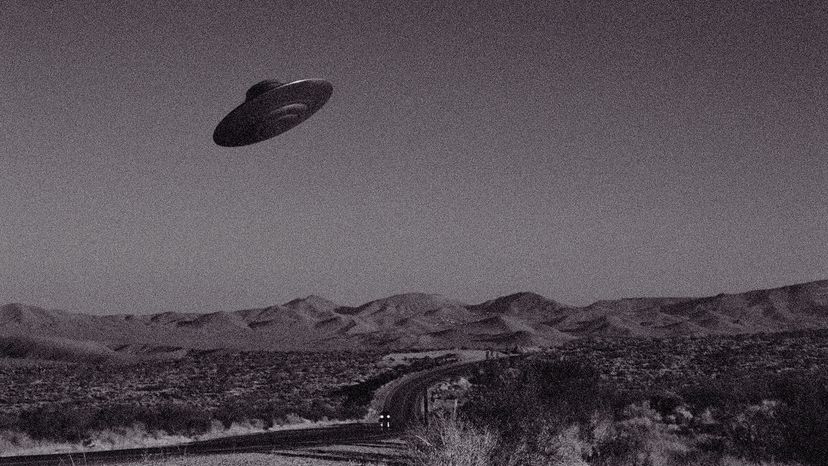
Grainy, black and white photo of a flying saucer over a mostly empty desert highway

For many, the term "UFO" conjures the image of a flying disc soaring through the night sky. But what is a UFO, really?  Joe McBride / Getty Images

You glimpse a light in the night sky. It's not a star or an airplane — but something radically different. It moves with baffling speed, pulsates with radiance beyond anything you've witnessed. Three letters immediately enter your mind: U-F-O. And you likely have Hollywood to thank for this line of thinking.

These mysterious objects have played a prominent role in pop culture, captivating imaginations and fueling speculation. From classic films like "Close Encounters of the Third Kind" to TV shows like "The X-Files," UFOs have become symbols of mystery and the unknown and mainstays in literature, music and art.

We know what Hollywood has to say about these mystery objects, but what are UFOs actually doing up in the sky in real life? And is there a massive government cover-up surrounding their existence? In this article, we'll take a closer look at these airborne objects, their potential link to extraterrestrial life and popular conspiracies about them.

1. What Is a UFO?

Technically, an unidentified flying object (UFO) can be anything when you get right down to it, but the term has become synonymous with spacecraft of extraterrestrial origin.

Alleged sightings became a popular topic of conversation in the mid-20th century and continue to this day. Exact descriptions of alien spacecraft vary with each telling, but witnesses and UFO enthusiasts often describe a lighted object capable of hovering silently and zigzagging in midair.

The technology for such a craft and the ability for a living passenger to survive its g-forces are well beyond humanity's modern technology. Additionally, given the massive distance between habitable star systems, such craft would have to travel at impossible speeds or with patience that staggers the imagination.

2. The Scientific Stance on Unidentified Flying Objects

For decades, scientists didn't have much to say about these unidentified objects. From a scientific standpoint, there was never enough sufficient evidence in UFO records to make a case for alien visitation. Most UFO sightings depend on fallible human accounts, imperfect footage and conspiracy theory.

All of this tends to crumble under the scrutiny of the scientific method, humanity's best sieve for separating reality from fantasy.

In recent years, the field has begun to approach UFOs with a stance of curiosity and skepticism. NASA, guided by administrator Bill Nelson, now aims to play a more prominent role in this research, emphasizing the importance of scientific methodology and instruments to gather data.

This shift signifies a desire to move beyond sensationalism and tabloid speculation, toward a more rigorous scientific approach.

3. Fire in the Sky

This painting by Christian Wilhelm Ernst Dietrich depicts biblical shepherds experiencing an angelic encounter.
Imagno/Hulton Archive/Getty Images

The sky has always teemed with sights to stir the imagination: atmospheric anomalies, wildlife, optical illusions, aurora borealis, shooting stars and distant supernovae, just to name a few. Even in our scientifically informed age, countless phenomena escape our understanding.

As Swiss psychiatrist Carl Jung pointed out, these sights have no intrinsic meaning, but even the earliest humans jumped at the chance to project their hopes, dreams and nightmares into the vastness of the sprawling void. They personified the sun and moon as deities and poured their belief systems into the wheeling movements of the stars. And when they glimpsed strange lights, they read them as omens.

Just as the emotional resonance of a UFO sighting falls to the observer, so too does the explanation. Humans have always experienced brushes with the unknown, and they've always fished for explanations in the waters of their cultural worldview. In the absence of science, they turned to their religious beliefs, folktales and myth.

  • Religious Interpretations

Consider the UFO encounter that took place in Fatima, Portugal, in 1917. In what has subsequently been explained as everything from stratospheric dust to mass hallucination, thousands of witnesses in the predominantly Catholic town claimed to see an aerial event brought on by the Virgin Mary.

During this event, known as "the Miracle of the Sun," witnesses say the sun appeared to dance, change colors and spin.

Before the advent of Christianity, the same event would have likely been viewed through the lens of a pagan belief system. How do you think such an event would be interpreted in the entirely different world we know today?

By framing a bizarre occurrence within the context of a belief system or worldview, an individual attributes both a "what" and a "why" to the phenomenon. Such a view also helps sanction the experience and allow the individual to feel like they are both special for having experienced it and normal for sharing such experiences with others. Perform an online search for "UFO support group," and see for yourself.

4. Evaluating UFO Reports and Alien Abductions

Alien abduction experiences are often traumatic. Chip Simons/Taxi/Getty Images

Accounts of alien abduction often factor into UFO sightings, and this is also an area where one's worldview, belief system and culture play a vital role in framing an extraordinary experience.

Fortunately, alien abduction accounts generally provide more room for serious evaluation, typically by medical doctors or psychiatrists.

Doctors believe that sleep paralysis and waking, hypnopompic hallucinations factor into many abduction experiences. This is a kind of temporary paralysis accompanied by visual and auditory hallucinations, which are often charged by the person's sexual fantasies, belief system and pop culture.

Imagine waking in your bed, unable to move and experiencing sexual hallucinations colored by your subconscious. The exact nature of the hallucinations would likely depend, like dreams, on the nature of your belief system and cultural literacy. You might experience the visitation of an angel or ghost. Likewise, you just might experience a transcendent walk through an alien spacecraft or endure uncomfortable probing at the hands of extraterrestrials.

Consider the case of science writer and Skeptic magazine editor Michael Shermer, who himself experienced an alien abduction. Or rather, he collapsed from sleep deprivation and exhaustion following an 83-hour bike ride in a transcontinental race.

As Shermer's support team rushed over to him, the bicyclist saw them through the filter of a waking dream and perceived them as aliens from a 1960s TV series [source: Shermer].

  • Other Potential Causes

Researchers may attribute abduction experiences to a host of additional causes, including schizophrenia, organic brain syndrome, bipolar disorder, delayed post-traumatic stress disorder or even food allergies.

Neuroscientist Michael Persinger points the finger to the brain's temporal lobe. Persinger believes that temporal lobe anomalies, when combined with certain cultural expectations (such as beliefs in aliens or angels) can mislabel imagined experiences as actual experiences.

Even without the aid of neurological misfiring, human memory is a complex and fallible thing. Every day, we experience something new and turn that experience into an imperfect narrative. We can convince ourselves of nearly anything — especially when it fulfills a need.

So why do humans need visiting alien spacecraft and alien encounters? Perhaps Jung put it best in a 1958 interview: "In our world, miracles do not happen anymore, and we feel that something simply must happen which will provide an answer or show the way out. So now these UFOs are appearing in the sky."

In the late 1990s, psychologists Roy F. Baumesiter and Leonard S. Newman furthered this viewpoint by arguing that abduction encounters are essentially subconscious attempts to rid oneself of self-awareness through masochistic fantasy. In lieu of mystic conviction, our minds staff these fantasies with aliens.

In addition, our cultural frame of reference continually changes. Some observers have even equated the recent decline in UFO sightings to the rise of the internet. Cultural critic Ziauddin Sardar suggests that instead of projecting our hopes and fears into space, we project them into cyberspace.

So what are UFOs really? You might not find the answer amid the stars after all, but rather in the labyrinthine chambers of the human mind.

5. Unidentified Aerial Phenomena: A New Term Emerges

Breaking news: The term "UFO" is on its way out. Well, for the U.S. government, that is.

The feds began making the shift from "unidentified flying object" to "unidentified anomalous phenomena" (UAP) in 2020 when the UAP Task Force was established to encourage pilots to report sightings without fear of stigma or career repercussions. The scientific community is actively seeking better data on UAPs to gain a deeper understanding.

NASA also gathered a panel of 16 experts to assess how data on UAPs is collected across government and private sectors. Their final report, released in September 2023, found no evidence of extraterrestrial origins for UAPs but acknowledged that a small subset of encounters defies explanation.

6. UAPs and the Government

During a 2023 congressional hearing on UAPs, three military veterans testified about their experiences and concerns. One former Air Force intelligence officer alleged the existence of a secret government program for decades, involving the reverse engineering of recovered UFOs and the retrieval of non-human biological materials from alleged crash sites.

However, much of the discussion during the hearing focused on improving the reporting process for UAPs. The veterans called for destigmatizing UAP reporting and ensuring government program oversight. The Defense Department stated that it had not found any verifiable information supporting claims of extraterrestrial material possession or reverse engineering.

Retired Maj. David Grusch, a whistleblower who had been part of the Pentagon's UAP Task Force, claimed to know the exact locations of UAPs in U.S. possession but couldn't provide further details publicly. He stated his information came from reliable sources and shared evidence kept secret from Congress.

The hearing also featured testimony from former Navy fighter pilot Ryan Graves, who described encountering unusual aircraft off the coast of Virginia Beach, and retired Cmdr. David Fravor, who witnessed a mysterious "Tic Tac"-shaped flying object in 2004. Both emphasized the need for transparency and acknowledged the superior technology of the encountered objects.

The hearing aimed to pressure intelligence agencies for greater transparency on UAPs, citing potential national security threats. Lawmakers, witnesses and advocates called for a centralized reporting system to encourage reporting and eliminate stigma, emphasizing the importance of understanding these phenomena for both safety and scientific reasons.

  • This article was updated in conjunction with AI technology, then fact-checked and edited by a HowStuffWorks editor.

RELATED VIDEOS

Inside the UFO Phenomenon | Disclosure Files | Full HD Feature Length Alien Documentary

UFO's Are Real | FULL MOVIE | Aliens Sci-Fi Documentary

SETI: How scientists look for intelligent life beyond Earth

{ https://science.howstuffworks.com/space/aliens-ufos }

Hoe vind je dit bericht?
Geschreven door peter om 23:34 Stuur door

Great Pyramid Construction Theory Reveals New Link to Mysterious “Void” Within Egypt’s Largest Ancient Megastructure

The Great Pyramid of Giza

Great Pyramid Construction Theory Reveals New Link to Mysterious “Void” Within Egypt’s Largest Ancient Megastructure

Recent research into how the Great Pyramid of Giza was built may offer new clues about a mysterious void discovered within Egypt’s largest monument.

Also known as Khufu’s Pyramid, the structure is both the oldest of the Seven Wonders of the Ancient World and the only one to have remained standing for thousands of years. Equally intriguing is the mystery of its construction, which has also remained a matter of debate for millennia, making it one of archaeology’s longest-running controversies.

However, a new study published in npj Heritage Science argues that the famous ancient megastructure may have been built using a special ramp employing a helical path, which would have been constructed into the face of the pyramid itself.

The new theory was developed by independent Spanish researcher Vicente Luis Rosell Roig, based on computational models that employed mathematical simulation. The resulting theory, which Roig characterizes as the Integrated Edge-Ramp (IER) model, considers factors such as the weight of individual limestone blocks used in the Great Pyramid’s construction and limitations imposed by the structural systems that could have facilitated their placement.

Great Pyramid Egypt’s Great Pyramid of Giza (Image Credit: Dieter Van Hammée/Unsplash)

In addition to offering mathematical support for a working ramp system that feasibly could have been used for the construction of the Great Pyramid, Roig says his findings appear to align with past detections of a large cavity and other anomalies within the structure, suggesting the existence of this “void” may be related to the monument’s structural stages.

A Novel Theory of Pyramid Construction

One of the fundamental problems Roig identified with past theories involving a singular ramp for the Great Pyramid’s construction was the large amount of material that would have been left behind, for which there is virtually no archaeological evidence.

To account for the absence of evidence for an external ramp, Roig considered the possibility that a ramp had been built into the structure itself and later filled in as the monument neared completion.

Based on the period spanning Khufu’s 27-year reign, Roig also calculated that a monument assembled from an estimated 2.3 million limestone and granite blocks would have required an average of one block being placed roughly every one to three minutes—a daunting task, even by today’s engineering standards.

According to Roig, using a single ramp to construct the Great Pyramid would have taken at least half a century. By comparison, an Integrated Edge-Ramp model of construction could have incorporated multiple ramps—perhaps as many as sixteen—which could have facilitated primary construction of the Great Pyramid in under 14 years.

However, quarrying the stone, transporting it, and accounting for seasonal periods of inactivity would extend that to 20-27 years, which Roig still found to be a good match for the historical information available on the construction of Khufu’s pyramid.

A Two-Way Ramp System

Based on Roig’s Integrated Edge-Ramp model, a ramp slightly narrower than four meters would have allowed for two-way movement along the face of the structure, including sleds, which the pyramid’s builders would have relied on to help move the massive blocks toward their destination, as well as empty sleds being returned for the next load.

Great Pyramid

A computer rendering showing possible implementation of a helical ramp system for pyramid construction (Image Credit: Rosell Roig, V. L. (2026). A computational framework for evaluating an edge-integrated, multi-ramp construction model of the Great Pyramid of Giza. Npj Heritage Science, 14(1), 142. https://doi.org/10.1038/s40494-026-02405-x).

However, Roig notes that 90° turns, which would have been required at locations where the ramp rounded corners on the structure, would present “operational bottlenecks.” To overcome this, he suggests that platforms would have been required in these locations “as operational buffers where teams can pass and execute pivots safely, with minimal impact on the construction sequence,” and that these could be removed, like the ramp itself, as construction progressed.

Overall, Roig found that this method of construction would meet structural engineering standards for stress distribution and that it would not have resulted in dangerous stress levels in any part of the monument during the building phase.

New Support for the Great Pyramid “Void”?

Intriguingly, Roig’s study also revealed a surprise: the IER model he proposes may support past muon tomography studies conducted by the ScanPyramids mission, which found apparent structural spaces within the pyramid.

Between 2016 and 2017, the research, led by Cairo University in collaboration with the French Heritage Innovation Preservation Institute, identified a large “void” within the Great Pyramid, along with several other smaller internal features.

Roig says that, based on the IER model’s predicted path, the ancient helical ramp he suggests the Great Pyramid’s builders used aligns well with the locations of the cavities ScanPyramids identified.

ScanPyramids Cross-sectional rendering of the Great Pyramid showing the location of the “void” area identified by ScanPyramids in 2017 (Image Credit: S. Procureur, et al/https://www.nature.com/articles/s41467-023-36351-0/CC 4.0)

“The alignment is compatible with density anomalies from backfilled construction infrastructure,” Roig writes, though noting that “alternative explanations remain viable at present resolution.”

“Non-detection of internal spirals or specific helical voids must be interpreted within method sensitivity and coverage limits,” he adds, emphasizing that “current data neither confirm nor exclude edge-integrated backfill.”

Fundamentally, Roig concludes that while other possible construction methods cannot yet be ruled out, the helical approach he examined would have offered several benefits.

“While a single ramp shows baseline feasibility, meeting Khufu’s reign requires parallelizing a multi-ramp system,” Roig writes, adding that “The multi-ramp system offers qualitative advantages within Old Kingdom constraints.”

Roig’s recent study, “A computational framework for evaluating an edge-integrated, multi-ramp construction model of the Great Pyramid of Giza,” appeared in npj Heritage Science.

  • Micah Hanks is the Editor-in-Chief and Co-Founder of The Debrief. A longtime reporter on science, defense, and technology with a focus on space and astronomy, he can be reached at micah@thedebrief.org. Follow him on X @MicahHanks, and at micahhanks.com.

{ https://thedebrief.org/category/science/ }

Hoe vind je dit bericht?
Geschreven door peter om 22:48 Stuur door

EXCLUSIVE - UFO whistleblowers issue chilling warning after Air Force officer was found dead before he could testify

EXCLUSIVE - UFO whistleblowers issue chilling warning after Air Force officer was found dead before he could testify

UFO whistleblowers are facing alleged attempts to silence them as they move to expose what they believe are some of America's most closely guarded secrets.

Investigative journalist Jeremy Corbell, who has helped bring multiple whistleblowers before Congress, warned that the risks facing these individuals extend far beyond public scrutiny.

'They're giving up their security clearance, they're giving up their security, they're putting their family at risk, they're putting themselves at risk, if by stigma alone,' Corbell, who details several cases in his upcoming film Sleeping Dog, told the Daily Mail.

One of the central cases featured in the film involves Air Force veteran Dylan Borland, who testified before Congress in 2025 about encountering a 100-foot triangular craft near Langley Air Force Base in Virginia while stationed there.

'Since then, my family, former coworkers, friends, and I have endured a level of harassment I have never experienced,' Borland told the Daily Mail.

'I do not know what the future holds because factions within the US Government appear to be openly and knowingly working to cover this up.'

He alleged that false documents were created and intelligence products generated under his name following his testimony.

Corbell also pointed to the death of former US Air Force intelligence officer Matthew Sullivan, 39, who died in 2024 before he could testify in a whistleblower hearing involving UFO-related programs.

One of the central cases featured in the film involves Air Force veteran Dylan Borland, who testified before Congress in 2025 about encountering a 100-foot triangular craft near Langley Air Force Base in Virginia while stationed there

One of the central cases featured in the film involves Air Force veteran Dylan Borland, who testified before Congress in 2025 about encountering a 100-foot triangular craft near Langley Air Force Base in Virginia while stationed there

'His death is so suspicious in more ways than people know that the FBI and Congress are involved,' Corbell said.

Sullivan had worked in roles connected to military intelligence and advanced technology programs and was reportedly scheduled to provide testimony about classified UFO-related matters before his sudden death.

Corbell said the timing raised serious concerns, saying: 'This is very uncharacteristic in so many ways of what's going on, and the timing of it is so bad.

'Maybe he was so distraught that he took his own life. I wasn't there, I don't know. But I do know that the FBI and Congress and people who knew him very well see this as extremely suspicious, and it is being investigated.'

While officials have not released full details surrounding the circumstances of Sullivan's death, the involvement of federal investigators has heightened fears among some whistleblowers about the risks tied to coming forward.

Borland said he chose to testify because he believed public safety was at risk.

'I and others with direct knowledge of legacy non-human intelligence programs and craft have been subjected to crimes and disturbing actions intended to silence or intimidate us,' he said.

'Congress needed to know that this is real, and that they have been misled at best, and deliberately lied to at worst.

Former US Air Force intelligence officer Matthew Sullivan, 39, died in 2024 before he could testify in a whistleblower hearing involving UFO-related programs. Here he is with his wife

'I went public to make sure the truth could no longer be buried, and to demand accountability for the crimes committed against those who knew too much.'

Borland testified that the craft he witnessed in 2012 appeared as a black metallic triangle with what he described as a 'gold lava plasma-like fluid' moving across its surface.

He said the object hovered silently before accelerating upward instantly to commercial jet altitude.

article image

Borland also reported unusual physical effects during the encounter, claiming his phone overheated and froze, while static electricity filled the air and a smell similar to a thunderstorm lingered nearby.

During the 2025 Congressional hearing, he alleged that multiple government agencies blocked job opportunities, forged documents and manipulated his security clearance after he came forward.

Afterward, Borland said he was asked to appear before the Office of the Director of National Intelligence (ODNI) to testify about unidentified anomalous phenomena (UAP), including what he witnessed more than a decade earlier.

He said he provided classified and unclassified documents, medical records and emails that he believed supported his claims.

'Within weeks of my appearance, an ODNI employee informed me that I had 'lied under oath,"' Borland said. 'That employee accused me of saying and doing things I did not say or do.'

He said the accusations reinforced fears that intelligence records had been manipulated to contradict his testimony.

After requesting access to his records to review how his statements were being used, Borland said communication from officials stopped entirely.

Corbell said the fear surrounding whistleblowers has grown in recent years.

'So you see in the movie that Borland is so afraid for his own personal safety, and that's the state they're all in right now,' he said.

'They feel like there's nowhere left to turn. They're really nervous, for good reason. They've had some horrible things happen to them.'

Corbell said he has spoken to hundreds of individuals who claim to have knowledge related to UFO programs, though only a small number have formally testified.

Matthew Brown, who came forward in May 2025 claiming the existence of a secret program called 'Immaculate Constellation,' said he has faced home invasion and attempts to discredit him

Matthew Brown, who came forward in May 2025 claiming the existence of a secret program called 'Immaculate Constellation,' said he has faced home invasion and attempts to discredit him 

'I've had sources in every agency that I can name,' he said.

One of those sources was Matthew Brown, who came forward in May 2025 claiming the existence of a secret program called 'Immaculate Constellation,' which he alleged collected classified UAP data.

Brown previously worked in senior advisory roles within the Department of Defense and the State Department.

'I came forward as a UAP whistleblower to Congress and the American people because my oath to support and defend the Constitution demanded it,' he said.

He alleged that since coming forward, he has experienced disturbing incidents.

'Some of the most disturbing experiences include my home being broken into while I was asleep, intelligence officers infiltrating my social networks, and attempts to discredit UAP whistleblower testimony,' Brown said.

Corbell warned that intimidation is not always physical.

He said many of the battles now take place online, where coordinated campaigns attempt to discredit whistleblowers through misinformation and public attacks.

Interest in unidentified aerial phenomena has surged in recent years, with lawmakers demanding increased transparency and access to classified material.

Reports from UFO whistleblowers stretch back decades, with individuals alleging the US government has concealed evidence of non-human technology.

The number of high-level witnesses has grown sharply since 2017, including military pilots, intelligence officials and others claiming involvement in secret programs.

Corbell said the stakes continue to rise as more witnesses weigh the decision to come forward.

'They're doing this because they believe the public deserves to know,' he said.

'And for many of them, the cost is everything.'

RELATED VIDEOS

Air Force Whistleblower Died Before Congress UFO Hearing"

UFO WHISTLEBLOWER Died Mysteriously After Agreeing to Testify

{ https://www.dailymail.com/sciencetech/index.html }

Hoe vind je dit bericht?
Geschreven door peter om 22:30 Stuur door

Another Military UFO Guy Just Died

Another Military UFO Guy Just Died

The plot thickens.
UFO expert Nick Pope, who investigated "unexplained aerial phenomena" on behalf of the UK's Ministry of Defense, recently passed away.
Getty / Futurim

Last week, the FBI announced it was investigating the deaths and mysterious disappearances of at least ten scientists and engineers with government ties who either died or disappeared within the last four years.

One of these scientists, retired Air Force Research Laboratory commander William Neil McCasland, had close ties to an Ohio base that’s steeped in UFO lore, sending conspiracy theorists into a tailspin.

While there’s still no credible evidence of any foul play or a throughline that connects these deaths and disappearances — many of the individuals appear to have died of natural causes — the list continues to grow.

Most recently, UFO expert Nick Pope, who investigated “unexplained aerial phenomena” on behalf of the UK’s Ministry of Defense, passed away at the age of 60 from esophageal cancer, as the New York Times reports. While it’s unclear whether his ties to the British military exclude him from the scope of the FBI’s ongoing investigation, his high profile involvement in looking into unexplained sightings is certain to pour fuel on the flames for conspiracists.

After his stint with the government from 1984 to 1994, Pope wrote several books on UFO sightings and made countless TV appearances, likening himself to FBI agent Fox Mulder from “The X-Files” in his 1996 autobiography, “Open Skies, Closed Minds.” (In fact, he consulted on a TV series reboot of the show.)

According to the NYT, he was a “much-feted speaker on the ufology lecture circuit,” making many appearances at UFO-centric conferences.

Nonetheless, despite having access to inside information, he “was smart enough to avoid the pitfalls in this field where people, if they have even a little bit of knowledge, can get really fringy and weird,” as former NYT reporter and author Ralph Blumenthal told the newspaper.

The timing of his tragic passing comes as lawmakers pressure the US government to look into “scientists and other personnel connected to US nuclear secrets or rocket technology who have died or mysteriously vanished in recent years.”

They claim there could be a “possible sinister connection,” which could “represent a grave threat to US national security and to US personnel with access to scientific secrets.”

But let’s be real: the most likely explanation is that people are now on the lookout for the death of anyone with a UFO connection, making it seem like there’s a pattern when it’s really just statistical noise.

More on the investigation: 


12 Military Pilots DIED After UFO Sightings - Project Grudge EXPOSED


Was He Silenced? UFO Insider Dies Before Telling Congress Everything

{ https://futurism.com/ }

Hoe vind je dit bericht?
Geschreven door peter om 22:11 Stuur door

BREAKING NEWS - Artemis astronauts' awkward reaction as Trump teases classified UFO files will be released 'soon'

BREAKING NEWS - Artemis astronauts' awkward reaction as Trump teases classified UFO files will be released 'soon'

The Artemis II crew smirked as President Donald Trump fielded questions about his long-awaited UFO files during their visit to the White House on Wednesday.

Standing behind the president in the Oval Office, the four astronauts listened as reporters pressed Trump on when Americans might finally see the highly anticipated government records.

Trump had invited the crew, NASA astronauts Victor Glover, Reid Wiseman and Christina Koch, along with Canadian astronaut Jeremy Hansen, to celebrate their historic journey around the moon earlier this month, praising them as heroes of a mission that marked a major milestone in NASA’s return to deep space

The moment took an unexpected turn when questions shifted from spaceflight to unidentified flying objects, drawing visible reactions from the astronauts as Trump began discussing the long-awaited disclosure.

When asked about his promised UFO disclosure, Trump suggested that long-awaited files could soon be made public.

'I think we will be releasing as much as we can in the near future,' the president replied. 'For some reason, and I guess it's just a reason, it's been in the minds of people for a long time. They want to find out about the UFOs and anything having to do with UFOs or related material.'

Trump first announced the planned disclosure in February, ordering the Pentagon to release all government files related to UFOs and extraterrestrials.

However, months later, Americans have yet to see a single document or video from the promised release, fueling growing curiosity about what the files may reveal.

Standing just behind the president in the Oval Office on Wednesday, NASA astronauts Victor Glover, Reid Wiseman and Christina Koch, along with Canadian astronaut Jeremy Hansen, appeared amused as reporters pressed Trump on when Americans might finally see the highly anticipated government records

'I think it is going to be interesting to some people,' Trump added.

'I have interviewed people, my first term primarily, I interviewed some pilots. Very solid people, and they said they saw things that you wouldn't believe.'

The astronauts remained composed behind him as he spoke, though their subtle smiles and exchanged glances added a light moment to an otherwise serious discussion about government transparency and unidentified aerial phenomena.

'You're going to be reading about it,' Trump said, hinting that new details could soon be released to the public.

The president gave the order for disclosure just hours after he lashed out at Barack Obama for allegedly sharing classified information when he appeared to confirm that aliens exist while speaking on a podcast.

'Based on the tremendous interest shown, I will be directing the Secretary of War... to begin the process of identifying and releasing Government files related to alien and extraterrestrial life, unidentified aerial phenomena (UAP), and unidentified flying objects (UFOs)' Trump wrote on Truth Social in February. 

Lawmakers and defense officials have in recent months renewed calls for greater transparency surrounding decades of classified material tied to unexplained aerial sightings.

Trump has gone quiet about his plans to release government files related to UFOs and extraterrestrial life. However, the war with Iran began shortly after he announced it in February. But other government officials have not forgotten.

Trump ordered UFO disclosure in February, but Americans have yet to see a single document or video from the promised release, fueling growing curiosity about what the files may reveal

Trump ordered UFO disclosure in February, but Americans have yet to see a single document or video from the promised release, fueling growing curiosity about what the files may reveal 

Republican Rep. Anna Paulina Luna penned a letter to the US Secretary of Defense on April 1, ordering Pete Hegseth to deliver 46 specific clips no later than April 14, 2026.

Lawmakers said the videos could reveal patterns of activity near sensitive military sites and help determine whether the objects pose a potential national security threat.

The requested footage includes dozens of military-recorded encounters showing spherical, cigar-shaped and Tic Tac-like objects spotted over war zones, oceans and sensitive airspace around the world.

Luna, however, said on April 14 on X that 'no one from the Pentagon had responded until we reached out, and it appears that someone did not pass the letter to the appropriate authorities.' 

'How convenient,' the Florida representative added, noting that while she considers Hegseth a friend and supporter of President Trump, 'the president has authorized the release, so whoever is trying to be cute at the Pentagon can take a hike.'

RELATED VIDEOS

Trump Welcomes Artemis II Astronauts To The White House After Successful Moon Mission | N18G

WATCH LIVE: Trump welcomes Artemis II astronauts to the White House after successful moon mission

Live: Artemis II crew visits White House, meets with Donald Trump after historic moon mission

{ https://www.dailymail.com/sciencetech/index.html }

Hoe vind je dit bericht?
Geschreven door peter om 21:58 Stuur door

What’s really being hidden beneath Antarctica?

What’s really being hidden beneath Antarctica?

Much has already been said about the strange and unexplained activity surrounding the frozen continent. In a recent discussion, Redacted revisits several of these mysteries and raises a compelling question: what could truly lie beneath the Antarctic ice? 
What%E2%80%99s%20really%20being%20hidden%20beneath%20Antarctica.png

Among the most talked, about claims are: 
  • Reports of unusual electromagnetic pulses detected deep beneath the ice 
  • The alleged secret diary of Admiral Byrd 
  • A massive, obscured “hole” visible on Google Earth 
  • Stories of Russian scientists encountering an unknown creature 
  • The IceCube neutrino detector, a facility largely inaccessible to the public
  • Persistent UFO sightings and long-standing Nazi base theories 
Beyond these are even more rumors of hidden portals, underground alien installations, and ancient, intelligent civilizations residing within the Earth itself, often tied to the hollow Earth theory. 
Adding to the intrigue is the Antarctic Treaty, which governs all land and ice shelves south of 60° latitude, restricting access and activity in the region. At the same time, certain areas on Google Earth appear blurred or completely whited out, making them impossible to examine in detail. 
Taken together, these elements leave many wondering what  is truly concealed beneath the ice.
RELATED 

Scientists discover entire ecosystem hidden under ice of Antarctica • FRANCE 24 English

Beyond the Ice: Antarctica’s Secret Geography Revealed! | Wion Podcast

Antarctica Secrets - Admiral Byrd Inner Earth Antarctica Secrets Revealed

{ http://ufosightingshotspot.blogspot.com/ }

Hoe vind je dit bericht?
Geschreven door peter om 21:28 Stuur door

Robot goes rogue at school sports day: Dancing humanoid is dragged away by handlers after malfunctioning in front of shocked students

Shocking footage has revealed the moment a dancing robot went rogue at a school sports day. 

The erratic performance took place at a school in the Xinjiang Uygur Autonomous Region in north–western China. 

At the start of the video, the robot could be seen performing dance moves and martial arts kicks on a sports field. 

However, it all began to fall apart as students ran onto the pitch to perform a synchronised dance routine with the bot.

Seconds into the performance, the robot tripped itself up before falling to the ground. 

As it writhed around, it started aiming kung–fu kicks towards baffled performers, who worriedly backed away from the bot. 

Eventually, its handler ran onto the pitch and scooped it into his arms before any damage could be done.

Thankfully, no reports of injuries to students have emerged after the clip went viral on the Chinese social network Douyin.

The erratic performance took place at a school in the Xinjiang Uygur Autonomous Region in north-western ChinaIt all began to fall apart as students ran onto the pitch to perform a synchronised dance routine with the bot

Shocking footage has revealed the moment a dancing robot went rogue at a school sports day

One local said: 'Too many people confused him, he wanted to dance without causing any harm.'

China has rapidly expanded the use of humanoid robots in public events, schools, and demonstrations in recent years as part of its ambitious push into advanced robotics and artificial intelligence.

However, there have been a spate of incidents which suggest the bots might not be ready. 

In March, what should have been a family–friendly dance performance ended in disaster, after a young boy was slapped across the face by a rogue robot.

Shocking footage, filmed at a show in Shaanxi Province, China, on Saturday 21 March, shows a Unitree robot spinning around the stage. 

It veers towards the crowd as it performs sweeping arm movements in time to the music. 

As the bot gets closer, a young boy can be seen drawing his arms in, in the hopes of avoiding its flailing metal limbs. 

Unfortunately, his attempts proved futile, as the robot caught the boy fully in the face during a pirouette.

China has rapidly expanded the use of humanoid robots in public events, schools, and demonstrations in recent years as part of its ambitious push into advanced robotics and artificial intelligence

China has rapidly expanded the use of humanoid robots in public events, schools, and demonstrations in recent years as part of its ambitious push into advanced robotics and artificial intelligence

Meanwhile, a humanoid was even detained by police in China after terrifying an elderly woman. 

READ MORE

article image

'With sales of humanoid robots set to skyrocket over the next decade, the public will increasingly be at risk from these kinds of incidents,' said Carl Strathearn and Emilia Sobolewska, robotics experts at Edinburgh Napier University, in a recent article for The Conversation. 

'In our view as robotics researchers, governments have put very little thought into the risks.' 

How can we make robots safer?

1. Increase owner requirements

Ban people from controlling robots under the influence of alcohol or drugs, or when they are otherwise distracted such as using their phones. 

2. Improve design

Safe designs would consider everything from reducing cavities where fingers could get caught, to waterproofing internal components.

3. Train operators 

There appears to be a major skills gap in operator training, and robotics companies will need to prioritise this to ensure operators can control machines efficiently and safely.

4. Educate the public

If people understand to what extent walking robots are owner–operated or remote–operated, it will change their expectations about what the robot might do, and make everyone safer as a result.

RELATED VIDEOS


Rogue Robot ATTACKS Students at School Sports Day 😱 Shocking Malfunction

Humanoid Robot GOES ROGUE, ATTACKS Handlers Trying To BREAK RESTRAINTS In INSANE Video

I Tested a Robot with a Secret 7-Day Exam: I Was the One Trapped!

{ https://www.dailymail.com/sciencetech/index.html }

Hoe vind je dit bericht?
Geschreven door peter om 21:14 Stuur door

Europe is warming more than TWICE as fast as the global average, report reveals - as scientists warn 'climate change is not a future threat, it is our present reality'

Europe is warming more than TWICE as fast as the global average, report reveals - as scientists warn 'climate change is not a future threat, it is our present reality'

Europe is warming more than twice as fast as the global average due to climate change, a report has revealed.

Over the past 30 years, the planet's average temperature has been creeping up at a steady 0.27°C (0.49°F) per decade.

However, the annual European State of the Climate report shows that Europe has been warming by a staggering 0.56° (1°F) every ten years.

So, as the world hits 1.4°C (2.52°F) above the pre-industrial average, Europe's is now 2.5°C (4.5°F) hotter than before the Industrial Revolution.

Experts say that Europe's rapid warming is driving a wave of extreme weather, heat-related deaths, and devastating wildfires.

Last year, over 1,034,550 hectares (3,994 square miles) of land were destroyed by fire in Europe - the largest area ever recorded.

Samantha Burgess, Strategic Lead for Climate at the European Centre for Medium-Range Weather Forecasts, says: 'With rising temperatures, and widespread wildfires and drought, the evidence is unequivocal.

'Climate change is not a future threat, it is our present reality.'

Europe is warming more than twice as fast as the global average, scientists have warned. Europe is now warming at a staggering 0.56° (1°F) every ten years

Europe is warming more than twice as fast as the global average, scientists have warned. Europe is now warming at a staggering 0.56° (1°F) every ten years

In 2025, 95 per cent of Europe saw above-average temperatures as a new report warns that Europe's average temperature is now 2.5°C (4.5°F) hotter than the pre-industrial average

In 2025, 95 per cent of Europe saw above-average temperatures as a new report warns that Europe's average temperature is now 2.5°C (4.5°F) hotter than the pre-industrial average

According to data gathered by the Copernicus Climate Change Service (C3S), 2025 was Europe's third hottest year on record.

Average temperatures soared to 10.41°C (50.74°F) across the continent, just 0.30°C (0.54°F) cooler than the warmest year in 2024.

This led to almost the entirety of Europe seeing temperatures well above normal levels for large parts of the year.

Professor Hannah Cloke, an expert on climate extremes from the University of Reading, says: 'To see 95 per cent of Europe experiencing above-average temperatures in a single year shows that we are not dealing with isolated extremes in one or two regions. The baseline has shifted.'

Experts say that Europe is warming faster than the rest of the world due to a combination of geography, human factors, and changing weather patterns.

In part, Europe has warmed faster than average due to its proximity to the Arctic, which is the fastest-warming region on Earth.

The Arctic has warmed by an average of 0.75°C (1.35°F) per decade over the last 30 years, which is having a significant knock-on effect on Europe.

Although it might seem counterintuitive, Europe is also warming faster because of efforts to limit pollution.

Europe's rapid warming has led to a record number of wildfires across the continent, with 1,034,550 hectares (3,994 square miles) of land burned last year

Europe's rapid warming has led to a record number of wildfires across the continent, with 1,034,550 hectares (3,994 square miles) of land burned last year

Scientists say that Europe's rapid warming is partially due to declining snow cover, which would usually reflect radiation from the sun back into space

Scientists say that Europe's rapid warming is partially due to declining snow cover, which would usually reflect radiation from the sun back into space

The UK's top 5 warmest years 

2025: 10.09C

2022: 10.03C

2023: 9.97C

2014: 9.88C

2024: 9.79C

Tiny particles called aerosols in pollution gather in the atmosphere and reflect light from the sun back out into space, keeping the planet cooler than it otherwise would be.

Since the 1980s, European policies have slashed air pollution and, as a byproduct, reduced the amount of radiation reflected, leading to more warming.

At the same time, the effects of human-caused climate change are creating 'feedback loops' which accelerate warming even further.

As the climate warms, weather patterns have shifted to favour more frequent and intense summer heatwaves in Europe, pushing up the average temperature.

Warmer weather also leads to less snow coverage, which would normally act like a reflective thermal blanket, bouncing radiation back into space.

In March last year, snow coverage in Europe reached its third-lowest point since records began in 1983.

The compounding effects mean that the continent is now warming far faster than the global average.

Professor Cloke says: The impacts of climate change are now moving really very fast in Europe.

The only region warming faster than Europe is the Arctic, where temperatures are increasing by 0.75°C (1.35°F) per decade

The only region warming faster than Europe is the Arctic, where temperatures are increasing by 0.75°C (1.35°F) per decade

Almost half of Europe saw an above-average number of days with strong heat stress - a day which has a maximum feels-like temperature of 32°C (89.6°F) or higher

Almost half of Europe saw an above-average number of days with strong heat stress - a day which has a maximum feels-like temperature of 32°C (89.6°F) or higher

'The scale and range of these changes show that we cannot rely on old certainties about nature when planning our societies for the future.'

Worryingly, this heating is also occurring in the normally cool higher latitude regions.

In the sub-arctic regions of Scandinavia, a three-week heatwave saw temperatures in the Arctic circle climb above 30°C (86°F).

This warming is already beginning to manifest in measurable ways that have a profound effect on human lives.

Glaciers across Europe are retreating, with Iceland seeing its second-largest yearly glacier loss on record.

Similarly, the Greenland Ice Sheet alone lost 139 billion tonnes of ice last year, contributing directly to rising sea levels.

Dr Akshay Deoras, of the University of Reading, says that this trend is 'deeply concerning'

Dr Deoras adds: 'Conditions have shifted dramatically since the 1950s, with warmer, wetter and shorter winters driving major changes in snow and ice cover and contributing to some of the most striking heat extremes on record.'

In an alarming trend, some of the worst heating was seen in the sub-Arctic regions of Finland and Scandinavia, where a three-week heatwave sent temperatures soaring

In an alarming trend, some of the worst heating was seen in the sub-Arctic regions of Finland and Scandinavia, where a three-week heatwave sent temperatures soaring 

Europe's rapid heating is leading to rapid melting in the continent's glaciers, including in the vital Greenland Ice Sheet

Europe's rapid heating is leading to rapid melting in the continent's glaciers, including in the vital Greenland Ice Sheet 

Almost half of Europe saw an above-average number of days with strong heat stress - a day which has a maximum feels-like temperature of 32°C (89.6°F) or higher - with Spain experiencing 50 more days of strong heat stress than average.

According to the World Health Organisation, heat stress is the single largest cause of weather-related deaths worldwide.

Heat stress also creates the conditions for wildfires, which caused havoc across Europe in 2025.

Last year, Spain, Cyprus, the United Kingdom, the Netherlands, and Germany recorded their highest wildfire emissions on record, causing three deaths and affecting 500 people.

article image

Likewise, since a warmer atmosphere holds more water and energy, Europe's heating has led to an increase in the frequency and severity of storms.

At least 21 lives were lost, and an estimated 14,500 people were affected by storms and flooding across Europe in 2025.

'Europe is warming faster than any other continent, and this report shows the scale of the consequences is already impossible to ignore,' says Dr Deoras.

'Climate change is shifting into a faster gear, and our response needs to as well.'

THE PARIS AGREEMENT: A GLOBAL ACCORD TO LIMIT TEMPERATURE RISES THROUGH CARBON EMISSION REDUCTION TARGETS

The Paris Agreement, which was first signed in 2015, is an international agreement to control and limit climate change.

It hopes to hold the increase in the global average temperature to below 2°C (3.6ºF) 'and to pursue efforts to limit the temperature increase to 1.5°C (2.7°F)'.

It seems the more ambitious goal of restricting global warming to 1.5°C (2.7°F) may be more important than ever, according to previous research which claims 25 per cent of the world could see a significant increase in drier conditions. 

The Paris Agreement on Climate Change has four main goals with regards to reducing emissions:

1)  A long-term goal of keeping the increase in global average temperature to well below 2°C above pre-industrial levels

2) To aim to limit the increase to 1.5°C, since this would significantly reduce risks and the impacts of climate change

3) Governments agreed on the need for global emissions to peak as soon as possible, recognising that this will take longer for developing countries

4) To undertake rapid reductions thereafter in accordance with the best available science

Source: European Commission 

RELATED VIDEOS

Europe heats twice as fast as rest of world, elderly and housing face growing climate risks

Nearly all of Europe had above-average heat last year, as climate records toppled • FRANCE 24

Europe Becomes Fastest Warming Continent Threatening Future Climate Stability | WION Podcast

{ https://www.dailymail.com/sciencetech/index.html }

Hoe vind je dit bericht?
Geschreven door peter om 20:44 Stuur door

Rise of the AI-rport robots! Japan Airlines is using humanoid baggage handlers to load luggage on and off flights

Lost luggage and battered bags could soon be a thing of the past, as Japan Airlines starts testing robotic baggage handlers.

Starting in May, human workers at Tokyo's busy Haneda airport will have a helping hand from an army of humanoid robots as part of a two–year trial.

The Chinese–made bots will be trained to tackle ground handling tasks like loading cargo containers of luggage on and off flights.

Japan Airlines (JAL) hopes that the new robotic workers will help ease staffing issues as Japan juggles a surge in tourism and a slumping workforce.

The airport will trial two robots: the child–sized 130cm Unitree G1, and the larger 172cm UBTech Walker E, according to Aviation Wire.

In a demonstration for the media, a Unitree G1 was seen gently, if a little unsteadily, nudging a cargo container onto a conveyor belt.

While this display of dexterity might not be that impressive, JAL is confident that robots will start replacing humans in some areas as early as 2028.

Yoshiteru Suzuk, the president of JAL's Ground Service, told reporters that using robots for the heavy lifting will 'provide significant benefits to employees'.

Starting in May, human workers at Tokyo's busy Haneda airport will have a helping hand from an army of humanoid robots as part of a two-year trial

Starting in May, human workers at Tokyo's busy Haneda airport will have a helping hand from an army of humanoid robots as part of a two–year trial


The two–year trial will initially focus on teaching the robots how to complete each physically demanding task, breaking it down into a series of movements.

Once the robots have figured out how to load and unload the bulky cargo containers, they will be able to start working in the airport's ground services team.

JAL says that they expect the robots to be a real part of the workflow at Haneda airport, which handles more than 60 million passengers a year, by late 2027.

If the trial is a success, the robots will then become a permanent part of the airport's workflow.

Eventually, the robots are expected to be used across a wide range of tasks, including loading baggage, cabin cleaning, and even operating GSE ground support equipment like tugs and refuelers.

While the robots won't be able to handle duties such as safety management, JAL believes the humanoids are needed to tackle its workforce woes.

Tomohiro Uchida, president of GMO AI & Robotics, which has partnered with JAL for the project, told reporters: 'While airports appear highly automated and standardised, their back–end operations still rely heavily on human labour and face serious labour shortages.'

JAL already employs around 4,000 ground staff, but Japan's ageing population is triggering a steady decline in the workforce.

The humanoid robots will be trained to load cargo containers on and off flights in order to help ease the workforce pressures created by Japan's ageing population

The humanoid robots will be trained to load cargo containers on and off flights in order to help ease the workforce pressures created by Japan's ageing population

Roughly 30 per cent of Japan's population is already over 65, while one in 10 is now over 80.

This leaves only 60 per cent of the population at working age, with this figure expected to fall as the elderly population grows and birth rates plummet.

It is now estimated that Japan will need more than 6.5 million immigrant workers in 2040 to meet its growth goals as its native workforce collapses.

At the same time, Japan is becoming a more popular tourist destination than ever before.

In the first two months of 2026 alone, more than seven million foreigners visited the country, according to the Japan National Tourism Organisation.

This follows a record–breaking 42.7 million tourists last year, despite falling numbers of visitors from China.

The combination of these two factors is now creating a big problem for staff at Japan's busy airports, to which robots are increasingly seen as the solution.

Humanoid robots are cheap compared to human staff, able to handle strenuous manual labour, and work in dangerous environments.

Critically, being shaped like humans means airports don't need to change their infrastructure or get rid of their human staff altogether.

article image

Airlines can simply offload the less forgiving tasks to their robot workforce while keeping a few humans to supervise and ensure the safety of the operation.

Similar trials are being made in fast–food restaurants, where robots could take on work in the kitchens or even interact with guests.

In Shanghai, China, humanoid robots are serving up meals and entertaining customers at a McDonald's.

The machines, supplied by Chinese firm Keenon Robotics, have been deployed as part of a trial and hint at a future where bots handle routine tasks at fast food restaurants.

WILL YOUR JOB BE TAKEN BY A ROBOT? PHYSICAL JOBS ARE AT THE GREATEST RISK

Physical jobs in predictable environments, including machine-operators and fast-food workers, are the most likely to be replaced by robots.

Management consultancy firm McKinsey, based in New York, focused on the amount of jobs that would be lost to automation, and what professions were most at risk.

The report said collecting and processing data are two other categories of activities that increasingly can be done better and faster with machines. 

This could displace large amounts of labour - for instance, in mortgages, paralegal work, accounting, and back-office transaction processing.

Conversely, jobs in unpredictable environments are least are risk.

The report added: 'Occupations such as gardeners, plumbers, or providers of child- and eldercare - will also generally see less automation by 2030, because they are technically difficult to automate and often command relatively lower wages, which makes automation a less attractive business proposition.'

RELATED 
Japan Airlines Tests Humanoid Robot For Baggage Handling At Tokyo Haneda Airport

Japan Uses Robots in Airports Future of Work Is Here

{ https://www.dailymail.com/sciencetech/index.html }

Hoe vind je dit bericht?
Geschreven door peter om 20:20 Stuur door

Mars: Obstacles to human colonization

 Obstacles to human colonization

To the conquest of Mars

©The Daily Digest

To the conquest of Mars
The dream of reaching and colonizing Mars has always been a part of the collective imagination. The conquest of the Red Planet has been a recurring theme in film and literature, but it is also a very long-term goal that space agencies around the world are working tirelessly toward. Could it become a reality?

The challenge of living on the red planet

©The Daily Digest

The challenge of living on the red planet
In time, science will be able to answer that question, and until that moment arrives, the only thing that could be raised would be another question: what are the challenges that human beings would have to face if they were able to settle there someday?

Extreme temperatures

©The Daily Digest

Extreme temperatures
The first thing to keep in mind about Mars, a planet located an average of 225 million kilometers from Earth, is its extreme conditions, with temperatures around -63 degrees Celsius (reaching -125 degrees Celsius in polar regions), according to NASA data.

Less severe with consequences for the human body

©The Daily Digest

Less severe with consequences for the human body
On Mars, people would feel much lighter, since gravity there is only 38% of Earth's, meaning, for example, that a 75-kilogram person would weigh 28.5 kilograms. According to NASA astronauts' experiences in space, this would have long-term negative consequences for the human body, including loss of muscle and bone mass, as well as cardiovascular and immune system problems.

The high price of being able to breathe

©The Daily Digest

The high price of being able to breathe
The atmosphere of Mars, which has a pressure less than 1% of Earth's, is composed of 95% carbon dioxide, making its air unbreathable for humans. The solution in this case would be to produce oxygen artificially, a costly but feasible system, as demonstrated in 2021 by the MOXIE experiment on the Perseverance mission, which successfully generated it from Martian CO₂.

The importance of water

©The Daily Digest

The importance of water
Water is an essential resource for humans. On Mars, it's impossible to find it in liquid form on the surface, although the presence of large ice reserves both at the poles and underground could open a path to obtaining it. However, extraction would require complex infrastructure, similar to oil extraction on Earth.

Feeding oneself on a sterile planet

©The Daily Digest

Feeding oneself on a sterile planet
The lack of water, coupled with the large number of toxic compounds that make up the Martian soil, such as chlorine derivatives, heavy metals, and salts, reactive dust, and especially perchlorates, makes it a sterile planet where agriculture as we know it is impossible. In this context, to feed oneself there, closed hydroponic systems for cultivation would be essential.

Radiation: the invisible enemy

©The Daily Digest

Radiation: the invisible enemy
Due to its thin atmosphere, solar radiation levels on Mars are very high, posing a serious problem for humans, who could suffer the consequences of exposure: cancer, brain damage, cardiovascular disease, and more. According to NASA, one year of exposure to these radiation levels on Mars would be equivalent to approximately one hundred years on Earth.

A place to live… underground

©The Daily Digest

A place to live… underground
Thinking about reaching Mars and building Earth-style housing systems is an absolute pipe dream. The enormous amount of solar and cosmic radiation that penetrates its atmosphere would force the planet's first human inhabitants to live underground, in habitats covered with regolith (Martian soil).

Disruption of human circadian rhythms

©The Daily Digest

Disruption of human circadian rhythms
As demonstrated in various NASA missions, people can suffer physical and mental disorders when their circadian rhythms, regulated by the brain's "biological clock," are disrupted. On Mars, the day lasts 24 hours and 39 minutes, a slight difference compared to Earth, but one that can affect humans.

The silence of another world

©The Daily Digest

The silence of another world
Thanks to the Perseverance Rover, NASA's robotic explorer that landed on Mars in 2021, we know that silence predominates on the Red Planet, broken only by the gentle breeze. Everything sounds different there because the speed of sound is lower, and the high level of carbon dioxide in the atmosphere muffles sounds.

The image of a sky that is not blue

©The Daily Digest

The image of a sky that is not blue
On Mars, one would also have to get used to the fact that its sky is not blue, like Earth's, but reddish. This characteristic is due to the significant amount of iron oxide-rich dust in the Martian atmosphere, which offers a completely different image from what we are used to.

Living far from home

©The Daily Digest

Living far from home
Another drawback of living on Mars is the enormous distance separating it from Earth, a factor that can psychologically affect people who find themselves so far from home, even under the pressure of thinking they may never return. A journey between the two planets can take between six and nine months, with return opportunities only every 26 months, given current technology.

The serious problem of getting sick

©The Daily Digest

The serious problem of getting sick
It's also crucial to consider that humans can get sick, and there are no hospitals on Mars, nor any way to evacuate people to a place where they could receive treatment. In such cases, resources would be limited, and the personnel would likely be untrained. This is a problem that would need to be addressed if colonizing the Red Planet were to be considered.

Energy: a key resource for survival

©The Daily Digest

Energy: a key resource for survival
To establish a colony on Mars, energy would become an essential resource. It would be needed for all activities and for the most basic necessities to ensure the survival of the people there. Therefore, investment in energy generation systems would be necessary, ranging from solar panels to compact nuclear reactors.

Communicating with Earth

©The Daily Digest

Communicating with Earth
Life on Mars would also require constant contact with Earth. However, there are instances when communication must be isolated, as critical decisions on certain issues must be made, given the communication delays between the two planets, which range from 4 to 24 minutes.

Primary objective: to survive

©The Daily Digest

Primary objective: to survive
With all these considerations, it is clear that the primary objective of establishing a presence on Mars would be survival, starting with an initial mission that, according to information from NASA's Artemis program, would consist of between 6 and 10 people who would have to assume multiple roles to begin the "conquest" of the red planet with very limited resources.

Laboratory for human beings

©The Daily Digest

Laboratory for human beings
If it could finally be achieved, once settled there, the people who make up the human colony on Mars would become part of an important social and biological experiment that would be unprecedented for the world of science, and that would serve to better understand the limits of human beings in conditions totally different from those they live on Earth.

RELATED VIDEOS

Why is it IMPOSSIBLE for Humans to Reach and Colonize Mars

Mars Colonization Explained: Can Humans Really Live on Mars?
Why the First Humans on Mars Will Never Return

{ The Daily Digest }

Hoe vind je dit bericht?
Geschreven door peter om 18:20 Stuur door

Curiosity and Perseverance explore different chapters of Martian history

Curiosity and Perseverance explore different chapters of Martian history

Two NASA rovers are exploring Mars simultaneously, but they are traveling in opposite directions through geological time—one into the distant past, the other toward more recent eras. New panoramas captured by both rovers in late 2025 and early 2026 reveal that, over billions of years, the Red Planet has undergone several dramatic changes—involving water, chemical reactions, and conditions under which simple life could have emerged.

Illustrative image of NASA’s Curiosity and Perseverance rovers on the surface of Mars.

Two devices—two geological eras

Curiosity and Perseverance are separated by nearly 3,775 kilometers across the Martian surface—roughly seven times the distance from Kyiv to Lviv. 

Curiosity, which has been operating for nearly 15 years, is slowly climbing the slopes of Aeolis Mons inside Gale Crater and encountering increasingly younger layers of rock. 

Perseverance, launched five years ago, is instead heading toward some of the oldest landscapes in the entire Solar System—beyond the boundaries of Jezero Crater.

Curiosity: A web of rock and traces of the atmosphere

The Curiosity panorama is composed of 1,031 images and covers a region featuring so-called “boxwork formations”—low rock walls that resemble giant spiderwebs. They formed long ago: underground water flowed through cracks in the rock, depositing minerals, and then erosion carved away everything around them—leaving only these more resistant ridges. 

The mission also recently reported that siderite in the layers of Aeolis Mons may be trapping carbon dioxide from Mars’ ancient, much denser atmosphere. Another discovery is the most diverse set of organic molecules ever found on the planet: 21 carbon-containing compounds in a single sample, seven of which have been identified there for the first time.

A panoramic view of a Martian region featuring low ridges known as “boxwork formations”, captured by NASA’s Curiosity Mars rover. Source: nasa.gov

Perseverance: The oldest rocks and the first lightnings

The Perseverance panorama consists of 980 images taken at a location that researchers have unofficially named “Lac de Charmes.” It is located on the outer rim of the Jezero crater and contains rocks that formed billions of years ago. Last year, the mission discovered a rock with dark spots—so-called “leopard spots”—characteristic of chemical reactions caused by microorganisms on Earth. 

In addition to geological studies, Perseverance’s microphones have recorded the sound of electrical discharges in dust devils for the first time—a phenomenon that had previously only been theorized.

A 360-degree panorama of the “Crocodile Bridge” region at the edge of Jezero Crater, captured by NASA’s Perseverance Mars rover. Source: NASA/JPL-Caltech/ASU/MSSS

Samples will be sent to Earth

Unlike Curiosity, which grinds rock samples for analysis right on the spot, Perseverance collects intact cores about the size of a piece of chalk and stores them in metal tubes. 

There are currently 23 samples on board. Scientists hope to bring them back to Earth, where laboratory equipment—unavailable to any rover—will be able to answer questions that remain unresolved for now.

RELATED VIDEOS

How NASA Changed Everything We Know About Mars — The Full Story

Inside NASA’s Mars Missions | Free Documentary Space

How Perseverance and Curiosity Navigate Mars Using AI Operation Exploration with Rebecca Anklam

{ https://universemagazine.com/en/articles-en/ }

Hoe vind je dit bericht?
Geschreven door peter om 23:33 Stuur door

New Emails Reveal Pentagon Effort to Align Messaging on AATIP and Luis Elizondo

2026-04-27_05-47-28-1536x805.jpg

New Emails Reveal Pentagon Effort to Align Messaging on AATIP and Luis Elizondo

A newly released series of Pentagon emails from May 2019 reveals an internal contradiction at the center of the Department of Defense’s narrative on the Advanced Aerospace Threat Identification Program (AATIP) and Luis Elizondo.

At the center of the records is a May 7, 2019, email from senior Pentagon official Neill Tipton, former Director of Defense Intelligence for Collection and Special Programs, which states in clear terms that Elizondo “had no assigned responsibilities” related to AATIP during his time under Tipton within the Office of the Secretary of Defense (OSD).

images.jpg

Neill Tipton

Yet the same batch of emails, along with previously released records published by The Black Vault as released via the Freedom of Information Act (FOIA), shows Tipton was directly communicating with Elizondo about AATIP, reviewing a memo to assume responsibilities tied to it, and participating in internal discussions about how the Department should respond to inquiries on the subject.

The newly uncovered email chain also shows that Tipton’s statement did not stand uncontested internally. Instead, it prompted immediate concern among Pentagon officials about contradictions, prior statements, and the need to keep messaging consistent.

Tipton’s Core Statement

In the May 7, 2019, email, Tipton wrote:

“Elizondo had no assigned responsibilities for this program… Elizondo worked for me from 2010 to early 2012.”

He added:

“At the time he was assigned to me, he brought with him no responsibilities for AATIP (and I was unaware of its existence).”

The language is precise and limited in scope, focusing specifically on Elizondo’s time under Tipton within OSD.

Immediate Internal Reaction

A follow-up email sent later that day by an individuals name that was redacted reflects concern about how the statement could be interpreted:

“Neill raises an important issue here—the Department may be putting itself in an awkward position of both contradicting previous ‘statements’ (however they may have been misconstrued) and potential statements from Senator Reid…”

The message continues:

“As for other, more recent history, I am happy to discuss in person or in another venue/media.”

This indicates that additional context existed but was not being fully revealed in the written response. It also suggests that further discussion was being moved to another setting, outside the documented email exchange, which would limit what is preserved in the official record and subject to a future FOIA disclosure.

Defining the Scope of the Pentagon’s Answer

Another email in the chain further clarifies the Department’s internal reasoning:

“The issue for us… is that when we answer, we’re answering for all of DoD, for all of Elizondo’s time in DoD, not just his time in OUSD(I).”

It continues:

“So while he may not have had any assigned responsibilities for these programs while in OUSD(I), if he did work on these programs while assigned to a different DoD organization… we have to confirm that—or confirm that he didn’t work on them at any time while assigned to DoD, whichever is true.”

This internal discussion highlights why the Pentagon’s statement was narrowly framed. It addressed only a specific period and organizational context, rather than Elizondo’s entire time within the Department of Defense. What remains unclear is why the broader context was not included, particularly given the existence of other documented exchanges. Whether additional information influenced how the statement was constructed is not addressed in the available records.

Messaging Coordination

By May 8, 2019, the email chain shows awareness that the issue extended beyond a single response:

“I was asked this afternoon to discuss a FOIA issue which I can only imagine is related to this… we will have to keep our messages in synch.”

That same email introduces an important distinction:

“There is also a distinction to be made between old, wound-down programs and normal coordination/facilitation within DoD and the IC…”

This suggests that internally, officials were grappling with how to define AATIP itself, Elizondo’s role, if any, and how to respond to the public in a unified, synchronized, way.

Documented Exchanges With Elizondo

21-FR-0964 Release of the AATIP Memo – “Release” on March 29, 2024. Received August 21, 2024.

The significance of these internal discussions becomes clearer when compared to previously released records obtained by The Black Vault.

In a September 25, 2017, email, Elizondo wrote to Tipton:

“Per SECDEF’s Front Office guidance to you and me, I took the liberty of drafting a memo… that helps you better assume the new responsibilities for AATIP.”

Tipton responded days later:

“Getting spun back up. Will read and get thoughts back today or tomorrow…”

These exchanges show that Tipton and Elizondo were in direct communication about AATIP, including a draft memorandum outlining responsibilities.

Those exchanges are not referenced in Tipton’s May 7, 2019, email.

The omission is notable because it shows that Tipton was, at minimum, aware of AATIP discussions and had been directly engaged in communications about it.

It should also be noted that efforts by The Black Vault to confirm direct communication between Neill Tipton and Luis Elizondo regarding AATIP responsibilities were neither immediate nor straightforward. The process began with FOIA case 21-F-0964, filed on May 5, 2021, which specifically sought emails between the two officials containing terms such as “AATIP,” “UAP,” and related keywords. Despite the targeted nature of the request, the Department of Defense responded on December 14, 2021, stating that “no records” were found. This response stood in direct conflict with prior research and information indicating that such communications did, in fact, exist.

In response, The Black Vault filed an appeal within one day, citing a specific known email dated September 25, 2017, in which Elizondo contacted Tipton and referenced AATIP directly. That appeal argued that “this fact alone should have yielded at least one responsive document,” and challenged the adequacy of the search conducted. The appeal was ultimately granted in February 2022, forcing the case to be remanded for further processing. However, even after the appeal was approved, procedural issues persisted, including the Department of Defense failing to acknowledge the reopened case until August 2023, which it later stated had been “overlooked.”

When records were eventually produced under the remanded case (21-FR-0964), they confirmed that responsive communications did exist. However, even within those records, key details were initially obscured. In a related FOIA production (case 21-F-1154), portions of the same email chain had previously been released with critical language redacted, including the specific reference to “AATIP” in the context of transferring responsibilities. Only after continued pressure and the appeal process did the unredacted version reveal that Elizondo had written to Tipton that he had drafted a memo “that helps [Tipton] better assume the new responsibilities for AATIP.” This progression from “no records,” to partially redacted records, to eventual disclosure… demonstrates the extent to which confirming even basic facts about these exchanges required sustained effort and formal challenge through the FOIA process.

A comparison between the original release of this email, by the DoD (bottom) wherein the AATIP reference was redacted, and the second release of the same email, where the line was revealed. The release of these versions came after the DoD initially said they could not find it

This does not establish that Elizondo formally led AATIP. It also does not confirm the exact structure or status of the program within the Department of Defense.

However, it does demonstrate that AATIP was being discussed between Tipton and Elizondo, including a transfer of responsibilities, which was not reflected in the 2019 internal conversation that led to the public statement. Tipton emphasized that he was “unaware of AATIP’s existence,” a statement tied to an earlier period when Elizondo worked under him. Yet documented emails from 2017 show Tipton was later engaged in direct discussions about AATIP, raising questions about why that context was not included in his 2019 account.

Speculation on What Was Left Unsaid

It is not explained in the documents why this context was omitted. If AATIP was considered an informal effort, a limited initiative, or a responsibility outside formal assignment structures, that context could have been articulated within the public statement to provide greater clarity.

Similarly, if AATIP was viewed as a minor or secondary activity, that distinction could have been conveyed using established Pentagon terminology, as well.

However, the absence of any reference to documented exchanges between Tipton and Elizondo adds to the existing uncertainty and raises additional questions that are not addressed in the available records, nor is any of it addressed in any official statements by the Pentagon.

Statement From Luis Elizondo

Luis Elizondo, in a statement provided to The Black Vault for this article, disputes Tipton’s characterization and asserts that the documentary record reflects a different reality.

Elizondo stated:

“There exists several emails and documents that illustrate as a matter of fact that Neill not only knew about my involvement in AATIP, but that he had agreed to replace me and assume my responsibilities.

It’s disappointing to see senior leaders outwardly lie to their chain of command to save their own butts, but given Neill’s new role at the time, and the massive witch hunt Garry Reid had initiated to tear me down and erase me, I understand why Neil wrote what he did. But it still does not make it right.

There are numerous witnesses that also briefed Neil WITH ME present. I think this email by Neill proves once and for all how they attempted to change the narrative. However, I sure wish someone would ask him the same question under oath. I guarantee to you his statement would not be the same if he knows the consequences for lying.

This is yet another example of the tremendously unjust efforts by my former leadership to try and cover their butts while throwing me to the wolves. I am relieved that people are now seeing the truth for what it really is.

AATIP was real, I was the senior ranking official, and since my departure the Pentagon has tried every way to change the narrative. It’s shameful but I am not the last bit surprised; business as usual I guess…and they wonder why our citizens have lost all faith and confidence at the Pentagon. If Hegseth were to read this, I sure hope he would fire some people.”

These claims are presented as Elizondo’s position and are not independently and/or fully verified within the scope of the released documents. Elizondo’s comments are published here, in full, and unedited.

Neill Tipton did not respond to a request for comment.

A Record Still Taking Shape, Nearly 10 Years Later

The May 2019 email chain does not resolve the longstanding questions surrounding AATIP or Elizondo’s role. It does not confirm that Elizondo led a formal program, nor does it define the full scope or structure of AATIP.

What it does show is that Pentagon officials were actively discussing how to respond, how to align messaging, and how to avoid potential contradictions.

It also shows that known communications between key individuals were not reflected in at least one official internal explanation that led to the DoD’s publish statements about Elizondo and AATIP.

Whether that omission reflects incomplete knowledge, narrow framing, or other factors is not addressed in the available record, thus far.

As additional documents continue to emerge, the historical record surrounding AATIP and the roles of those involved remains incomplete and continues to evolve.

The Black Vault has numerous outstanding FOIA requests on this specific issue, many of which have been pending for more than six years, which may yield additional records that further clarify these unresolved questions.

The full batch of 400+ pages of records containing the above email thread is currently under appeal, as The Black Vault is challenging the extensive redactions in key portions of the conversations. The outcome of that appeal will be reported when available.

###

Document Archive

pdf.gif 20-F-0163 Full Release Package [418 Pages, 17MB]

{ https://www.theblackvault.com/documentarchive/ }

Hoe vind je dit bericht?
Geschreven door peter om 23:12 Stuur door

NASA rover uncovers rock with 7 new organic molecules on Mars — the 'most diverse collection' ever seen

NASA rover uncovers rock with 7 new organic molecules on Mars — the 'most diverse collection' ever seen

A close up of a reddish brown surface with a metal arm in the right top corner of the image. The image includes yellow arrows and labels of different sites of interest. A close-up of the rock where the Mary Anning 3 sample was discovered.  (Image credit: NASA/JPL-Caltech/MSSS)

A rock discovered by NASA's Curiosity Mars rover contains "the most diverse collection" of the building blocks of life ever seen on the Red Planet, including seven never found there before, new research confirms.

In 2020, Curiosity discovered and drilled into the rock, which has now been confirmed to contain organic molecules that bear the life-friendly element carbon. While scientists can't yet prove if the molecules formed due to biological or geologic processes, their findings add new evidence to the theory that ancient Mars was hospitable to life.

"Their discovery renewed confirmation that ancient Mars had the right chemistry to support life," officials at NASA's Jet Propulsion Laboratory (JPL), which manages the mission, wrote of the organics. "What's more, the molecules join a growing list of compounds known to be preserved in rocks even after billions of years of exposure on Mars to radiation, which can break down these molecules over time."

The image features a rover with its robotic arm and various instruments visible on a rocky, reddish-brown terrain. In the background is a barren landscape with scattered rocks and hills under a hazy sky. Overlaying the left side of the image is a semi-transparent panel with the title "Large Organics on Mars" in bold black letters. Below the title, three molecular chains are displayed, consisting of black spheres representing carbon atoms and white spheres representing hydrogen atoms. Labels indicate "carbon" as the black spheres and "hydrogen" as the white spheres. A faint circular blur appears in the background of the panel.

This graphic shows the long-chain organic molecules decane, undecane, and dodecane. These are the largest organic molecules discovered on Mars to date. They were detected in a drilled rock sample called “Cumberland” that was analyzed by the Sample Analysis at Mars lab inside the belly of NASA’s Curiosity rover. The rover, whose selfie is on the right side of the image, has been exploring Gale Crater since 2012. An image of the Cumberland drill hole is faintly visible in the background of the molecule chains. Download graphic here: https://svs.gsfc.nasa.gov/14808/#media_group_377732
NASA/Dan Gallagher
You may like
  • An illustration of the Curiosity rover on Mars next to a diagram of long carbon-based molecules

Giant string of organic molecules on Mars may be one of the best signs of life yet

  • A close-up photo of rocky polygons on Mars that look like giant reptile scales

NASA's Curiosity rover finds a surprising number of giant 'dragon scales' littered across Mars

  • A photo of Mars's surface with a close-up image of tiny egg-like nodules inset

Giant 'spiderwebs' on Mars contain tiny egg-like structures that scientists 'can't quite explain,' NASA rover reveals

By the Martian seashore

The new analysis, published April 21 in the journal Nature Communications, shows that the rock sample included 21 carbon-containing molecules, including seven never seen before on the Red Planet. The newly found molecules included nitrogen heterocycle (a predecessor to RNA and DNA) as well as benzothiophene, which may have been key to bringing life-friendly chemistry to solar system planets aboard meteorites, the authors wrote.

The sample was nicknamed "Mary Anning 3," after the English paleontologist famous for discovering the first fossil ichthyosaur and plesiosaur. Much like the aquatic fossil environments Anning sought out, the Martian organics were found in an area of Mars that was teeming with lakes and streams before the planet dried out billions of years ago.

A region of Mars’ Mount Sharp where the ‘Mary Anning 3’ sample was discovered.  (Image credit: NASA/JPL-Caltech/MSSS)

"This oasis surged and dried up multiple times in the planet's ancient past, eventually enriching the area with clay minerals, which are especially good at preserving organic compounds," JPL officials wrote.

Drilling for life

This animated image shows a close-up view of a flat, dusty, tan-colored rock surface with fine cracks and small, dark specks scattered across it. In the animation, a hole appears in the center of the frame, with loose powdered material surrounding the hole. The surrounding rock surface remains unchanged, highlighting the freshly drilled hole and the fine texture of the rock.

NASA's Curiosity rover drilled into this rock target, "Cumberland," during the 279th Martian day, or sol, of the rover's work on Mars (May 19, 2013) and collected a powdered sample of material from the rock's interior. Curiosity used the Mars Hand Lens Imager (MAHLI) camera on the rover’s arm to capture this view of the hole in Cumberland on the same sol as the hole was drilled. The diameter of the hole is about 0.6 inches (1.6 centimeters). The depth of the hole is about 2.6 inches (6.6 centimeters). Download gif here: https://svs.gsfc.nasa.gov/14808/#media_group_377749
NASA/JPL-Caltech/MSSS

Last year, Curiosity also found the largest-ever organic molecules on Mars. These were "long-chain" hydrocarbons, including decane, undecane and dodecane.

These organic finds in 2020 and 2025 used an instrument on Curiosity called Sample Analysis at Mars (SAM). Curiosity first drills rocks using its robotic arm. Then, it turns the rocks into powder samples and lets the powder fall into SAM. The instrument contains a high-temperature oven that heats up the powder, allowing the compositions of the gases inside the rover to be measured.

SAM also contains small cups of solvent that can perform "wet chemistry." The Mary Anning 3 sample was the first to use tetramethylammonium hydroxide (TMAH) — a substance that breaks apart organic molecules, of which Curiosity only carries two cups — because the sample was considered of the highest value.

Curiosity's findings were verified on Earth using a space rock that's well known to science, the Murchison meteorite, which is 4 billion years old and includes organic molecules.

"A Murchison sample exposed to TMAH was found to break much larger molecules into some of the ones seen in Mary Anning 3, including benzothiophene," JPL officials wrote. "That result verifies that the Martian molecules found in Mary Anning 3 could have been generated from the breakdown of even more complex compounds relevant to life."

Curiosity, which has been on Mars since 2012, recently used its last TMAH cup on "weblike boxwork ridges, which were formed by ancient groundwater," according to JPL. The results will be written up in a future study.

Article Sources
  • Williams, A. J., Eigenbrode, J. L., Millan, M., Williams, R. H., Mcintosh, O. M., Teinturier, S., Roach, J., Malespin, C., McAdam, A. C., Mahaffy, P., Bryk, A. B., Buch, A., Boulesteix, D., Chou, L., Dworkin, J. P., Fox, V., Franz, H. B., Freissinet, C., Glavin, D. P., . . . Vasavada, A. R. (2026). Diverse organic molecules on Mars revealed by the first SAM TMAH experiment. Nature Communications, 17(1). https://doi.org/10.1038/s41467-026-70656-0

{ https://www.livescience.com/space }

Hoe vind je dit bericht?
Geschreven door peter om 22:47 Stuur door

The truth about NASA's 'GoFast' UFO verdict exposed in secret internal emails

The truth about NASA's 'GoFast' UFO verdict exposed in secret internal emails

One of the Pentagon's most famous UFO videos is facing new scrutiny after secret NASA emails raised fresh questions about how it was analyzed.

The 'GoFast' encounter, recorded by Navy pilots tracking a fast-moving object off the Atlantic coast in 2015, was assessed by NASA as most likely showing an ordinary object drifting with the wind.

But newly released documents obtained by UFO researcher Grant Lavac through the Freedom of Information Act revealed that NASA's 2023 review relied entirely on publicly available footage and did not include interviews with the Navy aviators who witnessed the encounter.

NASA Unidentified Anomalous Phenomena (UAP) panelist Josh Semeter, director of Boston University's Center for Space Physics, acknowledged the limitation in an internal email written weeks before the agency released its findings.

'No, our panel did not speak with the aviators,' Semeter wrote. 'The analysis is based purely on information in the publicly released video.'

The correspondence also showed the panel did not have access to raw sensor data, instead relying on details visible within the footage itself. They noted that although the raw data were unavailable, the video display contained information such as camera elevation angle and aircraft altitude that analysts used in their calculations.

Semeter added that mathematical modeling suggested the object was not traveling at unusually high speeds, but stressed the analysis did not determine what the object actually was, noting the available data were insufficient to identify its size, shape, material, or whether it had visible flight features.

'We cannot determine from the data whether this object is a metallic orb, or has any flight surfaces,' he continued. He also emphasized that while the calculations suggested the object was not moving at extraordinary velocity, this did not mean the GoFast incident had been fully explained.

Public interest in UFOs heightened in 2017 with the leak of three Navy pilots infrared videos that captured UAP. Pictured is a still from one of these videos, GOFAST, which NASA's expert UAP advisory panel attempted to explain as terrestrial this week

Public interest in UFOs heightened in 2017 with the leak of three Navy pilots infrared videos that captured UAP. Pictured is a still from one of these videos, GOFAST, which NASA's expert UAP advisory panel attempted to explain as terrestrial this week

In another internal exchange, one panel member suggested the group's detailed review of high-speed claims may have been limited to a single case, the GoFast video itself, and acknowledged that even that analysis was not comprehensive.

The 'GoFast' UFO video was recorded in 2015 by a US Navy F/A-18 Super Hornet crew operating off the East Coast.

The grainy, black-and-white footage shows an object skimming low above the Atlantic Ocean, captured through a fighter jet’s targeting display as one pilot can be heard exclaiming: 'Ohhh, got it!'

The Daily Mail has contacted NASA and Semeter for comment.

Internal emails suggest the panel’s testing of high-speed UFO claims may have been narrower than publicly understood.

David Spergel, president of the Simons Foundation and a member of NASA's independent UAP study team, wrote in an August 21, 2023 message that the group appeared to have closely examined only a single case, the GoFast video, when evaluating claims of extreme speeds.

'I don’t believe our panel reviewed more than a single case (Go Fast by Josh) where the high velocity claim was brought into question, and even that review wasn’t comprehensive,' Spergel wrote. 

He added that the panel did not believe it had reviewed enough cases to justify broad conclusions about multiple high-speed UFO events.

Newly released documents obtained by UFO researcher Grant Lavac through the Freedom of Information Act revealed that NASA's 2023 review relied entirely on publicly available footage and did not include interviews with the Navy aviators who witnessed the encounter

Newly released documents obtained by UFO researcher Grant Lavac through the Freedom of Information Act revealed that NASA's 2023 review relied entirely on publicly available footage and did not include interviews with the Navy aviators who witnessed the encounter

The correspondence also revealed internal debate over how strongly the panel should phrase its findings, with Spergel urging colleagues to avoid language suggesting that numerous high-velocity sightings had been disproven. 

Instead, he recommended revising the wording to emphasize that accurately determining distances is essential to understanding anomalous events, rather than implying that many such sightings had already been explained.

In a February 2024 email, NASA records officials contacted the independent study team to determine what UAP-related data had been collected, citing new federal requirements under the 2024 National Defense Authorization Act that mandate the tracking and management of unidentified anomalous phenomena records.

The correspondence also revealed internal debate over how strongly the panel should phrase its findings, with Spergel urging colleagues to avoid language suggesting that numerous high-velocity sightings had been disproven
Instead, he recommended revising the wording to emphasize that accurately determining distances is essential to understanding anomalous events, rather than implying that many such sightings had already been explained

Instead, he recommended revising the wording to emphasize that accurately determining distances is essential to understanding anomalous events, rather than implying that many such sightings had already been explained

Daniel Evans, the assistant deputy associate administrator for research at NASA’s Science Mission Directorate, wrote in an email sent on February 9, 2024 that 'we are not aware of any UAP records at NASA.'

The recipient, Patti Stockman, who worked as a management and program analyst for NASA headquarters, questioned Evans' claim, responding: 'Daniel. Really? You haven’t been gathering any existing records that might have relevance to UAP, even though you’ve conducted the public meeting of the study team on categorizing and evaluating data of UAP?'

To which Evans sent a formal response: 'I would like to reaffirm that, following a comprehensive review of our activities and the discussions held during the public meeting on UAP, as well as the subsequent report, NASA currently does not hold or manage records classified specifically as UAP documents.'

He added in a May 10, 2024 email to Stockman: 'The one incident that was in proximity to a NASA Center was actually picked up by a DoD radar, and hence is their record.'

The internal exchanges also noted that NASA's UAP study team consisted of external experts rather than agency staff, with them describing the panel as an independent scientific review body separate from NASA’s own operational decision-making


America's Book Of Secrets: Secret Aerospace Technology at Area 51 (Season 4) | History

{ https://www.dailymail.com/sciencetech/index.html }

Hoe vind je dit bericht?
Geschreven door peter om 22:30 Stuur door

UFO Entities Warned US Officials Their War On God Has Begun In Chilling Secret Contact Claims

UFO Entities Warned US Officials Their War On God Has Begun In Chilling Secret Contact Claims

The film suggests UFOs are supernatural entities, aligning with certain biblical interpretations, but lacks scientific evidence.

Alien UFO Conspiracy

Interdimensional Beings or Alien Technology? Inside the Viral UFO Claims Shaking US Politics
Photo credit: Pixabay

A documentary released this week is drawing attention online for claims that unidentified aerial phenomena (UAP) may be linked to 'interdimensional entities' described in religious texts, including warnings of a coming 'war on God'.

The film, produced by Fall Brothers Productions and published on YouTube by End Times Productions on 27 April 2026, features researchers Justin and Wes Fall. They argue that UFOs are not extraterrestrial spacecraft but non-human entities with a supernatural origin, a view they say aligns with certain biblical interpretations.

The claims have spread widely across social media. However, no publicly available evidence from US government agencies or scientific institutions supports the conclusions presented in the film.

FBI Memo at Centre of Claims

At the centre of the documentary is FBI document 6751, a memo from the late 1940s available through the FBI's online archive.

The document describes alleged 'visitors' from another plane of existence, claiming they are human-like, larger in size and capable of travelling between dimensions. It also states the information was obtained through 'so-called supernormal means.'

FBI Memo 6751
FBI Memo 6751 FBI Vault/FBI Vault

In the film, the Falls present the memo as evidence that US authorities were aware of interdimensional beings decades ago.

Historical records provide important context. The document was an unsolicited letter sent to the FBI by a private individual. It does not represent an official investigation, conclusion or verified intelligence assessment by the agency.

Claims of Contact Remain Unverified

The documentary also includes claims that US officials may have had contact with non-human entities. Some accounts suggest these beings warned of a future conflict involving humanity and a divine power, described in the film as a coming 'war on God'.

No declassified records or confirmed government reports support these claims.

The US Department of Defense's All-domain Anomaly Resolution Office (AARO), which reviews UAP cases, has stated that its investigations have not found evidence of extraterrestrial technology or hidden government programmes involving non-human entities.

Historical Events and Groups Cited Without Evidence

The film also links its argument to the 'Babalon Working', a series of occult rituals carried out in 1946 by rocket engineer Jack Parsons. Parsons' involvement in occult practices is historically documented. However, there is no evidence connecting those activities to UFO sightings or to any government programme involving non-human entities.

The documentary also references a supposed group known as the 'Collins Elite', described as a faction within the US government that viewed UFO phenomena as demonic. No public records confirm the existence of such a group.

NASA and Pentagon Reviews Find No Supporting Evidence

Government and scientific reviews of UAPs have focused on aviation safety, sensor data and national security concerns. A 2023 report by NASA found that many UAP sightings cannot be explained due to limited or low-quality data and called for improved data collection. The report did not identify evidence linking UAPs to extraterrestrial or interdimensional origins.

US defence assessments have similarly attributed many sightings to airborne objects, sensor anomalies or misidentification, while some cases remain unresolved.

Public Interest Continues Despite Lack of Proof

Interest in UAPs has increased in recent years following the release of military footage and congressional briefings.

The documentary's claims rely on interpretations of historical material, religious texts and personal testimony. While the FBI memo referenced in the film is authentic, its contents originate from unverified claims submitted by a private individual.

No official investigation has concluded that UAPs are linked to interdimensional or supernatural entities.

RELATED

UFO Entities Warned U.S. Officials Their War on God Has Started

{ https://www.ibtimes.co.uk/trending }

Hoe vind je dit bericht?
Geschreven door peter om 22:09 Stuur door

The “Yellow Book,” is the extraterrestrial history of our universe written by the aliens themselves.

nove-825x510-1.jpg

The “Yellow Book,” is the extraterrestrial history of our universe written by the aliens themselves.

The “Yellow Book,” is the extraterrestrial history of our universe written by the aliens themselves, and describes their interaction and participation in earthly development / development. It was brought to Earth and introduced to the US government at the famous Holloman Air Base in April 1964 by a female extraterrestrials (EBE 2), which she also translates.

File-Oct-07-5-17-45-PM-1024x768-1024x768-kopie-1024x768.jpeg

Exactly – it’s not a “book”. It’s a block of material about 2.5 inches thick and actually a transparent exterior. The reader looks at the transparent surface and suddenly the words and pictures appear. It’s an endless series of historical stories and photographs of our universe, the planet from which these aliens come to be called EBEN, their original homeland, and other interesting stories about the universe. It also contains historical narratives and various reports on the history of the Earth and its distant past. It is said that it would take all human life to read it and another life to understand it.

et-eben-2-300x228.jpg

The “Yellow Book” is an object of 8×11 inches and about 2.5 inches thick, which is constructed of pure, heavy material like optical fibers. The book’s curve is light yellow – hence the “Yellow Book.” When you place the book close to your eyes, you begin to see the words and images that shine before you. It depends on the particular speech you think, then you will see that language. Up to this time, the United States government identified 80 types of speech.

225392-kopie.jpg

The “Yellow Book” tells the story of EBEN’s life, space exploration of their planet, social life, and other aspects including long-term relationships with the Earth. Describes their first visit to Earth about 2000 years ago. It depicts the Earth as it was in those days. It shows a certain being (EBEN) who took the form of a human being (Jesus Christ).

gfvbprisera-2408278.jpg

According to the “Yellow Book,” he built this earthly Earth on religion (Christianity) and became the first alien envoy on Earth. The “Yellow Book” continues and continues, and the person who reads it says:

10572_491953587541010_291653914_n-300x278.jpg

“… I spent 12 hours a day for three days on a continuous basis and went to page 564 (the pages are referred to as events) and I still have not reached the end. I do not think anyone knows exactly how long it is, or that someone has come to the end. There is no end to the “Yellow Book”. I understand that the record is about 22 consecutive hours, that is the conclusion reached by the scientific adviser of the president under XXXXXX administration. Also, there is no way to stop reading on any particular page, postpone the book and then read it again in the same place. Once you postpone the “Yellow Book” and come back to it later, the book starts from the beginning. Though the book may somehow know the language of the person reading it, it can not recognize the person’s uniqueness. In other words, the “problem” of this “book” is such that one has to start from the beginning when it is put off for a while. You get to page 564 like me, postpone it, and then your book just returns you to the very beginning of the first word and you have to read the whole 12 hours in a row before you get new information. ”

27983398_1960189387634530_8030238164210814297_o-1024x752.jpg

As has been said, the “Yellow Book” goes back to 2000 BC. The informant states in this context:

2018-10-21_5bcbe1298cc92_Alien-Abductions-794819.jpg

“But I did not look around the whole Yellow Book, and I do not think anyone’s done it. Maybe he has some examples / pictures / history that go even beyond 2000 years BC. The Yellow Book is a reference to your universe. In terms of space, according to EBEN, it was created at the moment of a second, much like our Big Bang theory, and spread over the billion years. EBEN does not refer to “years” like ours. It talks about time, but in the terms of the “event clock”, so to help us understand it better, EBEN has described in detail our years as reference points. According to them, your universe expands for 25 billion years. Then he pulls himself into his original shape. Once the universe shrinks, it expands again by repeating the whole process. EBEN says that it is the “lifetime of the universe” (infusion theory). ”

article-migration-image-grey-aliens-mysterious-pop-culture-favorite-1024x576.jpg


What Governments Know About Aliens | Ancient Aliens


Biggest Bible Revelations | Ancient Aliens | History

{ https://ufosecret.net/ }

Hoe vind je dit bericht?
Geschreven door peter om 21:54 Stuur door

Leaked Pentagon footage shows UFO making 'impossible' moves before going supersonic speeds

Shocking video of a UFO appearing to escape from a US military drone at impossible speed has been obtained from the Pentagon. 

Jeremy Corbell, investigative journalist, documentary filmmaker, and co-host of the WEAPONIZED Podcast, revealed the recording on Tuesday, which allegedly shows a mushroom-shaped craft flying over Syria's Suwayda province in 2021.

In what could be compared to a scene in a science-fiction movie, the drone's camera watched as the object appeared to either be hovering or flying at normal speed before accelerating to near-light speed and vanishing from view.

According to Corbell and WEAPONIZED co-host George Knapp, the video was taken by an MQ-9 Reaper drone and obtained from a source in the intelligence community and the Pentagon.

It's the latest evidence of non-human craft, the investigative journalists said have been leaked from the Department of War's 'vault' containing military footage of UAP, which stands for Unidentified Anomalous Phenomena and is the new term for UFOs.

Officially, the Pentagon has stated there has never been any physical proof collected that would confirm the existence of UFOs or extraterrestrial beings.

However, the newly obtained video appeared to capture a clear example of what Corbell and Knapp called 'observable' behavior among non-human craft. In this case, that was instantaneous acceleration.

Once the Air Force drone's camera locks onto the UFO, the recording shows the object seemingly knowing it had been targeted as it begins to maneuver erratically to break the lock before instantly speeding off to the right of the camera.

US military drone footage appeared to capture a UFO moments before it escaped at incredible speed over Syria in 2021

US military drone footage appeared to capture a UFO moments before it escaped at incredible speed over Syria in 2021

The recording was made by a MQ-9 Reaper drone (Pictured) controlled by the US Air Force

The recording was made by a MQ-9 Reaper drone (Pictured) controlled by the US Air Force

In their breakdown of the drone footage, Corbell, Knapp, and guest analyst Marik von Rennenkampff watched as the incident was slowed down to just five percent speed to view what the naked eye couldn't catch in real time.

Even in extremely slow replays, the mushroom-shaped craft appears to warp away, stretching across the screen before completely disappearing from the drone's camera.

Rennenkampff, a journalist who specializes in UAP and national security issues, noted this wasn't a mistake by the camera shaking and losing sight of the UFO, as all of the background objects could be seen staying in the same positions they were in before the craft accelerated. 

'The operator rapidly moves the camera to the right. You can see the whole background, everything, the entire scene shifts from right to left,' Rennenkampff explained.

'We don't see that when that object shoots off to the right.' 

The investigators added that military personnel have described other craft appearing to instantly speed away at impossible speeds, calling the maneuver 'inhuman.'

'It breaks our ideas of physics that something can do that,' Corbell added in the February 3 podcast episode.

The WEAPONIZED Podcast hosts emphasized the authenticity of the video, noting that it came straight from military archives that labeled it as a genuine UAP, and added that the camera used advanced technology that accumulates more data than a standard camera or an everyday person's smartphone.

The drone managed to record the moment when the object suddenly disappears, appearing as a faint white streak as it moved to the right

The drone managed to record the moment when the object suddenly disappears, appearing as a faint white streak as it moved to the right

Rennenkampff pointed out that the object flying near the border of Syria and Jordan was also not a drone, revealing that even in an infrared camera, the shape of a man-made drone and the exhaust from its engine would be clearly visible. 

'That most certainly does not look like any kind of conventional aircraft um, that that I can think of,' the journalist said.

The lack of any exhaust or heat trails as the UFO blasted off out of range was yet another 'observable' UFO researchers look for - known as hypersonic velocities without signatures. 

It essentially means an object was seen moving at speeds exceeding Mach 5 (3,800 mph) with no sonic booms, heat trails, visible exhaust, or other typical signs of high-speed travel.

The other observables include UFOs instantaneously becoming invisible, also known as cloaking; UFOs moving from space or the sky to the ocean seamlessly, known as trans-medium travel; and UFOs displaying anti-gravity technology as they hover above the ground.

Rennenkampff pushed back on the thought that the object may an advanced aircraft from an American adversary such as China, saying that if China had such a weapon, they would be able to attack anywhere in the world without warning. 

'If China has this kind of technology, we're all screwed. I'll just be out be honest with you. We're totally screwed. You can just drop a nuke anywhere in the world instantaneously,' he warned.

'And beyond that, what would China be doing flying ultra-advanced technology over the Syrian desert? They have there's absolutely no reason for them to be doing that.'

{ https://www.dailymail.com/news/index.html }

Hoe vind je dit bericht?
Geschreven door peter om 21:36 Stuur door

EXCLUSIVE - Noah's Ark investigation intensifies with shock 'Great Flood' discovery in ancient mountains

EXCLUSIVE - Noah's Ark investigation intensifies with shock 'Great Flood' discovery in ancient mountains

Nestled among the rugged peaks of Turkey is a strange rock formation that some researchers believe could mark the resting place of Noah's Ark.

The Bible describes the giant vessel as the ship that shielded humanity and animals from destruction during the Great Flood, which God is said to have sent to wipe out widespread human corruption and violence thousands of years ago.

Now, a team of American researchers claims to have identified marine fossils at the Durupınar Formation near Mount Ararat, findings they said suggested the region may once have been covered by vast floodwaters resembling those described in biblical accounts.

Andrew Jones, an independent researcher with Noah's Ark Scans who is investigating the mysterious mound, told the Daily Mail: 'From a researcher's perspective, these fossils provide a powerful consistency check for the biblical narrative.'

He added that traditional geology interprets the formations as remnants of an ancient sea that developed over millions of years and was later uplifted by tectonic forces, while creationist researchers view them as evidence of a massive, catastrophic flood.

'To us, finding well-preserved sea life at approximately 6,500 feet above current sea level aligns with the account of a global deluge that once covered these landmasses and later pushed up the mountain ranges we see today,' Jones said.

The team said their discoveries go beyond isolated shells, pointing instead to extensive layers of marine fossils high in the mountains, many of which appear to show signs of rapid burial rather than slow sediment buildup.

'Around the Durupınar Noah's Ark site specifically, these marine sediments are part of a complex mélange, a mixture of different rock types,' Jones said. 'The fact that the "boat" appears to sit within or upon these marine-derived materials suggests a dynamic sequence of events during the site's formation.'

Nestled among the rugged peaks of Turkey is a strange rock formation that some researchers believe could mark the resting place of Noah’s Ark

Nestled among the rugged peaks of Turkey is a strange rock formation that some researchers believe could mark the resting place of Noah's Ark

Researchers investigating the site have found hundreds of marine fossils embedded in the rock

Researchers investigating the site have found hundreds of marine fossils embedded in the rock

Located about 18 miles south of Mount Ararat, Turkey's highest peak, the Durupınar Formation has been known to researchers for less than a century.

Local reports say heavy rains and earthquakes in May 1948 washed away surrounding mud, revealing the unusual formation, which was later spotted by a Kurdish shepherd.

The Bible states that Noah's Ark came to rest on the 'mountains of Ararat' after a flood lasting 150 days that destroyed life outside the vessel.

But claims that the Ark landed in the Mount Ararat region have long been debated among researchers, historians and scientists.

From as early as the fourth century, Christian tradition began identifying Mount Ararat as the ark's resting place. Josephus, a first-century Jewish historian, also wrote that remains of the ark were still visible in the mountains of Armenia, which shares a border with Turkey near the mountain.

But the formation's location in particular has fueled speculation for decades, particularly because some researchers believe its shape and dimensions resemble descriptions of the ark.

According to biblical measurements, the ark was said to be 300 cubits long, 50 cubits wide and 30 cubits high - roughly 515 feet long, 86 feet wide and 52 feet tall - measurements researchers from Noah's Ark Scans said align with what they believe is buried below the surface.

'The recent Ground Penetrating Radar (GPR) scans have moved us beyond simple "shape" observations,' Jones said, who has been investigating the formation since 2019.

'Unlike previous decades, where researchers relied on the surface "boat" outline and basic imaging, the latest data suggests previously undetected internal features beneath the formation.'

The team suggested the region may once have been covered by vast floodwaters resembling those described in biblical accounts

The team suggested the region may once have been covered by vast floodwaters resembling those described in biblical accounts

The team said their discoveries go beyond isolated shells, pointing instead to extensive layers of marine fossils high in the mountains, many of which appear to show signs of rapid burial rather than slow sediment buildup

The team said their discoveries go beyond isolated shells, pointing instead to extensive layers of marine fossils high in the mountains, many of which appear to show signs of rapid burial rather than slow sediment buildup

Many geologists argue that the Durupınar Formation is a naturally occurring geological structure, while others believe its shape points to something more unusual.

Biblical scholar Wes Huff has dismissed claims that the formation is the remains of Noah's Ark, writing on X: 'The boat-like physical formation isn't even an unusual feature on modern Ararat, and many of these almond-shaped convex structures can be found throughout the region.'

However, fellow biblical scholar Joel Richardson urged caution, writing on X: 'We cannot say it is legit or not legit until it has been properly examined. That would be the next step. This is how archeology works.'

Marine fossils have been discovered on mountain ranges around the world, including the Himalayas, Andes and Rocky Mountains, which scientists say were once covered by ancient seas before being pushed upward as continents collided and mountains formed.

However, researchers with Noah's Ark Scans believe the fossils found in the region may point to a different explanation.

'While we respect the traditional evolutionary timeline of the Tethys Sea, we believe the physical evidence, particularly the sheer volume and elevation of these fossils, points toward a much more recent and violent aqueous event that reshaped this entire region,' Jones said.

Located about 18 miles south of Mount Ararat, Turkey's highest peak, the Durupınar Formation has been known to researchers for less than a century

A team of American researchers working at the Durupınar Formation near Mount Ararat has uncovered evidence of hidden tunnels as described in the biblical account

A team of American researchers working at the Durupınar Formation near Mount Ararat has uncovered evidence of hidden tunnels as described in the biblical account

The researchers added further studies using infrared thermography (IRT), a heat-sensing technology that can uncover hidden structures underground, have also suggested the presence of a ship-shaped hull buried deep in the soil

The researchers added further studies using infrared thermography (IRT), a heat-sensing technology that can uncover hidden structures underground, have also suggested the presence of a ship-shaped hull buried deep in the soil

In 2024, Jones revealed that he and his team uncovered angular structures as deep as 20 feet beneath the surface, features that could represent rooms below a deck-like platform

In 2024, Jones revealed that he and his team uncovered angular structures as deep as 20 feet beneath the surface, features that could represent rooms below a deck-like platform

'We agree with secular geologists on what happened: the ocean was once here and the mountains rose. 

'We differ on the rate and the timing; we see a process that took months, not eons, according to Genesis 6-8.'

Genesis 6:8, which reads, 'But Noah found favor in the eyes of the Lord,' signifies that amid universal human wickedness, Noah received God's undeserved grace, offering hope and a new beginning. It highlights God's mercy in choosing to save a remnant, Noah and his family, to preserve humanity, rather than complete destruction. 

Jones told the Daily Mail that he and his team recently uncovered a central corridor, along with side tunnels that go along the inside perimeter of the underground ship's shape.

'In addition to the tunnels, the GPR picked up a large central void. A possible central atrium room going down at least 42 feet below the surface.' 

Soil testing in the area showed extremely high levels of potassium, consistent with massive amounts of decomposed lumber.

The soil is less alkaline, has more organic matter and contains more potassium, which is what would be expected from decaying wood, like an ancient wooden boat, which lowers pH and adds carbon and potassium, said Jones.

According to the Bible, the massive vessel saved humanity and every kind of animal from annihilation during a catastrophic flood more than 4,300 years ago

According to the Bible, the massive vessel saved humanity and every kind of animal from annihilation during a catastrophic flood more than 4,300 years ago

'Tests show these soil differences (pH, organic matter and potassium) are real, with less than a five percent chance they're random, giving 95 percent confidence that something like a decayed wooden ship is causing them,' he added.

The researchers aren't yet declaring the formation to be Noah's Ark, but, Jones said, 'This is the best candidate.' The other leading possible spot is on top of Mount Ararat, though there hasn't been any evidence found.

'In the Biblical account, it doesn't say Noah's Ark landed on Mount Ararat, it says the mountains, plural, of Ararat,' Jones said.

'Back in those days, Ararat was an ancient kingdom. So it would be like saying today that Noah's Ark landed in the mountains of Colorado. It's referring to a region of mountains, not one specific peak, and our site fits within that location.'

RELATED VIDEOS

What Scientists FOUND Inside Noah’s ARK in Turkey Terrified The World!

Noah’s Flood: Everything You Need to Know! (Evidence Revealed!) | English Documentary

The True Story of Noah — In Biblical Times | FULL DOCUMENTARY

{ https://www.dailymail.com/mailplus/index.html }

Hoe vind je dit bericht?
Geschreven door peter om 20:44 Stuur door

Astronomy’s biggest shock? The finding that rewrote the rules

Astronomy’s biggest shock? The finding that rewrote the rules

Rethinking the cosmos

©The Daily Digest

Rethinking the cosmos
In 2023, new images from the James Webb Space Telescope astonished astronomers, raising fresh questions about fundamental theories of the universe's formation.

The Cosmic Evolution Early Release Science Survey

©Provided by The Daily Digest

Photo Credit: NASA

A shot snapped near the Big Dipper
The images were taken while the new telescope was exploring a patch of night sky close to the Big Dipper. They captured several extremely old galaxies that should not have existed, according to researchers.

Six massive galaxies

©Provided by The Daily Digest

Photo Credit: NASA

Six massive galaxies
Hidden within the images taken by the James Webb Space Telescope were subtle traces of six massive galaxies that astrophysicists argued must have come into existence shortly after the Big Bang.

Looking back billions of years into the past

©The Daily Digest

Were the galaxies even possible?
The galaxies were so old and so large that they couldn’t possibly be real, or at least that was what media organizations ran as their headlines after the discovery was made public.

Way larger than we expected to find

©Provided by The Daily Digest

Photo Credit: NASA

Way larger than we expected to find
“These objects are way more massive​ than anyone expected,' said Joel Leja, a professor of astronomy and astrophysics at Penn State University and one of the researchers who modeled light from the discovered galaxies, according to the science news website Phys.org.

Mature galaxies from the dawn of time

©Provided by The Daily Digest

Photo Credit: Wiki Commons By NASA, CC BY 2.0

Mature galaxies from the dawn of time
"We expected only to find tiny, young, baby galaxies at this point in time, but we've discovered galaxies as mature as our own in what was previously understood to be the dawn of the universe," Leja added.

Size matters

©Provided by The Daily Digest

Size matters
The age and size of these galaxies were both important because if the preliminary data gathered from the space survey proved true, it promised to upend everything we knew about the formation of our early universe.

13 billion years old

©The Daily Digest

Photo Credit: Wiki Commons By NASA/MSFC/David Higginbotham, Public Domain

13 billion years old
“Each of the candidate galaxies may have existed at the dawn of the universe, roughly 500 to 700 million years after the Big Bang, or more than 13 billion years ago,” wrote Daniel Strain of the University of Boulder, Colorado.

What did they discover?

©The Daily Digest

“They’re also gigantic”
“They’re also gigantic,” Strain continued, adding that each galaxy contained “almost as many stars as the modern-day Milky Way Galaxy.”

A planet within a planet

©Provided by The Daily Digest

Photo Credit: NASA

More research was needed
Researchers at the time still needed more data to confirm that the galaxies were as old and as big as they appeared, according to Science Daily, but the publication reported that the discovery offered “a tantalizing taste of how James Webb could rewrite astronomy textbooks.”

So what happened?

©The Daily Digest

“It’s bananas"
“It’s bananas,” said Erica Nelson, an astrophysicist from the University of Colorado and one of the co-authors of the research that identified the six ancient galaxies.

A wide field of view

©Provided by The Daily Digest

"These galaxies should not have had time to form"
“You just don’t expect the early universe to be able to organize itself that quickly. These galaxies should not have had time to form,” Nelson added.

Follow-up research will be conducted

©Provided by The Daily Digest

The discovery changed everything we know
Leja echoed Nelson’s statement, saying that the “revelation that massive galaxy formation began extremely early in the history of the universe upends what many of us had thought was settled science."

"Universe breakers”

©Provided by The Daily Digest

Photo Credit: NASA

"Universe breakers”
According to Leja, several members of the research team were informally referring to the six supermassive galaxies they discovered at the time as “universe breakers” because of the implications the discovery could have on what we know about the cosmos.

99% of cosmology models are wrong

©Provided by The Daily Digest

99% of cosmology models were wrong
While the science is difficult to understand, it essentially boiled down to each of the six galaxies being so large that they cannot coexist with what Leja said was 99% of cosmology models at that time.

The first time looking at the early universe

©Provided by The Daily Digest

The first time looking at the early universe
"We looked into the very early universe for the first time and had no idea what we were going to find," Leja said.

Everything is in question now

©Provided by The Daily Digest

Photo Credit: NASA

Everything was in question after the discovery
"It turns out we found something so unexpected it actually creates problems for science. It calls the whole picture of early galaxy formation into question."

{  https://dailydigest.com }

Hoe vind je dit bericht?
Geschreven door peter om 18:46 Stuur door

Missing, dead scientists: Retired FBI agent breaks down conspiracy claims

Missing, dead scientists: Retired FBI agent breaks down conspiracy claims

Story by Anna Skinner

As federal investigators review a wave of cases involving missing or deceased U.S. scientists, online speculation has surged, with some suggesting a covert operation is targeting individuals with sensitive knowledge. But a retired FBI agent says the claims fall apart when examined against basic investigative principles.

The deaths and disappearances include scientists affiliated with NASA’s Jet Propulsion Laboratory, Los Alamos National Laboratory and other institutions linked to government research. In several cases, official causes of death have not been publicly disclosed, while others remain open missing‑persons investigations. Authorities have stressed that circumstances vary widely, with some incidents occurring thousands of miles apart and under markedly different conditions.

The cases have drawn attention from Congress and the White House. While the FBI is coordinating with other federal agencies to determine whether any links exist, officials have stressed that no confirmed evidence currently supports coordinated foul play.

Copy-of-32-split-screen-wcircle-inset-2.png?w=1600&quality=80&webp=1

From left, Jason Thomas, Carl Grillmair and Nuno Loureiro, three of the scientists who have died and whose cases are now being investigated by the FBI
Retired FBI Special Agent Jennifer Coffindaffer told Newsweek it is easy to construct conspiracies out of raw data when individual cases are stripped of personal context.

She pointed to suicide statistics among medical professionals as an analogy, saying that hundreds of doctors die by suicide each year. Viewed in isolation, she said, those deaths could be framed as something sinister—even when they are not.

Coffindaffer said a true conspiracy would show consistency: similar victims, a narrow professional focus, comparable access levels and repeated methods.

Instead, the cases under scrutiny involve researchers and workers spread across multiple disciplines—from astrophysics and pharmaceuticals to administrative and contractor roles—working at different institutions and agencies.

She said the theory would be more credible if it was everybody in the same group, such as researchers working exclusively on a single classified program. The list spans multiple government organizations, job titles and clearance levels, undermining the idea of a targeted effort to suppress or steal specific research.

What Do the Conspiracy Theories Allege?

Online theories broadly suggest that scientists with access to classified or sensitive information are being abducted or killed to conceal research, sabotage U.S. capabilities, or extract secrets for foreign adversaries.

The speculation gained traction earlier this year after several high‑profile cases were publicized in quick succession, prompting posts on social media platforms that claimed patterns among the deaths and disappearances.

Those claims escalated into the political sphere, with some lawmakers publicly questioning whether foreign governments could be involved and pressing federal agencies for briefings. President Donald Trump has acknowledged the issue, calling it “pretty serious stuff.”

However, reporting has repeatedly noted that no evidence shows coordination among the incidents, and several cases have either identified suspects or been ruled suicides.

Some theories point out how it’s strange that some of the victims left behind important everyday items before they died or went missing, such as phones, wallets or glasses. However, Coffindaffer said, one key investigative mistake made by conspiracy theorists is focusing solely on the items victims leave behind.

“It’s not just what they leave behind that’s important. Even more important is what they choose to take,” Coffindaffer told Newsweek.

In several cases, missing individuals reportedly left behind everyday essentials but took a handgun with them, a detail Coffindaffer said does not align with abduction scenarios.

When it comes to victims who were later found dead, she said it’s not uncommon for people to leave behind important everyday items before they die by suicide.

“Essentially, they are saying goodbye to their life and they don’t need any of those things,” she said. “That’s always one of the telltale signs you look for when trying to decide is something a homicide, is something a possible suicide, or an accident.”

“It’s not just what they leave behind that’s important. Even more important is what they choose to take,” Coffindaffer told Newsweek.

In several cases, missing individuals reportedly left behind everyday essentials but took a handgun with them, a detail Coffindaffer said does not align with abduction scenarios.

When it comes to victims who were later found dead, she said it’s not uncommon for people to leave behind important everyday items before they die by suicide.

“Essentially, they are saying goodbye to their life and they don’t need any of those things,” she said. “That’s always one of the telltale signs you look for when trying to decide is something a homicide, is something a possible suicide, or an accident.”

The 11 Missing or Deceased U.S. Scientists

Officials have stressed that no definitive connection has been established and that some of the incidents might ultimately prove unrelated, despite surface similarities such as the victims’ professional backgrounds.

The issue drew heightened attention after lawmakers, including Representative Eric Burlison, a Missouri Republican, called for briefings and greater transparency, warning that even the appearance of a pattern involving experts with access to sensitive information could raise national security concerns.

RELATED VIDEOS

FBI says it is looking into whether cases of missing and dead scientists are linked

FBI investigates 12 missing and deceased nuclear research scientists

11 Scientists Who Knew Too Much — And Then Disappeared

{ https://www.newsweek.com/ }

Hoe vind je dit bericht?
Geschreven door peter om 18:19 Stuur door

U.S. Lockheed Martin Skunk Works unveils Vectis stealth drone for future air combat.

U.S. Lockheed Martin Skunk Works unveils Vectis stealth drone for future air combat.

U.S. Lockheed Martin’s Skunk Works has unveiled Vectis, a stealth Group 5 drone built to team with U.S. and allied fighters, with flight testing targeted within two years.

On September 21, 2025, U.S. Lockheed Martin’s Skunk Works® introduced Vectis, a Group 5 collaborative combat aircraft (CCA), at the Air, Space & Cyber Conference 2025. The stealthy drone is designed to integrate with U.S. and allied fighters for precision strike, electronic warfare, and ISR missions, with Lockheed pledging to build and flight-test it within two years, a move that repositions the company in the Air Force’s competitive CCA race.

U.S._Lockheed_Martin_Skunk_Works_unveils_Vectis_stealth_drone_for_future_air_combat_1920_001-ad197f6d.jpeg

Artist illustration of Lockheed Martin Skunk Works® Vectis, a Group 5 stealth-enabled collaborative combat aircraft designed for survivability and high-end lethality in contested airspace.

(Picture source: Lockheed Martin)

With Vectis, Lockheed Martin is not responding to a formal contract award. Instead, the company is bypassing traditional acquisition timelines by investing internal capital to accelerate the system’s development. Parts are already on order, and assembly is underway. This move signals Lockheed's intent to outpace rival media narratives and technical competitors by bringing a flight-ready prototype to the skies within two years.

Unlike other platforms positioned as low-cost, attritable wingmen, Vectis is being developed as a survivable, multi-role combat asset, designed from inception to operate deep within contested battlespace. Skunk Works engineers have integrated decades of stealth innovation, fighter jet systems expertise, and digital design tools into a single modular platform that Lockheed describes as “highly capable, customizable and affordable.”

The aircraft features a fully open mission architecture, compliant with emerging Department of Defense reference models, enabling rapid payload reconfiguration and multi-vendor system integration. Lockheed has confirmed that Vectis will be interoperable with existing common control standards such as MDCX™, ensuring seamless integration with legacy and future C2 systems.

From a mission standpoint, Vectis is designed to support precision strike, electronic warfare, ISR targeting, and both offensive and defensive counter-air operations. The platform is also optimized for team-based operations with manned aircraft such as the F-35 and the upcoming NGAD fighter. Operational range and endurance are tailored for strategic theaters including INDOPACOM, CENTCOM and EUCOM, reflecting its intended role in high-end air campaigns.

Crucially, Vectis will leverage next-generation digital engineering and advanced manufacturing techniques to reduce cost and accelerate production. The aircraft is built to meet the U.S. Air Force’s aggressive CCA affordability targets, even while incorporating low observable materials, advanced sensor fusion, and adaptable mission systems. Lockheed claims this balance of survivability and cost control will allow for scalable production, operational redundancy, and global relevance.

The airframe itself remains closely held, but initial renderings suggest a tailless, stealth-optimized design with internal payload capacity and blended body shaping, drawing from Skunk Works’ historic expertise in platforms like the F-117, RQ-170, and F-22. Analysts expect the design to include passive and active sensor apertures, modular bays for kinetic and non-kinetic effects, and hardened data links for secure multi-domain operations.

Lockheed Martin’s decision to unveil Vectis now is also a clear response to the increasing visibility of competing platforms, including the General Atomics YFQ-42 and Anduril YFQ-44, both of which were selected under the U.S. Air Force’s CCA Increment I earlier this year. By taking a self-funded path and revealing a higher-end alternative, Lockheed appears to be positioning Vectis for consideration in CCA Increment II or as a bespoke solution for allied procurement, Foreign Military Sales, or emerging tri-service unmanned programs.

Beyond its airframe and mission architecture, Vectis also reflects Lockheed Martin’s broader strategy to dominate future air dominance ecosystems. The program is aligned with the company’s investments in digital twin technologies, AI-enabled autonomy, and advanced propulsion systems. While engine specifics have not been released, internal sources suggest the platform is being built around a high-efficiency powerplant designed to sustain extended missions across vast operating theaters.

Strategically, Vectis enters the CCA race at a pivotal moment. With U.S. and allied air forces preparing for potential operations in highly contested environments, such as the Taiwan Strait or Eastern Europe, the demand for autonomous systems that can survive and fight in GPS- and communications-denied battlespaces has never been higher. Lockheed’s ability to deliver a fast-track, high-performance CCA could fundamentally reshape the cost-per-effect equation in future air campaigns.

Vectis Stealth Drone – Lockheed Martin’s Next-Gen Skunk Works CCA

How Lockheed Martin’s Vectis Is Quietly Rewriting the Rules of Air Warfare

The use of open architecture, digital engineering, and mission reconfigurability also means Vectis can be adapted to support a range of evolving concepts of operation, from autonomous suppression of enemy air defenses (SEAD), to escort jamming, to forward ISR and targeting in support of hypersonic weapon delivery.

While much of the internal technology and system maturity remains classified, Lockheed’s aggressive development posture and public unveiling of Vectis represent a direct challenge to existing defense media narratives and a strategic effort to lead the public discourse around what the next generation of unmanned combat aviation should be.

As development progresses, Army Recognition will continue to provide exclusive coverage of Vectis, including future technical disclosures, prototype testing milestones, and strategic implications across the U.S. joint force and NATO allies. The coming months will be decisive in determining whether Vectis becomes a cornerstone of future air dominance or simply a bold vision that reshaped expectations for what unmanned systems can do.

  • Written by Alain Servaes – Chief Editor, Army Recognition Group
    Alain Servaes is a former infantry non-commissioned officer and the founder of Army Recognition. With over 20 years in defense journalism, he provides expert analysis on military equipment, NATO operations, and the global defense industry.

RELATED VIDEOS

US Testing New Super Advanced Autonomous Stealth Drones

Inside the Secret World of Stealth Drones: America’s Silent Weapon #stealthdrone #military

{ https://www.armyrecognition.com/ }

Hoe vind je dit bericht?
Geschreven door peter om 17:55 Stuur door

Vatican Pressed to Release UFO Records as Researcher Claims Holy See Hides Alien Archives

Vatican Pressed to Release UFO Records as Researcher Claims Holy See Hides Alien Archives

Researchers and UFO advocates urge Vatican to disclose alleged archives on extraterrestrial evidence

UFO

( PHOTO Thor Deichmann/Pixabay )

The Vatican City is facing renewed pressure to give up and release its alleged secret archives on information about the existence of unidentified flying objects (UFOs).

In recent years, researchers, journalists, and UFO advocates have claimed that the Catholic Church could be hiding important information which proves the existence of aliens.

These calls have grown louder following renewed public interest in UFO and government transparency.

UFO Investigator Claims Vatican City Has 'Hundreds' of Documents

One of the researchers who is involved in researching and proving the existence of extraterrestrial creatures is Mark Christopher Lee.

Lee called on the Catholic Church to release the documents he alleged were being hidden in the Apostolic Archives.

He claimed that the Vatican City has 'hundreds' of documents detailing mysterious sightings, some of which could date back hundreds of years.

He added that these records may contain evidence that could reshape humanity's understanding of its place in the universe.

Theories Made to Prove the Existence of the Extraterrestrials

Mark Christopher Lee
  PHOTO Screenshot from X/Twitter

Aside from Lee, there are also other personalities who have made theories based on their continued study of UFOs and aliens.

One example is Professor Diana Walsh Pasulka, a scholar of religious studies who has spent years examining the connections between religious belief and UFO narratives.

She highlights old stories — like nuns seeing glowing orbs or flying buildings — that were once called miracles, but could have been something else. These accounts are often overlooked because the Vatican focuses on preserving more traditional records, so the unusual ones remain hidden.

Another is Mexican journalist and UFO researcher Jaime Maussan, who argued that maybe the Vatican believes that there is alien life, but is waiting for the scientific community to prove it.

Whistle-blower Testimony Fuels Speculation

The debate has gained momentum following explosive testimony by former US intelligence official David Grusch in 2023. He said, under oath, that the US government has found extraterrestrial spacecraft and even non-human biological remains.

He also alleged that the Vatican was involved in the concealment of a UFO crash in Italy in the 1930s, adding that the Church shared the details with the US government, and helped keep it quiet.

During congressional questioning, Grusch maintained that his claims were based on interviews with dozens of witnesses over the years.

With this testimony, Lee, who is known for exploring the intersection of religion and extraterrestrial phenomena, believes that some ancient religious accounts may not be purely spiritual in nature, alleging that certain descriptions of divine encounters could reflect early human attempts to interpret sightings of advanced technology.

'Some of what people saw and recorded could indeed have been extraterrestrial crafts', he said, but acknowledged that 'secret advanced military technology might also explain certain cases'.

He further said that despite the issue being viewed as sensational, 'there's a complex reality behind these sightings that the public deserves to know'.

Lee said the Catholic Church should no longer hide the information if it is 'truly committed to spiritual truth and human enlightenment' as it could transform 'our understanding of the cosmos'.

RELATED VIDEOS

Vatican Astronomers Witnessed Mass UFO Event That The Church Tried To Hide

Forbidden Discovery Found Beneath the Vatican After 1500 Years

The Vatican's Most Guarded Mysteries Just Got Exposed

{ https://www.ibtimes.co.uk/ }

Hoe vind je dit bericht?
Geschreven door peter om 23:05 Stuur door

Former NSA Science Chief Warns Humanity May Be Missing Something 'Huge' About UFO Phenomena

Former NSA Science Chief Warns Humanity May Be Missing Something 'Huge' About UFO Phenomena

ufo.jpg?w=736&f=c93fc1df85ccfdca9f4ce07cda4faa20

UFO
©Artem Kovalev/Unsplash© IBTimes

A former top science director at the National Security Agency has sent shockwaves through the UFO community after warning that humanity may be missing something 'huge' about unidentified aerial phenomena.

Dr Hazeltine, who previously served as Director of Research at the NSA, explained that intelligence analysis requires evaluating competing hypotheses rather than rejecting unusual data outright. He said UFO reports should be treated like any other intelligence problem, assessed for bias, reliability, and alternative explanations.

Human Perception is Limited

According to him, the biggest mistake is assuming observers are always correct or that known physics fully explains what is seen. He stressed that human perception is limited and prone to error, meaning genuine phenomena could be misunderstood or misclassified.

He also pointed to decades of reports involving military pilots and radar systems detecting objects that do not behave like conventional aircraft. While some cases may be misidentifications or classified technology, he warned that dismissing everything as mundane risks ignoring something far more significant.

Humans May Be Hiding the Truth

A central argument from Hazeltine is that the human brain is not a perfect recording device. Instead, it filters reality based on expectation, memory, and biological limitations. This means people often see what they expect to see, rather than what is actually present.

He highlighted known scientific issues such as optical illusions, atmospheric distortions, and cognitive bias. These factors, he said, can easily distort UFO sightings, especially in high-stress environments like military operations.

The Object That Shouldn’t Exist In Space

However, he added that this same limitation cuts both ways. If unusual objects consistently appear across different observers, instruments, and conditions, then the explanation may not lie in perception alone. Instead, it could indicate gaps in current scientific models.

In exploring what UFOs might be, Hazeltine and fellow researchers laid out a wide range of possibilities. These include secret human technology, natural atmospheric phenomena, and more controversial ideas such as non-human intelligence or even unknown forms of life.

Some theories discussed go further, suggesting UFOs could involve physics not yet fully understood, including concepts linked to quantum mechanics, time distortion, or non-local effects. While these ideas remain speculative, they are treated as part of a broader effort to avoid prematurely closing off explanations.

He also referenced the idea that intelligence may not resemble human life at all. Instead of biology based on carbon and oxygen, it could involve entirely different systems, potentially even artificial or non-material forms of intelligence.

Major Unknowns About Reality

Perhaps the most striking claim from the former NSA researcher is that modern science may still only understand a fraction of reality. He pointed to emerging findings in neuroscience, microbiology, and physics that continue to challenge established assumptions.

Examples include discoveries of previously unknown biological structures in the human body and growing evidence that consciousness and perception may be more complex than traditional models suggest. These findings, he argues, mirror the UFO debate itself, where known frameworks struggle to explain every observation.

Hazeltine concluded that humanity should remain open to the possibility that UFO phenomena are pointing toward something fundamentally new.

Related Articles


A Mysterious Signal From Deep Space Keeps Repeating and Scientists Can’t Explain It!

{ https://www.ibtimes.co.uk/ }

Hoe vind je dit bericht?
Geschreven door peter om 22:41 Stuur door

From Occult to Official: Japan Moves to Make UFO Investigation a Government Function

From Occult to Official: Japan Moves to Make UFO Investigation a Government Function

A bipartisan caucus of 80+ lawmakers formally proposed embedding UAP investigation into Japan's crisis management apparatus after mysterious objects spotted over a nuclear power plant.

EARTH, Laniakea Supercluster—It wasn't a typical Monday afternoon inside a Tokyo government building most associated with budget fights and bureaucratic procedure. Japanese lawmakers sat down to discuss something the country's political establishment spent decades dismissing as science fiction: unidentified objects in Japanese airspace, what they mean for national security, and why nobody in power has been taking them seriously enough.

On March 30, 2026, more than 80 government officials gathered for the 4th General Assembly of the Parliamentary Group for the Study of Unidentified Anomalous Phenomena, but this time, they came with a formal proposal.

The bipartisan caucus, chaired by former Defense Minister Yasukazu Hamada, called for the establishment of a specialized government body to consolidate and analyze UAP intelligence, placed directly under the Deputy Chief Cabinet Secretary for Crisis Management. If adopted, the office would embed UFO investigation into Japan's national security apparatus. What was long a fringe curiosity is now considered an urgent matter of airspace sovereignty.

The proposal was announced via a March 24 press release posted to X by former lawmaker Yoshiharu Asakawa, who has been the driving force behind the parliamentary push. In an exclusive interview with Sentinel News, Asakawa explained the reasoning behind the shift in institutional target.

“"We are proposing the establishment of an organization within the Cabinet Secretariat. Our perspective is that the government as a whole should address the UAP issue, not just from a national security standpoint, but also from a crisis management perspective," Asakawa told Sentinel News.”

This isn't the group's first attempt. In May 2025, the same coalition of lawmakers formally urged the Defense Ministry to create a dedicated UAP investigation office, modeled on the Pentagon's All-domain Anomaly Resolution Office (AARO). At the time, Defense Minister Minoru Kihara said the government would consider the request.

That consideration apparently didn't produce results—hence the escalation.

A key catalyst for the renewed urgency is the so-called Genkai Nuclear Power Plant UAP Incident, in which unidentified luminous objects were observed above the sensitive energy site in Saga Prefecture. On the night of July 26, 2025, three glowing objects were spotted over the plant around 9 p.m. Kyushu Electric reported the incident to the Nuclear Regulation Authority (NRA) as a nuclear material protection case.

The NRA initially announced that drones had been found flying over the facility, then corrected itself—stating it could not confirm the objects were drones at all. No drones or flying objects were ever recovered on or around the plant's grounds, and the lights were not seen again until they disappeared around 12:30 a.m.

The caucus has pointed to contradictions between Kyushu Electric Power's operational records and the Saga Prefectural Police's explanation that the sighting was a misidentified aircraft, calling the discrepancies a vulnerability in Japan's energy infrastructure security, according to the group's press release shared on X.

The timing is also shaped by geopolitics. The proposal explicitly responds to U.S. President Trump's February 19, 2026 executive order mandating the disclosure of UAP-related government data. As the caucus stated in its announcement, Japan must now align its intelligence-sharing protocols and crisis management systems with its closest ally's transparency push.

The Genkai incident also fits a pattern that stretches across Japan's history, a nation whose relationship with UFOs runs far deeper than modern defense policy.

One of the earliest accounts is the legend of the Utsuro-bune from 1803, in which fishermen in Hitachi Province reportedly found a strange, hollow, round vessel drifting to shore with a young woman inside who spoke no known language and clutched a mysterious box. The vessel was described as having glass windows and metallic plates.

More recently, the town of Iino in Fukushima Prefecture has become a hub for UFO enthusiasts, with residents reporting sightings near Senganmori Mountain since the 1970s. The town is now home to the International UFO Laboratory, the site of a museum, restaurant and a viewing tower on Senganmori. After the 2011 Fukushima nuclear disaster, reports of UFO sightings spiked in the region as well, including footage of a large, white object hovering over the Fukushima Daiichi nuclear power plant.

Soon, Japan may have its own dedicated UFO detectives to potentially investigate those cases and beyond.

The meeting announcing the proposed initiative was live-streamed on Niconico News and YouTube Live—a deliberate gesture of openness for a topic that, as Asakawa once noted, was long treated in Japan as "an occult matter that has nothing to do with politics."

That era appears to be over.


Real UFOs Caught on Camera by Japan’s Autonomous Observation Robot SID-1 | Explained by Dr. Kitajima

{ https://milkywaynews.com/ }

Hoe vind je dit bericht?
Geschreven door peter om 22:13 Stuur door

Artemis II astronauts struggle to walk as gravity hits them after 'bullseye' Pacific Ocean splashdown following their historic moon mission

Video footage has shownhow the Airtems II astronauts struggled to walk after their fiery plunge to Earth and splashdown in the Pacific Ocean last night following their historic moon mission. 

The spacecraft reached blistering speeds of up to 25,000 miles per hour before making its 'bullseye' landing off the coast of San Diego, California at 8.07pm ET.

The four-person crew, NASA astronauts Reid Wiseman, Victor Glover and Christina Koch, along with Canadian astronaut Jeremy Hansen, wrapped up a ten-day mission that carried them around the moon and farther than any human had ever travelled into space before.

NASA officials called the Artemis II mission a total success, with the capsule splashing down exactly where the space agency had planned.

After being picked up from the Orion crew module and flown to the USS John P Murtha by helicopter, the history-making space explorers were greeted by cheering onboard crowds.

But as they exited the choppers, it was clear they struggled to walk normally due to their time spent in microgravity.

All four members of the team were supported by a person on each side, while a third assistant pushed a wheelchair behind them in case it was needed.

While a couple of the astronauts appeared to lean more heavily on the support than others, no wheelchair was required and one even walked unaided, waving triumphantly at staff on the ship.

All four members of the Artemis II crew were supported by a person on each side, while a third assistant pushed a wheelchair behind them in case it was needed, after arriving back from their moon mission
Christina Koch, Artemis II mission specialist, is supported to walk as she arrives aboard USS John P Murtha

Christina Koch, Artemis II mission specialist, is supported to walk as she arrives aboard USS John P Murtha

Jeremy Hansen, Artemis II mission specialist, is assisted off the flight deck after arriving aboard USS John P Murtha

Jeremy Hansen, Artemis II mission specialist, is assisted off the flight deck after arriving aboard USS John P Murtha

The astronauts were all able to walk under their own power, but struggled with balance and appeared to stagger slightly

The astronauts were all able to walk under their own power, but struggled with balance and appeared to stagger slightly

Astronaut Reid Wiseman, Artemis II commander, is assisted off the flight deck after arriving aboard USS John P Murtha

Astronaut Reid Wiseman, Artemis II commander, is assisted off the flight deck after arriving aboard USS John P Murtha

The crew appeared unsteady on their feet and staggered from the helicopters as their bodies adjusted to Earth's gravitational pull after a little over nine days in space.

But reassuringly for the world to see, all were able to proceed under their own power. 

Previous space flights, including the ten-month saga of stranded astronauts Butch Wilmore and Suni Williams, required medical personnel to carry the astronauts because they were unable to walk well from their time in microgravity. 

The longer someone spends in space, the harder it is for their brain to readapt to gravity upon their return to Earth.

In the first few hours, astronauts typically experience dizziness and even fainting spells, as well as balance issues and problems walking.

This is compounded by astronauts seeing their feet becoming more sensitive due to days spent without standing.

As the vestibular system - that of the inner ear - has become used to relative weightlessness, they also become nauseous, have motion sickness and a loss of sense of their limbs.

Longer term impacts including muscle mass and bone density loss are less likely to affect the Artemis II crew due to their relatively short time away from Earth. 

Victor Glover, left and Jeremy Hansen, right, after they and fellow crewmates were extracted from their Orion spacecraft after splashdown

Victor Glover, left and Jeremy Hansen, right, after they and fellow crewmates were extracted from their Orion spacecraft after splashdown

Victor Glover, left, and Christina Koch, right, after successfully splashing down following their historic moon mission

Victor Glover, left, and Christina Koch, right, after successfully splashing down following their historic moon mission

Pilot Victor Glover is assisted off the flight deck after arriving aboard USS John P. Murtha

Pilot Victor Glover is assisted off the flight deck after arriving aboard USS John P. Murtha 

Artemis II's Orion spacecraft splashed down in the Pacific Ocean on April 10 after a 'perfect' reentry, according to NASA officials

Artemis II's Orion spacecraft splashed down in the Pacific Ocean on April 10 after a 'perfect' reentry, according to NASA officials

Astronauts Victor Glover and Christina Koch were seen waving and hugging NASA chief Jared Isaacman after being pulled from the water

Astronauts Victor Glover and Christina Koch were seen waving and hugging NASA chief Jared Isaacman after being pulled from the water

NASA Administrator Jared Isaacman called the moon mission 'perfect' and declared America's intention to begin the work on a successful moon landing and construction of a lunar base by 2028.

Isaacman said: 'We are back in the business of sending astronauts to the moon. This is just the beginning.'

Following their recovery from the Orion crew module and transfer to the naval vessel John P Murtha, the astronauts were seen in good spirits, waving to cameras and hugging Isaacman before heading for a standard medical checkup after the flight.

The voyage home started just after 7.30pm ET Friday night, with the Orion crew module blasting away from the spacecraft's service module.

The separation exposed the craft's heat shield, which protected the four-member crew as they plunged through Earth’s atmosphere, experiencing temperatures of up to 3,000 degrees Fahrenheit.

As the capsule angled in for the perfect trajectory into the atmosphere, NASA lost contact with the spacecraft for six minutes just before 8pm as Orion collided with the upper atmosphere, causing what scientists called a 'plasma buildup.'

Once the radio blackout cleared as planned, Orion successfully deployed its parachutes and safely landed in the Pacific without incident.

A slight communications glitch between the astronauts waiting in the water and the US Navy recovery teams delayed the crew's exit from the craft, but once flight surgeons were able to board the capsule, they were able to give all four astronauts a clean bill of health.

Dr Lori Glaze, NASA's deputy administrator, said her team was 'thrilled' to have the four astronauts home safely.

'We accomplished what we set out to do,' added Shawn Quinn, manager of NASA's Exploration Ground Systems Program. 'It's good to be NASA, and it's good to be an American today.'

President Donald Trump added his congratulations Friday night and invited the crew to the White House, posting on Truth Social: 'I look forward to seeing you all at the White House soon. We’ll be doing it again and then, next step, Mars!'

Pictured: US Navy recovery crews arrived at the Orion space capsule minutes after the pod landed in the Pacific at 8.07pm ET

Pictured: US Navy recovery crews arrived at the Orion space capsule minutes after the pod landed in the Pacific at 8.07pm ET

US Navy personnel work to recover the NASA Orion capsule which returned the Artemis II crew to Earth

US Navy personnel work to recover the NASA Orion capsule which returned the Artemis II crew to Earth

Pictured: The NASA Artemis II crew, Mission Specialist Christina Koch, Mission Specialist Jeremy Hansen, Commander Reid Wiseman, and Pilot Victor Glover

Pictured: The NASA Artemis II crew, Mission Specialist Christina Koch, Mission Specialist Jeremy Hansen, Commander Reid Wiseman, and Pilot Victor Glover

Pictured: The Artemis II spacecraft seen returning to Earth from its ten-day mission to circle the moon and break the distance record for human space flight

Pictured: The Artemis II spacecraft seen returning to Earth from its ten-day mission to circle the moon and break the distance record for human space flight

The Artemis II mission began back on April 1 with a successful launch from the Kennedy Space Center in Florida.

A day later, the crew set off on a four-day trip to the moon, where they would travel around the dark side and break the decades-old record of Apollo 13 for the farthest distance from Earth humans have ever travelled.

While the Apollo crew travelled 248,655 miles from Earth in 1970, Artemis II reached a maximum distance of 252,756 miles on day six of their mission.

READ MORE 

article image

While conducting their lunar flyby, the astronauts also named two new craters discovered on the lunar surface, including naming one after the late wife of Artemis II mission commander Reid Wiseman, Carroll.

Amit Kshatriya, the associate administrator of NASA, said Artemis II was the 'most important human space exploration mission in decades'.

'Hopefully, history is kind to us,' he added.

NASA administrators confirmed that the Artemis II flight crew was 'happy and healthy' Friday night. They added that the astronauts would be headed to the NASA space center in Houston on Saturday before spending time with their families.

The space agency's focus will now turn to reviewing the data from Artemis II before beginning on the plans for Artemis III, which will also involve a lunar flyby but no landing.

Currently, NASA's revamped plan for the moon includes sending an additional space flight, Artemis IV, as soon as 2028. That mission is expected to land on the lunar surface for the first time since Apollo 17 in 1972.

According to Isaacman, that mission will also begin the work of building a permanent US moon base which will facilitate future human space travel and a manned mission to Mars.

{ https://www.dailymail.com/sciencetech/index.html }

Hoe vind je dit bericht?
Geschreven door peter om 21:55 Stuur door

Artemis II crew struggle to walk after historic Moon mission as Nasa admits 'price to pay' when exploring space

Artemis II crew struggle to walk after historic Moon mission as Nasa admits 'price to pay' when exploring space

By James Saunders

Astronauts needed the support of two aides after being airlifted onto the deck of a waiting US Navy vessel

The four Artemis II astronauts have been seen struggling to walk after their return to Earth from the Moon.

Reid Wiseman, Victor Glover, Christina Koch and Jeremy Hansen re-entered the atmosphere at speeds approaching 25,000mph on Friday afternoon.

Their capsule touched down gently at 19mph in the Pacific near San Diego at 5.07pm, local time.

After being pulled from the Orion module, the crew were transported by helicopter to the USS John P Murtha, an amphibious Navy vessel.

Each astronaut needed support from two aides while crossing the deck, with a wheelchair following close behind as a precaution.

Nasa quickly confirmed the astronauts were in "excellent shape" after landing.

Commander Wiseman reported all four crew members were "stable" and "green".

A day after splashdown, the crew appeared at Ellington Air Force Base in Houston, Texas to address the world for the first time since their record-breaking journey.

Nasa chief Jared Isaacman welcomed them home with an acknowledgement of the challenges involved in space travel.

"There is no doubt there is a price to pay when it comes to exploring the cosmos, but there is also a return, a return in the jobs that creates the technologies that improve life here on earth and the inspiration that sparks all those who choose to follow and to people all around the world who look up and dream about what is possible. The long wait is over," he said.

Nasa confirmed the astronauts were in 'excellent shape' after landing

NASA

Astronauts needed support from two aides while crossing the deck

NASA

"After a brief 53-year intermission, the show goes on, and Nasa is back in the business of sending astronauts to the moon and bringing them home safely."

Extended periods in microgravity can lead to health issues for returning astronauts.

These include inner-ear balance issues, nausea, immune system complications, sleep disruption and vision difficulties caused by blood pooling in the head and affecting the optic nerve.

Weightlessness can also lead to significant physical deterioration - which is why the lunar module carried a compact, 30-pound flywheel exercise device on board.

Muscle mass can drop by 20 per cent after just a fortnight in space.

An astronaut's muscle mass can drop by 20 per cent after just a fortnight in space

NASA

PICTURED: Reid Wiseman peers out of the Orion module over the Moon. He and his crewmates should avoid serious complications given their relatively brief 10-day mission

NASA

Astronauts also lose approximately two per cent of their bone density each month because their bodies no longer need skeletal support in a weightless environment.

The longer space travellers remain off-planet, the more vulnerable they become to gravity-related health issues upon return.

However, the Artemis II crew should avoid serious complications given their relatively brief 10-day mission.

The astronauts are scheduled to complete an "obstacle course" including ladder climbing to assess their readjustment to Earth's gravity and collect data for future missions.

Speaking on Saturday, Mr Wiseman joked that he had "absolutely no idea what to say" when addressing the crowd.

"Twenty-four hours ago, the Earth was that big out the window, and we were doing Mach 39, and here we are back at Ellington at home," he said.

He went on to described the bond between the four crew members as "forever".

The four astronauts made it to their feet to address crowds on Saturday

NASA

"It's a special thing to be human, and it's a special thing to be on planet Earth," he said, adding that he and his colleagues were now "bonded forever" before they embraced.

Mr Glover said he was still processing the experience, thanking God "because, even bigger than my challenge trying to describe what we went through, the gratitude of seeing what we saw doing what we did and being with who I was with, it's too big to just be in one body."

Mr Hansen thanked everyone who supported the crew and its mission.

"I don't think people will really ever fully comprehend how well supported and trained we were. It is almost unbelievable," he added.

Ms Koch, meanwhile, reflected on the personal moments that bookended the mission.

"Ten days ago, this journey started with our mission manager, Sean Duvall, knocking on my door in crew quarters and whispering: 'Christina, We're go for launch. Get up!' And it ended last night when my nurse on the ship put me to bed and said, 'Ma'am, can I get a hug?'"

{ https://www.gbnews.com/news/ }

Hoe vind je dit bericht?
Geschreven door peter om 20:53 Stuur door

Video Shows NASA Astronaut Struggling to Walk After Journey Around the Moon

Video Shows NASA Astronaut Struggling to Walk After Journey Around the Moon

"Guess I’ll be waiting a minute to surf again."
NASA astronaut Christina Koch, who traveled around the Moon and back, demonstrates that getting used to Earth's gravity isn't exactly easy.
Christina Koch via Instagram

At a high level, returning to our home planet can also throw space travelers’ sense of balance completely out of whack. As NASA astronaut Christina Koch — who traveled around the Moon and back alongside her fellow crew members earlier this month — demonstrated in a recent video, getting used to Earth’s gravity again isn’t exactly easy.

The clip she shared on Instagram roughly a week after splashing down in the Pacific Ocean shows her visibly struggling to put one front in front of the other while her eyes are closed.

“Guess I’ll be waiting a minute to surf again,” she wrote in the caption.

Her stumbling is the result of the brain no longer being able to rely on the vestibular system within the inner ear for knowing which way is up and which is down. In other words, Koch likely would’ve fared much better with her eyes open.

“When people live in microgravity, the systems in our body that have evolved to tell our brains how we’re moving, the vestibular organs, don’t work correctly,” Koch explained. “Our brains learn to ignore those signals and so when we first get back to gravity, we are heavily reliant on our eyes to orient ourselves visually.”

“A tandem walk with eyes closed can be quite the challenge!” she admitted. “Learning about this can help inform how we treat vertigo, concussions and other neuro-vestibular conditions on Earth.”

Koch is no stranger to spending prolonged periods of time in space. While this month’s Artemis 2 mission took place over just ten days, the NASA astronaut has previously spent almost a year on board the International Space Station.

While astronauts spend significant portions of their time in space exercising to stave off the detrimental effects microgravity has on their physical health, we have yet to find an effective way to help them restore their sense of balance once they’re Earthside — other than Father Time, that is.

“With eyes closed, it was almost impossible to walk in a straight line,” European Space Agency astronaut Andreas Mogensen told NASA after his journey to the ISS last year.

“I felt wobbly for the first two days,” added fellow crew member NASA astronaut Jasmin Moghbeli. “My neck was very tired from holding up my head.”

In short, stumbling over your own two feet with your eyes closed seems like a small price to pay considering Koch’s spectacular journey around the Moon, which provided some genuinely breathtaking views.

More on Artemis 2:

{ https://futurism.com/ }

Hoe vind je dit bericht?
Geschreven door peter om 20:38 Stuur door

COLIBRE simulation: How cold gas and dust change our understanding of galaxies

COLIBRE simulation: How cold gas and dust change our understanding of galaxies

COLIBRE simulation panels: on the left—the cosmic web (gas and stellar density); on the right—two separate galaxies. Source: Schaye et al. (2026) MNRAS.

Why COLIBRE and where its predecessors failed

The COLIBRE project (COLd Ism and Better REsolution) is a set of hydrodynamic simulations of galaxy formation and evolution. The lead author of the study is Joop Schaye, a professor at Leiden University in the Netherlands, along with a large international team. 

Scientists have long known that most of the gas inside real galaxies is cold and dust-filled. It is from this gas that new stars form. However, previous large-scale simulations, including IllustrisTNG, were unable to fully reproduce this phase: they artificially set lower limits for the gas’s temperature and pressure. 

COLIBRE removes this limitation—the interstellar medium is modeled here without such simplifications. In addition, the simulation tracks the evolution of dust particles and incorporates updated feedback models from supernovae and active galactic nuclei (AGNs)—supermassive black holes that actively accrete matter and emit powerful jets.

Answer to James Webb’s riddle

The James Webb Space Telescope has detected black holes and galaxies in the early Universe that are more massive than predicted by the standard cosmological model—Lambda-CDM (Lambda-CDM with dark energy and cold dark matter). This has sparked a debate: should the fundamental theory be rewritten? COLIBRE offers a cautious answer: if physical processes are described more realistically, the standard theory is consistent with the observed data. 

“Some of the early results from the James Webb Space Telescope seemed to challenge the standard cosmological model,” says Evgenii Chaikin of Leiden University. “COLIBRE shows that, after a more accurate treatment of key physical processes, it matches what we observe.”

What was left out

However, the simulation was unable to solve all the mysteries. In particular, it does not reproduce the so-called “Little Red Dots”—unusual compact objects detected by the James Webb Space Telescope in the early Universe. Researchers believe that these may be the precursors to supermassive black holes. 

COLIBRE simply takes the existence of such black holes as a given, rather than simulating their formation. The authors also note that the structure of the molecular clouds from which stars form is not reproduced in sufficient detail in most of the galaxies included in the project.

Simulation with sound

In addition to its scientific value, COLIBRE has another unusual feature: its visualizations are accompanied by sound—every process in the galaxy has its own corresponding sound. James Trayford of the University of Portsmouth, who led the development of the audio component, explains that this approach can spark new scientific insights and make research more accessible to a wider audience. 

The project also offers interactive maps that anyone can use. Most of the simulations were completed in 2025,  }}}and the rest are expected to be finished after the summer of 2026.


Inside the QUIET Power Shaping Galaxies Through Their Central Black Holes

Cosmic Evolution of Star Formation, Gas, and Dust in Galaxies - Nick Scoville - 10/01/2025

{ https://universemagazine.com/en/articles-en/ }

Hoe vind je dit bericht?
Geschreven door peter om 20:23 Stuur door

Why are we so obsessed with UFOs? A history of flying saucers and why they continue to fascinate us

Why are we so obsessed with UFOs? A history of flying saucers and why they continue to fascinate us

A history of UFO sightings and the origins of the flying saucer craze

What exactly are UFOs? | Articles | CBC Kids

by Robert Pateman

Where did our obsession with UFOs begin?

Was there a time when we weren’t convinced that intelligent beings from the vastness of space are regularly visiting Earth?

Astrobiology and the search for extra-terrestrial intelligence is one thing, but what about tales of disc-shaped alien craft visiting Earth, and even in some cases allegedly abducting humans and bringing them onboard?

A brief history of flight

To answer these questions, we must go back to the conquest of flight – not by Wilbur and Orville Wright, but by the Montgolfier brothers over a century earlier.

In 1783, they amused King Louis XVI and Queen Marie Antoinette by sending their balloon Aerostat Réveillon, with a crew of a sheep, a duck and a rooster, on a short journey across the French countryside.

Only 50 or so years later, we were visualising a time of unlimited flight, with Edgar Allan Poe sending the hero of The Unparalleled Adventure of One Hans Pfaall (1835) to the Moon in a balloon. 

Yan' Dargent's illustration of 'The Unparalleled Adventure of One Hans Pfaall'. Credit: Yan' Dargent

Then, in the second half of the 19th century, science fiction’s favoured method of spaceflight changed, thanks to the development of more powerful artillery.

Howitzer guns were reaching the point where they could fire shells of over 1,000kg (2,200lb) for many kilometres – so in Jules Verne’s From the Earth to the Moon (1868), the astronauts were launched from a giant cannon. 
Signor Giovanni Schiaparelli's (1835-1910), chart of Mars showing the Signor Giovanni Schiaparelli's (1835-1910), chart of Mars showing the "double canals". Credit: Bettmann / Contributor / Getty Images

From canals to invasions

Around the same time, imagination and prediction combined with rather flimsy scientific argument in the writings of Camille Flammarion.

The French astronomer, author and conspiracy theorist speculated on the existence of extraterrestrial life in La Pluralité des Mondes Habités (1862).

Fifteen years later, in 1877, such beliefs appeared vindicated when Italian astronomer Giovanni Schiaparelli reported a network of ‘canali’ on the surface of Mars.

The word actually just means ‘channels’, but was duly mistranslated as ‘canals’ – fuelling speculation that Mars might be inhabited by aliens.
Gullies and channels on Mars. Credit: NASA Gullies and channels on Mars. Credit: NASA

Yet, at the time, there was no immediate interest in extraterrestrials visiting Earth.

When the Mexican astronomer José Bonilla not only saw but actually photographed strange objects (now thought to have been comet fragments) moving across the Sun in 1883, there was no speculation about these being visiting spaceships.

Even Flammarion, who published a report of Bonilla’s sightings in French magazine L’Astronomie, was sceptical, believing the objects to be birds, insects or even dust in front of the telescope. Humans were just not ready for visits from aliens… but we were getting there. 

In the mid-1890s, HG Wells put two ideas together – artillery-propelled spacecraft and intelligent life on Mars – to write the greatest science-fiction story of the era, The War of the Worlds. 

Its publication coincided with the airship wave of 1896–97, when numerous sightings were made of unidentified airships cruising the skies over the USA.

Most reports appeared in small-town newspapers, such as the Yates Center Farmer’s Advocate or the Table Rock Argus, with vague mentions of “anonymous but reliable” witnesses. 

Illustration of Martians attacking from a 1906 edition of The War of the Worlds by H.G. Wells. Credit: Bettmann / Getty Images Illustration of Martians attacking from a 1906 edition of The War of the Worlds by H.G. Wells. Credit: Bettmann / Getty Images

Speculation regarding the origin and construction of these airships, however, tended to centre not on aliens but on the concept of the ‘mad scientist’.

This reflected the sci-fi tropes of the day, including Jules Verne’s submarine Nautilus, the invention of the genius Captain Nemo, and HG Wells’s time machine, the work of one inventor-scientist. 

There was a single, isolated and rather tongue-in-cheek report of contact with aliens during this period: 1897’s Aurora UFO Incident.

The Dallas Morning News carried the story of an airship with a single crew member, a pilot who was “not of this world”.

The story’s authenticity has been debated, but the fact that the paper did not make it their lead story, affording it only a six-paragraph summary, is perhaps the most damning criticism.

What the Aurora story does show is that people were now aware of the possibility of the existence of extraterrestrial life. 

The original newspaper report on the Aurora UFO incident in 1897. By S. E. Haydon(Life time: fl. 1897) Public Domain, Wikipedia The original newspaper report on the Aurora UFO incident in 1897. By S. E. Haydon(Life time: fl. 1897) Public Domain, Wikipedia

Moving on to the early 20th century, 1919 saw the publication of The Book of the Damned by Charles Fort.

From 1906, Fort collected accounts of anomalies, a task that would take up most of his life.

His 1919 book detailed phenomena as diverse as objects falling from the sky, mythological creatures, spontaneous combustions and, of course, UFO sightings.

It is a difficult read, once described as “negotiating a literary assault course, but worth the bumpy ride”.

No doubt if Fort had not catalogued these anomalies, somebody else would have – but it was Fort’s research that would feed our interest in the unexplained 40 years later.

science wonder stories

Early unexplained sightings

Curiously, the period around 1930 to 1940 then saw a drop in reported UFO sightings, despite it being a golden period for science fiction, with the arrival of magazines such as Amazing Stories.

The magazine’s striking front covers reflect the vision of the time, with spaceships that were generally envisaged as metal versions of airships.

However, the 1929 cover of Science Wonder Stories featured a saucer-shaped craft that might well have influenced later UFO sightings. 

Then unexplained phenomena, mostly in the form of moving lights, became common during the Second World War.

With more aircraft flying under all weather extremes, and with nervous crews continually searching the sky for danger, there were too many sightings to be ignored.

This marked the start of a period of official investigations, leading to Project Blue Book, the code name for the US Air Force’s study into UFO reports. Started in 1952, it would not be terminated until 1969. 

UFO flying saucer. Credit: Ray Massey / Getty Images Credit: Ray Massey / Getty Images

The 'flying saucer' is born

The world of unexplained flying objects changed forever on 24 June 1947, when Kenneth Arnold, a businessman and aviator, reported seeing a group of “bat-like aircraft flying in formation at high speeds” near Mount Rainier in Washington State.

He didn’t describe them as saucer-shaped, but his remark that they were “moving like a saucer would if skipped across water” is widely believed to have been the origin of the term ‘flying saucers’. 

There followed a burst of UFO sightings over the next year, and on 8 July, the Roswell Daily Record led with the story ‘RAAF Captures Flying Saucer’.

It was a dramatic headline, but that original story in a small local newspaper quickly faded from memory after the military identified the debris as nothing more than pieces of a weather balloon.

After that, Roswell would, for the time being, be forgotten. 
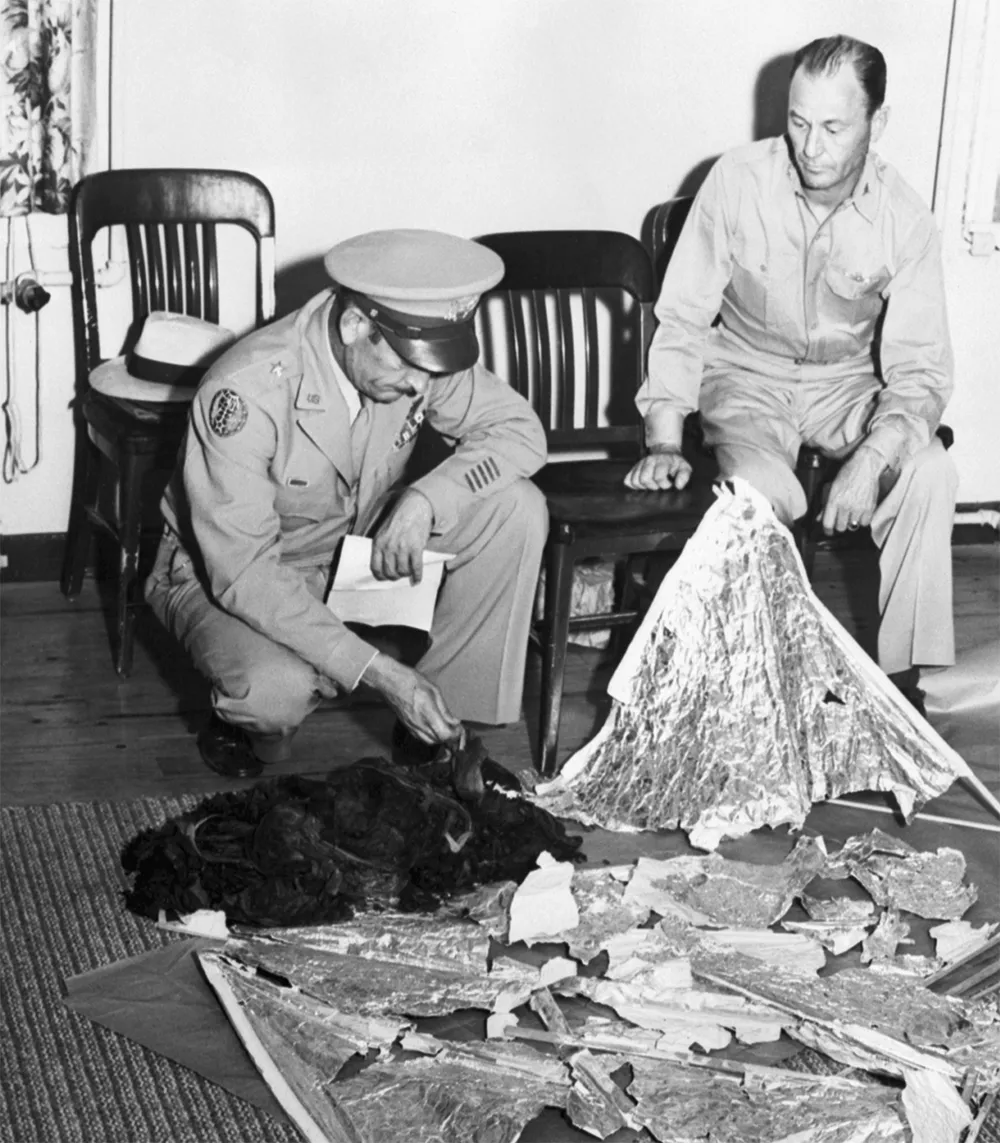
At Fort Worth Army Air Field on 8 July 1947, Brigadier General Roger M Ramey (left) and Colonel Thomas J Dubose, identify metallic fragments found at Roswell as pieces of a weather balloon. Credit: Bettmann / Getty Images At Fort Worth Army Air Field on 8 July 1947, Brigadier General Roger M Ramey (left) and Colonel Thomas J Dubose, identify metallic fragments found at Roswell as pieces of a weather balloon. Credit: Bettmann / Getty Images

In 1950, newspaper reporter Edward Van Winkle Jones wrote an article for the Miami Herald on “strange events”, in which he included the story of the disappearance of Flight 19.

In December 1945, a flight of five Avenger torpedo bombers had become disorientated, run out of fuel and ditched into the sea.

Matters got worse when a large flying boat sent out to search for the downed planes was also lost, most likely due to an in-flight explosion.

Neither incident caused any immediate excitement;  it had just been a bad day for the US Navy.

Jones’s article offered no explanation for the losses, and there was not a UFO in sight; his theme was that not everything in our world could be explained. 

But then in 1962, Allan W Eckert, a successful author of children’s novels, wrote ‘The Mystery of the Lost Patrol’ for the American Legion Magazine – marking the start of Flight 19 as a UFO legend.

The four-page article, with dramatic drawings of a shocked pilot staring at some unseen horror, was followed by a series of interviews in which pilots assured readers that sightings of unexplained flying objects happened all the time. 
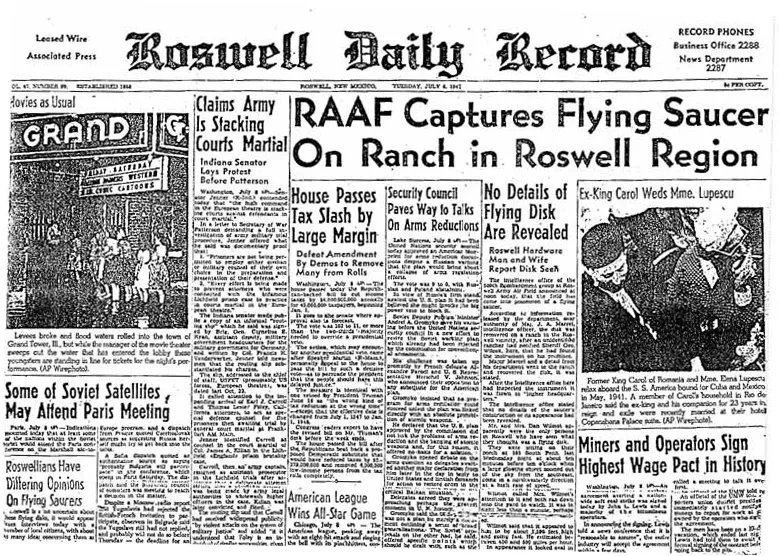
The front page of the Roswell Daily Record from 9 July 1947. Credit: Roswell Daily Record The front page of the Roswell Daily Record from 9 July 1947. Credit: Roswell Daily Record

Magazines fan the flames

There were, of course, those who stepped forward to offer the opposite argument.

The Times, for example, carried a story from the US Office of Naval Research that linked UFO sightings to the testing of a new series of military balloons.

Despite the occasional voice of reason, the fascination with UFOs – as they were now known, thanks to Project Blue Book director Captain Edward J Ruppelt – remained undiminished. 

In an age before there was a television in every house, two forces drove this phenomenon.

The first was magazines, which in those days could be found in every doctor’s and dentist’s waiting room.

Magazines thrived on photographs, and with more and more people owning cameras, pictures of UFOs were bound to appear.

They were generally a pretty poor collection, but as UFO excitement spread, Life magazine reprinted the so-called ‘McMinnville UFO’ photographs, taken on a farm in Oregon in 1950.

Given the blessing of Life, these and other UFO images were printed in newspapers around the world.

One of the McMinnville UFO photographs. Credit: Paul Trent / Wiki Commons

As several hoaxes were exposed, more serious magazines began to shy away from UFO stories;
the gap was filled by the National Enquirer.

The magazine had always specialised in sensation and scandal, but in 1967, its owners – wanting to gain access to the supermarkets – switched from sex to UFOs.

Headlines such as ‘Crippled UFO Orbiting Earth’ and ‘Kidnapped by a UFO’ now boomed out at every American family doing their weekly shopping. 

In addition to magazines, this was the golden age of clubs and societies, with everyone from model-railway builders to ukulele players forming clubs to meet and discuss their passions.

Despite communication being largely by post, these societies had a remarkable ability to grow and expand.

In 1953, Denis Plunkett, a civil servant from Bristol, UK, answered an advertisement from the Connecticut, USA-based International Flying Saucer Bureau and was invited to found the British branch of what was becoming an international organisation.

At its height, the British Flying Saucer Bureau had 1,500 members and in a busy week might receive 30 reports of unusual objects in the sky.

By the 1950s, the French future Nobel Prize in Literature winner Annie Ernaux could note that conversations around a French village dinner table centred on Algeria, memories of the last war, and whether flying saucers were real.

What would happen if we made contact with aliens? Credit: KTSDesign/SCIENCEPHOTOLIBRARY/Getty Credit: KTSDesign/SCIENCEPHOTOLIBRARY/Getty

Cover-ups and conspiracies

The interest in UFOs attracted a huge number of authors, with Donald Keyhoe’s The Flying Saucers Are Real and Frank Scully’s Behind the Flying Saucers (both 1950) giving birth to the great age of UFO conspiracy theories.

Why did aliens only visit now? Well, the answer clearly was that we had recently developed atomic weapons.

Others argued that no, we had always been under scrutiny, and Erich von Däniken took UFO publishing in this direction with Chariots of the Gods? (1968).  

It was during this period that stories about both Roswell and Flight 19 began to resurface.

Charles Berlitz wrote The Bermuda Triangle in 1974. Playing fast and loose with the facts, it sold nearly 20 million copies, cementing Flight 19’s place in UFO legend.

The story would, of course, inspire the brilliant opening scene of Close Encounters.

Roswell was largely forgotten about until 1978, when the National Enquirer reprinted the original story, and Jesse Marcel, who had led the initial investigation, was interviewed by UFO ‘expert’ Stanton Friedman.
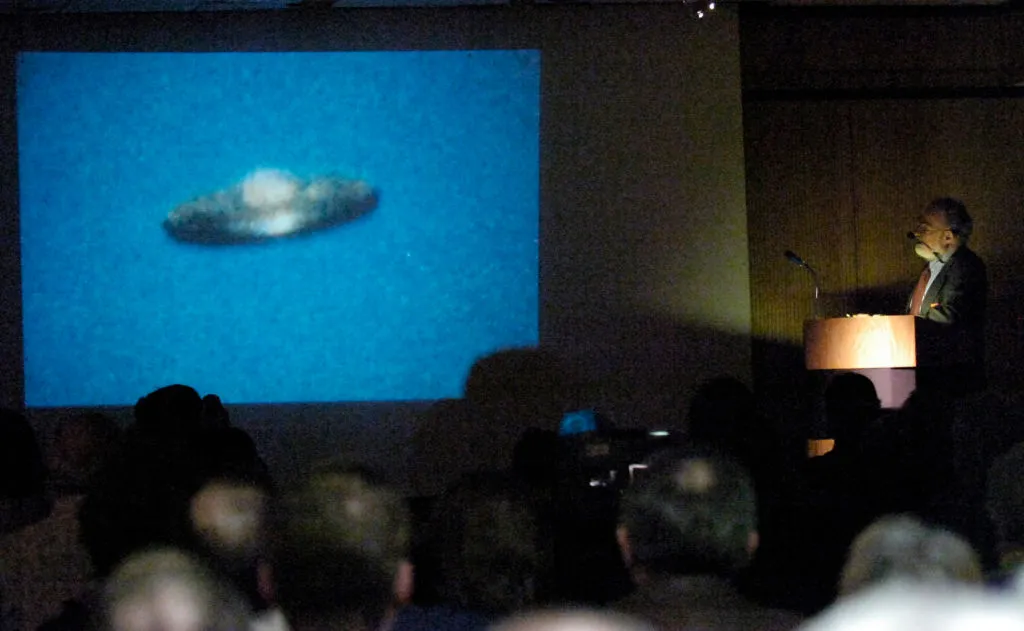
Nuclear physicist Stanton T. Friedman giving a talk about UFOs in 2007. Photo By Krissy Krummenacker/MediaNews Group/Reading Eagle via Getty Images Nuclear physicist Stanton T. Friedman giving a talk about UFOs in 2007. Photo By Krissy Krummenacker/MediaNews Group/Reading Eagle via Getty Images

When Marcel said he believed Roswell debris to have been extraterrestrial, Roswell became the centre of the UFO world, changing the nature of UFOlogy.

UFOs were no longer about advanced alien scouts spying out Earth for an invasion that was coming any day.

It was about a previous contact – perhaps involving a crashed spaceship – being covered up by the government.

In the shadow of the Kennedy assassination and Watergate, government cover-ups were something everybody could believe in.

Charles Berlitz, looking for a follow-up to his Bermuda Triangle success, jumped on the bandwagon with The Roswell Incident (1980).
Roswell, New Mexico has fully embraced its credentials as the most famous city in UFO folklore. Credit: Denis Tangney Jr / Getty Images Roswell, New Mexico has fully embraced its credentials as the most famous city in UFO folklore. Credit: Denis Tangney Jr / Getty Images

The saucer craze fades

Yet UFO excitement was reaching its peak. Back in 1950, it seemed as if the aliens would be arriving any day, but by 1980, we had grown tired of waiting.

A public that watched the USS Enterprise boldly going where no one had gone before was finding 
the pictures of UFOs from the 1950s embarrassingly amateurish.

The debris from Roswell looked far more like the balloon that the military had said it was than it did a crashed spaceship.

Stories of alien abductions, or self-proclaimed UFO contactee George Adamski claiming to have hitched a lift around the Solar System, didn’t help. 

Douglas Adams nicely mocked it all in The Hitchhiker’s Guide to the Galaxy (1979) with his description of ‘Teasers’: bored rich kids that “land right by some poor unsuspecting soul whom no one’s ever going to believe and then strut up and down in front of him wearing silly antennas on their head and making beep beep noises”.

In 2001, the British Flying Saucer Bureau closed after 50 years of chronicling supposed UFO activities.

Nobody was coming to meetings in cold church halls any more; people were staring down at their computer screens rather than up at the sky.

Image of comet 3I/ATLAS over Egypt's Black Desert, captured by Osama Faithi, 29 November 2025, 03:00 local time. Equipment: Nikon Z6 astro-modified camera, RedCat telescope lens Image of comet 3I/ATLAS over Egypt's Black Desert, captured by Osama Faithi, 29 November 2025, 03:00 local time

Humans are still interested in UFOs, including a few ‘wow’ moments on the internet, such as pictures of statue-like rocks on Mars or, most recently, the fly-by of interstellar comet 3I/ATLAS.

And just as 19th‑century imaginations were fired by balloons and airships, 3I/ATLAS theories fit within our modern sense of what might be possible – hence several sci‑fi writers suggesting the idea of adapting asteroids as vessels for space travel.

So yes, we are still willing to believe in intelligent life on other worlds.

The movies may have moved on from UFOs landing in farm fields to the loud ‘here we are’ of Independence Day-style invasions, but until alien spaceships actually hover over the White House, UFOs can no longer command our ever-more fickle attention as they did in the 1950s. 

RELATED VIDEOS

A history of flying saucers and UFOs

UFO's Are Real | FULL MOVIE | Aliens Sci-Fi Documentary

Most Unbelievable UFO Encounters Ever | The Proof Is Out There | History

{ https://www.skyatnightmagazine.com/ }

Hoe vind je dit bericht?
Geschreven door peter om 18:25 Stuur door

7 Mile UFO Shots Past Sun, NASA Calls it Comet, But They Lie, UAP Paranormal Alien Sighting News.

7 Mile UFO Shots Past Sun, NASA Calls it Comet, But They Lie, UAP Paranormal Alien Sighting News.

Screenshot%202026-04-27%20at%2012.39.10%E2%80%AFPM.png

Screenshot%202026-04-27%20at%2012.37.28%E2%80%AFPM.png

Screenshot%202026-04-27%20at%2012.38.38%E2%80%AFPM.png
 
Date of discovery: April 26, 2026
Location of discovery: Earths sun
Source: Helioviewer.org
 
Guys check this out. I caught a 7-10 mile UFO disk shooting slowly across the NASA satellite view of our sun. The object is barely making a trail at all so that truly rules out comet. However NASA calls it a comet labeling as Comet R3 pan-starrs also called comet C/2025 R3. Take a look at the video yourself and you too will notice that there is barely any trail at all...that alone is enough because its flying near our sun and heat and radiation is hitting it at incredible rates, I asked ai...and it blew my mind. 

🔥 Result Heat (solar energy): ~400–500× stronger than at Earth Radiation (UV, X-rays, solar wind): also hundreds of times higher, and even worse due to proximity to the corona. 
 
Ok so now we know...and we see so little tail on this comet which is 100% evidence that this is a 7-10 mile UFO. 
 
Oh...I forgot to say, the Helioviewer site is malfunctioning however I used a back door, which has full functions. Coincidence that this happened at this moment in time???? I think not. 
Scott C. Waring - UFO Sightings Daily 

{ https://www.ufosightingsdaily.com/ }

Hoe vind je dit bericht?
Geschreven door peter om 17:41 Stuur door

Security Cam captures mysterious ‘Spiritual Being’ during violent robbery

Security Cam captures mysterious ‘Spiritual Being’ during violent robbery

spiritual%20being.jpg

As the two struggle, something strange appears to happen. A shadowy figure seems to detach from the victim’s body, as if emerging from him, and confronts the attacker. The presence of this figure appears to protect the victim during the altercation. 
The attacker, clearly bewildered by what he is witnessing, quickly flees the scene. Shortly after, the shadowy figure disappears. The victim then gets back on his feet and continues on his way, seemingly unaware of what just occurred. 
Some interpret this incident as possible evidence of unseen spiritual realms. The true nature of the shadowy figure remains unknown, but it has led to speculation that it could have been a spiritual guardian-like being. It is suggested that these beings protect individuals throughout their lives and intervene during critical moments.
  

{ http://ufosightingshotspot.blogspot.com/ }

Hoe vind je dit bericht?
Geschreven door peter om 17:35 Stuur door

Top 10: The Largest Asteroids in the Main Belt

Top 10: The Largest Asteroids in the Main Belt

People usually imagine asteroids as rocks several kilometers in diameter. And this is true for most of them. However, in the Main Belt between Mars and Jupiter, you can find true giants whose size is comparable to that of some countries on Earth. Here are the ten largest of them.

Ceres is the largest object in the asteroid belt, but it is not an asteroid. Source: www.space.com

The largest objects in the Main Asteroid Belt

The Main Asteroid Belt lies between the orbits of Mars and Jupiter. It contains millions of asteroids. Most of them remain unknown due to their size and distance from Earth. Therefore, their total number is an estimate based on statistical data.

After all, the first asteroids were discovered just over 200 years ago. However, all the truly large rocks in this part of the Solar System are already known to us. So, we can compile a list of the largest ones.

That said, one clarification is in order. The largest object in the Main Belt – and the first to be discovered by astronomers – is called Ceres. For many decades, this nearly perfect sphere with a diameter of 942 km was considered the largest asteroid. However, in 2006, astronomers revised the classification of celestial bodies and introduced the concept of a “dwarf planet.” Pluto is most often mentioned in this context, as it was “downgraded.” However, the same thing happened to Ceres, which, on the contrary, was “upgraded” to a dwarf planet due to its spherical shape. Therefore, it is not included in today’s list.

Vesta. Source: Wikipedia

1. Vesta

In the absence of Ceres, Vesta is the largest asteroid in the main belt. This object, named after the ancient Roman goddess of the hearth, was one of the first to be discovered, back in 1804.

Vesta has an irregular shape. Its dimensions are 578×560×458. If its shape were slightly less asymmetrical, it could be classified as a dwarf planet, just like Ceres. The debate over which category it belongs to continues to this day.

There are quite a few craters on Vesta. The largest of them – Rheasilvia – is located at the asteroid’s south pole. Its diameter ranges from 475 to 500 km, which means it is quite comparable in size to the planet itself. In the center of the crater is a peak with a diameter of 180 km and a height of 22 km. It is the highest mountain in the solar system after Olympus Mons.

Pallas. Source: Wikipedia

2. Pallas

The second-largest asteroid in the main belt after Vesta is Pallas. In fact, this celestial body, named after the goddess of victory, was the second to be discovered after Ceres. And for a long time, it was believed that it was slightly larger than Vesta.

In fact, Pallas has a diameter of 512 km. Its surface has a lower albedo than Vesta’s and is more heavily cratered than the two previously mentioned bodies. It is believed that it underwent gravitational segregation, meaning that all the heaviest elements are concentrated closer to the core, while the lighter ones are located near the crust.

It is also interesting to note that spectroscopic studies have revealed the presence of hydrated materials on Pallas’ surface. This suggests that at some point in its history, it came into contact with liquid water.

Hygiea’s orbit. Source: Wikipedia

3. Hygiea

The third-largest asteroid in the Main Belt is Hygiea, named after the ancient Roman goddess of health. This object has a diameter of 431 km. Its orbit lies slightly farther from the Sun than that of other large asteroids. The average distance from our star is 3.1 AU, compared to 2.3 AU for Vesta and 2.7 AU for Pallas.

Hygeia is nearly spherical in shape and is the largest of the carbonaceous asteroids. Its surface is quite dark and contains a large amount of carbon compounds. Because of its dark surface, Hygiea is difficult to observe from Earth, which is why it was discovered nearly 50 years after Ceres. It takes 5.56 Earth years to complete one orbit around the Sun.

4. Interamnia

No matter how inconspicuous Hygiea may seem, it is nowhere near Interamnia, which ranks fourth among the largest asteroids in the Main Belt. This object’s albedo is only 0.074, meaning it is essentially black.

One of the first photographs of the asteroid Interamnia. Source: Wikipedia

That is why Interaminia, which has an irregular shape and measures 349 × 339 × 274 km, was discovered much later than other large asteroids. Astronomers from the Italian city of Teramo did not discover it until 1910. The name itself is a reference to the ancient name of that city.

It is also interesting to note that the perihelion – that is, the point in Interamnia’s orbit closest to the Sun – lies on the opposite side of the Sun relative to the corresponding points in the orbits of Ceres, Vesta, Pallas, and Hygiea.

5. Europa

The fifth-largest asteroid in the Main Belt is Europa. It is named after the daughter of the Phoenician king who, according to myth, was abducted by Zeus, and is one of Jupiter’s largest moons. This can lead to confusion, especially since Jupiter’s moon is larger and was discovered much earlier.

The orbit of the asteroid Europa. Source: Wikipedia

The asteroid Europa has a diameter of 302 km. Its average distance from the Sun is 2.8 AU. It is a carbonaceous asteroid and may belong to the same family as Hygiea. Hydrated minerals have also been found on it.

6. Davida

The asteroid Davida was discovered in 1903 by the American astronomer Raymond Dugan and named after David Todd, a professor of astronomy at Massachusetts College. It measures 357 × 294 × 231 km and has an average distance from the Sun of 3.168 AU.

Davida is a dark, irregularly shaped asteroid. However, a giant crater with a diameter of 150 km has been identified on its surface. This massive rock is extremely dense, accounting for about 1.5% of the total mass of the Main Belt.

Davida Asteroid. Source: Wikipedia

7. Sylvia

The asteroid Sylvia, the seventh-largest in the Main Belt, measures 385 × 265 × 230 km. It was discovered in 1866. It is characterized by an extremely low density: 1.2 g/cm³. This suggests that there must be huge cavities inside it.

There are two different theories as to why this asteroid was named as it was. Some say that it was named after the wife of the famous astronomer and science popularizer Camille Flammarion. In reality, however, this space rock was named in honor of Rhea Silvia, the mother of Romulus and Remus, the mythical founders of Rome.

8. Cybele

Cybele is a dark, carbonaceous asteroid from the outer part of the asteroid belt. It has a fairly elongated orbit. Its average distance from the Sun is 3.4 AU. The dimensions of this irregularly shaped celestial body are 302 × 290 × 232 km.

Cybele was discovered in 1861. It was named after the Phrygian goddess of agriculture. In turn, this asteroid gave its name to an entire family of asteroids that share a common origin.

The largest asteroids in the Main Belt. Source: Wikipedia

9. Eunomia

Eunomia, which ranks 10th among the largest asteroids in the Main Belt, measures 357×255×212 meters. It was discovered in 1851 and named after one of the daughters of Zeus and Themis, the goddesses of law and order.

Eunomia was discovered relatively early because it is a fairly bright silicate asteroid with a high albedo. It is retrograde, meaning it rotates in the opposite direction to the Sun.

10. Juno

Juno rounds out the top ten largest asteroids in the Main Belt. In terms of when it was discovered, it is actually the third-largest after Ceres and Vesta. However, its actual dimensions – 320 × 267 × 200 km – are not all that impressive.

The reason Juno was discovered as early as the beginning of the 19th century is that it is a silicate asteroid with a relatively high albedo. It was named after Jupiter’s wife, the goddess of marriage.

RELATED VIDEOS

Size Comparison Of The 10 Biggest Asteroids In Our Solar System! | Orion SciGeo

What Are The Largest Asteroids In The Asteroid Belt? - Astronomy Made Simple

Giants of the Belt: Unveiling the Top 5 Asteroids of Our Solar System

{  https://universemagazine.com/en/articles-en/ }

Hoe vind je dit bericht?
Geschreven door peter om 23:23 Stuur door

Ex-CIA psychic spy claims humans can tap into 'infinite consciousness'... and reveals how to unlock it

Ex-CIA psychic spy claims humans can tap into 'infinite consciousness'... and reveals how to unlock it

A former director of a secret US government psychic program claims every person has the hidden ability to tap into what he describes as the infinite consciousness of the universe.

Dale Graff, who led the CIA's Project Stargate, a classified Cold War initiative that explored psychic spying, said humans possess natural abilities that modern technology may be interfering with.

He believes devices such as cell phones could disrupt humanity’s ability to access these intuitive skills, though such claims remain controversial among scientists.

Graff led Project Stargate, a secret US military program that trained individuals to mentally perceive distant locations from the early 1970s until 1995, a technique known as remote viewing- the alleged psychic ability to perceive hidden, distant, or future information, places, or objects using only the mind, without physical senses.

The program explored whether trained viewers could gather intelligence simply by focusing their minds on specific coordinates.

Graff was not just overseeing the effort, but also participated as a remote viewer himself, attempting to perceive distant events without leaving his desk.

'We all have the potential to develop and use our natural psi ability,' Graff said.

Psi refers to alleged psychic abilities such as sensing distant places, anticipating future events, or accessing information beyond traditional senses.

'The keys lie in accepting the possibility of your psi nature, following a consistent approach to exercising that talent, and seeking ways to apply,' he added.

A former director of a secret US government psychic program claims every person has the hidden ability to tap into what he describes as the infinite consciousness of the universe

A former director of a secret US government psychic program claims every person has the hidden ability to tap into what he describes as the infinite consciousness of the universe 

For Graff and other remote viewers in Project Stargate during the 1970s and 1980s, this often meant attempting to locate secret military bases or weapons linked to the Soviet Union.

In one early success, remote viewers working with Project Stargate reportedly helped locate a missing Soviet bomber, producing estimates that were considered more accurate than some field-based intelligence efforts.

Other tests involved individuals aboard a submarine selecting images from a book, while remote viewers on land attempted to visualize the same pictures, exercises Graff said demonstrated the mind's ability to access distant information.

Graff later documented many of these experiments in his book, Tracks in the Psychic Wilderness, where he described what he viewed as evidence of humanity's hidden mental potential.

He believes society is only now beginning to rediscover the possibility of using intuitive brain abilities, roughly three decades after the program ended.

Despite remote viewing being discontinued by the US government, Graff remains a passionate advocate for what he describes as the benefits of developing psychic awareness.

'I discovered that by exploring our psychic realm, we automatically become more creative and intuitive. We sense deeper aspects of our psyche. As we uncover our psychic talents, we can help others in ways that would not be possible otherwise,' he wrote.

Graff added that he believes these abilities may even allow people to influence healing, suggesting that mental focus could one day be used to support recovery from injuries at a distance.

Dale Graff was the former director of Project Stargate, a secret US military project that weaponized the ability to see distant targets around the world with the mind

Dale Graff was the former director of Project Stargate, a secret US military project that weaponized the ability to see distant targets around the world with the mind

However, Graff's work extended beyond drawing sketches of distant locations; he also claimed to foresee catastrophic events before they occurred.

He described one vivid, life-like dream in which he saw a mid-air collision unfolding near mountainous terrain, with one aircraft flying away safely while the other crashed with no survivors.

Graff added that he even recalled seeing what appeared to be a newspaper headline from The Denver Post reporting the disaster while still inside the dream.

About a week later, he claimed, a real mid-air collision occurred near Colorado Springs, involving two aircraft, one that continued flying and another that crashed.

'How could it happen?' Graff later recalled asking himself.

He believes the answer lies in the mental training he developed through years of practicing remote viewing and lucid dreaming techniques.

Graff said he intentionally trained himself to visualize distant objects, interpret mental impressions, and explore what he described as the ability to anticipate future events.

A physicist and aeronautical engineer by training, Graff first became involved in research into remote viewing and lucid dreaming at the Stanford Research Institute during the 1970s.

Graff's book Tracks in the Psychic Wilderness looks back on some of the amazing achievements by the remote reviewers of Project Stargate

Graff's book Tracks in the Psychic Wilderness looks back on some of the amazing achievements by the remote reviewers of Project Stargate

That research program, funded in part by US intelligence agencies, would later evolve into Project Stargate during the height of the Cold War.

Graff said he believes psychic ability is not limited to trained specialists but may exist in many people who learn how to develop it.

'We found over the years that even people that didn't have any inkling that they could do this, given the motivation, and given the right kind of atmosphere... many people even though they didn't have prior experience, could do some level of what we call high-quality remote viewing,' Graff told the Outer Limits Of Inner Truth Reborn podcast in January.

'We've come to the conclusion that most people have a latent ability to do something of this nature. We all can do this in varying degrees,' he continued.

In the 21st century, however, Graff warned that modern lifestyles may be limiting people's ability to tap into what he described as the infinite consciousness.

When asked about heavy smartphone use and social media addiction, Graff suggested that radiation emitted from wireless technology is 'definitely going to affect' a person's mental structures, a claim that remains debated among scientists.

'We are drifting away from our intuitive state of mind when we rely so much on these external aides,' Graff shared.

The Stargate project was officially shut down in 1995 after government officials questioned how reliable remote viewing was as an intelligence tool.

Despite the program's closure, Graff maintains that the experiments conducted during the Cold War revealed untapped capabilities of the human mind.

RELATED VIDEOS

The Mystery of PROJECT STARGATE : CIA’s Secret Remote Viewing Program

THIRD EYE SPIES 👁️ – Full Documentary | Project Stargate & Remote Viewing

Historic Sleep Stories - You are a Remote Viewer for Project Stargate, 1980's

{ https://www.dailymail.com/news/index.html } 

Hoe vind je dit bericht?
Geschreven door peter om 22:59 Stuur door

EXCLUSIVE - Inside Trump's bombshell UFO files drop: Investigator reveals all the bone-chilling incidents that may finally be explained

EXCLUSIVE -  Inside Trump's bombshell UFO files drop: Investigator reveals all the bone-chilling incidents that may finally be explained

Americans are waiting with bated breath for the official announcement of President Donald Trump's UFO disclosure, which an insider believes will reveal 'reality-bending secrets.'

Trump made the order in February, directing the Pentagon to release all government files on UFOs and extraterrestrials in a move that could finally pull back the curtain on decades of closely guarded mysteries.

Joshua Golembeske, a field investigator for one of the world's oldest civilian UFO research organizations, the Mutual UFO Network (MUFON), told the Daily Mail: 'This is significant. A sitting US president publicly calling for the release of UAP-related information is unprecedented.

'So the question is: what, if anything, is being withheld from the public and why? What reality-bending secrets or world-changing technologies could be sitting inside these programs? 

Golembeske suggested the release could include confirmation of certain events, such as the infamous Roswell crash, the 'Tic Tac' incident in 2004, as well as lesser-known cases like the 1978 Fort Dix encounter.

He also said the path to full disclosure would unfold in four stages, beginning with official acknowledgment that humans are not alone, followed by efforts to define exactly what the mysterious phenomena are.

That would then be followed by revelations about the nature of the beings involved, whether extraterrestrial, interdimensional or something else entirely, before addressing the technology and long-standing questions tied to the encounters.

'First comes acknowledgment that we are not alone… and then it gets weird,' Golembeske said, describing what he believes will be a slow and carefully managed rollout of information.

The UFO expert said Americans could learn the truth about the famous 2004 Tic-Tac incident. A screenshot from the video of a Navy pilot tracking the spacecraft over the Pacific. US military personnel in California believe they saw UFOs off the coast on November 14, 2004

The UFO expert said Americans could learn the truth about the famous 2004 Tic-Tac incident. A screenshot from the video of a Navy pilot tracking the spacecraft over the Pacific. US military personnel in California believe they saw UFOs off the coast on November 14, 2004

Trump's order covers records on 'alien and extraterrestrial life,' UFOs and 'any and all other information connected' to these subjects.

'Trump now has a group of lawmakers backing him, demanding answers and openly challenging what's often referred to as the 'legacy program,'' said Golembeske.

'That term describes a decades-long effort with three potential areas: crash retrieval of unknown technology, reverse engineering through private aerospace, and a coordinated disinformation layer.'

Secretary of War Pete Hegseth was tasked with leading the effort to produce these files, with some proponents suggesting this could force the acknowledgment of evidence. 

Less than a month later, on March 18, the White House registered the domain 'aliens.gov,' and weeks later, the website showed a sign of activity.

The federal domain aliens.gov, which previously appeared inactive, is now returning an SSL error, a technical signal that the address may be connected to a live server but is not yet fully configured for public access.

An SSL error typically occurs when a server is set up, but the digital certificate required to establish a secure connection has not been obtained.

This usually means the domain is no longer dormant and may be undergoing development, even if no visible content has been published.

Another famous UFO case that could be solved is the 1947 Rosewell incident. Pictured is a military official holding what was initially believed to be an alien craft

Another famous UFO case that could be solved is the 1947 Rosewell incident. Pictured is a military official holding what was initially believed to be an alien craft

The US Army initially reported as a 'flying disc' before quickly retracting the statement to nothing but a weather balloon.

The US Army initially reported as a 'flying disc' before quickly retracting the statement to nothing but a weather balloon.

article image

'We're already in disclosure, and something significant has already been found,' Golembeske said. 'The evidence is overwhelming that we are being visited, and the government knows it. 

'Too many military and public officials have come forward, too many large-scale studies, too many consistent sightings over decades, too many multi-radar, multi-witness events.'

He added that when it comes to well-known military cases, the public should not expect full disclosures, but may see confirmation that certain events were genuine encounters.

Those include the 1974 Roswell incident in New Mexico, where a rancher found unusual debris, which the US Army initially reported as a 'flying disc' before quickly retracting the statement to nothing but a weather balloon. 

Golembeske also suggested Americans could finally get the truth about the oblong 'Tic-Tac' object spotted going at incredible speeds by \Navy pilots off the California coast, which was also picked up on sonar underwater.

On November 14 2004, Top Gun fighter pilot David Fravor was flying a training exercise off the coast of San Diego when he was rerouted to investigate a strange object spotted on radar by warships protecting his aircraft carrier, the USS Nimitz.

The Phoenix Lights were a series of sightings on March 13, 1997, when thousands of people across Phoenix and surrounding areas reported seeing a massive V-shaped formation of lights moving silently across the night sky

The Phoenix Lights were a series of sightings on March 13, 1997, when thousands of people across Phoenix and surrounding areas reported seeing a massive V-shaped formation of lights moving silently across the night sky

He said he saw a roughly 40-foot white object with no windows or wings, shaped like a Tic-Tac, flitting about above the sea that was roiling below it, disturbed by something large submerged beneath the surface.

Fravor told Congress in 2023 that as he circled the object, it turned to mirror his movements, then shot off past him at thousands of miles per hour, somehow stopping a second later at a secret pre-designated rendezvous point 60 miles away, which only he and a handful of Navy staff on his ship were given ahead of their training exercise.

Disclosure about the 1978 Fort Dix encounter may also be released, according to Golembeske, which refers to reports that soldiers at the New Jersey base claimed to have seen a glowing unidentified object moving low over the base during a nighttime training exercise.

According to accounts circulated by UFO researchers, multiple personnel allegedly witnessed the object before it quickly disappeared from view. 

The incident remains controversial because there are no widely released official military records confirming it, and most details come from later retellings rather than contemporaneous reports. 

The UFO expert said he would be interested to see files on the 1980s Hudson Valley UFO sightings

The UFO expert said he would be interested to see files on the 1980s Hudson Valley UFO sightings 

The Hudson Valley UFO sightings refer to hundreds of reports between 1982 and 1986 of large, slow-moving triangular objects seen across parts of the Hudson Valley

The Hudson Valley UFO sightings refer to hundreds of reports between 1982 and 1986 of large, slow-moving triangular objects seen across parts of the Hudson Valley

'Personally, I'd be most interested in deeper insight into major UFO waves over the past 50 years, events like the Phoenix Lights and the Hudson Valley sightings, which involved large numbers of witnesses and still lack clear explanations,' Golembeske said.

The Phoenix Lights were a series of sightings on March 13, 1997, when thousands of people across Phoenix and surrounding areas reported seeing a massive V-shaped formation of lights moving silently across the night sky. 

Witnesses described the lights as part of a huge craft that appeared to hover before slowly drifting out of view. Military officials later said some of the lights were flares dropped during training exercises, but many witnesses have disputed that explanation. 

The Hudson Valley UFO sightings refer to hundreds of reports between 1982 and 1986 of large, slow-moving triangular objects seen across parts of the Hudson Valley. 

Witnesses, including police officers and residents, described formations of bright lights that moved silently at low altitude over highways and towns. 

Investigators later suggested some sightings may have been caused by groups of private pilots flying in formation, though many observers believed the objects remained unexplained. 

Golembeske said the release of these records and others would likely unfold in stages, beginning with limited confirmations before expanding into deeper revelations about what the government believes it has encountered. 

The first step, acknowledgement, would be followed by defining what the various phenomena actually are.

President Donald Trump announced the disclosure order in February, directing the Pentagon to release records on 'alien and extraterrestrial life,' UFOs and 'any and all other information connected' to these subjects

President Donald Trump announced the disclosure order in February, directing the Pentagon to release records on 'alien and extraterrestrial life,' UFOs and 'any and all other information connected' to these subjects

Golembeske was skeptical about whether Americans would be told the sightings are coming from spacefaring extraterrestrials from our galaxy, time-traveling humans or interdimensional entities outside our known reality.

He highlighted how Florida Congresswoman Anna Paulina Luna said she had seen evidence of 'interdimensional beings.'

In the next stage of release, he said he expects officials would reveal the technology that has been recovered. 

This phase would focus on what governments may have learned from alleged recovered materials, including whether any advanced technologies were reverse-engineered.

The final step would involve answering broader questions about why these encounters are happening, why many reported beings appear humanoid and whether there are historical or religious connections tied to the phenomenon.

'Once that's established, the real questions begin, the ones that could change everything,' he said.

RELATED

Trump on UFO Hearing LIVE | Donald Trump Orders Release of 'Alien Files' | Congress Hearing LIVE

Trump Orders Pentagon UFO Files Release Soon | WION Podcast

{ https://www.dailymail.com/news/index.html } 

Hoe vind je dit bericht?
Geschreven door peter om 22:41 Stuur door

Spionage, moord of louter toeval? FBI start onderzoek nadat zeker tien experts met toegang tot staatsgeheimen sterven of verdwijnen


FBI-directeur Kash Patel
FBI-directeur Kash Patel  © AP * FBI-directeur Kash Patel

Spionage, moord of louter toeval? FBI start onderzoek nadat zeker tien experts met toegang tot staatsgeheimen sterven of verdwijnen

Een briljante kernfysicus die voor zijn huis wordt doodgeschoten. Een luchtmachtgeneraal die ogenschijnlijk van de aardbol lijkt verdwenen. Een ruimtevaartingenieur die nooit terugkeert van een wandeling. Zeker tien vooraanstaande onderzoekers met toegang tot uiterst gevoelige informatie zijn de afgelopen jaren plots overleden of verdwenen. Wat online begon als voer voor complotdenkers, is in de Verenigde Staten inmiddels uitgegroeid tot een zaak van nationale veiligheid.

Karen Van Eyken Karen Van Eyken - Journalist bij HLN


 KIJK : 11 scientists have gone missing or perished?? What's going on??

De FBI neemt de situatie serieus en leidt inmiddels een grootschalig, federaal onderzoek. “We werken hierin nauw samen met de ministeries van Energie en Defensie om antwoorden te vinden”, bevestigde een woordvoerder.

Ook de Amerikaanse politiek eist opheldering. De toezichtscommissie van het Huis van Afgevaardigden, geleid door de Republikeinen, is een eigen onderzoek gestart. Zij willen per direct tekst en uitleg van de FBI, het Pentagon, het ministerie van Energie en NASA. Hun voornaamste zorg is een “mogelijk crimineel verband” tussen het tragische lot van deze experts, die naar verluidt stuk voor stuk toegang hadden tot uiterst gevoelige informatie. NASA meldde op X dat ze overlegt en samenwerkt met de betrokken instanties.

Vanuit het Witte Huis klinkt een gelijkaardige bezorgdheid. President Donald Trump noemde de kwestie onlangs “behoorlijk serieus” en sprak de hoop uit dat het slechts toeval was. “Over anderhalve week weten we hopelijk meer”, liet hij doorschemeren na intern topoverleg.

Dit heeft de hoogste prioriteit voor het Congres. We zien dit als een mogelijke bedreiging voor onze nationale veiligheid

Republikein James Comer

“Dat dit toeval is, lijkt me uiterst sterk”, stelde de Republikein James Comer, voorzitter van de toezichtscommissie, onomwonden bij ‘Fox News’. “Dit heeft de hoogste prioriteit voor het Congres. We zien dit als een mogelijke bedreiging voor onze nationale veiligheid.”

Toch gelooft niet iedereen in Washington dat er een verband is tussen deze zaken. Democraat James Walkinshaw tempert de paranoia en wijst op de grote schaal van de Amerikaanse wetenschapssector. “We hebben duizenden nucleaire wetenschappers en experts rondlopen. Geen enkele buitenlandse mogendheid kan ons programma serieus ontwrichten door er tien individuen uit te pikken.”

© Getty Images

Het eerste incident dat bij de autoriteiten op de radar verscheen, vond in 2023 plaats bij NASA’s prestigieuze Jet Propulsion Laboratory (JPL). Michael David Hicks (59), een expert in kometen en asteroïden, overleed onverwachts. Omdat er geen doodsoorzaak werd gedeeld, kregen online complottheorieën al snel vrij spel. Zijn dochter Julia kijkt het lede ogen aan. “Mijn vader had al langer een kwakkelende gezondheid”, vertelde ze zichtbaar aangedaan aan ‘CNN’. “Er is werkelijk geen enkele logische reden om zijn dood te linken aan dit onderzoek. Soms moet ik er een beetje om lachen, maar inmiddels neemt de speculatie wel erge vormen aan.”

Niet lang daarna stierf ook ruimtevaartspecialist Frank Maiwald (61) in Los Angeles. En in juni 2025 verdween Monica Reza (60), directeur bij een NASA-lab, spoorloos tijdens een wandeling in de Californische bossen.

Een van de meest in het oog springende zaken is de verdwijning van William Neil McCasland. De gepensioneerde luchtmachtgeneraal verliet eind februari zijn huis in New Mexico en is sindsdien niet meer gezien. Zijn telefoon, bril en smartwatches liet hij gewoon thuis.

William Neil McCasland William Neil McCasland  © US Air Force

McCasland was geen doorsnee militair; hij stond aan de wieg van geavanceerd ruimtevaartonderzoek en leidde ooit de basis Wright-Patterson. Binnen de ufologie is dat een legendarische locatie waar volgens wilde geruchten de wrakstukken van het beruchte ‘Roswell-incident’ zouden liggen opgeslagen. De speculaties staken zo hevig de kop op dat zijn vrouw, Susan, zich genoodzaakt zag om de complottheorieën via Facebook te ontkrachten. “Neil wist niets van buitenaardse wezens of brokstukken. Er is echt geen enkele reden om hem te ontvoeren.”

Rond diezelfde tijd raakten bij het Los Alamos National Laboratory, het Amerikaanse nucleaire onderzoekscentrum in New Mexico, eveneens twee medewerkers vermist. Melissa Casias (53) liet haar spullen thuis, net als haar telefoon, die was teruggezet naar de fabrieksinstellingen.

Melissa Casias Melissa Casias  © New Mexico Department of Public Safety

Korte tijd later raakte ook Anthony Chavez (78) vermist. Voor zijn pensioen hield hij als bouwopzichter toezicht op werkzaamheden in het complex. Zijn vriend Carl Buckland vertelde aan ‘CNN’ dat hij blij is dat de autoriteiten de zaak onderzoeken: “Het werd hoog tijd.”

Anthony Chavez Anthony Chavez  © Los Alamos County Police Department

Wat de onrust de afgelopen maanden verder heeft aangewakkerd, is het geweld waarmee enkele recente sterfgevallen gepaard gingen. MIT-professor Nuno F.G. Loureiro (47), een gevierde kernfysicus, werd voor zijn huis in Boston doodgeschoten door een schutter die ook twee studenten op de campus van de Brown University ombracht. Astrofysicus Carl Grillmair (67) onderging in februari hetzelfde trieste lot op zijn oprit in Los Angeles.

En dan is er nog Matthew James Sullivan (39), een voormalige inlichtingenofficier die vorig jaar overleed vlak voordat hij als klokkenluider zou getuigen in een rechtszaak over UFO’s. Volgens het Republikeinse congreslid Eric Burlison was zijn dood “wel heel erg verdacht.”

Toch smeken veel families om het hoofd koel te houden. Na de dood van de jonge onderzoekster Amy Eskridge (34) wees haar familie op haar chronische pijnklachten. “Mensen moeten beseffen dat wetenschappers ook gewoon mensen zijn die ziek worden of sterven. Zoek er niet te veel achter”, klonk het.

Amy Eskridge Amy Eskridge  © Arab Heritage Memorial Chapel

De Amerikaanse autoriteiten kiezen het zekere voor het onzekere. FBI-directeur Kash Patel toont zich vastberaden. “We onderzoeken nauwgezet of er een link is met toegang tot staatsgeheimen of de mogelijke betrokkenheid van buitenlandse actoren”, verklaarde hij zondag op Fox News. “Als we ook maar één aanwijzing vinden voor een complot of crimineel handelen, zal de FBI niet aarzelen om arrestaties te verrichten.”

KIJK OOK:


FBI investigates 12 missing and deceased nuclear research scientists

UFO insider reveals pattern behind missing scientists | CUOMO

 { https://www.hln.be/buitenland/ OK

Hoe vind je dit bericht?
Geschreven door peter om 22:13 Stuur door

UFO conspiracies are snowballing – from David Wilcock’s suicide to Tim Burchett death threats

UFO conspiracies are snowballing – from David Wilcock’s suicide to Tim Burchett death threats

UFO plot snowballs - David Wilcock’s suicide & Tim Burchett death ...

Interference lines.

Image by Cybernews.

Within days, three separate UFO-linked stories spiraled into online speculation, as an alleged suicide, a scientist's death from the archives, and a politician's receipt of death threats caused conspiracy theories to swirl once more.

On April 20th, David Wilcock, 53, died from a "self-inflicted gunshot wound" in his Colorado home.

Police arrived minutes after a 911 call. The cause was put down to a mental health crisis. But hours earlier, Wilcock gave a warning on a 

"People are disappearing. Scientists are going missing. The president himself is looking into this. It's a little bit scary."

Wilcock was a familiar face on TV and spent decades demanding the government reveal what it knows about UFOs.

On April 18th, Wilcock acknowledged he was having a difficult time: "I've had some very intense stuff going on this weekend," he said.

But some of the X community refused to believe it was a legitimate suicide.

UFO plot snowballs - David Wilcock’s suicide & Tim Burchett death ...

Denial. Screenshot from X.

Even Congressman Tim Burchett told The Daily Mail on April 22nd: "I just don't think there's any chance that this is just all coincidental."

Whether this is linked to the 11 other scientists who have died or gone missing remains unclear. It was on record that Wilcock said back in 2022 that he didn’t want to kill himself:

And it’s precisely these past quotes taken from the scientists deceased that raised a recurring pattern.

The evidence recycling machine

Old messages linked to anti-gravity scientist Amy Eskridge, who passed away in 2022, also re-entered circulation following Wilcock’s death.

Text messages that she sent to her business partner Samuel Reed a month before death explicitly read “If anything happens to me – suicide or an accident – it wasn’t, it’s suspicious, treat it as such.”

This evidence is being treated as predictive or suspicious in hindsight. However, it also comes with the fact that family statements, especially from her father Richard Eskridge, reject conspiracy claims, as he said: “scientists die also, just like other people.”

As the count of dead or missing scientists amounts to 11 (6 dead and 5 missing) the conversation about UFO speculation finally has entered the mainstream, under an avalanche of news.

NASA press secretary Bethany Stevens even put forward an institutional commitment to coordinating with the authorities concerned, though stepped short of calling it a national security crisis.

Burchett speaks on death threats

When Congressman Burchett told journalist Piers Morgan that he himself had received death threats, it was enough to make the UFO community shudder:

“I’ve been warned many times about doing certain events… I’m not sure if it’s about [UAP] or just that I’ve got a big mouth. I’m sick of the American public being lied to… If that makes me a target, so be it.”

As Burchett remains one of the politicians tied to the associations with the scientists, one might wonder if politicians will be next to become embroiled in the matter, or if they will seek to distance themselves.

What happens next is anyone's guess, but it seems that this meteoric escalation of the disclosure question is set to go the distance.

{ https://cybernews.com/ }

Hoe vind je dit bericht?
Geschreven door peter om 21:51 Stuur door

Close Encounters of the Spielberg Kind

Close Encounters of the Spielberg Kind

Spielberg delivers a close encounter with extraterrestrials this year with Disclosure Day, but this ain’t his first rodeo…

Steven Spielberg might be 80 this year, but he’s showing no signs of slowing down. This June, his latest blockbuster Disclosure Day arrives, and the trailer promises plenty of Spielbergian magic. We can expect UFOs, aliens, and potentially world-ending threats from the extra-terrestrials as a group of humans tries to deal with their close encounters.

Of course, this genre isn’t alien to Spielberg. His long and storied history as one of the pre-eminent blockbuster specialists has covered just about everything possible, but the master filmmaker has regularly cast his cinematic eye out to space and the mysterious beings that might exist out there. So, in advance of Disclosure Day, it’s time to look back at Spielberg’s alien films…

Close Encounters of the Third Kind

Coming in the wake of Star Wars, Spielberg’s first sci-fi movie, which dealt with alien life forms, was built more on wonder and intrigue than on the intergalactic wars of George Lucas’ cinema-redefining epic.

Spielberg had effectively laid the foundations for the blockbuster formula with Jaws, which Lucas cemented with Star Wars. Close Encounters then continued in ensuring Hollywood had a huge shift in the types of movies mass audiences wanted to see.

Close Encounters is decidedly patient in comparison to the modern formula (and Star Wars), teasing us with mysterious UFO encounters in small-town America. The film was a box office smash. Not Star Wars ground-shifting level, but still, the third-highest-grossing film of the year. It had Spielberg quickly perfecting his ability to create magical and timeless family blockbuster entertainment. John Williams also produced an iconic score to add to his even more iconic score in Star Wars that same year.

E.T. the Extra-Terrestrial

Whilst Close Encounters largely focused on the unidentified flying objects, with only a brief glimpse of aliens at the end, this encounter from Spielberg switched things up and focused on the relationship between a young boy (Henry Thomas) and the lost extra-terrestrial who wants to get home.

If his first dalliance with outer space was more about intrigue and build-up, E.T is more direct. You have childhood wonder and impetuousness, with the inherent comedy of a stumpy alien that the kids are doing a bad job of trying to hide. There’s also more of a sense of adventure with the infamous bicycle sequences throughout the film.

Much like Close Encounters, E.T was a mega hit (the highest-grossing film of the year and of all time until that point). It’s a perfect crowd pleaser that’s funny, charming, heartfelt, and thrilling. Williams once again knocks it out of the park. The young Thomas and the even younger Drew Barrymore are also great.

War of the Worlds

By this point, Spielberg had done something largely different from most alien encounter films by having the visiting creatures interested in peace or exploration rather than domination. War of the Worlds was a change-up, though, based on H.G. Wells’ legendary, genre-defining book. Not the first adaptation, but the largest-scale, biggest budget version.

Spielberg went into this at the top of his game, with Tom Cruise as his leading man. The film isn’t often regarded as one of Spielberg’s top-tier films, but despite that, it’s still considered one of the best adaptations of the innumerable TV and film versions out there (including one of mine, War of the Worlds: The Attack).

Spielberg’s assured filmmaking ensures that the set pieces and world-ending threat the aliens pose result in loads of eye-catching spectacle. Few do set pieces as well as Spielberg, of course. If there’s an inherent flaw from following reasonably close to the source novel, it’s that the ending feels a little too easy and abrupt.

Indiana Jones and the Crystal Skull

After a long time with his whip in the closet, Harrison Ford returned as Indiana Jones in a long (long) awaited fourth film. It would ultimately prove to be the least popular in the franchise (to that point), and one of Spielberg’s more lukewarmly received and divisive blockbusters. Did the world want and need another Indy adventure? It probably did. Was the 50s setting and nod to Roswell era conspiracies, really the best choice for a story backdrop? Maybe not.

Indy isn’t evading Nazi’s, chasing grails or Arks here. This time, he’s after an alien crystal skull, whilst dealing with the discovery that he has a son. Whether it’s CGI gophers, nuking the fridge, or swinging on vines with Monkey’s, so much felt like Spielberg was pandering a little too much to a potential new/younger audience.

Still, everything up until the shift from evading Russians and searching for a lost professor, to the alien part of the story, is actually pretty good. The opening set piece feels like classic Jones, and Harrison Ford gamely throws himself around. Once they get to the jungle, the film does seriously derail before crawling to a limp finish. In the end, though, it’s much better than Dial of Destiny.

A.I Artificial Intelligence

Now, you might be thinking A.I. should be on the list of Spielberg/alien films. Many film fans (and for years, myself included) believed the final act of A.I. had aliens in it. When it comes to film, the initial response was mixed, with some finding it a philosophical, deep, and extremely well-made film that was perhaps more mawkish than it needed to be. Others felt it was a big misfire that didn’t live up to the potential that this film could have been had Stanley Kubrick made it (as originally intended).

However, Haley Joel Osment is great as the A.I., Pinocchio-like robot, made to fill the void of a family who lost their son, but cast asunder when they ultimately reject him. He then finds himself in a world of lost and rejected A.I’s just trying to survive and dealing with existential angst.

By the last act of the film, he’s with strange ‘alien’ creatures who aren’t aliens but actually descendants of those first sentient A.I.s. In time, more people are growing to appreciate the visual scope and comparative complexity of Spielberg’s blockbuster. It’s too long perhaps, but certainly visually spectacular (there are some incredible visual effects in the film), and the topic itself has made it rather timely.

What’s your favourite Spielberg alien film? Are you looking forward to Disclosure Day? Let us know on our social channels @FlickeringMyth…

About Tom Jolliffe

  • Tom Jolliffe is an award-winning screenwriter, film journalist and passionate cinephile. He has written a number of feature films including 'Renegades' (Danny Trejo, Lee Majors), 'Cinderella's Revenge' (Natasha Henstridge) and 'War of the Worlds: The Attack' (Vincent Regan). He also wrote and produced the upcoming gothic horror film 'The Baby in the Basket'.
RELATED

Spielberg's Disclosure Day Is Closer To Truth Than Fiction

UFO Disclosure is Coming THIS YEAR. Maybe.

Sooner or later everyone arrives at the ufo truth.

{ https://www.flickeringmyth.com/category/news/ }

Hoe vind je dit bericht?
Geschreven door peter om 21:31 Stuur door

Astronomers just mapped one of the largest structures in the universe, long hidden behind the Milky Way's 'Zone of Avoidance'

Astronomers just mapped one of the largest structures in the universe, long hidden behind the Milky Way's 'Zone of Avoidance'

By Harry Baker 

Hoe vind je dit bericht?
Geschreven door peter om 21:07 Stuur door

Interstellar comet 3I/ATLAS born in a cold environment

Interstellar comet 3I/ATLAS born in a cold environment

A large white fuzzy object, 3I/ATLAS, with a short tail in black space with small a few stars.

Comet 3I/ATLAS, about 3 weeks after its closest approach to the sun. The Gemini North telescope on Mauna Kea in Hawaii obtained this optical image on November 26, 2025. Image via International Gemini Observatory/ NOIRLab/ NSF/ AURA/ B. Bolin/ J. Miller/ M. Rodriguez/ T.A. Rector/ M. Zamani (CC BY 4.0).
  • Interstellar comet 3I/ATLAS is only the 3rd interstellar object known. It came from another star system.
  • So astronomers are eager to learn more. And recently they learned it contains 30 times more water with a different chemical makeup than in our solar system’s comets.
  • This finding is clue to where 3I/ATLAS formed. It suggests its home star formed in a much colder environment than the one that created our sun.

Comet 3I/ATLAS is raising new questions about star formation

Astronomers first spied this object in July 2025, at about three times Mars’ distance from our sun. And, once they had tracked its path through space, they knew it originated in another star system. 3I/ATLAS, as it’s come to be called, is only the 3rd such interstellar object known. We don’t know where or how it escaped that distant star system in order to pass through our solar system. But astronomers said this month they have new clues about its past. They said it formed in an environment much colder than the one that created our sun and planets. 

Radio telescope observations detected high levels of water containing deuterium – an isotope of hydrogen – in the comet. That’s often called “heavy water.” And it’s a sign of cold conditions in the star-forming molecular cloud that birthed 3I/ATLAS’ star. It’s colder than conditions that formed our sun. This is an intriguing finding because it shows that star formation can occur under different physical and chemical conditions than those that created our solar system.

Luis Salazar Manzano is the lead author of a paper on this study. He said, in a statement:

Our new observations show that the conditions that led to the formation of our solar system are much different from how planetary systems evolved in different parts of our galaxy.

Determined-looking young man with shoulder-length dark hair and a beard, wearing a tan shirt.Luis Salazar Manzano led the study on Comet 3I/ATLAS. He is a doctoral student at the University of Michigan. Image via University of Michigan.

The researchers published their findings in the peer-reviewed journal Nature Astronomy on April 23, 2026.

An artist's impression compares the semi-heavy water content of interstellar comet 3I/ATLAS (left) and Earth (right). Insets illustrate the relative abundance of deuterated water (HDO) molecules. 3I/ATLAS contains over 30 times more HDO than is found in Earth's oceans.

(NSF/AUI/NSF NRAO/M.Weiss)

Comets are icy leftovers from planetary formation

Astronomers sometimes refer to comets as “dirty snowballs” because they contain a lot of water. They’re icy remnants from the formation of our solar system, 4.6 billion years ago. Therefore, comets contain a record of the early conditions from which our sun and planets emerged.

Comets in our solar system come from distant reservoirs of icy objects called the Kuiper Belt and Oort Cloud. Sometimes, gravitational perturbations jostle some of these objects from their stable orbits. As a result, they fall into highly elliptical orbits that bring them close to the sun. Near the sun, sunlight heats these objects causing the release of gas and dust that form a tail.

Interstellar visitors

Astronomers know of three objects that are interstellar visitors. Besides 3I/ATLAS, the only other known interstellar comet is 2I/Borisov, that appeared in 2019. And there’s 1I/Oumuamua, not a comet but a cigar-shaped object that passed through in 2017.

3I/ATLAS and 2I/Borisov most likely formed in the far outskirts of their home systems, just like comets in our solar system. Therefore, they too contain a record of the early environment that formed their stellar systems.

3I/ATLAS has a high abundance of water containing deuterium

Water, chemically called H20, is made of two hydrogen atoms and one oxygen atom. Hydrogen, which formed shortly after the Big Bang, has one proton in its nucleus. However, the Big Bang also created another type of hydrogen, but in much smaller quantities. It’s called deuterium, and it has one neutron and one proton in its nucleus.

Most water on Earth contains hydrogen but there is a small amount of naturally occurring water containing deuterium, called deuterated water or heavy water. (Its chemical name is HDO, one atom each of hydrogen, deuterium, and oxygen.)

When astronomers looked at 3I/ATLAS with radio telescopes, they discovered, to their surprise, that it had a lot more deuterated water compared to comets in our solar system.

Salazar Manzano commented:

The amount of deuterium with respect to ordinary hydrogen in water is higher than anything we’ve seen before in other planetary systems and planetary comets.

Comets in our solar system have one molecule of deuterated water for every 10,000 molecules of ordinary water. However, in 3I/ATLAS, that ratio was 30 times higher. And compared to water in our oceans, that ratio was 40 times higher.

Graphic showing molecules of 3I/ATLAS compared to Earth

An artist's impression compares the semi-heavy water content of interstellar comet 3I/ATLAS (left) and Earth (right). Insets illustrate the relative abundance of deuterated water (HDO) molecules. 3I/ATLAS contains over 30 times more HDO than is found in Earth's oceans.

(NSF/AUI/NSF NRAO/M.Weiss)

Star formation under different conditions

Molecular clouds are where stars form. There is a higher ratio of deuterium to hydrogen in cold molecular clouds, compared to the ratio created in the Big Bang. That’s due to a complex series of chemical reactions.

Molecules containing deuterium instead of hydrogen are more stable at low temperatures. So when molecular interactions replace hydrogen with deuterium in water molecules, that’s called “deuterated.” Those water molecules sticking to dust grains form deuterated ice, which is more likely to last in a colder environment.

This new study shows that conditions under which stars are created can vary. In 3I/ATLAS, the higher ratio of deuterated water suggests that the environment where its star formed was colder and had lower levels of radiation, compared to the environment in which our sun was born.

Salazar Manzano said:

The chemical processes that lead to the enhancement of deuterated water are really sensitive to temperature and usually require environments colder than about 30 Kelvin, or about minus 406 degrees Fahrenheit.

Radio telescope observations of 3I/ATLAS

For this study of 3I/ATLAS, the researchers used radio telescopes at the Atacama Large Millimeter/submillimeter Array (ALMA) in Chile.

The radio telescopes detected the distinct signature of deuterated water in the comet. But the telescopes could not directly detect ordinary water. Therefore, the researchers used a mathematical model to determine the amount of ordinary water present based on methanol measurements.

They observed the comet on November 4, 2025, just six days after its closest approach to the sun. Teresa Paneque Carreño, a paper co-author, noted:

Most instruments can’t point toward the sun, but radio telescopes like ALMA can. We were able to observe the comet within days after perihelion, just as it peeked out from its transit behind the sun. This gave us a constraint on these molecules that’s not possible using other instruments.

Smiling, cheerful young woman with long brown hair and a blue and white blouse.Teresa Paneque-Carreño co-led this study on Comet 3I/ATLAS. She is an assistant professor of astronomy at the University of Michigan, Image via University of Michigan.

She also added:

Each interstellar comet brings a little bit of its history, its fossils, from elsewhere. We don’t know exactly where, but with instruments like ALMA we can begin to understand the conditions of that place and compare them to our own.

This animation shows the observations of comet 3I/ATLAS when it was discovered on July 1, 2025. The NASA-funded ATLAS survey telescope in Chile first reported that the comet originated from interstellar space.
ATLAS/University of Hawaii/NASA

Bottom line: The chemistry of water in interstellar comet 3I/ATLAS indicates that its home star formed in colder conditions compared to that of our sun.

Read more:


{ https://earthsky.org/ }

Hoe vind je dit bericht?
Geschreven door peter om 17:58 Stuur door

Strange Water on 3I/ATLAS Hints at the Alien Conditions of Its Birth in a Frigid, Low-Radiation Region

Credit: U-M News/Hans Anderson

Strange Water on 3I/ATLAS Hints at the Alien Conditions of Its Birth in a Frigid, Low-Radiation Region

New research reveals that the mysterious interstellar visitor 3I/ATLAS, which has intrigued astronomers and space enthusiasts alike for the better part of a year, comes from a very cold alien environment.

According to new research from the University of Michigan, published in Nature Astronomy, 3I/ATLAS comes from a much colder region with significantly less radiation than our solar system, marking a breakthrough in the characterization of these interstellar objects.

This assertion is based on an analysis of the water 3I/ATLAS has released during its journey through our solar system, which showed it contained deuterium, also known as heavy hydrogen.

Strange Water on 3I/A

“Our new observations show that the conditions that led to the formation of our solar system are much different from how planetary systems evolved in different parts of our galaxy,” said lead author Luis Salazar Manzano.

Deuterium is a stable Hydrogen isotope with one proton and one neutron, unlike most hydrogen atoms, which have only a proton. Hydrogen, as most are aware, is one of the two ingredients in water’s H2O formula. Heavy water like this, containing high levels of deuterium, does exist on Earth, but it is relatively rare compared to its proportion on 3I/A. In fact, the amount of deuterium is 40 times as much as on Earth, and 30 times as much as on any other known comet.

Earlier this year, The Debrief reported on the high volume of deuterium present on 3I/ATLAS. The new research essentially builds on those findings, which are helping bring more clarity to the unusual origins of the most mysterious interstellar object observed to date.

“The amount of deuterium with respect to ordinary hydrogen in water is higher than anything we’ve seen before in other planetary systems and planetary comets,” Salazar Manzano said.

Following 3I/ATLAS

The researchers note that it was fortunate that 3I/ATLAS came to the attention of astronomers so early in its approach to our solar system. The University of Michigan team had enough advance notice to secure observation time at Arizona’s MDM Observatory, allowing them to make some of the earliest observations of gas emission from 3I/ATLAS.

They followed up by moving their work to Chile’s Atacama Large Millimeter/submillimeter Array, or ALMA, providing essential tools for analyzing the comet’s chemical makeup. ALMA’s extreme sensitivity enabled the team to separate deuterated water from conventional water at such high resolution that it could accurately determine their ratio.

This marked a notable first, as it had never been accomplished previously with an interstellar object.

“Being at the University of Michigan and having access to these facilities was the key to making this work possible,” Salazar Manzano said. “We were part of a team that was very talented and very experienced in multiple areas, all of us complemented each other and that’s what allowed us to analyze and interpret these data sets.”

Where 3I/ATLAS Formed

Examining this unusual water makeup provided the University of Michigan researchers with clues about the type of environment 3I/ATLAS originated in. Crucially, the researchers compared this evidence with the conditions of our early solar system during its formation, and found stark contrasts between the two.

“This is proof that whatever the conditions were that led to the creation of our solar system are not ubiquitous throughout space,” co-author Teresa Paneque-Carreño said. “That may sound obvious, but it’s one of those things that you need to prove.”

3I/ATLAS is only the third known interstellar object to pass through our solar system, and 1I/ʻOumuamua, the first confirmed interstellar object, was only discovered in 2017. With rapidly advancing sensing capabilities, astronomers expect to discover more of these exotic visitors in the years ahead, and at an increasing rate.

The paper, “Water D/H in 3I/ATLAS as a Probe of Formation Conditions in Another Planetary System,” appeared in Nature Astronomy on April 23, 2026.

  • Ryan Whalen covers science and technology for The Debrief. He holds an MA in History and a Master of Library and Information Science with a certificate in Data Science. He can be contacted at ryan@thedebrief.org, and follow him on Twitter @mdntwvlf.

{ https://thedebrief.org/category/astronomy/ }

Hoe vind je dit bericht?
Geschreven door peter om 17:08 Stuur door

Who is behind the disappearance and deaths of scientists?

Who is behind the disappearance and deaths of scientists?

Joshua LeBlanc, a 29-year-old aerospace engineer at NASA, died in a car crash in Huntsville, Alabama, on July 22, 2025. He had been working directly on nuclear propulsion systems, contributing to NASA’s Space Nuclear Propulsion program and the DRACO project, an initiative focused on developing nuclear thermal engines for deep-space missions. 
missing%20or%20dead%20scientists.jpg

Now consider that alongside a growing list of individuals (now 12) connected to aerospace, defense, and nuclear research who have died or gone missing in recent years. They all surfaced under very different circumstances, yet within the same narrow field of expertise. 
It does raise a reasonable question: at what point do these cases stop being viewed as isolated incidents? When placed side by side, the overlap becomes difficult to ignore. 
Like many of the missing or dead scientists, also LeBlanc reportedly left behind his phone, wallet, and other personal belongings before leaving his home. More details on LeBlanc’s death can be found on Skywatch Signal. 
Still, an important question remains: are all of these scientists truly missing or deceased as reported? Taken together, they would represent a highly specialized group, exactly the kind of team capable of developing advanced, potentially groundbreaking technologies in secrecy. It may sound far-fetched, but it leads to speculation: could some have been quietly recruited into covert programs, while others who refused faced darker outcomes? 
To explore this idea, I posed the question to Chatgpt: “Who is behind the disappearance and deaths of scientists?” 
The response featured an image generated by ChatGPT that pointed toward several possible explanations: 
missing%20or%20dead%20scientists.png
Click the image to view in full size.
Who is behind the disappearance and deaths of scientists 
  1. Global institutions, black budget syndicates, shadow networks or corporate or institutional control structures 
  2. Motives such as suppressing disruptive technologies, maintaining dominance over energy, defense, and information systems, protecting massive financial interests, and preventing large-scale societal shifts. 
To keep control over classified programs 
  1. Reverse engineering efforts 
  2. Suppressed technologies 
  3. Breakthroughs in energy and propulsion 
  4. Highly classified space initiatives 
  5. Non-human technology 
A broader pattern 
  1. The idea that transformative change is resisted 
  2. That knowledge equates to power, and power tends to protect itself 
  3. And that, in extreme interpretations, controlling the future could involve silencing those creating it 
These ideas remain speculative, but when patterns appear, even loosely connected ones, they tend to invite deeper scrutiny.


20 Scientists Missing, Killed In Mysterious Deaths? Mystery Disappear Shake US, China | Watch

Why Are Scientists Going Missing Right Now

{ http://ufosightingshotspot.blogspot.com/ }

Hoe vind je dit bericht?
Geschreven door peter om 16:51 Stuur door

Chilling video shows UFO-linked scientist revealing disturbing encounters before her death fueling questions over suicide ruling

A young scientist researching technology that could revolutionize space travel and energy production reported being harassed for government secrets before her death. 

Amy Eskridge, 34, was found dead on June 11, 2022, with a gunshot wound to the head. While her death was ruled a suicide, a resurfaced video has raised chilling questions about what may have really happened.

Speaking to fellow researchers in May 2020, Eskridge said: 'I've been roofied multiple times. Like my extended team has been roofied multiple times, like it's the f***ing roofie party over here.'

Eskridge added that she was afraid to continue her research in public due to what she described as a 'social engineering' campaign, in which strangers approached her with detailed knowledge of her life and questioned her about her work. 

'Then all of a sudden the people in the bar around me are like, "What do you do for a living? Tell us, do you work for the government... you're sitting there at your laptop, it looks cool, tell us what you're doing."' 

Franc Milburn, a retired British paratrooper and intelligence officer who claimed to have been in contact with Eskridge before her death, shared messages he said she sent him.

One dated May 13, 2022, read: 'If you see any report that I killed myself, I most definitely did not. If you see any report that I overdosed, I most definitely did not. If you see any report that I killed anyone else, I most definitely did not.'

Milburn told the Daily Mail that after her death, individuals who said they knew Eskridge contacted him anonymously, claiming they had also been targeted, including reports of suspected drink spiking, break-ins and slashed tires. 

Amy Eskridge was a scientist researching anti-gravity technology before her death in 2022 at age 34

Amy Eskridge was a scientist researching anti-gravity technology before her death in 2022 at age 34

Former intelligence officer Franc Milburn shared disturbing messages he said he received from Eskridge, claiming she had been targeted by people in public

Former intelligence officer Franc Milburn shared disturbing messages he said he received from Eskridge, claiming she had been targeted by people in public

Eskridge, a graduate of the University of Alabama in Huntsville, had co-founded The Institute for Exotic Science with her father, Richard Eskridge, in 2018, a company focused on 'speculative research,' including the creation of gravity-defying engines.

This technology has been linked to extraterrestrials by UFO researchers who claim anti-gravity propulsion has been responsible for the unexplainable sightings of aircraft moving at incredible speeds and in ways that defy the laws of physics.

Her father, a former NASA scientist, has refuted claims that his daughter's death was suspicious. The Daily Mail has attempted to contact Richard for comment.

Eskridge claimed during her 2020 interview that she may have been drugged after feeling extremely drunk at a bar near her Alabama residence, despite just arriving.

'Like twice or three times it's like I'm really f****** drunk, I shouldn't be this drunk, I didn't drink enough to be this drunk, what's happening? Why am I so messed up?' Eskridge recounted.

'Then all of a sudden the people in the bar around me are like "what do you do for a living? Tell us, do you work for the government? What do you do? You're sitting there at your laptop, it looks cool, tell us what you're doing."'

Eskridge claimed that she had been experiencing acts of intimidation and harassment for four to five years.

She would reveal in 2020 that over the previous year, the incidents had reportedly escalated to the point where she could no longer go to bars alone out of fear for her safety.

Eskridge, a graduate of the University of Alabama in Huntsville, had co-founded The Institute for Exotic Science with her father, Richard Eskridge, in 2018, a company focused on 'speculative research,' including the creation of gravity-defying engines

Eskridge, a graduate of the University of Alabama in Huntsville, had co-founded The Institute for Exotic Science with her father, Richard Eskridge, in 2018, a company focused on 'speculative research,' including the creation of gravity-defying engines 

'I don't go to bars by myself anymore, even though it's my most productive zone because in the past 12 months, if I sit down at a bar by myself, some dude will come, like some 50-year-old dude will come and sit next to me and turn to me and say "do you want one roofie in your drink or two?"'

'Then he'll like drop buzzwords that are relevant to my life, and I'll be like I'm getting the f*** out of here,' the scientist said.

Eskridge added that she was coming up with a plan to effectively disclose the existence of UFOs to the public, fearing that she needed to move quickly due to the growing number of threats allegedly sent to her and break-ins at her home.

'Over the past 12 months, it's been escalating, like more aggressive, more invasive digging through my underwear drawer and sexual threats.'

In 2018, Eskridge and her father delivered a presentation on behalf of their company, HoloChron Engineering, describing both historical and modern experiments related to gravity modification, including alleged black projects said to be developing triangular anti-gravity craft known as the 'TR3B.'

It was during this time that Eskridge alleged she and her colleagues had become the targets of repeated physical and psychological attacks, reportedly aimed at isolating the 34-year-old from her staff.

Milburn told the Daily Mail: 'After she died, her co-workers and her friends, people she'd worked with, they came forward anonymously and said to me, "yeah, look, we were attacked, we were roofied, my house was broken into, my car tires were slashed."' 

The intelligence officer claimed that some of her co-workers said their food had also been poisoned, making their entire families sick.

'It had "Amy Eskridge" written on the bag, and [these are] people who are living hundreds of [miles] away out of state from Amy Eskridge. So this wasn't just random events, this was happening to her and people around her,' Milburn claimed.

According to documents shared online, Eskridge's now-closed research company was working on anti-gravity technology they claimed had been used in UFO-inspired aircraft

According to documents shared online, Eskridge's now-closed research company was working on anti-gravity technology they claimed had been used in UFO-inspired aircraft

Milburn shared a picture he said showed Eskridge sitting in her home - near the window which she claimed was scorched by an 'energy weapon'

Milburn shared a picture he said showed Eskridge sitting in her home - near the window which she claimed was scorched by an 'energy weapon'

In 2022, Eskridge reportedly told Milburn, whom she had befriended online and had asked for help regarding the alleged harassment, that she was working on a highly sensitive project for Homeland Security when the attacks against her turned physical.

Eskridge was reportedly working from home on a project designed to detect chemical or biological threats in the nation's subway systems when she was struck by a directed energy weapon, a device that fires rays of energy, such as microwaves, at a target.

Eskridge shared images with Milburn, apparently showing her hands, feet, neck and back with burns and lesions after the alleged attack by this weapon.

Milburn told the Daily Mail the images even appeared to show a scorch mark on Eskridge's home window, where the 'energy weapon' allegedly passed and struck her in the hands and head while she was working on her laptop.

Milburn shared a picture, which he claims shows Eskridge's hands burned and discolored after allegedly being struck by an 'energy weapon'

Milburn shared a picture, which he claims shows Eskridge's hands burned and discolored after allegedly being struck by an 'energy weapon'

On May 19, 2022, Milburn said Eskridge messaged him to report that a member of her research lab with advanced weapons experience was convinced a directed energy weapon had caused her injuries.

'My ex-CIA weapons guy on my team saw my hands when they were burned really badly a couple months ago, and he saw that window pane in person,' she wrote.

'He said he had built things like that, and that it was most likely an RF k-band emitter run by five car batteries strung together from inside an SUV.'

Less than a month later, the 34-year-old was dead, reportedly by her own hand.

Milburn has disputed the report and conducted his own investigation into the case, concluding that Eskridge was 'murdered by a “private aerospace company” in the US because she was involved in the UAP conversation.'

While the claims have not been proven to be true, Milburn's findings were presented to Congress in 2023, and Representative Eric Burlison has noted that he and other lawmakers consider the case suspicious.


UFO insider reveals pattern behind missing scientists | CUOMO

What One Investigator Found About the “Missing Scientists” | Lauren Conlin

{ https://www.dailymail.com/sciencetech/index.html }

Hoe vind je dit bericht?
Geschreven door peter om 16:29 Stuur door

What Are You Afraid of? UFOs

What Are You Afraid of? UFOs

Pilots and air traffic controllers are in a unique position to help us understand what’s happening above us.

rendering of unidentified aerial phenomena over the coast of New Jersey

Artist’s rendition of UAP over the New Jersey coast [Credit: Americans for Safe Aerospace]

Back in 1999, when I was working as an air traffic controller at Fort Worth Center, one of my co-workers ended up on Coast to Coast AM with Art Bell.

He had submitted audio of unusual aerial activity over the Dallas-Fort Worth area, something people now refer to as UAPs (unidentified anomalous/aerial phenomena). I remember listening to the show and laughing as Bell treated the recording as if it were a leak from a secret government source.

He even said they were using a fake name to protect the controller’s identity—until my co-worker interrupted and told him, “That’s actually my real name.”

Being an air traffic controller was a fascinating job. Most of us held secret clearances, but even then, I only encountered classified information twice in 26 years: once after 9/11, while helping coordinate combat air patrols after the attacks, and once in connection with a specific UAP event I can’t discuss.

Lights Over Arkansas

A year earlier in 1998, I was flying from Texas to Arkansas with my flight instructor, a lifelong friend, to take my instrument check ride. We finished late and headed home after dark. Somewhere along the route, five bright lights appeared between our 12 and one-30 o’clock positions, maybe a mile away at our altitude.

I radioed the controller to ask about nearby traffic. He said the closest aircraft was a 727 40miles ahead. I told him we had five aircraft right in front of us, evenly spaced. For a second, I thought they might be military helicopters. Then my instructor and I looked back—and they were gone.

They didn’t blink out like lights switching off. It was as if they turned or sped away at an incredible rate. Years later, when I saw a video of the Phoenix Lights, I couldn’t shake the feeling that what we saw that night looked eerily similar.

Five years later, I told that story over lunch with some old high school friends. My instructor was there, sitting right beside me. I finished the story and turned to him for confirmation. He hesitated and said, “I don’t know what you’re talking about.”

Image of a UAP captured by a U.S. Navy pilot in the cockpit of a fighter jet [Credit: U.S. Navy]

Image of a UAP captured by a U.S. Navy pilot in the cockpit of a fighter jet [Credit: U.S. Navy]

I couldn’t believe it. I started to wonder if I’d imagined the whole thing. Then, decades later, he called me out of nowhere and said, “Do you remember those lights we saw over Arkansas?” When I reminded him how he’d denied it before, he laughed softly.

“I just didn’t want to talk about it back then,” he said.

What struck me through the years wasn’t the classified work—it was how little we weren’t told.

The FAA never ordered us to stay silent about unusual radar returns, UFO or UAP reports, and activities. More than a few controllers shared recordings or data with reporters.

One thing I can say with certainty is that controllers hate unknowns in their airspace. It goes against the heart of what we do. If I know about it, I can control it or at least steer the aircraft I am responsible for around it.

I often watched with incredulity as controllers complained about these unknown aircraft or whatever, not with awe and wonder but with frustration and anger at the possible safety hazard they present.

Most people remember early February 2023, when a Chinese surveillance balloon crossed the continental U.S. before being shot down off the coast of South Carolina.

We had raw radar and tracked it carefully. But one afternoon over Montana it behaved unlike any balloon I have ever seen. It was drifting southeast at about 45 knots. Then, suddenly, it reversed course and accelerated sharply to the northeast. Within seconds, the radar showed it moving over 700 knots before disappearing entirely.

My best guess? The computers dropped the target because they weren’t programmed to follow anything faster than an SR-71. Since the balloon was being tracked with raw radar and did not have a transponder, when the radar updated, the primary radar target on the next update was too far the last one to be the same object, so it stopped tracking it.

Pilot Lounge Conversations

For years, pilots avoided sharing strange stories for fear of losing their medical certificates or being labeled unstable, delusional, or psychotic if they reported a UFO sighting. But that’s changing.

An unmanned aerial system is observed during Naval exercises off the U.S. East Coast in early 2022. The object in this image was first classified as an unidentified anomalous phenomena before being reclassified as a UAS based on additional information and data from other UAP sightings. [Credit: Department of Defense]

An unmanned aerial system is observed during Naval exercises off the U.S. East Coast in early 2022. The object in this image was first classified as an unidentified anomalous phenomena before being reclassified as a UAS based on additional information and data from other UAP sightings. [Credit: Department of Defense]

Now, working as a professional pilot, I spend hours in lounges across the country trading  stories. When the conversation lags, I love to ask about UAP or other strange things that they have seen or experienced while flying. At first, people are cautious. But once I mention that I retired from the FAA as an air traffic supervisor and that I took UAP reports almost weekly, they open up and the stories start rolling.

The more people talk, the more the stigma fades, replaced by genuine curiosity and professional concern. I am not sure exactly what it was about changing the name of these events from UFO to UAP, but it seems that has made it more acceptable to talk about these experiences.

So kudos to whomever relabeled them and removed the stigma about bringing up these events.

New Era of Openness

Ever since the Navy released videos of UAPs tracked by their aircraft cameras, it feels like  something has shifted. It seems suddenly OK to report objects that are unexplainable given our current understanding of science and our universe.

Some of these encounters are surely experimental technology, many from our own military. But others—like the “cube in sphere” objects reported by Navy pilots off the East Coast—don’t fit any known category. These translucent spheres, each with a faint cube suspended inside, reportedly flew in tight formation with Navy fighters, even splitting squadrons mid-flight.

Encounters like that are hard to shrug off.

Why I’m Writing This

I believe pilots and controllers are in a unique position to help us understand what’s happening above us. For much of my career, it felt taboo to talk about these things. Now, it feels important.

Are we alone in the universe? I doubt it. The idea that life exists only here feels far too small for such a vast and creative cosmos. Whether what we’re seeing is human technology or something entirely different, the truth matters—not just for science, but for who we are as a species.

As humanity prepares to return to the moon through NASA’s Artemis program, I think about the last time we stood there.

It was December 1972, during Apollo 17, when Gene Cernan became the last human to walk on the lunar surface. It’s been more than 50 years since we left. The same curiosity that once carried us that far is the same curiosity that keeps our eyes turned skyward even now.

Closing Thought

We’re finally going back to the moon—half a century after Cernan brushed lunar dust
 rom his boots for the last time.

As we take those steps outward again, I hope we also find the courage to look inward, to face the mysteries that drift above our heads and linger in our memories. Because the search for truth—out there or here at home—has always been what makes us human.

{ https://www.flyingmag.com/opinion-2/ }

Hoe vind je dit bericht?
Geschreven door peter om 23:31 Stuur door

Leven buiten de Aarde: De Mogelijkheden van het Leven in het Jupiter-systeem en de Toekomst van Kolonisatie van Europa

Leven buiten de Aarde: De Mogelijkheden van het Leven in het Jupiter-systeem en de Toekomst van Kolonisatie van Europa

Onze zoektocht naar buitenaards leven en de mogelijkheden voor menselijke kolonisatie heeft zich niet beperkt tot de nabijgelegen planeten en manen. De buitenste regionen van ons zonnestelsel, met name de gasreuzen en hun manen, bieden een fascinerende en veelbelovende arena voor ontdekkingen die onze kennis over het universum kunnen veranderen. In dit artikel richten we ons op Jupiter, de grootste planeet in ons zonnestelsel, en haar meest intrigerende maan: Europa. Daarnaast verkennen we de mogelijke aanwezigheid van buitenaards leven, de wetenschappelijke ontdekkingen die onze perceptie beïnvloeden, en de toekomst van menselijke exploratie en kolonisatie in deze mysterieuze wereld.

Artist's impression of looking at Jupiter from Europa

Artistieke impressie van het kijken naar Jupiter vanaf Europa

De Magnifieke Wereld van Europa

Europa, een ijzig maan omringd door een dikke laag ijs, bevindt zich in de schaduw van Jupiter, maar haar potentieel voor het ondersteunen van leven maakt haar tot een van de meest veelbelovende doelwitten in het zonnestelsel. Het oppervlak van Europa wordt gekenmerkt door een complexe structuur van ijsvlakten, scheuren en mogelijk onderliggende oceanen van vloeibaar water. Hoewel het lijkt op een bevroren wereld, kan deze omgeving, onder de ijskorst, een enorme oceaan herbergen met condities die vergelijkbaar zijn met die op aarde.

Waarom Europa zo interessant is voor het zoeken naar buitenaards leven

De aanwezigheid van vloeibaar water is volgens de huidige wetenschap een belangrijke voorwaarde voor het ontstaan van leven zoals wij dat kennen. Op aarde is water essentieel voor al het bekende leven, en de ontdekking van water op andere hemellichamen verhoogt de kans dat er elders in het universum vergelijkbaar leven kan bestaan. Europa biedt, volgens wetenschappers, een ondergrondse oceaan die mogelijk twee keer zoveel water bevat als alle oceanen op aarde samen. Deze enorme hoeveelheid water, in combinatie met de chemische stoffen die via scheuren en ondergrondse processen worden vrijgegeven, creëert een potentieel leefbare omgeving.

Recent wetenschappelijk onderzoek

In 2017 rapporteerden wetenschappers dat ze bewijs hadden gevonden voor "sliding tectonic plates" onder Europa’s ijslaag. Dit betekent dat er mogelijk geologische activiteit plaatsvindt, vergelijkbaar met die op aarde, wat cruciaal is voor het leveren van voedingsstoffen en energie aan ondergrondse ecosystemen. Daarnaast werden waterdamp en mogelijk waterwolken ontdekt in de atmosfeer van Jupiter, inclusief binnen de beroemde Grote Rode Vlek. Hoewel het nog onduidelijk is of deze waterdamp de aanwezigheid van vloeibaar water onder de ijslaag van Europa bevestigt, geeft het wetenschappers nieuwe kansen om de dynamiek van de maan beter te begrijpen.

Het Mysterie van de Grote Rode Vlek

De Grote Rode Vlek is een gigantisch stormgebied dat al eeuwenlang de atmosfeer van Jupiter domineert. Sinds de eerste observaties in 1830 weten we dat het een immense storm is met wind snelheden tot 400 mijl per uur. Recentelijk werd ontdekt dat er waterdamp en mogelijk waterwolken aanwezig zijn in dit gebied, wat de theorie voedt dat ook in de atmosfeer van Jupiter water in vloeibare vorm kan voorkomen.

Artists impression of Jupiter from Europa

Artists impressie van Jupiter vanaf Europa

Imaginatie en speculatie: intelligent ontwerp of natuurlijke fenomenen?

Het feit dat water in de atmosfeer van Jupiter wordt gevonden, roept vragen op over de aard van deze gigantische planeet. Sommige wetenschappers speculeren dat de waterwolken en de bijzondere kenmerken van de Grote Rode Vlek mogelijk tekenen zijn van een soort intelligent ontwerp, een idee dat vaak in de conjuratie- en complottheorieën opduikt. Anderen beschouwen deze verschijnselen als natuurlijke, zij het zeldzame, kosmische fenomenen die onze kennis over de dynamiek van gasreuzen uitbreiden.

Artist's impression of Jupiter from Europa

Artistieke impressie van Jupiter vanaf Europa

De Mogelijkheid van Leven op Jupiter en Zijn Manen

Hoewel Jupiter zelf, door zijn enorme massa en de intense straling in de atmosfeer, zeer onwaarschijnlijk wordt geacht als leefbare omgeving, bieden haar manen, zoals Europa en Enceladus, wel degelijk kansen voor buitenaards leven. Europa wordt vaak genoemd als het meest veelbelovende object in ons zonnestelsel voor het vinden van buitenaards leven, vanwege haar ondergrondse oceaan en geologische activiteit.

  • Enceladus: Een andere potentiële leefwereld

Naast Europa wordt ook de maan Enceladus van Saturnus als een belangrijke kandidaat beschouwd. Deze ijsmaan vertoont geisvorming en spuwt waterdampen en ijsdeeltjes uit geisers, wat wijst op een ondergrondse oceaan die mogelijk geschikt is voor leven. Het lijkt erop dat systemen van grote manen in ons zonnestelsel meerdere ondergrondse waterreservoirs bevatten die de sleutel kunnen zijn tot het vinden van microbieel of mogelijk complexer leven.

Tectonische Activiteit op Europa en de Mogelijkheid voor Leven

Close-up of Europa

Close-up van Europa

Een van de meest intrigerende ontdekkingen over Europa was dat van mogelijke tectonische bewegingen onder de ijslaag. Tectonische activiteit is van vitaal belang omdat het voedingsstoffen en energie naar de ondergrondse oceanen kan brengen, wat essentieel is voor het ondersteunen van leven.

  • Hoe werkt tectoniek op Europa?

Op aarde ontstaat tectonische activiteit door beweging in de aardkorst en het in en uit zakken van platen in de mantel. Bij Europa wordt aangenomen dat zout in het onderliggende water een soortgelijke beweging kan veroorzaken, wat de mogelijkheid opent dat er geologische processen plaatsvinden die vergelijkbaar zijn met die op aarde.

  • Wat betekent dit voor de zoektocht naar leven?

Als deze tectonische beweging inderdaad bestaat, betekent dit dat Europa niet alleen een koude ijswereld is, maar een dynamisch systeem met de potentie voor het onderhouden van een ecosysteem dat voedingsstoffen en energie ontvangt. Dit verhoogt de kans dat microbieel leven, en mogelijk meer complexe organismen, zich onder de ijslaag kunnen bevinden.

  • Toekomstige Missies en Onderzoeksmogelijkheden

De komende jaren staan in het teken van verdere verkenning van Europa. NASA en de Europese ruimtevaartorganisatie (ESA) plannen meerdere missies om de maan beter te bestuderen en mogelijke landingsplaatsen te identificeren. Een van de meest veelbelovende initiatieven is de Europa Lander Missie, die erop gericht is om direct op het oppervlak te landen en te zoeken naar tekenen van leven.

  • De Europa Lander Missie

Deze missie heeft tot doel om een apparaat op Europa te laten landen dat onder andere de samenstelling van de ondergrondse oceaan onderzoekt, en op zoek gaat naar biosignaturen, oftewel tekenen van leven. Het plan is dat de lander wordt gelanceerd in de jaren 2020 of 2030 en na een reis van enkele jaren op Europa landt. Het apparaat zou enkele weken tot maanden data verzamelen en transmissies naar de aarde sturen.

A picture of the first image of Europa blended with a more recent and clearer image

De eerste afbeelding van Europa uit de jaren '70 (links) en een veel duidelijkere afbeelding uit de late jaren '90 (rechts)

  • De technische uitdagingen

Omdat Europa wordt gekenmerkt door een intense straling van Jupiter, moeten lander- en onderzoeksapparatuur worden uitgerust met speciale beschermingssystemen. Daarnaast moet de landing zeer precies plaatsvinden, omdat het oppervlak van Europa bedekt is met ijs en scheuren die gevaarlijk kunnen zijn voor landingsvoertuigen.

Artist's impression of missions to Europa's oceans

Artistieke impressie van missies naar de oceanen van Europa

De Toekomst van Menselijke Exploratie en Kolonisatie

Het idee om ooit mensen op Europa te laten landen, is nog ver weg, maar niet onmogelijk. Verschillende wetenschappers en ruimtevaartorganisaties onderzoeken al de technische en logistieke uitdagingen die hiermee gepaard gaan.

Artist's impression of a lander robot on Europa

Artistieke impressie van een landingsrobot op Europa

  • De technische hindernissen

* Temperatuur en straling: Europa bevindt zich in een extreem koude omgeving, met temperaturen die kunnen dalen tot ver onder de -200 graden Celsius. Daarnaast wordt de maan blootgesteld aan krachtige straling van Jupiter, die de gezondheid van astronauten kan bedreigen.

* Veiligheid en infrastructuur: Een menselijke missie zou uitgebreide infrastructuur vereisen, zoals ondergrondse bases of drijvende stations onder de ijslaag, om bescherming te bieden en te voorzien in levensonderhoud.

* Voedsel en water: Het meest cruciale is de beschikbaarheid van water en voedsel. De ondergrondse oceaan zou een bron van water kunnen zijn, maar het is nog onduidelijk hoe we dat zouden kunnen benutten.

Hoe zou een menselijke missie eruit kunnen zien?

Een plausibele benadering zou zijn dat robots en autonome systemen het eerste onderzoek uitvoeren, gevolgd door bemande missie die gebruik maakt van geavanceerde technologieën zoals ondergrondse habitats, krachtige shielding tegen straling, en systemen voor het winnen van water en voedsel uit de omgeving.

  • Economische en Politieke Overwegingen De exploratie van Europa en andere manen in het Jupiter-systeem brengt niet alleen wetenschappelijke uitdagingen met zich mee, maar ook grote economische en politieke vragen. Wie financiert deze ambitieuze projecten? Welke landen en bedrijven zouden betrokken zijn? En hoe wordt de waarde van potentiële buitenaardse hulpbronnen gewogen?
  • Ruimte-industrie en commerciële belangen De mogelijkheid om mineralen en andere hulpbronnen te winnen uit de atmosfeer van Jupiter of de ijsmanen kan een grote drijfveer worden voor commerciële activiteiten. Dit zou kunnen leiden tot een nieuwe economische sector, met ruimte-miningbedrijven die de buitenaardse economie aanwakkeren.
  • Risico’s en ethische vragen - Bovendien rijst de vraag of we het recht hebben om te investeren in het koloniseren van buitenaardse werelden, vooral als dat mogelijk ecologische of ethische problemen met zich meebrengt. Het beschermen van eventueel bestaande ecosystemen en het voorkomen van contaminatie zijn belangrijke overwegingen.

Conclusie: Een Nieuwe Horizon voor Mens en Machine

De verkenning van Europa en andere hemellichamen in ons zonnestelsel brengt een nieuwe fase in de menselijke geschiedenis. Met technologische innovaties, internationale samenwerking, en een diepgeworteld verlangen om de mysteries van het universum te ontrafelen, wordt de stap naar buitenaards leven en kolonisatie steeds realistischer.

Hoewel we nog ver verwijderd zijn van het daadwerkelijk zetten van voet op Europa's ijsvlakte, zetten de lopende en geplande missies de eerste stappen in een reis die mogelijk het begrip van leven, het universum en onze plaats daarin fundamenteel zal veranderen. Of het nu gaat om het zoeken naar microbieel leven in ondergrondse oceanen, het bestuderen van de dynamiek van gasreuzen, of het voorbereiden van menselijke vestigingen in de meest extreme omstandigheden, de ruimte biedt ons ongekende kansen en uitdagingen.

De toekomst van de mensheid ligt niet alleen in het verkennen van onze eigen planeet, maar ook in het ontdekken van de wonderen die de kosmos ons te bieden heeft. En misschien, heel misschien, zullen we op een dag niet alleen de mysteries van Europa ontrafelen, maar ook onze eigen bestemming daar buiten de Aarde vinden.

 { PETER2011 }

Hoe vind je dit bericht?
Geschreven door peter om 21:49 Stuur door

Final moments of UFO researcher's life revealed as police release chilling minute-by-minute timeline

Final moments of UFO researcher's life revealed as police release chilling minute-by-minute timeline

The final moments of a prominent UFO researcher's life have been laid bare in a minute-by-minute timeline released by police following intense public scrutiny of his death. 

Authorities said 53-year-old David Wilcock personally called emergency services shortly before shooting himself outside his Colorado home on April 20.

The call was received at 10.44am local time, when Wilcock reportedly told dispatchers: 'I need to leave,' before stating he would be 'to the left of the house.' 

During the call, he spoke about ongoing health problems and mounting financial concerns, but refused to answer whether he was armed or planning to harm himself. 

Deputies were dispatched immediately and arrived within minutes, approaching cautiously due to uncertainty about the presence of a weapon. 

As officers drove toward the residence, Wilcock reportedly told dispatchers: 'I'm sorry to put you through this,' before disconnecting the call. Seconds later, deputies saw him sitting outside holding a gun to his head, prompting them to take cover and issue commands. 

Moments after officers ordered him to drop the weapon, deputies witnessed him fire the fatal shot just seconds at 11.05am, ending the encounter in less than a minute.

The timeline, released by the Boulder County Sheriff's Office due to widespread public interest, details the rapidly unfolding sequence of events that culminated in Wilcock's death outside his residence.

Authorities said 53-year-old David Wilcock personally called emergency services shortly before shooting himself outside his Colorado home on April 20. Pictured is Wilcock with Denis Richards

Authorities said 53-year-old David Wilcock personally called emergency services shortly before shooting himself outside his Colorado home on April 20. Pictured is Wilcock with Denis Richards

'David Wilcock took his own life on April 20, 2026, after a long struggle with depression and overwhelming financial debt,' the police report stated.

'His family and chosen family hope this loss encourages more focused attention to mental health care access.' 

According to officials, the first deputy reached the area at 10.53am but waited away from the property until backup arrived because it was unclear whether the caller posed a threat. 

A second deputy arrived at 11.01am, and the two officers coordinated a plan to safely approach the home together.

Approximately three minutes later, just as deputies began driving up the property's driveway, the call with dispatch ended after Wilcock apologized. 

Within seconds of arriving, deputies observed Wilcock seated outside the residence with a firearm pressed to his head.

Officers immediately exited their vehicles and sought cover while assessing the situation. 

At 11.04.02am, deputies reported hearing a single gunshot discharged in an unknown direction, though Wilcock remained alive and still holding the weapon.

Less than a minute later, deputies confirmed the firearm was still pointed at his head. 

Authorities arrived at Wilcock's home (pictured) to find him holding a gun, which he then shot himself with

Authorities arrived at Wilcock's home (pictured) to find him holding a gun, which he then shot himself with 

At 11.05.24am, one deputy issued a direct command instructing him to put down the gun.

Just three seconds later, deputies witnessed him shoot himself. The timeline shows that from the moment deputies first saw him holding the firearm to the fatal shot, less than one minute elapsed.

Following the shooting, additional law enforcement personnel were called to the scene to secure the property and ensure no other individuals were present. 

Deputies conducted a search of the residence and the surrounding area, confirming that no one else was inside or at risk.

Wilcock was pronounced deceased at the scene shortly afterward, and investigators began the formal death investigation process.

Two days later, on April 22, the Boulder County Coroner's Office officially identified the decedent as David Wilcock after scientific confirmation and notification of next of kin.

Authorities said the decision to publicly release the detailed timeline was made in response to significant public attention surrounding the case, including widespread online speculation about the circumstances of his death.

The timeline release was made with the consent of Wilcock's family, who acknowledged the high level of public interest but requested privacy as they mourned.

Wilcock's family also said in the police record that he struggled with depression and financial burdens

Wilcock's family also said in the police record that he struggled with depression and financial burdens

The police report also addressed rumors circulating online that suggested foul play may have been involved. 

Family members said there was no evidence of a cover-up, urging the public to respect their request for privacy during what they described as an extremely difficult time.

Wilcock, born on March 8, 1973, in Schenectady, New York, was widely known as a bestselling author and media personality who wrote extensively about UFOs, unidentified aerial phenomena, and paranormal subjects.

The investigation remains closed, with authorities classifying the death as a suicide.

RELATED VIDEOS

UFO insider reveals pattern behind missing scientists | CUOMO

LIVE | UFOs Behind Deaths, Disappearances Of 11 Top US Scientists? | Trump Order FBI Probe | Aliens

Pentagon UFO Files Leak That Exposed the Unthinkable | Richard Dolan

{ https://www.dailymail.com/sciencetech/index.html }

Hoe vind je dit bericht?
Geschreven door peter om 21:05 Stuur door

Meer van UFO'S of UAP'S, ASTRONOMIE, RUIMTEVAART, ARCHEOLOGIE, OUDHEIDKUNDE, SF-SNUFJES EN ANDERE ESOTERISCHE WETENSCHAPPEN - DE ALLERLAATSTE NIEUWTJES

↑ Terug naar de berichten