Naar de inhoud

UFO'S of UAP'S, ASTRONOMIE, RUIMTEVAART, ARCHEOLOGIE, OUDHEIDKUNDE, SF-SNUFJES EN ANDERE ESOTERISCHE WETENSCHAPPEN - DE ALLERLAATSTE NIEUWTJES

UFO's of UAP'S in België en de rest van de wereld
seniorennet.beseniorennet.be
Ontdek de Fascinerende Wereld van UFO's en UAP's: Jouw Bron voor Onthullende Informatie! Ben jij ook gefascineerd door het onbekende? Wil je meer weten over UFO's en UAP's, niet alleen in België, maar over de hele wereld? Dan ben je op de juiste plek! België: Het Kloppend Hart van UFO-onderzoek In België is BUFON (Belgisch UFO-Netwerk) dé autoriteit op het gebied van UFO-onderzoek. Voor betrouwbare en objectieve informatie over deze intrigerende fenomenen, bezoek je zeker onze Facebook-pagina en deze blog. Maar dat is nog niet alles! Ontdek ook het Belgisch UFO-meldpunt en Caelestia, twee organisaties die diepgaand onderzoek verrichten, al zijn ze soms kritisch of sceptisch. Nederland: Een Schat aan Informatie Voor onze Nederlandse buren is er de schitterende website www.ufowijzer.nl, beheerd door Paul Harmans. Deze site biedt een schat aan informatie en artikelen die je niet wilt missen! Internationaal: MUFON - De Wereldwijde Autoriteit Neem ook een kijkje bij MUFON (Mutual UFO Network Inc.), een gerenommeerde Amerikaanse UFO-vereniging met afdelingen in de VS en wereldwijd. MUFON is toegewijd aan de wetenschappelijke en analytische studie van het UFO-fenomeen, en hun maandelijkse tijdschrift, The MUFON UFO-Journal, is een must-read voor elke UFO-enthousiasteling. Bezoek hun website op www.mufon.com voor meer informatie. Samenwerking en Toekomstvisie Sinds 1 februari 2020 is Pieter niet alleen ex-president van BUFON, maar ook de voormalige nationale directeur van MUFON in Vlaanderen en Nederland. Dit creëert een sterke samenwerking met de Franse MUFON Reseau MUFON/EUROP, wat ons in staat stelt om nog meer waardevolle inzichten te delen. Let op: Nepprofielen en Nieuwe Groeperingen Pas op voor een nieuwe groepering die zich ook BUFON noemt, maar geen enkele connectie heeft met onze gevestigde organisatie. Hoewel zij de naam geregistreerd hebben, kunnen ze het rijke verleden en de expertise van onze groep niet evenaren. We wensen hen veel succes, maar we blijven de autoriteit in UFO-onderzoek! Blijf Op De Hoogte! Wil jij de laatste nieuwtjes over UFO's, ruimtevaart, archeologie, en meer? Volg ons dan en duik samen met ons in de fascinerende wereld van het onbekende! Sluit je aan bij de gemeenschap van nieuwsgierige geesten die net als jij verlangen naar antwoorden en avonturen in de sterren! Heb je vragen of wil je meer weten? Aarzel dan niet om contact met ons op te nemen! Samen ontrafelen we het mysterie van de lucht en daarbuiten.

Berichten van 1 juli 2024 tot 31 juli 2024

Space Debris From Every Angle

Images from the "Fly-around Observation" on July 15 conducted by Astroscale's ADRAS-J demonstration satellite. The idea was to image this space debris. Courtesy Astroscale/JAXA.

Space Debris From Every Angle

Near-Earth space is an orbiting junkyard of space debris. Everything from old rocket parts and pieces of dead satellites to cameras and tools floats in orbit. None of it serves a useful function any longer, but it does threaten other spacecraft. In fact, some missions have been damaged by this orbital debris and the problem will get worse as we launch more missions to space.

So, it makes sense to remove the existing space junk, but how to do that? A company in Japan called Astroscale is working with the Japan Aerospace Agency (JAXA) to figure that out.

On July 15 and 16th, Astroscale maneuvered a demonstration satellite called ADRAS-J into place around its target. Its goal was to do a “Fly-around observation” of a rocket upper stage that launched the Greenhouse Gases Observing Satellite (GOSAT) in 2009. ADRAS-J was launched earlier this year on a trajectory to chase down space debris. The early July portion of the mission saw ADRAS-J fly around the object and get high-quality images of the object. In addition, it took data about the rocket motor’s motion in space (including its orbital parameters) and assessed its condition. The effort was successful and the teams captured great images of the motor from every angle.

More images of the target object of space debris captured on July 16th. Courtesy Astroscale/JAXA. More images of the target object of space debris from ADRAS-J on July 16th. Courtesy Astroscale/JAXA.

The maneuvers ADRAS-J made are technically challenging, requiring fine guidance control of the ADRAS-J module. Luckily, the target object was fairly easy to approach and move around. In on-orbit maneuvers like this one, it’s important to control the relative position and attitude of the servicer unit (ADRAS-J). Such control allows it to move around the object and zero in on specific parts for further work. The rocket motor was fairly stable. However, not all bits of space junk are as stable as the rocket motor targeted for this experiment.

Challenges to Working with Space Debris

Given the huge collection of space junk out there, not everything is going to be easy to capture. Future “clean-up efforts” could involve so-called “non-cooperative targets” whose motions are more chaotic, or are dangerous to approach. Those could be very challenging. So, it’s important to have the detailed shape and surface reflectance of the real target object. For most pieces of space junk that information isn’t readily available.

For example, it’s also useful to know the changing visibility of the target object, and the influence of earth-reflected light, which disturbs the navigation sensor (the so-called Earth background problem in non-cooperative relative navigation). These add to the complexity of the mission. That’s because the servicer spacecraft must overcome those challenges for relative navigation while achieving highly accurate relative six-degree-of-freedom control around the target.

The ADRAS-J mission is part of the “Commercial Remove of Debris Demonstration” initiative from JAXA to acquire and test debris removal in space. If it’s successful, that should help clear up space for future missions leaving Earth. Astroscale Japan, Inc. will continue to operate ADRAS-J and will carry out “Astroscale missions” to further test the hardware and maneuvering capabilities.

The next step will be to perform a “Mission termination service”. That involves the transfer of a target piece of space junk to a safe orbit. This will be done in cooperation with JAXA, which has already provided extensive technical advice, testing facilities, and other activities supporting ADRAS-J’s development and operation.

Fly-around images in sequence. Courtesy Astroscale/JAXA.

Why Clean Up Space Junk?

Tens of thousands of artificial objects orbit above Earth. That includes more than 5,000 operating satellites, plus space stations, and Starlinks, and other stuff shot into orbit since the late 1950s. Eventually, as the old adage says, “what goes up must come down.” In fact, some of it does come back to Earth, which also poses a safety issue.

In the case of dead rocket motors and other nonworking pieces of space junk, not only will they come down to Earth, but they get in the way of spacecraft launches. That includes crewed launches carrying astronauts to the space stations, the Moon, and beyond.

The danger isn’t just that a collision will hurt somebody in space or on the ground. Tiny pieces of space junk can knock holes in solar panels and instruments. Bits of dust and paint flecks and other materials literally “sandblast” spacecraft on the way up. Space shuttles showed a lot of this damage. All this space debris began littering our spaceways starting with the first launches in the late 1950s. The materials are tracked by the North American Aerospace Defense Command (NORAD), and their catalogs include details of all the objects including satellites, weapons, fairings, upper stages, cameras, tools, and other pieces of debris from satellites destroyed by collisions and other actions.

It makes sense to clean up the junk that doesn’t fall back to Earth (and hopefully burn up in the atmosphere). That’s why JAXA and other agencies are looking at proactive ways to approach, apprehend, and safely store the debris (or deorbit it to vaporize, if possible). The first steps with ADRAS-J are proofs of concept that should lead to a larger clean-up job and a safer near-Earth environment for future missions.

For More Information

{ https://www.universetoday.com/ }

Hoe vind je dit bericht?
Geschreven door peter om 23:11 Stuur door

No Merger Needed: A Rotating Ring of Gas Creates A Hyperluminous Galaxy

This is a distant Hyper Luminous Infrared Galaxy named PJ0116-24. These galaxies experience rapid star formation that astronomers think is triggered by mergers. But this one suggests otherwise. Warm gas is shown in red and cold gas is shown in blue. Image Credit: PJ0116-24

No Merger Needed: A Rotating Ring of Gas Creates A Hyperluminous Galaxy

Some galaxies experience rapid star formation hundreds or even thousands of times greater than the Milky Way. Astronomers think that mergers are behind these special galaxies, which were more abundant in the earlier Universe. But new results suggest no mergers are needed.

These galaxies are called Hyper Luminous Infrared Galaxies (HyLIRGs), and they emit most of their energy in the infrared. New research examined a HyLIRG that’s 10,000 times brighter than the Milky Way in infrared. Instead of a chaotic merger, they found an organized rotating ring of gas that they say is responsible for the galaxy’s abundant star formation.

Their results are in a paper in Nature Astronomy titled “Detailed study of a rare hyperluminous rotating disk in an Einstein ring 10 billion years ago.” The lead author is Daizhong Liu, a Research Professor at Purple Mountain Observatory near Nanjing, China.

HyLIRGs are the rarest type of starburst galaxy, and they’re the most extreme type. They’re found only in the distant, ancient Universe. The galaxy is named PJ0116-24 and has a redshift of z=2.125. That redshift value means the light we’re seeing was emitted about 10.5 billion years ago, and the distant galaxy is now about 16 billion light-years away. At that distance, astronomers had to use gravitational lensing to look at the galaxy. That not only magnified the galaxy, it created an Einstein Ring.

This image is a VLT MUSE image of PJ0116-24 distorted into an Einstein Ring by a gravitational lens. The foreground lens is not removed in this image. Image Credit: Liu et al. 2024. This image is a VLT MUSE image of PJ0116-24 distorted into an Einstein Ring by a gravitational lens. The foreground lens is not removed in this image. Image Credit: Liu et al. 2024.

The researchers used a pair of telescopes to observe the galaxy. The Very Large Telescope traced the warm gas with its Enhanced Resolution Imager and Spectrograph (ERIS) instrument, and the Atacama Large Millimetre/submillimetre Array traced the cold gas. By combining the observations from both, the astronomers found an organized ring of rotating gas. If a merger had occurred and triggered the galaxy’s abundant star formation, an organized structure like this wouldn’t have been present. Instead, the galaxy’s morphology would be much more chaotic.

The authors write, “A widely accepted scenario is that HyLIRGs are the distant higher-luminosity tail of the local ultra-luminous IR galaxies with extreme starburst activities triggered by major mergers.” Another possibility is that these galaxies are very young and are experiencing their maximum star formation rates associated with youth. The problem is that astronomers haven’t observed enough of them to be certain exactly what’s going on.

This galaxy was identified by the Planck All-Sky Survey to Analyze Gravitationally-lensed Extreme Starbursts project (PASSAGES), which found about 20 HyLIRGs. PJ0116-24 is the brightest one found in the southern sky.

This image from the research shows how the gravitational lensing created an Einstein Ring. It's a distorted but still scientifically revealing image of the distant HyLIRG PJ0116-24. The gravitational lensing creates two images of the galaxy, with two AGN, labelled A1 and A2. The foreground lens has been removed from the image. Blue to green colours show stars, and red shows the cold gas out of which more stars form. (Note that the Einstein Ring is an artifact of gravitational lensing and is not the gaseous ring that the researchers found. That ring is revealed in velocity maps.) Image Credit: Liu et al. 2024. This image from the research shows how the gravitational lensing created an Einstein Ring. It’s a distorted but still scientifically revealing image of the distant HyLIRG PJ0116-24. The gravitational lensing creates two images of the galaxy, with two AGN, labelled A1 and A2. The foreground lens has been removed from the image. Blue to green colours show stars, and red shows the cold gas out of which more stars form. (Note that the Einstein Ring is an artifact of gravitational lensing and is not the gaseous ring that the researchers found. That ring is revealed in velocity maps.) Image Credit: Liu et al. 2024.

The authors write, “We found PJ0116-24 to be highly rotationally supported with a richer gaseous substructure than other known HyLIRGs. Our results imply that PJ0116-24 is an intrinsically massive and rare starburst disk probably undergoing secular evolution.” Its star formation rate (SFR) is 1,490 solar masses yr-1.

Simulations predict that the maximum SFR is greater than or equal to 1,000?solar masses yr-1. If these observations are correct, then they show that a galaxy can reach its maximum SFR even if it is alone and hasn’t been involved in a merger.

“Unlike almost all other extreme HyLIRGs, which are major mergers, PJ0116-24 does not obviously have massive companions or disturbed kinematics as evidence for major mergers,” the authors explain in their paper.

These velocity maps clearly show a coherent rotating gaseous ring structure in PJ0116-24. If the galaxy's rapid SFR were because of a merger, no such orderly structure would be present. Image Credit: Liu et al. 2024. These velocity maps clearly show a coherent rotating gaseous ring structure in PJ0116-24. If the galaxy’s rapid SFR were because of a merger, no such orderly structure would be present. Image Credit: Liu et al. 2024.

The galaxy also shows much higher metallicity than others in the early Universe. “These diagnostics indicate solar to supersolar metallicity,” the authors write. “This is much higher than in non-starburst galaxies at the same redshifts.”

Amit Vishwas is a postdoc at the Cornell Center for Astrophysics and Planetary Sciences. He’s a co-author of this paper and a previous paper in 2023 that used the JWST to observe another galaxy at an earlier epoch with similar gas conditions and metallicity. PJ0116-24 is about five times more massive and luminous than that one. Vishwas says both of these galaxies are helping astronomers build a better picture of how galaxies evolve.

“In both cases, gravitational lensing helped us zoom in to study the details of the interstellar medium of these galaxies,” Vishwas said in a press release. “I believe these new observations are helping us build an argument for the way galaxies evolve and build up – efficiently converting gas to stars in rapid growth spurts separated by long periods of relative calm.”

“The robust confirmation of PJ0116-24 as the most rotationally supported HyLIRG from this work is key evidence suggesting that secular evolution, that is, without recent major mergers, can be responsible for maximal star formation in the Universe,” the authors conclude in their work.

{ https://www.universetoday.com/ }

Hoe vind je dit bericht?
Geschreven door peter om 23:04 Stuur door

When Earth Danced with Polar Moons

Formation of the Moon.

When Earth Danced with Polar Moons

The origins of the Moon have been the cause of many a scientific debate over the years but more recently we seem to have settled on a consensus. That a Mars-sized object crashed into Earth billions of years ago, with the debris coalescing into the Moon. The newly formed Moon drifted slowly away from Earth over the following eons but a new study suggests some surprising nuances to the accepted model. 

According to current theory, the Moon formed around 4.5 billion years ago, shortly after the Solar System’s birth. It began with a massive collision between the early Earth and a Mars-sized protoplanet called Theia. The impact sent debris into orbit around the Earth which eventually coalesced to create the Moon. There is plenty of evidence to support this theory chiefly the composition of Earth’s mantle and lunar rocks.

Artist's impression of the early Solar System, where collision between particles in an accretion disc led to the formation of planetesimals and eventually planets. Those early particles brought primitive minerals to each world. Credit: NASA/JPL-Caltech Artist’s impression of the early Solar System, where collision between particles in an accretion disc led to the formation of planetesimals and eventually planets. Those early particles brought primitive minerals to each world. Credit: NASA/JPL-Caltech

The majority of the debris cloud settled back down on the Earth, a large proportion formed the Moon but some of it was ejected from the Earth-Moon system. In the paper recently authored by Stephen Lepp and his team from the University of Nevada they explored the dynamics of the material ejected from the impact. 

Shortly after the Moon formed it was orbiting Earth at a distance about 5% of its current value (average distance – 384,400km) but slowly, due to tidal effects between Earth and Moon it drifted away to its current altitude. Its surface was largely molten magma which gradually cooled and solidified forming the familiar crust, mantle and core that we see today. Heavy bombardment scarred the lunar surface with impact basins and craters and volcanic activity led to the slow formation of the lunar maria. 

The orbit of the Moon around the Earth has settled into a slightly elliptical one with an eccentricity of 0.0549. It is not a perfect circle and moves from 364,397km to 406,731km from Earth. The system wasn’t so stable in the early days of the Earth-Moon system and the particles in the accreting Moon had more erratic journeys. 

The Moon on August 24, 2023, with the eQuinox 2 telescope by Unistellar. Credit: Nancy Atkinson.

One of the terms that describes evolving orbits is nodal precession (where the orbital intersections slowly move around the orbit). There are two types and the first relates to where particles in an orbit slowly precess about the angular momentum vector of the Earth-Moon system. The other occurs around highly eccentric binary systems when the inclination of the orbiting object is large. The particle precesses about the binary eccentricity vector. Taking into account the Earth and orbits of particles in the debris cloud as the Moon started to form, such orbits described would be unstable.

The team showed that of all the possible orbits of particles, those in polar orbits were the most stable. They went further and showed that they existed around the Earth-Moon binary system after the Moon formed. As the separation of the Earth and Moon slowly increased through tidal interactions the region of space where polar orbits could exist decreased. Today, with the Moon at its current distance from Earth, there are no stable polar orbits since the nodal precession driven by the Sun is dominant

The team conclude that the presence of polar orbiting material can drive eccentricity growth of a binary system like the Earth and Moon. If a significant amount of material found its way into a polar orbit then the eccentricity of the Earth-Moon system would have increased.  

Source : 

{ https://www.universetoday.com/ }

Hoe vind je dit bericht?
Geschreven door peter om 22:57 Stuur door

A Surprising Source of Oxygen in the Deep Sea

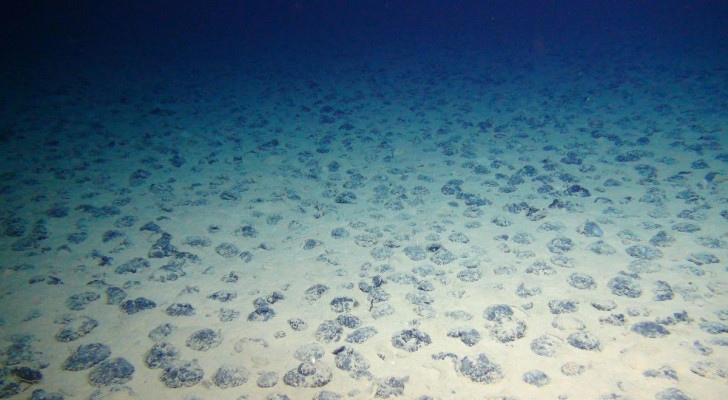
Manganese nodules from the seafloor are often rich in metals like manganese, iron, nickel, copper, and cobalt.

A Surprising Source of Oxygen in the Deep Sea

I have always found Mariana’s Trench fascinating, it’s like an alien world right on our doorstep. Any visitor to the oceans or seas of our planet will hopefully get to see fish flitting around and whilst they can survive in this alien underwater world they still need oxygen to survive. Breathing in oxygen is a familiar experience to us, we inflate our lungs and suck air into them to keep us topped up with life giving oxygen. Fish are different, they get their oxygen as water flows over their gills. Water is full of oxygen which at the surface comes from the atmosphere or plants. But deep down, thousands of meters beneath the surface, it is not so easy. Now a team of scientists think that potato-sized chunks of metal called nodules act like natural batteries, interacting with the water and putting oxygen into the deep water of the ocean. 

Thanks to robotic underwater explorers the sight of life teeming around thermal vents on the bottom of the deep ocean is not unusual. At those depths, no sunlight can penetrate to facilitate photosynthesis in plants. Somehow though, oxygen is present in the dark, deep regions of the ocean and its the rocks that a team of scientists led by Andrew Sweetman have been exploring.

A Three-dimensional cross-section of the hydrothermal system in the Chicxulub impact crater and its seafloor vents. The system has the potential for harboring microbial life. Illustration by Victor O. Leshyk for the Lunar and Planetary Institute.

The production of oxygen by plants is well understood. Light is captured by a pigment known as chlorophyll where it is then converted into chemical energy and stored in the glucose. During photosynthesis, carbon dioxide from air and water from soil are combined in a series of chemical reactions to produce glucose and oxygen that we use to breathe. This oxygen from the plants plays a role in maintaining levels in the atmosphere and the oceans and seas. The study challenges this somewhat simplified explanation. 

The team focussed on measuring how much oxygen was being consumed by organisms in the depths of the ocean. Water sampled from the deep showed a surprising rise in oxygen levels instead of an anticipated decline. The study was repeated a few years later from the same location in a study commissioned by a mining company. Again they saw a rise in oxygen levels. Clearly something in the deep ocean was creating oxygen, but what?

Lab tests ruled out the possibility of microbes but the region being studied was peppered with lumps of rock known as polymetallic nodules. The nodules are known to form when manganese and cobalt precipitate out of water and form around shells. The nodules where theorised to be the source of the oxygen but the mechanism was not understood. 

The answer came when Sweetman heard a reporter calling the nodules ‘a battery in a rock’. Putting batteries in saltwater results in bubbles of hydrogen and oxygen which is the result of a process known as electrolysis. The team measured the voltage on the nodules and found just one of them to be 0.95 volts – a little lower than the required 1.5 volts for saltwater driven electrolysis but the team were onto something, suspecting multiple rocks could cluster together to increase voltage. 

The discovery of rocks on the bottom of the ocean generating oxygen is fascinating on its own but it has profound impacts on the search for life elsewhere in the universe. We have already discovered ice covered water worlds among the moons around some of the outer planets. It’s likely there will be others in planetary systems around other stars. If these worlds are common then it is quite likely that oxygen is being released through electrolysis from similar metallic nodules and perhaps, supporting entire ecosystems.  

Source :

{ https://www.universetoday.com/ }

Hoe vind je dit bericht?
Geschreven door peter om 22:50 Stuur door

The Shocking Decline in Human Cranial Capacity: How do Evolutionists Explain it? They Don’t!

The Shocking Decline in Human Cranial Capacity: How do Evolutionists ...

The Shocking Decline in Human Cranial Capacity: How do Evolutionists Explain it? They Don’t!

Bibhu Dev Misra

One of the stories that most of us have grown up hearing is that the human species is continuously evolving to higher levels of intellect, through a gradual process of evolution by natural selection. It has been drilled into us that the modern human species i.e. Homo sapiens, has evolved over millions of years from ape-like ancestors. The fundamental physical factor that drove the process of evolution was the increase in brain volume or cranial capacity, which, over time, led to a slew of innovations such as fire, tools, weapons, clothes, boats, shelter, burials, rock art, music, language, etc. The cranial capacity is regarded as the most important indicator of IQ, since many studies using Magnetic Resonance Imaging (MRI) of the brain in individuals who were tested for IQ, found significant correlations between the size of cerebral structures and measures of intelligence. 

Now, if this story were true, then even in the modern day we should have found that our cranial capacities are gradually increasing over time. Instead, dozens of elaborate studies have revealed the exact opposite! The human brain has been consistently shrinking in volume over the past 12,000-odd years, since the end of the last Ice Age. We are dumber today than any time before in the Holocene era!

In one of the early studies titled, “Decrease of Human Skull Size in the Holocene”, published in the Human Biology journal in 1988, scientists computed cranial capacity (CC) for nearly 9500 male crania and 3300 female crania, originating from Europe and North Africa. The study found,

“Among male samples the peak CC (cranial capacity) occurred in the Mesolithic (1593 cc), the lowest value falls in modern times (1436 cc); in females sample timing is the same: Mesolithic maximum of 1502 cc and modern minimum of 1241 cc. For both males and females the decrease through time is smooth, statistically significant and inversely exponential. A decrease of 157 cc (9.9 % of the larger value) in males and of 261 cc (17.4 %) in females is a considerable one, of the order of magnitude comparable to the difference between averages for H. Erectus and H. Sapiens.”[1]

Separate studies conducted on large samples from Europe, the Near East, Africa, Japan and Australia have confirmed this general trend. Human cranial capacity has decreased by approx. 10% of its average value (i.e. 100-150 cc) since the Late Pleistocene until the early 20th century.[2]

If evolution by natural selection is consistently making us smarter then why did we lose such a large chunk of brain volume at a time when, supposedly, for the first time, humans transitioned from a hunter-gatherer lifestyle to settled, agricultural communities that allowed the first great civilizations of the world to flourish?

One of the first recognizable members of the genus Homo is called Homo erectus (meaning “upright man”), whose earliest appearance in the fossil records occurred around 2 million years ago. Homo erectus is thought to have been the earliest human ancestor capable of using fires, hunting and gathering in coordinated groups, caring for injured or sick group members, seafaring, and possibly art-making. The difference between the average cranial volume of Homo erectus and Homo sapiens is roughly the same as the amount of cranial volume that has been lost in the past 12,000 years in the Holocene period. 

Allow that to sink in. In just 12,000 years, we have lost the same amount of intelligence that, purportedly, took nearly 2 million years to develop! How does that happen? And why has the cranial volume been declining at a time when the most significant advancements in human civilization supposedly took place?

Clearly, something is amiss here. The data does not lie. Certain unfounded assumptions appears to have been made about human evolution and the origins of civilization that does not accord with the precipitous decline in human cranial capacity during the Holocene period. One of the thoughts that struck my mind when I came across this stunning data is, how do evolutionists and anthropologists explain it? 

skull.jpg

I had a hard time finding a well-written paper or article on this topic until I came across this piece in the Discover Magazine titled, “If Modern Humans Are So Smart, Why Are Our Brains Shrinking?”[3], in which, science writer Kathleen McAuliffe, tells us that she was utterly dismayed when anthropologist John Hawks of the University of Wisconsin told her that, over the past 20,000 years, the average volume of the human male brain has decreased from 1,500 cc to 1350 cc, losing a chunk the size of a tennis ball. “This happened in China, Europe, Africa - everywhere we look,” Hawks informed her. 

When Kathleen contacted other experts to find out if they knew about the shrinking human brain, she came to a startling realization. It was a closely guarded secret. “Only a tight-knit circle of paleontologists seem to be in on the secret, and even they seem a bit muddled about the matter,” she wrote to her utter surprise. 

One of the experts she consulted was Christopher Stringer, a paleoanthropologist at the Natural History Museum in London. Stringer told her something quite stunning: “Scientists haven’t given the matter the attention it deserves. Many ignore it or consider it an insignificant detail”. I could hardly believe this. This absolutely jaw-dropping piece of scientific data, which turns the Darwinian theory of gradual evolution by natural selection on its head, is treated by some scientists as an “insignificant detail”. What really is significant then? How the Homo erectus learned to pick his nose?

Besides, why is there so much secrecy around this information? Why is it that only a “tight-knit circle of paleontologists” knows about this, and everyone else seems to be in the dark? Isn’t it the duty of scientists, academia and the media to widely disseminate this kind of shocking information and invite debates and discussions over it? 

The truth is that, and many have written about it, scientists and academics do not earn any brownie points by ruffling the calm surface of “Lake Consensus”, as John Anthony West put it. There is a strong tendency to adhere to the status quo, and very often, errant academics who do not toe the official line, are put in their place by being denied grants, positions and other academic privileges. As a result, even if grave anomalies are observed in a theory that has achieved consensus, they are ignored or quietly filed away from the public eye. This kind of knowledge filtering goes on continuously, and what we know as the truth is simply a “consensus”, and nothing more.

Kathleen went on to write that, some scientists have tried to explain why our brains are shrinking, but their explanations are vague, muddled and inconsistent. According to Christopher Stringer, the reduction in cranial volume may be due to the decline in human stature since the Holocene period, since a larger brain is required to control a bigger body mass. However, John Hawks has contested this, claiming that the brain has shrunk much faster than the body. “For a brain as small as that found in the average European male today, the body would have to shrink to the size of a pygmy”, Hawks said. Besides, the scientific data indicates that human height declined till the end of the Bronze Age, after which it has been steadily increasing. But, brain volume has continued to decline till the modern period. This means there cannot be any cause-effect relationship between body size and brain size. 

Cognitive scientist David Geary of the University of Missouri believes that people actually became dumber in the Holocene period. According to him, as population density increased and complex societies emerged, people did not have to be as smart to survive; they could get by with the help of others. This created the selection pressure for the brain to become smaller. However, historical facts do not support his contention. It is only around c. 5000 BCE in the Eastern Mediterranean that we see a jump in population densities, followed by the emergence of complex Bronze Age societies. In many other parts of the world, complex societies arose even later than that. By that time, there had already been a substantial reduction in cranial volume. What this implies is that, only after humans became substantially stupid they began to form large, complex societies, and, as a result, some people were able to get by without possessing any specific skill or sufficient gray matter.

John Hawks put a different twist on the situation. He believes that humans may be getting smarter due to a re-wiring of the brain. The brain is an energy guzzler; it consumes nearly 20 percent of our calorie intake. A bigger brain uses up more energy. So, optimally, we need a brain that packs the most intelligence for the least energy. Hawks believes that, over the past 10,000 years, due to a series of advantageous brain-related mutations, the neural connections of the brain may have become streamlined and the molecular activity at the synapses improved, thereby making us more intelligent than our Paleolithic ancestors, even though we have smaller brains.

So, what Hawks is essentially saying is that, after moving in the wrong direction for nearly 2 million years, turning itself into an energy-guzzling SUV, the brain went through a sudden awakening at the end of the last Ice Age and decided to change course and transform itself into a Tesla. Hawks himself admits that such a course correction would require a large number of very rare, beneficial mutations, the chances of which are extremely slim. The fact is that random new mutations are more likely to reduce than to raise intelligence. A course correction for the human brain after 2 million years of evolution in the wrong direction, due to the sudden appearance of extremely rare beneficial mutations, is wishful thinking at best. 

Besides, there is no tangible evidence that the neural connections in the brain suddenly became more efficient after the onset of the Holocene Period. Nor is it likely that any such evidence will ever be found since brain tissue is not preserved for such long periods of time. If they were, we might have found that even the neural connections have degraded! 

The truth is very simple. Our declining cranial capacity indicates that we have been getting dumber over the course of the past 12,000 years. Our memories have declined substantially compared to our ancestors who could remember massive volumes of data, and transmit them orally to the next generation. Our powers of judgment and discrimination have declined because of which we cannot distinguish between the truth and lies, or discern what truly serves our welfare as opposed to what takes us down the path of misery. Our ethics and morality have nosedived, along with all the subtle abilities of the brain that we possessed in the bygone ages such as intuition, telepathy, clairvoyance, etc. 

Unfortunately, most people have been brought up to believe otherwise. They think that we are the smartest generation of people that ever lived since that is the idea that is pushed down their throats from an early age. The problem is, once people have been indoctrinated with a specific belief or ideology, no amount of evidence is enough to overturn that. The hardest things to get rid of are deeply held biases, and scientists are no exceptions to this.

Although the decline in cranial capacity during the Holocene period is at odds with Darwinian evolution, it is perfectly aligned with the doctrine of the Yuga Cycle or Great Year. The last 12,000 years comprise the descending arc of the Yuga Cycle, when human consciousness, memory and intelligence are supposed be in a state of continuous degradation. In the Mahabharata, the sage Markandeya told Yudhisthira, “Know, O Yudhisthira, that the period of life, the energy, intellect and the physical strength of men decrease in every Yuga!”[4] These statements, which have been generally brushed away as fanciful notions, are amply borne out by the scientific data collected over the past few decades. 

Since we are now approaching the end of the Kali Yuga, the shrinking of the human brain has already started tapering off in some populations. We can expect that, once we come out of the Kali Yuga, our cranial capacity will again start increasing gradually and attain their peak value in the next Golden Age or Satya Yuga, after another 12,000 years evolution along the ascending arc of the Yuga Cycle. 

So, what does all of this mean for human evolution? It means that the sinusoidal fluctuation in cranial volume, height and lifespan has been going on for millions of years, ever since man first appeared on the earth. Over a period of roughly 25,800 years, the cranial volume goes up and down with a 10% - 15% fluctuation in its value. 

Contrary to oft-repeated claims, there has not been a gradual increase in cranial volume over the past 2 million years. That is an assumption and not a fact. We have found less than 200 pre-Holocene hominin skulls. 200 skulls in a span of 2 million years! How can such a scanty collection of pre-Holocene crania reveal the pattern of human evolution? A regression line was fitted through these data points assuming that cranial volume must have increased linearly. That is an unacceptable assumption. Any kind of curve can be drawn through a scatter of 200 data points over a 2 million-year time period. There are hundreds of thousands of years in the graph without a single data point! 

On the other hand, tens of thousands of Holocene crania have been found, and that data indicates that cranial volume has been decreasing over the past 12,000 years and gradually flattening out. Surely, the true nature of the cranial capacity curve will be revealed where the data density is the highest. 

The only sensible conclusion to be drawn from this is that human cranial capacity fluctuates in a sinusoidal manner over a 25,800-year cycle. I propose that all the available Homo sapiens cranial specimens can be plotted on this sinusoidal curve. Since I do not have access to a well-dated set of human skulls I cannot test it out myself. But, there is a well-known set of cranial specimens belonging to the Cro-Magnon, which supports this argument.

The Cro-Magnons were one of the earliest examples of modern Homo sapiens in Western Europe. Cro-Magnons were taller than modern humans, had more robust bones, with a cranial capacity of around 1600 cc, which is comparable to the peak cranial capacity of the Mesolithic period.[5] Their fossils have been found between 30,000 to 40,000 years ago, which straddles the peak of an earlier Golden Age at around 38,676 BP (Before Present) or 36,676 BCE. 
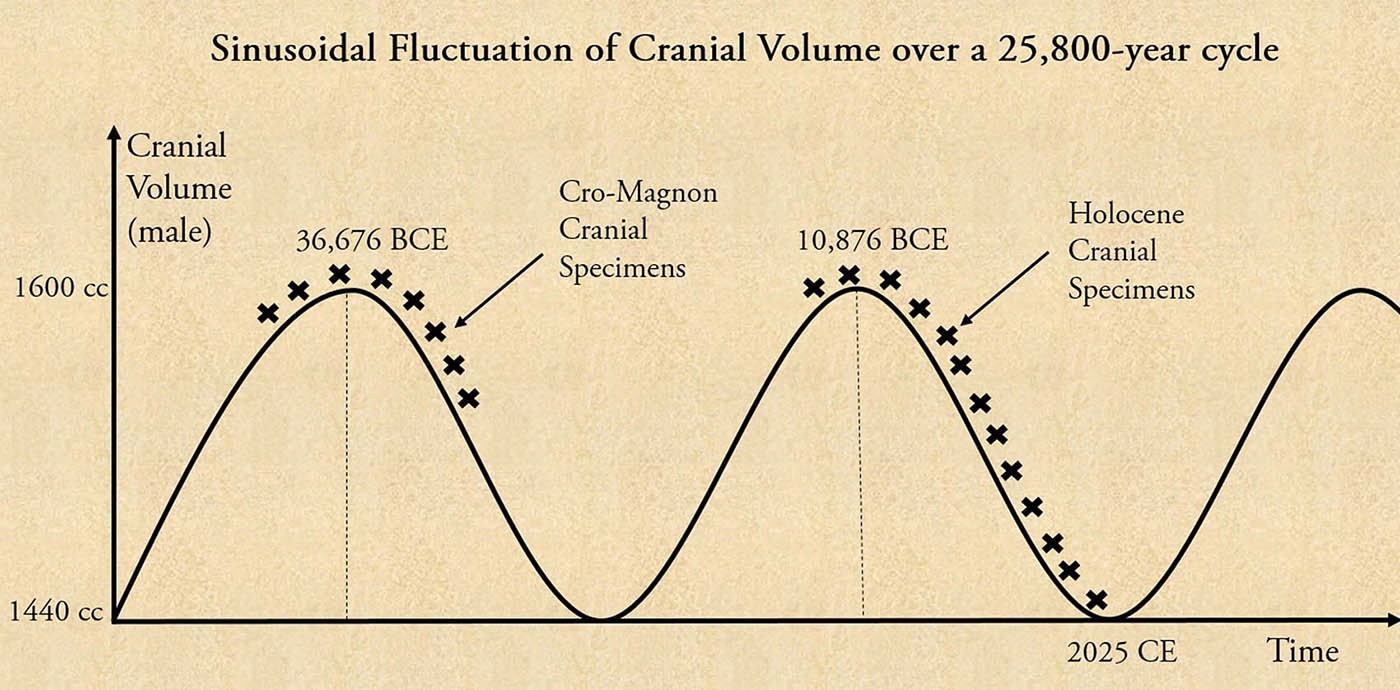
The cranial volume of Homo sapiens fluctuates over a 25,800-year Yuga Cycle. Credit: Bibhu Dev Misra.

This can be easily calculated from the Yuga Cycle timeline. The peak of the last Golden Age was reached around 10,876 BCE, and we need to add 25,800 years to get the previous peak i.e. 36,676 BCE. This means that the Cro-Magnons lived in an earlier Golden Age and some part of the descending Yuga Cycle. This is why, their morphology and cranial capacities are larger than that of modern humans and comparable to the peak cranial capacities of the Mesolithic period i.e. the most recent Golden Age.

Skull and lower jaw of Cro-Magnon, exhibited at the Musée de l'Homme in Paris. Credit: Thilo Parg, CC BY-SA 4.0 via Wikimedia Commons Forensic facial reconstruction of a Cro-Magnon man, using a cast of skull. Credit: Cicero Moraes, CC BY-SA 4.0 via Wikimedia Commons

What this means is that, over the past 2 million years, since the first hominin fossils began to appear, our cranial volume has been oscillating over a 25,800-year cycle, without a net increase or decrease in any direction. This is true not only for Homo sapiens crania but is likely to be equally applicable to all the extinct members of the human family, including the Neanderthals and Homo erectus. 

For instance, the Neanderthals had a bigger skull than modern humans with an average cranial capacity of around 1500 cc, which is comparable to the cranial volume of humans who lived at the end of the last Ice Age. However, even Neanderthal skull capacities vary between 1300 to 1600 cc, and it is quite possible that this variation occurs in tandem with the 25,800-year precession cycle. No one has tested for this till now, but if we plot out the available Neanderthal skulls on this curve, we may be taken by surprise.

Comparison of Modern Human and Neanderthal skulls from the Cleveland Museum of Natural History. The Neanderthal skull is the one on the right. Credit: hairymuseummatt CC BY-SA 2.0 via Wikimedia Commons

However, cranial specimens need to be accurately dated before plotting on the 25,800-year sinusoidal curve, because even a small percentage error in dating can make things go haywire. The difference between the peaks and troughs of the curve is only 12,900 years, which is very small in geological terms. Ideally, the hominin cranial specimens which have been discovered in the past 100,000 to 200,000 years should be used for plotting this curve, so that the error in dating is not very significant.

In case you are wondering what could be responsible for the decline in our cranial capacity during the Holocene period, certain studies indicate that genetics is the main driving factor. Over the past 12,000 years, we have been acquiring harmful gene mutations, and passing them on to our children, leading to the gradual degeneration of the human race. In a couple of papers published in the journal Trends in Genetics (2012), Professor Gerald Crabtree of Stanford University showed that, as a species, we are gradually declining in average intellect because we are accumulating mutations that deleteriously affect brain development or function.[6]

Professor John Sanford of Cornell University firmly believes that the human race is devolving and that there is no evidence of human evolution being directed by the forces of natural selection. In the book Genetic Entropy & the Mystery of the Genome (2008), he argued that the minimal rate of human mutation is estimated to be 100 new mutations per generation. While most mutations do not have any effect, some of them are deleterious. This causes a genetic degradation that leads to the gradual extinction of a species through time. In an interview with Jim Cantelon, he explained the new findings in the field of genetics:

“It’s kind of a trade secret amongst population geneticists - any really well-informed population geneticist understands that man is degenerating…what’s happening is that, every gene in every chromosome of every cell in my body is mutating, and so that guarantees my aging and my death. But the problem is that - these mutations that are accumulating in my body - some of them are transmitted to my children. I take all the mutations that I inherited from my ancestors – tens of thousands of deleterious mutations in my body – and I add my own contribution to that – about 100 new mutations at least – and pass it on to the next generation…It means we are a perishing people living in a dying world…there is no circle of life where things just continue staying the same, and it’s not an upward spiral of evolution where things keep getting better and better, it is a downward spiral. ”[7]

A downward spiral indeed! In other words, the descending arc of the Yuga Cycle or Great Year in which human intellect gradually declines. The wisdom of the ancients is now being validated by different scientific disciplines. But why is there so much secrecy? 

John Sanford said that the degeneration of man is a “trade secret amongst population geneticists”, while Kathleen McAuliffe had noted that the phenomenon of the shrinking human brain is a secret known to “only a tight-knit circle of paleontologists.” Why is this knowledge being concealed from the people at large? Why not just come out and say, “It's confirmed guys. We are idiots, and we are getting dumber, and that’s why we are messing up the world.” Is that too much to ask? 

I believe that John Sanford’s statement that we are “a perishing people in a dying world” is a bit too pessimistic, for it seems to imply that there is no hope for the world. That is not exactly true. Had the deterioration of the human brain been going on ceaselessly for the past 2 million years, then we would have transformed into chimps by now. Or become extinct. But we didn’t, right? This means that the process of degeneration is not unidirectional, but reverses itself at periodic intervals. Humanity is not headed towards extinction but towards transformation. 

At some point after the completion of the Kali Yuga, the harmful genetic mutations will get replaced by beneficial genetic mutations, which will then keep on accumulating and drive the upward spiral of evolution till the next Golden Age. This is how the Cycle of the Ages operate, and it is a shame that this essential wisdom has been discarded by the modern civilization. But, then, this is exactly what happens in the Kali Yuga, the age of ignorance and darkness, when, in spite of having so many advanced technologies, humanity remains completely oblivious of its origins and purpose.

One might naturally wonder what could be causing the harmful and beneficial genetic mutations to fluctuate over a 25,800-year cycle. Could the radiation from some powerful cosmic source be driving this phenomenon? The answer is yes, and I have explored this idea in my book Yuga Shift, and I shall write about it in future articles.

References

[1] Maciej Henneberg, “Decrease of Human Skull Size in the Holocene”, Human Biology, June 1988, Vol.60, No.3, pp. 395-405, https://digitalcommons.wayne.edu/humbiol/vol60/iss3/5/
[2] Christopher B. Ruff et al, “Body mass and encephalization in Pleistocene Homo”, Nature, 1997, Vol.387, pp. 173 - 176.
[3] Kathleen McAuliffe, “If Modern Humans Are So Smart, Why Are Our Brains Shrinking?” Discover Magazine, 20 January 2011, https://www.discovermagazine.com/the-sciences/if-modern-humans-are-so-smart-why-are-our-brains-shrinking
[4] Mahabharata 3.189, https://www.sacred-texts.com/hin/m03/m03189.htm
[5] “Cro-Magnon”, Britannica, https://www.britannica.com/topic/Cro-Magnon
[6] Gerald R. Crabtree, “Our fragile intellect. Part I” and “Our fragile intellect. Part II”, published in Trends in Genetics. Taken from Kevin J. Mitchell, “Genetic entropy and the human intellect”, Trends in Genetics, 2013, Vol.29, No.2, pp. 59-60.
[7] Dr. John Sanford, author of “Genetic Entropy and the Mystery of the Genome”, in an interview with Jim Cantelon, on the YouTube channel 100huntley, https://www.youtube.com/watch?v=K8KbM-xkfVk

{ https://mysteriousuniverse.org/ }

Hoe vind je dit bericht?
Geschreven door peter om 22:40 Stuur door

'UFO' spotted over Ibiza after tourists notice white 'orb' floating in the sky

'UFO' spotted over Ibiza after tourists notice white 'orb' floating in the sky

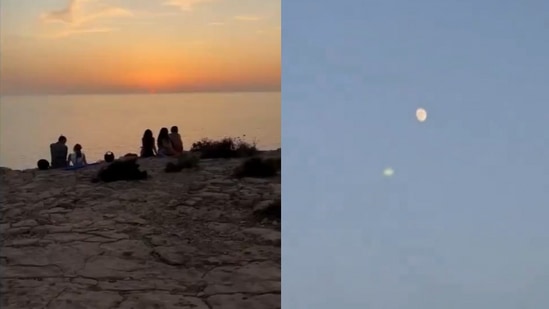
A group of tourists were peacefully watching the sunset when a strange white 'orb' floated into their field of vision. In a matter of seconds, the strange entity vanishes, leaving some people convinced it's a 'UFO'

By Lauren Haughey

UFO

Tourists claim to have spotted a UFO in Ibiza

(stock image) (Image: Getty Images/Science Photo Library RF)

When jetting off to sunny Ibiza, UFOs are probably the last thing on your mind.

Yet, one group of tourists believe they spotted exactly this while soaking up a stunning sunset by the sea - and it's left the internet utterly baffled. Now a clip of the mysterious aerial entity came to light on Pubity's Instagram.

The UFO was spotted in Ibiza, Spain.

The UFO was spotted in Ibiza, Spain.

It captures a crowd relaxed on a cliff, before one woman suddenly runs to the edge. The air is then thick with gasps, yells and confused questions as all eyes lock on to something next to the moon.

READ MORE: 

Eagle-eyed viewers will clock a white blob, slightly out of focus, floating in the sky. But just as the lens zooms in, it shoots off and vanishes.

Unsurprisingly, this strange footage racked up countless comments online, with many viewers dishing out their own theories on what this might be. Unconvinced by the sighting, one person said: "It’s probably just a drone," as another sceptic joked: "Bro that UFO took a pill in Ibiza."

Meanwhile, someone else quipped: "They saw the bottled water prices n zoomed," while one more scoffed: "Ohhh yes because every video starts with 'hey I’m going to run towards the edge and scream look look look' nice try."

According to the Majorca Bulletin, this isn't the first time a UFO has been spotted in the region. Incredibly, Sóller - a town in neighbouring Mallorca - was allegedly a hotspot for UFO sightings in the 1970s to 1990s.

The Ibiza sighting also comes less than a year after US Congress passed legislation that demands its government to disclose some UFO records, under certain conditions.

Maria Calafat, who is reportedly working on a UFO-based project for Netflix, believes this alone is motivating more people to come forward with their own personal experiences.

She told the Majorca publication: "The recent declassification of thousands of UFO files by US Congress, has made these cases fashionable again."

  • What do you think? Let us know in the comment section below...

{ https://www.dailystar.co.uk/ } 

Hoe vind je dit bericht?
Geschreven door peter om 21:25 Stuur door

UFO Sightings Caught On Video In The United Kingdom And Brazil Baffle Witnesses

UFO Sightings Caught On Video In The United Kingdom And Brazil Baffle Witnesses

UFO over the mountain forest

ISTOCKPHOTO

A mysterious UFO above a town in the United Kingdom was recently captured on camera and the object appeared to change shape as it moved through the sky.

The UFO was spotted by a resident of Bellshill in Lanarkshire on Friday, July 26.

“The skies have been beautiful lately with bright colours and when I heard the helicopter for the third time that day, I did look up and i caught a glimpse out the corner of my eye of it,” the witness told Glasgow Live.

“It was the way it was moving that made me want a closer look. I just thought it was strange and reminded me of something out of Harry Potter the closer it got.

“Even at one point it did look like a giant chicken, but still dark even when it passed over my house.”

Meanwhile in Brazil, another UFO was spotted and caught on video less than a week prior to the one in the United Kingdom.

The witness, Zona Desconhecida, said he was leaving a bakery when he saw a mysterious object hovering in the sky above Curitiba and captured what some are calling “The clearest video of a UFO ever taken.”

Not everyone is buying it, but many people on Reddit and YouTube were.

“Creepy as hell,” one viewer wrote. “I don’t think this is a balloon or drone look close that s—‘s like moving like there’s little legs on the sides moving and the eye or whatever also moves.”

“Amazing zoom on that camera, and a strong case for a UFO,” read another comment. “Without it taking off and showing speed, it’s hard for me to say for sure. But still, great submission.”

“When it finally comes into focus at the end, it just looks like smooth, uniformly shaped thing,” another person tried to explain. “The ‘landing gear’ and the light colored features on the side I think were just artifacts of it being out of focus.”

“Looks like the exact same thing that hovered over Bogota,” someone else wrote.

 { https://brobible.com/ }

Hoe vind je dit bericht?
Geschreven door peter om 21:00 Stuur door

UFO Encounter Interview Clips with Navy Pilots from History’s Unidentified

UFO Encounter Interview Clips with Navy Pilots from History’s Unidentified

History is gearing up for the premiere of their new UFO reality show Unidentified: Inside America’s UFO Investigation. It airs this Friday, May 31 after Ancient Aliens. The show has already generated a ton of press, and the show cast members were key in influencing the Navy to take a closer look at UFO reports, as reported in Politico by Unidentified cast member Bryan Bender.

Bender’s article, and a new article in the New York Times that includes witness testimony from Navy pilots, has hit the media by storm. Now, in the middle of the media fervor, History has released these clips of interviews with some of those pilots.

CLIP 1 – Former Navy pilot Lt. Ryan Graves recalls his experience encountering UFOs while on the USS Theodore Roosevelt.

CLIP 2 – Former Navy pilot Lt. Ryan Graves and Navy pilot Lt. Danny Aucoin discuss their experiences encountering UFOs while on active duty with the Navy.

CLIP 3 – Former Navy pilot Lt. Ryan Graves makes the shocking claim that multiple unidentified crafts appeared in the Middle East over the Arabian Gulf, while the carrier strike group was launching air strikes in Syria.

Promos

Visit the History channel website for Unidentified: Inside America’s UFO Investigation here.  

{  https://openminds.tv/category/articles/ }

Hoe vind je dit bericht?
Geschreven door peter om 16:51 Stuur door

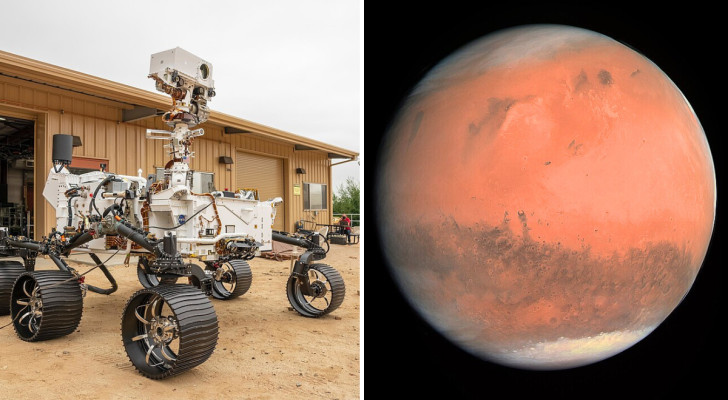
NASA Made a World-Shaking Discovery: Compelling Evidence of Past Life on Mars

NASA Made a World-Shaking Discovery: Compelling Evidence of Past Life on Mars

Story by Darren Orf
 
  • In its ancient past, Mars likely contained many of the necessarily ingredients for microbial life to flourish on its surface.
  • Now, a new discovery by NASA’s Perseverance rover shows a trifecta of compelling evidence—including the presence of water, organic compounds, and a chemical energy source—all on one rock located in the Jezero Crater.
  • Although this is the best clue yet that microbial life existed on Mars, there are still other explanations that could explain this geologic display without the existence of microbes.

“Is there life on Mars” is a question that has vexed astrobiologists and David Bowie alike. While the latter imagined some macabre collection of arachnids on the Red Planet, NASA scientists are fixated on finding evidence that microbial life once flourished on the fourth rock from the Sun. So fixated, in fact, that the space agency has spent more than $5 billion getting two immensely complicated robotic rovers—Curiosity and Perseverance—onto the Martian surface with this specific microbial mission in mind.

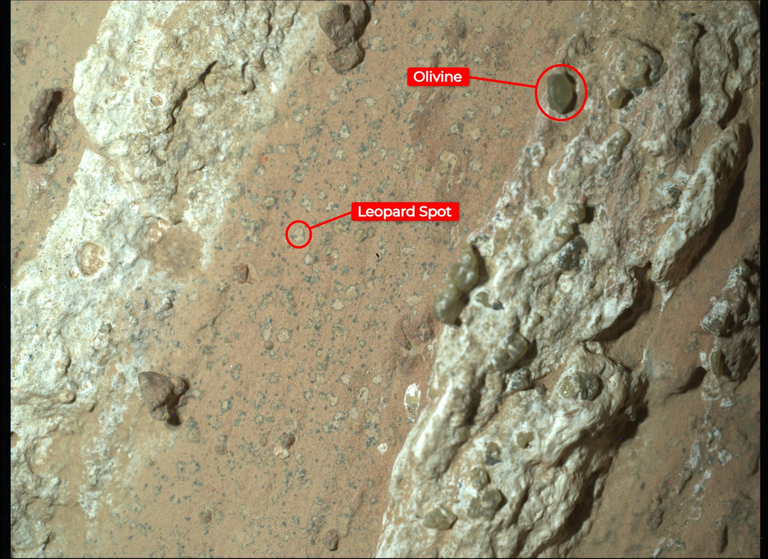
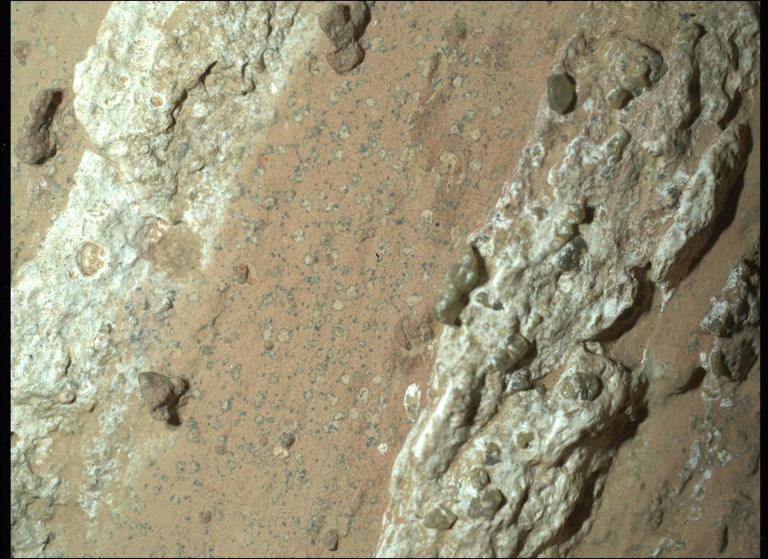
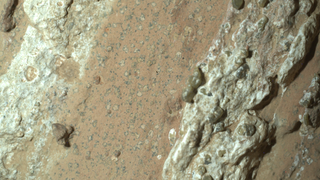
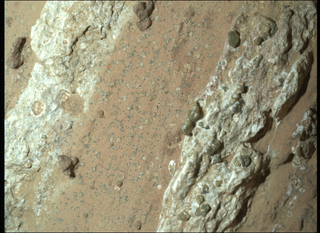
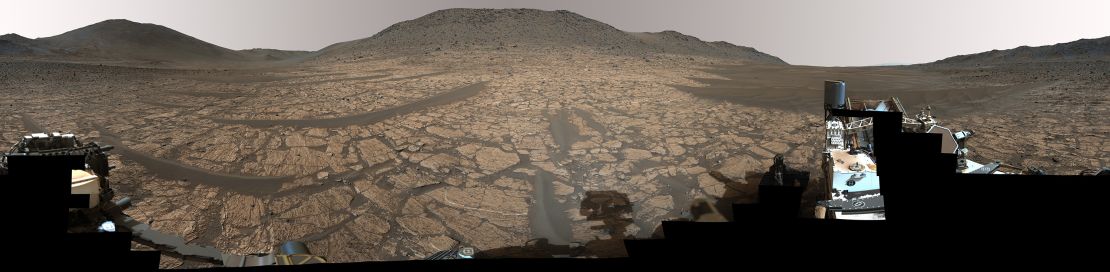
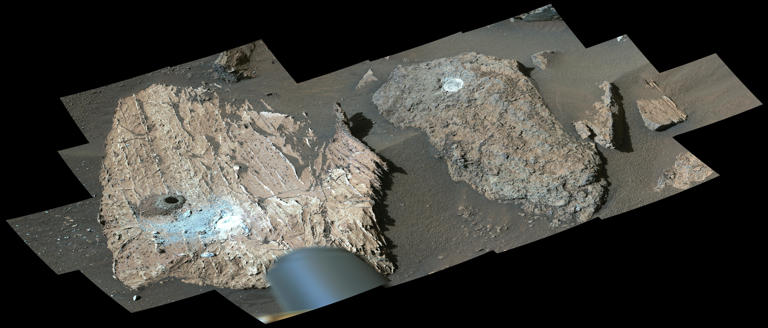
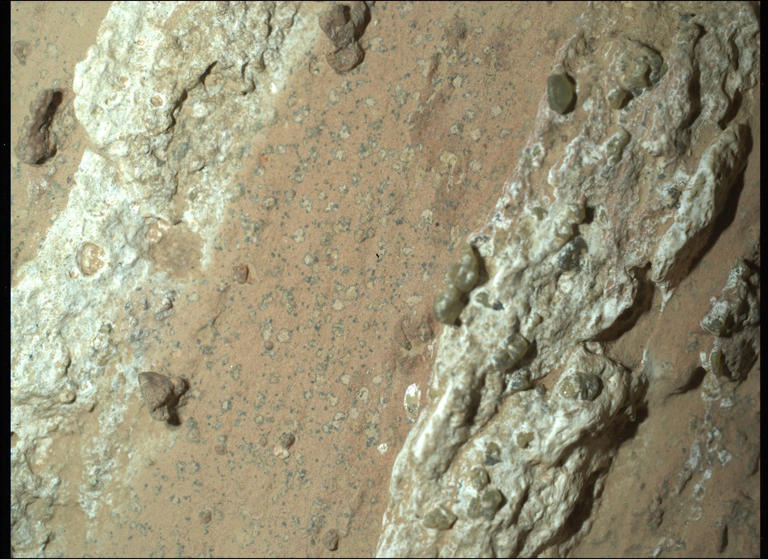
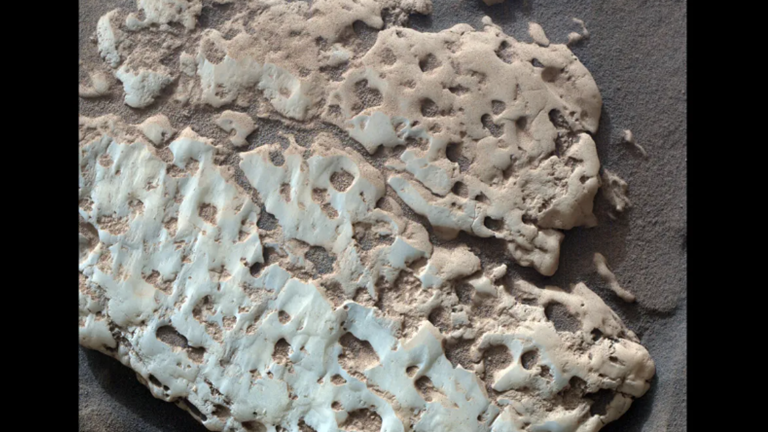
Now, one of those rovers might’ve discovered one of the most compelling pieces of evidence for Martian microbial life. Located on an arrowhead-shaped, three-foot-long rock nicknamed “Cheyava Falls” in the Jezero Crater (the 28-mile-wide crater that Perseverance has called home for the past three years), this “piece of evidence” is actually a trifecta of data points that suggest the presence of past microbial life. The rock in question features two vertical veins of calcium sulfate that likely formed from past water, and these stripes both flank a red band of rock filled with “leopard spots.”

NASA has discovered evidence of past water on Mars before, but it’s this narrow band of rock that brings new meaning to this discovery. Using its SHERLOC (Scanning Habitable Environments with Raman & Luminescence for Organics & Chemicals) and PIXL (Planetary Instrument for X-Ray Lithochemistry) instruments, Perseverance determined the existence of organic compounds within the rock. Oh, and those “leopard spots?” Those likely indicate chemical reactions that could’ve supplied energy to ancient microbial Martians.

While each of these discoveries—the presence of water, organic compounds, and chemical reactions—would be notable even if discovered separately, NASA has never seen all three in one location, meaning the geological chemistry of Cheyava Falls is possibly our best clue yet that Mars once hosted life.

“Cheyava Falls is the most puzzling, complex, and potentially important rock yet investigated by Perseverance,” Caltech’s Ken Farley, Perseverance project scientist, said in a NASA press statement. “We have our first compelling detection of organic material, distinctive colorful spots indicative of chemical reactions that microbial life could use as an energy source, and clear evidence that water—necessary for life—once passed through the rock.”

While this site is particularly exciting, it’s far from the first Martian discovery to cause considerable microbial hype. Just earlier this year, scientists studying a 2017 soil analysis from Curiosity’s ongoing mission in Gale Crater discovered an abundance of manganese in the soil—something that usually requires the presence of oxygen and (you guessed it) microbes.

An annotated image of the Cheyava Falls rock, the two vertical veins of calcium sulfate can be seen on the left and right of the image.

An annotated image of the Cheyava Falls rock, the two vertical veins of calcium sulfate can be seen on the left and right of the image.
© NASA/JPL-Caltech/MSSS

But all of these discoveries come with more than a few caveats. In Curiosity’s case, too little is known about the Mars’ oxidation process to be certain that microbes existed in Gale Crater, and this new discovery also isn’t immune from scientific scrutiny. One big head scratcher is the presence of millimeter-sized olivine crystals—a mineral that forms from magma. This may possibility explain how past volcanic activity could produce this geologic phenomena without relying on the presence of microbes at all.

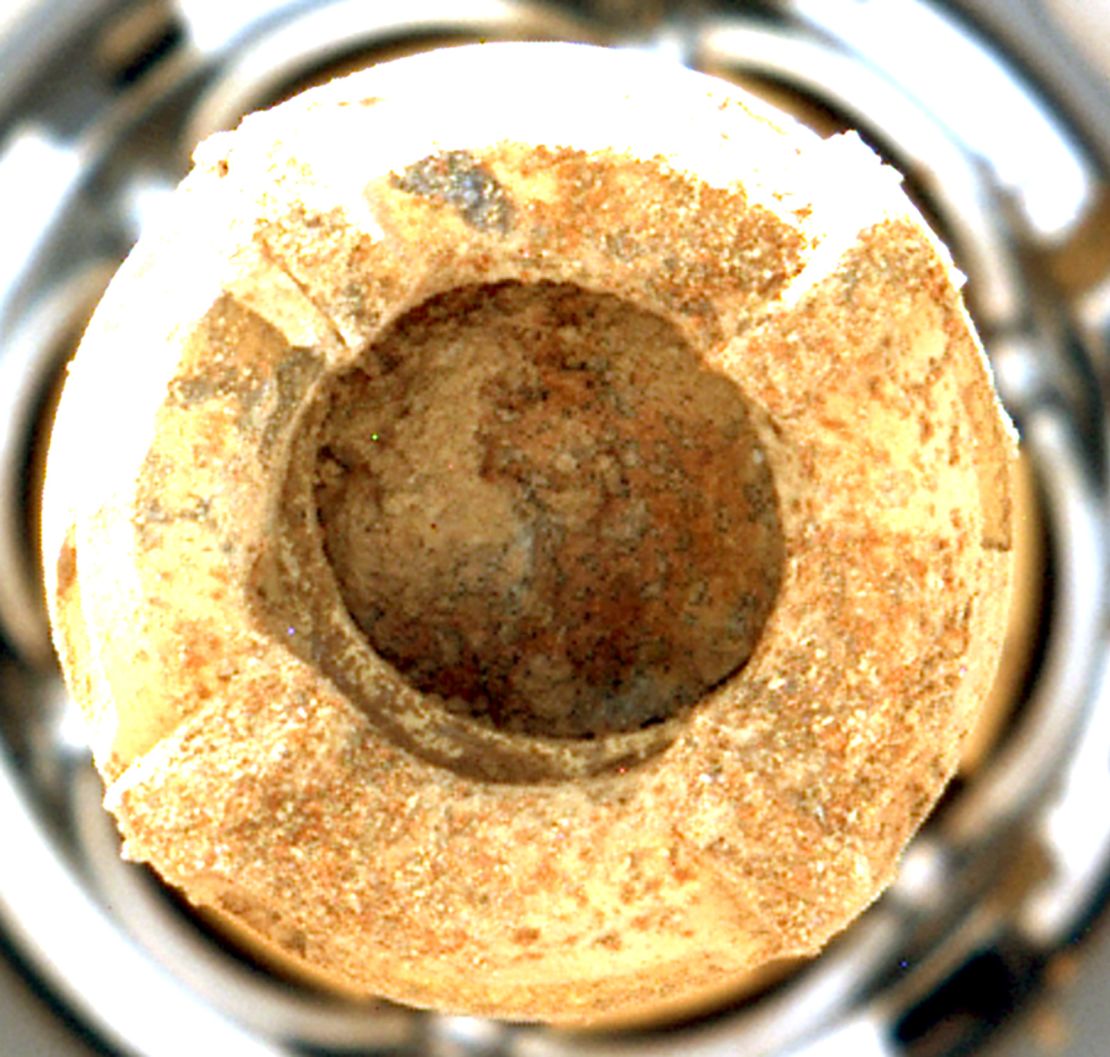
“We have zapped that rock with lasers and X-rays and imaged it literally day and night from just about every angle imaginable,” Farley said in the press statement. “Scientifically, Perseverance has nothing more to give. To fully understand what really happened in that Martian river valley at Jezero Crater billions of years ago, we’d want to bring the Cheyava Falls sample back to Earth, so it can be studied with the powerful instruments available in laboratories.”

The “six-wheeled geologist” (as NASA calls it) doesn’t contain an onboard lab like its sister rover, Curiosity. But that’s actually a feature—not a flaw. NASA originally designed Perseverance to also be a sample retrieval mission, meaning that the space agency would send an additional spacecraft to retrieve samples from Perseverance and bring them back to Earth for further study.

However, with the costs of such a mission edging into the $11 billion range, bringing back samples of this Martian geologic wonder is in now question—as is the possibility of definitively understanding if there was once microbial life on Mars.

Hoe vind je dit bericht?
Geschreven door peter om 16:41 Stuur door

NASA’S DART MISSION SNAPPED PICTURES UNTIL IT CRASHED INTO AN ASTEROID. HERE’S WHAT THOSE IMAGES REVEAL

NASA’S DART MISSION SNAPPED PICTURES UNTIL IT CRASHED INTO AN ASTEROID. HERE’S WHAT THOSE IMAGES REVEAL

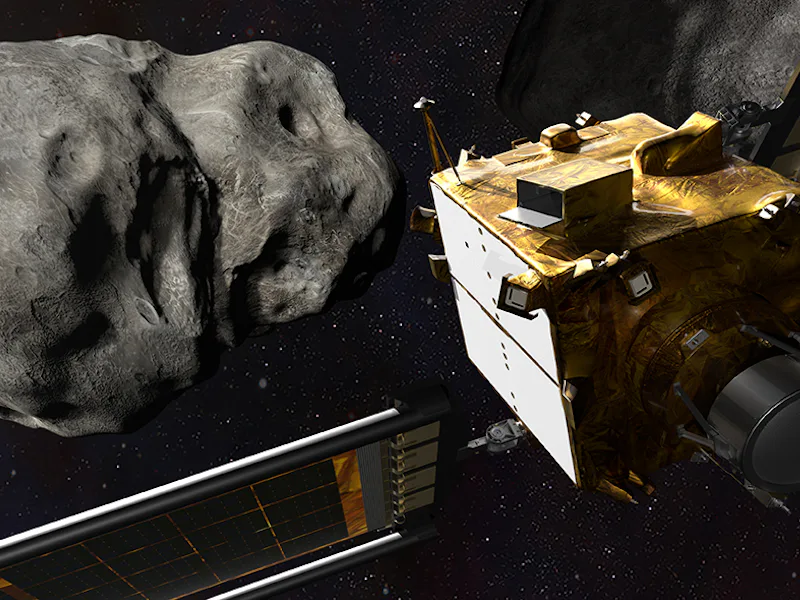
NASA got up close and personal to an asteroid pair near Earth.

 
An illustration of a box-shaped spacecraft approaching a potato-shaped asteroid.
JHU Applied Physics Laboratory

NASA’s Double Asteroid Redirection Test (DART) made history almost two years ago. This was the first time humanity attempted to intentionally alter the motion of a space rock. They succeeded.

A spacecraft slammed into the tiny moon of an asteroid, all while its onboard camera and an Italian robotic onlooker called LICIACube snapped photos.

The footage is a treasure trove. On Tuesday, teams published five scientific papers in the journal Nature Communications. Each contains new insights into what these rocks are like, and how tricky it may be for future planetary defense missions to strike another asteroid to avoid an impact’s calamity on Earth.

Behold the final five-and-a-half minutes before DART intentionally collided into asteroid Dimorphos.

NASA/JOHNS HOPKINS APL

Here are five discoveries about this binary asteroid system so briefly encountered on September 26, 2022.

1. THE LARGER ASTEROID HAS AN OLDER SURFACE THAN THE LITTLE MOON.

Didymos and its moonlet Dimorphos are related to one another. But scientists still don’t know exactly how. One investigation looked at 16 craters on the larger asteroid, Didymos.

DRACO, the Didymos Reconnaissance and Asteroid Camera for OpNav scientific camera, was one image source. It took many photos of Didymos and smaller Dimorphos before impacting the latter’s surface.

The craters suggest that the Didymos surface is about 12.5 million years old. But the Dimorphos surface is a fraction of that, only about 90,000 years to 300,000 years old.

2. DIDYMOS IS A PILE OF RUBBLE.

Observations confirmed theoretical expectations: It’s essentially a clump of leftovers from a catastrophic event in the ancient past.

Scientists noticed Didymos boulders appear too large to have been excavated by whatever made the craters. Something grander was responsible, and its mess, rounded up through gravitational attraction, is now Didymos. The large boulders are heirlooms passed down from an ancient parent rock.

A plume fans out from a central bright region like wings. The central bright region is surrounded by...

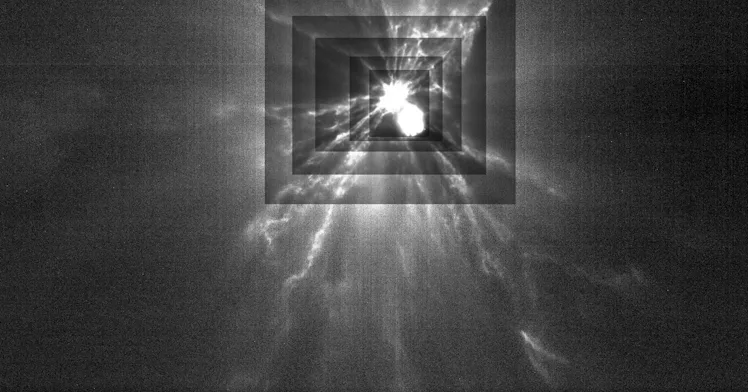
This image from Italy’s LICIACube show the plumes of ejecta streaming from the Dimorphos asteroid after NASA’s DART made impact. Each rectangle creates a different level of contrast. This helps viewers to better see the plume’s fine structure. 

ASI/NASA/APL

3. WE NEED TO KNOW MUCH MORE ABOUT FRACTURES ON DIMORPHOS’ BOULDERS.

Asteroid boulders live in an airless environment. But, they can be altered through thermal fatigue. As the Sun shines on them, cracks form.

The Dimorphos fractures were identified with the help of independent contributors who located them across boulders of different sizes. This work adds to what’s already been gleaned about the Near-Earth asteroid population from previous NASA, Japanese, and European missions.

The picture emerging from the data is that, should a kinetic impactor like DART slam into another space rock, the thermal cracks “may contribute to an enhancement in the ejected mass,” one study says.

4. ECLIPSES MAY BE ONGOING.

On the flip side, eclipses could be having an opposite effect: cooling rocks down.

This animation shows how Dimorphos’ orbit around Didymos was seen from Earth about one week after the DART impact.

NASA/APL/UMD

Based on limited data about how Dimorphos now spins after DART struck it, scientists think the moonlet remains tidally-locked to Didymos. This means Dimorphos shows the same face to Didymos, like the Moon does with Earth. If this relationship is fostering eclipses, a periodic drop in temperature could be happening on the asteroids.

Like thermal fatigue from solar radiation, the cooling effect of eclipses must also be factored into deflection techniques. This asteroid duo provides a unique chance to investigate this. Other closely-studied asteroids and comets have no companion to block out light.

5. THE DIDYMOS SURFACE IS WEAKER THAN DRY SAND ON EARTH.

One major thing researchers want to know before visiting any celestial object is how much weight you can put on it. This is called bearing capacity. It reveals a lot about the formation history of the Solar System. And in the case of planetary defense, bearing capacity also informs how to build something that can effectively knock a space rock off a collision course with Earth.

“The low surface strength of Dimorphos likely contributed to DART’s significant impact on its orbit,” NASA officials wrote in an announcement published Tuesday. This also seems to be a trait of the larger asteroid, Didymos.

Researchers looked at DRACO’s final full image of Didymos before it slammed into the moonlet Dimorphos. DART didn’t touch Didymos. But boulders on its surface left tracks. Scientists studied nine of these paths. They determined that the bearing capacity of Didymos is “at least 3 orders of magnitude less than the bearing capacity of dry sand on Earth, or lunar regolith [dirt].”

Researchers have already learned so much about Near-Earth asteroids from the DART mission. Thanks to the European Space Agency’s upcoming Hera mission to survey the duo in October 2026, even more discoveries could emerge.

{ https://www.inverse.com/ }

Hoe vind je dit bericht?
Geschreven door peter om 16:31 Stuur door

Een reis naar lokale legendes over de hele wereld -DEEL I

Een reis naar lokale legendes over de hele wereld - DEEL I

Een reis naar lokale legendes over de hele wereld

©Getty Images

Een reis naar lokale legendes over de hele wereld
Etherische figuren, die doen denken aan eeuwenoude legendes, komen op subtiele wijze tevoorschijn uit het tapijt van culturen en wenken nieuwsgierigen en dapperen om de blijvende kracht van folklore te ontdekken. Deze verhalen zijn het gefluister van generaties, die de essentie van het mysterieuze en magische vastleggen, en in deze galerij worden ze gevierd als de schatten van ons gedeelde menselijke erfgoed.

LEES VERDER door de galerij om de verhalen van weleer te ontdekken!

Het fluisterende bamboe (China)

©Shutterstock

Het fluisterende bamboe (China)
In het hart van het oude China fluistert een verhaal over twee geliefden, getransformeerd in bamboe, voor altijd samen zwaaiend in de wind. Deze legende, diep geworteld in de Chinese folklore, spreekt over de blijvende kracht van de liefde die echoot door de ritselende bamboebladeren. Het is een herinnering aan de veerkracht van de liefde en de eeuwige aanwezigheid in de natuur.

Anansi's Web (West-Afrika)

©Shutterstock

Anansi's Web (West-Afrika)
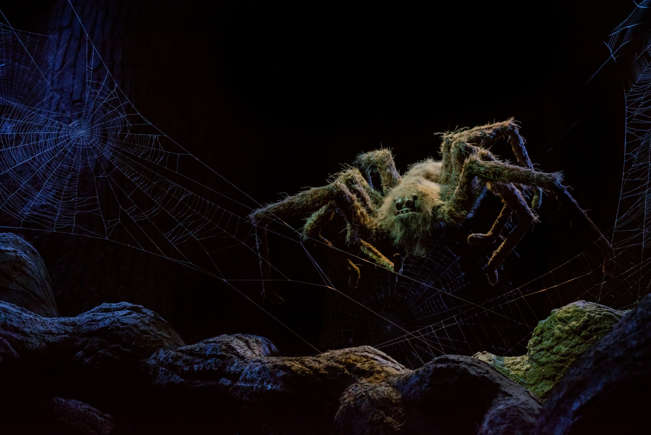
Onder de Afrikaanse hemel weeft Anansi de Spin meer dan alleen maar webben; hij weeft verhalen over wijsheid. Deze bedrieger, een prominent figuur in West-Afrikaanse verhalen, leert levenslessen door zijn sluwe en avontuurlijke heldendaden. Elke streng van zijn web symboliseert de complexiteit van de beslissingen in het leven en de wijsheid die hij door ervaring verkrijgt.

Het noorderlicht (Scandinavië)

©Shutterstock

Het noorderlicht (Scandinavië)
Terwijl je in de Scandinavische nacht staart, ben je getuige van de etherische dans van de Aurora Borealis. Folklore vertelt over deze lichten als een hemels fenomeen, waar de geesten van de overledenen in de hemel spelen, verhalen van verwondering weven en het aardse rijk overbruggen met het mystieke.

Het monster van Loch Ness (Schotland)

©Shutterstock

Het monster van Loch Ness (Schotland)
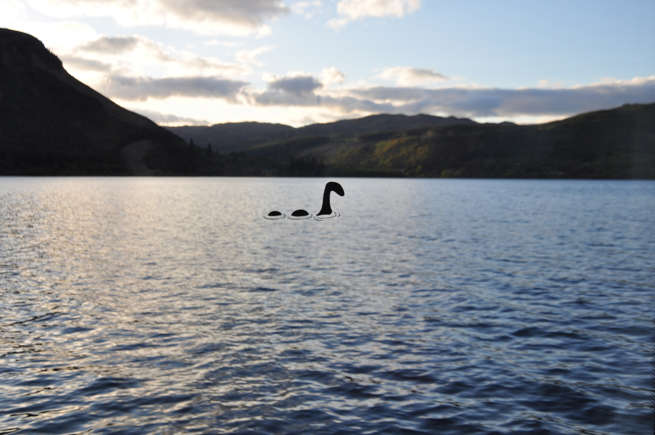
Gehuld in de mist van de Schotse folklore ligt Loch Ness, de thuisbasis van Nessie, het ongrijpbare monster. Deze legende geeft de essentie weer van de enigmatische charme van Schotland, waarbij Nessie de mysteries symboliseert die op de loer liggen in de diepten van onze verbeelding en in de donkere wateren van het meer.

Baba Yaga's Hut (Rusland)

©Shutterstock

Baba Yaga's Hut (Rusland)
In het hart van de Russische folklore staat de hut van Baba Yaga, een bijzondere verblijfplaats op kippenpoten. De enigmatische heks, die vaak een cruciale rol speelt in verhalen over heldendom en speurtochten, belichaamt de dualiteit van de natuur – soms een helper, soms een belemmering, maar altijd een belangrijke figuur in het rijke tapijtwerk van de Slavische mythologie.

De Feniks (Midden-Oosten)

©Shutterstock

De Feniks (Midden-Oosten)
Uit de as van oude verhalen uit het Midden-Oosten rijst de Feniks op, een prachtige vogel die vernieuwing en het eeuwige leven symboliseert. Dit mythische wezen, helder brandend en herboren uit zijn eigen ondergang, vertegenwoordigt de eindeloze cyclus van leven, dood en wedergeboorte, een krachtig embleem van veerkracht en hoop in de folklore.

Kraken (Noordse Zee)

©Shutterstock

Kraken (Noordse Zee)
In de diepe, koude wateren van de Noordse Zeeën schuilt de Kraken, een legendarisch zeemonster dat gevreesd wordt door zeilers. Dit enorme wezen, vaak vergeleken met een reuzeninktvis, belichaamt de mysteries en verschrikkingen van de oceaan, een bewijs van de eeuwenoude fascinatie en angst van de mensheid voor de onbekende diepten van de zee.

El Dorado (Zuid-Amerika)

©Shutterstock

El Dorado (Zuid-Amerika)
Diep in het hart van Zuid-Amerika fascineert de legende van El Dorado, de stad van goud, ontdekkingsreizigers al eeuwenlang. Dit prikkelende verhaal spreekt over grenzeloze rijkdom en ambitie en weerspiegelt de eindeloze zoektocht van de mensheid naar ontdekkingen en de ongrijpbare aard van onze grootste verlangens.

De Banshee (Ierland)

©Shutterstock

De Banshee (Ierland)
In de Ierse folklore is het treurige gejammer van de Banshee onder het maanlicht een voorbode van de dood. Deze spookachtige figuur, gehuld in mysterie, belichaamt de Keltische eerbied voor de overgang van leven naar dood, een aangrijpende herinnering aan de dunne sluier tussen het levende en het spirituele rijk.

Tengu (Japan)

©Shutterstock

Tengu (Japan)
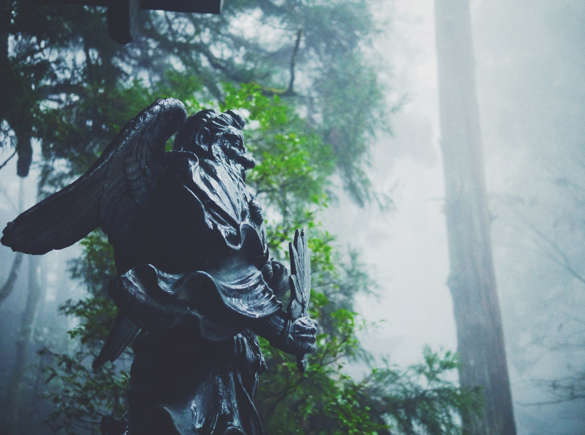
Hoog in de Japanse bergen wonen de Tengu: mystieke wezens die deels mens en deels vogel zijn. Deze wezens staan ​​bekend als zowel beschermers als bedriegers van de bossen en symboliseren de complexiteit van de natuur en menselijke interactie, waarbij ze kattenkwaad en wijsheid vermengen in het rijke tapijtwerk van de Japanse folklore.

Bigfoot (Noord-Amerika)

©Shutterstock

Bigfoot (Noord-Amerika)
In de uitgestrekte, onbekende bossen van Noord-Amerika roept de legende van Bigfoot, een mysterieuze reus, nieuwsgierigheid en debat op. Dit ongrijpbare wezen, vaak omschreven als een torenhoge, harige figuur, belichaamt de wilde en onbekende aspecten van de natuur. Bigfoot dient als symbool voor de mysteries die nog steeds verborgen liggen in de afgelegen wildernis.

De regenboogslang (Australië)

©Shutterstock

De regenboogslang (Australië)
Centraal in de Aboriginal mythologie wordt de Regenboogslang vereerd als een krachtige scheppende godheid. Dit levendige, slangachtige wezen, geassocieerd met water en leven, weeft door de verhalen van de inheemse bevolking en symboliseert de schepping, vruchtbaarheid en de onderlinge verbondenheid van alle levende wezens.

La Llorona (Mexico)

©Shutterstock

La Llorona (Mexico)
Het verhaal van La Llorona, gefluisterd langs de rivieroevers, spreekt over een spookachtige vrouw, die eeuwig rouwt om haar verdronken kinderen. Dit aangrijpende verhaal, doordrenkt van Mexicaanse folklore, dient als een waarschuwend verhaal over liefde, verlies en de gevolgen van iemands daden, dat door de eeuwen heen weerklinkt.

De Djinn (Midden-Oosten)

©Shutterstock

De Djinn (Midden-Oosten)
In verhalen uit het Midden-Oosten zijn de Djinn bovennatuurlijke wezens, noch geheel goed, noch slecht. Deze raadselachtige wezens worden vaak geassocieerd met het vervullen van wensen en weerspiegelen de dubbele aard van menselijke verlangens en de complexe gevolgen die de vervulling ervan met zich meebrengt.

 { https://www.msn.com/nl-be/ }

Hoe vind je dit bericht?
Geschreven door peter om 16:06 Stuur door

Een reis naar lokale legendes over de hele wereld - DEEL II

Een reis naar lokale legendes over de hele wereld - DEEL II

De Krampus (AlpenEuropa)

©Shutterstock

De Krampus (AlpenEuropa)
In de ijskoude Alpengebieden vormt de Krampus een schril contrast met de feestelijke vreugde van Kerstmis. Deze gehoornde figuur, bekend om het straffen van zich misdragende kinderen tijdens de kerstperiode, belichaamt de oude gebruiken en duistere aspecten van wintervieringen en herinnert aan de balans tussen welwillendheid en discipline.

Valkyries (Noorse mythologie)

©Shutterstock

Valkyries (Noorse mythologie)
In de Noorse mythologie kozen Walkuren, goddelijke vrouwelijke figuren, het lot van krijgers in de strijd. Deze krachtige wezens, die door de lucht vliegen, vertegenwoordigen de concepten van het lot en het hiernamaals, een integraal onderdeel van de Viking-overtuigingen en -cultuur.

De rattenvanger (Duitsland)

©Shutterstock

De rattenvanger (Duitsland)
De rattenvanger, een mysterieuze figuur uit de Duitse folklore, staat erom bekend een stad van ratten te bevrijden en later zijn kinderen weg te lokken. Zijn verhaal is een waarschuwend verhaal over beloften en gevolgen, dat door de eeuwen heen weerklank vindt.

De Nian (China)

©Shutterstock

De Nian (China)
Het angstaanjagende beest Nian zou in de Chinese folklore zijn verslagen met behulp van rode lantaarns en vuurwerk. Deze legende symboliseert de triomf over angst en tegenspoed, gevierd tijdens het Chinese Nieuwjaar.

De Golem (Joodse folklore)

©Shutterstock

De Golem (Joodse folklore)
In de Joodse folklore werd de Golem, een tot leven gewekt kleifiguur, gecreëerd om de gemeenschap te beschermen. Dit krachtige verhaal onderzoekt thema's als creatie, controle en de onbedoelde gevolgen van onze acties.

Kappa (Japan)

©Shutterstock

Kappa (Japan)
De Kappa, waterwezens uit de Japanse folklore, staan ​​bekend om hun kattenkwaad, maar toch zijn ze gebonden aan een beleefdheidscode. Deze wezens symboliseren de genuanceerde relatie tussen mensen en de natuurlijke wereld en weerspiegelen het delicate evenwicht van co-existentie.

The Selkie's Secret (Schotse en Ierse folklore)

©Shutterstock

The Selkie's Secret (Schotse en Ierse folklore)
Selkies, zeehondenmensen uit de Schotse en Ierse overlevering, belichamen de thema's identiteit en vrijheid. Hun verhalen, vaak romantisch en tragisch, spreken over de transformerende aard van selkies en hun diepe verbinding met zowel land als zee, en reflecteren op het universele verlangen naar iemands ware thuis.

Bronnen:

  • (Invaluable.com)
  • (TheTravel)
  • (World of Tales)

{ https://www.msn.com/nl-be/ }

Hoe vind je dit bericht?
Geschreven door peter om 16:04 Stuur door

What could a future sovereign Mars economy look like?

Artist's illustration of a future Mars colony. (Credit: Ville Ericsson)

What could a future sovereign Mars economy look like?

What would the economy of a future Mars society look like, and how could it be self-sustaining while being completely sovereign from Earth and its own economy? This is what a recent study submitted to Space Policy hopes to address as a sole researcher discusses a model that could be used for establishing economic freedom on Mars, enabling both monetary and political stability across all Red Planets settlements. This study holds the potential to help scientists, economists, and world leaders better understand plausible governmental systems used by human settlers on other worlds while maintaining sovereignty from Earth and its own governmental law and order.

Here, Universe Today discusses this incredible study with Dr. Jacob Haqq-Misra, who is the Director and a Senior Research Investigator of Blue Marble Space Institute of Science (BMSIS) and sole author of the study, regarding the motivation behind the study, significant ideas presented in the study, the importance of establishing a sovereign economic system on Mars, eliminating capital exchange between Mars and Earth, how Mars can become a sovereign entity from Earth after humans settle there, and how an economic system can be established on a sovereign Mars. Therefore, what was the motivation behind the study?

“My motivation was to build on the idealistic framework for an independent Mars that I developed in my book Sovereign Mars,” Dr. Haqq-Misra tells Universe Today. “In my book, I describe five conditions for enabling Mars to be an independent planetary state, a juridical peer to Earth. In this new study, I develop a possible economic model that would be consistent with these five conditions.”

These five conditions outlined in Sovereign Mars include all permanent settlers on Mars completely acquiescing Earth citizenship and interests; Earthlings being unable to interfere with the Mars affairs, including financial, political, and social aspects; Earthlings requiring permission from Mars to conduct scientific investigations on the Red Planet; only Mars citizens can own land; and all resources brought from Earth, including technological or other items, will remain on Mars permanently.

For the study, Dr. Haqq-Misra dives deeper into the economic facets of a future sovereign Mars government while embodying these five conditions, specifically focusing on the financial aspects of such an economic system, including banking, currencies, capital ownership, and Earthling tourism. He emphasizes how such a system builds off the mistakes from Earth’s present-day economic systems that could potentially lead to both financial and political stability on Mars. He notes this is an “idealistic but feasible model” with the goal of establishing full economic freedom for future Mars citizens from Earth. So, what were the most significant ideas presented in this study?

“The first idea is ‘full reserve banking’,” Dr. Haqq-Misra tells Universe Today. “Our banking system today allows banks to loan out more money than they hold as cash in reserves, which is known as a ‘fractional reserve’ system. This can lead to problems such as a ‘run on the bank,” where too many people try to take out their deposits all at once, only to find that the bank does not have their money.”

Dr. Haqq-Misra continues, “The second idea is the diffusion of capital ownership. Many visions of space settlement imagine something like a world space agency or other centralized authority that could ensure justice and perhaps even serve as a way to redistribute wealth. But the centralization of sovereign power also carries significant risks for the abuse of such power. Some arguments even suggest a somewhat Marxists approach toward the centralized or government ownership of wealth-producing capital, which is then redistributed equitably, but this again carries significant risk of abuse and corruption. An alternative idea is to widely diffuse the ownership of capital, instead of wealth. This means that ownership of companies, equipment, and anything else that can generate wealth would be held in a wider range of hands than today—ideally, by everyone.”

Along with the five conditions of a sovereign Mars noted above, requirements will also be established by the full reserve banking system on Mars, including all transactions staying on Mars, no currency exchange with Earth, and currency issuance will be based on changes in population. All tourism on Mars will follow three conditions that coincide with the conditions of both a sovereign Mars and the Mars full reserve banking system, including tourists being unable to own capital on Mars, the prohibition of Mars currency from being returned to Earth, and no currency transactions from tourists while services would only be provided from the exchange of goods.

On present-day Earth, currency exchange is the primary method for purchasing goods and services, with a total of 180 currencies being recognized across 195 countries around the world. While the value of each currency across the globe varies daily, this system allows individuals from separate countries to own capital in other countries with minimal government interference. But what is the importance behind the complete lack of capital exchange between Earth and Mars?

“This is part of the idealistic framework in Sovereign Mars,” Dr. Haqq-Misra tells Universe Today. “Preventing exchange between the two planets would enable Mars to retain its maximum potential to develop new ideas in civilization, such as this economic model. In practice, these ideas could still be attempted on Mars even if there is some exchange between the two planets, although this may lead to different results.”

The prospect of sending humans to Mars has been the purview of science fiction and countless scientific discussions for over 100 years. this began with the Danish silent film A Trip to Mars and other films continuing throughout the 20th century while incorporating current Mars inhabitants or remnants of past Mars civilizations. While films of the last few decades of the 20th century and into the 21st century conveyed the first human trips to Mars, most recently with the film The Martian, little has been discussed regarding permanent human settlements on the Red Planet.

The closest this notion came was in the television series The Expanse, which depicted the Martian Congressional Republic on Mars being a sovereign entity from Earth, complete with its own military and political hierarchy. However, the economic system within this government wasn’t discussed in detail. But what steps need to be taken for Mars to become a sovereign entity after humans settle there?

“The biggest challenge is having sufficient infrastructure and resources to become self-sustaining on Mars,” Dr. Haqq-Misra tells Universe Today. “Some resources could be used on Mars, but not right away, and actually enabling an independent Mars may require benefactors with long-term visions for humanity or even Earth, without the need for an immediate or near-future financial return. I call this ‘deep altruism’ in Sovereign Mars.”

Additionally, regarding the importance of establishing a sovereign economic system on Mars and the steps required for this economic system to take hold, Dr. Haqq-Misra tells Universe Today, “We have many examples even in recent history of economic recessions and collapses. If space settlement is really to be a long-duration venture, then we need economic ideas that can remain sustainable over long timescales.”

Dr. Haqq-Misra continues, “The best way to establish this economic system would be for any initial settlers to agree on a method for implementing such a system prior to actually arriving on Mars. Part of the value in thinking about martian governance today is to anticipate such possibilities prior to the actual landing of humans on Mars. And thinking about governance on Mars can also help us gain better insight into our governance and economic systems on Earth.”

Sending humans to Mars could happen within the next decade, but sending humans to live there could be decades away, and establishing a sovereign Mars could be at least 100 years away, along with establishing and maintaining a sustainable economy separate from Earth. However, establishing protocols well in advance could lead to a smooth transition into an economic system on a sovereign Mars that is completely separate and free from the Earth’s systems.

Dr. Haqq-Misra concludes by telling Universe Today, “I am working with a talented group of students this summer through the BMSIS Young Scientist Program to examine historical analogues for sovereignty on Mars. We hope to have some new studies finished in the coming year.”

Will a future sovereign Mars successfully establish an economic system that is separate from Earth some time in the distant future? Only time will tell, and this is why we science!

As always, keep doing science & keep looking up!

{ https://www.universetoday.com/ }

Hoe vind je dit bericht?
Geschreven door peter om 01:40 Stuur door

Having Trouble Traversing the Sands of Mars? A Lizard Robot Might Help

Having Trouble Traversing the Sands of Mars? A Lizard Robot Might Help

Mars exploration vehicles typically have wheels, allowing them to traverse some challenging terrain on the Red Planet. However, eventually, their systems start to wear down, and one of their wheels gets stuck. The “Free Spirit” campaign in 2009 was the most widely known case. Unfortunately, that campaign wasn’t successful, and now, 15 years later, Spirit remains stuck in its final resting place. Things might have been different if NASA had adopted a new robot paradigm developed by Guangming Chen and his colleagues at the Nanjing University of Aeronautics & Astronautics Lab of Locomotion Bioinspiration and Intelligent Robots. They devised a robot based on a desert lizard, with adaptable feet and a flexible “spine” that, according to their calculations, would be well suited to traversing over Martian regolith.

Planning for traversing tough terrain isn’t limited to rovers that are stuck. Curiosity and Perseverance, perhaps the two best-known operating rovers on Mars, currently spend a lot of their time trying to avoid areas where they might become entangled. This limits their ability to capture any data from those areas, potentially missing out on some cool rocks, like the pure sulfur that Curiosity recently found for the first time on Mars. 

A lizard-inspired robot, on the other hand, would have no trouble traversing such terrain. It also has some advantages over traversing different types of terrain, such as rocks. Most rovers don’t have enough leg lift to get over medium-sized rocks, whereas a legged robot would, especially one with adjustable “toes” that would allow it to grip a rock tighter than would otherwise be possible with typical legged robots.

Lizard-inspired robots aren’t only useful for walking – they can also jump like their biological cousins, as demonstrated in this video from UC Berkeley’s robotics lab.
Credit – UC Berkeley YouTube Channel

The design for the robot itself is relatively simple – it has four “feet” that are offset from each other by a chassis that essentially looks like a desert lizard. It even has a tail for counterbalancing. Each foot has a series of three “toes” powered by springs. They also have a servo for ankle articulation and a bearing for rotational control. This combination allows the lizard robot to walk on all fours effectively and adjust each leg to best adapt to the surface it is “walking” over.

The authors performed a series of kinematic calculations for different types of terrain to help understand how the robot would interact with each of those surfaces. Kinematic calculations are typically used in robotics when designers attempt to find the best way to move a specific robot part. The calculations are relatively detailed in this case, given the number of variable parts. However, a control algorithm is possible using just on-board computation, allowing for some basic autonomous terrain navigation if architecture is ever adopted for use in space.

Building an actual prototype would be a great way to work on that navigation algorithm, and that’s precisely what the researchers did. They 3D printed many of the parts for the chassis and foot, embedded some batteries and controllers in the head and tail sections, and started testing the prototype on simulated Martian test terrain.

Mars isn’t the only place that could benefit from legged robots – they could work on the Moon as well, as Fraser discusses.

They tested everything from grasping loose regolith to climbing over small rocks, and their algorithm seemed to work effectively for handling the relatively simple terrain in the test bed. However, the robot’s actual speed of movement was slower than originally simulated, mainly due to technical difficulties in balancing the motions of the springs and the spine. 

Despite any problems that arose during physical testing, this new robot iteration is a step in the right direction, as this lab has been designing similar systems for years. They also plan to continue to another version, including mounting a continuous power supply and fully implementing an autonomous navigation algorithm. Their research is funded by both Jiangsu Province and the Chinese Ministry of Science and Technology, so it seems it will continue to gain support, at least for the foreseeable future.

Learn More:

Lead Image:

  • Image of the prototyped lizard biomimetic robot.
  • Credit – Chen et al.

{ https://www.universetoday.com/ }

Hoe vind je dit bericht?
Geschreven door peter om 01:31 Stuur door

Watch an Inflatable Habitat Burst in Super Slo-Mo

Image of Sierra Space's full-scale Large Integrated Flexible Environment (LIFE®) on the test stand at NASA Marshall Space Flight Center. (Credit: Sierra Space)

Watch an Inflatable Habitat Burst in Super Slo-Mo

Ae inflatable habitats the future of human space exploration? This is what the space-tech company, Sierra Space, hopes to achieve as they recently conducted a successful Ultimate Burst Pressure test on June 18 with its Large Integrated Flexible Environment (LIFE®) technology at NASA’s Marshall Space Flight Center. The goal of these tests is to inflate the test article until it explodes while ascertaining if the maximum pressure falls within NASA’s strict safety guidelines regarding a recommended operating pressure of 60.8 psi (maximum operating pressure of 15.2 psi times four as a safety factor). Upon explosion, Sierra Space engineers immediately found the recent test achieved 74 psi, thus exceeding NASA’s safety standards by 22 percent.

“We are 100 percent committed to maintaining U.S. leadership in Low Earth Orbit. Sierra Space is leading the way with the first commercial space station to replace the International Space Station when it is decommissioned and ensure there is no gap in LEO,” said Sierra Space CEO Tom Vice. “Our revolutionary, expandable space station technology reinvents the space station. Our technology, for the first time, will enable the right unit economics that will usher in the full commercialization of space. Our biotech and industrial partners will utilize our factories of the future to innovate new products that will massively disrupt terrestrial markets and benefit life on Earth.”

This recent test marks the technology’s second full-scale structural test and seventh key validation test, which comes after Sierra Space successfully conducted its first full-scale burst test in December 2023, achieving 77 psi and exceeding NASA’s safety standards by 27 percent. Both test units stood at more than 6 meters (20 feet) in height and had volumes of 300 m3 (10,594 ft3), or approximately 1/3rd of the pressurized volume of the International Space Station (ISS). Sierra Space is now planning for the first test of its 500 m3 (17,657 ft3) space station technology in 2025, which will be 55 percent of the pressurized volume of the ISS.

December 2023 burst test of the Large Integrated Flexible Environment (LIFE®)

“No other company is moving at the speed of Sierra Space to develop actual hardware, stress-tested at full scale, and demonstrate repeatability. We’ve taken a softgoods system that very few companies around the world have been able to design, and now we have consistent, back-to-back results,” said Shawn Buckley, VP of Earthspace™ Systems, Space Stations, at Sierra Space. “A second successful full-scale test is an absolute game changer. We now know it’s possible to equal or surpass the total habitable volume of the entire International Space Station, in a single launch.”

While these two recent tests were conducted at full-scale, Sierra Space conducted two sub-scale burst tests in July 2022 and November 2022, achieving maximum pressures of 192 and 204 psi, respectively, with NASA’s safety standards being 182.4 psi given the sub-scale sizes, thus both tests successfully exceeding these safety standards.

July 2022 sub-scale burst test
November 2022 sub-scale burst test

Sierra Space stated in June 2023 that they hope to launch a “pathfinder” version of the LIFE® habitat in 2026 with the goal of the technology being an essential piece to the Orbital Reef commercial space station, with the latter scheduled to be operational in 2027. Given its size, Sierra Space estimates the LIFE® habitat can comfortably accommodate four astronauts with the remaining volume being used for science experiments, exercise equipment, small medical facilities, and the Astro Garden® system, which can potentially grow food in space and has previously undergone testing at the Sierra Space Madison WI facility.


This comes as numerous commercial space companies are attempting to launch their own space stations, including the Axiom Station, Starlab Space Station, Haven-1, and the aforementioned Orbital Reef space station. Additionally, this also comes as NASA announced their plans to “retire” the ISS in 2030, although the agency announced in a July 2024 white paper that they will evaluate the possibility of extending the lifetime of the ISS if no commercial space stations are able to accommodate space-based research at that time.

How will Sierra Space’s Large Integrated Flexible Environment (LIFE®) technology help advance human space exploration in the coming years and decades? Only time will tell, and this is why we science!

As always, keep doing science & keep looking up!

{ https://www.universetoday.com/ }

Hoe vind je dit bericht?
Geschreven door peter om 23:52 Stuur door

51,200-YEAR-OLD CAVE ART, LIKELY THE WORLD’S OLDEST, MAY NOT HAVE BEEN MADE BY MODERN HUMANS

zKrzIu3v?format=jpg&name=900x900

51,200-YEAR-OLD CAVE ART, LIKELY THE WORLD’S OLDEST, MAY NOT HAVE BEEN MADE BY MODERN HUMANS

New evidence reaffirms that cave art on the Indonesian island of Sulawesi is the oldest known in the world, according to a study that now dates the enigmatic paintings to 51,200 years ago.

The findings push back the timescales on human activity on Sulawesi, raising new questions about the origins of the island’s ancient art and its relationship to early human migrations.

An aerial view of Karampuang hill in south Sulawesi, where the cave is located.

An aerial view of Karampuang hill in south Sulawesi, where the cave is located. 
BRIN Google Arts & Culture

The entrance to Leang Karampuang cave

The entrance to Leang Karampuang cave, where some of the oldest cave art has been found.

Google Arts & Culture

Recent studies involving advanced laser ablation techniques examined the images on the cave’s walls, which include ancient depictions of animals like pigs and bovines along with stick renderings of anthropomorphic shapes. The new analysis reveals that the art is likely several thousands of years older than previously thought.

However, the extreme age of the art within the cave may point to another intriguing possibility: that its creators were not modern humans, and instead may have been one of our ancient hominin cousins. Such a discovery, if proven, would have profound implications for the origins of figurative art and the cognitive capabilities of our now-extinct hominin relatives.

THE ENIGMA OF SULAWESI

Renowned for its ancient cave paintings, Sulawesi has long fascinated archaeologists. Among the island’s most notable works of cave art include a 14-foot-wide panel that depicts crude imagery of early humans hunting what are commonly believed to be warty pigs and dwarf bovines with spears.

Past work had already revealed the presence of what archaeologists recognized as some of the world’s oldest rock art on the island. A process known as solution uranium-series (or U-series) was used to analyze calcite deposits that had formed over the art on the walls of Maros-Pangkep, a rock art location on the southern portion of the island. This technique, which scans rock walls without taking physical samples, provides a more accurate estimate by distinguishing between layers of sediment.

cave art

Cave art found at Maros-Pangkep on southern Sulawesi

(Credit: Cahyo/Wikimedia Commons/CC BY-SA 3.0).

However, in their recent study, researchers led by Indonesian archaeologist Adhi Augus Oktaviana used what they describe as “a novel application of this approach,” called laser-ablation U-series imaging, which allowed them to more accurately date some of the earliest cave art in the area.

In a recent study detailing their work, the researchers write, “This method provides enhanced spatial accuracy,” resulting in older minimum ages for previously dated art.

The scene, covered with calcium carbonate deposits, shows three human figures<strong> </strong>and a pig.

The scene, covered with calcium carbonate deposits, shows three human figures and a pig.

Dominic Julian/BRIN Google Arts

Three human-like figures and a large pig are drawn on a limestone cave wall.

Three human-like figures and a large pig are drawn on a limestone cave wall. Griffith University

REDATING THE WORLD’S OLDEST CAVE ART

The new analysis revealed remarkable results. A hunting scene found at the Leang Bulu’ Sipong 4 location, previously dated to at least 43,900 years ago during previous analysis, has now been revealed to have a minimum age closer to 51,200 years ago, making the art at the location at least 4,040 years older than initial estimates had placed it.

“Painted at least 51,200 years ago, this narrative composition, which depicts human-like figures interacting with a pig, is now the earliest known surviving example of representational art and visual storytelling in the world,” the authors of the new study state.

The authors add that their new analysis reveals a much deeper origin of figurative portrayals of animals and humans than previously recognized.

cave art

Image comparison revealing separation between pigment and sedimentation buildup on the cave walls at Sulawesi

(Credit: A.A. Oktaviana / Wikimedia Commons)
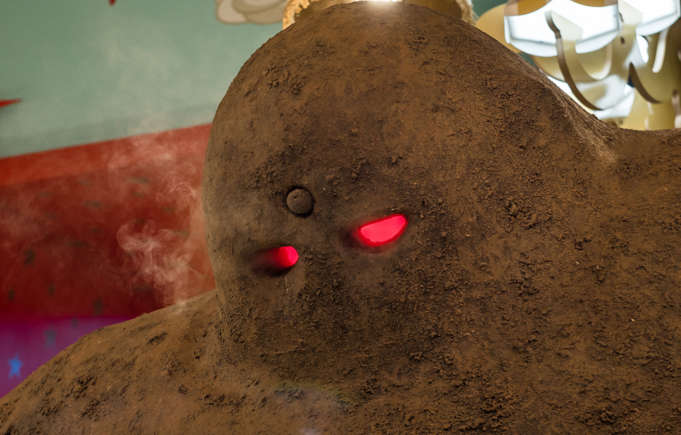
Of course, revising the dates of the cave art on Sulawesi raises new questions about what species of ancient hominin had actually served as the ancient artists in residence. According to most commonly accepted timelines, modern humans are believed to have left Africa as recently as 50,000 to 60,000 years ago, although possibly as early as 90,000 years ago.

Considering those nearer estimates for when these ancient migrations might have begun, it does raise questions about how likely it is that modern humans could have been present on Sulawesi by the time the newly redated cave art was produced. The earliest known modern human remains on the island date back to no earlier than 25,000 years ago, although evidence of human presence in the form of rock shelters and stone tool use has been found that suggests humans may have been there far earlier, even as much as 118,000 years ago.

While the possibility of modern humans arriving on the island that long ago presents a challenging question, there is little doubt that our ancient hominin cousins were present on Sulawesi by then. Past fossil discoveries have presented compelling evidence of the presence of hominins on the island as far back as 194,000 years ago.

CHALLENGING OLD THEORIES

While pushing back the timescales for the use of figurative art on the island of Sulawesi and raising questions about what species could have made it, the new findings also challenge past ideas that attribute the origins of such art to Europe toward the end of the Ice Age.

To figure out when the cave paintings were made, the team used a new technique to date calcium carbonate deposits that formed on top of the art.

To figure out when the cave paintings were made, the team used a new technique to date calcium carbonate deposits that formed on top of the art.

Dominic Julian/BRIN Google Arts

The team’s discoveries also suggest that it is possible humans may have been creating such art long before their arrival in Asia, if not even further back to times before modern humans are believed to have left Africa; a controversial possibility that some researchers, including British anthropologist Chris Stringer, have begun to propose in recent years.

However, if it were ever proven that some other hominin species had possessed the necessary cognitive development required to create figurative art so long ago, it would potentially upend our existing ideas about the capabilities of our early human ancestors and their hominin relatives.

At the very least, the authors concede in their study that the new findings suggest “a rich culture of storytelling developed at an early period in the long history of H. sapiens in this region — in particular, the use of scenic representation to tell visual stories about human-animal relationships.”

The new paper, led by Oktaviana et al. and titled “Narrative cave art in Indonesia by 51,200 years ago,” appeared in the journal Nature on July 3, 2024.

LINK VIDEO

{ https://thedebrief.org/category/science/ }

Hoe vind je dit bericht?
Geschreven door peter om 23:20 Stuur door

CHIMPANZEES ARE CAPABLE OF SPEECH, ACCORDING TO NEW ANALYSIS OF DECADES-OLD FOOTAGE

g61AsXXV?format=jpg&name=900x900

CHIMPANZEES ARE CAPABLE OF SPEECH, ACCORDING TO NEW ANALYSIS OF DECADES-OLD FOOTAGE

In 1962, many American moviegoers were treated to an unusual display during screenings of the popular Universal Newsreels that aired before feature presentations. That year, a segment entitled “Now Hear This! Italians Unveil Talking Chimp” was shown, introducing audiences to Renata, a chimpanzee who had reportedly been trained to say “mama” by her handler.

“As explained by her foster mother, this is one of the most extraordinary chimps in the world,” announcer Ed Herlihy’s famous voice could be heard saying in the decades-old footage. “You don’t have to know Italian to understand Renata’s accent when she gets her cue.”

Then, as Renata’s handler taps her on the chin, the chimpanzee is shown saying the word “mama” several times.

The footage, likely viewed as little more than a novelty at the time, represented something potentially extraordinary: evidence of a non-human primate displaying the ability to speak, albeit crudely. Despite Renata’s unique talent, the footage was largely forgotten, and prevailing wisdom continued to insist that humans were the only primates with the required neural circuitry capable of speech.

However, Renata was not the only known example of a chimpanzee who displayed a limited ability to learn and speak human words. Decades later, in a video uploaded to YouTube on August 17, 2007, a chimpanzee named Johnny was also shown saying “mama,” seemingly in response to requests from his owner, after which he was awarded a treat.

Now, an international team of researchers that reviewed the footage of Renata and Johnny have concluded that in at least three known instances, chimpanzees were indeed able to learn human words and exhibit limited speech capabilities.

“We recovered original footage of two enculturated chimpanzees uttering the word ‘mama’ and subjected recordings to phonetic analysis,” write the authors of a new study published in Nature: Scientific Reports by Axel G. Ekström and colleagues. “Our analyses demonstrate that chimpanzees are capable of syllabic production, achieving consonant-to-vowel phonetic contrasts via the simultaneous recruitment and coupling of voice, jaw and lips.”

In their paper, the researchers state that they conducted an online experiment in which participants were provided recordings of the utterances to listen to but were not told they were listening to chimpanzees. The participants “reliably perceived chimpanzee utterances as syllabic utterances, primarily as ‘ma-ma,’” the researchers write.

The researchers conclude that the vocal abilities great apes possess have largely been underestimated, writing that “Chimpanzees possess the neural building blocks necessary for speech.”

Great apes do not appear to display any signs of language use in nature, and it is noteworthy that Renata and Johnny appear to have learned their unique talents through human coaching. However, the findings are significant since they show that at least one nonhuman great ape species does possess the required neural components to facilitate speech, whether or not they utilize such faculties on their own in the wild.

Although speech is not an ability chimpanzees normally rely on, the same cannot be said of their overall ability to communicate. Recent studies have shown that chimpanzees frequently use gestures while communicating in a way similar to that of humans. In at least a few instances, chimpanzees have also shown a remarkable ability to understand human language. One notable example involves Kanzi, a bonobo who reportedly understands close to 3000 human words and has exhibited the ability to answer questions using a special keyboard that reproduces human words.

In their new paper, Ekström and colleagues note that past studies involving chimps and their ability to exhibit rudimentary speech had been largely dismissed due to lack of rigorous analysis. However, the new findings appear to support these previously unconfirmed observations, which have often cited words like “mama” as being among the ones most commonly learned by chimps.

Indeed, there could be more to the prevalence of this particular word in past studies involving chimpanzee speech. As the study’s authors note, “mama” is often among the first words human infants learn and may, in fact, have deeper roots as one of the earliest spoken language words ever created by humans.

“Accordingly, it has been argued that ‘mama’ may have been among the first words to appear in human speech,” the authors of the new study write.

“Our data complements this picture: chimpanzees can produce the putative ‘first words’ of spoken languages.”

The team’s new study, “Chimpanzee utterances refute purported missing links for novel vocalizations and syllabic speech,” was published in Nature: Scientific Reports on July 25, 2024.

{ https://thedebrief.org/category/science/ }

Hoe vind je dit bericht?
Geschreven door peter om 22:45 Stuur door

SR-91 Aurora: A Highly Classified American Aircraft

SR-91 Aurora: A Highly Classified American Aircraft

SR-91 Aurora: A Highly Classified American Aircraft

For decades, the US military has pursued the dream of dominating the skies with hypersonic platforms, a dream that China and Russia are also striving to become a reality. In this scenario of fierce competition, a disturbing question arises: is it possible that a Mach 5 aircraft, the mythical SR-91 Aurora, already existed and that its existence has been hidden from us?

The classified SR-91 Aurora project

Whispers about the Aurora, a supposedly classified hypersonic aircraft, have resonated in aviation circles since the 1980s. Yet evidence of this enigmatic triangular craft is as elusive as the wind. Is it conceivable that the United States not only managed to develop and operate a fleet of these aircraft at Mach 5+ during the 1980s but also kept this achievement in the shadows to this day? The truth could be more labyrinthine than we imagine.

SR-91 Aurora: A Highly Classified American Aircraft

The Pentagon, known for its “black programs,” has secretly funded the development of advanced technologies throughout history. Today, the most clandestine efforts are grouped under Special Access Programs, or SAPs, which restrict information to even those with the highest security clearances. Some of these recognized SAPs are never fully revealed, and others remain eternally anonymous.

After examining historical reports, declassified documents, testimonies and discussion forums, it is extremely unlikely that the United States has ever secretly operated a fleet of hypersonic aircraft. However, this does not rule out that such technological marvels have once touched the imposing doors of the hangars of Area 51.

Technology cost-benefit analysis for the SR-91 Aurora

It is vital to remember that there is a vast difference between technology that is mature and reliable enough for mass production and combat operation and that which, although within reach, is not sustainable from economic, resource or even political perspectives.

SR-91 Aurora: A Highly Classified American Aircraft SR-91

For example, the iPhone in your pocket is not necessarily the most advanced smartphone in the world; It is simply technology that can be mass-produced for a specific price and consumer. The latest communications technology would probably be much more expensive, potentially less reliable, and capable of leaving you in awe.

Aeronautical programs are advancing in a similar way: an extraordinary plane can be built for $2 billion, but that does not mean that mass production can begin immediately. Technology demonstrations, prototypes and limited production of exotic aircraft are a reality at facilities such as the Lockheed Martin plant in Palmdale or Area 51.

SR-91 Aurora: A response to the need to see without being seen

Sometimes, these efforts do not produce the expected results, are too costly, or require excessive maintenance. And sometimes, America‘s deepest secrets are buried in the desert, condemned to oblivion.

The SR-91 Aurora, if it ever existed, was conceived in response to a strategic need for aerial reconnaissance, a testament to the relentless quest for technological supremacy in a world where secrets and shadows play a crucial role.

Lockheed‘s SR-71 Blackbird, an unrivaled aerial beast and aviation’s fastest gem, laughed in the faces of more than 4,000 missiles with its dazzling speed during its golden era as a sky spy. This colossus, capable of challenging Mach 3 as if it were child’s play, made the most sophisticated surface-to-air missiles and elite fighters useless. So, when the Air Force decided to retire this very expensive technological marvel in the late 1980s, the world could only speculate: the United States must have something even more impressive in its arsenal.

It was not for less. The secret corridors of the Pentagon and Congress whispered about an heir to the Blackbird throne. But now, decades later, fact and fiction have become intertwined in a labyrinth of classified theories and programs, real or imagined, including those that may still lurk in the shadows.

Among whispers and rumors, there was talk of Aurora, a hypersonic, triangular plane taken from the bowels of science fiction, which seemed to be a first cousin of Lockheed Martin‘s SR-72 project, announced with great fanfare before this began. New era of hypersonic arms race.

Despite the rise of satellites, the need for aerial reconnaissance never died, as did the legend of the SR-71, which was even briefly resurrected in the 1990s to satisfy the hunger for aerial intelligence. The popular belief was that the Air Force would not let the SR-71 die without already having a worthy successor ready, warming up its engines in some secret location.

SR-91 Aurora: Many have followed its thread without finding its skein

And maybe they weren’t wrong. There are clues, threads of a larger plot, that point to evidence of an extraordinarily fast plane in those years, possibly related to Aurora.

In April 1992, on two separate occasions, journalist Steve Douglass, scanning the skies over Southern California, captured radio conversations that defied logic. A mysterious plane, with the callsign “Gaspipe,” coordinated with Edwards Air Force Base. The words captured by Douglass suggested that this craft flew at otherworldly altitudes and speeds. “You are at sixty-seven thousand [feet], eighty-one miles,” the controller indicated, and then, “Seventy miles, thirty-six thousand. Above the glide slope. Words that conjure images of a machine challenging the limits of the sky.

Was the SR-91 Aurora a real US military project?

There is no concrete evidence to confirm the existence of the SR-91 Aurora. Although it has been the subject of speculation and conspiracy theories, the lack of tangible evidence and the absence of official information suggests that it could be more of a myth or legend within the realm of military aviation.

What capabilities would a hypersonic aircraft like the SR-91 Aurora have?

If the SR-91 Aurora had existed, it is expected that it would have reached speeds exceeding Mach 5, which would have allowed it to perform reconnaissance and surveillance missions at extremely high speeds, making it difficult to detect and track by enemy air defense systems.

How is the SR-91 Aurora related to the SR-71 Blackbird?

The SR-91 Aurora is often considered the hypothetical successor to the SR-71 Blackbird, a spy plane that was a technological marvel of its time. It is speculated that the Aurora would have been designed to exceed the Blackbird’s capabilities, especially in terms of speed and operating altitude.

What advanced technologies would be expected on the SR-91 Aurora?

The SR-91 Aurora, had it been developed, would likely have incorporated advanced technologies such as high-temperature resistant composite materials, innovative propulsion systems to achieve hypersonic speeds, and stealth technologies to reduce its visibility to enemy radars.

Why do rumors about the SR-91 Aurora persist despite the lack of evidence?

Rumors about the SR-91 Aurora persist due to the public’s fascination with secret and advanced military technology. The story of the Aurora feeds into the culture of the Pentagon’s 

{https://militaryview.com/ }

Hoe vind je dit bericht?
Geschreven door peter om 22:32 Stuur door

SR-91 Aurora: The Hypersonic Enigma of the Skies

th?id=OVFT.B8IygMd_ay2ssIqq7mf4ui&pid=News&w=300&h=186&c=14&rs=2&qlt=90&dpr=1.3

SR-91 Aurora: The Hypersonic Enigma of the Skies

Story by Emily Davis

Not many aircraft in military aviation history have been shrouded in mystery and conjured as much speculation as the SR-91 Aurora. First appearing in the 1980s, “Aurora” was listed in a black program spy plane request, and ever since, this mysterious airframe has remained cloaked in secrecy. It was an attempt by military engineers to come up with a hypersonic plane design that would clock over Mach 5.0; no other aircraft has been reported to do so.

The SR-91 Aurora entered public awareness through the Los Angeles Times and Aviation Week & Space Technology reports in the mid-1980s. All the reports made the point that “Aurora” had been included inadvertently in the budget for 1995, which the U.S. government had submitted for “black aircraft production,” insinuating a clandestine project with funding greater than nearly $1 billion for the B-2 Spirit. By 1986, funding for the black project had swelled to about $2.7 billion, according to a procurement document obtained by Aviation Week.

In the 1980s, with the world’s fastest plane, the SR-71 Blackbird, reaching the end of its service life, a replacement had to be taken into consideration. That very impressive flying machine was powered by Pratt & Whitney J58 engines and represented an early effort at stealth design that could break Mach 3.2. According to analysts, the U.S. was capable of fielding a Mach 5.0 airframe and probably did so with the SR-91 Aurora.

Over the years, several reports and sightings have been viewed as a confirmation of the existence of the Aurora. One such sighting was reported by an engineer in 1989 over the North Sea, which claimed that the Aurora was a triangular-shaped aircraft. However, considering the speed at which the aircraft is supposed to fly, such sightings do not seem very credible. When the Aurora was supposedly flying, the Air Force’s B-2 bomber and F-117 Nighthawk were operational and would have accounted for the sightings.

In 2000, Nic Outterside of the Aberdeen Press and Journal cited anonymous sources that RAF/USAF Machrihanish in Kintyre, Argyll, served as a base for Aurora airframes. The long runways would be suitable for high-altitude experimental aircraft. More evidence appeared in the form of an answer to a parliamentary question in 2006 which stated that the British Ministry of Defense had been told by the United States that the U.S. Air Force had plans to produce a Mach 4.0-6.0 supersonic airframe, though no evidence conclusively proved that such a project existed.

So-called “sky quakes” over Los Angeles, first observed in the early 1990s, have also been attributed to the Aurora. In 1993, Bill Sweetman of Jane’s Defense Weekly reported that U.S. Geological Survey seismologists had recorded tremors consistent with a sonic boom from a high-altitude supersonic aircraft. These tremors were not in line with any known aircraft, suggesting something faster and more advanced.

Though countless claims and sightings have been made, the SR-91 Aurora has not been confirmed by U.S. officials. If it does exist, it would shatter the Blackbird’s speed record into minute pieces, truly heralding a new era in hypersonic flight.

The SR-91 Aurora has seldom failed to impress the imagination of aircraft enthusiasts and military analysts. From fact to fiction, and through internet myth, Aurora is what aerospace ambition and the mysterious represent.

{ https://www.msn.com/en-us/channel/topic/Technology/ }

{https://www.buzzhint.com/category/tech/}

Hoe vind je dit bericht?
Geschreven door peter om 22:24 Stuur door

SCIENTISTS PROPOSE CLEVER NEW STRATEGY FOR SPOTTING ALIEN WARP DRIVES THAT MAY BE LURKING IN THE COSMOS

NSfMTOfX?format=jpg&name=900x900

(Pixabay)

SCIENTISTS PROPOSE CLEVER NEW STRATEGY FOR SPOTTING ALIEN WARP DRIVES THAT MAY BE LURKING IN THE COSMOS

Warp drives, hypothetical propulsion systems that move spacecraft by compressing or “warping” spacetime around them rather than producing thrust like conventional engines, have long been the subject of ongoing research in physics. Although the concept has its roots in science fiction, many researchers over the last several decades have contributed to a growing realization that such technologies could actually work, at least in theory.

Now, a new study takes a novel approach to the conceptual study of warp drives: what might happen if such a futuristic propulsion system broke down? More specifically, the team involved with the study aimed to simulate key signatures—gravitational waves in this case—that would result from what they call warp drive “containment failure.”

WARP DRIVES IN SCIENCE FICTION

Although the warp drive concept was arguably made famous by its appearances in Star Trek, the idea has its origins much earlier. One of the earliest known fiction works to feature warp drive propulsion was a 1931 novel by John W. Campbell, Islands in Space. However, the term “space-warp drive” would not appear until almost two decades later in Fredrick Brown’s 1949 story “Gateway to Darkness.” Decades after that, the idea would also become a mainstay of interstellar transportation in the fictional universes of Star Trek, Star Wars, and other science fiction franchises.

Hypothetically, warp drive propulsion could actually exist, although bringing the technology to fruition would first require overcoming hurdles that include finding exotic sources of energy to power it, as well as relativistic issues that arise from implementing travel under such conditions.

According to Dr. Katy Clough of Queen Mary University of London, the lead author of the recent study, warp drives still look good on paper despite such problems.

“Even though warp drives are purely theoretical, they have a well-defined description in Einstein’s theory of General Relativity,” Clough said in a recent statement, “and so numerical simulations allow us to explore the impact they might have on spacetime in the form of gravitational waves.”

Through collaboration with gravitational physicists at Queen Mary University of London, the University of Potsdam, the Max Planck Institute (MPI) for Gravitational Physics in Potsdam, and Cardiff University, the international team used numerical simulations to examine the consequences of a warp drive breakdown.

Specifically, the team sought to explore the generation of gravitational waves such a “containment failure” would produce and whether signatures from such an event might be registered by Earth-based gravitational wave detectors.

Dr. Sebastian Khan of Cardiff University’s School of Physics and Astronomy and one of the paper’s co-authors, said it was “only natural that we carry on the tradition of warp drive research in the era of gravitational wave astronomy,” noting the early work in 1994 by Miguel Alcubierre, who is credited with constructing the first mathematical solution for warp drive physics while working on his Ph.D. at Cardiff University, after which he also worked at the MPI in Potsdam.

WARP DRIVE COLLAPSE

According to the team, when a warp drive collapses, it should produce gravitational waves, a form of energy-carrying wave generated under conditions where large amounts of mass are accelerated or disturbed, normally associated with celestial events.

On Earth, physicists have been studying gravitational waves since the first one was officially detected in 2015. Current research generally focuses on targets that include mergers between neutron stars, supermassive black holes, and other cosmic phenomena. According to the research team in their new paper, the breakdown of a warp drive would produce a noticeably different signature from these celestial sources of gravitational waves, resulting in a high-frequency burst.

Unfortunately, this quick gravitational burst would not register on detectors currently in use. However, this raises the intriguing question of whether warp drive transportation might produce perturbations in spacetime that might generate detectable signatures fairly often, at least if it were already in use by any spacefaring civilizations traversing the cosmos.

While no detectors capable of spotting these specific signatures presently exist, the technology required to build them does. This means that scientists might potentially be able to detect warp drives in use by alien civilizations, even if we are still a long way from harnessing the technology ourselves.

Dr. Khan notes that while the team’s study paves the way toward the detection of such hypothetical signals, it does not offer guidance on how prospective warp drive detectors might be built.

ENERGY DYNAMICS OF WARP DRIVE FAILURE

The researchers also explored the energetic aspects of hypothetical warp drive failure, revealing that a wave of negative energy matter would be released, after which alternating positive and negative waves would follow. The resulting net energy increase, the team says, might also produce a detectable signature.

“For me, the most important aspect of the study is the novelty of accurately modeling the dynamics of negative energy spacetimes,” Dietrich said, adding that the prospect of detecting signatures such technologies would produce might have other real-world applications.

Apart from the detection of advanced alien propulsion systems, Dietrich says the team’s findings could at least “help us better understand the evolution and origin of our universe, or the avoidance of singularities at the center of black holes.”

However, the team admits that detecting gravitational wave signatures from alien warp drives, while a far-fetched possibility, is nonetheless worth investigating.

“Even though we are skeptical about the likelihood of seeing anything, I do think it is sufficiently interesting to be worth looking at,” Dr. Clough said in a statement.

The team’s new paper, “What no one has seen before: gravitational waveforms from warp drive collapse,” appeared in The Open Journal of Astrophysics on July 25, 2024, and can be read in its entirety at the arxiv.org website.

{ https://thedebrief.org/category/space/ }

Hoe vind je dit bericht?
Geschreven door peter om 22:12 Stuur door

UFO ‘Sighting’ In Ibiza Goes Viral

UFO ‘Sighting’ In Ibiza Goes Viral

PEXELS: Grooveland Designs / Es Vedra island off the coast of Ibiza, Spain

KAY SMYTHE - NEWS AND COMMENTARY WRITER

Footage went viral Monday of an alleged UFO flying through the skies over Ibiza.

Video shared on Twitter shows a group of people sitting on what appears to be a cliffside during a gorgeous sunset on the Mediterranean island off the coast of Spain. A woman and whoever is filming then start running and pointing at the skies as a blurry white object flies over them.

The thing appears to hold still for a moment as it comes into focus … except, what you’re looking at isn’t a UFO. It’s the moon, shining brightly over the ocean. Things seem silly for a second. Then the reflection under the moon zooms off at speeds unknown in any type of human technologies.

I’ve seen my fair share of UFO videos in my life, but this one actually kind of freaked me out. 

It’s the type of click-baity stuff they show at the start of a found footage horror film. A woman appears to yell “Look! Look! Look!” while pointing at something in the skies. The group gasps in unison as the thing zooms off into the atmosphere. The clip has everything in the horror story recipe book.

So this is either one of the best staged UFO encounters ever … or its real.

{ https://dailycaller.com/ }

Hoe vind je dit bericht?
Geschreven door peter om 22:00 Stuur door

Psychologist Carl Jung’s Fascination with UFOs

Psychologist Carl Jung’s Fascination with UFOs

Some view Carl Jung as a UFO debunker, others as a UFO believer, but the truth is he was somewhere in the middle. Either way, it is certain that Jung was an avid UFO researcher and fascinated with the topic. He wrote a book about the psychological symbolism and the role the UFO mythos plays in the unconscious mind.  Moreover, on several occasions Jung complained that his studies would have been much easier if the UFO phenomenon was not real.

Jung the Psychologist

Jung was born in Switzerland in 1875. His father was a pastor in the Swiss Reformed Protestant Church, and his mother was from a wealthy Swiss family. He was the Jungs’ fourth child, but was the only child who survived into his childhood. As such, he grew up as an only child. Later, he wrote that he remembered enjoying his solitude.

His first experience with neurosis was at the age of twelve when a fellow student shoved him, causing him to fall and hit his head on the ground very hard. He remembered associating this experience with schoolwork, and whenever he had to go to school or do schoolwork he would faint. Overhearing his parents’ concern that this condition would cause him to be unable to support himself as an adult, Jung fought to overcome the problem and eventually returned to academics.

Although Jung had a profound interest in spirituality, his experiences triggered an interest in psychology and he decided to pursue a career in medicine. It wasn’t long before he realized that studies in psychology would allow him to combine his interests in medicine and spirituality, and in 1902, he completed his doctoral dissertation, which was titled “On the Psychology and Pathology of So-Called Occult Phenomena.” He graduated with a medical degree from the University of Basel.

After graduating, Jung went to work with psychiatric patients at the University of Zurich asylum. He wrote a paper on word association that he sent to Sigmund Freud. Freud was impressed with Jung’s work, and they quickly became very close. Freud considered Jung his successor. However, after several years, Jung began to develop his own ideas beyond the work of Freud, and due to their disagreements, the relationship turned adversarial.

Carl Jung (bottom right), Sigmund Freud (bottom left), and others at a 1909 celebration of the founding of Clark University, Worcester, Massachusetts. Credit: Library of Congress

Freud’s work with the ego and unconscious served as a foundation for Jung’s work. They both felt that disconnects between the conscious and unconscious minds caused neurosis in people. They also both relied on dream interpretation to explore a person’s unconscious mind as a method for subsequently resolving neurosis. In fact, one story holds that Jung and Freud interpreted each other’s dreams and both completely disagreed with the other’s analysis, thus hastening the dissolution of their friendship.

A major area of disagreement between the two was that Jung did not believe a person’s unconscious was driven solely by sexual desires, as Freud did. Jung believed other strong emotions such as fear and aspiration were just as influential. He also conceived of a deeper level of the unconscious called the collective unconscious, which he believed is a part of our unconscious mind that holds ideas and concepts shared by all humankind. He believed these base ideas are then shaped by our cultural perceptions and personal experience. For example, we all have ideas around the notions of mothers, fathers, wise elders, etc. Jung called these shared notions archetypes. Jung felt that these archetypes not only would manifest in dreams, but could be seen in people’s creative works and behavior, including art, religion, and mythology.

Jung’s contributions to psychology are numerous. Even today his ideas of extraversion and introversion are a mainstay in personality psychology. He also came up with the idea of psychological complexes and synchronicities. All of these ideas and terms are commonly used in everyday conversation today, and all were made popular by Jung.

Jung and Alchemy

It is the idea of the archetype that brought Jung to have a particular interest in UFOs. When Jung interpreted psychological meaning he would search for archetypal figures. As mentioned earlier, such figures could be a mother or father.  But, in a mythological story, the archetype may be the hero, a dragon, or even a planetary entity such as the sun. However, Jung also had an interested in alchemy.

Alchemy is typically connected to legends of ancient mystics attempting to unravel the secret of turning lead into gold. The work of alchemists is credited with the development of modern chemistry. However, another side of alchemy is spiritual in nature, relating to personal transformation. Jung had a passion for alchemy in this sense, and felt that the metal lead was a metaphor for an impure soul, whereas gold was a metaphor for a perfected soul. Jung’s interest in alchemy was thus as a method of purifying the soul.

The Tabula Smaradina (Emerald Tablet), a print by Mathias Merian from the 1600s displaying alchemical symbols and imagery. Credit: Mathias Merian

Jung wrote a couple of books focused on interpreting alchemical symbolism and processes as different stages of personal growth that mirrored his ideas. He felt these symbols were archetypes that were unconsciously manifesting in the work of alchemists. Although he acknowledged the physical goals of alchemy (an attempt to transmute lead into gold), Jung did not give it much attention in his writing and focused on the non-physical aspects that related to his psychological theories. This is very similar to the way he approached the topic of UFOs.

Jung and UFOs

In 1951, Jung wrote to a friend in the United States: “I am puzzled to death about the phenomena, because I haven’t been able yet to make out with sufficient certainty whether the whole thing is a rumour with concomitant singular and mass hallucination, or a downright fact.” 

Jung-Flying-Saucers-CoverBook cover to Jung’s Flying Saucers: A Modern Myth of Things Seen in the Skies. (Credit: Princeton University Press.)

Although Jung showed an interest in the mystery of the physical reality of the UFO phenomenon, professionally he stated, “As a psychologist, I am not qualified to contribute anything useful to the question of the physical reality of Ufos.” However, Jung could contribute by analyzing the unmistakable psychological side to the UFO phenomenon. In 1958, several of Jung’s papers regarding the psychology of UFOs were published in a book. It was originally published in German, but in 1959 it was translated to English under the title, Flying Saucers: A Modern Myth of Things Seen in the Skies.

In the book, Jung argued that although there may be a physical reality to UFOs, there is certainly a portion of the phenomenon that is fantasy. He examined the difficulty many have in accepting fantastical stories of UFOs, even when they come from pilots, and points out, “What is worse, most of the stories come from America, the land of superlatives and of science fiction.”

For the sake of argument, and to examine the psychological aspects of the phenomenon, Jung presumed that UFOs are fantasy. This is an important aspect that many critics overlook when they characterize Jung as dismissive of the phenomenon altogether. UFO researchers also tend not to appreciate the portions of Jung’s book in which he examined the UFO phenomenon in regards to archetypal imagery and alchemic symbolism. Jung himself assures his readers that although his work may appear to be “unbridled fantasy” to those unfamiliar with psychology, it is actually based on “thorough research into the history of symbols.”

In his book, Jung observed that most UFO sightings describe the objects as disc shaped, which is a symbol that is often seen in alchemy and existed in the mythology of other cultures. For example, the Hindu and Buddhist symbol of the mandala is a circular disc-shaped symbol. Jung believed that the mandala is a protective sphere, which is elicited in the unconscious in times of emotional tension. Jung noted that, around the time of many of the UFO sightings, the world was under a collective stress due to “Russian policies and their still unpredictable consequences.” In short, he felt that perhaps UFOs were appearing in visions at the time because of the world’s Cold War jitters, and that the UFOs were a manifestation of a need for protection and salvation.

Jung’s book also provided detail of the analysis of particular sightings and art. One of the significant contributions to ufology made by the book is a focus on two historical broadsheets, a type of ancient newspaper, that recorded mysterious apparitions that many have speculated to be UFO related. Although Jung asserted that these reports were in the UFO literature prior to the publication of his book, Jung clearly made them popular as potential ancient UFO sightings.

The first is referred to as the Basel Broadsheet, and it dates back to 1566. It was written by Samuel Coccius and is a report of “many large black globes” that were seen flying in front of the sun “with great speed.” The Basel Broadsheet notes, “Some of them became red and fiery and afterwards faded and went out.” Jung noted the similarity of this phenomenon to modern UFO accounts.

The Basel Broadsheet from 1566 analyzed by Carl Jung in his Flying Saucer book. Credit: Wickiana Collection, Zentralbibliothek Zürich

The second report is called the Nuremberg Broadsheet and dates back to 1561. This report chronicles a “very frightful spectacle” that was witnessed by several people. Again, “globes” were seen near the sun, “some three in a row, now and then four in a square, also some standing alone.” There were also “two great tubes.” Jung noted that in UFO literature large tubes are considered “motherships,” and have been reported to have smaller discs that appear to fly out of them.

The Nuremberg Broadsheet from 1561 analyzed by Carl Jung in his Flying Saucer book. Credit: Wickiana Collection, Zentralbibliothek Zürich

The Physical Reality of UFOs

In his book, Jung also examined the possibility of the physical reality of UFOs. He noted that, “unfortunately,” UFOs cannot be dismissed as purely psychological in nature. He pointed to numerous sightings, some of which have been caught in photographs and on radar. Jung even poked fun at astronomer Donald Menzel, a UFO debunker, saying that he “has not succeeded, despite all his efforts, in offering a scientific explanation of even one authentic UFO report.” 

Jung was well-versed on UFO research. He wrote, “since 1947 I have collected all of the books I could get a hold of on the subject.” He was also a member of the National Investigations Committee on Aerial Phenomena (NICAP), an early civilian UFO organization that included many credible members. In fact, in his book, Jung often referred to the work of Major Donald Keyhoe, a cofounder and director of NICAP.

Prior to releasing his book, Jung was considered by UFO researchers to be a proponent of the physical reality of UFOs. In 1955, he wrote an article on UFOs for a British journal called the Flying Saucer Review. In the article, Jung stated that he had never seen a UFO himself, but that “I can only say for certain: these things are not a mere rumour: something has been seen.”

He went on to argue that the U.S. Air Force “despite its contradictory statements,” considers the phenomenon to be real and they conduct official investigations. He warned that, by concealing information on the topic, the military is making it more likely that people will panic since the public is denied “an adequate picture of what is happening.”

Jung also stated that “the ‘disks’ (that is, the objects themselves) do not behave in accordance with physical laws, but as though without weight, and they show signs of intelligent guidance, by quasi human pilots, for their accelerations are such that no normal human could survive.”

Not much was made of Jung’s 1955 article until it was reprinted in 1958 by the Aerial Phenomena Research Organization (APRO) in the organization’s bulletin in July 1958. APRO posted the story as part of an announcement that Jung had agreed to become an official consultant for the organization. The New York Herald Tribune quickly picked up on the report and printed a story with the headline, “Dr. Jung Says ‘Flying Disks’ Suggest Quasi-Human Pilots.”

APRO Bulletin from July, 1958 with reprint of Jung’s article on UFOs. Credit: APRO

Jung was not happy with the implication that he believed UFOs represented a physical phenomenon and later wrote a letter to United Press International news agency clarifying his position. He wrote: “I expressly state that I cannot commit myself on the question to the physical reality or unreality of the UFOs since I do not possess sufficient evidence either for or against.” He then stated, “Something is seen, but it isn’t known what.” Jung later repeated this statement in his 1958 book and in several letters.

Although Jung was clearly embarrassed by the public perception that he conclusively believed flying saucers were physical in nature, he later reiterated his prior statements and earlier criticisms of the U.S. Air Force’s handling of the matter in very strong words. He wrote:

In spite of the fact that I hold my judgment concerning UFOs—temporarily let’s hope—in abeyance, I thought it worthwhile to throw a light upon the rich fantasy material which has accumulated round the peculiar observations in the skies. Any new experience has two aspects: (I) the pure fact and (2) the way one conceives of it. It is the latter I am concerned with. If it is true that the [American Air Force] or the Government withholds telltale facts, then one can only say that this is the most unpsychological and stupid policy one could invent. Nothing helps rumours and panics more than ignorance.

It is no wonder that many have been confused as to Jung’s official stance on UFOs. He seems to have believed the phenomenon and sightings to be real, but is uncertain whether UFOs are a physical reality or are limited to a psychological phenomenon. He stated that although “by all human standards it hardly seems possible to doubt this any longer,” in the decade or more he had been studying the topic, neither he nor anyone else seems to have learned much from the study of the physical aspect of UFOs. Jung said that this is precisely why he found it much more fruitful to study the psychological aspects of UFOs, an area in which he felt he had gained an abundance of knowledge.

Jung may be right. Concrete physical proof of UFOs continues to elude us to this day. Yet, Jung is another example of a luminary who garners a great amount of respect in his field of study, who also had the vision to seriously consider the UFO phenomenon. His UFO interest is a story that should not be forgotten, and his insights into the phenomenon may help guide us today, just as his insights into the human mind continue to be a part of the bedrock of modern psychological understanding.

  • A version of this article originally appeared in Open Minds UFO Magazine. Back issues can be found here.

{ https://openminds.tv/category/articles/ }

Hoe vind je dit bericht?
Geschreven door peter om 21:46 Stuur door

Leaked UFO video captured by Homeland Security analyzed

Leaked UFO video captured by Homeland Security analyzed

A group of UFO researchers with backgrounds in science have come together to analyze an alleged UFO video they have confirmed comes from the Department of Homeland Security (DHS). The object in the video was captured by a thermal imaging camera on a DHS aircraft, and according to the researchers, it exhibits characteristics that cannot be explained by any known aircraft or natural phenomenon.

The video is overlaid with the sort of telemetry one would expect from a military or law enforcement thermal image video. It shows an object apparently moving very quickly over land and then into the ocean. It seems to be tumbling or changing shape. It moves over buildings, through trees, and eventually over the ocean. Then things get weird. The object appears to go in and out of the ocean without slowing down, and at the end of the video is either joined by another object or breaks in two.

All of the primary witnesses have requested anonymity. However, several communications from alleged DHS employees indicate that the video caused quite a stir on the base.

A still from the video in which the unknown objects appears to be flying through trees. A still from the video in which the unknown objects appears to be flying through trees.

Research on the video began when an acquaintance to the pilot of the aircraft that captured the video contacted Daina Chaviano, a famous Cuban-born fantasy and science fiction author. She is also a volunteer with the Mutual UFO Network (MUFON) in Florida, where in her spare time she investigates UFO reports. She took the UFO case to her colleague, Morgan Beall, who runs the Florida MUFON chapter.

Chaviano and Beall were so impressed by what they saw they assembled a small group of skeptical researchers with backgrounds in various fields of science and technology. The pilot’s acquaintance requested strict control of the information provided and that knowledge of the investigation be limited to a very few people, so until now, the researchers have not shared any information regarding their investigation.

Today, the group released a 161-page report detailing their findings.

Aguadilla The object was filmed over Rafael Hernandez Airport in Aguadilla, Puerto Rico. (Credit: Google Maps)

They are vague when it comes to the identity of Chaviano’s informant. They say this person and others who provided information wanted to remain anonymous “to ensure no issues arise with the source’s employers.”

However, the group says: “The source of this video evidence was vetted and identified.”

They say they are absolutely certain that the information comes from sources on board the DHS aircraft and the video is genuine. Their investigation also confirmed what they were told.

Their sources told them that the UFO incident began at about 9:20 pm on the evening of April 25, 2013 at the Rafael Hernandez Airport in Aguadilla, Puerto Rico. It involved the crew of a DHC-8 Turboprop aircraft from U.S. Customs and Border Protection (CBP), a division of DHS.

A U.S. Customs and Border Protection Bombardier DHC-8Q200. (Credit: U.S. Customs and Border Protection) A U.S. Customs and Border Protection Bombardier DHC-8Q200. (Credit: U.S. Customs and Border Protection)

The DHC-8 took off on a routine flight and soon after takeoff they noticed “a pinkish to reddish light over the ocean that was in their vicinity and approaching toward the south.”

The crew was concerned the tower had not told them about the incoming traffic, so they called it in. The tower told them they also had a visual on the object, but they were unsure of its identity.

Once the object got close to land, its lights turned off, but at this time the DHC-8 was able to begin tracking and filming the object with their onboard thermal imaging system. The DHC-8 did not approach the object, but circled the area and filmed it.

The DHC-8 did not pick up the object on radar. However, their radar was looking downward to track ships on the ocean, not objects in the sky.

According to the source, a flight was delayed by the presence of the object. The research group was able to confirm from airport records that a FedEx flight scheduled to leave at 9:10 pm was delayed until 9:26 pm.

Image of the flight log from the UFO reporting showing the a delayed flight at the time of the UFO event. (Credit: SCU) Image of the flight log from the UFO reporting showing the a delayed flight at the time of the UFO event. (Credit: SCU)

The researchers also confirmed the flight time and path of the DHC-8 via radar data they obtained from a Freedom of Information Act Request to the U.S. Air Force 84th Radar Evaluation Squadron (RADES) group. The radar data confirmed that the DHC-8 took off at approximately 9:16 pm and circled the airport twice before leaving the area about 10 minutes later.

Flight path of the DHC-8 according to the radar data obtained via a Freedom of Information Act Request. (Credit: SCU) Flight path of the DHC-8 according to the radar data obtained via a Freedom of Information Act Request. (Credit: SCU)

The researchers note that there was an unknown object or objects tracked on radar a few minutes prior to the DHC-8’s take off,  but it is not known for certain that this was the same object that was later caught on video. The unidentified radar strikes were just off the shore to the north and northwest of the airport and lasted about 16 minutes from 8:58 pm to 9:14 pm.

When reading the times, the radar data is presented in a different time zone than the local times. The researchers explained this on their website: “Aviation times reflect  Zulu time which corresponds to Greenwich Mean Time (GMT). The video displays the Zulu time April 26th at 1:22 AM at the top left of the initial frames. Converting this Zulu time to Puerto Rico’s local time gives April 25th at 9:22 PM. Puerto Rico uses  Atlantic Standard Time and does not use daylight savings time.”

Radar data showing the flight path of the DHC-8 and the unknown radar hits between 8:58 pm to 9:14 pm. (Credit: SCU) Radar data showing the flight path of the DHC-8 and the unknown radar hits between 8:58 pm and 9:14 pm. (Credit: SCU)

The research group also thoroughly analyzed the video to determine the nature of the object in the film. They consulted thermal imaging experts to determine the capabilities of the system used for the filming, and broke the film down frame by frame to determine the object’s approximate size, speed, temperature and flight path.

The video (seen at the top of the story) is just under 4 minutes long, but the unknown object was tracked for about 2 1/2 of those minutes. Although it was difficult for the group to calculate the exact location of the object on the first half of its flight, they are confident of its position in the second half.

They have determined that the object came in from the ocean, from the north or northwest of the airport’s airstrip, and then flew over the airstrip, then turned back to the north and headed back out into the ocean.

Estimated flight path of the unknown object. The smaller lines estimate the path of the object in the first part of its flight. The thicker line shows the second half of the flight. The researchers are more confident of the location of the object during the second half. (Credit: SCU) Estimated flight path of the unknown object. The thinner lines estimate possible paths of the object in the first part of its flight. The thicker line shows the path the researchers believe is most likely. The researchers are more confident of the location of the object during the second half of its flight. This data corresponds with what the SCU researchers found. (Credit: SCU)

During this time the DHC-8 was circling the airport. As can be seen in the map created by the researchers, the aircraft was moving along the shore, turning to the south, and eventually lost site of the object over the ocean as they continued south.

The flight path of the DHC-8 during the filming of the unknown object. (Credit: SCU) The flight path of the DHC-8 during the filming of the unknown object posted on Reddit by an anonymous user. This path was calculated using the data in the video. It is marked “heli,” because the Reddit user believed the aircraft to be a helicopter and was unaware it was a DHC-8.

The report states: “The object was between three to five feet in length and its speed varied between approximately 40 mph to 120 mph. Its median speed was roughly 80 mph.”

The report goes on to note that an interesting characteristic at the end of the flight was when it apparently submerged into the ocean, traveled for over half a mile, and then flew back out.

According to the report: “Its speed through the water reached a high of 95 mph and average 82.8 mph.”

The unknown object returning to the ocean. The unknown object returning to the ocean.

One suggestion has been that the object was merely a balloon. However, the researchers reject this idea for several reasons. They say the wind speeds at the time were 8 to 13 mph at ground level and 12 to 18 mph at 400 to 3200 feet. This means the object was moving too fast to be carried by wind currents. It also changed directions from heading south back to the north, and it went underwater with minimal loss of speed.

Another possibility is that the object was actually a bird. The object appears dark on the screen, and for this type of thermal imaging that would mean it was warmer than the ambient air. This is how a bird would appear. However, the researchers note that the object was moving much too fast to be a bird. They note that peregrine falcons, which do occasionally visit Puerto Rico, have an average horizontal speed of 40 to 56 mph, and a maximum of 65 to 69 mph.

The researchers also examined the possibility that the object was a drone. Their research did discover that the Navy is working on a drone that can fly through the air and dive into the ocean and become a submarine. It is called a “Flimmer.”

They found that current Flimmer drones have not been tested underwater and have an airspeed of 68 mph. They also noted that the fastest known underwater battery powered torpedo travels at 50 mph.

The researchers do acknowledge that it could be possible that the Navy is secretly testing a Flimmer drone that is much more advanced. However, they question why the military would so recklessly test it over a civilian area and airport runways.

In conclusion they state: “There is no explanation for an object capable of traveling under water at over 90 mph with minimal impact as it enters the water, through the air at 120 mph at low altitude through a residential area without navigational lights, and finally to be capable of splitting into two separate objects. No bird, no balloon, no aircraft, and no known drones have that capability.”

A still image from the video just after the object apparently slit into two separate objects. A still image from the video just after the object apparently split into two separate objects.

They do not profess to know what the object was, and they welcome “reasonable” suggestions.

However, as to be expected, there are those who have suggested that “they know” the object is extraterrestrial in nature, and at least one of those suggestions has come from an anonymous source who has intimate knowledge of this event.

An anonymous letter was sent to one of the researchers that is very similar to one that was sent to John Greenewald, owner of the website TheBlackVault.com. The only thing Greenewald knew about the video was related to a low resolution copy that was leaked to a Puerto Rican UFO researcher. Many assumed the video was taken from a helicopter.

The letter references the exact type of thermal system and aircraft that was used to capture the video. The message was accompanied by a high resolution version of the thermal video, which was then posted on YouTube by Greenewald. The anonymous letter states: “Alien technology is no doubt under the ocean near Puerto Rico!”

Is alien technology being demonstrated in this video? This careful report, which the researchers say took over 1000 man hours to complete, indicates that whatever took place, it is certainly unusual. The entire report is 161 pages long, and thoroughly explains their work, and how they came to the conclusions they did.

The report on the Puerto Rico incident can be found at ExploreSCU.org. Click the image to go there. The report on the Puerto Rico incident can be found at ExploreSCU.org. Click the image to go to the site.

Even if the report had come to a mundane conclusion, the effort put into the investigation is remarkable. However, the fact that they could not determine what the object was, and have determined that it displayed characteristics that cannot be explained, makes the report remarkable.

Robert Powell, a retired engineer who worked in the semiconductor industry, who helped author the research paper, says although they have finally released their report, “work on this video will continue.”

Powell, Beall, Chaviano, and the rest of the researchers working on the report posted a high resolution version of the video, their report, and an animation of the radar data they obtained on a website called the Scientific Coalition for Ufology.

Powell says they have reached out to other scientific organizations that have shown an interest in the UFO phenomenon,  including 3AF Sigma2, a group that is part of the French National Aeronautical and Astronautical Association. The French scientists have agreed to review their work and provide input.

Powell says, “We hope that this report will generate ideas and thoughts from other scientists that may provide more insight into the characteristics of the object seen in the video.”

  • To download the report, view the video, and find out more about the investigation, visit: ExploreSCU.org.

{ https://openminds.tv/category/articles/ }

Hoe vind je dit bericht?
Geschreven door peter om 21:46 Stuur door

The disappearance of the UK’s “most spectacular” UFO photo

The disappearance of the UK’s “most spectacular” UFO photo

Hanging on the wall near the British government’s UFO Desk was what one of the men who occupied that desk called “the most spectacular UFO photo ever sent to the Ministry of Defence (MoD).” The photo has since disappeared, but the story of how the picture was obtained, and what it showed, has not.

Nick Pope ran the MoD’s UFO project from 1991 to 1994. When he was first assigned to the position, he was not excited about it. He felt the issue was ridiculous and he was not looking forward to having to deal with a bunch of UFO nuts. However, over the years, Pope found there were credible cases of incredible things, and began to see there was something truly mysterious about the phenomenon. One of the cases that lead him to this conclusion had to do with a photo that was made into a poster that he found hung in the office near his desk when he began working the UFO desk.

A recreation of the Calvine UFO photo poster. (Credit: Channel 5) A recreation of the Calvine UFO photo poster. (Credit: Channel 5)

“I first came across this story in 1991, when I joined the UFO project,” writes Pope on his website. “A poster-sized enlargement of the best  photo was prominently displayed on the office wall.”

“The X-Files first aired in the UK in 1994 and I acquired the same nickname (Spooky) as Fox Mulder, for obvious reasons,” Nick continues. “Mulder famously had his ‘I want to believe’ UFO poster on his office wall and though uncaptioned, I suppose this was my equivalent.”

The photo showed a picture of a large diamond shaped craft with a jet in the background. When he asked about the photo, Pope was told that they had officially determined the image was real. They estimated the craft to have been 25 meters (over 80 feet) in diameter.

However, if asked, they were instructed to answer, “no definite conclusion had been reached regarding the large diamond-shaped object.”

Pope learned that the object had been photographed on August 4, 1990. Two people had been walking near the town of Calvine in Scotland when they spotted the large diamond-shaped object. They described the object as looking metallic. It sat in one position, hovering silently for several minutes before taking off vertically at, as Pope writes, “a massive speed.”

During the sighting, the witnesses also saw a military aircraft that they thought might be a harrier jet, but they were unsure whether the jet was escorting the craft, chasing it, or whether the jet pilot was even aware of the diamond-shaped UFO.

The witnesses had taken several photographs and sent them to the Scottish Daily Record newspaper. The paper contacted the MoD, and the MoD was somehow able to convince the paper to hand over the photographs along with the negatives.

” The photos were then sent to the Defence Intelligence Staff (DIS) who then sent them on to imagery analysts at JARIC (Joint Air Reconnaissance Intelligence Centre). Yet at the time, MoD hadn’t even publicly acknowledged that there was any intelligence interest in UFOs at all,” Pope explains.

“We implied and sometimes stated that we didn’t ‘investigate’ UFOs, but merely ‘examined sightings to see if anything reported was of any defence interest’ – as if the two were somehow different!”

Pope say the MoD was actually very interested in these cases, but often less interested in where the craft came from than what they could learn from it. They had hoped to identify some sort of technology they would be able to appropriate.

Nick Pope, former MOD UFO investigator, at the International UFO Congress. (Credit: Peter Beste/Open Minds)Nick Pope, former MOD UFO investigator, at the International UFO Congress. (Credit: Peter Beste/Open Minds)

Either way, the Calvine UFO photos impressed the UFO desk investigators enough that they hung the poster in the office.

“At one particularly surreal briefing on the UFO phenomenon my DIS opposite number indicated the photo and pointed his finger to the right: ‘It’s not the Americans’, he said, before pointing to the left and saying ‘and it’s not the Russians.’ There was a pause, before he concluded ‘and that only leaves …’ – his voice trailed off and he didn’t complete the sentence, but his finger was pointing directly upwards,” recalls Pope.

The office where the UFO desk was located also housed other non-UFO related projects.

Pope says the reaction of some colleagues who came to visit unaware of the UFO program had amusing reactions to the poster.

Pope writes, “You’d have this surreal moment when they’d stop mid-sentence, stare at it, point and say ‘what the hell’s that?’ – this wasn’t the archetypal distant, blurred UFO photo. This was up close and personal, reach out and you can touch it stuff. ‘I don’t know what it is, but it’s not one of ours’ was our stock answer to the inevitable question.”

Eventually, around 1994, Pope says his superior determined the craft was a secret American aircraft or drone. Pope says they had already asked the U.S. if the craft or something similar of theirs was being tested over the UK, and were told they were not. Pope believes his boss had decided to support a potential cover-up by the Americans and the MoD and removed the poster. It was never to be seen again.

Although Pope has discussed these photographs in the media and has posted an article on his website, no one has come forward to claim they took the photos. Nor has anyone at the Scottish Daily Record come forth to discuss any involvement. The case remains a mystery.

{ https://openminds.tv/category/articles/ }

Hoe vind je dit bericht?
Geschreven door peter om 21:21 Stuur door

AI Sharpened Image of Purple UFO! May 18, 2004 - Provo Canyon, Utah, USA, UAP Sighting News.

AI Sharpened Image of Purple UFO! May 18, 2004 - Provo Canyon, Utah, USA, UAP Sighting News.

UAP,%20%E0%A4%89%E0%A4%AB%E0%A5%8C%20,%20%E0%A6%87%E0%A6%89%E0%A6%8F%E0%A6%AB%E0%A6%93,%20%C4%91i%CC%83a%20bay,%20MUFON,%20%E7%9B%AE%E6%92%83%E3%80%81%E3%82%A8%E3%82%A4%E3%83%AA%E3%82%A2%E3%83%B3,%20%20UFO,%20UFOs,%20%D0%9D%D0%9B%D0%9E%20,%20NLO,%20sighting,%20sightings,%20alien,%20aliens,%20ET,%20anomaly,%20anomalies,%20ancient,%20astrobiology,%20vreemdelinge,%20%203%20copy%205.png
Hey all, I wanted to check out this UFO photo from back in 2004 in Utah, because so many people tried to claim that it's a bird. So much disinformation trying to confuse the public and distract them from the truth out there. So...I used ai to correct the photo and sharpen it and it's clearly a purple triangle UFO over the mountains of Provo, Utah. In this video below...I debunk the debunkers. This is 100% proof that it's not a bird, it's a UFO. 
Scott C. Waring...winning. 

{ https://www.ufosightingsdaily.com/ }

Hoe vind je dit bericht?
Geschreven door peter om 21:14 Stuur door

Wat is zand en waar bestaat het eigenlijk uit? Het zijn niet alleen stenen

Wat is zand en waar bestaat het eigenlijk uit? Het zijn niet alleen stenen

Janine imageDoor Janine

Unsplash

Of je het nu vindt op een strand, in de woestijn of als onderdeel van de regen, zand is enorm wijdverspreid in onze wereld. Maar ondanks het feit dat het veel gebruikt wordt en aanwezig is in onze samenleving, weten maar weinig mensen wat zand eigenlijk is en waar het van gemaakt is. Kortom: wat is er nog meer dan de zeer bijzondere consistentie en korreligheid ervan? En is dat echt zand in de regen? Laten we het samen ontdekken!

Wat is zand?

Zand is niets meer dan een sedimentair gesteente, dat wil zeggen gevormd door erosie van verschillende soorten gesteente en de resulterende korrels. Het is een lang en continu proces dat leidt tot het ontstaan van zand in verschillende soorten en kleuren. Om te begrijpen wat zand is, moeten we beginnen met hoe het wordt gevormd:

  • Erosie van gesteenten en mineralen. Dankzij de werking van regen en wind worden de rotsen van een specifieke plaats na verloop van tijd geërodeerd en vallen ze uiteen. De minerale fragmenten die uit dit proces voortkomen, vormen het zand dat we kennen
  • Ophoping van riviersedimenten. Rivieren transporteren mineralen, organische resten, puin, enzovoort naar de zee. Al deze materialen worden onderweg geërodeerd en blijven dat ook, zelfs als ze eenmaal door zeestromingen langs de kusten worden verspreid.
  • Hypersaline neerslag. Naast erosie en de ophoping van sedimenten kan er ook zand ontstaan ​​door een hoge concentratie aan ionen en sterke verdamping, wat leidt tot het ontstaan ​​van hypersaline regen waarbij het zand op de grond “neerslaat”.

Zoals je kunt zien, zijn er verschillende processen die leiden tot de vorming van zand. Gedeeltelijk verklaren ze al waarom niet al het zand hetzelfde is, uitgaande van de kleur: er is bijvoorbeeld zwart vulkanisch zand en wit atolzand. Maar waar bestaat zand uit?

Waar bestaat zand uit?

Unsplash

Gewoon zand bestaat grotendeels uit silicium, in de vorm van mineralen zoals kwarts en graniet. Daarnaast zijn veldspaat, die een groot deel van de terrestrische en oceanische korst uitmaken, ook wijdverspreid in licht zand. In het donkere zand zijn echter ook grote hoeveelheden hematiet, granaat en magnetiet te vinden. Met name dit laatste mineraal is verantwoordelijk voor het “magnetische” zand dat vaak door regen wordt meegebracht.

Op basis van wat we hebben gezien, kunnen we daarom zeggen dat zand een verzameling mineralen van verschillende aard is in zeer kleine korrels, tussen 0,06 en 2 millimeter. Het is echter niet zeker dat alle mineralen waaruit het zand bestaat uit stenen afkomstig zijn: het witte zand van de Caribische eilanden bestaat ook uit microscopisch kleine resten die zijn verkregen door de erosie van schelpen en andere mariene organismen. Hun samenstelling bevat mineralen, die vervolgens bijdragen aan de vorming van dit specifieke zand.

Hoe is de samenstelling van zand in regen?

Zoals we al zeiden, kan zand ook bestaan ​​uit de minerale overblijfselen van sommige mariene organismen, waardoor het zijn karakteristieke witte kleur krijgt. Toch kunnen we ook iets soortgelijks zeggen over het zand van de Sahara, oftewel hetzelfde zand dat in sommige mediterrane landen na regen vaak op auto's blijft liggen. Het is slechts gedeeltelijk zand zoals we het tot nu toe hebben begrepen, omdat het in werkelijkheid is samengesteld uit de fossielen van vele microalgen die duizenden jaren geleden in een Afrikaans meer leefden.

Misschien weet niet iedereen dat de Sahara nog maar een paar duizend jaar een woestijn is, en dat het daarvoor de kenmerken had van prairies en savanne. In een van de meren in het gebied bevonden zich eencellige algen, diatomeeën genaamd: zodra ze gefossiliseerd waren na de vorming van de woestijn, vormden ze diatomeeënstof dat door de wind wordt getransporteerd en in de regen terechtkomt.

Zand is immers een overkoepelende term die we aan veel verschillende materialen geven en, specifieker, aan een heel specifieke korrel. Of het nu gemaakt is van kwarts of magnetiet, schelpen of gefossiliseerde algen, het is een fundamenteel materiaal voor onze hedendaagse samenleving. En niet alleen op het strand.

{ https://www.curioctopus.nl/ }

Hoe vind je dit bericht?
Geschreven door peter om 21:09 Stuur door

Do Biological UFOs Come from Other Dimensions or Parallel Realities?

Do Biological UFOs Come from Other Dimensions or Parallel Realities?

In an article posted on January 27, 2018, we discussed Biological UFOs, showcasing many images of different types of biological entities such as zeroids, archons, ebani and flying rods. 
biological%20UFOs%20(1).png
Image s some of the biological UFOs taken from our 2018 article
Now, the theory that some UFOs may be biological entities, which may populate the recesses of free space, possibly originating from another dimension, is not a new one. 
biological%20UFOs%20(3).png
Video on Youtube: Astronauts report squid-like entity floating in space
Jacques Vallée, a renowned computer scientist and ufologist, proposed a theory that UFOs and related phenomena might be manifestations of beings from other dimensions or parallel realities existing at different frequencies from our own. 
These entities, according to Vallée, may not necessarily be extraterrestrial but could belong to a reality operating under different physical laws. This hypothesis suggests that the phenomenon of alien visitors might originate not from our physical reality or outer space but from alternate realities or parallel universes. 
biological%20UFOs%20(4).png
Video on Youtube: Possible biological UFO filmed from passenger plane
biological%20UFOs%20(5).png
Possible biological UFO seen over Iraq
Analyst Bob Spearing of MUFON recently spilled the beans to Daily Mail about these mysterious aerial objects. MUFON has studied drawings and photographs dating back to the 1970s of "squid-like objects" floating in the sky 
biological%20UFOs%20(2).png
Image left: squid like entity spotted in Russia 1977 (credit MUFON)
Image right: squid like entity spotted in Denmark 1975 (credit MUFON)
These bioforms, living beings, are not only floating in our sky but also for example orbiting the moon, potentially populating the recesses of free space and the cosmic void, remain a mystery.

{ https://ufosightingshotspot.blogspot.com/ }

Hoe vind je dit bericht?
Geschreven door peter om 20:59 Stuur door

Pilot’s Shocking Encounter: UFO Follows Plane in Mid-Air Drama

Pilot’s Shocking Encounter: UFO Follows Plane in Mid-Air Drama

Pilot Witnesses UFO FOLLOWING His Plane

In a captivating and mysterious incident, a former pilot vividly describes witnessing a UFO following his plane, adding a new dimension to the ongoing exploration of unidentified aerial phenomena. This account is part of a broader investigation into UFO sightings, with significant findings reported in both Carneiro, Kansas, and Bariloche, Argentina.

The Encounter in Bariloche, Argentina

Captain Jorge Polanco, a seasoned pilot with years of experience, recounted an extraordinary encounter while landing a Boeing 737 filled with passengers at Bariloche Airport in 1995. As he approached the airport, Polanco noticed a very bright light in the sky. Upon closer inspection, he realized it was a saucer-shaped object, an unidentified flying object (UFO), which began to follow his aircraft.

The proximity of the UFO was alarming. At one point, Polanco estimated it was only 100 meters away from his plane. This was not just a fleeting glimpse; the UFO seemed to be mirroring his movements. As Polanco attempted to land, the power at the airport suddenly went out, forcing him to abort the landing and circle back up to 10,000 feet. Astonishingly, the UFO seemed to anticipate his actions, maintaining its position at the same altitude.

“It was as if the UFO was always one step ahead,” Polanco explained. The eerie intelligence and precision of the object left him and his crew in awe and fear. This was not merely an unidentified object but a highly advanced craft demonstrating capabilities beyond known human technology.

Broader Implications and Investigations

Polanco’s encounter was not an isolated incident. His sighting coincided with an electrical blackout at Bariloche Airport and burn marks on the ground, which appeared at the exact time of the sighting. Multiple pilots reported similar experiences, adding weight to the argument that these were not mere hallucinations or atmospheric anomalies but real, tangible events.

In an effort to understand these phenomena, Space Marine Intelligence Officer Nick Carnezzi and astrophysicist Sarah Cruttis embarked on an investigation in Carneiro, Kansas, a known UFO hotspot. Utilizing advanced drone technology, they conducted an aerial survey of a three-mile area where a cluster of UFO sightings had been reported. The drone’s findings revealed an anomaly – a circular concrete pad in the middle of nowhere, suggesting a possible landing site.

Linking the Dots

The connection between these two regions, separated by thousands of miles, is compelling. In both instances, there were sightings of low-hovering objects, unexplained physical evidence on the ground, and multiple eyewitness accounts, including those of trained pilots. These parallels raise questions about the nature and origin of these objects.

The investigations in Kansas and Argentina illustrate the importance of using technology to validate eyewitness accounts. The drones in Kansas and the aviation maps in Argentina provided crucial data, turning wild stories into credible reports with physical evidence.

VIDEO:

  • Pilot Witnesses UFO FOLLOWING His Plane | Alien Contact

Captain Jorge Polanco’s harrowing experience adds a personal, human element to the study of UFOs. His detailed account, combined with the corroborating evidence from other pilots and the advanced technological investigations, underscores the reality of these unexplained phenomena. As we continue to explore these mysteries, such firsthand experiences are invaluable, reminding us of the vast unknown that still awaits discovery in our skies.

The convergence of multiple credible sightings, physical evidence, and advanced technological analysis makes it increasingly difficult to dismiss these events as mere coincidences or fabrications. Whether these phenomena are of extraterrestrial origin or something yet to be understood, the testimony of pilots like Polanco is crucial in unraveling the enigma of UFOs.

{ https://www.latest-ufo-sightings.net/ }

Hoe vind je dit bericht?
Geschreven door peter om 20:42 Stuur door

NASA scientists discover 'signs of ancient life' in Martian rock

NASA scientists discover 'signs of ancient life' in Martian rock

Story by Cover Media, Cover Media
 
Mars life.
Mars life.
© NASA/JPL-Caltech/MSSS/Cover Images

NASA's Perseverance rover has discovered a rock on Mars that contains what scientists believe may be signs of ancient life.

The rock, dubbed "Cheyava Falls" by the rover's science team, exhibits intriguing characteristics that suggest it may have hosted life billions of years ago.

Analysis conducted by Perseverance's onboard instruments indicates that a core sample contains chemical signatures and structures potentially formed by life when the area was rich with flowing water.

While these features could indicate ancient microbial life, alternative explanations are still being considered, and further research is essential to confirm this hypothesis.

Nicola Fox, associate administrator of the Science Mission Directorate at NASA Headquarters, remarked on the significance of the find, "This trip through the Neretva Vallis riverbed paid off as we found something we've never seen before, which will give our scientists so much to study."

Ken Farley, Perseverance project scientist at Caltech, highlighted the rock's potential importance: "Cheyava Falls is the most puzzling, complex, and potentially important rock yet investigated by Perseverance. We have our first compelling detection of organic material and evidence that water once passed through the rock. However, we still need to determine exactly how the rock formed."

Named after a Grand Canyon waterfall, Cheyava Falls measures 3.2 feet by 2 feet. The rock's white calcium sulfate veins and reddish bands suggest the presence of hematite, a mineral that contributes to Mars's distinctive rusty hue. Closer inspection revealed millimetre-sized off-white splotches surrounded by black material, akin to leopard spots. These black halos contain both iron and phosphate, as determined by the rover's PIXL (Planetary Instrument for X-ray Lithochemistry) instrument.

David Flannery, an astrobiologist from Queensland University of Technology and a member of the Perseverance science team, explained, "On Earth, these types of features in rocks are often associated with the fossilized record of microbes living in the subsurface."

  • Copyright 2024 Cover Media. Distributed by Tribune Content Agency, LLC.
  • Signs of Ancient Life on Mars? Here’s What We See in This Intriguing Rock #Shorts

NASA’s Perseverance rover has made very compelling observations in a Martian rock that, with further study, could prove that life was present on Mars in the distant past – but how can we determine that from a rock, and what do we need to do to confirm it? 

Morgan Cable, a scientist on the Perseverance team, takes a closer look.

For details on each of the samples see: science.nasa.gov/mission/mars-2020-perseverance/mars-rock-samples/

Hoe vind je dit bericht?
Geschreven door peter om 00:21 Stuur door

LIFE ON VENUS? NEW DISCOVERY DEEPENS CONTROVERSY OVER POSSIBLE SIGNS OF LIFE IN PLANET’S ATMOSPHERE

bFrvTuOY?format=jpg&name=900x900

LIFE ON VENUS? NEW DISCOVERY DEEPENS CONTROVERSY OVER POSSIBLE SIGNS OF LIFE IN PLANET’S ATMOSPHERE

Recent observations of Venus have yielded new evidence of a compound in its atmosphere that could indicate the presence of life, according to findings that potentially lend weight to controversial past discoveries.

Phosphine, a toxic gas that astrobiologists have proposed could be associated with the presence of life on rocky planets, was initially detected in Venus’s atmosphere in a surprise discovery four years ago. Now, new observations potentially strengthen those past findings, hinting at the presence of biosignatures that, if confirmed, could mean life forms are able to thrive in the planet’s harsh environment.

A CONTROVERSIAL DISCOVERY ON VENUS

The initial detection of phosphine in Venus’s oxidized atmosphere was reported in September 2020, when a team of scientists led by Jane Greaves of Cardiff University said they had found evidence of the toxic molecule. The discovery initially led to debate over the possibility that life could exist on Venus, since phosphine is normally associated with organisms that thrive in low-oxygen environments.

The team’s announcement received considerable media attention, and also led to controversy that culminated in rebukes from some in the scientific community. Arguably, the sharpest criticism was leveled by the organizing committee of the International Astronomical Union (IAU) Commission F3 on Astrobiology, who even questioned the ethics of Greaves and her team over the manner in which the discovery was revealed.

“It is an ethical duty for any scientist to communicate with the media and the public with great scientific rigour and to be careful not to overstate any interpretation which will be irretrievably picked up by the press,” the commission wrote in an official statement released at the time.

The commission added it “would like to remind the relevant researchers that we need to understand how the press and the media behave before communicating with them.”

Initial follow-up attempts to detect the compound again were unsuccessful. However, last year, Greaves and her team succeeded in detecting phosphine in deeper portions of the planet’s atmosphere during observations made with the James Clark Maxwell Telescope (JCMT) at Mauna Kea Observatory, Hawaii. Additional detections with NASA’s Stratospheric Observatory for Infrared Astronomy (SOFIA) also suggested the presence of phosphine, which may originate either within or from below the clouds on Venus.

Venus

Craters seen in false color on the surface of Venus, where the presence of phosphine and ammonia could potentially point to the existence of life forms that may thrive in the planet’s inhospitable climate

(Credit: NASA).

Intriguingly, a separate research effort led by Rakesh Mogul with California State Polytechnic University reanalyzed data obtained by NASA’s Pioneer Venus Large Probe in 1978, revealing additional support for the presence of phosphine in the planet’s atmosphere that appeared to match the earlier findings.

“To date, our analyses remain unchallenged in the literature,” Mogul said of his team’s findings, which he characterized as being “in sharp contrast to the telescopic observations” made by Greaves and her colleagues, which Mogul said “remain controversial.”

NEW FINDINGS STILL WARRANT CAUTION

With the aid of a new receiver installed on the James Clerk Maxwell Telescope, Greaves and her colleagues now say they have collected as much as 140 times more data than previous observations yielded, which include additional detections of phosphine. The new findings were revealed in a pair of presentations by Greaves and David Clements, a researcher at Imperial College London who was involved with the discovery, on July 17 during a meeting of the Royal Astronomical Society.

However, of even greater potential interest in the search for possible life forms on Venus is evidence that ammonia is present in its atmosphere, which Clements has called “more significant than the discovery of phosphine.” Notably, the 2021 study by Mogul and his colleagues also determined that ammonia could potentially exist in Venus’s atmosphere.

Despite the potential significance of the discovery, during Greaves’s talk at the Society’s meeting earlier this month, a slide in her presentation emphasized that there are “many significant unknowns about the Venusian surface and atmosphere,” adding that “even a ‘gold standard’ discovery of two bio-associated molecules is not evidence that life is extant!”

Similarly, Clements told CNN that it would be premature to speculate that these gases point to the existence of life on Venus, although he conceded that the presence of ammonia along with phosphine certainly strengthens that possibility.

PROMISING PRELIMINARY FINDINGS

While cautioning against premature conclusions, Greaves explained during her presentation this month that there is at least a possibility that any organisms present on Venus could produce ammonia to help reduce the environment’s acidity and thereby make it more habitable. If this were the case, Greaves and her colleagues speculate that the gas could have potentially risen into the atmosphere, allowing its detection.

“The ammonia was detected in the upper clouds, where temperatures are -15°C or less and it is likely too cold for life to exist,” read a posting on the official X account of the Royal Astronomical Society summarizing Greave’s presentation.

“Researchers want to see if the molecule is also present deeper in Venus’s clouds, where it is much warmer,” it added.

Going forward, additional corroboration will be required, which might be obtained in one of several ways. One possibility includes data that could be collected by NASA’s Deep Atmosphere Venus Investigation of Noble gases, Chemistry, and Imaging (DAVINCI) mission, which will dispatch a probe into Venus’s harsh environment to measure its atmosphere in 2029.

Another potential chance to take measurements of the planet’s atmosphere could be afforded by the European Space Agency’s Jupiter Icy Moons Explorer, which will pass close to Venus next year and is equipped with instruments that could potentially obtain useful data that may complement the findings by Greaves and her colleagues.

Until that data is obtained, however, the new findings remain inconclusive, albeit promising.

“Again, it’s important to stress these are preliminary findings,” the Society said in its posting on X.

{ https://thedebrief.org/category/space/ }

Hoe vind je dit bericht?
Geschreven door peter om 23:53 Stuur door

5 Alleged Alien Artifacts That Were Actually Rocks, Spark Plugs, and Dolls

5 Alleged Alien Artifacts That Were Actually Rocks, Spark Plugs, and Dolls

From strangely spherical orbs to ancient aircraft, the list of supposedly out-of-this-world objects keeps growing. Learn more about five of the most famous fake alien artifacts.

Mexico City, Mexico September 12 2023. Mexican ufologist Jaime Maussan presented two supposed "non-human" bodies found in Peru in the Mexican Congress during a public assembly.

The bodies of two supposed aliens were presented to the Mexican Congress in September 2023. With their spindly bodies and bulbous domes, the specimens are the spitting image of the quintessential alien.

(Credit: Octavio Hoyos/Shutterstock)

We seem to have entered something of an alien renaissance. Public interest in extraterrestrial speculation soared this summer, as former intelligence officials testified to Congress that the U.S. government is in possession of materials from a spacecraft of “non-human origin.”

For all its mystery and intrigue, though, this moment is only the latest surge in a century of extraterrestrial hype, and of claims to the existence of alien artifacts. So far none have held up to scrutiny, and it remains to be seen whether the Pentagon is hiding the real deal. But there’s a long list of fascinating (and decidedly not authentic) objects that people have taken to be of alien origin.

Read More: 

1. Coso Artifact

An assortment of multiple geode rocks and minerals.
Found outside Olancha, a community near California's Coso Range, the “Coso artifcat” looked like a geode at first glance. Yet, its core of what appeared to be white porcelain and metal fostered rumors about its alien origins.
(Credit: Diane079F/Getty Images)

One winter morning in 1961, the three owners of a rock shop in eastern California went hunting for geodes. Later that day, when they brought their haul back to the shop and started slicing them open, the trio discovered something inexplicable: At the center of one “geode,” where they expected to find an array of sparkling crystals, they saw instead a circular piece of what appeared to be white porcelain surrounding a shaft of metal.

They were baffled. The object seemed man-made, but one of the discoverers claimed to have spoken with a geologist who said the surrounding rock would’ve taken 500,000 years to form. However, as noted in an analysis by Pacific Northwest Skeptics founder Pierre Stromberg and Louisiana State University geologist Paul Heinrich, “very little is known about the initial physical inspections.”

The True Origins of the Coso Artifact

After decades of speculation, Stromberg and Heinrich closed the case with help from a surprisingly niche group of experts — the Spark Plug Collectors of America. Several of its members concurred that the so-called Coso artifact is simply a Champion spark plug from the 1920s, potentially used in a 20th-century mining operation. Nevertheless, it still routinely shows up on lists of “out-of-place artifacts” (OOPArts) as possible evidence of aliens.

Read More: 

2. Klerksdorp Spheres

The “Moqui Marbles” of the Navajo Sandstone in Utah
Some of the “Ottosdal objects” of South Africa are adorned with strange grooves, as a result of natural geologic processes. The same sort of grooves mark the “Moqui Marbles” of the Navajo Sandstone in southern Utah.
(Credit: Sumikophoto/Shutterstock)

Similar to the Coso find, several stone spheres, also known as Ottosdal objects, have been found in 3 billion-year-old geological deposits in Ottosdal, South Africa, just outside of Klerksdorp. A 1979 article in the National Enquirer described them as “so perfectly made that they look as though they were cast from a mould,” and ever since, creationists and ancient astronaut theorists have interpreted them as the artificial products of an advanced civilization.

The True Origins of the Klerksdorp Spheres

Their name, however, is a misnomer. “A careful examination of the Ottosdal objects demonstrates the imaginary nature of the ‘perfectly spherical’ descriptions given by various authors,” states an analysis, also by Heinrich. In reality, the objects come in many shapes and sizes and are mostly asymmetrical. They’re just good old-fashioned carbonate concretions.

Some of the objects feature a series grooves around their circumference. The grooves, Heinrich explains, are merely the result of the sediment layers in which the objects formed: In fine-grained layers they grew more slowly, leaving what seem to be etched rings. The same process can be seen at work in the “Moqui Marbles” of southern Utah.

None of this, of course, prevents vague assertions that the objects may be “connected in some way” to Iapetus, a moon of Saturn that happens to have a similar ridge around its equator. Or that they are “so delicately balanced that, even with modern technology, they would need to have been made in zero gravity.”

Read More: 

3. Quimbaya Treasure

Semi-spherical helmet from the Quimbaya Treasure, Museum of the Americas, Madrid, Spain
This semi-spherical helmet, adorned with a female figure, was among the artifacts of the famed “Quimbaya Treasure.” Also included in the collection were several small figurines, whose stylized appearance is sometimes said to look like ancient aircraft.
(Credit: WH_Pics/Shutterstock)

The “Quimbaya Treasure” is an assortment of gold objects created by the Quimbaya culture, which reached its peak in what is now Colombia between 500 B.C.E. and 600 C.E. But of the 135 artifacts in the collection — which include everything from containers and pendants to human and animal figurines — a handful have been singled out as evidence of ancient aircraft (and, by extension, aliens).

The producers of the pseudoscientific TV series Ancient Aliens call them the Tolima jets. They’re shaped a little like birds or insects or fish, but (the producers argue) the anatomy doesn’t add up: Many have what appear to be wings, as well as vertical tails, a perplexing combo. What does have both? Modern fighter jets. Ergo pre-Columbian people must have achieved flight, millennia before Orville and Wilbur Wright, with help from extraterrestrials.

In 1994, two German men even built (substantially altered) model airplanes based on the artifacts to prove that, scaled and motorized, they could have flown. On Ancient Aliens, the producers claim the men “did not add an inch or remove an inch, they just essentially blew the thing into a larger size.” But again, a quick comparison shows the models to be far more aerodynamic than the originals.

The True Origins of the Quimbaya Artifacts

Chris White, who directed the film Ancient Aliens Debunked, notes that most of the Quimbaya artifacts are simply stylized animals. “Because of that,” he writes, “and the fact that the few objects in question also have teeth and eyes, it seems more likely that these were also depicting animals.” It takes little effort to see them as representations of fish, like the sucker-mouth catfish, which Quimbaya natives would’ve been familiar with.

Read More: 

4. Crystal Skulls

A crystal skull, originally attributed to the pre-Colombian civilizations of Mesoamerica, in the British Museum
The fine craftsmanship of the crystal skulls supposedly taken from the pre-Colombian Aztec or Maya civilizations is sometimes interpreted as a sign of alien interference in ancient affairs.
(Credit: Mistervlad/Shutterstock)

An assemblage of quartz crystals, carved in the likeness of human skulls and allegedly dating to pre-Columbian Mesoamerica, is another favorite of the Ancient Aliens crew. They started turning up left and right in the late 1800s, and museum curators, eager for exotic curiosities, ate them up. But none came from official archaeological excavations, and none had substantiated backstories.

Perhaps the most famous is the “Skull of Doom,” which Anna Mitchell-Hedges, the adopted daughter of British adventurer Frederick Arthur Mitchell-Hedges, claimed to have found while exploring a ruined temple in Belize with her father in 1924. If that were the skull’s true origin, it would be much too finely crafted for the era — the sort of thing the Aztec and Maya civilizations might’ve had otherworldly assistance for.

The True Origins of the Crystal Skulls

When Smithsonian anthropologist Jane MacLaren Walsh examined it in 2007, however, she concluded the technology used in its creation was “decidedly 20th century” (that is, high-speed, diamond-coated rotary tools).

In her book The Man Who Invented Aztec Crystal Skulls, Walsh traces many of the fakes to a single Frenchman named Eugène Boban, who, as a recognized expert on Mexican archaeology, was able to pass them off as genuine artifacts. Still, it’s unclear where they ultimately came from, so, you know, aliens — with equipment strikingly like that of today’s human jewelers.

Read More: 

5. Congressional Aliens

Mexico City, Mexico September 12 2023. Mexican ufologist Jaime Maussan presented two supposed "non-human" bodies found in Peru in the Mexican Congress during a public assembly.
The bodies of two supposed aliens were presented to the Mexican Congress in September 2023. With their spindly bodies and bulbous domes, the specimens are the spitting image of the quintessential alien.
(Credit: Octavio Hoyos/Shutterstock)

Lest you think the fountain of phony artifacts has gone dry, here’s a contemporary example, and one of the boldest yet.

For a brief moment in September 2023, Mexico’s Congress became the showroom for a spectacle the likes of which doesn’t often appear in government proceedings: mummified alien remains, and earnest testimony from the controversial, self-proclaimed ufologist who brought them.

Jaime Maussan, a Mexican journalist, presented two tiny, shriveled bodies, which he said had been found in a remote part of Peru in 2017 and dated to about 1,000 years ago. With oblong heads, three-fingered hands, and an eerily humanoid form, they resembled the classic grey aliens, or “greys,” common in extraterrestrial encounter claims (a bit on the nose, as such hoaxes go).

It may come as a surprise to see supposedly alien specimens taken seriously in the halls of legislature, but it’s a testament to our enduring extraterrestrial obsession.

The True Origins of the Congressional Aliens

As with each of the previous hoaxes, the mainstream scientific community scoffed at the proceedings. After all, when Maussan made similar claims in the past, the bodies turned out to be “recently manufactured dolls, which have been covered with a mixture of paper and synthetic glue to stimulate the presence of skin.” If we want an authentic alien artifact, we’ll have to keep waiting.

Read More: 

{ https://www.discovermagazine.com/ }

Hoe vind je dit bericht?
Geschreven door peter om 22:09 Stuur door

What the UAP Disclosure Act of 2024 Means For UFO Sightings

What the UAP Disclosure Act of 2024 Means For UFO Sightings

In July 2023, military veterans testified about UFO sightings before Congress, sparking debates and investigations into Unidentified Anomalous Phenomena.

UFO Sighting

(Credit: PeopleImages.com - Yuri A/Shutterstock)

In July 2023, three military veterans testified before the U.S. Congress about their experiences with UFOs. A navy fighter pilot described seeing a dark, cube-like spacecraft near the coast of Virginia in 2014. The pilot was flying an F-18 in hurricane-force winds and was stunned to see the dark object hovering, unbothered by the gusts.

Another navy pilot reported how he saw an aircraft near San Diego that resembled a Tic Tac. The apparent UFO was smooth, without wings or rotors. And when the navy pilot tried to get close, the other aircraft zipped from sight.

The House Committee on Oversight and Accountability also heard from a former member of the Pentagon’s task force on UFOs. He testified the government had extraterrestrial spacecraft in its possession, and he knew exactly where they were hidden. 

So, what has happened since that bombshell testimony? 

Government Reports on UFOs

The Department of Defense and other government agencies prefer the term Unidentified Anomalous Phenomena (UAP), and the 2023 testimony was part of an increasing interest from Congress to have intelligence agencies share what they know about UAPs.

In 2022, the Department of Defense established the All-Domain Anomaly Resolution Office (AARO)to serve as the go-to agency regarding extraterrestrials.

Since then, the office has received hundreds of reports of UFO sightings from the public. But this year, AARO has made it clear they haven’t been impressed.

Recent Developments of UAP Sightings

In late February, AARO released a report stating they saw no evidence of UAPs. The report is meant to be the first of two public investigations.

The report’s investigators say they reviewed all evidence collected since 1945, interviewed witnesses, and analyzed archives.

The following week, Major General Pat Ryder, the Pentagon press secretary, released a statement saying there had been “no verifiable evidence” that the UFO sightings were legit. The statement also denied there was any evidence that the government or private groups had access to “extraterrestrial technology” (AKA flying saucers), which they were able to study or even reverse-engineer.

Latest UAP Legislation

Government intelligence agencies might not give credence to UFO sightings, but some members of Congress still want transparency with the American public. In May, the Senate Select Committee on Intelligence passed the Intelligence Authorization Act, which included a section on UAPs.

Then in July, Senator Mike Rounds of South Dakota proposed to Congress the UAP Disclosure Act of 2024. If passed, the Act would establish oversight, a review board, and a public disclosure plan for the next seven years.

Read More: 

Public Interest in Extraterrestrial Life

Like most bills introduced into Congress, The UAP Disclosure Act will be subject to debate, both among politicians and citizens with strong opinions. While some people don’t believe in extraterrestrial life, others not only believe in UFOs but they also say they have had some sort of encounter. 

People who say they have seen a UFO have become of interest to scientists who want to know about these encounters as well as the personality traits believers might share. 

Personality Traits of UFO Witnesses

In a March 2024 article in the Journal of Scientific Exploration, an international research team from the U.S. and U.K. sought to identify shared personality traits among people who say they have seen UFOs. 

Of the 206 participants, half said they had seen a UFO. The participants took several questionnaires measuring their personality traits as well as their belief in ETs. Those who said they had seen UFOs also described their encounters. Most said they saw strange, undefined lights or orb-like spacecraft. 

The study’s authors noted that while most people assume UFO witnesses are neurotic or odd, their study found that most witnesses fell into a personality category in which they scored high on openness, agreeableness, and extraversion. This group also scored lower on neuroticism and schizotypy traits. 

Why Scientists Are Interested in UFO Sightings

The study's lead author, Daniel R. Stubbings, said the participants in his study had encounters similar to those of the Congressional hearing witnesses. Yet, he says many people aren’t taken seriously when they tell others about their experiences.

“The wider reason for the research is that the topic of UAP is being considered seriously at the highest levels of the USA government; that is an intriguing turn of events,” says Stubbings, a principal lecturer in clinical psychology at Cardiff Metropolitan University in Wales. 

Stubbings says the current public interest in UFOs is a prime research opportunity. If the sightings are eventually disproven, there is an opportunity to study the event from a mass hysteria or misinformation perspective. And if the sightings are proven correct, then scientists also have out-of-this-world research possibilities. 

“It is one of the few topics in science that is a win-win, but we need to collect the data and inspire other scientists to apply their skills, rather than add to the conjecture, speculation or belief,” Stubbings says.

Read More:

Article Sources

Our writers at Discovermagazine.com use peer-reviewed studies and high-quality sources for our articles, and our editors review for scientific accuracy and editorial standards. Review the sources used below for this article:

  • Emilie Lucchesi has written for some of the country's largest newspapers, including The New York Times, Chicago Tribune and Los Angeles Times. She holds a bachelor's degree in journalism from the University of Missouri and an MA from DePaul University. She also holds a Ph.D. in communication from the University of Illinois-Chicago with an emphasis on media framing, message construction and stigma communication. Emilie has authored three nonfiction books. Her third, "A Light in the Dark: Surviving More Than Ted Bundy," releases October 3, 2023 from Chicago Review Press and is co-authored with survivor Kathy Kleiner Rubin.

{ https://www.discovermagazine.com/ }

Hoe vind je dit bericht?
Geschreven door peter om 21:17 Stuur door

Roswell alien autopsy: A summary of the truth behind the video that shocked the world

Roswell alien autopsy: A summary of the truth behind the video that shocked the world

It was 1993 when I was first contacted by London businessman Ray Santilli. It was l995 when Santilli’s controversial ‘Alien Autopsy Film’ was released around the world. I have covered events surrounding this film in many publications around the world and in my new book ‘ROSWELL ALIEN AUTOPSY – The Truth Behind the Film That Shocked the World’ so forgive me if I don’t cover old ground here. All the relevant details of my previous research can be located on my website at: www.beyondroswell.com.

On June 22nd 2007, I travelled by train to London to meet up with Ray Santilli and his business partner Gary Shoefield. We had a pleasant lunch together and Ray Santilli showed me some frames of film encased in a type of perspex material. Santilli claimed these were original vintage 1947 frames of film from the alien autopsy. As they came with no official seal of approval or had been authenticated by anyone they were useless.

From left: Shoefield, Philip Mantle (Author), Ray Santilli

Within a couple of days of this meeting my friend and colleague Russel Callaghan, editor of UFO DATA magazine, had a phone call from a man by the name of Spyros Melaris. This man claimed he had lead the team that faked the whole alien autopsy film. He was a magician and filmmaker and he was now ready to spill the beans. He gave Russel a run down of the who, what, why and where of the whole affair. Because of my involvement in this affair Russel was soon on the phone to me with the details. It wasn’t long before I spoke to Spyros Melaris myself and he was telling me things in great detail. During the next few weeks I had several telephone conversations with Spyros Melaris and also put him in contact with US TV producer Robert (Bob) Kiviat at his request. Spyros was considering the best way to go public with his story, he had a book planned and thought that a TV documentary might also be a good idea.

Along with my colleagues Russel Callaghan, Michael Buckley and Steve Johnston, I was one of the co-organisers of the UFO DATA annual conference. It just so happened, that the 2007 conference had a loose Roswell theme to commemorate the 60th anniversary of the Roswell Incident. My colleagues and I discussed the possibility of asking Spyros Melaris to make his first public statement on this whole thing at our conference and eventually he agreed. The conference itself was held over the weekend of October 20th & 21st 2007 in Pontefract, West Yorkshire. A packed audience saw Spyros take the stage on Sunday October 21st. I had met him in person for the first time the night before at the hotel and I made loose arrangements to formally interview him at his home later in the year. As promised, Spyros took to the stage and told of his involvement in the making of the alien autopsy film. A small few members of the audience were rather upset to hear this but the vast majority were fascinated by what he had to say.

Spyros Melaris speaking at the UFO DATA conference in 2007. (Credit: Philip Mantle)

I made arrangements to visit the home of Spyros Melaris on November 16th 2007 and I drove to his house in Hertfordshire with my partner Christine. Before the formal audio-taped interview began we had lunch with Spyros and his lovely wife Anne. Over lunch Spyros showed us some of the documentary evidence he has to support his claims. This included his diary from l995, hand drawn sketches of the alien, a full list of hand painted story board images of the whole alien autopsy film, original fax messages from Kodak in the USA providing copies of l947 fill canister labels, and a large portfolio of research material. This was mainly of vintage (l940’s) US military vehicles and some vintage US military medical photographs. The interview itself lasted around two hours and we only touched the tip of the iceberg. The full interview can be located online at: http://www.outtahear.com/beyond_updates/index.html (Alien Autopsy Information section). I would like to thank my colleague Steve Johnston for transcribing this interview in full. The following is based on that interview.

Spyros Melaris (right) with Philip Mantle in 2007. (Credit: Philip Mantle)

Who is Spyros Melaris?  

As the name might give it away Spyros was originally born in Cyprus. As a boy he was taught a magic trick by his grandfather and his love of magic was born. The other passion as a boy growing up in the UK was film making. At school he told his careers officer that he wanted to be an actor but this was discouraged. A proper job was what he should have. So a proper job he took and after leaving school became an apprentice trained motor mechanic. However, his love of magic and film making eventually won over and he eventually became a magician and a filmmaker. He now owns his own TV studio in London and makes TV shows for all the major networks in the UK and independent production companies alike. In short, in his owns words, we make programmes for “anyone who books us.”

How He Met Ray Santilli

In January 1995 he was to attend the MIDEM music industry event in Cannes, France. He was taking a film crew there and had some spare time on his hands so he sent fax messages to 4 production companies picked at random from a media directory. He basically asked them if they wanted to hire him and his crew while in Cannes. One of these happened to be the Merlin Group owned by Ray Santilli. Spyros and Ray Santilli had a few telephone conversations but did not meet and arranged to meet in Cannes. By pure chance they bumped into each other at a restaurant in Cannes and it was here that Ray Santilli fist told Spyros Melaris that he had obtained film footage of an alien. Holding back a smirk Spyros asked Santilli if he was serious and he replied he was, not only that, he wanted Spyros to make a documentary from this footage. They eventually agreed to meet at Ray Santilli’s office back in London. A few days later Spyros kept his appointment with Santilli at his office in London. Here he met an almost distraught Ray Santilli who told him he’d bought this film but it had turned out to be very poor quality. Spyros was shown what has become known as the ‘tent footage’ and he immediately recognised it as been shot on video. The tape he was shown was on VHS format. Santilli seemed surprised that he had recognised it as being shot on video so quickly and he realised the game was up. Again in Spyros’s own words “If I can’t get it past this guy, I’m not going to get it past anyone else. He realised it was game up. That’s when the meeting ended. I thought the guy’s mad. He’s trying a fast one. I thought it was over at that point.”

So How Did The Idea of a Fake Film Come About?

 Melaris met up with his friend and colleague John Humphreys. Humphreys is a Royal Academy trained sculptor whose work had sometimes overlapped into film and TV special effects. Melaris and Humphreys had known each other for a long time and had worked on a number of things together in the past. Melaris simply put the idea to Humphreys, “John, do you fancy sculpting an alien?” Melaris told Humphreys of his meeting with Santilli and basically came up with the idea of making it. They talked things over from a legal point of view and how it might help them break into other projects, even Hollywood. The idea was to make it, release it to the world, and then make a second programme shortly after showing how they did it. Humphreys agreed and Melaris pitched the idea to Santilli. Santilli looked like a man reborn and agreed. The budget put forward by Melaris was about £30,000 and it was Santilli’s business partner and friend Volker Spielberg who put up the money. The funding was in place, contracts and a confidentiality agreement were signed and the ball was rolling.

The Team Behind The Making of The Film 

First off there was Spyros Melaris. He designed and directed the film, instructed and paid the rest of the team, made the autopsy table along with many of the other props, he also made the ‘contamination suits’ as well as obtain the props and cameras. The main researcher behind it all was Spyros’s then girlfriend Geraldine. She was the one who checked the medical books, spoke with surgeons and pathologists and she even played the part of the nurse in the film. Geraldine is not her real name as she wishes to remain anonymous. John Humphreys of course made the alien’s bodies. The mould was actually made from John’s ten year-old son who was quite tall. As a trained sculptor Humphreys had also studied anatomy so he was the man who played the surgeon in the film. Another friend of Spyros’s was Greg Simmons. He was seen occasionally in the film in one of the contamination suits and he also played the part of the soldier in the Debris Footage. Gareth Watson, a colleague of Santilli’s and Shoefield’s was the man in the surgical mask behind the glass, and finally Spyros’s brother Peter helped behind the scenes. The set was built in Geraldine’s house in Camden in London. The property was in the process of being converted into three flats (apartments) at the time and was therefore empty. The props were obtained from someone Spyros knew in the USA. She was not told what they were for and were all ordered separately and delivered to different addresses so as not to arouse suspicion. The camera’s were obtained by Spyros; one bought and one borrowed from a friend.

Original pencil sketch of a design for the alien creature by Spyros Melaris. (Credit: Spyros Melaris) Original pencil sketch of a design for the alien creature by Spyros Melaris. (Credit:Spyros Melaris)

Why There Are Two Separate Autopsy Films 

According to Spyros the first ‘Alien Autopsy’ film went pretty much as planned. However, upon completion Geraldine noticed that a few of the medical procedures were not correct. They therefore had to make another creature and film another one. Apparently Santilli was ready for packing it all in at this point as there was no more money in the budget to film it again. They persevered and made another one at Spyros’s cost the very next day. This too was not without problems. The foam latex used to fill the dummy had not worked right and an air bubble had left a hollow space in the creature’s leg. Humphreys was despatched to the local butchers by Spyros to get a leg joint of a sheep. This was inserted into the hollow part in the alien’s right leg, a few other things were added, the outside of the leg was gently burnt with a blowtorch and hey presto, the leg wound. Some of the inner organs were manufactured by Melaris, and animal organs were also used for the alien’s innards, although altered with a scalpel and coated with latex. The alien’s brain was actually made from three sheep’s brains and part of a pig’s brain cast in gelatine. This is how there came to be two separate autopsy films one of which was shown in its entirety, while the second one made, has only ever been released in part.

The Wreckage and I-beams

These were all designed by Spyros himself. At the October 2007 UFO DATA conference Spyros showed me how he had designed the ‘writing’ on them and what it said. The wreckage was then manufactured by John Humphreys, Spyros and his brother Peter. He told me that he based it on Greek lettering, a bit of ancient Egyptian stylising and some artistic license. On the main large beams, if translated correctly, reads ‘FREEDOM’. Spyros thought this a fitting name for an alien spacecraft. While designing the letters which spell the word ‘FREEDOM’, Spyros noticed that if the word is turned upside down, the word ‘VIDEO’ could be seen. He adjusted some of the letters to better facilitate this, so the piece would throw a little red herring into the mix. The translation of the smaller beam is being held back for Spyros’s book.

Spyros Melaris shows two of the many paintings he did for the original ‘story board’ for the alien autopsy film. (Credit: Philip Mantle)

The Cameraman’s Home Video Interview 

According to Melaris, Ray Santilli was put under a lot of pressure by various parties to arrange an interview with the fictitious cameraman he allegedly bought the film from. Of course, according to Melaris, there was no such person, so he came up with the idea of creating this aspect of the whole affair as well. The basic scenario is that Melaris flew to Los Angeles and met up with Santilli’s partner Gary Shoefield. Melaris wanted to find an eighty year old tramp on the streets of L.A., pay him a few hundred dollars, put him in front of a camera and ask him to read from a script. Santilli and Shoefield were nervous, and not sure this would work but Spyros was confident he could pull this off, and went ahead. He found an old guy living rough on the street, offered him $500 and a night in the hotel and he duly agreed. Again, by pure chance the chap had been an actor many years ago. Melaris took his name and the name of a movie he had appeared in. These details will be released in his book. He cleaned him up, gave him a shave, and added a bit of make up and a false prosthetic nose and chin and the job was done. The man himself did not know what he was reading or where it was going to be used. There was little chance that he would see the broadcast either. No one would recognise him in a thousand years. And they never did. This film was delivered in person in New York to US TV producer Bob Kiviat by Gary Shoefield and a man claiming to be the cameraman’s son. Eventually the film in question was broadcast on TV in Japan only and from there it was copied and distributed to UFO researchers around the world. The trick worked, no one has identified the man in question, and Melaris claims he is the only one who can do this.

The Crash Site 

There are a number of people who believe the alien autopsy film is authentic, not because of the film itself but because of the crash site. Ray Santilli released details, supposedly from his cameraman, as to where the incident took place in the desert. How did this come about? Well, according to Spyros this was quite simple. In l995, he flew to Roswell. Here he interviewed many local people including Loretta Proctor. Mrs. Proctor was the neighbour of rancher Mac Brazel and it was she who suggested that Mac take some of the UFO debris into town after he found it. Spyros also met and hired private pilot Rodney Corn. He asked corn to fly him over the UFO crash site, to which he replied “which one.” There are in fact at least three such sites. So, Spyros flew over all three of them, filming as he went. Rodney Corn was able to show Spyros a great deal from the air, far better than would have been possible on foot. This included small dirt roads and long forgotten landmarks. Before the interview took place Spyros also informed me that he obtained both old and new maps of the area. All of this information was handed to Ray Santilli and it was Santilli, not Spyros, who then put it all together to make a location for a nonexistent crash site.

Field where the “real” Roswell debris is said to have been found. (Credit: OpenMinds.tv)

The Grand Plan 

I asked Spyros what was the grand plan. The research was done, the film was made, so what next. Apparently it was a rather simple plan. To release the film to a broadcaster, ask them to investigate and see what happens. They were confident that it would not be exposed as a fake. Then, after a few months the plan was to hold their hands up and tell all. The reason this didn’t happen was money. Spyros had signed a confidentiality agreement with Ray Santilli and Santilli was still adamant that he needed to recoup his initial investment allegedly paid for the tent footage. Santilli told Melaris that he had invested a lot of money on this film and he must recoup that before they were to go public. Santilli reminded Spyros that he was bound by the confidentiality agreement and he was not to say or do anything until Santilli said so. Apart from a cheque for about £10,000, which Spyros split with his team, no royalties were ever paid. Santilli told him that due to the fact that he had stated publicly that it was a military film, that it had simply been copied by third parties without permission and used without payment as the people who were using the film believed that the copyright was vested with the US Military and not with Santilli. Eventually time went on and Spyros just got on with life. He was constantly working on other projects with Santilli and earning a living and the alien autopsy film was all but forgotten.

Going Public

Alien Autopsy movie poster. (Credit: Warner Bros.)

The one thing that I first asked Spyros was why was it that he had decided to go public with this information now. It was twelve years since the alien autopsy film hit the headlines. Melaris stuck to his confidentiality agreement. From a legal point of view if he broke it he could have been sued. However, in 2005 he was approached by Santilli and Shoefield to be involved in the movie version of this whole affair. He asked both if they would now tell the true story and reveal that it was all a fake but they said no, they were going to maintain that they really did have original film. Again, Santilli and Shoefield stated that there was no money in it and that they were doing it for “a bit of fun” when pressed they admitted that both Santilli and Shoefield would get paid a percentage of the profits, there was no such offer for Melaris. Melaris declined their offer. He left that meeting under the impression that the movie was not going to be made. However, the movie was made and distributed by Warner Bros and so Melaris felt that he was now able to speak as the story was now in the public domain.

The Doubters

To round off the interview I asked Spyros Melaris what he had to say to the doubters out there, those that believe the alien autopsy film is the genuine article. I’m not going to paraphrase this; instead I will use his words in full:

PM: Time’s against us, Spyros. I’ll ask one last question. There are those out there who believe in this film and Santilli 100% and they think that you’re some kind of pathological liar, playing devil’s advocate here, so please don’t be offended.

SM: No. Go ahead.

PM: What would you say if you could say one thing to the doubters out there? Is there any one thing that you can say that would say to them Spyros Melaris is who he says he is and has made this film?

SM: I don’t think that there’s any doubt that somebody made it today. That’s fair to say that somebody made the film and even Santilli said it’s a fake, but it was made from original film. I think that’s really the question. The question isn’t whether I made it because I can prove I made it. John Humphries will tell you I made it. Ray would probably tell you I made it! He couldn’t deny it. There’s too much evidence. The question is did I make it from original film? And the simple answer to that is no. There was never any original film other than the tent footage. I’ve never seen any other film. Ray maintains that he’s got original film. My question to Ray is how would that film marry with what I made? It can’t. I haven’t actually seen the film. Now you may say, “Maybe you’re lying and you did see the film and you made it.”

The story’s a bigger story if there was a real film. There would be more money in it. There wouldn’t be a reason for me and Ray to be parted. Why would we fall out? The common sense has got to come into the argument. I’m part of something as big as real film of a real alien. Why would I jeopardise being part of that and go off on my own? There’s no reason to. That’s the first thing.

The second thing. I promise you, something happened in Roswell. I’m not an easy person… I’m a sceptic. I’m not an easy person to convince. Thirty people that I talked to out there, clever people, doctors, lecturers, all sorts of people tell me they saw something. And I believe them. Something happened. A lot of ordinary people. Something happened. So, I don’t think there’s dispute about whether or not something happened in Roswell or other sightings or whether or not everything’s fake. No, I don’t think everything’s fake. I do know this is. I also know that if Ray had original film, he’d be jumping through hoops to let you test it. I’m sorry, but that’s what you would do. You would say, “Give me billions of pounds for this.” That’s what you would say. You would say, “I’ve got nothing to worry about. The cameraman doesn’t want to speak, but look at the film.” That’s what you’d do! That’s what you would do.

PM: Say no more.

[END OF INTERVIEW]

Once again I would like to reiterate that this is only part of what Spyros Melaris had to tell me. The full-unedited interview can be found in the alien autopsy section of our web site at: http://www.outtahear.com/beyond_updates/index.html.

Checking The Facts

So how do we check that what Spyros Melaris is telling us is correct? It is no easy task I can assure you. The documentary material shown to me by Spyros is intriguing but not proof positive. My colleague Mark Center in the USA checked the private pilot Rodney Corn for me and he does exist. Mark spoke to him on the phone but he has no recollection of being hired by Spyros Melaris. This could be because he was hired by Geraldine, and we are talking about an event which happened over 12 years ago.

At the UFO DATA conference in October 2007 was German researcher Michael Hesemann. Michael was also one of the speakers that weekend. Michael investigated the alien autopsy film from l995 through to l997 and believes it to be authentic. After the conference when Michael was back home in Germany he sent me an email that quite frankly left me stunned. He admitted for the first time that in l996 someone sent Michael an email telling him that Spyros Melaris was the hoaxer. Hesemann had never shared this information with anyone. I asked him what he did with it and he simply told me that he phoned Ray Santilli and asked him if he knew this man to which Santilli replied he did not. Michael told me he left it at that.

However, Spyros Melaris independently informed me that in l996 he had received a phone call from someone with a German accent asking him if he was the hoaxer and he of course denied it. He did not know who the caller was until he met Hesemann at our conference. I pressed Michael about this and eventually he admitted he did phone Spyros back in l996. Why Michael Hesemann never shared this information with anyone else is beyond me. In his defence, Michael has stated that there were others mentioned at the time and he did not want to spread false rumours, but these others names were circulated and eliminated. I have to be honest and say here and now that I cannot understand why Hesemann sat on this information and never told anyone. I leave it to you to make up your own mind.

A colleague of mine who is a veteran TV and movie special effects artist also took a look at the interview with Spyros. In his considered opinion the techniques and materials used by Melaris and his team to make the fake alien creature are 100% correct. There is no question in his mind that the dummies were made in the way described. He does have a few questions he’d like to ask, but these are purely little points of clarification and there is nothing wrong with what Melaris has had to say.

The other main person involved in all of this is of course US TV producer Bob Kiviat. Several years back my colleague Tim Mathews and I were tipped off about John Humphreys, Humphreys was part of the team and he made the dummies. Bob tried for years to get Humphreys on camera and make a TV documentary but all to no avail. Eventually, Bob did make a TV show for Channel 5 but without Humphreys in it. This was never broadcast. Both Humphreys and Melaris have spoken at length to Bob Kiviat about their involvement in this whole affair so I took the opportunity to ask Bob a few questions on December 4th 2007. This mini question and answer session is reproduced here in full:

Q: How many times did you speak with UK sculptor John Humphreys?

A: Once before the Ant & Dec movie came out. In approximately 2003. Once after that.

Q: Did Humphreys tell you on what he based the design for his alien creatures?

A: Yes, just on his own research, books and such. No other help.

Q: Did Humphreys ever see any original film, stills or otherwise?

A: No, never. He claimed it all came from his creative efforts and book research.

Q: During your conversations with Humphreys did he ever mention the name Spyros Melaris?

A: Yes. He said Spyros was the one who hired him for Santilli, who he met perhaps twice and came to the set once. All the money came through Spyros. Also, Spyros was the cameraman.

Q: Did Humphreys provide the names of anyone else involved. If yes what are those names?

A: No other names.

Q: Why was Humphreys looking to work with you on a documentary?

A: Yes, Humphreys wanted me to get him a network TV show based on his revelations that he made the autopsy footage, with Spyros acting as money man and cameraman, who he believed was working for Santilli.

Q: Was Humphreys going to tell all and sink the stories put out by Ray Santilli?

A: Yes, but until I got a commitment from a TV network and guaranteed money for his exclusive he kept much close to his chest.

Q: Did you speak to Humphreys agent/advisor?

A: Yes, his business manager was my main contact for all of 2003 and 2004, and it was he who informed me John was going to do the Ant & Dec movie, without giving me the details. There would also be a companion documentary “that would be my worst nightmare,” he said.

Q: If you did, what did he tell you about Humphreys involvement and reasons for wanting to spill the beans?

A: Instead of Humphreys spilling the beans to me, his manager clearly implied John had lost patience and saw a payday elsewhere – the movie, etc.

Q: You made a TV documentary for Channel 5 in 2006 in which I appeared, could you tell us why it was never broadcast?

Channel 5 was rushing instructions to my productions offices in L.A. from England telling me how the show needed to be styled, and they also wanted to move the airdate up to an almost impossible deadline. We were working around the clock already to appease the Channel 5 executive in charge when one of the top people at 5 actually listed the show in a TV guide of some sort. That’s when Gary Shoefield contacted 5 and falsely claimed Ray Santilli was involved in the ownership of my original Fox show, which the new 5 show was jumping off from. It was an outright fabrication, for my company has the only US copyright to the show AND THE ALIEN AUTOPSY FOOTAGE ITSELF!

While we were sorting through this false claim, we interviewed you. When the 5 executives saw you naming Humphreys as the guy who made the dummy and who was the key pro behind the footage, they wanted confirmation so they ILLEGALLY contacted Humphreys through a consulting producer. Humphreys freaked out, told them he wanted nothing to do with the 5 show and said he had to contact Warner Bros. Ultimately 5 reneged on their agreement with my distributor, my distributor did not fight for the airing, and this is how things were left. I’m still debating what course of action I can take to recover my substantial losses and damage!

Q: You have spoken on the telephone at length with Spyros Melaris. Are you convinced he is telling the truth?

A: For the most part, I can’t find any outlandish things that make his story unbelievable. But I do wonder how he could have been so naïve about the amount of money Santilli was making around the world. This part seems odd, as if he was playing dumb. On the contrary, he seems very bright. And if Ray gave him just enough work to keep him quiet afterward, I still wonder why he let all the other money go into Ray’s pocket without him demanding his share. This doesn’t add up, literally, pound for pound.

Q: You have been involved with the Alien Autopsy film since 1995, you have interviewed or spoken to most if not all the main players in it all, so what now is your conclusion?

A: I’m going to need more time to answer that question. Spryros’ actions or non actions in court will have a lot to do with this, and I’m looking into another intriguing angle that could impact my conclusions.

Robert Kiviat. End of interview.

It is clear from this brief interview with Bob Kiviat that there are slight differences between what John Humphreys says about his role in the faking of the film and what Melaris says. However, Humphreys does state quite clearly that it was Spyros Melaris who was the money man, it was Melaris who hired him on behalf of Santilli. Humphreys also confirms without any doubt that there never was any original film. It was a complete and utter fabrication.

I could go on but I think I’ve made my point. In l996, Spyros Melaris was outlined as the hoaxer to German researcher Michael Hesemann. In 2003, US TV producer Bob Kiviat spoke with UK sculptor John Humphreys who confirmed that Spyros was the man in charge and that there was no original film. In 2007, Spyros Melaris goes on the record for the first time and tells how it was all made. Well, perhaps not all. Spyros is holding back certain things for his book, which was supposed to be available in early 2008. And as for Ray Santilli, well he’s pretty quiet at the moment but I doubt if he will ever own up as he is quite simply in it too deep.

The long awaited book by Spyros Melaris ‘ALIEN AUTOPSY: The Myth Exposed’ comes with an accompanying DVD. It was originally scheduled to be released in 2008, but for a variety of reason it has been delayed with no firm date yet for its release.

{ https://openminds.tv/ }

Hoe vind je dit bericht?
Geschreven door peter om 21:01 Stuur door

AI Focused "Clearest ever UFO photo chased by fighter jet" UAP Sighting News.

AI Focused "Clearest ever UFO photo chased by fighter jet" UAP Sighting News.

UAP,%20%E0%A4%89%E0%A4%AB%E0%A5%8C%20,%20%E0%A6%87%E0%A6%89%E0%A6%8F%E0%A6%AB%E0%A6%93,%20%C4%91i%CC%83a%20bay,%20MUFON,%20%E7%9B%AE%E6%92%83%E3%80%81%E3%82%A8%E3%82%A4%E3%83%AA%E3%82%A2%E3%83%B3,%20%20UFO,%20UFOs,%20%D0%9D%D0%9B%D0%9E%20,%20NLO,%20sighting,%20sightings,%20alien,%20aliens,%20ET,%20anomaly,%20anomalies,%20ancient,%20astrobiology,%20vreemdelinge,%20%203%20copy%205.png
On August 4, 1990, two hikers in the Scottish Highlands witnessed a remarkable event involving an unidentified flying object (UFO) and a military jet. As they embarked on their walk near Calvine, Scotland, the hikers saw a large diamond-shaped craft hovering in the sky. Astonished by the sight, they quickly took photographs of the object. The UFO, which appeared to be metallic and structured, was soon joined by a fighter jet that seemed to be in pursuit of the mysterious craft. The incident became one of the most compelling UFO sightings in the United Kingdom, primarily because of the clear and detailed photographs captured by the hikers.
These images were reportedly handed over to the Ministry of Defence (MoD), but their release to the public was delayed for decades, leading to much speculation and debate among UFO enthusiasts and researchers. The MoD's handling of the case has fueled various conspiracy theories, with many believing that the government was attempting to conceal evidence of extraterrestrial life or advanced, undisclosed technology. Despite the long wait, the Calvine incident remains a significant and intriguing chapter in UFO lore, continuing to inspire investigations and discussions within the UFO community and beyond.
Thanks all, 
Scott Waring

{ https://www.ufosightingsdaily.com/ }

Hoe vind je dit bericht?
Geschreven door peter om 20:41 Stuur door

SpaceX returns to flight following Falcon 9 mishap investigation

SpaceX returns to flight following Falcon 9 mishap investigation

Story by Andrew Wulfeck

KENNEDY SPACE CENTER, Fla. – Two weeks after a leak doomed the deployment of Starlink satellites, SpaceX was back in flight Saturday, with the release of nearly two dozen devices designed to expand broadband internet access around the world.

A SpaceX Falcon 9 rocket launches from Cape Canaveral Space Force station.

A SpaceX Falcon 9 rocket launches from Cape Canaveral Space Force station. 

The Falcon 9 rocket took off from Launch Complex 39A at Florida’s Kennedy Space Center at 1:45 a.m. local time.

The launch was successful by all accounts, but space watchers were closely monitoring the moments surrounding payload deployment to see if the private space company would encounter issues similar to those of its July 11 mission.

During the previous mission, launch cameras showed a buildup of ice around an engine that prevented the successful deployment of satellites into orbit.

No one was injured during the failed mission, but the event triggered the Federal Aviation Administration to conduct an investigation to ensure the safety of the Falcon 9 rocket.

The rocket has long been lauded as the workhorse of the industry, having conducted hundreds of missions without a mishap.

Ice forms on Falcon 9 rocket after launch July 11, 2024. FOX Weather

Ice forms on Falcon 9 rocket after launch July 11, 2024. FOX Weather

© FOX Weather

During the less than two-week-long review, SpaceX engineers identified a line for a sensor that was cracked, which they said led to the failure.

"During the first burn of Falcon 9’s second stage engine, a liquid oxygen leak developed within the insulation around the upper stage engine," SpaceX said regarding its mishap report to the FAA. "The cause of the leak was identified as a crack in a sense line for a pressure sensor attached to the vehicle’s oxygen system. This line cracked due to fatigue caused by high loading from engine vibration and looseness in the clamp that normally constrains the line."

The results were satisfactory enough for the government agency to approve the private space company’s return to flight, and less than 48 hours later, a Falcon 9 rocket was back in the air.

SpaceX did not report any anomalies with Saturday’s launch, which was the 50th of the year devoted to the Starlink program.

The company has around 6,000 satellites in low-Earth orbit that provide customers with ground terminal receivers access to high-speed internet.

A standard service will cost a residential customer about $120 a month, but packages listed on the company’s website run upwards of $5,000.

The company has gained international recognition for donating terminals to victims in disaster zones, such as in Florida after Hurricane Ian and flooding in South America.

SpaceX has scheduled at least five additional rocket launches over the next two weeks to deploy more Starlink satellites. 

The schedule is part of the runup for what could be the launch of Crew-9 from Florida’s Space Coast in late August or early September.

NASA recently held a news conference where managers stated that all systems were a go for a crew of three astronauts and one Russian cosmonaut to launch in a Dragon spacecraft to the International Space Station for what is expected to be a six-month mission. 

The space agency has been closely monitoring the review of the Falcon 9 rocket but said that nothing has arisen to a level that would require delaying the Crew-9 mission beyond the upcoming launch window.

Original article source: 

74569059007-space-x-starlink-109.jpg?crop=3763,2821,x233,y0

SpaceX launches Starlink 10-9 mission from Cape Canaveral in Florida

74569056007-space-x-starlink-109-3.jpg?width=2560

Launch off a SpaceX Falcon 9 rocket on Starlink 10-9 mission to launch Starlink satellites. Rocket launched from Pad 39A at Kennedy Space Center at 1:45 a.m. EDT Saturday, July 27th.  Show less 
MALCOLM DENEMARK/FLORIDATODAY

{ https://www.msn.com/en-us/ }

Hoe vind je dit bericht?
Geschreven door peter om 23:56 Stuur door

The UAP Disclosure Act: The proposed Pentagon/AARO re-write of November 2023

The UAP Disclosure Act: The proposed Pentagon/AARO re-write of November 2023
Hi all:
 
The recent article below discusses the Pentagon's rewrite of the Senate-passed Unidentified Aerial Phenomena Disclosure Act (UAPDA) in November 2023. The author, Douglas Dean Johnson, releases a 33-page line-by-line rewrite of the UAPDA proposed by the Pentagon to congressional negotiators. This document, marked with strike-outs and underlines, shows the Pentagon's proposed changes to the Senate-passed bill.
 
The rewrite was presented as the "informal views" of the Office of the Under Secretary of Defense for Intelligence and Security (OUSD(I&S)), which urged consideration of the extensive revisions to the UAPDA. The document was transmitted to Capitol Hill negotiators in late November 2023, during the final stages of negotiations over the Fiscal Year 2024 National Defense Authorization Act (NDAA).
 
Dr. Sean Kirkpatrick, the former director of the Pentagon's All-domain Anomaly Resolution Office (AARO), stated in an interview that the Pentagon successfully opposed the original UAPDA. The final enacted language of the FY 2024 NDAA, signed into law on December 22, 2023, reflected the Department of Defense's basic viewpoint on major points, although not on every detail.
 
The original UAPDA, sponsored by Senate Majority Leader Chuck Schumer and Senator Mike Rounds, aimed to create a President-nominated, Senate-confirmed UAP Records Review Board with broad investigatory powers. However, in conference committee with the House of Representatives, the UAPDA was significantly stripped down, eliminating the proposed independent review board and most of the language implying the existence of tangible evidence of nonhuman visitation.
 
The final FY 2024 NDAA merely enhanced the National Archives and Records Administration's mission to gather UAP-related documentation, allowing agencies more authority to shield material from public disclosure, especially during the first 25 years after document creation.
My immediate thoughts on this piece after going through it were that the Pentagon's influence in revising the UAPDA suggests a conflict of interest, as it involves the executive branch altering a legislative initiative. This could be seen as encroaching on legislative powers and potentially violating the separation of powers principle. It raises concerns about the balance of power between the executive and legislative branches, as well as the transparency and independence of UAP investigations.
 
I got a reply from Douglas Johnson following my immediate observations: 
 
"Well, of course officials within the Executive Branch seek to "influence" those within the Legislative Branch-- and vice versa. That is not a "conflict of interest," but part and parcel of the whole three-branch system."
"It would certainly be an absurd state of affairs if members of the Legislative Branch, when considering legislation on any given subject, could not receive advice, and even strongly worded recommendations, from officials within the Executive Branch who are responsible for implementing legislation on that same subject. For example, if Congress is considering a bill dealing with sales of arms to a certain nation, would you suggest that lawmakers should refuse to look at any advice from the State Department and the Defense Department about the proposal?"
"The lawmakers are free to give whatever weight they wish to advise from Executive Branch officials-- in many cases, they disregard it entirely."
"Of course, the head of the Executive Branch, the President, can move beyond mere persuasion when he deems it necessary, and veto legislation that departs from what his preferences on what he deems to be significant matters (thereby raising the margin necessary for passage to two-thirds in each house of Congress). The possibility or direct written threat of a veto is often used by presidents, and their lieutenants, as an often-effective means of "influencing" the actions of Congress. Again, this is not a "conflict of interest," but basic elements of the constitutional scheme. In proper understanding of the separation of powers principles, such push-and-pull is not only permissible but absolutely necessary.”
 
At first look, Johnson’s response seems to make sense. He presents a reasonable perspective at first glance because it highlights the normal and necessary interactions between the executive and legislative branches of government. In a functioning democracy, it is expected that these branches will engage with each other, with the executive providing advice and recommendations to the legislative branch, especially on matters where the executive is responsible for implementation. This back-and-forth is indeed part of the checks and balances system designed to prevent any one branch from gaining too much power.
 
However, looking more closely, there might be problems, more to think about, or different ways to see it. It doesn't diminish my justified worries at all. The key issue with his response, when applied to the context of the Pentagon's rewrite of the UAPDA, is that it may not fully capture the specific nature and extent of the executive's involvement in this case. The concern is not about the exchange of advice or recommendations per se, but rather about the degree of influence and the potential for conflict of interest when the executive branch significantly alters a legislative initiative, especially one that pertains to oversight and transparency of executive actions. Mind you, David Grusch and other whistleblowers have accused the DoD of covering up a secret crash-retrieval and backengineering program involving crashed off-world craft and bodies. The fact that the DoD, through AARO, is assigned to investigate these claims presents a potential conflict of interest, raising concerns about the independence and objectivity of the UAP investigations conducted by AARO.
 
Johnson's statement makes a valid point about the general dynamics between the executive and legislative branches. However, it may not fully address the specific concerns regarding the Pentagon's involvement in rewriting the UAPDA, which some might view as an overreach of traditional executive authority.
Kind regards.
 
André

The UAP Disclosure Act: The proposed Pentagon/AARO re-write of November 2023

OUSD-I-S--cover-page--narrow-.jpgThe top of the first page of a document submitted by the Office of the Under Secretary of Defense for Intelligence and Security to congressional negotiators on the UAP Disclosure Act, November 2023.

By Douglas Dean Johnson

@ddeanjohnson on X/Twitter

My gmail address is my full name

Original publication: July 24, 2024, 10:00 AM EDT. Any substantive revisions to the original article will be noted in a log found at the end of the article. Those reading this article in the e-mailed version may have to click on "view in browser" under my byline in order to access embedded documents such as PDF files.

In the light of recent statements by the former head of the Pentagon "UFO office," Dr. Sean Kirkpatrick, asserting that the Pentagon/AARO successfully derailed the Schumer-Rounds Unidentified Anomalous Phenomena Disclosure Act (UAPDA) in late 2023, I am releasing here a proposed 33-page line-by-line rewrite of the Senate-passed UAPDA that the Pentagon provided to congressional negotiators during end-stage negotiations in November 2023.

This is the first publication of this document anywhere.

Further down in this article, you'll find Kirkpatrick's answers to questions I addressed to him for this article, such as whether the National Security Advisor or any other higher authority ever tried to subdue his activity in opposition to the UAPDA, and why the proposed Pentagon re-write of the UAPDA would have retained provisions affirming the right of the federal government to take ownership (via the exercise of eminent domain) over "any and all recovered technologies of unknown origin and biological evidence of non-human intelligence that be be controlled by private persons or entities..."

Pentagon Nov 2023 proposed revisions to UAPDA

GUIDE TO INTERPRETATION OF THE DOCUMENT: In the embedded PDF document, the unmodified underlying text is the Senate-passed UAPDA. Strike-out marking through a paragraph or phrase indicates that the Office of the Under Secretary of Defense for Intelligence and Security ((OUSD(I&S)) wanted that language removed from the bill. All underlined words and phrases were OUSD(I&S) proposals for new language or replacement language to be inserted.

Thus, if the OUSD(I&S) text had been enacted in total (which is not exactly what occurred), the resulting law would have been the original text, plus the underlined additions, minus the extensive strikeouts. This type of legislative re-write document is sometimes called a "red line."


The nature of the document is explained in introductory paragraphs found on the top third of the first page, shown in the image above: It was presented as the "informal views" of the Office of the Under Secretary of Defense for Intelligence and Security, which stated that the Department of Defense "strongly urges consideration" of the proposed extensive rewriting of Division G of S. 2226, which was the Schumer-Rounds UAP Disclosure Act, part of the the FY 2024 National Defense Authorization Act (NDAA) that had been passed by the U.S. Senate on July 27, 2023. The introduction to the document says that the Department of Defense position was arrived at "after conferring with NARA/ISOO," referring respectively to the National Archives and Records Administration (NARA) and to the Information Security Oversight Office.

The Under Secretary of Defense for Intelligence and Security is the top intelligence officer in the Department of Defense. [1] The Pentagon's All-domain Anomaly Resolution Office (AARO), the "UFO office," is attached to the OUSD(I&S) for administrative matters, although starting in 2023 the AARO director reports directly to a higher official, the Deputy Secretary of Defense, "on all operational and security matters." The Deputy Secretary, Kathleen Hicks, ranks directly under the Secretary of Defense.

Kirkpatrick served as AARO director from its formal inception in mid-2022 until December 1, 2023, which included the period that the 2023 UAPDA language was under consideration in Congress (mid-July to early December 2023).

Data associated with the original "informal views" file document (which I have sanitized) suggests that it was transmitted to negotiators on Capitol Hill in late November, 2023, during the final stages of negotiations over what UAP language would survive in the final FY 2024 NDAA. The final FY 2024 NDAA language became public on December 6, 2003, passed the Senate on December 13, passed the House of Representatives on December 14, and was signed into law on December 22, 2023 (Public Law 118-31).

Notwithstanding the designation of the OUSD((I&S) document as reflecting "informal" views, the Department's advice was conveyed emphatically ("strongly urges consideration") and in granular detail. The 33-page document proposed an extensive rewrite of the Schumer-Rounds proposal, removing most of the central elements of the Senate-approved language. Moreover, the Department's advice was largely heeded: The final enacted language reflected the Department's basic viewpoint on major points, although not on every detail.

In a 70-minute interview conducted by Marik von Rennenkampff on July 17, 2024 (viewable on YouTube here; rough transcript posted here), Kirkpatrick spoke openly about the Pentagon's 2023 opposition to the UAPDA– the first time that he has addressed that subject in detail in public, as far as I am aware. In this interview, Kirkpatrick presented opposition by the Department of Defense and AARO to the 2023 UAPDA as decisive, telling von Rennenkampff, "We convinced Congress last year not to go down that road..." [italics added for emphasis]

[Under End Note No. 2 below, I have posted an eight-minute clip from the 70-minute interview. I encourage interested readers to use the links above to review the entire 70-minute exchange, which included discussion of well-known IR videos taken by Navy pilots, and also Kirkpatrick's remarks about a recent report issued by AARO regarding analysis of a metallic sample, in addition to the extended discussion of the UAP Disclosure Act.]

The OUSD(I&S) document that I am posting here today does not spell out AARO's substantive objections to the UAPDA, as Kirkpatrick did in the July 17 interview, but it essentially incorporates those objections through its extensive proposed revisions to the UAPDA, which the Senate had already approved. In an email exchange on July 23, 2024, Kirkpatrick said he could not confirm (but neither did he dispute) the authenticity of the OUSD(I&S) document, adding, "However, the document does represent many of the objections I tried to articulate to Marik [von Rennenkampff, in the July 17, 2024 interview]."

THE BIRTH AND DEMISE OF THE ORIGINAL UAP DISCLOSURE ACT

The UAPDA was originally unveiled, with Senate Majority Leader Chuck Schumer (D-NY) as prime sponsor and Senator Mike Rounds (R-SD) as lead co-sponsor, on July 14, 2023. Four other senators co-sponsored the measure. After some modifications, it was added to the FY 2024 NDAA as part of a list of agreed-on amendments, without floor debate or a separate vote. The Senate passed its FY 2024 NDAA, including the UAPDA, on July 27, 2023.

As passed by the Senate, the UAPDA would have created a President-nominated, Senate-confirmed UAP Records Review Board– a temporary federal agency with full-time professional staff and broad investigatory powers to search out, gather, and release any UAP-related material from throughout the government, with the President making final decisions regarding delay or release of material deemed especially sensitive. The bill was modeled in most respects on the 1992 JFK Assassination Records Collection Act.

However, in conference committee with the House of Representatives, the UAPDA was greatly stripped down. The proposed independent review board was eliminated, as was most of the original language that had been widely read to imply that somewhere within the government's purview tangible evidence of nonhuman visitation was likely to be found. The final FY 2024 NDAA enacted on December 22, 2023 merely conferred on the National Archives and Records Administration a somewhat beefed-up mission to gather UAP-related documentation into a collection, but affording far more authority for agencies to shield material from public disclosure, especially during the first 25 years after creation of a document.

[For a more detailed description of the final enacted language, I refer the reader to my article "Quick guide to UAP-related provisions in the final FY 2024 National Defense Authorization Act" (December 13, 2023).]

Throughout the period of July-December 2023, I reported extensively on the progress of the UAPDA, a measure that I supported. At the time, and since, I have repeatedly stated that the gutting of the bill was due not to any lobbying campaign by powerful defense contractors, as some imagined, but to opposition from the Pentagon/AARO, the objections of which were largely adopted by several of the very senior Republican lawmakers who were among the small group of lawmakers who resolved the final contentious issues on NDAA. [3]

The Pentagon's opposition to the Senate-passed UAPDA was far from a state secret even in late 2023. After the stripped-down final version emerged from behind closed doors in early December, even the New York Times reported that a "person familiar with the talks who insisted on anonymity to describe them noted that the Defense Department also had pushed back forcefully on wider measures." ("Congress Orders U.F.O. Records Released but Drops Bid for Broader Disclosure," by Kayla Guo, New York Times, December 14, 2023)

THE PENTAGON AND THE WHITE HOUSE

From the time that the UAPDA was unveiled on July 14, 2023, up until the issuance of the final NDAA conference report on December 6, 2023, certain social-media influencers claimed that the UAPDA had the backing of President Biden and his National Security Advisor, Jake Sullivan. At no point did I encounter any actual evidence of such interest or support by high-level decisionmakers in the Executive Branch, and as months passed after the Senate's July 27 passage of the NDAA/UAPDA, it became quite clear that the Biden Administration was not doing anything to help enact the UAPDA.

I asked Kirkpatrick, "When you were the director of AARO, did you ever receive direction or heavy guidance from anybody in the White House, or the Executive Office of the President, or the National Security Council, or any other higher authority, indicating that you should soften or qualify your opposition to the UAPDA?"

Kirkpatrick replied:

The White House could have cared less about this issue. No one from the White House, EOP [Executive Office of the President], NSC [National Security Council], or any other 'higher authority' called me or my boss to put pressure on me to soften my position on the UAPDA. No one in Congress did either. (email, July 23, 2024)

As I was the first to report (on July 13, 2024), Senator Rounds re-introduced the UAPDA on July 11, 2024, as a possible amendment (SA 2610) to the FY 2025 National Defense Authorization Act (S. 4638), which the Senate will take up later this year. As filed by Rounds on July 11, Senate Majority Leader Schumer was listed as co-sponsor (no longer the prime or controlling sponsor).

Marik von Rennenkampff led off his July 17 interview with Kirkpatrick by noting that reintroduction of the UAPDA, to which Kirkpatrick responded: "Last year we convinced Congress last year not to go down that road..." Von Rennenkampff soon followed up: "Did you say that you or AARO pushed back on the Schumer-Rounds amendment when it was proposed last year? That seems to be a big mystery as to how it was, shall we say, watered down? Other people say 'gutted.'"

Kirkpatrick answered:

So let's be clear about how the process works in the United States government. Every year the NDAA is put together by proposals from both the Senate and the House side. Okay? Those proposals are socialized with the Department. The Department then gets an opportunity to write a reclaima [request for reconsideration] that goes back to the Hill that says, "Hey, this is not a good idea for these reasons," or, "This would be better if it was written this way," or, "Yeah, we just can't really support this because of these resource constraints," or whatever the case may be. And that is true for every piece of the NDAA– it gets farmed back to us and we or the Department get to look at that.

As AARO, the pieces of legislation that were written about AARO come to us, and we are allowed to write our thoughts and disclaimers. And so we wrote exactly that. "Look, this is duplicative of language you gave us in '22 [the NDAA enacted in December 2022, which mandated a "historical report" to be produced by AARO]. Let us finish the thing that you told us to do the first time, before you write additional legislation."

In the von Rennenkampff interview, Kirkpatrick stressed his view that creation of a UAP Records Review Board would duplicate a mission already assigned to AARO. But he also maintained that there was no evidence that would justify creation of a new agency to hunt for inter-government knowledge or possession of nonhuman technology.

Kirkpatrick said:

I mean, look, let me be clear: We found no evidence of any of these allegations. None. And I had access to everything there was to have access to. I went up and briefed and testified [to members of Congress] just as recently as a couple of months ago, with the SAPCO director and the CAPCO director from ODNI [officials who oversee special access programs], and all of us have gone through everything that we have, everything that witnesses have come forward and said, "Hey, this is this hidden program." And it turns out none of them are those hidden programs. None of them. All of them have turned out to be other things that have nothing to do with extraterrestrial reverse engineering. And all of them have been reported to Congress....

And [in the UAPDA] they're telling the commercial industry they have to turn over all of this stuff. Well, the commercial industry – and I talked to all of the commercial industry, and they're scratching their heads and they don't know what they're talking about [in the bill language].

The November 2023 OUSD(I&S) "informal views" draft was not adopted by the House-Senate conferees in total. But the final enacted language appears to have been largely consistent with OUSD(I&S)/AARO's core objectives. The proposed independent review board, with its professional staff and broad powers, was deleted. The final law, like the OUSD(I&S)/AARO draft, gives Executive Branch agencies broad discretion to prevent disclosure of specific records, although the enacted version contains a limited presumption for disclosure 25 years after creation of a UAP-related document.

PENTAGON'S PROPOSED 2023 UAPDA REWRITE RETAINED AN EMINENT DOMAIN PROVISION

One noteworthy aspect of the OUSD(I&S) draft is the way it proposed to rewrite Section 9010, "Disclosure of Recovered Technologies of Unknown Origin and Biological Evidence of Non-human Intelligence." In the Senate-passed UAPDA, this section empowered the Review Board to exercise eminent domain (i.e., assert government ownership) "over any and all recovered technologies of unknown origin and biological evidence of non-human intelligence that may be controlled by private persons or entities..."

The OUSD(I&S) draft proposed substantial weakening of the provision by replacing mandatory language ("The Federal Government shall exercise eminent domain over...) with non-binding hortatory language ("It is the sense of Congress that the Federal Government should exercise eminent domain appropriately over...)– but OUSD(I&S)/AARO did not propose deleting the objects to which such eminent domain "should" apply: "any and all recovered technologies of unknown origin and biological evidence of non-human intelligence that may be controlled by private persons or entities..."

Moreover, other OUSD(I&S) revisions would have required that any such exotic material be made available to AARO (rather than to an independent review board), and would have assigned to the President (rather than a review board) certain determinations regarding such material.

By email, I asked Sean Kirkpatrick, "What was the rationale for recommending retention of proposed new provisions of law that would have provided something of a legal foundation for AARO or other federal entities to assert control over hypothetical technologies of unknown origin or hypothetical evidence of non-human intelligence (at least, apparently, in such cases in which the President deemed it appropriate)? Was this a 'just in case' provision?"

Kirkpatrick replied:

At the time, the conspiracy frenzy was pushing this narrative of some prime contractor having this material, and there were these lingering allegations of AARO not having authorities, despite it being written into law previously. So a compromise was proposed to allow for the exercising of eminent domain under AARO’s authority to underscore that AARO could compel disclosure of anything, should anything exist. Since we know nothing exists, we didn’t feel it made our job harder, and felt this could close a gap in uninformed allegations. (email, July 23, 2024)

In the final enacted bill, however, the eminent domain section was entire absent. [4]

END NOTES

[1] In 2023 the Under Secretary of Defense for Intelligence and Security was Ronald Moultrie, who resigned effective February 29, 2024. President Biden has nominated as his successor Tonya Wilkerson, who is currently Deputy Director of the National Geospatial-Intelligence Agency (NGA). Wilkerson's nomination is currently pending before the Senate Armed Services Committee. For further information on that matter, see my article "Who is Tonya P. Wilkerson, and what does it have to do with UFOs?," May 21, 2024.

[2] I have embedded here a nine-minute excerpt from the 70-minute interview of Sean Kirkpatrick, conducted on July 17, 2024, by Marik von Rennenkampff. This clip runs from about the 8-minute point to about the 17-minute point in the original video.

Excerpt from July 17, 2024 interview of Sean Kirkpatrick by Marik von Rennenkampff, discussing AARO's 2023 activity in opposition to the original Schumer-Rounds UAP Disclosure Act. Fair Use under 17 U.S. Code § 107 for noncommercial purposes of investigative journalism, scientific research and debate, education, and commentary.

[3] In an exchange with Senator Rounds on the Senate floor on December 13, 2023, Senator Schumer said, "It is really an outrage that the House didn’t work with us on adopting our proposal for a review board, which, by definition, needs bipartisan consent. Now it means that declassification of UAP records will be largely up to the same entities that blocked and obfuscated their disclosure for decades." However, Schumer said nothing on that occasion (or any other occasion of which I am aware) to indicate that he viewed the opposition to the UAPDA as originating in whole or part from corporate entities. Rather, he expressed criticism of unspecified actors within the Executive Branch: "The U.S. Government has gathered a great deal of information about UAPs over many decades but has refused to share it with the American people. That is wrong, and, additionally, it breeds mistrust. We have also been notified by multiple credible sources that information on UAPs has also been withheld from Congress, which, if true, is a violation of the laws requiring full notification to the legislative branch, especially as it relates to the four congressional leaders, Defense Committees, and the Intelligence Committee."

An exchange on the U.S. Senate floor between the prime sponsor of the 2023 UAP Disclosure Act, Senate Majority Leader Chuck Schumer (D-NY), and the lead co-sponsor, Senator Mike Rounds (R-SD). This colloquy occurred on December 13, 2023, after the UAP Disclosure Act had been gutted in a House-Senate conference committee, and the Senate had passed the final FY 2024 NDAA.

[4] All of the UAP-related language that was included in the final Fiscal Year 2024 National Defense Authorization Act, enacted December 22, 2023 (Public Law 118-31), is included in the PDF file embedded below. The UAP Records Collection provision, which is what survived 

of the original UAP Disclosure Act, appears on pages 568-575. Additional explanation is found in my December 13, 2023 article, "Quick guide to UAP-related provisions in the final FY 2024 National Defense Authorization Act."

UAP pages only (final) from NDAA (HR 2670) and Joint Explanatory Statement 12-6-23

Hoe vind je dit bericht?
Geschreven door peter om 23:34 Stuur door

What is this 2.5 mile object on Planet Mercury? UFO Sighting News. Video.

What is this 2.5 mile object on Planet Mercury? UFO Sighting News. Video.

ufo,%20ufo%20sighting,%20UAP,%20alien%20base.png
Hey all, I found an interesting anomaly at the center of a crater on planet Mercury. The object measures 2.5 miles tall and 1.5 miles wide. It's super reflective as if it's made of a metallic alloy and it doesnt seem to fit into the surrounds. To me, this is proof of ancient aliens existing on Mercury. But for many, believing that aliens could exist...it's a horrifying thought...so much so that they will deny any possibility of it entering their mind. 
Scott C. Waring

{ https://www.ufosightingsdaily.com/ }

Hoe vind je dit bericht?
Geschreven door peter om 22:31 Stuur door

Ai focused 20 Mile Structures On Europa, Moon of Jupiter! NASA Link, UFO Sighting News.

Ai focused 20 Mile Structures On Europa, Moon of Jupiter! NASA Link, UFO Sighting News.

UAP,%20%E0%A4%89%E0%A4%AB%E0%A5%8C%20,%20%E0%A6%87%E0%A6%89%E0%A6%8F%E0%A6%AB%E0%A6%93,%20%C4%91i%CC%83a%20bay,%20MUFON,%20%E7%9B%AE%E6%92%83%E3%80%81%E3%82%A8%E3%82%A4%E3%83%AA%E3%82%A2%E3%83%B3,%20%20UFO,%20UFOs,%20%D0%9D%D0%9B%D0%9E%20,%20NLO,%20sighting,%20sightings,%20alien,%20aliens,%20ET,%20anomaly,%20anomalies,%20ancient,%20astrobiology,%20vreemdelinge,%20%203%20copy%205.png
NASA photo: https://photojournal.jpl.nasa.gov/catalog/PIA26332
 
Hey all, I found two huge structures on the moon Europa today. I made a video to show you all. The structures look metallic and stand half a mile tall and 20 miles long. 
Scott C. Waring 

{ https://www.ufosightingsdaily.com/ }

Hoe vind je dit bericht?
Geschreven door peter om 22:28 Stuur door

Perseverance vindt nieuw mogelijk bewijs van leven op Mars: “het is iets wat we nog nooit eerder hebben gezien”.

Perseverance vindt nieuw mogelijk bewijs van leven op Mars: “het is iets wat we nog nooit eerder hebben gezien”.

Janine imageDoor Janine

Het tweelingmodel van de Perseverance rover en een kleurenfoto van Mars

NASA/JPL-Caltech/Wikimedia commons -

Public domain / ESA & MPS for OSIRIS Team MPS/UPD/LAM/IAA/RSSD/INTA/UPM/DASP/IDA/Wikimedia commons - CC BY-SA 3.0 igo

NASA's Perseverance rover zet zijn missie op Mars voort op zoek naar bewijs dat de oude aanwezigheid van buitenaards leven op de rode planeet zou kunnen onthullen: er komt een opzienbarende nieuwe ontdekking.

Perserverance vindt een pijlvormige rots op Mars

Een vreemde rots, waarvan de vorm lijkt op de punt van een pijl, heeft de aandacht getrokken van NASA's Perseverance rover, op een missie naar Mars om te zoeken naar tekenen van buitenaards leven. Hoewel het bestaan van marsmannetjes nog niet is aangetoond, zijn er wel elementen naar voren gekomen die hun aanwezigheid op de rode planeet miljarden jaren geleden zouden kunnen bewijzen.

De Amerikaanse ruimtevaartorganisatie maakte dit bekend nadat Perseverance een rots had ontdekt die bedekt was met vlekken en rijk was aan “aderen”. Wetenschappers hebben deze rots een speciale naam gegeven, Cheyava Falls, naar een van de watervallen van de Grand Canyon. Maar wat is er zo bijzonder aan en waarom zou het bewijs kunnen leveren van buitenaards leven op Mars, dat ooit bewoonbaar kan zijn geweest?

Gesteente op Mars bedekt met vlekken: mogelijke sporen van fossiel leven

Cheyava Falls lijkt organische verbindingen te bevatten en dit zou kunnen wijzen op sporen van microbieel leven uit de tijd dat er water was op Mars. Perseverance vond de rots in het noordelijke deel van de Neretva-vallei, waar in het verleden een rivier stroomde die uitmondde in de Jezero-krater. "Deze “luipaardvlekken” op een rots op Mars zijn aanwijzingen voor waarschijnlijk de beste tekenen van oeroud microbieel leven die we tot nu toe op Mars hebben gevonden. Om het zeker te weten, moeten we het gesteente bestuderen in laboratoria op aarde", staat te lezen in het X-profiel van NASA's Jet Propulsion Laboratory.

De route van de rover, zoals uitgelegd door de Associate Administrator voor het Directoraat Wetenschapsmissies, Nicola Fox, was ontworpen om ervoor te zorgen dat hij de gebieden van Mars kan bereiken waar zich vermoedelijk de meest interessante wetenschappelijke monsters bevinden. "Deze reis door de rivierbedding van de Neretva Vallis heeft zijn vruchten afgeworpen, omdat we iets hebben ontdekt dat we nog nooit eerder hadden gezien en dat onze wetenschappers veel te bestuderen zal geven."

Nieuw bewijs van leven op Mars: verzamelde monsters

Perseverance van zijn kant "verklaarde" op zijn X-profiel: "Ik kwam naar Mars met een taak om uit te voeren: het vinden en bemonsteren van de beste rotsen voor toekomstige studies in laboratoria op Aarde. Ik zal deze speciale rotskern, en de andere in mijn collectie, veilig bewaren totdat er een toekomstige missie komt om ze naar de Aarde te brengen voor verdere studie."

De rots, die 90 cm bij 60 cm meet, verschilt van andere roodgekleurde rotsen die op Mars zijn gevonden door de vele zwarte en witte vlekken die erop zitten. De zwarte delen bevatten fosfaat en ijzer, net als aardse gesteenten waarop gefossiliseerd microbieel leven is gevonden. Juist dit heeft de hoop van wetenschappers aangewakkerd om misschien het leven van microben op Mars te kunnen bevestigen, hoewel we voor een definitief antwoord zullen moeten wachten tot de monsters over een paar jaar naar onze planeet terugkeren.

{ https://www.curioctopus.nl/ }

Hoe vind je dit bericht?
Geschreven door peter om 22:21 Stuur door

Night of Terror: The Chilling Pascagoula UFO Encounter of 1973″

Night of Terror: The Chilling Pascagoula UFO Encounter of 1973″

The Pascagoula UFO Incident

On a quiet night in October 1973, the lives of two friends, Charles Hickson and Calvin Parker, were forever changed by a series of events that remain one of the most compelling UFO incidents in history. Fishing on the Pascagoula River in Mississippi, they encountered a mysterious craft and beings that would haunt them for decades. This article delves into the details of their experience, the aftermath, and possible explanations for what occurred that fateful night.

The Encounter

On October 11, 1973, Charles Hickson, 42, and Calvin Parker, 19, were fishing off a pier after a long day at their shipyard jobs. As they cast their lines into the water, a large, oval-shaped craft with blue lights appeared in the sky. It hovered about 40 feet long and 10 feet high, emitting a strange buzzing sound.

Three creatures emerged from the craft, floating just above the ground. These beings, about five feet tall, had pale, wrinkled skin and grotesque faces with pointed protrusions instead of noses and ears. Their hands ended in crab-like claws, and they moved with an eerie, robotic motion. The beings paralyzed Hickson and Parker, rendering them unable to move or cry for help.

The creatures lifted them off the ground and carried them into the craft. Inside, they were subjected to invasive procedures. Hickson remained conscious, his mind racing in terror as he was examined by the beings. Parker fainted but later recalled being examined by a more humanoid female alien who communicated telepathically, attempting to reassure him.

Aftermath

Hickson and Parker woke up back on the riverbank, disoriented and terrified. Although it felt like hours had passed, they realized only 20 minutes had elapsed. Determined to report the incident, they contacted the Air Force, who directed them to the local police.

At the police station, the officers, initially skeptical, secretly recorded Hickson and Parker’s conversation. The recording, later known as the “secret tape,” captured their genuine fear and consistent recounting of the incident, lending credibility to their story. Multiple witnesses also reported seeing strange lights in the sky that night, corroborating their account.

Psychological Explanations

While Hickson and Parker’s story is compelling, some suggest it could be explained by psychological phenomena. Hypnagogic hallucinations, vivid experiences that occur between wakefulness and sleep, might account for their vivid memories. Sleep paralysis, where one is awake but unable to move, often accompanied by hallucinations and a sense of a threatening presence, could explain their paralysis and sense of fear.

Subsequent Encounters and Public Reaction

In the years following the incident, Hickson reported multiple additional encounters with various alien beings. He claimed to have received messages about environmental concerns and nuclear weapons and even described receiving an implant. These stories, while controversial, kept him in the public eye within the UFO community.

Parker, on the other hand, initially shied away from the spotlight, struggling with PTSD. He later began speaking publicly about the incident, publishing a book recounting his experiences. Their accounts, though occasionally evolving over time, remained consistent in their core details.

Broader Context and Impact

The Pascagoula incident is one of many reported alien abductions, each sharing common elements such as paralysis, telepathic communication, and invasive procedures. Notable cases include the 1961 abduction of Betty and Barney Hill, the 1975 Travis Walton case, and Whitley Strieber’s 1985 experience. These stories have significantly contributed to public fascination with extraterrestrial encounters and have sparked numerous debates about their validity.

VIDEO:

  • The Why Files – The Pascagoula UFO Incident | When Nightmares Come True

The Pascagoula UFO incident remains a fascinating and controversial event. While some believe Hickson and Parker were genuinely abducted by extraterrestrial beings, others attribute their experience to psychological phenomena such as hypnagogic hallucinations and sleep paralysis. Regardless of the true nature of their encounter, the trauma they experienced was real, and their story continues to captivate and intrigue those who hear it. The incident has not only left an indelible mark on the lives of Hickson and Parker but has also significantly influenced the broader narrative of UFO sightings and alien abductions.

{ https://www.latest-ufo-sightings.net/ }

Hoe vind je dit bericht?
Geschreven door peter om 22:08 Stuur door

NASA's Perseverance Mars rover finds possible signs of ancient Red Planet life

NASA's Perseverance Mars rover finds possible signs of ancient Red Planet life

Perseverance rover captured a 360-degree panorama of a region on Mars called “Bright Angel,” where a river flowed billions of years ago.

Perseverance rover captured a 360-degree panorama of a region on Mars called “Bright Angel,” where a river flowed billions of years ago. 

NASA/JPL-Caltech/ASU/MSSS

Perseverance collected a sample of the Cheyava Falls rock on July 21.

Perseverance collected a sample of the Cheyava Falls rock on July 21. 

NASA/JPL-Caltech/ASU/MSSS

Perseverance took this selfie, made up of 62 individual images, on July 23.

Perseverance took this selfie, made up of 62 individual images, on July 23. 

NASA/JPL-Caltech/MSSS

{ https://www.space.com/ }

Hoe vind je dit bericht?
Geschreven door peter om 01:41 Stuur door

Telescopes Shooting Lasers, Assembling Telescopes in Space, Growing Plants on Mars | Overtime Q&A 2

Telescopes Shooting Lasers, Assembling Telescopes in Space, Growing Plants on Mars | Overtime Q&A 2

What are those lasers shooting out from telescopes? Can we build a space elevator? Could we grow plants in Mars regolith? Why not assemble telescopes in space? Answering all these questions and more in this week's Overtime Q&A.

{ https://www.youtube.com/@frasercain }

Hoe vind je dit bericht?
Geschreven door peter om 01:12 Stuur door

Earth is wobbling and days are getting longer — and humans are to blame

Earth is wobbling and days are getting longer — and humans are to blame

The planet Earth on April 17, 2019. The Earth Polychromatic Imaging Camera (EPIC), a NASA camera aboard NOAA’s DSCOVR spacecraft, returns daily images of Earth from a distance of nearly 1 million miles (1.6 million kilometers). This animation shows the entire rotation of the planet on that day.
Earth moves much faster than it seems. 
(Image credit: NASA)

The length of Earth's days and the orientation of our planet are being thrown out of balance as human-caused climate change continuously alters Earth's spin, new research suggests.

Initially, these changes will be imperceptible to us, but they could have serious knock-on effects, including forcing us to introduce negative leap seconds, interfering with space travel and altering our planet's inner core, researchers warn.

A day on Earth lasts about 86,400 seconds. But the exact time it takes our planet to complete a single rotation can shift by tiny fractions of milliseconds every year due to a number of factors, such as tectonic plate movements, changes to the inner core's rotation and gravitational tugging from the moon.

However, human-caused climate change is another factor that can alter the length of our days, and scientists are just starting to realize how much this will affect our planet's spin in the coming years.

Over the past few decades, the rate of ice loss from Earth's polar regions, particularly Greenland and Antarctica, has been increasing rapidly due to global warming, leading to rising sea levels. Most of this extra water accumulates near the equator, causing our planet to bulge slightly around the middle. This, in turn, slows the planet's spin because more weight is distributed farther away from the planet's center — similar to how spinning figure skaters slow down by moving their arms away from their bodies.

In the new study, published July 15 in the journal PNAS, researchers used an advanced artificial intelligence program that combines real-world data with the laws of physics to predict how the planet's spin will change over time.

Related: 

A photo of water pouring from a melting Arctic glacier

Global warming has triggered sea level rises, which are impacting Earth's rotation. (Image credit: Getty Images)

The results back up a similar study published in March, which suggested that Earth's days will get longer in the future. However, the new program offered much more precise estimates of how days will lengthen over time.

The same research team behind the new paper also released another study, published July 12 in the journal Nature Geoscience, which showed that the increased water near the equator is moving Earth's axis of rotation. This is making the magnetic poles wobble farther away from the axis every year.

Scientists previously found that this effect has likely been happening for at least the past three decades. However, the new study suggests the axis will move even farther from its current position than previous studies predicted.

"We humans have a greater impact on our planet than we realise," Benedikt Soja, a geodesist at ETH Zurich in Switzerland who was a co-author on both the new studies, said in a statement. "And this naturally places great responsibility on us for the future of our planet."

Earth's magnetic poles (blue) will begin to wobble around the planet's spin axis (yellow) as the latter begins to move as a result of climate change.  (Image credit: ETH Zurich)

Spinning slower

Earth's days have always varied in length. Around 1 billion years ago, our planet likely took only 19 hours to complete a single rotation, before slowing to the 24 hours we experience today.

It also changes on shorter timescales. For example, in 2020, Earth was spinning more quickly than at any point since records began in 1960. In 2021, the planet's rotation began to slow down again even though we experienced the shortest-ever recorded day in June 2022.

But in general, Earth's rotation has been slowing for millennia, mainly due to a process known as lunar tidal friction, in which the moon's gravitational effect on our oceans pulls water away from the poles. At the moment, this effect is lengthening our days by around 2.3 milliseconds every century.

The new studies show that climate change is currently lengthening our days by around 1.3 milliseconds every century. However, based on current global temperature models, the researchers predict that this could increase to 2.6 milliseconds per century by the end of the 21st century, which would make climate change the biggest influence on our planet's spin.

Potential impacts

Spiral starlines in the night sky caused by Earth's rotation

Any changes to Earth's spin will have to be accounted for during space travel, researchers say.  (Image credit: Getty Images)

One of the most likely effects of longer days would be the need to introduce negative leap seconds — where we'd occasionally lose a second from some future days to accommodate the lengthening days, similar to how leap years work.

The March study suggests that this may need to start happening as soon as 2029, mainly to accommodate for how much the days have already lengthened over the past few millennia.

In the past, scientists have suggested this introduction could mess with the timekeeping of computers and smartphones. However, not everyone is convinced this will be a major issue.

The researchers of the new studies also noted that future changes could impact space travel.

"Even if the Earth's rotation is changing only slowly, this effect has to be taken into account when navigating in space — for example, when sending a space probe to land on another planet," Soja said. It is therefore important to monitor these changes closely, he added.

The team also warned that the changes to Earth's rotational axis could alter the rotation of Earth's inner core, which could further increase how fast days lengthen. However, this potential interaction is still largely unknown.

{ https://www.space.com/ }

Hoe vind je dit bericht?
Geschreven door peter om 01:06 Stuur door

Donkere zuurstofbron ontdekt op de bodem van de oceaan: het zou de oorsprong van het leven kunnen verklaren

Donkere zuurstofbron ontdekt op de bodem van de oceaan: het zou de oorsprong van het leven kunnen verklaren

Janine imageDoor Janine
Zuurstofproducerende polymetaalknollen in de diepten van de Stille Oceaan

ROV KIEL 6000, GEOMAR/Wikimedia Commons - CC BY 4.0

Zonder zuurstof zou er geen leven op aarde zijn, althans niet al tweeënhalf miljard jaar. We weten nu dat de eerste organismen die zuurstof produceerden blauwalgen waren en dat na verloop van tijd planten zich specialiseerden in de productie ervan door middel van fotosynthese. Om zuurstof te krijgen heb je zonlicht nodig, en daarom zijn er geen algen in de diepe zee die dit kunnen produceren, toch? Nou, ja en nee: het klopt dat er geen planten zijn in de diepten van de oceaan, maar tegelijkertijd hebben onderzoekers een productie van donkere zuurstof ontdekt uit bepaalde mineralen op de zeebodem. Laten we eens kijken hoe dit proces plaatsvindt en wat het betekent voor de oorsprong van het leven op aarde.

Zuurstofproducerende mineralen ontdekt op 5000 meter diepte

Anaëroob leven, dat wil zeggen leven zonder zuurstof, is zeker niet onbekend: het wordt bijvoorbeeld aangetroffen in sommige diepten in de zee, zoals de verloren stad van Lost City. Kortom, op de bodem van de oceaan is het vreemder om zuurstofproducerende mechanismen te vinden dan planten. Toch heeft een internationaal team van onderzoekers ontdekt dat er speciale metaalmineralen in de oceaanbodem zitten die zeewater kunnen splitsen in waterstof en zuurstof. Dit zijn de woorden van Andrew Sweetman van de Scottish Association for Marine Science:

Zuurstof was noodzakelijk om het aerobe leven op aarde te laten ontstaan, en we zijn er altijd van uitgegaan dat deze toevoer begon met fotosynthetische organismen. Maar nu weten we dat er zuurstof wordt geproduceerd in de diepten van de zee, waar geen licht is.

Kortom, het zou een “donkere zuurstof” zijn, juist omdat het niet wordt geproduceerd dankzij de fotosynthese van chlorofyl en zonlicht, maar door andere chemische processen die letterlijk plaatsvinden daar waar de zon niet schijnt.

De “geobatterijen” verborgen op de oceaanbodem

Goodfon

Zoals het team wetenschappers opmerkt in het onderzoek dat is gepubliceerd in het tijdschrift Geoscience, zijn het speciale polymetaalknollen die zich vormen op de oceaanbodem die zuurstof produceren. Deze formaties bevatten metalen zoals nikkel, koper, kobalt, lithium en mangaan, oftewel materialen die veel worden gebruikt bij de fabricage van elektrische batterijen. En het zijn precies “geobatterijen” waar Sweetman en zijn collega's het over hebben, nu ze zuurstofproductie hebben ontdekt in de Clarion-Clipperton-zone in het midden van de Stille Oceaan.

De onderzoekers ontdekten namelijk hoe de combinatie van roest en zout water elektriciteit kan opwekken. En er is slechts 1,5 volt nodig om zeewater te scheiden in waterstof en zuurstof, zoals werd aangetoond in een experiment: in de praktijk de spanning van een klassieke AA-batterij. De metaalknollen in de diepten van de oceaan fungeren als batterijen, of beter gezegd “geobatterijen”, voor de productie van zuurstof.

Oorsprong van aëroob leven en mijnexploitatie: de vooruitzichten op ontdekking

De ontdekking van de onderzoekers wijst in twee verschillende richtingen. De eerste is het verleden, en meer dan tweeënhalf miljard jaar geleden, het ontstaan van aeroob leven. Als rotsen inderdaad ook zuurstof kunnen produceren, wie zegt dan dat ze niet ook verantwoordelijk zijn voor het ontstaan van het leven op aarde zoals we dat nu kennen?

Tegelijkertijd is de tweede richting die van de toekomst en mijnexploitatie. Polymetaalknollen die donkere zuurstof produceren zouden tientallen jaren lang batterijen op wereldschaal van energie kunnen voorzien, maar is dat wel een goed idee? Enerzijds werd het onderzoek deels gefinancierd door het bedrijf The Metals Company, dat de metaalknollen wil extraheren. Aan de andere kant heeft diepzeemijnbouw tot verschillende problemen voor oceaanecosystemen geleid. Waaronder één die de zuurstof wil produceren die we al heel lang inademen.

{ https://www.curioctopus.nl/ }

Hoe vind je dit bericht?
Geschreven door peter om 23:50 Stuur door

Het iconische zeedier dat een schaal in de vorm van een taco had: een nieuwe studie onthult zijn “geheimen”

Het iconische zeedier dat een schaal in de vorm van een taco had: een nieuwe studie onthult zijn “geheimen”

Janine imageDoor Janine

The Burgess Shale - Royal Ontario Museum

Vijfhonderd miljoen jaar geleden leefde er een zeedier in de vorm van een “taco” in de wateren van de aarde. Een ongekende fossiele analyse heeft iets nieuws ontdekt over dit merkwaardige uitgestorven dier.

Odaraia alata, het vreemde zeewezen uit het Cambrium

In het Cambrium, toen het leven op aarde dramatisch explodeerde, leefde een vreemd wezen dat op een garnaal leek in de eerste oceanen die zich op onze planeet vormden. Landdieren die worden gedefinieerd als geleedpotigen met onderkaken of tangkaken bestaan voor ongeveer 70% uit krabben, bijen, duizendpoten en garnalen. 

Daartoe behoorde de Odaraia, waarvan de specifieke schaal hem beschermde tegen mariene gevaren, in de prehistorie, ongeveer 508 miljoen jaar geleden. De Odaraia bewoog zich in ondiep water, was bijna twintig centimeter lang en door zijn taco-vormige schaal, de beroemde Mexicaanse tortilla, kon hij zowel in normale houding als ondersteboven voortbewegen in zee.

De Odaraia had kaken: het is bevestigd

Foto van een Odaraia fossiel genomen in het Museum voor Natuurwetenschappen, Brussel

Ghedoghedo/Wikimedia commons - CC BY-SA 3.0

Onderzoekers van het Royal Ontario Museum in Toronto, Canada, hebben het eerste concrete bewijs geleverd dat dit schepsel was uitgerust met onderkaken, waarmee het zich voedde in open zee en niet alleen op de zeebodem. Door het analyseren van fossielen is het mogelijk geweest om enkele gaten in de evolutie van geleedpotigen op te vullen, en de Odaraia heeft in dit geval meer dan honderd jaar lang twijfels opgeroepen onder paleontologen.

In 1912 en 1981 werd de hypothese geopperd dat dit grote waterinsect in staat was om voedsel door zijn kaken te filteren, net als moderne garnalen. De beschikbare fossielen waren echter niet voldoende om deze theorie te bevestigen. De nieuwe studie, onder leiding van paleontoloog Alejandro Izquierdo López, heeft eindelijk wat duidelijkheid gebracht: na onderzoek van 150 exemplaren uit het Royal Ontario Museum die tot nu toe nog niet bestudeerd waren, koos het team 24 van de best bewaarde exemplaren uit om in detail te analyseren. De fossielen in kwestie waren gevonden in de rotsformatie Burgess Shale, waar de conservering van vondsten doorgaans buitengewoon goed is.

Ontdekt hoe de Odaraia zich voedde

Reconstructie van de Odaraia alata

Qohelet12/Wikimedia commons - CC BY-SA 4.0

De ongelooflijke staat van bewaring, zelfs van de zachte delen van het lichaam, maakte het mogelijk om te ontdekken dat de Odaraia doorzichtige kaken had, uitgerust met kleine tandjes. Tussen de kaken stond een enkele tand, die waarschijnlijk diende om voedsel beter te kunnen kauwen. Izquierdo López verklaarde dat “het lijkt op een drietand. Het is iets dat nog nooit bij een ander dier uit het Cambrium is gezien."

Verder bleek uit het onderzoek dat de 30 paar kleine poten van de Odaraia bedekt waren met talloze stekels en honderden kleine puntjes, die er samen uitzagen als een soort visnet voor de jacht op plankton. Een dier dat “deels filtervoeder, deels roofdier” was, met voor die tijd bijzonder grote ogen. Na meer dan een eeuw is het geheim van de bizarre Odaraia dus eindelijk onthuld en het helpt om de evolutie van de kaak bij de oude geleedpotigen van onze planeet te begrijpen.

74528367007-odaraia-swimming.jpg?width=2560

Odaraia alata is portrayed swimming upside down. You can see its large eyes and mandibles, or pincers, at the front near its mouth.  

DANIELLE DUFAULT, ROYAL ONTARIO MUSEUM

74528366007-small-odaraia.jpeg?width=2560

A smaller Odaraia alata seen from the side, with its big eyes and spiny legs.  
JEAN-BERNARD CARON, ROYAL ONTARIO MUSEUM

Artist's reconstruction of the arthropod Odaraia alata

Artist's reconstruction of Odaraia alata. It has now been classified as a mandibulate, and rsearchers believe it could have swum upside down to gather food with the help of the many spines along its legs. Less 

ILLUSTRATED BY DANIELLE DUFAULT. COURTESY ROYAL ONTARIO MUSEUM

{ https://www.curioctopus.nl/ }

Hoe vind je dit bericht?
Geschreven door peter om 22:35 Stuur door

Are Aliens Future Humans? Exploring Dr. Michael P. Masters’ Groundbreaking Theory

Are Aliens Future Humans? Exploring Dr. Michael P. Masters’ Groundbreaking Theory

ngcb1

In a recent episode of “Reality Check,” journalist Ross Coulthart sat down with Dr. Michael P. Masters, a professor of biological anthropology at Montana Tech University, to explore a fascinating and unconventional theory: Could UFOs and extraterrestrial beings be future humans? This theory, though unconventional, offers a unique perspective on the longstanding mystery of unidentified aerial phenomena (UAP) and the beings associated with them.

Dr. Michael P. Masters: A Profile

Dr. Michael P. Masters is not your typical scientist dabbling in speculative ideas. He holds a Ph.D. in anthropology from The Ohio State University, where he specialized in hominin evolutionary anatomy, archaeology, and biomedicine. His academic background provides a robust foundation for his research, which posits that the beings we often refer to as aliens might actually be our descendants from the future. This hypothesis is detailed in his books, including “Identified Flying Objects: A Multidisciplinary Scientific Approach to the UFO Phenomenon” (2019), “The Extratempestrial Model” (2022), and his novel “The Future Human Past” (2023).

The Future Human Hypothesis

The crux of Dr. Masters’ theory is the idea that UFOs and their occupants are not visitors from distant planets but time travelers from our own future. This hypothesis stems from his observations of the consistent humanoid descriptions of extraterrestrial beings. According to Masters, the anatomical features of these beings—such as their upright posture, bilateral symmetry, and advanced cognitive abilities—mirror the evolutionary trends observed in humans.

In his discussions, Masters elaborates on how these beings’ physical characteristics align with the trajectory of human evolution. He points out that the bipedalism, brain size, and facial anatomy of these so-called aliens show a continued evolution of traits that have defined our species for millions of years. He also touches on the improbability of similar evolutionary paths occurring independently on other planets, given the unique environmental pressures and conditions on Earth.

Personal Encounters and High Strangeness

An intriguing aspect of the interview was Dr. Masters’ personal experiences with the paranormal, which began intensively in 2022. These experiences include seeing multiple UFOs near his home in Montana and engaging in what he describes as telepathic communications with an advanced consciousness. These encounters, particularly one involving a deep trance mediumship session with two individuals, have profoundly influenced his views on the phenomenon. Masters describes these experiences as wake-up calls, pushing him to pay closer attention to the mysteries surrounding UAPs.

The Crypto-Terrestrial Hypothesis

In addition to his future human theory, Dr. Masters is also a proponent of the crypto-terrestrial hypothesis. This idea suggests that advanced beings might be hiding on Earth, possibly remnants of ancient civilizations that have advanced alongside us. This hypothesis aligns with various archaeological anomalies and ancient texts that hint at advanced knowledge and technology predating known human history.

For instance, the discovery of interlocking wooden pieces at Zambia’s Kalambo Falls dating back half a million years and a fossilized wheel imprint in a Ukrainian coal mine suggest the presence of advanced civilizations in Earth’s distant past. These findings challenge conventional timelines and suggest that humanity might not be the first technologically advanced species on this planet.

Cultural and Mythological Connections

Masters and Coulthart also delve into the cultural and mythological aspects of the phenomenon. They discuss how various ancient cultures, from the Sumerians to Native American tribes, have legends of great floods and advanced beings. These stories, preserved in oral histories and ancient texts, often depict encounters with superior entities that could be interpreted as future humans or remnants of advanced ancient civilizations.

Mainstream Media and Scientific Openness

Despite the unconventional nature of these theories, there is a growing openness in mainstream media and scientific communities to explore these ideas. This shift is partly due to the increasing number of credible UFO sightings and the acknowledgment by government agencies of the need to investigate these phenomena seriously.

Dr. Masters’ recent Harvard research paper, though briefly taken down due to a minor grammatical error, has sparked significant interest and discussions. This paper, co-authored with other researchers, explores various hypotheses, including the possibility of extraterrestrial or crypto-terrestrial origins of these beings. The goal is to foster a scientific dialogue that transcends traditional boundaries and considers all plausible explanations.

VIDEO:

  • Ross Coulthart and Dr. Masters ask: Are aliens future humans? | Reality Check

The conversation between Ross Coulthart and Dr. Michael P. Masters offers a thought-provoking perspective on the nature of UFOs and their occupants. By considering the possibility that these beings are future humans, we are invited to rethink our understanding of time, evolution, and the cosmos. As scientific and public interest in UAPs continues to grow, such interdisciplinary and open-minded approaches may bring us closer to unraveling one of humanity’s greatest mysteries.

{ https://www.latest-ufo-sightings.net/ }

Hoe vind je dit bericht?
Geschreven door peter om 15:38 Stuur door

Planet Mercury is covered with a layer of diamonds that is 9 miles thick

Planet Mercury is covered with a layer of diamonds that is 9 miles thick

Story by Eric Ralls

Planet Mercury is covered with a layer of diamonds that is 9 miles thick

Planet Mercury is covered with a layer of diamonds that is 9 miles thick
© Provided by Earth

Beneath the skin of Mercury, the smallest planet in our solar system, expect the unexpected. Reaching out across the cosmos with this fascinating revelation is a new study that points to a 9-mile-thick layer of diamonds concealed beneath the planet's surface.

While instance of such valuable encrustation might sound tantalizing, turning these precious stones into fashionable jewelry remains an impossibility due to their inaccessible location deep within the planet.

A rendered photo of Mercury with rainbow colors across its surface

Mercury, seen in this false-color image, may have a deep layer of inner diamonds, new research finds. 

(Image credit: NASA/Johns Hopkins University Applied Physics Laboratory/Carnegie Institution of Washington)

However, these gems could hold the key to unraveling some of the big unanswered questions circling around Mercury' composition and its rather curious magnetic field.

The scientist leading the charge is Yanhao Lin, a staff scientist based out of the Center for High Pressure Science and Technology Advanced Research in Beijing.

Mercury's hidden diamond

Oddly enough, for a planet its size, Mercury has a magnetic field. It is weaker than its Earth counterpart, but is still intriguing considering the planet's overall inactivity in geological terms.

What truly sparked Lin's interest, however, were the unusually dark patches on the surface of Mercury that were identified as graphite by NASA's Messenger mission.

This revelation triggered exploration into the possibility of something unique brewing within the planet's interior.

Birth of Mercury's diamond layer

Utilizing a team comprised of Chinese and Belgian researchers, Lin sought to explore the possibility of diamond formation deep in Mercury's core.

The team began by creating chemical mixtures that replicated Mercury's magma ocean. The concoction included iron, silica, and carbon, elements similar to certain kinds of meteorites, and was subjected to crushing pressures and extreme temperatures.

The team's rigorous experiments and computer simulations confirmed that Mercury's mantle would indeed be conducive to forming diamonds, especially under the revised conditions that the team established.

If these diamonds do exist, they could form a 9-mile average thick layer at the core-mantle boundary of Mercury, which is approximately 300 miles below the surface.

A diagram showing a cross-section of Mercury

A diagram showing the proposed layer of diamond at Mercury's core-mantle boundary. 

(Image credit: Dr. Yanhao Lin and Dr. Bernard Charlier)

Mercury's magnetism

The hypothesized existence of this layer of diamonds is more than just an intriguing fact. It could potentially explain the origin of Mercury's magnetic field.

These diamonds may facilitate heat transfer between the core and mantle, thereby creating temperature differences and causing liquid iron to circulate – a process that would kickstart the creation of a magnetic field.

Implications for future research

The discovery of a potential diamond layer within Mercury opens new avenues for planetary research and composition studies not only of Mercury but also of other celestial bodies.

Understanding the unique geological characteristics of Mercury could provide deeper insight into the formation and evolution of the solar system.

Future missions to Mercury may focus on directly exploring its interior structure through advanced geophysical measurements and remote sensing techniques to verify the existence of this diamond layer and its impact on the planet's magnetic field.

article image

Mercury as seen by the MESSENGER spacecraft. Although easily the darkest of the planets, Mercury may have a sparkling layer deep inside.

Image Credit: NASA/Johns Hopkins University/Hopkins University Applied University Applied Physics Laboratory/Carnegie Institution of Washington

Planetary formation and Mercury's diamonds

This revelation also prompts a reconsideration of the processes involved in planetary formation.

Diamonds are typically associated with high-pressure environments, suggesting that similar conditions may exist in other distant rocky exoplanets and moons within our solar system.

Lin and his team's findings underline the importance of studying extreme planetary conditions, which can reveal not only the composition of these bodies but also the historical processes that formed them, leading to a more comprehensive understanding of geology across the cosmos.

Evolution of exoplanets

The potential discovery casts a new light on the evolution of carbon-rich exoplanets. According to Lin, the process that led to the formation of a diamond layer on Mercury could also be at play on other planets, possibly leaving similar traces.

The arrival of the BepiColombo spacecraft, a joint mission of the European Space Agency and the Japan Aerospace Exploration Agency, in 2025 will provide better opportunities to delve deeper into this intriguing discovery.

Mercury, it seems, continues to dazzle us with new surprises, keeping the scientific community and general public on their toes.

Who'd have thought that this small, seemingly quiet planet could hold such vast volumes of precious stones deep within its confines?

{ https://www.msn.com/en-us/channel/topic/Science/ }

Hoe vind je dit bericht?
Geschreven door peter om 15:23 Stuur door

NASA just scored a badly needed win: The best potential evidence of alien life yet

NASA just scored a badly needed win: The best potential evidence of alien life yet

Story by mmcfalljohnsen@businessinsider.com (Morgan McFall-Johnsen)

The Cheyava Falls rock sample inside Perseverance's drill bit. NASA/JPL-Caltech/ASU/MSSS

The Cheyava Falls rock sample inside Perseverance's drill bit.
NASA/JPL-Caltech/ASU/MSSS© NASA/JPL-Caltech/ASU/MSSS
  • NASA's Perseverance rover has found potential evidence of ancient microbial life on Mars.
  • Scientists must bring the rock to Earth for further study, but three key features make it promising.
  • The discovery is a crucial win for NASA after a series of budget cuts and mission setbacks.

NASA has snagged a chunk of rock on Mars that could someday prove to be the first clear evidence of alien life.

To be clear, NASA is not declaring that it's discovered Martian life. Rather, its Perseverance rover has drilled a sample from a rock with attributes that could have come from ancient microbial activity, the agency announced Thursday.

To confirm their suspicions, scientists would need to bring the rock sample to Earth and study it in more detail.

"This is exactly the kind of sample that we wanted to find," Katie Stack Morgan, a lead scientist on the Perseverance mission, told Business Insider.

3 key features could point to alien life

"Cheyava Falls" (left) shows the dark hole where NASA's Perseverance took a core sample. The white patch directly beside the hole is where the rover abraded the rock to investigate its composition. NASA/JPL-Caltech/ASU/MSSS

"Cheyava Falls" (left) shows the dark hole where NASA's Perseverance took a core sample. The white patch directly beside the hole is where the rover abraded the rock to investigate its composition.

NASA/JPL-Caltech/ASU/MSSS© NASA/JPL-Caltech/ASU/MSSS

The rock, nicknamed Cheyava Falls, has three critical features:

  • First, white veins of calcium sulfate are clear evidence that water once ran through it.
  • Second, the rock tested positive for organic compounds, which are the carbon-based building blocks of life, as we know it.
  • Third, it's speckled with tiny "leopard spots" that point to chemical reactions that are associated with microbial life here on Earth.

A reddish Mars rock, nicknamed "Cheyava Falls," contains leopard spots that could point to ancient microbial life. NASA/JPL-Caltech/MSSS

A reddish Mars rock, nicknamed "Cheyava Falls," contains leopard spots that could point to ancient microbial life.

NASA/JPL-Caltech/MSSS© NASA/JPL-Caltech/MSSS

However, both the organic material and the leopard spots could have come from non-biological processes. That's why scientists need to study the sample more closely on Earth to know for sure.

The rover has reached the limit of what it can learn about the rock.

"We're not saying there's life on Mars, but we're seeing something that is compelling as a potential biosignature," Stack Morgan said.

Related video: 

  • Over 5000 Alien Worlds Have Been Discovered Outside Our Solar System (Dailymotion)

A biosignature is any feature that points to the presence of life.

"This is a very significant discovery," she added.

It's a much-needed win for the space agency. In recent months, NASA has taken hit after hit from budget limitations and technical errors across missions.

NASA needs this win

Earlier this year, the agency's first attempt to return to the moon since 1972 failed. The NASA-funded Peregrine moon mission, by the company Astrobotic suffered a fuel leak shortly after launch, forcing it to return to Earth and burn up in the atmosphere. (The next attempt, a mission by the company Intuitive Machines, also funded by NASA, successfully landed on the moon.)

Then, new budgeting decisions came down. NASA's budget proposal for 2025 effectively defunds the Chandra X-ray Observatory, which is still a highly productive and functional mission.

And just last week, NASA officials announced they were scrapping the VIPER moon rover that the agency has already spent $450 million to build. NASA plans to disassemble it and reuse some of the parts for future moon missions.

Meanwhile, two astronauts have been stuck on the International Space Station for 51 days because the NASA-funded Boeing spaceship that carried them there is leaking helium and having thruster malfunctions.

Even Perseverance wasn't spared. In April, NASA announced it was canceling its $11 billion plan to send a follow-up mission, called Mars Sample Return, to collect the rover's tubes of Martian rock and carry them back to Earth. That was the plan that could've brought scientists the Cheyava Falls rock sample.

Instead, NASA is asking companies to step in and propose their own cheaper, faster versions of the mission.

Those aren't light sabers, they're Perseverance's sample tubes, stashed on the Martian surface. NASA/JPL-Caltech/MSSS

Those aren't light sabers, they're Perseverance's sample tubes, stashed on the Martian surface.
NASA/JPL-Caltech/MSSS© NASA/JPL-Caltech/MSSS

The Cheyava Falls rock especially needs the extra studying.

"This rock is also one of the most complex rocks we've seen on the surface of Mars. There is a lot going on in this rock," Stack Morgan said.

Is it aliens? Check the CoLD scale

For now, this discovery is just a "step one" on the seven-step "confidence of life detection" (CoLD) scale.

The CoLD scale is a rough rating of scientific confidence in any potential alien-life discovery.

The CoLD (Confidence of Life Detection) scale helps scientists research whether a signal could indicate life. NASA/Aaron Gronstal

The CoLD (Confidence of Life Detection) scale helps scientists research whether a signal could indicate life.
NASA/Aaron Gronstal© NASA/Aaron Gronstal

"We've taken us up to the start of that scale, and I think that's what the rover was sent to Mars to do," Stack Morgan said.

A possible biosignature can climb to higher levels of confidence as evidence builds. For example, if scientists can confirm that known non-biological processes didn't create the leopard spots, the Cheyava Falls rock might ascend to step two or three.

But they need to get the sample to Earth first. And NASA needs to figure out how to do that.

"We're hoping that our most recent sample can play into the conversation about whether this effort is worth it," Stack Morgan said. "And we believe that it is."

If you enjoyed this story, be sure to follow Business Insider on Microsoft Start.

{ https://www.msn.com/en-us/channel/topic/Science/ }

Hoe vind je dit bericht?
Geschreven door peter om 14:59 Stuur door

Mysterieuze sporen in Lage Landen: UFO's geland?

Mysterieuze sporen in Lage Landen: UFO's geland?

Mysterieuze sporen in Lage Landen: UFO's geland?

Mysterieuze sporen in Lage Landen: UFO's geland?
© unsplash

Vanuit de lucht zagen mensen plots vreemde sporen op Belgische bodem.

Het gaat hier om kronkelende paden die verschenen in een veld genesteld in de Kempen, een streek aan weerszijden van de grens tussen Nederland en België. En volgens het Agentschap voor Natuur en Bos (ANB) "zijn het zeker geen wandelpaden". Wat is er aan de hand?

Maar het gaat hier om een recent fenomeen waar eigenlijk niets mysterieus aan is. De verklaring is dan ook ontnuchterend, meldt het Belgische mediakanaal Sudinfo. 

De ANB legt uit: "We hebben de stroken (die zichtbaar zijn vanuit de lucht) gemaaid en het is de bedoeling dat de nieuwe heidevegetatie daar groeit. Het klinkt inderdaad vreemd, maar we werken strook per strook en punt per punt zodat de oude heide op dit perceel de kans krijgt om te verjongen. We herhalen deze operatie elke twee of drie jaar om de variatie verder te vergroten. Hoe meer leeftijdsvariaties er zijn in een heideveld, hoe rijker de structuur, hoe meer soorten er opduiken en hoe robuuster de heidehabitat".

Geen UFO's dus, maar zorgvuldig natuurmanagement!

  • (FVDV and AsD for Tagtik/Source: Sudinfo/Illustration: Unsplash)

{ https://www.msn.com/nl-be/feed?ocid=msedgntp&pc=acts }

Hoe vind je dit bericht?
Geschreven door peter om 00:28 Stuur door

Marsrobot ontdekt verrassend (en bij toeval) pure zwavel: "Een oase in de woestijn, we kunnen dit niet verklaren"

Marsrobot ontdekt verrassend (en bij toeval) pure zwavel: "Een oase in de woestijn, we kunnen dit niet verklaren"

Artikel door Michaël Torfs
 

Curiosity bevindt zich sinds oktober 2023 in een gebied op Mars dat rijk is aan sulfaten, een mengeling van zout- en zwavelresten die gevormd worden wanneer water verdampt. Maar de jongste ontdekking is iets helemaal anders, en kwam als een echte verrassing. 

Geen mengvorm, maar pure zwavelkristallen

Toen Curiosity over een steen reed, barstte die open als een noot. Er kwamen gele zwavelkristallen tevoorschijn: geen mengeling van zwavel met andere elementen, maar het pure spul. We associëren zwavel met de typische geur van rottende eieren, maar volgens de NASA is de pas ontdekte, pure zwavel geurloos.

Er is mogelijk nog veel meer pure zwavel aanwezig, want in de buurt liggen nog verschillende gelijkaardige stenen. Dat stelt wetenschappers voor vragen, want ze dachten niet dat er zich op die plek op Mars ooit zwavel zou hebben gevormd.

"Een veld vinden met stenen gemaakt uit puur zwavel, is zoals een oase in de woestijn vinden", vertelt Ashwin Vasavada van de NASA. "Het zou daar niet moeten liggen, dat veld, dus nu moeten we proberen om een verklaring te vinden. Het ontdekken van onverwachte en rare dingen maakt het verkennen van de ruimte zo opwindend." 

De ontdekking gebeurde in het kanaal van Gediz Vallis, een bedding aan de voet van de 5 kilometer hoge Mount Sharp. Ooit moet daar water door gestroomd hebben, zeggen specialisten. Maar er is nog veel onderzoek nodig om te begrijpen hoe het landschap er zich precies heeft gevormd. De jongste ontdekking maakt die uitdaging nog wat groter. 

Curiosity maakte een close-up van een witte steen, gelijkaardig aan degene die onlangs openbarstte. Er ligt in de buurt een heel veld.

Curiosity maakte een close-up van een witte steen, gelijkaardig aan degene die onlangs openbarstte. Er ligt in de buurt een heel veld.

© Foto: NASA/JPL - Caltech/MSSS

{ https://www.msn.com/nl-be/feed?ocid=msedgntp&pc=acts }

Hoe vind je dit bericht?
Geschreven door peter om 00:22 Stuur door

Meer van UFO'S of UAP'S, ASTRONOMIE, RUIMTEVAART, ARCHEOLOGIE, OUDHEIDKUNDE, SF-SNUFJES EN ANDERE ESOTERISCHE WETENSCHAPPEN - DE ALLERLAATSTE NIEUWTJES

↑ Terug naar de berichten