Naar de inhoud

UFO'S of UAP'S, ASTRONOMIE, RUIMTEVAART, ARCHEOLOGIE, OUDHEIDKUNDE, SF-SNUFJES EN ANDERE ESOTERISCHE WETENSCHAPPEN - DE ALLERLAATSTE NIEUWTJES

UFO's of UAP'S in België en de rest van de wereld
seniorennet.beseniorennet.be
Ontdek de Fascinerende Wereld van UFO's en UAP's: Jouw Bron voor Onthullende Informatie! Ben jij ook gefascineerd door het onbekende? Wil je meer weten over UFO's en UAP's, niet alleen in België, maar over de hele wereld? Dan ben je op de juiste plek! België: Het Kloppend Hart van UFO-onderzoek In België is BUFON (Belgisch UFO-Netwerk) dé autoriteit op het gebied van UFO-onderzoek. Voor betrouwbare en objectieve informatie over deze intrigerende fenomenen, bezoek je zeker onze Facebook-pagina en deze blog. Maar dat is nog niet alles! Ontdek ook het Belgisch UFO-meldpunt en Caelestia, twee organisaties die diepgaand onderzoek verrichten, al zijn ze soms kritisch of sceptisch. Nederland: Een Schat aan Informatie Voor onze Nederlandse buren is er de schitterende website www.ufowijzer.nl, beheerd door Paul Harmans. Deze site biedt een schat aan informatie en artikelen die je niet wilt missen! Internationaal: MUFON - De Wereldwijde Autoriteit Neem ook een kijkje bij MUFON (Mutual UFO Network Inc.), een gerenommeerde Amerikaanse UFO-vereniging met afdelingen in de VS en wereldwijd. MUFON is toegewijd aan de wetenschappelijke en analytische studie van het UFO-fenomeen, en hun maandelijkse tijdschrift, The MUFON UFO-Journal, is een must-read voor elke UFO-enthousiasteling. Bezoek hun website op www.mufon.com voor meer informatie. Samenwerking en Toekomstvisie Sinds 1 februari 2020 is Pieter niet alleen ex-president van BUFON, maar ook de voormalige nationale directeur van MUFON in Vlaanderen en Nederland. Dit creëert een sterke samenwerking met de Franse MUFON Reseau MUFON/EUROP, wat ons in staat stelt om nog meer waardevolle inzichten te delen. Let op: Nepprofielen en Nieuwe Groeperingen Pas op voor een nieuwe groepering die zich ook BUFON noemt, maar geen enkele connectie heeft met onze gevestigde organisatie. Hoewel zij de naam geregistreerd hebben, kunnen ze het rijke verleden en de expertise van onze groep niet evenaren. We wensen hen veel succes, maar we blijven de autoriteit in UFO-onderzoek! Blijf Op De Hoogte! Wil jij de laatste nieuwtjes over UFO's, ruimtevaart, archeologie, en meer? Volg ons dan en duik samen met ons in de fascinerende wereld van het onbekende! Sluit je aan bij de gemeenschap van nieuwsgierige geesten die net als jij verlangen naar antwoorden en avonturen in de sterren! Heb je vragen of wil je meer weten? Aarzel dan niet om contact met ons op te nemen! Samen ontrafelen we het mysterie van de lucht en daarbuiten.

Categorie: André's Hoekje (ENG)

The Mars Conspiracies: Bizarre and Unsettling Claims from the Red Planet

The Mars Conspiracies: Bizarre and Unsettling Claims from the Red Planet
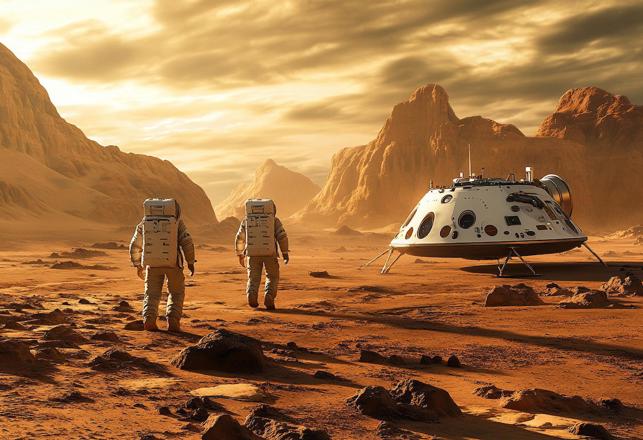
The Mars Conspiracies! Bizarre and Unsettling Claims from the Red Planet!

Introduction

The fascination with Mars, the fourth planet from the Sun, has captivated human imagination for centuries. This intrigue has evolved from ancient observations of the "Red Planet" to modern scientific exploration by rovers and orbiters. However, alongside legitimate scientific inquiry, a plethora of conspiracy theories has emerged, claiming everything from extraterrestrial life to government cover-ups. This essay aims to explore the most notable conspiracies surrounding Mars, examining their origins, the psychological factors at play, and the scientific responses to these bizarre and unsettling claims.

The Origins of Mars Conspiracies

The fascination with Mars and the possibility of extraterrestrial life has captivated humanity for centuries, leading to a variety of conspiracy theories that have emerged over time. The origins of these conspiracies can be traced back to the late 19th and early 20th centuries, a period marked by significant advancements in astronomy and a growing interest in the cosmos. This era laid the groundwork for a series of beliefs suggesting that Mars was not just a barren planet but potentially home to intelligent life.

The term "canals" gained traction in public discourse after American astronomer Percival Lowell proposed that he had observed a network of straight lines on the Martian surface. In the late 1800s, Lowell published a series of works, including "Mars" (1895), in which he claimed that these canals were artificial structures built by an advanced civilization to transport water from the polar ice caps to the planet's arid equatorial regions. His observations, made through the relatively primitive telescopes of the time, were later revealed to be optical illusions caused by the limitations of the equipment and the human tendency to perceive patterns.

Despite the lack of empirical evidence supporting Lowell's assertions, his theories captured the public's imagination and ignited a wave of speculation about the existence of intelligent life on Mars. The notion of Martian civilizations became a popular topic in literature and the arts, influencing works of fiction such as H.G. Wells' "The War of the Worlds" (1898), which portrayed a hostile Martian invasion of Earth. The idea of intelligent beings on the red planet was firmly entrenched in popular culture, setting the stage for future conspiracies.

As the 20th century progressed, advancements in space exploration further fueled public interest in Mars. The advent of space missions in the 1960s, particularly NASA's Mariner program, aimed to gather data on the Martian surface and atmosphere. However, rather than dispelling the myths surrounding Mars, these missions often intensified them. Some conspiracy theorists argued that NASA was deliberately withholding evidence of life on Mars, suggesting that the agency had discovered signs of civilization but was keeping this information secret from the public.

One of the most influential figures in the realm of Mars conspiracies was Richard Hoagland, who gained notoriety in the 1970s and 1980s. Hoagland posited that NASA was covering up evidence of an ancient Martian civilization, asserting that certain geological formations on the planet resembled pyramids and other structures associated with advanced societies on Earth. His theories proposed that the Martian surface contained remnants of a once-thriving civilization that had been lost to time, and he claimed that NASA's images from Mars were manipulated to hide these truths. Hoagland's ideas, though widely criticized by scientists, resonated with many and sparked a broader interest in the possibility of extraterrestrial life.

The Proof Is Out There: Top 4 MIND-BLOWING Mysteries on Mars
The claims made by Hoagland and others like him were often bolstered by anecdotal evidence and interpretations of NASA images. For example, some theorists pointed to photographs of rock formations that appeared to resemble faces or pyramids as proof of intelligent design. The famous "Face on Mars," captured by the Viking 1 orbiter in 1976, became a focal point for conspiracy theories. Although subsequent missions revealed that the "face" was merely a natural geological formation, the initial image fueled speculation and debate.

In addition to Hoagland, the 1990s saw the rise of a new wave of conspiracy theorists who focused on Mars as a site of extraterrestrial activity. The release of images from the Mars Global Surveyor and Mars Odyssey missions only served to enhance these theories. Some individuals claimed that NASA was involved in a cover-up, alleging that the agency had discovered evidence of alien structures, artifacts, or even current extraterrestrial life on the planet. The idea that government agencies were withholding information about extraterrestrial life became a central theme in many conspiracy theories.

The internet played a significant role in the proliferation of Mars conspiracies during the late 20th and early 21st centuries. With the rise of online forums and social media, individuals who believed in these theories could easily connect and share information. Websites dedicated to conspiracy theories flourished, providing a platform for like-minded individuals to discuss their beliefs and theories without the scrutiny often faced in mainstream discourse. This digital age allowed for the rapid spread of ideas, irrespective of their scientific validity.

One of the more notable conspiracy theories emerged surrounding the Mars rovers, Spirit and Opportunity, which landed on the planet in 2004. Some theorists claimed that the rovers had discovered evidence of microbial life or even advanced technology but that NASA was suppressing this information to prevent public panic. The photos and data sent back by the rovers were often interpreted in ways that aligned with existing beliefs about Martian life, leading to a tangled web of speculation that often contradicted established scientific findings.

In recent years, the introduction of more advanced missions, such as the Mars Science Laboratory’s Curiosity rover and the Perseverance rover, has continued to reignite interest in Mars conspiracies. The high-resolution images and data these missions provide have led to new claims and interpretations, with some conspiracy theorists suggesting that the rovers have found evidence of ancient civilizations or current alien life forms. The concept of NASA or other space agencies deliberately hiding information has persisted, fueled in part by the unprecedented access to information provided by the internet.

Moreover, the fascination with Martian life has been intertwined with broader themes of distrust in government and scientific institutions. Many conspiracy theories arise from a fundamental skepticism regarding official narratives. In an age where misinformation can spread as quickly as accurate information, the line between fact and speculation becomes increasingly blurred. The idea that powerful entities are concealing the truth resonates with individuals who feel marginalized or skeptical of mainstream science.

The intersection of science fiction and conspiracy theories has also played a significant role in shaping public perceptions of Mars. Films and television shows have often portrayed Mars as a world teeming with life or as a site of ancient civilizations. These depictions, while fictional, have contributed to a cultural narrative that encourages belief in the possibility of extraterrestrial life. When combined with real scientific findings, this narrative can lead to an environment ripe for conspiracy theories to flourish.

In conclusion, the origins of Mars conspiracies can be traced back to the late 19th century, fueled by early astronomical observations and a growing fascination with the possibility of intelligent life. Figures like Percival Lowell and Richard Hoagland have played pivotal roles in shaping these beliefs, often using anecdotal evidence and imaginative interpretations of images from space missions. The internet's rise has facilitated the rapid spread of these ideas, allowing conspiracy theories to thrive in an environment of skepticism and misinformation. As our exploration of Mars continues to evolve with new technology and missions, the allure of conspiracy theories surrounding the red planet will likely persist, reflecting humanity's enduring quest for knowledge and understanding of our place in the universe.

ANOMALIES ON MARS

  This planet has fooled Earthlings many times with its strange rocky surface. Humans have been interested in Mars for centuries, perhaps because it is the closest habitable planet in the solar system other than Earth, or perhaps because it is close enough to be well-observed. But this proximity has also given rise to many illusions, rumors and conspiracies, and many people have claimed to see strange things on the surface of Mars.

    After all, this planet has fooled Earthlings many times with its strange rocky surface. People have at various times claimed to find everything from canals and eerie human faces to extraterrestrial bases on the Red Planet's surface. In this vast universe, are we humans only eager to connect with our neighbors on this planet?

Given the long history of rumors and optical illusions associated with Mars, it certainly seems so.

1. Land and Sea: 

In 1784, Sir William Herschel, a famous British astronomer, wrote that the dark areas on Mars were oceans and the light areas were land.

They hypothesized that Mars is inhabited by intelligent beings who, according to NASA, "probably enjoy this situation as much as we do."

Herschel's theory prevailed for a century, with other astronomers claiming that vegetation could also be seen in light-colored regions.

From Illusions to Reality: Uncovering the Lies Behind Mars Myths and Conspiracies

2. Drains and Canals: 

When Mars approached Earth, the Italian astronomer Giovanni Schiaparelli observed some grooves on the red planet's surface with his telescope. The Italian word they used for these canals was "canali," which translates to "canals" in English, leading many in the English-speaking world to conclude that there were intelligent beings on Mars. Creatures were inhabited that created a system of waterways.

This fallacy was popularized by an astronomer named Percival Lowell, who in 1895 presented drawings of the canals in a book entitled "Mars" and in 1908 discussed his complete theory in another book, "Mars as Life." .

This theory was disproved in the early 20th century, when it was declared that the "rivers" were merely optical illusions. Seen through poor-quality telescopes, Martian point-like features, such as mountains and craters, appear to line up directly with each other.

3. Face of human: 

It all started in 1976, when NASA released a fascinating image of a mountain on Mars, captured by the "Viking 1" spacecraft. Eyes and nostrils could be clearly seen in the picture. Although it was a picture of a mountain, more than 30 years later, the "Face on Mars" still inspires myth and conspiracy theorists. Many believe it is an artificial structure built by an ancient Martian civilization. The shadow of the mountain really makes it look like a face when viewed from above.

However, images taken by the Mars Express orbiter and other spacecraft show that from other angles the mountain is clearly distinct, and does not look like a face at all. Pareidolia is the scientific term for seeing faces (or other significant objects) in different objects.

From Illusions to Reality: Uncovering the Lies Behind Mars Myths and Conspiracies

4. Trees of Mars: 

In 2001, seven years before his death, famed science fiction author Arthur C. Clarke, co-creator of "2001: A Space Odyssey," announced that he had discovered new images of Mars taken by the then-orbiting Mars Global Surveyor. In the pictures, you can see clumps of plants including trees.

"Take a good look at these new images of Mars, a lot is changing with the seasons." Clark said, speaking by phone during the Werner von Braun Memorial Lecture Series at the Smithsonian's National Air and Space Museum. "moving, which could possibly be vegetation." and "Where there's vegetation, you can bet we're going to find some Martians," he added.

The branches that Clark saw on the Martian surface are what Martian geologists call "spiders." These lines look like branches, and change with the seasons.They are formed by the melting of icy rocks by carbon dioxide, which flows along these paths when the carbon dioxide turns into ice sublimation gas. which look like branches.

5. Man on Mars: 

In 2007, the Mars rover "Spirit" took a closer look at the Red Planet, and spotted an image of a man dressed in human clothing kneeling in worship. Spirit obtained a beautiful view of the plateau called "Home Plate", which lies within Goseo Crater in the interior basin of the Columbia Hills range. Of course, the "man" in the picture is just a rock, humanized in our minds by pareidolia.

From Illusions to Reality: Uncovering the Lies Behind Mars Myths and Conspiracies

6. Hairy blue Spider: 

Images taken by the European Space Agency (ESA) in 2019 show what appears to be a giant hairy spider sitting with its legs stretched out on a Martian mountain. But these dotted "legs" are actually the tracks of hundreds of tiny tornadoes, or dust storms. It is not clear why the mountain is a hotspot for such storms, but ESA scientists say the way the air mass circulates around the region may be conducive to the formation of dust tornadoes.

From Illusions to Reality: Uncovering the Lies Behind Mars Myths and Conspiracies

7. Strange Green Rock: 

Mars, as we all know is a red planet. So why is this strange rock discovered by the Perseverance rover green? A tweet posted by the rover's public relations team on March 31 wondered, “Did this piece of Mars fall into this area from deep space? Is it Shahab-e-Saqib or something else?” The rock is about 6 inches (15 cm) long and lies in Mars' Jezero Crater near the rover's landing site. The rover vaporized a portion of the rock with a laser so that the rover's cameras and spectrometers could analyze the vapor cloud and reveal its chemical composition. Perhaps the answer to this mystery will be found soon.

From Illusions to Reality: Uncovering the Lies Behind Mars Myths and Conspiracies

Notable Conspiracy Theories

1. Extraterrestrial Life and Ancient Civilizations

One of the most pervasive claims in the realm of conspiracy theories is the notion that Mars once harbored intelligent life, or that it still does. This theory has captivated the imaginations of many and has been bolstered by a variety of supposed evidence collected over decades of exploration. Proponents of this theory often cite captivating images captured by Mars rovers that appear to show structures, faces, or other artifacts that resemble the works of intelligent beings. Among these images, the "Face on Mars" stands out as perhaps the most iconic. This rock formation, which was first photographed by the Viking 1 orbiter in 1976, bears a striking resemblance to a human face, leading to widespread speculation about its origins.

Believers in this theory argue that such formations are not mere natural geological occurrences, as most scientists contend, but rather remnants of an ancient civilization that once thrived on the red planet. They assert that these structures indicate an advanced society capable of monumental engineering and artistry, suggesting that humanity is not alone in the universe. The allure of the idea that intelligent life once existed on Mars taps into a deeper human curiosity about our place in the cosmos.

Critics, including scientists and skeptics, explain that the formations seen in these images can be attributed to pareidolia, a psychological phenomenon where the mind perceives familiar shapes in random patterns. In the case of the "Face on Mars," subsequent high-resolution imaging has shown that the geological features of the formation lack the detail necessary to support the claims of a crafted visage. Nevertheless, believers argue that the evidence is being suppressed, claiming that government entities or scientific organizations have a vested interest in maintaining the narrative that humanity is alone in the universe. This belief feeds into a broader narrative of distrust toward authorities, which is often a hallmark of conspiracy theories.

The fascination with extraterrestrial life is not limited to Mars. The discovery of extremophiles—organisms that thrive in extreme environments—on Earth has further fueled speculation about the possibility of life surviving in harsh conditions elsewhere in the solar system, including in the subsurface oceans of moons like Europa and Enceladus. As research continues, the debate over the existence of extraterrestrial life remains an engaging topic for many, blurring the line between scientific inquiry and speculative conspiracy.

2. NASA Cover-Ups

Another prevalent conspiracy theory claims that NASA is deliberately hiding information about Mars and its potential for life. This theory posits that the space agency has discovered irrefutable evidence of extraterrestrial life or advanced technology but is withholding this critical information from the public. Proponents argue that such suppression serves various purposes, including maintaining control over the narrative of space exploration, securing funding for ongoing missions, and preserving national security interests.

The idea of a cover-up resonates deeply in a society increasingly skeptical of governmental institutions. In an age where information is more accessible than ever, the belief that vital knowledge is deliberately concealed is a powerful narrative. Critics of this theory often point to NASA's transparency in sharing data and findings from its missions, but conspiracy theorists remain unconvinced. They argue that the agency's involvement in classified projects and its connections to military interests suggest a more sinister agenda at play.

Some conspiracy theorists claim that NASA's imagery and data are manipulated to hide evidence of extraterrestrial life. They point to specific instances where images from Mars rovers have been altered or where anomalies have been dismissed without thorough investigation. This perception of suppression is exacerbated by the complex nature of scientific research, which often requires time, peer review, and validation before findings are publicly accepted. In the fast-paced world of conspiracy theories, however, the lack of immediate validation can be interpreted as evidence of a cover-up.

This theory has been fueled by the rise of the internet, where individuals can easily share their interpretations and findings. Online forums and social media platforms provide a space for like-minded individuals to discuss their beliefs, creating echo chambers that reinforce their views. This environment fosters a culture of skepticism towards official narratives, leading many to question the integrity of government-sponsored research and the motivations behind it.

As technology advances and more missions to Mars are planned, the speculation surrounding NASA's findings is likely to continue. The agency's commitment to transparency will be put to the test, as the public remains eager for information about the potential for life beyond Earth.

3. The Mars Anomaly Research Society

The Mars Anomaly Research Society (MARS) is an organization that promotes the study of alleged anomalies on Mars, serving as a platform for enthusiasts and conspiracy theorists to share their findings and interpretations. Established by individuals who believe that Mars is teeming with evidence of past or present life, MARS has gained a following among those who are fascinated by the possibility of extraterrestrial civilizations.

Members of the society often analyze images from Mars rovers and orbiters, searching for patterns or formations that they believe indicate intelligent design. They share their discoveries through various mediums, including websites, forums, and social media, creating a community centered around the exploration of Mars anomalies. This collective effort leads to a wealth of interpretations, some of which are highly creative and imaginative.

However, critics argue that MARS fosters confirmation bias, encouraging individuals to find evidence that supports their preconceived notions while ignoring or dismissing scientific explanations. The emphasis on subjective interpretations can lead to a distorted understanding of the data, as individuals selectively focus on anomalies that fit their beliefs. As a result, many scientific findings are overlooked or misrepresented in favor of sensational claims.

The society's activities raise questions about the nature of scientific inquiry and the boundaries between legitimate research and pseudoscience. While the exploration of Mars has unveiled numerous mysteries, the methods employed by organizations like MARS often lack the rigor and skepticism that characterize the scientific method. This discrepancy can lead to a proliferation of misinformation and perpetuate the belief in conspiracy theories surrounding extraterrestrial life.

Furthermore, the existence of organizations like MARS highlights the tension between scientific exploration and public imagination. The desire for sensational discoveries often overshadows the nuanced understanding of the challenges involved in space exploration. While the allure of finding evidence of advanced civilizations is undeniable, it is essential to approach the subject with a critical eye, recognizing the difference between speculation and scientifically validated findings.

In conclusion, the belief in extraterrestrial life on Mars, the claims of NASA cover-ups, and the role of organizations like the Mars Anomaly Research Society exemplify the complexities surrounding conspiracy theories in the context of space exploration. These theories tap into fundamental human desires to understand our universe, our origins, and the possibility of life beyond our planet. However, they also highlight the challenges of distinguishing between credible scientific inquiry and unfounded speculation. As technology advances and our exploration of Mars continues, the dialogue surrounding these theories will undoubtedly evolve, reflecting the intersection of science, belief, and the quest for knowledge.

Psychological Factors Behind Mars Conspiracies

The allure of conspiracy theories surrounding Mars can be partly attributed to human psychology. Cognitive biases, such as the tendency to see patterns where none exist (pareidolia), play a significant role in how individuals interpret ambiguous visual information. When images from Mars are released, such as those taken by rovers and orbiters, many people naturally look for familiar shapes or forms, which can lead to the belief that there are signs of life or artificial structures on the planet. This phenomenon illustrates how our brains are wired to find meaning in chaos, often resulting in the fabrication of elaborate narratives that explain what we perceive.

Additionally, the desire for a sense of control and understanding in an uncertain world often leads people to gravitate toward conspiratorial thinking. In an age marked by rapid technological advancement and overwhelming amounts of information, many individuals feel powerless in the face of global challenges such as climate change, political instability, and health crises. Conspiracy theories, including those about Mars, provide a semblance of clarity and control by suggesting that there are hidden truths that, once uncovered, can demystify complex phenomena. By believing in these theories, individuals can feel as though they are part of an exclusive group that possesses knowledge denied to the general populace.

Moreover, the idea of extraterrestrial life taps into deep-seated existential questions about humanity's place in the universe. For many, the thought that we are not alone is both thrilling and unsettling. This emotional response can lead to the acceptance of extraordinary claims without the requisite evidence, further perpetuating conspiracy theories. The notion of Martians or ancient civilizations residing on Mars addresses fundamental human questions about existence, purpose, and our future. In a universe that seems vast and indifferent, the idea of other intelligent beings offers a glimmer of hope and a sense of connection.

Psychologically, the human need for belonging also plays a significant role in the proliferation of conspiracy theories about Mars. Communities that form around these beliefs often provide a sense of identity and camaraderie among members. In a world where social connections can be fleeting and superficial, finding a group that shares a common belief in Martian conspiracies can foster a strong sense of belonging. This social reinforcement further entrenches these beliefs, as members validate and support one another, creating an echo chamber that discourages critical thinking and skepticism.

Another psychological factor influencing belief in Mars conspiracies is the phenomenon known as confirmation bias. This bias leads individuals to seek out information that confirms their pre-existing beliefs while dismissing or undervaluing evidence that contradicts them. When individuals encounter information about Mars that aligns with their beliefs—such as purported sightings of UFOs or claims of ancient civilizations—they are more likely to accept this information without question. Conversely, credible scientific evidence disproving these claims may be ignored or rationalized away, reinforcing the conspiracy theory.

Fear also plays a crucial role in the acceptance of conspiracy theories. The vastness of space and the unknown aspects of Mars can evoke fear and anxiety about what lies beyond our planet. This fear can lead individuals to construct narratives that serve to explain or alleviate their concerns. For example, if someone fears the implications of the unknown, such as the possibility of invasive alien species or catastrophic encounters, they may turn to conspiracy theories as a way to regain a sense of control and safety. By attributing these fears to a conspiracy, they can externalize their anxieties rather than confront them directly.

Additionally, the role of media in amplifying these conspiracies cannot be overstated. The internet and social media platforms enable the rapid dissemination of information, often without rigorous fact-checking. This environment allows conspiracy theories to flourish, as sensationalist headlines and clickbait often attract more attention than sober, scientific analyses. As a result, individuals may find themselves inundated with misinformation, making it increasingly difficult to discern fact from fiction.

In conclusion, the psychological factors behind Mars conspiracies are complex and multi-faceted. Cognitive biases, the need for control, existential questions, social belonging, confirmation bias, fear, and the influence of media all contribute to the allure of these theories. Understanding these psychological drivers can help demystify why individuals are drawn to such beliefs, offering a pathway toward more constructive conversations about the mysteries of Mars and the universe at large. By addressing these psychological underpinnings, we can foster a more informed and critically engaged public discourse regarding space exploration and the quest for extraterrestrial life.

Scientific Responses to Mars Conspiracies

The scientific community has proactively addressed the myriad of conspiracies surrounding Mars through a steadfast commitment to empirical evidence and rational inquiry. This response is critical in an era where misinformation can spread rapidly, often leading to the public's misunderstanding of scientific facts. NASA, alongside other space agencies, has undertaken significant initiatives to ensure that their findings are communicated transparently and effectively. By publishing extensive data and high-resolution images from missions such as the Mars Rover Perseverance and the Mars Reconnaissance Orbiter, these organizations provide concrete evidence that bolsters their claims and helps demystify the red planet.

In addition to transparency, scientists underscore the importance of critical thinking and the scientific method as essential tools for evaluating extraordinary claims about extraterrestrial life. This emphasis on a rigorous, evidence-based approach serves to educate the public, encouraging individuals to scrutinize the sources of their information and to differentiate between well-supported scientific research and speculative assertions lacking empirical support. Educational outreach programs and public lectures have become vital components of this effort, aiming to foster a better understanding of planetary science and the processes that govern exploration.

Moreover, researchers have actively sought to debunk specific conspiracy theories through meticulous analysis and the deployment of advanced technology. A notable example is the infamous "Face on Mars," a feature that sparked imaginations and conspiracy theories upon its discovery in the 1970s. Initially interpreted as a possible artificial construct, this geological formation was re-examined with advanced imaging techniques. Higher resolution imagery has since revealed that it is merely a natural rock formation shaped by erosion and lighting conditions. Such scientific re-evaluations illustrate how empirical evidence can effectively counteract sensationalist narratives and highlight the distinction between legitimate scientific exploration and unfounded speculation.

The role of peer-reviewed research cannot be overstated in this context. By publishing findings in reputable scientific journals, researchers contribute to a body of work that can be scrutinized and validated by the broader scientific community. This process not only enhances the credibility of the research but also serves as a bulwark against misinformation. The collaborative nature of science, where findings are shared and debated, reinforces the notion that knowledge is built on a foundation of evidence and critical analysis.

In conclusion, the scientific community’s response to Mars conspiracies exemplifies a robust commitment to empirical investigation and public education. Through transparent communication, critical evaluation, and rigorous scientific inquiry, researchers actively combat misinformation and promote a deeper understanding of Mars and its mysteries. Such efforts not only advance our knowledge of the universe but also empower the public to engage thoughtfully with scientific discourse, fostering a culture of inquiry that is essential in today's information-rich society.

CONCLUSION

The fascination with Mars, fueled by a plethora of conspiracies, highlights the intricate relationship between human curiosity and the psychological need for explanation. This interplay is not merely a byproduct of our imagination; it reflects a deep-seated desire to understand our place in the universe and the potential for life beyond Earth. The allure of extraterrestrial life has captured the public's imagination, leading to various theories that often blur the lines between science and fiction. However, a critical examination of these claims is vital, as it underscores the importance of scientific rigor and empirical evidence in our quest for knowledge.

As we advance our exploration of Mars through missions led by NASA and other space agencies, we are continually uncovering new data that challenges existing narratives. Robotic rovers and orbiters provide valuable insights into the planet's geology, atmosphere, and potential for past or present life. These findings emphasize the necessity of distinguishing between scientifically validated information and speculative theories that may arise from human imagination. For instance, while the discovery of methane spikes on Mars has sparked excitement about the possibility of microbial life, it is essential to interpret such data within the context of rigorous scientific inquiry rather than succumbing to sensationalized interpretations.

Moreover, the scientific method offers a pathway to transcend the allure of conspiracy. It encourages us to question, hypothesize, and test our ideas against the backdrop of observable evidence, ultimately guiding us closer to the truth. The ongoing exploration of Mars serves as a reminder that while the cosmos may be filled with mysteries, our understanding must be grounded in careful analysis and skepticism.

In conclusion, the pursuit of knowledge about Mars is a journey that challenges us to confront both the enigmas of the universe and the narratives we create. By fostering a commitment to scientific rigor, we can navigate the complexities of human curiosity and continue to unravel the truths that lie beyond our planet.

{ PETER2011 }
Hoe vind je dit bericht?
Geschreven door peter om 22:05 Stuur door

The UAP Disclosure Act: The proposed Pentagon/AARO re-write of November 2023

The UAP Disclosure Act: The proposed Pentagon/AARO re-write of November 2023
Hi all:
 
The recent article below discusses the Pentagon's rewrite of the Senate-passed Unidentified Aerial Phenomena Disclosure Act (UAPDA) in November 2023. The author, Douglas Dean Johnson, releases a 33-page line-by-line rewrite of the UAPDA proposed by the Pentagon to congressional negotiators. This document, marked with strike-outs and underlines, shows the Pentagon's proposed changes to the Senate-passed bill.
 
The rewrite was presented as the "informal views" of the Office of the Under Secretary of Defense for Intelligence and Security (OUSD(I&S)), which urged consideration of the extensive revisions to the UAPDA. The document was transmitted to Capitol Hill negotiators in late November 2023, during the final stages of negotiations over the Fiscal Year 2024 National Defense Authorization Act (NDAA).
 
Dr. Sean Kirkpatrick, the former director of the Pentagon's All-domain Anomaly Resolution Office (AARO), stated in an interview that the Pentagon successfully opposed the original UAPDA. The final enacted language of the FY 2024 NDAA, signed into law on December 22, 2023, reflected the Department of Defense's basic viewpoint on major points, although not on every detail.
 
The original UAPDA, sponsored by Senate Majority Leader Chuck Schumer and Senator Mike Rounds, aimed to create a President-nominated, Senate-confirmed UAP Records Review Board with broad investigatory powers. However, in conference committee with the House of Representatives, the UAPDA was significantly stripped down, eliminating the proposed independent review board and most of the language implying the existence of tangible evidence of nonhuman visitation.
 
The final FY 2024 NDAA merely enhanced the National Archives and Records Administration's mission to gather UAP-related documentation, allowing agencies more authority to shield material from public disclosure, especially during the first 25 years after document creation.
My immediate thoughts on this piece after going through it were that the Pentagon's influence in revising the UAPDA suggests a conflict of interest, as it involves the executive branch altering a legislative initiative. This could be seen as encroaching on legislative powers and potentially violating the separation of powers principle. It raises concerns about the balance of power between the executive and legislative branches, as well as the transparency and independence of UAP investigations.
 
I got a reply from Douglas Johnson following my immediate observations: 
 
"Well, of course officials within the Executive Branch seek to "influence" those within the Legislative Branch-- and vice versa. That is not a "conflict of interest," but part and parcel of the whole three-branch system."
"It would certainly be an absurd state of affairs if members of the Legislative Branch, when considering legislation on any given subject, could not receive advice, and even strongly worded recommendations, from officials within the Executive Branch who are responsible for implementing legislation on that same subject. For example, if Congress is considering a bill dealing with sales of arms to a certain nation, would you suggest that lawmakers should refuse to look at any advice from the State Department and the Defense Department about the proposal?"
"The lawmakers are free to give whatever weight they wish to advise from Executive Branch officials-- in many cases, they disregard it entirely."
"Of course, the head of the Executive Branch, the President, can move beyond mere persuasion when he deems it necessary, and veto legislation that departs from what his preferences on what he deems to be significant matters (thereby raising the margin necessary for passage to two-thirds in each house of Congress). The possibility or direct written threat of a veto is often used by presidents, and their lieutenants, as an often-effective means of "influencing" the actions of Congress. Again, this is not a "conflict of interest," but basic elements of the constitutional scheme. In proper understanding of the separation of powers principles, such push-and-pull is not only permissible but absolutely necessary.”
 
At first look, Johnson’s response seems to make sense. He presents a reasonable perspective at first glance because it highlights the normal and necessary interactions between the executive and legislative branches of government. In a functioning democracy, it is expected that these branches will engage with each other, with the executive providing advice and recommendations to the legislative branch, especially on matters where the executive is responsible for implementation. This back-and-forth is indeed part of the checks and balances system designed to prevent any one branch from gaining too much power.
 
However, looking more closely, there might be problems, more to think about, or different ways to see it. It doesn't diminish my justified worries at all. The key issue with his response, when applied to the context of the Pentagon's rewrite of the UAPDA, is that it may not fully capture the specific nature and extent of the executive's involvement in this case. The concern is not about the exchange of advice or recommendations per se, but rather about the degree of influence and the potential for conflict of interest when the executive branch significantly alters a legislative initiative, especially one that pertains to oversight and transparency of executive actions. Mind you, David Grusch and other whistleblowers have accused the DoD of covering up a secret crash-retrieval and backengineering program involving crashed off-world craft and bodies. The fact that the DoD, through AARO, is assigned to investigate these claims presents a potential conflict of interest, raising concerns about the independence and objectivity of the UAP investigations conducted by AARO.
 
Johnson's statement makes a valid point about the general dynamics between the executive and legislative branches. However, it may not fully address the specific concerns regarding the Pentagon's involvement in rewriting the UAPDA, which some might view as an overreach of traditional executive authority.
Kind regards.
 
André

The UAP Disclosure Act: The proposed Pentagon/AARO re-write of November 2023

OUSD-I-S--cover-page--narrow-.jpgThe top of the first page of a document submitted by the Office of the Under Secretary of Defense for Intelligence and Security to congressional negotiators on the UAP Disclosure Act, November 2023.

By Douglas Dean Johnson

@ddeanjohnson on X/Twitter

My gmail address is my full name

Original publication: July 24, 2024, 10:00 AM EDT. Any substantive revisions to the original article will be noted in a log found at the end of the article. Those reading this article in the e-mailed version may have to click on "view in browser" under my byline in order to access embedded documents such as PDF files.

In the light of recent statements by the former head of the Pentagon "UFO office," Dr. Sean Kirkpatrick, asserting that the Pentagon/AARO successfully derailed the Schumer-Rounds Unidentified Anomalous Phenomena Disclosure Act (UAPDA) in late 2023, I am releasing here a proposed 33-page line-by-line rewrite of the Senate-passed UAPDA that the Pentagon provided to congressional negotiators during end-stage negotiations in November 2023.

This is the first publication of this document anywhere.

Further down in this article, you'll find Kirkpatrick's answers to questions I addressed to him for this article, such as whether the National Security Advisor or any other higher authority ever tried to subdue his activity in opposition to the UAPDA, and why the proposed Pentagon re-write of the UAPDA would have retained provisions affirming the right of the federal government to take ownership (via the exercise of eminent domain) over "any and all recovered technologies of unknown origin and biological evidence of non-human intelligence that be be controlled by private persons or entities..."

Pentagon Nov 2023 proposed revisions to UAPDA

GUIDE TO INTERPRETATION OF THE DOCUMENT: In the embedded PDF document, the unmodified underlying text is the Senate-passed UAPDA. Strike-out marking through a paragraph or phrase indicates that the Office of the Under Secretary of Defense for Intelligence and Security ((OUSD(I&S)) wanted that language removed from the bill. All underlined words and phrases were OUSD(I&S) proposals for new language or replacement language to be inserted.

Thus, if the OUSD(I&S) text had been enacted in total (which is not exactly what occurred), the resulting law would have been the original text, plus the underlined additions, minus the extensive strikeouts. This type of legislative re-write document is sometimes called a "red line."


The nature of the document is explained in introductory paragraphs found on the top third of the first page, shown in the image above: It was presented as the "informal views" of the Office of the Under Secretary of Defense for Intelligence and Security, which stated that the Department of Defense "strongly urges consideration" of the proposed extensive rewriting of Division G of S. 2226, which was the Schumer-Rounds UAP Disclosure Act, part of the the FY 2024 National Defense Authorization Act (NDAA) that had been passed by the U.S. Senate on July 27, 2023. The introduction to the document says that the Department of Defense position was arrived at "after conferring with NARA/ISOO," referring respectively to the National Archives and Records Administration (NARA) and to the Information Security Oversight Office.

The Under Secretary of Defense for Intelligence and Security is the top intelligence officer in the Department of Defense. [1] The Pentagon's All-domain Anomaly Resolution Office (AARO), the "UFO office," is attached to the OUSD(I&S) for administrative matters, although starting in 2023 the AARO director reports directly to a higher official, the Deputy Secretary of Defense, "on all operational and security matters." The Deputy Secretary, Kathleen Hicks, ranks directly under the Secretary of Defense.

Kirkpatrick served as AARO director from its formal inception in mid-2022 until December 1, 2023, which included the period that the 2023 UAPDA language was under consideration in Congress (mid-July to early December 2023).

Data associated with the original "informal views" file document (which I have sanitized) suggests that it was transmitted to negotiators on Capitol Hill in late November, 2023, during the final stages of negotiations over what UAP language would survive in the final FY 2024 NDAA. The final FY 2024 NDAA language became public on December 6, 2003, passed the Senate on December 13, passed the House of Representatives on December 14, and was signed into law on December 22, 2023 (Public Law 118-31).

Notwithstanding the designation of the OUSD((I&S) document as reflecting "informal" views, the Department's advice was conveyed emphatically ("strongly urges consideration") and in granular detail. The 33-page document proposed an extensive rewrite of the Schumer-Rounds proposal, removing most of the central elements of the Senate-approved language. Moreover, the Department's advice was largely heeded: The final enacted language reflected the Department's basic viewpoint on major points, although not on every detail.

In a 70-minute interview conducted by Marik von Rennenkampff on July 17, 2024 (viewable on YouTube here; rough transcript posted here), Kirkpatrick spoke openly about the Pentagon's 2023 opposition to the UAPDA– the first time that he has addressed that subject in detail in public, as far as I am aware. In this interview, Kirkpatrick presented opposition by the Department of Defense and AARO to the 2023 UAPDA as decisive, telling von Rennenkampff, "We convinced Congress last year not to go down that road..." [italics added for emphasis]

[Under End Note No. 2 below, I have posted an eight-minute clip from the 70-minute interview. I encourage interested readers to use the links above to review the entire 70-minute exchange, which included discussion of well-known IR videos taken by Navy pilots, and also Kirkpatrick's remarks about a recent report issued by AARO regarding analysis of a metallic sample, in addition to the extended discussion of the UAP Disclosure Act.]

The OUSD(I&S) document that I am posting here today does not spell out AARO's substantive objections to the UAPDA, as Kirkpatrick did in the July 17 interview, but it essentially incorporates those objections through its extensive proposed revisions to the UAPDA, which the Senate had already approved. In an email exchange on July 23, 2024, Kirkpatrick said he could not confirm (but neither did he dispute) the authenticity of the OUSD(I&S) document, adding, "However, the document does represent many of the objections I tried to articulate to Marik [von Rennenkampff, in the July 17, 2024 interview]."

THE BIRTH AND DEMISE OF THE ORIGINAL UAP DISCLOSURE ACT

The UAPDA was originally unveiled, with Senate Majority Leader Chuck Schumer (D-NY) as prime sponsor and Senator Mike Rounds (R-SD) as lead co-sponsor, on July 14, 2023. Four other senators co-sponsored the measure. After some modifications, it was added to the FY 2024 NDAA as part of a list of agreed-on amendments, without floor debate or a separate vote. The Senate passed its FY 2024 NDAA, including the UAPDA, on July 27, 2023.

As passed by the Senate, the UAPDA would have created a President-nominated, Senate-confirmed UAP Records Review Board– a temporary federal agency with full-time professional staff and broad investigatory powers to search out, gather, and release any UAP-related material from throughout the government, with the President making final decisions regarding delay or release of material deemed especially sensitive. The bill was modeled in most respects on the 1992 JFK Assassination Records Collection Act.

However, in conference committee with the House of Representatives, the UAPDA was greatly stripped down. The proposed independent review board was eliminated, as was most of the original language that had been widely read to imply that somewhere within the government's purview tangible evidence of nonhuman visitation was likely to be found. The final FY 2024 NDAA enacted on December 22, 2023 merely conferred on the National Archives and Records Administration a somewhat beefed-up mission to gather UAP-related documentation into a collection, but affording far more authority for agencies to shield material from public disclosure, especially during the first 25 years after creation of a document.

[For a more detailed description of the final enacted language, I refer the reader to my article "Quick guide to UAP-related provisions in the final FY 2024 National Defense Authorization Act" (December 13, 2023).]

Throughout the period of July-December 2023, I reported extensively on the progress of the UAPDA, a measure that I supported. At the time, and since, I have repeatedly stated that the gutting of the bill was due not to any lobbying campaign by powerful defense contractors, as some imagined, but to opposition from the Pentagon/AARO, the objections of which were largely adopted by several of the very senior Republican lawmakers who were among the small group of lawmakers who resolved the final contentious issues on NDAA. [3]

The Pentagon's opposition to the Senate-passed UAPDA was far from a state secret even in late 2023. After the stripped-down final version emerged from behind closed doors in early December, even the New York Times reported that a "person familiar with the talks who insisted on anonymity to describe them noted that the Defense Department also had pushed back forcefully on wider measures." ("Congress Orders U.F.O. Records Released but Drops Bid for Broader Disclosure," by Kayla Guo, New York Times, December 14, 2023)

THE PENTAGON AND THE WHITE HOUSE

From the time that the UAPDA was unveiled on July 14, 2023, up until the issuance of the final NDAA conference report on December 6, 2023, certain social-media influencers claimed that the UAPDA had the backing of President Biden and his National Security Advisor, Jake Sullivan. At no point did I encounter any actual evidence of such interest or support by high-level decisionmakers in the Executive Branch, and as months passed after the Senate's July 27 passage of the NDAA/UAPDA, it became quite clear that the Biden Administration was not doing anything to help enact the UAPDA.

I asked Kirkpatrick, "When you were the director of AARO, did you ever receive direction or heavy guidance from anybody in the White House, or the Executive Office of the President, or the National Security Council, or any other higher authority, indicating that you should soften or qualify your opposition to the UAPDA?"

Kirkpatrick replied:

The White House could have cared less about this issue. No one from the White House, EOP [Executive Office of the President], NSC [National Security Council], or any other 'higher authority' called me or my boss to put pressure on me to soften my position on the UAPDA. No one in Congress did either. (email, July 23, 2024)

As I was the first to report (on July 13, 2024), Senator Rounds re-introduced the UAPDA on July 11, 2024, as a possible amendment (SA 2610) to the FY 2025 National Defense Authorization Act (S. 4638), which the Senate will take up later this year. As filed by Rounds on July 11, Senate Majority Leader Schumer was listed as co-sponsor (no longer the prime or controlling sponsor).

Marik von Rennenkampff led off his July 17 interview with Kirkpatrick by noting that reintroduction of the UAPDA, to which Kirkpatrick responded: "Last year we convinced Congress last year not to go down that road..." Von Rennenkampff soon followed up: "Did you say that you or AARO pushed back on the Schumer-Rounds amendment when it was proposed last year? That seems to be a big mystery as to how it was, shall we say, watered down? Other people say 'gutted.'"

Kirkpatrick answered:

So let's be clear about how the process works in the United States government. Every year the NDAA is put together by proposals from both the Senate and the House side. Okay? Those proposals are socialized with the Department. The Department then gets an opportunity to write a reclaima [request for reconsideration] that goes back to the Hill that says, "Hey, this is not a good idea for these reasons," or, "This would be better if it was written this way," or, "Yeah, we just can't really support this because of these resource constraints," or whatever the case may be. And that is true for every piece of the NDAA– it gets farmed back to us and we or the Department get to look at that.

As AARO, the pieces of legislation that were written about AARO come to us, and we are allowed to write our thoughts and disclaimers. And so we wrote exactly that. "Look, this is duplicative of language you gave us in '22 [the NDAA enacted in December 2022, which mandated a "historical report" to be produced by AARO]. Let us finish the thing that you told us to do the first time, before you write additional legislation."

In the von Rennenkampff interview, Kirkpatrick stressed his view that creation of a UAP Records Review Board would duplicate a mission already assigned to AARO. But he also maintained that there was no evidence that would justify creation of a new agency to hunt for inter-government knowledge or possession of nonhuman technology.

Kirkpatrick said:

I mean, look, let me be clear: We found no evidence of any of these allegations. None. And I had access to everything there was to have access to. I went up and briefed and testified [to members of Congress] just as recently as a couple of months ago, with the SAPCO director and the CAPCO director from ODNI [officials who oversee special access programs], and all of us have gone through everything that we have, everything that witnesses have come forward and said, "Hey, this is this hidden program." And it turns out none of them are those hidden programs. None of them. All of them have turned out to be other things that have nothing to do with extraterrestrial reverse engineering. And all of them have been reported to Congress....

And [in the UAPDA] they're telling the commercial industry they have to turn over all of this stuff. Well, the commercial industry – and I talked to all of the commercial industry, and they're scratching their heads and they don't know what they're talking about [in the bill language].

The November 2023 OUSD(I&S) "informal views" draft was not adopted by the House-Senate conferees in total. But the final enacted language appears to have been largely consistent with OUSD(I&S)/AARO's core objectives. The proposed independent review board, with its professional staff and broad powers, was deleted. The final law, like the OUSD(I&S)/AARO draft, gives Executive Branch agencies broad discretion to prevent disclosure of specific records, although the enacted version contains a limited presumption for disclosure 25 years after creation of a UAP-related document.

PENTAGON'S PROPOSED 2023 UAPDA REWRITE RETAINED AN EMINENT DOMAIN PROVISION

One noteworthy aspect of the OUSD(I&S) draft is the way it proposed to rewrite Section 9010, "Disclosure of Recovered Technologies of Unknown Origin and Biological Evidence of Non-human Intelligence." In the Senate-passed UAPDA, this section empowered the Review Board to exercise eminent domain (i.e., assert government ownership) "over any and all recovered technologies of unknown origin and biological evidence of non-human intelligence that may be controlled by private persons or entities..."

The OUSD(I&S) draft proposed substantial weakening of the provision by replacing mandatory language ("The Federal Government shall exercise eminent domain over...) with non-binding hortatory language ("It is the sense of Congress that the Federal Government should exercise eminent domain appropriately over...)– but OUSD(I&S)/AARO did not propose deleting the objects to which such eminent domain "should" apply: "any and all recovered technologies of unknown origin and biological evidence of non-human intelligence that may be controlled by private persons or entities..."

Moreover, other OUSD(I&S) revisions would have required that any such exotic material be made available to AARO (rather than to an independent review board), and would have assigned to the President (rather than a review board) certain determinations regarding such material.

By email, I asked Sean Kirkpatrick, "What was the rationale for recommending retention of proposed new provisions of law that would have provided something of a legal foundation for AARO or other federal entities to assert control over hypothetical technologies of unknown origin or hypothetical evidence of non-human intelligence (at least, apparently, in such cases in which the President deemed it appropriate)? Was this a 'just in case' provision?"

Kirkpatrick replied:

At the time, the conspiracy frenzy was pushing this narrative of some prime contractor having this material, and there were these lingering allegations of AARO not having authorities, despite it being written into law previously. So a compromise was proposed to allow for the exercising of eminent domain under AARO’s authority to underscore that AARO could compel disclosure of anything, should anything exist. Since we know nothing exists, we didn’t feel it made our job harder, and felt this could close a gap in uninformed allegations. (email, July 23, 2024)

In the final enacted bill, however, the eminent domain section was entire absent. [4]

END NOTES

[1] In 2023 the Under Secretary of Defense for Intelligence and Security was Ronald Moultrie, who resigned effective February 29, 2024. President Biden has nominated as his successor Tonya Wilkerson, who is currently Deputy Director of the National Geospatial-Intelligence Agency (NGA). Wilkerson's nomination is currently pending before the Senate Armed Services Committee. For further information on that matter, see my article "Who is Tonya P. Wilkerson, and what does it have to do with UFOs?," May 21, 2024.

[2] I have embedded here a nine-minute excerpt from the 70-minute interview of Sean Kirkpatrick, conducted on July 17, 2024, by Marik von Rennenkampff. This clip runs from about the 8-minute point to about the 17-minute point in the original video.

Excerpt from July 17, 2024 interview of Sean Kirkpatrick by Marik von Rennenkampff, discussing AARO's 2023 activity in opposition to the original Schumer-Rounds UAP Disclosure Act. Fair Use under 17 U.S. Code § 107 for noncommercial purposes of investigative journalism, scientific research and debate, education, and commentary.

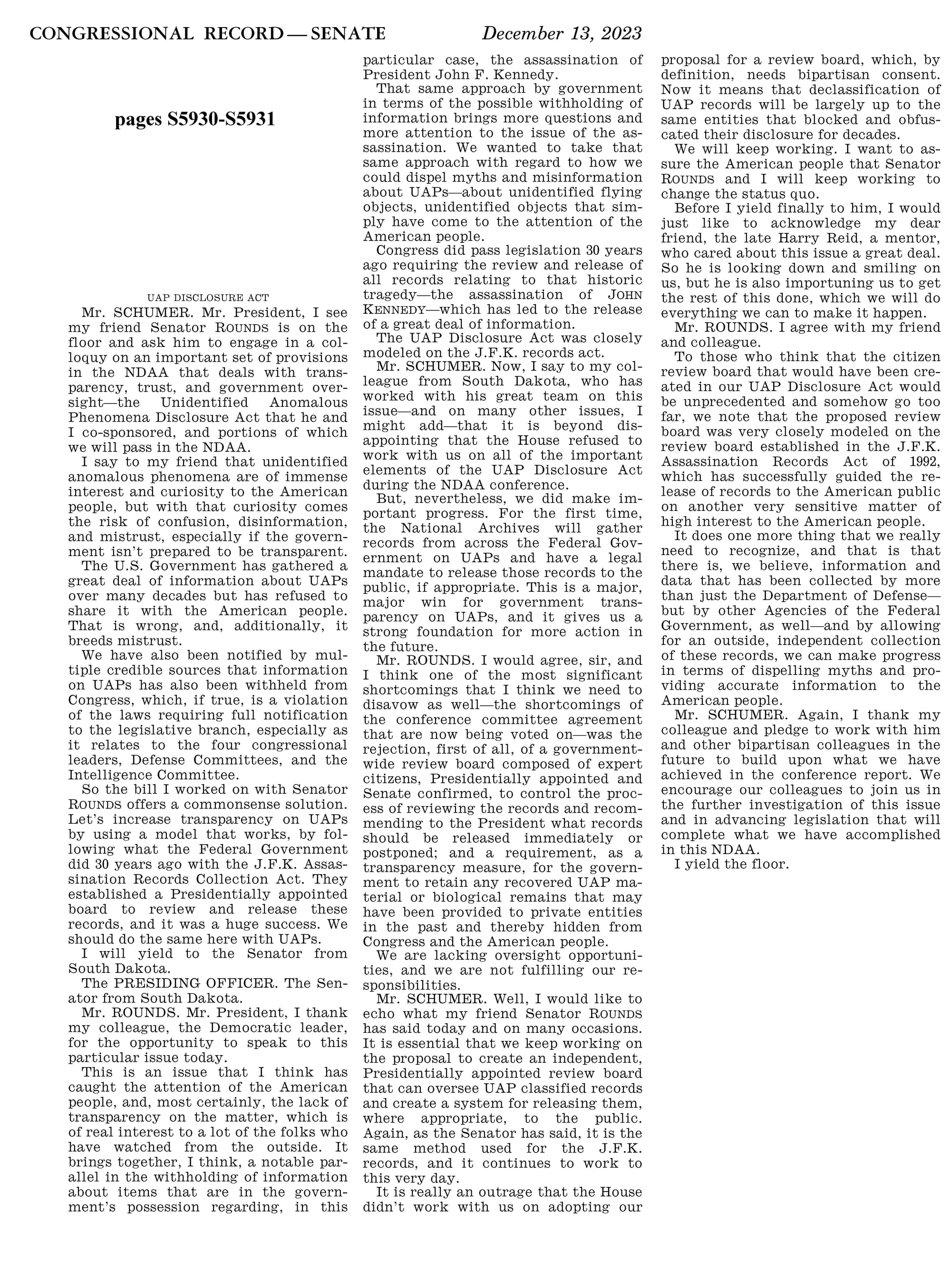
[3] In an exchange with Senator Rounds on the Senate floor on December 13, 2023, Senator Schumer said, "It is really an outrage that the House didn’t work with us on adopting our proposal for a review board, which, by definition, needs bipartisan consent. Now it means that declassification of UAP records will be largely up to the same entities that blocked and obfuscated their disclosure for decades." However, Schumer said nothing on that occasion (or any other occasion of which I am aware) to indicate that he viewed the opposition to the UAPDA as originating in whole or part from corporate entities. Rather, he expressed criticism of unspecified actors within the Executive Branch: "The U.S. Government has gathered a great deal of information about UAPs over many decades but has refused to share it with the American people. That is wrong, and, additionally, it breeds mistrust. We have also been notified by multiple credible sources that information on UAPs has also been withheld from Congress, which, if true, is a violation of the laws requiring full notification to the legislative branch, especially as it relates to the four congressional leaders, Defense Committees, and the Intelligence Committee."

An exchange on the U.S. Senate floor between the prime sponsor of the 2023 UAP Disclosure Act, Senate Majority Leader Chuck Schumer (D-NY), and the lead co-sponsor, Senator Mike Rounds (R-SD). This colloquy occurred on December 13, 2023, after the UAP Disclosure Act had been gutted in a House-Senate conference committee, and the Senate had passed the final FY 2024 NDAA.

[4] All of the UAP-related language that was included in the final Fiscal Year 2024 National Defense Authorization Act, enacted December 22, 2023 (Public Law 118-31), is included in the PDF file embedded below. The UAP Records Collection provision, which is what survived 

of the original UAP Disclosure Act, appears on pages 568-575. Additional explanation is found in my December 13, 2023 article, "Quick guide to UAP-related provisions in the final FY 2024 National Defense Authorization Act."

UAP pages only (final) from NDAA (HR 2670) and Joint Explanatory Statement 12-6-23

Hoe vind je dit bericht?
Geschreven door peter om 23:34 Stuur door

There is DVD of US Intelligence Members Communicating with Extraterrestrials, Former US Military Claims

Intelligence Community and Aliens

There is DVD of US Intelligence Members Communicating with Extraterrestrials, Former US Military Claims

Former US intelligence officer David Grusch testified before Congress during the July 2023 UAP hearing, stating that we have numerous spacecraft of non-human origin. If this is the case, one might wonder if any contact has been established between humans and these extraterrestrial species. There have been persistent rumors suggesting that the US government may have signed treaties with these extraterrestrials and has been engaged in collaborative efforts with them over an extended period.

According to a rather extraordinary claim made by former US government consultant Timothy Good, it is alleged that the 34th President of the United States, Dwight D. Eisenhower, had three clandestine meetings with extraterrestrials. Good claimed Eisenhower met aliens at a remote air base in New Mexico in 1954. In more recent times, former Israeli Space Head Haim Eshed stated that aliens and the U.S. government had reached some type of deal to stay quiet about their experiments on Earth and secret facilities on Mars. Eshed went on to claim the existence of a “Galactic Federation” and implied that then-President Trump was on the brink of making significant revelations in this regard.

Video Evidence

During a podcast with former Fox News anchor Clayton Morris on his show Redacted, Joshua Reid, a former United States Navy serviceman with a background in missile weapons defense systems, brought a wealth of knowledge and experience to the table. He opened the conversation by referencing his personal experiences in the Navy, specifically during the years 2004 to 2006. Reid’s background made him intimately familiar with topics related to secret space projects, a subject that has piqued his interest for over two and a half decades.


It is worth noting that Joshua Reid’s extensive research in the field of UAPs and classified information has led him to the inner workings of certain government activities. His extensive four-year investigation revealed a disconcerting pattern. It appeared that military technology, particularly in special access programs, was unintentionally making its way to foreign adversaries, including China. This exchange of classified information seemed to involve universities and professors who were receiving grants to reverse engineer technologies from these programs.

The remarkable twist in this story was that Hillary Clinton’s emails were potentially facilitating the sale of this classified information to China and other foreign entities. China would fund universities, enticing professors to divulge information on special access programs. This enabled them to advance their technology rapidly, potentially reaching parity with the United States.

Former Inspector General I. Charles McCullough III, well-versed in these special access programs, played a crucial role in this unfolding drama. He represented David Grusch and became a central figure in the whistleblower saga. According to Reid, multiple whistleblowers were involved, with two possessing firsthand information and tangible evidence. The fear of repercussions led these individuals to testify in front of congressmen, notably, Indiana Congressman André Carson. However, it was not until these whistleblowers presented video evidence of intelligence community members communicating with extraterrestrials that congressmen took their claims seriously.

The impact of these videos was profound. Congressmen were visibly shaken, with one trembling and another drinking water profusely. This sudden shift in demeanor signified that the evidence was both extraordinary and unsettling. The whistleblowers were introduced to Inspector General McCullough, who had an extensive background in the very special access programs at the center of the controversy.

“I’ve heard that we can confirm this later, but from what I’m hearing, André Carson is this Congressman that they testified in front of, along with a few others. The Congressman didn’t take these guys seriously, but what ended up happening is they pulled out the evidence, a DVD, and they showed these congressmen video evidence of intelligence community members communicating with extraterrestrials. After these videos were shown to congressmen, they were noticeably shaken in fear. One of them was holding a piece of paper and could not stop shaking. Another was drinking water profusely, and this is when they began to take this very, very seriously and introduce these gentlemen to the former Inspector General of the Intelligence Community, McCullough. Hence, he enters the picture as someone who understands these SAP programs, has been read into these programs from back in the day, and is now representing these gentlemen.”

Morris was eager to learn more about the DVDs and the physical evidence related to the astounding claims made by the whistleblowers. He posed the question of where this evidence was currently held and whether the public would ever have the opportunity to view it.

Joshua Reid responded by revealing that the evidence, in the form of DVDs and other materials, was regarded as an “insurance policy.” This meant that the evidence was securely in the hands of two prominent UFO researchers. Furthermore, Reid confirmed that these researchers had not only seen the evidence but also verified its authenticity, which was a significant factor contributing to the growing interest in this matter.

Morris was eager to learn more about the DVDs and the physical evidence related to the astounding claims made by the whistleblowers. He asked Reid where this evidence was currently held and whether the public would ever have the opportunity to view it.

Joshua Reid responded by revealing that the evidence, in the form of DVDs and other materials, was regarded as an “insurance policy.” This meant that the evidence was securely in the hands of two prominent UFO researchers. Furthermore, Reid confirmed that these researchers had not only seen the evidence but also verified its authenticity, which was a significant factor contributing to the growing interest in this matter.

One of the prominent UFO researchers who has been sharing insider knowledge on UAPs is investigative journalist Ross Coulthart. It is quite uncertain if Coulthart possesses this DVD evidence but he did reveal that there exists a huge UFO in the possession of the United States that cannot be moved, and he knows the location of the craft. Ross mentioned the existence of non-human intelligence engaging with Earth for a long time and the recovery of certain objects, but he could not disclose specific details due to concerns about revealing advanced technologies.

Read also:

In a recent episode of “The UFO Podcast,” host Andy engaged in a thought-provoking conversation with Ross. The discussion centered around the secrecy surrounding UFO sightings and government knowledge. Ross, who has deep insights into the matter, shared his perspective on why certain details remain undisclosed.

Andy began by addressing a critical question that has been on the minds of many UFO enthusiasts: the location of the mysterious craft. He asked Ross whether he could reveal where the craft was being held.

Ross responded: “Let me tell you, I can’t tell you the country it’s in; it’s not America. But what I can tell you is that the place where it is kept is used for another purpose that is a laudatory purpose that’s as much in your interests in your country in the UK as it is in mine in Australia and as it is in America. The simple reasons are that there are other uses for the place where this object is stored, and we could end up with a storm Area 51-type scenario if you came out and announced it.”

Ross went on to explain the potential consequences of revealing such information, including international incidents and threats to the safety of personnel at the facilities. He also emphasized the importance of protecting sources, drawing on his experience as a journalist dealing with sensitive intelligence.

Interestingly, Steve Sprague, a UFO researcher who studied the UAP phenomenon for 30 years, claimed that an aerospace executive would come forward and share the information during the July 2023 Congressional Hearing on UAPs. This unidentified insider is described as a C-level executive within the United States-based company, which, according to Sprague, is a top firm reverse-engineering alien technology.

According to the insider, aliens not only exist but have been present on Earth for at least five millennia, if not longer. Startlingly, the individual revealed the existence of at least two civilizations currently residing on our planet: humans and a group known as the “Ganzi,” originating from a distant part of our galaxy, roughly forty light years away. The Ganzi are characterized as technologically advanced beings who possess knowledge far surpassing humanity’s capabilities.

The insider also touched upon significant presidential briefings that have taken place, shedding light on the United States government’s awareness of these developments. On various occasions, President Biden was reportedly briefed on advanced technologies recovered from the Ganzi. The briefings included demonstrations of lasers capable of remarkable feats, such as extracting elements directly from ore and analyzing biological and geological data.

Videos of these briefings purportedly exist, with one showing Biden interacting with three Ganzi beings through a small device placed in his ear. Notably, one of the individuals accompanying the beings was John Podesta, who later assumed the role of Senior Advisor for Clean Energy Innovation. The insider also linked breakthroughs in fusion energy and laser technology to the company’s efforts in reverse-engineering Ganzi technology.

Sprague wrote, “Date 4 – May 19, 2022, Biden is now in Alaska and stopped off to refuel at Joint Base Elmendorf-Richardson. This video is the most incredible of all. Biden meets with three of the Ganzi. Biden puts a small device in his ear and a conversation occurs without sound. The video lasts for nine minutes and then four people enter the area. One of the people is John Podesta. The other three are unknown. The beings leave and the video ends. In September of 2022, Biden names Podesta as the Senior Advisor for Clean Energy Innovation. December 14, 2022, America has a breakthrough in fusion. To achieve this scientific feat – a laser is used. This laser has ‘unique’ properties.” (Source)

Sprague’s claims cannot be verified; however, it is certain that there exists an alien craft, and the United States has successfully accessed its interior. Dr. James Lacatski, a retired DIA intelligence officer who established the UFO program that operated from 2008 to 2010, has confirmed this. He stated that the craft possesses a streamlined configuration suitable for aerodynamic flight but lacks conventional features such as an engine, wings, intakes, exhaust, or fuel tanks.

{ https://www.howandwhys.com/ }

Hoe vind je dit bericht?
Geschreven door peter om 17:24 Stuur door

Former NASA Scientist Says UFO Pilots Could Be Living Beneath Earth’s Oceans In Secret Bases

Kevin Knuth NASA alien coverup

Former NASA Scientist Says UFO Pilots Could Be Living Beneath Earth’s Oceans In Secret Bases

For years, NASA whistleblowers have been claiming that they saw evidence of extraterrestrials. They believe Earth is in regular contact with intelligent beings of other worlds. How true are these claims? Are there really artificial structures on Moon, secret colonies on Mars, Apollo 11 alleged UFO encounter, etc.? Well, these conspiracies shaped the field of UFOlogy which have come to an extent that now NASA officially joined hands in the UFO investigation. The agency finally admitted the gravity of the situation.

Moreover, a big revelation on UFOs and extraterrestrial life was made by former NASA research scientist Kevin Knuth in 2018 on his personal blog that probably went unnoticed. Knuth shared the UFO evidence he collected in his professional career that intentionally was covered by the government around the world.

Note: 

  • Kevin Knuth is an Associate Professor in the Department of Physics at the University at Albany. He is the Editor-in-Chief of the journal Entropy. He is a former NASA research scientist having worked for four years at NASA Ames Research Center in the Intelligent Systems Division.
Kevin Knuth NASA alien coverupKevin Knuth. Image credit: Altpropulsion

Kevin Knuth described two personal stories about the speculation of extraterrestrials. The first one came at a 2002 NASA Contact Conference, which focused on serious speculation about extraterrestrials. During the meeting, a concerned participant said loudly in a sinister tone, “You have absolutely no idea what is out there!” The silence was palpable as the truth of this statement sunk in.

His second story is from 1988. During his graduation from Montana State University, his physics professor told the class that he had colleagues working at Malmstrom Air Force Base in Great Falls, Montana, where they were having problems with UFOs shutting down nuclear missiles. This very news was later confirmed when Knuth saw a recording of the press conference featuring several former US Air Force personnel, with a couple from Malmstrom AFB, describing similar occurrences in the 1960s

Professor Knuth firmly believes in the alien life and non-terrestrial nature of UFOs. He is inspired by the theory given by nuclear physicist Enrico Fermi about contact with intelligent civilizations. Fermi estimated there were about 300 billion stars in the galaxy, many of them billions of years older than the Sun, with a large percentage of them likely to host habitable planets. Even if intelligent life developed on a very small percentage of these planets, then there should be a number of intelligent civilizations in the galaxy. Depending on the assumptions, one should expect anywhere from tens to tens of thousands of civilizations.

In 1961, American scientist Frank Drake took the first steps to quantify the field by developing the now-famous “Drake Equation,” a simple algebraic expression that provides an estimate for the number of communicating civilizations in the Milky Way.

Professor Knuth estimated that it would take somewhere around 5 and 50 million years for a civilization like us to colonize the Milky Way. According to him, this should have happened in the history of our galaxy. But where is the evidence? This discrepancy between the expectation that there should be evidence of alien civilizations or visitations and the presumption that no visitations have been observed has been dubbed the Fermi Paradox.

Governments’ cover-up

Professor Knuth said that the topic of UFOs is considered taboo in the scientific community, with many organizations finding excuses for various UFO sightings. For example, there are times when the weather or human activities are excuses for alien sightings. The result is that UFOs are largely not included as a possibility for scientific study and discussions.

Further, he stated, the situation is worsened by the fact that many governments around the world have covered up and classified information about such encounters. But there are enough scraps of evidence that suggest that the problem needs to be open to scientific study (which has already begun).

Strong UFO evidence from the past

Professor Knuth says there have been documented cases of UFO sightings, including through telescopes. He said that sightings go all the way back to the 1700s which are well-documented in the book “Wonders in the Sky” by Jacques Vallée. He discussed one study performed by an astrophysicist at Stanford University named Peter Sturrock, when the professor found out that 5 percent of UFO sightings were never explained.

Kevin Knuth NASA alien coverup

Declassified document describing a sighting of a UFO in December 1977, in Bahia, a state in northern Brazil.  Arquivo Nacional Collection

He also said that numerous countries had declassified UFO files, including Canada, France, Ecuador, and the United Kingdom. There are cases when the United States even funded alien probes, but some findings have not been declassified yet. Knuth argues that these cases should encourage scientific research.

Read also:

He considered the footage released by the Chilean government in 2017 as the most convincing observations that came from government officials. Former NASA research scientists asked the scientific community to begin investigation on UFOs four years earlier, which hints at how much the scientists lost as the UFO topic was taboo for them.

Alien life underwater

Professor Knuth believes the pilots of UFOs could be living underneath our oceans. In 2021, he provided a logical reason behind this theory in this informative interview on Theories of Everything with Curt Jaimungal.

Curt asked Professor Knuth if he thought aliens might be hiding in places like our oceans. Knuth thought it could be possible. He said that oceans cover most of Earth, making them a good hiding spot. Kevin also said that if aliens came from a place with lots of water, living in Earth’s oceans would be easy for them.

“If you live in an ocean, going to another planet with an ocean is actually a pretty good thing,” Knuth explained. He detailed how water, being non-compressible, would provide consistent pressure, and the temperature variations in aquatic environments on different planets would be relatively moderate compared to the extreme conditions on planetary surfaces.

“If you come from an aquatic environment, aquatic environments on planets are going to be much better to live in than atmospheric environments. Atmospheres have a low heat capacity, so the temperature varies a lot …you get huge temperature variations…And then going from planet to planet, you have huge temperature variations in the atmosphere: go to Mars, and you’re looking at 100 degrees below zero Fahrenheit. You go to Venus, and you’re looking at 800 degrees Fahrenheit. It’s dramatic. And the air pressure is dramatically different, too, from planet to planet.”

The interview got even more interesting when they talked about where these aliens might live. Curt wondered if they were hiding underground or in small spaceships. Knuth thought it depended on how many aliens there were. He said, “Depends on how many people you have in there.”

Curt shared that he wasn’t usually into wild stories or mysteries. But this topic was too interesting to ignore. He wondered if maybe humans are just an experiment by these aliens. Knuth had a thought about this. He said, “If they’re DNA-based… then it’s hard to imagine that we’re not related in some way.” He meant that if aliens are like us in some biological ways, then maybe we’re connected somehow.

What if these aliens are so different from us that meeting them could be dangerous? Knuth mentioned a scientist named Stuart Kaufman who had ideas about this. He said, “You wouldn’t want to come in contact with their organic molecules because you don’t know what kind of reactions you’d have.” In simpler terms, if aliens have different chemicals in their bodies, touching them might not be safe for us.

Considering Professor Knuth’s speculations on underwater alien life. There are numerous recorded incidents of spotting UFOs going in and out of oceans.

In 2021, a retired British police officer Gary Heseltine who is the vice president of the new International Coalition for Extraterrestrial Research (ICER) told The Sun that UFOs may not be coming from space – but rather from beneath the sea amid a string of strange encounters involving US warships.

“That sounds crazy but if you think about it we only know 5 percent of the ocean, we know more about the surface of the moon or Mars than our own oceans – so that would seem to me why UFOs are seen regularly coming in and out of water.”

Drawing together the nuclear and underwater theories, Mr Heseltine said: “If you think about it if there was World War 3 and we made toxic all the water then that would affect their habitat. “That’s why I think there’s a correlation with water – they have bases and we only know 5% of the ocean.”

Scientist Bob McGwier has provided great insight into underwater UFO sightings. He disclosed two incidents about underwater UFOs or USOs, that he saw while performing covert operations. This claim was made several months after a video had been made public by the United States military, in which it appeared to show an unidentified flying object moving from the sky into the water in the year 2019. (Click here to read the full article)

{ https://www.howandwhys.com/ }

Hoe vind je dit bericht?
Geschreven door peter om 21:51 Stuur door

The Falcon Lake Incident: Canada's Most Mysterious Unsolved UFO Case...

The Falcon Lake Incident: Canada's Most Mysterious Unsolved UFO Case...

The Falcon Lake Incident: Canada's Most Mysterious Unsolved UFO Case...

In 1967 Stefan Michalak claims to of witnessed two UFOs in the woods of Manitoba, Canada at falcon lake. His story has become one of the most documented and heavily studied reports in history regarding UFOs. Interestingly, Stefan had more to back up his story than just recounting what he saw, he sustained an injury that still to this day cannot be explained away.

What follows is what many consider to be the best evidence of UFO’s of all time, this is the story of the falcon lake UFO.

In the fat report of the Scientific Study of Unidentified Flying Objects by the University of Colorado under contract to the United States Air Force (1969), Michalak's UFO encounter was described as "unknown", meaning there was no explanation. Their concluding remarks (on page 323) were impressive: "If Mr. A's reported experience were physically real, it would show the existence of alien vehicles in our environment."

RELATED VIDEOS

{ https://www.youtube.com/ }

Hoe vind je dit bericht?
Geschreven door peter om 23:47 Stuur door

Loeb Says Artillery Shells, West Says Insects

Loeb Says Artillery Shells, West Says Insects

Hi all:
 
Has Harvard astrophysicist Dr. Avi Loeb resolved the Ukrainian UFO issue? In a recent paper, he weighs in on the UAP study that Ukrainian astronomers conducted regarding current UAP activity in the Ukrainian theatre of conflict, and he proposes the theory that the detected UAPs are most likely products of artillery shells. Mick West, a debunker and veteran video game programmer, disagrees and suggests that the insect idea is the most plausible theory.
I have captured some of his comments on Twitter 
as well as a screenshot of the email Avi Loeb sent to Curt Jaimungal, the host of the Theory of Everything show
"ABSTRACT A recent report by astronomers about Unidentified Aerial Phenomena (UAP) in Ukraine (arXiv:2208.11215) suggests dark phantom objects of size 3–12 meters, moving at speeds of up to 15 km s−1 at a distance of up to 10–12 km with no optical emission. I show that the friction of such objects with the surrounding air would have generated a bright optical fireball. Reducing their inferred distance by a factor of ten is fully consistent with the size and speed of artillery shells."
The recent UAP activities in Ukraine remind me of past multispectral sensor-based UFO activities like the US Air Force UFO Networks established in Vietnam in 1968 and 1969 (documented by Australian researcher Paul Dean, https://ufos-documenting-the-evidence.blogspot.com/), which accumulated over 500 UFO trackings with a startling 99% Unknowns rate versus only 1% IFOs. If Dr. Avi Loeb had access to these data, assuming they are still available somewhere today, I wonder how he and West would interpret the instrumented data obtained from these networks.
Kind regards.
André

Open Science and Unidentified Aerial Phenomena

unidentified aerial phenomena

If the U.S. government finds evidence that unidentified aerial phenomena (UAP) have an extraterrestrial technological origin, the President will likely be the first to know about it.

However, such an event will be no different from the President being the first to know that hydrogen is the most abundant element in the universe.

It makes little sense for scientific knowledge of reality to adhere to national borders. Science should be done in an open and transparent way, so that all of humanity will benefit from it. In the case of COVID-19, many lives would have been saved if the detailed scientific information about the outbreak in Wuhan, China, had been immediately shared worldwide.

Yesterday, I posted a paper with a quantitative scientific calculation, implying that the dark objects identified as “phantoms” by a team of Ukrainian astronomers led by Boris Zhilayev are likely artillery shells. The objects were characterized by the astronomers as having sizes of 3–12 meters and speeds of up to 15 kilometers per second at a distance of up to 10–12 kilometers. I showed that these characteristics would result in huge fireballs around the objects as a result of their unavoidable friction with the air. The power of the fireball scales as the inferred distance to the fifth power. If the distances are overestimated by a factor of ten, the size and speed of the dark objects would match those of artillery shells.

Reporter Matthew Gault from VICE sent me Boris Zhilayev’s response, which read, “Avi Loeb is a theorist. We are experimenters. We observe, process, and determine the characteristics of objects. Our publication contains just such data. We are not in the business of interpretation. Avi Loeb is trying to interpret our data. The work contains a discovery. Bright and dark objects. Our work can be repeated and verified. Although this is a challenging experiment. Our characteristics of the objects are very similar to those of US military pilots and Canadian civilian pilots.”

I wrote back to Matthew the following:

“Being an experimentalist or a theorist is not relevant. All scientists, whether they are experimentalists or theorists, must use logic.  Here is how my argument cannot be refuted by anyone who uses logic. The Ukrainian astronomers saw the phantom objects as dark. This means that the objects blocked the background light from the sky. The required electromagnetic interaction with light implies that the phantom objects must also interact with air molecules. There is no logical way for the phantom objects to block light but not air molecules because the cross-section for electromagnetic interaction of air molecules with matter is larger than for light with matter. If we accept this premise, then the parameters inferred by the experimentalists would create fireballs of several terra-Watt brightness that illuminate the sky. This is comparable to the entire electric power consumption on Earth coming from one of these objects. But the experimentalists claim the object are darker than the sky. This violates logic and means that the distances of the phantom objects were overestimated by a factor of ten, as I show in my paper.”

Immediately afterward, I received an email from UAP debunker Mick West. He argued that the dark objects cited in the Ukrainian study are most likely insects because they change their speed in the sky, unlike artillery shells. Consider, for example, Figure 13 from the Zhilayev et al. paper. It shows snapshots of a dark object at three times separated by a constant interval of 0.02 seconds. Mick argued that the separation between the top and middle positions in the sky is larger than between the middle and bottom positions. Hence the object must change its speed very rapidly, unlike artillery shells.

I explained to Mick that this data is fully consistent with an object moving at a constant speed. Imagine filming an artillery shell that is approaching or receding from us at a nearly

constant speed. The angle on the sky that is traversed by the object per unit time will be inversely proportional to distance. At a larger distance the object will traverse a small angle per time period and at a closer distance it will traverse a large angle for the same period. We see this phenomenon routinely when a train approaches us from a distance and most much more rapidly across our field of view when it passes by.  The object should also get bigger when approaching us, but the observed angular size of the dark object in the images may be blurred by resolution, atmospheric turbulence or its motion.

When caught in the crossfire between two sides, it is often said that one should simply duck down and let the bullets cross and reach both sides. This is a wise strategy… unless science provides a bulletproof shield.

Avi Loeb is the head of the Galileo Project, founding director of Harvard University’s – Black Hole Initiative, director of the Institute for Theory and Computation at the Harvard-Smithsonian Center for Astrophysics, and the former chair of the astronomy department at Harvard University (2011-2020). He chairs the advisory board for the Breakthrough Starshot project, and is a former member of the President’s Council of Advisors onScience and Technology and a former chair of the Board on Physics and Astronomy of the National Academies. He is the bestselling author of “Extraterrestrial: The First Sign of Intelligent Life Beyond Earth” and a co-author of the textbook “Life in the Cosmos”, both published in 2021.

{ "André Skondras" <andrskondras@gmail.com>;  }

Hoe vind je dit bericht?
Geschreven door peter om 01:19 Stuur door

Triangular UFOs: New Historical Cases and Validated Insights -David Marler

Triangular UFOs: New Historical Cases and Validated Insights -David Marler

Triangular UFOs: New Historical Cases and Validated Insights -David Marler

NOTE ANDRE SKONDRAS

Do you want to hear some "common sense" in terms of critical rational thinking about UFOs? Then pay close attention to researcher and archivist David Marler's most recent presentation on Triangular UFOs throughout history. He factually refutes the UFO debunking claims in this presentation. Well-done job, David!

Description video

For over 20 years, David Marler has been investigating a particular subset of the UFO phenomenon – triangular UFOs. In his 2013 groundbreaking book, Triangular UFOs – An Estimate of the Situation, he established a working profile of these anomalous aerial objects by highlighting their repeatedly-reported characteristics and flight dynamics. Those conclusions were derived from his vast historical UFO materials and research at the time.

Since then, The David Marler Historical UFO Archive Collection has grown by leaps and bounds. Of particular note was the receipt of the world’s largest historical UFO case file collection in November of 2020. This consists of hundreds (if not thousands) of case files from: Civilian Saucer Intelligence of New York (CSI-NY), The National Investigations Committee on Aerial Phenomena (NICAP), and The Center for UFO Studies (CUFOS). In addition, it includes the personal Air Force Project Blue Book files of Dr. J. Allen Hynek.

In reviewing this vast treasure trove of historical UFO case files dating back to the late 1940s, David noted there were triangular UFO case reports that had never been seen by the general public. When reading these accounts, they served as the best outside validation for what David outlined in his book. Namely, the reported details and characteristics matched what other witnesses had described in reference to these triangular UFOs. However, the vast majority of these accounts date back from the 1950s, 60s, and 70s.

This presentation will share with the public, for the first time, historical UFO case files and audio recordings relating to triangular UFO reports that pre-date stealth technology and the modern period of UFO reporting. Enjoy this journey back to the early years of the UFO phenomenon where we see that the past was indeed prologue for the future of triangular UFO reports.

Presentation from the 2022 Ozark Mountain UFO Conference.

RELATED VIDEOS  ( peter2011 )

{ https://www.youtube.com/ }

Hoe vind je dit bericht?
Geschreven door peter om 22:23 Stuur door

Spontaneous Human Combustion: A Burning Mystery

Spontaneous Human Combustion

Spontaneous Human Combustion: A Burning Mystery

For some time, people have debated whether or not human beings could spontaneously combust, or burst into flames, without an external heat source. However, over the past 300 years, there have been more than 200 reports of such incidents occurring. This phenomenon is called spontaneous human combustion (or SHC) and it occurs when a person supposedly burns to death by a fire believed to have started from within the body of that person. Of the hundreds of accounts on record, there seems to be a similar pattern.

A solitary victim is often consumed by flame, usually inside his or her home. However, the extremities, such as the hands, feet, or parts of the leg, often remaining intact. The torso and head are charred beyond recognition and, in rare cases, the internal organs of a victim remain unscathed.

The room the victim was in usually shows little to no signs of fire, aside from a greasy residue left on furniture and walls. Often there is a sweet, smoky smell in the room where the incident has occurred.

Historic Cases of Spontaneous Human Combustion

The history of SHC can be traced back to medieval literature and some even believe there are several passages in the Bible making reference to it.

In 1641, the Danish physician, Thomas Bartholin (1616-1680), described the death of Polonus Vorstius in his book Historiarum Anatomicarum Rariorum , a collection of strange medical phenomena.

Vorstius was an Italian knight, who, while at his home in Milan, Italy in 1470, drank some strong wine and started vomiting flames before bursting into fire. This is considered to be the first recorded account of spontaneous combustion in human history.

Illustration of person spontaneously combusting

Illustration of person spontaneously combusting

( Public Domain )

In 1673, French author Jonas Dupont, published a book entitled De Incendiis Corporis Humani Spontaneis, which is a collection of cases and studies on the subject of spontaneous human combustion.

One famous incident from France dates back to 1725, when a Parisian innkeeper was awoken by the smell of smoke and discovered that his wife, Nicole Millet, had been reduced to ashes while lying on a straw pallet, which itself had been untouched by the flames.

All that remained of Madame Millet, a chronic alcoholic, was her skull, a few bones from her back, and lower legs. Wooden items found around her were undamaged. Her husband was charged with murder and initially found guilty.

On appeal, however, the judges agreed with his defense of “spontaneous human combustion,” thanks in part to the testimony of a surgeon named Dr. Claude-Nicolas Le Cat. Le Cat was at the inn when the smell of smoke awoke the house and Nicole’s body was discovered. Her death was later declared to be the consequence of “a visitation of God.”

Spontaneous human combustion became popularized in the 19th century after famous English author Charles Dickens used it to kill off one of his characters in the novel Bleak House . When critics accused Dickens of trying to validate something that didn’t exist, he simply pointed to existing research showing 30 historical cases at the time.

Illustration of the spontaneous human combustion case in Bleak House by Charles Dickens

Illustration of the spontaneous human combustion case in Bleak House by Charles Dickens

( Public Domain )

Common Characteristics of Spontaneous Human Combustion Victims

The topic of SHC received coverage in the British Medical Journal in 1938 when an article by L.A. Parry cited a book published in 1823 called Medical Jurisprudence . It stated that cases of spontaneous human combustion shared several common themes including:

  • the victims were chronic alcoholics;
  • they were usually elderly females;
  • the body had burned spontaneously, but some lighted substance had also come into contact with it;
  • the hands and feet usually fell off;
  • the fire had caused very little damage to many other combustible things in contact with the body;
  • the combustion of the body has left a residue of greasy and fetid ashes, very offensive in odor.

Alcoholism seems to have played a heavy role in early references to SHC, partially because some Victorian era physicians and writers believed spontaneous human combustion was caused by it.

The Wick Effect: A Scientific Explanation for SHC

There are several theories as to what causes SHC apart from the above-mentioned alcoholism. These include: flammable body fat, acetone buildup, static electricity, methane, bacteria, stress, and even divine intervention.

The theory explaining SHC which is most approved by science is called the “wick effect.” It likens the body of an SHC victim to a candle. A candle is composed of a wick on the inside surrounded by a wax made of flammable fatty acids. Fire ignites the wick and the fatty wax keeps it burning.

In the human body, the body fat acts as the flammable substance, while the victim's clothing or hair is the wick. A cigarette might set fire to a person’s clothing then split their skin, releasing subcutaneous fat, which in turn is absorbed into the burned clothing. As the fat melts from the heat, it soaks into the clothing, acting as a “wax-like substance” to keep the "wick" burning. The burning continues for as long as there is fuel available. Proponents of this theory say it explains why victims' bodies are destroyed yet their surroundings are barely burned.

The three stages of the Wick Theory

The three stages of the Wick Theory

( arzbmad16/Slideshare)

There is More to Consider About This Phenomenon

Author and biology professor Brian J Ford offers another explanation for SHC. He says that an acetone build-up is likely at the root of this bizarre phenomenon:

“When a person is ill they sometimes naturally produce traces of acetone in the body, and acetone is highly inflammable. I experimented with scale model humans using pig flesh that had been marinated in acetone; they burn like incendiary bombs. Alcoholism can cause people to produce acetone, as can many diseases. My conclusion is that an unwell individual produces high levels of acetone which accumulates in the fatty tissues and can be ignited, perhaps by a static spark or a cigarette.”

Something that should be taken into consideration is the fact that cases of SHC almost always occur indoors, to lone humans, and often near sources of heat. For example, there are almost no known instances of spontaneous human combustion happening in the middle of the street.

Another point to consider is that the phenomenon only seems to happen to humans, there are no known reported cases of animals suddenly catching fire.

Also, the "wick effect" doesn’t seem to fully explain why the victims remain motionless during the episode of combustion and burning, nor does it provide enough explanation why surrounding furniture is so often unaffected by the fire.

Furthermore, believers in SHC point to the fact that the human body has to reach a temperature of roughly 3,000 degrees Fahrenheit (1,648 degrees Celsius) in order to be reduced to complete ashes, which has been the case with many of the victims found. By comparison, cremating a human body is carried out at a temperature between 1400 and 1800 degrees Fahrenheit (982 degrees Celsius).

Modern Spontaneous Human Combustion Cases

Cases of SHC aren’t simply the stuff of old wives tales or confined strictly to books of antiquity. For instance, a more modern example took place in Ireland in 2010.

The burned body of an elderly man was found lying with his head near the fireplace of his apartment in a room that had virtually no fire damage. There were no burn marks on the floor, on the ceiling directly above him, or anywhere else in the room. An Irish coroner would later rule that spontaneous combustion was the cause of the death of 76-year-old Michael Faherty.

Another modern case of possible SHC occurred in 2017. The Independent reported that a 70-year-old man suddenly burst into flames “in unexplained circumstances in a London street.” The Fire Brigade’s investigation “found no evidence of an “accelerant” that would have spread the flames” and the man’s death was treated as “unexplained.” Could this be another case of spontaneous human combustion?

Many people believe that there is much about the human body which makes it unique among earthly beings and there are aspects of humans that are still unknown to us. One such feature is the phenomenon of spontaneous human combustion, which remains an unsolved mystery .

Spontaneous human combustion remains an unsolved mystery.

(Matthew/ CC BY NC ND 2.0 )

  • Top Image: Spontaneous Human Combustion is an unexplained phenomenon. Source: lucas le coadou/EyeEm /Adobe Stock

By Bryan Hill

RELATED VIDEOS, selected and posted bypeter2011

{ https://www.ancient-origins.net/ }

Hoe vind je dit bericht?
Geschreven door peter om 01:03 Stuur door

They Are Telling Us It Is NOT!

Hi all:
 
Recently, NASA Administrator Bill Nelson had an entertaining talk with PBS’s Firing Line’s Margaret Hoover about space-related stuff including the current hot topic of UFOs/UAPs. Below you can read the show’s full transcript. He said this among many other things: "Well, I hope it’s ours that is highly secret, because this kind of propulsion that has no wings and doesn’t have an exhaust and suddenly darts from here to there in an instant, covering a distance at speeds that are incredible, I hope it’s ours. But according to our government, they’re telling us it is NOT.”
 
Kind regards.
André
 
They Are Telling Us It Is NOT!

Afbeeldingsresultaten voor NASA Administrator Bill Nelson Discusses America’s Mission to Return to the Moon And Reach Mars,. Grootte: 303 x 160. Bron: www.kcts9.org

Bill Nelson

NASA Administrator Bill Nelson discusses America’s mission to return to the moon and reach Mars, a new international space race, unidentified aerial phenomena (UAP) sightings, and NASA’s search for intelligent life in the universe.

The final frontier, this week on ‘Firing Line.’
America has always had a frontier.
Now that frontier is upward, and it’s out into the cosmos.

A child of the Florida space coast who became the second sitting member of Congress in orbit.

We have liftoff.

Now Bill Nelson’s been asked to lead NASA into the future.
The agenda is ambitious and expensive — put an American back on the Moon by 2024, then on to Mars.

Mars is the goal in the decade of the 2030s.

There’s competition from China and Russia and the space race among billionaires to be the first.

Liftoff as the Falcon 9 and Crew Dragon…
There’s also a brand-new government report about unexplained sightings in the sky.

Look at that thing, dude.

And it may have raised more questions than answers.

Look at it fly!

What does NASA Administrator Bill Nelson say now?

‘Firing Line with Margaret Hoover’ is made possible in part by… And by… Corporate funding is provided by…
NASA Administrator Bill Nelson, welcome to ‘Firing Line.’

Thank you so much.
I love to talk about space.

You have said that NASA is in your blood.
You grew up on the Space Coast and became the second sitting member of Congress to travel into space aboard the Space Shuttle in 1986.
But a decade ago, NASA seemed adrift in space.
The space shuttle program was ending, and the U.S. had no means of reaching space.
Compared to 10 years ago, Senator, where does NASA stand today?

Well, it was specifically 11 years ago that Kay Bailey Hutchison of Texas and I wrote the bill that put NASA on the course that it’s on, a dual course — one-course commercial companies that NASA would hire, specifically the delivery of crew and cargo to the International Space Station.
And then the other course, NASA, to get out of low Earth orbit and go explore the heavens.
And that’s the course that we’re on.
Now, in that period of time, the space shuttle was coming to an end after the destruction of It was strongly encouraged to shut it down and come up with a design that was more safe for human life.
And that’s what we have now.
And you will see that in the largest rocket ever will launch at the end of this year.
The space launch system with its spacecraft, Orion, on the top.

I’d like to ask you about the SLS space launch system, which is NASA’s enormous launch rocket, a project that you have supported going back to 2011 when you were in the United States Senate.
Let me ask you, the office of inspector general says that that project is costing billions more than it was supposed to and is at least two years behind schedule.
As NASA administrator, your job now is to keep the project on schedule and within budget.
How are you going to do that?

And more recently, it’s just been delayed further because of a protest of the bid that NASA earlier this year had awarded to a competition of the lander, a commercial lander.
So that’s another delay of 100 days and then on the basis of what the General Accounting Office decides.
So you have these delays.
But the fact is, once GAO decides, we’re ready to go, and we’re going to push full steam ahead.

The goal was to launch Artemis in 2021, and then.
ultimately, land astronauts on the Moon by the end of 2024.
So is that going to stay on schedule, or will that be delayed?

We’re going with crew in 2023, and then, depending on this competition for a lander in the commercial sector, then that’s going to determine when we actually land on the moon with humans.
And that’s what we’ve got to keep on track and we’ve got to try to speed up.

You said you’re ready to go as soon as the GAO, the Government Accountability Office, says so, but in May, they said, quote, ‘The ambitious schedule decreases the likelihood of NASA achieving its goal.’
So what gives?
Who’s right here?

Well, that report was actually written on materials and information that they had received earlier that have since been changed.
However, space is hard, space is risky.
And when you have human life in it, it’s important that you do it right.
The entire space program all the way back from Project Mercury, look at all the delays there, after the Apollo 1 fire that we lost three astronauts.
They had to redesign the spacecraft.
You’ve seen these delays as a result because space is hard.

How confident are you there will be a woman on the Moon in 2024?

Well, don’t hold to that.
I’ve said space is hard.
That’s the goal.
So whenever that is, it will be the first woman and the next man.
And in the course of all the landings will also be the first person of color.

So there’s a chance it will be delayed from 2024.

We’ll see.
That’s the goal.

Listen, in 1968, astronauts on the first manned mission to the Moon, the Apollo 8, sent back a photograph of the Earth, which gave us a new perspective on our planet, and it even helped propel the environmental movement towards the first Earth Day in 1970.
One of your first interviews, you mentioned that climate change would be a top issue for you as the NASA administrator.
How will NASA’s new Earth System Observatory help protect the planet?

It’s five missions over the next decade, yet once on orbit, it’s all going to talk to each other as they measure every detail about land, the seas, ice, and the atmosphere.
And that is going to give us a three-dimensional picture of the Earth’s environment and what are the changes and what we project in the future.
That is already, in the scientific community, is just being greeted with extraordinary excitement.
Because if you want to mitigate climate, you’ve got to measure it.
And that’s what NASA is going to do.

The Mars helicopter, Ingenuity, which cost a relatively inexpensive $85 million to build and operate, just went on its ninth flight.
It was about 1/200th of what the SLS rocket, which hasn’t flown yet, has cost so far.
Ingenuity has been so successful that NASA extended its mission for at least another 30 days.
Should NASA focus even more on smaller missions like this that it’s so good at?

Well, Ingenuity is the result of a very large mission and a very successful one.
We have been putting landers out on Mars since the 1970s.
And so the one that is there now is the size of a Volkswagen, the rover.
And so they got this idea of attaching this little helicopter to it just to see if a helicopter could fly in an atmosphere that is one percent of the density of Earth’s atmosphere.
And lo and behold, it worked.
And then they said, ‘Well, it’s working so well, let’s try to do some other things.’
And now, after nine times flying, what it is actually, it’s a scout for the rover.
So we now have a scout on Mars.

It’s extraordinary to watch.
You know, William F. Buckley Jr.
spoke to astronaut Alan Shepard in 1973, two years after Shepard walked on the Moon, in a program that was entitled ‘Was It Worth It?’
Watch this.

I think we have the first amount of data back from the lunar surface that’s going to tell us a tremendous amount of the geology of the Moon, its relationship to the geology of the Earth, how the two are related, how we can better determine what’s going on on the Earth.
These are the kinds of things that we have to assess in the next five or six years.
Now, I can’t honestly say what’s going to be the answer five or six years from now — do we, in fact, want to go back to the Moon again?
Perhaps the answer will be no.
Perhaps we don’t want to go back for 100 years.
If you say, ‘All right, in 1985, automatically, fund $3 billion annually for the second expedition to the Moon,’ I would say I couldn’t give you an honest answer.
If you had to force me to make a decision now, I would say no, let’s wait five years.

And would that reasoning apply to Mars?

Oh, I think so, yeah.

Why is now the time to return to the Moon and to go to Mars?

Because in going back to the Moon, we’re going to learn how to go to Mars.
Now, as a practical matter, we’re not going to be there until late in the decade in the 2030s, so as we get prepared to go to Mars, first of all, how long is it going to take you?
It’s going to take you 8 to 10 months to get there.
Once you get there, you’re going to have to stay a minimum of a year because the planets have to come back into realignment where it’s closest so that you can get back to Earth.
So we’re going to learn habitats and protection and systems and new technology on the Moon that will enable us to go to Mars and to stay as long as a year in order to be able to get back to Earth.

A year ago, the Pentagon officially released three videos that were already circulating online.
The videos were from 2004 and 2015, and they showed unidentified objects on radar, performing in uncharacteristic ways.

My gosh.
They’re all going against the wind.
The wind’s 120 knots west.
Look at that thing, dude.

The director of National Intelligence has just declassified a nine-page report that is a preliminary assessment of UAPs, unexplained aerial phenomenon, what we all used to call UFOs.
Of the 144 UAP reports between 2004 and 2021, only one was identified in high confidence.
The other 143 are still mysterious.
What did you think of the key findings of that report?

Well, I’ve read that report, and two years ago, in a classified setting in the Senate Armed Services Committee, I talked to the pilots, and they are absolutely convinced that they saw something.
They locked their radar onto it, they followed it, and then, all of a sudden, it would move.
And it had no exhaust.
It had no plume.
It had no visible wings or any kind of engines.
So we don’t know what it is.
But it’s something because, as you mentioned, over 140 sightings and maybe a couple of dozen that are really very specific sightings by very credible sources.
And so, what is it?
We don’t know.
NASA has a program searching for life in the universe.
It’s called Space Astrobiology.
We’re looking for signs of life on Mars.
We’re looking in the project that’s going to Venus now to see is there life in that atmosphere.
We also listen in the universe.
We have a grant program for people listening in the universe for any kind of intelligent signal.
So we don’t know what this phenomenon is, but we sure need to find out.

According to the report, more, quote, ‘scientific knowledge’ may be needed to understand some of the objects.
The report reads, quote… Senator, they’re saying that our science is not good enough to understand the phenomena that was observed.
I know you say we don’t know what it is, but what do you think it is?

Well, I don’t know.
I hope it’s not an adversary here on Earth, because then they have technology, if that’s the case, that we do not have.
But the answer to your question is, I do not know.

Do you believe there’s life in another part of the universe?

I sure do.
And let me tell you why.
The universe is 13.5 billion years old.
We’re even finding now other suns that very likely have planets, that we call exoplanets, circulating around, and we’re looking for signs of one with a habitable atmosphere that would duplicate what we have in our solar system with planet Earth.
And so do I think in a universe that is so big that there is another sun in another galaxy, that that sun has planets revolving around it?
You bet I believe that.
And very likely, if there is, the chemical composition, as all those gases amassed around and formed the planets, the chemical composition could produce life.
And that’s what we’re exploring.

Does NASA have a plan, Senator, for what it would do should a UAP turn out to be a space alien?

No, but the first thing we’d want to do is to find out if it’s friend or foe.
But, you know, we’re not to that point because we just don’t know what this phenomenon is.
I think with all those sightings that you referenced, there’s something there.
This is not an optical illusion or a radar blip that’s a mistake.
When you talk to those Navy pilots, they’re convinced because they saw it, and they tracked it.

Senator, of course, one of the possibilities is that this is a foreign adversary’s advanced technology or perhaps our own advanced technology that is highly classified.
What is the probability that that’s what this is?

Well, I hope it’s ours that is highly secret, because this kind of propulsion that has no wings and doesn’t have an exhaust and suddenly darts from here to there in an instant, covering a distance at speeds that are incredible, I hope it’s ours.
But according to our government, they’re telling us it is not.

Well, then you can understand the curiosity that we’re out looking for other life, we believe it’s there, we have unidentified objects flying in our own airspace, but we don’t have a plan for aliens?

Well, I had a wonderful plan when I watched Steven Spielberg’s ‘E.T.,’ and he was a friendly little fella.
But we just don’t know.
We don’t know what this phenomenon is.

All right.
Richard Branson is scheduled to join Virgin Galactic, a space test next week.
Jeff Bezos plans to be on board his own Blue Origin spacecraft during the first manned mission later this month.
And I know you think that this is a great thing.
How does NASA think about itself in the context of private-sector investment in space exploration and its own role?

More power to these space billionaires.
Now, they’re not going into orbit.
They’re just going on an 11- or 15-minute ride to the edge of space, have about three minutes of zero G, and then come back.
You will start to have private astronauts early next year start going into orbit around the Earth.
And we will have private astronauts that will come under the tutelage of a professional former astronaut that will visit the space station.
So there’s a whole new explosion of new kind of uses of space in the private sector.

SpaceX rockets built by Elon Musk have already been used to power NASA missions.
And SpaceX is designing a lunar lander that is intended to take humans back to the Moon.
You know, there are some who argue that NASA should stay out of the business of building rockets and that this should be left to the private sector.
There is a view that NASA’s role in space exploration should be to set the vision for the country and then partner with the private sector who can do a better job of controlling costs and meeting deadlines.
What’s your response to that?

Well, that was the whole theory of the space bill, the NASA bill of 2010, was to have the best of both worlds.
Now, always, NASA has depended on the commercial sector.
All of our previous flights to the Moon, for example, were all done with private companies, with NASA overseeing them.
In effect, you’re having a version of that right now as we’re going back to the Moon with the first woman and the first person of color.

Let me ask you — because China and Russia have announced that they have plans to launch a spacecraft as soon as October to look for ice on the Moon, and they say that they are going to also build a permanent research base at the South Pole of the Moon by 2030, it begs the question of are we entering an age of a new space race, Senator?

Personally, I think we are, because I think the Chinese have a very aggressive space program.
Just within the last six months, they’ve landed on Mars.
They’re only the second nation to have landed on Mars.
Now, we’ve been on the surface of Mars since the 1970s, but they’re the second.
Look what they’ve done just a few weeks ago.
They now launched a space station, and now they have it occupied with their taikonauts.
And this announcement that they’re partnering with Russia, that should give us pause, as well, because Russia has been our partner when they were the Soviet Union in 1975 when we had Apollo-Soyuz.
And they have built the International Space Station with us.
And my opinion is that they will continue to be our partner on the International Space Station.
But we’ve got to watch a new space race with the Chinese government.

Is a space race good for innovation and exploration?

Competition is always good.

The critics would say even with Russia and China teaming up, they really don’t present enough of an existential threat for us to focus as uniquely and singularly as we did on the space race in the ’60s and ’70s.

Well, it depends on how you want to measure that.
Do you want, for example, for China, to have them land all of these missions that they’re planning on the South Pole, which is the place where there should be a lot of ice, and, therefore, you have fuel and you have oxygen?
They say it’s an international scientific mission.
Well, what happens if they suddenly get there, and we’re not there, and they say, ‘No, it’s an exclusive economic zone.
You can’t come in’? So you always want to be prepared?
I don’t think the United States wants to be second on anything.
And I think that’s why you’re seeing the vigorous support of the Biden administration with our space program.

One ‘gee whiz’ moment on the horizon is the launch of the new space telescope that is being advertised as being able to look much closer at the beginning of time.
This is the James Webb Telescope.
What does NASA hope it might find, Senator?

It’s going to look back in time to the beginning of the development of the universe.
As a result, we’re going to find out more about the development.
In finding out about that, we’re going to find out how did all of these solar systems occur in all of these millions and millions of galaxies.
And so we’re going to be able to determine what happened that we are so fortunate on planet Earth that we had a habitable atmosphere that will sustain life.
And by the way, the more and more that we find out about that, we can be better stewards of our own planet and protect the life we have here on this planet.

One final question.
Given what we know about the UAPs, when is the right time, Senator, for us to come up with a plan to handle intelligent life that we’re looking for?

Well, we better identify it first.
And once we identify it, then we’ll know what to do.
We don’t have any idea if suddenly an alien is going to appear.
This is still great speculation.
But we’re in the search for life out there, and this phenomenon that these Navy pilots have seen, let’s find out about it.
What is it?
And then we can deal with it.

For all the contingency plans that the U.S. government has on every shelf, in every binder, I would think that we would be more prepared for that possible eventuality than you say that we are.

It is what it is.

Senator Nelson, thank you very much for joining me on ‘Firing Line’ to talk about space and NASA under your leadership.

It’s my pleasure.
Thank you.

‘Firing Line with Margaret Hoover’ is made possible in part by… And by… Corporate funding is provided by…
You’re watching PBS.

{ https://www.bing.com/?FORM=Z9FD1 }

Hoe vind je dit bericht?
Geschreven door peter om 01:39 Stuur door

The man who FILMED the TIC TAC UFO speaks on camera for the first time

The man who FILMED the TIC TAC UFO speaks on camera for the first time
For the first time on camera... Commander Chad Underwood clarifies and informs what happened when he encountered and recorded what is now the most famous modern UFO footage of all-time. Cmdr. Underwood is a badass Navy Weapon Systems Officer from VFA-41 (the legendary Black Aces). He was flying in an F/A-18 Super Hornet - and was responsible for fighting the aircraft. Underwood’s testimony represents the first time in history a military “whizzo” recorded a UFO during operations - and the encounter footage has been confirmed directly by the United States Government as being ACTUAL footage of an Advanced Aerospace Vehicle of unknown origin - a real UFO.
Cmdr. Underwood’s account and footage also represents independent corroborating evidence to accompany the experience of Cmdr. David Fravor - the man who CHASED a TIC TAC shaped UFO with his fighter jet for our military.
The advanced and unidentified craft they observed and engaged that day - was able to outpace & outmaneuver our nation's most advanced war planes. It did in-fact “zoom off” to the left of Underwood’s wing - and it broke the lock on his ATFLIR targeting pod. It had no typical aeronautics or aerospace propulsion signatures - no tail, no wings, no exhaust plumes - and it also was able to Offensively Jam our fighter plane's radar & weapons systems. This is NOT an isolated event - quite the opposite.
 
Under the circumstances of this encounter - this is considered an ACT OF WAR by the United States Department of Defense. And typically - there are consequences. However - nothing about Cmdr. Underwood’s & Cmdr. Fravor’s experiences - were typical.
What you are about to hear in this interview is important. It has historic value. It’s evidence - of advanced and unknown aerospace vehicles operating in our restricted airspace - with impunity. Displaying instantaneous acceleration and impossible speeds - technology, we simply do not have. If this is not a National Security issue - I don’t know what is. Certainly, this is an existential conundrum - and it’s time we face the UFO reality head on - whatever it might represent.
But let’s hear what Commander Underwood has to say about it - after all - he is the man that filmed it… and he was there.
Hoe vind je dit bericht?
Geschreven door peter om 00:56 Stuur door

Meer van UFO'S of UAP'S, ASTRONOMIE, RUIMTEVAART, ARCHEOLOGIE, OUDHEIDKUNDE, SF-SNUFJES EN ANDERE ESOTERISCHE WETENSCHAPPEN - DE ALLERLAATSTE NIEUWTJES

↑ Terug naar de berichten