Ontdek de Fascinerende Wereld van UFO's en UAP's: Jouw Bron voor Onthullende Informatie!
Ben jij ook gefascineerd door het onbekende? Wil je meer weten over UFO's en UAP's, niet alleen in België, maar over de hele wereld? Dan ben je op de juiste plek!
België: Het Kloppend Hart van UFO-onderzoek
In België is BUFON (Belgisch UFO-Netwerk) dé autoriteit op het gebied van UFO-onderzoek. Voor betrouwbare en objectieve informatie over deze intrigerende fenomenen, bezoek je zeker onze Facebook-pagina en deze blog. Maar dat is nog niet alles! Ontdek ook het Belgisch UFO-meldpunt en Caelestia, twee organisaties die diepgaand onderzoek verrichten, al zijn ze soms kritisch of sceptisch.
Nederland: Een Schat aan Informatie
Voor onze Nederlandse buren is er de schitterende website www.ufowijzer.nl, beheerd door Paul Harmans. Deze site biedt een schat aan informatie en artikelen die je niet wilt missen!
Internationaal: MUFON - De Wereldwijde Autoriteit
Neem ook een kijkje bij MUFON (Mutual UFO Network Inc.), een gerenommeerde Amerikaanse UFO-vereniging met afdelingen in de VS en wereldwijd. MUFON is toegewijd aan de wetenschappelijke en analytische studie van het UFO-fenomeen, en hun maandelijkse tijdschrift, The MUFON UFO-Journal, is een must-read voor elke UFO-enthousiasteling. Bezoek hun website op www.mufon.com voor meer informatie.
Samenwerking en Toekomstvisie
Sinds 1 februari 2020 is Pieter niet alleen ex-president van BUFON, maar ook de voormalige nationale directeur van MUFON in Vlaanderen en Nederland. Dit creëert een sterke samenwerking met de Franse MUFON Reseau MUFON/EUROP, wat ons in staat stelt om nog meer waardevolle inzichten te delen.
Let op: Nepprofielen en Nieuwe Groeperingen
Pas op voor een nieuwe groepering die zich ook BUFON noemt, maar geen enkele connectie heeft met onze gevestigde organisatie. Hoewel zij de naam geregistreerd hebben, kunnen ze het rijke verleden en de expertise van onze groep niet evenaren. We wensen hen veel succes, maar we blijven de autoriteit in UFO-onderzoek!
Blijf Op De Hoogte!
Wil jij de laatste nieuwtjes over UFO's, ruimtevaart, archeologie, en meer? Volg ons dan en duik samen met ons in de fascinerende wereld van het onbekende! Sluit je aan bij de gemeenschap van nieuwsgierige geesten die net als jij verlangen naar antwoorden en avonturen in de sterren!
Heb je vragen of wil je meer weten? Aarzel dan niet om contact met ons op te nemen! Samen ontrafelen we het mysterie van de lucht en daarbuiten.
Berichten van 1 december 2022 tot 31 december 2022
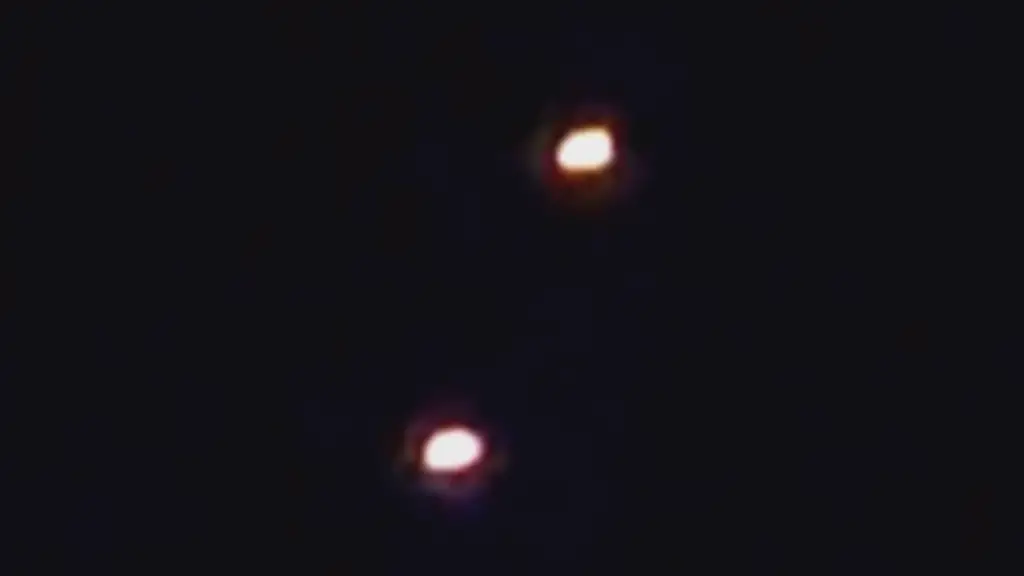
A low horizontal column lights (UFO) moving slowly across the sky over Morehead City North Carolina.
Video source MUFON, Case # 127633
THE GREYS ORDER: AGENDA EXPOSED - FULL MOVIE - V ORIGINAL
THE GREYS ORDER: AGENDA EXPOSED - FULL MOVIE - V ORIGINAL
Who are the Grey Aliens and what is their interest in our World? In this documentary we explore the possible motives behind three of the most prolific encounters in our history: The Roswell Incident, the Betty and Barney Hill Abduction and the Abduction of Travis Walton
NASA has an exciting 2023 planned - See what's on tap
Artemis 2 astronaut assignments, new spacesuits for the moon, OSIRIS-REx returns samples to Earth, Boeing Starliner's first crewed mission to space station and more is in store for 2023.
Credit: NASA
NASA Captures The Biggest Explosion In The Solar System
In October 2022, during the Orionids meteor shower, a fireball was captured on camera in North America. Other meteors left long streaks of glowing debris in the sky. A little earlier, in March 2022, an asteroid crashed into Earth's atmosphere, and was captured by one of the meteorological satellites. Fortunately, the asteroid, named 2022 EB5, was only 2 meters [6.5 feet] wide, so it didn’t result in a catastrophe.
But not all cosmic collisions are so safe. Some of them are powerful enough to damage planets or even lead to their destruction.
What explosion captured on camera is hundreds of times the power of our entire nuclear arsenal? Which cosmic explosion left a void the size of many galaxies around it? And what single meteorite triggered the creation of an Earth defense program?
Scientists Just Found An Exact Replica Of The Milky Way Galaxy In This Region Of Space
Scientists Warns Multiple Unidentified Alien Objects From Interstellar Space In Our Solar System
Shaped like an elongated cigar, by the time it was spotted it had already zipped by our own Sun, performed a slick hairpin turn, and begun hurtling off in another direction. Two things in particular fixated scientists. The first was its mysterious acceleration away from the Sun, which was hard to reconcile with many ideas about what it might have been made of. The second was its peculiar shape – by some estimates, it was 10 times as long as it was wide.
NASA considers using SpaceX Dragon to rescue crew of damaged Soyuz
NASA considers using SpaceX Dragon to rescue crew of damaged Soyuz It's been almost 20 years since we last lost astronauts in space. That is the biggest and proud effort of the space industry. However, once again we are in a dangerous situation.
Two weeks ago, Soyuz spacecraft docked to ISS sprang coolant leak. This is one of two vehicles used to get humans to and from the ISS and serves as a "lifeboat" in case personnel are required to evacuate the station rapidly. While the leak doesn't place the ISS or its crew in danger, it cuts the margin for error and can potentially interfere with future crew rotations. There must definitely have a solution. But a rescue Soyuz craft could only come in February at the earliest. As the last way, NASA is considering using SpaceX Dragon to rescue the crew of the damaged Soyuz. So, can SpaceX's trampoline save the Soyuz crew? How does Russia react to this plan? Find out all about this in today's episode of Alpha Tech:
NASA might use a SpaceX spacecraft to rescue three space station crew members depending on a leaky Soyuz to get home, a report suggests.
The Soyuz spacecraft on the International Space Station suffered a severe coolant leak on Dec. 15 and a decision about whether it is safe to send the crew back to Earth on it will come in January, Russia has said. If a rescue Soyuz craft is needed it could only come in February, two or three weeks before the normal changeover in March.
As the result, NASA is apparently considering using SpaceX, the only company currently flying astronauts into space from American soil, as a backup if these options don't work out.
"We have asked SpaceX a few questions on their capability to return additional crew members on Dragon if necessary, but that is not our prime focus at this time," NASA spokesperson Sandra Jones said in a statement to Reuters, published Wednesday (Dec. 28).
However, NASA did not clarify what options with SpaceX might be possible, such as whether the company could launch a backup Crew Dragon spacecraft to pick up the crew, or add more seats to the existing Dragon (called Endeavour) docked at the space station. NASA considers using SpaceX Dragon to rescue crew of damaged Soyuz
All Falcon 9 and Falcon Heavy Launches (V1.7)
what’s new: Added Starlink 5-1 and EROS-C3, made OneWeb 1 footage shorter to fit the aforementioned 2 launches. Added 1 and 2 to the end of SES O3b mPOWER.
also good job SpaceX on 61 Falcon launches in 2022, rip B1051, B1066, and B1049. They were purposefully expended.
Every Stunning Image From the James Webb Space Telescope Captured So Far (4K)
The James Webb Space Telescope (JWST) represents a new era in modern astronomy and as its first year of observing the universe comes to an end, we take a look at all the stunning images it has captured. We got to see the full capabilities of the James Webb Space Telescope with images of distant planets, the earleist Galaxies and even colossal galaxy mergers. We saw the remnants of ancient stars, but also the regions where new stars are born. In this video, we will look over the best images captured by JWST over the last year, which include the enormous galaxy cluster SMACS 0723, the beautiful views of the Pillars of Creation, and the chaotic clash in Stephan’s Quintet, along with the magnificent cliffs of the Carina Nebula and the stunning ‘Hourglass’ Protostar plus lots more. Sit back, relax, and enjoy the universe like never before.
Science on space station in 2022 - See the best pics!
The International Space Station science experiments in 2022 are highlighted in these images. "Hundreds of scientific investigations and technology demonstrations," were supported by the orbital outpost's crew during the year, according to NASA.
2022: Another Year of Mysteries and Speculations About Extraterrestrial Life
It has been an exciting year for those who are hoping to find out more about the possibility of alien life. In January, experts noted that 2022 could be the turning point in the search for truth about the UFOs. According to Mark Rodeghier, the scientific director of a UFO research center in Chicago, the advancements in software tools and technology that have been made in the study of these objects have attracted more qualified individuals.
More people are now qualified to study the subject of alien life after seeing the advancements in software tools that can help in the investigation of the matter.
In April, the US Department of Defense released more than 1,500 pages of documents related to the extraterrestrial nature of objects. These documents, which came from the AATIP, covered incidents from 2007 to 2012. Some of the cases included multiple medical reports and the injuries sustained by individuals after allegedly being hit by flying saucers.
Some of the injuries reportedly caused by the flying saucers included nerve damage, headaches, heart palpitations, and electromagnetic radiation. It’s not clear how the AATIP conducted its investigation procedures.
Two scientists presented a solution to the issue of the Fermi paradox in May. They noted that an intelligent society capable of space travel may eventually fail due to how their energy demands exceed their innovation.
The scientists suggested that advanced alien civilizations could try to limit their energy usage by going dark. This would prevent them from broadcasting signals to other extraterrestrial entities.
In June, a group of researchers presented a device that they claimed could be an artificial alien vessel that could support life on Mars. The object, which was found in a geological formation known as the Medusae Fossae, was described as a high-technology artifact that looked like it was made of a metallic alloy. However, some experts doubt the discovery, as it could actually be a natural feature.
The search for alien life continued to have setbacks in 2022. In July, a group that’s focused on finding signs of intelligent alien life announced that it didn’t detect any signals from these objects. The project, which was funded by philanthropist and billionaire Yury Milner, has been using various telescopes to look for electromagnetic signals coming from other star systems.
Israeli entrepreneur Yuri Milner, used the Green Bank Telescope in West Virginia
After analyzing soil samples taken by the ExoMars rover in August, the ESA revealed that there were traces of microbial life on the planet. However, they weren’t able to find proof of complex life forms. The presence of nutrients and water on the surface of Mars made the microbes resilient.
Despite the setbacks encountered in the search for alien life, the question of whether or not humans are alone in the universe is still being pursued.
2022: Another Year of Mysteries and Speculations About Extraterrestrial Life
It has been an exciting year for those who are hoping to find out more about the possibility of alien life. In January, experts noted that 2022 could be the turning point in the search for truth about the UFOs. According to Mark Rodeghier, the scientific director of a UFO research center in Chicago, the advancements in software tools and technology that have been made in the study of these objects have attracted more qualified individuals.
More people are now qualified to study the subject of alien life after seeing the advancements in software tools that can help in the investigation of the matter.
In April, the US Department of Defense released more than 1,500 pages of documents related to the extraterrestrial nature of objects. These documents, which came from the AATIP, covered incidents from 2007 to 2012. Some of the cases included multiple medical reports and the injuries sustained by individuals after allegedly being hit by flying saucers.
Some of the injuries reportedly caused by the flying saucers included nerve damage, headaches, heart palpitations, and electromagnetic radiation. It’s not clear how the AATIP conducted its investigation procedures.
Two scientists presented a solution to the issue of the Fermi paradox in May. They noted that an intelligent society capable of space travel may eventually fail due to how their energy demands exceed their innovation.
The scientists suggested that advanced alien civilizations could try to limit their energy usage by going dark. This would prevent them from broadcasting signals to other extraterrestrial entities.
In June, a group of researchers presented a device that they claimed could be an artificial alien vessel that could support life on Mars. The object, which was found in a geological formation known as the Medusae Fossae, was described as a high-technology artifact that looked like it was made of a metallic alloy. However, some experts doubt the discovery, as it could actually be a natural feature.
The search for alien life continued to have setbacks in 2022. In July, a group that’s focused on finding signs of intelligent alien life announced that it didn’t detect any signals from these objects. The project, which was funded by philanthropist and billionaire Yury Milner, has been using various telescopes to look for electromagnetic signals coming from other star systems.
Israeli entrepreneur Yuri Milner, used the Green Bank Telescope in West Virginia
After analyzing soil samples taken by the ExoMars rover in August, the ESA revealed that there were traces of microbial life on the planet. However, they weren’t able to find proof of complex life forms. The presence of nutrients and water on the surface of Mars made the microbes resilient.
Despite the setbacks encountered in the search for alien life, the question of whether or not humans are alone in the universe is still being pursued.
The Solar Wind is Creating Water on the Surface of the Moon
Water on the Moon has been a hot topic in the research world lately. Since its first unambiguous discovery back in 2008. Since then, findings of it have ramped up, with relatively high concentration levels being discovered, especially near the polar regions, particularly in areas constantly shrouded in shadow. Chang’e 5, China’s recent sample return mission, didn’t land in one of those permanently shadowed areas. Still, it did return soil samples that were at a much higher latitude than any that had been previously collected. Now, a new study shows that those soil samples contain water and that the Sun’s solar wind directly impacted that water.
The amount of water on the lunar surface varies widely both based on the time of the lunar day and the latitude it is located at. There is so much variability that the water content of the lunar soil can be 200 ppm higher or lower at different times of the day. With that much variability, it seems clear that the Sun plays a significant role in the hydrological cycle there is on the Moon.
Part of that role is controlling the type of hydrogen embedded into the lunar soil. Since the Moon has almost no atmosphere to speak of, the charged hydrogen particles that make up the solar wind can directly interact with the top regolith layer on the lunar surface. When they do so, they leave behind a distinct sign that they do – a large amount of hydrogen atoms with very little deuterium.
UT video on the importance of water at the lunar poles.
Deuterium is a heavier form of hydrogen with an extra neutron in its nucleus. It is relatively rare on the solar wind, given that the neutron gives the extra mass, making it less likely to be caught up in the forces that create the wind. As such, hydrogen and whatever water it eventually forms from the solar wind would be distinctly lacking in water molecules that integrate deuterium.
That is exactly what researchers at the Chinese Academy of Sciences found on some of the soil samples returned by Chang’e 5. They had a high (~1000-2500 ppm) concentration of hydrogen but a relatively low concentration of deuterium. Importantly, this result was the case for the first 100 nm of soil collected, showing that the solar wind effect appears on the topmost layer of the regolith, as expected.
Also, the overall water concentration in the Chang’e 5 sample was estimated to be around 46 ppm, right around what was found using remote sensing prior to the lander touching down. Location also mattered a lot to this study, as the researchers attempted to use the concentration findings and feed them into a model that tracks the outgassing that was evidenced by lunar water at other latitudes. At the higher latitudes of Chang’e 5, there wasn’t as much variability as was found at lower latitudes by missions such as Apollo and Luna.
The search for lunar water continues in this UT video.
More importantly, the model also suggests that even higher latitudes, reaching up toward the poles, would have an even greater abundance of hydrogen. That lends credence to the theory that the lunar poles are one of the most likely places to find large amounts of water on the lunar surface. And it also feeds into the interest that the polar regions have garnered as the potential site of the first lunar research base. While that is still a long way off, the results from this study are an important step toward understanding this all-important feature of lunar hydrology.
Bizarre Alien Encounters: William Shatner’s Weird Or What Marathon
In this YouTube video, various strange and mysterious stories of alleged alien encounters are presented and explored.
One such encounter is described by Mexican farm workers, who claim to have captured a small, human-like creature in a barn. The creature, covered in oil and with gray, amazing eyes, was subjected to DNA testing and found to be genetically distinct from any known species. The creature’s strange appearance and the mysterious circumstances surrounding its capture and death have led some to speculate that it may be an alien or even a trans-dimensional being.
Another story tells of a woman named Cynthia Crawford, who believes she is the product of a secret government experiment to breed humans with aliens. She claims to have unusual physical abnormalities, such as thick skin and porous bones, and to possess a rare and mysterious blood type. Some speculate that she may be the result of an alien program to create human hybrids, while others believe her claims require extraordinary proof and may be the result of a covert intelligence program.
In Arizona, a man named Chuck Hall claims to have had multiple encounters with extraterrestrial beings while working as an Airman at an underground military base. He refers to these beings as “tall whites” and claims that they are hosted by the military in exchange for sharing the secrets of their advanced technology. Hall also asserts that the tall whites have a base on the star Arcturus and have been visiting Earth for thousands of years, according to ancient Greek legends.
Despite the strange and often incredible nature of these stories, they serve as a reminder of the vast unknowns that exist in the universe and the possibility that we are not alone.
Boeing 747 Pilot Captures Cigar-Shaped UFO on Camera, Shares Experience with Defying Known Technology
Captain Christiaan van Heijst of a Boeing 747 revealed that he has seen strange objects in the sky. He said that the objects flew at speeds of up to 23,000mph.
He is a highly regarded airman and an experienced aerial photographer from The Netherlands. However, he has never seen anything like these before. UFOs are typically regarded as a taboo subject.
In the past couple of years, the topic of UFOs has started to move. Due to the growing number of people talking about their experiences with these mysterious objects, the government admitted that they are indeed in the sky. This led to the formation of a new term called UAP, which stands for Unidentified Aerial Phenomenon.
According to Christiaan, he initially thought that these objects were military-related. However, after seeing them, he realized that they sounded very similar to the strange things he had seen in the past. For over two decades, he has been flying airplanes. Before he became a commercial pilot, he was a champion aerobatic pilot.
He has over 10,000 hours of flight time and 6,000 hours on the Boeing 747. While he believes that around 99 percent of the objects that he has seen in the sky are harmless, he still has a couple of unidentified sightings that he’s still baffled by.
Christiaan noted that as a pilot, his main objective is to keep the plane safe. Whenever he sees something that catches his attention, he immediately starts looking for it to determine if it’s a military plane or something that might affect his flight.
Since most pilots are trained observers, they don’t search for UAP. Instead, they rely on their knowledge of weather conditions and aerial observations to determine if the objects they see have a direct impact on their flight path. One of Christiaan’s most compelling sightings was over Greece, where he was flying near an aircraft carrier.
During his flight, he spotted a bright light in the sky that moved at an extremely high speed. Although he could not explain what caused the light, he said that it left no trail. He estimated that it flew at speeds of around Mach 30.
He was not sure if the object was connected to the aircraft carrier, which was involved in operations during the Iraq War. Other strange sightings include a falling light that he saw in the sky that moved rapidly before crashing to the ground.
He also reported seeing a ball of light flying across the Adriatic Sea. The object disappeared without a splash as it moved toward the sea. Christiaan also told The Sun Online that he came across a cigar-shaped object that he took with him in January 2010. The object lasted for over an hour.
Capt. Christiaan van Heijst Captures Picture of Mysterious Object Off the Coast of Spain. Source: jpcvanheijst.com
He was traveling from Amsterdam to Malaga when he spotted the object in the sky about a hundred nautical miles ahead of him. According to air traffic control, there was no other aircraft flying in the area. The large and stationary object appeared to be blocking a portion of the sun.
It flew higher than commercial planes, and air traffic control did not find activity in the area. After taking a picture of the object, Christiaan was able to get an enhanced image of it using an AI system. The image was then analyzed by an agency that focuses on UFOs.
Although he doesn’t have a theory about what caused the objects in the sky to appear, Christiaan is still positive that one day, an explanation will be provided. He believes that the stigma surrounding UFO discussions will eventually break down.
Despite the possibility that there could be new atmospheric phenomena, it’s always better to analyze data without bias. For Christiaan, he used to disregard his own sightings as he was afraid that they might be too far fetched to consider seriously. He noted that colleagues often bring up the topic, though he rarely starts a dialogue himself.
According to him, his colleagues would often only discuss strange things with them once they believed they wouldn’t be able to explain it. He said that he was open to discussing his experiences with UFOs, though he avoids speculation.
Christiaan wanted to know what it was that he saw, as it could affect the safety of his plane. He noted that during the 1800s, the idea of rocks falling from the sky was regarded as a ridiculous notion. Today, most people believe that these are meteorites.
Despite the stigma surrounding UFOs, he believes that the situation will eventually break down eventually. He urged security agencies and aviation organizations around the world to keep investigating the phenomenon. He noted that he was very happy that the discussion about UFOs was starting to take place in the US.
He believes that eventually, people will start accepting the concept of UFOs, which will lead to the development of a more comprehensive understanding of the phenomenon.
He noted that collecting data is the only way to investigate what’s happening in the sky. Only then can we come up with an explanation as to what caused the objects to appear. In the US, a new investigation was launched after a series of leaked videos revealed that the military had encounters with alleged UFOs.
The government’s decision to declassify Project Blue Book, which detailed the activities of the UFOs during the 1960s, has led to a significant change in the way the topic is viewed. This discussion, which was once regarded as a fringe issue, has started to be discussed by prominent individuals.
His aerial photography can be found on his website and Instagram. He also recently appeared on YouTube to talk about his UAP encounters:
SpaceX launches Israeli recon satellite in final flight of 2022, lands rocket in California
A SpaceX Falcon 9 rocket launched the Israeli Earth-imaging satellite EROS C-3 from Vandenberg Space Force Base in California on Dec. 29, 2022. The first stage of the rocket landed at a nearby SpaceX pad about 8 minutes into the flight.
'Boss Mark' Found Deep Inside The Great Pyramid? 👨💼
6 US launch companies 2022 are doing better, even humiliated Jeff's Blue Origin after SpaceX
6 US launch companies 2022 are doing better, even humiliated Jeff's Blue Origin after SpaceX. There is no doubt that 2022 was out of this world! 2022 will go down in the history books as one of the most accomplished years across all U.S. space companies. The biggest dog is definitely SpaceX with United Launch Alliance starting to nip at its heels. There is only a big black sheep worth noting, Blue Origin. Jeff Bezos's space company has long had the potential to become a dominant US launch company. Certainly, no company is spending more toward that goal, except SpaceX. Pitifully, the results they achieved are completely unworthy. In fact, 6 US launch companies are doing better and humiliating Jeff's Blue Origin in 2022. Find out all about this in today's episode of Alpha Tech:
No. 1: SpaceX Was there any doubt? This year, the California-based launch company launched 60 rockets, with 100 percent mission success. More than 90 percent of these launches have taken place on previously flown first stages and the majority with reused payload fairings.
By every possible measure, 2022 has been a groundbreaking year for SpaceX even when considering the vast list of achievements it’s racked up over the last half-decade. It owns and operates the largest satellite constellation in history by an order of magnitude. Its Starlink satellite internet service has secured more than a million subscribers less than two years after entering beta. It operates the only routinely reusable orbital-class rockets and orbital spacecraft currently in service. Its Falcon 9 workhorse has launched more in one year than any other single rocket in history. It’s regularly launching at a pace that hasn’t been sustained by any one country – let alone a single company – in 40 years. It’s managing that near-historic cadence while simultaneously recovering and reusing boosters and fairings that represent some 70% of the value of almost every rocket it launches.
Thanks to its aggressive efforts to develop, test, and prove the capability to reuse Falcon 9 first stages, SpaceX was able to dramatically increase its launch capacity this year at a critical juncture. When Russia invaded Ukraine, Western access to the Russian Soyuz rocket ended. SpaceX was able to scale up its launch cadence accordingly, helping OneWeb, the European Space Agency, and others with launch needs that resulted from the war. 6 US launch companies 2022 are doing better, even humiliated Jeff's Blue Origin after SpaceX
It's over! NASA says goodbye to "InSight probe" after 4 years on Mars
It's over! NASA says goodbye to "InSight probe" after 4 years on Mars This is NASA's InSight spacecraft, an acronym for Interior Exploration using Seismic Investigations, Geodesy, and Heat Transport, launched to Mars in May 2018 and landed later that year in November. Its mission is to learn more about how Mars' interior is layered so scientists can compare Mars with what we know about other planets and Earth. Sadly, after a long struggle with Martian dust, NASA’s InSight probe has now gone quiet. It's time for Farewell to Insight!
NASA's InSight lander has probably phoned home for the last time from the planet Mars.
The space agency said the spacecraft did not respond to communications from Earth on Sunday, December 18. The lack of communications came as the lander's power-generating capacity has been declining in recent months due to the accumulation of Martian dust on its solar panels. NASA said that it is "assumed" that InSight has reached the end of its operations but that it will continue to try to contact the lander in the coming days.
"It's assumed InSight may have reached the end of its operations," NASA said late Monday, adding that its last communication was Thursday. "It's unknown what prompted the change in its energy."
Also, also on Monday, the InSight Twitter account shared a photo with a message saying this was probably the last photo it was sent from Mars.
"My power's really low, so this may be the last image I can send," the team wrote on InSight's behalf. "Don't worry about me though: my time here has been both productive and serene. If I can keep talking to my mission team, I will — but I'll be signing off here soon. Thanks for staying with me."
Actually, the solar-powered lander issued an update last month, reminiscing on its time in space.
“I’ve been lucky enough to live on two planets. Four years ago, I arrived safely at the second one, to the delight of my family back on the first. Thanks to my team for sending me on this journey of discovery. Hope I’ve done you proud,” it said. It's over! NASA says goodbye to "InSight probe" after 4 years on Mars
TUNGUSKA METEORITE: What’s There Now? What Happened in Tunguska Event?
The Tunguska event happened over 100 years ago but is still considered one of the most mysterious phenomenons of the 20th century. A Russian journalist decided to travel all the way to the Tunguska epicenter and look for himself - what's there now? And what caused it all?
If you liked this video, please feel free to like and subscribe! And share the link with your friends: it helps a lot! Thanks for watching!
These Mysterious Secrets from the Mayan Pyramids Are Causing New Theories for Researchers!
Pyramids are among the most fascinating structures of the past - but it wasn't just the ancient Egyptians who pounded these colossal structures out of the ground. Many other cultures, such as the ancient Chinese or the indigenous people of Latin America, also demonstrated their incomparable skill in building pyramids. But although these stone testimonies were completed centuries ago, they still hide many secrets from days long past. Today we would like to focus on the mystical Mayan pyramids and show you why the gigantic buildings are always the focus of exciting theories.
The Biggest Space Discoveries and Breakthroughs of 2022! What a Stunning Year!
2022 has been a busy year for space exploration and discovery. Thanks to a variety of exciting missions, we have been able to see the cosmos like never before. From the James Webb Space Telescope viewing the first galaxies to the DART mission crashing into an asteroid! Above our heads, incredible things were being achieved. Join me as we check out 2022's most significant space discoveries!
Skinwalker Ranch: New Evidence of Paranormal Activity, UFOs, Ghosts (Part 4) | The Basement Office
Allegedly one of the most haunted places on Earth, Skinwalker Ranch spans 500 eerie acres across eastern Utah. And while stories of paranormal activity at the property are in no short supply, hard evidence has eluded experts.
Real estate millionaire Brandon Fugal acquired the land back in 2016, and ever since has been eager to prove that the legends about the ranch are actually true. Steven Greenstreet , host and producer of “The Basement Office”, interviews owner Brandon Fugal and his team of investigators.
Skeptical of past myths, but open minded to the possibility of new discoveries, Greenstreet sets out on an exclusive tour of the heavily surveilled property, combs through hours of video footage, and works with experts to try and find a glimmer of truth.
The Secret Science of World War II - Full Documentary
In the crucible of World War II, Germany’s most brilliant scientists raced to create an arsenal of terrifying new weapons of mass destruction, even an atomic bomb. Before the war ended, they produced a series of technological firsts that were the basis for many modern-day air and spacecraft. This documentary highlights the inventions of Wernher von Braun, Werner Heisenberg, and many others.
Researchers digging in the ancient city of Aizanoi have announced the discovery of many new artifacts and works. But the discovery of an “almost intact” statue of a giant man with one foot takes the archaeological biscuit.
The ancient city of Aizanoi was founded as a Phrygian city on the western end of the Phrygia kingdom, in the present-day Çavdarhisar district of the western Anatolian province of Kütahya in Turkey. Aizanoi was home to the Aizanitisians, Phrygians, Greeks, Romans and Byzantines and the site was rediscovered by European travelers in 1824. The German Archaeological Institute began excavating in 1926 and works resumed in 1970, with them having accelerated significantly over the last two years.
At this site, that’s listed on the UNESCO World Heritage Tentative List , over the years archaeologists have unearthed ancient stone heads and bodies depicting Greek gods and goddesses such as Eros, Dionysus, Aphrodite and the demigod Herakles. This season, archaeologists greatly added to their expanding haul from this site and they have announced the discovery of “many large and small pieces of marble sculptures,” including an “almost intact” giant man carved in stone.
Excavation leader, Gokhan Coskun of Dumlupınar University, said if these newly discovered statues were complete they would reach “3 meters (9.84 ft) to 3.5 meters (11.48 ft) in height.” The “almost intact statue,” representing the only one of its type so far discovered, features a gigantic (in ancient Roman terms) man measuring 2 meters 10 centimeters (6’ 10”) high. The statue is missing only half of its pedestal and one foot. And besides all of these unearthed human and god forms, the archaeologists also discovered building blocks from bridge No 3, and they even unearthed a sundial.
From the Bronze Age till the late seventh century, and then again by the Çavdar Tatars in the 13th century, the ancient city of Aizanoi was constantly occupied. Ancient Origins reported in November 2021 that the site’s excavation coordinator, Gokhan Coskun, told the Greek Herald that “the bodies of the statues were found in a previous dig, whilst the 5000-year-old Greek statue heads of the Greek goddess of love and beauty, Aphrodite and Greek god of wine, Dionysus, were unearthed in a creek bed in the ancient city.
During the Hellenistic Period the ancient city of Aizanoi was controlled by the hegemonies of the Pergamon and Bithynia Kingdoms, only coming under Roman control in 133 BC. Gökhan Coşkun told Hurriyet Daily that the newly discovered statues date back “2,000 years”, and said “new artifacts are found every day.” Coşkun declared that this season's “surprising finds made the team very excited,” and especially in the area where the bridge crossed the Penkalas Stream.
According to a report on DPU Habar , the ancient city of Aizanoi, which dates back to 3,000 BC, was equipped with a theatre, stadium, agora and Zeus Temple . This year, “80 workers and 20 technical staff” focused on the Penkalas Stream area where they restored a Roman-era marble bridge (No: 2) and continued rebuilding the currently completely ruined bridge (No: 3). While the recovery of these bridges will inform the archaeologists about ancient building methods and processes, the world looks on in awe at the swelling collection of human bodies and heads dating back 1,800-2,000 years ago”.
Heads of gods and humans just kept emerging from the mud.
Every year archaeologists dig a little deeper into the rubble that is the ancient city of Aizanoi, and more and more bodies and heads of humans and gods are brought to the surface. However, as the artifacts pile up a big outstanding question becomes amplified, among both the researchers and the public. How, or rather why, did all of the carved heads become detached from the statue’s bodies?
In 2021 Mail Online reported that it was “not yet clear” how the heads and bodies were separated, and still today this remains unanswered. But so far as educated guesses go, it is thought most probable that an ancient stone masons' school, or a sculpture workshop “produced the magnificent statues,” according to Gokhan Coskun. The researcher concluded that his team was “very excited” about the statue they found in the recent excavations, which is ‘almost’ completely preserved, and he said they hope to find the giant man’s missing half pedestal and foot in 2023.
Top image: Statue emerging from red mud at Aizanoi.
New Measurements of Galaxy Rotation Lean Towards Modified Gravity as an Explanation for Dark Matter
Although dark matter is a central part of the standard cosmological model, it’s not without its issues. There continue to be nagging mysteries about the stuff, not the least of which is the fact that scientists have found no direct particle evidence of it. Despite numerous searches, we have yet to detect dark matter particles. So some astronomers favor an alternative, such as Modified Newtonian Dynamics (MoND) or modified gravity model. And a new study of galactic rotation seems to support them.
The idea of MoND was inspired by galactic rotation. Most of the visible matter in a galaxy is clustered in the middle, so you’d expect that stars closer to the center would have faster orbital speeds than stars farther away, similar to the planets of our solar system. What we observe is that stars in a galaxy all rotate at about the same speed. The rotation curve is essentially flat rather than dropping off. The dark matter solution is that galaxies are surrounded by a halo of invisible matter, but in 1983 Mordehai Milgrom argued that our gravitational model must be wrong.
Rotation curve of the typical spiral galaxy M 33 (yellow and blue points with errorbars) and the predicted one from distribution of the visible matter (white line). The discrepancy between the two curves is accounted for by adding a dark matter halo surrounding the galaxy. Credit: Public domain / Wikipedia
At interstellar distances, the gravitational attraction between stars is essentially Newtonian. So rather than modifying general relativity, Milgrom proposed modifying Newton’s Universal Law of Gravity. He argued that rather than the force of attraction is a pure inverse square relation, gravity has a small remnant pull regardless of distance. This remnant is only about 10 trillionths of a gee, but it’s enough to explain galactic rotation curves.
Of course, just adding a small term to Newton’s gravity means that you also have to modify Einstein’s equations as well. So MoND has been generalized in various ways, such as AQUAL, which stands for A Quadradic Lagrangian. Both AQUAL and the standard LCDM model can explain observed galactic rotation curves, but there are some subtle differences.
Measured shift between inner and outer stellar motions. Credit: Kyu-Hyun Chae
This is where a recent study comes in. One difference between AQUAL and LCDM is in the rotation speeds of inner orbit stars vs outer orbit stars. For LCDM, both should be governed by the distribution of matter, so the curve should be smooth. AQUAL predicts a tiny kink in the curve due to the dynamics of the theory. It’s too small to measure in a single galaxy, but statistically, there should be a small shift between the inner and outer velocity distributions. So the author of this paper looked at high-resolution velocity curves of 152 galaxies as observed in the Spitzer Photometry and Accurate Rotation Curves (SPARC) database. He found a shift in agreement with AQUAL. The data seems to support modified gravity over standard dark matter cosmology.
The result is exciting, but it doesn’t conclusively overturn dark matter. Thye AQUAL model has its own issues, such as its disagreement with observed gravitational lensing by galaxies. But it is a win for the underdog theory, which has some astronomers cheering “Vive le MoND!”
Giant Triangle UFO Below Surface Of Sun, Dec 29, 2022, UFO Sighting News.
Date of sighting: Dec 29, 2022
Location of sighting: Earths Sun
Guys this is huge, a triangle object was sticking out of our sun, visible below the surface for a few minutes today. The object was big, about 25X the diameter of Earth. Yes thats big, too big for humans to make right now, but after a billion years of technological evolution our species will have such abilities too. The sun is a huge power station and aliens have learned how to harness and use its power. Imagine charging up that ship for free! They did it, so it can be done.
Did You See Avatar: The Way of Water? It Made The Alien Na'vi Look Bad, UFO Sighting News.
Hey I took my family to see the new Avatar movie last night. And I walked away feeling confused about what I just watched. Why would director James Cameron make a movie that depicts the blue native Na'vi people as the bully? Please read my message on Twitter to the director and you will understand or perhaps you saw the movie and felt something odd like I did. To me, I would expect an epic movie like Avatar to show the Na'vi as kind, thoughtful, nature loving, and full of love. But this was not the case. Something was really off. For too long, Hollywood has portrayed aliens as cruel, heartless, aggressive, the bully, and they did it again with Avatar!
Three Glowing Orbs Over Clermont, Florida Dec 25, 2022, UFO Sighting News.
Date of sighting: Dec 25, 2022
Location of sighting: Clermont, Florida, USA
Here are some awesome glowing orbs over Florida. The area is known for glowing orange sphere which were first recorded by Dr Steven Green many years ago and continue to be seen here in this video. Absolute proof that Florida is shared not only with humans, but aliens.
Scott C. Waring - Taiwan
Eyewitness states:
My wife and I were on a date in Downtown Clermont, FL, sitting on the dock of Lake Minneola. I’m an avid sky watcher and noticed 3 bright orange orbs in the sky that looked like nothing I’ve seen before. Definitely not planes (you can see a plane traveling in the opposite direction and the subsequent blinking lights) I noticed the first one, and it had vanished by the time I had gotten my phone out to record the other two. They all followed close to the same flight path and just seemed to vanish when they reached a certain point. This follows closely to other sightings I’ve seen online with 2 or 3 of these orange orbs doing exactly this.
Mysterious Object At NASA Space Station, Dec 27, 2022 UFO Sighting News.
Hey all, hope you have a good holiday. I found this strange object moving past the space station this week and the camera follows it so thats 100% proof that the astronauts saw this object. But the question is...what is it? Since there was no communication heard, the possibilities are endless, but the objects shape, color and movement do conform to past UFOs recorded by the live cam. Watch the video and tell me your thoughts of what it is, but leave comments on my Youtube channel video area.
HAARP hit an asteroid with 9.6 million radio waves - Preparation against Apophis?
Scientists at the University of Alaska Fairbanks (UAF) and NASA want to examine the 2010 XC15 space rock to test their preparation against Apophis. This dangerous asteroid might hit our planet in 2029. It is believed that on April 13, 2029, Apophis will be 10 times closer to Earth than the moon.
The researchers will use the HAARP (High-frequency Active Auroral Research Program) array to shoot 9.6 megahertz radio waves at the 500-foot-wide 2010 XC15 asteroid.
HAARP is a government-funded research program that generally studies the ionosphere (part of Earth’s atmosphere at 50 to 400 miles above the surface). However, this will be the first time it will be employed to examine an asteroid.
Astronomers have been shooting radio waves in space to spot asteroids; figure out their shape, trajectory, structure of their surface, and many other characteristics. For this purpose, they use radio waves having frequency ranges either in the S-band (2,000 to 4,000 MHz) or X-band (8,000 to 12,000 MHz).
Interestingly, for probing 2010 XC15, the researchers are using waves of much lower frequency (9.6 MHz) and longer wavelengths because, this time, they don’t just want to explore the surface of the asteroid. They want to know what’s inside.
Information about the interiors could reveal important details about the damage that an asteroid could cause and help scientists figure out an effective counter-strategy.
Flashback: On December 27, the distance between 2010 XC15 and Earth will be around twice the distance between Earth and the moon. HAARP will be shooting 9.6 million chirping radio waves every second to this distance, and this process will be repeated every two seconds. This test is crucial because if the researchers can successfully examine 2010 XC15 using low-frequency radio waves at such a long distance. Then they could easily employ the same method to analyze Apophis.
Although the 2029 asteroid is most likely to miss Earth, in case it doesn’t, the consequences could be catastrophic.
For instance, in response to an FAQ that explores the possibility of Apophis hitting Earth, The Planetary Society wrote on its website, “Apophis would cause widespread destruction up to several hundred kilometers from its impact site. The energy released would be equal to more than 1,000 megatons of TNT, or tens to hundreds of nuclear weapons.”
Moreover, Apophis is just one asteroid. There will be many asteroids that will pass by, or might even hit, Earth in the future. Low-frequency radio waves could play a key role in understanding the composition of these mysterious space objects and, at the same time, help us strengthen our planetary defense mechanism.
However, before all this happens, HAARP and its low-frequency radio waves will have to pass their first test, which indeed has been carried out on December 27.
If the experiment worked, the pulses also reached asteroid 2010 XC15, which passed by Earth on Dec. 27th at a distance of 770,000 km. Researchers from NASA and the University of Alaska pinged 2010 XC15 with shortwave radio signals to probe the asteroid's interior--a first if it worked. They are still waiting for confirmation that the reflections were received, as expected, by antenna arrays in California and New Mexico.
They say that the 2029 Asteroid Apophis is most likely to miss Earth, but the fact that they perform this first test indicates that they are not 100 percent sure whether it will hit the Earth or not.
Also interesting is that they want to know what's inside asteroids, such as Apophis, but what will happen if they discover that the inside of an asteroid is made up of advanced technology, a hollow spacecraft built by aliens and disguised as an asteroid, like the infamous space rock ‘Oumuamua’.
Former Equerry to Queen Elizabeth II Claims to Have Met an Extraterrestrial Being
Air Marshal Sir Peter Horsley, a highly credible and vetted individual who served as Equerry to Her Majesty The Queen and Prince Philip, claims to have had an encounter with an extraterrestrial mind reading humanoid in 1954. Horsley, who had a successful career as a pilot and Deputy Chief of Strike Command, only felt comfortable sharing this extraordinary experience in his retirement. Predict
In an interview with Timothy Good, Horsley recalls that he didn’t have to voice his questions to the extraterrestrial and that they were answered for him. While Horsley did not provide an explanation for the encounter, he noted that it took him nearly 45 years to come forward with the story, even though it occurred over six decades ago.
Interestingly, Horsley mentioned that the subject of UFOs was discussed among high-ranking officials, including Prince Philip, during his time at Buckingham Palace. Prince Philip reportedly encouraged Horsley to conduct research into the subject, as long as it didn’t bring any negative publicity to the palace.
Air Marshal Sir Peter Horsley’s Incredible Encounter with an Extraterrestrial Mind Reader
Mysterious UFO Sighting in Florida Leaves Witnesses Baffled
Here’s one interesting UFO sighting video that was submitted to me through our Facebook page. This strange event happened on October 31st, 2022 around 2pm in Ocala, Florida.
Over the years, various reports of UFO sightings have been reported in Florida. Many of these incidents remain unexplained, and the public has been debating if these are actually extraterrestrial visitors or if they are the result of man-made or natural phenomena.
In 1997, a group of witnesses claimed to have spotted a UFO flying over the Everglades. It was described as a large triangular object that had bright lights on its corners. It disappeared into the clouds as it hovered over the swamp.
In 2002, a group of people claimed to have spotted a glowing and mysterious object in the sky over Gainesville. The object was described as having a cigar-shaped body and a dome-like top. It was seen hovering over the area for around 10 minutes before it disappeared.
In 2010, a group of individuals, including an employee of NASA, claimed to have spotted a UFO over the Kennedy Space Center. The object was described as a bright and glowing object that flew in the sky for several minutes before it disappeared.
See NASA's SWOT satellite deploy its antennas in space
NASA's Surface Water and Ocean Topography (SWOT) satellite's large mast and antenna panels of the spacecraft’s main science instrument were full deployed over the course of 4 days. The "two antennas belong to the groundbreaking Ka-band Radar Interferometer (KaRIn) instrument," according to NASA.
Credit: NASA/JPL-Caltech/CNES
Why Nuclear Starship could solve all Elon Musk's Problem "Colonizing Mars"?
Why Nuclear Starship could solve all Elon Musk's Problem "Colonizing Mars"?
China launches 'experiment' satellite atop Long March 3B rocket
A Chinese Long March 3B rocket launched the Shiyan-10 02 satellite from the Xichang Satellite Launch Center on Dec. 29, 2022.
The satellite "will be used for in-orbit verification of new technologies, including space environment monitoring," according to China Central Television.
The English translation of Shiyan is "experiment."
Credit: China Central Television (CCTV)
Future Technologies That Will Revolutionize Our World | Tech Effect Compilation | Spark
Murky Waters Threatens Deep Dive Search | The Bermuda Triangle: Into Cursed Waters (Season 1)
Mark and his team dive into deep waters to search for remains from the Snowy Grouper wreck. See more in this clip from Season 1, "Alien Abyss."
Watch new episodes of The Bermuda Triangle: Into Cursed Waters, Tuesdays at 10/9c, and stay up to date on all of your favorite The HISTORY Channel shows at history.com/schedule
New Mysterious Discovery in Sahara Shocks Researchers! What Are These Shapes All About?
In the midst of the barren desert, far from roads, cities or any sign of life, the Sahara is adorned with some striking details in the sand. These are dozens of geometrically arranged structures that stretch along a straight line for kilometers through central Algeria. Typically, these structures have a central point that is surrounded by 12 others - just as we know it from the dials of our watches. The first recordings of these mysterious circles spilled over the web last year - but the lively discussions in the comment columns were not intended to definitively answer the question of who created the objects. Today we would like to get to the bottom of this great mystery together with you!
The strange conical shapes light looks like a torch’s beam, but it’s far too high in the sky and the light appears from nowhere, as the Daily Star reports. At the beginning of the trail, there is a small glowing orb that resembles a meteorite or a reversed rocket launch, but witnesses said the light disappeared in an instant – ruling out both explanations.
Some local UFO buffs claimed the sight was of an alien ship, while others reckoned it was a satellite, with one resident saying: “It is very close,” with another commenting: “Doesn’t it look like a UFO. The light has vanished.”
Initially, officials were just as concerned and launched an investigation into what could have caused the phenomena.
As social media in India was flooded with people wanting an explanation for the strange UFO, many guesses were made.
Some expressed that they believed the object was a meteor or comet.
“People are scared of what is this. We didn’t listen to any sound like aircraft totally silent we see only light, sometimes after it disappeared in the sky,” one Twitter user wrote.
After much speculation, India Today claimed that what locals actually witnessed in the night sky was just “the latest operational test of Agni-V, India’s long-range, nuclear-capable, surface-to-surface ballistic missile.”
The missile was launched from the APJ Abdul Kalam Island off the Odisha coast and the government had cleared massive airspace for the test launch, which spread over 5,000 kilometers. Agni-V can bring almost the entire Asia, including the northernmost part of China, as well as some regions in Europe under its striking range. The Agni 1 to 4 missiles have ranges from 700 km to 3,500 km.
If true, is that any less scary than a UFO? And why did it suddenly vanish?
And does it also explain these other UFO sightings near the same location?
Multiple witnesses across rural Wisconsin captured video of strange UFOs shooting across the night skies from different locations.
Footage of the UFOs was taken by several independent witnesses around West Bend and Fredonia in rural Wisconsin on December 1.
The Daily Mail reports that the witnessses “did not know each other and filmed the lights at the same time from different locations, according to their video metadata.”
Two of the witnesses, Kimberly, 52, a salon owner from West Bend, and Ken, 54, a former police officer and financial services worker in Fredonia, shared their footage with the Mail.
“All of a sudden we saw what looked to be a white owl swoop from the upper right hand top of the trees, down in front of the headlights, and up to the left,” Kimberly told DailyMail.com.
She and her husband were driving home at around 10:45 p.m. when they saw the lights.
“And as we’re both leaning forward into the windshield, we start seeing these lights, similar to what I caught in the video,” she said. “We just couldn’t wrap our heads around what we were seeing.”
Ken shot his UFO video at the same time as Kimberly only about five miles northeast of her.
Another witness, Andrea Lynn, wrote on social media about a similar UFO sighting on Facebook. She was located 80 miles north and her sighting took place around 7 p.m.
“Has anyone in the Green Bay area seen the random groups of lights in the sky flying around? Any idea on what they are?” she asked.
“I reached out to the National Weather service, and they told me they saw the same lights again a week later.”
The next day, teacher Chris Nowak was about 35 miles away when he too saw similar odd lights in the sky at around 6:55 p.m.
“I’ve really never seen anything like it before,” Nowak told DailyMail.com. “It was like a row of illumination through the clouds, and it would pulse through the sky incredibly quickly.”
After stopping to film the phenomenon, Nowak says “it shot through the clouds and broke off into like three different beams from there. It moved at an incredible speed. It cleared down to the edge of the entire sky very, very quickly.”
He, like Kimberly, dismissed the idea that the UFOs were just spotlights.
“I’ve seen spotlights, we’ve taken our kids to Disney,” he said. “You see spotlights on clouds… That just has a much different look than what we were seeing.”
When asked about the strange UFO footage shot by multiple people in Wisconsin, former FBI agent Ben Hansen, host of the show UFO Witness on Discovery+, “Not only is there no evidence that any advertising spotlights have recently been permitted or used in this very rural area, the intensity and speed of the lights doesn’t comport with conventional technology.”
A meteorologist and a Milwaukee Federal Aviation Administration controller both stated that they saw nothing on their radars during the UFO sightings in Wisconsin.
“These latest sightings are kind of reminiscent of the ‘Foo Fighter‘ lights that were described by pilots during WWII or the lights that buzzed Washington D.C. in 1952,” said Hansen.
Pentagon’s UFO office inundated with unexplained sightings
By: Liam McAneny
Ever wondered whether humans were alone in the universe? A new office at the US Pentagon has received hundreds of reports of unidentified flying objects since it was set up in July.
The new All-domain Anomaly Resolution Office (AARO) was created back in July this year and was tasked with the job of tracking and investigating reports of “unidentified anomalous phenomena”.
The phrase unidentified anomalous phenomena (UAP) was chosen several years ago as a replacement for the moniker of UFO, to reduce stigma and to widen the net of unidentified objects that would be investigated.
As defined by the US Department of Defense, a UAP is any object in space, air, or land or in or under the sea that cannot be identified. The second prong of the definition for the purpose of the AARO office is that the object may pose a threat to US military operations or installations.
The AARO began their investigations starting with the historical reports of UAP encounters reported between 2004 and 2021, which encompassed 144 events. Of these 144 encounters, the AARO said that 80 of them were captured on “multiple sensors”.
These statistics were announced publicly by the director of national intelligence in June last year. This announcement, in addition to the establishment of the AARO office for the express purpose of investigating these phenomena and a rare Congressional hearing in May into UAPs has led to significant increases in reports of UAPS.
The director of the AARO, Sean Kirkpatrick, said that the office has “had lots more reporting” since it was set up, before going on to clarify the number was in the “several hundreds”.
Some of the AARO’s findings and investigations will be revealed in an updated report due to be produced by the director of national intelligence before the end of the year.
Kirkpatrick provided more comments on his agency’s mission, as well as emphasising their commitment to producing accurate and scientific findings.
“We have an important and yet challenging mission to lead an interagency effort to document, collect, analyse and when possible, resolve reports of any unidentified anomalous phenomena.
"We apply the highest analytic and scientific standards,” he said.
"We execute our mission objectively and without sensationalism and we do not rush to conclusions.”
One of the difficulties of past “UFO” investigations was that often, the US government’s own activities were to blame, but due to high-level classification, those reporting or investigating the incidents could not be informed of the true nature of the object they had witnessed.
Kirkpatrick said that this time, the AARO has made sure to work closely with various military and intelligence services within the government to avoid the same situation happening again.
“We are setting up very clear mechanisms with our ‘blue’ programs, both our DOD and IC programs, to deconflict any observations that come in with ‘blue’ activity to ensure that we weed those out and we can identify those fairly early on.”
We didn’t get full disclosure on what exactly all these unidentified flying objects/aerial phenomena (UFOs/UAPs) are in 2022, but we did learn some pretty weird things about our neighbors in the universe.
We went through a “UFO turning point” in 2022, according to Space. “The effort to detect, track and measure the UFO phenomenon in the field, in real time, has recently entered a new phase,” scientific director of the Center for UFO Studies in Chicago Mark Rodeghier told the outlet. “The technology has gotten better, software tools have improved and the current interest in UFOs has attracted new, qualified professionals. As a consequence, we will have even more evidence — as if it was needed — that the UFO phenomenon is real and can be studied scientifically.”
It’s unclear whether the specific scientific advancements described by Rodgehier are being employed by the All-Domain Anomaly Resolution Office (AARO), a group funded by the 2022 National Defense Authorization Act and tasked with investigating all cases and incidents relating to UFOs/UAPs.
Freedom of Information Act requests filed in 2022 for disclosure on AARO investigations were rejected, with the Navy claiming the videos they’ve collected would “harm national security” if released.
Warnings from late physicist Stephen Hawking about potential threats to our national and planetary security were utterly ignored throughout 2022. Hawking cautioned that broadcasting messages throughout the cosmos could lead to a violent takeover of our humble little planet. Still, various groups decided to beam Earth’s exact location and various other information about our species into space in April using the SETI Institute’s Allen Telescope Array in California and the Aperture Spherical Radio Telescope in China.
Another message was sent out in May, alerting any alien listeners to Earth’s climate crisis, according to Space. This particular message was sent to the TRAPPIST-1 planetary system that is believed to host at least seven planets with a similar makeup to our own.
In June, a report from China stated that a radio telescope had detected alien signals, but the report was quickly deleted. Scientists suggested that the Chinese actually picked up signals of human origin, but just days before, NASA joined the hunt for UFOs. Coincidence? Perhaps.
It would be really great if 2023 gave everyone on Earth conclusive evidence that we are not alone in the universe. It’s going to be a tough year, if you’re capable of listening to financial and sociological experts, and we might need all the help we can get.
Over the centuries many stories related to the existence and mysterious disappearance of Atlantis have been written . That is why it is considered one of the most widespread and interesting myths of classical prehistory. According to the legend, this advanced civilization sank under the waters without leaving any trace.
Unfortunately, ruins or archaeological remains could never be located, suggesting its possible location somewhere on the planet. Although different personalities throughout history have published their research providing interesting data on the subject.
One of those characters was the famous Greek writer Plato, who described a probable place where Atlantis would have been . But he was not the only one who dared to do it, in recent times other researchers have done it too. As incredible as it may seem, there is a coincidence on these possible places, it is about what is currently Tunisia.
Evidence of the existence of a Tunisian Atlantis
The country that we know today as Tunisia , has one of the oldest historical records of humanity. Archaeological excavations carried out to the south revealed that the region was inhabited by people 100,000 years ago .
Hence, Tunisia has been the cradle of some of the most developed cultures and civilizations in Europe. It was also recognized and mentioned by both ancient Greek and Egyptian writers.
Even the prestigious philosopher Plato of Greece, 2,400 years ago, came to point out that in ancient Tunisia there was a specific place, where the extinct Atlantis could have been based. It is not a secret that Plato dedicated himself for many years to that unsuccessful search and the tests led him to that conclusion.
In particular, Plato was referring to a place that by his description corresponds to the current city of Tozeur, very close to the many salt lakes that exist in the region.
Modern scholars agree with Plato
Efforts to try to find the location of the disappeared Atlantis have lasted over time, involving people of different times and nationalities. There are two personalities who, in the 1920s, agreed with Plato, when mentioning a certain place in Tunisia as the location of the lost civilization.
One of them was the scholar Albert Herrmann, who by deduction managed to establish a connection between the Chott el Djerid salt lake , with the Tritonis lake mentioned by Plato in his investigations. According to several writings made by the Greek literati, they located said lake in some part of the south of present-day Tunisia.
On the other hand, Dr. Paul Borchardt , a great scholar of the 20s, toured Tunisia driven by his research to establish the location of Atlantis. After years of collecting information and comparing ancient data, he concluded that under the sands of that country was the lost civilization.
Specifically, he pointed out that it could have been found somewhere between the modern city of Gabes ( Tacapae ) and the dry lake of Tritonis or Chott el Djerid. Gabes’s roots are very ancient, so much so that the ancient Greeks mention her by name in several of their reviews.
The salty lakes of Tunisia: a great enigma
Borchardt ‘s research highlights that the Hammeina dry lake was possibly an offshoot of the Chott el Djerid. This led him to conclude, by simple deduction, that on some occasion this lake had the name ” The Lake of the Atlanteans “, which was later called Tritonis.
It is interesting to note that Paul Borchardt himself led, for some time, a series of excavations around the Gabes dry lakes. The results were surprising, since ruins of an ancient city were found , as well as parts of an irrigation system. Unfortunately he was forced to suspend the excavations.
The change in topography
The historical records of the region where Tunisia is currently located, has undergone great changes in its topography. This is pointed out by several historians, among whom is the Greek Diodorus Siculus . According to him, a cataclysmic event devastated that vast area of North Africa around the year 1250 BC. c.
These devastating earthquakes may be the same ones that caused the collapse during the so-called ” Bronze Age ” . They are also credited with being responsible for the appearance of the many salt lakes that are now dry, because seismic activity separated the great Gulf from the rest of the Mediterranean.
So far they are just theories based on many coincidences, but nothing concrete due to the lack of physical evidence. The truth is that Atlantis continues somewhere under the earth, it may really be in Tunisia.
Over the centuries many stories related to the existence and mysterious disappearance of Atlantis have been written . That is why it is considered one of the most widespread and interesting myths of classical prehistory. According to the legend, this advanced civilization sank under the waters without leaving any trace.
Unfortunately, ruins or archaeological remains could never be located, suggesting its possible location somewhere on the planet. Although different personalities throughout history have published their research providing interesting data on the subject.
One of those characters was the famous Greek writer Plato, who described a probable place where Atlantis would have been . But he was not the only one who dared to do it, in recent times other researchers have done it too. As incredible as it may seem, there is a coincidence on these possible places, it is about what is currently Tunisia.
Evidence of the existence of a Tunisian Atlantis
The country that we know today as Tunisia , has one of the oldest historical records of humanity. Archaeological excavations carried out to the south revealed that the region was inhabited by people 100,000 years ago .
Hence, Tunisia has been the cradle of some of the most developed cultures and civilizations in Europe. It was also recognized and mentioned by both ancient Greek and Egyptian writers.
Even the prestigious philosopher Plato of Greece, 2,400 years ago, came to point out that in ancient Tunisia there was a specific place, where the extinct Atlantis could have been based. It is not a secret that Plato dedicated himself for many years to that unsuccessful search and the tests led him to that conclusion.
In particular, Plato was referring to a place that by his description corresponds to the current city of Tozeur, very close to the many salt lakes that exist in the region.
Modern scholars agree with Plato
Efforts to try to find the location of the disappeared Atlantis have lasted over time, involving people of different times and nationalities. There are two personalities who, in the 1920s, agreed with Plato, when mentioning a certain place in Tunisia as the location of the lost civilization.
One of them was the scholar Albert Herrmann, who by deduction managed to establish a connection between the Chott el Djerid salt lake , with the Tritonis lake mentioned by Plato in his investigations. According to several writings made by the Greek literati, they located said lake in some part of the south of present-day Tunisia.
On the other hand, Dr. Paul Borchardt , a great scholar of the 20s, toured Tunisia driven by his research to establish the location of Atlantis. After years of collecting information and comparing ancient data, he concluded that under the sands of that country was the lost civilization.
Specifically, he pointed out that it could have been found somewhere between the modern city of Gabes ( Tacapae ) and the dry lake of Tritonis or Chott el Djerid. Gabes’s roots are very ancient, so much so that the ancient Greeks mention her by name in several of their reviews.
The salty lakes of Tunisia: a great enigma
Borchardt ‘s research highlights that the Hammeina dry lake was possibly an offshoot of the Chott el Djerid. This led him to conclude, by simple deduction, that on some occasion this lake had the name ” The Lake of the Atlanteans “, which was later called Tritonis.
It is interesting to note that Paul Borchardt himself led, for some time, a series of excavations around the Gabes dry lakes. The results were surprising, since ruins of an ancient city were found , as well as parts of an irrigation system. Unfortunately he was forced to suspend the excavations.
The change in topography
The historical records of the region where Tunisia is currently located, has undergone great changes in its topography. This is pointed out by several historians, among whom is the Greek Diodorus Siculus . According to him, a cataclysmic event devastated that vast area of North Africa around the year 1250 BC. c.
These devastating earthquakes may be the same ones that caused the collapse during the so-called ” Bronze Age ” . They are also credited with being responsible for the appearance of the many salt lakes that are now dry, because seismic activity separated the great Gulf from the rest of the Mediterranean.
So far they are just theories based on many coincidences, but nothing concrete due to the lack of physical evidence. The truth is that Atlantis continues somewhere under the earth, it may really be in Tunisia.
CHINA TAKES INCREDIBLE CLOSE UP SHOT OF MARS' MOON PHOBOS
THAT IS ONE LUMPY MOON!
Glamor Shot
China's Tianwen-1 spacecraft has taken an incredible image of Phobos, one of the two moons orbiting Mars, from just 3,160 miles away — and the level of detail is breathtaking.
Tianwen-1's shot of the seven-miles-across natural satellite is so detailed, you can spot individual craters on its surface, including Öpik, an impact crater named after the Estonian astronomer and astrophysicist Ernst Julius Öpik.
Mars Snapshots
The Tianwen-1 satellite launched just over two years ago, alongside a lander and rover, and entered Martian orbit in February 2021. The rover, dubbed Zhurong, safely made it down to the Martian surface but is currently in hibernation due to the Martian winter.
Phobos is the larger of Mars' two moons, orbiting the planet from just 3,700 miles, meaning that Phobos orbits its parent planet in under eight hours. For perspective, Earth's Moon is over 238,000 miles away and takes 27 days to complete one rotation.
Last month, the Tianwen-1 orbiter completed all of its assigned tasks, which involved taking medium-resolution images of the entirety of the Red Planet. Despite having wrapped up on its mission, the orbiter will continue to prepare for future scientific endeavors, according to CNN.
In short, China's first Mars mission has already proved to be a resounding success — and we can't wait to see what the rover and orbiter still have in store for us.
Power on the Moon. What Will it Take to Survive the Lunar Night?
With the help of international and commercial partners, NASA is sending astronauts back to the Moon for the first time in over fifty years. In addition to sending crewed missions to the lunar surface, the long-term objective of the Artemis Program is to create the necessary infrastructure for a program of “sustained lunar exploration and development.” But unlike the Apollo missions that sent astronauts to the equatorial region of the Moon, the Artemis Program will send astronauts to the Moon’s South Pole-Aitken Basin, culminating in the creation of a habitat (the Artemis Basecamp).
This region contains many permanently-shadowed craters and experiences a night cycle that lasts fourteen days (a “Lunar Night“). Since solar energy will be limited in these conditions, the Artemis astronauts, spacecraft, rovers, and other surface elements will require additional power sources that can operate in cratered regions and during the long lunar nights. Looking for potential solutions, the Ohio Aerospace Institute (OAI) and the NASA Glenn Research Center recently hosted two space nuclear technologies workshops designed to foster solutions for long-duration missions away from Earth.
NASA’s Glenn is the home of NASA’s power systems research, where engineers and technicians work to develop advanced power generation, energy conversion, and storage methods – with applications ranging from solar, thermal, and batteries to radioisotopes, fission, and regenerative fuel cells. The Clevand-based OAI is a non-profit research group dedicated to fostering partnerships between government and industry to further aerospace research. The OAI has a long history of collaborating and contracting with NASA and the DoD.
These workshops were the latest step in NASA and the DOE’s collaborative development of nuclear technologies for crewed space exploration programs. In terms of propulsion, these efforts have aimed to advance proposals for nuclear-thermal and nuclear-electric propulsion systems (NTP/NEP). In the former case, a nuclear reactor is used to heat propellants like liquid hydrogen (LH2); in the latter, the reactor generates electricity for a magnetic engine that ionizes an inert gas like xenon (aka. Ion Propulsion).
In 2021, NASA and the DoE selected three reactor design proposals for a nuclear thermal system that could send cargo and crews to Mars and science missions to the outer Solar System. The contracts, valued at around $5 million apiece, were awarded through the DOE’s Idaho National Laboratory (INL). In June 2022, they followed up by selecting three design concept proposals for a Fission Surface Power (FSB) system that would expand on NASA’s Kilopower project and could be sent to the Moon as a technology demonstration for the Artemis Program.
The nuclear technologies workshops saw over 100 engineers, managers, and experts in power systems from across government, industry, and academia come together to discuss topics ranging from Fission Surface Power to space nuclear propulsion systems. The event featured speakers and panelists from NASA, the U.S. Department of Energy (DoE), the Department of Defense (DoD), and the commercial sector to share knowledge, results, and lessons learned from past efforts to develop nuclear technology. Todd Tofil, NASA’s Fission Surface Power project manager, explained in a NASA press release:
“Reliable energy is essential for exploration of the Moon and Mars, and nuclear technology can provide robust, reliable power in any environment or location regardless of available sunlight. As we move forward with projects like Fission Surface Power and nuclear propulsion, it makes sense to look at work that’s been done in the past at NASA and other agencies to see what we can learn.”
The first workshop (in November) included discussions on mission requirements that call for nuclear power, such as long-duration missions beyond Earth where solar power isn’t always an option. This includes the Moon’s southern polar region but also on Mars, where the increased distance and periodic dust storms can also limit solar energy. The workshop also included discussions about test hardware from previous programs that could be relevant to today’s projects. Things concluded with a tour of the seven Glenn facilities engaged in nuclear research. Said Lee Mason, associate chief of Glenn’s Power Division:
“The workshop provided an excellent opportunity to discuss technology advancements and provide the new industry teams an opportunity to learn from the past and build on the foundation that’s been established. Strong industry-government collaboration and knowledge sharing will help us be successful with Artemis and missions beyond.”
The second workshop took place in early December and saw over 500 people from 28 countries meeting (in-person and virtually) to discuss how to address the extreme challenges of operating in the Lunar Night. During the three-day workshop, attendees learned about relevant developments in the field from power and thermal technology experts from NASA and other organizations. These included those funded by NASA’s Space Technology Mission Directorate (STMD) and Exploration System Development Mission Directorate (ESDMD).
Status updates were also provided by several commercial entities that are partnered with NASA through the Commercial Lunar Payload Services (CLPS) initiative, which will begin delivering experiments and technology demonstrations to the lunar surface in early 2023. Most of these missions rely on solar panels or batteries and will face power and thermal challenges as they land in the South-Pole Aitken Basin. Since these systems need to remain in operation longer than a Lunar Day (also 14 days), CLPS providers will also benefit from advanced power systems.
Artist’s impression of astronauts on the lunar surface, as part of the Artemis Program. Credit: NASA
As Tibor Kremic, chief of the Space Science Project Office at NASA Glenn, summarized:
“The Moon is rife with extreme conditions, especially during the lunar night, that we must prepare for. We do that by bringing together leading experts from NASA, commercial partners, academia, and other government entities to share insights, review technical capabilities, and discuss the challenges and solutions ahead. The workshop was a learning experience for all of us, helping better prepare our CLPS providers and increase our understanding of the various technical capabilities and constraints as we continue to prepare for ever more ambitious payload deliveries to some of the toughest places in the solar system.”
These workshops also build on NASA’s Lunar Surface Innovation Initiative, which is dedicated to fostering partnerships that will lead to technologies needed to live and explore on the surface of the Moon. The Initiative is particularly focused on technologies that allow for in-situ resource utilization (ISRU), power generation, mitigating lunar dust, excavating and constructing on the Moon’s surface, exploring the lunar environment, and other methods that will ensure a sustainable human presence on the Moon for decades to come.
Another long-term objective of the Artemis Program is to establish the infrastructure and expertise that will allow for crewed missions to Mars in the early 2030s. This presents even greater challenges, ranging from logistics and transportation (transit times of up to nine months) to power systems for surface operations. Here too, nuclear propulsion (which could reduce transit times to 100 days) and nuclear reactors that can power surface habitats and vehicles for long-duration missions are in high demand.
This is yet another example of how this age of renewed space exploration (Space Age 2.0) is spurring the development of technologies that have been dreamt of for decades!
The Bermuda Triangle’s Strange Encounter: A Government Plane Captures a Mysterious Object Splitting
The Bermuda Triangle, located between Florida, Bermuda, and Puerto Rico, is known for its unexplained phenomena and UFO sightings. In 2013, a United States Customs and Border Patrol plane caught a strange pinkish light on thermal imaging camera as it approached the airport in Agua Dia, Puerto Rico. The footage showed a metallic sphere moving quickly around the airport before heading out to sea and appearing to splash down before resurfacing and splitting into two separate craft. The object then disappeared from view after nearly four minutes.
The footage, captured by a government plane’s infrared camera, has been analyzed by experts from the Scientific Coalition for Unidentified Aerial Phenomenon. The telemetry from the camera matched radar data, indicating that the object was real. The object’s temperature was also analyzed and found to be roughly 104 degrees, eliminating the possibility of it being a jet engine. The object’s size was estimated to be between three and five feet in diameter, ruling out the possibility of it being a balloon or a drone. The experts were also skeptical that it was a bird, due to the object’s ability to go in and out of the water and split into two separate craft.
While it is difficult to explain the exact nature of the object, the experts concluded that it is most likely a UFO. Puerto Rico has a long history of interesting sightings and encounters with USOs (unidentified submerged objects) in the area. The credible footage and analysis make this case a strong example of a possible UFO sighting.
SPLITTING ORB UFO ABOVE PUERTO RICO | The Proof is Out There: Bermuda Triangle Edition (Season 1)
U.S. customs and border patrol spot something strange while on a routine flight. See more in this clip from Season 1, "USOs & Underwater Forces."
Love watching The Proof Is Out There: Bermuda Triangle Edition? Stay up to date on all of your favorite The HISTORY Channel shows at history.com/schedule.
Massive Unidentified Object Heading To Earth Detected On NASA Live Feed!
Massive Unidentified Object Heading To Earth Detected On NASA Live Feed! The International Space Station is the largest single structure that humans have ever put into space. NASA will use lessons learned on the ISS to prepare for human missions that reach farther into space than ever before.
As with exploring any unknown terrain or space, there are bound to be encounters with the unknown. And now, the ISS might also be the place that has finally provided us with answers to the age old question “Are We Alone?”. The answer being a faint, but terrifying “No”. What does NASA know? And why does it keep cutting the Live Feed?
What SpaceX just did with Starship Nosecone is unbelievable and unlike no one...
What SpaceX just did with Starship Nosecone is unbelievable and unlike no one...
Is There Life on Mars? We Asked a NASA Scientist
Is there life on Mars? No, we have never discovered life on the Red Planet, but we have found lots of evidence that suggests Mars could have once supported life in its ancient past. There’s even a chance that Mars could be habitable beneath its surface. NASA astrobiologist Heather Graham explains more.
Strange Water Worlds and a Habitable Planet Found In Orbit of Kepler 138
TERRIFYING Update About Betelgeuse, MASSIVE Supernova Explosion Happening Soon!
Betelgeuse, Orion constellation’s most famous star, and now a bright red supergiant star, is nearing the end of its life. It will likely explode as a supernova and be visible during the daytime from Earth. And while we do not know as of yet if it is a threat or not, scientists have already discovered a telltale way to detect when a star is about to go supernova.
James Webb Telescope Finds More Mysteries: TRAPPIST-1, Red Spiral Galaxies and More
Aliens Tombs Found Within The Great Pyramid?
Why NASA's Next Telescope Will Be Even Better Than James Webb | Unveiled
In this video, Unveiled takes a closer look at NASA's next big telescope - the Nancy Grace Roman Space Telescope! Experts believe that this incredible machine will be even better than the James Webb... and, along with the Hubble Space Telescope, it will form a three-pronged strategy for the future of space exploration! This is Unveiled, giving you incredible answers to extraordinary questions!
Solomon and Sheba: Were a Famous Pharaoh and Queen the Real Protagonists in this Love Story?
The story of Solomon and Sheba is well known as one of love. But it is only when we learn their true identities that we see how much affection and adoration Solomon had for his favorite Queen. He literally moved mountains to express that love for her - well mountains of sand and soil to be precise. They still stand as long lines of great Hills today which we can look upon and sense a greater love than what went into the building of the Pyramids.
The Famous Meeting of Sheba and Solomon
Let us look back at that famous meeting when Sheba first entered Solomon’s Palace.
“She was bidden to enter the Palace, and when she saw it she thought it was a pool of water, and bared her legs. But Solomon said, ‘It is a palace paved with glass.’ Koran, Chapter of the Ant.
‘Solomon and the Queen of Sheba’ by Giovanni Demin.
“Steadying herself on Solomon’s arm, she bent down, and removing her sandals modestly lifted the hem of her robe, and stretched out a toe to test the water. The King was taken back with surprise, fooled automatically into a momentary belief that she really did believe a river in some way flowed through the hall.
Now it was his turn to express confusion. “It isn’t water. They are only glass tiles.” Then he saw that she was only teasing, and stammered, “Well, some of my guests have thought it very true to life. But it is well done isn’t it?” The Tutankhamen Code.
Fragments of glazed tiles depicting water, fish, reeds and birds have only ever been found in the ruins of one ancient Palace, that of Ymn Htp III at Malqata near Luxor.
This fact, along with a number of other finds in Luxor, are examined in “Out of Egypt” by the British/Egyptian historian Ahmed Osman and every-one of them points only to one man as having been the legendary King Solomon , namely the Pharaoh YmnHtp III.
We are told in the Book of 1 Kings that Solomon’s Temple and Palace were so grand and sumptuous that there has to be some archaeological evidence for them - yet nothing has ever been found in modern day Israel despite umpteen digs over more than a hundred years. The fabulous remains in Luxor not only match all we are told in the Bible, but many of the ancient walls and columns still stand, shouting out their message that these were built by the 18th Dynasty Kings David and Solomon, otherwise known in Ancient Egypt as Dayhut and Salim Amen.
Top: Artistic interpretation of Solomon’s Temple ( CC BY 4.0 ). Bottom: Temple of Amenhotep III, Luxor, Egypt.
I can only put the blindness of those who do not see down to a religious zeal that just will not allow any belief that the Bible time-line is out by four centuries or that Israel was once a large part of Egypt, a country that they have been taught to hate, even though the Bible itself places Israel in Egypt in the Book of 1 Samuel.
Solomon and Sheba: Pharaoh Ymn Htp III and Queen Etiye Azeb
Ahmed Osman not only identified both Kings but also Solomon’s father-in-law, Joseph. The evidence is so extensive that there cannot be any doubt about either of them. The full details of such proof can be studied in Osman’s books and, if one prefers a lighter approach, in my novel The Tutankhamen Code .
Apart from some 13 facts pointed out be Ahmed Osman which match quite precisely all we are told in the book of 1 Kings I have been fortunate in recognizing 11 more. When these are also taken into account then not one iota of doubt can remain. Solomon was the Pharaoh Ymn Htp III and the love of his life was his Queen Etiye Azeb, better known to us as Sheba. Here are a few of the most significant matches of my own finds with the Bible account.
Solomon and the Queen of Sheba (Gates of Paradise).
It was the Greek Egyptian historian Manethos who wrote, “Thus it came about that 80,000 unclean individuals were rounded up and dispatched to the stone quarries”. This is the same figure given in 1 Kings 5:15. The term ‘unclean’ was used to denigrate anyone not conforming to the writer’s own religious beliefs.
In year 10 of Solomon’s reign he married a foreign princess named Gilukhepa and a Marriage Scarab was issued with these words, “Gilukhipa, persons in her harim: 317 women”. 1 Kings 11:3 gives it as 300 concubines, a very close match.
A commemorative scarab of Amenhotep III. This scarab belongs to a class called the "marriage scarabs," which affirm the divine power of the king and the legitimacy of his wife, Tiye. Walters Art Museum, Baltimore.
The Bible tells us that Solomon’s father was King David. The father of Ymn Htp III was actually named in separate hieroglyphs as DHWT, which has to be the same for it would have been spoken something like ‘Dayhut’. A shortcut hieroglyph was occasionally used, hence a different translation of ‘DJHWT’. Like many other names this sometimes had the letter ‘Y’ added on the end just as we do in English and another suffix ‘Ms’ simply meant ‘Born of’.
The Kebra Nagast names MenyELEk as the eldest son of Solomon and that he was also known as David. MenyELEk has the very same meaning as YmnTwtAnkh, better known today as ‘King Tut’.
The Hall of Columns at Malqata, Luxor has the same length and breadth as the measurements given in 1 Kings 7:6, within two to three centimeters.
The clincher is in his name Ymn Htp III. Ymn, the God name for the setting Sun in the West was always written as ‘AMEN’, even in Greek letters, by Manethos who was still versant with the old Egyptian language. Hetep or Hotep was the Egyptian word for Peace or Rest, which at that time in Hebrew was Salim. As a Hebrew King of Egypt, his own family and his own people would have called him Salim Amen which evolved into Salomon then Solomon. Foreign Kings ruling other countries speaking other languages and for many generations is not that unusual. Guillaume I of England is a case in point as is Georg I of England (who never spoke English.)
Colossal statue of Amenhotep III in the British Museum.
Robert Feather in his “The Mystery of the Copper Scroll of Qumran” suggests that the Egyptian word ‘Heprew’ is the origin of the name Hebrew and this has to be true for the hieroglyph for Heprew (Creations) was a Scarab Beetle - in Greek ‘Scarabaeus’ - and this is what St. Ambrose called the mythical Ever Coming Son, IWSA - Iesous - in the 4th century AD.
More Evidence on Solomon and Sheba’s True Identities
Ralph Ellis tells us in his “Jesus Last of the Pharaohs” that the names of Biblical patriarchs are nearly all those of other Egyptian Kings and some are even spelled exactly the same such as the Pharaoh Jacob. But there were also Kings called Joshua, Abel, Cain, Abram, Salah, Isaac, as well as Jacob, David, and Solomon.
Ahmed Osman also notes in his book that both the Koran and Jewish traditions have it that Joseph’s brothers entered the City by different gates. Ancient Thebes, now Luxor, was renowned for its many Gates and Pylons and there wasn’t another city in those days that could compare.
It is quite surprising that not one Egyptologist has ever noticed the legend found by Sir Wallis Budge which tells us that Solomon’s Queen was an Abyssinian girl named Eteye Azeb and then realized that the name of Ymn Htp III’s Queen they translate as ‘Tiye’ should begin with an ‘E’. This vowel was never written in Egyptian but we now know that it was from the Ethiopian spelling. Syllables were often reversed in writing so Azeb has to be Zeba or Sheba. The Kebra Nagast even tells us that Solomon and Eteye’s son was called Meny EL Ek and that he was also known as ‘David’ which is ‘Dwd’ in Hebrew and ‘Twt’ or Tut in Egyptian. Both EL and TWT were seen as Moon Gods, which explains the variation from Ymn Twt Ankh to Meny EL Ek.
We do know that the mother of Etiye, namely Tuya or Etuya, the wife of Joseph, came from the south and what is today Northern Sudan. That places a question mark over the lovely story told by Ahmed Osman about Ymn Htp having a pleasure lake built for Etiye at Zarw and presenting her with a Summer Palace. The loving Royal Couple ‘sailed thereon in the Royal Barge ‘Aten Gleams’. Osman then places Zarw as being somewhat east of the Suez Canal, which would have been close to her Israelite relatives in Goshen.
A Question of Location
The problem with that location is that the King did build a lake in front of her Palace at Malqata, with a ‘T’ shaped channel running from the Nile at Luxor and terminating in a large harbor by the Palace. A marriage scarab commemorating this wonderful gift from the King to his wife gives its length as 3,700 cubits (about 1,020 yards), and breadth about 700 cubits. One kilometer is 1093.61 yards, which is near enough the same.
Today a long line of hills marks the route of the Channel from the Nile to Malqata, each one once topped with a glorious shining Temple. Truly a Gift of Great Love.
Top Image: The visit of the Queen of Sheba to King Solomon.
From an Ox to an “A”: The Ancient Egyptian Origins of the Latin Alphabet
As crazy as it sounds, it’s now well attested that the letter “A” started out its evolution as the Egyptian hieroglyph for an ox. But its truly mind-blowing transformation came when turquoise miners in ancient Egypt adapted the hieroglyph, turning it into graffiti. This seemingly unimportant simplification actually spearheaded the creation of syllabic alphabets, such as the Latin alphabet, used all over the world today.
But who were these miners and why did they do this? The story starts in Egypt almost 4,000 years ago when the turquoise mines on the Sinai Peninsula gained importance on an industrial scale. Many people from different strata of Egypt’s Bronze Age society were involved in mining activities at this mountainous location now known as Serâbît el-Khâdim. In fact, there were many mining sites for different raw materials all over the Sinai Peninsula making it a quarrying hub.
From Egyptian Hieroglyphs to the Latin Alphabet
At that time, around 1900 BC, the Egyptian language was written using hieroglyphs. These were mostly logographic which meant each symbol represented a word rather than a sound. There were thousands of Egyptian hieroglyphs making learning, memorizing and writing them a specialist skill.
Similarly, the Bronze Age Mesopotamians wrote their Sumerian language using cuneiform pictographs on clay tablets. In both Egypt and Mesopotamia, the written language played a number of different roles from the cultic to the profane. Dedications to deities, pharaohs and kings were common, as were records of produce and land ownership.
However, in spite of the widespread use of these early writing systems , they were still incredibly complicated. It was the invention of the alphabetic system that was to revolutionize the way people could read and write because it simplified the whole process of literacy.
Temple of Hathor in Serâbît el-Khâdim in Egypt. (Felipe Ligeiro FL / CC BY-SA 4.0 )
Graffiti That Revolutionized Literacy: The Temple of Hathor in Serâbît el-Khâdim
Close to the Serâbît el-Khâdim mines, located in the southwestern Sinai Peninsula of Egypt, a temple to Hathor was in use for 800 years and offered spiritual protection to those working in them. The temple went through several phases of reconstruction, taking a central role in the lives of those who spent time or passed through this desert location.
This large sanctuary consisted of a processional avenue, multiple buildings and rooms and many stelae engraved with hieroglyphic inscriptions. Priests, miners, officials, interpreters, scribes and others all left inscriptions at the temple dedicated to the goddess Hathor who was known as the “mistress of turquoise,” amongst her other epithets.
Serâbît el-Khâdim was first discovered in 1762. Over the next hundred years, various visits were made by antiquarians who were interested in the area, especially after Egyptian hieroglyphs were deciphered in 1822. It was during an expedition to the abandoned mines and the temple in 1905 that two Egyptologists realized they had made an exceptional discovery. The married couple William and Hilda Flinders Petrie noticed graffiti in and around the mines which appeared to be a different script to the Egyptian hieroglyphs etched all over the site.
During their visit they documented, mapped and photographed fourteen turquoise mines, circular enclosures near the temple and the temple itself. References to many different pharaohs were found which showed how long the area had been in use, as well as tools, altars, figurines, amulets, pottery, seals and jewelry.
The unusual graffiti symbols were on fallen stones in the vicinity of the mines, as well as on several statues within the temple grounds. This was in contrast to the more formal stelae decorated with finely carved hieroglyphs leading up to the temple. There were very few etchings to work with compared to the many hieroglyphic inscriptions, but Petrie analyzed what there were and became convinced they had found the earliest evidence for an alphabetic system.
The Irish-born British Egyptologist Hilda Petrie and her husband the British Egyptologist Flinders Petrie were the first to notice the graffiti markings at Serâbît el-Khâdim. ( Public domain )
Ancient Graffiti as Earliest Evidence of an Alphabetic System
It took until 1916 for the graffiti to be translated by fellow Egyptologist Alan Gardiner. He noticed the repeated use of several characters that he thought spelled out the word Baalat when considered phonetically. In Canaanite this meant “the mistress” which he took to be the equivalent to the Egyptian goddess Hathor.
But the real key to understanding these inscriptions came when he analyzed bilingual engravings etched onto the sides of a tiny sphinx figurine found in the temple. On one side there was an inscription in Egyptian hieroglyphs saying “the beloved of Hathor,” while on the side there was an inscription in the strange graffiti saying “the beloved of Baalat.”
This was the Rosetta Stone of the day, but it went further than translating a second language. It showed that the second language was expressed in an adaptation of Egyptian hieroglyphs and was being used syllabically. It soon became apparent that Petrie’s hunch had been correct. Here was a simplified version of Egyptian hieroglyphs where each character had been used to represent a sound rather than a word. It was the earliest known syllabic script and was celebrated as the potential forerunner to alphabetic systems in general.
Now known by experts as Proto-Sinaitic, it was to evolve and spread through trade and a significant input from the Phoenicians. But who drew the graffiti and exactly when they did it is still debated. It’s most likely that these graffiti first appeared during the reign of Amenemhet III in the middle Bronze Age. The general consensus is that it was created by Asiatic people, most likely of Caananite origin hence the inscriptions featuring Baalat.
The stelae with hieroglyphic dedications by interpreters also suggest that people speaking different languages were making trips to the mines. At that time in Egypt, many Asiatic people lived in the eastern delta region and there are records of Egyptians discussing their mixed parentage. So it’s perfectly possible that these groups were part of the expeditions to the mines recorded as having taken place.
A Serabit inscription found by Flinders Petrie at Serâbît el-Khâdim which spell out the name of the goddess Baalat. ( Public domain )
Semi-Literate Origins of a Revolutionary Concept
Whether the people writing the graffiti were learned or not is another debatable point. It's been argued that they were probably drawn by semi-literate people who were not well-versed in Egyptian hieroglyphs, and so used this abstract version to express themselves in their own language. The crude and inconsistent forms of these early letters and their location on random rocks, certainly lend weight to this theory.
But there are experts who think it’s just as likely these workers were skilled and educated. If it was barely literate mine workers who invented the alphabet for their own personal use, then it’s a remarkable accident of history because it completely changed the way language is written and read in many countries and cultures.
In 1993, similar inscriptions to those at Serâbît were discovered in the Wadi el-Hôl near Luxor. The inscriptions consisted of two lines carved into limestone rocks in the valley. At first it was thought they might be older than those at Serâbît, but experts now think that they came later so it’s possible that miners from Serâbît, who were familiar with the script, travelled to Wadi el-Hôl.
The graffiti went through several transformations over a long period before forming the base of multiple alphabets in use today. Experts aren’t clear on exactly when and how these symbols travelled outside of the Sinai Peninsula to take center stage in the future of literacy. But it’s certain it took many years.
The Evolution of Egyptian Hieroglyphs into the Latin Alphabet
What’s fascinating is to see how certain Egyptian hieroglyphs evolved via this Proto-Sinatic script into the Latin letters used today. For example, the letter “B” was the Egyptian hieroglyph for a house. The letter “H” started its life as the Egyptian hieroglyph for a fence and the letter “K” originated as the Egyptian hieroglyph for a hand. The Proto-Sinaitic, Ugaritic, Phoenician and Greek alphabets all stemmed from these early symbols and made their changes to them.
Interestingly, the early alphabets were abjads, which means they only had consonants. In Phoenician their version of the Egyptian hieroglyph for an ox represented a glottal stop, something that was of no benefit to the Greeks when they started to use the alphabet. Therefore, they changed the Phoenician letter known as “aleph” into the letter “alpha” and made it represent the vowel sound “a.”
Anyone who studies and analyses the past knows how important written language is. Texts and inscriptions give a lot of insight into the historic period that is unfortunately absent in the Neolithic and earlier. But, if it wasn’t for the introduction of the syllabic alphabet, it’s possible even less textual evidence from the past few thousands years would exist.
Of course, other factors helped the proliferation of the written language. The manufacture of paper, the improvement in education and the invention of the printing press to name but a few. However, it's clear that the syllabic alphabet made a significant contribution to the way information was recorded and passed on from the end of the Bronze Age onwards.
The origins and evolution of alphabetic systems and the Latin alphabet are complex subjects quite simplified here. But the point is that many useful inventions often start as happy accidents of history. Spoken languages also have long and convoluted stories which cannot be isolated from the multitude of factors that influenced their development.
Top image: Archaeologists have deciphered what could be the origins of the Latin alphabet in graffiti found at the Temple of Hathor near the Serâbît el-Khâdim mines. Serâbît el-Khâdim in the background and the evolution of the letter “A” in the foreground.
Colless, B.E. (2014). The Origin of the Alphabet: An Examination of the Goldwasser Hypothesis. Antiguo Oriente: cuadernos del Centro de Estudios de Historia del Antiguo Oriente , (12), pp.71-104.
Gardiner, A.H. (1916). The Egyptian origin of the Semitic alphabet. The Journal of Egyptian Archaeology , 3(1), pp.1-16.
Goldwasser, O. (2010). How the Alphabet was Born from Hieroglyphs. Biblical Archaeology Review, 36/2 pp. 40-53.
Mumford, G. (2015). The Sinai Peninsula and its environs: Our changing perceptions of a pivotal land bridge between Egypt, the Levant, and Arabia. ASAA Journal of Ancient Egyptian Interconnections, 7(1), pp. 1-24.
Traditional mining has been subject to a negative stigma for some time. People, especially in developed countries, have a relatively negative view of this necessary economic activity. Primarily that is due to its environmental impacts – greenhouse gas emissions and habitat destruction are some of the effects that give the industry its negative image. Mining in space is an entirely different proposition – any greenhouse gases emitted on the Moon or asteroids are inconsequential, and there is no habitat to speak of on these barren rocks. So what is the general public’s opinion on mining in space? A paper from a group of researchers in Australia, one of the countries most impacted by the effects of terrestrial mining, now gives us an answer.
Strangely, as the paper points out, no one had previously studied this particular aspect of space resources. Despite the general media interest in ventures such as Planetary Resources and the success of missions such as Hayabusa-2, no one had attempted to understand how the general public felt about space mining.
It was not a foregone conclusion, as there are some potentially negative environmental factors to mining in space. While it might not cause any immediate harm to ecosystems as it does here on Earth, it does destroy “pristine” environments that have arguably been around since the dawn of the solar system, at least in the case of the asteroids. As excellently portrayed in the Mars Trilogy by Kim Stanley Robinson, there will always be a part of humanity that will want to leave space as it is.
UT video on asteroid mining.
Another confounding factor is that the resources mined in space could, ostensibly at least, be used for products back on Earth. They could therefore end up in landfills, causing a longer-term environmental problem than if we simply recycled the material we already have in these large deposits of everything that humanity has created. So there was still an outstanding question of whether these potential downsides outweighed the risk in the eyes of the public.
Simply put, the public in a variety of countries broadly supports space mining, especially on asteroids. To get these results, the researchers performed two different studies, one involving almost 5,000 people in 27 (mostly rich) countries and another involving around 600 people in the US.
In the first study, the researchers asked a series of questions that focused on the participant’s attitudes towards mining – specifically four different kinds: in the Antarctic, on the ocean floor, on the Moon, or on asteroids. In particular, the researchers were interested in the positive and negative reactions that mining in each area elicited in their subjects.
UT interviews Dr. Phil Metzger, one of the world’s leaders in ISRU technology.
The results were unambiguous – people generally had negative feelings toward mining on the ocean floor, especially in the Antarctic, and they generally had positive feelings towards mining on the Moon, especially on asteroids. People across all 27 countries had reasonably similar responses, no matter what their income level or the environment they inhabited.
However, results from the first study were relatively shallow and did not delve too deeply into factors such as the participant’s political affiliation or individual morals. These are known to profoundly impact an individual’s stance toward terrestrial mining and its potential environmental impacts. Still, it was unclear what, if any, effect it would have on a person’s views of space mining.
Similar in structure to the first study, the second looked at people’s responses to questions about how they felt about mining in several different locations – this time including “tundra” instead of the Antarctic. However, it also delved into the individual inclinations of the person responding to the questions, including their political orientation, which is currently one of the more polarizing aspects of American life.
Isaac Arthur is also keen on asteroid mining, as he describes in this video. Credit – Isaac Arthur YouTube Channel
Neither a person’s political persuasion nor their moral foundations were found to be clear indicators of whether or not that person would support mining in space. However, there was a negative correlation with support for lunar mining, specifically by those that scored higher on a test that assessed their interest in environmental sustainability. Assumedly that is because they think of the Moon as a pristine “environment” and view mining activities as potentially harmful to it.
Overall these studies seem like a glowing endorsement of public support for asteroid mining. However, there are some other confounding factors, including, as the authors point out, that both lunar and asteroid mining are, at this point, highly abstract concepts, the real impact of which may be hard to grok for many study participants. But studies such as this have to start somewhere, and waiting until after there is already a fully-fledged mining mission on the Moon to see if it has public support might be a little late. For now, at least, those interested in moving forward with this aspect of the economic development of space have the public on their side.
Planetary Interiors in TRAPPIST-1 System Could be Affected by Solar Flares
In a recent study published in The Astrophysical Journal Letters, an international team of researchers led by the University of Cologne in Germany examined how solar flares erupted by the TRAPPIST-1 star could affect the interior heating of its orbiting exoplanets. This study holds the potential to help us better understand how solar flares affect planetary evolution. The TRAPPIST-1 system is an exolanetary system located approximately 39 light-years from Earth with at least seven potentially rocky exoplanets in orbit around a star that has 12 times less mass than our own Sun. Since the parent star is much smaller than our own Sun, then the the planetary orbits within the TRAPPIST-1 system are much smaller than our own solar system, as well. So, how can this study help us better understand the potential habitability of planets in the TRAPPIST-1 system?
“If we take Earth as our starting point, geological activity has shaped the entire surface of the planet, and geological activity is ultimately driven by planetary cooling,” said Dr. Dan Bower, who is a geophysicist at the Center for Space and Habitability at the University of Bern, and a co-author on the study. “The Earth has radioactive elements in its interior which generate heat and enable geological processes to persist beyond 4.5 Gyr. However, the question arises if all planets require radioactive elements to drive geological processes that may establish a habitable surface environment that allows life to evolve. Although some other processes can generate heat inside a planet, they are often short-lived or require special circumstances, which would advance the hypothesis that geological activity (and habitable environments?) are possibly rare.” What makes this study intriguing is that TRAPPIST-1 is known as an M-type star, which is much smaller than our Sun and emits far less solar radiation.
“M stars (red dwarfs) are the most common star type in our stellar neighborhood, and TRAPPIST-1 has garnered significant attention since it was discovered to be orbited by seven Earth-sized planets,” explained Dr. Bower. “In our study, we investigated how stellar flares from TRAPPIST-1 impacted the interior heat budget of the orbiting planets and discovered that particularly for the planets closest to the star, interior heating due to ohmic dissipation from flares is significant and can drive geological activity. Furthermore, the process is long-lived and can persist over geological timescales, potentially enabling the surface environment to evolve towards habitable, or pass through a series of habitable states. Previously, the influence of stellar flares on habitability has mostly been deemed to be destructive, for example by stripping the protective atmosphere that enshrouds a planet. Our results present a different perspective, showing how flares may actually promote the establishment of a habitable near-surface environment.” Ohmic dissipation, also known as ohmic loss, is defined as “a loss of electric energy due to conversion into heat when a current flows through a resistance.” Essentially, it’s what scientists used to calculate the amount of heat a planet loses, also known as planetary cooling, which all terrestrial planetary bodies—even Earth—encounter.
The study’s findings indicate that the planetary cooling occurring on the TRAPPIST-1 planets is enough to drive geological activity, which would lead to thicker atmospheres. The researcher’s models also predict that the presence of a planetary magnetic field can enhance these heating results.
Recently, NASA’s James Webb Space Telescope made its first observations of the TRAPPIST-1 system, finding that one of the planets in its system has a low probability of possessing a hydrogen atmosphere like the gas planets in our own solar system. This could indicate that at least one of TRAPPIST-1’s planets could possess a more terrestrial-like atmosphere like Earth, Mars, and Venus. With TRAPPIST-1 holding potential for the field of astrobiology, what follow-up research is planned for this study?
“There are two obvious avenues to pursue,” explains Dr. Bower. “First, our stellar neighborhood is dominated by M stars, so observational campaigns can assess the flaring nature of many more M stars besides TRAPPIST-1. Second, enhanced characterization of the TRAPPIST planetary system through observations and models will improve our understanding of the planetary interiors. This will enable us to refine our model in terms of whether the planets have an iron core and whether they have a large Earth-like silicate mantle.”
“We plan to run more elaborated physical simulations to better understand the effect intrinsic magnetic fields,” said Dr. Alexander Grayver, who is a Heisenberg Junior Research Group Leader at the University of Cologne, and lead author of the study. “The long-term goal is to couple our model with models of atmosphere formation and erosion.”
Do any of the TRAPPIST-1 planets contain the ingredients for life as we know it, or maybe as we don’t know it? Only time will tell, and this is why we science!
The U.S. government’s investigation into unidentified flying objects, or UFOs, has gained renewed attention in recent years, with the 2023 National Defense Authorization Act expanding the authority and scope of the investigation. In the video below, Chris Lehto explores some of the most notable UFO cases over the past 72 years, starting with the Roswell Incident of 1947.
The Roswell Incident remains one of the most well-known UFO cases to this day. It all started when a UFO allegedly crashed near Roswell, New Mexico, and the U.S. military initially claimed to have recovered the wreckage of a flying saucer. However, the story quickly changed, and the military claimed that the wreckage was actually from a weather balloon. Major Jesse Marcel was dispatched to the crash site and reported finding a piece of metal that was incredibly lightweight and couldn’t be bent, even with a sledgehammer. Marcel was ordered to transport the strange debris to Fort Worth Army Airfield, where he was met by the commanding general and told to keep quiet about the incident.
Another notable UFO case involves astronaut Gordon Cooper, who claimed to have witnessed a flying saucer while on a mission in 1951. He described seeing multiple silver and circular craft flying at higher altitudes than his jet fighter could reach. Cooper also reported seeing a negative film of a flying saucer landing on three telescoping legs, which flew off as the film crew approached.
In 1964, Robert Jacobs, a U.S. Air Force officer, claimed to have witnessed a UFO disabling an intercontinental ballistic missile during a test launch. He reported seeing a beam of light being fired at the warhead, causing it to tumble out of outer space. Jacobs faced harassment and his mailbox was destroyed after the story became public.
The Westall UFO incident of 1966 saw hundreds of students and teachers at a school in Westall, Victoria, Australia witness a low-flying UFO. The UFO was described as being disc-shaped and metallic, and it reportedly hovered over the school for several minutes before suddenly disappearing. Multiple witnesses reported seeing military personnel arrive at the school shortly after the UFO sighting, leading some to speculate that the government was involved in covering up the incident.
These are just a few examples of the many UFO cases that have garnered attention over the years. While it is impossible to say for certain what these sightings represent, they continue to fuel speculation and intrigue.
Mystery in Space: NASA Sun Satellite Observes Object Changing Course
NASA’s sun satellite recently captured a mysterious space object that appeared to suddenly change direction. The object was seen approaching the top left portion of the sun before shooting up and away, which has led to speculation about its nature.
There are several possible explanations for the object’s behavior. One possibility is that it is not actually close to the sun, but simply passed by the satellite at a high velocity. Another possibility is that it is an unidentified flying object (UFO), although there is no way to confirm this theory.
A third possibility is that the object is a clump of dust, gases, or other material that is being pushed in towards the solar system as part of the galactic current sheet. This would explain why the object appears to get bigger and brighter before becoming smaller as it moves away. If this is the case, it is possible that we will see more of these aggregated clumps as time goes on.
Regardless of what the object is, it is clear that it is a fascinating and unusual phenomenon. It will be interesting to see if further observations or analysis can provide more insight into its nature.
What's happening to these spiral galaxies? Although details remain uncertain, there sure seems to be a titanic battle going on. The upper galaxy is labelled UGC 1810 by itself, but together with its collisional partners is known as Arp 273. The overall shape of the UGC 1810 -- in particular its blue outer ring -- is likely a result of wild and violent gravitational interactions. The blue color of the outer ring at the top is caused by massive stars that are blue hot and have formed only in the past few million years. The inner part of the upper galaxy -- itself an older spiral galaxy -- appears redder and threaded with cool filamentary dust. A few bright stars appear well in the foreground, unrelated to colliding galaxies, while several far-distant galaxies are visible in the background. Arp 273 lies about 300 million light years away toward the constellation of Andromeda. Quite likely, UGC 1810 will devour its galactic sidekicks over the next billion years and settle into a classic spiral form. Arp 273: Battling Galaxies from Hubble Image Credit:
International Space Station in 2022 - See the NASA highlights
What happened on the International Space Station in 2022? NASA's 'Space to Ground' series highlights an eventful year in orbit.
Credit: NASA Johnson Space Center
What If You Lived on Kepler-22b?
Sunken Treasures (Full Episode) | Drain the Oceans
Treasure hunting has captured our imaginations for centuries. Draining the oceans reveals the richest wrecks ever found.
SPACE FORCE: The Secret Orbit - Arms Race in Space | SpaceTime - WELT Documentary
In December 2019, the United States established its new space force: the United States Space Force. A logical step in a globalized and digitized world whose infrastructure depends on satellites in space. This infrastructure is under threat. Also by a resurgence of conflict between East and West. This episode of Spacetime describes how the military conquered space and why the world is in a new arms race in Earth orbit.
An exploration of Tibet’s animal kingdom I Connections
Welcome to the roof of the world, the wild, mysterious animal kingdom of Tibet where animals and people co-exist in an extraordinary tough high altitude environment.
Interstellar Travel Without Breaking Physics with Andrew Higgins
Interstellar travel can be real. And you don't need to break the laws of Physics to do it. In this interview, I discuss a realistic way we can send missions to nearby stars in our lifetimes.
Not only is NASA seriously investigating UFOs, or "UAPs," but a new U.S. law for 2023, NDAA 2023, dramatically expands the authority and scope of UAP investigation. How much evidence could there be squirreled away in government files to find? Here is a list of 14 notable cases in chronological order:
(1) July 8th 1947 -, Roswell Army Air Field issued a press release stating that they had recovered a "flying disc". The Army quickly retracted the statement and said instead that the crashed object was a conventional weather baloon. On 7th August 1947 Jesse Marcel was pictured at Fort Worth Army-Air Force -- Brig. General Roger Ramey, left, holding telegram, and Col. Thomas J. DuBose looking over wind-forecasting device from Roswell claiming that the debris was in fact just a weather balloon.
(2) Gordon Cooper, Jr. born 1927, Cooper was very vocal about his belief in the existence of UFOs, so convinced that UFOs were deserving of serious study that he testified on the topic before the United Nations in 1978.
3) Ex-US Air Force First lieutenant Robert Jacobs alleged a craft, resembling a flying saucer, circled the dummy warhead during a test flight in California, during 1964.
(4) The Westall UFO incident: At approximately 11:00 am on Wednesday, 6 April 1966, students and a teacher from Westall High School, in Melbourne, Australia, reported seeing a flying object, described as a grey (or silvery-green) saucer-shaped craft with a slight purple hue and about twice the size of a family car.
(5) The Nuclear Event at Malmstrom: In 1967, Robert Salas, a U.S. Air Force officer, claimed that a "hovering orange fireball" at the gate knocked all ten nuclear missiles offline! Salas has been holding a press conference in Washington every five years since. Rep Gallagher put Salas's account into the U.S. congressional record summer of 2022.
(6)The Rendlesham Forest Incident: 1980. The Rendlesham UFO event, also known as the "British Roswell," refers to a series of reported UFO sightings near a U.S./ British military base in Suffolk, England. One of the key witnesses to the events was John Burroughs, a U.S. Air Force security officer. According to his testimony, he and several other airmen observed strange lights in the sky and even encountered a glowing, metallic ship on the ground.
(7) The Belgian UFO wave began in November 1989. Reports were filed, most many weeks after the events. Many of the reports related a large object flying at low altitude. Some reports also stated that the craft was of a flat, triangular shape, with lights underneath.
(8) On September 16, 1994, there was a UFO sighting outside Ruwa, Zimbabwe. 62 pupils at the Ariel School aged between six and twelve claimed that they saw one or more silver craft descend from the sky and land on a field near their school
(9) The Varginha UFO incident: James Fox great documentary "Moment of Contact" -in 1996 Varginha, Brazil. According to media reports, a creature was first sighted by three sisters ranging from 14 to 22 years old.
(10) The Phoenix Lights - March 13, 1997at 7:55 pm MST, a witness in Henderson, Nevada reported seeing a large, V-shaped object traveling southeast. At 8:15 pm, an unidentified former police officer in Paulden, Nevada reported seeing a cluster of reddish-orange lights disappear over the southern horizon. Shortly afterwards, there were reports of lights seen over the Prescott Valley. It is one of largest mass sightings in modern history.
(11) Turkey UFO incident.In the summers of 2007, 2008, and 2009, a security guard Yalcin Yilmaz, filmed strange lights and what appeared to be metallic flying saucers.
(13) The Gimbal Case: In 2014, a box-orb UFO was seen "daily" by Navy F-18 pilots after a new radar upgrade. The sightings, one captured on video as "The Gimbal" video, have been the subject of much debate and speculation, with some experts claiming that it was caused by "glare."
James Webb-telescoop werd een jaar geleden gelanceerd: een overzicht van de waanzinnige beelden
Sterrenkijken werd het voorbije jaar naar een heel nieuw niveau getild met de lancering van de James Webb-ruimtetelescoop. Meerdere keren dit jaar konden we genieten van waanzinnig mooie en mysterieuze beelden van ons universum. Hier volgt een overzicht van de mooiste plekjes die ontdekt zijn in ons heelal. Wetenschapsexpert Martijn Peeters geeft ook duiding bij de impact die James Webb op de wetenschap heeft gehad: “Deze mooie beelden zijn slechts bijkomstig en zeker niet het hoofdonderzoek.”
Na een succesvolle lancering exact een jaar geleden, bereikte de James-Webb telescoop op 23 januari zijn bestemming. Hij werd toen in een baan rond de zon ‘geparkeerd’ op een stabiele plek in de schaduw van de aarde. Hij verbruikt daar zo min mogelijk energie, heeft vrij zicht op het universum en kan eenvoudig beelden en metingen doorsturen. De ambitieuze kijker ligt op zo’n 1,5 miljoen kilometer van ons.
“Op dit moment is de impact nog beperkt, want hij is nog maar net operationeel”, vertelt Martijn Peters. “Maar hij stuurt nu zijn eerste data door en daar zijn al massaal veel wetenschappers mee bezig.” Het is dan ook veel meer dan enkel mooie beelden. “Veel data wordt opengesteld en daar kan iedereen onderzoek op uitvoeren. Daarnaast kan je metingen laten uitvoeren als je dat aanvraagt”, vertelt Peters.
Eerste beelden
Het was even wachten tot ze met het grote publiek werden gedeeld, maar in juli dit jaar konden we voor het eerst kijken naar de wondermooie beelden die de telescoop had gemaakt. Een van de eerste beelden was onder meer Stephan’s Quintet, een visuele groepering van vijf sterrenstelsels. Het beeld was waanzinnig scherp en bevatte meer dan 150 miljoen pixels.
“NASA pakt graag uit met die beelden en ze zijn ook zeer mooi, maar veel van die beelden zijn slechts bijkomstig en niet het hoofdonderzoek. De hoofdtaak is om massa’s aan wetenschappelijke data te genereren”, vertelt expert Peters.
Bij de eerste beelden van de James Webb zat ook de ‘zuidelijke Ringnevel’. Dat is een langzaam uitdijende schil van sterrengas op een afstand van ongeveer 2.000 lichtjaar (één lichtjaar is zo’n 9,5 biljoen kilometer). De nevel is duizenden jaren geleden uitgestoten door de stervende ster in het centrum. In zo’n afkoelende nevel ontstaan minuscule stofdeeltjes en verschillende moleculen, waaronder koolwaterstofverbindingen die aan de basis liggen van het leven. Over een kleine vijf miljard jaar zal ook onze eigen zon opzwellen tot een rode reuzenster en zo’n uitdijende nevel het heelal in blazen.
Op een ander beeld leken wel oranje-blauwe penseelstreken op een impressionistisch schilderij te staan, maar het zijn wervelende gas- en stofwolken in de Carinanevel, op 7.600 lichtjaar afstand. In de koude, stoffige krochten van dit nevelcomplex ontstaan nieuwe, zware sterren; een geboorteproces dat door Webb in detail bestudeerd kan worden, omdat infrarode straling dwars door de meeste stofwolken heen dringt. Net als op de andere Webb-foto’s zijn de kleuren niet echt (het menselijk oog kan geen infrarode straling waarnemen). Met verschillende kleuren worden verschillende infrarode golflengten in beeld gebracht.
Ook naar Neptunus werd getuurd door de James Webb. Astronomen hadden de meest afgelegen planeet van het zonnestelsel niet meer zo duidelijk kunnen zien sinds de sonde Voyager 2 in 1989 in de buurt van Neptunus passeerde. Het infraroodzicht van de telescoop bood een nieuwe manier om de atmosfeer te analyseren, verklaarde Mark McCaughrean, adviseur wetenschap en exploratie bij het Europees Ruimteagentschap (ESA).
Ook Jupiter kent door de James Webb nu minder geheimen voor ons. Verschillende beelden van de James Webb werden samengevoegd tot een compositiefoto die de aarde een nieuwe blik gunt op de gasreus. “Zo kan je Jupiters Grote Rode Vlek zien rechts onderaan”, zegt wetenschapsexpert Martijn Peters. “Dat is een storm groot genoeg om de aarde te verzwelgen.” Martijn wijst ook op de vage ringen en verre sterrenstelsels die je kan zien op de achtergrond.
Jongste sterrenstelsel
De telescoop heeft begin deze maand ook een zeer oud sterrenstelsel ontdekt dat tot nu toe niet zichtbaar was. Het sterrenstelsel zou ‘slechts’ 350 miljoen jaar na de oerknal zijn ontstaan. “Wat we met zekerheid kunnen verwachten, is dat het record van het jongste sterrenstelsel nog verbroken zal worden”, vertelt Peters. “Door te kijken naar het infraroodlicht diep in ons heelal kunnen we leren hoe de eerste honderd miljoenen jaren na de oerknal er uit hebben gezien. Tot nu was dat een mysterie.”
De James Webb kon ook staren naar dit Karrenwielstelsel. Dit stelsel was volgens de ruimtevaartorganisaties tot nu toe altijd een beetje in nevelen gehuld door de grote hoeveelheden stof. Hubble heeft voorheen ook naar dit sterrenstelsel gekeken, maar bijvoorbeeld de ‘spaken’ in het wiel zijn veel beter zichtbaar op de nieuwe afbeelding.
De data van James Webb maken eens te meer duidelijk dat het Karrenwielstelsel zich in een overgangsfase bevindt. Het was vermoedelijk ooit een normaal sterrenstelsel zoals de Melkweg, maar in het verleden was er een botsing op hoge snelheid tussen een groot spiraalstelsel en een klein sterrenstelsel dat niet zichtbaar is op de afbeelding. Door de botsing zijn de vorm en structuur veranderd.
Voor ruimtefanaten is het een bekend beeld: “De Zuilen van de Schepping”. Het is een van de mooiste bezienswaardigheden in de kosmos en dit jaar heeft James Webb hem opnieuw bezocht. Wat je ziet op de beelden zijn dichte wolken van waterstofgas en stof in het sterrenbeeld Serpens, op zo’n 6.500 lichtjaar van de aarde. De Hubble-telescoop fotografeerde deze ruimtepracht al in 1995 en 2014.
“De James Webb zal minstens 10 jaar operatief kunnen blijven, maar waarschijnlijk zelfs langer”, zegt Peters. Er komt ook nog een opvolging van NASA, namelijk de ‘Nancy Grace Roman Space Telescope’. Daar wordt nu al aan gewerkt en eens die klaar is, zal die nog veel grotere regionen van de nachthemel kunnen afspeuren. “Die zal ook beter zijn in onderzoek doen naar donkere energie en nog beter in onderzoek op vlak van exoplaneten”, vertelt Peters.
Afsluiten doen we met dit prachtige beeld. Het toont het hart van M74, ook bekend als het spookstelsel. M74 is een spiraalstelsel op 32 miljoen lichtjaar afstand en bestaat uit ongeveer 100 miljard sterren.
Falling Object Turns Over Las Vegas, Nevada, Dec 25, 2022, UFO Sighting News.
Date of sighting: Dec 25, 2022
Location of sighting: Las Vegas, Nevada, USA
A Las Vegas sighting was recorded on Christmas day. The object appeared to be huge and suspended in the sky and then made a sudden hard right turn of 90 degrees. The turn, is 100% proof that the craft is intelligently controlled. UFOs are often seen near Las Vegas, since part of Nellis AFB old firing range was given to Tall White aliens who created a base...so stated Charles Hall in many TV interviews. Also they are 45 min from Area 51 which has Area S4 within it. Not to mention that the infamous ET highway goes right to Vegas. This is a hotspot, and this video is shows us more proof of this.
Scott C. Waring - Taiwan
Eyewitness states:
Was driving and saw and orb shape in the sky for a few minutes before pulling over to grab my camera. It was completely stationary for several minutes before it began moving in this video. It clearly changes shape as it begins to move, from this orb shape to something with a long “tail.”
UFO sightings in outer space are not uncommon, especially around or on the moon many UFO sightings have been reported over the years, mainly by sky-watchers.
This time, while pointing his telescope to the moon sky watcher Limee noticed a flashing object next to the moon and after increasing color depth we see an unknown large spacecraft which is not the ISS or a satellite.
While we don't know if it's a man-made or an extraterrestrial craft, it's further proof that there's a lot of activity around the moon.
With NASA going to the moon again, and other space agencies also having the same goal, as well as unknown spaceships, like the one in the video below, the question is whether that will escalate into a space war in the near future.
Mysterious UFO Sighting Reported in Sickerville, New Jerseyon Christmas Day 2022
On December 25th, 2022, a resident of Sickerville, New Jersey reported seeing multiple flying objects in the sky while taking out their garbage. The witness described seeing one pulsating object hovering in the sky, which then turned into two flying objects. The witness ran back inside to retrieve their phone and began recording a video of the objects.
In the video, the witness captured two more objects appearing in the sky and seemingly following one another in a circular pattern. Two of the objects hovered in place while the other two disappeared in the distance, only to reappear and hover again a few minutes later.
The witness described the objects as being strange and unlike anything they had ever seen before. Some speculate that the objects could have been unidentified flying objects (UFOs) or possibly even extraterrestrial spacecraft. However, without further evidence it is difficult to determine the true nature of the objects.
The sighting was not widely reported and remains a mystery to this day. It is not uncommon for people to report UFO sightings, but without concrete evidence it can be difficult to determine the true cause of these events. Some people believe that UFO sightings are evidence of extraterrestrial visitation, while others believe they can be explained by natural or man-made phenomena. Regardless of the cause, the Sickerville UFO sighting remains a fascinating and intriguing event.
This day in UFO history: Rendlesham Forest UFO incident
The Rendlesham Forest UFO incident is a series of events that took place in December 1980 at a US military base in Rendlesham Forest, Suffolk, England. The incident has become one of the most well-known and controversial UFO cases in history, with many people believing that it was an encounter with extraterrestrial life.
According to eyewitness accounts, the incident began on the night of December 26, when military personnel at the base observed strange lights in the sky over the forest. The lights were described as bright, triangular, and pulsating, and some witnesses reported seeing them land in the forest.
Over the next few nights, several military personnel and local residents reported seeing the lights and experiencing strange phenomena, including radiation sickness, burns, and temporary paralysis. Some claimed to have seen strange, humanoid figures near the lights, and others reported that their electronic equipment, such as radios and watches, stopped working when they were near the lights.
The incident received widespread media attention and was investigated by the US military and the British government. However, both investigations concluded that the lights and strange phenomena were likely caused by natural phenomena, such as the Northern Lights, or by misidentified military aircraft.
Despite the official explanations, many people believe that the Rendlesham Forest UFO incident was an encounter with extraterrestrial life, and the case has spawned numerous theories and conspiracy theories. Some people believe that the US government covered up the true nature of the incident, while others claim that the military was involved in secret experiments or that the incident was a hoax.
To this day, the Rendlesham Forest UFO incident remains one of the most mysterious and debated UFO cases in history, with many people still seeking answers about what really happened in the forest that December night.
A 110 Million Year Old Dinosaur Mummy Has Just Been Found! What Have Archaeologists Found?
The mighty dinosaurs ruled our earth for 170 million years. Although the era of primeval giants is long over, new fossil discvoeries keep giving us spectacular insights into the age of the giant lizards. Today we would like to open the door to days long past with you and take a close look at some unique dinosaur discoveries from the recent past!
Cleopatra's Lost Tomb (Full Episode) | Lost Treasures of Egypt
Archaeologists hunt for the lost tomb of Cleopatra. One team dives the sunken city of Alexandria and an explorer unearths a secret underground tunnel.
RELATED
Scientists New TERRIFYING Discovery By The Large Hadron Collider At CERN
Scientists New TERRIFYING Discovery By The Large Hadron Collider At CERN. Located underground between the borders of France and Switzerland at CERN, the LHC is the world's most powerful particle accelerator. The giant donut-shaped collider uses superconducting magnets and beams of protons, to smash known particles together, at extremely high energies. And now, after a three-year-long gap, it has been turned back on.
This Ancient Book Found In Egypt Revealed A Terrifying Message
In ancient Egypt, death was not seen to be a humane enough means to put an end to one's suffering. Even in the afterlife, danger lurked around every corner, and the deceased had to overcome what amounted to a spiritual obstacle course in order to arrive at Aaru, the glorious realm where Osiris, the God of Death, resided. There were at least two routes to get to Aaru: one was by land, and the other was by sea. Both were challenging enough that they called for the use of a guidebook, which was suitably called the Book of Two Ways. It's possible that this complex map of the underworld of ancient Egypt was the first illustrated "book" in the history of our planet. And archaeologists have only recently uncovered a copy that is 4,000 years old, making it arguably the oldest version that has ever been found. What chilling messages does this book hold, and what does its content mean for Egyptologists? Stay with us until the very end to learn everything there is to know about this most recent shocking discovery.
The discovery, which was recently written about in a paper that was published in the Journal of Egyptian Archaeology, pushes the history of ancient literature further back in time. It also demonstrates the level of commitment and ingenuity with which these individuals attempted to solve the mystery of their own mortality. An Egyptology curator at the University of California, Berkeley named Rita Lucarelli stated in an interview that the ancient Egyptians were "obsessed with life in all its forms."
"Death was the beginning of a new life for them." There are only about twenty additional copies of Book of Two Ways known to current archaeologists, so the newest one is actually the oldest one of the lot. According to an article that Colin Barras wrote for New Scientist in October, it beats the previous record holder by around 40 years. The text was found in a coffin that had largely eluded the attention of both grave robbers and earlier generations of archaeologists. It was discovered during excavation of a burial pit in the Egyptian village of Dayr al-Barsh. The ancient text was not a solitary volume like the bound books we have now; rather, it was part of a larger collection. Instead, portions of the text were inscribed on the interior of the sarcophagus itself, and these portions have been preserved in the shape of two rotting cedar panels that are engraved with images and hieroglyphs. The inscriptions make direct reference to the Book of Two Ways, and additional objects in the tomb have been dated to the time of Pharaoh Mentuhotep II, who ruled Egypt until 2010 B.C.
This Genius US Invention Changed The B-52 Stratofortress Forever
This Genius US Invention Changed The B-52 Stratofortress Forever
The B-52 Strata fortress is a long-range weighty bomber aircraft planned to execute versatile missions. It was built to support immense quantities of weapons and is now deemed to be an crucial part of the United States strategic bomber force.
Just recently officials offered to equip the aircraft with an ordinary strategic rotary launcher or CSRL. These launchers are multi-faceted and designed to carry an extensive variety of weapons. Located inside what is considered as Bombay. Rotaries are modified to rotate the weapons mounted in the bomb bay. Current alterations to the B-52's rotary launcher design continued to construct the aircraft more pliable and fatal in combat environments. As the launcher can now support even more munitions than before. Even though improving the aircraft was not without effort.
To transport a rotary launcher, teams must get the weighty launcher on a trailer before a vehicle moves it to the planned plane. Once ready to load, weapons are armed onto the rotary. This can take around 11 hours to do. Eventually once the bombs are loaded the team utilises the trailer to raise a common strategic rotary launcher into the Bombay.
Nonetheless, like any technological hardware the rotary must also be examined and engineers must sometimes execute maintenance. Once the B-52 is formally ready for launch the team may plan to launch the aircraft in a manner called a cart start. This launching method happens when a small controlled explosive cartridge is thrusted into two of the B-52's engines as a kind of jump start for the generator. £
This enables the crew to become airborne in much less time than during a usual b-52 launch. Although these launches are routine operations they are used in an infrequent manner the B-52s however are not. The stratofortress aircraft was originally constructed in the 50s and have now been around for more than 65 years.
Throughout the years technology of planes has been improved but the primary components of the original B-52 still fly. Before recent upgrades the aircraft was what many regarded as a mismatch of digital and analog systems. The b-52 had initially contained analog interphone panels that crews resorted to talk to one another and crews initially had to carry thumb drives of crucial information such as maps, on and off the plane. Now crew members can obtain digital transmissions in the air.
But before crews can head into the air they still must be fully trained. This can be done by the 93rd bomb squadron, the only b-52 formal training unit in the air force. The team is in charge of training the b-52 pilots and other operators for duty including electronic warfare officers and weapons system officers.
The Crazy Evolution of New $ Billions US Stealth Aircraft
NASA Makes Asteroid Defense a Priority, Moving its NEO Surveyor Mission Into the Development Phase
There’s an old adage in the engineering field – what gets funded gets built. So it’s sure to be a happy time over at the Planetary Society, as NEO Surveyor, the project the organization has primarily supported over the past few years, has made it through NASA’s grueling budgetary process to reach the “development” stage, with an eye for a launch of the system in 2028.
NEO Surveyor is, as the name implies, a satellite specifically designed to survey for objects near the Earth (NEO). One of its primary contributions will be to look for asteroids and other small bodies that are potentially on an eventual collision course with Earth but are invisible to typical NEO survey missions because of their location in the solar system.
Typically, their signals are just background noise against the overwhelming signal from the Sun. But NEO Surveyor will be able to detect individual asteroid heat signatures, allowing it to isolate potentially dangerous asteroids using this novel technique. With the increased focus on “planetary defense,” as it has come to be called, NASA has been interested in the mission, which was initially proposed in 2005, for some time.
UT has plenty of content on how we protect ourselves from asteroids. The first step is always to find them.
But, as with all bureaucracies, NASA has budgetary difficulties, and NEO Surveyor was no exception. The agency originally canceled NEO Surveyor’s budget for the fiscal years 2022 and 2023, forcing project scientists and engineers to move on to other projects for their salaries. So when NASA again picked up the bill for the project, it had ballooned to $1.2 billion, partly due to the increased inflation throughout the economy in the intervening years.
Despite that price hike, the Planetary Society expects Congress to support the mission, in part thanks to more than 5,000 people who wrote their local representatives on behalf of the project. In a further show of support, the seemingly unrelated CHIPS and Science act passed by Congress earlier this year forces NASA into no longer cutting programs funding even if there are cost overruns on other programs (like, for example, the JWST).
Now with funding secured, the mission moves on to building and testing flight hardware as the third part of the five-step NASA project cycle. At the end of this “Phase C,” all of the hardware should be ready for final assembly and testing. But there’s still a long way, and potentially some of its own cost overruns, to go before NEO Surveyor is officially in space and collecting valuable data on our immediate planetary neighborhood. But for now, the project appears on track to deliver those helpful data points, if slightly later than its proponents had hoped for.
Watch this discussion of the NEO Surveyor Mission if you’d like to learn more, featuring Amy Mainzer, who originally proposed the mission. Credit – Tuscon Amateur Astronomy Association YouTube Channel
It won't be long, at all, before the 42nd "anniversary" of the Rendlesham Forest "UFO landing" will be upon us. That's right: forty-two years ago. At the time, I was 100 percent oblivious of the affair - after all, I was still at school and a teenager. I was also still a teenager when the story was revealed by the media in 1983. I'm not going to make this article an overview of what happened. Or, that didn't happen. Rather, I'm going to share with you some lesser-known aspects of the Rendlesham event. With that said, let's begin. Rendlesham Forest has a long history of ghostly encounters.
Witchcraft and occult-based rites and rituals have been performed late at night in those dark woods. So-called “Alien Big Cats,” or “black panthers,” as they are mostly named, have been seen roaming through the woods on more than a few times. One of the earliest, credible cases on record is that of Jimmy Freeman, whose close encounter with a big cat occurred while driving past Rendlesham Forest late one night in the mid-1970s. While the precise date has been lost to the inevitable fog of time, the details are as fresh in the mind of Freeman today as they were on the night the incident occurred. Given the fact that the encounter had occurred around 11:15 to 11:30 on what was a dark, cloudy and slightly misty night, Freeman was driving slowly and had his lights on full-beam as he negotiated the dark and winding roads. As a result, when something large and shadowy charged across the road in front of him, Freeman could not fail to see the creature for what it was. Long, sleek and black in color, Freeman is in no doubt that for a split second or two he had a brief sighting of a huge cat. Today, he says firmly: “If I live to be a hundred, I will tell the same: Rendlesham Forest has big cats.”
(Nick Redfern) Royal Air Force Bentwaters: no longer what it was
Now, to something that relates to Rendlesham, but on a very different level: It was in January 2001 that the then-retired - and now late - British Admiral of the Fleet, Lord Hill-Norton, decided to get into the Rendlesham Forest controversy. Much of it came from the late Georgina Bruni, who dug deep into the story. Having had an interest in UFOs for decades, he used his considerable clout to try and figure out what occurred on those nights in 1980. It was hardly an easy task for Hill-Norton to achieve. Of specific interest to Hill-Norton were the claims of a connection to the activities of the Porton Down staff - Porton Down being a highly classified facility in Wiltshire, England, that did a lot of controversial, top secret work. He wanted to know “...whether personnel from Porton Down visited Rendlesham Forest or the areas surrounding the Royal Air Force Watton in December 1980 or January 1981; and whether they are aware of any tests carried out in either of those two areas aimed at assessing any nuclear, biological or chemical hazard.” Hill-Norton got a response from the government he had dutifully worked for. It was not, however, the reply that he hoped for. The reply came from Baroness Symons of Vernham Dean. She spoke on behalf of the MoD, who provided nothing but a concise comment that didn’t really advance the investigation into the case at all. The baroness said: “The staff at the Defense Evaluation and Research Agency (DERA) Chemic and Biological Defense (CBD) laboratories at Porton Down have made a thorough search of their archives and have found no record of any such visits.”
(Nick Redfern) Rumors still circulate of connections between the Rendlesham Forest event and Porton Down.
The genesis of the next part of the story dates back to 1986. That was the year in which the late Graham Birdsall – who ran the popular and successful U.K.-based UFO Magazine – had a notable conversation with a man named George Wild. Back in the eighties, Wild was employed as a prison officer at a U.K. facility called Armley Prison. Built in the 19th century, and located in Leeds, England, it is a “Class C” jail, which means the prisoners are considered those who “cannot be trusted in open conditions but who are unlikely to try to escape.” George Wild quietly confided in Birdsall something highly disturbing, something that he had learned from a fellow officer: that on the night of December 27, 1980, the U.K. government’s Home Office was hastily readying local law-enforcement personnel to evacuate several prisons in Suffolk. Wild said that he knew for sure one of the prisons was HM [Her Majesty’s] Prison Highpoint North. It is situated in the village of Stradishall, Suffolk, which is approximately forty-four miles from Woodbridge. As for the primary role of the Home Office, its staff state that: “The first duty of the government is to keep citizens safe and the country secure. The Home Office has been at the front line of this endeavor since 1782. As such, the Home Office plays a fundamental role in the security and economic prosperity of the United Kingdom.” The inference was that the planned evacuations were due to what was happening at Rendlesham Forest. Why, apparently, there were plans for evacations of prisoners held in various areas during the Rendlesham events, no-one really knows.
It’s interesting to note that Jenny Randles has revealed something that may be connected to all of this. In July 1985, Randles was approached by a man who she called “Tommy Doyle.” Randles chose to give the man a pseudonym because, at the time, he was in prison. For burglary. Doyle wrote to Jenny, after he read Sky Crash; a copy of which just happened to be in the prison library. Doyle claimed knowledge of the Rendlesham incident. He even claimed possession of a certain, secret file on the controversy. It was said to have been a file that was confiscated by prison officials when it was found that Doyle had it. Randles was open-minded on what Doyle had to say, but understandably guarded, too. She received one phone call from Doyle after he completed his sentence some months later – and that was it. No more communication. Of course, relying on the words of a burglar might not be the wisest thing to do. There are, however, a couple of points that do make me wonder on the scenario of Doyle knowing at least something of the activity in the forest. First, there’s the fact that Doyle was definitely in prison. We know that because Jenny corresponded with him by mail and while he was still behind bars. And, we also know – thanks to Georgina Bruni, Graham Birdsall and George Wild – that there was a significant prison-based connection to the whole case. Could Doyle have learned something about that prison link to the 1980 incidents while he, himself, was incarcerated? Maybe so. Now, onto yet another lesser-known part of the overall Rendlesham event(s).
There is another very interesting story that few know about, but that may be relevant to the above. Still on this matter, there’s a story that surfaced on July 31, 1994. The source of the story? None other than Charles Halt. In a lecture at the city of Leeds, U.K., he revealed that only a few hours after the first night of activity in the woods, a C141 Starlifter aircraft, which was used in operations Desert Shield and Desert Storm, arrived. A number of what were intriguingly termed “special individuals” exited the plane and made their quick way to the East Gate of Royal Air Force Woodbridge. Not even Halt knew what was going on. The team was in the woods for a number of hours, after which they left the woods, took their seats on the plane, and got the hell out of Dodge. Georgina Bruni theorized to me that the team may have been there to remove any and all materials relative to the deployment of the hallucinogens the night before. Yes, it was only a scenario on the part of one of Georgina’s informants, but, it certainly made a lot of sense. Rumors suggest that radar tapes were taken from RAF Watton by U.S. Air Force personnel who wanted to examine the alleged UFO evidence and see what, exactly, the tapes showed. This part of the story began in January 1981 with a writer named Paul Begg. It turns out that Begg knew a serviceman who was aware of something of the UFO incidents. It wasn’t long before Jenny Randles was able to speak with this particular source. Not wanting to jeopardize the man’s career, Randles chose to refer to him as “David Potts.” It was Potts who was able to put the pieces together.
(Nick Redfern) Rendlesham: Aliens, Time-Travelers or a series of Top Secret experiments.
Potts told Randles that it was on December 29 when the Americans turned up at RAF Watton. Jenny learned that they took not just the radar-based data, but even the logbook for the relevant time. There was a very strange facet to all of this: the U.S. agents openly stated to their Royal Air Force counterparts that they needed the material because a craft from another world had come down in Rendlesham Forest. And they had orders to secure and scrutinize whatever material was available. While there is no reason at all to think that Potts was lying, the fact is that U.S. intelligence operatives simply would not stroll into a U.K. military base and loudly spout off about a crashed UFO. That’s not how the military works. And it’s certainly not how secrets are kept. Clearly, and obviously, the Americans were there to further sow the seeds of the UFO story that had been created to hide the truth of the December experiments. No doubt, they knew that those who worked at RAF Watton, and who had been told the story by their American colleagues, would have a hard time keeping quiet on a hot potato like that! And, as history has shown, David Potts did not stay quiet. He went on to become a significant figure in the radar-based angle of the story. While the more sensationalized RAF Watton story has never been vindicated, there is proof that the base was involved to some degree. In October 1988 I was informed by Squadron Leader E.E. Webster of RAF Watton: “Our log book for the period does indeed say that a UFO was reported to us by RAF Bentwaters at 0325 GMT on 28 December 1980 but that is all the information we have.” There is, however, more to come.
On October 2, 1983, the News of the World newspaper reported that, “The first sighting of the craft over England was recorded on a radar screen” at RAF Watton. The NOTW added that, “Radar operators followed the progress as it flew over the East Coast until it disappeared.” Moving ahead, in July 2015 the BBC took a look at the radar-driven side of all this. They told their readers: “New evidence has been gathered to back up claims a UFO landed near a U.S. airbase in Suffolk, a former deputy commander has claimed. Col. Charles Halt told the BBC he saw unidentified objects at Rendlesham Forest in December 1980. He says he now has statements from radar operators at RAF Bentwaters and nearby Wattisham airfield that an unknown object was tracked at the time.” The BBC got to the heart of the matter, as it relates to radar. They quoted Charles Halt as saying: “I have confirmation that (Bentwaters radar operators)... saw the object go across their 60 mile (96km) scope in two or three seconds, thousands of miles an hour. He came back across their scope again, stopped near the water tower, they watched it and observed it go into the forest where we were," said Col Halt. At Wattisham, they picked up what they called a ‘bogie’ and lost it near Rendlesham Forest. Whatever was there was clearly under intelligent control.”
With so much data in hand – suggesting that radar played such a significant role in this story – you might say to me: “Isn’t this proof that aliens really were flying over Suffolk in late December?” I say “No!” Why? Because, there is something that can turn everything on its collective head. It shows how the radar tapes didn’t monitor anything of a UFO kind. Just like the military personnel in Rendlesham Forest who thought they were encountering something extraterrestrial, those who were working on the radar side of things were also manipulated to accept something that wasn’t real. They were led to believe that something strange and unearthly was in the sky when, in all actuality, nothing was caught on radar. It just appeared to be the case. Yet again, things are not what they seem to be – which is just about the theme of this whole story.
(Nick Redfern) The Rendlesham affair was a mystery then. It's still a mystery now.
Back to Georgina Bruni: her final source told a most sinister tale. It concerns a military base situated in the county of Norfolk, England. It borders the county of Suffolk, where the Rendlesham events happened. Royal Air Force Watton is a now-closed-down RAF facility that opened in 1939. It wasn’t until 1998 that the Station was sold, by which time it was in a very run-down state. The Airfield remained and still remains in the hands of the Ministry of Defense.” On October 25, 1988 Squadron Leader E.E. Webster of RAF Watton wrote me the following, after I raised questions about RAF Watton’s claimed connections to the Rendlesham Forest case: “Our log book for the period does indeed say that a UFO was reported to us by RAF Bentwaters at 0325 GMT on 28 December 1980 but that is all the information we have.” Apparently, though, it actually wasn’t “all the information we have.” Someone – or an agency - was being decidedly economic with the facts, such as those facts were. Nick Pope revealed that Georgina Bruni’s RAF Police sources knew of a far greater story concerning RAF Watton than the brief one provided to me by Squadron Leader E.E. Webster in 1988. Apparently, on the very same night that staff at RAF Watton recorded the presence of a UFO (on December 28, 1980), a pair of military dog-handlers were patrolling the facility when something very strange happened. The pair was shocked and baffled to see just outside the perimeter fence a number of figures. No, they were not aliens. They were all too human: they were dressed in NBC (Nuclear, Biological and Chemical) outfits, head-to-foot. One of Bruni’s police sources revealed that he and his comrades were interviewed, questioned, and warned to remain silent with regard to what they had seen on that cold, winter’s night. Or, rather, who they had seen. And, no surprise: there are still new revelations surfacing.
ALL RELATED VIDEOS, selected and posted by peter2011
It may look like Audrey II from the 1986 film Little Shop of Horrors, but the green mouth opening and closing is a plant's response to changing carbon dioxide and humidity levels.
Researchers at the University of California San Diego captured a close-up look at a single stomata, a pore found in the epidermis of leaves, opening and closing in a movement that looks like breathing.
Knowing that plants can signal their 'mouths' to respond to changing levels will allow scientists to edit those signals and produce crops that withstand the effects of climate change, said Jared Dashoff, a spokesperson with the National Science Foundation (NSF) that funded the work.
'The response to changes is critical for plant growth and regulates how efficient the plant can be in using water, which is important as we see increased drought and rising temperatures,' said Julian Schroeder, who led the new research.
A close-up of stomata, a pore found in the epidermis of leaves, reveals it opens and closes like a mouth breathing. This is a response to changes in carbon dioxide levels
The changing climate can impact the balance between carbon dioxide entry and water vapor loss through the stomata.
If plants, particularly crops grown for food, cannot find a balance, they become dried up and useless.
A study in 2021, also funded by NSF, found that global agricultural productivity over the past 60 years is still 21 percent lower than it could have been without climate change.
On the underside of leaves and elsewhere, depending on the plant, are tiny openings called stomata — thousands per leaf with variations by plant species.
'Like little castle gates, pairs of cells on the sides of the stomatal pore — known as guard cells — open their central pore to take in the carbon dioxide,' Dashoff said in a statement.
These proteins signal cells to relax and shut the stomata.
When the plant senses increased carbon dioxide levels, a second protein blocks the first one from keeping the stomata open and shut.
'Finding that the CO2 sensor in plants is made up of two proteins was enlightening and maybe a reason the mechanism hadn't been identified until now,' Schroeder said.
In a low-carbon dioxide environment where the plant needs to keep the stomata open longer to get the amount it needs for photosynthesis, a protein known as HT1 activates an enzyme that forces the guard cells to swell up, keeping the stoma open.
'However, when stomata are open, the inside of the plant is exposed to the elements and water from the plant is lost into the surrounding air, which can dry out the plant,' said Dashoff.
'Plants, therefore, must balance the intake of carbon dioxide with water vapor loss by controlling how long the stomata remain open.'
Richard Cyr, an NSF program director, said: 'Determining how plants control their stomata under changing CO2 levels creates a different kind of opening — one to new avenues of research and possibilities for addressing societal challenges.'
Dashoff told SWS that the scientists have filed a patent and are examining ways to translate their findings into tools for crop breeders and farmers.
Thousands of stomata are on the surface of the plants. Scientists believe they can edit the signals it receives from plants when there is a change in carbon dioxide levels to breed crops to withstand climate change
While the video looks like Audrey II from the Little Shop of Horrors (pictured), it is a breathtaking shot of stomata responding to changes in carbon dioxide levels
Plants are known to be carbon dioxide guzzlers, but a study in 2018 found they take in more than previously thought.
In the study, researchers from the Department of Energy's Lawrence Berkeley National Laboratory developed a new model to account for what plants do during the photosynthesis-inactive period.
According to the team, previous models fail to consider that plants continue to compete for nutrients in the soil even at night.
By incorporating this, the researchers found that plants can produce an uptake of more carbon dioxide than previously thought.
And soils lose far less nitrous oxide. The new study found the models have been overestimating the soils’ release by roughly 2.4 gigatons of CO2-equivalent per year.
If you enjoyed this article...
Global warming will reduce the amount of carbon absorbed by forests because higher temperatures will mean the lifespan of trees will be shorter
KIJK. Akelig of fascinerend? Microscopische beelden uit nieuwe studie tonen hoe planten 'ademen’ met iets wat op een mond lijkt
Onderzoekers van de Universiteit van Californië hebben baanbrekend onderzoek verricht. Samen met medewerkers uit Estland en Finland zijn ze erin geslaagd om een ongrijpbare moleculaire route op te sporen die planten gebruiken om hun ‘ademhaling’ te sturen. De gevonden moleculaire route helpt planten om te reageren op CO²-waarden. Dat levert ook opvallende microscopische beelden op van de huidmondjes waarmee planten CO² opnemen. Verder onderzoek rond het mechanisme kan zorgen voor enorme stappen in het artificieel kweken van nieuwe en sterkere gewassen. Die sterkere gewassen kunnen essentieel worden als de hoeveelheid CO² in onze atmosfeer blijft toenemen.
This is why they didn't go back to the moon after the Apollo missions?
Apollo 17 (December 7–19, 1972) was the final mission of NASA's Apollo program and they never went to the moon again for some good reasons that time.
Now after 50 years something has changed and with its Artemis program NASA prepares to return to and to land astronauts on the moon again as soon as 2025. As NASA states, they are going back to the moon for scientific discovery, economic benefits, and inspiration for a new generation of explorers and we may wonder what these discoveries could be, maybe the man-made structures and (alien)objects already reported by the Apollo crews but hidden from the public for over 50 years?
Neil Armstrong said, look, you know, if I were to go forward and talk about what actually happened, it's been, I've been told Neil Armstrong said this to us, that my me, my wife, my children, and my grandchildren would all be killed. That they would take us out somehow. Some terrible accident. And he says, I'm not going to talk about it.
Here is an extract from the original press release. NASA scientists and engineers participating in exploration of Mars and the Moon reported the results of their discoveries at a briefing at the Washington National Press Club on March 21st, 1996. It was announced for the first time that manmade structures and objects have been discovered on the moon.
The scientists spoke rather cautiously and evasively about these objects, with the exception of a UFO. They always mentioned that manmade objects are possible and stated the information was still understudy and official results would be published later.
It was mentioned at the briefing that the Soviet Union used to own some photo materials proving the presence of such activity on the moon, and although it wasn't identified what kind of activity it was thousands of photo and video materials from the Apollo. And also the Clementine Space Station showed many parts on the lunar surface where this activity and its traces were perfectly evident.
The video films and photos made by us astronauts during the Apollo program were demonstrated at the briefing. People were extremely surprised why the materials hadn't been presented to the public earlier NASA specialists.
Biden Signs NDAA for 2023: What’s Inside About UFOs/UAPs?
The NDAA (National Defense Authorization Act), which was signed by President Joe Biden on Friday, provides the Pentagon with a budget of $816,770,000 for the upcoming fiscal year. It also sets the course for the country’s national defense strategy.
The bill provides for pay raises for military personnel and civilian service members. It also provides for the support of Taiwan and Ukraine. It also includes various programs related to the country’s nuclear facilities.
In a statement, Biden noted that the bill provides for the benefits of military personnel and their loved ones. It also includes important authorities to support the country’s foreign and national security interests. However, it contains a couple of controversial provisions. One of these is a requirement that the Department of Defense (DOD) must rescind a mandate requiring vaccinations for members of the armed forces. The Pentagon has said that it will comply with the law.
One of the controversial provisions of the bill that was signed by the president on Friday relates to the issue of anomalous phenomena, which the Pentagon refers to as UAPs. The legislation provides for the protection of whistleblowers and expands the scope of an investigation being conducted by the AARO.
According to Chris Mellon, a former official in the US Senate Intelligence Committee, the provision regarding UAPs in the NDAA is the biggest story that mainstream media has never covered. He said that the language used in the legislation is unprecedented.
The legislation provides for the authority and scope of the AARO, and it directs it to report directly to the leadership of the Intelligence Community and Defense Department. It also allows the agency to expand its scope of inquiry by looking into government records dating back to 1945.
The legislation also provides for the AARO to carry out a historical review of all UAP activities in the past and present. It requires the agency to share information related to these activities with the leadership of the Department of Defense and other agencies. One of the most important provisions of the legislation allows the agency to protect the privacy of US personnel who have signed non-disclosure agreements.
Independent researcher Douglas Dean Johnson, who tracks legislation related to UAP, noted that the provision in Sec. 1673 is a sweeping anti-retaliation clause that applies to both government contractors and employees.
In December, Johnson noted that the legislation prevented individuals from violating the laws by reporting information that they have gathered through the new system. He said that the provisions of the bill prevent those who have information from being suppressed by non-disclosure agreements.
According to the bill, the AARO must complete its historical review of all non-disclosure agreements within 18 months following the enactment of the NDAA. Mellon claims that the lack of comprehensive reporting on facts contributed to the decision by members of both parties to pass the legislation.
Despite the legislation’s provisions, the AARO still has limitations on how it can share information related to the issue of UAPs with the public. This issue was highlighted by the agency in recent days.
During a media roundtable organized by the Department of Defense on December 16, AARO Director Dr. Sean Kirkpatrick noted that the agency would like to share information about UAPs in the most transparent manner possible, but it also has to consider the importance of protecting classified information.
The agency’s director thanked the members of Congress for their support during the course of the legislation’s development. He also noted that the AARO will continue to carry out a comprehensive analysis of the data it collects in the coming years.
According to Kirkpatrick, the AARO will continue to carry out a thorough analysis of the data it collects in the coming years. He also noted that the agency will not rush to conclusions. The director of the agency said that his office will apply the highest scientific and analytic standards in its work.
InSight Officially Dead // Detecting Warp Drives // New SLS Engine
It’s official, InSight is gone. Perseverance is putting samples onto the surface of Mars. More scientific results from James Webb, and using gravitational wave observatories to detect warp drives.
Our view of the cosmos is limited to the observable universe- the slice of space containing all the galaxies that can be seen from Earth. But what we perceive to be the edge of our universe is not the actual edge of the universe- with most scientists in agreement that more space lies hidden beyond what we're able to see. Last time out, we travelled to the very edge of our observable universe. But today, we will be going even farther, as we wade out into the darkness of the unobservable universe.
Watch Part 1 (Journey to the Edge of the Universe):
8 Fascinating Discoveries of the James Webb Telescope
ColdFusion is an Australian based online media company independently run by Dagogo Altraide since 2009. Topics cover anything in science, technology, history and business in a calm and relaxed environment.
Is This a New Source of Limitless Energy
Chinese scientists recently discovered an unusual crystal on the Moon. They found out that this crystal contains an element that can literally replace nuclear fuel. These crystals were formed as a result of volcanic activity, just like some garnets on the Earth. And yep, the place where they discovered these crystals also suffered from volcanoes... 1.2 billion years ago. Are they dangerous for us down on Earth, or could we make good use of them? Animation is created by Bright Side.
The planet similar to ours has a secret
Scientists have long been looking for signs of life outside our planet Earth. A ‘weird’ planet recently discovered has given astronomers new hopes these plans could become a reality. The planet is a temperate sub-Neptune sized body, 8 times closer to its star than the Earth is to the Sun. But its temperature is similar to our home planet because the red dwarf it's orbiting is less potent.
Some other fascinating space objects are Super-Earths. If some planet weighs from 2 to 10 Earth masses, is 2 times bigger, and gets energy from a star, it's called Super-Earth. Such planets can consist of gas, rocks, water, ice, fire, acid, glass, or diamonds. Scientists haven't yet found a Super-Earth with ideal conditions for humans... Why so? Animation is created by Bright Side.
The Secret Mission Into The Great Pyramid?
Evil Alien Civilizations Lurking In The Milky Way Galaxy Are Monitoring Earth!
Evil Alien Civilizations Lurking In The Milky Way Galaxy Could Attack Earth! We now know that there are thousands of planets outside of our solar system, and trillions in our galaxy itself. Scien-tists estimate that there may be tens of billions of solar systems in our galaxy, perhaps even as many as 100 billion. Makes one wonder if there are advanced alien civilizations out there who also believe that they are the centre of the universe? And if yes, are they watching us?
Just Happened! A New Discovery on Mars could endanger (or help) Musk's SpaceX plans...
Just Happened! A New Discovery on Mars could endanger (or help) Musk's SpaceX plans...
Elon Musk and SpaceX are slowly but surely getting to establish a new civilization of mankind on Mars. Although things appear to be going smoothly, a recent discovery on Mars by Nasa is set to change everything.
For many decades, planetary scientists and the entire scientific community had concluded that Mars was a dead planet. The last volcanic eruptions there took place billions of years ago and the vast majority of experts believed that since then, the bowels of the planet have been practically motionless.
However, a groundbreaking study published recently has completely altered this view. The paper analyzes data from several orbital probes and also dozens of marsquakes captured by Insight, the NASA spacecraft perched near the equator of the Red Planet, which was the first satellite to record seismic movements on Mars.
The conclusions of the study are conclusive: the subsoil of Elysium Planitia, one of the largest Martian plains, contains an area displaying volcanic activity spanning a diameter of about 4,000 kilometers, an area similar to the size of Western Europe. The study notes that Mars has now become the third planet in the interior of the Solar System with known active volcanism, together with Earth and Venus.
The work was carried out by Adrien Broquet and Jeff Andrews-Hanna, scientists at the Lunar and Planetary Laboratory of the University of Arizona. Both analyzed different sets of data recorded by probes that spent decades analyzing the Red Planet, such as NASA’s Mars Global Surveyor and Mars Reconnaissance Orbiter.
Together with other missions, these analyses have made it possible to compose detailed topographic maps, as well as to study changes in the gravitational pull exerted by the planet, which depends on the composition of both the surface and the core layers. Adding Insight’s recent findings, both researchers conclude that the most plausible explanation for the seismic activity is the existence of a huge mantle plume in this part of Mars - a large rock conduit connecting the planet’s lower mantle with its outer crust.
The plume is 100º to 300º degrees Celsius (212º to 572º degrees Fahrenheit) hotter than the rest of the planet, so despite being in a solid state, it flows slowly upward. The head of this plume is thought to be between 25 and 200 kilometers deep. Were it to reach a distance of about 10 kilometers from the surface, the plume could heat the crust to a melting point, causing a lava eruption. According to the authors of the study, published in Nature Astronomy, the high seismic activity captured by Insight indicates that this area “is active” and that there may already be lava deposits in the subsurface. Just Happened! A New Discovery on Mars could endanger (or help) Musk's SpaceX plans...
Brian Cox - Solving The Fermi Paradox: Intelligent Alien Life in Our Galaxy
Brian Cox explains the details behind the Fermi Paradox and why we haven't yet found intelligent alien life.
The more interesting kind of life we hope to discover that would change our worldview for ever is multi-cellular life such as plants or animals.
Obviously the most exciting type on the hierarchy of alien life is intelligence. It is estimated that with our current pace of technological growth a civilization can colonize our whole galaxy within 10 million years. And if that is the case...Where is everybody?
At least two new minerals never seen on Earth have been identified within a 14-ton meteorite found in Somalia two years ago.
The minerals were found in a single two-ounce slice of the space rock, which was sent to the University of Alberta, believed to have discovered a potential third new mineral.
The two newly discovered minerals have been named elaliite and elkinstantonite, but no other details have been released.
The meteorite, dubbed 'El Ali,' is classified as an 'Iron, IAB complex,' which is one of over 350 in that particular category - but it is the ninth largest meteorite ever found.
Two new minerals never seen on Earth were identified in a single two-ounce slice of meteorite
The meteorite was named in honor of the town where it was found, which is the name also given to the first mineral.
The second was named after Lindy Elkins-Tanton, director manager of Arizona State University's Interplanetary Initiative and principal investigator of NASA's upcoming Psyche mission.
Elkins-Tanton plans to send a probe to probe the mineral-rich asteroid for evidence of how our solar system's planets formed.
Chris Herd, a professor in the Department of Earth & Atmospheric Sciences and curator of the University of Alberta's Meteorite Collection, said in a statement: 'Whenever you find a new mineral, it means that the actual geological conditions, the chemistry of the rock, was different than what's been found before.
'That's what makes this exciting: In this particular meteorite, you have two officially described minerals that are new to science.'
Herd is also optimistic that more new minerals could be uncovered if researchers take more samples from the meteorite.
The 14-ton meteorite (pictured) crashed into Semolina in 2020. It is the ninth largest ever found on Earth
The meteorite landed outside the town and was first discovered by camel herders who alerted experts.
The space rock is about twice as dense as a regular Earth rock and is so magnetic - nothing like this has been observed on our planet.
As Herd was analyzing the meteorite to classify it, he saw something that caught his attention.
He contacted Andrew Locock, head of the U of A's Electron Microprobe Laboratory, who has been involved in other new mineral descriptions, including Heamanite-(Ce).
'The very first day he did some analyses, he said, 'You've got at least two new minerals in there,' says Herd. 'That was phenomenal.
'Most of the time it takes a lot more work than that to say there's a new mineral.'
Locock's rapid identification was possible because the two minerals had been synthetically created before by French researchers in the 1980s.
Herd notes that 'it does not get to be called a mineral until it is found in nature.'
Researchers are optimistic that more new minerals could be uncovered if they take more samples from the meteorite
Researchers continue to examine the minerals to determine what they can tell us about the conditions in the meteorite when it formed.
'That's my expertise — how you tease out the geologic processes and the geologic history of the asteroid this rock was once part of,' said Herd.
'I never thought I'd be involved in describing brand new minerals just by virtue of working on a meteorite.'
While the future of the meteorite remains uncertain, Herd said the researchers have received news that it appears to have been moved to China in search of a potential buyer.
It remains to be seen whether additional samples will be available for scientific purposes.
Meer van UFO'S of UAP'S, ASTRONOMIE, RUIMTEVAART, ARCHEOLOGIE, OUDHEIDKUNDE, SF-SNUFJES EN ANDERE ESOTERISCHE WETENSCHAPPEN - DE ALLERLAATSTE NIEUWTJES


 LATEST UFO SIGHTINGS AND VIDEOS - 31/12/2022
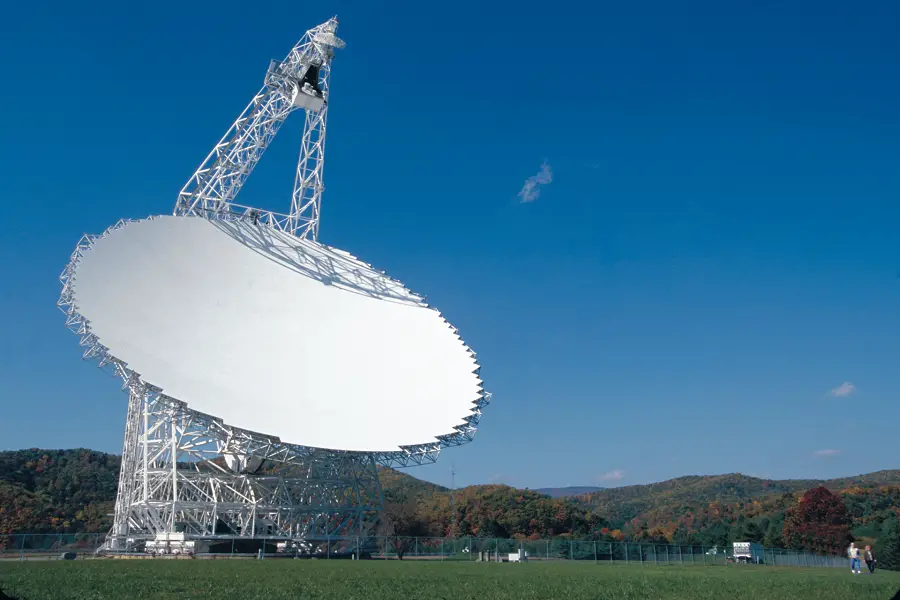
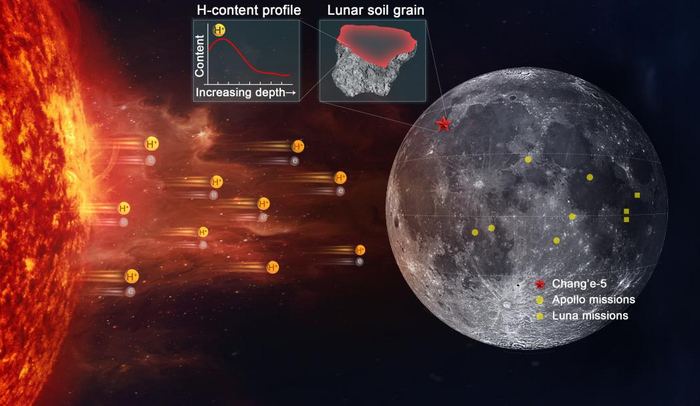

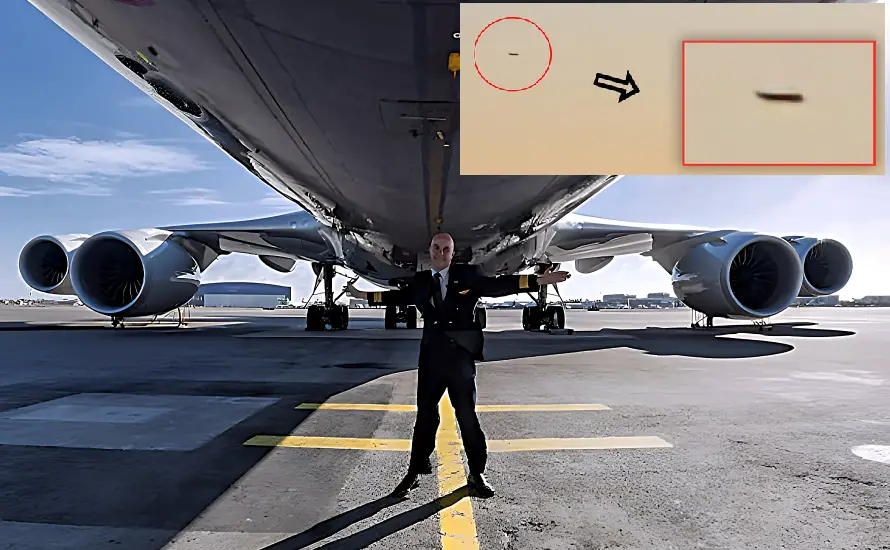
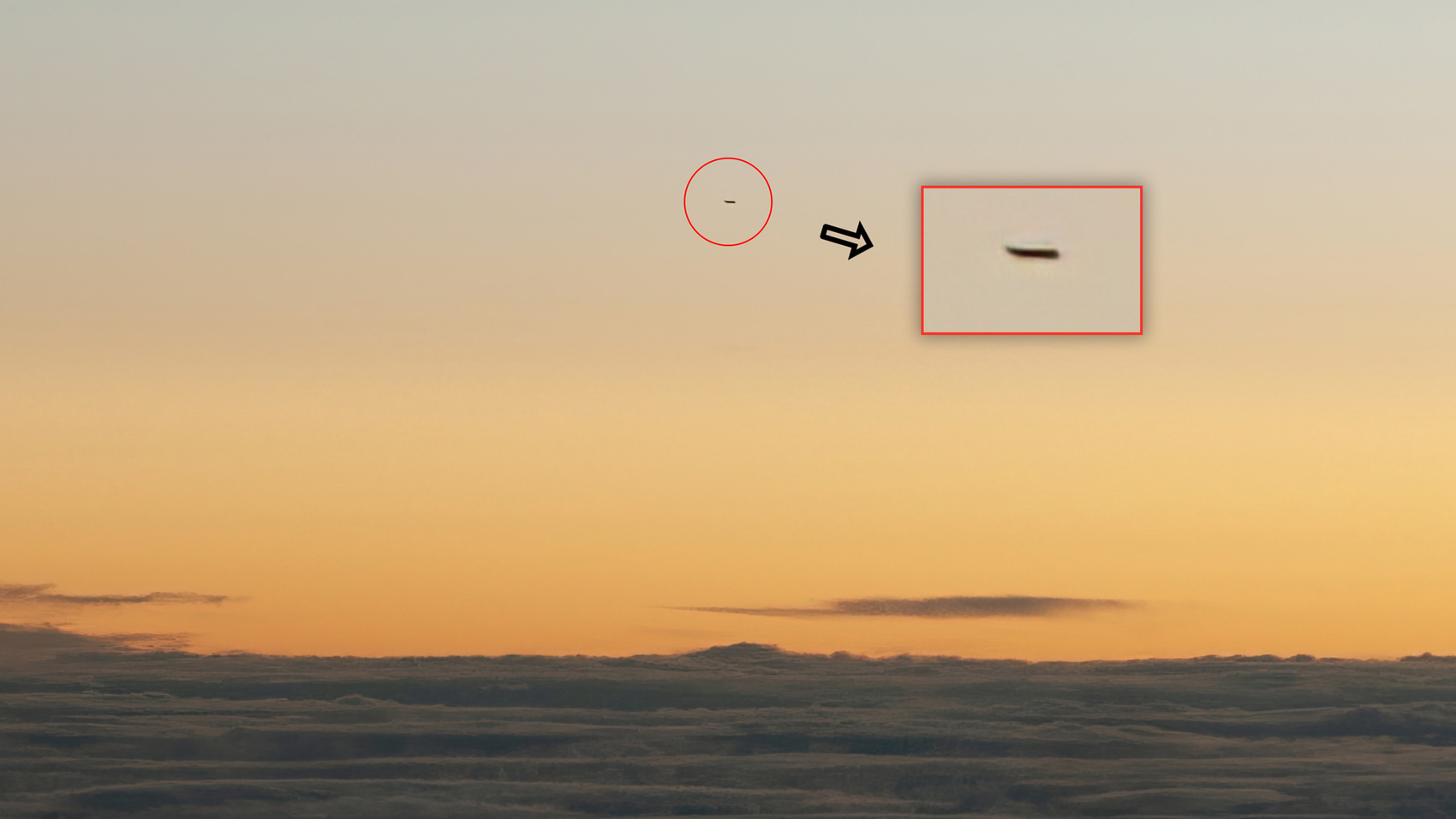

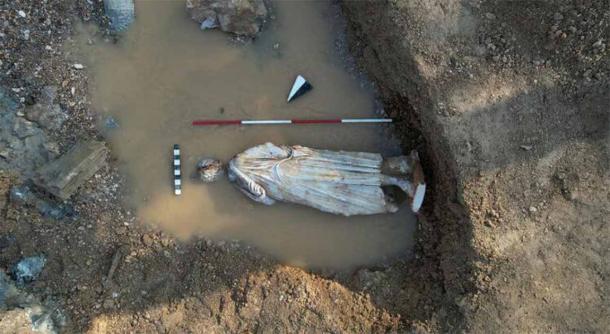
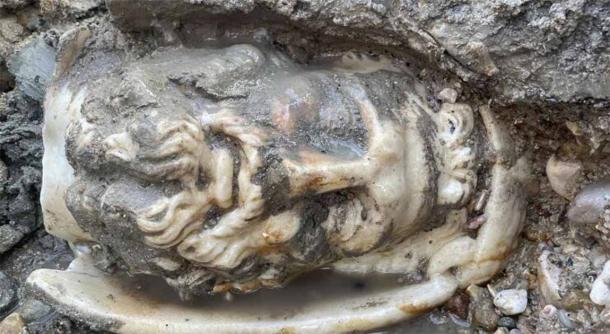
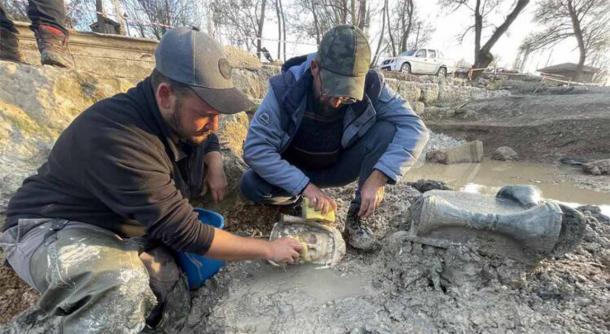
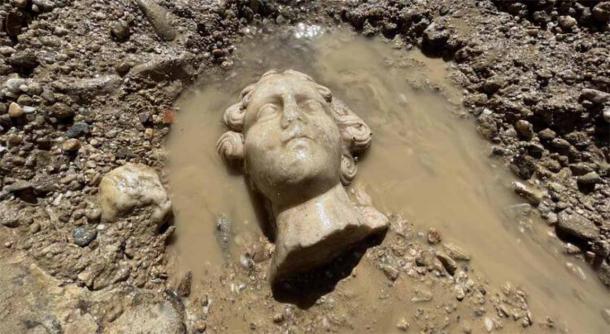
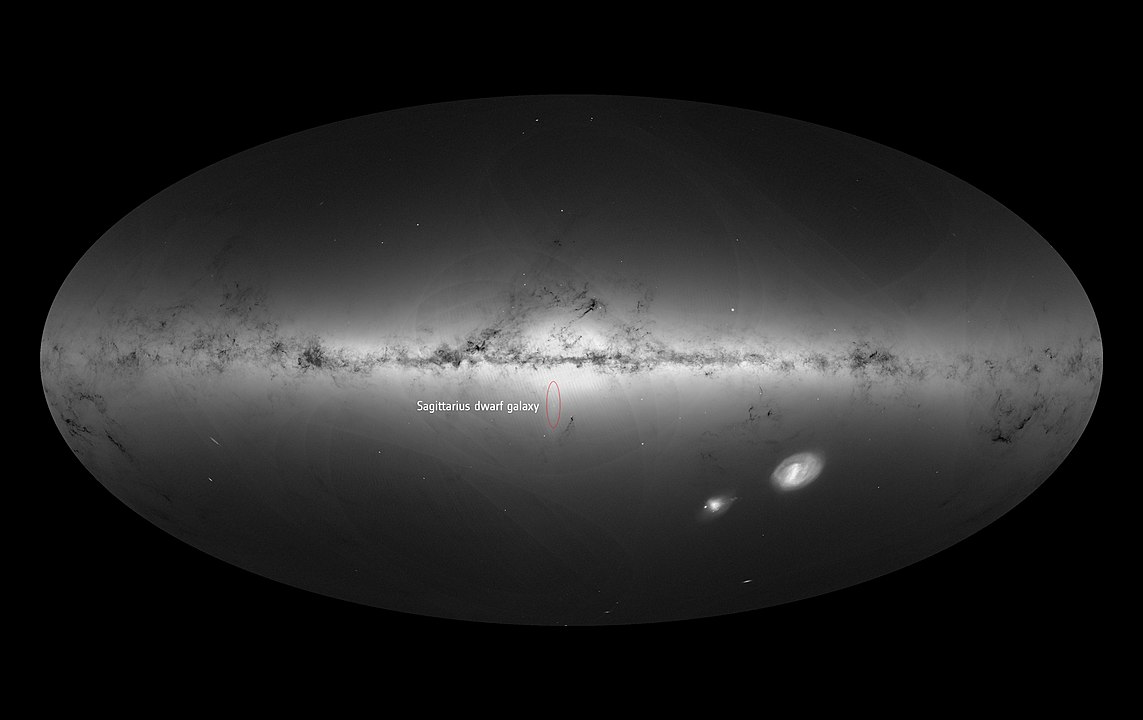
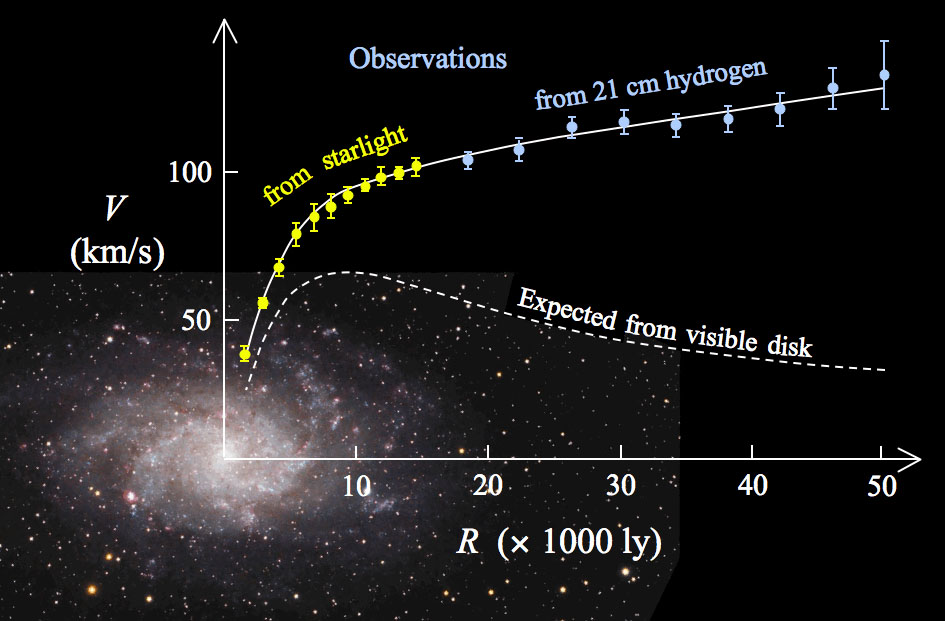



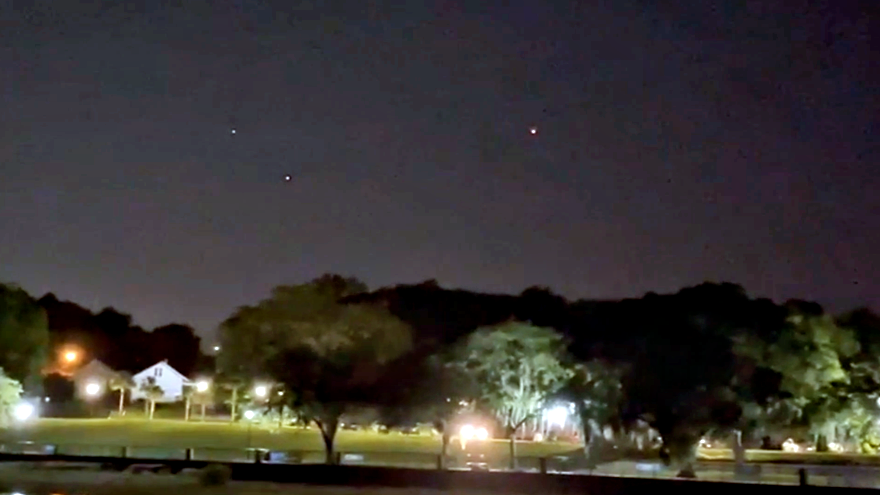

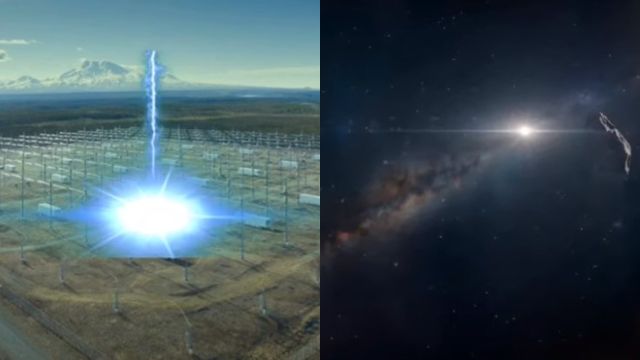


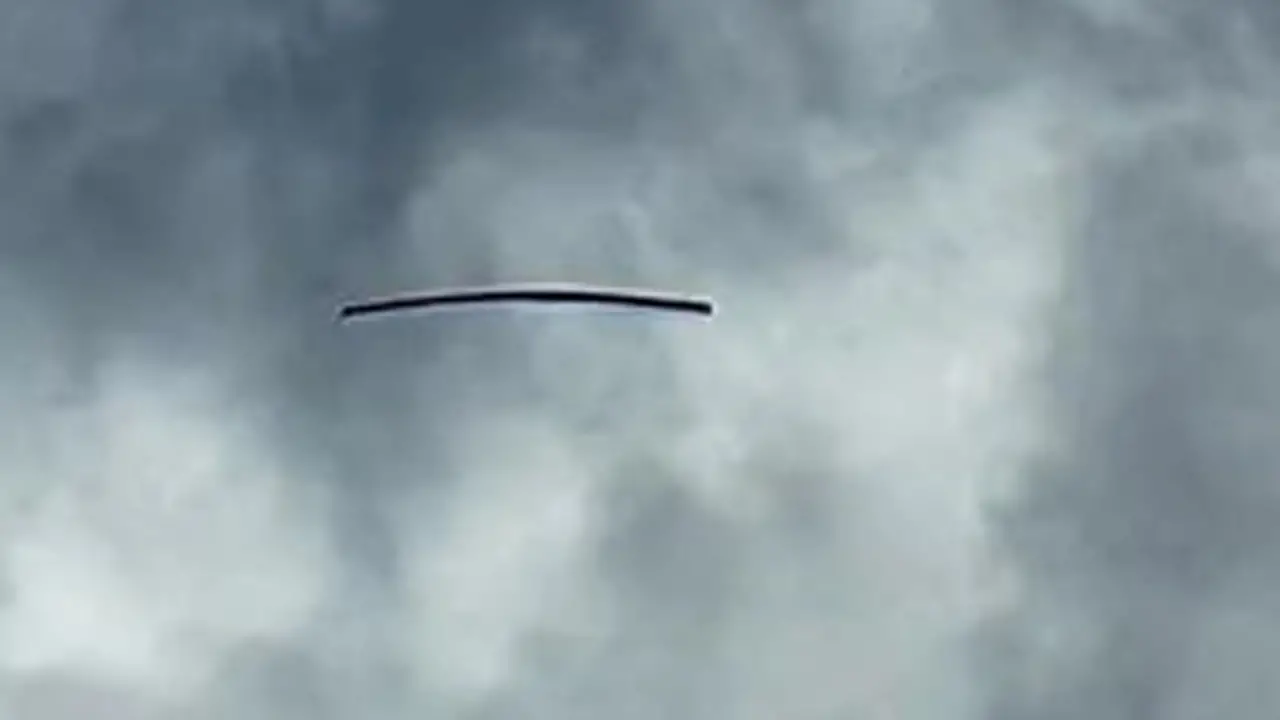
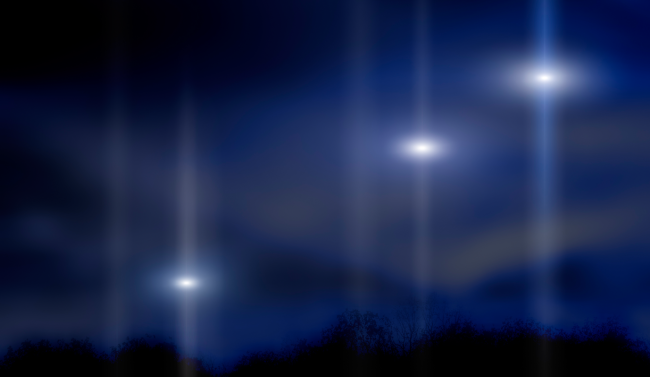

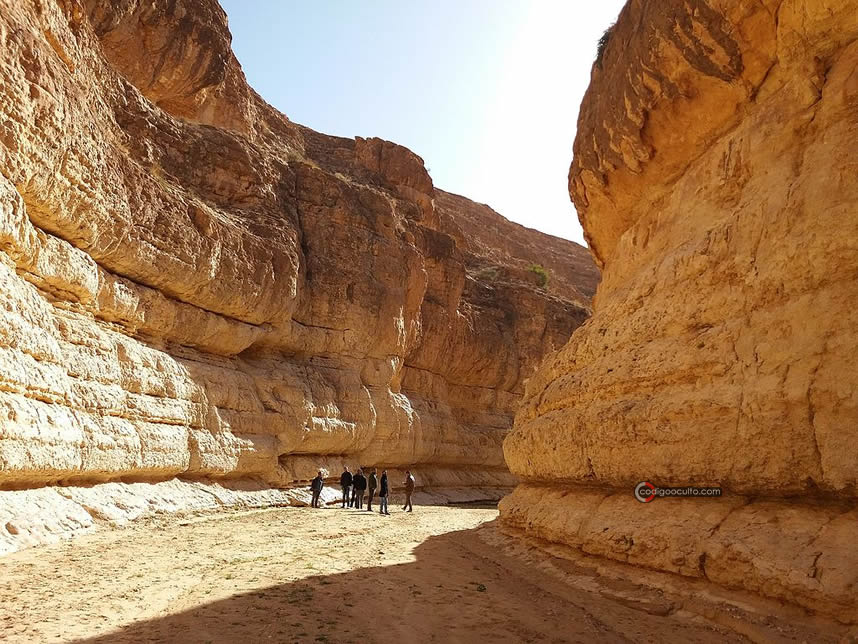
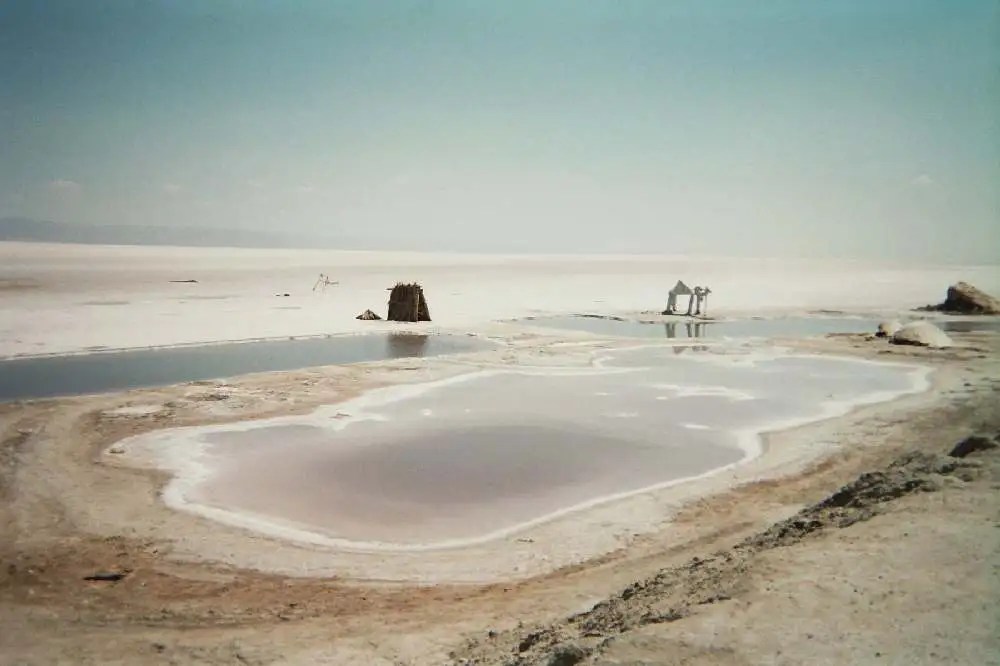



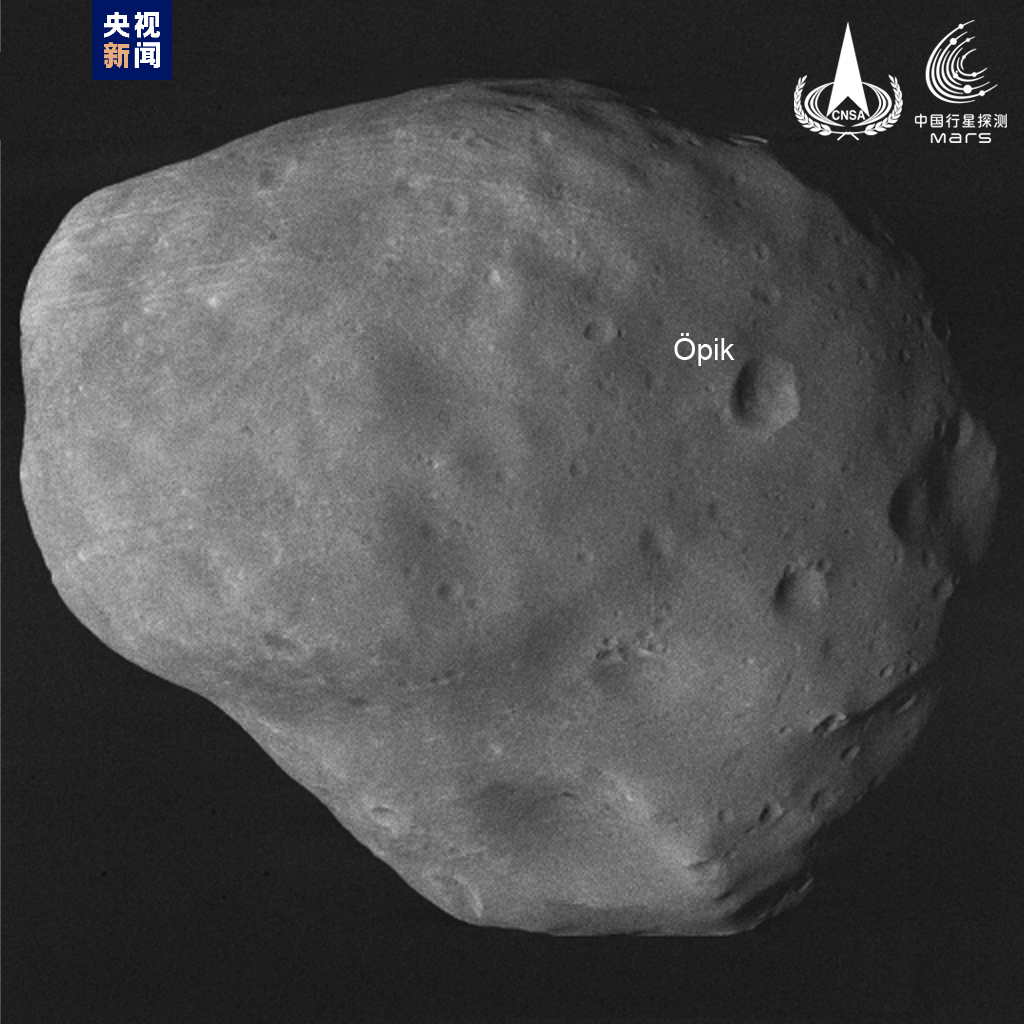
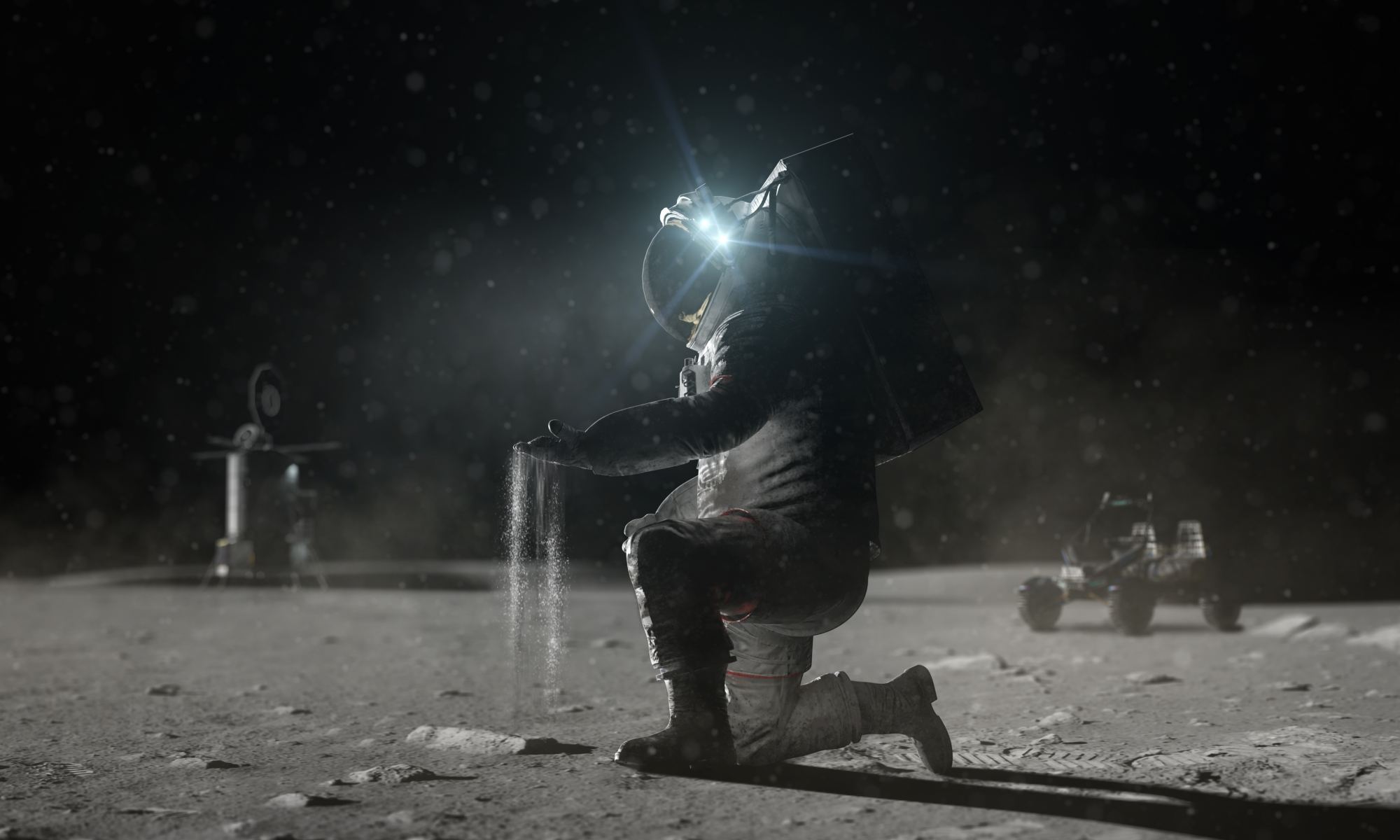






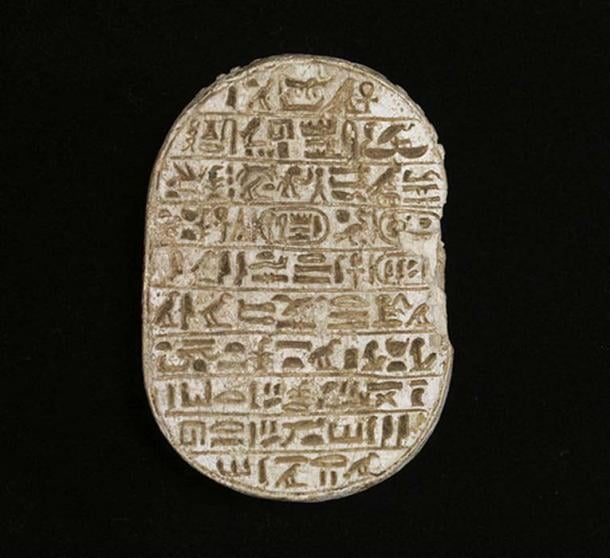

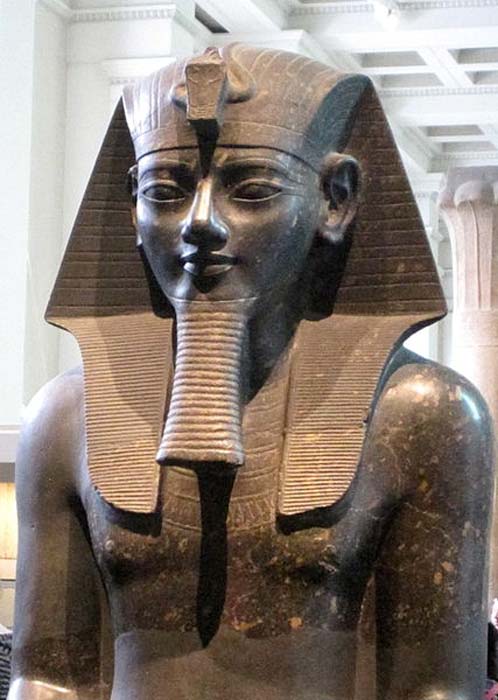
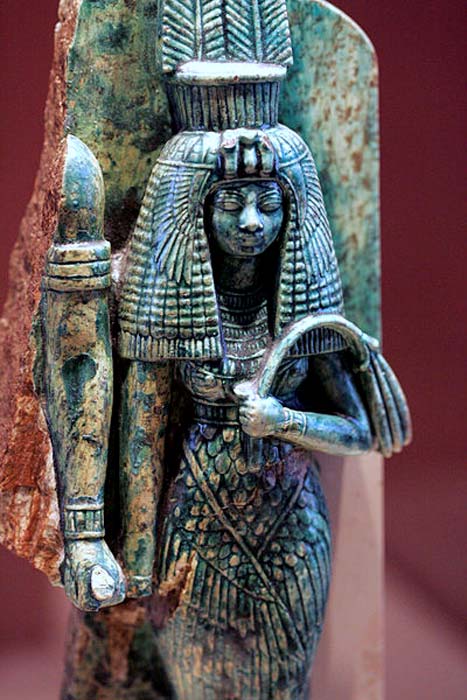
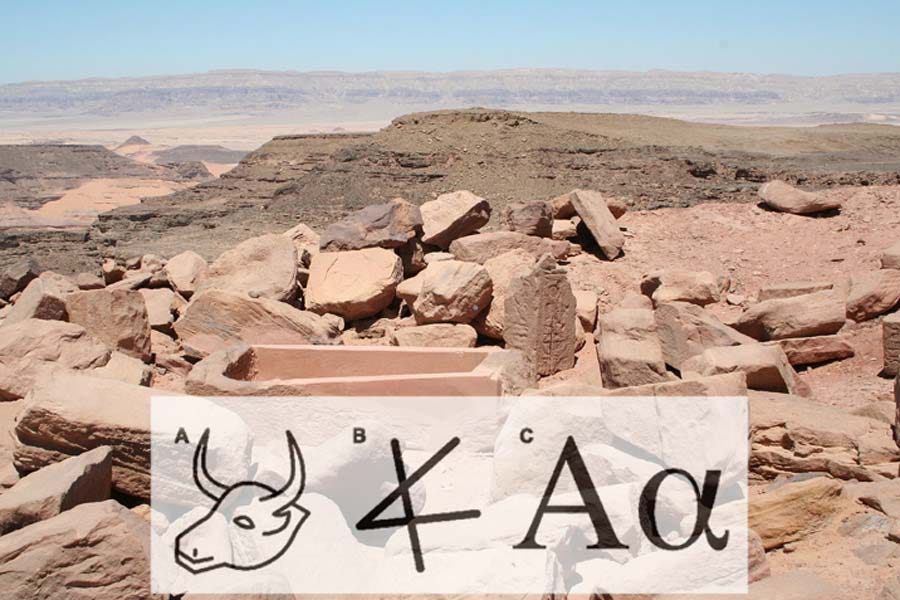
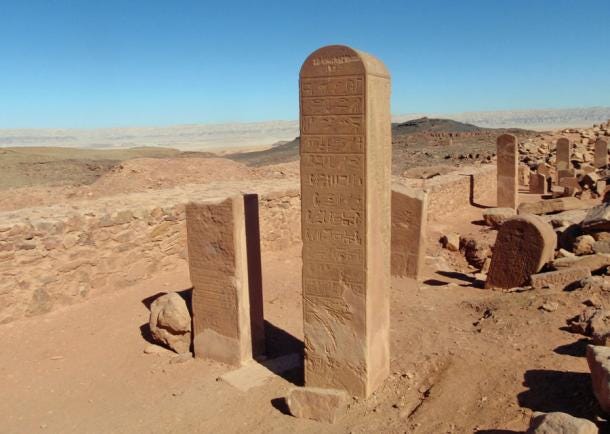

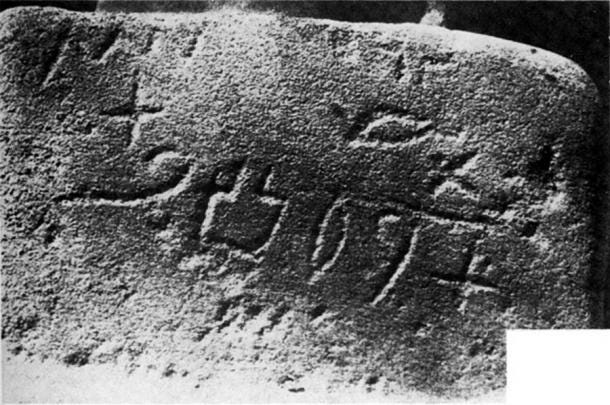
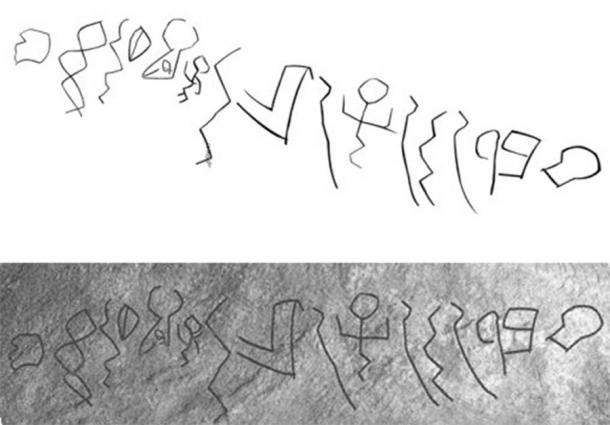
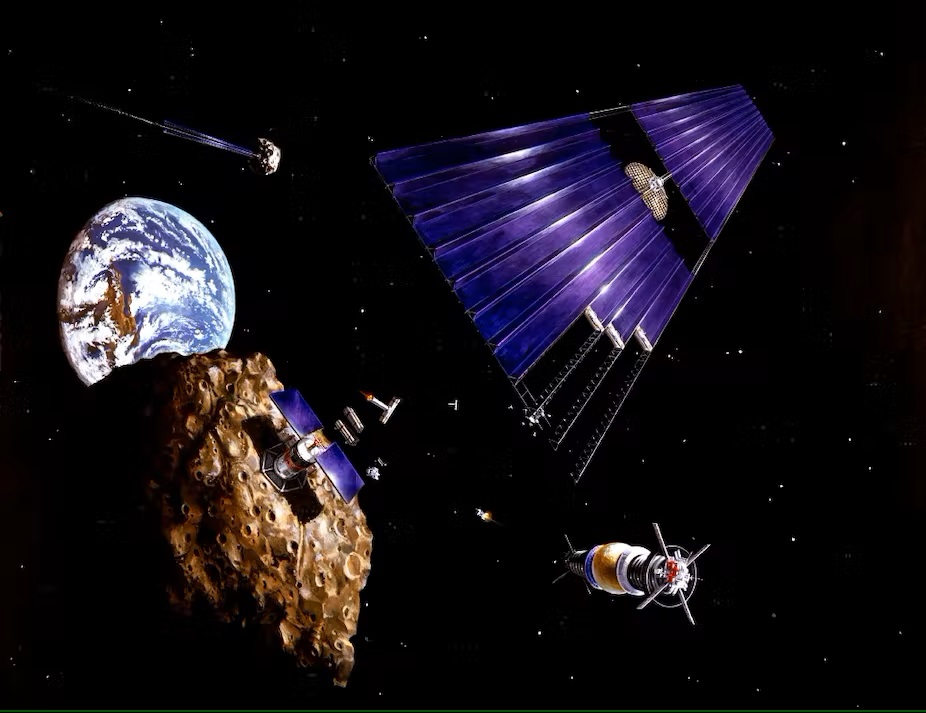

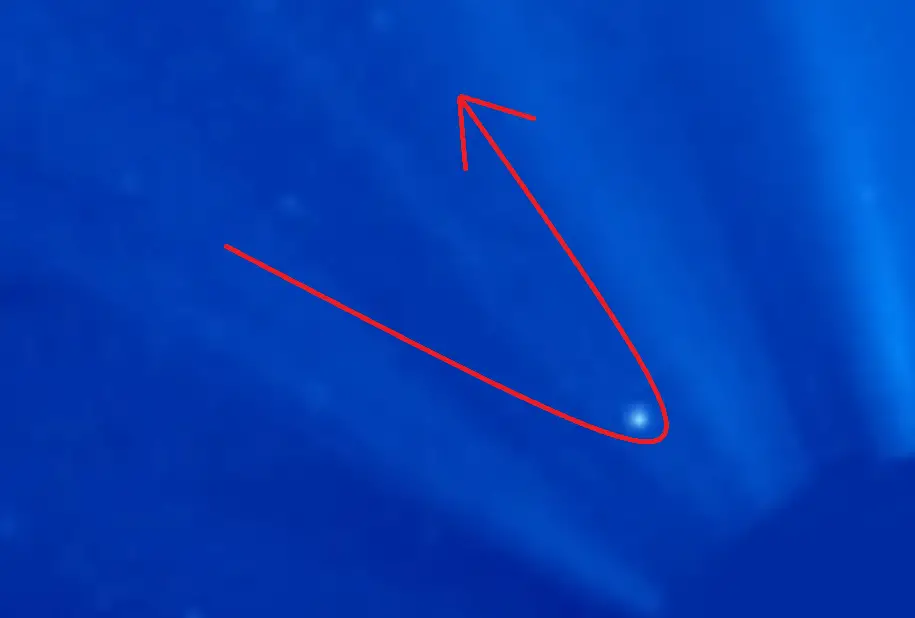

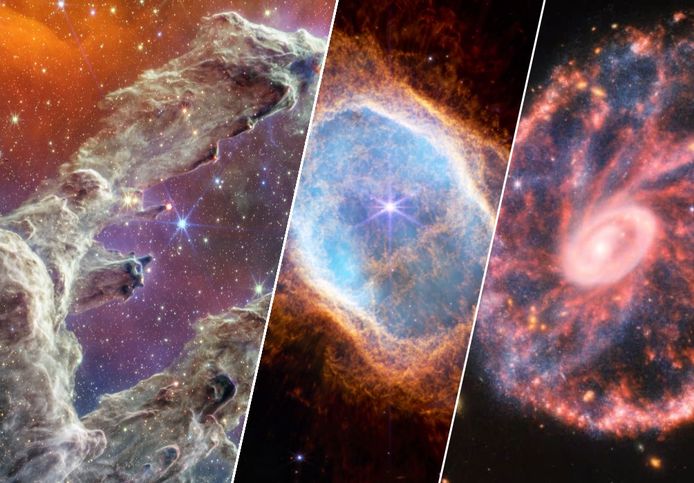

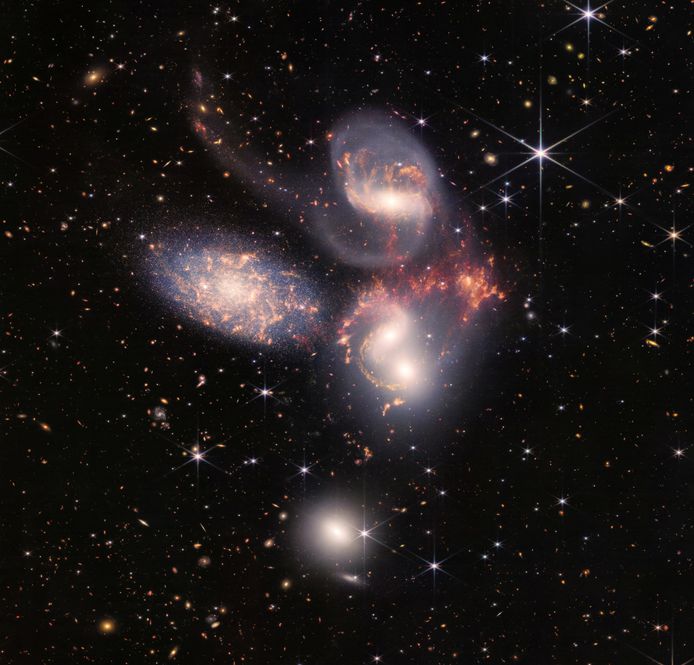
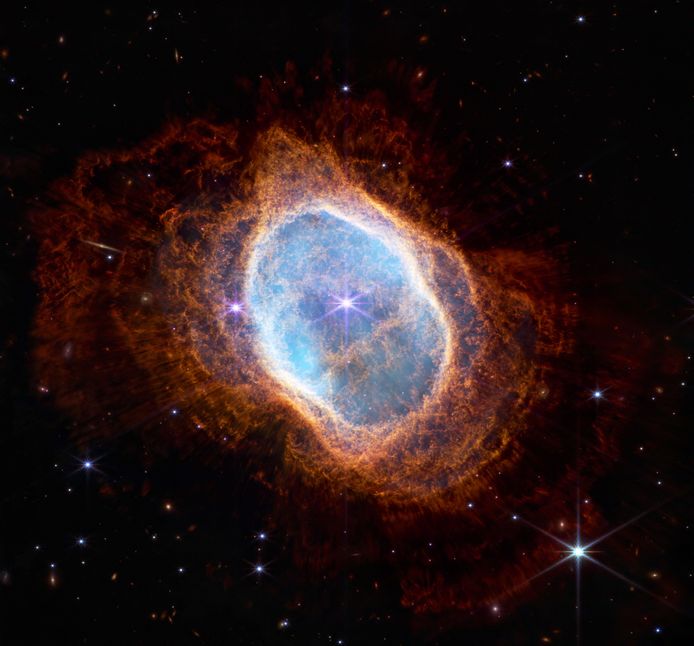
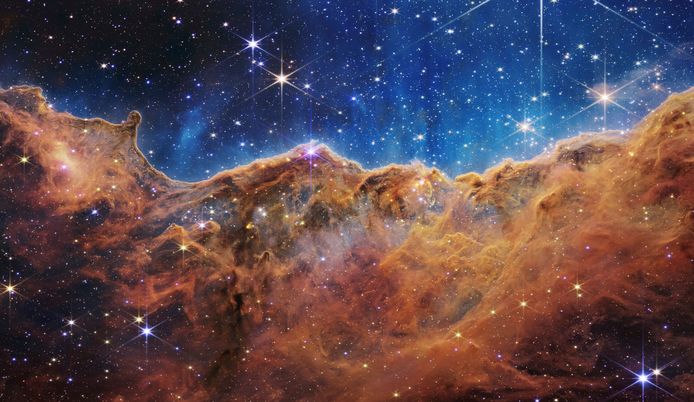
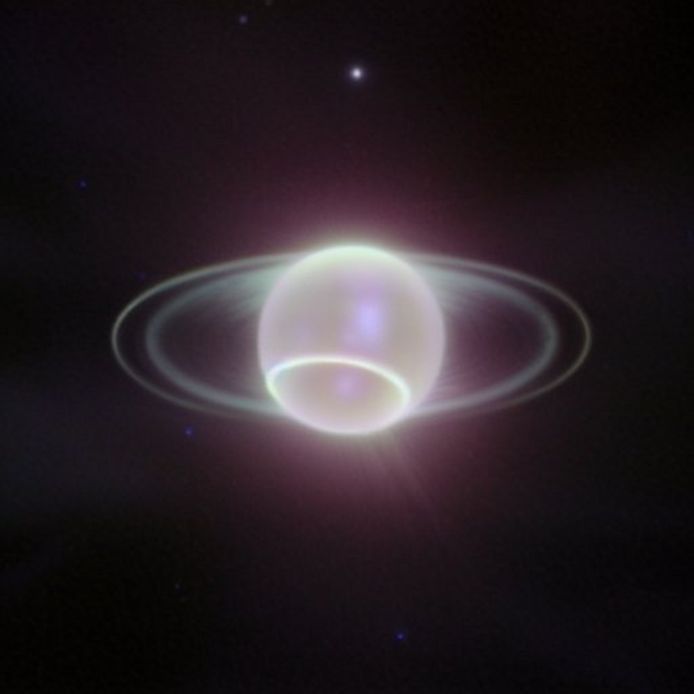

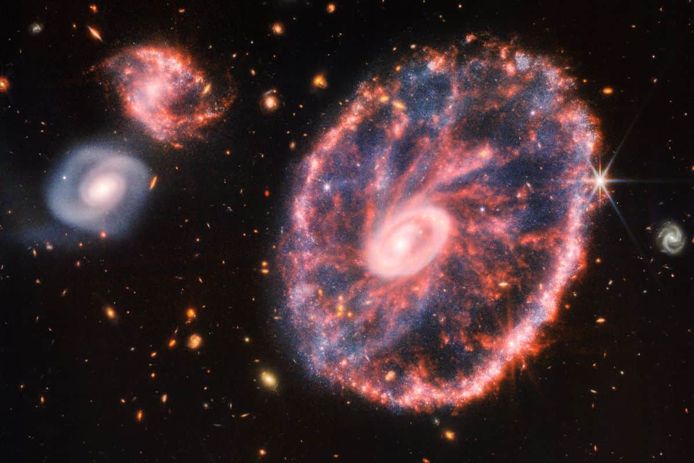
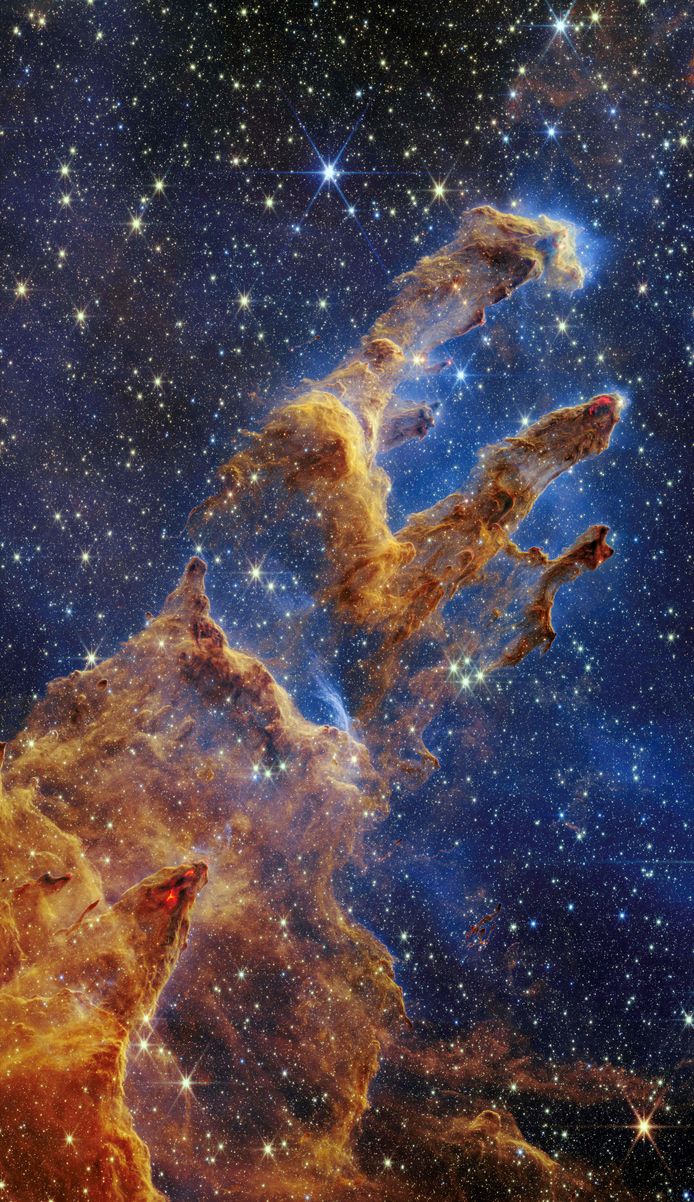


.jpg)
.jpg)
.jpg)