Naar de inhoud

UFO'S of UAP'S, ASTRONOMIE, RUIMTEVAART, ARCHEOLOGIE, OUDHEIDKUNDE, SF-SNUFJES EN ANDERE ESOTERISCHE WETENSCHAPPEN - DE ALLERLAATSTE NIEUWTJES

UFO's of UAP'S in België en de rest van de wereld
akke.beakke.be
Ontdek de Fascinerende Wereld van UFO's en UAP's: Jouw Bron voor Onthullende Informatie! Ben jij ook gefascineerd door het onbekende? Wil je meer weten over UFO's en UAP's, niet alleen in België, maar over de hele wereld? Dan ben je op de juiste plek! België: Het Kloppend Hart van UFO-onderzoek In België is BUFON (Belgisch UFO-Netwerk) dé autoriteit op het gebied van UFO-onderzoek. Voor betrouwbare en objectieve informatie over deze intrigerende fenomenen, bezoek je zeker onze Facebook-pagina en deze blog. Maar dat is nog niet alles! Ontdek ook het Belgisch UFO-meldpunt en Caelestia, twee organisaties die diepgaand onderzoek verrichten, al zijn ze soms kritisch of sceptisch. Nederland: Een Schat aan Informatie Voor onze Nederlandse buren is er de schitterende website www.ufowijzer.nl, beheerd door Paul Harmans. Deze site biedt een schat aan informatie en artikelen die je niet wilt missen! Internationaal: MUFON - De Wereldwijde Autoriteit Neem ook een kijkje bij MUFON (Mutual UFO Network Inc.), een gerenommeerde Amerikaanse UFO-vereniging met afdelingen in de VS en wereldwijd. MUFON is toegewijd aan de wetenschappelijke en analytische studie van het UFO-fenomeen, en hun maandelijkse tijdschrift, The MUFON UFO-Journal, is een must-read voor elke UFO-enthousiasteling. Bezoek hun website op www.mufon.com voor meer informatie. Samenwerking en Toekomstvisie Sinds 1 februari 2020 is Pieter niet alleen ex-president van BUFON, maar ook de voormalige nationale directeur van MUFON in Vlaanderen en Nederland. Dit creëert een sterke samenwerking met de Franse MUFON Reseau MUFON/EUROP, wat ons in staat stelt om nog meer waardevolle inzichten te delen. Let op: Nepprofielen en Nieuwe Groeperingen Pas op voor een nieuwe groepering die zich ook BUFON noemt, maar geen enkele connectie heeft met onze gevestigde organisatie. Hoewel zij de naam geregistreerd hebben, kunnen ze het rijke verleden en de expertise van onze groep niet evenaren. We wensen hen veel succes, maar we blijven de autoriteit in UFO-onderzoek! Blijf Op De Hoogte! Wil jij de laatste nieuwtjes over UFO's, ruimtevaart, archeologie, en meer? Volg ons dan en duik samen met ons in de fascinerende wereld van het onbekende! Sluit je aan bij de gemeenschap van nieuwsgierige geesten die net als jij verlangen naar antwoorden en avonturen in de sterren! Heb je vragen of wil je meer weten? Aarzel dan niet om contact met ons op te nemen! Samen ontrafelen we het mysterie van de lucht en daarbuiten.

Categorie: Diversen (Eng, NL en Fr)

Leo's encyclical is a north star for new space race — and alien encounters, too
Leo's encyclical is a north star for new space race — and alien encounters, too

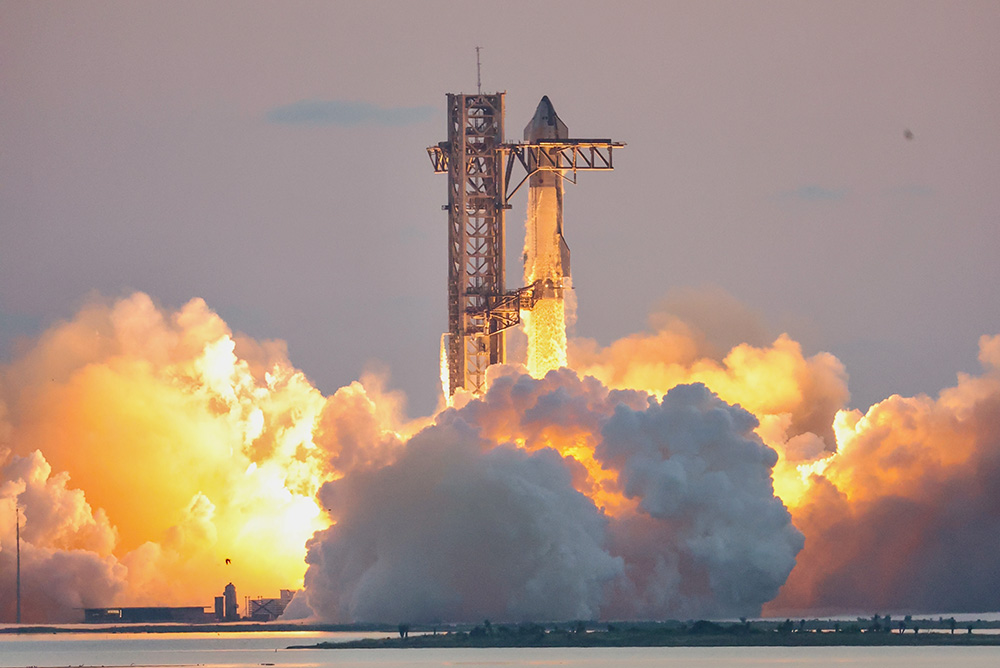
SpaceX's Starship lifts off for its fifth integrated flight test Oct. 13, 2024. (Wikimedia Commons/Steve Jurvetson)

SpaceX's Starship lifts off for its fifth integrated flight test Oct. 13, 2024.

(Wikimedia Commons/Steve Jurvetson)

by Scott Hurd

There's been plenty of talk about aliens this past year, thanks to the Pentagon's releasing files about UFOs. That excited a lot of people, because the possibility of UFOs suggests that aliens have come to Earth.

For his part, Pope Leo XIV has said nothing publicly about aliens visiting us on our planet. What he has said, however, has important implications for our visiting aliens on theirs. And given the new space race that's underway, his timing couldn't be better. 

Now, you might dismiss talk of aliens as a lot of sci-fi nonsense. Fair enough. But what you may not know is that you probably have already agreed to "recognize Mars as a free planet and that no earth-based government has authority or sovereignty over Martian activities."

What? Yes, that's a direct quote from the user terms of Elon Musk's Starlink satellite Wi-Fi network you likely accepted on your last plane trip. Surprise!

To be fair, that agreement applies only to "services provided on Mars via Starship or other spacecraft." However, what is the name of Musk's new SpaceX rocket ships? You guessed it: Starship. They're already being launched into space. And that might be cause for alarm, given Musk's money, power and dreams.

Leo himself expressed concern about Musk's becoming the world's first trillionaire. "What does that mean, and what's that about?" he wondered in an interview. The slogan on the T-shirt Musk has sometimes worn hints at an answer: "Occupy Mars!"

Occupying Mars has been a primary goal of SpaceX since its inception. At its initial public offering to investors, Musk reiterated that SpaceX seeks to transport people to the moon, Mars, and maybe even beyond our solar system. And his executive pay is tied to his establishing a permanent city on the Red Planet.

Martian cities are unlikely any time soon. But their possibility should be taken seriously now, to prevent outer space from becoming a new frontier for corporate greed, cosmic colonialism or even a combat zone. Because Musk may already be seeking to corner the galactic market with his Starlink user agreement. 

Its insistence that no earthly government has sway over Mars is tantamount to Musk saying: "When I get to Mars, I'll do whatever I want." As authors Naomi Klein and Astra Taylor ask in End Times Fascism and the Fight for the Living World, "Has [Musk] already quietly laid corporate claim to outer space and everything he puts there? Can he get away with it?"

Not if his primary competitor, Amazon founder Jeff Bezos, can help it. Over two decades ago, Bezos quietly founded an aerospace company, Blue Origin Enterprises. Today, Blue Origin builds rocket ships, promotes space tourism, is constructing NASA's Mars Telecommunications Network, and plans a colony on the moon.

Blue Origins' pursuits are "the most important work I'm doing," Bezos insists. And as Josh Tyrangiel wrote in his recent cover essay for The Atlantic, "Choose Your Overlord: Musk vs. Bezos," those aspirations include "creating the infrastructure for an off-world economy upon which human civilization might someday depend."

Other tech titans want in on the action too. Sam Altman, CEO of ChatGPT's parent company, OpenAI, recently sought his own rockets as a challenge to Musk. And Silicon Valley wunderkind Leopold Aschenbrenner promised to buy his wife, the chief of staff of Claude's parent company, Anthropic, an entire galaxy of her very own.

In addition to these tech bros' plans, Russia and China have goals to reach Mars and are working together to construct nuclear reactors on the moon for a space station. Not to be outdone, NASA is racing to establish its own moon base, and has invited India as a partner. India itself hopes its astronauts will reach the moon by 2040, and is collaborating with Japan on a lander and rover. The new space race is on.

The last space race was between the U.S. and Russia, who are still in the game today. But they and other countries now have direct competition from private interests like Musk's and Bezos' that, as Leo writes in Magnifica Humanitas, "are endowed with resources and the capacity to intervene that surpass those of many Governments."

The first space race was to simply reach the moon. The new race is about profiting from the moon by extracting its wealth. The lunar surface is rich with resources such as helium, titanium and iron that are critical for today's technologies. And its water-ice deposits could support human settlement and create fuel for rockets that, given the moon's low gravity, are easier to launch from there than from Earth.

In this quest for resources to advance technological ambitions, there's a danger of history repeating itself through the ugly specter of colonialism, which arose from competition between nations and commercial collaborators to secure what was needed for the Industrial Revolution. Colonialism ultimately helped trigger the First World War, which claimed at least 17 million lives.

Concerned by the ambitions of both governments and private companies, in 2023 a group of astronomers warned against a new "colonialism" in space that would exploit resources and cause ecological destruction. More recently, these concerns have surfaced in the media, with both the BBC and The New York Times asking the question: "Who owns the moon?"

Who does own the moon? That's an open question. The Outer Space Treaty, signed in 1967 by the United States, the Soviet Union, and a host of other nations, forbids any country from claiming sovereignty over anywhere in space. It does not, however, preclude them profiting from resources acquired there. In 2015, the U.S. passed a law allowing its national interests to do precisely that. Other nations have since followed suit.

The Vatican hasn't been silent on this. This past April, the Holy See's United Nations mission in Geneva produced a video, "Outer Space and Humanity at a Crossroads: Reflections on a New Frontier of the Common Good," which encourages strengthening the Outer Space Treaty to avoid past mistakes made on Earth, such as unbridled competition and needless deadly conflict.

But it's the encyclical published the following month, Magnifica Humanitas, that might prove most helpful in this present moment. What it says about the new "industrial revolution" unleashed by artificial intelligence can be applied to the new space race, too. Because both, in Leo's words, provide "fertile ground for new wars" and plant seeds for a future that could be "colonial in another form."

Many of the big players in AI and space, such as the U.S., China, Bezos and Musk, are one and the same. Like the race for AI, the space race needs to be "disarmed," as the encyclical puts it, from "the desire to secure geopolitical or commercial dominance." And the encyclical's call for regulations, dialogue, international cooperation, and economic justice are equally applicable to both. As is its warning about unfathomable power concentrated in a few, unaccountable hands.

What about aliens? They're still science fiction. But it's reasonable to fear they'd experience the same domination and exploitation to which humans have been subjected in the brutal quest for money and power. Magnifica Humanitas condemns as "new forms of slavery" the condition of workers who train and extract resources for AI. This "deeply challenges the moral conscience of our time." And is a warning for any future close encounters beyond our galaxy.

Thanks to the encyclical, many today look to the Catholic Church for ethical guidance and hope in a world increasingly saturated with AI. That same document can offer guidance and hope for humanity's new ventures into space. Because by asking, "What are we building?" here on Earth, it implores us to reject "a power that claims to dominate the heavens."

 { https://www.ncronline.org/sections/news }

Hoe vind je dit bericht?
Geschreven door peter om 22:08 Stuur door

Aussies confused after enormous swarm of moths shows up as rain on radar

Aussies confused after enormous swarm of moths shows up as rain on radar

The recent swarm of moths over the NSW Central Coast is believed to have caused rain radars to show non-existent rain clouds.

Residents around Sydney may have been confused over the last few weeks when they checked their weather apps.

The rain radar has been showing large clouds over the coast, even when there were clear skies.

But the odd phenomenon isn't the result of faulty equipment, instead the phantom rain signal was caused by millions of bogong moths migrating south.

'It is possible that radars across eastern NSW are detecting bogong moths,' the Bureau of Meteorology said in a statement.

'The bureau's radars are not malfunctioning… large numbers of insects can look like very light widespread rain, particularly near sunrise and sunset.'

The endangered moths migrate from low-lying inland regions in Queensland, central NSW, and western Victoria to caves in the southern Alps every spring.

The moths primarily travel at night and use the moon to navigate, so they are very sensitive to light pollution.

Rain clouds have been showing on radars around the NSW Central Coast even when skies are clear

Rain clouds have been showing on radars around the NSW Central Coast even when skies are clear

Meteorologists believe the phantom rain is being caused by large swarms of bogong moths migrating south (pictured are the moths trapped in a Sydney home)

Meteorologists believe the phantom rain is being caused by large swarms of bogong moths migrating south (pictured are the moths trapped in a Sydney home)

However, strong winds blew millions off-track in September and pushed them towards Sydney.

The Bureau's radar is able to show clouds by blasting out radio waves, which echo off water particles.

However, the waves can also reflect off other things - including smoke, ash, birds and moths.

'We can confirm that there has been increased 'echoes' displaying on radars across eastern NSW that aren't precipitation,' the bureau said.

'Now we can go back through the records as long ago as World War II to look for signatures of big clouds of moths.'

If researchers are able to prove the phantom rain was caused by moth swarms, it could be used to help collect data to save the endangered bogong moth by tracking their migration and population.

Zoos Victoria tracks the moths' bi-annual migration and encourages Aussies to submit sightings to its website.

The spring migration is especially important for the health of critically endangered mountain pygmy-possums, which eat the moths as they wake from winter hibernation.

Strong winds in September blew an unusual amount of the moths towards the coast (pictured is tracking data in September)

Strong winds in September blew an unusual amount of the moths towards the coast (pictured is tracking data in September)

Meteorologists noted the non-existent rain appeared on the radar between sunset and sunrise, when the moths (above) are most active

Meteorologists noted the non-existent rain appeared on the radar between sunset and sunrise, when the moths (above) are most active

Bogong moths are usually between 2.5cm and 3.5cm long and have dark stripes that run down each wing.

Anyone who spots a bogong moth is encouraged to upload a photo of the sighting to the Zoos Victoria Bogong Moth Tracker, which tracks their migration.

RELATED

Something very strange is going on in the skies above Australia

Bogong Moths Return After 40-Year Collapse — Australia's Bass Coast Spring Swarm 2025 #Shorts
These Moths Are Confusing Weather Radars

{ https://www.dailymail.com/sciencetech/index.html }

Hoe vind je dit bericht?
Geschreven door peter om 12:37 Stuur door

Super El Nino is changing the colour of the OCEAN: NASA says waters have become bluer as record-breaking temperatures wipe out marine life

Super El Nino is changing the colour of the OCEAN: NASA says waters have become bluer as record-breaking temperatures wipe out marine life

Super El Niño is changing the colour of the world's oceans, satellite images from NASA have revealed – with the equatorial pacific transforming from lush green to bright blue over the past year. 

El Niño has interfered with the currents that carry cold, nutrient-rich water to the surface, essential to photosynthesising plankton – which turn the areas they inhabit a dazzling emerald green. 

Without that essential food, the plankton have starved, and a wash of deep, lifeless blue has returned to the Pacific. 

A side-by-side comparison with satellite data from 2025 shows how this area held on to its typical green hue throughout the entire year. 

But by the time of the most recent data, which covers up to this month, the area around the equator has turned blue.    

El Niño is part of a naturally occurring climate cycle known as the El Niño Southern Oscillation.

Every two to seven years, this pattern brings either a hot El Niño period or a cooler La Niña phase.

During the El Niño phase, hot waters gather in the equatorial Pacific Ocean off the coast of South America, raising the average temperature and affecting global weather patterns.

NASA satellite observations show that Super El Niño is making the ocean bluer this year (top) compared to 2025, as warm water disrupts the flow of nutrients that typically feed green phytoplankton

NASA satellite observations show that Super El Niño is making the ocean bluer this year (top) compared to 2025, as warm water disrupts the flow of nutrients that typically feed green phytoplankton 

Scientists now believe we are in the early stages of a massive El Niño cycle, which could have catastrophic effects in the coming months and throughout 2027.

As of October, the National Oceanic and Atmospheric Administration predicts there is an 83 per cent chance that this will be the strongest El Niño since records began in 1950.

Meanwhile, NASA's satellite measurements show that sea surface temperatures in the eastern Pacific are currently 1.7°C (3°F) above the long–term average, and could jump another fraction of a degree higher in the coming months.

This band of warm water expanded throughout the spring and now covers millions of square miles in an area stretching from the coast of South America to the heart of the Pacific.

This is also the first El Niño year since NASA launched the PACE (Plankton, Aerosol, Cloud, Ocean Ecosystem) satellite in 2024, giving scientists an unprecedented view of the unfolding threat.

The Ocean Colour instrument aboard PACE observes the ocean in 'hyperspectral colour', measuring wavelengths in the visible, ultraviolet and infrared spectrum.

Dr Matthew Kehrli, a lead research scientist at NASA’s Goddard Space Flight Center, said: 'Some people think of water as being just blue, but it's amazing the multitude of colours the ocean can be.'

NASA's satellite measurements show that sea surface temperatures in the eastern Pacific are currently 1.7°C (3°F) above the long-term average

NASA's satellite measurements show that sea surface temperatures in the eastern Pacific are currently 1.7°C (3°F) above the long–term average

This picture, from data collected on October 14, shows the heat has spread along the coast of Chile and out into the south¿east Pacific, with the boxed arm showing the heat movements

This picture, from data collected on October 14, shows the heat has spread along the coast of Chile and out into the south–east Pacific, with the boxed arm showing the heat movements

During El Niño, the trade winds, which typically transport warm water westwards towards Australia, weaken or even reverse.

This reduces the upwelling of nutrient-rich waters from deeper parts of the ocean, leading to a decline in algae numbers and bluer waters, as seen in PACE's observations.

That decline can also trigger cascading effects across the entire marine ecosystem, forcing other animals to relocate to new feeding grounds in search of phytoplankton.

'You have expectations of what you would think would happen, but to visually see the results with the data products that you’re working with in real time is gratifying,' says Dr Kehrli.

Thanks to satellite observations, scientists actually got their first hint that a major El Niño year was coming all the way back in January.

Satellites built to measure sea levels picked up something called a Kelvin Wave building near Micronesia, in the western Pacific Ocean.

Kelvin Waves are slow-moving pulses of water spanning thousands of miles that act like underwater motorways transporting heat from west to east across the Pacific. 

El Niño is even affecting sea levels in the Pacific, with some areas rising up to 1.3 feet (40cm) above average (shown in red)

El Niño is even affecting sea levels in the Pacific, with some areas rising up to 1.3 feet (40cm) above average (shown in red)

That heat warms the air above them, causing it to rise and creating a change in air pressure that weakens the trade winds – kickstarting the El Niño chain reaction.

Dr Josh Willis, project scientist for sea level missions at NASA’s Jet Propulsion Laboratory in Southern California, says: 'Kelvin waves are like the heartbeat of El Niño.

'And our sea level satellites let us peer into the ocean and watch every beat.'

By early April, NASA's satellites saw that the Kelvin wave had reached the eastern Pacific and was already starting to warm sea surface temperatures.

Since warm waters also expand and rise, that change can be seen in a massive increase in sea levels within El Niño's critical region.

Sea levels rose by as much as 1.3 feet (40cm) near South America and the coast of California, while sea levels dropped by up to eight inches (20cm) near Indonesia and Australia.

Dr Willis says: 'El Niño touches almost all of us in some way every time it occurs. While many have seen what it can do, we look to the ocean to understand why.'

WHAT IS THE EL NINO PHENOMENON IN THE PACIFIC OCEAN?

El Niño and La Niña are the warm and cool phases (respectively) of a recurring climate phenomenon across the tropical Pacific - the El Niño-Southern Oscillation, or ENSO for short.

The pattern can shift back and forth irregularly every two to seven years, and each phase triggers predictable disruptions of temperature, winds and precipitation. 

These changes disrupt air movement and affect global climate. 

ENSO has three phases: 

        • El Niño: A warming of the ocean surface, or above-average sea surface temperatures (SST), in the central and eastern tropical Pacific Ocean. Over Indonesia, rainfall becomes reduced, while rainfall increases over the tropical Pacific Ocean. The low-level surface winds, which normally blow from east to west along the Equator, instead weaken or, in some cases, start blowing the other direction from west to east. 
        • La Niña: A cooling of the ocean surface, or below-average SST, in the central and eastern tropical Pacific Ocean. Over Indonesia, rainfall tends to increase, while rainfall decreases over the central tropical Pacific Ocean. The normal easterly winds along the Equator become even stronger.
        • Neutral: Neither El Niño or La Niña. Often tropical Pacific SSTs are generally close to average.

Source: Climate.gov

{ https://www.dailymail.com/sciencetech/index.html }

Hoe vind je dit bericht?
Geschreven door peter om 15:40 Stuur door

Sterkste El Niño ooit gemeten op komst: dit merken wij ervan in Nederland en België

Sterkste El Niño ooit gemeten op komst: dit merken wij ervan in Nederland en België

Artikel door Andrei Stiru
robert-boston-x7Od4oNheYQ-unsplash

In de Stille Oceaan bouwt zich een uitzonderlijk sterke El Niño op. Amerikaanse onderzoekers geven 75 procent kans dat hij dit najaar alle voorgangers sinds 1950 overtreft. In Nederland en België blijft het effect klein, al is 2027 wereldwijd mogelijk een recordwarm jaar.

Langs de evenaar in de Stille Oceaan komt normaal koud water uit de diepte omhoog. Tijdens een El Niño gebeurt dat veel minder. Tegelijk schuift een enorme massa warm water van het westen naar het midden en oosten van de oceaan. Het zeeoppervlak warmt daar sterk op en de windpatronen veranderen mee.

Het is een natuurlijk verschijnsel dat om de drie tot zeven jaar terugkeert. De tegenhanger heet La Niña: dan komt er net extra koud water boven en koelt het wat af.

Waarom deze zo sterk is

De huidige El Niño piekt komende winter. Het Amerikaanse klimaatvoorspellingscentrum van weerdienst NOAA meldde in september dat het zeewater in het oosten van de oceaan al meer dan 3 graden warmer was dan normaal. De kans op een ‘zeer sterke’ El Niño schat het centrum op meer dan 90 procent.

Waarom precies deze zo krachtig uitvalt, is onduidelijk. “Dat weten we niet echt”, zegt klimaatwetenschapper Wilco Hazeleger van de Universiteit Utrecht. “Soms komt er een extra grote El Niño voor. Wetenschappers zagen al enige tijd een opbouw van het warme water in het westen en dit jaar is dat gaan verplaatsen.”

Daarbovenop komt de klimaatverandering: de Stille Oceaan is, zoals bijna de hele wereld, al warmer dan vroeger. Dat verklaart niet alles. “Toch is dit, zelfs als je de opwarming van de aarde verdisconteert, een erg sterke El Niño”, aldus Hazeleger. Sterke edities waren er eerder, in 1997-1998 en 2015-2016. Deze wordt volgens hem mogelijk de sterkste sinds er met instrumenten gemeten wordt.

Leestip: 

Golven door de atmosfeer

Het warme water verandert de lucht erboven. Boven het warmste water stijgt lucht op, en waar lucht stijgt, valt de meeste regen. Verschuift het warme water, dan verschuiven dus ook de natte en droge gebieden.

Het blijft niet bij de tropen. “Net zoals je een steen in een vijver gooit en golven in de vijver verplaatsen, gebeurt dat ook in de atmosfeer”, zegt Hazeleger. Die grote golven dragen de verstoring de hele wereld rond.

De gevolgen zijn het grootst rond de Stille Oceaan zelf: in Zuid-Amerika en in Indonesië, de Filipijnen en Australië. Ook Afrika en Noord-Amerika krijgen ermee te maken. De Wereld Meteorologische Organisatie waarschuwde begin september voor meer kans op overstromingen, droogte en extreme hitte.

En bij ons?

Hier valt het mee. “Een van de weinige plaatsen wereldwijd waar El Niño nauwelijks of geen effect heeft, is Noordwest-Europa”, zegt Hazeleger. Eén klein effect is wel bekend: de kans op een nat voorjaar is groter dan normaal.

Indirect merkt iedereen het wel. Bij een El Niño stijgt de gemiddelde temperatuur op aarde, vooral in het jaar erna. Volgens de WMO kan 2027 het warmste jaar ooit gemeten worden.

Wat nog onzeker is

Het blijft een voorspelling. NOAA zegt zelf dat de typische gevolgen bij zo’n sterke El Niño waarschijnlijker worden, maar niet gegarandeerd zijn.

Ook de rol van klimaatverandering is niet uitgeklaard. Of de opwarming zulke El Niño’s sterker maakt, noemt Hazeleger een open vraag. De gevolgen lijken wel toe te nemen: natte gebieden worden natter, droge droger. “Er wordt hier veel onderzoek naar gedaan en de klimaatonderzoekers zijn er nog niet precies uit.”

Zeker is dat de piek nog moet komen. Pas na de winter is duidelijk of deze El Niño het record echt breekt.

Uitgelezen? Luister ook eens naar de Scientias Podcast:


Avondnieuws: VN-waarschuwing: super-El Niño kan 2027 tot warmste jaar ooit maken
Hoe vind je dit bericht?
Geschreven door peter om 19:42 Stuur door

5 Sci-Fi Movies That Are (Shockingly) Based On True Stories

5 Sci-Fi Movies That Are (Shockingly) Based On True Stories

By Liz Young

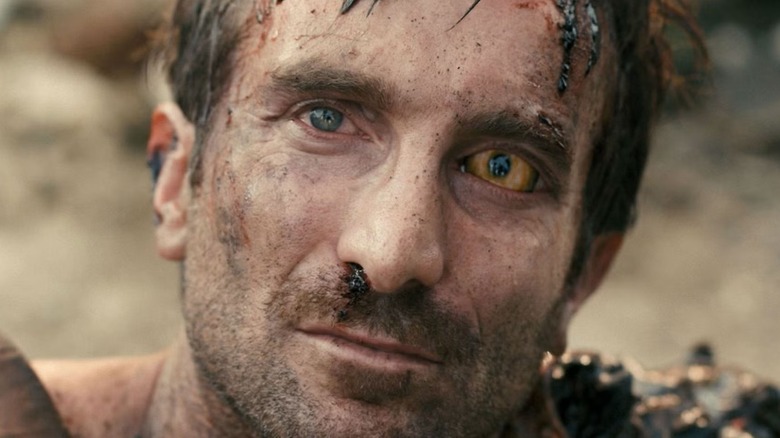
Wikus smiling with two different eye colors in

TriStar Pictures/Sony Pictures Releasin

The fun of science fiction is usually the out-of-this-world civilizations and stories. "Star Wars" and "Star Trek" take us to fictionalized worlds, while others like "Back to the Future" utilize a contemporary setting with sci-fi technology we could only dream of. You aren't typically watching and waiting with a suppressed groan at the ready for the "Based On a True Story" text to appear before the opening sequence. 

However, even if that title card is absent, there is still a chance that the flick is inspired by something in our reality. In science fiction, it's not always as obvious, since it often features futuristic technology and places, but the inspiration is there. Real scientists' work, actual UFO sightings, and even documented government operations have all been inspirations in the genre.

You may have heard about some of these, but the sci-fi movies on this list probably don't initially come to mind, unless you know quite a bit about the history of neuroscience or are familiar with magazine ads from the 1990s. While the inspirations may differ, they're all science fiction films 

1. Altered States

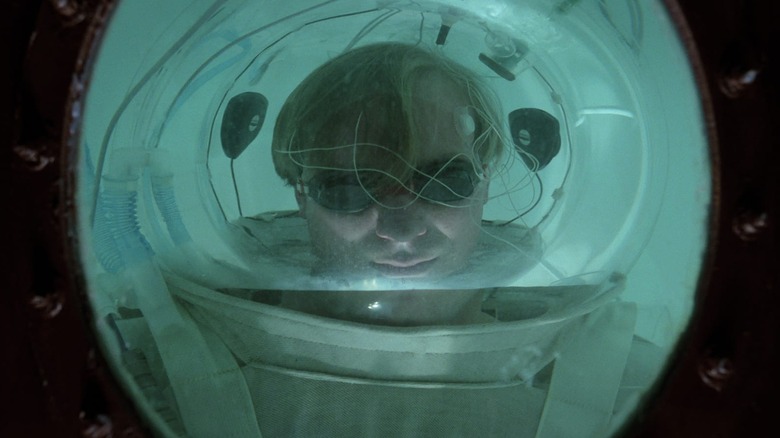
Eddie in a suit in a sensory deprivation tank in

WARNER BROS

The surrealist sci-fi horror "Altered States" follows Harvard scientist and professor Edward Jessup (William Hurt) and his work with consciousness. With his personal life in shambles, he heads to Mexico to learn more about a hallucinogenic plant used by indigenous peoples, believing it could help with his research. However, his work takes a turn as he proceeds to keep using the substance, making himself his primary test subject. 

The underlying ideas of the story, and the Paddy Chayefsky book it's based on, are rooted in the work of neuroscientist John C. Lilly. While he's remembered for his work in studying brain activity, and is credited to be the first to create maps of pleasure and pain pathways, he dabbled in other fields as well, looking into dolphin communication and sensory deprivation.

"Altered States" takes inspiration from Lilly's work with the latter, specifically the flotation tank he invented and the use of mind-altering substances, notably ketamine and LSD. In the movie, Jessup both uses sensory deprivation tanks while studying states of consciousness and experiments with various hallucinogens. However, there are no accounts of individuals reverting into a previous species of human in Lilly's work, making that part of the film fictional.

2. Banshee Chapter

Anne screaming in

XLrator Media

Ann (Katia Winter) investigates the disappearance of friend and fellow journalist James (Michael McMillian) in "Banshee Chapter." He was researching Project MK-Ultra when he vanished, and Ann picks up where he left off, trying to follow his notes to figure out what happened to him.

While the sci-fi horror flick certainly takes some creative liberties, Project MK-Ultra was a real CIA operation. It was built on concerns that American prisoners overseas were being mind-controlled, so the CIA decided to do its own experiments on the topic. Over the span of two decades, the CIA researched electroshock therapy and mind-altering substances. Many participants were unaware that they were a part of a study. A project called Operation Midnight Climax used sex workers to gather individuals and give them LSD without their knowledge, creating an ethical issue regarding informed consent.

There are also conspiracy theories regarding the CIA's involvement in scientist Frank Olson's death in 1953. This was at the start of MK-Ultra, and Olson was given a cocktail containing LSD without his knowledge at a work retreat. He then died several days later. His death was originally ruled a suicide due to the circumstances. However, during the congressional investigation, it was found that his death was related to the experiment. Conspiracy theorists believe that the CIA planned his death to keep him quiet, similar to how James goes missing after using one of the substances they're testing.

3. District 9

An alien in

TriStar Pictures/Sony Pictures Releasin

In Johannesburg, South Africa, a large spaceship brings aliens seeking refuge in the sci-fi action flick "District 9." While dynamics start off well, with the government giving the otherworldly creatures their own space, humans don't like them, and this results in rising tensions. In an effort to quell them, hired contractors come in to forcibly move the aliens elsewhere.

"District 9" is clearly inspired by the apartheid in South Africa. The name of the film itself is a reference to District Six, an area of Cape Town that experienced racial segregation during apartheid when it was declared that only white individuals could live in the municipality in 1966. This caused the forced relocation of the people of color living there. In Neill Blomkamp's movie, District 9 is where the aliens are initially sectioned off, but locals demand the relocation of aliens to a camp far from the city.

Blomkamp was raised in Johannesburg, and for him, the setting of the project was never a question. "In my opinion, the film doesn't exist without Jo'burg," The Guardian documents the director sharing with journalists in 2009. "It's not like I had a story, and then I was trying to pick a city. It's totally the other way around."

4. Phoenix Forgotten

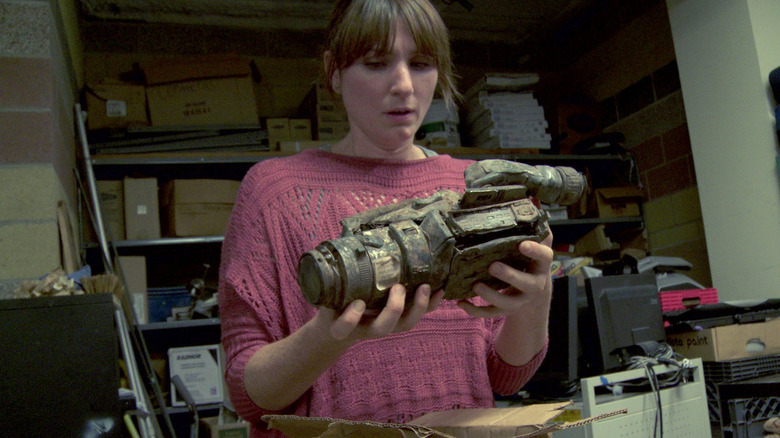
Sophie holding a dirt-crusted camera in

Cinelou Films

"Phoenix Forgotten" follows a woman looking into her older brother's disappearance. He initially saw some strange lights in the sky during her sixth birthday party, and later went missing while searching for a UFO, which he believed to be the source of the lights. As an adult, she's now trying to better understand what he learned, eventually finding his tapes in a recovered school camera.

The found footage horror film is based on a 1997 incident that happened across Nevada and Arizona. Now referred to as the Phoenix Lights, on March 13, 1997, there were reports of a triangle-like light formation visible in the sky. These sightings began around 8:30pm and were reported for several hours. Based on the location of these sightings as they moved across the state, the source was moving quickly, with Phoenix New Times journalist Tony Ortega arguing that it could have been traveling as fast as "400 miles per hour."

The source has never been officially identified, with some suggesting it was a military training exercise from an air force base in Tucson, Arizona to the usual UFO theories that arise with incidents of this nature. "Phoenix Forgotten" leans into the latter, presenting the lights as evidence of alien activity in the southwest.

5. Safety Not Guaranteed

Kenneth frowning at Darius in

FilmDistrict

Aubrey Plaza's Darius Britt researches the individual behind an ad about time travel in "Safety Not Guaranteed." The man is serious, wanting to go back to 2001 to stop the death of someone he cares about. Darius gets close to him by pretending to be genuinely interested in going on the mission, but the situation continues to grow more confusing as she figures out he's probably lying about what happened in 2001.

This science fiction comedy is inspired by a real ad that appeared in a magazine in 1997. In the classified section of Backwoods Home Magazine, writer John Silveira included an ad asking for someone to time travel with. Written as a joke to fill in space in the section, Silveira discussed how the ad came to be in an article for Backwoods Home Magazine in 2010.

"In the early days of Backwoods Home Magazine, the publisher, Dave Duffy, used fillers when the classified ad pages came up short," he wrote. "He'd ask me to come up with jokes or riddles. I often did." The time travel ad was one of two Silveira wrote that appeared in the 1997 issue — the other was a girlfriend search. People across the world continue to respond to the former as it makes the rounds online. "Sometimes, the flow into my P.O. box is a mere trickle," the writer 

RELATED

15 MOST POWERFUL SCI-FI FILMS OF THE LAST 10 YEARS YOU MAY HAVE MISSED!

25 Sci-Fi Thrillers Everyone Forgot About… But They’re STILL AMAZING in 2026!

50 Greatest Sci-Fi Films of All Time

The Only Sci-Fi Movie List You'll Ever Need | TOP 20 Greatest Films Ranked

{ https://www.bgr.com/category/entertainment/ }

Hoe vind je dit bericht?
Geschreven door peter om 21:33 Stuur door

‘Earth is almost entirely in the red’: Scientists warn ‘super-duper’ El Niño is still intensifying – and could continue into spring next year

‘Earth is almost entirely in the red’: Scientists warn ‘super-duper’ El Niño is still intensifying – and could continue into spring next year

Super El Niño is continuing to intensify, scientists have warned, with new forecasts suggesting the climate phenomenon could maintain its grip on global weather well into next year.

Experts say the event is now pushing into unprecedented territory, with vast swathes of the planet forecast to experience unusually warm conditions as the Pacific Ocean releases enormous amounts of stored heat.

The latest update from the World Meteorological Organization (WMO) predicts that El Niño will continue strengthening ahead of a forecasted peak in December.

Scientists say the powerful climate pattern is likely to influence temperatures and rainfall across much of the world in the coming months.

Britons have already been warned to expect large storms this autumn and winter, with the Department for Environment, Food and Rural Affairs urging people last month: 'If you've got a store of a bit of food that can keep you going for a while before the emergency services can get to you, you're going to be a lot better off than if you haven't.'  

The latest warning comes as meteorologists share striking maps showing large areas of the globe shaded red, indicating a heightened likelihood of above-average temperatures.

This map suggest Earth's climate engine is running hot, with unusually warm conditions forecast across much of the globe during the coming months as the powerful El Niño gathers strength. Pictured: The probability of above-average temperatures in November

This map suggest Earth's climate engine is running hot, with unusually warm conditions forecast across much of the globe during the coming months as the powerful El Niño gathers strength. Pictured: The probability of above-average temperatures in November

Forecasters expect Super El Niño to peak in December and remain strong into the spring of next year

Forecasters expect Super El Niño to peak in December and remain strong into the spring of next year

According to the WMO, there is a near-100 per cent chance that El Niño will persist through February next year.

US meteorologist Ryan Maue described the outlook in a post on X, writing: ‘New maps show Earth almost entirely in the red.

‘El Niño continues at 'maximum power' into the winter with planetary heating dialled up everywhere except the United States.’

The agency says the event could rank among the strongest observed since at least 1950.

WMO Secretary-General Celeste Saulo said: ‘El Niño is firmly established and strengthening rapidly.’

She explained that El Niño does not create new heat but instead releases heat that has accumulated beneath the ocean surface.

‘The ocean it's drawing from is the warmest we've ever measured it,’ Professor Saulo said. ‘There is simply more heat available to release.’

The widely used Niño 3.4 index rose from 1.6°C above normal in June to 2.5°C above normal in August, highlighting the rapid strengthening of the event.

WMO forecasts suggest the October-to-December average anomaly could reach about 3.7°C, with conditions peaking around December.

Experts say the event is now pushing into unprecedented territory, with vast swathes of the planet forecast to experience unusually warm conditions

Experts say the event is now pushing into unprecedented territory, with vast swathes of the planet forecast to experience unusually warm conditions

Scientists have warned that this year's 'Super El Niño' has already smashed historical temperature records, months before reaching its peak

Scientists have warned that this year's 'Super El Niño' has already smashed historical temperature records, months before reaching its peak

Climate scientist Zeke Hausfather said: ‘This year's El Niño continues its climb into uncharted waters.

‘Niño 3.4 region anomalies are now at 3.4°C above normal, higher than any prior El Niño event on record.'

Climate and energy researcher Leon Simons joked that forecasters are witnessing a ‘super-duper El Niño’, adding: ‘We're going to need a bigger y-axis.’

The update also points to an overwhelming likelihood of above-average sea surface temperatures across large parts of the globe during the final months of 2026.

Scientists warn that the combination of a powerful El Niño and exceptionally warm oceans could increase the risk of heat extremes, floods and droughts in different regions of the world for months to come.

Figures show that while sea surface temperatures are expected to start to slowly decrease in early 2027, El Niño will persist well into March.

How a Super El Niño will wreak havoc on the globe

El Niño is part of a naturally occurring weather cycle called the El Niño Southern Oscillation that changes between a hot and cool phase once every two to seven years.

During the hot, El Niño part of the cycle, the trade winds that normally blow warm water from the Pacific towards Australia slow or even reverse.

This allows warm water to collect near the surface of the equatorial Pacific Ocean off the west coast of South America, driving up global average temperatures.

Scientists have warned that this year's 'Super El Niño' has already smashed historical temperature records, months before reaching its peak.

Britons have been told to prepare for a stormy autumn thanks to the weather phenomenon.

According to scientists, Britons should prepare for 'heavy rainfall and flooding' from as early as October.

'A strong El Niño is likely to increase the chances of wetter, stormier conditions for the UK from October to December,' said Dr Amulya Chevuturi, senior hydroclimate scientist, UK Centre for Ecology & Hydrology.

'The North West is expected to be worse affected than the South East.'

A bit of rain might sound quite appealing following the months of relentless heat.

However, Professor Bill McGuire, Professor Emeritus of Geophysical Hazards, warns that the stormy autumn will likely be followed by a bitterly cold winter.

'Powerful El Niños typically bring mild, stormy Autumns and early Winters to the UK, followed by bitter cold, although this isn't set in stone,' he said.


El Niño Warning | Expert explains expected disruptions to weather patterns and impacts

{ https://www.dailymail.com/sciencetech/index.html }

Hoe vind je dit bericht?
Geschreven door peter om 14:13 Stuur door

Earth's vital signs are flashing red: Seven of nine key systems have been breached – as scientists warn 'we're rapidly running out of time'

Earth's vital signs are flashing red: Seven of nine key systems have been breached – as scientists warn 'we're rapidly running out of time'

Earth's life support systems are failing, scientists have warned – as seven out of nine planetary boundaries have now been breached.

A new report, called Planetary Health Check 2026, was written by more than 60 international scientists and assesses the state of our planet's health.

They analysed a range of measures including climate change, ocean acidification, stratospheric ozone depletion, land system changes and biosphere integrity.

Four are in the 'high–risk' red zone and three are in the 'increasing–risk' yellow zone – while only two remain in the 'safe' green zone.

'The impact of transgressing planetary boundaries are becoming increasingly clear all around us,' the report reads.

'Results published in the last year show that climate change is progressing faster than previously expected, causing unprecedented heatwaves on land and in the ocean and fuelling destructive extreme weather events.

'Tropical coral reefs have experienced their most severe mass bleaching event to date, a shutdown of the main Atlantic overturning circulation is now considered a credible risk even under low– to medium emission scenarios, and major Antarctic ice masses may have already begun their slide into the ocean.

'With seven out of nine boundaries transgressed, we have pushed Earth outside of its Safe Operating Space – meaning that we are turning Earth from a safe home into one full of hazards that threaten people across the world.'

Seven out of Earth's nine 'life support' systems have been breached, the Planetary Health Check report warned

Seven out of Earth's nine 'life support' systems have been breached, the Planetary Health Check report warned

Experts warned we have 'pushed Earth out of its Safe Operating Space', turning our planet into 'one full of hazards'

Experts warned we have 'pushed Earth out of its Safe Operating Space', turning our planet into 'one full of hazards'

According to the report, the red zone indicates that 'severe, irreversible damage to key planetary functions' has become likely.

It reveals that climate change is in this category, meaning immediate action must be taken to prevent locking in permanent changes.

It also sounds the alarm over the 'introduction of novel entities', referring to the release of man–made substances including plastic, synthetic chemicals, pesticides and other pollutants.

Biochemical flows are likewise in the red, indicating the severe disruption of nature's nutrient cycles.

The Earth's biosphere is also in the danger zone, meaning there has been a significant loss of the species, ecosystems and ecological functions that sustain life on our planet.

Life support systems that are currently in the yellow zone are Earth's freshwater systems, our land use and the acidification of the ocean.

The only two measures still in the green zone are stratospheric ozone depletion – the thinning of the ozone layer – and atmospheric aerosol loading, which refers to airborne particles that influence climate, rainfall patterns and human health.

Boundaries that now sit in the dangerous ‘red zone’ include climate change, the introduction of novel entities, biochemical flows and the biosphere

Boundaries that now sit in the dangerous 'red zone' include climate change, the introduction of novel entities, biochemical flows and the biosphere

This map shows the most impactful extreme weather events between April 2025 and April 2026. Most can be attributed to climate change

This map shows the most impactful extreme weather events between April 2025 and April 2026. Most can be attributed to climate change

Specific ecosystems highlighted in the report include the Amazon rainforest, which is close to passing a critical threshold.

'If it crosses its tipping point, up to 70 per cent of the Amazon forest could transition from lush rainforest to dry tropical savanna,' lead author Professor Carlos Nobre, from the University of Sao Paulo, wrote.

'[This would] release hundreds of billions of tons of carbon dioxide, irretrievably losing myriad species, and diminishing Earth's natural heritage.

'The resulting impacts would extend far beyond the Amazon itself, with serious implications for climate stability, food and water security, and human health around the world, such as an increased risk of epidemics.

'Besides an ecological catastrophe, losing the Amazon would be a moral injury: a sign that we had allowed one of Earth's great living worlds to disappear under our care.'

The report also specifically mentions the sea floor, which is being damaged by bottom trawling and faces the developing threat of deep–sea mining.

Scientists warned the outlook has worsened since last year, as pressure on several key life support systems continues to grow. 

Specific ecosystems highlighted in the report include the Amazon rainforest, which is close to passing a critical threshold

Specific ecosystems highlighted in the report include the Amazon rainforest, which is close to passing a critical threshold

The report, compiled by the Planetary Boundaries Science Lab, also warns that efforts to tackle climate change will fail unless nature is protected and restored.

Scientists said forests, wetlands and other ecosystems currently absorb vast amounts of carbon dioxide, but these natural carbon sinks are showing signs of weakening as environmental damage worsens.

Researchers also raised concerns about chemical pollution, warning that microplastics, PFAS 'forever chemicals' and thousands of other synthetic substances are being released into the environment faster than their impacts can be properly understood.

Despite the bleak outlook, the report says there is still hope.

'The science is clear: We have pushed the planet far beyond its Safe Operating Space,' it concludes.

'Despite some positive developments, our current efforts are far from sufficient. The window of opportunity to act and avoid irreversible change is narrowing – but it is still open.

'Through urgent and decisive action, we can change our trajectory towards sustainability. Returning to the Safe Operating Space is the defining task for a stable and liveable future.'

RELATED

Official Planetary Health Check 2026 with Johan Rockström

Planetary Alignment 2026 — What’s Really Happening in the Sky
Our Planet’s Vital Signs are Flashing Red: Planetary Health Check 2025

{ https://www.dailymail.com/sciencetech/index.html }

Hoe vind je dit bericht?
Geschreven door peter om 16:26 Stuur door

The first face of mankind? Ancient human who lived 315,000 years ago is brought back to life in stunning digital reconstruction

The first face of mankind? Ancient human who lived 315,000 years ago is brought back to life in stunning digital reconstruction

It’s like coming face to face with a long-lost relative – 315,000 years after we last saw them.

Scientists have pieced together what one of the world’s first humans looked like, using fossil fragments to bring them to life in an amazing digital image.

The result – the ‘oldest know representation’ of our species – shows a dark-skinned man with long black hair and a bushy beard, complete with deep-set eyes, a wide nose and full lips.

The facial image was created from the remains of a body discovered by a miner working at a mineral extraction site in Jebel Irhoud, Morocco.

That find led to a dramatic revision to the history of human evolution, as it showed that Homo sapiens are at least 100,000 years older than previously thought.

And the latest breakthrough sheds new light on what our ancestors may have looked like in their earliest days.

‘The archaeological site of Jebel Irhoud houses the oldest fossils attributed to Homo sapiens, dated to approximately 315,000 years before present,’ the researchers‘ paper, published in the journal Heritage, reads.

‘This study presents a forensic facial approximation based on data from a three-dimensional composite skull derived from Layer 7 of the site.’

The reconstruction shows a dark-skinned man with long black hair and a bushy beard, complete with deep-set eyes, a wide nose and full lips

The reconstruction shows a dark-skinned man with long black hair and a bushy beard, complete with deep-set eyes, a wide nose and full lips

Scientists pieced together the ancient face from fossil fragments combined with state-of-the-art technology

Scientists pieced together the ancient face from fossil fragments combined with state-of-the-art technology

By combining scans, photographs and video footage of the skull fragment known as Irhoud 1 with jawbone and tooth fossils unearthed nearby, the team created a 3D model of the skull

By combining scans, photographs and video footage of the skull fragment known as Irhoud 1 with jawbone and tooth fossils unearthed nearby, the team created a 3D model of the skull

One reconstruction is a stripped-back scientific reconstruction in grayscale, highlighting the skull's underlying anatomy

One reconstruction is a stripped-back scientific reconstruction in grayscale, highlighting the skull's underlying anatomy

When the skull was first unearthed in the 1960s, archaeologists thought it belonged to a Neanderthal and was around 40,000 years old. But in 2017, scientists determined that the skull was actually around 315,000 years old – and belonged to Homo sapiens.

By combining scans, photographs and video footage of the skull fragment – known as Irhoud 1 – with jawbone and tooth fossils unearthed nearby, researchers created a detailed 3D model of the skull.

They then used a modern human anatomical template, digitally adapting it to match the fossil's shape before adding estimated layers of muscle, fat and skin to put a face on the remains.

The process produced two versions of the face. One is a stripped-back scientific reconstruction in grayscale, highlighting the skull‘s underlying anatomy.

The other is a lifelike colour portrait complete with skin, hair and a beard, offering the public a striking glimpse of one of humanity‘s earliest known ancestors.

The study was led by 3D reconstruction expert Cícero Moraes, who is based in Brazil. The researchers stressed that the more lifelike reconstruction involved a degree of artistic licence.

Features such as skin colour, lighting, hairstyle and facial hair cannot be determined from the fossil remains themselves.

Instead, they were based on anthropological research into ancient and modern human populations, providing a plausible representation of what someone living in North Africa around 315,000 years ago may have looked like.

They also cautioned that the digital models do not show exactly what any one individual looked like, as the fossil fragments used to complete the reconstruction were likely to have been from several different people.

The team also consisted of researchers from Flinders University, the University of Pavia, the University of Lodz and Universiti Sains Malaysia. 

RELATED


The rise of Homo Sapiens: Humanity’s greatest story

The Origins of Humankind: A Journey to the First Man on Earth | Full Documentary

The 300,000 Year Journey: Complete Human Evolution Documentary

{ https://www.dailymail.com/sciencetech/index.html }

Hoe vind je dit bericht?
Geschreven door peter om 20:37 Stuur door

UFO doomsday cult play When Prophecy Fails coming to Beacon

UFO doomsday cult play When Prophecy Fails coming to Beacon

By Kulsum Shabbir - Reporter

UFO doomsday cult play When Prophecy Fails coming to Beacon | Greenock ...

(Image: Christopher Bowen)

A THEATRE production about a UFO doomsday cult is coming to the Beacon Arts Centre.

Groupwork will present When Prophecy Fails at the venue on October 23 at 7.30pm.

When Prophecy Fails

The production is inspired by the true story of history’s first UFO doomsday cult.

It follows people who believe the apocalypse is near and prepare for salvation by flying saucer.

When reality challenges belief, the group faces a crisis on stage.

Tickets are available through the Beacon Arts Centre website or by calling 01475 723723.

{ https://www.greenocktelegraph.co.uk/news/ }

Hoe vind je dit bericht?
Geschreven door peter om 21:22 Stuur door

A Mysterious Military Drone Was Recovered By A Fishing Charter Off Florida's Gulf Coast

A Mysterious Military Drone Was Recovered By A Fishing Charter Off Florida's Gulf Coast

By Aaron Greenbaum

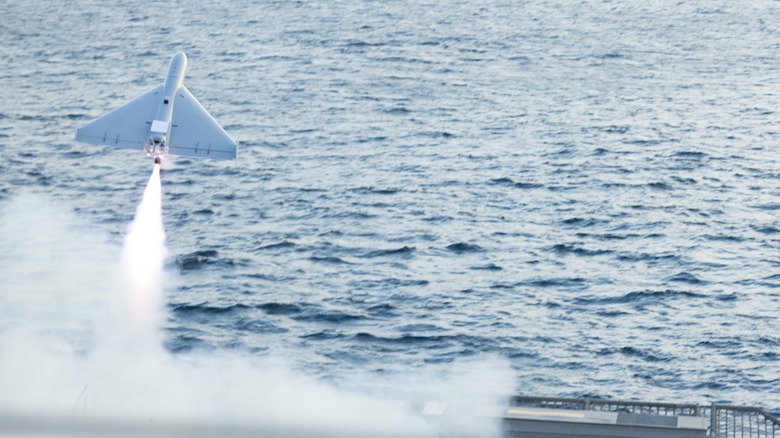
Low-cost Unmanned Combat Attack System (LUCAS) drones arranged on a tarmac

PUBLIC DOMAIN

When you charter a fishing boat, you do so with the expectation of catching some fish. Although, sometimes the unexpected occurs. Anglers have been known to snag some weird-looking fish, but who could ever expect a fishing expedition would result in dragging a military drone back to shore?

On September 20, 2026, a group of people had hired Hot Spot Charters to go on a six-hour fishing trip off the coast of Pensacola Beach, Florida when they spotted what the ship's captain initially thought was "an upside-down skiff," according to WEAR Channel 3 News. When they got closer and brought the semi-submerged UFO onboard (no easy feat since it weighed 500 pounds and was completely waterlogged), they realized it was actually an unmanned drone. A nearby military base, Eglin Air Force Base, informed the news channel that the vessel was a Low-cost Uncrewed Combat Attack System (LUCAS). Thankfully, some of the people onboard had enough military experience to assume the drone was safe to retrieve.

According to Eglin Air Force Base, the LUCAS drone had been missing since last Thursday. The UAV was undergoing some "routine scheduled testing" when it hit the water. After the fishing group brought the drone back to Pensacola Beach, Eglin Air Force Base officials retrieved it from the local Sheriff's Department. Thankfully, the LUCAS wasn't the only highlight of the trip; A school of Mahi-Mahi had congregated around the drone, and the charter group managed to catch six of the fish thanks to the military-grade bait.

What's the big deal with LUCAS?

Low-cost Unmanned Combat Attack System (LUCAS) drone launching from the deck of the USS Santa Barbara

PUBLIC DOMAIN

So, what exactly is a LUCAS and why was Eglin Air Force Base testing it? The LUCAS is what's known as a one-way attack drone, similar to the Iranian Shahed 136 both in terms of appearance and battle tactic: to swarm enemies and ram into them as fast as possible, detonating an integrated warhead for maximum damage. As such, the LUCAS is designed to be expendable and mass produced, sort of like those 3-D printed drones the Navy is testing. According to U.S. Central Command, the LUCAS entered the United States' weapon catalog in February of this year. While the drones first official use came during the 2026 Iran War, researchers at OSINT believe they were actually used earlier during the January 2026 Operation Absolute Resolve in Venezuela.

As for Eglin Air Force Base's role, the location is responsible for the majority of Air Force armament testing. When a new control system or attack drone is being developed, tested, and readied for deployment, it's sent to Eglin. While the base maintains an exclusion zone so it can safely evaluate weapons without risking any civilian casualties, the LUCAS had drifted outside of this area by the time the chartered fishing boat found it. However, the air base did not comment on why the drone hit the water, so maybe the LUCAS needs a bit more testing before it's ready for the military's Amazon-style marketplace.

{ https://www.bgr.com/category/tech/ }

Hoe vind je dit bericht?
Geschreven door peter om 21:27 Stuur door

Meer van UFO'S of UAP'S, ASTRONOMIE, RUIMTEVAART, ARCHEOLOGIE, OUDHEIDKUNDE, SF-SNUFJES EN ANDERE ESOTERISCHE WETENSCHAPPEN - DE ALLERLAATSTE NIEUWTJES

↑ Terug naar de berichten