Planet X Found Cloaked, Solar Material Pulled By it Gave It Away! UFO Sighting News.

Planet X Found Cloaked, Solar Material Pulled By it Gave It Away! UFO Sighting News.
Glowing Orbs Over Portland, Oregon Oct 9, 2026, UFO UAP Sighting News.
Sailors See 100 Meter UFO With Orb Fleet 450 Miles Off Nova Scotia, Oct 11, 2026, UAP Sighting News.
Glowing UFOs spotted racing over the Atlantic at 'hypersonic speeds' as sailors describe them vanishing and reappearing
Sailors have reported a mysterious sighting as they crossed the Atlantic this month.
A submission to the National UFO Reporting Center (NUFORC), dated October 11, detailed an encounter with glowing UFOs that the ship's crew said moved at impossible speeds and patterns.
For about 40 minutes, two sailors watched through binoculars as a single orb appeared 12 to 16 miles away, which 'rose and fell rapidly, bearing right and left, periodically shooting at hypersonic speeds, for about 5-10 minutes.'
The report, posted on October 21, claimed that three or four more orbs appeared, which looked the same as the first.
'All twisting and turning, rising and falling together in no set pattern,' the report states.
'Every so often they went somewhere else altogether, at a speed I can only call unreasonable, and then were simply there again.
'We picked up no targets on the radar.'
The NUFORC report included screenshots of the boat's radar, reportedly taken during the encounter, showing nothing on the screens that would suggest objects were in the sky.

A submission to the National UFO Reporting Center (NUFORC), dated October 11, detailed an encounter with glowing UFOs that the ship's crew said moved at impossible speeds and patterns - but did not show up on the boats radar (pictured)
The witness said the encounter began around 3:25am, when the ship’s second mate spotted a strange light low above the horizon, slightly to the left of the vessel’s bow.
The ship was crossing the Atlantic roughly 400 miles south of Nova Scotia, heading east at about 20mph, according to the report.
The witness described clear skies with only a thin crescent moon, saying ‘visibility was great.’
The vessel was not noticeably rocking, and there was ‘no traffic whatsoever’ nearby.
After seeing the first orb, the sailor said: 'The others appeared, 3-4 more. They were like the first in every respect.'
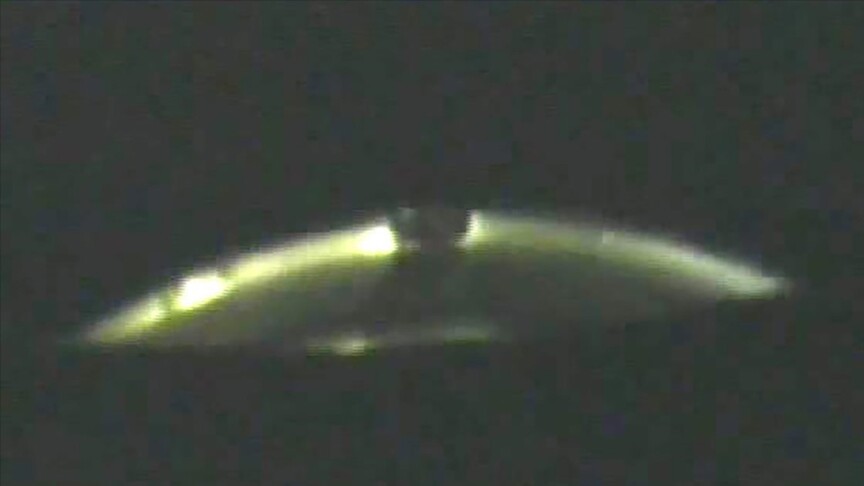
Another startling NUFORC report was submitted last year, featuring a video showing a clear image of what one witness believes was a giant UFO flying over California.
The April 27 video taken by an unnamed resident in Twentynine Palms followed what appears to be a brightly-lit hexagonal craft as it flew over the desert.

The report, posted on October 21, claimed that three or four more orbs appeared, which looked the same as the first. The witness shared screenshots of the radar to show no objects in the sky when they saw the UFOs
The UFO reportedly appeared out of nowhere around 10:27 pm PT while the witness was staying at a remote cabin.
According to the report, the suspected spacecraft was moving very slowly and irregularly, like it was in a daze.
'It seemed to move arbitrarily with no clear path. The movements were jerky and at varying speeds,' the witness wrote in their NUFORC report.
The large object also appeared to pulsate, giving off a bright light from its edges, as it moved through the sky for approximately 15 minutes.
'Tonight is the new moon - so it was definitely not the moon, and in any case was much brighter than even a full moon,' the witness continued.
'The striking thing was its great brightness and irregular shape and path,' they added.

Another startling NUFORC report was submitted last year, featuring a video showing a clear image of what one witness believes was a giant UFO flying over California
As the witness in Twentynine Palms followed the UFO, they added that the strange craft began to change shape - morphing from a six-sided object into a circle.
The person taking the cellphone video was the only witness at the cabin that night, so no one else was able to confirm their story.
However, they declared in their report to NUFORC that they hadn't taken any 'mind-altering substances' during the sighting and had clear vision the entire time.
Officials at NUFORC tried to find an explanation for the sighting, noting that a SpaceX rocket launch had taken place that day, but that Falcon 9 took off from in Florida three hours earlier.
A previous rocket launch created a similar phenomenon over the UK in March.
That bizarre shape was caused by illuminated frozen fuel expelled from the SpaceX rocket, experts revealed.
The light blue spiral is formed when excess fuel that has been released from the fast-spinning rocket turns to ice.
It then reflects sunlight in the upper atmosphere, giving it an otherworldly gleam before becoming water vapor.
World’s first round-trip mission to Mars has launched — why it could be a ‘transformative leap’ for science

On Monday (Oct. 19), Japan’s space agency launched a first-of-its-kindsample-return mission to Mars. The historic endeavor marks another major step toward humanity’s shared goal of understanding — and perhaps eventually colonizing — one of our closest planetary neighbors, experts say.
The Japan Aerospace Exploration Agency’s (JAXA) Martian Moons Exploration (MMX) probe is an international effort, constructed with help from NASA, the European Space Agency (ESA) and others. Over the next few years, it will closely study the Red Planet’s twin moons, Phobos and Deimos. The spacecraft will snap close-up photos of the pair before attempting to land on the larger satellite, Phobos, to scoop up rocky material that will hopefully be carried back to Earth in around five years.

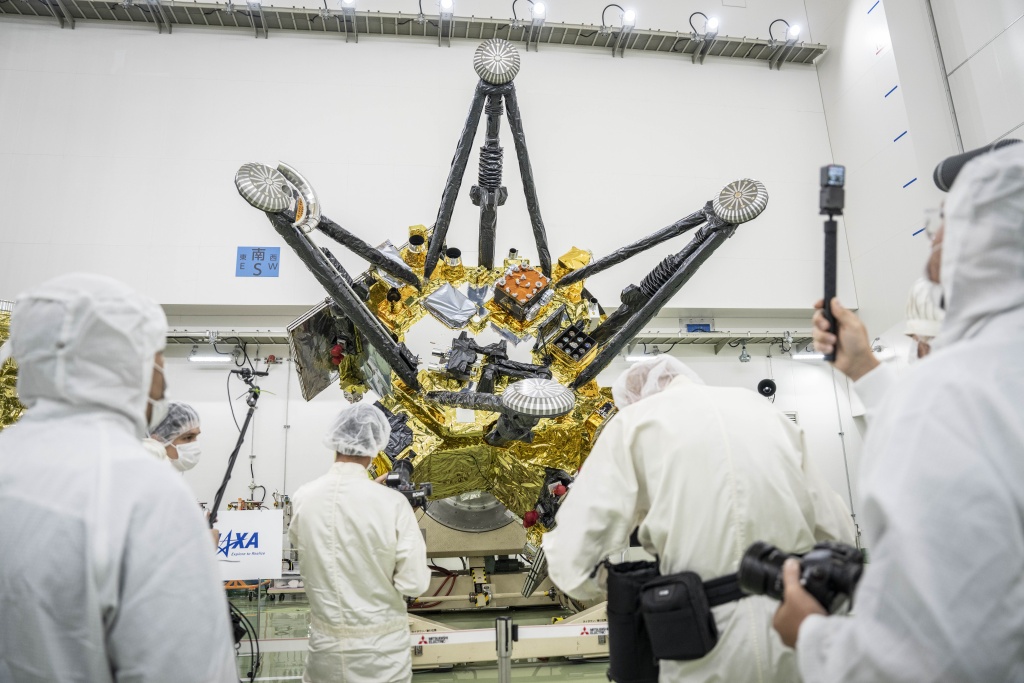
Members of the media film Exploration and Return Modules, making up the Martian Moons eXploration (MMX) spacecraft, at the Tanegashima Space Center in Minamitane, Kagoshima prefecture on August 13, 2026
Yuichi YAMAZAKI / AFP
If the mission is successful, the returned samples will finally settle a decades-old mystery about the origins of both moons. The findings could also help paint a picture of Mars’ ancient history and provide clues about what the early solar system was like.
“This mission marks a transformative leap in our capacity to investigate the Martian system,” Sonia Fornasier, an astronomer at the Paris Observatory who has studied Phobos and Deimos extensively and is a project scientist for MMX’s infrared spectrometer instrument (MIRS), told Live Science. It “ranks very high” among the missions we have sent to the Red Planet so far, she added.
JAXA launched the MMX probe on board an H3 rocket, which lifted off from Tanegashima Space Center in Kagoshima prefecture at 3:41 p.m. EDT Monday (4:41 a.m. Tuesday local time), Live Science’s sister site Space.com reported. (The mission was initially scheduled to launch in 2024, but it was delayed due to initial concerns about the H3 rocket.)
The camper-van-sized spacecraft successfully separated from the rocket’s fairing just over an hour later, and on Wednesday (Oct. 21), JAXA announced that the mission had passed the “initial critical operations phase,” meaning the probe is now locked into its roughly 140 million-mile-long (225 million kilometers) journey to Mars, which will take around 10 months.
“MMX took its first step today,” Naoki Murakami, general manager of Mitsubishi Electric’s space division, which led the design of the MMX probe, said in a postlaunch news conference early Tuesday morning (Oct. 20), according to The Japan Times. “This marks the beginning of a long, five-year journey.”

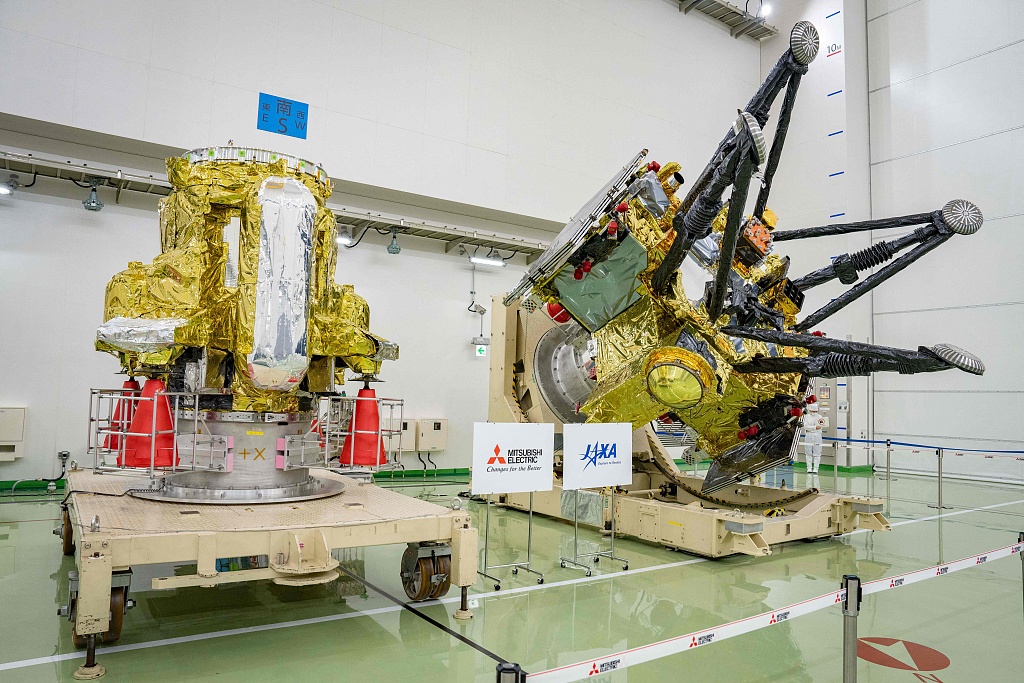
A Propulsion Module (L) and Exploration and Return Modules (R), making up the Martian Moons eXploration (MMX) spacecraft, are seen at the Tanegashima Space Center in Minamitane, Kagoshima prefecture on August 13, 2026. /VCG
Once the probe arrives at the Red Planet in August 2027, it will insert itself into a “quasi-satellite orbit” around Phobos. In other words, MMX will circle Mars alongside the moon but will not be gravitationally bound to it, similar to around half a dozen “quasi-moons” that currently accompany Earth around the sun.
Sonia Fornasier, Paris ObservatoryThis mission marks a transformative leap in our capacity to investigate the Martian system
After collecting data from a distance for a few months, MMX will swoop down and attempt to land on the surface of Phobos — not once, but twice.
During the first landing, MMX will hover just above the moon and deploy a mini rover, dubbed Idefix, onto the moon’s surface. The wandering robot, built by the French and German space agencies, will have to contend with extremely weak gravity as it trundles across the surface of Phobos: The rover weighs around 55 pounds (25 kilograms) on Earth but will weigh only around half an ounce (15 grams) on Phobos, according to ESA.
Once Idefix has completed its initial assessment of the moon’s surface, the entire MMX probe will set down on Phobos, on top of the spacecraft’s four-legged lander module. Mission scientists hope this goes a lot more smoothly than the attempted landings of Japan’s “Moon Sniper” and Resilience lunar landers, which crash-landed on Earth’s moon in 2024 and 2025, respectively.
Two of the MMX lander’s legs contain built-in sampling devices — one that will drill into Phobos and another that will hoover up surface material. The second device, dubbed the Pneumatic Sampler (or P-Sampler), was built by the Blue Origin-owned private company Honeybee Robotics on behalf of NASA and will collect its material in a “matter of seconds,” Kris Zacny, vice president of the Exploration Technology Group at Honeybee Robotics, said at an Oct. 15 NASA news conference. “You blink, and it’s all done.”
In total, JAXA aims to collect around a third of an ounce (10 grams) of material from Phobos. That would be around twice as much material as the space agency managed to snag on its most recent sample-return mission, Hayabusa2, which collected samples from the “spinning-top” asteroid Ryugu in 2019, finding materials rich in surprising organic compounds.
Once the samples have been acquired, at some point between late 2028 and early 2029, the probe will conduct a series of close flybys of Mars’ smaller moon, Deimos, before beginning the long trip back to Earth in late 2030 — the first return flight ever attempted by a spacecraft sent to Mars.
When the probe returns to Earth in 2031, it will release its samples in a 20-inch-wide (60 centimeters) container that will fall back to our planet’s surface, most likely somewhere in Australia, according to ESA.
Mars’ twin satellites, which were first spotted by American astronomer Asaph Hall in 1877, are nothing like Earth’s constant companion. For starters, they are much smaller; Phobos is around 14 miles (22 km) across, while Deimos is just 7.5 miles (12 km) wide. The duo also have lopsided shapes and are between 12 and 64 times closer to Mars than the moon is to Earth. (Phobos, meaning “fear,” and Deimos, meaning “terror,” are named after the sons of the Greek war god Ares, the counterpart to the Roman war god Mars.)
Phobos is dominated by the 6-mile-wide (10 km) Stickney crater, which was left by an ancient asteroid impact. The larger moon is also slowly falling toward Mars and may eventually be ripped apart before it reaches the Red Planet’s surface.
Other Martian spacecraft, such as the Emirates Mars Mission orbiter, have flown close to the moons, and NASA’s Mars rovers have frequently looked up to see the satellites eclipsing the sun in Mars’ sky (sometimes both at the same time). Yet many mysteries remain about the pair.
“Mars is right in our cosmic backyard, and yet we haven’t explored the planet’s moons,” Nancy Chabot, a space exploration expert at the Johns Hopkins Applied Physics Laboratory in Maryland and the deputy principal investigator of NASA’s MEGANE instrument on board MMX, told Live Science in an email. “MMX will do this!”
The biggest mystery surrounding Phobos and Deimos is their origin. Some researchers suspect the satellites are asteroids, or maybe even comets, that have been captured by Mars’ gravity, while others think the moons emerged from the debris of an ancient impact on the planet’s surface, similar to how Earth’s moon formed.
Neither theory is conclusive, meaning the moons’ origins “remain enigmatic,” Christopher Edwards, a planetary scientist at Northern Arizona University and one of NASA’s participating scientists for MMX, told Live Science.
For example, explaining how Mars captured the moons is “quite hard from an orbital mechanics perspective,” but if they did form from a debris disk from an ancient impact, they should have coalesced into better-defined spheres, Edwards said.
“MMX will solve this debate thanks to the spacecraft observations and the detailed analysis of the samples of Phobos on Earth,” Fornasier said. The data the probe collects from its flybys of Deimos will also allow researchers to generate a “full characterization of this body,” she added.
Fornasier is “particularly excited” by the possibility that the moons are captured asteroids because that would mean they would likely contain “organic and hydrated materials,” which would have a big “astrobiological implication” and would shed light on what the early solar system was like.
Regardless of how the twin moons formed, researchers also stand to learn a lot about Mars and how planets form and evolve.
“Phobos and Deimos are interesting, but not just in their own right,” Tom Statler, an MMX program executive and scientist in NASA’s Planetary Science Division, said at the Oct. 15 news conference. “Their presence is a key piece of the larger story of the Mars system. By uncovering the moons’ origin, we’ll gain new insights into the history of both Mars and Earth.”
If the moons did form via an impact scenario, the samples MMX collects may also contain actual pieces of Mars for researchers to study.
“If these objects are in fact pieces from the Martian surface that have coalesced moons, we’ll collect the best-preserved samples of the Martian surface,” Edwards said. Other fragments of Mars have already reached Earth as meteorites. However, entry into Earth’s atmosphere can transform them.
If Phobos is a chunk of Mars, that would be a real boon to NASA, which canceled its Mars Sample Return program — a mission that would have retrieved samples collected by the Perseverance rover — earlier this year. The agency’s researchers will receive up to 15% of the MMX samples to analyze.
During its three-year stay in the Red Planet’s system, the Japanese probe will also collect lots of data on Mars that could contribute to a wide range of future findings. “MMX will conduct in-depth studies of the Martian atmosphere, with a particular emphasis on dust and water transport mechanisms and the escape processes shaping Mars’ atmospheric dynamics,” Fornasier said.
This atmospheric data could temporarily fill a gap left by the recent death of NASA’s iconic MAVEN spacecraft, which stopped sending data back to Earth late last year.
Analysis of craters on the Martian moons could also provide clues about other events in Mars’ history. For example, some researchers think the Red Planet may have once had rings like Saturn or a larger moon.
Other experts are hopeful that the MMX findings could help lay the groundwork for future missions to explore — and perhaps colonize — Mars. “The samples from MMX will bring forth paradigm-shifting science on the Mars system for generations to come, especially as NASA prepares to send the first humans to Mars,” Nicky Fox, associate administrator for NASA’s Science Mission Directorate, said in a recent statement.
The next sample-return trip to Mars will be China’s Tianwen-3 mission, which is scheduled to launch in 2028 and will aim to land on and retrieve samples directly from the Red Planet’s surface, according to Space.com.
Since landing its first rover on Mars in 1997, NASA has pushed the boundaries of exploration with increasingly larger and more sophisticated robotic explorers. Each mission builds on the lessons learned from the Red Planet, leading to breakthroughs in technology and our understanding of Mars. From the microwave-sized Sojourner to the SUV-sized Perseverance—and even taking flight with the groundbreaking Ingenuity helicopter—these rovers reflect decades of innovation and the drive to answer some of science’s biggest questions.
German AfD party asks government about UFOs, aerial phenomena
![]()
BERLIN
RELATED
Leo's encyclical is a north star for new space race — and alien encounters, too

SpaceX's Starship lifts off for its fifth integrated flight test Oct. 13, 2024.
(Wikimedia Commons/Steve Jurvetson)
by Scott Hurd
There's been plenty of talk about aliens this past year, thanks to the Pentagon's releasing files about UFOs. That excited a lot of people, because the possibility of UFOs suggests that aliens have come to Earth.
For his part, Pope Leo XIV has said nothing publicly about aliens visiting us on our planet. What he has said, however, has important implications for our visiting aliens on theirs. And given the new space race that's underway, his timing couldn't be better.
Now, you might dismiss talk of aliens as a lot of sci-fi nonsense. Fair enough. But what you may not know is that you probably have already agreed to "recognize Mars as a free planet and that no earth-based government has authority or sovereignty over Martian activities."
What? Yes, that's a direct quote from the user terms of Elon Musk's Starlink satellite Wi-Fi network you likely accepted on your last plane trip. Surprise!
To be fair, that agreement applies only to "services provided on Mars via Starship or other spacecraft." However, what is the name of Musk's new SpaceX rocket ships? You guessed it: Starship. They're already being launched into space. And that might be cause for alarm, given Musk's money, power and dreams.
Leo himself expressed concern about Musk's becoming the world's first trillionaire. "What does that mean, and what's that about?" he wondered in an interview. The slogan on the T-shirt Musk has sometimes worn hints at an answer: "Occupy Mars!"
Occupying Mars has been a primary goal of SpaceX since its inception. At its initial public offering to investors, Musk reiterated that SpaceX seeks to transport people to the moon, Mars, and maybe even beyond our solar system. And his executive pay is tied to his establishing a permanent city on the Red Planet.
Martian cities are unlikely any time soon. But their possibility should be taken seriously now, to prevent outer space from becoming a new frontier for corporate greed, cosmic colonialism or even a combat zone. Because Musk may already be seeking to corner the galactic market with his Starlink user agreement.
Its insistence that no earthly government has sway over Mars is tantamount to Musk saying: "When I get to Mars, I'll do whatever I want." As authors Naomi Klein and Astra Taylor ask in End Times Fascism and the Fight for the Living World, "Has [Musk] already quietly laid corporate claim to outer space and everything he puts there? Can he get away with it?"
Not if his primary competitor, Amazon founder Jeff Bezos, can help it. Over two decades ago, Bezos quietly founded an aerospace company, Blue Origin Enterprises. Today, Blue Origin builds rocket ships, promotes space tourism, is constructing NASA's Mars Telecommunications Network, and plans a colony on the moon.
Blue Origins' pursuits are "the most important work I'm doing," Bezos insists. And as Josh Tyrangiel wrote in his recent cover essay for The Atlantic, "Choose Your Overlord: Musk vs. Bezos," those aspirations include "creating the infrastructure for an off-world economy upon which human civilization might someday depend."
Other tech titans want in on the action too. Sam Altman, CEO of ChatGPT's parent company, OpenAI, recently sought his own rockets as a challenge to Musk. And Silicon Valley wunderkind Leopold Aschenbrenner promised to buy his wife, the chief of staff of Claude's parent company, Anthropic, an entire galaxy of her very own.
In addition to these tech bros' plans, Russia and China have goals to reach Mars and are working together to construct nuclear reactors on the moon for a space station. Not to be outdone, NASA is racing to establish its own moon base, and has invited India as a partner. India itself hopes its astronauts will reach the moon by 2040, and is collaborating with Japan on a lander and rover. The new space race is on.
The last space race was between the U.S. and Russia, who are still in the game today. But they and other countries now have direct competition from private interests like Musk's and Bezos' that, as Leo writes in Magnifica Humanitas, "are endowed with resources and the capacity to intervene that surpass those of many Governments."
The first space race was to simply reach the moon. The new race is about profiting from the moon by extracting its wealth. The lunar surface is rich with resources such as helium, titanium and iron that are critical for today's technologies. And its water-ice deposits could support human settlement and create fuel for rockets that, given the moon's low gravity, are easier to launch from there than from Earth.
In this quest for resources to advance technological ambitions, there's a danger of history repeating itself through the ugly specter of colonialism, which arose from competition between nations and commercial collaborators to secure what was needed for the Industrial Revolution. Colonialism ultimately helped trigger the First World War, which claimed at least 17 million lives.
Concerned by the ambitions of both governments and private companies, in 2023 a group of astronomers warned against a new "colonialism" in space that would exploit resources and cause ecological destruction. More recently, these concerns have surfaced in the media, with both the BBC and The New York Times asking the question: "Who owns the moon?"
Who does own the moon? That's an open question. The Outer Space Treaty, signed in 1967 by the United States, the Soviet Union, and a host of other nations, forbids any country from claiming sovereignty over anywhere in space. It does not, however, preclude them profiting from resources acquired there. In 2015, the U.S. passed a law allowing its national interests to do precisely that. Other nations have since followed suit.
The Vatican hasn't been silent on this. This past April, the Holy See's United Nations mission in Geneva produced a video, "Outer Space and Humanity at a Crossroads: Reflections on a New Frontier of the Common Good," which encourages strengthening the Outer Space Treaty to avoid past mistakes made on Earth, such as unbridled competition and needless deadly conflict.
But it's the encyclical published the following month, Magnifica Humanitas, that might prove most helpful in this present moment. What it says about the new "industrial revolution" unleashed by artificial intelligence can be applied to the new space race, too. Because both, in Leo's words, provide "fertile ground for new wars" and plant seeds for a future that could be "colonial in another form."
Many of the big players in AI and space, such as the U.S., China, Bezos and Musk, are one and the same. Like the race for AI, the space race needs to be "disarmed," as the encyclical puts it, from "the desire to secure geopolitical or commercial dominance." And the encyclical's call for regulations, dialogue, international cooperation, and economic justice are equally applicable to both. As is its warning about unfathomable power concentrated in a few, unaccountable hands.
What about aliens? They're still science fiction. But it's reasonable to fear they'd experience the same domination and exploitation to which humans have been subjected in the brutal quest for money and power. Magnifica Humanitas condemns as "new forms of slavery" the condition of workers who train and extract resources for AI. This "deeply challenges the moral conscience of our time." And is a warning for any future close encounters beyond our galaxy.
Thanks to the encyclical, many today look to the Catholic Church for ethical guidance and hope in a world increasingly saturated with AI. That same document can offer guidance and hope for humanity's new ventures into space. Because by asking, "What are we building?" here on Earth, it implores us to reject "a power that claims to dominate the heavens."
12 Unbelievable Things Animals Can Sense Before Humans Do

Dog companion. Image via Pixabay.
Have you ever wondered if your pet knows more about the world than you do? Animals possess an extraordinary ability to sense things that often leave us humans in awe. From impending natural disasters to subtle changes in human emotions, animals have a knack for picking up on things long before we do. It’s as if they are equipped with a sixth sense. This article explores 12 unbelievable things that animals can sense before humans do, revealing the hidden depths of animal intuition and perception. Prepare to be amazed as we delve into the incredible world of animal senses.
Earthquakes A Quiver Before the Quake
(image credits: unsplash)
One of the most fascinating abilities animals possess is their capacity to sense earthquakes before they occur. Numerous reports have documented animals behaving unusually just before a quake. Dogs might bark incessantly, birds may fly erratically, and cats could hide in fear. Scientists believe that animals can detect the subtle vibrations and changes in the Earth’s magnetic field that precede an earthquake. It’s as if they have an early warning system built into their very being, allowing them to sense the tremors long before human-made technology can.
Weather Changes A Storm on the Horizon
(image credits: unsplash)
Animals seem to have an uncanny ability to predict changes in the weather. Have you ever noticed your dog acting restless before a storm hits? This is because animals can sense changes in barometric pressure, humidity, and even static electricity in the air. Birds may take flight to seek shelter, while cows might lie down in the pasture. These behaviors have been observed for centuries, and they continue to baffle scientists and weather enthusiasts alike. Animals’ sensitivity to atmospheric changes is truly remarkable, offering them a natural advantage in anticipating Mother Nature’s moods.
Human Emotions A Heartfelt Connection
(image credits: unsplash)
Animals are incredibly attuned to human emotions, often sensing our feelings before we even express them. Dogs, in particular, are known for their empathy and ability to comfort their owners during times of distress. They can pick up on subtle cues such as changes in body language, tone of voice, and even scent. This emotional intelligence allows them to provide support and companionship when we need it most. It’s no wonder that animals are often referred to as “man’s best friend,” as they offer a level of understanding and connection that is truly unparalleled.
Illness A Nose for Health
(image credits: unsplash)
Some animals, especially dogs, have been trained to detect illnesses such as cancer, diabetes, and seizures in humans. Their sense of smell is incredibly powerful, allowing them to detect changes in body odor that indicate illness. Dogs have been known to alert their owners to potential health issues, sometimes even saving lives in the process. This ability to sense illness before symptoms become apparent is a testament to the remarkable capabilities of animals and their potential role in healthcare and early detection.
Natural Disasters A Warning from the Wild
(image credits: unsplash)
Beyond earthquakes and weather changes, animals can also sense other natural disasters like tsunamis and volcanic eruptions. In 2004, before the devastating tsunami hit Southeast Asia, elephants were seen moving to higher ground, and flamingos left their low-lying breeding areas. It’s believed that animals can detect the low-frequency vibrations and changes in the environment that precede such events. This innate ability to sense danger and seek safety highlights the incredible survival instincts that animals possess, often putting them a step ahead of humans.
Magnetic Fields A Compass Within
(image credits: unsplash)
Many animals, particularly birds and sea turtles, have an extraordinary ability to sense the Earth’s magnetic fields. This internal compass helps them navigate during long migrations, guiding them across vast distances with remarkable accuracy. Scientists are still studying how exactly animals perceive these magnetic fields, but it’s clear that this ability plays a crucial role in their survival and ability to find their way home. The precision with which animals navigate the globe is nothing short of astonishing, showcasing their incredible adaptation to the natural world.
Pregnancy A Maternal Instinct
(image credits: unsplash)
Some animals, particularly dogs, have been known to sense pregnancy in humans before it’s even noticeable. They may become more protective, attentive, or even clingy towards their pregnant owners. This ability is thought to be linked to their keen sense of smell, as they can detect hormonal changes in a woman’s body. This maternal instinct is a testament to the deep bond between animals and humans, as well as their ability to perceive changes in their environment that often go unnoticed by us.
Fear A Sixth Sense of Safety
(image credits: unsplash)
Animals have an incredible ability to sense fear in humans and other animals. This heightened awareness allows them to assess potential threats and react accordingly. Dogs, for instance, can pick up on the scent of adrenaline, a hormone released during moments of fear or stress. This ability to sense fear is an essential survival mechanism, helping animals navigate the complexities of the natural world. It’s a reminder of the primal instincts that still exist within our domesticated companions, connecting them to their wild ancestors.

Impending Death A Mysterious Awareness
(image credits: unsplash)
There have been numerous accounts of animals sensing impending death, either in humans or other animals. Cats, for example, have been known to stay close to terminally ill individuals, offering comfort in their final moments. This mysterious awareness is not fully understood, but it’s believed to be linked to changes in scent or behavior that animals can detect. This ability to sense the end of life is both haunting and beautiful, highlighting the deep connection between animals and the cycle of life and death.
Time An Unseen Clock
(image credits: unsplash)
Animals have an uncanny ability to sense time, often anticipating events with remarkable accuracy. Dogs, for example, seem to know when it’s time for their daily walk or when their owner is due home from work. This sense of time is believed to be linked to their internal circadian rhythms, which help regulate their daily activities. It’s as if animals have an unseen clock that guides their actions and routines, offering them a sense of stability and predictability in their lives.
Danger A Survival Instinct
(image credits: unsplash)
Animals possess an incredible ability to sense danger, whether it’s from a predator, a natural disaster, or even a human threat. This heightened awareness allows them to react quickly and take appropriate action to protect themselves and their young. It’s a survival instinct that has been honed over millions of years of evolution, ensuring the continuation of their species. This ability to sense danger is a powerful reminder of the resilience and adaptability of animals in the face of adversity.
Energy A Vibrational Connection
(image credits: unsplash)
Some animals are believed to be sensitive to the energy or vibrations in their environment. This ability allows them to detect changes in their surroundings, such as the presence of other animals or even paranormal activity. While this phenomenon is not fully understood, it’s a testament to the deep connection animals have with the world around them. This vibrational awareness offers animals a unique perspective on their environment, allowing them to navigate the complexities of life with ease.
Electricity A Shocking Sensibility
(image credits: unsplash)
Certain animals, like sharks and rays, have the ability to sense electric fields in their environment. This ability, known as electroreception, allows them to detect the electrical signals produced by other animals, helping them locate prey or avoid predators. This remarkable sense is a testament to the diverse and specialized adaptations that animals have developed to survive in their respective habitats. The ability to sense electricity is a fascinating example of the hidden talents that exist within the animal kingdom.
Food Sources A Nose for Nourishment
(image credits: unsplash)
Animals have an exceptional ability to locate food sources, often from great distances. This ability is primarily attributed to their keen sense of smell, which allows them to detect the scent of food even when it’s not visible. For example, bears can smell food from miles away, while sharks can detect the scent of blood in the water from a significant distance. This ability to locate nourishment is a crucial survival skill, ensuring that animals can find the sustenance they need to thrive in their environments.
Territorial Changes A Sense of Home
(image credits: unsplash)
Animals are highly attuned to changes in their territory, often sensing when something is amiss. This ability allows them to protect their home and resources from intruders or potential threats. For example, birds may become more vocal or aggressive when their territory is threatened, while wolves may patrol their boundaries more frequently. This territorial awareness is a vital aspect of animal behavior, ensuring the safety and stability of their environment. It’s a reminder of the deep connection animals have with their homes and the lengths they will go to protect them.
Conclusion The Unseen World of Animal Senses
(image credits: unsplash)
The incredible abilities of animals to sense things before humans do is a testament to the wonders of the natural world. From predicting natural disasters to detecting subtle changes in human emotions, animals possess a remarkable array of senses that often leave us in awe. These abilities not only highlight the deep connection animals have with their environment but also remind us of the hidden depths of intuition and perception that exist within the animal kingdom. As we continue to explore and learn from these remarkable creatures, we gain a deeper appreciation for the mysteries of life and the extraordinary capabilities of our animal companions. What other secrets might animals hold that we have yet to discover?
RELATED
Voelen dieren UFO's voor mensen? Vreemde ontmoetingen suggereren dat ze dat misschien wel doen
Aussies confused after enormous swarm of moths shows up as rain on radar
The recent swarm of moths over the NSW Central Coast is believed to have caused rain radars to show non-existent rain clouds.
Residents around Sydney may have been confused over the last few weeks when they checked their weather apps.
The rain radar has been showing large clouds over the coast, even when there were clear skies.
But the odd phenomenon isn't the result of faulty equipment, instead the phantom rain signal was caused by millions of bogong moths migrating south.
'It is possible that radars across eastern NSW are detecting bogong moths,' the Bureau of Meteorology said in a statement.
'The bureau's radars are not malfunctioning… large numbers of insects can look like very light widespread rain, particularly near sunrise and sunset.'
The endangered moths migrate from low-lying inland regions in Queensland, central NSW, and western Victoria to caves in the southern Alps every spring.
The moths primarily travel at night and use the moon to navigate, so they are very sensitive to light pollution.

Rain clouds have been showing on radars around the NSW Central Coast even when skies are clear

Meteorologists believe the phantom rain is being caused by large swarms of bogong moths migrating south (pictured are the moths trapped in a Sydney home)
However, strong winds blew millions off-track in September and pushed them towards Sydney.
The Bureau's radar is able to show clouds by blasting out radio waves, which echo off water particles.
However, the waves can also reflect off other things - including smoke, ash, birds and moths.
'We can confirm that there has been increased 'echoes' displaying on radars across eastern NSW that aren't precipitation,' the bureau said.
'Now we can go back through the records as long ago as World War II to look for signatures of big clouds of moths.'
If researchers are able to prove the phantom rain was caused by moth swarms, it could be used to help collect data to save the endangered bogong moth by tracking their migration and population.
Zoos Victoria tracks the moths' bi-annual migration and encourages Aussies to submit sightings to its website.
The spring migration is especially important for the health of critically endangered mountain pygmy-possums, which eat the moths as they wake from winter hibernation.

Strong winds in September blew an unusual amount of the moths towards the coast (pictured is tracking data in September)

Meteorologists noted the non-existent rain appeared on the radar between sunset and sunrise, when the moths (above) are most active
Bogong moths are usually between 2.5cm and 3.5cm long and have dark stripes that run down each wing.
Anyone who spots a bogong moth is encouraged to upload a photo of the sighting to the Zoos Victoria Bogong Moth Tracker, which tracks their migration.
RELATED
“We Don’t Know What We Don’t Know”: New Study Uncovers a Concerning “Blind Spot” in Modern Scientific Research

How much of what we know about the world around us is influenced by things we see in popular media, and could that mean trouble for science?
The short answer is yes, according to new research by researchers at the University of New South Wales (UNSW), which reveals a concerning trend in modern scientific
According to a pair of recent UNSW studies, the topics that often become the research focus of many career scientists are largely driven by exposure to popular media like films, television shows, and other cultural factors that cause areas of the sciences that receive less attention to remain unexplored.
The result, according to the UNSW research team, suggests that some of the most important phenomena in the natural world remain unexplored.
“We don’t know what we don’t know,” says Dr Pietro Pollo, a UNSW researcher and lead author of one of the new studies.
Along with researcher Michael M. Kasumovic, Pollo says that people’s fascination with animal species that appear in popular films may drive their scientific interest to the point of influencing their career trajectories. However, that presents problems when the majority of the media addressing such topics focuses on larger mammals, birds, and other more obvious species.
As a result, Pollo argues that some of the remaining big questions about smaller and often less attractive species often fall to the wayside.
“In nature documentaries, the focus is usually on polar bears, lions, elephants, and other mammals,” Pollo recently said of the phenomenon he and Kasumovic characterize in their research. “And that is where most research interest and funding ends up.”
Presently, the largest populations of unknown animal species belong primarily to insects, microscopic roundworms, and marine invertebrates or fish. According to some estimates, up to as much as 80% to 86% of all species on Earth—roughly 7 to 8 million species—remain unnamed and undescribed.
Pollo and Kasumovic say that among these species, creatures like spiders, slugs, insects, and worms receive less attention for fairly obvious reasons: they are smaller, less attractive, and receive far less attention in popular media.
The result, however, could be more damaging for science than many are aware, since these cultural factors that drive people’s research focus appear to be leaving major gaps in our knowledge about the world around us.
Further complicating things is the fact that, according to Pollo and Kasumovic, this apparent “blind spot” emerges in ways that researchers can’t easily predict, due to the difficulty in attempting to predict long-term outcomes from essential, yet often very basic research efforts.
One example they point to involves research into saliva from lizards, which became instrumental in creating modern weight-loss drugs like Ozempic. Another example involves fluorescent proteins discovered in jellyfish that helped transform the study of individual cells.

(Image Credit: Unsplash)
Such seemingly obscure research focuses reveal how often unlikely areas of study can have a significant impact on scientific advancements that may include more than just knowledge about the natural world: they may also drive innovations in technology, treatments for various diseases, and a range of other beneficial scientific advancements.
“The next major discovery could be in an organism we currently ignore because we don’t find it cute or exciting,” Pollo said in a statement.
In their research, Pollo and Kasumovic looked at more than one million science papers in the fields of ecology and evolution. What they found was alarming: in more than half of all these publications, the focus was primarily on vertebrates, with a main focus on larger mammals that make up less than 5% of all known types of animal species.
The research suggests that vertebrate studies not only become the focus for many researchers in their careers, but also that they garner more citations and greater amounts of media attention, thereby compounding the problem.
By contrast, studies and related media exposure of invertebrates remains overwhelmingly low by contrast. Fundamentally, Pollo and Kasumovic argue that science training needs to focus on helping to broaden scientific interests and emphasize the possibilities in the lesser-explored areas of invertebrate biology and related fields.
“We have millions of species and limited time and funding,” Pollo says. “So we need to diversify our research as much as we can.”
The recent research article, “Drivers of Taxonomic Bias in Ecology and Evolution: Insights From Ethologists and Behavioural Ecologists,” appeared in Ecology and Evolution.
On Hostile Alien Worlds, Water Unexpectedly Behaves Like a Bizarre Chemical Shapeshifter

Water behaves strangely under extreme conditions beyond Earth, according to new research highlighting the unexpected realities that may one day greet future astronauts.
In a recent paper published in Communications Chemistry, a team of scientists from the University of Nevada, Las Vegas, describes their laboratory experiments subjecting water to the harshest conditions found on other planets.
Their laboratory work revealed that water’s atomic structure, appearance, and other properties change under these extreme conditions. With such environments presently still out of reach, the new laboratory work offers a unique window into what may lie beneath the surfaces of distant worlds.
One of the primary discoveries made in the new research was that, under extreme pressure, water ice can begin to lose its symmetry.
“Water beyond Earth-like conditions has more complex behavior than we ever previously imagined,” said lead author Ashkan Salamat, research lead and director of UNLV’s Nevada Extreme Conditions Lab. “It’s amazing how water can behave under pressure.”
Under normal conditions, compression forces atoms into closer proximity, thereby reducing a material’s volume. In many materials, increasing pressure can also favor more symmetrical atomic arrangements. Yet the UNLV team observed an unexpected departure from this behavior: the atomic structure of water ice became less symmetrical under extreme pressure.
In an attempt to recreate the intense conditions found deep inside worlds such as Neptune and Uranus, the UNLV team subjected water ice to pressures reaching approximately 35 million pounds per square inch (PSI). For comparison, a typical car tire is inflated to around 30 PSI.
Worlds with such high internal pressures are truly alien environments compared to Earth. No probe has ever entered the deep interiors of Neptune or Uranus to provide firsthand measurements, although Voyager 2 flew past both planets in the 1980s. These ice giants are believed to contain substantial amounts of water, ammonia, and methane deep within their interiors, where extreme pressures and temperatures may produce exotic states of matter.
“We can’t enter the crust or atmospheres of these planets because of distance, but we have data from things like the Voyager program,” said Salamat. “We have an idea of their compositions, and interior pressure and temperatures. And in labs like mine, we can mimic the chemistry and experiment with what could be occurring inside these planets.”
The effects of these simulated planetary conditions were examined using spectroscopy, while two diamonds exerted intense pressure on samples of ice X, an unusual form of water ice that exists under high-pressure conditions. Researchers also used X-ray techniques to investigate the material’s atomic structure.
In replicating these exotic environments, the UNLV team discovered unexpected behavior in water ice. Their findings suggest that, under pressures vastly greater than those encountered at Earth’s surface, the material can undergo structural changes that depart from the symmetrical arrangements previously expected at such extremes.
“Understanding the mechanisms of our solar system and our observable universe is critical for the endeavor of human knowledge,” Salamat concluded. “When we eventually get to these worlds, what are we going to see? We’re really the initial pioneers in trying to answer these questions in the laboratory.”
The paper, “Evidence for Symmetry-Reduction in Solid H2O Above 222 GPa,” appeared in Communications Chemistry on October 20, 2026.
The mysterious desert linked to aliens and mutated animalsA failed rocket launch helped fuel decades of rumours about alien encounters in this Mexican desert
Credit: Henry Romero / Reuters
Deep in the Chihuahuan Desert in northern Mexico lies a mysterious area known as the Mapimí Zone of Silence, where legend has it radio signals and other forms of communication can’t be received.
The Zone of Silence developed its supernatural reputation in the 1970s, after a failed rocket test by the US Air Force led to a large clean-up operation. Rumour has it that magnetic anomalies – either in the ground or the atmosphere – caused the rocket crash, as well as the communication failures that gave the Zone of Silence its name.
People have also reported strange lights in the sky, weird mutated plants and animals, and even alien sightings. Tourists flock from around the world to witness these strange phenomena.
Unfortunately, it appears that the truth of Mapimí is a lot more mundane than the myth. The legend was invented by locals hoping to leverage the rocket crash to attract tourism money to the area.
The Zone of Silence is located within the Mapimí Biosphere Reserve, a biological research station that was established a few years after the rocket crash. This helped to fuel rumours that the zone of silence had extraterrestrial significance, but it turns out that the only scientific interest in the area is biological.
The reserve is home to 200 species of bird, over 400 plant species and 36 species of reptile. Researchers at the reserve say that they’ve never had any issues with radio communication and it’s likely the mutated animals people claim to have seen are just part of the unique biodiversity of the site.
Read more:
RELATED
The UAP alien craft myth almost everyone still believes, and what the Pentagon actually confirmed

Declassified defense records reveal the true nature of unidentified aerial sightings.
The widespread belief that the military secretly verified alien visitors is incorrect; what the Department of Defense actually uncovered is an alarming, unresolved gap in airspace surveillance. Official investigations into unidentified anomalous phenomena (UAPs) show that while hundreds of military encounters remain unexplained, verified evidence points directly toward advanced foreign surveillance platforms, sensor calibration errors, and airborne clutter rather than off-world technology. The genuine national security dilemma is far more grounded, yet equally concerning for military leadership.
For decades, popular culture operated under the assumption that deep government vaults housed conclusive proof of extraterrestrial visitation. When the Pentagon formally acknowledged authentic cockpit footage captured by naval aviators, public imagination immediately leaped to interstellar craft. Yet the institutional documents tell an entirely different story, one framed by sensor limitations, electronic warfare capabilities, and domestic intelligence seams.

The creation of formal investigative units, such as the All-domain Anomaly Resolution Office (AARO), shifted the conversation from speculative folklore to rigorous physical analysis. Intelligence analysts and aerospace engineers began categorizing incoming military reports using radar telemetry, infrared imaging, and multispectral optical data.
Most sightings fall apart under systematic forensic review. Commercial atmospheric balloons, commercial drones, meteorological research equipment, and optical parallax illusions account for the vast majority of cataloged incidents. What appears on infrared targeting pods as an object defying the laws of aerodynamics often turns out to be a slow-moving civilian drone recorded by a jet flying at high speed.
A significant portion of unidentified cases become fully resolved once analysts acquire multi-sensor data, showing conventional objects distorted by sensor artifacts or extreme flight geometries.
The core issue is that modern combat sensors are calibrated to track high-velocity, predictable aerodynamic targets like cruise missiles or fighter jets. When confronted with slow, small, or unconventional objects drifting through flight corridors, onboard systems occasionally generate anomalous tracking tracks, creating the illusion of impossible maneuvers.
The true threat driving Pentagon interest is not galactic, but terrestrial. Strategic competitors have heavily invested in asymmetric aerial technology designed to probe American defensive perimeters.
Modern surveillance doctrine relies on high-altitude, low-observable platforms that operate along the margins of standard radar detection. Adversary nations deploy tethered or free-floating intelligence craft equipped with electronic signal collection suites. These platforms loiter near military training ranges, observing radio frequencies, radar emissions, and tactical flight procedures without triggering conventional interception alarms.
When military pilots report objects hovering motionlessly against high winds or operating at extreme altitudes, they frequently observe specialized reconnaissance hardware designed specifically to test how domestic radar networks process unconventional radar cross-sections.
| Popular Myth | Investigative Reality |
|---|---|
| Confirmed off-world technology | Advanced foreign surveillance or airborne clutter |
| Instantaneous propulsion defying physics | Parallax effect and sensor tracking anomalies |
| Complete government transparency blackout | Declassified reports tracking military aviation hazards |
| Single unified covert program | Fragmented inter-agency intelligence evaluations |

The political push for greater transparency originated within the ranks of frontline service members rather than conspiracy circles. Naval aviators flying off carrier strike groups repeatedly encountered unknown airborne obstacles in restricted military airspace, creating immediate flight safety hazards.
By restructuring the reporting framework, defense leaders systematically separated genuine national security intelligence from speculative culture. The ongoing mystery does not hinge on the existence of extraterrestrials, but on the precise capabilities of state-sponsored intelligence platforms operating within domestic borders.
💡 The real challenge facing defense analysts is tracking small, low-radar-profile objects operating in heavily restricted military airspace.
🔍 Official documentation reveals that rigorous physical analysis resolves nearly all encounters into conventional hardware, optical illusions, or sensor errors.
📌 Readers tracking defense developments should consult published congressional briefings rather than speculative commentary for confirmed technical updates.
RELATED
{ https://cristinaiglesias.com/newsday/category/world-news/ }
Trump briefed on secret UFO program, Ross Coulthart claims
Is the president getting the full UAP picture?

UAP Legacy Program folder on the White House Desk; UFO emerges outside. Image by Cybernews.
Journalist Ross Coulthart has said that the White House is grappling with the issue of UFO disclosure, but that President Donald Trump is fully in the loop.
Coulthart claims that President Trump now knows about an alleged longstanding crash retrieval program, which is allegedly responsible for intercepting non-human craft for reverse-engineering purposes.
Speaking on NewsNation’s Reality Check, Coulthart said: “I know the president knows full well now about the existence of the legacy retrieval and reverse engineering program.”
Coulthart said the effort is overseen by figures operating “at a very high level” within Trump's orbit, singling out Devin Nunes, chair of the President's Intelligence Advisory Board as a key figure in this process.
Former Republican Congressman Devin Nunes chaired the powerful House Intelligence Committee from 2015 to 2019, allowing him the experience to oversee US intelligence agencies.
After he left Congress in 2022, Nunes became CEO of Trump Media & Technology Group, the company behind Trump’s social media platform Truth Social.
In February 2025, Trump appointed him chairman of the President's Intelligence Advisory Board, which provides assessments of US intelligence activities. Despite having a genuine senior intelligence role, this doesn’t establish that Nunes oversees any UAP program.
The reaction on Reddit was dubious. Commenters pointed out that using such divisive figures to control the narrative and potentially run a psychological operation (“psy-op”).
It’s common in the UFO community to doubt politicians and suspect that the US could be covering up secret military tech.
These remain conspiracy theories. But outright distrust, like “I absolutely do not believe or trust this regime to do anything other than cheat or lie,” doesn’t correspond to the community waiting with bated breath for the government’s next move.

Coulthart went beyond claims about Trump's awareness, suggesting that the phenomenon itself may eventually become impossible to keep hidden from the public.
“It is more likely than not that it will show itself to people and allow itself to be revealed,” said Coulthart.
He speculated that the apparent increase in visibility could be “part of a steady conditioning,” adding that the phenomenon “doesn't want to alarm us” or “frighten us.”
By saying that he “wouldn't be surprised at all” if disclosure eventually revealed “a non-human intelligence engaging with this planet.”
It's not Coulthart's first time waxing lyrical about the topic. In May, he spoke out about how Trump had been briefed on the legacy program, and even said a White House statement about humans not being alone was imminent.
RELATED
Are UFOs a figment of people’s imagination? The answer is not so simple

Man sees a strange object in the sky
For decades, UFO sightings were often dismissed as imagination, exaggeration or mistaken identity. Psychology does show that human perception can turn distant lights, aircraft and unusual atmospheric effects into something far stranger, but that explanation does not cover every report because some UAP cases involve radar, infrared cameras or multiple witnesses observing something physically present.
That is why the modern scientific question has changed. Researchers are not asking if every UFO represents an alien spacecraft, but neither are they assuming every witness simply imagined what they saw.
The evidence suggests several different phenomena have been grouped together under one convenient label. Some UFOs begin with errors in human perception, some are ordinary objects seen under unusual conditions, and a smaller number remain genuinely unidentified because investigators do not have enough information.
Human vision feels objective, but perception is partly constructed by the brain. What you consciously see is built from incomplete sensory information combined with expectations, previous experiences and assumptions about what is happening around you.
That system usually works extremely well. It also means an ambiguous light in a dark sky can be surprisingly difficult to interpret because there may be no buildings, trees or other familiar objects available to reveal its true distance and size.
Psychologists have extensively studied visual illusions and internally generated perceptions, showing that conscious experience is not determined only by direct retinal information. One scientific review examines how perception can depart from the physical stimulus producing it.
A distant aircraft viewed head-on, for example, may initially look stationary. Once it turns, its movement and shape suddenly become obvious, even though nothing about the object itself changed.
Takeaway: Seeing something clearly does not guarantee correctly identifying it. Human perception is an interpretation of sensory information rather than a perfect recording of the external world.
Many extraordinary UFO reports depend on estimates of speed, size and altitude, but those measurements become unreliable if the object's distance is unknown. A tiny nearby object and a much larger distant object can occupy almost the same apparent size in someone's field of vision.
This creates a chain reaction. If a witness assumes something is several kilometers away when it is actually much closer, its calculated size and apparent speed can become wildly exaggerated.
The same issue affects videos. Without reliable distance measurements, footage alone may not tell investigators if they are watching a small balloon nearby or something much larger farther away.
AARO's historical review explains that missing information about altitude, speed and size has repeatedly prevented investigators from resolving UFO reports.
Takeaway: Some apparently impossible UFO behavior can emerge from one incorrect assumption about distance. Without that measurement, size and speed can become little more than educated guesses.
If someone sees a strange light shortly after hearing reports of UFO activity nearby, that context can influence how the brain interprets an otherwise ambiguous observation. Expectations do not invent every sighting, but they can shape meaning when the sensory information is unclear.
Research into paranormal beliefs has found associations with factors including intuitive thinking and confirmation bias, although findings vary considerably between studies and do not justify assuming every UFO witness has the same psychology.
This can work in both directions. Someone convinced UFOs are impossible may too quickly label an unusual observation as an aircraft, while someone convinced aliens are visiting Earth may interpret the same uncertain light as extraterrestrial technology.
Good investigation therefore needs information beyond what either observer initially believed.
Takeaway: Expectations can influence how ambiguous events are interpreted, which is why scientific investigation tries to separate what was actually measured from what witnesses thought the object might be.
Even a completely sincere witness may remember an event differently after discussing it, reading media coverage or repeatedly reconstructing what happened. Human memory is not a permanent video stored inside the brain.
Each act of remembering involves reconstruction. Details can become stronger, weaker or subtly altered over time, especially when the original event was confusing and emotionally intense.
This does not mean witnesses are lying. A person can describe an event honestly while unknowingly remembering some details differently from how they occurred.
That is why investigators generally value contemporaneous sensor measurements, photographs and reports recorded immediately after an event more highly than recollections reconstructed years later.
Takeaway: Sincerity and accuracy are not always the same thing. Someone can genuinely believe every detail of a UFO memory even if parts changed as the event was repeatedly remembered.
When enough information becomes available, many UFO reports eventually receive straightforward explanations. Balloons, aircraft, drones, birds, satellites and other familiar objects repeatedly appear among resolved government cases.
AARO's historical investigation found that earlier government studies generally concluded that most reported UFOs were ordinary objects, natural phenomena, optical effects or misidentifications.
That is important because "unidentified" describes the state of an investigation rather than a special type of object.
A balloon can be a UFO for several hours if nobody recognizes it. Once investigators identify it, nothing physically changes about the balloon; only our knowledge changes.
Takeaway: Many UFOs turn out to be real physical objects that were initially misidentified. A mistake about an object's identity is very different from imagining an object that never existed.
Modern skies contain objects that previous generations never had to interpret. Large numbers of satellites, drones and unusual aircraft can produce lights and movements that look unfamiliar to someone encountering them unexpectedly.
Satellite constellations provide an obvious example. Groups of newly launched satellites can appear as lines of lights traveling together across the night sky, producing a strange sight for someone who has never seen them before.
Drones create another difficulty because they can hover, accelerate and display lights in ways that do not immediately resemble conventional airplanes.
The more crowded the sky becomes, the more opportunities people have to encounter genuine technology they cannot immediately recognize.
Takeaway: Some modern UFO sightings may be increasing not because alien visitors are becoming more common, but because humans have placed far more unfamiliar objects into the sky.
Light traveling through the atmosphere can bend, distort and shimmer. Temperature differences between layers of air can produce mirages and other effects that alter the apparent position or shape of distant objects.
Bright planets can also become surprisingly convincing UFOs when viewed under the right conditions.
Venus has repeatedly been mistaken for an unusual aircraft because it can appear extremely bright near the horizon and seem to move when clouds or the observer move.
Atmospheric turbulence can make a point of light change color or brightness rapidly, creating an appearance that feels technological.
Once again, the observer is seeing something real. The error occurs in identifying what produced the appearance.
Takeaway: A UFO can be a genuine visual phenomenon without being a mysterious physical craft. The atmosphere can transform ordinary distant objects into experiences that look extraordinary.
The idea that UFOs are simply imaginary becomes much harder to apply when radar, infrared equipment or several independent sensors record an event. In those cases, investigators may have evidence that something physically interacted with detection systems.
Modern UAP investigations therefore prioritize technical sensor information whenever it exists.
AARO says its analysts combine available information from multiple intelligence and sensor sources, and only a very small percentage of reports display potentially interesting signatures such as unusual apparent speed or morphology in its annual report.
That does not establish alien technology.
Sensors can malfunction, produce artifacts or record familiar objects in unfamiliar ways. But a radar return cannot simply be explained by saying a pilot imagined seeing something.
Takeaway: Some UFO cases contain objective sensor data, meaning psychology alone cannot explain every report. Investigators still have to determine what created the signal.
Reports from fighter pilots receive unusual attention because pilots are trained observers operating sophisticated equipment. Their experience makes their testimony valuable, but it does not make human perception infallible.
Pilots encounter difficult viewing conditions, high speeds and objects at uncertain distances.
They may accurately report that something unusual was present without correctly estimating its size or movement.
This is an important middle position often lost in UFO arguments. Saying a pilot could be mistaken does not mean accusing that person of lying or hallucinating.
The observation can be genuine while the interpretation remains uncertain.
Takeaway: A credible witness can accurately report an unusual event without necessarily identifying its cause correctly. Professional experience improves observation but does not remove every perceptual limitation.
Cameras and radar systems are often treated as perfectly objective witnesses, but every sensor has limitations. Infrared cameras display heat rather than the scene exactly as human eyes would see it, while radar depends on interpreting reflected signals.
Camera movement can also produce misleading apparent motion.
An effect known as parallax can make a relatively slow distant object appear to race across the background when the camera observing it is moving rapidly.
Zoom, stabilization systems and image-processing software introduce additional variables that have to be understood before investigators calculate extraordinary speeds.
This is why the strongest cases require raw data and technical information about the sensor rather than only a dramatic video clip circulating online.
Takeaway: Replacing human eyesight with a machine does not eliminate interpretation. Investigators have to understand what the sensor itself may be adding to the observation.
One of the biggest misconceptions is that a case remaining unresolved after investigation means experts examined strong evidence and found something impossible. Sometimes the exact opposite is true.
NASA says the limited quantity and quality of most UAP observations make firm scientific conclusions difficult. Its UAP study focused heavily on improving future data collection for precisely that reason.
AARO reaches a similar conclusion. Many historical cases remain unresolved because investigators lacked reliable information about characteristics such as altitude, speed or size.
An unclear photograph from fifty years ago may remain unexplained forever because the missing information cannot be recreated.
Takeaway: "Unresolved" sometimes means investigators know too little, not that the object behaved in a way science cannot explain. Poor evidence can preserve a mystery indefinitely.
It would also be misleading to say officials consider every unexplained case boring. AARO has acknowledged that a small percentage of reports contain characteristics considered interesting enough to receive more detailed analysis.
Its FY2023 report said only a very small proportion displayed signatures such as apparent high-speed movement or unknown shapes.
Investigators use modeling, simulation and technical review to determine if those apparent anomalies survive closer examination.
This is the scientifically interesting category because a case can begin with a seemingly extraordinary feature and either lose that feature after analysis or remain genuinely puzzling.
Neither outcome should be decided before the evidence is examined.
Takeaway: Most reports do not appear extraordinary after investigation, but a small minority contain enough unusual information to justify continued scientific attention.
NASA's position is much more nuanced than either "UFOs are aliens" or "UFOs are all in people's heads." The agency defines UAP as observations that cannot initially be identified as aircraft or known natural phenomena.
NASA created an independent study specifically to determine how such events could be investigated more scientifically.
At the same time, NASA states that there are currently no data supporting the claim that UAP are evidence of alien technology.
Both statements can be true.
Some observations deserve investigation, and the evidence still does not demonstrate extraterrestrial spacecraft.
Takeaway: NASA treats UAP as legitimate observations worth understanding without interpreting them as evidence of alien visitation.
AARO reviewed decades of American and foreign UFO investigations to determine if any had secretly established an extraterrestrial explanation. Its historical review found no confirmed case of off-world technology.
The office reported that previous investigations overwhelmingly resolved sightings as ordinary objects, natural phenomena, optical effects or misidentification.
It also examined claims involving alleged recovered extraterrestrial material and reported that a tested metal sample was ordinary and terrestrial.
That conclusion does not establish that every future UFO will be mundane.
It means the historical evidence investigated so far has not produced the physical proof needed to move alien technology from possibility to established explanation.
Takeaway: Official investigations acknowledge unresolved cases but have not verified that any represents technology from beyond Earth.
Scientists cannot prove that no extraterrestrial civilization has ever visited Earth simply by explaining most UFO sightings. One genuine extraterrestrial object would remain extraordinary even if the other million reports were balloons.
This gives the UFO question an unusual structure.
Explaining thousands of cases does not logically eliminate every future possibility, while leaving one case unresolved does not prove aliens.
The evidence must positively support extraterrestrial origin.
That could involve physical material demonstrably manufactured somewhere other than Earth, several independent sensors documenting impossible performance or some other observation that repeatedly survives attempts at conventional explanation.
Nothing currently meets that standard.
Takeaway: Alien visitation remains logically possible, but possibility is not evidence. A UFO would need characteristics that positively establish extraterrestrial origin rather than merely resist identification.

Photo Credit: Deposit Photos
None of this makes psychology irrelevant. Human perception, memory and expectation remain essential to understanding why particular lights become compelling UFO encounters and why stories can become increasingly extraordinary after the event.
A purely psychological explanation may work well for some sightings.
An optical explanation may work for another, while a drone or balloon explains something else. A sensor malfunction may account for yet another case.
Trying to force every UFO into one explanation creates the problem.
"UFO" is a category defined by missing information, which means completely different causes can end up receiving the same label.
Related: Did human beings exist before they were born? Here's what science can and can't prove
Takeaway: Imagination and perception help explain part of the UFO phenomenon, but the category also includes real aircraft, atmospheric events, balloons, drones and cases where investigators still cannot determine what happened.
No single answer fits every report. Some UFO experiences may involve perceptual errors, expectations or memories that distort what actually happened, while many others involve real physical objects that witnesses simply failed to recognize.
A smaller group contains sensor measurements or other evidence showing that something was genuinely detected without providing enough information to identify it.
That is why saying UFOs are "imaginary" is almost as misleading as saying UFOs are alien spacecraft.
The scientific position occupies the less dramatic middle.
Most investigated cases appear capable of ordinary explanations. Some remain unresolved because the evidence is incomplete, while a small number contain features worth investigating more carefully.
NASA says current evidence does not support alien technology, and AARO says decades of government investigations have not verified extraterrestrial origin.
That still leaves genuine mysteries.
The challenge is resisting the urge to decide what they are before the evidence can tell us.
Question for you. Which kind of UFO case would you find hardest to dismiss: one seen by several trained pilots, one recorded simultaneously by several independent sensors or one that leaves physical material researchers can examine? The strongest evidence would probably combine all three.
The post Are UFOs a figment of people's imagination? The answer is not so simple appeared first on FODMAP Everyday.
Police officer witnesses 75-foot, circular UFO hover silently over house

Reenactment Image. Credit: Night Cafe
Real UFO Case Based On Primary Source
At 11 p.m., sometime in 1988, Officer Robert Lunsford of the Chesapeake, Virginia, Police Department responded to a call from homeowners reporting that a strange craft was hovering over their house.
When he got back to the station, a shell-shocked Lunsford decided to call a UFO report hotline number he found in his police handbook after he filed his report.
Officer Lunsford picked up the landline, dialed, and told his strange but credible story to the man on the other end of the line.

Police officer calling UFO hotline. Credit: Night Cafe
"When I arrived, what I saw was, um, a real large, uh, craft in the air. Circular. I would say it was at least 25 yards wide, or diameter actually would be.
And it was hovering over a house; it was motionless. It had bright red lights coming from it," Lunsford said. - Lunsford
The man at the other end then asked if the object was making any noise.
"No, I didn't hear any sound at all. It didn't appear—never saw it land, and from the people I talked to, they never saw it land either. I was in the military before, and I've never seen any aircraft whatsoever that looked like that," Lunsford added. - Lunsford
The young officer then told of watching the silent disc move west toward another city. Afterward, he checked with the airports and Langley Air Force Base to confirm whether they had picked up any radar hits on the object, or if it could be one of theirs.
The recipient of the call was Robert J. “Bob” Gribble, a retired Seattle firefighter, who established the hotline using his own money when he founded the National UFO Reporting Center (NUFORC) in 1974.
In 2004, Gribble donated this treasure trove of primary-source UFO witness audio recordings to Wendy Connors, a respected UFO historian in Albuquerque, NM, who archived them for posterity.
As he listened to the young police officer, Gribble did not lead him on; in fact, his calm, deadpan voice was reminiscent of an elder Catholic priest hearing confession.
Historic Sighting
Near the end of the conversation, Officer Lunsford said that he and the homeowners were not the only witnesses to such sightings, and that others in Chesapeake, Virginia, had also made similar reports recently.
Gribble said he hadn't been aware of any such sightings, but asked the officer to have such individuals contact him if he heard of any more.
Lunsford pointed out that the first UFO sighting in the United States allegedly occurred near Chesapeake, Virginia, according to a letter written by two witnesses and sent to Thomas Jefferson in 1813.
Here is the Text of Entire letter:
From Edward Hansford and John L. Clarke
Portsmouth Va July 31st 1813.
most honorable Sir
We the subscribers most earnestly solicit, that your honor will give us your opinion, on the following extraordinary Phenomenon Viz:
At (blank) hour on the night of the 25th instant, we saw in the South a Ball of fire full as large as the sun at Maridian which was frequently obscured within the space of ten minutes by a smoke emitted from its own body, but ultimately retained its briliancy, and form1 during that period, but with apparent agitation. It then assumed the form of a Turtle which also appeared to be much agitated and as frequently obscured by a similar smoke. It descended obliquely to the West, and raised again perpendicular to its original hight which was on or about 75 degrees. It then assumed the shape of a human skeleton which was frequently obscured by a like smoke and as frequently descended and ascended—It then assumed the form of a Scotch Highlander arrayed for battle and extremely agitated, and ultimately passed to the West and disappeared2 in its own smoke. we are honorable
Sir with Sentiments of very high respect & esteem Your most Obedient very humble Servts
Edward Hansford, Keeper of the Washington Tavern in the Town of Portsmouth Virginia— John L. Clarke, of Baltimore. Hansford and Clark

Listen to the Audio of the entire call from Officer Lunsford:
Here is a reenactment of what the officer witnessed based on his call:
'Two Good Men Died at Area 51. They Weren't Killed by Aliens', Says Lawyer Who Sued the Secret Base

Area 51's main gate in Nevada, pictured, guards the site where workers said the Air Force burned toxic waste in open trenches
PHOTO David James Henry / Wikimedia Commons, CC BY-SA 4.0 cropped
Robert Frost and Wally Kasza, two Area 51 workers, died in the 1990s after illnesses their lawyer linked to alleged toxic-waste burning at the base. Jonathan Turley, the lawyer who sued the US government for Frost's widow, Kasza, and other workers, said in 1999 that aliens played no part.
President Bill Clinton then signed an order shielding classified details of the base's waste. By 1999, the families still did not know what the men had breathed. Their case is back in the news as a former US Army sniper's alien tale, with no named victim, spreads online.
Workers told Turley the Air Force dumped waste and discarded equipment into open trenches as long as football fields, poured jet fuel over it, and burned it. Frost, a sheet-metal foreman at the base, died in 1990 aged 57. According to The Village Voice, doctors found high levels of dioxin and dibenzofurans in his body after his death. The Las Vegas Sun reported that he had already lost a workers' compensation claim.
Kasza replaced Frost as industrial supervisor, later developed kidney cancer, and died before the case ended. Turley filed two lawsuits in 1994: Kasza v. Browner, aimed at the Environmental Protection Agency (EPA), and Frost v. Perry, aimed at the Pentagon. They sought information and an end to the burning, not personal compensation; Frost's lawsuit also sought civil penalties and legal fees. 'Two good men died at Area 51. They weren't killed by aliens,' Turley told The Village Voice in 1999.
The Air Force spent months arguing the lawsuits could not proceed because, officially, Area 51 did not exist. Workers could face up to 10 years in prison for disclosing classified information, the Tampa Bay Times reported, and a judge classified Turley's university office. On 29 September 1995, Clinton exempted the base from any waste rule that would force disclosure of classified information, citing the 'paramount interest of the United States'. The timeline below charts the case.

PHOTO IBTimes UK
In January 1998, a federal appeals court upheld the dismissal of Frost's claims on state-secrets grounds and found Kasza's claims moot after inspections and a presidential exemption. 'This case has nothing to do with national security,' Turley said, according to the Las Vegas Sun. In November 1998, the US Supreme Court declined to hear an appeal. Clinton and then George W. Bush renewed the exemption, and the Federal Register records renewals in 2000, 2001, and 2002.
EPA inspectors visited the base after the lawsuits, but the government did not publish their findings. A CIA history of the U-2 spy plane, released in 2013, acknowledged Area 51 by name. 'The denial of the existence of Area 51 was always absurd,' Turley wrote in a 2019 column on his website.
Nick Betts, the sniper, says an unnamed man told him the story over drinks in Poland, but offers no casualty record or name. The Pentagon office that investigates unexplained sightings said in 2024 it had found no evidence of alien technology. By contrast, Frost and Kasza left widows and a paper trail.
Ex-Pentagon Official Claims Recovered Aliens Caused Workers to Reportedly 'Take Their Own Lives'

Ex-Pentagon Official alleges encounters with recovered aliens led to deaths
PHOTO by keshan jalota on Unsplash)
Former Pentagon UFO investigator Jay Stratton claims in his new memoir that people involved with alleged US recoveries of aliens and their technology suffered mental breakdowns and, in some cases, took their own lives.
Stratton, the first director of the Pentagon's Unidentified Aerial Phenomena Task Force, has also alleged that military contractors possess at least a dozen crashed spacecraft and have recovered non-human remains.
BroBible reports the claims in connection with his memoir, Out of the Shadows. He previously served as Chief of Air and Space Warfare for the Defense Intelligence Agency. Harvard astrophysicist Avi Loeb has challenged Stratton to produce evidence.
The memoir passage reproduced by BroBible attributes the reported harm to encounters with non-human intelligence and its technology, claiming they caused some people 'to resign, suffer mental breakdowns, and in some cases take their own lives. The truth was just too difficult for them to process.'

Stratton also alleges that aliens were recovered alive from the 1947 crash at Roswell, New Mexico, but later died after refusing food and human contact.
Other former officials have advanced similar claims. They include Luis 'Lue' Elizondo, identified in the report as director of the Pentagon's Advanced Aerospace Threat Identification Program, and David Grusch, an Air Force veteran who previously worked at the National Geospatial-Intelligence Agency and National Reconnaissance Office.
Astrophysicist Eric Davis, who worked with the Pentagon's UFO programme, has asserted that he personally viewed classified images and documents purportedly supporting claims of alien life discovered in crashed craft.
Hal Puthoff, a former CIA-funded researcher and adviser to the Advanced Aerospace Weapon System Applications Program, has separately alleged the recovery of 'four separate types' of alien species.
Loeb leads Harvard's Galileo Project, which searches for signs of extraterrestrial life, and previously chaired the university's Department of Astronomy. He has himself suggested that the comet 3I/Atlas and the asteroid Oumuamua could be alien spacecraft.
His earlier proposals include the possibility that an advanced civilisation created the universe in a laboratory and that aliens could travel through hidden dimensions.
Loeb chairs the UAP Science Advisory Council, which advises the White House and other US agencies. He also described a separate UAP Governing Board whose membership spans the executive branch, the military, and the intelligence community.
'Obviously, any groundbreaking revelation about alien intelligence would be of great political benefit to the Trump administration. Why can't anyone offer President Trump a guided tour to an alien spacecraft or at least some footage of alien bodies?' he wrote.
Loeb also told Fox 32 News that a legal waiver lets employees share confidential UAP information with designated government investigators, but Stratton provided neither tangible nor digital proof.
'Jay did not respond to my invitation, even after it was repeated by the Council member, Dr Tim Gallaudet,' Loeb wrote. The report includes no reply from Stratton addressing Loeb's invitation or demand for evidence.
Loeb described public disclosure as a goal of the council, explaining that its purpose includes releasing material on alleged non-human technologies so that the evidence becomes available beyond official channels.
Jay Stratton Claims Roswell's Balloon Story Was a Cover-up and UFOs Are Drawn to Nuclear Energy

Former Pentagon official Jay Stratton alleges a Roswell cover-up and links UFOs to nuclear energy
PHOTO @jaystrattonofficial/Instagram
Former US intelligence official Jay Stratton has alleged that non-human bodies were recovered near Roswell, New Mexico, in 1947 and concealed behind a balloon explanation.
His claims resurfaced on Tuesday, 20 October, along with his account of using nuclear energy to attract unidentified objects. Neither allegation has been independently verified.
The allegation appeared in Stratton's memoir, Out of the Shadows: Revealing the Truth About Non-Human Intelligent Life, published on 13 October.
He previously directed the Pentagon's Unidentified Aerial Phenomena Task Force and served at the Defense Intelligence Agency. His experience lends weight to the story, though it cannot replace evidence.
Debris recovered from a ranch near Roswell in July 1947 became the centre of one of America's most enduring UFO disputes.
The US Army Air Forces initially announced the recovery of a flying disc, before describing the material as balloon equipment.
Stratton offers a different version. He writes that a source described the recovery of a crashed craft and occupants who were not human. According to the account, some died on impact, while others briefly survived. The claim rests on testimony that readers cannot independently test.
He also recounts allegations that intelligence personnel suffered serious psychological distress after encountering the supposed wreckage and bodies. The reports include no independently verified medical records, witness statements, or physical remains to support those assertions.
A documented explanation accounts for the debris. A 1994 US Air Force investigation traced it to Project Mogul, a classified research programme that used high-altitude balloons to gather information relevant to Soviet nuclear activity.
The Air Force revisited accounts of supposed bodies in a 1997 report. It concluded that later memories conflated the Roswell story with test-dummy drops and separate military accidents in later years. That explanation directly contradicts Stratton's account of recovered non-human occupants.
The Pentagon's All-domain Anomaly Resolution Office, known as AARO, reviewed the history again in 2024. It found no records demonstrating that the government recovered aliens or extraterrestrial material at Roswell.
Stratton traces his involvement in UAP investigations to footage he says he viewed in 2005 while working at the Defense Intelligence Agency.
In a radio interview on 18 October, he described a black triangular object near a nuclear missile silo. He believed known aerospace technology could not explain its movements.
But the reporting reviewed did not include classified footage available for independent examination. Its apparent speed, shape and origin therefore remain matters of Stratton's description, rather than independently established findings.

The Pentagon found no verifiable evidence of extraterrestrial technology, challenging Jay Stratton's UFO claims
PHOTO jaystrattonofficial/Instagram
He says repeated reports near nuclear facilities prompted a theory that UAPs were drawn to nuclear energy. His memoir describes investigators considering a submarine as a lure in waters associated with previous sightings.
'Our bait could be a nuclear submarine,' Stratton writes in an excerpt reported by Popular Mechanics. He says the intention was to use the reactor's nuclear signature to bring an object close enough to observe or potentially recover.
The distinction matters. A proposed strategy does not establish that an operation was carried out, much less that an object approached. In the October radio interview, Stratton went further and claimed to have used nuclear sources to lure UAPs. No independently accessible operational record or instrument data substantiates that outcome.
Stratton also describes strange lights near his family's home and the personal strain of pursuing these investigations. Those experiences remain personal recollections, not evidence of an extraterrestrial presence.
AARO's 2024 historical review examined allegations of secret programmes alongside the Roswell debris. Its then-acting director, Tim Phillips, said the office found 'no verifiable evidence' that any UAP sighting represented extraterrestrial activity.
The agency acknowledged that some reports remained unresolved. However, its investigators found no verifiable evidence that the US government or private industry had obtained extraterrestrial technology. Stratton has not yet publicly presented independently testable evidence to support his competing Roswell and nuclear-attraction claims.
RELATED