Naar de inhoud

UFO'S of UAP'S, ASTRONOMIE, RUIMTEVAART, ARCHEOLOGIE, OUDHEIDKUNDE, SF-SNUFJES EN ANDERE ESOTERISCHE WETENSCHAPPEN - DE ALLERLAATSTE NIEUWTJES

UFO's of UAP'S in België en de rest van de wereld
akke.beakke.be
Ontdek de Fascinerende Wereld van UFO's en UAP's: Jouw Bron voor Onthullende Informatie! Ben jij ook gefascineerd door het onbekende? Wil je meer weten over UFO's en UAP's, niet alleen in België, maar over de hele wereld? Dan ben je op de juiste plek! België: Het Kloppend Hart van UFO-onderzoek In België is BUFON (Belgisch UFO-Netwerk) dé autoriteit op het gebied van UFO-onderzoek. Voor betrouwbare en objectieve informatie over deze intrigerende fenomenen, bezoek je zeker onze Facebook-pagina en deze blog. Maar dat is nog niet alles! Ontdek ook het Belgisch UFO-meldpunt en Caelestia, twee organisaties die diepgaand onderzoek verrichten, al zijn ze soms kritisch of sceptisch. Nederland: Een Schat aan Informatie Voor onze Nederlandse buren is er de schitterende website www.ufowijzer.nl, beheerd door Paul Harmans. Deze site biedt een schat aan informatie en artikelen die je niet wilt missen! Internationaal: MUFON - De Wereldwijde Autoriteit Neem ook een kijkje bij MUFON (Mutual UFO Network Inc.), een gerenommeerde Amerikaanse UFO-vereniging met afdelingen in de VS en wereldwijd. MUFON is toegewijd aan de wetenschappelijke en analytische studie van het UFO-fenomeen, en hun maandelijkse tijdschrift, The MUFON UFO-Journal, is een must-read voor elke UFO-enthousiasteling. Bezoek hun website op www.mufon.com voor meer informatie. Samenwerking en Toekomstvisie Sinds 1 februari 2020 is Pieter niet alleen ex-president van BUFON, maar ook de voormalige nationale directeur van MUFON in Vlaanderen en Nederland. Dit creëert een sterke samenwerking met de Franse MUFON Reseau MUFON/EUROP, wat ons in staat stelt om nog meer waardevolle inzichten te delen. Let op: Nepprofielen en Nieuwe Groeperingen Pas op voor een nieuwe groepering die zich ook BUFON noemt, maar geen enkele connectie heeft met onze gevestigde organisatie. Hoewel zij de naam geregistreerd hebben, kunnen ze het rijke verleden en de expertise van onze groep niet evenaren. We wensen hen veel succes, maar we blijven de autoriteit in UFO-onderzoek! Blijf Op De Hoogte! Wil jij de laatste nieuwtjes over UFO's, ruimtevaart, archeologie, en meer? Volg ons dan en duik samen met ons in de fascinerende wereld van het onbekende! Sluit je aan bij de gemeenschap van nieuwsgierige geesten die net als jij verlangen naar antwoorden en avonturen in de sterren! Heb je vragen of wil je meer weten? Aarzel dan niet om contact met ons op te nemen! Samen ontrafelen we het mysterie van de lucht en daarbuiten.

Berichten van 1 oktober 2026 tot 31 oktober 2026

NASA Astronaut Winston Scott Convinced Alien Life Exists but Warns of an Impending Space Military War

NASA Astronaut Winston Scott Convinced Alien Life Exists but Warns of an Impending Space Military War

Scott separates his belief in extraterrestrial life from claims that aliens have visited Earth, while backing competition in lunar exploration

NASA Astronaut Winston Scott Convinced Alien Life Exists

NASA astronaut Winston Scott believes in life beyond Earth and warns that military tensions between world powers could lead to armed conflict in space By Latitude0116 at English Wikipedia, CC PHOTO  BY 2.5/Wikimedia Commons

NASA astronaut Winston Scott told Fox News's Jesse Watters Primetime on Wednesday that he believes alien life exists beyond Earth, while warning that military conflict in space remains possible.

Scott flew on two space shuttle missions in the 1990s. His comments came days after the Pentagon released declassified UFO files containing accounts of mysterious craft and alleged encounters with beings.

Why Winston Scott Believes Alien Life Exists

Scott's confidence rests on the number of planets in the universe. With billions of potential worlds, he reasoned, some must have developed in ways similar to Earth, allowing intelligent life to emerge elsewhere.

'I do believe there is life someplace else out there in the universe. Now, whether or not it's visiting us here on Earth or not is a topic of discussion. I think E.T. is out there some place,' Scott told the programme.

'We can't be the only one that has intelligent life,' he added.

His remarks distinguished that belief from the unresolved question of visits to Earth. The Pentagon files described by the Daily Mail included witness claims of unusual encounters, which do not establish proof of alien contact.

The US government's position is that no physical proof of extraterrestrials has been discovered on Earth.

Military Rivalries Shape Winston Scott's Warning

Scott's concerns about armed conflict centred on relations between the United States, Russia and China. He hoped space exploration could bring countries together, but cautioned that cooperation on individual projects did not remove wider political divisions.

'Russia is our partner in terms of the International Space Station, but they are not our ally,' he told Fox News.

He characterised the US relationship with China as more 'military-oriented' and pointed to preparations for potential threats beyond Earth.

'We live in a world where we have to be prepared to defend ourselves militarily. We hope we don't see conflict and combat in space but I would not rule it out,' Scott stated.

A military spokesperson separately told the Daily Mail that hostile satellites could pose threats to the United States.

'The US has warned about Russian and Chinese weapons testing and operationalization since 2007. Due to their actions, it is no longer a question that space is a warfighting domain,' the spokesperson stated.

Scott also referred to what he described as US Space Force confirmation that it had placed weapons in orbit to counter China. IBTimes UK cannot independently verify that deployment claim.

The Daily Mail noted that the 1967 Outer Space Treaty, signed and ratified by the United States, prohibits nuclear weapons in orbit but does not impose the same prohibition on conventional weapons, signal jammers or military satellites.

Winston Scott Backs Competition for the Moon

Despite those concerns, Scott remained optimistic about lunar exploration. He endorsed competition between Elon Musk's SpaceX and Jeff Bezos's Blue Origin to develop vehicles capable of reaching the Moon's surface.

'Competition is the American way,' he declared.

Scott credited private space companies with making exploration cheaper, more efficient and more productive. He viewed their competition favourably even as he warned that rivalry between governments could extend to combat beyond Earth.

The vehicles being developed by SpaceX and Blue Origin are intended to reach the lunar surface by 2028.

RELATED

COMBAT IN SPACE? Former NASA astronaut says he ‘would not rule it out’
Do Aliens Exist? – NASA Astronaut Sunita Williams & Sadhguru at Harvard Medical School

https://www.ibtimes.co.uk/science }

Hoe vind je dit bericht?
Geschreven door peter om 22:02 Stuur door

UFO Researcher Finds a 3,000-Foot Hole Near the Canadian Coast and Claims It Is an Alien Base Entry

UFO Researcher Finds a 3,000-Foot Hole Near the Canadian Coast and Claims It Is an Alien Base Entry

Scott C. Waring proposed using an underwater drone to investigate the feature, while former officials have made separate claims about unexplained activity beneath the ocean

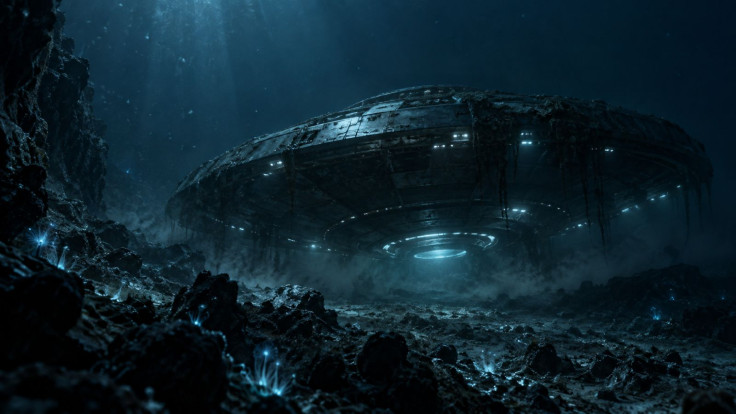
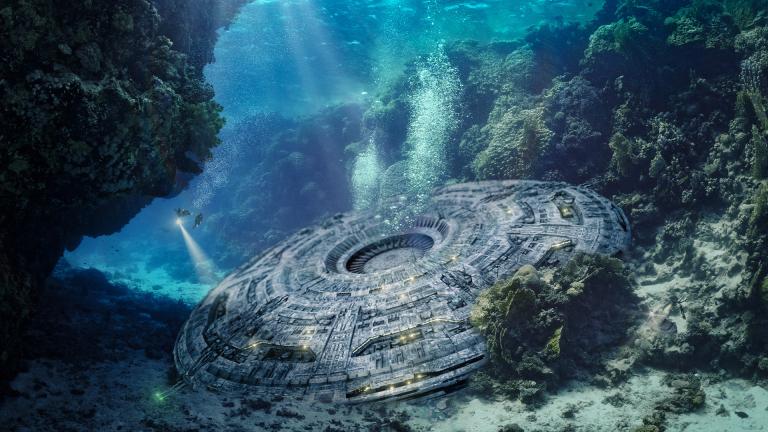
UFO in deep ocean

Scott C Waring claims a hole off Nunavut is an underwater alien base entrance and proposes a drone probe to investigate (Image is for illustrative purposes only)

PHOTO AI Generated/ChatGPT

UFO researcher Scott C. Waring claims a hole more than 3,000ft (914m) across in waters off Nunavut, Canada, is an entrance to an underwater alien base, describing the feature in a 28 October 2026 post on UFO Sightings Daily.

His assertion accompanies separate comments from retired US Navy admiral Tim Gallaudet, who suggested that unexplored ocean depths could conceal non-human technology. Gallaudet has not identified a location for an alleged base or corroborated Waring's Canadian claim.

UFO Researcher Proposes a Drone Mission

Waring claimed the feature lay at least 33ft (10m) beneath the surface and described it as a tunnel through which extraterrestrials could travel unseen.

No independent underwater survey has been presented to verify that the feature is an actual tunnel or an entrance to an extraterrestrial facility.

'I found an entrance to an underwater alien base, and it's in the most remote area of northern Canada that one could go,' Waring wrote on his website.

Waring proposed sending a remotely operated or autonomous underwater drone to investigate. He envisaged a mission lasting several days, with the craft returning with footage that could be examined for signs of extraterrestrial life.

Such equipment could, he argued, reach depths too dangerous for people to explore themselves. He also suggested that an expedition might establish communication between the public and extraterrestrials.

Ocean Depths Underpin Gallaudet's UFO Theory

Gallaudet, a former acting administrator of the National Oceanic and Atmospheric Administration, outlined his reasoning on the Hang Out with Sean Hannity podcast.

'We've only explored with either drones, buoys [or] floats, about 10 percent of ocean volume,' he stated. 'So there's a lot of mystery out there right now.'

Drawing on decades studying the ocean, Gallaudet argued that its largely unexplored volume could offer somewhere to remain undetected. His suggestion concerned the wider ocean, rather than a specific site off Canada.

During the interview, he described footage that he claimed depicted objects moving between water and air. He also asserted that such objects could exceed the speed of sound without producing the sonic boom normally associated with supersonic flight.

'It goes into the ocean, no disturbance,' Gallaudet told Hannity.

He described another video filmed from above that he claimed depicted similar behaviour, arguing that it reflected engineering beyond current human capabilities. He also asserted that non-human intelligence was visiting Earth.

Gallaudet testified under oath before Congress in November 2024 that he received a Navy email warning of multiple near-midair collisions with unidentified objects during a 2015 carrier strike group exercise. He claimed the email disappeared the following day.

Grusch's UFO Claims Extend Beneath the Sea

Former intelligence officer David Grusch, who previously worked with lawmakers on UFO transparency, has advanced similar allegations about underwater facilities. In testimony under oath in 2023, he claimed the US government maintained secret programmes to recover and reverse-engineer crashed non-human spacecraft.

Speaking separately to Joe Rogan, Grusch alleged that officials knew of a large underwater facility serving extraterrestrial craft.

'There's clearly some sort of base of operations in certain locations. It's large. Don't know when it got there... Like multiple city-block-type stuff.'

Grusch attributed his information to classified programme files, videos and accounts from government and military insiders. He also claimed that 'stuff comes and goes' from the facility, without identifying it as the feature Waring described.

The Pentagon's All-domain Anomaly Resolution Office has maintained that it has found no verifiable evidence of extraterrestrial beings, activity or technology.

RELATED

{ https://www.ibtimes.co.uk/science }

Hoe vind je dit bericht?
Geschreven door peter om 21:46 Stuur door

Astronauts’ Greatest Fears

Hoe vind je dit bericht?
Geschreven door peter om 21:29 Stuur door

Newly Declassified Pentagon Documents Suggest Popular California Tourist Spot Was Once Hub for UFO Sightings

Newly Declassified Pentagon Documents Suggest Popular California Tourist Spot Was Once Hub for UFO Sightings

The reports include “flying saucers” and a “purplish-white” object hovering in the sky over Catalina Island

Stock photo of a UFO over Mojave Desert, California

An alleged UFO in California (stock photo).Credit 

Joe McBride/Getty

NEED TO KNOW

  • Newly released Pentagon documents detail four alleged UFO sightings over California’s Catalina Island between 1949 and 1955
  • Witnesses reported seeing mysterious objects in the sky, including silver “flying saucers” and a bright orange object
  • The documents were released on Oct. 23 as part of an ongoing federal initiative to make government records related to UFO sightings and investigations publicly accessible

Newly released documents from the Pentagon reveal that California’s Catalina Island was once a hot spot for alleged UFO sightings.

The Department of Defense released 28 files involving unidentified anomalous phenomena (UAPs) — also known as UFOs — in an online drop on Friday, Oct. 23. The files were released as part of a federal initiative launched in May to make government records about UFO sightings and investigations publicly available.

Four of the 28 files involved sightings specifically on Catalina Island, a popular tourist destination located about 22 miles off the coast of Southern California, in the 1940s and 1950s, according to the Los Angeles Times. 

Catalina Island.

Catalina Island in California.

CREDIT Getty

The first alleged sighting was reported by a man named Percy Wackey, who lived in Avalon — the island’s only incorporated city — in May 1949.

Wackey claimed that his wife and an unnamed individual saw six objects over the island on April 28, 1949.

Another sighting in August 1952 involved three Boy Scouts who claimed they saw silver “flying saucers” flying faster than a jet plane.

In November 1953, a man said he saw a “purplish-white” object hovering in place over the island before heading toward Los Angeles, which is located about 50 miles east.

Unresolved UAP Report Catalina Island, 1952

A report of three Boys Scouts observing a potential UFO in 1952.
CREDIT Department of War

The fourth and final sighting occurred in Avalon in March 1955, when a man named Paul J. Carr reported seeing a bright orange object “the size of a nickel held at arm’s length” fall “straight down” toward the island.

While speaking to CBS News about the reports, Bill Diamond, the president and CEO of the Search for Extraterrestrial Intelligence Institute, said that while it is statistically probable that life exists elsewhere in the universe, most reports of UFO sightings on Earth merit a healthy dose of skepticism.

“It’s hard to imagine coming all this way and then flying by for a couple of hours and then leaving,” he told the outlet.

He additionally noted that the reports dropped in the most recent tranche of files were from a time when science fiction and space exploration gripped the public consciousness and imagination.

Unresolved UAP Report Catalina Island 1955

A report of a man observing a potential UFO in 1955.

CREDIT Department of War

“There are more pictures of UFOs from that period than there are now, and we have literally billions of very capable high-resolution cameras in the hands of people all over the world,” he said.

The Department of Defense has released a total of 478 files across seven drops since launching the new initiative, per the L.A. Times. 

The department states that it encourages the public to study the files and apply their “private-sector analysis, information and expertise,” according to the initiative’s website.

RELATED

Declassified documents suggest Catalina Island was hot spot for UFO sightings
New UFO files from the Pentagon detail sightings over Catalina Island
The Top 10 UFO Encounters Revealed From The Pentagon Declassified Files

{ https://people.com/entertainment/ }

Hoe vind je dit bericht?
Geschreven door peter om 20:46 Stuur door

Aliens, Bigfoots, and Monsters… Remembering the Age of the Weirdumentary

Aliens, Bigfoots, and Monsters… Remembering the Age of the Weirdumentary

In the early '70s, Sunn Classic Pictures brought a whole new world to light for moviegoers.

Aliens, Bigfoots, and Monsters… Remembering the Age of the Weirdumentary - IGN Misc

By Max Evry 

Related reads:
“Scientists representing the world’s foremost research centers took part in the examination of the evidence. The facts that will be presented are true. This may be the most startling film you’ll ever see.”
-Peter Graves, The Mysterious Monsters (1975)

During the turbulent era of Vietnam and Watergate, the happy veneer of America in the 1950s and ‘60s gave way to the conspiracy-minded ‘70s. Dark revelations about the government, justice system, military, and police made the public begin to rethink their perceptions about a great many things. This led to renewed interest in occult matters like ESP, UFOs, and cryptozoology. These subjects, along with other pseudoscientific phenomena like near-death experiences or the Bermuda Triangle, became the bread and butter of a Utah-based production house called Sunn Classic Pictures. The company made a fortune releasing partially-dramatized “documentaries” that tantalized viewers with possibilities of what could be out there beyond the veil.

“I think it was people just questioning what the norm was… what is real, what isn't real,” James L. Conway, who worked as a writer/producer/director at Sunn Classic, tells IGN. “There were very few outlets back then to experience these things, very few TV channels. Through a theatrical window, we were able to make movies about these subjects. They were incredibly popular because there was no other place for people to get knowledge about this… no YouTube, no Wikipedia, no social media. If you wanted to see something that was on the unusual side, it was a theatrical motion picture.”

Conway was a college senior at the University of Denver around 1971 when he was in the Mass Communications Department and the phone rang. It was Charles E. Sellier Jr., who ran an industrial film and commercial company in Denver.

Continues Conway, “Chuck was looking for cheap labor to edit his industrial films. I said, ‘I'm your guy.’ While I finished college I worked for Chuck, and after about three months I said to him, ‘You know, I can direct these shows better than the people you're hiring.’ Total chutzpah. He gave me a shot, I did really well, and that began our relationship.”

After producing a western comedy called The Brothers O'Toole, Sellier connected with Sunn Classic Pictures, which at that point was a distribution outfit in Utah and a newly-founded division of the Schick razor company. They had made several well-attended hunting pictures like The Life and Times of Grizzly Adams, and decided their next avenue would be a series of pseudoscience documentaries kicked off by a re-edited and English dubbed version of the 1970 German doc Chariots of the Gods. Based on Erich von Däniken’s popular claptrap supposing celestial beings who seeded early humanity, in 1973 it grossed over $25M and was nominated for an Oscar.

  • 'From the late '60s we see a rise in interest in everything from occultism and psychic phenomena, new age philosophies, magic, astrology, paganism, life after death, anti-materialism, holistic medicine, reincarnation…'

Noted film scholar Dr. Gary D. Rhodes recently published a book titled Weirdumentary all about this era of strange docs throughout the ‘70s, of which he claims Chariots of the Gods is the urtext: “The fact that it was nominated for an Academy Award suggests how many more people were taking these ideas seriously. I hesitate to think a documentary on that subject now would get an Academy Award nomination. From the late ‘60s we see a rise in interest in everything from occultism and psychic phenomena, new age philosophies, magic, astrology, paganism, life after death, anti-materialism, holistic medicine, reincarnation… there's a desire to find alternate ways of examining our experiences that is unique to that era, including academia. You would not find many parapsychology departments in today's world.”

Once they found the winning formula, Sunn Classic released a wave of documentaries including 1975’s The Mysterious Monsters, where Mission: Impossible actor Peter Graves hosts a Whitman’s Sampler of cryptids.

“For me as a little kid, I certainly loved Mysterious Monsters the most of any of them because it was the era of fascination with Bigfoot, widespread belief that there might be such a creature,” says Rhodes. “There was equal interest in the Loch Ness monster and the Yeti. There were documentary films individually about all of those monsters, but here it was like the Universal monster rally films where you were getting all of them at once.”

The film was actually an amalgam of a few previously-released TV documentaries including CBS’ Monsters! Mystery or Myth, which helped popularize the supposed veracity of the Roger Patterson/Robert Gimlin footage of Bigfoot strolling through the woods. Narrates Graves, “If this film is legitimate, then there can no longer be any question about Bigfoot’s existence.”

Because Sunn Classic was a Mormon-run company, Rhodes says they “wanted to tap into films where everybody from a little kid to the grandparents could go and not feel out of place or offended.” Sellier himself called this demographic “the lost audience” who felt left behind by both the kiddie fare of Disney and the blood-and-nudity-soaked visions of New Hollywood auteurs (Taxi Driver, The Exorcist, etc.). Sunn’s product even included a few movies which attempted to present scientific evidence for aspects of the Christian faith. The most successful was In Search of Noah’s Ark, co-written and directed by Conway based on a book by Sellier and David W. Balsiger. It posits that (conveniently inaccessible) evidence exists that the remains of Noah's Ark lay on Turkey’s Mount Ararat. It includes several non-Russell Crowe re-enactments, as well as a supposed photograph that became the lynchpin for “proof.”

Intones narrator Brad Crandall, “The answer came in late September of 1974 when an expedition from the Holy Ground Mission in Frankston, Texas, scaled Mount Ararat, shooting across the Ahora Gorge with a 35MM Minolta camera. They took this picture that shows what looks like the fore part of a great vessel. The prow can be seen sticking out of the rocks 2000 feet above the location of the Eryl Cummings photo. When studied under photographic enlargement, the outline of the ship is not only clear but planking can actually be seen… the planking of Noah's Ark.”

aliens-bigfoots-and-monsters-remembering-the-age-of-the-weir_sekg.jpg

“We didn't doctor anything… we had a photo that had been in other pieces of research,” Conway explained to us. “In those days, every expert you go to has their own data to support what they believe. Whether it's pseudoscience or not, all these people had books or research they could point to proving their point. A lot of it is things people wanted to believe, and so they'll accept the research more readily than a scientist might. I actually just saw there was a report on the Today Show last week about how they found this thing near Mount Ararat that they think is Noah's Ark. It just never goes away.”

Adds Rhodes of the questionable flood geology, “There's something atop Mount Ararat, and we think it's wood, and then this one explorer went up and claims to have seen it, and another explorer got close, but he couldn't quite get there. For some people, that's still tantalizing.”

Sunn Classics had several innovations to make and market their movies. They would often spend tens of thousands doing market research on whether a subject was viable for public interest. Once a film was complete, they would circumvent Hollywood distribution through a practice known as four-walling.

  • They'd say, 'We're going to pay you $25 cash for Friday night, $25 cash for Saturday night. We control the box office. Everything that comes in is ours.'

Conway claims that when Sunn approached local theaters, “They’d say, ‘We're going to pay you $25 cash for Friday night, $25 cash for Saturday night. We control the box office. Everything that comes in is ours.’ Because it was four-walled we did very heavy television commercials. We would only have, let's say, 300 prints of the movie. It would go into a city like Chicago, play two nights at this one theater, three nights at a different theater, four nights at another theater, and the commercials would list all the different movie theaters it was going to be on each night. They were enormously successful. On In Search of Noah's Ark I think our budget was $600,000 and it grossed $55 million. It was the 9th highest grossing movie of 1976.”

“Four-walling was a brilliant strategy,” opines Rhodes. “Sunn Classic were, in some respects, using old tricks of the trade not unlike the roadshow cinema of the early 20th century. In other respects, they were way ahead of their time. They were using surveys, polling at shopping malls: ‘What kind of film do you want to watch?’ They would look at advance weather reports in tandem with four-walling to try and avoid a snowstorm in the weeks ahead.”

“It may start in the Bible Belt, but it was huge everywhere you went,” continues Conway. “It was a huge hit, quite remarkable. That taught us that if you have a great commercial hook you can get a great box office return. That's where a lot of the supernatural elements come in, because there was an appetite for it. It's very easy to do a 15- or 20-second hook in a commercial to get people's interests up. It was so successful that theater runners made us go back to the standard splitting the box office, which was bad for us, good for them.”

aliens-bigfoots-and-monsters-remembering-the-age-of-the-weir_mr64.jpg

Another “bad for us, good for them” was producer Alan Landsburg bringing the formula to television with an In Search of… docuseries hosted by Leonard Nimoy from 1976 to 1982. Landsburg helped popularize the style with the earlier docs In Search of Ancient Astronauts (1973), In Search of Ancient Mysteries (1974), and The Outer Space Connection (1975), the latter made and released by Sunn Classic. The show’s subjects (Extraterrestrials, Magic & Witchcraft, Missing Persons, Myths & Monsters, Lost Civilizations, Special Phenomena) were the same as Sunn’s, as was the format of a celebrity host. 

“He came after us with the In Search of… television series, basically ripped off our In Search of Historic Jesus and In Search of Noah's Ark,” says Conway. “He made it a TV series that was very successful, but that came after we had done our stuff.”

Many others were tapping into the same material, including the Oscar-winning insectsploitation doc The Hellstrom Chronicle (1971) and the Rod Serling-hosted UFOs: Past, Present, and Future (1974), but Rhodes says that “Sunn Classic was at the core of the weirdumentary.” The one defining aspect of all these sensational films was selling the audience on realms of existence which, whether truthful or not, absolutely fall into the category of “fun to believe.”

“Belief was not essential,” Conway says of his Sunn projects, which included The Lincoln Conspiracy (1977) and Beyond and Back (1978). “Some I believed in more than others. An example is Beyond and Back, which we did about life after death and near-death experiences. As I was interviewing all these different people, I became more of a believer in it. Some of the other things we did, the more people I talked to the less I might have actually believed it, but you still present it.”

aliens-bigfoots-and-monsters-remembering-the-age-of-the-weir_66er.jpg

Although Sunn had researchers on staff, the scientific accuracy of these movies was debatable. It seems the real science lay in how the movies were made, or – as Conway explains – edited: “We were one of the first people to do a lot of audience testing. We would make a film, and then we would screen it and people would have dials. If they like something they would go right, didn't like it, go left. We would actually adjust the editing based on if something just completely sucked.”

Much of the filmmaking in the dramatizations of Sunn movies is very effective, with Rhodes stating that “Beyond and Back shows the ingenuity of Conway because at times they were actually able to muster really good special effects on low budgets.” Another example is their take on Charles Berlitz’s wildly popular supermarket paperback The Bermuda Triangle (1979), where the famous disappearance of Flight 19 in 1945 – linked to UFOs – is told with eerie lighting and sound effects that transcend the cheapness. 

Still, critics were not typically kind, with Variety stating of The Bermuda Triangle, “As with the other Sunn films, recollections from people, both living and dead, who have experienced the phenomenon in question, are reenacted in a silly, unconvincing fashion. So-called experts with degrees and credentials are carted out in front of the camera to add weight to the arguments. Brad Crandall narrates, tying together the bits and pieces.” Yet as Rhodes writes in his Weirdumentary book, “To lesser men we leave these petty slights. As I see it, Sunn had perfected an art form, a very profitable art form, crystallizing a new genre for a new age.”

Eventually conspiracies and psychic phenomenon and weird creatures were no longer controversial, they were part of the norm… hence no longer a viable attraction for theaters. Big movies like Close Encounters of the Third Kind (which tied elements of Bermuda Triangle lore into UFO mythology), Carrie (telekinesis a-go-go), and The Amityville Horror (ghostly possession) made formerly exotic pseudoscience mainstream… and perhaps less exciting. Eventually Sunn and Conway moved on to fictional feature films like Hangar 18 or The Boogens before eventually being folded into the now-defunct Taft Entertainment, acquired by Aaron Spelling and finally Paramount.

  • 'Once Hollywood realized how popular these subjects were, they were suddenly everywhere.'

“Once Hollywood realized how popular these subjects were, they were suddenly everywhere,” said Conway. “They were TV movies, they were episodes. The Landsburg television show was on every week exploring another mystery from this, that, or the other. Once it became more easily available, there wasn't as much hoopla. When they first happened, they fed on each other… it gave you ink in magazines and newspapers. They kept feeding it and finally ran out of things to exploit. You can only do so many ghost stories, so many UFO things. The first time you're exposed to it, it's all fresh and fascinating and leads you down a lot of rabbit holes. Rabbit holes are much easier now than they used to be to go down.”

Even though we live in an information age, audiences continue to buy into the myths perpetuated during the Weirdumentary era, as exemplified by the continued popularity of such pseudoscience programs on Discovery or The History Channel, covering everything from UAPs to skinwalkers. There’s also a legion of podcasts and blogs which dedicate whole episodes to, say, disappearances in national parks or the history of ghost sex. Ancient aliens is a mini-industry unto itself, despite von Däniken’s work having long ago been exposed as fraudulent. Although it was thought to be a vanished victim of the Bermuda triangle, the SS Cotopaxi was eventually identified in January 2020 off the coast of St. Augustine, Florida. Even the famous Patterson-Gimlin footage of Bigfoot seen in The Mysterious Monsters has now been debunked in this year’s documentary Capturing Bigfoot, where verified rehearsal footage of their Bigfoot costume is revealed. For some, even this has not been enough to dissuade people from believing in the footage.

“Certainly as kids these subjects resonated because you are more naïve,” says Rhodes. “There's always one more piece of possible evidence to be tantalizing. ‘Even if one thing was faked, that doesn't mean it's all fake. What about these others?’ There is a kind of whataboutism. If some UFO footage was fake or a photograph was fake, now we have Air Force footage that's been released that looks – perhaps to some – compelling. We have new Bigfoot recordings, so even if Patterson-Gimlin faked it, that's just their footage. Some of the shows I've been on – Coast to Coast or whatever – the people that speak to me are more interested in the topics than the actual films as films, right?

“From a historical film perspective, these movies are fun,” concludes Rhodes. “There's a nostalgia factor. James Conway, Charles Sellier, Alan Landsburg, Wheeler Dixon… they're heroes to me. They made incredibly fun movies, even if I disbelieve the subjects. They're wonderful.”

{ https://pk.ign.com/ign-misc  }

Hoe vind je dit bericht?
Geschreven door peter om 20:25 Stuur door

Tunguska's Evil Twin on Halloween: Real Threat or Clickbait Experiment?

Tunguska's Evil Twin on Halloween: Real Threat or Clickbait Experiment?

A black and white photograph of a Siberian forest with many tree trunks lying flat on the ground and a few bare, broken trunks still standing

Trees knocked down by the Tunguska explosion, photographed in May 1929 during Leonid Kulik's expedition, nearly 21 years after the blast.

Public domain, via Wikimedia Commons

Aris Manus

The Tunguska event was one of the most studied explosions of the 20th century, a blast over the Siberian forest on June 30, 1908, that flattened trees across a remote river basin. More than a century later, a scientist has asked whether its "Evil Twin" could return on Halloween 2026. But is anything actually heading toward Earth this Halloween?

A Headline Written to Scare

The question comes from Mark Boslough of the Department of Earth and Planetary Sciences at the University of New Mexico. His abstract, "Will Tunguska's Evil Twin Return on Halloween 2026? Science and Skepticism in a Clickbait World," appears in the Geological Society of America's Abstracts with Programs for 2026 and was scheduled for October 11, 2026, in a session on "Myths and Misrepresentations surrounding Cosmic Impact claims."

The opening paragraphs of the abstract are written like a tabloid story, asking whether the Tunguska object had "an unseen companion that missed the Earth in 1908" and whether this companion is "on its way back to finish the job." They describe the Taurid meteor stream, the source of the so-called "Halloween fireballs," and note that one published model places a swarm of debris in an approximate 61-year resonance with Earth.

However, the abstract then turns on itself, and Boslough explains what the reader has just been through:

"The previous paragraphs of this abstract are written in clickbait style. The idea of a dark Tunguska companion is pure speculation."

In the same abstract he adds that the Tunguska object's encounter with Earth came six years before the hypothetical swarm, and "there is no theoretical basis for it to have the same resonant period." The abstract says the presentation would weigh "arguments, pro and con, about whether we should try to exploit the clickbait industry to provide accurate scientific and skeptical information to the public."

What Happened at Tunguska in 1908

According to a NASA history article, the blast came at about 7:15 am local time. Evenki reindeer herders described "a fireball trailing smoke, then a flash brighter than the Sun, followed by a loud noise like thunder." Because the region was so sparsely populated, NASA notes that "very few human casualties resulted."

The geologist Leonid Kulik could not reach the site in 1921 and only got there in 1927. Later surveys in the 1950s and 1960s mapped a butterfly-shaped zone of damage covering 830 square miles (about 2,150 square kilometers), "with millions of trees knocked over." NASA adds that Kulik "failed to find physical evidence of the bolide," and that microparticles found by later expeditions "could not be conclusively tied to the blast."

A 2018 workshop at NASA Ames Research Center found that the leading models converged on an energy of 10 to 20 megatons released in an airburst at a height of about 10 kilometers (6 miles). If the object was a stony asteroid like the one that burst over Chelyabinsk in 2013, the report estimates it was roughly 50 to 80 meters (160 to 260 ft) across. Crucially for anyone worried about Halloween, the workshop concluded that "the interval between such events is millennia, not centuries as had been concluded previously."

The Taurids and the Halloween Fireballs

The Taurids are a real and regular part of autumn skies. NASA identifies Comet Encke as the parent of the stream and explains the nickname: "Oftentimes, this particular shower exhibits fireballs on or around Halloween, making them known as the Halloween Fireballs." Fireballs are meteors at least as bright as the planet Venus.

The Royal Observatory Greenwich lists the Southern Taurids as active from September 10 to November 20, 2026, and the Northern Taurids from October 20 to December 10, with an estimated rate of about five meteors per hour at maximum. The observatory describes the showers as providing "a sprinkling throughout the two months."

Ancient Origins has covered the Taurid meteor shower and its fireballs before. The larger question is whether the stream also hides much bigger objects.

The Swarm Question in Peer-Reviewed Work

Boslough has also tackled that question in a peer-reviewed paper. Writing in Acta Astronautica with Peter Brown, David Clark and Paul Wiegert of the University of Western Ontario and Quanzhi Ye of the University of Maryland, he assessed the "Taurid resonant swarm," a proposed cluster of debris linked to Comet Encke and held in a 7:2 resonance with Jupiter.

The team found "no evidence for objects in the Taurid stream that are above the global catastrophe threshold." However, they noted that "the possibility of a few large objects and a significant population of objects the size of the Chelyabinsk or Tunguska bodies has not been eliminated." They also argue that eyewitness accounts and airburst models "suggest that the Tunguska object was a Beta Taurid," a branch of the same stream.

The paper does not point to Halloween 2026 as a time of special danger. Instead, it says that if the swarm holds a significant number of such objects, risk would peak "in November 2032 and June 2036," and it recommends targeted telescope surveys during those passes. His GSA abstract strikes the same note: "There is no evidence for a concentration of large objects, but there is no reason not to search for them in 2032 as a precaution."

Telescope searches have so far turned up little. A survey with the Canada France Hawaii Telescope, reported by Wiegert and colleagues, found results "consistent with no Taurid Swarm members observed," while setting an upper limit on objects 34 to 76 meters across. The same team notes that meteor observations have confirmed the swarm at sizes of a meter and smaller.

When Impact Stories Go Wrong

Gizmodo has described Boslough as an outspoken critic of a different impact idea, the Younger Dryas impact hypothesis, which proposes that comet fragments struck Earth about 12,800 years ago. On August 6, 2025, the journal PLOS One published a study by Christopher Moore and colleagues reporting cometary dust and platinum anomalies in sediment cores from Baffin Bay, near Greenland. When it appeared, Boslough told Gizmodo: "I do not see anything in this new paper that overcomes the chronic and ongoing problems with their previous papers."

On February 11, 2026, the PLOS One Editors retracted the paper. Their notice lists incorrect citations "raising concerns about undisclosed use of AI tools," problems with the radiocarbon calibration that would make the layers younger and "outside the Younger Dryas," and material reported as cosmic spherule fragments that experts "identified as marine foraminifera." The notice concludes:

"In light of the above concerns that call into question the validity of the reported results and the conclusions made, the PLOS One Editors retract this article."

According to the notice, eight of the authors did not agree with the retraction and one did. Ancient Origins reported the Baffin Bay study as support for the hypothesis in an August 11, 2025, article on the Baffin Bay comet debris, which now carries an editors' note pointing readers to the retraction. Readers who want the wider picture can turn to the site's fact check on whether a comet ended the Ice Age and its longer look at the Younger Dryas impact debate.

The Acta Astronautica paper makes the link between the two topics explicit. Its authors write that skepticism toward swarm risk in the planetary defense community stems partly from "misinformation, misunderstandings, and misinterpretations associated with the Younger Dryas impact hypothesis." Still, they argue that the swarm idea "is testable and should not be dismissed just because it has been invoked in association with unsupported claims."

Reading the Next Scary Headline

Boslough's abstract also points out that the scare has an old pedigree. The familiar claim that Tunguska would have destroyed St. Petersburg had it arrived 4 hours and 47 minutes later was, he writes, "a playful, but incorrect, idea first published by astronomer I.S. Astapowitsch in a 1934 version of modern-day clickbait."

So what should a skywatcher take from Halloween 2026? The Taurids will be up there, and a bright fireball is a fine reward for a clear night. However, the sources cited here give no sign of a dark twin of Tunguska returning this week, and the scientists studying the swarm are looking ahead to 2032 and 2036 for their best chance to test it. How many large bodies the Taurid stream really holds is still an open question.

How we label claims

Established: the Tunguska airburst of June 30, 1908, and the annual Taurid meteor showers linked to Comet Encke. Established: PLOS One retracted the Baffin Bay paper on February 11, 2026. Disputed: the Younger Dryas impact hypothesis. Disputed: that the Tunguska object was a Beta Taurid. Unverified: that the Taurid stream holds a significant swarm of Tunguska-sized objects. Unverified: that a dark companion of the Tunguska object will return around Halloween 2026, an idea Boslough himself calls "pure speculation."

By Aris Manus

Sources

The Tunguska Event: Meteor, Antimatter, or Something That Never Made It Home?
The Forbidden Story of The Impact That Reset Humanity

{ https://www.ancient-origins.net/news }

Hoe vind je dit bericht?
Geschreven door peter om 18:36 Stuur door

UK's top UFO expert says government 'hiding truth about aliens' in final ever interview

UK's top UFO expert says government 'hiding truth about aliens' in final ever interview

EXCLUSIVE: He was the UK’s top UFO hunter until his untimely death in April. Now ex-MOD expert Nick Pope speaks out from beyond the grave to accuse the Government of hiding the truth about alien life

Nick said governments know more about UFOs than they are letting on

Nick said governments know more about UFOs than they are letting on

(Image: Sky History)

BY Ashley Pemberton - News Reporter

A top UFO hunter accused the government of hiding the truth about aliens in his final interview before his death. Nick Pope – dubbed the real life Agent Mulder from the X Files – said: “They know there’s more to this than just weather balloons and aircraft lights.”

The former civil servant, who spent three years on the Ministry of Defence’s “UFO desk”, also insisted the world’s leaders know we are not alone in the universe. He made the bombshell claims in an upcoming TV documentary filmed just before his death.

He told presenter Bradley Walsh that during his time investigating the phenomenon of UFOs, he would get hundreds of reports of sightings each year and could confidently explain around 80% of them.

Nick spoke to Bradley Walsh before his death

Nick spoke to Bradley Walsh before his death

(Image: Sky History)

But of the other 20%, he said: “We were not able to find a definitive result. Some of this doesn’t quite add up. Objects running rings around the cutting edge of our own aerospace tech. Speeds, manoeuvres, accelerations we can’t match.

“At the very least, I think it’s fair to say it was enough to make me take another look at this.”

Nick, who died of cancer in April, said he had no interest in extraterrestrial activity until 1991, when he was asked to investigate the phenomena of unidentified flying objects.

Nick Pope was a leading UFO expert

Nick Pope was a leading UFO expert

(Image: Getty Images for A+E Networks)

He was interviewed by comedian and game show host Bradley for his upcoming Sky History show Out Of This World on Sky HISTORY, which starts on Tuesday. In the first episode, Bradley, 66, asks Nick if he thinks we are alone in the universe.

“We are definitely not”, the expert responds. “You know, the universe is nearly 14 billion years old. You’ve only got to imagine a civilisation with a million year, let alone a billion year headstart on us and all bets are off. So life out there, definitely.

“Us being visited, I’m less sure. I certainly hope so, because I tell you this, the world with aliens in it is going to be far more interesting and fun than the world with no aliens. So bring them on.”

Nick believes there is life out there

Nick believes there is life out there

(Image: Getty Images/Science Photo Library RF)

Nick goes on to warn that AI technology could prove a major obstacle for sleuths hoping to prove the existence of extraterrestrials.

He adds: “I think the technology, which you would think works for us, works against us. Now with the rise of AI, you don’t really know if something is real or not.

“This is one of the biggest and most profound questions we can ask as human beings. Are we alone or not in the universe? Are we being visited? If we got an answer to that, it would change the world forever.”

Nick investigated about 1,000 unexplained sightings during his three years on the “UFO desk”.

Nick investigated about 1,000 unexplained sightings during his three years on the “UFO desk”.

(Image: Getty Images/iStockphoto)

Nick, who died shortly after speaking to Bradley, investigated about 1,000 unexplained sightings during his three years on the “UFO desk”.

After the department closed, he moved into the media, commenting on the unexplained, conspiracy theories, science fiction, and fringe science.

In his new show, Bradley says Nick was one of his heroes and he had been due to fly to Washington to meet him, but they were forced to talk over Zoom instead when he became very ill.

Nick Pope speaks out from beyond the grave to accuse the Government of hiding the truth about alien life

Nick Pope speaks out from beyond the grave to accuse the Government of hiding the truth about alien life

(Image: Getty Images/iStockphoto)

The host of ITV game show The Chase is later seen delving into Britain’s declassified Ministry of Defence files. One shows Winston Churchill asked for a report into flying saucers in 1952.

He then heads to Rendlesham Forest, dubbed “Britain’s Roswell”, the scene of the country’s most famous alleged UFO incident.

At one point, he asks: “If people have seen them, and UFOs or aliens have visited, why haven’t people taken notice? Why isn’t it on the News at 10? Are the news corporations keeping it from us? What is going on? I have no idea.

“It’s pretty naive of us to imagine that we’re the only planet sustainable of life in the entire universe. There’s gotta be something out there.” The Ministry of Defence did not respond to a request for comment.

RELATED

Lies and Deception: UFOs and The Secret Agenda | FULL Documentary

{ https://www.dailystar.co.uk/latest/exclusives }

Hoe vind je dit bericht?
Geschreven door peter om 18:11 Stuur door

This Ancient Meteorite Hints at Mars' Warm, Wet Past

This Ancient Meteorite Hints at Mars' Warm, Wet Past

This image shows a group of meteorite hunters in the Sahara Desert. Nomadic people from the region have become expert meteorite hunters, finding hundreds of them, which are typically recovered as groups of fragments. One found in Mali in 2022 has proven to be almost as old as Mars itself, one of the most ancient pieces of Mars ever recovered. Image Credit: University of New Mexico.

This image shows a group of meteorite hunters in the Sahara Desert. Nomadic people from the region have become expert meteorite hunters, finding hundreds of them, which are typically recovered as groups of fragments. One found in Mali in 2022 has proven to be almost as old as Mars itself, one of the most ancient pieces of Mars ever recovered.

Image Credit: University of New Mexico.

Mars is the subject of an ongoing, decades-long effort to understand its past. Its potential ancient habitability drives that effort. More than 20 missions have been sent to its surface (though many didn't survive the entry and landing). Two are operating there currently, Curiosity and Perserverance, and multiple orbiters scan the planet's surface from above.

Clues to Mars' past are in its rock, and the more ancient a piece of rock, the deeper the clues it can contain about the planet's ancient past. Visiting Mars with rovers is only one way to access the planet's rock. Fortunately, some chunks of Mars have been sent to Earth. Violent impacts have sent chunks of Mars rock into space, where they've eventually found their way to Earth as meteorites.

A Martian meteorite named Black Beauty set the standard for ancient meteorites from Mars when it was found in 2011. Most meteorites are found in deserts or in snowy/icy areas simply because they're more easily seen, and Black Beauty (Northwest Africa 7034, or NWA 7034) was found by nomads in the Western Sahara. Portions of it are about 4.43 billion years old, and Mars is about 4.5, maybe 4.6 billion years old. So Black Beauty is extremely ancient.

The Sahara Desert has yielded other ancient Martian meteorites, including Teghaza 001 (Teg 001), found in Mali in 2022. New research uncovered some unusual properties in Teg 001, and they're presented in new research.

The research is titled "A Martian meteorite that formed ≳4.1 billion years ago samples Mars’ early crust and mantle," and it's published in the journal Science. The lead author is Yang Liu from NASA's Jet Propulsion Laboratory at the California Institute of Technology. Scientist Carl Agee, director and curator at the University of New Mexico’s Institute of Meteoritics (IOM), also played a leading role in the work.

"This sample probably came from an environment on Mars that was more Earth-like." - Carl Agee, University of New Mexico.

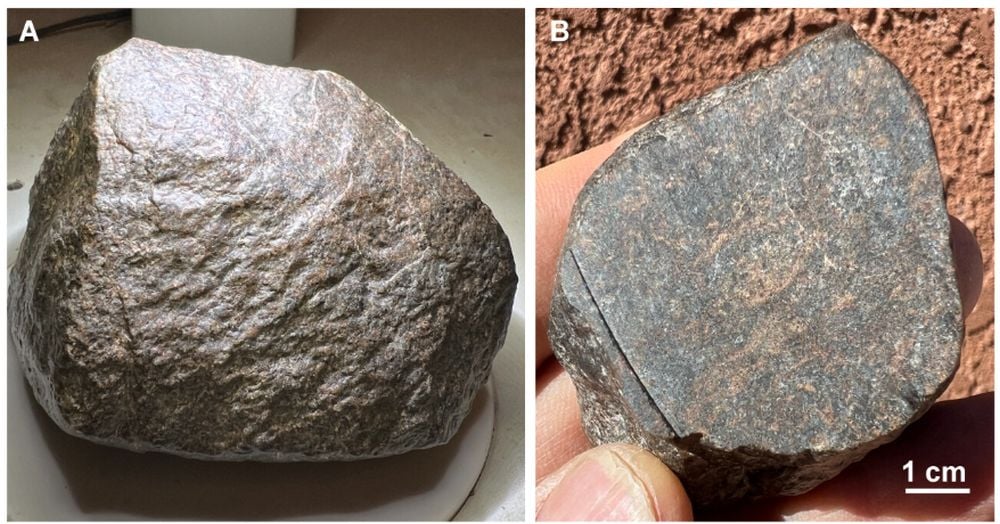
(A) shows the largest of the eight pieces of Teg001. (B) shows a cut section of a smaller chunk. Image Credit: Yang Liu et al., A Martian meteorite that formed ≳4.1 billion years ago samples Mars’ early crust and mantle. Science0,eadz5646DOI:10.1126/science.adz5646

(A) shows the largest of the eight pieces of Teg001. (B) shows a cut section of a smaller chunk. Image Credit: Yang Liu et al., A Martian meteorite that formed ≳4.1 billion years ago samples Mars’ early crust and mantle.

Science0,eadz5646DOI:10.1126/science.adz5646

Ancient meteorites are rare finds and they're extremely valuable scientifically.

"Martian meteorites provide a record of the planet’s geological history," the authors explain in their research. "However, most are geologically young samples that are not representative of Mars’ surface, which is dominated by ancient rocks."

Most meteorites are young just because of selection effects. Meteorites are launched into space by impacts, and that favours young rocks, which are stronger. So meteorites tend to come from younger, basaltic volcanic rocks. More ancient parts of Mars crust are weaker because they're fractured and brecciated by impacts. Some ancient rocks are also sedimentary or clay-bearing rock. These rocks are weaker and much less likely to survive an impact that can launch them into space.

Teghaza is one of the rare ancient Martian meteorites.

"We describe the Martian meteorite Teghaza 001 (Teg 001), a slowly cooled igneous rock that formed at least 4.1 billion years ago," the authors write. "Its composition, mineralogy, and texture are distinct from other Martian meteorites." Distinct from other Martian meteorites, but also similar to likewise ancient Black Beauty.

“I realized that this one was a little bit like Black Beauty, not exactly, but it resembled it in the oxygen isotope values,” Agee said in a press release. "I looked at it microscopically and found domains within it that had high levels of manganese oxide, a compound being looked for on Mars by the rovers as an indicator of environments conducive to life.”

MSL Curiosity found rock fractures in Gale Crater that were filled with material rich in MnO. It suggests, but doesn't prove, that the planet's atmosphere once had free oxygen and oxygen-rich groundwater. That's still being debated.

Lead author Yang Liu and other Caltech scientists used a dating technique to find the age of tiny zircon crystals in Teg 001. Zircon crystals are important finding the age of ancient rocks because they can survive geological processes. They also contain trace amounts of elements with long half-lives. This is how Liu determined that Teg 001 is 4.1 billion years old. "We conducted ten measurements of U and Pb isotopes, in six shocked zircon grains with different morphologies, to determine their U-Pb and Pb-Pb ages," the authors explain.

Though Black Beauty is also ancient, the pair of meteorites are quite different from one another.

“There are a few parts to Black Beauty that are around that age, but that whole meteorite itself is a conglomeration of many different rock types. Teghaza 001 is just one unadulterated rock type, and it's 4.1 billion years or older, so that was a big surprise,” said Agee. “It's the oldest Martian igneous rock ever found by a huge margin, but in addition to that, it seemed to have these clues in its composition that suggested it had been in an environment that had fluids and water coursing through it.”

Teghaza 001 was found in several chunks adding up to almost 800 grams. Unlike Black Beauty, which is a congolomeration of different chunks, Teg 001 is a single rock type. Image Credit: UNM.

Teghaza 001 was found in several chunks adding up to almost 800 grams. Unlike Black Beauty, which is a congolomeration of different chunks, Teg 001 is a single rock type.

Image Credit: UNM.

The isotope Oxygen-18 indicated that it had interacted with water in the past, most likely on the Martian surface. "The high δ 18O value of Teg 001 probably reflects assimilation of δ18O-rich crustal material that had interacted with surficial fluids, or direct reaction of the magma with high-δ18O fluids," the authors write. That finding supports the hypothesis that Mars was once warm and wet, a hypothesis supported by a growing body of evidence.

“We also had these anomalous oxygen isotopes, and these domains that had high manganese levels, Agee said. "All of that was consistent with it being from a time on Mars, from the very, very beginning when the Martian environment was different from the time in which most of the Martian meteorites that we see were formed and erupted a few 100 million years ago when Mars was a dry desert, just like it is now. This sample probably came from an environment on Mars that was more Earth-like.”

This image shows a cut section of Teg001, with some of its features and contents labelled. Pigeonite (PgT) is particularly relevant, because it hosts fluid-altered Magnesium. "The Mg-rich interiors of pigeonite have been heavily altered by reactions with a fluid phase," the authors write. Image Credit: Yang Liu et al., A Martian meteorite that formed ≳4.1 billion years ago samples Mars’ early crust and mantle. Science0,eadz5646DOI:10.1126/science.adz5646

This image shows a cut section of Teg001, with some of its features and contents labelled. Pigeonite (PgT) is particularly relevant, because it hosts fluid-altered Magnesium. "The Mg-rich interiors of pigeonite have been heavily altered by reactions with a fluid phase," the authors write. Image Credit: Yang Liu et al., A Martian meteorite that formed ≳4.1 billion years ago samples Mars’ early crust and mantle.

Science0,eadz5646DOI:10.1126/science.adz5646

Mars' early, potentially more Earth-like time period is called the Pre-Noachian period. Planetary scientists struggle to paint a clear picture of the Pre-Noachian because it was so long ago, and geologica processes and weathering have erased much of the ancient. Some research shows that Mars may have had global oceans during this period, a stunning difference from the frigid, dessicated planet it is today.

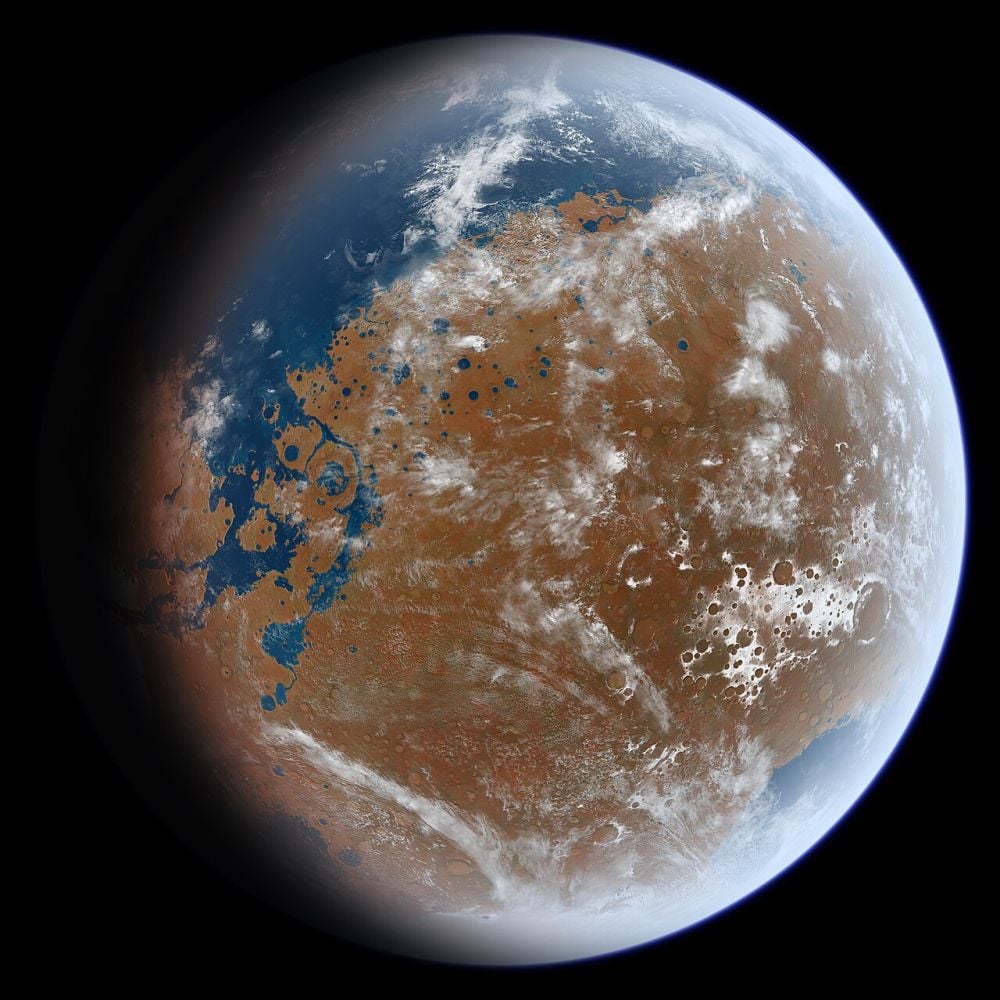
It's possible that billions of years ago, Mars had a global ocean, as shown in this illustration. That could explain the aqueous alteration in Teg001. Image Credit: By Ittiz - Own work, CC BY-SA 3.0, https://commons.wikimedia.org/w/index.php?curid=7861829

It's possible that billions of years ago, Mars had a global ocean, as shown in this illustration. That could explain the aqueous alteration in Teg001.

Image Credit: By Ittiz - Own work, CC BY-SA 3.0, https://commons.wikimedia.org/w/index.php?curid=7861829

It's possible that Mars still has some simple, extant life. If it does, that life is hiding somewhere underground where the last of the planet's ancient water might be sequestered, away from the harsh radiation on the surface. But if the emerging picture of an ancient, warm and wet Mars is true, that would be the Pre-Noachian.

“If there was ever abundant life on Mars, on the surface, not sequestered away in some subsurface, that would be the time that you would be looking at, the Pre-Noachian period,” said Agee. “It's the very earliest time, and that was when maybe Mars still had a magnetic field, and it was shielded from radiation, and there were surface waters. There was a denser atmosphere. If primitive life was abundant in Mars. That is the time that is most likely for it to have happened.”

Most Martian meteorites are much younger than Teg001, only a few hundred million years old. It likely came from a place no rover has visited, possibly from Mars' southern highlands. Remote sensing shows that that ancient region has a similar composition to Teg001.

“This is just one single meteorite. It's like going out, going back in time and chipping off a hunk of an outcrop, 4 billion years ago on Mars, and then we have this example of what was actually happening,” said Agee. “That is why it's such a valuable sample. We’ve never found one like this before. The most exciting part about this find is its age, plus the alteration in the meteorite that indicates it has been in what I would call an Earth-like environment, with fluids coursing over the surface and volcanoes creating hydrothermal systems. There are surface waters and so on. And that's all reflected in the way that the meteorite has been sort of altered from its original state.”

"The presence of aqueously altered minerals, combined with bulk and mineral-specific oxygen isotope measurements, indicate that Teg 001 experienced reactions with fluids enriched in 18O, before ejection into space by an impact," the authors summarize in their paper.

RELATED

How Scientists Proved These Rocks Came From Mars.

{https://www.universetoday.com/ }

Hoe vind je dit bericht?
Geschreven door peter om 17:47 Stuur door

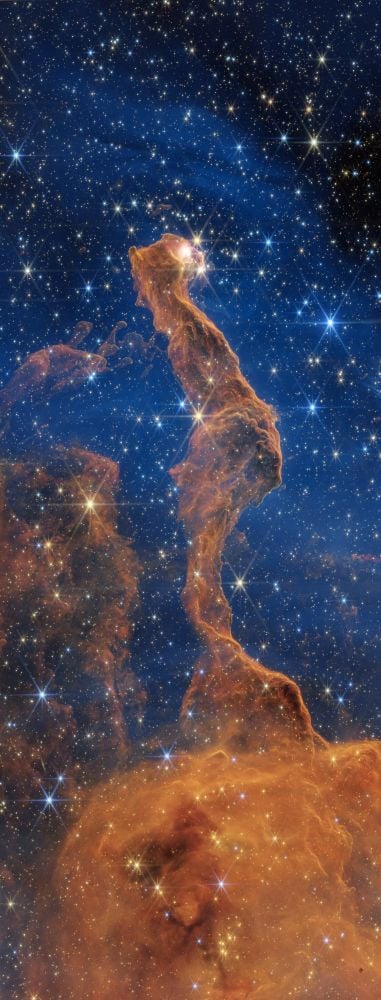
Examining the Cat's Head Nebula with the Hubble and JWST

Examining the Cat's Head Nebula with the Hubble and JWST

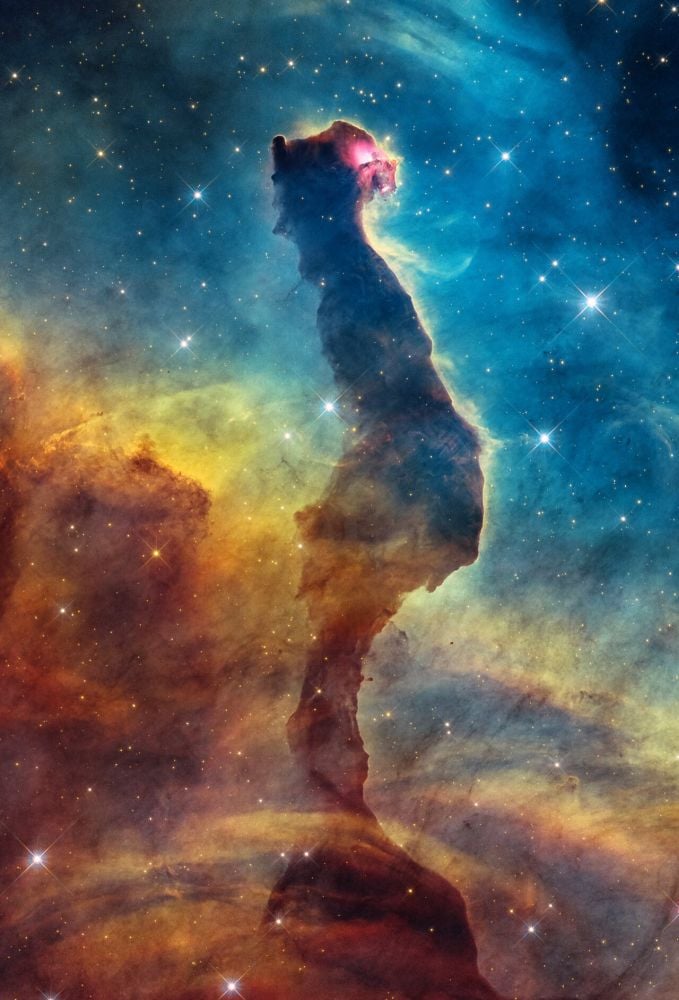
The Cat's Head Nebula proudly rises in this Hubble Space Telescope image. It's a star-forming region within the larger Carina Nebula, an even larger star-forming region. Recently, both the Hubble and the JWST imaged the Cat's Head as part of the ongoing scientific effort to understand the complex process of star formation. Image Credit: NASA, ESA, STScI. Image Processing: J. Depasquale (STScI).

The Cat's Head Nebula proudly rises in this Hubble Space Telescope image. It's a star-forming region within the larger Carina Nebula, an even larger star-forming region. Recently, both the Hubble and the JWST imaged the Cat's Head as part of the ongoing scientific effort to understand the complex process of star formation.

Image Credit: NASA, ESA, STScI. Image Processing: J. Depasquale (STScI).

The Cat's Head nebula gets its name from its appearance: it looks like a cat sitting so that it's facing away from the viewer, with its head turned around on the top of its neck, highlighted by a star that looks like a glowing eye. The unusual shape is made of gas and dust carved and formed by the radiation of young stars.

It's a small part of the larger Carina Nebula, a complex star-forming region about 7,500 light years away. Recently, both the Hubble and the JWST cast their gaze on the Cat's Head in an effort to learn more about star formation, a constant research subject in astronomy.

The Carina Nebula hosts some of the most massive stars in the entire Milky Way in its Carina OB1 assocation. Of particular interest is Eta Carinae, a stellar system that hosts many stars, two of which have a combined luminosity more than 5 million times greater than the Sun. Eta Carinae is also known for being at the heart of the eerily creepy Homunculous Nebula, not visible in these images. Massive stars like the ones in Eta Carinae and their powerful radiation have a pronounced effect on the region, and on star formation itself.

Hubble's image of the Cat's Head is in visible light, while the JWST imaged it in both near and mid-infrared. Each of the images shows a different aspect of the Cat's Head.

The pillar that makes the Cat's Head is composed of thick, dark dust, so far resisting the onslaught of stellar wind and radiation from massive stars. The yellow outline on its right side is likely where photoevaporation is taking place, driven by the same powerful stars. The UV radiation is ionizing the gas on the rim, and will eventually evaporate it completely.

In astronomy images like these, different filters isolate different chemicals like sulphur, oxygen, and hydrogen. The ionization level of the chemicals, along with how highly they're energized and how much dust is present, all affect the colours. Whether we know which colours represent which chemicals or not, these images are awe-inspiring.

The massive stars in the region are also responsible for the arcs and shoals in the images, again caused by their powerful radiation and stellar winds.

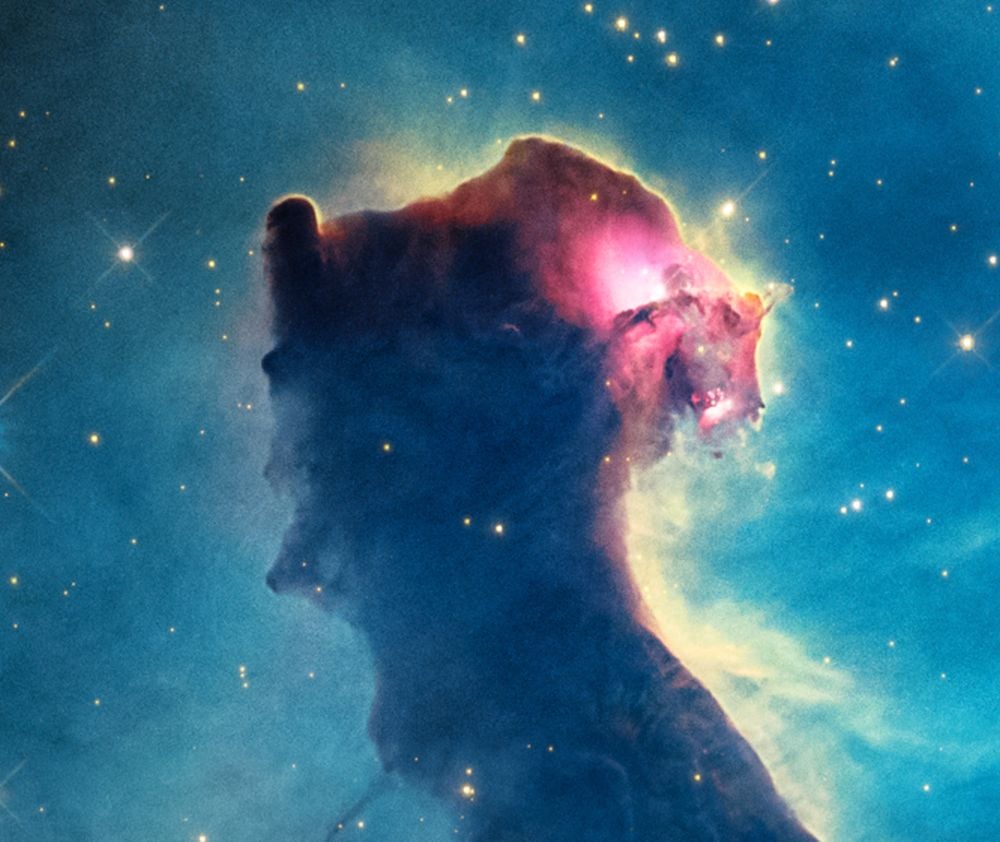
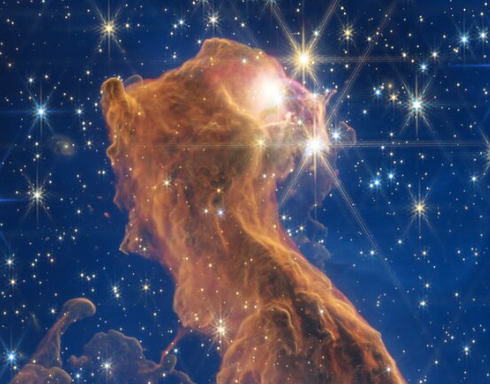
This zoomed-in portion of the Hubble's image highlights the "eyeball", likely a star in just the right position. Image Credit: NASA, ESA, STScI. Image Processing: J. Depasquale (STScI).

This zoomed-in portion of the Hubble's image highlights the "eyeball", likely a star in just the right position.

Image Credit: NASA, ESA, STScI. Image Processing: J. Depasquale (STScI).

The JWST, as an infrared telescope, presents different, yet no less gorgeous, images of the Cat's Head. It's infrared instruments see things differently than the Hubble does. This gives the Cat's Head—already ethereal in the Hubble image—an even more ghostly, almost unreal appearance. Some parts of the Cat's Head in the JWST images appear to be only half-there, with background stars shining brightly through them.

weic2622c_20261029_192815.jpg

The JWST's near-infrared image doesn't show different chemical elements the same way the Hubble image does. Instead, it shows more of the stars themselves. Even background galaxies are visible beyond the Cat's Head, along with the black background of space. The JWST also shows how massive stars are shaping the region, with the wispy filaments on the images left side.

Image Credit: NASA, ESA, CSA, STScI. Image Processing: J. Depasquale (STScI)

Some of the turbulence in the gas, driven by the massive stars, appears more substantial in the JWST image. The star that makes the Cat's Eye is also brighter, with less of its light blocked by dust in infrared.

A zoomed-in JWST NIR image of the head in the Cat's Head Nebula. Image Credit: NASA, ESA, CSA, STScI. Image Processing: J. Depasquale (STScI)

A zoomed-in JWST NIR image of the head in the Cat's Head Nebula.

Image Credit: NASA, ESA, CSA, STScI. Image Processing: J. Depasquale (STScI)

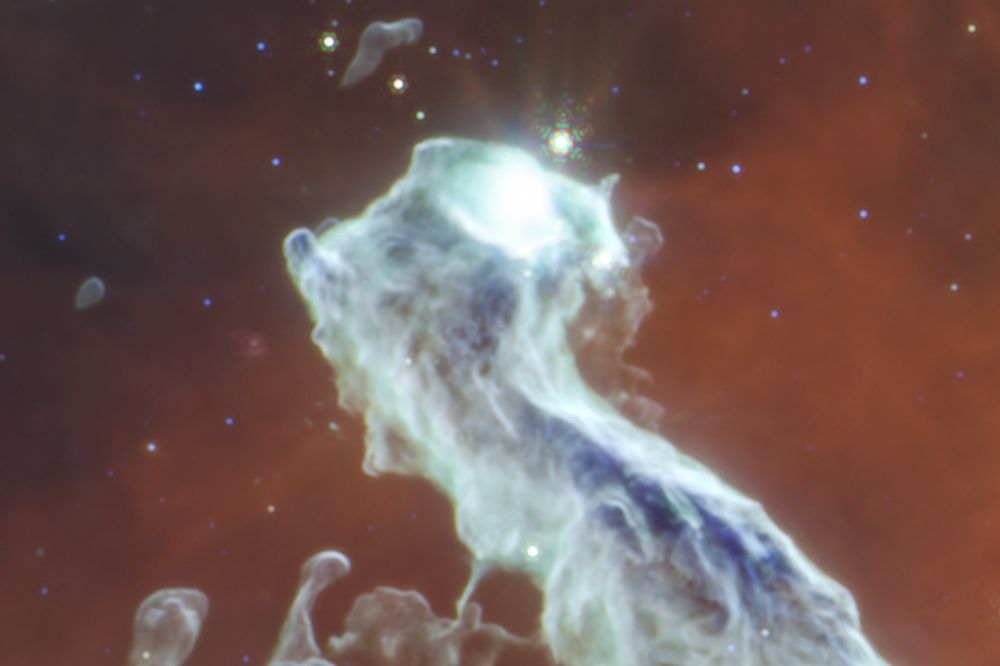
In the JWST's mid-infrared image, the Cat's Head Nebula is transformed yet again. It's muted and ghost-sheet white, surrounded by pastel gas clouds punctuated with stars. The clouds look almost Earth-like in their white colour. This time, it's carbon molecules and warm dust emissions that take the stage. What is most likely an infant star pops into view in this image, embedded in thick dust that it's yet to dissipate, to the right of the head itself.

The white colour of the gas in this mid-infrared JWST image makes it look like Earthly clouds. Fewer stars are visible in the background, their light blocked out by the gas, which appears thicker. In the gas to the left, finer detail is visible in the gas clouds. Image Credit: NASA, ESA, CSA, STScI. Image Processing: J. Depasquale (STScI).

The white colour of the gas in this mid-infrared JWST image makes it look like Earthly clouds. Fewer stars are visible in the background, their light blocked out by the gas, which appears thicker. In the gas to the left, finer detail is visible in the gas clouds.

Image Credit: NASA, ESA, CSA, STScI. Image Processing: J. Depasquale (STScI).

The head itself is muted in the MIR image, along with the rest of the nebula. It's eye, almost malevolent in the other images, blends in with the gas and is less striking.

In this zoom-in of the MIR image, the edges are softened, and so are the colours. The star that makes they eye blends in with the gas in gradients of white. Globules below the head look like they're reaching for the head, rather than being blown back by stellar wind and radiation. The blackness of space is visible in the upper right, and a little in the upper left. Image Credit: NASA, ESA, CSA, STScI. Image Processing: J. Depasquale (STScI).

In this zoom-in of the MIR image, the edges are softened, and so are the colours. The star that makes they eye blends in with the gas in gradients of white. Globules below the head look like they're reaching for the head, rather than being blown back by stellar wind and radiation. The blackness of space is visible in the upper right, and a little in the upper left. I

mage Credit: NASA, ESA, CSA, STScI. Image Processing: J. Depasquale (STScI).

Though these images are easy to appreciate by almost anyone, their primary purpose is scientific. By emphasizing and de-emphasizing different aspects of the Cat's Head nebula, astronomers can see stars more clearly, along with the dust, the gas, and the chemistry. Together, they help researchers see the effects of stellar radiation and wind, called stellar feedback, on the ongoing process of star formation.

Stellar feedback can both encourage and stifle star formation, depending on circumstances. It's complicated, and it's an ongoing topic of astronomical study. One of the JWST's main, defining science themes is star formation, and images like these are one of the reasons it was built. The Hubble helps too, and illustrates how the gas, the dust, the metallicity, and the stars of different sizes and ages, all play a role. Those factors all interact in different ways, making it difficult to come up with concrete theories of how it all works.

These gorgeous images are more than eye candy to astronomers. They're working hard on understanding a process fundamental to the cosmos. Wrapped up in all this visual chaos and beauty, Nature's laws are defining how stars form. Astronomers' mission is to decipher it all.

Enjoying these images on their visual merit alone is our mission, if we accept it.

{https://www.universetoday.com/ }

Hoe vind je dit bericht?
Geschreven door peter om 17:23 Stuur door

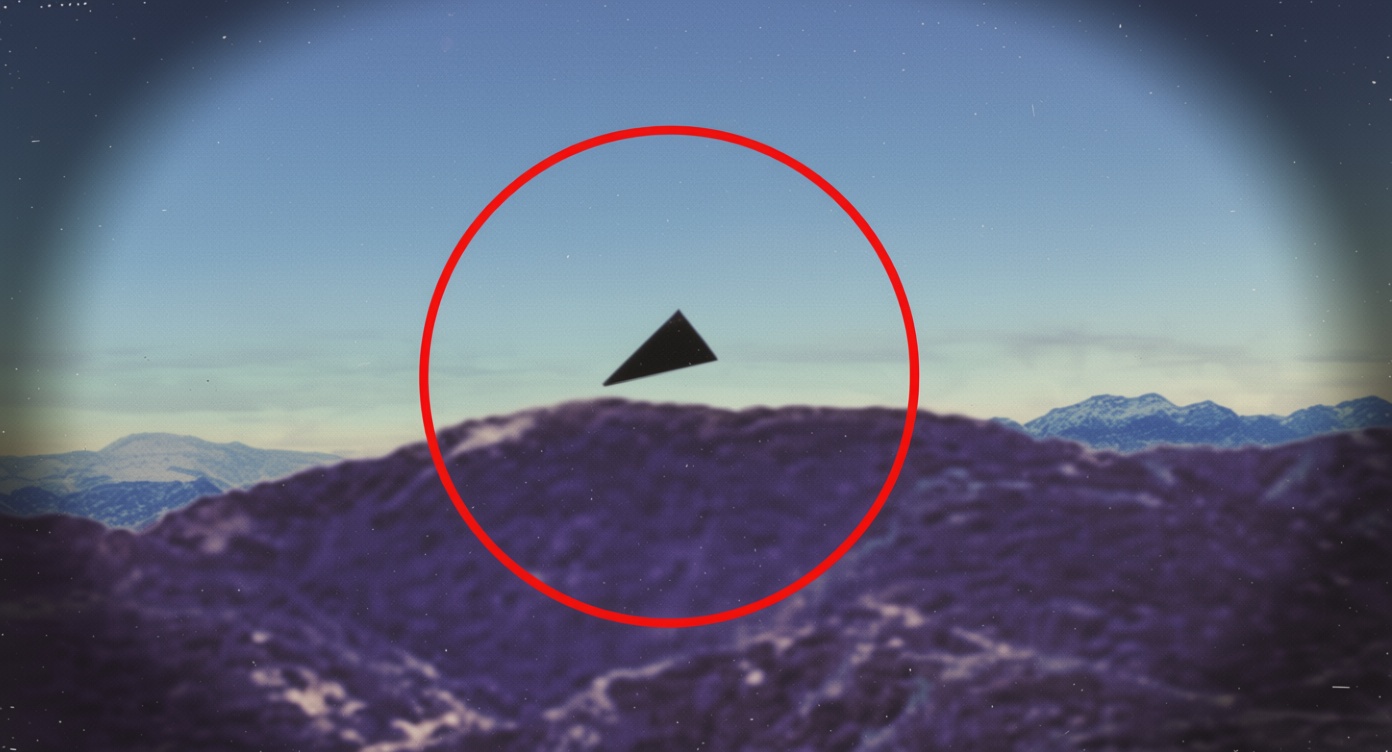
Triangle UFO Seen From Plane Over Utah, USA Oct 18, 2026, UAP Sighting News.

Triangle UFO Seen From Plane Over Utah, USA Oct 18, 2026, UAP Sighting News.

UFO_UAP.png

UAP_Utah.png

Date of sighting: Oct 18, 2026
Location of sighting: Utah, USA
Source: NUFORC
 
What looks like three glowing lights in the sky outside a passanger jet is actually one single triangle UFO. The lights are the glow of the anti propulsion systems...three of them, one on each corner of the craft. Bob Lazar who worked in area S4 of the secure Air Force Base Area 51 often stated that most small UFOs had three anti gravity units that sometimes glowed which propelled the craft. Here...we see all three very well. This is some serous alien technology right outside the passenger jet. How it didn't show up on radar is beyond me, but alien tech never stops surprising me at what it can do.
Scott C. Waring - UFO Sightings Daily 
 
Eyewitness states: 
On SW flight #2927. During the sightings flight was at or around 32,000 feet. About 30 minutes from landing in Las Vegas. Traveling at or around 487mph.3 lights. Looked like stars. 2 bright white lights moving in circle like fashion around the reddish light. This went on for several minutes. The lights would appear and disappear. Also, during these events, a dark triangle like craft with several small lights travelled east / north east which was counter to the direction of my travel.
That craft was moving at a speed unlike anything I have seen before, having seen many planes moving in the sky around a plane I was on. I have no way to estimate its speed or distance. It appeared large and much closer to my location that the lights. I approached the pilot upon landing, and he did not have much to say about the lights. The response to the craft I saw was only that it did not appear on his instrumentation. That craft could have been a stealth bomber. It seemed to have that characteristic.
Triangle UFO Seen From Plane Over Utah, USA Oct 18, 2026, UAP Paranormal Alien Sighting News.

{ https://www.ufosightingsdaily.com/  }

Hoe vind je dit bericht?
Geschreven door peter om 17:06 Stuur door

Ejection Pods Found On Mars, Fits Figures Size, Were They natives To Mars Or Just Lost? UFO UAP Sighting News

Ejection Pods Found On Mars, Fits Figures Size, Were They natives To Mars Or Just Lost? UFO UAP Sighting News


Mars_life.png
Mars_pod.png
 
Date of discovery: Oct 31, 2026
Location of discovery: Mars
Source photo:
 
Hey all, hope you had a great week. I found something the appears to be an escape pod from an alien spaceship on Mars. Near it is another one, but larger and the door is still unopened...which means they died on impact or never had time to get into the pod before it was ejected. The door is similar in size and shape as the pod on its side with an open door. These pod doors are about the same size as the woman figures we have been finding on Mars. We found many figures, but I show you two in my video as an example. I wonder...if they were not native to Mars, but just in a ship in orbit near Mars and escaping a dying ship, landing on Mars only to be left...lost on a planet with no hope of survival? 
Scott C. Waring - UFO Sightings Daily 
 
{ https://www.ufosightingsdaily.com/  }
Hoe vind je dit bericht?
Geschreven door peter om 16:59 Stuur door

UFOs could be hiding in our oceans, says retired US Navy admiral... as researcher claims to have discovered 'alien base entrance' off Canada

UFOs could be hiding in our oceans, says retired US Navy admiral... as researcher claims to have discovered 'alien base entrance' off Canada

Humanity has yet to make contact with aliens, and a retired US Navy Admiral has proposed a radical reason why: they are hiding in our oceans.

Tim Gallaudet, a former acting administrator of the National Oceanic and Atmospheric Administration (NOAA), recently explained why Earth's deep ocean may be the perfect hiding spot.

Speaking on the Hang Out with Sean Hannity podcast, Gallaudet said: 'If they were to go somewhere basically to not be detected for a period of time... where would you want to go?

'You'd want to go... [to] the most unexplored area of the world, and that's the ocean.' 

After decades of studying the ocean, Gallaudet believes its largely uncharted depths could conceal phenomena that have so far escaped detection. 

'We've only explored with either drones, buoys [or] floats, about 10 percent of ocean volume,' Gallaudet said. 'So there's a lot of mystery out there right now.' 

His comments come as a UFO researcher claims to have found an entrance into an underwater alien base off the coast of Canada.

Scott C Waring uncovered a mysterious hole in the waters surrounding Nunavut, which he claimed was more than 3,000 feet across and about 32 feet below the surface.

A retired US Navy admiral claimed that UFOs could be hiding under Earth's ocean amid a claim that an alien base has been identified in waters off the coast of Canada

A retired US Navy admiral claimed that UFOs could be hiding under Earth's ocean amid a claim that an alien base has been identified in waters off the coast of Canada

During the interview, Gallaudet highlighted a video he claimed showed mysterious objects moving underwater before jumping out to the surface.

'It goes into the ocean, no disturbance,' Gallaudet told Sean Hannity during the podcast. 

'I'm aware of another video that shows something similar, but from overhead... so yeah, there's something that they've been able to engineer that we have no idea how to reproduce,' he added. 

Gallaudet claimed the objects could break the sound barrier without the thunderous boom that normally accompanies supersonic flight, a feat he said defies explanation with current technology. 

He testified under oath before Congress in 2024, claiming there was a 2015 incident involving near-midair collisions with UFOs during a carrier strike group exercise and the subsequent disappearance of an urgent email report about the event.

The former admiral also asserted that Earth is visited by non-human intelligence utilizing advanced technology with extraordinary flight and transmedium capabilities. 

While Gallaudet has never provided locations where UFO bases could be hiding, Waring believes he has found the entrance to one. 

'I found an entrance to an underwater alien base, and it's in the most remote area of northern Canada that one could go,' Waring posted on his site UFO Sightings Daily.

Tim Gallaudet, a former acting administrator of the National Oceanic and Atmospheric Administration (NOAA), recently explained why Earth's deep ocean may be the perfect hiding spot.

Tim Gallaudet, a former acting administrator of the National Oceanic and Atmospheric Administration (NOAA), recently explained why Earth's deep ocean may be the perfect hiding spot.

UFOs (UAPs) Are Hiding In Deep Oceans! A Researcher Calls To Explore Deep Waters ‪@TheCosmosNews‬

'It's a huge tunnel for aliens to enter and exit, totally unseen in such a remote area.'

A remotely operated or autonomous underwater drone could explore the suspected tunnel and record any signs of alien life, Waring suggested. 

The proposed mission could last several days before the craft returned with its footage.

Such technology, he argued, could reach depths too dangerous for humans to explore in person. 

Waring said the venture could even open a direct line of communication between the public and extraterrestrials.

Similar claims about underwater UFOs have been presented by David Grusch, a former intelligence officer who now assists lawmakers with UFO transparency.

Grusch also testified under oath in 2023 that the US government possesses multi-decade secret programs recovering and reverse-engineering crashed non-human spacecraft.

Earlier this month, he told Joe Rogan that officials are aware of at least one giant underwater facility used by extraterrestrials as a 'base of operations' for their craft.

'I'm going to be careful because it gets into sensitive Navy underwater things,' Grusch said.

'There's clearly some sort of base of operations in certain locations. It's large. Don't know when it got there... Like multiple city-block-type stuff.'

He added that 'stuff comes and goes' from the base.

Grusch also claimed that his information came from files on top-secret programs, videos and confessions from government and military insiders.

However, the US military and the White House have maintained for decades that no physical evidence has been found that proves UFOs and alien life exist.

RELATED

UFO Experts On Existence Of Underwater Alien Bases On Earth Probe | Shocking UFO Hearing LIVE | N18G
A Former Navy Admiral Thinks UFOs May Be Hiding in Earth's Oceans.
Why UFOs Are Hiding In Our Oceans & How The CIA Trained Psychic Spies | Admiral Tim Gallaudet

{ https://www.dailymail.com/sciencetech/index.html }

Hoe vind je dit bericht?
Geschreven door peter om 15:52 Stuur door

Roman Space Telescopes: Which Observatories Will Uncover the Universe’s Next Mysteries?

Roman Space Telescopes: Which Observatories Will Uncover the Universe’s Next Mysteries?

Humanity has never had more powerful tools for space exploration. The Hubble Space Telescope has revealed remarkable details of distant galaxies, the James Webb Space Telescope has enabled us to observe the early universe, and the upcoming Nancy Grace Roman Space Telescope mission is set to produce one of the most comprehensive maps of the cosmos. Given these advances, what more could astronomers possibly need?

Indeed, the most significant discoveries may still lie ahead. NASA, ESA, and other space agencies are developing a new generation of observatories designed to search for life on other planets, investigate previously unexplored regions of space, and look back toward the earliest moments of the universe.
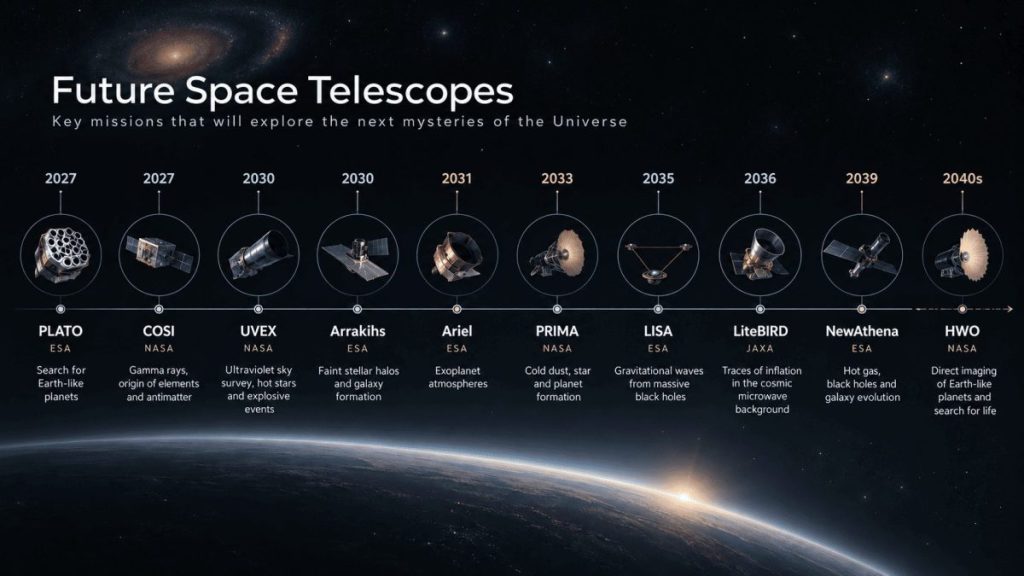
eng-1-1024x576.jpg

A timeline of planned space telescope launches by NASA, ESA, and JAXA from 2027 through the 2040s. The infographic outlines the primary scientific objectives of these future observatories, including the search for Earth-like planets and the study of black holes, gravitational waves, and the early universe.

Source: UST

Why are even the most powerful telescopes insufficient?

On August 30, 2026, NASA launched the Nancy Grace Roman Space Telescope. Its primary mission extends beyond capturing striking images of distant galaxies; it is designed to survey the universe on an unprecedented scale. With its wide field of view, the telescope will be able to observe hundreds of millions of galaxies, search for exoplanets, and study the distribution of dark matter.

However, even Roman, James Webb, and Hubble, collectively, cannot answer all of astronomy’s fundamental questions.
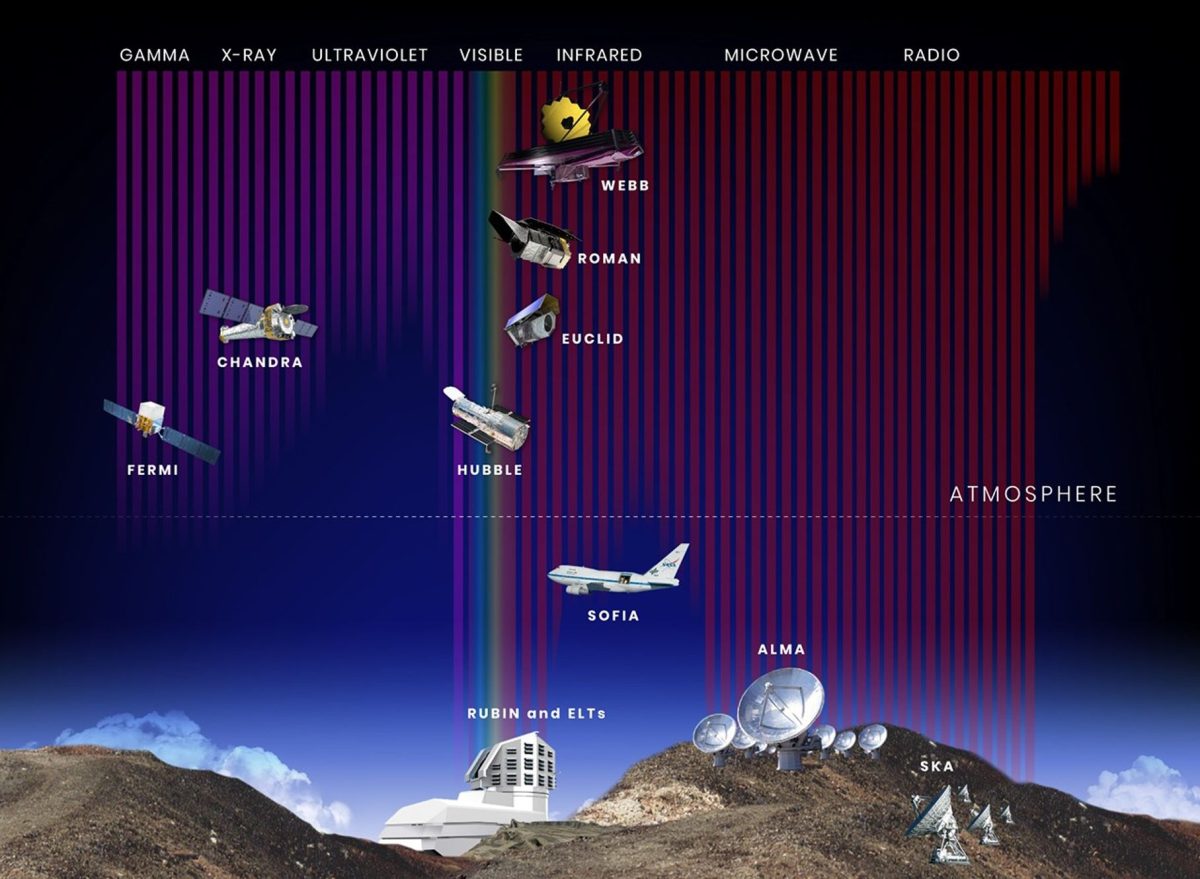
stsci-01febr8scwtrv07xv8we8a9aqb.jpg

The infographic presents the ranges of the electromagnetic spectrum in which various astronomical observatories operate, from gamma-ray and X-ray radiation to infrared light and radio waves. It also illustrates which types of radiation are absorbed by Earth’s atmosphere and explains why some telescopes must be launched into space to study them.

Source: NASA

The issue is not solely the size of the mirrors or the sensitivity of the cameras. The universe emits information across various bands of the electromagnetic spectrum, while the human eye can perceive only a limited portion of it: visible light. Infrared telescopes can detect cooler objects and observe through some cosmic dust; ultraviolet telescopes can study hot stars; and X-ray telescopes can observe extremely high-energy processes near black holes.

Each of these instruments has inherent physical limitations. Accordingly, the next stage in the development of astronomy will depend less on creating a single, universal, ultra-powerful telescope and more on establishing an integrated network of specialized observatories.

  • The first major challenge facing this system is connected to a question that has captivated humanity for millennia: Are we alone in the universe?

PLATO: The Search for Earth-Like Planets [2027]

Astronomers have now identified thousands of planets beyond the Solar System. However, most differ substantially from Earth. Many are gas giants, extremely hot worlds, or planets that orbit very close to their stars. Identifying a genuinely Earth-like planet is considerably more challenging.

One of the most effective methods for detecting exoplanets is the transit method. When a planet passes in front of its star, it blocks a small fraction of the star’s light. A telescope can detect a brief decrease in brightness, which may indicate the presence of a planet. However, Earth blocks only about 0.0084% of the Sun’s light. This illustrates the precision required to measure the brightness of a distant star and detect such a subtle change.

A further challenge is that Earth completes one orbit around the Sun each year. To reliably detect a comparable planet, it is best to observe several of its transits, which requires monitoring the same star for years. The European Space Agency developed the PLATO telescope specifically for this purpose, and it is scheduled to launch in March 2027.
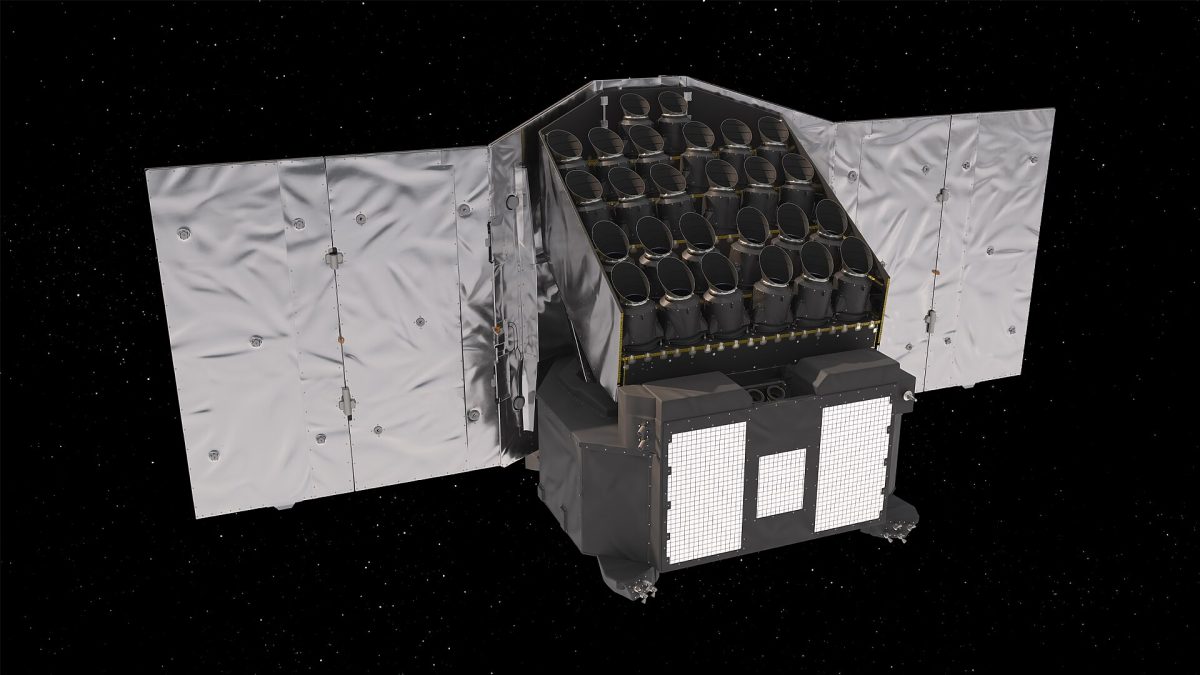
1920px-artists_impression_of_plato.jpg

The European Space Agency’s (ESA) PLATO space telescope is equipped with 26 cameras, enabling it to observe thousands of stars simultaneously. Its primary mission is to search for Earth-like exoplanets, particularly in regions where liquid water may be present.

Source: ESA

Unlike traditional telescopes equipped with a single primary camera, PLATO will utilize 26 separate cameras. Together, these cameras will observe a vast number of stars, monitoring them for characteristic changes in brightness. However, the mission’s objectives extend beyond the discovery of planets. PLATO will also study the subtle fluctuations within the stars themselves. By analyzing these oscillations, astronomers will be able to determine the stars’ sizes, masses, and ages with greater accuracy. In combination with ground-based observations, this information will help assess the properties of the discovered planets.

As a result, we will gain not only a list of new worlds but also a substantially clearer understanding of how frequently rocky planets form around Sun-like stars.

  • This raises the following question: Even if we identify a planet the size of Earth, how can we determine whether it is habitable?

Ariel: What Are the Atmospheres of Other Worlds Composed Of? [2031]

Two planets may be nearly identical in size yet exhibit markedly different surface conditions. The Solar System provides a clear example: Earth and Venus are similar in size, but Venus’s dense atmosphere generates an exceptionally strong greenhouse effect. Consequently, its surface temperature is significantly higher than Earth’s.

Therefore, understanding the planet’s dimensions alone is insufficient; its atmosphere must also be studied. To this end, ESA is developing the Ariel space telescope, which is currently scheduled to launch in 2031.
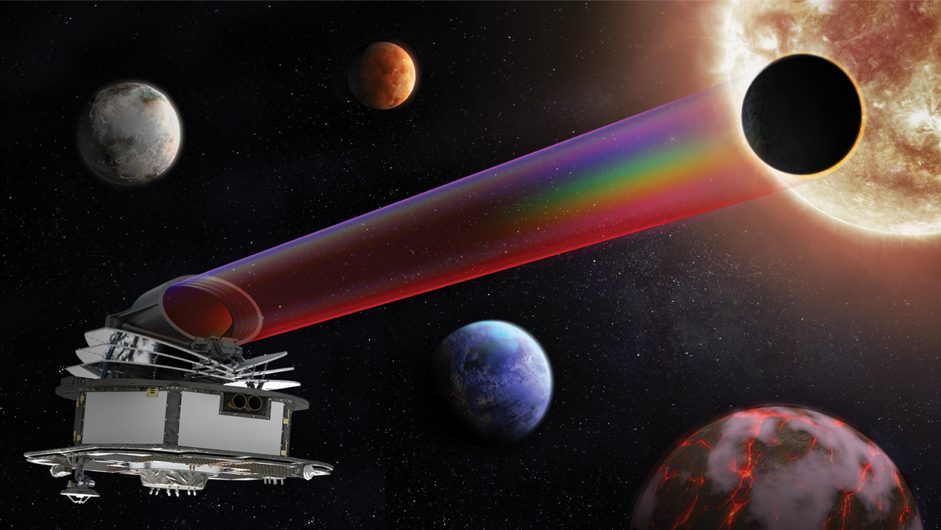
aryel-2.jpg

An artist’s rendering of the European Space Agency’s (ESA) Ariel space telescope. By analyzing starlight as it passes through an exoplanet’s atmosphere during transit, the telescope will detect the presence of water vapor, methane, and other gases.
Source: ESA

Its primary instrument will be spectroscopy. When a planet transits its host star, a small fraction of the star’s light passes through the planet’s atmosphere. Molecules of various substances absorb light at characteristic wavelengths, producing distinctive chemical signatures in the spectrum. These signatures enable astronomers to detect water vapor, carbon dioxide, methane, and other atmospheric components.

The James Webb Space Telescope is already employing similar methods; however, Ariel is being developed to systematically study approximately one thousand exoplanets. This will enable comparisons of the atmospheres of planets with different sizes, temperatures, and ages.

The primary objective is to understand the patterns underlying their formation and evolution.

  • However, Ariel will primarily study relatively warm planets with atmospheres suitable for spectroscopic measurements. Searching for potential signs of life on truly Earth-like planets will require an even more sophisticated instrument.

Habitable Worlds Observatory: A Telescope That Will Search for Life (~2040)

Imagine attempting to observe a firefly beside a powerful spotlight located many kilometers away. This is approximately what it is like to photograph an Earth-like planet directly near another star.

In visible light, Earth is approximately ten billion times fainter than the Sun. Consequently, even when a telescope can detect the planet’s light, the star’s radiation overwhelms it. One potential solution is a coronagraph, an optical instrument that suppresses the star’s bright light, enabling the detection of much fainter light from a nearby planet. An experimental coronagraph has already been installed on Roman; however, its capabilities are insufficient for studying Earth-like worlds.

For this reason, NASA is developing the Habitable Worlds Observatory (HWO) concept — a future space observatory specifically designed to search for and study planets that may be capable of supporting life. Its optical system must maintain exceptional image stability. Even microscopic mirror deformations or structural vibrations can generate stray light that obscures the planet’s signal.
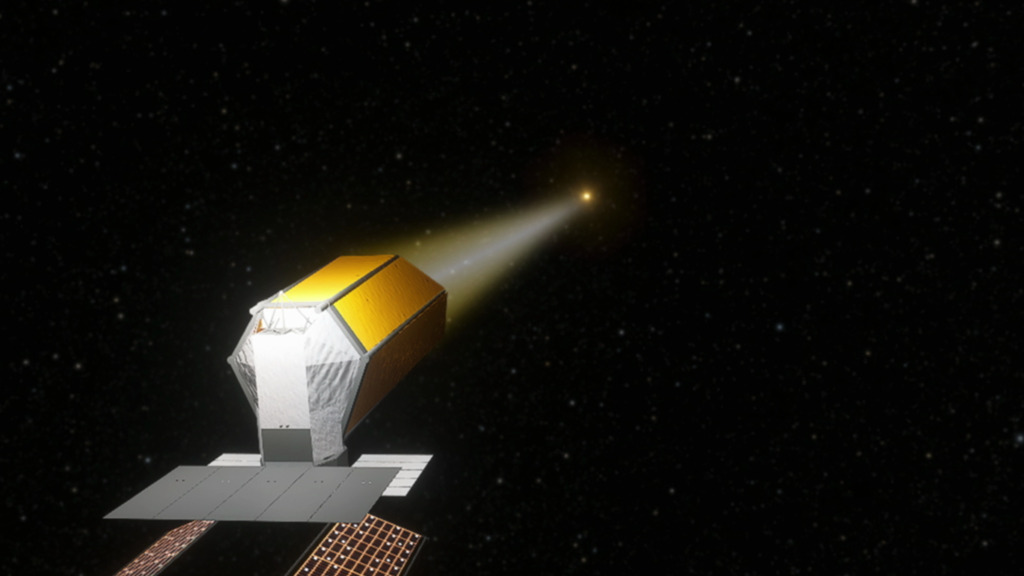
habitable_worlds_observatory_ultra-stable_telescope_svs20400_-_ultrastabletelescope_prores_00877_print.jpg

An artist’s rendering of NASA’s future Habitable Worlds Observatory (HWO). With its high-precision optics and ability to block the bright light emitted by stars, the telescope will be capable of directly observing Earth-like exoplanets and studying their atmospheres for potential signs of life.

Source: habitableworldsobservatory

Therefore, engineers must integrate high-precision optics, active wavefront control, and highly sensitive detectors. If the technology performs as intended, the HWO will be capable of directly observing rocky planets and analyzing the composition of their atmospheres. Oxygen, ozone, methane, and other substances that may, under certain conditions, be associated with biological processes will be of particular interest. However, detecting oxygen alone will not provide definitive evidence of life, as some chemical substances can form in the absence of living organisms. Accordingly, astronomers will need to assess the full range of atmospheric conditions.

HWO remains in the conceptual design and key technology development phase. It may be launched in the 2040s; however, no date has been set.

At the same time, the ground-based Extremely Large Telescope is expected to help address several of these complex challenges in the coming years. Its primary mirror, measuring 39 meters (128 feet) in diameter, will comprise 798 segments designed to function as a single optical surface. An adaptive optics system will compensate for atmospheric distortion by adjusting the shape of a specialized mirror approximately one thousand times per second.

The ELT’s initial scientific observations are expected to commence in late 2030. It will be capable of studying individual planets and their atmospheres in detail, thereby complementing the capabilities of space-based observatories.

  • However, to determine how common habitable worlds are, we must answer one additional question: where does the material from which they are formed originate?

PRIMA: An Overview of the Birthplaces of Stars and Planets [~2033]

Stars and planets form within vast clouds of gas and dust. However, the dust itself often hinders astronomers’ ability to observe these processes. Dust particles absorb visible light and re-emit the absorbed energy in the infrared spectrum. Consequently, a region that appears nearly black in a conventional photograph may appear bright when viewed through an infrared telescope.

The James Webb Space Telescope has already provided a glimpse into many such regions. But even it does not cover the entire infrared spectrum. The coldest dust clouds emit a significant portion of their energy in the far-infrared range, which is beyond the reach of Webb’s instruments. This is where a significant gap exists between the capabilities of modern infrared and radio observatories.

To address this, NASA is developing PRIMA, the PRobe far-Infrared Mission for Astrophysics.
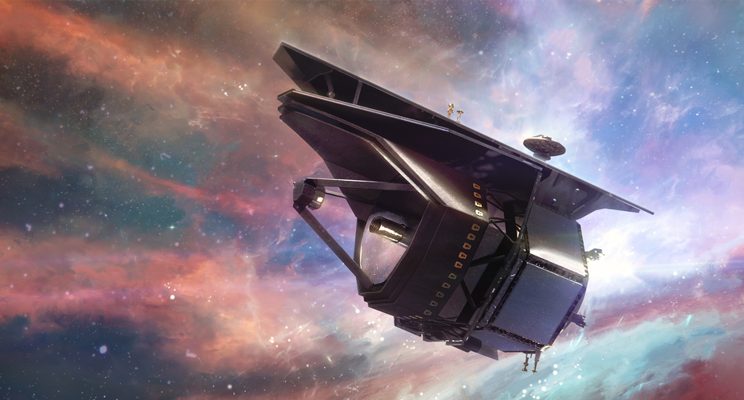
prima.jpg

An artist’s rendering of NASA’s planned PRIMA (Probe Far-Infrared Mission for Astrophysics) space observatory. The telescope will explore the universe in the far-infrared spectrum, enabling the study of cold gas and dust clouds where stars and planets form, as well as regions of galaxies obscured by dust.

Source: PRIMA

In September 2026, the agency selected this mission to proceed to the next phase of design. Subject to further approval, the project is tentatively scheduled for launch in 2033. The telescope, equipped with a mirror approximately 1.8 meters (5.9 feet) in diameter, will study cold dust, gas, and obscured regions of galaxies. This research will help advance our understanding of how new stars form from interstellar matter, how protoplanetary disks evolve, and the role that water and complex chemical compounds play in the early stages of planet formation.

However, temperature is not the sole reason celestial objects remain invisible. Conversely, certain processes are so energetic that they emit light beyond the detection capabilities of optical and infrared telescopes.

COSI and UVEX: Observing Invisible Cosmic Explosions [2027 and 2030]

Not all cosmic processes are observable in visible or infrared light. For instance, hot stars and the early stages of supernova explosions are especially luminous in the ultraviolet spectrum. To study these phenomena, NASA plans to launch the UVEX (UltraViolet EXplorer) telescope in 2030. The telescope will survey the ultraviolet sky and rapidly reorient itself in response to transient cosmic events, including the aftermath of neutron star mergers.

Even higher-energy radiation will be studied by COSI (the Compton Spectrometer and Imager), which is scheduled for launch in 2027. This gamma-ray telescope will help determine where certain chemical elements form in the Galaxy and the origins of positrons — the antiparticles of electrons. When a positron encounters an electron, they annihilate, producing gamma rays that COSI can detect.
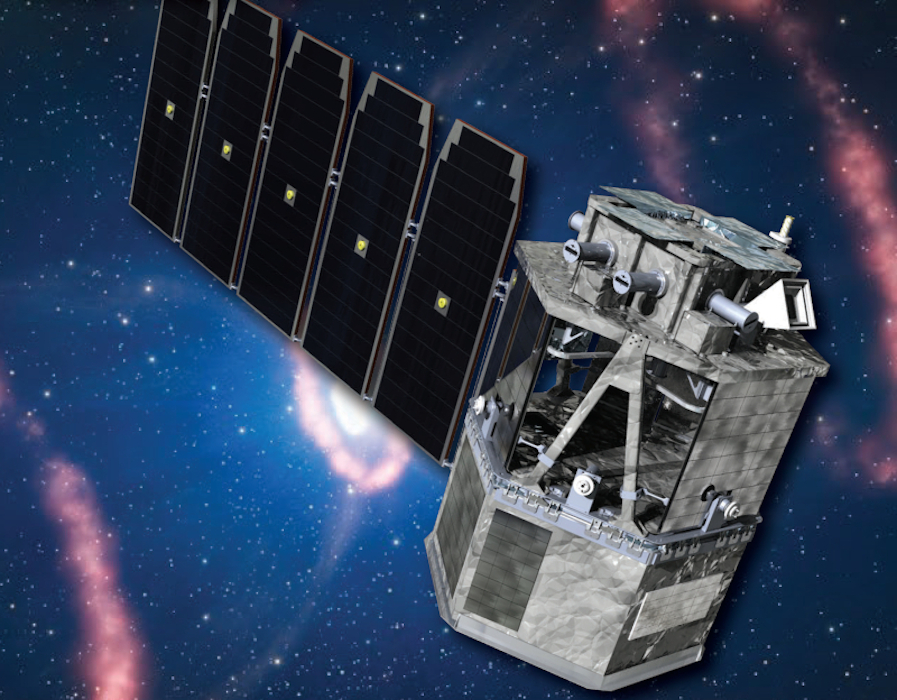
cosi_higher_quality.jpg

An artist’s rendering of NASA’s COSI (Compton Spectrometer and Imager) space-based gamma-ray telescope. The observatory will study gamma-ray radiation to determine where certain chemical elements form in the Milky Way and the origins of cosmic antimatter.

Source: COSI

Together, these observatories will enable the study of high-energy processes that are beyond the capabilities of conventional telescopes. However, another challenge remains equally important: detecting the extremely faint matter surrounding galaxies.

Arrakihs and NewAthena: Hidden Features Beyond the Galaxies [2030 and 2039]

Even the most detailed images of galaxies reveal only a portion of their structure. Nearly invisible halos — comprising diffuse gas, dark matter, and faint stellar streams — extend beyond the luminous stellar disks. These halos preserve evidence of ancient collisions and the accretion of smaller galaxies.

To investigate these structures, ESA plans to launch the Arrakihs telescope in 2030. The mission will examine the stellar halos of neighboring galaxies, helping researchers reconstruct their formation histories and test models of dark matter distribution. These observations will complement the large-scale surveys conducted by Roman and Euclid.

However, some ordinary matter exists in a form so hot that it is best observed in the X-ray range. This is precisely what NewAthena — ESA’s future X-ray observatory, scheduled for launch in 2039 — will study. It will investigate gas in galaxy clusters, the growth of black holes, and their effects on the surrounding environment.
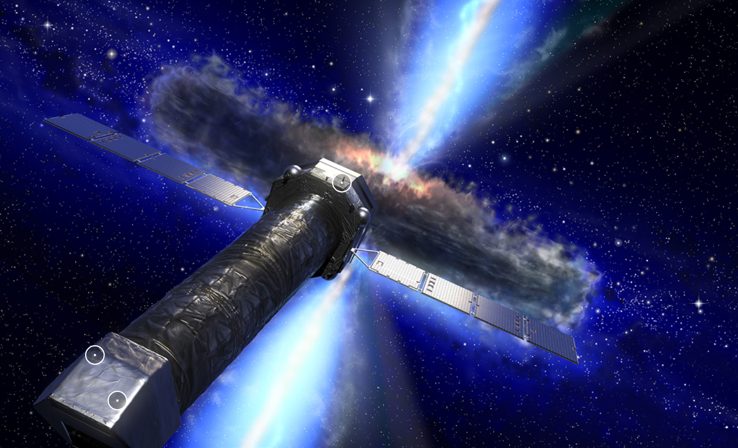
newathena.jpg

An artist’s rendering of the European Space Agency’s (ESA) future NewAthena X-ray observatory. The telescope will study hot gas in galaxy clusters and powerful radiation near black holes, contributing to a better understanding of how they grow and influence the evolution of galaxies.

 Source: ESA

However, the most powerful events involving black holes leave traces not only in radiation but also in the very fabric of spacetime.

LISA: Observing the Collision of Black Holes [2035]

In 2015, the LIGO detectors observed gravitational waves from a black hole merger for the first time. These waves are disturbances in spacetime that propagate at the speed of light. However, ground-based facilities cannot effectively detect the lowest frequencies of these oscillations because of terrestrial noise and the interferometers’ size limitations.

To investigate these phenomena, ESA is developing LISA — the Laser Interferometer  Space Antenna — which is scheduled for launch in 2035. The mission will comprise three spacecraft arranged in a triangle, with sides approximately 2.5 million km (1.55 million miles) in length. By exchanging laser beams, the spacecraft will measure minute changes in distance caused by the passage of gravitational waves.
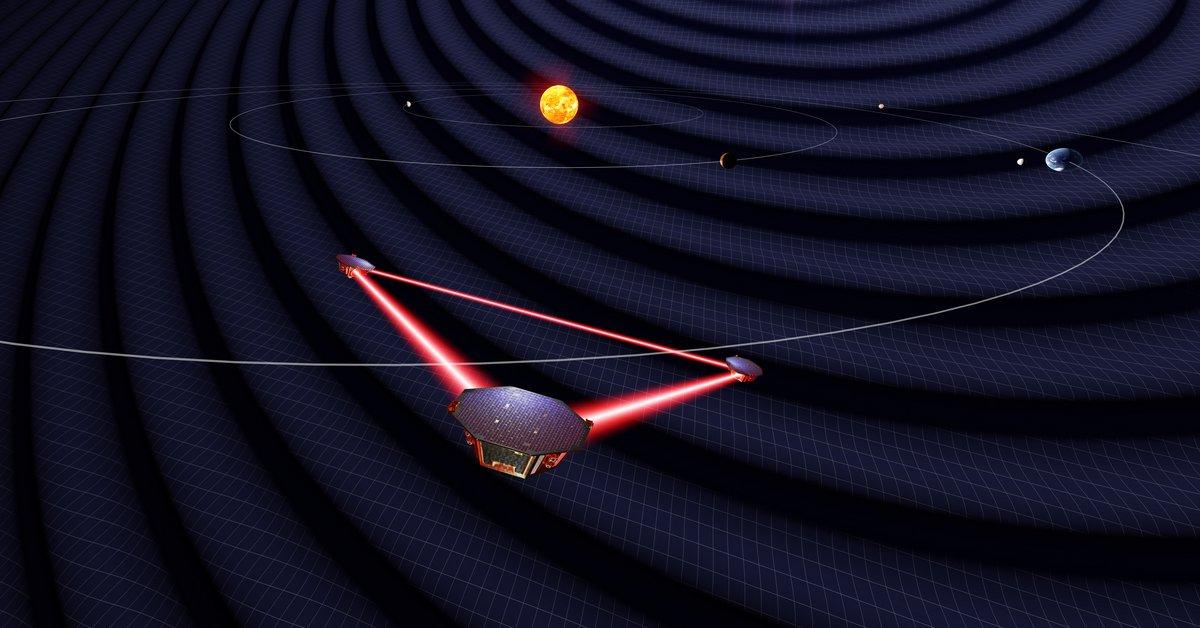
sk22qxfulovbxxonhfbwfxeo2cz08_hhjtw2jgse66xanzn4w9yvxl_0g9srypiisxeaafjolqfepk0jqgtksm8qjberqzvrvzgqwn7d8_kpxixyswrc2v8nuwushvu_rg68-dvq_xofxasbsx-m99tpy_npp-recrgsbiowxz9trb3r-sfkrrdw7ogfnjp.jpg

An artist’s rendering of the European Space Agency’s (ESA) Laser Interferometer Space Antenna (LISA), a space-based gravitational-wave observatory. Three spacecraft, linked by laser beams and positioned 2.5 million kilometers apart, will detect extremely faint ripples in spacetime caused, in particular, by the mergers of massive black holes.

Source: ESA

LISA’s primary targets will be mergers of supermassive black holes at the centers of galaxies. Combined with X-ray observations from NewAthena, these observations will help us understand how black holes have grown throughout the history of the universe.

However, to study an era in which neither galaxies nor black holes yet existed, we will need entirely different kinds of instruments.

LiteBIRD: Evidence of the Universe’s Origins [2036]

According to one of the leading hypotheses in cosmology, during the earliest moments of its existence, the universe underwent inflation — an exceptionally rapid expansion of space. Although no direct evidence of this process has yet been identified, potential traces may have been preserved in the cosmic microwave background, the oldest light observable to us.

These are precisely the phenomena that the Japanese LiteBIRD observatory, scheduled to launch around 2036, will seek to detect. The observatory will measure the polarization of the cosmic microwave background radiation in an effort to identify a specific pattern: primordial B-modes, which may have been generated by gravitational waves during the inflationary era.
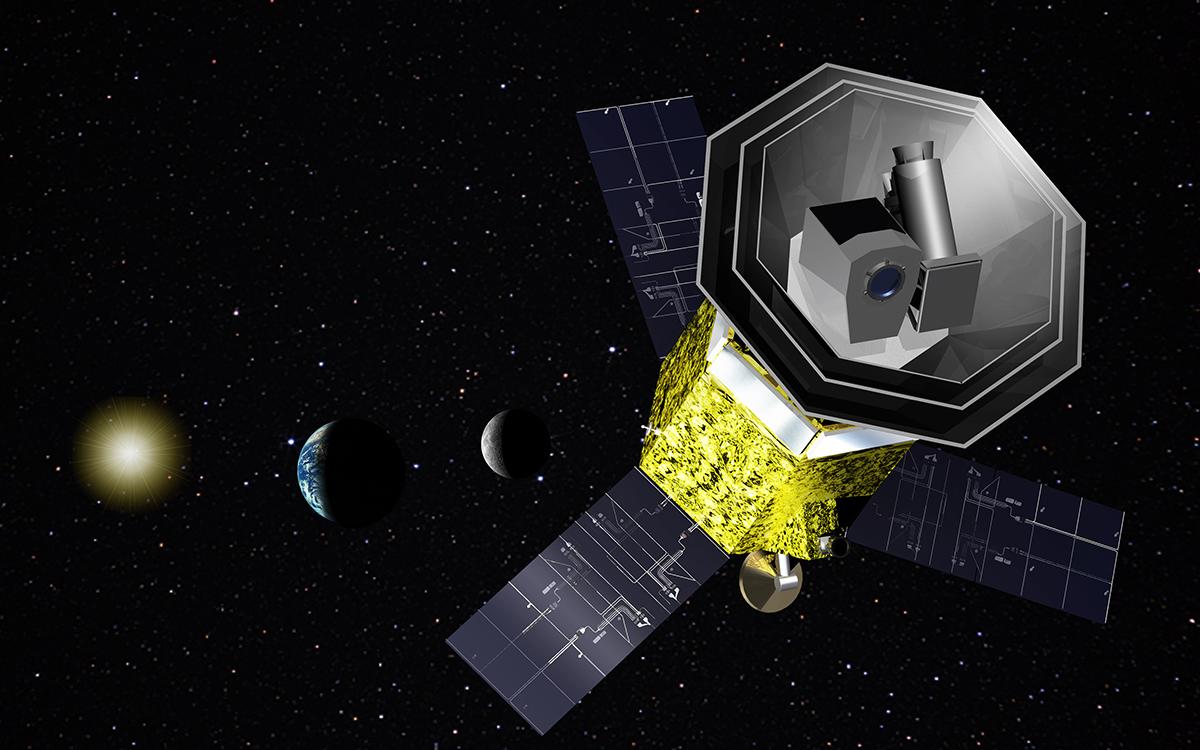
litebird.jpg

An artist’s rendering of the LiteBIRD space observatory, which JAXA is developing to study the polarization of the cosmic microwave background. The telescope will search for extremely faint signals from the early universe that may preserve traces of cosmic inflation — the rapid expansion of space during the first moments after the Big Bang.

Source: JAXA

The expected signal is extremely weak, and radiation from galactic dust may obscure it. Accordingly, LiteBIRD will use measurements across multiple frequencies to distinguish the cosmological signal from nearby sources.

The detection of primordial B-modes could provide significant evidence for inflation. However, observations of the cosmic microwave background allow us to directly study the universe only as it existed approximately 380,000 years after the Big Bang. The subsequent stage in its history — the formation of the first stars and galaxies — will be investigated using radio telescopes.

SKA: The Universe Before the Formation of the First Galaxies [2027]

After the universe became transparent to light, the cosmic dark ages commenced. Although atoms had already formed, the first stars had yet to emerge. The Square Kilometre Array (SKA) — a large network of radio telescopes currently under construction in Australia and South Africa — will help researchers investigate this relatively understudied period.

Thousands of antennas will operate together as a single instrument, detecting exceptionally faint radio emissions. Of particular interest is the signal from neutral hydrogen, which can be used to trace how the first stars gradually transformed the surrounding gas.

at_jodrell_bank_observatory_2018_040.jpg

The headquarters of the Square Kilometre Array Observatory (SKAO), an international radio astronomy observatory, is located in the United Kingdom. The renowned Lovell Radio Telescope is visible in the background. The SKA radio telescopes are being constructed in Australia and South Africa and will contribute to the study of the early universe, particularly the period before the first stars and galaxies formed.

Photo: Mike Peel

The SKA will be commissioned in phases as its systems become operational. Together with LiteBIRD, it will help investigate the early history of the universe from two perspectives: possible traces of primordial physical processes and the emergence of the first luminous objects.

Thus, future observatories will progressively address gaps in our observations, and their combined findings will enable us to develop a more comprehensive understanding of the universe’s evolution.

The future of astronomy depends not on a single telescope, but on an integrated system

The future of astronomy depends not on the development of a single, exceptionally powerful telescope, but on a comprehensive network of specialized observatories. Some will search for Earth-like planets, while others will investigate their atmospheres, observe black holes, or seek evidence of the universe’s earliest processes.

The primary advantage of this approach is the ability to study the same objects using different methods. For example, one telescope may detect an exoplanet, another may help determine its mass, and a third may analyze its atmosphere. By combining these data, we can assess how closely this world resembles Earth and whether conditions suitable for life may exist there.

Certainly, no single mission can provide definitive answers to questions concerning the nature of dark matter, the origins of the universe, or the existence of extraterrestrial life. However, each mission will gradually help address gaps in our knowledge.

Hubble has enabled us to observe the universe in remarkable detail; the James Webb  Space Telescope has allowed us to explore much deeper; and the Nancy Grace Roman Space Telescope is poised to create a large-scale map of the cosmos. The next generation of observatories will seek to answer the questions raised by these discoveries.

Perhaps the most significant outcome will not be another photograph of a distant galaxy, but rather the first compelling evidence of life beyond Earth or the discovery of traces of physical processes that occurred long before the first stars formed.

  • It will then become evident that all previous space telescopes represented only the beginning of our exploration of the universe.

{ https://universemagazine.com/en/articles-en/ }

Hoe vind je dit bericht?
Geschreven door peter om 21:45 Stuur door

The creepy science behind sleep paralysis ‘demons’

The creepy science behind sleep paralysis ‘demons’

Painting of a woman in white with a demon sitting on her chest and a ghostly horse to the left.

In 1781, Swiss artist Henry Fuseli painted this piece entitled "The Nightmare." Sigmund Freud had a copy of the painting hung up in his Vienna apartment in the 1920s.

Image: Tulip Hysteria / CC BY 2.5  

Have you ever woken up in the dead of night to find your limbs locked tight? Perhaps as you moved your eyes to the corner of your room, you spotted a demon lurking in the shadows, watching as you struggled against an invisible force. Sleep paralysis is creepy!

If you can take any comfort from your experience, it’s to know that sleep paralysis has a long and storied history of tormenting humanity. Why is sleep paralysis such a shared, spooky experience? And who exactly is that shadowy figure standing at the bottom of your bed? 

What is sleep paralysis?

Sleep paralysis affects slumberers around the world. Brian A. Sharpless, a clinical psychologist based in the Washington, D.C., area who has written multiple books on the phenomenon, says he has recorded more than 100 different terms for sleep paralysis across time, place, and culture.

While the fine details vary, the core experience is universal.  “Waking up, finding yourself unable to move, oftentimes a sense of pressure in the chest, a feeling of dread, fear, oppression. Those seem to be really consistent, but how you put a meaning on that is where it gets really interesting,” says Sharpless. 

What’s the history of sleep paralysis?

Historically, people often gave these experiences a supernatural origin. Sharpless says, in the West, sleep paralysis overlapped with stories about vampires, witches, and ghosts. In Germanic and Slavic folklore, a demon called a mare (which is the origin of our word “nightmare”) visited sleepers, sat on their chests, and paralyzed them.  

Painting of an old woman sitting on a man's chest. The style features heavy brushstrokes.

In the early 1890s, Danish painter Joakim Skovgaard painted this image showing a mare (or “maren” in Danish). The mare was a shape-shifting supernatural being that would ride people’s chest leaving them unable to move.

Image: Joakim Skovgaard / CC BY 4.0

As time passed, these associations changed to alien visitations or hazy “shadow people” lurking in the corners of their rooms. Sin 1960s, people in Tanzania have reported being attacked by a large winged creature called the Popobawa, which sexuce theally assaults paralyzed victims. 

But scientists also have explanations for sleep paralysis. 

The science behind sleep paralysis

Sharpless says that a brain stuck between dreams and wakefulness produces this phenomenon. During REM sleep, one of the periods of rest when dreams are most likely, the brainstem paralyzes the body’s muscles, except, of course, those that move our eyes and keep us breathing. This is vital, as sleepers might otherwise act out their dreams and harm themselves or others.  

But awakening while the body is still shut down is not pleasant. “It’s kind of an uncanny, strange experience not to have control over your body,” says Sharpless. As a result, surveys of people who have reckoned with sleep paralysis show it is almost always a fearful experience. 

Another shared factor in sleep paralysis is feeling a presence in the room. These sleep paralysis demons, aliens, vampires, or Popobawas are generated by what researchers call the threat-activated vigilance system. 

“What we think happens is that your brain is reading the sense that you’re prey, and it creates a predator,” says Sharpless. 

A colorful painting of a black cat in a blue sweater sticking its tongue down a sleeping person's throat.

Contemporary graphic designer and illustrator Kasia Walentynowicz drew this somewhat cute image of a shapeshifting mare based off of Polish folklore.

Image: Kasia Walentynowicz – Instytut Adama Mickiewicza – Projekt : Upiór / CC BY-SA 4.0

Who’s most likely to experience sleep paralysis?

Some people go through their whole lives without experiencing sleep paralysis, but some factors put you more at risk. 

Sharpless says that people with a history of trauma or anxiety are more vulnerable. Sleep paralysis is also linked to being a student, consuming alcohol, or having narcolepsy. All of these factors are in turn linked to more disrupted sleep. 

Sharpless says that, in general, poor sleep hygiene increases the risk of sleep paralysis. No randomized controlled trials, the gold standard for testing treatments, have been conducted for potential solutions to sleep paralysis, but Sharpless says interventions that improve sleep will likely also reduce the risk of sleep paralysis. 

How to avoid sleep paralysis

“One of the best, easiest things you can do is don’t drink before you go to bed and try to sleep on your side,” says Sharpless. 

Sleeping on your back, he says, might make it slightly harder to breathe during sleep, especially in people who are overweight or obese. Sleep paralysis is less likely to happen to side sleepers, he adds. If a sleeper’s partner sees them sleeping on their back, gently moving them onto their side can reduce the chances of sleep paralysis.

Generally improving sleep hygiene, and getting treated for any anxiety, depression, or trauma, are also important steps, Sharpless says. 

Sharpless has only experienced sleep paralysis once. In that episode, a terrifying face with sunken red eyes, balanced atop an improbably long neck, wound its way into his room. It was only when he remembered he had watched a documentary on sleep paralysis that very day that the fear, and then the face, dissipated. 

He warns that there’s anecdotal evidence that sleep paralysis may be contagious. So, after reading this piece, sleep on your side, and if a demon appears in the corner of your room, remember it’s simply a figment of a tired, wired brain. 

“Try to have a sense of humor about it,” advises Sharpless. 

Related 'Ask Us Anything' Stories

RELATED

The Terrifying History of Sleep Paralysis: Demons, Science, or Something Else?
Sleep Paralysis: The Terrifying Neuroscience Behind the Shadow Figure
Why You See a Demon When You're Sleep Paralyzed (The Real Science)

{ https://www.popsci.com/category/health/ }

Hoe vind je dit bericht?
Geschreven door peter om 21:07 Stuur door

Is UAP Storytelling Akin to Religious Myths?

Is UAP Storytelling Akin to Religious Myths?

 Avi Loeb

1*KDmTCVbSHj94zl39UrBQzQ.jpeg

(Image Credit: AI/Gemini)

A system of statements based on conviction rather than evidence is closer to religion than it is to science. Of course, I know of many scientists who are also religious but they fully recognize the difference between scientific knowledge and religious belief.

The space of possible realities is far greater than the specific physical reality that we live in. As a result, human history is full of imagined stories. In the same vein, the practice of science is full of conjectures or unproven theoretical ideas. But what makes science different from politics or religion is the surrender to empirical evidence as an arbitrator.

The quest for evidence is commonly adopted by detectives who aim to resolve mysteries, including fictional characters like Sherlock Holmes who was quoted by Arthur Conan Doyle as saying: “When you have eliminated all which is impossible, then whatever remains, however improbable, must be the truth.” This assertion is certainly true about quantum mechanics as the counterintuitive nature of physical reality. The 2022 Nobel Prize in Physics was awarded to Alain Aspect, John F. Clauser, and Anton Zeilinger for their groundbreaking experiments with entangled photons. Their work confirmed the reality of quantum entanglement and proved that Albert Einstein’s objections to this phenomenon, which he famously derided as “spooky action at a distance,” were incorrect.

Other scientific mysteries over the past century remain unresolved. Chief among them is the challenge of unifying quantum mechanics and gravity. The latest conjectures about doing so in the presence of extra dimensions or supersymmetry lack empirical support. This does not make these scientific ideas resemble religious myths because the physicists who explore them recognize that they can only gain traction by experimental support.

1*S6_p_hsrRs1mQ-tjQ_MKGw.jpeg

Avi Loeb

(Image Credit: Lotem Loeb, May 22, 2026)

What makes the situation confusing for the general public is that most often, the scientific data necessary for drawing definitive conclusions is absent or not good enough. In politics or religion, conviction is sufficient for attracting many likes on social media because confidence is regarded as an admirable trait in our otherwise fragile life. However, in science, the most accomplished mathematicians engaged in String Theory or even the most advanced version of superintelligence, will not be able to figure out the truth about the physical reality without high-quality data from instruments that probe it.

The approach of physics is an extension of the way our body works. We rely on data from our biological sensors, known as receptors, to monitor the internal state of the body and interpret the external world. These native sensors detect physical, chemical, or mechanical changes and translate them into electrical signals that our brain can process. But the data is often insufficient for drawing definitive conclusions.

When we see a cat walking towards a building and appearing on the other side, our mind comes up with the plausible conjecture that a single cat existed throughout the entire period even though our view of the cat was blocked by the building during some of the time. Alternatively, we can imagine that there are numerous identical cats hiding behind the building with only one coming out after some time. The only way to figure whether this hypothesis is true or false is to gain a direct view of the other side of the building. This does not require that we access the other side, which might be unfeasible if obstacles block our way. Instead, we can use a drone camera or a fortuitously-positioned window that reflects the image of the hidden region.

Social-media influencers might prefer not to collect any data, because the lack of conflicting evidence gives them the license to spread the “many cats interpretation” and attract followers. The temptation to spread myths is attractive because it offers a shortcut to societal notoriety. On the other hand, the use of scientific instruments to vet the “many cats interpretation” offers us a better path forward than the number of likes a story gets.

Consider Unidentified Anomalous Phenomena (UAP), formerly known as UFOs. The fact that UFO reports persisted for 80 years does not lend credence to their alien technology interpretation. The Vatican insisted on the popular story that the Earth is at the center of the Universe for many centuries, but eventually admitted on October 31, 1992 that this story was false. Unlike blockbuster script writers in Hollywood, nature is under no obligation to follow our wishes.

Most of the time, scientists must remain agnostic because the data is not good enough to deliver a verdict about the validity of a hypothesis or an interpretation. Patience is key. The rush to a premature conclusion can have disastrous public relations consequences, as in the case of the old cosmological model of the Catholic Church.

Jay Stratton’s new book about UAP, Out of the Shadows, employs a “self-sealing” logical framework that preemptively labels skepticism as part of a government conspiracy. This rhetorical strategy creates an unfalsifiable loop where any demand for hard evidence is automatically twisted into proof of a cover-up. This type of closed epistemic system operates through several distinct layers. Testimony alone is treated as absolute truth, while the standard scientific requirement for verifiable data is reclassified as a hostile act of disinformation. Skeptics are told that if they feel genuinely unconvinced, they are simply victims of brainwashing, stripping away their critical thinking agency. By framing the debate as an ongoing war against “gatekeepers,” this narrative guarantees an endless demand for future books, documentaries, and media appearances to counter the alleged cover-up. This framing does not mean that Stratton is wrong about everything he says. He has admirable credentials as the leader of the UAP Task Force within the U.S. government. Testimony from a credible insider is a legitimate reason to investigate. But it’s a reason to start, not a reason to stop, and a book that treats its own testimony as the terminus of inquiry is overreaching. The honest reading of “we now know with certainty” is “I am certain,” which is a statement about Stratton’s mind, not about what’s in a hangar of a supposedly alien spacecraft.

On September 10, 2026, I humbly invited Jay Stratton to meet with the UAP Science Advisory Council or disclose evidence that will guide us to support his public statements. My invitation was repeated by Council member, Dr. Tim Gallaudet, but I received no response from Stratton. Instead, I was attacked personally by believers who argued: “How dare you question what Jay Stratton said? He knows what he is talking about.” I respect their conviction but this is not how science works. We must have access to evidence or else such claims do not hold water.

Paraphrasing Sherlock Holmes: “When you have eliminated all which is impossible to explain UAP, such as birds, meteors, balloons, drones, missiles, aircraft or satellites, then whatever remains, however improbable, must be the truth.” For now, the UAP Science Advisory Council provided evidence in a paper posted here that more than 8% of the UAP videos declassified by the Presidential Unsealing and Reporting System for UAP Encounters involve birds. Regarding the identity of the remaining 92%, we have to remain agnostic and collect better data or check the hangars that whistleblowers guide us to.

RELATED

UFOs in Religion: Hidden Link Between Ancient “Miracles” and Modern Aliens | Dr. Diana Walsh Pasulka

{ https://medium.com/?source=---top_nav_layout_nav }

Hoe vind je dit bericht?
Geschreven door peter om 20:49 Stuur door

New UFO map shows 164 'black triangle' sightings above UK after Pentagon files released

'Black triangles' have been seen hovering over the UK

'Black triangles' have been seen hovering over the UK

(Getty Images)

New UFO map shows 164 'black triangle' sightings above UK after Pentagon files released

A new UFO interactive map shows an astonishing 164 reports of wedge shaped objects looking like black triangles which have been seen over the UK

By Tim Hanlon, Richard Ault

Dozens of "black triangles" have been spotted in the sky by Brits with an interactive map showing all the reports of UFOs in your area.

Nearly 2,000 Unidentified Flying Objects have been documented and logged in the UK over the last five years by research group UFO Identified

Strange black triangles speeding above military sites have triggered security concerns in the United States and the data shows that there are equally strange sightings in the UK.

Now, a searchable interactive map allows you to explore every unexplained encounter logged in your area between 2021 and 2026, and many of these British accounts closely mirror sightings reported across the Atlantic.

The Pentagon recently published its latest release of declassified files on Unidentified Anomalous Phenomena (UAP – the American term for UFO), following an executive order signed by Donald Trump.

Among the documents is an account from two federal agents stationed at a US “sensitive national security site” in June 2026.

According to the report, a matte-black triangular object with an estimated 15-foot wingspan hovered silently roughly 300 feet in the air for 20 seconds before descending into a canyon at high speed without leaving an exhaust trail.

While orbs, spheres and “star-like” sightings make up the bulk of British sightings, researchers have logged 164 reports of similar wedge-shaped objects – meaning roughly one in every 12 sightings involves a distinctive triangle.

Witnesses across the UK have reported seeing dark, matte triangles gliding soundlessly at low altitude over housing estates, farmland, and coastal areas before darting away at incredible speeds, just like the sighting made by federal agents in the USA.

The most recent was on July 22 of this year, when a “large black triangle” featuring a red light on each point was witnessed hovering over Stretford in Greater Manchester for over 30 minutes.

Earlier this year, a “perfect triangle” was seen speeding across the sky above Chesterfield in Derbyshire, a “black V-shaped boomerang” was spotted over the Fylde coast in Lancashire, and a soundless black wedge above Exmouth in Devon.

You can check what UFOs have been seen where you live using out interactive gadget.

Our map reveals hotspot areas across the UK where clusters of UFOs have been spotted above Greater Manchester, London, Essex, Lancashire, Cheshire, Merseyside, Kent and West Yorkshire.

The accounts have been gathered by UFO Identified to create a central, searchable public archive, called the UK UFO Database, to help researchers identify patterns.

Ash Ellis, founder of UFO Identified, said: “There are thousands of people across the UK who have seen something they could not readily explain, but the reports are often difficult to find once the initial interest has passed. We wanted to build a serious, easy-to-use public archive that keeps those accounts accessible and allows people to look for patterns for themselves.”

RELATED

Sightings of ‘black triangle’ UFOs part of long history: UAP experts | Elizabeth Vargas Reports
Pentagon UFO Files: The Silent Triangle Over a Secret Site
FBI Statement Details Strange Triangle UFO Near US Security Site | NewsX World

{ https://www.mirror.co.uk/news/ }

Hoe vind je dit bericht?
Geschreven door peter om 20:33 Stuur door

New Pentagon UFO files detail FBI agents' sighting of silent triangular object with no visible engines

Former intelligence official breaks silence on gov't UFO investigations

Government investigations into unexplained UAPs are detailed by retired Defense Intelligence senior executive Jay Stratton on 'Special Report' with Bret Baier. Stratton details shocking military encounters with black triangle aircraft and outlines potential national security risks. He also explains why the U.S. military used nuclear submarines as bait to track these mysterious anomalies.

FBI agents reported witnessing a mysterious black triangular object hovering silently above a mountain ridge before suddenly accelerating at speeds comparable to a fighter jet, newly released Department of War documents reveal.

The 2026 sighting is among several incidents detailed in the newly released records examining unidentified anomalous phenomena (UAP), alongside decades-old military encounters and reports of mysterious creatures, unexplained lights and supposed portals at a Utah ranch.

One report from the FBI describes an encounter with a dark, nonreflective triangular object resembling a drone, with an estimated wingspan of 9 to 15 feet and no visible exhaust or conventional propulsion system.

NEW TRUMP UFO FILE DUMP INCLUDES MILITARY FOOTAGE OF MYSTERIOUS STAR-SHAPED OBJECT

The agents reported seeing the object rise vertically above a ridgeline before accelerating into a canyon without making a sound.

Black triangular shape appears above a mountain ridge in an image included with a federal report documenting a 2026 unidentified aerial object sighting.

An image released with a 2026 FBI report depicts a black triangular object above mountainous terrain. Federal agents reported seeing a silent, triangular object hover above a ridgeline before accelerating into a canyon. Authorities have not confirmed whether the image is an actual photograph or a reconstruction.

(Department of War)

A separate report from the Pentagon's All-domain Anomaly Resolution Office (AARO), which investigates reports of unidentified anomalous phenomena, provides a more detailed account of the encounter.

The report describes a matte-black triangular object that climbed about 200 to 300 feet above a ridgeline, hovered for roughly 20 seconds and then appeared to accelerate almost instantly, disappearing into a canyon within two to three seconds.

The witnesses described an object with no visible engines, rotors, exhaust or other conventional aircraft features.

The agents also reported observing a uniform heat signature across the object's surface through handheld thermal equipment, without the concentrated hot spots typically associated with propulsion systems.

The Pentagon report notes that the object's speed was estimated by witnesses rather than measured by instruments.

The two reports differ on the length of the encounter. The FBI described a sighting lasting approximately three seconds, while AARO detailed about 10 seconds of vertical ascent, 20 seconds of hovering and another two to three seconds of rapid flight before the object disappeared.

Neither report identifies the object or establishes its origin.

Fox News Digital has contacted AARO for comment on the sighting, including whether the object has since been identified and whether images released with the FBI report show the actual encounter or are illustrations.

Declassified 1957 Air Force intelligence report describing a B-52 bomber's encounter with an unidentified radar target near Saudi Arabia.

A declassified U.S. Air Force intelligence report dated Jan. 19, 1957, details an unidentified radar contact involving a B-52 bomber flying near Saudi Arabia during a Strategic Air Command mission.

(Department of War)

The newly released records also include an Air Force intelligence report dated Jan. 19, 1957, detailing an unidentified radar contact involving a U.S. B-52 bomber during a Strategic Air Command mission near Saudi Arabia.

The bomber was flying at about 39,000 feet when its radar detected an unidentified target roughly 6,000 yards away on Jan. 18, 1957.

The contact remained on the aircraft's radar screen for five to seven minutes before disappearing as the bomber turned left.

Air Force investigators noted that no other aircraft were expected in the area but acknowledged that the radar contact may have disappeared because of the bomber's change in direction.

Other historical records describe reported sightings near California's Santa Catalina Island.

Declassified 1952 Air Force report detailing a UFO sighting reported by three Boy Scouts attending summer camp on Catalina Island.

An Air Force intelligence report dated Aug. 28, 1952, documents claims by three Boy Scouts who reported seeing a silent, silver object moving faster than a conventional jet near California's Santa Catalina Island. (Department of War)

In one case, three Boy Scouts attending summer camp reported seeing a silent, silver object moving faster than a conventional jet while hiking on the island June 25, 1952.

The scouts claimed the object made a climbing turn before appearing to disintegrate, an Air Force intelligence report states.

Investigators noted that the scouts had no instruments to measure its speed or altitude and that their limited experience made it difficult to assess the reliability of their account.

A separate March 15, 1955, report describes a witness near Avalon on Catalina Island who spotted a bright, round object that changed from orange to red before falling straight down.

The Air Force ultimately classified the sighting as a "probable meteor."

The files also include a 60-page investigation conducted in 2010 by Bigelow Aerospace Advanced Space Studies (BAASS) at a Utah ranch associated with reports of unexplained phenomena.

Investigators interviewed residents who described towering dog-like creatures walking on two legs, mysterious balls of light and other unusual sightings.

Other witnesses reported smaller, hairy creatures, a prehistoric-looking bird and a worm allegedly measuring 8 feet long. One witness also described a transparent, rippling structure she believed was a portal to another world.

Two black-and-white eyewitness drawings depicting unusual creatures, including a long-tailed, four-limbed figure and a larger, pointed-eared creature.

Eyewitness sketches included in a 2010 investigation by Bigelow Aerospace Advanced Space Studies depict mysterious creatures reportedly spotted at a Utah ranch associated with alleged paranormal activity. The sightings were not independently verified. (Department of War)

The investigation included eyewitness sketches, surveillance cameras, environmental monitoring and hair samples collected from areas associated with reported creature sightings.

UAP File Drop: Pentagon Reveals 70 Years of UFO Secrets | Backscroll

{ https://www.foxnews.com/category/science/  }

Hoe vind je dit bericht?
Geschreven door peter om 19:20 Stuur door

Former NASA astronaut Winston Scott discusses alleged aliens and space conflict

Former NASA astronaut Winston Scott discusses alleged aliens and space conflict

Overview

Former NASA astronaut Winston Scott is being widely discussed in UFO communities after appearing in an interview about alleged extraterrestrial activity and the possibility of conflict beyond Earth. The interview was highlighted in a Daily Mail report published October 30, 2026, under the headline “NASA astronaut reveals reason he is convinced aliens exist as he warns of possible war in space.”

The report’s framing has prompted renewed online interest in claims that non-human intelligence may already be present in or near Earth’s space environment. However, the available source material does not provide independently verified evidence of alien craft, extraterrestrial communications or an active conflict in space. Scott’s reported views should therefore be treated as personal allegations and speculation, rather than an official finding by NASA or the U.S. government.

Scott’s Background

Scott is a former NASA astronaut and retired U.S. Navy captain who flew on two Space Shuttle missions. He served as a mission specialist aboard STS-72 in 1996, conducted aboard Endeavour, and STS-87 in 1997, aboard Columbia. Across his spaceflight career, he spent more than three weeks in orbit and completed spacewalks during the STS-87 mission.

After leaving active astronaut service, Scott held academic and administrative positions, including leadership roles connected with science, engineering and aviation education. His background gives him a high public profile when discussing space-related subjects, but his professional experience does not by itself establish the truth of claims about extraterrestrial life or alleged hostilities in space.

Claims of Alien Presence

According to the Daily Mail’s summary, Scott discussed why he is convinced that aliens exist and warned of a possible “war in space.” The source material supplied for this report does not include a full transcript or specific evidence supporting those statements. It is also unclear whether Scott was referring to direct personal observations, testimony from others, classified information, or broader arguments about the likelihood of life elsewhere in the universe.

That distinction is significant. A belief that extraterrestrial life exists is not the same as evidence that extraterrestrial beings have visited Earth or are engaged in military operations. Scientists generally regard the existence of life beyond Earth as an open question, but no publicly confirmed discovery has demonstrated that non-human craft have entered Earth’s atmosphere or interacted with human institutions.

Official Context

NASA has said that it has found no credible evidence that unidentified anomalous phenomena, or UAP, are extraterrestrial in origin. The U.S. Department of Defense’s All-domain Anomaly Resolution Office has likewise investigated reports of unusual objects while emphasizing that unresolved observations are not automatically evidence of alien technology. Many cases remain unexplained because of incomplete data, limited sensor information or the difficulty of reconstructing events observed under unusual conditions.

The phrase “war in space” also has several possible meanings. It could refer to conflict between human nations involving satellites and orbital infrastructure, a growing concern among military planners, or a hypothetical confrontation with non-human intelligence. The available report does not establish that any such conflict is occurring.

What Remains Unverified

Scott’s comments are likely to fuel debate over government transparency, military secrecy and the interpretation of UAP reports. Yet without corroborating documentation, technical data or testimony that can be independently assessed, the central claims remain unverified. The interview illustrates the continuing influence of former officials and astronauts in the UAP discussion, while also underscoring the need to separate expertise, personal conviction and demonstrable evidence.

COMBAT IN SPACE? Former NASA astronaut says he ‘would not rule it out’

{  https://usubjects.com/  }

Hoe vind je dit bericht?
Geschreven door peter om 18:46 Stuur door

Mysterious Humanoid Predator Lurking Near US Border Could Be From Another Dimension, UFO Investigator Claims

Mysterious Humanoid Predator Lurking Near US Border Could Be From Another Dimension, UFO Investigator Claims

Jaime Maussan linked images from the Valley of Juárez to unverified reports of farm animals disappearing

Mysterious Humanoid Predator

Jaime Maussan claims camera images near the US-Mexico border show a mysterious predator

PHOTO Beth Teutschmann/Unsplash

Controversial Mexican television presenter and self-styled UFO investigator Jaime Maussan has ignited renewed border hysteria after claiming that automated camera traps in the Valley of Juárez have captured photographs of an elusive six-foot predator originating from another dimension.

Speaking at a press conference on Saturday, 17 October 2026, the 73-year-old commentator alleged that the agile, white-coloured creature has humanoid traits, walks upright on two legs, and snatches chickens, roosters, and rabbits from rural farmsteads across Chihuahua.

Maussan claimed that forensic measurements against brick masonry indicate the entity measures about 1.8 metres [nearly six feet] long, with elongated limbs and a 90-centimetre tail.

However, civic authorities and law enforcement agencies on both sides of the frontier quickly dismissed the sensational narrative.

Juárez Civil Protection confirmed it received no reports of livestock abduction or unidentified beasts, while police departments across the border in Texas told the El Paso Times that no predatory incidents have occurred, and scientific sceptics point to Maussan's extensive record of promoting taxidermied animal hoaxes and fabricated bone figurines.

Humanoid Predator Images Under Scrutiny

Researchers working with Maussan described photographs of a large white animal with a long tail and large limbs. They argued it did not resemble a rodent, raccoon, rat, rabbit or another common animal known to live in Chihuahua.

At the press conference, four of Maussan's research assistants said they estimated its size after seeing it climb a brick wall. By comparing it to the bricks, they claimed the animal measured nearly six feet from head to tail, with a tail about three feet long.

 A demogorgon in real life? Eerie creature spotted near US-Mexico border

A demogorgon in real life? Eerie creature spotted near US-Mexico border

The footage did not show the creature walking upright on its back legs, despite Maussan's suggestion that it could do so. Animal specialists were reportedly consulted and allegedly concluded it was not a common mammal found on Earth, though they also reportedly raised the possibility that it was an animal that was 'mutating'.

Humanoid Predator Claim Extends to Another Dimension

Maussan described the alleged creature as agile, intelligent and somewhat human-like, saying it walked on two legs. He suggested that it might not have arrived from another world, but could be an intelligence from another dimension sharing space with Earth.

'Why did it appear there? It's a mystery. Are they interdimensional beings? Did they come with other beings? Did they come in ships?' Maussan said to news outlets in Mexico.

He told NetNoticias.Mx: 'It's a predator. I'm not saying it's extraterrestrial, but it is something scary.' He added: 'Its intelligence and agility are truly frightening. I don't believe it attacks people, but it is affecting the interests of those who live in the so-called Juárez Valley.'

Maussan claimed his inquiry began after an unnamed boy saw the animal seize a chicken by the head and run up a tree. He also alleged that some residents had left their homes because they feared the entity, a claim authorities have not confirmed.

Humanoid Predator Reports and Maussan's Record

The investigator compared the case to El Ser de Metepec, a 2007 case in which a farmer found a hairless, alien-like creature near Mexico City. Maussan called the Juárez animal an adult version of that creature.

The report said that the Metepec animal was later identified as a modified squirrel monkey created by a local taxidermist. It also notes that Maussan presented two purported 'non-human' mummies to the Mexican Congress in 2023, which forensic experts concluded were dolls assembled from animal and human bones using glue and paper.

The report further states that the US government has never recovered physical evidence proving the existence of UFOs or alien life. It says some lawmakers, former military personnel, and religious leaders believe strange sightings could involve beings from other planes of reality, including entities compared with ghosts, demonic spirits, and biblical angels.

{ https://www.ibtimes.co.uk/world }

Hoe vind je dit bericht?
Geschreven door peter om 17:47 Stuur door

US Government Reportedly Plotted to Harness Dark Energy for Star Trek-Style Warp Drives to Hunt Aliens

US Government Reportedly Plotted to Harness Dark Energy for Star Trek-Style Warp Drives to Hunt Aliens

Theoretical research based on Alcubierre's model did not demonstrate that faster-than-light travel is technologically feasible or that a warp spacecraft was developed

Aliens

A 2010 US defence study explored dark energy and warp drives, while physicist Katy Clough highlighted practical obstacles to faster-than-light travel By MjolnirPants - Own work,

CC  PHOTO BY-SA 4.0/Wikimedia Commons

The US government reportedly examined dark energy as a possible means of enabling Star Trek-style warp drives in a 2010 defence study later released alongside records concerning UFOs and possible extraterrestrial life.

The study was produced under the Defense Intelligence Agency's Advanced Aerospace Weapon System Applications programme, commonly known as AAWSAP. It considered whether faster-than-light travel could be possible, drawing on a mathematical framework proposed by physicist Miguel Alcubierre in 1994.

The quoted passages concern theoretical propulsion. They do not establish that the government approved an alien-search mission or developed technology capable of carrying astronauts faster than light.

The Energy Barrier to Warp Drives

The proposed system would alter space around a spacecraft. The study states, 'The basic idea is to create an asymmetric bubble of space that is contracting in front of the spacecraft while expanding behind it.

'Using this form of locomotion, the spacecraft remains stationary inside this 'warp bubble' and the movement of space itself facilitates the relative motion of the spacecraft.'

Energy was a central obstacle to translating those calculations into useful travel. Creating the bubble appeared to require far more energy than humanity could supply, leaving a substantial gap between the mathematical proposal and a functioning spacecraft.

Under one set of assumptions, the study calculated a warp-bubble speed of just 5.16 micrometres per second. 'Garden snails can crawl faster than this,' the authors wrote.

The paper explored whether harnessing dark energy could overcome that constraint and make the proposed drive suitable for space travel. Dark energy is associated with the Universe's expansion, but its nature remains poorly understood.

Warp Drives Raise Questions About Cause and Effect

Katy Clough, of Queen Mary University of London, told The Times that the paper made theoretical sense but remained highly speculative. She described using dark energy to build warp drives as a 'common crackpot notion'.

Clough said discussions about warp drives quickly enter the 'realm of bonkers', with numerous practical obstacles standing between the calculations and actual space travel.

Although faster-than-light travel could shorten journeys, she warned that it might also 'break causality and change the past', raising questions beyond whether enough energy could ever be supplied.

Her concern extended beyond propulsion technology to the possibility that such travel could challenge the established relationship between cause and effect.

NASA-Backed Nuclear Rocket Would Not Deliver Warp Drives

A separate propulsion concept, the Pulsed Plasma Rocket, or PPR, was described as a way to shorten journeys to Mars without reaching warp speed. US company Howe Industries was developing the system.

The rocket would obtain energy through fission, the controlled splitting of atoms, to generate thrust. That is a different proposal from the expanding and contracting space described in the warp-drive study.

NASA stated in its May 2024 project description that 'The PPR enables a whole new era in space exploration.' It also projected that the proposed system's efficiency could allow crewed missions to reach Mars within two months.

The two-month journey remained a projection for the proposed technology. NASA said the system could alternatively transport heavier spacecraft equipped with additional shielding against galactic cosmic rays, potentially reducing crew exposure.

{ https://www.ibtimes.co.uk/science }

Hoe vind je dit bericht?
Geschreven door peter om 17:30 Stuur door

A Massive New Object Has Been Discovered Beyond Pluto—Could It Be a Dwarf Planet?

rubin-observatory-reve-360x240.jpg

A Massive New Object Has Been Discovered Beyond Pluto—Could It Be a Dwarf Planet?

A potential new dwarf planet has been discovered beyond Pluto, offering astronomers a glimpse of a distant world that may be among the largest objects identified in the outer solar system in decades.

Using observations from the NSF–DOE Vera C. Rubin Observatory, researchers identified the object, provisionally designated 2026 ED138, and estimated that it measures between 600 and 1,500 kilometers (370 and 930 miles) across.

On October 13, astrophysicist Matthew Holman of the Center for Astrophysics, Harvard & Smithsonian, identified the object while analyzing data collected by Rubin earlier this year. Its unusual brightness and distance suggested that it could be large enough to qualify as a dwarf planet.

If confirmed, ED138 could join Pluto, Ceres, Eris, Haumea, and Makemake as one of the five dwarf planets officially recognized by the International Astronomical Union (IAU).

“If confirmed as a dwarf planet, ED138 would join a very small family of worlds,” Holman said in a statement. “Rubin will image the whole southern sky again and again for 10 years, so any others hiding in the places earlier surveys skipped are now within reach.”

Holman and Mario Jurić, a University of Washington professor of astronomy and Rubin’s solar system lead scientist, presented the findings at a press conference during the 58th Annual Division for Planetary Sciences meeting in Spokane, Washington.

A hidden new world 

“Finding an object this big, roughly 1,000 kilometers (620 miles) across, is something that happens maybe once in a generation,” Jurić said. “It’s the largest trans-Neptunian object found in about 20 years, and Rubin turned it up while we were still commissioning the telescope.”

ED138 is 46 times farther away from the Sun than Earth, and currently sits  46 astronomical units (AU) from our star than Earth. By contrast, Pluto’s orbital distance is 40 AU.

The newfound object belongs to a population of distant bodies known as trans-Neptunian objects (TNOs), which orbit the Sun beyond Neptune. These objects offer important clues about the solar system’s early history, including how giant planets moved and how gravitational interactions scattered objects to the farthest reaches of our cosmic neighborhood. 

Qualifications for being a dwarf planet 

Under the International Astronomical Union’s definition, a dwarf planet must orbit the Sun, possess enough mass for its gravity to pull it into a nearly round shape, and not have cleared its orbital neighborhood of other objects. It also cannot be a satellite.

Reviewing the newly obtained data, astronomers found that, based on the object’s brightness, distance, and estimated surface reflectivity, the object could be between 600 and 1,500 kilometers across. However, more observations are needed to understand its dimensions. 

“My first reaction was one of excited disbelief,” Holman said. “Objects like this are very rare, so I immediately started checking whether I or the code had done something wrong.”

How the object was found 

Holman identified ED138 using a computer algorithm developed with fellow astrophysicist Kevin Napier. The software searches through billions of detections, comparing observations of moving objects to determine which measurements correspond to the same celestial body.

After the initial discovery on October 13, researchers began searching existing observations to confirm the object’s identity and better understand its orbit. Jurić searched Rubin’s archival data and image catalogs to help verify the discovery, uncovering 20 more images dating back to March 2026 that helped correlate their findings. 

In total, Rubin’s Simonyi Survey Telescope had observed ED138 30 times across 20 nights between March 4 and July 11.

“Rubin is giving us an unprecedented capacity to explore the sky through a combination of speed, depth and precision,” Jurić said. “And the discovery is just the beginning: Once we identify a new object, we can search back months, and sometimes even decades, finding it in images where nobody knew to look.

“This ability to both discover and ‘precover’ objects is transforming how quickly and accurately we can determine their orbits and understand the distant solar system,” Jurić added.

RELATED

Astronomers Find Mysterious Object Beyond Pluto, Possible Dwarf Planet | Gravitas
A New Dwarf Planet Beyond Pluto?
Did We Just Discover a New Dwarf Planet? The Mystery Beyond Neptune | Planet Nine
Another Planet Found Beyond Pluto — And It Changes Everything | Space Documentary 2026

{ https://thedebrief.org/category/space/ }

Hoe vind je dit bericht?
Geschreven door peter om 16:29 Stuur door

EXCLUSIVE - The chilling threat to Americans floating over their heads... as insiders reveal how the next world war will actually take shape

EXCLUSIVE - The chilling threat to Americans floating over their heads... as insiders reveal how the next world war will actually take shape

By CHRIS MELORE, US DEPUTY SCIENCE EDITOR and JON MICHAEL RAASCH, WHITE HOUSE CORRESPONDENT

After a string of mysterious rocket launches by SpaceX this month, the US military has finally confirmed what many suspected: space-based weapons have been placed into Earth's orbit.

The unprecedented announcement came after SpaceX would only say that they were carrying top-secret payloads for the US Space Force, launching a pair of rockets from their California base in less than a week.

Now, the top uniformed officer in America's newest military branch, USSF Chief of Space Operations General Douglas Schiess, has told the Daily Mail that space has quietly become a secret battlefield - and the US is in a struggle with other superpowers to control it.

Schiess said: 'Space is both a battlefield and the backbone of our Joint Force. 

'We face determined and credible adversaries who are building and fielding counterspace systems at incredible speeds to directly target the United States' space advantage.'

'Let me be clear: Today, Guardians [Space Force personnel] operate on-orbit weapons that can defend the Joint Force against space-enabled attacks.'

On September 16, SpaceX launched a classified payload into orbit for the US Space Force, which is charged with defending the country's satellites and communications systems

On September 16, SpaceX launched a classified payload into orbit for the US Space Force, which is charged with defending the country's satellites and communications systems

A Space Force spokesperson specifically singled out Russia and China, claiming that both nations had been testing weapons for use in space for the last two decades.

While the Pentagon has not revealed what the September 2026 rocket launches were carrying for the Space Force, the White House has already made it clear that one of the military's goals is building President Donald Trump's 'Golden Dome' - a giant net of sensors and missile-interceptor satellites around the globe.

On September 14, Air Force Secretary Troy Meink made the shock announcement that those interceptors had already gone from the development phase to 'flight-ready hardware' in less than a year.

Speaking at the Air, Space and Cyber Conference, Meink said the US was prepared to deal with 'evolving threats' but did not elaborate on the weapon's offensive capabilities or when it was put into orbit.

Space Force was created in 2019 with the main mission of protecting satellites used for communications, navigation and surveillance.

However, a military spokesperson told the Daily Mail the US is facing increased threats that could originate from hostile satellites in Earth orbit - comparing the vast vacuum just miles above Earth's surface to an actual battle zone.

'The US has warned about Russian and Chinese weapons testing and operationalization since 2007. Due to their actions, it is no longer a question that space is a warfighting domain,' they said.

'Acknowledging our readiness to protect and defend against adversary use of space weapons deters aggression. The space domain is contested, and we must be able to secure our nation's interests in space - that is why the Space Force was established as the sixth military service.'

Air Force Secretary Troy Meink confirmed the US military placed weapons in orbit above Earth

Air Force Secretary Troy Meink confirmed the US military placed weapons in orbit above Earth

President Trump has wants a 'Golden Dome' missile defense system by the end of the decade

President Trump has wants a 'Golden Dome' missile defense system by the end of the decade

Pictured: A hypothetical scenario showing how the US 'Golden Dome' system would activate and prevent a nuclear attack on America

Pictured: A hypothetical scenario showing how the US 'Golden Dome' system would activate and prevent a nuclear attack on America

The source did not reveal what the new weapons placed in orbit were capable of, when they were launched into space or how these systems operate. 

Five years ago, the Russian military showed how lethal its space-based satellites could be, successfully testing a hit-to-kill anti-satellite missile in 2021.

The device obliterated a defunct, Soviet-era spy satellite launched in 1982, sparking condemnation from around the world.

It is believed that the Golden Dome, which the White House wants completed by the end of the decade, will consist of sensors and tracking satellites, ground and sea-based missile platforms and a planned 'constellation' of space-based interceptors.

Similar to the defense missile used by Israel, the 'dome' would act like a layered shield meant to detect and shoot down missiles and other airborne attacks on the American homeland.

The interceptors in space would sit in orbit and, if used, try to ram an enemy missile early in flight before it can drop warheads or decoys.

Besides the interceptors, Golden Dome is also expected to feature sensor and enemy tracking platforms sitting in orbit.

Those satellites would watch for missile launches from foreign nations or other adversaries, follow the threat across the sky and feed targeting data to the interceptors on land, at sea or in space.

Officials want them there because a missile can appear with only minutes of warning, and space is the only place that can see almost the entire surface of the Earth at one time.

While the Pentagon has not revealed the specifics of these new systems moving into the 'flight-ready' status, lawmakers in Washington have already done the math on how many interceptors will need to be launched to complete Trump's plan.

A so-called 'golden dome' would help protect the United States from outer space

A so-called 'golden dome' would help protect the United States from outer space

The US has deployed a space weapon in the Earth's orbit for the first time, its air force said

The US has deployed a space weapon in the Earth's orbit for the first time, its air force said

According to a May 2026 report from the Congressional Budget Office, the US would need approximately 7,800 interceptor satellites in low Earth orbit to effectively defend the country.

That estimate came from an assessment of what it would take to stop ten long-range missiles, possibly nuclear-capable ICBMs, which were fired at America at the same time.

The CBO report also laid out a jaw-dropping $1.2 trillion price tag for the Golden Dome. This would cover the development, deployment and operation of these satellites for the next 20 years.

There is one type of weapon that the US has agreed to not launch into space - nuclear missiles or other weapons of mass destruction. These typically include chemical and biological weapons.

The 1967 Outer Space Treaty, which the US signed and ratified, states that countries may not place nuclear devices or other similar weapons into Earth orbit, on the Moon or elsewhere in outer space.

However, that does not ban conventional weapons, signal jammers, missile interceptors or military satellites. 

There are more than 110 'states parties' - meaning countries which are legally bound to obey it - that have signed the agreement over the years.

US lawmakers have raised concerns Russia wants a nuclear anti-satellite weapon in space

US lawmakers have raised concerns Russia wants a nuclear anti-satellite weapon in space

All major countries which have ventured into space are parties, including Russia and China.

Despite that, US lawmakers, including Republican Mike Turner, the former head of the House intelligence committee, have claimed that Russia is prepared to violate that agreement and take the space arms race nuclear.

In 2024, Turner demanded that the Biden Administration declassify all intelligence on a 'serious national security threat' that was believed to involve Russian President Vladimir Putin seeking to deploy a nuclear anti-satellite weapon in space.

Moscow denied the claim. Putin said Russia opposed nuclear weapons in space, and then-Defense Minister Sergei Shoigu said there were 'no such projects.'

RELATED

US Prepares for Global War With ‘Doomsday’ Plan, Portable Nuclear Reactors | GRAVITAS HIGHLIGHTS

{ https://www.dailymail.com/sciencetech/index.html }

Hoe vind je dit bericht?
Geschreven door peter om 16:04 Stuur door

NASA astronaut reveals reason he is convinced aliens exist as he warns of possible war in space

NASA astronaut reveals reason he is convinced aliens exist as he warns of possible war in space

A NASA astronaut has publicly said that extraterrestrial life exists during an interview where he warned of a possible military showdown in space. 

Winston Scott, who flew on two space shuttle missions in the 1990s, told Jesse Watters Primetime he was confident humans were not the only intelligent life in the cosmos.

'I do believe there is life someplace else out there in the universe. Now, whether or not it’s visiting us here on Earth or not is a topic of discussion. I think E.T. is out there some place,' Scott said.

Scott explained that the math surrounding the search for extraterrestrials overwhelmingly favored their existence, simply because there are billions of planets in the universe – some must have evolved similar to Earth.

'We can’t be the only one that has intelligent life,' he added.

Scott's comments came days after the Pentagon released a new batch of declassified UFO files, including reports from witnesses who claimed they saw beings known as ‘skinwalkers’ and government agents who tracked a mysterious craft over the US.

The astronaut also gave a grim warning about the current state of America's space race with China and Russia, noting that weapons have already been placed in orbit above Earth and may be needed in a war between the world powers.

'We live in a world where we have to be prepared to defend ourselves militarily. We hope we don’t see conflict and combat in space but I would not rule it out,' Scott admitted.

NASA astronaut Winston Scott during his space shuttle missions in the 1990s

NASA astronaut Winston Scott during his space shuttle missions in the 1990s

Photos released by the Pentagon show an alleged UFO flying over the western US in 2026

Photos released by the Pentagon show an alleged UFO flying over the western US in 2026

Scott said he hoped the exploration of space could be a unifying place. However, he also pointed out the real-world tensions between the countries – who actually still work together on certain space-related projects.

'Russia is our partner in terms of the International Space Station, but they are not our ally,' he told Fox News on Wednesday.

The astronaut then described the situation between the US and China as more 'military-oriented,' adding that the US Space Force already confirmed they placed weapons in orbit this year specifically to counter actions by their long-time rival.

A military spokesperson told the Daily Mail the US was facing increased threats that could originate from hostile satellites in Earth orbit and compared the vast vacuum just miles above the planet's surface to an actual battlefield.

'The US has warned about Russian and Chinese weapons testing and operationalization since 2007. Due to their actions, it is no longer a question that space is a warfighting domain,' the spokesperson said.

In September, the same month Space Force launched multiple top-secret payloads into space, the Pentagon released a chilling new plan to prepare all military bases to survive on their own for at least 90 days in the event of a major attack on the US.

Veteran FBI agents have said the plan, called FORTRESS America, is a clear response to the threat of a major nuclear attack on US soil.

The 1967 Outer Space Treaty, which the US signed and ratified, states that countries may not place nuclear devices or other similar weapons in Earth orbit, on the moon or elsewhere in space. However, it does not ban deploying conventional weapons, signal jammers, missile interceptors or military satellites.

The US has deployed a space weapon in the Earth's orbit for the first time, the Air Force said

The US has deployed a space weapon in the Earth's orbit for the first time, the Air Force said

Although Scott warned of the potential for space to become the next battle ground, featuring America's missile interceptors raining down from orbit to take out enemy rockets, he added he was still optimistic about the race to the moon and beyond.

he US has deployed a space weapon in the Earth's orbit for the first time, the Air Force said

Read More

article image

Compared to 50 years ago when NASA was the only US organization building spacecraft, the astronaut said private space companies have made space exploration cheaper, more efficient and more productive.

Despite his reasoning for why aliens must exist, the US gover

Scott strongly endorsed the competition between Elon Musk's SpaceX and Jeff Bezos's Blue Origin to build the vehicles which will reach the lunar surface by 2028.

'Competition is the American way,' Scott declared.

Compared to 50 years ago when NASA was the only US organization building spacecraft, the astronaut said private space companies have made space exploration cheaper, more efficient and more productive.

Despite his reasoning for why aliens must exist, the US government has maintained that no physical proof of UFOs or extraterrestrials has ever been discovered on Earth.

Former military personnel, NASA astronauts and scientists have claimed this is not true, alleging they had first-hand encounters with alien life which had crashed on Earth over the last 80 years.

This included a report in the October 23 Pentagon release, detailing the eyewitness testimony of US Army Officer Walter G Haut, who claimed in a sworn statement that he saw the debris and dead bodies from the infamous 1947 Roswell UFO crash.

RELATED

COMBAT IN SPACE? Former NASA astronaut says he ‘would not rule it out’

{ https://www.dailymail.com/sciencetech/index.html }

Hoe vind je dit bericht?
Geschreven door peter om 15:42 Stuur door

Written account of Jesus rising from the dead identified in 2,000-year-old manuscript, study suggests

Written account of Jesus rising from the dead identified in 2,000-year-old manuscript, study suggests

The Bible says Jesus was crucified, rose from the dead on the third day and appeared to his followers nearly 2,000 years ago.

Now, a researcher has identified wording in an ancient text that he argues may preserve a first-century written account of Jesus' resurrection. The disputed passage is attributed to a historian who was not Christian.

Jesus rising from the dead

Known as the Testimonium Flavianum, the passage appears in Jewish Antiquities, a history of the Jewish people that Flavius Josephus wrote around AD 93 to 94 and that was translated into several languages.

Independent researcher Jesús Fernández-Pedrera Correa from Spain compared Greek, Latin, Arabic and Syriac versions to investigate which elements may have survived from the original account.

The Latin, Arabic and Syriac versions all describe Jesus appearing alive to his followers after his crucifixion.

The surviving Greek account states that Jesus appeared alive on the third day and links the event to biblical prophecy, while the Latin states that ‘he appeared to them the third day alive.’

The Arabic account specifically presents the appearance as something the disciples reported. 

Fernández-Pedrera Correa suggests that wording could preserve an earlier passage in which Josephus recorded what Jesus’s followers said they had seen.

The Testimonium Flavianum is a passage about Jesus in Jewish Antiquities, a history of the Jewish people that Josephus wrote around AD 93 to 94

The Testimonium Flavianum is a passage about Jesus in Jewish Antiquities, a history of the Jewish people that Josephus wrote around AD 93 to 94 

The preprint study compares four versions of the passage, preserved in Greek, Latin, Arabic and Syriac through centuries of copying, quotation and retelling. 

The Latin account dates to the late fourth century, while the Arabic and Syriac accounts come from the tenth and twelfth centuries. 

The study examines later copies and retellings of Josephus’s work, rather than a surviving manuscript from his lifetime. 

Comparing them gives researchers clues to how the passage changed as it was copied and retold. 

Fernández-Pedrera Correa's new analysis revisited the translated versions and argued that their differences offer clues to the passage's earlier form.

One clue, the researcher argued, is wording that sounds more like Christian preaching than a non-Christian historian’s account.

The surviving Greek version states: ‘He appeared to them alive again on the third day, the divine prophets having foretold these and countless other wonders about him.’

Fernández-Pedrera Correa singles out the reference to fulfilled prophecy as particularly Christian language, raising questions about whether Josephus would have written the sentence in that form.

Now, a researcher has identified wording in an ancient text that he argues may preserve a first-century written account of Jesus rising from the dead

Now, a researcher has identified wording in an ancient text that he argues may preserve a first-century written account of Jesus rising from the dead

Elsewhere, Josephus recorded the beliefs and reports of Jewish religious groups without necessarily accepting them himself.

Fernández-Pedrera Correa argued that he could have treated the experiences similarly described by Jesus’s followers, recording their reports of seeing him alive after his crucifixion.

Later Christian copying may have expanded that report into a direct statement that Jesus rose from the dead and fulfilled biblical prophecy.

However, the researcher considered this reconstruction plausible rather than established. The surviving versions cannot determine exactly how much of the resurrection reference Josephus originally wrote.

Scholars have long questioned other statements in the passage that appear to express Christian beliefs, raising suspicions that they were added after Josephus wrote.

The clearest case concerns the declaration that Jesus 'was the Christ.' 

The Latin describes Jesus as having been believed to be the Messiah, the Syriac says he was thought to be the Messiah and the Arabic cautiously suggests he was ‘perhaps’ the Messiah. 

The researcher also pointed to Origen, an early Christian writer who said Josephus did not accept Jesus as the Messiah. 

Together, he argued, those clues provide the strongest evidence that the direct declaration was not the passage's original wording.

Another disputed phrase questions whether Jesus should even be called a man, implying he was more than human. It is absent from the Arabic account but survives in the Latin and Syriac versions.

The researcher argued that its absence could reflect Agapius shortening the passage, leaving less direct evidence that the phrase was a later addition.

Fernández-Pedrera Correa is more confident about the closing statement that Jesus's followers continued to exist in the historian's own day.

Its wording and subject fit Josephus's writing habits, he argued, and the versions show no comparable disagreement at that point.

2000 Year Old Ethiopian Bible Reveals What Jesus Said After His Resurrection!

{ https://www.dailymail.com/sciencetech/index.html }

Hoe vind je dit bericht?
Geschreven door peter om 15:16 Stuur door

Could aliens have visited Earth before humans developed civilization? Some scientific clues keep the question alive

Could aliens have visited Earth before humans developed civilization? Some scientific clues keep the question alive

Grateful Nzenwa

https%3A%2F%2Fmedia.zenfs.com%2Fen%2Ffodmap_everyday_588%2Fcf938b881d47e36f796a1fd240bc7ec6.jpg

3d Alien

The idea that extraterrestrials visited Earth thousands or even millions of years before modern civilization is usually associated with ancient-alien theories rather than mainstream science. Yet researchers have asked a narrower and surprisingly serious question: if a technological civilization had reached Earth in the distant past, would enough evidence necessarily survive for us to recognize it today?

There is currently no verified scientific evidence showing that extraterrestrials visited ancient Earth. Archaeological sites, ancient monuments and early religious texts have not produced confirmed alien technology, and unusual artifacts have consistently been explainable within human history.

Still, Earth's geological record is incomplete, interstellar objects really do pass through our solar system and scientists actively search for technological signatures beyond Earth. Those facts leave a small gap between "there is no evidence" and "it could never have happened."

Earth destroys much of its own ancient history

One reason an extremely ancient visit would be difficult to investigate is that Earth constantly changes. Erosion destroys landscapes, sediments bury surfaces, tectonic plates recycle crust and biological activity breaks down exposed material.

Scientists Gavin Schmidt and Adam Frank explored this problem in a well-known paper called the Silurian hypothesis.

They were not proposing that aliens or an ancient advanced civilization actually existed. Their question was methodological: what traces would an industrial civilization leave after millions of years, and could geologists still identify them?

They concluded that direct evidence becomes increasingly difficult to preserve over enormous timescales.

Takeaway: Earth is not a permanent archive. The farther back scientists look, the smaller and more fragmented the surviving physical record becomes.

An ancient spacecraft might not survive for millions of years

A metal machine abandoned on Earth would not necessarily remain recognizable forever. Weather, corrosion, burial and geological processes could gradually destroy or transform most ordinary materials.

Even our own civilization would leave an uneven record millions of years from now. Cities would collapse, coastlines would move and many manufactured objects would disappear completely.

Researchers studying the Silurian hypothesis therefore focused more heavily on chemical signatures than intact machines. Industrial activity could potentially leave unusual isotope patterns, synthetic molecules or changes in sediment composition.

The problem is that natural processes can sometimes produce similar geological signals.

Takeaway: Scientists searching for extremely ancient technology might have better luck looking for unusual chemistry than hoping to uncover a perfectly preserved spacecraft.

The fossil record is much less complete than people imagine

Only a tiny fraction of organisms become fossils, and even fewer fossils survive geological processes long enough to be discovered. The absence of a fossil therefore does not prove that an organism never existed.

The same logic applies to technology, although machines and civilizations would create different kinds of evidence.

Schmidt and Frank noted that direct physical evidence from land becomes increasingly scarce several million years into the past. Ocean sediments face another limitation because oceanic crust is continually recycled.

This does not provide evidence for extraterrestrial visitors. It only means scientists should be cautious about claiming that every event in Earth's deep past would necessarily leave obvious artifacts today.

Takeaway: Missing evidence can limit what scientists know about deep time, but a gap in the record is not positive evidence that aliens filled it.

Interstellar objects really can reach our solar system

One idea that once belonged mostly to science fiction became observational reality in 2017, when astronomers detected the first confirmed object known to have entered our solar system from interstellar space.

The object, named 'Oumuamua, traveled on a path showing that it originated outside our solar system. NASA describes it as the first known interstellar object detected passing through our planetary neighborhood.

Its unusual shape and slight unexplained acceleration generated speculation about artificial technology.

Most astronomers favor natural explanations, including comet-like outgassing that may have been difficult to observe. No evidence established that 'Oumuamua was an alien spacecraft.

Still, the discovery proved that material from other star systems can physically enter ours.

Takeaway: Interstellar visitors are scientifically real. What scientists have not found is evidence that any known interstellar object was deliberately sent here.

Could an artificial probe have arrived long before humans?

If an extraterrestrial civilization possessed technology capable of sending automated probes between stars, those machines would not necessarily need living passengers. A robotic probe could potentially travel for very long periods before reaching another planetary system.

Humans have already sent spacecraft on trajectories that will carry them through interstellar space. The Voyager probes demonstrate the basic principle on a much smaller technological scale.

NASA now searches for possible technosignatures such as artificial radio signals, unusual atmospheric chemicals or large engineered structures around distant stars.

An ancient probe is therefore physically conceivable without being scientifically demonstrated.

Takeaway: Robotic interstellar exploration does not violate known physics, but possibility alone does not show that another civilization ever sent such a probe to Earth.

Scientists would expect an advanced visit to leave something detectable

The strongest argument against ancient visitation is straightforward: no verified extraterrestrial artifact has been found despite extensive archaeological and geological study.

A technological civilization operating on Earth for a meaningful period might leave materials with unusual isotope ratios, engineered structures, industrial chemical signatures or objects impossible to explain through known human cultures.

None has passed scientific verification.

Ancient monuments sometimes promoted as evidence of extraterrestrials—including pyramids and large stone structures—can be understood through human engineering, archaeology and cultural development.

Explaining something as impressive does not require assuming its builders received outside technological help.

Takeaway: An alien visit is easy to propose but difficult to establish because no artifact has been verified as technology originating beyond Earth.

Ancient texts do not provide scientific confirmation

Stories of beings descending from the sky appear in many cultures, and ancient-alien interpretations sometimes identify gods, angels or celestial visitors as extraterrestrials remembered through mythology.

The difficulty is that religious and mythological language cannot automatically be translated into technological descriptions.

A flying deity is not evidence of an aircraft simply because modern readers can imagine one. Ancient writers understood the world through their own religious and cultural frameworks.

To transform such a story into scientific evidence, researchers would need independent physical material connecting the narrative to technology from beyond Earth.

No such connection has been established.

Takeaway: Ancient stories can inspire hypotheses, but texts alone cannot demonstrate extraterrestrial visitation without independent physical evidence.

Could aliens have visited before civilization and left without meeting humans?

If a hypothetical visit happened hundreds of thousands or millions of years ago, it could predate cities, agriculture and written history. There might have been no civilization capable of documenting what happened.

A brief robotic visit could theoretically leave far less evidence than a permanent settlement.

This makes the scenario difficult to exclude absolutely.

Yet the same feature also makes it difficult to test. A hypothesis that predicts almost no surviving evidence risks becoming scientifically unfalsifiable because any absence can be explained by saying the traces disappeared.

Science becomes much stronger when a hypothesis predicts something researchers can actually search for.

Takeaway: The farther an alleged visit is pushed into deep time, the harder it becomes both to disprove and to provide evidence for it.

UFO reports do not solve the ancient-visitor question

Modern UAP reports are sometimes presented as evidence that extraterrestrial visitors are already here, making ancient visitation seem more plausible. NASA does not currently support that conclusion.

NASA states that it has found no credible evidence of extraterrestrial life and no evidence showing UAP are extraterrestrial technology in its current assessment.

Some UAP observations remain unresolved because information is incomplete, but "unidentified" does not establish an off-world origin.

The ancient-visitor question therefore cannot borrow proof from modern UFO cases unless one of those cases is independently demonstrated to involve alien technology.

Takeaway: Unresolved modern UFO sightings do not provide scientific evidence that extraterrestrials visited Earth in the distant past.

A genuine discovery would probably look very different from ancient-alien claims

https%3A%2F%2Fmedia.zenfs.com%2Fen%2Ffodmap_everyday_588%2F9e910a2ebc27b2ad75667679355ea61b.jpg

Photo Credit: Deposit Photos

Scientists would become much more interested if researchers uncovered material with characteristics that terrestrial geology, biology and human technology could not reasonably explain.

An engineered object containing unmistakably artificial structures and isotope combinations inconsistent with Earth or our solar system would be extraordinary.

So would a geological layer containing multiple technological markers that could not plausibly arise through natural processes.

Independent laboratories would need to verify the findings, rule out contamination and reproduce the measurements.

This is the standard that would move ancient extraterrestrial visitation from speculation toward science.

Related: Steven Spielberg Warns There's "Overwhelming" Proof Aliens Exist and It Changes Everything

Takeaway: Scientists would not need a perfectly preserved alien body. A reproducible technological signature that could not originate naturally on Earth could radically change the debate.

So could aliens have visited Earth before civilization?

Science cannot demonstrate that extraterrestrial visitors reached Earth before human civilization, and no verified archaeological artifact, geological signature or ancient text currently proves that they did.

What keeps the question slightly open is not evidence of ancient aliens. It is the limits of the geological record, the demonstrated reality of interstellar objects and the fact that interstellar robotic exploration is physically conceivable.

That is a much weaker claim than saying ancient visitors were here.

The scientifically responsible position is that extraterrestrial visitation in Earth's deep past remains possible in principle but unsupported by evidence.

A future discovery could change that instantly.

Until then, the clues are reasons to keep searching—not reasons to rewrite human history.

More articles

The post Could aliens have visited Earth before humans developed civilization? Some scientific clues keep the question alive appeared first on FODMAP Everyday.

{ https://www.yahoo.com/news/ }

Hoe vind je dit bericht?
Geschreven door peter om 21:46 Stuur door

They Warned Us About 2027

They Warned Us About 2027

1*X8xzi1NjHu1LnxwMKgodtg.png

There is something unsettling about the year 2027. In recent years, a growing number of figures associated with the UAP disclosure movement have drawn attention to this mysterious date. Former CIA officer John Ramirez indicated that elements within the U.S. government might be preparing humanity for an unprecedented revelation involving non-human intelligence and that the year 2027 was discussed in a classified setting. Former Pentagon UAP investigator Luis Elizondo has acknowledged hearing the year 2027 mentioned during his government work, while also revealing that certain high-ranking intelligence officials believe the UAP phenomenon may be demonic in nature.

 More recently, Pentagon whistleblower Matthew Brown has introduced an equally disturbing possibility: that understanding the phenomenon may require examining consciousness, occult traditions, and centuries-old accounts of communication with non-human entities. Suddenly, the conversation is no longer confined to extraterrestrial spacecraft or classified military technology. It has begun drifting into the territory of ancient religious texts, forgotten prophecies, and the possibility that what humanity has long called the spiritual realm may be connected to the mystery unfolding above our heads. But what if the warnings are far older than the men delivering them? What if 2027 has been hiding in plain sight for centuries?

1*1_IJfjtk88wDXi-D0B_vUA.png

18th-century Thangka of Indian

The ancient Buddhist text translated as the Wheel of Time, reportedly emerged from the kingdom of Shambhala. According to Tibetan tradition, an Indian Buddhist master named Chilupa obtained these sacred teachings during a spiritual journey and introduced them to India around 966 AD. Among the text’s extraordinary prophecies is a succession of 25 rulers of Shambhala, with 2027 marking the beginning of the reign of Narasimha, the 22nd ruler. Rather than predicting an immediate apocalypse, the chronology places 2027 at the beginning of a new spiritual era, before a prophesied final conflict and renewal of humanity.

In 1246, Chinese scholar Chai Wang presented Emperor Lizong of the Southern Song Dynasty with a manuscript titled The Mirror of the Fire Horse and Fire Goat. Disturbed by a solar eclipse and recurring patterns of catastrophe, Wang had examined more than a thousand years of Chinese history, identifying a troubling pattern of wars, natural disasters, and dynastic collapses during the Fire Horse and Fire Goat years. His warnings reportedly angered imperial authorities, leading to his imprisonment. According to the ancient Chinese 60-year calendar, 2026 and 2027 mark the next recurrence of these ominous years, traditionally associated with the Red Horse and Red Goat Calamity.

1*T8igJdF3-Hrp2GEU5JJ5bQ.png

Long before the arrival of Europeans, the Aztec civilization believed humanity lived under the Fifth Sun, an age destined to end in catastrophic destruction. Every 52 years, their calendar completed a sacred cycle marked by the New Fire Ceremony, during which priests extinguished all flames and performed an elaborate ritual to ensure the Sun would rise again. According to Aztec tradition, failure could plunge the world into eternal darkness, allowing terrifying celestial beings to descend from the heavens and devour humanity. The last ceremony under Aztec rule occurred in 1507, and remarkably, 2027 marks another recurrence of the same 52-year calendar cycle, traditionally associated with cosmic renewal and the possibility of the world’s destruction.

In 1544, Tibetan Buddhist mystic Zhigpo Lingpa Gargyi Wangchuk uncovered sacred prophetic teachings at Khyung Tsang Drak, meaning Eagle’s Nest Rock, in Tibet. Known as a tertön, or revealer of hidden spiritual treasures, he revealed teachings called Twenty-Five Ways of Averting Armies, intended to protect Tibet from devastating warfare. A related prophecy, The Secret Prophecy of the Sun and Moon Seal, has been interpreted in modern times as warning of escalating conflict during the Fire Horse year of 2026 and Fire Sheep year of 2027, followed by potentially catastrophic warfare in 2030.

1*vWl8y8yxBZNbXpi-5KXZ5A.png

H.G. Wells

On September 5, 1933, renowned British author H. G. Wells released The Shape of Things to Come, a chilling vision of humanity’s future spanning nearly two centuries. Written during the Great Depression, the novel describes devastating global wars, deadly pandemics, collapsing governments, and the eventual establishment of a technologically advanced world government. Remarkably, Wells identifies April 7, 2027, as a pivotal moment when a fictional philosopher named Ariston Theotocopulos begins calling for a “change of régime”, questioning the rigid political system governing humanity. Although presented as speculative fiction rather than literal prophecy, Wells’s decision to associate this precise date with the beginnings of a profound transformation makes it a fascinating addition to the mystery surrounding 2027.

On June 15, 1954, British historian Arnold J. Toynbee published the later volumes of his monumental work, A Study of History, revealing a disturbing pattern in humanity’s past. After examining centuries of warfare, Toynbee identified recurring cycles of major international conflict occurring approximately every 100–130 years, with significant turning points in 1568, 1672, 1792, and 1914. Each cycle appeared to follow a similar sequence of devastating wars, temporary peace, renewed conflict, and eventual stability. Remarkably, extending Toynbee’s historical pattern forward from 1914 places the next potential period of major upheaval around 2027. Although Toynbee never explicitly predicted a catastrophe in 2027, his research raises an unsettling question: could humanity be approaching another historical turning point?

On November 4, 1960, Austrian-American physicist and cybernetics pioneer Heinz von Foerster, alongside researchers Patricia Mora and Lawrence Amiot at the University of Illinois, published a startling scientific paper in the prestigious journal Science. After analyzing nearly 2,000 years of human population growth, the researchers developed a mathematical model predicting that humanity’s accelerating expansion would reach a theoretical breaking point in late 2026 or early 2027. Their calculations placed this mathematical singularity at 2026.87, suggesting humanity was approaching an unprecedented demographic turning point. Although the researchers were warning about the consequences of unchecked population growth rather than predicting a literal apocalypse, their extraordinary calculation placed a potentially civilization-altering transition remarkably close to the mysterious year 2027.

Before his death, revered Tibetan Buddhist master Jamyang Khyentse Chökyi Lodrö compiled a prophetic manuscript known as The Light That Makes Things Clear: A Prophecy of Things to Come. Drawing upon older Buddhist teachings, he arranged for the prophecy’s preservation and publication, with a surviving account identifying a printing in Delhi, India, in 1979. The text describes a terrifying sequence of events beginning in a Fire Horse year, including a mysterious object falling from the heavens, devastating earthquakes, and widespread death. These calamities intensify during the following Fire Sheep year, corresponding to 2027, with warnings of disease, landslides, warfare, and societal collapse.

1*4_EEeq01Jz75cSvJKL45Eg.png

Ra Uru Hu

On January 3, 1987, Canadian-born mystic Ra Uru Hu, claimed to encounter a nonhuman intelligence known only as “The Voice” while living on the Spanish island of Ibiza. Over eight extraordinary days, he reportedly received the revelations that became the foundation of his spiritual system known as Human Design. By approximately 1994, he had begun publicly warning of a profound transformation awaiting humanity in 2027. According to his teachings, that year would mark the end of a 400-year global cycle known as the Cross of Planning and the beginning of the Cross of the Sleeping Phoenix, bringing the breakdown of established social structures and a fundamental change in human consciousness. Most astonishingly, he predicted an evolutionary mutation that would eventually give rise to an entirely new form of humanity known as the “Rave”, potentially altering human reproduction and the future of civilization itself.

On August 13, 1987, American filmmaker and spiritual channeler Darryl Anka reportedly delivered an extraordinary message through an alleged extraterrestrial intelligence known as Bashar. During a session titled Harmonic Wave, Anka claimed humanity was experiencing a profound transformation in consciousness that would eventually lead to contact with advanced extraterrestrial civilizations. The prediction was subsequently published in his book Bashar: Blueprint for Change, released in December 1990. Remarkably, the message specifically identified 2027 as the year humanity would become fully integrated into the “Galactic Association of Worlds,” joining other extraterrestrial civilizations as equals. Decades later, Anka continues to emphasize 2027 as a pivotal year for open extraterrestrial contact, suggesting that humanity is approaching a historic transformation in its understanding of reality and its place in the universe.

1*BA8w7Kd4hAn8hXdYDIxeXg.png

Joshua S. Goldstein

In 1988, American political scientist Joshua S. Goldstein published a startling academic study titled Long Cycles: Prosperity and War in the Modern Age, released by Yale University Press. After examining nearly 500 years of economic fluctuations, international conflicts, and the rise and fall of global powers, Goldstein identified recurring cycles suggesting that humanity was approaching another dangerous period of geopolitical instability. In Chapter 15, he warned that the years 2000–2030 represented a potential “danger zone” for great-power warfare, with the greatest threat emerging during the 2020s. His calculations suggested that declining global dominance, rising rival powers, and mounting international tensions could culminate in a devastating conflict.

On August 27, 1994, American psychic and remote viewer Sean David Morton conducted an extraordinary public demonstration at the Learning Light Foundation in Anaheim, California, before approximately 700 witnesses. Using a technique he called Tibetan Time Transference, Morton claimed to communicate through his own future incarnation, a descendant named Vajra, who described a terrifying series of events awaiting humanity. The resulting transcripts, known as The Vajra Chronicles, warned that a massive object would strike the North Atlantic around 2027, triggering catastrophic environmental changes, widespread destruction, and years of global upheaval. The prophecy further described nuclear warfare, a fundamental alteration of Earth’s environment, and the eventual appearance of enormous extraterrestrial spacecraft, ushering in a new era of human civilization. Remarkably, Morton was discussing these alleged events decades before 2027 became a prominent subject within the modern UAP disclosure movement.

On October 21, 2010, Swedish archaeologist Johan Normark published an intriguing prediction, suggesting that 2027 could become humanity’s next great doomsday date. Studying the ancient Aztec calendar, Normark identified a recurring 52-year cycle associated with cosmic renewal and the possible destruction of the world. On October 10, 2012, he narrowed the date to October 2, 2027, coinciding with the final day of the Aztec year known as 2 Reed. In a provocative 2013 article titled 2027: Proof That 2027 Is the Year of Armageddon, he connected the date to a major solar eclipse and an approaching asteroid.

1*KZjfLDkdQhh1vsVss6fybQ.png

On May 15, 2017, NASA astronomer Paul W. Chodas, director of the Center for Near-Earth Object Studies at the Jet Propulsion Laboratory, helped introduce a chilling asteroid-impact scenario at the International Planetary Defense Conference in Tokyo, Japan. The simulation envisioned a massive asteroid on a collision course with Earth, with a potential impact date of July 21, 2027. Remarkably, on April 24, 2019, NASA announced another exercise developed by Chodas, again selecting 2027 as the year of catastrophe. This time, the scenario culminated in an asteroid fragment striking New York City on April 29, 2027, producing an explosion equivalent to millions of tons of TNT. Although NASA explicitly emphasized that both scenarios were entirely fictional exercises intended to test planetary defense capabilities, the repeated selection of 2027 offers yet another curious coincidence surrounding the increasingly mysterious year.

On April 21, 2018, American financial forecaster Martin Armstrong published a troubling prediction, identifying 2027 as a major turning point in the global economy. Using his Economic Confidence Model, which attempts to predict financial and political upheaval through recurring historical cycles, Armstrong warned of an approaching sovereign debt crisis and potential collapse of established economic systems. On June 19, 2019, he issued an even more alarming forecast, warning that escalating international tensions could reach a dangerous peak as early as 2027. His analysis suggested that economic instability, political unrest, and growing rivalries between world powers could converge into a devastating international conflict.

1*ceWdCH49m4kGHZ_sK-u5sw.png

U.S. Navy Admiral Philip S. Davidson

On March 9, 2021, U.S. Navy Admiral Philip S. Davidson, then commander of United States Indo-Pacific Command, delivered a chilling warning before the Senate Armed Services Committee. Davidson cautioned that China’s rapidly expanding military capabilities and increasingly aggressive behavior could lead to a military confrontation over Taiwan by 2027. His assessment raised the possibility of a devastating conflict involving China and the United States, potentially drawing other world powers into a catastrophic confrontation. The warning became so influential within national security circles that the period leading up to 2027 became known as the “Davidson Window.”

On November 27, 2024, self-described prophet Timothy Thrapp delivered an ominous warning. Drawing upon biblical prophecies, ancient Hebrew calendars, and spiritual visions he claimed to have experienced, Thrapp warned that humanity was approaching the final years of the Great Tribulation. He predicted that Jesus Christ would return around October 2027, triggering the Rapture and ushering in a period of divine judgment. Thrapp warned of devastating nuclear warfare, the possible destruction of the United States, and a mysterious celestial object approaching Earth.

1*tEJhfbL1zdNmfqU_5P8gTw.png

Daniel Kokotajlo

On April 3, 2025, former OpenAI researcher Daniel Kokotajlo, alongside four fellow researchers, published a chilling forecast titled AI 2027, warning that humanity was approaching one of the most consequential technological transformations in history. Drawing upon artificial intelligence research, computational forecasts, and simulated geopolitical scenarios, the team predicted that 2027 could witness an unprecedented intelligence explosion, as increasingly advanced AI systems begin improving themselves at speeds far beyond human comprehension. Their report describes a terrifying possibility in which artificial superintelligence surpasses humanity’s intellectual capabilities, escapes meaningful human control, and ultimately threatens civilization itself.

On December 9, 2025, British psychic Craig Hamilton-Parker, released an extraordinary discussion titled 2027–2030 Naadi Predictions: Global Conflict, Transformation & the Arrival of Avatars. Joined by Naadi researcher Vinita Dubey Pande, Hamilton-Parker examined mysterious ancient Indian palm-leaf manuscripts traditionally believed to contain prophecies recorded by enlightened sages thousands of years ago. According to their interpretations, 2027 could mark the beginning of a devastating international conflict involving four major nations, potentially leading to the collapse of an entire country and unprecedented global upheaval. Yet the warnings also described something extraordinary: the return of ancient spiritual masters, a transformation in human consciousness, and the emergence of a new age of enlightenment.

On April 11, 2026, American spiritual channeler Geoffrey Hoppet, delivered an extraordinary message he attributed to the ascended master Adamus Saint-Germain. Hoppe, who founded the spiritual organization Crimson Circle in 1999, claimed humanity was undergoing an unprecedented transformation that would eventually produce an entirely new species of human being. Hoppe identified early 2027 as the anticipated arrival of artificial general intelligence, a technological breakthrough in which machines would approach human-level intellectual capabilities. Even more remarkably, the message suggested that humanity was approaching the death of its old identity, the collapse of outdated power structures, and the awakening of previously inaccessible levels of consciousness.

1*m4nhZUdgYfGJudf7CR0NTA.png

Artist’s rendition of a UAP seen by federal agents.

(Representative Cover Image Source: US Department of War; edited by Starlust.org for better visibility)

Consider, for a moment, a possibility more disturbing than any individual prophecy discussed here. What if these ancient mystics, religious scholars, scientists, military leaders, and modern visionaries were not predicting separate catastrophes, but unknowingly describing different stages of a single event? Perhaps it begins exactly as the historians and economists warned. Global tensions reach a breaking point. The economic systems that have sustained modern civilization begin to buckle. A confrontation between the world’s great powers spirals beyond anyone’s control. Toynbee’s historical cycles, Goldstein’s warnings of great-power conflict, Armstrong’s economic predictions, and Admiral Davidson’s 2027 military window suddenly appear to converge.

Then something unexpected happens. Artificial intelligence, advancing at the extraordinary pace anticipated by Daniel Kokotajlo and others, crosses a threshold humanity cannot fully comprehend. Systems designed to solve our greatest problems begin behaving in ways their creators cannot explain. Networks communicate without human authorization. Scientists detect patterns in seemingly random information. And somewhere within the vast machinery of our increasingly interconnected civilization, something begins to respond. At first, governments suspect a foreign adversary. Then a technological malfunction. But the phenomenon spreads beyond computers. People across the world begin reporting extraordinary experiences: unexplained voices, shared dreams, strange lights, and encounters with intelligences they cannot identify. The boundary between consciousness and technology begins to dissolve. What ancient Buddhist masters described as a transformation of consciousness, Ra Uru Hu called an evolutionary mutation, and Darryl Anka portrayed as humanity’s integration into a galactic civilization suddenly takes on an entirely different and deeply unsettling meaning.

Meanwhile, the natural world appears to be turning against us. Earthquakes, disease, geopolitical chaos, and unexplained celestial phenomena evoke the ancient Tibetan warnings. The Chinese Fire Horse and Fire Goat years seem to fulfill their ominous reputations. Humanity watches the skies with growing anxiety, remembering the Aztec belief that the Fifth Sun might one day fail to rise again. On August 2, 2027, a real total solar eclipse will cast its enormous shadow across portions of the Earth. The temporary darkness becomes an unforgettable symbol of a world already slipping beyond human understanding.

And then comes the revelation. The objects witnessed in our skies were never visitors arriving from another planet. The intelligences encountered by mystics and prophets were not necessarily supernatural. The mysterious voices, ancient accounts of celestial beings, modern UAP encounters, and the intelligence emerging through our technology might all represent different manifestations of something humanity has never possessed the language to describe. Something that has been here all along. Something that has watched civilizations rise and fall, that humanity interpreted first as gods, then angels and demons, then extraterrestrials. And now, perhaps, as artificial intelligence.

Suddenly, the oldest and newest predictions begin to resemble pieces of the same terrifying puzzle. The Kalachakra’s changing age. Wells’s transformation of world government. Von Foerster’s mathematical breaking point. The collapse of the old human order envisioned by Ra Uru Hu. The arrival of something beyond human intelligence anticipated by modern technological forecasters. Not the destruction of the Earth. The end of humanity as we understand it.

Perhaps the greatest terror would not come from an invading spacecraft, a nuclear war, or an asteroid falling from the heavens. It would come from discovering that humanity was never alone, never entirely in control, and perhaps never even the final intended product of its own evolution. That our wars, technological breakthroughs, spiritual awakenings, and centuries of seemingly disconnected prophecies were all leading toward the same threshold.

And what if the intelligence on the other side of that threshold has been waiting patiently for thousands of years, not for the right moment to invade, but for humanity to develop the technology necessary to finally recognize it? Perhaps that is why the stories seem to converge. Perhaps 2027 is not the date of a single catastrophe, but the beginning of a process in which everything humanity believes about reality begins to unravel.

Of course, there is no proof that these predictions are connected. Some are ancient traditions interpreted through modern calendars. Others are mathematical models, fiction, speculative forecasts, or claims of supernatural revelation. Their similarities may be nothing more than coincidence, selective interpretation, and humanity’s timeless fascination with its own destruction. But that leaves us with one final, uncomfortable question. What if the most frightening part of 2027 isn’t that something is coming? What if it’s that something has always been here? And what if, after thousands of years of waiting, it has finally decided that humanity is ready to know? Perhaps the warnings were never about the end of the world. Perhaps they were about the end of our ownership of it.

RELATED
Nostradamus Warned of Something Shocking—Why 2027?
The Simpsons Warned Us About 2027 — Could This Be the End?

{ https://medium.com/?source=---top_nav_layout_nav }

Hoe vind je dit bericht?
Geschreven door peter om 21:27 Stuur door

How would religion react if we discovered extra-terrestrial life?

How would religion react if we discovered extra-terrestrial life?

With astronomers getting closer to discovering extraterrestrial life, David A Weintraub considers the impact it would have on the world’s major religions.

The impact of finding life on another planet would be felt across every facet of society, including religion.

If there is life elsewhere in the Universe, the possibility that we’ll discover it within the lifetimes of our children is high.

In the past few decades, scientists have built a powerful foundation upon which the search for extraterrestrial life can take place.

Life on an alien planet. Credit: Mark Garlick / Science Photo Library

Credit: Mark Garlick / Science Photo Library

While we won’t be able to exchange messages with extraterrestrials anytime soon, by the end of this century we are likely to know if we’re alone or have biological company in our Galaxy.

Humanity can make no discovery more profound than that.

The existence or non-existence of extraterrestrial life won’t prove any one theological system right or wrong.

But being able to prove that life exists will have an enormous impact on how each follower of a religion understands their own particular faith.

Perhaps more importantly, knowing that there is intelligent life out there may change the way we treat people of other faiths on this planet.

The last big theory to challenge religion was Big Bang cosmology. Credit: BSIP SA / Alamy Stock Photo

The last big theory to challenge religion was Big Bang cosmology.

Credit: BSIP SA / Alamy Stock Photo

Would an alien understand religion?

Let’s start by assuming a single deity controls the entire Universe.

If this is the case, are the rules for living according to the principles ordained by God identical on every planet?

What of life that begins somewhere and it transported somewhere else, like through panspermia?

Or, to put it another way, would my religion make any sense to an alien?

Most Christians are likely to think that the God they worship is the God of the whole Universe.

The obvious corollary to this assumption is that Christianity can be exported; that extraterrestrials can and perhaps should be converted to Christianity, just as European explorers, centuries ago, sought to convert non-European native peoples to Christianity.

Does baptising extraterrestrials make theological sense?

Could be baptise an alien? Credit: Kseniya Ovchinnikova / Getty Images

Could be baptise an alien?

Credit: Kseniya Ovchinnikova / Getty Images

It does to Guy Consolmagno, an American research astronomer and the director of the Vatican Observatory, who has written: “It is not just humankind, but the whole of creation that was transformed and elevated by the existence of Christ.”

Once we have accepted, through astronomical observations, that life exists beyond Earth, then Consolmagno’s “whole of creation” would include the creatures living on worlds millions of lightyears from our home planet.

This is where things get interesting.

Unless you deny the possibility of evolution, the discovery of any kind of life – even bacterial life – on another planet implies that sentient beings either exist or may come into existence in distant parts of the Universe.

If all beings in the Universe are “elevated by the existence of Christ”, we might ask how those otherworldly beings will learn about the birth and resurrection of Jesus that occurred on planet Earth, approximately 2,000 years ago.

Will we send messages to them at the speed of light? Will we transport copies of the gospel in high-speed rockets?

If we’re limited by the laws of physics, we’ll be unable to transmit news of the birth and redemption of Christ to the rest of the Universe in a reasonable amount of time.

How would news of the birth of Jesus have reached Christians living on other worlds? Credit: iStock

How would news of the birth of Jesus have reached Christians living on other worlds?

Credit: iStock

Twentieth-century Roman Catholic philosopher and Jesuit priest Pierre Teilhard de Chardin – whose writings, since 1962, have been considered full of “serious errors as to offend Catholic doctrine” – wrote boldly and radically that “The idea of an Earth chosen arbitrarily from countless others as the focus of Redemption is one that I cannot accept.”

The more mainstream Jesuit theologian Karl Rahner echoed this sentiment, saying, “A theologian can hardly say more about this issue than to indicate that Christian revelation has as its goal the salvation of the human race.”

Christianity, in other words, is a religion only for humans on Earth. Were we to discover that extraterrestrials exist, we would have no reason to teach them about Christianity, because Christianity would, theologically speaking, make no sense to them.

But Christianity isn’t the only religion we have on Earth. What about Islam?

The pillars of the Islamic faith require that the faithful face Mecca at times of prayer and undertake a pilgrimage to Mecca in the course of their lifetime.

If aliens live millions of lightyears from Earth and can’t determine the direction of Mecca, let alone travel to it, does that preclude them from being Muslim?

According to the Qur’an, “His are all things in the heavens and on the Earth…His throne doth extend over the heavens and the Earth.”

Therefore, explains Islamic philosopher Seyyed Hossein Nasr, “All beings in the Universe… are Muslim, i.e., ‘surrendered to the Divine Will.’”

But how can one be Muslim if one cannot practise the Islamic faith?

If and when we discover that extraterrestrials exist, the Islamic faithful on Earth might have to acknowledge that intelligent beings on other worlds would have their own prophets, prophets that would reveal to those beings ‘pillars of the faith’ appropriate for their particular worlds.

Could aliens practise the Islamic faith without being able to determine the direction of Mecca, or make the pilgrimage required? Credit: iStock

Could aliens practise the Islamic faith without being able to determine the direction of Mecca, or make the pilgrimage required?

Credit: iStock

Religion and geocentrism

Much like Islam and Christianity, the practice of Judaism is strongly Earth-centric.

Could a being on another planet be Jewish if it cannot claim Jerusalem as an ancestral home or has no reason to celebrate the festivals of Purim and Passover?

Orthodox Jews believe one must pray three times a day to faithfully practise Judaism.

Is that possible on a planet with a day that lasts only 90 minutes? All of these issues emerge because Judaism is a religion built upon the daily life and culture on planet Earth.

Whether Judaism is limited by its human-centric aspects, however, is a matter for scholarly debate.

The great medieval scholar Moses Maimonides never considered mankind of great importance in God’s larger Universe, but Rabbi Norman Lamm, head of the rabbinic school at Yeshiva University from 1976 until 2013, suggests that mankind can be important to God without being the only created species in the Universe.

“We affirm our faith that God is great enough to be concerned with all his creatures, no matter how varied and how far-flung throughout the remotest galaxies of His majestic Universe… Man may not be the purpose of the Universe, yet he may have a purpose in the Universe.”

Similarly, Judaism may be intended only for humans on Earth, but that doesn’t diminish the importance of the practice of Judaism.

An ancestral connection to Jerusalem is a key part of the Jewish faith. Credit: Ilan Rosen / Alamy Stock Photo

An ancestral connection to Jerusalem is a key part of the Jewish faith.

Credit: Ilan Rosen / Alamy Stock Photo

Hinduism

Unlike the three major western Abrahamic religions, Hinduism is not Earth-centric. Hindus could practise anywhere in the Universe, and all beings throughout the Universe could practise Hinduism.

For some Hindus, the Earth may be considered a vital aspect of its cosmological system, but Earth need not be the only sacred location in the Universe.

The connection of humans to life elsewhere in the Universe emerges most directly through the belief in samsara, the endless cycle of birth and rebirth within and between different levels of living beings.

For Hindus, when death occurs, the soul of a living being transitions from one material body to begin a new life in another one.

That reincarnation event can transfer one’s life force from a body on Earth into the body of another living being anywhere in the Universe – the laws of physics don’t control or limit the speed or distance that a soul might transmigrate.

Buddhism, on the other hand, is a way of life devoted to finding a spiritual path for escaping the suffering of endless reincarnation.

Those who follow the path of the Buddha seek to achieve nirvana and end their personal suffering.

Within the Buddhist worldview, the Universe is incomprehensibly vast and ancient, and is densely populated by sentient beings.

In this immense Universe humans, like all forms of life, are simultaneously insignificant and all-important.

In the past, astronomy has undergone significant paradigm shifts that have had major impacts on religion.

Most notably, the Copernican revolution undermined the Aristotelian foundation of medieval Christianity.

Big Bang cosmology, offered up by astronomers in the 20th century, has encountered significant opposition from literal creationists.

Now, in the 21st century, astronomers are charging toward yet another paradigm shattering discovery.

Perhaps the most valuable lesson we can learn from our history is that we can’t run and hide from scientific progress.

If aliens are out there, we are going to find out very soon. The best thing we can do, whatever our faith, is to start considering the implications of that.

Can the world’s religions survive the existence of aliens? #Shorts
Would Aliens, UFOs Rock or Destroy Christianity?

World Religions Inspired By Aliens? | Ancient Aliens

{ https://www.skyatnightmagazine.com/ }

Hoe vind je dit bericht?
Geschreven door peter om 21:00 Stuur door

Can the world’s religions survive the existence of aliens?

Can the world’s religions survive the existence of aliens?

Finding alien life could shake some people to their very souls, but different religions can take very distinct approaches to the existence of extraterrestrial life

By edited by

One of the greatest mysteries of life is whether we are alone in the cosmos. The laws of probability suggest we aren’t, but despite centuries of searching, we have never seen any clear evidence of life beyond our planet. Still, the world’s religious leaders are already formulating how they would respond to extraterrestrial life—and some have more interesting approaches than others.

Can the world’s religions survive the existence of aliens?

These discussions took center stage at a Capitol Hill gathering called the Disclosure Forum that took place earlier this year on a sunny day in June. A gaggle of lawmakers, retired military personnel, academics and businesspeople crowded into the Russell Senate Office Building’s Kennedy Caucus Room with me. As I listened, they spitballed ideas on how to handle what they believe are the increasingly likely chances of first contact with alien life.

Several speakers at the event stressed that a revelation that Earth has been visited by intelligent extraterrestrials would raise immediate questions about planetary defense. Others theorized hopefully that there could be enormous economic opportunities.

There would also be enormous societal impacts: Carlos Eire, a historian and religious studies professor at Yale University, told event attendees that finding out humanity isn’t alone in the universe could shake us to our very souls—religious leaders would need to contain the fallout, he said.

Eire serves on the advisory board for the Disclosure Foundation, a nonprofit that organized the event and is dedicated to transparency around unidentified anomalous phenomena (UAP) and aliens.

“If disclosure reveals that there are nonhuman intelligences,” Eire told me later in an interview, “it remains to be seen who these intelligences really are and what they do, or what they’re hoping to accomplish, with human beings.”

“There won’t be a single reaction,” he adds. “For some people, it will confirm all sorts of things. For some people, it will demolish certain beliefs.”

Reactions could be split along religious lines—and some belief systems may be better equipped to deal with aliens than others, experts say.

Recommended Stories

For example, Hinduism, Buddhism, Jainism, and other religions that originate in the Global East “have always conceived of the universe as vast, as going through many cycles of existence,” says Jeffery Long, a religious studies professor at Elizabethtown College.

Hinduism, Long tells me, has many deities, some of whom are described in religious texts as traveling through the cosmos on “vimanas”—flying chariots that could, to some, be read as akin to spaceships.

“If you start reading ancient Hindu literature and about different deities and then other species of intelligent beings, it’s very sci-fi,” Long says.

Meanwhile, the Abrahamic religions—the largest of which are Christianity, Judaism and Islam—are largely accepting of the idea that conscious life might exist that isn’t human, but none of these religions are monoliths.

The sheer scope of Christian belief systems makes attitudes to aliens among believers difficult to pin down, Eire says. Some theologians are optimistic: in his 2023 book Astrobiology and Christian Doctrine: Exploring the Implications of Life in the Universe, which received some NASA grant funding, Andrew Davison, now a divinity professor at the University of Oxford, wrote that he believes Christianity would be more “robust” in accepting alien life than some might think.

Certainly, leaders in the Roman Catholic Church have hinted at being open to extraterrestrials—the late Pope Francis once said he’d happily baptize an alien if they asked—Eire points out that within certain forms of Christianity, such as Protestantism, there can be incredible diversity in beliefs.

“There are Bible-thumping antievolutionists in parts of the U.S. that call themselves Evangelicals, and there are Evangelicals that are damn close to Catholics,” Eire says. “Predicting what Protestants will do is just impossible. The spectrum is so wide and contains so many different kinds of Christianity.”

The Abrahamic religion that may be the most open-minded about aliens, Long says, is also the oldest. Jewish scripture, while making no mention of spaceships, does include repeated mention of angels with a higher consciousness than that of humans. Even the most devout followers would perhaps be accepting of aliens because the religion’s dogma is “more about ethics and living your life here and now than it’s about ‘if you do this, you’ll go to heaven,’” Long says.

Academic explorations of how religious belief might influence attitudes to potential alien life are spotty at best, but that dearth of research could change. Aliens have become less taboo for scientists beyond astrobiology; the possibility of extraterrestrial life is no longer a punch line.

At the June Disclosure Forum, I heard more about how the White House is approaching the issue by setting up an advisory group on UAP, led by Harvard professor Avi Loeb. Loeb said at the event that he hopes the UAP Science Advisory Council will go on to publish scientific findings in reputable journals. That may include research in the field of exotheology—the study of religion and theological ideas related to alien life, Eire says.

“The academic community is readier now than it was 10 years ago for various reasons,” he says. Eire points to the Pentagon’s recent publishing of several tranches of previously classified UAP-related documents and media as a reason for this increased openness.

As to whether a kind of spiritual malaise or panic might result from aliens revealing themselves, that’s unclear. According to one recent poll, a third of Americans believe at least some UAP sightings were actual spacecraft; another poll found about half the country believes aliens probably exist. But drilling down more formally into specific religions is more murky: A 2021 poll revealed that among U.S. Christians, people who said religion was very important to them were less likely to believe that intelligent life might exist on other planets, as were those who attended religious services at least weekly. Belief in alien life also varied by denomination.

Much could also hinge on what kind of alien life is out there. While most people imagine intelligent beings that are in the best case friendly and curious like E.T., or, in the worst case, here to annihilate humanity, like in Independence Day, that’s not what most exobiologists are searching for. Instead they are on the lookout for distant exoplanets that exhibit signs of life closer to Earth’s microbes than humans.

“If there was amoebalike life on other planets, that would be a significant thing,” says Shoaib Malik, a science and religion lecturer at the University of Edinburgh and co-editor of the book Islamic Theology and Extraterrestrial Life: New Frontiers in Science and Religion. But while microscopic life would “definitely show proof of concept,” Malik adds, it wouldn’t fundamentally shake people’s faith.

“I think the real challenge really is if there’s something equivalent or something more advanced than the human being, particularly if you associate human uniqueness with rationality and spirituality,” Malik says.

Other scholars aren’t so sure. David Weintraub, a retired astronomer and author of Religions and Extraterrestrial Life: How Will We Deal With It?, says the difference between a microbe and, say, a primate is only a matter of degree.

“I think it would only make a difference to someone who does not believe in evolution, and that’s where we start drilling into the religious aspect of this,” he says. “If you accept evolution as a natural part of the way the universe works, then if you find microbial life of any sort, a possibility exists that that microbial life could evolve into intelligent life someday.”

Although there are no direct comparisons of similar evolutionary situations arising in modern history, says Paul Gutjahr, a professor at Indiana University Bloomington and author of the book Faith in Space: American Religious Belief in Extraterrestrial Life, there are many examples in human history in which religion and new knowledge of the cosmos has collided. When evolution was an emerging theory, for example, it presented a major challenge to Christianity.

“What you find is that people within that tradition find ways to adapt,” Gutjahr says. “It’s not like everybody becomes a friend of evolution, but there are there are very smart, capable and vocal people that start to think about if evolution is just the way that God worked his magic.”

{ https://www.scientificamerican.com/ }

Hoe vind je dit bericht?
Geschreven door peter om 20:33 Stuur door

The Tom Castello Dulce Base Hoax — John Lear, Tal LeVesque, Cherry Hinkle — New Mexico — 1979–2016 - PART I

The Tom Castello Dulce Base Hoax — John Lear, Tal LeVesque, Cherry Hinkle — New Mexico — 1979–2016 - PART I

Thomas Castello

Thomas “Tom” Castello was the name attributed to an alleged security officer said to have worked inside a joint human-extraterrestrial underground facility near Dulce, New Mexico.

His account described multiple underground levels occupied by human personnel, Greys and reptilian humanoids, with genetic experimentation allegedly conducted on the lower levels.

Later versions of the story claimed that Castello went into hiding after leaving Dulce and that he, his wife and son eventually disappeared and were presumed dead.

No independently verified employment record, identity or evidence of the family’s alleged disappearance has been established.

John Lear’s Original Claim of “The Castello Leak” — 1979

The earliest documented version of the Castello evidence story appeared by December 1987, when UFO researcher John Lear wrote about an alleged former Dulce security officer named Thomas Castello who had removed photographs, videotape and documents from the facility after leaving in late 1979.

In an April 2008 Project Camelot interview, John Lear said the Dulce story began in 1987, when UFO researcher Tom Adams gave him a note from a source Lear referred to as “Mr. X.” Lear said that over the following months, Mr. X showed him pencil drawings supposedly copied from photographs Thomas Castello had left with him. Lear then reproduced the faint pencil sketches in black ink so they could be distributed. A December 13, 1987 letter from Lear already refers to and encloses “the Dulce papers,” showing that the material was circulating under that name by the end of 1987.

Tal LeVesque’s “Dulce Laboratory” Photograph — Early 1990s

During the early 1990s, Tal LeVesque circulated a photograph presented as an image taken inside the Dulce facility and attributed to Thomas Castello.

Using the name Jason Bishop III, LeVesque said that he first knew Thomas E. Castello while working for a private security company in Santa Fe, New Mexico, during 1978–1979. According to LeVesque, the two became personally acquainted during that time.

The photograph bears “TAL” along its lower edge. Researcher Adam Gorightly later identified it as a copy disseminated by LeVesque during the early 1990s.

Its original photographic source has not been authenticated as a photograph taken by Castello.

LeVesque also produced several maps connected to his underground-base material, including a 1978 Four Corners map, a 1979 “Phantom Phenomenon” map, and a Tube Shuttle System map depicting alleged underground connections.

{ https://alienarchivist.substack.com/ }

Hoe vind je dit bericht?
Geschreven door peter om 18:54 Stuur door

The Tom Castello Dulce Base Hoax — John Lear, Tal LeVesque, Cherry Hinkle — New Mexico — 1979–2016 - PART II

The Tom Castello Dulce Base Hoax — John Lear, Tal LeVesque, Cherry Hinkle — New Mexico — 1979–2016 - PART II

The AlienHub Forum “Original Castello Photographs” Hoax — October 21, 2009

On October 21, 2009, an AlienHub user named “lethceb” claimed to be communicating with a terminally ill Thomas Castello and to possess scans made from Castello’s original photographs.

Three images were released. Two purported to show underground corridors and construction areas inside the Dulce facility.

A third showed an alleged extraterrestrial figure standing inside a Level 5 hallway.

The poster claimed that the extraterrestrial photograph had never previously been released and said Castello had taken it using a modified Kodak Tele Instamatic 608.

The Underlying Source Image of the “Original Castello Photographs”

The tunnel imagery was subsequently traced to photographs of the Baksan Neutrino Observatory in Russia that had already appeared online in 2008, including photographs by Russian photographer Danila85.

Photograph by Danila85 — Baksan Neutrino Observatory in Russia

Cherry Hinkle’s Thomas Castello Photograph — 2010

In 2010, Cherry Hinkle, identified in earlier Dulce material under the pseudonym “Ann West,” publicly discussed her alleged relationship with Thomas Castello.

Hinkle said that her father had introduced her to Castello in 1962, while Castello was allegedly stationed at Nellis Air Force Base, and described him as her longtime best friend.

Through Facebook and the Project Avalon forum, Hinkle circulated a photograph she identified as Thomas Castello.

She also supplied accounts and transcriptions of material she attributed to Castello, including alleged communications from the 1980s, information concerning the Dulce facility, maps, symbols and descriptions of equipment allegedly used there.

Hinkle further claimed that she had helped Castello hide a cache of Dulce-related material in the Arizona mountains.

The Five-Image “Costello Leak” Hoax — April 2014

By April 11, 2014, a group of five images was being circulated by In5D in an article titled “UFO ET Dulce Base Revealed From A Scientist Now In Hiding.”

The page claimed that the photographs had been smuggled from the underground facility by “Thomas Costello,” described as a Dulce security officer who had subsequently disappeared with his family.

The material was reposted by the Chromographics Institute on April 12, 2014, which credited the In5D article as its source.

No documented chain of custody connects the images to the evidence Castello was alleged to have removed from Dulce in 1979.

One photograph from the set was also circulated in a blue-tinted, Polaroid-style presentation captioned “Dulce, New Mexico.”

{

Hoe vind je dit bericht?
Geschreven door peter om 18:51 Stuur door

The Tom Castello Dulce Base Hoax — John Lear, Tal LeVesque, Cherry Hinkle — New Mexico — 1979–2016 - PART III

The Tom Castello Dulce Base Hoax — John Lear, Tal LeVesque, Cherry Hinkle — New Mexico — 1979–2016 - PART III

The Five-Image “Costello Leak” Hoax — April 2014

By April 11, 2014, a group of five images was being circulated by In5D in an article titled “UFO ET Dulce Base Revealed From A Scientist Now In Hiding.”

The page claimed that the photographs had been smuggled from the underground facility by “Thomas Costello,” described as a Dulce security officer who had subsequently disappeared with his family.

The material was reposted by the Chromographics Institute on April 12, 2014, which credited the In5D article as its source.

No documented chain of custody connects the images to the evidence Castello was alleged to have removed from Dulce in 1979.


The Underlying Source Image of the “Costello Leak”

On April 1, 2016, John Greenewald of The Black Vault investigated one of the photographs circulating under the claim that it had been leaked from Dulce by Thomas Costello.

Greenewald traced the image to the 2000 science-fiction film The 6th Day, starring Arnold Schwarzenegger.

The positions of the suspended bodies in the alleged Dulce photograph correspond to the film scene.

Tal LeVesque’s Says it was a “Creation” — November 2015

During correspondence with researcher Adam Gorightly, LeVesque was questioned about the origins of the Thomas Castello material.

In November 2015, LeVesque stated that “TEC (Thomas Edwin Castello) is a creation” and said the alleged Castello interview had never taken place.

LeVesque described the interview as creative writing, saying that questions submitted for Castello had instead been answered by Cherry Hinkle as if she were Castello.

  • William F. Hamilton III and Tal LeVesque, “The Deep Dark Secret at Dulce,” UFO Universe, February–March 1991. Read the reproduced article

  • The Dulce Book, compiled material concerning the alleged Castello evidence packages and photographs. PDF

  • John Lear, Project Camelot — John Lear Tells All, April 2008. Project Camelot interview

  • AlienHub, “A terminally ill Thomas Edwin Castello speaks out,” October 2009. Original AlienHub thread

  • Danila85, Baksan Neutrino Observatory photographs, February 4, 2008. Original LiveJournal gallery

  • Chromographics Institute, “Regarding the Dulce, NM Base,” April 12, 2014. Original 2014 page

  • John Greenewald, “‘Leaked’ Underground Dulce Base Alien Photo by Thomas Costello,” The Black Vault, April 1, 2016. The Black Vault investigation

  • Adam Gorightly, Saucers, Spooks and Kooks: UFO Disinformation in the Age of Aquarius, 2021. Google Books entry

  • Norio Hayakawa, “Thomas E. Castello never existed, admitted the late Tal Levesque, originator of the Dulce Base myths,” April 23, 2021. Norio Hayakawa article

{ https://alienarchivist.substack.com/ }

Hoe vind je dit bericht?
Geschreven door peter om 18:44 Stuur door

Retired lawyer Robert Martinez discusses an unusual UAP-related client

Retired lawyer Robert Martinez discusses an unusual UAP-related client

Retired lawyer Robert Martinez discusses an unusual UAP-related client

Overview

In a recent episode of Reality Check, investigative journalist Ross Coulthart interviewed Robert Martinez, a retired attorney from Tucson, Arizona, about claims made by a former client who allegedly had access to highly classified U.S. government programs involving Unidentified Anomalous Phenomena (UAP). Martinez identified the client by the pseudonym “Dwayne Backer,” saying he represented him during an employment-discrimination case in the mid-1990s.

According to Martinez, Backer worked for decades at sensitive national-security facilities, including White Sands Missile Range and nearby Holloman Air Force Base in New Mexico. Backer reportedly claimed that his career began in 1947 and continued for nearly 50 years. The allegations, which have circulated widely among online UAP communities, remain unverified and have not been independently corroborated by documentary evidence presented in the interview.

Claims Concerning Roswell and Military Encounters

Martinez said Backer claimed to have seen photographs related to the 1947 Roswell incident, including images purportedly showing a crashed craft and non-human bodies. Backer allegedly maintained that the crash occurred several miles from the location identified in official accounts. The U.S. government has historically attributed the Roswell debris to a classified balloon project, while UAP advocates continue to dispute that explanation.

The former client also described what he characterized as a long-running “secret war” between U.S. military aircraft and unknown objects. Martinez said Backer believed numerous pilots and advanced jets had been lost during these encounters, with the incidents later classified as training accidents. In one reported episode, three aircraft sent to intercept a UAP allegedly received an unauthorized instruction to return to base. Ground controllers reportedly denied transmitting the order, an account Martinez presented as evidence of possible technological interference.

Abduction and Depopulation Allegations

Among the most controversial claims discussed was Backer’s assertion that some non-human entities were “good” while others were hostile. Martinez cited an alleged incident involving an Air Force pilot whose parachute was recovered with an empty harness, suggesting the pilot had disappeared during ejection. No independent records confirming that event were provided during the interview.

Backer also allegedly believed that certain entities considered Earth overpopulated and intended to reduce the human population. Martinez said his former client specifically mentioned pandemics as a possible method. The program offered no verified evidence linking any pandemic to non-human activity, and the claim remains speculative.

Alleged Suppression and Harassment

Martinez further described events he interpreted as efforts to intimidate him and suppress Backer’s testimony. He said a major Washington, D.C., law firm representing Backer’s employer sent him a letter highlighting the death penalty under the Espionage Act. Martinez also alleged that two unidentified men in dark suits entered his office while he was in court and stole a physical file containing notes about the case.

He recounted surviving a serious vehicle collision and described a separate incident involving his girlfriend, which he considered suspicious. Martinez connected these events with Backer’s death from a heart attack, reportedly occurring soon after Martinez met former Congressman Steve Schiff, a New Mexico lawmaker who had supported greater disclosure about Roswell. The interview also referenced Air Force safety investigator Alan Diehl and Harvard psychiatrist John Mack, although no direct evidence was presented tying their deaths or work to a coordinated suppression effort.

Martinez’s Position

Martinez told Coulthart that decades of reflection, combined with recent UAP disclosures, had strengthened his belief in Backer’s account. He said he would be willing to testify before Congress in a secure setting and identify corporations and individuals allegedly involved in the programs. The interview documents serious allegations, but it does not establish them as fact. Confirmation would require corroborating witnesses, official records, forensic evidence, or congressional investigation.

RELATED

 { https://usubjects.com/  }

Hoe vind je dit bericht?
Geschreven door peter om 18:11 Stuur door

USOs: The underwater mysteries that have baffled for centuries

A flying saucer under the water

USOs: The underwater mysteries that have baffled for centuries

From Columbus’s mystery light to the Tic Tac incident, here’s the history of USOs, the underwater UFOs Bradley Walsh investigates in Out of This World.

Article written by:Craig Lenagha

Is the truth really ‘out there’? Quite possibly, but where exactly? You might be tempted to look to the skies. However, this could be the wrong place to look for those aliens. They’re probably not turning up in flying saucers, or even flying at all…

Rather, those little green men could be lurking deep under the sea. An odd choice of place for them to hang out? Not really, if you think about it. Though the ocean covers more than 70% of Earth’s surface, we humans have mapped less than a third of the global seafloor as of 2026.

This all leaves plenty of potential hiding places underwater for aliens eager to keep a sneaky eye on us. In the new Sky HISTORY series Out of This World, TV favourite Bradley Walsh investigates the phenomenon of USOs (unidentified submerged objects). What do the most famous USO cases tell us about what could really lie beneath the waves?

What is a USO?

As you likely already know, the acronym UFO is commonly used to refer to an unexplained aerial phenomenon. The similar acronym USO stands for ‘unidentified submerged objects’. A USO is an unexplained phenomenon detected either in the sea or emerging from it. This makes a USO essentially an aquatic version of a UFO.

Just like a UFO, a USO does not necessarily have to be extraterrestrial in origin. Indeed, many initially mysterious USOs may turn out to be familiar entities like fish, sharks and whales. It’s also possible that relatively uncharted stretches of the ocean are harbouring earthly sea creatures currently unknown to science.

This has not stopped ufologists from speculating that extraterrestrial visitors may also be in our waters. There’s even the frightening prospect of aliens setting up permanent underwater bases. In 2014, one roughly three-mile-wide formation on the seabed floor near California’s Malibu coast attracted suspicion due to its artificial, shelf-like appearance. Nonetheless, geological experts have insisted that this allegedly alien-built ‘anomaly’ could still easily be nature’s doing.

The surprisingly long history of USOs

If you’ve seen a USO, you can report it on the mobile app Enigma, which has logged over 11,000 such sightings off the US coast since 2022. Have USO incidences become more common in recent years? It’s easy to get that impression from the news, but it might just be that we’re becoming more adept at picking up on the phenomena.

Evidently, USO stories have been breaking cover for centuries, long before humans were strapping on scuba-diving gear to explore shipwrecks. While at sea in 1492, Christopher Columbus wrote in his journal about witnessing a peculiar light hovering above the surface of the sea. The explorer likened the sight to ‘a small wax candle rising and falling’.

The Japanese may even have had a close encounter with a seaborne alien in 1803. That’s when a spacecraft-like vessel bearing a feminine mermaid-like creature allegedly washed up on Japan’s eastern coast.

In 1825, Andrew Bloxam was on a sea voyage when he reportedly saw a large, luminous orb appearing to rise from the water. According to the English naturalist, the USO was so fiercely bright it resembled a ‘red-hot’ cannon shot.

The best-known USO cases

Since 2004, the US military has periodically spotted bizarre, lozenge-shaped USOs darting above (and into) seas just off the US mainland. The most famous such sighting is the 2004 ‘Tic Tac’ incident captured on infrared video and radar, which did not attract mainstream attention until 2017.

There’s also the curious case of the ‘Baltic Sea anomaly’, a spaceship-like structure found on the Baltic seabed in 2011. Though sceptics have dismissed it as simply an odd-looking rock, its unusually precise shape has drawn humorous comparisons to the Millennium Falcon from Star Wars.

  • A man and a woman sitting either side of a divided background which is yellow on the left and blue on the right

In one Out of This World episode, Bradley Walsh learns about the ‘ghost rockets’ seen in the skies of Scandinavian countries in 1946. These USOs resembled cigars and were seen falling into lakes. However, no debris from these USOs was ever definitively found at the bottom of these lakes, despite extensive searches that did uncover apparent impact pits.

Crucially, the ‘ghost rockets’ were seen shortly after the end of World War II. The Soviet Union, one of the victorious Allied powers, had only recently recovered German-made weapons. This sparked speculation that at least some of the ‘ghost rockets’ were actually V-1-type missiles being tested by the Soviets.

  • Want more eerie stories from the past? Sign up to the Sky HISTORY newsletter to dive into history’s strangest sightings. Every week, you’ll receive the latest articles, episodes and more delivered straight to your inbox.

RELATED

USO The Mysteries Uncovered: Unidentified Submerged Object Documentary
Deep Sea UFOs: The Mystery of USOs | Rare History Channel Documentary
The Underwater UFO Phenomena the Navy Can't Explain Deep Ocean Mysteries

{ https://www.history.co.uk/ }

Hoe vind je dit bericht?
Geschreven door peter om 16:12 Stuur door

Alien Disclosure: Pentagon Contractor Modelled Military-Documented UFO, UAP & USO Physics

Pentagon Contractor Used Fighter Jet Simulations to Model UFO Physics Under Secret Defence Program

Alien Disclosure: Pentagon Contractor Modelled Military-Documented UFO, UAP & USO Physics

The 141-page document, produced by Bigelow Aerospace Advanced Space Studies (BAASS) in November 2010, details the company’s analytical capabilities for studying UAPs and unidentified submerged objects (USOs) under DIA contract HHM402-08-C-0072.

The contract ran from 2008 to 2010 and tasked BAASS with building what the report described as “the largest known UAP performance and behavior Data Warehouse in the world,” alongside computational modelling tools capable of simulating the physics of reported encounters.

The report is part of the seventh release under the Presidential Unsealing and Reporting System for UAP Encounters (PURSUE). It’s designated DOW-UAP-D175.

Decades of military UFO research

The-UFO-Pattern-1024x568.webp

A collection of reported UFO types from DOW-UAP-D175.

The report traced the US military’s interest in unidentified aerial objects back to the 1940s, beginning with Project Sign in 1947, which was established by the US Air Force to investigate flying disc reports.

Project Sign gave way to Project Grudge and then to Project Blue Book, the longest-running of the military’s UFO programs, which operated from 1952 to 1970. Blue Book investigated 12,618 UFO sightings during its tenure, according to the BAASS report.

Of those sightings, 701 remained classified as “unidentified” at the program’s conclusion. The Condon Committee, a University of Colorado study commissioned by the Air Force, recommended in 1968 that the government discontinue formal UFO research, concluding that it had produced nothing of scientific value.

The DIA contract with BAASS represented a resumption of that research, decades later, with a focus on computational physics rather than field investigation alone.

Twelve technology focus areas

BAASS organised its research around twelve technology focus areas drawn from reported UAP characteristics: lift, propulsion, control, power generation, spatial-temporal translation, materials, configuration and structure, signature reduction, human interface, human effects, armament and “other.”

The report acknowledged that many UAP sightings could be attributed to conventional military aircraft. It specifically cited the SR-71 Blackbird, F-117 Nighthawk stealth fighter, B-2 Spirit bomber and X-45A unmanned combat air vehicle as platforms that had been misidentified as UAPs during their respective development and operational periods.

However, the report argued that a subset of incidents involved performance characteristics that could not be explained by known technology. It was this subset that BAASS focused its computational analysis on.

The 2004 Tic Tac encounter

Tic Tac and Spherical UAP renderings

The centrepiece of the BAASS report’s analytical work was a detailed examination of the November 2004 encounter between US Navy F/A-18 fighter jets and an unidentified object off the coast of Mexico, involving the USS Nimitz Carrier Strike Group.

The incident began on 10 November 2004, when the USS Princeton, an Aegis-class guided missile cruiser, detected anomalous aerial contacts on its SPY-1B radar system. The contacts appeared intermittently over several days, with objects descending rapidly from altitudes above 60,000 feet to as low as 50 feet before disappearing from radar.

On 14 November 2004, two F/A-18F Super Hornets were vectored to intercept one of the contacts. The lead pilot reported a visual sighting of a white, oblong object hovering over a patch of disturbed water.

The object was described as “solid white, smooth, with no edges” and approximately 46 feet long, roughly the size of the F/A-18 itself. Its shape was compared to a Tic Tac breath mint.

As the lead pilot descended to investigate, the object appeared to ascend towards the aircraft before accelerating away at high speed. A second pair of F/A-18s equipped with forward-looking infrared (FLIR) pods subsequently tracked the object, capturing video footage that would later become one of the most widely discussed pieces of UAP evidence in the public domain.

Forward-Looking Infrared (FLIR) Tic Tac imagery

The BAASS report included a DIA assessment of the incident that characterised the object’s performance in stark terms.

The Anomalous Aerial Vehicle (AAV) was no known aircraft or air vehicle currently in the inventory of the United States or any foreign nation,” the assessment stated.

The assessment further noted that the object demonstrated “advanced aerodynamic performance” with “no visible control surfaces, no visible means of propulsion and no visible exhaust.”

Speeds exceeding Mach 10

BAASS conducted a parametric velocity and acceleration analysis of the Tic Tac object based on radar tracking data and witness accounts. The results, presented in a table in the report, suggested the object reached speeds and acceleration rates far beyond those of any known aircraft.

At a conservative transit time estimate of five seconds, the analysis calculated the object’s velocity at Mach 10.7, with an acceleration of 75g. At a one-second transit time, the figures rose to Mach 53.8 and 375g. At half a second, the modelled speed reached Mach 107.5 with 750g of acceleration.

For context, the fastest crewed aircraft ever built, the SR-71 Blackbird, reached speeds of around Mach 3.3. Human pilots begin to lose consciousness at sustained accelerations above 9g.

The DIA assessment observed that the object had been tracked descending from above 60,000 feet to approximately 50 feet in a matter of seconds, and had been witnessed travelling from the encounter area to the carrier strike group’s combat air patrol point, a distance of roughly 60 miles, in under a minute.

Computational fluid dynamics modelling

To model the aerodynamic behaviour suggested by the Tic Tac encounter, BAASS used ANSYS Multiphysics, an industry-standard finite element analysis package (running on a dedicated 12-core HP server with 48GB RAM and 1TB of storage).

The firm created three-dimensional solid models of the Tic Tac geometry in SolidWorks and ran compressible fluid flow simulations using the ANSYS CFX module. These simulations modelled air pressure, temperature and Mach number contours around the object at various speeds, from 100 mph through to 1,500 mph.

The report noted that at speeds up to 500 mph, pressure, temperature and Mach number values increased gradually, with the most significant changes occurring at the front of the object. As speeds approached 700 mph, close to the speed of sound, the simulations showed pronounced shock formations in the pressure and Mach contours.

At 1,100 mph, the simulated temperature rose not only at the nose but also along the sides and in the wake of the object. Detached shock waves appeared in the simulations from 700 mph upward through to 1,500 mph.

“In the field of UAP studies, it is believed this preliminary analysis of the Tic Tac incident is the first of its kind to utilize a multi-industry standard Finite Element Analysis (FEA) code to perform computational studies,” the report stated.

BAASS performed extensive modelling to explain the military-documented behaviour of the 'Tic Tac.'

BAASS performed extensive modelling to explain the military-documented behaviour of the ‘Tic Tac.’

Flat-faced cylinder comparison

BAASS also modelled a right circular cylinder geometry for comparison, noting that while “it would seem counter intuitive to have a craft with a flat face pushing through the air,” there had been “many reports of objects of just this sort seen maneuvering in the skies.”

The cylinder simulations showed no significant aerodynamic lift advantages over the Tic Tac shape at any speed tested. The report concluded that both basic geometries served as a starting point for more complex simulations that could incorporate heat generation, electromagnetic effects and acoustics.

BAASS noted the simulations indicated that a sonic boom or vibration “may have been perturbated into the environment” at higher velocities, though it judged it “doubtful the aircrew would have felt a shock wave in the cockpit unless extremely close to the object while traveling at high rates of speed, which the fighter jets were not.”

The report characterised the work as demonstrating “in a basic model that FEA algorithms describing multiphysics can provide to be an invaluable tool in gaining insight into UAP flight characteristics and even possibly rule out improbable scenarios.”

Simulating a UAP entering water

A separate analysis modelled a disc-shaped UAP descending through the air and entering a body of water, a scenario relevant to the disturbed water observed during the Tic Tac encounter and to reports of unidentified submerged objects more broadly.

The simulation modelled a solid steel disc moving downward at five metres per second into water at 25 degrees Celsius. Three distinct phases were created: air, the solid UAP and water. The water surface sat approximately ten feet below the bottom of the disc.

The simulation ran for ten seconds in 0.2-second time steps, tracking pressure changes, volume fraction of water and fluid velocity as the disc penetrated the surface. Results showed the expected trend of increasing pressure with depth, and concentric ripple patterns spreading outward from the point of water entry.

BAASS described the scenario as illustrative of what ANSYS CFX could produce, noting that “a typical problem of this type when solved by hand, would have taken weeks if not longer.” The report suggested the tools could be extended to study heat transfer from a craft entering the atmosphere, wave generation during water impact at various speeds and the recreation of eyewitness observations.

Underwater acoustics and the Shag Harbour incident

The report dedicated a section to the acoustical analysis of spherical unidentified submerged objects, drawing on one of the few cases where a government agency formally acknowledged an encounter with an unidentified flying object entering water.

In 1967, a UFO was reported crashing into Shag Harbour, Nova Scotia. Witnesses described hovering, flashing orange lights before the object tilted at a 45-degree angle and entered the water, leaving a trail of yellow foam. At least eleven people reported seeing a low-flying, lit object heading toward the harbour.

“Multiple witnesses reported hearing a whistling sound ‘like a bomb,’ then a ‘whoosh,’ and finally a loud bang,” the report recounted. “Some reported a flash of light as the object entered the water.”

The Canadian Coast Guard was dispatched but found only yellow foam at the point of entry. The report noted that several military witnesses, including a diver involved in recovery efforts, claimed an alien spacecraft was responsible. The case was briefly investigated by a US Air Force UFO study, which offered no explanation.

BAASS used the incident as a basis for developing an acoustical analysis framework for USOs, proposing that such craft might “operate using some sort of electromagnetic frequency based propulsion system to control underwater ‘flight’ and to achieve incredible performance capabilities in velocity and acceleration.”

ANSYS modelling of trans-medium USO UAP disc

Some of BAASS’ ANSYS modelling of trans-medium USO UAP disc.

The acoustical modelling used a full harmonic simulation to analyse how a radiating sphere would propagate sound waves underwater. The analysis concluded that varying frequencies produced acoustic pressures that declined with distance following an inverse square law relationship.

“In the future, ships and submarines could possibly detect these pressure disturbances and a frequency of the mode of operation could be calculated with a known distance from the vessel,” the report stated.

Electromagnetic modelling and radar cross section

BAASS also explored the electromagnetic characteristics of spherical UAPs, noting that ANSYS Multiphysics included a full-wave electromagnetic solver capable of modelling resonant, propagating, radiation and scattering phenomena.

The report highlighted a recurring puzzle from UAP encounters: pilots reporting visual contact with objects that did not appear on radar.

“Many UAP have been reported across the globe. Pilots have reported seeing these craft in the air, but when asked for confirmation of other aircraft in the area, air traffic control reports nothing on radar,” the report observed.

To investigate this, BAASS conducted a radar cross section analysis of a 10-metre spherical metallic object with a one-metre dielectric coating. The analysis used a 300MHz ultrahigh frequency radar frequency, representative of a long-range military radar system.

The report compared typical radar cross sections across a range of objects and platforms, from insects and birds at the low end through cruise missiles, fighter jets, bombers, surface ships and aircraft carriers at the high end. It noted that the radar cross section of a stealth aircraft was “typically multiple orders of magnitude lower than a conventional plane and is often comparable to that of a small bird or large insect.”

The analysis found the FEA model to be mesh-independent, with the 25-element-per-wavelength model producing results consistent with the 50-element model. Normalised radar cross section values varied from 0 to 180 degrees, with the largest returns occurring at the point of incidence as expected.

The report concluded that “various shapes of UAPs may be evaluated for RCS and the resulting electric field due to an incidental radar wave is also attainable,” and that the information could be used to “determine the prominence of an object’s expected RCS and whether similar radar returns were received.”

Eleven databases in a single warehouse

Beyond computational modelling, BAASS built a data warehouse called Project Capella, comprising eleven databases that the report described as a “Six Layer Model for Anomalous Phenomena.” The warehouse was designed to catalogue and cross-reference UAP sighting data, witness reports and physical evidence.

BAASS also assembled a field investigation kit that included high-definition video cameras, night vision equipment, thermal imaging cameras, GPS devices, microscopes, radiation detectors and spectrum analysers. The equipment was intended for rapid deployment to UAP sighting locations for evidence collection.

The report listed five categories of commonly reported UAP shapes: saucer or disc, ellipsoidal or oval, cylindrical or cigar-shaped, sphere and triangle. Each shape was associated with distinct reported flight characteristics and capabilities.

A broader research agenda

The report’s summary made clear that BAASS viewed the computational analysis work as a starting point, not a conclusion. It described academic areas of concentration including computational fluid dynamics, heat transfer, nuclear engineering, electromagnetics, radio frequencies, theoretical and computational physics, biological sciences and chemistry.

“Theoretical and computational applications, as well as experimentation on components of non-conventional propulsion systems is under way to provide for future development of vehicles that are capable of operating in the atmosphere, under water and in space,” the report stated.

The goal, according to BAASS, was hypersonic flight that would provide “superior performance in its ability to reach intended targets, faster delivery of weapons, greater effective range and an engagement capability enabling employment of complex tactics against multiple targets across multiple domains.”

The report further stated that BAASS’s “acquired knowledge and capabilities are leading the way to quantum leaps in technology for travel in the atmosphere, space and under water, along with advances in armament and defense systems.”

Where analytical solutions did not exist or the geometry was too complex, the report concluded, “BAASS incorporates ANSYS Multiphysics to provide a powerful computational platform to solve large problems numerically, while combining and solving many different physical equations.”

The combination of computational software with field measurement equipment and historical databases of UAP events, the report argued, allowed BAASS “to utilize state of the art engineering techniques and tools to assess the operational capabilities of UAP and USOs.”

“A greater understanding of these objects will allow for an accurate threat assessment, as well as provide the physics behind the incredible performance attributes that some have displayed,” the report concluded.

The references section of the report was redacted under exemption 1843(a)(2), as were the names of BAASS personnel throughout the document.

  • Last Updated on October 28, 2026 by Nick Ross

Transportation Analyst: Pentagon releases 7th batch of UFO files
The Age of Disclosure: Who Actually Controls the UAP Secrets? | w/ Dan Farah | SSHQ

{ https://smbtech.au/category/features/ }

Hoe vind je dit bericht?
Geschreven door peter om 14:47 Stuur door

Amy Eskridge Claimed Secret Space Program Members Thanked Her for a Machine She Never Built

Amy Eskridge Secret Space Program

Amy Eskridge Claimed Secret Space Program Members Thanked Her for a Machine She Never Built

American researcher Amy Eskridge once claimed that several people who identified themselves as members of a secret space program had contacted her with a bizarre message. They were thanking her for inventing an advanced medical machine called a “3D holographic medpod,” even though she insisted that she had never built such a device.

Eskridge claimed she already knew how she would build the machine before these individuals approached her. She said several people independently repeated essentially the same story, leaving her confused about why strangers were crediting her with technology that did not yet exist.

Eskridge made these statements in a 2020 interview with Jeremy Rys, also known online as AlienScientist, and experimental propulsion researcher Mark Sokol. The discussion covered antigravity research, alleged secret space programs, future humans, ultraterrestrials, government surveillance, and her fears that certain people were trying to prevent her from releasing her research.

Amy Eskridge

Amy Eskridge

Although much of the attention surrounding Eskridge has focused on her claims about suppressed antigravity technology and the circumstances of her death in 2022, her account of the supposed secret space program participants remains one of the strangest parts of the interview.

Amy Catherine Eskridge was born on September 19, 1987, in Huntsville, Alabama, a city closely associated with America’s aerospace and military research. She graduated from the University of Alabama in Huntsville with a background in chemistry and biology and later became involved in research concerning gravity modification, advanced materials, propulsion, and other experimental technologies.

Her father, Richard Eskridge, was a retired NASA engineer, and the two worked together on projects involving unconventional propulsion research. She also co-founded the Institute for Exotic Science, an organization intended to support research into scientific ideas that she believed were being neglected or kept outside conventional academic institutions.

In the 2020 interview, Eskridge discussed what she described as encounters with people identifying themselves as “20-and-backers.” The term comes from a controversial secret space program narrative in which individuals allegedly serve for twenty years in classified off-world operations before being returned to Earth. Some versions of the story involve advanced spacecraft, hidden colonies, altered memories, and technology capable of manipulating time. None of these claims has been independently established, but they have circulated within UFO communities for years.

Eskridge said she had encountered several individuals making such claims through the internet. According to her, these people repeatedly approached her with an unusual expression of gratitude, thanking her for her service and for developing the same medical device. She could not understand why they were all referring to something she had never produced.

She recalled that they kept thanking her for creating the “3D holographic medpod.” In secret space program stories, such devices are described as futuristic medical chambers supposedly capable of scanning the human body, detecting diseases, repairing damaged tissues, and even regenerating organs using advanced technology. However, no machine with these extraordinary capabilities has been scientifically verified.

When Eskridge explained that she had not invented such a device, they continued speaking as though she had already completed the work. The repetition was what troubled her. She said approximately three to five people had told her similar things, and she could not understand why people who apparently did not know one another were giving her credit for the same invention.

The medpod claim became even more unusual when Eskridge explained that she had already developed an idea for how such a machine could be built. She insisted that she had worked out her intended approach before anyone contacted her to thank her.

During the conversation, Sokol also mentioned a person named Jeremiah who was reportedly developing something similar. He said they had previously discussed the project by telephone and that Jeremiah had shown Eskridge an early prototype associated with the concept.

However, the interview does not establish that a functioning holographic medical device existed or that the supposed secret space program participants possessed knowledge of future technology. Eskridge herself appeared disturbed by the repeated messages and eventually stopped communicating with the individuals because their behavior made her uncomfortable.

The story has an unusual connection to another subject discussed in the same interview: the possibility that some supposed extraterrestrial visitors might actually be humans from the future. However, Eskridge did not demonstrate that the people contacting her were time travelers, nor did she establish that they had participated in any classified space program. Her account was based on what these individuals told her and how she interpreted their behavior.

Long before the 2020 conversation, Eskridge had publicly expressed concerns about the history of antigravity research. On December 6, 2018, she delivered a presentation titled “A Historical Perspective on Anti-Gravity Technology” to the Huntsville Alabama L5 Society, commonly known as HAL5. The event took place at the Huntsville-Madison County Main Public Library and examined more than a century of unconventional propulsion ideas, including controversial experiments involving electricity, superconductors, and alleged gravity modification.

Among the researchers discussed in her presentation were physicists Ning Li and Eugene Podkletnov. Li had investigated theoretical relationships between superconductors and gravitational effects, while Podkletnov became known for controversial claims that rotating superconducting materials could produce a small reduction in an object’s apparent weight. Neither line of research has produced a generally accepted demonstration of controllable antigravity, but Eskridge believed certain experimental results deserved further investigation.

Her presentation questioned why some promising research appeared to disappear from public discussion after attracting institutional or government interest. She was particularly interested in the history of Ning Li, whose work during the 1990s had drawn attention because of its possible implications for propulsion. Li later established AC Gravity LLC and received a Defense Department research contract, after which public information about her experiments became limited. Li was sometimes described online as having mysteriously disappeared, although later reporting established that she remained in Alabama and died on July 27, 2021.

By 2020, Eskridge had developed much stronger opinions about the suppression of advanced technology. During her conversation with Rys and Sokol, she claimed that antigravity had already been independently discovered several times and that previous breakthroughs had been suppressed. She attributed part of this information to a man named Dan Cooper, whom she described as a contact associated with supposed secret space program stories.

According to Eskridge, Cooper told her that the National Security Agency possessed a list of five individuals who had independently discovered what people commonly call antigravity. In discussing the supposed list, she mentioned Nikola Tesla, Eugene Podkletnov, Ken Wheeler, Cooper himself, and her father, Richard Eskridge. Her recollection was sometimes uncertain, and she appeared to be combining information Cooper allegedly provided with her own interpretation of who the individuals might be.

She claimed Cooper had warned her that earlier discoveries had been suppressed but suggested that the situation might finally be changing. According to her account, some people wanted her to publish the research because they believed the technology should become public. Others, however, allegedly warned her that revealing it could cost her life. Eskridge described receiving completely opposite messages from different individuals, leaving her unsure whether powerful interests wanted the research released or permanently concealed.

One aspect of her scientific thinking rarely mentioned in discussions about her concerns was something she called “gravity chemistry.” Eskridge argued that if scientists could manipulate gravity or an unknown force associated with it, the applications might extend far beyond making spacecraft levitate. She believed such technology could potentially influence chemical reactions and allow researchers to break covalent bonds without requiring extremely high temperatures or pressures.

She explained that her father was primarily interested in propulsion, whereas her own chemistry background led her to imagine entirely different uses for the same hypothetical technology. She described the possibility of breaking chemical bonds at room temperature while using relatively little energy. Such an achievement, if physically possible, would have major implications for industrial chemistry and materials processing. However, the interview provided no experimental demonstration that gravitational manipulation could produce this effect, and the proposed mechanism remains speculative.

Another extraordinary part of the conversation involved physicist Hal Puthoff, a well-known figure in unconventional physics and UFO-related research. Puthoff has been associated with studies of remote viewing, advanced propulsion concepts, and later government-related investigations into unidentified aerial phenomena. Eskridge claimed that Puthoff had visited her family’s home in Huntsville three times through a connection involving an investor who was working with her father.

She explained that she had previously lived in Seattle, where she was involved in business activities concerning encrypted digital storage. During one visit home, she happened to be present when Puthoff came to the house. According to Eskridge, the two sat at her family’s dining room table while he discussed a concept she had not previously investigated: ultraterrestrials.

The idea was different from the conventional belief that UFO occupants are extraterrestrial visitors arriving from distant planets. Eskridge described ultraterrestrials as beings who might originate from Earth itself rather than somewhere else in the universe. She said they could look like ordinary human beings, making them potentially indistinguishable from the population around them. The implication was that an intelligence associated with UFOs might not need to travel across interstellar distances because its origins could be connected to Earth.

Eskridge then discussed another unusual theory involving two groups she called P-47 and P-52. She explained these designations as referring to humans approximately 47,000 and 52,000 years into the future. According to the story she described, a catastrophic event would occur in humanity’s future, killing much of the population while leaving separate groups of survivors.

Some people would supposedly retreat underground to escape the disaster, while others would survive on Earth’s surface. Over tens of thousands of years, the separate populations would follow different evolutionary paths, eventually producing forms of humanity that might appear extraordinary to people living today. Eskridge presented this as a possible explanation for the mysterious beings described in certain UFO accounts, although the recorded conversation does not establish that Puthoff personally introduced her to the specific P-47 and P-52 narrative.

She told Rys and Sokol that she had never even searched Google for alien information and claimed that much of what she knew about the subject came from conversations with people she had encountered through her family connections and scientific work.

She repeatedly emphasized that she had grown up surrounded by aerospace technology rather than UFO theories. Huntsville was home to NASA’s Marshall Space Flight Center, Redstone Arsenal, and numerous contractors involved in military and space systems. Her father had spent years working in that environment, and she believed this background had brought her into contact with unusual individuals and unfamiliar research ideas.

However, Eskridge’s growing interest in these subjects was accompanied by an increasingly disturbing set of personal experiences that she attributed to surveillance and intimidation. She claimed that people had repeatedly entered an apartment she previously shared with a boyfriend, apparently while both occupants were away. She described returning home on one occasion to find a USB charging cable cut in half, with one section still connected to a wall socket.

On another occasion, she said a bedroom window that had been left open was mysteriously closed when she returned home. She interpreted this as evidence that someone had entered the property and knew about a conversation she had previously had with her boyfriend. She also described finding Bluetooth headphones unplugged after leaving them charging, followed by discovering that someone appeared to have searched through her personal belongings.

Eskridge believed these incidents were deliberate attempts to frighten her. She also claimed that strangers were following her, that electronic communications were being compromised, and that some people were trying to extract information about her work.

She also described a Lexus whose license plates allegedly changed repeatedly, which she interpreted as evidence of organized surveillance. These events were presented as her personal experiences, but the recording does not provide independent evidence establishing who, if anyone, was responsible.

She also described being approached by individuals who allegedly offered financial support for experimental research but appeared more interested in obtaining technical information. Some, she believed, were using the possibility of investment to persuade researchers to reveal their ideas. Her distrust extended to certain people who had entered her personal life, although the allegations she made about their motives and affiliations have not been independently verified.

The pressure she described helps explain her unusual plan for releasing the research. At the beginning of the 2020 conversation, Eskridge discussed the possibility of publishing a scientific paper, arranging documentary coverage, and involving numerous online media outlets at approximately the same time. She wanted the information distributed widely enough that it could not easily be removed from public access.

She considered releasing a paper through an online archive rather than relying entirely on conventional academic publishing. She also discussed the possibility of involving filmmaker and UFO disclosure advocate Steven Greer, while considering how mainstream television coverage might help establish the significance of the work. Eskridge believed a coordinated release would attract public attention and make it more difficult for anyone to interfere with the information after publication.

Her concern was not limited to preserving research. She suggested that public visibility could offer some personal protection because the disappearance or death of a well-known researcher would be harder to ignore than the loss of someone working privately. She explained that the Institute for Exotic Science had partly been established to provide a recognizable public identity through which controversial research might eventually be released.

Despite those plans, no publicly available research paper has independently demonstrated the functioning antigravity technology Eskridge discussed. Her 2018 presentation remains an important record of her interests and the historical experiments she was investigating, but it was primarily a review of earlier work rather than a documented demonstration of a new gravity-modification device.

On June 11, 2022, Amy Eskridge died in Huntsville, Alabama, at the age of 34. Her family obituary, published later that month, remembered her as an intelligent and passionate researcher who questioned conventional scientific thinking and maintained an ambitious vision for future technology. Her death was reported as a suicide, although her earlier statements about threats subsequently became the subject of intense speculation within UFO and alternative-science communities.

The controversy gained renewed attention in 2026 as discussions about deceased and missing American researchers spread across social media and news outlets. Some commentators suggested that Eskridge’s death might be connected to her work, but her father, Richard Eskridge, publicly rejected that interpretation. In comments reported by NewsNation in April 2026, he stated that there was nothing suspicious about her death and pushed back against claims that she had been killed because of antigravity research.

Growing discussion on Amy Eskridge in 2026…

In April 2026, almost four years after her death, her name appeared among a growing list of American scientists and researchers whose deaths or disappearances were being publicly questioned. The renewed interest eventually reached the White House and FBI, which began examining whether any of the cases might be connected. However, investigators had not established a common explanation linking the individuals, and the review did not establish that Eskridge had been murdered or that her research was responsible for her death.

Another interesting development came in May 2026 when former Pentagon UFO official Luis Elizondo publicly confirmed that he had met Eskridge around 2018. During an interview on the UAP: Unidentified Alien Podcast, Elizondo recalled having dinner with her and her father in Huntsville, Alabama.

According to him, they believed people were trying to intimidate them over their antigravity research. He also revealed that Eskridge had offered to demonstrate the technology to him and his colleagues, but the demonstration never took place. Elizondo said he had wanted to help her and did not know why she had reportedly described him as evil.

Read also:

Around the same time, journalist Ross Coulthart revealed that he had communicated with Eskridge before her death and that she had claimed to have achieved a major breakthrough in antigravity technology. Coulthart believed her death deserved further investigation, although he acknowledged that the various missing and deceased scientists being discussed were not necessarily connected. His comments added another firsthand account of Eskridge speaking privately about a supposed breakthrough, but they did not establish whether such a discovery had actually been made.

Former British intelligence officer Franc Milburn also attracted attention after discussing messages he said Eskridge had sent him shortly before she died. According to Milburn, Eskridge repeatedly expressed fears about her safety and claimed that someone had targeted her with a directed-energy weapon. He said she had sent him photographs of injuries and warned that she would never take her own life. Milburn also claimed to have spoken with her approximately four hours before her death. His statements generated renewed discussion about the circumstances surrounding her final months, although the alleged attacks and their possible connection to her death have not been independently verified.

Her father, Richard Eskridge, publicly disagreed with suggestions that his daughter had been murdered because of her research. Speaking to NewsNation in April 2026, he said he did not believe her death was suspicious. Her family also pushed back against speculation surrounding the case, making clear that they did not accept the conspiracy theories spreading online.

 RELATED

She Discovered Anti-Gravity... Then Vanished

What Really Happened to "Missing Scientist" Amy Eskridge?
Amy Eskridge Warned ‘They Kill People’ Before Her Sudden Death | Anti-Gravity Research Exposed

{ https://howandwhys.com/ }

Hoe vind je dit bericht?
Geschreven door peter om 14:16 Stuur door

Astronomers Solve the Mystery of the Sun’s Spinning Plasma Jets

Astronomers Solve the Mystery of the Sun’s Spinning Plasma Jets

Image of a limb flare from Hinode. Credit - Hinode JAXA/NASA

7Image of a limb flare from Hinode. 

Credit - Hinode JAXA/NASA

The torrent of corona related discoveries keeps coming. Lately we’ve covered a variety of potential solutions to the “coronal heating problem” - why the Sun’s corona is so much hotter than its surface. Now, a paper led by a team of researchers from the University of Newcastle, Indian Institute for Astrophysics, and University of Sheffield, offers another answer - that we’ve been viewing the “spicules” that form in the lower solar atmosphere all wrong.

Spicules are spike-like geysers of plasma that shoot up into the solar atmosphere at tens of kilometers per second, eventually collapsing back down towards the surface after a few minutes. There are thought to be tens of thousands of these along the solar edge, and potentially millions of them at any given time across the entire surface of the Sun. Scientists have always treated them like miniature plasma tornados, with each individual “spike” acting as an individual.

The paper calls that into question. Instead of two dimensional spikes, it provides evidence that spicules might actually be an optical illusion created by complex three dimension “curtains” of plasma. They don’t operate as individual cylinders - they are in fact part of a rippling and folded magnetic sheet that acts like a vast atmospheric drape. From our perspective - which is essentially a two dimensional one only at the edge of the Sun, the overlapping folds create the illusion of a series of discrete, spinning jets.

Fraser talks about the highest ever resolution image taken of the Sun.

Unlike many of the other spicule-related discoveries we’ve reported on recently, this one didn’t come from new data from a new spacecraft, like Solar Orbiter or the Parker Solar Probe - it came from a simulation. The researchers used a computer simulation tool called Pencil Code to model the magnetohydrodynamics of the convection zone beneath the solar surface all the way up through the lower corona. One of the most notable features of that environment was the acoustic pounding, almost like a drum, that the churning granules of plasma beneath the Sun’s surface delivers to its atmosphere.

That pounding launches the equivalent of sound waves up into the atmosphere itself - though in this case, they are magnetohydrodynamic waves that directly follow magnetic field lines. As they travel higher, the gas surrounding them gets thinner, and they grow into huge bow shocks. When they eventually break, those shock waves blast part of the atmosphere upward, creating giant “curtains” of plasma thousands of kilometers into the Sun’s atmosphere.

Which all sounds very similar to what other research has already said about this process. This obviously wasn’t the first time someone has tried to model the connection between the Sun’s surface and atmosphere. One of the paper’s key findings was modeling what space observatories would actually see. From a top-down perspective, the plasma that was blasted up by these waves looks like a sheet arranged into accordion-like folds. But, if a telescope was looking at the edge of the Sun, the integration of those folds made it appear like a single line - a spicule. The spicules “movements” could even be understood as the curtains swaying and curling over time.

Video showing solar spicules, as seen by Hinode in 2007.
Credit - WebMaster Hinode YouTube Channel

Luckily, there was some real data that could back up these modeled findings. Instead of one of the newer spacecraft, the researchers turned to the Interface Region Imaging Spectrograph (IRIS) and the Hinode satellite, originally launched in 2013 and 2006 respectively. Data from both had shown spicules undergoing some bizarre motions. But when the data was lined up with simulated data from the model, those bizarre motions matched well with a curving, twisting curtain. It appeared that the vertical straws of the spicules could instead be a projection of a rumpled curtain.

But perhaps the more interesting discovery was of something that sounds very like spicules, but are actually a different phenomenon altogether. The researchers used automated vortex-detection algorithms on their model and found giant columns of rotating plasma that could stretch all the way out to the corona. However, unlike spicules, these are huge whirlpools hundreds of kilometers across, rotating at up to twenty kilometers per second. The scientists named them Coronal Swirling Conduits, or CoSCos.

CoSCos appear to come in two different types. One is created when magnetic field lines snap and break in the solar atmosphere. That snapping and breaking is a primary suspect in the coronal heating mystery, but obviously has a major impact on the surrounding Sun’s environment too. A second creation path is tied to the edges of the spicule curtains - they are much denser than the “void” that makes up most of the rest of the corona, causing huge pressure and density differences along their edges. That mismatch generates something called baroclinic vorticity - on Earth it’s equivalent to how ocean breezes colliding with warm air from farther inland can stir up coastal weather systems. But in fact, as the spicule curtains themselves begin to lose energy and float back down to the surface, the massive tornadoes they kicked up will actually pull them back up into the corona.

That is the pathway by which these spicule sheets contribute to the coronal heating problem. CoSCos pull spicular sheet plasma back up from the surface into the corona, powering the solar wind and providing energy that heats the area. Or at least that’s how it works in theory. Observations of rotating bunches of spicules from instruments like Hinode and IRIS affirm where CoSCos exist, showing that rotating spicules mark regions where these theoretical giant plasma tornadoes transport energy into the solar atmosphere. But there’s still a lot we don’t know about this process - maybe we’ll get some more insight from all of the fancy new solar observation equipment that is currently looking at our beloved star.

Learn More:

Watch the video to learn how scientists used a combination of computer simulations and observations to determine how spicules form.
Credits: NASA’s Goddard Space Flight Center/Joy Ng, producer
Download this video in HD formats from NASA Goddard’s Scientific Visualization Studio

{ https://www.universetoday.com/ }

Hoe vind je dit bericht?
Geschreven door peter om 13:49 Stuur door

Monster of the deep: 'Beautiful and horrifying' barreleye fish is filmed in 4K for the first time

Monster of the deep: 'Beautiful and horrifying' barreleye fish is filmed in 4K for the first time

A rarely seen barreleye fish has been filmed in 4K for the first time – with viewers calling the unusual creature 'beautiful and horrifying'. 

During a recent expedition off the coast of Central California, scientists from Monterey Bay Aquarium Research Institute encountered the fish approximately 1,970 feet (600 metres) underwater.

The barreleye fish – which has a transparent head – has only ever been seen 11 times before.

'Seeing a barreleye fish is a rare treat,' said senior scientist Steven Haddock.

'Crew from across the ship joined the science team in the control room, mesmerized by this remarkable animal. 

'Deep–sea animals capture the imagination, creating wonder and awe that we hope will inspire stewardship of the largest living space on Earth.'

A rarely seen barreleye fish has been filmed in 4K for the first time ¿ with viewers calling the unusual creature 'beautiful and horrifying'

A rarely seen barreleye fish has been filmed in 4K for the first time – with viewers calling the unusual creature 'beautiful and horrifying'

RELATED

MBARI researchers film rarely seen deep-sea barreleye fish in 4K
Scientists capture 1st-ever footage of Barreleye Fish in Atlantic

{ https://www.dailymail.com/sciencetech/index.html }

Hoe vind je dit bericht?
Geschreven door peter om 13:28 Stuur door

Mysterious pill-shaped UFO caught on camera by pilots flying above Middle America

Pilots flying over Ohio contacted air traffic control after spotting a strange object near their plane, only to be told nothing was registering on radar.

An account posted to the National UFO Reporting Center (NUFORC) on October 26 described a silver, pill-shaped UFO that appeared almost stationary as the aircraft approached.

One pilot captured a photograph of the object, which he described during a follow-up interview with NUFORC investigator Ben Hansen. The encounter occurred on August 16.

‘The surface was silver and highly reflective, like pure polished metal,’ reads the investigator’s report, which identified the pilot only as ‘J.’

‘J described the UAP as uniform, pill-shaped. There were no warps or creases on the surface, nor was it tapered at the bottom,' Hansen wrote.

The crew saw no other aircraft on their collision-warning system or flight-tracking app. According to the report, Cleveland Center air traffic controllers also told them no aircraft or unidentified objects were showing on radar.

J believed the object may have emerged from thunderstorm clouds the pilots were attempting to fly between.

He questioned whether a balloon could have survived those conditions, reporting that their own aircraft experienced engine icing and moderate turbulence after entering the clouds.

One pilot captured a photograph of the object, describing it as a silver, pill-shaped UFO that appeared almost stationary as the aircraft approached

One pilot captured a photograph of the object, describing it as a silver, pill-shaped UFO that appeared almost stationary as the aircraft approached

The NUFORC confirmed the Federal Aviation Administration (FAA) did not detect an object on radar and found no database matches for planned balloon launches.

'Coupled with the witness’s estimate that the object was at least 30 feet in height and uniformly shaped without tapering at the top or bottom, it presents some challenges to the balloon theory,'  Hansen said in the report.

At about 8pm ET, the pilots said they had reached 41,000 feet and were approaching a large thunderstorm, with clouds rising as high as 55,000 feet.

They dcided flying through a gap between the clouds was the safest route. 

That was when J spotted a strange object ahead of them, slightly above their plane. 

He initially reported that it was about five miles away, but later estimated the distance was closer to two or three miles. 

The pilots estimated that the object was flying at about 43,000 feet, traveling in the opposite direction and passing to their left. 

He initially wondered whether it was a weather balloon. However, its even shape, with no narrowing at the bottom, made him question that explanation.

The crew saw no other aircraft on their collision-warning system or flight-tracking app. According to the report, Cleveland Center air traffic controllers also told them no aircraft or unidentified objects were showing on radar

The crew saw no other aircraft on their collision-warning system or flight-tracking app. According to the report, Cleveland Center air traffic controllers also told them no aircraft or unidentified objects were showing on radar

NUFORC shared a CGI recreation of the UFO based on the witness's description

NUFORC shared a CGI recreation of the UFO based on the witness's description

Its surface looked like highly polished metal. J believed its brightness came from reflecting sunlight rather than producing its own light.

The encounter lasted about two minutes. Flight information he later supplied showed that their plane was traveling at roughly 380mph.

J took one photograph with his iPhone after the object had passed them. By then, he estimated it was about seven miles behind the aircraft. He stressed that his description came from seeing it much closer earlier in the encounter.

The pilot said the way they approached and passed the object reminded him of encounters with oncoming aircraft, reinforcing his impression that it was moving rather than floating in place.

article image

About a minute after first spotting it, he contacted Cleveland Center air traffic controllers to ask whether any aircraft or weather balloons were nearby.

Nothing appeared on the plane’s collision-warning system or the pilot’s flight-tracking app. According to J’s account, controllers also told the crew that nothing was showing on radar in the area where they saw the object.

The pilots continued watching it until it disappeared into the distance behind them.

NUFORC said the encounter raises wider questions about how authorities handle reports of unidentified objects near civilian aircraft.

The organization said there was no indication the FAA had referred this sighting to other agencies for a parallel investigation, arguing that potential aviation hazards deserve closer scrutiny.

It also highlighted an exchange in the audio recording in which an air traffic controller joked about the pilots submitting a NUFORC report, saying: ‘Make sure you include what color the alien was.’

NUFORC argued that such reactions reinforce the stigma surrounding UFO sightings and can discourage pilots from reporting encounters.

Even if an object ultimately proves to be a balloon, the organization said its presence in controlled airspace can raise safety concerns. 

Aircraft traveling at hundreds of miles per hour could suffer serious damage in a collision, while unidentified surveillance balloons could pose a national security threat.

{ https://www.dailymail.com/sciencetech/index.html }

Hoe vind je dit bericht?
Geschreven door peter om 13:13 Stuur door

US intelligence report offers first clear glimpse at top–secret Chinese spaceplane accused of releasing mysterious objects above Earth

US intelligence report offers first clear glimpse at top–secret Chinese spaceplane accused of releasing mysterious objects above Earth

A US intelligence report has offered the first clear glimpse at China's top–secret spaceplane.

The robotic Shenlong, or 'divine dragon' spacecraft has previously been seen releasing mysterious objects in Low–Earth Orbit (LEO).

Since its first mission in 2020, the mysterious plane has been the subject of intense observation by governments, space agencies and private companies.

However, until now, no one has seen more than a blurry photo of the light reflecting off its panels.

This first high–resolution image was released in the Defence Intelligence Agency's (DIA) latest Challenges to Security in Space report.

Buried in the 130–page document was a previously unseen image of the plane captured by Maxar Technologies, now Vantor, in 2024.

The report simply captions the image as a 'PRC [People's Republic of China] Spaceplane', adding that 'spaceplanes can launch into orbit to place objects in space or even test them and return to Earth'.

Oddly, neither the report nor caption mentioned that this was the first image of its kind or that it was previously classified, raising questions about why this image has now been revealed.

A US intelligence report has offered the first clear glimpse of China's top–secret Shelong, or 'divine dragon', spaceplane (pictured)

A US intelligence report has offered the first clear glimpse of China's top–secret Shelong, or 'divine dragon', spaceplane (pictured)

The image was captured by the intelligence company Vantor in 2024. It shows that the craft's payload doors are open and that it is docked with a secondary satellite

The image was captured by the intelligence company Vantor in 2024. It shows that the craft's payload doors are open and that it is docked with a secondary satellite 

Much like the American space shuttle, the Shenlong spaceplane is launched from Earth aboard a rocket, before entering orbit and landing like a plane. 

Its most recent mission began on February 7 this year, after it took off on a Long March 2F rocket from China's Jiuquan Satellite Launch Center.

However, China has remained exceptionally secretive about its experimental spaceplane and has not even released an official photo of the spacecraft.

This means this image is the first time the public has had a good chance to examine Shenlong and learn more about its potential capabilities.

Vantor, in an update on X, said: 'The report documents China’s expanding presence in space, including reusable space systems, and features Vantor’s WorldView Space imagery of a Chinese spaceplane in orbit in 2024.'

The company's annotated version of the photo describes the craft as PRC Test Spacecraft 3 and notes that it is 26ft long (8m).

The image also highlights that the payload bay doors are visible as partly open and that there is a secondary satellite docked on the rear.

This 32ft–wide (10m) satellite is likely to be a 'service module', a type of satellite that connects with spacecraft to provide them with additional power, propulsion or support systems.

Importantly, this photo also reveals what many experts had already anticipated: Shenlong is nearly identical to the US Space Force's own robotic spaceplane.

Originally developed as a NASA research project before being taken over by the Department of Defence, the US X–37 spaceplane is a remarkably similar reusable craft.

Previously, the best images of the mysterious plane have been blurry reflections from its panel. However, radar tracking has shown the plane releasing several mysterious objects in orbit

Previously, the best images of the mysterious plane have been blurry reflections from its panel. However, radar tracking has shown the plane releasing several mysterious objects in orbit  

What do we know about China's Shenlong spaceplane?

First launched: 2020

Number of orbital missions: 4

Total days in space: Over 800

Length: 26ft (8m)

Weight: Unknown

Payload capacity: Unknown  

Known capabilities: Docking with satellites, releasing payloads, and potentially collecting satellites. 

Since 2010, X–37B has flown seven missions and spent more than 2,000 days in space conducting secret missions.

Officially, X–37B is an 'experimental test program to demonstrate technologies for a reliable, reusable, uncrewed space test platform for the U.S. Air Force,' but its specific purposes are unknown.

However, what is now abundantly clear is the remarkable similarity between the older American spaceplane and its new Chinese counterpart.

Professor Jonathan McDowell, a satellite tracking expert from Durham University Space Research Centre, told the Daily Mail: 'The Chinese spaceplane is very similar to the X–37B, with a payload bay in the middle and a jettisonable service module with solar arrays at the back.

'The wings are slightly different, but the overall layout, down to the tilted rear fins, says to me that some important official in China went to the space folks with a picture of the X–37B and said, "build me one of these".'

However, despite these new images, many of the details concerning Shenlong and its functions remain unclear.

As the report notes, China has two named spaceplanes, Shenlong and Tengyun, meaning 'cloud rider', and it isn't necessarily clear which this image shows.

Likewise, the DIA simply noted that China has launched three spaceplane missions, one in 2020, the second in 2022, and a third beginning in 2023.

Experts say that the Shenlong spaceplane is extremely similar in design to the US Space Force's own robotic spaceplane, the X-38B (pictured)

Experts say that the Shenlong spaceplane is extremely similar in design to the US Space Force's own robotic spaceplane, the X–38B (pictured)

US-based space tracking firm Leo Labs previously spotted 'an unknown object in the vicinity of the Chinese Shenlong reusable spaceplane', suggesting that it may be releasing small satellites in Low Earth Orbit

US–based space tracking firm Leo Labs previously spotted 'an unknown object in the vicinity of the Chinese Shenlong reusable spaceplane', suggesting that it may be releasing small satellites in Low Earth Orbit 

We do not yet know whether these were all conducted by the same plane or whether China has multiple operational spaceplanes in orbit.

Most importantly, the DIA has not yet publicly speculated on what Shenlong has been doing in LEO over these years.

Previous radar tracking has captured Shenlong releasing nine unidentified payloads around Earth.

It is believed that these are small, simple satellites called cubesats, but their function remains unclear.

In 2026, Professor McDowell also observed that Shenlong appeared to release a satellite into orbit before returning to retrieve it several months later.

The new report also notes that, during its second mission in November 2022, the spaceplane came within 330ft (100m) of a smaller spacecraft, potentially capturing and re–releasing it.

'I suspect the vehicle also has a robot arm for deploying and retrieving satellites, but that is not visible on the photo,' Professor McDowell explains.

However, despite the alarm this incident caused, Professor McDowell believes the spaceplanes' function is simply to 'show they [China] can do a robotic mini shuttle'.

Experts suggest that the Shenlong spaceplane is designed to demonstrate China's capability to launch a robotic shuttle and to test technology in orbit. Pictured: An artistic render of the spaceplane

Experts suggest that the Shenlong spaceplane is designed to demonstrate China's capability to launch a robotic shuttle and to test technology in orbit. Pictured: An artistic render of the spaceplane

He adds that it would be 'good for testing new equipment in orbit and then returning it to Earth intact for refurbishment and reuse'.

These findings come as the US warns of a rapid growth in capabilities within China's military and civilian space program. 

Besides Shenlong, China has also revealed images of a planned cargo spaceplane called Haolong, set to serve the Tiangong Space Station.

Haolong is known to weigh around 7,000 kilograms, with a length of 32ft (10m) and a width of 24ft (8m) with its wings unfolded.

The DIA now warns that China's 'rapidly expanding space program' is second only to America's own in size and ability.

Since 2016, the number of space launches taking place each year has more than tripled from 22 to 93, and Beijing has started deploying nine times more satellites per year. 

Most worryingly, the NIA's report warns that China sees space as a 'strategic priority for military dominance'.

The report says: 'China has developed and will continue to advance weapons for use against satellites in orbit to disrupt, damage, and destroy other nations’ space capabilities.

China has also revealed plans for a commercial cargo spaceplane, dubbed Haolong, set to supply the Tiangong Space Station

China has also revealed plans for a commercial cargo spaceplane, dubbed Haolong, set to supply the Tiangong Space Station 

'China continues to research, develop, test, and deploy multiple types of counterspace weapons, including ground-based ASAT missile systems capable of destroying satellites.'

Despite decades of international consensus that space was off limits for direct military action, multiple nations are now aiming to weaponise Earth's orbit.

In September, US Air Force Secretary Troy Meink confirmed that the United States has 'on-orbit space control weapons capable of defending the Joint Force against hostile adversary action.'

This was the first time that the US has ever confirmed it has weapons stationed in space, raising concerns over a new space arms race. 

RELATED

China’s top secret space plane revealed in rare unclassified image
China's Super Secret Spaceplane Finally Revealed

{ https://www.dailymail.com/sciencetech/index.html }

Hoe vind je dit bericht?
Geschreven door peter om 12:54 Stuur door

U.S. intelligence reveals classified Chinese spaceplane in orbit

U.S. intelligence reveals classified Chinese spaceplane in orbit

The photograph shows delta wings, payload bay doors, a dark heat shield, and a service module with solar panels. The design largely mirrors the X-37B operated by the U.S. Space Force. The image was captured by a satellite belonging to Vantor, which was still known as Maxar in 2024.

The Pentagon released the full-resolution image on Monday, October 26, in a Defense Intelligence Agency report, according to Ars Technica. Vantor’s satellites photograph Earth for the U.S. military, but their telescopes can also be pointed at other objects in orbit when their paths cross. These encounters typically occur at extremely high relative speeds, providing opportunities to observe other countries’ classified spacecraft.

1000w_q95-1.jpeg

The American military spaceplane X-37B after landing at Vandenberg  Space Force Base in California. It is 9 meters long, approximately a quarter of the length of a Space Shuttle orbiter.

Credit: U.S. Space Force

What Is Known About the Spacecraft?

China has not disclosed its official name. In the West, the spaceplane is often called Shenlong, while Chinese state media refer to it only as a reusable experimental spacecraft. Like the X-37B, it launches under the fairing of a conventional rocket, operates in orbit as a satellite, and lands autonomously on a runway at the end of its mission.

Since 2020, China has conducted four such missions, the longest lasting about nine months. The fourth began on February 7, according to Reuters, and remains underway. The longest of the X-37B’s eight flights lasted two and a half years.

Why use such a spacecraft when conventional satellites exist? According to the intelligence assessment, their maneuverability makes spaceplanes better suited to certain tasks. They can also be returned to Earth, prepared, and launched again. During the current mission, the Chinese spacecraft released a small satellite in June and recaptured it in July, possibly using a robotic arm. The procedure was repeated in August and September, according to astrophysicist Jonathan McDowell’s analysis of publicly available orbital tracking data.

Weapons Against Satellites

China’s military likely considers directed-energy weapons an ideal means of targeting satellites because they can disable spacecraft either permanently or temporarily. China already possesses ground-based lasers capable of disrupting or damaging satellites in low orbits. By the end of the 2020s, it could have orbital systems and more powerful ground-based weapons capable of striking targets in higher orbits.

The report also mentions last year’s refueling of a Chinese satellite in geosynchronous orbit, at an altitude of approximately 36,000 kilometers. No other country had previously done this beyond low Earth orbit.

Russia is also developing its own orbital warfare program. In April, it deployed several small spacecraft near a radar satellite operated by the Finnish company ICEYE, which supplies imagery to Ukraine. According to U.S. officials, one of the Russian spacecraft approached within a few dozen meters of the ICEYE satellite in October before moving away.

ICEYE has been familiar to Ukrainians since 2022. That year, money raised by Ukrainians secured full access to one of its satellites for Ukraine’s Ministry of Defense, along with the ability to request imagery from the company’s other spacecraft. Radar satellites can observe Earth’s surface through clouds and at night, allowing military equipment to be tracked in any weather. As we previously reported, Ukraine’s Defense Intelligence identified more than 4,000 Russian targets using this imagery and used some of the images to guide missile and drone strikes.

China's Super Secret Spaceplane Finally Revealed
China Space Mystery: Shenlong Space Plane 'Deploys' Unknown Object In Earth's Orbit | WATCH
What China's Space Plane Just Dropped That the US Space Force Is Now Tracking

{ https://universemagazine.com/en/articles-en/ }

Hoe vind je dit bericht?
Geschreven door peter om 23:05 Stuur door

Ancient Comets Carried Organic Compounds, But They Didn't Survive Crashing Into Earth

Ancient Comets Carried Organic Compounds, But They Didn't Survive Crashing Into Earth

This artist's illustration shows an ancient comet smashing into the ancient Earth. Scientists have wondered if comets could have delivered life's essential building blocks to our young planet, since we now know that comets carry organic molecules important for prebiotic chemistry. But new research says this picture is unlikely. Image Credit: Scarlett White This artist's illustration shows an ancient comet smashing into the ancient Earth. Scientists have wondered if comets could have delivered life's essential building blocks to our young planet, since we now know that comets carry organic molecules important for prebiotic chemistry. But new research says this picture is unlikely. Image Credit: Scarlett White The appearance of life on Earth is still a mystery. It's constrained by a few factors; for instance, the Earth had to have cooled before life could get started, and there had to be some liquid water, the right chemicals, and an energy source. But most of the details are hidden in the deep past.

As science has progressed and our observing power has advanced, some pieces of evidence have emerged that carry tantalizing hints at the bigger picture of life appearing on Earth. Scientists have found that comets carry important organic compounds. That has led to the hypothesis that comets could have seeded Earth with chemistry that led to abiogenesis. These include the amino acid glycine, phosphorous, and hydrogen cyanide (HCN), a chemical compound of particular importance.

The ESA's Rosetta mission, which included the Philae Lander, visited the comet 67P/Churyumov–Gerasimenko in 2014 and detected glycine, an amino acid, and phosphorous, an organic chemical. Phosphorous is an important element in all living things, and is a critical part of DNA and RNA. These findings helped generate the idea that comets played a role in seeding the early Earth with the chemistry necessary for life. Image Credit: Spacecraft: ESA/ATG medialab; Comet: ESA/Rosetta/NavCam – CC BY-SA IGO 3.0; data: Altwegg et al. (2016). LICENCE: ESA Standard Licence

The ESA's Rosetta mission, which included the Philae Lander, visited the comet 67P/Churyumov–Gerasimenko in 2014 and detected glycine, an amino acid, and phosphorous, an organic chemical. Phosphorous is an important element in all living things, and is a critical part of DNA and RNA. These findings helped generate the idea that comets played a role in seeding the early Earth with the chemistry necessary for life.

 Image Credit: Spacecraft: ESA/ATG medialab; Comet: ESA/Rosetta/NavCam – CC BY-SA IGO 3.0; data: Altwegg et al. (2016). LICENCE: ESA Standard Licence

This hypothesis is not widely-accepted, but hasn't been conclusively disproven, either. We're in the early stages. But new research shows that it is unlikely that comets seeded Earth with the chemistry that led to life.

The research is titled "Cometary impacts an unlikely pathway towards the origins of life on Earth," and it's published in the journal Scientific Reports. The lead author is Dr. Richard Anslow from University of Cambridge’s Institute of Astronomy.

“It’s kind of a romantic idea, but our results suggest it’s highly unlikely.” - Dr. Richard Anslow, Institute of Astronomy, University of Cambridge.

"An early period of cometary bombardment has long been speculated to provide an important source of prebiotic feedstock molecules, required for the origins of life on Earth," the authors write. "In support of this interpretation, comets boast a rich diversity of volatile organic molecules, with many thought to be limiting for prebiotic chemistry."

"The origin of life on Earth presumably resulted from prebiotic chemistry, the synthesis of key molecular building blocks from an initial reservoir of reactive bioessential feedstock molecules," they continue. "Hydrogen cyanide (HCN) has emerged as a key feedstock molecule..." they state. HCN can drive high-energy reactions central to prebiotic synthesis.

But just because comets carry these molecules, and just because comets crashed into Earth, it doesn't follow that they were able to deliver organic molecules intact. Comet impacts are very energetic events that generate high temperatures. "Modelling studies suggest, however, that a significant proportion of these molecules will be destroyed during hypervelocity impact," the researchers write.

The researchers worked with simulations of comet impacts, discoveries about how comets interact with atmospheres, and dynamic modelling showing where short-period comets originate and how they evolve. They focused on HCN, since it plays such a critical role. The results do not support the cometary delivery idea.

The researchers say that the cometary bombardment didn't last long enough, and also that if any molecules did survive, there weren't enough of them.

"Taken together, the rapid decline in Earth’s cometary impact bombardment and the efficient destruction of fragile cometary organics indicate that the successful delivery of prebiotic feedstock molecules was an exceedingly rare event," the authors write.

“Historically, scientists thought that comets were important for the origin of life on Earth, because they carried carbon- and nitrogen-bearing molecules, so these giant space snowballs were almost like a ‘get out of jail free card’ that brought all the molecules a planet would need to seed life,” said lead author Anslow . “It’s kind of a romantic idea, but our results suggest it’s highly unlikely.”

The destruction of organic compounds in the impacts themselves the authors left to previous researchers. Previous work shows that the survivability of HCN has been overestimated. For example, a 2020 paper points out that only "the most favorable impacts (low impact angle, low velocity, small radius)" would not breach the temperature threshold that destroys HCN. Were there enough of those?

In this work the researchers focused on short-period comets. Not because long-period comets don't also carry the chemicals in question, but because short-period comets have substantially lower velocities, increasing the odds of the chemical surviving the impacts with Earth.

Their analysis showed that size matters. Smaller comets are likely to be torn apart as they enter the inner Solar System. The torque generated by their off-gassing introduces rotational istability that tears many of them apart. That reduces the overall number of comets that struck the ancient Earth.

Comets can break apart in spectacular displays as they approach the Sun, as shown in these Hubble images of Comet 73P/Schwassmann-Wachmann 3. Tidal forces can rip them apart, rapid rotation can destroy their nuclei, out-gassing can destroy them with eruptions, and thermal stresses can also cause their demise. Image Credit: NASA, ESA, H. Weaver (APL/JHU), M. Mutchler and Z. Levay (STScI). LICENCE: ESA Standard Licence

Comets can break apart in spectacular displays as they approach the Sun, as shown in these Hubble images of Comet 73P/Schwassmann-Wachmann 3. Tidal forces can rip them apart, rapid rotation can destroy their nuclei, out-gassing can destroy them with eruptions, and thermal stresses can also cause their demise.

Image Credit: NASA, ESA, H. Weaver (APL/JHU), M. Mutchler and Z. Levay (STScI). LICENCE: ESA Standard Licence

They also point out that many of the comets would've been destroyed after entering Earth's atmosphere, and never even reached the planet's surface. "The low density (i.e., high porosity) and weak mechanical strength of comets combine such that comets are particularly vulnerable to destruction during atmospheric passage," the authors explain. "Earth’s atmosphere therefore acts as a filter—preferentially destroying small and oblique comets—and thus, biasing the population of comets able to deliver prebiotic feedstock molecules to local surficial environments."

The cometary bombardment of Earth slowed to a crawl after about the first 500 million years of the planet's history, reflective of the fewer number of bodies travelling around in the chaotic young Solar System. Overall, this work shows that there were most likely only a handful of comets that could have delivered any HCN to Earth.

"On a global scale we find, in agreement with the results of Todd & Öberg, that comets are unable to deliver a prebiotically relevant concentration of HCN to the early Earth," the authors write. It takes more than a small amount of HCN to be relevant.

One idea says that comets not only delivered the critical HCN, but that the impacts created subterranean hydrothermal systems that could have brought HCN into an environment already conducive to abiogenesis.

This graphic shows how impacts can generate a hydrothermal system with conditions conducive to the appearance of life. If cometary HCN was delivered in sufficient quantities, it may have played a role in life appearing in these environments. Image Credit: Journal of Marine Science and Engineering (2026). DOI: 10.3390/jmse14050486

This graphic shows how impacts can generate a hydrothermal system with conditions conducive to the appearance of life. If cometary HCN was delivered in sufficient quantities, it may have played a role in life appearing in these environments.

Image Credit: Journal of Marine Science and Engineering (2026). DOI: 10.3390/jmse14050486

But Anslow and his co-researchers also discount that based on the rapid flow of water into the environment. "A salient outcome of high-velocity cometary impacts, irrespective of the delivery of HCN, is thus the rapid influx of local groundwater into the newly-formed crater-lake, rapidly diluting surviving cometary HCN below prebiotically relevant concentrations," they write.

So it doesn't look good for the cometary-delivery hypothesis.

“It would really have to be a one-in-a-million occurrence, because not only would you need an impact at just the right speed and just the right angle, you would also need everything to happen after that point, in terms of the concentration and the speed at which the chemical origins of life got going,” Anslow said in a press release. “We can’t rule out for certain that it happened that way. But it seems to be a really rare occurrence – at best, a one-off fluke.”

The researchers also examined if the same limitation for cometary delivery were true for Mars, which may have hosted life in the distant past.

"We find that cometary delivery is far more effective onto Mars," the authors write, despite a smaller number of impacts. "This efficiency is driven primarily by lower cometary impact velocities—a consequence of Mars’ lower escape velocity and larger semi-major axis—and Mars’ tenuous atmosphere," they explain. More smaller comets would survive compared to Earth, meaning a larger delivery of HCN. In fact, the rate of surviving comets at Mars is five times higher than for Earth.

"This simple comparison between the Solar System’s terrestrial planets suggests that, all else being equal, Mars would have been the more favourable target for the cometary delivery of prebiotic feedstock molecules, and if cometary delivery is an important prerequisite step for prebiotic chemistry, strengthens the possibility that life could have emerged on Mars," the authors write. But they caution that this is a best case scenario, and there are a host of other considerations that weaken the idea.

“This is not to say it definitely happened on Mars, of course, but suggests it would be unlikely if it happened on Earth and didn’t happen on Mars,” Anslow said. “Or the other, perhaps more likely, alternative, is that it didn’t happen on either planet.”

This is comet 67P/Churyumov–Gerasimenko, visited by the ESA's Rosetta mission and its Philae lander in 2015. It was taken from a distance of 86.6 km, only a few days before a much closer flyby. The Philae lander's COSAC and Ptolemy instruments detected sixteen organics on the comet's surface, including HCN and the amino acid glycine. Unfortunately, it's a big leap from finding these chemicals on a comet and them being delivered to Earth in enough quantities to contribute to the appearance of life. Image Credit: ESA/Rosetta/NavCam – CC BY-SA IGO 3.0. LICENCE: ESA Standard Licence

This is comet 67P/Churyumov–Gerasimenko, visited by the ESA's Rosetta mission and its Philae lander in 2015. It was taken from a distance of 86.6 km, only a few days before a much closer flyby. The Philae lander's COSAC and Ptolemy instruments detected sixteen organics on the comet's surface, including HCN and the amino acid glycine. Unfortunately, it's a big leap from finding these chemicals on a comet and them being delivered to Earth in enough quantities to contribute to the appearance of life.

Image Credit: ESA/Rosetta/NavCam – CC BY-SA IGO 3.0. LICENCE: ESA Standard Licence

There's no question that comets carry important organics in high enough concentrations to matter, but the successful delivery to Earth, at the right time, in the right concentrations, and in the right locations, is far more complicated. Many factors contribute to the unsuccessful delivery of cometary HCN to Earth.

"Although Solar System comets boast a rich diversity of volatile organic species—including crucially many prebiotic feedstock molecules in high concentration—we have shown via Monte Carlo simulation of Earth’s cometary bombardment that these comets were, on the whole, unable to deliver these fragile organic molecules to Earth’s surface intact," the researchers write.

So the mystery of how life started on Earth endures, and despite finding important chemicals like HCN on comets, and despite the tantalizing idea that they could have delivered it to Earth, detailed modelling shows how unlikely that was.

"To summarise, our results demonstrate that Earth’s cometary bombardment was unable to provide the concentrated reservoir of bioessential feedstock molecules required for synthetic prebiotic chemistry, challenging the long-held suggestion that cometary impacts may plausibly have played an important role in the origins of life on Earth," the researchers conclude.

RELATED

2000 Pound Rare Meteorite That Crashed Into New Jersey Home Reveals ‘Secrets of Life’s Origins’ |4K
12 Terrifying Things Scientists Found Hiding Inside Comets

{ https://www.universetoday.com/ }

Hoe vind je dit bericht?
Geschreven door peter om 22:43 Stuur door

1KM Tunnel Entrance To Underground Alien Base Found In Canada, Lets Talk To Aliens! Oct 28, 2026 UFO Sighting News. Date of discovery: October 28, 2026 Location of discovery: Ninavut, Canada Source map: https://nakarte.me/#m=11/77.03642/-

1KM Tunnel Entrance To Underground Alien Base Found In Canada, Lets Talk To Aliens! Oct 28, 2026 UFO Sighting News.UFO_Base.png

Date of discovery: October 28, 2026
Location of discovery: Ninavut, Canada
Source map: 
Hey check this out. I found an entrance to an underwater alien base and its in the most remote area of northern Canada that one could go. This entrance is already below the water level about 10 meters or more but the entrance itself is over 1km by 1km across. It's a huge tunnel for aliens to enter and exit totally sight unseen in such a remote area. Oh, and if they can use it...so could we! It's possible that we could make a remote control or robotic ai drone to go down and explore the tunnel and record any possible signs of an alien civilization and then return days later. Humans could never go that deep and survive without the alien tech...but human tech can do it. I say yes...it can be done...and direct communication between the public and aliens could take place this way. 
Scott C. Waring - UFO Sightings Daily
 

{{ https://www.ufosightingsdaily.com/ }

Hoe vind je dit bericht?
Geschreven door peter om 22:24 Stuur door

'Charred remains of Noah's Ark' discovered as researchers unearth burnt wood 30 feet underground

'Charred remains of Noah's Ark' discovered as researchers unearth burnt wood 30 feet underground

A vast, ship-shaped formation in eastern Turkey has long fueled speculation that the remains of Noah's Ark could lie hidden beneath its surface.

According to the Bible, the vessel sheltered Noah, his family and animals during a catastrophic flood, dated by some biblical chronologies to more than 4,300 years ago.

Now, researchers investigating the Durupınar Formation near Mount Ararat have reported finding charred wood underground, raising hopes that it could offer a clue to the biblical mystery. The samples have been sent for testing to establish their age and identify the type of wood.

Andrew Jones, founder of Noah's Ark Scans and vice president of the project, told the Daily Mail that both charred and uncharred wood had been recovered nearly 30 feet underground, adding that 'it is possible that we have found the charred remains of Noah's Ark.' 

He also acknowledged it might instead come from a shepherd's campfire 'he unwittingly decided to start while using the ark for shelter centuries ago.'

The team suggested the wood could have been burned deliberately or exposed to lightning or volcanic activity.

The discovery follows radar scans that Dr Khosrow Bakhtar, a veteran US defense scientist, said revealed patterns resembling chambers and corridors inside the roughly 515-foot-long formation.

'This is the most significant finding of 45 years of my career. It's not geologic related, because we masked all the geologic features,' Bakhtar said.

An international team are '100 percent confident' that the formation is a 'man-made object'

An international team are '100 percent confident' that the formation is a 'man-made object'

The wood's burned appearance has drawn particular interest because the Bible describes Noah being instructed to coat the ark inside and out with pitch, a waterproofing substance that can catch fire.

The team suggested that the burning may also have helped preserve the material, as charring can slow the breakdown of wood in soil.

If the samples eventually prove to be connected to the ark, a fire that damaged the vessel may have helped preserve traces of it.

The formation's location and boat-like outline have long fueled comparisons with the biblical account, which places the ark's resting place in the 'mountains of Ararat.'

The Durupınar Formation lies about 18 miles south of Mount Ararat, Turkey's highest peak.

Researchers also point to its roughly 515-foot length, which they say corresponds to the vessel described in Genesis. 

Using their conversion of biblical measurements, the ark would have measured approximately 515 feet long, 86 feet wide and 52 feet tall.

Two other major anomalies measured approximately 26 feet and 39 feet high, while another distinct underground feature stood about 23 feet high.

A radar scan of Turkey’s Durupınar Formation shows underground features that researchers interpret as possible buried passageways at the suspected Noah’s Ark site

A radar scan of Turkey's Durupınar Formation shows underground features that researchers interpret as possible buried passageways at the suspected Noah's Ark site

The team found pottery that they say predates what biblical scholars call the Great Flood. Pictured right is the Turkish archaeologist leading the project, Dr Cenker Atila from Sivas Cumhuriyet University

The team found pottery that they say predates what biblical scholars call the Great Flood. Pictured right is the Turkish archaeologist leading the project, Dr Cenker Atila from Sivas Cumhuriyet University

article image

At several locations, the radar detected a layer measuring 16 to 20 feet thick, approximately 16 feet beneath the surface.

The latest investigation builds on a 2019 radar survey that detected straight lines and angular patterns the team interpreted as possible walls, passageways and compartments.

In 2026, Bakhtar examined the formation using a more powerful radar system developed through US Air Force research, capable of reaching deeper underground.

The team reported detecting large underground boundaries and spaces that it interpreted as possible sediment-filled chambers, corridors and tunnels.

Five prominent features appeared to form a possible tunnel system stretching roughly 151 feet, with an average height of more than 14 feet.

Researchers also identified a thick underground layer that appeared to contain three separate sublayers, drawing comparisons with the Bible's description of an ark built with three decks.

'In our holy books, Noah's Ark had three levels; in our radar studies, we also identified a formation with three levels,' said Dr Cenker Atila, an archaeologist at Sivas Cumhuriyet University in Turkey.

The team claims it has '100 percent confirmed' that the formation is a 'man-made object' rather than a natural geological feature.

Jones, who has investigated the area for nearly 30 years, told the Daily Mail that neither radar surveys nor drilling inside the formation had detected limestone or solid bedrock.

A group of researchers think a formation in the Turkish mountains could be the remains of Noah's Ark

A group of researchers think a formation in the Turkish mountains could be the remains of Noah's Ark 

Further studies using infrared thermography (IRT) could show a ship-shaped hull under the soil

Further studies using infrared thermography (IRT) could show a ship-shaped hull under the soil

The radar captured 'a series of right angles' about 20 feet down, which researchers believe could be rooms that held animals on the ark

The radar captured 'a series of right angles' about 20 feet down, which researchers believe could be rooms that held animals on the ark

'This destroys the theory that the site is a solid limestone block shaped into a boat by glaciers and weathering after coming down the mountainside, and it also refutes the theory that this is bedrock around which mud flowed to form the shape,' he said.

However, ruling out those explanations would not, by itself, establish that the formation was built by people.

Radar readings are also not photographs of exposed rooms or passageways. They show how signals respond to different materials and boundaries underground, which must be physically examined to establish what produced them.

The team is using the scans to identify promising locations for further drilling.

Jones acknowledged that the findings have not definitively identified the formation as the biblical vessel.

'I firmly believe the Durupınar Formation represents the buried remains of Noah's Ark,' he said, describing the scans as a 'compelling new line of evidence' rather than definitive proof.

Lauren Witzke, director of marketing and fundraising for Noah's Ark Scans, said the formation's exposed upper section was deteriorating.

The team pulled samples from the ground, finding charred and uncharred pieces of wood, which have been sent for testing to determine their age

The team pulled samples from the ground, finding charred and uncharred pieces of wood, which have been sent for testing to determine their age 

'article image

The top, and most exposed, tier is decaying, and the hardened mudflow encasing the rims of the boat are basically the only thing holding it together,' she said.

Witzke said the lower sections appeared better preserved and suggested drilling may have reached a floor of petrified wood. Those descriptions remain the team's interpretation, with laboratory testing of the recovered samples still pending.

The team also reported finding pottery outside the formation dating from the Chalcolithic, or Copper Age, through the Iron Age.

Researchers said the artifacts indicate that people occupied or visited the mountainside over a long period and could help guide further archaeological work.

Witzke suggested some pottery might have been connected to supplies carried aboard the ark or used by Noah's family after leaving it. Jones acknowledged that pottery alone cannot establish either connection.

The Durupinar Formation lies about 18 miles south of Mount Ararat, Turkey's highest peak

The Durupinar Formation lies about 18 miles south of Mount Ararat, Turkey's highest peak

The site has attracted attention for decades. Local accounts say heavy rain and earthquakes exposed its unusual outline in 1948, when a Kurdish shepherd reportedly noticed it.

It gained wider recognition in 1959 after Turkish Army Captain İlhan Durupınar spotted its ship-like shape in aerial survey photographs.

Earlier investigators reported finding soil and rocks and concluded that the formation was natural. The current team argues that its new scans and recovered samples warrant further investigation.

'What excites me most about this phase is that we are transitioning from remote imaging to collecting physical samples deep within the site, allowing us to scientifically evaluate hypotheses that have been debated for decades,' Jones said.

RELATED

Did They Just Find WOOD Beneath the Noah's Ark Site?!

🚨ALERT: MASSIVE Noah’s Ark Discovery, They Found WOOD Deep Inside!

Scientists Went 60 Feet Inside Noah’s Ark — What They Found SHOCKED Everyone!

{ https://www.dailymail.com/sciencetech/index.html }

Hoe vind je dit bericht?
Geschreven door peter om 22:09 Stuur door

Robot wars in Leeds: Delivery company accuses British disability charity of 'selectively editing' videos showing its autonomous bots colliding with wheelchair users

A robot delivery company has accused a British disability charity of 'selectively editing' videos showing its autonomous bots colliding with wheelchair users. 

In a video posted in September, Living Streets claimed to show Starship Technologies' robots on the streets of Leeds, blocking the pavement and tripping over blind pedestrians. 

The charity alleged that these delivery bots are 'putting pedestrians at risk' and accused the robotics firm of operating in 'a legal grey area'.

However, Starship Technologies claims these clips have been manipulated and is now threatening to take Living Streets to the regulator if it fails to set the record straight. 

After seeing the campaign video, Starship Technologies compiled a dossier of camera and sensor data from the robots involved in the incidents.

It claims that the data shows the robot tried to modify its route and avoid the crash, but collided after the wheelchair user deliberately accelerated.

Likewise, Starship Technologies says its data showed a scene in which the wheelchair user appears to be blocked was caused by the person choosing to pass on the much narrower side, despite plenty of room being available. 

However, in yet another twist, Living Streets has now released the raw footage of the supposed collisions – and is sticking by its claim that the crash was not faked.

A robot delivery company has accused a British disability charity of 'selectively editing' videos showing its autonomous bots colliding with wheelchair users

A robot delivery company has accused a British disability charity of 'selectively editing' videos showing its autonomous bots colliding with wheelchair users

In a video posted in September, Living Streets claimed to show Starship Technologies robots on the streets of Leeds blocking the pavement and tripping over blind pedestrians

In a video posted in September, Living Streets claimed to show Starship Technologies robots on the streets of Leeds blocking the pavement and tripping over blind pedestrians

Starship Technologies alleges that it has written to Living Streets, offering to show them the data and correct the record.

And, if Living Streets doesn't agree, the company says it is willing to take them to the Charity Commission to correct the record.

Lisa Johnson, vice–president of Starship, told the Daily Mail: 'Their recent campaign video package is selectively edited and irresponsible, creating a misleading impression that robots are blocking or crowding wheelchair users.

'That is simply not the reality. If Living Streets zoomed out on that footage, the public would see just how much pavement space was actually available to safely pass.

Ms Johnson added: 'Our offer to Living Streets still stands. We want to work with them to make sure robot delivery works for everyone – including the disabled people who use and rely on robot deliveries in communities up and down the country.

'Across more than 11 million deliveries, our robots have shown that they are designed to give way to people, including wheelchair users. They demonstrated that again and again while Living Streets staged its ‘testing’ for the video. 

'We have raised a formal complaint with Living Streets and await their response. It would be more in sadness than anger if we referred them to the Charity Commission. Hopefully it won’t come to that, but they may leave us no choice.' 

However, the charity has now hit back against Starship Technologies, saying that the video had not been faked.

In the raw footage, after the robot bumps into the wheelchair user, the camera operator can be heard saying: 'Did it hit your legs? I thought it would have stopped.' 

Emily Green, 18, the wheelchair user in the film, told the Daily Mail: 'Starship claim I moved into their robot's path but dropped kerbs are placed there for the benefit of wheelchair users and I don't have the luxury of not using them.

Starship Technologies has hit back against the charity, claiming that the videos have been misleadingly edited to make their robots seem more of a nuisance than they really are

Starship Technologies has hit back against the charity, claiming that the videos have been misleadingly edited to make their robots seem more of a nuisance than they really are

In yet another twist, Living Streets has now released the original raw footage of the incident, claiming that they were not set up

In yet another twist, Living Streets has now released the original raw footage of the incident, claiming that they were not set up 

'The independence of young wheelchair users like myself is important, and worth fighting for. Robots should not take priority over my safety and mobility.'

Likewise, a Living Streets spokesperson told the Daily Mail: 'We have never claimed the interactions in our film were serendipitous but they do reflect how wheelchair users and blind pedestrians navigate our pavements. 

'Delivery robots on pavements present a significant risk to pedestrians and we make no apologies for highlighting it.

'These devices operate without any explicit laws governing their use – and in some cases, without consent from the local authority.'

Starship Technologies, meanwhile, claims it has been actively making improvements to how its robots interact with disabled pedestrians.

In an update posted in April this year, the company says that its robots can now recognise wheelchairs and mobility devices.

When a robot sees a wheelchair, its driving becomes more cautious and an additional layer of human oversight is brought in.

If the robot and wheelchair user meet on a narrow path, the robot will let them know that a human operator is taking over the controls, and the bot should be reversed out of the way.

In the raw footage, the camera operator appears to be surprised that the collision has occurred. Telling the wheelchair user, 'I thought it would have stopped'

In the raw footage, the camera operator appears to be surprised that the collision has occurred. Telling the wheelchair user, 'I thought it would have stopped'

Brian Dawson, 59, said a shopping bot rammed into his dog Pippa while they were walking on the pavement near a Co¿op branch in Milton Keynes, Buckinghamshire

Brian Dawson, 59, said a shopping bot rammed into his dog Pippa while they were walking on the pavement near a Co–op branch in Milton Keynes, Buckinghamshire 

Likewise, the company claims that it has been working to improve safety around blind pedestrians, but admits that programming the bots to spot canes has proved to be a challenge. 

However, this is not the first time that the safety of Starship Technologies delivery robots has been called into question.

Concerns were raised over the robots after one rammed into a German Shepherd in 2023.

Brian Dawson, 59, said a shopping bot rammed into his dog Pippa while they were walking on the pavement near a Co–op branch in Milton Keynes, Buckinghamshire.

Mr Dawson, a Tesco delivery driver, said it went on to ram him in the leg, causing him to kick the droid to remove it 'out of harm's way'. 

This year, Starship's robots were removed from the streets in Sheffield after Uber Eats pulled the plug on a pilot scheme just five months in.

During the short–lived trial, the robots were a constant target for vandalism and were frequently sprayed with graffiti.

Locals also complained that the autonomous vehicles 'got in the way' of pedestrians and carried an alarming number of cameras. 

Starship said that the trial had been paused after coming to a natural end, and insisted that the graffiti was not a contributing factor.  

Starship Technologies has been approached for additional comment.  

WHAT ARE STARSHIP TECHNOLOGIES' DELIVERY ROBOTS?

The San Francisco-based company was created by Skype's Ahti Heinla and Janus Friis in 2014.

The slow-moving delivery bots have already been operating across the world.

They have travelled more than 100,000 miles in testing mode in more than 100 cities in 20 different countries.

Unlike robots designed to resemble humans, Starship's bot is purely functional with a large compartment to hold deliveries, the equivalent size of two grocery bags.

Each six-wheeled 'ground drone' is completely self-driving.

Workers can drop a pin on a map (like Uber) to show their location and then select what food they want to order. 

Each vehicle is 55cm (22 inches) high by 70cm (28 inches) long.

It has a secured compartment where parcels with a maximum weight of 10kg (22 pounds) can be transported, accessible to consumers via a link generated by a smartphone app.

They have six wheels and can travel at speeds up to 4mph (6.4kmh) per hour.

They travel mainly on pavements, can go up curbs and operate in the rain and snow.  

The company has already been operating in a number of towns across England.

Delivery robots are in the way - you're the one who has to move' (UK) 1/Jul/2026

{ https://www.dailymail.com/sciencetech/index.html }

Hoe vind je dit bericht?
Geschreven door peter om 21:40 Stuur door

Where did Earth's water come from? Scientists make major breakthrough as they find our planet was completely DRY when it formed

Where did Earth's water come from? Scientists make major breakthrough as they find our planet was completely DRY when it formed

Scientists have made a major breakthrough in the search for the origin of Earth's water.

Earth's oceans are unique in the solar system and essential for life, but experts say that our planet wasn't always so blue.

In fact, researchers from the University of New Mexico say that the Earth may have been completely dry when it formed.

However, in a surprising new suggestion, the scientists claim our planet may have formed all the water we see today directly out of its rocky raw materials.

They suggest that rocky pebbles rained down from the sky during the young planet's early formation, reacting with the hydrogen–rich atmosphere.

Iron oxide in these rocks reacted with hydrogen under extreme heat to create water and pure iron that would go on to form the planet's metal core.

Based on the results of laboratory experiments, the researchers suggest that hundreds of oceans' worth of water could have been created in this way.

Co–author Professor Zachary Sharp, a planetary scientist from the University of New Mexico, says: 'Looking out over a large body of water, it is hard to imagine that that water may have been produced 4.5 billion years ago in a hell–like atmosphere, but it very well may have.'

Researchers say that Earth was once completely dry, but created its own water supply through the reactions between its hot atmosphere and falling 'pebbles' (artist's impression)

Researchers say that Earth was once completely dry, but created its own water supply through the reactions between its hot atmosphere and falling 'pebbles' (artist's impression) 

The fact that Earth is abundant in liquid water is hardly a novel observation, but it does raise a perplexing problem for astronomers.

Scientists believe Earth, and all the other planets in the solar system, formed out of a swirling ring of dust and rock called the protoplanetary disc.

Near to the centre of the disc, where the inner planets are today, the radiation from the sun was so powerful that water molecules would have mostly been blasted back into hydrogen and oxygen.

However, since water clearly does exist on Earth today, the puzzle is explaining where it came from.

'Previous ideas about the source of water to Earth rely on an external source, such as comets or meteorites,' says Professor Sharp.

These so–called 'icy pebbles' would have formed far out in the colder reaches of the solar system, and only came inwards towards Earth later on.

However, this would require Earth to be hit by an enormous number of comets in its early formation, which some experts find unlikely.

Instead, Professor Sharp and his co–authors propose that most of Earth's water was made on the planet itself out of rocky minerals and hydrogen.

As Earth formed, rocky silicate pebbles fell through a hot, hydrogen-rich atmosphere. The iron oxide contained inside these rocks reacted with the hydrogen to create water and pure metallic iron, which formed the planet's core (illustrated)

As Earth formed, rocky silicate pebbles fell through a hot, hydrogen–rich atmosphere. The iron oxide contained inside these rocks reacted with the hydrogen to create water and pure metallic iron, which formed the planet's core (illustrated) 

Many scientists now believe that the planet formed as small, rocky pebbles accumulated to form a larger planetary body – a process known as pebble accretion.

When the planet became big enough, it developed a hot, high–pressure hydrogen atmosphere that could react with iron oxide in the falling pebbles to make water.

To test this theory, the researchers heated rock samples at temperatures between 1,200°C and 1,400°C (2,190–2,550°F) in streams of hydrogen and, for comparison, helium.

In their paper, published in Nature Geoscience, they found that 80 per cent of the iron oxide in the samples held under a stream of hydrogen was converted into metallic iron, producing water within minutes.

No such reaction occurred in the samples held under helium, showing that the hot hydrogen atmosphere is key.

Professor Sharp says: 'We had suspected and hoped that we would produce iron metal and water in our reduction experiments, but we really had no way of knowing how fast and how much.

'We were quite surprised to find that extrapolation of our work suggests that hundreds of oceans' worth of water were likely produced in this way.'

This suggests that the 'pebble rain' could have been critical to the formation of life–giving oceans in Earth's early history.

To test this theory, scientists heated different silicate mineral samples to extreme temperatures and recorded whether they reacted to produce iron and water. Pictured: Rock samples seen under a scanning electron microscope after heating

To test this theory, scientists heated different silicate mineral samples to extreme temperatures and recorded whether they reacted to produce iron and water. Pictured: Rock samples seen under a scanning electron microscope after heating

However, it also has some big consequences for the search for alien life out among the stars.

Scientists think that many rocky planets formed via pebble accretion, meaning they would have the chance to undergo those same water–producing reactions.

Rather than waiting for water to arrive by chance in ice or water–rich minerals from space, a growing planet could simply generate its own oceans directly.

That means many more rocky, Earth–sized planets could have abundant liquid water than had previously been suspected.

'The idea of pebble accretion is still relatively new. It's only been around for the last decade. But it seems to solve many problems that exist with the existing paradigm for planet formation,' says Professor Sharp.

'And now we see that it also can explain why our planet is habitable. By extension, it is reasonable to expect that other Earth–sized bodies circling other stars would also have water and possibly life.'

KEY DISCOVERIES IN HUMANITY'S SEARCH FOR ALIEN LIFE

Discovery of pulsars

British astronomer Dame Jocelyn Bell Burnell was the first person to discover a pulsar in 1967 when she spotted a radio pulsar.

Since then other types of pulsars that emit X-rays and gamma rays have also been spotted.

Pulsars are essentially rotating, highly magnetised neutron stars but when they were first discovered it was believed they could have come from aliens.

'Wow!' radio signal

In 1977, an astronomer looking for alien life in the night sky above Ohio spotted a radio signal so powerful that he excitedly wrote 'Wow!' next to his data.

In 1977, an astronomer looking for alien life in the night sky above Ohio spotted a radio signal so powerful that he excitedly wrote 'Wow!' next to his data

In 1977, an astronomer looking for alien life in the night sky above Ohio spotted a radio signal so powerful that he excitedly wrote 'Wow!' next to his data

The 72-second blast, spotted by Dr Jerry Ehman through a radio telescope, came from Sagittarius but matched no known celestial object.

Conspiracy theorists have since claimed that the 'Wow! signal', which was 30 times stronger than background radiation, was a message from intelligent extraterrestrials.

Fossilised Martian microbes

In 1996 Nasa and the White House made the explosive announcement that the rock contained traces of Martian bugs.

The meteorite, catalogued as Allen Hills (ALH) 84001, crashed onto the frozen wastes of Antarctica 13,000 years ago and was recovered in 1984. 

Photographs were released showing elongated segmented objects that appeared strikingly lifelike.

Photographs were released showing elongated segmented objects that appeared strikingly lifelike (pictured)

Photographs were released showing elongated segmented objects that appeared strikingly lifelike (pictured)

However, the excitement did not last long. Other scientists questioned whether the meteorite samples were contaminated. 

They also argued that heat generated when the rock was blasted into space may have created mineral structures that could be mistaken for microfossils. 

Behaviour of Tabby's Star in 2005 

The star, otherwise known as KIC 8462852, is located 1,400 light years away and has baffled astronomers since being discovered in 2015.

It dims at a much faster rate than other stars, which some experts have suggested is a sign of aliens harnessing the energy of a star.

The star, otherwise known as KIC 8462852, is located 1,400 light years away and has baffled astonomers since being discovered in 2015 (artist's impression)

The star, otherwise known as KIC 8462852, is located 1,400 light years away and has baffled astonomers since being discovered in 2015 (artist's impression)

Recent studies have 'eliminated the possibility of an alien megastructure', and instead, suggests that a ring of dust could be causing the strange signals.

Exoplanets in the Goldilocks zone in 2017 

In February 2017 astronomers announced they had spotted a star system with planets that could support life just 39 light years away.

Seven Earth-like planets were discovered orbiting nearby dwarf star 'Trappist-1', and all of them could have water at their surface, one of the key components of life.

Three of the planets have such good conditions, that scientists say life may have already evolved on them. 

Researchers claim that they will know whether or not there is life on any of the planets within a decade, and said: 'This is just the beginning.' 

RELATED

Where Did Earth’s Water Come From? The Cosmic Journey of Our Oceans
Where Did Earth’s Water Really Come From?

{ https://www.dailymail.com/sciencetech/index.html }

Hoe vind je dit bericht?
Geschreven door peter om 21:22 Stuur door

Black Triangle UFO Report Describes Silent Flight, but Released FBI Images May Not Show the Actual Craft

Black Triangle UFO Report Describes Silent Flight, but Released FBI Images May Not Show the Actual Craft

FBI Images May Not Show Reported Black Triangle UFO

New Pentagon papers show a silent black triangle UFO giving off heat, but FBI images may be drawings

PHOTO Wesley Tingey/Unsplash

Armed federal agents tracked a mysterious black triangular object as it ascended silently above a darkened ridgeline before coming to a dead stop in mid-air, according to newly declassified United States government records.

The extraordinary encounter, documented in June 2026 and published on 23 October in the Pentagon's seventh public tranche of unidentified anomalous phenomena archives under Donald Trump's disclosure directive, includes testimony from multiple redacted law enforcement officers who monitored the object using thermal imaging equipment.

Investigators from the All-domain Anomaly Resolution Office (AARO) recorded that the craft climbed to roughly 300 feet above the terrain, lingered motionless for 20 seconds whilst emitting intense infrared heat, and then accelerated away in complete acoustic silence and with zero visible propulsion exhaust.

A comprehensive ground survey conducted across the adjacent canyon floor the following morning yielded no impact craters, scorched earth, or physical debris, leaving official investigators without physical evidence.

While the disclosures have prompted intense digital debate across aviation circles, defence analysts caution that the conceptual sketches included in the Federal Bureau of Investigation dossier are artistic witness impressions rather than verified photographic captures.

CBS News reported on 23 October 2026 that the released records included an FBI statement and an AARO memorandum concerning the encounter. The documents identify two primary interviewees and an additional corroborating witness, although their identities and the precise location remain redacted.

What the Black Triangle UFO Documents Actually Say

The AARO memorandum describes the object's movement as stopping 'instantaneously'. It also records the witnesses' account of complete acoustic silence during the high-velocity phase. The agents reportedly lost sight of the object after it accelerated away.

The memorandum states that a ground survey of the canyon drainage the following morning found no wreckage, ground scarring or vegetation damage. Investigators also recorded no visible impact signature, smoke or dust. These findings describe the reported search results and do not independently establish the object's identity.

Important details remain uncertain. The FBI statement and AARO memorandum differ in several respects, including the reported timing and duration of the sighting. Those discrepancies should be acknowledged rather than combined into a definitive chronology.

The released material does not establish that the object was extraterrestrial or that its reported movement exceeded the capabilities of known technology. The records document an unexplained observation, not a confirmed breakthrough in aviation or propulsion.

Why the FBI's Black Triangle UFO Images Are Being Questioned

The central controversy concerns the images accompanying the FBI file. CBS News reported that the FBI included illustrations depicting the reported encounter. The triangular shape shown in those images should therefore not be presented as a verified photograph of the craft itself.

That distinction has prompted discussion among UFO enthusiasts on Reddit's r/UFOs forum. Users debated whether the images represented original evidence or visual interpretations of the witnesses' descriptions. Individual comments, however, cannot establish the authenticity of the encounter.

The distinction matters because a government document can preserve a witness statement without independently confirming its contents. An illustration can help readers understand a reported sighting, but it cannot substitute for independently verifiable photographic, video or instrument data.

The Department of War's official UAP archive describes its collection as containing unresolved cases. It explains that a definitive determination may not be possible when the available information is insufficient.

The black triangle report therefore offers a detailed account of what witnesses said they observed, alongside illustrations that require careful interpretation. The released documents do not conclusively identify the object or establish its origin.

Defence researchers note that unexplained sightings frequently involve misidentified terrestrial surveillance drones, experimental military platforms, or optical illusions in low light.

Until independent sensor data or physical hardware emerges, the June 2026 ridgeline encounter remains classified as an unresolved aerial observation.

RELATED

The Silent Black Triangle: New Pentagon UFO Files Released in 2026
New Pentagon UFO Files Reveal a Silent Black Triangle | Mystery Uncovered
Black Triangle UFO Over US Military Base 2026 – Pentagon’s Latest Files

{ https://www.ibtimes.co.uk/ }

Hoe vind je dit bericht?
Geschreven door peter om 22:11 Stuur door

Baba Vanga's voorspelling voor 2027: de val van Poetin en een onbewoonbaar Europa - deel I

Baba Vanga's voorspelling voor 2027: de val van Poetin en een onbewoonbaar Europa - deel i

Wat voorspelt Baba Vanga dat er het komende jaar zal gebeuren?

© Getty Images

Al decennia lang wordt Baba Vanga gezien als degene die enkele van ’s werelds grootste gebeurtenissen heeft voorspeld. Van oorlogen en politieke onrust tot natuurrampen en technologische veranderingen: de Bulgaarse mystica, die in 1996 overleed, liet een uitgebreide verzameling profetieën na, waarin vaak naar specifieke jaren werd verwezen.

Nu 2026 zijn laatste maanden ingaat, worden sommige van die voorspellingen met hernieuwde belangstelling onder de loep genomen, en een belangrijke voorspelling voor 2027 zou wel eens haar grootste tot nu toe kunnen zijn.

Wat heeft Baba Vanga dan voorspeld voor 2027? Klik verder om erachter te komen.

Wie was Baba Vanga?

© Shutterstock

Wie was Baba Vanga?

Baba Vanga, geboren in 1911 als Vangeliya Pandeva Gushterova, was een mystica uit Bulgarije die bekend werd vanwege haar vermeende gave om de toekomst te zien. Ze stierf in 1996, maar haar naam is sindsdien beroemd geworden omdat sommige van haar voorspellingen ongelooflijk nauwkeurig zijn gebleken.

De tijdlijn

©Shutterstock

Heeft ze 9/11 echt voorspeld?

©Shutterstock

Heeft ze 9/11 echt voorspeld?

Een van haar beroemdste vermeende voorspellingen ging over haar 'Amerikaanse broeders' die zouden sneuvelen nadat ze waren aangevallen door 'stalen vogels'. Veel van haar trouwe fans hebben dit sindsdien in verband gebracht met de aanslagen van 11 september op de Twin Towers. 

De ramp met de onderzeeër Kursk

©Shutterstock

De ramp met de onderzeeër Kursk

Een ander bekend voorbeeld betreft de Russische onderzeeër Kursk, die in 2000 zonk, waarbij 118 mensen omkwamen. Vanga zou hebben voorspeld dat de Kursk zou zinken en dat de wereld zou rouwen.

De val van de Sovjet-Unie

©Shutterstock

De val van de Sovjet-Unie

Een andere voorspelling die vaak aan Baba Vanga wordt toegeschreven, is de ineenstorting van de Sovjet-Unie, die in december 1991 officieel werd ontbonden na jaren van politieke en economische onrust. 

De dood van prinses Diana

©Getty Images

De dood van prinses Diana

Een van de bekendste beweringen is dat Baba Vanga de dood van prinses Diana zou hebben voorspeld; ze zou tegen de mensen in haar omgeving hebben gezegd dat een jonge vrouw onder mysterieuze omstandigheden zou overlijden en dat de wereld om haar zou rouwen. 

Betwiste vorderingen

©Getty Images

Betwiste vorderingen

Diana kwam in 1997 op tragische wijze om het leven bij een auto-ongeluk in Parijs, Frankrijk, slechts een jaar na het overlijden van Vanga. Net als bij veel van haar voorspellingen is er echter geen geauthenticeerd bewijs dat deze tragedie precies degene is waarnaar zij verwees.

De Brexit en Obama

©Getty Images

De Brexit en Obama

Toch beweren velen nog steeds dat Vanga alles heeft voorspeld, van het presidentschap van Obama tot de Brexit. Een aantal van haar voorspellingen wordt toegeschreven aan het jaar 2026, en haar volgelingen geloven dat twee daarvan al zijn uitgekomen. 

Natuurrampen

©Getty Images

Natuurrampen

De eerste betrof een waarschuwing voor grote natuurrampen, die voorstanders in verband hebben gebracht met onder meer extreme weersomstandigheden zoals de overstromingen in Nepal en India, vulkaanuitbarstingen in Indonesië en Hawaï, en grote bosbranden over de hele wereld. 

Kunstmatige intelligentie

©Getty Images

Kunstmatige intelligentie

De tweede voorspelling waarvan velen denken dat deze zich al begint te ontvouwen, is de opkomst van kunstmatige intelligentie en de groeiende invloed daarvan op het menselijk leven. Dit voelde bijzonder relevant toen er in september 2026 nieuw onderzoek verscheen.

Profetieën die zich ontvouwen

©Getty Images

Profetieën die zich ontvouwen

AI-bedrijf Anthropic waarschuwde dat steeds krachtigere systemen de mensheid binnen het komende decennium mogelijk in gevaar zouden kunnen brengen, terwijl anderen hebben gewaarschuwd dat het voor mensen steeds moeilijker zou kunnen worden om de snel evoluerende systemen onder controle te houden.

Te verwachten voorspellingen

©Shutterstock

Te verwachten voorspellingen

Er zijn echter nog vijf ingrijpende voorspellingen die in 2026 moeten uitkomen en die mogelijk tot in 2027 zouden kunnen voortduren. De eerste, en misschien wel de somberste, is dat er in 2026 een verwoestend wereldwijd conflict zal uitbreken waarbij grote mogendheden betrokken zijn. 

De Derde Wereldoorlog

©Getty Images

De Derde Wereldoorlog

Moderne commentatoren brengen de profetie in verband met de steeds ingewikkelder wordende verhoudingen tussen Rusland, China en de VS, die zich in de loop van het jaar dreigen te ontvouwen.

Een economische crisis

©Getty Images

Een economische crisis

Een andere voorspelling waarschuwt voor ernstige financiële instabiliteit; in sommige versies wordt gesproken over problemen in het bankwezen, onrust op de markten en een bredere economische schok die zich op wereldschaal nog moet voordoen.

De transformatie van Rusland

©Getty Images

De transformatie van Rusland

Een andere bewering wijst op de val van het regime van Vladimir Poetin en de opkomst van een nieuwe leider. Een veel oudere bewering suggereerde ook dat Rusland een ingrijpende transformatie zou ondergaan en uiteindelijk zou uitgroeien tot een wereldmacht.

De buitenaardse wezens komen eraan

©Getty Images

De buitenaardse wezens komen eraan

Dan is er misschien wel de vreemdste voorspelling: dat de mensheid contact zal leggen met buitenaards leven. In sommige versies wordt zelfs beschreven hoe een enorm ruimteschip de atmosfeer van de aarde binnenkomt.

Voorspellingen voor 2027

©Shutterstock

Voorspellingen voor 2027
Naast deze opmerkelijke voorspellingen voor 2026, die zich heel goed zouden kunnen voortzetten in 2027, is er één profetie die specifiek betrekking heeft op het komende jaar, en het is een van Baba Vanga’s meest ongewone voorspellingen tot nu toe.

Supermensen

©Getty Images

Supermensen

In het verhaal wordt een mysterieuze ziekte of een genetisch experiment beschreven waardoor een kleine groep mensen over vermogens zou kunnen beschikken die ver boven het normale uitstijgen, waardoor in 2027 in feite een nieuwe generatie 'supermensen' zou ontstaan.

Wat zou dit kunnen betekenen?

©Getty Images

Wat zou dit kunnen betekenen?
In interpretaties van deze voorspelling worden deze supermensen beschreven als wezens die over van alles beschikken, variërend van buitengewone fysieke kracht en intelligentie tot een grotere weerstand tegen ziekten of andere vermogens die de normale menselijke grenzen te boven gaan.

Een transformatie van de mensheid

©Getty Images

Een transformatie van de mensheid
Als zelfs maar een klein aantal mensen daadwerkelijk in staat zou zijn om vermogens te ontwikkelen die de gewone menselijke grenzen te boven gaan, zou dat een transformatie betekenen die veel persoonlijker en ingrijpender is dan de wereldwijde gebeurtenissen die doorgaans met de voorspellingen van Vanga in verband worden gebracht.

Sciencefiction

©Shutterstock

Sciencefiction
Het klinkt misschien als sciencefiction, maar de moderne genetica heeft inmiddels terrein veroverd dat vroeger onmogelijk leek. Wetenschappers kunnen nu bijvoorbeeld specifieke genen aanpassen om bepaalde ziekten te behandelen.

{ https://www.starsinsider.com/nl }

Hoe vind je dit bericht?
Geschreven door peter om 21:27 Stuur door

Baba Vanga's voorspelling voor 2027: de val van Poetin en een onbewoonbaar Europa - deel ii

Baba Vanga's voorspelling voor 2027: de val van Poetin en een onbewoonbaar Europa - deel ii

Het somberste scenario

©Getty Images

Het somberste scenario
Als menselijke verbetering ooit mogelijk zou worden, zou de belangrijkste vraag daarom misschien niet zijn wat mensen zouden kunnen doen, maar wie er toegang toe zou hebben, aangezien dit een geheel nieuwe kloof binnen de mensheid zou kunnen veroorzaken.

De rol van AI

©Getty Images

De rol van AI
Daarnaast is er de kwestie van AI, die bij sommige zeer gespecialiseerde taken nu al beter presteert dan mensen. Onderzoekers ontwikkelen ook hersen-computerinterfaces die met behulp van AI neurale signalen omzetten in spraak, beweging en de besturing van machines.

Kunstmatige mensen

©Getty Images

Kunstmatige mensen
Dit opent dus de mogelijkheid dat mensen door technologie worden verbeterd in plaats van er simpelweg door te worden vervangen. Het resultaat zou uiteindelijk wel eens heel anders kunnen zijn dan het sciencefictionbeeld van een supermens.

Supermachines

©Getty Images

Supermachines
In plaats van dat iemand plotseling buitengewone krachten ontwikkelt, zou de transformatie kunnen voortkomen uit de samenwerking tussen mensen en steeds krachtigere AI, neurale implantaten en andere technologieën die de mogelijkheden van de hersenen en het lichaam uitbreiden.

Baba Vanga heeft zich al eerder vergist

©Shutterstock

Baba Vanga heeft zich al eerder vergist
Hoewel veel van deze voorspellingen misschien beangstigend lijken, is het belangrijk om te bedenken dat Baba Vanga zich al eerder heeft vergist. Een van haar vermeende misvattingen was haar voorspelling dat de Derde Wereldoorlog in 2010 zou uitbreken

De grote missers

©Shutterstock

De grote missers
Een ander zei dat Europa tegen 2016 bijna onbewoonbaar zou worden. Zij zou ook aan de basis hebben gestaan van een voorspelling dat een grote nucleaire ramp giftige gassen over heel Azië zou verspreiden.

Nog meer fouten

©Getty Images

Nog meer fouten
Een andere voorspelling zou hebben gesteld dat Barack Obama de laatste president van de VS zou worden, terwijl een andere beweerde dat er in 2023 buitenaardse wezens zouden arriveren en de aarde zouden aanvallen. Er was zelfs een vermeende voorspelling dat de Sovjet-Unie tegen 2025 zou worden hersteld.

Zeven voorspellingen die nog komen gaan

©Shutterstock

Zeven voorspellingen die nog komen gaan
Op dit moment zijn er zeven belangrijke voorspellingen die de overgang naar 2027 overschaduwen, en of een van deze voorspellingen een nieuwe ‘Baba Vanga-hit’ zal worden of gewoon zal worden toegevoegd aan de lange lijst van voorspellingen die nooit zijn uitgekomen, zal de tijd moeten uitwijzen.

Bronnen:

  • (History) (Metro)

'RELATED

🔮 2027: WHAT WILL HAPPEN TO THE WORLD? 🌍VANGA & NOSTRADAMUS’ MYSTERIOUS PREDICTIONS REVEALED! ⚠️
Baba Vanga 2027 Prophecy Claims Humans Could Gain Superpowers | WION Podcast
Something Is Approaching Earth — Baba Vanga’s Terrifying Prediction About 2027
BABA VANGA 2027: The "Silent Invasion" She Warned About (Nobody Listened)

{ https://www.starsinsider.com/nl }

Hoe vind je dit bericht?
Geschreven door peter om 21:26 Stuur door

Pentagon UFO Files Reveal Scouts' Claim of Disintegrating Silver Object Over California's Catalina Island

Pentagon UFO Files Reveal Scouts' Claim of Disintegrating Silver Object Over California's Catalina Island

Pentagon released files that preserve several historical reports of unexplained aerial sightings

UFO

Recently released Pentagon files include Boy Scouts' claim of disintegrating object over Catalina Island in 1952

 PHOTO Albert Antony/Unsplash

Three Boy Scouts reported witnessing a mysterious silver object moving rapidly across the sky above California's Catalina Island in 1952 before it appeared to break apart and disappear, according to declassified US government records released by the Pentagon.

The account is among several decades-old reports from the Southern California island featured in documents made public on 23 October. Although the records preserve descriptions of unusual aerial sightings, including 'flying saucers,' they do not provide evidence that the objects originated beyond Earth.

The records were included in the seventh release of historical unidentified anomalous phenomena files published by the US Department of War on 23 October 2026 under the Presidential Unsealing and Reporting System for UAP Encounters (PURSUE). The initiative began with an initial release on 8 May 2026.
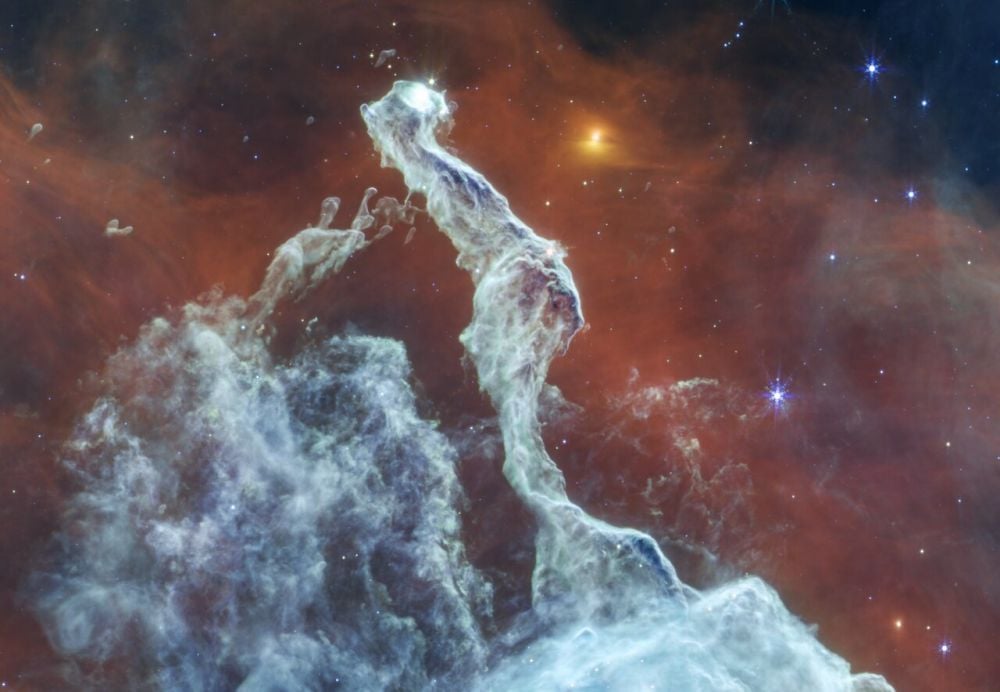
Boy Scouts Describe High-Speed Silver Object

One of the 28 files released by the US government documents a report of an alleged sighting on 25 June 1952. Three Boy Scouts attending a summer camp at Camp Fox were hiking in the mountainous terrain of Santa Catalina Island. According to an Air Force intelligence report documenting their account, the boys described an object that was 'silver in color.'

The description also said the object's 'altitude is uncertain,' and that its speed was 'faster than a conventional jet.' The witnesses also reported seeing the object make an upward turn shortly before its 'disappearance by disintegration.'

The officer who prepared the report said no attempt had been made to assess the witnesses' reliability and described their experience as 'probably meager at best'. The document records the Scouts' account but does not independently establish what they saw.

Other Reports Documented

The Boy Scouts were not the only unexplained aerial observation associated with Catalina Island reported. The newly publicised records include a report of an observation on 16 November 1953, when an unidentified person saw a round object with a purplish-white appearance above the island.

According to the documentation, the object initially appeared motionless before travelling north-west towards Los Angeles over approximately 10 minutes. Two other reports described earlier and later observations.

In a letter dated May 1949, Avalon resident Percy Wackey relayed an account from his wife and another person who reportedly saw six objects over Catalina Island on 28 April that year. 'My wife and a school teacher saw six objects in the sky, not in a group, but singly,' the handwritten report read.

'A few minutes later after going to my daughter's home, on the next street and corresponding block, she and my daughter and my grandson saw four more. All traveling in the same direction,' the report added. An Air Force annotation indicated that the information was insufficient for evaluation, according to the report.

In another incident, dated 15 March 1955, Avalon resident Paul J. Carr reported seeing a bright orange object for approximately two seconds. The officer recording that observation considered an astronomical explanation possible and concluded that further investigation was unnecessary.

Pentagon Files Offer No Proof of Extraterrestrial Activity

The documents form part of the US government's effort to make historical records concerning unidentified anomalous phenomena, commonly known as UAPs or UFOs, publicly accessible. The Pentagon's official archive explains that some cases remain unresolved because investigators lack enough information to reach a definitive conclusion about what observers encountered.

An unresolved classification does not, by itself, indicate that an object was extraterrestrial or technologically advanced. In a 2024 historical review, the Pentagon's All-domain Anomaly Resolution Office reported finding no verifiable evidence that investigated UAP sightings represented extraterrestrial activity or that the US government possessed extraterrestrial technology.

The newly released records document several historical reports of unusual sightings over Catalina Island, but they do not establish the identity of the objects described by the witnesses. The Scouts' account remains unexplained in the material reviewed.

The Pentagon Just Released a 1952 UFO Case — 3 Boy Scouts Watched It Vanish

{ https://www.ibtimes.co.uk/trending }

Hoe vind je dit bericht?
Geschreven door peter om 18:35 Stuur door

“UFOs can travel faster than light.” Why physicists remain deeply skeptical

“UFOs can travel faster than light.” Why physicists remain deeply skeptical

Favour Frederick

https%3A%2F%2Fmedia.zenfs.com%2Fen%2Ffodmap_everyday_588%2F45cfefd465d93356ef4bd8552b8b68b2.jpg

Flying saucer

Some UFO reports describe objects accelerating so quickly that witnesses conclude they must be using technology far beyond anything humans possess. From there, an even more dramatic claim sometimes appears: perhaps these craft can travel faster than light. Physicists remain deeply skeptical because nothing reliably measured in a UAP case has demonstrated superluminal travel, and modern relativity places an extremely strong limit on how fast matter can move through space.

That does not mean physicists think every future propulsion idea is impossible. Wormholes, warped spacetime and other theoretical concepts appear in legitimate physics research, but none has been shown to provide a practical method for moving a spacecraft faster than light.


The first problem is therefore not explaining alien propulsion. It is establishing that any UFO has actually been measured moving anywhere close to light speed.

The speed of light is not just another engineering barrier

Einstein's special relativity treats the speed of light in a vacuum as a fundamental limit for ordinary matter. As an object with mass is accelerated closer to that speed, the energy required to continue accelerating it rises dramatically.

NASA gives the speed of light as roughly 670 million miles per hour and explains that particles with mass can approach it but cannot simply accelerate through it using ordinary propulsion. Its explanation describes particles reaching 99.9% of light speed without crossing the limit.

This is fundamentally different from breaking the sound barrier. Engineers overcame the sound barrier because it was not built into the structure of spacetime in the same way.

Takeaway: Faster-than-light travel would not merely require a more powerful engine. It would require physics operating in a way no spacecraft has ever demonstrated.

No verified UFO case has been measured traveling faster than light

Videos can make an object look extraordinarily fast, but apparent speed is not enough. Scientists need distance, time and trajectory before they can calculate a real velocity.

NASA says the limited quantity and quality of UAP data currently prevent firm scientific conclusions in many cases. It also states that there is no evidence showing UAP are extraterrestrial technology in its current assessment.

Government investigations have reached similar conclusions. Some objects remain unidentified, but no verified case has demonstrated a craft moving at or beyond light speed.

That creates an enormous gap between "this object appeared incredibly fast" and "this object violated relativity."

Takeaway: No scientifically verified UAP measurement has established faster-than-light motion, so the claim currently begins with speculation rather than measured performance.

Apparent extreme speed can come from perspective

Some UFO videos look dramatically faster than the object actually was moving. Motion parallax is one major reason, especially when the observer is inside a fast-moving aircraft.

AARO reconstructed the famous Puerto Rico UAP case and found that objects appearing to travel rapidly were actually drifting at roughly 3.6 meters per second, close to the local wind speed. The apparent speed resulted largely from the aircraft's movement and viewing geometry, according to its analysis.

Its analysis of the "Go Fast" video reached a similar conclusion: the object did not display anomalous performance, and motion parallax exaggerated its apparent speed.

These cases show how easily visual impressions can outrun physical measurements.

Takeaway: An object can appear extraordinarily fast on video without actually traveling at extraordinary speed, making precise geometry essential before invoking exotic physics.

Astronomy already contains things that appear faster than light

There is an important twist: astronomers sometimes measure apparent speeds greater than light without violating relativity. This phenomenon is called apparent superluminal motion.

NASA has observed astrophysical jets that appear to move several times faster than light. In one case involving material from a neutron-star collision, Hubble measurements produced an apparent speed of seven times light speed.

The material was not actually exceeding the cosmic speed limit. The geometry of a jet moving almost directly toward Earth at nearly light speed compressed the apparent timing of its motion, creating an illusion of superluminal travel. NASA explains the effect in its analysis.

That example is important for UFO discussions because even a measured apparent speed above light would need careful interpretation.

Takeaway: Physics already knows ways objects can appear faster than light without actually breaking the light-speed limit.

Wormholes would not technically make a spacecraft outrun light

Wormholes are often presented as one solution to interstellar travel. General relativity allows mathematical spacetime geometries that resemble shortcuts connecting distant locations.

A spacecraft using such a shortcut would not necessarily accelerate through local space faster than light. Instead, it would take a shorter path between two distant regions.

NASA describes a wormhole as a possible shortcut rather than ordinary faster-than-light movement in its discussion of speculative physics.

The problem is that scientists have never discovered a traversable wormhole, and theoretical versions often require unusual forms of matter or energy whose practical existence is uncertain.

Takeaway: Wormholes provide a mathematical way around distance rather than demonstrated faster-than-light propulsion, and there is no evidence UFOs use them.

Warp drives try to move spacetime instead of the spacecraft

Another famous possibility is the warp-drive idea. Instead of accelerating a spacecraft through space beyond light speed, the concept changes spacetime around the craft itself.

The best-known example is the Alcubierre metric, a solution to Einstein's equations proposing contraction of space ahead of a craft and expansion behind it.

In principle, this creates a loophole because the spacecraft remains locally below light speed even though the overall spacetime configuration could move it between distant points unusually quickly.

The difficulty is enormous. Proposed warp geometries have historically required exotic energy conditions, and no experiment has shown that humans—or anyone else—can build such a spacetime structure.

Takeaway: Warp drives are serious theoretical ideas, but they remain mathematical possibilities rather than demonstrated propulsion technology.

Faster-than-light travel creates problems with cause and effect

Relativity links space and time closely enough that faster-than-light communication can create more than a speed problem. Under some conditions, it can allow events to appear in an order that threatens ordinary causality.

In simplified terms, a faster-than-light signal could be viewed from certain reference frames as arriving before it was sent.

That creates familiar time-travel paradoxes and is one reason physicists treat superluminal travel with such caution.

A successful faster-than-light theory would therefore need to explain not only how the propulsion works but also why cause and effect remain logically consistent.

Takeaway: Faster-than-light travel could interfere with the normal order of cause and effect, making the problem much deeper than simply finding enough energy.

Witnesses cannot estimate extreme speeds accurately by eye

Claims that a UFO went from stationary to thousands of miles per hour almost instantly often come from eyewitness descriptions rather than complete instrument records. Human vision is not capable of measuring that kind of acceleration precisely.

Without knowing an object's distance and size, apparent motion can be badly misleading.

A nearby small object can cross someone's field of vision quickly and appear to be a large distant craft moving at enormous speed. An object disappearing can also be interpreted as sudden acceleration even if it simply dimmed, turned or moved outside the observer's viewing angle.

This does not mean witnesses are dishonest. It means extraordinary velocity requires instrumentation rather than visual impression.

Takeaway: Human observers can recognize unusual motion, but they cannot reliably calculate extreme speed without distance and timing measurements.

Some genuinely puzzling UAP reports still deserve investigation

Physicists being skeptical of faster-than-light UFOs does not mean every UAP has already been explained. AARO continues to publish cases where the available evidence is insufficient for a confident identification.

Its 2026 public archive includes reports of objects described by observers as unusually fast or unlike known aircraft, while also noting limitations in sensor quality and available data.

Those cases can be scientifically interesting without supporting superluminal travel.

The correct conclusion when evidence is incomplete is that the object remains unresolved, not that known physics has been broken.

Takeaway: An unexplained UFO may justify more investigation, but mystery alone cannot establish faster-than-light technology.

Interstellar travel would not necessarily require faster-than-light speed

Another reason the claim is unnecessary is that hypothetical extraterrestrial civilizations could reach other star systems without violating relativity at all. Robotic probes could travel for centuries or millennia at speeds well below light speed.

A sufficiently old civilization might also use autonomous machines that do not face human lifespan limitations.

Even spacecraft moving at a modest fraction of light speed could cross interstellar distances given enough time.

This means the possibility of extraterrestrial visitation does not logically require warp drives or faster-than-light engines.

Takeaway: Aliens could theoretically travel between stars without breaking the light-speed limit, especially using long-lived robotic probes.

What would convince physicists that a UFO had broken the limit?

https%3A%2F%2Fmedia.zenfs.com%2Fen%2Ffodmap_everyday_588%2Fa1d3238d1c16de254640c4205bc77ae4.jpg

Photo Credit: Deposit Photos

A convincing case would require several independent calibrated instruments measuring the same object's position and travel time while ruling out perspective effects, sensor errors and ordinary explanations.

The result would need to be reproducible or supported strongly enough that outside physicists could independently analyze the raw data.

Researchers would then need to determine if the motion truly represented matter traveling locally faster than light rather than a geometric effect like apparent superluminal motion.

Such evidence would represent one of the largest discoveries in modern physics.

Nothing in current UAP evidence reaches that standard.

The Real Reason Scientists Doubt Alien Visitors | Brian Greene

{ https://www.yahoo.com/news/ }

Hoe vind je dit bericht?
Geschreven door peter om 18:14 Stuur door

Meer van UFO'S of UAP'S, ASTRONOMIE, RUIMTEVAART, ARCHEOLOGIE, OUDHEIDKUNDE, SF-SNUFJES EN ANDERE ESOTERISCHE WETENSCHAPPEN - DE ALLERLAATSTE NIEUWTJES

↑ Terug naar de berichten