Naar de inhoud

UFO'S of UAP'S, ASTRONOMIE, RUIMTEVAART, ARCHEOLOGIE, OUDHEIDKUNDE, SF-SNUFJES EN ANDERE ESOTERISCHE WETENSCHAPPEN - DE ALLERLAATSTE NIEUWTJES

UFO's of UAP'S in België en de rest van de wereld
akke.beakke.be
Ontdek de Fascinerende Wereld van UFO's en UAP's: Jouw Bron voor Onthullende Informatie! Ben jij ook gefascineerd door het onbekende? Wil je meer weten over UFO's en UAP's, niet alleen in België, maar over de hele wereld? Dan ben je op de juiste plek! België: Het Kloppend Hart van UFO-onderzoek In België is BUFON (Belgisch UFO-Netwerk) dé autoriteit op het gebied van UFO-onderzoek. Voor betrouwbare en objectieve informatie over deze intrigerende fenomenen, bezoek je zeker onze Facebook-pagina en deze blog. Maar dat is nog niet alles! Ontdek ook het Belgisch UFO-meldpunt en Caelestia, twee organisaties die diepgaand onderzoek verrichten, al zijn ze soms kritisch of sceptisch. Nederland: Een Schat aan Informatie Voor onze Nederlandse buren is er de schitterende website www.ufowijzer.nl, beheerd door Paul Harmans. Deze site biedt een schat aan informatie en artikelen die je niet wilt missen! Internationaal: MUFON - De Wereldwijde Autoriteit Neem ook een kijkje bij MUFON (Mutual UFO Network Inc.), een gerenommeerde Amerikaanse UFO-vereniging met afdelingen in de VS en wereldwijd. MUFON is toegewijd aan de wetenschappelijke en analytische studie van het UFO-fenomeen, en hun maandelijkse tijdschrift, The MUFON UFO-Journal, is een must-read voor elke UFO-enthousiasteling. Bezoek hun website op www.mufon.com voor meer informatie. Samenwerking en Toekomstvisie Sinds 1 februari 2020 is Pieter niet alleen ex-president van BUFON, maar ook de voormalige nationale directeur van MUFON in Vlaanderen en Nederland. Dit creëert een sterke samenwerking met de Franse MUFON Reseau MUFON/EUROP, wat ons in staat stelt om nog meer waardevolle inzichten te delen. Let op: Nepprofielen en Nieuwe Groeperingen Pas op voor een nieuwe groepering die zich ook BUFON noemt, maar geen enkele connectie heeft met onze gevestigde organisatie. Hoewel zij de naam geregistreerd hebben, kunnen ze het rijke verleden en de expertise van onze groep niet evenaren. We wensen hen veel succes, maar we blijven de autoriteit in UFO-onderzoek! Blijf Op De Hoogte! Wil jij de laatste nieuwtjes over UFO's, ruimtevaart, archeologie, en meer? Volg ons dan en duik samen met ons in de fascinerende wereld van het onbekende! Sluit je aan bij de gemeenschap van nieuwsgierige geesten die net als jij verlangen naar antwoorden en avonturen in de sterren! Heb je vragen of wil je meer weten? Aarzel dan niet om contact met ons op te nemen! Samen ontrafelen we het mysterie van de lucht en daarbuiten.

This Ancient Meteorite Hints at Mars' Warm, Wet Past

This Ancient Meteorite Hints at Mars' Warm, Wet Past

This image shows a group of meteorite hunters in the Sahara Desert. Nomadic people from the region have become expert meteorite hunters, finding hundreds of them, which are typically recovered as groups of fragments. One found in Mali in 2022 has proven to be almost as old as Mars itself, one of the most ancient pieces of Mars ever recovered. Image Credit: University of New Mexico.

This image shows a group of meteorite hunters in the Sahara Desert. Nomadic people from the region have become expert meteorite hunters, finding hundreds of them, which are typically recovered as groups of fragments. One found in Mali in 2022 has proven to be almost as old as Mars itself, one of the most ancient pieces of Mars ever recovered.

Image Credit: University of New Mexico.

Mars is the subject of an ongoing, decades-long effort to understand its past. Its potential ancient habitability drives that effort. More than 20 missions have been sent to its surface (though many didn't survive the entry and landing). Two are operating there currently, Curiosity and Perserverance, and multiple orbiters scan the planet's surface from above.

Clues to Mars' past are in its rock, and the more ancient a piece of rock, the deeper the clues it can contain about the planet's ancient past. Visiting Mars with rovers is only one way to access the planet's rock. Fortunately, some chunks of Mars have been sent to Earth. Violent impacts have sent chunks of Mars rock into space, where they've eventually found their way to Earth as meteorites.

A Martian meteorite named Black Beauty set the standard for ancient meteorites from Mars when it was found in 2011. Most meteorites are found in deserts or in snowy/icy areas simply because they're more easily seen, and Black Beauty (Northwest Africa 7034, or NWA 7034) was found by nomads in the Western Sahara. Portions of it are about 4.43 billion years old, and Mars is about 4.5, maybe 4.6 billion years old. So Black Beauty is extremely ancient.

The Sahara Desert has yielded other ancient Martian meteorites, including Teghaza 001 (Teg 001), found in Mali in 2022. New research uncovered some unusual properties in Teg 001, and they're presented in new research.

The research is titled "A Martian meteorite that formed ≳4.1 billion years ago samples Mars’ early crust and mantle," and it's published in the journal Science. The lead author is Yang Liu from NASA's Jet Propulsion Laboratory at the California Institute of Technology. Scientist Carl Agee, director and curator at the University of New Mexico’s Institute of Meteoritics (IOM), also played a leading role in the work.

"This sample probably came from an environment on Mars that was more Earth-like." - Carl Agee, University of New Mexico.

(A) shows the largest of the eight pieces of Teg001. (B) shows a cut section of a smaller chunk. Image Credit: Yang Liu et al., A Martian meteorite that formed ≳4.1 billion years ago samples Mars’ early crust and mantle. Science0,eadz5646DOI:10.1126/science.adz5646

(A) shows the largest of the eight pieces of Teg001. (B) shows a cut section of a smaller chunk. Image Credit: Yang Liu et al., A Martian meteorite that formed ≳4.1 billion years ago samples Mars’ early crust and mantle.

Science0,eadz5646DOI:10.1126/science.adz5646

Ancient meteorites are rare finds and they're extremely valuable scientifically.

"Martian meteorites provide a record of the planet’s geological history," the authors explain in their research. "However, most are geologically young samples that are not representative of Mars’ surface, which is dominated by ancient rocks."

Most meteorites are young just because of selection effects. Meteorites are launched into space by impacts, and that favours young rocks, which are stronger. So meteorites tend to come from younger, basaltic volcanic rocks. More ancient parts of Mars crust are weaker because they're fractured and brecciated by impacts. Some ancient rocks are also sedimentary or clay-bearing rock. These rocks are weaker and much less likely to survive an impact that can launch them into space.

Teghaza is one of the rare ancient Martian meteorites.

"We describe the Martian meteorite Teghaza 001 (Teg 001), a slowly cooled igneous rock that formed at least 4.1 billion years ago," the authors write. "Its composition, mineralogy, and texture are distinct from other Martian meteorites." Distinct from other Martian meteorites, but also similar to likewise ancient Black Beauty.

“I realized that this one was a little bit like Black Beauty, not exactly, but it resembled it in the oxygen isotope values,” Agee said in a press release. "I looked at it microscopically and found domains within it that had high levels of manganese oxide, a compound being looked for on Mars by the rovers as an indicator of environments conducive to life.”

MSL Curiosity found rock fractures in Gale Crater that were filled with material rich in MnO. It suggests, but doesn't prove, that the planet's atmosphere once had free oxygen and oxygen-rich groundwater. That's still being debated.

Lead author Yang Liu and other Caltech scientists used a dating technique to find the age of tiny zircon crystals in Teg 001. Zircon crystals are important finding the age of ancient rocks because they can survive geological processes. They also contain trace amounts of elements with long half-lives. This is how Liu determined that Teg 001 is 4.1 billion years old. "We conducted ten measurements of U and Pb isotopes, in six shocked zircon grains with different morphologies, to determine their U-Pb and Pb-Pb ages," the authors explain.

Though Black Beauty is also ancient, the pair of meteorites are quite different from one another.

“There are a few parts to Black Beauty that are around that age, but that whole meteorite itself is a conglomeration of many different rock types. Teghaza 001 is just one unadulterated rock type, and it's 4.1 billion years or older, so that was a big surprise,” said Agee. “It's the oldest Martian igneous rock ever found by a huge margin, but in addition to that, it seemed to have these clues in its composition that suggested it had been in an environment that had fluids and water coursing through it.”

Teghaza 001 was found in several chunks adding up to almost 800 grams. Unlike Black Beauty, which is a congolomeration of different chunks, Teg 001 is a single rock type. Image Credit: UNM.

Teghaza 001 was found in several chunks adding up to almost 800 grams. Unlike Black Beauty, which is a congolomeration of different chunks, Teg 001 is a single rock type.

Image Credit: UNM.

The isotope Oxygen-18 indicated that it had interacted with water in the past, most likely on the Martian surface. "The high δ 18O value of Teg 001 probably reflects assimilation of δ18O-rich crustal material that had interacted with surficial fluids, or direct reaction of the magma with high-δ18O fluids," the authors write. That finding supports the hypothesis that Mars was once warm and wet, a hypothesis supported by a growing body of evidence.

“We also had these anomalous oxygen isotopes, and these domains that had high manganese levels, Agee said. "All of that was consistent with it being from a time on Mars, from the very, very beginning when the Martian environment was different from the time in which most of the Martian meteorites that we see were formed and erupted a few 100 million years ago when Mars was a dry desert, just like it is now. This sample probably came from an environment on Mars that was more Earth-like.”

This image shows a cut section of Teg001, with some of its features and contents labelled. Pigeonite (PgT) is particularly relevant, because it hosts fluid-altered Magnesium. "The Mg-rich interiors of pigeonite have been heavily altered by reactions with a fluid phase," the authors write. Image Credit: Yang Liu et al., A Martian meteorite that formed ≳4.1 billion years ago samples Mars’ early crust and mantle. Science0,eadz5646DOI:10.1126/science.adz5646

This image shows a cut section of Teg001, with some of its features and contents labelled. Pigeonite (PgT) is particularly relevant, because it hosts fluid-altered Magnesium. "The Mg-rich interiors of pigeonite have been heavily altered by reactions with a fluid phase," the authors write. Image Credit: Yang Liu et al., A Martian meteorite that formed ≳4.1 billion years ago samples Mars’ early crust and mantle.

Science0,eadz5646DOI:10.1126/science.adz5646

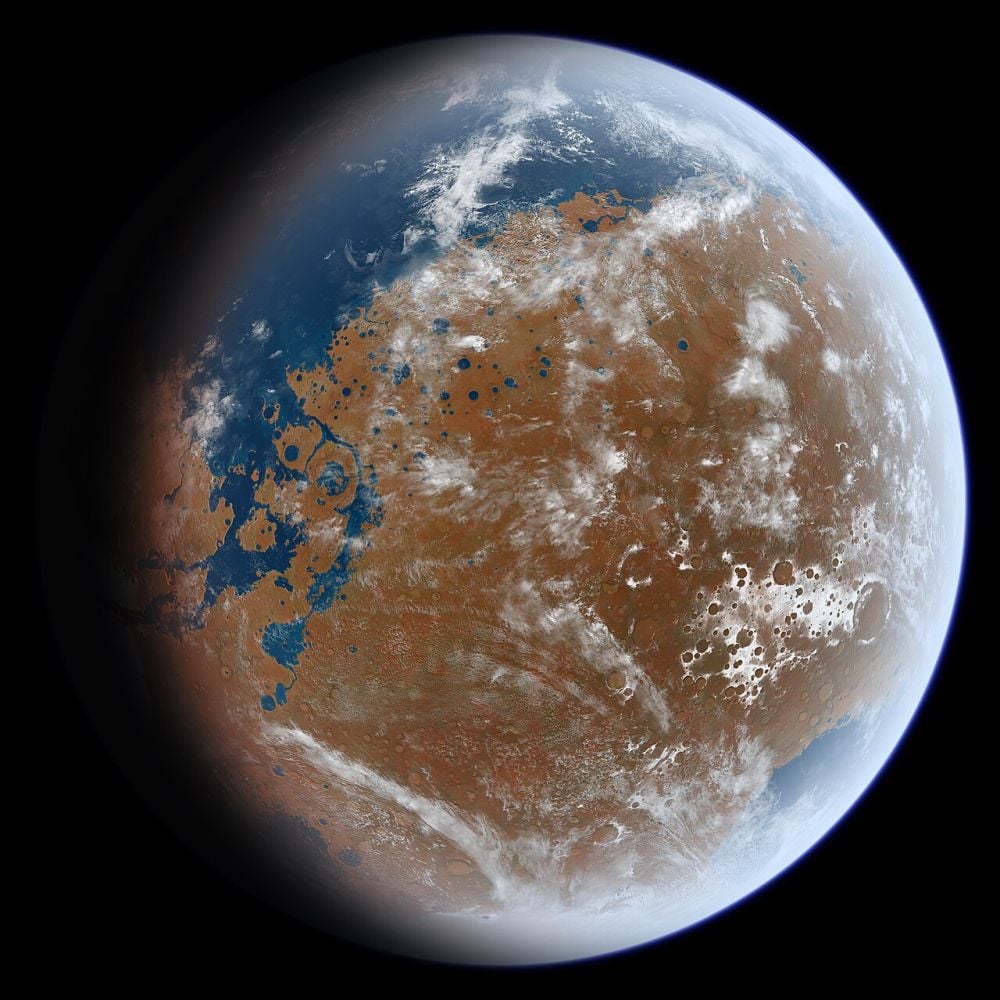
Mars' early, potentially more Earth-like time period is called the Pre-Noachian period. Planetary scientists struggle to paint a clear picture of the Pre-Noachian because it was so long ago, and geologica processes and weathering have erased much of the ancient. Some research shows that Mars may have had global oceans during this period, a stunning difference from the frigid, dessicated planet it is today.

It's possible that billions of years ago, Mars had a global ocean, as shown in this illustration. That could explain the aqueous alteration in Teg001. Image Credit: By Ittiz - Own work, CC BY-SA 3.0, https://commons.wikimedia.org/w/index.php?curid=7861829

It's possible that billions of years ago, Mars had a global ocean, as shown in this illustration. That could explain the aqueous alteration in Teg001.

Image Credit: By Ittiz - Own work, CC BY-SA 3.0, https://commons.wikimedia.org/w/index.php?curid=7861829

It's possible that Mars still has some simple, extant life. If it does, that life is hiding somewhere underground where the last of the planet's ancient water might be sequestered, away from the harsh radiation on the surface. But if the emerging picture of an ancient, warm and wet Mars is true, that would be the Pre-Noachian.

“If there was ever abundant life on Mars, on the surface, not sequestered away in some subsurface, that would be the time that you would be looking at, the Pre-Noachian period,” said Agee. “It's the very earliest time, and that was when maybe Mars still had a magnetic field, and it was shielded from radiation, and there were surface waters. There was a denser atmosphere. If primitive life was abundant in Mars. That is the time that is most likely for it to have happened.”

Most Martian meteorites are much younger than Teg001, only a few hundred million years old. It likely came from a place no rover has visited, possibly from Mars' southern highlands. Remote sensing shows that that ancient region has a similar composition to Teg001.

“This is just one single meteorite. It's like going out, going back in time and chipping off a hunk of an outcrop, 4 billion years ago on Mars, and then we have this example of what was actually happening,” said Agee. “That is why it's such a valuable sample. We’ve never found one like this before. The most exciting part about this find is its age, plus the alteration in the meteorite that indicates it has been in what I would call an Earth-like environment, with fluids coursing over the surface and volcanoes creating hydrothermal systems. There are surface waters and so on. And that's all reflected in the way that the meteorite has been sort of altered from its original state.”

"The presence of aqueously altered minerals, combined with bulk and mineral-specific oxygen isotope measurements, indicate that Teg 001 experienced reactions with fluids enriched in 18O, before ejection into space by an impact," the authors summarize in their paper.

RELATED

How Scientists Proved These Rocks Came From Mars.

{https://www.universetoday.com/ }

Hoe vind je dit bericht?
Geschreven door peter om 17:47 Stuur door

Examining the Cat's Head Nebula with the Hubble and JWST

Examining the Cat's Head Nebula with the Hubble and JWST

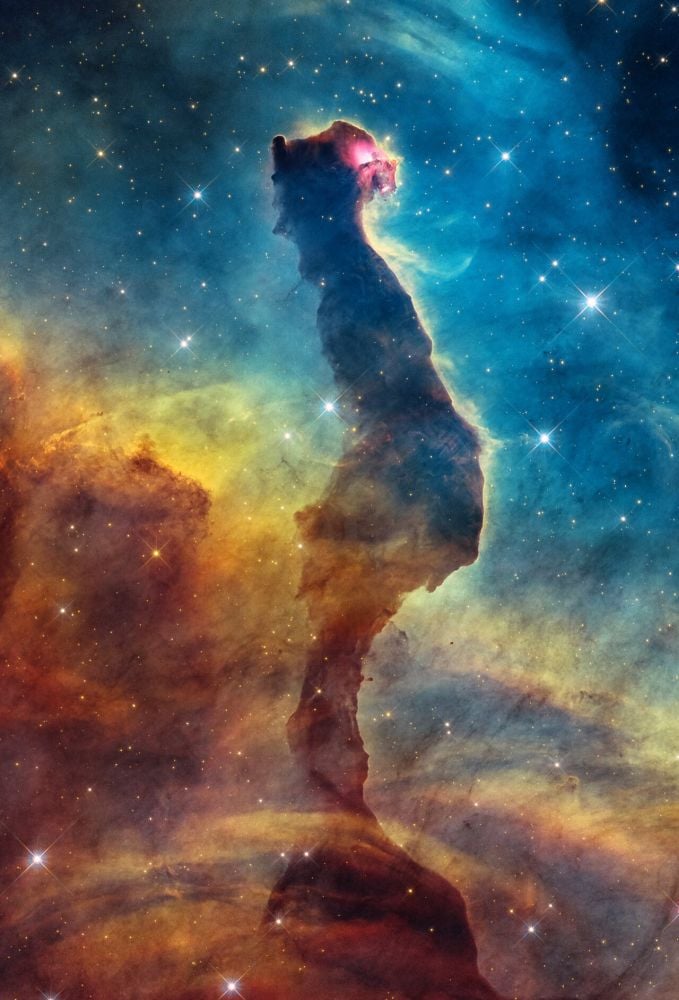
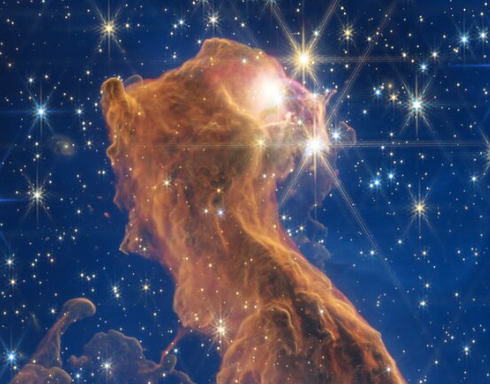
The Cat's Head Nebula proudly rises in this Hubble Space Telescope image. It's a star-forming region within the larger Carina Nebula, an even larger star-forming region. Recently, both the Hubble and the JWST imaged the Cat's Head as part of the ongoing scientific effort to understand the complex process of star formation. Image Credit: NASA, ESA, STScI. Image Processing: J. Depasquale (STScI).

The Cat's Head Nebula proudly rises in this Hubble Space Telescope image. It's a star-forming region within the larger Carina Nebula, an even larger star-forming region. Recently, both the Hubble and the JWST imaged the Cat's Head as part of the ongoing scientific effort to understand the complex process of star formation.

Image Credit: NASA, ESA, STScI. Image Processing: J. Depasquale (STScI).

The Cat's Head nebula gets its name from its appearance: it looks like a cat sitting so that it's facing away from the viewer, with its head turned around on the top of its neck, highlighted by a star that looks like a glowing eye. The unusual shape is made of gas and dust carved and formed by the radiation of young stars.

It's a small part of the larger Carina Nebula, a complex star-forming region about 7,500 light years away. Recently, both the Hubble and the JWST cast their gaze on the Cat's Head in an effort to learn more about star formation, a constant research subject in astronomy.

The Carina Nebula hosts some of the most massive stars in the entire Milky Way in its Carina OB1 assocation. Of particular interest is Eta Carinae, a stellar system that hosts many stars, two of which have a combined luminosity more than 5 million times greater than the Sun. Eta Carinae is also known for being at the heart of the eerily creepy Homunculous Nebula, not visible in these images. Massive stars like the ones in Eta Carinae and their powerful radiation have a pronounced effect on the region, and on star formation itself.

Hubble's image of the Cat's Head is in visible light, while the JWST imaged it in both near and mid-infrared. Each of the images shows a different aspect of the Cat's Head.

The pillar that makes the Cat's Head is composed of thick, dark dust, so far resisting the onslaught of stellar wind and radiation from massive stars. The yellow outline on its right side is likely where photoevaporation is taking place, driven by the same powerful stars. The UV radiation is ionizing the gas on the rim, and will eventually evaporate it completely.

In astronomy images like these, different filters isolate different chemicals like sulphur, oxygen, and hydrogen. The ionization level of the chemicals, along with how highly they're energized and how much dust is present, all affect the colours. Whether we know which colours represent which chemicals or not, these images are awe-inspiring.

The massive stars in the region are also responsible for the arcs and shoals in the images, again caused by their powerful radiation and stellar winds.

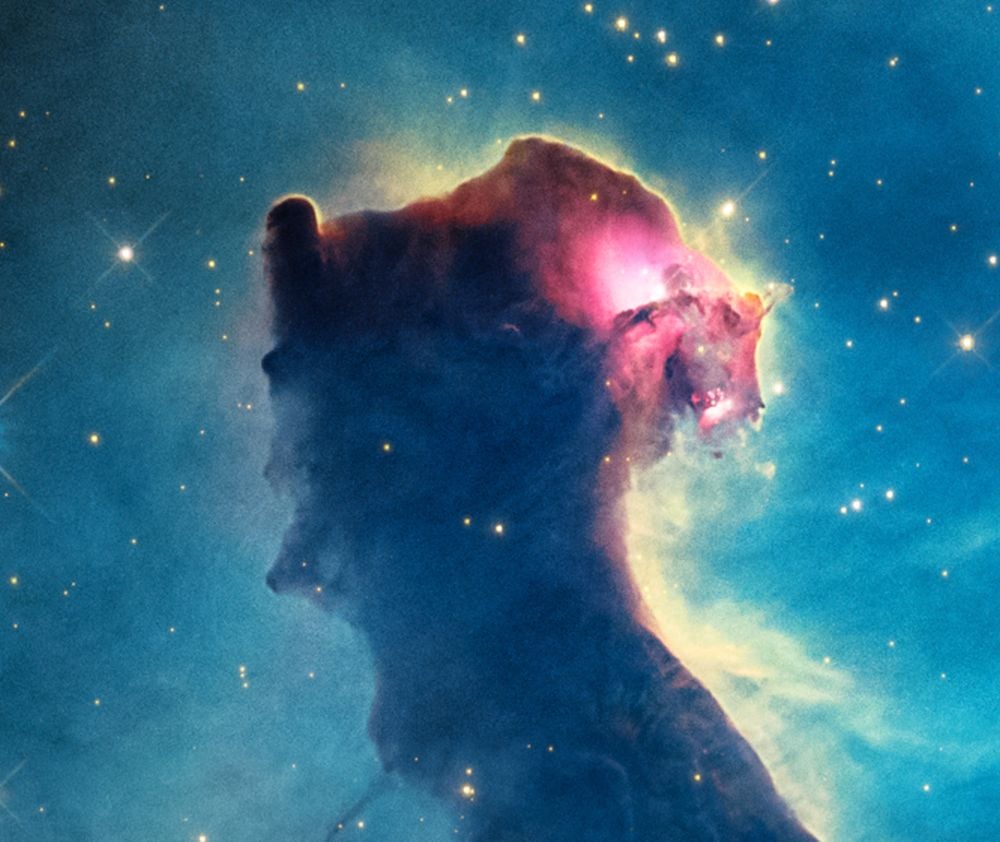
This zoomed-in portion of the Hubble's image highlights the "eyeball", likely a star in just the right position. Image Credit: NASA, ESA, STScI. Image Processing: J. Depasquale (STScI).

This zoomed-in portion of the Hubble's image highlights the "eyeball", likely a star in just the right position.

Image Credit: NASA, ESA, STScI. Image Processing: J. Depasquale (STScI).

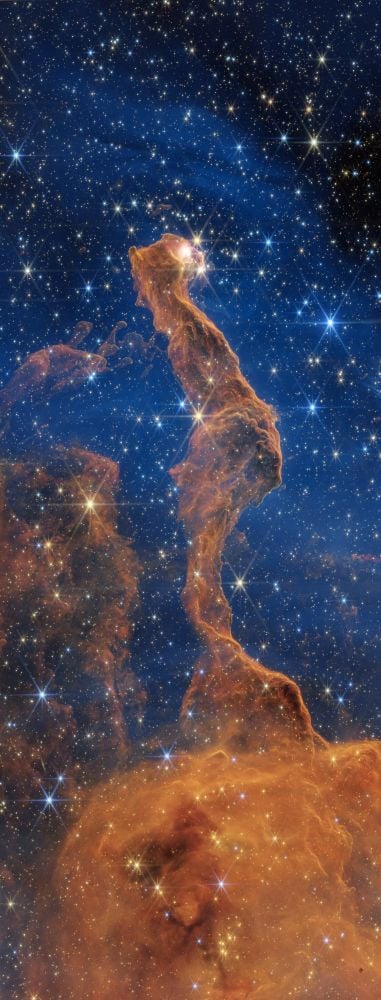
The JWST, as an infrared telescope, presents different, yet no less gorgeous, images of the Cat's Head. It's infrared instruments see things differently than the Hubble does. This gives the Cat's Head—already ethereal in the Hubble image—an even more ghostly, almost unreal appearance. Some parts of the Cat's Head in the JWST images appear to be only half-there, with background stars shining brightly through them.

weic2622c_20261029_192815.jpg

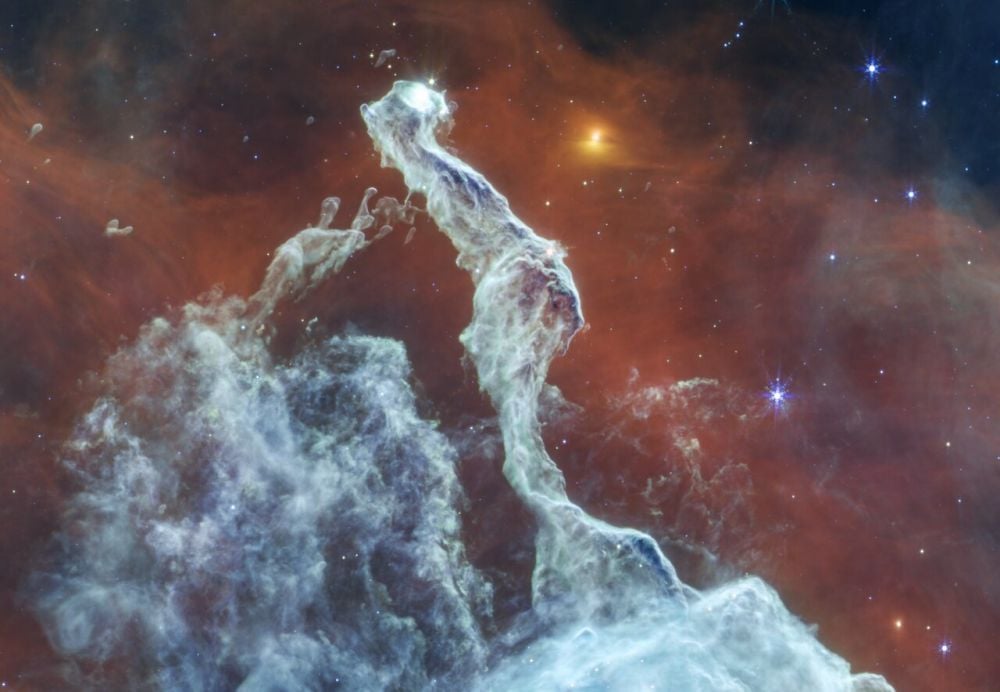
The JWST's near-infrared image doesn't show different chemical elements the same way the Hubble image does. Instead, it shows more of the stars themselves. Even background galaxies are visible beyond the Cat's Head, along with the black background of space. The JWST also shows how massive stars are shaping the region, with the wispy filaments on the images left side.

Image Credit: NASA, ESA, CSA, STScI. Image Processing: J. Depasquale (STScI)

Some of the turbulence in the gas, driven by the massive stars, appears more substantial in the JWST image. The star that makes the Cat's Eye is also brighter, with less of its light blocked by dust in infrared.

A zoomed-in JWST NIR image of the head in the Cat's Head Nebula. Image Credit: NASA, ESA, CSA, STScI. Image Processing: J. Depasquale (STScI)

A zoomed-in JWST NIR image of the head in the Cat's Head Nebula.

Image Credit: NASA, ESA, CSA, STScI. Image Processing: J. Depasquale (STScI)

In the JWST's mid-infrared image, the Cat's Head Nebula is transformed yet again. It's muted and ghost-sheet white, surrounded by pastel gas clouds punctuated with stars. The clouds look almost Earth-like in their white colour. This time, it's carbon molecules and warm dust emissions that take the stage. What is most likely an infant star pops into view in this image, embedded in thick dust that it's yet to dissipate, to the right of the head itself.

The white colour of the gas in this mid-infrared JWST image makes it look like Earthly clouds. Fewer stars are visible in the background, their light blocked out by the gas, which appears thicker. In the gas to the left, finer detail is visible in the gas clouds. Image Credit: NASA, ESA, CSA, STScI. Image Processing: J. Depasquale (STScI).

The white colour of the gas in this mid-infrared JWST image makes it look like Earthly clouds. Fewer stars are visible in the background, their light blocked out by the gas, which appears thicker. In the gas to the left, finer detail is visible in the gas clouds.

Image Credit: NASA, ESA, CSA, STScI. Image Processing: J. Depasquale (STScI).

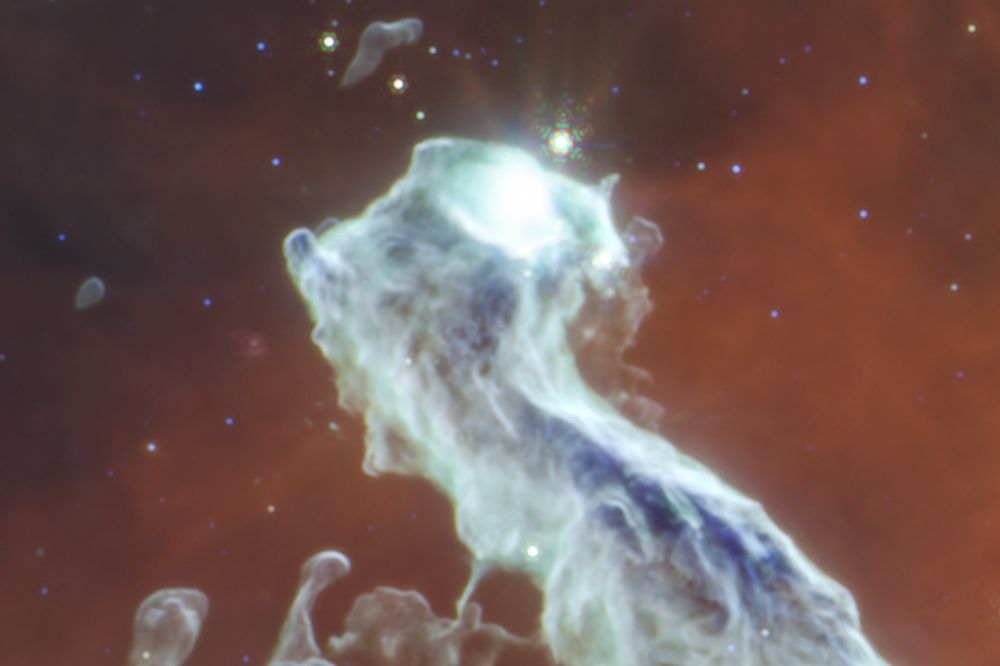
The head itself is muted in the MIR image, along with the rest of the nebula. It's eye, almost malevolent in the other images, blends in with the gas and is less striking.

In this zoom-in of the MIR image, the edges are softened, and so are the colours. The star that makes they eye blends in with the gas in gradients of white. Globules below the head look like they're reaching for the head, rather than being blown back by stellar wind and radiation. The blackness of space is visible in the upper right, and a little in the upper left. Image Credit: NASA, ESA, CSA, STScI. Image Processing: J. Depasquale (STScI).

In this zoom-in of the MIR image, the edges are softened, and so are the colours. The star that makes they eye blends in with the gas in gradients of white. Globules below the head look like they're reaching for the head, rather than being blown back by stellar wind and radiation. The blackness of space is visible in the upper right, and a little in the upper left. I

mage Credit: NASA, ESA, CSA, STScI. Image Processing: J. Depasquale (STScI).

Though these images are easy to appreciate by almost anyone, their primary purpose is scientific. By emphasizing and de-emphasizing different aspects of the Cat's Head nebula, astronomers can see stars more clearly, along with the dust, the gas, and the chemistry. Together, they help researchers see the effects of stellar radiation and wind, called stellar feedback, on the ongoing process of star formation.

Stellar feedback can both encourage and stifle star formation, depending on circumstances. It's complicated, and it's an ongoing topic of astronomical study. One of the JWST's main, defining science themes is star formation, and images like these are one of the reasons it was built. The Hubble helps too, and illustrates how the gas, the dust, the metallicity, and the stars of different sizes and ages, all play a role. Those factors all interact in different ways, making it difficult to come up with concrete theories of how it all works.

These gorgeous images are more than eye candy to astronomers. They're working hard on understanding a process fundamental to the cosmos. Wrapped up in all this visual chaos and beauty, Nature's laws are defining how stars form. Astronomers' mission is to decipher it all.

Enjoying these images on their visual merit alone is our mission, if we accept it.

{https://www.universetoday.com/ }

Hoe vind je dit bericht?
Geschreven door peter om 17:23 Stuur door

Triangle UFO Seen From Plane Over Utah, USA Oct 18, 2026, UAP Sighting News.

Triangle UFO Seen From Plane Over Utah, USA Oct 18, 2026, UAP Sighting News.

UFO_UAP.png

UAP_Utah.png

Date of sighting: Oct 18, 2026
Location of sighting: Utah, USA
Source: NUFORC
 
What looks like three glowing lights in the sky outside a passanger jet is actually one single triangle UFO. The lights are the glow of the anti propulsion systems...three of them, one on each corner of the craft. Bob Lazar who worked in area S4 of the secure Air Force Base Area 51 often stated that most small UFOs had three anti gravity units that sometimes glowed which propelled the craft. Here...we see all three very well. This is some serous alien technology right outside the passenger jet. How it didn't show up on radar is beyond me, but alien tech never stops surprising me at what it can do.
Scott C. Waring - UFO Sightings Daily 
 
Eyewitness states: 
On SW flight #2927. During the sightings flight was at or around 32,000 feet. About 30 minutes from landing in Las Vegas. Traveling at or around 487mph.3 lights. Looked like stars. 2 bright white lights moving in circle like fashion around the reddish light. This went on for several minutes. The lights would appear and disappear. Also, during these events, a dark triangle like craft with several small lights travelled east / north east which was counter to the direction of my travel.
That craft was moving at a speed unlike anything I have seen before, having seen many planes moving in the sky around a plane I was on. I have no way to estimate its speed or distance. It appeared large and much closer to my location that the lights. I approached the pilot upon landing, and he did not have much to say about the lights. The response to the craft I saw was only that it did not appear on his instrumentation. That craft could have been a stealth bomber. It seemed to have that characteristic.
Triangle UFO Seen From Plane Over Utah, USA Oct 18, 2026, UAP Paranormal Alien Sighting News.

{ https://www.ufosightingsdaily.com/  }

Hoe vind je dit bericht?
Geschreven door peter om 17:06 Stuur door

Ejection Pods Found On Mars, Fits Figures Size, Were They natives To Mars Or Just Lost? UFO UAP Sighting News

Ejection Pods Found On Mars, Fits Figures Size, Were They natives To Mars Or Just Lost? UFO UAP Sighting News


Mars_life.png
Mars_pod.png
 
Date of discovery: Oct 31, 2026
Location of discovery: Mars
Source photo:
 
Hey all, hope you had a great week. I found something the appears to be an escape pod from an alien spaceship on Mars. Near it is another one, but larger and the door is still unopened...which means they died on impact or never had time to get into the pod before it was ejected. The door is similar in size and shape as the pod on its side with an open door. These pod doors are about the same size as the woman figures we have been finding on Mars. We found many figures, but I show you two in my video as an example. I wonder...if they were not native to Mars, but just in a ship in orbit near Mars and escaping a dying ship, landing on Mars only to be left...lost on a planet with no hope of survival? 
Scott C. Waring - UFO Sightings Daily 
 
{ https://www.ufosightingsdaily.com/  }
Hoe vind je dit bericht?
Geschreven door peter om 16:59 Stuur door

UFOs could be hiding in our oceans, says retired US Navy admiral... as researcher claims to have discovered 'alien base entrance' off Canada

UFOs could be hiding in our oceans, says retired US Navy admiral... as researcher claims to have discovered 'alien base entrance' off Canada

Humanity has yet to make contact with aliens, and a retired US Navy Admiral has proposed a radical reason why: they are hiding in our oceans.

Tim Gallaudet, a former acting administrator of the National Oceanic and Atmospheric Administration (NOAA), recently explained why Earth's deep ocean may be the perfect hiding spot.

Speaking on the Hang Out with Sean Hannity podcast, Gallaudet said: 'If they were to go somewhere basically to not be detected for a period of time... where would you want to go?

'You'd want to go... [to] the most unexplored area of the world, and that's the ocean.' 

After decades of studying the ocean, Gallaudet believes its largely uncharted depths could conceal phenomena that have so far escaped detection. 

'We've only explored with either drones, buoys [or] floats, about 10 percent of ocean volume,' Gallaudet said. 'So there's a lot of mystery out there right now.' 

His comments come as a UFO researcher claims to have found an entrance into an underwater alien base off the coast of Canada.

Scott C Waring uncovered a mysterious hole in the waters surrounding Nunavut, which he claimed was more than 3,000 feet across and about 32 feet below the surface.

A retired US Navy admiral claimed that UFOs could be hiding under Earth's ocean amid a claim that an alien base has been identified in waters off the coast of Canada

A retired US Navy admiral claimed that UFOs could be hiding under Earth's ocean amid a claim that an alien base has been identified in waters off the coast of Canada

During the interview, Gallaudet highlighted a video he claimed showed mysterious objects moving underwater before jumping out to the surface.

'It goes into the ocean, no disturbance,' Gallaudet told Sean Hannity during the podcast. 

'I'm aware of another video that shows something similar, but from overhead... so yeah, there's something that they've been able to engineer that we have no idea how to reproduce,' he added. 

Gallaudet claimed the objects could break the sound barrier without the thunderous boom that normally accompanies supersonic flight, a feat he said defies explanation with current technology. 

He testified under oath before Congress in 2024, claiming there was a 2015 incident involving near-midair collisions with UFOs during a carrier strike group exercise and the subsequent disappearance of an urgent email report about the event.

The former admiral also asserted that Earth is visited by non-human intelligence utilizing advanced technology with extraordinary flight and transmedium capabilities. 

While Gallaudet has never provided locations where UFO bases could be hiding, Waring believes he has found the entrance to one. 

'I found an entrance to an underwater alien base, and it's in the most remote area of northern Canada that one could go,' Waring posted on his site UFO Sightings Daily.

Tim Gallaudet, a former acting administrator of the National Oceanic and Atmospheric Administration (NOAA), recently explained why Earth's deep ocean may be the perfect hiding spot.

Tim Gallaudet, a former acting administrator of the National Oceanic and Atmospheric Administration (NOAA), recently explained why Earth's deep ocean may be the perfect hiding spot.

UFOs (UAPs) Are Hiding In Deep Oceans! A Researcher Calls To Explore Deep Waters ‪@TheCosmosNews‬

'It's a huge tunnel for aliens to enter and exit, totally unseen in such a remote area.'

A remotely operated or autonomous underwater drone could explore the suspected tunnel and record any signs of alien life, Waring suggested. 

The proposed mission could last several days before the craft returned with its footage.

Such technology, he argued, could reach depths too dangerous for humans to explore in person. 

Waring said the venture could even open a direct line of communication between the public and extraterrestrials.

Similar claims about underwater UFOs have been presented by David Grusch, a former intelligence officer who now assists lawmakers with UFO transparency.

Grusch also testified under oath in 2023 that the US government possesses multi-decade secret programs recovering and reverse-engineering crashed non-human spacecraft.

Earlier this month, he told Joe Rogan that officials are aware of at least one giant underwater facility used by extraterrestrials as a 'base of operations' for their craft.

'I'm going to be careful because it gets into sensitive Navy underwater things,' Grusch said.

'There's clearly some sort of base of operations in certain locations. It's large. Don't know when it got there... Like multiple city-block-type stuff.'

He added that 'stuff comes and goes' from the base.

Grusch also claimed that his information came from files on top-secret programs, videos and confessions from government and military insiders.

However, the US military and the White House have maintained for decades that no physical evidence has been found that proves UFOs and alien life exist.

RELATED

UFO Experts On Existence Of Underwater Alien Bases On Earth Probe | Shocking UFO Hearing LIVE | N18G
A Former Navy Admiral Thinks UFOs May Be Hiding in Earth's Oceans.
Why UFOs Are Hiding In Our Oceans & How The CIA Trained Psychic Spies | Admiral Tim Gallaudet

{ https://www.dailymail.com/sciencetech/index.html }

Hoe vind je dit bericht?
Geschreven door peter om 15:52 Stuur door

Roman Space Telescopes: Which Observatories Will Uncover the Universe’s Next Mysteries?

Roman Space Telescopes: Which Observatories Will Uncover the Universe’s Next Mysteries?

Humanity has never had more powerful tools for space exploration. The Hubble Space Telescope has revealed remarkable details of distant galaxies, the James Webb Space Telescope has enabled us to observe the early universe, and the upcoming Nancy Grace Roman Space Telescope mission is set to produce one of the most comprehensive maps of the cosmos. Given these advances, what more could astronomers possibly need?

Indeed, the most significant discoveries may still lie ahead. NASA, ESA, and other space agencies are developing a new generation of observatories designed to search for life on other planets, investigate previously unexplored regions of space, and look back toward the earliest moments of the universe.
eng-1-1024x576.jpg

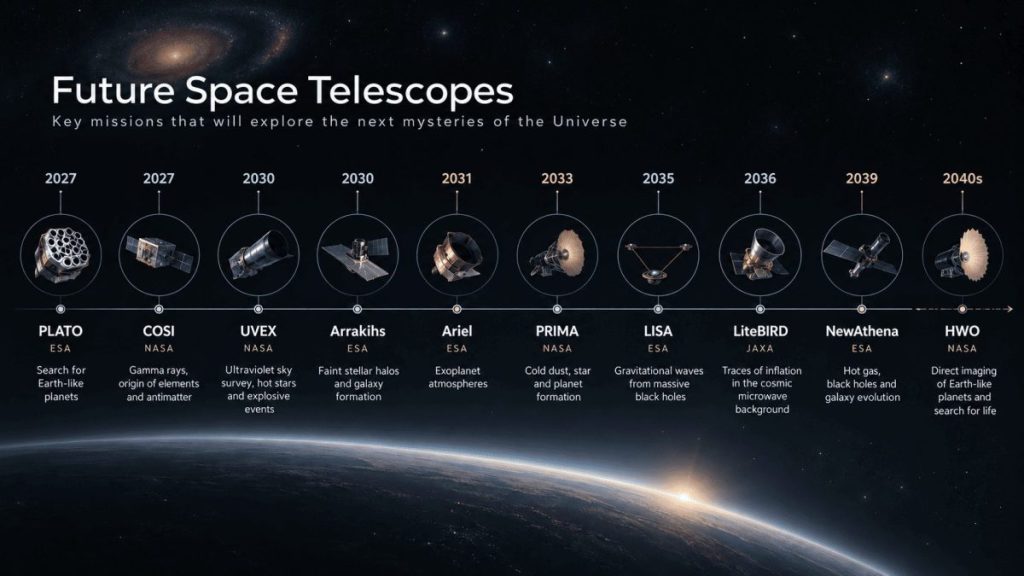
A timeline of planned space telescope launches by NASA, ESA, and JAXA from 2027 through the 2040s. The infographic outlines the primary scientific objectives of these future observatories, including the search for Earth-like planets and the study of black holes, gravitational waves, and the early universe.

Source: UST

Why are even the most powerful telescopes insufficient?

On August 30, 2026, NASA launched the Nancy Grace Roman Space Telescope. Its primary mission extends beyond capturing striking images of distant galaxies; it is designed to survey the universe on an unprecedented scale. With its wide field of view, the telescope will be able to observe hundreds of millions of galaxies, search for exoplanets, and study the distribution of dark matter.

However, even Roman, James Webb, and Hubble, collectively, cannot answer all of astronomy’s fundamental questions.
stsci-01febr8scwtrv07xv8we8a9aqb.jpg

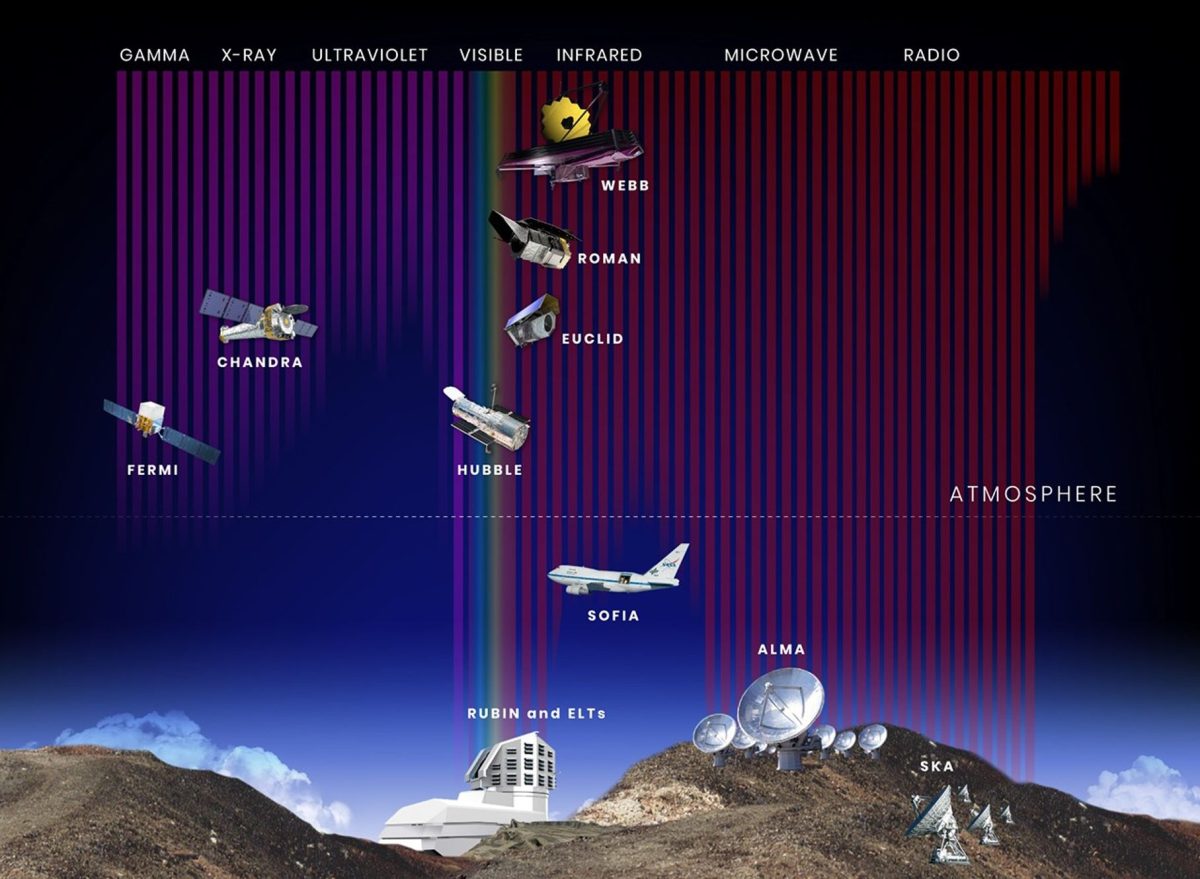
The infographic presents the ranges of the electromagnetic spectrum in which various astronomical observatories operate, from gamma-ray and X-ray radiation to infrared light and radio waves. It also illustrates which types of radiation are absorbed by Earth’s atmosphere and explains why some telescopes must be launched into space to study them.

Source: NASA

The issue is not solely the size of the mirrors or the sensitivity of the cameras. The universe emits information across various bands of the electromagnetic spectrum, while the human eye can perceive only a limited portion of it: visible light. Infrared telescopes can detect cooler objects and observe through some cosmic dust; ultraviolet telescopes can study hot stars; and X-ray telescopes can observe extremely high-energy processes near black holes.

Each of these instruments has inherent physical limitations. Accordingly, the next stage in the development of astronomy will depend less on creating a single, universal, ultra-powerful telescope and more on establishing an integrated network of specialized observatories.

  • The first major challenge facing this system is connected to a question that has captivated humanity for millennia: Are we alone in the universe?

PLATO: The Search for Earth-Like Planets [2027]

Astronomers have now identified thousands of planets beyond the Solar System. However, most differ substantially from Earth. Many are gas giants, extremely hot worlds, or planets that orbit very close to their stars. Identifying a genuinely Earth-like planet is considerably more challenging.

One of the most effective methods for detecting exoplanets is the transit method. When a planet passes in front of its star, it blocks a small fraction of the star’s light. A telescope can detect a brief decrease in brightness, which may indicate the presence of a planet. However, Earth blocks only about 0.0084% of the Sun’s light. This illustrates the precision required to measure the brightness of a distant star and detect such a subtle change.

A further challenge is that Earth completes one orbit around the Sun each year. To reliably detect a comparable planet, it is best to observe several of its transits, which requires monitoring the same star for years. The European Space Agency developed the PLATO telescope specifically for this purpose, and it is scheduled to launch in March 2027.
1920px-artists_impression_of_plato.jpg

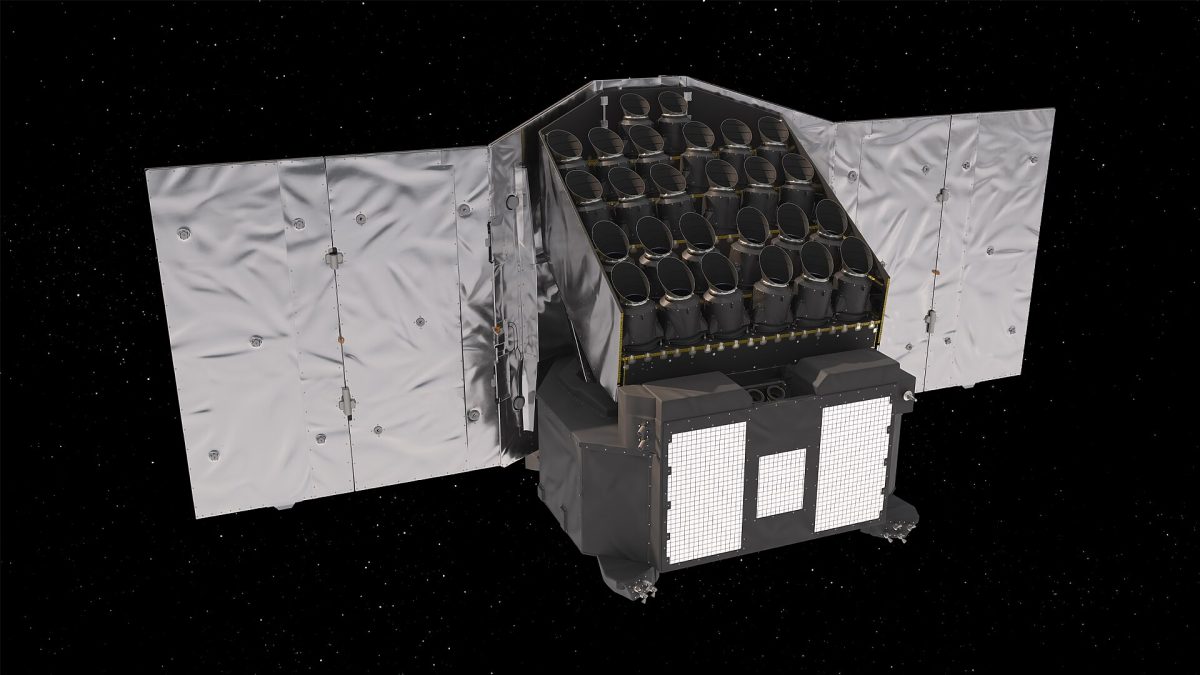
The European Space Agency’s (ESA) PLATO space telescope is equipped with 26 cameras, enabling it to observe thousands of stars simultaneously. Its primary mission is to search for Earth-like exoplanets, particularly in regions where liquid water may be present.

Source: ESA

Unlike traditional telescopes equipped with a single primary camera, PLATO will utilize 26 separate cameras. Together, these cameras will observe a vast number of stars, monitoring them for characteristic changes in brightness. However, the mission’s objectives extend beyond the discovery of planets. PLATO will also study the subtle fluctuations within the stars themselves. By analyzing these oscillations, astronomers will be able to determine the stars’ sizes, masses, and ages with greater accuracy. In combination with ground-based observations, this information will help assess the properties of the discovered planets.

As a result, we will gain not only a list of new worlds but also a substantially clearer understanding of how frequently rocky planets form around Sun-like stars.

  • This raises the following question: Even if we identify a planet the size of Earth, how can we determine whether it is habitable?

Ariel: What Are the Atmospheres of Other Worlds Composed Of? [2031]

Two planets may be nearly identical in size yet exhibit markedly different surface conditions. The Solar System provides a clear example: Earth and Venus are similar in size, but Venus’s dense atmosphere generates an exceptionally strong greenhouse effect. Consequently, its surface temperature is significantly higher than Earth’s.

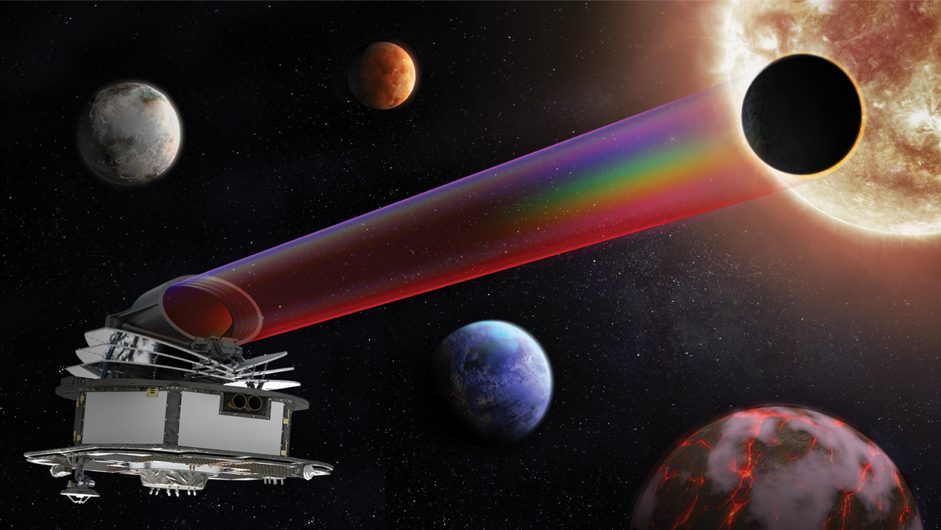
Therefore, understanding the planet’s dimensions alone is insufficient; its atmosphere must also be studied. To this end, ESA is developing the Ariel space telescope, which is currently scheduled to launch in 2031.
aryel-2.jpg

An artist’s rendering of the European Space Agency’s (ESA) Ariel space telescope. By analyzing starlight as it passes through an exoplanet’s atmosphere during transit, the telescope will detect the presence of water vapor, methane, and other gases.
Source: ESA

Its primary instrument will be spectroscopy. When a planet transits its host star, a small fraction of the star’s light passes through the planet’s atmosphere. Molecules of various substances absorb light at characteristic wavelengths, producing distinctive chemical signatures in the spectrum. These signatures enable astronomers to detect water vapor, carbon dioxide, methane, and other atmospheric components.

The James Webb Space Telescope is already employing similar methods; however, Ariel is being developed to systematically study approximately one thousand exoplanets. This will enable comparisons of the atmospheres of planets with different sizes, temperatures, and ages.

The primary objective is to understand the patterns underlying their formation and evolution.

  • However, Ariel will primarily study relatively warm planets with atmospheres suitable for spectroscopic measurements. Searching for potential signs of life on truly Earth-like planets will require an even more sophisticated instrument.

Habitable Worlds Observatory: A Telescope That Will Search for Life (~2040)

Imagine attempting to observe a firefly beside a powerful spotlight located many kilometers away. This is approximately what it is like to photograph an Earth-like planet directly near another star.

In visible light, Earth is approximately ten billion times fainter than the Sun. Consequently, even when a telescope can detect the planet’s light, the star’s radiation overwhelms it. One potential solution is a coronagraph, an optical instrument that suppresses the star’s bright light, enabling the detection of much fainter light from a nearby planet. An experimental coronagraph has already been installed on Roman; however, its capabilities are insufficient for studying Earth-like worlds.

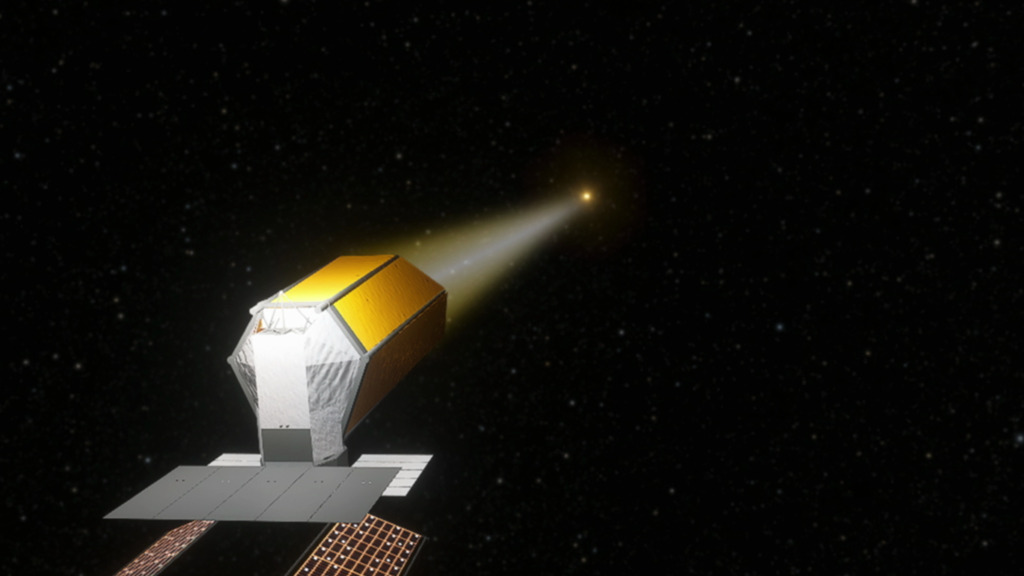
For this reason, NASA is developing the Habitable Worlds Observatory (HWO) concept — a future space observatory specifically designed to search for and study planets that may be capable of supporting life. Its optical system must maintain exceptional image stability. Even microscopic mirror deformations or structural vibrations can generate stray light that obscures the planet’s signal.
habitable_worlds_observatory_ultra-stable_telescope_svs20400_-_ultrastabletelescope_prores_00877_print.jpg

An artist’s rendering of NASA’s future Habitable Worlds Observatory (HWO). With its high-precision optics and ability to block the bright light emitted by stars, the telescope will be capable of directly observing Earth-like exoplanets and studying their atmospheres for potential signs of life.

Source: habitableworldsobservatory

Therefore, engineers must integrate high-precision optics, active wavefront control, and highly sensitive detectors. If the technology performs as intended, the HWO will be capable of directly observing rocky planets and analyzing the composition of their atmospheres. Oxygen, ozone, methane, and other substances that may, under certain conditions, be associated with biological processes will be of particular interest. However, detecting oxygen alone will not provide definitive evidence of life, as some chemical substances can form in the absence of living organisms. Accordingly, astronomers will need to assess the full range of atmospheric conditions.

HWO remains in the conceptual design and key technology development phase. It may be launched in the 2040s; however, no date has been set.

At the same time, the ground-based Extremely Large Telescope is expected to help address several of these complex challenges in the coming years. Its primary mirror, measuring 39 meters (128 feet) in diameter, will comprise 798 segments designed to function as a single optical surface. An adaptive optics system will compensate for atmospheric distortion by adjusting the shape of a specialized mirror approximately one thousand times per second.

The ELT’s initial scientific observations are expected to commence in late 2030. It will be capable of studying individual planets and their atmospheres in detail, thereby complementing the capabilities of space-based observatories.

  • However, to determine how common habitable worlds are, we must answer one additional question: where does the material from which they are formed originate?

PRIMA: An Overview of the Birthplaces of Stars and Planets [~2033]

Stars and planets form within vast clouds of gas and dust. However, the dust itself often hinders astronomers’ ability to observe these processes. Dust particles absorb visible light and re-emit the absorbed energy in the infrared spectrum. Consequently, a region that appears nearly black in a conventional photograph may appear bright when viewed through an infrared telescope.

The James Webb Space Telescope has already provided a glimpse into many such regions. But even it does not cover the entire infrared spectrum. The coldest dust clouds emit a significant portion of their energy in the far-infrared range, which is beyond the reach of Webb’s instruments. This is where a significant gap exists between the capabilities of modern infrared and radio observatories.

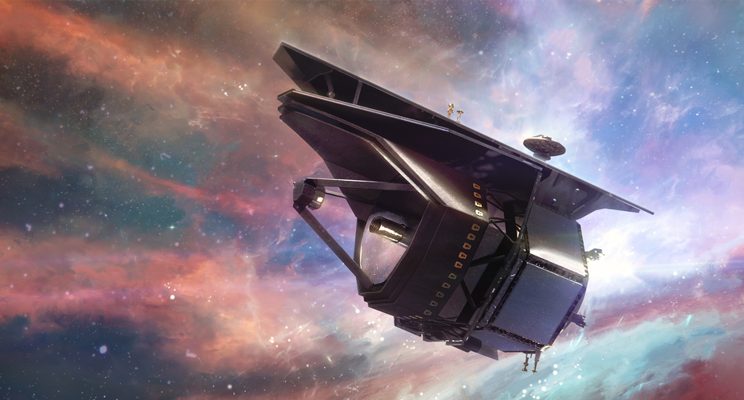
To address this, NASA is developing PRIMA, the PRobe far-Infrared Mission for Astrophysics.
prima.jpg

An artist’s rendering of NASA’s planned PRIMA (Probe Far-Infrared Mission for Astrophysics) space observatory. The telescope will explore the universe in the far-infrared spectrum, enabling the study of cold gas and dust clouds where stars and planets form, as well as regions of galaxies obscured by dust.

Source: PRIMA

In September 2026, the agency selected this mission to proceed to the next phase of design. Subject to further approval, the project is tentatively scheduled for launch in 2033. The telescope, equipped with a mirror approximately 1.8 meters (5.9 feet) in diameter, will study cold dust, gas, and obscured regions of galaxies. This research will help advance our understanding of how new stars form from interstellar matter, how protoplanetary disks evolve, and the role that water and complex chemical compounds play in the early stages of planet formation.

However, temperature is not the sole reason celestial objects remain invisible. Conversely, certain processes are so energetic that they emit light beyond the detection capabilities of optical and infrared telescopes.

COSI and UVEX: Observing Invisible Cosmic Explosions [2027 and 2030]

Not all cosmic processes are observable in visible or infrared light. For instance, hot stars and the early stages of supernova explosions are especially luminous in the ultraviolet spectrum. To study these phenomena, NASA plans to launch the UVEX (UltraViolet EXplorer) telescope in 2030. The telescope will survey the ultraviolet sky and rapidly reorient itself in response to transient cosmic events, including the aftermath of neutron star mergers.

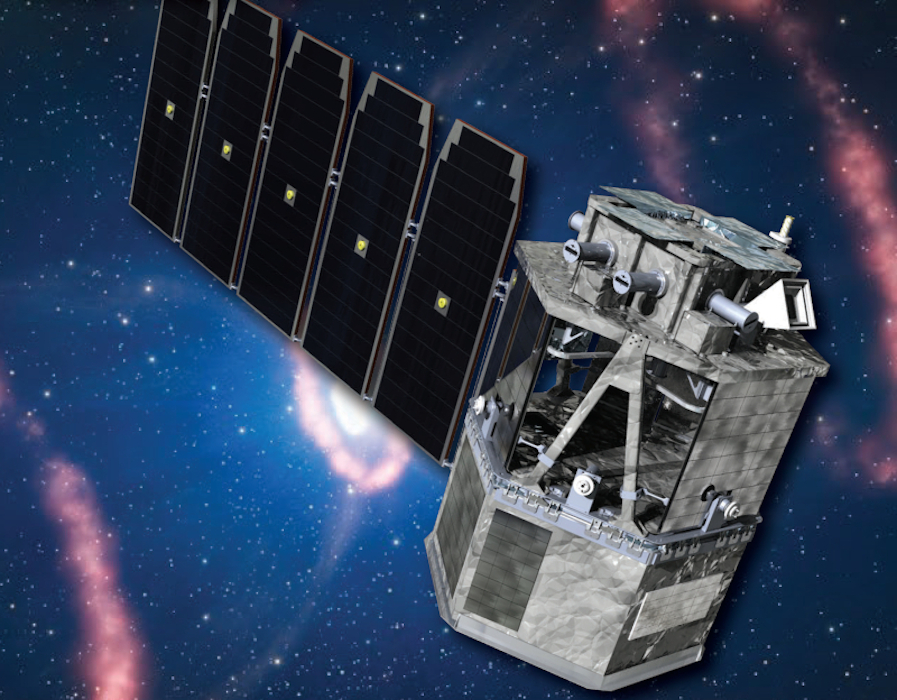
Even higher-energy radiation will be studied by COSI (the Compton Spectrometer and Imager), which is scheduled for launch in 2027. This gamma-ray telescope will help determine where certain chemical elements form in the Galaxy and the origins of positrons — the antiparticles of electrons. When a positron encounters an electron, they annihilate, producing gamma rays that COSI can detect.
cosi_higher_quality.jpg

An artist’s rendering of NASA’s COSI (Compton Spectrometer and Imager) space-based gamma-ray telescope. The observatory will study gamma-ray radiation to determine where certain chemical elements form in the Milky Way and the origins of cosmic antimatter.

Source: COSI

Together, these observatories will enable the study of high-energy processes that are beyond the capabilities of conventional telescopes. However, another challenge remains equally important: detecting the extremely faint matter surrounding galaxies.

Arrakihs and NewAthena: Hidden Features Beyond the Galaxies [2030 and 2039]

Even the most detailed images of galaxies reveal only a portion of their structure. Nearly invisible halos — comprising diffuse gas, dark matter, and faint stellar streams — extend beyond the luminous stellar disks. These halos preserve evidence of ancient collisions and the accretion of smaller galaxies.

To investigate these structures, ESA plans to launch the Arrakihs telescope in 2030. The mission will examine the stellar halos of neighboring galaxies, helping researchers reconstruct their formation histories and test models of dark matter distribution. These observations will complement the large-scale surveys conducted by Roman and Euclid.

However, some ordinary matter exists in a form so hot that it is best observed in the X-ray range. This is precisely what NewAthena — ESA’s future X-ray observatory, scheduled for launch in 2039 — will study. It will investigate gas in galaxy clusters, the growth of black holes, and their effects on the surrounding environment.
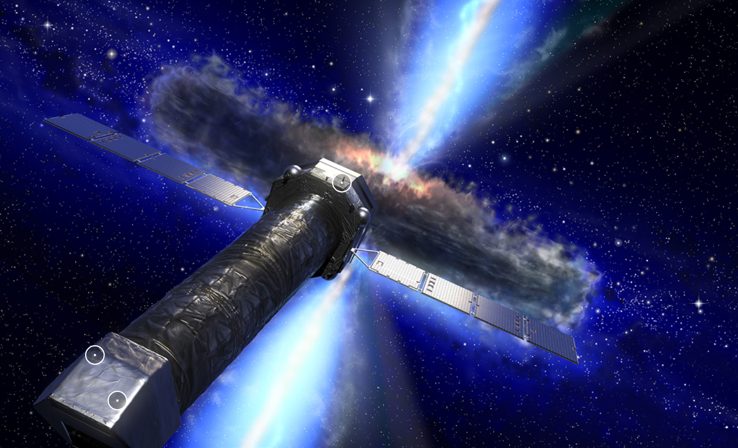
newathena.jpg

An artist’s rendering of the European Space Agency’s (ESA) future NewAthena X-ray observatory. The telescope will study hot gas in galaxy clusters and powerful radiation near black holes, contributing to a better understanding of how they grow and influence the evolution of galaxies.

 Source: ESA

However, the most powerful events involving black holes leave traces not only in radiation but also in the very fabric of spacetime.

LISA: Observing the Collision of Black Holes [2035]

In 2015, the LIGO detectors observed gravitational waves from a black hole merger for the first time. These waves are disturbances in spacetime that propagate at the speed of light. However, ground-based facilities cannot effectively detect the lowest frequencies of these oscillations because of terrestrial noise and the interferometers’ size limitations.

To investigate these phenomena, ESA is developing LISA — the Laser Interferometer  Space Antenna — which is scheduled for launch in 2035. The mission will comprise three spacecraft arranged in a triangle, with sides approximately 2.5 million km (1.55 million miles) in length. By exchanging laser beams, the spacecraft will measure minute changes in distance caused by the passage of gravitational waves.
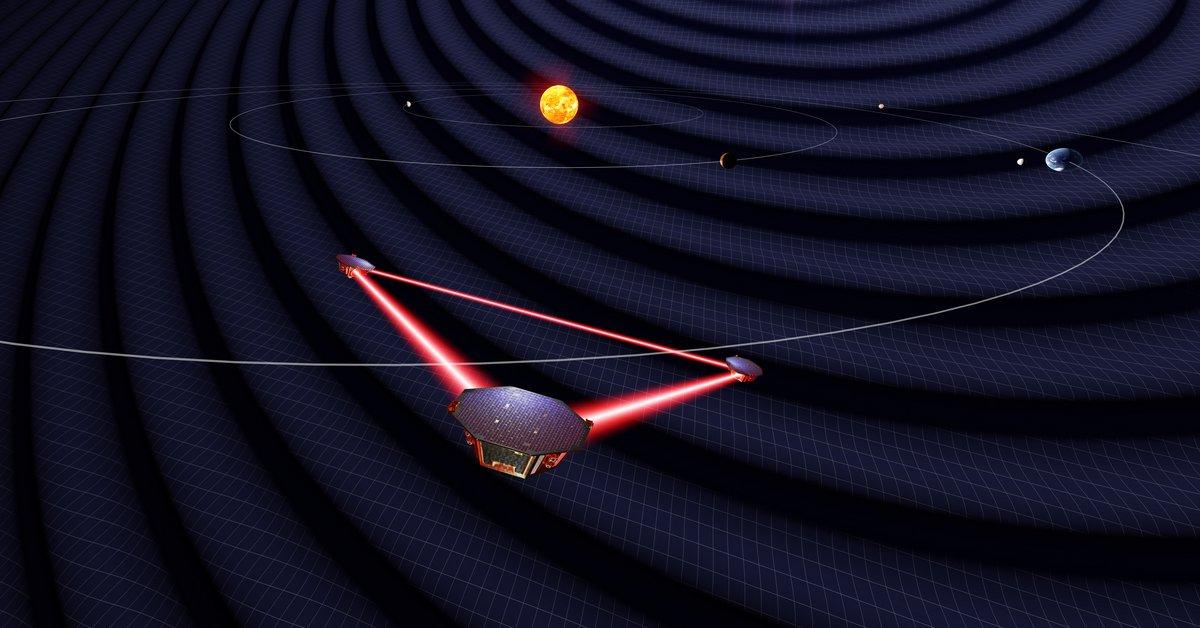
sk22qxfulovbxxonhfbwfxeo2cz08_hhjtw2jgse66xanzn4w9yvxl_0g9srypiisxeaafjolqfepk0jqgtksm8qjberqzvrvzgqwn7d8_kpxixyswrc2v8nuwushvu_rg68-dvq_xofxasbsx-m99tpy_npp-recrgsbiowxz9trb3r-sfkrrdw7ogfnjp.jpg

An artist’s rendering of the European Space Agency’s (ESA) Laser Interferometer Space Antenna (LISA), a space-based gravitational-wave observatory. Three spacecraft, linked by laser beams and positioned 2.5 million kilometers apart, will detect extremely faint ripples in spacetime caused, in particular, by the mergers of massive black holes.

Source: ESA

LISA’s primary targets will be mergers of supermassive black holes at the centers of galaxies. Combined with X-ray observations from NewAthena, these observations will help us understand how black holes have grown throughout the history of the universe.

However, to study an era in which neither galaxies nor black holes yet existed, we will need entirely different kinds of instruments.

LiteBIRD: Evidence of the Universe’s Origins [2036]

According to one of the leading hypotheses in cosmology, during the earliest moments of its existence, the universe underwent inflation — an exceptionally rapid expansion of space. Although no direct evidence of this process has yet been identified, potential traces may have been preserved in the cosmic microwave background, the oldest light observable to us.

These are precisely the phenomena that the Japanese LiteBIRD observatory, scheduled to launch around 2036, will seek to detect. The observatory will measure the polarization of the cosmic microwave background radiation in an effort to identify a specific pattern: primordial B-modes, which may have been generated by gravitational waves during the inflationary era.
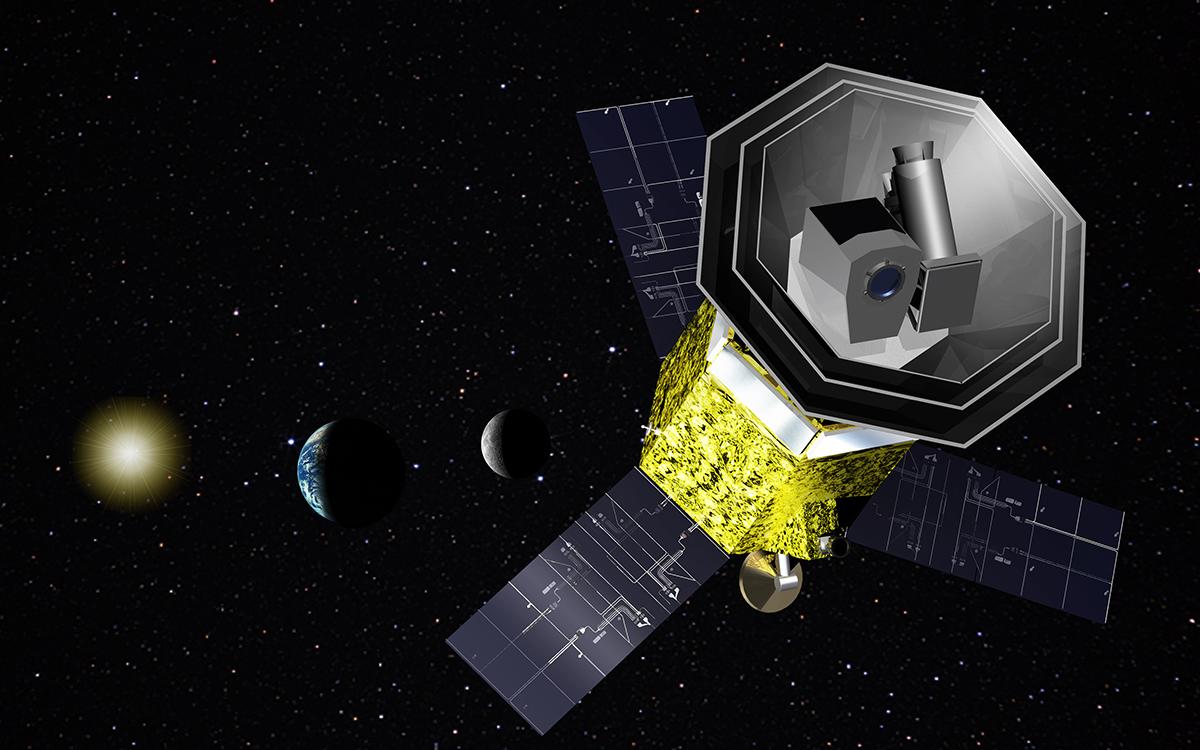
litebird.jpg

An artist’s rendering of the LiteBIRD space observatory, which JAXA is developing to study the polarization of the cosmic microwave background. The telescope will search for extremely faint signals from the early universe that may preserve traces of cosmic inflation — the rapid expansion of space during the first moments after the Big Bang.

Source: JAXA

The expected signal is extremely weak, and radiation from galactic dust may obscure it. Accordingly, LiteBIRD will use measurements across multiple frequencies to distinguish the cosmological signal from nearby sources.

The detection of primordial B-modes could provide significant evidence for inflation. However, observations of the cosmic microwave background allow us to directly study the universe only as it existed approximately 380,000 years after the Big Bang. The subsequent stage in its history — the formation of the first stars and galaxies — will be investigated using radio telescopes.

SKA: The Universe Before the Formation of the First Galaxies [2027]

After the universe became transparent to light, the cosmic dark ages commenced. Although atoms had already formed, the first stars had yet to emerge. The Square Kilometre Array (SKA) — a large network of radio telescopes currently under construction in Australia and South Africa — will help researchers investigate this relatively understudied period.

Thousands of antennas will operate together as a single instrument, detecting exceptionally faint radio emissions. Of particular interest is the signal from neutral hydrogen, which can be used to trace how the first stars gradually transformed the surrounding gas.

at_jodrell_bank_observatory_2018_040.jpg

The headquarters of the Square Kilometre Array Observatory (SKAO), an international radio astronomy observatory, is located in the United Kingdom. The renowned Lovell Radio Telescope is visible in the background. The SKA radio telescopes are being constructed in Australia and South Africa and will contribute to the study of the early universe, particularly the period before the first stars and galaxies formed.

Photo: Mike Peel

The SKA will be commissioned in phases as its systems become operational. Together with LiteBIRD, it will help investigate the early history of the universe from two perspectives: possible traces of primordial physical processes and the emergence of the first luminous objects.

Thus, future observatories will progressively address gaps in our observations, and their combined findings will enable us to develop a more comprehensive understanding of the universe’s evolution.

The future of astronomy depends not on a single telescope, but on an integrated system

The future of astronomy depends not on the development of a single, exceptionally powerful telescope, but on a comprehensive network of specialized observatories. Some will search for Earth-like planets, while others will investigate their atmospheres, observe black holes, or seek evidence of the universe’s earliest processes.

The primary advantage of this approach is the ability to study the same objects using different methods. For example, one telescope may detect an exoplanet, another may help determine its mass, and a third may analyze its atmosphere. By combining these data, we can assess how closely this world resembles Earth and whether conditions suitable for life may exist there.

Certainly, no single mission can provide definitive answers to questions concerning the nature of dark matter, the origins of the universe, or the existence of extraterrestrial life. However, each mission will gradually help address gaps in our knowledge.

Hubble has enabled us to observe the universe in remarkable detail; the James Webb  Space Telescope has allowed us to explore much deeper; and the Nancy Grace Roman Space Telescope is poised to create a large-scale map of the cosmos. The next generation of observatories will seek to answer the questions raised by these discoveries.

Perhaps the most significant outcome will not be another photograph of a distant galaxy, but rather the first compelling evidence of life beyond Earth or the discovery of traces of physical processes that occurred long before the first stars formed.

  • It will then become evident that all previous space telescopes represented only the beginning of our exploration of the universe.

{ https://universemagazine.com/en/articles-en/ }

Hoe vind je dit bericht?
Geschreven door peter om 21:45 Stuur door

The creepy science behind sleep paralysis ‘demons’

The creepy science behind sleep paralysis ‘demons’

Painting of a woman in white with a demon sitting on her chest and a ghostly horse to the left.

In 1781, Swiss artist Henry Fuseli painted this piece entitled "The Nightmare." Sigmund Freud had a copy of the painting hung up in his Vienna apartment in the 1920s.

Image: Tulip Hysteria / CC BY 2.5  

Have you ever woken up in the dead of night to find your limbs locked tight? Perhaps as you moved your eyes to the corner of your room, you spotted a demon lurking in the shadows, watching as you struggled against an invisible force. Sleep paralysis is creepy!

If you can take any comfort from your experience, it’s to know that sleep paralysis has a long and storied history of tormenting humanity. Why is sleep paralysis such a shared, spooky experience? And who exactly is that shadowy figure standing at the bottom of your bed? 

What is sleep paralysis?

Sleep paralysis affects slumberers around the world. Brian A. Sharpless, a clinical psychologist based in the Washington, D.C., area who has written multiple books on the phenomenon, says he has recorded more than 100 different terms for sleep paralysis across time, place, and culture.

While the fine details vary, the core experience is universal.  “Waking up, finding yourself unable to move, oftentimes a sense of pressure in the chest, a feeling of dread, fear, oppression. Those seem to be really consistent, but how you put a meaning on that is where it gets really interesting,” says Sharpless. 

What’s the history of sleep paralysis?

Historically, people often gave these experiences a supernatural origin. Sharpless says, in the West, sleep paralysis overlapped with stories about vampires, witches, and ghosts. In Germanic and Slavic folklore, a demon called a mare (which is the origin of our word “nightmare”) visited sleepers, sat on their chests, and paralyzed them.  

Painting of an old woman sitting on a man's chest. The style features heavy brushstrokes.

In the early 1890s, Danish painter Joakim Skovgaard painted this image showing a mare (or “maren” in Danish). The mare was a shape-shifting supernatural being that would ride people’s chest leaving them unable to move.

Image: Joakim Skovgaard / CC BY 4.0

As time passed, these associations changed to alien visitations or hazy “shadow people” lurking in the corners of their rooms. Sin 1960s, people in Tanzania have reported being attacked by a large winged creature called the Popobawa, which sexuce theally assaults paralyzed victims. 

But scientists also have explanations for sleep paralysis. 

The science behind sleep paralysis

Sharpless says that a brain stuck between dreams and wakefulness produces this phenomenon. During REM sleep, one of the periods of rest when dreams are most likely, the brainstem paralyzes the body’s muscles, except, of course, those that move our eyes and keep us breathing. This is vital, as sleepers might otherwise act out their dreams and harm themselves or others.  

But awakening while the body is still shut down is not pleasant. “It’s kind of an uncanny, strange experience not to have control over your body,” says Sharpless. As a result, surveys of people who have reckoned with sleep paralysis show it is almost always a fearful experience. 

Another shared factor in sleep paralysis is feeling a presence in the room. These sleep paralysis demons, aliens, vampires, or Popobawas are generated by what researchers call the threat-activated vigilance system. 

“What we think happens is that your brain is reading the sense that you’re prey, and it creates a predator,” says Sharpless. 

A colorful painting of a black cat in a blue sweater sticking its tongue down a sleeping person's throat.

Contemporary graphic designer and illustrator Kasia Walentynowicz drew this somewhat cute image of a shapeshifting mare based off of Polish folklore.

Image: Kasia Walentynowicz – Instytut Adama Mickiewicza – Projekt : Upiór / CC BY-SA 4.0

Who’s most likely to experience sleep paralysis?

Some people go through their whole lives without experiencing sleep paralysis, but some factors put you more at risk. 

Sharpless says that people with a history of trauma or anxiety are more vulnerable. Sleep paralysis is also linked to being a student, consuming alcohol, or having narcolepsy. All of these factors are in turn linked to more disrupted sleep. 

Sharpless says that, in general, poor sleep hygiene increases the risk of sleep paralysis. No randomized controlled trials, the gold standard for testing treatments, have been conducted for potential solutions to sleep paralysis, but Sharpless says interventions that improve sleep will likely also reduce the risk of sleep paralysis. 

How to avoid sleep paralysis

“One of the best, easiest things you can do is don’t drink before you go to bed and try to sleep on your side,” says Sharpless. 

Sleeping on your back, he says, might make it slightly harder to breathe during sleep, especially in people who are overweight or obese. Sleep paralysis is less likely to happen to side sleepers, he adds. If a sleeper’s partner sees them sleeping on their back, gently moving them onto their side can reduce the chances of sleep paralysis.

Generally improving sleep hygiene, and getting treated for any anxiety, depression, or trauma, are also important steps, Sharpless says. 

Sharpless has only experienced sleep paralysis once. In that episode, a terrifying face with sunken red eyes, balanced atop an improbably long neck, wound its way into his room. It was only when he remembered he had watched a documentary on sleep paralysis that very day that the fear, and then the face, dissipated. 

He warns that there’s anecdotal evidence that sleep paralysis may be contagious. So, after reading this piece, sleep on your side, and if a demon appears in the corner of your room, remember it’s simply a figment of a tired, wired brain. 

“Try to have a sense of humor about it,” advises Sharpless. 

Related 'Ask Us Anything' Stories

RELATED

The Terrifying History of Sleep Paralysis: Demons, Science, or Something Else?
Sleep Paralysis: The Terrifying Neuroscience Behind the Shadow Figure
Why You See a Demon When You're Sleep Paralyzed (The Real Science)

{ https://www.popsci.com/category/health/ }

Hoe vind je dit bericht?
Geschreven door peter om 21:07 Stuur door

Is UAP Storytelling Akin to Religious Myths?

Is UAP Storytelling Akin to Religious Myths?

 Avi Loeb

1*KDmTCVbSHj94zl39UrBQzQ.jpeg

(Image Credit: AI/Gemini)

A system of statements based on conviction rather than evidence is closer to religion than it is to science. Of course, I know of many scientists who are also religious but they fully recognize the difference between scientific knowledge and religious belief.

The space of possible realities is far greater than the specific physical reality that we live in. As a result, human history is full of imagined stories. In the same vein, the practice of science is full of conjectures or unproven theoretical ideas. But what makes science different from politics or religion is the surrender to empirical evidence as an arbitrator.

The quest for evidence is commonly adopted by detectives who aim to resolve mysteries, including fictional characters like Sherlock Holmes who was quoted by Arthur Conan Doyle as saying: “When you have eliminated all which is impossible, then whatever remains, however improbable, must be the truth.” This assertion is certainly true about quantum mechanics as the counterintuitive nature of physical reality. The 2022 Nobel Prize in Physics was awarded to Alain Aspect, John F. Clauser, and Anton Zeilinger for their groundbreaking experiments with entangled photons. Their work confirmed the reality of quantum entanglement and proved that Albert Einstein’s objections to this phenomenon, which he famously derided as “spooky action at a distance,” were incorrect.

Other scientific mysteries over the past century remain unresolved. Chief among them is the challenge of unifying quantum mechanics and gravity. The latest conjectures about doing so in the presence of extra dimensions or supersymmetry lack empirical support. This does not make these scientific ideas resemble religious myths because the physicists who explore them recognize that they can only gain traction by experimental support.

1*S6_p_hsrRs1mQ-tjQ_MKGw.jpeg

Avi Loeb

(Image Credit: Lotem Loeb, May 22, 2026)

What makes the situation confusing for the general public is that most often, the scientific data necessary for drawing definitive conclusions is absent or not good enough. In politics or religion, conviction is sufficient for attracting many likes on social media because confidence is regarded as an admirable trait in our otherwise fragile life. However, in science, the most accomplished mathematicians engaged in String Theory or even the most advanced version of superintelligence, will not be able to figure out the truth about the physical reality without high-quality data from instruments that probe it.

The approach of physics is an extension of the way our body works. We rely on data from our biological sensors, known as receptors, to monitor the internal state of the body and interpret the external world. These native sensors detect physical, chemical, or mechanical changes and translate them into electrical signals that our brain can process. But the data is often insufficient for drawing definitive conclusions.

When we see a cat walking towards a building and appearing on the other side, our mind comes up with the plausible conjecture that a single cat existed throughout the entire period even though our view of the cat was blocked by the building during some of the time. Alternatively, we can imagine that there are numerous identical cats hiding behind the building with only one coming out after some time. The only way to figure whether this hypothesis is true or false is to gain a direct view of the other side of the building. This does not require that we access the other side, which might be unfeasible if obstacles block our way. Instead, we can use a drone camera or a fortuitously-positioned window that reflects the image of the hidden region.

Social-media influencers might prefer not to collect any data, because the lack of conflicting evidence gives them the license to spread the “many cats interpretation” and attract followers. The temptation to spread myths is attractive because it offers a shortcut to societal notoriety. On the other hand, the use of scientific instruments to vet the “many cats interpretation” offers us a better path forward than the number of likes a story gets.

Consider Unidentified Anomalous Phenomena (UAP), formerly known as UFOs. The fact that UFO reports persisted for 80 years does not lend credence to their alien technology interpretation. The Vatican insisted on the popular story that the Earth is at the center of the Universe for many centuries, but eventually admitted on October 31, 1992 that this story was false. Unlike blockbuster script writers in Hollywood, nature is under no obligation to follow our wishes.

Most of the time, scientists must remain agnostic because the data is not good enough to deliver a verdict about the validity of a hypothesis or an interpretation. Patience is key. The rush to a premature conclusion can have disastrous public relations consequences, as in the case of the old cosmological model of the Catholic Church.

Jay Stratton’s new book about UAP, Out of the Shadows, employs a “self-sealing” logical framework that preemptively labels skepticism as part of a government conspiracy. This rhetorical strategy creates an unfalsifiable loop where any demand for hard evidence is automatically twisted into proof of a cover-up. This type of closed epistemic system operates through several distinct layers. Testimony alone is treated as absolute truth, while the standard scientific requirement for verifiable data is reclassified as a hostile act of disinformation. Skeptics are told that if they feel genuinely unconvinced, they are simply victims of brainwashing, stripping away their critical thinking agency. By framing the debate as an ongoing war against “gatekeepers,” this narrative guarantees an endless demand for future books, documentaries, and media appearances to counter the alleged cover-up. This framing does not mean that Stratton is wrong about everything he says. He has admirable credentials as the leader of the UAP Task Force within the U.S. government. Testimony from a credible insider is a legitimate reason to investigate. But it’s a reason to start, not a reason to stop, and a book that treats its own testimony as the terminus of inquiry is overreaching. The honest reading of “we now know with certainty” is “I am certain,” which is a statement about Stratton’s mind, not about what’s in a hangar of a supposedly alien spacecraft.

On September 10, 2026, I humbly invited Jay Stratton to meet with the UAP Science Advisory Council or disclose evidence that will guide us to support his public statements. My invitation was repeated by Council member, Dr. Tim Gallaudet, but I received no response from Stratton. Instead, I was attacked personally by believers who argued: “How dare you question what Jay Stratton said? He knows what he is talking about.” I respect their conviction but this is not how science works. We must have access to evidence or else such claims do not hold water.

Paraphrasing Sherlock Holmes: “When you have eliminated all which is impossible to explain UAP, such as birds, meteors, balloons, drones, missiles, aircraft or satellites, then whatever remains, however improbable, must be the truth.” For now, the UAP Science Advisory Council provided evidence in a paper posted here that more than 8% of the UAP videos declassified by the Presidential Unsealing and Reporting System for UAP Encounters involve birds. Regarding the identity of the remaining 92%, we have to remain agnostic and collect better data or check the hangars that whistleblowers guide us to.

RELATED

UFOs in Religion: Hidden Link Between Ancient “Miracles” and Modern Aliens | Dr. Diana Walsh Pasulka

{ https://medium.com/?source=---top_nav_layout_nav }

Hoe vind je dit bericht?
Geschreven door peter om 20:49 Stuur door

New UFO map shows 164 'black triangle' sightings above UK after Pentagon files released

'Black triangles' have been seen hovering over the UK

'Black triangles' have been seen hovering over the UK

(Getty Images)

New UFO map shows 164 'black triangle' sightings above UK after Pentagon files released

A new UFO interactive map shows an astonishing 164 reports of wedge shaped objects looking like black triangles which have been seen over the UK

By Tim Hanlon, Richard Ault

Dozens of "black triangles" have been spotted in the sky by Brits with an interactive map showing all the reports of UFOs in your area.

Nearly 2,000 Unidentified Flying Objects have been documented and logged in the UK over the last five years by research group UFO Identified

Strange black triangles speeding above military sites have triggered security concerns in the United States and the data shows that there are equally strange sightings in the UK.

Now, a searchable interactive map allows you to explore every unexplained encounter logged in your area between 2021 and 2026, and many of these British accounts closely mirror sightings reported across the Atlantic.

The Pentagon recently published its latest release of declassified files on Unidentified Anomalous Phenomena (UAP – the American term for UFO), following an executive order signed by Donald Trump.

Among the documents is an account from two federal agents stationed at a US “sensitive national security site” in June 2026.

According to the report, a matte-black triangular object with an estimated 15-foot wingspan hovered silently roughly 300 feet in the air for 20 seconds before descending into a canyon at high speed without leaving an exhaust trail.

While orbs, spheres and “star-like” sightings make up the bulk of British sightings, researchers have logged 164 reports of similar wedge-shaped objects – meaning roughly one in every 12 sightings involves a distinctive triangle.

Witnesses across the UK have reported seeing dark, matte triangles gliding soundlessly at low altitude over housing estates, farmland, and coastal areas before darting away at incredible speeds, just like the sighting made by federal agents in the USA.

The most recent was on July 22 of this year, when a “large black triangle” featuring a red light on each point was witnessed hovering over Stretford in Greater Manchester for over 30 minutes.

Earlier this year, a “perfect triangle” was seen speeding across the sky above Chesterfield in Derbyshire, a “black V-shaped boomerang” was spotted over the Fylde coast in Lancashire, and a soundless black wedge above Exmouth in Devon.

You can check what UFOs have been seen where you live using out interactive gadget.

Our map reveals hotspot areas across the UK where clusters of UFOs have been spotted above Greater Manchester, London, Essex, Lancashire, Cheshire, Merseyside, Kent and West Yorkshire.

The accounts have been gathered by UFO Identified to create a central, searchable public archive, called the UK UFO Database, to help researchers identify patterns.

Ash Ellis, founder of UFO Identified, said: “There are thousands of people across the UK who have seen something they could not readily explain, but the reports are often difficult to find once the initial interest has passed. We wanted to build a serious, easy-to-use public archive that keeps those accounts accessible and allows people to look for patterns for themselves.”

RELATED

Sightings of ‘black triangle’ UFOs part of long history: UAP experts | Elizabeth Vargas Reports
Pentagon UFO Files: The Silent Triangle Over a Secret Site
FBI Statement Details Strange Triangle UFO Near US Security Site | NewsX World

{ https://www.mirror.co.uk/news/ }

Hoe vind je dit bericht?
Geschreven door peter om 20:33 Stuur door

New Pentagon UFO files detail FBI agents' sighting of silent triangular object with no visible engines

Former intelligence official breaks silence on gov't UFO investigations

Government investigations into unexplained UAPs are detailed by retired Defense Intelligence senior executive Jay Stratton on 'Special Report' with Bret Baier. Stratton details shocking military encounters with black triangle aircraft and outlines potential national security risks. He also explains why the U.S. military used nuclear submarines as bait to track these mysterious anomalies.

FBI agents reported witnessing a mysterious black triangular object hovering silently above a mountain ridge before suddenly accelerating at speeds comparable to a fighter jet, newly released Department of War documents reveal.

The 2026 sighting is among several incidents detailed in the newly released records examining unidentified anomalous phenomena (UAP), alongside decades-old military encounters and reports of mysterious creatures, unexplained lights and supposed portals at a Utah ranch.

One report from the FBI describes an encounter with a dark, nonreflective triangular object resembling a drone, with an estimated wingspan of 9 to 15 feet and no visible exhaust or conventional propulsion system.

NEW TRUMP UFO FILE DUMP INCLUDES MILITARY FOOTAGE OF MYSTERIOUS STAR-SHAPED OBJECT

The agents reported seeing the object rise vertically above a ridgeline before accelerating into a canyon without making a sound.

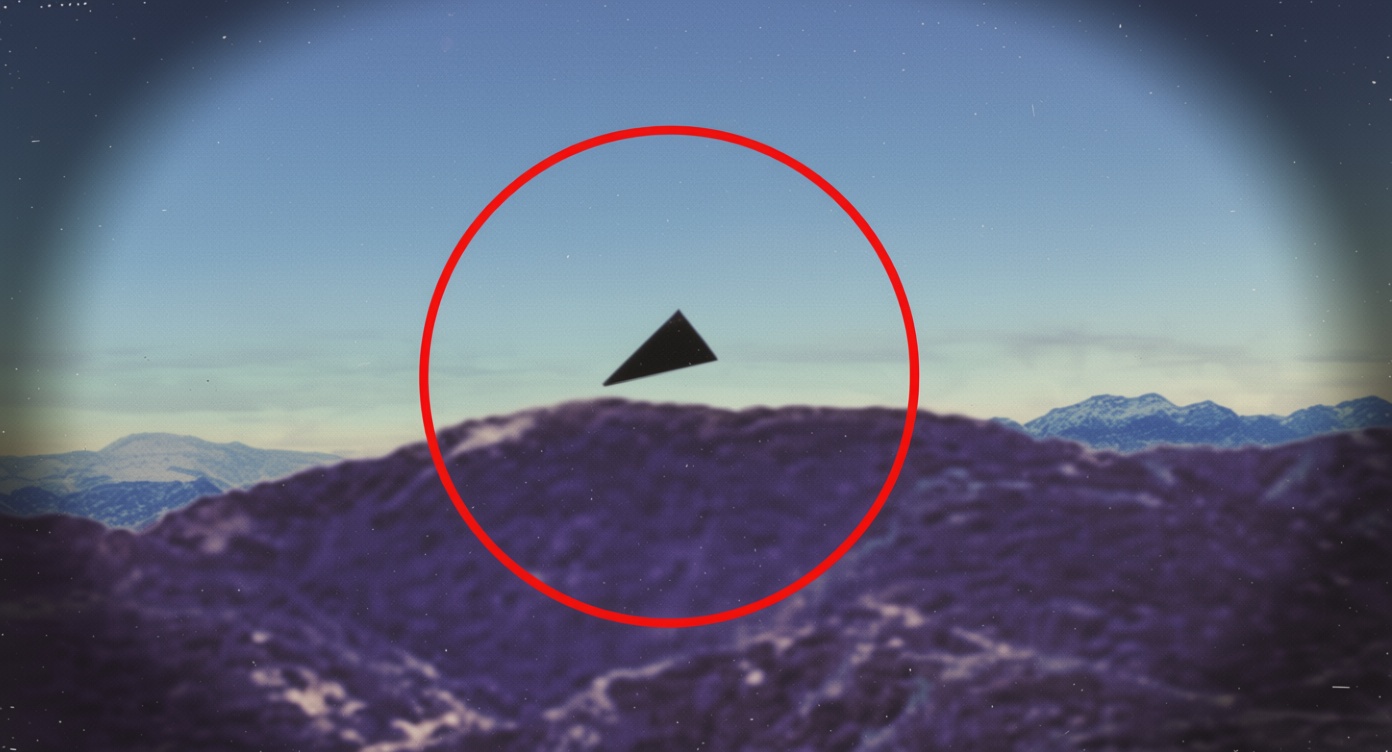
Black triangular shape appears above a mountain ridge in an image included with a federal report documenting a 2026 unidentified aerial object sighting.

An image released with a 2026 FBI report depicts a black triangular object above mountainous terrain. Federal agents reported seeing a silent, triangular object hover above a ridgeline before accelerating into a canyon. Authorities have not confirmed whether the image is an actual photograph or a reconstruction.

(Department of War)

A separate report from the Pentagon's All-domain Anomaly Resolution Office (AARO), which investigates reports of unidentified anomalous phenomena, provides a more detailed account of the encounter.

The report describes a matte-black triangular object that climbed about 200 to 300 feet above a ridgeline, hovered for roughly 20 seconds and then appeared to accelerate almost instantly, disappearing into a canyon within two to three seconds.

The witnesses described an object with no visible engines, rotors, exhaust or other conventional aircraft features.

The agents also reported observing a uniform heat signature across the object's surface through handheld thermal equipment, without the concentrated hot spots typically associated with propulsion systems.

The Pentagon report notes that the object's speed was estimated by witnesses rather than measured by instruments.

The two reports differ on the length of the encounter. The FBI described a sighting lasting approximately three seconds, while AARO detailed about 10 seconds of vertical ascent, 20 seconds of hovering and another two to three seconds of rapid flight before the object disappeared.

Neither report identifies the object or establishes its origin.

Fox News Digital has contacted AARO for comment on the sighting, including whether the object has since been identified and whether images released with the FBI report show the actual encounter or are illustrations.

Declassified 1957 Air Force intelligence report describing a B-52 bomber's encounter with an unidentified radar target near Saudi Arabia.

A declassified U.S. Air Force intelligence report dated Jan. 19, 1957, details an unidentified radar contact involving a B-52 bomber flying near Saudi Arabia during a Strategic Air Command mission.

(Department of War)

The newly released records also include an Air Force intelligence report dated Jan. 19, 1957, detailing an unidentified radar contact involving a U.S. B-52 bomber during a Strategic Air Command mission near Saudi Arabia.

The bomber was flying at about 39,000 feet when its radar detected an unidentified target roughly 6,000 yards away on Jan. 18, 1957.

The contact remained on the aircraft's radar screen for five to seven minutes before disappearing as the bomber turned left.

Air Force investigators noted that no other aircraft were expected in the area but acknowledged that the radar contact may have disappeared because of the bomber's change in direction.

Other historical records describe reported sightings near California's Santa Catalina Island.

Declassified 1952 Air Force report detailing a UFO sighting reported by three Boy Scouts attending summer camp on Catalina Island.

An Air Force intelligence report dated Aug. 28, 1952, documents claims by three Boy Scouts who reported seeing a silent, silver object moving faster than a conventional jet near California's Santa Catalina Island. (Department of War)

In one case, three Boy Scouts attending summer camp reported seeing a silent, silver object moving faster than a conventional jet while hiking on the island June 25, 1952.

The scouts claimed the object made a climbing turn before appearing to disintegrate, an Air Force intelligence report states.

Investigators noted that the scouts had no instruments to measure its speed or altitude and that their limited experience made it difficult to assess the reliability of their account.

A separate March 15, 1955, report describes a witness near Avalon on Catalina Island who spotted a bright, round object that changed from orange to red before falling straight down.

The Air Force ultimately classified the sighting as a "probable meteor."

The files also include a 60-page investigation conducted in 2010 by Bigelow Aerospace Advanced Space Studies (BAASS) at a Utah ranch associated with reports of unexplained phenomena.

Investigators interviewed residents who described towering dog-like creatures walking on two legs, mysterious balls of light and other unusual sightings.

Other witnesses reported smaller, hairy creatures, a prehistoric-looking bird and a worm allegedly measuring 8 feet long. One witness also described a transparent, rippling structure she believed was a portal to another world.

Two black-and-white eyewitness drawings depicting unusual creatures, including a long-tailed, four-limbed figure and a larger, pointed-eared creature.

Eyewitness sketches included in a 2010 investigation by Bigelow Aerospace Advanced Space Studies depict mysterious creatures reportedly spotted at a Utah ranch associated with alleged paranormal activity. The sightings were not independently verified. (Department of War)

The investigation included eyewitness sketches, surveillance cameras, environmental monitoring and hair samples collected from areas associated with reported creature sightings.

UAP File Drop: Pentagon Reveals 70 Years of UFO Secrets | Backscroll

{ https://www.foxnews.com/category/science/  }

Hoe vind je dit bericht?
Geschreven door peter om 19:20 Stuur door

Former NASA astronaut Winston Scott discusses alleged aliens and space conflict

Former NASA astronaut Winston Scott discusses alleged aliens and space conflict

Overview

Former NASA astronaut Winston Scott is being widely discussed in UFO communities after appearing in an interview about alleged extraterrestrial activity and the possibility of conflict beyond Earth. The interview was highlighted in a Daily Mail report published October 30, 2026, under the headline “NASA astronaut reveals reason he is convinced aliens exist as he warns of possible war in space.”

The report’s framing has prompted renewed online interest in claims that non-human intelligence may already be present in or near Earth’s space environment. However, the available source material does not provide independently verified evidence of alien craft, extraterrestrial communications or an active conflict in space. Scott’s reported views should therefore be treated as personal allegations and speculation, rather than an official finding by NASA or the U.S. government.

Scott’s Background

Scott is a former NASA astronaut and retired U.S. Navy captain who flew on two Space Shuttle missions. He served as a mission specialist aboard STS-72 in 1996, conducted aboard Endeavour, and STS-87 in 1997, aboard Columbia. Across his spaceflight career, he spent more than three weeks in orbit and completed spacewalks during the STS-87 mission.

After leaving active astronaut service, Scott held academic and administrative positions, including leadership roles connected with science, engineering and aviation education. His background gives him a high public profile when discussing space-related subjects, but his professional experience does not by itself establish the truth of claims about extraterrestrial life or alleged hostilities in space.

Claims of Alien Presence

According to the Daily Mail’s summary, Scott discussed why he is convinced that aliens exist and warned of a possible “war in space.” The source material supplied for this report does not include a full transcript or specific evidence supporting those statements. It is also unclear whether Scott was referring to direct personal observations, testimony from others, classified information, or broader arguments about the likelihood of life elsewhere in the universe.

That distinction is significant. A belief that extraterrestrial life exists is not the same as evidence that extraterrestrial beings have visited Earth or are engaged in military operations. Scientists generally regard the existence of life beyond Earth as an open question, but no publicly confirmed discovery has demonstrated that non-human craft have entered Earth’s atmosphere or interacted with human institutions.

Official Context

NASA has said that it has found no credible evidence that unidentified anomalous phenomena, or UAP, are extraterrestrial in origin. The U.S. Department of Defense’s All-domain Anomaly Resolution Office has likewise investigated reports of unusual objects while emphasizing that unresolved observations are not automatically evidence of alien technology. Many cases remain unexplained because of incomplete data, limited sensor information or the difficulty of reconstructing events observed under unusual conditions.

The phrase “war in space” also has several possible meanings. It could refer to conflict between human nations involving satellites and orbital infrastructure, a growing concern among military planners, or a hypothetical confrontation with non-human intelligence. The available report does not establish that any such conflict is occurring.

What Remains Unverified

Scott’s comments are likely to fuel debate over government transparency, military secrecy and the interpretation of UAP reports. Yet without corroborating documentation, technical data or testimony that can be independently assessed, the central claims remain unverified. The interview illustrates the continuing influence of former officials and astronauts in the UAP discussion, while also underscoring the need to separate expertise, personal conviction and demonstrable evidence.

COMBAT IN SPACE? Former NASA astronaut says he ‘would not rule it out’

{  https://usubjects.com/  }

Hoe vind je dit bericht?
Geschreven door peter om 18:46 Stuur door

Mysterious Humanoid Predator Lurking Near US Border Could Be From Another Dimension, UFO Investigator Claims

Mysterious Humanoid Predator Lurking Near US Border Could Be From Another Dimension, UFO Investigator Claims

Jaime Maussan linked images from the Valley of Juárez to unverified reports of farm animals disappearing

Mysterious Humanoid Predator

Jaime Maussan claims camera images near the US-Mexico border show a mysterious predator

PHOTO Beth Teutschmann/Unsplash

Controversial Mexican television presenter and self-styled UFO investigator Jaime Maussan has ignited renewed border hysteria after claiming that automated camera traps in the Valley of Juárez have captured photographs of an elusive six-foot predator originating from another dimension.

Speaking at a press conference on Saturday, 17 October 2026, the 73-year-old commentator alleged that the agile, white-coloured creature has humanoid traits, walks upright on two legs, and snatches chickens, roosters, and rabbits from rural farmsteads across Chihuahua.

Maussan claimed that forensic measurements against brick masonry indicate the entity measures about 1.8 metres [nearly six feet] long, with elongated limbs and a 90-centimetre tail.

However, civic authorities and law enforcement agencies on both sides of the frontier quickly dismissed the sensational narrative.

Juárez Civil Protection confirmed it received no reports of livestock abduction or unidentified beasts, while police departments across the border in Texas told the El Paso Times that no predatory incidents have occurred, and scientific sceptics point to Maussan's extensive record of promoting taxidermied animal hoaxes and fabricated bone figurines.

Humanoid Predator Images Under Scrutiny

Researchers working with Maussan described photographs of a large white animal with a long tail and large limbs. They argued it did not resemble a rodent, raccoon, rat, rabbit or another common animal known to live in Chihuahua.

At the press conference, four of Maussan's research assistants said they estimated its size after seeing it climb a brick wall. By comparing it to the bricks, they claimed the animal measured nearly six feet from head to tail, with a tail about three feet long.

 A demogorgon in real life? Eerie creature spotted near US-Mexico border

A demogorgon in real life? Eerie creature spotted near US-Mexico border

The footage did not show the creature walking upright on its back legs, despite Maussan's suggestion that it could do so. Animal specialists were reportedly consulted and allegedly concluded it was not a common mammal found on Earth, though they also reportedly raised the possibility that it was an animal that was 'mutating'.

Humanoid Predator Claim Extends to Another Dimension

Maussan described the alleged creature as agile, intelligent and somewhat human-like, saying it walked on two legs. He suggested that it might not have arrived from another world, but could be an intelligence from another dimension sharing space with Earth.

'Why did it appear there? It's a mystery. Are they interdimensional beings? Did they come with other beings? Did they come in ships?' Maussan said to news outlets in Mexico.

He told NetNoticias.Mx: 'It's a predator. I'm not saying it's extraterrestrial, but it is something scary.' He added: 'Its intelligence and agility are truly frightening. I don't believe it attacks people, but it is affecting the interests of those who live in the so-called Juárez Valley.'

Maussan claimed his inquiry began after an unnamed boy saw the animal seize a chicken by the head and run up a tree. He also alleged that some residents had left their homes because they feared the entity, a claim authorities have not confirmed.

Humanoid Predator Reports and Maussan's Record

The investigator compared the case to El Ser de Metepec, a 2007 case in which a farmer found a hairless, alien-like creature near Mexico City. Maussan called the Juárez animal an adult version of that creature.

The report said that the Metepec animal was later identified as a modified squirrel monkey created by a local taxidermist. It also notes that Maussan presented two purported 'non-human' mummies to the Mexican Congress in 2023, which forensic experts concluded were dolls assembled from animal and human bones using glue and paper.

The report further states that the US government has never recovered physical evidence proving the existence of UFOs or alien life. It says some lawmakers, former military personnel, and religious leaders believe strange sightings could involve beings from other planes of reality, including entities compared with ghosts, demonic spirits, and biblical angels.

{ https://www.ibtimes.co.uk/world }

Hoe vind je dit bericht?
Geschreven door peter om 17:47 Stuur door

US Government Reportedly Plotted to Harness Dark Energy for Star Trek-Style Warp Drives to Hunt Aliens

US Government Reportedly Plotted to Harness Dark Energy for Star Trek-Style Warp Drives to Hunt Aliens

Theoretical research based on Alcubierre's model did not demonstrate that faster-than-light travel is technologically feasible or that a warp spacecraft was developed

Aliens

A 2010 US defence study explored dark energy and warp drives, while physicist Katy Clough highlighted practical obstacles to faster-than-light travel By MjolnirPants - Own work,

CC  PHOTO BY-SA 4.0/Wikimedia Commons

The US government reportedly examined dark energy as a possible means of enabling Star Trek-style warp drives in a 2010 defence study later released alongside records concerning UFOs and possible extraterrestrial life.

The study was produced under the Defense Intelligence Agency's Advanced Aerospace Weapon System Applications programme, commonly known as AAWSAP. It considered whether faster-than-light travel could be possible, drawing on a mathematical framework proposed by physicist Miguel Alcubierre in 1994.

The quoted passages concern theoretical propulsion. They do not establish that the government approved an alien-search mission or developed technology capable of carrying astronauts faster than light.

The Energy Barrier to Warp Drives

The proposed system would alter space around a spacecraft. The study states, 'The basic idea is to create an asymmetric bubble of space that is contracting in front of the spacecraft while expanding behind it.

'Using this form of locomotion, the spacecraft remains stationary inside this 'warp bubble' and the movement of space itself facilitates the relative motion of the spacecraft.'

Energy was a central obstacle to translating those calculations into useful travel. Creating the bubble appeared to require far more energy than humanity could supply, leaving a substantial gap between the mathematical proposal and a functioning spacecraft.

Under one set of assumptions, the study calculated a warp-bubble speed of just 5.16 micrometres per second. 'Garden snails can crawl faster than this,' the authors wrote.

The paper explored whether harnessing dark energy could overcome that constraint and make the proposed drive suitable for space travel. Dark energy is associated with the Universe's expansion, but its nature remains poorly understood.

Warp Drives Raise Questions About Cause and Effect

Katy Clough, of Queen Mary University of London, told The Times that the paper made theoretical sense but remained highly speculative. She described using dark energy to build warp drives as a 'common crackpot notion'.

Clough said discussions about warp drives quickly enter the 'realm of bonkers', with numerous practical obstacles standing between the calculations and actual space travel.

Although faster-than-light travel could shorten journeys, she warned that it might also 'break causality and change the past', raising questions beyond whether enough energy could ever be supplied.

Her concern extended beyond propulsion technology to the possibility that such travel could challenge the established relationship between cause and effect.

NASA-Backed Nuclear Rocket Would Not Deliver Warp Drives

A separate propulsion concept, the Pulsed Plasma Rocket, or PPR, was described as a way to shorten journeys to Mars without reaching warp speed. US company Howe Industries was developing the system.

The rocket would obtain energy through fission, the controlled splitting of atoms, to generate thrust. That is a different proposal from the expanding and contracting space described in the warp-drive study.

NASA stated in its May 2024 project description that 'The PPR enables a whole new era in space exploration.' It also projected that the proposed system's efficiency could allow crewed missions to reach Mars within two months.

The two-month journey remained a projection for the proposed technology. NASA said the system could alternatively transport heavier spacecraft equipped with additional shielding against galactic cosmic rays, potentially reducing crew exposure.

{ https://www.ibtimes.co.uk/science }

Hoe vind je dit bericht?
Geschreven door peter om 17:30 Stuur door

A Massive New Object Has Been Discovered Beyond Pluto—Could It Be a Dwarf Planet?

rubin-observatory-reve-360x240.jpg

A Massive New Object Has Been Discovered Beyond Pluto—Could It Be a Dwarf Planet?

A potential new dwarf planet has been discovered beyond Pluto, offering astronomers a glimpse of a distant world that may be among the largest objects identified in the outer solar system in decades.

Using observations from the NSF–DOE Vera C. Rubin Observatory, researchers identified the object, provisionally designated 2026 ED138, and estimated that it measures between 600 and 1,500 kilometers (370 and 930 miles) across.

On October 13, astrophysicist Matthew Holman of the Center for Astrophysics, Harvard & Smithsonian, identified the object while analyzing data collected by Rubin earlier this year. Its unusual brightness and distance suggested that it could be large enough to qualify as a dwarf planet.

If confirmed, ED138 could join Pluto, Ceres, Eris, Haumea, and Makemake as one of the five dwarf planets officially recognized by the International Astronomical Union (IAU).

“If confirmed as a dwarf planet, ED138 would join a very small family of worlds,” Holman said in a statement. “Rubin will image the whole southern sky again and again for 10 years, so any others hiding in the places earlier surveys skipped are now within reach.”

Holman and Mario Jurić, a University of Washington professor of astronomy and Rubin’s solar system lead scientist, presented the findings at a press conference during the 58th Annual Division for Planetary Sciences meeting in Spokane, Washington.

A hidden new world 

“Finding an object this big, roughly 1,000 kilometers (620 miles) across, is something that happens maybe once in a generation,” Jurić said. “It’s the largest trans-Neptunian object found in about 20 years, and Rubin turned it up while we were still commissioning the telescope.”

ED138 is 46 times farther away from the Sun than Earth, and currently sits  46 astronomical units (AU) from our star than Earth. By contrast, Pluto’s orbital distance is 40 AU.

The newfound object belongs to a population of distant bodies known as trans-Neptunian objects (TNOs), which orbit the Sun beyond Neptune. These objects offer important clues about the solar system’s early history, including how giant planets moved and how gravitational interactions scattered objects to the farthest reaches of our cosmic neighborhood. 

Qualifications for being a dwarf planet 

Under the International Astronomical Union’s definition, a dwarf planet must orbit the Sun, possess enough mass for its gravity to pull it into a nearly round shape, and not have cleared its orbital neighborhood of other objects. It also cannot be a satellite.

Reviewing the newly obtained data, astronomers found that, based on the object’s brightness, distance, and estimated surface reflectivity, the object could be between 600 and 1,500 kilometers across. However, more observations are needed to understand its dimensions. 

“My first reaction was one of excited disbelief,” Holman said. “Objects like this are very rare, so I immediately started checking whether I or the code had done something wrong.”

How the object was found 

Holman identified ED138 using a computer algorithm developed with fellow astrophysicist Kevin Napier. The software searches through billions of detections, comparing observations of moving objects to determine which measurements correspond to the same celestial body.

After the initial discovery on October 13, researchers began searching existing observations to confirm the object’s identity and better understand its orbit. Jurić searched Rubin’s archival data and image catalogs to help verify the discovery, uncovering 20 more images dating back to March 2026 that helped correlate their findings. 

In total, Rubin’s Simonyi Survey Telescope had observed ED138 30 times across 20 nights between March 4 and July 11.

“Rubin is giving us an unprecedented capacity to explore the sky through a combination of speed, depth and precision,” Jurić said. “And the discovery is just the beginning: Once we identify a new object, we can search back months, and sometimes even decades, finding it in images where nobody knew to look.

“This ability to both discover and ‘precover’ objects is transforming how quickly and accurately we can determine their orbits and understand the distant solar system,” Jurić added.

RELATED

Astronomers Find Mysterious Object Beyond Pluto, Possible Dwarf Planet | Gravitas
A New Dwarf Planet Beyond Pluto?
Did We Just Discover a New Dwarf Planet? The Mystery Beyond Neptune | Planet Nine
Another Planet Found Beyond Pluto — And It Changes Everything | Space Documentary 2026

{ https://thedebrief.org/category/space/ }

Hoe vind je dit bericht?
Geschreven door peter om 16:29 Stuur door

EXCLUSIVE - The chilling threat to Americans floating over their heads... as insiders reveal how the next world war will actually take shape

EXCLUSIVE - The chilling threat to Americans floating over their heads... as insiders reveal how the next world war will actually take shape

By CHRIS MELORE, US DEPUTY SCIENCE EDITOR and JON MICHAEL RAASCH, WHITE HOUSE CORRESPONDENT

After a string of mysterious rocket launches by SpaceX this month, the US military has finally confirmed what many suspected: space-based weapons have been placed into Earth's orbit.

The unprecedented announcement came after SpaceX would only say that they were carrying top-secret payloads for the US Space Force, launching a pair of rockets from their California base in less than a week.

Now, the top uniformed officer in America's newest military branch, USSF Chief of Space Operations General Douglas Schiess, has told the Daily Mail that space has quietly become a secret battlefield - and the US is in a struggle with other superpowers to control it.

Schiess said: 'Space is both a battlefield and the backbone of our Joint Force. 

'We face determined and credible adversaries who are building and fielding counterspace systems at incredible speeds to directly target the United States' space advantage.'

'Let me be clear: Today, Guardians [Space Force personnel] operate on-orbit weapons that can defend the Joint Force against space-enabled attacks.'

On September 16, SpaceX launched a classified payload into orbit for the US Space Force, which is charged with defending the country's satellites and communications systems

On September 16, SpaceX launched a classified payload into orbit for the US Space Force, which is charged with defending the country's satellites and communications systems

A Space Force spokesperson specifically singled out Russia and China, claiming that both nations had been testing weapons for use in space for the last two decades.

While the Pentagon has not revealed what the September 2026 rocket launches were carrying for the Space Force, the White House has already made it clear that one of the military's goals is building President Donald Trump's 'Golden Dome' - a giant net of sensors and missile-interceptor satellites around the globe.

On September 14, Air Force Secretary Troy Meink made the shock announcement that those interceptors had already gone from the development phase to 'flight-ready hardware' in less than a year.

Speaking at the Air, Space and Cyber Conference, Meink said the US was prepared to deal with 'evolving threats' but did not elaborate on the weapon's offensive capabilities or when it was put into orbit.

Space Force was created in 2019 with the main mission of protecting satellites used for communications, navigation and surveillance.

However, a military spokesperson told the Daily Mail the US is facing increased threats that could originate from hostile satellites in Earth orbit - comparing the vast vacuum just miles above Earth's surface to an actual battle zone.

'The US has warned about Russian and Chinese weapons testing and operationalization since 2007. Due to their actions, it is no longer a question that space is a warfighting domain,' they said.

'Acknowledging our readiness to protect and defend against adversary use of space weapons deters aggression. The space domain is contested, and we must be able to secure our nation's interests in space - that is why the Space Force was established as the sixth military service.'

Air Force Secretary Troy Meink confirmed the US military placed weapons in orbit above Earth

Air Force Secretary Troy Meink confirmed the US military placed weapons in orbit above Earth

President Trump has wants a 'Golden Dome' missile defense system by the end of the decade

President Trump has wants a 'Golden Dome' missile defense system by the end of the decade

Pictured: A hypothetical scenario showing how the US 'Golden Dome' system would activate and prevent a nuclear attack on America

Pictured: A hypothetical scenario showing how the US 'Golden Dome' system would activate and prevent a nuclear attack on America

The source did not reveal what the new weapons placed in orbit were capable of, when they were launched into space or how these systems operate. 

Five years ago, the Russian military showed how lethal its space-based satellites could be, successfully testing a hit-to-kill anti-satellite missile in 2021.

The device obliterated a defunct, Soviet-era spy satellite launched in 1982, sparking condemnation from around the world.

It is believed that the Golden Dome, which the White House wants completed by the end of the decade, will consist of sensors and tracking satellites, ground and sea-based missile platforms and a planned 'constellation' of space-based interceptors.

Similar to the defense missile used by Israel, the 'dome' would act like a layered shield meant to detect and shoot down missiles and other airborne attacks on the American homeland.

The interceptors in space would sit in orbit and, if used, try to ram an enemy missile early in flight before it can drop warheads or decoys.

Besides the interceptors, Golden Dome is also expected to feature sensor and enemy tracking platforms sitting in orbit.

Those satellites would watch for missile launches from foreign nations or other adversaries, follow the threat across the sky and feed targeting data to the interceptors on land, at sea or in space.

Officials want them there because a missile can appear with only minutes of warning, and space is the only place that can see almost the entire surface of the Earth at one time.

While the Pentagon has not revealed the specifics of these new systems moving into the 'flight-ready' status, lawmakers in Washington have already done the math on how many interceptors will need to be launched to complete Trump's plan.

A so-called 'golden dome' would help protect the United States from outer space

A so-called 'golden dome' would help protect the United States from outer space

The US has deployed a space weapon in the Earth's orbit for the first time, its air force said

The US has deployed a space weapon in the Earth's orbit for the first time, its air force said

According to a May 2026 report from the Congressional Budget Office, the US would need approximately 7,800 interceptor satellites in low Earth orbit to effectively defend the country.

That estimate came from an assessment of what it would take to stop ten long-range missiles, possibly nuclear-capable ICBMs, which were fired at America at the same time.

The CBO report also laid out a jaw-dropping $1.2 trillion price tag for the Golden Dome. This would cover the development, deployment and operation of these satellites for the next 20 years.

There is one type of weapon that the US has agreed to not launch into space - nuclear missiles or other weapons of mass destruction. These typically include chemical and biological weapons.

The 1967 Outer Space Treaty, which the US signed and ratified, states that countries may not place nuclear devices or other similar weapons into Earth orbit, on the Moon or elsewhere in outer space.

However, that does not ban conventional weapons, signal jammers, missile interceptors or military satellites. 

There are more than 110 'states parties' - meaning countries which are legally bound to obey it - that have signed the agreement over the years.

US lawmakers have raised concerns Russia wants a nuclear anti-satellite weapon in space

US lawmakers have raised concerns Russia wants a nuclear anti-satellite weapon in space

All major countries which have ventured into space are parties, including Russia and China.

Despite that, US lawmakers, including Republican Mike Turner, the former head of the House intelligence committee, have claimed that Russia is prepared to violate that agreement and take the space arms race nuclear.

In 2024, Turner demanded that the Biden Administration declassify all intelligence on a 'serious national security threat' that was believed to involve Russian President Vladimir Putin seeking to deploy a nuclear anti-satellite weapon in space.

Moscow denied the claim. Putin said Russia opposed nuclear weapons in space, and then-Defense Minister Sergei Shoigu said there were 'no such projects.'

RELATED

US Prepares for Global War With ‘Doomsday’ Plan, Portable Nuclear Reactors | GRAVITAS HIGHLIGHTS

{ https://www.dailymail.com/sciencetech/index.html }

Hoe vind je dit bericht?
Geschreven door peter om 16:04 Stuur door

NASA astronaut reveals reason he is convinced aliens exist as he warns of possible war in space

NASA astronaut reveals reason he is convinced aliens exist as he warns of possible war in space

A NASA astronaut has publicly said that extraterrestrial life exists during an interview where he warned of a possible military showdown in space. 

Winston Scott, who flew on two space shuttle missions in the 1990s, told Jesse Watters Primetime he was confident humans were not the only intelligent life in the cosmos.

'I do believe there is life someplace else out there in the universe. Now, whether or not it’s visiting us here on Earth or not is a topic of discussion. I think E.T. is out there some place,' Scott said.

Scott explained that the math surrounding the search for extraterrestrials overwhelmingly favored their existence, simply because there are billions of planets in the universe – some must have evolved similar to Earth.

'We can’t be the only one that has intelligent life,' he added.

Scott's comments came days after the Pentagon released a new batch of declassified UFO files, including reports from witnesses who claimed they saw beings known as ‘skinwalkers’ and government agents who tracked a mysterious craft over the US.

The astronaut also gave a grim warning about the current state of America's space race with China and Russia, noting that weapons have already been placed in orbit above Earth and may be needed in a war between the world powers.

'We live in a world where we have to be prepared to defend ourselves militarily. We hope we don’t see conflict and combat in space but I would not rule it out,' Scott admitted.

NASA astronaut Winston Scott during his space shuttle missions in the 1990s

NASA astronaut Winston Scott during his space shuttle missions in the 1990s

Photos released by the Pentagon show an alleged UFO flying over the western US in 2026

Photos released by the Pentagon show an alleged UFO flying over the western US in 2026

Scott said he hoped the exploration of space could be a unifying place. However, he also pointed out the real-world tensions between the countries – who actually still work together on certain space-related projects.

'Russia is our partner in terms of the International Space Station, but they are not our ally,' he told Fox News on Wednesday.

The astronaut then described the situation between the US and China as more 'military-oriented,' adding that the US Space Force already confirmed they placed weapons in orbit this year specifically to counter actions by their long-time rival.

A military spokesperson told the Daily Mail the US was facing increased threats that could originate from hostile satellites in Earth orbit and compared the vast vacuum just miles above the planet's surface to an actual battlefield.

'The US has warned about Russian and Chinese weapons testing and operationalization since 2007. Due to their actions, it is no longer a question that space is a warfighting domain,' the spokesperson said.

In September, the same month Space Force launched multiple top-secret payloads into space, the Pentagon released a chilling new plan to prepare all military bases to survive on their own for at least 90 days in the event of a major attack on the US.

Veteran FBI agents have said the plan, called FORTRESS America, is a clear response to the threat of a major nuclear attack on US soil.

The 1967 Outer Space Treaty, which the US signed and ratified, states that countries may not place nuclear devices or other similar weapons in Earth orbit, on the moon or elsewhere in space. However, it does not ban deploying conventional weapons, signal jammers, missile interceptors or military satellites.

The US has deployed a space weapon in the Earth's orbit for the first time, the Air Force said

The US has deployed a space weapon in the Earth's orbit for the first time, the Air Force said

Although Scott warned of the potential for space to become the next battle ground, featuring America's missile interceptors raining down from orbit to take out enemy rockets, he added he was still optimistic about the race to the moon and beyond.

he US has deployed a space weapon in the Earth's orbit for the first time, the Air Force said

Read More

article image

Compared to 50 years ago when NASA was the only US organization building spacecraft, the astronaut said private space companies have made space exploration cheaper, more efficient and more productive.

Despite his reasoning for why aliens must exist, the US gover

Scott strongly endorsed the competition between Elon Musk's SpaceX and Jeff Bezos's Blue Origin to build the vehicles which will reach the lunar surface by 2028.

'Competition is the American way,' Scott declared.

Compared to 50 years ago when NASA was the only US organization building spacecraft, the astronaut said private space companies have made space exploration cheaper, more efficient and more productive.

Despite his reasoning for why aliens must exist, the US government has maintained that no physical proof of UFOs or extraterrestrials has ever been discovered on Earth.

Former military personnel, NASA astronauts and scientists have claimed this is not true, alleging they had first-hand encounters with alien life which had crashed on Earth over the last 80 years.

This included a report in the October 23 Pentagon release, detailing the eyewitness testimony of US Army Officer Walter G Haut, who claimed in a sworn statement that he saw the debris and dead bodies from the infamous 1947 Roswell UFO crash.

RELATED

COMBAT IN SPACE? Former NASA astronaut says he ‘would not rule it out’

{ https://www.dailymail.com/sciencetech/index.html }

Hoe vind je dit bericht?
Geschreven door peter om 15:42 Stuur door

Written account of Jesus rising from the dead identified in 2,000-year-old manuscript, study suggests

Written account of Jesus rising from the dead identified in 2,000-year-old manuscript, study suggests

The Bible says Jesus was crucified, rose from the dead on the third day and appeared to his followers nearly 2,000 years ago.

Now, a researcher has identified wording in an ancient text that he argues may preserve a first-century written account of Jesus' resurrection. The disputed passage is attributed to a historian who was not Christian.

Jesus rising from the dead

Known as the Testimonium Flavianum, the passage appears in Jewish Antiquities, a history of the Jewish people that Flavius Josephus wrote around AD 93 to 94 and that was translated into several languages.

Independent researcher Jesús Fernández-Pedrera Correa from Spain compared Greek, Latin, Arabic and Syriac versions to investigate which elements may have survived from the original account.

The Latin, Arabic and Syriac versions all describe Jesus appearing alive to his followers after his crucifixion.

The surviving Greek account states that Jesus appeared alive on the third day and links the event to biblical prophecy, while the Latin states that ‘he appeared to them the third day alive.’

The Arabic account specifically presents the appearance as something the disciples reported. 

Fernández-Pedrera Correa suggests that wording could preserve an earlier passage in which Josephus recorded what Jesus’s followers said they had seen.

The Testimonium Flavianum is a passage about Jesus in Jewish Antiquities, a history of the Jewish people that Josephus wrote around AD 93 to 94

The Testimonium Flavianum is a passage about Jesus in Jewish Antiquities, a history of the Jewish people that Josephus wrote around AD 93 to 94 

The preprint study compares four versions of the passage, preserved in Greek, Latin, Arabic and Syriac through centuries of copying, quotation and retelling. 

The Latin account dates to the late fourth century, while the Arabic and Syriac accounts come from the tenth and twelfth centuries. 

The study examines later copies and retellings of Josephus’s work, rather than a surviving manuscript from his lifetime. 

Comparing them gives researchers clues to how the passage changed as it was copied and retold. 

Fernández-Pedrera Correa's new analysis revisited the translated versions and argued that their differences offer clues to the passage's earlier form.

One clue, the researcher argued, is wording that sounds more like Christian preaching than a non-Christian historian’s account.

The surviving Greek version states: ‘He appeared to them alive again on the third day, the divine prophets having foretold these and countless other wonders about him.’

Fernández-Pedrera Correa singles out the reference to fulfilled prophecy as particularly Christian language, raising questions about whether Josephus would have written the sentence in that form.

Now, a researcher has identified wording in an ancient text that he argues may preserve a first-century written account of Jesus rising from the dead

Now, a researcher has identified wording in an ancient text that he argues may preserve a first-century written account of Jesus rising from the dead

Elsewhere, Josephus recorded the beliefs and reports of Jewish religious groups without necessarily accepting them himself.

Fernández-Pedrera Correa argued that he could have treated the experiences similarly described by Jesus’s followers, recording their reports of seeing him alive after his crucifixion.

Later Christian copying may have expanded that report into a direct statement that Jesus rose from the dead and fulfilled biblical prophecy.

However, the researcher considered this reconstruction plausible rather than established. The surviving versions cannot determine exactly how much of the resurrection reference Josephus originally wrote.

Scholars have long questioned other statements in the passage that appear to express Christian beliefs, raising suspicions that they were added after Josephus wrote.

The clearest case concerns the declaration that Jesus 'was the Christ.' 

The Latin describes Jesus as having been believed to be the Messiah, the Syriac says he was thought to be the Messiah and the Arabic cautiously suggests he was ‘perhaps’ the Messiah. 

The researcher also pointed to Origen, an early Christian writer who said Josephus did not accept Jesus as the Messiah. 

Together, he argued, those clues provide the strongest evidence that the direct declaration was not the passage's original wording.

Another disputed phrase questions whether Jesus should even be called a man, implying he was more than human. It is absent from the Arabic account but survives in the Latin and Syriac versions.

The researcher argued that its absence could reflect Agapius shortening the passage, leaving less direct evidence that the phrase was a later addition.

Fernández-Pedrera Correa is more confident about the closing statement that Jesus's followers continued to exist in the historian's own day.

Its wording and subject fit Josephus's writing habits, he argued, and the versions show no comparable disagreement at that point.

2000 Year Old Ethiopian Bible Reveals What Jesus Said After His Resurrection!

{ https://www.dailymail.com/sciencetech/index.html }

Hoe vind je dit bericht?
Geschreven door peter om 15:16 Stuur door

Could aliens have visited Earth before humans developed civilization? Some scientific clues keep the question alive

Could aliens have visited Earth before humans developed civilization? Some scientific clues keep the question alive

Grateful Nzenwa

https%3A%2F%2Fmedia.zenfs.com%2Fen%2Ffodmap_everyday_588%2Fcf938b881d47e36f796a1fd240bc7ec6.jpg

3d Alien

The idea that extraterrestrials visited Earth thousands or even millions of years before modern civilization is usually associated with ancient-alien theories rather than mainstream science. Yet researchers have asked a narrower and surprisingly serious question: if a technological civilization had reached Earth in the distant past, would enough evidence necessarily survive for us to recognize it today?

There is currently no verified scientific evidence showing that extraterrestrials visited ancient Earth. Archaeological sites, ancient monuments and early religious texts have not produced confirmed alien technology, and unusual artifacts have consistently been explainable within human history.

Still, Earth's geological record is incomplete, interstellar objects really do pass through our solar system and scientists actively search for technological signatures beyond Earth. Those facts leave a small gap between "there is no evidence" and "it could never have happened."

Earth destroys much of its own ancient history

One reason an extremely ancient visit would be difficult to investigate is that Earth constantly changes. Erosion destroys landscapes, sediments bury surfaces, tectonic plates recycle crust and biological activity breaks down exposed material.

Scientists Gavin Schmidt and Adam Frank explored this problem in a well-known paper called the Silurian hypothesis.

They were not proposing that aliens or an ancient advanced civilization actually existed. Their question was methodological: what traces would an industrial civilization leave after millions of years, and could geologists still identify them?

They concluded that direct evidence becomes increasingly difficult to preserve over enormous timescales.

Takeaway: Earth is not a permanent archive. The farther back scientists look, the smaller and more fragmented the surviving physical record becomes.

An ancient spacecraft might not survive for millions of years

A metal machine abandoned on Earth would not necessarily remain recognizable forever. Weather, corrosion, burial and geological processes could gradually destroy or transform most ordinary materials.

Even our own civilization would leave an uneven record millions of years from now. Cities would collapse, coastlines would move and many manufactured objects would disappear completely.

Researchers studying the Silurian hypothesis therefore focused more heavily on chemical signatures than intact machines. Industrial activity could potentially leave unusual isotope patterns, synthetic molecules or changes in sediment composition.

The problem is that natural processes can sometimes produce similar geological signals.

Takeaway: Scientists searching for extremely ancient technology might have better luck looking for unusual chemistry than hoping to uncover a perfectly preserved spacecraft.

The fossil record is much less complete than people imagine

Only a tiny fraction of organisms become fossils, and even fewer fossils survive geological processes long enough to be discovered. The absence of a fossil therefore does not prove that an organism never existed.

The same logic applies to technology, although machines and civilizations would create different kinds of evidence.

Schmidt and Frank noted that direct physical evidence from land becomes increasingly scarce several million years into the past. Ocean sediments face another limitation because oceanic crust is continually recycled.

This does not provide evidence for extraterrestrial visitors. It only means scientists should be cautious about claiming that every event in Earth's deep past would necessarily leave obvious artifacts today.

Takeaway: Missing evidence can limit what scientists know about deep time, but a gap in the record is not positive evidence that aliens filled it.

Interstellar objects really can reach our solar system

One idea that once belonged mostly to science fiction became observational reality in 2017, when astronomers detected the first confirmed object known to have entered our solar system from interstellar space.

The object, named 'Oumuamua, traveled on a path showing that it originated outside our solar system. NASA describes it as the first known interstellar object detected passing through our planetary neighborhood.

Its unusual shape and slight unexplained acceleration generated speculation about artificial technology.

Most astronomers favor natural explanations, including comet-like outgassing that may have been difficult to observe. No evidence established that 'Oumuamua was an alien spacecraft.

Still, the discovery proved that material from other star systems can physically enter ours.

Takeaway: Interstellar visitors are scientifically real. What scientists have not found is evidence that any known interstellar object was deliberately sent here.

Could an artificial probe have arrived long before humans?

If an extraterrestrial civilization possessed technology capable of sending automated probes between stars, those machines would not necessarily need living passengers. A robotic probe could potentially travel for very long periods before reaching another planetary system.

Humans have already sent spacecraft on trajectories that will carry them through interstellar space. The Voyager probes demonstrate the basic principle on a much smaller technological scale.

NASA now searches for possible technosignatures such as artificial radio signals, unusual atmospheric chemicals or large engineered structures around distant stars.

An ancient probe is therefore physically conceivable without being scientifically demonstrated.

Takeaway: Robotic interstellar exploration does not violate known physics, but possibility alone does not show that another civilization ever sent such a probe to Earth.

Scientists would expect an advanced visit to leave something detectable

The strongest argument against ancient visitation is straightforward: no verified extraterrestrial artifact has been found despite extensive archaeological and geological study.

A technological civilization operating on Earth for a meaningful period might leave materials with unusual isotope ratios, engineered structures, industrial chemical signatures or objects impossible to explain through known human cultures.

None has passed scientific verification.

Ancient monuments sometimes promoted as evidence of extraterrestrials—including pyramids and large stone structures—can be understood through human engineering, archaeology and cultural development.

Explaining something as impressive does not require assuming its builders received outside technological help.

Takeaway: An alien visit is easy to propose but difficult to establish because no artifact has been verified as technology originating beyond Earth.

Ancient texts do not provide scientific confirmation

Stories of beings descending from the sky appear in many cultures, and ancient-alien interpretations sometimes identify gods, angels or celestial visitors as extraterrestrials remembered through mythology.

The difficulty is that religious and mythological language cannot automatically be translated into technological descriptions.

A flying deity is not evidence of an aircraft simply because modern readers can imagine one. Ancient writers understood the world through their own religious and cultural frameworks.

To transform such a story into scientific evidence, researchers would need independent physical material connecting the narrative to technology from beyond Earth.

No such connection has been established.

Takeaway: Ancient stories can inspire hypotheses, but texts alone cannot demonstrate extraterrestrial visitation without independent physical evidence.

Could aliens have visited before civilization and left without meeting humans?

If a hypothetical visit happened hundreds of thousands or millions of years ago, it could predate cities, agriculture and written history. There might have been no civilization capable of documenting what happened.

A brief robotic visit could theoretically leave far less evidence than a permanent settlement.

This makes the scenario difficult to exclude absolutely.

Yet the same feature also makes it difficult to test. A hypothesis that predicts almost no surviving evidence risks becoming scientifically unfalsifiable because any absence can be explained by saying the traces disappeared.

Science becomes much stronger when a hypothesis predicts something researchers can actually search for.

Takeaway: The farther an alleged visit is pushed into deep time, the harder it becomes both to disprove and to provide evidence for it.

UFO reports do not solve the ancient-visitor question

Modern UAP reports are sometimes presented as evidence that extraterrestrial visitors are already here, making ancient visitation seem more plausible. NASA does not currently support that conclusion.

NASA states that it has found no credible evidence of extraterrestrial life and no evidence showing UAP are extraterrestrial technology in its current assessment.

Some UAP observations remain unresolved because information is incomplete, but "unidentified" does not establish an off-world origin.

The ancient-visitor question therefore cannot borrow proof from modern UFO cases unless one of those cases is independently demonstrated to involve alien technology.

Takeaway: Unresolved modern UFO sightings do not provide scientific evidence that extraterrestrials visited Earth in the distant past.

A genuine discovery would probably look very different from ancient-alien claims

https%3A%2F%2Fmedia.zenfs.com%2Fen%2Ffodmap_everyday_588%2F9e910a2ebc27b2ad75667679355ea61b.jpg

Photo Credit: Deposit Photos

Scientists would become much more interested if researchers uncovered material with characteristics that terrestrial geology, biology and human technology could not reasonably explain.

An engineered object containing unmistakably artificial structures and isotope combinations inconsistent with Earth or our solar system would be extraordinary.

So would a geological layer containing multiple technological markers that could not plausibly arise through natural processes.

Independent laboratories would need to verify the findings, rule out contamination and reproduce the measurements.

This is the standard that would move ancient extraterrestrial visitation from speculation toward science.

Related: Steven Spielberg Warns There's "Overwhelming" Proof Aliens Exist and It Changes Everything

Takeaway: Scientists would not need a perfectly preserved alien body. A reproducible technological signature that could not originate naturally on Earth could radically change the debate.

So could aliens have visited Earth before civilization?

Science cannot demonstrate that extraterrestrial visitors reached Earth before human civilization, and no verified archaeological artifact, geological signature or ancient text currently proves that they did.

What keeps the question slightly open is not evidence of ancient aliens. It is the limits of the geological record, the demonstrated reality of interstellar objects and the fact that interstellar robotic exploration is physically conceivable.

That is a much weaker claim than saying ancient visitors were here.

The scientifically responsible position is that extraterrestrial visitation in Earth's deep past remains possible in principle but unsupported by evidence.

A future discovery could change that instantly.

Until then, the clues are reasons to keep searching—not reasons to rewrite human history.

More articles

The post Could aliens have visited Earth before humans developed civilization? Some scientific clues keep the question alive appeared first on FODMAP Everyday.

{ https://www.yahoo.com/news/ }

Hoe vind je dit bericht?
Geschreven door peter om 21:46 Stuur door

They Warned Us About 2027

They Warned Us About 2027

1*X8xzi1NjHu1LnxwMKgodtg.png

There is something unsettling about the year 2027. In recent years, a growing number of figures associated with the UAP disclosure movement have drawn attention to this mysterious date. Former CIA officer John Ramirez indicated that elements within the U.S. government might be preparing humanity for an unprecedented revelation involving non-human intelligence and that the year 2027 was discussed in a classified setting. Former Pentagon UAP investigator Luis Elizondo has acknowledged hearing the year 2027 mentioned during his government work, while also revealing that certain high-ranking intelligence officials believe the UAP phenomenon may be demonic in nature.

 More recently, Pentagon whistleblower Matthew Brown has introduced an equally disturbing possibility: that understanding the phenomenon may require examining consciousness, occult traditions, and centuries-old accounts of communication with non-human entities. Suddenly, the conversation is no longer confined to extraterrestrial spacecraft or classified military technology. It has begun drifting into the territory of ancient religious texts, forgotten prophecies, and the possibility that what humanity has long called the spiritual realm may be connected to the mystery unfolding above our heads. But what if the warnings are far older than the men delivering them? What if 2027 has been hiding in plain sight for centuries?

1*1_IJfjtk88wDXi-D0B_vUA.png

18th-century Thangka of Indian

The ancient Buddhist text translated as the Wheel of Time, reportedly emerged from the kingdom of Shambhala. According to Tibetan tradition, an Indian Buddhist master named Chilupa obtained these sacred teachings during a spiritual journey and introduced them to India around 966 AD. Among the text’s extraordinary prophecies is a succession of 25 rulers of Shambhala, with 2027 marking the beginning of the reign of Narasimha, the 22nd ruler. Rather than predicting an immediate apocalypse, the chronology places 2027 at the beginning of a new spiritual era, before a prophesied final conflict and renewal of humanity.

In 1246, Chinese scholar Chai Wang presented Emperor Lizong of the Southern Song Dynasty with a manuscript titled The Mirror of the Fire Horse and Fire Goat. Disturbed by a solar eclipse and recurring patterns of catastrophe, Wang had examined more than a thousand years of Chinese history, identifying a troubling pattern of wars, natural disasters, and dynastic collapses during the Fire Horse and Fire Goat years. His warnings reportedly angered imperial authorities, leading to his imprisonment. According to the ancient Chinese 60-year calendar, 2026 and 2027 mark the next recurrence of these ominous years, traditionally associated with the Red Horse and Red Goat Calamity.

1*T8igJdF3-Hrp2GEU5JJ5bQ.png

Long before the arrival of Europeans, the Aztec civilization believed humanity lived under the Fifth Sun, an age destined to end in catastrophic destruction. Every 52 years, their calendar completed a sacred cycle marked by the New Fire Ceremony, during which priests extinguished all flames and performed an elaborate ritual to ensure the Sun would rise again. According to Aztec tradition, failure could plunge the world into eternal darkness, allowing terrifying celestial beings to descend from the heavens and devour humanity. The last ceremony under Aztec rule occurred in 1507, and remarkably, 2027 marks another recurrence of the same 52-year calendar cycle, traditionally associated with cosmic renewal and the possibility of the world’s destruction.

In 1544, Tibetan Buddhist mystic Zhigpo Lingpa Gargyi Wangchuk uncovered sacred prophetic teachings at Khyung Tsang Drak, meaning Eagle’s Nest Rock, in Tibet. Known as a tertön, or revealer of hidden spiritual treasures, he revealed teachings called Twenty-Five Ways of Averting Armies, intended to protect Tibet from devastating warfare. A related prophecy, The Secret Prophecy of the Sun and Moon Seal, has been interpreted in modern times as warning of escalating conflict during the Fire Horse year of 2026 and Fire Sheep year of 2027, followed by potentially catastrophic warfare in 2030.

1*vWl8y8yxBZNbXpi-5KXZ5A.png

H.G. Wells

On September 5, 1933, renowned British author H. G. Wells released The Shape of Things to Come, a chilling vision of humanity’s future spanning nearly two centuries. Written during the Great Depression, the novel describes devastating global wars, deadly pandemics, collapsing governments, and the eventual establishment of a technologically advanced world government. Remarkably, Wells identifies April 7, 2027, as a pivotal moment when a fictional philosopher named Ariston Theotocopulos begins calling for a “change of régime”, questioning the rigid political system governing humanity. Although presented as speculative fiction rather than literal prophecy, Wells’s decision to associate this precise date with the beginnings of a profound transformation makes it a fascinating addition to the mystery surrounding 2027.

On June 15, 1954, British historian Arnold J. Toynbee published the later volumes of his monumental work, A Study of History, revealing a disturbing pattern in humanity’s past. After examining centuries of warfare, Toynbee identified recurring cycles of major international conflict occurring approximately every 100–130 years, with significant turning points in 1568, 1672, 1792, and 1914. Each cycle appeared to follow a similar sequence of devastating wars, temporary peace, renewed conflict, and eventual stability. Remarkably, extending Toynbee’s historical pattern forward from 1914 places the next potential period of major upheaval around 2027. Although Toynbee never explicitly predicted a catastrophe in 2027, his research raises an unsettling question: could humanity be approaching another historical turning point?

On November 4, 1960, Austrian-American physicist and cybernetics pioneer Heinz von Foerster, alongside researchers Patricia Mora and Lawrence Amiot at the University of Illinois, published a startling scientific paper in the prestigious journal Science. After analyzing nearly 2,000 years of human population growth, the researchers developed a mathematical model predicting that humanity’s accelerating expansion would reach a theoretical breaking point in late 2026 or early 2027. Their calculations placed this mathematical singularity at 2026.87, suggesting humanity was approaching an unprecedented demographic turning point. Although the researchers were warning about the consequences of unchecked population growth rather than predicting a literal apocalypse, their extraordinary calculation placed a potentially civilization-altering transition remarkably close to the mysterious year 2027.

Before his death, revered Tibetan Buddhist master Jamyang Khyentse Chökyi Lodrö compiled a prophetic manuscript known as The Light That Makes Things Clear: A Prophecy of Things to Come. Drawing upon older Buddhist teachings, he arranged for the prophecy’s preservation and publication, with a surviving account identifying a printing in Delhi, India, in 1979. The text describes a terrifying sequence of events beginning in a Fire Horse year, including a mysterious object falling from the heavens, devastating earthquakes, and widespread death. These calamities intensify during the following Fire Sheep year, corresponding to 2027, with warnings of disease, landslides, warfare, and societal collapse.

1*4_EEeq01Jz75cSvJKL45Eg.png

Ra Uru Hu

On January 3, 1987, Canadian-born mystic Ra Uru Hu, claimed to encounter a nonhuman intelligence known only as “The Voice” while living on the Spanish island of Ibiza. Over eight extraordinary days, he reportedly received the revelations that became the foundation of his spiritual system known as Human Design. By approximately 1994, he had begun publicly warning of a profound transformation awaiting humanity in 2027. According to his teachings, that year would mark the end of a 400-year global cycle known as the Cross of Planning and the beginning of the Cross of the Sleeping Phoenix, bringing the breakdown of established social structures and a fundamental change in human consciousness. Most astonishingly, he predicted an evolutionary mutation that would eventually give rise to an entirely new form of humanity known as the “Rave”, potentially altering human reproduction and the future of civilization itself.

On August 13, 1987, American filmmaker and spiritual channeler Darryl Anka reportedly delivered an extraordinary message through an alleged extraterrestrial intelligence known as Bashar. During a session titled Harmonic Wave, Anka claimed humanity was experiencing a profound transformation in consciousness that would eventually lead to contact with advanced extraterrestrial civilizations. The prediction was subsequently published in his book Bashar: Blueprint for Change, released in December 1990. Remarkably, the message specifically identified 2027 as the year humanity would become fully integrated into the “Galactic Association of Worlds,” joining other extraterrestrial civilizations as equals. Decades later, Anka continues to emphasize 2027 as a pivotal year for open extraterrestrial contact, suggesting that humanity is approaching a historic transformation in its understanding of reality and its place in the universe.

1*BA8w7Kd4hAn8hXdYDIxeXg.png

Joshua S. Goldstein

In 1988, American political scientist Joshua S. Goldstein published a startling academic study titled Long Cycles: Prosperity and War in the Modern Age, released by Yale University Press. After examining nearly 500 years of economic fluctuations, international conflicts, and the rise and fall of global powers, Goldstein identified recurring cycles suggesting that humanity was approaching another dangerous period of geopolitical instability. In Chapter 15, he warned that the years 2000–2030 represented a potential “danger zone” for great-power warfare, with the greatest threat emerging during the 2020s. His calculations suggested that declining global dominance, rising rival powers, and mounting international tensions could culminate in a devastating conflict.

On August 27, 1994, American psychic and remote viewer Sean David Morton conducted an extraordinary public demonstration at the Learning Light Foundation in Anaheim, California, before approximately 700 witnesses. Using a technique he called Tibetan Time Transference, Morton claimed to communicate through his own future incarnation, a descendant named Vajra, who described a terrifying series of events awaiting humanity. The resulting transcripts, known as The Vajra Chronicles, warned that a massive object would strike the North Atlantic around 2027, triggering catastrophic environmental changes, widespread destruction, and years of global upheaval. The prophecy further described nuclear warfare, a fundamental alteration of Earth’s environment, and the eventual appearance of enormous extraterrestrial spacecraft, ushering in a new era of human civilization. Remarkably, Morton was discussing these alleged events decades before 2027 became a prominent subject within the modern UAP disclosure movement.

On October 21, 2010, Swedish archaeologist Johan Normark published an intriguing prediction, suggesting that 2027 could become humanity’s next great doomsday date. Studying the ancient Aztec calendar, Normark identified a recurring 52-year cycle associated with cosmic renewal and the possible destruction of the world. On October 10, 2012, he narrowed the date to October 2, 2027, coinciding with the final day of the Aztec year known as 2 Reed. In a provocative 2013 article titled 2027: Proof That 2027 Is the Year of Armageddon, he connected the date to a major solar eclipse and an approaching asteroid.

1*KZjfLDkdQhh1vsVss6fybQ.png

On May 15, 2017, NASA astronomer Paul W. Chodas, director of the Center for Near-Earth Object Studies at the Jet Propulsion Laboratory, helped introduce a chilling asteroid-impact scenario at the International Planetary Defense Conference in Tokyo, Japan. The simulation envisioned a massive asteroid on a collision course with Earth, with a potential impact date of July 21, 2027. Remarkably, on April 24, 2019, NASA announced another exercise developed by Chodas, again selecting 2027 as the year of catastrophe. This time, the scenario culminated in an asteroid fragment striking New York City on April 29, 2027, producing an explosion equivalent to millions of tons of TNT. Although NASA explicitly emphasized that both scenarios were entirely fictional exercises intended to test planetary defense capabilities, the repeated selection of 2027 offers yet another curious coincidence surrounding the increasingly mysterious year.

On April 21, 2018, American financial forecaster Martin Armstrong published a troubling prediction, identifying 2027 as a major turning point in the global economy. Using his Economic Confidence Model, which attempts to predict financial and political upheaval through recurring historical cycles, Armstrong warned of an approaching sovereign debt crisis and potential collapse of established economic systems. On June 19, 2019, he issued an even more alarming forecast, warning that escalating international tensions could reach a dangerous peak as early as 2027. His analysis suggested that economic instability, political unrest, and growing rivalries between world powers could converge into a devastating international conflict.

1*ceWdCH49m4kGHZ_sK-u5sw.png

U.S. Navy Admiral Philip S. Davidson

On March 9, 2021, U.S. Navy Admiral Philip S. Davidson, then commander of United States Indo-Pacific Command, delivered a chilling warning before the Senate Armed Services Committee. Davidson cautioned that China’s rapidly expanding military capabilities and increasingly aggressive behavior could lead to a military confrontation over Taiwan by 2027. His assessment raised the possibility of a devastating conflict involving China and the United States, potentially drawing other world powers into a catastrophic confrontation. The warning became so influential within national security circles that the period leading up to 2027 became known as the “Davidson Window.”

On November 27, 2024, self-described prophet Timothy Thrapp delivered an ominous warning. Drawing upon biblical prophecies, ancient Hebrew calendars, and spiritual visions he claimed to have experienced, Thrapp warned that humanity was approaching the final years of the Great Tribulation. He predicted that Jesus Christ would return around October 2027, triggering the Rapture and ushering in a period of divine judgment. Thrapp warned of devastating nuclear warfare, the possible destruction of the United States, and a mysterious celestial object approaching Earth.

1*tEJhfbL1zdNmfqU_5P8gTw.png

Daniel Kokotajlo

On April 3, 2025, former OpenAI researcher Daniel Kokotajlo, alongside four fellow researchers, published a chilling forecast titled AI 2027, warning that humanity was approaching one of the most consequential technological transformations in history. Drawing upon artificial intelligence research, computational forecasts, and simulated geopolitical scenarios, the team predicted that 2027 could witness an unprecedented intelligence explosion, as increasingly advanced AI systems begin improving themselves at speeds far beyond human comprehension. Their report describes a terrifying possibility in which artificial superintelligence surpasses humanity’s intellectual capabilities, escapes meaningful human control, and ultimately threatens civilization itself.

On December 9, 2025, British psychic Craig Hamilton-Parker, released an extraordinary discussion titled 2027–2030 Naadi Predictions: Global Conflict, Transformation & the Arrival of Avatars. Joined by Naadi researcher Vinita Dubey Pande, Hamilton-Parker examined mysterious ancient Indian palm-leaf manuscripts traditionally believed to contain prophecies recorded by enlightened sages thousands of years ago. According to their interpretations, 2027 could mark the beginning of a devastating international conflict involving four major nations, potentially leading to the collapse of an entire country and unprecedented global upheaval. Yet the warnings also described something extraordinary: the return of ancient spiritual masters, a transformation in human consciousness, and the emergence of a new age of enlightenment.

On April 11, 2026, American spiritual channeler Geoffrey Hoppet, delivered an extraordinary message he attributed to the ascended master Adamus Saint-Germain. Hoppe, who founded the spiritual organization Crimson Circle in 1999, claimed humanity was undergoing an unprecedented transformation that would eventually produce an entirely new species of human being. Hoppe identified early 2027 as the anticipated arrival of artificial general intelligence, a technological breakthrough in which machines would approach human-level intellectual capabilities. Even more remarkably, the message suggested that humanity was approaching the death of its old identity, the collapse of outdated power structures, and the awakening of previously inaccessible levels of consciousness.

1*m4nhZUdgYfGJudf7CR0NTA.png

Artist’s rendition of a UAP seen by federal agents.

(Representative Cover Image Source: US Department of War; edited by Starlust.org for better visibility)

Consider, for a moment, a possibility more disturbing than any individual prophecy discussed here. What if these ancient mystics, religious scholars, scientists, military leaders, and modern visionaries were not predicting separate catastrophes, but unknowingly describing different stages of a single event? Perhaps it begins exactly as the historians and economists warned. Global tensions reach a breaking point. The economic systems that have sustained modern civilization begin to buckle. A confrontation between the world’s great powers spirals beyond anyone’s control. Toynbee’s historical cycles, Goldstein’s warnings of great-power conflict, Armstrong’s economic predictions, and Admiral Davidson’s 2027 military window suddenly appear to converge.

Then something unexpected happens. Artificial intelligence, advancing at the extraordinary pace anticipated by Daniel Kokotajlo and others, crosses a threshold humanity cannot fully comprehend. Systems designed to solve our greatest problems begin behaving in ways their creators cannot explain. Networks communicate without human authorization. Scientists detect patterns in seemingly random information. And somewhere within the vast machinery of our increasingly interconnected civilization, something begins to respond. At first, governments suspect a foreign adversary. Then a technological malfunction. But the phenomenon spreads beyond computers. People across the world begin reporting extraordinary experiences: unexplained voices, shared dreams, strange lights, and encounters with intelligences they cannot identify. The boundary between consciousness and technology begins to dissolve. What ancient Buddhist masters described as a transformation of consciousness, Ra Uru Hu called an evolutionary mutation, and Darryl Anka portrayed as humanity’s integration into a galactic civilization suddenly takes on an entirely different and deeply unsettling meaning.

Meanwhile, the natural world appears to be turning against us. Earthquakes, disease, geopolitical chaos, and unexplained celestial phenomena evoke the ancient Tibetan warnings. The Chinese Fire Horse and Fire Goat years seem to fulfill their ominous reputations. Humanity watches the skies with growing anxiety, remembering the Aztec belief that the Fifth Sun might one day fail to rise again. On August 2, 2027, a real total solar eclipse will cast its enormous shadow across portions of the Earth. The temporary darkness becomes an unforgettable symbol of a world already slipping beyond human understanding.

And then comes the revelation. The objects witnessed in our skies were never visitors arriving from another planet. The intelligences encountered by mystics and prophets were not necessarily supernatural. The mysterious voices, ancient accounts of celestial beings, modern UAP encounters, and the intelligence emerging through our technology might all represent different manifestations of something humanity has never possessed the language to describe. Something that has been here all along. Something that has watched civilizations rise and fall, that humanity interpreted first as gods, then angels and demons, then extraterrestrials. And now, perhaps, as artificial intelligence.

Suddenly, the oldest and newest predictions begin to resemble pieces of the same terrifying puzzle. The Kalachakra’s changing age. Wells’s transformation of world government. Von Foerster’s mathematical breaking point. The collapse of the old human order envisioned by Ra Uru Hu. The arrival of something beyond human intelligence anticipated by modern technological forecasters. Not the destruction of the Earth. The end of humanity as we understand it.

Perhaps the greatest terror would not come from an invading spacecraft, a nuclear war, or an asteroid falling from the heavens. It would come from discovering that humanity was never alone, never entirely in control, and perhaps never even the final intended product of its own evolution. That our wars, technological breakthroughs, spiritual awakenings, and centuries of seemingly disconnected prophecies were all leading toward the same threshold.

And what if the intelligence on the other side of that threshold has been waiting patiently for thousands of years, not for the right moment to invade, but for humanity to develop the technology necessary to finally recognize it? Perhaps that is why the stories seem to converge. Perhaps 2027 is not the date of a single catastrophe, but the beginning of a process in which everything humanity believes about reality begins to unravel.

Of course, there is no proof that these predictions are connected. Some are ancient traditions interpreted through modern calendars. Others are mathematical models, fiction, speculative forecasts, or claims of supernatural revelation. Their similarities may be nothing more than coincidence, selective interpretation, and humanity’s timeless fascination with its own destruction. But that leaves us with one final, uncomfortable question. What if the most frightening part of 2027 isn’t that something is coming? What if it’s that something has always been here? And what if, after thousands of years of waiting, it has finally decided that humanity is ready to know? Perhaps the warnings were never about the end of the world. Perhaps they were about the end of our ownership of it.

RELATED
Nostradamus Warned of Something Shocking—Why 2027?
The Simpsons Warned Us About 2027 — Could This Be the End?

{ https://medium.com/?source=---top_nav_layout_nav }

Hoe vind je dit bericht?
Geschreven door peter om 21:27 Stuur door

How would religion react if we discovered extra-terrestrial life?

How would religion react if we discovered extra-terrestrial life?

With astronomers getting closer to discovering extraterrestrial life, David A Weintraub considers the impact it would have on the world’s major religions.

The impact of finding life on another planet would be felt across every facet of society, including religion.

If there is life elsewhere in the Universe, the possibility that we’ll discover it within the lifetimes of our children is high.

In the past few decades, scientists have built a powerful foundation upon which the search for extraterrestrial life can take place.

Life on an alien planet. Credit: Mark Garlick / Science Photo Library

Credit: Mark Garlick / Science Photo Library

While we won’t be able to exchange messages with extraterrestrials anytime soon, by the end of this century we are likely to know if we’re alone or have biological company in our Galaxy.

Humanity can make no discovery more profound than that.

The existence or non-existence of extraterrestrial life won’t prove any one theological system right or wrong.

But being able to prove that life exists will have an enormous impact on how each follower of a religion understands their own particular faith.

Perhaps more importantly, knowing that there is intelligent life out there may change the way we treat people of other faiths on this planet.

The last big theory to challenge religion was Big Bang cosmology. Credit: BSIP SA / Alamy Stock Photo

The last big theory to challenge religion was Big Bang cosmology.

Credit: BSIP SA / Alamy Stock Photo

Would an alien understand religion?

Let’s start by assuming a single deity controls the entire Universe.

If this is the case, are the rules for living according to the principles ordained by God identical on every planet?

What of life that begins somewhere and it transported somewhere else, like through panspermia?

Or, to put it another way, would my religion make any sense to an alien?

Most Christians are likely to think that the God they worship is the God of the whole Universe.

The obvious corollary to this assumption is that Christianity can be exported; that extraterrestrials can and perhaps should be converted to Christianity, just as European explorers, centuries ago, sought to convert non-European native peoples to Christianity.

Does baptising extraterrestrials make theological sense?

Could be baptise an alien? Credit: Kseniya Ovchinnikova / Getty Images

Could be baptise an alien?

Credit: Kseniya Ovchinnikova / Getty Images

It does to Guy Consolmagno, an American research astronomer and the director of the Vatican Observatory, who has written: “It is not just humankind, but the whole of creation that was transformed and elevated by the existence of Christ.”

Once we have accepted, through astronomical observations, that life exists beyond Earth, then Consolmagno’s “whole of creation” would include the creatures living on worlds millions of lightyears from our home planet.

This is where things get interesting.

Unless you deny the possibility of evolution, the discovery of any kind of life – even bacterial life – on another planet implies that sentient beings either exist or may come into existence in distant parts of the Universe.

If all beings in the Universe are “elevated by the existence of Christ”, we might ask how those otherworldly beings will learn about the birth and resurrection of Jesus that occurred on planet Earth, approximately 2,000 years ago.

Will we send messages to them at the speed of light? Will we transport copies of the gospel in high-speed rockets?

If we’re limited by the laws of physics, we’ll be unable to transmit news of the birth and redemption of Christ to the rest of the Universe in a reasonable amount of time.

How would news of the birth of Jesus have reached Christians living on other worlds? Credit: iStock

How would news of the birth of Jesus have reached Christians living on other worlds?

Credit: iStock

Twentieth-century Roman Catholic philosopher and Jesuit priest Pierre Teilhard de Chardin – whose writings, since 1962, have been considered full of “serious errors as to offend Catholic doctrine” – wrote boldly and radically that “The idea of an Earth chosen arbitrarily from countless others as the focus of Redemption is one that I cannot accept.”

The more mainstream Jesuit theologian Karl Rahner echoed this sentiment, saying, “A theologian can hardly say more about this issue than to indicate that Christian revelation has as its goal the salvation of the human race.”

Christianity, in other words, is a religion only for humans on Earth. Were we to discover that extraterrestrials exist, we would have no reason to teach them about Christianity, because Christianity would, theologically speaking, make no sense to them.

But Christianity isn’t the only religion we have on Earth. What about Islam?

The pillars of the Islamic faith require that the faithful face Mecca at times of prayer and undertake a pilgrimage to Mecca in the course of their lifetime.

If aliens live millions of lightyears from Earth and can’t determine the direction of Mecca, let alone travel to it, does that preclude them from being Muslim?

According to the Qur’an, “His are all things in the heavens and on the Earth…His throne doth extend over the heavens and the Earth.”

Therefore, explains Islamic philosopher Seyyed Hossein Nasr, “All beings in the Universe… are Muslim, i.e., ‘surrendered to the Divine Will.’”

But how can one be Muslim if one cannot practise the Islamic faith?

If and when we discover that extraterrestrials exist, the Islamic faithful on Earth might have to acknowledge that intelligent beings on other worlds would have their own prophets, prophets that would reveal to those beings ‘pillars of the faith’ appropriate for their particular worlds.

Could aliens practise the Islamic faith without being able to determine the direction of Mecca, or make the pilgrimage required? Credit: iStock

Could aliens practise the Islamic faith without being able to determine the direction of Mecca, or make the pilgrimage required?

Credit: iStock

Religion and geocentrism

Much like Islam and Christianity, the practice of Judaism is strongly Earth-centric.

Could a being on another planet be Jewish if it cannot claim Jerusalem as an ancestral home or has no reason to celebrate the festivals of Purim and Passover?

Orthodox Jews believe one must pray three times a day to faithfully practise Judaism.

Is that possible on a planet with a day that lasts only 90 minutes? All of these issues emerge because Judaism is a religion built upon the daily life and culture on planet Earth.

Whether Judaism is limited by its human-centric aspects, however, is a matter for scholarly debate.

The great medieval scholar Moses Maimonides never considered mankind of great importance in God’s larger Universe, but Rabbi Norman Lamm, head of the rabbinic school at Yeshiva University from 1976 until 2013, suggests that mankind can be important to God without being the only created species in the Universe.

“We affirm our faith that God is great enough to be concerned with all his creatures, no matter how varied and how far-flung throughout the remotest galaxies of His majestic Universe… Man may not be the purpose of the Universe, yet he may have a purpose in the Universe.”

Similarly, Judaism may be intended only for humans on Earth, but that doesn’t diminish the importance of the practice of Judaism.

An ancestral connection to Jerusalem is a key part of the Jewish faith. Credit: Ilan Rosen / Alamy Stock Photo

An ancestral connection to Jerusalem is a key part of the Jewish faith.

Credit: Ilan Rosen / Alamy Stock Photo

Hinduism

Unlike the three major western Abrahamic religions, Hinduism is not Earth-centric. Hindus could practise anywhere in the Universe, and all beings throughout the Universe could practise Hinduism.

For some Hindus, the Earth may be considered a vital aspect of its cosmological system, but Earth need not be the only sacred location in the Universe.

The connection of humans to life elsewhere in the Universe emerges most directly through the belief in samsara, the endless cycle of birth and rebirth within and between different levels of living beings.

For Hindus, when death occurs, the soul of a living being transitions from one material body to begin a new life in another one.

That reincarnation event can transfer one’s life force from a body on Earth into the body of another living being anywhere in the Universe – the laws of physics don’t control or limit the speed or distance that a soul might transmigrate.

Buddhism, on the other hand, is a way of life devoted to finding a spiritual path for escaping the suffering of endless reincarnation.

Those who follow the path of the Buddha seek to achieve nirvana and end their personal suffering.

Within the Buddhist worldview, the Universe is incomprehensibly vast and ancient, and is densely populated by sentient beings.

In this immense Universe humans, like all forms of life, are simultaneously insignificant and all-important.

In the past, astronomy has undergone significant paradigm shifts that have had major impacts on religion.

Most notably, the Copernican revolution undermined the Aristotelian foundation of medieval Christianity.

Big Bang cosmology, offered up by astronomers in the 20th century, has encountered significant opposition from literal creationists.

Now, in the 21st century, astronomers are charging toward yet another paradigm shattering discovery.

Perhaps the most valuable lesson we can learn from our history is that we can’t run and hide from scientific progress.

If aliens are out there, we are going to find out very soon. The best thing we can do, whatever our faith, is to start considering the implications of that.

Can the world’s religions survive the existence of aliens? #Shorts
Would Aliens, UFOs Rock or Destroy Christianity?

World Religions Inspired By Aliens? | Ancient Aliens

{ https://www.skyatnightmagazine.com/ }

Hoe vind je dit bericht?
Geschreven door peter om 21:00 Stuur door

Meer van UFO'S of UAP'S, ASTRONOMIE, RUIMTEVAART, ARCHEOLOGIE, OUDHEIDKUNDE, SF-SNUFJES EN ANDERE ESOTERISCHE WETENSCHAPPEN - DE ALLERLAATSTE NIEUWTJES

↑ Terug naar de berichten