Last month the U.S. government’s new UAP investigation office, the All-domain Anomaly Resolution Office (AARO), submitted a report to Congress entitled, “Report on the Historical Record of U.S. Government Involvement with Unidentified Anomalous Phenomena” (UAP, the new term for UFO). This new report is itself anomalous for several reasons.
SURPRISINGLY, MOST AARO CASES ARE UNEXPLAINED, 62% AS OF AUG. 30, 2022
It appears that the latest AARO figures for unexplained UAP cases work out to 62%, as of August 30, 2022, since the current AARO historical report of February 2024 gives no figures.
AARO’s 2022 Annual Report reported 510 total UAP cases, of which 171 of the 366 new post-Task Force cases were “uncharacterized and unattributed” (p. 5). This seems to be a brand new name for “unidentified” (see the UAP Reporting Directive May 2023 para. 3.B.6) though the Annual Report tries to suggest it is a more preliminary “initial” category than either “positively resolved” or “unidentified.” Unfortunately, it does not define these terms in the AARO Report.
However, AARO’s UAP Reporting Directive of May 2023 belies their effort to minimize this new “unattributed” category label, by defining in paragraph 3.B.6 that “UAP ATTRIBUTION is the assessed natural or artificial source of the phenomenon and includes solar, weather, tidal events; US government, scientific, industry, and private activities; and foreign (allied or adversary) government, scientific, industry, and private activities.” That seems to indicate that “attribution” is not some “initial” cursory impression but a thorough “assessment,” hence like the identification process that would lead to “identified” or “unidentified.”
The AARO Annual Report seems to conveniently fail to mention that when these new 171 unidentified UAP reports are added to the previous UAP Task Force’s 143 unidentified, the grand total of 314 unidentified out of 510 represents a formidable 62% unexplained/unidentified.
AARO makes no mention at all of this statistic of 62% unexplained. The reader would be required to know the AARO predecessor’s UAP Task Force stats, add the numbers, and do the calculations of percentage – which almost no one will even realize needs to be done.
AARO admits its January 2023 Annual report (for 2022) had revealed that “some” of the (171) unidentified UAP “demonstrated unusual flight characteristics or performance capabilities.” (AAROR p. 26, omits the “171” number given in the AARO Jan 2023 report, p. 5, and neither report says how many were “some.”)
This is the core element of any basic definition of a truly Unexplained UFO or UAP: unusual flight characteristics/performance along with unconventional shape (the definition can be traced as far back as Air Force UFO reporting directives in 1948-49). AARO does not single this out for much attention nor give exact statistics.
The 2024 AARO report avoids all mention of its predecessor UAP Task Force’s remarkable pro-UAP statistics of 99.3% Unidentified, including at least 56% involving multiple sensor systems which would eliminate sensor errors and conventional IFO explanations (stats all omitted in AAROR p. 24).
No AARO mention is made of either the 99.3% unidentified or the succeeding 62% unidentified number, the latest exact percentage (by calculation) deducible from exact AARO case numbers (see next section trying to numerically pin down AARO’s subsequent vague “majority” wording). The total caseload percentage of unexplained does not seem to be dropping much further if at all, given that AARO continues in 2023 and 2024 to repeatedly use the same vague “majority” term for the explained case fraction, conveniently without numbers. Presumably, if it had dropped significantly AARO would likely have highlighted this or at least set the record straight.
DISENTANGLING AARO’S OBSCURE STATISTICS REVEALS AN ANNUAL NEAR DOUBLING OF TOTAL UNEXPLAINED UAP (FROM 143 TO 314 TO CA. 600 CUMULATIVE TOTAL REPORTS)!
As mentioned above, AARO’s predecessor UAP Task Force had a total of 143 Unexplained UAP cases as of March 2021. This was more than doubled to a cumulative total of 314 unexplained in the first AARO Annual Report as of August 2022. Now it appears that the number may nearly double again to about 600 unexplained in 2024 (see table below). Unfortunately, due to a lack of clarity or transparency, we are forced to analyze and disentangle AARO’s obfuscated UAP statistics in order to deduce this.
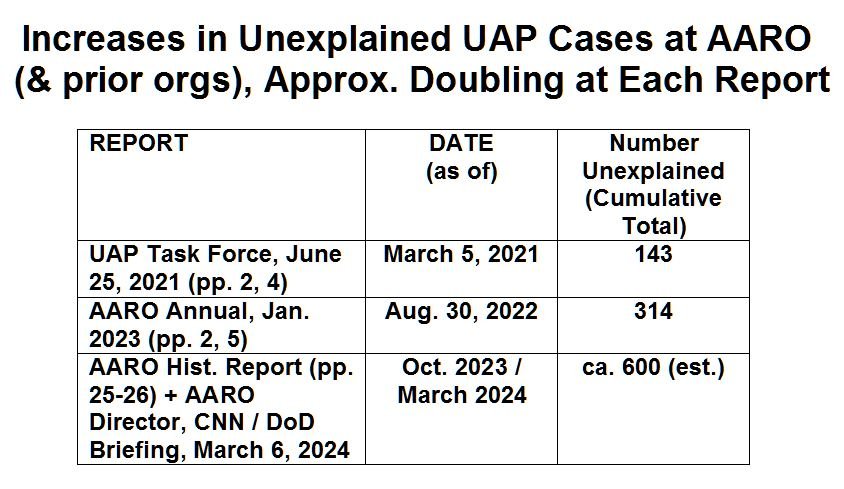
Interestingly, the October 2023 AARO “Consolidated Annual Report” (or “AARO Cons” for short) to Congress on UAP, makes the Blue Book-style prediction that:
“Based on the ability to resolve cases to date, with an increase in the quality of data secured, the unidentified and purported anomalous nature of most UAP will likely resolve to ordinary phenomena and significantly reduce the amount of UAP case submissions [i.e., apparently discourage making of UAP reports].”
But each year or so, the total cumulative number of unidentified anomalous UAP reports increased from 143 to 314 to 600. That suggests that each year or so the added new reports with supposedly better “quality of data” were more unexplainable not more resolved with the better data. A later obscure statement in the AARO Cons report admits that AARO has not been able to explain away its UAP case backlog (the excuse being a “lack of data,” but perhaps really a lack of investigation?) hence the new cases with better data are not helping AARO, they’re still highly unexplainable (AARO Cons., Oct. 2023, p. 8).
Once again, history repeats itself. During Project Blue Book the Air Force repeatedly suggested that the primary problem in identifying and explaining UAP was lack of quality data, when often the reverse was true. When Blue Book sorted UAP cases into categories based on the quality of data, its ability to find conventional explanations steadily decreased as the quality of the witnesses and data increased (see table below from data in Blue Book Special Report 14).
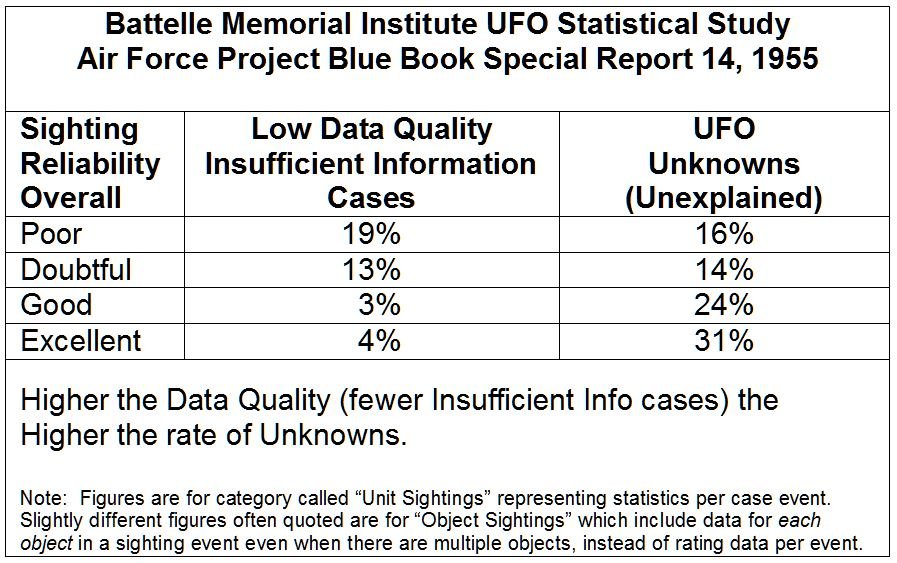
Because there is no mention in the 2024 AARO report of even its alleged current 2024 caseload of 1,200 UAP cases – a number shared by AARO Acting Director Tim Phillips with CNN on March 6, 2024 – the next most recent stats with any kind of hint at an explained/unexplained breakdown we can find are in the previous AARO Annual Reports: the October 2023 AARO Report and the belated 2022 Annual UAP Report to Congress of January 2023 (a confusing array of dates and reports).
The January 2023 report gives the breakdown of only the new cases, with the numbers if one adds them up, 195-to-171 explained-to-unexplained or 53-47% (of the new, not of the total caseload), calling it “more than half,” language that subsequent AARO reports have blurred into the more vague single word “majority.” Both the October 2023 and 2024 AARO reports thus have similar language stating that an apparently bare “majority” of the UAP reports were explained, and some of the remaining “anomalous.”
Then the 2024 AARO report in effect adopts the bare “majority” language as the current UAP status, implying a roughly 51-49% type breakdown (possibly even the same 53-47% ratio as the previous new cases, in view of the vagueness). By implication, AARO seems to broadly apply the older reports’ fuzzy breakdown to the final UAP 2024 situational wrap-up in this current 2024 AARO report. AARO thus admits in subdued non-numerical language the surprising fact that nearly half of its UAP caseload is still unexplained today or does not “have an ordinary explanation” – thus seeming to undermine its position. (AAROR pp. 25-26; similar statement in AARO Cons., Oct 2023, p. 8) It would be helpful in the future if AARO would clarify the data and present the actual numbers.
Presumably, the current 2024 numbers are close to this implied 51-49% split of Explained-Unexplained, or AARO would have said differently and given us the exact figures in the AARO report. (The AARO official website does not help, it gives UAP Reporting Trends from cases 1996 to November 20, 2023, including percentages of shapes (“morphology”) of UAP but for some reason gives no numbers of total cases or percentages of cases resolved or explained – much more important numbers insofar as rating AARO’s mission performance and assessing the level of UAP activity being encountered by DoD and the IC.)
In any case, if applied to the current UAP total then there may be close to 600 Unexplained in the 1,200 UAP reports total in March 2024 (and this does not account for AARO sweeping away Insufficient Data cases as if fully explained as Blue Book did in the past, which might push the 600 Unexplained still higher depending on the definition of Insufficient Data being applied consistently). If so, then this represents almost a doubling of the 314 unexplained cases from August 2022 (a figure AARO also omits). And that 314 unexplained was a more-than doubling from the previous 143 unexplained.
If the stats were much better than this from AARO’s viewpoint, they would likely have said so. AARO had plenty of room – and months of time remaining before the report was due to Congress – to provide explicit numbers in its historical report.
Why are we forced to resort to guessing games on nuances of AARO’s language? Why doesn’t AARO release the statistics openly and transparently?
In still another revealing statistical admission worded in non-numerical language, AARO admits, as mentioned above, that “A small percentage of cases have potentially anomalous characteristics or concerning characteristics.” (AAROR p. 26)
What exactly is that “small percentage” numerically, what exactly do they mean by “small” and are they understating and minimizing it in various ways? What is a “concerning” characteristic? A national security threat? A danger to air safety?
Is this “small percentage” the same category for which AARO then-Director Kirkpatrick gave CNN some UAP stats in October 2023 not found in the formal AARO Cons Annual Report just then released? Kirkpatrick said that 2-4% of the cases are “truly anomalous and require further investigation” (he had also previously given that same ambiguous figure to the media). Why the uncertainty of 2% or 4%? That is a double-factor uncertainty. Is there a “moderately” anomalous category below “truly anomalous” at AARO and what percentage of Unexplained or Total UAP cases might fall into that category?
The AARO 2022 Annual Report uses an interesting new term, “unknown morphologies” (= unknown shapes?), and says such “interesting signatures” are found “only in a very small percentage” of cases – as if stressing the “very small” number makes it better, as in old Air Force Project Blue Book debunker fashion that it was just a little ways to go to be completely explained away (AARO Jan 2023, p.8). How can a shape be “unknown”? Either one sees a shape or not.
It all adds up to a profound mystery that AARO seems to be deliberately obscuring if not obfuscating.
AARO IS PLAYING THE SAME GAMES WITH DATA AS OLD UFO PROJECT BLUE BOOK – FLOODING ITS FILES WITH INSUFFICIENT DATA CASES
It appears that AARO has adopted the old Air Force Project Blue Book’s strategy of flooding their case files with Insufficient Data cases wrongly claimed to be explained. But if there are insufficient data to explain a UFO case or cases, then they are by definition unexplained. However, as Hynek taught, these don’t rate as “officially” Unexplained either, because that requires fully Sufficient Data and must go through IFO screening investigation. “Insufficient Data” does not identify an object or its cause, it says there is not enough data to do so. This AARO policy of caseload dilution with Insufficient Data reverses its predecessor UAP Task Force’s smart approach of selecting higher quality “focused” UAP cases with an emphasis on multi-sensor incidents (80 of the initial 144 UAPTF cases or 56%) which yielded only one IFO out of 144.
And unlike Blue Book, AARO does not even bother to give a breakdown of the status of the current 1,200 UAP cases on file that AARO’s new Acting Director Tim Phillips told the media about but strangely are not mentioned in AARO’s Historical Report. Perhaps AARO doesn’t want anyone to focus on numbers – specific numbers involving the alleged “assessed” UAP identifications instead of vague generalities.
Where are the UAP cases with data so that scientists can independently verify AARO’s conclusions, which is the core of the scientific process?
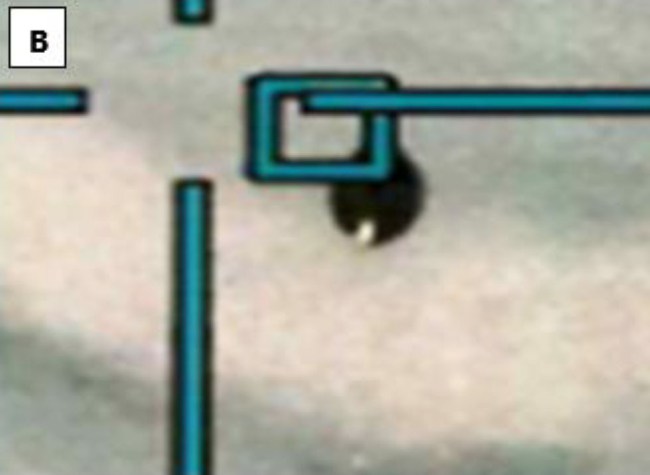
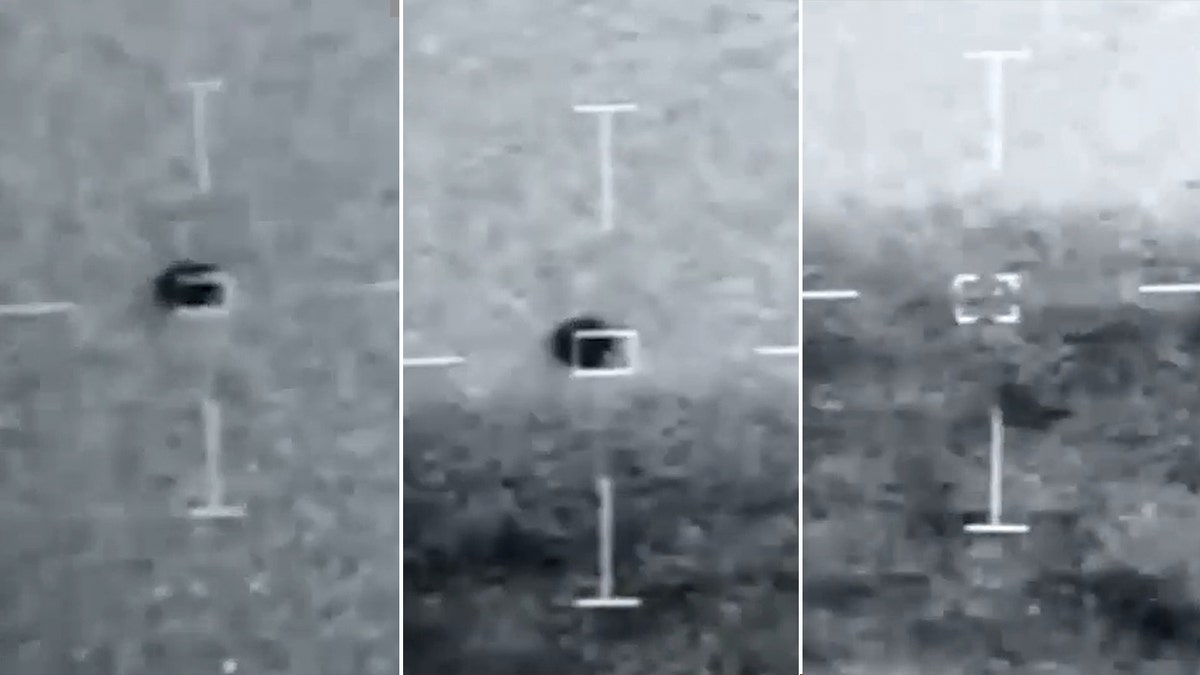
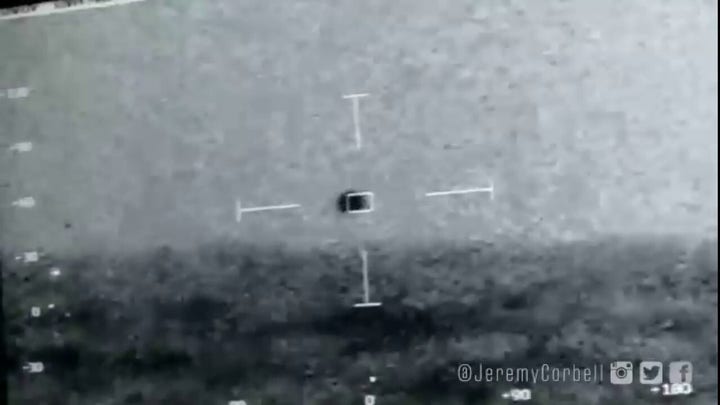
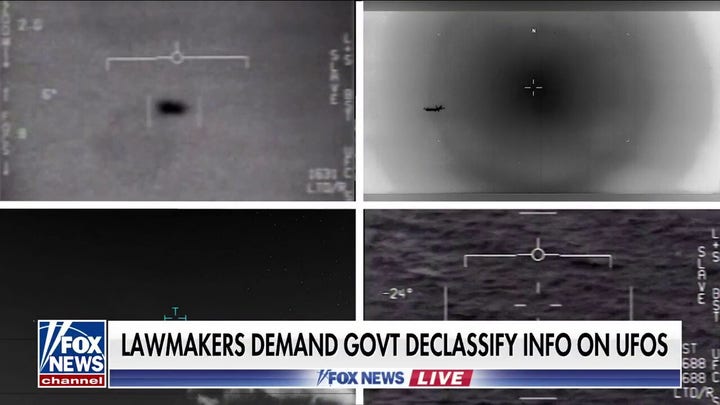
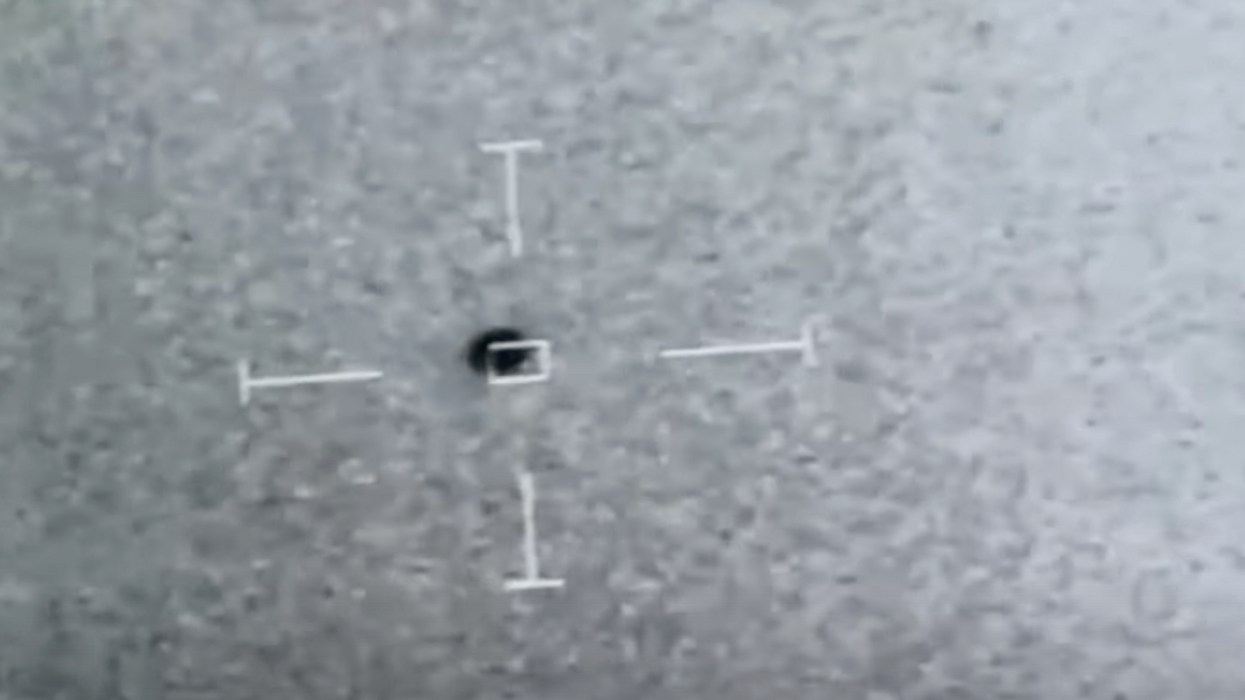
If the government favors transparency as it claims, why is it that not even redacted UAP case files are being released? Why is it that after the Navy Go Fast, FLIR, and Gimbal videos were confirmed to be unclassified other videos of precisely the same kind, obtained over US training ranges, are still being withheld? I know this to be the case because I’ve seen one of the unreleased videos and raised this issue directly with DoD. I initially got a polite reply and an assurance the matter would be reviewed, but months have passed and I’ve heard nothing further. Unsurprisingly, nothing further has occurred. And why is it that Customs and Border Patrol official IR videos can be released without damage to national security, but not similar DoD videos? I’m confident that with over 1,000 new cases there must be others like “Gimbal”, “Flir” and “Go Fast” that have not been released.
AARO appears to be the “New Blue Book,” trying to “get rid” of UAP just like the old Air Force Project Blue Book in its heyday of the 1960s strived to “get rid” of UFOs by every trick in the (blue) book (Hynek UFO Report, ch. 3). In sum, with great irony, AARO seems to repeat some of the same methodological errors and mistakes that undermined the credibility of the historical UAP investigation it is reporting. These appear to include:
-
- misuse or obfuscation of objective statistics;
- mislabeling or treating Insufficient Data cases as fully solved (when by definition “insufficient” means insufficient data to positively solve);
- floating bogus stories of UFO witness mistakes to distract from the real issues;
- flooding case files with poor data + insufficient data + Identified “IFO” cases to drown out and conceal the genuine Unexplained UFO cases, etc.
AARO’s methodology for UAP case handling is murky (confusing and inconsistent use of language, undefined terminology, etc), making it necessary to piece together hints from across multiple AARO reports, rather than just the latest 63-page report. No copies of formal AARO Analytic Division UAP case handling procedure and methodology documents have been released either; perhaps because there aren’t any.
“INSUFFICIENT DATA” DOES NOT MEAN “IDENTIFIED” – IT MEANS INSUFFICIENT TO IDENTIFY A UAP POSITIVELY
How often is “insufficient data” actually a result of insufficient investigation? Sweeping investigatory failures under the carpet was a routine practice of AARO’s forerunner, the USAF Project Blue Book of the 1950s-60s. Blue Book’s standard trick as exposed by its own chief scientific consultant, Dr. J. Allen Hynek, was to make it appear the Air Force had disposed of 90-95% of its UFO caseload not with actual data, but by flooding its case files with 60% or more Insufficient Data cases and casually applying convenient but implausible and unsupported explanations. The Air Force has released or leaked to the press bogus UFO “explanations” such as stars that were not visible, moon-as-UFO when the moon had not even risen yet, the pilot was “possibly drunk,” etc (See Clark, “Debunking,” UFO Encyclopedia, 2018, pp. 379-400).
This happened time and time again, often leaving witnesses embarrassed or understandably angry. So much so that in one case in 1966, Rep. Gerald Ford blasted the Air Force and sought Congressional hearings after sightings by police of fast high-flying objects in the Dexter, Michigan, area were dismissed by the Air Force as “swamp gas.” A mismatch between proffered Air Force explanations and the data submitted by witnesses was a recurring issue.
It appears that some 60% of Blue Book’s cases were in reality Insufficient Data (not just Blue Book’s understated 20% category labeled “Insufficient Data”) – because there was simply not enough info to go beyond guessing at “possible” or “probable” explanations to achieve certainty. The remaining 40% of Sufficient Data cases broke down into approximately 10%—30%, identified—unidentified. The unidentified were therefore a surprising 70-75% Unexplained Unknowns in the total Sufficient Data cases (30/40 = 75%, all numbers here are rounded).
As indicated above, Blue Book went further and tried to conceal this statistical shell game by carving out a much smaller 20% category they called “Insufficient Data” – a misdirect that obscured the fact that Blue Book did not sufficiently investigate the other 40% of the total cases and that the total Insufficient Data should have been stated as about 60%. These Possible/Probables were treated as fully explained IFOs instead of as Insufficient-Data. (See Hynek UFO Report, 1977, p. 259, etc.)
AARO TRIES TO GLOSS OVER SENSOR TRACKING OF UAP
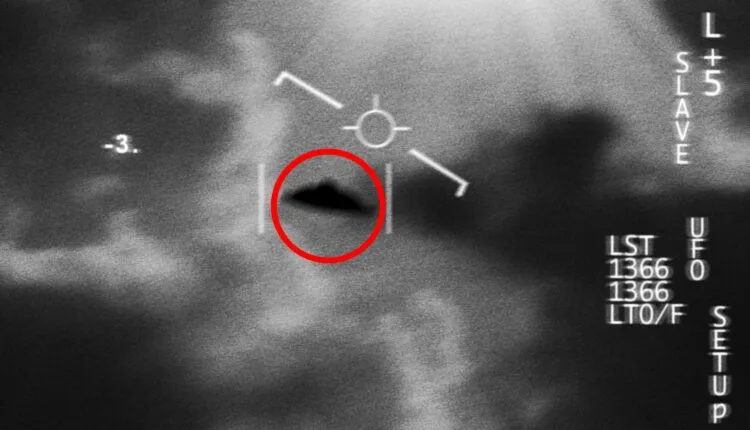
AARO tries to brush aside sensor tracking of UAP on the flimsy grounds of sensor “aberrations” and “artifacts” (AAROR p. 12; media reports call them “glitches”; previous AARO reports call them sensor “errors”). This is untenable if multiple sensors track the same UAP, like infrared and radar such as in the ATFLIR sensor pod videos by the Navy F/A-18s that most everyone concerned with the UAP issue has seen by now (probably at least 50 million video views to date).
In fact, AARO seems to ignore its own data showing they have reduced the problem of “Ambiguous Sensor Contact” with UAP in its caseload from 23% to 9% from April to November 2023 – it’s on AARO’s website but not mentioned in AARO’s report. (The earlier AARO annual report did show a 5% Ambiguous Sensor Contact figure as of Aug. 2022 based mostly on the Navy UAP Task Force’s work, before the April 2023 worsening increase under AARO to 23%.)
That 9% “Ambiguous Sensor Contact” figure means the other 91% of AARO’s current case files of sensor trackings of UAP are good data and are not “ambiguous.” This would appear to undermine attempts at downplaying or dismissing sensor trackings of UAP as must be due to some sort of speculative sensor “artifacts.” Cases involving multiple sensors can overcome sensor error so that any sensor that has an error is corrected by the other sensors that do not. Sensors operating at different frequencies on different bands of the electromagnetic spectrum will not all be fooled by electronic spoofing at the same time.
AARO withholds its multiple-sensor case numbers – unlike its predecessor UAP Task Force that reported it had 56% of all cases as multiple-sensor cases including two or more sensors tracking the same UAP at the same time by “radar, infrared, electro-optical, weapon seekers, and visual observation” (UAPTF June 2021, pp. 3-4). No wonder UAPTF had 99.3% Unexplained cases – good data and no terrestrial explanations.
AARO then complains about the lack of data regarding “speed, altitude, and size of reported UAP” (AAROR, p. 27), even though many of its cases have measurement data from multiple sensors (e.g., radar-infrared-optical F/A-18 cases). The complaint harkens back to Air Force Project Blue Book’s similarly unsupported complaint over the alleged lack of measured “speed, altitude, size” data on UFOs (The Report on Unidentified Flying Objects, the ex-Blue Book Chief Ruppelt’s 1956 book, pp. 116-7, 149, 201, 212, 224, etc.). Meanwhile, Blue Book buried any mention of tracking data resident in Blue Book files from missile tracking cameras, radar-visual cases, and from an Army UAP tracking network specially set up around the top secret “Site B” nuclear weapons stockpile depot at Killeen Base, Camp Hood, Texas (see section, below, with sample chart illustrating some of the Army UAP tracking).
In AARO’s boasted “thorough” and “complete” reporting of past UAP investigations (AAROR p. 12), there is no mention of the existence of the AF’s special AF-Army-Navy/Marine multiple-sensor UFO tracking networks set up at multiple sites in South Vietnam during the Vietnam War in 1968-70. Declassified military histories reveal over 500 “UFO” trackings on radar, optical, laser-ranging, nightscope, telescope, and infrared sensor systems, with 99% Unexplained (Declassified military histories: “Sensor Networks to Track UFOs in the Vietnam War,” UFO Encyclopedia, 2018, pp. 1050-1054).
AARO’s highly selective treatment of the Condon Report also from the AF’s UFO contract study at the University of Colorado, managed to studiously avoid the widely reported criticism that the Condon Report’s negative conclusions were contradicted by the embarrassing unmentioned fact that 34% of its own UAP cases remained Unexplained after investigation – as numerous scientists have pointed out in criticism of the Condon Report’s anti-UFO conclusions. (Someone in effect slipped up and put an easy list of the “Sightings, Unexplained” in the back Index of the published Condon Report, in 1969, where about 26 such Unexplained cases are listed, in addition to listing another 4 radar cases, 1 airglow photometer case, 3 numbered cases missed, and an uncertain number–about two–of the 14 unexplained Prairie Network-confirmed cases not overlapping with the preceding, totaling some 36 out of a grand total of about 106, or about 34%. Different tallies of the obfuscated Condon Report case numbers come up with slightly different numbers. See for example: W. Smith, Journal of UFO Studies, CUFOS, 1996). AARO fails to mention that 14 of the Condon study’s Unexplained UFO cases were backed up by photos taken by the astronomical meteor-tracking cameras of the Smithsonian’s Prairie Network system, an unprecedented scientific development.
There is also no mention of Dr. Condon’s obvious, non-scientific bias, which may have been the reason he was selected by the Air Force to chair the eponymous Commission. In late January 1967, while the Condon Committee’s investigation was ongoing, Dr. Condon tipped his hand, telling an audience at a lecture that UFOs are “nonsense” but “I’m not supposed to reach that conclusion for another year.” Once again, serious issues well-known to any UAP researcher are not included in the AARO report.
Likewise, AARO seems unaware of the new Over the Horizon – Forward Scatter (OTH-FS) radars turned over to NORAD for operational duty in March 1968 which immediately began tracking UAP. This was revealed in the House Science & Astronautics UFO Symposium hearings on July 29, 1968, and published, but despite being open source history it never made it into AARO’s “complete” and “thorough” history (“NORAD” in Clark, UFO Encyclopedia, 2018, p. 811b).
NO MENTION OF THE SCIENTIST SIGHTINGS OF UAP OR INSTRUMENTATION CASES
No mention is made by AARO that many scientists, including government scientists, astronomers, physicists, and others have personally seen UFOs, some obtaining instrument data and photos. AARO never mentions unclassified instrument tracking of UAP in the Blue Book files and other Air Force declassified records (AARO can’t claim that released sensor data is “classified”).
No mention that 14 Unexplained UFO cases in the hostile Air Force University of Colorado “scientific study of UFOs” were photographed and confirmed by the Smithsonian Prairie Network scientific meteor-tracking cameras (another 6 caught on meteor cameras were IFOs). The Colorado study tried to bury it in its infamous Condon Report, but it’s identifiable if one looks at and studies the summary data table with skewed and misleading definitions.
It appears AARO didn’t look. Another scientist UAP instrument detection by airglow scanning photometer is also an Unexplained UFO in the Condon Report, which concealed the fact that an embarrassing 34% of its cases ended up Unexplained (as mentioned above).
The Air Force set up UAP tracking networks in South Vietnam with multiple sensor systems during the war in 1968-70, as revealed in many declassified military histories (mentioned before). But AARO seems ignorant of it.
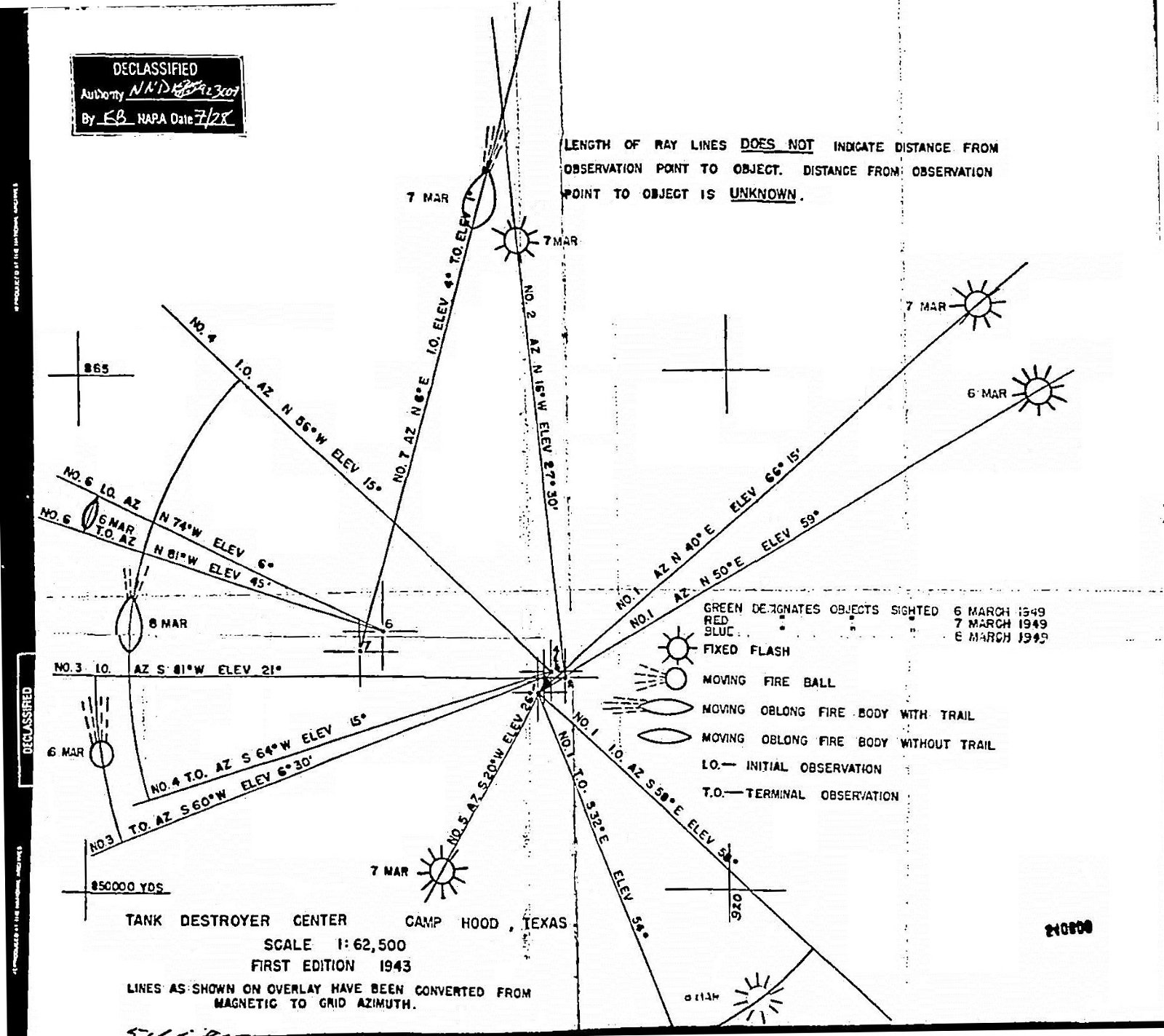
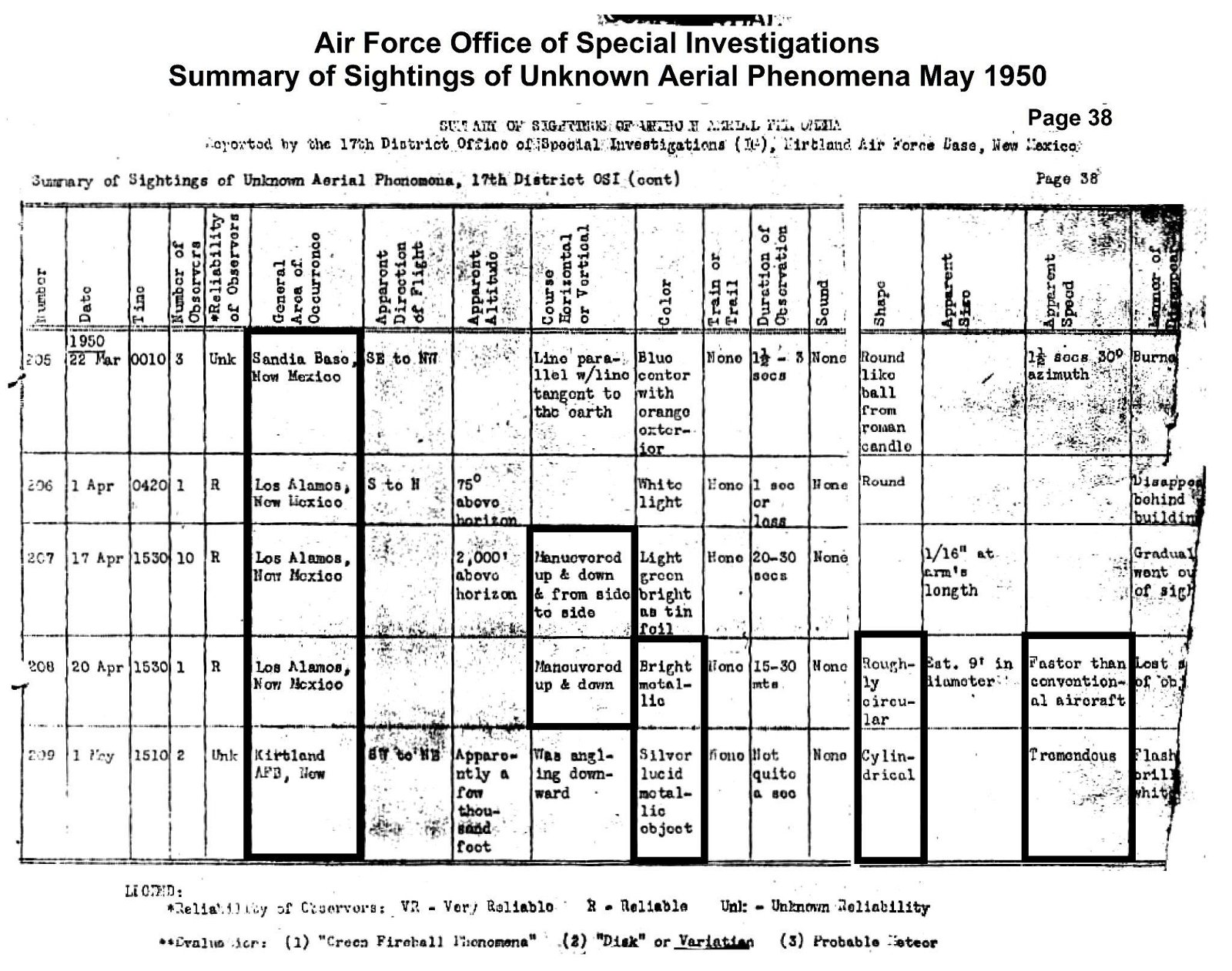
Army UAP Tracking Network Record AARO Missed Finding in the Blue Book Files, March 6-8, 1949 (Site B Nuclear Weapons Stockpile, Killeen Base, Camp Hood, Texas). Later cases included triangulations of speed, size, and altitude data on UAP.
DOES AARO ADMIT SOME “NON-EMPIRICAL” EVIDENCE OF EXTRATERRESTRIALS?
AARO’s two key conclusions, as presented at the top of its report’s Executive Summary, state:
AARO found no evidence that any USG investigation, academic-sponsored research, or official review panel has confirmed that any sighting of a UAP represented extraterrestrial technology.
…
AARO has found no empirical evidence for claims that the USG and private companies have been reverse-engineering extraterrestrial technology.
(AAROR Exec Summary p. 7, underlining added.)
If there is not a blanket AARO denial saying “no evidence” of extraterrestrial UAP sightings, but only a more limited, qualified denial stating “no empirical evidence” (physical evidence) of reverse-engineering extraterrestrial tech, then what non-empirical evidence does AARO have? Empirical means physical evidence and reality of objects and events, not human records of such, which records are presumably non-empirical evidence.
Is this an innocent ambiguity or an inadvertent admission that AARO has non-empirical evidence, such as documentary records or witness testimony, of reverse-engineering efforts on recovered extraterrestrial technology?
Interestingly, AARO claims to have “conducted approximately 30 interviews” of “approximately 30 people” (pp. 6, 11), and quite specifically “As of September 17, 2023, AARO interviewed approximately 30 individuals” who claimed knowledge of hidden government extraterrestrial technology and evidence (AAROR, p. 28). Don’t they know exactly how many people they interviewed, was it 30 or not?
AARO is quick to stress that “It is important to note that none of the interviewees had firsthand knowledge of these programs” (p. 9).
But this seems to be contradicted later when AARO explains that “Priority is given to those interviewees who claimed first-hand knowledge… Interviewees relaying second or third-hand knowledge are lower in priority, but AARO has and will continue to schedule interviews with them, nonetheless.” (AAROR, p. 28) AARO thus makes it seem they are reluctant to “continue to schedule interviews” with “secondhand or thirdhand” witnesses because they are so occupied with high-priority firsthand witnesses.
AARO FAILS TO DEFINE WHAT EVIDENCE IT WOULD ACCEPT FOR EXTRATERRESTRIAL UAP
AARO also fails to define what evidence is required to establish extraterrestrial intelligence visiting Earth. Would multiple sensors tracking an object from high altitude or space that stops and starts with accelerations of >1000 g’s be at least a starting definition of evidence for non-human or extraterrestrial intelligence? (See Robert Powell/SCU critique of AAROR.) Likewise, AARO complains more broadly that it needs “Sufficient Data” in UAP cases, then never explains exactly what is considered “sufficient” (AARO Cons Report Oct 2023, p. 8).
Does it require direct communication with extraterrestrial intelligence to satisfy AARO’s unstated but seemingly shifting definition of “evidence” (see below)? What if the ETs simply refuse to communicate; do we just pretend to ignore them until they do? Is that a responsible operational defense posture or intelligence collection and analysis policy?
What radio signals have been received from UAP in the reports AARO has collected? AARO’s briefing slides to Congress and on its website state that it has cases of UAP-transmitted radio signals in the 1-3 and 8-12 GHz frequency bands (completely separate and different from UAP radar beams at 1-8 GHz, also listed). This has been briefed to Congress and listed in AARO Reporting Trends slides of “Typically-Reported UAP Characteristics” – but is never mentioned in the AARO Report.
Are these UAP Radio Signals a communication? What analysis of these signals has been undertaken? Has Congress been informed of the findings? The AARO Report also ignores a long history back to 1950 of UAP transmitting radio signals and radar beams and even replying to IFF (Identification, Friend or Foe) interrogation signals transmitted to the UAP by ground-based US radar stations (see “UFO IFF” and “NORAD National Alert” articles in Clark’s UFO Encyclopedia, 2018, pp. 814-824, 1155-6).
Does extraterrestrial evidence require beyond-terrestrial technological capabilities (the “extra” in “extraterrestrial”)? Does sensor data suffice or must physical samples be obtained? What about AARO’s October 2023 Consolidated Annual UAP Report which mentions “some cases” of UAP with “high-speed travel and unusual maneuverability” (p.2), and “very small percentage” with “high-speed travel and unusual morphologies” (p. 8), none of which are mentioned in AARO’s current historical report (unless it’s in the classified version).
The earlier UAP Task Force reported that 15% of its reports were of “unusual UAP movement patterns or flight characteristics” including “demonstrating UAP acceleration or a degree of signature management” (the latter meaning the UAP’s apparent use of electromagnetic signature reduction as a means of “camouflage” for purposes of lowering detectability, effectively a form of stealth) in mid-flight. Taken together, these terms evidently convey, at minimum, the UAP’s ability to “remain stationary in winds aloft, move against the wind, maneuver abruptly, or move at considerable speed, without discernable means of propulsion” (UAPTF June 2021, p. 5).
In October 2023 the AARO then-director Sean Kirkpatrick told CNN that about 2% to 4% of his cases were “truly anomalous” – possibly referring to his just-released report’s reference to “unknown morphologies” (meaning “unknown shapes”) and “interesting signatures” not otherwise defined in the report.
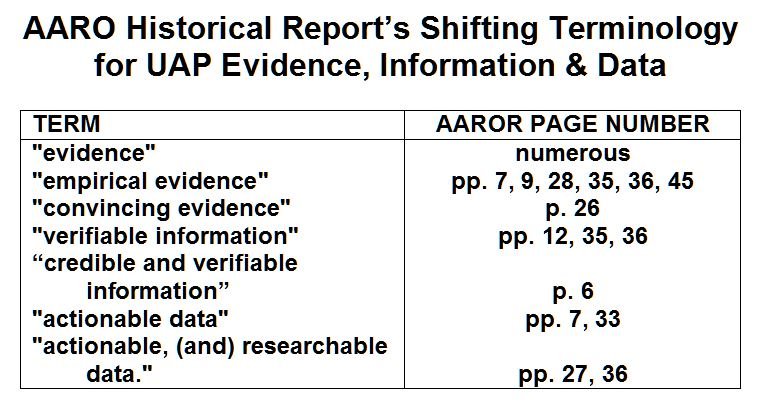
These are tantalizing and provocative admissions by AARO and its predecessor, but what do they mean in terms of meeting AARO’s unspoken requirements for “evidence”?
AARO’s report displays a constant shifting of ill-defined goalposts for what it deems to be “evidence,” etc. First, there is plain “evidence” then “empirical evidence,” then there is “convincing evidence” (is “empirical evidence” not quite “convincing”?). AARO refers to “verifiable information” as if to contrast it with “empirical evidence” (AAROR, p. 35) thus raising the question, is “empirical evidence” not empirically “verifiable information” by itself? And AARO speaks of “actionable data” as conveniently undefined and not distinguished from other types of data or “evidence.” And beyond that, there are “actionable, researchable data.”
The common denominator in these shifting vague pseudo-definitions of what is required for UAP evidence is that they seem intended to ensure genuine anomalies are minimized in favor of prosaic explanations, no matter how implausible.
NOTHING BY AARO ON THE GOVERNMENT “STIGMA” PUT ON THE UAP SUBJECT; NO DISCUSSION, NO HISTORY, DESPITE ITS CRITICAL IMPORTANCE
AARO does not even mention the word “stigma” anywhere in this report, except buried in a passing reference to the UAP Task Force helping “destigmatize” reporting of UAP though not the subject of UAP (AAROR, p. 24).
This is despite the historical importance of the “stigma” deliberately attached to the UFO subject by the US government – principally by the Air Force – that is widely cited by the media and witnesses testifying before Congress. The critical importance of stigma and the problems it has created in hampering and crippling UAP research and investigation are undeniable.
As AARO’s predecessor UAP Task Force stated in its “Preliminary Report to Congress” submitted in June of 2021 (p. 4):
“Narratives from aviators in the operational community and analysts from the military and IC describe disparagement associated with observing UAP, reporting it, or attempting to discuss it with colleagues…. [T]hese stigmas have … reputational risk [that] may keep many observers silent, complicating scientific pursuit of the [UAP] topic.”
The “stigma” attached to the UFO topic as applied by the government appears to have included abuses that AARO was legally required to investigate in its Historical Report – but did not. Specifically, the Historical Report was required to:
“(ii) include a compilation and itemization of the key historical record of the involvement of the intelligence community with unidentified anomalous phenomena [UAP], including— …
“(III) any efforts to obfuscate, manipulate public opinion, hide, or otherwise provide incorrect unclassified or classified information about unidentified anomalous phenomena [UAP] or related activities.” [NDAA FY23 Sec. 6802(j)(1)(B); 50 U.S. Code § 3373(j)(1)(B)]
As mentioned above, AARO failed to compile, itemize, and report on US intelligence agency abuses of UAP witnesses and others. The one tiny item dismissive of vague public perceptions of the Air Force’s UFO “debunker” abuse (AAROR, p. 38) does not document its long history as was required by law in NDAA FY23 and 50 U.S. Code § 3373 cited above.
AARO made no effort to compile the history of the Intelligence Community’s efforts to “obfuscate” or “hide” UAP information through excessive secrecy, as noted before.
Air Force Intelligence “efforts to … obfuscate [and] manipulate public opinion” on UFOs since the 1950s are primarily what caused the harsh stigma attached to the entire UFO subject in society. But this anti-UFO stigma is not investigated or historically documented by AARO – or even mentioned – contrary to its legal obligation.
This is despite the public admission by former USAF OSI officer Richard Doty that his official assignments included spying on US civilian UAP researchers and breaking into a private home, spreading disinformation about UAP, misinforming two US Senators, and spreading fake UFO documents including some so-called “MJ-12” documents that turned out to be a hoax (Doty radio interview Feb. 27, 2005; see Rojas, “Open Letter,” posting May 6, 2014, OpenMinds). Much more evidence could be cited of similar stigma-inducing covert government actions besides the public debunking and shaming of innocent UAP witnesses and civilian investigators (see “Debunking and Debunkery,” Clark, UFO Encyclopedia, 2018, pp. 379-400).
AARO’S NON-DISCLOSURE OF NON-DISCLOSURE AGREEMENTS (NDAS)
The AARO report states that it asked DoD and IC organizations to review their files for any NDAs related to UAP and none were reported (AAROR, pp. 7, 30). Had AARO actually reviewed AFOSI NDAs themselves, rather than delegating the task, they might have reached a different conclusion.
For example, I was informed by a former member of the Advanced Aerospace Threat Investigation Program (AATIP / AAWSAP) that when he requested the opportunity to interview the two F-16 pilots involved in the famous Stephenville, TX, 2008 UAP case, both pilots replied that they could not discuss the matter because they had signed USAF NDAs. It ought to be possible to run this to the ground either by contacting the pilots or searching AFOSI records.
In another instance, a former USAF Air Traffic controller told me she and her colleagues signed OSI NDAs after reporting a black triangular UAP hovering over a nuclear weapons storage facility at Barksdale AFB. Subsequently, AFOSI officers asked them to sign NDAs, explaining that they had seen a highly classified US weapons system they were not cleared for (the secret weapons program ruse again). The witnesses assumed that was a cover story, as they could not imagine a test aircraft being sent to hover over a nuclear weapons storage facility, but they felt compelled to sign the NDAs for fear of retaliation if they did not. This case also suggests that in searching for pertinent USAF NDAs, it may be necessary to review NDAs of the type alleging uncleared military personnel had been exposed to US advanced technology programs outside their clearance level or access authorization and not merely search for some sort of “UAP NDA.”
In the Bentwaters, Rendlesham Forest, UK, case in December 1980-January 1981, there are indications that secondary witnesses and civilian investigators were pressured to sign secrecy agreements (see Col. Charles Halt’s 2016 book, pp, 400, 439).
IS AARO A SCIENCE PROJECT OR AN INTELLIGENCE ORGANIZATION?
Why is AARO, a component of the Intelligence Community and the Department of Defense (DoD), suddenly changing the rules of the game and importing purely academic, scientific standards for the interpretation of intelligence data? Is it because this allows the government to ignore important and valid but inconvenient information?
AARO claims its “methodology applies both the scientific method and intelligence analysis tradecraft” (AAROR, p. 6). But it seems the scientific methodology is set off against the intelligence methodology to discredit any observation of UAP that exceeds present-day scientific understanding, on the tacit grounds that observations by military personnel on this issue, and seemingly this issue alone, are not credible. Meanwhile, the intelligence tradecraft that would investigate a foreign adversary’s possible futuristic development of science seems to be shunted aside. Thus AARO uses a limited academic form of today’s science to deny as “not credible” the observed and measured UAP performance that may represent an advanced technology, possibly extraterrestrial, although we know 21st century science will inevitably be followed by a 31st century science. Neither the law enforcement nor intelligence communities have the luxury of limiting themselves to dismissing human reporting in favor of purely scientific standards of evidence.
It sometimes feels as though AARO is approaching the old unscientific Air Force Project Blue Book policy, long ago exposed by Blue Book scientific consultant Dr. Hynek, of declaring “It Can’t Be: Therefore it Isn’t” when dealing with tough unexplainable UFO cases (The Hynek UFO Report, 1977, ch. 3).
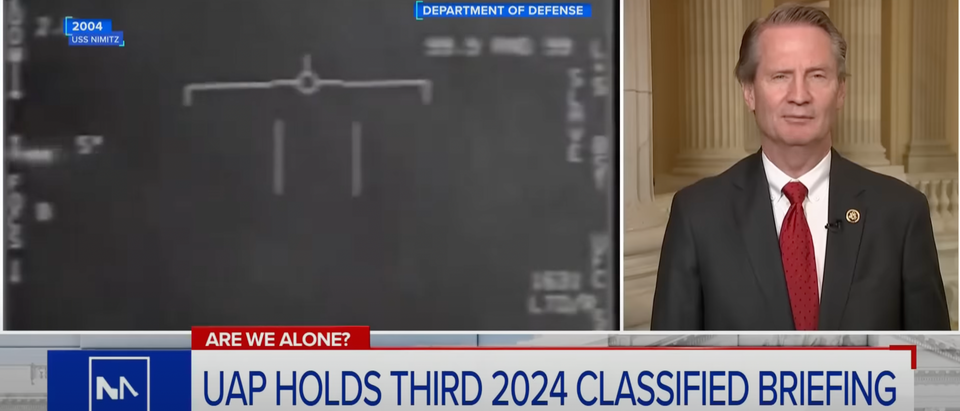
Hence, AARO’s Dr. Kirkpatrick claims there is no “credible” information of craft demonstrating capabilities that defy our current scientific understanding: “AARO has found no credible evidence thus far of extraterrestrial activity, off-world technology, or objects that defy the known laws of physics” (DoD News Briefing, Apr. 19, 2023). This, despite the testimony of Navy squadron Cmdr. Dave Fravor and his colleagues were involved in the Nimitz incident, backed by dramatic radar-infrared-electro-optical data recordings. AARO does not even mention the Nimitz case or its investigation anywhere in its “complete”, “thorough”, and “accurate” Historical UAP Report.
Cmdr. Fravor and his wingman and their crew all saw and reported the same wingless white “Tic Tac” shaped craft in conditions of ideal visibility and their accounts of its mind-boggling capabilities were corroborated by radar operators serving on two different platforms
Later that day another F/A-18 witnessed and filmed the UAP, yet it seems as if AARO is denying this undeniable event, suggesting it did not even happen just because it exceeds today’s academic scientific understanding. Multiple accounts by all three pilots and their weapons systems operators, and multiple radar operators and technicians agree that craft they observed demonstrated almost-instantaneous high g acceleration; achieved hypersonic speed without a sonic boom; showed no evidence of friction or plasma or obvious propulsion, despite the extreme velocities it achieved (estimated peak 90,000 mph in 12 miles going from 0 to 90,000 mph to 0, all in 0.78 seconds, at 5,000 g’s acceleration). The estimated 47-foot wingless white “Tic Tac” shaped craft also thus seemed to survive g forces far greater than any aircraft, rocket, or missile of that size built by man. The tough Navy squadron commander of the Black Aces could not find a terrestrial explanation for what he and his colleagues observed and he has made that clear in sworn testimony to Congress. Is this not relevant?
What aspect of this case should be thrown out as “not credible” and why? Why are we even bothering to ask pilots to report UAP if we do not deem them credible? Why is this case not viewed as compelling, albeit not absolutely conclusive, evidence of the presence in Earth’s atmosphere of vehicles that are so far advanced we cannot understand or replicate their performance? What evidence would AARO accept – and is AARO going to employ an unspoken rule of today’s academic science that does not see a science of tomorrow, and therefore arbitrarily says it must not have happened, because we don’t understand what was reported?
Aside from not liking the implications, is there any reason to doubt the fully consistent account of so many accomplished aviators and sailors operating with high-tech sensors? Our military could not function as effectively as it does if its personnel were not competent and reliable. When assessing the UAP issue, senior policymakers deserve candid views of intelligence and military personnel, not views limited by unrealistically high scientific standards imported from Academia. After all, AARO is a joint IC/DoD operation, not a science project.
CONCLUSION
As documented above, AARO has not complied with statutory orders from Congress for a detailed history of UAP sightings as recorded in USG’s historical records, instead providing a limited history of flawed US Government investigations of UAP.
There was no examination of the impact of “stigma” on the UFO subject, witnesses, and persons interested in it, aggressively implemented by the Air Force and supported by the AF-instigated CIA Robertson Panel, despite the legal requirement for AARO to document the history of intelligence agency manipulation of public opinion and other abuses.
Yet, as AARO itself acknowledged in its first report to Congress the “stigma” surrounding this topic has been a central problem in terms of getting government personnel or scientists to report or study UAP. (AARO Jan. 2023, p. 2) To summarize:
-
- The AARO report is beset with basic errors of fact and science (for instance, despite AARO insinuations, Apollo moon landings cannot be seen by the naked eye from Earth, Manhattan Project buildings cannot fly in the air as UFOs, etc.).
- The report makes unsupported claims about secret government projects causing civilian UAP sightings while ignoring the military’s own sightings of UAP that the military knew were not our own.
- AARO never defines what evidence they would accept for extraterrestrial visitation or even UAP existence, to help avoid repeating past failures of UAP investigations. It seems AARO’s unstated definition of “evidence” is a fluid goalpost.
- There are massive gaps in AARO’s review of important US government documents, records, and programs, and patterns of excessive UAP secrecy. The report focuses on prior government UAP investigations without even acknowledging they were more of an effort to delegitimize the topic than investigate it.
- The powerful effects of the stigma that resulted are neve


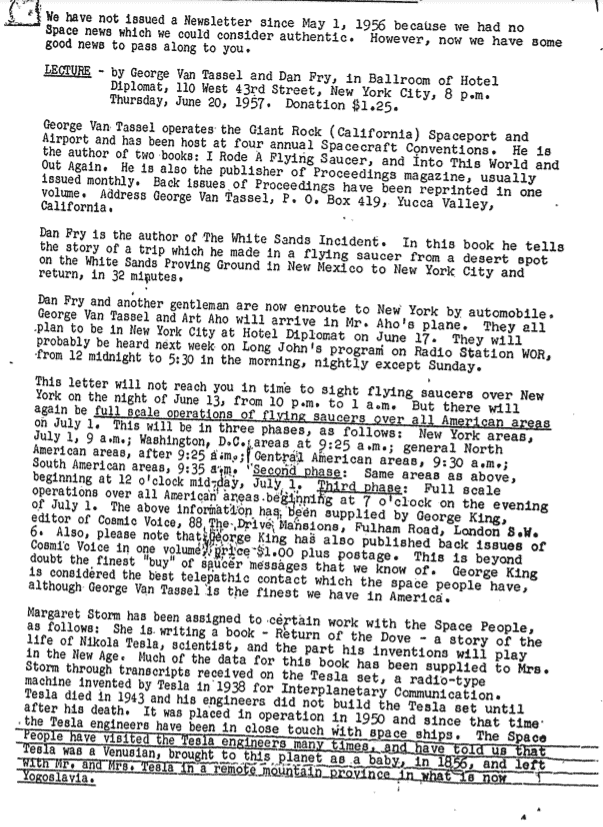
 Does This FBI Document Suggest That Nikola Tesla Was An Alien From Venus?



























































.png)
.png)
.png)
.png)
















































































































































.png)
.png)
.png)
.png)