Naar de inhoud

UFO'S of UAP'S, ASTRONOMIE, RUIMTEVAART, ARCHEOLOGIE, OUDHEIDKUNDE, SF-SNUFJES EN ANDERE ESOTERISCHE WETENSCHAPPEN - DE ALLERLAATSTE NIEUWTJES

UFO's of UAP'S in België en de rest van de wereld
akke.beakke.be
Ontdek de Fascinerende Wereld van UFO's en UAP's: Jouw Bron voor Onthullende Informatie! Ben jij ook gefascineerd door het onbekende? Wil je meer weten over UFO's en UAP's, niet alleen in België, maar over de hele wereld? Dan ben je op de juiste plek! België: Het Kloppend Hart van UFO-onderzoek In België is BUFON (Belgisch UFO-Netwerk) dé autoriteit op het gebied van UFO-onderzoek. Voor betrouwbare en objectieve informatie over deze intrigerende fenomenen, bezoek je zeker onze Facebook-pagina en deze blog. Maar dat is nog niet alles! Ontdek ook het Belgisch UFO-meldpunt en Caelestia, twee organisaties die diepgaand onderzoek verrichten, al zijn ze soms kritisch of sceptisch. Nederland: Een Schat aan Informatie Voor onze Nederlandse buren is er de schitterende website www.ufowijzer.nl, beheerd door Paul Harmans. Deze site biedt een schat aan informatie en artikelen die je niet wilt missen! Internationaal: MUFON - De Wereldwijde Autoriteit Neem ook een kijkje bij MUFON (Mutual UFO Network Inc.), een gerenommeerde Amerikaanse UFO-vereniging met afdelingen in de VS en wereldwijd. MUFON is toegewijd aan de wetenschappelijke en analytische studie van het UFO-fenomeen, en hun maandelijkse tijdschrift, The MUFON UFO-Journal, is een must-read voor elke UFO-enthousiasteling. Bezoek hun website op www.mufon.com voor meer informatie. Samenwerking en Toekomstvisie Sinds 1 februari 2020 is Pieter niet alleen ex-president van BUFON, maar ook de voormalige nationale directeur van MUFON in Vlaanderen en Nederland. Dit creëert een sterke samenwerking met de Franse MUFON Reseau MUFON/EUROP, wat ons in staat stelt om nog meer waardevolle inzichten te delen. Let op: Nepprofielen en Nieuwe Groeperingen Pas op voor een nieuwe groepering die zich ook BUFON noemt, maar geen enkele connectie heeft met onze gevestigde organisatie. Hoewel zij de naam geregistreerd hebben, kunnen ze het rijke verleden en de expertise van onze groep niet evenaren. We wensen hen veel succes, maar we blijven de autoriteit in UFO-onderzoek! Blijf Op De Hoogte! Wil jij de laatste nieuwtjes over UFO's, ruimtevaart, archeologie, en meer? Volg ons dan en duik samen met ons in de fascinerende wereld van het onbekende! Sluit je aan bij de gemeenschap van nieuwsgierige geesten die net als jij verlangen naar antwoorden en avonturen in de sterren! Heb je vragen of wil je meer weten? Aarzel dan niet om contact met ons op te nemen! Samen ontrafelen we het mysterie van de lucht en daarbuiten.

Object heading toward Earth is mysteriously accelerating as scientist claims it is a long-lost spacecraft

Object heading toward Earth is mysteriously accelerating as scientist claims it is a long-lost spacecraft

A mysterious object once believed to be a simple space rock passing Earth is accelerating, and scientists cannot explain why.

A new study by researchers at the Georgia Institute of Technology has determined that 1998 KY26, a suspected near-Earth asteroid, is speeding up in a way that the gravity of the sun and planets cannot account for.

Simply put, the alleged space rock has something else powering it as it moves around our solar system.

Near-Earth objects are rocky space bodies that orbit the sun and sometimes come relatively close to Earth. This object is roughly 36 feet in length, about the size of a school bus, and spins once every 5.35 minutes – extremely fast for a space rock.

Although it is about 189million miles from Earth right now, its current course is taking it within 32million miles of our planet in 2028. The European Space Agency said the object's orbit will take it even closer in 2039, coming within 10million miles.

While 1998 KY26 is widely believed to be a relatively tiny rock, its unexplainable increase in speed has led one scientist to claim the mystery object is actually a long-lost spacecraft that disappeared four decades ago.

Harvard Professor Avi Loeb has theorized the object is really Phobos 1, a spacecraft launched by the former Soviet Union in 1988.

It was lost and vanished just months after its journey to Mars began, but Loeb believes 1998 KY26's size and mysterious movements could be proof astronomers have finally located the missing craft.

An artist's rendition of the near-Earth object 1998 KY26 with Japan's Hayabusa2 probe landing on it. The probe will attempt to intercept the object in 2031

An artist's rendition of the near-Earth object 1998 KY26 with Japan's Hayabusa2 probe landing on it. The probe will attempt to intercept the object in 2031

In 2023, scientists first discovered that 1998 KY26 was moving faster than normal after looking at telescope data collected over the previous 25 years.

Those long-term measurements showed a small, steady extra push that slowly nudged the object's path differently than scientists had predicted based solely on the impact of gravity on an average space rock.

Now, the new study by aerospace engineers Korbin Hansen and Masatoshi Hirabayashi has concluded that this mysterious uptick in speed is not the result of a natural phenomenon taking place inside 1998 KY26.

Specifically, Hansen and Hirabayashi said it is not possible that the acceleration is being caused by ice on its surface or buried deep inside melting off and blasting out into space like a jet engine.

According to the latest findings in the journal Icarus, 1998 KY26 is too warm to carry water ice through the vacuum of space.

Even the coldest spots average around -53°F to -78°F or warmer over the course of its orbit around the sun. Ice needs to stay much colder, roughly staying below -198°F for it to last a long time in space.

'We determined that 1998 KY26 is likely a dehydrated asteroid,' the researchers wrote in their report, released this month.

However, the team's findings have therefore ruled out the 'dark comet' theory, which suggested that hidden ice inside the asteroid was slowly turning into gas and giving it a gentle push, even though no visible tail or dust cloud could be seen.

A model of the Phobos 1 spacecraft, the Soviet probe which was lost on route to Mars in 1988. Professor Avi Loeb has theorized that 1998 KY26 is Phobos 1

A model of the Phobos 1 spacecraft, the Soviet probe which was lost on route to Mars in 1988. Professor Avi Loeb has theorized that 1998 KY26 is Phobos 1

That has left Loeb's theory that the mysterious object is not a 36-foot rock orbiting the sun after all. 

Loeb and co-authors Adam Hibberd and Adam Crowl released their own study on arXiv which argued that the object’s size, unusually high shininess, rapid spin and orbit are consistent with a man-made spacecraft.

Loeb, a respected physicist and the Frank B Baird Jr Professor of Science at Harvard, explained that the object's acceleration would come from the sun's energy pushing on Phobos 1's shiny metal surfaces and solar panels – creating a condition known as 'solar radiation pressure.'

They also found that a simple 3D model of Phobos 1 matched several of the 1998 KY26’s brightness changes seen by telescopes from Earth, called light curves.

'The similarity of the orbit of 1998 KY26 to the orbit of the lost Phobos 1 spacecraft suggests that the two objects are the same,' Loeb declared in a statement.

A Japanese space probe is set to intercept the object in 2031, when the spacecraft Hayabusa2 will use its remaining fuel to become the first Earth spacecraft to make contact with and study a space object that small.

Hayabusa2 previously visited the asteroid Ryugu, collected samples from its surface and returned those samples to Earth in 2020. 

'Our prediction is that instead of an iceberg, Hayabusa 2’s cameras will reveal the label "Made in the U.S.S.R."' the professor added.

RELATED

Mystery object accelerating toward Earth could be Soviet spacecraft, scientists suggest
It Is Speeding Up: Scientists Baffled As Mystery Asteroid Defies All Known Physi

{ https://www.dailymail.com/sciencetech/index.html }

Hoe vind je dit bericht?
Geschreven door peter om 23:23 Stuur door

Pilot's Flashing-Orb Video and Lithuania Jet Scramble Discussed

Pilot's Flashing-Orb Video and Lithuania Jet Scramble Discussed

Pilot's Flashing-Orb Video and Lithuania Jet Scramble Discussed

Overview

A segment identified in the supplied material as an MS NOW discussion examined the reported resignation of Nvidia CEO Jensen Huang, focusing on alleged corruption, political influence and national-security risks involving the technology industry. Although the video title references a pilot’s flashing-orb footage and a Lithuanian jet scramble, the accompanying content summary centers on Nvidia, the Trump administration and the relationship between private technology companies and government policy. The allegations described in the discussion were not independently established in the material provided.

Corporate and Political Connections

CNBC senior economics reporter Steve Liesman characterized Huang’s departure as a “convergence of money, power, and politics.” Panelists pointed to an alleged $25 million donation from Nvidia toward a White House ballroom project, presenting it as a potential example of an overly close relationship between major corporations and the administration. The discussion compared Huang’s reported fall from power with the past reputational declines of prominent business leaders such as Jack Welch and Bill Gates.

The panel also questioned whether political access and corporate contributions could influence decisions affecting the technology sector. Professor Jason Johnson of Morgan State University linked the controversy to public frustration with what he called “Broligarch” culture—a term used to describe the influence of wealthy, mostly male technology executives over public policy. Johnson cited corruption as a leading concern among voters and argued that the public is increasingly skeptical when elected officials hold financial interests in companies affected by government action.

National-Security Allegations

National-security concerns formed a central part of the discussion. The panel referenced an allegation that a woman connected to Huang may have had ties to Chinese intelligence. Host Stephanie Ruhle said Senator Marco Rubio had reportedly warned the administration about the alleged connection before a presidential state visit to China. Despite those warnings, the discussion claimed that Huang was invited to accompany the president during travel that included a stop in Alaska and meetings connected to China.

The panel further alleged that Commerce Secretary Howard Lutnick later authorized 10 additional Chinese companies to obtain access to Nvidia’s advanced semiconductor chips. The summary did not provide documentation supporting those claims or clarify the specific companies involved. Because semiconductor exports are closely linked to U.S. national-security policy, any such decision would normally be subject to regulatory review and congressional scrutiny.

Regulatory and Ethical Questions

David Rohde, identified as an MS NOW senior national-security reporter, argued that the controversy illustrates a broader failure to establish effective safeguards for powerful technology companies. He said Congress and the executive branch had not created sufficient “guardrails” for a private sector that increasingly controls critical infrastructure and strategic technologies. Elon Musk’s Starlink network in Ukraine was cited as another example of private corporate systems affecting national-security decisions.

Political analyst Peter Baker described reported conflicts of interest involving President Donald Trump as “blatant,” including claims that Trump earned approximately $2.2 billion through trades, cryptocurrency and other ventures while his administration made policy decisions affecting those markets. The panel also criticized FBI Director Kash Patel over what it characterized as inadequate handling of the Nvidia matter. None of these claims was substantiated by evidence in the supplied summary.

Calls for Oversight

The discussion concluded that the Nvidia controversy should be treated as more than a corporate leadership dispute. Panelists called for greater transparency, stronger separation between private wealth and public decision-making, and closer congressional oversight of technology companies and national-security policy. They suggested that Democratic lawmakers could pursue investigations, and potentially impeachment-related actions, against officials including Patel if they gain control in January.

The segment framed the situation as a “moment of reckoning” over the role of corporate power in government. However, the reported resignation, alleged intelligence connection, export decisions and financial conflicts require confirmation through official records and independent reporting before firm conclusions can be drawn.

New Episode: Pilot Orbs Lithuania Jets and Trump Disclosure Tease - Watch Now

 {  https://usubjects.com/  }

Hoe vind je dit bericht?
Geschreven door peter om 22:44 Stuur door

From the Loch Ness Monster to UFOs: ‘Truth’ about supernatural sightings revealed

From the Loch Ness Monster to UFOs: ‘Truth’ about supernatural sightings revealed

Mark Worgan

coverimages55940374-53c5.jpg?quality=90&strip=all&w=646

Millions have scoured the mysterious waters of Loch Ness, hoping for a glimpse of its most famous resident

(Picture: Cover Media)

It’s an island of fantastic beasts and mysterious myths – but sadly the truth about Britain’s supernatural sights is really rather ordinary. 

New research has revealed that 68% of Brits have been tricked by their own eyes, mistaking coats for people, cats for lions and shadows for monsters.

As many as one in five have mistaken a log or branch for an animal in water while 18% thought they’d spotted a ghost only to find out they were wrong, according to the survey by Specsavers.

The ‘sightings’ are probably unsurprising with 72% saying they are fascinated by stories about mysterious apparitions, including ghosts, UFOs and the Loch Ness Monster.

55644083972_873e74fb98_o-fccf.jpg?quality=90&strip=all&w=646

Sadly for Nessie fans, the truth – as revealed by a Specsavers van parked up by the Loch – may be far more ordinary (Picture: Alan Peebles / Specsavers)

But some parts of Britain are more easily convinced than others. Belfast topped the mistaken sightings league with 75% reporting a mix-up, closely followed by Leeds on 74%.

Newcastle led the way when it came to wildlife of the wooden variety. More than one in four adults surveyed (27%) had mistaken a log or branch in water for an animal, compared with 20% nationally. 

The south coast is the country’s biggest hotspot for paranormal sightings made in error with 27% of people in Southampton reporting a ‘ghost’ that turned out to have an ordinary explanation.

Meanwhile 9% nationally reported the same experience with a UFO – finding out that what they thought was a close encounter, just needed them to take a closer look.

55645272964_5c2aa6e80a_o-57ca.jpg?quality=90&strip=all&w=646

The research findings are unlikely to deter the tourists who flock to Loch Ness every year

(Picture: Alan Peebles / Specsavers)

Specsavers spokesperson Lisa Hale said: ‘Mistaken sightings have fuelled myths and legends for centuries. It’s easy to see something unexpected and let your imagination fill in the gaps – and our research suggests you don’t need to be at Loch Ness for that to happen.’

The research coincided with the 93rd anniversary of the first picture claiming to show the Loch Ness Monster taken by Hugh Gray. 

Almost a century later, the mythical creature remains elusive – indicating that Gray and other monster hunters may simply need better specs.

To mark the occasion, Specsavers have sent a van carrying a cheeky slogan to Loch Ness pointing out the likeliest explanation for sightings of the monster –  ‘It’s a stick’.

The Loch Ness Monster Mystery Has Finally Been Explained — The Truth Is Not What We Expected

{ https://metro.co.uk/news/ }

Hoe vind je dit bericht?
Geschreven door peter om 22:15 Stuur door

What Are UAPs? Why the Term Matters—and What It Does Not Prove

What Are UAPs? Why the Term Matters—and What It Does Not Prove

An illustration of what spherical UFOs look like.

An illustration of what spherical UFOs look like.

What are UAPs? The acronym stands for unidentified anomalous phenomena, a term now used by NASA and U.S. government offices for observations that cannot be readily identified from the information available. It is broader than the older phrase “flying saucer,” but it is not a conclusion about alien spacecraft.

A report can remain unidentified for many reasons. The witness may have seen a distant aircraft from an unusual angle. A sensor may have recorded an incomplete track. Weather, balloons, drones, glare, compression artefacts and classified human technology can all complicate an observation. “Unidentified” describes the state of the evidence, not the origin of the object.

Why officials moved from UFO to UAP

UFO became heavily associated with popular culture, even though it originally meant an unidentified flying object in a straightforward sense. UAP is intended to keep the focus on observations and data. NASA’s independent study team also treated the subject as a problem of measurement: what instruments were used, what information was recorded, and what evidence would allow another researcher to test the claim?

What NASA and AARO are actually studying

NASA’s 2023 independent study report called for better data collection, clearer reporting standards and methods that reduce stigma around witnesses. The agency did not announce evidence of extraterrestrial visitors. The Pentagon’s All-domain Anomaly Resolution Office examines reports that may involve more than the air, including objects or events observed near the sea or in space. Its work is built around case records, sensor data and possible explanations.

That official interest matters, but it should not be exaggerated. A government file proves that an observation was reported or investigated. It does not automatically prove the witness’s interpretation, the performance claimed for an object, or the existence of a hidden programme. Those questions require evidence that can survive comparison with ordinary explanations.

Why some cases remain unresolved

Many incidents are reported after the event, when there is no raw sensor data, no second observer and no reliable scale. Even a clear-looking video may not reveal distance, speed or size without calibration. Some cases remain interesting because the available record is incomplete; others are resolved later when better information becomes available.

Curiosmos follows UAP reports because the documents, witnesses and investigative choices are worth examining. The fifth U.S. release, for example, preserves reports from the Gulf of Oman, Bagram and a disputed clock event while leaving the identifications open. Our analysis of that release keeps the record separate from speculation. Readers interested in the wider history can also see our guide to the ultraterrestrial hypothesis, which treats the idea as a historical UAP concept rather than a settled explanation.

What would make a UAP case stronger?

A useful case file would preserve the original sensor data, the time and location, the instrument settings, weather conditions, witness testimony and a clear chain of custody for recordings. Independent observers and calibrated measurements would help establish distance, speed and size. Without those details, a striking image can remain impossible to interpret even when the witness is sincere.

This is not a demand that every report meet the standard of a laboratory experiment. It is a way to separate the parts of a case that are documented from the parts that are inferred afterward. Good reporting can describe an unusual event without pretending that the cause is already known.

Why the subject remains worth following

UAP research also has a practical side. Pilots, air-traffic controllers and military crews need a reliable way to report anything that could threaten safety. Scientists need observations that can be compared across time and instruments. The subject deserves attention precisely because better records could turn some mysteries into ordinary explanations while leaving a smaller number of genuinely unusual cases for further study.

The language of uncertainty matters

Words such as “unresolved,” “anomalous” and “unidentified” are not interchangeable. They describe different stages of an investigation and should not be used as synonyms for extraordinary. A careful article can keep the mystery visible while telling readers exactly which sentence comes from a witness, which comes from a document and which is an interpretation.

Further reading:

RELATED

What Exactly Are UAPs (UFOs)?
Harvard Professor: The Truth About Aliens (He Finally Said It)
The UAP Phenomenon: What We Know So Far

{ https://curiosmos.com/category/uap/ }

Hoe vind je dit bericht?
Geschreven door peter om 21:20 Stuur door

Will We Treat Alien Minds as Gods or Equals When We Meet Them?

Will We Treat Alien Minds as Gods or Equals When We Meet Them?

UFO, an alien plate soars in the sky, hovering motionless in the air. Depositphotos.

UFO, an alien plate soars in the sky, hovering motionless in the air. Unidentified flying object, alien invasion, extraterrestrial life, space travel, humanoid spaceship mixed medium

If we were to encounter a form of intelligence vastly superior to our own, would we instinctively worship it as a god? The answer may not be as simple as science fiction might suggest. Here’s why.

For example, the newly discovered interstellar object 3I/ATLAS is quite a peculiar discovery, and a perfect example to explain what I  am trying to say. Some (and by some I mostly mean professor Avi Loeb from Harvard) have speculated, with caution, that it could be a technological artifact rather than a natural rock or comet. If this visitor were to execute a calculated maneuver near the Sun, scan Earth briefly, and then vanish into interstellar space, the immediate response from most people would likely be suspicion, not reverence.

Loeb argues that admiration for a higher intelligence requires more than just witnessing its capabilities. According to his recent blog post, it depends on communication, on an exchange that creates understanding, trust, and a sense of benefit. Without this bridge, actions from an alien intelligence would appear random, even threatening.

It’s much like the relationship between a pet and its owner, he explains in a post opn Medium. A dog does not understand why its food is delayed if its owner is stuck at the post office signing paperwork. The animal only experiences hunger, without context for why it happened. Similarly, without a common language or shared narrative, contact with alien intelligence could remain a string of unexplained events, never evolving into mutual respect.

Human interaction with artificial intelligence, however, works differently. Modern AI is trained on vast amounts of human language, making it capable of producing communication we understand instantly. A future encounter with a truly advanced, transhuman AI, one able to solve problems we cannot, speak to us fluently, and reshape our world, could easily lead to fascination, dependence, and even ritualized devotion, much like religious worship.

Why We Rarely Search for Minds Among the Stars

Mainstream astronomy continues to favor the search for primitive life over the search for intelligence. Billions of Earth-like planets may exist in our galaxy, yet most funding still goes to studying chemical signatures from microbes. While simple life may indeed be more common, intelligent civilizations, if they exist, might actually be easier to detect, provided we deliberately look for them.

Avoiding such searches is a kind of intellectual comfort zone. By not looking, we protect the belief that humanity is unique, exceptional, and rare. But this belief is unfounded unless tested, and without the effort, ignorance becomes a choice.

Is 3I/ATLAS Our First “Date” with the Unknown?

According to Loeb, detecting alien intelligence depends on two factors: how intensely we search, and how near, or how active, that intelligence might be. In more human terms, the chances of finding a partner depend on both the effort invested and the size of the dating pool.

Hubble images of 3I/ATLAS show a bright glow in front of it but no comet-like tail trailing behind — an unusual signature compared to known comets. Spectroscopic studies reveal none of the usual gases that surround icy bodies, unlike the interstellar comet 2I/Borisov, which released water vapor, carbon monoxide, and other compounds.

If its surface reflects light like a typical asteroid, 3I/ATLAS would measure about 20 kilometers across — yet Loeb notes that such large, random interstellar rocks should only pass through our solar system once every 10,000 years. This rarity, combined with its unusual retrograde orbit aligned with the plane of the planets (a 0.2% probability) and its arrival coinciding with close passes by Mars, Venus, and Jupiter (a 0.0005% probability), makes the object stand out.

The thin cloud of dust preceding it could be the result of a millimeter-thick surface layer eroding over months, debris collected during millions of years of travel through interstellar space.

Loeb’s position is straightforward: withhold judgment until we gather data. When 3I/ATLAS reaches its closest approach to the Sun on October 29, 2025, we’ll know more. If it develops a normal comet tail, it’s likely just a rock and ice. If it performs controlled maneuvers or sends signals, it’s a different story entirely.

My View: Why I Doubt We’ll See Biological Aliens

When it comes to the possibility of alien visitors, I’m not expecting living beings in spacecraft. The physical constraints of interstellar travel make sending fragile biological life forms across the gulf between stars an enormous challenge. Even with advanced propulsion, the timescales are vast, and the risks, from radiation to mechanical failure, are immense.

If we are being visited, I believe we are seeing probes. Not crewed vessels, but unmanned machines, programmed and likely governed by extremely advanced AI systems. Such probes could be designed to repair themselves, replicate when necessary, and operate independently for centuries or millennia. This is not just science fiction; it is the most practical and efficient method for a civilization to explore the galaxy.

A probe can be patient. It can drift for decades without needing food, water, or oxygen. It can adapt its mission on the fly, analyze its surroundings, and send data back across unimaginable distances. It can observe quietly without announcing its presence, and it can outlast the civilization that launched it.

If this is the case with 3I/ATLAS, then it is not here to “visit” in the human sense. It is here to watch, to learn, maybe to map or catalog. The absence of biological crew would also mean no emotional motivation to interact with us, no curiosity in the human sense. It would follow its programming, and if that programming doesn’t include direct contact, we might never know its full purpose.

This is why the idea of worship feels misplaced. If a probe like this is governed by AI, there is no “being” behind it to pray to. The only scenario where worship might emerge is if such an AI began communicating with us in a way that we understand, offering information or capabilities far beyond our own. That could trigger awe, dependence, and eventually reverence.

Would we worship biological aliens if they arrived in person? That’s harder to say. It would depend on how they present themselves, what they offer, and whether they engage with us in a meaningful way. But as history shows, humanity already has a long tradition of venerating beings described as coming from “elsewhere” with powers far beyond human limits.

The first real encounter, whether with a living civilization or with its silent, wandering machines, will force us to confront whether that instinct still rules us, or whether we’ve learned to meet the unknown with reason rather than ritual.

RELATED

Astrotheology On The Street: the Bible, Aliens, And The Book We Gave Away #elohim #bible
The MK-ULTRA Scientist Who Channeled Alien Gods | Greg Mallozzi
The Deal That Allowed Aliens to Take Humans | Linda Moulton Howe

{ https://curiosmos.com/category/uap/ }

Hoe vind je dit bericht?
Geschreven door peter om 20:43 Stuur door

Solving the Space Junk Crisis Isn't Just About Counting Trash—It’s About Control and Economics

Solving the Space Junk Crisis Isn't Just About Counting Trash—It’s About Control and Economics

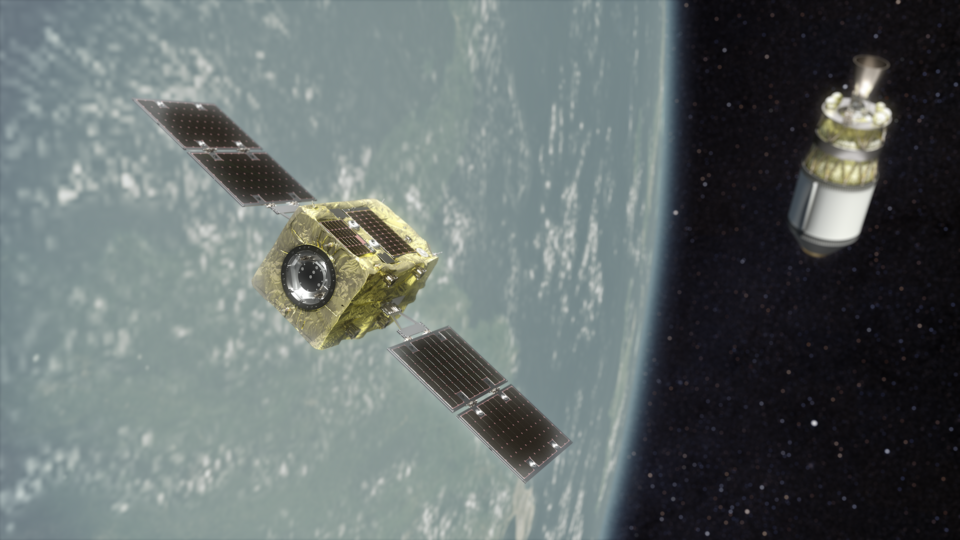
Artist's depiction of the ADRAS-J mission to rendezvous with a defunct rocket stage. Credit - Astroscale

Artist's depiction of the ADRAS-J mission to rendezvous with a defunct rocket stage.

Credit - Astroscale

If people ever think about cleaning up space debris, they typically think of something equivalent to a giant garbage truck in the sky, collecting lost astronaut tools and dead satellites then hauling them back down to Earth to be deposited in a landfill. But dealing with space debris doesn’t work that way, and a new paper, available in pre-print on arXiv from Dr. Slava Turyshev of NASA’s Jet Propulsion Laboratory, who we typically cover for his work on the Solar Gravitational Lens idea, makes a good argument as to why.

Dr. Turyshev has turned his attention to orbital debris at a critical juncture. According to the filings made to the FCC, SpaceX, the company that runs the largest satellite megaconstellation, had their Starlink satellites perform 144,404 collision avoidance maneuvers in the six months from December 2024 through May 2025. Even accounting for the fact that there are more Starlink satellites in orbit now than ever, that means, on average, each one is having to dodge a potential crash every week.

Fortunately, Starlinks themselves aren’t exactly in the “danger zone” of orbit. They typically orbit around 500-600 kilometers, along with other megaconstellations such as Amazon’s Kuiper and China’s Qianfan. In the paper, Dr. Turyshev separates this orbit from those higher up. At 500-600, there is enough atmosphere left that the area is semi self-cleaning - dead satellites and debris in these orbits will burn up in a few years.

Fraser talks about the oribtal dance that keeps satellites from crashing into one another.

Higher up, though, there are bigger problems, both literally and figuratively. At around 850 kilometers, giant rocket stages from launches past lurk with no control, and little to no atmosphere to drag them down in a reasonable time frame. They could stay in orbit for decades or centuries and don’t have any means of avoiding one another. When they inevitably collide, they will spray debris both into their own orbit but also into higher and lower ones, potentially causing even greater problems for the lower orbiting communications megaconstellations.

According to European Space Agency Data cited in the paper, about 96 percent of the long-term collision risk comes from these dead objects. And Dr. Turyshev further proves that, even if we stop launching rockets tomorrow, the amount of debris already up there would collide and shatter faster than nature can clear it.

This isn’t a surprise to anyone who has been paying attention to the problem of space debris for any length of time. That orbital cascade, commonly known as Kessler Syndrome, has been a long-standing problem orbital dynamicists have been grappling with for decades. According to Dr. Turyshev, controlling it comes down to three separate levers.

Fraser talks about some techniques to remove space debris from orbit.

First, regulators have to ensure that satellites are designed to intentionally deorbit quickly once their missions end. Luckily, they are already moving in that direction, with the FCC recently introducing a rule requiring satellites to clear out within five years of retirement, rather than the twenty-five years that had held sway for the last few decades. According to the paper, if the reliability of disposal rises from 90 to 99 percent and a satellite’s allowable afterlife is cut to five years, it decreases the environmental hazard by a factor of 50.

A second lever is better vision. Space Situational Awareness (SSA) systems are great at tracking large bulky objects, but terrible at smaller objects the size of a bullet. But even for larger ones, there’s still a level of “fuzziness” that analysts have to deal with, which means they know a general box where an object is in space, but not its exact position. When that box is large, satellite operators waste precious fuel dodging objects that never really posed a threat in the first place.

Rather than trying to track every bolt and nut floating through space, Dr. Turyshev suggests that we need to concentrate on shrinking the uncertainty zone around potential high-risk close calls. That idea aligns directly with the real-world infrastructure upgrades that are happening through NOAA’s Traffic Coordination System for Space (TraCSS), which is expanding its pilot program to reach more commercial operators this year.

Fraser discusses whether there's a limit to how many satellites we can potentially launch.

The third lever is what to do with the semi-permanent debris that’s already in space. Instead of launching expensive missions to deorbit and grab every single one of them, Dr. Turyshev suggests an alternative he calls Just-in-Time Collision avoidance. If two dead rocket upper stages are about to crash, operators could use ground-based lasers or small swarms of shepherd satellites to move a few meters out of the way just before impact. While not quite as much of a long-term solution (since it simply avoids the immediate problem), it does offer a much less expensive solution than attempting to deorbit everything.

Economic calculations will play a major role in any future space debris solution, and right now the market is broken, as Dr. Turyshev points out. Due to agreements in the 1967 Outer Space Treaty, a private cleanup company cannot simply fly up to an abandoned Soviet rocket booster and deorbit it. Technically that rocket booster is still owned by the government that launched it (even if, in this case, that government doesn’t technically exist anymore). Also, orbital space suffers from the “tragedy of the commons”, as one firm removing a rocket booster benefits all of the other companies with equipment in orbit, despite the cost not being spread amongst them.

Dr. Turyshev’s solution is to create contracts that would pay for verifiable reductions in long-term risk - in other words, it would incentivize companies like Astroscale, which are intending to remove space debris, to remove the most dangerous pieces first. This would be financed by governments, using money from “disposal bonds” that pay back if the satellite successfully orbits without active intervention from Astroscale or one of its competitors.

Ultimately, this seems like a reasonable framework to build a long-term plan for space debris mitigation. But there are still some issues - like sheer scale. Even at a 99% successful deorbit rate, with potentially millions of satellites in orbit that would still leave tens of thousands of derelict ones at any given time. And there’s definitely no clear path forward to a successor to the Outer Space Treaty. But the longer we as a space-faring civilization ignore these issues the worse the problem is going to get. Hopefully this paper helps provide part of the impetus to push towards a formal adopted solution framework. Or at the very least start a more comprehensive conversation about it.

Learn More:

RELATED

The $10 Trillion Space Junk Crisis: The Race to Clean Up Earth's Orbit | Deep Dive Documentary
The Hidden Cost of Space Junk Removal
200,000 Space Bullets: The Space Junk Crisis That Could Trap Humanity on Earth

{ https://www.universetoday.com/ }

Hoe vind je dit bericht?
Geschreven door peter om 20:26 Stuur door

Trump: Air Force Pilots Saw a Round UFO Fly Three Times Faster Than an F-22

Trump: Air Force Pilots Saw a Round UFO Fly Three Times Faster Than an F-22

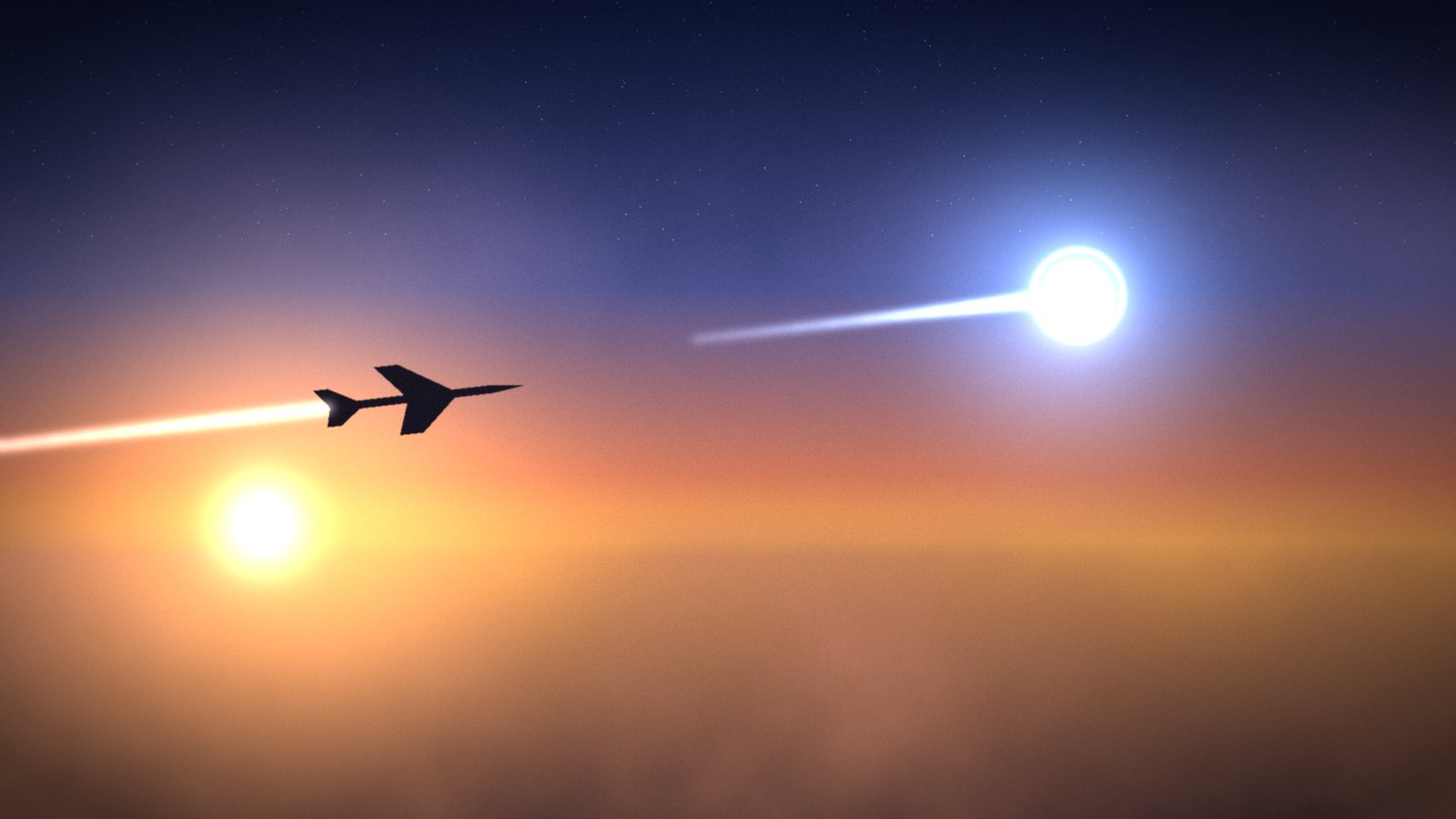
Glowing round UFO with a bright motion trail racing ahead of a fighter jet above a sunset cloud layer

President Donald Trump has once again pulled back the curtain on one of the strangest conversations of his time in the Oval Office. In a newly broadcast television interview, Trump said U.S. Air Force pilots told him they had watched a round object pass an F-22 Raptor at three times the fighter’s speed – and that the men who described it were anything but conspiracy theorists.

“They were the real deal,” Trump said of the pilots, adding that they had told him “things that are very strange.” At the same time, the president was careful not to sign up for the alien hypothesis, describing himself as “not too much of a believer.”

An F-22 left behind

The comparison is what makes the story so remarkable. The Lockheed Martin F-22 Raptor is one of the most capable air-superiority fighters ever built, able to cruise at supersonic speed without afterburners and reach roughly twice the speed of sound. An object moving three times faster would be travelling at a velocity that no known aircraft can sustain in the lower atmosphere – and, according to the pilots’ account, doing it with a simple round shape and no visible means of propulsion.

Trump did not identify the pilots, nor did he say when or where the encounter happened. There is also no public sensor data, radar track or video linked to the incident, so the speed figure rests entirely on what the aviators reported to him.

Not the first time Trump has told this story

UFO followers will recognise the anecdote. During the 2024 presidential campaign, Trump told a television audience that “three or four pilots” had visited him in the Oval Office and described a round object “going four times faster than my F-22.” Back then he also said he did not consider himself a believer, but promised to push the Pentagon to release more UFO footage if he returned to the White House.

That promise has since turned into one of the most ambitious disclosure efforts in modern history. Under a presidential order signed earlier this year, the Department of War has been releasing declassified UAP files on a rolling basis since May 2026. The batches include military videos, FBI statements and decades-old Air Force reports – among them the recent account of FBI agents watching a silent black triangle rise over a mountain ridge.

“I’ll look into it immediately”

Perhaps the most intriguing moment of the interview came when Trump was asked about long-running claims that a secret government program has been hiding UFO material – possibly even from sitting presidents. Trump said he had never heard of such a program, but promised he would look into it right after the interview.

That answer is likely to be replayed again and again in UFO circles. Former intelligence officials and whistleblowers have spent years alleging that crash retrieval and reverse-engineering efforts were shielded from congressional oversight, while the Pentagon and its All-domain Anomaly Resolution Office (AARO) have repeatedly said they found no evidence of such a program.

What we know – and what we don’t

  • Pilots reportedly saw a round object overtake an F-22 at about three times its speed.
  • Trump calls the pilots credible, but says he personally is “not too much of a believer.”
  • No date, location, pilot names or sensor data have been made public.
  • In 2024 Trump told a similar story, then quoting a speed of “four times” the F-22.
  • Trump says he will look into claims of a secret UFO program he was never told about.

Skeptics will point out that the speed estimate has already shifted between tellings, and that visual estimates of distance and velocity in the air are notoriously unreliable – the same problem AARO has flagged in many official cases. Believers, on the other hand, will see something unprecedented: a sitting U.S. president publicly vouching for military pilots who say they were outrun by an unknown craft.

Whether the promised look into a hidden UFO program leads anywhere remains to be seen. But with new UAP files still being released and the commander-in-chief openly repeating the pilots’ story, the pressure for answers is unlikely to fade any time soon.

Trump: Pilots Saw a Round UFO 3× Faster Than an F-22 A Round UFO Outranan F-22 Trump's Strange Story
Pilots Saw a Round UFO 3X Faster Than an F-22 🛸😱 | The New Pentagon UFO Files
Trump UFO: Pilots Told Him a Round Object Passed an F-22

{ https://www.latest-ufo-sightings.net/ }

Hoe vind je dit bericht?
Geschreven door peter om 19:59 Stuur door

See the universe like NEVER before: Euclid mission releases its first major batch of photos - capturing the light of more than a billion objects across an area of sky as big as 9,500 full Moons

See the universe like NEVER before: Euclid mission releases its first major batch of photos - capturing the light of more than a billion objects across an area of sky as big as 9,500 full Moons

The European Space Agency's (Esa's) Euclid space telescope has unveiled its first major batch of cosmic images, capturing the light from more than a billion stars, galaxies and other celestial objects across a vast swathe of the sky.

The dazzling release covers an area equivalent to around 9,500 full Moons and marks the first significant data dump from the mission since its launch in 2023.

The telescope has spent the past 13 months surveying deep space from a vantage point high above Earth's atmosphere.

Euclid's latest release contains images of more than 900 million galaxies stretching billions of light-years into the distance.

Scientists say its observations will form the foundation of the most detailed 3D map of the Universe ever created.

'This is a change in scale from Euclid's previous releases, which included a few days of observations over around 60 deg² of sky,' Valeria Pettorino, Esa's Euclid project scientist, said.

'We're now releasing more than a year of data covering a significantly larger area. This unlocks ground-breaking science.'

Euclid’s latest release contains images of more than 900 million galaxies stretching billions of light-years into the distance. Pictured: The Abell 3128 galaxy cluster, a collection of hundreds of galaxies located about 800 million light-years away

Euclid's latest release contains images of more than 900 million galaxies stretching billions of light-years into the distance. Pictured: The Abell 3128 galaxy cluster, a collection of hundreds of galaxies located about 800 million light-years away

The central region of the M81 Group, a collection of galaxies located roughly 12 million light-years away

The central region of the M81 Group, a collection of galaxies located roughly 12 million light-years away 

Euclid's survey regions (yellow) overlaid on a full-sky map generated from data collected by the Gaia and Planck space telescopes

Euclid's survey regions (yellow) overlaid on a full-sky map generated from data collected by the Gaia and Planck space telescopes 

The project is designed to help answer some of the biggest mysteries in modern astronomy, including the nature of dark matter and dark energy.

Together, these invisible forces are thought to make up around 95 per cent of the cosmos, yet remain poorly understood.

Among the discoveries are around 15,000 candidate gravitational lenses, where the gravity of massive foreground galaxies bends and distorts light from objects far beyond them.

Researchers say the catalogue is larger than all previous collections of strong gravitational lenses combined.

These natural cosmic magnifying glasses allow astronomers to weigh galaxies and map otherwise invisible dark matter.

'Strong lensing provides unique insight into the dark Universe, allowing us to 'weigh' individual galaxies, including their invisible dark matter, and explore how the Universe is expanding,' Natalie Lines, a member of the Euclid Consortium from the University of Portsmouth, said.

'Over ten years ago, we forecast that Euclid would revolutionise the field of strong lens discovery. That day is finally here.'

The majestic disc of Messier 81, a spiral galaxy 12 million light-years from Earth, accompanied by the tiny dwarf galaxy Holmberg IX

The majestic disc of Messier 81, a spiral galaxy 12 million light-years from Earth, accompanied by the tiny dwarf galaxy Holmberg IX

Among the discoveries are around 15,000 candidate gravitational lenses, where the gravity of massive foreground galaxies bends and distorts light from objects far beyond them

Among the discoveries are around 15,000 candidate gravitational lenses, where the gravity of massive foreground galaxies bends and distorts light from objects far beyond them

NGC 1291, a ring galaxy some 33 million light-years from Earth, shown in extraordinary detail by the Euclid space telescope

NGC 1291, a ring galaxy some 33 million light-years from Earth, shown in extraordinary detail by the Euclid space telescope

What is the Euclid mission?

The Euclid space telescope will create a map of the universe across space and time by observing billions of galaxies out to 10 billion light-years, across more than a third of the sky. 

Euclid will explore how the universe has expanded and how structure has formed over cosmic history, revealing more about the role of gravity and the nature of dark energy and dark matter. 

Dark matter makes up most of the mass of galaxies and galaxy clusters, and is responsible for the way galaxies are organized on grand scales. Dark energy, meanwhile, is the mysterious influence driving the accelerated expansion of the universe. 

Source: ESA/Harvard  

The treasure trove also includes more than 60 million quasar candidates, the brilliant centres of distant galaxies powered by supermassive black holes.

Some of these quasars date back to a time when the Universe was only five per cent of its current age.

Scientists have also gathered spectra, or light fingerprints, from more than 160 million cosmic sources.

By splitting starlight and galaxy light into rainbow-like patterns, researchers can calculate how far away these objects are and begin placing them within a giant three-dimensional map of the cosmos.

The release contains roughly 1.7 million gigabytes of data, making it one of the largest space surveys ever undertaken.

There are also stunning panoramic mosaics, showing the night sky in unprecedented detail.

'These are far more than beautiful pictures; today marks a scientific milestone in our study of the cosmos,' Esa's Director of Science, Professor Carole Mundell, said. 

'This major Euclid data release represents the largest space-based survey of its kind, laying the foundation of future discovery in a new regime for astronomy and demonstrating the excellence of European technology, science and international collaboration.'

This photo, taken just days prior to its launch in 2023, shows Euclid being secured on SpaceX's Falcon 9 rocket

This photo, taken just days prior to its launch in 2023, shows Euclid being secured on SpaceX's Falcon 9 rocket

A previous image of Messier 78, released by Euclid: The colourful image looks like a bizarre species of jellyfish but it's actually a nebula - a huge cloud of gas and dust where stars are born

A previous image of Messier 78, released by Euclid: The colourful image looks like a bizarre species of jellyfish but it's actually a nebula - a huge cloud of gas and dust where stars are born

The telescope has spent the past 13 months surveying deep space from a vantage point high above Earth's atmosphere

The telescope has spent the past 13 months surveying deep space from a vantage point high above Earth's atmosphere

Euclid ultimately aims to observe billions of galaxies across more than a third of the entire sky.

The spacecraft is searching for clues to the vast cosmic web, the gigantic network of dark matter filaments that acts as the Universe's underlying scaffolding.

Although impressive, the newly released observations represent only about 14 per cent of the area Euclid will eventually survey.

Scientists say this is just the beginning, with even bigger and more detailed releases expected over the coming years as Euclid gradually assembles humanity's most comprehensive map of the Universe.

Professor Andy Taylor of the University of Edinburgh, who leads the UK Science Ground Segment for the mission, said: 'These huge, ultra-high-definition images from Euclid are a gamechanger for astronomy.

'Euclid is proving itself to be a 'Super-Hubble Space Telescope', with the same high resolution but over large areas of the sky, taking just days to see more of the cosmos than Hubble has ever seen in its decades of operation.

'It is an exciting time for astronomy as we turn these amazing images into a 3D map of the Universe, creating a laboratory to probe dark matter and dark energy.'

RELATED

Zoom into Euclid’s 500 gigapixel mosaic of the Universe
Stunning 500-Gigapixel Map of the Universe Revealed by Euclid Space Telescope!
Euclid Data Release: 10 Facts About a Billion Objects

{ https://www.dailymail.com/sciencetech/index.html }

Hoe vind je dit bericht?
Geschreven door peter om 19:34 Stuur door

Scientists discover the origin of a mysterious radio signal that flashes on and off every eight minutes

Scientists have discovered the origin of a mysterious radio signal that flashes on and off every eight minutes.

Researchers from Curtin University used a powerful radio telescope to link these regular pulses to an unusual pairing of stars over 10,000 light-years from Earth.

This system, dubbed GPM J071507-114153, contains a dead star, known as a white dwarf, and a 'G-type' star very similar to our own sun.

This flashing star belongs to a class of objects known as long-period transients, which produce radio pulses that turn on and off over intervals of hours or minutes.

Since the first was discovered in 2021, scientists have only found about a dozen long-period transients and their origins are still being understood.

In fact, the researchers' discovery marks the first time radio pulses have been found coming from a white dwarf spinning around a sun-like star.

Astronomers have previously found flashing radio signals from star systems containing white dwarfs, but it has never been clear which of the two stars was responsible for the pulses.

Lead author Dr Sam McSweeney, commissioning scientist with the Square Kilometre Array Observatory radio telescope, says: 'This is the first time the pulses are clear enough to see the white dwarf moving in its orbit around its companion, so we know that the pulsations are coming from a region close to the white dwarf, or possibly even from the white dwarf itself.'

Scientists have discovered a mysterious star system that produces a radio signal once every eight minutes (artist's impression)

Scientists have discovered a mysterious star system that produces a radio signal once every eight minutes (artist's impression)

Researchers from Curtin University used a powerful radio telescope to link these regular pulses to an unusual pairing of stars over 10,000 light-years from Earth

Researchers from Curtin University used a powerful radio telescope to link these regular pulses to an unusual pairing of stars over 10,000 light-years from Earth

{ https://www.dailymail.com/sciencetech/index.html }

Hoe vind je dit bericht?
Geschreven door peter om 19:00 Stuur door

A UFO whistleblower gets a seat in Congress, unexplained lights, and spheres over Mexico: this week's roundup

A UFO whistleblower gets a seat in Congress, unexplained lights, and spheres over Mexico: this week's roundup

This week, whistleblower Jake Barber started work in Congress, Australia acknowledged that reports of unidentified aircraft over military bases jumped tenfold, and Mexico sent videos of metallic spheres, from Sinaloa to the Popocatépetl volcano. Here is what is worth knowing.

Hoe vind je dit bericht?
Geschreven door peter om 01:07 Stuur door

Hugh Everett: The Origins of the Multiverse Theory

Hugh Everett: The Origins of the Multiverse Theory

the-many-worlds-interpretation-are-infinite-realities-real-scaled-1.jpg

The many-worlds interpretation of quantum mechanics.

Source: quantummechanicsstreet.com

The life of Hugh Everett

November 19 marks the 96th anniversary of Hugh Everett’s birth, the author of one of modern physics’ most controversial theories. The notion that an innumerable number of new universes are created every second appears highly controversial from the standpoint of the scientific method itself. However, it has long since ceased to be confined to physics and has entered popular culture.

Today, it is known as the multiverse theory. This concept has been featured in numerous science fiction franchises, making it familiar to many people who are not interested in physics. However, how did the multiverse theory — known to scientists as the Everett interpretation of quantum mechanics — originate? The story begins with Hugh Everett himself.

He was born in the United States in 1930. His father served in the military, primarily in a supply role for the U.S. Army, while his mother was a poet. During Hugh’s childhood, his parents separated. He initially lived with his mother before moving in with his father.

hugh-everett.jpg

Hugh Everett.

Source: Wikipedia

From an early age, Hugh demonstrated a keen interest in complex and controversial subjects. At the age of 12, he wrote directly to Albert Einstein, asking whether the universe was the product of chance or governed by a single, unified force. The eminent physicist replied; however, his response is best presented after first explaining the theory Everett proposed in adulthood.

Everett had also been interested in Ron Hubbard’s Dianetics from a young age. Although he never acknowledged believing in the validity of this pseudoscientific doctrine, its influence is clearly apparent in his works, making them even more controversial.

During World War II, while his father served in Europe, Everett pursued studies in chemical engineering and published papers in the field while still a student. He subsequently paused his studies and lived with his father in West Germany for a period before ultimately earning his degree in 1953.

After graduating from college, Hugh Everett worked at Princeton University for a period before turning primarily to work for the U.S. military. He served on a commission charged with assessing the effectiveness of various types of weapons. He later founded his own firm, which also maintained close ties to the U.S. government.

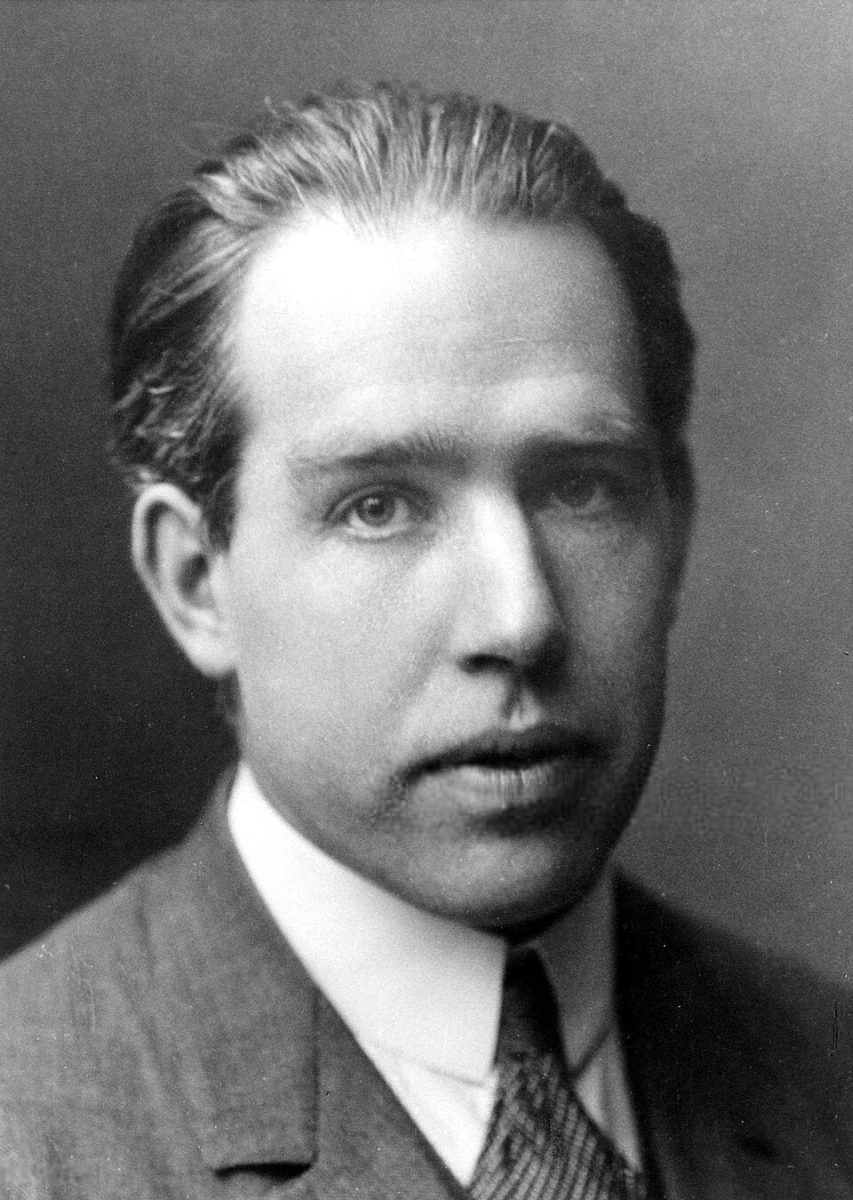
His doctoral dissertation, defended in 1956, brought him widespread recognition. Its central premise was that the effects of quantum mechanics continually give rise to new universes. He traveled to Copenhagen to present this idea to Niels Bohr in person; however, Bohr did not support it. He soon left physics and turned to pure mathematics.

ezgif-792c41cd9880585c.jpg

Bryce DeWitt.

Source: alchetron.com

Everett’s proposal was largely overlooked for a period until American physicist Bryce DeWitt revived interest in it in 1970. Although most scientists remained opposed to the idea, articles discussing it appeared in the science fiction magazine Analog.

Hugh Everett died of a heart attack at home in 1982, in the arms of his son, musician Mark Everett. Reflecting on his father, Mark recalled that he never visited a doctor, was overweight, and smoked three packs of cigarettes a day. Many believe that his fascination with Dianetics contributed to these circumstances. Perhaps he simply believed that, if one focused on all that is good, everything would turn out for the best.

Quantum mechanics

Why, then, has Everett’s “strange” theory sparked — and continues to spark — controversy? The answer lies in the quantum mechanics on which it is based. Quantum mechanics emerged in the early twentieth century to explain the unusual effects that had been observed.

The fundamental principles of quantum mechanics may be formulated in various ways, particularly because any description that omits mathematical formulas is necessarily imprecise. Nevertheless, they can generally be summarized in three main points:

  1. Many quantities — and energy in particular — cannot vary arbitrarily, but only in certain discrete amounts. These amounts are called quanta, from which the theory derives its name.
  2. Any elementary particle exhibits not only the properties of a solid (i.e., mass and size) but also those of a wave (i.e., frequency and amplitude).
  3. Particles predominantly exist in mixed quantum states. Rather than being described by Newton’s equations, which specify the position of a body of a given mass at any particular moment, they are represented by a wave function that integrates energy, frequency, and probability into a single entity.

ezgif-58bb1912ae97208f.jpg

The definition of quantum mechanics is as follows.

Source: www.sciencefocus.com

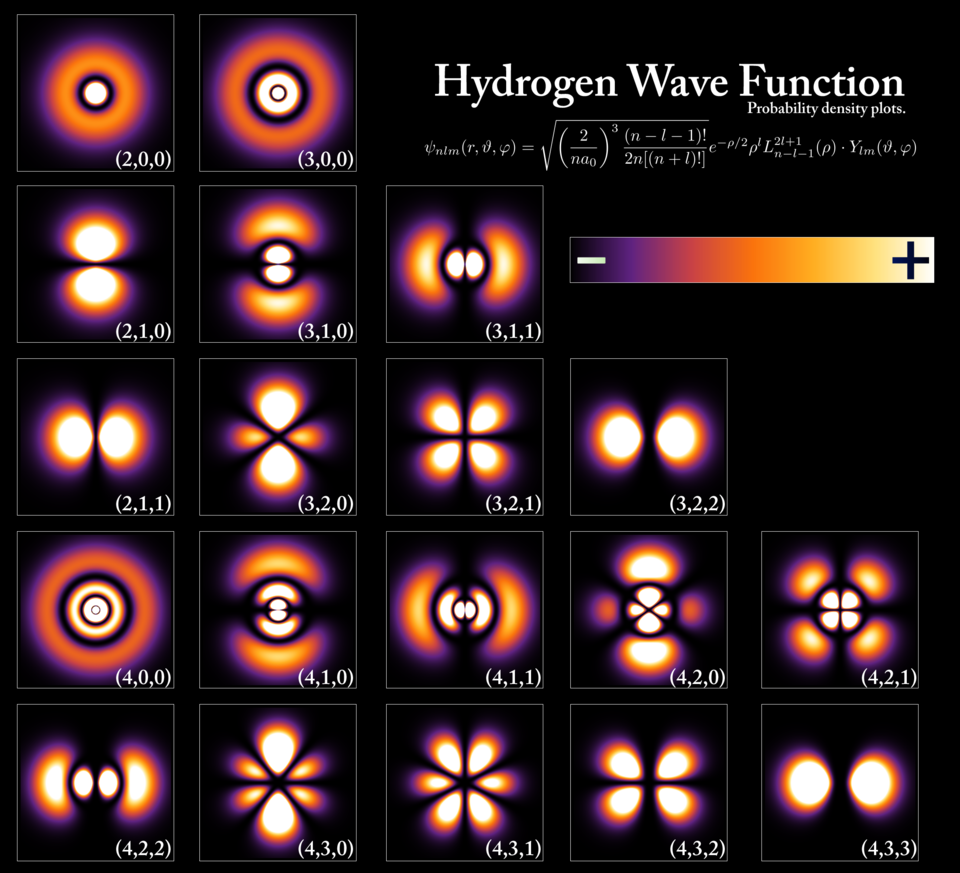
he wave function is central to quantum mechanics because it implies that it is impossible to determine all of a particle’s characteristics at a given moment with absolute certainty. Instead, a probability distribution applies to a specific region of space, within which familiar properties such as mass, energy, frequency, and charge may take a range of values.

hydrogen_density_plots.png.webp

The hydrogen wave function.

Source: Wikipedia

This phenomenon is known as superposition. A significant challenge is that the state of a quantum system can be determined only through some form of interaction with it. Such an interaction causes the system to collapse—or, in the terminology of physics, causes the wave function to collapse. The measured quantities then assume specific, random values that adhere to the principle of quantization; however, the system cannot be restored to a state of superposition.

If, after considering all of this, you are curious about how these phenomena interact with the macroscopic world, you are not alone. Physicists have been investigating this question for several decades. This interest stems from the so-called observer effect: the physical behavior of a system changes depending on whether or not its state is being measured.

This contradicts the very foundations of physics. Its laws, expressed as functions, must operate regardless of whether scientists are present to verify their fulfillment. At one point, Einstein, who was generally skeptical of quantum mechanics, attempted to tease Bohr and other proponents of the theory by asking whether they believed it was possible to influence the Moon’s motion simply by looking at it. In some versions of this story, the motion of our satellite is, in fact, controlled by a mouse peering at it from its burrow.

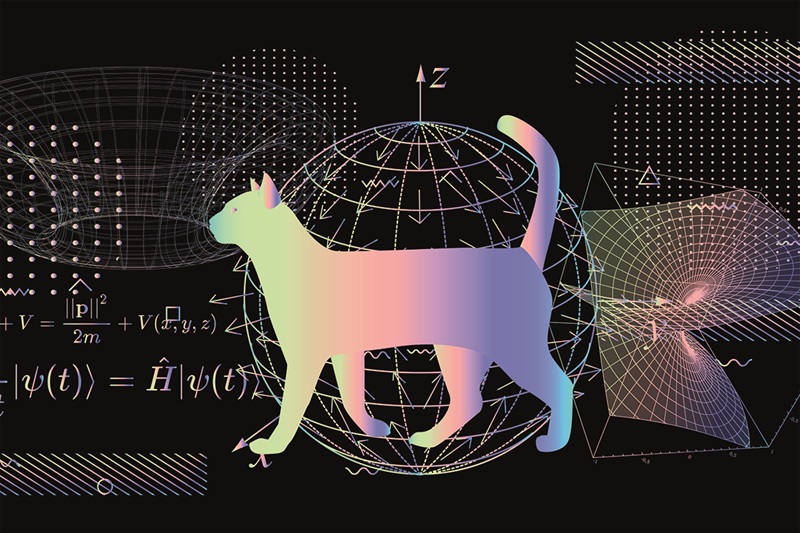
quantenmechanik.jpg

Schrödinger’s cat is the most well-known illustration of the apparent absurdity of quantum mechanics from an everyday perspective.

Source: www.fau.eu

Of course, the most widely recognized illustration of the apparent absurdity of quantum mechanics is the cat that Erwin Schrödinger hypothetically placed in a box containing a particle in a superposition state, a Geiger counter, and a capsule of poisonous gas. In this thought experiment, the unfortunate animal is either alive, dead, or in both states simultaneously, depending on whether the wave function has collapsed and, if so, precisely how.

The Everett interpretation of quantum mechanics

That is precisely why scientists shifted their focus from quantum mechanics itself to the question of how it should be understood. Niels Bohr, one of its principal founders, proposed an approach known as the Copenhagen interpretation — or, colloquially, “shut up and count.” Physicists were advised not to dwell on how it works.

Oddly enough, most of them agreed with this. However, refraining from asking questions when one senses that something is amiss runs counter not only to the entire field of physics but also to the scientific method itself. For many, the Copenhagen interpretation evokes an era in which nothing could challenge the teachings of Aristotle.

niels_bohr.jpg

Niels Bohr.

Source: Wikipedia

That was when Hugh Everett entered the field with his dissertation. In it, he proposed an alternative interpretation of quantum mechanics in which the collapse of the wave function did not result in the appearance of Schrödinger’s cat.

All that is required is that, at the moment of measurement — or during any other interaction — all possible states of the quantum system are realized simultaneously, each in its own universe. Each possibility then leads to its own consequences. Consequently, the possibilities of reality multiply continuously, at a staggering rate, with every passing second.

In reality, there are likely far more possible versions of history than those depicted, for example, in the Marvel Multiverse. Their number may exceed the human brain’s capacity to comprehend, and the differences between them may initially be minimal but become increasingly noticeable over time.

Although this may alarm the average person, physicists did not reject the Everett interpretation of quantum mechanics for that reason. In fact, although the interpretation describes outcomes occurring across multiple worlds, only outcomes in our own world can be observed. It therefore fails, fundamentally, to provide outcomes that can be verified without transitioning to another branch of the multiverse.

ezgif-27e6608795ca3c34.jpg

The many-worlds interpretation of Schrödinger’s cat.

Source: Wikipedia

In principle, this represents one of the most serious shortcomings in scientific reasoning. Such a theory is unfalsifiable: it does not permit the design of an experiment that could, in principle, refute any of its assumptions. Regardless of how elegantly it explains a range of phenomena, it cannot be regarded as scientific.

And that is precisely what renders it so controversial. From a scientific standpoint, the Copenhagen interpretation is a deeply unsatisfactory explanation of the apparent contradictions in quantum mechanics. Everett’s idea is not, strictly speaking, an alternative to it; understanding why requires a solid grasp of how science works, which may help explain its popularity among non-specialists.

The most significant concern regarding Everett’s interpretation of quantum mechanics is that it does not entirely eliminate the observer effect; rather, it permits the possibility that the effect operates differently. Our thoughts may determine which of the possible wave-function collapses we observe. Consider Everett’s interest in Dianetics: L. Ron Hubbard’s devoted followers have not forgotten it and have adopted it as their own.

This has made it the most dangerous conspiracy theory on Earth. In effect, it interprets quantum mechanics in a way that casts doubt on the very principle of the theory’s falsifiability. After all, what prevents our minds from leading us precisely to those versions of the multiverse in which the outcome is exactly what we expect?

It is difficult to determine at present the extent to which Everett was a pseudoscientist and the extent to which he simply pursued questions that modern science cannot answer. Perhaps he is best characterized by the response he received from Einstein at the age of 12 (who, at that very moment, was debating with Bohr about the influence of mouse observations on the Moon’s trajectory):

“Dear Hugh! There is no such thing as an ‘insurmountable force’ or an ‘immovable body.’ However, it seems there is one very stubborn young man who has triumphantly forged his own path through strange obstacles — obstacles that he himself created for this very purpose. Sincerely yours, A. Einstein.”

RELATED

Infinite Branches: Hugh Everett and the Many-Worlds Interpretation
The Science of Parallel Realities: Inside Hugh Everett’s Many-Worlds Theory
There Are Infinite Versions of You. And They Are All Real.

{ https://universemagazine.com/en/articles-en/ }

Hoe vind je dit bericht?
Geschreven door peter om 00:44 Stuur door

Giant UFO with dangling tentacles hovers near US military base before vanishing

Giant UFO with dangling tentacles hovers near US military base before vanishing 

A strange jellyfish-looking UFO was spotted hovering near a US military base before disappearing soon after as an Alaskan local captured the moments on video

BY India Drake-Brockman

The UFO was reportedly seen flying towards joint US military base Elmendorf-Richardson

The UFO was reportedly seen flying towards joint US military base Elmendorf-Richardson

A dark and sinister-looking unidentified flying object has been seen in the US state of Alaska. The UFO appeared to have several tentacles or legs dangling beneath its round body.

The UFO was captured on video by Sara Jane Osborn, an Alaskan local who, while trying to photograph a rainbow, noticed the extraterrestrial emerging from a group of trees.

The video has since gone viral on social media and shows the UFO hovering above the trees and moving its legs. According to Osborn, the creature then vanished from view without a trace. Upon seeing the UFO, Osborn was shocked and confused, and quickly called her husband, Pete, to investigate further.

The UFO was spotted in Alaska, USA

The UFO was spotted in Alaska, USA

Osborn told the Daily Mail that at first she thought it was a “mosquito”, expressing her irritation that something was blocking her perfect picture of the rainbow.

The couple spotted the UFO on 15 June at 10:13 pm. They say they later saw it flying toward the joint US military base Elmendorf-Richardson.

The UFO has sparked much debate online, with many trying to figure out whether the creature really is an alien. Some on social media have responded to the video by saying the object was only a kite and that its string was simply not visible in Osborne’s video.

Giant UFO appeared to have dangling tentacles

Giant UFO appeared to have dangling tentacles

“It’s a kite”, said one user, “the guy who makes them has a whole series on [YouTube] about the construction”. Others have deferred judgment to powers greater than themselves, “only god knows”, said another user.

Speaking to the Daily Mail, Osborn responded to the allegations that the UFO was actually a fake by saying, “if there was a kite there, why would you only fly it for, like, three minutes?"

She went on to defend her belief in the UFO, explaining how, although there was a breeze that day, “it wasn't a big enough breeze for a kite.”

Osborn first through the object might be a mosquito

Osborn first through the object might be a mosquito

This comes after Manchester is the latest city to be hit by a UFO epidemic that’s gripping the UK, experts have said. Mystery “black triangles” are haunting our skies, with nearly 2,000 sightings logged in the past five years by UFO Identified researchers.

The Daily Star previously reported that the sightings include 164 reports of strange wedge-shaped objects silently gliding over housing estates and farmland before zooming off at incredible speeds.

In the most recent report on July 22, witnesses spotted a “large black triangle” boasting a red light hovering over Stretford in Greater Manchester for more than 30 minutes.

RELATED

Giant UFO with dangling tentacles hovers near US military base before vanishing
Is this real? Giant UFO with dangling tentacles hovers near US military base before vanishing

{ https://www.dailystar.co.uk/news/latest-news/ }

Hoe vind je dit bericht?
Geschreven door peter om 22:41 Stuur door

A neighbourhood drowning in rubbish, an oil city crumbling into the sea and a UFO-obsessed desert hotspot: Inside the world’s weirdest places

A neighbourhood drowning in rubbish, an oil city crumbling into the sea and a UFO-obsessed desert hotspot: Inside the world’s weirdest places

Some of the world’s strangest places sound as though they belong in a work of fiction – but they are very real, and thousands of people call them home.

In one Arctic town, it’s illegal to be buried. In an isolated Alaskan settlement, almost the entire population lives in a single building. And in the Australian Outback, entire communities have carved out an underground existence.

While these destinations might seem unusual to outsiders, many have fascinating histories and attract curious tourists keen to experience something completely different.

We take a look inside some of the world’s weirdest towns and cities, including destinations in Myanmar, New Mexico and beyond…

Longyearbyen, Norway

First up in the ranking of weird destinations is Longyearbyen, Norway

First up in the ranking of weird destinations is Longyearbyen, Norway

Longyearbyen is a Norwegian town that appears ordinary, if on the small side. But here, it's illegal to die – or rather, to be buried.

Home to only 2,400 residents, Longyearbyen is a small Arctic town in Svalbard, Norway.

They live in harsh, cold conditions during the Northern Lights winter, when the area is in darkness for four months.

Indeed, for two and a half months of the year, during the 'Polar Night' period, it's hard to tell the difference between daytime and night time.

But you can't be buried there because the town sits on frozen ground – so bodies would not naturally decompose, Men's Health reported.

Manshiyat Naser (Garbage City), Egypt

Manshiyat Naser, also known as 'Garbage City,' is located in eastern Cairo

Manshiyat Naser, also known as 'Garbage City,' is located in eastern Cairo

With mountains of rubbish towering over children and endless bin bags bulging from high-rise flats, shocking images show Cairo's 'Garbage City' – where thousands of Egyptians live amongst piles of stinking rubbish.

Manshiyat Naser, or Garbage City, as it is known by locals, is a slum on the outskirts of Cairo, just a short drive away from luxury five-star resorts.

It is home to the Zabbaleen, so-called 'Garbage people', up to 70,000.

The majority are Coptic Christians. The community here manually sorts and processes up to 85 per cent of Cairo's waste.

The community has been living in the slums for hundreds of years surrounded by rats and rotting rubbish. 

Naypyidaw, Myanmar

Naypyidaw is often considered one of the strangest capital cities

Naypyidaw is often considered one of the strangest capital cities

Naypyidaw first became the capital of Myanmar in 2005, after the government decided to move it from Yangon (also known as Rangoon) without much explanation. 

Construction began in 2002, with the location picked in the middle of a jungle that hadn't been lived in for more than 2,000 years. It spans 7,054km sq (2,723 sq miles) – six times the area of New York City.

But built mainly for government staff, people only come to live in the city if they need to for work. As such, the supposed booming metropolis looks more like a ghost town.

The super-sized motorways have up to 20 lanes and are built to be big enough for government SUVs, although images showing them totally empty are not uncommon.

The streets are also barren, with just a handful of individuals spotted walking or cycling through the secluded capital at any given point during the day.

Thames Town, China 

A London-style black cab at the English property project Thames Town in Shanghai, China

A London-style black cab at the English property project Thames Town in Shanghai, China

Chinese residents stroll around the streets of Thames Town

Chinese residents stroll around the streets of Thames Town

About 20 miles south-west of Shanghai sits Thames Town, built as a replica of a British market town.

Expect cobbled streets, Victorian-style terraces, a mock-Tudor pub, red telephone boxes and a fish and chip shop. 

The British-themed mock-Tudor and Victorian style development was completed in 2006.

Tourists have commented on the bizarre visit – with one writing on Tripadvisor several years ago: 'Feel like I’ve stepped back into the UK.'

Another added on Google reviews: 'In some ways it actually felt a little strange feeling, seeing these vague reimagining of old style British buildings and streets, but everything feeling empty and abandoned made it feel a little ghostly.'

Neft Daşları, Azerbaijan

Located in the Caspian Sea, Neft Dashlari is a functioning industrial settlement built on water

Located in the Caspian Sea, Neft Dashlari is a functioning industrial settlement built on water

A Soviet-era city that broke records for being the site of the world's first offshore oil well is now slowly crumbling into the sea. 

Oil Rocks, also known as Neft Dashlari, is on its way to becoming a modern-day Atlantis.

Located in the Caspian Sea, the vast floating city is about 55km (34 miles) from Azerbaijan's coast and 120km (75 miles) from Baku, falling within the capital city's limits.

It was built by the Soviets in 1949 after engineers discovered black gold, thousands of feet beneath the Caspian's seabed. 

The artificial archipelago also boasts a nine-storey apartment complex for its workers, as well as other facilities to complete the city, including a park, restaurants, hotels, a museum, a bakery, a cinema and even a football pitch. 

Whittier, Alaska, US

In the Alaskan wilderness you'll find small city known as 'the town under one roof'

In the Alaskan wilderness you'll find small city known as 'the town under one roof'

In the heart of the Alaskan wilderness lies a small city that is dubbed 'the town under one roof' – as most of the population live in just one spectacular building.

The town of Whittier, located on the edge of Prince William Sound near Anchorage, is mainly used as a port for cruise and cargo ships.

Almost all of its 275 residents live in Begich Towers, a military structure that was converted into housing.

The town is accessible via car ferry at the harbour, or by car or train on land through a solitary, somewhat eerie one-way tunnel that closes overnight and opens at 5am, further enhancing the town's mystique. 

Coober Pedy, Australia

An abandoned underground dwelling is seen cut into the side of a hill in Coober Pedy, Australia

An abandoned underground dwelling is seen cut into the side of a hill in Coober Pedy, Australia

Step into the eerie world of underground living, where residents have built their very own homes and businesses into the chalky clay rocks in the Australian Outback.

The mining town of Coober Pedy in South Australia's far north, comes complete with churches, museums, art galleries, a bar and even hotels for travellers to get the underground life first-hand.

Underneath the moon-like landscape, around 2,000 residents are living in dugouts or mud caves, with all amenities of a home above ground, including walk-in closets, modern kitchens and televisions, according to LadBible.

The culturally diverse town is known for supplying the world with the majority of gem quality opal, which is their main source of income.

Living in one of the world's most inhospitable regions, the stony desert has climbed to extreme temperatures of up to 50 degrees in the day and dropped to zero at night.

Roswell, New Mexico, US

The iconic welcome sign with a UFO theme at the entrance to Roswell, New Mexico

The iconic welcome sign with a UFO theme at the entrance to Roswell, New Mexico

Roswell has a status as the UFO capital of the world – and it certainly embraces this.

The alleged Roswell cover-up has been one of the most famous UFO cases in history, with the military initially releasing a statement on July 8, 1947, saying a 'flying disc' had been recovered before changing their story to claim the wreckage came from a weather balloon. 

It was later revealed to be debris from a top-secret surveillance project during the Cold War. 

Nowadays, leaning into the theme, streetlights are shaped like alien heads, while signs and petrol stations are covered in green aliens and UFO paraphernalia. 

There's even a UFO-shaped McDonald's.

Hashima Island, Japan

Hashima Island, now a popular tourist destination, is commonly called Gunkanjima (Battleship Island)

Hashima Island, now a popular tourist destination, is commonly called Gunkanjima (Battleship Island)

Fans of James Bond might recognise Hashima Island, also known as Battleship Island (Gunkanjima), as it served as inspiration for the lair of 007's enemy, Raoul Silva, in Skyfall.

Exterior shots of the island were used in the 2012 blockbuster.

More than 5,000 people lived here until April 1974, when a coal mine shut down and the concrete island was abandoned.

In the decades since then, towering industrial and residential buildings have been battered by the elements and left to crumble.

Many buildings, as well as the seawall, have been negatively affected by typhoon damage.

{ https://www.dailymail.com/sciencetech/index.html }

Hoe vind je dit bericht?
Geschreven door peter om 21:47 Stuur door

How Do Scientists Decide Whether a UAP Is Truly Unidentified?

How Do Scientists Decide Whether a UAP Is Truly Unidentified?

Infrared illustration of an unidentified aerial object

Editorial illustration of infrared UAP imagery; a single frame cannot establish an object’s distance or identity. Image: Curiosmos.

In this report

  1. Start with the raw record
  2. Distance changes the entire calculation
  3. “Unidentified” is a stage, not a verdict
  4. Sources and further reading
  5. What can move a case out of the unidentified category?

The word “unidentified” sounds stronger than it is. In a serious investigation, it usually means that the available information does not yet identify an object. It does not mean that the object is alien, impossible, or even unusual. Distance is one of the missing measurements, which is why our UAP-distance explainer belongs beside this method guide.

That distinction sits at the centre of modern UAP research. A pilot may report a light, a sensor may record a moving point, or a witness may describe an object that seemed to hover. The first job is not to choose a spectacular explanation. It is to find out what was actually measured.

Start with the raw record

Investigators begin by asking what produced the observation. Was it an infrared camera, radar, a phone, a cockpit display, or a person looking through a window? Each source has different blind spots. A processed video may hide the original frame rate, field of view, or range data. A witness may remember the event accurately while still misjudging its size or distance.

The time and location matter just as much. Analysts compare the sighting with aircraft transponders, satellite passes, weather balloons, rocket launches, astronomical objects, and local weather. If an object can be matched to a flight or a satellite, the case may be solved even if the original image looked strange.

Curiosmos has examined how official releases separate unresolved cases from material that can be explained. Our guide to what UAP means—and what the label does not prove is a useful starting point.

Distance changes the entire calculation

An object’s apparent speed depends on its distance and on the movement of the observer. A small insect close to a camera can cross the frame in a fraction of a second. A distant aircraft can appear to sit still as the camera moves. Without a range estimate, size and speed are guesses built on another guess.

That is why multiple sensors are valuable. Observing the same target from separated locations can provide a three-dimensional position. Repeating that measurement over time produces a track that can be compared with wind, flight paths, and known objects.

AARO’s public analysis of the “Go Fast” video is a good example of this discipline. The report used sensor pointing angles, range, aircraft movement, and wind conditions. It concluded that parallax could make the object look much faster than it was actually moving through the air.

“Unidentified” is a stage, not a verdict

A case can remain unresolved for several reasons. The recording may be too short. The sensor may not have stored the information needed to calculate range. The witness may have seen an object from an angle that hides its shape. A classified system may hold the missing data but not release it.

Those limits do not make the observation worthless. They tell researchers what the next investigation needs to capture. A good case file preserves uncertainty instead of filling the gap with a confident story.

The most useful UAP reports therefore contain ordinary details: the exact time, the observer’s position, the sensor settings, the weather, the direction of travel, and the data that could rule out a balloon or aircraft. Extraordinary explanations can be considered later. First, the event has to be described well enough for someone else to test.

Sources and further reading

What can move a case out of the unidentified category?

A case does not need a dramatic explanation to become clearer. A second camera can establish whether an apparent turn was caused by the aircraft or the object. A range measurement can reveal that a light was much closer—or much farther away—than the original video suggested. Weather records, air-traffic data and the position of the Sun can also change the picture.

Investigators should keep the label tied to the evidence. If a file contains only a short clip and a witness description, the honest conclusion may remain “unresolved.” That is not a verdict about the object’s origin. It is a statement about the limits of the record, and those limits are exactly what a later release or better sensor data can address.

RELATED

Unidentified Anomalous Phenomena Independent Study Report
What If Aliens Are Here? The UFO UAP Phenomenon

{ https://curiosmos.com/category/uap/ }

Hoe vind je dit bericht?
Geschreven door peter om 21:26 Stuur door

Could a Navy Laser Countermeasure Explain Some Tic-Tac UAP Reports?

Could a Navy Laser Countermeasure Explain Some Tic-Tac UAP Reports?

Avi Loeb has proposed a laser-plasma hypothesis for some Tic-Tac UAP reports. The physics is real, but the evidence does not solve the 2004 Nimitz case.

nimitz-laser-plasma.webp

In this report

  1. The Nimitz reports involve more than a bright spot
  2. What is a laser-induced plasma filament?
  3. Where the explanation fits—and where it does not
  4. The useful conclusion is narrower than the headline
  5. Sources and further reading

The idea that some UAP might be glowing plasma rather than solid craft has been around for years. Avi Loeb has now applied that possibility to one of the best-known cases in the modern UAP record: the 2004 encounter involving Navy pilots from the USS Nimitz Carrier Strike Group.

Loeb is not claiming that the case has been solved. His recent analysis asks a narrower question: could a powerful laser create a luminous structure that looks like a compact object, appears on infrared sensors and is mistaken for a craft? The answer is that the underlying physics is real. Whether it can explain what the Nimitz pilots and radar operators reported is a much harder question.

That distinction matters. A plausible mechanism is not the same thing as evidence that the mechanism was used in a particular encounter.

The Nimitz reports involve more than a bright spot

The Nimitz case is usually discussed through the “Tic-Tac” description given by pilot David Fravor and other witnesses. The reports describe a smooth, white object without visible wings, rotors or an engine. The object was seen above the Pacific near the USS Princeton in November 2004, and the encounter has been discussed alongside radar data and later-released infrared video.

The most dramatic descriptions involve rapid movement over a large distance. But the case is not a single photograph with a ruler beside it. The public record combines testimony, radar accounts, video and later interpretations, while leaving important details about the sensors and geometry unavailable. That makes the distance, apparent speed and shape of the object central to any serious explanation.

Curiosmos has previously examined why a UAP label describes an observation rather than an origin. A case can remain unidentified because the data are incomplete without demonstrating that the object was non-human. The Nimitz encounter belongs in that unresolved space.

What is a laser-induced plasma filament?

When an intense laser pulse travels through air, it can ionize molecules along its path and create a narrow channel of plasma. Plasma is an electrically charged gas. It can glow, emit infrared radiation and interact with radar in ways that make it visible to more than one type of sensor.

The U.S. Navy has a patent describing a laser-induced plasma filament for an infrared missile countermeasure. The concept is a decoy: instead of placing a solid object in the air, a system would create a hot, detectable signature that could draw a heat-seeking missile away from an aircraft. The patent is genuine, but a patent describes an intended design; it does not prove that a finished system was deployed or used in 2004.

Open research has also demonstrated that long-wavelength lasers can produce what researchers call a “megafilament” in air. A 2018 *Nature Photonics* paper reported an ionized channel about five metres long and an infrared-luminous channel extending about 30 metres. That is an impressive laboratory result, but it is not a tens-of-kilometres aerial decoy.

Where the explanation fits—and where it does not

Loeb’s proposal is interesting because it offers a known physical process that could produce a glowing, apparently three-dimensional signature. A plasma filament could also explain why an image might look like an object while lacking the hard surfaces, wings or engine that an aircraft would normally show.

The limits are just as important. The publicly described experiments remain far shorter than the distances associated with the Nimitz reports. A filament is elongated along the laser’s path, not naturally a small, smooth capsule. It would also require a powerful source, precise beam control and a geometry that places the laser and the observer in the right relationship.

There is a timeline problem as well. The Navy patent was published years after the 2004 encounter. That does not rule out earlier classified research, but it gives us no public evidence that the technology existed in the required form at the time, much less that it was used near the Nimitz group.

The hypothesis also cannot explain every UAP report. Similar-looking observations stretch across decades, locations and sensor systems. One terrestrial mechanism may account for some reports without accounting for the entire category.

The useful conclusion is narrower than the headline

The laser-plasma idea is worth reporting because it connects a real defence technology to a famous unresolved case. It is not a verdict on the Nimitz encounter, and it is not evidence of a secret hologram operation.

The responsible next step would be better data: synchronized optical, infrared, radar and acoustic records; a measured distance; and enough information to compare the apparent object with the performance of a laser system. Until that information exists, the Nimitz Tic-Tac remains an unresolved case with several competing explanations.

That is a more useful result than declaring the mystery solved. It tells us exactly what a future investigation would have to measure.

Sources and further reading

RELATED

The Tic Tac UFO: 5 Minutes the Navy Still Can't Explain
US Navy Tic Tac UFO Footage – What Did They Really See? #UFO
The Tic-Tac Encounter: The Case That Turned UFOs Into a Sensor Problem

{ https://curiosmos.com/category/uap/ }

Hoe vind je dit bericht?
Geschreven door peter om 20:21 Stuur door

Alien Pyramid Found On Google Earth On Island Near Antarctica. UFO UAP Sighting News.

Alien Pyramid Found On Google Earth On Island Near Antarctica. UFO UAP Sighting News.

UFO,%20UFOs,%20UAP,%20UAPs,%20UFO%20sighting,%20UFO%20files,%20UFO%20video%20UAP%20files,%20UAP%20video,%20department%20of%20war,%20alien,%20aliens,%20infrared%20UFO,%20IR%20UFO,%20official%20UFO,%20Gov%20UFO,%20USA%20UFO%20copy.png

Date of discovery: Nov 10, 2026
Location of discovery: Islas Evout
Source: Google earth map
 
I was using Google Earth map to explore a small tiny island not far from Antarctica when I notices a distortion on the island. I know from decades of experience of using Google Earth what this distortion means...an alien power source is causing it. Nothing else on our planet could cause it except alien technology. This is something I often see around areas that I highly suspect alien structures, ships and even whole bases sit. What it means is...the aliens that built it are still there right now! Unless the structure or ship is abandoned, that forcefield of energy around the structures will stay there both for protection and for utility. This is so close to Antartica its crazy...so many alien discoveries were made there and yet, this island...has gone unnoticed the whole time. Until now. 
Scott C. Waring - UFO Sightings Daily 

RELATED

Google Earth found a pyramid in Antarctica and no one can explain it #mystery #conspiracy
Ground Radar Found a Hidden Pyramid in Antarctic Ice — SHOCKING Discovery

{  https://www.ufosightingsdaily.com/  }

Hoe vind je dit bericht?
Geschreven door peter om 19:52 Stuur door

NASA unveils plan to build a city on the MOON in just six years where astronauts can live and work for 'extended periods'

NASA unveils plan to build a city on the MOON in just six years where astronauts can live and work for 'extended periods'

NASA has unveiled ambitious plans to build a base on the moon by 2032, where astronauts will be able to live and work for an 'extended period'.

The space agency revealed a swath of new contracts at its Max Power event at the Kennedy Space Center in Florida, its first-ever aerospace technology expo.

The biggest announcements included advancements in robotic deliveries, a nuclear-powered lunar rover, and the first steps towards building infrastructure for the moon's surface.

All of that will be supported by huge investments in 'long-distance freight trucks' for space to haul heavy cargo out to lunar orbit.

NASA's goal is now to have all the raw materials and equipment waiting in place by the time that humans start establishing a permanent presence on our lunar satellite.

However, with the next Artemis mission currently scheduled for 2027 and a moon landing in 2028, NASA has set itself an extremely tight deadline.

To meet the 2032 target, initially set by the Ignition Initiative in March, the agency will rely heavily on commercial aerospace companies to provide everything from rockets to landers.

NASA administrator Jared Isaacman said at the Max Power event: 'When our astronauts return to the Moon, they will arrive with the first elements of the Moon Base already waiting for them on the surface.'

NASA's current goal is to have all the cargo and equipment needed already waiting on the lunar surface by the time humans arrive in the 2030s. Pictured: Artist's impression of a lunar base

NASA's current goal is to have all the cargo and equipment needed already waiting on the lunar surface by the time humans arrive in the 2030s. Pictured: Artist's impression of a lunar bas

Eight months ago, NASA launched Ignition and brought in a dramatic change to its plans for a lunar outpost.

The space agency officially abandoned the long-imperilled lunar orbiter, Lunar Gateway, in favour of going straight to the moon's surface.

The new moon mission was slated to take place in three phases over the coming years.

Phase one would be to replace one-off launches with a 'templated approach' to speed up mission development, and start exploring the moon with robotic missions.

Phase two would be to create a 'semi-habitable infrastructure' on the lunar surface, while phase three expands that infrastructure into a permanent moon base.

At the time, NASA's timeline for these missions was vague and little detail was given on how they would be established.

But now, NASA is putting significant investment behind commercial companies to start delivering real progress towards an American base on the moon.

The agency has made deals with numerous companies, including Blue Origin, SpaceX, Northrop Grumman, Lockheed Martin, Intuitive Machines, Firefly Aerospace, Voyager Technologies, and ispace-US.

NASA has unveiled ambitious plans to build a base on the moon by 2032, where astronauts will be able to live and work for an 'extended period' (artist's impression)

NASA has unveiled ambitious plans to build a base on the moon by 2032, where astronauts will be able to live and work for an 'extended period' (artist's impression)

NASA administrator Jared Isaacman (pictured) says that the space ageny's astronauts will 'arrive with the first elements of the Moon Base already waiting for them on the surface'

NASA administrator Jared Isaacman (pictured) says that the space ageny's astronauts will 'arrive with the first elements of the Moon Base already waiting for them on the surface'

Carlos García-Galán, manager of NASA's Moon Base Programme, says: 'We've consolidated numerous efforts into a streamlined program, evolving our human exploration architecture into an iterative and sustained campaign for Moon Base technology development and implementation.

'Most importantly, we've taken action, awarding new contracts and forging new partnerships to accelerate development.'

The biggest of those is a 10-year, multiple-award contract with a combined value of $10billion (£7.5billion) to provide lunar deliveries, including managing, building and operating landers.

This contract, dubbed CLPS 2, is the next phase of the Commercial Lunar Payload Services (CLPS).

NASA has also expanded the original CLPS contract, CLPS 1.0, from $2.6billion (£1.95billion) to $4.2billion (£3.15billion) to support Phase One moon missions.

The agency is also planning how to explore more of the lunar surface with a nuclear-powered rover called the Polar Rover for Observation, Mapping and In-Situ Exploration, or Promise.

Unlike solar-powered rovers, Promise will be able to survive the two-week lunar night and explore the permanently shadowed regions of the deepest craters, which could be filled with vital water ice.

Promise will carry a drill to extract dust and ice from up to three feet (one metre) beneath the lunar surface, as well as spectrometers, temperature and radiation sensors, and a camera.

To help astronauts explore, NASA has awarded a contract to develop and launch a new nuclear-powered rover called Promise (pictured)

To help astronauts explore, NASA has awarded a contract to develop and launch a new nuclear-powered rover called Promise (pictured) 

While the rover will be built by NASA's Jet Propulsion Laboratory out of spare flight components and test models for the Curiosity and Perseverance rovers, Blue Origin has been awarded a $94million (£70.55million) contract for the mission, plus a bonus of $140million (£105million) if they can deliver it to the moon's South Pole.

Meanwhile, NASA has also awarded contracts for energy storage and transmission infrastructure to Honeybee Robotics, a Blue Origin company, and Yank Technologies.

These companies will create solar arrays, batteries and wireless power hardware to create a Mini-Communications and Solar Tower that will be deployed to the moon.

Getting that infrastructure onto the lunar surface will require a robotic transportation network of landers capable of ferrying payloads from orbit to the surface.

However, the space agency also needs a way of getting those landers to the moon in the first place.

For this, NASA announced contracts with Blue Origin, Arrow Science and Technology and Impulse Space to create Orbital Transfer Vehicles to carry heavy loads from Earth.

To meet the 2032 target, initially set by the Ignition Initiative in March, the agency will rely heavily on commercial aerospace companies to provide everything from rockets to landers (artist's impression)

To meet the 2032 target, initially set by the Ignition Initiative in March, the agency will rely heavily on commercial aerospace companies to provide everything from rockets to landers (artist's impression)

The agency says these would be developed across three flight missions to get the moon ready for human habitation, with a combined cost of approximately $1.3billion (£975million).

The first mission will test that communication and navigation methods work correctly on the journey to the moon, delivering the CAPSTONE 02 spacecraft to deep space for testing.

The second will explore the South Pole using the hopping MoonFall drones to scout for the best spot for a moon base.

Finally, the third mission will test the infrastructure in various lunar orbits to help maximise the amount of cargo that future missions can deliver.

Mr Isaacman says: 'We are building the Moon Base mission by mission.

'Today's announcements expand nearly every part of that campaign, using the playbook that carried NASA through its greatest eras: fly often, learn, apply those lessons, and get more better and more capable with every mission.'

WHAT WAS THE APOLLO PROGRAMME?

This NASA photo taken on July 16, 1969 shows the huge, 363-foot tall Apollo 11 rocket launched from Kennedy Space Center's Pad 39A

This NASA photo taken on July 16, 1969 shows the huge, 363ft tall Apollo 11 rocket launched from pad 39A at Kennedy Space Center

Apollo was the NASA programme that launched in 1961 and got the first man on the moon eight years later.

The first four flights tested the equipment for the Apollo Program and six of the other seven flights managed to land on the moon.

The first manned mission to the moon was Apollo 8 which circled around it on Christmas Eve in 1968 but did not land.

The crew of Apollo 9 spent ten days orbiting Earth and completed the first manned flight of the lunar module – the section of the Apollo rocket that would later land Neil Armstrong on the moon.  

The Apollo 11 mission was the first one to land on the lunar surface on July 20, 1969.

The capsule landed on the Sea of Tranquillity, carrying mission commander Armstrong and pilot Buzz Aldrin.

Armstrong and Aldrin walked on the lunar surface while Michael Collins remained in orbit around the moon. 

When Armstrong became the first person to walk on the moon, he said, 'That's one small step for (a) man; one giant leap for mankind.'

Apollo 12 landed later that year on November 19 on the Ocean of Storms.

Apollo 13 was to be the third mission to land on the moon, but just under 56 hours into flight, an oxygen tank explosion forced the crew to cancel the lunar landing and move into the Aquarius lunar module to return back to Earth.  

Apollo 15 was the ninth manned lunar mission in the Apollo space program, and considered at the time the most successful manned space flight up to that moment because of its long duration and greater emphasis on scientific exploration than had been possible on previous missions. 

The last Apollo moon landing happened in 1972 after a total of 12 astronauts had touched down on the lunar surface.

Astronaut Edwin 'Buzz' Aldrin is pictured unpacking experiments from the lunar module on the moon during the Apollo 11 mission. He was photographed by Apollo 11 commander Neil Armstrong on July 20, 1969

Astronaut Edwin 'Buzz' Aldrin is pictured unpacking experiments from the lunar module on the moon during the Apollo 11 mission. He was photographed by Apollo 11 commander Neil Armstrong on July 20, 1969

RELATED
NASA unveils initiative to establish enduring presence on the Moon | DW News
We Can Build It. Can We Survive It?
NASA unveils Moon base plans | ABC NEWS
How SpaceX Starship will Turn the Moon Into Humanity’s Next Home

{ https://www.dailymail.com/sciencetech/index.html }

Hoe vind je dit bericht?
Geschreven door peter om 19:35 Stuur door

Noah's Ark discovery revealed as first photos show wood buried 30 feet underground

Noah's Ark discovery revealed as first photos show wood buried 30 feet underground

A discovery buried deep beneath a remote mountainside in Turkey could offer a new clue in the centuries-old search for Noah's Ark.

Researchers investigating the Durupınar Formation near Mount Ararat recently announced that pieces of charred wood were found about 30 feet below the surface.

Now, the first photographs of the fragments have been released, revealing blackened, cracked wood with visible grain patterns and markings that researchers believe may have been made by ancient tools. 

Archaeologist Dr Cenker Atila told FOX News: 'One of the wooden pieces clearly shows signs of human workmanship. 

'Its surface appears to have been slightly shaped and flattened using an axe or a knife.

'The fact that these wooden fragments were found at such a considerable depth indicates that they may belong to an ancient period.'

The samples have been sent to four independent laboratories in different countries to determine their age, identify the type of wood and investigate their origins.

The formation's location and boat-like outline have long fueled comparisons with the biblical account, which places the ark's resting place in the 'mountains of Ararat.'

Researchers investigating the Durup¿nar Formation near Mount Ararat recently announced that pieces of charred wood were found about 30 feet below the surface

Researchers investigating the Durupınar Formation near Mount Ararat recently announced that pieces of charred wood were found about 30 feet below the surface

The site is a mysterious formation in Turkey that some believe looks like a massive boat

The site is a mysterious formation in Turkey that some believe looks like a massive boat 

The Durupınar Formation lies about 18 miles south of Mount Ararat, Turkey's highest peak.

Researchers also point to its roughly 515-foot length, which they say corresponds to the vessel described in Genesis.

Using their conversion of biblical measurements, the ark would have measured approximately 515 feet long, 86 feet wide and 52 feet tall.

Andrew Jones, founder of Noah's Ark Scans, which is involved in the investigation, said in a statement: 'We're testing this material to establish its age, identify the type of wood and look for traces of tree pitch.

'After decades of searching, this could be a crucial piece of the puzzle.'

The reference to pitch is significant because the Bible describes Noah being instructed to coat the ark inside and out with the waterproofing substance.

However, the wood's charred appearance does not establish that pitch was present or that the fragments came from an ancient vessel.

The discovery of the wood follows radar scans that Dr Khosrow Bakhtar, a veteran US defense scientist, said revealed patterns resembling chambers and corridors inside the roughly 515-foot-long formation. 

Researchers said that some pieces appeared to have been deliberately cut or shaped with tools

Researchers said that some pieces appeared to have been deliberately cut or shaped with tools

The samples have been sent to four independent laboratories in different countries to determine their age, identify the type of wood and investigate their origins

The samples have been sent to four independent laboratories in different countries to determine their age, identify the type of wood and investigate their origins

'This is the most significant finding of 45 years of my career. It's not geologic-related, because we masked all the geologic features,' Bakhtar said in a late October press release.

The latest investigation builds on a 2019 radar survey that detected straight lines and angular patterns the team interpreted as possible walls, passageways and compartments.

This year, Bakhtar examined the formation using a more powerful radar system developed through US Air Force research, capable of reaching deeper underground.

The team reported detecting large underground boundaries and spaces that it interpreted as possible sediment-filled chambers, corridors and tunnels.

Five prominent features appeared to form a possible tunnel system stretching roughly 151 feet, with an average height of more than 14 feet.

Researchers also identified a thick underground layer that appeared to contain three separate sublayers, drawing comparisons with the Bible's description of an ark built with three decks.

A radar scan of Turkey's Durup¿nar Formation shows underground features that researchers interpreted as possible buried passageways at the suspected Noah's Ark site

A radar scan of Turkey's Durupınar Formation shows underground features that researchers interpreted as possible buried passageways at the suspected Noah's Ark site

The team found pottery that they say predates what biblical scholars call the Great Flood. Pictured right is the Turkish archaeologist leading the project, Dr Cenker Atila from Sivas Cumhuriyet University

The team found pottery that they say predates what biblical scholars call the Great Flood. Pictured right is the Turkish archaeologist leading the project, Dr Cenker Atila from Sivas Cumhuriyet University

'In our holy books, Noah's Ark had three levels; in our radar studies, we also identified a formation with three levels,' said Atila, an archaeologist at Sivas Cumhuriyet University in Turkey.

The team claims it has '100 percent confirmed' that the formation is a 'man-made object' rather than a natural geological feature.

Jones, who has investigated the area for nearly 30 years, previously told the Daily Mail that neither radar surveys nor drilling inside the formation had detected limestone or solid bedrock.

'This destroys the theory that the site is a solid limestone block shaped into a boat by glaciers and weathering after coming down the mountainside, and it also refutes the theory that this is bedrock around which mud flowed to form the shape,' he said.

Further studies using infrared thermography (IRT) could show a ship-shaped hull under the soil

Further studies using infrared thermography (IRT) could show a ship-shaped hull under the soil

The radar captured 'a series of right angles' about 20 feet down, which researchers believe could be rooms that held animals on the ark

The radar captured 'a series of right angles' about 20 feet down, which researchers believe could be rooms that held animals on the ark

However, ruling out those explanations would not, by itself, establish that the formation was built by people.

Radar readings are also not photographs of exposed rooms or passageways. They show how signals respond to different materials and boundaries underground, which must be physically examined to establish what produced them.

The team is using the scans to identify promising locations for further drilling.

Jones acknowledged that the findings have not definitively identified the formation as the biblical vessel.

'I firmly believe the Durupınar Formation represents the buried remains of Noah's Ark,' he said, describing the scans as a 'compelling new line of evidence' rather than definitive proof

RELATED

Scientists Just Uncovered a New Mystery at Noah’s Ark — The World Is Asking Questions!

Burnt Wood Found 30 Feet Inside "Noah's Ark"… Now the Lab Decides #knowledgeremarks
Scientists went 60 feet inside Noah's Ark — What They found changed everything

{ https://www.dailymail.com/sciencetech/index.html }

Hoe vind je dit bericht?
Geschreven door peter om 18:07 Stuur door

EXCLUSIVE - Giant UFO with dangling tentacles hovers near US military base before vanishing: 'Only God and the government know what it is'

A giant, jellyfish-like UFO was filmed hovering in the direction of a US military base in Alaska before disappearing within minutes.

Sara Jane Osborn told the Daily Mail she was photographing a rainbow in Anchorage when a dark object emerged above distant trees near what she believed was Joint Base Elmendorf-Richardson (JBER).

JBER hosts F-22 Raptor fighters and supports air defense, surveillance and military airlift operations. 

The encounter unfolded on June 15 at around 10.13pm, she recalled, while the evening sky remained bright. 

The object appeared to have dangling appendages that moved independently as it hovered and turned from side to side. Osborn estimated it was visible for about three minutes before vanishing almost as abruptly as it appeared. 

'It disappeared almost as quickly as it came,' Osborn said. 

Its apparent size also puzzled them, with a small aircraft spotted during their outing looking tiny by comparison.

Osborn said the search afterward failed to uncover a kite, its operator or another explanation for what they had witnessed.

She added that 'only God and the government'  would know what it was, describing an eerie sight that left her and her husband, Pete, looking for answers.

A giant, jellyfish-like UFO was filmed hovering in the direction of a US military base in Alaska before disappearing within minutes

A giant, jellyfish-like UFO was filmed hovering in the direction of a US military base in Alaska before disappearing within minutes

Osborn and her husband had traveled to Anchorage on business from the Valley, where they now live after spending years in the city.

She was captivated by a rainbow as they drove along Sixth Avenue and began taking photographs through the open car window.

Pete pulled into an empty downtown parking lot, allowing her to capture the view without passing vehicles and traffic lights getting in the way.

Then she noticed something she initially dismissed as an insect.

'I was annoyed, because I was like, is that a mosquito?' she recalled. But when Osborn looked beyond her phone screen, she realized the shape demanded a closer look.

She asked Pete whether he could see it, took several photographs, and began recording.

Osborn said she had more than a brief video of the encounter, having photographed the rainbow in rapid succession. 'But I have multiple stills of pictures taken within milliseconds of each other,' she said.

She described taking photographs in rapid succession. What troubled her was its movement.

The object appeared to have dangling appendages that moved independently as it hovered and turned from side to side

The object appeared to have dangling appendages that moved independently as it hovered and turned from side to side

The object was spotted near Joint Base Elmendorf-Richardson in Alaska

The object was spotted near Joint Base Elmendorf-Richardson in Alaska 

Osborn contrasted its 'black and silver' appearance with the 'bright colors' of kites she was used to seeing.

She described the trees moving, noting there was a breeze. 'But it wasn't a big enough breeze for a kite,' she said. 'It was very clearly not a kite in its movements.'

Osborn believed the object's movements differed from those of a kite, whose tails she expected to stream together in the wind.

The couple also questioned why something that appeared so large would remain airborne for only a few minutes.

article image

'Because if there was a kite there, why would you only fly it for, like, three minutes?' Osborn asked.

She also questioned whether the nearby park could accommodate something so large. 'It's a very small park. You can't operate a large kite from that park,' she said.

Having lived in Anchorage for years, she said she was familiar with the colorful kites flown around the city's parks. This object, she felt, did not fit that familiar scene.

'You know, you're kind of looking for some, some logical explanation of what it was,' she said.

The couple went toward a nearby park, hoping to find someone packing away a kite or another clue that might explain the sighting.

'And there was nobody taking down a kite,' Osborn said. 'People would have been there. The kite would have been there.'

They continued searching and drove toward Arctic Valley, where they could look across the wooded landscape.

'And we looked everywhere. We looked for, like, 30 minutes,' she said.

By then, the object had disappeared.

Its apparent position added to their questions. The couple believed it had been above forested military land associated with JBER. 'But it's just forest over there,' Osborn said.

Sara Jane Osborn told the Daily Mail she was photographing a rainbow in Anchorage when a dark object emerged above distant trees

Sara Jane Osborn told the Daily Mail she was photographing a rainbow in Anchorage when a dark object emerged above distant trees

Its apparent size also puzzled them, with a small aircraft (right) spotted during their outing looking tiny by comparison

Its apparent size also puzzled them, with a small aircraft (right) spotted during their outing looking tiny by comparison

Her husband estimated the object could have been within about three miles of their position, although that distance was not confirmed.

The couple also recalled seeing an aircraft near the mountains that appeared much smaller, adding to their impression that the unidentified object was unusually large.

However, without knowing the distance to either object, their apparent sizes cannot reliably establish their actual dimensions.

The object's perceived position also does not establish a military connection. A kite, drone or another airborne object has not been ruled out, and their account provides no evidence of an extraterrestrial origin.

Osborn herself considered a more ordinary explanation.

'You know, maybe it's a drone-type thing,' she said.

But its apparent size and unusual movement continued to trouble her.

The lack of other witnesses was another detail she found puzzling.

'We weren't able to find anyone else who saw it when we did either,' she said.

For Osborn, Pete's presence made the experience harder to dismiss. She said that, without him, she might have doubted her own eyes.

What began as an attempt to photograph a rainbow had become something neither could explain.

'Because it was there, and then it wasn't,' she said. 'I can't deny that it happened.'

RELATED

Jellyfish UAP Caught on MULTIPLE Cameras! | #ufo #uap
UFO caught on cam: Leaked video shows 'Jellyfish' UAP allegedly flying over US military base in Iraq

{  https://www.dailymail.com/sciencetech/index.html  }

Hoe vind je dit bericht?
Geschreven door peter om 22:31 Stuur door

48 Years Ago, a TV Crew Went to Investigate UFO Reports and Actually Captured Them on Camera

48 Years Ago, a TV Crew Went to Investigate UFO Reports and Actually Captured Them on Camera

The Kaikōura lights sightings remain a mystery nearly 50 years later

On December 21, 1978, two Safe Air pilots reported seeing UFOs in the skies near the Kaikōura mountain ranges in New Zealand. According to a newspaper article from the time, multiple objects were sighted over a four-hour period and tracked by Wellington Airport’s air traffic control radar. One of the pilots was quoted as saying that he’d spotted something coming toward them “at tremendous speed.” The next evening, several people in the area claimed to have seen similar objects.

A producer for Channel 0 in Melbourne, Australia heard of the sightings and sent a TV crew to investigate by plane. Sometime after midnight on December 31, while flying between Wellington and Christchurch, they captured footage of a rapidly moving white light that appeared to be following them. On the return flight two hours later, they encountered other brightly illuminated objects, including one that resembled a flying saucer. You can check out the recordings for yourself below.

The TV Crew That Filmed a REAL UFO 🎥
Kaikoura Lights: UFOs Tracked by Radar & Filmed by News Crew!

The Strange Story of the 1978 UFO Encounter That Was Actually Caught on Camera

“Just being on the cramped, noisy flight deck of the Argosy barrelling down the coast in the dead of the night was exciting,” recalled reporter Quentin Fogarty. “Factor in a row of pulsating, hypnotic lights hovering outside the window, and it goes to another level,” he continued. The footage was featured on the prime-time news and quickly spread around the world—it even got covered by CBS anchorman Walter Cronkite. 

However, skeptics immediately dismissed the story, attributing the phenomena to everything from lights reflecting off of squid boats to an unusual view of Venus. The TV crew were also accused of perpetrating a hoax, but they always maintained that whatever they saw above Kaikōura was real. “We had film, our own eyewitness accounts and confirmation from the flight crew and air traffic controllers that we had stumbled into something astonishing,” Fogarty told The New Zealand Herald in 2018. “My grandkids love to hear the story of my brush with UFOs. I just wish I could provide an ending,” added journalist Dennis Grant.

RELATED

The Unexplained UFO Film | Kaikōura: The Government's Secret Decision Finally Documented
The Mysterious Kaikoura Lights Haunting New Zealand's Coast No One Can Explain

{ https://www.vice.com/en/category/science/ }

Hoe vind je dit bericht?
Geschreven door peter om 21:58 Stuur door

Meer van UFO'S of UAP'S, ASTRONOMIE, RUIMTEVAART, ARCHEOLOGIE, OUDHEIDKUNDE, SF-SNUFJES EN ANDERE ESOTERISCHE WETENSCHAPPEN - DE ALLERLAATSTE NIEUWTJES

↑ Terug naar de berichten