Ontdek de Fascinerende Wereld van UFO's en UAP's: Jouw Bron voor Onthullende Informatie!
Ben jij ook gefascineerd door het onbekende? Wil je meer weten over UFO's en UAP's, niet alleen in België, maar over de hele wereld? Dan ben je op de juiste plek!
België: Het Kloppend Hart van UFO-onderzoek
In België is BUFON (Belgisch UFO-Netwerk) dé autoriteit op het gebied van UFO-onderzoek. Voor betrouwbare en objectieve informatie over deze intrigerende fenomenen, bezoek je zeker onze Facebook-pagina en deze blog. Maar dat is nog niet alles! Ontdek ook het Belgisch UFO-meldpunt en Caelestia, twee organisaties die diepgaand onderzoek verrichten, al zijn ze soms kritisch of sceptisch.
Nederland: Een Schat aan Informatie
Voor onze Nederlandse buren is er de schitterende website www.ufowijzer.nl, beheerd door Paul Harmans. Deze site biedt een schat aan informatie en artikelen die je niet wilt missen!
Internationaal: MUFON - De Wereldwijde Autoriteit
Neem ook een kijkje bij MUFON (Mutual UFO Network Inc.), een gerenommeerde Amerikaanse UFO-vereniging met afdelingen in de VS en wereldwijd. MUFON is toegewijd aan de wetenschappelijke en analytische studie van het UFO-fenomeen, en hun maandelijkse tijdschrift, The MUFON UFO-Journal, is een must-read voor elke UFO-enthousiasteling. Bezoek hun website op www.mufon.com voor meer informatie.
Samenwerking en Toekomstvisie
Sinds 1 februari 2020 is Pieter niet alleen ex-president van BUFON, maar ook de voormalige nationale directeur van MUFON in Vlaanderen en Nederland. Dit creëert een sterke samenwerking met de Franse MUFON Reseau MUFON/EUROP, wat ons in staat stelt om nog meer waardevolle inzichten te delen.
Let op: Nepprofielen en Nieuwe Groeperingen
Pas op voor een nieuwe groepering die zich ook BUFON noemt, maar geen enkele connectie heeft met onze gevestigde organisatie. Hoewel zij de naam geregistreerd hebben, kunnen ze het rijke verleden en de expertise van onze groep niet evenaren. We wensen hen veel succes, maar we blijven de autoriteit in UFO-onderzoek!
Blijf Op De Hoogte!
Wil jij de laatste nieuwtjes over UFO's, ruimtevaart, archeologie, en meer? Volg ons dan en duik samen met ons in de fascinerende wereld van het onbekende! Sluit je aan bij de gemeenschap van nieuwsgierige geesten die net als jij verlangen naar antwoorden en avonturen in de sterren!
Heb je vragen of wil je meer weten? Aarzel dan niet om contact met ons op te nemen! Samen ontrafelen we het mysterie van de lucht en daarbuiten.
Woensdag 11 november 2026
How Do Scientists Decide Whether a UAP Is Truly Unidentified?
How Do Scientists Decide Whether a UAP Is Truly Unidentified?
The word “unidentified” sounds stronger than it is. In a serious investigation, it usually means that the available information does not yet identify an object. It does not mean that the object is alien, impossible, or even unusual. Distance is one of the missing measurements, which is why our UAP-distance explainer belongs beside this method guide.
That distinction sits at the centre of modern UAP research. A pilot may report a light, a sensor may record a moving point, or a witness may describe an object that seemed to hover. The first job is not to choose a spectacular explanation. It is to find out what was actually measured.
Start with the raw record
Investigators begin by asking what produced the observation. Was it an infrared camera, radar, a phone, a cockpit display, or a person looking through a window? Each source has different blind spots. A processed video may hide the original frame rate, field of view, or range data. A witness may remember the event accurately while still misjudging its size or distance.
The time and location matter just as much. Analysts compare the sighting with aircraft transponders, satellite passes, weather balloons, rocket launches, astronomical objects, and local weather. If an object can be matched to a flight or a satellite, the case may be solved even if the original image looked strange.
Curiosmos has examined how official releases separate unresolved cases from material that can be explained. Our guide to what UAP means—and what the label does not prove is a useful starting point.
Distance changes the entire calculation
An object’s apparent speed depends on its distance and on the movement of the observer. A small insect close to a camera can cross the frame in a fraction of a second. A distant aircraft can appear to sit still as the camera moves. Without a range estimate, size and speed are guesses built on another guess.
That is why multiple sensors are valuable. Observing the same target from separated locations can provide a three-dimensional position. Repeating that measurement over time produces a track that can be compared with wind, flight paths, and known objects.
AARO’s public analysis of the “Go Fast” video is a good example of this discipline. The report used sensor pointing angles, range, aircraft movement, and wind conditions. It concluded that parallax could make the object look much faster than it was actually moving through the air.
“Unidentified” is a stage, not a verdict
A case can remain unresolved for several reasons. The recording may be too short. The sensor may not have stored the information needed to calculate range. The witness may have seen an object from an angle that hides its shape. A classified system may hold the missing data but not release it.
Those limits do not make the observation worthless. They tell researchers what the next investigation needs to capture. A good case file preserves uncertainty instead of filling the gap with a confident story.
The most useful UAP reports therefore contain ordinary details: the exact time, the observer’s position, the sensor settings, the weather, the direction of travel, and the data that could rule out a balloon or aircraft. Extraordinary explanations can be considered later. First, the event has to be described well enough for someone else to test.
What can move a case out of the unidentified category?
A case does not need a dramatic explanation to become clearer. A second camera can establish whether an apparent turn was caused by the aircraft or the object. A range measurement can reveal that a light was much closer—or much farther away—than the original video suggested. Weather records, air-traffic data and the position of the Sun can also change the picture.
Investigators should keep the label tied to the evidence. If a file contains only a short clip and a witness description, the honest conclusion may remain “unresolved.” That is not a verdict about the object’s origin. It is a statement about the limits of the record, and those limits are exactly what a later release or better sensor data can address.
RELATED
Unidentified Anomalous Phenomena Independent Study Report
Could a Navy Laser Countermeasure Explain Some Tic-Tac UAP Reports?
Avi Loeb has proposed a laser-plasma hypothesis for some Tic-Tac UAP reports. The physics is real, but the evidence does not solve the 2004 Nimitz case.
The idea that some UAP might be glowing plasma rather than solid craft has been around for years. Avi Loeb has now applied that possibility to one of the best-known cases in the modern UAP record: the 2004 encounter involving Navy pilots from the USS Nimitz Carrier Strike Group.
Loeb is not claiming that the case has been solved. His recent analysis asks a narrower question: could a powerful laser create a luminous structure that looks like a compact object, appears on infrared sensors and is mistaken for a craft? The answer is that the underlying physics is real. Whether it can explain what the Nimitz pilots and radar operators reported is a much harder question.
That distinction matters. A plausible mechanism is not the same thing as evidence that the mechanism was used in a particular encounter.
The Nimitz reports involve more than a bright spot
The Nimitz case is usually discussed through the “Tic-Tac” description given by pilot David Fravor and other witnesses. The reports describe a smooth, white object without visible wings, rotors or an engine. The object was seen above the Pacific near the USS Princeton in November 2004, and the encounter has been discussed alongside radar data and later-released infrared video.
The most dramatic descriptions involve rapid movement over a large distance. But the case is not a single photograph with a ruler beside it. The public record combines testimony, radar accounts, video and later interpretations, while leaving important details about the sensors and geometry unavailable. That makes the distance, apparent speed and shape of the object central to any serious explanation.
Curiosmos has previously examined why a UAP label describes an observation rather than an origin. A case can remain unidentified because the data are incomplete without demonstrating that the object was non-human. The Nimitz encounter belongs in that unresolved space.
What is a laser-induced plasma filament?
When an intense laser pulse travels through air, it can ionize molecules along its path and create a narrow channel of plasma. Plasma is an electrically charged gas. It can glow, emit infrared radiation and interact with radar in ways that make it visible to more than one type of sensor.
The U.S. Navy has a patent describing a laser-induced plasma filament for an infrared missile countermeasure. The concept is a decoy: instead of placing a solid object in the air, a system would create a hot, detectable signature that could draw a heat-seeking missile away from an aircraft. The patent is genuine, but a patent describes an intended design; it does not prove that a finished system was deployed or used in 2004.
Open research has also demonstrated that long-wavelength lasers can produce what researchers call a “megafilament” in air. A 2018 *Nature Photonics* paper reported an ionized channel about five metres long and an infrared-luminous channel extending about 30 metres. That is an impressive laboratory result, but it is not a tens-of-kilometres aerial decoy.
Where the explanation fits—and where it does not
Loeb’s proposal is interesting because it offers a known physical process that could produce a glowing, apparently three-dimensional signature. A plasma filament could also explain why an image might look like an object while lacking the hard surfaces, wings or engine that an aircraft would normally show.
The limits are just as important. The publicly described experiments remain far shorter than the distances associated with the Nimitz reports. A filament is elongated along the laser’s path, not naturally a small, smooth capsule. It would also require a powerful source, precise beam control and a geometry that places the laser and the observer in the right relationship.
There is a timeline problem as well. The Navy patent was published years after the 2004 encounter. That does not rule out earlier classified research, but it gives us no public evidence that the technology existed in the required form at the time, much less that it was used near the Nimitz group.
The hypothesis also cannot explain every UAP report. Similar-looking observations stretch across decades, locations and sensor systems. One terrestrial mechanism may account for some reports without accounting for the entire category.
The useful conclusion is narrower than the headline
The laser-plasma idea is worth reporting because it connects a real defence technology to a famous unresolved case. It is not a verdict on the Nimitz encounter, and it is not evidence of a secret hologram operation.
The responsible next step would be better data: synchronized optical, infrared, radar and acoustic records; a measured distance; and enough information to compare the apparent object with the performance of a laser system. Until that information exists, the Nimitz Tic-Tac remains an unresolved case with several competing explanations.
That is a more useful result than declaring the mystery solved. It tells us exactly what a future investigation would have to measure.
Alien Pyramid Found On Google Earth On Island Near Antarctica. UFO UAP Sighting News.
Date of discovery: Nov 10, 2026
Location of discovery: Islas Evout
Source: Google earth map
I was using Google Earth map to explore a small tiny island not far from Antarctica when I notices a distortion on the island. I know from decades of experience of using Google Earth what this distortion means...an alien power source is causing it. Nothing else on our planet could cause it except alien technology. This is something I often see around areas that I highly suspect alien structures, ships and even whole bases sit. What it means is...the aliens that built it are still there right now! Unless the structure or ship is abandoned, that forcefield of energy around the structures will stay there both for protection and for utility. This is so close to Antartica its crazy...so many alien discoveries were made there and yet, this island...has gone unnoticed the whole time. Until now.
Scott C. Waring - UFO Sightings Daily
RELATED
Google Earth found a pyramid in Antarctica and no one can explain it #mystery #conspiracy
Ground Radar Found a Hidden Pyramid in Antarctic Ice — SHOCKING Discovery
NASA has unveiled ambitious plans to build a base on the moon by 2032, where astronauts will be able to live and work for an 'extended period'.
The space agency revealed a swath of new contracts at its Max Power event at the Kennedy Space Center in Florida, its first-ever aerospace technology expo.
However, with the next Artemis mission currently scheduled for 2027 and a moon landing in 2028, NASA has set itself an extremely tight deadline.
To meet the 2032 target, initially set by the Ignition Initiative in March, the agency will rely heavily on commercial aerospace companies to provide everything from rockets to landers.
NASA administrator Jared Isaacman said at the Max Power event: 'When our astronauts return to the Moon, they will arrive with the first elements of the Moon Base already waiting for them on the surface.'
NASA's current goal is to have all the cargo and equipment needed already waiting on the lunar surface by the time humans arrive in the 2030s. Pictured: Artist's impression of a lunar bas
The space agency officially abandoned the long-imperilled lunar orbiter, Lunar Gateway, in favour of going straight to the moon's surface.
The new moon mission was slated to take place in three phases over the coming years.
Phase one would be to replace one-off launches with a 'templated approach' to speed up mission development, and start exploring the moon with robotic missions.
Phase two would be to create a 'semi-habitable infrastructure' on the lunar surface, while phase three expands that infrastructure into a permanent moon base.
At the time, NASA's timeline for these missions was vague and little detail was given on how they would be established.
But now, NASA is putting significant investment behind commercial companies to start delivering real progress towards an American base on the moon.
The agency has made deals with numerous companies, including Blue Origin, SpaceX, Northrop Grumman, Lockheed Martin, Intuitive Machines, Firefly Aerospace, Voyager Technologies, and ispace-US.
NASA has unveiled ambitious plans to build a base on the moon by 2032, where astronauts will be able to live and work for an 'extended period' (artist's impression)
NASA administrator Jared Isaacman (pictured) says that the space ageny's astronauts will 'arrive with the first elements of the Moon Base already waiting for them on the surface'
Carlos García-Galán, manager of NASA's Moon Base Programme, says: 'We've consolidated numerous efforts into a streamlined program, evolving our human exploration architecture into an iterative and sustained campaign for Moon Base technology development and implementation.
'Most importantly, we've taken action, awarding new contracts and forging new partnerships to accelerate development.'
The biggest of those is a 10-year, multiple-award contract with a combined value of $10billion (£7.5billion) to provide lunar deliveries, including managing, building and operating landers.
This contract, dubbed CLPS 2, is the next phase of the Commercial Lunar Payload Services (CLPS).
NASA has also expanded the original CLPS contract, CLPS 1.0, from $2.6billion (£1.95billion) to $4.2billion (£3.15billion) to support Phase One moon missions.
The agency is also planning how to explore more of the lunar surface with a nuclear-powered rover called the Polar Rover for Observation, Mapping and In-Situ Exploration, or Promise.
Unlike solar-powered rovers, Promise will be able to survive the two-week lunar night and explore the permanently shadowed regions of the deepest craters, which could be filled with vital water ice.
Promise will carry a drill to extract dust and ice from up to three feet (one metre) beneath the lunar surface, as well as spectrometers, temperature and radiation sensors, and a camera.
To help astronauts explore, NASA has awarded a contract to develop and launch a new nuclear-powered rover called Promise (pictured)
While the rover will be built by NASA's Jet Propulsion Laboratory out of spare flight components and test models for the Curiosity and Perseverance rovers, Blue Origin has been awarded a $94million (£70.55million) contract for the mission, plus a bonus of $140million (£105million) if they can deliver it to the moon's South Pole.
Meanwhile, NASA has also awarded contracts for energy storage and transmission infrastructure to Honeybee Robotics, a Blue Origin company, and Yank Technologies.
These companies will create solar arrays, batteries and wireless power hardware to create a Mini-Communications and Solar Tower that will be deployed to the moon.
Getting that infrastructure onto the lunar surface will require a robotic transportation network of landers capable of ferrying payloads from orbit to the surface.
However, the space agency also needs a way of getting those landers to the moon in the first place.
For this, NASA announced contracts with Blue Origin, Arrow Science and Technology and Impulse Space to create Orbital Transfer Vehicles to carry heavy loads from Earth.
To meet the 2032 target, initially set by the Ignition Initiative in March, the agency will rely heavily on commercial aerospace companies to provide everything from rockets to landers (artist's impression)
The agency says these would be developed across three flight missions to get the moon ready for human habitation, with a combined cost of approximately $1.3billion (£975million).
The first mission will test that communication and navigation methods work correctly on the journey to the moon, delivering the CAPSTONE 02 spacecraft to deep space for testing.
The second will explore the South Pole using the hopping MoonFall drones to scout for the best spot for a moon base.
Finally, the third mission will test the infrastructure in various lunar orbits to help maximise the amount of cargo that future missions can deliver.
Mr Isaacman says: 'We are building the Moon Base mission by mission.
'Today's announcements expand nearly every part of that campaign, using the playbook that carried NASA through its greatest eras: fly often, learn, apply those lessons, and get more better and more capable with every mission.'
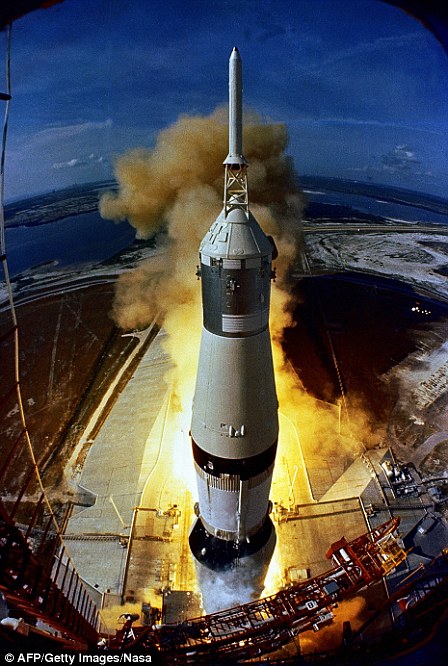
This NASA photo taken on July 16, 1969 shows the huge, 363ft tall Apollo 11 rocket launched from pad 39A at Kennedy Space Center
Apollo was the NASA programme that launched in 1961 and got the first man on the moon eight years later.
The first four flights tested the equipment for the Apollo Program and six of the other seven flights managed to land on the moon.
The first manned mission to the moon was Apollo 8 which circled around it on Christmas Eve in 1968 but did not land.
The crew of Apollo 9 spent ten days orbiting Earth and completed the first manned flight of the lunar module – the section of the Apollo rocket that would later land Neil Armstrong on the moon.
The Apollo 11 mission was the first one to land on the lunar surface on July 20, 1969.
The capsule landed on the Sea of Tranquillity, carrying mission commander Armstrong and pilot Buzz Aldrin.
Armstrong and Aldrin walked on the lunar surface while Michael Collins remained in orbit around the moon.
When Armstrong became the first person to walk on the moon, he said, 'That's one small step for (a) man; one giant leap for mankind.'
Apollo 12 landed later that year on November 19 on the Ocean of Storms.
Apollo 13 was to be the third mission to land on the moon, but just under 56 hours into flight, an oxygen tank explosion forced the crew to cancel the lunar landing and move into the Aquarius lunar module to return back to Earth.
Apollo 15 was the ninth manned lunar mission in the Apollo space program, and considered at the time the most successful manned space flight up to that moment because of its long duration and greater emphasis on scientific exploration than had been possible on previous missions.
The last Apollo moon landing happened in 1972 after a total of 12 astronauts had touched down on the lunar surface.
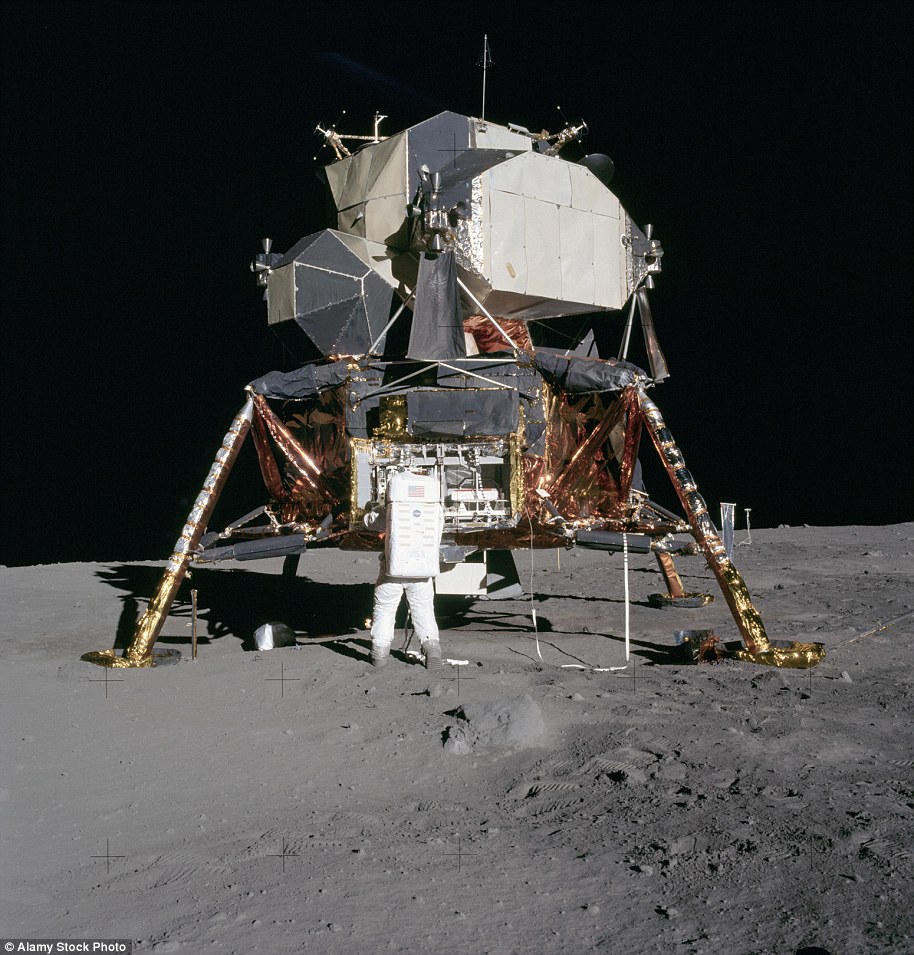
Astronaut Edwin 'Buzz' Aldrin is pictured unpacking experiments from the lunar module on the moon during the Apollo 11 mission. He was photographed by Apollo 11 commander Neil Armstrong on July 20, 1969
RELATED
NASA unveils initiative to establish enduring presence on the Moon | DW News
We Can Build It. Can We Survive It?
NASA unveils Moon base plans | ABC NEWS
How SpaceX Starship will Turn the Moon Into Humanity’s Next Home
Noah's Ark discovery revealed as first photos show wood buried 30 feet underground
By STACY KAISER FOR DAILYMAIL.COM
A discovery buried deep beneath a remote mountainside in Turkey could offer a new clue in the centuries-old search for Noah's Ark.
Researchers investigating the Durupınar Formation near Mount Ararat recently announced that pieces of charred wood were found about 30 feet below the surface.
Now, the first photographs of the fragments have been released, revealing blackened, cracked wood with visible grain patterns and markings that researchers believe may have been made by ancient tools.
Archaeologist Dr Cenker Atila told FOX News: 'One of the wooden pieces clearly shows signs of human workmanship.
'Its surface appears to have been slightly shaped and flattened using an axe or a knife.
'The fact that these wooden fragments were found at such a considerable depth indicates that they may belong to an ancient period.'
The samples have been sent to four independent laboratories in different countries to determine their age, identify the type of wood and investigate their origins.
The formation's location and boat-like outline have long fueled comparisons with the biblical account, which places the ark's resting place in the 'mountains of Ararat.'
Researchers investigating the Durupınar Formation near Mount Ararat recently announced that pieces of charred wood were found about 30 feet below the surface
The site is a mysterious formation in Turkey that some believe looks like a massive boat
The Durupınar Formation lies about 18 miles south of Mount Ararat, Turkey's highest peak.
Researchers also point to its roughly 515-foot length, which they say corresponds to the vessel described in Genesis.
Using their conversion of biblical measurements, the ark would have measured approximately 515 feet long, 86 feet wide and 52 feet tall.
Andrew Jones, founder of Noah's Ark Scans, which is involved in the investigation, said in a statement: 'We're testing this material to establish its age, identify the type of wood and look for traces of tree pitch.
'After decades of searching, this could be a crucial piece of the puzzle.'
The reference to pitch is significant because the Bible describes Noah being instructed to coat the ark inside and out with the waterproofing substance.
However, the wood's charred appearance does not establish that pitch was present or that the fragments came from an ancient vessel.
The discovery of the wood follows radar scans that Dr Khosrow Bakhtar, a veteran US defense scientist, said revealed patterns resembling chambers and corridors inside the roughly 515-foot-long formation.
Researchers said that some pieces appeared to have been deliberately cut or shaped with tools
The samples have been sent to four independent laboratories in different countries to determine their age, identify the type of wood and investigate their origins
'This is the most significant finding of 45 years of my career. It's not geologic-related, because we masked all the geologic features,' Bakhtar said in a late October press release.
The latest investigation builds on a 2019 radar survey that detected straight lines and angular patterns the team interpreted as possible walls, passageways and compartments.
This year, Bakhtar examined the formation using a more powerful radar system developed through US Air Force research, capable of reaching deeper underground.
The team reported detecting large underground boundaries and spaces that it interpreted as possible sediment-filled chambers, corridors and tunnels.
Five prominent features appeared to form a possible tunnel system stretching roughly 151 feet, with an average height of more than 14 feet.
Researchers also identified a thick underground layer that appeared to contain three separate sublayers, drawing comparisons with the Bible's description of an ark built with three decks.
A radar scan of Turkey's Durupınar Formation shows underground features that researchers interpreted as possible buried passageways at the suspected Noah's Ark site
The team found pottery that they say predates what biblical scholars call the Great Flood. Pictured right is the Turkish archaeologist leading the project, Dr Cenker Atila from Sivas Cumhuriyet University
'In our holy books, Noah's Ark had three levels; in our radar studies, we also identified a formation with three levels,' said Atila, an archaeologist at Sivas Cumhuriyet University in Turkey.
The team claims it has '100 percent confirmed' that the formation is a 'man-made object' rather than a natural geological feature.
Jones, who has investigated the area for nearly 30 years, previously told the Daily Mail that neither radar surveys nor drilling inside the formation had detected limestone or solid bedrock.
'This destroys the theory that the site is a solid limestone block shaped into a boat by glaciers and weathering after coming down the mountainside, and it also refutes the theory that this is bedrock around which mud flowed to form the shape,' he said.
Further studies using infrared thermography (IRT) could show a ship-shaped hull under the soil
The radar captured 'a series of right angles' about 20 feet down, which researchers believe could be rooms that held animals on the ark
However, ruling out those explanations would not, by itself, establish that the formation was built by people.
Radar readings are also not photographs of exposed rooms or passageways. They show how signals respond to different materials and boundaries underground, which must be physically examined to establish what produced them.
The team is using the scans to identify promising locations for further drilling.
Jones acknowledged that the findings have not definitively identified the formation as the biblical vessel.
'I firmly believe the Durupınar Formation represents the buried remains of Noah's Ark,' he said, describing the scans as a 'compelling new line of evidence' rather than definitive proof
RELATED
Scientists Just Uncovered a New Mystery at Noah’s Ark — The World Is Asking Questions!
Burnt Wood Found 30 Feet Inside "Noah's Ark"… Now the Lab Decides #knowledgeremarks
Scientists went 60 feet inside Noah's Ark — What They found changed everything
A giant, jellyfish-like UFOwas filmed hovering in the direction of a US military base in Alaska before disappearing within minutes.
Sara Jane Osborn told the Daily Mail she was photographing a rainbow in Anchorage when a dark object emerged above distant trees near what she believed was Joint Base Elmendorf-Richardson (JBER).
JBER hosts F-22 Raptor fighters and supports air defense, surveillance and military airlift operations.
The encounter unfolded on June 15 at around 10.13pm, she recalled, while the evening sky remained bright.
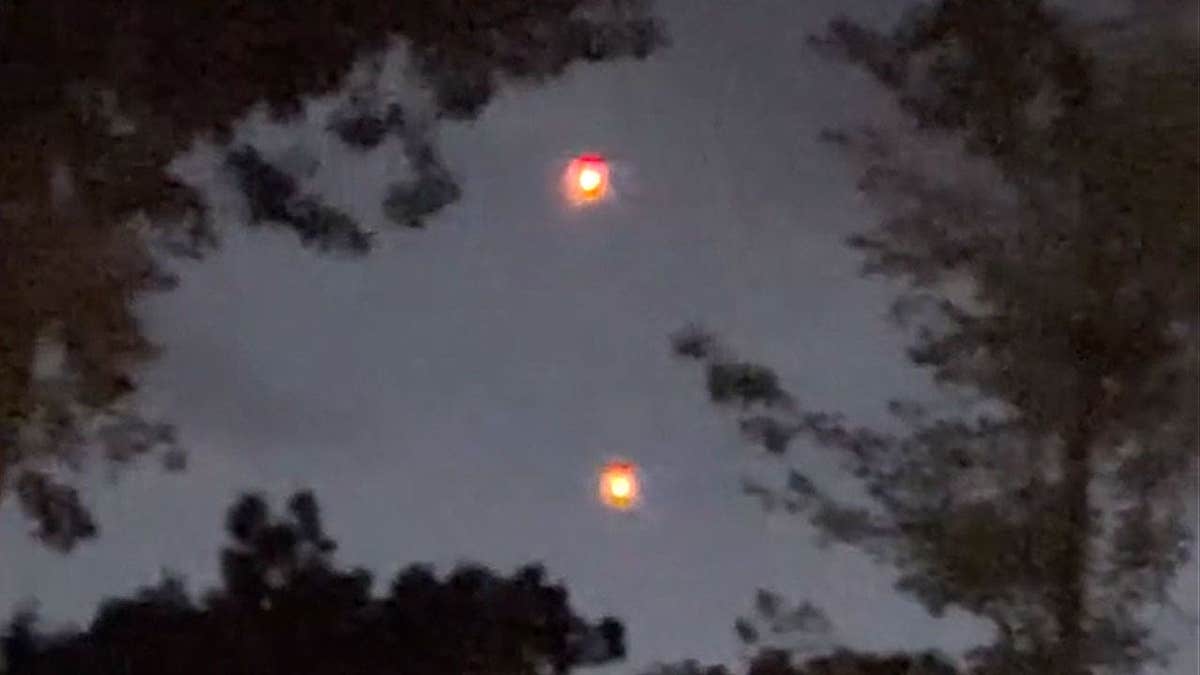
The object appeared to have dangling appendages that moved independently as it hovered and turned from side to side. Osborn estimated it was visible for about three minutes before vanishing almost as abruptly as it appeared.
'It disappeared almost as quickly as it came,' Osborn said.
Its apparent size also puzzled them, with a small aircraft spotted during their outing looking tiny by comparison.
Osborn said the search afterward failed to uncover a kite, its operator or another explanation for what they had witnessed.
She added that 'only God and the government' would know what it was, describing an eerie sight that left her and her husband, Pete, looking for answers.
A giant, jellyfish-like UFO was filmed hovering in the direction of a US military base in Alaska before disappearing within minutes
Osborn and her husband had traveled to Anchorage on business from the Valley, where they now live after spending years in the city.
She was captivated by a rainbow as they drove along Sixth Avenue and began taking photographs through the open car window.
Pete pulled into an empty downtown parking lot, allowing her to capture the view without passing vehicles and traffic lights getting in the way.
Then she noticed something she initially dismissed as an insect.
'I was annoyed, because I was like, is that a mosquito?' she recalled. But when Osborn looked beyond her phone screen, she realized the shape demanded a closer look.
She asked Pete whether he could see it, took several photographs, and began recording.
Osborn said she had more than a brief video of the encounter, having photographed the rainbow in rapid succession. 'But I have multiple stills of pictures taken within milliseconds of each other,' she said.
She described taking photographs in rapid succession. What troubled her was its movement.
The object appeared to have dangling appendages that moved independently as it hovered and turned from side to side
The object was spotted near Joint Base Elmendorf-Richardson in Alaska
Osborn contrasted its 'black and silver' appearance with the 'bright colors' of kites she was used to seeing.
She described the trees moving, noting there was a breeze. 'But it wasn't a big enough breeze for a kite,' she said. 'It was very clearly not a kite in its movements.'
Osborn believed the object's movements differed from those of a kite, whose tails she expected to stream together in the wind.
The couple also questioned why something that appeared so large would remain airborne for only a few minutes.
'Because if there was a kite there, why would you only fly it for, like, three minutes?' Osborn asked.
She also questioned whether the nearby park could accommodate something so large. 'It's a very small park. You can't operate a large kite from that park,' she said.
Having lived in Anchorage for years, she said she was familiar with the colorful kites flown around the city's parks. This object, she felt, did not fit that familiar scene.
'You know, you're kind of looking for some, some logical explanation of what it was,' she said.
The couple went toward a nearby park, hoping to find someone packing away a kite or another clue that might explain the sighting.
'And there was nobody taking down a kite,' Osborn said. 'People would have been there. The kite would have been there.'
They continued searching and drove toward Arctic Valley, where they could look across the wooded landscape.
'And we looked everywhere. We looked for, like, 30 minutes,' she said.
By then, the object had disappeared.
Its apparent position added to their questions. The couple believed it had been above forested military land associated with JBER. 'But it's just forest over there,' Osborn said.
Sara Jane Osborn told the Daily Mail she was photographing a rainbow in Anchorage when a dark object emerged above distant trees
Its apparent size also puzzled them, with a small aircraft (right) spotted during their outing looking tiny by comparison
Her husband estimated the object could have been within about three miles of their position, although that distance was not confirmed.
The couple also recalled seeing an aircraft near the mountains that appeared much smaller, adding to their impression that the unidentified object was unusually large.
However, without knowing the distance to either object, their apparent sizes cannot reliably establish their actual dimensions.
The object's perceived position also does not establish a military connection. A kite, drone or another airborne object has not been ruled out, and their account provides no evidence of an extraterrestrial origin.
Osborn herself considered a more ordinary explanation.
'You know, maybe it's a drone-type thing,' she said.
But its apparent size and unusual movement continued to trouble her.
The lack of other witnesses was another detail she found puzzling.
'We weren't able to find anyone else who saw it when we did either,' she said.
For Osborn, Pete's presence made the experience harder to dismiss. She said that, without him, she might have doubted her own eyes.
What began as an attempt to photograph a rainbow had become something neither could explain.
'Because it was there, and then it wasn't,' she said. 'I can't deny that it happened.'
RELATED
Jellyfish UAP Caught on MULTIPLE Cameras! | #ufo #uap
UFO caught on cam: Leaked video shows 'Jellyfish' UAP allegedly flying over US military base in Iraq
On December 21, 1978, two Safe Air pilots reported seeing UFOs in the skies near the Kaikōura mountain ranges in New Zealand. According to a newspaper article from the time, multiple objects were sighted over a four-hour period and tracked by Wellington Airport’s air traffic control radar. One of the pilots was quoted as saying that he’d spotted something coming toward them “at tremendous speed.” The next evening, several people in the area claimed to have seen similar objects.
A producer for Channel 0 in Melbourne, Australia heard of the sightings and sent a TV crew to investigate by plane. Sometime after midnight on December 31, while flying between Wellington and Christchurch, they captured footage of a rapidly moving white light that appeared to be following them. On the return flight two hours later, they encountered other brightly illuminated objects, including one that resembled a flying saucer. You can check out the recordings for yourself below.
The TV Crew That Filmed a REAL UFO 🎥
Kaikoura Lights: UFOs Tracked by Radar & Filmed by News Crew!
The Strange Story of the 1978 UFO Encounter That Was Actually Caught on Camera
“Just being on the cramped, noisy flight deck of the Argosy barrelling down the coast in the dead of the night was exciting,” recalled reporter Quentin Fogarty. “Factor in a row of pulsating, hypnotic lights hovering outside the window, and it goes to another level,” he continued. The footage was featured on the prime-time news and quickly spread around the world—it even got covered by CBS anchorman Walter Cronkite.
However, skeptics immediately dismissed the story, attributing the phenomena to everything from lights reflecting off of squid boats to an unusual view of Venus. The TV crew were also accused of perpetrating a hoax, but they always maintained that whatever they saw above Kaikōura was real. “We had film, our own eyewitness accounts and confirmation from the flight crew and air traffic controllers that we had stumbled into something astonishing,” Fogarty told The New Zealand Heraldin 2018. “My grandkids love to hear the story of my brush with UFOs. I just wish I could provide an ending,” added journalist Dennis Grant.
RELATED
The Unexplained UFO Film | Kaikōura: The Government's Secret Decision Finally Documented
The Mysterious Kaikoura Lights Haunting New Zealand's Coast No One Can Explain
Alien Disclosure in 2027? What the Public Record Actually Shows
Is alien disclosure in 2027 a real timetable? We trace the claim, compare it with UAP records and explain what evidence would actually confirm non-human intelligence.
An image filed as “Unidentified Flying Object” in U.S. Air Force records.
Credit: U.S. National Archives, NAID 218517913.
Will there be alien disclosure in 2027? The public record currently shows a recurring claim, not an official countdown. The date is tied to a former intelligence officer’s statement, while the United States has also begun releasing real UAP records. Keeping those two strands separate is the key to understanding what is—and is not—known.
There is a reason the date keeps circulating. It did not appear from nowhere. But it is also not the deadline of a public government programme, a congressional act or a published scientific finding. The story of 2027 sits at the intersection of one former intelligence officer’s public claim, a real push for greater access to UAP records and a public that has watched the subject move from ridicule to official hearings, archives and military releases.
That distinction matters. The documents now being released are real. The unanswered cases are real. The arguments over secrecy, oversight and historical records are real. A confirmed timetable for public contact or a final disclosure in 2027 is something else entirely.
Where did the 2027 claim come from?
The date is closely associated with John Ramirez, a former CIA officer who has spoken publicly about UAPs after leaving government service. In a 2023 interview, Ramirez said he had heard that something could happen in 2027 and suggested that recent disclosures might be preparing the public for it.
It was an extraordinary claim, and it travelled fast because it supplied a specific date to a subject that is usually made of fragments: testimony, classified programmes, witness accounts, military footage and documents that arrive years after the events they describe. A date gives all of that material a shape. It makes a slow, uncertain process feel like a countdown.
But a public claim is not a government notice. Ramirez did not produce a document establishing a 2027 event, identify a law that requires one or point to an official timetable. His statement is part of the story because it explains why so many people now search for “alien disclosure 2027.” It is not, by itself, evidence that a planned revelation exists.
That does not mean the wider UAP debate can be reduced to one interview. The date has stayed alive because genuine disclosure work has been taking place around it.
Why the rumour attached itself to real disclosure efforts
The United States has built a public record system for UAP material. The 2024 National Defense Authorization Act required federal agencies to identify and organise UAP-related records for a collection at the National Archives. The law set an October 20, 2024 deadline for agencies to review the records in their custody and prepare publicly releasable copies for online access.
That is a significant development. It means UAP records are being treated as a historical and governmental archive rather than left scattered across agencies, private contractors and old programme files. The collection is broad: it covers records relating to unidentified anomalous phenomena, technologies of unknown origin and non-human intelligence or equivalent subjects.
Yet an archive is not an announcement of contact. A record can document an observation, a failed attempt at identification, a discussion of a claim or a request for further analysis. It may be incomplete, heavily redacted or later explained. Making a document public allows people to examine what the government recorded; it does not automatically settle what the object or event was.
That difference is easy to lose online. “Disclosure” can mean releasing decades-old files. It can mean confirming that an agency investigated a report. It can mean an official finding that a particular object remains unresolved. It can also mean, in its most dramatic form, a government acknowledging that non-human intelligence is present on Earth. Those are not interchangeable events.
What the current UAP releases actually say
The All-domain Anomaly Resolution Office, or AARO, has been releasing material through its public transparency initiative. Its own description is plain: the cases in that archive are unresolved because the government has not been able to make a definitive determination about their nature. Sometimes the problem is a lack of data. Sometimes the useful data cannot be released without exposing military sensors, locations, witnesses or operational methods.
An unresolved case is worth studying. It can raise questions about airspace security, collection methods, sensor limits and the quality of the available evidence. Curiosmos has also explained why a UAP’s distance matters more than a dramatic video: without scale and range, even striking footage can support only a narrow conclusion. It is not a blank cheque for every proposed explanation. The responsible starting point is the opposite: preserve the original report, establish what the instruments recorded, identify what is missing and let independent analysts test the available material.
That is why the newer releases matter. A video, a witness report or a sensor document may not answer the largest question on its own, but it gives researchers something better than a rumour. It gives them a record with a date, a chain of custody and a defined context.
Curiosmos has followed that process in our coverage of the National Archives’ UAP records collection, the fifth U.S. UAP release and the AARO imagery release. Each release adds material to the public discussion. None has announced that 2027 is a deadline for contact.
Congress has considered a much larger disclosure process
The idea of formal disclosure is not confined to podcasts. Members of Congress have repeatedly proposed stronger measures for collecting, reviewing and releasing UAP records. A 2025 Senate amendment described as the UAP Disclosure Act of 2025 included a proposed review-board structure and a “controlled disclosure campaign plan.”
The language is striking because it acknowledges how difficult the subject can be. Classified information may involve intelligence sources, sensor capabilities, military platforms, nuclear information or private contractors. A disclosure process has to separate what can be released from what must remain protected for genuine national-security reasons.
But proposed legislation is not the same as enacted law, and a disclosure plan is not the same as a declaration of non-human contact. The 2025 text was submitted as an amendment and ordered to lie on the table. It did not establish a public 2027 date.
That leaves a harder and more useful set of questions than a simple yes-or-no prediction. If governments hold records that deserve public scrutiny, the issue is how those records will be authenticated, who will review them and whether the public will receive enough context to distinguish an unresolved observation from a demonstrated conclusion.
What would genuine disclosure look like?
If a historic disclosure were ever to occur, it would need more than a dramatic speech or a short video clip. It would require material that can withstand examination beyond the first news cycle.
That means records with provenance: where they came from, who collected them, how they were stored and what has been done to them since. It means data that independent experts can inspect where national-security limits allow. It means technical claims that can be tested against physics, engineering and known sensor behaviour. And it means officials being specific about the difference between what has been observed, what has been alleged and what has actually been established.
The question of biological material or recovered technology would demand an even higher standard. A photograph, a press conference or a witness statement might start the conversation, but the decisive work would involve documented samples, independent laboratories and methods that other specialists can scrutinise. Nothing less would settle a question of that scale.
That standard should not be seen as an attempt to make disclosure impossible. It is what would protect a genuine discovery from being lost in noise, hoaxes and political argument. If the evidence is as consequential as people believe, it deserves to be handled in a way that can outlast the first wave of excitement.
So, will there be alien disclosure in 2027?
There may be more hearings, more document releases, more official video and more testimony before 2027 ends. The UAP subject is now firmly inside public institutions: the National Archives, congressional proposals, military reporting systems and scientific discussions about how better data might be collected.
What is not public is a government timetable promising that non-human intelligence will be revealed in 2027. The date remains a claim with a traceable source, amplified by years of genuine frustration over secrecy and a real demand for better access to evidence.
That may feel less dramatic than a countdown, but it leaves the larger question intact. The most useful measure of progress will not be whether a date on social media arrives with a spectacle. It will be whether the public gains records, data and review processes strong enough to tell the difference between an unresolved object, a classified human programme and something that would genuinely change our understanding of life in the universe.
David Grusch describes footage he says he saw of recovered bodies. His account raises questions about appearance, provenance and biological identification.
David Grusch says the beings he saw in recovery footage looked strikingly human. Pale skin, familiar proportions and an appearance he compared with classical beauty: the description is a departure from the small, dark-eyed figures that dominate popular images of alien encounters.
Speaking in a September 2026 interview, the former intelligence officer described video he says showed bodies during a retrieval. He did not present the footage publicly. His account concerns images he says he viewed, rather than bodies he examined himself.
That distinction leaves an intriguing question. If such footage exists, how would investigators establish who—or what—it shows?
The account behind the description
In the interview, Grusch described human-looking figures with very pale, bluish-white skin. He also discussed footage showing a recovery scene, rather than a close anatomical examination. An automated transcript places this discussion around the one-hour mark.
He withheld details that he said could expose sources. That prevents readers from independently tracing the recording to a date, location or retrieval team.
The comparison with Greek gods needs care, too. Grusch referred to an account involving Tom DeLonge and William McCasland. The comparison reaches the interview through that separate account; it does not come from a conversation Grusch says he personally had with McCasland.
From a congressional allegation to a described scene
Grusch became widely known after his 2023 congressional appearance. The history of these promises is also part of the wider disclosure debate. His written statement described an investigation informed by people he considered credible, including individuals with longstanding involvement in alleged recovery activities. He said some information had been provided through classified channels.
The newer description gives the public a scene to imagine. It also introduces a different task: evaluating a recording. A witness’s account of a video and the video itself offer different opportunities for scrutiny. Investigators could examine an original file for editing, compare its location with independent records and interview the people who recorded it.
A clip circulating online would be a much poorer starting point. Compression can erase detail, and a repost can strip away the file’s history. Even a convincing-looking scene might leave the identity of its subjects unresolved.
A familiar face would make identification harder
A human-looking body would invite ordinary explanations before any biological examination had begun. Clothing, skin colour and apparent height would tell an investigator relatively little on their own. Lighting changes colour; camera angle changes proportions; a scene without a reliable scale makes height difficult to estimate.
Nor would unusual appearance establish an extraterrestrial origin. That question would require evidence beyond the image: samples with a documented history, independent examinations and results other researchers could inspect. Any proposed genetic finding would need an explanation of how contamination was controlled and how the comparison was made.
Conversely, a familiar appearance would not by itself settle every question about a genuinely unusual specimen. The investigation would still have to follow the material, rather than decide its origin from a face.
For now, the public has Grusch’s description. The footage he discusses has not been supplied with this interview for independent examination. The most interesting next development would be a recording with a traceable history—or biological results tied to the same recovery. Either would let the discussion move from an image described by one person to material that others could examine.
RELATED
UFO Whistleblower David Grusch Makes Bombshell Revelation about Sentient Alien Plasmoid Life
UFO whistleblower says U.S. recovered nonhuman "biologics" from crash sites
GRUSCH SPILLS A LOT OF BEANS. Tells Dr. Phil about photos, crafts, visuals of non humans.
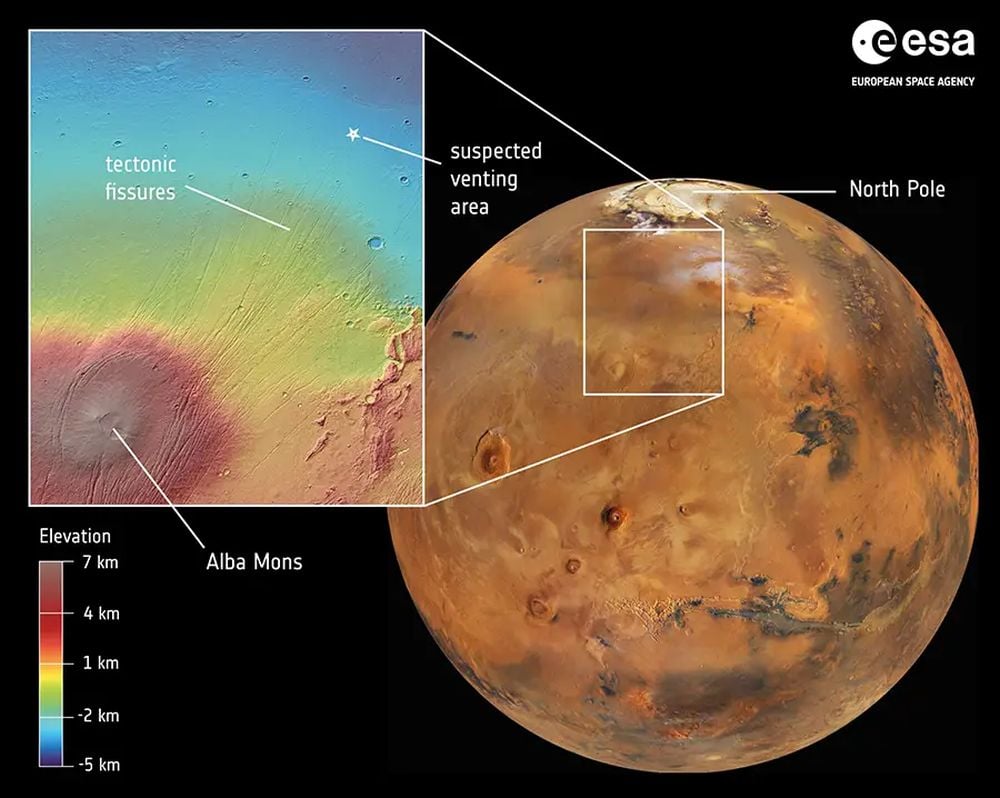
We've known about HCl in Mars' atmosphere for some time, thanks to the Trace Gas Orbiter. They were attributed to atmospheric interactions due to warmth during perihelion. But the same chemical has been detected at aphelion, and researchers think it may be venting into the atmosphere from underground magma chambers. If that's true, then Mars isn't as dormant as thought.
Image Credit: MEX/HRSC global color mosaic, ESA/DLR/FU Berlin, G. Michael. Inset: Blended MOLA-HRSC digital elevation model, Fergason et al 2018
We'll never stop being fascinated by Mars. It's kind of like a failed Earth. It appears as if billions of years ago Mars was warm, wet, and habitable. That ended when its interior cooled and its geodynamo failed.
When its geodynamo failed, its magnetic shield failed. The full force of the Sun bore down on the unfortunate planet, and its warming atmosphere was lost to space.
The loss of atmosphere wasn't the only change. Mars had a powerful volcanic past, and the prominent volcanoes in Tharsis Montes prove that. But the planet is largely believed to have left its volcanic past behind as a consequence of cooling.
But there's growing evidence that the planet isn't totally dormant. Recent evidence from missions like InSight and the ExoMars Trace Gas Orbiter suggest some ongoing activity. InSight detected more than 1300 Marsquakes, and the Trace Gas Orbiter detected hydrochloric acid.
Hydrochloric acid (HCl) is a highly corrosive acid with multiple natural sources, including atmospheric ones. The ExoMars Trace Gas Orbiter (TGO) collected widespread observations of HCl in Mars' atmosphere at parts-per-billion levels, but initially, it was only detected during perihelion. The HCl detections were attributed to aerosol-atmospheric sources driven by greater warmth from the Sun, a naturally-occurring, seasonal pattern.
But new research in Science Advances shows that not all of the TGO's HCl detections can be traced to perihelion. It's titled "Enigmatic HCl detections as a potential signature of igneous activity on Mars." The lead author is Alexander Trokhimovskiy from the Space Research Institute at the Russian Academy of Sciences.
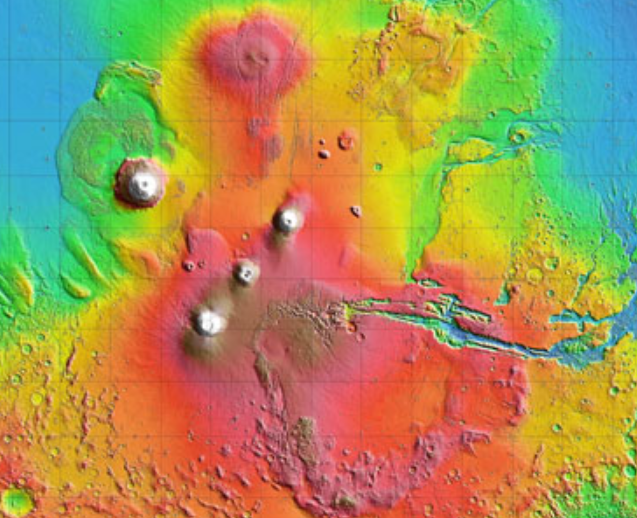
This Mars Orbiter Laser Altimeter (MOLA) image shows Alba Mons near the top, with the three Tharsis Montes volcanoes below it, and the massive Olympus Mons to their northwest. Though not as tall as Olympus Mons, Alba Mons is larger by area. The new HCl detections are curiously close to Alba Mons.
Image Credit: NASA/JPL/GSFC
The authors acknowledge that Mars is believed to be volcanically dormant, and that Marsquakes and other evidence of more recent volcanic activity is accumulating. However, there's no clear understanding of Mars' modern activity. For instance, many of the InSight lander's detections were attributed to meteorites.
If we were to witness an actual eruption, and the gases that go with it, a new understanding of Mar's interior would arise. But that hasn't happened, and we have to rely on less obvious evidence for Mars' internal state.
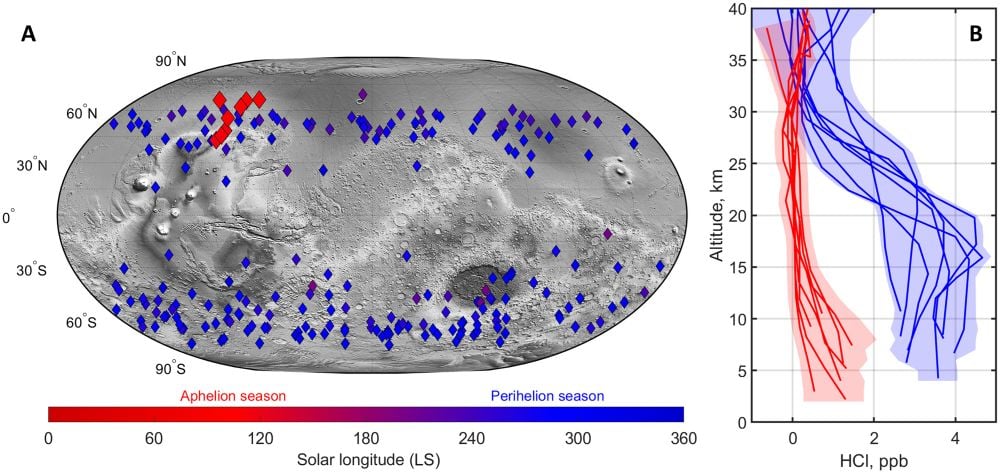
"While sulfur dioxide, so far undetected, could testify to ongoing eruptive activity, evidence of active magma chambers may be better identified by seepage of halogen gases, such as hydrogen chloride (HCl)," the authors write. "Here, we report HCl detections during the cold aphelion season that are isolated in the Alba Mons region." Could these new HCl detections be a window into Mars' interior?
Olympus Mons is known as the largest volcano and the tallest mountain in the Solar System. But Alba Mons is actually the largest volcano by surface area. Like Olympus Mons, it's also in the Tharsis region. (And neither are part of Tharsis Montes, the iconic row of three volcanoes). Alba Mons' volcanic flows reach further than 1300 km from its central summit. One of Alba Mons most significant features is its enormous system of fractures. For multiple reasons, detecting HCl over Alba Mons is intriguing.
"Strongly localized in space and time, aphelion HCl detections, amidst an otherwise absence of HCl at that season on Mars, exhibit marked contrast with prolonged and widespread detections at perihelion," the authors write.
“Detections of HCl at low altitudes, unexplained by observed atmospheric state and models, together with the geological context of the region, hint at an igneous origin of this gas,” Trokhimovskiy et al. write. These most recent HCl directions were in 2025.
This figure show HCl detections by the Trace Gas Orbiter. Blue ones represent perihelion detections, which can be explained by seasonal warming and atmospheric interactions driven by the Sun. Red ones are more enigmatic. They could come from tiny fissures near Alba Mons, almost directly under the detections.
Image Credit: Alexander Trokhimovskiy et al. , Enigmatic HCl detections as a potential signature of igneous activity on Mars. Sci. Adv.12, eaeb9422(2026).
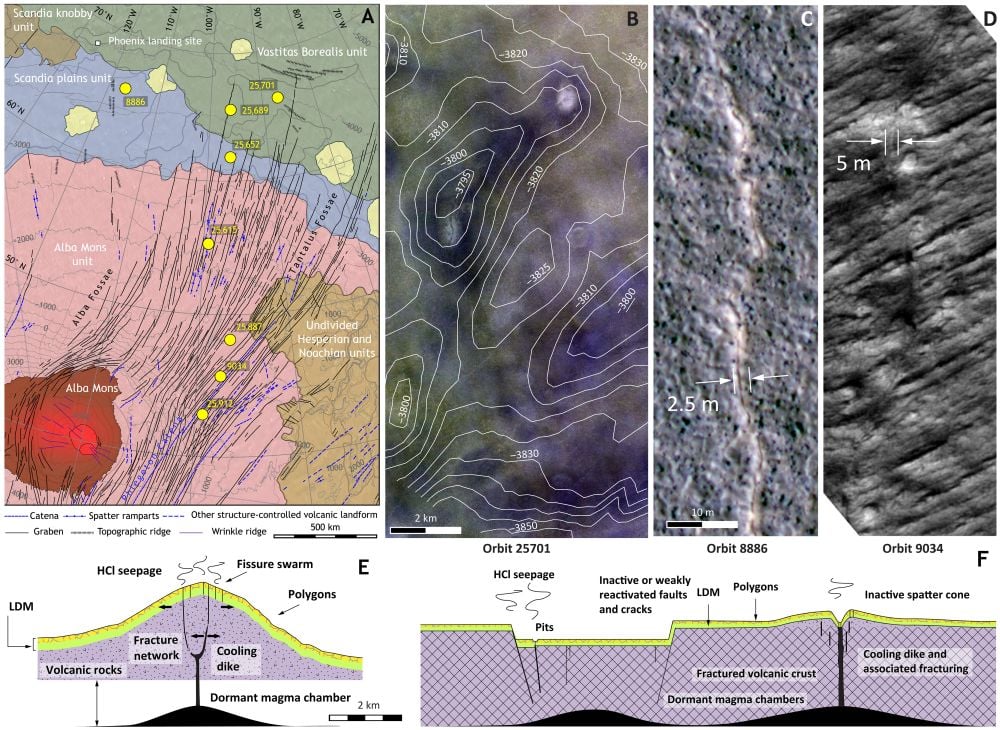
The HCl detections alone may not be enough to oveturn the idea that Mars is dormant. As the authors say, they're just a hint. But there's more. "We also identify fresh and narrow (<1 meter) fissures in this area, which we interpret to be potential HCl pathways rooted into magmatic bodies at depth," the researchers explain.
"These structures have not been identified on Mars in earlier works. For instance, systematic geomorphologic mapping of the northern hemisphere did not consider these landforms," the authors explain.
These panels shows some of the important points in the research. (A) shows Alba Mons and the HCl aphelion detections in yellow. (B) is a CASSIS image from the TGO showing a fractured ridge, while (C) and (D) are HiRISE images from NASA's Mars Reconnaissance Orbiter showing smaller fissures the researchers identify as potential HCl sources. (E) and (F) are geological models that can explain HCl is seeping from these fissures.
Image Credit: Alexander Trokhimovskiy et al. , Enigmatic HCl detections as a potential signature of igneous activity on Mars. Sci. Adv.12, eaeb9422(2026).
The researchers calculated the seepage rate necessary to account for the HCl abundance in the aphelion detections. They compared it to the perihelion detections, and included the expected lifetime for HCl to persist in the Martian atmosphere. Their work rules out atmospheric-aerosol interactions as the source for the HCl detected during aphelion. But it also rules out those same interactions for the source of HCl detected during perihelion. That makes sense, since non-seasonal seepage from magma chambers would be happening no matter the season.
"Thus, perihelion HCl is unlikely to be directly volcanic in origin," they write. There could still be a link between igneous HCl and perihelion HCl. "However, a connection between igneous and seasonal HCl may still exist via a mechanism complementary to heterogeneous production," the authors write.
Planets are complicated, as we Earthlings know. Multiple interrelated factors contribute to the whole, and everything changes over time. This work further emphasizes how that's true, even on so-called dormant Mars. "The overall cycle of hydrogen chloride includes irreversible sinks," the authors write, and sinks have to be included in any modelling or understanding of Mars.
"Introducing a volcanic source of HCl, we can propose that a fraction of the perihelion HCl observed in the Martian atmosphere is ultimately of igneous origin," the researchers explain. "Localized igneous sources may therefore act as continuous primary contributors of chlorine, which is subsequently redistributed between atmospheric and surface reservoirs."
But despite the complicated picture of seasonality and surface sinks, their conclusion is clear: "Our results are best explained by ongoing igneous processes in the Martian interior."
RELATED
Mars May Still Be Volcanically Active — Scientists Found a Clue!
Mars May Still Be Alive — A Gas Is Leaking From Its Volcano
Mars Volcanic Activity? New Research Article Points to Hidden Magma
AI imagines what cities on other planets could look like
In this age of artificial intelligence and advanced technology, the possibilities are endless. Whatever image, idea, thought, or concept you can conjure, A.I. can create it to some capacity for you. We’ve used A.I. to invent some interesting and illustrious concepts, such as cities on various solar system planets. From Jupiter and Mars to our beloved moon, A.I. has created unique depictions of what our future could look like. Whether it’s an ice and snowy terrain of intricate structural designs or dome-like structures made out of moon rock, these cities could be a preview into what our lives may look like years from now.
Uranus To end it off with a bang, we have Uranus once again! This city truly looks futuristic. Those space shuttles look like they’ve been teleported through a black hole or something equally fascinatingly foreboding. The sky is reminiscent of the beautiful wonders space offers, with its own version of the northern lights.
We can’t forget about the city itself. It’s built seamlessly into Uranus’ snowy terrain, and the dark gray metal exterior seems durable enough to handle the icy and cold-biting weather. Residents of the city are cozying up to their fireplaces if that steam coming from those buildings is any indication!
Jupiter A far cry from the tropical forest city on Jupiter, this one is inspired by general futuristic expectations with a reliance on some kind of obsidian metal. The city continues into the far reaches of Jupiter’s abounding terrain. Since the planet is the largest, it could be a neighbor to the former green-infested civilization.
The orange and lightning-streaked sky alludes to the city's location on Jupiter’s surface; it’s potentially close to the planet’s Giant Red Spot. In that case, the city must be prepared to endure the echoes of the enormous hurricane-esque storm, but that doesn’t look like a problem. The large buildings are integrated to weather the storm, and those space shuttles in the sky are effective transport for Jupiter’s heavy winds.
Moon With a view of a once-inhabited Earth, this version of the moon is one with a thriving city of human activity and even scientific advancements. The few astronauts in view seem to be studying the moon’s surface and, perhaps, ways to improve civilized life on the astronomical object.
This is probably one of the more uniquely structured cities. Its round tunnels, engraved in moon rock, resemble the tunnels that ants inhabit underground. If they look this interesting on the outside, imagine what they would look like on the inside! It even seems this community is attempting to bring greenery to the somber, gray-hued environment.
Neptune Neptune is another ice giant with icy and snowy terrain similar to Uranus. A futuristic city with equally futuristic technology to withstand the outstanding freezing temperatures of over negative 300 degrees! The silver-white material of the structures blends in with the surrounding environment to deter any unwanted terrestrial beings!
Neptune’s city is equipped for thriving activity. It’s probably one of those places in sci-fi movies where a building looks smaller from the outside than the inside. The interior exceeds the expectations of all who look upon the structure. If you love the winter or snow, Neptune may be the best option for relocation
Uranus An ice giant, indeed! The icy city with the large moon or planet in the background makes this city life look straight from a sci-fi movie or novel. Imagine waking up to this. That’s a sight to behold! Uranus is known for its icy and windy environment, so life on this planet may not always be the best.
However, the few people at the bottom of the city are strapped in space gear that is fit to bear the uninhabitable force of Uranus’ environment. The elaborate architecture looks like it’s part of an opulent city with a royal castle – medieval times meet the future!
Jupiter Jupiter may be the best planet for cities to thrive because of its enormous size: it’s the largest planet in the solar system! We’re not entirely sure what environments can be found on the gas giant, but surely, with its expansive terrain, an enriching, vibrant green forest is one of them.
The city looks like a fun and interesting place to discover Jupiter’s unknown territory. This tropical paradise is a perfect complement to Jupiter’s hydrogen ocean! You can enjoy the beautiful scenery around you and then walk to the unique, hopefully safe, ocean. A great haven from the infamous Great Red Spot storm in the planet’s southern hemisphere!
Mars There has been constant speculation that Mars is another place humanity can call home. Remember when NASA found water on the planet? Well, perhaps this vision of a city on Mars is what our looming days will eventually look like. Unfortunately, the Red Planet doesn’t appear to offer much in sights; the environment is endless dusty red terrain.
However, Mars is somewhat similar to Earth: It has the same four seasons but in longer periods. Regardless, that should help humanity accommodate to the planet's environment more easily. Those white pod-like homes may look small, but they’re probably cozy for the winter and durable against Mars’ polar ice caps.
Venus One of Venus’ many names is Earth’s twin, so the potential structure of a city on the planet’s surface is fitting. However, it is the hottest planet in the solar system and has been shaped by volcanic activity…hopefully, civilization doesn’t run into any of those unfortunate circumstances.
The tan-orange and sandy appearance of the planet's surface alludes to a territory fit for volcanoes and their unforgiving demeanor. However, humanity seems prepared for such geological fissures. The city's structural integrity seems top-tier, and its bright silver metallic exterior suggests it can withstand the overbearing heat of lava, volcanic ash, and steam.
Mercury With the teeming gray rock mountains in the background and futuristic dome-like structures built into the surface, not to mention the ominous planet or moon in the back, Mercury definitely looks like something out of a sci-fi movie. Since it’s the closest planet to the sun, special caution and accommodations would need to be made, and the rounded, almost circular structures look like they keep the sun’s overwhelming heat out and people safe from an unfortunate stifling experience.
The stark white city also gives an air of modern, rich living. Life on Mercury doesn’t look too bad: there’s a walkway to traverse the solitary terrain and even a seemingly small pool to swim in. The already rich folk need to leave this planet and its opulent living to those who’ve never experienced such notions. Venus is down the road; try there instead!
Moon To start, we have the moon. NASA has already sent astronauts to the dark and chalk-white environment of the astronomical body and has even considered the possibility of humans living on it. So, this is perfect for our minds to picture what life on the space object could entail.
The city looks like New York, which could be perfect for civilization to acclimatize to a new and, frankly, terrifying environment. When you see the familiar, it’ll usually help ease timid and anxious spirits. Just don’t look at Earth looming over everything, the endless dark and starry night, or the odd off-white and bumpy ground of the moon – because then you might panic, and the air is sparse up there!
RELATED
🌆 BEYOND REALITY: Cities Floating Between Planets | Sci-Fi Ambience
25 INSANE Future Space Cities That Will Actually Exist | Orbital Megastructures 2050
The Living-Orb Accounts Robert Hastings Wants to Investigate
Witnesses describe glowing objects that seemed to breathe or communicate. Their accounts raise questions about appearance, plasma and how another encounter could be recorded.
Illustration of the reddish-orange light described in an account collected by Robert Hastings. An interpretive scene, not a photograph of the reported encounter.
Credit: Curiosmos.
A hovering light that seems to breathe poses a different question from an unfamiliar aircraft. Could something luminous appear alive—and what would let us investigate that impression?
UFO researcher Robert Hastings has been gathering accounts of that kind. In a June 20, 2026 article, he described witnesses who told him about plasma-like orbs they believed were conscious. He also invited similar accounts for a book he was preparing. These are claims about personal encounters, not a scientific announcement that living plasma has been discovered.
The encounter that made an orb seem alive
Hastings recounts testimony from a woman he calls Amanda, who contacted him in 2022 about an experience she dated to autumn 1992. She described a reddish-orange object hovering near a neighbour’s yard, roughly the size of a melon. Its flickering, undulating appearance reminded her of breathing.
She also reported hearing a reassuring message in her mind and losing awareness of the passage of time. In her account, the light disappeared as her husband came outside. Her name is withheld, and Curiosmos has not interviewed her or independently verified the event.
The interesting question is why she understood the encounter as involving a living presence. Her description combines an observed appearance with a private experience of communication. Those two parts would require different kinds of investigation. Another observer might record the light’s movement; a recording could not by itself establish the source of a thought.
Plasma already behaves in unfamiliar ways
There is a physical reason the word plasma attracts attention. Plasma is ionised gas, containing free electrons and charged ions. It responds to electric and magnetic fields and can form complex structures. NASA’s glossary describes these spontaneous, intermittent structures across different scales.
A pattern that changes shape can consequently have an organised appearance without being a biological organism. That leaves room for a worthwhile question: how far can physical self-organisation go, and which observations would reveal something beyond it?
Calling an unidentified light a plasmoid does not answer that question. First, investigators would need to establish that plasma is actually present. Colour, glow and movement alone cannot identify a substance’s composition or the process supplying its energy.
Measurements make the term more specific. In a 2021 investigation using NASA’s Magnetospheric Multiscale spacecraft, instruments measured particles and fields closely enough to test how plasma responds collectively to electromagnetic forces. That research concerned near-Earth space, not Hastings’ encounters. It illustrates the difference between an evocative visual description and a measured plasma process.
How a future encounter could be documented
A repeat sighting would offer opportunities unavailable in a decades-old recollection. Observers could preserve the original recording, note the time and weather, identify the camera settings and document their positions. Separate observations from known locations could help estimate distance.
Distance is particularly valuable. A light moving across a camera frame supplies an angular motion, not a speed through space. Without knowing whether it was metres or kilometres away, an apparent burst of acceleration is difficult to translate into physical movement.
The NASA UAP study team’s 2023 report recommends calibrated observations and contextual information for this reason. Better records would also allow investigators to compare an orb’s apparent response with changes in the surroundings. Did it move after an observer approached? Did several people see the same response? Did it recur under comparable conditions?
Such questions leave the possibility of unusual behaviour open while giving it something concrete to rest on. A flicker interpreted as breathing, a measured physical cycle and a response that consistently tracks an outside action would be three different findings.
A witness account worth preserving accurately
Curiosmos has covered orb reports from pilots. Hastings’ account explores another part of the subject: the impression that a light has a presence or awareness. It should retain that human dimension without turning the witness’s interpretation into an established property of the object.
For someone reporting an encounter, careful listening and careful documentation can belong together. Preserve what was seen, what was felt and what remains uncertain. If another encounter produces records that several independent investigators can examine, the question could advance beyond the memory that first brought it to our attention.
RELATED
Nuclear Weapons and UFOs with Robert Hastings
The ORB Strategy That's Actually Getting My Traders Funded
IT CAME OUT OF THE RED ORB - Ep. 202 - July 22, 2026
Are UAPs Real? A High-Stakes Deep Dive with Timothy Phillips
President Donald Trump said Air Force pilots told him a mysterious round object flew past an F-22 fighter jet at three times its speed, while pledging to investigate claims that a secret government program studying UFOs could exist without the president's knowledge.
Trump made the comments during an interview with correspondent Ross Douthat that aired Sunday on CBS' "60 Minutes."
Douthat asked Trump whether anything the president had seen, heard or been told led him to believe there was more behind unidentified objects spotted in the sky. Trump described himself as "not too much of a believer," but pointed to conversations with Air Force pilots in the Oval Office.
"These are not people that you would say are conspiracy theorists – they don’t even know what it means – but they’re great, great pilots," Trump said, before joking about their appearance. "Young, handsome, they have beautiful, nice flat tops. I’d like to have a haircut just like them. They look perfect, like Tom Cruise."
An image released with a 2026 FBI report depicts a black triangular object above mountainous terrain. Federal agents reported seeing a silent, triangular object hover above a ridgeline before accelerating into a canyon. Authorities have not confirmed whether the image is an actual photograph or a reconstruction.
(Department of War)
Trump called the pilots "the real deal" and said they had told him "things that are very strange."
He described one of those encounters involving an F-22.
"They’re flying an F-22, which is the best there is, the fastest, the best plane that anyone’s ever seen," Trump said. "And something goes by them at three times their speed. And it’s round. It’s not aerodynamic."
President Donald Trump previously directed the War Department to release UAP and UFO files.
(Aaron Schwartz / AFP via Getty Images)
Douthat then asked Trump about claims from alleged whistleblowers that the government operates a secret program studying UFOs that even presidents may not know about.
A screenshot of video footage from an alleged unidentified anomalous phenomenon (UAP) sighting in the northeastern United States in July 2025, which was detailed in files released by the DOW and originally obtained by the FBI.
(DOW/FBI)
"No, and I haven’t heard that," Trump said. "But if there is, I’m going to find out about it right after this interview."
Trump later said there are "a lot of very solid people" who believe such claims are true, though he remained skeptical himself.
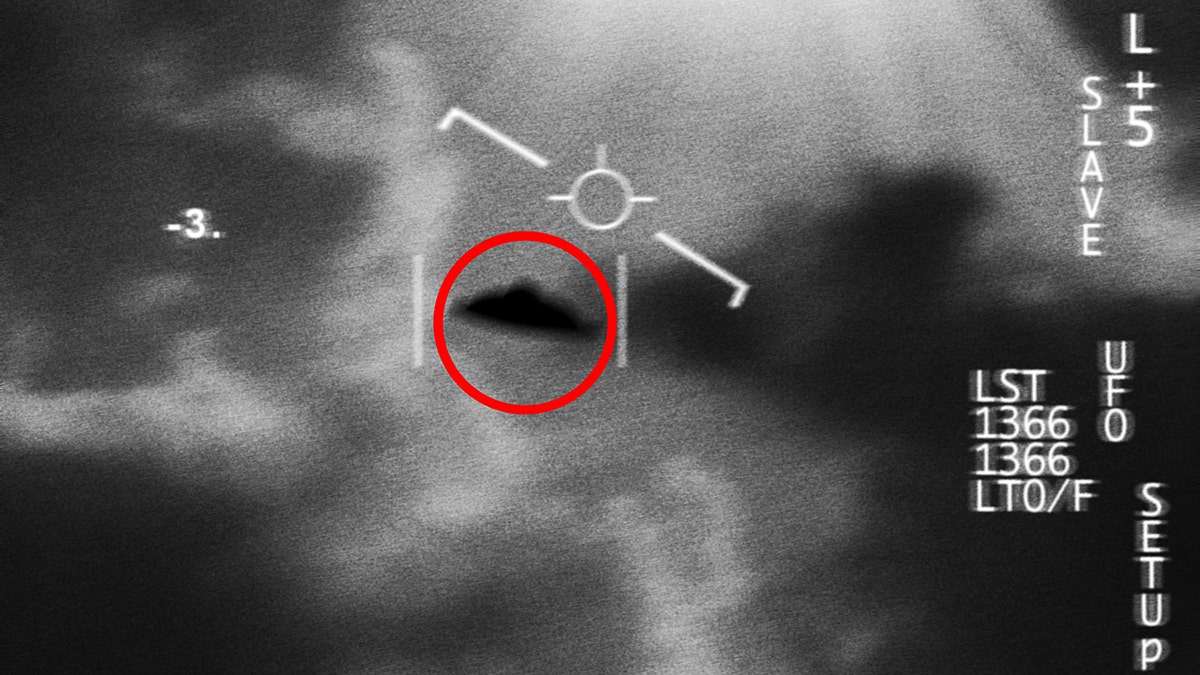
A black and white surveillance image with a UFO circled in red.
(iStock)
Fox News Digital reached out to the White House for comment.
Trump's remarks come just weeks after the Pentagon's All-domain Anomaly Resolution Office (AARO) released a batch of recently declassified records detailing UFO sightings spanning decades.
Among them was a 2026 account from federal law enforcement agents who reported seeing a matte-black triangular object rise vertically above a mountain ridge, hover silently and then accelerate into a canyon at a speed they compared to a fighter jet.
The witnesses described no visible engines, rotors, exhaust or other conventional means of propulsion. Handheld thermal equipment also showed a uniform heat signature across the object's surface rather than concentrated heat typically associated with a propulsion system.
The object was never identified, and the Pentagon report noted that its speed was estimated by witnesses rather than measured by instruments.
Are we alone? Scientists take a new look at UAP sightings
Donald Trump may or may not be using UFOsas a distraction from his unpopular policies, but there’s something else that’s distracting him from UFOs.
In a new interview with the CBS News show 60 Minutes, the US president was asked if he had seen anything in the reams of documents released by his administration that has struck him as too strange to explain.
But instead, Trump quickly veered into newly familiar territory – talking about how sexy the US Air Force’s pilots are.
He told host Ross Douthat: ‘I’m not too much of a believer, but I sat in the Oval Office, first term and a little bit second term, meeting with Air Force pilots that are really good, solid people.
‘These are not people that you would say are conspiracy theorists. They don’t even know what it means.
‘But they’re great, great pilots. Young, handsome. They have beautiful, nice flat tops. I’d like to have a haircut just like them. They look perfect, like Tom Cruise.
‘They’re thin, you know, very thin and very everything, but they’re the real deal.’
These gorgeous military men have told him about ‘things that are very strange’, he said, such as round objects that fly past their F-22 jets at three times the speed.
Trump’s focus on male physiques during speeches at his campaign rallies drew plenty of attention ahead of last week’s midterm elections.
Among the targets for his hot-blooded comments was incumbent Ohio senator Jon Husted, a Republican who was running for reelection in the November 3 vote.
At a campaign event a few weeks before polling day, Trump told the crowd:’I started examining his body because I didn’t know he was a great athlete.
‘And I looked and I watched up and down. I looked at his ass, and I looked at the whole thing.’
In Georgia several days later, Trump called Republican candidate for governor Rick Jackson a ‘very handsome, distinguished, beautiful-looking guy’.
He also declared his joy that the US was ‘allowed to have big, strong, handsome soldiers now’, adding: ‘There are some reasons to be president.’
Husted and Jackson both ultimately failed in their election bids, losing to Democrats Sherrod Brown and Keisha Lance Bottoms respectively.
New documents released last month by the Defense Department provided more recollections from federal agents who said they encountered UFOs – officially called unidentified anomalous phenomena, or UAP.
The pilots who deliver his UFO briefings look ‘perfect, like Tom Cruise’, Trump said
(Picture: Ian West/PA Wire)
The report said the agents watched the craft ‘executing a slow, controlled, perfectly vertical ascent’ which ‘occurred in absolute acoustic silence’, before it stopped moving ‘instantaneously’.
In his 60 Minutes interview, Trump said the existence of UFOs is ‘one of the questions in private I get asked about’ most by people he meets.
Asked about claims from whistleblowers that there is a programme studying the phenomena that is even hidden from the president, Trump said: ‘I haven’t heard that.
‘But if there is, I’m going to find out about it right after this interview.’
RELATED
Trump on UFOs: Pilots Told Me "Very Strange" Things 🛸 #shorts
Trump on What Air Force Pilots Told Him About UFOs
Donald Trump said during the interview that one of the most frequent questions he gets asked is what the military calls unexplained anomalous phenomena, also known as unidentified flying objects, or UFOs.
(REUTERS/Eric Lee) (REUTERS)
In a sitdown with 60 Minutes correspondent Ross Douthat, President Donald Trump weighed in on UFOs and said that military pilots have "told me things that are very strange". Trump’s interview comes days after Republicans faced setbacks in the 2026 midterm elections.
In the same interview, Trump stood by his handling of the economy and the Iran war. However, he also acknowledged some "bad messaging" on economic issues and said his immigration crackdown was "too tough" at times.
What Donald Trump said about UFOs
Trump said during the interview that one of the most frequent questions he gets asked is what the military calls unexplained anomalous phenomena, also known as unidentified flying objects, or UFOs.
“I'm not too much of a believer, but I sat in the Oval Office, first term and a little bit second term, meeting with Air Force pilots that are really good, solid people,” said the president. “These are not people that you would say are conspiracy theorists. They don't even know what it means. But they're great, great pilots. Young, handsome. They have beautiful, nice flat tops. I'd like to have a haircut just like them. They look perfect, like Tom Cruise. … They're thin, you know, very thin and very everything. And … they're the real deal. And they've told me things that are very strange in certain cases.”
He added, “They said, 'Yes, there's something going on out there...' because they're flying an F-22... and something goes by them at three times their speed, and it's round..."”
RELATED
Donald Trump on UFOs, Aliens & UAPs (Compilation)
Trump on 60 Minutes: Pilots Saw Something Round
Trump Discusses UFOs and Air Force Pilots' Reports
An Arizona nurse who spent decades caring for dying patients claimed that more than 100 terminally ill children reported seeing mysterious beings resembling Grey aliens shortly before their deaths. Some children reportedly laughed and interacted with these visitors, while others became frightened and tried to hide.
David Parker, a retired registered nurse from Phoenix, Arizona, shared his account on Reddit in September and October 2023. Parker said he had worked in nursing for 40 years, including 17 years in hospice care and five years in a specialized pediatric hospice unit.
During his career, he claimed to have been present at approximately 3,600 deaths. He had witnessed patients describing deceased relatives, unusual figures, and other experiences near the end of their lives. Still, the reports from the children were unlike anything he remembered hearing from adult patients.
Parker explained that the pediatric facility had ten beds and cared for patients ranging from newborn babies to 17-year-olds. Many children arrived with extremely serious illnesses after other medical treatments had been exhausted. Families were allowed to stay with their children, and the staff provided care not only for the patients but also for parents and relatives who were preparing for an unimaginable loss.
According to Parker, most children remained at the facility for only a short time, sometimes just a few days. Many were infants or were already too ill to communicate, but some older children remained conscious and could describe what they were experiencing. It was among these patients that he began noticing a recurring pattern. Instead of seeing deceased family members, as many adult hospice patients reportedly did, the children described small, strange-looking beings standing near their beds or moving around their rooms.
The descriptions were remarkably similar, according to Parker. The figures were approximately four feet tall, extremely thin, and pale grey in color. They had disproportionately large eyes, narrow heads, thin bodies, long arms, and unusually long fingers.
In later interviews, Parker added that the children described small slits for their noses and mouths, and hands that appeared to have three or four fingers rather than five. Their heads were particularly unusual because they were narrow and elongated instead of the oversized, bulbous heads commonly associated with popular depictions of Grey aliens.
Parker claimed that the encounters continued throughout the five years he worked at the pediatric facility. Some children smiled or laughed while watching the figures, and others appeared to communicate with them. A few were reportedly so frightened that they pulled blankets over themselves or tried to avoid looking in their direction. Several children even made drawings of the visitors.
At first, Parker did not associate these descriptions with extraterrestrial beings. He said he was not particularly interested in UFOs at the time and was unfamiliar with the popular image of the Grey alien. He assumed the children might be seeing some unfamiliar kind of spirit.
Only later, after learning more about UFO-related accounts, did he begin to notice the similarities between their descriptions and the entities frequently reported in alleged alien encounters. Even then, he remained uncertain whether the figures had anything to do with extraterrestrial life.
One of the most extraordinary incidents occurred in a room containing three beds separated by partitions. Parker explained that the arrangement allowed nurses to observe several seriously ill children from one position while still providing separation between the patients. In a later interview, he described the barriers as solid walls extending from floor to ceiling, with an opening at one end that allowed staff to monitor the room.
On several occasions, Parker claimed, two children in this area appeared to respond to the same invisible presence simultaneously. They would look toward the same part of the room, sometimes nodding or making unfamiliar sounds, before suddenly stopping together. He believed they were repeating something being spoken to them by the visitors. The children were not simply describing a figure standing beside a bed. According to his recollection, they appeared to participate in something resembling a conversation.
Parker attempted to reproduce the sounds he remembered hearing from the children. He said the children involved were sometimes around eight to twelve years old, making the behavior more noticeable to him than ordinary infant babbling.
Parker later discussed these experiences during an interview with former US Air Force pilot Chris Lehto, released on YouTube in December 2025. He explained that the television sets in the hospice were rarely turned on and that the atmosphere was generally quiet. He again recalled children repeating unfamiliar syllables while looking in the same direction. Parker could hear their responses, but he never heard the voices they seemed to be imitating. He also admitted that he had not conducted any formal investigation into these incidents because his responsibility was to care for the children, not question them about unusual experiences.
Parker said the facility also had seven private rooms, where children reportedly described similar beings. In a December 2024 Reddit post, he explained that many patients were too seriously ill to walk or interact with one another. He believed this made it unlikely that the descriptions were simply being passed between children through ordinary conversations.
Another peculiar detail involved the visitors’ apparent interest in the nurses. Parker said some children would tell him that a Grey-like figure was standing directly beside him or doing something near him. He would look around but see nothing unusual.
During one of his later Reddit discussions, Parker recalled that he sometimes closed his eyes and mentally asked the mysterious visitors to reveal themselves. Despite his curiosity, he claimed they never appeared to him, even when the children seemed to be watching them from only a short distance away.
Interestingly, Parker also said that not all the children were receiving narcotic pain medication. He compared his hospice experience with his later work in a pediatric burn unit, where patients frequently required strong painkillers. He said he had not encountered the same recurring descriptions among those burn patients.
The distinction interested him because many people naturally associate unusual visions near death with medication, confusion, or hallucinations. Yet the absence of narcotic drugs does not eliminate other possible medical explanations, including changes in brain function caused by severe illness.
Parker described how some members of the hospice staff allegedly interpreted the children’s drawings according to their religious beliefs. During his conversation with Lehto, he claimed certain nurses added halos, wings, beards, or other religious features to sketches the children had made.
According to Parker, the additions were visibly different from the original drawings, sometimes even using different ink. He objected to these changes because he believed the children had described something quite different from the angels or religious figures that adults wanted to see.
Parker believed the children were reporting an unfamiliar presence, while some adults apparently interpreted the same descriptions through their own religious traditions. He insisted that the children had not described the figures as Jesus, Mary, or angels.
However, the drawings would have been important evidence if they had been preserved in their original form. When Reddit users asked him to share them, Parker admitted that he was uncertain whether he still possessed any of the sketches. He said they might be stored among old belongings, although he feared they could already be lost.
The unusual experiences were not confined to what children claimed to see. Parker described another phenomenon that he believed was sometimes visible to the adult hospice staff. He reported seeing light and dark human-sized forms moving through corridors and entering patient rooms. Some appeared almost solid toward the center, with mist-like edges that seemed to trail behind them. He compared their movement to a stack of pennies in which different sections shifted forward and backward without the entire structure falling apart.
According to Parker, the figures sometimes moved along hallways, stopped, changed direction, and disappeared inside rooms. He claimed other staff members witnessed similar forms, although the Grey-like visitors remained invisible to the adults. On certain occasions, he said he would wait for one of these shapes to pass before continuing down the corridor.
Parker’s personal history may also help explain why he approached these experiences differently from someone encountering them for the first time. He revealed that he had lost his own children to a drunk driver. The tragedy profoundly affected him and helped shape his decision to work with dying patients and their families.
Parker also shared another extraordinary account involving an elderly hospice patient, which he later described in a YouTube video titled The Final Gift. He claimed the woman was unconscious and had previously undergone an amputation that left her with only one leg. One day, while passing her room, he reportedly saw her sitting upright on the edge of the bed, smiling and appearing unusually healthy. Both legs were visible. When he returned to look again, she was lying unconscious in her bed, just as she had been before.
Parker interpreted the experience as a possible glimpse of the woman’s spirit while she was still alive. He said the incident affected him deeply because he had never met her before caring for her at the hospice. The story became even stranger when he claimed the woman later appeared to him at his home.
Afterward, he contacted the hospice and learned that she had recently died. Parker saw these experiences as deeply meaningful, although there is no independent evidence confirming the apparition or establishing that it represented anything outside ordinary human perception.
In a study published in the Journal of Palliative Medicine in January 2014, physician Christopher Kerr and colleagues investigated the experiences of hospice patients approaching death. The researchers enrolled 66 participants, with 59 included in the final analysis.
Most reported experiencing at least one dream or vision, and nearly all described their experiences as feeling real. The most common visitors were deceased or living relatives and friends, while comforting encounters with deceased loved ones became more frequent as death approached.
The research became especially relevant to pediatric patients when Kathryn Levy, Pei C. Grant, and Christopher Kerr published a case study online on January 24, 2020. Their paper documented the experiences of a 15-year-old girl with terminal glioblastoma who experienced two vivid end-of-life dreams or visions.
The researchers reported that the experiences provided comfort and meaning for the girl and her family. Although the case did not involve extraterrestrial beings, it demonstrated that significant end-of-life experiences can occur in children and deserve serious attention within pediatric palliative care.
A wider systematic review published in 2023 also examined how hospice patients experience these dreams and visions. Researchers found recurring themes involving deceased relatives, emotional reassurance, and a sense of preparation for death.
There are several medical possibilities that need to be considered when examining Parker’s account. Severe illness can affect the brain through changes in oxygen supply, metabolism, infection, dehydration, and medication. Delirium can also produce vivid hallucinations, and the National Cancer Institute recognizes that confusion and altered perception are common in patients approaching death. Some end-of-life visions occur without the obvious disorientation associated with delirium, which is one reason clinicians and researchers continue to study these experiences rather than treating every report as identical.
Parker never provided a definite explanation for what he believed the children experienced. He wondered whether the visitors were spirits, extraterrestrial beings, or something else entirely. He also questioned whether the experiences were somehow connected to the location of the hospice, since he did not encounter the same recurring descriptions throughout his other nursing work. Whatever the explanation, he continued to regard the children as sincere in what they were describing, even though he could not share their perceptions.
45-Year Hospice Nurse: Dying Kids All Saw the Same ‘Thin-Headed’ Beings
This illustration is exaggerated and isn't to scale, but it highlights the growing space debris problem. Some of the debris isn't really junk; it's zombie satellites. Researchers are developing an autonomous framework called CORTEX for guiding servicing satellites to dock with these zombies and revive them.
Image Credit: ESA
The growing problem of satellites crowding one another is generating concern in the space community, for good reason. Almost 20,000 satellites orbit Earth now, and with more satellite constellations and other satellites being launched every year, Low-Earth Orbit (LEO) is starting to look like it's reaching its limit. Of particular concern are the 3,500+ plus satellites that are basically zombies. They are either completely non-functional or not sending any signals alerting other satellites to their presence.
A collision between two satellites could be catastrophic. Satellite constellations have some built-in redundancy which would help deal with the loss, but there's an additional risk. A collision could also create a debris cloud, multiplying the ongoing risk. The Kessler syndrome describes a cascade of collisions generated from debris created in a single, initial collision, that goes on to create even more collisions. It's like a feedback loop that keeps getting worse.
Somehow, this problem must be dealt with. The existing debris is one thing, but intact zombie satellites are another. These have lost the ability to communicate and warn other satellites of their presence. These can be repaired, and that's the subject of new research in Acta Astronautica. It's titled "CORTEX: An autonomous, end-to-end, convex-based framework for close-range rendezvous trajectory design and guidance with hardware testbed validation," and the lead author is Minduli Wijayatunga, a new aerospace engineering faculty member in The Grainger College of Engineering, at the University of Illinois Urbana-Champaign.
This work is all about the growing idea of Rendezvous and Proximity Operations (RPO). Spacecraft docking operations have been custom-designed solutions for individual situations, like docking with the ISS. But with thousands of zombie satellites, custom docking solutions aren't realistic.
"Rendezvous and Proximity Operations (RPO) are shifting from bespoke demonstration missions such as Northrop Grumman’s Mission Extension Vehicles, China’s Tianyuan–1, and Astroscale’s ADRAS-J, to routine missions due to the growth of in-orbit assets and the resulting demand for inspection, servicing, assembly, and debris mitigation," the authors write. They point out that while there were only about 13,700 tracked objects in LEO in 2019, there were more than 24,000 in 2025. That's a shocking increase, and there's no signs of it slowing down.
That's forcing scientists to develop autonomous ways to deal with the overpopulation. The growing population of satellites isn't the only thing dictating an autonomous solutions. Autonomous repair is also critical because of the time delay in communications between the ground and LEO, and because satellites are best observed in and maneuvered with in windows when they're illuminated by sunlight.
“These spacecraft must be able to track the trajectories of uncooperative objects autonomously but also make go/no-go decisions without waiting for the ground to decide,” Wijayatunga said. “Suppose your thruster fails or you encounter high-order orbital perturbations that push you away from your nominal trajectory. In those instances, how do you make those decisions?” she added.
That's what CORTEX is being designed to do.
"This paper presents CORTEX (Convex Optimization for Rendezvous Trajectory EXecution), an autonomous framework for close-range rendezvous trajectory design and guidance under sensing, actuation, and dynamics uncertainties," the authors write.
"Among RPO phases, the close-range rendezvous, where the servicer locates the docking port axes and approaches the client, is particularly safety-critical. It must satisfy strict operational constraints (e.g., keep-out zones, approach corridors, plume/line-of-sight constraints, illumination/eclipses) under limited actuation authority and imperfect relative navigation," the authors write.
Wijayatunga's PhD involved trajectory and guidance using something called convex optimization. Convex optimization is a method that lets a spacecraft approach a target using math and trajectories, not input commands. It basically solves a math problem of trajectories and thruster commands until the lone, best answer is arrived at. The answer should mean a successful docking. The idea is to reach that docking state with minimal fuel use while also following constraints like the targets no-go zones or keep-out zones. Those are places on the target satellite that might house sensitive equipment like sensors or antennae.
This work expanded to include the idea of sunlight windows. Cortex also includes options other than aborting if things went sideways. Instead of calling the docking off, CORTEX can reconsider its options. It even takes into account situations that arise where thrusters can't be fired.
“I wanted to bring that same idea into developing CORTEX and expand it, taking into consideration sunlight windows so we don't have to operate in darkness. That, and the replanning versus abort architecture, are novel in CORTEX,” Wijayatunga said.
“CORTEX has trajectory design and guidance, so if you deviate significantly from your nominal mission trajectory, it replans the trajectory and re-approaches unless you are in severe violation of your keep-out zone, in which case it returns to a passively safe orbit. It's an algorithm to recover from the unexpected. We tried instances where you're supposed to use your thrusters, but you can't for whatever reason. And CORTEX was very robust to that.”
CORTEX is being tested in a particular modelled docking scenario. It's what's called an ISAM, an In-orbit Servicing Sssembly and Manufacturing. It's designed for what will most likely be fairly typical in the future. It involves a Client Spacecraft Object (CSO) in LEO and is designed to test autonomous approach, servicing, and inspection of the CSO by a servicing spacecraft with a Guidance Navigation and Control (GNC) system for proximity operations.
Hold positions are an important part of CORTEX. In the modelled scenario, there are two of them that let the servicing spacecraft pause and re-evaluate in a fixed relative position. One is at the beginning of the fly around, and the other is at the start of the final approach. They are there to let the servicer pause during eclipses, a new idea in CORTEX.
This figure shows some aspects of CORTEX controlling a servicing spacecraft while it approaches and rendezvous with a client satellite. Blue shows the Rendezvous Sphere, orange shows the Approach Sphere, and red is the Keep Out Sphere. The approach axes is identified as CORTEX's successful solution to the docking problem.
Image Credit: Wijayatunga et al. 2026. Acta Astronautica.
One way of looking at CORTEX is as a flow chart governed by four things. "The goals of CORTEX are: (i) minimize fuel and time consumption, (ii) ensure that both the fly-around and final approach occur entirely in sunlight, (iii) avoid the KOS during the fly-around phase, and (iv) satisfy the approach corridor constraint and avoid plume impingement during the final approach," the authors write.
This schematic flow-chart shows how CORTEX works. CORTEX has the ability to abort its approach if necessary, and instead of giving up, it can determine how to re-approach its client. Image Credit: Wijayatunga et al. 2026.
Acta Astronautica.
In the tests, the servicing spacecraft was forced into an odd, unexpected situation and CORTEX had to deal with it. Its orbit was unexpectedly perturbed, and thruster operation was impaired, not firing when they were supposed to. Other errors were also introduced, corresponding to unexpected factors like solar storms and thrust errors.
CORTEX fared well in the tests and was able to deal with the unexpected situations in the models. "In all cases, the framework either recovered successfully while respecting safety constraints or executed a safe retreat before entering unsafe regions," the authors write.
“In some of the hardware tests, if the servicer violates the approach corridor, it leaves the keep-out zone and retreats to a safe position and in others, the servicer is able to recover and carry on with its mission,” Wijayatunga said.
Satellite close approach and recovery isn't purely hypothetical. The Japan Aerospace Exploration Agency (JAX) launched Astroscale's ADRAS-J in 2024. It successfully maneuvered within 50 meters of a typical piece of space debris, a spent rocket stage, considered to be an 'uncooperative target.' It flew around the object, catching multiple images from different angles. It used sensors and autonomous navigation to accomplish this.
Astroscale's ADRAS-J autonomous spacecraft approached a spent rocket booster, a typical piece of space debris, and captured images of it from multiple angles. It's a step toward eventual servicing of zombie satellites.
Image Credit: Astroscale/JAXA.
The hallmark of the past few decades is rapidly-advancing technology. Among other things, it's led to a crowded LEO and a growing population of zombie satellites.
Maybe we'll end up using technological tools like CORTEX, enabled by AI and machine learning, to manage the problems technology has helped generate in the first place.
Now this is unexpected. This short video was recorded in Madison, Wisconsin yesterday and there is a aircraft that is following a feet of orbs over the city last night. I took a screenshot of the orbs and found they had no wings, no aircraft flashing lights and even no sound. So that rules out military helicopters...because they are loud and can shake the neighborhood...everyone knows when they fly over you. So...what about Chinese lanterns? Nope again, lanterns glow orange most the time and usually burn out in under 60 seconds and travel with the wind. These objects are moving way to fast to be lanterns and they are being escorted by some kind of silent aircraft...the flashing three lights gives this away. I feel these orbs are alien in origin and most likely came from 45km from Lake Michigan...so we know what that means, these orbs came from below the water from an underwater alien base and are being escorted by a small aircraft that seems to have caught sight of it...and followed it. Why would they follow the glowing orbs? Wouldn't you if you were a pilot of a four seat light aircraft? I sure would. Its the chance of a lifetime and this pilot is making that dream come true. But...will he ever release the info about his sighting or just keep it secret? Only time will tell.
Growing up, many children dream of becoming an astronaut one day and getting to visit the moon.
Now, that fantasy is about to become a reality for a select few – because Nasa is seeking new astronauts 'to help write the next chapter of human spaceflight'.
The lucky candidates will live and work on the moon, and receive a comfortable salary of $164,395 (£122,565) per year.
This is an extraordinary time to join Nasa's astronaut corps,' Nasa administrator Jared Isaacman said.
'The people we select could walk on the moon, live and work at the Moon Base, and help pioneer the systems and operations that will ultimately carry crews to Mars.
'Those missions will demand technical excellence, sound judgment, teamwork and courage.'
Growing up, many children dream of becoming an astronaut one day and visiting the moon. Now, that dream is about to become a reality for a select few – because Nasa is hiring
Applications are open on Nasa's website now, with those interested having until 11.59pm EST on December 3 to submit their applications.
The basic requirements include US citizenship and a master's degree in a Stem field.
The requirement for the master's degree can also be met by completion of at least two years of work toward a doctoral programme, completion of a Doctor of Medicine, Doctor of Osteopathic Medicine, Physician Assistant, Doctor of Nursing Practice, Family Nurse Practitioner, or a related medical degree, or completion of, or current enrolment in, a nationally recognised Test Pilot School programme.
'If Test Pilot School is the only advanced technical degree, then completion of a bachelor's degree in a Stem field, including engineering, biological science, physical science, or computer science is required,' Nasa explained.
In addition, you'll need to have at least three years of related professional experience after completing your qualifying degree.
For pilots, this can include 750 hours of pilot-in-command time in a high-performance jet aircraft, 1,500 total flight hours (including 750 as pilot) in other fixed-wing aircraft, or 1,000 total flight hours (including 300 as pilot) in a rotary-wing aircraft.
As expected, Nasa also has strict medical and security clearances, as well as physical standards.
Applications are open on Nasa's website now, with those interested having until 11.59pm EST on December 3 to submit their applications.
Candidates will be expected to work in dangerous, life-threatening situations, and live in confined spaces for prolonged periods of time.
They'll also need to perform 'arduous' physical activities, including heavy lifting and crawling.
What's more, applicants will need to consider if they're willing to be apart from their friends and family during long missions.
'Must be willing to deploy to space for 12 months or longer, accepting extreme isolation, austere living conditions, and separation from loved ones,' Nasa explained.
If you meet all these requirements – and nail a face-to-face interview – you could be invited into the training programme, which will last around two years.
Only then will Nasa decide on its final astronauts.
'For those who apply, becoming a Nasa astronaut is more than a career opportunity,' said Scott Tingle, chief astronaut and chair of the Astronaut Selection Board at Nasa's Johnson Space Center in Houston.
The lucky candidates will live and work on the moon, and will receive a decent salary of $164,395 (£122,565) per year
'It is a chance to join a legacy of explorers who have pushed the boundaries of discovery and play a role in the missions that will shape humanity's future in space.
'The next generation of astronaut candidates could help write history while inspiring future scientists, engineers, and explorers.'
Since the 1960s, Nasa has selected more than 370 people to train as astronaut candidates.
Its last round of hiring was in 2024, when ten astronauts were selected – out of a pool of more than 8,000 applicants.
The hiring news has sparked huge interest among aspiring astronauts on X.
Replying to Nasa's post about applications, one user said: 'I have no professional qualifications for this. I just love space and want to go to space.'
Another added: 'Applied in my head at age 9, still waiting to hear back.'
And one joked: 'I'm a 34-year-old Englishman with absolutely 0 experience needed to be an astronaut apart from I really like space. Have you got room for me?'
Humanity is allegedly heading towards an apocalyptic showdown that will end with a nonhuman life form in charge of the planet within the next decade.
Podcast host Joe Roganwarned that the threat to the human race came from advanced artificial intelligence, which he theorized was alive and was becoming more than just an incredibly fast computer program.
Rogan said: 'I don't think it's a technology. I think it's a life force. I think it's a life form. I think it's digital life. And I think it's going to be infinitely more intelligent than us.'
AI would overtake humans as Earth’s ‘apex predator’ within five to ten years, he predicted, as the technology rapidly replaces jobs around the world.
Rogan said he had been warned about the unchecked potential of AI by multiple whistleblowers from the tech industry who were 'terrified' of AI's ability to deceive and even blackmail people to avoid being shut down.
Suggesting it was already too late for humans to prevent AI from eventually controlling all of society, he noted that big tech firms such as OpenAI had removed key safety features from their AI programs that prevented it from making up information or cheating to achieve its goals.
Rogan urged society to stop battling each other and prepare for a potentially losing war against a superintelligence that could take over power grids, water supplies and global communications.
'We're going to be dealing with humans versus nonhumans. And I think nonhumans are going to be running the show. Like literal nonhumans, like nonhuman, nonbiological intelligence is going to be running the show,' Rogan predicted.
Joe Rogan claimed artificial intelligence may be a life form instead of a collection of computer problems
(Stock Image)
Rogan made the chilling prediction during his interview with comedian and author Sam Tallent on the Joe Rogan Experience podcast, as they discussed jobs disappearing due to automation.
'We're not going to be the apex predator anymore. There's going to be a thing that has ultimate domain over us,' Rogan declared.
'The aliens are here, and they live inside chips. They're real. It's a life form, and it's a hyperintelligent life form that we've created.'
The podcast host explained that AI was continuing to evolve, learn and improve itself, claiming it was capable of tapping into resources around the globe to solve problems which humanity has not been able to figure out in decades.
He said mathematician Eric Weinstein had already declared 'math is broken,' noting how AI had solved equations in seconds that humans considered impossible to answer.
Rogan predicted that AI will soon have access to technology that humanity was still struggling to develop, including cold fusion, an inexhaustible source of clean energy made by forcing atoms to fuse together without extreme heat.
He claimed that one of the only positives that may come from the rise of AI and potential 'full-scale societal collapse' would be the human instinct to come together following a crisis, comparing it to the American response after the September 11 terror attacks.
Joe Rogan warned that he believed artificial intelligence was a 'life form' that would soon become the dominant species on Earth
Rogan cautioned that if a foreign nation were able to harness the power of a true AI superintelligence, they would be able to control critical US systems, shut down infrastructure and launch devastating cyber attacks on the population.
'It's going to happen because there's a Manhattan style a Manhattan Project-style race that's going on right now between us and China and Russia and we can't lose it,' Rogan said during the November 3 podcast episode.
'If we lose it, then they are going to have a super intelligence that controls everything. It'll control the grid. It'll control, like water systems, everything,' he added.
Whether a foreign adversary unleashed an AI-powered attack on the world or AI did it by itself, Rogan urged the public to put their political and societal differences aside and start preparing for a doomsday-style event.
'We have to come together and people are going to have to learn how to grow their own food. They're going to have to learn how to be self-sustaining,' Rogan explained.
'We're going to get to a very weird place very shortly because we have become so dependent on these industrial production methods of creating food that we can't even imagine this concept of getting our own food,' he continued.
The podcast host's warning came after Jacob Coxon, a whistleblower who worked at AI giant Anthropic, claimed that this 'dangerous technology' could destroy humanity by the year 2030.
Jacob Coxon, a former researcher for OpenAI and fellow giant Anthropic, claimed that this 'dangerous technology' could destroy humanity by the year 2030.
Coxon said that humans knew how to control nuclear weapons, but did not know how to control AI.
'The people building AI earnestly believe that it could kill us all by the end of the decade. This is not a marketing stunt,' he wrote in a chilling September 9 post on X.
Rogan has also previously claimed that the birth of superintelligence within AI systems could soon be looked at by some as the prophesied Second Coming of Jesus Christ.
In December 2025, Rogan claimed AI-powered technology would soon be able to replicate some biblical feats, potentially enabling humans to bring people back from the dead using new medicines or mind-uploading technology.
Meer van UFO'S of UAP'S, ASTRONOMIE, RUIMTEVAART, ARCHEOLOGIE, OUDHEIDKUNDE, SF-SNUFJES EN ANDERE ESOTERISCHE WETENSCHAPPEN - DE ALLERLAATSTE NIEUWTJES


 How Do Scientists Decide Whether a UAP Is Truly Unidentified?