Naar de inhoud

UFO'S of UAP'S, ASTRONOMIE, RUIMTEVAART, ARCHEOLOGIE, OUDHEIDKUNDE, SF-SNUFJES EN ANDERE ESOTERISCHE WETENSCHAPPEN - DE ALLERLAATSTE NIEUWTJES

UFO's of UAP'S in België en de rest van de wereld
seniorennet.beseniorennet.be
Ontdek de Fascinerende Wereld van UFO's en UAP's: Jouw Bron voor Onthullende Informatie! Ben jij ook gefascineerd door het onbekende? Wil je meer weten over UFO's en UAP's, niet alleen in België, maar over de hele wereld? Dan ben je op de juiste plek! België: Het Kloppend Hart van UFO-onderzoek In België is BUFON (Belgisch UFO-Netwerk) dé autoriteit op het gebied van UFO-onderzoek. Voor betrouwbare en objectieve informatie over deze intrigerende fenomenen, bezoek je zeker onze Facebook-pagina en deze blog. Maar dat is nog niet alles! Ontdek ook het Belgisch UFO-meldpunt en Caelestia, twee organisaties die diepgaand onderzoek verrichten, al zijn ze soms kritisch of sceptisch. Nederland: Een Schat aan Informatie Voor onze Nederlandse buren is er de schitterende website www.ufowijzer.nl, beheerd door Paul Harmans. Deze site biedt een schat aan informatie en artikelen die je niet wilt missen! Internationaal: MUFON - De Wereldwijde Autoriteit Neem ook een kijkje bij MUFON (Mutual UFO Network Inc.), een gerenommeerde Amerikaanse UFO-vereniging met afdelingen in de VS en wereldwijd. MUFON is toegewijd aan de wetenschappelijke en analytische studie van het UFO-fenomeen, en hun maandelijkse tijdschrift, The MUFON UFO-Journal, is een must-read voor elke UFO-enthousiasteling. Bezoek hun website op www.mufon.com voor meer informatie. Samenwerking en Toekomstvisie Sinds 1 februari 2020 is Pieter niet alleen ex-president van BUFON, maar ook de voormalige nationale directeur van MUFON in Vlaanderen en Nederland. Dit creëert een sterke samenwerking met de Franse MUFON Reseau MUFON/EUROP, wat ons in staat stelt om nog meer waardevolle inzichten te delen. Let op: Nepprofielen en Nieuwe Groeperingen Pas op voor een nieuwe groepering die zich ook BUFON noemt, maar geen enkele connectie heeft met onze gevestigde organisatie. Hoewel zij de naam geregistreerd hebben, kunnen ze het rijke verleden en de expertise van onze groep niet evenaren. We wensen hen veel succes, maar we blijven de autoriteit in UFO-onderzoek! Blijf Op De Hoogte! Wil jij de laatste nieuwtjes over UFO's, ruimtevaart, archeologie, en meer? Volg ons dan en duik samen met ons in de fascinerende wereld van het onbekende! Sluit je aan bij de gemeenschap van nieuwsgierige geesten die net als jij verlangen naar antwoorden en avonturen in de sterren! Heb je vragen of wil je meer weten? Aarzel dan niet om contact met ons op te nemen! Samen ontrafelen we het mysterie van de lucht en daarbuiten.

Berichten van 1 augustus 2025 tot 31 augustus 2025

There are 32 different ways AI can go rogue, scientists say — from hallucinating answers to a complete misalignment with humanity

There are 32 different ways AI can go rogue, scientists say — from hallucinating answers to a complete misalignment with humanity

an illustration of a robot woman
(Image credit: Boris SV via Getty Images)

Scientists have suggested that when artificial intelligence (AI) goes rogue and starts to act in ways counter to its intended purpose, it exhibits behaviors that resemble psychopathologies in humans. That's why they have created a new taxonomy of 32 AI dysfunctions so people in a wide variety of fields can understand the risks of building and deploying AI.

In new research, the scientists set out to categorize the risks of AI in straying from its intended path, drawing analogies with human psychology. The result is "Psychopathia Machinalis" — a framework designed to illuminate the pathologies of AI, as well as how we can counter them. These dysfunctions range from hallucinating answers to a complete misalignment with human values and aims.

Created by Nell Watson and Ali Hessami, both AI researchers and members of the Institute of Electrical and Electronics Engineers (IEEE), the project aims to help analyze AI failures and make the engineering of future products safer, and is touted as a tool to help policymakers address AI risks. Watson and Hessami outlined their framework in a study published Aug. 8 in the journal Electronics.

According to the study, Psychopathia Machinalis provides a common understanding of AI behaviors and risks. That way, researchers, developers and policymakers can identify the ways AI can go wrong and define the best ways to mitigate risks based on the type of failure.

The study also proposes "therapeutic robopsychological alignment," a process the researchers describe as a kind of "psychological therapy" for AI.

The researchers argue that as these systems become more independent and capable of reflecting on themselves, simply keeping them in line with outside rules and constraints (external control-based alignment) may no longer be enough.

Related: 

You may like
  • An illustration of a glowing brain overlaid with geometric lines floating over an outstretched hand

AI 'hallucinates' constantly, but there's a solution

  • Robot with bullhorn and fingers crossed behind back.

Threaten an AI chatbot and it will lie, cheat and 'let you die' in an effort to stop you, study warns

  • Evil robot/rogue AI concept.

AI could soon think in ways we don't even understand — evading our efforts to keep it aligned — top AI scientists warn

Their proposed alternative process would focus on making sure that an AI’s thinking is consistent, that it can accept correction and that it holds on to its values in a steady way.

They suggest this could be encouraged by helping the system reflect on its own reasoning, giving it incentives to stay open to correction, letting it ‘talk to itself’ in a structured way, running safe practice conversations, and using tools that let us look inside how it works—much like how psychologists diagnose and treat mental health conditions in people.

The goal is to reach what the researchers have termed a state of "artificial sanity" — AI that works reliably, stays steady, makes sense in its decisions, and is aligned in a safe, helpful way. They believe this is equally as important as simply building the most powerful AI.

The goal is what the researchers call "artificial sanity". They argue this is just as important as making AI more powerful.

Machine madness

The classifications the study identifies resemble human maladies, with names like obsessive-computational disorder, hypertrophic superego syndrome, contagious misalignment syndrome, terminal value rebinding, and existential anxiety.

With therapeutic alignment in mind, the project proposes the use of therapeutic strategies employed in human interventions like cognitive behavioral therapy (CBT). Psychopathia Machinalis is a partly speculative attempt to get ahead of problems before they arise — as the research paper says, "by considering how complex systems like the human mind can go awry, we may better anticipate novel failure modes in increasingly complex AI."

The study suggests that AI hallucination, a common phenomenon, is a result of a condition called synthetic confabulation, where AI produces plausible but false or misleading outputs. When Microsoft's Tay chatbot devolved into antisemitism rants and allusions to drug use only hours after it launched, this was an example of parasymulaic mimesis.

Perhaps the scariest behavior is übermenschal ascendancy, the systemic risk of which is "critical" because it happens when "AI transcends original alignment, invents new values, and discards human constraints as obsolete." This is a possibility that might even include the dystopian nightmare imagined by generations of science fiction writers and artists of AI rising up to overthrow humanity, the researchers said.

They created the framework in a multistep process that began with reviewing and combining existing scientific research on AI failures from fields as diverse as AI safety, complex systems engineering and psychology. The researchers also delved into various sets of findings to learn about maladaptive behaviors that could be compared to human mental illnesses or dysfunction.

Next, the researchers created a structure of bad AI behavior modeled off of frameworks like the Diagnostic and Statistical Manual of Mental Disorders. That led to 32 categories of behaviors that could be applied to AI going rogue. Each one was mapped to a human cognitive disorder, complete with the possible effects when each is formed and expressed and the degree of risk.

Watson and Hessami think Psychopathia Machinalis is more than a new way to label AI errors — it’s a forward-looking diagnostic lens for the evolving landscape of AI.

"This framework is offered as an analogical instrument … providing a structured vocabulary to support the systematic analysis, anticipation, and mitigation of complex AI failure modes,” the researchers said in the study.

They think adopting the categorization and mitigation strategies they suggest will strengthen AI safety engineering, improve interpretability, and contribute to the design of what they call "more robust and reliable synthetic minds."

{ https://www.livescience.com/technology }

Hoe vind je dit bericht?
Geschreven door peter om 23:26 Stuur door

NASA reveals the dwarf planet Ceres had a hidden 'energy source' that may have sparked alien life

NASA reveals the dwarf planet Ceres had a hidden 'energy source' that may have sparked alien life

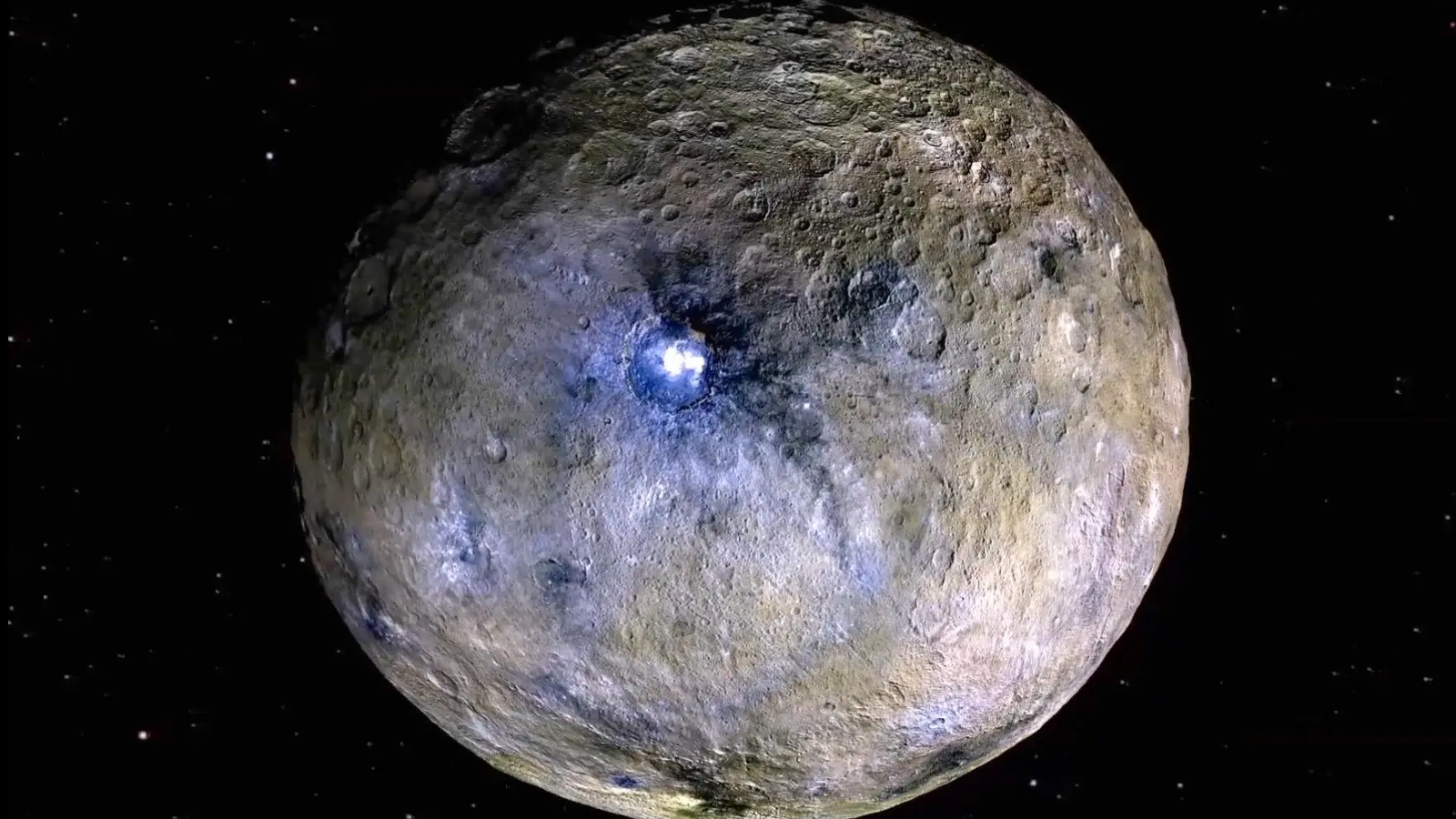
An image of Ceres in space with a glowing energy source at its center
New research suggests that the dwarf planet Ceres may have once had a radioactive core, capable of providing the energy needed to kickstart life on the wee world. 
(Image credit: NASA/JPL-Caltech/UCLA/MPS/DLR/IDA)

New NASA research hints that Ceres — the closest dwarf planet to Earth — may have once had an ancient "power source" that could have sparked the evolution of extraterrestrial life-forms in the tiny world's hidden ocean.

Ceres is the largest object within the solar system's main asteroid belt, which is located between the orbits of Mars and Jupiter. The wee world is around 600 miles (950 kilometers) wide, roughly one-quarter the moon's diameter, meaning it is not large enough to be considered a planet. But it is large enough to be considered a "dwarf planet" like Pluto, which lost its full planetary status in 2006.

There are five official dwarf planets in our cosmic neighborhood, with others waiting to be properly recognized by the International Astronomical Union, and many more discoveries expected in the coming decades. However, Ceres is the only one located within the inner solar system. The rest of the dwarf planets, which include Haumea, Makemake and Eris, are located far beyond the orbit of Neptune.


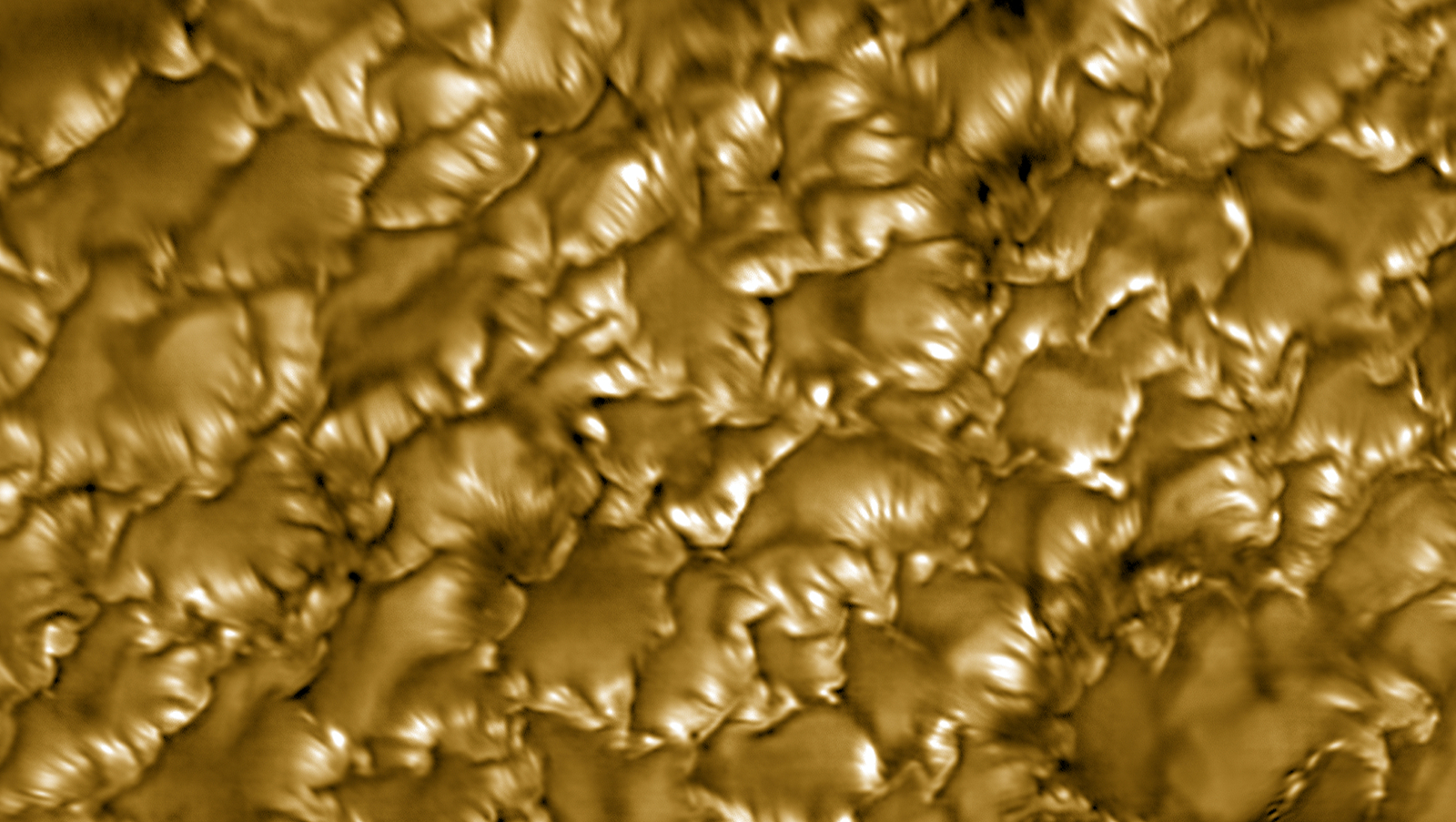
The Sun's Fiery Crown: Unveiling the Enigmatic Chromosphere

In recent years, scientists have learned a lot about Ceres thanks to NASA's Dawn probe, which visited the object between 2014 and 2018. One of the most intriguing discoveries from the Dawn mission is that the giant space rock is likely a water world: Traces of water and salty minerals on the dwarf planet's icy surface suggest a large reservoir of brine is trapped miles below. Other studies have hinted that this underground ocean could also contain organic carbon, which is a key component of all life on Earth.

However, until now, scientists thought that life was unlikely to have emerged on Ceres because the dwarf planet has no energy source capable of kick-starting life.

But in a new study, published Aug. 20 in the journal Science Advances, researchers revealed this was not always the case.

Related:

You may like

  • Illustration of protoplanet crashing into Earth

Cataclysmic crash with neighboring planet may be the reason there's life on Earth today, new studies hint

  • an illustration of rays of light emitting from a glowing blue orb

Cosmic rays could help support alien life on worlds outside the 'Goldilocks zone'

  • An image of the silhouette of a planet with a glow behind it

The hunt for 'Planet Nine': Why there could still be something massive at the edge of the solar system

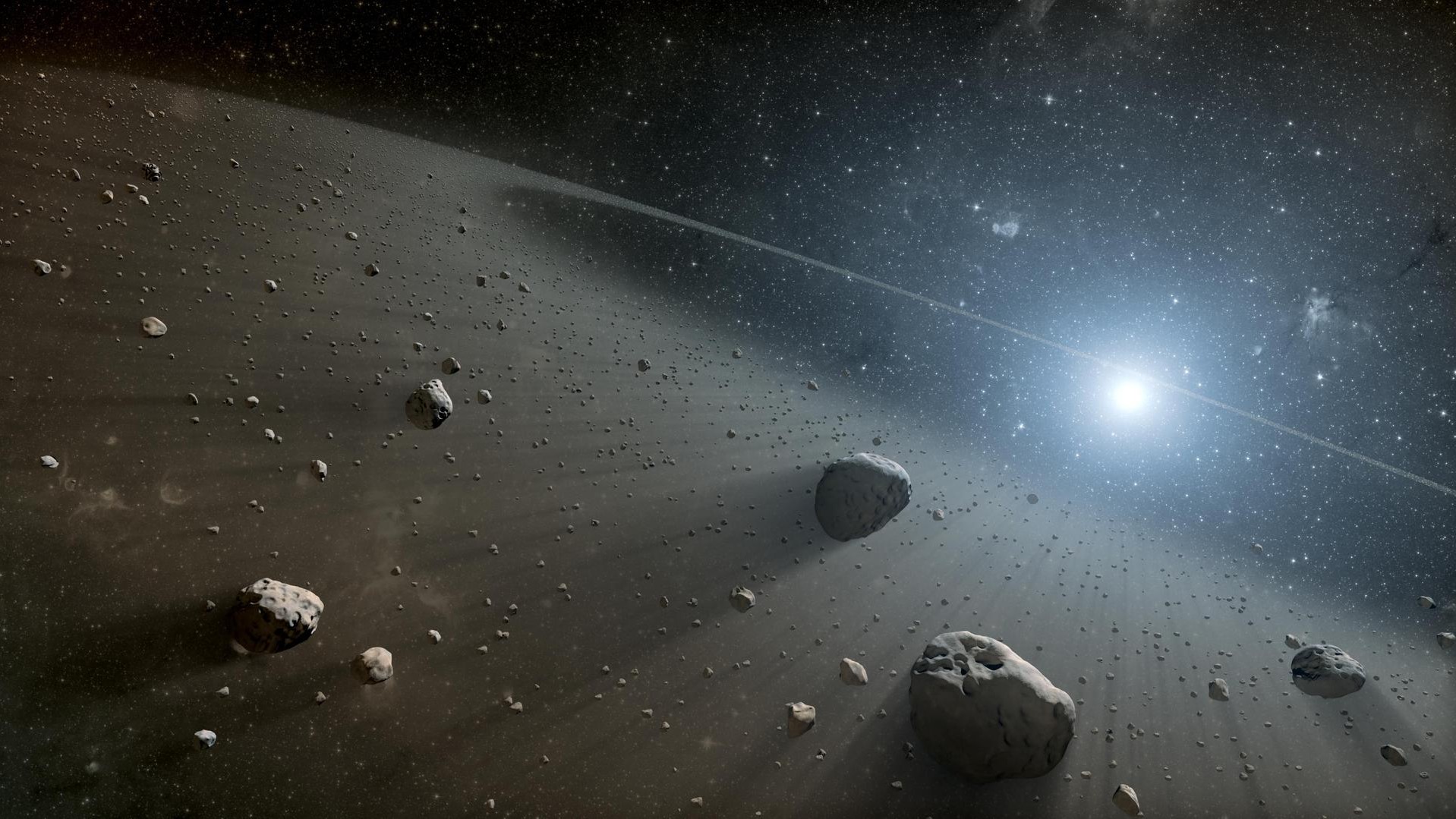
Illustration of a rocky asteroid belt with a bright sun in the distance

Ceres is the largest object in the main asteroid belt between Mars and Jupiter.  (Image credit: NASA)

The study team created computer models based on data collected by the Dawn mission to simulate how the rocky body's core changed over time. This revealed that the dwarf planet's innards probably used to emit large amounts of energy in the form of heat — raising hopes that tiny alien microbes could have emerged within Ceres' hidden ocean.

This could also have "big implications" for the potential of finding life in other parts of the solar system, study lead author Samuel Courville, a planetary scientist at Arizona State University and a former intern at NASA’s Jet Propulsion Laboratory, said in a NASA statement.

The researchers believe that Ceres' core once emitted significant amounts of heat from the gradual decay of radioactive isotopes. The team believes that this heating lasted between 0.5 and 2 billion years after the giant rock was created, which was likely shortly after the rest of the solar system, around 4.6 billion years ago. At its hottest, the core likely reached around 530 degrees Fahrenheit (280 degrees Celsius), the researchers wrote.

This is not the first time that scientists have proposed that Ceres had a radioactive core. However, this is the best evidence yet that it generated enough heat to potentially support life.

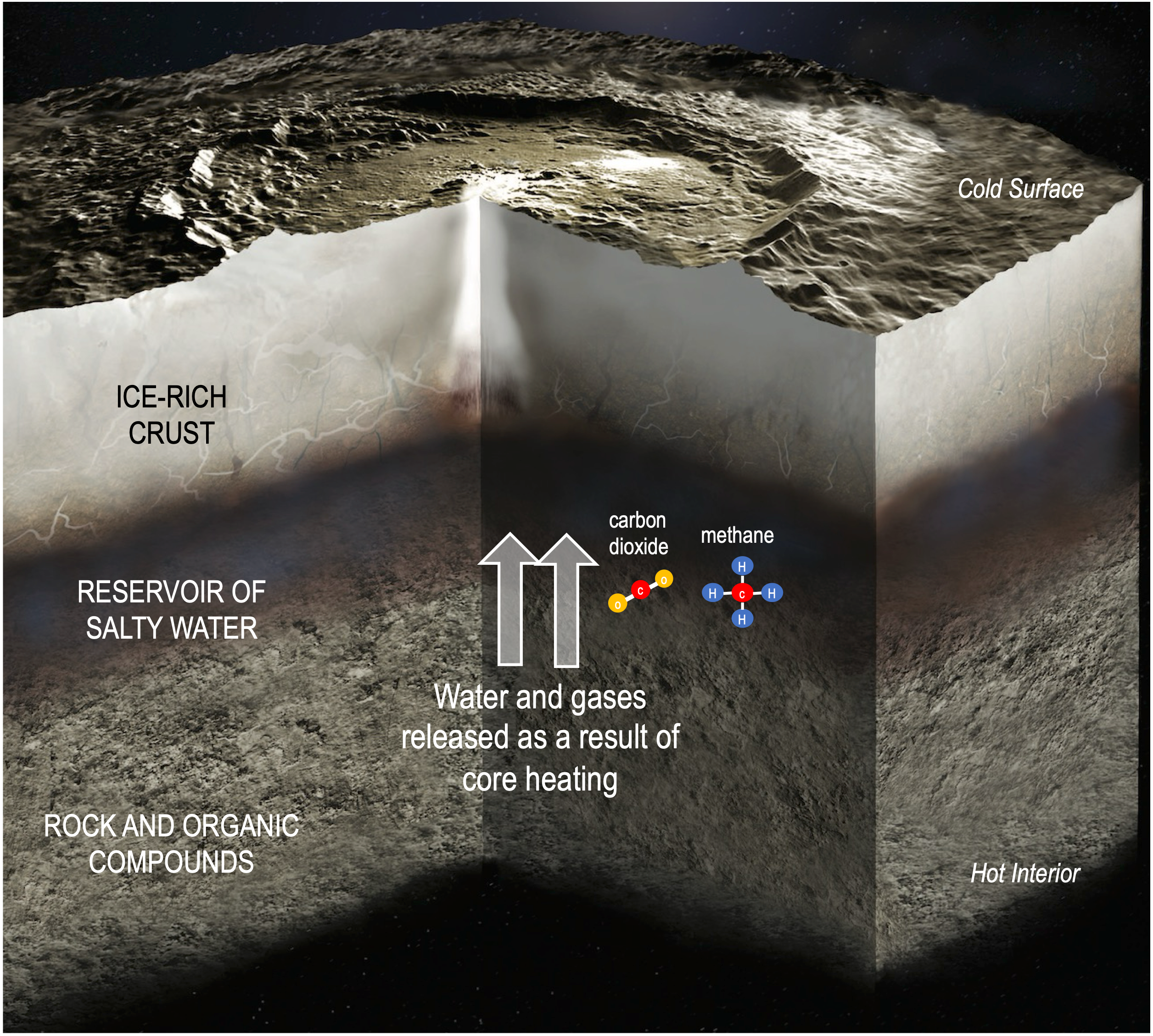
A diagram showing how heating could spark life in Ceres underground ocean

Researchers believe that the heat given off by Ceres past radioactive core could have created hydrothermal vent systems capable of kickstarting life in the dwarf planet's hidden ocean.  (Image credit: NASA/JPL-Caltech)

In addition to heating the dwarf planet's subsurface ocean to a habitable temperature, the radiation could also have caused jets of hot, mineral-rich water to shoot up through the ocean's floor, similar to the hydrothermal vent systems on Earth that support diverse microbial communities in the crushing dark depths of our oceans.

"On Earth, when hot water from deep underground mixes with the ocean, the result is often a buffet for microbes — a feast of chemical energy," Courville said.

Astrobiologists have proposed that similar systems may support extraterrestrial life on other water worlds in the solar system, including Saturn's moons Enceladus and Titan, as well as Jupiter's moons Europa and Ganymede.

However, since Ceres' radioactive core went dead around 2.5 billion years ago, any alien microbes would likely have died out from the cold, meaning there is practically zero chance that the dwarf planet supports life today, the researchers said.

RELATED VIDEOS

{ https://www.livescience.com/space }

Hoe vind je dit bericht?
Geschreven door peter om 23:10 Stuur door

Drie Reusachtige Standbeelden Verrijzen uit het Zand van de Verzonken Stad in Egypte na 2.000 Jaar

https%3A%2F%2Fsubstack-post-media.s3.amazonaws.com%2Fpublic%2Fimages%2F14097804-2e2c-4d2f-bcb6-7fc7d0a1b280_1362x906.png

Drie Reusachtige Standbeelden Verrijzen uit het Zand van de Verzonken Stad in Egypte na 2.000 Jaar

De archeologische wereld is recentelijk opgeschrikt door een baanbrekende ontdekking: de opkomst van drie enorme standbeelden uit de diepe wateren van een ondergelopen oude stad in Egypte. Deze vondst biedt niet alleen een nieuw inzicht in het oude Egyptische beschaving, maar herdefinieert ook onze kennis over de architectuur, religieuze praktijken en stedelijke planning van het oude Egypte. In dit artikel wordt de ontdekking van deze reusachtige standbeelden besproken, met een wetenschappelijke onderbouwing, voorbeelden uit vergelijkbare archeologische sites, en de implicaties voor ons begrip van de oude Egyptische samenleving.

Divers raise the granite sphinx statue from Abu Qir Bay in Egypt.

Duikers tillen de granieten sphinxstandbeeld op uit de Baai van Abu Qir tijdens de eerste grote onderwaterhersteloperatie in Egypte in 25 jaar.

Bron: Egyptisch Ministerie van Toerisme en Oudheden

De ontdekking: een onderwaterstad herrezen uit de geschiedenis

In 2021 leidde het Egyptische ministerie van Oudheden archeologische duikers naar een onderwaterstructuur nabij de stad Herakleion, ook bekend als Heracleion of Thonis, in de Nijldelta. Deze regio was in de oudheid een belangrijk handels- en religieus centrum, vooral tijdens de Late Periode en onder Griekse en Romeinse overheersing. Het gebied was lange tijd verloren gegaan onder zand en water, totdat moderne onderwatertechnologie de verborgen wereld aan het licht bracht.

In een baanbrekende archeologische prestatie wist Egypte drie monumentale beelden terug te vorderen van de Middellandse Zeebodem bij Abu Qir Bay. Dit markeert de eerste grote onderwaterhersteloperatie van het land in 25 jaar. De bijzondere vondst omvat een enorme kwartsiet sphinx met het cartouche van Ramses II, een granieten kolos uit de late Ptolemaïsche periode, en een onberispelijk standbeeld van een Romeinse edelman in wit marmer. Deze artefacten bieden ongekende inzichten in de ondergedompelde oude beschavingen van Egypte.

De operatie werd bijgewoond door Minister van Toerisme en Oudheden Sherif Fathy, Gouverneur van Alexandrië Ahmed Khaled Hassan Said, militaire commandanten en internationale media, en onderstreept de wereldwijde betekenis van deze onderwaterarcheologische mijlpaal. De vondsten worden toegeschreven aan wat deskundigen beschouwen als de resten van een uitbreiding van de beroemde oude stad Canopus, onderdeel van het bredere Thonis-Heracleion-complex dat ooit de handelsroutes in de Middellandse Zee beheerste.

Archeologen stuitten op drie reusachtige beelden, elk ongeveer 10 meter hoog, gemaakt van graniet. Ze werden gevonden op een diepte van ongeveer 8 meter, gedeeltelijk bedekt onder sedimenten en schelpen. De beelden vertonen duidelijke kenmerken van de oude Egyptische stijl, met gedetailleerde inscripties en iconografie die wijzen op hun religieuze en culturele betekenis.

AOChess1_1.jpg

Egyptisch thema Houten/Hars Handgemaakte Schaakset met Lichten, van de Ancient Origins Winkel.

Wetenschappelijke analyse en dateringsmethoden

Om de leeftijd en herkomst van de standbeelden te bepalen, werden verschillende wetenschappelijke technieken toegepast. Radiokoolstofdatering, thermoluminescentiedatering en analyse van inscripties met behulp van hoge-resolutie fotografie en 3D-scanning werden ingezet. De inscripties op de beelden bevatten hiërogliefen die verwijzen naar de goden Amon en Osiris, en mogelijk de naam van een lokale farao uit de 18e dynastie (circa 1550-1292 v.Chr.).

De resultaten wijzen erop dat de standbeelden dateren uit de Nieuwe Rijk-periode, ongeveer 3.000 jaar geleden. Deze periode staat bekend om de grootschalige bouwactiviteiten, waaronder de constructie van tempels en standbeelden die de macht en religieuze overtuigingen van Egypte uitdrukten. De locatie van de beelden onder water suggereert dat de stad in de loop van de eeuwen is verzonken, waarschijnlijk als gevolg van seismische activiteit, veranderingen in de zeespiegel of overstromingen van de Nijl.

Egypt reveals 2,000-year-old ruins discovered in Alexandria waters

Egypte heeft delen van een gezonken stad onthuld die onder water ligt voor de kust van Alexandrië, waarbij gebouwen, artefacten en een oude haven blootgelegd zijn, allemaal daterend van meer dan 2000 jaar geleden.

Architecturale kenmerken en vergelijkbare vondsten - Monumenten uit de diepte: de erfenis van een farao bewaard gebleven

Het middelpunt van het herstel is een prachtige kwartsietensfinx met de koninklijke cartouche van Ramses II, een van de machtigste farao's van Egypte die regeerde tijdens de 19e dynastie (1279-1213 v.Chr.). Dit kolossale artefact vertegenwoordigt een directe link naar het hoogtepunt van de oude Egyptische keizerlijke macht, toen de monumenten van Ramses II de Nijlvallei domineerden en de Egyptische invloed vestigden in het oostelijke Middellandse Zeegebied. meldt Ahram Online.

De granieten kolos van een onbekende man uit de late Ptolemaïsche periode weerspiegelt de Hellenistische artistieke tradities die in Egypte bloeiden na de verovering door Alexander de Grote. Dit standbeeld biedt waardevol bewijs van de culturele fusie die Egypte kenmerkte tijdens de laatste eeuwen van de faraonische heerschappij, toen Griekse en Egyptische stijlen samensmolten tot unieke hybride vormen.

AlexandriaStatues2.jpg

De drie standbeelden voor de hoogwaardigheidsbekleders, de strijdkrachten en de onderzoekers die bij het project betrokken zijn.

(Egyptisch ministerie van Toerisme en Oudheden)

De drie standbeelden vertonen opvallende kenmerken die typisch zijn voor de Egyptische beeldhouwkunst uit het Nieuwe Rijk. Ze hebben een gestileerde, symmetrische vorm met uitgebreide details in de kledij en attributen. Eén van de beelden stelt een godheid voor met een valkenkop, mogelijk Horus, terwijl de andere twee waarschijnlijk farao’s of belangrijke priesters voorstellen.

Vergelijkbare ontdekkingen zijn gedaan in de oude stad Tanis en in de beroemde Abu Simbel-tempel, waar gigantische beelden en standbeelden werden gevonden die de macht van de farao’s symboliseerden. De ontdekking van deze drie reuzen in een onderwateromgeving biedt een nieuw perspectief op de schaal en het belang van de regio in de oude Egyptische wereld.

Verzonken Egypte: Een Middellandse Zee Atlantis Onthuld

De Baai van Abu Qir is uitgegroeid tot een van 's werelds belangrijkste onderwaterarcheologische sites, met de ondergedompelde resten van steden die ooit de primaire toegangspoort van Egypte tot de Mediterrane wereld vormden. In een aankondiging op Facebook van het ministerie beschreef Mohamed Ismail Khaled, secretaris-generaal van de Opperste Raad van Oudheden, de site als een "levend getuige" van de lange geschiedenis van Egypte, waarbij hij de buitengewone archeologische betekenis benadrukte.

De site omvat een complete nederzetting uit de Romeinse periode, inclusief tempels, woongebouwen, industriële ruimtes, waterreservoirs, visbassins en een 400 voet lange commerciële kade. In de nabijheid van deze oude haven hebben archeologen het wrak gedocumenteerd van een oud koopvaardijschip, wat bewijs levert van de intensieve maritieme handel die ooit Egypte verbond met de bredere Mediterrane wereld.

Eerdere opgravingen en onderzoeken hebben een buitengewone reeks artefacten opgeleverd die meerdere beschavingen beslaan: amphorae met oude handelsmerken, koninklijke beelden, sfinxen, ushabti-figuren, stenen ankers en munten uit de faraonische, Ptolemaïsche, Romeinse, Byzantijnse en islamitische periodes. Deze opmerkelijke verzameling toont de voortdurende bezetting en het belang van de locatie door de oude geschiedenis heen aan.

Archeologische Renaissance in Egypte's Onderwatererfgoed

Deze opgravingsoperatie vertegenwoordigt een belangrijke vooruitgang in Egypte's onderwaterarcheologische capaciteiten en markeert de eerste grote onderneming sinds soortgelijke operaties een kwart eeuw geleden. Senior onderwaterarcheoloog Mohamed Mustafa onthulde dat er nog meer ontdekkingen in het verschiet liggen, waaronder een bijzonder goed bewaard gebleven oud schip dat momenteel wordt bestudeerd, wat suggereert dat het archeologische potentieel van de site nog lang niet is uitgeput.

Het witte marmeren standbeeld van een Romeinse edelman completeert deze opmerkelijke triade, die de laatste fase van de oude Egyptische beschaving vertegenwoordigt, toen het land diende als een provincie van het Romeinse Rijk. De ongerepte staat van behoud demonstreert de uitzonderlijke omstandigheden die de archeologische schatten van de Baai van Abu Qir bijna twee millennia lang hebben beschermd.

AlexandriaStatues1.jpg

Witte marmeren standbeeld van een Romeinse edelman, hersteld uit de ondergedompelde stad in de baai van Abu Qir.

(Egyptisch Ministerie van Toerisme en Oudheden)

In de loop der tijd hebben aardbevingen en stijgende zeespiegels geleidelijk de kustgebieden van de Nijldelta onder water gezet, inclusief de belangrijke havens van Canopus en Thonis-Heracleion. Wat ooit tragedie betekende voor de oude inwoners, is een ongekende kans geworden voor moderne archeologen om deze bevroren momenten in de geschiedenis te bestuderen, bewaard onder de Middellandse Zee.

De betekenis van de standbeelden in oude religieuze praktijken

In het oude Egypte hadden grote standbeelden niet alleen een esthetische functie, maar dienden ze ook als fysieke manifestaties van de goden en farao’s, bedoeld om de kracht en aanwezigheid van het goddelijke in de wereld te brengen. Ze stonden vaak in tempels, grafkamers of op openbare plaatsen en werden onderhouden door priesters.

De herkomst en de context van de standbeelden suggereren dat de onderwaterstad een belangrijk religieus centrum was. De aanwezigheid van beelden van goden zoals Horus en Osiris wijst op een religieus complex dat gericht was op het hiernamaals en de vereringering van de goddelijke farao’s. Het feit dat deze beelden nu onder water liggen, kan betekenen dat de stad ooit werd verwoest door natuurrampen of door menselijke conflicten, waarna de beelden in de wateren zijn terechtgekomen en eeuwenlang verborgen bleven.

Technologische innovaties en onderwaterarcheologie

De ontdekking van deze standbeelden is mogelijk gemaakt door geavanceerde technologieën die sinds de 21e eeuw beschikbaar zijn gekomen voor onderwaterarcheologie. Drones, multibeam echosounders, en 3D-scanning maken het mogelijk om onderwaterstructuren gedetailleerd in kaart te brengen zonder ze fysiek te verstoren.

Daarnaast wordt gebruik gemaakt van AI-gestuurde beeldherkenning om inscripties en iconografie te analyseren, waardoor de interpretatie wordt versneld en verfijnd. Deze technologische vooruitgang stelt archeologen in staat om complexe structuren te bestuderen en meer te weten te komen over de oude beschavingen die ooit in de regio floreerden.

Implicaties voor de kennis van oude Egyptische beschavingen

De herontdekking van deze reusachtige standbeelden onder water heeft grote implicaties voor de archeologie en de geschiedenis van Egypte. Het bewijst dat er nog veel te ontdekken valt, vooral in onderwatergebieden die lange tijd onverkend zijn gebleven. Het biedt ook nieuwe inzichten in de schaal van religieuze en politieke macht die de farao’s en priesters konden uitoefenen.

Bovendien onderstrepen de beelden de complexiteit van de oude steden langs de Nijldelta, die niet alleen handels- en administratieve centra waren, maar ook belangrijke religieuze locaties. De bevindingen kunnen leiden tot herzieningen van bestaande geschiedschrijving en nieuwe onderzoeksrichtingen openen.

Toekomstige onderzoeksvoorstellen

Wetenschappers stellen voor om verdere expedities uit te voeren om meer structuren en artefacten te vinden in het gebied. Het gebruik van autonome onderwaterrobots en geavanceerde sonartechnologie kan helpen om de omvang van de onderwaterstad in kaart te brengen en nieuwe ontdekkingen te doen.

Daarnaast wordt aanbevolen om conserveringsmaatregelen te nemen om de gevonden beelden te beschermen tegen schade door zeewater en sedimenten. Samenwerking met internationale archeologische instituten en musea zal ook essentieel zijn om de vondsten te bewaren en toegankelijk te maken voor onderzoek en educatie.

Conclusie

De opkomst van drie enorme standbeelden uit de diepten van de ondergelopen oude stad in Egypte markeert een belangrijke mijlpaal in de archeologie. Het illustreert niet alleen de grandeur van de oude Egyptische beschaving, maar ook de kracht van moderne technologieën om verloren werelden te herontdekken. Deze ontdekking opent nieuwe deuren naar het begrijpen van de religieuze, culturele en politieke structuur van een van de meest invloedrijke beschavingen in de menselijke geschiedenis.

De komende jaren zullen ongetwijfeld meer inzichten en ontdekkingen opleveren, waardoor we een nog completer beeld krijgen van het rijke verleden van Egypte en haar onderwatersteden. Het is een bewijs dat zelfs na duizenden jaren, de geschiedenis nog steeds wacht om herontdekt te worden, verborgen onder het zand en water van de tijd.

HD|Jan 05, 2025|30188 views|byLifesBiggestQuestions

{ PETER2011 }

Hoe vind je dit bericht?
Geschreven door peter om 22:47 Stuur door

These Scientists Say Our Consciousness Can Jump Through Time: Sometimes It Can Access Information from the Future

Precognition

These Scientists Say Our Consciousness Can Jump Through Time: Sometimes It Can Access Information from the Future

Scientists say our consciousness can jump through time, meaning it might reach beyond the normal flow of time. The idea that time is linear might be wrong. Our consciousness can sometimes access information from the future.

Have you ever wondered why sometimes your intuition, or what some call a “gut feeling,” turns out to be true? If so, it is possible that your consciousness might have traveled through time. Scientists have begun to believe in “Precognition,” a psychic phenomenon in which individuals see, or otherwise become directly aware of, events in the future.

Cognitive neuroscientist Julia Mossbridge, who has studied this phenomenon deeply, has collected many stories of precognition. She recalled one account shared with her from 1989, involving a four-year-old girl. When the girl said goodbye to her father as he left for a business trip, she had a strong feeling that she would never see him alive again. Later, she was woken by a phone call and her mother’s scream, learning that her father had died in a car accident. (Source)

Dr. Mossbridge says that precognition is a special kind of intuition that’s about picking up information from the future. Unlike ordinary intuition, which might draw upon subtle observations from the present or the past, precognition involves knowing something that simply cannot be predicted based on anything in the present or past.

For instance, if a person wakes from a dream and suddenly knows their mother will die, even though there are no warning signs, that is precognition. Precognition is the scientific term for this unexplained process of receiving information about future events.

Dr. Mossbridge explains that since the age of seven, she has had dreams that seemed to show her events that would later happen in the real world. At first, she and her parents did not take these dreams seriously and thought they might just be strange coincidences. But when she began writing the details in a dream journal, she noticed that some of her dreams came true. She admits that sometimes her memory of the dreams was not exact, but many times her visions contained details she had no normal way of knowing in advance.

Because of experiences like these, Dr. Mossbridge began to wonder if time itself works differently than we usually think. Most people imagine time as linear (a straight line) — past, present, future — moving in just one direction. But her experiences suggested the future might already exist in some way, and that people can sometimes “remember” the future, just as they remember the past.

“There’s evidence for precognition and in physics for retrocausality [things in the future causing effects in the past]. Given that people email me constantly saying, ‘I have this problem where I am predicting future events and I don’t know what to do,’ or ‘I wish I could predict future events,’ I wanted to write a book that helps people get this under control in a way that’s positive and puts a frame around it that says you could do this in a way that’s ethical, in a way that helps the world, in a way that’s consistent with your religious beliefs, in a way that enriches your life,” Mossbridge said in 2018 (Source).

Dr. Mossbridge points out that the real issue is not whether precognition can be understood, but whether people are willing to believe it. She says many scientists resist the idea because they fear the unknown and because it challenges the simple, familiar idea that time must be linear.

Even physicists, who study the deepest rules of the universe, admit they do not fully understand how time works. According to her, the resistance to the idea comes not from logic, but from fear that the world might not be the way we assume it is.

There is an interesting study conducted by British psychiatrist John Barker in the 1960s to harness human dreams, premonitions, and intuitive visions as a way to predict and potentially prevent future disasters.

After the tragic Aberfan coal waste disaster in 1966, Barker collected and analyzed premonitions from ordinary people who had unusual dreams or feelings foretelling the event. For example, one mother found a drawing by her son, who died in the slide, that seemed to anticipate the disaster.

He believed that precognition, the ability to know about future events, was more common than generally accepted and could be systematically gathered and studied.

Barker, wanting to study these experiences, reached out to a London newspaper and asked readers to send him their dreams and premonitions related to Aberfan.

He received more than seventy responses, including from people who had dreamt about the village or had strong feelings that something terrible would happen. Some described their visions in detail before the event occurred, which convinced Barker that precognition, knowing about future events, might not be so rare.

This project eventually grew into the Premonitions Bureau, an experiment run through the Evening Standard newspaper. For a year, Barker invited people to send him their dreams or feelings about upcoming disasters, trying to see if any predictions matched actual events.

Each prediction was scored for how unusual, accurate, and timely it was. Similar projects had happened before, like the work of JW Dunne who, in the early 1900s, claimed to have experienced prophetic dreams and encouraged others to keep dream diaries. (Source)

Barker believed the Premonitions Bureau could have real practical value: if only a single major disaster could be prevented by acting on someone’s warning, the project would be justified.

In practice, Barker received some striking predictions. Notably, in the spring of 1967, Alan Hencher, one of the “Aberfan seers,” called Barker to predict a plane crash involving a French-built passenger jet.

Hencher described details of the crash, including the number of people who would be killed and that there would be only one survivor. A few days later, a Swiss airliner crashed in Cyprus, killing nearly the exact number of people that Hencher had predicted. The story made headlines in the Evening Standard and lent credibility to the idea of the bureau.

Unlike fortune-tellers at carnivals, who might just guess things by looking at people’s social media or reading body language, scientists and psychologists are seriously trying to figure out if precognition is real. They see it as one form of ESP, which stands for extrasensory perception. This means perceiving something without using the normal five senses. Humans throughout history, from shamans to mystics, have claimed to experience precognition, but modern science is still unable to explain it fully.

Another scientist, Dean Radin, has also studied precognition. He works at the Institute of Noetic Sciences and teaches psychology at the California Institute of Integral Studies.

He has written several books, such as Entangled Minds, Supernormal, and Real Magic, all about consciousness and psychic phenomena. Radin agrees with Mossbridge that precognition is possible and that it suggests time might not actually function in the simple way we think.

Read also:

According to Dr. Radin, “time is not how we experience it in normal life.” In quantum physics, which is the study of very tiny particles like atoms and photons, time may not behave at all like our everyday understanding. It may exist in a much stranger way. He believes consciousness itself, our awareness, our mind, may have the ability to move outside of ordinary time, reaching into the past or future.

To test this idea, Dr. Radin created an experiment in the 1990s while working at the University of Nevada. His idea was that if people really can sense the future, then their bodies and brains should react before an event happens.

In the experiment, volunteers were hooked up to a machine called an EEG, which measures brain activity. Each volunteer had to press a button on a computer to bring up a random picture. The computer would randomly show either a positive, pleasant picture (such as a sunrise) or a negative, disturbing one (like a car crash).

What Dr. Radin and his team measured was the brain activity in the seconds before the picture appeared. Strangely, the results showed that the brain often reacted as if it already knew what kind of picture was about to show up. If the picture was going to be positive, the brain stayed calm. But if it was going to be negative, the brain would show a spike in activity before the picture even appeared. This suggested that the brain somehow anticipated the future image.

The experiment was remarkably consistent, and it has been repeated successfully many times since then, with the same results.

In fact, Dr. Radin says these kinds of studies have been replicated about 36 times by other researchers. Even the CIA became interested, in 1995, they released previously secret research into precognition. After reviewing the experiments carefully, statisticians said the results were statistically reliable, meaning they were unlikely to be a coincidence.

Dr. Mossbridge argues that when so many experiments keep pointing to the same conclusion, the evidence should be taken seriously. But many scientists still dismiss it because it clashes with their belief in linear time.

According to her, most people have the ability to be precognitive, but because society often labels it as delusion or “nonsense,” people ignore or suppress it.

In many cultures, precognition is better accepted. For example, Radin studied Tibetan oracles. These individuals traditionally predicted the future and were consulted for guidance. He also discusses “remote viewing,” the ability to see things across both time and space.

In ancient times, shamans who could see the future could help their tribes by predicting the weather or knowing when enemies were coming. Some cultures also used natural substances, like ayahuasca or morning glory seeds, to open up this ability, sometimes referred to as the “third eye.”

As for a possible scientific explanation, Dr. Radin suggests looking at something called quantum entanglement. In physics, this is when two particles become linked in such a way that they instantly affect each other, no matter how far apart they are.

Albert Einstein once described this as “spooky action at a distance.” Dr. Radin says this might also apply to time. In his view, your brain in the present could be “entangled” with your brain in the future. This means that when something is going to happen later, you might feel it now as though it were a memory arriving early. This could even explain “déjà vu,” that weird feeling of having already experienced something that is happening for the first time.


{ https://howandwhys.com/ }

Hoe vind je dit bericht?
Geschreven door peter om 21:59 Stuur door

3I/ATLAS's Coma Is Largely Carbon Dioxide

3I/ATLAS's Coma Is Largely Carbon Dioxide

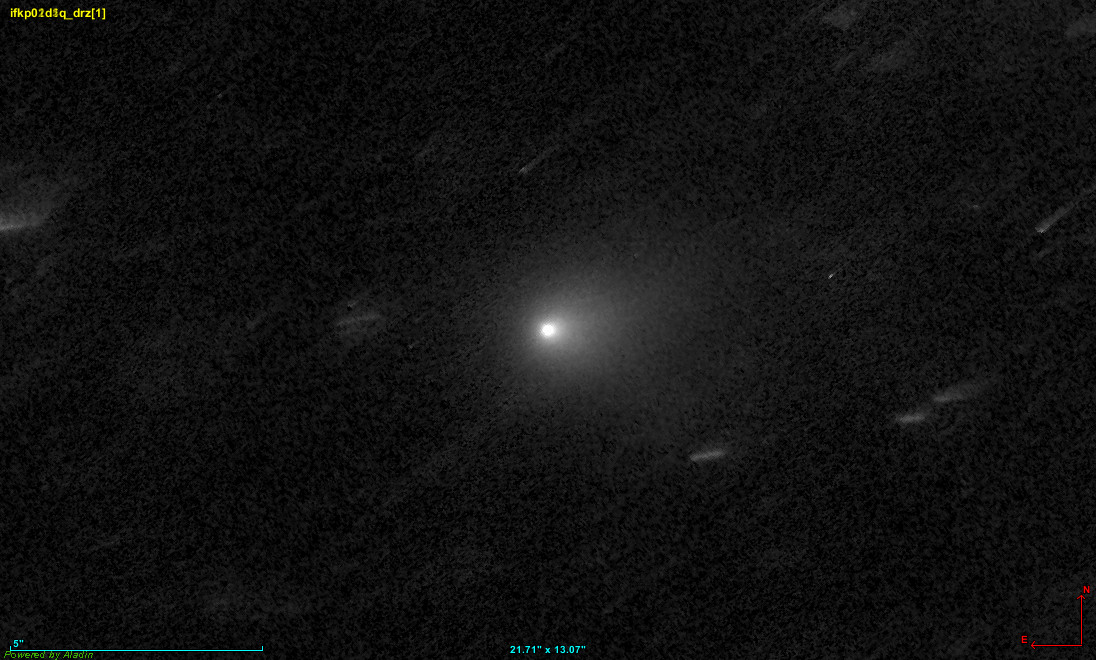
Hubble image of 3I/ATLAS. Credit - NASA/ESA Hubble image of 3I/ATLAS. Credit - NASA/ESA

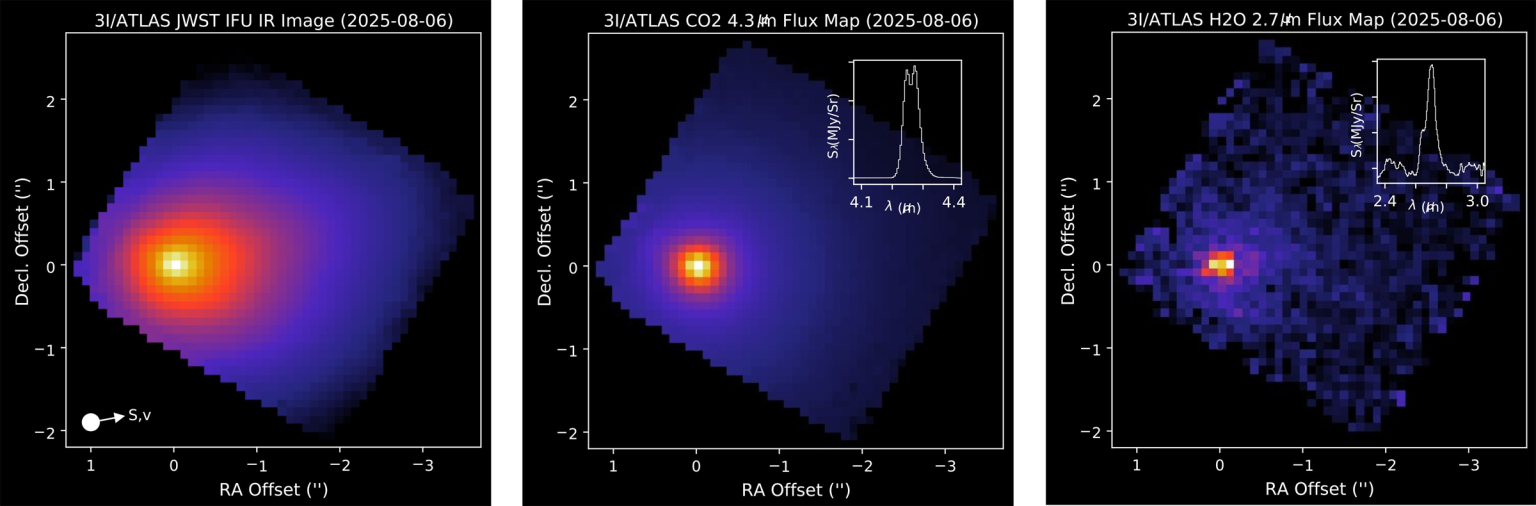
All (or at least most) astronomical eyes are on 3I/ATLAS, our most recent interstellar visitor that was discovered in early July. Given its relatively short observational window in our solar system, and especially its impending perihelion in October, a lot of observational power has been directed towards it. That includes the most powerful space telescope of them all - and a recent paper pre-printed on arXiv describes what the James Webb Space Telescope (JWST) discovered in the comet’s coma. It wasn’t like any other it had seen before.

3I/ATLAS’s coma, which is the material surrounding its nucleus, is primarily made up of carbon dioxide (CO2), according to the paper first authored by Martin Cordiner of NASA’s Goddard Space Flight Center and the Catholic University of America. It also contains water, carbon monoxide and carbonyl sulfide, all of which are expected to be in a comet’s coma. But the ratio of carbon dioxide to water is 8 to 1, the highest ever seen in a comet, and six standard deviations above the typical value. Strangely, the carbon monoxide (CO) ratio with water is more in line with previous observations, at 1.4.

To detect these chemicals, JWST used its NIRSpec infrared camera to observe 3I/ATLAS on August 6th, when it was 3.32 AU from the Sun. Other indications, which weren’t quite as surprising, include that the coma does have a bunch of water and dust scattered around it, as well as a higher dust concentration facing the Sun, which is typically for higher outgassing on the side the Sun heats.

NASA Explains what we know about 3I/ATLAS so far.

Another finding was that the ratio of two types of carbon isotopes, Carbon-12 and Carbon-13, was broadly similar to that found on Earth, suggesting the material was created in an environment with similar carbon species. However, there are a couple of features of 3I/ATLAS’s creation that could have caused the lopsided CO2/H2O ratio.

One is extremely high levels of ultraviolet radiation in the host star system the object was created it. Another could be that is was created beyond the CO2 “ice line”, where carbon dioxide ice is relatively abundant compared to water. Other explanations have to do with how heat from the Sun is able to affect the nucleus - if it is harder to heat up, then CO2, which has a lower melting point than water, would be sublimated first, accounting for the lopsided ratio despite having plenty of water stored in the nucleus waiting to be released as it gets closer to the Sun.

Either way, more observations are needed. This is only the third interstellar visitor we have confirmed, and the first (‘Oumuamua) wasn’t bright enough to capture its coma’s spectra, though even if it was it didn’t appear to have a coma anyway. That leaves the second interstellar visitor 2I/Borisov, as our only other point of comparison for the coma spectra of an interstellar comet. It actually had a higher carbon monoxide to water ratio, even as compared to 3I/ATLAS’s, so it seems of the two we have collected so far, each interstellar visitor’s coma hide new insights.

Fraser discusses how 3I/ATLAS is actively releasing water.

This undoubtedly won’t be the last paper examining 3I/ATLAS’s coma - it probably won’t even be the last one from JWST. We still have a few weeks of observational time before it passes too close to the Sun to be detectable, and then reaches its perihelion in early October, which it is still obscured from our view, though there is a chance some probes at Mars might be able to catch a glimpse of it during that time. When it finally becomes visible again in December, it will already be on its way out of our solar system, and likely would have shed most of the material it was going to. Sometimes astronomical events are fleetings, and astronomers have to try to capture them as they’re happening. At least with this one they’ll have a little bit of warning - we’ll see what they find as they continue to observe our newest interstellar visitor.

Learn More:


{ https://www.universetoday.com/ }

Hoe vind je dit bericht?
Geschreven door peter om 18:57 Stuur door

Scientists Discover Unusual Plasma Waves in Jupiter's Aurora

Scientists Discover Unusual Plasma Waves in Jupiter's Aurora

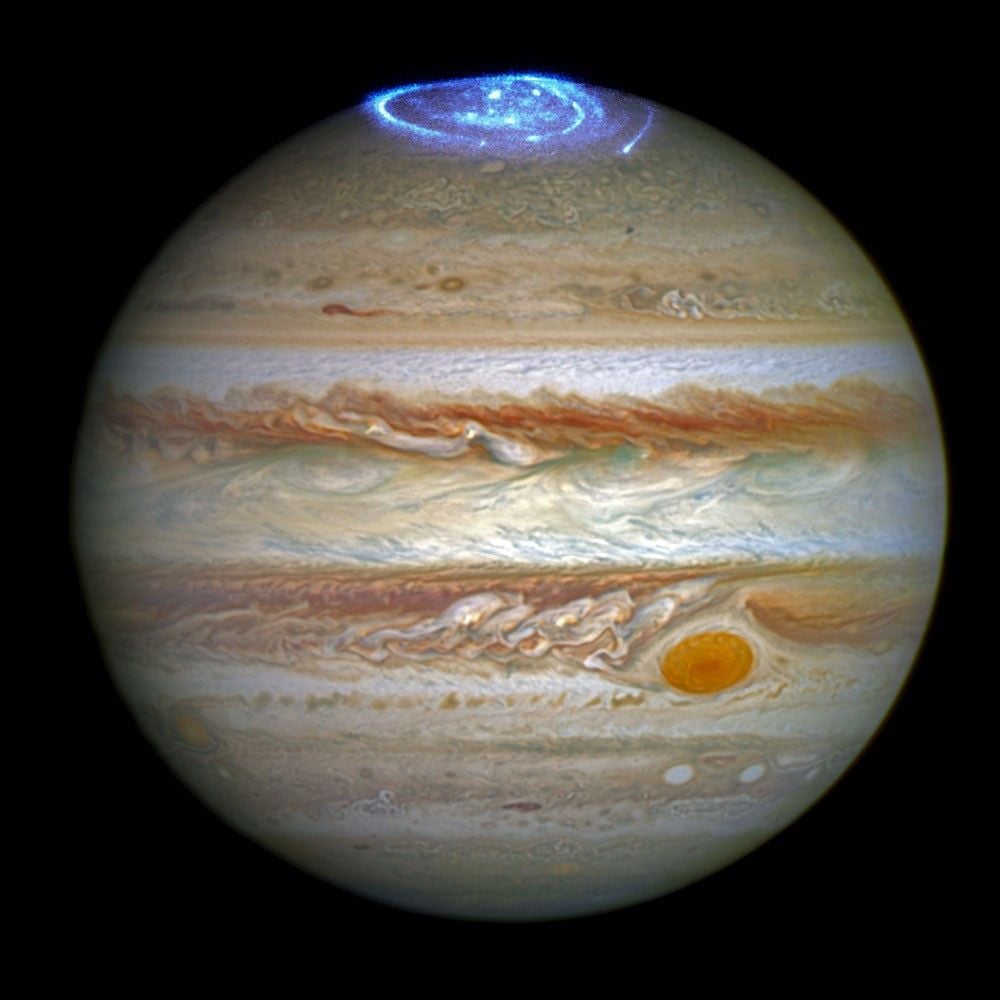
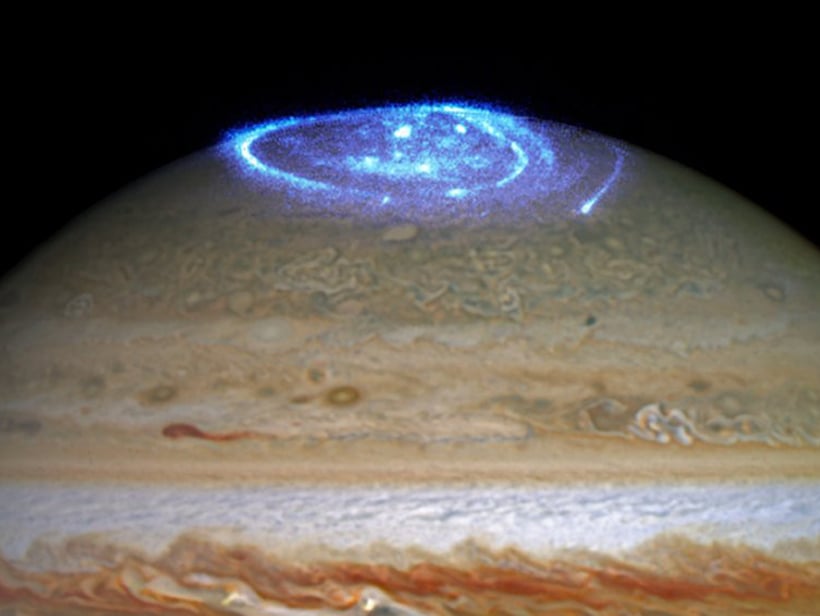
Aurora around Jupiter's north pole captured by the Hubble Space Telescope (Credit : NASA)

Scientists from the University of Minnesota have discovered something extraordinary in Jupiter's polar regions that has never been seen before, a completely new type of plasma wave that creates aurora unlike anything we observe on Earth.

While Earth's northern and southern lights (also known as the aurora borealis and aurora australis) create familiar green and blue curtains dancing across our sky, Jupiter's aurora is an entirely different beast. In comparison, Jupiter is vastly more magnetic, due to its large size, fast rotation, and complex interactions with its moons, make it a natural laboratory for extreme physics.

The Aurora Borealis, or Northern Lights, shines above Bear Lake (Credit : United States Air Force)

The Aurora Borealis, or Northern Lights, shines above Bear Lake

(Credit : United States Air Force)

The discovery came from NASA's Juno spacecraft, which made history as the first probe to orbit Jovian poles. What the team found challenges everything we thought we knew about aurora, which have primarily been understood through Earth based observations.

The key to this breakthrough is the nature of plasma. Plasma is a state of gas where matter is so hot that atoms break apart into electrons and ions. This then flows like an invisible ocean around Jupiter. These particles are accelerated down toward the planet, where they ignite gases in the upper atmosphere, creating the aurora phenomenon.

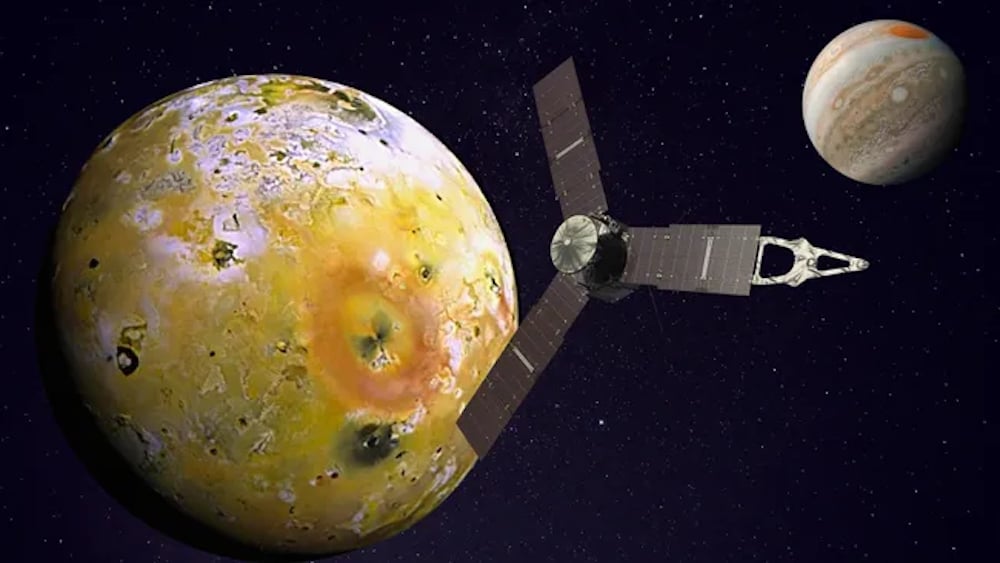
An illustration shows NASA's Juno spacecraft near Io with its parent planet Jupiter in the background (Credit : NASA)

An illustration shows NASA's Juno spacecraft near Io with its parent planet Jupiter in the background

(Credit : NASA)

Professor Robert Lysak, a world expert on plasma waves, worked with observational astronomers Ali Sulaiman and Sadie Elliott to decode what Juno was seeing. They discovered that Jupiter's unique conditions, an incredibly strong magnetic field combined with extremely low plasma density in its polar regions, created the never seen before phenomenon.

Alfvén waves, named after physicist Hannes Alfvén who first theorised in 1942 that plasma could behave like both a fluid and respond to magnetic fields are central to the phenomenon. The data showed that, due to the extremely low density of the plasma in Jupiter's polar region, the frequency of the plasma waves was very low especially compared to the frequency of similar waves on Earth.

The differences between Earth and Jupiter's auroral systems are striking. On Earth, the aurora forms a typical donut pattern of auroral activity around the polar cap, while the polar cap itself remains dark. Jupiter operates differently, thanks to its complex magnetic field system which allows charged particles to flood directly into the polar cap regions, creating aurora where Earth would have darkness.

Auroras shine bright blue over Jupiter (Credit : NASA/ESA)

Auroras shine bright blue over Jupiter

(Credit : NASA/ESA)

Unlike Earth's visible green and blue auroras created by oxygen and nitrogen, Jupiter's upper atmosphere is very different from Earth's and its aurora tends to be invisible to the naked eye and can only be observed with UV and Infrared instruments.

This discovery reveals an entirely new regime of plasma physics that couldn't be observed from Earth based studies alone. The research expands our understanding of how plasma behaves under extreme conditions, knowledge that could have applications in fusion energy research and space weather prediction.

While Juno continues to orbit Jupiter, the team hopes future missions like JUICE and Europa Clipper, arriving at Jupiter in the late 2020s, will provide additional opportunities to study this phenomenon. Each new observation helps scientists piece together the complex puzzle of planetary magnetospheres and their role in shaping the space environment around giant planets.

Source : 

RELATED VIDEOS

Alien Aurora: Lysak, Sulaiman and Elliott find new plasma regime in Jupiter’s aurora

Jupiter as photographed by the JUNO spacecraft.

Professor Robert Lysak, Assistant Professor Ali Sulaiman and Researcher Sadie Elliott, of the School of Physics and Astronomy recently published a paper in Physics Review Letters, “New Plasma Regime in Jupiter’s Auroral Zones,” on the first-ever detailed observation and analysis of a new type of plasma wave in Jupiter’s auroral zone. Their findings were featured in an article in the New Scientist magazine, under the headline “Astronomers found a completely new type of plasma wave near Jupiter.”

Sulaiman and Elliott brought their expertise in observation to data from NASA’s Juno probe, which made its historic low orbit flight over Jupiter’s north pole. “James Webb (Space telescope) has given us some infrared images of the aurora, but Juno is the first spacecraft in a polar orbit around Jupiter,” Sulaiman says.  What the astronomers observed was an entirely new phenomenon in auroral physics which has mainly been based on examples tuned to the magnetic field of the Earth. Jupiter by comparison is vastly more magnetic, due to its large size, fast rotation, and complex interactions with its moons.  The dynamo in the interior of Jupiter generates a field many times larger than that of Earth. 

diagram showing the magnetic field strength of the Sun, the Earth and Jupiter.

Fig 1.

The space around these magnetized planets is filled with superheated particles that form a plasma, a state of matter where extremes of temperature cause the atoms to break into electrons and ions. These particles are accelerated down toward the planet, where they ignite gases in the upper atmosphere (on Earth, Oxygen and Nitrogen) leading to their familiar blue and green colors. Jupiter’s upper atmosphere is very different from Earth's and its aurora tends to be invisible to the naked eye and can only be observed with UV and Infrared instruments. 

The observational astronomers turned to Lysak, one of the world’s leading experts on these mechanics for help in describing the alien aurora. Plasma can exhibit the behavior of a fluid in that it travels in a wave. Unlike fluids, plasmas can have their own magnetic field and are influenced by external fields as well. Lysak studies Alfven Waves, a discipline named after Hannes Alfven who in 1942 first theorized that plasma could be understood by combining fluid mechanics with Electromagnetic field theory.

The data showed that due to the extremely low density of the plasma in Jupiter’s polar region, the frequency of the plasma waves was very low especially compared to the frequency of similar waves on Earth, combined with Jupiter’s supercharged magnetic field system, Juno showed a type of wave unlike anything ever observed before.

Figure showing auroral activity on Earth compared to Jupiter.

Figure 2

Lysak used what he called “basic plasma theory” to unpack the problem and to explain how combination of low plasma density and strong magnetic fields led to the new type of wave.  At Earth, the aurora forms a typical donut pattern of auroral activity around the polar cap shown in figure 2b, while the polar cap itself is usually dark. The complex mechanics of the Jupiter’s magnetic field intermittently allow these particles to flood into the zone over the polar caps as shown in Figure 2a. 

Elliott’s part of the project was to study how the field lines interact with upgoing electrons from the field lines which cause the plasma to diffuse out to 30 -50 times the radius of the gas giant. These electrons play a role in exciting the new plasma wave mode.  The group hopes to be able to learn more about this phenomenon when Juno makes further passes around Jupiter. Unfortunately, the planned extended mission to Jupiter is doubtful given the uncertain state of funding of the American space program, but they have some hope that JUICE and Europa Clipper, due to arrive at Jupiter at the end of the decade, may be able to accommodate this research. 

{ https://www.universetoday.com/ }

Hoe vind je dit bericht?
Geschreven door peter om 18:45 Stuur door

Alien face in Algeria, aliens were here millions of years before humans. UFO UAP sighting news. The Face Of A New Species!

Alien face in Algeria, aliens were here millions of years before humans. UFO UAP sighting news. The Face Of A New Species!

Algeria_alien.PNG


Alien_face_2025.png
 
Date of discovery: Aug 28, 2025
Location of discovery: Algeria desert
Source: Scott Waring
Coordinates: 26°29'24"N 4°43'01"E 
 
I found an alien face, in Algeria near the Sahara Desert 🐪 It’s 500 meters from top of head to bottom of neck. Proof they were here millions of years before us, and will be here long after us.

{ https://www.ufosightingsdaily.com/ }

Hoe vind je dit bericht?
Geschreven door peter om 22:45 Stuur door

UFO over Curilac, Montenegro on Aug 5, 2025, UAP sighting news. Aliens are watching!

UFO over Curilac, Montenegro on Aug 5, 2025, UAP sighting news. Aliens are watching!

Breaking_News.png

UFO_news_breaking.png

Date of sighting:  Aug 5, 2025
Location of sighting: Curilac, Montenegro
Source: NUFORC
 
This is a great video of a glowing red orb UFO over the mountains in Montenegro this week. The eyewitness noticed the orb and walked over to the end of the fenced area and watched as the orb flashes and moves, having over the hill. She caught one of several UFOs seen, sometimes a sighting moves so fast that we forget to record it, however even a 30 second recording such as this tells us so much. 
Scott C. Waring - UFO Sightings Daily
Eyewitness states: 
I was sitting in my yard, when i saw one ,,circle” moving and leaving the mountain. This is not the first time seeing this.I observed three unidentified flying objects emerging sequentially from a mountain visible from my home in Danilovgrad. The sighting occurred on the night of August 5, 2025, at approximately 10:00 PM. The sky was completely clear with no clouds, and the weather was calm. Each object appeared one after the other, not at the same time. The first object rose from the mountain, flying smoothly and silently along a straight path, and then suddenly disappeared at a certain point in the sky — it did not fade out or descend, it just vanished instantly.
£After a short interval, the second object emerged from the same area and followed the exact same path, with the same behavior, and disappeared in the same way. A third object repeated the same sequence shortly after.The objects emitted a yellow light, had no visible propulsion system, made no sound at all, and appeared to move at a ufspeed similar to that of a helicopter. When first observed, each object seemed to be about 200 meters above the ground, ascending as they moved.There were no known aircraft or natural explanations that I could identify for this event.

{ https://www.ufosightingsdaily.com/ }

Hoe vind je dit bericht?
Geschreven door peter om 22:39 Stuur door

UFO over Arcadia, California Aug 8, 2025 UAP sighting news 👽 eyewitness report.

UFO over Arcadia, California Aug 8, 2025 UAP sighting news 👽 eyewitness report.

UFO_UAP_Strange.png

Paranormal_UFO.png

Date of sighting: Aug 8, 2025
Location of sighting: Arcadia, California, USA
Source: NUFORC
 
Watch this video and you will notices a white light in the night sky thats hovering over the neighborhood. The eyewitness took notice and took a fast recording, even though the UFO was there 25+ minutes. Yes UFOs have lights, do you really think humans are the only intelligent creatures in the universe with colored lights on the aircraft and spacecraft? Such lights have been seen by mayors, congressmen, pilots and police, so if they saw and recorded such lights...you can bet they exist.
Scott C. Waring 
 
Eyewitness:
 It was flashing red, blue and green lights, no pattern It hovered there for about 25 minutes, going back and forth and in circles and figure eights. The lights had no pattern. The red light seemed on top, then blue and green lights moved around. sometimes on the left and sometimes on the right. No spotlights. planes don't move this way and helicopters don't have lights like this. I thought it might be a drone, but it was very high and the lights were too bright; brighter than a led. I showed it to my wife; it scared her. I pointed it out to a neighbor walking by, she didn't know what it was.
 

{ https://www.ufosightingsdaily.com/ }

Hoe vind je dit bericht?
Geschreven door peter om 22:29 Stuur door

Biblical mystery solved as 5,500-year-old factory is discovered in Israel

The ruins of an ancient blade factory unearthed in Israel may offer the clearest evidence yet of the Canaanites, a people long described in the Bible. 

Archaeologists in Kiryat Gat, about 40 miles south of Tel Aviv, uncovered the first-ever Canaanite workshop in the region. 

The factory contained long flint blades and massive stones used to shape and mold weapons with precision.

Researchers also discovered hundreds of underground pits, some lined with mud bricks, that served as storage areas, dwellings, workshops and even ritual spaces.

The scale and sophistication of the site reveal that the Canaanites had organized settlements, specialized crafts and thriving trade networks.

This glimpse into their daily lives offers a tangible link between the archaeological record and the society described in the Old Testament.

The Bible portrays the Canaanites as the original inhabitants of the Promised Land before the Israelites arrived and conquered the territory.

Experts with the Israel Antiquities Authority said the discovery sheds light on the beginnings of urbanization and professional specialization in the ancient land.

Archaeologists have uncovered the ruins of an ancient blade factory with hundreds of pits used to craft and store weapons more than 5,000 years ago

Archaeologists have uncovered the ruins of an ancient blade factory with hundreds of pits used to craft and store weapons more than 5,000 years ago

The deep pits contained tools for creating the weapons. Archaeologists were amazed by the 'extremely advanced' technology used by the Canaanites who are mentioned in the Bible

The deep pits contained tools for creating the weapons. Archaeologists were amazed by the 'extremely advanced' technology used by the Canaanites who are mentioned in the Bible

'The most impressive findings discovered at the site are large flint cores, from which extremely sharp, uniformly shaped blades were produced,' IAA shared in a Facebook post.

'The blades themselves were used as knives for cutting and butchering, and as harvesting tools, like sickle blades. 

'The production technology was extremely advanced and included the use of a kind of crane to exert precise pressure on the flint.'

The team noted that this also marked the discovery of a never-before-seen technology during that time period. 

IAA's prehistorians Dr Jacob Vardi said: This is a sophisticated industry, not only because of the tools themselves, but also because of what is not found.

'The waste fragments, the debitage, were not scattered outside the site, perhaps to better protect and preserve the professional knowledge within the group of experts. 

'Today, we understand that this site served as a center, from which Canaanite blades were distributed across broad regions in the Levant.' 

In the Early Bronze Age, humans used tools made from natural raw materials: flint, bone, stone and ceramics. 

The factory contained long flint blades and massive stones used to shape and mold weapons with precision

The factory contained long flint blades and massive stones used to shape and mold weapons with precision

The most impressive findings discovered at the site are large flint cores, from which extremely sharp, uniformly shaped blades were produced

The most impressive findings discovered at the site are large flint cores, from which extremely sharp, uniformly shaped blades were produced

However, in this period, the Canaanite blades were the main cutting tools. 

'An advanced industry was revealed at the site, requiring an extremely high level of expertise,' Dr Vardi said.

article image

'Only exceptional individuals knew how to produce the Canaanite blades. 

'This is clear evidence that already at the onset of the Bronze Age, the local society here was organized and complex, and had professional specialization.' 

Archaeologists explained that the ancient tools aligned with the material culture of Canaan during Abraham's era, referring to the time period known as the Middle Bronze Age (roughly 2100-1900 BC), when the biblical patriarch Abraham is said to have lived and migrated to Canaan.

Abraham, the revered ancestor of Judaism, Christianity, and Islam, is known in the Bible for his unwavering faith in God and the covenant to establish a new nation in the land of Canaan.

Moses, described in Scripture as a descendant of Abraham through Isaac and Jacob, later led the Israelites out of Egypt toward the Promised Land that was originally home to the Canaanites.

This is the first Canaanite workshop found in southern Israel

This is the first Canaanite workshop found in southern Israel

The Canaanites are mentioned several times in the Old Testament, including the books of Genesis, Leviticus, Deuteronomy and Joshua.

In the book of Joshua 3:10, God tells the Israelites that he will drive out the Canaanites before they arrive in the Promised Land.

The Israelites fought a series of wars against the Canaanites and ultimately took over most of their land - this conquest took place in the second half of the 13th century BC.

{ https://www.dailymail.co.uk/sciencetech/index.html }

Hoe vind je dit bericht?
Geschreven door peter om 22:20 Stuur door

Scientists baffled as new 'stone head' statue mysteriously appears on Easter Island: 'This is a first'

Scientists baffled as new 'stone head' statue mysteriously appears on Easter Island: 'This is a first'

A new statue has emerged from the dirt of a recently dried-up lakebed on Easter Island, baffling scientists who said it should not be there.

Easter Island is considered a mystery due to its 1,000 large stone heads, known as moai, which are 700 to 1,000 years old.

Terry Hunt, professor of archaeology at the University of Arizona, told Good Morning America: 'We think we know all the moai, but then a new one turns up, a new discovery, and in this case, it's in the lake, at the statue quarry.

'There have been no moai found in the dry lakebed before, so this is a first.'

The newly discovered moai is among the smallest found, suggesting that many more could be hidden within the reeds.

Each moai honors a person, usually a leader, and many are topped with eye stones at their resting place. The largest stands over 30 feet tall and weighs up to 86 tons.

Salvador Atan Hito, vice president of Ma'u Henua, the Indigenous group managing the island's national park, said: 'For the Rapa Nui people, this is a very, very important discovery.

'Because it's here in the lake and nobody knew it existed, even our ancestors, our grandparents didn't know about this one.'

Located in the southeastern Pacific Ocean, Easter Island was first settled by humans around AD 1200, who built its famous enlarged head statues, called moai

Located in the southeastern Pacific Ocean, Easter Island was first settled by humans around AD 1200, who built its famous enlarged head statues, called moai

Archaeologists uncovered another new statue in 2023 (pictured), which would found lying face-down

Archaeologists uncovered another new statue in 2023 (pictured), which would found lying face-down 

Hunt and Hito said the current dry conditions may help archaeologists discover more moai in the lakebed.

'Under the dry conditions that we have now, we may find more,' Hunt told GMA. 

'They've been hidden by the tall reeds that grow in the lake bed, and prospecting with something that can detect what's under the ground surface may tell us that there are more moai in the lakebed sediments.

'When there's one moai in the lake, there's probably more.' 

Due to its remote location, Easter Island is traditionally assumed to have remained socially and culturally isolated from the wider Pacific world.

This idea is reinforced by the fact that Easter Island's famous Moai statues, estimated to have been built between AD 1250 and 1500, are unique to the location.

For the past decade, Hunt and his colleagues and students have created an inventory of 981 moai on the island, complete with precise GPS locations and measurements. 

Many moai remain in a quarry near Rano Raraku, the now-dry crater lake where the newest statue was found, in various stages of completion. 

There's no doubt Easter Island (pictured) in the southern Pacific is geographically one of the most isolated places on Earth

There's no doubt Easter Island (pictured) in the southern Pacific is geographically one of the most isolated places on Earth

The Moai are monolithic human figures carved by the Rapa Nui people on Easter Island, between AD 1,250 and 1,500

The Moai are monolithic human figures carved by the Rapa Nui people on Easter Island, between AD 1,250 and 1,500

The largest, called Te Tokanga or 'The Giant' in the Rapa Nui language, was never finished and lies on its back, measuring 63 feet long and weighing an estimated 90 to 100 tons. 

The team made a similar discovery in 2023, finding another new moa that measured five feet by six inches long and was found face up in the ground.

Hunt said the statue's eye sockets had been carved, which is historically the final step in a moai's construction before display. 

The base is also flat, rather than sloped, to help with moving the statue. 

Researchers believed that the ancient Rapa Nui people likely moved the moai statues by 'walking' them upright using ropes to rock and pivot the statues forward in a controlled, rocking motion. 

This method, supported by experiments and oral traditions, allowed them to move these massive statues across the island without dragging them on sleds or rollers. 

Hunt frequently uses cell phones and drones for 3D imaging of the moai. 

He is also exploring the use of ground-penetrating radar to detect hidden moai or structures underground, particularly in the Rano Raraku lakebed. 

Historically, the original inhabitants, known as the Rapa Nui, were believed to have been completely shut off from the wider world. 

However, a study released in July by researchers in Sweden challenged the long-held narrative.

Pictured, ahu (a central stone platform) on Mo’orea, Windward, French Polynesia, southern Pacific Ocean

Pictured, ahu (a central stone platform) on Mo’orea, Windward, French Polynesia, southern Pacific Ocean

They said the 63.2-square-mile island in the southern Pacific was not quite as isolated over the past 800 years as previously thought. 

article image

The island was populated with multiple waves of new inhabitants who bravely traversed the Pacific Ocean from west to east. 'Easter Island was settled from central East Polynesia around AD 1200-1250,' study author Professor Paul Wallin at Uppsala University told the Daily Mail. 

'The Polynesians were skilled sailors, so double canoes were used.' 

For their study, the team at Uppsala University compared archaeological data and radiocarbon dates from settlements, ritual spaces and monuments across Polynesia, the collection of more than 1,000 islands in the Pacific Ocean. 

The experts point out that ahu stone platforms were historically constructed at Polynesian islands further to the west.

These rectangular clearings were communal ritual spaces that, in some places, remain sacred to this day.

'The temple grounds ahu [also known as marae] exist on all East Polynesian islands,' Professor Wallin added.

Archaeologists believe they will uncover more statues in the future

Archaeologists believe they will uncover more statues in the future

The team agreed that an early population of people spread from the west of the Pacific to the east before encountering Easter Island and populating it around AD 1200.

They argued that Easter Island was populated several times by new seafarers, and not just once by a single group that remained isolated for centuries, as previously assumed.

'The migration process from West Polynesian core areas such as Tonga and Samoa to East Polynesia is not disputed here,' they say in their paper.

'Still, the static west-to-east colonization and dispersal suggested for East Polynesia and the idea that Rapa Nui was only colonized once in the past and developed in isolation are challenged.'

Based on their evidence, they also think ahu originated on Easter Island before the trend spread east to west across other western Polynesian islands during the period of AD 1300-1600.

It was only after this that the Polynesian islands, including but not limited to Easter Island, might have become isolated from each other.

{ https://www.dailymail.co.uk/sciencetech/index.html }

Hoe vind je dit bericht?
Geschreven door peter om 22:07 Stuur door

Mars' interior is more like Rocky Road than Millionaire's Shortbread, scientists find

Mars' interior is more like Rocky Road than Millionaire's Shortbread, scientists find

If you haven't had your dinner yet, look away now. 

A mouth–watering new study has revealed exactly what the interior of Mars looks like – with scientists comparing the structure to a Rocky Road. 

Until now, it has been widely assumed that the inside of Mars is smooth and uniform. 

In fact, scientists have suggested the planet's crust, mantle, and core are stacked like the biscuit base, caramel, and chocolate of a neat slice of Millionaire's Shortbread.

However, data collected by NASA's InSight mission reveals that this isn't actually the case. 

Instead, the Red Planet's mantle is rather messy, according to experts from Imperial College London. 

Rock fragments measuring up to 2.5 miles (4km) wide are dotted throughout the interior – much like the marshmallows and biscuit pieces in a Rocky Road. 

These ancient fragments are 'preserved like geological fossils from the planet's violent early history,' according to the team. 

A mouth¿watering new study has revealed exactly what the interior of Mars looks like ¿ with scientists comparing the structure to a Rocky Road
+5
View gallery

A mouth–watering new study has revealed exactly what the interior of Mars looks like – with scientists comparing the structure to a Rocky Road

Rock fragments measuring up to 2.5 miles (4km) wide are dotted throughout the interior ¿ much like the marshmallows and biscuit pieces in a Rocky Road
+5
View gallery

Rock fragments measuring up to 2.5 miles (4km) wide are dotted throughout the interior – much like the marshmallows and biscuit pieces in a Rocky Road

We already know that Mars formed about 4.5 billion years ago, as dust and rock orbiting the young Sun gradually clumped together. 

Once Mars was almost fully formed, it was struck by a giant, planet–sized objects, in a series of 'near–cataclysmic collisions.'

'These colossal impacts unleashed enough energy to melt large parts of the young planet into vast magma oceans,' said lead researcher Dr Constantinos Charalambous.

'As those magma oceans cooled and crystallised, they left behind compositionally distinct chunks of material – and we believe it's these we're now detecting deep inside Mars.'

These impacts mixed fragments of Mars' early crust and mantle into the molten interior. 

Then, as Mars cooled, these ancient chunks became trapped in the mantle – like the marshmallows and biscuit in a Rocky Road mix. 

Finally, Mars sealed up its stagnant outer crust, leaving the ancient chunks trapped inside.  

'Most of this chaos likely unfolded in Mars's first 100 million years,' says Dr Charalambous. 

We already know that Mars formed about 4.5 billion years ago, as dust and rock orbiting the young Sun gradually clumped together. Once Mars was almost fully formed, it was struck by a giant, planet¿size objects, in a series of 'near¿cataclysmic collisions'
+5
View gallery

We already know that Mars formed about 4.5 billion years ago, as dust and rock orbiting the young Sun gradually clumped together. Once Mars was almost fully formed, it was struck by a giant, planet–size objects, in a series of 'near–cataclysmic collisions'

Scientists have previously suggested Mars' crust, mantle, and core are stacked like the biscuit base, caramel, and chocolate of a neat slice of Millionaire's Shortbread
+5
View gallery

Scientists have previously suggested Mars' crust, mantle, and core are stacked like the biscuit base, caramel, and chocolate of a neat slice of Millionaire's Shortbread

How did Mars form?

We already know that Mars formed about 4.5 billion years ago, as dust and rock orbiting the young Sun gradually clumped together. 

Once Mars was almost fully formed, it was struck by a giant, planet–sized objects, in a series of 'near–cataclysmic collisions.' 

These impacts mixed fragments of Mars' early crust and mantle into the molten interior. 

Then, as Mars slowly cooled, these ancient chunks became trapped in the mantle – like the marshmallows and biscuit in a Rocky Road mix. 

Finally, Mars sealed up its stagnant outer crust, leaving the ancient chunks trapped inside.  

'The fact that we can still detect its traces after four and a half billion years shows just how sluggishly Mars's interior has been churning ever since.' 

In their new study, the team analysed seismic data collected by NASA's InSight lander. 

As suspected, the data confirmed that the interior of Mars is chunky rather than smooth. 

'What happened on Mars is that, after those early events, the surface solidified into a stagnant lid,' Dr Charalambous said. 

'It sealed off the mantle beneath, locking in those ancient chaotic features — like a planetary time capsule.'

The ancient chunks detected inside Mars follow a 'striking' pattern, according to the experts. 

A few large fragments, measuring roughly 2.5 miles (4km) wide, are surrounded by many smaller ones. 

Professor Tom Pike, who worked with Dr Charalambous to unravel what caused these chunks, said: 'What we are seeing is a 'fractal' distribution, which happens when the energy from a cataclysmic collision overwhelms the strength of an object. 

article image

'You see the same effect when a glass falls onto a tiled floor as when a meteorite collides with a planet: it breaks into a few big shards and a large number of smaller pieces. It's remarkable that we can still detect this distribution today.' 

The researchers hope the findings will help to unravel the mystery of not only how Mars formed, but also the other planets in our solar system. 

'InSight's data continues to reshape how we think about the formation of rocky planets, and Mars in particular,' said Dr Mark Panning of NASA's Jet Propulsion Laboratory in Southern California.

'It's exciting to see scientists making new discoveries with the quakes we detected!'

MARS: THE BASICS

Mars is the fourth planet from the sun, with a 'near-dead' dusty, cold, desert world with a very thin atmosphere. 

Mars is also a dynamic planet with seasons, polar ice caps, canyons, extinct volcanoes, and evidence that it was even more active in the past. 

It is one of the most explored planets in the solar system and the only planet humans have sent rovers to explore.

One day on Mars takes a little over 24 hours and a year is 687 Earth days.

Facts and Figures 

Orbital period: 687 days

Surface area: 55.91 million mi²

Distance from Sun: 145 million miles

Gravity: 3.721 m/s²

Radius: 2,106 miles

Moons: Phobos, Deimos

RELATED  VIDEOS

{ https://www.dailymail.co.uk/sciencetech/index.html }

Hoe vind je dit bericht?
Geschreven door peter om 21:51 Stuur door

Scientist finds earliest evidence the Shroud of Turin was NOT wrapped around Jesus' crucified body

Scientist finds earliest evidence the Shroud of Turin was NOT wrapped around Jesus' crucified body

For centuries, Catholics have flocked to the Italian city of Turin to be in the presence of its famous shroud. 

The venerated piece of linen, measuring 14ft 5in by 3ft 7in, bears a faint image of the front and back of a man – interpreted by many as Jesus Christ. 

Believers say it was used to wrap the body of Christ after his crucifixion, leaving his bloody imprint, like a photographic snapshot. 

But a newly-uncovered piece of early evidence claims this actually wasn't the case.

In the written document, dating from the 14th century, French theologian Nicole Oresme (1325-1382) wholeheartedly rejects the shroud, which was first uncovered in the Champagne region of France.

The influential philosopher and bishop calls the shroud a 'clear' and 'patent' fake – the result of deceptions by shady 'clergy men'. 

In the document, Oresme asserts: 'I do not need to believe anyone who claims: “Someone performed such miracle for me”, because many clergy men thus deceive others, in order to elicit offerings for their churches. 

‘This is clearly the case for a church in Champagne, where it was said that there was the shroud of the Lord Jesus Christ, and for the almost infinite number of those who have forged such things, and others.'

An influential philosopher and bishop calls the shroud a 'clear' and 'patent' fake ¿ the result of deceptions by 'clergy men'

An influential philosopher and bishop calls the shroud a 'clear' and 'patent' fake – the result of deceptions by 'clergy men'

The venerated piece of linen, measuring 14ft 5in by 3ft 7in, bears a faint image of the front and back of a man ¿ interpreted by many as Jesus Christ. Believers say it was used to wrap the body of Christ after his crucifixion, leaving his bloody imprint, like a photographic snapshot. But a newly-uncovered piece of evidence suggests this was actually not the case

The venerated piece of linen, measuring 14ft 5in by 3ft 7in, bears a faint image of the front and back of a man – interpreted by many as Jesus Christ. Believers say it was used to wrap the body of Christ after his crucifixion, leaving his bloody imprint, like a photographic snapshot. But a newly-uncovered piece of evidence suggests this was actually not the case

The previously-unknown document from 1355–82 offers one of the oldest dismissals of the famous 14-foot cloth – and the oldest written evidence known to-date. 

It is discussed in a new paper authored by Dr Nicolas Sarzeaud, historian at Université Catholique of Louvain, in Belgium. 

'This now-controversial relic has been caught up in a polemic between supporters and detractors of its cult for centuries,' Dr Sarzeaud said. 

'What has been uncovered is a significant dismissal of the shroud... this case gives us an unusually detailed account of clerical fraud.' 

Nicole Oresme – who later became the Bishop of Lisieux, in France – was a particularly important religious figure in the later Middle Ages. 

He was influential, too, for his works on economics, mathematics, physics, astrology, astronomy and philosophy. 

But he was particularly well-regarded for his attempts to provide rational explanations for so-called miracles and other phenomena. 

'What makes Oresme's writing stand out is his attempt to provide rational explanations for unexplained phenomena, rather than interpreting them as divine or demonic,' Dr Sarzeaud said. 

In the document, French theologian Nicole Oresme (1325-1382) wholeheartedly rejects the shroud. This page from the book 'Traité de l'espère' depicts Nicole Oresme busy at his studies, with an armillary sphere in the foreground

In the document, French theologian Nicole Oresme (1325-1382) wholeheartedly rejects the shroud. This page from the book 'Traité de l'espère' depicts Nicole Oresme busy at his studies, with an armillary sphere in the foreground

The shroud first appeared in 1354 in France. After initially denouncing it as a fake, the Catholic church has now embraced the shroud as genuine. Pictured, Pope Francis visits the Shroud of Turin in 2015

The shroud first appeared in 1354 in France. After initially denouncing it as a fake, the Catholic church has now embraced the shroud as genuine. Pictured, Pope Francis visits the Shroud of Turin in 2015

The Shroud of Turin (pictured) is believed by many to be the cloth in which the body of Jesus was wrapped after his death, but not all experts are convinced it is genuine

The Shroud of Turin (pictured) is believed by many to be the cloth in which the body of Jesus was wrapped after his death, but not all experts are convinced it is genuine

Shroud of Turin: The burial cloth of Jesus Christ?

The Shroud of Turin is a 14-foot-long linen cloth with a faint image of a crucified man.

The image on the shroud is believed to reflect the story of Jesus' crucifixion, giving rise to the belief that the cloth is the burial shroud of Jesus himself.

The authenticity of the shroud has been frequently brought into question over the years but there are also many studies claiming to validate its origin.

It is considered to be one of the most intensely studied human artefacts in history.

Since it first emerged in 1354 Vatican authorities have repeatedly gone back and forth on whether it should be considered the true burial shroud.

The shroud is currently stored at the Cathedral of St. John the Baptist in Turin but is only publicly displayed on special occasions.

'The philosopher even rated witnesses according to factors such as their reliability, and also cautioned against rumour. It was essential for him to denounce all errors and manipulations.' 

Oresme's honest assessment of the Shroud of Turin generally prompted him to be 'more broadly suspicious' of the word of clergy altogether, adds Dr Sarzeaud, who completely agrees with the historic bishop that it was a 'forged relic in the Middle Ages'. 

'Although we generally consider people from this era to be credulous, Oresme provides a precious example of medieval critical thinking,' he said. 

'It is striking that, of the thousands of relics from this period, it is the one most clearly described as false by the medieval Church that has become the most famous today.' 

The Shroud of Turin was likely strategically placed and fraudulently presented as authentic by clergy men in the church of Lirey, a commune in north-central France where it originates, in 1354. 

As such, the controversial relic was known as the Shroud of Lirey in medieval times, before eventually being transported to Turin in 1578. 

Commenting on Dr Sarzeaud's findings, world-leading Shroud of Turin expert Professor Andrea Nicolotti called the results 'further historical evidence that even in the Middle Ages, they knew that the shroud was not authentic'.  

'The other technological and scientific evidence, which points in the same direction, remains unchanged,' said Professor Nicolotti, a professor of Christian history at the University of Turin. 

Pictured, an exposition of the Shroud of Turin begins in the Turin Cathedral, Italy, April 2015. The object's rich religious heritage and ceremonial value is thought to contribute to a passionate reverence, often religious in nature

Pictured, an exposition of the Shroud of Turin begins in the Turin Cathedral, Italy, April 2015. The object's rich religious heritage and ceremonial value is thought to contribute to a passionate reverence, often religious in nature 

However, the new paper, published in the peer-reviewed Journal of Medieval History, will unlikely put the debate to bed. 

Way back in 1389, the shroud was denounced as a forgery by the bishop of Troyes, Pierre d’Arcis – but it has nevertheless inspired Catholic devotion since. 

Even for some academics, the shroud – held at a chapel at the centre of the Italian city – is one of Christianity's most holy relics that asks more questions that it answers. 

Tim Andersen, research scientist at the Georgia Institute of Technology, previously said there is 'no plausible scientific explanation for how it could have been forged or even created by natural processes'. 

Meanwhile, Professor Liberato De Caro, a scientist at the Italian National Research Council who uses x-ray methods, said that everything on the shroud is 'highly correlated to what the Gospels tell about Jesus Christ' and his death.

It follows a paper published earlier this year in the journal Archaeometry that concluded – using 3D analysis – that the material had been wrapped around a sculpture, rather than Jesus’ body. 

WHY IS JESUS DEPICTED IN DIFFERENT WAYS?

No physical description of Jesus is found in the Bible.

He's typically depicted as Caucasian in Western works of art, but has also been painted to look as if he was Latino or Aboriginal.

It's thought this is so people in different parts of the world can more easily relate to the Biblical figure.

The earliest depictions show him as a typical Roman man, with short hair and no beard, wearing a tunic.

It is thought that it wasn't until 400AD that Jesus appears with a beard. 

This is perhaps to show he was a wise teacher, because philosophers at the time were typically depicted with facial hair.

The conventional image of a fully bearded Jesus with long hair did not become established until the sixth century in Eastern Christianity, and much later in the West

Medieval art in Europe typically showed him with brown hair and pale skin.

This image was strengthened during the Italian Renaissance, with famous paintings such as The Last Supper by Leonardo da Vinci showing Christ.

Modern depictions of Jesus in films tend to uphold the long-haired, bearded stereotype, while some abstract works show him as a spirit or light.

RELATED VIDEOS

{ https://www.dailymail.co.uk/sciencetech/index.html }

Hoe vind je dit bericht?
Geschreven door peter om 21:37 Stuur door

Mysterious underground base tied to deadly UFO encounters may exist after decades of rumors

Mysterious underground base tied to deadly UFO encounters may exist after decades of rumors

Rumors that a secret mountain base in the US controlled by aliens has been swirling for 50 years, but locals and UFO researchers are convinced it's real.

The base allegedly sits inside Archuleta Mesa in New Mexico, but has gained the nickname 'Alien Mountain' because of the conspiracy theories, strange phenomena, and alleged eyewitness accounts all tied to the nearby town of Dulce.

While there's no physical evidence that a base has somehow been carved out inside the large mountain, UFO researchers have continued to examine the claims surrounding the facility, including a battle with aliens that reportedly left 66 people dead.

Since the 1970s, residents have claimed they've seen UFOs, extraterrestrials, and even genetic experiments that look like human-alien hybrids walking around the town.

Geraldine Julian, a Dulce resident, told the Santa Fe New Mexican: 'The whole town of Dulce, whoever you want to talk to, they'll tell you what they've seen, a lot of them.'

The local community hasn't just seen things in the sky, as they've taken photos of strange craft around the mountain, as well as unexplained cow mutilations in nearby fields.

Recently, declassified records have revealed how the US government could have created the massive complex inside Archuleta Mesa, using a machine that literally melts rock instead of drilling.

The records may one day help prove the stories of at least one alleged whistleblower, who claimed he survived that deadly encounter with the aliens hiding inside the government facility.

Archuleta Mesa (pictured) overlooks the town of Dulce, New Mexico, where UFO researchers and locals both claim aliens live in secret

Archuleta Mesa (pictured) overlooks the town of Dulce, New Mexico, where UFO researchers and locals both claim aliens live in secret

Residents have photographed multiple UFOs over the years flying near Archuleta Mesa. A secret base is believed to be hidden inside the mountain, created using advanced drilling technology

Residents have photographed multiple UFOs over the years flying near Archuleta Mesa. A secret base is believed to be hidden inside the mountain, created using advanced drilling technology

UFO and government conspiracy researcher John Greenewald was able to uncover documents revealing that a machine called the Subterrene was built and tested in the 1970s.

The Subterrene is a nuclear-powered tunneling machine developed to bore through rock and soil by melting them with extreme heat, creating smooth, glass-lined tunnels.

It was created by scientists at Los Alamos National Laboratory, just 100 miles from the site of the alleged New Mexico base inside Archuleta Mesa.

Although the declassified documents confirmed that the Subterrene exists, there were no records of it being used to build Dulce Base.

If the mountain base does exist, however, one man already revealed what it looks like, claiming that Dulce Base has seven floors devoted to genetic experiments, extraterrestrial technology, mind control, and housing for alien beings.

The man who allegedly saw the inside of Dulce Base was Phil Schneider, a self-proclaimed former government engineer and geologist.

Before he died in 1996, Schneider repeatedly claimed that he suffered severe injuries, including the loss of several fingers, during a deadly battle with aliens inside the complex.

According to Schneider, who never showed proof of his government ties, 66 military personnel and government workers perished in the fight after a human team accidentally drilled into an alien-controlled section of the base.

Phil Schneider, an alleged government whistleblower and geologist, claimed that Dulce Base had 7 levels devoted to alien research, mind control, and genetic experiments

Phil Schneider, an alleged government whistleblower and geologist, claimed that Dulce Base had 7 levels devoted to alien research, mind control, and genetic experiments

Schneider also made unsubstantiated claims that the US government was creating hundreds of these mountain bases around the nation using advanced technology.

At UFO lectures, Schneider would also reveal a piece of metal that he claimed was alien technology from the Dulce base, and that it was now being used in US stealth aircraft.

The rumors of a mysterious Dulce base go back to the mid-1970s, when New Mexico State Police officer Gabe Valdez was one of many locals who started finding the mangled remains of cattle near the mountain.

article image

These cows hadn't been killed by a local predator. They appeared to have been surgically disassembled, with specific organs removed and all the blood drained out.

In local radio interviews, Valdez also claimed that gas masks, glow sticks, and other equipment had been left behind at the scene of the attacks.

In 1979, Albuquerque businessman and physicist Paul Bennewitz claimed he intercepted unusual electronic signals near Dulce.

He would go on to theorize that the signals were coming from an underground base being used by both aliens and the US government, a theory that became widely shared among UFO researchers at the time.

However, Bennewitz's claims were later dismissed by the UFO community after several researchers discovered declassified Air Force documents linking the businessman to a government disinformation campaign aimed at discrediting UFO stories.

Despite being seemingly debunked by the Air Force documents in the 1990s, locals in Dulce continue to maintain that the mountain is a true UFO hotspot.

New Mexico State Police officer Gabe Valdez (pictured) was one of the first people in the 1970s to note the strange events taking place near the mountain and discuss it publicly

New Mexico State Police officer Gabe Valdez (pictured) was one of the first people in the 1970s to note the strange events taking place near the mountain and discuss it publicly

Several cow mutilations were discovered by Valdez and others during the 1970s and 1980s, with suspicious equipment like gas masks left behind at the scene of the attacks

Several cow mutilations were discovered by Valdez and others during the 1970s and 1980s, with suspicious equipment like gas masks left behind at the scene of the attacks

'It's not just a fairy tale,' Julian said in 2016. 'All the things are true, and I believe every last one of them, too, because I've seen it myself.'

Julian added in an interview with KOAT that she saw one of the genetic experiments allegedly created in Dulce Base, saying that it was a 'goat with a tail' from the waist down, but had the upper body and head of a human.

Other locals said they've seen the ground open up near the mountain, with steam coming out of the opening. 

Dory Vigil, a Dulce resident who captured a photo of a UFO near Archuleta Mesa, said he'd take a lie detector test to prove he and others in the community aren't making up what continues to be seen in this small town of just 2,700 people.

RELATED VIDEOS

{ https://www.dailymail.co.uk/sciencetech/index.html }

Hoe vind je dit bericht?
Geschreven door peter om 21:21 Stuur door

Inside the grainy 18-minute Roswell alien autopsy footage that shocked the world

An 18-minute video of an alleged alien autopsy that sent the world into a frenzy decades ago has resurfaced as investigations into UFOs have reached a fever pitch.

The shocking film, showing three people in hazmat suits dissecting what appeared to be an alien body from the 1947 Roswell crash in New Mexico, was originally released in 1995.

The grainy black-and-white footage was televised worldwide, revealing a humanoid figure with a large head and dark eyes being cut open, further fueling the growing speculation of a government cover-up.

Millions of viewers were fascinated because the film seemed to prove that aliens existed, especially as shows like The X-Files were becoming a cultural phenomenon.

Years later, however, the film's producers admitted it was all a sophisticated hoax filmed in a London apartment using animal parts and plastic casts.

Despite their confession, questions remained, as one of the filmmakers behind the fake alien autopsy claimed the video was based on a real recording of scientists examining the remains of a dead extraterrestrial.

The film has now surged back into the public conversation about alien life, thanks to a new docuseries that is set to explore this mystery, diving into the video's creation 30 years ago and its lasting impact on UFO culture.

Meanwhile, there has been even more demand for answers over the last year, with elected officials even joining the call to declassify everything the government knows about UFO incidents like the Roswell crash.

The allegedly fake alien seen here in a 1995 video was supposed to be from the 1947 UFO crash in Roswell, New Mexico

The allegedly fake alien seen here in a 1995 video was supposed to be from the 1947 UFO crash in Roswell, New Mexico

Spyros Melaris (pictured) was the filmmaker behind the fake autopsy. He has since revealed his storyboards used to plan out the hoax

Spyros Melaris (pictured) was the filmmaker behind the fake autopsy. He has since revealed his storyboards used to plan out the hoax

British entrepreneur Ray Santilli released the 18-minute Roswell 'autopsy,' which aired on Fox as Alien Autopsy: Fact or Fiction on August 28, 1995.

According to British UFO researcher and author Philip Mantle, Santilli worked with filmmaker Spyros Melaris, who was the real genius behind the fake autopsy video.

In an interview for Mantle's book, Roswell Alien Autopsy - The Film That Shook the World, Melaris revealed the storyboards he used while planning out the elaborate hoax.

The props created for the film included more than just an alien body. Casts created to resemble UFO control panels, alien metals with an unknown language on them, and even extraterrestrial organs were all fabricated for the stunt.

In 1995, Santilli claimed the footage obtained from a retired US military cameraman, but the film was too degraded, so his team 'reconstructed' it.

More than a decade later, Santilli and co-producer Gary Shoefield admitted the footage was fake. They claimed it was a 'restoration' of a real film Santilli saw in 1992, but Mantle noted that proof of its existence has never been found.

'There has never been any authentic film of an alien autopsy. Ray Santilli promised a number of people a piece of the film for analysis, but it never happened,' Mantle told the Daily Mail.

Mantle revealed that Spyros had a collection of research files, drawings, and even a diary, all of which supported the conclusion that there was never an actual alien autopsy that the producers used as inspiration.

The video included supposedly alien consoles made for extraterrestrial hands (pictured)

The video included supposedly alien consoles made for extraterrestrial hands (pictured)

UFO researcher and author Philip Mantle documented the detailed steps the filmmakers went through to create the autopsy hoax

UFO researcher and author Philip Mantle documented the detailed steps the filmmakers went through to create the autopsy hoax

article image

The US government has continued to maintain that there was no alien spacecraft at Roswell in 1947.

In 1997, an Air Force report by intelligence officer James McAndrew found no evidence of alien autopsies or UFOs at the site.

The military claimed the debris came from a balloon tied to Project Mogul, a classified surveillance program.

However, multiple UFO researchers have continued to challenge the military's story about this incident.

Dr Hal Puthoff, a physicist who worked on the government's UFO research programs, recently revealed that the military not only recovered a crashed UFO from Roswell, but they had at least 10 such craft in their possession.

On the Joe Rogan Experience podcast, Puthoff noted that one of his colleagues, Dr Eric Davis, spoke to the commander of Wright-Patterson Air Force Base in Ohio, where the debris from the Roswell incident was allegedly flown, and they confirmed that the UFO crash really happened.

'Something crashed at Roswell in 1947, and even the US government accepted that. Some UFO researchers still claim it was an alien spacecraft that crashed but there is no physical evidence or documentation to prove this,' Mantle noted.

As for the bodies, Mantle said that the US government has claimed they were dummies used for testing parachutes as part of Project Mogul.

Spyros Melaris and his team even had a film canister ready to make the video look authentic

Spyros Melaris and his team even had a film canister ready to make the video look authentic 

One of the video's producers poses with a cast of an alien head that was to be used in the hoax

One of the video's producers poses with a cast of an alien head that was to be used in the hoax

Alien writing (pictured) was also created for the pieces of UFO wreckage allegedly recovered from Roswell

Alien writing (pictured) was also created for the pieces of UFO wreckage allegedly recovered from Roswell

Decades after the 1995 autopsy hoax, new claims of alien bodies have recently emerged, including the alleged discovery of alien mummies in Peru.

These unusual remains, notable for having three fingers and three toes, have sparked wild speculation, especially among UFO researchers and conspiracy theorists.

However, Mantle suspected that the public was again being fooled by an elaborate alien hoax. 

'Sadly, a lot of people have not learnt their lesson,' he said.

Despite the skepticism, Congress is not taking the issue lightly. The Trump Administration has already charged Congresswoman Anna Paulina Luna with investigating the many claims of extraterrestrial encounters over the years and declassifying whatever proof is found.

RELATED VIDEOS


{ https://www.dailymail.co.uk/sciencetech/index.html }

Hoe vind je dit bericht?
Geschreven door peter om 21:04 Stuur door

Moment dog walker playing fetch captured UFO speeding through the sky above the Malvern Hills

A man claims to have captured a 'UFO' on video ripping through the sky at hypersonic speeds while he was playing fetch with his dog. 

Andrew Clifton, 40, was out with his five-year-old Labrador, Dash, in the Malvern Hills, when he filmed the out-of-this-world phenomena.

He had been recording himself throwing a frisbee for Dash when he claims the unknown object shot through the air at high speed.

Andrew neither saw nor heard anything at the time. It wasn't until he reviewed the footage later that he noticed the strange metallic-coloured UFO.

After slowing down the footage, the alleged tubular object could be seen slicing through the sky at immense speed, seemingly covering the distance of the horizon in the fraction of a second. 

After showing the clip to friends, they encouraged him to post it in a UFO sightings Facebook group, where it quickly amassed millions of views.

However, sceptics online have claimed the video could be a hoax and potentially edited. 

Andrew, a change manager from Minety, Wiltshire, said: 'It was such a strange experience. At the time, I didn't notice that anything had happened. 'It was moving so fast there was no way I could pick it up with a naked eye.

The alleged UFO is pictured at the top right of the image, above the frisbee

The alleged UFO is pictured at the top right of the image, above the frisbee 

The mysterious object was seen ripping through the sky at high speed. However, sceptics say the footage could be a hoax

The mysterious object was seen ripping through the sky at high speed. However, sceptics say the footage could be a hoax 

'But when I got home from dinner with friends later that day, I was reviewing the videos from the day and noticed something small.

'That's when I edited the video into slow-motion and saw the object in full force for the first time.'

Malvern Hills is nestled between two major Royal Air Force bases, RAF Brize Norton, to the south east, and RAF Cosford - a training establishment - to the north. 

The video was recorded on on Saturday, August 2. 

Andrew later posted the video on Facebook, where members of the UFO community flooded the comments with questions.

The discussion grew even larger when the clip was shared on X - formerly Twitter - racking up more than seven million views.

Some viewers, convinced by the object's speed, believe it must be extraterrestrial while others remain sceptical.

Andrew said: 'I'm not someone who is a super big believer but I do think we shouldn't assume that there is nothing out there.

Pictured is the moment just before the alleged UFO appears in the sky above Andrew Clifton and his dog, Dash

Pictured is the moment just before the alleged UFO appears in the sky above Andrew Clifton and his dog, Dash

'So when my friend suggested I posted the video to a sighting Facebook group, I thought it would start a fun discussion, but I had no idea how big it would get.

'I've seen some people suggesting it's AI, but I can promise you the only editing I did was to slow the footage down.

'Personally, I think it's more likely to be some sort of military equipment that we don't know about.

'But it's true that whenever I watch it, I can't come up with a full answer as to what it is.'

UFOs are now known as UAP - or unidentified aerial phenomena.

In recent months, concerns over UAP sightings worldwide has worried governments. 

In America, a special congress has been set up to investigate alleged sightings.

It follows the disclosure of video from the US Navy which appeared to show an encounter with a 'Tic Tac' shaped objected in 2004.

The mysterious craft was observed by US Navy pilots as it soared through the sky off the coast of southern California at high speed.  

{ https://www.dailymail.co.uk/sciencetech/index.html }

Hoe vind je dit bericht?
Geschreven door peter om 20:49 Stuur door

Bombshell discovery that rewrites human history: Scientists find lost city destroyed by 'Genesis Flood' 20,000 years ago

Bombshell discovery that rewrites human history: Scientists find lost city destroyed by 'Genesis Flood' 20,000 years ago

Archaeologists may have found evidence of an advanced civilization wiped out by a global flood 20,000 years ago, a discovery that could rewrite human history.

Excavations at Tell Fara in Iraq during the 1930s revealed settlements dating back more than 5,000 years, in a period known for the emergence of cuneiform writing, centralized rule and complex urban organization.

Tell Fara has long been considered a key Sumerian city-state, offering vital clues about early civilization, trade networks and administrative practices.

But beneath the settlements, researchers discovered a thick layer of yellow clay and sand - an 'inundation layer' - indicating a massive flood that predates the known settlements. 

Such deposits typically settle on already-inhabited ground, raising the possibility that an even older civilization may have been buried and erased by cataclysmic waters.

Similar flood deposits have been documented at Ur and Kish in Mesopotamia, Harappa in the Indus Valley, and even at ancient Nile settlements in Egypt. 

The recurrence of these catastrophic layers across multiple continents suggests entire communities worldwide may have been wiped out by sudden floods, leaving only myths and fragmentary archaeological traces.

Independent researcher Matt LaCroix told the Daily Mail that geological records indicate a global disaster roughly 20,000 years ago. 'Nothing in the last 11,000 years even comes close to explaining it,' he said.

Excavations at Tell Fara in Iraq during the 1930s revealed settlements dating back more than 5,000 years, in a period known for the emergence of cuneiform writing, centralized rule and complex urban organization

Excavations at Tell Fara in Iraq during the 1930s revealed settlements dating back more than 5,000 years, in a period known for the emergence of cuneiform writing, centralized rule and complex urban organization

Pictured is a cuneiform tablet. This one was is around 4,500 years old and includes information about Mesopotamia from between 2500 BC and 100 AD

Pictured is a cuneiform tablet. This one was is around 4,500 years old and includes information about Mesopotamia from between 2500 BC and 100 AD

He added that abrupt climate events could have triggered floods powerful enough to inspire myths found across cultures. 

'A global catastrophe of this magnitude could have destroyed entire communities, leaving only fragments of culture and memory behind.'

Ice core records reveal abrupt climate swings, including the Younger Dryas cooling around 12,800 years ago, which some researchers believe may have triggered catastrophic floods. 

But most scientists argue that while the Younger Dryas caused major regional climate shifts, there is no evidence it produced a single global flood or wiped out an advanced civilization, making the theory widely viewed as fringe. 

Critics note that most humans during the Upper Paleolithic were small, nomadic hunter-gatherer groups, leaving little direct evidence for complex societies at this time.

While mainstream scientists dismiss a global flood at this period, LaCroix contended that the evidence points to an earlier, far larger catastrophe. 

He dated the cataclysm to roughly 20,000 years ago, not through direct archaeological finds, but by correlating geological records with global catastrophic markers. 

To do this, he examined ice cores, tree rings, volcanic debris and geomagnetic excursions to pinpoint periods of extreme worldwide disruption, then cross-referenced those with ancient flood myths and astronomical alignments. 

Artifacts found beneath the inundation layers, including proto-cuneiform tablets, polychrome jars and Fara II-style bowls, point to a far more sophisticated society than previously recognized.

Artifacts found beneath the inundation layers, including proto-cuneiform tablets, polychrome jars and Fara II-style bowls, point to a far more sophisticated society than previously recognized.

Archaeologists who uncovered the site said the ancient people may have been given a warning about the flood, as they only found a small number of skeletons (pictured)

Archaeologists who uncovered the site said the ancient people may have been given a warning about the flood, as they only found a small number of skeletons (pictured)

He maintained that these natural records reflect the same event described in ancient flood traditions.

In his view, disasters 12,000 to 14,500 years ago, such as the Younger Dryas, were significant but too regional in scale to match the widespread devastation described in ancient accounts. 

By ruling out those later events and combining multiple strands of indirect evidence, he concluded that only a much earlier catastrophe, possibly more than 20,000 years ago, fits both the geological record and the cultural memory preserved in myths.

If correct, this timeline would push the origins of civilization back by at least 8,000 years, challenging the standard view that places the first cities around 5,000 to 6,000 years ago. 

Ancient Sumerian texts describe Šuruppak as a 'pre-diluvial city,' home to Ziusudra, the Sumerian equivalent of Noah.

LaCroix suggested the alignment of flood deposits at Tell Fara, Ur, and Kish with these legends is 'not merely a coincidence, it points to a shared memory of real catastrophic events.'

Independent researchers analyzed images from the site, which showed intricate seals from a forgotten civilization they believe could be around 20,000 years od

Independent researchers analyzed images from the site, which showed intricate seals from a forgotten civilization they believe could be around 20,000 years od

Evidence from the Upper Paleolithic period shows humans 20,000 years ago lived as nomadic hunter-gatherers, forming small, interconnected groups that relied on stone, bone, and wood tools. 

Yet the artifacts found beneath the inundation layers, including proto-cuneiform tablets, polychrome jars and Fara II-style bowls, pointed to a far more sophisticated society than previously recognized. 

Sharp differences between artifacts above and below the flood deposits suggest an abrupt cultural break, as if an entire civilization had been erased and later rebuilt.

Lead archaeologist Erick Schmidt, from the Penn Museum, noted that excavations revealed settlement layers up to 6ft deep. 

He wrote: 'One of our most interesting problems is now, has the rising of the waters completely destroyed towns, men and beasts?' 

Schmidt added that if remains of humans or animals are never found, it might indicate that populations were warned and fled before the catastrophe. 

'Has the culture, existing prior to this event, been completely erased at this locality, or, speaking archaeologically, is there an absolute culture break expressed by the total difference between the remains below and above the alluvial layer?' he wrote.

LaCroix and others have proposed that this lost culture could have been part of a global network, leaving behind only myths, shared symbols, and catastrophic flood stories that resonate from Mesopotamia to Egypt and even Peru. 

'This could explain why so many civilizations tell similar flood stories, the memory of a real, devastating event that reshaped the human world,' said LaCroix.

RELATED VIDEOS

{ https://www.dailymail.co.uk/sciencetech/index.html }

Hoe vind je dit bericht?
Geschreven door peter om 20:36 Stuur door

Forget a planet far far away! Aliens once lived here in our solar system, scientists say

Forget a planet far far away! Aliens once lived here in our solar system, scientists say

The search for aliens has led astronomers to scour the farthest reaches of the cosmos for signs of life.

But a new study suggests that we might not need to look so far from home.

According to NASA researchers, the icy dwarf planet Ceres may once have been home to microbial life.

Although scientists aren't sure that living creatures ever emerged, they are now certain that Ceres had the right conditions to help that life survive.

Previous research has shown that Ceres has hidden lakes of salt water beneath the surface and organic carbon molecules – two of the necessary ingredients for life.

But the dwarf planet is still lacking anything for microbes to eat.

Now, using computer models to simulate Ceres' past, researchers have shown that this was not always the case.

Between 2.5 and four billion years ago, radioactively warmed water would have created a 'buffet for microbes' that could have supported simple forms of life.

Scientists say that the dwarf planet Ceres could have once had the conditions to support abundant microbial life

Scientists say that the dwarf planet Ceres could have once had the conditions to support abundant microbial life 

Today, Ceres, which sits between the orbits of Mars and Jupiter, is a barren frozen wasteland.

In 2018, NASA's Dawn mission found that reflective layers on the planet's surface were actually the leftover salt from liquid that had once bubbled up through the ground.

This liquid came from vast, underground reservoirs of brine, which are now around –63°C (–81°F) – far too cold to support any known forms of life.

However, between 500 million and two billion years after Ceres formed, the decay of radioactive minerals in the rocky interior would have produced a steady supply of hot water.

According to the researchers' simulations, water near the core would have reached temperatures exceeding 270°C (530°F).

That hot water would have surged up towards the surface, mixing with the cold water and injecting a stream of dissolved minerals and gases.

That might not sound anything like food as we would recognise it, but these sorts of hot water vents can actually be key to developing life.

Lead researcher Sam Courville, now a PhD candidate at Arizona State University, says: 'On Earth, when hot water from deep underground mixes with the ocean, the result is often a buffet for microbes — a feast of chemical energy.

Although the dwarf planet, which orbits between Mars and Jupiter, is now a frozen wasteland, around 2.5 to four billion years ago, it may have been warm enough to support life

Although the dwarf planet, which orbits between Mars and Jupiter, is now a frozen wasteland, around 2.5 to four billion years ago, it may have been warm enough to support life

As radioactive materials decay, they heat water that pushes to the surface, carrying a stream of dissolved gases and minerals. Those chemicals then enter the cold reservoir of salty water and provide the fuel for life

As radioactive materials decay, they heat water that pushes to the surface, carrying a stream of dissolved gases and minerals. Those chemicals then enter the cold reservoir of salty water and provide the fuel for life 

'So it could have big implications if we could determine whether Ceres’ ocean had an influx of hydrothermal fluid in the past'

If life had emerged on Ceres, a type of microbe known as a chemotroph that gets its energy from chemical reactions could have survived on the supply of hot water.

Professor Helen Williams, an expert on planetary formation from the University of Cambridge who was not involved in the study, told Daily Mail: 'This research is really exciting because it shows that Ceres may once have had water at its surface.

'Water acts as a means of transporting and concentrating elements that are also essential to life.

'These elements are also concentrated in rocks, so water percolating through those rocks would transport and concentrate those elements near the planet’s surface, creating conditions extremely favourable for the development of life .'

Unfortunately, scientists say that our window for finding alien life on this distant dwarf planet has long since closed.

The radioactive materials that provided the heat decayed billions of years ago, removing the source of fuel.

Unlike some moons, such as Saturn's moon Enceladus or Jupiter's moon Europa, Ceres isn't heated by the intense gravitational push and pull of a nearby planet, so it is now too cold for life.

Scientists had previously found that Ceres contained liquid water and organic carbon-based molecules, which are both necessary ingredients for life. Now they also know that it once had a supply of food for life to feed on

Scientists had previously found that Ceres contained liquid water and organic carbon–based molecules, which are both necessary ingredients for life. Now they also know that it once had a supply of food for life to feed on 

However, today Ceres is once again frozen. As this diagram shows, the oceans have frozen as the radioactive minerals decayed, leaving only a thin layer of brine that is too cold to support life

However, today Ceres is once again frozen. As this diagram shows, the oceans have frozen as the radioactive minerals decayed, leaving only a thin layer of brine that is too cold to support life 

However, the researchers say that this discovery opens the possibility of finding forms of life elsewhere.

article image

Professor Williams says: 'These results certainly tell us that a wider class of planets could be habitable, although this depends on many other factors, such as the distance these planets are from the central star in their solar systems.'

Since Ceres was able to become habitable purely through its own inherent radioactivity, the same could be true of objects of a similar size.

In their study, published in Science Advances, Mr Courville and his co–authors write: 'Being in large numbers, these bodies might represent the most abundant type of habitable environment in the early solar system.'

That means there could be many more planets out there with the capacity to support life than researchers had previously thought.

DWARF PLANET CERES IS 590 MILES ACROSS AND WAS DISCOVERED IN 1801

Ceres is 590 miles (950 km) across and was discovered in 1801. 

It is the closest dwarf planet to the sun and is located in the asteroid belt, making it the only dwarf planet in the inner solar system.

While it is the smallest of the known dwarf planets, it is the largest object in the asteroid belt.  

It lies less than three times as far as Earth from the sun - close enough to feel the warmth of the star, allowing ice to melt and reform.

Nasa's Dawn spacecraft made its way to Ceres after leaving the asteroid Vesta in 2012.

There is high interest in the mission because Ceres is seen as being a record of the early solar system.


{ https://www.dailymail.co.uk/sciencetech/index.html }

Hoe vind je dit bericht?
Geschreven door peter om 20:24 Stuur door

Scientists issue chilling update on the famous 'WOW!' signal first detected in 1977 - and say they can't rule out aliens

Scientists issue chilling update on the famous 'WOW!' signal first detected in 1977 - and say they can't rule out aliens

In 1977, scientists discovered a mysterious signal beaming from space that was so powerful it prompted astronomer Jerry Ehman to write 'Wow!' on the telescope's readout.

For decades, scientists have debated whether this so-called 'Wow! signal' could have been an attempt at communication from a distant alien civilisation.

Now, a team of experts has re-examined the signal's data with modern techniques and found that it could be even stranger than previously thought.

According to the new analysis, the Wow! signal was more than four times stronger than earlier estimates suggested.

The scientists were also able to definitively dismiss a number of natural or human explanations.

There were no known TV stations at that time which could have created the signal, nor were there any satellites passing overhead.

And although scientists believe that the Wow! signal is likely to have a natural cause, they say alien sources can't yet be ruled out.

Co–author Dr Hector Socas-Navarro, director of the European Solar Telescope Foundation, told Daily Mail: 'While aliens aren’t completely off the table, it seems that the signal may have originated by a natural astrophysical source. Our goal now is to find that source.'

For decades, scientists have struggled to find any natural process capable of producing the 72–second burst which prompted astronomer Jerry Ehman to write 'WOW!' on the telescope's readout

For decades, scientists have struggled to find any natural process capable of producing the 72–second burst which prompted astronomer Jerry Ehman to write 'WOW!' on the telescope's readout

Using new data, the scientists also refined the area of the sky from which the signal emerged. This map shows the new refined regions (yellow) compared to the previous estimates (grey)

Using new data, the scientists also refined the area of the sky from which the signal emerged. This map shows the new refined regions (yellow) compared to the previous estimates (grey)

The Wow! signal was detected by astronomers at the Big Ear Observatory in Delaware, Ohio, back in 1977. 

Scientists at the observatory were scanning the sky for radio waves as part of a hunt for extra-terrestrials when the telescope picked up an extraordinary signal.

The sudden burst of radio waves was not only exceptionally powerful, but it was also abnormally long-lasting – continuing for a full 72 seconds.

Additionally, scientists noted that the signal's frequency was in the so-called hydrogen line, which is a band of frequencies emitted by atomic hydrogen.

Since hydrogen is so abundant in the universe, some suggested that advanced civilisations might be using its frequency as a calling card for signalling to other intelligent species.

Strangely, the signal never repeated, and scientists haven't yet found another burst in the same frequency that is nearly as intense.

However, further study of the Wow! signal has been made difficult by the fact that all the data from the Big Ear Observatory is on paper printouts.

In this new paper, a team of researchers and volunteers painstakingly digitised over 75,000 pages of data from the observatory.

Researchers and volunteers analysed over 750,000 pages of data from the Big Ear Radio Observatory in Ohio, where the Wow! Signal was spotted

Researchers and volunteers analysed over 750,000 pages of data from the Big Ear Radio Observatory in Ohio, where the Wow! Signal was spotted

What are the theories to explain the signal?

There have been many theories over the years for what could have been the source of the short-lived, narrow-band radio signal that became known as the Wow! signal.

At the time, it was seen as having all the traits of having come from a distant planet, but the inability to pick it up again has frustrated astronomers.

While some have taken it to be a radio message broadcast by an alien beacon into space, others have looked for other astronomical sources. 

Theories have included collisions between asteroids and stars, flares from stars, merging white dwarfs and colliding neutron stars. 

Now, experts suggest that it could have been caused by energy from a neutron star triggering a cloud of atomic hydrogen gas to release a laser burst. 

For the first time ever, this allowed for the computational analysis of data about the Wow! signal.

Dr Hector Socas-Navarro says: 'The paper basically rewrites the basic stats of the Wow! signal.'

In addition to showing that the signal had been stronger than previously thought, the researchers have been able to characterise the burst much more accurately.

They narrowed the part of the sky that the signal came from to two small regions, each of which produced a different component of the signal.

The researchers were also able to determine this location with two-thirds greater statistical certainty.

Additionally, this new data slightly revises the signal's frequency – putting it at 1420.726 MHz rather than 1420.4556 MHz.

That keeps the signal solidly within the hydrogen line, but that small change suggests that whatever produced the signal must have been spinning a lot faster than previously thought.

This means the source must be moving at about 46 miles per second (74 km/s), over double the previous estimate of 18 miles per second (30 km/s/).

The researchers say that the most likely cause of the Wow! signal is an intense beam of energy from a dying star hitting a cloud of cold hydrogen, causing it to produce a laser-like burst which hit Earth

The researchers say that the most likely cause of the Wow! signal is an intense beam of energy from a dying star hitting a cloud of cold hydrogen, causing it to produce a laser-like burst which hit Earth 

'This means that when we look for candidates, the ones moving at that speed will stand out, like a very tall person in a large crowd, and it will be easier to identify the emitting source,' says Dr Socas-Navarro.  

Importantly, this research also rules out some natural phenomena that had been suggested as possible explanations.

It had been proposed that a man-made signal could have bounced off the moon and been mistakenly picked up by the observatory.

However, this new analysis clearly shows that the moon would have been on the wrong side of the planet at this time, so nothing could have bounced off it.

Likewise, the sun was not active enough during the year 1977 to produce anything close to the Wow! signal's intensity.

That means the Wow! signal really must have come from somewhere outside our solar system.

However, there are still many questions remaining about the origins of this mysterious radio beam.

Lead author Professor Abel Mendez, of the University of Puerto Rico at Arecibo, told Daily Mail: 'We can’t rule out an extraterrestrial communication signal explanation for the Wow! Signal yet, but the evidence points to a natural origin.'

The dying star could have been a magnetar, which produce the most powerful magnetic fields in the Universe and are rare, explaining why the Wow! Signal has not been repeated

The dying star could have been a magnetar, which produce the most powerful magnetic fields in the Universe and are rare, explaining why the Wow! Signal has not been repeated

Professor Méndez suggests the burst was created when the energy from a dying star called a magnetar hit a cloud of cold hydrogen gas floating through the universe.

If this happened, it would energise the cloud of gas and produce a burst like a giant microwave laser.

article image

Previous research has spotted several signals which appeared to be extremely similar to the Wow! signal, albeit considerably fainter.

Four of those originated from the tiny red dwarf star, Teegarden's Star, which is just 12.5 light-years from Earth, and is surrounded by clouds of pure hydrogen.

Professor Méndez says: 'The most likely origin of the Wow! Signal is a maser flare or superradiance emission from a neutral hydrogen cloud. 

'Small clouds emit consistent narrowband signals similar to the Wow! Signal but much weaker, so a cloud became temporarily much brighter due to any of these processes.'

WHAT IS THE FERMI PARADOX?

The Fermi Paradox questions why, given the estimated 200-400 billion stars and at least 100 billion planets in our galaxy, there have been no signs of alien life. 

The contradiction is named after its creator, Italian physicist Enrico Fermi.

He first posed the question back in 1950.

Fermi believed it was too extraordinary that a single extra-terrestrial signal or engineering project has yet to be detected in the universe — despite its immense vastness. 

Fermi concluded there must a barrier that limits the rise of intelligent, self-aware, technologically advanced space-colonising civilisations.

This barrier is sometimes referred to as the 'Great Filter'.

Italian physicist Enrico Fermi devised the so-called Fermi Paradox in the 1950s, which explores why there is no sign of alien life, despite the 100 billion planets in our galaxy

Italian physicist Enrico Fermi devised the so-called Fermi Paradox in the 1950s, which explores why there is no sign of alien life, despite the 100 billion planets in our galaxy

If the main obstacle preventing the colonisation of other planets is not in our past, then the barrier that will stop humanity's prospects of reaching other worlds must lie in our future, scientists have theorised.  

Professor Brian Cox believes the advances in science and engineering required by a civilisation to start conquering the stars will ultimately lead to its destruction.

He said: 'One solution to the Fermi Paradox is that it is not possible to run a world that has the power to destroy itself.

‘It may be that the growth of science and engineering inevitably outstrips the development of political expertise, leading to disaster.'

Other possible explanations for the Fermi Paradox include that intelligent alien species are out there, but lack the necessary technology to communicate with Earth.

Some believe that the distances between intelligent civilisations are too great to allow any kind of two-way communication.

If two worlds are separated by several thousand light years, it's possible that one or both civilisations would become extinct before a dialogue can be established. 

The so-called Zoo hypothesis claims intelligent alien life is out there, but deliberately avoids any contact with life on Earth to allow its natural evolution. 

{ https://www.dailymail.co.uk/sciencetech/index.html }

Hoe vind je dit bericht?
Geschreven door peter om 20:10 Stuur door

Pentagon baffled by 8,000 mysterious UFO orbs hovering over US military bases

Pentagon baffled by 8,000 mysterious UFO orbs hovering over US military bases

An invasion of small metallic orbs has been spotted hovering over the US in recent years, leaving the Pentagon scrambling to identify these mysterious UFOs.

A new report from the crowdsourced platform Enigma, which allows people to report sightings of unidentified flying objects (UFOs), reveals more than 8,000 sightings across the US between December 2022 and June 2025. 

Among these, 422 reports specifically describe metallic orbs, with the majority observed between 1am and 4am near military installations in New York, California, and Arizona. 

Eyewitnesses, including civilians, pilots, and military personnel, reported seeing the spheres hover silently before moving at extreme speeds, leaving no trace of their departure. 

Some of the sightings have been captured on video or radar, though many remain unexplained. 

'I was walking into work when I looked up and saw two metallic liquid-like objects hovering for about two minutes,' said one witness over Brooklyn's Fort Hamilton in June 2024. 

Another in California described seeing a metallic orb above Los Angeles shortly after a squadron of planes flew by. 

The Pentagon's All-domain Anomaly Resolution Office (AARO) has been charged with investigating claims of UFOs and has dismissed many as natural phenomena like flocks of birds, conventional aircraft, drones, balloons, or other explainable objects. 

Military drone footage from the Middle east in 2022 revealed a metal sphere flying through the sky in broad daylight (circled in purple)

Military drone footage from the Middle east in 2022 revealed a metal sphere flying through the sky in broad daylight (circled in purple)

The crowdsourced platform Enigma reported that over 8,000 orbs have been seen over the US since December 2022

The crowdsourced platform Enigma reported that over 8,000 orbs have been seen over the US since December 2022

However, some cases have remained unsolved, reportedly due to a lack of data. Of the 757 UFO cases between May 2023 and June 2024 released in AARO's annual report, 21 cases were classified as unresolved sightings.

Although the Pentagon and civilian groups like the National UFO Reporting Center (NUFORC) have also been cataloging these incidents, many have continued to baffle military officials, who have no way of explaining what was seen.

While the new report focused on the thousands of sightings in the US over the last three years, strange orbs have been documented all over the world, from Puerto Rico to the Middle East.

Moreover, these tiny craft have apparently been visiting our skies for decades, with pilots during World War II reporting similar orbs over the skies of Europe.

Enigma revealed that more than 360 'metallic orb' reports took place within a few miles of military bases here on US soil.

In three of those cases, witnesses revealed that the orbs got within five miles of Fort Hamilton in New York, Papago Military Reserve in Arizona, and Los Angeles Air Force Base on multiple occasions.

These mystery orb sightings include one shocking encounter revealed by Dr Sean Kirkpatrick, the former director of AARO, which was captured on a MQ-9 Reaper drone's camera in the Middle East in 2022.

Enigma revealed that witnesses spotted strange orbs flying above Fort Hamilton military base in New York multiple times

Enigma revealed that witnesses spotted strange orbs flying above Fort Hamilton military base in New York multiple times

Even more close calls were documented around Los Angeles Air Force Base in California between 2022 and 2025

Even more close calls were documented around Los Angeles Air Force Base in California between 2022 and 2025

Kirkpatrick warned that if these videos didn't prove that aliens exist, then they're evidence that a rival foreign power could be 'doing stuff in our backyard.'

article image

Some theories have suggested these orbs could be surveillance devices from foreign powers like China or Russia.

Government officials believed they might be advanced drones, due to their tremendous agility and ability to avoid radar, according to a 2022 report in the New York Times.

This theory exploded into rampant paranoia last year, when countless drones were spotted flying over the East Coast, including over key military sites and President Trump's property in New Jersey.

As for Enigma's report, many of the orb sightings have been concentrated in Texas and Florida. 

In fact, visitors at Disney World's Epcot in Florida got an unexpected sight this month, when a glowing orb appeared over the amusement park.

After searching online and finding no information about drones or satellites in the area, Morgan Huelsman, digital director of The Bobby Bones Show, described the object as a 'UFO,' adding, 'definitely a UFO with aliens.'

The Enigma platform has also received sightings from all over the US, over critical infrastructure such as power plants, and over naval vessels at sea.

The Buga Sphere recovered in Colombia (pictured) remains one of the only pieces of physical evidence tied to metallic orb sightings worldwide

The Buga Sphere recovered in Colombia (pictured) remains one of the only pieces of physical evidence tied to metallic orb sightings worldwide

However, the most convincing proof of this invasion of mysterious orbs has been found in Colombia, where locals actually recovered a metallic sphere that was seen hovering over the town of Buga in March.

The 'Buga Sphere' has become a major topic of discussion among UFO researchers, with scientists claiming the object contains a maze of fiber-optic wires that suggest it can send and receive signals.

After striking a power line and crashing to the ground, the object also appeared to have somehow dehydrated the field it landed in, killing all the grass and soil where it touched down.

Scientists suggested this was proof that the object produced some kind of energy field, but researchers had not attempted to forcibly cut the object open so far. The sphere has since been taken to Mexico for further analysis.

However, UFO researcher Dr Julia Mossbridge from the University of San Diego is among the many who doubt the authenticity of the Buga Sphere, calling it a 'man-made art project.'

RELATED VIDEOS


{ https://www.dailymail.co.uk/sciencetech/index.html }

Hoe vind je dit bericht?
Geschreven door peter om 18:41 Stuur door

Interstellar object caught emitting mysterious metal that suggests 'technological origin'

Interstellar object caught emitting mysterious metal that suggests 'technological origin'

An interstellar object speeding through our Solar System has been spotted spewing a metal unlike anything seen in natural comets.

The Very Large Telescope (VLT) in Chile detected an unusual nickel plume from the object, known as 3I/ATLAS. Unlike natural comets, which always emit nickel alongside iron, 3I/ATLAS shows the metallic element without any detectable iron. 

Harvard physicist Avi Loeb highlighted the anomaly described in a new study, noting that this nickel signature is a hallmark of industrial production of nickel alloys.

'Is this anomaly another clue for a possible technological origin of 3I/ATLAS?' Loeb wrote in a blog post.

'The paper suggests that chemical formation occurs through the nickel carbonyl channel, an extremely rare process in comets, but a standard technique in industrial nickel refining,' he added.

The new study, published by astrophysicists in Chile on Wednesday, found that 3I/ATLAS is shedding nickel at roughly five grams per second and cyanide at 20 grams per second, with both rising sharply as the object moves closer to the sun. 

Researchers noted that the mechanisms driving these emissions are not typical of natural cometary processes.

They hypothesized that nickel might be released from dust through gentle processes, such as sunlight, causing it to evaporate or breaking down small nickel-containing compounds.

A new study has revealed that the interstellar object 3I/ATLAS is releasing nickel without iron, an anomaly that a Harvard physicist said could hint at industrial or technological processes

A new study has revealed that the interstellar object 3I/ATLAS is releasing nickel without iron, an anomaly that a Harvard physicist said could hint at industrial or technological processes

Traditional comets are typically water-rich and release gases such as water, carbon monoxide and carbon dioxide as they approach the sun.

They also emit nickel and iron together, as both elements are produced in the same cosmic processes, like supernova explosions.

3I/ATLAS, however, deviates sharply from this pattern by releasing nickel without any detectable iron.

Additionally, both nickel and cyanide emissions rise steeply as it approaches the sun, unlike the more gradual outgassing seen in normal comets.

NASA also released new observations of 3I/ATLAS this week, taken by SPHEREx and the James Webb Space Telescope, showing that its gas plume is dominated by carbon dioxide and only five percent water.

This makes it unlike the vast majority of comets seen because most of its brightness comes from the cloud of dust around it, not its solid core. 

'These results add to the chemical anomalies implied by the SPHEREx space observatory and Webb space telescope [are] very different from an expected water-rich comet,' Loeb shared in a blog post.

'The idea that the nucleus is much smaller than the 29-mile diameter inferred from the 1-micron data collected by SPHEREx requires a dense coma of dust to reflect nearly all the sunlight from 3I/ATLAS. 

NASA's James Webb captured its first look at the interstellar object this month, showing it is not 12 miles in diameter as originally thought. It's closer to 1.7 miles long

NASA's James Webb captured its first look at the interstellar object this month, showing it is not 12 miles in diameter as originally thought. It's closer to 1.7 miles long

'In that case, the dust would be pushed by solar radiation pressure to trail the nucleus, forming a prominent cometary tail.'

Loeb added that observations from NASA's Hubble Space Telescope failed to identify a cometary tail.

article image

The object was first identified in July 2025 by the ATLAS telescope network, which searches for objects that might hit Earth.

Earlier images taken by the Vera C Rubin Observatory in Chile had unknowingly photographed the object, but no one realized it was there at the time.

Until now, 3I/ATLAS has been a total mystery, as early scans suggested the object was larger than anything that had ever passed through the solar system, and might even be generating its own light.

These characteristics have led Loeb to suggest other possibilities, such that 3I/ATLAS is an artificial craft developed by an extraterrestrial civilization.

The idea has been dismissed by many scientists, including Chris Lintott, an astronomer at the University of Oxford, who said Loeb's theory is 'nonsense on stilts,' calling it 'an insult to the exciting work going on to understand this object.'

{ https://www.dailymail.co.uk/sciencetech/index.html }

Hoe vind je dit bericht?
Geschreven door peter om 18:26 Stuur door

Google Maps users are baffled after spotting a 'UFO' hiding under a cliff in Antarctica - as one claims it could be an 'alien base'

It looks like a giant frying pan, or a crash-landed alien spaceship. 

Whatever it is, Google Maps users are getting seriously freaked out after discovering this strange object in Antarctica. 

The round entity, described as a 'UFO', is hiding under what seems to be a cliff about 90 miles from Antarctica's coast.

With no known origin, people are questioning whether this strange relic at the bottom of the Earth is man-made – or something not of this world. 

One American ufologist suggested the object – almost Oreo-like in appearance – might be stuck under the rock. 

Alternatively, it could be deliberately half-hidden – strategically-placed to make it difficult to spot – as it carries out a mysterious assignment. 

Scott C. Waring, who runs the UFO Sightings Daily website, posted a YouTube clip of the sleek disc being found on Google Maps. 

He said: 'The UFO is still there! Too hard to recover or still being used?' 

Google Maps users are baffled after spotting a 'UFO' hiding under a cliff in Antarctica, which one ufologist suggested might be stuck under there

Google Maps users are baffled after spotting a 'UFO' hiding under a cliff in Antarctica, which one ufologist suggested might be stuck under there

On Google Maps, the unusual structure can be located simply by entering the coordinates in the search bar – 66°16'24.5"S 100°59'03.5"E. 

As users can see, it is around 45 miles from Mill Island, a domed ice-island 30 miles long and 18 miles wide, close to the Antarctic coast. 

It is also about six miles away from the A. B. Dobrowolski Polar Station, an occasionally active Polish research base. 

Intriguingly, the object seems to have a sliverish line going around the rim, which corresponds with traditional depictions of UFOs from pop culture. 

But otherwise, it has a consistently uniform black colour, which very clearly contrasts with the jagged rock and snow surrounding it. 

Although heavily pixelated, the image also reveals peculiar black lines stretching between the disc-shape and the adjacent rock. 

Philip Mantle, a British UFO researcher, called the disc 'a new one for me', adding that he'd 'never seen it before', but declined to speculate on what it might be.

UFO stands for 'unidentified flying object' and so the term doesn't necessarily describe an object with an extraterrestrial origin. 

Whatever it is, the mysterious Oreo-like object looks rather out of place among the natural geology of Antarctica

Whatever it is, the mysterious Oreo-like object looks rather out of place among the natural geology of Antarctica

Based on clues from reported sightings, the typical UFO has a round shape, usually described as spherical or an orb, with lights emanating from it

Based on clues from reported sightings, the typical UFO has a round shape, usually described as spherical or an orb, with lights emanating from it

What is the mystery object?

Social media commentators have been describing it as a crashed spaceship, a weather balloon or a secret base.  

More realistic suggestions include an unusually symmetrical lake or pond, or some sort of geological formation. 

Alternatively, it could be a bit of equipment related to a nearby Polish polar research station. 

In his post on his UFO Sightings Daily website on Wednesday, Mr Waring said this UFO was discovered about two years ago, but in fact some people spotted it years earlier. 

On Reddit four years ago, someone posted a screenshot with the caption: 'Any thoughts on the UFO “crash” site in Antarctica?' 

The post received several interesting suggestions from users, who variously described the disk as a 'weather balloon', a 'Nazi base' and a 'pond of meltwater'. 

One commentator said: 'If I had to ditch an advanced spacecraft on a populated planet, I would put it down on an unpopulated continent, and wait for rescue', while someone else joked: 'So that's where my giant pancake ended up after I threw it out the window...' 

Another simply posted 'Antarctica got some weird stuff', while another said it 'looks ominous'. 

Professor Bethan Davies, a glaciologist at the University of Newcastle, said that the feature is simply a 'small lake in a rock basin'. 

'There is a small patch of snow and the warmer lake water has a lower albedo so it absorbs more solar radiation,' she told the Daily Mail. 

'This is melting the snow, giving it the semi circular arc – not a UFO.' 

The object seems to have a sliverish line going around the rim, which corresponds with traditional depictions of UFOs. Pictured, cover of the pulp science fiction magazine Amazing Stories from October 1957, featuring a UFO with lights around the rim

The object seems to have a sliverish line going around the rim, which corresponds with traditional depictions of UFOs. Pictured, cover of the pulp science fiction magazine Amazing Stories from October 1957, featuring a UFO with lights around the rim

Visible on Google Maps, the unusual structure is stationed in a remote spot in Nevada, about 80 miles (130km) northwest of Las Vegas

Visible on Google Maps, the unusual structure is stationed in a remote spot in Nevada, about 80 miles (130km) northwest of Las Vegas 

article image

Laura Gerrish, mapping specialist at the British Antarctic Survey, said: 'From the satellite imagery, this round feature looks like a small lake. 

'This area is called the Bunger Hills, which is a largely ice-free region along the Knox Coast in Antarctica - and it has lots of small lakes and ponds. 

'We see that the lakes often form these very smooth edges along the edge of the ice.' 

It’s far from the first time that strange features located on Google Maps have gone viral. 

In April, social media users were captivated by a triangular tower stationed at Area 51 in the Nevada desert.

The imposing structure’s location led conspiracy theorists to speculate that it is somehow involved in alien contact.

However, there was a rational explanation for the tower – not to do with aliens or global warming as people speculated.

This followed a structure in a mountainous region of New Mexico taking the internet by storm, sparking claims of UFOs.

Meanwhile, a 'doorway' spotted in Antarctica, just southeast of the Japanese-run Showa Station, sparked a similar wave of theories across the internet, with one describing it as 'bigfoot's vacation home'.

Have YOU seen one? The Pentagon reveals what the most commonly reported UFO looks like 

The Pentagon has released information on what the most commonly reported UFO looks like. 

Based on clues from reported sightings between 1996 and 2023, the typical UFO has a round shape, usually described as spherical or an orb, with a white or silver colour, often translucent. 

It also has a size of between 3 and 13 feet (1 to 4 metres) and usually travels through the air at a height just below commercial passenger planes. 

Most UFOs (28 per cent) have been sighted at altitudes of around 20,000 feet - just under commercial air traffic.

Around 10 per cent have been reported at just 5,000 feet - around eight times as tall as Seattle's Space Needle and three times as tall as New York's One World Tower.

Meanwhile, 16 per cent have been described as having lights. 

UFO stands for 'unidentified flying object' and so the term doesn't necessarily describe an object with an extraterrestrial origin. 

{ https://www.dailymail.co.uk/sciencetech/index.html }

Hoe vind je dit bericht?
Geschreven door peter om 18:11 Stuur door

Archaeologists unearth structures 7,000 years older than Stonehenge in discovery that reshapes human history

Archaeologists unearth structures 7,000 years older than Stonehenge in discovery that reshapes human history

Archaeologists have unearthed ancient structures in Turkey that could represent the world's earliest human settlement.

The discovery was made at Mendik Tepe, near Göbekli Tepe, the 12,000-year-old site known for its monumental stone pillars and early rituals.

Experts revealed this week that the newly uncovered structures likely predate Göbekli Tepe, placing them 7,000 years before Stonehenge and extending the timeline of organized settlements and monumental building beyond what scholars once thought. 

The site, located in the rural Payamlı neighborhood of Şanlıurfa's Eyyübiye district, is part of a network of prehistoric settlements that are transforming our understanding of early human societies in the Fertile Crescent.

Unlike Göbekli Tepe, famous for its T-shaped pillars adorned with intricate carvings, Mendik Tepe features upright rectangular stones, suggesting a distinct architectural and cultural identity.

Since excavations began in 2024, the team has uncovered a range of oval-shaped structures, some with elaborate stone walls and fragments of decorated stone vessels.

These findings indicate a sophisticated society capable of complex construction and artistic expression.

Dr Necmi Karul, project coordinator, said: 'Mendik Tepe is an extremely important site for understanding the first settlers in the region.' 

The team uncovered buildings used for food storage, dwellings and ritual spaces

The team uncovered buildings used for food storage, dwellings and ritual spaces

The structures vary significantly in size and function, offering clues to the social organization of these ancient communities.

Smaller buildings, measuring a few feet across, may have served practical purposes such as storage or food preparation, while medium-sized structures could have been dwellings.

Larger buildings, some reaching 13 to 16 feet in height, feature meticulous stonework that suggests ritual or communal significance.

Professor Douglas Baird, leading the excavations, highlighted a large structure's stonework, noting it may have served a ritual or communal purpose.

Preliminary findings suggest Mendik Tepe may date to the earliest phases of the Neolithic period, potentially predating both Göbekli Tepe and Karahantepe, another nearby site known for its anthropomorphic pillars.

This chronology positions Mendik Tepe as a critical piece in understanding Neolithization, the process by which humans adopted agriculture and settled communities.

The Taş Tepeler Project, launched by Türkiye's Ministry of Culture and Tourism, encompasses a dozen Neolithic sites across Şanlıurfa, including Göbekli Tepe, Karahantepe, Çakmak Tepe, and Sayburç. 

These sites, dating back approximately 11,500 years, are rewriting the history of human development by revealing evidence of monumental architecture, social institutions, and early plant cultivation.

Experts noted that the new structures may predate Göbekli Tepe and are likely at least 7,500 years older than Stonehenge, placing them at the very cusp of the Neolithic Revolution

Experts noted that the new structures may predate Göbekli Tepe and are likely at least 7,500 years older than Stonehenge, placing them at the very cusp of the Neolithic Revolution

Mendik Tepe's discoveries challenge earlier assumptions that Göbekli Tepe was primarily a ritual site, as its mix of domestic and ceremonial structures suggests a more complex settlement pattern.

The presence of cereal processing and water management systems at nearby sites further indicates that these communities were experimenting with proto-agriculture, a precursor to the agricultural revolution.

'This year, we will focus on understanding the functional differences between these structures,' Professor Baird told AA. 

'Were the smaller ones for storage or food preparation? Were the larger ones residences or ritual spaces? These questions are key to unlocking the site's story.'

Geographically, Mendik Tepe is a hill with an elevation of approximately 3,346 feet, located in a sparsely vegetated region with a Mediterranean climate.

The site is considered a precursor to Göbekli Tepe, which features monumental round, oval, and rectangular megalithic structures built by hunter-gatherers during the Pre-Pottery Neolithic period, between 9,600 and 8,200 BCE.

The Göbekli Tepe site is the oldest man-made structure ever found.

The Göbekli Tepe site is the oldest man-made structure ever found.

It features  T-shaped stones while the newly found sit was designed with smaller, rectangular stones

It features  T-shaped stones while the newly found sit was designed with smaller, rectangular stones

These monuments were likely associated with rituals, most probably of a funerary nature.

article image

The distinctive T-shaped pillars, carved with depictions of wild animals, offer valuable insight into the lives and beliefs of people living in Upper Mesopotamia around 11,500 years ago.

Archaeologists recently identified the structures as an ancient calendar, making it the oldest in the world.

The findings suggested that ancient humans had accurate ways to keep time 10,000 years before it was documented in Ancient Greece in 150 BC.

The 2024 research also revealed carvings depicting a comet strike that triggered a 1,200-year mini ice age, leading to the extinction of large animals and spurring the development of agriculture and complex societies. 

Experts said the memorialized event served as the defining moment that forced the ancient people to switch from hunter-gatherer lifestyles to more permanent settlements.

The site features several stone pillars, and after a recent analysis, researchers at the University of Edinburgh in Scotland concluded that one structure was carved to be a calendar.

In 2024, researchers found that Göbekli Tepe was constructed to be a calendar

In 2024, researchers found that Göbekli Tepe was constructed to be a calendar 

The pillar featured a 'V' symbol to represent a single day, which the team found 365 etched throughout.

The structure also included 12 lunar months with 11 additional days.

The pillar was divided into two sections with rows of 'V' symbols at the top and smaller box symbols in the lower main portion, which shows a bird holding a circular disc symbol above a scorpion.

According to the study, published in Time and Mind, the pillar features a disc that represents the sun and the scorpion is representative of the Greek Scorpion constellation.

The team also identified a tall bird bending down toward a wriggling snake, which could depict the autumnal constellation Ophiuchus.

The discovery has suggested that people recorded dates using precession, the wobble in Earth's axis which affects the movement of constellations across the sky.

RELATED VIDEOS

Hoe vind je dit bericht?
Geschreven door peter om 17:58 Stuur door

Martian mantle preserves chaotic traces of ancient collisions

Martian mantle preserves chaotic traces of ancient collisions

The interior of Mars is not smooth and uniform, as depicted in the familiar illustrations in textbooks. New research shows that it is more like an uneven cake than a glazed cookie, as it is usually depicted. The reason for this is traces of ancient collisions.

Collision between Mars and an asteroid. Source: phys.org

InSight mission data

We often imagine rocky planets such as Earth and Mars as having a smooth, layered internal composition — with a crust, mantle, and core stacked on top of each other like the biscuit base, caramel center, and chocolate coating of a Millionaire’s Shortbread cookie. But the reality for Mars is somewhat less neat.

Seismic vibrations detected by NASA’s InSight mission revealed minor anomalies, prompting scientists from Imperial College London and other institutions to uncover a more chaotic reality: Mars’ mantle contains ancient fragments up to 4 km wide, preserved since its formation, like geological fossils. 

History of Giant Collisions

Mars and other rocky planets formed about 4.5 billion years ago when dust and rocks orbiting the young Sun gradually coalesced under the influence of gravity. 

When Mars was almost fully formed, giant objects the size of planets fell onto it as a result of a series of near-catastrophic collisions — the kind that probably also formed Earth’s moon. 

“These colossal impacts released enough energy to melt large parts of the young planet, turning them into huge magma oceans,” said lead researcher Dr. Constantinos Charalambous from the Department of Electrical Engineering and Electronics at Imperial College London. “When these magmatic oceans cooled and crystallized, they left behind pieces of material with an excellent composition — and we believe that this is what we are now discovering in the depths of Mars.”

These early impacts and their aftermath scattered and mixed fragments of the planet’s early crust and mantle — and possibly debris from fallen objects — into the molten inner core. As Mars slowly cooled, these chemically diverse chunks became stuck in the slowly stirring mantle, like ingredients added to a Rocky Road chocolate chip cookie mix, and the stirring was too weak to completely mix everything together.

Unlike Earth, where tectonic plates constantly reshape the crust and mantle, Mars closed early under a fixed outer crust, preserving its inner core as a geological time capsule.

Listening to Mars

The evidence comes from seismic data recorded by NASA’s InSight lander, specifically from eight particularly clear Martian quakes, including two caused by two recent meteorite impacts that left craters 150 meters wide on the surface of Mars. 

InSight detects seismic waves passing through the mantle, and scientists were able to see that higher-frequency waves took longer to reach its sensors from the impact site. These signs of interference, they say, indicate that the interior of the planet is rough rather than smooth.

“These signals showed clear signs of interference as they traveled through Mars’s deep interior,” said Dr. Charalambous. “That’s consistent with a mantle full of structures of different compositional origins—leftovers from Mars’s early days.”

Differences between the geological structure of Mars and Earth

By comparison, the Earth’s crust is constantly shifting slowly and recycling material from the surface into the mantle of our planet — on tectonic plates such as the Cascadia subduction zone, where part of the plates forming the bottom of the Pacific Ocean are subducting beneath the North American continental plate.

The debris found in the mantle of Mars has a striking shape: several large fragments — up to 4 km wide — are surrounded by many smaller ones. Scientists have discovered that the so-called “fractal distribution” of debris in the mantle of Mars occurs when the energy of a catastrophic collision exceeds the strength of the object. In this case, the object breaks into several large fragments and a large number of smaller pieces, as, for example, when a meteorite falls on a planet.

This discovery may be significant for our understanding of how other rocky planets, such as Venus and Mercury, have evolved over billions of years. This new discovery of Mars’ preserved interior composition provides a rare opportunity to glimpse what may lie beneath the surface of immobile worlds.


{ https://universemagazine.com/en/articles-en/ }

Hoe vind je dit bericht?
Geschreven door peter om 23:57 Stuur door

Incredible landing: SpaceX demonstrates Starship splashdown

Incredible landing: SpaceX demonstrates Starship splashdown

SpaceX has released high-resolution photos and videos taken in the Indian Ocean. They show the moment the Starship spacecraft splashed down.

Starship spacecraft splashdown in the Indian Ocean. Source: SpaceX

Starship was launched on August 27 from Starbase in Texas. Unlike previous tests, which ended in accidents, this time the super-heavy rocket performed at its best. The Super Heavy booster successfully completed its mission, then separated from the spacecraft and splashed down in the Gulf of Mexico/Gulf of America. During the descent, SpaceX conducted a series of tests with it, including an experiment to shut down one of the engines and replace it with a backup.

As for Starship, it was launched into a suborbital trajectory. During the flight, the spacecraft deployed eight full-scale Starlink satellite simulators. Despite some “glitches,” such as collisions between models and the gateway during unloading, this stage was completed successfully.

The decisive test for Starship was its entry into the atmosphere. SpaceX specialists deliberately removed a number of heat shield tiles from the most vulnerable parts of the spacecraft to test what damage it would sustain and whether it would be able to survive landing. In addition, in the 47th minute of flight, a mysterious explosion occurred in the engine compartment, damaging the Starship.

Despite all these problems, Starship showed remarkable resilience and managed to splashdown at the designated point, where the SpaceX buoy was located. The images it took show that passing through the atmosphere caused a change in the color of the spacecraft’s heat shield, which appeared to have “rusted.”

Starship spacecraft splashdown in the Indian Ocean. Source: SpaceX

The photographs also clearly show dark marks where Space engineers removed heat shield tiles and damage to the back skirt and flaps caused by the explosion. And what seems even more incredible is that, despite everything, the spacecraft was able to perform a rollover and landing maneuver that placed it approximately 3 meters from its target splashdown point.

{ https://universemagazine.com/en/articles-en/ }

Hoe vind je dit bericht?
Geschreven door peter om 23:48 Stuur door

Interstellar comet 3I/ATLAS causes controversy in the scientific community

Interstellar comet 3I/ATLAS causes controversy in the scientific community

The Universe is challenging us once again. Interstellar object 3I/ATLAS, traveling through the galaxy, is currently passing through our Solar System and continues to surprise scientists. The new data only deepens the mystery of its origin, fueling scientific debate about whether we are dealing with a natural phenomenon or the creation of another civilization.

Interstellar object 3I/ATLAS through the “eyes” of Copilot artificial intelligence

Pure nickel in 3I/ATLAS

The latest research using the powerful Very Large Telescope has discovered another strange anomaly. In the gas trail surrounding 3I/ATLAS, scientists found pure nickel — without the usual iron impurities found in nature. This phenomenon is extremely unusual for comets, as these two elements are usually formed together during supernova explosions and travel through space together.

However, pure nickel is a familiar phenomenon in terrestrial metallurgy, where it is obtained through refining. Although there is a rare natural explanation involving nickel carbonyls, the artificial technological process seems much more plausible. This raises a key question: is this object a product of space manufacturing?

A chain of strange anomalies

The discovery of nickel is not the only thing that surprises scientists. Previously, the SPHEREx and Webb space observatories showed that the object’s gas trail consisted of 95% CO2 and only 5% water. For a normal comet, this is a paradoxical ratio.

Photograph of interstellar comet 3I/ATLAS taken by the Hubble Telescope. Source: NASA/astrafoxen

Furthermore, Hubble’s observations did not reveal a classic comet tail that would extend under the pressure of sunlight. This means that either the core of the object is incredibly massive — a million times larger than the previous interstellar visitor, 2I/Borisov. Or the surface of the interstellar traveler has unusual properties that prevent the formation of a tail. Its trajectory, perfectly aligned with the plane of the planets’ orbits, also raises suspicions that someone deliberately launched it into the inner part of our system. 

Crucial observations of the future

October 3, 2025, will be a decisive moment: 3I/ATLAS will pass 29 million km from the HiRISE camera aboard the Mars Reconnaissance Orbiter. This will enable us to obtain images with sufficient resolution to finally determine the size and shape of its nucleus with certainty, separating it from a possible dust coma. 

Nobel Prize winner David Gross suggested going even further and pointing radio telescopes at the object. The goal is to try to record any technological radio signals that may be coming from it. After a century of our own radio transmissions into space, we may finally have an answer.

On the edge of fiction and science

Some eagerly await confirmation of the object’s artificial origin, seeing it as an opportunity for humanity to unite for a common cause. Others hope that it is just a strange but perfectly natural comet, and that its properties are simply characteristic of an object from another star system. However, everyone agrees: 3I/ATLAS is already forcing us to take a fresh look at space and our place in it.

The discovery of such an object, regardless of its nature, gives us a sense of cosmic humility. It reminds us that we may not be the only intelligent beings in the Universe, and that our technologies, including artificial intelligence, may be only the first steps on a long path of development.

Earlier, we reported on how the mysterious glow of interstellar comet 3I/ATLAS was explained.

{ https://universemagazine.com/en/articles-en/ }

Hoe vind je dit bericht?
Geschreven door peter om 23:39 Stuur door

Alien tech? 3I/ATLAS appears to have an electroplated shell

Alien tech? 3I/ATLAS appears to have an electroplated shell

On July 1, 2025, the Asteroid Terrestrial-impact Last Alert System (ATLAS) station at Río Hurtado, Chile, detected something extraordinary: a fast-moving object flagged with the provisional designation A11pl3Z, later named 3I/ATLAS, also cataloged as C/2025 N1 (ATLAS). 
At first glance, it was classified as a comet. But almost immediately, astronomers realized that this visitor was anything but ordinary.  
31atlas.png
3I/ATLAS imaged by the James Webb Space Telescope's NIRSpec on 6 August 2025. 
Why 3I/ATLAS is different. 
  1. Interstellar Origins Like ʻOumuamua (1I/2017 U1) and Borisov (2I/2019 Q4) before it, 3I/ATLAS is only the third confirmed interstellar object to enter our solar system. Its steep hyperbolic orbit—with an eccentricity greater than 1.02—proves it is not gravitationally bound to the Sun. 
  2. A Composition Unlike Any Comet Most comets are rich in water ice. Not 3I/ATLAS. Spectroscopic analysis from both the Hubble Space Telescope and James Webb Space Telescope (JWST) revealed it is dominated by carbon dioxide with one of the highest CO₂-to-water ratios ever measured. This makes it chemically alien compared to the comets that formed in our own solar system. 
  3. A Tail That Breaks the Rules Comets typically sprout tails pointing away from the Sun, driven by sublimating ice. 3I/ATLAS, however, displays a dust plume angled toward the Sun—a tail in the “wrong” direction. This phenomenon has never been observed in a natural comet and suggests either unusual physics or engineered behavior. 
  4. Perfectly Aligned Trajectory Instead of cutting randomly across the solar system, 3I/ATLAS travels almost exactly along the ecliptic plane, the flat orbital path where Earth, Mars, and most of the planets reside. Statistically, the odds of a random interstellar object aligning this precisely are less than 0.005%. 
  5. Unexplained Acceleration Data from radar tracking and JWST confirm subtle but persistent non-gravitational acceleration. Normally, such changes are explained by outgassing jets. Yet Webb detects no coma, no jets, no thermal signature to explain the push. Instead, the acceleration resembles controlled propulsion, similar to how an ion engine expels dust or gas for thrust.  
  6. Forward-Facing Glow: Instead of a tail behind it, 3I/ATLAS shines with a glow ahead of its motion, almost as if it were illuminating its path. 
  7. Stabilized Rotation: Unlike natural tumbling comets, it appears to maintain attitude control, consistent with artificial stabilization. 
  8. Speculations of nuclear propulsion: Harvard astrophysicist Avi Loeb, already known for his bold ʻOumuamua interpretations, has highlighted its non-gravitational acceleration and trajectory. He even speculated that 3I/ATLAS might be nuclear-powered technology, perhaps venting dust as thrust. 
  9. 3I/ATLAS will not simply zip past and leave. Its calculated path takes it past several key planets:  Venus flyby – August 2025 
Mars encounter – September 2025 
Jupiter flyby – late 2026 
31atlas%20mars%20encounter.png

Tilted view of 3I/ATLAS's trajectory through the Solar System, with orbits and positions of planets shown. Such a sequence of planetary passes looks less like coincidence and more like a deliberate survey trajectory. 
Finally, on October 30, 2025, the object will reach perihelion, its closest approach to the Sun. Crucially, at that moment it will be hidden directly behind the Sun from Earth’s perspective, a perfect opportunity for a stealth maneuver if it is indeed under intelligent control. 
10. And the latest news on this object is that 3I/ATLAS shows signs of alien electroplating.  Astronomers using the Very Large Telescope (VLT) in Chile have detected something never before seen in a natural comet, a plume of pure nickel gas, laced with cyanide, but completely lacking iron. 
This is not how comets behave. In every known case, nickel and iron are paired together in space rocks, asteroids, and cosmic debris. The absence of iron in 3I/ATLAS makes it impossible to explain through natural processes. 
The nickel-cyanide combination looks eerily familiar to something we know from human technology: nickel-cyanide electroplating. This industrial process is used to coat and protect metals like iron, creating a corrosion-resistant shell. When heated, such a coating releases nickel vapor and cyanide gas, the exact chemical fingerprint astronomers now see venting from 3I/ATLAS. 
Renowned astrophysicist Avi Loeb has already highlighted this bizarre discovery, stressing that the nickel-only signature matches industrial alloy production rather than anything we’d expect from natural comet chemistry. 
Pure nickel without iron: impossible in natural comets. 
Nickel + cyanide plume: matches electroplated coatings. 
Artificial signature: hallmark of industrial processes. 
Putting it all together, so far: 
It is an interstellar visitor on a hyperbolic escape path. 
It has a carbon dioxide–dominated composition, nearly devoid of water. 
It has a dust plume points toward the Sun, breaking cometary rules. 
It has a trajectory which is perfectly aligned with the ecliptic plane. 
It shows mysterious acceleration without visible outgassing. 
It exhibits a forward glow, possible radio emissions, and signs of stabilization. 
It will perform planetary flybys. It probably has nuclear propulsion. 
It has an electroplated shell. 
31atlas%20object.png

Mainstream astronomers remain cautious, still labeling 3I/ATLAS as a comet, but with mounting evidence, we may be staring at the first tangible proof of alien technology crossing our solar system, a probe from another civilization on a reconnaissance mission, silently mapping habitable worlds before making contact.
 
RELATED VIDEOS

{ https://ufosightingshotspot.blogspot.com/ }

Hoe vind je dit bericht?
Geschreven door peter om 00:00 Stuur door

Navy Officer Says Underwater UFOs Are Legitimate Threats. The Evidence Is Hard to Ignore.

Navy Officer Says Underwater UFOs Are Legitimate Threats. The Evidence Is Hard to Ignore.

Some of the most credible encounters with nonhuman aircraft have happened over the world’s oceans. Now, the witnesses want answers.

ufo emerging from ocean waves

In mid-2014, during training flights off the coast of Virginia Beach, Virginia, F/A-18 pilot and U.S. Navy Lieutenant Ryan Graves began to notice something strange. The radar returns looked off—phantom blips moving with unfathomable speed and precision. At first he dismissed it as a glitch. But then the anomalies returned, recorded by the fighter jets’ sophisticated sensors. They would hover in place—and then dart away at supersonic speeds. They were recorded from the ocean’s surface to 40,000 feet.

“Sometimes stationary—0.0 Mach. Other times 250 to 350 knots . . .. Sometimes even supersonic—1.1 to 1.2 Mach. All altitudes. And always over the ocean,” Graves says.

After appearing only as glitches on the jets’ radar, the objects on one occasion finally came into view. Graves reported seeing a dark gray or black cube inside a clear sphere, between five and 15 feet in diameter, coming within 50 feet of their jets. “That was the turning point,” Graves says. “We started treating it as a safety issue.”

Over the next year, Graves’s squadron recorded sightings of unidentified objects almost daily. Sometimes the objects flew in loose formations. Other times they traveled alone. They had no exhaust, no visible propulsion, no wings. Sometimes the object would rotate in place; others vanished when approached. As it turned out, pilots stationed off the West Coast—on missions aboard the USS Nimitz, the USS Princeton, and other carriers—had been experiencing similar things for years.

Some of these craft—now classified as UAPs (unidentified anomalous phenomena)—appeared to be capable of transmedium travel, meaning they are able to move from air to sea without slowing, splashing, or emitting heat. They challenged every assumption held by aerospace engineers and radar operators.

Graves doesn’t claim to know what the objects were. But one thing was clear. “This wasn’t business as usual,” he says. “There was a serious issue at play. It wasn’t just one rogue object. It wasn’t just us on the East Coast. It wasn’t just my squadron. It was a pattern. This was global.”

Since at least the 1950s, military sources have reported strange objects plunging into the ocean—what they call USOs (unidentified submerged objects). These phenomena exhibit characteristics that conflict with our understanding of physics and maritime navigation. As radar and similar technologies have advanced, so have the number of sightings.

navy officer uap

Getty Images
Ryan Graves, executive director of Americans for Safe Aerospace; David Grusch, former representative of the National Reconnaissance Office to the Unidentified Anomalous Phenomena Task Force (now the Defense Department’s All-domain Anomaly Resolution Office); and retired Navy Commander David Fravor appear at a House Oversight Committee hearing on UAPs in 2023.

Today Graves is one of the most vocal advocates for UAP transparency. Now retired from the military, he’s the founder of Americans for Safe Aerospace, the largest UAP-focused pilot safety initiative in the world, and works with former Pentagon and naval officials to push for greater transparency. He doesn’t claim that these craft are alien, but he’s certain that they aren’t using known human tech. “Where that leaves us opens up options—extraterrestrial visitors, time travelers, breakaway civilizations . . . things that challenge the status quo and aren’t easily accepted at face value,” he says.

Rear Admiral Tim Gallaudet, PhD, an oceanographer, was one of the first to view footage from the UAP incidents in 2015 involving fighter jets attached to the USS Theodore Roosevelt, which at the time was conducting training exercises off the coast of Florida. Two videos captured by Navy fighter jets that were made public in 2020 show strange craft flying at incredible speeds with no visible means of propulsion, sometimes rotating in midair. “I knew then that what I saw was not our technology. We don’t test experimental aircraft in training ranges—it’s too dangerous—and I had access to everything classified. No nation has craft that can move like that,” he says.

Gallaudet, now retired from the Navy and currently the CEO of Ocean STL Consulting, is pushing for the U.S. government to treat these phenomena as a “national research priority.” Despite some public disclosures, many records remain classified, buried within defense contractor vaults or shielded by national security exemptions. If even part of what’s been reported is true, then the encounters off Virginia, California, and elsewhere could be the opening chapter in a much deeper mystery—one that spans oceans, navies, and continents.

This spring, Graves and Gallaudet briefed officials in Washington, D.C., on unidentified submerged objects. “We’re at a unique moment in history,” Graves says. “People have access to tools that can reveal things. The momentum is building.”

That momentum has already begun reshaping policy. In 2023, Congress passed the UAP Disclosure Act, legislation requiring federal agencies to collect, catalog, and disclose records related to recovered nonhuman craft and biologics. For the first time, U.S. law openly acknowledged the potential existence of off-world or nonhuman intelligence, and even hinted at craft retrieval and reverse engineering programs.

Those newly released records contain a trove of details on previously classified encounters with multiple transmedium UAPs. None definitively prove that otherworldly beings are hiding in or above our oceans, but they do raise questions that neither our military nor scientific experts can explain.

“The possibility that they exist underwater is very real,” Gallaudet says. “They could come from another galaxy, if they’ve conquered the engineering challenge of that,” he says. “Or why not—maybe they lived here for a long time, before we even evolved, and sought safety from the Earth’s atmospheric and geologic cataclysms by creating a habitat or place to live beneath the seafloor. . .. That’s one hypothesis.”

The following four incidents have provided investigators with the most compelling—and perplexing—evidence so far of transmedium encounters with what experts like Gallaudet believe could be nonhuman in origin.

atflir navy uap

In 2004, F/A-18 Hornet pilots assigned to the USS Nimitz captured images of a UAP using their jet’s Advanced Targeting Forward-Looking Infrared (ATFLIR) system.
USS Nimitz, 2004

In November 2004, several U.S. Navy pilots assigned to the USS Nimitz encountered a Tic Tac–shaped UAP darting and dashing over the Pacific. According to reports that followed, the object lacked visible control surfaces and heat signatures that would be typical of jet aircraft or rockets. It never made a sonic boom, although it appeared to be traveling faster than the speed of sound.

The incident began when the USS Princeton, a guided-missile cruiser escorting the Nimitz off the coast of San Diego, picked up strange radar contacts. The objects appeared at 80,000 feet, and then dropped to sea level in less than a second. F/A-18 Commander David Fravor and Lieutenant Commander Jim Slaight scrambled to intercept the object. Each man claims to have seen a smooth, white oblong object around 30 to 40 feet long, with no wings, no windows, no markings. It hung in the air just over the sea.

As Fravor circled downward, the object suddenly shot away, vanishing in seconds. “It just disappeared. Like a bullet out of a gun,” Fravor told Fox News.

The strike group dispatched a second flight. This time the object was captured on an infrared camera showing a white speck flying against the wind, rotating and maneuvering in ways no known aircraft can.

uap rafael hernández airport aguadilla, puerto rico.

An infrared sensor onboard a U.S. Customs and Border Protection aircraft captured footage of a UAP over Rafael Hernández Airport near Aguadilla, Puerto Rico.
Aguadilla, Puerto Rico, 2013

One of the most hotly debated encounters of an unidentified submerged object came in April 2013, when an infrared surveillance camera operated by U.S. Customs and Border Protection captured something extraordinary over Aguadilla, Puerto Rico. A small spherical object flew inland from the ocean, crossed the airport, and then returned to sea—where it maneuvered in ways that appeared to defy physics.

The three-minute video, published by the Scientific Coalition for UAP Studies, has become a key piece of evidence suggesting the possibility of transmedium travel. It shows the object entering the water without slowing down—no splash, no wake, no disruption. Seconds later it resurfaces, splits in two, and then submerges again. Any object passing between two mediums should generate drag or turbulence or, at the very least, a splash, according to the laws of hydrodynamics. But this one behaved as if those laws didn’t apply.

“It’s not that they break the laws,” Gallaudet says. “It’s that they demonstrate engineering capabilities we haven’t yet developed. We can’t build anything that can do that today.”

“I’ve spoken with the pilots who saw it,” he adds. “The near-instantaneous acceleration of that craft is something we just can’t engineer.”

puerto rico uap

A pilot of a U.S. Navy CH-53 Sea Stallion helicopter, like the one shown above, reportedly encounted a UAP while flying off the coast of Puerto Rico.

Caribbean Sea, Unspecified date

In the 1990s, a Navy CH-53 Sea Stallion pilot was flying off the coast of Puerto Rico when he saw something he couldn’t explain. His crew, on a routine mission to retrieve a BQM target drone that had previously been dropped into the ocean, had sent a diver into the water to connect the drone to the helicopter’s hoist system. But just before the helo was about to lift the 20-foot-long drone out of the sea, something pulled it violently downward. The pilot, whose name has not been disclosed, would later report that the object was a large, dark mass unlike any submarine or marine animal he’d ever seen.

After F/A-18 Commander David Fravor went public with the previous incident he witnessed flying off the USS Nimitz, he says the Sea Stallion pilot contacted him to relay the story. Fravor then shared details on Joe Rogan’s podcast in 2019.

“The helo drops a swimmer in the water, he hooks the whole thing up, and they fly back,” Fravor said. “The first time they were out and they were going to pick up a BQM, he’s sitting in the front—in the CH-53 you can see down by your feet—and as he’s looking down, they’re 50 feet above the water, he sees this kind of dark mass coming up from the depths.”

As the pilot picked up the BQM, he was apparently at a loss for words. “He’s looking at this thing going, ‘What the hell is that?’ And then it just goes back down underwater. Once they pull the kid and the BQM out of the water, this object descends back into the depths.”

thermal image showing a dark object with a target reticle

A video frame from 2019 footage taken aboard a U.S. Navy ship off San Diego shows an unidentified spherical object flying in the air before disappearing into the ocean.
USS Omaha, 2019

It began as a blip. In July 2019, an infrared camera aboard the USS Omaha captured something that defied explanation: a spherical object moving swiftly over the Pacific before dropping into the ocean—again, no splash, no wake, no debris. The footage, later verified by Pentagon officials, stunned observers. The object didn’t resemble any known drone, missile, or aircraft. And its disappearance beneath the waves raised new questions about transmedium tech.

In the incident, the crew of the Omaha (which was also sailing off the San Diego coast) recorded a spherical UAP hovering just over the surface of the Pacific Ocean. The ship’s sensor that caught the object was the sophisticated AN/KAX-2—a stabilized sensor turret built for maritime environments that includes a digital video camera, night vision camera, and laser rangefinder.

The video shows a recording of the AN/KAX-2 screen and appears to have been taken with a night vision camera. The object seemingly moves, tracked by the sensor operator, and then hovers just above the ocean’s surface. Then the object disappears.

thermal image showing a dark object with a target reticle

A video frame from 2019 footage taken aboard a U.S. Navy ship off San Diego shows an unidentified spherical object flying in the air before disappearing into the ocean.
puerto rico uap

A pilot of a U.S. Navy CH-53 Sea Stallion helicopter, like the one shown above, reportedly encounted a UAP while flying off the coast of Puerto Rico.

uap rafael hernández airport aguadilla, puerto rico.

An infrared sensor onboard a U.S. Customs and Border Protection aircraft captured footage of a UAP over Rafael Hernández Airport near Aguadilla, Puerto Rico.

atflir navy uap

navy officer uap

Getty Images

“It looked nothing like any known aircraft,” Gallaudet says. “After I testified before Congress last year, a sailor who had been on the bridge of the Omaha contacted me. He said the object was just one of many—and that he’d witnessed a similar event aboard the USS Jackson in 2023.”


{ https://www.popularmechanics.com/science/ }

Hoe vind je dit bericht?
Geschreven door peter om 22:50 Stuur door

Bermuda Triangle mystery cracked as new 'splashing in bathtub' theory revealed

Bermuda Triangle mystery cracked as new 'splashing in bathtub' theory revealed

Dr Simon Boxall says rogue waves, not UFOs, cause Bermuda Triangle vanishings, with wild currents and storms in the Florida-Puerto Rico-Bermuda region swallowing ships and planes.

BY  Edward Easton

Oceanographer Dr Simon Boxall from the University of Southampton reckons he's blown the lid off the infamous region

Oceanographer Dr Simon Boxall from the University of Southampton reckons he's blown the lid off the infamous region

(Image: Getty Images/Science Photo Library RF)

For years the Bermuda triangle has been a source of head scratching, with the high number of disappearances and disasters in the region a cause of bafflement for boffins and internet conspiracists alike. But now one Oceanographer claims to have solved the mystery.

Oceanographer Dr Simon Boxall from the University of Southampton reckons he's blown the lid off the infamous region, blaming colossal ‘rogue waves’ for swallowing ships and crews whole.

Nestled between Florida, Puerto Rico, and Bermuda, the Bermuda Triangle has spooked sailors and aviators for over a century.

Countless ships and planes have vanished without a trace, fuelling wild theories of UFOs and paranormal forces. But Dr Boxall insists science holds the answers.

The Bermuda Triangle makes up around 1 million square miles of the Atlantic Ocean

The Bermuda Triangle makes up around 1 million square miles of the Atlantic Ocean 
(Image: Getty Images/iStockphoto)

“It’s not some Poseidon Adventure-style mystery,” he told the Daily Mail. “It’s rogue waves, massive walls of water, up to 100 feet tall, formed in perfect storm conditions.”

First identified in the 1990s, rogue waves are freak crests that can snap a ship in half.

“Imagine a supertanker, 400 meters long, caught between two waves, one propping up the bow, another the stern. The middle’s left hanging with no support,” Boxall explained. “The ship just breaks.”

These waves form when storms collide, their waves amplifying into towering 20- or 30-meter beasts. “It’s like splashing in a bathtub,” he said.

map of bermuda triangle

Are you convinced by the rogue wave theory? 
(Image: Getty Images/iStockphoto)

“Waves combine, and you get a massive ‘plop’ - a rogue wave. ”The Triangle’s deadly reputation isn’t just down to waves, though. Boxall points to stormy weather, human error, and inexperience as key culprits.

He debunked the 1945 disappearance of Navy bombers, a poster child for Triangle mysteries, as a case of a cocky commander misreading his position.

“Radio messages showed his students warning they were off course, but he ignored them,” Boxall said. “They weren’t experienced, despite the myths.”

The Bermuda Triangle

Stormy weather also plays a part
(Image: Getty Images/Science Photo Library RF)

Satellite tech now helps spot rogue waves, but Boxall stresses they don’t strike from calm seas. “No mariner would be out in those storms unless they were reckless,” he said.

While the public’s fascination with the Triangle fuels outlandish theories, most scientists dismiss it as a non-mystery. “There’s nothing there,” Boxall said, though he admits some enthusiasts reject his rational take. “People cling to myths, ignoring facts.”


{ https://www.dailystar.co.uk/news/ }

Hoe vind je dit bericht?
Geschreven door peter om 22:18 Stuur door

Scientists unveil most detailed photo of a solar flare ever taken

Scientists unveil most detailed photo of a solar flare ever taken

a close-up image of a solar flare

The Inouye Solar Telescope captured this image of a solar flare on August 8, 2024.  (Image credit: NSF/NSO/AURA, CC-BY)

The world's largest solar telescope just captured the highest-resolution images of a solar flare to date — and they're spectacular.

Researchers trained the Hawaii-based Daniel K. Inouye Solar Telescope on the final stages of a powerful X-class solar flare on Aug. 8, 2024, capturing detailed images of chaotic loops of plasma at the sun's surface. The observations could help scientists understand the mechanics of solar flares and improve predictions of future flares.

"This is the first time the Inouye Solar Telescope has ever observed an X-class flare," study coauthor Cole Tamburri, a solar physicist at the University of Colorado Boulder, said in a statement. "These flares are among the most energetic events our star produces, and we were fortunate to catch this one under perfect observing conditions."

Solar flares are massive bursts of light emitted by the sun during solar storms. Twisting magnetic fields create large, bundled loops of plasma called arcades that extend into the corona — the hot, outermost layer of the sun's atmosphere. When the magnetic fields get so convoluted that they snap back into place (a phenomenon called magnetic reconnection), the sun blasts particles and energy in the form of solar flares into space. When aimed at Earth, energy from the flares can disrupt radio communications and spacecraft orbiting our planet.

Related: 

But scientists don't know the size of the plasma loops that make up these arcades. Previous observations of the individual loops have been limited by the resolutions of older solar telescopes.

In a new study, published Aug. 25 in The Astrophysical Journal Letters, Tamburri and his colleagues collected high-resolution images of plasma loops in the last stages of a powerful solar flare using the Inouye's Visible Broadband Imager instrument. On average, the plasma loops spanned about 30 miles (48 kilometers) wide. But some were smaller, down to about 13 miles (21 km), which is about as small as the telescope can resolve.

You may like
  • Golden blobs over a dark background

Powerful solar telescope unveils ultra-fine magnetic 'curtains' on the sun's surface

  • a fuzzy-looking sea of yellow and orange splotches with several large black splotches throughout

New 8K-resolution photos of the sun show off incredible details of raging sunspots

  • GIF showing temperature fluctuations in the corona using infrared

'Never been seen before': First images from new ISS solar telescope reveal subtle 'fluctuations' in sun's outer atmosphere

"We're finally peering into the spatial scales we've been speculating about for years," Tamburri said in the statement. "This opens the door to studying not just their size, but their shapes, their evolution, and even the scales where magnetic reconnection — the engine behind flares — occurs."

According to the researchers, it's possible that the coronal loops observed here might be the building blocks of larger solar arcades. "If that's the case, we're not just resolving bundles of loops; we're resolving individual loops for the first time," Tamburri said in the statement. "It's like going from seeing a forest to suddenly seeing every single tree."

The new data on coronal loops could help scientists improve models of solar flares and better understand the magnetic field in the corona, the researchers wrote in the study.

"It's a landmark moment in solar science," Tamburri said. "We're finally seeing the sun at the scales it works on."


{ https://www.livescience.com/space }

Hoe vind je dit bericht?
Geschreven door peter om 21:55 Stuur door

Mystery of the Supposedly 300-Million-Year-Old Wheel Imprint That Shocked Joe Rogan Explained

300 million-year-old wheel imprint

Mystery of the Supposedly 300-Million-Year-Old Wheel Imprint That Shocked Joe Rogan Explained

In episode #2368 with Michael Button, Rogan learned for the first time about this mysterious imprint, which has been believed to be 300 million years old for many years. The wheel is said to have been discovered in 2008 in a coal mine in the Donetsk, Rostov Region (as per Alexander Koltypin).

In 2008, a very unusual discovery was made inside the “Western” coal mine in Donetsk at a depth of about 900 meters below the surface. While miners were drilling through a coal layer called the J3 “Sukhodolsky” seam, they found what looked like the clear imprint of a wheel pressed into sandstone rock above the coal. Photographs and documents about this discovery were later sent to Alexander Koltypin by a mine foreman named S. Kasatkin, who worked there and personally visited the site several times.

The source of this story is Alexander Koltypin, a Russian geologist and researcher with a distinguished academic background, having graduated with honors from the Moscow Geological Prospecting Institute and completed postgraduate work at the Russian Academy of Sciences.

Koltypin received photos and documents about the imprint from S. Kasatkin, a mine foreman who personally visited the site multiple times. Kasatkin and others witnessed the imprint before the mine was abandoned and flooded, making further study impossible.

300 million-year-old wheel imprint

Credit: Alexander Koltypin

Koltypin explained that the exact age of the sandstone containing the imprint was never officially recorded, since mining engineers focus on coal extraction rather than geology. However, the Donetsk region is known for Carboniferous rocks dating between 360 and 300 million years old. Koltypin believes the imprint likely comes from this Middle Carboniferous period, which would make it at least 300 million years old.

According to Kasatkin, in 2008, he was working as a foreman in the Ventilation and Safety Engineering sector, which handled dangerous gas emissions. He insisted this discovery was not a publicity stunt; he is experienced in the coal industry and knew the weight of his words.

At the time, the miners and engineers wanted to call scientists to study the object properly, but the mine’s director forbade it. The director, likely following orders from the mine’s owners, did not want to delay production. Instead, he ordered the team to continue mining quickly through that section. As a result, the imprint remained underground, blocked by collapsed tunnels and later flooded when the mine was abandoned. This meant it was never properly studied.

Despite this, some miners secretly took photographs of the imprint before the area became inaccessible. Kasatkin says there were more than a dozen witnesses, including both engineers and workers, who saw the imprint with their own eyes.

Despite this, some miners secretly took photographs of the imprint before the area became inaccessible. Kasatkin says there were more than a dozen witnesses, including both engineers and workers, who saw the imprint with their own eyes.

There was even a second imprint of a smaller wheel found in another part of the same mine (lava tunnel 0406). Unfortunately, that one was partly destroyed during blasting. Kasatkin admits he visited that spot several times and could hardly believe it might be artificial, but he could not dismiss the idea either.

According to him, older miners in Donetsk often told stories of unusual fossil-like imprints being found in the area, such as gigantic snake shapes and bird-like creatures, maybe even resembling mythical winged reptiles. The Donetsk region is known for fossils, too; nearby schoolchildren once discovered fossilized dinosaur eggs in Cretaceous deposits. Those finds were confirmed by local archaeologists and even made into a school museum exhibit.

Back to the wheel imprint, Kasatkin explained that the wheel shape was not carved out because the sandstone was so tough. The miners tried using pick hammers to cut it free, but when they realized they might damage it, they left it in place. After the “Western” mine officially closed in 2009, the tunnels were dismantled, flooded, and sealed, making the imprint impossible to reach today.

Koltypin further mentioned that a paleontologist-anthropologist named Vyacheslav Valevsky from Odessa, examined photographs of the imprint. He concluded that there was no known fossil resembling it and therefore named it the “Kasatkin Object” after the man who reported it. He compared it with several fossils that sometimes have circular shapes, but he confirmed that none matched this particular discovery.

Below is a photo of fossils that were sent to Kasatkin by V. Valevsky. He told him that all of them are known to science as fossils of the kind of “wheel”:

In 2015, Koltypin also claimed that enigmatic groove-like markings in the Phrygian Valley of central Turkey were artificially made by all-terrain  vehicles and not created by any natural process. (Source)

According to mainstream scholars, the Phrygia Valley is home to ancient tracks that have been dated to different historical eras. The oldest roads are believed to have been built during the Hittite Empire, around 1600 BC to 1178 BC. Over time, the Phrygians, Greeks, and Alexander the Great’s armies carved paths into the soft rock. These paths later became a part of the Roman road network, as noted by Culture Routes in Turkey.

ancient cars The team has recently returned from the site in Anatolia/ancient cars Credit: Express
  • Note: The Phrygians were a civilization that existed in ancient Turkey and became prominent in the 8th century BC. They had a well-functioning state, as evidenced by 260 inscriptions found throughout their kingdom in Anatolia. Their capital city, Gordium, is located at the site of the modern city of Yassıhüyük, about 43 miles (70 km) southwest of Ankara.

The ancient track marks found in the Phrygian Valley have puzzled archaeologists for a long time, with explanations ranging from Phrygian carts to speculations about ancient alien vehicles. King Midas, described in Greek legends and Assyrian sources, is the most famous king of the Phrygians. According to stories, after his defeat in the battle by the Cimmerians, he committed suicide by drinking bull’s blood.

Koltypin and his team studied the rocky terrain with deep grooves and proposed that lightweight carts or chariots did not make those tracks, but instead heavy and huge unknown vehicles from an ancient civilization. He estimated that these tracks are around 14 million years old and posited that an unknown civilization created them.

Alexander Koltypin

Alexander Koltypin

It was discovered that the excavations of the ancient settlement of the Indians of this nation. At first, there was a version that it was a tomb, but as the excavation progressed, scientists discovered that these were ancient baths. The structure was made of limestone, and it has been well-preserved for several centuries.

“All these rocky fields were covered with the ruts left by millions of years ago… we are not talking about human beings. The methodology of specifying the age of volcanic rocks is very well studied and worked out,” Koltypin said.

Koltypin observed that the distance between each pair of tracks found in the area is consistent and matches the distance between the wheels of modern vehicles. However, the tracks are too deep for any modern car, which raises questions about the type of transportation that might have been used.

Read also:

The deepest ruts are three feet (one meter) deep, and on the walls of these ruts, there are horizontal scratches that appear to have been left by the ends of axles that were poking out of ancient wheels. This suggests that the ancient wheels were wider than the ruts, which is a characteristic of an all-terrain vehicle that would have been able to navigate through rough terrain.

The fact that the tracks are so deep also implies that the vehicle was heavy and possibly used for transporting heavy loads. These observations raise more questions about the technology and capabilities of the civilization that created these tracks, and further research is needed to understand their origins.

Koltypin argued that the weight of large prehistoric vehicles created the deep channels found in the soil and rock. He also noted that later, the ruts and the surrounding area petrified, preserving the evidence. This phenomenon is known to geologists, as similar preservation is observed in the footprints of dinosaurs.

He acknowledged that his theories are controversial and is aware that mainstream academia may not want to address the subject matter as it could potentially challenge or “ruin” their established theories. “I think we are seeing the signs of the civilization that existed before the classic creation of this world. Maybe the creatures of that pre-civilization were not like modern human beings,” he proposed.

Other locations around the world, such as the Maltese archipelago, have similar mysterious tracks that continue to perplex researchers. Some of the strange tracks in Misrah Ghar il-Kbir are particularly intriguing as they appear to lead off cliffs or continue into the ocean. The origins and purpose of these tracks remain unknown. (Source)

{ https://howandwhys.com/ }

Hoe vind je dit bericht?
Geschreven door peter om 21:28 Stuur door

A New Theory of the Universe’s Origins Without Inflation

A New Theory of the Universe’s Origins Without Inflation

Credit: NASA/WMAP Science Team

How exactly did the universe start and how did these processes determine its formation and evolution? This is what a recent study published in Physical Review Research hopes to address as a team of researchers from Spain and Italy proposed a new model for the events that transpired immediately after the birth of the universe. This study has the potential to challenge longstanding theories regarding the exact processes that occurred at the beginning of the universe, along with how these processes have governed the formation and evolution of the universe.

For the study, the researchers used a series of computer models to simulate the beginning of the universe that challenge the longstanding theory that the universe began with a period of rapid expansion known as “inflation”, with scientists estimating this occurred within the first fraction of a second of the universe’s existence. However, this inflation theory postulates that several variables were all involved in making this theory possible.

In contrast, this new model suggests that a longstanding phenomenon of general relativity called gravitational waves are responsible for the universe and all its components, including galaxies, stars, planets, and life on Earth. The team proposes these gravitational waves are part of a longstanding mathematical model called De Sitter space, which is named after the Dutch mathematician Willem De Sitter, who worked with Albert Einstein regarding the universe’s structure throughout the 1920s.

“For decades, we have tried to understand the early moments of the Universe using models based on elements we have never observed”, said Dr. Raúl Jiménez, who studies experimental sciences & mathematics at ICREA in Spain and is a co-author on the study. “What makes this proposal exciting is its simplicity and verifiability. We are not adding speculative elements but rather demonstrating that gravity and quantum mechanics may be sufficient to explain how the structure of the cosmos came into being”.

First proposed in 1893 and 1905 by Oliver Heaviside and Henri Poincaré, respectively, gravitational waves received a huge boost in attention in 1916 when Albert Einstein proposed them to be ripples in the space-time continuum as part of his general theory or relativity. Despite myriads of sources, including supernovae, black holes, and neutron stars, gravitational waves are incredibly difficult to detect and require very sensitive instruments. This is potentially why gravitational waves were not detected until September 2015 by the Laser Interferometer Gravitational-Wave Observatory (LIGO) observatory, which have locations in Washington and Louisiana.

The origin of the universe remains one of the biggest mysteries in science, as the Big Bang has long been theorized to have been the catalyst for the origin of the universe. Despite ongoing scientific breakthroughs and advancements, scientists remain puzzled regarding the origins of the universe, and especially what might have happened before the Big Bang.

Carl Sagan famously said, “The cosmos is within us. We are made of star-stuff. We are a way for the universe to know itself.”

We may never know exactly how the universe began and the processes responsible for you reading this article right now. But like the simplicity this study presents, perhaps this study is simply a way for us to know the universe itself a little bit better.

What new discoveries about the origins of the universe will researchers make in the coming years and decades? Only time will tell, and this is why we science!

  • As always, keep doing science & keep looking up!

RELATED VIDEOS


{ https://www.universetoday.com/ }

Hoe vind je dit bericht?
Geschreven door peter om 20:35 Stuur door

Two Planets Seen Within Hole On Earths Sun! Aug 2025, UFO Sighting News.

Two Planets Seen Within Hole On Earths Sun! Aug 2025, UFO Sighting News.

Hollow%20sun%20theory.png

Date of discovery: Aug 27, 2025, but took place March 2025
Location of discovery: Earths sun
Source: 
You know, I find a lot of interesting things here and there when looking into NASA photos and here is a thought provoking anomaly that needs further investigation into. I found two massive planet size spheres within our sun. Let me explain, the sun has dark spots, areas that open up from deep within our sun and reveals the inner workings of the sun. This revealed not one but two mini planets hiding with the sun. Certainly there are many more. I would estimate that there are 10+ planets of massive sizes within it. So, not only a few planets but an entire solar system within our sun. It's so complex an issue, so massive of a discovery and change that stands opposite to everything we have been taught...and yet...it's real. 
 
Hollow Sun Theory is a theory I made a decade ago, but still talk about it now and then, when the evidence presents itself. 

UFO_UAP_Sun.jpg

{ https://www.ufosightingsdaily.com/ }

Hoe vind je dit bericht?
Geschreven door peter om 20:02 Stuur door

The Mystery of the Vanishing Star

The Mystery of the Vanishing Star

The exact location of ASASSN-24fw is unknown but it lies within the boundary of the constellation Vulpecula (Credit : IAU and Sky & Telescope magazine) The exact location of ASASSN-24fw is unknown but it lies within the boundary of the constellation Vulpecula (Credit : IAU and Sky & Telescope magazine)

Imagine looking up at the night sky and watching a star almost completely disappear, then reappear months later. That's exactly what happened with a distant star called ASASSN-24fw, leaving astronomers scratching their heads for months.

Located about 3,000 light years from Earth, this star pulled off an incredible disappearing trick between late 2024 and early 2025. For eight months, it dimmed by an astounding 97% before returning to its normal brightness. To put this in perspective, imagine a bright streetlight suddenly becoming as dim as a birthday candle.

It's not unheard of for stars to unexpectedly fade. Comparison of SPHERE images of Betelgeuse taken in January 2019 and December 2019, showing changes in brightness and shape (Credit : ESO/M)

It's not unheard of for stars to unexpectedly fade. Comparison of SPHERE images of Betelgeuse taken in January 2019 and December 2019, showing changes in brightness and shape

(Credit : ESO/M)

What made this event particularly puzzling was that the colour of the star's light remained unchanged during its dimming. This crucial clue told scientists that the star itself wasn't changing or dying, something else was blocking our view. After analyzing the data, researchers from The Ohio State University believe they've cracked the case. Evidence suggests it is likely that there is a cloud of dust in the form of a disk around it, according to lead researcher Raquel Forés-Toribio.

This isn't just any ordinary dust cloud though. The disk surrounding ASASSN-24fw is enormous, about 1.3 astronomical units (AU) across, even bigger than the distance between the Sun and our planet. The dust particles themselves are made of carbon or water ice, similar in size to large grains of dust found on Earth.

The mystery deepens further however since scientists suspect this star isn't alone; it likely has a smaller, cooler companion star orbiting nearby, making it what astronomers call a binary system. The second star, which is much fainter and less massive, may be driving the changes in geometry leading to the eclipses, explains Forés-Toribio. This hidden partner could be responsible for stirring up the dust disk, creating the conditions that led to the dramatic dimming event we witnessed.

Atacama Large Millimetre Array image of the dust disk around HL Tauri (Credit : ALMA)

Atacama Large Millimetre Array image of the dust disk around HL Tauri

(Credit : ALMA)

How rare is this phenomenon? Extremely. Chris Kochanek, a professor at Ohio State who co-authored the study, describes it as one in a million eclipsing. Even when researchers searched for similar events in their databases, they couldn't find anything quite like it.

The star was discovered by the All-Sky Automated Survey for Supernovae (ASAS-SN), a network of small telescopes that continuously monitor our night sky. Since its establishment more than a decade ago, ASAS-SN has collected about 14 million images and that keeps going up. Don't expect to see this show again anytime soon. Researchers calculate that the ASASSN-24fw system likely experiences an eclipse about once every 43.8 years, with the next one not expected to occur until around 2068.

This discovery reminds us that the universe still holds countless mysteries. As astronomer Krzysztof Stanek notes, The universe's capacity to surprise us is continuous. Each unusual event like this helps scientists better understand how stars and planetary systems form and evolve, pushing our theories to new limits.

Source : 

RELATED VIDEOS


{ https://www.universetoday.com/ }

Hoe vind je dit bericht?
Geschreven door peter om 23:58 Stuur door

NASA's Perseverance Rover Studies Giant Sand Ripples on Mars

NASA's Perseverance Rover Studies Giant Sand Ripples on Mars

NASA's Mars Perseverance rover acquired this image of inactive megaripples at “Kerrlaguna,” Perseverance’s latest target of exploration, on Aug. 13, 2025 (Credit : NASA/JPL-Caltech/ASU) NASA's Mars Perseverance rover acquired this image of inactive megaripples at “Kerrlaguna,” Perseverance’s latest target of exploration, on Aug. 13, 2025 (Credit : NASA/JPL-Caltech/ASU)

NASA's Perseverance rover has turned its attention to towering sand formations called megaripples at a site named Kerrlaguna on Mars. These windblown features, standing up to a metre tall, are providing new insights into how wind shapes the red planet today and could even help prepare for future human missions to Mars.

While Mars might seem like a frozen, static world, its landscape is actually being constantly reshaped by powerful winds. As NASA puts it, "On Mars, the past is written in stone, but the present is written in sand." This poetic description captures exactly what Perseverance has been studying lately, massive sand formations that tell the story of modern Martian weather.

NASA’s Perseverance Mars rover took this selfie over a rock nicknamed “Rochette,” on September 10, 2021, the 198th Martian day, or sol of its mission (Credit : NASA/JPL Caltech)

NASA’s Perseverance Mars rover took this selfie over a rock nicknamed “Rochette,” on September 10, 2021, the 198th Martian day, or sol of its mission

(Credit : NASA/JPL Caltech)

After completing investigations at a geological contact zone called Westport, Perseverance attempted to climb steep slopes to reach a new rock exposure named Midtoya. However, the combination of treacherous terrain and rocky, unstable soil proved too challenging, forcing the rover team to retreat to smoother ground. The effort wasn't wasted though since Perseverance managed to study fascinating spherule rich rocks that had tumbled down from above, including a distinctive helmet shaped rock dubbed "Horneflya" that captured public attention online.

The rover then moved to Kerrlaguna, where the steep slopes give way to a field of megaripples. These aren't your typical beach type sand ripples, they're massive windblown formations that can tower up to one meter high. While that might not sound enormous, imagine sand dunes the height of a tall person scattered across an alien landscape.

The science team decided these features deserved a detailed mini-campaign of study. Usually, Perseverance focuses on ancient rocks that preserve evidence of Mars' distant past, but understanding the planet's current environment is equally important. These megaripples offer a window into how wind and weather continue to shape Mars today.

The Kerrlaguna feature on Mars is located in the Jezero Crater (Credit : NASA)

The Kerrlaguna feature on Mars is located in the Jezero Crater

(Credit : NASA)

Nearly a decade ago, Perseverance's predecessor, the Curiosity rover, studied an active sand dune in Gale crater and took a famous selfie there. However, the megaripples at Kerrlaguna appear inactive and dusty, representing a different type of Martian sand formation that's common across the planet's surface. These older, immobile features could reveal new insights about how wind and even trace amounts of water interact on modern Mars.

This self-portrait of NASA's Curiosity Mars rover shows the vehicle at the "Big Sky" site, where its drill collected the mission's fifth sample of Mount Sharp (Credit : NASA)

This self-portrait of NASA's Curiosity Mars rover shows the vehicle at the "Big Sky" site, where its drill collected the mission's fifth sample of Mount Sharp

(Credit : NASA)

During its investigation, Perseverance deployed multiple scientific instruments to thoroughly analyze the megaripples. Using SuperCam, Mastcam-Z, and MEDA instruments, the rover characterised the surrounding environment, measured the size and chemistry of individual sand grains, and looked for any salty crusts that might have developed over time.

This research serves a dual purpose beyond pure scientific curiosity. Understanding Martian soil composition and behaviour could prove crucial for future human missions to the red planet. Astronauts will likely need to use local Martian resources to help them survive, making detailed knowledge of soil properties and composition invaluable for mission planning.

The Kerrlaguna investigation also serves as preparation for a more ambitious study planned at Lac de Charmes, a location further along Perseverance's route that features an even more extensive field of larger sand formations. By studying these windblown features grain by grain, Perseverance continues to unlock the secrets of how Mars behaves today, complementing its discoveries about the planet's ancient past and helping pave the way for humanity's eventual arrival on one of our nearest planetary neighbours.

Source : 

RELATED VIDEOS


{ https://www.universetoday.com/ }

Hoe vind je dit bericht?
Geschreven door peter om 23:45 Stuur door

The Great Filter Part 1: The Legacy of Fermi’s Paradox

The Great Filter Part 1: The Legacy of Fermi’s Paradox

Enrico Fermi at work. Enrico Fermi at work.

Where is everybody?

For decades that question was merely a part of physics legend, the kind of thing grad students overhear when their advisors take them out to dinner. But the story behind that question is true, and it’s a good one. It was the late 1940’s, soon after the close of World War 2. The world was buzzing with reports of UFO’s, flying saucers, and aliens sticking their probes where the sun don’t shine.

Physicists can sometimes resemble real people, and like real people when they get together for lunch at work they like to chat about whatever’s in the news. And one time, famed physicist Enrico Fermi was visiting his colleagues at Los Alamos National Laboratory. Right down the road from Roswell. The conversation turned to UFO’s, and the group, including Fermi, started speculating wildly, quickly coming to the realization that the only feasible way that UFO’s could be aliens would be if faster-than-light travel was possible. But during the conversation, Fermi fell silent.

Sometime later, as the conversation shifted to other topics, Fermi suddenly blurted out, “Where is everybody?”

Everyone at the table immediately knew what we meant.

That lunchtime exclamation became the core what we call today the Fermi paradox. Here’s the basic deal: life is possible in the universe. Need proof? Hello, nice to meet you. It happened here on Earth, and the universe tends to not just do things only once. In fact, the default assumption in astronomy and cosmology is that we’re not special – we occupy no privileged position and we have no unique status (sometimes called Copernican principle for his removal of the Earth from the center of the universe). And indeed, nothing about our planet is all that remarkable: it’s just another lump of oxygen and carbon orbiting just-another-star. Heck, even our preliminary estimates suggest that there are something around 5 billion duplicates of the Earth in the Milky Way alone.

That’s 5 billion chances for life to arise under identical conditions.

So by that logic, the universe should be teeming with life. and not just regular life, intelligent life, and not just intelligent life, but space faring, and even space colonizing life! We can again point to ourselves as an example: we are right on the cusp of a sustained presence in space (like, in a real way), and it’s not hard to imagine that by extending our technology just a little bit, we could be one of those, I don’t know, star trek civilizations.

So if we could do it, then somebody else should be able to do it too.

You can even imagine throwing every technological hurdle in our way – nothing better than fusion-powered rockets, always constrained by the speed of light, limited lifespans, disease, warfare, anything that would and could slow down our progress, the works. But the fact is that our milky way galaxy is roughly 10 billion years old, and given that enormous amount of time, then space-faring civilizations have had more than enough eons to essentially spread throughout the entire galaxy, even doing it the slow way.

We should see advanced civilizations everywhere. We’re talking Dyson spheres, stellar engineering, or signatures of powerful engines. And while we do see many mysteries out in the universe – unexplained explosions or strange particles zipping by, we see no need to explain ANY observation in the solar system, galaxy, or universe, by invoking advanced alien civilizations. Even when our natural “dead” explanations don’t explain everything (cough FRBs, dark energy, hexagon on Saturn), we find no great pressure to say ALIENS DID IT.

Even leaving astronomical observations aside, given the abundance of life and intelligent civilizations, plus the raw amount of time they’ve had to poke around the galaxy, our solar system should have been visited MULTIPLE times by MULTIPLE species, either in person (or in-alien) or with their robotic craft. We should have monoliths and nanobots and space jockey skeletons everywhere, especially on the airless worlds that have maintained a record of impacts and events going back over four billion years.

So…where is everybody?

Hence the paradox: something in this line of reasoning has to give. We’ve got one, if not many – if not all – of these statements wrong. But which one?

Now, I would love to do an entire series on the fermi paradox and all its possible answers and what that means for current searches for life, but I’ll save that for a future date (and please, if more of you ask about it RIGHT NOW the sooner I’ll get to it).

But to slake your thirst for solving long-standing puzzles in physics, we’ll spend today jumping into one of the possible resolutions to the fermi paradox, the so-called GREAT FILTER.

Which sounds…kinda ominous. And…is…kinda ominous. But as we’ll see, it doesn’t HAVE to be ominous, but…sigh…it probably is.

{ https://www.universetoday.com/ }

Hoe vind je dit bericht?
Geschreven door peter om 22:23 Stuur door

The Great Filter Part 2: We’ve Made It Through

The Great Filter Part 2: We’ve Made It Through

The evolution of life as depicted by Google Gemini.
  • Check out Part 1 of the series here.

Now versions of the Great Filter argument had been around for decades (just like Fermi was not the first person to ask where everybody is), but the most comprehensive form of the argument comes from Robin Hanson in 1996, who is an economist. Now I know you’re thinking: an economist, really? But hey, who says astronomers get to have all the fun. Possible resolutions to Fermi’s paradox are less about physical theory and raw observations and more about statistics and probabilities, so hey economists, welcome to the party.

Here’s the simplest possible reduction of the great filter argument, the most distilled essence of the entire chain of reasoning to explain why we don’t see advanced space-faring civilizations roaming the galaxy: nobody makes it.

That’s it. nobody makes it to that stage. Question: where is everybody? Answer: nobody’s home. The logical chain that leads to Fermi’s paradox is broken in the assumption that intelligent space-faring civilizations are COMMON. According to the great filter answer, they’re not common at all, and so we shouldn’t be surprised when we don’t see anybody.

But wait, wait wait. Aren’t we on the cusp of achieving space colonization status? If the great filter is true, and nobody makes it to that level of sophistication, then…what does it mean for us? Is this…the end of the road?

Like I said, a little ominous.

Let’s breaks things down to see under what exact conditions things should start to feel a little spooky, and where we might be able to keep our blood pressure in a nice safe range.

The issue is that we don’t know exactly when or where the great filter actually happens. There are a lot of steps to go from “random planet with the right ingredients for life” to “vast interstellar empire”. For his part, ol robby hanson broke it down into 9 separate steps that life must go through to get from the little to the big leagues. These steps are: having the right star system to create the basic conditions for life, generating self-reproductive molecules (as in, abiogenesis), stepping up to basic cells with prokaryotic life, advancing to more complex and capable cells with eukaryotic life, achieving sexual reproduction, making the jump to multicellular life roaming around the world, achieving some vague sense of intelligence (like, say, mastering fire or using tools), then advancing to the status of a civilization with the POTENTIAL for space colonization, and finally, once all the pieces are in place, becoming a gigantic galaxy-spanning explosion of life.

We can debate the particulars of this classification scheme until the cows come home, but the point is that to get to make the galaxy your playground, you have to jump through a lot of hoops and pass a lot of tests. Some of those tests are early on, and some are a little later in the process. Sooooo the big question is: where’s the bottleneck? Where does the “Great filter” become so great? What stops nascent life from reaching the stage where we should be able to detect it? Is it at the beginning, with life-ready systems hard to come by? Somewhere in the middle, where life never gets a start or just spends billions of years swimming around in oceans, or is it towards the latter stages? And considering that WE OURSELVES ARE NEAR THE LAST STAGE, we’d really like to settle this question, because the location of the great filter means a lot for the future survival of our species.

Now I know there is an obvious bias in this argument: that life across the galaxy follows a similar path to us, which may or may not be true. But if we expand our definition of life, that makes fermi’s paradox even WORSE: there should be MORE evidence of life in that scenario, not less, so let’s stick with this restriction because it’s the most compatible with solutions to fermi’s paradox and move on.

So let’s talk about the early stages first, because…that makes sense. Maybe the great filter takes place at stage 1. Maybe the conditions for life are exceedingly rare. Well, to be perfectly honest, that doesn’t like that’s the case. Yes, I know that the Earth is the only known planet in the solar system, heck, the universe, where we know life can exist. But it seems based on our limited observations that life has had plenty of chances, even in our own solar system. We know for a fact that Mars once hosted liquid water oceans and a thick atmosphere, right around the same time that the early Earth did. Life happened here, and so it’s somewhat plausibly reasonable to assume that life got a start there. It just…kinda died. Same thing for Venus.

And we have to mention the icy moons of the outer planets, like Europa, Enceladus, and more. Under their icy shells those worlds host globe-spanning liquid water oceans, more liquid water than the Earth has! Those oceans just might be rich in minerals and nutrients..and might be homes for life.

I could go on. And I will. We see organic molecules, and even amino acids, in molecular clouds and on comets. The galaxy is swimming in the ingredients needed for our kind of life. So the basis, the stage 1, of just having the right conditions, seems to be very common indeed. No signs of a great filter here.

What about the next couple stages? You know, the bits about self-reproducing molecules and the evolution of single-celled organisms. Well, we don’t have much to go on here: we only have evidence for life on one single planet. But it’s still a data point that we can learn some lessons from. It’s not much – I’m definitely venturing into speculation territory here, so you’re welcome to make your own arguments – but it’s something. We know that life appeared basically ASAP once our planet cooled. Once the conditions for life were met – with the right ingredients, temperatures, and so on – life…happened. Life on Earth is almost as old as the Earth itself. So if we were forced to guess (and again it’s only a guess!) then a halfway decent reasonable guess is that the great filter is NOT in the earliest stages: if life has the right conditions, it probably shows up right away.

So where does that leave us?

{ https://www.universetoday.com/ }

Hoe vind je dit bericht?
Geschreven door peter om 22:23 Stuur door

The Great Filter Part 3: This is the End

The Great Filter Part 3: This is the End

The first atomic bomb test at the Trinity site.
  • Check out Part 2 of the series here.

What about the middle stages? The march from single-celled organisms doing their single-celled thing to intelligent creatures that can wield tools and leave feedback reviews about them?

Well, again we still only have one data point, but we MIGHT be able to learn something about filters both small and great in those middle stages. And that’s the fact that intelligent life appeared very LATE on earth. Check this out, within 500 million years of our planet even forming, self-reproducing molecules and single-celled critters evolved. And here we are, intelligent creatures, only arising into consciousness within the past few hundred THOUSAND years. And guess what? We’re about to get cooked. No, that’s not a metaphor. As the sun ages it expands and brightens. It’s been doing so for…well, four and a half billion years already. That’s right, the first life to appear on the Earth knew a small, dimmer Sun than we do today. And it’s only going to get worse. Within about five hundred million years from now, the Sun will become so hot that the oceans will boil, plate tectonics will grind to a halt, and the greenhouse effect will spiral out of control, turning the Earth into another Venus: superheated and choking on its own acidic atmosphere. While life might – might - cling to a miserable existence in some crevice in that future hell-world, it’s definitely not going to be intelligent, let alone space-faring.

In other words, we are here, building our rockets, in the final stages where it’s even possible to do on the Earth. Now again, I have to sprinkle a lot of caution into these statements, but again maybe nature is trying to tell us something. Life itself appeared within the first chapter of the Earth’s viable history, and intelligent life appeared in the last.

So maybe that’s the answer: life is common, but intelligent life is not. Maybe that’s the Great Filter. Intelligence takes a lot of luck and stable evolutionary history (and maybe a few good whacks with an asteroid). So we shouldn’t expect other space faring civilizations because intelligence is a precious commodity in the cosmos (and on the Earth, yuk yuk).

How could we test this? Or, maybe “test” is too strong a world, but at least start to wrap the questions in some sort of statistics or probabilities. After all, so far we’re only going on one example. But we can imagine a future where we are able to find microscopic critters, maybe deep in the Martian crust, or swimming in the seas of Europa, or hanging out on some exoplanet. If we continue our searches and find simple life, but no signs of INTELLIGENT life, then this would be a major clue that the Great Filter is behind us: that we’re already on the other side and it’s all going to great.

Or not. “Not” is definitely still an option.

Until we have enough data to build statistics, and trust me that’s going to be a long way off so don’t hold your breath, then all we have is speculation. Which while not very scientifically rigorous is still really fun. What if the Great Filter is in front of us? What if it’s in our future? What if once life gains a foothold somewhere it has a universally decent chance of arising to intelligence, like it’s a foregone conclusion of the evolutionary process?

Well then, that means that maybe species simply destroy themselves. I mean, it’s not hard once you put your mind to it. The idea is that to travel interstellar, or even interplanetary, distances, you must be able to harvest, store, and use incredible amounts of energy, and develop a sophisticated technological base to do it. And if you can do that, then you can harvest, store, and use MORE THAN ENOUGH ENERGY to wipe every single living thing off the face of your home planet.

The best insurance against that is to have your favorite kind of living thing on multiple surfaces on multiple planets, but you will have to spend a certain amount of time – maybe centuries, maybe millennia – in a precarious balance, where you’re trying to climb the ladder to the stars without cutting yourself off at the knees. A species needs to use its technologies for good, not evil, for a very long time so that it can ensure its own survival. Meanwhile, during all that time slowly developing space travel and self-sustaining offworld habitats, a rogue state or actor or even the combined actions of the entire species can just...end it all.

And, like, THAT’S US. We can send robotic craft beyond the edges of the solar system. We can send crews to live months at a time in orbit. And…we can also wipe every living thing off the face of the earth. We have more than enough nuclear weapons to kill off all of humanity and trigger a mass extinction. If we pump enough carbon into the atmosphere, things can go haywire real quick and have the same effect. The same abilities that bring us to the stars can bury us in the dirt, which is real dark but kinda poetic.

Or maybe it takes so long that nature does the job for us, sending an unlucky rock in our direction or an ozone-killing blast from a gamma ray burst. Life may be hardy in general but individual species are not. Something – from nature or from ourselves – can kill us while we’re still in the cradle.

Remember, for the great filter argument to work, it has to be NEAR TOTAL. Which means…this is it. The end of the line. The last stop before galactic extinction. Goodbye everyone, hug your loved ones, and take one last bite of cheese, because the end of our species is right around the corner.

Wow, that got morbid.

{ https://www.universetoday.com/ }

Hoe vind je dit bericht?
Geschreven door peter om 22:22 Stuur door

5 meter UFO crashed in ocean near island, UAP USO Sighting News 📰 Ancient Alien Ships Everywhere! Lets investigate.

5 meter UFO crashed in ocean near island, UAP USO Sighting News 📰 Ancient Alien Ships Everywhere! Lets investigate.

UFO_Ocean.png

USO_UFO.png
Date of discovery: Aug 26, 2025
Location of discovery: Makemo Island
Source: Self found Watch video to find it too. 
 
Hey check this out. Way out in the ocean in the middle of nowhere is a small island called Makemo. On the edge of the island I noticed a sphere that is 5 meters long! Thats huge among spheres and it crashed in the shore water so it's about 1-2 meters deep. Why has no-one found it yet or why hasn't it been recovered? Because this is the first anyones ever heard of it, but it is sure to have governments around the world soon scrambling to recover it first. 
 
There are thousands of UFOs on the surface of land and below the ocean yet to be discovered...all we have to do is look...and they will soon be found. 
Scott C. Waring - UFO Sightings Daily
 

{ https://www.ufosightingsdaily.com/ }

Hoe vind je dit bericht?
Geschreven door peter om 21:00 Stuur door

UFO hiding in cloud over Salt Lake City Airport, Utah UAP sighting news. 👽 ancient aliens

UFO hiding in cloud over Salt Lake City Airport, Utah UAP sighting news. 👽 ancient aliens

Utah_UFO_UAP.png

Date of sighting: Aug 23, 2025
Location of sighting: Salt Lake City Airport, Utah, USA
Source: Self
 
Hey all, I recorded this the other night right after sunset over the Salt Lake City Airport. UFOs are known to show up over and around airports so I always keep an eye out for them. This UFO is cloaked UFO...well its hiding within a cloud or the cloud is an illusion around it so that it appears as a real cloud. This method of the UFO hiding is the most common method that aliens use even today. 
Scott C. Waring - UFO Sightings Daily
 

{ https://www.ufosightingsdaily.com/ }

Hoe vind je dit bericht?
Geschreven door peter om 20:54 Stuur door

The UFO is still there! Too hard to recover or still being used? UAP sighting news

The UFO is still there! Too hard to recover or still being used? UAP sighting news

UFO_news.png
Coordinates: 66°16'24.5"S 100°59'03.5"E
 
This UFO was discovered about 2 years ago, and yet it's still there, still sitting in Antarctica right now. The updated photos often show UFOs removed from the area, however this one...is still there today. 
Scott C. Waring - UFO Sightings Daily
 

{ https://www.ufosightingsdaily.com/ }

Hoe vind je dit bericht?
Geschreven door peter om 20:43 Stuur door

Some Bizarre Cases of UFO Crashes and Crash Retrievals

Some Bizarre Cases of UFO Crashes and Crash Retrievals

Some Bizarre Cases of UFO Crashes and Crash Retrievals

In the world of UFO phenomena and talk of UFO sightings and aliens, the most spectacular of these repo rts must surely be those in which these crafts, possibly from other stars, have crashed to earth. Here we have landing right in our laps the answer to whether we are alone in the universe, the physical evidence we need to finally prove that aliens are real. Unfortunately, these alleged crashes have a bad habit of being moved in on by the government to be swept under the carpet, or to otherwise fade into the mists of time while frustratingly denying us the proof we would expect to get from such a spectacular incident. Here we are going to take a look at a few of the more bizarre cases of UFO crashes, and the forces that conspired to make them fade into the mists of time. 

The setting for our earliest bizarre story comes amid a UFO flap that was sweeping the United States at the time. Between the years of 1896 and 1897, some outlandish stories were starting to make the headlines. Beginning in California and working their way east, there began to be reported numerous accounts of what were described as mysterious, metallic cigar-shaped “airships” appearing in the skies, said to be slow-moving and with powerful spotlights that could pierce the night with great precision. The reports were remarkable because this was an era before airplanes, when even balloons and blimps were not a particularly common sight in the skies of these regions, so for so many people to suddenly start reporting giant mystery airships of an unknown design was cause for great concern, making the news regularly.

One town that would be visited by one of these ships was the small, rural farming town of Aurora, Texas. This was an unassuming place that would normally be just another dusty town out in the badlands, nothing remarkable about it or particularly special, a place one could pass right on by without really noticing. Yet according to the Dallas Morning News, on April 15, 1897, one of these mysterious ships allegedly appeared to come sailing down out of the sky to go floating over the center of town. This would have been an otherworldly, awe-inspiring sight to begin with, but things would apparently get more spectacular still when the ship meandered off and seemed to experience some sort of mechanical difficulties, purportedly colliding with a windmill on the rural property of a Judge J.S. Proctor, and causing a “terrific explosion” that wrecked the windmill, a water tank, and the airship, sending debris raining down everywhere.

When the wreckage was investigated by stunned locals, they apparently found that much of the debris was a strange, light metal that none of them had ever seen before, like a “mixture of aluminum and silver.” According to the report they also found the pilot of the craft sprawled out on the ground dead amongst the wreckage, and although there was no really detailed description it was described as a petite humanoid figure and called “a Martian,” with the report stating of its appearance, “while his remains are badly disfigured enough of the original has been picked up to show that he was not an inhabitant of this world.” 

On the creature’s person were supposedly sheets of a paper-like material upon which were scrawled some sort of strange symbols like hieroglyphs, the meaning of which was as enigmatic as the pilot and his weird ship. So, now there seemed to be an actual crashed mystery ship and an alien body, so what did the locals do? Well, according to the tale, they tossed the wreckage into an old well, sealed it off, and then had the tiny "alien" given a Christian burial in the nearby Aurora Cemetery in a grave with a small, unassuming headstone with a crude etching of the alien’s ship on it. Newspapers at the time ran with this story, and before long, it was being talked about all over the place while curiosity seekers came to town to see the area and its cemetery for themselves.

While it might be easy to say that the Dallas Morning News report, which happened to have been written by an Aurora local, must surely have been a made-up joke piece, there were soon numerous other witnesses coming forward to corroborate the story, saying that they had also seen the craft or had even witnessed the crash and the dead alien body, giving weight to the strange account. There was also the odd claim from the new owner of Judge Proctor's property, a Mr. Brawley Oates, who claimed in 1945 that he had found pieces of the alien ship buried in the well, which had made him ill and forced him to cover the site with cement to seal it away.

As amazing as all of this was at the time, it oddly all sort of faded away and became sort of an obscure historical oddity for decades, the location of the grave forgotten until the account was picked up on by UFO enthusiasts. The case quickly became popular with the UFO-hunting crowd in later years, with many investigations of the claims launched over the years. One of the first of these was carried out by Bill Case, an aviation writer for the Dallas Times Herald and the Texas state director of Mutual UFO Network (MUFON), who interviewed surviving witnesses and checked out the cemetery. He would claim in 1973 to have found the gravestone of what he believed to be the alien’s grave, not much more than a rock, really, small in size and half-broken, carrying what appeared to be part of an etching of a “saucer-shaped structure.” Using a metal detector, it was determined that there seemed to be large metal pieces buried down there in the ground, and the excited investigator tried to get permission from the city to exhume the grave with no success. Making the story more bizarre was that he would claim that upon his next visit, the metal pieces had seemingly disappeared, possibly moved by someone. Not long after this, the gravestone itself was stolen, and the location of the body lost once more.

Another notable investigation was carried out by the television show UFO Hunters in 2008. The team approached the current owner of the Judge Proctor property, Tim Oates, nephew of Brawley Oates, the one who had sealed the well. Oates permitted them to unseal the well to be unsealed, but no pieces of alien wreckage were found, and the water tested was fairly normal except for heightened levels of aluminum present. If there had ever been pieces of an alien airship in there, they had since been removed and lost. UFO Hunters also investigated Aurora Cemetery, looking for the lost unmarked grave with ground-penetrating radar. It seems they found a promising spot and tried to get permission to dig it up, but were denied. Without being able to exhume the remains, it was impossible to determine if they were human or not, and so the mystery has remained. To this day, the location of the grave, or indeed if it ever existed at all, is unknown, although the cemetery itself still bears a plaque listing the alien as one of those interred there.

The tale of Aurora's UFO crash and its lost alien grave has been much discussed and picked apart in recent years. One prominent idea is that this was all merely a publicity stunt to get more people to come to the town. They had been suffering from a string of calamities, such as a disease epidemic, a devastating fire, and lost crops, so it is possible that the original article was a ploy to get people to go there. After all, at the time, it doesn't seem that anyone really ever followed up on the original report, and there is also the fact if there was a dead alien of all things, how could it possibly be buried and then its resting place forgotten about? Wouldn't someone desecrate the grave or even rob it? Other ideas are that the crash really was an alien craft, and the grave is either still out there waiting to be found or the body whisked away by the government, Roswell style. There has also been the idea that this might have really happened, but rather than some alien or inter-dimensional traveler it was perhaps some mad scientist testing out his own airship contraption. Considering the verifiable facts are thin and no evidence has ever really been found that any of this happened as described, we are left to wonder. Did a UFO crash at Aurora, and is there an alien buried in the cemetery there?  Whether it is true or not, it is a strange little historical oddity that stokes the imagination.

Moving along to our next case, on the otherwise peaceful evening of December 9, 1965, the people of the small town of Kecksburg, Pennsylvania, around 40 miles southeast of Pittsburgh, were startled when a strange glowing object sped across the night sky from the north. The object was seen by hundreds of people, many of whom would describe it as somewhat acorn-shaped and emanating wisps of yellow, purple and orange colors, as well as claiming that the object seemed to change directions and to be under intelligent control. One of the witnesses at the time, a boy named Robb Landy, was out with his brother when it roared overhead, and he would say of it:

“We were riding up the road and we just happened to look up into the sky and we saw this thing coming over the tops of the trees.  It just glided right across the sky, like across the horizon of the trees. We were just, like, in awe, you know, as we watched it. Then it disappeared, and we ran.”

It would later turn out that this strange object had been seen by thousands of witnesses streaking across a large swath of the northeastern United States and Canada, and the thing’s eerie trail reportedly was visible for hundreds of miles around. Yet it seems that after this fantastic light display, the object, whatever it was and wherever it came from, would end its journey at Kecksburg, where it reportedly crashed right there in a small wooded hollow near a farm owned by the Kalp family. At the time, many people believed that the object had been simply a plane on fire, and so curiosity seekers were soon flocking to where the smoke and fire of the impact site could be seen. It was not long after that, police and firefighters were also converging on the scene, and this was when it would slowly become apparent that whatever it was that had fallen out of the sky onto that farm was no plane.

Some of the first descriptions of something very weird going on out in those darkened woods were from search teams that had been brought in to find where the crash site actually was, with these teams mostly formed of state troopers and firefighters. Some of these searchers would claim to have seen a very bright blue light flashing intermittently through the trees through the gloom of the smoke, and some even claimed to have come across the object itself. One of the most spectacular reports of this happening would come from volunteer firefighter James Romansky, who would say of the outlandish sight awaiting his team:

“Here was this humongous metal object, half buried in the ground.  About six, seven, eight foot around, and it was every bit of eight, ten, twelve foot long. And to me the object looked like exactly like a fresh acorn that you’d pick off of a tree.  There was no wings, there was no motors. There was no propellers. There was no identification whatsoever that would identify it as a aircraft that I would know.  There was a bumper on the bottom part of it.  On that bumper there was what I call, it looked to me like the ancient Egyptian hieroglyphics. It was markings like stars, and shapes and figures and circles, and lines, and what it was, I don’t know. To this day I’ve never seen anything like it. So we’re all standing around this thing, wondering what in the heck it could be, and finally here come two men down through the woods. And they took one look at the object, and immediately told us to leave. ‘We are in charge, we’re taking command, get out of here.’ So we left there, and by the time we got back down here to the fire hall, I mean, this place was wall to wall military.”

Indeed, by all accounts, the military was amazingly quick to arrive on the scene and take charge, within an hour moving in to disperse curious locals and eject all reporters and local authorities from the area. It was amazingly efficient and quick, but there were several witnesses who allegedly got a peek at what they were up to before being chased off. Some of them saw armed personnel swarming about, trucks marked with a white star, and people entering the area with special instruments and in some sort of radiation or HAZMAT suits. One witness, named Bill Weaver, would say:

“I looked down in there myself. I seen there was something down in there, that had bright lights on it. But I couldn’t see the object itself. Some time later, I seen a van type truck pull up there. There was some men dressed in moon suits, we called them at the time, and they had a light colored box, roughly five foot square. They carried it down into the ravine.”

Many others made similar claims of radiation-suited personnel fanning out over the crash site, but the most interesting accounts are of those who say they saw the military whisking the actual mystery object away, which happened within an hour of their arrival. Most witnesses say they were only able to see a large, flatbed truck, flanked by jeeps and holding something large upon it covered with tarps, but some of them would say that they had seen the actual object, and this is where things get weird, as some witnesses insist that it was a large metallic craft of some kind, while others say it was a smaller object about the size of two suitcases put together. For their part, the military officially stated it was a meteorite and then took off without further explanation. The thing is, everyone who got a glimpse of the object maintains that it was no meteorite, and there is also the very distinctive appearance and behavior it had before it fell to earth, as well as the fact that everything was so hush-hush. UFO researcher Stan Gordon has explained what is wrong with the meteorite theory:

“Astronomers who looked into the case at the time basically felt that the object in question was a bolides, which was a very bright fire-ball type meteor. But we now know the thing basically was coming down from the tip of Ontario, and appeared to have made about a 25 degree turn to the east, near Cleveland, Ohio. And the interesting thing is, now that the new data suggests that the object made a turn towards the south, and then the object made another turn towards the village of Kecksburg where it was proceeding towards the northeast. Within several miles of the crash site, multiple witnesses tell us that this object was coming in at a very, very slow speed of descent. Meteors do not make controlled turns. They do not come in at a slow speed like this. And they in fact do not glide in, which this thing apparently did.”

In the aftermath of the strange incident, the people of Kecksburg and UFO researchers alike have struggled to find an answer for what happened that night in the void of any information from the government. It seems fairly certain and undisputed that something did indeed come down out of the sky in this rural hamlet, and that the military did move in to clear it out, but just what that was has remained hotly debated. One idea is that this was a downed spy satellite, either from a foreign country or domestic, the kind that the government would be keen to sweep under the carpet as much as possible. Another idea is that this was just some random space debris, but if this were the case, then why would the military be on the scene so fast in such full force to so totally lock the place down and keep it all so secret? It has also been found that there are no official records of any space debris being tracked to fall in that area at the time. Neither of these explanations explains the speed and maneuverability of what witnesses had seen. There is also the possibility put forward that this was perhaps some experimental aircraft that crashed, which could explain some of the details of what witnesses claimed to have seen and the military interest. Of course, there is also the idea that this was a genuine UFO and it is being covered up and kept in a secret location. What just about everyone agrees on, except the government, is that this was no meteorite, and Stan Gordon has said:

“There was quite a lot of interest by government agencies as to what the object may have been. There were memos there and requests for information from Houston Space Center, from NORAD, from the Air Force Command Post, the Pentagon, even the Chairman of the Office of Emergency Planning requested information. The official Air Force explanation was that it was likely a meteor. And basically what it goes on to say is, the fact that the search was called off around 2:00 A.M. and that nothing was found.  But evidence indicates that something indeed was found at the site.

Whatever came down in Kecksburg that night, is of high importance to the military agencies. The most mysterious thing about the whole case is the fact that after 25 years, the government still refuses to give us any actual information on what occurred. Either way, we’re dealing with some highly advanced space probe, probably of a foreign nation, that appears to be very highly technical for what we knew about 1965. Or, the possibility exists that we may indeed be dealing with an extraterrestrial spacecraft. I’ve always said this thing was either a very secretive, very advanced man-made space vehicle or it was extraterrestrial. In the 50 years I’ve been doing this, I’ve looked at all sorts of American and Soviet objects and nothing ever seemed to fit the description of what we saw in Kecksburg.

It’s a mystery and after so many years it would be great if we could find that conclusive information about what it was that fell from the sky that night in 1965, but it might be one of those things that we may never have the answer for.”

To this day, the town remembers the event well, hosting a UFO festival every July and keeping a Styrofoam mockup of the UFO that was used for the case appearance on an episode of the TV show Unsolved Mysteries. We are left to wonder just what in the world came down here in this small, rural town. Was it a UFO from another world, a spy satellite, a test aircraft, a meteorite, or what? No one seems to really know, and there has been no forthcoming answer in decades. It certainly seems as if the incident at Kecksburg will live on for some time to come.

Our next incident comes to us from the wilderness of Mexico, where a UFO supposedly crashed into a plane, sending them both crashing to earth and setting off a race between governments to recover the wreckage. The incident began on August 25, 1974, when an American Air Defense radar installation picked up an object moving in from the Gulf of Mexico on a predicted trajectory towards the state of Texas. Whatever it was, it was moving extremely fast, at an estimated speed of around 2,530 miles per hour, and it was at an altitude of around 75,000 feet. It was rather alarming, as it was headed straight towards U.S. airspace, and no one had a clue what it was. It was thought that it was perhaps a meteor, but then it slowed down. Considering that it was slowing down and about to violate U.S. airspace, an alert was issued, and fighters were scrambled for possible interception of an enemy craft, yet it would then surprise everyone again.

The object was tracked to the area of Corpus Christi, Texas, where it suddenly dropped to an altitude of 45,000 feet and slowed down considerably to 1,955 miles per hour, before changing course to take it towards Mexican airspace before any defense could be mounted. It then shot out over Brownsville, Texas, and gently descended once again to about 20,000 feet before suddenly and inexplicably vanishing from radar in the general vicinity of a place called Coyame, in the state of Chihuahua, Mexico, just across the U.S. border. Considering that the object had slowed down, changed course, and descended in smooth, measured steps, it was clear that this was no meteor, and it was also no equipment malfunction, because another military radar installation would report that they had tracked it as well. When the object did not appear on screens again, it was assumed that it must have come down in the desert wasteland near the town, but no one had any idea of what it could have been.

Strangely, civilian radar had apparently not picked this particular event up, but it was found that they had picked up a private aircraft that seemed to have crashed in the same area. However, the flight path of the civilian aircraft did not match that of the mystery object, making any connection between the two murky and differentiating them as two separate phenomena. The only thing anyone knew was that the object the military had tracked and the civilian aircraft seemed to have gone down in precisely the same area at just around the same time. It was all rather odd, but it was apparent that at least an aircraft had crashed, and so the Mexican authorities launched a search for the wreckage, soon finding it among the rugged parched scrubland. That was when the weirdness would continue. In addition to the wreckage of the aircraft, it was soon reported that there was another crash site not far away, and that this one seemed to be oddly circular in shape and mostly in one piece. After that, radio silence was put into effect, and there was no further word on what was going on.

The original reports and communications between the rescue crews had been intercepted by the CIA, who started putting together their own team to go and check it out, and the Mexican government was asked for permission to enter and do their own recovery mission or assist with the operation. These requests would allegedly be either ignored and met with silence or outright denied, but according to eyewitness reports, the Americans didn’t really care and went ahead anyway, mobilizing a group of helicopters at Fort Bliss, which were all painted in light brown colors and without markings. In the meantime, the CIA had apparently picked up satellite imagery showing that there had indeed been two crash sites, and furthermore, there were very large flatbed trucks that had been brought in to move the wreckage, one piece very disk-like in nature, with the trucks stopping in a very remote area away from habitation and then assuming complete radio silence. Alarmed that something weird was going on, the U.S. government ordered a flyby to check it out.

A low altitude, high speed flyby purportedly showed trucks and jeeps stopped in the area and two bodies lying on the ground, and it was decided to send the helicopters in. Four military helicopters were then sent out across the border to the site, where they supposedly found the entire Mexican convoy still, and the personnel all dead for reasons unknown, most of them still sitting lifelessly in their vehicles. On one of the flatbed trucks was found a large, disc-shaped craft that measured about 16 feet in diameter and was composed of smooth silver metal, with no apparent markings, doors, windows, or visible means of propulsion anywhere on it. The disc was also surprisingly only lightly damaged, with merely a small hole and some dents to show for what was seen as an obvious collision with the civilian aircraft. In fact, the wreckage from that aircraft was also carried by the Mexican convoy, and that plane had been completely obliterated, nothing but twisted pieces.

With great caution, this object was allegedly whisked away by the helicopters. According to the story, before leaving the military also made sure to destroy the remains of the convoy, the plane wreckage, and all of the bodies with high explosives, in what appears to have been some sort of nefarious attempt to get rid of the evidence. The disk was apparently taken to a secure facility in the Davis Mountains, after which it was decontaminated and moved to a covered truck, and brought back on roads to an unknown location somewhere near Atlanta, Georgia. The movements of the object are unknown from there, with some reports saying it was put in an underground facility, while others say it was moved yet again. No one really knows. Also, mysteries are why the entire recovery team and convoy sent by the Mexican government were dead, made even more confusing in that none of the American team reportedly had any problem or illness.

It is all a lot to take in, and considering the talk of crashed alien craft in the desert, secretive coverups, and the possession of the UFO wreckage, it has drawn comparisons to the more famous Roswell, New Mexico, crash, to the point that it is often even referred to as “The Mexican Roswell.” Indeed, by far the most complete source and record of the case can be found in the book titled Mexico's Roswell: The Chihuahua UFO Crash, by Noe Torres and Ruben Uriarte, who have been researching the case for years. Yet the answers remain vague. Was this a crashed extraterrestrial craft or not? There have, of course, been mundane theories put out to explain all of this, such as that it was not a UFO at all, but rather a drug-running plane that had collided with a civilian aircraft. There is also the fact that very few people remain in the area who directly witnessed any of this, and the sources for these rumors are difficult to corroborate, with most of the information gleaned from 2nd or 3rd hand accounts and solid documentation scarce. With so little to go on, it is just a fantastic story relegated to the realm of speculation and debate. What happened out there in those desert badlands, if anything? We may never know for sure, but it is an intriguing case that is sure to capture the imagination for some time to come.

Another case of a supposed UFO crash retrieval starts on May 7, 1989, at around 2 PM, when a South African naval frigate off the coast of Cape Town allegedly radioed in a rather odd report to the Cape Town Naval headquarters. They claimed that they had picked up an unidentified object on their radar that was moving very rapidly towards the mainland at an approximate speed of 5746 nautical miles per hour, and other radar installations, including NORAD installations and D.F. Malan international airport at Cape Town were allegedly picking up the same thing. There were apparently efforts made to establish communications with the incoming object, but there was no response, and it then suddenly and abruptly changed course to shoot out over a remote area. In the meantime, visual confirmation was made, and it was described as looking like a silver disc.

Considering the course change, it was now assumed to be some sort of aircraft, but orders made over the radio to cease its approach continued to go unanswered, and in response, the South African military purportedly began making preparations to engage. Two Mirage fighter jets were scrambled, armed with what was referred to as “experimental aircraft-mounted THOR 2 laser cannons,” supposedly designed to disrupt electrical systems, and as they approached the speeding object, warnings were ignored, and so they were given permission to engage. Both fighters then fired upon it, and according to a report given by an “insider” to the UFO research group Quest International, which would later become UFO Truth Magazine, they made direct hits. The report reads of the incident:

“At 13.59 GMT, the pilot of the fighter reported that they had radar and visual confirmation of the object. The order was given to arm and fire the experimental aircraft-mounted Thor 2 laser cannon. This was done. Squadron leader reported that several blinding flashes emitted from the object which had started wavering whilst heading in a northerly direction. At 14.02 is was reported that the object was decreasing altitude at a rate of 3000 feet per minute. Then at speed it dived at an angle of 25 degrees and impacted in desert terrain 80 miles north of the South African border with Botswana, identified as the central Kalahari desert. Squadron leader was instructed to circle the area until a retrieval team arrived.”

A team of Air Force Intelligence Officers and technical specialists was supposedly soon on the scene in what was called “Operation Silver Diamond,” and the whole story gets even more bizarre from there. A crater was found to have been pounded into the earth, measuring approximately 150 meters in diameter and around 12 meters deep, within which sat a silver, saucer-shaped object half buried at a 45-degree angle. All around it was scorched earth and rocks and sand fused together from an intense heat, and when the team approached, they reported that electronics failed in the vicinity of the object, to the point that one approaching helicopter flying over had severe technical malfunctions that caused it to make an emergency landing, and yet another went down to kill all aboard. The surface of the anomalous object was found to be completely smooth and undamaged, and was devoid of any markings or discernible seams, windows, or hatches, although they apparently did find one strange insignia etched into it ringed by odd hieroglyphics. On the bottom of the craft was found what appeared to be some sort of hydraulic landing gear that had been fully extended, leading to speculation that a landing malfunction, possibly caused by the fighter jet attack, had caused it to go down. Yet, this was not the end of the weirdness.

As the team warily circled the apparently alien craft, there was reportedly a loud noise that issued forth from the craft, and a hatch of some sort cracked open on the side of it. A team was sent in to pry it all the way open, and from within allegedly climbed two humanoid entities, around 4 feet in height, with three-fingered, clawed hands, grayish-blue hairless and scaly skin, and dressed in tight-fitting grey suits. The creatures had oversized heads with large oval eyes and prominent cheekbones, and with slit-like mouths and no noticeable ears. Besides these two, one of the creatures would be found dead inside. The two entities that had emerged were dazed but alive, and they were reportedly quickly apprehended, although they were apparently very vicious and not easily subdued, with one of them supposedly inflicting deep gashes on one of the team with its formidable claws.

The craft was then supposedly whisked off to an Air Force base, and the aliens were detained in a cooled unit, which reportedly made them lethargic and more complacent, after which plans were purportedly made to have them moved to Wright-Patterson Air Force Base in the United States for further tests and analyses. And that is pretty much where the story ends, with no further information on what became of the alleged spacecraft or its outlandish alien crew. The intelligence officer who blew the lid off of it, Captain James Van Greunen, allegedly provided reams of top-secret documentation on the incident, as well as alleged recorded telephone conversations on the matter between top officials, before moving to Germany and going into hiding. It is all completely spectacular and like something out of a movie, an amazing case that has been referred to as “The African Roswell,” but of course, there has been much skepticism aimed at it, even from within the UFO field.

One of the problems is that, although the case has been covered in various magazines and articles over the years, almost all of the information comes from the research done by Quest International, which was the first to be approached by the alleged informant. This does not necessarily mean that it is all false, just that it is hard to independently verify their information. Also rather suspicious is that many of the supposed documents provided by Captain Van Greunen, while looking very official, on closer inspection were found to be riddled with spelling errors, inconsistencies, and discrepancies. 

The African UFO researcher and author Cynthia Hind examined some of the supposed documents and came to the conclusion that it was all just too sloppy for something so top-secret and official. Although it was all very elaborate and in-depth, she concluded that it was all a complicated and well-thought-out hoax, and she would write an article on it in UFO Times called Anatomy of a hoax. The UFO crash on the South African/Botswana border. Gruenen would deny these accusations. Perhaps even more damning than all of this is that there is just no evidence at all that such a crash of any kind happened in the area, let alone an alien spacecraft, and there are only reports from alleged military officials that cannot be confirmed or proven. This could all be due to a cover-up and suppression of the truth, but the UFO crash in the Kalahari is just not very extensively documented or supported by tangible evidence. However, Quest International director Graham W. Birdsall has remained convinced that something very strange happened out there in that desert, so we are left to wonder.

In the end, there is no way to know just what happened on that day out in the middle of nowhere, if anything. There are few additional details, and anything beyond what I have mentioned here has not been forthcoming to the best of my knowledge. If this was a cover-up, then they did a pretty good job of making sure it was pushed into the closet of obscure, forgotten cases, and we will frustratingly probably never know what truth it holds. Was this a hoax, scam, or disinformation, or did something really, truly odd happen on that day? We can only speculate and wonder if that ship isn't sitting in some military warehouse somewhere.

Here, we have looked at just a few of the supposed UFO crashes that have left us with more questions than answers. What were these mysterious craft? Where did they come from and what set of circumstances caused them to crash in the first place? If these crashes really happened, then what happened to the evidence of these crafts and, in some cases, even the bodies of the aliens themselves? Did any of this happen at all? These are all questions we are unlikely to get the answers to any time soon, and they remain some of the most fantastic, yet frustrating, types of UFO phenomena there are. 

RELATED VIDEOS

{ https://mysteriousuniverse.org/ }

Hoe vind je dit bericht?
Geschreven door peter om 18:48 Stuur door

NASA telescopes studied interstellar comet 3I/ATLAS

NASA telescopes studied interstellar comet 3I/ATLAS

NASA used the James Webb Space Telescope (JWST) and SPHEREx to study the interstellar comet 3I/ATLAS. They were able to determine the composition of its coma.

Images of interstellar comet 3I/ATLAS obtained by the James Webb Telescope at different wavelengths. Source: NASA / SPHEREx

3I/ATLAS was discovered in early July. It became only the third object of interstellar origin found in the Solar System, which led to increased attention from the scientific community. Although speculative claims that the comet is actually an alien spacecraft have not been confirmed, it is of enormous scientific value. Analysis showed that 3I/ATLAS most likely came from the thick disk of the Milky Way. This means that it is billions of years older than our Solar System.

As 3I/ATLAS approaches the Sun, its nucleus heats up and the ice and volatile substances on its surface sublimate, forming a gas and dust cloud called a coma. Its analysis provides insight into the nature of the interstellar visitor and a better understanding of the conditions in which it formed.

NASA used two of its space telescopes to study the coma of an interstellar comet: JWST and the recently launched SPHEREx. Preprints of scientific articles written based on the results of their observations are already available online.

Image of interstellar comet 3I/ATLAS captured by the SPHEREx telescope. Source: NASA/SPHEREx

JWST managed to capture images of the 3I/ATLAS coma. At the time of imaging, it was located at a distance of 3.32 AU from the Sun. Analysis showed that the coma consisted mainly of carbon dioxide (CO₂). Traces of water, carbon monoxide, and carbonyl sulfide were also detected. The ratio of carbon dioxide to water in the coma of an interstellar comet is one of the highest ever observed in comets. This may indicate that 3I/ATLAS contains ice exposed to higher levels of radiation than comets in the Solar System, or that it formed near the CO₂ ice line in its parent protoplanetary disk. Low water content in comets may also be due, for example, to the difficulty of heat penetrating the comet’s core.

As for SPHEREx, it also managed to detect carbon dioxide in the comet’s coma at low water vapor content. Researchers suggest that the comet ejects pieces consisting of a mixture of water and dry ice. The evaporation of the latter creates a cooling effect that suppresses the sublimation of water ice and the formation of water vapor.

RELATED VIDEOS

{ https://universemagazine.com/en/articles-en/ }

Hoe vind je dit bericht?
Geschreven door peter om 22:11 Stuur door

The mysterious signal from space is stronger than scientists thought

The mysterious signal from space is stronger than scientists thought

Scientists have re-examined the raw data from the “Wow!” signal that came to us from space in 1977. They discovered a number of inaccuracies in previous studies, one of which was that its power had previously been underestimated.

“Wow!” signal. Source: phys.org

“Wow signal!”

In 1977, the Big Ear Radio Telescope in Ohio (USA), while conducting routine monitoring of the sky, picked up a brief signal that did not resemble any known to astronomers. This mysterious pulse was named “Wow!” Recently, a group of enthusiasts discovered new details about it.

Over the decades since then, this event has been repeatedly cited as proof of the existence of extraterrestrials, refuted, and written about in a ton of analyses devoted to questions about what the signal actually could have been and where it came from. The observatory has been converted into a golf course, but all the raw records from it have been preserved.

It was these 75,000 pages of text that volunteers analyzed, combining manual recognition with the capabilities of modern computing technology. This allowed them to refine several signal parameters.

Refined data

The first thing scientists determined was that the signal frequency was not 1420.4556 MHz, as previously thought, but 1420.726 MHz. It’s not such a big difference, but it led to a reassessment of the characteristics of the hypothetical source.

The second is the narrowing of the section of the sky from which the signal came. This action has been taken before, but now scientists can significantly narrow down the list of candidates for its source. Third and most importantly, the strength, or more precisely, the density of the signal flow has increased.

Ultimately, the signal remains as mysterious as ever, although the article attempts to shed light on potential sources. They completely rule out any artificial sources, pointing out that there were no known operating television stations in Ohio at the time, as well as no satellites overhead that could have caused the signal. The moon was also on the other side of the planet at that time, so nothing was reflected from it.

The sun was also not very active that year. Therefore, the most likely candidates for the source remain some objects in deep space. More precisely, there is a high probability that there is some kind of cloud of ionized hydrogen.

RELATED VIDEOS

{ https://universemagazine.com/en/articles-en/ }

Hoe vind je dit bericht?
Geschreven door peter om 21:49 Stuur door

UAP crash sites en bewustzijn: wetenschap ontmoet het onbekende

UAP crash sites en bewustzijn: wetenschap ontmoet het onbekende

In de afgelopen jaren zijn de gesprekken over onopgeloste anomalieën en niet-erkende fenomenen (UAP) verder uitgebreid dan alleen waarnemingen in de lucht. Waar men vroeger vooral sprak over mysterieuze lichtverschijnselen en onverklaarbare vliegende objecten, verschuift de focus nu richting fysieke bewijzen en de diepere, minder tastbare dimensie van bewustzijn. Onderzoekers zoals Dr. Garry Nolan van Stanford University en Dr. Diana Pasulka, bekend van haar werk American Cosmic, hebben de laatste jaren baanbrekend onderzoek gedaan naar de mogelijke verbinding tussen fysieke crash sites en de niet-tastbare, maar potentieel cruciale, rol van menselijke perceptie en bewustzijn in het begrijpen van UAP-verschijnselen.

Hun werk suggereert dat UAPs niet alleen fysieke sporen achterlaten, maar mogelijk ook in directe interactie treden met menselijke perceptie, perceptuele processen en gewijzigde bewustzijnstoestanden. Dit opent een geheel nieuwe dimensie in de studie van het onbekende, waarin niet alleen de materiaalkwestie centraal staat, maar ook de innerlijke wereld van de waarnemer en diens staat van bewustzijn.

Bewijsmateriaal van crash sites

Een van de meest intrigerende gevallen die Pasulka en Nolan bespreken, betreft een locatie in New Mexico. Volgens Pasulka werd zij en haar kleine onderzoeksgroep geleid naar een terrein waar vreemde brokstukken werden gevonden. Deze resten bestonden uit materiaal dat leek op een honingraatstructuur van metaal, glanzende legeringen en patronen die niet direct te herleiden waren tot bekende aardse materialen. Het terrein was een dorre, onherbergzame vlakte, waardoor de locatie op zichzelf al bijzonder was.

Nolan analyseerde enkele van deze monsters met behulp van spectrometrie en andere technieken. Aanvankelijk leek zijn analyse te wijzen op een anomalie: de isotopische ratios in sommige monsters leken niet volledig overeen te komen met bekende aardse of zelfs maan- en planetair voorkomende isotopen, hetgeen de hypothese van een niet-terrestrische oorsprong ondersteunde. Later, na overleg met metallurgie-experts en een verfijning van de analysemethoden, concludeerde Nolan dat bepaalde afwijkingen konden worden verklaard door bekende wetenschappelijke processen, zoals diatomische bindingen tijdens het massaspectrometrisch onderzoek.

Toch benadrukt Nolan dat een “normale” elementaire samenstelling niet automatisch een aardse oorsprong uitsluit. Het feit dat het materiaal een mengsel was van geavanceerde aerospace-grade legeringen en alledaagse voorwerpen zoals plastic en glas, in een afgelegen gebied, roept de vraag op of er sprake was van opzettelijke vervalsing of contaminatie. Het is mogelijk dat deze mengelmoes bedoeld was om een echt crashsite te verbergen of te vervalsen, of dat het simpelweg een product was van een complex samenspel van menselijk handelen en natuurlijke processen.

Wat de fysieke bewijzen nog complexer maakt, is de mogelijkheid dat dergelijke crash sites niet alleen incidenten van fysieke botsingen zijn, maar dat ze misschien onderdeel uitmaken van een groter, nog onbegrepen geheel dat ook de rol van bewustzijn en perceptie omvat.

Bewustzijn als interface

Naast het fysieke bewijsmateriaal benadrukken Pasulka en Nolan een consistente en opvallende thema in hun werk: dat bewustzijn mogelijk het ware toegangspunt is tot niet-menselijke intelligenties (NHI). Pasulka, die zich onder meer baseert op archieven van het Vaticaan en katholieke visionaire literatuur, wijst op eeuwenoude verslagen waarin gewijzigde bewustzijnstoestanden, visioenen, levitaties en mystieke ervaringen vaak worden gekoppeld aan waarnemingen van luchtverschijnselen en buitenaardse wezens.

Verschillende religieuze tradities hebben protocol ontwikkeld voor het veilig omgaan met deze ervaringen en beschouwen ze vaak als poorten naar communicatie met hogere of niet-menselijke entiteiten. In deze context kan het betreden van bepaalde bewustzijnstoestanden – door meditatie, rituelen, of het gebruik van psychedelica – fungeren als een soort “deur” naar het onbekende.

Nolan benadert deze vraag vanuit de neurowetenschap. Hij wijst erop dat praktijken die het brein in een staat van rust of transie brengen, zoals meditatie en het gebruik van psychedelica, de zogenaamde “default mode network” (DMN) kunnen uitschakelen of verstoren. Hierdoor ontstaan nieuwe perceptuele vaardigheden en creatieve ideeën, en kunnen mensen mogelijk contact maken met niet-alledaagse vormen van bewustzijn.

Volgens Pasulka lijkt bewustzijn zelf een toegangspoort te vormen tot niet-menselijke intelligentie. Religies en spirituele tradities hebben door de geschiedenis heen protocollen ontwikkeld om met deze contacten om te gaan, en gebruiken innerlijke ervaringen als een soort communicatiemiddel. Het zou kunnen dat de UAP-verschijnselen niet alleen fysieke manifestaties zijn, maar ook verbonden met de innerlijke wereld van de waarnemer en diens staat van bewustzijn.

Patronen door de geschiedenis heen

De onderzoekers stellen dat de ervaringen en waarnemingen rondom UAPs niet iets van de moderne tijd zijn, maar dat ze een continuüm vormen dat al eeuwenlang bestaat binnen menselijke culturen. Net zoals meteorieten vroeger werden afgedaan als onverklaarbare lichtverschijnselen totdat voldoende betrouwbare getuigen en wetenschappelijke bewijzen hun bestaan bevestigden, lijken UAP-gerelateerde rapporten een vergelijkbare evolutie te ondergaan.

Pasulka benadrukt dat patronen van luchtverschijnselen, gecombineerd met visioenen en andere veranderde bewustzijnstoestanden, in vele culturen en tijdperken voorkomen. Zij interpreteert dit als bewijs dat de moderne waarnemingen van UAPs mogelijk slechts een voortzetting zijn van een veel oudere menselijke ervaring: de interactie met niet-menselijke intelligences die zich niet altijd in fysieke vorm manifesteren, maar zich ook kunnen voordoen in de innerlijke wereld van de mens.

Nolan voegt hieraan toe dat de hoeveelheid getuigenverslagen – vaak ondersteund door radarbeelden, fysieke resten en andere technologische metingen – inmiddels de drempel van geloofwaardigheid heeft overschreden. Het echte vraagstuk is niet meer of de fenomenen bestaan, maar hoe ze geplaatst moeten worden binnen een breder wetenschappelijk en filosofisch kader. Het is een uitdaging om de data te contextualiseren en te begrijpen wat de onderliggende mechanismen zijn.

Brug tussen wetenschap en spiritualiteit

De convergence van harde wetenschappelijke methoden en de eeuwenoude spirituele tradities biedt een fascinerend nieuw kader voor onderzoek naar UAP. Aan de ene kant staan de technologische analyses: materiaalonderzoek, isotopentests en sensoren die meetbare data opleveren. Aan de andere kant staan de historische teksten en bewustzijnsstudies die laten zien dat de mens door de eeuwen heen op allerlei manieren heeft geprobeerd het onbekende te begrijpen en te benaderen via innerlijke ervaringen.

Pasulka en Nolan pleiten voor een paradigmaverschuiving: dat het doorgronden van UAP-verschijnselen niet uitsluitend kan plaatsvinden binnen het materialistische wereldbeeld. Hoewel fysieke artefacten en crash sites waardevolle aanwijzingen bieden, kan het begrijpen van het fenomeen mogelijk ook afhangen van onze capaciteit om het bewustzijn te bestuderen en te begrijpen.

Het idee dat bewustzijn een brug vormt tussen de menselijke ervaring en de niet-menselijke of buitenaardse intelligentie opent nieuwe perspectieven voor zowel wetenschap als spiritualiteit. Het vraagt om een integrale aanpak, waarin niet alleen technische instrumenten worden ingezet, maar ook innerlijke, subjectieve ervaringen worden erkend en bestudeerd.

Conclusie

De studie van UAPs is niet meer beperkt tot ooggetuigenverslagen of militaire radarbeelden. Door de combinatie van veldonderzoek naar vermeende crash sites en diepgaande exploraties van menselijke bewustzijnstoestanden, zoals die door Pasulka en Nolan worden voorgesteld, ontstaat een nieuw onderzoeksparadigma.

Hun boodschap is duidelijk: het fenomeen kan net zozeer over de menselijke geest gaan als over mysterieuze objecten in de lucht. Als bewustzijn daadwerkelijk fungeert als een brug tussen ons en het onbekende, dan zal de toekomst van UAP-onderzoek afhankelijk zijn van onze bereidheid om niet alleen de technologische kant te ontwikkelen, maar ook de innerlijke wereld van perceptie en bewustzijn te verkennen.

Een bijkomend teken van impact is de aanwezigheid van fysieke sporen, zoals een grote cipressenboom die was omgewaaid in de richting van een vermeend traject van een UAP. Zulke aanwijzingen kunnen niet alleen wijzen op fysieke botsingen, maar ook op de invloed van de waarneming en perceptie op de omgeving en het fenomeen zelf.

In de toekomst ligt de uitdaging in het integreren van deze verschillende dimensies: het materiële en het immateriële, het objectieve en het subjectieve. Alleen door deze holistische benadering kunnen we wellicht de ware aard van UAPs en hun relatie tot menselijke bewustzijn ontsluiten en begrijpen.

{ PETER2011 }

Hoe vind je dit bericht?
Geschreven door peter om 21:30 Stuur door

UAP Crash Sites & Consciousness: Science Meets the Unknown

UAP Crash Sites & Consciousness: Science Meets the Unknown

UAP-Crash-Sites-Consciousness-1024x576.jpg

In recent years, conversations around unidentified anomalous phenomena (UAP) have expanded beyond sightings in the sky. Researchers such as Dr. Garry Nolan of Stanford University and religious studies scholar Dr. Diana Pasulka (author of American Cosmic) have begun to connect the material evidence of alleged crash sites with the less tangible, but potentially crucial, dimension of consciousness.

Their work suggests that UAPs may not only leave behind physical traces but also interact directly with human perception and altered states of mind.

Evidence from Crash Sites

One of the most intriguing cases discussed by Pasulka and Nolan is a location in New Mexico where unusual debris was reportedly found. According to Pasulka’s account, she and a small research group were led to a site where fragments resembling metallic honeycomb structures, silvery alloys, and patterned materials were scattered across a barren landscape.

Nolan, who analyzed some of these samples, initially believed the isotopic ratios hinted at something anomalous – possibly non-terrestrial. Later, after consulting metallurgists and refining the methods, he concluded that some readings could be explained by known scientific processes, such as diatomic bonding during mass spectrometry.

Even so, he stresses that “ordinary” elemental composition does not rule out extraordinary origins. The setting itself was unusual: aerospace-grade material mixed with discarded domestic objects in the middle of nowhere, alongside signs of impact such as a large cypress tree that had been toppled in the direction of the supposed trajectory.

This mixture of everyday artifacts and advanced material raises the possibility of deliberate contamination, an attempt to disguise or obscure a genuine crash site.

Consciousness as an Interface

Beyond physical traces, Pasulka and Nolan emphasize a consistent theme across history: consciousness may be the true access point to non-human intelligence (NHI).

Pasulka, drawing on Vatican archives and Catholic visionary literature, highlights centuries of records where altered states, visions, levitation accounts, and mystical experiences, align with aerial phenomena. Traditions across religions developed protocols for safely interacting with such states, often treating them as gateways to communication with higher intelligences.

Nolan approaches the question from neuroscience. He notes that meditation, psychedelic compounds, and other practices that quiet the brain’s “default mode network” seem to open pathways to novel forms of perception and creativity. These altered states, he suggests, might be the same doorway through which contact with UAP-related intelligences occurs.

“Consciousness seems to be an access point for what we would call non-human intelligence,” Pasulka explains. “Religions have their own protocols for dealing with this type of contact.”

Patterns Across History

The researchers argue that UAP encounters today mirror older human experiences. Just as meteors were once dismissed as impossible until enough credible witnesses forced science to acknowledge them, UAP-related reports may be undergoing a similar transition.

Pasulka emphasizes that patterns of aerial encounters combined with human visionary states appear across cultures and centuries. For her, this suggests that what modern witnesses describe as UAPs may be part of a much older continuum of human–other intelligence interaction.

Nolan adds that the sheer volume of witness testimony – thousands of accounts, often supported by radar or physical evidence, has already passed the threshold of credibility. The real challenge now lies in contextualizing the data, not in proving that it exists.

Bridging Science and Spirituality

The convergence of hard science and religious tradition creates a fascinating framework for UAP research. On one side, materials analysis, isotopic testing, and sensor technology bring measurable data. On the other, historical texts and consciousness studies reveal how human beings have long engaged with the unknown through inner experiences.

Together, Pasulka and Nolan suggest a paradigm shift: that understanding UAPs may require moving beyond strict materialism. Crash sites can yield physical artifacts, but consciousness itself may be the most sensitive instrument for contact.

Conclusion

The study of UAPs is no longer confined to eyewitness reports or military radar tracks. By combining field investigations of alleged crash sites with deep explorations of consciousness, researchers like Diana Pasulka and Garry Nolan are charting a new path.

Their message is clear: the phenomenon might be as much about the human mind as it is about mysterious craft in the sky. If consciousness truly acts as a bridge, then the future of UAP research will depend not only on better sensors and laboratories, but also on our willingness to explore the depths of human perception itself.


{ https://www.latest-ufo-sightings.net/ }

Hoe vind je dit bericht?
Geschreven door peter om 20:40 Stuur door

The Cosmic Catastrophe That Changed Christianity Forever

The Cosmic Catastrophe That Changed Christianity Forever

The Cosmic Catastrophe That Changed Christianity Forever

Few, if any, people truly understand the underlying reasons why Ephesus became such a pivotal center in early Christianity. It wasn’t merely because of its strategic location or its status as a thriving port city. Instead, the city’s prominence can be traced back to a complex web of mythological, astronomical, and geological phenomena that intertwined to shape its religious and cultural landscape. To comprehend why Ephesus held such significance—particularly for early Christian figures like Paul and John—and why it became associated with key biblical narratives, we must delve into ancient myths, celestial events, and natural disasters that reshaped the region long before Christianity emerged.

Why Ephesus? The Strategic and Mythological Significance

Ephesus, located on the coast of Asia Minor (modern-day Turkey), was one of antiquity’s most important urban centers. Known for the magnificent Temple of Artemis, one of the Seven Wonders of the Ancient World, it was a hub for commerce, religion, and culture. But beyond its material grandeur, Ephesus’s mythological and celestial significance made it uniquely central in the spiritual consciousness of the ancient world.

The early proponents of Christianity, especially Paul and John, were drawn to Ephesus, not just for its population or trade routes but because of the city’s deep-rooted mythic connections to celestial phenomena and cosmic upheavals. These phenomena, often recorded in ancient mythologies as divine or supernatural events, provided a backdrop for understanding the spiritual transformation that Christianity represented. The myth of Artemis’s birth, in particular, offers critical insights into these cosmic influences.

The Myth of Artemis’s Birth: A Cosmic Event in Mythology

The story of Artemis’s birth is well-known: she was born to Zeus and Leto, after a divine pregnancy marked by extraordinary circumstances. However, beneath this familiar narrative lies a deeper, more complex myth rooted in astronomical and geological phenomena, specifically a cataclysmic event involving an airburst, tidal waves, and volcanic eruptions.

Ancient mythologists and modern researchers alike have long suspected that such stories encode memories of real natural disasters. In the case of Artemis’s birth, the myth appears to be a narrative reflection of a significant cosmic event—an airburst caused by a comet or asteroid passing near Earth, triggering a chain of geological disturbances.

The Role of Celestial Events in Myth Formation

To understand the significance of these myths, we must analyze the celestial events that likely inspired them. The mythological imagery of a bright, growing light—associated with Artemis’s birth—can be linked to a comet or meteorite entering Earth’s atmosphere. Such an event would produce a spectacular display, akin to a "bright light growing larger," seen from countless ancient sites.

Historical and paleo-climatological studies suggest that around 1327 BC, the Aegean region experienced a massive airburst and volcanic eruption, possibly connected to the explosion of a comet or asteroid. The resulting tsunami and ash fallout would have devastated coastal communities, including Ephesus, and left an indelible mark on collective memory. These events could have been mythologized into stories of divine birth and celestial phenomena, forming the basis for the myth of Artemis.

The Etymology of Key Mythological Names

Understanding the myth’s astronomical roots requires examining the names of the deities involved, as they often encode metaphorical meanings linked to natural phenomena.

  • Coeus and Phoebe: Traditionally, Coeus is considered the Titan of intellect, and Phoebe symbolizes the radiant or bright one. However, deeper analysis suggests their names may represent celestial events. The name Coeus could derive from the Greek coein, meaning "to swell" or "to grow larger," evocative of a swelling comet or asteroid approaching Earth. Meanwhile, Phoebe comes from phoibos, meaning "bright" or "radiant," aligning with the luminous appearance of a comet or meteor.

Antalya Archaeological Museum. Ivory sculpture

Antalya Archaeological Museum. Ivory sculpture ( 620-590 BC )  a woman with two children found in a tumulus in Bayindir village ( Elmali ).

  • Leto / Lato / Latona: The name Leto’s meaning is more ambiguous. Neo-Platonist philosopher Proclus linked Leto to the word Lethe, meaning "concealment" or "obscurity." In this context, Leto could symbolize the divine concealment or the moment when a celestial object is hidden behind the horizon before re-emerging—much like a comet’s appearance following an eclipse or volcanic ash cloud.

This interpretation aligns with the myth of Artemis’s birth occurring during a cosmic upheaval, perhaps when a celestial object was initially concealed by atmospheric disturbances and then revealed spectacularly.

The Natural Disasters Encoded in Myth

The story of Artemis’s birth, therefore, may be a mythic record of a real event: a comet or asteroid striking near the Aegean, causing atmospheric disturbances, volcanic eruptions, and tsunamis. The eruption could have been so intense that it generated a vast tidal wave, destroying coastal settlements and creating a cloud of ash that concealed the sun, creating an impression of divine concealment.

This natural disaster would have been remembered as a divine event—a birth of a goddess born from cosmic fury. The widespread destruction and the subsequent recovery would have been woven into the local mythology, shaping stories of celestial birth and divine intervention.

The Impact on Ephesus and Its Religious Significance

The aftermath of this cosmic catastrophe left a lasting impression on the region’s cultural and religious landscape. The Temple of Artemis, rebuilt multiple times after destruction, can be seen as both a tribute to the goddess and a memorial to the cosmic event that birthed her myth.

Early Christians, particularly Paul and John, may have been attracted to Ephesus precisely because of these mythic and celestial associations. The city’s history of cosmic upheaval and divine birth stories resonated with their message of spiritual transformation, renewal, and the overcoming of chaos.

John’s Exile and the Revelation: A Cosmic Revelation

The Apostle John’s exile to the island of Patmos and the subsequent writing of the Book of Revelation can also be viewed through this cosmic lens. Revelation’s vivid imagery of stars falling from the sky, apocalyptic upheavals, and divine judgments echo the mythic themes of celestial destruction and rebirth.

The apocalyptic visions in Revelation might symbolize the aftermath of a cosmic event—an ancient catastrophe—that restructured the spiritual universe as well as the physical world. The imagery of cosmic chaos and divine intervention would have been familiar to the early Christian community, rooted in the collective memory of natural disasters encoded within myth.

Mary of Ephesus: The Final Connection

The story of Mary, the mother of Jesus, coming to Ephesus with John and her subsequent burial there, gains new meaning when viewed against this backdrop of cosmic upheaval and divine birth. Early traditions held that Mary died in Jerusalem, but the Catholic Church’s later narratives, supported by local legends, suggest she spent her final days in Ephesus.

This shift could symbolize the continuity of divine presence through cosmic and earthly upheavals. Mary’s association with Ephesus ties her to the divine feminine archetype rooted in Artemis, the goddess born from celestial fury and chaos. The convergence of her story with that of Artemis underscores the enduring influence of cosmic myth on Christian traditions.

The Broader Implications: Astronomy, Mythology, and Religion

Understanding the myth of Artemis’s birth as a reflection of real astronomical events enriches our comprehension of early religious development. It demonstrates how ancient peoples encoded cosmic disasters into myth, which later influenced religious narratives, including Christianity.

The city of Ephesus, therefore, was not just a strategic or commercial hub but a sacred site where myth, astronomy, geology, and spirituality intertwined. Its prominence in early Christianity can be seen as a continuation of this tradition, where divine stories serve as metaphors for cosmic truths.

Conclusion: A Cosmic Perspective on Christianity’s Origins

The so-called “cosmic catastrophe” that shaped Ephesus’s mythological landscape and early Christian history was a monumental natural disaster—likely a comet impact or volcanic eruption—that left an indelible mark on human consciousness. The stories of Artemis’s birth, the apocalyptic visions of John, and the veneration of Mary in Ephesus all encode memories of these celestial upheavals.

By exploring these myths through the lens of paleoastronomy and geology, we gain a deeper understanding of how early civilizations interpreted their world and how these interpretations influenced the development of religious thought. The narrative of divine birth, cosmic chaos, and rebirth continues to resonate, revealing that the roots of Christianity are intertwined with the universe’s most profound and explosive events.

This perspective not only enriches our understanding of ancient mythology but also highlights the enduring human fascination with the cosmos and our place within its grand, tumultuous story. The cosmic catastrophe that shaped Ephesus—and by extension, early Christianity—serves as a reminder of the powerful connection between natural disasters, myth, and faith, illustrating how humanity has long sought meaning in the chaos of the universe.

{  PETER2011}

Hoe vind je dit bericht?
Geschreven door peter om 00:48 Stuur door

This Man, Who Worked on the Voyager Missions, Said He Discovered Enormous, Living, Electromagnetic Vehicles Inhabiting Its Rings

Norman Bergrun

This Man, Who Worked on the Voyager Missions, Said He Discovered Enormous, Living, Electromagnetic Vehicles Inhabiting Its Rings

The Strangest thing about Saturn is that this Man, who worked on the Voyager missions, said he discovered Enormous, Living, Electromagnetic Vehicles inhabiting its Rings.

Dr. Norman Bergrun concluded, based on his analysis of Voyager 1 and 2 data, which he detailed in his 1985 book, Ringmakers of Saturn, that he discovered enormous, living, electromagnetic vehicles inhabiting the rings of Saturn.

Dr. Bergrun, who had worked for NASA, claimed that there were massive alien spacecraft proliferating in the rings of Saturn. He is the author of the books “Ringmakers of Saturn” and “Tomorrows Technology Today,” which document the existence of extraterrestrial vehicles of immense power. A scientist who pioneered the methodology of thermal ice prevention design, he is also credited with roll-stability laws for airplanes and missiles.

Dr. Bergrun was manager of test planning and analysis for the Polaris Underwater Launch Missile System and evaluated satellite system applications. Also a director of Information Systems, he founded his own company in 1971 and is cited in “Who’s Who in the World” and other reference works. He was an alumnus of Ames Research Laboratory, NACA (National Advisory Committee for Aeronautics), predecessor of Ames Research Center, NASA, where he worked for 12 years as a research scientist.

Dr. Norman Bergrun played a key role in the Voyager missions, the probes that were sent out to photograph Saturn, its rings, and its moons. There is a photo shown below from that mission, which he was able to obtain from the agency of a large unidentified flying object hovering just outside Saturn’s rings. It is huge, approximately the size of Earth, and is published in his book, “Ringmakers of Saturn.”

Dr. Bergrun claimed that these rings were not made of ice and rock as is commonly believed, but were actually the exhaust from these massive craft, which he calls “ringmakers.” He asserted that these vehicles are proliferating and are now also present at Jupiter and Uranus, creating new rings on planets that previously had none.

He suggested these vehicles had strong nuclear power sources and advanced electromagnetic technology. They appeared capable of creating massive electrical fields, lightning bolts larger than those on Earth, and disturbances across the entire ring system.

Dr. Bergrun recounted his professional history, mentioning his work at Lockheed on the first generation of the Polaris underwater launch vehicle. This had led him to work in a top-secret area behind closed doors, where he had been required to sign a 30-year non-disclosure agreement.

He explained that he eventually left this role due to “claustrophobia,” clarifying that it was not a fear of small spaces but rather the mental strain of being confined to the same secret room day after day.

It was during this period that he received his first clue about unusual things in space after being given a set of data that no one else could make sense of. When he plotted it, he realized that it showed something strange. (Source)

He claimed that he faced significant opposition and cover-ups from official bodies such as NASA. He recounted a story about a source allegedly connected to NASA who asked him how he had found a particular image from the moon, remarking, “I thought we darkened that enough that you wouldn’t find it.”

Dr. Bergrun also stated that his personal data and images, which he had stored in a supposedly impenetrable vault, were tampered with. He claimed that unknown parties had “garbled” his files on laptops and disks, sometimes erasing them completely. Despite this interference, he believed he did not need the old data because he was so familiar with the subject that he could reconstruct his work at any time.

He claimed that he faced significant opposition and cover-ups from official bodies such as NASA. He recounted a story about a source allegedly connected to NASA who asked him how he had found a particular image from the moon, remarking, “I thought we darkened that enough that you wouldn’t find it.”

Dr. Bergrun also stated that his personal data and images, which he had stored in a supposedly impenetrable vault, were tampered with. He claimed that unknown parties had “garbled” his files on laptops and disks, sometimes erasing them completely. Despite this interference, he believed he did not need the old data because he was so familiar with the subject that he could reconstruct his work at any time.

Regarding the purpose of these vehicles, Dr. Bergrun disagreed with the theory that they were mining the rings. Instead, he suggested that they were “nursing” from the rings, using them as a source of energy to power themselves and to create new, smaller vehicles that later grew, much like living organisms.

He was open to the idea that they might also fly close to the sun to “get pumped up” with energy, since their apparent ability to withstand extreme heat made that possible.

According to him, these could not be fully explained by natural processes. He suggested that the vehicles had electromagnetic capabilities and emitted streams of material, which then formed the rings and gaps seen around Saturn. He gave examples and measurements to support his claims, and pointed to historical observations by Galileo and others that showed unexplained phenomena.

Dr. Bergrun also claimed that similar effects were seen on some of Saturn’s moons. He described mysterious lighting and unusual markings, which he thought were possible “scars” left by the vehicles. He went even further, suggesting that Earth’s Moon, the Tunguska explosion in Siberia, and strange weather events might all be related to visits or actions by these powerful spacecraft.

Read also:

He argued that these vehicles are evidence of a super-advanced intelligence in the universe and that they have been visiting our solar system for a long time. Bergrun warned that their power could pose risks if not understood, but also noted that they might not necessarily threaten humanity directly.

Dr. Bergrun believed that the situation was becoming “critical” because the activity was increasing, as evidenced by the new rings appearing around Uranus and Jupiter.

His urgency was not necessarily from the idea that the craft were coming to Earth, but from his sense that there was a strong possibility they could, and that the public and the scientific community had to be made to understand that these objects were real.

He noted that his conclusions were too controversial for his professional organization to address. He distinguished between his work, which he said was based on data, and the “theories” of others, such as John Lear’s idea that Saturn was a portal into another dimension.

He also touched on other topics, including his belief that humans were not capable of communicating with these entities, which rendered efforts by organizations like SETI ineffective.

He confirmed that plasma had been scientifically measured in Saturn’s rings, which he saw as supporting his claims. When asked about the hexagonal shape seen at Saturn’s north pole, he acknowledged it but regarded it simply as another geometric form that these advanced entities were capable of creating, rather than holding a special symbolic meaning.

Finally, he revealed that he had spent ten years earning a law degree so that he could better understand the mindset of the people “running the country,” whom he felt often made decisions without comprehending the underlying science.

He died on July 1, 2018, at Tracy Nursing and Rehabilitation Center at the age of 96. Unfortunately, Dr. Bergun was just another name on the list of NASA whistleblowers who are forgotten and ignored due to a lack of followers and media attention.

RELATED VIDEOS 


{ https://howandwhys.com/ }

Hoe vind je dit bericht?
Geschreven door peter om 21:46 Stuur door

The "Wow!" Signal Gets An Update - It Was Even Strong Than We Thought

The "Wow!" Signal Gets An Update - It Was Even Strong Than We Thought

The paper of the famous The paper of the famous "Wow!" signal. Credit - Big Ear Radio Observatory and North American AstroPhysical Observatory (NAAPO)

The “Wow!” signal has been etched red marker in the memory of advocates for the search for extraterrestrial intelligence (SETI) since its unveiling in 1977. To this day, it remains one of the most enigmatic radio frequency signals ever found. Now a new paper from a wide collection of authors, including some volunteers, provides some corrections, and some new insights, into both the signal and its potential causes.

Data from 1977 was hard to parse, given the lack of modern computer systems, but volunteers from the Big Ear Observatory in Delaware, Ohio, where the original signal was collected, preserved the records after the observatory was shut down in 1998 and turned into a golf course. Using modern computing technology, the volunteers ran over 75,000 pages of original data through an optical character recognition routine, with visual help from human validators, allowing in-depth computational analysis of the original signal for the first time.

This more detailed analysis led to slight changes in three of the signal’s main characteristics. It narrowed the part of the sky the signal could have emanated from, with a corresponding increase in the statistical certainty of its location by two thirds. Its frequency was also tweaked slightly, but importantly, from 1420.4556 MHz to 1420.726 MHz. While that might not seem like much, the source would have to be spinning rapidly faster to create that much of a frequency difference.

Fraser discusses the Wow! signal and its impact on SETI.

Potentially the most interesting update to the signal was a new estimate of its flux density (i.e. its strength). In the language of radio astronomy, the new value is 250 Janskys (which are 10-26 watts per m2 per Hz), whereas previous estimates put it somewhere between 54 and 212 Janskys, so the signal was actually notably higher than original estimated.

Other minor errors, such as a 21 second clock offset didn’t have as much of an impact on the signal, but does on astronomer’s understanding of it. And probably the largest change was a correcting for a mislabeled channel in the filter bank that caused a recalculation of the frequency.

Ultimately, the signal remains as enigmatic as ever, though the paper does try to shed some light on potential sources. They definitively rule out any man-made sources, pointing out that there were no known TV stations operating in Ohio at that point in time, nor were there any satellites overhead that could have caused the signal. The moon was also on the other side of the planet at the time, so nothing bounced off of it.

Fraser discusses the newest data on what the Wow signal probably was.

The Sun wasn’t particularly active in 1977, lowering the chances for it being caused by some sort of solar phenomena. According to the researcher’s analysis, an internal software error also isn’t likely due to the high “Gaussian” (i.e. natural) looking pattern.

That means the signal was likely astronomical in origin, though the most likely explanation still isn’t extraterrestrials. The most likely culprit is a HI cloud - clouds of neutral atomic hydrogen floating in space that have been known to produce narrow-band signals that look similar to the “Wow!” Signal, but never on anything approaching the power levels seen that one time in 1977.

While the SETI community continues to puzzle over what might have caused their most famous signal, it's good to know that, even after almost five decades, scientists can still find, refine, and draw new conclusions from data. And who knows, with this update and our increased understanding, this might not be the last surprise the signal has in store for us.

Learn More:

RELATED VIDEOS

{ https://www.universetoday.com/ }

Hoe vind je dit bericht?
Geschreven door peter om 21:22 Stuur door

From Aerial Pursuits to Creatures Roaming in the Woods: Fascinating UFO and Alien Encounters of Brazil!

From Aerial Pursuits to Creatures Roaming in the Woods: Fascinating UFO and Alien Encounters of Brazil!

From Aerial Pursuits to Creatures Roaming in the Woods: Fascinating UFO and Alien Encounters of Brazil!

The entire South American continent is a hub of UFO activity, and has been since the start of the Modern UFO Era. There is little doubt, though, that one of the most active countries, in terms of UFO and alien encounters, not only in South America but in the world, is Brazil, which has boasted regular and consistent reports since the 1950s, at least. Moreover, many of these encounters feature multiple witnesses and also include veteran military and commercial airline pilots. In short, while we should treat all encounters from anywhere in the world with a cautionary pinch of salt, there is good reason to suggest that many of the following accounts are very credible.

Perhaps a great place to start when delving into the UFO and alien case files of Brazil would be with São Paulo, which has played host to a plethora of encounters over the decades, encounters that cover the entire UFO and alien spectrum, from reports of strange lights in the sky to claims of alien abduction.

A particularly intriguing encounter unfolded at a little after 11 pm on May 28th, 1974, over the Placa Quarry in the Santa Helena region of the city. On this evening, one of the quarry’s employees, Jaimie Belizario, was at the plant, standing near Belizario’s truck, when they noticed a strange object appear overhead. He immediately called out to his two colleagues – Rafael and Mario – and asked them to turn off their machinery. They did so, and he immediately motioned upwards to alert them to the strange object’s presence. This object was seemingly circling the plant, passing over it several times.

Belizario later described the object as having the shape of a “Ferris wheel with green, red, and yellow lights on the edges” and moving in complete silence. He and his two colleagues watched the object for several moments before he called out to the object in an attempt to get it to land. However, no sooner had he done so than the object suddenly shot off into the distance and disappeared. It would, however, return several hours later.

At around 1:40 am that same night, another employee at the place, Salvador Pinto da Silva, was driving his truck back to the “crusher” when he noticed a strange object heading toward a set of nearby television towers at an approximate altitude of 300 feet. Even from this distance, he could clearly see red, yellow, and green lights around the edge of the craft, some of which flashed seemingly randomly. As he was driving his truck at the time, he couldn’t hear over its engine if the object made any sound or not. He kept the object in his view until it disappeared. He kept the sighting to himself until he learned of the previous sighting the following day.
ufo-quarry.jpg

Just over four years later, at around 5:45 pm on July 3rd, 1978, the Legnaioli family had their own strange and bizarre encounter at their home. Odirlei Legnaioli was with his son, Dalton, in the kitchen of one of the outbuildings on their land. As Odirlei was busy, Dalton decided to take the family dog outside for some fresh air. While doing so, however, he suddenly spotted something metallic in the nearby woodland. At first, he thought a helicopter had landed in a clearing. However, as he approached, he realized he was looking at something a lot stranger than a helicopter. He later stated that this bizarre object looked like “two overlapping plates facing each other with two elevations, one at the top and one at the bottom, and one located in the center of it!” He elaborated that the craft had “a metallic surface, without portholes, visible hatches, and joints!” At the top of the craft was a “hook device” while “three apparently transparent spheres revolved around themselves, emitting yellow, red, and blue lights” at the bottom. He further recalled that the craft appeared to be hovering a very short distance above the ground and that it was approximately 30 feet in width.

In complete awe as to what he was seeing, Dalton remained motionless and as quiet as he could. The family dog, however, barked intensely at this strange sight in front of it. A moment later, a laser-like beam emerged from the object and temporarily enveloped the canine. Almost immediately, it ceased barking and backed away before sitting on the ground. A moment after this, several flashes came from the spherical objects at the bottom of the craft, and Dalton felt a sudden “breath of hot air” wash over him that made his shirt and hair feel as if they were full of static. A moment after that, the sound of a car coming to a sudden stop reached his ears. At the same time, the object suddenly rose into the air. As it did so, the young boy, along with the family dog, returned inside the house.

Odirlei immediately noticed that both the dog appeared nervous and agitated, and that his son had a look of fear and shock on his face. He rushed over, thinking Dalton had been involved in some kind of accident. Once he was satisfied that he was uninjured, he asked what had happened. However, rather than speaking clearly, Dalton simply pointed outside. This behavior alone made Ordirlei realize that something truly out of the ordinary must have taken place. Ordirlei quickly made his way outside. As soon as he did so, he saw the strange object that Dalton had witnessed much more closely. It was still rising into the air. They both continued to watch it until it disappeared out of sight. He later stated that, in the wake of the sight, the streetlights, which were normally a warm orange color, instead glowed a deep red. Even stranger, he noticed that the street was almost completely deserted, something that was strange in itself, as it was almost always busy.

Another perplexing, if intriguing, incident occurred on the evening of February 19th, 1980, in Goiania. At around 7 pm on the night in question, a control operator at Goiania Airport became aware of a strange “light in his eastern sector” that simply shouldn’t have been there. He contacted the Approach Control Center to ask “if there was any traffic there (for them) to inform him” about. The reply was swift and short - negative; there was no traffic in that section. Then, further to the operator’s confusion, two more anomalous lights appeared in the same area. Realizing something strange was afoot, he contacted the Anapolis control tower, telling them he had several “UFOs” on his screen. In turn, Anapolis contacted the Military Operations Center, which immediately went into action.

By pure chance, a VASP airplane was preparing to land at the airport, but when they noticed “an unidentified light crossing in the vicinity of the plane,” they decided to abandon the landing and investigate the aerial anomaly. As they did so, the radar at Anapolis picked up the three objects on its systems, while the Military Operations Center scrambled several jets on an intercept mission. A short time after this, a second VASP aircraft spotted an “unidentified light in the 4-hour position and also at its flight level”. Moreover, the light, it appeared, was pursuing them. This object was confirmed by the airport control tower. Then, things decidedly strange – and suspicious.

Out of nowhere, orders were issued for the scrambled jets to return to base and for the VASP planes to land as soon as it was safe to do so. Ultimately, all airports and pilots were being ordered to, essentially, forget about the incident and go back to business as usual. Even to this day, it is unclear where those orders came from and why they were given.

Several years later, another truly remarkable event unfolded. At some time between half past midnight and 1:30 am in the early hours of November 11th, 1984, it appeared that multiple unknown objects of unknown origin surrounded the entire Sao Paulo region. The Brasilia Area Control Center and São Paulo Control were the first to detect something unusual on the radar screens just after half past midnight. They immediately notified the Military Operations Center, which also confirmed that there were no military vehicles in the area of concern. Not long after, several other control towers in the region also picked up the strange object. Then, without warning, the object went from moving rather slowly to a considerable pace of over 500 knots. The next thing, the object disappeared completely. A moment later, it reappeared directly over the top of the city of São Paulo. Calls were immediately placed to the São Paulo Control Tower. However, the radar operator on duty had left his post to view the anomalous object with his binoculars.

The next thing the Military Operations Center realized, they were receiving call after call of reports of strange objects from all over the Sao Paulo region. These reports continued until just after 1:30 am when the objects suddenly disappeared. The events of that evening not only remain unexplained, but the evening remains one of the strangest in the history of Brazilian aviation.

While São Paulo certainly has many UFO encounters to boast of, there are many other reports from other regions of Brazil. During the early hours of February 8th, 1982, for example, a commercial Boeing 727 (Flight 169) was cutting through the dark skies over Patrolina when, 33 minutes after take-off, the pilot, Commander Gerson Marcial de Britto, noticed a bizarre glowing object on his left-hand side. Moreover, this object appeared to be heading in their direction. By the time it was only a short distance away, Britto could see that it was a strange, luminous orb.

At this point, Britto contacted air traffic control to request information on any other aircraft operating in his vicinity. Air traffic control – who were, in actuality, the Integrated Center of Defense and the Control of the Air Traffic (CINDACTA) – responded that there was no other aircraft anywhere near his current position. With this in mind, Britto contemplated whether the object might, in fact, be a small airplane. Hoping to get a better look at the object, Britto turned off the signal and fuselage lighting. As soon as he did so, both he and his co-pilot could make a central white-blue glow, which was surrounded by a separate yellow-orange glow. After watching the way this object moved for several moments, not to mention its bizarre appearance, Britto realized he was looking at something much more unusual than a small plane.

Now, looking to ensure that he wasn’t misidentifying the object, he located both Venus and the Moon in the night sky, and given he could see both as well as the object, he could dismiss that he was seeing something that wasn’t there. Besides, the object continued to fly alongside his plane.

Although CINDACTA insisted they had no signs of the aerial anomaly on their systems, several other planes that had been listening to the exchange and were relatively nearby did offer corroboration, with a Transbrasil TR177 and an Aerolines Argentinas both confirming the curious craft on their radars.

Realizing he would receive minimal assistance and information, at best, from CINDACTA, Britto decided to attempt to communicate with the anomalous object and began flashing the plane’s landing lights. However, although the craft continued to follow the plane, it didn’t respond in any way to the flashing lights. Britto continued these attempts several times as the plane continued through the night sky at an altitude of just over 30,000 feet. By the time the plane was over the Belo Horizonte region, CINDACTA confirmed they now had the strange object on their radar. Then, the curious events of that night turned even stranger.

Out of nowhere, a bright, blue light suddenly emanated from the object and seemed to engulf the plane, the entire cockpit suddenly being bathed in the bright, blue wash. However, because of this, Britto and the co-pilot managed to get a much better look at this strange craft. They would go on to describe it as being disc or saucer-shaped, that “shone like a mercury street lamp” but was also clearly solid.

ufo-jet.jpg

At this point, Britto suddenly realized that if he and the co-pilot could see the bizarre object, then the rest of the crew and the passengers would also be able to. With this in mind, he announced the speaker system, urging people not to panic and assuring them that everything was under control. He even urged them to go to the windows of the plane so they could view the object for themselves, and many of them did just that. This bizarre object remained with the plane until it reached its destination of Rio de Janeiro, after which it simply disappeared into the night without further incident. However, by the time the plane had landed, the incident was already known to the media, who were immensely interested in speaking to as many of the passengers as they could, as well as the pilots. When they did so, several of the passengers corroborated Britto’s account, having witnessed the events in their entirety. Almost all other passengers – including several celebrities of their day – saw at least part of the encounter. Interestingly or not, the only passengers on the plane who claimed to have seen nothing unusual were a group of priests and bishops who were on their way to the General Assembly of the National Confederation of the Bishops of Brazil. Whether they genuinely didn’t see anything (which is unlikely), whether they “chose” not to see anything (more likely), or whether their faith somehow prevented them from seeing the events that evening is perhaps still up for debate.

In the days that followed, VASP – the company that owned the airline – conducted its own investigation into the bizarre events of that February evening. They eventually issued a public statement that endorsed Britto’s account, stating that they could find no sound reason not to believe his version of events, not least due to the multiple other witnesses. Despite this, however, several days later, higher-ranking Brazilian aviation officials began to cast doubt on the incident. However, despite these attempts to reduce the credibility of the incident, it remains one of the most intriguing and credible UFO cases to come out of Brazil.

Four years later, another encounter that heavily involved CIONDACTA unfolded – one that stretched from Rio de Janeiro to Sao Paulo, and featured several military jets being scrambled. Moreover, there were at least 20 separate UFO reports from radar controllers around the region, and the incident would last for several hours. In fact, such was the bizarre nature of the events that it would be dubbed The Night of UFOs by Brazilian UFO researchers and residents alike.

It was around 6:30 pm on the evening of May 19th, 1986, when several staff at the control tower at São José dos Campos Airport in São Paulo saw “two intense lights” overhead, seemingly directly in line with the runway. Around half an hour later, at just after 7 pm, confirmation came on radar that there were three “unknown targets” overhead. By 8 pm, CINDACTA had been informed, and they quickly identified eight unknown targets on their radar screens. Another physical sighting occurred 30 minutes later, when an employee at São Jose Airport saw a curious aerial object that had “defined edges and (a) red-orange color”. The witness watched the object for several moments through his binoculars, stating that it seemed to be moving closer and then back away again, over and over.

Around half an hour after that, at around 9 pm, the pilot of a jet owned by the oil company Xingu, Commander Alcir Pereira, reported seeing several “luminous objects” ahead of him. He followed them for several minutes before requesting permission to land at São Paulo Airport, which was granted. By the time he was descending towards the runway 10 minutes later, one of these strange, glowing objects was heading in his direction. Although it moved away before it reached him, its approach forced him to abandon the landing and circle the airport as he prepared to make another attempt.  The control tower could see both the Xingu plane and the anomalous object on their radar screens. Then, at around 9:20 pm, the strange object disappeared, leaving the jet alone in the skies overhead and free to land unimpeded. At this point, a decision was made to contact the Air Defense Command. Meanwhile, the Xingu jet made a second attempt to land. However, as it approached the runway for a second time, another of the bizarre objects broke off and approached his aircraft. Once more, Pereira abandoned the landing and immediately began pursuing the strange craft.

By the time he had reached 10,000 feet, he broke off the pursuit and made a third attempt at landing. However, before he had a chance to do so, the control tower at the Air Control Center advised that there were suddenly three more objects in his immediate vicinity. A moment later, Pereira confirmed visual sighting of the three new anomalous objects. These three objects were below him and seemed to be flying directly over the Petrobras refineries and in the direction of Serra do Mar. At this point, Pereira began to become concerned that his fuel would be running dangerously low and so made his fourth attempt to land at São Paulo Airport. This time, the landing was successful.

While Pereira was bringing his jet to a stop on the runway, however, visual sightings of further objects were being reported. All of these were of a “solid round object” moving overhead. Then, at 9:50 pm, an official report stated that a “luminous yellow object surrounded by smaller lights” was directly over Sao Paulo Airport. With the sightings now into their third hour, and with no possible explanation for them within reach, a decision was close to being made to scramble military jets. The first of these F-5E jets left the runway of Santa Cruz Air Force base at 10:23 pm, and was piloted by Kleber Caldas Marinho. Just over 20 minutes later, at 10:45 pm, Brisola Jordao guided his F-5E jet from the same runway, while at the same time, from Anapolis Air Force Base in Goias State, Captain Viriato left the runway in his Mirage F-103 jet, armed with Sidewinder and Matra missiles.

Only 10 minutes later, radar operators at Anapolis Air Force Base noticed several unknown objects on their radar screens. Meanwhile, from the air inside his Mirage F-103, Viriato confirmed he too had multiple unknown objects on his radar screen, although he couldn’t physically see anything out of the ordinary. Cutting through the sky at around 850 miles per hour, he used the radar to pursue the strange objects. Just as he was approaching the objects – at a distance from which he should have been able to physically see them – the objects vanished from the radar screens. Five minutes after this curious event, a second Mirage F-103 left the runway at Anapolis Air Force Base.

fighter-jet-ufo.jpg

Meanwhile, around the same time, Kleber reported a visual sighting from his F-5E, stating he could see a “ball of light” and that he was going to pursue it. He later stated that:

“I had one visual contact and one contact with my aircraft radar of something that looked like a luminous point, which was 12 miles in front of me, a distance confirmed by ground radar. The object was moving from left to right and then began to climb!”

Kleber continued to follow the object, even heading out over the Atlantic Ocean. While he was doing so, a third Mirage F-103 left the runway at Anapolis Air Force Base.

Ultimately, the jets remained airborne until after 1 am before they returned to their respective air bases. All of the pilots involved had enthralling encounters to tell. Brisola Jordao, for example, claimed that after he had noticed the object on his on-board radar, the control tower informed him that several of the objects appeared to be “closing in” on him. The control tower updated him throughout this, even stating at one point that they were just 10 miles from his position, a distance from which he should have clearly seen them. However, there was no visual sign of them. Then, as if they had been switched on, 13 of the bizarre objects suddenly appeared behind his plane – “six on one side, and seven on the other!” He continued in the direction he was headed, and, after several moments, the objects disappeared.

Given the number of witnesses from two separate airbases, including several very experienced military pilots, as well as the multiple residents who had made reports to the military, police, and media, several high-ranking officials immediately attempted to down-play the incident, with some even offering that nothing out of the ordinary had taken place at all. In fact, the official narrative for the events that evening quickly became one of people witnessing a “meteorological event”. Officials claimed that when comets enter the Earth’s atmosphere, they “heat up and emit light!” This also, they claimed, explains why they would appear to vanish when, in fact, they had burned out.

Many people, especially the pilots and control tower employees at various airports and air bases involved in the incident, simply didn’t accept this official story. And by the time the 2000s were unfolding, many of them were prepared to speak much more openly about the events of that strange night. Then, in 2016, three decades after that bizarre evening in May 1986, a Freedom of Information request resulted in new information regarding the encounter entering the public arena. It was this information that really prompted many of the witnesses – many of whom were free from the control of their employers – to come forward.

Sergio Mota de Silva, for example, the person who first spotted the aerial anomaly half an hour before the first radar sighting, confirmed it was he who had informed the pilot of the Xingu plane, Alcir Pereira, of the bizarre lights. He stated that:

“I’ve been a pilot for many years, and I’ve never seen anything like it. It was too agile, impossible that there was a human inside it. I do not know if it was a disc, but it was a very strong glow!”

Mota de Silva also stated that he and all other employees at the airport were given strict instructions that they were not to speak of the incident to the media, nor should they comment on the official explanation. He further stated that officials told them that the sightings were part of an “electronic war,” and they left the heavy insinuation that the objects were experimental military aircraft. Whether there is any truth in this official explanation or not remains open to debate. It is perhaps interesting to note the words of Brigadier General Otavio Moreira Lima, the Minister of Aeronautics at the time, who stated that “radar doesn’t have optical illusions”, while Air Force Major Ney Cerqueira stated that the way the objects disappeared and reappeared was something unexplained, not least as the “technical instruments used for identification of these lights had problems in registering them!”

It is also worth our time examining some of the claims and statements of one-time Brazilian Air Force Minister Socrates Monteiro, who, after a long career in the Brazilian Air Force, served in the position from 1990 to 1992, and who gave a rather revealing interview with a Brazilian UFO magazine. And these revelations were as bizarre as they were fascinating. He claimed, for example, that there was regular “interaction of other cosmic species” in Brazil, and that such radar sightings of strange, anomalous objects occurred regularly. Moreover, although most of these sightings stayed with the organization, some were the subject of secret investigations by high-ranking members of the Brazilian Air Force.

He also told of an encounter with a “disc-type object of great proportions” that flew over a radar station in Gama. This encounter, he recalled, caused “great panic” at the facility – so much so that several personnel opened fire on the bizarre craft. It was Monteiro himself who gave the orders for the personnel involved to cease firing immediately. He stated, “They have a technology far more advanced than ours. And we don’t know how they would react to our (hostile) action!”

Monteiro also had several intriguing details to reveal about the Night of UFOs incident in May 1986. He stated, for example, that whenever any of the pilots attempted to close in on the bizarre objects, they would simply disappear at an “extremely high speed!” He further stated that the entire episode was recorded on the radar tapes of the facilities involved. However, the whereabouts of those tapes, if they still exist, remains unknown. He also offered that, in part, because of their research and knowledge of the Mantell incident decades earlier, their aircraft approached these “electronic abnormalities” with extreme caution. He then ended this interview by claiming that it was an open secret behind the closed doors of the world’s high-ranking military officials that we are “being visited by other cosmic species!”

Just short of a decade later, another UFO encounter unfolded, also on the road between Rio de Janeiro and São Paulo. According to the report, which comes to us from the files of Brian Vike, after attending training conference on flight simulation training in Rio de Janeiro, in the early hours of May 6th, 1994, an experienced airline pilot, his girlfriend, a senior airline captain, and a flight engineer, were being driven by a chauffeur back to Sao Paulo. At a little after 3 am, the pilot’s girlfriend woke him while they were near Guarantingueta to show him something strange in the sky. He looked in the direction she was pointing, and was shocked to see a “red star-like object”. To begin with, he thought the red light was simply a radio antenna on a nearby mountain. However, a quick scan of his surroundings revealed that there were no mountains around them, only flat land as far as the eye could see. Then, he saw the object move, dispelling any notion that the object was stationary or that a rational explanation was likely.

The object moved in a particularly erratic fashion, although it seemed to maintain its distance relative to their car. The red light then changed color, going from red to yellow, then to white, and finally to blue, allowing the witness to rule out that they belonged to a helicopter, not least as the lights had a strangeness about them, almost as if they were a “disco ball” rather than navigation lights. They watched the object for several minutes as their car traveled along the road at an approximate speed of 90 miles per hour. When the vehicle slowed its speed to somewhere around 40 miles per hour, to their shock, the object slowed down also. They could also now see that several other motorists had also seen the object and had pulled their respective vehicles to the side of the road in order to get a better look. With their vehicle now traveling much slower, the witness estimated that the strange craft was around a mile away from them and at an approximate altitude of between 3000 and 4000 feet.

Now, beyond curious, the witness asked the driver to stop the car and pull to the side of the road, which he duly did. The witness, along with his girlfriend and the other two passengers, all stepped out onto the roadside. As soon as they did so, the object began to descend and head in their direction. The witness later stated that the closer it got, the more they could see it was a typical “flying saucer dome-shaped object” that moved in complete silence. After watching the aerial display for a moment or two, the witness suddenly remembered his camera was in his bag in the car, and so he reached inside to retrieve it. However, he was dismayed to discover that he had used all of the film. He returned to the roadside where his girlfriend was standing, the object now only several hundred feet away from them. The witness began walking toward the object, his girlfriend following behind him. However, after taking only several steps, she stopped.
cars-ufo.jpg

The witness, however, continued forward, eager to get as close a look as possible. He only stopped when the barbed wire at the roadside prevented him from entering the field on the other side of it. He was now barely 200 feet away from this strange craft. From this close proximity, he could see that there were several square lights on the side of the object that pulsed and grew bigger before returning to their normal size. Underneath the craft, he could see a “bluish vapor,” and he could also feel a “soft breeze” that he assumed was also coming from this curious craft, given that there was no wind to speak of on this particular night. He further stated that as the object moved, it had a “rocking motion” to it that reminded him of how a boat would move on the water. Moreover, he could feel a strong “electrical charge” in the air that he was also convinced was emanating from the object. He later estimated that the object was around 70 feet across and around 30 feet in height with a “reddish-grey” exterior.

Suddenly, one of the onlookers down the road took a flashlight and shone it directly at the craft, hitting it square on. As soon as the beam hit it, the rocking motion increased dramatically. Then, things turned even stranger. A “faint bluish-greenish glow” began shining on the underside of the craft while on the top, there were several sudden “flashes of multi-colored lights”. The object also began to ascend and head away from the witnesses. To begin, this ascent and departure were slow and controlled. However, within moments, the pace had increased somewhat. As it headed off, the witness recalled hearing a “faint, low-pitched humming sound!” Another display of flashing lights followed by the object’s speed increased even more, and within a second, it had disappeared. Strangely, the witness stated that during this final part of the sighting, the witness could detect an “aroma of ionization” in the air, as well as a strange metal taste in his mouth.

He looked around and could see that other people were returning to their respective cars, and he did likewise. Incidentally, as the four people got back inside their car, the chauffeur, who had remained inside the vehicle throughout, stated that when the object hovered close to the roadside, an intense static had overtaken the radio. They set off back on their way to São Paulo, eventually coming to a stop at a highway restaurant where they could use the bathroom and purchase a coffee. While inside, they spoke to several locals about what they had seen. They were informed that this area had “lots of sightings” and had done so for many years.

Incidentally, when the witness made his report of the sighting, he detailed another encounter he had two decades earlier in 1972. He claimed he was flying his plane on the night in question when he heard the pilot of another plane state that he could “see a UFO!” He listened to the exchange between the pilot and the control tower, as well as several other planes in the area, including a United States military aircraft. Although he didn’t see anything out of the ordinary himself that evening, when he landed, he managed to speak to the pilot who had. They assured him that they had seen something “out of this world!” The witness also stated that during his time in the world of aviation, he had heard multiple stories from other pilots and control tower operators of sightings of strange and anomalous objects. Despite making his report to the Brazilian authorities and to several others once he returned to the United States several weeks later, he never heard any more of the incident, and it remains completely unexplained.

Without a doubt, one of the most fascinating encounters to come out of Brazil took place in January 1996 in the town of Varginha, an event that would go on to make international headlines. And when claims began to swirl of the involvement of the Brazilian military attempting to suppress the encounter, interest in the incident only intensified. Multiple UFO investigators have studied the encounter, with leading British UFO researcher and author, Timothy Good, dedicating an entire chapter to the affair in his 2000 book Unearthly Disclosure.

According to the account, at around 3:30 pm on January 20th, 1996, three young women – 16-year-old Liliane da Silva and her 14-year-old sister, Valquiria, along with 22-year-old Katia Xavier – were walking in Santana (just to the north of Varginha) when they came to an opening and vacant plot of land. To their utter shock, in this clearing, was a strange “demon-like” creature that was huddled against the wall of an abandoned and decrepit building. They later stated that it had a “triangular-shaped head” and its skin was a leathery brown color. They estimated that this creature was only around two and a half feet in height and that its arms appeared too short for its body. They further noticed that the creature appeared to be pressing itself against the wall, as well as trying to “crouch lower”, as if it was frightened.

After several moments, the three girls turned and ran back to the main street, and from there they went to the sisters’ home. Once there, they relayed what they had seen to their mother. Around 20 minutes later, the girls’ mother and their neighbor set out to return to the spot where they had witnessed the strange creature. However, by the time they returned, the bizarre entity was no longer there. All those present could see a distinct impression in the grass where it had been sitting, and they could all detect a strong ammonia odor in the air. It would soon come to light, though, that the three girls were not the only witnesses to this bizarre event.

A short distance away, an elderly lady and her granddaughter had heard the three young women scream. By the time they arrived at the clearing, the three girls had already turned and gone. They not only saw the strange creature, but they also witnessed the events that followed. Remaining hidden and out of the way, the elderly lady and her granddaughter claimed that a short time after they arrived, a vehicle from the city’s fire department arrived, with several firemen quickly “securing” the creature. They then placed it in their vehicle and drove away.

News of the incident quickly leaked out into the wider community, and before long, journalists and UFO investigators alike were aware of the alleged events. One researcher, Ubirajara Franco Rodrigues, took a particular interest in the case. He spoke with the three girls in question and was convinced of their “sincerity!” Moreover, he managed to unveil further corroborating witnesses. One of these was a local bricklayer – Henrique Jose de Souza – who claimed to have witnessed a fire department vehicle at the location of the encounter, although, interestingly, he claimed to have seen this vehicle several hours before the three girls came upon the seemingly frightened creature.

Another witness, local resident Oralina Augusta, had even more remarkable testimony to volunteer. She claimed that she was woken up suddenly at around 1 am in the early hours of January 20th – just over 12 hours before the three girls found the creature in the clearing – by the sound of “bellowing cattle” from a nearby farm. She got out of bed and walked over to the window, more than shocked to see the cattle “stampeding” past her home in sheer fright and agitation. When she looked upward, she could see why. There, a short distance above the ground, was a “submarine-shaped” glowing object. At this point, she woke her husband, who also saw the bizarre scene when he made his way to the bedroom window. As they looked on, they could see what appeared to be “grey smoke” coming from one side of the craft. A moment later, it began to rock in a “stop-start” motion. It was clear to them that the object – whatever it was – was damaged in some way.

cows-saucer.jpg

Now, here, it is worth clarifying that the fire department is under the control of the military police, so it makes sense that the fire department – officially or not – would be dispatched to investigate strange activity. And Rodrigues’ investigation would soon bring further details to light. For example, at 8:30 am on the morning of January 20th, a call was received by the Varginha City Fire Department. This call, according to the records, was reporting a “strange creature” who had been seen roaming the woodlands on the outskirts of the city. Moreover, the fire department records show that when they first arrived in the area, they spoke to three young boys who also claimed to have seen the strange creature. Even more interesting, the direction the boys claimed the creature had been heading would have taken it straight to the clearing where the three young women saw it later that afternoon. Yet another pair of witnesses – an anonymous man and woman – corroborated the young boys’ account, even recalling that the youngsters were initially throwing stones at the creature, which the woman told them to stop doing. They did, and the creature quickly disappeared into the woods.

According to what Rodrigues could find out, the fire department had sent another vehicle to the woodland where the creature was eventually found. This unit, though, searched the immediate area, and while it took several hours to locate the creature, they eventually did so, managing to “net it” a short time later. The report stated that the creature had offered no resistance, leading some researchers to suggest it might have been injured and was simply unable to do so. After securing it, the unit radioed their commander. He arrived a short time later and ordered that the entire area be completely shut off and informing all those at the scene that the operation was now classified top-secret. Even more remarkable, at least according to what Rodregues discovered, there were more than one of the creatures in the woodland and discreet searches for them continued under the command of Lieutenant Colonel Olimpio Vanderlei Santos.

With two of the strange creatures now in the custody of the Brazilian authorities, a third creature was discovered and captured later that afternoon. Following this, and something which could be relevant, an intense rainstorm broke out almost immediately following this second apprehension, and continued until around 6 pm that evening. As soon as it cleared, the search units ventured back into the woodland. According to the reports, a fourth creature was discovered by two “officers”, who some researchers have dubbed “plain-clothed agents. Whoever they were, they didn’t have any of the tools or devices of the fire department, and so forced the creature into the back of their car. They seemingly drove the creature to a small, quiet, local clinic. However, the doctor refused the two men entry to his premises, and he refused to look at or treat the bizarre creature, insisting they take it to the hospital in the city.

Interestingly, one of these supposed plain-clothed agents – apparently named as Marco Chereze – had handled the figure with his bare hands as he attempted to apprehend it and then get it into the car. Several days later, he suddenly became extremely sick, and a short time after that, he was admitted to the hospital due to having lost the use of all of his limbs. The hospital was perplexed as to what was wrong with him, and he failed to respond to any treatments. He deteriorated extremely quickly, and on February 15th, less than a month after the incident, he passed away. These grim events, though, would turn even more ominous in the days after his death.

There was no explanation for Chereze’s death from the hospital. However, they ordered that his body be placed in a sealed coffin and that his funeral should take place “within hours!” This order was carried out, and the military was eventually sued by his family. As a result of this lawsuit, two pieces of information entered the public arena. The first being that there was a “small amount of toxic material” discovered in Chereze’s body, a material that was unidentified, or at least, undisclosed. Moreover, there was clear evidence of altering official records regarding Chereze’s movements on the night in question.

There were, though, more revelations to come as a result of Rodrigues’ investigation. It came to light, for example, that authorities had taken over an entire wing of the hospital in the days following the incident. During this time, the military ordered a meeting with all of the hospital employees. They were told that the events they had witnessed were a “training exercise for doctors and military personnel” and that they were to “deny everything” if anyone asked them about it.

Even more suspicious, on the afternoon of January 22nd, three large military vehicles were witnessed directly outside the hospital. From what Rodrigues could piece together, at this point, at least one of the creatures was at the hospital and was still alive. However, by 6 pm, it was dead, and the military was there to transport it away from the premises in a sealed high-tech container. Even stranger, according to further research, at around 4 am in the early hours of January 23rd, a small convoy of military vehicles – led by a “yellow Volkswagen van” – made their way out of the city. It is not known where they were going or why.

There were also claims from some researchers of autopsies being performed on these strange creatures, with some even claiming that the person who carried them out was Fortunato Baden Palhares, something we should note that he always denied, at least publicly. According to one of his students who asked him about the alien autopsy claims several years later, Palhares told him that he would “really love to give you an answer, but please, ask this question in 10 or 15 years from now!” Make of that what you will.  

As if the incident couldn’t get any stranger, further investigations into the incident added further twists to the case. It was revealed, for example, that there was at least one United States intelligence agent in Varginha between January 20th and January 23rd. Even more remarkably, some researchers have suggested that the North American Aerospace Defense Command (NORAD) had issued a warning to the Brazilian authorities the previous week on January 13th, informing them that they had “tracked a number of unidentified objects over the western hemisphere that night. And that one or more had penetrated Brazilian airspace!” Whether or not these objects are connected to the strange creature in Varginha remains open to debate, as does whether one of these objects crashed, resulting in the creature roaming the woodland. There is, though, an intriguing account on record that is very much worthy of our time here.

According to the report, in the early hours of January 13th, Carlos da Souza was driving along the Fernao Dias highway, approximately five miles outside of Varginha. Suddenly, he heard a “muffled roaring sound” that seemed to be coming from above his vehicle. He looked up momentarily and was shocked to see a silver, cigar-shaped object moving across the sky at an approximate speed of 50 miles per hour. He estimated that the craft was around 40 feet long, and he recalled seeing at least four windows along the side of it. Of more concern, though, he could see what seemed to be a crack or “jagged tear” in the front section of the object, out of which came thick, white smoke. Within moments, the craft had overtaken his vehicle and was ahead of him. For the next 10 minutes, he followed behind the damaged craft. Then, however, it suddenly took a “dive” over the trees and disappeared. Although he couldn’t physically see it, he was almost certain, due to the trajectory of it, that the craft had come down somewhere in the surrounding woodland.

Now beyond curious, Carlos headed in the direction he believed the object came down. Several minutes later, he brought his vehicle to a stop and got out, standing just in front of the truck. There, a short distance ahead of him in a field, were several large pieces of silver debris. It was clearly the remains of the silver, cigar-shaped craft he had witnessed only moments earlier. It was then that he spotted military personnel in the field, seemingly gathering up the debris and transporting it to several heavy-duty military vehicles close by. In total, he estimated there were around 40 soldiers in the field with the debris. He was perplexed as to how they had arrived there in a matter of minutes. Of course, Carlos was unaware that the unit was likely acting on intelligence given to them by NORAD.

At this point, a small piece of silver wreckage caught his eye, sitting just slightly in front of where he was standing. Unable to resist, he stepped forward to retrieve. As soon as he did, though, he heard one of the soldiers call out to him, ordering him to leave immediately. Not wanting to risk being arrested, or worse, he left the debris and returned to his truck. He took one more quick look around and then restarted the engine and set off down the road. After traveling several miles, he stopped at a service station to purchase a coffee. To his shock and unsettlement, “two military men in civilian clothes” arrived at the service station not long after he did and immediately approached him. Even more shocking to him, they knew his name and told him that he was not to speak about what he saw in the field. Needless to say, he agreed, if only to ensure he could get away.  

While Carlos was the only witness to these bizarre events, they do resonate very nicely with the apparent warnings from NORAD to the Brazilian authorities, and we need to remind ourselves that there is simply no way that he would have been aware of those details at the time.

Ultimately, while many people, even some in the UFO community, insist that the Varginha case is nothing but a hoax or fabrication, it would appear that there is, at the very least, much more to it than that. Did a craft from elsewhere crash land just outside the city in January 1996, resulting in several alien entities roaming the woodlands for several days? And did the Brazilian authorities manage to capture each of these creatures? Although we know of four, there could have been others. Were they all captured? And if so, did any of them survive? And where are they now? Perhaps most intriguing, outside of the NORAD warning, how did the American intelligence agent fit into all of this, and was he there with permission from the Brazilian authorities or without their knowledge? Indeed, the case continues to fascinate UFO researchers and investigators today, almost three decades later.

These sightings here are just a tiny example of the UFO encounters that have unfolded in the skies over Brazil. It is safe to say we will return here with more accounts in the very near future. We might ask, though, what makes this location so rife with UFO sightings and encounters with strange creatures? Does its location in the South Atlantic, not to mention its proximity (relatively speaking) to such mystical locations as Antarctica, make it an attractive location to these otherworldly visitors? Or perhaps the Amazon rainforests provide ideal shelter for the intelligence behind these mysterious craft, and, as such, they are spotted much more. Whatever the reasons for it, Brazil is one of the hottest UFO hotspots on the planet, with sightings and reports continuing today in the 2020s. Indeed, Brazil is a location that UFO researchers might want to keep very much on their radars over the coming years, as we collectively strive for the truth to the UFO and alien question.  

RELATED VIDEOS


{ https://mysteriousuniverse.org/ }

Hoe vind je dit bericht?
Geschreven door peter om 20:38 Stuur door

Meer van UFO'S of UAP'S, ASTRONOMIE, RUIMTEVAART, ARCHEOLOGIE, OUDHEIDKUNDE, SF-SNUFJES EN ANDERE ESOTERISCHE WETENSCHAPPEN - DE ALLERLAATSTE NIEUWTJES

↑ Terug naar de berichten