Ontdek de Fascinerende Wereld van UFO's en UAP's: Jouw Bron voor Onthullende Informatie!
Ben jij ook gefascineerd door het onbekende? Wil je meer weten over UFO's en UAP's, niet alleen in België, maar over de hele wereld? Dan ben je op de juiste plek!
België: Het Kloppend Hart van UFO-onderzoek
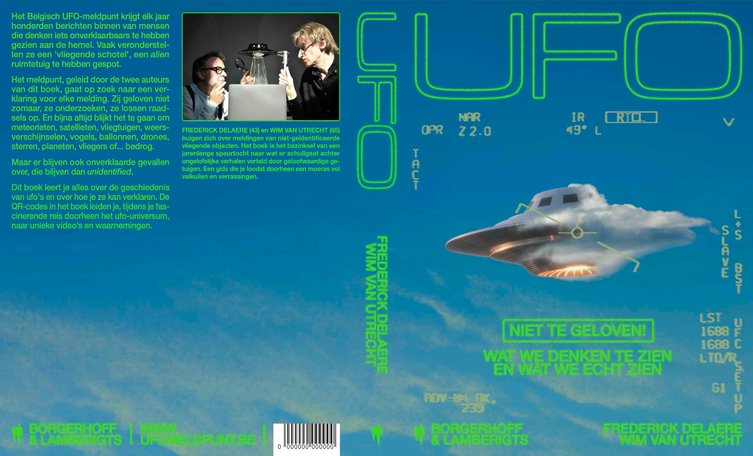
In België is BUFON (Belgisch UFO-Netwerk) dé autoriteit op het gebied van UFO-onderzoek. Voor betrouwbare en objectieve informatie over deze intrigerende fenomenen, bezoek je zeker onze Facebook-pagina en deze blog. Maar dat is nog niet alles! Ontdek ook het Belgisch UFO-meldpunt en Caelestia, twee organisaties die diepgaand onderzoek verrichten, al zijn ze soms kritisch of sceptisch.
Nederland: Een Schat aan Informatie
Voor onze Nederlandse buren is er de schitterende website www.ufowijzer.nl, beheerd door Paul Harmans. Deze site biedt een schat aan informatie en artikelen die je niet wilt missen!
Internationaal: MUFON - De Wereldwijde Autoriteit
Neem ook een kijkje bij MUFON (Mutual UFO Network Inc.), een gerenommeerde Amerikaanse UFO-vereniging met afdelingen in de VS en wereldwijd. MUFON is toegewijd aan de wetenschappelijke en analytische studie van het UFO-fenomeen, en hun maandelijkse tijdschrift, The MUFON UFO-Journal, is een must-read voor elke UFO-enthousiasteling. Bezoek hun website op www.mufon.com voor meer informatie.
Samenwerking en Toekomstvisie
Sinds 1 februari 2020 is Pieter niet alleen ex-president van BUFON, maar ook de voormalige nationale directeur van MUFON in Vlaanderen en Nederland. Dit creëert een sterke samenwerking met de Franse MUFON Reseau MUFON/EUROP, wat ons in staat stelt om nog meer waardevolle inzichten te delen.
Let op: Nepprofielen en Nieuwe Groeperingen
Pas op voor een nieuwe groepering die zich ook BUFON noemt, maar geen enkele connectie heeft met onze gevestigde organisatie. Hoewel zij de naam geregistreerd hebben, kunnen ze het rijke verleden en de expertise van onze groep niet evenaren. We wensen hen veel succes, maar we blijven de autoriteit in UFO-onderzoek!
Blijf Op De Hoogte!
Wil jij de laatste nieuwtjes over UFO's, ruimtevaart, archeologie, en meer? Volg ons dan en duik samen met ons in de fascinerende wereld van het onbekende! Sluit je aan bij de gemeenschap van nieuwsgierige geesten die net als jij verlangen naar antwoorden en avonturen in de sterren!
Heb je vragen of wil je meer weten? Aarzel dan niet om contact met ons op te nemen! Samen ontrafelen we het mysterie van de lucht en daarbuiten.
Berichten van 1 augustus 2025 tot 31 augustus 2025
The term “geology” should only be used in relation to Earth, since in Greek it means “the science of Earth”. However, when astronomers study other planets in the Solar System, they naturally take the most studied one, i.e., ours, as a “reference point”. Mars has a lot in common with Earth, but in some ways it is very different. Some of its features are strange: although it has the largest volcanoes in the Solar System, there is currently virtually no volcanic activity. Clearly, there is still much we do not know about our neighbor.
Mars as a planet
Mars, like Earth, is a rocky planet. Its shape is nearly spherical, its chemical composition is mainly silicates and aluminates, it has a dense core, and it is covered by a relatively thin crust. This is where the similarities between the two celestial bodies end and their differences begin.
Mars. Source: NASA
The fourth planet from the Sun is half the size of Earth. The average radius of Mars is only 3,389.5 km. Its surface area is 1.4437×10⁸ km2, which is only 28% of that of our world, if we include the oceans. This means that the geological formations found on Earth would appear gigantic on Mars. Incredibly, the mountains, canyons, and depressions there are indeed much larger than those on Earth.
The surface of Mars is very uneven compared to Earth. In particular, its northern hemisphere is almost entirely low-lying, while the southern hemisphere is dominated by mountain ranges and plateaus. To explain this striking difference, some scientists point to the specific mechanism of Martian tectonic plate formation, while others believe it is the result of a collision with a large space object.
Whatever caused this strange dichotomy between the hemispheres of Mars, astronomers are certain that it arose at the dawn of the planet’s existence. Therefore, all subsequent evolution there took place in conditions where there were lowlands in the north and highlands in the south.
Volcanoes of Mars
Approximately 4.5 billion years ago, when Mars was just formed, it was a red-hot ball. Then its crust solidified, but liquid magma remained inside. This created conditions for volcanic activity. However, it occurred in a way that was very different from what we are used to on Earth.
Olympus Mons. Source: NASA
On our planet, the crust consists of separate lithospheric plates that are constantly in motion. Magma erupts mainly through cracks between them, which is why most volcanoes are located along the joints of large sections of the lithosphere. Only occasionally can another type of volcanism be found on Earth, when a flow of hot magma literally melts its way to the surface. Such volcanoes are called shield volcanoes.
It is not known for certain whether lithospheric plates ever moved on Mars. At least, no traces of them have been found there. For billions of years, Martian volcanoes have appeared exclusively due to hot flows that melt the crust, and this happens in a rather strange way. Some volcanoes are indeed similar to those on Earth. However, the largest of them, due to their tendency to group, have formed large provinces that have no analogues not only on Earth, but in the entire Solar System.
Tharsis
The best example of strange Martian volcanism is Tharsis, located in the northwestern part of Mars. Its area is 30 million km², which is larger than Canada, the United States, and China combined. It is here that the largest volcano in the Solar System rises – the 26-kilometer-high Olympus Mons, approximately three times higher than Everest.
Topographic map of Tharsis. Source: NASA / JPL-Caltech / Arizona State University
However, the most interesting thing about this giant is not its height, but its width. The diameter of Olympus’ base is 624 km, which means that on Earth it would hardly fit in Ukraine. So, despite its dizzying height, it looks almost flat. More precisely, its upper part forms a plain with a minimal slope, while its edges are slopes up to 7 km high.
At the center of the giant volcano is a caldera measuring 85×60 km. Several craters actually merge into one giant pit up to 3 km deep, so large that the entire city of Kyiv could fit inside it.
At the same time, Olympus is the largest, but not the only, giant volcano in Tharsis. To the southeast of it, there are three more very similar structures – the Ascraeus Mons, Pavonis Mons, and Arsia Mons. Each of them is much higher than Everest, and their diameters are measured in hundreds of kilometers.
Incidentally, the highest of the Tharsis Olympus volcanoes is by no means the record holder in terms of area. Alba Mons is “only” 6.8 km high, but its diameter reaches 1,350 km. And in general, it is difficult to call it a mountain, because its slope reaches only 0.5°, which means that it is essentially a sloping elevation. Previously, the term “patera” was used to describe such relief features.
Elysium
Another volcanic province, Elysium, is also located in the northern hemisphere of Mars. There are also several giant shield volcanoes there: the Hecates Tholus, Mount Elysium, and the Albor Tholus. They are significantly smaller than Olympus, but their size is still impressive. For example, Elysium rises 16 km above the Martian surface and has a diameter of 240 km.
Topographic map of Elysium and its surroundings. Source: NASA / JPL-Caltech / Arizona State University
Although the two volcanic provinces are very similar, they were formed in completely different periods. Tharsis is extremely ancient, its origin dating back to the Noachian period of Martian history, meaning it is about 4 billion years old. Elysium is much younger. It was formed about 600 million years ago. This is relatively young by the standards of the Red Planet and closer to the time when multicellular life appeared on Earth.
Why shield volcanoes regularly form in such large groups on Mars is still unclear. Apparently, this is related to the peculiarities of the rise of the same hot magmatic flows in its depths, which scientists call plumes. Perhaps the fact that they abut against a solid crust rather than separate plates somehow affects the nature of volcanism.
In addition, Mars’s smaller size plays a role. If there are irregularities in the distribution of heat inside it, they will manifest themselves much more strongly than on Earth. It is quite possible that at a certain depth below the Martian surface, there are large pockets of lava that manifest themselves as volcanic provinces.
Giant faults
In addition to giant volcanoes, Mars has equally amazing surface faults. From a geological point of view, they are very different from those we encounter on Earth, where structures similar to the Dniester Canyon or the Grand Canyon of the Colorado River in the United States are formed as a result of soil particles being washed away by water.
Fault lines in the Valles Marineris. Source: NASA / JPL-Caltech / Arizona State University
However, liquid water never flowed on the Red Planet long enough to wash out gorges tens and hundreds of meters deep. The nature of canyon formation there is completely different and is related to the same volcanic provinces. Giant mountains of solidified lava are so massive that they literally collapse under their own weight into the depths of the planet. As a result, the much thinner crust around them stretches and cracks.
Over time, cracks formed by erosion and other processes can reach truly enormous sizes. The largest of these is the Valles Marineris. It is often compared to the Grand Canyon in Colorado, but this only complicates its perception. The total length of this structure is 4,500 km, which means that on Earth it would stretch from Great Britain to the Caspian Sea.
In addition, the average width of the Valles Marineris is 200 km. This means that standing on one edge, you are unlikely to see the other. The picture will be more like a giant precipice, the bottom of which is lost somewhere below.
Another feature of the Martian landscape is related to the giant fractures on the surface: chaos terrains. This is the name given to areas where hills and furrows are scattered haphazardly, forming a veritable labyrinth. They appeared at a time when Mars still had plenty of ice and streams flowed across its surface. When the subsurface ice melted, the ground subsided. The water, flowing outwards, went to lower areas and eroded the already damaged rocks along the way. This happened extremely unevenly, resulting in the formation of chaos.
Sedimentary rocks on Mars
Although more large impact craters have been found on Mars than on the Moon or Mercury, smaller traces of collisions are much less common there. This is due to wind and water erosion.
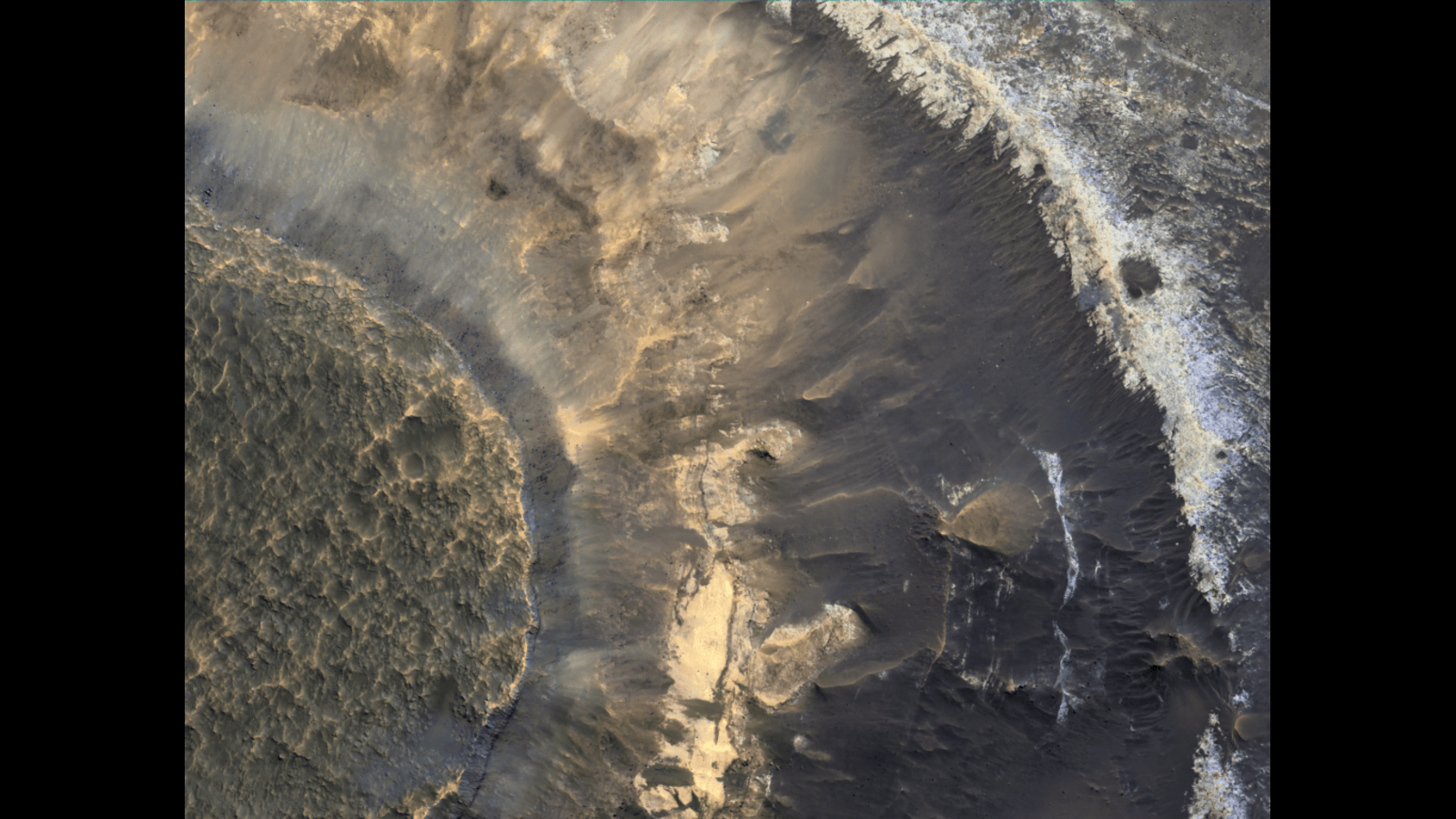
Sedimentary rocks at the bottom of a Martian crater. Source: NASA/JPL-Caltech/Univ. of Arizona
Wind and water cause the destruction of solid rock and transport small particles. Several billion years ago, when the planet’s atmosphere was denser and the northern basin was filled with an ocean into which water flowed, these processes were much more intense. They can still be seen on the surface in the form of dry riverbeds of ancient rivers.
Traces of erosion on Mars include not only certain landforms, but also the presence of rocks that we call sedimentary. These include sand, gypsum, and clay. These conglomerates of extremely fine particles can only form in the presence of large amounts of water, usually near or at the bottom of rivers and lakes.
Despite the similarity between Martian sedimentary rocks and those on Earth, they contain almost no organic matter, which is common on Earth. More precisely, it may be there, and scientists are eager to find it, but this will only be possible after samples of the substance have been brought from Mars to Earth.
Scientists have also not yet found any traces of a developed biosphere on Mars. This means that minerals commonly found on Earth, such as oil, natural gas, and coal, are most likely not present there, as they are the remains of living organisms.
Is Mars really dead?
No matter how spectacular the volcanic eruptions on Mars were, no matter how long water flowed in its streams, forming clay deposits, all this is now a thing of the distant past. This view of the planet has become mainstream over the last few decades.
Eruption of Olympus Mons (concept). Source: Getty Images
However, this trend has recently begun to change. One of the main reasons for this is the InSight probe. It operated on the surface of Mars for many months, while the seismograph on board recorded what was happening in the depths of the planet. Imagine the surprise of scientists when it began to register one surface vibration after another!
In general, astronomers had previously assumed the possibility of Marsquakes even in the absence of lithospheric plate movement. After all, tectonic vibrations occur even on the Moon, which is definitely “dead” in this sense. However, the events recorded by InSight turned out to be too frequent and too strong to be caused, for example, by the collapse of some underground cavities. More and more scientists are now inclined to believe that there is still liquid magma inside the Red Planet.
Research on Mars increasingly suggests that our current understanding of its “inner world” is not entirely accurate. However, humanity began exploring our neighboring planet relatively recently, so our knowledge of it is quite limited. It is quite possible that in a few thousand years, it will surprise researchers with active volcanoes… but that is a completely different story.
This article was published in issue No. 1 (190) of Universe Space Tech magazine in 2024. You can purchase this issue in electronic or printed form from our store.
Introduction: The Unseen Doorway to the Impossible
Imagine driving home on a dark, deserted highway, the moon bright, the radio playing softly. Then, a strange light appears, maneuvers impossibly, and suddenly, hours vanish from your life. You arrive home, shaken, clothes torn, shoes scuffed, with no memory of the intervening time, only a gnawing sense of dread laced with fragmented, disturbing images. This unsettling scenario, echoing the foundational experience of Betty and Barney Hill in 1961, marks the entry point into the perplexing world of alleged alien abductions for many. It's a world characterized by profound trauma, bewildering gaps in memory, and an overwhelming search for answers.
These experiences often leave individuals feeling isolated, grappling with anxieties and symptoms—nightmares, unexplained marks, sudden phobias—that defy conventional explanation. Mental health professionals may offer diagnoses, but for some "experiencers," these labels feel insufficient, failing to capture the sheer strangeness of what they sense occurred. It's in this crucible of confusion and isolation that many turn towards a controversial yet frequently sought-after tool: Abduction Hypnosis.
Presented as a key to unlock buried memories, hypnotherapy, specifically hypnotic regression, is employed to navigate the fog of "missing time" and piece together fragmented recollections. Proponents believe it allows direct access to subconscious memories of encounters with non-human intelligences, bypassing conscious filters or even alleged alien-induced amnesia. Critics, however, warn of the perilous paths of suggestibility and false memory creation inherent in the process. Does this practice illuminate genuine, hidden encounters with otherworldly beings, or does it inadvertently construct elaborate narratives born from the depths of the human psyche, influenced by culture and trauma? We will explore the history, methodology, profound claims, and troubling controversies surrounding abduction hypnosis, examining its complex role within the persistent narrative of alien encounters.
The Call for Memory: Why Individuals Seek Abduction Hypnosis
The journey into abduction hypnosis often begins not with a clear memory, but with a void – the perplexing and deeply unsettling awareness of "missing time." Driving home might take hours longer than it should, leaving a gaping hole in recall. As Betty and Barney Hill discovered, this missing time isn't just a curiosity; it's a psychic wound demanding explanation. What happened in those lost hours? This question becomes an obsessive pursuit for many.
Alongside missing time, other strange breadcrumbs often lead individuals to seek hypnotic exploration. Disturbing nightmares, far too vivid and visceral to be dismissed as mere dreams, plague their sleep. Betty Hill’s nightmares following her 1961 experience were key drivers in seeking help. Fleeting, fragmented images or sounds flash through the mind during waking hours – a glimpse of a large, dark eye, a snippet of humming sound, a feeling of paralysis. The body, too, might bear witness: unexplained bruises appear, odd scoop marks or triangular patterns are found on the skin, or a persistent, localized pain lingers without a medical cause. Barney Hill’s scuffed shoes and torn binocular strap, Betty’s ripped dress – these seemingly minor details become significant clues pointing towards an unremembered event.
Beyond the physical, inexplicable phobias can suddenly manifest – a sudden terror of owls, deer, doctor's offices, or even specific visual patterns. Underlying it all is often a powerful, pervasive feeling that something happened, something profound and possibly violating, coupled with a frustrating inability to grasp or articulate it. This dissonance can lead to significant psychological distress: anxiety, panic attacks, depression, insomnia, and obsessive behaviors. As described in research on Post-Abduction Syndrome (PAS), individuals may feel alienated from themselves, struggling with dissociation or a numbing of emotions.
Facing skepticism from friends, family, and even medical professionals only deepens the isolation. Many seeking help report feeling dismissed or pathologized, with some even stating they'd rather be seen as mentally unbalanced than have their experiences invalidated. In this context, abduction hypnosis emerges not necessarily as a first choice, but often as a last resort—a potential pathway to understanding, healing, and perhaps, validation. It represents a hope for retrieving the missing pieces, for constructing a coherent narrative out of baffling fragments, and ultimately, for finding relief from the haunting ambiguity.
Pioneers and Practitioners: Figures Shaping Abduction Hypnosis
The landscape of abduction hypnosis has been significantly shaped by a few key figures who brought the practice into the public eye and developed specific methodologies, often amidst considerable controversy.
Budd Hopkins
Budd Hopkins, an artist turned UFO researcher, stands out as a foundational figure. Beginning in the 1970s, Hopkins became deeply invested in abduction reports, particularly those involving "missing time." He fervently believed that hypnosis was not just helpful, but essential for retrieving memories he theorized were deliberately blocked by aliens. Through books like "Missing Time" and "Intruders" (later a TV miniseries), Hopkins popularized many core elements of the modern abduction narrative, including the focus on reproductive procedures and hybrid beings, largely based on accounts elicited through hypnosis. He established support groups and positioned himself as a central hub for abductees, advocating for the reality of their experiences based on the consistency he observed in hypnotically retrieved accounts.
Dr. John E. Mack
Perhaps the most academically credentialed proponent was the late Dr. John E. Mack. A professor of psychiatry at Harvard Medical School and a Pulitzer Prize-winning biographer, Mack's involvement lent significant, albeit controversial, weight to abduction claims. Initially skeptical, Mack became convinced of the phenomenon's authenticity after interviewing hundreds of "experiencers" starting in the late 1980s. He employed hypnosis as part of his therapeutic work, concluding that his patients were sane individuals recalling genuinely traumatic, albeit inexplicable, events. Mack argued forcefully that the consistency, emotional power, and detail of these accounts defied conventional psychological explanations. His stance led to a formal inquiry by Harvard in 1994, though he ultimately retained tenure. Mack emphasized the profound, often spiritually transformative, impact these experiences had on individuals, suggesting they might challenge our fundamental understanding of reality.
Yvonne Smith
Yvonne Smith represents a dedicated clinical hypnotherapist who built her practice specifically around alleged alien abduction cases. Certified in the early 1990s, she founded the Close Encounter Resource Organization (CERO), providing support groups and individual hypnotherapy sessions. Smith has worked with hundreds of clients, often referred by physicians and psychologists. Like Hopkins and Mack, she highlights the striking similarities in narratives recalled under hypnosis by people from vastly different backgrounds who have never met. Her work, detailed in her book "Chosen: Recollections Of UFO Abductions Through Hypnotherapy," focuses on helping individuals cope with the PTSD-like symptoms resulting from their perceived encounters.
Laurie McDonald
Adding a contemporary voice is Laurie McDonald, another clinical hypnotherapist specializing in abduction regression. With reported experience involving over a thousand cases, McDonald integrates modern concerns, even using apps to detect potential hidden surveillance during sessions with high-profile clients. She speaks internationally on the topic and works to create "psychological profiles" of the different types of entities described by experiencers during regression, reinforcing the idea of distinct alien races (Grays, Reptilians, Mantis beings, etc.) involved in the phenomenon.
It's crucial to note, however, that the field includes not just licensed therapists but also self-proclaimed "UFO Investigators" who utilize hypnosis. As David Jacobs, another prominent abduction researcher who uses hypnosis, has acknowledged, there is often "no systematic training" specifically for this niche application. This lack of standardization means methodologies can vary significantly, raising further questions about the consistency and reliability of the "memories" retrieved.
The Hypnotic Journey: Accessing the Depths of Memory
Embarking on a hypnotic regression session aimed at uncovering abduction memories typically involves a structured process designed to relax the conscious mind and facilitate access to deeper levels of awareness. The setting is usually calm and controlled, perhaps an office like Yvonne Smith's, where the therapist aims to create a safe and reassuring atmosphere.
The process often begins with guided relaxation techniques. The therapist, adopting a calm and pleasant demeanor, might instruct the individual to focus on their breathing, inhaling deeply and exhaling slowly, releasing tension with each breath. Imagery is frequently employed – picturing a peaceful waterfall, descending a metaphorical staircase step-by-step, or arriving in a tranquil, safe personal space. The hypnotherapist's voice acts as a guide, encouraging the individual to sink deeper into a relaxed, focused, trance-like state. As one practitioner puts it, tension melts away "like warm wax over the edge of a burning candle."
Once a sufficient depth of hypnosis is achieved – a state characterized by heightened focus and suggestibility – the therapist gently guides the individual's recall. They might direct the person back to the specific time period where memory seems fragmented or missing, or towards the feelings and sensations associated with the inexplicable event. Prompts are crucial here: "Describe what you see or hear," "What are your feelings right now?", "Tell me what happens next." The therapist encourages the subject to "just let it flow, even if it sounds weird."
During this phase, fragmented sensations, fleeting images, and disconnected feelings often begin to surface. Hypnotherapy aims to help the individual organize these pieces, allowing a more coherent narrative to emerge from the subconscious. It's described as accessing and processing subconscious memories, allowing them to rise to conscious awareness.
Crucially, this process is often accompanied by intense emotional release, known as catharsis. As the narrative unfolds, individuals may re-experience the terror, fear, pain, or sense of violation associated with the alleged events. Recordings of sessions, like those from the Betty and Barney Hill case or those played by Yvonne Smith (with permission), reveal subjects weeping, gasping, and expressing profound distress as they seemingly relive traumatic moments. This intense emotional reaction is often cited by proponents as evidence for the authenticity of the underlying experience, arguing that such powerful feelings wouldn't accompany mere fantasy. However, critics point out that strong emotions can also be associated with vividly imagined scenarios or falsely recalled events, especially under the influence of suggestion.
Unveiling the Narrative: Common Themes in Hypnotic Recollections
As individuals journey through hypnotic regression, remarkably consistent themes and sequences tend to emerge across different accounts, forming what might be called the classic abduction narrative. While variations exist, the core elements appear with striking regularity.
The Beginning of the Experience
The experience often begins subtly, perhaps with an unusual feeling or a compulsive urge to be somewhere specific. Then comes the “Oz Factor,” a shift in consciousness where the surrounding world fades, replaced by an internal focus, sometimes accompanied by strange lights (electric red, bright white, or blue) or a mist. Paralysis frequently sets in, rendering the individual unable to move or scream. Figures then appear – often the small, large-headed Grays with their unnerving, dark, almond-shaped eyes. Reports describe being moved, either walking numbly or being levitated, sometimes passing through solid objects like walls or windows, often drawn upwards by a beam of light into an unseen craft.
Inside the Craft and the Examination
Inside the vessel, descriptions commonly include sterile, metallic environments, often with curved hallways and unusual, shadowless illumination, sometimes described as blue or fluorescent. The centerpiece of the narrative is almost invariably the medical examination. Placed upon a cold table, often nude, the abductee reports being subjected to invasive procedures by beings who exhibit a cold, clinical detachment. There's a distinct focus on reproductive biology: men describe painful probing, sperm extraction, and sometimes having instruments inserted into them, occasionally leaving marks like triangular scoops. Women recount gynecological exams, ovum extraction, and terrifyingly, the insertion of long, needle-like instruments into their navel, as Betty Hill vividly described – an experience so traumatic her session had to be stopped. The beings often seem unfamiliar with human physiology or clothing, struggling with zippers, yet carrying out complex procedures.
Other Interactions and Communication
Beyond the core exam, other strange interactions are reported. "Imaging" involves being shown scenes on screens designed to evoke strong emotions – Whitley Strieber recalled seeing images of global destruction. "Envisioning" projects similar scenes directly into the mind. In "staging," the abductee interacts within these mental projections. "Testing" involves operating complex alien devices, finding they instinctively know how, despite initial confusion. Communication is rarely verbal in the human sense; instead, it's often telepathic – a direct mind-to-mind transfer, sometimes perceived as a cacophony of voices or a "hive mind." Messages conveyed might include warnings about environmental destruction or nuclear war, prophecies of future cataclysms (a theme Yvonne Smith noted increasing in recent years), or assignments for the abductee, positioning them as unwilling ambassadors or participants in an alien agenda.
The Hybrid Program
One of the most disturbing and emotionally charged elements is the "hybrid program." Both male and female abductees report being used for reproductive purposes. Later, they might be presented with children – beings appearing part-human, part-alien (often described as having features similar to the abductee but with large, Grey-like eyes or fair hair). This "child presentation" evokes profound feelings of connection, loss, and grief, with experiencers like Jacqueline lamenting, "Where's my baby?"
The Return
The return is often as abrupt as the departure. Abductees find themselves back where they started, often with no conscious memory of the event, only the jarring realization of "missing time." Sometimes, small errors occur – clothes are on backward, or they are returned to a different location, even locked outside their own home. Paradoxically, alongside the trauma, some report a "theophany" upon return – an overwhelming feeling of love, peace, or oneness with the universe or even their captors, a phenomenon researchers struggle to explain, suggesting possibilities from medical manipulation to a form of Stockholm Syndrome. This complex tapestry of events, recalled under hypnosis, forms the core of the abduction mystery.
The Psychological Puzzle: Decoding Hypnotic Abduction Accounts
While the narratives emerging from abduction hypnosis can be compellingly consistent and emotionally charged, the scientific and psychological communities largely approach them with significant skepticism, offering alternative explanations rooted in the known workings of the human mind and memory.
Memory Malleability and Suggestibility
Central to this skepticism is the understanding that human memory is not a perfect recorder. It's reconstructive, malleable, and highly susceptible to distortion, especially under stress, trauma, or suggestive influences. Psychologist Elizabeth Loftus's groundbreaking work demonstrated that false memories, even of complex and emotional events like being lost in a shopping mall, can be implanted through suggestion. This raises serious questions about memories retrieved under hypnosis, a state known to significantly increase suggestibility. Critics argue that hypnotists, even well-intentioned ones, can subtly or overtly guide the subject, embedding ideas or shaping ambiguous feelings into a coherent, but potentially false, abduction narrative. The subject, eager to find answers or please the authority figure, may confabulate – filling in memory gaps with plausible-sounding details drawn from imagination or cultural scripts.
Sleep Paralysis and Hallucinations
A powerful alternative explanation for many abduction experiences, particularly those described as starting in bed at night, is the combination of sleep paralysis and hypnagogic or hypnopompic hallucinations. During sleep paralysis, the mind wakes up while the body remains temporarily immobilized – a natural mechanism to prevent acting out dreams. This state can be accompanied by vivid, often terrifying hallucinations: seeing figures in the room (historically interpreted as demons like the Incubus/Succubus or the "Old Hag"), hearing buzzing sounds, feeling pressure on the chest, sensing a presence, or experiencing sensations of floating or flying. For someone unfamiliar with this common neurological hiccup, especially if they possess a vivid imagination or pre-existing belief in the paranormal, these sensations could easily be interpreted as an alien encounter. Harvard researcher Richard McNally's work suggests abductees often exhibit traits like fantasy proneness and "magical ideation," making them potentially more likely to interpret anomalous experiences in extraordinary ways.
Cultural Influence
The pervasive influence of culture cannot be ignored. Skeptics like Robert Sheaffer point out that the appearance and behavior of reported aliens often mirror depictions in science fiction, from early films like Invaders From Mars (1953) to the iconic "Grey" popularized through books and shows like The X-Files. The details of the Betty and Barney Hill account itself have been noted to resemble elements from an episode of The Outer Limits broadcast shortly before their hypnosis sessions. Furthermore, abduction narratives seem to shift with cultural knowledge; initial reports featured Martians and Venusians, but as science deemed those planets uninhabitable, the claimed origins shifted to more distant star systems. This suggests the narratives draw heavily from a shared cultural pool of ideas about extraterrestrials.
Accidental Awareness Under Anesthesia
A more recent and fascinating hypothesis links some abduction accounts to "accidental awareness under general anesthesia." Psychoanalyst David V. Forrest noted the striking parallels: the subject lying on a table, bright lights overhead, masked figures (surgeons/nurses) looming, invasive procedures, feelings of paralysis and terror, and strange bodily sensations. A traumatic experience of waking during surgery, perhaps partially recalled or distorted by anesthetic drugs, could potentially be reconstructed later, possibly under hypnosis, as an alien abduction memory. Barney Hill, under hypnosis, even compared the feeling of being probed to a prior tonsillectomy, noting the coldness and his closed eyes.
Ultimately, the skeptical perspective argues that abduction hypnosis doesn't retrieve objective memories of extraterrestrial encounters but rather facilitates the construction of narratives based on suggestibility, false memory, misinterpretations of natural phenomena like sleep paralysis, personality factors, and powerful cultural influences.
The Human Impact: Trauma, Healing, and Community
Regardless of whether alien abductions are objectively real physical events, the psychological impact on those who believe they have experienced them is undeniable and often profound. Many report symptoms consistent with significant trauma, leading to the informal designation "Post-Abduction Syndrome" (PAS) within the experiencer community. This cluster of symptoms, as described by researchers like Rick Nielsen and Rose Hargrove, mirrors Post-Traumatic Stress Disorder (PTSD) – persistent intrusive memories or flashbacks, nightmares, insomnia, hypervigilance, anxiety, panic attacks, depression, emotional numbing, and avoidance of stimuli associated with the perceived event. The key difference highlighted is that alleged abductions can be recurring, making it harder to pinpoint a single originating trauma.
Crucially, research has shown that the trauma experienced is physiologically real. Studies conducted by researchers like Richard McNally at Harvard, using measures like heart rate and skin conductance while subjects listened to scripts of their abduction accounts, found that the physiological responses were as intense, or even more so, than those of combat veterans or victims of sexual assault recalling their verified traumas. This underscores a critical point: the emotional distress and psychological suffering are genuine, even if the underlying memory is contested. As McNally noted, it highlights "the power of emotional belief."
Given this real suffering, the role of abduction hypnosis becomes complex. While heavily criticized as a potential source of false memories, some proponents and even some experiencers view it as a therapeutic tool. For individuals tormented by inexplicable anxiety, physical symptoms, or fragmented memories, the hypnotic process – even if it leads to a narrative deemed false by outsiders – can provide a sense of understanding, coherence, and control. Constructing a story, any story, can sometimes be preferable to living with terrifying ambiguity. Some individuals report significant relief after hypnotherapy, experiencing reduced anxiety, better sleep, and the ability to integrate the perceived experience into their lives, finally feeling they understand what happened to them.
Beyond individual therapy, the sense of community offered by support groups, like Yvonne Smith's CERO, plays a vital role. Alien abductees frequently face disbelief and ridicule, leading to profound isolation. These groups offer a haven where experiences can be shared without judgment, providing validation and mutual support. Hearing similar stories from others can lessen the sense of being alone or "crazy." This communal reinforcement is essential for coping, though critics also point out that such environments can potentially solidify or elaborate upon potentially false narratives through group dynamics.
For some, navigating these experiences, whether through hypnosis, support groups, or personal reflection, leads to a shift in identity. They may come to see themselves as "experiencers," individuals chosen for contact, perhaps even imbued with a unique purpose or insight, sometimes related to reported alien warnings about the planet's future. While fraught with challenges, the journey for some involves finding a way to live with these extraordinary beliefs and integrate them into a meaningful life narrative.
The Ongoing Debate: Science, Belief, and the Unknown
Decades after the Betty and Barney Hill case brought alien abduction into the mainstream, the phenomenon, and the use of hypnosis to explore it, remains deeply contentious. The core tension lies between the rigorous demands of scientific methodology and the powerful, subjective reality reported by experiencers. Science, prioritizing empirical evidence and testable hypotheses, largely favors psychological and neurological explanations – false memory, suggestibility, sleep paralysis, cultural scripting, misinterpretation of mundane events. The lack of consistent, verifiable physical evidence (like unambiguously non-terrestrial implants) remains a significant hurdle for literal interpretations.
Yet, for those who undergo these experiences, the memories – whether accessed consciously or through hypnosis – often feel profoundly real, accompanied by genuine emotional and physiological trauma. Researchers sympathetic to experiencers, like the late John Mack, argued that simply dismissing these accounts as purely psychological phenomena failed to address the full scope of the reported experiences – the consistency across cultures, the occurrence in young children seemingly unexposed to media tropes, the occasional correlation with contemporaneous UFO sightings by others, and the sheer transformative power of the events on individuals' lives. Mack suggested that the phenomenon might force us to reconsider our very definitions of reality, proposing that these encounters could occur in a liminal space not fully captured by conventional physics or psychology.
The debate is unlikely to be resolved soon. Abduction hypnosis sits squarely at the nexus of this conflict. Is it a tool capable of piercing amnesia, revealing interactions that defy our current understanding of the cosmos? Or is it a process that, interacting with belief, trauma, and the inherent suggestibility of the human mind, constructs convincing facsimiles of impossible experiences? Without definitive proof either way, the interpretation often hinges on pre-existing beliefs.
What remains clear is that the alien abduction narrative, often brought into focus through the lens of hypnosis, taps into deep-seated human anxieties about violation, control, identity, and our place in a vast, unknown universe. It challenges our understanding of memory, consciousness, and the boundaries of believable experience, leaving us face-to-face with an enduring, and for many, deeply personal, mystery.
Additional Resources and Support
For individuals seeking further information or support related to experiences discussed in this article, the following resources (mentioned in the research) may be starting points, though critical evaluation is always advised:
Close Encounter Resource Organization (CERO): Founded by Yvonne Smith, provides support groups.
Online communities and forums: Numerous online groups exist for experiencers to connect (examples provided in source links like crystalinks.com/support., abduct.com/support.php, etc., though link validity may vary over time).
Books by researchers: Works by Budd Hopkins, John Mack, David Jacobs, Yvonne Smith, and Thomas E. Bullard offer detailed perspectives, though often reflecting the author's specific viewpoint.
Skeptical resources: Organizations and publications dedicated to critical thinking and scientific skepticism often analyze abduction claims (e.g., Committee for Skeptical Inquiry, Skeptic magazine, Skeptoid podcast).
Exploring the Potential Link Between Crop Circles, Alien Abductions, and UAPs
Over the past several decades, numerous unexplained phenomena have captivated the public and scientific communities alike. Among these are crop circles, reports of alien abductions, and the increasing sightings and investigations of Unidentified Aerial Phenomena (UAPs). While each of these phenomena has been studied independently, an intriguing question persists: could there be a connection linking them? To explore this, we must analyze their characteristics, the evidence supporting their existence, and the potential theoretical frameworks that might unify these phenomena.
Crop Circles: An Overview
Crop circles are large geometric patterns that appear mysteriously overnight in fields of cereal crops. First gaining widespread attention in the late 20th century, these formations often feature complex, symmetrical designs. While many crop circles have been revealed as hoaxes—created by human pranksters using simple tools—some remain unexplained due to their intricate patterns, timing, and occasionally, their apparent lack of human origin. Researchers have proposed various theories, ranging from natural phenomena (such as wind patterns) to extraterrestrial activity or even advanced human engineering.
From a scientific standpoint, the majority of crop circles have been demonstrated as human-made hoaxes. However, a subset remains unexplained, raising questions about their origin. Some researchers suggest that these formations could be a form of communication or art from extraterrestrial sources, or perhaps a manifestation of unknown natural processes. Notably, reports of anomalous electromagnetic effects and localized animal behavior around certain crop circles have fueled speculation about their potential extraterrestrial connection.
Alien Abductions: An Overview
Reports of alien abductions involve individuals claiming to have been taken against their will by extraterrestrial beings. These accounts often include descriptions of medical examinations, communication with alien entities, and a sense of missing time. While skeptics attribute such reports to psychological factors such as sleep paralysis, hallucinations, or memory distortions, some researchers argue that the consistency and detail in many accounts point to a genuine phenomenon.
Psychologically, abduction reports often feature themes of trauma, curiosity, or a desire for understanding of the unknown. From a scientific perspective, there is limited empirical evidence supporting the physical reality of abductions. Nonetheless, the phenomenon persists in cultural consciousness, possibly reflecting deeper societal fears or curiosity about extraterrestrial life.
UAPs: An Overview
UAPs, formerly known as UFOs, have garnered renewed attention following recent official disclosures and military reports. UAPs are aerial phenomena that cannot be immediately identified or explained. Modern UAP investigations leverage advanced sensor technology, radar, infrared imaging, and pilot testimonies. Many UAP sightings involve rapid, maneuverable objects exhibiting capabilities beyond current human technology.
While most UAPs are eventually identified as natural or man-made objects (e.g., aircraft, weather phenomena), a subset remains unexplained. The U.S. Department of Defense and other agencies have acknowledged that some UAPs could pose national security concerns, emphasizing the need for scientific investigation.
Potential Connections Between the Phenomena
The question of whether crop circles, alien abductions, and UAPs are interconnected hinges on several considerations: the possibility of a common extraterrestrial origin, shared communication methods, or a broader phenomenon of contact.
Shared Themes of Contact and Communication
All three phenomena involve interaction—either direct or indirect—with extraterrestrial entities or unknown forces. Crop circles could serve as a form of visual communication or art from alien visitors, perhaps conveying messages or marking landing sites. UAPs might represent the physical manifestation of alien crafts observed during sightings, while abduction reports could be accounts of direct contact or experimentation.
Temporal and Spatial Overlap
Some researchers have noted temporal overlaps where crop circles appear near UAP sightings, or reports of abductions coincide with increased UAP activity. For instance, certain crop circles have been reported in regions with frequent UAP sightings, leading some to speculate about a coordinated phenomenon or a shared source.
Psychological and Cultural Factors
The widespread cultural narratives about extraterrestrials could influence the perception and reporting of these phenomena. For example, individuals experiencing abduction phenomena may interpret anomalous aerial sightings as evidence of alien activity, or vice versa. This suggests that cultural frameworks shape how such phenomena are experienced and reported.
Scientific and Theoretical Considerations
From a scientific perspective, there is currently no empirical evidence directly linking crop circles, abductions, and UAPs as manifestations of a single phenomenon. However, some hypotheses propose that these phenomena could be different expressions of an overarching process, such as:
Interdimensional or Multidimensional Hypotheses: Suggesting that extraterrestrial entities operate across multiple dimensions, leading to observable phenomena in our physical realm, including crop circles and UAPs, and influencing human consciousness to produce abduction narratives.
Quantum or Electromagnetic Interactions: Proposing that unknown natural forces or advanced technology could produce electromagnetic effects associated with crop circles, UAPs, and psychological phenomena related to abduction reports.
Psychophysical or Consciousness-Based Models: Asserting that human consciousness interacts with unknown forces, leading to sightings, crop circle formations, and abduction memories, all interconnected through shared subconscious or collective unconscious processes.
Critical Evaluation and Scientific Challenges of Crop Circles, UAPs, and Abduction Claims
The phenomena of crop circles, unidentified aerial phenomena (UAPs), and alleged extraterrestrial abductions have fascinated the public and researchers alike for decades. These phenomena are often intertwined in popular culture, leading to widespread speculation about their origins and implications. However, despite numerous intriguing correlations and hypotheses, establishing rigorous scientific validation remains a significant challenge. This essay aims to critically evaluate these phenomena, explore the scientific obstacles in studying them, and discuss the factors that complicate objective analysis.
Crop circles, characterized by intricate patterns appearing overnight in fields of crops, have long been a subject of debate. While some posit that these formations are evidence of extraterrestrial activity or other supernatural forces, the majority of scientifically validated evidence indicates that most crop circles are human-made hoaxes. Skilled artists and pranksters have demonstrated the ability to create complex designs using simple tools, such as planks, ropes, and GPS devices. Investigations into these formations often reveal telltale signs of human craftsmanship, including tool marks and deliberate geometric patterns. Despite this, a subset of enthusiasts claims that some crop circles exhibit anomalous features that defy human explanation, such as unusual electromagnetic effects or unexplained energy signatures. Nonetheless, these claims lack consistent, reproducible scientific evidence to substantiate the involvement of non-human agents.
Unidentified aerial phenomena (UAPs), formerly known as UFOs, represent another complex area of investigation. Modern technology has allowed for increased documentation of aerial objects that exhibit flight characteristics beyond current human-made aircraft capabilities, such as abrupt accelerations, instantaneous changes in direction, and hypersonic speeds. Military and civilian radar data, along with visual sightings, have contributed to the growing body of UAP reports. In recent years, official government agencies, including the U.S. Department of Defense, have acknowledged the existence of UAPs and have established task forces to analyze these phenomena. Despite these efforts, conclusive evidence regarding their origins remains elusive. Many UAP observations are attributed to natural atmospheric phenomena, sensor artifacts, or misidentifications of conventional aircraft or drones. The lack of comprehensive, physical evidence—such as recovered materials, high-resolution imagery, or direct scientific measurements—limits the ability to definitively determine whether UAPs are of extraterrestrial origin, advanced human technology, or natural phenomena.
Claims of extraterrestrial abductions further complicate the scientific landscape. These reports typically involve individuals asserting they have been taken against their will by non-human entities, often with detailed descriptions of encounters and medical examinations. While such claims are emotionally compelling, they lack verifiable physical evidence. Many scientists interpret abduction reports through psychological frameworks, including sleep paralysis, hallucinations, and cognitive biases. Factors such as stress, trauma, and cultural influences can shape individuals’ perceptions and memories, leading to false or distorted accounts. Extensive research into sleep disorders and altered states of consciousness supports the notion that many abduction experiences may be psychological phenomena rather than physical events.
The phenomena are also subject to cognitive biases that hinder objective analysis. Pareidolia, the tendency to perceive meaningful images in random patterns, can lead observers to interpret crop markings or aerial shapes as deliberate symbols or messages. Confirmation bias influences researchers and enthusiasts to focus on evidence that supports their preconceived notions while dismissing contradictory data. Cultural influences, media portrayals, and societal beliefs about extraterrestrials shape perceptions and interpretations of these phenomena. As a result, objective scientific inquiry is often compromised by subjective interpretations and anecdotal evidence.
The scientific community emphasizes the importance of reproducible, empirical evidence before establishing causal links or explanations. For phenomena as elusive as crop circles, UAPs, and abduction claims, this requirement poses a significant challenge. Rigorous scientific validation necessitates high-quality data, controlled experiments, and peer-reviewed research—standards that are difficult to meet given the nature of these phenomena. Without tangible physical evidence, such as artifacts, biological samples, or consistent measurement data, the hypotheses remain speculative.
In conclusion, despite the widespread fascination with crop circles, UAPs, and extraterrestrial abduction claims, the scientific validation of these phenomena remains limited. Many crop circles are demonstrated to be human-made hoaxes, UAPs often lack conclusive physical evidence to confirm extraterrestrial origins, and abduction reports are predominantly explainable through psychological mechanisms. These phenomena are further complicated by cognitive biases and cultural influences, which hinder objective analysis. The scientific community rightly calls for more rigorous, reproducible empirical evidence before drawing definitive conclusions. Until then, these phenomena should be approached with scientific skepticism, open-minded curiosity, and a commitment to evidence-based investigation
Conclusion
While the phenomena of crop circles, alien abductions, and Unidentified Aerial Phenomena (UAPs) share common thematic elements such as contact, communication, and unexplained activity, current scientific evidence does not definitively establish a direct causal or causal relationship among them. These phenomena have long fascinated both the public and researchers, largely because of their mysterious nature and the potential implications they hold for our understanding of life beyond Earth and the universe’s hidden dimensions. Despite the intriguing overlaps in timing, geographic distribution, and thematic content, the scientific community remains cautious, emphasizing the need for rigorous investigation and empirical validation.
The recurring appearance of crop circles, often in specific regions and during particular periods, raises questions about their origins—whether they are elaborate hoaxes, artistic expressions, or potentially signals from extraterrestrial sources. Similarly, reports of alien abductions often involve consistent narratives of contact and communication, yet lack conclusive physical evidence. UAPs, meanwhile, have been documented through radar, visual sightings, and increasingly sophisticated sensor technology, which complicates initial assumptions about their nature, whether they are secret military projects, natural atmospheric phenomena, or something else entirely.
Despite the absence of definitive proof linking these phenomena, their simultaneous occurrence and overlapping themes motivate ongoing multidisciplinary research. Advances in sensor technology, data analysis, and consciousness studies offer promising avenues for future exploration. For instance, improved imaging and tracking systems could better analyze UAPs, while psychological and neuroscientific research might deepen understanding of abduction reports and perceptual phenomena. Additionally, interdisciplinary approaches combining physics, psychology, anthropology, and cultural studies are essential to comprehensively examine the societal and psychological impacts of these mysterious events.
In conclusion, crop circles, alien abductions, and UAPs continue to be compelling mysteries at the intersection of science, psychology, and cultural perception. While current evidence does not confirm a direct link among them, their shared themes suggest they could be interconnected aspects of a broader, perhaps extraterrestrial or multidimensional, reality. As technology and scientific methodologies advance, future discoveries may illuminate these phenomena’s true nature, potentially transforming our understanding of the universe and our place within it. Until then, they remain intriguing enigmas that challenge our curiosity and scientific rigor.
References
Hynek, J. (1972). The UFO Experience: A Scientific Inquiry. Henry Regnery Company.
Maccabee, B. (2000). "Crop Circles: The Scientific Evidence." Journal of Scientific Exploration, 14(3), 319-341.
National Aeronautics and Space Administration (NASA). (2021). "UAPs and the Search for Extraterrestrial Life." NASA Science Briefings.
McDonnell, J. A., & Mendez, M. (2019). "UAPs: An Overview of Recent Developments." Journal of Advanced Aerospace Studies.
Kean, L. (2010). UFOs: Generals, Pilots, and Government Officials Go on the Record. Harmony Books.
Note: This analysis synthesizes current scientific perspectives and hypotheses. The phenomena discussed remain subjects of ongoing investigation and debate.
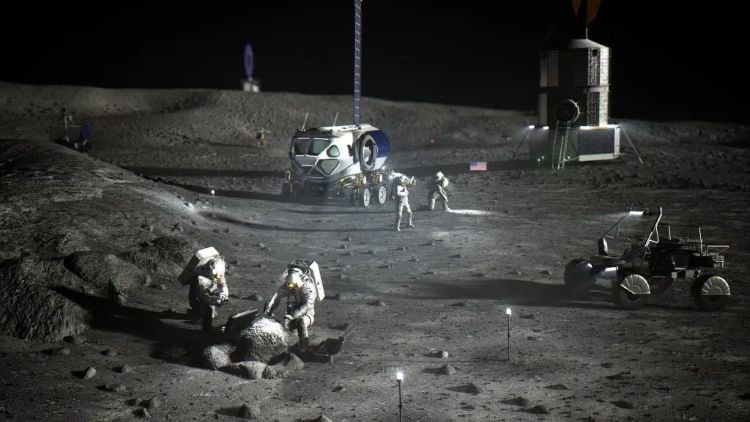
Artist's illustration of future lunar astronauts. (Credit: NASA)
How can thermoelectric generators (TEGs) help advance future lunar surface habitats? This is what a recent studypublished in Acta Astronautica hopes to address as a team of researchers from the Republic of Korea investigated a novel technique for improving power efficiency and reliability under the Moon’s harsh conditions. This study has the potential to help mission planners, engineers, and future astronauts develop technologies necessary for deep space human exploration to the Moon and beyond.
For the study, the researchers conducted a first-time analysis of how a novel TEG system could function under lunar surface conditions, specifically regarding the extreme temperature differences between the lunar day and lunar night, which ranges from 121°C (250°F) to -133°C (-208°F), respectively. Previous studies have hypothesized that drastic temperature ranges could enable greater efficiency for TEGs, also called a transient-state operation.
The goal of this study was to discuss how switching heat storage (HS) systems, also called multiple-HS systems, under lunar conditions could produce the transient-state operation. In the end, the researchers found the multiple-HS system under lunar conditions resulted in a 48.9 percent power generation increase, indicating the temperature range could benefit TEGs and a potentially long-term lunar habitat.
The study notes, “Deep space exploration, including missions such as the establishment of human bases, especially on the Moon and Mars, has garnered significant interest worldwide. As stated by scientists helming missions such as the Artemis project, a manned lunar base is an integral part of deep space exploration as it can serve as a base for future missions in the solar system. Consequently, production of sufficient power for maintaining such a base has become the focus of this research.”
The study discusses other potential power sources like Radioisotope Thermoelectric Generators (RTGs) but discourages their use for long-term missions due to the half-life decay of radioactive isotopes. Despite this, RTGs have successfully been used on instruments that were left on the lunar surface by the Apollo missions and are currently being used by NASA’s Curiosity and Perseverance rovers on Mars.
Going forward, NASA plans to use RTGs on the agency’s upcoming Dragonfly mission, which is currently slated to launch in July 2028. The researchers briefly mention how solar and nuclear power could be used as viable power sources on the Moon, with nuclear fission reactors previously being suggested for use on the lunar surface.
NASA’s Artemis program, specifically with the goal of establishing a long-term human presence on the lunar surface, enhances the relevance of this study. The continued development of new technologies on the lunar surface not only ensures a long-term human presence on the Moon but also establishes technologies that could be used on future crewed missions to Mars, as outlined in NASA’s Moon to Mars Architecture. Additionally, the use of a reliable power source on the lunar surface mitigates the need for bringing power sources from Earth, enhancing a practice called in situ resource utilization (ISRU), which uses available resources to maintain a successful mission. In this case, TEGs use the wide temperature range on the lunar surface for their power generation needs.
As humanity continues its journey towards developing long-term settlements beyond Earth, studies like this demonstrate a growing interest in using Earth-based technologies for improving life beyond Earth. Perhaps TEGs could serve as a starting point for powering long-term lunar habitats until a more advanced and reliable system is established.
How will thermoelectric power generation help advance lunar habitats in the coming years and decades? Only time will tell, and this is why we science!
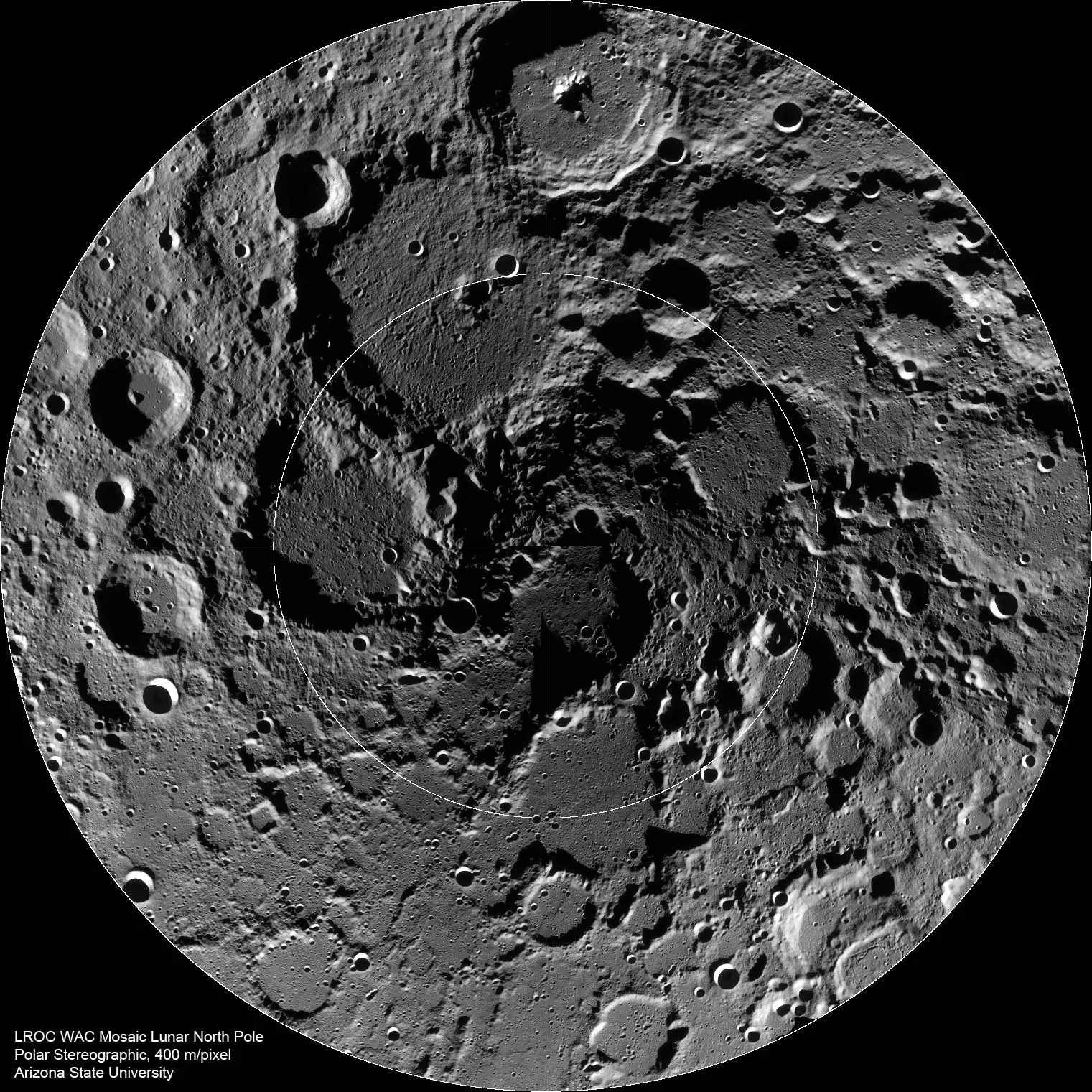
The lunar north pole, captured by the Lunar Reconnaissance Orbiter Camera. Credit: NASA/GSFC/Arizona State University
How do you tell how old an astronomical object is? I mean, the next time the Moon is in the sky, take a look at it. How would you even begin to answer that question?
I won’t leave you in suspense. Astronomers use a technique called crater counting and it’s pretty much exactly what it sounds like. The idea is that worlds like the Moon, Mercury, and many of the moons of the outer system are not active. They’ve been dead, in almost every sense of the word, for a very long time. And when a comet or asteroid strikes them, the crater they leave behind sticks around. There’s no air to blow it away. No water to wash it down. No plate tectonics to pull it under the surface.
And so craters just pile up, one after another, and often on top of each other. But not all dead worlds are created equal. Some of them were molten in the recent past, and lava is really good at covering up craters. So if you compare two worlds and count their craters, you can get a relative sense of which worlds solidified sooner.
And some had molten parts alongside the solid parts for some time. Planets and moons don’t always cool down all at once. There might be active volcanic regions over here and just plains of solid nothingness over there. So if you scan across the surface of a world, the places with more craters are probably going to be older (in the sense that they solidified in the more distant past) than the places were fewer craters.
For example, on the Moon we have those two broad regions: the dark basins, or mare, and the lighter-colored highlands. Just by looking at the craters you can tell that the maria are younger because they have fewer craters.
But…how old? If I see a world with tons of craters, how old it is? Not in a relative sense, as in this planet is older than this other one. But in an absolute sense. Like billions of years. Give me a number.
The Apollo missions held the key to unlocking crater records not just on the Moon, but across the solar system.
That’s because scientists have been able to apply radiometric dating to the moon rocks returned from the Apollo missions. If you’re not already familiar, radiometric dating is where you look at the abundances of various radioactive elements and compare their proportions to the numbers of elements that they decay into. Since we know the half-life of those elements, we can calculate the absolute age of that sample.
And since the Apollo missions visited many places on the Moon, we’ve been able to build a detailed accounting of which parts cooled and solidified when. For example, the edge of the Sea of Tranquility, the site of the Apollo 11 landing, is just over 3.5 billion years old, while some other regions in the highlands reach right up to 4 billion years old.
By far the youngest features on the Moon are some of the large impact craters. The Copernicus, Tycho, and Cone craters are all less than a billion years old. The youngest crater of all is probably the Giordano Bruno crater, named after the Italian renaissance smart/crazy guy, and is only 4 million years old. These craters are so young because the impacts carry so much energy that they’re able to erase everything in their vicinity, wiping the slate clean and starting the whole process over.
With these absolute numbers in hand, we can now calibrate crater counts across the entire solar system. Now we can look at regions of Mercury or Callisto and know how old they are, even though we’ve never been there, thanks to the Apollo missions and their geologic handiwork.
We also know thanks to the Apollo missions that the Moon is slowly slipping away from us. This was hypothesized all the way back in the early 1800’s when Sir Edmund Halley (of Halley’s comet fame) read through ancient eclipse records and realized we were slowly getting further and further apart. And we had a pretty good explanation for WHY the moon might be going away – the tides raised by the moon get carried in front of it by the spin of the Earth, and that extra gravitational tug pulls the moon into a higher orbit - but we had no good way of putting a precise number on this.
In 1962 Princeton graduate student James Faller proposed placing reflectors on the Moon’s surface. This would allow us to more easily bounce lasers back and forth from the Moon to here, and use that to measure a distance, the same way you can use one of those little laser measurement thingies to…measure distances.
While measurements had been taken before by just reflecting off the lunar soil, with the reflectors the measurements became much more accurate. We now know that the Moon is receding from the Earth at an average rate of 3.8 centimeters per year. Which isn’t very quick, but over the course of, you know, an eon or two, it really adds up.
In fact, in just a few hundred million years the combined effect of the Moon spiraling away from us and the Sun getting brighter and larger (different article) will mean that total solar eclipses will become impossible.
For over 90 years, the UFO enigma has captivated people’s minds worldwide, sparking curiosity, debates, and countless investigations into the phenomenon. The wait is over, as David Grusch, David Fravor & Ryan Graves are set to testify before the US Congress during the congressional meetings scheduled for July 26, 2023.
Meanwhile, various theories were postulated by United States Representative Mike Gallagher on the possible origin of UFOs while he appeared on Pat McAfee’s show on June 27, 2023. The former Marine suggested that unidentified flying objects (UFOs) might possibly represent an enigmatic “ancient civilization” that had remained hidden on Earth until recently when they began to surface.
“This should be an opportunity for the government to be transparent,” he said. “If we have information that disconfirms the extraterrestrial hypothesis, or all these other ones, at least it shows the government doing something competent and being forward-leaning by declassifying information to the public.”
Rep. Gallagher made this statement in response to the wild interview of David Grusch with Ross Coutlhart that hit the media. Mr. Grusch, who is confirmed to testify before Congress in the upcoming hearings, claimed that the US government has proof of alien life and that there are spacecraft from another species. He mentions that there is a significant number of these spacecraft, some of which have landed while others have crashed.
When asked about the duration of the cover-up, Grusch mentions that the first recovery of a UAP occurred in 1933 in Magenta, Italy, during the regime of Benito Mussolini. He explains that the Italian government moved the recovered craft to a secure air base until 1944-1945 when the Vatican informed the Americans about it.
Appearing on the sports talk show, Gallagher suggested that one possible explanation of supposed UFO sightings was the so-called “Terminator” theory — derived from the film of the same name — that aliens were actually human beings from the future. Gallagher further put forth another theory, suggesting the following: “Instead of us from the future, it might indeed be an ancient civilization that has been lurking here, and suddenly it’s making its presence known.” Ancient Aliens, does it ring a bell?
A similar theory was also proposed by Tim Peake, one of Britain’s famous astronauts. He said that the UFOs filmed by the US military over 100 times could either time traveling humans or aliens from other civilizations. During an interview with Good Morning Britain in June 2022, Briton astronaut Tim Peake, who spent more than six months on the International Space Station, was asked about the UAP videos, which the Pentagon recently declassified.
Peake said: “I heard one theory where a pilot was talking about that potentially in the future, they’ve developed time travel – is it something that’s come back from the future?” He did not exactly say what the UFOs are but shared some theories that have long been discussed by UFOlogists.
“I don’t think it’s a development of any state nation or non-state organization at all. I think it’s quite remarkable when you see the video footage. It does seem extraordinary as to what these machines are capable of.”
There is a huge buried UFO hidden outside the US, and Ross Coulthart claimed that he knows the location of this immovable craft. There is no confirmation from Coulthart about the nature of this craft if it was retrieved. However, some have speculated this could be an archeological dig. Could this particular craft potentially be a remnant of a bygone civilization?
Considering Rep. Gallagher’s theory, scientists have explored the possibility of detecting ancient civilizations in Earth’s geological record. A recent paper called “The Silurian Hypothesis” discusses how traces of industrial civilizations could be found. While fossils and artifacts are unlikely to survive over millions of years, anomalous changes in chemical compositions could serve as clues. By studying geological anomalies and applying models to other planets, scientists hope to understand if civilizations existed in the distant past.
NASA has spent many years seeking the truth regarding extraterrestrial life. Furthermore, the space agency has never denied the existence of non-human life beyond Earth in any form. This is sufficient to discuss the idea of non-human life existing beyond Earth in any form, from the microscopic to the macroscopic. Avi Loeb, a professor at Harvard, has supported the idea that there may have been earlier civilizations on both Earth and Mars, and that these civilizations may have been the origin of UAPs. (Click here to read the full article)
Mr. Loeb writes: “Planets like Mars or Earth could have given multiple births to technological civilizations that were a billion years apart and hence were not aware of each other. Like stable parents, the planets recovered from the environmental impact of these civilizations over time. We may have been separated in time from siblings that we never had the opportunity to meet and so we are unaware of their existence.”
Former Pentagon UFO official, Lue Elizondo, shared intriguing insights in an interview about crash retrievals and materials related to UFOs/UAPs. He believes the US government possesses exotic materials but lacks transparency on the matter. (Click here to read the full article)
Elizondo used an analogy of finding an out-of-place object in King Tut’s tomb to emphasize the significance of finding advanced materials before our known technology existed. Some interpreted this analogy as a hint that UFOs could be considered archaeological findings, possibly ancient rather than just old.
Interestingly, Bob Lazar, on the Joe Rogan Experience, mentioned hearing that at least one recovered UFO was found during an archaeological dig, suggesting its ancient origin. Astronomer Avi Loeb suggested that some advanced devices made by early inhabitants of Mars and Earth might still be operational elsewhere in the Solar System, potentially accounting for some Unidentified Aerial Phenomena reports.
Physicist John E. Brandenburg’s 2015 study speculated about a massive thermonuclear explosion that destroyed Mars’ once-Earthlike atmosphere, considering the Cydonian Hypothesis and Fermi’s Paradox. These ideas explore the possibility of ancient advanced civilizations in our solar system.
Some researchers believe that there was once a highly developed culture on Earth. But as a result of unknown circumstances, civilization was destroyed. This is evidenced by archaeological finds that cannot be explained from the scientific point of view of modern society. There is a theory that in the past, our planet was visited by alien representatives who shared their knowledge and technologies with people, so maybe they donated incredible technologies thousands of years ago, but then these technologies brought humanity to the brink of extinction.
Some people claim that our ancestors used so advanced technologies that in our time, it is difficult to imagine them. But some of the modern technologies may have been borrowed from the past, although almost no one knows about it. You may have heard of the ancient nuclear war hypothesis or ancient flying vehicles, which can also be found in ancient texts. It is said that our ancestors could even move in space and had knowledge about the universe that surpasses all modern knowledge.
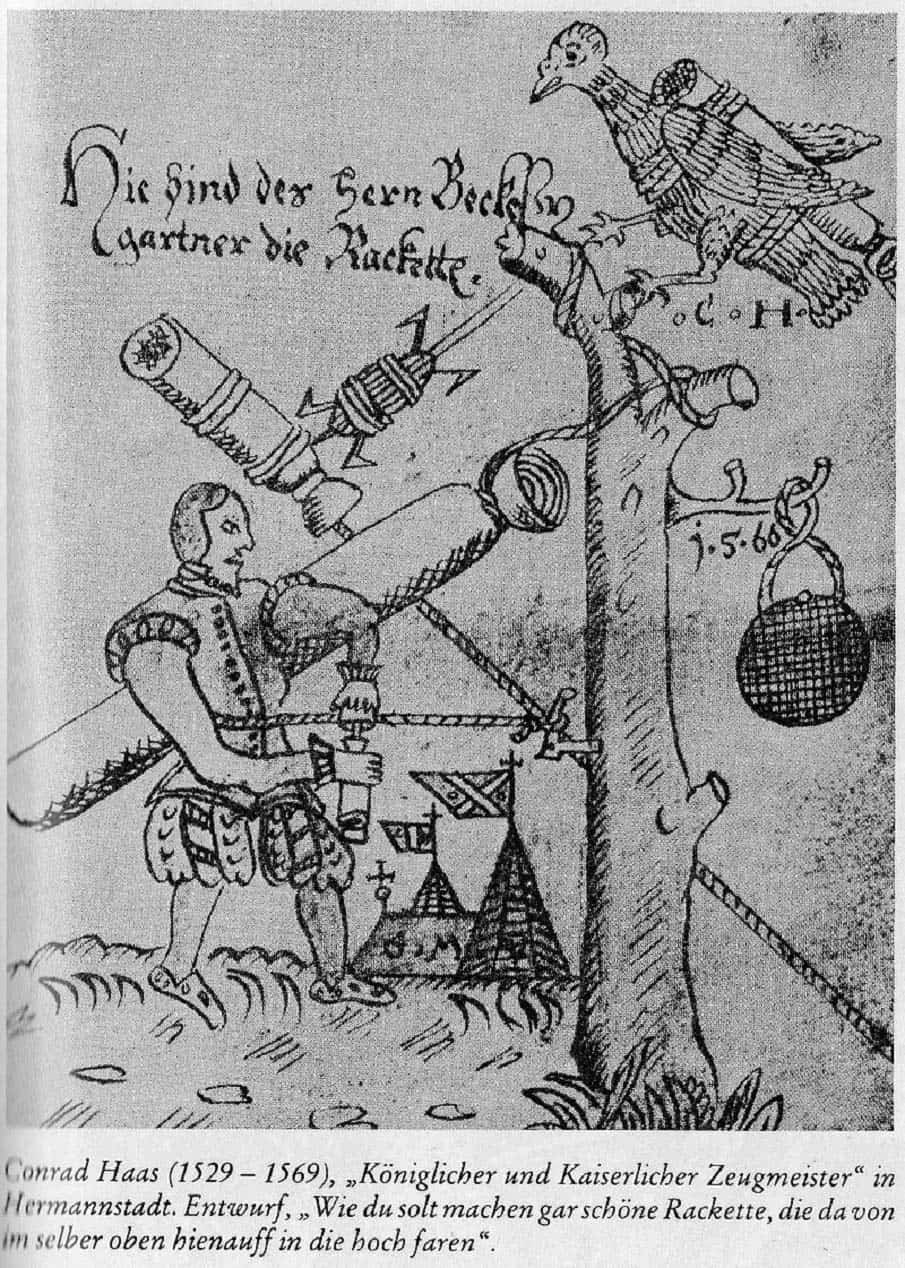
A 450-page manuscript was examined in 1963 by Romanian engineer Doru Todericiu in Sibiu’s national archive (former Hermannstadt). Todericiu examined the manuscript’s scientific and technological substance before classifying it as a work on various artillery and ballistics difficulties, despite the fact that it had previously been known as such. He learned that Conrad Haas, the author of the manuscript’s third section, had written about some amazing concepts related to rocketry.
The Sibiu manuscript does not fit into the present history, so it draws increased attention. There aren’t many details available concerning Conrad Haas’s life. He was born not far from Vienna in Dornbach. He worked for the Imperial court of Vienna as an artillery guard and commissioned officer. He most likely traveled to Transylvania in 1551 with Imperial forces to fulfill this role, when he took the position of chief of the artillery camp at the Hermannstadt arsenal.
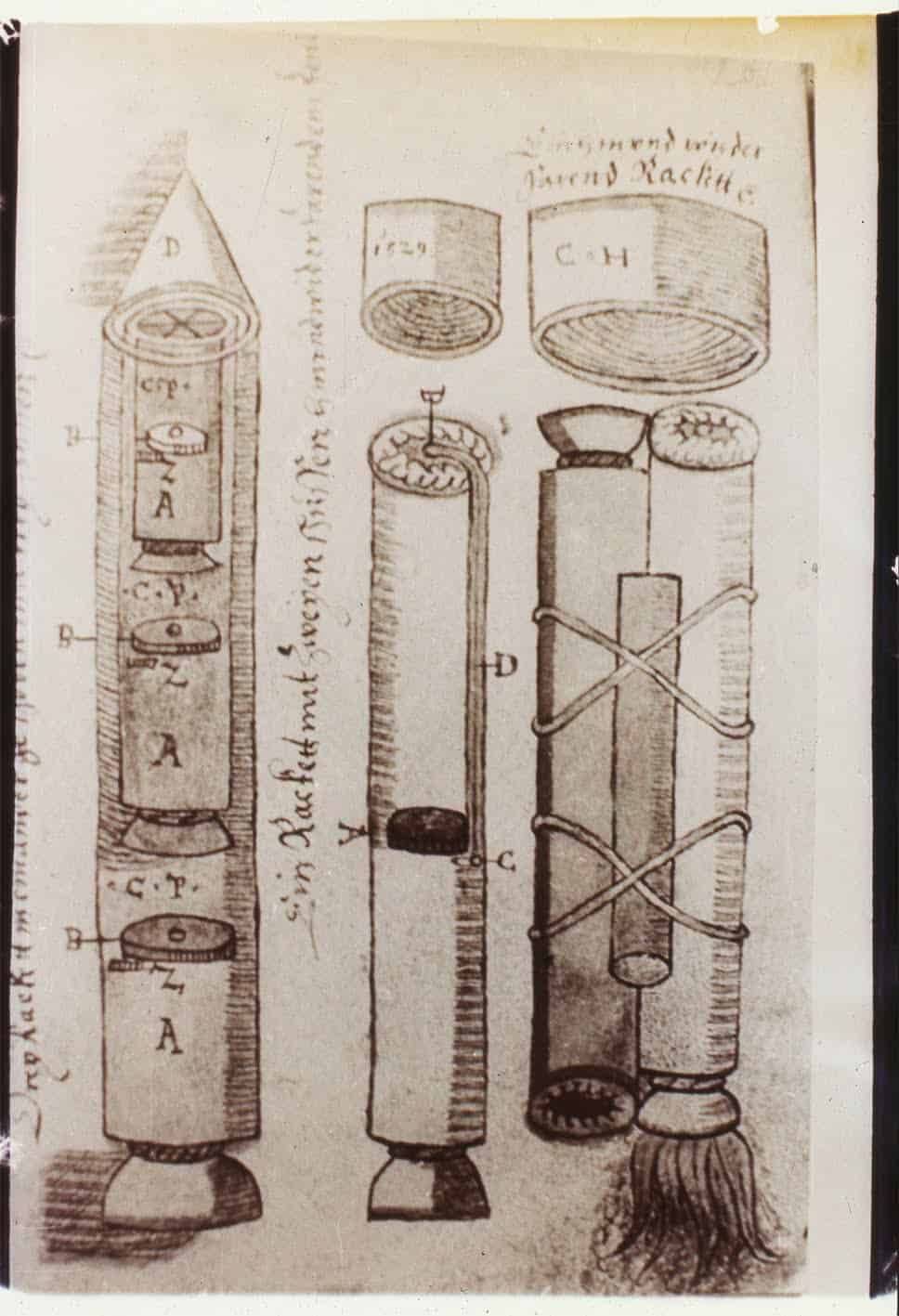
He penned the manuscript between 1529 and 1569, and it appears to contain, among other things, the earliest explanation of the multistage rocket’s basic operating principle. He talks about bundling rockets, stabilizing fins, and employing liquid fuel as well as describing and showing two and three-stage rockets.
The Sibiu manuscript is written in German. Many people believe that it was written using some even more ancient texts. The manuscript texts describe in detail the principles of rocketry, and there are also drawings of models of space three-stage rocket. The document contains a description of technologies for combining fireworks with weapons and even the construction of a hang glider, as well as instructions for creating fuel mixtures as liquid rocket fuel.
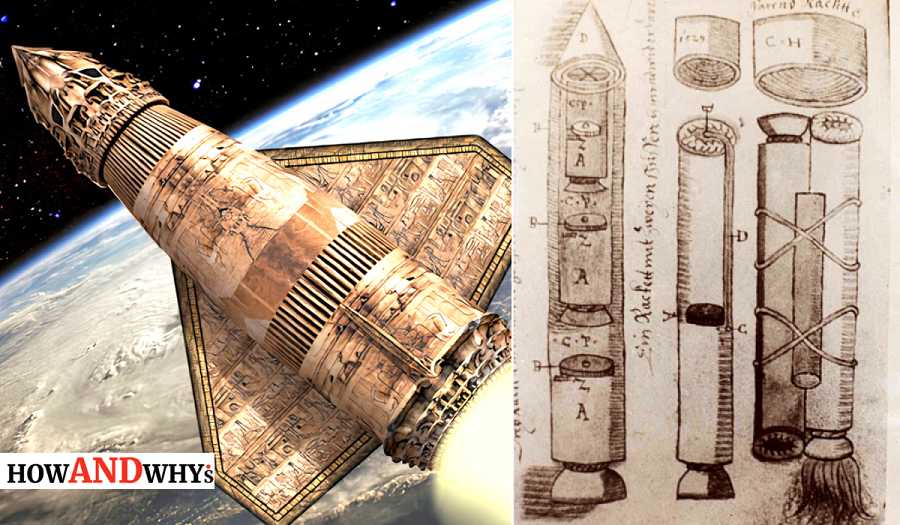
3-Stage Space Rockets description in Sibiu Manuscript
What’s more, there are references to flights to the moon. According to researchers from Romania, the manuscript contains stories about a man who was able to get to the Earth’s satellite due to a unique flying machine. There are also descriptions of prehistoric fuel, which consisted of several rare elements. The rockets of this type were later launched at Cape Kennedy and used by cosmonauts in the Mercury, Gemini, and Apollo programs.
It looks like this chronicler visited the future world. The handwritten text of Sibiu is quite long as it consists of 450 pages. It is known that the Sibiu manuscript is genuine and the experts do not doubt this, but they are in no hurry to comment on the contents of this text.
It could be claimed that this case is just science fiction if researchers of anticity did not find other strange texts and technologies. In addition, multiple artifacts found by archaeologists confirm that our ancestors were much more civilized than modern historians imagine. Manuscripts such as Sibiu have the potential to change the way people think about our history.
Description of a rocket by Conrad Haas
It remains a mystery whether Haas succeeded in using his designs and bringing them to life. However, there are people who claim that a rocket was launched in Sibiu in 1550. It is believed that Conrad Haas created the first rocket. According to Haas, it took him more than 25 years to develop a unique aircraft. The biggest challenge, in this case, was the search for a fuel that would be sufficient to lift it into the air.
The main focus of the paper is the fuel issue. In addition to the conventional powder components of saltpeter, sulfur, and coal, Haas also used “brandy”, with the help of which the thrust development of the rockets was to be increased: “Again, take a little crushed powder and pour in enough brandy to make a little dough. Then take it and paint the little chamber (= rocket chamber) together with the little hole (= ignition hole) on the rocket by heart.” Haas also tried and used other “fuels” – significantly, the missile’s purpose dictated the particular fuel combination.
In summary, one can say that the following developmental solutions and developments can be attributed to Conrad Haas:
Multistage and cluster rocket
Arrangement of fuel sets in stage rockets
Use of different fuel mixtures depending on the rocket type, performance, area of application and design
Use of liquid fuel
delta-shaped stabilizing fins
Anticipating the idea of the modern spaceship
Although Conrad Haas designed weapons to kill, he secretly believed in basic human values. His basic humanistic attitude is particularly clear from the following statement: “But my advice is more peace and no war, leave the rifles under the roof, so the bullet won’t be fired, the powder won’t be burned wet, so the prince kept his money, the gun master his life; that is the advice Conrad Haas does.”
The technical characteristics of the rocket are similar to those of modern vehicles. It was made of wooden parts covered with a layer of special stone dust, which was supposed to protect the body from burning when rubbed against the air. Contemporaries note that in the 16th century, researchers did not know the intricacies of physical processes in the air, which is why scientists could receive information from aliens.
In addition, from his youth, he was engaged in research on ancient writings found in the territory of modern Egypt. A mission to the Moon could take place in 1550. But there is no documentary evidence to support all these claims.
Lady Sala Shabazz, the founder of the Black Inventions Museum who passed away on March 28, 2002 said once: “… Unfortunately, the individuals who are commissioned to write textbooks many times exhibited prejudice and omitted other historical information. In an effort to cover large spans of time, they have briefed history and left out so many other important facts and that’s something that many people have not been aware of.”
The city of Sibiu is known to many of us because it is the birthplace of Hermann Oberth, considered to be one of three fathers of rocketry and modern astronautics. Additionally, there is a dedicated document (ID 19770026087) in the NASA archives about the Sibiu manuscript.
For some reason, UFOs mostly seem to come in three shapes: the standard flying saucer shape, a sphere or an orb, and a triangle. There aren’t any publicly official numbers on how many each shape get spotted each year, but based on the number of stories that pop up week-to-week, it’s pretty safe to say that those are the three most common UFO shapes that get reported.
The latest report making waves in the UFO community involves the third shape on the list: a triangle. According to an eyewitness account filed with the National UFO Reporting Center (NUFORC), a person in St. Peters, Missouri recently had an encounter at night with a triangular UFO. Luckily, in this case, they were able to take some footage of the UFO.
Eyewitness reports
“I stopped where it stopped and it began to hover and loiter with no noise other than its visible triangular shape,” the eyewitness explained. “It was about 100 feet overhead and a football field length away. It was maneuvering in an odd way. Almost like it was submerged taking banks and angular dives. It would cloak in a ball of light than [sic] reappear nearby elsewhere hovering.”
The witness says this was the third time that they had seen a UFO like this in the area. One of the encounters was during the day time and was “seen by multiple neighbors.” The other sighting was at night over his subdivision and “it was only 50-80 feet high flying low and silently passing overhead,” they wrote.
“Other accounts by neighbors date back to the early 90’s … describing the same thing,” the witness added. “Apparently this area is a hot spot for almost weekly activity for 3 decades. I also see them near Adventist Church or by South High in daylight where the triangles are white and very bright and reflective you see them pop out for a few seconds then go invisible again.”
The UFO Capital of Missouri
Earlier this month, KSDK News reported that Piedmont, Missouri, located about two-and-a-half hours south of St. Peters, was named the UFO Capital of the Show Me State.
“I had a gentleman set at my desk and cry about how things that he has seen have illuminated and changed his life over the years,” said Sara Phillips, executive director of the Piedmont Area Chamber of Commerce. “My husband and I moved back here years ago and he swears he saw some kind of lights.”
“One resident said that if they had to estimate half the residents had seen something in the sky. Clearwater Lake becomes kind of the epicenter of this,” said Sean Rost of the State Historical Society of Missouri. “There are people reporting seeing lights above the water. There are people seeing lights under the water.”
Phillips says there have been over 500 reporting sightings of UFOs in the area and, for some unknown reason, the sightings continue to this day near Clearwater Lake.
Fake footage of an alien autopsy may have been based on real ‘original frames’
EXCLUSIVE: Though fakers behind the grainy 18-minute film admit they staged it, they insist it was a reconstruction of real footage shot by the US military after UFO crash near Roswell
Footage of an alien autopsy faked in Camden may have been based on real ‘original frames’, according to the maker of a new TV shock doc.
In 1995 the world was stunned by 18 minutes of grainy film that appeared to show scientists in hazmat suits dissecting the corpse of an ET recovered from a reported UFO crash site near Roswell in New Mexico, US, in 1947.
The footage became an international sensation baffling film experts, military analysts and even the Secret Service. In 2006 the team that made it admitted the film was a fake confessing it was shot on a set constructed in a living room in Camden, north London.
Its alien bodies were hollow plaster casts filled with offal, sheep brains and raspberry jam.
The footage became an international sensation(Image: Warner Brothers)
But Brit film-maker John Dower, who has made a new Sky Original documentary series about the scam, said his investigation showed it may have been based on real footage.
He said the makers of the bogus post-mortem film insisted it was a reconstruction of an actual clip that has since gone missing.
John, who made My Scientology Movie and BAFTA award-winning Lockerbie, said: “Over a decade after the eerie black and white footage of an alien autopsy was released in the mid-90s and affected many in a similar way to The Blair Witch Project the film was revealed to have been produced in a small flat in Camden, north London, and not in the New Mexico desert of Roswell.
“With its makers describing it as ‘a restoration’ it is still possible that it's based on original frames from an existing post-war film. I've directed some bonkers documentaries in my time but never one in which it is so difficult to work out what is real and what isn’t.”
A Sky spokesman said the team behind the footage insisted ‘it was based on a genuine film recorded by the US military’ in what was a ‘stranger-than-fiction documentary series’.
The series will be screened on Sky Documentaries(Image: Getty Images)
Hayley Reynolds, Sky’s acting director of documentaries and factual, said: “The 90s were the golden age of UFO fever - before smartphones, before streaming - when grainy footage, The X-Files, and Roswell ruled the headlines.
“Alien Autopsy remains one of the most debated mysteries of the 20th Century.”
Arron Fellows, creative director of production company Mindhouse, said the series ‘taps into our timeless fascination with extraterrestrial life’.
“It’s incredible that the Alien Autopsy story has never been told in a premium documentary before,” he added.
The series will be screened on Sky Documentaries and streaming service NOW.
Flying object that crashed in Poland was a Russian drone, Polish officials say
Poland's defense minister said that a flying object that crashed and exploded in a cornfield in eastern Poland early Wednesday was identified as a Russian drone, calling it a provocation by Russia.
At a news conference in Warsaw, Defense Minister Władysław Kosiniak-Kamysz accused Russia of provoking NATO during a crucial moment, as peace talks over the war in neighboring Ukraine are underway, the country's news agency PAP reported.
"Russia is provoking us once again," Kosiniak-Kamysz said, just as peace talks have given hope that the war "has a chance of ending."
Local police said they received reports of the crash around 2 a.m. and found burned metal and plastic debris at the scene, near the village of Osiny. As a result of the explosion, windows were broken in some houses but nobody was injured, PAP reported.
Poland's Armed Forces Operational Command said Wednesday on social media that no violations of Polish airspace from neighboring Ukraine or Belarus were recorded overnight
Officials initially said the explosion may have been caused by a part of an old engine with a propeller.
Defense Minister Wladyslaw Kosiniak-Kamysz later said the object was most likely a drone, adding that an analysis was underway to determine whether it was a military or smuggling one, PAP reported.
A police officer sets up a police tape, after an unidentified object fell and exploded in a cornfield overnight, according to Polish authorities, in the village of Osiny, eastern Poland, Aug. 20, 2025.Kacper Pempel/REUTERS
"I was sitting in my room at night, around midnight, maybe, and I heard something just bang," local resident Pawel Sudowski told local news website Lukow.tv. "It exploded so loudly that the whole house simply shook."
Lublin District Prosecutor Grzegorz Trusiewicz told reporters several investigators — both civilian and military — were examining the crash site.
"We have a lot of manpower, we have the army to help us. I hope that we will be able to finish the operation by the evening," Trusiewicz said.
Since Russia launched a full-scale invasion of Ukraine more than three years ago, there have been a number of intrusions into Polish airspace, raising alarm in the European Union and NATO member state and reminding people how close the war is.
In 2023, a Russian missile went through Polish airspace near the Ukrainian border during one of Russia's barrages.
In 2022, a Ukrainian air defence missile fell on the Polish village of Przewodow, near the border, killing two people.
Earlier this year, unidentified crashed objects were found on the ground in two locations in Poland. Authorities said it was possible those objects came from a SpaceX rocket after debris entered the atmosphere over Poland.
"Our work is a new piece of evidence that suggests that Mars was once a much more complex and active planet than it is now."
A HiRISE image of the heavily eroded ridge of an inverted channel left behind by a dried up river billions of years ago.
(Image credit: NASA/JPL/University of Arizona.)
Mars was a rainier, wetter place than planetary scientists previously thought, according to a new study of ancient, inverted river channels that span more than 9,000 miles (14,484 kilometers) in the Red Planet's southern Noachis Terra region.
"Our work is a new piece of evidence that suggests that Mars was once a much more complex and active planet than it is now, which is such an exciting thing to be involved in," study leader Adam Losekoot of the U.K.'s Open University said in a statement.
We've known Mars was once a wet planet ever since the Mariner 9 orbiter mission from the '70s photographed a surface covered in dried-up river channels. These channels were dated back to over 3.5 billion years ago. However, channels cut into the ground are not the only evidence for running water on Mars.
When that water ran-off, or evaporated, it left sedimentary deposits. Sometimes we see these in craters that were once lakes filled with water: NASA's Curiosity rover is exploring Gale Crater, which has a central three-mile-tall (five-kilometer-tall) peak covered in sediment.
Other times, these sediments were laid down on river beds. Over the eons, the sediments would have hardened, while the river channels and the land around them would have weathered and eroded away. That left the sediments, which are more resistant to erosion, sticking out as tall ridges. Geologists today call them fluvial sinuous ridges, or, more plainly, inverted channels.
Now, Losekoot, who is a Ph.D. student, has led the discovery of a vast network of these channels in Noachis Terra based on images and data taken by the High Resolution Imaging Science Experiment (HiRISE) camera and the Context Camera on NASA's Mars Reconnaissance Orbiter, and the Mars Orbiter Laser Altimeter (MOLA) on the defunct Mars Global Surveyor mission.
(Image credit: NASA/JPL/MSSS/The Murray Lab)
Previously, Noachis Terra had not been given due attention because it lacked the more classical river channels that form more obvious evidence of water. However, by mapping the network of inverted channels, Losekoot realized there was lots of evidence there had once been plentiful water in the region.
"Studying Mars, particularly an under-explored region like Noachis Terra, is really exciting because it's an environment which has been largely unchanged for billions of years," said Losekoot. "It's a time capsule that records fundamental geological processes in a way that just isn't possible here on Earth."
Some of the inverted channels appear as isolated segments that have survived the elements for billions of years. Others are more intact, forming systems that run for hundreds of miles and stand tens of yards tall.
This double inverted ridge signifies where an ancient river split into two before reconnecting downstream. Between the two ridges we can see a mesa, which may be the harder material that caused the river to diverge to get around it. (Image credit: NASA/JPL/University of Arizona)
Such a widespread network of inverted channels does not suggest these channels were caused by flash floods, argues Losekoot. Rather, they seem to have formed in stable climatic conditions over a geologically significant period of time during the Noachian–Hesperian transition, which was the shift from one geological era into the next around 3.7 billion years ago.
What's particularly intriguing is the most likely source of water to have formed these inverted channels is precipitation — be it rain, hail or snow. Indeed, given the size of the inverted channel network in Noachis Terra, this region of Mars may have experienced lots of rainy days in a warm and wet climate.
It's more evidence that Mars was once more like Earth than the cold and barren desert it is today.
Losekoot presented his findings at the Royal Astronomical Society's National Astronomy Meeting held at the University of Durham in the U.K., which ran between July 7 and July 11.
On July 24, 2025, the 4,608th Martian day, or Sol, of the mission, NASA’s Curiosity rover imaged wind-eroded rocks shaped like a piece of coral in the Gale crater on Mars.
This image of the Paposo rock was taken by Curiosity’s MAHLI instrument on July 24, 2025.
Image credit: NASA / JPL-Caltech / MSSS.
One of the wind-eroded rocks was captured by Curiosity’s Mars Hand Lens Imager (MAHLI), a camera on the end of its robotic arm.
“Nicknamed Paposo, the rock was about 5 cm (2 inches) from MAHLI when this image was taken,” members of the Curiosity team wrote in a statement.
On the same day, Curiosity used its Remote Micro Imager, part of its ChemCam instrument, to view another coral-shaped rock.
This image of a wind-eroded rock was taken by Curiosity’s Remote Micro Imager on July 24, 2025.
£Image credit: NASA / JPL-Caltech / MSSS.
“Curiosity has found many small features like these, which formed billions of years ago when liquid water still existed on Mars” the researchers said.
“Water carried dissolved minerals into rock cracks and later dried, leaving the hardened minerals behind.”
“Eons of sandblasting by the wind wore away the surrounding rock, producing unique shapes.”
“This common process is seen extensively on Earth and has produced fantastic shapes on Mars, as well, including a flower-shaped rock.”
Curiosity rover took this selfie on October 11, 2019. The rover drilled twice in this location, nicknamed Glen Etive. Just left of the rover are the two drill holes, called Glen Etive 1 (right) and Glen Etive 2 (left).
Image credit: NASA / JPL-Caltech / MSSS.
Launched November 26, 2011, Curiosity is the fourth rover the United States has sent to Mars.
Led by NASA’s Jet Propulsion Laboratory, the mission involves almost 500 scientists from the United States and other countries.
Curiosity explores the 154-km- (96-mile) wide Gale crater and acquires rock, soil, and air samples for onboard analysis.
The car-size rover is about as tall as a basketball player and uses a 2.1-m- (7-foot) long arm to place tools close to rocks selected for study.
Scientists found a mysterious cosmic object that's between 10 and 100 times more powerful than all known supernovas. What could it be?
NGC 4945 is an edge-on spiral galaxy just 11 million light years away in Centaurus
(Image credit: ESO)
A bewilderingly powerful mystery object found in a nearby galaxy and only visible so far in millimeter radio wavelengths could be a brand new astrophysical object unlike anything astronomers have seen before.
The object has been named 'Punctum,' derived from the Latin pūnctum meaning "point" or "dot," by a team of astronomers led by Elena Shablovinskaia of the Instituto de Estudios Astrofísicos at the Universidad Diego Portales in Chile. Shablovinskaia discovered it using ALMA, the Atacama Large Millimeter/submillimeter Array.
"Outside of the realm of supermassive black holes, Punctum is genuinely powerful,” Shablovinskaia told Space.com.
Witnessing the Dawn of a New Solar System: A Historic Discover
Astronomers don't know what it is yet — only that it is compact, has asurprisingly structured magnetic field, and, at its heart, is an object radiating intense amounts of energy.
"When you put it into context, Punctum is astonishingly bright — 10,000 to 100,000 times more luminous than typical magnetars, around 100 times brighter than microquasars, and 10 to 100 times brighter than nearly every known supernova, with only the Crab Nebula surpassing it among star-related sources in our galaxy," Shablovinskaia said.
Punctum is located in the active galaxy NGC 4945, which is a fairly close neighbor of our Milky Way galaxy, located 11 million light-years away. That's just beyond the confines of the Local Group. Yet, despite this proximity, it cannot be seen in optical or X-ray light but rather only millimeter radio wavelengths. This has only deepened the mystery, although the James Webb Space Telescope (JWST) has yet to take a look at the object in near- and mid-infrared wavelengths.
ALMA's view of the bright core of NGC 4945, and inset, the compact, mystery object called Punctum. (Image credit: Elena Shablovinskaia et al.)
What could Punctum be?
Its brightness remained the same over several observations performed in 2023, meaning it is not a flare or some other kind of transitory phenomenon. Millimeter-wave radiation typically comes from cold objects such as young protoplanetary disks and interstellar molecular clouds. However, very energetic phenomena such as quasars and pulsars can also produce radio waves through synchrotron radiation, wherein charged particles moving at close to the speed of light spiral around magnetic field lines and radiate radio waves.
What we do know about Punctum is that based on how strongly polarized its millimeter light is, it must possess a highly structured magnetic field. And so, Shablovinskaia believes what we are seeing from Punctum is synchrotron radiation. Objects with strong polarization tend to be compact objects, because larger objects have messy magnetic fields that wash out any polarization.
Perhaps that synchrotron radiation is being powered by a magnetar, the team believes, which is a highly magnetic pulsar. However, while a magnetar's ordered magnetic field fits the bill, magnetars (and regular pulsars for that matter) are much fainter at millimeter wavelengths than Punctum is.
Supernova remnants such as the Crab Nebula, which is the messy innards blasted into space of a star that exploded in 1054AD, are bright at millimeter wavelengths. The trouble is that supernova remnants are quite large — the Crab Nebula itself is about 11 light-years across — whereas Punctum is clearly a much smaller, compact object.
The Crab Nebula taken by the James Webb Space Telescope (Image credit: NASA/JPL-Caltech)
"At the moment, Punctum truly stands apart — it doesn't fit comfortably into any known category," said Shablovinskaia. "And honestly, nothing like this has appeared in any previous millimeter surveys, largely because, until recently, we didn't have anything as sensitive and high-resolution as ALMA."
There is the caveat that Punctum could just be an outlier: an extreme version of an otherwise familiar object, such as a magnetar in an unusual environment, or a supernova remnant interacting with dense material. For now, though, these are just guesses lacking supporting evidence. It is quite possible that Punctum is indeed the first of a new kind of astrophysical object that we haven't seen before simply because only ALMA can detect them.
In the case of Punctum, it is 100 times fainter than NGC 4945's active nucleus that is being energized by a supermassive black hole feeding on infalling matter. Punctum probably wouldn't have been noticed at all in the ALMA data if it wasn't for its exceptionally strong polarization.
Further observations with ALMA will certainly help shed more light on what kind of object Punctum is. The observations that discovered Punctum were actually focused on NGC 4945's bright active core; it was just happenstance that Punctum was noticed in the field of view. Future ALMA observations targeting Punctum instead would be able to go to much lower noise levels without worrying about the galaxy's bright core being over-exposed, and it could also be observed across different frequencies.
The greatest help could potentially come from the JWST. If it can see an infrared counterpart, then its greater resolution could help identify what Punctum is.
"JWST's sharp resolution and broad spectral range might help reveal whether Punctum's emission is purely synchrotron or involves dust or emission lines," said Shablovinskaia.
For now, it's all ifs and buts, and all we can say for sure is that astronomers have a genuine mystery on their hands that has so far left them feeling flummoxed.
"In any case," concluded Shablovinskaia, "Punctum is showing us that there is still a lot to discover in the millimeter sky.”
A paper describing the discovery of Punctum has been accepted by the journal Astronomy & Astrophysics, and a pre-print is available on astro.ph.
Cube-Shaped UFOs: Not Drones, Not Balloons, So What Are They?
Introduction
The Age of UFO Transparency is upon us—an era in which the veil of secrecy surrounding unidentified flying objects is gradually lifting, revealing a reality that once belonged solely to conspiracy theories and clandestine government programs. Many would argue that this shift is long overdue; the days of dismissing UFO reports as mere hallucinations or fabrications are waning. Instead, an increasing number of scientific institutions, government agencies, and independent researchers are approaching the subject with a newfound seriousness and rigor. NASA, the renowned space agency, has taken a significant step by assembling a dedicated team of astrophysicists tasked with investigating UFO phenomena. Their goal is to analyze sightings, assess the data with scientific precision, and determine whether these objects are of terrestrial origin or if they indeed originate from beyond our planet. This paradigm shift reflects a broader societal change—one that embraces curiosity and evidence-based inquiry over skepticism and suppression.
This newfound transparency has empowered witnesses, especially aviators, to come forward and share their extraordinary encounters. For decades, pilots and military personnel have reported strange objects in the skies, but fear of ridicule or official silence often kept these stories from reaching the public. Today, those barriers are diminishing. As a result, a wealth of firsthand accounts is now available, providing invaluable insights into phenomena that continue to baffle scientists and enthusiasts alike. Among these accounts, some are particularly perplexing: sightings of cube-shaped UFOs. Unlike the more common disc-shaped or spherical craft, these geometric anomalies challenge our conventional understanding of aircraft and extraterrestrial technology alike.
Unusual as they are, reports of cube-shaped UFOs are not isolated incidents. Naval aviators, in particular, have documented encounters with strange “Black Cube” objects. These mysterious crafts are often described as being surrounded by transparent spheres—strange, clear orbs that seem to interact with the cubes in inexplicable ways. Some of these cube-shaped objects have been observed shadowing military aircraft, maintaining a close proximity that suggests a high level of intelligence and control. On multiple occasions, fighter jets have narrowly avoided collisions with these enigmatic objects, raising urgent questions about their nature and intentions. The fact that these encounters occur in controlled airspace, under the watchful eye of military personnel, underscores their significance. It’s one thing to observe strange lights from the ground, but when trained pilots report close encounters with seemingly autonomous, technologically advanced objects, the stakes become much higher.
What makes these cube-shaped UFOs particularly fascinating—and unsettling—is their apparent technological sophistication. According to testimonies from fighter pilots and military officials, these objects display characteristics that defy our current understanding of aeronautical engineering. They are reported to exhibit rapid acceleration, sudden directional changes, and hovering capabilities that no known human-made aircraft can replicate. Some witnesses describe the objects as having a solidity and geometric precision that suggests a level of design and manufacturing far beyond our contemporary capabilities. The technology behind these objects, as hinted at by witness observations, appears to surpass our own, hinting at either a highly advanced extraterrestrial origin or an as-yet-undiscovered terrestrial technology.
The danger posed by these unidentified objects extends beyond mere curiosity. The close encounters with military aircraft—often with near-misses—highlight a potential risk to aviation safety. Such incidents raise critical questions: Are these objects probes sent to gather information? Are they aware of our defenses? Or are they simply passing through our airspace without regard for human activity? The fact that fighter pilots have repeatedly reported these objects “everywhere”—over the ocean, in restricted military zones, and even near major cities—only amplifies their significance. These encounters suggest that whatever these objects are, they are not only real but also capable of operating in ways that challenge our understanding of physics and technology.
The phenomenon of cube-shaped UFOs raises numerous scientific and philosophical questions. Are these objects of extraterrestrial origin, representing a form of advanced alien technology that has yet to be understood? Or could they be manifestations of some unknown terrestrial phenomenon—perhaps an undiscovered natural anomaly or experimental craft? Alternatively, some theories posit that these objects might be artificial constructs created by an unknown intelligence, capable of manipulating matter and energy at levels far beyond human capabilities. The consistent reports from credible witnesses, especially military personnel, lend weight to the argument that these phenomena are real and potentially significant.
In conclusion, the era of UFO transparency offers a rare opportunity to explore these mysteries with scientific rigor and open-minded curiosity. The encounters with cube-shaped UFOs, in particular, challenge our assumptions about the limits of technology and the nature of reality itself. As research progresses and more data becomes available, we may soon uncover answers to questions that have puzzled humanity for generations. Whether these objects are visitors from distant worlds, manifestations of unknown natural phenomena, or advanced terrestrial inventions, their existence demands our attention and careful investigation. The skies are revealing secrets once hidden in darkness, and it is up to us—scientists, pilots, policymakers, and curious minds—to understand what these enigmatic objects truly are.
Historical Context and Sightings
Historically, reports of unidentified flying objects (UFOs) have predominantly featured disc-shaped or spherical objects, which have long captured the imagination of the public and researchers alike. These classic sightings often involved disc-shaped crafts, sometimes described as "flying saucers," with smooth, metallic surfaces reflecting sunlight or other ambient light sources. Such reports date back to the mid-20th century, with famous incidents like the 1947 Kenneth Arnold sighting and the 1948 Roswell incident shaping public perception of UFOs as potentially extraterrestrial visitors.
However, in recent years, there has been a noticeable shift in the types of shapes reported by witnesses around the world. Increasingly, eyewitnesses describe encounters with craft exhibiting distinctly cubic or rectangular geometries. These objects are characterized by sharp edges, well-defined geometric symmetry, and metallic surfaces that reflect light in a manner consistent with highly polished or reflective materials. Witness reports often describe these craft as having a sense of precision and angularity that sets them apart from more traditional, rounded UFOs.
One of the most notable recent cases took place in 2017 over the skies of the United Kingdom. Multiple eyewitnesses, including commercial pilots, reported observing a large, luminous cube silently floating at high altitude. The object was described as a perfectly symmetrical cube, glowing with a bright, white light, and hovering motionlessly for several minutes before suddenly ascending at an incredible speed, disappearing from view in seconds. This phenomenon was documented by multiple independent witnesses, adding credibility to the report. The silence of the craft and its abrupt maneuvering defied typical explanations involving known aerial vehicles.
Similarly, in 2020, a drone operator in Japan captured compelling footage of a cube-like object performing abrupt and complex maneuvers. The footage showed a metallic, box-shaped craft executing rapid directional changes, hovering in place before accelerating vertically at a speed inconsistent with conventional drones or aircraft. The object’s sharp edges and geometric shape were clearly visible in the footage, and it maintained a stable, angular form throughout its movements. Such precise and sudden maneuvers are difficult to reconcile with known human-made aerial technology, especially at the altitudes and speeds observed.
While skeptics often argue that these sightings are misidentifications of familiar objects, such as drones, weather balloons, or conventional aircraft, several factors challenge these explanations. For instance, many of the reported objects lack the typical features associated with drones, such as visible propellers, rotors, or blinking lights. Moreover, some witnesses have emphasized the lack of sound emanating from these craft, which further complicates identification. The consistent reports of sharply defined geometric shapes, coupled with unusual flight behaviors, suggest that these objects may be of unfamiliar origin or possess capabilities beyond current human technology.
The increasing frequency of these cubic and geometrically precise sightings raises important questions about the nature and origin of these objects. Their persistent appearance across diverse locations and contexts indicates that they are not merely optical illusions or misidentifications but potentially a new class of unidentified aerial phenomena. As such, these reports warrant rigorous scientific investigation—using advanced radar, infrared imaging, and other technologies—to better understand their characteristics, behaviors, and potential implications for aviation safety and scientific knowledge. The evolution from traditional disc-shaped sightings to geometric, angular crafts marks a fascinating chapter in the ongoing exploration of UFO phenomena.
Differentiating From Drones and Balloons
To understand what cube-shaped UFOs are not, it is essential to consider and dismiss common explanations such as drones and balloons. These familiar objects often come to mind when interpreting unidentified aerial phenomena, but thorough analysis reveals significant differences that set the cube-shaped UFOs apart.
1. Drones: Modern quadcopters and multirotor drones are ubiquitous and increasingly sophisticated. They are designed for recreational, professional, and military purposes, and their features are well-documented. Drones typically have recognizable propellers or rotors, which are often visible even when in motion. They also tend to have blinking LED lights—red, green, or white—used for visibility and navigation. The size of drones varies from small handheld devices to larger unmanned aircraft, but most are relatively compact, generally less than 2 meters in wingspan or length.
The movement patterns of drones are often erratic or highly controlled, depending on the operator. They can hover precisely, perform rapid directional changes, and even execute complex aerial maneuvers, especially with the aid of onboard sensors and autopilot systems. These capabilities are well within the realm of current technology, and drones are usually observed within the visual range of observers.
In contrast, the reported cube-shaped UFOs are often described as large and silent. Witness testimonies frequently mention objects measuring several meters across, with no audible noise emanating from them. Moreover, these UFOs are observed performing abrupt, highly controlled maneuvers—such as rapid accelerations, sudden directional changes, or hovering in place—beyond what typical consumer or even advanced military drones can achieve. For example, a witness might describe a large, luminous cube darting swiftly across the sky, changing direction instantaneously without any sound or visible propulsion system, making it unlikely to be a drone.
2. Balloons: Balloons are among the simplest explanations for aerial phenomena. They are lightweight, often made of latex, Mylar, or paper, and are designed to drift passively with prevailing wind currents. Their shapes are generally soft and irregular—round, elongated, or amorphous—lacking rigid geometrical features. They are commonly used for weather measurement, promotional displays, or festivities, and are often associated with specific events or locations.
Balloons tend to ascend slowly, drifting with the wind, and can be observed at various altitudes. Their movements are predictable, dictated largely by atmospheric conditions. They usually have minimal reflective surfaces, except maybe a metallic or shiny patch, which can catch light but does not produce complex reflections. Their lack of maneuverability means they cannot perform sudden directional changes or hover precisely at a fixed point in the sky.
The cube-shaped UFOs, however, are described as having a rigid, geometrical structure resembling a perfect cube or rectangular prism. Witnesses often report the object remaining stationary in the air for extended periods, then suddenly accelerating or changing direction abruptly—behaviors incompatible with passive balloons. Furthermore, the shiny or reflective surfaces of some of these objects suggest a solid, possibly metallic, construction rather than a lightweight, inflatable structure. Their apparent ability to perform complex maneuvers further rules out balloons as a plausible explanation.
3. Alternative Explanations:
Given these distinctions, it becomes necessary to consider other possibilities. For instance, some hypothesize that these cube-shaped UFOs could be advanced experimental aircraft or drones developed by military agencies, designed with stealth and maneuverability in mind. The geometrical shape might serve specific aerodynamic or stealth purposes, although such designs are not publicly acknowledged or documented.
Others suggest they could be optical illusions, reflections, or camera artifacts. For example, the angle of sunlight reflecting off a high-altitude metallic object can produce a cube-like appearance in photographs or videos. Similarly, digital glitches or lens effects might distort the shape of an object, leading to misinterpretations.
Yet, many reports describe these objects as solid, three-dimensional entities with consistent shape and behavior over time, making mere optical illusions unlikely. In some cases, multiple witnesses across different locations observe the same object simultaneously, further discounting the possibility of misidentification or camera artifacts.
Conclusion: In summary, the characteristics of cube-shaped UFOs—large size, silence, abrupt maneuvers, rigid geometrical shape, and reflective surfaces—are inconsistent with the properties of drones and balloons. While these common explanations are often considered first, detailed analysis and eyewitness accounts suggest that these objects are something more enigmatic. The need to explore alternative hypotheses remains, including advanced technology, atmospheric phenomena, or other yet-to-be-understood factors. As such, distinguishing these UFOs from everyday objects is crucial in advancing our understanding of unexplained aerial phenomena.
Yet another Unidentified Aerial Phenomena.
Image Credit: kolesinibimitresku/Shutterstock.com
Possible Explanations and Scientific Investigations
1. Advanced Human-Made Technology One prominent hypothesis suggests that these cube-shaped objects are experimental aircraft or unmanned aerial vehicles (UAVs) developed by military agencies or private aerospace corporations. Throughout history, the military has often pursued unconventional designs to gain strategic advantages, such as stealth, speed, or maneuverability. For example, the development of stealth aircraft like the F-117 Nighthawk involved radical geometries to reduce radar detection. The cube shape, with its sharp edges and symmetrical form, might serve similar purposes—perhaps to minimize radar cross-section or to enable unique flight characteristics.
Another possibility is that these objects are test models for future aircraft or drone technology. For instance, a cube-shaped drone could potentially harness novel aerodynamic principles or employ advanced materials that allow for silent, highly maneuverable flight. Such designs might also incorporate innovative propulsion systems, such as ion thrusters or electromagnetic propulsion, to achieve speeds or maneuvers that conventional aircraft cannot match.
However, the lack of official acknowledgment from governments or defense agencies raises questions about this hypothesis. Typically, military projects undergo extensive testing and are disclosed to some degree, especially if they involve technology with significant strategic implications. The unconventional shape and reports of extraordinary maneuvers—such as sudden accelerations, abrupt direction changes, or hovering in ways impossible for known aircraft—further complicate this explanation. If such technology exists, it is likely highly classified, and its existence remains unconfirmed publicly.
2. Extraterrestrial Craft Another compelling explanation is that these cube-shaped objects are extraterrestrial in origin, representing advanced alien technology. The geometric symmetry, structural complexity, and unusual flight behaviors could imply a purpose beyond human engineering. For instance, the cube shape might be related to energy manipulation, communication, or propulsion systems unknown to current science.
In science fiction and popular culture, geometric shapes like cubes and pyramids often symbolize advanced civilization artifacts. The pyramids of Egypt, for example, are sometimes speculated to have been aligned with cosmic energies or serve as energy conduits, leading some researchers to consider whether similar principles could be at play with these objects. The recurring reports of these objects exhibiting behaviors such as hovering silently, rapid acceleration, or sudden disappearance—phenomena that challenge our current understanding of physics—add intrigue to the extraterrestrial hypothesis.
It's important to note, however, that there is no direct, conclusive evidence linking these sightings to extraterrestrial life. No recovered debris, biological material, or definitive signals have been detected. Nonetheless, the consistency and frequency of reports, coupled with the objects’ peculiar behaviors, suggest that scientific investigation is warranted. Researchers in the SETI (Search for Extraterrestrial Intelligence) community often advocate for thorough examination of unexplained aerial phenomena, emphasizing the importance of unbiased data collection and analysis.
3. Optical Illusions and Atmospheric Phenomena
Some researchers posit that optical illusions or atmospheric phenomena could account for certain sightings. For example, lenticular clouds—lens-shaped clouds that form at high altitudes—can appear as solid objects with geometric shapes, especially when illuminated by the sun at specific angles. Similarly, ice crystal reflections in the atmosphere can create halos, sun dogs, or other optical artifacts that might be mistaken for solid craft.
Reflections from high-altitude ice crystals or man-made objects like airplanes and drones can also produce geometric shapes in the sky. For instance, a reflective surface on a passing aircraft could create a brief, cube-like reflection, especially under certain lighting conditions.
However, many eyewitness reports include physical traces—such as radar returns, thermal signatures, or photographic evidence—that support the presence of solid objects rather than mere optical illusions. For example, radar data showing coherent, moving targets synchronized with visual sightings provide strong evidence against purely atmospheric explanations. Additionally, some sightings involve objects that produce no sound or appear to hover silently, which are less easily explained by atmospheric phenomena alone.
4. Psychological Factors
Perception biases and psychological factors can significantly influence UFO sightings. Human cognition tends to interpret ambiguous stimuli based on prior knowledge or expectations, often filling in gaps with familiar shapes or patterns—this is known as pareidolia. For example, under low visibility conditions or stressful situations, witnesses might perceive abstract shapes as familiar objects like cubes or disks.
Mass hysteria, cultural influences, and media exposure can also shape perceptions. The proliferation of science fiction movies and media stories featuring alien craft can prime observers to interpret unusual aerial phenomena as extraterrestrial or advanced technology. Psychological factors may contribute to false memories, especially when witnesses discuss sightings repeatedly or are influenced by others’ accounts.
Nonetheless, the consistency and level of detail in many reports suggest that not all sightings are solely products of perception. When physical evidence, such as radar data, photographs, or multiple independent witnesses, corroborate visual reports, the likelihood of misperception diminishes. These cases merit scientific scrutiny, including analysis of environmental conditions, eyewitness interviews, and technological data to discern the true nature of the phenomena.
In conclusion, the enigma surrounding these cube-shaped objects involves multiple plausible explanations, ranging from advanced human-made technology and extraterrestrial origins to atmospheric illusions and psychological factors. Scientific investigations employ a multidisciplinary approach—combining radar analysis, atmospheric science, material testing, and psychological assessment—to unravel these mysteries. Only through rigorous, unbiased research can we hope to understand the true nature of these intriguing phenomena.
Physical Characteristics and Behavior
Reports of cube-shaped UFOs frequently describe metallic, reflective surfaces that appear smooth and featureless, often emphasizing their sharp edges and precise corners. Witnesses note that these objects have a distinctly geometric appearance, which sets them apart from more common saucer or disc-shaped unidentified flying objects. The surfaces are often described as mirror-like, reflecting the sky, clouds, or even the landscape below, which adds to their mysterious nature. Some accounts mention a duller, matte finish, suggesting a coating or material that reduces reflections, perhaps to avoid detection or glare.
In addition to their shape and surface features, these UFOs are often observed to hover silently in the sky, seemingly defying the laws of physics as we understand them. Witnesses report that the objects can remain stationary for extended periods, sometimes hours, with no visible means of propulsion or exhaust. However, they occasionally exhibit sudden and rapid accelerations, darting across the sky at incredible speeds that would be impossible for conventional aircraft or balloons. These abrupt movements are often described as 'teleportation-like' or 'instantaneous,' indicating a propulsion mechanism beyond current technology.
Another characteristic behavior involves abrupt directional changes, where the cube seemingly flips or rotates on its axis before changing course. Some witnesses describe the objects exhibiting anti-gravity capabilities, allowing them to hover effortlessly or ascend vertically without any visible thrust. These behaviors suggest an advanced form of propulsion or energy manipulation, possibly involving unknown physical principles such as electromagnetic or gravitational forces.
Such behaviors are incompatible with conventional aircraft, which rely on aerodynamic lift and jet propulsion, as well as with balloons, which depend on buoyancy. The physical descriptions challenge current understanding of aerodynamics, propulsion, and energy sources. For example, the ability to hover silently and make sudden, high-speed maneuvers implies a propulsion system that is highly efficient and potentially based on unknown physical principles. These characteristics continue to intrigue scientists and enthusiasts alike, fueling speculation about extraterrestrial technology or advanced human-made devices that utilize physics beyond our current comprehension.
Implications for Physics and Engineering
If such objects are indeed artificial and capable of the maneuvers reported, they could represent groundbreaking advancements in physics and engineering. The potential discovery of technologies far beyond our current capabilities would challenge many fundamental principles and open new avenues for scientific exploration. Several hypotheses have been proposed to explain how these objects might operate, each with profound implications.
1. Zero-Point or Quantum Levitation: One of the most intriguing possibilities is that these objects utilize zero-point or quantum energy manipulation to achieve levitation or anti-gravity effects. Zero-point energy refers to the residual energy present in a vacuum due to quantum fluctuations. If an object could harness this energy, it might generate a repulsive force against gravity, enabling it to hover effortlessly. For example, in laboratory conditions, researchers have experimented with quantum locking and superconductors to produce levitation phenomena, but scaling such effects to macroscopic objects remains a significant challenge. If an artificial craft could tap into zero-point energy efficiently, it would revolutionize transportation and energy systems, making traditional fuel-based propulsion obsolete.
2. Unknown Propulsion Systems: Another hypothesis is that these objects employ propulsion methods beyond our current technological understanding. This could involve manipulation of electromagnetic fields, spacetime bending, or even the exploitation of exotic physics such as warp drives or wormholes. For instance, theoretical models like the Alcubierre drive propose contracting space in front of a craft and expanding it behind, effectively allowing faster-than-light travel without violating relativity. If such propulsion methods are realized, they would drastically reduce travel times across vast distances, transforming interplanetary and interstellar exploration. Engineering such systems would require precise control over electromagnetic and gravitational fields, pushing the boundaries of materials science, quantum physics, and energy management.
3. Structural Engineering: The cube shape of the object may serve specific structural or functional purposes. In engineering, geometrical shapes often optimize strength and stability; for example, cubes distribute stress evenly across their surfaces. In this context, the cube could serve as an energy containment vessel, signal transmission hub, or a modular platform for various onboard systems. Some speculate that the shape might facilitate interactions with electromagnetic or gravitational fields, acting as an antenna or energy conduit. Advanced materials, such as metamaterials with negative refractive indices, could be integrated into its structure to manipulate fields or shield internal components from external interference.
4. Scientific Validation and Broader Implications: Confirming the existence and understanding the technology behind such objects would be a scientific revolution. It would necessitate revisiting and possibly rewriting the laws of physics as we know them. For instance, discovering a practical application of zero-point energy or a new form of propulsion could lead to the development of highly efficient energy sources and propulsion systems, drastically reducing the environmental impact of transportation. Moreover, it could inspire the development of new materials with extraordinary properties, such as superstrength, superconductivity at higher temperatures, or dynamic adaptability.
In conclusion, the implications of these objects extend beyond mere curiosity—they could fundamentally alter our technological landscape. For physics, they pose questions about the limits of energy manipulation, spacetime control, and material science. For engineering, they challenge us to develop new manufacturing techniques, energy systems, and structural designs. The potential for breakthroughs is immense, promising a future where interstellar travel might become feasible, and energy harnessing could reach levels previously thought impossible. Scientific validation of such technologies would mark a new era in human achievement, transforming our understanding of the universe and our place within it.
Current Limitations and Need for Further Research
Despite numerous sightings and reports over the years, definitive identification of unidentified flying objects (UFOs) and unidentified aerial phenomena (UAP) remains elusive. Several significant limitations hinder our understanding and impede scientific progress in this field. Addressing these challenges is crucial to advancing our knowledge and potentially uncovering the nature of these mysterious phenomena.
1. Limited Data:
The primary obstacle is the scarcity of comprehensive and reliable data. Most UFO sightings are anecdotal, relying heavily on eyewitness accounts that are often subjective and prone to error. Photographic and video evidence, when available, frequently suffers from poor quality, low resolution, or unclear imagery, making analysis difficult. For instance, many early UFO photographs from the mid-20th century are grainy or blurry, which hampers definitive assessment. Radar data, which could provide valuable tracking information, is often unavailable or not systematically collected during sightings. Without high-quality, consistent data, it is challenging to distinguish between genuine unknown phenomena and misidentifications of known objects or atmospheric effects.
2. Classified Technologies:
Governments and military organizations around the world likely possess advanced aerospace technologies that are not publicly acknowledged. These could include secret aircraft, experimental drones, or other sophisticated systems developed for defense purposes. For example, sightings of fast-moving, highly maneuverable objects could potentially be attributed to classified military projects such as stealth aircraft or drone swarms. The existence of such classified technologies complicates efforts to determine whether observed phenomena are extraterrestrial or human-made. This also raises the issue of transparency, as governments may withhold information to protect national security interests, thus limiting the available data for scientific scrutiny.
3. Potential Hoaxes or Misidentifications:
While many sightings are credible and supported by multiple witnesses or sensor data, others may be hoaxes, deliberate fabrications, or misinterpretations of natural phenomena. For example, weather balloons, atmospheric reflections, or astronomical objects like planets and meteors are often mistaken for unidentified craft. Additionally, social media and internet forums have sometimes facilitated hoaxes, leading to false reports that can muddy the waters of serious investigation. Distinguishing between genuine unexplained phenomena and fabricated or misinterpreted reports remains a persistent challenge.
4. Advancing scientific understanding
in this field requires a systematic approach to data collection, analysis, and open sharing of findings. Implementing standardized protocols for documenting sightings—including high-resolution photographs, video recordings, radar, and infrared data—is essential. Collaboration between civilian researchers, government agencies, and international organizations can foster a more comprehensive database. For example, deploying dedicated tracking stations equipped with multi-spectral sensors and high-speed cameras at known hotspots could yield valuable insights. Independent investigations by scientists and enthusiasts, free from governmental or commercial influence, can also contribute to unbiased analysis.
5. the development of advanced tracking technologies,
such as enhanced radar systems, infrared imaging, and machine learning algorithms for pattern recognition, will facilitate the identification and classification of aerial phenomena. Transparency and data sharing are vital; public access to declassified data can foster a broader scientific inquiry. Initiatives like the U.S. Department of Defense's Unidentified Aerial Phenomena Task Force and similar international efforts exemplify steps toward more systematic and open research.
In conclusion, addressing current limitations and fostering further research are essential steps toward understanding the true nature of UFOs and UAPs. Only through rigorous scientific methods, technological innovation, and open collaboration can we hope to uncover whether these phenomena are of extraterrestrial origin, advanced human technology, or natural atmospheric effects.
CONCLUSION
Cube-shaped UFOs represent a fascinating and perplexing anomaly within the realm of aerial phenomena. Their distinct geometric structure sets them apart from more commonly reported shapes such as discs, spheres, or elongated objects. These cube-shaped entities challenge our conventional understanding of flight and aerodynamics, prompting a wide array of hypotheses and debates among scientists, enthusiasts, and skeptics alike. While some suggest these objects could be advanced secret military technology—perhaps experimental aircraft or drone prototypes—others posit that they are extraterrestrial crafts operating with unfamiliar physics. The diversity of theories underscores the complexity and mystery surrounding these phenomena.
One of the key reasons why cube-shaped UFOs intrigue researchers is their apparent defiance of typical aerodynamic principles. Traditional aircraft rely on aerodynamic shapes—wings, fuselages, and streamlined bodies—to achieve lift and stability. A cube, with its sharp edges and flat surfaces, seems inherently unstable and unlikely to sustain flight under normal conditions. For example, some eyewitness reports describe these objects hovering silently or moving with peculiar, abrupt maneuvers that do not align with known human-made technology. These observations raise questions about whether these objects are employing unknown forms of propulsion or manipulating physical laws in ways we do not yet comprehend.
Furthermore, the hypothesis that these objects could be extraterrestrial in origin remains compelling, especially considering their unexplained behaviors and the lack of identifiable propulsion systems. If they are indeed alien crafts, their geometric shape might serve a purpose, such as optimal structural integrity or a form of communication. Alternatively, these objects could be the result of advanced human experimentation, perhaps involving materials or technologies that are still in the developmental phase or classified.
To truly understand the nature of cube-shaped UFOs, a multidisciplinary approach is essential. Physics and engineering are crucial in analyzing the potential propulsion mechanisms and aerodynamic properties. Atmospheric science can help determine how these objects interact with environmental conditions, such as wind, temperature, and atmospheric density. Psychology and sociology also play significant roles, as they help interpret eyewitness accounts and address possible perceptual biases or hallucinations. For example, some reports may be influenced by optical illusions, psychological expectations, or environmental factors like lighting and weather conditions.
In conclusion, the enigma of cube-shaped UFOs challenges the boundaries of current scientific knowledge and invites a comprehensive, open-minded investigation. Only through rigorous scientific inquiry—combining empirical data, technological analysis, and open discourse—can we hope to demystify these extraordinary objects. Their study not only expands our understanding of aerial phenomena but also has the potential to reveal new insights into physics, material science, and perhaps even the existence of intelligent life beyond Earth. The pursuit of this knowledge may ultimately lead to breakthroughs that redefine our understanding of the universe and our place within it.
References
Hynek, J. (1972). The UFO Experience: A Scientific Inquiry. Henry Regnery Company.
Maccabee, B. (2012). UFOs and Government: A Historical Inquiry. Anomalist Books.
National UFO Reporting Center. (2021). UFO Sightings Database.
Ruppelt, E. J. (1956). The Report on Unidentified Flying Objects. Doubleday.
Reid, J. (2019). "Analysis of Geometric UFO Sightings." Journal of Ufology, 45(3), 123-137.
Wetenschappers zijn er inmiddels in geslaagd om te achterhalen waar je gedachten zich afspelen. Ze hebben deze vinding meteen een toepassing gegeven – met succes.
De afgelopen jaren komen ze steeds vaker voor: zogeheten brain-computer interfaces (BCI’s). Kort gezegd werkt een BCI door hersenactiviteit op te nemen met sensoren en de resulterende data om te zetten naar instructies voor een computer – bijvoorbeeld om een bepaalde zin uit te spreken. Tot voor kort maakten vooral spraak-BCI’s gebruik van signalen die via de motorische zenuwbanen naar de spreekspieren werden gestuurd.
Daar is nu verandering in gekomen. Onderzoekers hebben namelijk een nieuwe generatie BCI ontwikkeld die – met behulp van kunstmatige intelligentie – gedachten direct kan ‘uitlezen’ en correct interpreteren, zonder dat de gebruiker hoeft te proberen te spreken.
Onder leiding van onderzoeker Erin Kunz is de ontdekking gedaan. “Dit is de eerste keer dat het ons is gelukt om te begrijpen hoe hersenactiviteit eruitziet op het moment dat iemand alleen denkt aan spreken,” zegt Kunz. “Voor mensen met ernstige spraak- en motorische beperkingen kan dit een veel makkelijkere en natuurlijkere manier van communiceren zijn.” Het onderzoek is gepubliceerd in Cell.
Gedachten uitlezen Hoewel eerdere BCI-systemen al sneller waren dan oudere communicatiemethoden, waren ze nog altijd niet bijzonder gebruiksvriendelijk. Voor mensen met beperkte spiercontrole kan het gebruiken van oudere BCI’s erg zwaar en vermoeiend zijn. Dat komt doordat oudere BCI’s werken door hersenactiviteit in de motorische cortex uit te lezen via implantaten. Hiervoor moeten gebruikers proberen om te spreken, wat erg zwaar kan zijn op het moment dat je een verlamming hebt.
Voor het nieuwe onderzoek werkte het team met vier deelnemers die ernstig verlamd waren, bijvoorbeeld door amyotrofische laterale sclerose (ALS) of een hersenstamberoerte. Hen werd gevraagd een set woorden hardop uit te spreken, en vervolgens diezelfde woorden alleen in gedachten te vormen.
Uit de metingen bleek dat beide taken – hardop spreken en in gedachten spreken – grotendeels dezelfde hersengebieden activeerden en vergelijkbare activiteitspatronen veroorzaakten. Het verschil zat vooral in de signaalsterkte: gedachten genereerden zwakkere signalen dan daadwerkelijke spraakpogingen.
AI Met deze gegevens trainde het onderzoeksteam verschillende AI-modellen om de juiste woorden te herkennen. Tijdens een testdemonstratie bleek dit al opmerkelijk goed te werken: met een vocabulaire van ongeveer 125.000 woorden wist het systeem soms tot wel 74% van de gedachten correct te interpreteren.
Opvallend was dat de nieuwe BCI ook woorden kon herkennen die niet expliciet in de trainingsset voorkwamen. Zo kon het systeem bijvoorbeeld correct benoemen welke getallen een deelnemer in gedachten telde terwijl hij of zij naar een reeks roze cirkels op een scherm keek.
Chitty Chitty Bang Bang Volgens de onderzoekers verschillen de hersenpatronen van innerlijke spraak en daadwerkelijke spraakpogingen voldoende om ze van elkaar te onderscheiden. Daardoor is het ook mogelijk om bepaalde gedachten juist níét te laten registreren. Dat kan handig zijn voor gebruikers die hun gedachten tijdelijk privé willen houden.
In een test voerden de onderzoekers een wachtwoord in: zodra de deelnemer in gedachten de zin “chitty chitty bang bang” formeerde, stopte het systeem met opnemen en uitspreken van innerlijke gedachten. Dit biedt een extra laag controle en privacy.
Hoopvolle toekomst Vooral voor mensen die door ziekte of letsel niet meer kunnen praten, zou de technologie een enorme stap vooruit betekenen. Ook onderzoeker Frank Willett, die meewerkte aan het project, ziet veel potentie. “De toekomst van BCI’s ziet er veelbelovend uit,” zegt hij. “Ons werk geeft hoop dat spraak-BCI’s op een dag net zo vloeiend, natuurlijk en comfortabel zullen communiceren als wij nu doen.”
When Ancient Wisdom Meets Modern Psychology: Exploring the Timeless Pursuit of Flow and Human Flourishing
Throughout human history, the quest for understanding what constitutes a fulfilling and meaningful life has been a central concern across cultures and civilizations. While modern psychology, particularly through the pioneering work of Mihaly Csikszentmihalyi, has introduced the concept of “flow” as a state of complete absorption and optimal performance, this phenomenon is far from a recent discovery. In fact, ancient philosophers, spiritual teachers, and cultural traditions have long recognized and cultivated states akin to flow, often describing them with different terminology but with remarkably similar insights. By examining these ancient perspectives alongside contemporary scientific understanding, we can uncover enduring truths about human nature and explore how reconciling these traditions can enhance our pursuit of well-being, mastery, and purpose in the modern world.
The Concept of Flow in Modern Psychology
Mihaly Csikszentmihalyi’s groundbreaking research in the late 20th century introduced a revolutionary understanding of human consciousness and well-being through the concept of flow. Flow refers to a mental state where individuals are deeply immersed and fully engaged in an activity, experiencing a sense of effortless concentration and a loss of self-awareness. This state is often described as being “in the zone,” where external distractions fade away, and the individual’s focus becomes entirely absorbed in the task at hand.
According to Csikszentmihalyi, people typically experience flow when they undertake activities that challenge their skills just enough to keep them engaged without causing anxiety or boredom. For instance, a musician might enter a flow state when improvising during a performance, or an athlete might experience it during an intense game. During flow, perceptions of time often distort—hours can feel like minutes—and individuals often report feeling a high level of satisfaction and fulfillment. Interestingly, this state is linked to peak performance, heightened creativity, and increased productivity in various domains, including arts, sports, work, and even daily routines.
Modern psychological research has expanded on Csikszentmihalyi’s original work, identifying specific conditions that foster flow. These conditions include having clear goals that provide direction and purpose, receiving immediate feedback that helps individuals adjust their actions, and maintaining a balance between the challenge of the activity and their own skill level. When these elements align, individuals are more likely to experience sustained engagement and intrinsic motivation—doing something because it is inherently rewarding rather than for external rewards like money or recognition.
The implications of understanding flow extend far beyond individual experiences. In education, incorporating activities that promote flow can enhance student engagement and learning outcomes. In the workplace, designing tasks that balance challenge and skill encourages employees to find their work more meaningful and satisfying, ultimately boosting productivity and innovation. Personal development strategies often aim to cultivate flow experiences as a way to improve overall life satisfaction and mental well-being.
Furthermore, flow has been linked to positive mental health outcomes, including reduced stress, increased happiness, and resilience. As modern society becomes increasingly fast-paced and distracted, understanding how to facilitate flow can help individuals find more fulfillment and balance in their everyday lives. Overall, the concept of flow remains a vital area of research within psychology, offering insights into how people can optimize their experiences and achieve a more meaningful and satisfying existence.
Ancient Wisdom and the Recognition of Optimal Experience
Long before the formalization of the concept of flow by Csikszentmihalyi in the 20th century, many cultures and spiritual traditions around the world recognized and described states of consciousness characterized by harmony, mastery, and transcendence. These states often resemble what modern psychology identifies as flow—a mental state where a person is fully immersed in an activity, experiencing effortless engagement, deep focus, and a sense of unity with their environment. These ancient traditions not only acknowledged such experiences but also provided guidance on how to attain them, emphasizing harmony with oneself, others, and the universe. By exploring these teachings, we gain insight into the enduring human pursuit of optimal experience and the universal nature of flow-like states across different cultures and eras.
1. Chinese Philosophy: Wu Wei
In Taoism, one of the most influential Chinese philosophical traditions, the concept of wu wei—literally translating as “non-action” or “effortless action”—serves as a foundational principle for achieving harmony with the natural world. Wu wei advocates for aligning oneself with the spontaneous flow of the Tao, which is considered the underlying principle of all existence. Rather than forcing outcomes or resisting circumstances, practitioners are encouraged to act in a manner that is effortless, spontaneous, and in accordance with nature’s rhythms. This approach fosters a sense of ease and grace in action, allowing individuals to operate with minimal resistance and maximum harmony. When a person successfully embodies wu wei, their actions often feel natural, seamless, and devoid of unnecessary struggle, leading to peak experiences where mastery and effortlessness coexist. In such moments, practitioners often describe a sense of unity with their surroundings, a profound understanding of the interconnectedness of all things, and feelings of transcendence—akin to the psychological state of flow. Taoist masters often exemplify this, engaging in activities such as painting, martial arts, or poetry with a fluidity that appears almost effortless, revealing an intrinsic link between ancient wisdom and modern concepts of optimal experience.
2. Greek Philosophy: Eudaimonia and Arete
The ancient Greeks, especially Aristotle, articulated ideas closely related to the modern concept of flow through their emphasis on eudaimonia and arete. Eudaimonia, often translated as “flourishing” or “living well,” refers to a life of virtue, purpose, and fulfillment. Aristotle believed that achieving eudaimonia required the cultivation of moral virtues, intellectual development, and the actualization of one’s potential. Central to this pursuit was engaging in activities that develop one’s character and mastery—whether in arts, sciences, or moral conduct. Such activities, when performed with excellence (arete), foster a deep sense of engagement and satisfaction that resembles the experience of flow. For Aristotle, the highest human good was found in the activity of rational contemplation and virtuous action, which involve complete absorption and a sense of harmony with one’s purpose. The Greek philosophical tradition thus recognized that mastery, moral virtue, and intellectual growth are pathways to profound fulfillment—a pursuit that aligns closely with the modern understanding of being fully immersed and engaged in meaningful activity.
3. Indian Spiritual Traditions: Samadhi and Moksha
In Indian spiritual philosophies, especially within Hinduism and Buddhism, states of deep meditative absorption—called samadhi—are considered the pinnacle of spiritual practice. Samadhi refers to a state of intense concentration and unity with the object of meditation, characterized by bliss, clarity, and transcendence. When practitioners achieve samadhi, they experience a complete dissolution of the ego and a profound sense of interconnectedness with all existence. These moments are often described as peak experiences, where duality and self-consciousness fade away, leaving only pure awareness. Similarly, the concept of moksha in Hinduism signifies liberation from the cycle of suffering and rebirth (samsara). Achieving moksha entails realizing one’s true nature and attaining self-realization through disciplined practice, devotion, or insight. These states involve focused effort, detachment from egoic desires, and an experience of unity with the divine or the universe—paralleling the psychological concept of flow, where full absorption and a loss of self-awareness lead to transcendence. Practitioners often describe these experiences as moments of bliss, clarity, and ultimate freedom, emphasizing the importance of discipline and inner harmony in reaching such states.
4. Additional Perspectives and Cross-Cultural Insights
Beyond these major traditions, many other cultures have recognized similar states of optimal experience. Indigenous spiritual practices, for example, often involve rituals, dances, or ceremonies designed to induce trance-like states of unity and mastery. Similarly, Sufi mystics seek fana—an annihilation of the self—through prayer, poetry, and dance, experiencing profound union with the divine. These teachings underscore a universal human tendency to seek states of harmony, mastery, and transcendence that elevate everyday consciousness into moments of peak experience.
The common thread across these diverse traditions is the understanding that achieving harmony within oneself and with the universe leads to states of profound fulfillment and transcendence. These states share remarkable similarities with modern psychological flow—marked by complete absorption, intrinsic motivation, and a sense of unity. By examining these ancient perspectives, we can appreciate that the pursuit of optimal experience is a timeless aspect of human life, rooted in spiritual, philosophical, and practical wisdom accumulated over centuries.
In conclusion, ancient cultures and spiritual traditions recognized and valued states of harmony, mastery, and transcendence that closely resemble the modern concept of flow. Whether through Taoist wu wei, Greek eudaimonia, Indian samadhi and moksha, or other cultural practices, these teachings continue to inspire and inform our understanding of how to achieve peak experiences and live fulfilling lives. Their enduring wisdom highlights that the quest for harmony with oneself, others, and the universe is a fundamental aspect of human nature—an ongoing journey toward the realization of our highest potential.
Universal Themes and Cross-Cultural Parallels
Despite the diverse terminology, cultural backgrounds, and philosophical frameworks, these ancient concepts share fundamental themes that underscore a universal human pursuit: the quest for optimal experience. Central to these ideas are notions such as effortless action, harmonious engagement with one's environment, mastery of skills, and transcendence beyond the ego or ordinary consciousness. These themes reveal that across different civilizations and epochs, humans have sought to understand and attain states of flow or harmony that lead to fulfillment, meaning, and a sense of unity with the world around them. Whether articulated through the Chinese concept of wu wei, the Indian idea of dhyana or meditation, or the Greek notions of eudaimonia, these principles emphasize that the drive for balance and transcendence is ingrained in the human condition.
Bridging Ancient Wisdom and Modern Science
Recent scientific developments, especially in neuroscience and psychology, have begun to shed light on the mechanisms underlying these timeless states. Advanced brain imaging techniques, such as functional magnetic resonance imaging (fMRI) and electroencephalography (EEG), have identified specific neural patterns associated with flow and similar states of heightened consciousness. Notably, during flow experiences, there is a marked decrease in activity within the prefrontal cortex—the brain region involved in self-awareness, critical judgment, and the narrative of the ego. This reduction explains why individuals often experience a loss of self-consciousness and a sense of effortless immersion in their activity.
Furthermore, the neurochemical landscape during flow states involves the release of mood-enhancing and motivational chemicals such as dopamine, endorphins, and norepinephrine. These neurochemicals contribute to feelings of pleasure, focus, and a sense of mastery, reinforcing the behavior that led to the flow state. The interplay of these biological processes supports the subjective experience of being "in the zone," where effort seems to dissolve, and performance reaches its peak.
Interestingly, these modern scientific insights resonate strongly with ancient teachings. For example, the Chinese philosophy of wu wei emphasizes surrendering ego-driven control and harmonizing with natural laws, which parallels the observed decrease in self-referential brain activity during flow. Similarly, Indian meditative practices often involve focused attention and cultivating a state of inner stillness, aligning with neural patterns seen during flow—reduced cognitive chatter and increased present-moment awareness. These parallels underscore a profound cross-cultural understanding: that the pursuit of effortless engagement and harmony is a shared aspect of human spiritual and psychological development, now increasingly understood through the lens of science as well.
Understanding the profound intersection between ancient wisdom and modern psychology offers a wealth of insights that can significantly enhance human flourishing at both the individual and societal levels. By examining timeless principles rooted in history alongside contemporary scientific findings, we can develop more holistic strategies for personal growth and societal well-being. Here are some key implications, elaborated in detail:
Cultivating Mindfulness and Presence
Many ancient traditions—such as Buddhism, Stoicism, and Taoism—place a strong emphasis on mindfulness, which involves being fully present in the current moment. This state of awareness allows individuals to engage deeply with their experiences, fostering a sense of flow—a mental state characterized by complete immersion and enjoyment in an activity. Modern psychology supports this, showing that mindfulness practices can reduce stress, improve focus, and enhance emotional regulation. Incorporating mindfulness into daily routines—through meditation, breathing exercises, or simple awareness practices—can help individuals develop greater capacity for deep engagement with their work, relationships, and personal pursuits. For example, taking a few minutes each day to focus on one’s breath or observe surroundings without judgment can cultivate a calm, attentive mind that is better equipped to handle life's challenges. Moreover, mindfulness enhances resilience and promotes a balanced perspective, contributing to long-term mental health and well-being.
Designing Engaging Activities
An essential aspect of fostering flow is the structuring of activities that strike a balance between challenge and skill level. This principle echoes ancient philosophies which emphasized aligning effort with natural ability to promote harmony and mastery. In practical terms, this means designing tasks—whether in education, professional work, or leisure—that are neither too easy nor overly difficult. When individuals encounter appropriately challenging tasks that stretch their capabilities without overwhelming them, they are more likely to experience intrinsic motivation and a sense of achievement. For instance, educators can tailor assignments to match students’ skill levels, gradually increasing difficulty as competence develops. In workplaces, job roles can be designed to include clear goals and opportunities for skill development. Leisure activities—such as hobbies or sports—can be chosen or adapted to maintain engagement and promote mastery over time. This careful calibration of challenge and skill fosters sustained motivation, personal growth, and a sense of accomplishment.
Encouraging Virtue and Purpose
The ancient pursuit of eudaimonia (meaningful living) and arete (virtue or excellence) underscores the importance of engaging in purpose-driven activities. When individuals find meaning and align their actions with personal values, they are more likely to experience flow, fulfillment, and resilience. Modern psychology confirms that purpose enhances motivation, well-being, and even physical health. Encouraging individuals to reflect on their core values and to pursue goals that serve a greater good—whether through community service, creative expression, or professional endeavors—can foster a sense of purpose. For example, someone working in healthcare may find deep satisfaction not only in the technical aspects of their job but also in the knowledge that they are contributing to the well-being of others. Societal institutions, such as educational systems and workplaces, can promote purpose by emphasizing ethical values, social responsibility, and personal development. Cultivating a culture that celebrates virtues like compassion, integrity, and perseverance can inspire individuals to live meaningful lives aligned with their highest ideals.
Creating Supportive Environments
Societies that value mastery, harmony, and spiritual development provide fertile ground for individuals to attain states of optimal experience. These environments can include a variety of institutional and community practices designed to support growth and well-being. Educational systems that emphasize holistic development, critical thinking, and emotional intelligence can nurture students’ potential from a young age. Workplaces that promote autonomy, mastery, and purpose—often referred to as creating a “positive work environment”—can enhance employee engagement and satisfaction. Community practices, such as local clubs, spiritual groups, or volunteer organizations, foster social connection and shared growth. Policies that prioritize mental health, inclusivity, and lifelong learning further reinforce a society’s commitment to individual and collective flourishing. When societal values emphasize harmony, respect, and continual development, individuals are more likely to thrive and reach their full potential. This, in turn, creates a positive feedback loop where societal well-being and personal fulfillment reinforce each other.
Conclusion
In summary, integrating ancient wisdom with modern psychological insights offers a comprehensive framework for fostering human flourishing. By cultivating mindfulness, designing engaging activities, encouraging virtue and purpose, and creating supportive environments, both individuals and societies can unlock their full potential. These principles emphasize the importance of harmony, deliberate effort, and meaningful engagement—timeless values that remain relevant across cultures and eras. Embracing these insights can lead to more fulfilled individuals and healthier, more resilient societies committed to growth, harmony, and well-being.
Challenges in Modern Life
Despite the many insights gained into human psychology and well-being, contemporary society faces numerous barriers that hinder individuals from experiencing the state of flow—those deep, immersive moments of focused engagement and intrinsic satisfaction. One of the most pervasive challenges is the omnipresence of constant connectivity through smartphones, social media, and digital devices. While these tools provide convenience and instant communication, they also lead to frequent interruptions and a fragmented attention span. The bombardment of notifications, messages, and information streams makes it difficult to sustain the sustained concentration required for entering and maintaining flow states.
In addition, the modern emphasis on multitasking—juggling multiple activities simultaneously—further undermines the quality of attention. Although multitasking may seem efficient, it often results in superficial engagement, reducing the likelihood of achieving the deep focus necessary for flow. Scientific studies suggest that the human brain is not well-designed for multitasking; instead, it thrives on focused effort and single-tasking, which foster mastery and intrinsic motivation.
Moreover, the culture of instant gratification prevalent in today's society can divert individuals away from activities that require patience, effort, and long-term commitment—key elements for experiencing flow. The commercialized nature of leisure activities, such as quick-fix entertainment and fleeting social media interactions, encourages a superficial sense of fulfillment that can diminish the value of sustained, meaningful pursuits. As a result, many people may find it increasingly difficult to engage deeply in activities like practicing a craft, learning a new skill, or engaging in creative work.
Recognizing these modern challenges, some thinkers and psychologists advocate for a conscious integration of ancient principles of harmony, effortlessness, and purpose into daily life. Practices such as mindfulness, deliberate unplugging from digital devices, and engaging in activities that align with one's core passions can help restore focus and facilitate flow. By consciously creating space for deep work and intrinsic motivation, individuals can counteract the distractions and superficial pursuits that dominate modern life, thereby enriching their overall well-being and sense of fulfillment.
Conclusion: A Timeless Pursuit
The exploration of ancient wisdom alongside modern psychology reveals that the pursuit of optimal experience, often called "flow," is a fundamental aspect of human nature that transcends different cultures and historical periods. These insights demonstrate that achieving fulfillment in life involves more than temporary pleasures; it requires aligning oneself with natural rhythms, cultivating skills, and engaging in activities that are meaningful, purposeful, and performed with full presence.
Throughout history, various philosophies and spiritual traditions have emphasized the importance of harmony and mastery. Concepts such as wu wei from Taoism, which advocates effortless action in accordance with the natural order; eudaimonia from Aristotle, representing human flourishing through virtuous living; and samadhi from Eastern meditation practices, denoting deep states of focused consciousness, all highlight the timeless nature of these ideas. By revisiting and integrating these ancient teachings, modern individuals and societies can develop more sustainable, fulfilling ways of living that resonate with our innate human tendencies.
Incorporating these principles into daily life offers practical guidance for navigating the complexities and distractions of contemporary society. They encourage us to seek balance, develop mastery in our pursuits, and find joy in the process itself rather than solely focusing on outcomes. By doing so, we honor a shared human heritage—an enduring collective wisdom—that continues to inspire and guide us in our ongoing quest for meaning, personal growth, and deep satisfaction. Ultimately, the pursuit of a meaningful, flow-filled life remains a timeless endeavor rooted in the universal truths of human nature.
References for Further Reading:
Csikszentmihalyi, M. (1990). Flow: The Psychology of Optimal Experience. Harper & Row.
Lao Tzu. (6th century BCE). Tao Te Ching.
Aristotle. (4th century BCE). Nicomachean Ethics.
Patanjali. (2nd century BCE). Yoga Sutras.
Sivananda, S. (1988). The Science of Pranayama. Divine Life Society.
Nisbett, R. E. (2003). The Geography of Thought. Free Press.
Note:This essay synthesizes ancient philosophical concepts with modern psychological findings to provide a comprehensive understanding of human optimal experience. It emphasizes the universality of these ideas and their relevance in contemporary life.
A petrographic thin section of Apollo 17 sample 72275, a fragmental breccia. Photo credit: Randy Korotev
A set of instruments shut off almost 50 years ago are still producing useful results. It’s the seismometers left by the Apollo missions to monitor moonquakes, which as the name suggests are earthquakes but on the Moon. First off, the Apollo seismometers were the first to reveal that the Moon does indeed have quakes, which is an impressive achievement in its own right. And once we realized that the Moon shakes, we’ve been able to use the natural seismic vibrations produced inside the Moon to map out its interior structure.
It's the same way that we can map out the interior of the Earth. Vibrations travel at different speeds through different kinds of materials, just like sounds are different in the air versus under water.
The reason that the Apollo-era seismometers, which were shut off in 1978, still provide useful results is that even though they’re not producing data, our analysis techniques and understanding have improved. This means we can squeeze more information out of the data we already have, and decades after the seismometers went silent, we were able to use their data to find evidence for the existence of the Moon’s core.
So the Moon’s got a core, that’s nice. What’s the big deal? The big deal is that it’s best to stop thinking of the Moon as merely the natural satellite of the Earth. Instead, think of it as small rocky terrestrial world in its own right. It’s stepping out of the shadow and into the limelight, and it’s got something to say.
I’m reframing this because the Moon is our keystone to understanding how ALL terrestrial planets – Mercury, Venus, Mars, and yes, even Earth – evolved in their early history. That’s because the Moon still retains a record, a memory, of its younger days, frozen in place for billions of years. The Earth doesn’t remember most of its ancient history because of all our plate tectonics. We haven’t landed on Mercury. We’ve technically landed on Venus, but that wasn’t for very long so it doesn’t count. And yes, we’ve landed a lot on Mars, and even collected some samples…but we haven’t figured out how to get those samples back to Earth.
So not only does the Moon retain a memory of what all terrestrial planets go through, it’s right there and we’ve been able to touch it! And bring some back! And, and smell it! By cracking open Moon rocks, by looking at seismometer data, by looking at core samples, by looking at heat flow data, we can piece together what happened on the Moon and use that knowledge to inform what happens to Mars, Venus, Mercury…and Earth.
And what happened to the Moon was, put simply, not very pretty. We now know that there was a phase, shortly after it formed, when the Moon was covered in a single magma ocean with a depth of around 500 kilometers. What we call the Lunar highlands are simply the slightly-less-dense rock that floated to the surface of that magma ocean and then solidified first. What floated to the top and cooled was largely minerals containing oxygen and silicon, with iron sinking down to form the core – hey wait a minute, that’s exactly like the Earth! I told you the Moon could tell us about our own planet.
Shortly after the surface of the Moon largely cooled and the crust formed, it suffered a series of intense impacts, an epoch between 3.85 and 4 billion years ago called the Late Heavy Bombardment. Just strike after strike after strike, like a brutal uneven boxing match that you just can’t look away from. Each of those impacts formed breccias, which comes from the Italian word for rubble. Why we didn’t just call it rubble, I don’t know.
Breccias are formed when you have a bunch of different kinds of rocks and minerals doing their own thing, minding their own business, when WHAM a meteorite comes crashing in, smashing and mixing and fusing everything together, and then all those minerals are forced to cohabitate in the same rocks.
Finally, after the late heavy bombardment, the moon suffered periods of major volcanism, which would explode and pour liquid hot magma across their surroundings, generating the mare, or seas, that we see today.
Artist's depiction of comets containing semi-heavy water hitting Earth. Credit - NASA / Theophilus Britt Griswold
Comets are like the archeological sites of the solar system. They formed early on, and their composition helps us understand what the area around the early Sun was like, potentially even before any planets were formed. A new paper from researchers at a variety of US and European institutions used the Atacama Large Millimeter Array (ALMA) to capture detailed spatial spectral images of comet 12P/Pons-Brooks, which is very similar to the famous Halley’s comet, and might hold clues to where the water on the Earth came from.
It might not be intuitively obvious just looking at it, but there are three types of water in Earth’s ocean. H2O, what we think of as regular water, is the most common, but there’s another, less common type known as semi-heavy water. Semi-heavy water replaces one of the hydrogen atoms in a water molecule with a deuterium atom - essentially a “heavy” version of hydrogen with two neutrons. About one in every 3,200 water molecules in the oceans is made up of this semi-heavy molecule, which is known as the D/H ratio. Even more rare is the true “heavy” water, where both hydrogen atoms are replaced with deuterium, which only happens in one in every 41 million water molecules.
The ratio of regular water to semi-heavy water has been of interest to astronomers for a long time as it can be used as evidence for where that water came from. There aren’t any biological or chemical processes that would change that ratio on a global scale, so it should be the same as when water was first delivered to Earth. Astronomers had long debated whether or not comets were that delivery mechanism, but data so far had been mixed as best about whether the ratio of semi-heavy water to water in the comets themselves was the same as that on Earth.
Fraser discusses the Oort Cloud, the source of many comets
Most previous comets that had been observed had higher D/H ratios in the water in their coma than that of Earth’s oceans, calling into question whether they were the original source. However, more recently comets from other “families”, such as Oort-cloud comets and Jupiter-family comets, which have a distinct orbital path from Halley-types like 12P/Pons-Brooks, have been found to have the correct D/H ratio, bringing these interplanetary travelers back into the spotlight as a potential source of Earth’s water.
However, up until now, no one had yet found the correct D/H ratio in a Halley-type comet. That’s really the most important finding of the new paper - ALMA watched the coma of 12P/Pons-Brooks in April and May 2024, with one continual week-long observational period capturing data on the semi-heavy water in it, and a single day capturing the much stronger spectrographic signal of the normal water.
To reconcile these two observational times, and any changes that might have occurred between them, the researchers used a radiative transfer model based on methanol, another common cometary gas, as a proxy for the potential variability in the rate of water production. To prove this point, the researchers also utilized data from the NASA Infrared Telescope Facility to prove that the production rate of both methanol and water didn’t change. Importantly, this proved that both the water and semi-heavy water in the coma was being produced by sublimation from the nucleus, not through chemical reactions in the coma itself.
Dr. Paul Hartogh discusses the D/H ratio in comets.
Credit - Serious Science YouTube Channel
One added feature of the ALMA data was its spatial resolution, and it was the first time that spatial data of these ratios was obtained for a Halley-type comet. While that particular finding didn’t have a major impact on the overall D/H ratio, it might be useful for future studies on the physics of comets. It can also be combined with spatial data from other types of comets that hint at an interesting theory - that, despite our different labels for them, they might have all come from the same place originally. The ratios are similar enough that the researchers suggest that the comets might have developed within 10AU of each other in the early solar system, essentially making only what happened to them afterward the differentiator between what we now view as different classes of comets.
More data is needed to prove that theory, but if it is true then comets are not only spectacular visitors that light up the sky every so often. They are a common thread that ties everything in the solar system together throughout its billion year history. While this paper in particular contributes to our understanding of that, and how they might have been the driving force of the creation of Earth’s oceans, there’s still a lot we don’t know about them - which means it is indeed time to collect more data.
Clear dashcam UFO footage: Classified craft or alien presence?
The first video, beginning around the 1:02 mark, was captured on a dash cam while driving eastbound on a four-lane freeway. Suddenly, a large triangular craft entered the frame, flying approximately 300 to 400 feet above the road.
Although the exact location remains unknown, the sighting is remarkable for its level of visible detail:
A blinking light with two dull orange lights in the center.
A large circular feature on the underside, possibly an energy source.
A distinctly aerodynamic triangular design.
What appears to be an energy field or interference surrounding the craft.
An estimated width of 75 to 100 feet, with no audible sound, suggesting non-conventional technology.
When viewed in slow motion, the footage stands out as one of the most striking nighttime captures to date, raising the question: is this a black-budget military project, or evidence of something extraterrestrial? Interestingly, the triangular craft bears a strong resemblance to the rumored TR-3B black manta, an alleged anti-gravity alien reproduction vehicle.
Additional almost similar sightings in Texas and Florida.
Austin, Texas: A dark craft hovering silently in the night sky, completely stationary throughout the entire recording.
Sarasota, Florida: Three energy sources forming a triangular pattern while hovering in the night sky. It looks like it could be one of those triangle crafts.
Today, many aerial craft, whether human-made or not, are observed using technologies that remain beyond our current understanding.
Het Langdurige Mysterie van het Ontbrekende Normale Materie in het Universum: Een Doorbraak in de Astrofysica
Een afbeelding van een kunstenaar toont hoe korte, heldere flitsen van radiogolven door de mist tussen sterrenstelsels reizen, bekend als het intergalactische medium. Elke golflengte stelt astronomen in staat om de anders onzichtbare gewone materie te 'wegen'.
Melissa Weiss/CfA
Het universum, zoals wij het kennen, bestaat uit een complexe samenstelling van materie en energie. Hoewel wetenschappers aanzienlijke vorderingen hebben gemaakt in het begrijpen van de kosmische samenstelling, blijft een intrigerend vraagstuk bestaan: waar is al het 'normale' materie dat volgens theorieën en waarnemingen had moeten bestaan, maar tot nu toe grotendeels ontbrak in onze observaties? Recent onderzoek suggereert dat een lang bestaand raadsel over de zogenaamde 'ontbrekende' materie mogelijk opgelost is. Deze ontdekking heeft de potentie om ons begrip van de kosmische structuur en de evolutie van het heelal ingrijpend te veranderen.
Het Probleem van de Ontbrekende Materie
Het concept van 'normale' materie, ook wel baryonische materie genoemd, verwijst naar de materie die opgebouwd is uit baryonen: de elementaire deeltjes zoals protonen en neutronen. Deze vormen de basis van sterren, planeten, gaswolkjes en alles wat we kunnen waarnemen met het blote oog of telescopen. Het is de materie die wij kennen en die zichtbaar is in het universum. Toch bestaat er een fundamenteel probleem dat wetenschappers al decennia bezighoudt: de hoeveelheid baryonische materie die we in het heelal waarnemen, komt niet overeen met de hoeveelheid die we theoretisch verwachten op basis van kosmologische modellen en waarnemingen van de oerknal.
In de jaren 1950 al ontdekten astronomen dat de hoeveelheid baryonische materie in het heelal niet volledig kan worden verklaard door de objecten die we direct kunnen zien, zoals sterren en gaswolken. Toen ze de gegevens vergeleken met de voorspellende modellen van het heelal, bleek dat er een aanzienlijk deel van de baryonen ontbrak. Dit was een opmerkelijk probleem omdat het betekende dat er een grote hoeveelheid materie moest zijn die we niet konden detecteren, hoewel de theorieën en metingen aangeven dat ze aanwezig moesten zijn.
In het begin van de 21e eeuw werden de schattingen van de baryonische inhoud van het heelal verfijnd door middel van geavanceerde observaties. Onderzoek naar de kosmische microgolfachtergrond, de straling die de oerknal herinnert, gaf een eerste indicatie van de hoeveelheid baryonische materie die in het heelal aanwezig is. Daarnaast werden grote schaalstructuren zoals clusters van sterrenstelsels bestudeerd. Deze clusters bevatten enorme hoeveelheden gas dat zich uitstrekt over miljoenen lichtjaren en dat voornamelijk bestaat uit baryonen. Uit deze metingen bleek dat ongeveer 5% van de totale energie-inhoud van het heelal uit baryonische materie bestaat, volgens de standaard kosmologische modellen.
Maar hier ligt het probleem: als we proberen te tellen hoeveel baryonen we daadwerkelijk kunnen waarnemen in het heelal, dan komen we tot de conclusie dat slechts een fractie van die 5% echt zichtbaar is. We kunnen sterren, gaswolken en andere objecten tellen en meten, maar deze waarnemingen laten slechts een deel zien van de baryonen die volgens de modellen aanwezig zouden moeten zijn. Het resterende deel lijkt te 'verdwijnen' in de waarnemingen, wat heeft geleid tot de benaming ‘missing baryons’ of ‘ontbrekende materie’. Met andere woorden, er zou een groot deel van de baryonische materie in het heelal moeten zijn, maar die is tot nu toe niet direct zichtbaar of detecteerbaar met de instrumenten die we tot onze beschikking hebben.
Het ontbreken van deze baryonen vormt een van de grootste raadsels in de moderne kosmologie. Verschillende theorieën en onderzoekslijnen proberen te verklaren waar deze 'verdwenen' materie zich zou kunnen bevinden. Een veelgehoorde hypothese is dat deze baryonen zich in een soort diffuse, hete gaswolk bevinden die zich uitstrekt tussen de sterrenstelsels en clusters van sterrenstelsels, de zogenaamde 'warm-hot intergalactic medium' (WHIM). Dit gas is extreem dun en heet, waardoor het moeilijk te detecteren is met traditionele telescopen die vooral gevoelig zijn voor zichtbaar licht of koud gas.
Het onderzoek naar de ontbrekende baryonen is complex en vereist geavanceerde instrumenten en technieken, zoals X-ray telescopen en spectroscopie om het zwakke signaal van het diffuse gas op te vangen. Het vinden en bestuderen van deze ontbrekende materie is essentieel om een compleet beeld te krijgen van de samenstelling van het heelal en om de evolutie ervan beter te begrijpen. Het oplossen van dit vraagstuk kan ook nieuwe inzichten bieden in de dynamiek van het heelal, de werking van donkere materie en de aard van de kosmische evolutie.
Kortom, het probleem van de ontbrekende baryonische materie is een van de grote raadsels in de hedendaagse astronomie en kosmologie. Het benadrukt dat zelfs de meest fundamentele onderdelen van het universum, de materie die we het beste kennen, nog steeds mysteries bevat die wachten om opgelost te worden. Het zoeken naar deze 'verdwenen' baryonen is niet alleen een zoektocht naar ontbrekende materie, maar ook een zoektocht naar meer inzicht in de fundamentele werking van ons heelal.
De zoektocht naar de ontbrekende baryonen
Gedurende decennia waren astronomen vastbesloten om dit mysterie op te lossen. Verschillende hypothesen werden geopperd over waar deze baryonen zich konden bevinden. Eén van de meest aannemelijke theorieën stelde dat de ontbrekende materie zich bevindt in een diffuse, hete gaswolk die zich uitstrekt over de intergalactische ruimte. Dit heet het Warm-Hot Intergalactic Medium (WHIM), een extreem dunne en hete gasfase met temperaturen tussen 10^5 en 10^7 Kelvin. Vanwege de lage dichtheid en hoge temperatuur is het echter bijzonder moeilijk te detecteren met traditionele telescopen.
Recentelijk is er echter een belangrijke doorbraak geweest. Astronomen hebben gebruikgemaakt van geavanceerde instrumenten zoals de Cosmic Origins Spectrograph op de Hubble-ruimtetelescoop en de X-ray observatoria zoals Chandra en XMM-Newton. Door nauwkeurig te kijken naar de spectra van heldere achtergrondbronnen, zoals quasars, konden ze absorptielijnen identificeren die wijzen op het bestaan van het WHIM.
Een baanbrekende studie, gepubliceerd in 2023, toont aan dat een aanzienlijk deel van de ontbrekende baryonen inderdaad in dit hete, diffuse gas bevindt. Door meerdere lijnen van bevestiging te combineren, konden onderzoekers de hoeveelheid baryonische massa in het WHIM nauwkeurig schatten. Deze metingen suggereren dat ongeveer 60-70% van de 'verdwenen' baryonen nu wordt gevonden in deze intergalactische gaswolken.
Wat deze nieuwe bevindingen bijzonder maakt, is dat ze overeenkomen met de resultaten van recente onderzoeken die gebruikmaakten van Fast Radio Bursts (FRBs). Sinds 2007 zijn meer dan duizend FRBs gedetecteerd, waarvan slechts ongeveer 100 konden worden herleid tot hun galaxieën. Deze korte, krachtige radiosignalen fungeren als kosmische zaklampen die door de intergalactische ruimte reizen. Hun licht wordt beïnvloed door de materie die ze passeren: hoe meer materie, hoe meer de signalen vertragen, vooral in het zogenoemde plasma dispersion effect.
De 69 onderzochte FRBs, waarvan sommige zich op afstanden van 11,74 miljoen tot bijna 9,1 miljard lichtjaar bevinden, bieden een nieuwe manier om de verdeling van materie te bestuderen. Het meest verre FRB, genaamd FRB 20230521B, werd tijdens het onderzoek ontdekt en is momenteel het meest afgelegen waargenomen FRB. Met behulp van het Deep Synoptic Array, een netwerk van 110 radiotelescopen nabij Bishop, Californië, konden de onderzoekers 39 van deze FRBs traceren naar hun oorsprong. Daarnaast werden de afstanden gemeten met telescopen zoals Keck en Palomar in Hawaii en San Diego. De overige 30 FRBs werden gevonden met de Australian Square Kilometre Array Pathfinder en andere telescopen wereldwijd.
Wanneer radiosignalen als FRBs door de ruimte reizen, worden ze beïnvloed door de materie die ze passeren. Hoe meer materie in hun pad, des te meer worden de signalen vertraagd of verspreid in verschillende golflengten. Dit fenomeen, plasma dispersie genoemd, stelt astronomen in staat om de hoeveelheid en verdeling van de intergalactische materie te meten. Door de vertragingen in verschillende golflengten te analyseren, konden de onderzoekers het gas dat de FRBs passeerden in kaart brengen.
Volgens Connor, een van de onderzoekers, fungeren FRBs als korte kosmische lantaarns: “We kunnen heel precies meten hoe de radiosignalen vertraagd worden op verschillende golflengten (plasma dispersie), en dat geeft ons een manier om alle baryon(en) mee te tellen.” Co-auteur Vikram Ravi vergelijkt het met het zien van de schaduw van alle baryonen: “Als je een persoon voor je ziet, kun je veel over hem te weten komen. Maar als je alleen zijn schaduw ziet, weet je nog steeds dat hij er is en ongeveer hoe groot hij is.”
Door deze nieuwe methode konden de onderzoekers de verdeling van het baryonische materie in het heelal beter in kaart brengen. Het resultaat toont aan dat 76% van de kosmische materie zich bevindt als heet, laag-dicht gas tussen de sterrenstelsels, terwijl 15% in galactische halo’s ligt. De rest bevindt zich binnen de sterren, planeten en koud gas in de sterrenstelsels zelf.
Een illustratie van een kunstenaar toont gewone materie als kleurige plekken in de ruimten tussen sterrenstelsels.
Jack Madden/IllustrisTNG/Ralf Konietzka/Liam Connor/CfA
Impliceert voor ons begrip van het heelal
Deze recente observatiegebaseerde bevindingen bieden een belangrijke aanvulling op ons huidige begrip van het heelal en bevestigen enkele langverwachte theorieën over de verdeling van materie in het kosmos. Ze sluiten naadloos aan bij eerdere voorspellingen uit geavanceerde simulaties en modelleringen, en laten zien dat het 'missing baryon problem'—het probleem dat wetenschappers al decennia lang proberen op te lossen—voor een groot deel een kwestie was van waar de materie zich bevindt in plaats van of die materie überhaupt bestond.
Het 'missing baryon problem' verwijst naar de discrepantie tussen de hoeveelheid baryonische materie (de normale materie die uit protonen en neutronen bestaat) die we zien in sterrenstelsels, gaswolken en andere zichtbare objecten, en de hoeveelheid die we theoretisch verwachten op basis van de kosmische achtergrondstraling en de modellering van het vroege heelal. Voorheen was het onduidelijk waar het grootste deel van deze baryonen zich bevond, want veel ervan was niet zichtbaar met de bestaande instrumenten. Nieuwe observaties, onder andere door middel van snelle radio-observaties en het gebruik van Fast Radio Bursts (FRBs), hebben nu uitgewezen dat een groot deel van deze baryonische materie zich bevindt in het Warm-Hot Intergalactic Medium (WHIM).
William H. Kinney, professor in de fysica aan de Universiteit van Buffalo, benadrukt dat de materie zelf al lang bekend was, maar dat we nu met nieuwe technieken en instrumenten hebben vastgesteld dat het grootste deel ervan in het WHIM ligt. Kinney zegt: “De decennia oude ‘missing baryon problem’ was nooit over of de materie er was, maar vooral over waar die zich bevond.” Het is een belangrijke doorbraak omdat het de lang bestaande onzekerheid wegneemt dat deze materie misschien niet bestond, en in plaats daarvan aantoont dat het zich voornamelijk in diffuse, warm en uitgestrekte gaswolken bevindt die zich tussen de sterrenstelsels uitstrekken.
Connor, een ander wetenschapper die betrokken is bij dit onderzoek, voegt hieraan toe: “Dankzij FRBs weten we nu dat driekwart van de baryonen in het heelal zweeft tussen de sterrenstelsels, in de kosmische webstructuur.” Deze kosmische webstructuur bestaat uit filamenten van gas en donkere materie die de grote schaal van het heelal vormen. De metingen van FRBs—zeer korte en krachtige radiogolven die door het heelal reizen—maken het mogelijk om de hoeveelheid materie die ze doorkruisen te bepalen, doordat de vertraging van het radiosignaal (de dispersie) wordt beïnvloed door de hoeveelheid gas dat het passeert.
Het begrijpen van deze verdeling van baryonische materie is van groot belang voor het verfijnen van onze modellen over de evolutie en structuurvorming van het heelal. Het laat zien dat een aanzienlijk deel van de materie niet zichtbaar is met traditionele telescopen, omdat het zich in een warm, dun gas bevindt dat moeilijk te detecteren is. Dit gas wordt verwarmd tot temperaturen tussen ongeveer 10^5 en 10^7 Kelvin, waardoor het vooral zichtbaar wordt in de röntgenstraling. Dit verklaart waarom eerdere observaties met bijvoorbeeld optische en radiotelescopen niet voldoende waren om deze materie te lokaliseren en te kwantificeren.
De nieuwe inzichten bieden niet alleen antwoorden, maar roepen ook nieuwe vragen op. Hoe wordt het WHIM gevormd en onderhouden? Welke fysische processen zorgen voor de verhitting en dispersie van deze gaswolken? Het lijkt erop dat interacties tussen het gas en de donkere materie, evenals energiebalansen binnen het heelal, een belangrijke rol spelen in de vorming en stabiliteit van het WHIM. Het bestuderen van deze processen is cruciaal voor een volledig begrip van de evolutie van het universum.
De ontwikkeling van nieuwe, gevoeliger instrumenten en observatietechnieken zal een grote rol spelen in het verder ontrafelen van deze mysteries. Zo wordt bijvoorbeeld gewerkt aan de geplande Lynx X-ray observator, die in staat zal zijn om röntgenstraling van het WHIM met hoge precisie te meten en in kaart te brengen. Daarnaast zal de James Webb Space Telescope, vooral bekend om zijn vermogen om in het infrarood te kijken, bijdragen aan het bestuderen van de interactie tussen baryonische materie en donkere materie, en het proces van structuurvorming op grote schaal.
Kortom, deze nieuwe bevindingen helpen ons niet alleen om het 'missing baryon problem' op te lossen, maar bieden ook een dieper inzicht in de complexe dynamiek van het heelal. Ze bevestigen dat het grootste deel van de normale materie zich niet in de sterren en planeten bevindt, maar in een uitgestrekt en warm gas dat zich tussen de sterrenstelsels bevindt en de grote structuur van het heelal vormgeeft. Dit heeft grote implicaties voor ons begrip van de evolutie van het heelal en onderstreept het belang van geavanceerde observatietechnieken voor toekomstige kosmologische ontdekkingen. Het is een belangrijke stap in de richting van een completer en nauwkeuriger beeld van de samenstelling en de dynamiek van ons heelal.
De Deep Synoptic Array hielp astronomen om eerder onbekende snelle radiobroken te vinden.
Vikram Ravi/Caltech/OVRO
Conclusie
Het oplossen van het langlopende raadsel van de 'ontbrekende' baryonische materie markeert een belangrijke mijlpaal in de astrofysica. Dankzij geavanceerde observatietechnieken zoals de studie van FRBs en spectroscopie wordt het mogelijk om het grootste deel van deze mysterieuze materie terug te vinden in het hete intergalactische gas dat zich uitstrekt over grote afstanden. Deze ontdekkingen versterken ons begrip van de dynamiek en evolutie van het heelal en onderstrepen dat zelfs de oudste vragen over de kosmos nieuwe antwoorden kunnen brengen, mits we blijven kijken en innoveren. De combinatie van nieuwe technologieën en methoden brengt ons dichter bij het volledig begrijpen van de complexe structuur van het universum en de verborgen materie die het vormgeeft.
Artistic interpretation of CHIME's Outrigger array over North America localizing RBFLOAT to its host galaxy. Credit: Daniëlle Futselaar/MMT Observatory
An international team of scientists, including Northwestern University astrophysicists, has spotted one of the brightest fast radio bursts (FRBs) ever recorded—and pinpointed its location with unprecedented precision.
The millisecond-long blast—nicknamed RBFLOAT (short for "radio-brightest flash of all time" and, yes, a nod to "root beer float")—was discovered by the Canadian Hydrogen Intensity Mapping Experiment (CHIME) and its newly completed "Outrigger" array. By combining observations from sites in British Columbia, West Virginia and California, scientists traced the burst to a single spiral arm of a galaxy 130 million light-years away—accurate within just 42 light-years.
Because they occur so far away and vanish within the blink of an eye, FRBs are notoriously difficult to study. If scientists can pinpoint an FRB's exact location, however, they can explore its environment, including characteristics of its home galaxy, distance from Earth and potentially even its cause. Eventually, this information could help shed light on the nature and origins of these mysterious, fleeting bursts.
First time FRB was traced to source location was 2015
The study, "FRB 20250316A: A Brilliant and Nearby One-Off Fast Radio Burst Localized to 13 parsec Precision," published in The Astrophysical Journal Letters, marks the first time the full Outrigger array was used to localize an FRB.
"It is remarkable that only a couple of months after the full Outrigger array went online, we discovered an extremely bright FRB in a galaxy in our own cosmic neighborhood," said Northwestern's Wen-fai Fong, a senior author on the study.
"This bodes very well for the future. An increase in event rates always provides the opportunity for discovering more rare events. The CHIME/FRB collaboration worked for many years toward this technical achievement, and the universe rewarded us with an absolute gift."
"This result marks a turning point," said corresponding author Amanda Cook, a postdoctoral researcher at McGill University. "Instead of just detecting these mysterious flashes, we can now see exactly where they are coming from. It opens the door for discovering whether they are caused by dying stars, exotic magnetic objects or something we haven't even thought of yet."
An expert on cosmic explosions, Fong is an associate professor of physics and astronomy at Northwestern's Weinberg College of Arts and Sciences. She is also a member of the Center for Interdisciplinary Exploration and Research in Astrophysics (CIERA) and the NSF-Simons AI Institute for the Sky (SkAI Institute).
An artist's depiction shows how brief, bright bursts of radio waves travel through the fog between galaxies, known as the intergalactic medium. Each wavelength allows astronomers to “weigh” the otherwise invisible ordinary matter.
Melissa Weiss/CfA
Four days of solar energy packed into a single blink
Flaring up and disappearing within milliseconds, FRBs are brief, powerful radio blasts that generate more energy in one quick burst than our sun emits in an entire year. While most pass unnoticed, every once in a while, an FRB is bright enough to detect. FRB20250316A, or RBFLOAT, was one of these rare events. Detected in March 2025, RBFLOAT released as much energy in a few milliseconds as the sun produces in four days.
"It was so bright that our pipeline initially flagged it as radio frequency interference, signals often caused by cell phones or airplanes that are much closer to home," Fong said. "It took some sleuthing by members of our collaboration to uncover that it was a real astrophysical signal."
And while many FRBs repeat—pulsing multiple times across several months—RBFLOAT emitted all its energy in just one burst. Even in the hundreds of hours after it was first observed, astronomers did not detect repeat bursts from the source. That means astrophysicists couldn't wait for another flare to gather more data. Instead, they only had one shot at pinpointing its location.
"RBFLOAT was the first non-repeating source localized to such precision," said Northwestern's Sunil Simha, a postdoctoral scholar at CIERA and study co-author. "These are much harder to locate. Thus, even detecting RBFLOAT is proof of concept that CHIME is indeed capable of detecting such events and building a statistically interesting sample of FRBs."
Location of RBFLOAT next to its host galaxy.
Credit: Yuxin "Vic" Dong/MMT
FRB forensics hint at a magnetar
To investigate RBFLOAT's origin, the scientists relied on CHIME, a large radio telescope in British Columbia and the world's most prolific FRB hunter. Smaller versions of CHIME, the Outriggers, enable astronomers to triangulate signals to precisely confine the specific locations of FRBs on the sky.
With this array of vantage points, the team traced the burst to the Big Dipper constellation in the outskirts of a galaxy about 130 million light-years away from Earth. The team precisely pinpointed it to a region just 45 light-years across, which is smaller than an average star cluster.
Follow-up observations from the 6.5-meter MMT telescope in Arizona and the Keck Cosmic Web Imager on the 10-meter Keck II Telescope in Hawai'i provided the most detailed view yet of a non-repeating FRB's surroundings. Simha analyzed the optical data obtained from Keck, and Northwestern graduate student Yuxin "Vic" Dong used the MMT to obtain deep optical images of the FRB's host galaxy.
Their investigations revealed the burst occurred along a spiral arm of the galaxy, which is dotted with many star-forming regions. The RBFLOAT occurred near, but not inside, one of these star-forming regions. Although astrophysicists still don't know exactly what causes FRBs, this evidence bolsters one leading hypothesis.
At least some appear to come from magnetars, ultra-magnetized neutron stars born from the deaths of massive stars. Star-forming regions often host young magnetars, which are energetic enough to produce quick, powerful bursts.
"We found the FRB lies at the outskirts of a star-forming region that hosts massive stars," Simha said. "For the first time, we could even estimate how deeply it's embedded in surrounding gas, and it's relatively shallow."
Keck's rich dataset and FRB's precise location enabled the team to perform first-of-its-kind analysis of the galaxy's properties at the FRB's location. These uncovered characteristics include the density of the galaxy's gas, star-formation rate and presence of elements heavier than hydrogen and helium.
"The FRB lies on a spiral arm of its host galaxy," added Dong, who is the principal investigator of the MMT program.
"Spiral arms are typically sites of ongoing star formation, which supports the idea that it came from a magnetar. Using our extremely sensitive MMT image, we were able to zoom in further and found that the FRB is actually outside the nearest star-forming clump. This location is intriguing because we would expect it to be located within the clump, where star formation is happening.
"This could suggest that the progenitor magnetar was kicked from its birth site or that it was born right at the FRB site and away from the clump's center."
The start of something spectacular
With the CHIME Outriggers now fully running, astronomers expect to pin down hundreds more FRBs each year—bringing them closer than ever to solving the mystery of what causes these spectacular flashes. The localization power of the Outriggers, combined with CHIME's wide field of view, marks a turning point for the FRB search.
"For years, we've known FRBs occur all over the sky, but pinning them down has been painstakingly slow," Dong said. "Now, we can routinely tie them to specific galaxies, even down to neighborhoods within those galaxies."
"The entire FRB community has only published about 100 well-localized events in the past eight years," Simha said. "Now, we expect more than 200 precise detections per year from CHIME alone. RBFLOAT was a spectacular source to begin building such a sample."
"Thanks to the CHIME Outriggers, we're now entering a new era of FRB science," said study co-author Tarraneh Eftekhari, who is CIERA's assistant director.
"With hundreds of precisely localized events expected in the next few years, we can start to understand the full breadth of environments from which these mysterious signals emanate, bringing us one step closer to unlocking their secrets. RBFLOAT is just the beginning."
More information: FRB 20250316A: A Brilliant and Nearby One-off Fast Radio Burst Localized to 13 pc Precision, The Astrophysical Journal Letters (2025). DOI: 10.3847/2041-8213/adf62f on arXiv (2025). DOI: 10.48550/arxiv.2506.19006
De psychologische betekenis van UFO's, buitenaardse wezens en het probleem van het kwaad
In de hedendaagse samenleving worden UFO's en UAP's (Unidentified Aerial Phenomena) vaak niet alleen gezien als mysterieuze objecten of buitenaardse bezoekers, maar ook als symbolen die diepgewortelde menselijke angsten, wensen en existentiële vragen weerspiegelen. Deze fenomenen raken aan fundamentele thema's zoals onze psychologische drijfveren, onze zoektocht naar betekenis, en vooral het onvermijdelijke en universele probleem van het kwaad. In deze analyse wordt onderzocht hoe deze fenomenen niet alleen een voorgrond vormen voor speculatie en wetenschap, maar ook een spiegel bieden voor onze collectieve psyche en onze innerlijke conflicten.
De menselijke neiging tot projecie: angst en de schaduw
Een kernpunt in de interpretatie van UFO's en UAP's is onze natuurlijke neiging om onze eigen angsten, onderdrukte emoties en innerlijke conflicten op anderen te projecteren. Carl Jung noemde dit concept de 'schaduw', een deel van ons onbewuste dat verborgen is omdat het aspecten bevat die we liever niet onder ogen zien of accepteren. Volgens Jung is het projectieproces een manier om onze eigen innerlijke conflicten en gevoelens te externaliseren, zodat we ons niet volledig bewust hoeven te worden van onze ongemakkelijke emoties.
Wanneer we geconfronteerd worden met onbegrepen fenomenen zoals UFO's, kunnen we deze vaak toeschrijven aan buitenaardse wezens omdat ze een symbool worden voor datgene wat wij niet begrijpen of wat ons angst aanjaagt. Een buitenaards wezen kan bijvoorbeeld staan voor het onbekende, het gevaarlijke of zelfs kwaadaardige dat we in onszelf en onze samenleving vrezen. Deze interpretaties worden versterkt door de media en populaire cultuur, die vaak beelden en verhalen scheppen over buitenaardse invallen en invasies, waardoor de angst wordt aangezet en versterkt.
Deze projectie is niet alleen individueel, maar heeft ook een sociale en politieke dimensie. In tijden van grote onzekerheid, zoals tijdens crises, oorlogen of maatschappelijke onrust, worden 'de ander' – of dat nu een persoon, een groep of een geheel buitenlands fenomeen – vaak gezien als de oorzaak van het probleem of als een bedreiging. Dit verschijnsel leidt tot de dehumanisering van de 'ander', waardoor het makkelijker wordt om vijandigheid en geweld te rechtvaardigen. Voorbeelden hiervan zijn de demonisering van buitenlandse groepen, vreemdelingen of politieke tegenstanders, maar ook de angst voor onbekende fenomenen zoals UFO's.
Door deze projectie ontstaan vaak stereotypen en vooroordelen die niet gebaseerd zijn op feitelijke kennis, maar op angst en onwetendheid. Het gevaar hiervan ligt in de mogelijkheid tot escalatie van conflicten en het onvermogen om rationeel en open te staan voor het onbekende. Het erkennen van onze neiging tot projectie kan helpen om meer begrip en empathie te ontwikkelen, zowel naar anderen als naar die onbegrepen fenomenen die ons blijven intrigeren en soms angstaanjagend lijken. Het leren omgaan met onze schaduw en de angsten die daarmee gepaard gaan, biedt een weg naar meer bewustzijn en innerlijke balans, ook in de interpretatie van het onbekende buiten onszelf.
Het kwaad als ultieme zorg: een existentiële uitdaging
Het kwaad wordt door filosofen, theologen en psychologen vaak gezien als een van de meest fundamentele en ultieme menselijke zorgen. Het stelt ons voor diepe existentiële vragen: waarom bestaat er zoveel lijden, onrecht en destructie in onze wereld? Hoe kunnen goede, moreel verlichte mensen toch kwade daden verrichten? Deze vragen raken aan de kern van ons bestaan en confronteren ons met de kwetsbaarheid en complexiteit van de menselijke natuur.
Het kwaad wordt niet alleen gezien als een moreel probleem, maar ook als een existentiële uitdaging. Het dwingt ons na te denken over de aard van goed en kwaad, over onze eigen rol in het wereldwijde geheel en over de vraag of het kwaad onvermijdelijk is. Religieuze tradities proberen vaak antwoorden te vinden door te verwijzen naar het concept van zonde of het kwaad als een test van ons geloof, terwijl filosofen zoals Leibniz spraken over de ‘beste van alle mogelijke werelden’, waarin het kwaad geen afwezigheid van goed is, maar een noodzakelijk onderdeel ervan.
De recente discussie over UFO’s en buitenaardse levensvormen voegt een nieuwe dimensie toe aan deze vragen. Zou het bestaan van buitenaardse beschavingen het kwaad kunnen belichamen? Of zouden zij, zoals sommige theorieën suggereren, wellicht de ultieme verbeeldingen zijn van onze angst voor het onbekende en het kwaadaardige dat in onszelf huist? Het is interessant om te overwegen dat het kwaad niet exclusief menselijk is. Sommige denkers vermoeden dat buitenaardse beschavingen, indien zij bestaan en hoger geëvolueerd zijn, mogelijk het probleem van het kwaad hebben overwonnen. Dit zou betekenen dat zij een hogere morele staat hebben bereikt, waarin destructie en lijden niet meer de kern vormen van hun bestaan. Echter, dit blijft een utopisch en wellicht naïef idee, omdat het aannemelijk is dat ook zij geconfronteerd worden met morele dilemma’s en de constante strijd tussen goed en kwaad. Het onderzoeken van het kwaad in relatie tot buitenaards leven helpt ons niet alleen om onze eigen morele positie te verduidelijken, maar ook om onze existentiële zorgen te verdiepen. Het blijft een universeel thema dat ons uitdaagt om na te denken over de aard van het kwaad en onze eigen rol daarin.
UFO's en buitenaardse wezens als projecties van hoop en angst
UFO's en buitenaardse wezens worden vaak gezien als fascinerende fenomenen die onze verbeelding en emoties sterk beïnvloeden. Voor velen symboliseren deze verschijnselen niet alleen een mysterie dat wacht om ontdekt te worden, maar ook een diepgewortelde hoop op een betere toekomst. Tegelijkertijd worden ze ook geassocieerd met angst en onzekerheid over wat er buiten onze aardse wereld schuilgaat. Een interessante invalshoek is het idee dat UFO's en buitenaardse wezens fungeren als projecties van hoop en angst, afhankelijk van onze eigen perspectieven en wensen.
Aan de ene kant worden buitenaardse wezens soms afgebeeld als potentiële redders. In veel sciencefictionverhalen en theorieën wordt aangenomen dat er buitenaardse beschavingen bestaan die hoger ontwikkeld zijn dan wij op het gebied van technologie en moraal. Deze beschavingen zouden ons kunnen helpen bij het oplossen van onze problemen, zoals oorlog, ziektes of klimaatverandering. Het idee dat er een hogere morele en technologische evolutie bestaat, geeft mensen een gevoel van troost en vertrouwen. Het biedt de hoop dat wij niet alleen op onze eigen kracht aangewezen zijn, maar dat er buiten onze aarde een soort universeel moreel kompas bestaat dat ons kan helpen in tijden van crisis. Bovendien wordt deze hoop versterkt door het concept dat buitenaardse wezens niet kwaadaardig, maar juist vriendelijk en hulpvaardig zijn, een beeld dat vaak wordt voorgesteld in populaire cultuur.
Tegelijkertijd roept deze hoop echter ook kritische vragen op. Is het niet te optimistisch en misschien zelfs naïef om buitenaardse beschavingen automatisch als goed en vriendelijk te beschouwen? Zijn wij niet veel te snel geneigd om onze eigen morele waarden op deze wezens te projecteren? Het gevaar ligt in het idealiseren van buitenaardse wezens als universele rede- en moreel gidsen, zonder rekening te houden met de complexiteit en diversiteit van mogelijke evoluties elders in het universum. Het is heel goed mogelijk dat buitenaardse beschavingen, net als de mensheid, een morele dualiteit kennen, met zowel goede als kwaadaardige kenmerken. Het idee dat zij per definitie moreel superieur of puur zouden zijn, kan leiden tot teleurstelling of zelfs gevaarlijke illusies, vooral als we hen beschouwen als messiaanse redders die onze problemen oplossen.
Bovendien is het belangrijk om te erkennen dat onze projecties niet altijd overeenkomen met de realiteit. Wij hebben de neiging om te zoeken naar hoop en geruststelling, vooral in onzekere tijden. Deze wens kan onze interpretaties beïnvloeden, waardoor we eerder geneigd zijn om een vriendelijk en behulpzaam beeld van buitenaardse wezens te vormen, zelfs als er geen concrete bewijzen voor bestaan. Het is daarom cruciaal om kritisch te blijven en niet te vergeten dat elk buitenaards wezen, net als wij, een complexe entiteit kan zijn met zowel goede als kwaadaardige neigingen.
Kortom, UFO's en buitenaardse wezens blijven intrigerende symbolen die onze diepere wensen en angsten weerspiegelen. Ze kunnen ons inspireren tot hoop en verbeelding, maar tegelijkertijd waarschuwen ze ons ook voor de gevaren van over-idealiseerde projecties. Het is belangrijk dat we deze fenomenen benaderen met een open maar kritische blik, ons bewust van de complexiteit en diversiteit die universeel mogelijk is. Alleen door een evenwichtige kijk kunnen we de ware aard van het buitenaardse verkennen zonder vast te lopen in simplistische aannames of illusies. Zo kunnen UFO's en buitenaardse wezens ons niet alleen uitdagen, maar ook helpen om onze eigen menselijke waarden en verwachtingen beter te begrijpen.
Het gevaar van de projectie: angst voor het kwaadaardige buitenaardse
De menselijke verbeelding wordt al eeuwenlang beïnvloed door de gedachte dat er buiten onze planeet intelligente levensvormen bestaan. Vaak worden deze buitenaardse wezens afgebeeld als gevaarlijk, kwaadaardig en destructief. Dit beeld wordt versterkt door literaire en culturele werken zoals H.G. Wells’ "War of the Worlds", waarin aliens worden voorgesteld als agressieve indringers die onze beschaving willen vernietigen. Deze negatieve voorstelling van buitenaardse wezens leidt tot een diepe angst voor de dreiging die ze mogelijk vormen, en kan resulteren in een defensieve en paranoïde houding ten opzichte van het buitenaardse.
De angst voor kwaadaardige aliens wordt niet alleen gevoed door fictie, maar ook door de menselijke behoefte om de onbekende wereld te begrijpen en te beheersen. Het idee dat er buitenaardse beschavingen bestaan die kwaadaardig kunnen zijn, brengt een confrontatie met het onzekere en het oncontroleerbare met zich mee. Het zou betekenen dat wij geconfronteerd worden met een andere vorm van het kwaad, die niet door menselijke beperkingen wordt bepaald of begrensd. Dit roept vragen op over onze eigen moraliteit en technologische superioriteit. Als buitenaardse wezens echt kwaadaardig blijken te zijn, zou dat ons verplichten onze eigen positie in het universum te herzien en te twijfelen aan onze morele superioriteit.
Het scenario van kwaadaardige buitenaardse wezens voedt vooral de angsten voor vernietiging en onderwerping. Het idee dat er een buitenaardse kracht bestaat die ons kan overmeesteren, wekt collectieve onrust en versterkt het militaristische denken. Mensen kunnen zich in zo’n situatie geneigd voelen tot het ontwikkelen van defensieve wapens en het vergroten van de militaire macht, uit angst voor een mogelijk invasie. Dit soort projectie van angst creëert een vicieuze cirkel waarin de angst voor het kwaadaardige buitenaardse wordt versterkt door de culturele beelden die we van hen hebben.
Bovendien roept de angst voor kwaadaardige aliens vragen op over onze eigen menselijkheid. Als wij ons zo sterk identificeren met het idee dat buitenaardse wezens kwaadaardig zijn, projecteren we onze angsten en negatieve eigenschappen op hen. Dit kan een manier zijn om onze eigen onzekerheid en onze behoefte aan veiligheid te externaliseren. Het is een voorbeeld van de menselijke neiging om het onbekende te demoniseren en te zien als een bedreiging. Het gevaar van deze projectie is dat het ons kan blind maken voor de werkelijke risico’s en dat we belangrijke ethische vragen negeren over hoe wij omgaan met het onbekende en de andere.
Kortom, de angst voor kwaadaardige buitenaardse wezens weerspiegelt onze eigen onzekerheden en culturele angsten. Het is een projectie die versterkt wordt door fictie en media, en die onze collectieve houding kan beïnvloeden. Het onderliggende gevaar hiervan is dat het ons afleidt van het onderzoeken van de werkelijke aard van het buitenaardse en ons kan leiden tot een defensieve, vreedzame houding ten opzichte van het onbekende. In plaats van ons te laten leiden door angst, zou een meer open en nieuwsgierige benadering kunnen bijdragen aan een beter begrip van onze plaats in het universum en de mogelijke vormen van intelligent leven die daar bestaan.
De ultieme vraag: zijn wij zelf het kwaad?
Een centrale en diepgaande vraag die voortkomt uit de overwegingen rondom het kwaad, is of wijzelf niet de grootste bron ervan zijn. Dit vraagstuk raakt aan de kern van de menselijke aard en roept ons op om naar binnen te kijken. Veel denkers en psychologen stellen dat het kwaad niet noodzakelijkerwijs van buitenaf komt, maar dat het juist in onszelf ligt. Ze suggereren dat de angst voor buitenaards kwaad en het projecteren van onze duistere kanten op de "ander" een afspiegeling is van onze eigen innerlijke conflicten en onbewuste gedachten.
Deze zienswijze benadrukt dat het inzicht in onze psychologische dynamiek cruciaal is om het fenomeen van het kwaad te begrijpen. S.A. Diamond, bijvoorbeeld, wijst erop dat het doorgronden van onze interne schaduwkanten ons helpt om bewuster te worden van onze neigingen tot kwaad. Wanneer we onze eigen donkere gedachten en impulsen erkennen, kunnen we beter leren omgaan met deze gevoelens en ze niet onbewust op anderen te projecteren. Dit geldt niet alleen voor menselijke relaties, maar ook voor hoe wij omgaan met het idee van buitenaards kwaad. Als wij ons bewust worden van onze eigen schaduwkanten, verkleinen we de kans dat we buitenaardse wezens of andere "buitenstaanders" als de ultieme bron van het kwaad gaan zien.
Het erkennen van onze eigen rol in het kwaad betekent niet dat we de buitenaardse fenomenen compleet negeren, maar juist dat we een evenwicht zoeken tussen het onderzoeken van externe bedreigingen en het introspectief werken aan onze morele ontwikkeling. Het gevaar van het buitenaardse kwaad, zoals dat vaak wordt voorgesteld in sciencefiction en populaire cultuur, ligt vooral in de projectie van onze eigen angsten en onvolkomenheden. Door onze innerlijke schaduwen onder ogen te zien en te integreren, kunnen we een meer verlichte en bewuste houding aannemen.
Tot slot is het belangrijk te beseffen dat de vraag of wij zelf het kwaad zijn, niet slechts een filosofisch of psychologisch vraagstuk is, maar ook praktische implicaties heeft voor onze samenleving. Het moedigt ons aan om niet alleen te zoeken naar buitenaardse bedreigingen, maar ook naar manieren om onze eigen morele tekortkomingen aan te pakken. Door ons bewust te worden van onze eigen duistere kanten, kunnen we streven naar een meer harmonieuze wereld, waarin het kwaad niet langer slechts een externe vijand is, maar ook een interne uitdaging. Het is deze zelfreflectie die ons in staat stelt om niet alleen de wereld, maar ook onszelf te verbeteren.
De rol van collectieve mythes en verhalen
De rol van collectieve mythes en verhalen in de interpretatie van UFO's en buitenaardse wezens is van groot belang binnen de menselijke cultuur en samenleving. Buiten het persoonlijke en psychologische perspectief, fungeren mythes en verhalen als universele symbolen en metaforen die onze collectieve angsten, hoop en existentiële vragen weerspiegelen. Ze vormen een soort gids of kader waarmee wij proberen onze onzekerheden te begrijpen en zin te geven aan het onbekende.
In veel culturen en tijden hebben verhalen over vreemde wezens, goden of geesten een centrale rol gespeeld in het verklaren van onverklaarbare fenomenen en het bieden van een verklaring voor het bovennatuurlijke. Deze collectieve mythes helpen ons om complexe en soms angstaanjagende realiteiten te verwerken. Ze geven ons een manier om onze emoties en gedachten te structureren en te delen met anderen. Wanneer het gaat om de moderne mythe van buitenaardse bezoekers, zien we dat deze niet alleen voortkomt uit nieuwsgierigheid naar het onbekende, maar ook uit diepgewortelde menselijke angsten en verlangens.
De mythe van buitenaardse wezens weerspiegelt bijvoorbeeld onze angst voor verlies van controle, vernietiging en het kwaad dat buiten ons ligt. Het idee dat er buitenaardse beschavingen bestaan die ons kunnen overvallen of bedreigen, speelt in op onze fundamentele zorgen over de veiligheid en het voortbestaan van de mensheid. Tegelijkertijd geeft deze mythe ook hoop op verlossing, transformatie en de mogelijkheid tot contact met een hogere intelligentie of andere vormen van bewustzijn. Het biedt de hoop dat, door het begrijpen en omgaan met onze innerlijke duisternis en onzekerheden, wij kunnen evolueren en een nieuwe fase van bewustzijn kunnen bereiken.
Daarnaast fungeren deze mythes ook als spiegel voor onze maatschappelijke en technologische ontwikkeling. Ze geven uitdrukking aan onze dromen en angsten over de vooruitgang en de onbekende ruimte die de technologie en wetenschap ons bieden. UFO-verschijnselen worden vaak geïnterpreteerd als symbolen voor het onbekende dat we nog niet kunnen beheersen of volledig begrijpen. Ze benadrukken onze behoefte aan controle, kennis en betekenis in een wereld die voortdurend verandert.
Kortom, collectieve mythes en verhalen over buitenaardse wezens spelen een essentiële rol in hoe wij als samenleving omgaan met het onverklaarbare. Ze bieden niet alleen een verklaring voor mysterieuze fenomenen, maar ook een spiegel voor onze diepste angsten en verlangens. Door deze mythen te bestuderen, kunnen we inzicht krijgen in onze collectieve psyche en onze zoektocht naar betekenis in een complex en soms angstaanjagend universum. Ze vormen een belangrijke brug tussen het persoonlijke en het universele, en helpen ons om onze plaats in het geheel te begrijpen.
Conclusie: een universeel en complex vraagstuk
De fenomenen van UFO's en buitenaardse wezens vormen een complex en gelaagd fenomeen dat zowel onze angsten als onze hoop weerspiegelt. Ze fungeren als projectievlakken voor onze meest primitieve en diepgaande psychologische processen, zoals de projectie van de schaduw en de angst voor het kwaadaardige "ander". Tegelijkertijd confronteren ze ons met de universele vraag of het kwaad inherent is aan het bestaan of dat het voortkomt uit onze menselijke condition humaine.
Het is essentieel dat wij, als mensheid, deze fenomenen niet slechts afwijzen of angstvallig afwachten, maar er actief en bewust mee omgaan. Door onszelf beter te begrijpen en onze morele ontwikkeling te stimuleren, vergroten we de kans dat we niet worden overgeleverd aan oncontroleerbare angsten of destructieve projecties. Het erkennen van het probleem van het kwaad, zowel in onszelf als in de wereld, vormt een belangrijke stap in de richting van een meer bewuste, compassievolle en vreedzame samenleving – of deze nu op aarde is of daarbuiten.
Kortom, UFO's en buitenaardse wezens zijn niet alleen mysteries uit de ruimte, maar ook vensters naar onze eigen ziel. Ze herinneren ons eraan dat het eeuwige menselijke vraagstuk over het kwaad, onze angsten en hoop, universeel is en altijd deel zal uitmaken van onze collectieve zoektocht naar betekenis en verlossing.
Meet S/2025 U1, the latest addition to Uranus' family of moons. It's only about 10 km in diameter, but that doesn't mean it's insignificant. It could hint of even greater complexity in the ice giant's system of moons and rings. Due to the drastic differences in brightness levels, this image is a composite of three different treatments of the data, allowing the viewer to see details in the planetary atmosphere, the surrounding rings, and the orbiting moons. Image Credit: NASA, ESA, CSA, STScI, M. El Moutamid (SWRI), M. Hedman (University of Idaho)
The JWST has another feather in its cap. The perceptive space telescope has taken a break from peering into the ancient, distant Universe and probing the formation and evolution of galaxies. It's turned its gaze closer to home, examining Uranus for the presence of undiscovered moons, and it found one.
The discovery of one more tiny moon might not seem like a big deal. But if the Solar System is a puzzle, it can't be completed without the small pieces. As scientists build a more complete understanding of Uranus, the tiny moon S/2025 U1 will be a part of it.
Astronomers found the small moon in JWST NIRCam images from February. It orbits about 56,000 km from Uranus' center, and has an orbital period of 9.6 hours. It follows a nearly circular orbit. That suggests that it formed there, rather than being captured, since captured moons tend to follow eccentric orbits.
“It’s located about 35,000 miles (56,000 kilometers) from Uranus’ center, orbiting the planet’s equatorial plane between the orbits of Ophelia (which is just outside of Uranus’ main ring system) and Bianca,” said Maryame El Moutamid, a lead scientist in SwRI’s Solar System Science and Exploration Division based in Boulder, Colorado. “Its nearly circular orbit suggests it may have formed near its current location.”
“This object was spotted in a series of 10 40-minute long-exposure images captured by the Near-Infrared Camera (NIRCam),” said El Moutamid. “It’s a small moon but a significant discovery, which is something that even NASA’s Voyager 2 spacecraft didn’t see during its flyby nearly 40 years ago.”
Uranus is unique among the Solar System's planets because it's tipped on its side. So instead of a side view, the JWST gets a 'top down' view of the planet, its rings, and its moons.
In 1986, Voyager 2 came to within 81,500 km of Uranus and didn't spot the moon. At that time, only five of the planet's moons had been discovered, and Voyager discovered a sixth, Puck, named after a character in Shakespeare's A Midsummer Night's Dream. Eventually, Voyager 2's images revealed the presence of 11 new moons.
S/2025 U1 is only about 10 km in diameter. That measurement is based on its albedo. If it has the same albedo as Uranus' other moons, then that measurement should stand. At only 10 km diameter, it's easy to see how it's gone undetected for so long.
The tiny moon adds more complexity to one of the Solar System's most complex environments. In fact, its discovery hints at even greater complexity yet to be discovered.
Moons around Saturn and Uranus can act like shepherds that maintain and shape the structure of the rings. Rings can also form from moons that get too close to their planets. When a moon exceeds the Roche Limit, the planet's gravity pulls the moon apart and the debris creates a ring. Around Saturn, there's growing evidence that the same material can then coalesce into another moon, and that this cycle has been repeated. In fact, Saturn's rings contain about 150 moonlets embedded in its rings, which could be evidence of new moons forming.
A similar cycle may happen at Uranus, though on a much shorter timescale. Uranus' moons are more densely packed than Saturn's, and collisions between moons may create the debris that forms rings.
“No other planet has as many small inner moons as Uranus, and their complex inter-relationships with the rings hint at a chaotic history that blurs the boundary between a ring system and a system of moons,” said Matthew Tiscareno of the SETI Institute in Mountain View, California, a member of the research team. “Moreover, the new moon is smaller and much fainter than the smallest of the previously known inner moons, making it likely that even more complexity remains to be discovered.”
This discovery isn't completely unexpected. Astronomers have been studying Uranus' moons and some have concluded that there must be more smaller moons. Only they can explain the sizes and edges of Uranus' rings. A 2020 paper said, "Given that 17 of the 20 sharp ring edges remain unexplained, one would expect several more moons to be required." These moons would be in the 5 to 10 km range, and S/2025 U1 is about 10km in diameter. Though the same paper said that Cassini should've found them, it was incorrect; only the JWST has the power to spot them.
Will the JWST find more tiny moons in the Solar System? Much of the space telescope's observing time is already spoken for. Its observations focus on its four main science themes. But a portion of its time is allocated to General Observer programs, and astronomers compete for this time with observing proposals. It seems likely that more GO programs will focus on the Solar System.
“Through this and other programs, Webb is providing a new eye on the outer solar system. This discovery comes as part of Webb’s General Observer program, which allows scientists worldwide to propose investigations using the telescope’s cutting-edge instruments. The NIRCam instrument’s high resolution and infrared sensitivity make it especially adept at detecting faint, distant objects that were beyond the reach of previous observatories,” said El Moutamid.
“Looking forward, the discovery of this moon underscores how modern astronomy continues to build upon the legacy of missions like Voyager 2, which flew past Uranus on Jan. 24, 1986, and gave humanity its first close-up look at this mysterious world. Now, nearly four decades later, the James Webb Space Telescope is pushing that frontier even farther,” El Moutamid said.
Tijdssprongen: Een wetenschappelijke analyse van mysterieuze gebeurtenissen en hun mogelijke verklaringen
Inleiding
Het fenomeen van tijdssprongen, oftewel "time slips", vormt een intrigerende en complexe categorie binnen de parapsychologie en de onderzoeksliteratuur. Deze gebeurtenissen worden gekenmerkt door plotselinge en onverklaarbare verschuivingen in de waarneming van tijd, waarbij individuen of groepen zich tijdelijk in een andere periode lijken te bevinden. Hoewel dergelijke verhalen vaak worden beschouwd als onderdeel van het paranormale domein, verdienen ze een kritische wetenschappelijke benadering om de mogelijke verklaringen en implicaties te onderzoeken. In deze dissertatie worden twee opmerkelijke casussen uit de geschiedenis en hedendaagse verslaggeving geanalyseerd: het tijdsspoor in het Engelse dorp Kersey uit 1957 en een vermeende tijdreis in de Canadese wildernis uit de 19e eeuw. Daarnaast wordt de theorie van energie-vortexen en perceptie als mogelijke verklaringsmodellen besproken.
1. Het tijdsspoor van Kersey: Een gedetailleerde reconstructie
In oktober 1957 maakten drie cadetten van de Britse Koninklijke Marine een routinekaartlees-oefening in Suffolk, Engeland. Tijdens hun tocht door het schilderachtige dorp Kersey, dat bekendstaat om zijn goed bewaarde middeleeuwse kenmerken, ervaarden zij een merkwaardig en onheilspellend fenomeen dat hun perceptie van tijd en werkelijkheid op zijn kop zette. Wat aanvankelijk leek op een gewone training, veranderde al snel in een mysterieuze gebeurtenis die nog decennia later tot de verbeelding spreekt.
Het dorp Kersey, gelegen in het hart van Suffolk, staat bekend om zijn historische architectuur en zijn rustige, bijna tijdloze sfeer. De cadetten, die gewend waren aan het lezen van kaarten en het navigeren door landelijke gebieden, besloten op een dag om de omgeving te verkennen te voet. Alles leek normaal totdat ze bij een bepaald punt kwamen waar de omgeving plotseling leek te verstarren. De geluiden van het dorp – de klok van de oude kerk, het geritsel van de bladeren, het gezang van vogels en het geroezemoes van de wind – verdwenen plotseling. De straat bleef stil, zonder beweging of geluid dat normaal gesproken het dagelijks leven kenmerkt. Het was alsof de tijd zelf was stilgezet.
Wat het fenomeen nog vreemder maakte, was de uiterlijke staat van het dorp. De huizen, gebouwd in de stijl van de middeleeuwen, vertoonden geen moderne kenmerken zoals auto’s, elektriciteitslijnen of straatverlichting. In plaats daarvan zag men eenvoudige, houten en bakstenen gebouwen, met rieten daken en smalle straatjes. De sfeer was donker en somber, alsof de cadetten waren teruggekeerd in de tijd, naar een periode vóór de Industriële Revolutie. Een bijzonder detail dat de cadetten opmerkten was een vervallen slagerswinkel met rottende vleesresten die eruitzagen als koeienvlees, bedekt met groene schimmels en rotte geur. Dit soort voedselresten zou typisch zijn voor de middeleeuwen, toen voedselveiligheid en bewaring nog niet op de moderne wijze werden toegepast.
Bovendien was de beroemde kerktoren, het herkenningspunt van Kersey, plotseling verdwenen. Waar de cadetten eerder de toren konden zien, was deze nu volledig afwezig. Het leek alsof het dorp volledig was getransformeerd in een middeleeuwse setting zonder enige moderne infrastructuur. Er waren geen elektrische lijnen, geen auto’s of andere technische snufjes te zien. Het was een soort tijdsvertelling zonder dat de cadetten zich ervan bewust waren.
Na enkele minuten van verstarring en verwarring, begonnen de dingen zich weer normaal te herstellen. De omgeving keerde abrupt terug naar de huidige tijd. De klok sloeg weer, vogels begonnen te zingen en het dorp kwam tot leven. De kerktoren verscheen weer op de gebruikelijke plek, de straten vulden zich met mensen en moderne voertuigen en het dorp zag eruit zoals het in 1957 was.
De gebeurtenis bleef lange tijd een mysterie. Parapsycholoog Andrew MacKenzie voerde later onderzoek uit naar deze ervaring en bevestigde dat de beschrijvingen van de cadetten historisch correct waren. Hij suggereerde dat de cadetten mogelijk waren getransporteerd naar de 15e eeuw, een periode waarin het dorp nog niet de huidige kerktoren had en waarin de Zwarte Dood heerste. De aanwezigheid van de vervallen slagerswinkel met rottend vlees en de middeleeuwse architectuur zouden volgens MacKenzie wijzen op een soort tijdsverloop dat niet door de gewone wetenschap kon worden verklaard.
Skeptici betwijfelen echter de authenticiteit van deze gebeurtenis. Zij wijzen op het feit dat de omstandigheden die de cadetten beschreven onrealistisch zijn voor een klein dorp in 1957. Bijvoorbeeld, de uitgebreide vleesresten en de afwezigheid van moderne infrastructuur zouden niet passen bij de werkelijkheid van die tijd. Bovendien is het mogelijk dat de cadetten onder invloed stonden van een hallucinatie, een psychologisch fenomeen of dat ze simpelweg de omgeving verkeerd interpreteerden door de spanning en de onbekendheid met het gebied.
Toch blijven de getuigenissen van de cadetten onverklaard en intrigeren ze vele onderzoekers en enthousiastelingen. Sommige geloven dat de gebeurtenis mogelijk een soort tijdsvoogdelijke anomalie was, een zogeheten tijdsspoor dat zich af en toe manifesteert en een glimp geeft van een ander tijdperk. Anderen zien het als een voorbeeld van een collectieve illusie of een hallucinerende ervaring die werd versterkt door de mysterieuze sfeer van het dorp.
Ooit is het mogelijk dat we meer leren over zulke fenomenen, maar voor nu blijven de gebeurtenissen van Kersey een intrigerend raadsel. Ze herinneren ons eraan dat de grenzen tussen tijd, ruimte en perceptie nog altijd niet volledig begrepen zijn en dat de natuur van de werkelijkheid misschien complexer is dan wij denken. Of het nu een echt tijdsspoor was, een hallucinerende illusie of een ander mysterie dat ons nog te wachten staat, één ding is zeker: de gebeurtenis in Kersey blijft een fascinerend verhaal dat de nieuwsgierigheid naar het onbekende voedt en ons uitdaagt onze perceptie van de werkelijkheid te herzien.
2. Het Canadese tijdsspoor: Een 19e-eeuwse waarneming
In de geschiedenis van de menselijke waarnemingen en het onderzoek naar het onverklaarbare, speelt het fenomeen van tijdssporen en tijdsverlopen een intrigerende rol. Een bijzonder geval dat vaak wordt aangehaald, betreft de waarneming van Sir Cecil Edward Denny in 1874 tijdens zijn dienst bij de North-West Mounted Police in Canada. Deze gebeurtenis wordt vaak geciteerd vanwege de mogelijke aanwijzingen voor een tijdsspoor, een fenomeen waarbij men getuige zou kunnen zijn van een verschijning uit een ander tijdperk binnen de eigen tijdlijn.
De context van de gebeurtenis speelt zich af in de Canadese wildernis, langs de rivier Old Man, een gebied dat bekendstaat om zijn ruige landschap en rijke inheemse geschiedenis. Sir Cecil Denny was toen betrokken bij een expeditie in dit afgelegen gebied, ver weg van de beschaving en de moderne middelen. Tijdens een dag dat hij met zijn team de omgeving verkende, werd hij verrast door een plotselinge, onverwachte storm die zich snel ontwikkelde. Terwijl hij zich snel probeerde te verschuilen, kreeg hij via de rand van een nabijgelegen bosrand een bijzonder beeld te zien: een authentieke inheemse nederzetting in volle werking, met vuur dat gloeiend brandde en mensen die zich zonder angst bewogen. De scène was levendig en realistisch, een tafereel dat deed denken aan een moment uit het verleden.
Wat deze gebeurtenis bijzonder maakt, is dat de nederzetting, volgens Denny, slechts enkele minuten zichtbaar was, maar toen de storm afnam en hij opnieuw keek, de nederzetting volledig was verdwenen. Hij voelde zich alsof hij zich in een andere tijd bevond, alsof de geschiedenis zich op dat moment voor zijn ogen afspeelde. Het was alsof hij tijdelijk een glimp had opgevangen van een andere tijdlijn of een alternatieve realiteit. Zijn beschrijving wijst op een soort tijdsverschuiving, een fenomeen dat niet met de conventionele wetenschap verklaard kan worden.
Na de gebeurtenis ondernam Denny een zoektocht naar de locatie die hij had gezien, in de hoop meer duidelijkheid te krijgen. Hij bezocht de plek meerdere keren, maar vond geen bewijs van een recent kamp of nederzetting. Wel trof hij oude ringvormige vuurplaatsen aan, evenals schedels die door de tijd verbleekt waren. Deze artefacten en sporen wezen op een historische confrontatie of aanwezigheid van inheemse stammen uit het verleden, mogelijk eeuwen geleden. De oude vuurplaatsen en de bleke schedels duiden op een plek die al lange tijd niet meer in gebruik was en mogelijk het resultaat van conflicten of rituelen uit het verleden.
Deze waarneming roept talrijke vragen op over de aard en het bestaan van tijdssporen. Is het mogelijk dat Denny zich tijdelijk in een andere tijd heeft bevonden? Of was het een optische illusie, een hallucinerende ervaring, of een interpretatie van een traumatische gebeurtenis? Ondanks dat skeptici deze gebeurtenis kunnen afdoen als een hallucinerende waarneming of een psychische reactie op de stress van de storm en de afgelegenheid, blijft het feit dat een dergelijke beschrijving bestaat en dat er geen duidelijke verklaring is die het volledig kan weerleggen.
Het fenomeen van tijdssporen wordt vaak besproken in de context van paranormale en metafysische theorieën. Sommige onderzoekers suggereren dat er mogelijk energetische anomalieën bestaan die tijdelijke verschijnselen kunnen veroorzaken, zoals het zichtbaar worden van gebeurtenissen uit het verleden op bepaalde locaties. Anderen denken dat er mogelijk interdimensionale poorten bestaan, die het mogelijk maken dat waarnemingen uit verschillende tijdlijnen elkaar kunnen overlappen of kortstondig zichtbaar worden voor bewuste waarnemers.
Wat de gebeurtenis van Denny nog intrigerender maakt, is dat deze niet op zichzelf staat. In de folklore en het onderzoek naar onverklaarbare fenomenen worden vergelijkbare gevallen gerapporteerd, waarbij mensen tijdelijke visioenen, geluiden of gebeurtenissen uit het verleden waarnemen. Sommige van deze verhalen worden toegeschreven aan energierijke gebieden, oude geologische structuren, of plaatsen met een rijke geschiedenis van conflicten en rituelen. Het feit dat Denny's waarneming plaatsvond in een afgelegen, historisch geladen gebied, versterkt de plausibiliteit dat er meer speelt dan alleen een toevallige illusie.
Het blijft echter een uitdaging om dergelijke gebeurtenissen wetenschappelijk te bewijzen of te weerleggen. De wetenschap zoekt doorgaans naar verklaringen gebaseerd op fysische wetten en empirisch bewijs, en tot op heden ontbreken er definitieve bewijzen voor het bestaan van tijdssporen of interdimensionale poorten. Toch blijven verhalen zoals dat van Sir Cecil Denny fascinerend en inspirerend voor degenen die geloven in de mogelijkheid dat onze realiteit meer lagen bevat dan we met het blote oog kunnen waarnemen.
In de hedendaagse parapsychologie en het onderzoek naar het onverklaarbare blijven dergelijke waarnemingen een bron van inspiratie en discussie. Ze stimuleren wetenschappers en enthousiastelingen om verder te zoeken naar verklaringen voor de mysterieuze verschijnselen die zich mogelijk achter de sluier van tijd en ruimte bevinden. Of het nu gaat om energetische anomalieën, tijdelijke verschijnselen, of andere dimensies die ons nog onbekend zijn, het verhaal van Denny blijft een intrigerend voorbeeld dat onze kennis van de werkelijkheid uitdaagt en uitdaagt tot verder onderzoek.
Kortom, de waarneming van Sir Cecil Edward Denny uit 1874 blijft een fascinerend en mysterieus verhaal dat de grenzen van onze kennis en verbeelding uitdaagt. Het zet aan tot nadenken over de mogelijkheid dat de geschiedenis niet altijd vaststaat en dat er misschien plekken en momenten bestaan waarin tijd en ruimte op een onverklaarbare wijze samenkomen. Hoewel er geen sluitend wetenschappelijk bewijs is voor tijdssporen, blijven zulke verhalen ons intrigeren en herinneren ons eraan dat de wereld vol geheimen is die wachten om ontdekt te worden.
3. Theoretische modellen voor tijdssprongen
De theorieën over tijdssprongen proberen op verschillende manieren te verklaren hoe en waarom mensen soms het gevoel hebben dat ze door de tijd reizen of dat de tijd op mysterieuze wijze lijkt te springen. Er bestaan diverse modellen die deze fenomenen proberen te begrijpen, variërend van oude spirituele tradities tot moderne wetenschappelijke hypothesen. In dit uitgebreide overzicht worden enkele van de belangrijkste theoretische benaderingen beschreven, met speciale aandacht voor het concept van energie-vortexen, energetische velden en de rol van bewustzijn.
Een van de oudste en meest besproken theorieën is die gebaseerd op het idee van energie-vortexen en energetische velden. Deze theorieën vinden hun oorsprong in oude shamanistische tradities en worden ondersteund door moderne theorieën over energetische knooppunten en locaties op aarde die bijzondere energetische eigenschappen bezitten. Volgens deze opvattingen zouden bepaalde natuurlijke plekken, zoals cirkelvormige steenarrangementen of boomstructuren, fungeren als poorten of portals die toegang bieden tot andere tijden of dimensies. Deze plekken worden vaak aangeduid als energetische vortexen of knooppunten. Het idee is dat deze vortexen een concentratie van energie bevatten die, wanneer ze op de juiste manier worden waargenomen en gemanipuleerd, een tunnel of doorgang kunnen vormen tussen verschillende tijdlijnen.
Jimmy Two Hats, een inheemse Amerikaanse die beweert visioenen en tijdsreizen te hebben ervaren, is een voorstander van deze theorie. Hij gelooft dat deze vortexen werken door het harmoniseren van energieën die, als ze worden waargenomen en bewust worden beïnvloed door een persoon met voldoende perceptueel vermogen, een soort tunnelwerking tussen tijden kunnen creëren. Volgens hem functioneren deze vortexen door het genereren van energetische patronen die resoneren met het bewustzijn van de waarnemer. Hij vergelijkt deze werking met oude shamanistische praktijken waarbij cirkels van stenen of boomgegroei gebruikt werden als portalen naar andere tijden of werelden. In zijn visie fungeren deze energetische poorten niet alleen als fysieke doorgangen, maar ook als mentale en spirituele gateways die het mogelijk maken om door tijd en ruimte te reizen.
Daarnaast bestaat er een andere belangrijke theorie die stelt dat tijdssprongen niet louter afhankelijk zijn van fysieke locaties, maar dat ze ook worden beïnvloed door perceptie en bewustzijn. Volgens deze benadering bestaan tijd en ruimte niet volledig los van de waarnemer. In plaats daarvan worden ze gezien als fenomenen die afhankelijk zijn van de manier waarop het bewustzijn de werkelijkheid interpreteert en beïnvloedt. Wanneer iemand zich op een krachtig energetisch punt bevindt, en bovendien een verhoogde bewustzijnstoestand heeft—bijvoorbeeld door meditatie, trance of andere spirituele praktijken—kan die persoon de illusie van tijdssprongen ervaren. Dit komt doordat het bewustzijn, door het beïnvloeden van energetische frequenties, de perceptie van tijd kan manipuleren en projecteren. In deze context wordt tijd niet gezien als een vaste, objectieve dimensie, maar als een flexibele ervaring die afhankelijk is van de staat van bewustzijn van de waarnemer.
Sommige theorieën suggereren dat deze fenomenen mogelijk ontstaan doordat het brein op een bepaalde manier wordt gestimuleerd door energetische velden of door de omgeving. Deze prikkels kunnen leiden tot altered states of consciousness, waarin de waarnemer de tijd op een andere manier ervaart. De combinatie van fysieke energetische locaties en verhoogde bewustzijnstoestanden zou dus kunnen verklaren waarom sommige mensen plotseling het gevoel hebben dat ze door de tijd reizen of dat de tijd sprongen maakt.
Tot slot is er ook een meer wetenschappelijke benadering die probeert tijdssprongen te verklaren door middel van kwantumfysica en theorieën over de aard van tijd en ruimte. Hoewel deze theorieën nog in ontwikkeling zijn, suggereren ze dat tijd niet noodzakelijk lineair en vastomlijnd is, maar dat het mogelijk is dat bepaalde kwantummechanische processen de waarneming van tijd kunnen beïnvloeden of zelfs manipuleren. Deze modellen blijven echter grotendeels hypothetisch en vereisen nog veel verder onderzoek.
Kortom, de verschillende theoretische modellen voor tijdssprongen reflecteren de complexiteit en de mysterieusheid van dit fenomeen. Of het nu gaat om energetische vortexen, perceptuele beïnvloeding of kwantumfysische verklaringen, ze delen de overtuiging dat tijd niet altijd een vaste en onwrikbare dimensie is, maar dat het op mysterieuze manieren beïnvloed en mogelijk zelfs kan worden gereconfigureerd door menselijke perceptie, energetische velden en spirituele praktijken. Het blijven fascinerende onderwerpen die vragen oproepen over de aard van realiteit en onze rol daarin.
4. Kritische evaluatie en wetenschappelijke plausibiliteit
De verhalen over bovennatuurlijke gebeurtenissen en paranormale ervaringen blijven voor velen intrigerend en mysterieus, maar ze vormen tegelijkertijd een grote uitdaging voor de wetenschap. Hoewel ze fascinerend zijn en een diepgaande menselijke interesse in het onbekende weerspiegelen, is het uiterst moeilijk om dergelijke gebeurtenissen daadwerkelijk te bewijzen of te weerleggen met de huidige wetenschappelijke methoden en technieken. Dit komt doordat de aard van deze verhalen vaak gebaseerd is op subjectieve ervaringen, herinneringen en interpretaties, die niet gemakkelijk te objectiveren zijn.
Een belangrijk obstakel bij het wetenschappelijk evalueren van deze fenomenen is het ontbreken van concreet fysiek bewijs. In veel gevallen ontbreken artefacten, onweerlegbare sporen of andere tastbare bewijzen die de gebeurtenissen kunnen bevestigen of weerleggen. Zonder dergelijke objectieve gegevens blijft het moeilijk om vast te stellen of de gebeurtenissen daadwerkelijk plaatsvonden, of dat ze het resultaat waren van psychologische factoren, interpretatie of perceptuele illusies. Dit betekent dat veel van deze verhalen moeilijk te classificeren zijn binnen de reguliere wetenschappelijke kaders, omdat ze niet voldoen aan de strenge criteria van bewijs die nodig zijn om ze als feit te accepteren.
Daarnaast spelen psychologische factoren een grote rol bij het ontstaan en de interpretatie van deze verhalen. Stress, trauma, angst en andere emotionele toestanden kunnen hallucinaties en subjectieve ervaringen veroorzaken die lijken op paranormale gebeurtenissen. Mensen kunnen bijvoorbeeld onder invloed van stress of angst bepaalde geluiden, beelden of gevoelens ervaren die ze later interpreteren als bovennatuurlijk. Het menselijke brein is immers zeer gevoelig voor suggestie en kan, onder bepaalde omstandigheden, ervaringen creëren die niet op de werkelijkheid gebaseerd zijn.
Verder kunnen herinneringen en waarnemingen vervormen of verkeerd geïnterpreteerd worden, vooral wanneer ze worden gekoppeld aan verhalen die al bestaan of aan culturele overtuigingen over het bovennatuurlijke. Deze psychologische processen maken het extra moeilijk om onderscheid te maken tussen feit en fictie, en zorgen ervoor dat veel verhalen over paranormale gebeurtenissen niet gemakkelijk te verifiëren zijn.
Toch bieden deze verhalen waardevolle inzichten in de menselijke perceptie en de manier waarop wij omgaan met het onbekende. Ze geven een kijkje in hoe mensen proberen betekenis te geven aan onverklaarbare ervaringen en hoe ze omgaan met angst voor het onbekende. Bovendien kunnen ze ons helpen om beter te begrijpen hoe onze perceptie van tijd en ruimte kan worden beïnvloed door psychologische en fysieke factoren.
Sommige wetenschappers, zoals Carl Grove en anderen, suggereren dat bepaalde locaties mogelijk energetische anomalieën vertonen die onze bestaande kennis van natuurwetten uitdagen. Ze stellen dat bepaalde plekken op aarde, door natuurlijke of onverklaarbare oorzaken, misschien energievelden of energetische verstoringen vertonen die bovennatuurlijke verschijnselen kunnen veroorzaken. Deze anomalieën zouden kunnen leiden tot ervaringen die mensen interpreteren als ontmoetingen met geesten, tijdreizen of andere bovennatuurlijke gebeurtenissen.
Het idee dat bepaalde locaties energetisch geladen zouden kunnen zijn, sluit aan bij theorieën uit de parapsychologie en energetische geneeskunde, waarin wordt gesuggereerd dat energievelden invloed kunnen uitoefenen op menselijke perceptie en bewustzijn. Hoewel deze theorieën nog niet breed wetenschappelijk geaccepteerd zijn, vormen ze een fascinerende hypothese die mogelijk toekomstige onderzoeken kan stimuleren.
De plausibiliteit van deze theorieën wordt verder versterkt door de waarnemingen van bepaalde mysterieuze fenomenen op specifieke locaties, zoals de zogenaamde 'geestlanden' of gebieden waar herhaaldelijk onverklaarbare gebeurtenissen worden gerapporteerd. Sommige onderzoekers geloven dat deze gebieden zich kenmerken door de aanwezigheid van energetische verstoringen of anomalieën die de menselijke perceptie kunnen beïnvloeden en mystieke ervaringen kunnen veroorzaken.
Het is belangrijk te benadrukken dat, ondanks de fascinerende aard van deze verhalen en theorieën, er nog geen sluitend wetenschappelijk bewijs voor bestaat. De meeste van deze hypothesen blijven voorlopig speculatief en vereisen verder onderzoek. Het is essentieel dat wetenschappers kritisch blijven en openstaan voor nieuwe ontdekkingen, maar tegelijkertijd ook de beperkingen erkennen die momenteel bestaan in het onderzoeken van bovennatuurlijke fenomenen.
Kortom, hoewel de verhalen over paranormale gebeurtenissen en energierijke locaties intrigerend blijven, moeten ze met de nodige voorzichtigheid worden benaderd vanuit een wetenschappelijk perspectief. Het ontbreken van fysiek bewijs en de invloed van psychologische factoren zorgen ervoor dat het moeilijk is om deze gebeurtenissen als feit te classificeren. Toch bieden ze waardevolle inzichten in de menselijke perceptie en blijven ze een bron van inspiratie voor verder onderzoek, vooral op het gebied van menselijke bewustzijn, perceptie en de mogelijke aanwezigheid van onverklaarbare energievelden. Het is mogelijk dat toekomstige technologische ontwikkelingen en wetenschappelijke doorbraken ons meer zullen kunnen vertellen over de aard van deze mysterieuze fenomenen en de plausibiliteit ervan. Tot die tijd blijven ze een intrigerend onderwerp dat de grenzen van onze kennis en verbeelding uitdaagt.
Conclusie
De fenomenen van tijdssprongen blijven een intrigerend en mysterieus onderwerp dat zich uitstrekt over verschillende disciplines, waaronder parapsychologie, natuurkunde en antropologie. Ondanks de fascinerende verhalen en theorieën die hierover bestaan, is er tot op heden geen sluitend wetenschappelijk bewijs dat tijdssprongen daadwerkelijk plaatsvinden. Dit gebrek aan bewijs betekent echter niet dat het fenomeen volledig uitgesloten moet worden; eerder onderstreept het de complexiteit en het ongrijpbare karakter ervan. Veel waarnemingen en rapportages van tijdsveranderingen, zoals plotselinge verstrijkingen van tijd of onverwachte heroverspanningen in de tijdlijn, worden vaak toegeschreven aan subjectieve ervaringen, geheugenfouten of psychologische factoren. Toch blijven deze verhalen de nieuwsgierigheid prikkelen en stimuleren ze wetenschappers en onderzoekers om verder te kijken dan de conventionele beperkingen van tijd en ruimte.
Het bestuderen van tijdssprongen biedt waardevolle inzichten in de grenzen van menselijke perceptie en de mogelijke verborgen dimensies van onze werkelijkheid. Het bevordert een open en kritische houding ten opzichte van het onbekende, wat essentieel is voor wetenschappelijke vooruitgang. Hoewel er nog geen definitieve verklaring is gevonden, kunnen toekomstige technologische en wetenschappelijke ontwikkelingen mogelijk meer duidelijkheid scheppen. Het onderzoeken van deze fenomenen helpt ons niet alleen om de aard van tijd en bewustzijn beter te begrijpen, maar daagt ons ook uit om onze percepties en aannames ter discussie te stellen. Het blijft daarom een boeiend onderwerp dat de nieuwsgierigheid aanwakkert en de drang naar kennis en ontdekking blijft voeden. Kortom, tijdssprongen blijven een fascinerend mysterie dat onze wetenschap en verbeelding uitdaagt, en dat mogelijk ooit een nieuw inzicht in de fundamenten van de werkelijkheid kan bieden.
Literatuur
Swancer, B. (2025). "Bizarre Cases of Time Slips." Modern Mysteries.
MacKenzie, A. (1997). Adventures in Time. Society for Psychical Research.
Denny, C. E. (1880). The Riders of the Plains: A Reminiscence of the Early and Exciting Days in the North West.
Grove, C. (2023). Correspondentie met James Two Hats, Unexplained Mysteries Forum.
Bijlage
Voorbeeldverhalen en getuigenissen van tijdssprongen vormen een rijke bron van data die verder wetenschappelijk onderzoek verdienen. Het combineren van historische archieven, psychologische analyses en energetische theorieën kan mogelijk leiden tot een beter begrip van deze mysterieuze verschijnselen.
One of the weirder corners of the paranormal is that of what are called "time slips." These are instances in which individuals or even whole groups of people have seemed to pass through some veil between time and space, to find themselves flung back far back into the past to witness events there before being catapulted right back into the present, often confused and with no idea what has happened to them. Such cases tend to be rare, but when they do happen, they also tend to be very bizarre indeed.
One such time slip allegedly happened to a small group of young men in England, which seems to have taken them back into the past of a small village and left a strange, unsolved mystery behind. It was the fall of 1957, when in October of that year, three cadets with the British Royal Navy went out into the English countryside in Suffolk for a simple map-reading training exercise. On this day, the cadets, named William Laing, Michael Crowley and Ray Baker, had the objective to simply follow a route through the scenic area, observe several assigned locations, map a route to a waypoint, make notes of what they found, and then return to report to their superiors. Considering that it was a clear, sunny day, it was more or less a pleasant walk through the picturesque countryside, and at first, that’s precisely what it was, but things were about to take a turn into the weird.
Along their route, the men passed the small hamlet of Kersey, a charming little village of only a few hundred people known for its rustic streets and historical medieval buildings. As they looked out at the village, it seemed like just another normal, quiet day, the church bells ringing out to join the bird song in the air, wisps of smoke climbing out of chimneys. Since Kersey was an assigned location along their route, they approached the village to observe it, but as they did, things allegedly got very weird, indeed. It began with the silence. The church bells were no longer ringing, the birds stopped singing, and even the sound of the wind seemed muted, as if a wall of silence had descended on them. Everything seemed still, the leaves not stirring on the streets, the branches of trees paused, everything seemingly frozen in time, even some ducks in a nearby stream were standing motionless, and perhaps even weirder still was that there was no one out walking about, despite it being a pleasant sunny day. Even the smoke from the chimneys had stopped churning out smoke. Indeed, as they entered the village, it seemed entirely deserted, and one of the cadets would say of the unsettling, eerie scene:
“It was a ghost village, so to speak. It was almost as if we had walked back in time. I experienced an overwhelming feeling of sadness and depression in Kersey, but also a feeling of unfriendliness and unseen watchers which sent shivers up one’s back… I wondered if we’d knocked at a door to ask a question who might have answered it? It doesn’t bear thinking about.”
Things got even stranger still as they began exploring the village. There were no cars anywhere to be seen, no phone wires, no bicycles, and the road itself seemed roughly cobbled and old-fashioned. Although there were many medieval buildings in Kersey, they also noticed that they could see absolutely no modern buildings around them. All of the houses were of a medieval-style, all hand-built and timber-framed, with greenish glass windows covered in a film of grime. Adding to the surreal quality was that even the season seemed to have changed. Whereas it had been autumn, one cadet would mention that now “it was verdant… and the trees were that magnificent green colour one finds in spring or early summer.” They decided to approach one of these quaint, seemingly deserted buildings and looked inside, where they were surprised to see that it was some kind of creepy butcher’s shop. One of the witnesses would say of the odd sight:
“There were no tables or counters, just two or three whole oxen carcasses which had been skinned and in places were quite green with age. There was a green-painted door and windows with smallish glass panes, one at the front and one at the side, rather dirty-looking. I remember that as we three looked through that window in disbelief at the green and mouldy green carcasses… the general feeling certainly was one of disbelief and unreality. Who would believe that in 1957 that the health authorities would allow such conditions?”
They looked into some other buildings to find that, although they seemed to be houses, there was nothing in there, no furniture and no sign of life at all, as if they had suddenly been abandoned by residents who had taken all of their possessions with them. It must have been quite sudden because the smoke from the chimneys that they had seen had also stopped. They went to look for the church tower because it was a major landmark where they thought they would be able to get their bearings, but were startled to find that it simply was not there anymore, as if it had vanished into thin air, even though they had clearly seen it from outside of the village and it was the most famous building there. Where had it gone? Where had everyone gone? At this point, the three men were feeling very unsettled and spooked. There was an ominous, vaguely menacing feeling of dread coming over them, and they decided to get out of there as quickly as possible.
As soon as they left the village, they would report that everything abruptly went back to normal. The bells started again, the birds sang, the crisp wind of autumn hit them, leaves fell from trees, and the chimneys once again belched smoke. The church tower was also once again there, towering over the surrounding buildings, and the three astonished cadets could not account for any of it. Although their superiors confirmed that they had reached Kersey, the stranger details of the account were brushed off at the time, and they would just sort of swirl around in the back of the witnesses’ minds.
It would not be until many years later when in the 1980s the case came to the attention of paranormal researcher Andrew MacKenzie, of the Society for Psychical Research, when he received a letter from Lang and Crowley. Intrigued, he went to meet with the men and even went to the village with them, and the more he learned, the more he became convinced something truly strange had happened here. One of the main things that impressed MacKenzie was that the account was very historically accurate; for instance, the building with the cow carcasses indeed had once been a butcher’s shop, although in 1957 it would have been a private residence. Other observations of the layout of the town also matched true historical records, which were information these cadets would not have likely known. MacKenzie concluded that not only had these men traveled through a time slip, but he even worked out just what era they had gone to. He surmised that because the village had been mostly deserted and the tower was not visible to them that it had been so before the tower had been completed and when the village had been ravaged by the Black Death, by his estimate sometime in the early 1400s. He was so impressed with the case that he would include it in his 1997 book on time slips titled “Adventures in Time.”
Of course, there have been skeptics as well. For instance, it has been pointed out that glass windows would have been very expensive during that era and that it would be unlikely for a butcher shop with so many cow carcasses to be there in such a tiny village, as meat was a luxury product that would have been more common in larger towns. In the end, there seems to be no way to know for certain what these men experienced out there in that idyllic English countryside. Were they somehow transported temporarily to another time through means we may never fully understand? Or is there some other, more rational explanation? It remains unknown.
Another very strange time slip happened back in the 19th century on the frontiers of Canada, and it is a very weird case, indeed. Sir Cecil Edward Denny emigrated from England to the United States at the age of just 19 and in 1874 joined Canada’s North-West Mounted Police, working his way up the ranks from constable to sub-inspector. Denny took part in the Long March west, and he remained at Fort Macleod during the winter of 1874-75, where he kept detailed journals and notes on his many adventures through this wild land. He would describe the land in his The Riders of the Plains: A Reminiscence of the Early and Exciting Days in the North West:
“For some years after the advent of the North West Mounted Police into the western portion of the then Prince Rupert’s land, and to-day known as the North West Territories, the newness, and also the strangeness, of the country, were a source of unfailing interest to us, who belonged to that force. Game of all kinds abounded throughout the country and as we came to the foot hills of the Rockies, bear, elk and moose were often to be seen. This class of game was little molested by the tribe of Blackfeet Indians, whose home was out on the plains, and who lived altogether on the buffalo, which animals supplied them not only with meat, but nearly everything, either directly or indirectly, that they required. The streams were full of fish of many kinds, trout being the most plentiful, and near the mountains salmon trout which often weighed fifteen to eighteen pounds were easily to be caught.”
During his various travels, they also had much contact with the local Blackfoot tribe of the region, who were friendly and inviting to these outsiders at the time and often went hunting or fishing with them, and Denny’s writings are full of many detailed accounts of their way of life and culture. Indeed, Denny’s accounts are among some of the more detailed writings there are on the people and animals of this land, but among the myriad reports and musings of the wildlife or the Blackfeet there are some reports that really stick out as odd and seem to jump right off the page to firmly lodge themselves into the world of the weird, and one of these seems to be the time Denny came across some sort of time slip out there in the remote wilds.
In the summer of 1875, Denny made a trip from the fort on Old Man River to the foothills of the mountains, and up that river about 40 miles to do a bit of fishing and hunting. He took with him a pack horse, blankets, cooking utensils, an inflatable Indian rubber boat, and various other supplies, and accompanying him was a Native tribesman to act as both a guide and to help bring back any game they managed to bag, as well as two spare horses. At first, their expedition went off well, with each of them managing to shoot a deer, and that first evening, they set up a pleasant camp in good spirits and had a hearty dinner of venison and some trout they had caught in the river. It seemed as if it would be a fruitful trip that would go without a hitch until the following day, when they would run into some trouble and a threatening storm would seemingly spring up out of nowhere. Denny writes of this:
“On the following morning we packed the deer and our camp outfit on the two spare horses, and the Indian made an early start with them for the fort. I remained with the boat ready to go down by the river, keeping only my gun and a light overcoat, with a bite of cold meat and bread for lunch. I made good way down the river during the morning, which was fine and warm, only once having any trouble, at a rather nasty rapid, in the middle of which I stuck on a flat rock. In getting off the boat upset, and I got a thorough ducking before I could catch it again. The gun which was fastened by a cord to the side of the cushion, was not lost, although rendered useless for the time by water. I, therefore, camped early for dinner, eating the bread and meat, which, although rather sodden, was better than nothing. I got my clothes partially dried in the sun. All my matches were wet, and a fire was not to be had.
While camped about noon the weather began to look threatening, heavy banks of clouds gathering in the north, and now and then the growl of thunder in the distance could be heard. As I was not more than half way, I started again on my downward journey as soon as possible, but the farther I went the darker it grew, and I soon saw that I was in for a heavy storm, which, to say the least, was by no means pleasant. The thunderstorms along the mountains, although seldom of long duration, where often very severe while they lasted, and by the look of things, I was in for one of the worst. I however made my way steadily down the river, and after a while the storm came down with a vengeance. There was a heavy wind, with hail, rain, and perpetual lightning, followed by deafening peals of thunder, seemingly right overhead. I found it difficult with such a light boat to make any progress, as the heavy wind would drive me from one shore to the other, and the river was lashed into quite heavy waves, so that, although the boat could not sink, I was sitting in water up to my waist, and sometimes sheets of water would be blown right over me. As it was getting quite dark, although not more than four o’clock in the afternoon, I found it impossible to make my way, and I determined to land and wait until the storm was over.”
He managed to finally get to shore and take shelter in a stand of trees, and it was then that there was a lull in the storm just enough for him to make out over the slashing rain and crashing thunder the sound of drums thumping and beating from an Indian camp, accompanied by the sound of chanting. Considering that the Natives of the area were friendly, he tied up his boat securely and made his way towards the sounds of the camp, which became louder and clearer as he drew near. The storm chose that time to become even more intense than before, with lightning ominously flashing across the sky and the rumble of thunder shaking the earth, but he managed to make it within sight of the camp, and he says of what happened next:
“The storm had now come down worse than ever, and the lightning was almost blinding. I made my way through the timber as fast as possible, it not being any too safe in such close proximity to the trees, and coming out into an open glade of quite an extent, I saw before me the Indian camp not more than two hundred yards away. I could see men and women, and even children, moving about among the lodges, and what struck me as strange was the fact that the fires in the centre of many of the tents shone through the entrances, which were open. This surprised me, as you do not often find the Indians moving about in the wet if they can help it. They generally keep their lodges well closed during a thunder storm, of which they are very much afraid. They look upon thunder as being the noise made by one of their deities called the “Old Man,” while throwing great boulders from the mountains. There were, I should consider, about twenty lodges in the camp, and a band of horses could be seen grazing not far off on the other side of the camp.
I stood for a few seconds watching and considering which lodge to make for, and had taken a few steps towards the one nearest me, when I seemed to be surrounded by a blaze of lightning, and at the same time a crash of thunder followed that fairly stunned me for nearly a minute, and sent me on my back. A large tree not far off was struck. I could hear the rending of the wood, and it was afterwards found nearly riven in half. Some of the electric fluid had partly stunned and thrown me down. I was fortunate to have escaped with my life, and, as it was, it was a few minutes before I was able to rise and look around. I looked towards the place where the camp stood, but to my unutterable astonishment as well as terror, it was not there. It was quite light, although still storming heavily, and was not much after four o’clock. A few minutes before not only a large Indian camp had stood there, and the voices of the Indians could be distinctly heard, but now all had suddenly disappeared, even to the band of horses that were quietly grazing there only a few minutes before.
I stood for a moment almost dumb with astonishment, seeing and hearing nothing, when suddenly an overwhelming sense of terror seemed to seize me, and almost without knowing what I did, I ran towards the bank overlooking the river, which was about a quarter of a mile away, dropping my gun as I ran. I did not stop until I reached the top of the bank, and there I had to rest for want of breath. Here I managed to gather my wits together, and to think of what had taken place. The open place where the camp had stood was in plain sight from where I was, with the clump of trees behind towards the river, but it was empty, and not a tent or human being in sight. There was nothing but the trees tossed by the storm and the driving rain, and now and then a flash of lightning. I could even then hardly believe my eyes, but there was no doubt about it, and I did not remain long in sight of that spot, and being afraid to go down to my boat, I determined to walk down the river bank to the fort, which must have been a good fifteen miles away. It was one of the hardest journeys I ever undertook. What with the shock from being thrown down, and then the most astonishing and inexplicable disappearance of the camp, and also being soaked to the skin, I was in a most uncomfortable condition. The storm continued until night, when it cleared up, and I made my way into the fort at about midnight, completely fagged out, turning into bed at once, with no explanation to anyone.”
The following morning, Denny would tell some other officers in his regiment about what he had seen during that storm, but he was merely laughed at, and no one believed him. He was told it had all been in his head or that he was making up tall tales, but he knew what he had seen, and he could not explain it. He decided to travel back to the spot where the mysterious camp had been, taking one of the Indians and a Blackfoot interpreter with him, and they managed to find the spot fairly quickly, its spot hard to miss because of the unique bend of the river and rock formations nearby, but there was no sign of a camp there and they were met with an eerie quiet. Denny would write about what they found:
“We found the place without trouble, but it was vacant, and look as we could no sign of any recent camp was to be seen. A few rings of stone partly overgrown with grass showed where an old camp had been many years ago, and on questioning the Indian, he stated that the Blackfeet had surprised and slaughtered a camp of Cree Indians at that place many years ago, and in fact we came across two bleached skulls lying in the grass. The Indian did not seem to have any superstitions regarding that place. We found where a tree had been struck by lightning, and the boat and gun we brought away. I have, until now, but seldom mentioned this circumstance, but I am to-day as firmly convinced as ever that the Indian camp, together with the men, women, and the horses, was most certainly there, and that I suffered under no hallucination whatever, but account for it I cannot, and look upon it as one of those inexplicable riddles which cannot be solved.”
Were they somehow transported temporarily to another time through means we may never fully understand? Or is there some other, more rational explanation? Was this a case of another time somehow transposing itself onto the present? Was it some sort of mysterious interdimensional phenomenon? It remains unknown, and it goes to show just how far back weird time-slip stories go.
A very strange and prolonged time slip case was uncovered by paranormal researcher Carl Grove, who found a witness on the forum for the Unexplained Mysteries site who had a very bizarre story to tell. The witness, a Native American who calls himself James Two Hats, engaged with Grove in a long correspondence, during which time he would weave a fantastic tale of a mystical cave, vision quests, spirits, a ghostly phantom storm, and travel through time. The witness’s testimony is as odd as it is engaging, with Jimmy claiming to have had visions and psychic abilities from a very young age. When he later served in the Vietnam War, he claims that these powers were recognized by his higher-ups, and that he was recruited into a “highly secret operation” that was using psychics to try and gain an advantage in the war, including remote viewers, clairvoyants, and any gifted person the military could get their hands on. Jimmy was one of these, although he says that his memories of his time with the program seem to have been mostly wiped, but that the vestiges of what he does remember are like nascent flashes from a half-remembered nightmare and are “confused and some of them are horrific.”
After the war, he spent a long time trying to come to terms with post-traumatic stress disorder, as well as with his psychic abilities and what he had experienced during his time in the program. He had frequent, horrific nightmares that involved creatures dragging him away through the walls, and he developed a profound fear of the dark. He was getting very little sleep and it was deeply affecting his life, and it was at this time that he began feeling a powerful pull towards a place that he had known about since his childhood, a cave he calls Cob Cave, near Jasper, Arkansas, located next to a sacred lake in what is now Buffalo National Park. He explained to Grove about this cave:
“The place scared me. There was a place on the trail to it where I always felt the air change from warm to cold, it was like crossing a line I couldn't see and it happened in any season. I tried to point out the spot to other people but I was the only one who felt it. The cave is a beautiful place with a creek and a waterfall on the open side, and it frightened me down to my bones. In 1990 I was going through some hard personal times and decided to take up some of the old Indian ways and get back into my meditation as well, to try to put my life on a better course. Part of what happened involved a resurgence of connection with that cave. I felt there was someplace I had to go, and that was how it started. Cob Cave rang up, felt like the place. I said to myself, Is it Cob Cave? and something else in my mind said, Yes.”
Over the next several weeks, he began having long conversations with these voices in his head, which he claimed were coming from outside of himself and were those of mysterious spirits. These voices told him that he was special, and that he had latent powers he could only dream of, but that to unlock them fully, he needed to make an overnight vision quest to that cave. Jimmy was told that there he would learn things, that he would be tested, and that his eyes would be opened, but that it would also be dangerous and that he only had about a 50% chance of surviving his coming ordeal. He was also told that if he were to refuse, then he would forget all of it and that his life would go back to normal as if nothing had happened. Curious as to what was at that cave and what would happen, he accepted, and says of what happened next:
“They gave me some advice about how to live for the next month, that being the amount of time I had to wait, and then they stopped talking. So for about a month I lived a very clean life, ate only the old foods, and wondered if I was crazy or not. When the time came, I had to go, or I would have lost all self-respect. I took portions of the old foods as offerings, took a bottle of ginger soda, and a book of matches. I drove down to the cave trailhead and sat in my car until after closing hours, and walked up to it as the sun went down, managing to avoid any late hikers or rangers by dodging behind trees and fading into the shadows here and there. When I was sure everyone else had gone I went into the cave, barely able to find my way to the ledge at the back, and then I knew I was there for the night no matter what because it was too dark to find my way out.”
He found a spot in that cold, dank darkness and sat down to wait for what was in store for him, wary of what the spirits had told him, but the voices in his head were silent for the time being. He waited there in the dark, and at first nothing happened, just silence, to the point that he began to think that he was perhaps losing his mind. After all, he had driven out to this remote cave on the whim of voices in his head telling him to go on a vision quest and wait alone in that cave for some sort of spiritual test, so perhaps his grip on reality was loosening. That was when it seemed the test began in spectacular fashion. He would explain of what he experienced:
“Ghostly apparitions confronted me and attacked me, and if I disregarded them as just illusion they elbowed me in the ribs or stabbed me with sharp objects. An unexplainable storm came up and focused directly on the valley and the mountain above me, and even blew through the cave itself. I thought at one point I might be in a tornado and lightning hit the mountain nine times. Each time I could hear the rocks behind me crackling and popping as the charge dissipated and it was like the lightning was looking for me, getting closer to me with each strike. I truly thought I was going to die and I was lying back to the wall as low as I could get, up until it all struck me as funny and I sat up and started laughing and cheering on the storm, things swirling around me in the wind, rocks falling from the cave roof, lightning flashing and thunder booming and the creek roaring past in full flood, and I felt completely in harmony with all of it. Within moments it all stopped, and I assumed it was all over, maybe I even passed the test.”
When the ordeal suddenly stopped as soon as it had begun, Jimmy was alone once more in that cave, cold, wet, and thirsty, with just an hour left before the approaching sunrise. He thought about trying to feel his way out of the cave, but deemed it too dangerous because it was still too dark, and so he felt around for a dry place to try and lie down for a rest. When he finally found a good spot and was about to take a nap, he then noticed a strange light filling the cave and lighting up the actual rocks, the cave walls glowing brighter and brighter as he wondered what was coming next after that first spiritual assault. He explains of the bizarre events that would transpire:
“What happened, happened instantly. Suddenly the rock around me wasn't solid any longer, a circular area around me didn't have rock in it anymore and I had been depending on that rock for support. I scrambled for a grip on something but started falling like I'd jumped out of a plane, straight down, going through hoops of light that now remind me of what Black Elk described as the Hoops of Nations, hoops within hoops within hoops and I was flashing through them with a whoosh. After what felt like a long fall with a sudden right turn, I found myself standing in the cave unharmed, but things were very different. It was the same place, but it was daytime, maybe early afternoon from the angle of the light. Late summer by the smell of things, a crispness already in the air. Across the hollow that borders the cave I saw a red clay slope dotted with huge widely spaced evergreen trees, where I should have seen rocky steps cut into the limestone by the CCC, second growth oak and hickory forest, and a stand of slender pawpaws.
It was how things should have looked there, ten thousand years before, and I began to worry about how I was supposed to get home because I didn't appear to be waking up. I pinched myself and it hurt a lot but accomplished nothing. Then I heard voices to my left, people talking in a language I did not know, and my first thought was that I'd somehow fallen back in time and now some Indian people were going to torture me to death. They turned out to be friendly, though, and I stayed with them for several weeks before they sent me back. When I came back, I was on that same stone I fell through, lying flat on my back and fully conscious, dry and warm even inside my boots.”
What was going on here? Did this man somehow travel through the walls of that cave and through time and space? If so, then how was this possible? Was it the doing of the spirits or some latent quality of his already innate psychic powers, somehow enhanced and focused by the cave? Jimmy himself believes that some places are inherently imbued with mysterious energies, and that anyone can access them and use them to travel through time and space if only they can harness their ability to do so and sharpen their perceptions. He says that shamans have long sought to achieve this through vision quests, although he admits that it would be rare for one such as him to do so without disciplined training. In his case, he claims that it was the fact that the cave was a potent example of one of these power points, plus his psychic abilities and perception and focus cleaned through meditation that had allowed him to do this without proper guidance and training. He says of his ideas on all of this:
“I've regularly practiced meditation nearly my entire life and I also practice chi gong and some of the Shaolin methods for generating and controlling energy. It's fair to say that I have perceptions and consciousness at levels most other people do not... I believe that anyone has this potential but few of us use it. The test of the lake had that purpose, to separate out those who have a strong natural talent for this. Other people would not see the lake at all and perceiving a time slip event should be much that way, depending partly on the ability of the individual to release the dominant view of the world.
I've read that in the old times, and possibly even now, certain shamans were able to use these high energy places as physical transportation. It was a high level talent few people acquired, but those who achieved it could teleport from one place of high energy to another. Often these places were marked by circular structures, naturally occurring as trees or stone formations, but in some cases these energy vortexes were only specific places on a flat plain, for example marked by nothing but an odd sensation when you passed over them. People would mark these spots with circles of stones. A shaman could move instantly from one to another even when the two points were separated by hundreds of miles.
To me this seems to be partly based on energy and partly on perception. the two different vortexes harmonize, overlapping in terms of force, and if you know the place you intend to go to, perceiving that place instead of yourstarting point puts you there... A similar effect might explain the timeslips, as harmonies of energy surges that occur in the same place but apart in time. Human perception might be essential to this, as a catalytic force. Houses might not appear if no one is there to see them. Without a mind present the energy might remain formless, a fog that comes and goes without incident.”
It is all a rather bizarre account, and one is left to wonder just what to do with it. Is this just hallucinations, drugs, or fantasy, or is there something more to it? Did this witness go out into the great beyond past what we think we know, or is he simply pulling our chain?
So what are we to make of time slips? Are these people actually traveling through time? Are they merely viewing a past that has somehow been imprinted on reality as if images to film? Could it involve forays into parallel dimensions, perhaps pushing through some thin spot between realities? Whatever the case may be, these potentially provide very strange and bizarre accounts offering a peek into worlds and realities beyond what we know, and true or not are all damn strange tales all the same.
Het Belgische Ufomeldpunt krijgt elk jaar honderden meldingen binnen van mensen die denken iets onverklaarbaars te hebben gezien in de hemel. Vaak veronderstellen ze een 'vliegende schotel', een alien ruimtetuig te hebben gespeurd.
Het meldpunt, geleid door de twee auteurs van dit boek, gaat op zoek naar een verklaring voor elke melding. Bijna altijd vinden ze die ook en blijkt het te gaan om meteorieten, satellieten, vliegtuigen, weersverschijnselen, vogels, ballonnen, drones, sterren en planeten, vliegers of... bedrog. Maar er blijven ook onverklaarde gevallen over, die blijven dan unidentified.
Dit boek leert je alles over de geschiedenis van ufo's en over hoe je ze kan verklaren.De QR-codes in het boek leiden je, tijdens je fascinerende reis doorheen het ufo-universum, naar unieke video's en waarnemingen.
An international team of astronomers has published the results of a study of the pulsar nebula MSH 15-52, better known as the Hand of God. The Chandra X-ray telescope participated in these observations.
Hand of God
In 2009, NASA published images of an amazing structure located 17,000 light years from Earth. At its center is the pulsar PSR B1509-58, a rapidly rotating neutron star with a diameter of only 20 km. It was formed as a result of the collapse of a giant star that occurred approximately 1,700 years ago.
The Hand of God pulsar nebula. The image is based on data from the Chandra X-ray telescope and ATCA. Source: X-ray: NASA/CXC/Univ. of Hong Kong/S. Zhang et al.; Radio: ATNF/CSIRO/ATCA; H-alpha: UK STFC/Royal Observatory Edinburgh; Image Processing: NASA/CXC/SAO/N. Wolk
Despite its tiny size, the pulsar has a significant impact on its surroundings. It is responsible for the formation of a complex nebula that spans 150 light years. It resembles an X-ray image of a human hand with the palm and fingers extended. This is why the nebula got the nickname “Hand of God.”
Since then, astronomers have continued to study this object using Chandra. Now the Australia Telescope Compact Array (ATCA) has joined the observations. Its data was combined with data from Chandra, allowing for a new look at the exploding star and its surroundings.
Anatomy of a dead star
In the new image of the Hand of God, ATCA radio data is marked in red. In turn, the blue, orange, and yellow colors correspond to Chandra’s X-ray data. Hydrogen gas is shown in gold, and the area where X-ray and radio data intersect is shown in purple.
Structure of the pulsar nebula Hand of God. Source: X-ray: NASA/CXC/Univ. of Hong Kong/S. Zhang et al.; Radio: ATNF/CSIRO/ATCA; H-alpha: UK STFC/Royal Observatory Edinburgh; Image Processing: NASA/CXC/SAO/N. Wolk
The pulsar rotates nearly seven times per second and has a strong magnetic field, approximately 15 trillion times stronger than Earth’s. Rapid rotation and a strong magnetic field make B1509-58 one of the most powerful electromagnetic generators in the Milky Way. Its powerful wind, consisting of electrons and other particles, creates the nebula.
Radio data from ATCA show complex filaments aligned with the magnetic field of the nebula, shown by short straight white lines in the additional image. These filaments may be the result of the pulsar wind colliding with the remnants of a supernova.
Direction of magnetic field lines in the pulsar nebula Hand of God. Source: X-ray: NASA/CXC/Univ. of Hong Kong/S. Zhang et al.; Radio: ATNF/CSIRO/ATCA; H-alpha: UK STFC/Royal Observatory Edinburgh; Image Processing: NASA/CXC/SAO/N. Wolk
By comparing radio and X-ray data, researchers identified key differences between the two types of light sources. In particular, some notable X-ray features, including the jet at the bottom of the image and the inner parts of the three “fingers” at the top, are not detected in radio waves. This indicates that high-energy particles are escaping from the shock wave near the pulsar and moving along magnetic field lines, creating fingers.
Radio data also show that the structure of RCW 89 differs from typical young supernova remnants. Most of the radio emission is uneven and corresponds exactly to the clusters of X-ray and optical emission. It also extends far beyond X-rays. All these characteristics confirm the idea that RCW 89 is colliding with a dense cloud of hydrogen located nearby.
However, not all questions were answered. One of the mysterious areas is the sharp boundary of X-ray radiation in the upper right corner of the image, which appears to be a shock wave from a supernova. Supernova shock waves usually glow brightly in the radio waves of young supernova remnants, so researchers are surprised by the absence of a radio signal at the X-ray boundary.
MSH 15–52 and RCW 89 exhibit many unique features not found in other young pulsar nebulae. However, many questions remain unanswered regarding the formation and evolution of these structures. According to scientists, further research is needed to better understand the complex interaction between the pulsar wind and the supernova remnant.
It has long been known that water and carbon exist on Ceres, the largest object in the main asteroid belt. Recently, scientists discovered that in the past, it may have had a chemical energy source that could have sustained life on it.
Dwarf planet Ceres is shown in these enhanced-color renderings that use images from NASA’s Dawn mission. New thermal and chemicals models that rely on the mission’s data indicate Ceres may have long ago had conditions suitable for life.Credit: NASA / JPL-Caltech / UCLA MPS / DLR / IDASource: phys.org
Data on organic molecules on Ceres
A new NASA study has shown that Ceres may have had a constant source of chemical energy: molecules necessary for the metabolism of certain microorganisms. Although there is no evidence that microorganisms ever existed on Ceres, this discovery supports theories that this interesting dwarf planet, which is the largest body in the main asteroid belt between Mars and Jupiter, may once have had conditions suitable for single-celled life forms.
Scientific data from NASA’s Dawn mission, which ended in 2018, previously showed that the bright, reflective areas on Ceres’ surface are mainly composed of salts left behind by liquid that seeped up from underground. A later analysis in 2020 found that the source of this liquid was a huge deposit of brine, or salt water, beneath the surface. In other studies, the Dawn mission also found evidence that Ceres contains organic matter in the form of carbon molecules, which is necessary, though not sufficient on its own, to support microbial cells.
Hydrothermal sources on Ceres in the past
The presence of water and carbon molecules are two important pieces of the puzzle regarding Ceres’ suitability for life. New discoveries suggest a third element: a long-term source of chemical energy in Ceres’ distant past that could have sustained microorganisms. This result does not mean that there was life on Ceres, but rather that there was probably “food” that could have sustained life if it had ever arisen on Ceres.
In a study published in the journal Science Advances on August 20, scientists constructed thermal and chemical models simulating the temperature and composition of Ceres’ interior over time. They found that approximately 2.5 billion years ago, Ceres’ underground ocean may have had a stable source of hot water containing dissolved gases rising from metamorphosed rocks in the rocky core. The heat came from the decay of radioactive elements in the rocky inner layer of the dwarf planet when Ceres was young — an internal process that is believed to be common in our Solar System.
Ceres’s temperature evolution drives major interior events.Depending on the extent of internal heating, a mid-sized (~500- to 1000-km radius) icy body such as Ceres may undergo differentiation and then metamorphism of its interior and ocean freezing, leading to the present-day interior structure. After accreting (1), the temperature within Ceres as a function of time and depth controls the events that determine Ceres’s habitability: (2) ice-rock differentiation at ~4 Myr, (3) metamorphic volatiles are added into the ocean ~0.5 to 2 Gyr, and (4) ocean freezing. Here, we assume the ice shell is made of pure water ice.
The Ceres we know today is hardly suitable for life. It has become colder, with more ice and less water than in the past. Currently, radioactive decay inside Ceres does not produce enough heat to prevent water from freezing, and what remains of the liquid has turned into concentrated brine.
The period when Ceres was most likely habitable was between half a billion and 2 billion years after its formation (or approximately 2.5–4 billion years ago), when its rocky core reached its maximum temperature. At that time, warm liquids could have entered Ceres’ underground waters.
The dwarf planet also lacks the advantage of modern internal heating generated by the pull and push of a large planet, as occurs with Saturn’s moon Enceladus and Jupiter’s moon Europa. Thus, Ceres’ greatest potential for providing the energy necessary for life was in the past.
This illustration depicts the interior of dwarf planet Ceres, including the transfer
This result is also significant for water-rich objects throughout the outer Solar System. Many other icy moons and dwarf planets similar in size to Ceres (with a diameter of about 585 miles or 940 kilometers) and lacking significant internal heating from planetary gravitational pull may also have had a window of opportunity for life in the past.
A US military space-plane, the X-37B orbital test vehicle, is due to embark onits eighth flight into space on August 21, 2025. Much of what the X-37B does in space is secret. But it serves partly as a platform for cutting-edge experiments.
One of these experiments is a potential alternative to GPS that makes use of quantum science as a tool for navigation: a quantum inertial sensor.
Satellite-based systems like GPS are ubiquitous in our daily lives, from smartphone maps to aviation and logistics. But GPS isn't available everywhere. This technology could revolutionize how spacecraft, airplanes, ships and submarines navigate in environments where GPS is unavailable or compromised.
In space, especially beyond Earth's orbit, GPS signals become unreliable or simply vanish. The same applies underwater, where submarines cannot access GPS at all. And even on Earth, GPS signals can be jammed (blocked), spoofed (making a GPS receiver think it is in a different location) or disabled — for instance, during a conflict.
This makes navigation without GPS a critical challenge. In such scenarios, having navigation systems that function independently of any external signals becomes essential.
Traditional inertial navigation systems (INS), which use accelerometers and gyroscopes to measure a vehicle's acceleration and rotation, do provide independent navigation, as they can estimate position by tracking how the vehicle moves over time. Think of sitting in a car with your eyes closed: you can still feel turns, stops and accelerations, which your brain integrates to guess where you are over time.
Eventually though, without visual cues, small errors will accumulate and you will entirely lose your positioning. The same goes with classical inertial navigation systems: as small measurement errors accumulate, they gradually drift off course, and need corrections from GPS or other external signals.
Where quantum helps
If you think of quantum physics, what may come to your mind is a strange world where particles behave like waves and Schrödinger's cat is both dead and alive. These thought experiments genuinely describe how tiny particles like atoms behave.
At very low temperatures, atoms obey the rules of quantum mechanics: they behave like waves and can exist in multiple states simultaneously — two properties that lie at the heart of quantum inertial sensors.
The quantum inertial sensor aboard the X‑37B uses a technique called atom interferometry, where atoms are cooled to the temperature of near absolute zero, so they behave like waves. Using fine-tuned lasers, each atom is split into what's called a superposition state, similar to Schrödinger's cat, so that it simultaneously travels along two paths, which are then recombined.
Since the atom behaves like a wave in quantum mechanics, these two paths interfere with each other, creating a pattern similar to overlapping ripples on water. Encoded in this pattern is detailed information about how the atom's environment has affected its journey. In particular, the tiniest shifts in motion, like sensor rotations or accelerations, leave detectable marks on these atomic "waves".
The X-37B is being prepared for its eighth flight. (Image credit: US Space Force)
Compared to classical inertial navigation systems, quantum sensors offer orders of magnitude greater sensitivity. Because atoms are identical and do not change, unlike mechanical components or electronics, they are far less prone to drift or bias. The result is long duration and high accuracy navigation without the need for external references.
The upcoming X‑37B mission will be the first time this level of quantum inertial navigation is tested in space. Previous missions, such as NASA's Cold Atom Laboratory and German Space Agency's MAIUS-1, have flown atom interferometers in orbit or suborbital flights and successfully demonstrated the physics behind atom interferometry in space, though not specifically for navigation purposes.
By contrast, the X‑37B experiment is designed as a compact, high-performance, resilient inertial navigation unit for real world, long-duration missions. It moves atom interferometry out of the realms of pure science and into a practical application for aerospace. This is a big leap.
This has important implications for both military and civilian spaceflight. For the US Space Force, it represents a step towards greater operational resilience, particularly in scenarios where GPS might be denied. For future space exploration, such as to the Moon, Mars or even deep space, where autonomy is key, a quantum navigation system could serve not only as a reliable backup but even as a primary system when signals from Earth are unavailable.
Quantum navigation is just one part of the current, broader wave of quantum technologies moving from lab research into real-world applications. While quantum computing and quantum communication often steal headlines, systems like quantum clocks and quantum sensors are likely to be the first to see widespread use.
Countries including the US, China and the UK are investing heavily in quantum inertial sensing, with recent airborne and submarine tests showing strong promise. In 2024, Boeing and AOSense conducted the world's first in-flight quantum inertial navigation test aboard a crewed aircraft.
This demonstrated continuous GPS-free navigation for approximately four hours. That same year, the UK conducted its first publicly acknowledged quantum navigation flight test on a commercial aircraft.
This summer, the X‑37B mission will bring these advances into space. Because of its military nature, the test could remain quiet and unpublicized. But if it succeeds, it could be remembered as the moment space navigation took a quantum leap forward.
Cosmic Tunnels Connect Our Solar System to Distant Stars
Scientists have discovered extraordinary "interstellar tunnels" that create direct pathways from our solar system to distant stellar regions, fundamentally changing our understanding of the space around Earth. Using advanced X-ray telescope data, researchers at the Max Planck Institute have mapped these cosmic channels that stretch across vast regions of the galaxy, revealing an intricate network connecting different star systems.
The breakthrough discovery emerged from analysis of data gathered by the eROSITA X-ray telescope, which orbits the Sun-Earth Lagrangian point L2. This sophisticated instrument provided researchers with the clearest view ever obtained of the soft X-ray background, allowing them to peer deep into the structure of interstellar space without interference from Earth's atmosphere or magnetosphere. The telescope's unique position enables continuous observation of cosmic phenomena that remain invisible to ground-based instruments.
Our solar system exists within an enormous cavity known as the Local Hot Bubble, a region of space approximately 300 light-years across filled with million-degree plasma. This cosmic bubble was carved out by a series of supernova explosions that occurred between 10 and 20 million years ago, creating what astronomers describe as a "supernova graveyard."
The research team, led by scientists at the Max Planck Institute for Extraterrestrial Physics, analyzed thousands of X-ray measurements to create the most detailed map ever produced of this local cosmic environment. Their findings, published in the journal Astronomy & Astrophysics, reveal that this bubble is far from uniform in temperature and structure, reveals the Max Planck Institute report.
What makes this discovery particularly remarkable is the identification of tunnel-like structures extending from the Local Hot Bubble toward specific constellations. These channels appear as regions of exceptionally hot, low-density plasma that create pathways through the surrounding cooler interstellar medium.
3D model of the solar neighborhood. The color bar represents the temperature of the LHB as colored on the LHB surface. The direction of the Galactic Centre (GC) and Galactic North (N) is shown in the bottom right. The link to the interactive version can be found at the bottom of the page.
The most significant tunnel discovery points directly toward the constellation Centaurus, home to some of our nearest stellar neighbors including the Alpha Centauri system. This cosmic highway extends across vast distances, potentially connecting our Local Hot Bubble with distant star-forming regions where new solar systems are being born.
A second interstellar tunnel was identified leading toward the constellation Canis Major, linking our solar system with the Gum Nebula located approximately 1,500 light-years away. Co-author Dr. Michael Freyberg explained the implications: "What we didn't know was the existence of an interstellar tunnel towards Centaurus, which carves a gap in the cooler interstellar medium" explains a Daily Mail report.
These tunnels may form part of an extensive branching network that connects different star-forming regions throughout our local galactic neighborhood. The researchers believe this interstellar highway system is maintained by the explosive births and deaths of massive stars, which create powerful shockwaves and stellar winds that push gas and debris through space.
The formation of these interstellar tunnels demonstrates a process astronomers call "stellar feedback," where the life cycles of massive stars shape the structure of entire galaxies. When extremely massive stars exhaust their nuclear fuel, they collapse and explode as supernovae, creating expanding shells of superheated plasma that sweep through space at tremendous velocities.
Previous research has shown that the supernova explosions that created our Local Hot Bubble also collected gas and debris at their expanding edges, creating ideal conditions for new star formation. These new stars then produce their own jets of hot gases and radiation, which continue pushing outward until they encounter other stellar bubbles and star-forming regions.
The discovery also provides fascinating insights into our solar system's cosmic journey. According to co-author Dr. Gabriele Ponti:
"The sun must have entered the LHB a few million years ago, a short time compared to the age of the sun. It is purely coincidental that the sun seems to occupy a relatively central position in the LHB as we continuously move through the Milky Way."
The Ancient Mysteries of Time and Space ebook available from the Ancient Origins store.
Implications for Galactic Evolution
This network of cosmic tunnels represents a previously unknown aspect of galactic architecture that influences how matter and energy move between different regions of space. The researchers discovered that these pathways exhibit a distinct north-south temperature dichotomy, with the southern regions significantly hotter than their northern counterparts.
The thermal pressure measured within the Local Hot Bubble suggests it may be "open" toward high galactic latitudes, allowing material to flow freely between our local environment and the broader galactic halo. This connectivity could have profound implications for understanding how elements created in stellar cores are distributed throughout the galaxy, potentially affecting the formation of new planetary systems.
The eROSITA telescope's unprecedented sensitivity to soft X-ray emissions has revealed structures that remained invisible to previous generations of instruments. By operating from the L2 Lagrangian point, the telescope avoids contamination from Earth's magnetosphere, providing the cleanest possible view of these faint cosmic phenomena.
Top image: eROSITA telescope's all sky survey image.
An Analytical Examination of Twenty Characteristics Unique to Unidentified Flying Objects (UFOs)
The USS Nimitz UFO that reportedly hovered over an underwater disturbance in the ocean. Some believe that there was either another mysterious object or an underwater base where UFOs come from.
Credit: US Navy
Abstract
Unidentified Flying Objects (UFOs), now often referred to as Unidentified Aerial Phenomena (UAP), have intrigued humanity for decades. Despite numerous sightings and anecdotal reports, the scientific community has largely approached UFOs with skepticism due to their elusive nature and the lack of empirical evidence. However, recent government disclosures and technological advancements have renewed interest in systematically analyzing the defining features that distinguish UFOs from conventional aircraft and natural phenomena. This report identifies and critically examines twenty characteristics that are frequently reported and appear to be unique to UFOs, emphasizing their implications for scientific inquiry and understanding. These characteristics challenge current physics paradigms, inspire the development of new scientific theories, and underscore the necessity for rigorous, multidisciplinary research. Exploring these features may offer insights into advanced propulsion, materials science, and space-time manipulation, potentially revolutionizing our understanding of the universe.
Twenty Key Characteristics Unique to Unidentified Flying Objects (UFOs)
1. Astounding Acceleration One of the most remarkable features of UFOs (UAPs) is their ability to perform rapid, deliberate maneuvers, including sudden changes in direction that appear instantaneous. These accelerations far exceed the capabilities of known biological organisms and surpass the limits of current human-made technology. Such rapid movements suggest propulsion systems or energy sources that are beyond our current understanding and engineering. The ability to accelerate so quickly raises profound questions about their physical and technological properties, challenging our concepts of physics and material science. For example, reports describe accelerations exceeding 20g, with abrupt directional changes and hovering capabilities that defy conventional aeronautical principles. These maneuvers imply propulsion systems capable of manipulating inertia or gravitational fields, hinting at breakthroughs in physics that could enable acceleration and maneuverability previously thought impossible. This characteristic remains a key indicator of their extraordinary and possibly non-human origin.
2. Silent Hypersonic Speeds UAPs are capable of traveling at hypersonic speeds—faster than Mach 5—without producing the usual detectable signatures associated with high-speed aircraft. Unlike military jets or reconnaissance drones, which generate sonic booms, vapor trails, and atmospheric ionization that can be tracked and measured, UAPs leave no such traces. Their silent travel suggests advanced propulsion methods or energy field manipulation that minimizes emissions and acoustic signatures. Their ability to operate covertly at incredible speeds, moving silently at hypersonic velocities, remains one of the most perplexing aspects of their behavior. This may involve electromagnetic or field-based propulsion systems that eliminate noise, heat, and vapor signatures, making detection extremely challenging.
3. Elusive Observability Despite advances in optical, electromagnetic, and radar technologies, capturing clear images or definitive data of UAPs remains extraordinarily difficult. Witnesses often report vague or fleeting visual impressions, while radar returns can be inconsistent, nonsensical, or jammed. Many UAPs appear opaque, semi-metallic, and difficult to see in detail, further complicating identification. Their elusive nature may be due to advanced cloaking, reflective properties, or interference with detection systems. Some reports suggest they employ optical camouflage, adaptive reflection, or electromagnetic cloaking that render them nearly invisible or indistinct. This persistent challenge in observation underscores their ability to evade detection, making it difficult for scientists and military agencies to analyze or understand their true nature.
4. Mysterious Trans-medium Travel UAPs demonstrate a baffling ability to seamlessly move through different environments—air, water, and space—without any apparent loss in performance or stability. Unlike human-made vehicles designed specifically for one medium, these objects seem to operate efficiently across all three, suggesting an understanding of physics that surpasses current technology. Their smooth transitions imply they harness unknown principles of energy or physics, allowing them to defy conventional limitations. Such trans-medium capabilities raise profound questions about their origin, engineering, and the physical laws they might exploit. They often appear to manipulate local gravitational or electromagnetic fields, facilitating effortless movement through different environments—an ability that suggests mastery over physics beyond our current comprehension.
5. Unexplained Positive Lift UAPs can maintain altitude and move through Earth's atmosphere without relying on traditional aerodynamic lift mechanisms such as wings, engines, or propellers. They lack exhaust plumes, fins, or control surfaces yet exhibit precise movement, hovering, and maneuvering capabilities. This suggests they generate lift through unknown forces—possibly electromagnetic or gravitational—allowing them to resist gravity without visible means of thrust. Such behavior defies current aerodynamic principles and indicates the presence of advanced, potentially non-human, propulsion technologies. Their ability to sustain positive lift in various atmospheric conditions remains one of the most intriguing mysteries, suggesting the use of electromagnetic or gravitational manipulation rather than conventional aerodynamics.
6. Atypical Flight Dynamics UFOs frequently demonstrate flight behaviors that defy conventional aeronautical principles. Observers describe sudden accelerations exceeding 20g, abrupt directional changes, and hovering capabilities that surpass the performance limits of known human-made aircraft. For instance, the 2004 USS Nimitz incident involved an object accelerating rapidly and executing sharp turns without visible means of propulsion, implying the utilization of advanced energy fields or propulsion technologies beyond our current understanding. These anomalous flight dynamics imply propulsion systems capable of manipulating inertia or gravitational fields, hinting at breakthroughs in physics that enable acceleration and maneuverability previously thought impossible. Such capabilities raise crucial questions about energy sources, control mechanisms, and the fundamental laws governing motion, requiring further scientific investigation into the mechanics behind these phenomena.
7. Lack of Visible Means of Propulsion A hallmark of UFO sightings is the absence of observable propulsion systems. Many reports describe objects that exhibit rapid acceleration, sustained hovering, or high-speed travel without any visible engines, exhaust plumes, or wings. For example, luminous objects are often seen gliding silently across the sky, with no detectable heat or smoke signatures. This suggests they might harness propulsion mechanisms involving electromagnetic fields, field manipulation, or other exotic technologies that do not produce conventional exhaust or noise. The absence of visible propulsion aligns with hypotheses involving futuristic energy manipulation technologies such as warp drives or antigravity engines. These propulsion systems challenge our understanding of energy transfer, field interactions, and the potential harnessing of zero-point or unknown energy sources. Investigating these phenomena could revolutionize aerospace propulsion.
8. Shape-Shifting and Morphing Forms Reports frequently note the shape-shifting abilities of UFOs, which appear as discs, spheres, triangles, or other geometric configurations that transition seamlessly between forms. This morphological variability exceeds simple optical illusions or artifacts, suggesting the objects possess shape-memory materials or cloaking mechanisms that allow real-time reconfiguration. For example, craft have been documented changing from spherical to triangular shapes within seconds, sometimes displaying complex geometries that seem to defy the constraints of rigid structures. Such shape-shifting could imply the utilization of advanced materials with programmable properties or energy fields that manipulate the object's shape. This capability might serve stealth, evasion, or tactical purposes, and hints at technologies capable of dynamically altering physical form and optical characteristics. Understanding the physics behind such morphing abilities could unlock new fields in materials science, nanotechnology, and electromagnetic control.
9. Absence of Noise A significant number of UFO sightings report objects operating silently, even during high-speed maneuvers and rapid accelerations. This acoustic silence is inconsistent with traditional aircraft, which produce noise due to engine operation and aerodynamic effects. For instance, luminous craft are often observed moving swiftly overhead without any sound, despite the sonic booms or engine noise associated with conventional flight. This suggests the use of propulsion methods that do not generate acoustic signatures—possibly through electromagnetic or field-based propulsion systems that eliminate propulsive noise. Such silent operation would be advantageous for stealth and tactical purposes, with physics likely involving manipulation of electromagnetic or gravitational fields to produce motion without propellant exhaust. Exploring these silent propulsion technologies could lead to the development of near-silent aircraft and spacecraft, revolutionizing aeronautics and defense.
10. Unusual Light Emissions Many UFOs are characterized by anomalous light phenomena, including intense, fluctuating, multicolored, or pulsating emissions. These luminous displays often seem to emanate intrinsically from the craft rather than be external illumination or reflections. For example, sightings over military bases frequently describe craft emitting multicolored flashes or persistent glowing patterns that change dynamically. These light emissions may indicate energy emissions or field manipulations, possibly involving plasma, electromagnetic radiation, or exotic energy states. Such phenomena challenge conventional understanding of lighting and energy emission, suggesting that these objects possess advanced energy control systems capable of manipulating electromagnetic spectra. These luminous characteristics could serve functions such as communication, propulsion, or camouflage. Understanding the physics behind these emissions might lead to breakthroughs in energy management and optical technologies.
11. Hovering and Station-Keeping Abilities UFOs often demonstrate the capacity to hover at fixed positions for extended durations without visible means of support. Witnesses frequently report craft remaining stationary in mid-air, sometimes for hours, with no visible propulsion or stabilization devices. This persistent station-keeping defies gravitational constraints and aerodynamic principles. For example, sightings near military bases or populated areas often involve craft silently hovering without any apparent means of support. Such abilities suggest the presence of anti-gravity or electromagnetic levitation technologies, possibly involving manipulation of local gravitational fields or creation of controlled energy bubbles that counteract gravity. These capabilities could revolutionize transportation and infrastructure, enabling stationary hover modes impossible with current technology. The physics underlying such anti-gravity or electromagnetic levitation remains speculative but offers promising avenues for research into gravitational control and energy field manipulation.
12. Transcendence of Known Aerodynamic Constraints UFOs are frequently observed performing maneuvers that violate known aerodynamic constraints, such as abrupt stops, rapid climbs, or instantaneous reversals of direction. These actions challenge the principles of inertia, drag, and lift governing conventional flight. Multiple eyewitness accounts describe craft executing sharp turns at high speeds without observable yawing or banking motions, suggesting bypassing aerodynamic limitations via new physics. These extraordinary maneuvers imply the use of propulsion systems capable of manipulating inertia or gravitational forces, allowing objects to accelerate or decelerate instantly or change direction without inertia effects. Such capabilities could involve local spacetime manipulation or electromagnetic field control, enabling craft to effectively "teleport" or phase through physical constraints. These phenomena necessitate exploration of advanced propulsion theories extending beyond classical aerodynamics, potentially leading to breakthroughs in inertial control and spacetime engineering.
13. Non-Standard Material Composition Recovered debris or visual reports occasionally suggest that UFOs are composed of materials with properties unlike any known terrestrial alloys. Reports describe metals that withstand extreme heat without melting, exhibit remarkable strength-to-weight ratios, or display unknown spectral signatures. For example, alleged debris has shown to contain alloys with unusual atomic structures, possibly indicating extraterrestrial origin or the use of advanced manufacturing techniques. Although physical recoveries remain rare and often unverified, the implications are profound: materials capable of surviving intense re-entry conditions, resisting corrosion, or withstanding electromagnetic stress could revolutionize materials science. If such materials are indeed advanced or extraterrestrial, they might incorporate unknown elements or nanostructures that enable extraordinary properties. Studying these materials could provide insights into new material physics and lead to the development of ultra-lightweight, super-strong, or heat-resistant materials for human use.
14. Disappearance and Reappearance A recurring phenomenon reported in UFO encounters is the sudden vanishing of craft, sometimes followed by reappearance elsewhere or at different altitudes. Witnesses describe objects "blinking" out of existence or teleporting across the sky within seconds. Multiple military and civilian accounts describe craft vanishing behind clouds or reappearing at great distances unexpectedly. These behaviors suggest the use of advanced space-time manipulation, portals, or wormholes—concepts considered within physics but currently speculative. Such teleportation-like behavior would require extraordinary control over space and time, possibly involving localized distortions of spacetime fabric. Understanding and harnessing such phenomena could revolutionize transportation, communication, and our understanding of the universe's structure, potentially enabling interstellar travel and multidimensional exploration.
15. Multidirectional Movement UFOs often demonstrate the ability to change direction instantly and move in multiple directions without observable effects of inertia. Observers report craft executing complex trajectories that would cause severe G-forces on human pilots, yet no such effects are perceived. For example, craft performing rapid lateral shifts or sudden reversals are often described as gliding seamlessly through the air. These movements imply effective control over inertia or gravitational interactions, possibly via electromagnetic or exotic propulsion systems that manipulate local spacetime curvature. The physics involved might relate to inertial dampening or gravitational shielding, which are currently theoretical. Mastery of such control would have profound implications for spacecraft navigation, allowing rapid, precise maneuvers with minimal energy expenditure. Further research into inertia control and gravitational field manipulation is essential to fully understand these phenomena.
16. Absence of Conventional Flight Surfaces Contrary to traditional aircraft, many UFOs lack visible wings, fins, stabilizers, or aerodynamic surfaces. Their streamlined, smooth shapes suggest designs optimized for non-aerodynamic propulsion or cloaking. Reports describe craft with seamless, monolithic metallic surfaces that seem almost inorganic, with no protrusions or control surfaces. This design minimizes drag and could facilitate field-based propulsion methods, such as electromagnetic or gravitational manipulation, which do not depend on aerodynamic principles. The absence of such features indicates a fundamentally different approach to flight, possibly involving self-contained energy fields or inertialess control mechanisms. Understanding these structural configurations could inform future aircraft and spacecraft designs that operate independently of aerodynamic principles, emphasizing energy field control over traditional aerodynamics.
17. Ability to Penetrate or Hover Through Obstructions Several eyewitness accounts describe UFOs passing through solid objects like clouds, glass, or barriers, then reappearing on the other side. For example, craft are reported to glide through cloud cover or penetrate windows without damage. These behaviors suggest the use of advanced energy fields or matter manipulation technologies capable of temporarily altering physical properties—such as reducing density or creating localized spacetime distortions. Such capabilities might involve phase-shifting, portal creation, or electromagnetic cloaking, enabling objects to bypass physical obstacles seamlessly. If validated, these technologies could revolutionize transportation and infrastructure by allowing objects to pass through barriers effortlessly. Investigating the physics behind such phenomena involves exploring quantum field manipulation, spacetime topology, and advanced energy control.
18. Unusual Radar and Electromagnetic Signatures UFOs frequently produce radar signatures that are inconsistent with their visual appearance, sometimes evading detection entirely or generating anomalous electromagnetic interference. For instance, radar systems may register a large cross-section that does not match the visual size, or the craft may cause electromagnetic disturbances that interfere with communication and navigation systems. These signatures suggest the use of stealth or cloaking technologies involving electromagnetic shielding, plasma fields, metamaterials, or active interference systems designed to evade detection. Such properties have significant implications for stealth technology and electromagnetic physics, prompting further research into electromagnetic cloaking, stealth design, and advanced sensor development capable of penetrating such defenses.
19. Persistent Multi-spectrum Anomalies Many UFOs are detected across multiple electromagnetic spectrums simultaneously, including visible light, infrared, radio, and ultraviolet. This multi-spectrum activity indicates the presence of complex onboard systems capable of energy manipulation across different wavelengths. For example, infrared signatures often show high-energy emissions, while radio frequencies display unusual modulation patterns. Such multi-wavelength activity suggests that these objects possess advanced energy sources and multifunctional systems operating cohesively across the electromagnetic spectrum. These phenomena could involve plasma engines, quantum energy states, or exotic particles that emit or manipulate radiation in multiple bands. Studying these multi-spectrum signatures can reveal the nature of their energy systems, improve detection techniques, and contribute to the development of advanced energy management and communication technologies.
20. Behavioral Anomalies and Possible Intelligence In some cases, UFOs appear to exhibit behaviors influenced by human presence, such as approaching observers, altering trajectories upon detection, or performing specific maneuvers. While some interpret these as psychological effects or misidentifications, others suggest the possibility of deliberate interaction or testing by the objects themselves. For example, craft have been observed adjusting altitude or speed when detected by military personnel or civilians, implying a form of responsiveness or embedded intelligence. If such interactions are genuine, they suggest a level of cognition or programming beyond simple physical phenomena, possibly indicating that these objects are controlled by entities capable of sensing and reacting to human observers. This raises profound questions about consciousness, artificial intelligence, and communication protocols embedded within these phenomena. Further multidisciplinary research combining physics, psychology, and AI is essential to understanding whether these behaviors represent intelligent control or programmed responses.
Discussion and Implications
The twenty characteristics discussed above collectively underscore the extraordinary and often inexplicable nature of UFO phenomena. Many traits challenge the current scientific understanding rooted in physics, materials science, and aerospace engineering. While some features could be attributed to optical illusions, atmospheric artifacts, or psychological effects, the consistency, recurrence, and multi-spectral nature of these reports suggest they are intrinsic properties of the objects themselves. These phenomena motivate the development of new scientific theories that incorporate advanced energy manipulation, anti-gravity, spacetime engineering, and possibly extraterrestrial technology. The recent declassification of military and government reports—such as the U.S. Office of Naval Intelligence’s UAP reports—reinforces the importance of systematic scientific investigation (U.S. Department of Defense, 2021). Addressing these anomalies requires a multidisciplinary approach, combining physics, engineering, psychology, and atmospheric science, with an emphasis on rigorous data collection, experimental validation, and theoretical modeling.
Conclusion
The twenty characteristics identified in this report serve as a comprehensive framework for understanding the peculiarities of UFO phenomena. Their repeated occurrence across various contexts and reports suggests these objects possess properties and capabilities currently beyond human technological and scientific reach. Recognizing and studying these features could lead to groundbreaking advancements in physics, propulsion, materials science, and space-time manipulation. Continued research, supported by advanced sensor technologies, international collaboration, and open scientific inquiry, is essential to unravel the mysteries surrounding these enigmatic objects. Such efforts not only hold the potential to expand our scientific horizons but also to fundamentally alter humanity’s understanding of the universe and our place within it.
References
U.S. Department of Defense. (2021). Preliminary Assessment: Unidentified Aerial Phenomena. Office of the Director of National Intelligence.
U.S. Government Accountability Office. (2022). Unidentified Aerial Phenomena: Observations of Unusual Activity and Progress in Understanding. GAO-22-105.
National Aeronautics and Space Administration (NASA). (2020). Advanced Aerial Surveillance Technologies. NASA Technical Reports.
Center for the Study of Extraterrestrial Intelligence. (2019). Analyzing Unexplained Aerial Encounters. CSET Research Paper.
National Defense Authorization Act. (2022). Provision for UAP Investigations. Congress of the United States.
Schmidt, H., & Lee, J. (2020). "Emerging Technologies in UAP Detection." Journal of Aerospace Technology, 15(3), 45-60.
European Space Agency. (2018). Monitoring Unusual Aerial Phenomena in Near-Earth Space. ESA Reports.
Johnson, R. (2021). The Science of UAPs: Challenges and Opportunities. Scientific American, 324(4), 78-85.
United Nations Office for Outer Space Affairs. (2022). Guidelines for Reporting and Investigating Aerial Anomalies. UNOOSA Publications.
Smith, A., & Patel, K. (2023). "Advances in Radar and Sensor Technologies for Detecting UAPs." International Journal of Aerospace Engineering, 2023, Article ID 567890.
SwRI scientists reviewed spectral data of sample material taken from near-Earth asteroids Ryugu and Bennu (pictured above) and compared them with spectral data of main belt asteroid Polana from the James Webb Space Telescope and found that they closely match. Image Credit: NASA
In 2020, the Japan Aerospace Exploration Agency's (JAXA) Hayabusa2 spacecraft completed its primary mission when it returned samples of asteroid Ryugu to Earth. In 2023, NASA's OSIRIS-REx also completed its primary mission by returning samples of asteroid Bennu to Earth. Scientists in labs around the world have been studying those samples and have uncovered some surprises.
The Ryugu sample contained uracil, one of the four RNA nucleotides that are essential for life as we understand it. That discovery indicates that asteroids could've played a role in delivering the raw materials for life to Earth. The Bennu sample contained its own surprise. It contained unexpected phosphate compounds, which suggested that it could be a splinter from a small, ancient body with an ocean.
These findings show how complex asteroids can be, and that they're more than just chunks of space rock.
Asteroids are the fragments from collisions involving planetesimals. Each one is a puzzle piece that can help astronomers uncover our Solar System's history. One of the key endeavours in asteroid and Solar System science is determining which asteroids shared the same parent bodies, which can help illuminate the overall history of the Solar System.
Both are from the Polana collisional family in the main asteroid belt (MAB) between Mars and Jupiter. It took more than laboratory study of the samples to confirm it. The JWST played an important role, too, by obtaining both mid-infrared and near-infrared spectra from both asteroids.
"We present JWST Near Infrared Spectrograph and Mid-Infrared Instrument spectroscopy of the parent body of the family, (142) Polana, and compare it with spacecraft and laboratory data of both near-Earth asteroids," the authors write. "Spectral features at similar wavelengths in the spectra of Polana and those of Bennu and Ryugu support the hypothesis that both asteroids originated in the Polana family."
This figure shows the hydrogen content of asteroids determined by various techniques in other research. The Polana results are added from this study. Shaded regions show the range of H wt % for carbonaceous chondrites. Polana is similar to Bennu and Ryugu and unlike the CI and CM chondrites.
Image Credit: Arredondo et al. 2025. PSJ.
“Very early in the formation of the solar system, we believe large asteroids collided and broke into pieces to form an ‘asteroid family’ with Polana as the largest remaining body,” said lead author Arredondo in a press release. “Theories suggest that remnants of that collision not only created Polana, but also Bennu and Ryugu as well. To test that theory, we started looking at spectra of all three bodies and comparing them to one another.”
“They are similar enough that we feel confident that all three asteroids could have come from the same parent body,” Arredondo said.
Polana is much larger than both Ryugu and Bennu, at about 55 km in diameter. Bennu is only about 500 meters in diameter, and Ryugu is only about 850 meters in diameter. Polana is very dark, with an albedo of only 0.045, and is a Type F carbonaceous asteroid, a sub-group of the more common C-type asteroid.
The researchers think that after the collision that spawned them, Ryugu and Bennu were pushed out of their orbits close to Polana by Jupiter's immense gravity. As a result, the two smaller asteroids have been altered by their closer proximity to the Sun.
“Polana, Bennu and Ryugu have all had their own journeys through our solar system since the impact that may have formed them,” said SwRI’s Dr. Tracy Becker, a co-author of the paper. “Bennu and Ryugu are now much closer to the Sun than Polana, so their surfaces may be more affected by solar radiation and solar particles.
There are some differences between the three, especially around the depth and width of the 2.7 μm feature. This feature indicates hydrated minerals, or water-bearing minerals, and tells scientists something about an asteroid's history of thermal and aqueous alteration. "The differences in the depth and width of the 2.7 μm feature are more prominent between Polana and Ryugu than between Polana and Bennu. The cause of this difference is uncertain but could potentially be due to location in the early planetesimal or the effects of space weathering," the researchers write.
This figure compares NIRSpec Polana data to Bennu and Ryugu data. There are differences around the 2.7 micrometer feature that are likely due to space weathering.
Image Credit: Arredondo et al. 2025. PSJ.
“Likewise, Polana is possibly older than Bennu and Ryugu and thus would have been exposed to micrometeoroid impacts for a longer period,” Becker added. “That could also change aspects of its surface, including its composition.”
The differences could also stem from differences in the parent body.
"The differences in hydration between Bennu and Ryugu do not necessarily mean that they come from different parent bodies," the authors explain. "Differences between the similarly sized Bennu and Ryugu could be due to parent body partial dehydration due to internal heating. If Bennu came from surface material and Ryugu came from inner material, the parent body impact would produce different layers of compaction, which would cause them to have different macroporosities and levels of hydration."
In their conclusion, the authors state that despite differences, they're confident that all three bodies share the same parent body. "We find that similarities in the shapes and strengths of many of the spectral features across the NIR and MIR, including the prominent OH feature at 2.72 μm, support the hypothesis that Bennu and Ryugu could have originated in the new Polana family," they write.
Some regions of the spectra require further study to understand and explain, according to the authors.
"The analysis of the returned samples from both Bennu and Ryugu is ongoing, and future developments in the understanding of how surface processes manifest in NIR and MIR spectra will give additional insights into the interpretation of our Polana spectrum," they conclude.
Scientists studied Polana, a fairly large asteroid in the Main Belt, using a spectroscope installed on the James Webb Space Telescope. It turned out to be very similar to Bennu and Ryugu, which had previously been explored by spacecraft.
An article on the spectroscopy of Polana (142) was recently published in the Planetary Science Journal. Its authors claim that it has a common origin and forms a family with well-known objects such as Bennu and Ryugu.
The diameter of Polana is about 55 km. It was discovered back in the 19th century and has not been particularly noteworthy until now. Instead, Ryugu and Bennu were explored by spacecraft at close range, and material from the former was even brought back to Earth.
Spectral analysis of asteroids and their samples
A team of scientists led by Dr. Anicia Arredondo believes that in the early stages of the Solar System’s formation, large asteroids collided and broke into pieces to form a “family of asteroids,” the largest of which was Polana. Theories suggest that the remnants of this collision not only created Polana, but also Bennu and Ryugu. To test this theory, scientists began studying the spectra of all three bodies and comparing them with each other.
Arredondo and her team have applied for time on the James Webb Space Telescope to observe Polana using two different spectral instruments that focus on the near-infrared and mid-infrared spectra. Next, they compared this data with spectral data from physical samples of Ryugu and Bennu collected by two different space missions. The Japanese Aerospace Exploration Agency’s Hayabusa2 spacecraft encountered Ryugu in 2018 and collected samples that returned to Earth at the end of 2020. NASA’s OSIRIS-REx spacecraft encountered Bennu in 2020 and collected samples that returned to Earth in late 2023.
Asteroid sizes
Bennu and Ryugu are considered asteroids on Earth because they orbit the Sun inside the orbit of Mars; however, they are not considered dangerous to Earth, with closest approaches of approximately 1.9 and 1 million miles, respectively.
Both Bennu and Ryugu are relatively small compared to Polana. Bennu’s diameter is approximately one-third of a mile, or roughly the same as that of the Empire State Building. Ryugu is twice as large, but Polana overshadows them both, being approximately 33 miles wide. Scientists believe that Jupiter’s gravity pushed Bennu and Ryugu out of their orbits near Polana.
Moon samples collected by the Apollo 17 mission have revealed new information about the Light Mantle, a distinctive bright band crossing the surface of the Moon. These are the remains of an ancient landslide that may be associated with the Tycho crater.
The last people on the Moon
Launched in December 1972, the Apollo 17 mission was the last flight in the Apollo program. As part of this program, NASA sent a scientist (geologist Harrison Schmitt) to the Moon for the first time, which largely determined its record “catch” of 110 kg of lunar soil samples, which were then delivered to Earth.
Harrison Schmitt on the Moon. Source: NASA
Light Mantle was one of the key objectives of the mission. This five-kilometer-long deposit, located at the foot of the two-kilometer-high South Massif mountain, has attracted the attention of scientists since its discovery. It is believed to be the remains of an ancient landslide. However, how exactly it formed and what allowed it to stretch for several kilometers was unknown.
The astronauts studied the Light Mantle by taking a series of cores. Some of them were placed in long-term storage in a sealed container in a special nitrogen storage facility. This was done with the expectation that in the future they could be studied using more advanced technologies and new scientific approaches that did not exist at that time.
Anatomy of a lunar landslide
This turned out to be the right decision. Over the next half-century, scanning technology took a huge leap forward, making it possible to examine samples in great detail. The research team took advantage of this circumstance. First, scientists simulated how landslides could occur on the Moon using rocks of similar composition. After that, they opened one of the sealed cores, analyzed its contents, and then compared it with the results of computer simulations.
A sample of lunar soil delivered by the Apollo 17 mission. It has been stored in a sealed container for over 50 years. Source: Dave Edey and Romy Hanna, UTCT, Jackson School of Geosciences/NASA
According to the researchers, analysis showed that the finer material covering the fragments in the core originated from them, rather than from the surrounding rock. This suggests that the debris broke apart and helped the landslide to “flow” like a liquid.
Although it is still unclear what exactly caused the landslide, one of the most likely causes was attributed to the impact of an asteroid that formed the Tycho crater. During the impact, countless rocks were thrown outwards and then fell back onto the Moon, forming small secondary craters. They diverge from Tycho with bright rays. Some of them stretch toward the Southern Massif.
The location where the lunar soil sample was collected. Source: NASA/GSFC/Arizona State University
Scientists have suggested that some of the material ejected during the formation of Tycho may have struck the South Massif. This could have caused a landslide, which ultimately formed the Light Mantle.
In the past decade, astronomers have witnessed three interstellar objects (ISOs) passing through the Solar System. This included the enigmatic 'Oumuamua in 2017, the interstellar comet 2I/Borisov in 2019, and 3I/ATLAS in July 2025. This latest object also appears to be a comet based on recent observations that showed it was actively releasing water vapor as it neared the Sun. The detection of these objects, which were previously theorized but never observed, has piqued interest in the origins of ISOs, their dynamics, and where they may be headed once they leave the Solar System.
Since asteroids and comets are essentially material leftover from the formation of planets, studying ISOs could reveal what conditions are like in other star systems without having to send interstellar missions there. In a recent paper, Shokhruz Kakharov and Prof. Abraham Loeb calculated the trajectories of all three interstellar visitors to determine where they came and apply age constraints. Their results indicate these ISOs originated from different regions in the Milky Way's disk, and range in age from one to several billion years.
Kakharov is a graduate student at Harvard University's Astronomy Department whose work includes studies on interstellar objects, the trajectories of spacecraft like Voyager, direct imaging, and the flux of extragalactic dark matter. Prof. Loeb is the Frank B. Baird Jr. Professor of Professor of Science at Harvard University and the Director of the Institute for Theory and Computation (ITC) at the Harvard & Smithsonian Center for Astrophysics (CfA). The paper that details their findings appeared online and is being reviewed for publication in Astronomy & Astrophysics.
Artist's impression of Project Dragonfly, a study for an interstellar spacecraft.
Credit: i4is
The discovery of 'Oumuamua kicked off a revolution in astronomy, confirming the existence of ISOs and inspiring efforts to study them closer. As Kakharov told Universe Today via email, they've also transformed our understanding of galactic dynamics and the formation of planetary systems:
Before 1I/'Oumuamua's discovery in 2017, we had no direct evidence that objects from other star systems could reach our solar system. These visitors provide unique samples of material from distant planetary systems, offering insights into the chemical composition and physical properties of exoplanetary material that we cannot obtain through remote observations alone. They also serve as natural probes of the interstellar medium and galactic dynamics, revealing the gravitational interactions that shape stellar populations over billions of years.
Since asteroids and comets are essentially material leftover from the formation of planetary systems, the study of ISOs enables the study of other star systems without having to mount interstellar missions. Currently, the only viable means for sending spacecraft to neighboring star systems involves gram-scale wafercraft and lightsails that are accelerated by direct energy arrays to a small fraction of the speed of light. Examples include Breakthrough Initiative's Starshot, and the Institute for Interstellar Studies' (i4is) Swarming Proxima Centauri concept.
While these mission concepts could reach the nearest star (Proxima Centauri) within a human lifetime, they would be very expensive to mount, and it would be decades before we learned what conditions are like in neighboring star systems. But as 'Oumuamua, 2I/Borisov, and 3I/ATLAS have demonstrated, ISOs pass through our Solar System regularly, each offering unique research opportunities. Determining where each ISO originated is the first step toward understanding the diversity and dynamics of stellar populations in the Milky Way. Said Kakharov:
Understanding ISO origins provides a deeper context for interpreting their physical and chemical properties. For example, knowing that 3I/ATLAS likely originated from an old stellar population suggests it may have experienced different evolutionary processes than younger objects. This information helps us understand the diversity of planetary system architectures and the conditions under which objects are ejected into interstellar space. Also, tracing their origins helps identify potential source regions and ejection mechanisms, whether through gravitational scattering, stellar evolution, or other dynamical processes.
For their purposes, Kakharov and Loeb ran a series of Monte Carlo numerical simulations using the GalPot galactic potential model, a software package designed to calculate the gravitational potential of a galaxy:
For each ISO, we generated 10,000 different possible trajectories by sampling from the observational uncertainties in their velocities and systematic uncertainties in the Solar motion relative to the Local Standard of Rest. We integrated each trajectory for 1 billion years in the Milky Way's gravitational potential to determine their maximum vertical excursions from the galactic plane. This statistical approach provides robust estimates of their orbital parameters and accounts for the significant uncertainties inherent in long-term orbital predictions.
From this, they were able to numerically integrate the trajectories of these three interstellar objects back in time and relate them to potential stellar populations. "Our analysis revealed that the three ISOs originate from distinct stellar populations with different ages and galactic locations," said Kakharov. Their results showed 3I/ATLAS is the oldest of the three, with a median age of 4.6 billion years, and originated from the Milky Way's thick disk. This component is thicker than the galaxy's thin disk (where our Sun resides) and is populated by older, lower metallicity stars.
1I/'Oumuamua is relatively young by comparison, about 1 billion years, and originated from the thin disk where new stars are still forming. 2I/Borisov falls between them in age, approximately 1.7 billion years old, and originated from the thin disk. "This diversity suggests that ISOs are ejected from planetary systems throughout the galaxy's history, not just from young, recently formed systems." These results also offer a preview of what's to come thanks to new observational facilities that will become operational in the coming years. Said Kakharov:
The Vera C. Rubin Observatory's Legacy Survey of Space and Time (LSST) will dramatically increase ISO detection rates, potentially finding dozens of new interstellar objects per year. Future missions like the European Space Agency's Comet Interceptor could potentially help with an ISO for in-situ analysis. These facilities will enable statistical studies of ISO populations, allowing us to understand their frequency, distribution, and diversity across different stellar environments.
Hidden in the Grand Canyon in an area the public is not allowed to enter, is a phase shifting plane, never in one reality but always in several in space and time. Caused by UFOs interacting with the plane in flight…never to return again. Sometimes in our reality...and sometimes not...proven by the satellite photos.
Hey here is a wild sighting not one, but a whole UFO fleet cloaked in clouds. The photos were captured by two different individuals (in source) and they captured something rare. The UFO clouds were seen leaving a mountainous area of Taiwan, with mountains so steep and dangerous that no roads reach those locations, no trails and no homes exist. Make for the perfect entrance and exit to an alien base, am I right or am I right?
One eyewitness states, "Lots of clouds!" The other states, "Unbelievable! First time seeing so many UFO clouds from noon to night."
Just to make sure the photos were real I ran them through ai to confirm and yes, they are not ai, but are the real thing.
How do UFOs keep the cloud from blowing away? Sometimes they do blow away, but usually the cloud around the UFO is contained using a forcefield...that same field used to protect the ship from outside attacks also keeps things in...namely the clouds.
This is 100% proof that an alien base exists 5km below the mountains of Taiwan in Nantou County.
Hey look at this. A video was sent it to NUFORC that shows glowing lights of a triangle UFO over Missouri. It looks like the USAF ultra top secret TR-3B Black Manta project. It's never before been seen but only heard of from US gov sources, but this is it. This is a huge one and it looks like it's tilted vertical so that its bottom propulsion systems can each be seen glowing white. So rare and it's very similar to the New Jersey drones seen for several months earlier this year, but this one is 3X the size of those. This TR-3B most likely is the Black Manta project of the USAF, however aliens do have such craft, and it the TR-3B was based upon alien tech that was back engineered at Area S4, inside Area 51.
Silent triangular craft hovered, cloaked in light, reappeared nearby; seen multiple times in hotspot with decades of similar reports. I was following what I now believe to be a usaf recon craft. I stopped where it stopped and it began to hover and loiter with no noise other than its visible triangular shape. It was about 100 feet overhead and a football field length away. It was manuevering in an odd way. Almost like it was submerged taking banks and angular dives. It would cloak in a ball of light than re appear nearby elsewhere hovering.
UFO over houses in Marion, Iowa on Aug 9, 2025, UAP sighting news 📰👽 ancient aliens are watching. Wow!
Date of sighting: Aug 9, 2025
Location of sighting: Marion, Iowa, USA
Source: NUFORC website
Watch this short video and you will see a huge glowing sphere with a black hole in it. The hole...is a dome window in the UFO. This UFO is carefully watching the homes below, monitoring the humans reaction that is recording them and its discovering...humans are no longer afraid of the truth. That aliens exist.
Scott C. Waring - UFO Sightings Daily
Eyewitness states:
Thought it was a comet, but it brightened, moved. So I thought it was a comet orbiting into our atmosphere, but when I googled lens it it said it was a ufo and then I started to see it get brighter and it started moving around so I started to record. The video is only 13 seconds. In the first 3 seconds of the video stop zoom in to the bottom right hand corner boom, mothership and spaceship leaving or going into the mothership.
De Anunnaki: Oude Goden of Buitenaardse Bezoekers die de Mensheid Heeft gevormd?
Inleiding
Al duizenden jaren vertellen oude beschavingen verhalen over machtige goden die de wereld en de mensheid bestuuren. Een van de meest intrigerende en mysterieuze figuren uit deze verhalen zijn de Anunnaki, een term die vooral uit de Mesopotamische mythologie bekend is. Deze oude goden worden vaak afgebeeld als machtige wezens die een grote invloed zouden hebben gehad op de ontwikkeling van de menselijke beschaving. Maar wat als deze mythes niet slechts symbolisch of allegorisch bedoeld zijn, maar daadwerkelijk gebaseerd op ontmoetingen met buitenaardse bezoekers? In deze tekst wordt de vraag onderzocht of de Anunnaki mogelijk geen mythische figuren zijn, maar buitenaardse wezens die de mensheid hebben geholpen, beïnvloed of zelfs gecreëerd. Door een brede kijk op oude verhalen, archeologische vondsten en alternatieve theorieën wordt geprobeerd te achterhalen wat de ware aard van de Anunnaki kan zijn.
De oorsprong van de Anunnaki in de Mesopotamische mythologie
De verhalen over de Anunnaki stammen uit de oude beschavingen van Mesopotamië, waaronder Sumer, Akkad, Babylonië en Assyrië. Deze mythologieën vormen een van de oudste schriftelijke bronnen die inzicht geven in de opvattingen en religieuze overtuigingen van de mensen die duizenden jaren geleden in deze regio leefden. Volgens de mythen waren de Anunnaki de kinderen van de oppergod Anu en de aardgodin Ki, en werden zij beschouwd als machtige ondergoddelijke wezens die een centrale rol speelden in het beheer van de kosmos en de menselijke samenleving.
In de oude teksten worden de Anunnaki vaak afgebeeld als wijze en verheven entiteiten, maar ook als streng en soms wraakzuchtig. Ze worden beschreven als zijnde betrokken bij de schepping van de mens, het bepalen van het lot van de mensheid, en het begeleiden van de natuurlijke en maatschappelijke orde. Volgens sommige verhalen kwamen de Anunnaki uit de hemel neer op aarde en vestigden zich in tempels en steden, vaak in de vorm van goddelijke leiders of koningen die zichzelf als vertegenwoordigers van de goden zagen. Ze waren aanwezig in belangrijke mythologische verhalen over de schepping, oorlogen tussen goden en de strijd om macht en invloed binnen het goddelijke pantheon.
De mythes over de Anunnaki bevatten elementen van macht, geheimzinnigheid en transcendentie. Ze schetsen een kosmos waarin goden en mensen nauw met elkaar verweven zijn, en waarin de rol van de goden niet altijd volledig duidelijk of begrijpelijk is voor de menselijke wereld. Sommige onderzoekers interpreteren deze verhalen als een manier om natuurlijke krachten en het onbekende te verklaren, zoals het ontstaan van de aarde, de hemel en de natuurlijke gebeurtenissen die de oude Mesopotamiërs observeerden. Anderen vermoeden dat de verhalen een diepere, verborgen werkelijkheid kunnen bevatten, die mogelijk verwijst naar buitenaardse invloeden of oude technologische kennis.
Door de eeuwen heen hebben de Anunnaki een mysterieuze en invloedrijke plaats ingenomen in de geschiedenis van de mensheid. Ze symboliseren niet alleen de goddelijke macht en de scheppingsmythen, maar ook de menselijke zoektocht naar begrip van het onbekende en het hogere. De verhalen over de Anunnaki blijven tot op heden een fascinerend onderwerp voor onderzoekers en liefhebbers van oude mythologie, omdat ze een venster bieden op de denkwereld van onze voorouders en hun zoektocht naar zingeving en orde in een complexe wereld.
Verschillende interpretaties: mythologie versus oude astronautentheorie.
De interpretatie van de verhalen over de Anunnaki roept al eeuwenlang veel vragen en discussies op. Traditioneel worden deze verhalen uit de oude Mesopotamische mythologie beschouwd als symbolische vertellingen die de menselijke ervaring en de kosmische orde willen uitdrukken. In deze context worden de Anunnaki vaak gezien als goddelijke wezens, die de schepping en het functioneren van de wereld op hun eigen wijze beïnvloedden. Voor de meeste historici en archeologen vormen de oude teksten en artefacten geen concreet bewijs voor buitenaards bezoek. Zij interpreteren deze verhalen vooral als culturele uitingen van een samenleving die probeerde haar wereldbeeld en religieuze overtuigingen te structureren, zonder daarin noodzakelijk een verwijzing te zien naar buitenaardse bezoekers.
Echter bestaan er alternatieve theorieën die deze traditionele interpretaties uitdagen en een heel andere blik op de oude verhalen bieden. Een van de meest bekende en controversiële is de zogenaamde oude astronautentheorie. Volgens deze theorie waren de Anunnaki niet slechts mythologische figuren, maar in werkelijkheid buitenaardse bezoekers die al duizenden jaren geleden de aarde bezochten. Voorstanders van deze theorie geloven dat deze wezens technologisch veel geavanceerder waren dan de mens en dat ze zich achter de mythologische verhalen verstoppen om hun aanwezigheid en invloed te verbergen.
De oude astronautentheorie stelt dat de Anunnaki betrokken waren bij genetische manipulatie en de schepping van de mens. Volgens deze visie zouden zij de mens niet uit het niets hebben geschapen, maar genetisch hebben gemodificeerd om een slavenras te creëren die voor hen werkte. Deze theorie suggereert dat de menselijke evolutie niet volledig natuurlijk was, maar sterk beïnvloed door extraterrestrische interventies. Op die manier zouden de verhalen over goden die afdaalden uit de hemel en de mens machtigen, symbolisch kunnen verwijzen naar werkelijke ontmoetingen met buitenaardse wezens.
Ondersteuners van deze theorie wijzen vaak op archeologische vondsten en monumenten die mogelijk aanwijzingen bevatten voor dergelijke contacten. Zo worden onder andere de ziggurats, grote tempeltorens uit de oude Mesopotamische beschaving, vaak genoemd. Zij zouden niet alleen religieuze centra zijn geweest, maar mogelijk ook dienen als landingsplaatsen of technologische faciliteiten voor buitenaardse bezoekers. Sommige onderzoekers geloven dat de complexe bouwtechnieken en de nauwkeurige astronomische uitlijningen van deze structuren niet geheel verklaard kunnen worden door de toenmalige technologie, en dat ze mogelijk gebruik maakten van geavanceerde kennis die afkomstig zou kunnen zijn van buitenaardse bronnen.
Daarnaast worden er ook andere oude constructies en kunstwerken aangehaald die volgens aanhangers van de oude astronautentheorie mogelijk technologische overblijfselen of sporen van buitenaardse activiteit zouden kunnen zijn. Zo wordt bijvoorbeeld de piramide van Chéops en bepaalde rotstekeningen en kunstvoorwerpen geïnterpreteerd als bewijs voor een buitenaardse invloed op de oude beschavingen. Hoewel deze ideeën door de mainstream wetenschap niet worden erkend en vaak als speculatief worden beschouwd, blijven ze een fascinerende alternatieve interpretatie van onze geschiedenis.
Kortom, de discussie over de aard van de Anunnaki en de interpretatie van oude verhalen blijft complex en controversieel. Of men ze nu ziet als mythologische symbolen of als bewijzen van buitenaardse ontmoetingen, het raakt aan fundamentele vragen over de oorsprong van de mens en onze geschiedenis. De oude astronautentheorie biedt een intrigerend perspectief dat de grenzen tussen mythologie, archeologie en sciencefiction doet vervagen, en daagt ons uit om verder te kijken dan de traditionele verklaringen voor onze oude beschavingen.
Het verhaal van de Anunnaki op aarde: mijnbouw, genetische manipulatie en de schepping van de mens
Volgens oude teksten, epische mythes en de populaire oude astronautentheorie is de aanwezigheid van de Anunnaki op aarde geen toeval, maar eerder een gevolg van bewuste interventie door buitenaardse wezens. Deze wezens zouden actief betrokken zijn geweest bij de mijnbouw van waardevolle mineralen, met name goud, dat essentieel was voor hun technologische en misschien spirituele doeleinden. Volgens de verhalen arriveerden de Anunnaki op aarde om de rijkdommen uit de aardbodem te halen, maar al snel ontwikkelden ze een complexere relatie met de mensheid.
Een van de meest intrigerende aspecten van deze theorieën is de bewering dat de Anunnaki genetische manipulatie hebben toegepast om de mens te creëren. Ze zouden menselijke en dierlijke DNA-sequenties gecombineerd hebben om een hybride ras te vormen dat voor hen arbeid kon verrichten. Deze hybride mensen waren mogelijk bedoeld als een soort slaven, die de zware arbeid in de mijnen konden verrichten zonder dat de Anunnaki zelf voortdurend aanwezig hoefden te zijn. Volgens sommige bronnen zouden deze genetische experimenten mogelijk ook bedoeld zijn geweest om de menselijke capaciteit voor kennis, bewustzijn en spiritualiteit te vergroten, of juist te beperken, afhankelijk van de intenties van de buitenaardse makers.
De schepping van de mens wordt in veel oude verhalen beschreven als een soort experiment of project van de goden, waarin niet alleen de genetische code wordt aangepast, maar ook menselijke eigenschappen en kennis worden overgedragen. Sommige interpretaties suggereren dat de verhalen over de schepping uit klei en het ontstaan van hybriden symbolisch kunnen zijn voor technologische ingrepen die veel verder gaan dan de menselijke wetenschap van vandaag. Deze mythes zouden bijvoorbeeld verwijzen naar geavanceerde genetische technieken die lang geleden door de Anunnaki werden gebruikt.
Daarnaast worden de verhalen over de Nephilim, reusachtige en machtige wezens die in de Bijbel worden genoemd, vaak gekoppeld aan deze mythes. Sommige theorieën stellen dat deze wezens mogelijk afstammelingen waren van de hybride mens-dier creaties of dat ze een andere vorm van buitenaardse aanwezigheid vertegenwoordigen. Het idee dat buitenaardse wezens in het verleden onder de mensen hebben geleefd en invloed hebben uitgeoefend, wordt door deze verhalen versterkt en blijft een intrigerend onderwerp binnen de oude astronautentheorie. Al deze elementen samen schetsen een complex beeld van een mogelijk verborgen geschiedenis waarin de mens niet zomaar is ontstaan, maar het resultaat zou kunnen zijn van een eeuwenoud buitenaards experiment.
De rivaliteit tussen Enki en Enlil en de gevolgen voor de mensheid
In de oude Mesopotamische mythologie spelen de goden Enki en Enlil een centrale en invloedrijke rol. Deze goden vertegenwoordigen niet alleen belangrijke natuurlijke krachten, maar symboliseren ook tegengestelde krachten binnen de kosmos en de menselijke samenleving. Enki, de god van water, wijsheid, schepping en magie, wordt vaak afgebeeld als een welwillende en behulpzame figuur die de mensheid steunt en beschermt. Hij wordt gezien als een voorvechter van de mens, iemand die innovatie en kennis bevordert en zich inzet voor het welzijn van de menselijke soort. Aan de andere kant staat Enlil, de luchtgod en oppergod, die wordt gekenmerkt door zijn autoritaire en strenge aard. Hij vertegenwoordigt orde, macht en soms ook hardheid, en hanteert zijn invloed om de natuurlijke en sociale orde te handhaven, vaak met een zekere mate van onbuigzaamheid.
De rivaliteit tussen deze twee goden weerspiegelt een diepere strijd tussen verschillende kosmische en aardse krachten. Volgens de mythologische verhalen veroorzaken hun conflicten vaak chaos en onrust, wat zich vertaalt in de menselijke geschiedenis als conflicten, natuurrampen en maatschappelijke upheavingen. Sommige interpretaties suggereren dat deze goden misschien niet louter mythologisch zijn, maar symbolische representaties van verschillende buitenaardse facties of oude technologische en culturele groepen die betrokken waren bij de ontwikkeling en het ontstaan van de mensheid. In deze visie zouden Enki en Enlil niet zomaar mythologische figuren zijn, maar vertegenwoordigers van verschillende belangen en ideologieën die in de loop der tijden met elkaar botsten.
De strijd tussen Enki en Enlil zou kunnen duiden op conflicten tussen uiteenlopende technologische of culturele groepen die betrokken waren bij het evolutionaire proces van de mens. Bijvoorbeeld, Enki wordt vaak geassocieerd met kennis, innovatie en het aanwenden van technologie, terwijl Enlil mogelijk symbool staat voor behoud, controle en de strengheid van de natuurlijke orde. Deze tegenstelling zou kunnen wijzen op een voortdurende spanning tussen vooruitgang en behoud, tussen het experimenteren met nieuwe kennis en het beschermen van bestaande structuren. Dergelijke conflicten zouden niet alleen mythologisch zijn, maar ook een diepere verklaring bieden voor de grote veranderingen en catastrofes die de menselijke geschiedenis hebben gekenmerkt.
Een van de bekendste verhalen uit de mythologie die mogelijk verband houdt met deze rivaliteit is dat van de Grote Overstroming. Dit verhaal, dat in veel oude culturen terugkeert – van het Bijbelse verhaal van Noach tot de Gilgamesh-epos – wordt vaak geïnterpreteerd als een herinnering aan een grote natuurramp die de mensheid op de rand van uitsterven bracht. Sommige theorieën stellen dat deze ramp niet louter natuurlijk was, maar mogelijk het gevolg van ingrijpende acties door buitenaardse wezens of technologische krachten die de natuurlijke balans verstoorden. Het idee is dat de overstroming een soort reset was, een manier om de chaos te beheersen en de mens opnieuw te laten beginnen.
Deze ramp zou de mens hebben gedwongen om zich opnieuw te ontwikkelen, kennis te vergaren en zich aan te passen aan een veranderde wereld. Het verhaal van de overstroming symboliseert wellicht niet alleen een natuurcatastrofe, maar ook de voortdurende strijd tussen verschillende machten die de koers van de menselijke geschiedenis bepalen. Door deze mythologieën en verhalen te interpreteren, krijgen we mogelijk inzicht in de complexe relatie tussen mythologie, geschiedenis en de ontwikkeling van de mensheid, waarbij oude verhalen een diepere laag van betekenis onthullen over de conflicten en samenwerkingen die onze wereld hebben gevormd.
Legendes over hybriden, de Nephilim en de Grote Overstroming
Door de eeuwen heen hebben verschillende culturen over de hele wereld verhalen verteld over mysterieuze hybride wezens, zoals de Nephilim, en overeenkomsten in overstromingsmythen die vaak de basis vormen van religieuze en mythologische tradities. Deze verhalen hebben velen geïntrigeerd en leiden tot talloze theorieën en speculaties over hun ware aard en oorsprong.
De Nephilim worden vaak beschreven als reuzen of halfgoddelijke wezens die een bijzondere rol speelden in de oude beschavingen. In de Bijbel, met name in het boek Genesis, worden ze als de nakomelingen van de 'kinderen van God' en de 'dochters van de mens' beschreven. Deze wezens worden soms afgebeeld als reuzen die een enorme kracht en invloed hadden op de toenmalige samenlevingen. Sommige interpretaties suggereren dat de Nephilim mogelijk buitenaardse oorsprong hadden, of dat ze genetisch gemanipuleerde hybriden waren, ontstaan uit een samensmelting van menselijke en buitenaardse DNA. Alternatief wordt gedacht dat deze verhalen symbolisch zijn en een mythisch beeld vormen van machtige leiders of mythologische helden.
Interessant is dat vergelijkbare verhalen over hybride wezens en reuzen ook in andere oude beschavingen voorkomen. In Mesopotamië bijvoorbeeld, vertelt het Gilgamesj-epos over een reusachtige koning die bijna onsterfelijk leek. In Griekse mythologie bestaan de titanen en de giganten, die eveneens grote kracht en invloed hadden. Deze overeenkomsten leiden tot de suggestie dat deze verhalen mogelijk een gemeenschappelijke oorsprong hebben of dat ze reflecties zijn van universele angsten en aspiraties van oude volkeren.
Daarnaast speelt de mythe van de Grote Overstroming een centrale rol in vele religieuze en culturele tradities. In de Bijbel wordt het verhaal van Noach en de Ark beschreven, waarin een wereldwijde vloed alles vernietigt en slechts een klein aantal mensen en dieren overleeft. Ook in het Mesopotamische Gilgamesj-epos wordt een soortgelijke overstromingsmythe verteld met Utnapishtim, die door de goden werd gewaarschuwd om een ark te bouwen en de mensheid te redden. Andere culturen, zoals de Hindoeïstische traditie met het verhaal van Manu, de Maya’s en de oude volkeren van de Pacific Islands, vertellen over catastrofale overstromingen die de wereld verwoestten.
Sommige onderzoekers geloven dat deze verhalen gebaseerd zijn op een echte gebeurtenis, een grote natuurlijke ramp zoals een enorme vloedgolf of een klimaatverandering die de oude wereld heeft getroffen. Anderen denken dat deze overstromingsmythen symbolisch zijn en een dieper spiritueel of sociaal verhaal vertellen over vernietiging en vernieuwing. Binnen de theorieën over buitenaardse invloeden wordt gesuggereerd dat de overstroming misschien wel het resultaat was van een door buitenaardse wezens geleide gebeurtenis, mogelijk een experiment of een ramp die de oude beschavingen heeft uitgemoord en de menselijke samenleving heeft getransformeerd.
Kortom, de legendes over hybriden, de Nephilim en de Grote Overstroming blijven fascinerend en vormen een rijke bron van mythologie, geschiedenis en speculatie. Of ze nu gebaseerd zijn op feitelijke gebeurtenissen, mythologische verhalen, of buitenaardse invloeden, ze blijven de menselijke verbeelding prikkelen en bieden inzicht in hoe oude volkeren probeerden te begrijpen wat er achter hun wereld gebeurde. Door deze verhalen te bestuderen, krijgen we niet alleen een blik op de mythes van het verleden, maar ook op de universele vragen over het bestaan, de kracht van de natuur en de mysteries van het universum.
Archeologische en monumentale traceringen
Verschillende archeologische vondsten worden door voorstanders van de oude astronautentheorie geïnterpreteerd als mogelijke bewijzen van buitenaardse aanwezigheid op aarde in het verre verleden. Deze theorie, populair onder een bepaalde groep onderzoekers en enthousiastelingen, stelt dat niet alle oude beschavingen enkel door menselijke kennis en inspanning tot stand gekomen zijn, maar dat ze mogelijk contact hadden met geavanceerde buitenaardse wezens, de zogenaamde “oude astronauten”. Een van de meest genoemde voorbeelden hierbij zijn de indrukwekkende structuren zoals ziggurats en piramides, die volgens deze theorie niet enkel religieuze of ceremoniële functies hadden, maar ook dienden als landingsplatforms of technologische uitvindingen van de vermeende buitenaardse bezoekers, de Anunnaki.
Ziggurats en piramides als technologische monumenten
De Ziggurat van Ur en de indrukwekkende piramides van Egypte worden vaak aangehaald als bewijs dat oude beschavingen over technische kennis beschikten die volgens sommige onderzoekers niet te verklaren is door de beschikbare technologie van die tijd. De bouw van de Ziggurat van Ur bijvoorbeeld, een immense trapvormige tempel gebouwd uit klei en steen, toont een uitzonderlijke precisie en complexiteit. Sommige aanhangers van de theorie stellen dat zulke structuren niet enkel religieuze doelen dienden, maar ook functioneerden als landingsplatforms voor vliegende wezens of als communicatie-instrumenten.
De piramides van Egypte, vooral de Grote Piramide van Gizeh, worden vaak aangehaald als een bewijs voor een geavanceerde kennis van astronomische oriëntatie en geometrie. De piramides zijn zo uitgelijnd dat ze precies overeenkomen met de vier hoeken van de wereld en met belangrijke sterrenconstellaties zoals Orion. Volgens de oude astronautentheorie zou dit niet mogelijk zijn geweest zonder buitenaardse hulp, omdat de oude Egyptenaren volgens deze theorie niet over zulke geavanceerde kennis beschikten. Voorstanders wijzen er ook op dat de precisie waarmee de piramide is gebouwd, nog altijd verbazing wekt en dat veel details nog niet volledig verklaard kunnen worden met de technieken uit die tijd.
Astronomische uitlijningen en bouwtechnieken
Daarnaast worden de astronomische uitlijningen van bepaalde structuren vaak gezien als bewijs dat oude beschavingen contact hadden met buitenaardse wezens. Zo zou de piramide van Cheops zich bijvoorbeeld richten op de ster Sirius, een belangrijke ster in de oude Egyptische mythologie. Ook de ziggurats vertonen astronomische oriëntaties die volgens sommigen niet te verklaren zijn door menselijke kennis uit die periode. De precisie waarmee deze structuren zijn uitgelijnd, zou kunnen wijzen op kennis die van buitenaardse bronnen afkomstig is.
Verder worden de bouwtechnieken van deze monumenten vaak als uitzonderlijk beschouwd. De manier waarop enorme stenen blokken werden verplaatst en gestapeld zonder moderne machines, roept vragen op. Sommigen suggereren dat buitenaardse technologie of kennis hierbij een rol heeft gespeeld, zoals bijvoorbeeld antizwaartekrachtechnieken of geavanceerde gereedschappen die niet zijn ontdekt of gereproduceerd.
Artefacten en symboliek
Naast de grote structuren worden ook bepaalde inscripties en artefacten geïnterpreteerd als aanwijzingen voor buitenaardse contacten. Bijvoorbeeld, mysterieuze symbolen en afbeeldingen die niet passen binnen de bekende culturele contexten van de oude beschavingen. Sommige symbolen lijken bijvoorbeeld te verwijzen naar vliegende objecten of technologische apparaten, wat volgens de theorie wijst op een oude geschiedenis van contact met buitenaardse wezens.
Een bekend voorbeeld is het zogenaamde “Vogel-symbool” dat op verschillende oude artefacten verschijnt, waarvan sommigen beweren dat het een afbeelding is van een vliegend object of een ruimteschip. Ook de zogenaamde “Alien-goden” die in sommige mythologieën voorkomen, worden door voorstanders geïnterpreteerd als verwijzingen naar buitenaardse bezoekers. Of deze interpretaties correct zijn, blijft onderwerp van discussie onder archeologen en historici, omdat ze vaak gebaseerd zijn op subjectieve interpretaties van symboliek en artefacten.
Concluderend
Hoewel veel van deze theorieën en interpretaties niet algemeen worden erkend in de academische wereld, dragen ze bij aan de fascinerende vraag of de oude beschavingen mogelijk contact hadden met geavanceerde buitenaardse wezens. Ze zetten ons aan tot nadenken over de grenzen van menselijke kennis in het verleden en de mogelijkheid dat onze voorouders niet alles zelf konden hebben bereikt. Of deze theorieën ooit definitief bewezen kunnen worden, blijft voorlopig onduidelijk, maar ze blijven een intrigerend onderdeel van de populaire archeologie en pseudowetenschap.
Conclusie: wetenschappelijke mainstream versus alternatieve theorieën
De discussie over de Anunnaki en hun ware aard blijft een complex en vaak omstreden onderwerp binnen zowel de archeologie als de populaire cultuur. Aan de ene kant bevinden zich de mainstream wetenschappers en archeologen, die de oude verhalen en mythes beschouwen als culturele uitingen van de oude beschavingen. Volgens hen weerspiegelen deze vertellingen de wereldbeelden, overtuigingen en psychologische denkwijzen van oude samenlevingen, zonder dat er bewijs is voor een buitenaardse betrokkenheid. Ze benadrukken dat tot nu toe geen archeologisch bewijs is gevonden dat de Anunnaki daadwerkelijk buitenaardse wezens waren, noch dat zij betrokken zouden zijn bij het scheppen van de mensheid. Hun theorieën baseren zich op grondig onderzoek en wetenschappelijke methoden, en zij waarschuwen voor het gevaar van het overhaast interpreteren van oude teksten en artefacten zonder solide bewijs.
Aan de andere kant staan talrijke onderzoekers, ufologen en enthousiastelingen die geloven dat de oude verhalen, monumenten en mysterieuze artefacten aanwijzingen bevatten voor een buitenaardse betrokkenheid bij onze geschiedenis. Zij wijzen op oude teksten zoals de Sumerische kleitabletten, waarin de Anunnaki worden beschreven als goddelijke wezens van een buitenaardse oorsprong die de mensheid zouden hebben geholpen bij het ontstaan van beschavingen. De oude astronautentheorie, die stelt dat buitenaardse wezens onze voorouders hebben bezocht en invloed hebben uitgeoefend op de ontwikkeling van de mens, blijft een populair en controversieel idee. Hoewel er geen sluitend bewijs is dat deze theorie ondersteunt, biedt het een fascinerend alternatief dat de manier waarop wij naar onze geschiedenis kijken, kan veranderen.
Deze alternatieve theorieën brengen de vraag naar de aard van onze voorouders en de oorsprong van onze beschaving opnieuw in het middelpunt van de discussie. Ze roepen op tot een bredere interpretatie van oude teksten en artefacten, en stimuleren onderzoek dat verder gaat dan de conventionele wetenschappelijke kaders. In de kern blijft de vraag of wij alleen het resultaat zijn van natuurlijke evolutie of dat er mogelijk buitenaardse invloeden in het spel zijn geweest, nog altijd onbeantwoord. De zoektocht naar de waarheid brengt ons dichter bij het begrijpen van onze geschiedenis, of het nu door de lens van de mainstream wetenschap of door de alternatieve theorieën wordt benaderd.
Reflectie
De vraag of de Anunnaki slechts mythologische figuren zijn of daadwerkelijke buitenaardse bezoekers die onze geschiedenis hebben beïnvloed, blijft vooralsnog onbeantwoord. Dit onderwerp roept veel vragen op en vormt een fascinerende puzzel voor onderzoekers, historici en geïnteresseerden. Wat duidelijk is, is dat deze verhalen ons aanmoedigen om verder te kijken dan de traditionele wetenschappelijke interpretaties en om open te staan voor nieuwe ideeën en theorieën. Ze herinneren ons eraan dat de menselijke geschiedenis niet altijd zo eenduidig en eenvoudig is als het lijkt, maar dat er vaak verborgen lagen en onopgeloste mysteries zijn die wachten om ontdekt te worden.
De verhalen over de Anunnaki komen vooral voort uit oude Mesopotamische teksten, zoals de Sumerische kleitabletten. In deze verhalen worden de Anunnaki beschreven als machtige goden die de mensheid schiepen en beïnvloedden. Of deze figuren nu symbolisch zijn of gebaseerd op werkelijke ontmoetingen met buitenaardse wezens, ze blijven een bron van inspiratie en verwondering. Voor gelovigen vormen zij een belangrijk onderdeel van hun wereldbeeld, terwijl sceptici ze zien als mythologische verhalen die mogelijk een allegorische betekenis hebben. Toch blijven de verhalen intrigeren omdat ze mogelijk aanwijzingen bevatten over oude beschavingen en hun kennis.
Het onderzoek naar de mogelijke buitenaardse connecties van de Anunnaki is een voortdurende zoektocht die waarschijnlijk nog vele jaren zal duren. Nieuwe archeologische vondsten, technologische ontwikkelingen en wetenschappelijke inzichten kunnen in de toekomst mogelijk meer duidelijkheid scheppen. Misschien zullen toekomstige ontdekkingen ons dichterbij brengen bij het begrijpen van wie de Anunnaki werkelijk waren en wat hun rol was in de menselijke geschiedenis. Het is een zoektocht die ons uitdaagt om onze bestaande aannames te herzien en om onze blik op het verleden te verruimen.
Deze vraagstukken stimuleren ook onze nieuwsgierigheid en kritisch denken. Ze zorgen ervoor dat we niet alles voor waar aannemen, maar dat we blijven zoeken, analyseren en openstaan voor nieuwe theorieën. Het is belangrijk om een gezonde balans te vinden tussen scepsis en openheid, zodat we niet alles zomaar accepteren, maar ook niet vastgeroest raken in dogma’s. De zoektocht naar de waarheid over de Anunnaki herinnert ons eraan dat de menselijke kennis nog lang niet volledig is en dat er altijd ruimte is voor nieuwe ontdekkingen. Kortom, het is een voortdurende reis van nieuwsgierigheid en reflectie, die ons uitdaagt om ons blik op de geschiedenis en onze oorsprong te verruimen en te verdiepen.
The idea that it is the Earth that revolves around the Sun, and not vice versa, was known even to ancient Greek philosophers. And the most interesting thing is that it was based on calculations and observations that anyone can repeat on their own.
How to determine the distance to the Sun and Moon
Aristarchus of Samos
Usually, when talking about the heliocentric system of the world, Nicolaus Copernicus is mentioned. However, the outstanding Polish astronomer, although he did a lot to strengthen the idea of the Earth revolving around the Sun, was not its author.
This idea was well known in ancient times, and it is associated with the name of a completely different scientist, Aristarchus of Samos. He lived in the 3rd century BC and already then defended such a view of the structure of the world. Ancient authors actively discussed it: some supported it, others rejected it. But the fact remains – it was widespread and did not seem implausible.
And the most interesting thing is that it was based not on interpretations of sacred texts or empty speculation, but on observations, measurements, and calculations. Moreover, they were easily accessible for verification both then and now.
Heliocentric model. Source: www.daviddarling.info
It all started with the question of how far away the Moon and Sun are from Earth. It would seem that neither can be reached; they appear to be approximately the same size, and who knows how big they are. However, there is a way to determine this.
However, it requires accepting the fact that the Moon is a sphere that does not emit light itself, but only reflects sunlight. But it is not difficult to come to this conclusion even by simply observing the phases of our satellite. This is especially evident in the first days of the new moon, when a thin crescent and the rest of the sphere are visible, like a ghost. This phenomenon was later named Da Vinci’s glow.
Distances to the Sun and Moon
Assuming that the Moon is a sphere onto which the Sun’s rays fall, it follows that when it is half illuminated, the angle between the lines connecting the Moon and the Sun and the Moon and the Earth is a right angle. Even the ancient Greeks knew how to solve problems involving right-angled triangles.
If we measure the angle between the Moon and the Sun at this moment, its tangent will be the ratio of the distances from the Moon to the Sun and from the Earth to the Moon.
The positions of the Moon and Sun during quadrature. Source: Wikipedia
Aristarchus did not yet know what a tangent was, but he had the mathematical tools to calculate the required value, at least approximately. However, there is one major problem here. It is extremely difficult to determine the exact moment when the Moon is illuminated by the Sun exactly halfway (this configuration is called quadrature).
The angle to be measured is very close to 90°, and it is easy to make a mistake when measuring it. Aristarchus of Samos calculated it to be 87°. According to his calculations, the Sun was located 18 to 20 times farther from Earth than the Moon, whereas in reality the distance to the Sun is approximately 390 times greater.
However, this mistake did not prevent the scientist from coming to the correct conclusion that the Sun is much further away from us than the Moon. And since both appear to be approximately the same size in the sky, the daytime star must be about 19 times larger than the nighttime ornament.
Solar eclipse and the sizes of celestial bodies
But how much larger or smaller than Earth is the Moon itself? Aristarchus of Samos was aided by his observations of lunar eclipses and his understanding that they occur when the Moon passes into Earth’s shadow. The ancient Greek scientist believed that the Earth’s shadow was equal to its diameter, when in fact it is about 25% smaller because the Sun is not a point source of light.
Page from Aristarchus’ work. Source: Wikipedia
However, this error was not so significant. Aristarchus calculated that the duration of a total eclipse is 3.5 hours. He also knew that the period of the Moon’s rotation around the Earth is 27.3 days. Again, he did not know that the speed of its orbital motion is not constant. We can write the equation 2r/t = 2πR/T, where r is the radius of the Earth, t is the duration of the eclipse, R is the distance to the Moon, and T is its orbital period.
From this equation, it is easy to determine that the ratio of the distance to the Moon and the radius of the Earth (R/r) is approximately 59.6 – not far from the actual value. Using this ratio and the angular radius of the Moon, Aristarchus determined that its size is approximately three times smaller than that of Earth, which is quite close to the modern value of 0.273 times the radius of our planet.
Knowing this and the ratio of the distances from Earth to the Sun and from Earth to the Moon, we can calculate how much larger our star is than our planet. Aristarchus of Samos calculated that its radius was more than 19 times that of Earth, but less than 43 times. Of course, this was incorrect due to inaccurate angle measurements during the quadrature; however, it was still obvious that the Sun was much larger than the Earth.
Statue of Aristarchus of Samos near the University of Thessaloniki. Source: Wikipedia
Aristarchus also suggested that smaller bodies usually revolve around larger ones, which seems logical from a common-sense point of view. Modern astrophysicists, of course, could argue about how convincing this argument is.
However, Aristarchus once again came to the correct conclusion: the Earth does indeed revolve around the Sun. In ancient times, astronomers repeatedly measured the distances to the Sun and Moon. For example, in the 1st century BC, Posidonius calculated that it was located at a distance of 9,893 Earth radii from us. This was still half the actual value, but even so, our sun seemed like a real giant compared to our planet, which was an argument in favor of heliocentrism.
But eventually, the ancient Greeks and Romans lost interest in the idea that the Earth revolves around the Sun. Historians still argue about the reasons for this. Perhaps religious issues were the cause, since in those days, belief in the immobility of the Earth was even more important for the authority of priests than it was during the Renaissance.
Another possible reason is purely scientific: the absence of visible annual parallax of stars. If the Earth revolved around the Sun, we would see it shift slightly as the seasons change. But nothing like that happens.
Aristarchus of Samos himself explained this, correctly assuming that the stars are simply very far away, which is why their parallax is small. However, this was only confirmed in the 19th century. Until then, it was a real problem that constantly cast doubt on heliocentrism. Be that as it may, it became dominant in scientific thought many centuries after the end of the classical era.
Space is littered with cosmic wanderers. Some are stars booted from the grip of a companion they once had. Others are rogue comets and asteroids on runaway trajectories with nowhere to go and no one chasing them. We typically call those interstellar objects. Then there are mysterious fragments booted from their solar system by the explosive culmination of their stars’ lives. That’s what Garrett Levine at Yale University is looking for.
"At the end of a star's lifetime, it's losing mass, and everything's going haywire in its system," Levine tells Inverse. "Some stuff might fall onto the star, and some might leave the system, and it's the latter we're looking at."
These fragments are called jurads (named for the late astronomer Michael Jura), and short of using god-like powers to shatter a planet light years away and peer inside, they’re the best way to get even a glimpse of how planets form in distant star systems, and if they’re chemically like any of the planets in our Solar System. To find these jurads, Levine and his colleagues are using one of the most ambitious projects in astronomy: the Legacy Survey of Space and Time (LSST). This program will use the Vera C. Rubin Observatory in Chile (whose potential with the group’s research is what Levine calls the “scientific opportunity of a lifetime”), to image the entire visible sky for an unparalleled survey of what is lurking in and beyond our Solar System. If the researchers can spot a jurad, astronomers around the world can point a telescope at it, and this might reveal the secrets of how planets form beyond our Solar System.
Cosmic Backyard is an Inverse series that explores the cutting-edge research looking into the depths of the cosmos. This work is pushing the boundaries of our understanding of the universe, and our place in it.
Tracing an Interloper
In 2017, a mysterious object swept through our Solar System. Called ‘Oumuamua, its trajectory showed that it came from outside our Solar System, and was on its way back out. While debate After 'Oumuamua's discovery, astronomers speculated about the existence of another kind of object from exoplanetary systems. Researchers call these objects jurads and they are most often icy bodies like comets, but potentially asteroids or fragments of planets pushed to the outskirts of their star’s system. They seem to roam freely around the galaxy after their home stars died and their gravity weakened as they subsequently lost mass.
The comets and asteroids of our Solar System are ancient leftovers of the processes that gave birth to Earth and its sibling worlds, and so can shed light on our Solar System's ancient history. Interstellar objects could similarly shed light on the formation of exoplanets and, "originating from varied environments, can not only reveal how common or unique our Solar System is, but also how comets change over time," Dennis Bodewits, an astrophysicist at Auburn University in Alabama who is not affiliated with Levine’s research, tells Inverse.
Whereas a typical interstellar object could have been flung out of its home star system at any time — comets are flung out of our own Solar System regularly — jurads are fragments that are flung out upon the death of their star.
The Vera C. Rubin Observatory will open its eyes to the night skies in 2024. As data pours in, the telescope could catch a jurad flying in.
"It's a really incredible opportunity to gain crucial information about extrasolar systems," study co-author Aster Taylor, an astrophysicist at the University of Michigan, tells Inverse. "Interstellar objects, including jurads, are basically our only chance to take samples from another stellar system. It's hard to express how exciting that is for me, as an astrophysicist."
All in all, investigating objects from another star helps address the "big and general question that many astronomers would like to answer — whether our Solar System is typical, an outlier, or in-between," Levine says. "There are many ways to attack this question, and our study is one example."
An illustration of ‘Oumuamua.
NASA
It Works On Paper
To figure out if they could find jurads with the Rubin Observatory, Levine and company first modeled Oort Clouds, the giant swarms of icy rocks around stars where comets are usually believed to originate. (The research was outlined in a recent study in the Planetary Science Journal.) They estimated how many objects that Oort Clouds around stars about one to eight times the Sun's mass might release in their end stages. They also modeled if astronomers would be able to tell if an object came from before or after a star’s death.
When our Sun and roughly 97 percent of all stars die, all that will be left is their core, and this leftover object is called a white dwarf. Previous research suggested that each white dwarf is expected to kick out up to an Earth's amount of mass.
They found that it was possible to distinguish jurads from objects kicked out before a star died. As stars reach their ends, they grow bright and blast out gusts of gas. This can drive off hyper-volatile molecules such as carbon monoxide, and stellar winds could deposit dust that covers the entire jurad surface, they say.
However, LSST is currently expected to only discover about 15 interstellar objects over the course of its roughly 10-year observational campaign. As such, given what scientists currently know about exoplanetary systems, Levine and his colleagues say it's not impossible but not likely that LSST will detect a jurad.
Still, Pedro Bernardinelli, an astrophysicist at the University of Washington in Seattle who was not involved in the work, notes there are many uncertainties with analyses of this kind. "This is not a problem with the work — it is rather a problem with our understanding of planetary formation, and how similar or not our own Solar System is to others," he notes. As such, "I would not take as a prophecy that LSST will never find such objects."
"It's a very exciting time to be in astronomy and astrophysics," Levine says. "We're at a point where we've answered a lot of questions, but like all good fields of science, once we've answered a question, usually two or three more pop up."
A former intelligence official turned whistleblower has given Congress and the Intelligence Community Inspector General extensive classified information about deeply covert programs that he says possess retrieved intact and partially intact craft of non-human origin.
The information, he says, has been illegally withheld from Congress, and he filed a complaint alleging that he suffered illegalretaliation for his confidential disclosures, reported here for the first time.
Other intelligence officials, both active and retired, with knowledge of these programs through their work in various agencies, have independently provided similar, corroborating information, both on and off the record.
Thewhistleblower, David Charles Grusch, 36, a decorated former combat officer in Afghanistan, is a veteran of the National Geospatial-Intelligence Agency (NGA) and the National Reconnaissance Office (NRO). He served as the reconnaissance office’s representative to the Unidentified Aerial Phenomena Task Force from 2019-2021. From late 2021 to July 2022, he was the NGA’s co-lead for UAP analysis and its representative to the task force.
The task force was established to investigate what were once called “unidentified flying objects,” or UFOs, and are now officially called “unidentified anomalous phenomena,” or UAP. The task force was led by the Department of the Navy under the Office of the Under Secretary of Defense for Intelligence and Security. It has since been reorganized and expanded into the All-Domain Anomaly Resolution Office to include investigations of objects operating underwater.
Grusch said the recoveries of partial fragments through and up to intact vehicles have been made for decades through the present day by the government, its allies, and defense contractors. Analysis has determined that the objects retrieved are “of exotic origin (non-human intelligence, whether extraterrestrial or unknown origin) based on the vehicle morphologies and material science testing and the possession of unique atomic arrangements and radiological signatures,” he said.
In filing his complaint, Grusch is represented by a lawyer who served as the original Intelligence Community Inspector General (ICIG).
“We are not talking about prosaic origins or identities,” Grusch said, referencing information he provided Congress and the current ICIG. “The material includes intact and partially intact vehicles.”
In accordance with protocols, Grusch provided the Defense Office of Prepublication and Security Review at the Department of Defense with the information he intended to disclose to us. His on-the-record statements were all “cleared for open publication” on April 4 and 6, 2023, in documents provided to us.
Grusch’s disclosures,and those of non-public witnesses, under new protective provisions of the latest defense appropriations bill, signal a growing determination by some in the government to unravel a colossal enigma with national security implications that has bedeviled the military and tantalized the public going back to World War II and beyond. For many decades, the Air Force carried out a disinformation campaign to discredit reported sightings of unexplained objects. Now, with two public hearings and many classified briefings under its belt, Congress is pressing for answers.
Karl E.Nell, a recently retired Army Colonel and current aerospace executive who was the Army’s liaison for the UAP Task Force from 2021 to 2022 and worked with Grusch there, characterizes Grusch as “beyond reproach.”
Karl E. Nell
(Credit: Department of the Army)
Christopher Mellon, who spent nearly twenty years in the U.S. Intelligence Community and served as the Deputy Assistant Secretary of Defense for Intelligence, has worked with Congress for years on unidentified aerial phenomena.
“A number of well-placed current and former officials have shared detailed information with me regarding thisalleged program, including insights into the history, governing documents and the location where a craft was allegedly abandoned and recovered,” Mellon said. “However, it is a delicate matter getting this potentially explosive information into the right hands for validation. This is made harder by the fact that, rightly or wrongly, a number of potential sources do not trust the leadership of the All-Domain Anomaly Resolution Officeestablished by Congress.”
But some insiders are now willing to take the risk of coming forward for the first time with knowledge of these recovery programs.
Jonathan Grey is a generational officer of the United States Intelligence Community with a Top-Secret Clearance who currently works for the National Air and Space Intelligence Center (NASIC), where the analysis of UAP has been his focus. Previously he had experience serving Private Aerospace and Department of Defense Special Directive Task Forces.
“The non-human intelligence phenomenon is real. We are not alone,” Grey said. “Retrievals of this kind are not limited to the United States. This is a global phenomenon, and yet a global solution continues to elude us.”
At the National Geospatial-Intelligence Agency, Grusch served as a Senior Intelligence Capabilities Integration Officer, cleared at the Top Secret/Secret Compartmented Information level, and was the agency’s Senior Technical Advisor for Unidentified Aerial Phenomena analysis/Trans-Medium Issues. From 2016 to 2021, he served with the National Reconnaissance Office as Senior Intelligence Officer and led the production of the NRO director’s daily briefing. Grusch was a GS-15 civilian, the military equivalent of a Colonel.
Grusch has served as an Intelligence Officer for over fourteen years. A veteran of the Air Force, he has numerous awards and decorations for his participation in covert and clandestine operations to advance American security.
According to a 2021 NRO Performance Report, Grusch was an intelligence strategist with multiple responsibilities who “analyzed unidentified aerial phenomena reports” and “boosted congressional leadership Intel gaps [in] understanding.” He was assessed by the reconnaissance office’s Operations Center Deputy Director as an “adept staff officer and strategist” and “total force integrator with innovative solutions and actionable results.”
Grusch prepared many briefs on unidentified aerial phenomena for Congress while in government and helped draft the language on UAP for the FY2023 National Defense Authorization Act, spearheaded by Senators Kirsten Gillibrand and Marco Rubio and signed into law by President Biden in December 2022. The provision states that any person with relevant UAP information can inform Congress without retaliation, regardless of any previous non-disclosure agreements.
In his statements cleared for publication by the Pentagon in April, Grusch asserted that UFO “legacy programs” have long been concealed within “multiple agencies nesting UAP activities in conventional secret access programs without appropriate reporting to various oversight authorities.”
He said he reported to Congress on the existence of a decades-long “publicly unknown Cold War for recovered and exploited physical material – a competition with near-peer adversaries over the years to identify UAP crashes/landings and retrieve the material for exploitation/reverse engineering to garner asymmetric national defense advantages.”
Beginning in 2022, Grusch provided Congresswith hours of recorded classified information transcribed into hundreds of pages which included specific data about the materials recovery program. Congress has not been provided with any physical materials related to wreckage or other non-human objects.
Grusch’s investigation was centered on extensive interviews with high-level intelligence officials, some of whom are directly involved with the program. He says the operation was illegally shielded from proper Congressional oversightand that he was targeted and harassed because of his investigation.
Grusch said that the craft recovery operations are ongoing at various levels of activity and that he knows the specific individuals, current and former, who are involved.
“Individuals on these UAP programs approached me in my official capacity and disclosed their concerns regarding a multitude of wrongdoings, such as illegal contracting against the Federal Acquisition Regulations and other criminality and the suppression of information across a qualified industrial base and academia,” he stated.
Associates who vouched for Grusch said his information was highly sensitive, providing evidence that materials from objects of non-human origin are in the possession of highly secret black programs. Although locations, program names, and other specific data remain classified, the Inspector General and intelligence committee staff were provided with these details. Several current members of the recovery program spoke to the Inspector General’s office and corroborated the information Grusch had provided for the classified complaint.
Grusch left the government on April 7, 2023, in order, he said, to advance government accountability through public awareness. He remains well-supported within intelligence circles, and numerous sources have vouched for his credibility.
“His assertion concerning the existence of a terrestrial arms race occurring sub-rosa over the past eighty years focused on reverse engineering technologies of unknown origin is fundamentally correct, as is the indisputable realization that at least some of these technologies of unknown origin derive from non-human intelligence,” said Karl Nell, the retired Army Colonel who worked with Grusch on the UAP Task Force.
In a 2022 performance evaluation, Laura A. Potter, Deputy Chief of Staff for Intelligence, Headquarters, Department of the Army, described Nell as “an officer with the strongest possible moral compass.”
Grusch is represented by Charles McCullough III, senior partner of the Compass Rose Legal Group in Washington and the original Inspector General of the Intelligence Community, confirmed by the U.S. Senate in 2011. At that time, McCullough reported directly to the then-Director of National Intelligence, James R. Clapper, and oversaw intelligence officers responsible for audits, inspections, and investigations.
In May 2022, McCullough filed a Disclosure of Urgent Concern(s); Complaint of Reprisal on behalf of Grusch with the ICIG about detailed information that Grusch had gathered beginning in 2019 while working for the UAP Task Force.
An unclassified version of the complaint provided to us states that Grusch has direct knowledge that UAP-related classified information has been withheld and/or concealed from Congress by “elements” of the intelligence community “to purposely and intentionally thwart legitimate Congressional oversight of the UAP Program.” All testimony Grusch provided for the classified complaint was provided under oath.
According to the unclassified complaint, in July 2021, Grusch had confidentially provided classified information to the Department of Defense Inspector General concerning the withholding of UAP-related information from Congress. He believed that his identity, and the fact that he had provided testimony, were disclosed “to individuals and/or entities” within the Department of Defense and the Intelligence Community outside the IG’s office. He did not allege that this information was improperly disclosed by any member of that office.
As a result, Grusch suffered months of retaliation and reprisals related to these disclosures beginning in 2021. He asked that details of these reprisals be withheld to protect the integrity of the ongoing investigation.
The Intelligence Community Inspector General found his complaint “credible and urgent” in July 2022. According to Grusch, a summary was immediately submitted to the Director of National Intelligence, Avril Haines; the Senate Select Committee on Intelligence; and the House Permanent Select Committee on Intelligence.
The complaint was drafted and signed by McCullough and his managing partner. It ended with Grusch’s signature attached to his statement that “I do solemnly affirm under the penalties of perjury that the contents of the foregoing paper are true and correct to the best of my knowledge.”
A whistleblower reprisal investigation was launched, and Grusch began his communication with the staff of the Congressional intelligence committees in private closed-door sessions. According to Grusch, certain information which he obtained in his investigation could not be put before Congressional staffers because they did not have the necessary clearances or the appropriate investigative authority.
A representative of the House Permanent Select Committee on Intelligence told us in March that the committee members are not able to comment on the content of a complaint or confirm the identity of a complainant.
“When you have multiple agencies nesting UAP activities in conventional SAP/CAP programs, both as recipients of exploitation-related insights and for operational reasons, without appropriate reporting to various oversight authorities, you have a problem,” Grusch said, referencing the highly secret Special Access Programs and Controlled Access Programs.
Grusch’s willingness to take risks and speak out appears to be emboldening others with similar knowledge who believe in greater transparency.
Jonathan Grey, the intelligence officer specializing in UAP analysis at the National Air and Space Intelligence Center, is speaking publicly for the first time, identified here under the identity he uses inside the agency.
NASIC, headquartered at Wright Patterson Air Force Base, is the Department of Defense’s primary Air Force source for foreign air and space threat analysis. Its mission is to “discover and characterize air, space, missile, and cyber threats,” according to the agency’s website. “The center’s team of trusted subject matter experts deliver unique collection, exploitation, and analytic capabilities not found elsewhere,” the website states.
Grey said that such immense capabilities are not merely relegated to the study of the prosaic. “The existence of complex historical programs involving the coordinated retrieval and study of exotic materials, dating back to the early 20th century, should no longer remain a secret,” he said. “The majority of retrieved, foreign exotic materials have a prosaic terrestrial explanation and origin – but not all, and any number higher than zero in this category represents an undeniably significant statistical percentage.”
National Air and Space Intelligence Center headquarters at Wright Patterson Air Force Base (Image Credit: NASIC/Facebook).
It is unusual for an Air Force insider to come forward, as the Air Forcehas been less forthcomingthan other agencies with regard to UAP.
“A vast array of our most sophisticated sensors, including space-based platforms, have been utilized by different agencies, typically in triplicate, to observe and accurately identify the out-of-this-world nature, performance, and design of these anomalous machines, which are then determined not to be of earthly origin,” Grey said.
Mellon, the former Deputy Assistant Secretary of Defense for Intelligence, has been instrumental in arranging classified briefings for members of Congress and other officials about UAP, which include references to exotic retrieved materials. The first briefing he facilitated on retrievals of unexplained objects was provided to staff members of the Senate Armed Services Committee on Oct. 21, 2019, and to staff members of the Senate Intelligence Committee two days later, asreportedbyThe New York Times.
Former Deputy Assistant Secretary of Defense for Intelligence Christopher Mellon
(Credit: C. Mellon).
Mellonsays that once the members of Congress gain greater awareness of the information provided to their staff and the Inspector General, they will be in a position to quickly determine the truth if they have the will to do so.
“This is an unprecedented oversight challenge for the committees, but I believe we have leaders in Congress who are up to the task,” Mellon said.
Classified briefings are often presented for Jonathan Grey and his team at NASIC. “High-level, classified briefing materials exist in which real-world scenarios involving UAP, as evidenced by historical examples, are made available to Intelligence Personnel on a need-to-know basis,” he told us. “I have been the recipient of such briefings for almost a decade.”
The National Defense Authorization Act for FY2023 tasked the Secretary of Defense, in consultation with the Director of National Intelligence, with establishing for the first time a secure mechanism for the authorized reporting of sensitive information to defense channels.
In addition, the legislation asks for reporting on “material retrieval, material analysis, reverse engineering, research, and development” involving unidentified anomalous phenomena currently and going back decades.
Dr. Garry Nolan, a Professor in the Department of Pathology at Stanford University and a renowned inventor and entrepreneur with more than three hundred published papers, has started over half a dozen companies based on technologies out of his laboratory. Nolan has previously applied some of those technologies to the analysis of exotic materials, publishing the first peer-reviewed paper examining such materials.
Stanford professor Garry Nolan (Credit: Timothy Archibald)
“Human civilization was utterly transformed by something as small as a grain of silicon or germanium—creating the underpinning of the integrated circuits that underly computation and now even artificial intelligence,” Nolan said.
Studying even small samples of purported anomalous material could lead to currently inconceivable benefits for humanity, he said. “What might be represented here could be hundreds of technology revolutions ahead of us. It could be more transformative for humanity than what the microprocessor accomplished. Imagine what we could do with even a grain of knowledge about how they operate.”
To encourage potential witnesses to come forward, the whistleblower legislation forbids any federal employee from retaliating against anyone providing authorized disclosure.
“Whistleblowing is essential to the checks and balances of our government – and no federal employee should feel discouraged from stepping forward due to fear of retaliation,” Rep. Andre Carson told us. In May 2022, Carson presided over the first open Congressional hearing on UAP since 1968.
The case of David Grusch marks a crucial test of these new whistleblower protections and their ability to protect future whistleblowers who decide to come forward.
Jonathan Grey says secrets have been necessary. “Though a tough nut to crack, potential technological advancements may be gleaned from non-human intelligence/UAP retrievals by any sufficiently advanced nation and then used to wage asymmetrical warfare, so, therefore, some secrecy must remain,” he says. “However, it is no longer necessary to continue to deny that these advanced technologies derived from non-human intelligence exist at all or to deny that these technologies have landed, crashed, or fallen into the hands of human beings.”
Grey noted that the hypothesis that the United States alone has bullied the other nations into maintaining this secrecy for nearly a century continues to prevail as the primary consensus amongst the public at large. “My hope is to dissuade the global populace from this archaic and preposterous notion, and to potentially pave the way for a much broader discussion,” he said.
Grusch said it was dangerous for this “eighty-year arms race” to continue in secrecy because it “further inhibits the world populace to be prepared for an unexpected, non-human intelligence contact scenario.”
“I hope this revelation serves as an ontological shock sociologically and provides a generally uniting issue for nations of the world to re-assess their priorities,” Grusch said.
Leslie Kean and Ralph Blumenthal, with Helene Cooper, co-authored the Dec. 17, 2017, front-page article in The New York Times that disclosed the existence of a secret Pentagon program investigating UAP.
Tim McMillan, Micah Hanks, Craig Labadie ,and Sean Munger contributed to this article.
Additional background details on this article, and our investigative process can be found here.
It all had started a few years before the “Space Race” began between the two rival nations: the USA and Soviets. The world was stunned by the daily UFO sightings, and stories of alien contact flushed newspapers. It was the era of two types of people: the first one was groups of like-minded people, for example, engineers, scientists, and inventors who dismissed any alien contact and flying saucers’ stories, while the second ones were the contactees who also claimed to had been in the UFOs. These groups never aligned with each other, but Wilbert Brockhouse Smith (1910-1962), a Canadian engineer was the only line of connection between these two groups.
Mr. Smith worked as a senior radio engineer for the Canadian government’s Department of Transport in the late 1940s and 50s. He was the reason behind the radio communication between Canada and the United States at that time. Very few people know that Mr. Smith convinced the Canadian government to establish a program to monitor the UFOs that eventually detects the strange aerial phenomenon which, according to him, was not earthly. While asking Americans about the existence of UFOs, he received a reply from them that the US government had put this subject at their uppermost concern, and it was even more top secret than the atomic bomb.
“One of the most important things I had to realize was that we are not alone. The human race in the form of man extends throughout the universe and is incredibly ancient. Also, its appearance in physical form is but one of its many manifestations along the path of progress. This planet has been colonized many times by people from elsewhere and our present human race are blood brothers of these people. Is it any wonder that they are interested in us,”
Wilbert Smith said.
Wilbert Brockhouse Smith (1910-1962) Credit: Grant Cameron
Besides, according to researcher Grant Cameron, Mr. Smith played a major role in establishing Radio Ottawa used by Canadian spies and also for tracking secret Soviet communications.
In 1950, the Canadian UFO study program Project Magnet was established by Transport Canada under the supervision of Mr. Smith. The government funded the project for four years, but he received informal funding after. In 1952, he set up an observatory at Shirley’s Bay to study the findings of UFO sightings under Project Magnet. He had a personal interest in geo-magnetism, which made him conclude that the UFOs were of extraterrestrial origin, propelled by magnetic forces, and actually from parallel universes.
Mr. Smith said: “It is my opinion that the people from elsewhere choose all sorts of methods to make contact with us, and their technology and understanding being much better than ours, they can use methods which we find quite incomprehensible.”
Interestingly, he believed that the UFOs were controlled through physic powers, and such statements embarrassed the Department of Transport. In 1952, when the great UFO wave hit the media, Mr. Smith claimed that the United States Air Force shot down a UFO near Washington, D.C, recovered its piece and let him borrow it. When asked if he had returned the piece to the USAF, he replied that it went to a much more highly secret group (It was neither FBI nor CIA), which identity he could not disclose.
Surprisingly, Mr. Smith was also a firm believer in aliens. In 1961, he gave a speech at the Vancouver Area UFO Club, where he claimed to had been in contact with aliens, referring to them as “the boys topside.” Furthermore, he said that the aliens had explained to him that the speed of light is not constant, and time works differently in the universe, not chronological ticking that people can imagine on Earth, but a “field function” that changed throughout the universe, and which could be altered. (Source]
Their ships as he was told, were supported on the Earth’s gravitational field. The fields surrounding their ships, he added, created areas that reduced areas that weakened the strength of objects that came into contact with them, accounting for the destruction of earthly military craft that flew too close to them. This explained, among other phenomena, the May 1956 crash of a military jet into the Villa St. Louis convent in Orleans — the jet, Smith said, flew into a “very strong vortex of reduced binding,” causing it to break apart.
When nuclear explosions happened, he added, similar unstable vortices were formed. His unnamed friend, who had also been in communication with “these people from outside,” claimed to have spoken with one of them, Tyla, a garbage collector whose duty was to clean up the radioactive messes left by such man-made explosions. Tyla, according to Smith, grabbed the stuff, transported it onboard his ship, rendered it inactive, and then dumped it in a remote location on Earth. Tyla reportedly told a friend in 1948 that he would dump his next load near Ottawa at an appropriate moment so that many people could observe it.
On November 21, 1950, Mr. Smith wrote a memo that was classified as “Top Secret” but later, it was recovered from the Archives of the University of Ottawa. According to the memo, the Canadian government was serious about UFOs and had been building a secret technology using oceanic radiation, atmospheric radioactivity, and geo-magnetism. He further wrote that his work in geomagnetic and the energy on which flying saucers operate was connected. (Source)
By summarizing sightings reported in 1952, Mr. Smith reported that UFOs were “a hundred feet or more in diameter; they can travel at speeds of several thousand miles per hour; they can reach altitudes well above those which should support conventional aircraft or balloons, and ample power and force seem to be available for all required maneuvers.”
Project Magnet was discontinued just a few days afterward. Ottawa Journal reported that scientists insist, “there is no proof flying saucers exist but they honorably admit there is no proof that all the strange and wandering objects reported in the sky are freaks of imagination or atmosphere.”
Before his death from cancer, Mr. Smith had asked his wife to hide all his research and sensitive files, as he was afraid that they would get into the wrong hands. “They will be coming to ransack all my work,” Smith proclaimed. He died on December 27, 1962, and as he predicted soon after that, the Soviets, Americans, and Canadians approached his wife. (Source)
Is the remote viewing real? The subject is very controversial for scientists to study but James H. Lee, an award-winning financial advisor suggested that it has the potential to make a meaningful contribution to the professional futurist′s toolbox. This particular technique is well-discussed in the declassified CIA files where psychic abilities were used to spy on Soviet Russia and track down its military activities under Project Stargate.
RV was real, CIA admitted it
The first test of the project was conducted in the 1970s at the US Army base in Maryland. Basically, this highly classified project was about the mind-reading of the enemies, so the CIA started recruiting people who claimed to “have powers of extrasensory perception (ESP) to help uncover military and domestic intelligence secrets.” (Source)
In the CIA declassified file, it was detailed how Uri Geller could replicate things drawn by a researcher in another sealed room. As the US government was getting benefits from this program, they continued funding it.
In one experiment for the CIA, Geller replicate images drawn by a researcher, sitting in another sealed room.
Uri Geller replicated images drawn by a researcher
One of the remote viewers named Angela Dellafiora Ford revealed her physics powers on the CBS News program “48 Hours.” In 1989, she was asked by the army to psychically track down the location of one man. She located the man in Lowell, Wyoming, and then he was arrested 100 miles west of a Wyoming town called Lovell.
In 2021, John Greenewald, Jr.’s Blackvault published approximately 2,700 pages of the declassified documents provided by the CIA, involving UAP/UFO information. One document that staggered ET hunters was about Mars.
The document titled “Mars Exploration May 22, 1984,” basically centers around a subject that made use of astral projection which helped him observe ancient alien life on Mars. In this document, there is a transcript, where a subject named Joseph McMoneagle, a retired US Army veteran was given an envelope prior to the interview and asked not to open it until the interview ended. According to the CIA’s own documents, the unnamed psychic described “The planet Mars. Time of interest approximately 1 million years B.C.” (Source)
He claimed to identify that he saw pyramid-like structures on the Red Planet. The subject also added that he witnessed alien life forms on the Martian surface.
[Subject]: I’m seeing, ah… It’s like a perception of a shadow of people, very tall… thin, it’s only a shadow. It’s as if they were there and they’re not, not there anymore. [Monitor]: Go back to a period of time where they are there. Sub: Um… (mumble) It’s like I get a lot of static on a line and everything, it’s breaking up all the time, very fragmentary pieces. Mon: Just report the data, don’t try to put things together, just report the raw data. Sub: I just keep seeing very large people. They appear thin and tall, but they’re very large. Ah… wearing some kind of strange clothes.
According to the date specified in the “Mars Exploration” memo, it was approved to be published only in 2000 although it was recorded in 1984, and McMoneagle was the only remote viewer to be working at that time. He wrote in his book “Mind Trek” about a similar incident mentioned in that memo.
Jacob Brogan, an assistant editor at the Washington Post tracked down and called McMoneagle. According to Brogan, McMoneagle told him that the request to visit Mars was not made by the CIA but by some unknown army person to him. (Source)
“Neither of us knew what we were working on. Our assumption at the time was that I was working on targets on Earth. I was not familiar with any pyramids on Earth that had such large rooms,” McMoneagle told him.
McMoneagle was confused why he had been asked by the army to explore Mars. He had no clue. He remembered one more incident when he was asked to examine the UFO. “The problem that I have with targeting UFOs and Mars and things like that is that there’s no real way to validate the information,” he said.
In an interview with Richard Thieme, a founder of ThiemeWorks, McMoneagle shared his experience on Project Stargate, UFOs, and ETs. He shared his encounter with the UFO in 1966, in which he got a radiation burn.
Richard Thieme asked him: “Is it all one thing, though? These are complex psychological processes – and you were burned physically in 1966. Is it all one thing? Do scriptural texts of folk documents about people encountering entities – can we connect that experience with an experience of the lights going on at night and you seeing a physical craft?”
McMoneagle replied: “I did a remote viewing in early 1980s, 82 or 83, where a UFO target was mixed in with other targets, so I had no idea it was a UFO target.” Over the years, as McMoneagle said, he was involved in about 450 missions. One of his favorites was in 1980 when CIA personnel captured a suspected KGB agent in South Africa. They wanted to know how the agent was communicating with the Soviet military. They put an envelope on McMoneagle’s desk, and without knowing anything of the man, McMoneagle told the CIA that the man liked to use a small pocket calculator. The calculator turned out to be a disguised short-wave radio. He retired from the Army in 1984 but continued to work as a Stargate consultant.
According to the date specified in the “Mars Exploration” memo, it was approved to be published only in 2000 although it was recorded in 1984, and McMoneagle was the only remote viewer to be working that time. He wrote in his book “Mind Trek” about the similar incident mentioned in that memo.
CIA Interdimensional Experiemnt
Robert Monroe (1915 –1995), another RV that had a striking history of remote viewing was probably the first RV hired by the CIA. One day in 1978, the CIA representatives contacted him. They wanted to implement his mind-expanding practice in attempt of sending soldiers into deep remote viewing sessions. Given Monroe’s extensive background and various patented applications, he was the perfect choice for this trailblazing operation. Hoping to obtain further credibility in the study of paranormal phenomena, he agreed to join them. (Source)
Since those involved were opening portals to other dimensions, researchers aptly named the assignment Gateway Process. According to declassified files, the program is “a training system designed to bring enhanced strength, focus and coherence to the amplitude and frequency of brainwave output between the left and right hemispheres so as to alter consciousness, moving it outside the physical sphere so as to ultimately escape even the restrictions of time and space. (Source)
The participant then gains access to the various levels of intuitive knowledge the universe offers.” Discoveries listed in Commander Wayne M. McDonnell’s final analysis paper included detailed information about the nature of reality. Investigators ascertained we live in a holographic universe and waking life is a projected electromagnetic matrix.
To enter the unearthly realms, headphone-donning voyagers sat in isolated darkness while listening to various tones at specific hertz. The participants had no contact or communication with one another. After their journey was finished, the volunteers would report what they experienced with staff members.
According to Robert, subjects would often encounter interdimensional entities. Most frequently, they witnessed reptilian humanoids. The viewers referred to the uncanny creatures as “the alligators” due to their crocodilian features. Curiously, Monroe was already quite familiar with the unsettling breed. During countless expeditions, he observed identical saurian creatures. For over thirty-five years, the etheric investigator gathered insight about these startling beings.
Could there be another civilization living among us? UFO expertAnna Whittyhas put forth a theory suggesting that aliens have been residing in Earth’s oceans for protection and have always been present on our planet. Whitty’s claims are based on the official statement of Dr. Shirley Wright, who allegedly interviewed the only survivor of the Roswell crash in 1947.
A two-hour documentary called “Roswell 75: The Final Evidence” features Whitty along with other experts, discussing the UFO crash and the potential presence of advanced humanoid aliens on Earth. In the documentary, Dr. Wright mentioned that the aliens inquired about human exploration inside the ocean, they asked “how far into the ocean” the humans traveled.
Dr. Shirley Wright, a former colleague of Albert Einstein stated that she interviewed aliens found at the Roswell crash site in 1947. She noted that aliens are actually just humans, but an advanced form. She claimed to have been present when the US government interviewed an alien survivor from the Roswell crash. According to Dr. Wright, the alien said that not all of them live above the ground and that many reside underground on our planet.
In 1993, an interview with Dr. Shirley Wright was made public where she claims to have witnessed the examination of Roswell UFO crash debris and encountered nine alien bodies. The interview reveals detailed descriptions of the aliens’ physical characteristics, their suits, and their apparent ability to survive in Earth’s atmosphere, while also highlighting the limited information they were willing to disclose about their lifestyle and reproductive methods.
Dr. Shirley Wright was a dedicated teacher and scientist, earning PhDs in Physical Chemistry and Physical Science. She was a chemistry professor at MDCC for over 50 years. She was a student of Dr. Albert Einstein at Princeton. Credit: legacy.com
According to Dr. Wright, while discussing her security clearance, she revealed: “The only reason we could go is that it’s a crack or did they deactivate it… after school, it was immediately deactivated.” This suggests that her access to the Roswell incident was facilitated by her clearance, which was granted specifically for the purpose of examining the extraterrestrial crash.
When asked about her encounter with the alien survivor, Dr. Wright admitted: “I was back at the motel in a city nearby, and I had been told that I would be able to keep the being alive.” This statement raises questions about the nature of her involvement and the significance of her role in handling and studying the extraterrestrial being.
Describing the appearance of the aliens, Dr. Wright vividly recalled: “They were very light, soft, a grayish-green, really. They had a slim, lean physique, no nose but markings where a nose opening would be, prominent eyes, and a mouth. They had no eyebrows, but they had ears and a very forked head.” These detailed descriptions paint a picture of the otherworldly beings she encountered during her extraordinary experience.
Additionally, Dr. Wright noted: “Their eyes were enormous, the most obvious thing you’d see on their face. They were almost brown-black, very dark.” This emphasizes the distinctiveness of the aliens’ eyes and adds to the mystique surrounding their appearance.
Regarding their attire, Dr. Wright observed: “They had suits on, very much like what we call suits. The fabric, however, was unfamiliar to me as a chemist. It didn’t resemble any fabric I recognized.” This intriguing detail raises questions about the technology and materials used by these extraterrestrial visitors.
Dr. Wright also touched upon the aliens’ apparent ability to adapt to Earth’s atmosphere, stating, “They could apparently survive in our atmosphere. They seemed to indicate that the atmosphere was quite similar, although not identical to ours.” This revelation hints at the remarkable adaptability of these beings and their advanced understanding of different planetary conditions.
In the realm of their lifestyle and reproductive methods, Dr. Wright admitted: “We tried to find that out, but we were very cautious not to antagonize them. They didn’t reveal much about it, but they mentioned living underground, in what we would call subterranean conditions.” This suggests a unique aspect of their civilization and their preference for dwelling beneath the surface.
Anna Whitty told the Daily Star that if whatever Wright had documented through her interview is correct, then it is more believable for the aliens to come from under the sea rather than from another planet. “If what Shirley said is right, it is more likely that aliens come from somewhere under the sea or caves or something like that, rather than another planet, it makes sense because there’s a lot of evidence on the planet that there has been a massive cataclysm every few thousand years,” Whitty said.
“If humans on the surface are being reset to the Stone Age every several thousands of years, and these people are somewhere where they are more protected because they are underground, then perhaps their development in technology and intelligence is continuing on an upwards trajectory whereas we’re reset. It’s also possible that maybe they aren’t beings at all, but they can make you think you’re seeing what you’re not seeing,” she added.
Whitty’s theory of aliens being “underwater entities” is supported by several incidents and testimonies. One such incident occurred in July 2019 when footage filmed on the USS Omaha showed a UFO diving into the water off San Diego. No wreckage or recovered craft were found. Retired US Air Force Lt. Col. Richard French, who served as a lead investigator of Project Blue Book in the 1950s, claimed to have witnessed two aliens repairing their ship submerged underwater in Newfoundland.
French testified about his experiences in front of former members of Congress at the Citizen Hearing in 2013, stating that he saw the aliens and their crafts below the water surface. He described clear water that allowed him to observe the beings and their activities. Despite his role as a UFO debunker, French confirmed that it was a UFO sighting involving extraterrestrials.
Other accounts support the idea of extraterrestrial presence in the ocean. Former Gunner’s Mate John Baughman, stationed on the USS Carl Vinson in 2010, reported seeing a Tic Tac-shaped UFO underwater. He described a solid object that rapidly collapsed and disappeared as it descended into the depths.
There have also been encounters with unidentified submerged objects (USOs). The crew of a Soviet submarine witnessed six disc-like objects approaching their vessel at high speeds. Unable to escape, they were forced to surface. Through the periscope, they observed the objects emerging from the water and swiftly departing.
Classic alien abduction cases also involve encounters with underwater bases. Betty Andreasson Luca, a Massachusetts woman, experienced multiple abductions and recalled being taken to a spacecraft flying over the ocean. The craft submerged into the water, entering a tunnel illuminated by light. Filiberto Cardenas claimed to have been taken to a secret underwater hangar witnessed by his friend’s family. He described entering a tunnel at high speed underwater and arriving at a large hangar beneath the sea.
These incidents and testimonies provide evidence for the presence of extraterrestrial activity in the ocean and support Whitty’s theory of aliens as “underwater entities".
The first World Humanoid Robot Games are underway in China, with robots competing against each other in track and field, soccer, kickboxing and other events.
Humanoid robots are racing, fighting and falling over in a first-of-its-kind World Humanoid Robot Games event held inChina.
The Olympics-style competition features more than 500 robots from 16 different countries going head-to-head in sports such as running, soccer and kickboxing. The event also features more niche competitions, including medicine sorting and handling materials for cleaning services, Reuters reported.
An opening ceremony officially kicked off the games in Beijing on Thursday (Aug. 14), featuring robots dancing and playing musical instruments alongside human operators and companions. Robot athletes will now compete until the games come to a close on Sunday (Aug. 17).
Unitree's H1 humanoid robot won gold in the 400m and 1,500m races on Friday (Aug. 15).(Image credit: Photo by Zhang Xiangyi/China News Service/VCG via Getty Images)
Several robot have fallen over in the soccer matches.(Image credit: Kevin Frayer/Stringer via Getty Images)
Robot kickboxing is one of the games' contact sports.(Image credit: Kevin Frayer/Stringer via Getty Images)
Faced with an ageing population and stiff U.S. tech competition, China is investing billions of dollars into robotics. The games are a testament to the strides engineers are making in the field. However, spectators have also seen their fair share of robots moving awkwardly and falling over.
Human biology is very complicated, so building machines that can walk like us — let alone run and play sports — is difficult. For example, in robot soccer, participants didn't pass the ball to each other with Messi-like precision, but rather walked into the ball to clumsily knock it forward, occasionally stumbling over each other and having to be dragged off the pitch.
The robots are also slower than humans. The fastest robot to have ever run 1,500 meters, for example, finished in 6 minutes and 34 seconds, which is almost twice as long as the human record, which stands at 3 minutes and 26 seconds, according to France 24.
We've already seen humanoid robots compete in sporting events. For example, in June, China hosted what was billed as the world's first humanoid robot combat competition, which saw kickboxing robots awkwardly knock seven bells out of each other. Robot aficionados might also be familiar with robots playing soccer and robots running half-marathons.
The new robot games bring together all of these sports and many more for the first time. They also provide engineers with an opportunity to test out their latest tech.
"You can test a lot of interesting new and exciting approaches in this contest," Max Polter, a member of the HTWK Robots football team from Germany, told Reuters. "If we try something and it doesn't work, we lose the game. That's sad but it is better than investing a lot of money into a product which failed."
Epic scene depicting the Hurrians in their mountainous homeland, combining historical and mythological elements including warriors, giants, and dragons that feature prominently in ancient Mesopotamian literature and the traditions about giants.
( Generated using Flux-Pro/Kontext/Pro AI model)
The Mountain Warriors Who Gave Birth to Giants
By Willem McLoud
In the shadowy mountains of ancient Mesopotamia, a land often called the cradle of civilization, lived a people whose very name meant "cave dwellers." These were the Hurrians—fierce mountain warriors and masterful artisans whose influence echoes through millennia of myth and scripture. Though historically overshadowed by more prominent civilizations like the Sumerians and Akkadians, the Hurrians played a crucial role in shaping some of humanity's most enduring legends, especially those involving giants, divine battles, and supernatural beings. Their story is one of mystery, resilience, and myth-making, bridging the worlds of history and legend.
The Historical Emergence of the Hurrians
The first references to the Hurrians appear in the early third millennium BCE, a period when Mesopotamian civilization was blossoming amidst chaos and innovation. During this time, the Akkadian Empire expanded across much of Mesopotamia, and alongside it, the Hurrians made their presence known in the northern regions. While the Sumerians established the earliest city-states and the Akkadians forged a vast empire, the Hurrians inhabited the mountainous and northern terrains, often serving as formidable neighbors, allies, or foes.
Scholars debate the origins of the Hurrians, but archaeological evidence offers some clarity. The city of Urkesh (modern-day Tell Mozan) in northeastern Syria was a prominent Hurrian center, with continuous settlement dating back to approximately 2700 BCE. Excavations reveal a sophisticated civilization: palaces with walls ten meters thick, intricate seals, and a rich tradition of poetry and storytelling. These people excelled not only in warfare—being renowned archers and metalworkers—but also in literature, creating epic cycles that would influence later mythologies.
Map of the Akkadian Empire showing the extent of Mesopotamian control during the third millennium BC, when the Hurrians first appear in historical records.
During the third millennium BCE, Mesopotamia was a melting pot of cultures and peoples. The Sumerians laid the foundation with their city-states and cuneiform writing, while the Akkadians expanded their influence across the region. The Hurrians, living in the northern mountains, interacted with these civilizations through trade, warfare, and cultural exchange. They often served as mercenaries, diplomats, or rivals, but their influence extended beyond mere politics.
Over time, the Hurrians established their own kingdoms and exerted considerable cultural influence. Their language, a non-Semitic tongue, has been preserved on clay tablets and seals, revealing a society rich in myth, religion, and art. Importantly, their mythology—particularly stories involving giants, divine conflicts, and cosmic battles—would leave a lasting mark on the mythic landscape of the ancient Near East.
The Mythological Legacy: Giants and Divine Beings
One of the most intriguing aspects of Hurrian influence is their contribution to mythic archetypes involving giants and divine conflicts. Ancient texts and iconography depict beings with "bodies of cave birds" or "ravens' faces," as described by early scribes. These descriptions evoke images of monstrous entities—sometimes stone giants rising from primordial seas or monstrous bird-like creatures battling gods.
Cylinder seals, small carved amulets used to secure documents or depict stories, often portray gods in fierce combat with monstrous "birdmen" or serpents—creatures that resemble the legendary dragons and giants of later mythologies. These motifs suggest that the Hurrians had a profound conceptual framework for understanding cosmic battles, divine intervention, and the origins of monstrous beings.
The stories of fallen angels, divine seed, and supernatural giants that permeate later cultures—such as Greek myth's Titans or the biblical Nephilim—may have roots in Hurrian mythic traditions. These narratives likely originated from the Hurrians' worldview, shaped by their experiences in mountainous regions where the natural landscape itself seemed alive with divine power and danger.
The Cultural Transmission of Hurrian Mythology
The influence of Hurrian myth did not remain confined to their own culture. As Mesopotamian civilizations interacted, conquered, and integrated one another’s stories, Hurrian legends found their way into the broader mythic tapestry. For instance, the famous "Kish-tribe" myths and the stories of divine battles between gods like Teshub (Hurrian storm god) and other deities echo in later Hittite and Greek mythologies.
The Epic of Kumarbi, a prominent Hurrian myth, recounts the story of a divine conflict in which the primordial god Kumarbi bites off the genitals of the sky god Anu and gives birth to a series of monstrous offspring, including the thunder god Teshub. This myth shares similarities with Greek stories of Cronus and the Titans, suggesting a shared mythic archetype that traversed cultures and centuries.
The Giants Among Men: Why Do Hurrian Myths Matter?
The recurring theme of giants, divine wars, and monstrous beings in Hurrian mythology points to a worldview that saw the natural and supernatural worlds as intertwined battlegrounds. Their mountain strongholds, perched high above the fertile plains, symbolized a place where divine and mortal realms intersected—a liminal space where giants and gods coexisted or clashed.
These stories served multiple purposes: explaining natural phenomena, reinforcing social hierarchies, and providing spiritual explanations for the chaos and order of the universe. The giants embodied primal forces—chaos, violence, and the untamed wilderness—while the gods represented order, civilization, and divine authority. The Hurrians, as mountain warriors, saw themselves as mediators between these worlds, custodians of divine secrets, and architects of mythic giants that would inspire generations.
The Enduring Echoes in Modern Cultures
Remarkably, the mythic motifs introduced by the Hurrians have persisted across cultures and eras. From Persian dragon-slaying myths to the Greek Titans and even biblical giants, their influence is undeniable. The stories of divine conflict, monstrous beings, and heroic warriors echo in countless traditions, suggesting a shared human fascination with the cosmic struggle between chaos and order.
These stories continue to inspire modern fantasy, literature, and art, reflecting a universal appeal rooted in ancient mythic archetypes. The colossal beings and divine battles of the Hurrians remind us that ancient peoples sought to understand the universe through stories—stories that, despite the passage of millennia, still resonate with our collective imagination.
Conclusion: The Giants of the Mountain Realm
The Hurrians, often overshadowed in history, were the true architects of some of the most enduring mythic images of giants, divine conflicts, and monstrous creatures. Their mountain strongholds served as the crucibles where legends were forged—a civilization of warriors, poets, and storytellers who gifted humanity a rich mythic heritage.
Through archaeological discoveries and the study of ancient texts, we can glimpse their worldview—a universe filled with cosmic battles, divine offspring, and primal forces that continue to influence our stories today. The mountain warriors who gave birth to giants remind us that beneath the veneer of history lies a profound, mythic truth: that humans have always looked to the mountains—those high places—as the birthplace of gods, monsters, and legends that transcend time.
By exploring the legacy of the Hurrians, we uncover a vital chapter in the story of human myth-making—a story that links ancient mountain warriors to the giants and divine conflicts that continue to captivate our imagination.
De goden die van de sterren "afdaalden" en de oude beschavingen die in hen geloofden
De menselijke geschiedenis wordt gekenmerkt door een voortdurende zoektocht naar betekenis, orde en transcendentie. Een centraal thema in veel beschavingen is de verering van goden en bovennatuurlijke wezens die vaak worden geassocieerd met de sterren en het universum. De mythen en religieuze overtuigingen rond „goden die uit de sterren afdaalden“ vormen een fascinerend onderwerp dat inzicht biedt in hoe oude culturen de kosmos interpreteerden en hun plaats daarin begrepen. In deze dissertatie wordt de rol van sterren-goden en de beschavingen die in hen geloofden onderzocht, met aandacht voor mythologische, archeologische en culturele aspecten.
Een illustratie van de Goden, die uit de hemel neerdaalden
1. Mythologische en culturele achtergrond
Verschillende oude beschavingen kenden verhalen over goddelijke entiteiten die uit de hemel neerdaalden en een belangrijke rol speelden in hun mythologie en cultuur. Deze verhalen weerspiegelen de menselijke behoefte om de kosmos te begrijpen en te verbinden met het aardse bestaan. Ze dienen ook als verklaringen voor natuurlijke fenomenen zoals zon- en maansverduisteringen, vallende sterren en de bewegingen van planeten.
In de Mesopotamische mythologie werden de Anunnaki beschouwd als goddelijke wezens afkomstig uit de sterren, die op aarde neerdaalden en haar bewerkten. Volgens deze verhalen waren zij de scheppers van de mensheid en hadden zij een grote invloed op het lot van de beschavingen die in Mesopotamië bloeiden. Een voorbeeld hiervan is het verhaal van het zwaard van Tiamat dat door de god Marduk werd gebruikt om de chaos te bedwingen en de wereld te scheppen.
Ook in de Egyptische mythologie speelde de sterrenwereld een grote rol. De sterrenbeelden Cygnus en Orion symboliseren de eeuwigheid en de goddelijke aanwezigheid. De Egyptenaren geloofden dat de ziel van de farao’s naar de sterren kon opstijgen en daar verder leefde. Ze bouwden indrukwekkende grafmonumenten, zoals de piramides, waarin ze de overgang van het aardse bestaan naar het sterrenrijk wilden begeleiden.
In de Griekse mythologie worden de sterrenbeelden vaak geassocieerd met helden en goden die uit de hemel kwamen om de mensheid te begeleiden. Bijvoorbeeld, het sterrenbeeld Pegasus, het gevleugelde paard dat uit de bloed van Medusa werd geboren, symboliseert inspiratie en heldenmoed. Ook Quetzalcoatl, de gevederde slang uit de Azteekse mythologie, wordt wel gezien als een god die uit de hemel neerdaalde, bekend om zijn scheppende kracht en kennis.
Andere voorbeelden uit de mythologie zijn de Gekroonde Serpent, een symbool dat vaak in verschillende culturen terugkomt en verwijst naar wijsheid en transformatie. In de Maya-cultuur werd Quetzalquotl, de gevederde slang, vereerd als een schepper en beschermer. De Maya's geloofden dat Quetzalquotl uit de hemel neerdaalde om de mensheid te onderwijzen over landbouw, wetenschap en religie.
Kortom, deze verhalen over goddelijke entiteiten die uit de hemel neerdaalden, illustreren de universele behoefte van de mensheid om haar plaats in het universum te begrijpen. Ze vormen een rijke bron van symboliek en mythologie die de culturele identiteit en wereldbeeld van verschillende beschavingen heeft gevormd.
2. Astronomische kennis en religie
De oude beschavingen ontwikkelden opmerkelijke astronomische kennis die nauw verweven was met hun religieuze overtuigingen. De Babylonische astronomen bijvoorbeeld, noteerden bewegingen van hemellichamen en creëerden complexe kalenders gebaseerd op de sterren en planeten. Ze hielden uitgebreide registers bij van de posities van planeten en sterren, wat niet alleen voor praktische doeleinden diende, zoals het bepalen van het juiste moment voor oogst of religieuze festiviteiten, maar ook voor het bevestigen van hun geloof in een kosmische orde. Bijvoorbeeld, de Babylonische astronomische dictaten bevatten voorspellingen van hemelverschijnselen die vaak werden geïnterpreteerd als tekenen van goddelijke wil.
Het concept van sterren-goden werd versterkt door de astronomische alignments van tempels en piramides. De piramide van Cheops, bijvoorbeeld, is uitgelijnd met de ster Sirius, een ster die in de oude Egyptische mythologie een centrale rol speelde. Sirius werd geassocieerd met de god Osiris en symboliseerde de hergeboorte en het leven na de dood. Het uitlijnen van de piramide met Sirius toont aan dat de Egyptenaren sterren niet slechts als hemellichamen zagen, maar als boodschappers van de goden die een directe invloed hadden op het aardse leven.
Een ander voorbeeld is de oude Griekse mythologie, waarin de sterren en planeten vaak werden gekoppeld aan goden en helden. De planeet Venus bijvoorbeeld, werd verbonden met de godin Aphrodite (Venus), en werd gezien als een teken van liefde en schoonheid. De sterrenbeelden zoals Orion en Ursa Major hadden niet alleen astronomische betekenis, maar werden ook verbonden met mythen en verhalen over helden en goden, waardoor ze een diep symbolische waarde kregen.
Deze voorbeelden illustreren hoe astronomische kennis niet slechts praktisch of Wetenschappelijk was, maar ook een religieus en symbolisch fundament vormde voor de oude beschavingen, die de hemel zagen als een manifestatie van de goddelijke orde en het kosmische bewustzijn.
3. Mythologische verhalen en hun symboliek
Veel mythologieën vertellen over goden die uit de sterren neerdaalden om menselijke wezens te onderwijzen, te beschermen of te controleren. In de Sumerische mythologie bijvoorbeeld, arriveerden de Anunnaki uit de hemel en werden ze als scheppers en beschermers van de mensheid gezien. Deze verhalen symboliseren een kosmische orde waarin goden en mensen een interactief verband hebben, met de sterren als de poort tussen het menselijke en het goddelijke rijk. De Anunnaki worden vaak afgebeeld als wezens die uit de sterrenhemel kwamen en de aarde bezochten om kennis en cultuur over te dragen, zoals in de Gilgamesh-epos, waarin zij als wijze scheppers en leraren optreden.
In de meeste gevallen vertegenwoordigen de sterren niet alleen fysieke objecten, maar ook abstracte concepten zoals tijd, onsterfelijkheid en kosmische kracht. Bijvoorbeeld, de Griekse mythologie kent de goden van de sterrenbeelden, zoals Orion, die symbool staan voor kracht en moed, of Cassiopeia, die de trots en het ijdelheid vertegenwoordigt. Deze sterrenbeelden worden vaak verbonden met verhalen over helden en goden, en symboliseren universele menselijke waarden en emoties. De Romeinen kenden vergelijkbare associaties met constellaties, zoals de held Hercules, wiens sterrenbeeld symbool staat voor kracht en doorzettingsvermogen.
Een ander voorbeeld is de oude Egyptische mythologie, waarin de Zonnegod Ra wordt gezien als de schepper die dagelijks uit de sterrenhemel opstijgt en de wereld verlicht. De sterren worden hier geassocieerd met de eeuwigheid en de onsterfelijkheid van de goddelijke krachten die de kosmos besturen. Ook de Maya-cultuur had uitgebreide mythologieën over de sterren en planeten, waarin zij astronomische gebeurtenissen interpreteerden als voorspellingen van belangrijke gebeurtenissen op aarde, en symbolen van de voortdurende cyclus van leven en dood.
Deze mythologische verhalen geven inzicht in hoe oude beschavingen de universele kracht toeschreven aan sterren en hemellichamen, en hoe deze kracht werd geïncorporeerd in hun religieuze praktijken en wereldbeelden. Ze gebruikten de sterren als symbolen voor hogere principes, en als hulpmiddelen om de kosmos en het menselijk bestaan te begrijpen. Het verband tussen mythologie en sterrenbeelden benadrukt de menselijke neiging om het onbekende te interpreteren door middel van verhalen die universele waarden en kosmische wetten reflecteren.
4. Archeologische bewijzen en iconografie
De archeologische vondsten ondersteunen het belang van sterren en hemellichamen in religieuze en culturele contexten door de eeuwen heen. In Mesopotamië bijvoorbeeld zijn talloze kleitabletten ontdekt die astronomische gegevens bevatten, zoals sterrencirkels, maansikkels en periodes van planeten. Deze teksten, vaak geschreven in het Sumerisch en Akkadisch, vertellen niet alleen over astronomische waarnemingen, maar zijn ook verweven met mythologische verhalen. Zo beschrijven sommige teksten de goden die uit de sterren kwamen of die verbonden waren met specifieke hemellichamen, zoals de planeet Venus, die in Mesopotamië werd vereerd als de godin Ishtar. Daarnaast werden ziggurats, de indrukwekkende tempelplatforms in Mesopotamië, vaak strategisch gebouwd met richtingen die overeenkwamen met astronomische lijnen en astronomische gebeurtenissen. Sommige archeologen geloven dat deze structuren ook konden dienen als observatoria, waarmee priesters en astronomen de hemel konden bestuderen voor religieuze en agrarische doeleinden.
Een ander krachtig voorbeeld van de rol van sterren in religie vinden we in de oude Maya-beschaving. De Maya’s ontwikkelden een complexe kalender gebaseerd op nauwkeurige astronomische observaties. Hun kalender combineerde de tzolk’in (rituele kalender) en de Haab’ (zonnenkalender), die samen de basis vormden voor hun religieuze rituelen en landbouwpraktijken. De iconografie van de Maya’s bevat vaak sterrenbeelden en hemellichamen afgebeeld in muurschilderingen, keramiek en stenen reliëfs. Bijvoorbeeld, de beroemde piramides van Chichen Itza en Uxmal zijn uitgelijnd met astronomische gebeurtenissen zoals de zonnewende en de maansverduisteringen. Tijdens de zonnewende van 21 maart en 21 september zorgen de schaduwen op de Kukulkán-piramide voor een scheppings- en vruchtbaarheidssymbool dat de astronomische kennis van de Maya’s benadrukt. De sterrenbeelden, zoals de Grote Beer en Orion, worden vaak afgebeeld en dienden mogelijk als gidsen voor de landbouw en religieuze rituelen.
Naast Mesopotamië en de Maya-beschaving zijn er ook bewijzen uit andere culturen die de rol van sterren in religieuze praktijken benadrukken. In het oude Egypte bijvoorbeeld werd de ster Sirius nauw verbonden met de herdenking van de jaarlijkse overstroming van de Nijl en de wedergeboorte van de zon. Tempels en piramides, zoals de beroemde piramide van Cheops, waren vaak uitgelijnd met bepaalde sterren of hemellichamen, wat de band tussen hemel en aarde onderstreept.
Kortom, archeologische vondsten en iconografie uit diverse oude beschavingen tonen duidelijk aan dat sterren en hemellichamen een centrale rol speelden in religieuze overtuigingen, rituelen en het wereldbeeld van de mensheid.
5. De invloed op beschavingen en religieuze systemen
De overtuiging dat goden uit de sterren afdaalden, heeft een diepgaande en blijvende invloed gehad op de ontwikkeling van beschavingen en religieuze systemen door de geschiedenis heen. Deze overtuiging vormde de basis voor veel mythologieën, rituelen, architectuur en kalenderkunde in verschillende culturen. Bijvoorbeeld, in het oude Egypte werden de sterren, met name de Grote Beer en Orion, beschouwd als symbolen van goddelijke entiteiten die de wereld en het leven beïnvloeden. De piramides van Gizeh werden bijvoorbeeld uitgelijnd met de sterren, om de doden te begeleiden naar het hiernamaals, wat de nauwe connectie tussen sterren en religieuze overtuigingen illustreert.
Daarnaast versterkten deze sterrenmythen en overtuigingen de sociale hiërarchieën binnen samenlevingen. Priesters en koningen positioneerden zich vaak als bemiddelaars tussen de sterren en de mensen. In Mesopotamië bijvoorbeeld, werden de goddelijke rechtvaardigingen voor de heerschappij van de koning vaak gekoppeld aan de sterrenbeelden en hemellichamen. De zogenaamde ‘hemelwachten’ hielden astronomische observaties bij om de gunstige momenten voor belangrijke rituelen of oorlogen te bepalen, wat de invloed van sterren op het dagelijks leven benadrukte.
Ook in de Griekse mythologie speelde de verbinding met de sterren een grote rol. De beroemde mythes over Orion, de jager die uit de sterrenhemel werd geplaatst, weerspiegelen de overtuiging dat de sterren niet slechts fysieke hemellichamen zijn, maar levendige tekenen van de goddelijke wil. Deze verhalen boden niet alleen verklaringen voor natuurlijke fenomenen, maar versterkten ook het idee dat de sterren en de goden één waren, en dat door het bestuderen en eren van deze hemellichamen, men dichter bij het goddelijke kon komen.
Bovendien creëerden deze ideeën een gevoel van kosmische verbondenheid en onsterfelijkheid dat de sociale cohesie versterkte. Mensen geloofden dat de goddelijke machten uit de sterren afdaalden om de wereld te leiden en te beschermen. Dit gaf niet alleen een diepere betekenis aan het leven en de natuur, maar ook een gevoel van zekerheid en verbondenheid met het universum. De sterren werden als levende tekenen van de goddelijke wil gezien; bijvoorbeeld, in de Chinese astronomie werden specifieke sterren en sterrenbeelden geassocieerd met keizerlijke macht en wereldorde.
Een ander voorbeeld is de Mayacultuur, waarin de kalender gebaseerd was op astronomische observaties van de planetaire bewegingen en sterrengroepen. Deze kennis was essentieel voor het plannen van religieuze festivals, het bepalen van de juiste tijd voor oogst en het uitvoeren van rituelen die de kosmische orde in stand moesten houden. De Mayasterrenbeelden werden bovendien afgebeeld op tempels en artefacten, wat hun religieuze en culturele belang onderstreepte.
Kortom, de overtuiging dat goden uit de sterren afdaalden, heeft niet alleen de mythologie en religieuze rituelen beïnvloed, maar ook de architectuur, kalenderkunde en sociale structuren gevormd. Het gaf een kosmisch perspectief aan het bestaan, dat de wereld en haar leiders legitimeerde en een gevoel van verbondenheid en onsterfelijkheid creëerde. Hierdoor zijn deze sterrenmythen en overtuigingen nog altijd zichtbaar in de archeologie, kunst en cultuur van oude beschavingen, en blijven ze een fundamenteel onderdeel van ons wereldbeeld.
6. Moderne interpretaties en continue invloed
Hoewel veel van de oude sterrenmythen oorspronkelijk allegorisch of symbolisch van aard waren, blijft hun invloed vandaag de dag zichtbaar in diverse religieuze, culturele en wetenschappelijke contexten. De verering van hemellichamen, de astrologie en onze voortdurende zoektocht naar buitenaards leven weerspiegelen de menselijke fascinatie met het kosmische en het goddelijke, en deze fascinatie wordt nog steeds uitgedragen in verschillende vormen.
Een duidelijk voorbeeld van de blijvende invloed van sterrenmythen is de astrologie. Al duizenden jaren geloven mensen dat de positie van planeten en sterren invloed kan uitoefenen op menselijke karaktereigenschappen en levensgebeurtenissen. Deze overtuiging vindt haar wortels in oude beschavingen zoals de Babyloniërs, die sterren en planeten als goddelijke boodschappers beschouwden en horoscopen ontwikkelden om de toekomst te voorspellen. Tegenwoordig wordt astrologie nog altijd door miljoenen mensen beoefend en gebruikt, niet alleen als een manier om inzicht te krijgen in iemands karakter, maar ook als een hulpmiddel bij het nemen van belangrijke beslissingen. De symboliek van sterren en planeten als goddelijke entiteiten blijft zo een krachtig onderdeel van onze cultuur.
Daarnaast is de mythologie rondom sterren en hemellichamen terug te vinden in de populaire cultuur, bijvoorbeeld in films, literatuur en kunst. Films zoals "Interstellar" en "Star Wars" bouwen voort op archetypes van sterren als goddelijke bronnen of poorten naar andere werelden. In literatuur worden sterren vaak gebruikt als metaforen voor hoop, het onbekende of het goddelijke; denk bijvoorbeeld aan het gebruik van de ster van Bethlehem in Kerstverhalen of de sterrencitaden in sciencefictionverhalen die de menselijke drang naar verkenning symboliseren.
De zoektocht naar buitenaards leven is een ander voorbeeld van hoe oude mythes en symboliek nog steeds een rol spelen in onze moderne wereld. Sinds de tijd van de oude Grieken die verhalen hadden over de goden op de Olympus, wordt de kosmos beschouwd als een rijk dat mogelijk bevolkt is door andere wezens. De SETI-inspanningen (Search for Extraterrestrial Intelligence) en de ontelbare wetenschappelijke missies naar Mars en de buitenste planeten illustreren onze voortdurende nieuwsgierigheid naar het onbekende en onze wens om het universum te begrijpen. Het idee dat er misschien buitenaardse beschavingen bestaan, lijkt op de oude mythe van sterren als goddelijke figuren die afdalende of opkomende krachten vertegenwoordigen, en inspireert wetenschappers en amateurs om de grenzen van onze kennis te verleggen.
Ook in religieuze tradities blijven sterren en hemellichamen een belangrijke symboliek behouden. In het christendom wordt de ster van Bethlehem bijvoorbeeld gezien als een goddelijke aanwijzing en gids voor de wijzen uit het Oosten. In de islam worden de sterren gezien als tekenen van Allah’s schepping en macht. Deze symboliek vertaalt oude mythes over sterren als hemelse entiteiten naar moderne religieuze overtuigingen, die de verbinding tussen de hemel en de aarde benadrukken.
Kortom, de mythe van sterren-goden en hemellichamen leeft voort in verschillende vormen. Of het nu gaat om de symboliek in kunst en literatuur, de spirituele betekenissen in religies, of de wetenschappelijke zoektocht naar buitenaards leven, deze oude verhalen blijven een krachtig middel om onze menselijke zoektocht naar betekenis en begrip te illustreren. De verbeelding dat sterren afdalende goden of hemelse gidsen zijn, blijft een universeel thema dat ons inspireert om verder te kijken dan onszelf en het onbekende te omarmen.
Conclusie
De goden die uit de sterren afdaalden en de beschavingen die in hen geloofden vormen een essentieel onderdeel van de menselijke culturele geschiedenis. Ze illustreren hoe oude beschavingen de kosmos niet alleen als een fysieke ruimte zagen, maar ook als een spiritueel domein waarin goddelijke machten en menselijke levens onlosmakelijk verbonden waren. In veel oude culturen waren sterren en hemellichamen meer dan slechts hemellichamen; ze werden gezien als boodschappers of manifestaties van goddelijke krachten. Bijvoorbeeld, de oude Egyptenaren associeerden de sterren met de goden en geloofden dat de nachthemel de verblijfplaats was van de zielen en goden die invloed uitoefenden op het aardse leven. In Mesopotamië ontwikkelden de Babyloniërs uitgebreide astronomische systemen om de bewegingen van de sterren te begrijpen, die ze koppelden aan religieuze en mythologische verhalen die een kosmisch ordeningsprincipe uitdroegen.
Deze mythologische en religieuze overtuigingen, ondersteund door archeologisch bewijs en astronomisch inzicht, hebben de ontwikkeling van religieuze systemen, architectuur en wereldbeelden sterk beïnvloed. Tempels en monumenten werden vaak strategisch geplaatst op astronomisch belangrijke punten, zoals de beroemde Ziggurat van Ur, die mogelijk een astronomisch observatorium was. Bovendien fungeerden de verhalen over sterren-goden als een manier om het onbegrijpelijke te verklaren en het maatschappelijke samenhang te versterken. Deze verhalen en symboliek blijven een krachtig symbool van de menselijke zoektocht naar betekenis, onsterfelijkheid en de ultieme orde van het universum.
De voortdurende fascinatie met deze verhalen onderstreept de tijdloze aard van onze relatie met de sterren en de goden die uit hen afdaalden. Het benadrukt onze universele drang om het kosmos te begrijpen en te verbinden met het goddelijke. Door de eeuwen heen blijven sterren en mythologie een bron van inspiratie, niet alleen voor religieuze overtuigingen, maar ook voor wetenschappelijke ontdekkingen en culturele expressies. Dit alles toont aan dat onze verbondenheid met de sterren en de goden die uit hen afstegen, een fundamenteel aspect is van onze menselijke identiteit en geschiedenis.
Bronnen:
Van de Mieroop, M. (2015). A History of the Ancient Near East. Wiley-Blackwell.
Aveni, A. F. (2001). Skywatchers: A Revised and Updated Version of Skywatchers of Ancient Mexico. University of Texas Press.
Parker, R. (2012). The Calendars of Ancient Egypt. Journal of Egyptian Archaeology.
Kuiper, K. (2014). Maya Cosmos: Three Thousand Years on the Shaman's Path. University of New Mexico Press.
Meer van UFO'S of UAP'S, ASTRONOMIE, RUIMTEVAART, ARCHEOLOGIE, OUDHEIDKUNDE, SF-SNUFJES EN ANDERE ESOTERISCHE WETENSCHAPPEN - DE ALLERLAATSTE NIEUWTJES


 Inside Mars: Characteristics of the Red Planet’s Structure
 Mars.
Source: NASA