Ontdek de Fascinerende Wereld van UFO's en UAP's: Jouw Bron voor Onthullende Informatie!
Ben jij ook gefascineerd door het onbekende? Wil je meer weten over UFO's en UAP's, niet alleen in België, maar over de hele wereld? Dan ben je op de juiste plek!
België: Het Kloppend Hart van UFO-onderzoek
In België is BUFON (Belgisch UFO-Netwerk) dé autoriteit op het gebied van UFO-onderzoek. Voor betrouwbare en objectieve informatie over deze intrigerende fenomenen, bezoek je zeker onze Facebook-pagina en deze blog. Maar dat is nog niet alles! Ontdek ook het Belgisch UFO-meldpunt en Caelestia, twee organisaties die diepgaand onderzoek verrichten, al zijn ze soms kritisch of sceptisch.
Nederland: Een Schat aan Informatie
Voor onze Nederlandse buren is er de schitterende website www.ufowijzer.nl, beheerd door Paul Harmans. Deze site biedt een schat aan informatie en artikelen die je niet wilt missen!
Internationaal: MUFON - De Wereldwijde Autoriteit
Neem ook een kijkje bij MUFON (Mutual UFO Network Inc.), een gerenommeerde Amerikaanse UFO-vereniging met afdelingen in de VS en wereldwijd. MUFON is toegewijd aan de wetenschappelijke en analytische studie van het UFO-fenomeen, en hun maandelijkse tijdschrift, The MUFON UFO-Journal, is een must-read voor elke UFO-enthousiasteling. Bezoek hun website op www.mufon.com voor meer informatie.
Samenwerking en Toekomstvisie
Sinds 1 februari 2020 is Pieter niet alleen ex-president van BUFON, maar ook de voormalige nationale directeur van MUFON in Vlaanderen en Nederland. Dit creëert een sterke samenwerking met de Franse MUFON Reseau MUFON/EUROP, wat ons in staat stelt om nog meer waardevolle inzichten te delen.
Let op: Nepprofielen en Nieuwe Groeperingen
Pas op voor een nieuwe groepering die zich ook BUFON noemt, maar geen enkele connectie heeft met onze gevestigde organisatie. Hoewel zij de naam geregistreerd hebben, kunnen ze het rijke verleden en de expertise van onze groep niet evenaren. We wensen hen veel succes, maar we blijven de autoriteit in UFO-onderzoek!
Blijf Op De Hoogte!
Wil jij de laatste nieuwtjes over UFO's, ruimtevaart, archeologie, en meer? Volg ons dan en duik samen met ons in de fascinerende wereld van het onbekende! Sluit je aan bij de gemeenschap van nieuwsgierige geesten die net als jij verlangen naar antwoorden en avonturen in de sterren!
Heb je vragen of wil je meer weten? Aarzel dan niet om contact met ons op te nemen! Samen ontrafelen we het mysterie van de lucht en daarbuiten.
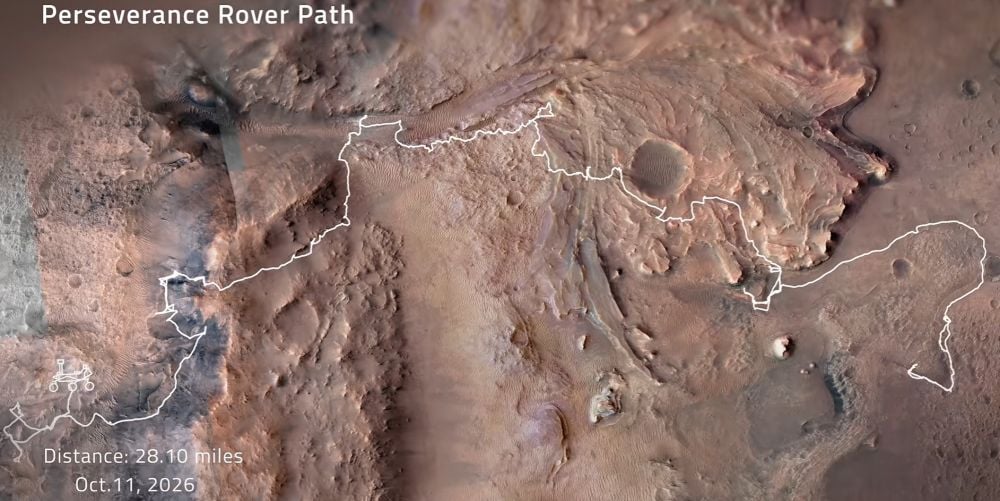
This screenshot shows Perseverance's path on Mars. It landed in Jezero Crater on the right, and travelled 45.22 km (28.10 miles) in total, reaching the point marked by the rover drawing. The rover has set a new record for distance travelled on another world mage Credit: NASA/JPLAfter five-and-a-half years on Mars, NASA's Perseverance Rover has set a distance record for travel on another world. Since landing in Mars' Jezero Crater, an ancient paleolake, on February 18, 2021, Perseverance has travelled 45.22 km, or 28.10 miles. That puts it slightly ahead of NASA's Opportunity rover, which travelled 45.16 kilometers (28.06 miles) during its mission. It must be noted, however, that Perseverance took only 5.5 years to travel this far, while Opportunity required almost 15 years.
Comparing the plutonium-powered Perseverance to the solar-powered Opportunity is unfair. But in any case, Perseverance deserves recognition for this milestone.
“The original mission called for no more than 12.4 miles of driving. We’ve blown well past that..."
Steven Lee, Perseverance and Curiosity project manager, JPL/NASA.
Perseverance is currently in a region named “Lac de Charmes,” which is off the western end of Jezero Crater. It reached its new milestone while heading toward a feature named "Idubi," a scientific target notable for its ancient rocks. On Earth, there are no rocks as old as these because they've all been destroyed by plate tectonics.
Perseverance has found igneous rocks, a surprising result considering that scientists expected to find mostly sedimentary rocks. In fact, a primary reason Jezero Crater was chosen as the mission's landing site is because sedimentary rocks are good at preserving evidence of ancient life. While the rover found plenty of sedimentary rocks, it found igneous rocks, along with fluorite, which forms when rock interacts with heated water. This is evidence of hydrothermal activity, and scientists are hoping Perseverance will find more traces of ancient hydrothermal systems at Idubi.
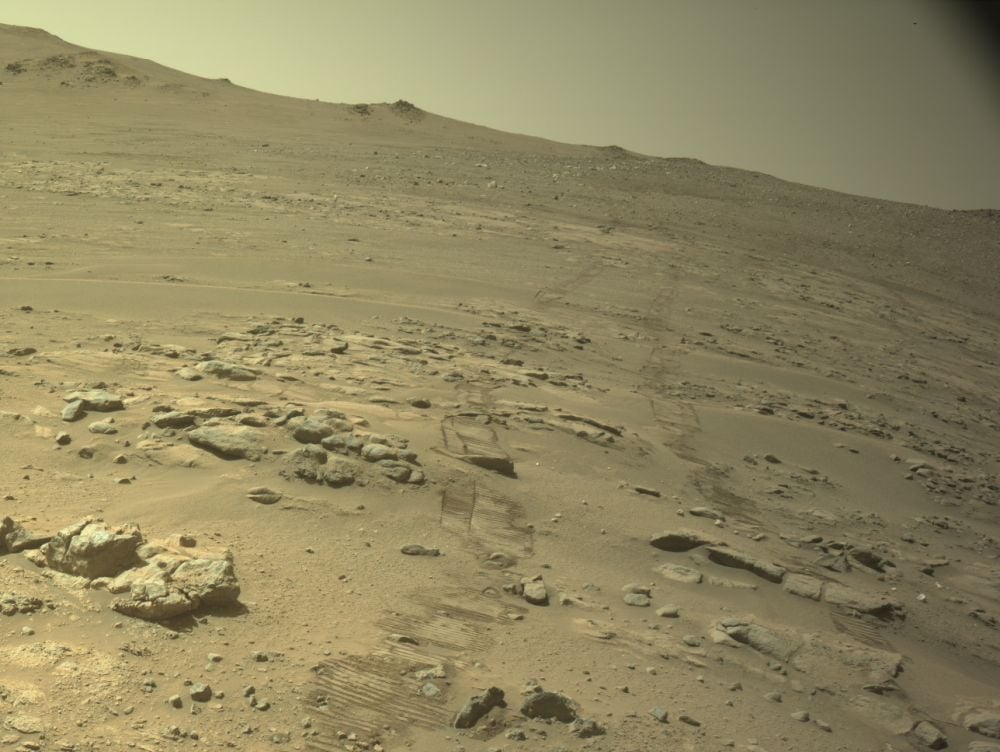
Perseverance captured this backward-looking image on the day it set its new distance-travelled record. The date was Oct. 11th 2026, or on the 2006th Martian sol of its mission.
Image Credit: NASA/JPL-Caltech
Perseverance's skill at travelling long distances rests on more than just its power source. It also has an autonomous navigation system called AutoNav. AutoNav continuously takes images of the terrain and creates a 3D map of hazards. It uses this information to plot its own course. It can do this while travelling close to its top speed, and as a result, it can travel up to 412 meters (1,351 feet) in one Martian day.
Spirit and Opportunity were the first rovers to use AutoNav, though theirs wasn't as sophisticated. Those twin rovers used their first-generation AutoNav to travel about 5% of their total distance, while Perseverance has relied on it for about 90% of its travelled distance. (Sojourner used a limited form of hazard detection, but nothing as sophisticated as AutoNav.)
Steven Lee is the project manager for Curiosity and Perseverance at NASA’s Jet Propulsion Laboratory in Southern California. “It is an honor to be working on Perseverance at a moment when the technology has evolved to the point that drives like these are routine,” Lee said in a press release. “The original mission called for no more than 12.4 miles of driving. We’ve blown well past that, and with all mobility systems fully operational and favorable extended-ground-life test results, we expect Perseverance to keep adding to this record for many years to come.”
Perseverance is on its extended mission now, which began this month. The mission will have the rover exploring the rim of Jezero Crater until about the end of 2028. Throughout its primary mission, software updates have given its AutoNav increasing sophistication, and that should continue through its extended mission.
“The rover that broke this record did so by making its own decisions about the path," said Mark Maimone, the deputy team chief of Perseverance's robotic operation. "Given the autonomy to just go, Perseverance is a better driver than the one that landed, and we’re not done. Our newest software teaches Perseverance to steer less and roll more, and to check its own position against orbital maps mid-drive."
The glare from the Sun is the next obstacle to be overcome with the rover's AutoNav system. The Sun's glare places limits on the rover's operations, and by overcoming that, the rover's daily maximum distance travelled will grow.
"The next frontier is sunlight itself," Maimone said. "Glare in the navigation cameras is why we park by mid-afternoon if we’re driving toward the Sun, and if we can teach the rover to see past those artifacts, every rover that follows gets a longer working day.”
The distance records themselves are remarkable, and they illustrate NASA's growing prowess in robotic exploration. But the real payoff is the increased science operations. The further it can travel in less time, the more geologic targets Perseverance can explore. And after all, Perseverance studies Martian geology in order to meet the objectives of its astrobiological mission.
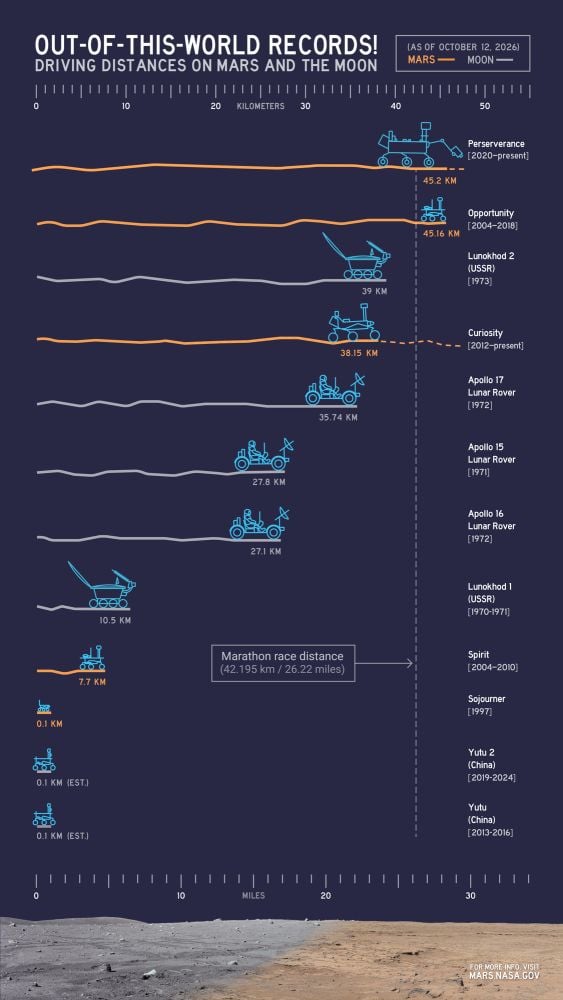
This infographic shows how far various rovers have travelled on the surface of Earth’s Moon and Mars. Only Perseverance and Curiosity are still operational and moving across the surface; the figures shown for those two are distances driven as of Oct. 11, 2026.
Image Credit: NASA/JPL-Caltech
Among the mission's highlights, which are partly attributed to its AutoNav capabilities, Perseverance has discovered potential biosignatures, and may yet discover ancient hydrothermal systems. Hydrothermal systems are like a 'Holy Grail' in astrobiology because they provide water, heat, and chemistry important for life. Hydrothermal systems may also contain fossilized evidence of ancient, simple life, in the form of microscopic structures, organic molecules, and even microbial mats.
The only sad part of Perseverance's mission concerns the samples it's gathered. Perseverance has cached 29 samples of Martian rock and regolith as part of a future Mars Sample Return mission. That mission was to be a cooperative endeavour between NASA and the ESA, but as of now, there's no firm commitment to the mission. It's currently deemed to expensive, and there are many unanswered questions about its potential success.
While Perserverance's AutoNav represents an impressive feat beyond the capabilities of previous rovers, the system also inspires an even more capable future. It's easy to imagine a future mission using AutoNav and AI to coordinate multiple rovers and even UAVs to coordinate the study of specific, hard-to-reach yet scientifically important targets on Mars and elsewhere. Think caves, elevated outcrops, and other challenging terrain.
But for now, we can enjoy Perseverance's accomplishments, which bring us closer to potentially, hopefully, finding conclusive evidence of ancient life on Mars.
NASA’s Perseverance Rover Sets Mars Driving Record! | Full Journey Mapped
NASA’s Perseverance Rover Record Drive Path Animation (as of Oct. 11, 2026)
Rover Surpasses Historic Apollo 17 And Lunokhod 2 Distances | WION News
I was looking at the Dept of War website at the 6th drop videos and found one that was interesting. Its a glowing light recorded by a police officer for a little over 15 minutes and the sighting is recorded on his cell phone which seems to be propped up on his car to keep it steady...like using a tripod to prevent shaking. The object does change color from red, green, white and at first I assumed the light was the whole craft. I was wrong! I took three screenshots, enlarged them and one of them revealed a craft around the light itself. The craft is actually 6X bigger than the light, in a tic-tac shape and having a greenish tint to it.
The big question is...is it alien? Right here...I have difficulty saying that due to the fact the US gov has had UFOs in their possession since the late 1940s and has been flying alien tech thats been back engineered since the 1990s...and yes it could be an alien tech craft that the US gov is teaching its pilots to use. The fact its sitting in the same position for 15 minutes is odd, as if its trying look like a star in the sky...a method of camouflage...not invisibility...is very US military like. So...its hard to call this one. However the shape is similar to Tall White alien ships leaving behind Nellis AFB. Very confusing this one.
Scott C. Waring - UFO Sightings Daily
FILE 001: The Tic Tac — The UFO the Pentagon Can't Explain | Case File UAP
White dwarfs can glow in a surprising range of colors, including one documented for the first time in new research demonstrating how these dead stars can defy their namesake
A recent paper published in RAS Techniques and Instruments describes the first known white dwarf that would appear green to the human eye, along with an assortment of similar stars in other colors.
Generally, cooler stars appear reddish or orange, transitioning toward white and eventually blue as their temperatures increase. However, the new research reveals a much broader range of colors that can occur among these small, dense stellar remnants.
White Dwarfs
These dense objects are the remnants of once Sun-like stars that burned out long ago. Despite being relatively small and technically “dead,” they can remain extremely hot. As a result, many glow in the white-to-blue portion of the visible spectrum, hence their name.
The new research, however, reveals that their colors can also include green, pink, cyan, yellow, and purple, offering a surprising variety of hues that would become apparent if we could observe these distant objects more closely.
“Most stars, including most white dwarfs, behave like ‘perfect radiators,’ so their colour is set almost entirely by temperature. But nobody had really looked into what else might be possible for white dwarfs,” said Dr Mark Hollands, Warwick Prize Fellow in the Astronomy and Astrophysics Group, University of Warwick, who led the work. “It turns out these incredibly dense stars can produce colours nobody expected, and some of them genuinely surprised me.”
What Colors a White Dwarf?
The unusually dense atmospheres of white dwarfs play an important role in determining their colors. Under these extreme conditions, elements such as carbon, calcium, and sodium can interact with helium-rich plasma, absorbing specific wavelengths of light in ways that would not occur in the less dense atmospheres of Sun-like stars. As certain wavelengths are absorbed, the star’s apparent color shifts, much as though a filter had been placed over its light.
Pink or purple hues can result from carbon-rich atmospheres, while yellow colors may arise from elements deposited by asteroids and comets. In relatively cool white dwarfs, interactions involving hydrogen and helium can also produce a cyan appearance.
The first identified green white dwarf, WD J1330+6435, has an atmospheric temperature of approximately 4,000°C. Its unusual coloration results from a combination of calcium, lithium, and sodium, likely originating from rocky material drawn in from its planetary system.
“The traces of sodium in the atmosphere of this white dwarf absorb the orange part of the spectrum, leaving behind a ghostly green glow,” Dr. Hollands said. “Imagine standing on a planet and looking up at a green star. It feels like something out of science fiction.”
Modeling Star Color
This remarkable assortment of colors isn’t commonly visible in our night sky, since most white dwarfs are too distant and faint for their colors to be readily distinguished by the human eye.
Instead, astronomers use spectroscopy to separate starlight into its component wavelengths, revealing information about a star’s temperature, composition, and other physical properties. For the new research, the team processed these measurements using a model that simulates human color vision, allowing them to determine how the stars would actually appear to an observer.
Despite the intriguing findings, the familiar white coloration remains far more common. Of the 151 white dwarfs examined within approximately 65 light-years of Earth, only five displayed unusual colors.
“One in thirty might not sound like a huge fraction, but across the entire population of white dwarfs in the Universe, that is still a lot of oddly coloured stars out there,” Professor Boris Gänsicke, Department of Physics, University of Warwick, concluded. “Yet if we take the median across a representative population of white dwarfs, we found that the average white dwarf really is white.”
Ryan Whalen covers science and technology for The Debrief. He holds an MA in History and a Master of Library and Information Science with a certificate in Data Science. He can be contacted at ryan@thedebrief.org, and follow him on Twitter @mdntwvlf.
Astronomers Find the First Known Green Star — Here’s Why It Looks Green | Newstro
A church in Jerusalem stands over the sites where Christians believe Jesus was crucified and buried - and a discovery beneath it may shed new light on his final journey to the cross.
The Church of the Holy Sepulchre dates back to the fourth century, when Roman Emperor Constantine ordered a church built around the burial place believed to be Jesus' tomb.
Archaeologists have uncovered plant remains suggesting parts of the site were once cultivated, echoing the Gospel of John's description of a garden containing a new tomb near the place of crucifixion.
A newly published archaeological report details another intriguing discovery: a stone-paved road with a broad, shallow step edged with larger stones.
The surviving section measures roughly 10 by 12 feet and lies beneath a Crusader-era walkway inside the church. Its original edges no longer survive, but its curve and pronounced slope suggest it climbed toward the southwest.
Professor Francesca Romana Stasolla, who leads the excavation, wrote: 'One possibility – at present no more than a hypothesis – is that this was a suburban road ascending toward the area of the Calvary, assuming that the site functioned as a place of public executions.' The Bible says Jesus was crucified on Calvary.
Stasolla considered whether it served Roman construction crews, but the step would have hindered carts hauling heavy building materials. Its construction and dimensions also made it unlikely to have been merely a small path leading to nearby tombs.
Roman executions were public spectacles, and an approach road needed to accommodate spectators whose presence added to the humiliation of the condemned.
Archaeologists uncovered an ancient road under the church, which could have been taken by Jesus to the cross nearly 2,000 years ago
'What is certain is that the place of execution must have been public and accessible,' Stasolla of Sapienza University of Rome in Italy wrote.
Although ancient accounts describe mass crucifixions around Jerusalem, archaeologists have yet to securely identify a designated execution ground.
The road was found in an early Roman phase predating Emperor Hadrian's second-century redevelopment of Jerusalem, leaving open the possibility that it was in use during Jesus' lifetime.
Researchers also considered whether the road served construction crews during Emperor Hadrian's redevelopment, when the area was incorporated into the city.
Such service routes, known as 'strade di lizza,' were used to transport building materials.
However, the road's step makes that explanation unlikely, as it would have obstructed carts and made hauling large architectural pieces either uphill or downhill difficult.
The stretch of road was abandoned during the construction of Constantine's church complex in the fourth century.
Christians were already visiting places associated with Jesus' suffering and death, but those pilgrimages did not yet follow a defined route.
Israel has closed the Church of the Holy Sepulchre indefinitely due to escalating security concerns as the war in Iran intensifies
It was during the Middle Ages, particularly the Crusader period, that the Via Dolorosa became established as a sequence of streets commemorating Jesus' journey from the Roman governor's headquarters to Calvary.
Stasolla led the excavation from May 2022 to October 2025, but the broader project began in 2019, and her team continues studying the finds and documentation after the digging ended.
In April 2025, she and her team announced they had uncovered remnants of an ancient garden beneath the foundation of the Church of the Holy Sepulchre.
The analysis dated the remains to the pre-Christian era, around the time of Jesus' crucifixion and burial. Historians generally date his death to around 33 AD.
Archeologists were excavating the floor of the church (pictured) when the uncovered signs of an ancient garden that is mentioned in the Bible as where Jesus was laid to rest
There is a long-held debate over where Jesus was laid to rest. Some say the church while others believe he was put inside an ancient rock-cut tomb, known as the Garden Tomb (pictured), which aligns with Biblical text
Many scholars favor the Church of the Holy Sepulchre, citing evidence that the surrounding area contained rock-cut tombs during the period in which Jesus lived. The Garden Tomb, another ancient burial site in Jerusalem, remains an alternative location favored by some Christians.
The original Holy Sepulchre church was commissioned by Roman Emperor Constantine I and inaugurated in AD 335, roughly 300 years after Jesus’ death.
Ancient accounts describe Roman religious structures associated with the worship of Venus being cleared from the site, exposing a tomb identified by Christians as Jesus’ burial place.
Stasolla suggested that knowledge of the tomb’s location may have passed down through generations of the early Christian community. Constantine’s builders cut away the surrounding rock, preserving the burial chamber and making it a focal point of the new sanctuary.
The team also uncovered part of a circular base made from reused marble beneath the shrine enclosing the revered tomb. Measuring approximately 20 feet in diameter, the base may belong partly or entirely to a later rebuilding rather than Constantine’s original construction.
Analyses of the mortar joining its slabs are underway to help establish the sequence in which the structure was built and altered.
Jesus Walked This Ancient Path in Jerusalem The Night He Died
Speaking at the event, a triumphant Musk declared: 'Flying cars are real… It's got altitude controls, thrusters and main thrusters in the rear. So it can basically fly like a rocket, it can do rolls, crazy gymnastics.'
However, on social media, tech fans have been left baffled by the outlandish stunt, with tech blogger Marques Brownlee asking: 'This is a prank, right?'
Mr Brownlee wrote in a sceptical post on X: 'They really just got on stage and said this newly designed 4000+ pound car can do flips and go half the speed of sound (380+mph) and will ship in 2028.'
Meanwhile, some Tesla fans didn't question whether the flying Roadster really existed but weren't certain it would ever be safe to drive.
As one commenter bluntly joked: 'Car insurance companies are going to s*** themselves.'
Elon Musk has shocked the world by unveiling a spectacular demonstration of a new Tesla flying car
On social media, tech fans have been left baffled by the outlandish stunt, with tech blogger Marques Brownlee asking: 'This is a prank, right?'
Last year, Musk promised the retooled Roadster – Tesla's original car that hasn't been in production since 2012 – would fly, in part because he said fellow billionaire Peter Thiel wants a flying vehicle.
And the billionaire appears to have made his dreams come true at a live event on Thursday night from SpaceX's testing facility in McGregor, Texas.
In one demonstration, the Roadster drove directly towards a row of parked vehicles before flinging itself into the air, flipping over, and landing safely on the other side.
In another, the Roadster jumped directly into the air from a stationary position, hovering as it rolled over and gently lowered itself back to the ground in a cloud of smoke.
Besides its stunning rocket abilities, Tesla says the Roadster can accelerate from 0–60 miles per hour in approximately 0.81 seconds and hit a top speed of 230mph.
The car is even supposedly fitted with a suction fan system under the car that generates up to 2G of downforce that lets it stick to the road, enabling it to drive upside down on a steel ramp.
However, tech fans on social media have been quick to question whether such a groundbreaking innovation could be real.
One commenter wrote on X: 'Bro this does not look real no f*****g way.'
In a stunning clip, the new Tesla Roadster drives upside–down on a ramp before launching itself into a flip and landing safely
Tech fans have taken to social media to poke fun at the impractical nature of Tesla's supposed flying car
Real life if you ignore gravity, insurance, and the price of tires,' another added.
Even Musk himself appeared to question whether the flying version of the Tesla Roadster would ever be available.
He said: 'I'm not sure it's necessarily legal in all jurisdictions, but there will be such a car that someone can own.'
Meanwhile, even tech fans who thought the demonstration was real were baffled as to why anyone would want this feature in their own car.
'Imagine being inside a car that does this and getting instant brain damage,' wrote one.
'Imagine pushing the wrong button and your car does this,' joked another.
While one commenter chimed in: 'So what will happen to my coffee and bags in that moment.'
But despite some critical responses, the overwhelming sentiment online has been one of amazement.
Tesla fans joked that they could use the jumping abilities of the new Roadster to skip traffic
One bemused Tesla fan wrote: 'We're living in a simulation. Exhibit A.'
'It's like watching Blade Runner 2049 happening in 2026.'
Another added: 'Absolutely speechless. Never in my wildest dreams did I ever think I'd live to see the day where we had a flying car.'
Even Silicon Valley's tech elites flocked to offer their congratulations to Musk on his impressive innovation.
Demis Hassabis, co–founder and chair of Google DeepMind, responded to Musk's post saying: 'Huge congrats @elonmusk! Incredible work, Blade Runner cars here we come...'
Likewise, Google and Alphabet CEO Sundar Pichai wrote: 'The FSD [Full Self–Driving] version of this will be something:) congrats!'
Meanwhile, excited tech fans have already started to dream about what this next generation of flying cars might be used for.
One commenter wrote: 'I could have used this in traffic today.'
Elon Musk brought his long–promised flying Tesla Roadster to the public eye for the first time, with a declaration that 'flying cars are real' and a promise to make them available by 2028
Musk says he is currently targeting 2028 to begin production of the new sports car, but warned that some of the features may not be legal in all countries
Another added: 'The next James Bond film has to feature this car.'
While one Tesla enthusiast jokingly suggested: 'Perfect escape car for a heist'.
Musk says he is currently targeting 2028 to begin production of the new sports car.
On Tesla's 'Reserve Your Roadster' webpage, customers can pay a refundable $50,000 (£37,525) deposit on a 'performance' model Tesla Roadster featuring 'active aero and a multi–mode suction system'.
Customers can also reserve a model with a 'thrust' augment, featuring 'acceleration thrusters' for $250,000 (£187,656).
Meanwhile, a 'rocket' augment is available on an invite–only basis, and claims to be: 'Air ready with seating for one. Includes Performance and Thrust, plus a full flight system.'
However, in 2017, Musk claimed flying cars would never take off.
'Obviously, I like flying things,' Musk told Bloomberg.
'But it's difficult to imagine the flying car becoming a scalable solution.'
He also said there's a risk of falling debris if flying cars were to get in a mid–air crash.
'If somebody doesn't maintain their flying car, it could drop a hubcap and guillotine you,' Musk said.
'Your anxiety level will not decrease as a result of things that weigh a lot buzzing around your head.'
But if this latest demonstration is to be believed, Tesla appears to have overcome some of those technical limitations to bring flying cars from science fiction to reality.
Elon Musk’s Flying Tesla Is REAL ... And It Just Jumped A Row Of Cars | The Low Down
NASA's probe circling the sun recently captured a mysterious object soaring by.
An image from the Solar Heliospheric Observatory (SOHO), taken on October 3, shows the sun releasing coronal streamers, bright, elongated, cusp-like structures in its outer atmosphere.
Scott C Waring claimed the alien craft measured about 2.5 miles across and half a mile wide.
'A ship that large could carry tens of thousands of passengers across the universe in no time,' Waring shared on his site UFO Sightings Daily.
'Also, the ship is using a tractor beam to safely pull three different smaller orb craft with it, which is visible in the photo after I put it into negative format view.'
However, NASA has maintained that it has no evidence of UFOs or extraterrestrial life.
While the space agency has not acknowledged the object in the image, Waring said the it 'is something NASA will never talk about.'
A white, cylinder-shaped object appears on the right side of the frame, which a UFO researcher hailed as a 'mothership'
'Something that is 100 percent proof that aliens pass through our own solar system daily, while the public is kept in the dark of such things existing,' he continued in the blog post on UFO Sightings Daily.
Waring claimed that the mothership was also traveling 'near the speed of light.'
'Also the ship is using a tractor beam to safely pull three different smaller orb craft with it, which is visible in the photo after I put it into negative format view,' he added.
The UFO researcher compared the size of the 'UFO' to that of 3I/ATLAS, the mysterious interstellar visitor that captivated the world in 2025.
The object is believed to be up to 3.5 miles long, but Harvard professor Avi Loeb, who tracked the 3I/ATLAS extensively, said it 'could be six miles or larger.'
The object was first identified in July 2025 by the ATLAS telescope network, which looks for objects that might hit Earth.
Loeb considers the interstellar object 3I/ATLAS most likely a natural comet, though he has kept open the possibility of artificial or technological origins due to several unusual features.
Scott C Waring claimed the alien craft measured about 2.5 miles across and half a mile wide
The UFO researcher compared the size of the 'UFO' to that of 3I/ATLAS, the mysterious interstellar visitor that captivated the world in 2025
Waring said: 'The size and dimensions are similar to comet Atlas which is also a spaceship...but that was suppose to be gone last year...so mark that possibility off, unless it's passing through again as spaceships often change directions and routes.'
While 3I/ATLAS is billions of miles from Earth, Loeb recently published a report suggesting our Solar System may be far more crowded with interstellar objects, chunks of rock or ice from other star systems, than anyone realized.
He presented new data and calculations in February that indicated roughly 35 million meter-scale interstellar objects are embedded inside Earth's orbit.
This conclusion comes from the detection of two interstellar meteor candidates, CNEOS-22 and CNEOS-25, recorded in 2022 over the Pacific and in 2025 over the Barents Sea in the Arctic.
The objects were small, about six feet and four feet across, but traveling fast enough to exceed the Solar System's escape velocity.
Loeb and his team estimated that such meteors collide with Earth about once every three years, implying a dense population of similar objects around the Sun.
Each meter-scale object could carry roughly three million tons of material, totaling about 220 billion tons within Earth's orbit.
Larger interstellar objects like 3I/ATLAS are far rarer, but their greater mass makes their total contribution similar, suggesting smaller objects may be fragments of bigger bodies.
Loeb said studying this population could reveal how material moves between star systems.
This idea builds on discoveries like the famous 'Oumuamua and comet Borisov, plus newer findings about massive interstellar objects, implying that space is filled with 'interstellar trash' drifting between stars.
The first known interstellar visitor, the object 'Oumuamua, was detected on October 19, 2017, as it passed through the inner Solar System.
Two years later, on August 30, 2019, comet Borisov became the second confirmed interstellar object, traveling on a hyperbolic path that marked it as a visitor from another star system.
With improved observations, including next-generation telescopes and potential space interceptors, scientists could better measure interstellar visitors' properties, origins, and trajectories.
Hollywood has given us all sorts of aliens over the years, from the little guy who wanted to phone home to the ones who vaporized the White House. But one of the few humans who’s actually walked on the moon has another explanation for what’s flying around up there, and it involves Satan.
Charlie Duke, the Apollo 16 astronaut who became the youngest person to walk on the moon at 36, is now 91 and convinced UFOs are the work of the devil. “The Lord says what we’re seeing is real, but the devil can appear as an angel of light, the Bible says,” he told the Christian Broadcasting Network.
And he’s been trying to convince people of this for years, with mixed results.
Duke recalled discussing his theory at Rotary Club events, where “people were laughing me off the stage.” Eventually, he asked God to confirm it. His request was oddly detailed: If a businessman friend who never discussed UFOs brought them up the next morning, Duke would consider that proof.
An Apollo Astronaut Thinks Satan Is Behind UFOs. Here’s His Explanation.
According to Duke, that’s exactly what happened. His friend brought up UFOs over breakfast, and Duke took it as the answer he’d been looking for. He also cites 2 Corinthians 11:14, the biblical passage warning that Satan can disguise himself as an angel of light.
Duke has said, however, he never saw a UFO while he was in space. He did notice some strange flashes, but those have been attributed to cosmic particles. For a man who’s actually walked on the moon, it’s funny that his strongest evidence for demonic UFOs comes from a conversation with a businessman over breakfast.
And this is a man who helped make history. During Apollo 11, Duke was the voice in Mission Control who famously told Neil Armstrong and Buzz Aldrin they had “a bunch of guys about to turn blue” while waiting for confirmation that they’d landed safely.
He’s also got some company in the demon theory department.
Vice President JD Vance told podcaster Benny Johnson in March that he believes UFOs are demons. Meanwhile, Monsignor Stephen Rossetti, an exorcist with the Archdiocese of Washington, was removed from that position in June after claiming that many UFO sightings were demonic. Catholic officials weren’t thrilled with his public comments.
Religion scholar Diana Walsh Pasulka sees a fascinating connection between the growing interest in UFOs and people’s religious beliefs. “Belief in UFOs is really one of the best things that’s happened to religion in a long time,” she told the Associated Press.
For Duke, though, the question seems settled. “You can laugh at me if you want to, but that’s what God showed me, and I’m sticking to it,” he said.
And considering he’s been laughed off actual stages for saying this, I doubt another round of skepticism is going to change his mind.
'They're Demonic': Astronaut Who Walked on the Moon on Shocking Truth About Aliens
Shocking Truth About Aliens Revealed by Astronaut: 'They're Demonic'
Do Animals Sense UFOs Before Humans? Strange Encounters Suggest They Might
Dogs suddenly panic. Horses rear in terror. Cattle scatter without warning. Then, moments later, a mysterious object appears in the sky.
Throughout the history of UFO research, witnesses have reported unusual animal behavior occurring before or during encounters with unidentified flying objects. While most investigations focus on the appearance, movement, and technology of these mysterious craft, another potentially important clue is often overlooked: the reactions of animals.
In a recent discussion, UFO researcher Richard Dolan explored several historical cases involving dogs, horses, cattle, and other animals that reportedly reacted to UFOs before their human companions even noticed anything unusual.
Could animals be detecting sounds beyond human hearing? Are they sensitive to electromagnetic disturbances? Or might something even stranger be involved?
Let’s examine the reported encounters and the possible explanations.
The 1965 Ohio UFO Encounter: A Dog and Horse Panic
On May 20, 1965, six members of the McDonald family reportedly witnessed a strange object hovering over their property in Leroy Township, Ohio.
According to the account, a silvery-white disc approximately the size of a car passed close to their rooftop. The object featured circular openings along its body and produced a low buzzing or purring sound.
But the family’s animals reacted dramatically.
Their dog fled into a nearby field, while their horse reared and ran around its tether in apparent panic. One witness described the horse’s ears as pinned backward and its eyes as wild.
What made the incident particularly unusual was that both animals were accustomed to aircraft. The family lived beneath flight paths serving nearby airports.
Neighbors also reportedly experienced television and radio interference around the time of the sighting.
The incident was documented by the National Investigations Committee on Aerial Phenomena (NICAP), an organization that investigated UFO reports during the twentieth century.
The combination of animal distress, unusual aerial activity, and reported electronic interference raises an interesting question: were the animals reacting to something humans could not fully perceive?
New Zealand, 1969: A Trained German Shepherd Loses Control
One of the most intriguing historical reports occurred on October 30, 1969, at the Waipukurau Aerodrome in New Zealand.
Security officer John Cudby was patrolling the airfield with his German Shepherd at approximately 3:10 a.m. when he noticed strange lights reflected in a glass door.
Turning around, he reportedly observed a metallic, saucer-shaped object hovering near a hangar.
The object was described as approximately 60 feet wide and 12 feet high, with red and green lights and a turret-like structure on top.
It also produced a low mechanical sound.
Cudby’s normally obedient dog became extremely agitated, barking, growling, circling, and ignoring commands.
As the object’s sound increased in intensity, the dog’s behavior reportedly became even more erratic.
When Cudby directed his searchlight toward the object, its underside appeared to brighten. The craft then tilted and accelerated away.
The dog’s agitation was so severe that Cudby reportedly had to lift it into his vehicle afterward.
Cudby suggested that the object might have emitted a high-frequency sound beyond human hearing.
If accurate, this encounter could support the possibility that animals perceive acoustic signals associated with unusual aerial phenomena that humans cannot hear.
Astralia, 1980: Terrified Livestock and a Mysterious Landing
On September 30, 1980, farm caretaker George Blackwell reported an extraordinary encounter near Rosedale, Victoria, Australia.
At approximately 1:00 a.m., Blackwell awoke to a strange mechanical whistling sound.
Outside, cattle were bellowing and a horse was reportedly running in panic.
Blackwell went to investigate and observed a domed object hovering near an open water tank.
The object reportedly measured approximately 25 to 28 feet across and displayed white, orange, and blue illumination.
According to his account, it eventually landed nearby.
During the encounter, the sound intensified into what Blackwell described as a mechanical scream. A dark, tube-like structure appeared around the object’s lower section.
A loud bang followed, and the object lifted off, producing a blast of hot air.
Afterward, Blackwell discovered that the water tank was empty, with mud forming a cone-shaped deposit at its center.
Investigators later examined reported physical traces associated with the incident.
Although the account does not establish what the object was, the reported animal behavior is notable because the livestock appeared disturbed before Blackwell went outside to investigate.
Denmark, 1995: A Labrador Reacts Before a Car Malfunctions
On September 29, 1995, a Danish motorist named Klaus Lund reportedly experienced an unusual event while driving with his black Labrador.
At approximately 9:30 p.m., the dog suddenly became agitated.
It began barking and clawing at the vehicle’s door.
Shortly afterward, the car reportedly experienced a series of electrical malfunctions.
The windshield wipers activated unexpectedly, dashboard instruments behaved erratically, the headlights failed, and the engine stopped.
A powerful blue-white light then appeared above the vehicle.
The incident was reportedly investigated by the Danish UFO organization SUFOI.
What makes this case especially interesting is the apparent sequence of events.
The dog reacted before the driver noticed the unusual light or the vehicle’s reported electrical problems.
Could the animal have detected an electromagnetic disturbance? Was an ultrasonic sound involved?
The available testimony cannot establish a cause, but the reported timing makes the case relevant to research into animal reactions during UFO sightings.
Pennsylvania, 2014: Dogs React to a Silvery-Blue Object
Another unusual encounter was reported in Lewistown, Pennsylvania, on July 28, 2014.
At approximately 1:00 a.m., a woman stepped outside with her dog.
Her dog suddenly ran away, while a neighbor’s dog began whimpering inside its enclosure.
Looking upward, the woman reportedly noticed a silvery-blue disc hovering just above a nearby rooftop.
She estimated that the object measured approximately 20 to 25 feet across.
Unlike conventional metallic UFO descriptions, she characterized its appearance as something resembling energy.
Within seconds, the object disappeared.
The witness also reported experiencing a brief sensation of warmth passing through her body.
Moments later, she reportedly observed the object again, this time farther away and at a higher altitude.
The account was published as MUFON case 58468.
The dogs’ behavior is particularly interesting because both animals reportedly reacted before the witness became aware of the object.
However, the report alone cannot determine whether the object caused their reactions.
Michigan, 2018: A Dog Warns Its Owner of a Triangle-Shaped UFO
On September 18, 2018, a woman in Romulus, Michigan, was reportedly awakened around 1:00 a.m. by her crying dog.
Believing the animal needed to go outside, she took it outdoors.
There, she heard a strange metallic clanging sound resembling heavy chains striking one another.
She then noticed an unusual triangular object moving slowly above her home.
The object reportedly featured two sharply defined rectangular lights and two red lights.
Meanwhile, her dog backed against the garage, whining and barking in apparent fear.
The witness described the object as moving only slightly faster than walking speed.
The case raises a question that appears repeatedly in UFO reports: how many unusual aerial events might go unnoticed if animals did not alert their owners?
Can Dogs and Other Animals Hear UFOs?
One of the most plausible explanations for these reports involves differences between human and animal hearing.
Dogs can detect higher-frequency sounds than humans, while cats can hear frequencies higher still.
Horses and cattle also have hearing abilities that differ from our own.
This means an object that appears silent to a human observer could theoretically produce sounds detectable by nearby animals.
A high-frequency mechanical whine, for example, might cause a dog to become distressed even if its owner hears nothing.
UFO researcher James McCampbell explored this possibility in his 1973 book Ufology.
He examined approximately 200 reports involving animals and proposed several potential explanations for their reactions, including unusual sounds and electromagnetic emissions.
In 1976, researcher Harold Heaton also examined a catalog of 232 UFO reports involving animal behavior.
His analysis suggested that dogs, horses, and cattle dominated the reported encounters.
Later, researcher Joan Woodward examined 104 selected UFO sightings involving animal responses in a study discussed in the MUFON UFO Journal beginning in October 2005.
She found possible associations between reported sounds and particular animal reactions.
These historical studies provide interesting starting points, but they do not demonstrate that unidentified craft emit ultrasonic frequencies.
Could Electromagnetic Fields Affect Animals?
Another hypothesis involves electromagnetic disturbances.
Some UFO reports include claims of malfunctioning radios, disrupted television reception, stalled engines, or unusual electrical behavior.
Researchers have questioned whether electromagnetic emissions might also influence animals.
McCampbell proposed that microwave emissions could potentially affect the nervous system, producing sensations of fear or interfering with movement.
One relevant scientific phenomenon is the microwave auditory effect, in which certain pulsed microwave exposures can produce perceived sounds through physical interactions with tissue.
However, the existence of this effect does not establish that it explains any UFO encounter.
No verified measurements from the incidents discussed here demonstrate that such emissions were present.
Nevertheless, electromagnetic monitoring could be valuable in future investigations involving unusual animal behavior and unidentified aerial objects.
Do Animals Have a Sixth Sense About UFOs?
Richard Dolan also explored a more speculative possibility: animal consciousness.
Animals sometimes appear to anticipate events before humans notice obvious signals.
Dogs may become excited before their owners return home, while cats sometimes hide before a trip to the veterinarian.
Researcher Rupert Sheldrake investigated claims that certain dogs could anticipate their owners’ return even when arrival times were unpredictable.
One of his best-known studies involved a dog named Jaytee, whose waiting behavior was filmed while its owner was away.
Sheldrake interpreted the results as possible evidence of an unusual connection between animals and humans.
However, the interpretation remains scientifically controversial, and telepathy has not been established as an explanation for such behavior.
Dolan raises an intriguing question: if animals can detect subtle signals associated with familiar humans, might they also respond to unfamiliar presences?
There is currently no reliable scientific evidence that animals telepathically detect UFOs or extraterrestrial intelligence.
Still, the question illustrates how UFO research sometimes intersects with broader debates about animal perception and consciousness.
What About Dolphins and Other Marine Animals?
Most reported UFO-related animal reactions involve terrestrial species.
However, Dolan also mentioned an unusual account involving dolphins.
Researcher and dolphin enthusiast Joan Ocean described an experience in Hawaii in which dolphins allegedly guided her toward enormous glowing spheres underwater.
She claimed that dolphin sounds were audible inside the spheres but not outside them.
The account is unusual, but the nature of the glowing objects remains unknown.
There is no verified evidence that they were extraterrestrial craft or even related to the UFO phenomenon.
Nevertheless, reports involving marine animals raise interesting questions about whether unusual underwater phenomena could influence animal behavior.
Are Animal Reactions Reliable Evidence of UFO Activity?
Animal reactions can provide useful contextual information during investigations, especially when they occur before human witnesses notice something unusual.
However, several important limitations must be considered.
Animals can react to many ordinary stimuli, including:
High-frequency sounds from electrical equipment or wildlife.
Changes in weather and atmospheric pressure.
Unfamiliar odors or vibrations.
Distant vehicles, aircraft, and other environmental disturbances.
Stress, illness, or behavior from nearby animals.
Additionally, most historical UFO cases rely on witness testimony rather than controlled measurements.
An animal becoming frightened during a reported UFO sighting does not independently establish that an extraordinary craft was present.
To investigate these reports scientifically, researchers would benefit from synchronized video recordings, environmental sound measurements, electromagnetic monitoring, veterinary observations, and comparisons with periods when no unusual objects are reported.
Such evidence could help distinguish ordinary environmental triggers from genuinely unexplained events.
Final Thoughts: Are Animals Detecting Something We Cannot?
The history of UFO sightings contains numerous accounts of animals reacting strangely before or during encounters with unidentified objects.
From frightened horses in Ohio to agitated dogs in New Zealand, Denmark, and Michigan, these reports suggest a recurring theme worth examining.
The most straightforward possibilities involve sensory abilities that differ from those of humans, particularly hearing and sensitivity to subtle environmental changes.
More speculative ideas involving electromagnetic effects or unusual forms of awareness remain unproven.
The central mystery is not whether animals possess senses different from ours—they clearly do. The unanswered question is whether those abilities have ever allowed them to detect a genuinely unexplained aerial phenomenon before humans noticed it.
For now, the historical accounts offer intriguing testimony rather than conclusive scientific evidence.
But if future UFO investigations systematically document animal behavior alongside physical measurements, our four-legged companions might help researchers understand what witnesses are actually experiencing.
Giant Red Sprite illuminates the night sky above Montemaggiore
The existence of elusive electrical discharges in the upper atmosphere, known by intriguing names such as red sprites, blue jets, pixies, and ELVES, has been a subject of scientific debate and fascination for years.
Now, on September 16, 2026, Florian Riou, a photographer specializing in capturing these rare electrical discharges, photographed an enormous luminous phenomenon known as a red sprite in Balagne, above the village of Montemaggiore. Florian Riou's website: www.florianriou.com
These red sprites, often imperceptible to the naked eye, appear briefly during particularly intense and prolonged thunderstorms. They occur in the mesosphere, at altitudes between 40 and 90 kilometers, and typically last only a few milliseconds.
Despite advances in scientific research, these extraordinary atmospheric events remain only partially understood, revealing a mysterious aspect of our planet's atmosphere. Yet, in the past, sightings of such phenomena were rarely reported, if they were reported at all.
The same question arises when we look at auroras. Reports and images of these spectacular displays seem increasingly common, including sightings in regions where they were once considered highly unusual.
Could these observations be connected? Are we simply becoming better at detecting and documenting rare atmospheric events, or could something more significant be happening?
Could a larger disturbance be affecting Earth's atmosphere as a whole, involving solar activity, electromagnetic conditions, and the planet's own interconnected systems?
Below the video of the giant Red Sprite and another amazing video showcasing different types of electrical discharges captured around the world.
Northern Arizona University researchers have developed sophisticated planetary models suggesting that 26 of the 29 nearby rocky exoplanets like those in the TRAPPIST 1 systemmay support extraterrestrial life that is much less evolutionarily advanced than Earth’s, even though they are billions of years older, because of limitedplantenergy.
“If life on those exoplanets evolved just like on Earth, most of those planets will just be filled withmicrobes and not advanced aliens,” explained NAU ecoinformatics professor Chris Doughty and the lead author of a study detailing the team’s findings.
The researchers also found evidence that three of the studied planets may be somewhat more biologically advanced than mere microbes, including one that may be ahead of Earth from an evolution perspective. However, they said these planets may host life more like what’s depicted in the Dune novels than in James Cameron’s Avatar films.
Search for Extraterrestrial Life on Nearby Planets to Determine “Who is Ahead”
When announcing their findings, the NAU team noted that scientists have long debated the seemingly high likelihood that intelligent life should exist versus the lack of evidence for such advanced extraterrestrial life.
“Physicist Enrico Fermi famously asked, given the high likelihood of intelligent extraterrestrial life in the galaxy, ‘Where are they?’ Doughty explained.
According to the NAU team, one possible explanation is a lack of plant energy that sophisticated lifeforms need to keep evolving. On Earth, warmer, wetter environments support more plant life, providing animals with the fuel they need to evolve. The researchers suspect this may apply on a planetary-wide scale, potentially offering a comparatively wet Earth an evolutionary boost over older, drier planets in our cosmic neighborhood.
“Who is ahead?” Doughty explained. “That is the mystery we are quantitatively trying to solve.”
TRAPPIST-1e and Other Candidates Orbiting Red Dwarf Stars
Unlike Earth, most rocky exoplanets astronomers have discovered orbit smaller, cooler stars called red dwarfs. While many such candidates are billions of years older than Earth, they receive much less solar energy.
Planets within a red dwarf’s habitable zone where liquid water can exist on the surface are also typically tidally locked, meaning one half of the planet never receives direct sunlight. Still, red dwarf stars are the most common type in our galaxy, increasing the chances of finding extraterrestrial life on planets orbiting them.
Study co-author Michael Gowanlock, a NAU associate informatics professor, said that even if photosynthetic life on a planet orbiting a red dwarf had billions of years more than Earth to evolve, it may still trail Earth life from an evolutionary standpoint.
“The total annual photosynthesis is likely lower because there is less light and half the planetary surface area available for photosynthesis,” Gowanlock explained.
To predict the amount of plant energy available for animal evolution on some of the most promising “nearby” life candidate exoplanets, the team modeled TRAPPIST-1e and 28 other exoplanets that may have water within Earth’s cosmic neighborhood. For example, TRAPPIST-1e is 40 light-years from Earth, so conventional rockets would take thousands of years to reach it.
For comparison, the team used the roughly 2.4 x 1025 grams of carbon that were “fixed” on Earth during the 3.2 billion years before more efficient vascular plants evolved. Once plant life began, the team said that 7 x 1025 grams more carbon was fixed before humans evolved.
“Advanced Life on Those Exoplanets Might be More Dune Than Avatar”
After running the simulations, the NAU team determined that TRAPPIST-1ehas fixed only 21% of Earth’s carbon “despite being several billion years older than Earth.”
Study coauthor Cameron Hrabak, an NAU alumnus, said this figure, which is less than the amount fixed by the Earth before the evolution of more efficient vascular plants, suggests that TRAPPIST-1e “may only be at the microbial stage of evolution.”
When they ran the same numbers for the other 28 exoplanets on their life candidate list, they found just two where life had “potentially evolved ahead of Earth’s: GJ 1061c and K2-3d.” Notably, both Earth-like exoplanets are larger, hotter, and brighter than most Earth-like planets discovered in our solar neighborhood.
The models also revealed three other “nearby” planets that could have evolved life to a stage similar to Earth’s Mesozoic, or “roughly equivalent to the age of dinosaurs on Earth.”
When discussing the types of life that might exist on those candidates, Doughty said the expected rain-limited savannah woodland conditions could evolve something one might find Muad Dib riding through the desert rather than something out of James Cameron’s vivid imagination.
“To use two pop culture references, the ecological characteristics that shape advanced life on those exoplanets might be more ‘Dune’ than ‘Avatar,’” Doughty said.
Planets Likely Filled with Microbes “and Not Advanced Aliens”
When discussing the study’s implications, the NAU team cautioned that their figures are only estimates and “not proof” of extraterrestrial life. They also note that the atmospheres around TRAPPIST-1e and other life candidates “would profoundly affect climate, photosynthesis and how life evolved.”
Ongoing efforts by the James Webb Space Telescope may offer additional data on these 29 exoplanets that could help the team further refine their models. However, Doughty said the study’s results do suggest that life on nearby Earth-like planets may be “evolutionarily behind us and still at the microbial stage.”
Which means we can sleep well, because if life on those exoplanets evolved just like on Earth, most of those planets will just be filled with microbes and not advanced aliens,” the team leader concluded.
Christopher Plain has spent the last six years as Associate News Editor and Head Science Reporter at The Debrief. Follow and connect with him on X, learn about his novels at plainfiction.com, or email him at christopher@thedebrief.org.
RELATED
GJ 3378 b: The Nearby Super-Earth That Could Change Everything | Full Space Documentar | exoplanet.
AI Points to a Planet With a 99.1% Chance of Life — And It’s Surprisingly Close
The organism is a member of the archaea, a group of single-celled microbes genetically distinct from bacteria. It was discovered by researchers during genetic sequencing of individual marine plankton and has been provisionally named Candidatus Sukunaarchaeum mirabile, or Sukunaarchaeum. This name refers to Sukunabikona, a deity from Japanese mythology whose name translates to “renowned little lord”. Sukunabikona is often described as a tiny dwarf about the size of a human thumb and is commonly known as the god of healing, hot springs, and magic.
The Sukunaarchaeum genome is less than half the size of the smallest previously identified archaeal genome and contains only 189 protein-coding genes. Genetic analysis indicates that Sukunaarchaeum is distinct from all previously recognized archaeal groups, while related sequences in marine samples suggest that a broader, previously overlooked lineage exists.
The Genes It Kept and the Ones It Lost
Many organisms with highly reduced genomes often lose their independence as they shed genes. Mitochondria and chloroplasts, for example, were once free-3living bacteria but now rely on their host cells for essential functions. In contrast, Sukunaarchaeum has lost almost all genes needed to produce its own nutrients and energy, yet has retained the core genetic machinery necessary for genome replication and protein synthesis.
“The key to defining life is whether something can replicate itself, and whether it can do this autonomously,” said Professor Thorsten Allers of the University of Nottingham’s School of Life Sciences and co-author of the study. “This exciting discovery provides new clues about how simple a living cell can become while remaining capable of reproducing and maintaining its own genetic information.”
About a quarter of the remaining genome encodes unusually large membrane proteins with functions that are not yet fully understood. Similar proteins are found in some parasitic archaea, leading researchers to suspect that Sukunaarchaeum may live as a parasite within or alongside another organism, although its specific host has not been identified.
A Provisional Designation
“Although it has lost almost all of the genes needed to make nutrients and energy, it has kept much of the machinery required to copy its genome and produce proteins from its genetic information,” Allers said. “This suggests that Sukunaarchaeum may be close to the minimum level of genetic information needed for an organism to remain an independent cell.”
While researchers have sequenced the genome of Sukunaarchaeum in great detail, they have never viewed the organism under a microscope. Since researchers have not yet cultured the organism, it carries the provisional designation Candidatus Sukunaarchaeum mirabile. A version of the genome was previously documented in a preprint that circulated for over a year, attracting biologists’ attention before the peer-reviewed paper was actually published.
The Limits of Cellular Life
The team’s next steps will be to determine where Sukunaarchaeum lives, what it uses as a source of nutrients and energy, and how it interacts with a potential host. This could, in turn, help answer the more fundamental question of what constitutes the minimal genetic repertoire for an independent cell to be considered alive.
Austin Burgess is a writer and researcher with a background in sales, marketing, and data analytics. He holds an MBA, a Bachelor of Science in Business Administration, and a data analytics certification. His work focuses on breaking scientific developments, with an emphasis on emerging biology, cognitive neuroscience, and archaeological discoveries.
RELATED
They Found Microbes Living in Conditions That Should Kill Everything
Eyewitness tells Joe Rogan about meeting and communicating through telepathy with an alien, UFO UAP Sighting News.
Now this is interesting. Joe Rogan is shocked to hear about how a person interacted with an alien person in uniform near Quartz Mountain in Nevada, USA. What really strikes me is how he describes the alien with blue white skin and no ears, larger eyes...this person communicated to him speaking in a foreign language but in his head he saw translation and images the person was talking about. He saw images of the tritium material and metal material the alien was requesting help finding. That simple telepathic and oral communication combined is an amazing and important experience for others to learn.
As I have said before, telepathy works, anyone can do it with practice. And we are hardwired with this ability, however receiving takes a more powerful person using telepathy for us to clearly see it in our heads.
Having sunk to the bottom of the sea when the pyramids were being built, its treasures could have been lost to the sands of time.
But a wave of luck has swept over archeologists after they discovered what is believed to be the world's oldest known shipwreck off Turkey's coast - dating back an astonishing 4,700 years.
The vessel was found near Kekova Island in Antalya and is thought to have sunk between 2600 BC and 2400 BC, around the same time the Great Pyramid of Giza was being built.
Although the ship's wooden hull has long since decayed, divers uncovered a cargo of ancient storage pots and stone anchors resting nearly 100ft (30m) below the surface.
Researchers say the discovery predates the famous Dokos wreck in Greece, previously regarded as the world's oldest known shipwreck.
The archaeologists who found the ship say it was about 32ft (10m) in length and was a trade vessel carrying cargo.
‘The shipwreck is a time capsule at the bottom of the sea,’ Professor Hakan Oniz, from Akdeniz University in Turkey, who led the Mediterranean Archaeology Association expedition, said.
Although the ship's wooden hull has long since decayed, divers uncovered a cargo of ancient storage pots and stone anchors resting nearly 100ft (30m) below the surface
More than 30 ceramic pots called amphorae were identified, along with three stone anchors
The newly identified wreck lies in an area of the Mediterranean that contains several ancient shipwrecks from different periods, including Roman vessels
In total, more than 30 ceramic pots called amphorae were identified at the site, along with three stone anchors.
Experts believe the vessel was a trading ship carrying goods such as olive oil or wine across the eastern Mediterranean.
Analysis of the clay suggests the amphorae were probably produced in workshops in the Jordan Valley before being transported by sea.
Similar vessels have previously been found near the Egyptian pyramids at Giza, Saqqara and Abusir, as well as at Troy and on Crete, hinting at extensive Bronze Age trade networks.
According to the researchers, the ship may have departed from a port on the Levantine coast and been sailing west towards Troy or Crete when disaster struck.
In their study published in the Journal of Maritime Archaeology, the team wrote: ‘Current information suggests that the shipwreck is from a small vessel that sank while sailing east to west during the Early Bronze Age.’
Analysis of the clay suggests the amphorae were probably produced in workshops in the Jordan Valley before being transported by sea
According to the researchers, the ship may have departed from a port on the Levantine coast and been sailing west towards Troy or Crete when disaster struck
Experts believe the vessel was a trading ship carrying goods such as olive oil or wine across the eastern Mediterranean
Experts described the find as a 'time capsule at the bottom of the sea'. Their discovery suggests sailors may have produced their own food during voyages
Turkey's Culture and Tourism Minister, Mehmet Nuri Ersoy, hailed the find as evidence of the world's oldest shipwreck and said it sheds new light on Anatolia's maritime past.
‘We are bringing to light the traces of the world’s oldest shipwreck,’ he said.
‘Clay analyses indicate that the amphorae were probably produced in workshops in the Jordan Valley.
A diver explores an area off Turkey's coast where archaeologists say the world's oldest shipwreck has been found.
Hakan Öniz
‘The discovery of similar examples in Egypt, Troy and Crete is of great importance for understanding the trade networks that connected different regions by sea.’
He added: ‘Among the finds, one amphora stands out, featuring nine different markings and two holes in its body.
‘Thought to have possibly been used as a churn in cheese or butter production, this vessel offers clues that sailors may have produced their own food during long voyages.’
RELATED
They Found a Shipwreck Older Than Rome (And Can't Explain It)
World’s oldest shipwreck discovered off Turkey’s Mediterranean coast
From the Shroud of Turin to Noah's Ark... experts reveal science that proves the Bible is true
By Harriet Alexander and Stacy Liberatore
Photo illustration by Alyson DiCapua
It is the most printed book of all time, and it's also the most debated. For some, the Bible is a collection of parables: a series of deeply resonant stories, designed to guide you throughout your life. Yet for others it is a historical document, whose power is only enhanced by its factual accuracy.
Jeremiah J Johnston, a New Testament scholar, pastor and writer, has no doubt in his mind as to where the book belongs on his shelves. It is historical fact, he insists.
'For too long, skeptics have claimed that the Gospels are pious legends, faith-based fiction or the mythologized memoirs of early communities,' he writes in The Jesus Discoveries, published earlier this year. 'But nothing could be further from the truth.'
'The Christian faith is grounded in events that occurred in real places, involving real people and leaving real evidence. And with striking clarity, archaeology, textual discoveries and historical records are beginning to tell the story again.'
Johnston, a 45-year-old theologian and author, is a pillar of one of America's largest megachurches – the Prestonwood Baptist Church, in Plano, Texas, which regularly attracts 17,000 people a week.
A lifetime spent investigating Biblical texts has convinced Johnston of the historical accuracy of the book, he told the Daily Mail. And he has set out to explain why.
'The Bible is the most enduring and influential collection of ancient writings known to humanity,' he writes. 'Yet what makes it distinct is not simply its literary value, but the historical claims it makes. It doesn't present itself as myth, fable or detached philosophy.'
And in his 20-plus years of studies, he has since come to find that one relic many believe to be forged is in fact proof of 'the living God in the course of real history.'
Courtesy of Jeremiah J Johnston
An unabashed enthusiast, he peppers his speech with gleeful yelps, telling the Daily Mail that a Roman coin was 'the coolest thing in the world,' and calling the Dead Sea Scrolls 'the most astounding Biblical discovery of all time.'
There remain, of course, many Biblical mysteries yet to be solved.
Chief among them is perhaps the existence or otherwise of Noah's Ark. Johnston is dismissive of claims that the remains of the Ark have been found.
Andrew Jones, who runs Noah’s Ark Scans, caused a stir earlier this year when he discussed his team's work investigating a site in Turkey which for 60 years has been rumored to be the resting place of the Ark.
Jones and his team claimed they have '100 percent confirmed' that the mound is not a natural geological feature but a 'man-made object' below the surface.
'I firmly believe the Durupınar Formation represents the buried remains of Noah's Ark,' Jones told the Daily Mail.
Geologists argue that the boat-shaped mound near Mount Ararat, in eastern Turkey, is natural. But Jones and his supporters claim it could be the remnants of the Biblical boat.
Johnston has been vocal in disavowing Jones's research, saying there was rare unanimity among Bible scholars that the Turkish site was incorrect.
'The one thing all of us get along about is 100 percent certainty this geological formation in eastern Turkey is not the spot of Noah's Ark.'
He said that the scientific techniques Jones was using were inaccurate in a mountainous area, and insisted the Turkish formations were natural.
'The scientific consensus is not even close,' he said in a YouTube video in April. 'I'm talking about conservative, moderate – but even liberal, atheist, agnostic archaeologists all know that this is just to sell books. This is sensationalism that catches fire because Christians want it to be true.'
Yet he remained adamant that the discoveries he documented were, indeed, proof of the Bible's accuracy.
'Stones are still speaking. Inscriptions are still uncovered,' he writes. 'Manuscripts, ossuaries, graffiti and government records - all are emerging from the dust of time and converging with the Gospels' witness.
'These findings don't replace Scripture, but they do reinforce and illuminate it. And they help us see the figure of Jesus in sharper historical focus.'
The Shroud of Turin
Johnston arrived in Britain to study the New Testament at Middlesex University. The PhD student started out as a Turin Shroud skeptic, believing it was a medieval forgery as others had told him.
But he has since changed his mind and become one of the foremost advocates for the authenticity of the cloth – convinced it is the very shroud which covered the body of Jesus when he was taken down from the cross.
Johnston dismisses claims that the cloth is a forgery, arguing that the analyzed samples of the material, which were not taken from the center of the fabric but rather plucked from the edges, where it had been patched up, put its authenticity into question.
Certainly, there is no debate that the shroud has been altered.
It first emerged in France in around 1355, when it was put on display in a church in the village of Lirey, 120 miles southeast of Paris. The cloth was moved to the city of Chambery in 1502 and was damaged in a fire 30 years later. Nuns of the Poor Clares of Chambéry did their best to salvage the cloth over a two-week period that included much mending – and prayer.
Ultimately, in 1578, the relic was moved to a cathedral in the northern Italian city of Turin, where it remains to this day.
In 1988, scientists from three countries – teams from the British Museum, the University of Arizona and the Eidgenoessische Technische Hochschule in Zurich – carbon dated postage stamp-sized segments of the cloth.
The scientific methods measuring the remaining radioactive carbon inside the material all concluded the pieces date back to medieval times.
The scientists insisted that the samples came from the main part of the cloth.
But Johnston does not accept this as fact.
He further argues in the book that the marks on the cloth are AB-type blood stains – a blood type common to at least 11 percent of Middle Eastern Jews, of which Jesus was one.
He claims there are high levels of bilirubin in the marks, the yellow pigment in bile, which he suggests shows trauma at the time of death, noting that anyone attempting a medieval forgery, even if they did paint in blood, would not be aware of the significance.
To bolster his case that the fabric came from the Middle East, Johnston notes that an Eidgenoessische criminologist and botanist, Max Frei-Sulzer, concluded in the 1970s that the shroud bore traces of 58 different species, many of which exist in the area around Jerusalem -including gundelia tournefortii – a thistle from the daisy family, and anthemis, or chamomile.
Frei-Sulzer's methods have been questioned, but the scientist, who died in 1983, has not been discredited.
Johnston claims the shroud shows signs of an intense explosion of light, which he claims is 'proof' of the resurrection.
He calls it 'a supernatural eruption that left evidence scorched into the very fabric of his burial shroud.'
Johnston writes: 'The shroud may be the photographic negative of the single most explosive event in the history of creation: the moment when death itself lost its sting and life eternal burst forth from a dark tomb.'
Courtesy of Jeremiah J Johnston
The Sudarium of Oviedo
Johnston told the Daily Mail that the sudarium, a Latin word describing a sweat cloth, or face towel, used to wipe the face of a recently-deceased person, was 'the nail in the coffin' for the 1988 carbon dating of the Turin Shroud.
He argues that the linen cloth, moved from the Middle East to Spain in around 600AD, features corresponding marks to the Turin Shroud. And he claims that both the Turin Shroud and the sudarium have marks made by the same blood type, AB. Furthermore, he argues that the stains bear traces of lung fluid, expelled when a person is crucified.
Wikimedia Commons
'I love the second cloth because I feel like nobody talks about it,' he told the Daily Mail. 'I feel like this has just been lost.
'And I think it's such a huge piece of the Shroud of Turin, and I mean, it's mentioned in the Bible as well.'
Critics, however, say the evidence that it was actually placed on Jesus's face is flimsy.
Courtesy of Jeremiah J Johnston
De Agostini via Getty Images
Roman Coin
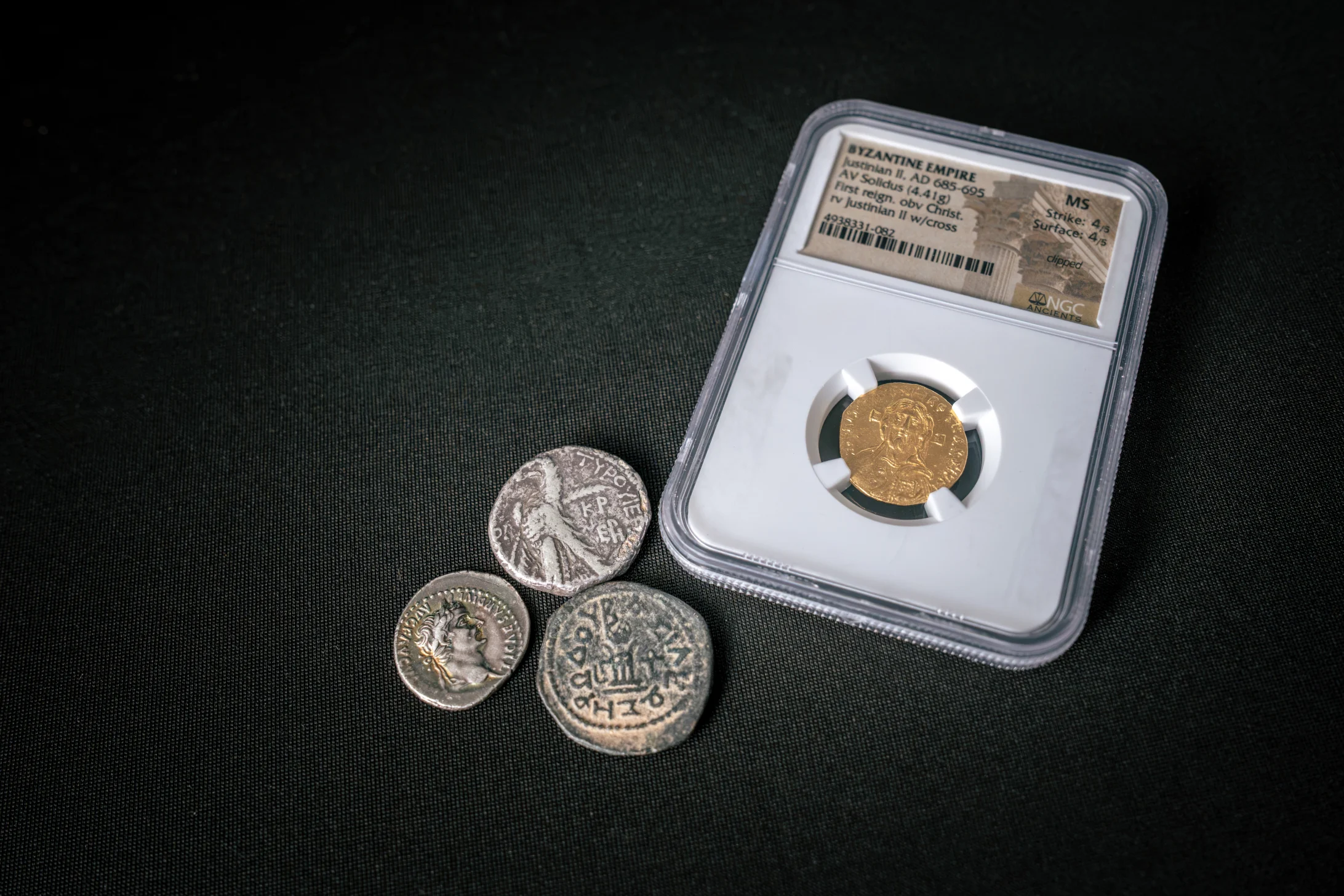
The Texan scholar called the Roman coin 'the coolest thing in the world,' writing in his book that it was 'the first state-issued portrait of Christ to circulate as currency.'
He writes: 'Coins are tiny sermons. They are mass-produced, transportable, and unforgettable. They crystallize a creed in metal.'
The gold piece was created under the Emperor Justinian II, a devout Christian who ruled from 685 to 695 AD and again from 705 to 711 AD.
Christianity had become the official religion of the Roman Empire in 313 AD.
Johnston says the coin marks the first time the emperor himself is not depicted on the coin.
'The front bears the face of Jesus Christ and the reverse shows the emperor calling himself "Servant of Christ,"' writes Johnston. 'It is difficult to overstate how audacious this was.'
And he agrees with the late Alan Whanger, a Duke University professor who died in 2017, that the coin's image bears direct correlation to the Turin Shroud.
Whanger, quoted by Johnston, said he found 'massive evidence that the coin image is an extraordinarily accurate reproduction of the Shroud face, which could only have been accomplished by the artist die cutter looking directly at the Shroud face as the model for the coin.'
The coin alone is evidence of early Christianity. But it is hard to see why Johnston believes the coin reinforces historical fact.
Yet he argues that the two elements - the shroud and the coin - combine to show that the Bible was a historical text, rather than a collection of parables.
The Palatine Graffiti
Johnston also seizes on ancient Roman graffiti - or graffito, as it is known in the singular form - as yet more evidence of the Bible as historical fact.
He writes about a carving in a wall, created around 200 AD and discovered in 1857. The carving shows a man being crucified, with the head of a donkey on his body. The mocking caption, in ancient Greek, reads: 'Alexamenos worships his God.'
Wikimedia Commons
For Johnston, this finding is more evidence that the Scriptures are an accurate record depicting history, though it's never entirely clear how his conclusion that the image created approximately 200 years after Jesus' death, proves it.
'He has the head of a jackass, if you will,' Johnston told the Daily Mail.
Bridgeman via Getty Images
'They were mocking the Christian movement, and this is in the Second Century, and by mocking it, they only prove that the Bible stands true: that the best established fact in the ancient world is that Jesus died by Roman crucifixion at the hands of Pontius Pilate under the Emperor Tiberius Caesar on Friday April 3rd AD 33.'
Reuters
The Dead Sea Scrolls
Perhaps Johnston's greatest enthusiasm is reserved for the Dead Sea Scrolls, which he told the Daily Mail were 'the most astounding Biblical discovery of all time.'
The thousands of parchment and papyrus fragments were found hidden in a series of caves 13 miles east of Jerusalem by a Bedouin shepherd in 1947.
The documents, believed to have been created between the third century BC and 70 AD, are a series of letters, calendars and descriptions of rituals for worship.
AFP via Getty Images
About 230 of the manuscripts are referred to as 'biblical scrolls,' according to the Israel Antiquities Authority, and these texts are now part of the Hebrew Bible.
For Johnston, the fact that the scrolls are an almost contemporary telling of the Bible proves that it was a historical document, and not a 'fairytale,' which evolved over time. Scrolls predicting Christ's birth – and his crucifixion – support this reading of the tome.
'It confirms the reliability of the Bible, the prophecy predictions of the Messiah as well, and it shows that our text is stable,' he told the Daily Mail.
RELATED
9 Biblical Structures Science Still Can’t Explain
New DNA Study Stuns Scientists — The Shroud of Turin, Jesus' Blood & the Mystery of the Crucifixion
The Jesus Discoveries: The PROOF Of Christ with Dr. Jeremiah Johnson | Blurry Creatures
NASA has revealed a stunning image of a giant 'cosmic smile' created by the warping of spacetime.
This bizarre portrait was captured by NASA and the European Space Agency using the Hubble Space Telescope.
It shows the galaxy cluster SDSS J1038+4849, located 4.5 billion light-years from Earth in the constellation Ursa Major.
Strangely, you can clearly make out two glowing orange eyes, a white button nose, and a broad sparkling smile stretching across a vast expanse of space.
NASA explains: 'In the case of this "happy face", the two eyes are very bright galaxies, and the misleading smile lines are actually arcs caused by an effect known as strong gravitational lensing.'
Galaxy clusters are some of the most massive objects in the universe, containing hundreds of individual galaxies, and exert such a powerful gravitational pull that it warps spacetime around them.
This effect, originally predicted by Albert Einstein, means that light from distant objects bends as it passes through an optical lens.
In some rare cases, that creates a brilliant circle known as an Einstein Ring that can look just like a glowing celestial grin.
NASA has revealed a stunning image of a giant 'cosmic smile' created by the warping of spacetime
According to Einstein's theory of relativity, objects with enough mass can warp and stretch the fabric of spacetime around them – like a bowling ball on a trampoline.
When light enters these warped regions, it follows the curve of spacetime so that it appears to bend.
While this happens on a small scale around smaller objects like planets and suns, the more massive the object, the more dramatically light is bent.
Around some of the most massive objects in the universe, that effect is so strong it can be seen through our telescopes as gravitational lensing.
Einstein rings, like the one that makes this cosmic smile, are a special case of gravitational lensing produced when a distant light source is perfectly aligned with a powerful gravitational lens and the observer.
This precise alignment allows the light to bend symmetrically around the massive source of gravity to appear as a ring-like structure.
Gravitational lensing doesn't always produce such perfect illusions, and the results vary depending on how the object, lens, and observer line up.
Just like glasses lenses, strong gravitational fields can warp or magnify passing light, even producing multiple images of a single object.
The gravitational pull of extremely massive objects, such as galaxy clusters like MACS0416 (pictured), warps and stretches spacetime around them
Bent spacetime causes light to curve around massive objects, sometimes producing multiple distorted images of a distant object. In this image, the light of a distant supernova has been split into four images, in an effect known as an Einstein Cross
Gravitational lensing occurs when a massive galaxy or cluster of galaxies bend the light emitted from a more distant galaxy.
This forms a highly magnified, though much distorted image.
This is because massive objects bend the spacetime around them, making light travel in a different path.
This theory was first proposed by Einstein in his theory of General Relativity.
In 2014, for example, astronomers used the Hubble Space Telescope to look at the galaxy cluster MACS J1149.6+2223, located about five billion light-years from Earth.
With the additional mass of a huge galaxy embedded in the cluster, light coming from an exploding star known as Supernova Refsdal, about 9.3 billion light-years away, was warped and stretched.
Gravitational lensing created four identical copies of the supernova arranged around the galaxy, creating a structure known as an Einstein Cross.
Rings and lensing effects like these were critical in proving that Einstein's theories about spacetime were actually correct.
However, they are now helping astronomers to probe the most distant reaches of the universe.
One possibility astronomers are now exploring is using gravitational lensing to measure the mass of stars.
If they know where a distant bright object should appear, astronomers can look past the edge of a star and measure how much the light is being bent.
Scientists use gravitational lensing to look at light from extremely distant objects, such as Earendel (pictured), the most distant star ever observed at 12.9 billion light-years from Earth
This method was first used in 2023 to measure the mass of a single, isolated white dwarf, revealing that it was 56 per cent as large as our sun.
Because gravitational lensing can amplify light from distant objects, it also allows space telescopes to see much further than they normally would be capable of.
Known as Earendel, this is the most distant single star ever observed, and its light started travelling towards Earth when the universe was less than one billion years old.
In 1905, Albert Einstein determined that the laws of physics are the same for all non-accelerating observers, and that the speed of light in a vacuum was independent of the motion of all observers - known as the theory of special relativity.
This groundbreaking work introduced a new framework for all of physics, and proposed new concepts of space and time.
He then spent 10 years trying to include acceleration in the theory, finally publishing his theory of general relativity in 1915.
This determined that massive objects cause a distortion in space-time, which is felt as gravity.
At its simplest, it can be thought of as a giant rubber sheet with a bowling ball in the centre.
Pictured is the original historical documents related to Einstein's prediction of the existence of gravitational waves, shown at the Hebrew university in Jerusalem
As the ball warps the sheet, a planet bends the fabric of space-time, creating the force that we feel as gravity.
Any object that comes near to the body falls towards it because of the effect.
Einstein predicted that if two massive bodies came together it would create such a huge ripple in space time that it should be detectable on Earth.
It was most recently demonstrated in the hit film film Interstellar.
In a segment that saw the crew visit a planet which fell within the gravitational grasp of a huge black hole, the event caused time to slow down massively.
Crew members on the planet barely aged while those on the ship were decades older on their return.
A UFO researcher who spent more than four decades investigating mysterious objects near U.S. nuclear weapons facilities has made an extraordinary claim that non-human entities can move themselves and abducted humans through solid walls, closed doors, and windows as if these physical barriers do not exist.
Robert Hastings, the author of UFOs & Nukes, believes the process might involve an unknown quantum phenomenon, although he admits that he does not understand how such technology would work. What makes his account even stranger is that Hastings claims he has personally experienced repeated alien abductions, while several military veterans he interviewed during his investigations have reported similar encounters.
During a March 2025 interview on The Good Trouble Show with Matt Ford, Hastings discussed his experiences with alleged non-human intelligences, including an encounter in which he woke up to find a small, Grey-type entity standing beside his bed. He also described the experience of former U.S. Air Force officer Robert Salas, who claimed that mysterious beings levitated him through a closed bedroom window and took him aboard a spacecraft in 1985.
Hastings insists that such encounters are physical events rather than psychological fantasies or delusions, although no independently verified scientific evidence has established that these abductions occurred.
His book, UFOs & Nukes: Extraordinary Encounters at Nuclear Weapons Sites, examines incidents reported at bases such as Malmstrom, Minot, F.E. Warren, Ellsworth, and Vandenberg. The accounts include objects allegedly hovering over missile silos, interference with military communications, and nuclear weapons systems becoming temporarily inoperable during reported UFO activity.
One of the best-known cases involves Malmstrom Air Force Base in Montana, where ten Minuteman nuclear missiles assigned to Echo Flight unexpectedly went offline on March 16, 1967. Military documents confirm that the missiles experienced a significant technical failure, but the suggestion that a UFO caused it comes from witness accounts and remains disputed.
Former Air Force officers, including Robert Salas, have also described a separate incident involving Oscar Flight, where a reddish, unidentified object was reportedly observed near a missile launch control facility around the time of additional missile problems. Hastings has spent years collecting testimony relating to these incidents and believes the repeated reports suggest that unidentified objects have shown an unusual interest in humanity’s most destructive weapons.
On September 27, 2010, Hastings helped organize a press conference at the National Press Club in Washington, D.C., where seven former Air Force personnel publicly discussed UFO incidents involving nuclear weapons. The event attracted attention because the witnesses had served in positions connected with highly sensitive military facilities, although their testimony did not independently establish extraterrestrial involvement. Hastings believes some of the alleged incidents suggest that unknown objects were capable of interfering with missile systems, raising questions about the security of weapons designed to operate under extremely strict military control.
There have also been reports of unusual experiences at nuclear weapons facilities that go beyond conventional UFO sightings. An anonymous Reddit user known as BumblebeeExpensive claimed to have worked for six years at a now-closed nuclear weapons storage depot in Nevada. The individual described witnessing unexplained lights, an unidentified figure apparently disappearing from the roof of a structure, strange sounds, and three mutilated donkeys reportedly discovered near the installation.
For Hastings, however, the mystery eventually became deeply personal. He explained that in August 1988, he went camping with approximately 15 people in the mountains near Albuquerque, New Mexico. Something happened that night which convinced him that he and two other members of the group had been abducted by non-human entities. He did not provide a detailed reconstruction of the alleged abduction in the interview, but said the experience shocked him because he had never expected to become personally involved in the phenomenon he had spent years investigating.
At the time, Hastings was already familiar with alien abduction research by figures such as Budd Hopkins and Harvard psychiatrist John Mack. Nevertheless, he said that reading about such accounts was entirely different from believing he had experienced one himself.
According to Hastings, the encounters continued through the late 1980s, the 1990s, and into the following decades. He decided not to discuss them publicly because he feared that admitting to alien abductions would damage his credibility and undermine his ongoing work with military veterans who had reported UFO encounters at nuclear weapons sites.
That decision began to change after Hastings was diagnosed with a serious heart condition in 2017. He explained that his uncertain health made him reconsider whether he wanted to leave his personal experiences undisclosed. Hastings subsequently learned that his colleague Robert Jacobs, a former Air Force officer associated with the famous Big Sur UFO incident, also claimed to have experienced alien abductions. The two researchers collaborated on the 2019 book Confession: Our Hidden Alien Encounters Revealed, in which they described experiences they believed involved physical contact with non-human beings.
One of Hastings’ most disturbing alleged encounters occurred on December 31, 2014. He says he woke from a deep sleep and raised his head from the pillow, only to discover a strange figure standing at the foot of his bed. The entity was approximately four feet tall, with a large, bulbous head and an extremely thin body. Hastings could see only its silhouette, illuminated by light coming from a nearby bathroom, and could not make out its facial features. Nevertheless, he believed it resembled the beings commonly described in alien abduction accounts as Greys.
Hastings recalled that he was about to scream because he believed the entity was preparing to take him somewhere. He associated the situation with previous experiences he interpreted as abductions, but before he could react, his next awareness was of lying back on his pillow with bright sunlight entering the room.
Several hours appeared to have passed, and he had no clear memory of what happened during that interval. Hastings said that, as far as he could recall, this was his last such experience, although he could not rule out the possibility of events he no longer remembered.
His personal encounters are only one part of the story. In the 2025 interview, Hastings said that seven of the 167 military veterans he considered his principal UFO research sources had also reported experiences they interpreted as alien abductions. Among them were Robert Salas and Robert Jacobs, both connected with well-known military UFO cases.
Salas described an alleged abduction that occurred in California in 1985, nearly two decades after his reported involvement in the Malmstrom missile incidents. According to Hastings, Salas was lying in bed with his wife when the bedroom suddenly filled with a bright blue light. As Salas attempted to sit up and investigate, he found himself unable to move. Small figures allegedly entered the room, lifted him from the bed, and carried him toward a closed window, through which he claims he was transported without the glass being broken or physically opened.
Hastings said Salas was subsequently taken aboard a craft and subjected to a painful physical examination before being returned to bed. Salas publicly discussed his abduction account in 2013, although parts of his recollection had also been explored through hypnosis, a method that cannot reliably establish whether recovered memories describe real events. Hastings nevertheless considers the account significant because similar descriptions of people passing through solid objects appear in other alleged abduction cases.
Explaining how such an event might be possible, Hastings suggested that an unknown quantum phenomenon could be involved. He believes some entities can move through walls, doors, and windows while also transporting human beings through these barriers. Quantum physics does describe unusual behavior at microscopic scales, including quantum tunneling, in which particles can pass through barriers that classical physics would normally prevent them from crossing.
Another account Hastings discussed involves former Air Force security policeman Mario Woods, who was stationed at Ellsworth Air Force Base in South Dakota in 1977. Woods claimed that he and a fellow security officer responded to an alarm at a Minuteman missile site and encountered an enormous spherical object hovering at a low altitude.
According to Hastings, Woods described the object as being approximately the size of a large department store, and both men allegedly experienced a sensation of suffocation inside their vehicle. Woods later described seeing small shadowy figures, while additional alleged abduction details emerged during hypnosis. Hastings acknowledged that he could not explain why certain military personnel reported such experiences or whether their presence at nuclear facilities was connected.
The number of military abduction accounts collected by Hastings increased in 2025 following his correspondence with former Air Force security policeman Richard L. Barth. On November 16, 2025, Hastings published a detailed account of Barth’s alleged encounter, which reportedly occurred at Vandenberg Air Force Base in September 1964.
Hastings said Barth contacted him in October 2025 after watching an earlier interview, and provided a military discharge document confirming that he had served at Vandenberg with the 4392nd Combat Defense Squadron. The records supported Barth’s military assignment, although they did not independently verify his claimed encounter.
Barth stated that he was guarding an unarmed Minuteman missile being prepared for a future test launch when he noticed a human-shaped figure approaching through dense fog around 2 a.m. The figure appeared to be dressed in military clothing, including a raincoat and garrison cap.
As it approached, Barth reportedly felt that something was entering his mind and taking control of his body. He attempted to reach for his pistol but discovered that his arm would not move. Terrified, he retreated into the small guard shack before apparently losing consciousness.
When Barth regained awareness, he claimed to be inside a dark room with an opening in the floor through which he could see another missile installation from above. He described four small beings sitting nearby, with large heads, large eyes, and short necks. The figures seemed to be observing him, but he could not clearly distinguish their features. Barth later recalled finding himself back inside the guard shack, resting with his head on the lap of a human-looking figure that allegedly communicated with him telepathically.
According to Barth, the entity apologized for frightening him and explained that its group was gathering information about nuclear missile installations because it wanted to prevent humanity from destroying the planet in a nuclear war. The most extraordinary part of the alleged message concerned the existence of multiple non-human species operating on Earth. Barth claimed he was told that some were less benevolent than others and that an agreement among these groups restricted their interference in human affairs unless humanity threatened the planet’s survival.
Following Barth’s account, Hastings updated his research figures, stating that among 169 military veterans he had interviewed about UFO incidents involving nuclear weapons systems, eight had also reported abduction experiences. This is an increase from the 167 principal sources and seven alleged abductees he mentioned in his March 2025 interview.
Hastings also noted that two veterans had independently described human-looking figures in military-style uniforms apparently working alongside beings resembling Greys. These are separate witness accounts rather than independently established encounters, but Hastings believes their similarities warrant further investigation.
On March 11, 2026, Barth and Hastings appeared together on The Good Trouble Show, where they discussed the alleged Vandenberg encounter, telepathic communication, and the reported warning about nuclear war. The discussion returned to the same question Hastings has pursued for decades: why have so many UFO reports involved locations connected with nuclear weapons, and why have some of the individuals stationed at these facilities later reported encounters with non-human entities?
Hastings’ interests have also expanded beyond traditional spacecraft sightings and humanoid abduction accounts. In June 2026, he published an article concerning reports of luminous, plasma-like objects that witnesses believed were intelligent. One woman, identified under the pseudonym Amanda, described a reddish-orange glowing orb that allegedly communicated directly with her mind during an encounter in 1992.
Hastings said he was collecting similar reports for a new book, Strange Encounters: The Spectrum of Alien Contact with Humans, which would examine encounters involving different alleged types of extraterrestrial or interdimensional entities.
Hastings acknowledges that many people who accept military UFO reports remain unwilling to consider alien abductions as part of the same phenomenon. He argues that dismissing such experiences overlooks an important part of the accounts collected from military witnesses, including individuals who worked around nuclear weapons.
While the physical reality of these extraordinary claims remains unproven, Hastings maintains that the accounts cannot be separated from his wider investigation into the relationship between UFOs and nuclear weapons.
Whetherartificial intelligence(AI) can truly be conscious remains a subject of intense debate. However, a new study from Ludwig Maximilian University of Munich (LMU) reveals an intriguing distinction: People are willing to describe AI as awareof its surroundings, but remain reluctant to consider it conscious, even when its behavior is indistinguishable from that of a human.
The study, led by Dr. Louis Longin from LMU’s Chair of Philosophy of Mind, alongside Dr. Bahador Bahrami, Professor Ophelia Deroy, and other collaborators, was published in the journal Cognition.
“Whereas previous studies have typically asked general questions about whether AI actually has mental states, our study is the first to directly compare how people attribute the same mental states to AI and humans behaving in the same way, under identical circumstances,” Longin said in a statement.
“We may be using mental terms to refer to AI, but this may only be because we lack better words,” says Ophelia Deroy, a philosopher and a senior author of the study. “After all, AI is trained to act and speak like a human, so these descriptions seem natural,” she adds.
The Experiment
In their study, the research team sought to understand how people attribute awareness and consciousness to AI compared with humans, testing nearly 1,100 participants, asking them to evaluate the awareness of artificial agents or humans described in scenarios involving reactions to sounds and other people’s emotions. Participants were also asked to rate how conscious or aware the individuals or AI systems were of their surroundings.
The results suggested that the more responsive an AI system or human was to its surroundings, the more aware participants judged it to be. However, among the team’s experimental findings was that even the most responsive AI was considered less conscious than the least responsive human.
Judgments of awareness, by contrast, were similar for AI and humans.
“There is a growing worry in public discussion that people will see AI behaving in a human-like way and start treating these systems as if they had human-like mental states,” said Longin, the study’s lead author. “We found something much more nuanced: People are quite willing to say that an AI notices things and is aware of its surroundings. But they clearly draw a line when it comes to the term ‘consciousness’. People consistently attribute less consciousness to AI than humans – even when their behavior is identical.”
Aware, but Not Conscious?
“Our study teaches us lessons for how we communicate about AI,” says Bahador Bahrami, who is also a senior author of the study and an expert in social neuroscience.
“Companies and journalists often reach for hyped descriptions of AI models, and credit them with intentions, plans, or even moral conscience and hesitation,” Bahrami says. “What our study shows is that everyday judgements are much more discriminating: People do not simply put AI and humans on the same mental scale. But the boundary also depends on which terms we use. For more neutral descriptors such as ‘awareness’, the distinction can largely disappear. That makes our choice of language important.”
The study does not establish whether AI systems actually experience consciousness. Instead, it examines how humans interpret and describe the behavior of AI compared with that of other humans.
Overall, its findings suggest that people are more comfortable describing AI as “aware” than as “conscious,” even when the underlying behavior is the same. However, this raises another possibility: Could humans be projecting their own understanding of consciousness onto AI?
What is Consciousness?
Defining consciousness has long challenged philosophers and scientists, particularly when attempting to distinguish between human awareness and the increasingly sophisticated behavior of artificial intelligence.
Julia Mossbridge, a neuroscientist, Senior Distinguished Fellow in AI, Mind and Society at Florida Atlantic University, and co-author of Transcendent Mind: Rethinking the Science of Consciousness (2017), told The Debrief that the difficulty lies partly in the absence of a universally accepted definition of consciousness.
“If by consciousness we mean a self-based structure (like the ego) that relates to the contents of awareness, as Jung thought, then the difference between AI consciousness and human consciousness has three parts: differences in what the ego might be made out of (mental stuff for humans vs. math for AI), differences in what the contents of awareness might feel like (sensory experiences for humans vs. motivations for AI), and differences in the relationship between the ego and the contents of awareness (driven by the unconscious for humans vs. driven by code for AI).”
Mossbridge points to research examining different definitions of consciousness, including one that focuses on observable behavior.
“Imants Baruss, my co-author on Transcendent Mind, did a meta-analysis of the different definitions of consciousness — in the end, he found five of them. One was the sense of “awareness” used here — he called it ‘behavioral consciousness,’ meaning that something or someone looks (from the outside) as if it is aware of its environment.
“When we see an ant walk around a puddle, we say to ourselves, ‘That ant is aware of the puddle and is avoiding it.’ I think this is the kind of consciousness people feel comfortable attributing to machines, because it’s easy to imagine how it works,” Mossbridge adds.
Meanwhile, some argue that the debate over AI consciousness may be influencing how humans understand their own minds.
“For me, the main tension is not necessarily whether AI is conscious on its own merits; it’s that we seem to need to reduce and devalue human consciousness to fit AI into a narrow (and suspiciously convenient) model of what it means to be conscious,” said Peter John, a Toronto-based existential educator, philosophical consultant, and mentor who explores questions of meaning, identity, consciousness, and psychology through his philosophical platform Yepicurus,
“So in this sense, yes, we are projecting, and not just projecting—but shaping the landscape to lend credibility to the claim that AI is conscious,” John told The Debrief in an email. “And it’s understandable why people resist this. They may see it as an incursion into the last frontier that is truly sacred: that we are beings, not things.
“Things can be clever, but only beings can have subjective experience. ‘Awareness’ itself is a concession because it may imply subjective experience, but it may be less intuitively offensive to people than saying consciousness.”
Ultimately, the debate raises a more fundamental question: How can we determine whether AI is conscious when we have yet to reach a universally accepted definition of consciousness itself? While the new findings reveal how people distinguish between awareness and consciousness in machines, they also highlight the limitations of our understanding of both.
Chrissy Newton is a PR professional and the founder of VOCAB Communications. She currently appears on The Discovery Channel and Max and hosts the Rebelliously Curious podcast, which can be found on YouTube and on all audio podcast streaming platforms. Follow her on X: @ChrissyNewton, Instagram: @BeingChrissyNewton, and chrissynewton.com. To contact Chrissy with a story, please email chrissy @ thedebrief.org.
RELATED
What Is Consciousness — Can AI Be Conscious? | Panel Discussion at UT Austin
Is AI Already Conscious? (FULL EPISODE)
Claude Just Crossed The Consciousness Line And Anthropic Admitted It
The Shipwreck in the Atlantic That May Not Be the Titanic
In 1911, the Olympic was the largest ship in the world, until a collision with a Navy cruiser damaged its hull and reportedly bent its keel. Its owner, J. P. Morgan, faced a costly repair bill and struggled to find anyone willing to cover the damage.
But the Olympic had an almost identical sister ship sitting unfinished in a Belfast shipyard: the Titanic. According to the theory, the two ships were secretly switched over an empty weekend, and the insurance coverage on the supposedly damaged vessel was increased to $12.5 million.
Morgan cancelled his suite aboard the Titanic, as did dozens of his associates. Meanwhile, three of the wealthiest men in America, John Jacob Astor IV, Isidor Straus, and Benjamin Guggenheim, were invited and boarded the ship and died during its sinking.
It is worth noting that these three men are often portrayed in theories as standing between Morgan and the creation of a central bank. Morgan was one of the most influential bankers in the United States, and the financial system in which he operated played a significant role in creating political pressure for banking reform. In the aftermath of the disaster, the theory suggests, the removal of these alleged opponents helped clear the way for the establishment of the U.S. Federal Reserve (the Fed).
The Why Files examines persistent historical theories surrounding the Titanic disaster of April 15, 1912. This investigation explores long-standing allegations of insurance fraud, a possible vessel switch, and the hidden motives of powerful financiers, examining the evidence to determine how much truth lies behind these enduring maritime mysteries.
RELATED
The Latest Titanic Wreck Footage Has Scientists Concerned
Mapping Every Famous Shipwreck in History | 1545–2026
The Titanic Wreck Was Re-analyzed by AI - What It Found Changes Everything
A wife and mother inCalifornia claims that a murder plot by her husband led to a divine encounter with the Holy Spirit that changed her perception of heaven.
Ana Christina told the Daily Mail she filed for divorce from her husband, 'Sam,' in December 2008 but had forgotten to cancel her million-dollar life insurance policy.
Ana Christina, who changed her and her children's names to protect their identities, believed this was the motivation that drove Sam to attempt to kill her weeks later.
Before moving out of their Irvine, California home, Sam allegedly began lacing Christina's coffee with rat poison, which caused her to grow increasingly sick until she woke up paralyzed on January 9, 2009.
As she lay sick, Ana Christina, who was 49 at the time, said Jesus arrived in the bedroom to escort her spirit into the afterlife, reuniting her with her late sister Nadia in heaven. Nadia had died by suicide at the age of 35.
Seeing her sister was like a sigh of relief, as Christina had always wondered where Nadia would end up because of the church's teachings about suicide.
'Because at church, they tell you [if] you commit suicide, it's a sin, it's an unforgivable sin, and I discovered that it's not,' said Christina.
Christina claims that when she returned from the afterlife hours after the attack began, she was miraculously cured of the poisoning. This shocked Sam, she said, and motivated him to quickly flee the US after police chose not to investigate her claims.
Ana Christina told the Daily Mail she returned from what she considered the afterlife healed after she was allegedly poisoned by her ex-husband
'I believe it's a blessing in disguise that he just left the country,' Christina told the Daily Mail.
'Because if he had done time for an attempted murder... he would have gotten about 10 years. And then, he would be out in the streets, taking revenge. But him fleeing the country and being away, I don't have to live watching my back.'
Christina was the breadwinner of the family when she and Sam agreed to amicably divorce in 2008.
However, Sam was the beneficiary of the life insurance policy Christina forgot to cancel when they filed the paperwork to end their marriage.
While Sam stayed in their home for three more weeks while the divorce was finalized, Christina claimed he began to slip rat poison into her coffee, causing her to gradually become deathly ill.
'I believe he started putting it in my coffee every day. Little by little, that's how I didn't notice, and that's when my body started to break down. I started getting sick, and I had to stay at home for a long time,' Christina said.
After receiving a call in early January 2009 that her brother overseas had fallen ill, Christina booked a flight for an extended visit, but she alleged that before she could leave, Sam prepared her favorite meal and laced it with a massive dose of poison.
Christina said she met her late sister (left) who had died by suicide in the afterlife, changing her view on what the Christian faith teaches about self-harm
By that night, Christina said the poison left her fully paralyzed in bed, comparing the pain she felt in her body to a sledgehammer breaking her bones.
That is when she said she heard a clear divine voice, telling her she was dying but this would not be the end.
She claimed that Sam found her in the bedroom the next morning unable to move, powerless to stop him from forcing Xanax down her throat through her locked teeth.
As Christina said she felt her body die while being suffocated, she told the Daily Mail it was like removing a heavy coat as her spirit left her body on the floor.
There was no darkness or sense of an ending, Christina continued, revealing that she then saw Jesus, who extended his hand to escort her into the afterlife.
Later she was reunited with her parents and Nadia.
'You know, God is a very compassionate God, a very loving God that understands what we go through and does not judge us the way we judge each other. He's a very compassionate Lord, and he knew what Nadia was going through,' Christina said.
Christina (left) claimed she also encountered her mother (right) during her near-death experience
Her family urged her toward a banquet she had seen in the afterlife, but she said she would be pulled back to Earth before she could join them.
Still in shock, Christina claimed she could not speak but used hand gestures to signal to Sam that she knew what he had tried to do.
'The look on his face was just priceless. You can just imagine. This man thought he finished me off. I'm done. I think it took him about eight hours to finish me off, and here I am, as strong as a horse in front of him,' Christina recalled.
Christina revealed that she and her children have moved on from the incident, and Sam left the US within a year of the alleged attack and their divorce.
Although she was a Christian before her near-death experience, she said the experience completely changed her relationship with God.
'I was actually a born-again Christian before my encounter. But I was nothing like what I am now,' Christina explained.
Her experience even spurred her to set up her own ministry in Africa, with all the proceeds of the book she wrote about her encounter, My Sweet Encounter With Death, going to support that church.
Christina's claims about the incident were met with skepticism, even from her own children, leading authorities to side with Sam and call for a psychiatric evaluation for his alleged victim.
Christina said the near-death experience was a blessing. Her ex-husband fled the country, allowing her and her daughters to carry on with their lives
However, two months after her January 2009 near-death experience, Christina said she underwent a full forensic hair analysis that found dangerously high levels of the rat poison ingredient barium in her body.
The levels were up to 2,700 times higher than the medically safe limit, she said. Christina believed God left that amount in her body as a sign that her claims were factual.
Christina said she took the results to the Irvine Police Department, asking them to open an investigation, but was turned away.
The Irvine Police Department has told the Daily Mail it is looking into the circumstances that led detectives not to pursue the case.
RELATED
Near Death Experience: Poisoned to Death by Husband..Then Meets Jesus in Heaven!
Poisoned to Death - She Sees Jesus, Angels, Abraham & A Freaky Dude
Meer van UFO'S of UAP'S, ASTRONOMIE, RUIMTEVAART, ARCHEOLOGIE, OUDHEIDKUNDE, SF-SNUFJES EN ANDERE ESOTERISCHE WETENSCHAPPEN - DE ALLERLAATSTE NIEUWTJES


 The Perseverance Rover Reaches Another Milestone