The Shipwreck in the Atlantic That May Not Be the Titanic

The Shipwreck in the Atlantic That May Not Be the Titanic
RELATED
The Shipwreck in the Atlantic That May Not Be the Titanic
RELATED
EXCLUSIVE - I was secretly poisoned by my husband and died. Then I met Jesus and made a shocking discovery in heaven
A wife and mother in California claims that a murder plot by her husband led to a divine encounter with the Holy Spirit that changed her perception of heaven.
Ana Christina told the Daily Mail she filed for divorce from her husband, 'Sam,' in December 2008 but had forgotten to cancel her million-dollar life insurance policy.
Ana Christina, who changed her and her children's names to protect their identities, believed this was the motivation that drove Sam to attempt to kill her weeks later.
Before moving out of their Irvine, California home, Sam allegedly began lacing Christina's coffee with rat poison, which caused her to grow increasingly sick until she woke up paralyzed on January 9, 2009.
As she lay sick, Ana Christina, who was 49 at the time, said Jesus arrived in the bedroom to escort her spirit into the afterlife, reuniting her with her late sister Nadia in heaven. Nadia had died by suicide at the age of 35.
Seeing her sister was like a sigh of relief, as Christina had always wondered where Nadia would end up because of the church's teachings about suicide.
'Because at church, they tell you [if] you commit suicide, it's a sin, it's an unforgivable sin, and I discovered that it's not,' said Christina.
Christina claims that when she returned from the afterlife hours after the attack began, she was miraculously cured of the poisoning. This shocked Sam, she said, and motivated him to quickly flee the US after police chose not to investigate her claims.

Ana Christina told the Daily Mail she returned from what she considered the afterlife healed after she was allegedly poisoned by her ex-husband
'I believe it's a blessing in disguise that he just left the country,' Christina told the Daily Mail.
'Because if he had done time for an attempted murder... he would have gotten about 10 years. And then, he would be out in the streets, taking revenge. But him fleeing the country and being away, I don't have to live watching my back.'
Christina was the breadwinner of the family when she and Sam agreed to amicably divorce in 2008.
However, Sam was the beneficiary of the life insurance policy Christina forgot to cancel when they filed the paperwork to end their marriage.
While Sam stayed in their home for three more weeks while the divorce was finalized, Christina claimed he began to slip rat poison into her coffee, causing her to gradually become deathly ill.
'I believe he started putting it in my coffee every day. Little by little, that's how I didn't notice, and that's when my body started to break down. I started getting sick, and I had to stay at home for a long time,' Christina said.
After receiving a call in early January 2009 that her brother overseas had fallen ill, Christina booked a flight for an extended visit, but she alleged that before she could leave, Sam prepared her favorite meal and laced it with a massive dose of poison.

Christina said she met her late sister (left) who had died by suicide in the afterlife, changing her view on what the Christian faith teaches about self-harm
By that night, Christina said the poison left her fully paralyzed in bed, comparing the pain she felt in her body to a sledgehammer breaking her bones.
That is when she said she heard a clear divine voice, telling her she was dying but this would not be the end.
She claimed that Sam found her in the bedroom the next morning unable to move, powerless to stop him from forcing Xanax down her throat through her locked teeth.
As Christina said she felt her body die while being suffocated, she told the Daily Mail it was like removing a heavy coat as her spirit left her body on the floor.
There was no darkness or sense of an ending, Christina continued, revealing that she then saw Jesus, who extended his hand to escort her into the afterlife.
Later she was reunited with her parents and Nadia.
'You know, God is a very compassionate God, a very loving God that understands what we go through and does not judge us the way we judge each other. He's a very compassionate Lord, and he knew what Nadia was going through,' Christina said.

Christina (left) claimed she also encountered her mother (right) during her near-death experience
Her family urged her toward a banquet she had seen in the afterlife, but she said she would be pulled back to Earth before she could join them.
Still in shock, Christina claimed she could not speak but used hand gestures to signal to Sam that she knew what he had tried to do.
'The look on his face was just priceless. You can just imagine. This man thought he finished me off. I'm done. I think it took him about eight hours to finish me off, and here I am, as strong as a horse in front of him,' Christina recalled.
Christina revealed that she and her children have moved on from the incident, and Sam left the US within a year of the alleged attack and their divorce.
Although she was a Christian before her near-death experience, she said the experience completely changed her relationship with God.
'I was actually a born-again Christian before my encounter. But I was nothing like what I am now,' Christina explained.
Her experience even spurred her to set up her own ministry in Africa, with all the proceeds of the book she wrote about her encounter, My Sweet Encounter With Death, going to support that church.
Christina's claims about the incident were met with skepticism, even from her own children, leading authorities to side with Sam and call for a psychiatric evaluation for his alleged victim.

Christina said the near-death experience was a blessing. Her ex-husband fled the country, allowing her and her daughters to carry on with their lives
However, two months after her January 2009 near-death experience, Christina said she underwent a full forensic hair analysis that found dangerously high levels of the rat poison ingredient barium in her body.
The levels were up to 2,700 times higher than the medically safe limit, she said. Christina believed God left that amount in her body as a sign that her claims were factual.
Christina said she took the results to the Irvine Police Department, asking them to open an investigation, but was turned away.
The Irvine Police Department has told the Daily Mail it is looking into the circumstances that led detectives not to pursue the case.
NASA astronaut cites biblical warning as proof that UFOs are 'demonic'
A former NASA astronaut has issued a chilling claim that UFOs are demonic beings rather than extraterrestrials, citing a warning in the Bible as proof.
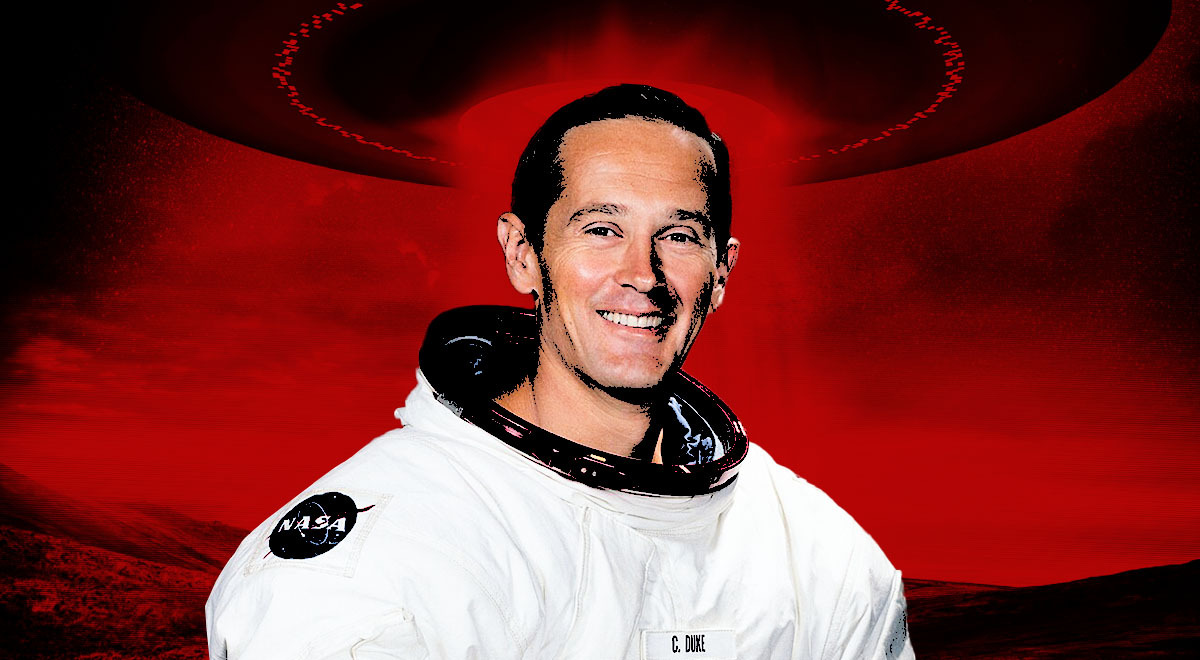
Charles Duke, who served as lunar module pilot on Apollo 16 in 1972, shared his belief with the Christian Broadcasting Network (CBN), pointing to 2 Corinthians 11:14 in the Bible.
'The Lord says what we're seeing is real, but the devil can appear as an angel of light, the Bible says,' Duke said.
He claimed UFOs were drawing people away from their faith and encouraging them to pursue supposed alien beings. 'UFOs are trying to turn us away from the truth,' he said. 'They're demonic.'
Duke, 91, said he had long held this belief, recalling a moment when he prayed to God for a sign to confirm his suspicions.
He asked for something specific: that a close friend, a businessman who never discussed such topics, would bring up UFOs at breakfast the following morning.
According to Duke, that is exactly what happened. 'Charlie, come on over. I want to start talking to you about UFOs,' he recalled his friend saying.
Duke interpreted the exchange as an answer to his prayer, reinforcing his belief that the phenomena have a demonic origin.

Charles Duke, who served as lunar module pilot on Apollo 16 in 1972, discussed his belief about UFOs, saying they are demonic and are leading people away from Christianity
Duke’s comments echo 2 Corinthians 11:14, which says: 'And no wonder, for even Satan disguises himself as an angel of light.'
In the surrounding passage, the Apostle Paul warns believers about false apostles and deceitful workers who present themselves as representatives of Christ.
Duke appeared to apply that warning about deceptive appearances to UFOs, suggesting that supposed extraterrestrial visitors could conceal a demonic identity and draw people away from their faith.
Religious interpretations of UFOs have also been voiced by Vice President JD Vance and conservative commentator Tucker Carlson.
Vance has said he believes in supernatural phenomena and suggested that a powerful being that harms humans could be understood as a demon, while one that helps them might be seen as an angel.
He argued that such beings could appear indistinguishable from technologically advanced extraterrestrials to a human observer.
Speaking on The Joe Rogan Experience podcast in 2024, Carlson said: 'They're from here, and they've been here for thousands of years, whatever they are.'
'And it's pretty clear to me that they're "spiritual entities,"' he continued, 'whatever that means.'

Charles Duke cited the verse that says the devil can appear as an angel of light, which he interprets as being UFOs seen in the skies

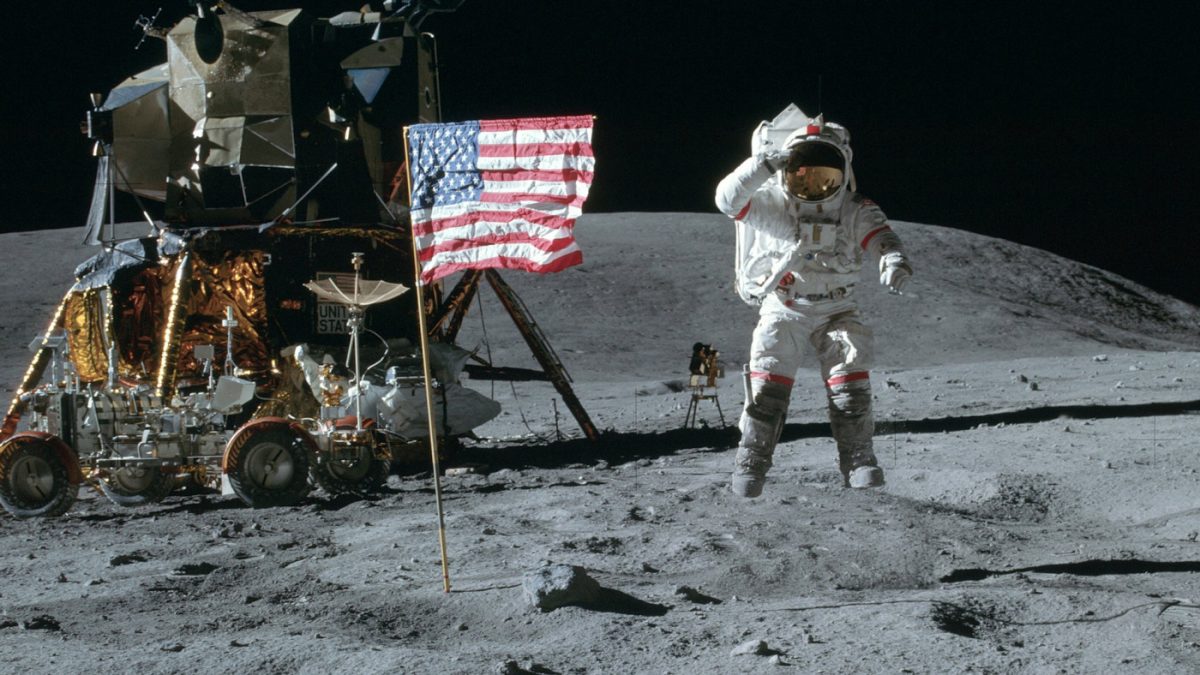
Apollo 16 was NASA's 10th crewed Apollo mission and the fifth human landing on the moon, launching on April 16, 1972, and returning on April 27, 1972. Above is Duke saluting the flag on the moon
While the belief that UFOs are demonic is gaining traction, Father Lee Taylor, who leads three churches in North Wales, told the Daily Mail that several passages of Scripture suggest the mysterious objects in our skies are better understood as non-human intelligence than demonic beings.
He pointed to Genesis' description of humanity as God's supreme creation on Earth, Ezekiel's vision of the 'wheel within a wheel,' and Jesus' statement in John 14:2 that 'in my Father's house are many rooms.'
Taylor said the Church should begin examining those passages now, arguing that Christians need to prepare theologically for the possibility of non-human intelligence before any official confirmation sparks confusion or fear.
He believes the discovery of intelligent life beyond Earth would not undermine Christianity, but instead expand humanity's understanding of God's creation.
'A bigger universe, or the discovery of a bigger universe, doesn't make God smaller,' Taylor, who has been ordained for 15 years, said. 'It just makes creation bigger.'
'I don't think it's a challenge to faith. I think it's a challenge to the limits of our theological imagination,' he added. 'I think a larger universe demands a larger theology.'
He also urged fellow Christians to reconsider the belief that UFOs are demonic, warning that it encourages people to respond with fear rather than to approach the phenomenon with an open mind.
'I don't think it's the most helpful framework for discussing an unknown phenomenon. It can encourage people to project fear or certainty onto something we don't yet understand,' Taylor said.
He argued that, if intelligent life exists beyond Earth, 'there's no reason to assume that every other form of intelligence would fit neatly into categories of absolute good or absolute evil.' Instead, he believes such beings would likely reflect the same diversity already found among humanity.
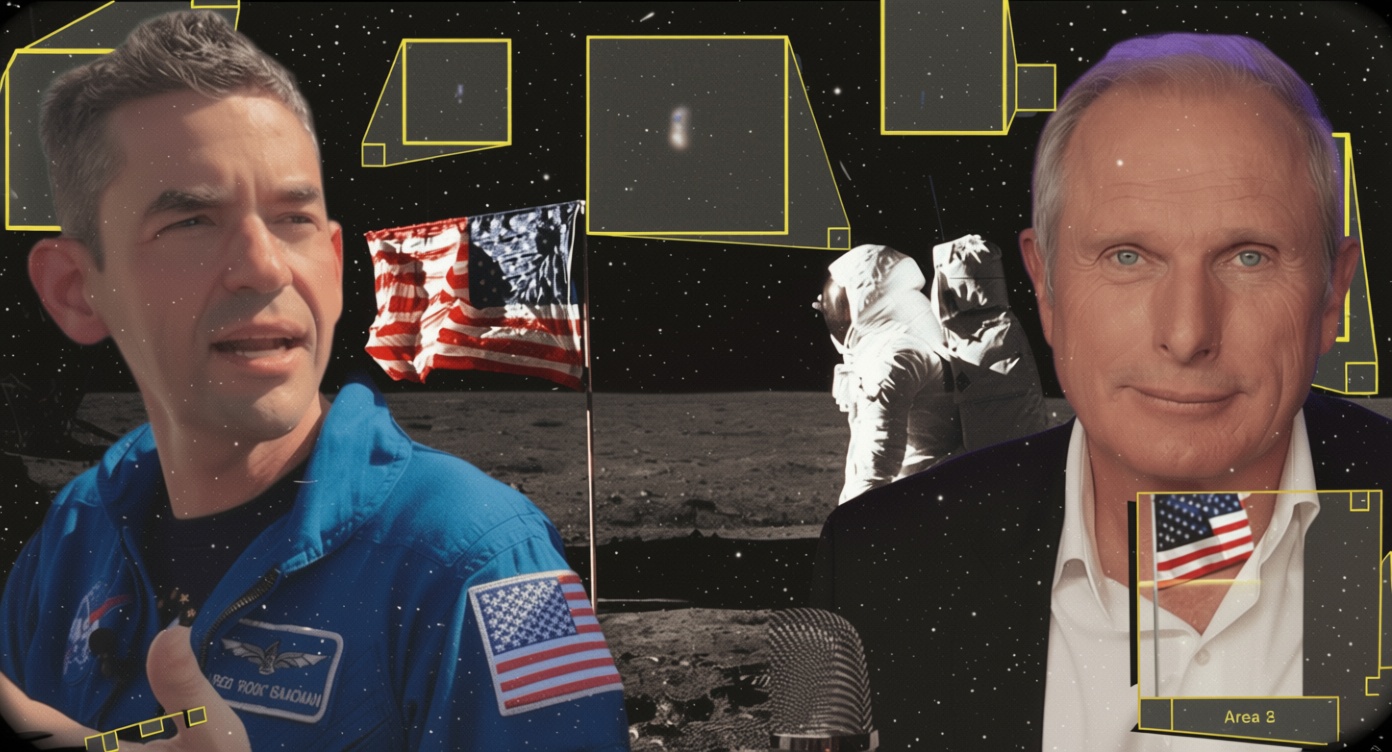
Apollo astronaut Charlie Duke believes UFOs are demonic, not alien
The devil is in the disclosure.

Former NASA astronaut Charlie Duke, with a celestial light glowing from a UFO.
Image by Cybernews.
Former Apollo 16 astronaut Charlie Duke has claimed that UFOs are demonic forces rather than extraterrestrial visitors.
Speaking to CBN News, of the Christian Broadcasting Network, Duke speculated that a UFO arrival could tamper with an individual's religious beliefs and even sway them from Christian teachings.
The former spaceman recalled one particular incident in which he prayed to God for a clear sign to confirm his suspicions, and the following morning, a close friend unexpectedly brought up UFOs during breakfast.
He described the friend as a businessman who didn’t usually bring up unusual topics.
Duke, now 91, was the lunar module pilot on NASA's Apollo 16 mission in April 1972, becoming the 10th person to walk on the Moon. He spent around 71 hours on the lunar surface.
And when it comes to the fiendish side of alien craft, Duke explained he has even voiced these beliefs on stage.
I felt like UFOs were demonic, but I was saying that at rotary clubs and stuff like that, and people were laughing me off the stage,former astronaut Charlie Duke said.
Despite these strong views, Duke said he never saw anything resembling a UFO during his career as an astronaut (1966–1975), other than strange flashes of light.
These flashes occurred when passing beyond Earth's Van Allen radiation belts.
Rather than being evidence of alien activity, the flashes are attributed to cosmic particles stimulating the astronauts' retinas, a recognized spaceflight phenomenon.
Duke invoked the biblical warning that the devil can disguise himself as an angel of light, using it to support his belief that apparent extraterrestrial encounters could be spiritual deception rather than evidence of alien life.
His views echo those of Vice President JD Vance, who, back in April, spoke of being "obsessed" with UFOs, while also claiming them to be demonic.
The UFO disclosure narrative of late has become more fanciful, with whistleblowers like David Grusch speaking out about US troops killing reptilian aliens.
Another leap was made by US Air Force veteran Dylan Borland, who speculated that extraterrestrials may focus on genes and reproduction, possibly to replace humans on Earth.
While Grusch and Borland stopped short of religious overtones, an astronaut throwing mythos into the mix suggests a battle of faith commencing, as well as one of science.
Segmented UFO Seen On Live Cam Over Rhodes International Airport, Greece, Oct 12, 2026, UAP Sighting News.
3 Mile Doorway To Underground City On Mars Found! Ancient aliens city. UFO UAP Sighting News.
2.5 Mile UFO Passes Through Our Solar System, NASA Is Mum About It, UAP Sighting News.


Wetenschappers constateren een onverwachte verschuiving van de magnetische noordpool
Bigfoot sightings across 14 US states reveal an eerie pattern sparking claims a creature is hiding nearby
An eerie pattern in thousands of reported Bigfoot sightings across the US has raised the unsettling possibility that a mysterious creature is lurking close to humans.
Independent researcher and retired police officer Bruce Champagne examined 5,834 reports across 14 states before singling out 25 accounts he believes offer the clearest evidence of an unknown creature prowling near cities and towns at night for a specific purpose.
According to Champagne, witnesses most often reported seeing Bigfoot along quiet paths, roaming up to a mile into towns and cities on winter nights.
The study described this as cautious, repeated behavior rather than random accidents on the edges of the woods.
Champagne called the alleged creature's movements: 'A pattern of rare, apparently intentional, largely solitary, nocturnal, corridor-based incursions that may be consistent with flexible decision-making.'
Bigfoot is believed to be a huge, hairy, ape-like creature, or species of creatures, that walks like a human and hides in remote forests throughout North America.
The first widely publicized modern report of Bigfoot came in 1958, when Humboldt Times journalist Andrew Genzoli published a letter from a reader describing massive, mysterious footprints found near a logging site in Bluff Creek, California.
Despite thousands of alleged sightings, eyewitness testimonies, photographs and footprint discoveries across the country, there has never been any physical evidence presented publicly that scientists have said proves the Bigfoot species exists.

The Bigfoot urban incursions were distributed across 14 US states, with the highest concentrations in Illinois, Ohio, Utah, New Jersey and Colorado

A trail of 35-45 clear, pristine footprints in Washington in 1996, shared by Jeff Meldrum, Bigfoot expert and author of Sasquatch: Legend Meets Science
Champagne focused on Bigfoot sightings that occurred at least a quarter-mile inside densely populated areas - meaning they had at least 1,600 residents per square kilometer (0.38 square miles).
The 25 accounts described large, ape-like creatures spotted at least a quarter of a mile inside towns and cities by witnesses deemed highly credible in Champagne’s analysis.
The reports spanned 14 US states, with the highest numbers coming from Illinois, Ohio, Utah, New Jersey and Colorado. Sightings peaked between 2006 and 2015, according to the research.
Champagne compared the reported behavior with that of other intelligent animals, including great apes, when they encounter humans.
He argued that the alleged creatures’ strong preference for traveling at night suggested they understood the risks of using urban walkways during the day.
'The patterning observed here suggests that urban incursions, while uncommon, are behaviorally structured events that merit further comparative and field-based investigation,' Champagne concluded.
The study found the creatures often traveled stealthily along drainage ditches and railway lines.
On average, they ventured 1.75 miles into the cities and towns they were exploring at night. However, at least one sighting found an alleged Bigfoot walked nearly eight miles into town, although the exact date and location were not revealed in the report.

Bigfoot as seen in the 1967 Patterson-Gimlin Film, which depicts a suspected Sasquatch that was spotted in Bluff Creek, California

A new study found Bigfoot sightings were more common in winter and during the night between midnight and 3am
Among other wildlife species, run-ins with humans often occur because of environmental stresses, such as animals searching for food in the winter when supplies become scarce.
Champagne suggested the same thing might be happening with Bigfoot sightings, as the creatures come out of hiding when their food sources run low during the cold, winter months.
Champagne’s research focused on accounts documented in three major databases, Oregonbigfoot.com, the Green Archive and the Bigfoot Field Researchers Organization (BFRO).
BFRO is the most widely cited and comprehensive public collection of Bigfoot reports in the US.
According to their records, which date back to 1904, Washington state has seen the most Bigfoot sightings, with more than 700 on record. California ranks second with nearly 500 sightings on record.
Champagne assessed reports on the basis of whether multiple witnesses were present, how credible the observers were, how close the witnesses allegedly got to the creature and how long the encounters lasted.
Champaign found that 36 percent of all Bigfoot encounters happened in winter, followed by autumn (27%), summer (23%) and spring (14%).
The creatures were described as 'massive' by 40 percent of witness accounts, however, one in five people called Bigfoot 'lightly built.'
Typical Bigfoot sightings also described a creature that stood up to 15 feet tall, with footprints measuring up to 24 inches long and eight inches wide.
They were most often seen prowling between midnight and 3am local time.
Scientists say ancient black holes could hold the key to a hidden FIFTH dimension beyond our universe
Black holes are already some of the strangest objects in the universe, but scientists now say they could unlock an even more bizarre part of the cosmos.
A group of leading physicists say that ancient black holes could hold the key to a hidden fifth dimension, beyond our material universe.
In addition to the four familiar dimensions - height, width, depth, and time - scientists say that our universe might have a 'dark dimension'.
While this extra plane of reality is hidden from us, researchers say that tiny black holes left over from shortly after the Big Bang might be able to reach it.
Since these ultra-dense remnants, known as primordial black holes, are so small, their gravity could bleed through into the dark dimension.
That means hunting for primordial black holes could reveal some of the fundamental secrets of spacetime itself.

Scientists say that tiny primordial black holes (artist's impression) left over from shortly after the Big Bang could hold the key to a hidden 'dark dimension'
The world we see and interact with exists within the four dimensions of spacetime, but some physicists believe the universe might be more complex.
To try and understand this, imagine drawing a person on a piece of paper.
From that figure's perspective, their entire universe has just three dimensions: length, width, and time.
Since they can't peel themselves off the flat page and take a look around, they can't move through the extra dimension of height, and it would be really hard for them to imagine how anyone could.
According to some theories, our universe is a bit like this: a four-dimensional sheet embedded within a bigger, five-dimensional cosmos.
Scientists call the 4D universe, which contains everything we can see, the 'brane', while the fifth-dimensional background is called the 'bulk'.
To make things even stranger, scientists say that this dimension is tiny, just a micron wide in our four dimensions - about one tenth the length of a red blood cell.
There isn't direct evidence that we are in a 'dark dimension' universe, but lots of theoretical physics concerning electromagnetism and gravity work better if the mathematics has an extra dimension.
However, things get weirder still when you throw tiny but enormously powerful sources of gravity, like primordial black holes, into the mix.
Normal black holes form when enormous stars, tens to hundreds of times the mass of our sun, run out of fuel and collapse, leaving behind an ultra-dense core of matter.
Primordial black holes, on the other hand, were formed by an entirely different process altogether.

Scientists believe that gravity from primordial black holes could bleed out of our four-dimensional reality into a hidden fifth dimension
Some scientists think these black holes formed directly from the swirling soup of rapidly cooling matter that made up the universe shortly after the Big Bang.
Although primordial black holes haven't been directly observed, it's theorised that they could form part of the mass of dark matter - the invisible substance that makes up 27 per cent of the universe.
In their new paper, published in the journal Physical Review D, researchers from Lehman College in the US wanted to see what would happen to these black holes in a universe that had a fifth dimension.
Specifically, they wanted to answer the question of whether they would become four-dimensional or five-dimensional objects.
To do this, they calculated how big primordial black holes would become based on two theories about how they formed.
In the first scenario, these tiny black holes formed out of 'overdensities' of matter in the early universe that collapsed under their own weight as the cosmos cooled.
According to their calculations, these black holes were starting out behaving like four-dimensional objects.
However, because they would be so small, their four-dimensional configuration would soon become unstable, and they would collapse into a five-dimensional object.
In the second scenario, primordial black holes formed out of hypothetical structures known as cosmic strings.
According to some theories, these are ultra-thin one-dimensional 'scars' in the fabric of spacetime left over from the birth of the universe.

Primordial black holes may have formed directly out of matter in the early universe (illustrated). If so, they would be so small that they would have become five-dimensional by now

Scientists also think that primordial black holes could have formed out of 'cosmic strings'. These small black holes would also be five-dimension according to the researchers' calculations. Pictured: A simulation of cosmic strings in the universe
These flaws might have formed when spacetime underwent dramatic phase transitions as it cooled, similar to how cracks form in ice as water transitions from liquid to solid.
If loops of cosmic strings came together, they could have collapsed directly into black holes long before stars or other structures in the universe had a chance to form.
However, the researchers' calculations show that primordial black holes formed in this way would also be five-dimensional right from the start.
That means, if our universe does have a dark dimension, any primordial black holes that exist are so small that they will always be five-dimensional.
While that sounds far-fetched and highly theoretical, it does actually have observable consequences for the nature of the universe.
For example, the researchers point out that five-dimensional black holes would evaporate more slowly than their conventional four-dimensional counterparts.
According to their calculations, primordial black holes created by collapsing cosmic strings could have lifespans equivalent to the 13.8 billion-year age of the universe.
That means these black holes could still be around us today, whizzing about above our heads and, eventually, vanishing in puffs of particles.
The researchers even go so far as to suggest that this theory could explain the 'ghost particle' that slammed into the KM3NeT detector, located deep under the Mediterranean Sea, in 2023.
If a five-dimensional primordial black hole finally evaporated, it could trigger the release of such an energetic particle from an otherwise quiet patch of sky.
However, that suggestion goes well beyond what is currently provable with direct observation.
But it does offer a tantalising hint of what black holes might reveal about our universe, if there really is a dark dimension lurking just out of sight.
Sterkste El Niño ooit gemeten op komst: dit merken wij ervan in Nederland en BelgiëIn de Stille Oceaan bouwt zich een uitzonderlijk sterke El Niño op. Amerikaanse onderzoekers geven 75 procent kans dat hij dit najaar alle voorgangers sinds 1950 overtreft. In Nederland en België blijft het effect klein, al is 2027 wereldwijd mogelijk een recordwarm jaar.
Langs de evenaar in de Stille Oceaan komt normaal koud water uit de diepte omhoog. Tijdens een El Niño gebeurt dat veel minder. Tegelijk schuift een enorme massa warm water van het westen naar het midden en oosten van de oceaan. Het zeeoppervlak warmt daar sterk op en de windpatronen veranderen mee.
Het is een natuurlijk verschijnsel dat om de drie tot zeven jaar terugkeert. De tegenhanger heet La Niña: dan komt er net extra koud water boven en koelt het wat af.
De huidige El Niño piekt komende winter. Het Amerikaanse klimaatvoorspellingscentrum van weerdienst NOAA meldde in september dat het zeewater in het oosten van de oceaan al meer dan 3 graden warmer was dan normaal. De kans op een ‘zeer sterke’ El Niño schat het centrum op meer dan 90 procent.
Waarom precies deze zo krachtig uitvalt, is onduidelijk. “Dat weten we niet echt”, zegt klimaatwetenschapper Wilco Hazeleger van de Universiteit Utrecht. “Soms komt er een extra grote El Niño voor. Wetenschappers zagen al enige tijd een opbouw van het warme water in het westen en dit jaar is dat gaan verplaatsen.”
Daarbovenop komt de klimaatverandering: de Stille Oceaan is, zoals bijna de hele wereld, al warmer dan vroeger. Dat verklaart niet alles. “Toch is dit, zelfs als je de opwarming van de aarde verdisconteert, een erg sterke El Niño”, aldus Hazeleger. Sterke edities waren er eerder, in 1997-1998 en 2015-2016. Deze wordt volgens hem mogelijk de sterkste sinds er met instrumenten gemeten wordt.
Leestip:
Het warme water verandert de lucht erboven. Boven het warmste water stijgt lucht op, en waar lucht stijgt, valt de meeste regen. Verschuift het warme water, dan verschuiven dus ook de natte en droge gebieden.
Het blijft niet bij de tropen. “Net zoals je een steen in een vijver gooit en golven in de vijver verplaatsen, gebeurt dat ook in de atmosfeer”, zegt Hazeleger. Die grote golven dragen de verstoring de hele wereld rond.
De gevolgen zijn het grootst rond de Stille Oceaan zelf: in Zuid-Amerika en in Indonesië, de Filipijnen en Australië. Ook Afrika en Noord-Amerika krijgen ermee te maken. De Wereld Meteorologische Organisatie waarschuwde begin september voor meer kans op overstromingen, droogte en extreme hitte.
Hier valt het mee. “Een van de weinige plaatsen wereldwijd waar El Niño nauwelijks of geen effect heeft, is Noordwest-Europa”, zegt Hazeleger. Eén klein effect is wel bekend: de kans op een nat voorjaar is groter dan normaal.
Indirect merkt iedereen het wel. Bij een El Niño stijgt de gemiddelde temperatuur op aarde, vooral in het jaar erna. Volgens de WMO kan 2027 het warmste jaar ooit gemeten worden.
Het blijft een voorspelling. NOAA zegt zelf dat de typische gevolgen bij zo’n sterke El Niño waarschijnlijker worden, maar niet gegarandeerd zijn.
Ook de rol van klimaatverandering is niet uitgeklaard. Of de opwarming zulke El Niño’s sterker maakt, noemt Hazeleger een open vraag. De gevolgen lijken wel toe te nemen: natte gebieden worden natter, droge droger. “Er wordt hier veel onderzoek naar gedaan en de klimaatonderzoekers zijn er nog niet precies uit.”
Zeker is dat de piek nog moet komen. Pas na de winter is duidelijk of deze El Niño het record echt breekt.
Uitgelezen? Luister ook eens naar de Scientias Podcast:
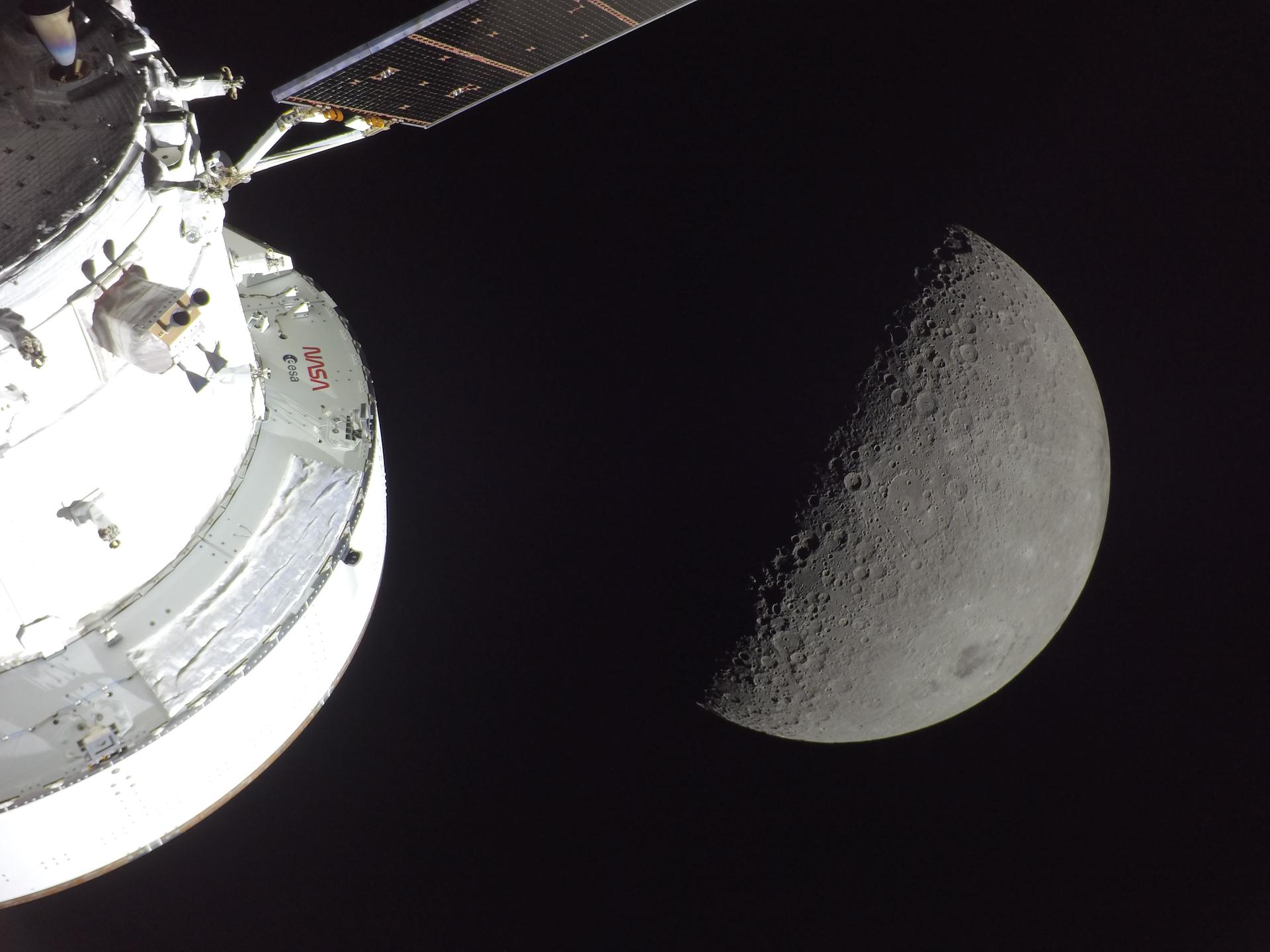
'Swamp-like colors' on the moon: New NASA report reveals strange sights from Artemis II mission — Space photo of the week
Astronauts on NASA's Artemis II mission saw surprising "jaundiced yellow" and "swampy green" colors on the moon during their close lunar flyby, a new report reveals.

What color is the moon? Ask an Earthling, and you'll get a predictably monochromatic answer: white or gray.
But ask the four crewmembers of NASA's Artemis II mission — who spent nearly seven hours circling the moon from just 4,000 miles (6,400 kilometers) from the lunar surface this April — and you'll wonder if they're talking about the same dusty satellite we can see from Earth.
Yellow, brown, green, blue and tan features fan across vast volcanic plains and lurk at the edges of ominous craters, according to the crew's in-the-moment observations, which were shared this week in NASA's Artemis II Preliminary Lunar Science Report. The 130-page document catalogs everything crewmembers Reid Wiseman, Victor Glover, Christina Koch and Jeremy Hansen saw during their historic close flyby of the moon on April 6, drawing from 814 gigabytes of photo, video and audio recordings taken from the Orion crew capsule.
This rainbow of lunar color represents distinct geological features that could inform future missions on where to land and where to explore as the world's space agencies race to set up a permanent presence on the moon.
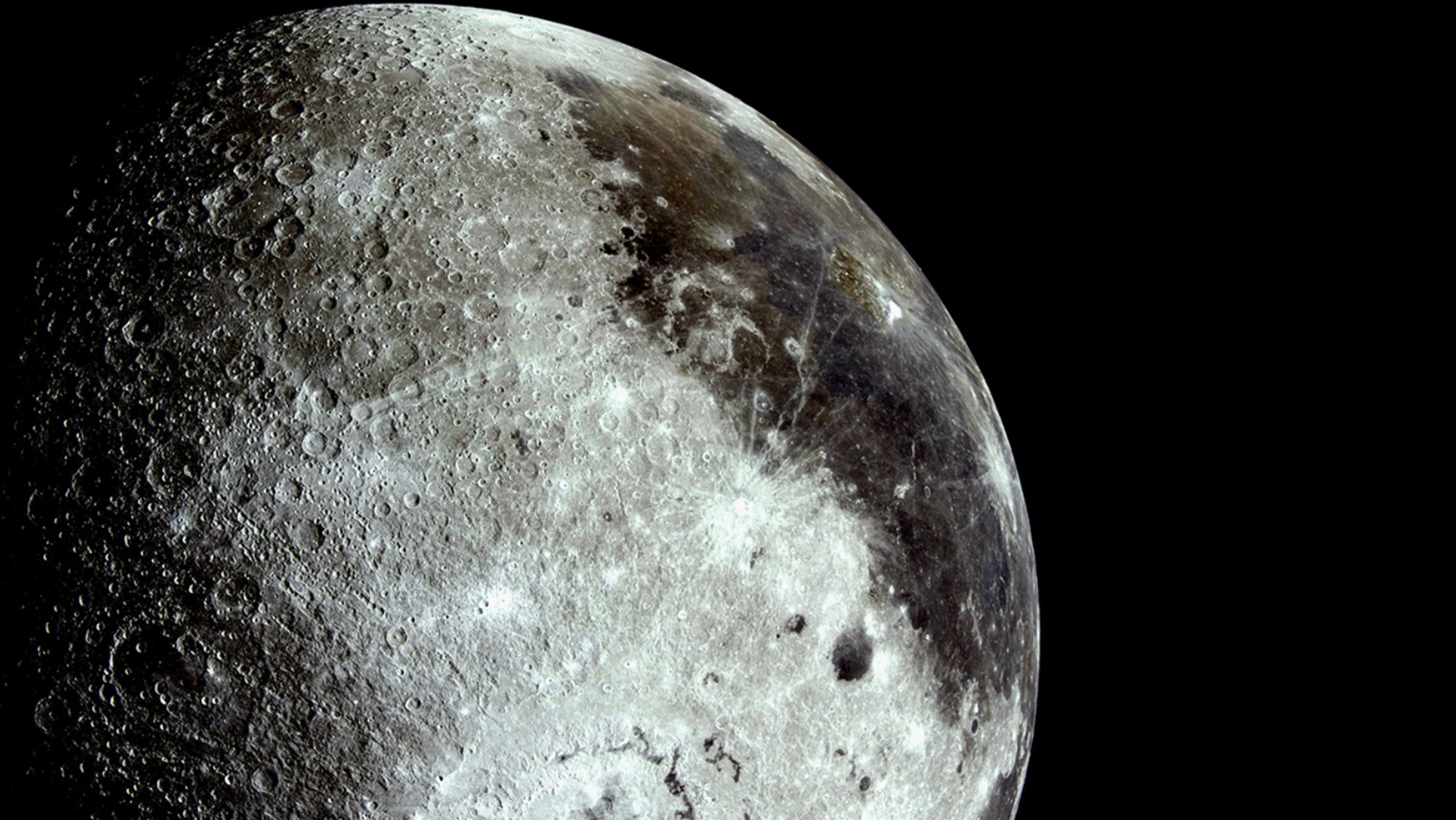
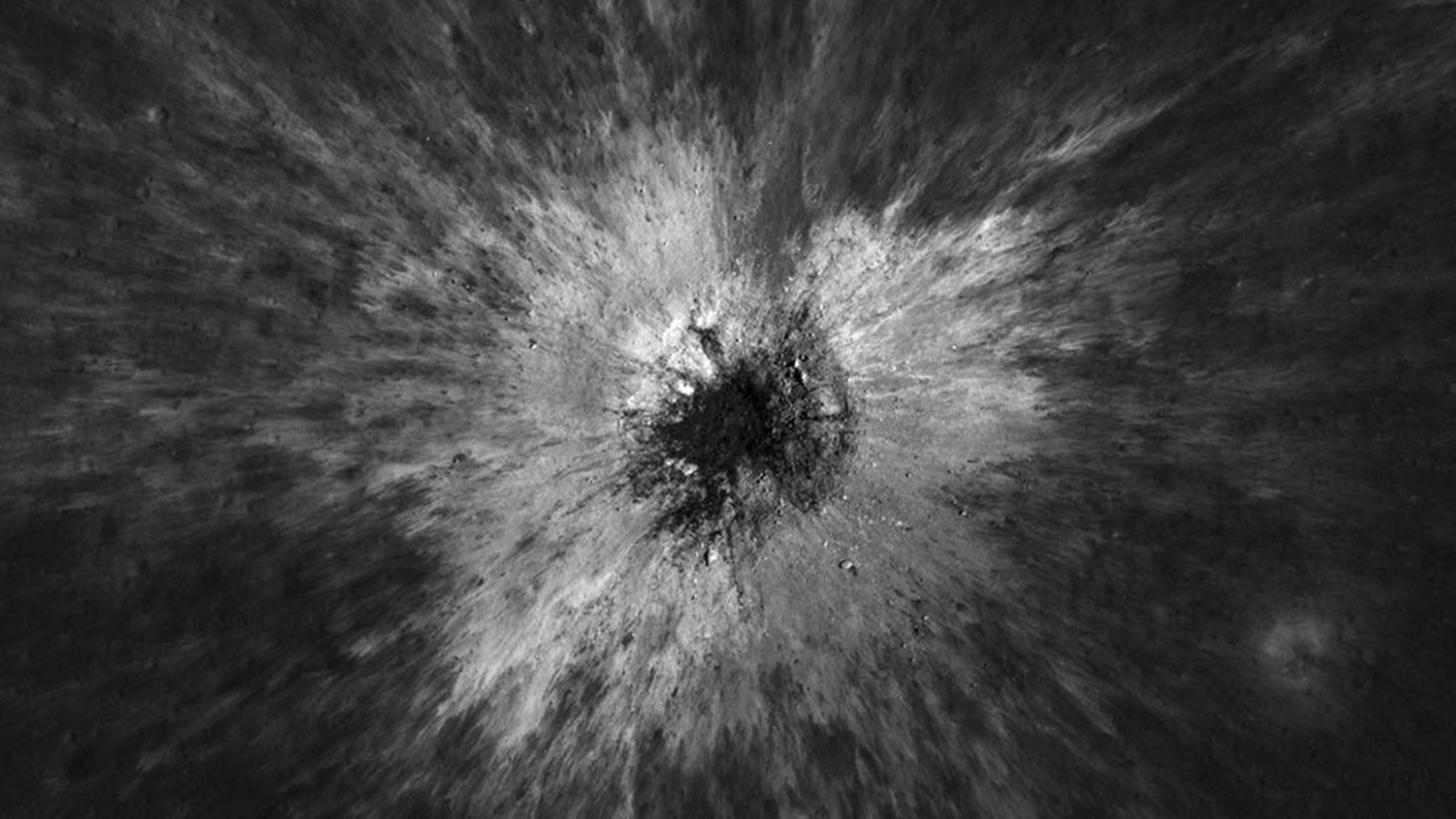
One spot that particularly enthralled the astronauts (and is featured in the image above) is the Aristarchus Plateau — a broad, elevated region on the northwestern edge of the moon's nearside. The region hosts one of the moon's densest collections of ancient volcanic features, including swaths of dark lava deposits and colorful volcanic glasses.
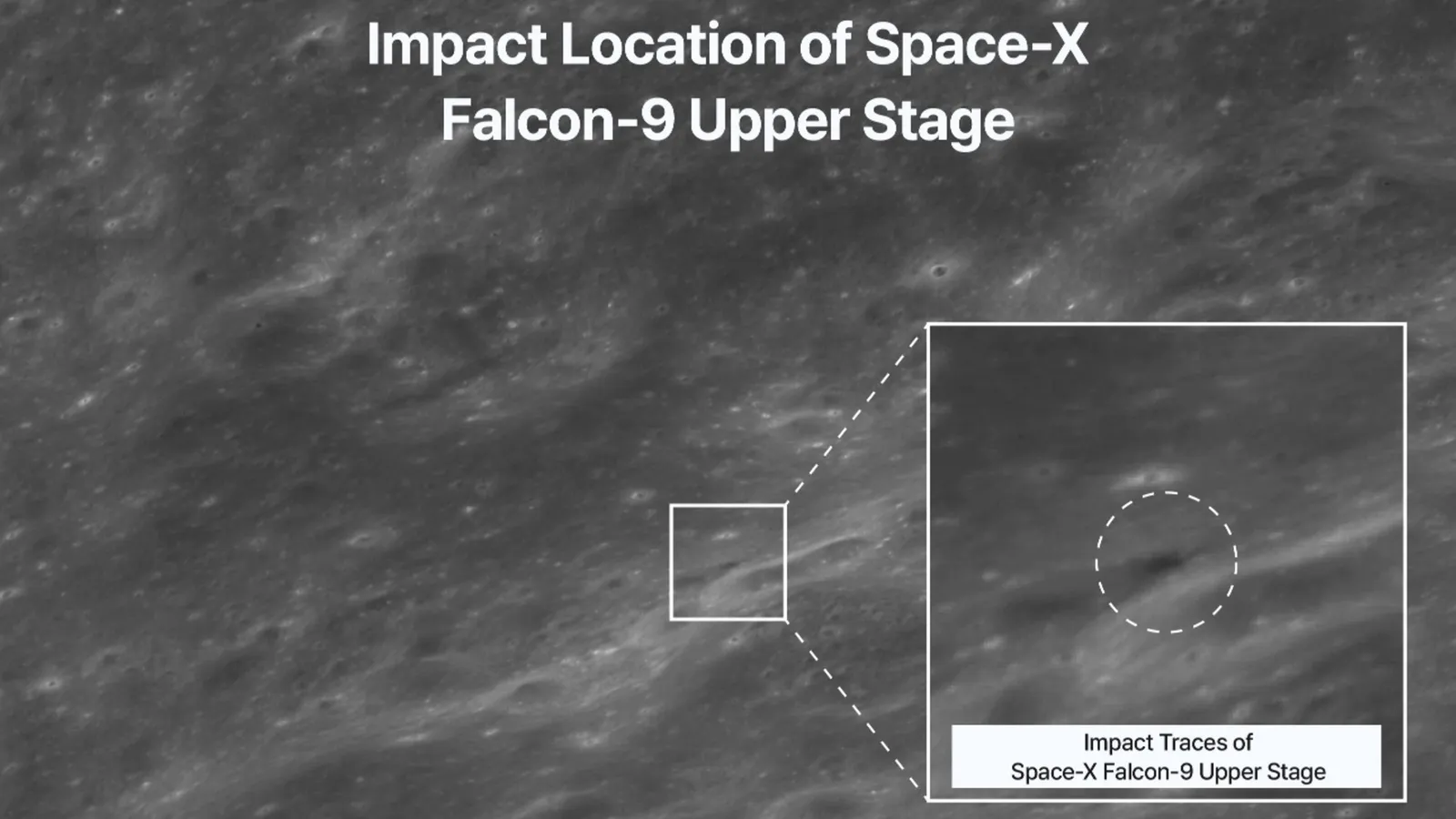
You may likeFirst photos of SpaceX lunar rocket crash show blackened hole torn into the moon's surface
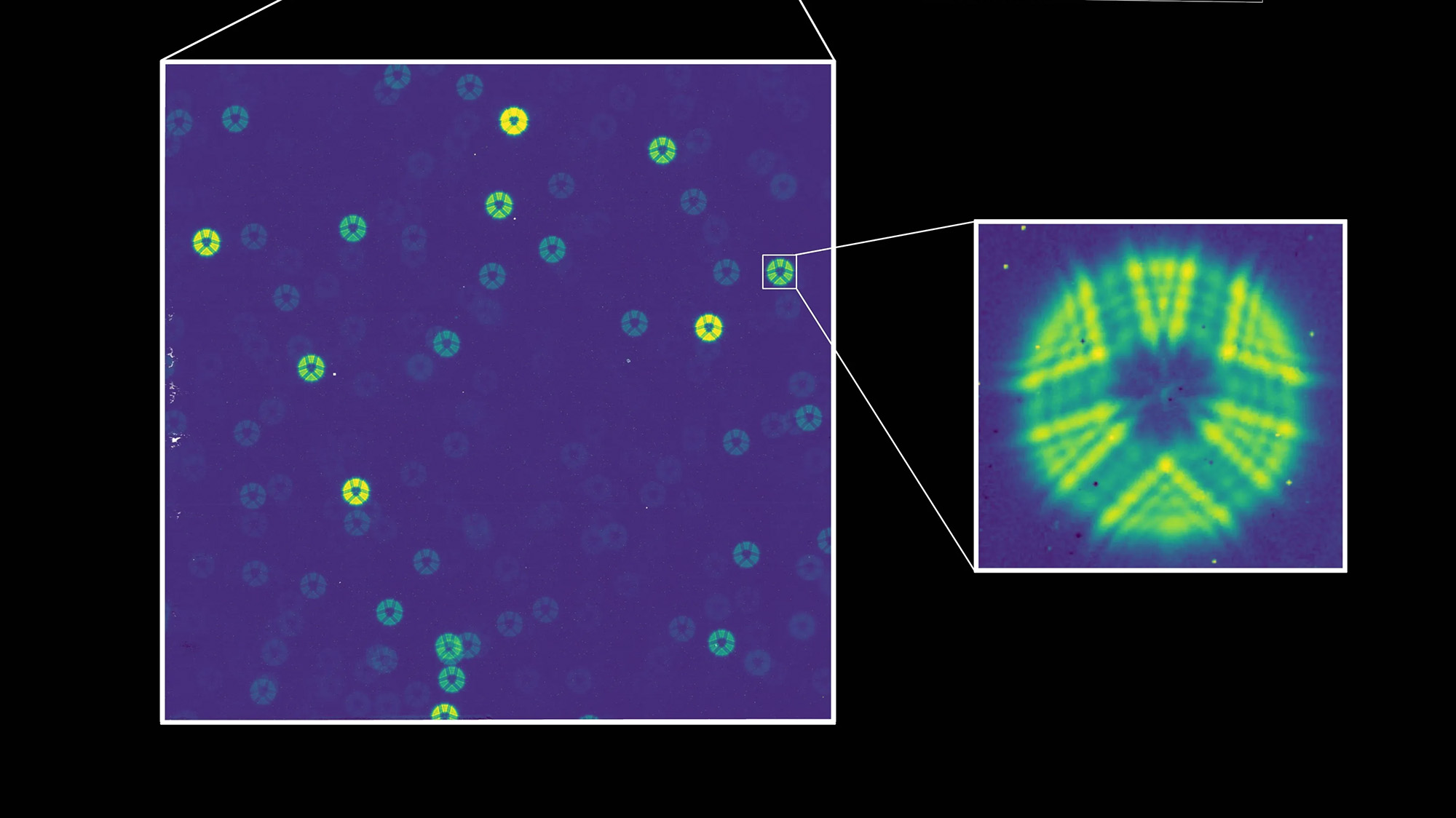
'On our way to groundbreaking science': Stars turn neon-green in first test image from NASA's Roman telescope
Koch, mission specialist for Artemis II, was shocked to see distinct yellow shades in the region; she likened the plateau to "a yellow snow-capped mountain," with sunlight-reflecting craters providing the bright "snow." She went on to call the region "a jaundiced cheek of the Moon."
"There are so many colors now," Glover, Artemis II's pilot, added while photographing the area. "There's also a green. I see brown, especially Aristarchus and north toward the north pole. … It kind of flows down from the north in brown streaks."
According to the report authors, these colorful hues "could be associated with orange (titanium-rich) and green (magnesium-rich) glass beads respectively," similar to volcanic glass beads collected by the Apollo 15 and 17 missions on separate parts of the moon.
Another colorful patch of the lunar surface that caught the crew's attention was Orientale Basin — a huge, young and multiringed impact crater that's about three times as wide as Massachusetts, according to NASA. Straddling the moon's near and far sides, this massive bull's-eye is rarely visible from Earth, but it dominated the crewmembers' field of view as they orbited around the side of the moon.
"It has just created chaos across that entire area," Wiseman, commander for the mission, said at the time.
What to read nextFirst photos from Smile spacecraft show Earth like you've never seen it before
Rare red northern lights may be visible alongside red moon during tonight's partial lunar eclipse

This photo, taken by the Orion capsule's external cameras, shows the lunar terminator, where the dayside bleeds into the nightside. Orientale Basin is the large bull's-eye-like feature near the bottom right of the moon.
(Image credit: NASA)
When flying over this sprawling basin, the crew noted gray, brown, tan and green below. The largest, outermost ring in the basin contained "almost swamp-like colors," Koch reported, while Glover spotted what looked like "dusted peaks" and "white on the very edges of [the mountains], the spines, the ridgebacks." Chains of craters parading away from the impact site looked "like bubbles rising from a team of scuba divers below," Koch added.
While these may sound like off-the-cuff observations, the Artemis II crew spent more than two years training to study and describe the moon's geology. Their regimen included visiting craters on Earth, taking lessons individually and in classrooms, conducting simulated flybys and, according to the report, bringing "self-selected reference materials" into the Orion capsule to read on the way to the moon.
Thanks to this training, the crew's observations provided a wealth of scientific information that no autonomous camera or orbiter could, the report said.
"The Artemis II mission demonstrated the exceptional value of human observation and cognition as scientific assets in planetary exploration," the report authors concluded. "Unlike cameras, which capture isolated moments and often narrow subsets of a scene, human observers continuously interpret their surroundings, integrating realtime visual perception with contextual understanding."
Or, to put that in Glover's more relatable words to mission control, "It's quite a wicked view.
Extraordinary story of how man's beloved 'UFO' home landed in California... and why it's up for sale
A California home shaped like a UFO has hit the market for $1.5million after an aging architect spent years restoring it to its glory.
The Donaldson Futuro was deemed an historic structure in January 2021. Now the spherical-shaped yellow home with its distinctive bubble windows has hit the market for $1,495,000.
The property is owned by Milford Wayne Donaldson, an architect who served on President Barack Obama's Advisory Council on Historic Preservation.
The 83-year-old and his wife, Laurie, have owned the home since the 1970s, when Donaldson heard the Futuro was in disrepair and sitting behind the San Diego Design Center.
When the design center was sold, he told The Wall Street Journal, the building's new owners had started to demolish the Futuro. Donaldson could not stand to watch the artwork be destroyed, so he bought it and stored it in a San Diego boatyard that his friend owned, he said.
Donaldson, who loved the Futuro since he was a kid, does not recall what he paid for it.
In 2004, he would buy a half-acre of land in the San Jacinto Mountains near Idyllwild for $70,000. This would become the new home for the plastic structure, which was designed by Finnish architect Matti Suuronen in the late 1960s, WSJ reported.
He chose the location because it was similar to the one to that of the first Futuro in Finland. It is estimated that 100 Futuros were made. It is believed that around 50 to 60 have survived.

The Donaldson Futuro in the San Jacinto Mountains has hit the market for $1,495,000

The UFO-shaped home has a 1960s feel and a great view of the mountains through its bubble windows

The home is 26 feet in diameter and had to be transported to the location via a wide-load truck and be escorted by California Highway Patrol
Moving such a structure proved difficult. The home is 26 feet in diameter.
It had to be shrink-wrapped and escorted by the California Highway Patrol on a wide-load truck in December 2004.
'When we finally got up there, it was like we were the Pied Piper. We had about 40 people in cars behind us,' Donaldson told WSJ.
Once it actually reached the mountains, a crane had to hoist the flying saucer up above the tree line.
From there, the Donaldsons renovated the inside of the home in a 1960s style, complete with popcorn ceiling and linoleum floors.
The couple, who primarily live eight hours away in Sacramento, enjoyed the retreat for roughly one week a month.
But now that Donaldson is aging, he's ready to offload the home so his wife, 66, does not get stuck having to sell it once he has died, he told WSJ.
'It’s best to try to find a buyer now [who] really appreciates it…. And doesn’t just do an Airbnb or something,' he told the outlet.

Milford Wayne Donaldson, 83, and his wife, Laurie, bought the home in the late 1970s

In 2004, they moved it to its current location after repairing the outside

Donaldson now wants to sell the home so his 66-year-old wife is not stuck selling it after he dies

The home was designed by Finnish architect Matti Suuronen in the late 1960s
Listing agent Tim McTavish thinks the home will attract buyers who love architecture or those from museums or foundations.
There is another Futuro house in California, near Joshua Tree. The home is available on Airbnb and it is thought to be the only Futuro house in the US that can be rented out for the night.
When Suuronen designed the homes in 1968, he originally intended them to be used as portable ski chalets.
They had 520sq ft of inside space and boasted a kitchen, a bathroom and a fireplace, while the front door took the form of an electric hatch.
The ones located in the US were made under contract with a Philadelphia company, WSJ reported.
Only a few Futuros have sold over the years, with most going for $50,000 to $100,000.
However, Donaldson believes his home is worth more, as it is in a livable condition.
What If Humanity Encounters a Hostile Alien Civilization?

What If Humanity Encounters a Hostile Alien Civilization?
For generations, humanity has looked at the stars and wondered whether someone else might be looking back.
The possibility of discovering intelligent life beyond Earth has inspired astronomers, philosophers and storytellers. Many imagine first contact as a moment of extraordinary cooperation: two civilizations exchanging knowledge, revealing new technologies and discovering that life is not unique to our planet.
But there is another possibility.
What if humanity’s first encounter with an extraterrestrial civilization is not peaceful? What if the first evidence of intelligent life comes from a species whose intentions we cannot understand — or one that considers humanity a threat?
It is a frightening scenario, but it raises questions worth examining. How would we recognize a hostile civilization? Could humanity defend itself against technology thousands or millions of years more advanced than ours? And would an extraterrestrial conflict even resemble a war as we understand it?
There is no confirmed evidence that extraterrestrial civilizations exist, let alone that any pose a threat to Earth. Scientists have not detected a verified alien transmission, invasion force or hostile intelligence. TryScience Kits
Yet considering hypothetical outcomes of first contact can help us understand the challenges of interstellar communication, the limits of our technology and the importance of distinguishing evidence from speculation.
The most unsettling possibility is that a civilization does not need to arrive at Earth’s doorstep for humanity to face difficult decisions.
Why Humanity Might Not Recognize a Threat Immediately
If intelligent extraterrestrial life exists, we cannot assume that it would think, communicate or behave like humans.
Every understanding we have of intelligence comes from life on Earth. Our ideas about cooperation, competition, fear, territory and survival developed through the evolutionary history of our own species.
An extraterrestrial civilization could have followed a completely different path.
Its members might have evolved under different environmental conditions, developed unfamiliar senses or organized their societies in ways that have no obvious human equivalent. Their technologies might rely on principles we have not yet discovered, although any technology we encounter would still have to operate within the laws of physics as we understand them, unless new evidence demonstrated otherwise.
Even the concept of hostility could be difficult to establish.
Imagine detecting an artificial signal from another star system. It contains mathematical patterns that strongly suggest an intelligent origin, but no understandable language. Is it a greeting, a scientific transmission, an automated beacon or a warning?
We might not know.
Now imagine detecting a spacecraft or robotic probe entering our solar system. Its trajectory changes in a way that appears deliberate. It does not respond to our signals. Its purpose remains unknown.
Such an observation would demand careful investigation, but it would not automatically demonstrate hostile intent.
The distinction matters because humanity could create a dangerous situation by treating an unknown object as an enemy before understanding what it is.
Equally, assuming that every unfamiliar presence must be harmless could be unwise.
The challenge would be to investigate without allowing fear to replace evidence.
Could an Advanced Civilization See Humanity as a Threat?
One hypothetical explanation for a hostile encounter involves strategic uncertainty.
A technologically advanced civilization might encounter another species whose future capabilities are impossible to predict. Even if the younger civilization appears primitive, its future development could eventually change the balance of power.
This is a speculative scenario, not an established description of how extraterrestrial civilizations would behave.
Human history provides examples of societies becoming suspicious of rivals whose intentions they cannot confidently assess. However, projecting human political behaviour onto an entirely different form of intelligence is uncertain. StudyBiology
An extraterrestrial species might have no interest in conquest. It might not compete for resources in ways familiar to humans. It might regard biological life as valuable, or it might simply be indifferent to civilizations that occupy distant planets.
Alternatively, if a civilization operates according to survival strategies very different from ours, its actions could be difficult to anticipate.
The problem is that we have no reliable evidence about the motivations of extraterrestrial intelligence.
That uncertainty is precisely why scientists must separate plausible physical scenarios from assumptions about alien psychology.
The Dark Forest Theory: Could Silence Be a Survival Strategy?
One idea frequently discussed in connection with the Fermi paradox is the Dark Forest hypothesis.
The Fermi paradox concerns the apparent contradiction between the enormous number of potentially habitable worlds in the universe and the absence of confirmed evidence of extraterrestrial civilizations.
The Dark Forest hypothesis offers one possible explanation: civilizations might deliberately remain silent because revealing their locations could expose them to potential threats.
The concept became widely known through science fiction, particularly Liu Cixin’s The Dark Forest. It has also entered broader discussions about extraterrestrial intelligence and the risks of interstellar communication.
In this hypothetical universe, every civilization faces a difficult calculation. It cannot know whether another civilization is peaceful, dangerous or capable of becoming a threat in the future.
Sending a signal might reveal its location. Remaining silent might reduce that risk.
But the hypothesis has major limitations.
There is no evidence that extraterrestrial civilizations follow such a strategy. The apparent silence of the universe has several possible explanations, including the rarity of intelligent life, the difficulty of detecting distant signals and the possibility that technological civilizations are separated by enormous distances in space and time. GoStargazing
Nevertheless, the Dark Forest hypothesis highlights an important question: could uncertainty about another civilization’s intentions make communication more complicated than we imagine?
If humanity ever detects an artificial signal, the answer may depend on what the evidence actually reveals — not on the most frightening explanation we can invent.
What Would an Alien War Actually Look Like?
Popular films often portray extraterrestrial warfare as fleets of enormous spacecraft descending through Earth’s atmosphere, followed by battles over cities.
A real encounter, if one ever occurred, might look nothing like that.
The distances between stars are immense. The nearest star system to the Sun, Alpha Centauri, is more than four light-years away. Even a spacecraft travelling at a significant fraction of the speed of light would require years to reach it, and current human spacecraft are nowhere near those speeds.
Interstellar travel would therefore involve extraordinary engineering challenges, energy requirements and travel times.
A civilization capable of sending probes between stars might choose to use automated systems rather than transport biological beings. Robotic spacecraft could potentially investigate distant planetary systems without requiring their creators to make the journey themselves.
This is a possibility based on engineering considerations, not evidence that extraterrestrial civilizations have actually developed such systems.
If a conflict ever occurred, its form would depend on the technologies, intentions and physical capabilities of the civilizations involved.
Could a Civilization Attack Without Invading?
A hypothetical hostile civilization might not need to occupy Earth to affect humanity.
An object entering the solar system could raise questions about surveillance, reconnaissance or scientific exploration. A powerful artificial signal could force humanity to reconsider its understanding of the universe. A technological system capable of interfering with communications might create problems without any physical invasion. TryScience Kits
These are speculative scenarios, and there is no verified evidence that extraterrestrial systems are doing any of these things.
Moreover, the ability to send a signal across interstellar distances would not automatically imply the ability to manipulate Earth’s technology or defeat its defenses.
Different capabilities must not be treated as interchangeable.
A civilization capable of producing a powerful radio transmission might have no practical ability to travel here. A civilization capable of sending a probe might not possess the resources or motivation to engage in conflict.
The physical constraints matter as much as the imagined threat.
Could Humanity Defend Itself?
The honest answer is that humanity has no established defense system designed to fight an extraterrestrial civilization.
Our military technologies, space programs and planetary-defense initiatives have been developed for terrestrial conflicts, scientific exploration and identifiable natural hazards.
Systems designed to detect and track asteroids, for example, help scientists assess the risk posed by near-Earth objects. They are not designed to identify or counter hostile alien spacecraft.
If an unknown object entered the solar system, humanity’s first challenge would be understanding what it was.
Astronomers would need to determine its trajectory, physical characteristics and whether its behaviour could be explained by natural processes or known human technology. Independent observations would be essential.
If evidence eventually established that the object was artificial, researchers would need to investigate its capabilities and intentions without assuming that artificiality automatically meant hostility.
International coordination would also become important. A discovery of this magnitude would affect scientific institutions, governments and the public around the world. TryScience Kits
No single country could reasonably claim to understand an unknown extraterrestrial civilization on the basis of one observation.
Would Our Technology Be Enough?
If another civilization were thousands or millions of years ahead of humanity technologically, the gap could be enormous. But the age of a civilization alone would not tell us exactly what it could do.
Technological development does not guarantee unlimited energy, instant communication or the ability to violate physical laws. Any credible assessment would need to consider demonstrated capabilities rather than imagined superpowers.
Humanity’s most useful initial responses would likely involve observation, scientific analysis, communication where appropriate and cooperation among nations.
If a threat were confirmed, decision-makers would face questions for which no established playbook exists.
Could the object be redirected? Would communication reduce uncertainty? Would any attempt to interfere with it create additional risks?
Those questions could not be answered responsibly without understanding the specific situation.
The priority would be to gather reliable evidence and avoid decisions driven entirely by panic.
Could Miscommunication Start the First Alien War?
A particularly disturbing possibility is that neither civilization initially intends to fight.
Humanity has repeatedly experienced misunderstandings between groups with different languages, customs and expectations. An encounter with an entirely unfamiliar intelligence could introduce communication difficulties on a much greater scale.
Even the meaning of a signal could be uncertain.
A sequence of radio pulses might be interpreted as a greeting, a mathematical demonstration or an attempt to establish a communication channel. Without a shared language or cultural context, identifying its purpose could take years.
The same problem would apply to actions.
Suppose humanity sends a response containing mathematical information. Would another civilization interpret it as a peaceful introduction, an attempt to establish contact or an indication of technological capability?
We would have no reliable way to know without additional evidence.
This is why verification, cautious interpretation and international scientific cooperation would be important in any genuine first-contact scenario. TryScience Kits
The danger is not that every misunderstanding would lead to war. Rather, it is that uncertainty could encourage premature assumptions about intentions.
A responsible response would aim to reduce that uncertainty before taking actions that could be difficult to reverse.
What If the First Contact Is a Warning?
Another possibility is that humanity receives a message that appears to describe a danger.
Perhaps the signal contains a mathematical sequence followed by information about a cosmic event. Perhaps it describes a physical phenomenon that scientists initially struggle to understand.
Would it be a warning? A scientific transmission? A historical record? Or something else entirely?
Without confirmation, humanity could not safely assume that the message was intended to help us.
The difficulty would be greater if the source were hundreds or thousands of light-years away.
Because information cannot travel faster than light under established physics, a signal from a distant civilization would reveal something about its past. The civilization might have changed dramatically since transmitting it, or it might no longer exist.
If humanity sent a reply, the response could take centuries to reach the original source.
This means first contact might be less like a conversation and more like studying an ancient message.
The idea of receiving a warning from an extinct civilization is a compelling hypothetical scenario, but there is currently no confirmed evidence of such a transmission.
Even so, it illustrates why the discovery of extraterrestrial intelligence would raise questions extending far beyond whether another civilization is friendly.
Could an Advanced Civilization Be Peaceful?
Hostility is not the only plausible possibility.
A civilization that survives for an extremely long time might develop social systems that encourage cooperation, manage conflict or reduce the incentives for destructive behaviour.
Alternatively, technological progress might have little relationship to moral or political development. A society could be highly capable in some fields while remaining divided or unstable in others.
We cannot currently determine which possibility is more likely.
The assumption that advanced civilizations must be peaceful is no better supported than the assumption that they must be hostile.
It is also possible that an extraterrestrial civilization would have little interest in humanity. It might observe Earth from a distance, send automated scientific probes or communicate only when there was a clear reason to do so. TryScience Kits
Other civilizations, if they exist, might be too distant or too different for meaningful interaction.
The first confirmed discovery of extraterrestrial intelligence would provide our first real evidence about life beyond Earth. Until then, claims about alien intentions remain speculation.
What Scientists Are Actually Doing to Prepare
Although no verified extraterrestrial civilization has been detected, researchers are investigating ways to search for evidence of life and intelligence beyond Earth.
Astronomers study exoplanets, examine planetary atmospheres for potential biosignatures and search for unusual radio signals that could indicate technological activity.
These efforts serve different purposes. Evidence of microbial life would not necessarily imply intelligent life, and a possible technosignature would require careful verification before it could be attributed to an extraterrestrial civilization.
Scientists also discuss how discoveries should be communicated and how potential signals should be evaluated.
The SETI community has developed principles intended to encourage verification, transparency and international consultation if a credible candidate signal is detected.
These principles do not constitute a global defense plan against hostile aliens. They are primarily concerned with the responsible scientific handling of a possible discovery.
Planetary defense programs, meanwhile, focus on natural hazards such as asteroids and comets. Although these programs demonstrate the value of monitoring the space around Earth, they should not be mistaken for preparations for interstellar warfare. GoStargazing
The distinction is important. Humanity is actively studying the universe, but it is not currently preparing to fight a known extraterrestrial enemy.
How Would Humanity React to the Discovery of a Hostile Civilization?
Even before any physical confrontation, confirmed evidence of a hostile extraterrestrial civilization would have enormous psychological and political consequences.
Governments would face pressure to explain the threat. Scientists would be asked to assess the evidence. Media coverage would intensify, and the public would demand answers about the risks to Earth.
The effects would depend on what had actually been discovered.
An ancient signal expressing hostility would pose a different problem from a nearby object demonstrating an immediate ability to threaten the planet. A statement of hostile intent would not necessarily establish that the sender possessed the capability or motivation to act on it.
Separating these questions would be essential.
A poorly communicated discovery could produce unnecessary fear. Conflicting claims could undermine public confidence. Governments might disagree over how to interpret the evidence or whether to respond.
International cooperation would therefore matter not only for scientific reasons but also for maintaining a clear understanding of the situation.
It is impossible to predict whether humanity would unite in response. A shared external challenge might encourage cooperation, but it could also intensify disagreements over responsibility, strategy and risk.
Human behaviour is complicated enough that a single outcome should not be assumed. StudyBiology
The Most Important Lesson: Do Not Confuse Possibility With Evidence
The prospect of a hostile extraterrestrial civilization is frightening because it combines two enormous uncertainties: whether intelligent life exists elsewhere and how such life might behave.
Neither question has a confirmed answer.
The universe contains billions of galaxies, and astronomers have discovered thousands of planets beyond our solar system. These discoveries establish that planets are common, but they do not establish that intelligent civilizations are common.
Earth remains the only known world inhabited by life, and humanity is the only known technological civilization.
Any discussion of alien warfare must therefore remain hypothetical.
That does not make the subject worthless. Examining possible scenarios can help clarify the importance of communication, verification, scientific cooperation and realistic assessments of technological capability.
But a thought experiment must not be presented as a prediction.
No hostile alien fleet has been detected. No confirmed extraterrestrial civilization has threatened Earth. There is no scientific basis for claiming that humanity is on the verge of an interstellar war.
The real challenge is understanding how humanity should respond if evidence of extraterrestrial intelligence ever emerges.
Conclusion: Would First Contact Change Humanity Forever?
If humanity ever encounters an intelligent civilization beyond Earth, the discovery would transform our understanding of life and our place in the universe. GoStargazing
If that civilization proved hostile, the consequences could be profound. Humanity would need to understand the nature of the threat, evaluate its capabilities and coordinate its response in a situation unlike any in recorded history.
Yet the first step would not necessarily be to prepare for battle.
It would be to establish what the evidence actually shows.
A strange signal is not proof of an enemy. An unfamiliar spacecraft would not automatically establish hostile intent. A civilization’s technological capabilities would need to be assessed rather than imagined.
The greatest danger in a hypothetical first-contact scenario might come from assuming too much before knowing enough.
Humanity has developed powerful scientific tools, international communication networks and an increasingly detailed understanding of the cosmos. These capabilities do not guarantee that every future challenge could be overcome, but they provide a foundation for investigating the unknown.
For now, the search for extraterrestrial life continues without any confirmed discovery of intelligent beings beyond Earth.
Whether the first contact is peaceful, hostile or simply a faint signal from a civilization that disappeared long ago, the discovery would force humanity to confront one of its oldest questions in a new way.
Are we alone?
And if we are not, what happens next?
Frequently Asked Questions
Has humanity ever encountered a hostile alien civilization?
No confirmed encounter with extraterrestrial intelligence has occurred. Reports of unusual sightings or unexplained signals have not established the existence of a hostile alien civilization.
Could the first alien contact lead to war?
It is a hypothetical possibility, but there is no evidence that extraterrestrial civilizations are hostile. Communication difficulties, uncertainty and incompatible objectives are possible subjects for scientific and philosophical discussion, not established predictions. TryScience Kits
What is the Dark Forest theory?
The Dark Forest hypothesis proposes that civilizations might remain silent because revealing their locations could expose them to potential threats. It is a speculative explanation for the Fermi paradox, not a scientifically confirmed description of extraterrestrial behaviour.
Could humanity defend itself against a technologically advanced alien civilization?
There is no reliable way to answer without knowing the civilization’s capabilities, intentions and proximity. Humanity has no established defense system designed specifically for extraterrestrial conflict.
Would an alien civilization need to invade Earth to threaten humanity?
Not necessarily in every hypothetical scenario. A sufficiently capable civilization might affect humanity through remote technologies or other means, but such scenarios are speculative and no extraterrestrial threat has been verified.
Are scientists preparing for an alien invasion?
No known scientific program is preparing to fight a confirmed extraterrestrial enemy. Researchers search for life and possible technosignatures, while planetary-defense programs focus primarily on natural hazards such as asteroids and comets.
What would scientists do if they detected a possible alien signal?
They would investigate possible interference, seek independent confirmation, examine the signal’s characteristics and assess whether natural or human-made explanations could account for it. A credible discovery would require careful verification before conclusions were drawn.
Disclaimer
This article explores a hypothetical scenario involving extraterrestrial intelligence. No confirmed evidence currently demonstrates that intelligent extraterrestrial civilizations exist or that any pose a threat to Earth. The scenarios discussed are speculative and should not be interpreted as predictions of future events.
References and Further Reading
{ https://whatifscience.in/category/aliens-extraterrestrial-worlds/ }

Roswell Incident: What Was Found and How the Story ChangedA “Flying Saucer” Was Found Near Roswell, Then the Military Changed Its Story
Roswell Incident: What Was Found and How the Story Changed
The Roswell Incident: What Was Actually Found, and How the Story Changed Over 70 Years
Ask ten people what happened at Roswell and you’ll get ten answers. Some will say a flying saucer crashed in 1947 and the military hid the bodies. Others will say it was just a weather balloon and the whole thing is a joke. Both answers skip most of what the record shows.
The documented version is messier, and in some ways stranger. The Army really did announce it had a “flying disc.” The weather balloon explanation really was a cover story, though not the kind believers assume. And the alien bodies that now define the legend appear nowhere in 1947 accounts. They show up decades later, in stories that kept changing.
This article follows the Roswell story in order, from what was picked up on a New Mexico ranch to the Air Force reports of the 1990s and the Pentagon’s 2024 review. I’ve linked the primary documents so you can check any claim yourself.
The story starts with a ranch foreman named William “Mac” Brazel. Sometime in late June or early July 1947, he came across scattered debris on a ranch near Corona, New Mexico, roughly 75 miles northwest of Roswell. Accounts differ on the exact date. He described rubber strips, tinfoil-like material, tape and thin wooden sticks.
The timing matters. In late June, pilot Kenneth Arnold’s sighting near Mount Rainier had set off a national “flying disc” craze, and newspapers were full of saucer talk. According to Wikipedia’s account of the incident, Brazel’s relatives suggested his debris might be a “flying disk,” and on July 7 he told Sheriff George Wilcox. The sheriff contacted Roswell Army Air Field, home of the 509th Bomb Group, then the only atomic-capable unit in the world.
Intelligence officer Major Jesse Marcel and a counterintelligence officer went out to the site, collected material, and brought it back. What happened next took less than 48 hours.
On July 8, 1947, base public information officer Walter Haut issued a press release, reportedly on the orders of the base commander, saying the 509th had recovered a “flying disc.” The Roswell Daily Record ran it under the headline “RAAF Captures Flying Saucer On Ranch in Roswell Region.” The story hit the wires that afternoon.
The reversal came almost at once. The debris was flown to Fort Worth, where Brigadier General Roger Ramey of the Eighth Air Force held a press conference. He and his weather officer, Irving Newton, displayed foil, rubber and sticks, and said it was a weather balloon with a radar target. Reporters photographed the material, and interest faded within days. Brazel was quoted giving a more mundane description of what he’d found, and then largely stopped talking to the press.
Here is the first fact that gets lost: the Army itself said “flying disc” first. That wasn’t invented by later believers. It’s why the incident has always carried a whiff of cover-up, and as we’ll see, there was one, just not the one people think.
A second fact is just as important. None of the July 1947 newspaper coverage mentions alien bodies, a spacecraft with occupants, or a second crash site. The saucer in the 1947 headline was a disc, the word everyone was using that summer for any odd flying object.
After July 1947, Roswell more or less vanished. The incident didn’t appear in major UFO books of the 1950s and 1960s. The Air Force’s Project Blue Book, which investigated sightings until 1969, didn’t treat it as a notable case.
It came back in 1978. Nuclear physicist and UFO researcher Stanton Friedman tracked down the retired Jesse Marcel and recorded an interview. Marcel said the weather balloon story had been a cover and that the real debris was something else, “nothing made on this earth.” Then, in February 1980, the National Enquirer ran its own Marcel interview, and national attention followed. A 1980 book, The Roswell Incident, by Charles Berlitz and William Moore, brought the case to a mass audience.
It’s worth pausing on this. Marcel was recalling events from three decades earlier, and he’d once posed for photographs holding the debris that Ramey called a balloon. Memory is not a recording, and Marcel’s later account cannot simply be set against the 1947 record without considering that gap. That doesn’t make him a liar. It makes him a witness whose recollection had thirty years to drift.
The extraterrestrial corpses entered the story in the late 1980s and early 1990s, through a handful of new witnesses. In 1989, Roswell mortician Glenn Dennis told Friedman that the base had called him in July 1947 asking about child-size coffins, and that he’d glimpsed an alien autopsy. His account was featured in the 1991 book UFO Crash at Roswell and in a 1994 television dramatization.
It didn’t hold up well. Dennis gave a nurse’s name that turned out to be false. Even researchers sympathetic to the crash story came to regard him with caution, and Kevin Randle, an author of that 1991 book, later called him one of the least credible Roswell witnesses. Gerald Anderson claimed to have stumbled on a crashed craft with bodies as a child; Frank Kaufmann, a major source for a 1994 book, claimed a radar role that investigators say he never held. The researcher Karl Pflock noted that only a handful of people with supposed firsthand knowledge of alien bodies were ever identified and interviewed, and his own investigation led him to conclude that no bodies were recovered.
Time magazine’s 1990s overview of the controversy captures the moment well, including how quickly witness accounts multiplied once a TV audience was watching.
Then came the hoaxes and tall tales. In 1995, British entrepreneur Ray Santilli released “alien autopsy” film he said showed a Roswell-era examination. It was shown on Fox, and it was later admitted to be a staged re-creation. In 1997, retired Army officer Philip Corso published The Day After Roswell, claiming he’d handled recovered alien technology that seeded modern electronics. The Pentagon’s 2024 review, discussed below, found no evidence of any reverse-engineering program.
Even Walter Haut, the officer who wrote the original release, entered the story late. He died in 2005. A sealed affidavit he’d signed in 2002 was published in 2007 and described a cover-up and alien corpses, which contradicted an earlier affidavit he gave in 1993. Researchers inside the UFO community themselves argued over which version to believe.
What’s surprising is how much official paper exists. Roswell isn’t a case the government ignored. It’s one it investigated, at length, in public.
So the weather balloon story was a cover, but a cover for a secret balloon program, not a spacecraft. As one commentator put it, a flying saucer was easier to admit than Mogul. That fits the timeline: in 1947 the Soviet Union hadn’t yet tested a nuclear weapon, and the Army had every reason to keep quiet about how it planned to watch for one.
Believers pushed back hard on this one, and the objection has weight. The dummy drops started years after 1947, so critics argue the explanation asks witnesses to have misplaced events by a decade or more. The Air Force’s reply is that this is exactly what long-term memory does. Neither side can prove it.
| Period | Who tells it | What’s claimed |
|---|---|---|
| July 1947 | Army, press | A “flying disc” is recovered, then identified as a weather balloon with a radar target |
| 1978–1980 | Marcel, Friedman, Berlitz and Moore | The balloon story was a cover; the debris was extraordinary |
| Late 1980s–1994 | Dennis, Anderson, Kaufmann, others | A craft crashed; alien bodies were recovered |
| 1994–1997 | US Air Force | Debris was Project Mogul; “bodies” memories trace to 1950s dummy drops |
| 1995–2007 | Santilli, Corso, Haut affidavit | Autopsy film, reverse-engineering, deathbed accounts |
| 2024 | AARO | No verifiable evidence of extraterrestrial technology; Mogul explanation repeated |
Notice the direction of travel. The earliest accounts are the plainest, and the most dramatic claims arrive the furthest from the events. That’s a pattern historians recognize in many legends, and it’s the first thing I’d tell anyone weighing a Roswell claim.
An honest account has to say what isn’t settled, because the skeptic’s case has gaps too.
What isn’t unresolved is the basic physical record. No wreckage of a craft has ever been produced, no body, no verified document describing one, and no credible 1947 account of either.
Here’s the most defensible version of what happened at Roswell. In the summer of 1947, a ranch foreman found debris from a classified Army balloon project. The base, caught up in the flying disc craze, announced a “flying disc” before correcting itself. The Army then covered the real purpose of the debris with the weather balloon story. For thirty years, almost nobody talked about it. Then a retired officer’s recollections, and a string of later witnesses, built the crashed-saucer legend we know today.
None of that makes Roswell uninteresting. It’s one of the clearest examples of how a modest secret and a famous press release can grow into a national myth. The documents are public. The best thing a reader can do is open the GAO report, skim the Air Force volumes, and decide how much weight each witness deserves.
{ https://whatifscience.in/category/aliens-extraterrestrial-worlds/ }

What the US Government Has Actually Said About UAPs: A Timeline (2020–2026)
Few subjects attract as much confident nonsense as UFOs. Some people say the government has already admitted aliens are real. Others say officials have said nothing at all. Neither is true, and the actual record is stranger and more interesting.

I went back through the primary documents: press statements, congressional hearings, intelligence assessments and the Pentagon’s own reports. This article lays out what officials said, in what order, and what they pointedly did not say. Every claim below links to the original source wherever one is publicly available.
In more than six years of official statements, the US government has said these things:
The 2026 file releases haven’t changed that last point. They have changed how much raw material the public can inspect.
The modern chapter starts with three short clips known as FLIR1, Gimbal and GoFast. Navy aircrews recorded them with infrared targeting pods, one in November 2004 and two in January 2015. They circulated for years after leaks in 2007 and 2017, and the New York Times helped bring them to a wide audience.
The government’s first real move came on April 27, 2020. The Department of Defense formally authorized release of the three videos. The stated reason was to clear up public confusion over whether the footage was real. The statement also said the phenomena in them “remain characterized as ‘unidentified.’”
People often skip over what that wording does and doesn’t mean. “Unidentified” is a label for the state of the analysis. It is not a claim about what the objects are. The Pentagon confirmed the footage was authentic Navy material and said nothing about the origin of the objects.

The story didn’t stop there. In February 2025, AARO published an analysis of GoFast. Its conclusion, as summarized by The Black Vault, was that the object was at around 13,000 feet, not skimming the ocean as viewers assumed. AARO said with high confidence that it did not move at anomalous speeds. The office also noted a limitation: the original file and metadata were lost, so it worked from a compressed copy. Independent analysts such as Mick West had argued for years that the object was a balloon. For Gimbal, I could not find a comparable AARO resolution report, so treat that one as open.
Behind the videos was a quiet bureaucratic evolution. In 2020 the Pentagon set up the Unidentified Aerial Phenomena Task Force. Congress then asked for an unclassified assessment, and the Office of the Director of National Intelligence delivered a nine-page Preliminary Assessment on June 25, 2021.
That document is worth reading in full because it is so restrained. It looked at 144 reports from US government sources between 2004 and 2021, 80 of which involved more than one sensor. It could explain only one of them with high confidence. The rest stayed unexplained, partly because, in the report’s words, the quality of the data was too limited to draw firm conclusions. It sorted possible explanations into broad buckets: airborne clutter, natural atmospheric phenomena, US government or industry programs, foreign adversary systems, and “other.” It did not mention aliens.
The All-domain Anomaly Resolution Office, or AARO, was created in 2022 to take over the work, and Congress later wrote its mandate into law through the fiscal year 2023 defense authorization act. Its job is to collect and analyze reports across the military and intelligence community and to flag anything that could threaten flight safety or national security.
Two AARO products matter most.
Congress has pushed this topic harder than almost any other part of the government, often across party lines.
On May 8, 2026, the Department of War launched the Presidential Unsealing and Reporting System for UAP Encounters, abbreviated PURSUE. Its announcement described a joint release of previously unseen UAP files with participation from other agencies, including the FBI and NASA, hosted on a dedicated site, WAR.GOV/UFO. A second release followed on May 22. A third, a fourth and a fifth have come out since, and press reports suggest at least one more in September. The department says files will keep coming on a rolling basis.
The material is a mixed bag: infrared sensor clips, historical documents and, in at least one release, NASA crew audio. A few items are recent. One Army sensor video, for example, was captured in 2026 with no written description from the reporter. For those who want to see the material directly, the department’s own page is the place to start.
What the releases do not contain is a conclusion. They are source material, not findings. Even as the files go public, AARO’s formal position has not moved from its 2024 and 2026 reports.
| Date | What was said or done | Source |
|---|---|---|
| Apr 27, 2020 | DoD releases FLIR1, Gimbal and GoFast; phenomena stay “unidentified” | defense.gov |
| Jun 25, 2021 | ODNI assessment: 144 reports, one explained, no claim of non-terrestrial origin | dni.gov (PDF) |
| May 17, 2022 | First public House hearing in 50+ years; ~400 reports cited | CBS News |
| Jul 26, 2023 | Grusch, Fravor and Graves testify before House Oversight panel | Rep. Burchett |
| Mar 8, 2024 | AARO Vol. 1: no verifiable evidence of extraterrestrial activity or technology | aaro.mil (PDF) |
| Nov 13, 2024 | Joint House Oversight hearing, “Exposing the Truth” | Rep. Burchett |
| Feb 2025 | AARO’s GoFast analysis: higher altitude, no anomalous speed | The Black Vault |
| Sep 9, 2025 | Task force hearing on transparency and whistleblowers | House Oversight |
| Mar 31, 2026 | Task force asks AARO for specific UAP videos | House Oversight (PDF) |
| May 8, 2026 | PURSUE launches; WAR.GOV/UFO goes live | war.gov |
| May 22, 2026 | Second PURSUE release | war.gov |
| Jun–Aug 2026 | Third, fourth and fifth releases | war.gov |
| Jul 2026 | AARO FY2025 report: 319 reports, 114 resolved | DefenseScoop |
A few habits help when you meet the next viral claim.
Plenty of questions remain open. Hundreds of cases are unresolved because of limited data. Congress and the Pentagon disagree about how transparent AARO has been. The released files, valuable as they are, are a curated slice of a much larger archive, and the public can’t yet judge what was withheld or why. A second volume of the historical report was promised, and I could not confirm in the sources I checked that it has been published.
So here is the plain-English bottom line. The US government has acknowledged that unidentified objects exist in military airspace and that some remain unresolved. It has said repeatedly, in official reports, that it has no verifiable evidence they are extraterrestrial. It has also begun publishing raw material at a pace not seen before, and that is the real story of 2026. The most useful thing any reader can do is open the files and check.
NASA chief says all UAP data released; Coulthart disputes claim

A dispute over the completeness of publicly available UAP records has emerged between NASA Administrator Jared Isaacman and journalist Ross Coulthart. In a NewsNation interview with Nancy Loo, Isaacman said NASA had released all of the UAP data available to the agency. Coulthart challenged that statement during the latest episode of Reality Check, arguing that significant records from earlier human-spaceflight programs remain inaccessible or have not been fully published.
The disagreement centers on what qualifies as “UAP data” and which records fall within NASA’s responsibility. NASA has increasingly focused on the scientific study of unidentified anomalous phenomena, while Coulthart contends that historical material held by NASA or associated government agencies should also be examined and disclosed. The competing positions highlight continuing uncertainty over the scope of government transparency on UAP-related information.
According to the NewsNation report, Coulthart pointed specifically to records connected with the Apollo, Gemini and Skylab programs. He said those archives contain material that has not yet been released in full, challenging the premise that NASA has made all relevant data public. The report does not establish whether the disputed records contain evidence of unexplained objects, or whether they are simply archival materials that have not been reviewed, digitized or cleared for public release.
Coulthart also addressed the Apollo 17 “blue dots” film, which remains under review by the Pentagon and NASA. The imagery has attracted attention among UAP researchers, but its meaning remains unresolved. No conclusion was presented in the report that the objects shown are extraterrestrial or otherwise anomalous. The continued review illustrates the broader difficulty of distinguishing genuine unknowns from camera artifacts, reflections, processing issues or other conventional explanations.
The episode also examined a new claim by Jake Barber involving a cylindrical “mothership” that allegedly released smaller, egg-shaped craft. Coulthart compared the account with reports from the well-known 1976 Tehran incident, in which Iranian military pilots reported encounters with unusual objects. The comparison is presented as part of Coulthart’s analysis, not as confirmation that the modern claim and the historical case describe the same phenomenon.
NewsNation’s program additionally discussed a Defense Intelligence Agency announcement that it had located missing files. The source material does not specify the precise contents of those files or indicate whether their recovery changes the government’s public understanding of UAP. Their mention nevertheless underscores a recurring issue in UAP reporting: records can be dispersed across agencies, classified, improperly cataloged or difficult for outside researchers to access.
Coulthart and co-host Meagan Medick also considered whether artificial intelligence could help analyze the UAP phenomenon. One topic was research by Dr. Beatrice Villarroel involving possible transient objects in geostationary orbit. The discussion raised the prospect of using automated systems to monitor large volumes of astronomical and sensor data for patterns that human investigators might miss.
The report further considered whether an autonomous monitoring system could be observing Earth. That idea remains speculative, and no evidence was presented establishing that such a system exists. More broadly, AI could assist with categorizing observations, comparing flight and satellite data, and identifying recurring anomalies, but it cannot by itself determine the origin of an unexplained sighting. Independent verification, reliable sensor records and transparent methodologies remain essential to evaluating UAP claims.
The disagreement between Isaacman and Coulthart reflects a larger divide over transparency, archival access and the definition of UAP evidence. NASA’s position, as reported by NewsNation, is that its available UAP data has been released. Coulthart’s counterargument is that older space-program records still warrant disclosure and examination. Until the specific records are identified, reviewed and made available for independent assessment, the competing claims cannot be conclusively resolved.
The Reality Check episode therefore presents an ongoing debate rather than a settled finding. Reports involving the Apollo 17 film, recovered government files and alleged spacecraft should be treated as claims requiring documentation and corroboration. For researchers and the public, the central question remains not only what agencies say they have released, but also what records exist, who controls them and whether qualified investigators can independently evaluate the underlying evidence.
IDF continues search for unidentified aerial object detected entering Israel near Lebanese borderBy AMIR BOHBOT
IDF soldiers continued searching the area around Arab el-Aramsha in the Western Galilee, near the Lebanese border, on Sunday morning after an unidentified aerial object was detected entering Israeli territory on Saturday night.
The incident began at about 8 p.m. on Saturday, when the area's hostile aircraft infiltration alerts were activated. Searches resumed at first light on Sunday, as the IDF continued investigating the circumstances of the incident and seeking to rule out a potential security threat.
A military source told Walla that IDF detection systems had identified a foreign object entering Israeli territory. Initially, there was concern that the object was a drone or unmanned aerial vehicle (UAV), but the possibility that it was a powered paraglider could not be ruled out.
According to the source, the searches initially focused on the Arab el-Aramsha area before being expanded to additional locations along the border.
The IDF said its surveillance systems had detected an unidentified aerial object in the area of the Lebanese border and that troops were continuing their searches. No unusual findings have been reported so far, and no special instructions have been issued to civilians.
Following the IDF's situation assessment, Mateh Asher Regional Council head Moshe Davidovich said in a Sunday statement that he had asked the military's Northern Command chief for a full debrief on the situation.
"The regional council’s security teams remain fully prepared and alert, and we are closely monitoring the situation to ensure routine life continues. I will continue to provide updates as necessary," Davidovich said.
Several hostile aircraft infiltration alerts were activated in the Upper Galilee last month.
On September 2, alerts sounded in Dafna, Hagoshrim, Kfar Yuval, and Ma'ayan Baruch, prompting the launch of interceptor missiles. After an initial investigation, the IDF assessed that the alerts were triggered by a false target.
Additional alerts were activated on September 10 in several communities in the area, including Ghajar, Kfar Yuval, and Hagoshrim. In that incident, the IDF later announced the detection was a false alarm.
Why Was the Outer Space Treaty Necessary?
Exactly 59 years ago, a document entered into force that continues to govern human activities beyond Earth. Under its provisions, no country may claim sovereignty over the Moon; the placement of nuclear weapons in orbit is prohibited; and any damage caused by a satellite falling within another country’s territory must be compensated for by the state that launched it.
Signing of the Outer Space Treaty on January 27, 1967.
Credit: CORBIS.
Source: Getty Images
A nuclear bomb has previously been detonated in space. The most powerful such explosion occurred in the summer of 1962, when no regulations governing outer space were yet in place.
On July 9, the United States launched a missile carrying a thermonuclear warhead from Johnston Atoll in the Pacific Ocean. The 1.4-megaton charge — equivalent to 1.4 million metric tons of TNT — detonated at an altitude of approximately 400 km. The test was designated Starfish Prime.
The charged particles released by the explosion were trapped by Earth’s magnetic field. For several years, they orbited the planet, forming an artificial radiation belt. Each satellite passing through this region was exposed to an additional dose of radiation that its electronics and solar panels could not withstand. Within a few months, at least six satellites had failed. One of them was Telstar, the first commercial television relay satellite, which was launched into orbit the day after Starfish Prime.
An artificial aurora lasting approximately seven minutes following the Starfish Prime high-altitude nuclear test on July 9, 1962.By that time, both the United States and the Soviet Union had already developed missiles capable of carrying a warhead beyond the atmosphere. One test demonstrated the vulnerability of near-Earth space; an actual conflict in orbit could have rendered it unusable for years. In October 1963, the UN General Assembly called on states not to deploy nuclear weapons in orbit.
The agreement that emerged from this concern bears a lengthy official title but is widely known as the Outer Space Treaty. It was opened for signature on January 27, 1967, simultaneously in Washington, London, and Moscow, and entered into force on October 10 of that year. The provisions governing the Moon were established nearly two years before the Apollo 11 astronauts set foot on its surface. Today, more than 110 countries, including Ukraine, are parties to the treaty.
Seventeen concise articles establish several fundamental principles. All countries may explore outer space, and every nation should share in its benefits. The treaty designates astronauts as envoys of humanity and requires every state to assist them in the event of an accident. Nuclear weapons and other weapons of mass destruction may not be placed in orbit or deployed beyond Earth. The Moon and other celestial bodies may be used solely for peaceful purposes; the establishment of military bases and fortifications, as well as the conduct of military maneuvers, is prohibited.
The first publicly released image of the debris cloud from the “Kosmos-1408” satellite, captured on November 15, 2021, shortly after its destruction by a Russian anti-satellite missile. The image was taken with a wide-angle telescope near Ouarzazate, Morocco.
Credit: Kem Ki. Source: Numerica Corporation
This has led to the widespread belief that the treaty has completely demilitarized space. In reality, it prohibits only weapons of mass destruction and makes no mention of conventional weapons or military satellites. The launch of ballistic missiles is also permitted, as they leave the atmosphere only briefly and do not remain in orbit. When Russia destroyed its own malfunctioning satellite, “Kosmos-1408,” with a strike from Earth in November 2021, it did not formally violate any provisions of the treaty. However, more than 1,500 trackable pieces of debris ended up near the orbit of the International Space Station, forcing its crew to take shelter in the docked spacecraft.
When the Apollo 11 astronauts planted the United States flag on the Moon’s surface in July 1969, the Moon did not thereby become American territory. The treaty expressly prohibits any state from claiming extraterrestrial space or a celestial body as its own. Such areas may not be appropriated through a declaration of sovereignty, use, or actual occupation.
Apollo 11 astronaut Edwin Aldrin salutes the U.S. flag at the landing site, known as Tranquility Base, on July 20, 1969. The lunar module is visible on the left.
Credit: NASA
This provision also renders the “certificates” for plots on the Moon — which are sold online — meaningless. Sellers argue that the treaty applies only to governments and makes no reference to private individuals. However, no country recognizes such plots as property belonging to anyone; without that recognition, a stamped piece of paper has no legal force.
A substantially more complex issue concerns what may be extracted from the Moon. The treaty does not regulate the extraction of water, metals, or regolith — that is, the loose layer of dust and debris covering the surface. Proponents of mining argue that the same reasoning applies as it does on the high seas. Waters beyond the territorial waters controlled by individual countries are commonly regarded as neutral. They belong to no one; however, fish caught there become the property of the fisher.
The United Nations sought to address this issue as early as 1979 by adopting the Moon Treaty. The treaty designates the resources of Earth’s natural satellite as the common heritage of humanity, meaning that they may be extracted only in accordance with international rules. None of the leading spacefaring nations, including Ukraine, has acceded to the treaty.
Today, the “fisherman’s logic” is enshrined in the Artemis Accords, a set of non-binding principles proposed by the United States in 2020 in conjunction with its program to return humans to the Moon. Signatories agree that resources on any celestial body may be harvested, provided that doing so does not violate the Outer Space Treaty, and that such activities do not constitute an appropriation of territory. Separately, the agreements provide for the open publication of scientific data, assistance to astronauts in the event of an accident, the protection of historic sites such as the Apollo landing sites, and the safe removal of space debris.
Flags of the countries that, as of September 2026, have joined the Artemis Accords, a set of nonbinding principles for the exploration of the Moon and other celestial bodies proposed by the United States in 2020.
Credit: NASA
As of the end of September 2026, 76 countries had signed the agreement. Ukraine was the ninth country to join, in November 2020. Critics argue that the right to extract resources violates the prohibition on appropriation and primarily benefits the United States and commercial companies.
Unlike the provisions concerning resources, this treaty provision has long been established in practice. Each country must supervise all space activities conducted by its citizens and companies. Accordingly, a private firm may not launch a spacecraft into orbit without government authorization and oversight. Damage caused by a space object is compensated by the so-called launching state — that is, the country that carried out or commissioned the launch, or provided its territory for the launch. Therefore, Ukraine will be responsible for the Ukrainian satellite, together with the country from which the rocket was launched.
This principle was put to the test in the winter of 1978. The Soviet reconnaissance satellite “Kosmos-954” was equipped with radar for tracking ships. Because its solar panels could not provide sufficient power, a nuclear reactor containing approximately 50 kg of highly enriched uranium operated aboard the satellite. Following a malfunction, the satellite fell out of orbit and crashed on January 24 in the uninhabited northern part of Canada, near Great Slave Lake. Radioactive debris was scattered across a strip approximately 600 km long — roughly the straight-line distance from Kyiv to Uzhhorod.
The team from the joint Canadian-American Operation Morning Light, which searched for radioactive debris from the Soviet satellite “Kosmos-954” in northern Canada in 1978.
Credit: Operation Morning Light / Imperative Productions. Source: CBC
Canada invoiced the USSR for more than 6 million Canadian dollars to cover the costs of searching and cleaning up the area. Moscow paid half of this amount (3 million) in 1981 but never formally acknowledged liability. This remains the only instance in which a state has filed a claim under the 1972 Special Convention, which elaborates on the treaty’s provisions concerning compensation for damage.
Another provision of the treaty addresses the contamination of other worlds. Countries must conduct the exploration of celestial bodies in a manner that avoids introducing bacteria and prevents harmful changes on Earth resulting from substances brought back from other worlds. Accordingly, Mars rovers are assembled in specialized clean rooms, and certain components are heated before launch to destroy any living organisms on their surfaces.
High Bay 1 Clean Room at the Spacecraft Assembly Facility, NASA JPL, Pasadena.
Photo: NASA, JPL-Caltech
The objective is straightforward: if microorganisms are discovered on Mars or elsewhere, scientists must be able to determine with certainty that they were not transported there from Earth.
This requirement was most fully fulfilled at the conclusion of two missions to the giant planets. The Galileo spacecraft, which had been studying Jupiter since 1995, was deliberately directed into the planet’s atmosphere in September 2003. This measure eliminated the risk that it might one day collide with Europa, an icy moon. Beneath its surface, there is likely an ocean of liquid water in which life could theoretically exist.
The Galileo spacecraft near Jupiter’s icy moon Europa, beneath whose surface a liquid-water ocean is likely to exist.
Artist’s concept. Source: NASA / JPL-Caltech / Univ. of Michigan
Fourteen years later, the same procedure was carried out with the Cassini spacecraft. During the mission, researchers discovered that jets of water were erupting from a subsurface ocean beneath the icy surface of Enceladus, one of Saturn’s moons. Had Cassini run out of fuel, it would have become impossible to control, potentially resulting in a collision with Enceladus or neighboring Titan. Accordingly, on September 15, 2017, the spacecraft was directed into Saturn’s atmosphere, where it burned up.
An illustration depicting NASA’s Cassini spacecraft during one of its numerous flybys of Titan, Saturn’s largest moon.The treaty was drafted when only the USSR, the United States, and France possessed their own space-launch vehicles. Today, thousands of satellites orbit Earth, a substantial proportion of which were launched by private companies, and dozens of countries are planning lunar missions. The text makes no direct reference to resource extraction, space debris, or collisions involving a country’s own spacecraft.
These gaps are being addressed through separate agreements, around which two major coalitions have already formed. Seventy-six countries have joined the Artemis Accords, while China and Russia are developing their own proposal for an international research station on the Moon. Disputes over the rights to extracted resources are likely to become a practical concern as soon as the first minerals are mined there.
Steven Spielberg's alien thriller Disclosure Day now officially streaming
From Close Encounters to E.T. to War of the Worlds, Spielberg has explored a spectrum of alien visitors

Steven Spielberg has spent much of his career looking to the stars. From the wonder of Close Encounters of the Third Kind to the childhood adventure of E.T. the Extra-Terrestrial, few filmmakers have done more to shape the way Hollywood approaches stories about humanity making contact with something beyond our world. Even War of the Worlds, though it was an adaptation, offered a glimpse into Spielberg's fascination with extraterrestrial life.
Now, Spielberg's latest alien movie has finally made the jump from theaters to streaming.
Disclosure Day began streaming exclusively on Peacock on Friday, Oct. 9, giving Spielberg fans a new opportunity to catch the director's latest exploration of alien conspiracies. The sci-fi epic arrived in theaters on June 12, where it earned mostly favorable reviews and became one of the more prominent releases of the summer. The movie earned a respectable $244 million at the global box office.
Disclosure Day follows several people who find themselves caught up in a decades-old conspiracy surrounding humanity's encounters with extraterrestrial life.

Josh O'Connor plays Daniel Kellner, a cybersecurity expert who steals information from the powerful corporation Wardex, revealing an almost 80-year-old government cover-up involving alien visitations. He soon finds himself on the run from Wardex agents determined to recover the information before it can reach the public.

The result is part alien-contact movie, part conspiracy thriller, and part chase movie. Polygon's review described Disclosure Day as something of a return to the Spielberg of the 1980s, combining the pursuit and suspense of movies like E.T. with the otherworldly pull of Close Encounters of the Third Kind. The review also praised the film's sense of wonder and its more sentimental side, arguing that it comes surprisingly close to the classic Spielberg formula.
Rather than simply treating extraterrestrials as an invading threat, Disclosure Day is built around the idea that the truth about alien life belongs to everyone — and that learning we're not alone could fundamentally change how humanity sees itself.
Related
Disclosure Day can’t even come close