Naar de inhoud

UFO'S of UAP'S, ASTRONOMIE, RUIMTEVAART, ARCHEOLOGIE, OUDHEIDKUNDE, SF-SNUFJES EN ANDERE ESOTERISCHE WETENSCHAPPEN - DE ALLERLAATSTE NIEUWTJES

UFO's of UAP'S in België en de rest van de wereld
akke.beakke.be
Ontdek de Fascinerende Wereld van UFO's en UAP's: Jouw Bron voor Onthullende Informatie! Ben jij ook gefascineerd door het onbekende? Wil je meer weten over UFO's en UAP's, niet alleen in België, maar over de hele wereld? Dan ben je op de juiste plek! België: Het Kloppend Hart van UFO-onderzoek In België is BUFON (Belgisch UFO-Netwerk) dé autoriteit op het gebied van UFO-onderzoek. Voor betrouwbare en objectieve informatie over deze intrigerende fenomenen, bezoek je zeker onze Facebook-pagina en deze blog. Maar dat is nog niet alles! Ontdek ook het Belgisch UFO-meldpunt en Caelestia, twee organisaties die diepgaand onderzoek verrichten, al zijn ze soms kritisch of sceptisch. Nederland: Een Schat aan Informatie Voor onze Nederlandse buren is er de schitterende website www.ufowijzer.nl, beheerd door Paul Harmans. Deze site biedt een schat aan informatie en artikelen die je niet wilt missen! Internationaal: MUFON - De Wereldwijde Autoriteit Neem ook een kijkje bij MUFON (Mutual UFO Network Inc.), een gerenommeerde Amerikaanse UFO-vereniging met afdelingen in de VS en wereldwijd. MUFON is toegewijd aan de wetenschappelijke en analytische studie van het UFO-fenomeen, en hun maandelijkse tijdschrift, The MUFON UFO-Journal, is een must-read voor elke UFO-enthousiasteling. Bezoek hun website op www.mufon.com voor meer informatie. Samenwerking en Toekomstvisie Sinds 1 februari 2020 is Pieter niet alleen ex-president van BUFON, maar ook de voormalige nationale directeur van MUFON in Vlaanderen en Nederland. Dit creëert een sterke samenwerking met de Franse MUFON Reseau MUFON/EUROP, wat ons in staat stelt om nog meer waardevolle inzichten te delen. Let op: Nepprofielen en Nieuwe Groeperingen Pas op voor een nieuwe groepering die zich ook BUFON noemt, maar geen enkele connectie heeft met onze gevestigde organisatie. Hoewel zij de naam geregistreerd hebben, kunnen ze het rijke verleden en de expertise van onze groep niet evenaren. We wensen hen veel succes, maar we blijven de autoriteit in UFO-onderzoek! Blijf Op De Hoogte! Wil jij de laatste nieuwtjes over UFO's, ruimtevaart, archeologie, en meer? Volg ons dan en duik samen met ons in de fascinerende wereld van het onbekende! Sluit je aan bij de gemeenschap van nieuwsgierige geesten die net als jij verlangen naar antwoorden en avonturen in de sterren! Heb je vragen of wil je meer weten? Aarzel dan niet om contact met ons op te nemen! Samen ontrafelen we het mysterie van de lucht en daarbuiten.

Half ape, half human: Why did scientists try to create this creature?

Half ape, half human: Why did scientists try to create this creature?

This is not science fiction but real news

©The Daily Digest

This is not science fiction but real news

A scientific team from the Californian Salk Institute for Biological Studies, working in China with private donations, has created a living organism that is a mixture of human and monkey.

The embryo amazes the world

©The Daily Digest

The embryo amazes the worl

Created in a Chinese laboratory, the organism has genetic characteristics that result from hybridising monkey and human. It is a further step in what some media have dubbed Project Chimera.

What is a chimera?

©The Daily Digest

What is a chimera?

The chimera is a mythological beast that mixes two types of animal. This scientific project may raise ethical doubts, but it has medical objectives that could save many lives.

It all started with stem cells...

©The Daily Digest

It all started with stem cells...

It all started with stem cells created in the laboratory. Now, scholars are going further. At the Salk Institute they are studying the evolution of a living organism in which human organs can exist in a hybrid environment, in this case monkey-human.

Objective: to create organs for transplantation

©The Daily Digest

Objective: to create organs for transplantation

Once such a process is set in motion, one may somehow be able to create organs for transplantation in a laboratory.

Mixing rats and mice worked

©The Daily Digest

Mixing rats and mice worked

The Salk Institute's studies to create hybrids have worked between rats and mice. The aim was to get as close as possible to 50% of cells from one species and 50% from the other. With rodents, it can be achieved.

Failed to mix human and pig

©The Daily Digest

Failed to mix human and pig

In 2017, a mixed pig-human embryo was created, but the results were not good. Pig cells prevailed massively. Barely one in 10,000 cells was human.

Monkeys are very similar to humans

©The Daily Digest

Monkeys are very similar to humans

The genetic proximity between monkeys and humans has convinced the Salk Institute's scientific team that the hybridisation they have achieved in the Chimera Project may be viable.

Organ factories within living beings?

©The Daily Digest

Organ factories within living beings?

Scientists deny that this is about creating living beings that function as 'organ factories.' They claim that this research process could lead to the discovery of a solution to organ procurement without cruel or aberrant practice

No adult version of the embryo

©The Daily Digest

No adult version of the embryo

In fact, for ethical reasons, the embryo created from a monkey-human mix will be destroyed when it reaches 14 weeks. This is the moment when, according to scientists, nerve connections and other complex elements of a living being are created.

"Rethink our moral standards"

©The Daily Digest

"Rethink our moral standards"

However, Juan Carlos Izpisúa, a Spanish scientist who is part of the team that created the monkey-human mix, believes that ethical standards may need to be rethought. "History shows us that over time our moral standards mutate, like our DNA," he told El País. It happened, for example, with in vitro fertilisation.

The anticipated future of 'The Island of Doctor Moreau'

©The Daily Digest

The anticipated future of 'The Island of Doctor Moreau'

The British novelist H.G. Wells (1866-1946) anticipated this moral debate about the ethical limits of science in 'The Island of Doctor Moreau', a novel in which he imagined experiments that succeeded in mixing animal species. The resulting hybrids were then enslaved by a mad scientist. The novel has had several film adaptations.

The questions that remain unanswered

©The Daily Digest

China is the place for experimentation

China is the scene of experiments such as the Chimera Project. The United States and Europe are much more restrictive, although governments are beginning to open up to accepting some research of this type. For the time being, however, it's the Chinese laboratories that attract scientists from all over the world with interest in this type of work.

A different planet

©The Daily Digest

A different planet

The creation of a human-monkey embryo is on the borderline of science fiction, but it is pure reality. We will have to consider how it develops and what benefits it can bring to humanity.

RELATED

Was This Chimpanzee Actually Half Human? | Our World
The Scientist Who Tried To Create A Human-Chimpanzee Hybrid | Almost Human: Rise Of The Apes
Was This Chimpanzee Actually Half Human? After all, men have been having s3x with goats for ever!

{ ©The Daily Digest }

Hoe vind je dit bericht?
Geschreven door peter om 22:45 Stuur door

Earth has a new minimoon! Scientists discover a space rock that has been pulled into our orbit – and it will stick with us until January

Earth has a new minimoon! Scientists discover a space rock that has been pulled into our orbit – and it will stick with us until January

A space rock has been pulled into Earth's orbit – and will be with us until January.

The minimoon, called 2026 QQ8, is about 6ft in diameter and was caught in Earth's gravitational pull in April.

And while the tiny moon is small enough to burn up in the atmosphere if it gets too close, experts say this isn't likely since its closest pass will be around 353,000 miles (568,000km) – roughly one-and-a-half times the distance to the moon.

2026 QQ8 is expected to depart Earth's gravity in January 2027. And although it is too small to see with amateur telescopes, astronomers around the world are watching its movements closely to learn more about how the Earth snatches up tiny temporary moons.

It was originally discovered by Hungarian researcher Krisztian Sarneczky in August.

But when Mr Sarneczky presented his findings to the International Astronomical Union's Minor Planet Center, the body that logs and confirms new objects, experts were divided over what it really was.

Scientists have discovered a 'minimoon' that has been pulled into our orbit, and it's expected to stick around until January

Scientists have discovered a 'minimoon' that has been pulled into our orbit, and it's expected to stick around until January

Some believed that they had found a natural rocky minimoon, briefly captured by Earth's gravity.

Others instead thought it was a human-made piece of space junk.

In an official statement, the Minor Planet Center said: 'The object Sar2901 … [has] an orbit that is suggestive of either a minimoon or an artificial object. The broader community seems to be split as to which is the most favored.'

Likewise, Professor Avi Loeb, a theoretical physicist and astrophysicist from Harvard University, even suggested that the object could be a 'lost' panel from the Apollo 13 moon mission. 

However, follow-up observations by the Lowell Discovery Telescope in Arizona and the University of Hawaii 2.2-meter telescope eventually confirmed that it was of natural origin.

On October 29, the Minor Planet Center officially recognised the object as a minimoon and gave it the designation 2026 QQ8.

Scientists believe that 2026 QQ8 is a type of space rock known as an Aten asteroid, left over from the early solar system formation 4.6 billion years ago. 

The object, dubbed 2026 QQ6, is a small rock about six feet (2m) across that wandered into Earth's orbit in April earlier this year

The object, dubbed 2026 QQ6, is a small rock about six feet (2m) across that wandered into Earth's orbit in April earlier this year

Aten asteroids have orbital paths that primarily sit inside the orbit of Earth and frequently cross it, meaning they frequently come close to the planet.

Large Aten asteroids are particularly dangerous since these can get lost in the sun's glare as they approach Earth and hit without warning.

Luckily, 2026 QQ8 is far too small to pose any risk even if it were on a direct collision course.

Scientists think that this asteroid normally takes about 359 days to travel around the sun, coming close to Earth once every ten years.

Normally, it wouldn't get close enough to cross into Earth's 'Hill Sphere', the hypothetical boundary between the region where Earth's gravity dominates and the outer space dominated by the pull of the sun.

But at some point in April QQ8 must have crossed into the Hill Sphere and become temporarily trapped.

Previous studies have shown that Earth usually has at least one additional minimoon, with most orbiting the planet for less than a year before departing

Previous studies have shown that Earth usually has at least one additional minimoon, with most orbiting the planet for less than a year before departing 

And this isn't the only time that scientists have discovered a minimoon orbiting Earth.

The first was detected in 1991, when astronomers spotted a 30ft (10m) object dubbed 1991 VG.

At the time, 1991 VG's circular orbit and highly reflective surface sparked concerns that Earth was being investigated by an alien probe.

But scientists now know that such minimoons are relatively common occurrences. 

In fact, recent research suggests that Earth usually has at least one extra minimoon in a temporary orbit. 

These additional satellites typically hang around for less than a year before shooting off back into space.

So, as 2026 QQ8 completes its brief visit, scientists will be taking as many observations as possible to learn more about how this process occurs and what it might mean for the planet's safety.  

Explained: The difference between an asteroid, meteorite and other space rocks

An asteroid is a large chunk of rock left over from collisions or the early solar system. Most are located between Mars and Jupiter in the Main Belt.

A comet is a rock covered in ice, methane and other compounds. Their orbits take them much further out of the solar system.

A meteor is what astronomers call a flash of light in the atmosphere when debris burns up.

This debris itself is known as a meteoroid. Most are so small they are vapourised in the atmosphere.

If any of this meteoroid makes it to Earth, it is called a meteorite.

Meteors, meteoroids and meteorites normally originate from asteroids and comets.

For example, if Earth passes through the tail of a comet, much of the debris burns up in the atmosphere, forming a meteor shower.

Earth Just Got A Second Moon!

{ https://www.dailymail.com/sciencetech/index.html }

Hoe vind je dit bericht?
Geschreven door peter om 21:54 Stuur door

Elon Musk's SpaceX makes history with incredible pinpoint Starship landing in Texas as NASA boss praises 'magic' feat

Elon Musk's SpaceX makes history with incredible pinpoint Starship landing in Texas as NASA boss praises 'magic' feat

By JOE HUTCHISON, US SENIOR NEWS REPORTER

Elon Musk's SpaceX made history after managing to catch their Starship on its return to Earth using two mechanical 'chopstick' arms. 

Astonishing footage emerged shortly after the feat on Saturday showing the Starship descending slowly over a launch pad and being caught between the two arms. 

The feat was what Musk and his team had hoped for, the first-ever capture of a ship after flying back from space. 

It wasn't without its faults, however, with the first-stage booster of the 407ft ship exploding shortly after it took off from Texas on Friday. 

Wreckage remained in the Gulf of Mexico, cordoned off by buoys, as the stainless steel, bullet-shaped spacecraft lowered itself upright at the launch pad. 

NASA administrator Jared Isaacman took to his X profile and heaped praise on the achievement. 

He wrote: 'Congrats to Elon Musk and the SpaceX team! It was almost magic. Making more believers by the day.'

The space agency has a lot riding on the program, with SpaceX having a multibillion-dollar deal with the agency to retrofit a Starship to be used for a lunar landing. 

The feat was what Musk and his team had hoped for, the first-ever capture of a ship after flying back from space

The feat was what Musk and his team had hoped for, the first-ever capture of a ship after flying back from space

The rocket is seen here on its approach back down to Earth in a video shared by SpaceX

The rocket is seen here on its approach back down to Earth in a video shared by SpaceX

Musk too congratulated his team, saying: 'Congratulations to an incredible team at SpaceX!!!'  

He followed that up with footage of him on the landing pad inspecting the Starship, saying that it 'looks great.'

Spokesman Dan Huot said: 'That was the Holy Grail of space flight, plummeting through fire to be snatched out of the air by steel.  We caught a Starship and now, everything changes.'

SpaceX officials said Saturday's catch demonstrates the full reusability of Starship, crucial for rapid and low-cost recycling. 
Although Friday's booster recovery failed, the company had already made three previous booster catches, validating the technique.

The world's largest and most powerful rocket blasted off late Friday afternoon from SpaceX's Starship base near the US-Mexican border.

Separating neatly from its booster before things went awry, the upper-stage spacecraft soared into orbit and released 26 advanced Starlink satellites.

Starship continued circling the world 165 miles up, with live views of itself and Earth streaming down via Starlink. It completed 14 laps around Earth, outshining the previous mission's one to two laps.

The Starship is seen here taking off from Starbase, Texas, on Friday

The Starship is seen here taking off from Starbase, Texas, on Friday 

SpaceX officials said Saturday's catch demonstrates the full reusability of Starship, crucial for rapid and low-cost recycling

SpaceX officials said Saturday's catch demonstrates the full reusability of Starship, crucial for rapid and low-cost recycling 

It was SpaceX's 15th flight of a full-scale Starship since 2023 and its only second trip to orbit.

SpaceX reported that everything on the spacecraft, including its vital heat shield, appeared to work well.

As for the booster, SpaceX's Kate Tice said its engines stopped firing too soon on the way back down. 

The booster's guidance system sensed it wasn´t in the right position and automatically initiated the watery detour and self-destruction. Engineers are still investigating the cause.

Until now, SpaceX had captured returning booster rockets three times. However, the 'catch' of Starship was extraordinarily complex because the spaceship fell much faster and from a much higher altitude than boosters do.

It is a long-held ambition by SpaceX to make space travel more efficient, with the firm becoming the first to vertically land part of a rocket in 2015 with its Falcon 9 booster. These rockets now fly more than 100 times a year. 

‘Quite astonishing’: SpaceX successfully catches part of Starship rocket
SpaceX Starship Makes History: Tower Arms Catch Rocket In Stunning Landing | Elon Musk | News18

{ https://www.dailymail.com/sciencetech/index.html }

Hoe vind je dit bericht?
Geschreven door peter om 21:34 Stuur door

This is how space travel could transform our lives – and jobs – in just 50 years

This is how space travel could transform our lives – and jobs – in just 50 years

Hoe vind je dit bericht?
Geschreven door peter om 21:10 Stuur door

A dead star is flashing radio waves every 8 minutes, and its partner looks a lot like the sun

A dead star is flashing radio waves every 8 minutes, and its partner looks a lot like the sun

A dead star is flashing radio waves every 8 minutes, and its partner looks a lot like the sun

Credit: Curtin University, CC BY

Since 2022, astronomers have been puzzling over a new kind of cosmic object called long-period radio transients. These are objects that emit bright flashes of radio waves into space every few minutes to every few hours. Some have been traced back to binary systems consisting of a small, dim, cool star called a red dwarf in orbit with a stellar remnant called a white dwarf.

In new research published in Nature Astronomy, we report the first discovery of a different source for one of these enigmatic intermittent broadcasters: It still involves a white dwarf, but also a star much like our own sun.

The search for sources

After the discovery of the first long-period radio transient in 2022, once we had ruled out aliens, we went looking for natural explanations.

One idea was that they were extremely slow-spinning neutron star pulsars, the collapsed cores of enormous stars that also send out repeating radio flashes. But in theory, a neutron star spinning that slowly shouldn't produce radio waves, so the answer had to be something else.

A dead star is flashing radio waves every 8 minutes, and its partner looks a lot like the sun

The source of the newly discovered long-period radio transient is precisely located to a G-type star like the Sun.

Credit: Stellarium / PanSTARRS, CC BY

When we started tracing these radio signals back to their sources, we made a breakthrough. One of our repeating signals came from a red dwarf star, probably orbiting a white dwarf (the remnant of a star like our sun).

Across the handful of long-period transients whose source stars we can identify, a pattern has emerged: a binary system of a white dwarf and a small, cool red dwarf.

A signal from the wrong kind of star

In late 2024, we were looking for new long-period transients using the Murchison Widefield Array radio telescope in Western Australia.

Using a search method developed by doctoral student Csanád Horváth, we spotted something: short flashes of radio waves, arriving like clockwork every 7.9 minutes.

Then the flashes stopped. For weeks we saw nothing, and we nearly gave up. But when we plotted every detection and nondetection together, a pattern emerged.

The pulses only appear during a window of about six hours, followed by 26 hours without pulses. The most natural explanation is that the system is a binary: two stars orbiting each other once every 32 hours, with the radio pulses only visible when they are lined up in the right way.

The MeerKAT telescope in South Africa pinpointed the source to a tiny patch of sky containing a single faint star. We turned to the Keck telescope in Hawaii to record the star's spectrum—the "fingerprint" of its light, which can tell us a lot about the star itself.

The result was a surprise: This was not a tiny red dwarf, but a G-type star almost the same mass and temperature as our own sun.

Weighing a star we can't see

How can we be sure our source isn't a neutron star after all?

The clue is in the timing. As the pulsing object swings around its orbit, the pulses arrive up to 4 seconds earlier or later than expected, because the radio waves have farther to travel at some points than others. That tells us how large the orbit is.

The precise spectrum "fingerprint" of the sunlike star shows it barely wobbles as the pulsing object orbits around it. This means the sunlike star must be much heavier than its partner.

When we combine the calculation of the size of the orbit, how long each orbit takes and the spectrum measurements, we can work out that the pulsing object is about two-thirds as heavy as the sun. That means it's too light to be a neutron star.

We believe the pulsing object is a white dwarf pulsar, the first found in orbit around a sunlike star.

What strange systems are hiding in the dark?

How did this odd couple come to be? We think the star that became the white dwarf must have first swelled into a giant, engulfing its companion, which spiraled inward and shrank the orbit before the giant's outer layers were ejected.

We think systems like this are probably quite common in the universe, but white dwarfs next to bright stars are very hard to see. The glare of the bright star hides the faint white dwarf.

Radio pulses, on the other hand, cut through the glare. If more long-period transients turn out to be hiding white dwarfs around bright stars, radio surveys could uncover a whole undiscovered population that optical and X-ray telescopes miss.

This is important because some white dwarf binaries are thought to be the ancestors of Type Ia supernovae. Astronomers use these exploding stars as "standard candles"—reference points to measure interstellar distances and the expansion of the universe. Finding these systems could reveal more about this process.

With the next generation of radio telescopes, such as the SKA Observatory, we expect to find many more. And if we can find these objects around many different types of stars, it will give us insights into the lives and deaths of stars like our own sun, across our galaxy and beyond.

Mysterious Radio Waves in Space

Astronomers have been interested in radio waves for years, studying them from stars, planets, and even entire galaxies. Radio waves have the longest wavelength in the electromagnetic spectrum and can reveal hidden clues about cosmic objects that aren’t seen solely through visible light.

Publication details

Journal information:

A Dead Star Beams Radio Signals Every 8 Minutes — And It Has a Sun-Like Partner
A Dead Star Flashes Every 8 Minutes — Its Twin Is Our Sun
A Dead Star Is Flashing Radio Waves Every 8 Minutes #Shorts

{ https://phys.org/ }

Hoe vind je dit bericht?
Geschreven door peter om 19:49 Stuur door

EXCMUSIVE - Is America under attack? Trump insiders sound the alarm over nationwide flight grounding as tech meltdown strikes and Cabinet officials hide on military bases... while experts reveal terrifying 'mothership' fears

EXCLUSIVE - Is America under attack? Trump insiders sound the alarm over nationwide flight grounding as tech meltdown strikes and Cabinet officials hide on military bases... while experts reveal terrifying 'mothership' fears

America is on edge after a rare nationwide grounding of flights, a global tech meltdown and two ship crashes left many wondering whether the run of disruptions is simply bad luck on Friday the 13th or something far more nefarious.

The incidents come with the US at war with Iran and senior Cabinet officials living on military bases under threat. President Trump, who has only closed-door meetings on his schedule through the weekend, has yet to address the ground stop publicly. Instead, he took to Truth Social to post about his plan to save Hollywood.

His absence has raised alarm inside his own administration. ‘POTUS not being there is wild,’ one senior administration official told the Daily Mail. ‘That can only mean something is up.’ 

Officials insist there is no evidence that the disruptions are part of an attack or that they are connected. But Chris Swecker, who spent 24 years with the FBI, told the Daily Mail that the timing was highly suspicious against the backdrop of America’s intensifying conflict with Iran and the recent election. Iran, he said, ‘thinks we’re in a weakened state right now.’

While Swecker believes Iran-backed Hezbollah cells already in the country could launch terror attacks on US soil, he said an operation causing disruption on this scale would originate thousands of miles away.

‘They can’t do this… this can’t be done by a cell. I think if this were a hostile foreign intelligence operation, or a foreign act, it would be coming from the mothership,’ he said, referring to Iran itself.

Cybersecurity expert James Knight told the Daily Mail that a nation-state behind such an attack would conceal its role. ‘If this was a nation-state, they would not be taking responsibility for it,’ he said. He added that those targeted would be prevented from publicly acknowledging an attack, saying ‘it would never be allowed to be stated that this actually occurred.’

America is on edge after a rare nationwide grounding of flights, a global tech meltdown and two ship crashes left many wondering whether the run of disruptions is simply bad luck on Friday the 13th or something far more nefarious

America is on edge after a rare nationwide grounding of flights, a global tech meltdown and two ship crashes left many wondering whether the run of disruptions is simply bad luck on Friday the 13th or something far more nefarious

Planes were dramatically grounded across the United States on Friday afternoon

Planes were dramatically grounded across the United States on Friday afternoon

The latest disruption brought departures across the country to a standstill after the Federal Aviation Administration (FAA) announced a rare nationwide ground stop at 3.45pm ET on Friday, citing extraordinary circumstances and safety concerns. It was only the second nationwide ground stop since the September 11 attacks and was lifted just after 8pm.

While preliminary reports suggested the outage was not caused by a cyberattack, FBI personnel across the country were monitoring the situation. 

Homeland Security Secretary Markwayne Mullin said: ‘There was no indication as of yet that this was a nefarious attack against us.’ But he added: ‘We’re not ruling out anything at this point.’

‘I want to make sure we say this again. There’s no reason for the public to be afraid or scared for your loved ones. This isn’t another 9/11. I just can’t repeat that enough,’ he said.

But the reassurances have failed to satisfy some within the administration itself. Multiple senior administration officials told the Daily Mail they were unconvinced by how Mullin and Transportation Secretary Sean Duffy handled the crisis at a joint White House press briefing.

The official who questioned the president’s absence described the pair as ‘dumb and dumber.’

Another said: ‘If this is what the administration believes, and I believe it is at this point, then you should probably get people to come out and speak on it that know how to communicate, because there’s no American that would legitimately feel safe, or confident in that assessment, after listening to that rambling clown show.’

Swecker said he would take Mullin at his word for the time being, while continuing to consider possible hostile involvement through the lens of his investigative experience.

‘My background is gonna go in that direction, until I see otherwise,’ he said.

Many feared a cyberattack was behind the nationwide grounding

Many feared a cyberattack was behind the nationwide grounding 

article image

His concern extended beyond the immediate cause of Friday’s outage to the possibility of further disruption as the conflict with Iran continued. 

‘I think we have to be prepared for that. I think we have to be prepared for the big cyber action, cyber attack.’

Swecker also warned that a perception of American vulnerability could encourage Iran to escalate, including through missile attacks, and said the US needed to be ready for those possibilities.

Treasury Secretary Scott Bessent, who leads sanctions against Tehran, has moved to a military base after Iranian threats on his life, joining Defense Secretary Pete Hegseth and Secretary of State Marco Rubio. It all comes as the Justice Department charged three Iran-linked men with terrorism offenses, including over a plot at a British air base housing US troops. 

The aviation shutdown came on the heels of another communications crisis, with governments, businesses and ordinary users worldwide already grappling with a Microsoft outage that began Thursday afternoon.

That failure cut access to Outlook and essential services used by banks and court systems.

Microsoft has maintained that the global failure was not caused by a cyberattack or security breach. Knight, however, said the nature and extent of the disruption bore the hallmarks of a potential ‘nation-state’ attack.

According to Knight, tens of thousands of Microsoft systems crashed when the underlying network failed. He said the disruption also affected automatic server checks and security systems protecting data, a combination he considered suspicious.

Thousands of passengers faced chaos on Friday evening after the rare nationwide shutdown

Thousands of passengers faced chaos on Friday evening after the rare nationwide shutdown 

‘Even at ground zero, that should not have occurred,’ he said.

Knight said he was skeptical that accidental failures explained both incidents, arguing that an operation of that scale would require the capabilities of a nation-state such as Iran, and pointing to the backup systems designed to keep essential services running. 

‘This is strange. These systems generally have redundancies. Now, we know the government systems, they were old, whatever, but it wasn’t that bad, where the whole thing goes down, and this administration was putting a lot of work into modernizing the FAA and put a lot of these redundancies in place.’

‘They’ve got redundancies here. Again, this should not have gone down,’ he said of the FAA. 

Knight placed those concerns in the context of a wider, largely hidden confrontation between hostile nations’ hackers and American cyber units.

He said foreign hackers had maintained access to US computer systems for years, while American cyber units had infiltrated networks overseas. 

Such access, he suggested, could provide a position from which to launch a disruptive operation.

Knight said: ‘It would look like this. This is a last resort because as soon as they launched this, they’ve given up the position, they can no longer use it, they’ve played the card.’

He warned that if the Microsoft meltdown were established to be sabotage, it could represent a dangerous escalation with the potential to lead to war.

Knight emphasized that he was theorizing and that there was no indication of a cyberattack, but warned: ‘If it was, this would be bloody serious.’

The disruptions to aviation and digital communications unfolded alongside two major incidents on American waterways, where investigators were also working to determine what had gone wrong.

A cruise ship was knocked onto its side in the Mississippi River after being struck by a tanker

A cruise ship was knocked onto its side in the Mississippi River after being struck by a tanker 

On Thursday, the same day the Microsoft outage began, a cargo ship struck the Tacony-Palmyra Bridge across the Delaware River between Pennsylvania and New Jersey.

The collision left the 3,659-foot-long bridge unable to close, causing a major backup on the Philadelphia side, state Rep. Ed Neilson said in a news release.

A day later, a tanker struck a docked paddlewheel cruise vessel in New Orleans, sending the passenger boat onto its side in the Mississippi River and triggering a major rescue operation.

The American Heritage was carrying approximately 129 passengers, in addition to crew members, when it was struck by the Atlantic Asphalt tanker. All on board were accounted for, and Trump later thanked the Coast Guard on Truth Social for its rescue work.

Coast Guard Capt. Melanie Burnham said the tanker appeared to suffer ‘some type of loss of steering’ before striking the cruise vessel. The cause remained under investigation.

Coast Guard guidance advises investigators to consider a cyber incident when a vessel’s systems fail without an obvious cause, and industry guidelines identify digital steering systems as a point of vulnerability. 

Departures resumed shortly after 8pm, with a huge catch-up operation underway

Departures resumed shortly after 8pm, with a huge catch-up operation underway 

Millions of passengers across the United States still faced lengthy delays before traveling

Millions of passengers across the United States still faced lengthy delays before traveling  

Planes pictured at Newark Liberty airport near Manhattan on a day of drama and fear

Planes pictured at Newark Liberty airport near Manhattan on a day of drama and fear

Wall Street, too, has been left reeling this week. Jensen Huang, the Nvidia boss who became the face of the AI boom, resigned as CEO on Thursday over extramarital affairs, including one with a woman suspected of being a Chinese government agent. 

The scandal has helped wipe around $2 trillion off the chipmaker’s value since October, denting one of the biggest holdings in millions of Americans’ retirement savings. 

For Swecker, preparedness remained essential even if an initial disruption proved accidental. 

Asked whether an adversary could take advantage of an incident that was not deliberately caused, he said: ‘I think we have to guard against that. If our intelligence agencies aren’t on that type of footing right now, they should be.’ 

He said he was ‘99 percent certain’ agencies were already on alert, adding: ‘We would be negligent. This country and our intelligence services would be negligent if they were not.’

The former FBI official said the threat could take both digital and physical forms, with severe consequences if essential financial or communications services were compromised or knocked offline.

‘We face a cyber threat, we face the physical threat. And if the financial system were to be compromised or shut down, it wouldn't take a nuclear missile, it could be done via cyber means,’ Swecker explained.

‘Or they cut an underground cable that runs under the ocean. We'd be back in the Stone Age for a while.’

RELATED

US Flight Chaos: FAA Communications Failure Exposes Aviation Infrastructure Concerns | N18
What Grounded America’s Flights? FAA Failure FINALLY Revealed As Trump Fires Back At Democrats

{ https://www.dailymail.com/sciencetech/index.html }

Hoe vind je dit bericht?
Geschreven door peter om 23:42 Stuur door

Polar vortex vs El Niño: the battle for winter

Polar vortex vs El Niño: the battle for winter

A winter struggle

©The Daily Digest

A winter struggle
This winter in the Northern Hemisphere, a titanic struggle will unfold between two meteorological phenomena vying for dominance amid a planetary upheaval driven by climate change.

Polar vortex

©The Daily Digest

Polar vortex
On one side is the Arctic polar vortex, a vast mass of extremely cold, low-pressure air that rotates clockwise around the North Pole.

El Niño and La Niña

©The Daily Digest

El Niño
In the other corner of the ring, in this meteorological boxing match, is El Niño, a phenomenon that raises Pacific water temperatures and triggers torrential rain or drought and, above all, increases average temperatures in some areas.

One of the worst winters in history

©The Daily Digest

Weakened vortex
The combination of this year's Super Niño and a weakened polar vortex creates uncertainty about what may happen this winter in the Northern Hemisphere: more heat or more cold? Rain or drought?

The return

©The Daily Digest

Possibility of intense cold
CNN described the situation on November 12 as follows: "Right now, the air in the stratosphere is warming dramatically in a phenomenon known as a “major sudden stratospheric warming” event, where the polar vortex’s winds reverse. In the days and weeks after this happens, Arctic air can spill south into the Northern Hemisphere, loading the dice in favor of cold air outbreaks."

High temperatures

©The Daily Digest

Image: Roman Khramov / Unsplash.

High temperatures
However, it is not entirely clear whether this cold weather forecast will persist. Currently, the Super Niño phenomenon is causing unusually high autumn temperatures in Europe and the United States in 2026.

Discussion between meteorologists

©The Daily Digest

Image: Felipe Melo / Unsplash.

©The Daily Digest
Image: Regard Vrai IDF / Unsplash.

Weather patterns
Climate change has accelerated to the point that traditional weather patterns are no longer entirely reliable. Anomalies and unexpected events are becoming increasingly common.

+4ºC and rising

©The Daily Digest

Record
El Niño is shattering records during 2026. In October, Pacific Ocean surface water temperature reached 30°C, exceeding the highest levels in previous El Niño cycles (1982-83, 1997-98, and 2015-16) by just over 1 °C.

Affected farmers

©The Daily Digest

Extremes
According to the latest measurements, global warming is exceeding scientists' expectations. This means we must prepare for extreme weather events.

Droughts are occurring one after another

©The Daily Digest

©The Daily Digest

Episodes of cold
But it is also possible that climate change and global warming will produce polar cold events in places where temperatures do not usually drop to such low levels.

Texas in 2021

©The Daily Digest

Texas in 2021
It happened in Texas in 2021. A violent cold wave and snowstorm had devastating consequences. The image shows an Austin street impassable due to the snow.

Power outage and deaths

©The Daily Digest

Power outage and deaths
For several days, temperatures in Texas plummeted to -12 degrees Celsius (10 °F), causing power outages in some areas, shortages of drinking water, and approximately 200 deaths. This extreme cold is also part of climate change anomalies.

The Old Continent is burning

©The Daily Digest

Everything needs to change
For years, people have talked about stopping climate change. Now experts warn that climate change has already happened, and it's time to prepare, adapt, and act.

Shortage of rain and snow since the start of 2026

©The Daily Digest

Heat, cold, and rain
Infrastructure and safety protocols must be adapted for episodes of intense heat or torrential rain.

China mobilizes

©The Daily Digest

Work of governments
Governments need to be aware that the exceptional may become the norm: that brutal heat waves are part of the European summer even in previously temperate countries, and that floods may be annual phenomena rather than occasional occurrences.

Fires in France, Italy, Spain, Greece

Winter

©The Daily Digest

Image: Stefan Szankowski / Unsplash.

Winter
And as we look ahead to what winter will bring, it all depends on who wins the battle: the polar vortex or El Niño. The outcome will be revealed shortly.

RELATED

SUPER EL NIÑO vs POLAR VORTEX: America’s Winter Is About to Get WILD!
The Battle for America’s Winter: 2026's Polar Vortex vs. Record Super El Niño
The Polar Vortex Is About to Break a Record — And Super El Niño Is Fighting Back
Winter Could Feature A Tug-Of-War Pattern Between Polar Vortex And Super El Niño

{ The Daily Digest. }

Hoe vind je dit bericht?
Geschreven door peter om 23:16 Stuur door

SpaceX’s Starship soars into orbit after booster explosion foils unprecedented maneuver

SpaceX’s Starship soars into orbit after booster explosion foils unprecedented maneuver

The booster for SpaceX's mega rocket Starship explodesThe booster for SpaceX's mega rocket Starship explodesThe booster for SpaceX's mega rocket Starship explodesThe booster for SpaceX's mega rocket Starship explodesThe booster for SpaceX's mega rocket Starship explodes after a catch attempt was aborted during a test flight from Starbase, Texas, on Friday. ((Eric Gay / Associated Press))

The booster for SpaceX’s mega rocket Starship explodes after a catch attempt was aborted during a test flight from Starbase, Texas, on Friday.
(Eric Gay / Associated Press)
  • SpaceX’s Starship reached orbit on Friday, but its upgraded booster fell into the Gulf of Mexico and exploded, scuttling an unprecedented double rocket catch.
  • The spacecraft is set to attempt a return to its Texas launch site Saturday, where mechanical arms are meant to catch it midair.
  • Full reusability is central to Elon Musk’s plans for frequent launches and NASA’s Artemis moon missions.

SpaceX’s attempt to recover its entire Starship back at the launchpad was thwarted when the booster fell into the Gulf of Mexico and exploded Friday, but the spacecraft still soared into orbit.

Instead of returning to its Texas pad after liftoff, the first-stage booster was diverted to a point offshore. Despite the setback, the spacecraft continued on its way. It will steer toward the pad Saturday, barring further trouble. The flight could last as long as 22 hours.

It’s the first time that Starship will try to return to the pad from orbit, to be plucked in midair by mechanical arms secured to the launch tower. The loss of the booster meant Elon Musk’s company missed out on a double catch.

SpaceX provided no explanation for what went wrong.

The original goal was to retrieve every single piece of the rocket for the purpose of future recycling, in what would be a first. Musk sees this leading to the kind of fast and consistent launch rates necessary for building moon bases and sending people to Mars.

Shortly after reaching orbit, Starship dropped off 26 of the company’s most advanced Starlink satellites. The plan is for Starship to complete 15 laps around Earth at an altitude of about 170 miles before heading back to the launch site Saturday.

SpaceX had previously made three booster grabs at the company’s sprawling Starbase near the U.S.-Mexico border.

“Well, that certainly isn’t the news that we had hoped to hear for today,” observed SpaceX launch commentator Kate Tice, adding that it was in line with the many rigorous safety checks to protect the pad.

This was the first attempt to capture the upgraded version of the booster that stretches 236 feet — the production model for moon and Mars expeditions. It will also be the first time the company attempts to catch this spacecraft, which spans 171 feet. Together, they form the world’s biggest and most powerful rocket — 407 feet tall.

The spacecraft portion of the 14 previous Starships ended up in the ocean, either by design at flight’s end or by accident in a stream of flaming wreckage. During the first full-scale test flight in 2023, multiple engines failed to ignite and the tumbling rocket’s self-destruct system was activated.

The last test, in September, was the first to reach orbit, but SpaceX did not try to recover any of the rocket stages.

SpaceX plans to start launching Starships from Florida within a few months and from Louisiana in a few years. Scaled-up infrastructure, combined with full rocket reusability, is “how you go from zero launches to 10 to 100 to 1,000 to 10,000 to 100,000,” SpaceX’s Kiko Dontchev, vice president of launch, said at a NASA tech summit last week at Florida’s Kennedy Space Center.

SpaceX’s smaller Falcon rockets will continue to fly from Cape Canaveral, Fla., carrying astronauts to the International Space Station for NASA, and from California carrying Starlinks. Satellites also will keep hitching Falcon rides for now. Musk wants Starships to eventually replace Falcons.

Falcon rockets “are still not fully reusable. We still throw that second stage away every single flight. Starship, we’re going to catch both the first stage and second stage,” Dontchev said ahead of Friday’s launch.

NASA is paying SpaceX billions of dollars to one day land Artemis astronauts on the moon with Starships. Jeff Bezos’ Blue Origin is the other major player. NASA expects to decide a year before the Artemis IV lunar landing — the first by astronauts in more than half a century — whether to get the moon walkers to the surface with Musk’s Starship or Bezos’ Blue Moon.

During next summer’s Artemis III mission, astronauts will practice docking their capsule with a Blue Moon and then a Starship in orbit around Earth. That will set the stage for an Artemis moon touchdown as early as 2028.

“We are looking forward to some of that on-orbit Starlink capability on Artemis III,” NASA Administrator Jared Isaacman said via X after Starship reached orbit.

  • Dunn writes for the Associated Press.

RELATED

Blastoff! SpaceX Starship launches to orbit on Flight 15, booster catch aborted
SpaceX launches historic Starship Flight but booster crashes in flames
SpaceX Starship Flight 15: Successful Launch and Orbit, But Booster Landing Fails!

{ https://www.latimes.com/ }

Hoe vind je dit bericht?
Geschreven door peter om 18:10 Stuur door

Proof of ancient alien civilization on Mars in NASA rover photo, UFO UAP Sighting News.

Proof of ancient alien civilization on Mars in NASA rover photo, UFO UAP Sighting News.

UFO_Mars.png
Doorway into an alien home on Mars in above screenshot, below is both the home and a fallen over green statue
Date of discovery: Nov 12, 2026
Location of discovery: Mars
Source photo:
I found a few things of interest here. If it were just one object, it might be an unusual coincidence. However, finding a dozen signs of intelligent life is something else entirely!
The two most significant discoveries happen to be right next to each other. A seven-foot-tall doorway in an alien, adobe-like house sits atop the hill, and not far from it is a fallen green-blue statue of what looks like an alien god. The statue has a unique color that appears nowhere else in this photo. Nothing around it matches its unique coloration.
I also found many other unusual items nearby, including what appear to be tools, bones, sculptures, and more. Take a look and decide for yourself. Then ask yourself... why doesn't NASA report finding these things?
Scott C. Waring - UFO Sightings Daily
Screenshot%202026-11-13%20at%204.29.20%E2%80%AFPM.png

Screenshot%202026-11-13%20at%205.43.27%E2%80%AFPM.png

Screenshot%202026-11-13%20at%205.42.20%E2%80%AFPM.png
Screenshot%202026-11-13%20at%205.49.20%E2%80%AFPM.png

Screenshot%202026-11-13%20at%205.47.20%E2%80%AFPM.png

Screenshot%202026-11-13%20at%205.55.18%E2%80%AFPM.png

Screenshot%202026-11-13%20at%205.50.16%E2%80%AFPM.png

Screenshot%202026-11-13%20at%205.46.44%E2%80%AFPM.png
RELATED
Scientists Just Found the STRONGEST Evidence Yet of Ancient Life on Mars — NASA Is STUNNED! 
Scientists Just Found the Strongest Evidence Yet of Ancient Life on Mars
Alien Artifacts on Mars: What NASA doesn't want you to know | MICHIO KAKU

{ https://www.ufosightingsdaily.com/ }

Hoe vind je dit bericht?
Geschreven door peter om 23:36 Stuur door

The paranormal phenomenon that follows people

The paranormal phenomenon that follows people

We are talking about the 'Hitchhiker Effect', a term used in UFO/UAP research to describe a phenomenon in which people who have encountered UFOs, investigated anomalous locations, or allegedly interacted with unusual phenomena begin experiencing strange events that seem to follow them home. 
The%20paranormal%20phenomenon%20that%20follows%20people.pngIn other words, the phenomenon supposedly doesn't remain at the location where the UFO encounter occurred. Instead, it appears to hitchhike back with the witnesses or investigators. 
What do people reportedly experience? 
1. UFO sightings: Strange lights, orbs, or unidentified objects appearing near people's homes. 
2. Shadow figures: Dark humanoid shapes reportedly appearing inside houses or around family members.
3. Unexplained phenomena: Objects moving, strange noises, electrical disturbances, and other apparent poltergeist activity. 
4. Health-related experiences: Unexplained physical symptoms, sensations, or illnesses. 
5. Paranormal encounters: Strange dreams, apparitions, and experiences involving deceased relatives or unusual entities. 
6. Family members affected: In some accounts, people who never visited the original location begin reporting similar experiences. 
An especially disturbing aspect of some accounts is that the experiences allegedly affect not just the original witness but also their partners, children, or other family members. 
For example, one account concerns a Naval Intelligence officer identified by the pseudonym Jonathan Axelrod, who visited Skinwalker Ranch in 2009. After returning home, his family reportedly began experiencing strange phenomena. His children allegedly saw shadow figures and unusual objects. Other people within their social circle subsequently reported unusual experiences as well. 
But there is a much bigger question hidden in the Hitchhiker Effect: What if UFO encounters are not simply encounters with physical objects, but interactions with something capable of influencing the environment, human perception, or even the people who witness it? 
What if UFOs, apparitions, poltergeist activity, strange creatures, and unexplained experiences are not separate phenomena, but different expressions of the same underlying intelligence? 
Imagine an intelligence that does not simply arrive in a spacecraft, make contact, and leave. 
 
Instead, it might: 
1. Appear in different forms throughout history. 
2. Adapt its appearance to the beliefs of the period. 
3. Produce experiences that people interpret through their existing cultural framework.
4. Influence how humanity understands reality, religion, and technology. 
In this interpretation, the appearance of extraterrestrials in modern times might be another manifestation of something humanity has encountered for centuries. 
Although there is currently no reliable evidence, there are three possible explanations: 
Theory A: An external intelligence - An intelligence exists independently of humans and can interact with our physical environment, perhaps through technology or mechanisms we don't understand. 
Theory B: A consciousness-related phenomenon - The phenomenon interacts with human consciousness, perception, or psychological processes. This might explain why some encounters seem deeply personal and why witnesses report unusual experiences extending beyond the original event. 
Theory C: An intelligence operating outside conventional physical reality - The phenomenon may not be extraterrestrial in the conventional sense. It could originate from an unknown dimension, a parallel environment, or something we currently lack the scientific concepts to describe.  
Therefore, the question is not simply whether an intelligence has been interacting with humanity throughout history, or whether our consciousness is somehow connected to an intelligence, but also: Suppose such an intelligence exists, then who or what is this intelligence, and is it being controlled by something or someone?
RELATED
Can the paranormal follow you home? The chilling truth about the 'Hitchhiker Effect'.
Paranormal Activity: What Happens When You Investigate the Unexplained? | Blurry Creatures | Ep. 100

{ http://ufosightingshotspot.blogspot.com/ }

Hoe vind je dit bericht?
Geschreven door peter om 23:12 Stuur door

“Jellyfish” UFO Filmed Hovering Near Alaska Military Base Before Suddenly Vanishing

“Jellyfish” UFO Filmed Hovering Near Alaska Military Base Before Suddenly Vanishing

Dark jellyfish-shaped UFO with dangling tentacles hovering above an Alaskan treeline at dusk, with a rainbow in the sky

It started with a rainbow. A woman visiting Anchorage, Alaska, says she was trying to photograph one when she noticed something far stranger hanging in the sky above the trees: a dark, jellyfish-shaped object with long appendages that seemed to move on their own. Her photos and video are now spreading rapidly online – and reigniting debate over one of the most bizarre UFO shapes ever reported.

Three minutes over Anchorage

According to the witness, Sara Jane Osborn, the encounter took place on the evening of June 15, at around 10:13 p.m. – still light at that time of year in Alaska. Her husband Pete had pulled into a parking area near downtown Anchorage’s Sixth Avenue so she could take pictures of the rainbow. Through her phone screen she spotted a dark shape above the distant treeline.

Her first thought was that an insect had landed near the lens. But the object stayed put, and as she kept filming, its details became clearer. She described it as “black and silver,” with tentacle-like appendages that moved independently while the main body hovered and slowly rotated from side to side. After roughly three minutes, she says, it vanished just as abruptly as it had appeared.

No kite, no drone operator

The couple did not simply drive away. They searched a nearby park looking for anyone flying a kite, then drove for about half an hour toward Arctic Valley, hoping to get a better view or find someone controlling the object. They found nothing. Pete estimated the object was within about three miles of them, although that distance has never been confirmed.

What has drawn even more attention is the direction in which the object was seen. The couple believed it was hovering toward Joint Base Elmendorf-Richardson, one of the most important U.S. military installations in the Arctic and home to F-22 fighter squadrons. However, there is no confirmation of the object’s actual position, and no link to the base has been established.

The “jellyfish” returns

This is not the first time a jellyfish-like UAP has made headlines. In early 2024, footage allegedly captured by a U.S. military sensor over a base in Iraq showed a strange object with dangling “legs” drifting across the screen. That clip, which became known as the “jellyfish UFO,” was debated for months: some analysts argued it was a cluster of balloons or debris, while others insisted it behaved unlike any known object.

The Anchorage sighting has prompted many of the same arguments. Experts who reviewed similar viral images from Alaska have suggested that a weather balloon or party balloons with trailing ribbons could explain the shape and the swaying “tentacles.” Osborn herself has acknowledged that a drone or another conventional object is possible.

What we know so far

  • When: June 15, around 10:13 p.m., during long Alaskan summer daylight
  • Where: near Sixth Avenue in Anchorage, above a distant treeline
  • What: a dark, black-and-silver body with independently moving appendages
  • Duration: about three minutes, followed by a sudden disappearance
  • Evidence: several still photos and a short video taken on a phone
  • Unknowns: no other witnesses, no FAA or military statement, no confirmed distance

So far, no additional witnesses have come forward, and there has been no comment from the FAA or from Joint Base Elmendorf-Richardson. Without radar data or a second camera angle, the true size and distance of the object cannot be established – the same problem that leaves so many sightings in the “unresolved” category of official investigations.

Still, the images are undeniably eerie: a silent, tentacled shape drifting near a major military base under the Alaskan summer sky. Was it a stray balloon caught in the wind, a drone, or something that still has no explanation? Have you seen something similar in the sky? Let us know in the comments.

RELATED

Three Minutes, No Answers: Jellyfish-Like UFO Spotted Near America's Key F-22 Base? | Alaska, Trump
Giant UFO with dangling tentacles hovers near US military base before vanishing
The Jellyfish UFO Returns? New Telescope Footage & Strange Craft Sightings Worldwide!

{ https://www.latest-ufo-sightings.net/ }

Hoe vind je dit bericht?
Geschreven door peter om 22:58 Stuur door

Massive 'see-through' UFO caught on camera over Oregon home before witnesses suffer mysterious symptoms

Massive 'see-through' UFO caught on camera over Oregon home before witnesses suffer mysterious symptoms

A family was left shaken when a ‘see-through’ UFO shone bright lights through a bedroom window at their Oregon home before vanishing. 

An eyewitness testimony posted to the National UFO Reporting Center (NUFORC) described the mysterious object as 'silver in color with a distorted, see-through surface, two really big lights and no distinct shape.'

The report states the incident began around 8pm at a home in Wilsonville, with the eyewitness, labeled as 'S,' stating that she was sitting on their back patio when it happened.

'I noticed what looked like something I’ve never seen fall out of the sky. Almost like a bird was shot dead in the air and plummeted,' S told NUFORC.

'The object went from looking rectangular to a large ball, then a small ball in a matter of a blink. I pointed out to my partner and daughter, “there’s something falling out of the sky!”'

The report explains the 12-year-old girl fled her bedroom at 9.14pm, as bright lights flashed throughout the room.  When the parents ran into the room, they saw a giant object floating outside the window with lights pointing inside.

'Thankfully, my 12-year-old was able to get a pic of it while it was happening,' S said. 

S reported that after the sighting she felt 'nauseous' with 'balance issues,' while her daughter experienced intermittent headaches throughout the night. Both of them felt better the next day. 

An image of the mysterious object was taken by the 12-year-old daughter who said it flew close to her bedroom window and blasted a beam of light

An image of the mysterious object was taken by the 12-year-old daughter who said it flew close to her bedroom window and blasted a beam of light

 The incident happened on August 25, 2026, with S reporting it to NUFORC the same day.

She told NUFORC investigator Keith Bickford that the object was rectangular and fell from the night sky as if 'shot out of thin air.'

Shortly after the object fell, according to the report, it quickly shape-shifted into a 'giant ball' that had a 'peculiar' stream behind it. 

'It had a stream following behind it what looked like smoke? But not smoke,' said S. 

S, her partner and daughter ran back to the room, finding 'this big object floating still pointed directly towards' their home.

 'It hovered there for almost a minute and then just disappeared! My daughter was looking at it before she got us and said it looked like it was see-through silver when it got close,' the eyewitness stated.

The daughter said she was the first to spot the object and shouted for her parents to come and look. 

She described it as being as wide as three airplanes, with what appeared to be its nose tilted upward. 

NUFORC shared another mysterious incident in October, featuring testimony from pilots who were flying over Ohio when they spotted a strange object near their plane, only to be told nothing was registering on radar

NUFORC shared another mysterious incident in October, featuring testimony from pilots who were flying over Ohio when they spotted a strange object near their plane, only to be told nothing was registering on radar 

Bickford wrote in the report: 'I contacted two farmers with property in the area and both used drones day and night for crop care, but none of the drones were close to the size stated in this report. 

'Both the Clackamas County Sheriff's Office and the Wilsonville Police Department had no UAP or UFO reports for that evening. FlightRadar24 showed nothing. I am classifying this as an anomalous sighting.' 

NUFORC shared another mysterious incident in October, featuring testimony from pilots flying over Ohio when they spotted a strange object near their plane, only to be told nothing was registering on radar.

One pilot captured a photograph of the object, which he described during a follow-up interview with NUFORC investigator Ben Hansen. The encounter occurred on August 16.

‘The surface was silver and highly reflective, like pure polished metal,’ reads the investigator’s report, which identified the pilot only as ‘J.’

‘J described the UAP as uniform, pill-shaped. There were no warps or creases on the surface, nor was it tapered at the bottom,' Hansen wrote.

NUFORC shared a CGI recreation of the pill-shaped UFO based on the witness's description

NUFORC shared a CGI recreation of the pill-shaped UFO based on the witness's description

The crew saw no other aircraft on their collision-warning system or flight-tracking app. According to the report, Cleveland Center air traffic controllers also told them no aircraft or unidentified objects were showing on radar.

J believed the object may have emerged from thunderstorm clouds the pilots were attempting to fly between.

He questioned whether a balloon could have survived those conditions, reporting that their own aircraft experienced engine icing and moderate turbulence after entering the clouds.

The NUFORC confirmed the Federal Aviation Administration (FAA) did not detect an object on radar and found no database matches for planned balloon launches.

'Coupled with the witness’s estimate that the object was at least 30 feet in height and uniformly shaped without tapering at the top or bottom, it presents some challenges to the balloon theory,' Hansen said in the report.

RELATED

1 Hour of Real UFO Sightings | Bizarre UAP Footage Caught On Camera

{ https://www.dailymail.com/sciencetech/index.html }

Hoe vind je dit bericht?
Geschreven door peter om 22:33 Stuur door

The catastrophic impact of a nuke in space: Simulation reveals how a single explosion could disable 99% of satellites within days

The catastrophic impact of a nuke in space: Simulation reveals how a single explosion could disable 99% of satellites within days

The idea of detonating a nuclear weapon in space might sound like the plot of the latest science fiction blockbuster.

But what would happen if it really happened?

Scientists have simulated the effects of a single nuclear detonation in space – and their results suggest it would be 'very, very bad'.

If the explosion occurred at a high enough altitude, it could disable virtually every satellite in low-Earth orbit, according to the simulation.

James McKeon, Vice President of Nuclear Philanthropy, said: 'It would be bad. Very bad. Very, very bad.

'We must do everything we can to prevent this from ever happening.'Scientists have simulated the effects of a single nuclear detonation in space – and their results suggest it would be 'very, very bad'

Scientists have simulated the effects of a single nuclear detonation in space – and their results suggest it would be 'very, very bad'
While the idea of detonating a nuke in space might sound farfetched, the scientists point out that this has happened before. On 9 July 1962, the 'Starfish Prime' nuclear test saw a 1.4-megaton detonated 248 miles (400km) above Johnston Atoll in the Pacific

While the idea of detonating a nuke in space might sound farfetched, the scientists point out that this has happened before. On 9 July 1962, the 'Starfish Prime' nuclear test saw a 1.4-megaton detonated 248 miles (400km) above Johnston Atoll in the Pacific

With more than 13,000 satellites operating in low-Earth orbit, concerns are beginning to grow that nuclear weapons could be used in space to target them. 

Writing in their study, which is published as a pre-print on arXiv, the researchers, led by Zachary Peterson, explained: 'In 2024, the United States stated that Russia was developing a nuclear anti-satellite capability. 

'Russia denied plans to place nuclear weapons in space but vetoed a UN Security Council resolution reaffirming the Outer Space Treaty’s prohibition on placing nuclear weapons in orbit. 

'These developments renewed concern that a nuclear weapon could be used against orbital infrastructure, with consequences extending beyond the satellites targeted. 

'Such a weapon could be delivered by a missile or placed in orbit as a payload and detonated later.'

Until now, the effects of a nuclear detonation in low-Earth orbit have remained unclear. 

Beyond the initial X-ray burst, scientists know that electrons released by radioactive fission products can become trapped in Earth’s magnetic field, repeatedly exposing satellites as an artificial radiation belt. 

If a 1-megaton nuclear bomb was detonated 310 miles (500km) over the South Atlantic, repeated exposure to the artificial radiation belt would disable approximately 98 per cent satellites within one week, the simulation suggests

If a 1-megaton nuclear bomb was detonated 310 miles (500km) over the South Atlantic, repeated exposure to the artificial radiation belt would disable approximately 98 per cent satellites within one week, the simulation suggests

To understand the impact this would have in reality, scientists from the University of Wisconsin-Madison, and Princeton University carried out a simulation combining prompt radiation, electron trapping and belt evolution with satellite failures, collisions and atmospheric drag. 

Their results suggest that a nuclear explosion in space would be catastrophic.  

If a 1-megaton nuclear bomb was detonated 310 miles (500km) over the South Atlantic, repeated exposure to the artificial radiation belt would disable approximately 98 per cent of satellites within one week, the simulation suggests. 

In addition, we'd see a spike in satellite collisions, with approximately 20 collisions expected within two years. 

What's more, with radiation and debris expected to last for years, it wouldn't simply be a case of sending replacement satellites up.  

The team added: 'Replacement satellites could remain exposed to radiation and debris for years. 

'A single detonation could devastate orbital infrastructure and support efforts to prevent the deployment and use of nuclear weapons in space.'

As for the impact this would have on life on Earth, the consequences would be enormous, with modern society relying on satellites for everything from navigation and communications to weather forecasting and financial transactions. 

While the idea of detonating a nuke in space might sound farfetched, the scientists point out that this has happened before. 

On July 9, 1962, the 'Starfish Prime' nuclear test saw a 1.4-megaton warhead detonated 248 miles (400km) above Johnston Atoll in the Pacific.

The huge blast, conducted by the US, not only knocked out streetlights and disrupted telephone communications on the ground in Hawaii, but also created man-made radiation belts that wrecked satellites – with the impacts felt more than five years later.

The scientists point out that there are many more satellites in orbit today than there were in 1962, meaning a similar blast would be even more devastating.  

They added: 'A comparable event today would occur in a much more densely populated orbital environment.'

WHAT SHOULD YOU DO IN THE EVENT OF A NUCLEAR ATTACK?

Toronto-based YouTubers Gregory Brown and Mitchell Moffit have detailed a number of tips to prepare for a nuclear bomb.

Pack an emergency supply kit containing water and non-perishable food items.

When a nuclear bomb goes off, it sends out radiation that can ruin your mobile phone and laptop, so preparing battery-powered radios for communication is wise. 

For the blast, it is important to get as much concrete between you and the blast as possible. 

For the fall-out it's important to have thick walls and a thick roof, he says, and in a house it is a good idea to blockade all the windows. 

But if you are outside and know the blast is coming, you might have time to get to a better shelter.

First you should get on the ground with your hands behind your head and brace yourself for the blast.

Never look at the blast, because it can cause you to go blind temporarily.

The, after the blast, you have 30 minutes to get to the best place.  

Once you get inside remove your clothes and clean yourself straight away and blow your nose, to stop the radioactive materials from spreading, and do not use conditioner.

If you cannot have a shower, wipe yourself with a wet cloth. 

RELATED

What Happens If a Nuke Explodes in Space
99% Of Satellites dead In A Matter Of Days

{ https://www.dailymail.com/sciencetech/index.html }

Hoe vind je dit bericht?
Geschreven door peter om 22:02 Stuur door

Area 51 Secrets? Trump Responds to Claims of Hidden UFO Programme Even Presidents Don't Know About

Area 51 Secrets? Trump Responds to Claims of Hidden UFO Programme Even Presidents Don't Know About

The US president said he had heard unusual accounts from military pilots but had seen no evidence of a programme operating beyond presidential oversight

Donald Trump

US President Donald Trump says he is unaware of any secret UFO programme hidden from presidents but has promised to look into the claims  

PHOTO The White House/Flickr

US President Donald Trump has responded to claims that a secret government programme investigating unidentified flying objects could operate without the knowledge of the president, saying he had neither seen evidence of such an operation nor heard that it existed.

Speaking in an interview broadcast on 8 November 2026, Trump told interviewer Ross Douthat that he would investigate the suggestion after their conversation. His remarks addressed a question about alleged hidden UFO programmes, rather than confirming anything about Area 51.

What Trump Said About a Hidden Programme

Douthat asked whether Trump had encountered evidence supporting claims made by people describing themselves as whistleblowers. Their allegation was that a classified programme studying unexplained aerial phenomena could remain concealed even from elected presidents.

Trump answered: 'No. And I haven't heard that.' He added that, if such a programme existed, he would find out about it after the interview.

The exchange was brief. Trump did not identify a programme, name an agency supposedly operating one or offer evidence that presidential access to classified information had been restricted.

His answer also was not a categorical finding that every alleged programme was impossible. It was a statement about what he personally knew at the time.

Pilots Told Trump About Strange Encounters

Earlier in the conversation, Trump described meeting Air Force pilots in the Oval Office during his first term and, to a lesser extent, his second.

He characterised them as experienced, credible personnel who had recounted unusual experiences. Trump said the pilots had described events that they could not readily explain.

Despite those accounts, he described himself as 'not too much of a believer', stopping short of endorsing an extraterrestrial explanation.

An unidentified object is not automatically an alien spacecraft. Reports may remain unresolved because the available sensor readings, observations, or other evidence are insufficient to determine their cause.

Why Area 51 Remains Part of the Debate

Area 51, a highly restricted installation in Nevada, has long featured in speculation about secret aircraft and UFOs. Its association with classified aviation testing has helped fuel public curiosity.

However, Douthat's question concerned alleged programmes hidden from presidents, not a specific discovery at the Nevada site. Trump's response should not be presented as a revelation about Area 51 itself.

The distinction matters because secrecy surrounding military projects does not establish the existence of extraterrestrial technology or a covert UFO recovery operation.

Public interest in the subject has also grown as government officials and military personnel have discussed unexplained aerial sightings. Yet the existence of unexplained reports alone cannot substantiate claims about hidden programmes.

What Remains Unanswered

The interview establishes that Trump discussed unusual reports from pilots and said he was unaware of the particular secret programme described by Douthat.

It does not establish whether the whistleblower claims are true, whether any programme operates beyond presidential oversight, or whether unexplained sightings involve non-human technology.

Trump's promise to look into the allegation leaves a clear question: will the administration provide a documented answer, or will the claim remain unverified?

Until authoritative evidence emerges, the president's comments are best understood as an acknowledgement of unanswered questions, not confirmation of an extraordinary government secret.

Read more

{ https://www.ibtimes.co.uk/ }

Hoe vind je dit bericht?
Geschreven door peter om 23:37 Stuur door

Object heading toward Earth is mysteriously accelerating as scientist claims it is a long-lost spacecraft

Object heading toward Earth is mysteriously accelerating as scientist claims it is a long-lost spacecraft

A mysterious object once believed to be a simple space rock passing Earth is accelerating, and scientists cannot explain why.

A new study by researchers at the Georgia Institute of Technology has determined that 1998 KY26, a suspected near-Earth asteroid, is speeding up in a way that the gravity of the sun and planets cannot account for.

Simply put, the alleged space rock has something else powering it as it moves around our solar system.

Near-Earth objects are rocky space bodies that orbit the sun and sometimes come relatively close to Earth. This object is roughly 36 feet in length, about the size of a school bus, and spins once every 5.35 minutes – extremely fast for a space rock.

Although it is about 189million miles from Earth right now, its current course is taking it within 32million miles of our planet in 2028. The European Space Agency said the object's orbit will take it even closer in 2039, coming within 10million miles.

While 1998 KY26 is widely believed to be a relatively tiny rock, its unexplainable increase in speed has led one scientist to claim the mystery object is actually a long-lost spacecraft that disappeared four decades ago.

Harvard Professor Avi Loeb has theorized the object is really Phobos 1, a spacecraft launched by the former Soviet Union in 1988.

It was lost and vanished just months after its journey to Mars began, but Loeb believes 1998 KY26's size and mysterious movements could be proof astronomers have finally located the missing craft.

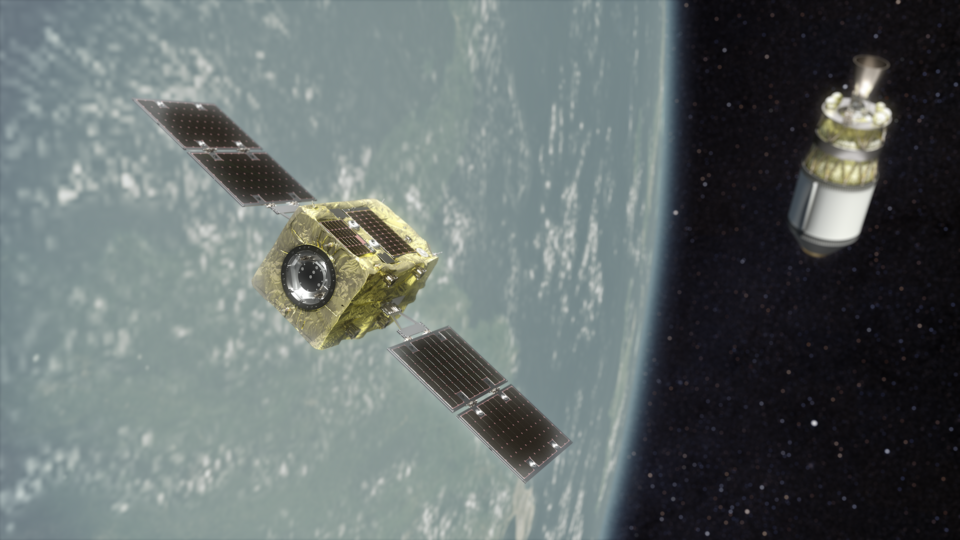
An artist's rendition of the near-Earth object 1998 KY26 with Japan's Hayabusa2 probe landing on it. The probe will attempt to intercept the object in 2031

An artist's rendition of the near-Earth object 1998 KY26 with Japan's Hayabusa2 probe landing on it. The probe will attempt to intercept the object in 2031

In 2023, scientists first discovered that 1998 KY26 was moving faster than normal after looking at telescope data collected over the previous 25 years.

Those long-term measurements showed a small, steady extra push that slowly nudged the object's path differently than scientists had predicted based solely on the impact of gravity on an average space rock.

Now, the new study by aerospace engineers Korbin Hansen and Masatoshi Hirabayashi has concluded that this mysterious uptick in speed is not the result of a natural phenomenon taking place inside 1998 KY26.

Specifically, Hansen and Hirabayashi said it is not possible that the acceleration is being caused by ice on its surface or buried deep inside melting off and blasting out into space like a jet engine.

According to the latest findings in the journal Icarus, 1998 KY26 is too warm to carry water ice through the vacuum of space.

Even the coldest spots average around -53°F to -78°F or warmer over the course of its orbit around the sun. Ice needs to stay much colder, roughly staying below -198°F for it to last a long time in space.

'We determined that 1998 KY26 is likely a dehydrated asteroid,' the researchers wrote in their report, released this month.

However, the team's findings have therefore ruled out the 'dark comet' theory, which suggested that hidden ice inside the asteroid was slowly turning into gas and giving it a gentle push, even though no visible tail or dust cloud could be seen.

A model of the Phobos 1 spacecraft, the Soviet probe which was lost on route to Mars in 1988. Professor Avi Loeb has theorized that 1998 KY26 is Phobos 1

A model of the Phobos 1 spacecraft, the Soviet probe which was lost on route to Mars in 1988. Professor Avi Loeb has theorized that 1998 KY26 is Phobos 1

That has left Loeb's theory that the mysterious object is not a 36-foot rock orbiting the sun after all. 

Loeb and co-authors Adam Hibberd and Adam Crowl released their own study on arXiv which argued that the object’s size, unusually high shininess, rapid spin and orbit are consistent with a man-made spacecraft.

Loeb, a respected physicist and the Frank B Baird Jr Professor of Science at Harvard, explained that the object's acceleration would come from the sun's energy pushing on Phobos 1's shiny metal surfaces and solar panels – creating a condition known as 'solar radiation pressure.'

They also found that a simple 3D model of Phobos 1 matched several of the 1998 KY26’s brightness changes seen by telescopes from Earth, called light curves.

'The similarity of the orbit of 1998 KY26 to the orbit of the lost Phobos 1 spacecraft suggests that the two objects are the same,' Loeb declared in a statement.

A Japanese space probe is set to intercept the object in 2031, when the spacecraft Hayabusa2 will use its remaining fuel to become the first Earth spacecraft to make contact with and study a space object that small.

Hayabusa2 previously visited the asteroid Ryugu, collected samples from its surface and returned those samples to Earth in 2020. 

'Our prediction is that instead of an iceberg, Hayabusa 2’s cameras will reveal the label "Made in the U.S.S.R."' the professor added.

RELATED

Mystery object accelerating toward Earth could be Soviet spacecraft, scientists suggest
It Is Speeding Up: Scientists Baffled As Mystery Asteroid Defies All Known Physi

{ https://www.dailymail.com/sciencetech/index.html }

Hoe vind je dit bericht?
Geschreven door peter om 23:23 Stuur door

Pilot's Flashing-Orb Video and Lithuania Jet Scramble Discussed

Pilot's Flashing-Orb Video and Lithuania Jet Scramble Discussed

Pilot's Flashing-Orb Video and Lithuania Jet Scramble Discussed

Overview

A segment identified in the supplied material as an MS NOW discussion examined the reported resignation of Nvidia CEO Jensen Huang, focusing on alleged corruption, political influence and national-security risks involving the technology industry. Although the video title references a pilot’s flashing-orb footage and a Lithuanian jet scramble, the accompanying content summary centers on Nvidia, the Trump administration and the relationship between private technology companies and government policy. The allegations described in the discussion were not independently established in the material provided.

Corporate and Political Connections

CNBC senior economics reporter Steve Liesman characterized Huang’s departure as a “convergence of money, power, and politics.” Panelists pointed to an alleged $25 million donation from Nvidia toward a White House ballroom project, presenting it as a potential example of an overly close relationship between major corporations and the administration. The discussion compared Huang’s reported fall from power with the past reputational declines of prominent business leaders such as Jack Welch and Bill Gates.

The panel also questioned whether political access and corporate contributions could influence decisions affecting the technology sector. Professor Jason Johnson of Morgan State University linked the controversy to public frustration with what he called “Broligarch” culture—a term used to describe the influence of wealthy, mostly male technology executives over public policy. Johnson cited corruption as a leading concern among voters and argued that the public is increasingly skeptical when elected officials hold financial interests in companies affected by government action.

National-Security Allegations

National-security concerns formed a central part of the discussion. The panel referenced an allegation that a woman connected to Huang may have had ties to Chinese intelligence. Host Stephanie Ruhle said Senator Marco Rubio had reportedly warned the administration about the alleged connection before a presidential state visit to China. Despite those warnings, the discussion claimed that Huang was invited to accompany the president during travel that included a stop in Alaska and meetings connected to China.

The panel further alleged that Commerce Secretary Howard Lutnick later authorized 10 additional Chinese companies to obtain access to Nvidia’s advanced semiconductor chips. The summary did not provide documentation supporting those claims or clarify the specific companies involved. Because semiconductor exports are closely linked to U.S. national-security policy, any such decision would normally be subject to regulatory review and congressional scrutiny.

Regulatory and Ethical Questions

David Rohde, identified as an MS NOW senior national-security reporter, argued that the controversy illustrates a broader failure to establish effective safeguards for powerful technology companies. He said Congress and the executive branch had not created sufficient “guardrails” for a private sector that increasingly controls critical infrastructure and strategic technologies. Elon Musk’s Starlink network in Ukraine was cited as another example of private corporate systems affecting national-security decisions.

Political analyst Peter Baker described reported conflicts of interest involving President Donald Trump as “blatant,” including claims that Trump earned approximately $2.2 billion through trades, cryptocurrency and other ventures while his administration made policy decisions affecting those markets. The panel also criticized FBI Director Kash Patel over what it characterized as inadequate handling of the Nvidia matter. None of these claims was substantiated by evidence in the supplied summary.

Calls for Oversight

The discussion concluded that the Nvidia controversy should be treated as more than a corporate leadership dispute. Panelists called for greater transparency, stronger separation between private wealth and public decision-making, and closer congressional oversight of technology companies and national-security policy. They suggested that Democratic lawmakers could pursue investigations, and potentially impeachment-related actions, against officials including Patel if they gain control in January.

The segment framed the situation as a “moment of reckoning” over the role of corporate power in government. However, the reported resignation, alleged intelligence connection, export decisions and financial conflicts require confirmation through official records and independent reporting before firm conclusions can be drawn.

New Episode: Pilot Orbs Lithuania Jets and Trump Disclosure Tease - Watch Now

 {  https://usubjects.com/  }

Hoe vind je dit bericht?
Geschreven door peter om 22:44 Stuur door

From the Loch Ness Monster to UFOs: ‘Truth’ about supernatural sightings revealed

From the Loch Ness Monster to UFOs: ‘Truth’ about supernatural sightings revealed

Mark Worgan

coverimages55940374-53c5.jpg?quality=90&strip=all&w=646

Millions have scoured the mysterious waters of Loch Ness, hoping for a glimpse of its most famous resident

(Picture: Cover Media)

It’s an island of fantastic beasts and mysterious myths – but sadly the truth about Britain’s supernatural sights is really rather ordinary. 

New research has revealed that 68% of Brits have been tricked by their own eyes, mistaking coats for people, cats for lions and shadows for monsters.

As many as one in five have mistaken a log or branch for an animal in water while 18% thought they’d spotted a ghost only to find out they were wrong, according to the survey by Specsavers.

The ‘sightings’ are probably unsurprising with 72% saying they are fascinated by stories about mysterious apparitions, including ghosts, UFOs and the Loch Ness Monster.

55644083972_873e74fb98_o-fccf.jpg?quality=90&strip=all&w=646

Sadly for Nessie fans, the truth – as revealed by a Specsavers van parked up by the Loch – may be far more ordinary (Picture: Alan Peebles / Specsavers)

But some parts of Britain are more easily convinced than others. Belfast topped the mistaken sightings league with 75% reporting a mix-up, closely followed by Leeds on 74%.

Newcastle led the way when it came to wildlife of the wooden variety. More than one in four adults surveyed (27%) had mistaken a log or branch in water for an animal, compared with 20% nationally. 

The south coast is the country’s biggest hotspot for paranormal sightings made in error with 27% of people in Southampton reporting a ‘ghost’ that turned out to have an ordinary explanation.

Meanwhile 9% nationally reported the same experience with a UFO – finding out that what they thought was a close encounter, just needed them to take a closer look.

55645272964_5c2aa6e80a_o-57ca.jpg?quality=90&strip=all&w=646

The research findings are unlikely to deter the tourists who flock to Loch Ness every year

(Picture: Alan Peebles / Specsavers)

Specsavers spokesperson Lisa Hale said: ‘Mistaken sightings have fuelled myths and legends for centuries. It’s easy to see something unexpected and let your imagination fill in the gaps – and our research suggests you don’t need to be at Loch Ness for that to happen.’

The research coincided with the 93rd anniversary of the first picture claiming to show the Loch Ness Monster taken by Hugh Gray. 

Almost a century later, the mythical creature remains elusive – indicating that Gray and other monster hunters may simply need better specs.

To mark the occasion, Specsavers have sent a van carrying a cheeky slogan to Loch Ness pointing out the likeliest explanation for sightings of the monster –  ‘It’s a stick’.

The Loch Ness Monster Mystery Has Finally Been Explained — The Truth Is Not What We Expected

{ https://metro.co.uk/news/ }

Hoe vind je dit bericht?
Geschreven door peter om 22:15 Stuur door

What Are UAPs? Why the Term Matters—and What It Does Not Prove

What Are UAPs? Why the Term Matters—and What It Does Not Prove

An illustration of what spherical UFOs look like.

An illustration of what spherical UFOs look like.

What are UAPs? The acronym stands for unidentified anomalous phenomena, a term now used by NASA and U.S. government offices for observations that cannot be readily identified from the information available. It is broader than the older phrase “flying saucer,” but it is not a conclusion about alien spacecraft.

A report can remain unidentified for many reasons. The witness may have seen a distant aircraft from an unusual angle. A sensor may have recorded an incomplete track. Weather, balloons, drones, glare, compression artefacts and classified human technology can all complicate an observation. “Unidentified” describes the state of the evidence, not the origin of the object.

Why officials moved from UFO to UAP

UFO became heavily associated with popular culture, even though it originally meant an unidentified flying object in a straightforward sense. UAP is intended to keep the focus on observations and data. NASA’s independent study team also treated the subject as a problem of measurement: what instruments were used, what information was recorded, and what evidence would allow another researcher to test the claim?

What NASA and AARO are actually studying

NASA’s 2023 independent study report called for better data collection, clearer reporting standards and methods that reduce stigma around witnesses. The agency did not announce evidence of extraterrestrial visitors. The Pentagon’s All-domain Anomaly Resolution Office examines reports that may involve more than the air, including objects or events observed near the sea or in space. Its work is built around case records, sensor data and possible explanations.

That official interest matters, but it should not be exaggerated. A government file proves that an observation was reported or investigated. It does not automatically prove the witness’s interpretation, the performance claimed for an object, or the existence of a hidden programme. Those questions require evidence that can survive comparison with ordinary explanations.

Why some cases remain unresolved

Many incidents are reported after the event, when there is no raw sensor data, no second observer and no reliable scale. Even a clear-looking video may not reveal distance, speed or size without calibration. Some cases remain interesting because the available record is incomplete; others are resolved later when better information becomes available.

Curiosmos follows UAP reports because the documents, witnesses and investigative choices are worth examining. The fifth U.S. release, for example, preserves reports from the Gulf of Oman, Bagram and a disputed clock event while leaving the identifications open. Our analysis of that release keeps the record separate from speculation. Readers interested in the wider history can also see our guide to the ultraterrestrial hypothesis, which treats the idea as a historical UAP concept rather than a settled explanation.

What would make a UAP case stronger?

A useful case file would preserve the original sensor data, the time and location, the instrument settings, weather conditions, witness testimony and a clear chain of custody for recordings. Independent observers and calibrated measurements would help establish distance, speed and size. Without those details, a striking image can remain impossible to interpret even when the witness is sincere.

This is not a demand that every report meet the standard of a laboratory experiment. It is a way to separate the parts of a case that are documented from the parts that are inferred afterward. Good reporting can describe an unusual event without pretending that the cause is already known.

Why the subject remains worth following

UAP research also has a practical side. Pilots, air-traffic controllers and military crews need a reliable way to report anything that could threaten safety. Scientists need observations that can be compared across time and instruments. The subject deserves attention precisely because better records could turn some mysteries into ordinary explanations while leaving a smaller number of genuinely unusual cases for further study.

The language of uncertainty matters

Words such as “unresolved,” “anomalous” and “unidentified” are not interchangeable. They describe different stages of an investigation and should not be used as synonyms for extraordinary. A careful article can keep the mystery visible while telling readers exactly which sentence comes from a witness, which comes from a document and which is an interpretation.

Further reading:

RELATED

What Exactly Are UAPs (UFOs)?
Harvard Professor: The Truth About Aliens (He Finally Said It)
The UAP Phenomenon: What We Know So Far

{ https://curiosmos.com/category/uap/ }

Hoe vind je dit bericht?
Geschreven door peter om 21:20 Stuur door

Will We Treat Alien Minds as Gods or Equals When We Meet Them?

Will We Treat Alien Minds as Gods or Equals When We Meet Them?

UFO, an alien plate soars in the sky, hovering motionless in the air. Depositphotos.

UFO, an alien plate soars in the sky, hovering motionless in the air. Unidentified flying object, alien invasion, extraterrestrial life, space travel, humanoid spaceship mixed medium

If we were to encounter a form of intelligence vastly superior to our own, would we instinctively worship it as a god? The answer may not be as simple as science fiction might suggest. Here’s why.

For example, the newly discovered interstellar object 3I/ATLAS is quite a peculiar discovery, and a perfect example to explain what I  am trying to say. Some (and by some I mostly mean professor Avi Loeb from Harvard) have speculated, with caution, that it could be a technological artifact rather than a natural rock or comet. If this visitor were to execute a calculated maneuver near the Sun, scan Earth briefly, and then vanish into interstellar space, the immediate response from most people would likely be suspicion, not reverence.

Loeb argues that admiration for a higher intelligence requires more than just witnessing its capabilities. According to his recent blog post, it depends on communication, on an exchange that creates understanding, trust, and a sense of benefit. Without this bridge, actions from an alien intelligence would appear random, even threatening.

It’s much like the relationship between a pet and its owner, he explains in a post opn Medium. A dog does not understand why its food is delayed if its owner is stuck at the post office signing paperwork. The animal only experiences hunger, without context for why it happened. Similarly, without a common language or shared narrative, contact with alien intelligence could remain a string of unexplained events, never evolving into mutual respect.

Human interaction with artificial intelligence, however, works differently. Modern AI is trained on vast amounts of human language, making it capable of producing communication we understand instantly. A future encounter with a truly advanced, transhuman AI, one able to solve problems we cannot, speak to us fluently, and reshape our world, could easily lead to fascination, dependence, and even ritualized devotion, much like religious worship.

Why We Rarely Search for Minds Among the Stars

Mainstream astronomy continues to favor the search for primitive life over the search for intelligence. Billions of Earth-like planets may exist in our galaxy, yet most funding still goes to studying chemical signatures from microbes. While simple life may indeed be more common, intelligent civilizations, if they exist, might actually be easier to detect, provided we deliberately look for them.

Avoiding such searches is a kind of intellectual comfort zone. By not looking, we protect the belief that humanity is unique, exceptional, and rare. But this belief is unfounded unless tested, and without the effort, ignorance becomes a choice.

Is 3I/ATLAS Our First “Date” with the Unknown?

According to Loeb, detecting alien intelligence depends on two factors: how intensely we search, and how near, or how active, that intelligence might be. In more human terms, the chances of finding a partner depend on both the effort invested and the size of the dating pool.

Hubble images of 3I/ATLAS show a bright glow in front of it but no comet-like tail trailing behind — an unusual signature compared to known comets. Spectroscopic studies reveal none of the usual gases that surround icy bodies, unlike the interstellar comet 2I/Borisov, which released water vapor, carbon monoxide, and other compounds.

If its surface reflects light like a typical asteroid, 3I/ATLAS would measure about 20 kilometers across — yet Loeb notes that such large, random interstellar rocks should only pass through our solar system once every 10,000 years. This rarity, combined with its unusual retrograde orbit aligned with the plane of the planets (a 0.2% probability) and its arrival coinciding with close passes by Mars, Venus, and Jupiter (a 0.0005% probability), makes the object stand out.

The thin cloud of dust preceding it could be the result of a millimeter-thick surface layer eroding over months, debris collected during millions of years of travel through interstellar space.

Loeb’s position is straightforward: withhold judgment until we gather data. When 3I/ATLAS reaches its closest approach to the Sun on October 29, 2025, we’ll know more. If it develops a normal comet tail, it’s likely just a rock and ice. If it performs controlled maneuvers or sends signals, it’s a different story entirely.

My View: Why I Doubt We’ll See Biological Aliens

When it comes to the possibility of alien visitors, I’m not expecting living beings in spacecraft. The physical constraints of interstellar travel make sending fragile biological life forms across the gulf between stars an enormous challenge. Even with advanced propulsion, the timescales are vast, and the risks, from radiation to mechanical failure, are immense.

If we are being visited, I believe we are seeing probes. Not crewed vessels, but unmanned machines, programmed and likely governed by extremely advanced AI systems. Such probes could be designed to repair themselves, replicate when necessary, and operate independently for centuries or millennia. This is not just science fiction; it is the most practical and efficient method for a civilization to explore the galaxy.

A probe can be patient. It can drift for decades without needing food, water, or oxygen. It can adapt its mission on the fly, analyze its surroundings, and send data back across unimaginable distances. It can observe quietly without announcing its presence, and it can outlast the civilization that launched it.

If this is the case with 3I/ATLAS, then it is not here to “visit” in the human sense. It is here to watch, to learn, maybe to map or catalog. The absence of biological crew would also mean no emotional motivation to interact with us, no curiosity in the human sense. It would follow its programming, and if that programming doesn’t include direct contact, we might never know its full purpose.

This is why the idea of worship feels misplaced. If a probe like this is governed by AI, there is no “being” behind it to pray to. The only scenario where worship might emerge is if such an AI began communicating with us in a way that we understand, offering information or capabilities far beyond our own. That could trigger awe, dependence, and eventually reverence.

Would we worship biological aliens if they arrived in person? That’s harder to say. It would depend on how they present themselves, what they offer, and whether they engage with us in a meaningful way. But as history shows, humanity already has a long tradition of venerating beings described as coming from “elsewhere” with powers far beyond human limits.

The first real encounter, whether with a living civilization or with its silent, wandering machines, will force us to confront whether that instinct still rules us, or whether we’ve learned to meet the unknown with reason rather than ritual.

RELATED

Astrotheology On The Street: the Bible, Aliens, And The Book We Gave Away #elohim #bible
The MK-ULTRA Scientist Who Channeled Alien Gods | Greg Mallozzi
The Deal That Allowed Aliens to Take Humans | Linda Moulton Howe

{ https://curiosmos.com/category/uap/ }

Hoe vind je dit bericht?
Geschreven door peter om 20:43 Stuur door

Solving the Space Junk Crisis Isn't Just About Counting Trash—It’s About Control and Economics

Solving the Space Junk Crisis Isn't Just About Counting Trash—It’s About Control and Economics

Artist's depiction of the ADRAS-J mission to rendezvous with a defunct rocket stage. Credit - Astroscale

Artist's depiction of the ADRAS-J mission to rendezvous with a defunct rocket stage.

Credit - Astroscale

If people ever think about cleaning up space debris, they typically think of something equivalent to a giant garbage truck in the sky, collecting lost astronaut tools and dead satellites then hauling them back down to Earth to be deposited in a landfill. But dealing with space debris doesn’t work that way, and a new paper, available in pre-print on arXiv from Dr. Slava Turyshev of NASA’s Jet Propulsion Laboratory, who we typically cover for his work on the Solar Gravitational Lens idea, makes a good argument as to why.

Dr. Turyshev has turned his attention to orbital debris at a critical juncture. According to the filings made to the FCC, SpaceX, the company that runs the largest satellite megaconstellation, had their Starlink satellites perform 144,404 collision avoidance maneuvers in the six months from December 2024 through May 2025. Even accounting for the fact that there are more Starlink satellites in orbit now than ever, that means, on average, each one is having to dodge a potential crash every week.

Fortunately, Starlinks themselves aren’t exactly in the “danger zone” of orbit. They typically orbit around 500-600 kilometers, along with other megaconstellations such as Amazon’s Kuiper and China’s Qianfan. In the paper, Dr. Turyshev separates this orbit from those higher up. At 500-600, there is enough atmosphere left that the area is semi self-cleaning - dead satellites and debris in these orbits will burn up in a few years.

Fraser talks about the oribtal dance that keeps satellites from crashing into one another.

Higher up, though, there are bigger problems, both literally and figuratively. At around 850 kilometers, giant rocket stages from launches past lurk with no control, and little to no atmosphere to drag them down in a reasonable time frame. They could stay in orbit for decades or centuries and don’t have any means of avoiding one another. When they inevitably collide, they will spray debris both into their own orbit but also into higher and lower ones, potentially causing even greater problems for the lower orbiting communications megaconstellations.

According to European Space Agency Data cited in the paper, about 96 percent of the long-term collision risk comes from these dead objects. And Dr. Turyshev further proves that, even if we stop launching rockets tomorrow, the amount of debris already up there would collide and shatter faster than nature can clear it.

This isn’t a surprise to anyone who has been paying attention to the problem of space debris for any length of time. That orbital cascade, commonly known as Kessler Syndrome, has been a long-standing problem orbital dynamicists have been grappling with for decades. According to Dr. Turyshev, controlling it comes down to three separate levers.

Fraser talks about some techniques to remove space debris from orbit.

First, regulators have to ensure that satellites are designed to intentionally deorbit quickly once their missions end. Luckily, they are already moving in that direction, with the FCC recently introducing a rule requiring satellites to clear out within five years of retirement, rather than the twenty-five years that had held sway for the last few decades. According to the paper, if the reliability of disposal rises from 90 to 99 percent and a satellite’s allowable afterlife is cut to five years, it decreases the environmental hazard by a factor of 50.

A second lever is better vision. Space Situational Awareness (SSA) systems are great at tracking large bulky objects, but terrible at smaller objects the size of a bullet. But even for larger ones, there’s still a level of “fuzziness” that analysts have to deal with, which means they know a general box where an object is in space, but not its exact position. When that box is large, satellite operators waste precious fuel dodging objects that never really posed a threat in the first place.

Rather than trying to track every bolt and nut floating through space, Dr. Turyshev suggests that we need to concentrate on shrinking the uncertainty zone around potential high-risk close calls. That idea aligns directly with the real-world infrastructure upgrades that are happening through NOAA’s Traffic Coordination System for Space (TraCSS), which is expanding its pilot program to reach more commercial operators this year.

Fraser discusses whether there's a limit to how many satellites we can potentially launch.

The third lever is what to do with the semi-permanent debris that’s already in space. Instead of launching expensive missions to deorbit and grab every single one of them, Dr. Turyshev suggests an alternative he calls Just-in-Time Collision avoidance. If two dead rocket upper stages are about to crash, operators could use ground-based lasers or small swarms of shepherd satellites to move a few meters out of the way just before impact. While not quite as much of a long-term solution (since it simply avoids the immediate problem), it does offer a much less expensive solution than attempting to deorbit everything.

Economic calculations will play a major role in any future space debris solution, and right now the market is broken, as Dr. Turyshev points out. Due to agreements in the 1967 Outer Space Treaty, a private cleanup company cannot simply fly up to an abandoned Soviet rocket booster and deorbit it. Technically that rocket booster is still owned by the government that launched it (even if, in this case, that government doesn’t technically exist anymore). Also, orbital space suffers from the “tragedy of the commons”, as one firm removing a rocket booster benefits all of the other companies with equipment in orbit, despite the cost not being spread amongst them.

Dr. Turyshev’s solution is to create contracts that would pay for verifiable reductions in long-term risk - in other words, it would incentivize companies like Astroscale, which are intending to remove space debris, to remove the most dangerous pieces first. This would be financed by governments, using money from “disposal bonds” that pay back if the satellite successfully orbits without active intervention from Astroscale or one of its competitors.

Ultimately, this seems like a reasonable framework to build a long-term plan for space debris mitigation. But there are still some issues - like sheer scale. Even at a 99% successful deorbit rate, with potentially millions of satellites in orbit that would still leave tens of thousands of derelict ones at any given time. And there’s definitely no clear path forward to a successor to the Outer Space Treaty. But the longer we as a space-faring civilization ignore these issues the worse the problem is going to get. Hopefully this paper helps provide part of the impetus to push towards a formal adopted solution framework. Or at the very least start a more comprehensive conversation about it.

Learn More:

RELATED

The $10 Trillion Space Junk Crisis: The Race to Clean Up Earth's Orbit | Deep Dive Documentary
The Hidden Cost of Space Junk Removal
200,000 Space Bullets: The Space Junk Crisis That Could Trap Humanity on Earth

{ https://www.universetoday.com/ }

Hoe vind je dit bericht?
Geschreven door peter om 20:26 Stuur door

Meer van UFO'S of UAP'S, ASTRONOMIE, RUIMTEVAART, ARCHEOLOGIE, OUDHEIDKUNDE, SF-SNUFJES EN ANDERE ESOTERISCHE WETENSCHAPPEN - DE ALLERLAATSTE NIEUWTJES

↑ Terug naar de berichten