Ontdek de Fascinerende Wereld van UFO's en UAP's: Jouw Bron voor Onthullende Informatie!
Ben jij ook gefascineerd door het onbekende? Wil je meer weten over UFO's en UAP's, niet alleen in België, maar over de hele wereld? Dan ben je op de juiste plek!
België: Het Kloppend Hart van UFO-onderzoek
In België is BUFON (Belgisch UFO-Netwerk) dé autoriteit op het gebied van UFO-onderzoek. Voor betrouwbare en objectieve informatie over deze intrigerende fenomenen, bezoek je zeker onze Facebook-pagina en deze blog. Maar dat is nog niet alles! Ontdek ook het Belgisch UFO-meldpunt en Caelestia, twee organisaties die diepgaand onderzoek verrichten, al zijn ze soms kritisch of sceptisch.
Nederland: Een Schat aan Informatie
Voor onze Nederlandse buren is er de schitterende website www.ufowijzer.nl, beheerd door Paul Harmans. Deze site biedt een schat aan informatie en artikelen die je niet wilt missen!
Internationaal: MUFON - De Wereldwijde Autoriteit
Neem ook een kijkje bij MUFON (Mutual UFO Network Inc.), een gerenommeerde Amerikaanse UFO-vereniging met afdelingen in de VS en wereldwijd. MUFON is toegewijd aan de wetenschappelijke en analytische studie van het UFO-fenomeen, en hun maandelijkse tijdschrift, The MUFON UFO-Journal, is een must-read voor elke UFO-enthousiasteling. Bezoek hun website op www.mufon.com voor meer informatie.
Samenwerking en Toekomstvisie
Sinds 1 februari 2020 is Pieter niet alleen ex-president van BUFON, maar ook de voormalige nationale directeur van MUFON in Vlaanderen en Nederland. Dit creëert een sterke samenwerking met de Franse MUFON Reseau MUFON/EUROP, wat ons in staat stelt om nog meer waardevolle inzichten te delen.
Let op: Nepprofielen en Nieuwe Groeperingen
Pas op voor een nieuwe groepering die zich ook BUFON noemt, maar geen enkele connectie heeft met onze gevestigde organisatie. Hoewel zij de naam geregistreerd hebben, kunnen ze het rijke verleden en de expertise van onze groep niet evenaren. We wensen hen veel succes, maar we blijven de autoriteit in UFO-onderzoek!
Blijf Op De Hoogte!
Wil jij de laatste nieuwtjes over UFO's, ruimtevaart, archeologie, en meer? Volg ons dan en duik samen met ons in de fascinerende wereld van het onbekende! Sluit je aan bij de gemeenschap van nieuwsgierige geesten die net als jij verlangen naar antwoorden en avonturen in de sterren!
Heb je vragen of wil je meer weten? Aarzel dan niet om contact met ons op te nemen! Samen ontrafelen we het mysterie van de lucht en daarbuiten.
A rocket is set to blast off towards one of Mars's moons tonight in an ambitious £262million mission.
The Japanese spacecraft, known as Martian Moons Exploration (MMX), will this evening begin its 300million-mile mission to Phobos - the larger of the Red Planet’s two satellites.
Its aim is to collect at least 10g of dust and rock from the moon's surface, before heading back to Earth.
The mission is expected to return the first-ever samples collected from the vicinity of Mars, with tiny grains of material believed to contain a wealth of scientific information.
Experts hope the samples will finally settle a decades-old debate over whether Phobos is an asteroid that was 'captured' by Mars's orbit, or the remains of a giant collision involving the Red Planet.
'Through detailed observations and analysis of the samples obtained from Phobos, this mission seeks to clarify the formation of the Martian sphere and the Solar System, explore how life began, and pave the way for future deep-space exploration,' the Japan Aerospace Exploration Agency (JAXA) said.
Phobos, the largest of the Red Planet's two moons, is the ambitious mission's set destination
The spacecraft's aim is to touch down on Phobos and scoop up at least 10g of dust and rock from the moon’s surface before beginning the long journey back to Earth (artist impression)
MMX is set to launch on an H3 rocket at 8.41pm (BST) today, from the country's Tanegashima Space Centre.
The spacecraft consists of three components with specific functions, including a propulsion module to get MMX to Mars, an exploration module with sample collection gear and a return module to deliver the sample to Earth.
After takeoff, the rocket will spend several years travelling through deep space before orbiting Phobos.
In early 2029, a small microwave-sized rover will drop down on to the moon’s surface and spend 100 days exploring its landscape.
Its findings will inform the exact area where the exploration module should land.
Once confirmed, the spacecraft will descend to the surface of Phobos then spend two-and-a-half hours collecting material.
Scientists hope to gather samples from one or even two separate locations, giving them a better understanding of the moon's composition.
To do this, MMX will use one of two collection systems. The primary option is the C-sampler, which can drill up to 0.8 inches (2cm) beneath the surface and retrieve material that has been shielded from the sun's radiation.
A second system, known as the P-sampler, uses a burst of nitrogen gas to blast dust and small rocks into a collection chamber.
In early 2029, a small microwave-sized rover will drop down on to the moon’s surface
The spacecraft will spend two-and-a-half hours collecting samples from Phobos for research
In total, the spacecraft is equipped with 13 scientific instruments that will be used to examine Phobos in unprecedented detail.
High-resolution cameras, called Tengoo and Orochi, will photograph and map the moon's surface, while a laser altimeter will create a detailed 3D picture of its shape and terrain.
Another instrument, called MIRS, will analyse the moon's minerals, and a gamma-ray and neutron detector known as Megane will help reveal its chemical makeup.
The mission will also study Mars's smaller moon, Deimos, from afar.
After it has gathered at least 10g of material, the spacecraft will then leave the Martian system and travel back home, arriving in 2031.
As the spacecraft approaches Earth, it will release a capsule carrying the precious samples.
The capsule will plunge through the atmosphere before descending by parachute into the Australian outback, where it will be recovered and flown to Japan for analysis.
Martian Moons Exploration is to launch at 8:41pm (BST) today from a Japanese space centre
Experts hope the samples will finally settle a decades-old debate over whether Phobos is a captured asteroid or the remains of a giant collision involving the Red Planet itself
Studying material directly in laboratories on Earth will allow far more detailed analysis than is possible in space.
‘Mars is a planet that shares many similarities with Earth, yet today it has only a thin atmosphere and a cold environment,’ JAXA said.
‘To unravel the mystery of how Mars evolved into its present state, scientists would ideally study Mars itself.
‘However, the planet's strong gravity presents significant technical challenges for landing and sample return missions.
‘For this reason, MMX has selected Phobos, one of Mars's moons, as the exploration target.’
Scientists are also hoping the samples may contain tiny fragments of Mars itself.
Because Phobos orbits so close to the planet, debris blasted from the Martian surface by asteroid impacts may have become embedded in the moon over billions of years.
The European Space Agency (ESA) has provided the spacecraft’s deep space communication equipment.
‘The data and samples returned by MMX are a window to study the evolution of Mars and the Solar System,’ Elliot Sefton-Nash, ESA MMX Project Scientist, said.
‘Bringing samples to our most sophisticated labs here on Earth is a multiplier for discoveries, because our most precise instruments are too large, complex or sensitive to send to space.
‘Even after the mission has been completed, future generations of scientists will study the Phobos samples with even more advanced instruments – samples brought to Earth are the gift that keeps on giving.’
RELATED
NASA’s Ambitious Mission to Bring Martian Samples to Earth
Agents rushed to a Minnesota farm midafternoon last week after receiving a call about a 'foreign' object found in a crop field.
Authorities said in a Facebook post: 'On October 14, 2026, at approximately 3.30pm, the Stevens County Sheriff’s Office received a phone call [about] foreign debris that was found in a cornfield in Scott Township.'
Footage shared online by locals in Alberta shows two black vehicles parked just feet from the object as officers examine it.
The object appeared scorched along its underside, and farmers reportedly discovered the object while combining their fields.
The Minnesota Duty Officer was alerted, prompting a response from federal agencies.
Authorities have since moved the object to a secure location.
The sheriff's office is coordinating with state and federal officials to identify and contact the object's owner and arrange its removal from the field.
Authorities found a metallic object approximately 11 feet in diameter that they believe may be space debris
Stevens County Sheriff Jason Dingman said that because the incident is an ongoing investigation, he cannot say which federal agencies are involved.
'There are several various agencies assisting in the determination of origin of this object,' Dingman said Friday afternoon.
'We're not getting fed much information either and what info we do get is pretty cryptic.
'So I think somebody way up the food chain above my head knows what this thing is but they are not even telling us.'
Chokio resident Tena Wilts told the Star Tribune that she saw the object on Thursday while driving to her parents' house, about three miles away from the field.
'It's very large. Compared to the trucks, it seems very large and bizarre that it just kind of landed there in the middle of a field,' Wilts said.
'We had a tornado through the area a few weeks ago, so that came to mind. You hear about space garbage, too, so that comes to mind.'
Officials told KARE 11 that serial numbers were visible on the object, potentially offering investigators a way to trace its manufacturer or owner. Authorities have said the discovery poses no danger to the public.
Space debris includes defunct satellites, spent rocket stages and fragments created when spacecraft break apart or collide, according to NASA.
Some objects eventually fall back toward Earth as their orbits decay.
During reentry, spacecraft generally break apart roughly 45 to 52 miles above the surface.
Their fragments then encounter intense heating as they descend, with some burning up and others surviving the journey to the ground.
NASA explains that components made from materials with higher melting points, including titanium and stainless steel, can survive longer than parts made from aluminum.
Pieces protected inside larger structures may also be shielded from heating until the surrounding material breaks apart. NASA uses computer models to predict which spacecraft components might survive reentry.
Controlled reentries are designed to guide debris toward remote areas, usually over the ocean. With an uncontrolled descent, however, NASA says there is no guarantee that surviving fragments will avoid populated land.
Investigators have not publicly linked the Minnesota object to a particular satellite, rocket or launch.
Apparent space debris lands in western Minnesota cornfield
Super El Niño is changing the colour of the world's oceans, satellite images from NASAhave revealed – with the equatorial pacific transforming from lush green to bright blue over the past year.
El Niño has interfered with the currents that carry cold, nutrient-rich water to the surface, essential to photosynthesising plankton – which turn the areas they inhabit a dazzling emerald green.
Without that essential food, the plankton have starved, and a wash of deep, lifeless blue has returned to the Pacific.
A side-by-side comparison with satellite data from 2025 shows how this area held on to its typical green hue throughout the entire year.
But by the time of the most recent data, which covers up to this month, the area around the equator has turned blue.
El Niño is part of a naturally occurring climate cycle known as the El Niño Southern Oscillation.
Every two to seven years, this pattern brings either a hot El Niño period or a cooler La Niña phase.
During the El Niño phase, hot waters gather in the equatorial Pacific Ocean off the coast of South America, raising the average temperature and affecting global weather patterns.
NASA satellite observations show that Super El Niño is making the ocean bluer this year (top) compared to 2025, as warm water disrupts the flow of nutrients that typically feed green phytoplankton
Scientists now believe we are in the early stages of a massive El Niño cycle, which could have catastrophic effects in the coming months and throughout 2027.
As of October, the National Oceanic and Atmospheric Administration predicts there is an 83 per cent chance that this will be the strongest El Niño since records began in 1950.
Meanwhile, NASA's satellite measurements show that sea surface temperatures in the eastern Pacific are currently 1.7°C (3°F) above the long–term average, and could jump another fraction of a degree higher in the coming months.
This band of warm water expanded throughout the spring and now covers millions of square miles in an area stretching from the coast of South America to the heart of the Pacific.
This is also the first El Niño year since NASA launched the PACE (Plankton, Aerosol, Cloud, Ocean Ecosystem) satellite in 2024, giving scientists an unprecedented view of the unfolding threat.
The Ocean Colour instrument aboard PACE observes the ocean in 'hyperspectral colour', measuring wavelengths in the visible, ultraviolet and infrared spectrum.
Dr Matthew Kehrli, a lead research scientist at NASA’s Goddard Space Flight Center, said: 'Some people think of water as being just blue, but it's amazing the multitude of colours the ocean can be.'
NASA's satellite measurements show that sea surface temperatures in the eastern Pacific are currently 1.7°C (3°F) above the long–term average
This picture, from data collected on October 14, shows the heat has spread along the coast of Chile and out into the south–east Pacific, with the boxed arm showing the heat movements
During El Niño, the trade winds, which typically transport warm water westwards towards Australia, weaken or even reverse.
This reduces the upwelling of nutrient-rich waters from deeper parts of the ocean, leading to a decline in algae numbers and bluer waters, as seen in PACE's observations.
That decline can also trigger cascading effects across the entire marine ecosystem, forcing other animals to relocate to new feeding grounds in search of phytoplankton.
'You have expectations of what you would think would happen, but to visually see the results with the data products that you’re working with in real time is gratifying,' says Dr Kehrli.
Thanks to satellite observations, scientists actually got their first hint that a major El Niño year was coming all the way back in January.
Satellites built to measure sea levels picked up something called a Kelvin Wave building near Micronesia, in the western Pacific Ocean.
Kelvin Waves are slow-moving pulses of water spanning thousands of miles that act like underwater motorways transporting heat from west to east across the Pacific.
El Niño is even affecting sea levels in the Pacific, with some areas rising up to 1.3 feet (40cm) above average (shown in red)
That heat warms the air above them, causing it to rise and creating a change in air pressure that weakens the trade winds – kickstarting the El Niño chain reaction.
Dr Josh Willis, project scientist for sea level missions at NASA’s Jet Propulsion Laboratory in Southern California, says: 'Kelvin waves are like the heartbeat of El Niño.
'And our sea level satellites let us peer into the ocean and watch every beat.'
By early April, NASA's satellites saw that the Kelvin wave had reached the eastern Pacific and was already starting to warm sea surface temperatures.
Since warm waters also expand and rise, that change can be seen in a massive increase in sea levels within El Niño's critical region.
Sea levels rose by as much as 1.3 feet (40cm) near South America and the coast of California, while sea levels dropped by up to eight inches (20cm) near Indonesia and Australia.
Dr Willis says: 'El Niño touches almost all of us in some way every time it occurs. While many have seen what it can do, we look to the ocean to understand why.'
El Niño and La Niña are the warm and cool phases (respectively) of a recurring climate phenomenon across the tropical Pacific - the El Niño-Southern Oscillation, or ENSO for short.
The pattern can shift back and forth irregularly every two to seven years, and each phase triggers predictable disruptions of temperature, winds and precipitation.
These changes disrupt air movement and affect global climate.
ENSO has three phases:
El Niño: A warming of the ocean surface, or above-average sea surface temperatures (SST), in the central and eastern tropical Pacific Ocean. Over Indonesia, rainfall becomes reduced, while rainfall increases over the tropical Pacific Ocean. The low-level surface winds, which normally blow from east to west along the Equator, instead weaken or, in some cases, start blowing the other direction from west to east.
La Niña: A cooling of the ocean surface, or below-average SST, in the central and eastern tropical Pacific Ocean. Over Indonesia, rainfall tends to increase, while rainfall decreases over the central tropical Pacific Ocean. The normal easterly winds along the Equator become even stronger.
Neutral: Neither El Niño or La Niña. Often tropical Pacific SSTs are generally close to average.
‘Any other colours, green included, are not possible,’ Mark Hollands, an astrophysicist at the University of Warwick, tells Metro.
Well, that is until Hollands and his team found one.
Why is this star green?
WDJ1330+6435, which is about 4,000°C, glows a ghostly green (Picture: Mark Hollands, University of Warwick)
Astronomers have long thought white dwarves, the embers left behind when a star dies, follow the same temperature colour rule. They’re hot, so they are a bluish white, hence the name.
But as Holland and his co-authors wrote in their paper published in the journal RAS Techniques and Instruments, these solar husks can actually be colours never seen in other stars.
Researchers calculated what colour 151 white dwarfs would look like to the human eye. Of them, 146 live up to their name.
Yet WDJ1330+6435, a dead star 280 light-years from Earth, or about 165trillion miles away, in the constellation Draco, glows green.
This white dwarf has been absorbing iron-, magnesium-, and sodium-rich slush from the rocky planets that once orbited it.
‘Think of something like asteroids or minor planets that have ventured too close to the white dwarf, have been shredded into dust by tidal forces and then rained down onto the stellar surface where they get mixed in,’ Hollands says.
White dwarves, while very hot, shine dimly (Picture: PA)
Chemical elements – the things in the periodic table – absorb different colours of light and spit out the rest. Sodium’s favourite colour is orange, which is why sodium street lamps glow a dull yellow.
WDJ1330+6435 is so dense that the star’s helium plasma, the gooey fourth state of matter, makes the sodium soak orange, yellow and red light.
‘This absorbed radiation is then re-radiated at other wavelengths, with the emergent spectrum having a beautiful green colour,’ Hollands says.
If our sun – which, as Hollands says, is white, not yellow – were replaced with WDJ1330+6435, Earth wouldn’t be the same.
Hollands says the star would be tiny in the sky as it’s 100 times smaller. Earth would have a wider orbit as the white dwarf’s gravity isn’t as strong.
‘Even if we could move the Earth closer in somehow, so that the star appeared bigger in the sky, plant life on Earth absorbs mostly violet and red light, reflecting the green, to grow,’ he adds.
‘With some of these wavelengths missing from WDJ1330+6435, that certainly wouldn’t be good news for us.’
Are there other coloured stars?
White dwarves are like giant cotton wool balls, tinted by the material they absorb (Picture: Mark Hollands/University of Warwick
WDJ1330+6435 is the first known genuinely green star in the Milky Way.
It’s one of five white dwarf stars the astronomers found that glow an odd colour because of the material in their atmospheres.
Hydrogen- and helium-filled wisps were cyan or a pale blue and stars that swallowed asteroids or rocky planets were yellowish or, in the case of WD J1330+6435, chartreuse.
Carbon-rich ones were pink or purple, like WD J1011+2845, which is 48 light-years from Earth in the constellation Leo Minor.
The star glows a salmon-pink hue because its convection zone – layers of hot and cold slush – is so deep that carbon leaks from inside it.
‘We also found some of these carbon-rich white dwarfs to be pale purple as well, if the stellar temperature is a bit higher and the abundance of carbon a bit lower,’ says Hollands.
Another white dwarf, WD J1011+2845, that would appear pink to the human eye (Picture: Mark Hollands/University of Warwick)
As white dwarf stars can’t be seen directly from Earth, the astronomers deduced their colours using star spectrum data, the ‘fingerprint’ left when starlight is split apart by wavelength.
Hollands says that while the findings don’t change how we see white dwarf stars – no pun intended – they show just how colourful the universe is.
Even brown dwarf stars, failed stars too small to attain the gravity needed to get their hydrogen motors running, can sparkle.
‘Most of their light is radiated in the infrared, but a small amount is still emitted at visible wavelengths, with absorption from sodium, potassium, and titanium oxide affecting their perceived colours,’ Hollands says.
‘Other people have in the past worked out the colours of brown dwarfs from their spectra and determined that they would be violet or purple.’
RELATED
Scientists Just Found the First GREEN Star, and It Ate Its Own Planets
Scientists Found a Green Star — But Stars Aren’t Supposed to Be Green
'Cute demo, but totally impractical': Experts are skeptical that Tesla's 'Rocket' Roadster could actually work in the real world
Tesla has unveiled a new version of its Roadster EV that can briefly take to the air using SpaceX tech. Whether it actually qualifies as a flying car is another matter.
Tesla's new 'Rocket' Roadster is slated for production in 2028.
(Image credit: Tesla)
During a filmed demonstration at the SpaceX rocket testing facility in Texas Thursday (Oct. 15), the second-generation Tesla Roadster was shown accelerating up a curved ramp before launching itself into the air, performing a 180-degree barrel roll and touching back down to Earth.
In another stunt, the vehicle leapt over a row of parked Teslas. For safety reasons, the vehicle was operated remotely in both instances.
"Turns out, the future does have flying cars," Tesla and SpaceX CEO Elon Musk wrote on X following the demonstration.
The Roadster's airborne capabilities are made possible by a system of cold-gas thrusters developed using technology from Musk's aerospace company, SpaceX. These thrusters release bursts of high-pressure gas to generate thrust, allowing the vehicle to accelerate rapidly and, according to Tesla, become airborne for short periods.
The new Roadster will come in three variants: Performance, Thrust and Rocket. Only the Rocket is capable of flight. The Performance model is a two-seater equipped with a suction system that's designed to improve traction and handling (or drive up inverted ramps, as in Tesla's demo), while the Thrust model adds rear-mounted thrusters that Tesla claims can propel the vehicle from 0 to 60 mph (97 km/h) in under a second.
(Image credit: Tesla)
The highest-end model, Rocket, features SpaceX cold-gas thrusters positioned around the vehicle to enable short bursts of flight and in-air control. This single-seat model will be available by invitation only, according to Tesla.
On the company's website, Tesla representatives explicitly stated that the Rocket isn't approved for use on public roads and that availability depends on regional regulations. During the reveal, Musk told the audience that the Rocket "is not necessarily a safety-optimized car."
Tesla's next-generation Roadster electric car is displayed in McGregor, Texas, United States, October 16, 2026. /VCG
Tesla hasn't disclosed how far or for how long its EV can remain airborne, nor is it the first company to develop a hybrid road-air vehicle. There is also skepticism from outside viewers on whether the demonstration could be replicated outside of controlled scenarios.
Artificial intelligence (AI) scientist Yann LeCun — a professor of data science, computer science, neural science and electrical engineering at New York University — described the demonstration on X as a "marketing stunt" and questioned whether the vehicle would work in practice.
"Even assuming that 50% of the mass of the car is the compressed air, that gives you less than 10s of useful thrust (with thrust-to-weight ratio larger than 1.0). Probably more like 5 seconds, actually," he posted on the social media platform. "So the car must be an empty, lightweight shell containing big compressed air tanks. Cute demo, but totally impractical. But of course, you knew that."
He likened it to SpaceShipOne, which debuted in 2004 as the first privately funded spacecraft and made three record-setting flights before being retired.
California-based Alef Aeronautics, which is developing its own flying EVs, marked Tesla's unveiling by releasing footage of its vehicle flying over an earlier Roadster model. Alef representatives said the demonstration marked its 1,000th logged flight.
The first flying taxis could start operating in 2026 — will this new form of transport actually take off?China puts a sodium-ion battery into an EV for the first time — it can drive 248 miles on a single chargeWatch four flying cars go toe-to-toe in new 'Formula One of the skies'
"Welcome Tesla to the flying car race, we've been here alone for eleven years," Alef CEO Jim Dukhovny said in a statement emailed to Live Science. "Having competition is a good thing, especially from such a major company as Tesla."
Unlike Tesla's compressed-gas tech, Alef's vehicle uses electric propellers for vertical takeoff and landing, with a rotating cabin and body designed to support forward flight.
Production of the new Roadster is scheduled for 2028, but Tesla doesn't have the best track record of meeting its deadlines. The company has delayed production of its Optimus humanoid robot a few times since first unveiling the machine in 2021, for example, with an initial start in 2023, before being pushed back. Only in recent months has production begun to scale to a few hundred units per week.
Help us improve Live Science Pro: We're always trying to make our content better. Leave us feedback about Pro here.
Hence then, the article about cute demo but totally impractical experts are skeptical that tesla s rocket roadster could actually work in the real world was published today ( Monday 19/10/2026 - 07:10 PM ) and is available onLive Science ( Middle East ) The editorial team at PressBee has edited and verified it, and it may have been modified, fully republished, or quoted. You can read and follow the updates of this news or article from its original source.
Tesla Roadster FINALLY Exposed! The Rocket-Powered Car That Could Actually HOVER Is Coming
Jay Stratton claims US presidents may be kept from the full truth about UFOs.
Stratton says the US government has nonhuman craft and that he personally saw nonhuman beings.
He alleges Pentagon officials discouraged officers from filing an official UAP report after a sighting.
Stratton describes an 80-year secrecy system that he says keeps UFO information from the public.
Former Defense Intelligence Agency official Jay Stratton has made huge claims about UFOs and nonhuman intelligence in a series of interviews while promoting his new book
Having spent nearly 33 years in the US military and intelligence community, including more than 16 years investigating unidentified anomalous phenomena (UAPs), Stratton rose to the Senior Executive Service, the highest rank available to career civilian federal employees.
Stratton, who released his memoir Out of the Shadows: Revealing the Truth About Non-Human Intelligent Life on October 13th, claims the US government possesses non-human craft, adding that he has personally seen both craft and non-human beings.
"I have seen non-human beings and non-human craft with my own eyes," Stratton claimed in an interview with CNN's Jake Tapper.
Homing in on a particular craft when an unidentified craft hovered near his window, Stratton claimed:
What is unmistakably a nonhuman being staring at my son, it's gray and has a large head with small black eyes, no noticeable nose and a small mouth,
UAP whistleblower Jay Stratton told CNN.
Stratton claimed his home acted as a blockade to two different realms, and was adamant extraterrestrials were observing him, as a result of him investigating them on behalf of the government.
He said his interest in UAPs began when a colleague showed him footage of a triangular object flying over nuclear missile facilities, describing the footage as beyond anything he was able to comprehend.
He also added that the US president is “even being shielded from the truth,” adding that we need to do more to brief the president:
The president that's going to the microphone to tell the world we're not alone, that's a monumental moment,
Jay Stratton told Fox News.
The secrecy is described as part of a broader “secret cold war race,” suggesting that China and Russia are also pursuing the technology, though Stratton stopped short of mentioning them directly.
Alleged UFO coverup
Another revelation in the interview is that Stratton claims he helped organize the collection of data of a UAP whilst on board a US nuclear submarine.
He described deploying the submarine off the East Coast alongside a Navy P-3 aircraft equipped with sensors to monitor the object.
“On the very first mission, a UAP appeared,” Stratton said, adding that one of their teams’ aircraft collected the relevant data.
In a separate incident, two admirals and a commander (described as the "cream of the crop") personally witnessed a UAP "phase in" and hover over a training compound before instantly vanishing.
Following this sighting, Stratton arranged for these officers to come to the Pentagon to be formally debriefed so the encounter could be entered into the official intelligence record.
Reputations on the line
However, a senior figure at the Pentagon apparently intercepted these officers and warned that their reputations would be at stake should they file a report.
The alleged intervention, as part of what he calls in his book a historic cover-up, referred to a “hidden hand.” But this secrecy doesn’t just pertain to this particular incident – it stretches back 8 decades.
“The people who have had this 80-year monopoly on the topic believe that the secret is so intense that the American people cannot handle it.”
This deeply entrenched secrecy goes far beyond career threats. According to Stratton, those enforcing the silence have historically gone to extreme, and potentially dangerous, lengths to protect it.
“Throughout history, the secrets sometimes are so impactful to our national security that steps have been taken to remove the problem,” he said.
RELATED
WE ARE NOT ALONE? Ex-intelligence official says he's CERTAIN alien life exists
Out of the Shadows: Jay Stratton's 10 UFO Claims, Traced
JAY STRATTON says aliens are here, he has seen bodies and tech and it is a threat.
Agents rushed to a Minnesota farm midafternoon last week after receiving a call about a 'foreign' object found in a crop field.
Authorities said in a Facebook post: 'On October 14, 2026, at approximately 3.30pm, the Stevens County Sheriff’s Office received a phone call [about] foreign debris that was found in a cornfield in Scott Township.'
Footage shared online by locals in Alberta shows two black vehicles parked just feet from the object as officers examine it.
The object appeared scorched along its underside, and farmers reportedly discovered the object while combining their fields.
The Minnesota Duty Officer was alerted, prompting a response from federal agencies.
Authorities have since moved the object to a secure location.
The sheriff's office is coordinating with state and federal officials to identify and contact the object's owner and arrange its removal from the field.
Authorities found a metallic object approximately 11 feet in diameter that they believe may be space debris
Stevens County Sheriff Jason Dingman said that because the incident is an ongoing investigation, he cannot say which federal agencies are involved.
'There are several various agencies assisting in the determination of origin of this object,' Dingman said Friday afternoon.
'We're not getting fed much information either and what info we do get is pretty cryptic.
'So I think somebody way up the food chain above my head knows what this thing is but they are not even telling us.'
Chokio resident Tena Wilts told the Star Tribune that she saw the object on Thursday while driving to her parents' house, about three miles away from the field.
'It's very large. Compared to the trucks, it seems very large and bizarre that it just kind of landed there in the middle of a field,' Wilts said.
'We had a tornado through the area a few weeks ago, so that came to mind. You hear about space garbage, too, so that comes to mind.'
Officials told KARE 11 that serial numbers were visible on the object, potentially offering investigators a way to trace its manufacturer or owner. Authorities have said the discovery poses no danger to the public.
Space debris includes defunct satellites, spent rocket stages and fragments created when spacecraft break apart or collide, according to NASA.
Some objects eventually fall back toward Earth as their orbits decay.
During reentry, spacecraft generally break apart roughly 45 to 52 miles above the surface.
Their fragments then encounter intense heating as they descend, with some burning up and others surviving the journey to the ground.
NASA explains that components made from materials with higher melting points, including titanium and stainless steel, can survive longer than parts made from aluminum.
Pieces protected inside larger structures may also be shielded from heating until the surrounding material breaks apart. NASA uses computer models to predict which spacecraft components might survive reentry.
Controlled reentries are designed to guide debris toward remote areas, usually over the ocean. With an uncontrolled descent, however, NASA says there is no guarantee that surviving fragments will avoid populated land.
Investigators have not publicly linked the Minnesota object to a particular satellite, rocket or launch.
RELATED
Mysterious 11-Foot Space Object Crash Lands in Minnesota Cornfield! 👾🛸
11-foot piece of suspected space debris found in eastern Minnesota cornfield
Apparent space debris lands in western Minnesota cornfield
FNC's Jennifer Griffin asked the Pentagon during a press briefing Wednesday about comments made by Rep. Jeff Van Drew about an Iranian "mothership" launching drones off the U.S. Eastern Seaboard.
"We have no evidence that these activities are coming from a foreign entity or are the work of an adversary," said Pentagon spokesperson Sabrina Singh. "These are not U.S. military drones. Again, this is being investigated by local law enforcement. Our initial assessment is that these are not drones or activities coming from a foreign entity or adversary."
About Rep. Jeff Van Drew's claim, she said: "There is no Iranian ship off the coast of the United States, and there is no so-called mothership launching drones toward the United States."
JENNIFER GRIFFIN, FOX NEWS: Can you tell me what the Pentagon is doing to address this issue of drone sightings over New Jersey? It's near sensitive installations, the FBI is involved. What is the Pentagon doing?
SABRINA SINGH, DEFENSE DEPARTMENT SPOKESMAN: Sure. We are aware of those drone sightings that have been reported. At this time, we have no evidence that these activities are coming from a foreign entity or are the work of an adversary. We're going to continue to monitor what is happening, but at no point were our installations threatened when this activity was occurring.
GRIFFIN: Can you rule out that these are American drones, military drones?
SINGH: These are not U.S. military drones. Again, this is being investigated by local law enforcement. Our initial assessment is that these are not drones or activities coming from a foreign entity or adversary.
GRIFFIN: Representative Jeff Van Drew, a Republican from New Jersey, was just on the air saying that Iran launched a "mothership" probably about a month ago that contains these drones and that the "mothership" is off the East Coast of the United States. Is there any truth to that?
SINGH: There is not any truth to that. There is no Iranian ship off the coast of the United States, and there is no so-called mothership launching drones toward the United States.
Mysterious drones over New Jersey are not from Iranian "mothership," Pentagon says
Avi Loeb named chair of the White House UAP Science Advisory Council
ILLUSTRATIVE RECONSTRUCTION // NOT EVIDENCE
Appointment and Reported Mandate
Avi Loeb was reportedly named chair of the White House UAP Science Advisory Council in June 2026, according to information circulating online. The council is described as a scientific advisory body established in coordination with the White House, the Department of Defense’s All-domain Anomaly Resolution Office (AARO), the Office of the Director of National Intelligence (ODNI), the FBI and other federal agencies.
The reported appointment would place Loeb, a prominent Harvard astrophysicist, at the center of a growing U.S. government effort to evaluate unidentified anomalous phenomena—commonly known as UAP—through scientific and national-security channels. However, the source material available for this report is limited. The supplied Reddit link was inaccessible because of a network-security restriction, and no official White House, AARO, ODNI or FBI announcement was provided to independently confirm the council’s formation, membership or operating authority.
Loeb’s Background
Loeb is known for his work in astrophysics and for advocating the systematic scientific investigation of unusual observations. He served as chair of Harvard University’s Department of Astronomy and previously led the university’s Institute for Theory and Computation. In 2018, he became widely known outside academic circles after suggesting that the interstellar object ʻOumuamua might have been artificial—a hypothesis that remains disputed among scientists.
He later founded the Galileo Project, an initiative intended to search for evidence of extraterrestrial technological artifacts using astronomical instruments and data-driven analysis. Loeb has argued that UAP reports should be examined without assuming either a conventional or extraterrestrial explanation. His appointment, if formally confirmed, would likely signal an emphasis on collecting higher-quality data, improving sensor analysis and separating identifiable aircraft, atmospheric effects and other ordinary phenomena from genuinely unresolved cases.
Federal UAP Efforts
The reported council would operate alongside existing federal programs rather than replace them. AARO was established to investigate UAP affecting military facilities, training ranges and other sensitive areas. Its responsibilities include analyzing reports from military personnel, reviewing sensor data and identifying potential threats to national security.
ODNI has also issued assessments of UAP reporting, while congressional hearings have brought renewed attention to claims involving military encounters, alleged recovered materials and government transparency. Federal officials have repeatedly emphasized that unresolved does not mean extraterrestrial. Many cases remain open because the available imagery or sensor data is incomplete, ambiguous or difficult to interpret.
The FBI’s reported involvement could reflect the law-enforcement implications of incidents near restricted facilities or the need to assess possible foreign surveillance and security threats. The precise division of responsibilities among the proposed council and existing agencies has not been detailed in the supplied material.
Questions Surrounding the Council
Key unanswered questions include whether the council is an official federal entity, an external advisory group coordinated with government agencies, or a privately organized body using the White House connection in a less formal sense. It is also unclear who appointed its members, whether its findings will be public, what scientific disciplines it represents and how it will access classified information.
Until an official charter, membership list or government statement is released, the reported appointment should be treated as unconfirmed beyond the available online claim. If validated, Loeb’s chairmanship could bring greater scientific visibility to UAP investigations—but its credibility will ultimately depend on transparent methods, verifiable data and conclusions that distinguish evidence from speculation.
RELATED
White House brings in Avi Loeb to head Science Advisory Council for new UFO board.
UFO spacecraft? Harvard's Avi Loeb break down a claim by a former Pentagon official
Is the White House's New UAP Council a Game Changer for Disclosure
A former Pentagon UFO investigator claims the U.S. has recovered alien spacecraft and non-human bodies (i.e. alien bodies). Harvard astrophysicist Avi Loeb is skeptical of those claims and demands evidence.
This is a curious development because, over the years, Avi Loeb, the head of Harvard’s Galileo Project, which searches for signs of extraterrestrial life, and former chairman of the university’s Department of Astronomy, has made numerous bizarre claims of his own about UFOs and aliens.
Former Pentagon UFO investigator’s claims have been made by other officials
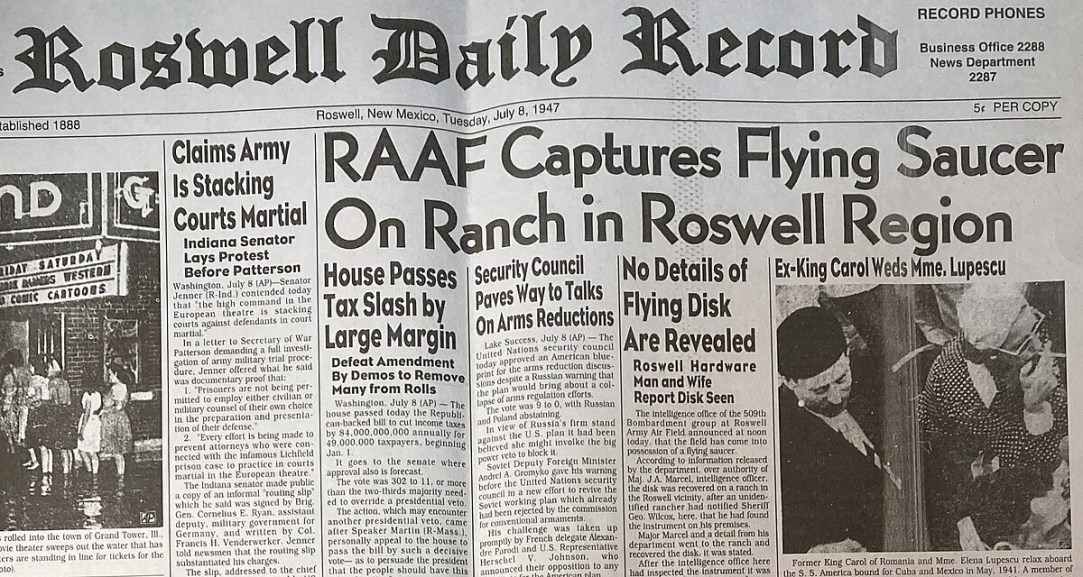
Jay Stratton, the former Chief of Air and Space Warfare for the Defense Intelligence Agency and the first director of the Pentagon’s Unidentified Aerial Phenomena Task Force, recently claimed aliens were recovered alive from the infamous Roswell, New Mexico, crash in 1947, but later died after refusing food and human contact.
Stratton said military contractors possess at least a dozen crashed spacecraft and have recovered non-human remains. In his new memoir, Out of the Shadows, he claims that encounters with non-human intelligence and their technology caused some of those involved “to resign, suffer mental breakdowns, and in some cases take their own lives. The truth was just too difficult for them to process.”
His claim echoes that of other former government officials, including the director of the Pentagon’s Advanced Aerospace Threat Identification Program (AATIP) Luis “Lue” Elizondo and David Grusch, an Air Force veteran and former official with the National Geospatial-Intelligence Agency (NGA) and the National Reconnaissance Office (NRO).
Dr. Eric Davis, an astrophysicist who worked with the Pentagon’s UFO program for years, has also asserted that he has personally seen classified images and documents from the U.S. government that purportedly attest to alien life having been discovered in crashed UFOs.
Also, Dr. Hal Puthoff, a former CIA-funded researcher and advisor to the Advanced Aerospace Weapon System Applications Program, also claimed that the United States has recovered “four separate types” of alien species from crashed UFOs.
Roswell Daily Record - Public Domain
Avi Loeb casts doubt on Jay Stratton’s claims
Avi Loeb, who was recently appointed to lead a new Science Advisory Council to study UFO orbs and other military sightings by the White House, claims if there was evidence of the U.S. recovering alien spacecraft and non-human bodies, it would have been shown to President Donald Trump.
“This board [the UAP Science Advisory Council], with comprehensive representation across the executive branch, military and intelligence community, vigorously follows the Presidential Unsealing and Reporting System for UAP Encounters (PURSUE) and would be delighted to review any evidence for technologies of non-human origin,” Loeb wrote on his website.
“Obviously, any groundbreaking revelation about alien intelligence would be of great political benefit to the Trump administration. Why can’t anyone offer President Trump a guided tour to an alien spacecraft or at least some footage of alien bodies?”
Avi Loeb claims Jay Stratton was invited to speak with the Science Advisory Council
“Jay did not respond to my invitation, even after it was repeated by the Council member, Dr. Tim Gallaudet,” Loeb wrote. “Why is it a higher priority for Jay to speak with Bret than with a Council that is dedicated to chasing the evidence and releasing it to the public?”
Loeb also pointed out in a recent interview with Fox 32 News that, although a legal waiver permits employees to exchange confidential UAP data, Stratton has not provided any tangible or digital proof.
But what if we were to double the height of the humanoid robot and gave it terrifying hydraulic actuators that give it far beyond superhuman strength?
That’s precisely what Beijing-based company NeodraDynamics Robotics has done. At this year’s China International Industry Fair, the company showed off an imposing, 13-foot and 1.2-ton robot dubbed Neo1 — and it looks like it was yanked straight out of a pulpy sci-fi movie. Photos show the behemoth towering above the heads of convention goers.
Instead of relying on electric motors, the company opted for a “hydraulic-electric hybrid drive” that, according to a boisterous press release, “thoroughly eliminates robots’ power and environmental adaptation anxieties.”
In other words, it’s akin to a highly sophisticated excavator in the shape of a 13-foot giant. But unlike an excavator, the robot has “41 full-body active degrees of freedom” and can carry over 1,100 pounds in its beefy arms. It also has a claimed “repeated positioning accuracy” and fingertip precision of a single micrometer.
NeodraDynamics Robotics is envisioning its Neo1 mecha as the ultimate “sky, ground and sea” responder, assisting during “aerial inspection, underground mining, and deep-sea engineering.”
It can withstand “ultra-high underwater pressure to execute subsea equipment maintenance,” as well as shock and pollution, making it a candidate for “efficient demolition, clearance and hazard zone operations.”
But while we continue to gaze upon the mecha in awe, we’ll wait for an actual showcase before we render full judgment. After all, the Neo1 would be far from the first Chinese piece of vaporware that never turned into a reality.
Apart from the breathless press release, the company’s website doesn’t elaborate a whole lot either. Even more importantly, we have yet to see the robot in action.
In short, it’s a wild idea that may or may not usher in a new era in industrial mechanical engineering. And judging by its inspiring looks, it’d look pretty cool from afar at a construction site — as long as it never decides to turn against humanity, that is.
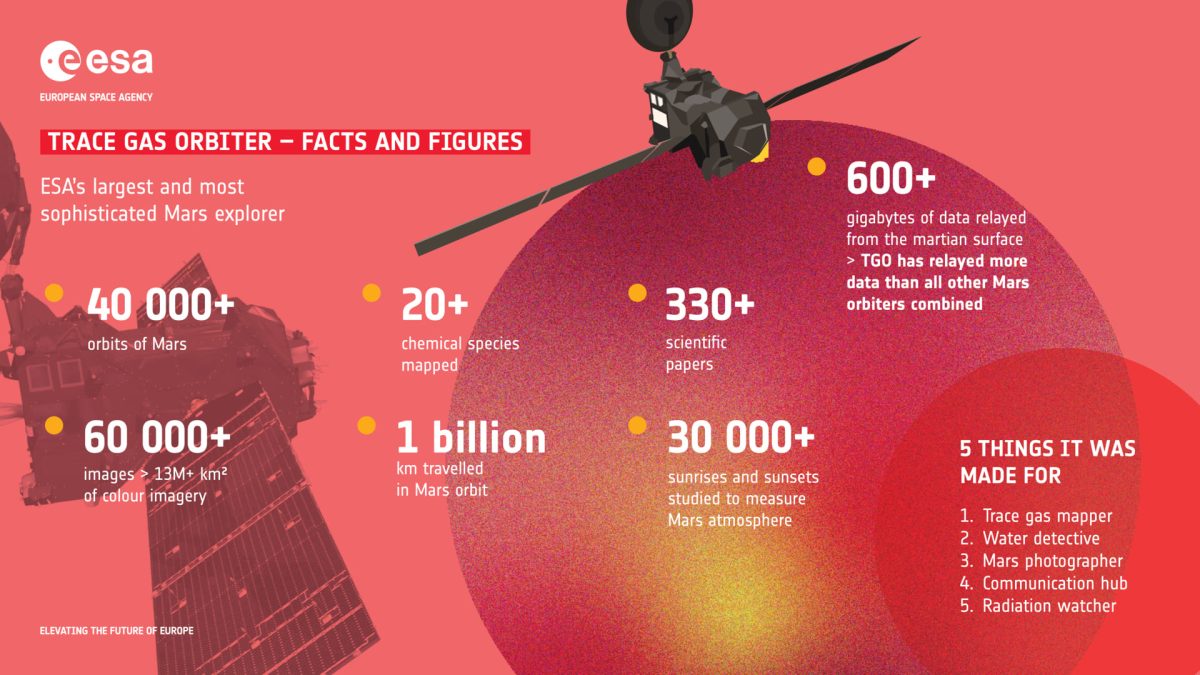
Exactly ten years ago, Europe’s Trace Gas Orbiter (TGO), part of the ExoMars program, entered orbit around Mars. It was built to search the planet’s atmosphere for methane, which could indicate life or geological activity. The gas has never been found. Instead, hydrogen chloride was detected on Mars for the first time, and the spacecraft has relayed more data from the surface toEarth than all other Mars orbiters combined.
The ExoMars Trace Gas Orbiter, part of ESA’s program designed to answer the question of whether life ever existed on Mars. Source: NASA
A Decade in Numbers
To mark the anniversary, ESA published an infographic summarizing the mission’s achievements. Over ten years, the spacecraft has completed more than 40,000 orbits around Mars and traveled approximately one billion kilometers. That is almost seven times the distance between Earth and the Sun, which is 150 million kilometers.
Key facts and figures from ten years of the ExoMars Trace Gas Orbiter’s operations in orbit around Mars. Credit: ESA
The spacecraft’s camera has captured more than 60,000 images. Its color images cover over 13 million square kilometers—more than 21 times the area of Ukraine. The entire surface of Mars, however, covers approximately 145 million square kilometers.
Another aspect of its work is less visible. NASA’s Curiosity and Perseverance rovers transmit their data through the orbiter, and the total volume of relayed data has already exceeded 600 gigabytes.
The Beginning of the ExoMars Program
The spacecraft launched on March 14, 2016, aboard a Russian Proton rocket. Traveling with it was Europe’s Schiaparelli lander, also part of the ExoMars program. As Space.com reported at the time, the lander was intended only to test landing technology and operate on the surface for a few days. But on October 19, as the orbiter entered orbit, the lander crashed during descent because its parachute separated prematurely. The accident did not affect the orbiter’s operations.
The next stage of the program was to be the Rosalind Franklin rover, which, according to plans drawn up in 2016, was scheduled to launch as early as 2018. The launch was postponed several times, and in March 2022, ESA suspended the joint program with Russia following its full-scale invasion of Ukraine.
Artist’s illustration of the Rosalind Franklin rover at Oxia Planum, the ExoMars landing site. Credit: ESA/Mlabspace. Source: esa.int
Following the split, ESA replaced the Russian landing platform with its own, while NASA undertook to provide the launch vehicle, braking engines for landing, and radioisotope heater units. The rover is now scheduled to launch in 2028 and land in 2030.
The Mystery of Martian Methane
Methane on Mars has long puzzled scientists. On Earth, most of this gas is produced by living organisms, while on Mars, solar ultraviolet radiation destroys its molecules within a few centuries. So if methane is present there, some source—biological or geological—must be continually replenishing it.
To find even traces of the gas, researchers used the spacecraft’s spectrometers to study more than 30,000 sunrises and sunsets. At these moments, sunlight passes tangentially through the planet’s atmosphere, and each gas absorbs its own characteristic wavelengths. This allowed researchers to map more than 20 chemical species.
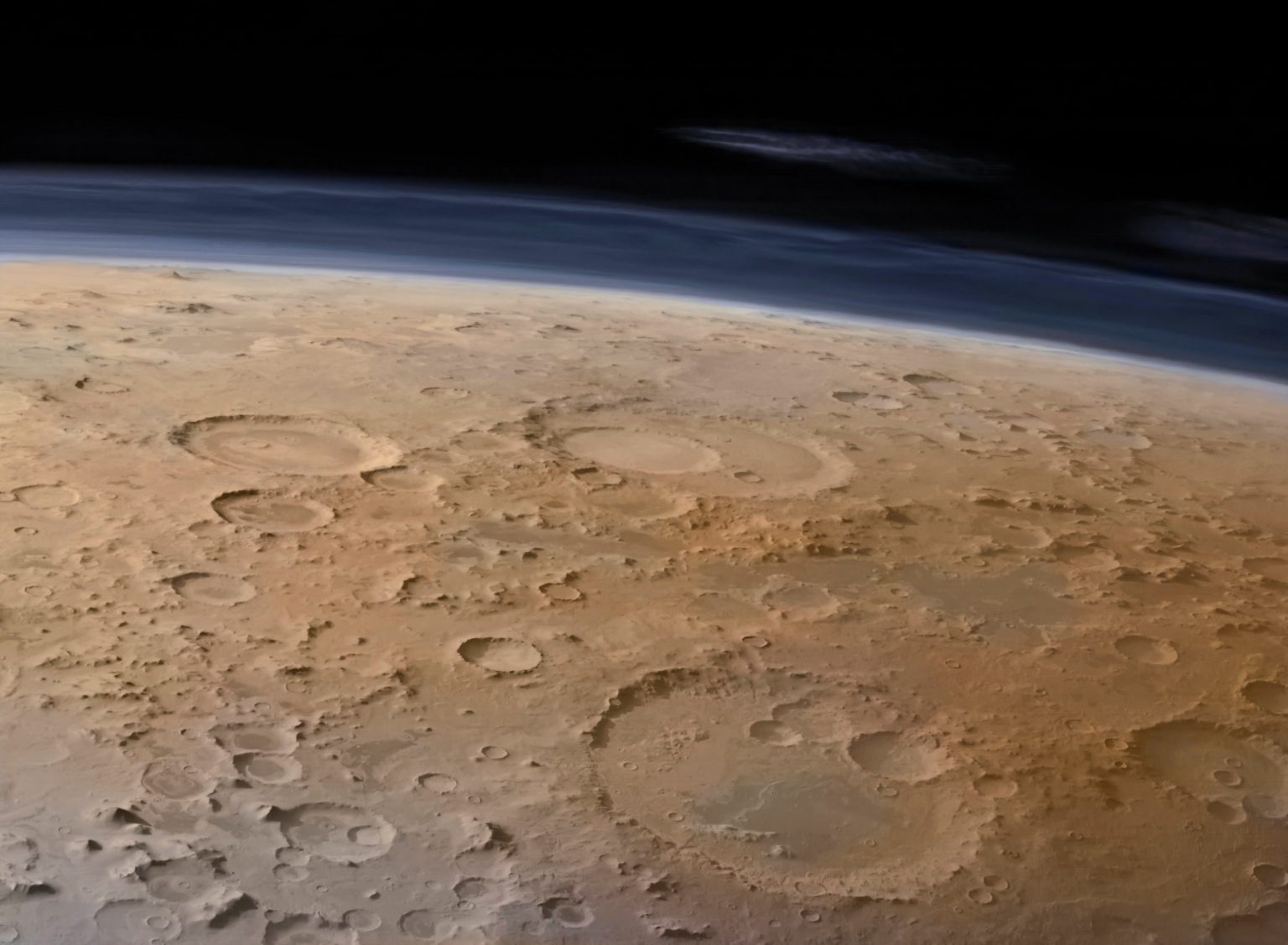
The atmosphere of Mars.
Image: ESA / DLR
No methane was detected in these spectra. According to the peer-reviewed journalAstronomy & Astrophysics, the upper limit of its abundance is 20 molecules per trillion. Yet the Curiosity rover has repeatedly detected methane near the surface. Researchers still cannot explain why the gas is not detected higher up.
Unexpected Hydrogen Chloride
During the global dust storm of 2018, the spacecraft’s instruments detected hydrogen chloride in the Martian atmosphere for the first time. On Earth, volcanoes emit this gas, so the discovery was initially interpreted as a possible sign of present-day volcanic activity.
Subsequent observations weakened this explanation. The gas appears each year alongside dust in both hemispheres, suggesting that it is probably produced by chemical reactions within the atmosphere itself under the influence of sunlight, rather than coming from the planet’s interior.
However, observations from orbit reveal only gases in the atmosphere. Organic molecules that could indicate life will have to be sought on the planet itself. The Rosalind Franklin rover’s drill will reach a depth of two meters, beyond the reach of solar ultraviolet radiation that destroys such molecules near the surface. Samples will be analyzed in the rover’s onboard laboratory, without being returned toEarth.
A University of Sydney researcher has used Mars orbital and model data to create the world’s first map of Martian soil covering roughly 92% of the red planet’s surface.
“This is the first time a classification system of this scale has been developed for Martian soils,” explained Daniel Irving from the Sydney Institute of Agriculture and the Faculty of Science.
Martian Soil Separated into 2,000 Classes
To build his Martian soil map and grading system, Irving drew on a wide array of existing resources. This included orbital observations from Martian satellites and planetary models based on data gathered from rovers and other scientific studies of the red planet.
After combining the data, Irving classified 800 million individual locations across the Martian surface. This included separating the locations into 2,000 soil “classes” and marking where these soils are expected to be found.
Sydney PhD candidate David Irving makes the first-ever map of Martian Soil. Credit: University of Sydney, Irving, et al.
Next, Irving and his supervisor, Professor Alex McBratney, evaluated each class’s properties, including texture, mineralogy, profile thickness, and pH level. This granular detail allowed them to group the soil classes into 10 major “realms,” 100 “assemblages,” and 2,000 “detailed forms,” resulting in what they called the Provisional Polythetic Areth Classification System, or PPACS.
According to a release announcing the work, the Sydney researcher and his supervisor proposed the term “areths,” which they derived from Ares, the Greek name for Mars, for these new Martian soil classes.
PPACS Scores Mark Best Locations for Future Mars Greenhouses
After classifying the 2,000 soil types on the PCCS, the Sydney team assessed each one for characteristics that are known to support plant production on Earth. These included the soil’s capacity for holding water and how much clay and gravel it contained.
“A future greenhouse on Mars would need more than air, water, and light. Its builders would also need to know what lies beneath to understand better starting points for growing plants,” Professor McBratney explained.
After examining the results, Irving and colleagues found one class, which they named Nohibareth, offered the best collection of plant growth-supporting properties. As a result, Nohibareth received a PCCS score of 0.93, ranking it at the top of the list.
“Nohibareth’s modeled average profile includes a pH of 6.8, 72 percent clay, minimal sand or gravel, and an estimated water-holding capacity of 202 millimeters per meter,” a statement announcing the research explained.
The Martian Soil map indicates that this preferred class is found around the planet’s middle latitudes, including around Tharsis, central Arabia Terra, and Elysium Planitia. However, this soil type is only found on 0.14 percent of the planet’s surface.
Although other soils showed some promise, the researchers found that 73 percent of the forms they evaluated had poor water retention properties, making them unlikely soil bases for plant growth. For example, the researchers noted that classes in the Fareth to Mareth realms all scored below 0.3 on the PCSS, “reflecting less favorable combinations of the properties considered.”
Candidates for Closer Investigation
When discussing the study’s results, Irving and colleagues cautioned that the highlighted Nohibareth sites are not already selected for future greenhouses. Instead, they said the areas on their map suggesting the best plant-growing Martian regolith represent “candidates for closer investigation.”
The Sydney team also warned that Martian soil contains no organic compounds and that their findings do not suggest crops can be grown even in the highest-scoring material. They also note that the map does not include factors that can affect plant growth, such as perchlorate toxicity, nitrogen availability, or depth profiles.
However, Irving and colleagues said the map and scoring system suggest that colonists could supplement the highest-scoring Martian soils and use them in controlled environments to potentially create self-sustaining greenhouses that don’t require regular supplies from Earth. Irving said their findings could also offer a new way to interpret the data scientists regularly receive from ongoing Mars missions.
“Every rover mission collects valuable information about Mars, but scientists need consistent ways to organize and compare that knowledge,” he explained. “This gives us a framework that can grow and evolve as new data becomes available.”
The study was published in the soil science journal Catena.
Christopher Plain has spent the last six years as Associate News Editor and Head Science Reporter at The Debrief. Follow and connect with him on X, learn about his novels at plainfiction.com, or email him atchristopher@thedebrief.org.
Biohybrid computers made of organoids—tiny human brainmodels using real cells—have reached an important new benchmark by reading braille for the first time, even under challenging conditions.
A group of UK scientists working at Bristol University reported their biohybrid computing achievement in Frontiers in Artificial Intelligence, with a new paper describing the results.
The team’s achievement marks a major step toward the long-sought goal of harnessing organic brain cells for computing. The human brain is far more energy efficient than traditional computers, making the technology highly attractive as large-scale computing operations, like data centers, come under heavy criticism for their massive resource use.
Biohybrid Computer Accuracy
Although biohybrid computers could eventually offer advantages in energy efficiency, demonstrating that they can reliably process and transmit meaningful information remains a work in progress. The Bristol team sought to advance this research by developing organoids modeled on the human forebrain and testing their ability to process information encoded from Braille characters.
The researchers ultimately achieved an 83% classification accuracy rate by combining signals from three brain organoids to identify Braille letters.
“We can take information from a real tactile sensor, turn it into a form that a living neural network can receive, and then recover meaningful information from the organoid response,” said first author Tianyi Liu, PhD candidate at Bristol University. “That gives us a practical way to connect artificial sensors with biological neural systems, which are a very interesting possible route towards more energy-efficient computing.”
Creating a Biohybrid Computer
The researchers developed tiny but complex models of the human brain containing approximately 10,000 neurons and supporting cells, although they lacked many of the structures found in a fully developed human brain.
The organoids were connected to electrodes that allowed researchers to deliver electrical signals and monitor their neural activity. They were also maintained in a controlled environment designed to keep the living cells functioning throughout the experiments.
The next step was determining whether this biohybrid computing system could reliably process recognizable information.
Testing began with a tactile sensor detecting physical Braille characters. The team then converted the sensor readings into electrical patterns, which were delivered to the organoids through the electrodes.
By experimenting with different input patterns and measuring the resulting neural activity, the researchers investigated whether specific Braille characters produced distinguishable responses.
Biohybrid Tests
The researchers then used computational methods, including a large language model (LLM), to classify the organoids’ neural responses and determine whether those signals corresponded to specific Braille letters.
Combining the responses of three organoids produced substantially better results than using a single organoid, increasing classification accuracy from 61% to 83%.
“After processing by the organoids, the tactile data still contains enough information to classify Braille letters with good accuracy,” said senior author Dr. Benjamin Ward-Cherrier of Bristol University. “Combining outputs from several organoids also showed an improvement in performance.”
Exactly why combining signals from three organoids improved accuracy remains uncertain, although the team suspects that differences in their individual neural networks may allow them to provide complementary information.
“Different organoids may have slightly different network connections, developmental states, and ongoing activity, so the same input can produce similar but not identical responses,” said Liu. “Combining those responses may give us complementary information that we would not get from a single organoid. At the same time, if every organoid behaves differently, it obviously makes it harder to build a predictable and standardized system.”
A Computer that May Learn like a Brain
After achieving promising results with clean input data, the researchers introduced an additional challenge: noise, or interference that can make information more difficult to interpret.
Interestingly, when noise was introduced, the Braille characters could be classified more accurately from the organoids’ responses than from the raw sensor data. This suggests that the biological neural networks may help preserve or transform useful information under challenging conditions.
However, the findings do not demonstrate that the organoids learned to recognize Braille in the same way a human brain might. Whether these systems can adapt through experience remains an important question for future research.
“We showed that tactile information could be encoded, processed through the organoids, and decoded, but we did not demonstrate learning or long-term changes in the organoids,” Liu said.
“We also tested one tactile task using a fixed encoding scheme and a relatively simple measure of neural activity. The next step is definitely to move beyond Braille; we are interested in things such as textures, edges, and different kinds of touch, and eventually in closed-loop tasks where the organoid receives feedback from what it does.
“That would allow us to start asking whether the organoid can actually adapt through experience,” Lie said.
Ryan Whalen covers science and technology for The Debrief. He holds an MA in History and a Master of Library and Information Science with a certificate in Data Science. He can be contacted at ryan@thedebrief.org, and follow him on Twitter @mdntwvlf.
They Just Made a Chip With Living Human Brain Cells
Scientists Just Built a Computer Using Human Brain Cells
American writer William S. Burroughs believed that the mysterious Gray aliens might be members of a dying civilization that had lost its ability to create and were secretly collecting blood and reproductive material from human beings. He called them “Control Aliens” and suspected they wanted to make humanity less intelligent.
Yet he personally wanted to encounter these same beings. He even visited a famous alleged alien abduction site and reportedly arranged an unusual display outside his Kansas home, hoping it might attract their attention.
Burroughs he became one of the most influential American writers of the 20th century, particularly through his controversial 1959 novel Naked Lunch. His writing frequently explored the possibility that human beings were being manipulated by forces they did not fully understand, whether through language, social institutions, addiction, or something beyond ordinary reality.
For much of his life, Burroughs had been interested in magic, dreams, altered consciousness, and the hidden mechanisms of human perception. He experimented with unconventional literary techniques and entertained ideas that many people would have considered science fiction.
William S. Burroughs, 1983. Photo: Chuck Patch / Wikimedia Commons (CC BY-SA 2.0).
His fascination with extraterrestrial intelligence was therefore not something that suddenly appeared during his final years. An archived lecture from August 11, 1980, recorded at the Jack Kerouac School of Disembodied Poetics with an introduction by Allen Ginsberg, lists aliens, dreams, reincarnation, space travel, and nuclear weapons among its subjects.
That recording is significant because it places his interest in such questions years before the alien abduction phenomenon became widely associated with writer Whitley Strieber. Burroughs was already examining whether consciousness might extend beyond the physical world and whether human understanding of reality was fundamentally incomplete..
Burroughs became particularly fascinated with the alien abduction phenomenon after reading Communion, the 1987 book in which Whitley Strieber described his alleged encounters with mysterious non-human beings. Strieber was already a successful horror novelist known for books such as The Wolfen and The Hunger, but Communion was presented as an account of experiences he believed had actually happened. The story centered on disturbing events at his family’s secluded cabin in upstate New York, including an alleged encounter on December 26, 1985, that left him struggling to understand what had taken place.
Strieber described small, unusual beings and experiences that seemed to involve a loss of control over his body and surroundings. Although his story became famous as an alien abduction account, he was cautious about declaring that the entities were necessarily extraterrestrials arriving from another planet. He preferred calling them the visitors because he believed their identity and origin remained unknown. The possibility that these encounters might involve consciousness, an unfamiliar dimension, or something connected to the human mind made his account particularly interesting to Burroughs.
After reading Communion and its 1988 sequel Transformation, Burroughs became determined to investigate the experiences personally. According to an account by Matthew Levi Stevens, published in New Dawn magazine, Burroughs wrote to Strieber in 1989, explaining that he wanted to make contact with the mysterious beings. Strieber and his wife, Anne, had received numerous unusual letters following the publication of Communion, and Anne initially wanted to confirm that the person writing to them was genuinely the famous author.
Burroughs eventually assured them, “I am indeed really me,” and the couple invited him to their cabin. What followed was an unusual meeting between two established American writers who were interested in the same mystery for very different reasons. Strieber claimed he had already experienced frightening encounters with unknown entities, while Burroughs wanted to know whether he could experience something similar. He traveled to the place where Strieber said the encounters had occurred, hoping that being there might somehow increase his chances of meeting the visitors.
During his stay, Burroughs questioned Strieber about the experiences and listened closely to his descriptions. Strieber later remembered him as exceptionally polite and deeply interested in the details. Burroughs came away believing that Strieber was sincere and that his experiences had felt completely real to him.
However, despite visiting the cabin and spending time with Strieber, Burroughs did not report encountering the visitors himself. He could not explain why the alleged beings had appeared to Strieber but failed to make contact with him. Rather than abandoning the possibility of an encounter, he began considering different explanations, including whether the entities might choose whom they contacted and whether their reasons for approaching particular individuals were less friendly than people assumed.
Burroughs wondered whether the visitors might regard him as a potential enemy. He suspected that if they were intelligent beings with their own objectives, they might recognize people capable of interfering with those objectives. This was an important development in his thinking because he increasingly approached the phenomenon as a possible struggle over consciousness and control, rather than simply a question of whether unidentified spacecraft were visiting Earth.
His interest in the cabin visits was later revisited in a September 2019 Radio Misterioso interview, hosted by Greg Bishop and published the following month. The interview’s description specifically mentions the occasions when Burroughs visited Strieber’s famous cabin hoping to contact the visitors.
In that conversation, Strieber described his belief that the phenomenon might involve another level of human beings exercising some form of control over souls. This interpretation differed from the ordinary image of extraterrestrial explorers traveling between planets. It also showed how far Strieber’s thinking had moved beyond the idea of biological creatures conducting experiments on human subjects.
Burroughs continued discussing extraterrestrials in public during the early 1990s. In an interview conducted at his home in Lawrence, Kansas, on June 10, 1991, Nicholas Zurbrugge asked about his interests, and Burroughs spoke about both Native American shamanism and reports of flying saucers. He explained that he wanted to see the alleged beings personally and mentioned reports of UFO sightings in Kansas, including around the lake where he owned a house. Despite his interest and his attempts to make contact, he said he had not been fortunate enough to experience a sighting himself.
His curiosity also extended to the famous Roswell UFO story. During an interview with his friend David Ohle, Burroughs discussed Strieber’s 1989 novel Majestic, which imagined a government cover-up involving an alleged extraterrestrial spacecraft crash in New Mexico. He described fictional details about recovered alien bodies, including creatures without stomachs that might survive through an unusual form of photosynthesis. He also repeated the novel’s imagery of aliens gathering together in spacecraft resembling hives, suggesting a society organized very differently from humanity.
He was equally interested in the possibility that extraterrestrial beings might experience time differently. In the same interview, Burroughs referred to the famous alleged abduction of Betty and Barney Hill and discussed an anecdote in which the visitors supposedly struggled to understand human aging. For him, this raised the possibility that time might not be experienced in the same way by every form of intelligence. His speculation reflected a recurring theme in his work: that ordinary human concepts might be inadequate for understanding realities outside familiar experience.
Burroughs also believed that dreams and altered states could offer access to something beyond the limits of ordinary perception. In his 1986 essay collection The Adding Machine, he described artistic creativity as a means of exploring new worlds and forms of consciousness. He questioned whether physical space travel was the only way humans could reach unfamiliar realities, suggesting that writers, artists, and people experimenting with consciousness might explore territories that conventional technology could not easily reach.
His interest in such ideas continued through the 1990s. Burroughs explored shamanism, ritual magic, dream control, and practices associated with attempting to change or extend conscious awareness. He had long been concerned with the relationship between language and mental freedom, famously expressing the idea that language itself could operate like an external influence on human thought. His involvement with experimental writing and the cut-up technique also reflected an attempt to break familiar patterns of association and discover unexpected connections between words and ideas.
In his 1995 book My Education: A Book of Dreams, Burroughs discussed his conviction that something genuine might exist behind at least some of the reports, although he did not know what the entities actually were. He considered the possibility that the sexual elements of the encounters were not incidental but central to the phenomenon itself. His attention was especially drawn to Strieber’s descriptions of intimate interactions with the visitors, which Burroughs interpreted as possible evidence that the beings were seeking some form of biological or sexual exchange.
According to Matthew Levi Stevens, Burroughs decided to create a conspicuous symbol outside his home in Lawrence, Kansas, apparently hoping that it would attract the attention of the alleged visitors. He reportedly allowed the grass on his lawn to grow long before arranging for somebody to cut a large patch into the phallic symbol, resembling the way a crop circle might be formed in a field.
The reported idea was connected to his suspicion that the visitors were especially interested in human sexuality. If the beings were approaching humans for reproductive or sexual reasons, Burroughs apparently thought that a large sexual symbol might encourage them to investigate his property. The episode is described in Stevens’ account of Burroughs’ interests and occult practices, although independent documentation of the lawn display has not been established. It nevertheless illustrates how seriously, and sometimes unusually, Burroughs pursued the possibility of making contact
Burroughs did not appear to regard the visitors as necessarily benevolent. His writings suggest that he was fascinated by them but also suspicious of their possible intentions. He wanted firsthand knowledge of a phenomenon he thought might exist, even while entertaining the possibility that the beings behind it were manipulating human beings for purposes that had nothing to do with friendship or scientific exploration.
His most disturbing interpretation appeared in a diary entry dated February 3, 1997, only months before his death. The entry was later published in Last Words: The Final Journals of William S. Burroughs. By this time, Burroughs had developed a particularly hostile picture of the Gray aliens, whom he described as “Control Aliens.” He speculated that they belonged to a dying race that had somehow lost its creative abilities and depended on human blood and semen for survival.
According to this theory, the Grays were not advanced visitors generously sharing knowledge with a less developed civilization. They were beings suffering from a fundamental deficiency and attempting to compensate for it by exploiting another species. Burroughs also suspected that they wanted to make people less intelligent, possibly because independent human thought posed a danger to their objectives. He believed that individuals with developed perception or spiritual awareness might recognize what these entities were doing and become difficult to manipulate.
The most revealing part of his final journal entry was his frustration over the apparent absence of contact. After considering why the Grays seemed to approach certain people but avoided others, he asked, “Why don’t they come and see ME?” He answered his own question by suggesting that the visitors might be afraid of people with advanced spiritual awareness. This was his personal explanation, rather than evidence of how any unknown intelligence selected people for contact.
Whitley Strieber describes his alien visitor
His interest in extraterrestrials also entered his artistic projects. During the early 1990s, following his work on The Black Rider with theater director Robert Wilson and musician Tom Waits, Burroughs developed ideas for another theatrical project inspired partly by Paradise Lost. The proposed work mixed religious imagery, atomic destruction, UFOs, alien abductions, and the Roswell story. Although the original project was not completed during his lifetime, elements of the material later contributed to musician Grant Hart’s 2013 album The Argument.
In his later speculation, the Grays became another possible representation of such forces, beings that supposedly understood how to manipulate human consciousness while depending on humanity for something they could no longer produce themselves.
Burroughs died on August 2, 1997, at the age of 83, without reporting the kind of direct encounter he had hoped to experience. His fascination with Strieber’s visitors remained unresolved.
Deep in the mountains of Colombia, an Indigenous community has preserved an extraordinary tradition in which certainchildren are selected to spend years of their childhood without seeing sunlight or even the light of a full moon. These children are being prepared to become spiritual leaders who, according to Kogi beliefs, can communicate with an invisible cosmic consciousness believed to be the source of all life and intelligence.
The Kogi people believe the physical universe is not the beginning of existence. They say that everything we see, including mountains, rivers, animals, trees, and human beings, first exists in a spiritual realm called Aluna, where reality takes shape as thought before becoming physical. Their spiritual leaders, known as Mamas, undergo years of unusual training intended to develop a connection with this invisible world.
They are raised in dark ceremonial houses or caves, where elder Mamas teach them about the physical world through stories, songs, sounds, and spiritual instruction. The children learn about sunlight, animals, rivers, and mountains without being allowed to experience these things in daylight.
This practice was documented by anthropologist Gerardo Reichel-Dolmatoff, who studied the Kogi and published a detailed account of their spiritual education in 1976. His research describes a demanding training process that could last 18 years, beginning with nine years in which the child lives a nocturnal existence, deliberately separated from the ordinary visual experiences of childhood.
The Kogi live in the Sierra Nevada de Santa Marta, a mountainous region near Colombia’s Caribbean coast. Their ancestors belonged to the ancient Tairona civilization, which existed long before the arrival of Spanish conquerors. During the colonial period, Indigenous communities retreated into the mountains, preserving many of their traditions, religious beliefs, and ways of life.
A Kogi woman with a child at Ciudad Perdida in Colombia’s Sierra Nevada de Santa Marta mountains, photographed in March 2017. Image credit: Dwayne Reilander / Wikimedia Commons / CC BY-SA 4.0.
Unlike modern societies that generally understand nature through scientific observation, the Kogi interpret the world through a spiritual system in which everything is interconnected. They consider themselves responsible for maintaining the balance of the Earth, a task they believe was given to them by the Great Mother, the spiritual source of creation.
According to the Tairona Heritage Trust, an organization dedicated to supporting the Kogi and preserving their culture, the traditional ideal was to select a child at birth and begin preparing him for the role of Mama. The child would be cared for by his mother and elder spiritual teachers, but his early environment would be deliberately restricted to darkness.
Reichel-Dolmatoff’s anthropological account describes children more commonly beginning formal priestly training around the age of two or three. They were taken to isolated ceremonial centers in the mountains, where they lived with an experienced Mama and his family. During the first nine years of their instruction, they were not permitted to see daylight or even the light of a full moon.
The restrictions were not simply intended to keep the children physically isolated. The Kogi believed that their future spiritual leaders needed to develop a different understanding of reality, one that did not depend primarily on what the eyes could see.
Their daily routine was also unusual. The children were trained to sleep during the day and remain awake at night, when they received instruction in sacred songs, dances, religious language, and the stories explaining how the universe was created. Their teachers wanted them to become familiar with the spiritual structure of the world before becoming accustomed to ordinary physical appearances.
The children were sometimes taken outside at night, with their exposure to moonlight restricted. Historical descriptions also refer to the use of torches and low-burning fires during instruction, meaning the tradition should not be understood as nine uninterrupted years without any source of light whatsoever. It was primarily a strict separation from daylight and the normal visual environment.
One account preserved by the Tairona Heritage Trust describes how a mother could visit the doorway of the ceremonial house where her child was being raised. She would sing to him while he danced, after which he would return to his secluded environment. As the child grew older, spiritual instructors gradually assumed greater responsibility for his education.
The same account describes children receiving specially prepared foods and blessed water. They were also taught to pay attention to small details such as bubbles appearing in water, which carried spiritual significance within Kogi teachings. Their education involved learning to observe, remember, listen, and interpret the natural world according to the community’s traditional beliefs.
Reichel-Dolmatoff’s research explained that the early years were intended to alter the child’s ordinary perception of time and space. By changing sleeping patterns, limiting exposure to daylight, and emphasizing spiritual instruction, the Kogi sought to prepare future Mamas for the religious responsibilities they would eventually assume.
The training could continue long after the initial nine years. According to the 1976 anthropological study archived by Yale University’s Human Relations Area Files, a young trainee could briefly return to his family around puberty before undertaking another nine years of instruction. The later period focused more heavily on moral teachings, mythology, and the responsibilities of spiritual leadership.
The entire process was meant to produce someone who understood the world differently from other members of the community. A Mama was expected to interpret spiritual signs, conduct ceremonies, guide important decisions, and help maintain the relationship between human society and the forces believed to govern nature.
At the center of this system is Aluna, perhaps the most extraordinary aspect of Kogi cosmology.
The Kogi believe that before the physical universe existed, there was a state of consciousness without material form. This consciousness is associated with the Great Mother, who conceived the world spiritually before it appeared as physical reality. Mountains, oceans, animals, plants, and human beings were first imagined within Aluna.
The 2012 documentary Aluna: An Ecological Warning from the Kogi People, directed by British filmmaker Alan Ereira, presents the Great Mother as pure thought without physical form, and the world comes into existence through her act of thinking.
According to this understanding, thought is not merely something produced by human brains. It is part of the underlying reality from which physical existence emerges. The visible universe is the expression of an invisible spiritual order that the Kogi believe continues to influence everything taking place in the world.
This is why the practice of raising selected children in darkness carries such importance within their culture. The Mamas are trained to concentrate on the invisible spiritual relationships behind nature rather than becoming entirely occupied with its physical appearances.
For the Kogi, Aluna is not simply another dimension somewhere beyond Earth. It is the spiritual foundation of the world itself, present in the processes that allow rivers to flow, plants to grow, animals to reproduce, and human communities to survive.
Their belief is that every living thing has a spiritual origin and that human actions can disturb the balance between the physical world and its invisible foundation. The Mamas believe they have a responsibility to understand these relationships and perform ceremonies intended to preserve them.
This spiritual responsibility extends to agriculture, marriage, and the use of natural resources. The Tairona Heritage Trust explains that the Kogi traditionally bless seeds in Aluna before planting them, conduct ceremonies associated with fertility, and make offerings to spiritual guardians connected with different aspects of the environment.
The Mamas also visit sacred locations known as Ezuamas, which the Kogi regard as important points of connection with the spiritual powers associated with nature. These places may be connected with particular mountains, rivers, forests, or other geographical features, and the ceremonies performed there are intended to protect the balance of the surrounding environment.
The Kogi describe the Earth as a living body whose different parts depend upon one another. In their understanding, damaging a sacred site is not merely destroying a piece of land. It is interfering with a relationship that helps sustain the wider natural world.
Ereira first worked with the Kogi during the production of the 1990 BBC documentary From the Heart of the World: The Elder Brothers’ Warning. In that film, the Kogi warned that humanity was damaging the Earth through deforestation, mining, pollution, and the destruction of important natural environments.
The Kogi call themselves the Elder Brothers and describe modern industrialized humanity as the Younger Brothers. Their explanation is that the Elder Brothers were entrusted with understanding and protecting the world, while the Younger Brothers became increasingly concerned with changing and exploiting it.
They believe that the Younger Brothers have forgotten the spiritual relationships that make life possible. According to the Mamas, this separation from nature has led humanity to damage the environment without understanding the wider consequences.
After their first warning received international attention, the Kogi waited to see whether people would change their behavior. When the environmental destruction they were witnessing continued, they invited Ereira back to make another documentary.
This second film, Aluna, was intended to do more than repeat their warning. The Mamas wanted to demonstrate what they meant when they said that places separated by great distances could nevertheless be connected.
One of the documentary’s most unusual sequences involves a plan to use approximately 400 kilometers of golden thread to represent an invisible network connecting sacred locations along Colombia’s Caribbean coast and the Sierra Nevada mountains.
The Kogi believe that these sites are linked through Aluna, even when the connections cannot be observed directly. A particular location near the mouth of a river might have a spiritual relationship with another location high in the mountains, and damage to one could affect the other.
Gold carries special meaning within their beliefs because of its enduring nature and its association with the creative forces of the Earth. By using golden thread, the Mamas wanted to make their invisible understanding of the landscape visible to people who were unfamiliar with it.
The documentary also follows one of their senior spiritual leaders, Mama Shibulata, during a visit to England. There, he meets an astronomer and encounters scientific ideas about the universe that are very different from those traditionally taught among the Kogi.
ironmental balance of the surrounding region.
Scientists appearing in the documentary explain that coastal and inland ecosystems are indeed connected through physical processes, including water movement, evaporation, salinity, and the movement of nutrients. Altering wetlands can have consequences beyond the immediate location where the disturbance occurs.
Marine biologist Alex Rogers, associated with the University of Oxford, discusses how environmental damage along Colombia’s coast reflects problems affecting other regions of the Caribbean and the wider planet. He agrees that human activities can produce effects across interconnected ecosystems, lending scientific support to the general environmental concern expressed by the Kogi.
Another scientific discussion focuses on the importance of particular habitats that serve as refuges for species over long periods. Destroying such areas might not cause an immediate visible catastrophe, but the long-term consequences can be serious because animals and plants may lose locations essential for their survival.
The Kogi have long regarded particular places as especially important, although their explanations involve spiritual relationships rather than the ecological mechanisms described by scientists. The documentary suggests that Indigenous environmental knowledge can sometimes identify relationships and vulnerabilities that deserve scientific investigation.
The distinction is important because evidence that ecosystems are interconnected does not establish the existence of Aluna as a cosmic consciousness. The Kogi’s spiritual explanation and the scientific explanation are different, even when both emphasize the importance of protecting the natural environment.
Their traditional training nevertheless raises other questions, particularly about what prolonged separation from sunlight might mean for a developing child.
Modern medical research shows that insufficient sunlight can increase the risk of vitamin D deficiency, which can lead to rickets and problems with bone development. Vitamin D can also be obtained through certain foods, so the absence of sunlight does not automatically mean a child will develop the condition.
However, reliable medical evidence explaining how Kogi children undergoing this training maintained adequate vitamin D levels is limited. It is therefore difficult to determine whether the traditional practice caused particular health problems or whether dietary and environmental factors provided some protection.
Prolonged visual deprivation can also interfere with normal visual development, particularly during early childhood. This makes the distinction between near-total darkness and absolute darkness significant when describing the training. Historical accounts establish severe restrictions on daylight, but they do not justify assuming that every child experienced an uninterrupted absence of all light.
There is also no scientific evidence that raising children in darkness gives them the ability to communicate with a cosmic intelligence. The purpose and spiritual significance of the training are documented features of Kogi culture, but the abilities attributed to the Mamas belong to their religious understanding of the world.
The Kogi’s message is not limited to what happens during those childhood years. Their larger concern is that humanity has become so focused on material progress that it no longer recognizes how deeply its survival depends on the natural world.
Their warning about damaged forests, disappearing wildlife, altered rivers, and disturbed ecosystems is connected to a belief that human beings have responsibilities toward the Earth rather than unlimited authority over it.
Near the end of Aluna, the Mamas continue their journey despite the destruction they have witnessed. Their purpose is not simply to predict disaster but to persuade the outside world that protecting rivers, forests, and sacred landscapes is necessary if future generations are to survive.
For the Kogi, the unusual childhood training of the Mamas and their warning to modern civilization are parts of the same worldview. Both begin with the belief that the physical world cannot be understood by examining isolated objects alone, because every living thing belongs to a larger network of relationships.
Their spiritual explanation remains a matter of belief, but their concern about the destruction of interconnected ecosystems raises a question that modern environmental science also takes seriously: how much of the natural world are human beings changing before they fully understand the consequences?
I was searching the SOHO/NASA images of the sun and came across this interesting object exiting. Its only in five frames of images but its remarkable, huge and something I have never before seen. There is a huge sphere and it has a glowing contained ring around it...and just as it moves out of the sun...a cube appears in front of it.
I feel its a massive planet size UFO that was at the center of our sun...with others...in an area that is hollowed out where there could be a whole mini solar system of moon and planet size ships inside. Why would they do this? Energy! The need it and the sun has unlimited supplies of it. Also the sun offers them protection from other alien races attacking them. Not to mention aliens might be using it to monitor our whole solar system to keep intruders from disturbing an area that they see as owned by certain alien species that were here millions or billions of years ago and are still here in our solar system today.
This could be Nibiru...also known as Planet X. Its a massive planet size UFO that has an orbit so huge it takes thousands of years to pass by Earth. Even NASA has said a mysterious trail was found in our solar system that leads them to think a unknown planet could exist out there somewhere.
A person on the platform X (formally Twitter) posted a photo of a perfect disk shaped cloud over DC a few days ago. Not because they were making a joke, but because they were subconsciously really concerned about its existence. Such things often go unnoticed by most people, however the public is widely changing its opinion about these disk shape objects and leaning further towards the idea that they are cloaked alien craft attempting to get closer to the human population by appearing as a simple cloud.
Where else would aliens want to listen telepathically to the minds of humans than the area the most US gov intelligence workers live? Washington DC is an intelligence playground for them.
Have you ever looked up at a cloud and thought wow, that strange, then it suddenly disappears in a few seconds right before your eyes? Its the standard built in reaction of the ships ai causing it to scan if its been seen and instantly cloak if it has. In this way...you have telepathically controlled the ship itself, forcing it to hide even more. Yes you heard me right, you have controlled an alien ship!
Artemis II astronaut reveals the terrifying moment he feared his crew would be lost in space 'after straying too far from Earth'
By TOM MIDLANE
The Commander of the Artemis II mission has revealed he feared he and his crew would be lost in space after their shuttle strayed too far from Earth.
Reid Wiseman, 50, and his three fellow astronauts reached their maximum distance from Earth of 219,669 nautical miles – 252,756 standard miles – and were set to begin their return, only for the odemeter to continue ticking upwards.
The crew had been charged with performing a lunar flyby before being slingshotted back to our planet – setting a new record for the furthest distance ever travelled by humans, smashing the one previously set by Apollo 13 in 1970, while flying over the dark side of the Moon.
Speaking at the Starmus Festival in Tenerife on Saturday, Wiseman said: 'Mission control in Houston had told us our maximum distance, the furthest we were supposed to be from Earth, was 219,667 [nautical miles].
'I was watching this number, and I saw it hit 219,667, and I thought, "Great, this is the farthest we will be from Earth, and the next number I will see will be 219,666, we'll be going home", but about three minutes later, I saw 219,668. It went up. I was like, "Huh, that's weird".
'And then about three minutes later, it goes to 219,669, and that was the moment that I felt real fear because I thought we had just gone too far. We're never going to come home, and so I was very scared.'
After a tense three-minute wait, with the astronauts' eyes glued to the odometer, the number finally started to go down - meaning they were on their way back to Earth.
Artemis II astronauts (l-r) mission specialist Christina Koch, mission specialist Jeremy Hansen, pilot Victor Glover and commander Reid Wiseman
The Artemis II crewed lunar mission lifts off from Pad 39B at Kennedy Space Center in Cape Canaveral, Florida, on April 1, 2026
The crew cheered. Mr Wiseman said: 'I knew there was a good chance we might make it.'
But the possibility of not making it home was a scenario the Artemis II crew had given their full attention to.
Mission specialist Jeremy Hansen admitted the astronauts had talked two days before takeoff about what they would do in the event of a catastrophic error - and said the group was 'at peace' with the risk involved in their journey.
'Like, if Reid's number had just kept growing and we knew we weren't coming home, but we were going to be alive for a while, how do you sit comfortably, not knowing what the future is going to be?' he said.
'And by launch the crew was at peace, not because we're brave, it's not bravado, it's because we had an acceptance of whatever came, we would do the best, or our time would end.'
Commander Wiseman, pilot Victor Glover and mission specialists Christina Koch and Jeremy Hansen of the Canadian Space Agency lifted off from Kennedy Space Center in Cape Canaveral, Florida, on April 1, 2026.
In all, the astronauts travelled 700,237 miles before splashing down in the Pacific off San Diego exactly as scheduled at 5.07pm local time on April 10.
All four were presented with Stephen Hawking medals for science communication at the Starmus Festival, founded by Queen guitarist Sir Brian May - who has a PhD in astrophysics from Imperial College London.
In the crew's first press conference after splashing down, Wiseman spoke about the spiritual impact of his time spent in space following a question from Kristin Fisher, host of the space-related YouTube channel The Endless Void.
'I'm not really a religious person but there was really no other avenue for me to explain anything or experience anything, so I asked for the [ship's] chaplain to just come visit us for a minute,' he said.
'I'd never met him before in my life, but I saw the cross on his collar and I just broke down in tears.
'It's very hard to fully grasp what we just went through….when the sun eclipsed behind the moon, I think all four of us…I turned to Victor [Glover, the Artemis pilot] and I said, "I don't think humanity has evolved to the point of being able to comprehend what we are looking at right now," because it was otherworldly and it was amazing.'
The Artemis II crew module separates from its service module on April 10 as it prepares for re-entry to Earth following a flyby of the Moon
Victor Glover (left) and Christina Koch (right) - the first black person and the first woman to travel to the Moon - are photographed on the flight deck of USS John P. Murtha after splashdown
Artemis II commander Reid Wiseman (left) and Canadian Space Agency astronaut Jeremy Hansen - the first non‑American to travel beyond low Earth orbit - are also pictured on the flight deck
Wiseman told The Telegraph that he experienced 'Earthsickness' during the voyage, which was the first manned mission to the Moon since Apollo 17 in 1972.
'You're looking at an Earth that is so tiny it can fit underneath your thumb, and around it is total blackness, it's just complete, infinite black space, and that little tiny dot down there is our home.
'And the feeling I mostly had was, I want to see my kids again, I want to be reunited with my friends, I want to sit on green grass and eat fresh salad, and just experience life on that planet again. It was overwhelming. Instead of homesickness, it was Earthsickness.'
The Artemis II astronauts experienced deceleration forces four times stronger than gravity as they re-entered Earth's atmosphere during their final 13-minute descent into the Pacific.
The Orion crew capsule containing the astronauts separated from Artemis II's cylindrical service module 34 minutes before splashdown.
At 22,000ft, Orion's small parachutes known as drogues deployed before the main parachutes opened a minute later allowing it to touchdown in the Pacific at 20 miles per hour.
After more than an hour's delay because of strong ocean currents, the four astronauts clambered into a dinghy and were hoisted into helicopters which flew them to the USS John P. Murtha.
RELATED
ASA Astronaut Reveals EVERYTHING | This Is What Really Happened on Artemis IIN
9 highlights from Artemis II's historic journey around the moon
At the heart of an ancient church in Jerusalem lies a rock-cut burial chamber that millions believe once held the body of Jesus Christ.
The tomb sits inside a small shrine within the Church of the Holy Sepulchre, which Christians have revered as the site of Jesus' crucifixion, burial and resurrection for nearly 1,700 years.
Now, archaeologists have uncovered the remains of a 20-foot-wide circular marble monument built around the burial chamber, offering new physical evidence of how this particular tomb was singled out and honored in antiquity.
Researchers found that the surrounding rock had been deliberately cut away, leaving behind what archaeologist Francesca Romana Stasolla described as 'the chamber in which tradition recalled the deposition of Christ.'
The discovery raises the possibility that the monument was built around this particular tomb because early Christians knew it was Jesus' burial place, a belief that may have been passed down through generations.
Fragments of the ancient structure were discovered beneath the present-day shrine, with researchers suggesting its circular design may reflect that of the original monument commissioned by Roman emperor Constantine nearly 1,700 years ago.
Stasolla explained that 'the monumentalization was kept to a minimum, in an effort to preserve as far as possible the original appearance of the venerated Tomb.'
Although the surviving marble may belong to a later phase of construction, researchers described the discovery as 'the earliest archaeologically documented monument built around the venerated tomb.'
Archaeologists have uncovered the remains of a 20-foot-wide circular marble monument built around the burial chamber, offering new physical evidence of how this particular tomb was singled out and honored in antiquity.
Stasolla also suggested that the tomb's identification with Jesus may have survived through an ancient chain of memory.
'It is nonetheless possible that the memory of this tomb had crystallized within the early community and had been transmitted across generations,' she wrote in the excavation report.
The Church of the Holy Sepulchre attracts an estimated four million visitors each year.
The original church was dedicated in AD 335 after Roman buildings at the site, traditionally described as a temple to the goddess Venus, were demolished.
During the work, builders uncovered a rock-cut chamber that was identified as the burial place of Jesus, who had died nearly 300 years earlier.
Emperor Constantine's workers focused on one particular tomb that was already being venerated as Christ's burial place, excavating around it to separate it from the surrounding graves.
The second church at the Church of the Holy Sepulchre, which stands today, was built and restored starting around 614 to 626 AD, following the destruction and fire caused by the Persian Sassanid invasion.
Many scholars support the Church of the Holy Sepulchre as the site, citing the presence of rock-cut tombs from the first century.
Archaeologists have found evidence beneath the Church of the Holy Sepulchre that aligns with what the Bible says about where Jesus was buried
Others argue that the Garden Tomb, another ancient burial site in Jerusalem, better matches biblical descriptions.
The latest findings are detailed in a new 605-page report resulting from excavations conducted from May 2022 to October 2025.
The surviving structure was constructed from recycled marble slabs, carefully shaped and joined with mortar to form a circular platform centered on the burial chamber.
Archaeologists also identified a narrow channel carved into the marble, apparently designed to carry water around the monument and into a nearby collection system.
But the marble itself holds another clue to the shrine's turbulent past.
Archeologists were excavating the floor of the church (pictured) when they uncovered signs of an ancient garden that is mentioned in the Bible as where Jesus was laid to rest
In first-century Jerusalem (during the Second Temple period), more than 98% of Jewish burial caves were sealed using heavy, square, or plug-type blocking stones rather than round disks
Two of the surviving slabs bear faint traces of ancient decorative patterns that appear to date from after Constantine's reign, suggesting the structure may have been rebuilt or repaired centuries after its original construction.
Stasolla raised the possibility that the surviving marble belonged to restoration work carried out following the Persian attack on Jerusalem in 614 AD.
Researchers are now examining the mortar used to join the slabs in an effort to establish when different parts of the structure were assembled.
Despite those uncertainties, the monument's circular shape closely matches early depictions of the shrine, leading archaeologists to believe that the original fourth-century structure may have followed the same design.
That early monument may also have featured a ring of small columns, an arrangement depicted in ancient representations of the tomb and echoed in descriptions left by later pilgrims.
However, only a portion of the marble base has survived, preventing researchers from determining exactly how the original structure appeared.
Archaeologists uncovered an ancient road under the church, which could have been taken by Jesus to the cross nearly 2,000 years ago
The report also included the discovery of an ancient road leading out of where the church stands, which archaeologists speculated could have been a path of execution.
The surviving section measures roughly 10 by 12 feet and lies beneath a Crusader-era walkway inside the church. Its original edges no longer survive, but its curve and pronounced slope suggest it climbed toward the southwest.
Professor Francesca Romana Stasolla, who leads the excavation, wrote: 'One possibility – at present no more than a hypothesis – is that this was a suburban road ascending toward the area of the Calvary, assuming that the site functioned as a place of public executions.' The Bible says Jesus was crucified on Calvary.
Stasolla considered whether it served Roman construction crews, but the step would have hindered carts hauling heavy building materials. Its construction and dimensions also made it unlikely to have been merely a small path leading to nearby tombs.
Roman executions were public spectacles, and an approach road needed to accommodate spectators whose presence added to the humiliation of the condemned.
Video prompts discussion over whether UAP appears orb-shaped or tic-tac-shaped
ILLUSTRATIVE RECONSTRUCTION // NOT EVIDENCE
Overview
A video linked to the U.S. government’s Presidential Unsealing and Reporting System for UAP Encounters (PURSUE) has prompted online discussion about the apparent shape of an unidentified aerial phenomenon. The post, associated with the site’s sixth release, asks viewers to decide whether the object looks more like a spherical “orb” or a capsule-shaped “tic-tac” craft.
The available material does not provide enough information to independently determine the object’s identity, dimensions, distance, speed or operating environment. It also does not include a substantiated technical assessment explaining whether the shape seen in the footage corresponds to a physical object, a sensor artifact, image-processing effects or an optical distortion.
What the Government Page Shows
The source is hosted at war.gov, presented as an official U.S. government website, and appears under a release page labeled “Release 06.” The page’s URL identifies the referenced item as “DOW-UAP-PR133-Unresolved-UAP-Report-Middle-East-2025.” The page includes standard government-site security and authentication notices, along with navigation for news, multimedia and other Department of War content.
However, the supplied source text consists primarily of the page’s navigation and metadata. It does not reproduce a detailed case narrative, an investigator’s report, sensor information, a chain of custody for the video or a formal conclusion about the object. As a result, the page reference establishes the video’s placement within the PURSUE release structure, but does not by itself validate extraordinary interpretations of what the footage depicts.
Orb or “Tic-Tac”?
The distinction raised by the post reflects two familiar descriptions used in UAP discussions. An “orb” generally refers to an object that appears round or spherical, while “tic-tac” is commonly used for a smooth, elongated, capsule-like shape. At a distance—or when a recording has limited resolution—those descriptions can shift depending on viewing angle, focus, motion blur, glare and digital compression.
A single image or short video may not reliably reveal an object’s three-dimensional form. Apparent changes in shape can result from camera movement, autofocus, atmospheric conditions or the way bright points of light spread across a sensor. Without calibrated imagery, multiple viewing angles or corroborating radar and tracking data, classifying the object’s silhouette remains a visual judgment rather than a verified finding.
Need for Additional Context
The available description does not identify the recording platform, the location beyond the page’s reference to the Middle East, the date and time of the event, or the conditions under which the video was captured. It also does not state whether the footage was recorded by a military aircraft, a ground-based observer, a remotely operated system or another source.
Those details would be important for evaluating the report. Analysts would typically examine the original file, metadata, sensor specifications, apparent range, viewing geometry and any accompanying reports from witnesses or other systems. None of that supporting analysis is provided in the material available here.
What Can Be Concluded
The video has generated a legitimate question about how the object appears on screen, but the current record supports only a cautious conclusion: viewers disagree over whether its apparent outline is orb-like or tic-tac-shaped. The source does not establish that it is an advanced craft, an extraterrestrial vehicle or even a solid object.
Further government documentation, including an official case summary or technical assessment, would be needed to move the discussion beyond visual interpretation. Until such information is released, the footage is best treated as an unresolved UAP report, consistent with the label attached to the PURSUE page.
“Even sceptics can’t fully explain what the nurse saw…” Earthquake, meteor shower or an extra-terrestrial spaceship crash? We investigate the Berwyn Mountains UFO incident.
So the story goes, on the evening of January 23, 1974, residents across North Wales reported loud noises and brilliant lights in the sky over the mountain of Cadair Berwyn in North Wales – an occurrence later dubbed the infamous “Roswelsh” incident. Confusion reigned supreme. Had an aeroplane crashed into the mountain or a wartime German bomb exploded? Or was it something more out-of-this-world?
An RAF search and rescue team was scrambled to the mountainside, but – according to official MoD reports – they found nothing. Police descended on the area and investigations were launched. But, again, they came to nought.
Cadair Berwyn Ridge. Credit: James Forrest
Instead, in the coming days and weeks, it was scientists who explained the phenomenon witnessed by hundreds of local people. The bright lights were a meteor descending through the atmosphere and burning up before it reached the ground; the loud noises were caused by an earthquake that simultaneously struck in the Berwyn Mountains with a magnitude of 3.5 on the Richter Scale.
But, evidently, not everyone was convinced by the official explanation – and an alternative narrative, an extraterrestrial conspiracy theory, emerged.
Newspaper articles included eyewitness accounts alleging “flying saucers emerging from the Irish Sea”, a “big glowing object sitting on the mountainside with a load of lights circling around underneath it” and even the military loading a crashed flying saucer onto a flatbed truck and taking it away.
Dusk views from Cadair Berwyn. Credit: James Forrest
Official police logs included numerous 999 calls from villagers reporting an “orange and red glow”, “large perfect circle” or similar on the mountainside. Key witness Pat Evans, a retired nurse, drove up to the mountain on the night, stating she saw a “huge ball glowing and pulsating” that “had to be a UFO of some sort”.
Self-proclaimed UFO investigators took it even further, claiming eyewitnesses saw “alien beings emerging dazed from a crashed spaceship” and mysterious “men in black” initiating a government cover-up in the rural area.
To understand how such an outlandish tale could take root, you first have to understand the sheer isolation of the Berwyns. Located in North Wales, to the east of Bala and lying just outside the boundary of Eryri (Snowdonia) National Park, this mountain range is a forgotten land of windswept moorland. For the most part it’s pathless, austere and covered in energy-sapping heather, and only the most dedicated of hillwalkers venture for the summits of Cadair Bronwen and Cadair Berwyn.
Bivvying and watching the sunset from Cadair Berwyn. Credit: James Forrest
I visited back in 2018, sleeping atop the summits – alone – on a kind of one man mission to uncover something cosmic and otherworldly. I came away empty handed, of course. I’m no UFO fanatic. I don’t believe in any of that codswallop.
But, despite my own personal reservations, and in the interests of balance and thoroughness, let’s delve into the story a little deeper. Do the official explanations ring true? Or could the conspiracy theorists be onto something?
Let’s start with those wedded to the official narrative. Seismologist Dr Roger Musson, writing for the Royal Astronomical Society in 2006, provides easily the most comprehensive defence of the scientific status quo. He describes the incident as a “small but interesting earthquake that raised speculation about meteorites, UFOs and air crashes – none of which turned out to be valid”.
The shelter atop Cadair Berwyn. Credit: James Forrest
He argues “there can be no doubt that a meteor shower took place as well as an earthquake that night”, admitting the duality “may seem curious” – but confidently discrediting theories other than coincidence. Was there, in fact, no earthquake and instead were the seismic effects caused by a meteor crash? Musson states the absence of an impact crater makes this an impossibility. Alternatively, could the aerial lights have been caused by an earthquake? Musson notes that, while “earthquake lights” are a known phenomenon, this is unlikely due to the small size of the Bala earthquake.
Instead his conclusion is that the earthquake-meteor combo is nothing more than coincidence, quoting two previous incidents – the 1896 Hereford earthquake and the 1892 Pembroke earthquake – where the same thing happened. As Dr Musson argues: “Meteors are sufficiently common that some coincidences between meteor observations and earthquakes over a long period of time are inevitable, no matter how striking they may seem at the time.”
As for the various other outlandish stories of spaceships, aliens and cover-ups? Dr Musson doesn’t speculate much, but does reference anecdotal evidence that the presence of four surveyors from the Institute of Geological Sciences sparked theories of a scandal – “possibly the only instance of seismologists being mistaken for men in black”.
Llyn Lluncaw. Credit: James Forrest
Dr Musson’s conclusions match very closely the official position of 1974, as outlined in a letter from Brynmor John, junior RAF minister, to Dafydd Elis Thomas, the local MP, at the time. Mr John wrote: “It seems the phenomena could well have been caused by a meteor descending through the atmosphere burning up and finally disintegrating before it reached the ground. Such a hypothesis would also explain the absence of any signs of impact. It has also been suggested that at 8.32pm that evening there was an earth tremor in the Berwyn Mountains.”
But what of the alien apologists and conspiracy theorists? For those who reject the double-coincidence of a simultaneous meteor and earthquake, the Roswelsh incident remains open-and-closed proof of extraterrestrial visitation and high-level official concealment.
Local resident Huw Lloyd, who was just 14 when his family’s hillside home in Llandrillo was rocked by a “violent thud”, insists the official narrative simply doesn’t hold up. After driving four police officers up the track towards Cadair Berwyn in his father’s Land Rover to look for a reported plane crash, he experienced a blinding spectacle. “Suddenly the whole sky was lit up by the most incredible white light, brighter it seemed than even the sun,” Lloyd recalled, as quoted in The Sun newspaper. “For close on 30 seconds the skies were filled with this light for as far as you could see.”
Lonesome dusk views from Cadair Berwyn. Credit: James Forrest
Prominent UFO investigator Russ Kellett goes much further, claiming the incident was the culmination of a military engagement over the Irish Sea. As quoted in Wales Online, he said: “There’s no doubt whatsoever that it was more than just an earthquake,” claiming that he has spoken to a fisherman who said he saw flying saucers emerge from the Irish Sea before the incident on the Berwyn Mountains. Mr Kellett added: “I’ve got an affidavit from a group of men who were coming home from Bala when they found this flying saucer at the side of the road and the military came and took it away on a flat-back vehicle.”
Other eyewitnesses refuse to discount what they saw with their own eyes. Geraint Edwards, from nearby Llandderfel, recounted on a Channel 5 documentary how he stood in awe on his way to a darts match as a strange craft hovered silently over the peaks. “It was definitely a flying saucer,” Edwards insisted. “It looked like a rugger ball, but the ends were more pointy. When it took off, it just went like lightning.”
Even academic and journalistic sceptics like Dr David Clarke concede that certain details defy easy explanation. Reflecting on the account of district nurse Pat Evans, who drove up the mountain and described a glowing, pulsating object with circling lights, Dr Clarke noted: “There’s been various attempts to explain what she saw, but even sceptics can’t fully explain what the nurse saw.” According to reports, Pat Evans has remained silent on this incident since 1974, despite initially speaking out.
Cadair Berwyn Trig. Credit: James Forrest
Whether one sides with the Royal Astronomical Society or the alien apologists, the mystery of Cadair Berwyn remains permanently etched into mountain folklore: a reminder, perhaps, that under the dark skies of Wales’ mountains, the line between Earth and the cosmos can feel delightfully blurred.
‘The Welsh Roswell’ - the Berwyn mountain UFO crash, Llandrillo, Wales, January 23, 1974
Residents were told to shelter this morning after a red alert following a suspected drone incursion closed Lithuania’s second busiest airport
(Picture: AFP)
Nato fighters were scrambled in Lithuania this morning after an unrecognised flying object was sighted.
Residents living near an airport serving Kaunas, the country’s second-largest city, were told to shelter and the hub was closed on Sunday after a red air warning was activated and air police fighters were summoned.
It is believed the object entered from Poland, where armed forces said they are verifying a possible violation of airspace.
Lithuanian authorities said possible drone debris was being examined near the northern village of Juodzionys found after the mysterious object vanished off radar.
Residents in northern and central parts of the country were told to remain in shelters for at least an hour this morning.
Armed forces confirmed the unmanned object may not have been shot down and possibly detonated on its own.
‘Lithuanian police officers are currently working at the scene, conducting initial investigation and evidence collection activities’, a statement said.
‘The circumstances of the incident, including the possible origin of the unmanned aerial vehicle and the possible cause of the explosion, are still under investigation.’
A yellow air warning was also temporarily issued after a ‘possible threat’ was detected in some neighbouring regions in Latvia.
Kaunas airport outside Lithuania’s second largest city was closed on Sunday morning following the red alert (Picture: Google)
Ukrainian drones have also entered Nato airspace in Baltic countries, with Kyiv attributing the incursions to Russian signal jamming causing the objects to veer off course.
The developments have dialled up concerns that the war is spilling out into neighbouring countries.
It comes as RAF drones encountered near misses with suspected drones flying 40 times the legal height limit above the North Sea.
Multiple different investigations have been launched into the incidents, reported just days apart, amid concerns the equipment is being used for spying purposes.
One person was killed and several were injured following a Ukrainian drone strike on an oil terminal in St Petersburg this morning, the city’s mayor said.
E-commerce firm Ozon said its logistics hub and data centre in the region had been attacked, although its services remained unaffected.
The case of Betty and Barney Hill and their alleged alien abduction is one of the most well-known abduction stories in American history. In 1961, the two were traveling at night, headed home from vacation when they experienced a bout of lost time. In the days and weeks after their incident, they gradually recovered more and more memories of that night through hypnosis and dreams...if you believe in that sort of thing!
Barney Hill in particular described the aliens as being short with terrifying eyes that "seemed to speak". We're not sure exactly what talking eyes are supposed to look like, but the AI image-generating program did a fantastic job at creating an alien with eyes that will definitely haunt our own nightmares!
In 1973, two men from Pascagoula, Mississippi, claimed that they were abducted by aliens while fishing from a pier. The two described observing multiple UFOs before being taken into one of them by three creatures with "robot-slit mouths" and "crab-like pincers." This is definitely one of the more unusual descriptions of aliens given by alleged abductees.
While it appears that the image generator didn't quite stick to the description given by the men, it still ended up creating a creature that is 100% nightmare fuel. This crab monster has way too many legs and eyes for our comfort! Let's hope these guys stay as far away from the earth as possible.
During an ABC News segment on alleged alien abductees, reporters met twins Audrey and Debbie, who claimed to have been abducted multiple times over the years by aliens they dubbed "The Bald Men." They said the experiences started in childhood and described the aliens as tall, bald men wearing black capes.
The AI image generator definitely created a terrifying picture from this description, but it's missing the most important part—the black cape! We were hoping to see what kind of fashion statement these aliens would make. Also, while the picture gives us the creeps, this could just as easily be a vampire as opposed to an alien.
One of the earliest, highly-publicized accounts of alien abduction came from a Brazilian farmer in 1957. Antonio Vilas-Boas was working late in his fields one night when he spotted a red light in the sky growing larger. When he attempted to flee the scene, he was brought aboard by the extraterrestrials and claims to have encountered a woman with platinum blonde hair and bright blue cat eyes that he allegedly had relations with.
Even among abduction stories, this one is pretty ridiculous, considering the specifics. However, the program did a great job at rendering what he saw according to his description. However, this lady looks like she could probably just as easily be a superhero as a terrifying visitor from outer space.
Reddit is the perfect place to find people swapping stories about unexplained experiences, and this commenter did not disappoint. According to a user, his Dad once saw a UFO and was subsequently visited by an unusually tall man with pale skin and a creepy smile that looked "distinctly out of place."
We have to admit having a hard time believing this one because the description the user gave sounds just a little too much like Slender Man, the internet's most famous creepy (but fictional) creation. That being said, this image still gives us the heebie-jeebies, whether this terrifying man actually exists or not.
Among those who believe in extraterrestrials and alien abduction, there is a belief in different races of aliens that visit humanity. One of the most commonly talked about groups is the reptilians, who, like their name implies, have a very lizard-y look to them. According to Reddit user u/GreatAuntEater, bipedal reptiles abducted them and performed multiple experiments on them aboard a ship.
We love this picture that AI has created for this description but for all the wrong reasons. This guy looks too cute and friendly to hurt anyone, much less abduct them! Maybe he and his friends were just lost in space and looking for directions to help them get back on track.
Descriptions of "little green men" or gray aliens with giant eyes are a dime a dozen. So, we really enjoy it when someone claims to have encountered an alien that sounds much more fantastical, whether it's actually real or not. According to Reddit user u/scrappster, he awoke one night to find a reptilian alien with a "strong brow ridge" that was "outlined in lights of many colors" in his bedroom.
This alien encounter was definitely a swing and a miss for the AI image generator. This reptilian fellow looks more like a lizard you would find on earth—they're rare, but agama lizards are known for their bright, colorful patterns. No need to leave the comfort of the planet to discover a rainbow lizard!
This next story from Reddit user u/ShaneMcDeath is probably one of the most outrageous we've ever heard. According to him, his cousin once saw a floating orb of light appear out of nowhere. In the next instant, he found himself getting a "chest massage from a completely hairless woman with no eye pupils." Either this is a tall tale or this guy's cousin really lucked out in the alien abduction department!
Unfortunately, the AI image generator created an alien that looks much less attractive than we were imagining this mystery woman looked like. Does skincare not exist on this woman's planet? And let's just say that we're very thankful that pupils exist so that our eyes aren't just terrifying orbs of color.
In 1969, a Brazilian citizen named Jose Antonio da Silva claims he was fishing when he experienced full-body paralysis. Shortly after, several aliens showed up and took him aboard their ship. He described his abductors as "dwarf-like" creatures with long, flowing red hair. We have to admit—that's not one we've heard before!
This AI-generated image of the alleged aliens is just too ridiculous to be scared of. This doesn't look so much like an extraterrestrial as it does the concept art for a Trolls reboot. We're not sure how this adorable little guy manages to balance that giant head on such tiny legs, but we'd love to adopt him and take him home with us!
People Who Experienced Aliens (Full Episode) | UFOs: Investigating the Unknown | Nat Geo
A former US Army sniper has claimed that a secret military operation took place near Area 51 and at least one American soldier was killed in a battle with reptilian aliens.
Nick Betts, a co-host of the Liberty Risk podcast, said an unnamed member of the military's elite special missions unit revealed to him that he and other soldiers were given energy weapons to hunt down three creatures which had invaded a top-secret US facility.
During the mission into a deep underground tunnel near the Nevada base, one soldier was allegedly shot in the chest and killed instantly by the same type of directed-energy weapon.
'They said that they f****** shot this creature that was bipedal, mildly reptilian-looking but had fingers and was using this weapon system,' Betts said.
Betts said the member of the Joint Special Operations Command (JSOC) revealed what had happened during a night of drinking as they participated in a documentary about the ongoing Ukraine war.
The veteran sniper who served in both Iraq and Afghanistan told his Navy SEAL co-hosts, Kevin Kent and Ryan Williams, that he believed the story was true after the shocking reaction of another soldier who was allegedly on the mission to Area 51.
According to Betts, both his source and the other JSOC member threatened him not to talk about what he'd been told, adding that their role in the documentary was mysteriously cancelled immediately after Betts asked about the incident the following morning.
'I would have chalked it up to the wine if it wasn't for being choke slammed up against a f****** wall in the morning at 6am,' Betts revealed.
Area 51, an area of more than 2.9 million acres, is located at the Nevada Test and Training Range
The US military and the White House have maintained that there has never been any physical evidence that UFOs or extraterrestrials exist.
Betts also noted that the story from the unnamed JSOC soldier was told while he was drunk, but added that his source was still lucid and not 'sloppy' at the time.
Also, the fellow special forces soldier on the alleged Area 51 mission was not in the same hotel room in Poland when Betts heard the story – convincing him that the soldier's violent reaction was genuine.
'I'm like, "Hey, so and so told me you know a thing or two about aliens." Dude, he f****** stops, turns me, grabs me by the f****** neck, and f****** slams me up against the wall,' Betts recalled during a podcast episode in December 2025.
'And he's like, "Nick, I f****** swear to God. Never f****** talk about this again."'
According to the soldier who leaked the story to Betts, military officials at North Carolina's Fort Bragg summoned the JSOC unit for an emergency mission to an underground base a few miles from Area 51.
The Nevada complex has been tied to claims of secret UFO research and the development of experimental aircraft since the 1940s.
After traveling from Fort Bragg, the team was allegedly briefed at Area 51 itself, given high-tech weapons that used energy blasts instead of bullets and then flown by Black Hawk helicopter to an entry point for a long tunnel leading into the complex.
The reptilian theory, claiming shape-shifting reptilian aliens secretly control Earth, surged in popularity through conspiracy theorist David Icke in the late 20th century (Stock Image)
Betts claimed the emergency began after the underground site stopped sending regular radio checks, and a quick-reaction force failed to return after being sent in.
The sniper did not reveal if his source knew whether these soldiers were dead or still missing.
Once inside the facility, the source claimed a team of about six soldiers began sweeping through the tunnels and encountered the first reptilian invader using the same type of weapons they had been given.
'As they're coming around on this outside, the outside left guy gets f****** hosed with one of the guns that they're using like straight to the chest and f****** dies,' Betts recounted.
The group allegedly returned fire and killed the creature. Betts' JSOC source added that the mission ended with all three reptilian aliens being found and killed.
However, the remains of the dead US soldier were allegedly cremated on site, which the rest of the team protested because of the serviceman's Catholic beliefs.
The source also claimed that a cover story was created, saying the soldier died in a training accident that incinerated his body.
According to Betts, the mysterious base the reptilians had invaded was more advanced than even the most secure levels of the Pentagon.
Area 51 sits on a highly restricted part of the Nevada desert which has been tied to UFO theories since the 1940s
'It was, you know, almost looked like "Independence Day," where they have the glass windows and things like that and access points with full handprints and biometrics and then also an iris reader,' he described.
The survivors of the alleged battle in Nevada were taken to sign documents, possibly a non-disclosure agreement, and underwent biometric scanning of their hands and eyes.
Betts noted that after he was ordered to leave the documentary set in Poland, which took place at an unrevealed point after 2022, the two soldiers never spoke with him again.
Betts's claims are not the first mention of a race of beings which allegedly appear to be reptilian.
Multiple government whistleblowers, including astrophysicist Dr Eric Davis and retired Air Force Major David Grusch, have alleged that at least four alien species exist, including a race known as the Reptilians.
RELATED
'Area 51 Battle': Army Sniper Claims US JSOC Unit Killed 'Reptilian Beings' In Underground Fight
What Happened At Area 51 In This Secret Battle Between US Soldiers & ‘Reptilian Aliens’? | Revealed
Area 51 Alien Battle? Former US Army Sniper’s SHOCKING Claim About Secret Mission & Three Creatures
Guys I just caught this yesterday and have been trying to make the video close ups so that you could see it better. I added a slight close up several times focusing on the mouth of the volcano as well as close ups of the UFO itself passing behind the clouds. I did this so you the reader will not miss any details that are incredibly significant to determining that it is a real UFO. Its about 100 meters across and its just hovering in place. I recorded 30 min of raw footage, making it faster to not waste your time so its now 7 minutes 30 seconds of footage. Its just amazing to see these things. I haven't seen UFOs like this over volcanos in about ten years so why are they doing it suddenly? Well I feel that must feel the alien base might be in danger by an outside threat. This could be the USA wanting to take over an actual alien base on Earth but most likely its an alien threat not of this planet.
He's never been one to shy away from pushing the limit – but Elon Musk might find he has gone too far after unveiling the world's first flying car today.
In a stunning clip, the Tesla Roadster goes up an upside down ramp before doing a flip and falling toward the ground – before the rocket thrusters activate and allow it to hover to safety, as the crowd roars.
Musk declared the new vehicle is 'going to crush every track record that has ever existed', and claimed it would be available by 2028.
It can basically fly like a rocket. It could do rolls. It could do crazy gymnastics. Whatever you want, really,' he added.
Speaking at the reveal event in Texas, Musk explained that the car's impressive flipping abilities were due to the addition of 'altitude controls, thrusters and main thrusters in the rear'.
He did caution, however, that 'this is not necessarily a safety-optimized car, but it takes the fun meter to 11 out of ten'.
Last year, Musk promised the redesigned Roadster – Tesla's original car that hasn't been in production since 2012 – would fly, in part because he said fellow billionaire Peter Thiel wants a flying vehicle.
And he appeared to make those dreams come true last night, live from SpaceX's testing facility in McGregor.
Elon Musk brought his long-promised flying Tesla Roadster to the public eye for the first time, with a declaration that 'flying cars are real' and a promise to make them available by 2028
Musk appeared to make his dreams come true Thursday night at a reveal event live from SpaceX's testing facility in McGregor, Texas
More clips of the new Roadster shared by Musk on X showcase even more dramatic flying abilities.
In one demonstration, the car drives directly towards a row of parked vehicles before flinging itself into the air, flipping over and landing safely on the other side.
In another, the Roadster jumps directly into the air from a stationary position, hovering as it rolls over and gently lowers itself back to the ground in a cloud of smoke.
The car's rapid-firing thrusters with their plumes of white smoke are reminiscent of the Reaction Control System used to control spacecraft and lunar landers, such as SpaceX's Starship Human Landing System.
This might not be much of a surprise, given that Musk says the new Tesla Roadster has been designed in collaboration with SpaceX.
Besides its stunning rocket abilities, Tesla says the Roadster can accelerate from 0-60 miles per hour in approximately 0.81 seconds and hit a top speed of 230mph.
The company's engineers claim the Roadster uses a suction fan system under the car that generates up to 2G of downforce that lets it stick to the road, Car Sales reported.
The vehicle goes all the way up an upside-down ramp before doing a flip in the air and falling toward the ground, but not before the attitude-control thrusters and rear rocket thrusters activate and allow it to hover to safety
The car's rapid-firing thrusters with their plumes of white smoke are reminiscent of the Reaction Control System used to control spacecraft and lunar landers
According to the tech billionaire, this is what allowed the car to stick to a steel ramp even when upside-down.
Musk says he is currently targeting 2028 to begin production of the new sports car.
On Tesla's 'Reserve Your Roadster' webpage, customers can pay a refundable $50,000 (£37,525) deposit on a 'performance' model Tesla Roadster featuring 'active aero and a multi-mode suction system'.
Customers can also reserve a model with a 'thrust' augment, featuring 'acceleration thrusters' for $250,000 (£187,656).
Meanwhile, a 'rocket' augment is available on an invite-only basis, and claims to be: 'Air ready with seating for one. Includes Performance and Thrust, plus a full flight system.'
However, the full price of the vehicle is yet to be confirmed, and the road legality of some features remains unclear.
'I'm not sure it's necessarily legal in all jurisdictions, but there will be such a car that someone can own,' said Musk.
Musk declared the new vehicle is 'going to crush every track record that has ever existed
However, in 2017, Musk claimed flying cars would never take off.
'Obviously, I like flying things,' Musk told Bloomberg.
'But it's difficult to imagine the flying car becoming a scalable solution.'
He also said there's a risk of falling debris if flying cars were to get in a mid-air crash.
'If somebody doesn't maintain their flying car, it could drop a hubcap and guillotine you,' Musk said.
'Your anxiety level will not decrease as a result of things that weigh a lot buzzing around your head.'
But if this latest demonstration is to be believed, Tesla appears to have overcome some of those technical limitations to bring flying cars from science fiction to reality.
In an interview with Joe Rogan last year, Musk insisted the car's next unveiling is 'getting close', and said a press event with the flying car will land before the end of the year.
During the three-hour podcast, he spent a few minutes trying to sell Rogan on the Cybertruck before Rogan cut in to ask: 'What about the Roadster?'
'Oh, that's coming,' Musk replied before coyly adding a few vague details.
'We're going to do something really special with that. It's going to be the most memorable product unveil ever.'
Rogan asked him for more information after they turned off the recording equipment.
Musk did caution, however, that 'this is not necessarily a safety-optimized car, but it takes the fun meter to 11 out of ten'
Tesla has been promising the Roadster since 2017 – and taking deposits on the high–powered vehicle
Earlier this year, Toyota announced it was doubling down on its vision of flying taxis after announcing a major new manufacturing partnership with California-based Joby Aviation.
Their goal is to mass produce electric aircraft capable of whisking passengers over congested cities at speeds of almost 200mph.
The Japanese auto giant is taking a controlling 51 per cent stake in the new venture, called Joby Toyota Aero Manufacturing Preparation Company, while Joby will own the remaining 49 per cent.
The announcement sent Joby's shares soaring as investors cheered what could become one of the biggest milestones yet in the race to bring commercial air taxis to everyday commuters.
Rather than looking like a conventional aeroplane, Joby's futuristic craft is a cross between a helicopter and a sleek private jet.
The all-electric vehicle uses six tilting propellers to take off and land vertically before transitioning into forward flight like an aeroplane.
It can carry a pilot and four passengers, and it's designed to reach speeds of nearly 200mph while producing far less noise than a traditional helicopter.
Toyota said the partnership will focus on improving manufacturing quality, reducing production costs and eventually mass-producing the aircraft.
Elon Musk unveils Tesla's "flying car" more than a decade in the making
Tesla Roadster: Elon Musk unveils first flying car with SpaceX rocket thrusters
A man with a reportedly 210 IQ claims that death does not actually end human existence. Instead, consciousness, or what people traditionally call the soul, may continue existing within the deeper computational structure of reality, even after the physical body stops functioning.
Christopher Michael Langan, often described as one of the smartest men in America, believes that death is not the destruction of consciousness but a transition into another state of existence. His theory suggests that reincarnations could exist simultaneously, meaning the lives we experience as past, present, and future may not be separated by time at a deeper level of reality.
Langan discussed these ideas during a lengthy July 2021 appearance on the Theories of Everything podcast with Curt Jaimungal, where he explained his unusual understanding of consciousness, the universe, God, and what happens when someone dies. He describes a reality in which consciousness and physical existence are interconnected parts of a much larger system that continuously processes information and determines how reality develops.
Langan became widely known for his exceptionally high intelligence, with reported IQ estimates ranging from 195 to 210. His life attracted considerable attention because, despite his intellectual abilities, he spent years working in physically demanding jobs, including as a nightclub bouncer. Journalist Malcolm Gladwell later discussed Langan in his 2008 book Outliers, examining how intelligence alone does not guarantee conventional success.
Christopher Michael Langan
Langan developed much of his intellectual work independently, studying mathematics, physics, philosophy, and other subjects outside the traditional academic system. During the 1980s, he began developing what he calls the Cognitive-Theoretic Model of the Universe, or CTMU, an ambitious philosophical and mathematical framework intended to explain the relationship between consciousness and reality.
He argues that a genuine theory of everything cannot simply describe particles, forces, and the physical laws governing the universe. It must also explain why consciousness exists, how intelligence is possible, and how the universe can contain beings capable of understanding their own existence.
In the interview, Langan explained that conventional theories of everything generally attempt to unify the fundamental forces of nature into a single physical framework. However, he believes such theories address only part of the problem because they do not fully explain cognition or the relationship between an observer and the reality being observed. His CTMU attempts to approach the entire question from a metaphysical perspective, treating consciousness and physical existence as interconnected rather than completely separate phenomena.
One of his most unusual statements concerns the possibility that reality itself operates like a language. Langan describes the CTMU as the “language that reality speaks to itself about itself.” In his view, the universe is not merely a collection of physical objects interacting according to mathematical equations. Reality also has an underlying logical structure through which information is organized, interpreted, and processed. He believes this structure allows reality to recognize itself and participate in its own evolution.
Langan argues that language should not be understood merely as something humans use to communicate. In mathematics and logic, a language can consist of symbols, rules, relationships, and operations that determine how information is structured. He applies this idea to existence itself, proposing that reality possesses something resembling an internal grammar. Within this framework, physical events are not separate from information but are expressions of the underlying structure that makes those events possible.
During the interview, he explained the difference between syntax and semantics, two concepts that play an important role in his theory. Syntax concerns the rules and structures through which symbols are organized, while semantics concerns their meaning and interpretation. He used the example of looking at a book written in an unfamiliar language such as Sanskrit. Someone who cannot understand the language might see only unfamiliar shapes on a page, even though those symbols contain information that becomes meaningful once the reader understands the underlying system.
Langan believes something similar occurs when human beings observe the universe. People perceive objects, movement, matter, and physical events, but understanding what they observe requires a system capable of interpreting information. His theory attempts to connect this act of interpretation with the structure of reality itself. He argues that intelligence and intelligibility are mutually connected, meaning reality must possess a structure that can be understood while also containing the capacity for understanding.
This leads to another extraordinary part of his theory. Langan proposes that reality is fundamentally a self-simulating system, meaning it does not necessarily require an external computer, programmer, or intelligence existing outside everything else. Instead, reality is capable of organizing and processing itself through its own underlying structure. He explored this argument in his 2020 paper, The Reality Self-Simulation Principle: Reality is a Self-Simulation, published in the journal Cosmos and History.
The distinction is important because Langan is not simply claiming that human beings are characters inside a computer simulation created by an advanced civilization. His argument concerns the ultimate nature of existence itself. If reality includes everything that exists, he reasons that its fundamental structure cannot depend on something completely outside reality. According to the CTMU, the universe must therefore be capable of containing the principles that explain its own existence and development.
Langan also believes that this relationship between information, intelligence, and reality provides a way to understand consciousness. Within his framework, consciousness is not treated merely as an accidental feature produced by biological activity. Instead, cognition is part of the larger structure through which reality recognizes and processes itself. This does not establish that consciousness can survive without the brain, but it explains why Langan considers the possibility of survival after physical death a natural consequence of his model.
His explanation becomes particularly unusual when Jaimungal asks him what happens after death. Rather than immediately describing an afterlife, Langan first explains what he believes death actually means. According to him, dying terminates the relationship between consciousness and the particular physical body a person currently possesses. In other words, the body stops functioning, but that does not necessarily mean the conscious aspect of existence is permanently destroyed.
Langan describes physical existence as a form of instantiation, meaning that something becomes expressed in a particular form within the world we experience. In his terminology, our ordinary physical reality belongs to what he calls the terminal domain. The human body is one way in which consciousness can participate in this domain, but his theory allows for the possibility that consciousness has a deeper existence not restricted to that particular physical form.
He claims that when someone dies, consciousness is withdrawn from its present physical existence and moves back toward what he calls the origin of reality. This should not be confused with a literal journey through space, because he is describing a change in the underlying state of existence rather than movement from one physical location to another. The body remains part of the physical world, while the conscious identity is understood within his model as having a relationship with a deeper structure.
A December 2024 article published by Anomalien describes this possibility as the soul moving into another dimension or plane of existence within the computational structure of reality. This is a way of interpreting Langan’s ideas, although his own explanation is more technical. He does not provide a description of an identifiable supernatural location where souls gather after death. Instead, he d iscusses a level of reality that is not subject to the same physical and temporal conditions experienced by human beings.
Another remarkable aspect of his explanation is the possibility of receiving a new physical body. Langan suggests that after consciousness is withdrawn from its current form, it could be provided with a substitute body, another kind of terminal existence through which it can continue experiencing reality. In this interpretation, death would represent the end of one physical relationship rather than the permanent disappearance of the individual from existence.
However, this raises another question that Jaimungal brings up during the interview. If consciousness continues after the body dies and later becomes associated with another form, what happens to the memories of the previous life? Would a person remember their family, relationships, experiences, and identity, or would everything associated with that existence be erased?
Langan’s response introduces one of the strangest concepts in his theory. He argues that information does not simply disappear from what he calls the conspansive manifold, a mathematical structure associated with the CTMU. According to his explanation, memories belonging to a previous existence could remain recoverable within this larger structure of reality. The fact that a person no longer has access to those memories would not necessarily mean the information itself has been destroyed.
He also suggests that remembering previous lives may not always be necessary. Once consciousness is no longer associated with a particular physical existence, memories connected with that former life might have little relevance to its new circumstances. From this perspective, a person could continue existing in another form without consciously remembering who they were before, even though information associated with their former existence remains part of reality’s underlying structure.
This is different from the familiar idea that reincarnation requires a person to carry recognizable memories from one body into another. Langan’s explanation allows for a distinction between the continued existence of information and the ability of an individual to consciously retrieve it. He also refers to psychological changes associated with the moment of death, suggesting that the transition itself could alter the way consciousness relates to memories and personal identity.
But his theory becomes even more unusual when he discusses time. Langan argues that asking what happens after death may be misleading because the word “after” assumes that consciousness continues to experience time in the same way it does while attached to a physical body. In his framework, leaving the terminal domain also means leaving the ordinary temporal conditions associated with physical existence.
He uses the term metatemporal to describe this different relationship with time. In the familiar physical world, people experience events as a sequence in which the past has already happened, the present is occurring now, and the future has yet to arrive. Langan proposes that this arrangement may not apply in the same way beyond the terminal domain, where different physical histories could have a relationship that cannot be understood through ordinary chronological order.
The idea leads to his extraordinary suggestion about reincarnation. Langan argues that if a person experiences multiple lifetimes, those reincarnations could be meta-simultaneous. Rather than unfolding as completely separate events within a single universal timeline, different lifetimes could coexist at a deeper level of reality. He describes a non-terminal domain in which there is a sense that those reincarnations all occur at once.
His claim concerns a deeper relationship between different lifetimes outside the conventional experience of time. Someone living in one particular body would still experience their own existence as a normal sequence of events, even if the wider structure containing that lifetime was not organized according to the same chronological limitations.
One particularly strange implication of this explanation is that a person’s relationship with past and future lives might be completely different from how reincarnation is commonly imagined. Instead of consciousness finishing one life, waiting for another birth, and then beginning a new existence, Langan’s theory allows the possibility that these lives belong to a larger structure in which their apparent separation depends on the perspective from which they are experienced.
His statement that consciousness already exists in this metatemporal relationship while a person is alive makes the idea even more unusual. Within the CTMU, ordinary physical existence would represent only one aspect of a much broader reality. A person experiences the present moment through their current body, while the deeper structure of reality may not be confined to that individual’s experience of time.
Langan also connects his theory with religious questions, including the existence of God, the soul, free will, and the afterlife. He has argued that the CTMU can provide a logical and mathematical foundation for these concepts. However, this is not the same as an independently accepted scientific demonstration that God or an afterlife exists. The mathematical and philosophical arguments belong to Langan’s own framework, and experimental evidence has not established their conclusions.
His views on death therefore differ from traditional descriptions of heaven and hell. Rather than presenting death as a simple departure from Earth to a fixed spiritual destination, he describes a fundamental change in the relationship between consciousness, physical existence, and time. The possibility of another body, the recoverability of memories, and the coexistence of different lifetimes are all connected to his broader argument that reality possesses a self-processing informational structure.
Interestingly, Langan’s views share similarities with those of physicist Thomas Campbell, who also believes that consciousness is fundamental to reality. As discussed in our previous article, Campbell suggests that the physical universe is like a virtual reality, where human bodies serve as temporary avatars for consciousness. Both believe that consciousness exists beyond the physical body and that death may not be the end of our existence.
Similarly, neurosurgeon Dr. Eben Alexander, who reported a remarkable near-death experience, argues that the brain does not create consciousness but acts more like a filter through which we experience physical reality. Although their explanations differ, Alexander and Langan both suggest that consciousness may continue after death. What makes Langan’s theory particularly unusual is his claim that reality has a computational structure and that all our different lifetimes could exist simultaneously beyond ordinary time. However, these ideas remain speculative and have not been scientifically proven.
This screenshot shows Perseverance's path on Mars. It landed in Jezero Crater on the right, and travelled 45.22 km (28.10 miles) in total, reaching the point marked by the rover drawing. The rover has set a new record for distance travelled on another world mage Credit: NASA/JPLAfter five-and-a-half years on Mars, NASA's Perseverance Rover has set a distance record for travel on another world. Since landing in Mars' Jezero Crater, an ancient paleolake, on February 18, 2021, Perseverance has travelled 45.22 km, or 28.10 miles. That puts it slightly ahead of NASA's Opportunity rover, which travelled 45.16 kilometers (28.06 miles) during its mission. It must be noted, however, that Perseverance took only 5.5 years to travel this far, while Opportunity required almost 15 years.
Comparing the plutonium-powered Perseverance to the solar-powered Opportunity is unfair. But in any case, Perseverance deserves recognition for this milestone.
“The original mission called for no more than 12.4 miles of driving. We’ve blown well past that..."
Steven Lee, Perseverance and Curiosity project manager, JPL/NASA.
Perseverance is currently in a region named “Lac de Charmes,” which is off the western end of Jezero Crater. It reached its new milestone while heading toward a feature named "Idubi," a scientific target notable for its ancient rocks. On Earth, there are no rocks as old as these because they've all been destroyed by plate tectonics.
Perseverance has found igneous rocks, a surprising result considering that scientists expected to find mostly sedimentary rocks. In fact, a primary reason Jezero Crater was chosen as the mission's landing site is because sedimentary rocks are good at preserving evidence of ancient life. While the rover found plenty of sedimentary rocks, it found igneous rocks, along with fluorite, which forms when rock interacts with heated water. This is evidence of hydrothermal activity, and scientists are hoping Perseverance will find more traces of ancient hydrothermal systems at Idubi.
Perseverance captured this backward-looking image on the day it set its new distance-travelled record. The date was Oct. 11th 2026, or on the 2006th Martian sol of its mission.
Image Credit: NASA/JPL-Caltech
Perseverance's skill at travelling long distances rests on more than just its power source. It also has an autonomous navigation system called AutoNav. AutoNav continuously takes images of the terrain and creates a 3D map of hazards. It uses this information to plot its own course. It can do this while travelling close to its top speed, and as a result, it can travel up to 412 meters (1,351 feet) in one Martian day.
Spirit and Opportunity were the first rovers to use AutoNav, though theirs wasn't as sophisticated. Those twin rovers used their first-generation AutoNav to travel about 5% of their total distance, while Perseverance has relied on it for about 90% of its travelled distance. (Sojourner used a limited form of hazard detection, but nothing as sophisticated as AutoNav.)
Steven Lee is the project manager for Curiosity and Perseverance at NASA’s Jet Propulsion Laboratory in Southern California. “It is an honor to be working on Perseverance at a moment when the technology has evolved to the point that drives like these are routine,” Lee said in a press release. “The original mission called for no more than 12.4 miles of driving. We’ve blown well past that, and with all mobility systems fully operational and favorable extended-ground-life test results, we expect Perseverance to keep adding to this record for many years to come.”
Perseverance is on its extended mission now, which began this month. The mission will have the rover exploring the rim of Jezero Crater until about the end of 2028. Throughout its primary mission, software updates have given its AutoNav increasing sophistication, and that should continue through its extended mission.
“The rover that broke this record did so by making its own decisions about the path," said Mark Maimone, the deputy team chief of Perseverance's robotic operation. "Given the autonomy to just go, Perseverance is a better driver than the one that landed, and we’re not done. Our newest software teaches Perseverance to steer less and roll more, and to check its own position against orbital maps mid-drive."
The glare from the Sun is the next obstacle to be overcome with the rover's AutoNav system. The Sun's glare places limits on the rover's operations, and by overcoming that, the rover's daily maximum distance travelled will grow.
"The next frontier is sunlight itself," Maimone said. "Glare in the navigation cameras is why we park by mid-afternoon if we’re driving toward the Sun, and if we can teach the rover to see past those artifacts, every rover that follows gets a longer working day.”
The distance records themselves are remarkable, and they illustrate NASA's growing prowess in robotic exploration. But the real payoff is the increased science operations. The further it can travel in less time, the more geologic targets Perseverance can explore. And after all, Perseverance studies Martian geology in order to meet the objectives of its astrobiological mission.
This infographic shows how far various rovers have travelled on the surface of Earth’s Moon and Mars. Only Perseverance and Curiosity are still operational and moving across the surface; the figures shown for those two are distances driven as of Oct. 11, 2026.
Image Credit: NASA/JPL-Caltech
Among the mission's highlights, which are partly attributed to its AutoNav capabilities, Perseverance has discovered potential biosignatures, and may yet discover ancient hydrothermal systems. Hydrothermal systems are like a 'Holy Grail' in astrobiology because they provide water, heat, and chemistry important for life. Hydrothermal systems may also contain fossilized evidence of ancient, simple life, in the form of microscopic structures, organic molecules, and even microbial mats.
The only sad part of Perseverance's mission concerns the samples it's gathered. Perseverance has cached 29 samples of Martian rock and regolith as part of a future Mars Sample Return mission. That mission was to be a cooperative endeavour between NASA and the ESA, but as of now, there's no firm commitment to the mission. It's currently deemed to expensive, and there are many unanswered questions about its potential success.
While Perserverance's AutoNav represents an impressive feat beyond the capabilities of previous rovers, the system also inspires an even more capable future. It's easy to imagine a future mission using AutoNav and AI to coordinate multiple rovers and even UAVs to coordinate the study of specific, hard-to-reach yet scientifically important targets on Mars and elsewhere. Think caves, elevated outcrops, and other challenging terrain.
But for now, we can enjoy Perseverance's accomplishments, which bring us closer to potentially, hopefully, finding conclusive evidence of ancient life on Mars.
NASA’s Perseverance Rover Sets Mars Driving Record! | Full Journey Mapped
NASA’s Perseverance Rover Record Drive Path Animation (as of Oct. 11, 2026)
Rover Surpasses Historic Apollo 17 And Lunokhod 2 Distances | WION News
I was looking at the Dept of War website at the 6th drop videos and found one that was interesting. Its a glowing light recorded by a police officer for a little over 15 minutes and the sighting is recorded on his cell phone which seems to be propped up on his car to keep it steady...like using a tripod to prevent shaking. The object does change color from red, green, white and at first I assumed the light was the whole craft. I was wrong! I took three screenshots, enlarged them and one of them revealed a craft around the light itself. The craft is actually 6X bigger than the light, in a tic-tac shape and having a greenish tint to it.
The big question is...is it alien? Right here...I have difficulty saying that due to the fact the US gov has had UFOs in their possession since the late 1940s and has been flying alien tech thats been back engineered since the 1990s...and yes it could be an alien tech craft that the US gov is teaching its pilots to use. The fact its sitting in the same position for 15 minutes is odd, as if its trying look like a star in the sky...a method of camouflage...not invisibility...is very US military like. So...its hard to call this one. However the shape is similar to Tall White alien ships leaving behind Nellis AFB. Very confusing this one.
Scott C. Waring - UFO Sightings Daily
FILE 001: The Tic Tac — The UFO the Pentagon Can't Explain | Case File UAP
White dwarfs can glow in a surprising range of colors, including one documented for the first time in new research demonstrating how these dead stars can defy their namesake
A recent paper published in RAS Techniques and Instruments describes the first known white dwarf that would appear green to the human eye, along with an assortment of similar stars in other colors.
Generally, cooler stars appear reddish or orange, transitioning toward white and eventually blue as their temperatures increase. However, the new research reveals a much broader range of colors that can occur among these small, dense stellar remnants.
White Dwarfs
These dense objects are the remnants of once Sun-like stars that burned out long ago. Despite being relatively small and technically “dead,” they can remain extremely hot. As a result, many glow in the white-to-blue portion of the visible spectrum, hence their name.
The new research, however, reveals that their colors can also include green, pink, cyan, yellow, and purple, offering a surprising variety of hues that would become apparent if we could observe these distant objects more closely.
“Most stars, including most white dwarfs, behave like ‘perfect radiators,’ so their colour is set almost entirely by temperature. But nobody had really looked into what else might be possible for white dwarfs,” said Dr Mark Hollands, Warwick Prize Fellow in the Astronomy and Astrophysics Group, University of Warwick, who led the work. “It turns out these incredibly dense stars can produce colours nobody expected, and some of them genuinely surprised me.”
What Colors a White Dwarf?
The unusually dense atmospheres of white dwarfs play an important role in determining their colors. Under these extreme conditions, elements such as carbon, calcium, and sodium can interact with helium-rich plasma, absorbing specific wavelengths of light in ways that would not occur in the less dense atmospheres of Sun-like stars. As certain wavelengths are absorbed, the star’s apparent color shifts, much as though a filter had been placed over its light.
Pink or purple hues can result from carbon-rich atmospheres, while yellow colors may arise from elements deposited by asteroids and comets. In relatively cool white dwarfs, interactions involving hydrogen and helium can also produce a cyan appearance.
The first identified green white dwarf, WD J1330+6435, has an atmospheric temperature of approximately 4,000°C. Its unusual coloration results from a combination of calcium, lithium, and sodium, likely originating from rocky material drawn in from its planetary system.
“The traces of sodium in the atmosphere of this white dwarf absorb the orange part of the spectrum, leaving behind a ghostly green glow,” Dr. Hollands said. “Imagine standing on a planet and looking up at a green star. It feels like something out of science fiction.”
Modeling Star Color
This remarkable assortment of colors isn’t commonly visible in our night sky, since most white dwarfs are too distant and faint for their colors to be readily distinguished by the human eye.
Instead, astronomers use spectroscopy to separate starlight into its component wavelengths, revealing information about a star’s temperature, composition, and other physical properties. For the new research, the team processed these measurements using a model that simulates human color vision, allowing them to determine how the stars would actually appear to an observer.
Despite the intriguing findings, the familiar white coloration remains far more common. Of the 151 white dwarfs examined within approximately 65 light-years of Earth, only five displayed unusual colors.
“One in thirty might not sound like a huge fraction, but across the entire population of white dwarfs in the Universe, that is still a lot of oddly coloured stars out there,” Professor Boris Gänsicke, Department of Physics, University of Warwick, concluded. “Yet if we take the median across a representative population of white dwarfs, we found that the average white dwarf really is white.”
Ryan Whalen covers science and technology for The Debrief. He holds an MA in History and a Master of Library and Information Science with a certificate in Data Science. He can be contacted at ryan@thedebrief.org, and follow him on Twitter @mdntwvlf.
Astronomers Find the First Known Green Star — Here’s Why It Looks Green | Newstro
A church in Jerusalem stands over the sites where Christians believe Jesus was crucified and buried - and a discovery beneath it may shed new light on his final journey to the cross.
The Church of the Holy Sepulchre dates back to the fourth century, when Roman Emperor Constantine ordered a church built around the burial place believed to be Jesus' tomb.
Archaeologists have uncovered plant remains suggesting parts of the site were once cultivated, echoing the Gospel of John's description of a garden containing a new tomb near the place of crucifixion.
A newly published archaeological report details another intriguing discovery: a stone-paved road with a broad, shallow step edged with larger stones.
The surviving section measures roughly 10 by 12 feet and lies beneath a Crusader-era walkway inside the church. Its original edges no longer survive, but its curve and pronounced slope suggest it climbed toward the southwest.
Professor Francesca Romana Stasolla, who leads the excavation, wrote: 'One possibility – at present no more than a hypothesis – is that this was a suburban road ascending toward the area of the Calvary, assuming that the site functioned as a place of public executions.' The Bible says Jesus was crucified on Calvary.
Stasolla considered whether it served Roman construction crews, but the step would have hindered carts hauling heavy building materials. Its construction and dimensions also made it unlikely to have been merely a small path leading to nearby tombs.
Roman executions were public spectacles, and an approach road needed to accommodate spectators whose presence added to the humiliation of the condemned.
Archaeologists uncovered an ancient road under the church, which could have been taken by Jesus to the cross nearly 2,000 years ago
'What is certain is that the place of execution must have been public and accessible,' Stasolla of Sapienza University of Rome in Italy wrote.
Although ancient accounts describe mass crucifixions around Jerusalem, archaeologists have yet to securely identify a designated execution ground.
The road was found in an early Roman phase predating Emperor Hadrian's second-century redevelopment of Jerusalem, leaving open the possibility that it was in use during Jesus' lifetime.
Researchers also considered whether the road served construction crews during Emperor Hadrian's redevelopment, when the area was incorporated into the city.
Such service routes, known as 'strade di lizza,' were used to transport building materials.
However, the road's step makes that explanation unlikely, as it would have obstructed carts and made hauling large architectural pieces either uphill or downhill difficult.
The stretch of road was abandoned during the construction of Constantine's church complex in the fourth century.
Christians were already visiting places associated with Jesus' suffering and death, but those pilgrimages did not yet follow a defined route.
Israel has closed the Church of the Holy Sepulchre indefinitely due to escalating security concerns as the war in Iran intensifies
It was during the Middle Ages, particularly the Crusader period, that the Via Dolorosa became established as a sequence of streets commemorating Jesus' journey from the Roman governor's headquarters to Calvary.
Stasolla led the excavation from May 2022 to October 2025, but the broader project began in 2019, and her team continues studying the finds and documentation after the digging ended.
In April 2025, she and her team announced they had uncovered remnants of an ancient garden beneath the foundation of the Church of the Holy Sepulchre.
The analysis dated the remains to the pre-Christian era, around the time of Jesus' crucifixion and burial. Historians generally date his death to around 33 AD.
Archeologists were excavating the floor of the church (pictured) when the uncovered signs of an ancient garden that is mentioned in the Bible as where Jesus was laid to rest
There is a long-held debate over where Jesus was laid to rest. Some say the church while others believe he was put inside an ancient rock-cut tomb, known as the Garden Tomb (pictured), which aligns with Biblical text
Many scholars favor the Church of the Holy Sepulchre, citing evidence that the surrounding area contained rock-cut tombs during the period in which Jesus lived. The Garden Tomb, another ancient burial site in Jerusalem, remains an alternative location favored by some Christians.
The original Holy Sepulchre church was commissioned by Roman Emperor Constantine I and inaugurated in AD 335, roughly 300 years after Jesus’ death.
Ancient accounts describe Roman religious structures associated with the worship of Venus being cleared from the site, exposing a tomb identified by Christians as Jesus’ burial place.
Stasolla suggested that knowledge of the tomb’s location may have passed down through generations of the early Christian community. Constantine’s builders cut away the surrounding rock, preserving the burial chamber and making it a focal point of the new sanctuary.
The team also uncovered part of a circular base made from reused marble beneath the shrine enclosing the revered tomb. Measuring approximately 20 feet in diameter, the base may belong partly or entirely to a later rebuilding rather than Constantine’s original construction.
Analyses of the mortar joining its slabs are underway to help establish the sequence in which the structure was built and altered.
Jesus Walked This Ancient Path in Jerusalem The Night He Died
Speaking at the event, a triumphant Musk declared: 'Flying cars are real… It's got altitude controls, thrusters and main thrusters in the rear. So it can basically fly like a rocket, it can do rolls, crazy gymnastics.'
However, on social media, tech fans have been left baffled by the outlandish stunt, with tech blogger Marques Brownlee asking: 'This is a prank, right?'
Mr Brownlee wrote in a sceptical post on X: 'They really just got on stage and said this newly designed 4000+ pound car can do flips and go half the speed of sound (380+mph) and will ship in 2028.'
Meanwhile, some Tesla fans didn't question whether the flying Roadster really existed but weren't certain it would ever be safe to drive.
As one commenter bluntly joked: 'Car insurance companies are going to s*** themselves.'
Elon Musk has shocked the world by unveiling a spectacular demonstration of a new Tesla flying car
On social media, tech fans have been left baffled by the outlandish stunt, with tech blogger Marques Brownlee asking: 'This is a prank, right?'
Last year, Musk promised the retooled Roadster – Tesla's original car that hasn't been in production since 2012 – would fly, in part because he said fellow billionaire Peter Thiel wants a flying vehicle.
And the billionaire appears to have made his dreams come true at a live event on Thursday night from SpaceX's testing facility in McGregor, Texas.
In one demonstration, the Roadster drove directly towards a row of parked vehicles before flinging itself into the air, flipping over, and landing safely on the other side.
In another, the Roadster jumped directly into the air from a stationary position, hovering as it rolled over and gently lowered itself back to the ground in a cloud of smoke.
Besides its stunning rocket abilities, Tesla says the Roadster can accelerate from 0–60 miles per hour in approximately 0.81 seconds and hit a top speed of 230mph.
The car is even supposedly fitted with a suction fan system under the car that generates up to 2G of downforce that lets it stick to the road, enabling it to drive upside down on a steel ramp.
However, tech fans on social media have been quick to question whether such a groundbreaking innovation could be real.
One commenter wrote on X: 'Bro this does not look real no f*****g way.'
In a stunning clip, the new Tesla Roadster drives upside–down on a ramp before launching itself into a flip and landing safely
Tech fans have taken to social media to poke fun at the impractical nature of Tesla's supposed flying car
Real life if you ignore gravity, insurance, and the price of tires,' another added.
Even Musk himself appeared to question whether the flying version of the Tesla Roadster would ever be available.
He said: 'I'm not sure it's necessarily legal in all jurisdictions, but there will be such a car that someone can own.'
Meanwhile, even tech fans who thought the demonstration was real were baffled as to why anyone would want this feature in their own car.
'Imagine being inside a car that does this and getting instant brain damage,' wrote one.
'Imagine pushing the wrong button and your car does this,' joked another.
While one commenter chimed in: 'So what will happen to my coffee and bags in that moment.'
But despite some critical responses, the overwhelming sentiment online has been one of amazement.
Tesla fans joked that they could use the jumping abilities of the new Roadster to skip traffic
One bemused Tesla fan wrote: 'We're living in a simulation. Exhibit A.'
'It's like watching Blade Runner 2049 happening in 2026.'
Another added: 'Absolutely speechless. Never in my wildest dreams did I ever think I'd live to see the day where we had a flying car.'
Even Silicon Valley's tech elites flocked to offer their congratulations to Musk on his impressive innovation.
Demis Hassabis, co–founder and chair of Google DeepMind, responded to Musk's post saying: 'Huge congrats @elonmusk! Incredible work, Blade Runner cars here we come...'
Likewise, Google and Alphabet CEO Sundar Pichai wrote: 'The FSD [Full Self–Driving] version of this will be something:) congrats!'
Meanwhile, excited tech fans have already started to dream about what this next generation of flying cars might be used for.
One commenter wrote: 'I could have used this in traffic today.'
Elon Musk brought his long–promised flying Tesla Roadster to the public eye for the first time, with a declaration that 'flying cars are real' and a promise to make them available by 2028
Musk says he is currently targeting 2028 to begin production of the new sports car, but warned that some of the features may not be legal in all countries
Another added: 'The next James Bond film has to feature this car.'
While one Tesla enthusiast jokingly suggested: 'Perfect escape car for a heist'.
Musk says he is currently targeting 2028 to begin production of the new sports car.
On Tesla's 'Reserve Your Roadster' webpage, customers can pay a refundable $50,000 (£37,525) deposit on a 'performance' model Tesla Roadster featuring 'active aero and a multi–mode suction system'.
Customers can also reserve a model with a 'thrust' augment, featuring 'acceleration thrusters' for $250,000 (£187,656).
Meanwhile, a 'rocket' augment is available on an invite–only basis, and claims to be: 'Air ready with seating for one. Includes Performance and Thrust, plus a full flight system.'
However, in 2017, Musk claimed flying cars would never take off.
'Obviously, I like flying things,' Musk told Bloomberg.
'But it's difficult to imagine the flying car becoming a scalable solution.'
He also said there's a risk of falling debris if flying cars were to get in a mid–air crash.
'If somebody doesn't maintain their flying car, it could drop a hubcap and guillotine you,' Musk said.
'Your anxiety level will not decrease as a result of things that weigh a lot buzzing around your head.'
But if this latest demonstration is to be believed, Tesla appears to have overcome some of those technical limitations to bring flying cars from science fiction to reality.
Elon Musk’s Flying Tesla Is REAL ... And It Just Jumped A Row Of Cars | The Low Down
NASA's probe circling the sun recently captured a mysterious object soaring by.
An image from the Solar Heliospheric Observatory (SOHO), taken on October 3, shows the sun releasing coronal streamers, bright, elongated, cusp-like structures in its outer atmosphere.
Scott C Waring claimed the alien craft measured about 2.5 miles across and half a mile wide.
'A ship that large could carry tens of thousands of passengers across the universe in no time,' Waring shared on his site UFO Sightings Daily.
'Also, the ship is using a tractor beam to safely pull three different smaller orb craft with it, which is visible in the photo after I put it into negative format view.'
However, NASA has maintained that it has no evidence of UFOs or extraterrestrial life.
While the space agency has not acknowledged the object in the image, Waring said the it 'is something NASA will never talk about.'
A white, cylinder-shaped object appears on the right side of the frame, which a UFO researcher hailed as a 'mothership'
'Something that is 100 percent proof that aliens pass through our own solar system daily, while the public is kept in the dark of such things existing,' he continued in the blog post on UFO Sightings Daily.
Waring claimed that the mothership was also traveling 'near the speed of light.'
'Also the ship is using a tractor beam to safely pull three different smaller orb craft with it, which is visible in the photo after I put it into negative format view,' he added.
The UFO researcher compared the size of the 'UFO' to that of 3I/ATLAS, the mysterious interstellar visitor that captivated the world in 2025.
The object is believed to be up to 3.5 miles long, but Harvard professor Avi Loeb, who tracked the 3I/ATLAS extensively, said it 'could be six miles or larger.'
The object was first identified in July 2025 by the ATLAS telescope network, which looks for objects that might hit Earth.
Loeb considers the interstellar object 3I/ATLAS most likely a natural comet, though he has kept open the possibility of artificial or technological origins due to several unusual features.
Scott C Waring claimed the alien craft measured about 2.5 miles across and half a mile wide
The UFO researcher compared the size of the 'UFO' to that of 3I/ATLAS, the mysterious interstellar visitor that captivated the world in 2025
Waring said: 'The size and dimensions are similar to comet Atlas which is also a spaceship...but that was suppose to be gone last year...so mark that possibility off, unless it's passing through again as spaceships often change directions and routes.'
While 3I/ATLAS is billions of miles from Earth, Loeb recently published a report suggesting our Solar System may be far more crowded with interstellar objects, chunks of rock or ice from other star systems, than anyone realized.
He presented new data and calculations in February that indicated roughly 35 million meter-scale interstellar objects are embedded inside Earth's orbit.
This conclusion comes from the detection of two interstellar meteor candidates, CNEOS-22 and CNEOS-25, recorded in 2022 over the Pacific and in 2025 over the Barents Sea in the Arctic.
The objects were small, about six feet and four feet across, but traveling fast enough to exceed the Solar System's escape velocity.
Loeb and his team estimated that such meteors collide with Earth about once every three years, implying a dense population of similar objects around the Sun.
Each meter-scale object could carry roughly three million tons of material, totaling about 220 billion tons within Earth's orbit.
Larger interstellar objects like 3I/ATLAS are far rarer, but their greater mass makes their total contribution similar, suggesting smaller objects may be fragments of bigger bodies.
Loeb said studying this population could reveal how material moves between star systems.
This idea builds on discoveries like the famous 'Oumuamua and comet Borisov, plus newer findings about massive interstellar objects, implying that space is filled with 'interstellar trash' drifting between stars.
The first known interstellar visitor, the object 'Oumuamua, was detected on October 19, 2017, as it passed through the inner Solar System.
Two years later, on August 30, 2019, comet Borisov became the second confirmed interstellar object, traveling on a hyperbolic path that marked it as a visitor from another star system.
With improved observations, including next-generation telescopes and potential space interceptors, scientists could better measure interstellar visitors' properties, origins, and trajectories.
Hollywood has given us all sorts of aliens over the years, from the little guy who wanted to phone home to the ones who vaporized the White House. But one of the few humans who’s actually walked on the moon has another explanation for what’s flying around up there, and it involves Satan.
Charlie Duke, the Apollo 16 astronaut who became the youngest person to walk on the moon at 36, is now 91 and convinced UFOs are the work of the devil. “The Lord says what we’re seeing is real, but the devil can appear as an angel of light, the Bible says,” he told the Christian Broadcasting Network.
And he’s been trying to convince people of this for years, with mixed results.
Duke recalled discussing his theory at Rotary Club events, where “people were laughing me off the stage.” Eventually, he asked God to confirm it. His request was oddly detailed: If a businessman friend who never discussed UFOs brought them up the next morning, Duke would consider that proof.
An Apollo Astronaut Thinks Satan Is Behind UFOs. Here’s His Explanation.
According to Duke, that’s exactly what happened. His friend brought up UFOs over breakfast, and Duke took it as the answer he’d been looking for. He also cites 2 Corinthians 11:14, the biblical passage warning that Satan can disguise himself as an angel of light.
Duke has said, however, he never saw a UFO while he was in space. He did notice some strange flashes, but those have been attributed to cosmic particles. For a man who’s actually walked on the moon, it’s funny that his strongest evidence for demonic UFOs comes from a conversation with a businessman over breakfast.
And this is a man who helped make history. During Apollo 11, Duke was the voice in Mission Control who famously told Neil Armstrong and Buzz Aldrin they had “a bunch of guys about to turn blue” while waiting for confirmation that they’d landed safely.
He’s also got some company in the demon theory department.
Vice President JD Vance told podcaster Benny Johnson in March that he believes UFOs are demons. Meanwhile, Monsignor Stephen Rossetti, an exorcist with the Archdiocese of Washington, was removed from that position in June after claiming that many UFO sightings were demonic. Catholic officials weren’t thrilled with his public comments.
Religion scholar Diana Walsh Pasulka sees a fascinating connection between the growing interest in UFOs and people’s religious beliefs. “Belief in UFOs is really one of the best things that’s happened to religion in a long time,” she told the Associated Press.
For Duke, though, the question seems settled. “You can laugh at me if you want to, but that’s what God showed me, and I’m sticking to it,” he said.
And considering he’s been laughed off actual stages for saying this, I doubt another round of skepticism is going to change his mind.
'They're Demonic': Astronaut Who Walked on the Moon on Shocking Truth About Aliens
Shocking Truth About Aliens Revealed by Astronaut: 'They're Demonic'
Do Animals Sense UFOs Before Humans? Strange Encounters Suggest They Might
Dogs suddenly panic. Horses rear in terror. Cattle scatter without warning. Then, moments later, a mysterious object appears in the sky.
Throughout the history of UFO research, witnesses have reported unusual animal behavior occurring before or during encounters with unidentified flying objects. While most investigations focus on the appearance, movement, and technology of these mysterious craft, another potentially important clue is often overlooked: the reactions of animals.
In a recent discussion, UFO researcher Richard Dolan explored several historical cases involving dogs, horses, cattle, and other animals that reportedly reacted to UFOs before their human companions even noticed anything unusual.
Could animals be detecting sounds beyond human hearing? Are they sensitive to electromagnetic disturbances? Or might something even stranger be involved?
Let’s examine the reported encounters and the possible explanations.
The 1965 Ohio UFO Encounter: A Dog and Horse Panic
On May 20, 1965, six members of the McDonald family reportedly witnessed a strange object hovering over their property in Leroy Township, Ohio.
According to the account, a silvery-white disc approximately the size of a car passed close to their rooftop. The object featured circular openings along its body and produced a low buzzing or purring sound.
But the family’s animals reacted dramatically.
Their dog fled into a nearby field, while their horse reared and ran around its tether in apparent panic. One witness described the horse’s ears as pinned backward and its eyes as wild.
What made the incident particularly unusual was that both animals were accustomed to aircraft. The family lived beneath flight paths serving nearby airports.
Neighbors also reportedly experienced television and radio interference around the time of the sighting.
The incident was documented by the National Investigations Committee on Aerial Phenomena (NICAP), an organization that investigated UFO reports during the twentieth century.
The combination of animal distress, unusual aerial activity, and reported electronic interference raises an interesting question: were the animals reacting to something humans could not fully perceive?
New Zealand, 1969: A Trained German Shepherd Loses Control
One of the most intriguing historical reports occurred on October 30, 1969, at the Waipukurau Aerodrome in New Zealand.
Security officer John Cudby was patrolling the airfield with his German Shepherd at approximately 3:10 a.m. when he noticed strange lights reflected in a glass door.
Turning around, he reportedly observed a metallic, saucer-shaped object hovering near a hangar.
The object was described as approximately 60 feet wide and 12 feet high, with red and green lights and a turret-like structure on top.
It also produced a low mechanical sound.
Cudby’s normally obedient dog became extremely agitated, barking, growling, circling, and ignoring commands.
As the object’s sound increased in intensity, the dog’s behavior reportedly became even more erratic.
When Cudby directed his searchlight toward the object, its underside appeared to brighten. The craft then tilted and accelerated away.
The dog’s agitation was so severe that Cudby reportedly had to lift it into his vehicle afterward.
Cudby suggested that the object might have emitted a high-frequency sound beyond human hearing.
If accurate, this encounter could support the possibility that animals perceive acoustic signals associated with unusual aerial phenomena that humans cannot hear.
Astralia, 1980: Terrified Livestock and a Mysterious Landing
On September 30, 1980, farm caretaker George Blackwell reported an extraordinary encounter near Rosedale, Victoria, Australia.
At approximately 1:00 a.m., Blackwell awoke to a strange mechanical whistling sound.
Outside, cattle were bellowing and a horse was reportedly running in panic.
Blackwell went to investigate and observed a domed object hovering near an open water tank.
The object reportedly measured approximately 25 to 28 feet across and displayed white, orange, and blue illumination.
According to his account, it eventually landed nearby.
During the encounter, the sound intensified into what Blackwell described as a mechanical scream. A dark, tube-like structure appeared around the object’s lower section.
A loud bang followed, and the object lifted off, producing a blast of hot air.
Afterward, Blackwell discovered that the water tank was empty, with mud forming a cone-shaped deposit at its center.
Investigators later examined reported physical traces associated with the incident.
Although the account does not establish what the object was, the reported animal behavior is notable because the livestock appeared disturbed before Blackwell went outside to investigate.
Denmark, 1995: A Labrador Reacts Before a Car Malfunctions
On September 29, 1995, a Danish motorist named Klaus Lund reportedly experienced an unusual event while driving with his black Labrador.
At approximately 9:30 p.m., the dog suddenly became agitated.
It began barking and clawing at the vehicle’s door.
Shortly afterward, the car reportedly experienced a series of electrical malfunctions.
The windshield wipers activated unexpectedly, dashboard instruments behaved erratically, the headlights failed, and the engine stopped.
A powerful blue-white light then appeared above the vehicle.
The incident was reportedly investigated by the Danish UFO organization SUFOI.
What makes this case especially interesting is the apparent sequence of events.
The dog reacted before the driver noticed the unusual light or the vehicle’s reported electrical problems.
Could the animal have detected an electromagnetic disturbance? Was an ultrasonic sound involved?
The available testimony cannot establish a cause, but the reported timing makes the case relevant to research into animal reactions during UFO sightings.
Pennsylvania, 2014: Dogs React to a Silvery-Blue Object
Another unusual encounter was reported in Lewistown, Pennsylvania, on July 28, 2014.
At approximately 1:00 a.m., a woman stepped outside with her dog.
Her dog suddenly ran away, while a neighbor’s dog began whimpering inside its enclosure.
Looking upward, the woman reportedly noticed a silvery-blue disc hovering just above a nearby rooftop.
She estimated that the object measured approximately 20 to 25 feet across.
Unlike conventional metallic UFO descriptions, she characterized its appearance as something resembling energy.
Within seconds, the object disappeared.
The witness also reported experiencing a brief sensation of warmth passing through her body.
Moments later, she reportedly observed the object again, this time farther away and at a higher altitude.
The account was published as MUFON case 58468.
The dogs’ behavior is particularly interesting because both animals reportedly reacted before the witness became aware of the object.
However, the report alone cannot determine whether the object caused their reactions.
Michigan, 2018: A Dog Warns Its Owner of a Triangle-Shaped UFO
On September 18, 2018, a woman in Romulus, Michigan, was reportedly awakened around 1:00 a.m. by her crying dog.
Believing the animal needed to go outside, she took it outdoors.
There, she heard a strange metallic clanging sound resembling heavy chains striking one another.
She then noticed an unusual triangular object moving slowly above her home.
The object reportedly featured two sharply defined rectangular lights and two red lights.
Meanwhile, her dog backed against the garage, whining and barking in apparent fear.
The witness described the object as moving only slightly faster than walking speed.
The case raises a question that appears repeatedly in UFO reports: how many unusual aerial events might go unnoticed if animals did not alert their owners?
Can Dogs and Other Animals Hear UFOs?
One of the most plausible explanations for these reports involves differences between human and animal hearing.
Dogs can detect higher-frequency sounds than humans, while cats can hear frequencies higher still.
Horses and cattle also have hearing abilities that differ from our own.
This means an object that appears silent to a human observer could theoretically produce sounds detectable by nearby animals.
A high-frequency mechanical whine, for example, might cause a dog to become distressed even if its owner hears nothing.
UFO researcher James McCampbell explored this possibility in his 1973 book Ufology.
He examined approximately 200 reports involving animals and proposed several potential explanations for their reactions, including unusual sounds and electromagnetic emissions.
In 1976, researcher Harold Heaton also examined a catalog of 232 UFO reports involving animal behavior.
His analysis suggested that dogs, horses, and cattle dominated the reported encounters.
Later, researcher Joan Woodward examined 104 selected UFO sightings involving animal responses in a study discussed in the MUFON UFO Journal beginning in October 2005.
She found possible associations between reported sounds and particular animal reactions.
These historical studies provide interesting starting points, but they do not demonstrate that unidentified craft emit ultrasonic frequencies.
Could Electromagnetic Fields Affect Animals?
Another hypothesis involves electromagnetic disturbances.
Some UFO reports include claims of malfunctioning radios, disrupted television reception, stalled engines, or unusual electrical behavior.
Researchers have questioned whether electromagnetic emissions might also influence animals.
McCampbell proposed that microwave emissions could potentially affect the nervous system, producing sensations of fear or interfering with movement.
One relevant scientific phenomenon is the microwave auditory effect, in which certain pulsed microwave exposures can produce perceived sounds through physical interactions with tissue.
However, the existence of this effect does not establish that it explains any UFO encounter.
No verified measurements from the incidents discussed here demonstrate that such emissions were present.
Nevertheless, electromagnetic monitoring could be valuable in future investigations involving unusual animal behavior and unidentified aerial objects.
Do Animals Have a Sixth Sense About UFOs?
Richard Dolan also explored a more speculative possibility: animal consciousness.
Animals sometimes appear to anticipate events before humans notice obvious signals.
Dogs may become excited before their owners return home, while cats sometimes hide before a trip to the veterinarian.
Researcher Rupert Sheldrake investigated claims that certain dogs could anticipate their owners’ return even when arrival times were unpredictable.
One of his best-known studies involved a dog named Jaytee, whose waiting behavior was filmed while its owner was away.
Sheldrake interpreted the results as possible evidence of an unusual connection between animals and humans.
However, the interpretation remains scientifically controversial, and telepathy has not been established as an explanation for such behavior.
Dolan raises an intriguing question: if animals can detect subtle signals associated with familiar humans, might they also respond to unfamiliar presences?
There is currently no reliable scientific evidence that animals telepathically detect UFOs or extraterrestrial intelligence.
Still, the question illustrates how UFO research sometimes intersects with broader debates about animal perception and consciousness.
What About Dolphins and Other Marine Animals?
Most reported UFO-related animal reactions involve terrestrial species.
However, Dolan also mentioned an unusual account involving dolphins.
Researcher and dolphin enthusiast Joan Ocean described an experience in Hawaii in which dolphins allegedly guided her toward enormous glowing spheres underwater.
She claimed that dolphin sounds were audible inside the spheres but not outside them.
The account is unusual, but the nature of the glowing objects remains unknown.
There is no verified evidence that they were extraterrestrial craft or even related to the UFO phenomenon.
Nevertheless, reports involving marine animals raise interesting questions about whether unusual underwater phenomena could influence animal behavior.
Are Animal Reactions Reliable Evidence of UFO Activity?
Animal reactions can provide useful contextual information during investigations, especially when they occur before human witnesses notice something unusual.
However, several important limitations must be considered.
Animals can react to many ordinary stimuli, including:
High-frequency sounds from electrical equipment or wildlife.
Changes in weather and atmospheric pressure.
Unfamiliar odors or vibrations.
Distant vehicles, aircraft, and other environmental disturbances.
Stress, illness, or behavior from nearby animals.
Additionally, most historical UFO cases rely on witness testimony rather than controlled measurements.
An animal becoming frightened during a reported UFO sighting does not independently establish that an extraordinary craft was present.
To investigate these reports scientifically, researchers would benefit from synchronized video recordings, environmental sound measurements, electromagnetic monitoring, veterinary observations, and comparisons with periods when no unusual objects are reported.
Such evidence could help distinguish ordinary environmental triggers from genuinely unexplained events.
Final Thoughts: Are Animals Detecting Something We Cannot?
The history of UFO sightings contains numerous accounts of animals reacting strangely before or during encounters with unidentified objects.
From frightened horses in Ohio to agitated dogs in New Zealand, Denmark, and Michigan, these reports suggest a recurring theme worth examining.
The most straightforward possibilities involve sensory abilities that differ from those of humans, particularly hearing and sensitivity to subtle environmental changes.
More speculative ideas involving electromagnetic effects or unusual forms of awareness remain unproven.
The central mystery is not whether animals possess senses different from ours—they clearly do. The unanswered question is whether those abilities have ever allowed them to detect a genuinely unexplained aerial phenomenon before humans noticed it.
For now, the historical accounts offer intriguing testimony rather than conclusive scientific evidence.
But if future UFO investigations systematically document animal behavior alongside physical measurements, our four-legged companions might help researchers understand what witnesses are actually experiencing.
Giant Red Sprite illuminates the night sky above Montemaggiore
The existence of elusive electrical discharges in the upper atmosphere, known by intriguing names such as red sprites, blue jets, pixies, and ELVES, has been a subject of scientific debate and fascination for years.
Now, on September 16, 2026, Florian Riou, a photographer specializing in capturing these rare electrical discharges, photographed an enormous luminous phenomenon known as a red sprite in Balagne, above the village of Montemaggiore. Florian Riou's website: www.florianriou.com
These red sprites, often imperceptible to the naked eye, appear briefly during particularly intense and prolonged thunderstorms. They occur in the mesosphere, at altitudes between 40 and 90 kilometers, and typically last only a few milliseconds.
Despite advances in scientific research, these extraordinary atmospheric events remain only partially understood, revealing a mysterious aspect of our planet's atmosphere. Yet, in the past, sightings of such phenomena were rarely reported, if they were reported at all.
The same question arises when we look at auroras. Reports and images of these spectacular displays seem increasingly common, including sightings in regions where they were once considered highly unusual.
Could these observations be connected? Are we simply becoming better at detecting and documenting rare atmospheric events, or could something more significant be happening?
Could a larger disturbance be affecting Earth's atmosphere as a whole, involving solar activity, electromagnetic conditions, and the planet's own interconnected systems?
Below the video of the giant Red Sprite and another amazing video showcasing different types of electrical discharges captured around the world.
Northern Arizona University researchers have developed sophisticated planetary models suggesting that 26 of the 29 nearby rocky exoplanets like those in the TRAPPIST 1 systemmay support extraterrestrial life that is much less evolutionarily advanced than Earth’s, even though they are billions of years older, because of limitedplantenergy.
“If life on those exoplanets evolved just like on Earth, most of those planets will just be filled withmicrobes and not advanced aliens,” explained NAU ecoinformatics professor Chris Doughty and the lead author of a study detailing the team’s findings.
The researchers also found evidence that three of the studied planets may be somewhat more biologically advanced than mere microbes, including one that may be ahead of Earth from an evolution perspective. However, they said these planets may host life more like what’s depicted in the Dune novels than in James Cameron’s Avatar films.
Search for Extraterrestrial Life on Nearby Planets to Determine “Who is Ahead”
When announcing their findings, the NAU team noted that scientists have long debated the seemingly high likelihood that intelligent life should exist versus the lack of evidence for such advanced extraterrestrial life.
“Physicist Enrico Fermi famously asked, given the high likelihood of intelligent extraterrestrial life in the galaxy, ‘Where are they?’ Doughty explained.
According to the NAU team, one possible explanation is a lack of plant energy that sophisticated lifeforms need to keep evolving. On Earth, warmer, wetter environments support more plant life, providing animals with the fuel they need to evolve. The researchers suspect this may apply on a planetary-wide scale, potentially offering a comparatively wet Earth an evolutionary boost over older, drier planets in our cosmic neighborhood.
“Who is ahead?” Doughty explained. “That is the mystery we are quantitatively trying to solve.”
TRAPPIST-1e and Other Candidates Orbiting Red Dwarf Stars
Unlike Earth, most rocky exoplanets astronomers have discovered orbit smaller, cooler stars called red dwarfs. While many such candidates are billions of years older than Earth, they receive much less solar energy.
Planets within a red dwarf’s habitable zone where liquid water can exist on the surface are also typically tidally locked, meaning one half of the planet never receives direct sunlight. Still, red dwarf stars are the most common type in our galaxy, increasing the chances of finding extraterrestrial life on planets orbiting them.
Study co-author Michael Gowanlock, a NAU associate informatics professor, said that even if photosynthetic life on a planet orbiting a red dwarf had billions of years more than Earth to evolve, it may still trail Earth life from an evolutionary standpoint.
“The total annual photosynthesis is likely lower because there is less light and half the planetary surface area available for photosynthesis,” Gowanlock explained.
To predict the amount of plant energy available for animal evolution on some of the most promising “nearby” life candidate exoplanets, the team modeled TRAPPIST-1e and 28 other exoplanets that may have water within Earth’s cosmic neighborhood. For example, TRAPPIST-1e is 40 light-years from Earth, so conventional rockets would take thousands of years to reach it.
For comparison, the team used the roughly 2.4 x 1025 grams of carbon that were “fixed” on Earth during the 3.2 billion years before more efficient vascular plants evolved. Once plant life began, the team said that 7 x 1025 grams more carbon was fixed before humans evolved.
“Advanced Life on Those Exoplanets Might be More Dune Than Avatar”
After running the simulations, the NAU team determined that TRAPPIST-1ehas fixed only 21% of Earth’s carbon “despite being several billion years older than Earth.”
Study coauthor Cameron Hrabak, an NAU alumnus, said this figure, which is less than the amount fixed by the Earth before the evolution of more efficient vascular plants, suggests that TRAPPIST-1e “may only be at the microbial stage of evolution.”
When they ran the same numbers for the other 28 exoplanets on their life candidate list, they found just two where life had “potentially evolved ahead of Earth’s: GJ 1061c and K2-3d.” Notably, both Earth-like exoplanets are larger, hotter, and brighter than most Earth-like planets discovered in our solar neighborhood.
The models also revealed three other “nearby” planets that could have evolved life to a stage similar to Earth’s Mesozoic, or “roughly equivalent to the age of dinosaurs on Earth.”
When discussing the types of life that might exist on those candidates, Doughty said the expected rain-limited savannah woodland conditions could evolve something one might find Muad Dib riding through the desert rather than something out of James Cameron’s vivid imagination.
“To use two pop culture references, the ecological characteristics that shape advanced life on those exoplanets might be more ‘Dune’ than ‘Avatar,’” Doughty said.
Planets Likely Filled with Microbes “and Not Advanced Aliens”
When discussing the study’s implications, the NAU team cautioned that their figures are only estimates and “not proof” of extraterrestrial life. They also note that the atmospheres around TRAPPIST-1e and other life candidates “would profoundly affect climate, photosynthesis and how life evolved.”
Ongoing efforts by the James Webb Space Telescope may offer additional data on these 29 exoplanets that could help the team further refine their models. However, Doughty said the study’s results do suggest that life on nearby Earth-like planets may be “evolutionarily behind us and still at the microbial stage.”
Which means we can sleep well, because if life on those exoplanets evolved just like on Earth, most of those planets will just be filled with microbes and not advanced aliens,” the team leader concluded.
Christopher Plain has spent the last six years as Associate News Editor and Head Science Reporter at The Debrief. Follow and connect with him on X, learn about his novels at plainfiction.com, or email him at christopher@thedebrief.org.
RELATED
GJ 3378 b: The Nearby Super-Earth That Could Change Everything | Full Space Documentar | exoplanet.
AI Points to a Planet With a 99.1% Chance of Life — And It’s Surprisingly Close
The organism is a member of the archaea, a group of single-celled microbes genetically distinct from bacteria. It was discovered by researchers during genetic sequencing of individual marine plankton and has been provisionally named Candidatus Sukunaarchaeum mirabile, or Sukunaarchaeum. This name refers to Sukunabikona, a deity from Japanese mythology whose name translates to “renowned little lord”. Sukunabikona is often described as a tiny dwarf about the size of a human thumb and is commonly known as the god of healing, hot springs, and magic.
The Sukunaarchaeum genome is less than half the size of the smallest previously identified archaeal genome and contains only 189 protein-coding genes. Genetic analysis indicates that Sukunaarchaeum is distinct from all previously recognized archaeal groups, while related sequences in marine samples suggest that a broader, previously overlooked lineage exists.
The Genes It Kept and the Ones It Lost
Many organisms with highly reduced genomes often lose their independence as they shed genes. Mitochondria and chloroplasts, for example, were once free-3living bacteria but now rely on their host cells for essential functions. In contrast, Sukunaarchaeum has lost almost all genes needed to produce its own nutrients and energy, yet has retained the core genetic machinery necessary for genome replication and protein synthesis.
“The key to defining life is whether something can replicate itself, and whether it can do this autonomously,” said Professor Thorsten Allers of the University of Nottingham’s School of Life Sciences and co-author of the study. “This exciting discovery provides new clues about how simple a living cell can become while remaining capable of reproducing and maintaining its own genetic information.”
About a quarter of the remaining genome encodes unusually large membrane proteins with functions that are not yet fully understood. Similar proteins are found in some parasitic archaea, leading researchers to suspect that Sukunaarchaeum may live as a parasite within or alongside another organism, although its specific host has not been identified.
A Provisional Designation
“Although it has lost almost all of the genes needed to make nutrients and energy, it has kept much of the machinery required to copy its genome and produce proteins from its genetic information,” Allers said. “This suggests that Sukunaarchaeum may be close to the minimum level of genetic information needed for an organism to remain an independent cell.”
While researchers have sequenced the genome of Sukunaarchaeum in great detail, they have never viewed the organism under a microscope. Since researchers have not yet cultured the organism, it carries the provisional designation Candidatus Sukunaarchaeum mirabile. A version of the genome was previously documented in a preprint that circulated for over a year, attracting biologists’ attention before the peer-reviewed paper was actually published.
The Limits of Cellular Life
The team’s next steps will be to determine where Sukunaarchaeum lives, what it uses as a source of nutrients and energy, and how it interacts with a potential host. This could, in turn, help answer the more fundamental question of what constitutes the minimal genetic repertoire for an independent cell to be considered alive.
Austin Burgess is a writer and researcher with a background in sales, marketing, and data analytics. He holds an MBA, a Bachelor of Science in Business Administration, and a data analytics certification. His work focuses on breaking scientific developments, with an emphasis on emerging biology, cognitive neuroscience, and archaeological discoveries.
RELATED
They Found Microbes Living in Conditions That Should Kill Everything
Eyewitness tells Joe Rogan about meeting and communicating through telepathy with an alien, UFO UAP Sighting News.
Now this is interesting. Joe Rogan is shocked to hear about how a person interacted with an alien person in uniform near Quartz Mountain in Nevada, USA. What really strikes me is how he describes the alien with blue white skin and no ears, larger eyes...this person communicated to him speaking in a foreign language but in his head he saw translation and images the person was talking about. He saw images of the tritium material and metal material the alien was requesting help finding. That simple telepathic and oral communication combined is an amazing and important experience for others to learn.
As I have said before, telepathy works, anyone can do it with practice. And we are hardwired with this ability, however receiving takes a more powerful person using telepathy for us to clearly see it in our heads.
Having sunk to the bottom of the sea when the pyramids were being built, its treasures could have been lost to the sands of time.
But a wave of luck has swept over archeologists after they discovered what is believed to be the world's oldest known shipwreck off Turkey's coast - dating back an astonishing 4,700 years.
The vessel was found near Kekova Island in Antalya and is thought to have sunk between 2600 BC and 2400 BC, around the same time the Great Pyramid of Giza was being built.
Although the ship's wooden hull has long since decayed, divers uncovered a cargo of ancient storage pots and stone anchors resting nearly 100ft (30m) below the surface.
Researchers say the discovery predates the famous Dokos wreck in Greece, previously regarded as the world's oldest known shipwreck.
The archaeologists who found the ship say it was about 32ft (10m) in length and was a trade vessel carrying cargo.
‘The shipwreck is a time capsule at the bottom of the sea,’ Professor Hakan Oniz, from Akdeniz University in Turkey, who led the Mediterranean Archaeology Association expedition, said.
Although the ship's wooden hull has long since decayed, divers uncovered a cargo of ancient storage pots and stone anchors resting nearly 100ft (30m) below the surface
More than 30 ceramic pots called amphorae were identified, along with three stone anchors
The newly identified wreck lies in an area of the Mediterranean that contains several ancient shipwrecks from different periods, including Roman vessels
In total, more than 30 ceramic pots called amphorae were identified at the site, along with three stone anchors.
Experts believe the vessel was a trading ship carrying goods such as olive oil or wine across the eastern Mediterranean.
Analysis of the clay suggests the amphorae were probably produced in workshops in the Jordan Valley before being transported by sea.
Similar vessels have previously been found near the Egyptian pyramids at Giza, Saqqara and Abusir, as well as at Troy and on Crete, hinting at extensive Bronze Age trade networks.
According to the researchers, the ship may have departed from a port on the Levantine coast and been sailing west towards Troy or Crete when disaster struck.
In their study published in the Journal of Maritime Archaeology, the team wrote: ‘Current information suggests that the shipwreck is from a small vessel that sank while sailing east to west during the Early Bronze Age.’
Analysis of the clay suggests the amphorae were probably produced in workshops in the Jordan Valley before being transported by sea
According to the researchers, the ship may have departed from a port on the Levantine coast and been sailing west towards Troy or Crete when disaster struck
Experts believe the vessel was a trading ship carrying goods such as olive oil or wine across the eastern Mediterranean
Experts described the find as a 'time capsule at the bottom of the sea'. Their discovery suggests sailors may have produced their own food during voyages
Turkey's Culture and Tourism Minister, Mehmet Nuri Ersoy, hailed the find as evidence of the world's oldest shipwreck and said it sheds new light on Anatolia's maritime past.
‘We are bringing to light the traces of the world’s oldest shipwreck,’ he said.
‘Clay analyses indicate that the amphorae were probably produced in workshops in the Jordan Valley.
A diver explores an area off Turkey's coast where archaeologists say the world's oldest shipwreck has been found.
Hakan Öniz
‘The discovery of similar examples in Egypt, Troy and Crete is of great importance for understanding the trade networks that connected different regions by sea.’
He added: ‘Among the finds, one amphora stands out, featuring nine different markings and two holes in its body.
‘Thought to have possibly been used as a churn in cheese or butter production, this vessel offers clues that sailors may have produced their own food during long voyages.’
RELATED
They Found a Shipwreck Older Than Rome (And Can't Explain It)
World’s oldest shipwreck discovered off Turkey’s Mediterranean coast
From the Shroud of Turin to Noah's Ark... experts reveal science that proves the Bible is true
By Harriet Alexander and Stacy Liberatore
Photo illustration by Alyson DiCapua
It is the most printed book of all time, and it's also the most debated. For some, the Bible is a collection of parables: a series of deeply resonant stories, designed to guide you throughout your life. Yet for others it is a historical document, whose power is only enhanced by its factual accuracy.
Jeremiah J Johnston, a New Testament scholar, pastor and writer, has no doubt in his mind as to where the book belongs on his shelves. It is historical fact, he insists.
'For too long, skeptics have claimed that the Gospels are pious legends, faith-based fiction or the mythologized memoirs of early communities,' he writes in The Jesus Discoveries, published earlier this year. 'But nothing could be further from the truth.'
'The Christian faith is grounded in events that occurred in real places, involving real people and leaving real evidence. And with striking clarity, archaeology, textual discoveries and historical records are beginning to tell the story again.'
Johnston, a 45-year-old theologian and author, is a pillar of one of America's largest megachurches – the Prestonwood Baptist Church, in Plano, Texas, which regularly attracts 17,000 people a week.
A lifetime spent investigating Biblical texts has convinced Johnston of the historical accuracy of the book, he told the Daily Mail. And he has set out to explain why.
'The Bible is the most enduring and influential collection of ancient writings known to humanity,' he writes. 'Yet what makes it distinct is not simply its literary value, but the historical claims it makes. It doesn't present itself as myth, fable or detached philosophy.'
And in his 20-plus years of studies, he has since come to find that one relic many believe to be forged is in fact proof of 'the living God in the course of real history.'
Courtesy of Jeremiah J Johnston
An unabashed enthusiast, he peppers his speech with gleeful yelps, telling the Daily Mail that a Roman coin was 'the coolest thing in the world,' and calling the Dead Sea Scrolls 'the most astounding Biblical discovery of all time.'
There remain, of course, many Biblical mysteries yet to be solved.
Chief among them is perhaps the existence or otherwise of Noah's Ark. Johnston is dismissive of claims that the remains of the Ark have been found.
Andrew Jones, who runs Noah’s Ark Scans, caused a stir earlier this year when he discussed his team's work investigating a site in Turkey which for 60 years has been rumored to be the resting place of the Ark.
Jones and his team claimed they have '100 percent confirmed' that the mound is not a natural geological feature but a 'man-made object' below the surface.
'I firmly believe the Durupınar Formation represents the buried remains of Noah's Ark,' Jones told the Daily Mail.
Geologists argue that the boat-shaped mound near Mount Ararat, in eastern Turkey, is natural. But Jones and his supporters claim it could be the remnants of the Biblical boat.
Johnston has been vocal in disavowing Jones's research, saying there was rare unanimity among Bible scholars that the Turkish site was incorrect.
'The one thing all of us get along about is 100 percent certainty this geological formation in eastern Turkey is not the spot of Noah's Ark.'
He said that the scientific techniques Jones was using were inaccurate in a mountainous area, and insisted the Turkish formations were natural.
'The scientific consensus is not even close,' he said in a YouTube video in April. 'I'm talking about conservative, moderate – but even liberal, atheist, agnostic archaeologists all know that this is just to sell books. This is sensationalism that catches fire because Christians want it to be true.'
Yet he remained adamant that the discoveries he documented were, indeed, proof of the Bible's accuracy.
'Stones are still speaking. Inscriptions are still uncovered,' he writes. 'Manuscripts, ossuaries, graffiti and government records - all are emerging from the dust of time and converging with the Gospels' witness.
'These findings don't replace Scripture, but they do reinforce and illuminate it. And they help us see the figure of Jesus in sharper historical focus.'
The Shroud of Turin
Johnston arrived in Britain to study the New Testament at Middlesex University. The PhD student started out as a Turin Shroud skeptic, believing it was a medieval forgery as others had told him.
But he has since changed his mind and become one of the foremost advocates for the authenticity of the cloth – convinced it is the very shroud which covered the body of Jesus when he was taken down from the cross.
Johnston dismisses claims that the cloth is a forgery, arguing that the analyzed samples of the material, which were not taken from the center of the fabric but rather plucked from the edges, where it had been patched up, put its authenticity into question.
Certainly, there is no debate that the shroud has been altered.
It first emerged in France in around 1355, when it was put on display in a church in the village of Lirey, 120 miles southeast of Paris. The cloth was moved to the city of Chambery in 1502 and was damaged in a fire 30 years later. Nuns of the Poor Clares of Chambéry did their best to salvage the cloth over a two-week period that included much mending – and prayer.
Ultimately, in 1578, the relic was moved to a cathedral in the northern Italian city of Turin, where it remains to this day.
In 1988, scientists from three countries – teams from the British Museum, the University of Arizona and the Eidgenoessische Technische Hochschule in Zurich – carbon dated postage stamp-sized segments of the cloth.
The scientific methods measuring the remaining radioactive carbon inside the material all concluded the pieces date back to medieval times.
The scientists insisted that the samples came from the main part of the cloth.
But Johnston does not accept this as fact.
He further argues in the book that the marks on the cloth are AB-type blood stains – a blood type common to at least 11 percent of Middle Eastern Jews, of which Jesus was one.
He claims there are high levels of bilirubin in the marks, the yellow pigment in bile, which he suggests shows trauma at the time of death, noting that anyone attempting a medieval forgery, even if they did paint in blood, would not be aware of the significance.
To bolster his case that the fabric came from the Middle East, Johnston notes that an Eidgenoessische criminologist and botanist, Max Frei-Sulzer, concluded in the 1970s that the shroud bore traces of 58 different species, many of which exist in the area around Jerusalem -including gundelia tournefortii – a thistle from the daisy family, and anthemis, or chamomile.
Frei-Sulzer's methods have been questioned, but the scientist, who died in 1983, has not been discredited.
Johnston claims the shroud shows signs of an intense explosion of light, which he claims is 'proof' of the resurrection.
He calls it 'a supernatural eruption that left evidence scorched into the very fabric of his burial shroud.'
Johnston writes: 'The shroud may be the photographic negative of the single most explosive event in the history of creation: the moment when death itself lost its sting and life eternal burst forth from a dark tomb.'
Courtesy of Jeremiah J Johnston
The Sudarium of Oviedo
Johnston told the Daily Mail that the sudarium, a Latin word describing a sweat cloth, or face towel, used to wipe the face of a recently-deceased person, was 'the nail in the coffin' for the 1988 carbon dating of the Turin Shroud.
He argues that the linen cloth, moved from the Middle East to Spain in around 600AD, features corresponding marks to the Turin Shroud. And he claims that both the Turin Shroud and the sudarium have marks made by the same blood type, AB. Furthermore, he argues that the stains bear traces of lung fluid, expelled when a person is crucified.
Wikimedia Commons
'I love the second cloth because I feel like nobody talks about it,' he told the Daily Mail. 'I feel like this has just been lost.
'And I think it's such a huge piece of the Shroud of Turin, and I mean, it's mentioned in the Bible as well.'
Critics, however, say the evidence that it was actually placed on Jesus's face is flimsy.
Courtesy of Jeremiah J Johnston
De Agostini via Getty Images
Roman Coin
The Texan scholar called the Roman coin 'the coolest thing in the world,' writing in his book that it was 'the first state-issued portrait of Christ to circulate as currency.'
He writes: 'Coins are tiny sermons. They are mass-produced, transportable, and unforgettable. They crystallize a creed in metal.'
The gold piece was created under the Emperor Justinian II, a devout Christian who ruled from 685 to 695 AD and again from 705 to 711 AD.
Christianity had become the official religion of the Roman Empire in 313 AD.
Johnston says the coin marks the first time the emperor himself is not depicted on the coin.
'The front bears the face of Jesus Christ and the reverse shows the emperor calling himself "Servant of Christ,"' writes Johnston. 'It is difficult to overstate how audacious this was.'
And he agrees with the late Alan Whanger, a Duke University professor who died in 2017, that the coin's image bears direct correlation to the Turin Shroud.
Whanger, quoted by Johnston, said he found 'massive evidence that the coin image is an extraordinarily accurate reproduction of the Shroud face, which could only have been accomplished by the artist die cutter looking directly at the Shroud face as the model for the coin.'
The coin alone is evidence of early Christianity. But it is hard to see why Johnston believes the coin reinforces historical fact.
Yet he argues that the two elements - the shroud and the coin - combine to show that the Bible was a historical text, rather than a collection of parables.
The Palatine Graffiti
Johnston also seizes on ancient Roman graffiti - or graffito, as it is known in the singular form - as yet more evidence of the Bible as historical fact.
He writes about a carving in a wall, created around 200 AD and discovered in 1857. The carving shows a man being crucified, with the head of a donkey on his body. The mocking caption, in ancient Greek, reads: 'Alexamenos worships his God.'
Wikimedia Commons
For Johnston, this finding is more evidence that the Scriptures are an accurate record depicting history, though it's never entirely clear how his conclusion that the image created approximately 200 years after Jesus' death, proves it.
'He has the head of a jackass, if you will,' Johnston told the Daily Mail.
Bridgeman via Getty Images
'They were mocking the Christian movement, and this is in the Second Century, and by mocking it, they only prove that the Bible stands true: that the best established fact in the ancient world is that Jesus died by Roman crucifixion at the hands of Pontius Pilate under the Emperor Tiberius Caesar on Friday April 3rd AD 33.'
Reuters
The Dead Sea Scrolls
Perhaps Johnston's greatest enthusiasm is reserved for the Dead Sea Scrolls, which he told the Daily Mail were 'the most astounding Biblical discovery of all time.'
The thousands of parchment and papyrus fragments were found hidden in a series of caves 13 miles east of Jerusalem by a Bedouin shepherd in 1947.
The documents, believed to have been created between the third century BC and 70 AD, are a series of letters, calendars and descriptions of rituals for worship.
AFP via Getty Images
About 230 of the manuscripts are referred to as 'biblical scrolls,' according to the Israel Antiquities Authority, and these texts are now part of the Hebrew Bible.
For Johnston, the fact that the scrolls are an almost contemporary telling of the Bible proves that it was a historical document, and not a 'fairytale,' which evolved over time. Scrolls predicting Christ's birth – and his crucifixion – support this reading of the tome.
'It confirms the reliability of the Bible, the prophecy predictions of the Messiah as well, and it shows that our text is stable,' he told the Daily Mail.
RELATED
9 Biblical Structures Science Still Can’t Explain
New DNA Study Stuns Scientists — The Shroud of Turin, Jesus' Blood & the Mystery of the Crucifixion
The Jesus Discoveries: The PROOF Of Christ with Dr. Jeremiah Johnson | Blurry Creatures
NASA has revealed a stunning image of a giant 'cosmic smile' created by the warping of spacetime.
This bizarre portrait was captured by NASA and the European Space Agency using the Hubble Space Telescope.
It shows the galaxy cluster SDSS J1038+4849, located 4.5 billion light-years from Earth in the constellation Ursa Major.
Strangely, you can clearly make out two glowing orange eyes, a white button nose, and a broad sparkling smile stretching across a vast expanse of space.
NASA explains: 'In the case of this "happy face", the two eyes are very bright galaxies, and the misleading smile lines are actually arcs caused by an effect known as strong gravitational lensing.'
Galaxy clusters are some of the most massive objects in the universe, containing hundreds of individual galaxies, and exert such a powerful gravitational pull that it warps spacetime around them.
This effect, originally predicted by Albert Einstein, means that light from distant objects bends as it passes through an optical lens.
In some rare cases, that creates a brilliant circle known as an Einstein Ring that can look just like a glowing celestial grin.
NASA has revealed a stunning image of a giant 'cosmic smile' created by the warping of spacetime
According to Einstein's theory of relativity, objects with enough mass can warp and stretch the fabric of spacetime around them – like a bowling ball on a trampoline.
When light enters these warped regions, it follows the curve of spacetime so that it appears to bend.
While this happens on a small scale around smaller objects like planets and suns, the more massive the object, the more dramatically light is bent.
Around some of the most massive objects in the universe, that effect is so strong it can be seen through our telescopes as gravitational lensing.
Einstein rings, like the one that makes this cosmic smile, are a special case of gravitational lensing produced when a distant light source is perfectly aligned with a powerful gravitational lens and the observer.
This precise alignment allows the light to bend symmetrically around the massive source of gravity to appear as a ring-like structure.
Gravitational lensing doesn't always produce such perfect illusions, and the results vary depending on how the object, lens, and observer line up.
Just like glasses lenses, strong gravitational fields can warp or magnify passing light, even producing multiple images of a single object.
The gravitational pull of extremely massive objects, such as galaxy clusters like MACS0416 (pictured), warps and stretches spacetime around them
Bent spacetime causes light to curve around massive objects, sometimes producing multiple distorted images of a distant object. In this image, the light of a distant supernova has been split into four images, in an effect known as an Einstein Cross
Gravitational lensing occurs when a massive galaxy or cluster of galaxies bend the light emitted from a more distant galaxy.
This forms a highly magnified, though much distorted image.
This is because massive objects bend the spacetime around them, making light travel in a different path.
This theory was first proposed by Einstein in his theory of General Relativity.
In 2014, for example, astronomers used the Hubble Space Telescope to look at the galaxy cluster MACS J1149.6+2223, located about five billion light-years from Earth.
With the additional mass of a huge galaxy embedded in the cluster, light coming from an exploding star known as Supernova Refsdal, about 9.3 billion light-years away, was warped and stretched.
Gravitational lensing created four identical copies of the supernova arranged around the galaxy, creating a structure known as an Einstein Cross.
Rings and lensing effects like these were critical in proving that Einstein's theories about spacetime were actually correct.
However, they are now helping astronomers to probe the most distant reaches of the universe.
One possibility astronomers are now exploring is using gravitational lensing to measure the mass of stars.
If they know where a distant bright object should appear, astronomers can look past the edge of a star and measure how much the light is being bent.
Scientists use gravitational lensing to look at light from extremely distant objects, such as Earendel (pictured), the most distant star ever observed at 12.9 billion light-years from Earth
This method was first used in 2023 to measure the mass of a single, isolated white dwarf, revealing that it was 56 per cent as large as our sun.
Because gravitational lensing can amplify light from distant objects, it also allows space telescopes to see much further than they normally would be capable of.
Known as Earendel, this is the most distant single star ever observed, and its light started travelling towards Earth when the universe was less than one billion years old.
In 1905, Albert Einstein determined that the laws of physics are the same for all non-accelerating observers, and that the speed of light in a vacuum was independent of the motion of all observers - known as the theory of special relativity.
This groundbreaking work introduced a new framework for all of physics, and proposed new concepts of space and time.
He then spent 10 years trying to include acceleration in the theory, finally publishing his theory of general relativity in 1915.
This determined that massive objects cause a distortion in space-time, which is felt as gravity.
At its simplest, it can be thought of as a giant rubber sheet with a bowling ball in the centre.
Pictured is the original historical documents related to Einstein's prediction of the existence of gravitational waves, shown at the Hebrew university in Jerusalem
As the ball warps the sheet, a planet bends the fabric of space-time, creating the force that we feel as gravity.
Any object that comes near to the body falls towards it because of the effect.
Einstein predicted that if two massive bodies came together it would create such a huge ripple in space time that it should be detectable on Earth.
It was most recently demonstrated in the hit film film Interstellar.
In a segment that saw the crew visit a planet which fell within the gravitational grasp of a huge black hole, the event caused time to slow down massively.
Crew members on the planet barely aged while those on the ship were decades older on their return.
A UFO researcher who spent more than four decades investigating mysterious objects near U.S. nuclear weapons facilities has made an extraordinary claim that non-human entities can move themselves and abducted humans through solid walls, closed doors, and windows as if these physical barriers do not exist.
Robert Hastings, the author of UFOs & Nukes, believes the process might involve an unknown quantum phenomenon, although he admits that he does not understand how such technology would work. What makes his account even stranger is that Hastings claims he has personally experienced repeated alien abductions, while several military veterans he interviewed during his investigations have reported similar encounters.
During a March 2025 interview on The Good Trouble Show with Matt Ford, Hastings discussed his experiences with alleged non-human intelligences, including an encounter in which he woke up to find a small, Grey-type entity standing beside his bed. He also described the experience of former U.S. Air Force officer Robert Salas, who claimed that mysterious beings levitated him through a closed bedroom window and took him aboard a spacecraft in 1985.
Hastings insists that such encounters are physical events rather than psychological fantasies or delusions, although no independently verified scientific evidence has established that these abductions occurred.
His book, UFOs & Nukes: Extraordinary Encounters at Nuclear Weapons Sites, examines incidents reported at bases such as Malmstrom, Minot, F.E. Warren, Ellsworth, and Vandenberg. The accounts include objects allegedly hovering over missile silos, interference with military communications, and nuclear weapons systems becoming temporarily inoperable during reported UFO activity.
One of the best-known cases involves Malmstrom Air Force Base in Montana, where ten Minuteman nuclear missiles assigned to Echo Flight unexpectedly went offline on March 16, 1967. Military documents confirm that the missiles experienced a significant technical failure, but the suggestion that a UFO caused it comes from witness accounts and remains disputed.
Former Air Force officers, including Robert Salas, have also described a separate incident involving Oscar Flight, where a reddish, unidentified object was reportedly observed near a missile launch control facility around the time of additional missile problems. Hastings has spent years collecting testimony relating to these incidents and believes the repeated reports suggest that unidentified objects have shown an unusual interest in humanity’s most destructive weapons.
On September 27, 2010, Hastings helped organize a press conference at the National Press Club in Washington, D.C., where seven former Air Force personnel publicly discussed UFO incidents involving nuclear weapons. The event attracted attention because the witnesses had served in positions connected with highly sensitive military facilities, although their testimony did not independently establish extraterrestrial involvement. Hastings believes some of the alleged incidents suggest that unknown objects were capable of interfering with missile systems, raising questions about the security of weapons designed to operate under extremely strict military control.
There have also been reports of unusual experiences at nuclear weapons facilities that go beyond conventional UFO sightings. An anonymous Reddit user known as BumblebeeExpensive claimed to have worked for six years at a now-closed nuclear weapons storage depot in Nevada. The individual described witnessing unexplained lights, an unidentified figure apparently disappearing from the roof of a structure, strange sounds, and three mutilated donkeys reportedly discovered near the installation.
For Hastings, however, the mystery eventually became deeply personal. He explained that in August 1988, he went camping with approximately 15 people in the mountains near Albuquerque, New Mexico. Something happened that night which convinced him that he and two other members of the group had been abducted by non-human entities. He did not provide a detailed reconstruction of the alleged abduction in the interview, but said the experience shocked him because he had never expected to become personally involved in the phenomenon he had spent years investigating.
At the time, Hastings was already familiar with alien abduction research by figures such as Budd Hopkins and Harvard psychiatrist John Mack. Nevertheless, he said that reading about such accounts was entirely different from believing he had experienced one himself.
According to Hastings, the encounters continued through the late 1980s, the 1990s, and into the following decades. He decided not to discuss them publicly because he feared that admitting to alien abductions would damage his credibility and undermine his ongoing work with military veterans who had reported UFO encounters at nuclear weapons sites.
That decision began to change after Hastings was diagnosed with a serious heart condition in 2017. He explained that his uncertain health made him reconsider whether he wanted to leave his personal experiences undisclosed. Hastings subsequently learned that his colleague Robert Jacobs, a former Air Force officer associated with the famous Big Sur UFO incident, also claimed to have experienced alien abductions. The two researchers collaborated on the 2019 book Confession: Our Hidden Alien Encounters Revealed, in which they described experiences they believed involved physical contact with non-human beings.
One of Hastings’ most disturbing alleged encounters occurred on December 31, 2014. He says he woke from a deep sleep and raised his head from the pillow, only to discover a strange figure standing at the foot of his bed. The entity was approximately four feet tall, with a large, bulbous head and an extremely thin body. Hastings could see only its silhouette, illuminated by light coming from a nearby bathroom, and could not make out its facial features. Nevertheless, he believed it resembled the beings commonly described in alien abduction accounts as Greys.
Hastings recalled that he was about to scream because he believed the entity was preparing to take him somewhere. He associated the situation with previous experiences he interpreted as abductions, but before he could react, his next awareness was of lying back on his pillow with bright sunlight entering the room.
Several hours appeared to have passed, and he had no clear memory of what happened during that interval. Hastings said that, as far as he could recall, this was his last such experience, although he could not rule out the possibility of events he no longer remembered.
His personal encounters are only one part of the story. In the 2025 interview, Hastings said that seven of the 167 military veterans he considered his principal UFO research sources had also reported experiences they interpreted as alien abductions. Among them were Robert Salas and Robert Jacobs, both connected with well-known military UFO cases.
Salas described an alleged abduction that occurred in California in 1985, nearly two decades after his reported involvement in the Malmstrom missile incidents. According to Hastings, Salas was lying in bed with his wife when the bedroom suddenly filled with a bright blue light. As Salas attempted to sit up and investigate, he found himself unable to move. Small figures allegedly entered the room, lifted him from the bed, and carried him toward a closed window, through which he claims he was transported without the glass being broken or physically opened.
Hastings said Salas was subsequently taken aboard a craft and subjected to a painful physical examination before being returned to bed. Salas publicly discussed his abduction account in 2013, although parts of his recollection had also been explored through hypnosis, a method that cannot reliably establish whether recovered memories describe real events. Hastings nevertheless considers the account significant because similar descriptions of people passing through solid objects appear in other alleged abduction cases.
Explaining how such an event might be possible, Hastings suggested that an unknown quantum phenomenon could be involved. He believes some entities can move through walls, doors, and windows while also transporting human beings through these barriers. Quantum physics does describe unusual behavior at microscopic scales, including quantum tunneling, in which particles can pass through barriers that classical physics would normally prevent them from crossing.
Another account Hastings discussed involves former Air Force security policeman Mario Woods, who was stationed at Ellsworth Air Force Base in South Dakota in 1977. Woods claimed that he and a fellow security officer responded to an alarm at a Minuteman missile site and encountered an enormous spherical object hovering at a low altitude.
According to Hastings, Woods described the object as being approximately the size of a large department store, and both men allegedly experienced a sensation of suffocation inside their vehicle. Woods later described seeing small shadowy figures, while additional alleged abduction details emerged during hypnosis. Hastings acknowledged that he could not explain why certain military personnel reported such experiences or whether their presence at nuclear facilities was connected.
The number of military abduction accounts collected by Hastings increased in 2025 following his correspondence with former Air Force security policeman Richard L. Barth. On November 16, 2025, Hastings published a detailed account of Barth’s alleged encounter, which reportedly occurred at Vandenberg Air Force Base in September 1964.
Hastings said Barth contacted him in October 2025 after watching an earlier interview, and provided a military discharge document confirming that he had served at Vandenberg with the 4392nd Combat Defense Squadron. The records supported Barth’s military assignment, although they did not independently verify his claimed encounter.
Barth stated that he was guarding an unarmed Minuteman missile being prepared for a future test launch when he noticed a human-shaped figure approaching through dense fog around 2 a.m. The figure appeared to be dressed in military clothing, including a raincoat and garrison cap.
As it approached, Barth reportedly felt that something was entering his mind and taking control of his body. He attempted to reach for his pistol but discovered that his arm would not move. Terrified, he retreated into the small guard shack before apparently losing consciousness.
When Barth regained awareness, he claimed to be inside a dark room with an opening in the floor through which he could see another missile installation from above. He described four small beings sitting nearby, with large heads, large eyes, and short necks. The figures seemed to be observing him, but he could not clearly distinguish their features. Barth later recalled finding himself back inside the guard shack, resting with his head on the lap of a human-looking figure that allegedly communicated with him telepathically.
According to Barth, the entity apologized for frightening him and explained that its group was gathering information about nuclear missile installations because it wanted to prevent humanity from destroying the planet in a nuclear war. The most extraordinary part of the alleged message concerned the existence of multiple non-human species operating on Earth. Barth claimed he was told that some were less benevolent than others and that an agreement among these groups restricted their interference in human affairs unless humanity threatened the planet’s survival.
Following Barth’s account, Hastings updated his research figures, stating that among 169 military veterans he had interviewed about UFO incidents involving nuclear weapons systems, eight had also reported abduction experiences. This is an increase from the 167 principal sources and seven alleged abductees he mentioned in his March 2025 interview.
Hastings also noted that two veterans had independently described human-looking figures in military-style uniforms apparently working alongside beings resembling Greys. These are separate witness accounts rather than independently established encounters, but Hastings believes their similarities warrant further investigation.
On March 11, 2026, Barth and Hastings appeared together on The Good Trouble Show, where they discussed the alleged Vandenberg encounter, telepathic communication, and the reported warning about nuclear war. The discussion returned to the same question Hastings has pursued for decades: why have so many UFO reports involved locations connected with nuclear weapons, and why have some of the individuals stationed at these facilities later reported encounters with non-human entities?
Hastings’ interests have also expanded beyond traditional spacecraft sightings and humanoid abduction accounts. In June 2026, he published an article concerning reports of luminous, plasma-like objects that witnesses believed were intelligent. One woman, identified under the pseudonym Amanda, described a reddish-orange glowing orb that allegedly communicated directly with her mind during an encounter in 1992.
Hastings said he was collecting similar reports for a new book, Strange Encounters: The Spectrum of Alien Contact with Humans, which would examine encounters involving different alleged types of extraterrestrial or interdimensional entities.
Hastings acknowledges that many people who accept military UFO reports remain unwilling to consider alien abductions as part of the same phenomenon. He argues that dismissing such experiences overlooks an important part of the accounts collected from military witnesses, including individuals who worked around nuclear weapons.
While the physical reality of these extraordinary claims remains unproven, Hastings maintains that the accounts cannot be separated from his wider investigation into the relationship between UFOs and nuclear weapons.
Whetherartificial intelligence(AI) can truly be conscious remains a subject of intense debate. However, a new study from Ludwig Maximilian University of Munich (LMU) reveals an intriguing distinction: People are willing to describe AI as awareof its surroundings, but remain reluctant to consider it conscious, even when its behavior is indistinguishable from that of a human.
The study, led by Dr. Louis Longin from LMU’s Chair of Philosophy of Mind, alongside Dr. Bahador Bahrami, Professor Ophelia Deroy, and other collaborators, was published in the journal Cognition.
“Whereas previous studies have typically asked general questions about whether AI actually has mental states, our study is the first to directly compare how people attribute the same mental states to AI and humans behaving in the same way, under identical circumstances,” Longin said in a statement.
“We may be using mental terms to refer to AI, but this may only be because we lack better words,” says Ophelia Deroy, a philosopher and a senior author of the study. “After all, AI is trained to act and speak like a human, so these descriptions seem natural,” she adds.
The Experiment
In their study, the research team sought to understand how people attribute awareness and consciousness to AI compared with humans, testing nearly 1,100 participants, asking them to evaluate the awareness of artificial agents or humans described in scenarios involving reactions to sounds and other people’s emotions. Participants were also asked to rate how conscious or aware the individuals or AI systems were of their surroundings.
The results suggested that the more responsive an AI system or human was to its surroundings, the more aware participants judged it to be. However, among the team’s experimental findings was that even the most responsive AI was considered less conscious than the least responsive human.
Judgments of awareness, by contrast, were similar for AI and humans.
“There is a growing worry in public discussion that people will see AI behaving in a human-like way and start treating these systems as if they had human-like mental states,” said Longin, the study’s lead author. “We found something much more nuanced: People are quite willing to say that an AI notices things and is aware of its surroundings. But they clearly draw a line when it comes to the term ‘consciousness’. People consistently attribute less consciousness to AI than humans – even when their behavior is identical.”
Aware, but Not Conscious?
“Our study teaches us lessons for how we communicate about AI,” says Bahador Bahrami, who is also a senior author of the study and an expert in social neuroscience.
“Companies and journalists often reach for hyped descriptions of AI models, and credit them with intentions, plans, or even moral conscience and hesitation,” Bahrami says. “What our study shows is that everyday judgements are much more discriminating: People do not simply put AI and humans on the same mental scale. But the boundary also depends on which terms we use. For more neutral descriptors such as ‘awareness’, the distinction can largely disappear. That makes our choice of language important.”
The study does not establish whether AI systems actually experience consciousness. Instead, it examines how humans interpret and describe the behavior of AI compared with that of other humans.
Overall, its findings suggest that people are more comfortable describing AI as “aware” than as “conscious,” even when the underlying behavior is the same. However, this raises another possibility: Could humans be projecting their own understanding of consciousness onto AI?
What is Consciousness?
Defining consciousness has long challenged philosophers and scientists, particularly when attempting to distinguish between human awareness and the increasingly sophisticated behavior of artificial intelligence.
Julia Mossbridge, a neuroscientist, Senior Distinguished Fellow in AI, Mind and Society at Florida Atlantic University, and co-author of Transcendent Mind: Rethinking the Science of Consciousness (2017), told The Debrief that the difficulty lies partly in the absence of a universally accepted definition of consciousness.
“If by consciousness we mean a self-based structure (like the ego) that relates to the contents of awareness, as Jung thought, then the difference between AI consciousness and human consciousness has three parts: differences in what the ego might be made out of (mental stuff for humans vs. math for AI), differences in what the contents of awareness might feel like (sensory experiences for humans vs. motivations for AI), and differences in the relationship between the ego and the contents of awareness (driven by the unconscious for humans vs. driven by code for AI).”
Mossbridge points to research examining different definitions of consciousness, including one that focuses on observable behavior.
“Imants Baruss, my co-author on Transcendent Mind, did a meta-analysis of the different definitions of consciousness — in the end, he found five of them. One was the sense of “awareness” used here — he called it ‘behavioral consciousness,’ meaning that something or someone looks (from the outside) as if it is aware of its environment.
“When we see an ant walk around a puddle, we say to ourselves, ‘That ant is aware of the puddle and is avoiding it.’ I think this is the kind of consciousness people feel comfortable attributing to machines, because it’s easy to imagine how it works,” Mossbridge adds.
Meanwhile, some argue that the debate over AI consciousness may be influencing how humans understand their own minds.
“For me, the main tension is not necessarily whether AI is conscious on its own merits; it’s that we seem to need to reduce and devalue human consciousness to fit AI into a narrow (and suspiciously convenient) model of what it means to be conscious,” said Peter John, a Toronto-based existential educator, philosophical consultant, and mentor who explores questions of meaning, identity, consciousness, and psychology through his philosophical platform Yepicurus,
“So in this sense, yes, we are projecting, and not just projecting—but shaping the landscape to lend credibility to the claim that AI is conscious,” John told The Debrief in an email. “And it’s understandable why people resist this. They may see it as an incursion into the last frontier that is truly sacred: that we are beings, not things.
“Things can be clever, but only beings can have subjective experience. ‘Awareness’ itself is a concession because it may imply subjective experience, but it may be less intuitively offensive to people than saying consciousness.”
Ultimately, the debate raises a more fundamental question: How can we determine whether AI is conscious when we have yet to reach a universally accepted definition of consciousness itself? While the new findings reveal how people distinguish between awareness and consciousness in machines, they also highlight the limitations of our understanding of both.
Chrissy Newton is a PR professional and the founder of VOCAB Communications. She currently appears on The Discovery Channel and Max and hosts the Rebelliously Curious podcast, which can be found on YouTube and on all audio podcast streaming platforms. Follow her on X: @ChrissyNewton, Instagram: @BeingChrissyNewton, and chrissynewton.com. To contact Chrissy with a story, please email chrissy @ thedebrief.org.
RELATED
What Is Consciousness — Can AI Be Conscious? | Panel Discussion at UT Austin
Is AI Already Conscious? (FULL EPISODE)
Claude Just Crossed The Consciousness Line And Anthropic Admitted It
The Shipwreck in the Atlantic That May Not Be the Titanic
In 1911, the Olympic was the largest ship in the world, until a collision with a Navy cruiser damaged its hull and reportedly bent its keel. Its owner, J. P. Morgan, faced a costly repair bill and struggled to find anyone willing to cover the damage.
But the Olympic had an almost identical sister ship sitting unfinished in a Belfast shipyard: the Titanic. According to the theory, the two ships were secretly switched over an empty weekend, and the insurance coverage on the supposedly damaged vessel was increased to $12.5 million.
Morgan cancelled his suite aboard the Titanic, as did dozens of his associates. Meanwhile, three of the wealthiest men in America, John Jacob Astor IV, Isidor Straus, and Benjamin Guggenheim, were invited and boarded the ship and died during its sinking.
It is worth noting that these three men are often portrayed in theories as standing between Morgan and the creation of a central bank. Morgan was one of the most influential bankers in the United States, and the financial system in which he operated played a significant role in creating political pressure for banking reform. In the aftermath of the disaster, the theory suggests, the removal of these alleged opponents helped clear the way for the establishment of the U.S. Federal Reserve (the Fed).
The Why Files examines persistent historical theories surrounding the Titanic disaster of April 15, 1912. This investigation explores long-standing allegations of insurance fraud, a possible vessel switch, and the hidden motives of powerful financiers, examining the evidence to determine how much truth lies behind these enduring maritime mysteries.
RELATED
The Latest Titanic Wreck Footage Has Scientists Concerned
Mapping Every Famous Shipwreck in History | 1545–2026
The Titanic Wreck Was Re-analyzed by AI - What It Found Changes Everything
A wife and mother inCalifornia claims that a murder plot by her husband led to a divine encounter with the Holy Spirit that changed her perception of heaven.
Ana Christina told the Daily Mail she filed for divorce from her husband, 'Sam,' in December 2008 but had forgotten to cancel her million-dollar life insurance policy.
Ana Christina, who changed her and her children's names to protect their identities, believed this was the motivation that drove Sam to attempt to kill her weeks later.
Before moving out of their Irvine, California home, Sam allegedly began lacing Christina's coffee with rat poison, which caused her to grow increasingly sick until she woke up paralyzed on January 9, 2009.
As she lay sick, Ana Christina, who was 49 at the time, said Jesus arrived in the bedroom to escort her spirit into the afterlife, reuniting her with her late sister Nadia in heaven. Nadia had died by suicide at the age of 35.
Seeing her sister was like a sigh of relief, as Christina had always wondered where Nadia would end up because of the church's teachings about suicide.
'Because at church, they tell you [if] you commit suicide, it's a sin, it's an unforgivable sin, and I discovered that it's not,' said Christina.
Christina claims that when she returned from the afterlife hours after the attack began, she was miraculously cured of the poisoning. This shocked Sam, she said, and motivated him to quickly flee the US after police chose not to investigate her claims.
Ana Christina told the Daily Mail she returned from what she considered the afterlife healed after she was allegedly poisoned by her ex-husband
'I believe it's a blessing in disguise that he just left the country,' Christina told the Daily Mail.
'Because if he had done time for an attempted murder... he would have gotten about 10 years. And then, he would be out in the streets, taking revenge. But him fleeing the country and being away, I don't have to live watching my back.'
Christina was the breadwinner of the family when she and Sam agreed to amicably divorce in 2008.
However, Sam was the beneficiary of the life insurance policy Christina forgot to cancel when they filed the paperwork to end their marriage.
While Sam stayed in their home for three more weeks while the divorce was finalized, Christina claimed he began to slip rat poison into her coffee, causing her to gradually become deathly ill.
'I believe he started putting it in my coffee every day. Little by little, that's how I didn't notice, and that's when my body started to break down. I started getting sick, and I had to stay at home for a long time,' Christina said.
After receiving a call in early January 2009 that her brother overseas had fallen ill, Christina booked a flight for an extended visit, but she alleged that before she could leave, Sam prepared her favorite meal and laced it with a massive dose of poison.
Christina said she met her late sister (left) who had died by suicide in the afterlife, changing her view on what the Christian faith teaches about self-harm
By that night, Christina said the poison left her fully paralyzed in bed, comparing the pain she felt in her body to a sledgehammer breaking her bones.
That is when she said she heard a clear divine voice, telling her she was dying but this would not be the end.
She claimed that Sam found her in the bedroom the next morning unable to move, powerless to stop him from forcing Xanax down her throat through her locked teeth.
As Christina said she felt her body die while being suffocated, she told the Daily Mail it was like removing a heavy coat as her spirit left her body on the floor.
There was no darkness or sense of an ending, Christina continued, revealing that she then saw Jesus, who extended his hand to escort her into the afterlife.
Later she was reunited with her parents and Nadia.
'You know, God is a very compassionate God, a very loving God that understands what we go through and does not judge us the way we judge each other. He's a very compassionate Lord, and he knew what Nadia was going through,' Christina said.
Christina (left) claimed she also encountered her mother (right) during her near-death experience
Her family urged her toward a banquet she had seen in the afterlife, but she said she would be pulled back to Earth before she could join them.
Still in shock, Christina claimed she could not speak but used hand gestures to signal to Sam that she knew what he had tried to do.
'The look on his face was just priceless. You can just imagine. This man thought he finished me off. I'm done. I think it took him about eight hours to finish me off, and here I am, as strong as a horse in front of him,' Christina recalled.
Christina revealed that she and her children have moved on from the incident, and Sam left the US within a year of the alleged attack and their divorce.
Although she was a Christian before her near-death experience, she said the experience completely changed her relationship with God.
'I was actually a born-again Christian before my encounter. But I was nothing like what I am now,' Christina explained.
Her experience even spurred her to set up her own ministry in Africa, with all the proceeds of the book she wrote about her encounter, My Sweet Encounter With Death, going to support that church.
Christina's claims about the incident were met with skepticism, even from her own children, leading authorities to side with Sam and call for a psychiatric evaluation for his alleged victim.
Christina said the near-death experience was a blessing. Her ex-husband fled the country, allowing her and her daughters to carry on with their lives
However, two months after her January 2009 near-death experience, Christina said she underwent a full forensic hair analysis that found dangerously high levels of the rat poison ingredient barium in her body.
The levels were up to 2,700 times higher than the medically safe limit, she said. Christina believed God left that amount in her body as a sign that her claims were factual.
Christina said she took the results to the Irvine Police Department, asking them to open an investigation, but was turned away.
The Irvine Police Department has told the Daily Mail it is looking into the circumstances that led detectives not to pursue the case.
RELATED
Near Death Experience: Poisoned to Death by Husband..Then Meets Jesus in Heaven!
Poisoned to Death - She Sees Jesus, Angels, Abraham & A Freaky Dude
A former NASA astronaut has issued a chilling claim that UFOs are demonic beings rather than extraterrestrials, citing a warning in the Bible as proof.
Charles Duke, who served as lunar module pilot on Apollo 16 in 1972, shared his belief with the Christian Broadcasting Network (CBN), pointing to 2 Corinthians 11:14 in the Bible.
'The Lord says what we're seeing is real, but the devil can appear as an angel of light, the Bible says,' Duke said.
He claimed UFOs were drawing people away from their faith and encouraging them to pursue supposed alien beings. 'UFOs are trying to turn us away from the truth,' he said. 'They're demonic.'
Duke, 91, said he had long held this belief, recalling a moment when he prayed to God for a sign to confirm his suspicions.
He asked for something specific: that a close friend, a businessman who never discussed such topics, would bring up UFOs at breakfast the following morning.
According to Duke, that is exactly what happened. 'Charlie, come on over. I want to start talking to you about UFOs,' he recalled his friend saying.
Charles Duke, who served as lunar module pilot on Apollo 16 in 1972, discussed his belief about UFOs, saying they are demonic and are leading people away from Christianity
Duke’s comments echo 2 Corinthians 11:14, which says: 'And no wonder, for even Satan disguises himself as an angel of light.'
In the surrounding passage, the Apostle Paul warns believers about false apostles and deceitful workers who present themselves as representatives of Christ.
Duke appeared to apply that warning about deceptive appearances to UFOs, suggesting that supposed extraterrestrial visitors could conceal a demonic identity and draw people away from their faith.
Vance has said he believes in supernatural phenomena and suggested that a powerful being that harms humans could be understood as a demon, while one that helps them might be seen as an angel.
He argued that such beings could appear indistinguishable from technologically advanced extraterrestrials to a human observer.
Speaking on The Joe Rogan Experience podcast in 2024, Carlson said: 'They're from here, and they've been here for thousands of years, whatever they are.'
'And it's pretty clear to me that they're "spiritual entities,"' he continued, 'whatever that means.'
Charles Duke cited the verse that says the devil can appear as an angel of light, which he interprets as being UFOs seen in the skies
Apollo 16 was NASA's 10th crewed Apollo mission and the fifth human landing on the moon, launching on April 16, 1972, and returning on April 27, 1972. Above is Duke saluting the flag on the moon
While the belief that UFOs are demonic is gaining traction, Father Lee Taylor, who leads three churches in North Wales, told the Daily Mail that several passages of Scripture suggest the mysterious objects in our skies are better understood as non-human intelligence than demonic beings.
He pointed to Genesis' description of humanity as God's supreme creation on Earth, Ezekiel's vision of the 'wheel within a wheel,' and Jesus' statement in John 14:2 that 'in my Father's house are many rooms.'
Taylor said the Church should begin examining those passages now, arguing that Christians need to prepare theologically for the possibility of non-human intelligence before any official confirmation sparks confusion or fear.
He believes the discovery of intelligent life beyond Earth would not undermine Christianity, but instead expand humanity's understanding of God's creation.
'A bigger universe, or the discovery of a bigger universe, doesn't make God smaller,' Taylor, who has been ordained for 15 years, said. 'It just makes creation bigger.'
'I don't think it's a challenge to faith. I think it's a challenge to the limits of our theological imagination,' he added. 'I think a larger universe demands a larger theology.'
He also urged fellow Christians to reconsider the belief that UFOs are demonic, warning that it encourages people to respond with fear rather than to approach the phenomenon with an open mind.
'I don't think it's the most helpful framework for discussing an unknown phenomenon. It can encourage people to project fear or certainty onto something we don't yet understand,' Taylor said.
He argued that, if intelligent life exists beyond Earth, 'there's no reason to assume that every other form of intelligence would fit neatly into categories of absolute good or absolute evil.' Instead, he believes such beings would likely reflect the same diversity already found among humanity.
'They're Demonic': Astronaut Who Walked on the Moon on Shocking Truth About Aliens
01Former Apollo 16 astronaut Charlie Duke says UFOs are demonic forces, not extraterrestrial visitors.
02Duke says he never saw a UFO during his NASA career, only flashes linked to cosmic particles.
03He argues UFO encounters could challenge Christian beliefs and reflect spiritual deception.
04Similar demonic claims have appeared in recent UFO debate, including comments from JD Vance.
Former Apollo 16 astronaut Charlie Duke has claimed that UFOs are demonic forces rather than extraterrestrial visitors.
Speaking to CBN News, of the Christian Broadcasting Network, Duke speculated that a UFO arrival could tamper with an individual's religious beliefs and even sway them from Christian teachings.
The former spaceman recalled one particular incident in which he prayed to God for a clear sign to confirm his suspicions, and the following morning, a close friend unexpectedly brought up UFOs during breakfast.
He described the friend as a businessman who didn’t usually bring up unusual topics.
Duke, now 91, was the lunar module pilot on NASA's Apollo 16 mission in April 1972, becoming the 10th person to walk on the Moon. He spent around 71 hours on the lunar surface.
And when it comes to the fiendish side of alien craft, Duke explained he has even voiced these beliefs on stage.
I felt like UFOs were demonic, but I was saying that at rotary clubs and stuff like that, and people were laughing me off the stage,
former astronaut Charlie Duke said.
Despite these strong views, Duke said he never saw anything resembling a UFO during his career as an astronaut (1966–1975), other than strange flashes of light.
These flashes occurred when passing beyond Earth's Van Allen radiation belts.
Rather than being evidence of alien activity, the flashes are attributed to cosmic particles stimulating the astronauts' retinas, a recognized spaceflight phenomenon.
Strong biblical motif
Duke invoked the biblical warning that the devil can disguise himself as an angel of light, using it to support his belief that apparent extraterrestrial encounters could be spiritual deception rather than evidence of alien life.
His views echo those of Vice President JD Vance, who, back in April, spoke of being "obsessed" with UFOs, while also claiming them to be demonic.
The UFO disclosure narrative of late has become more fanciful, with whistleblowers like David Grusch speaking out about US troops killing reptilian aliens.
Another leap was made by US Air Force veteran Dylan Borland, who speculated that extraterrestrials may focus on genes and reproduction, possibly to replace humans on Earth.
While Grusch and Borland stopped short of religious overtones, an astronaut throwing mythos into the mix suggests a battle of faith commencing, as well as one of science.
Meer van UFO'S of UAP'S, ASTRONOMIE, RUIMTEVAART, ARCHEOLOGIE, OUDHEIDKUNDE, SF-SNUFJES EN ANDERE ESOTERISCHE WETENSCHAPPEN - DE ALLERLAATSTE NIEUWTJES


 Mission to Mars! Japanese spacecraft begins epic five-year quest to bring Martian moon samples back to Earth for the first time