Naar de inhoud

UFO'S of UAP'S, ASTRONOMIE, RUIMTEVAART, ARCHEOLOGIE, OUDHEIDKUNDE, SF-SNUFJES EN ANDERE ESOTERISCHE WETENSCHAPPEN - DE ALLERLAATSTE NIEUWTJES

UFO's of UAP'S in België en de rest van de wereld
akke.beakke.be
Ontdek de Fascinerende Wereld van UFO's en UAP's: Jouw Bron voor Onthullende Informatie! Ben jij ook gefascineerd door het onbekende? Wil je meer weten over UFO's en UAP's, niet alleen in België, maar over de hele wereld? Dan ben je op de juiste plek! België: Het Kloppend Hart van UFO-onderzoek In België is BUFON (Belgisch UFO-Netwerk) dé autoriteit op het gebied van UFO-onderzoek. Voor betrouwbare en objectieve informatie over deze intrigerende fenomenen, bezoek je zeker onze Facebook-pagina en deze blog. Maar dat is nog niet alles! Ontdek ook het Belgisch UFO-meldpunt en Caelestia, twee organisaties die diepgaand onderzoek verrichten, al zijn ze soms kritisch of sceptisch. Nederland: Een Schat aan Informatie Voor onze Nederlandse buren is er de schitterende website www.ufowijzer.nl, beheerd door Paul Harmans. Deze site biedt een schat aan informatie en artikelen die je niet wilt missen! Internationaal: MUFON - De Wereldwijde Autoriteit Neem ook een kijkje bij MUFON (Mutual UFO Network Inc.), een gerenommeerde Amerikaanse UFO-vereniging met afdelingen in de VS en wereldwijd. MUFON is toegewijd aan de wetenschappelijke en analytische studie van het UFO-fenomeen, en hun maandelijkse tijdschrift, The MUFON UFO-Journal, is een must-read voor elke UFO-enthousiasteling. Bezoek hun website op www.mufon.com voor meer informatie. Samenwerking en Toekomstvisie Sinds 1 februari 2020 is Pieter niet alleen ex-president van BUFON, maar ook de voormalige nationale directeur van MUFON in Vlaanderen en Nederland. Dit creëert een sterke samenwerking met de Franse MUFON Reseau MUFON/EUROP, wat ons in staat stelt om nog meer waardevolle inzichten te delen. Let op: Nepprofielen en Nieuwe Groeperingen Pas op voor een nieuwe groepering die zich ook BUFON noemt, maar geen enkele connectie heeft met onze gevestigde organisatie. Hoewel zij de naam geregistreerd hebben, kunnen ze het rijke verleden en de expertise van onze groep niet evenaren. We wensen hen veel succes, maar we blijven de autoriteit in UFO-onderzoek! Blijf Op De Hoogte! Wil jij de laatste nieuwtjes over UFO's, ruimtevaart, archeologie, en meer? Volg ons dan en duik samen met ons in de fascinerende wereld van het onbekende! Sluit je aan bij de gemeenschap van nieuwsgierige geesten die net als jij verlangen naar antwoorden en avonturen in de sterren! Heb je vragen of wil je meer weten? Aarzel dan niet om contact met ons op te nemen! Samen ontrafelen we het mysterie van de lucht en daarbuiten.

Black Triangle UFO Report Describes Silent Flight, but Released FBI Images May Not Show the Actual Craft

Black Triangle UFO Report Describes Silent Flight, but Released FBI Images May Not Show the Actual Craft

FBI Images May Not Show Reported Black Triangle UFO

New Pentagon papers show a silent black triangle UFO giving off heat, but FBI images may be drawings

PHOTO Wesley Tingey/Unsplash

Armed federal agents tracked a mysterious black triangular object as it ascended silently above a darkened ridgeline before coming to a dead stop in mid-air, according to newly declassified United States government records.

The extraordinary encounter, documented in June 2026 and published on 23 October in the Pentagon's seventh public tranche of unidentified anomalous phenomena archives under Donald Trump's disclosure directive, includes testimony from multiple redacted law enforcement officers who monitored the object using thermal imaging equipment.

Investigators from the All-domain Anomaly Resolution Office (AARO) recorded that the craft climbed to roughly 300 feet above the terrain, lingered motionless for 20 seconds whilst emitting intense infrared heat, and then accelerated away in complete acoustic silence and with zero visible propulsion exhaust.

A comprehensive ground survey conducted across the adjacent canyon floor the following morning yielded no impact craters, scorched earth, or physical debris, leaving official investigators without physical evidence.

While the disclosures have prompted intense digital debate across aviation circles, defence analysts caution that the conceptual sketches included in the Federal Bureau of Investigation dossier are artistic witness impressions rather than verified photographic captures.

CBS News reported on 23 October 2026 that the released records included an FBI statement and an AARO memorandum concerning the encounter. The documents identify two primary interviewees and an additional corroborating witness, although their identities and the precise location remain redacted.

What the Black Triangle UFO Documents Actually Say

The AARO memorandum describes the object's movement as stopping 'instantaneously'. It also records the witnesses' account of complete acoustic silence during the high-velocity phase. The agents reportedly lost sight of the object after it accelerated away.

The memorandum states that a ground survey of the canyon drainage the following morning found no wreckage, ground scarring or vegetation damage. Investigators also recorded no visible impact signature, smoke or dust. These findings describe the reported search results and do not independently establish the object's identity.

Important details remain uncertain. The FBI statement and AARO memorandum differ in several respects, including the reported timing and duration of the sighting. Those discrepancies should be acknowledged rather than combined into a definitive chronology.

The released material does not establish that the object was extraterrestrial or that its reported movement exceeded the capabilities of known technology. The records document an unexplained observation, not a confirmed breakthrough in aviation or propulsion.

Why the FBI's Black Triangle UFO Images Are Being Questioned

The central controversy concerns the images accompanying the FBI file. CBS News reported that the FBI included illustrations depicting the reported encounter. The triangular shape shown in those images should therefore not be presented as a verified photograph of the craft itself.

That distinction has prompted discussion among UFO enthusiasts on Reddit's r/UFOs forum. Users debated whether the images represented original evidence or visual interpretations of the witnesses' descriptions. Individual comments, however, cannot establish the authenticity of the encounter.

The distinction matters because a government document can preserve a witness statement without independently confirming its contents. An illustration can help readers understand a reported sighting, but it cannot substitute for independently verifiable photographic, video or instrument data.

The Department of War's official UAP archive describes its collection as containing unresolved cases. It explains that a definitive determination may not be possible when the available information is insufficient.

The black triangle report therefore offers a detailed account of what witnesses said they observed, alongside illustrations that require careful interpretation. The released documents do not conclusively identify the object or establish its origin.

Defence researchers note that unexplained sightings frequently involve misidentified terrestrial surveillance drones, experimental military platforms, or optical illusions in low light.

Until independent sensor data or physical hardware emerges, the June 2026 ridgeline encounter remains classified as an unresolved aerial observation.

RELATED

The Silent Black Triangle: New Pentagon UFO Files Released in 2026
New Pentagon UFO Files Reveal a Silent Black Triangle | Mystery Uncovered
Black Triangle UFO Over US Military Base 2026 – Pentagon’s Latest Files

{ https://www.ibtimes.co.uk/ }

Hoe vind je dit bericht?
Geschreven door peter om 22:11 Stuur door

Baba Vanga's voorspelling voor 2027: de val van Poetin en een onbewoonbaar Europa - deel I

Baba Vanga's voorspelling voor 2027: de val van Poetin en een onbewoonbaar Europa - deel i

Wat voorspelt Baba Vanga dat er het komende jaar zal gebeuren?

© Getty Images

Al decennia lang wordt Baba Vanga gezien als degene die enkele van ’s werelds grootste gebeurtenissen heeft voorspeld. Van oorlogen en politieke onrust tot natuurrampen en technologische veranderingen: de Bulgaarse mystica, die in 1996 overleed, liet een uitgebreide verzameling profetieën na, waarin vaak naar specifieke jaren werd verwezen.

Nu 2026 zijn laatste maanden ingaat, worden sommige van die voorspellingen met hernieuwde belangstelling onder de loep genomen, en een belangrijke voorspelling voor 2027 zou wel eens haar grootste tot nu toe kunnen zijn.

Wat heeft Baba Vanga dan voorspeld voor 2027? Klik verder om erachter te komen.

Wie was Baba Vanga?

© Shutterstock

Wie was Baba Vanga?

Baba Vanga, geboren in 1911 als Vangeliya Pandeva Gushterova, was een mystica uit Bulgarije die bekend werd vanwege haar vermeende gave om de toekomst te zien. Ze stierf in 1996, maar haar naam is sindsdien beroemd geworden omdat sommige van haar voorspellingen ongelooflijk nauwkeurig zijn gebleken.

De tijdlijn

©Shutterstock

Heeft ze 9/11 echt voorspeld?

©Shutterstock

Heeft ze 9/11 echt voorspeld?

Een van haar beroemdste vermeende voorspellingen ging over haar 'Amerikaanse broeders' die zouden sneuvelen nadat ze waren aangevallen door 'stalen vogels'. Veel van haar trouwe fans hebben dit sindsdien in verband gebracht met de aanslagen van 11 september op de Twin Towers. 

De ramp met de onderzeeër Kursk

©Shutterstock

De ramp met de onderzeeër Kursk

Een ander bekend voorbeeld betreft de Russische onderzeeër Kursk, die in 2000 zonk, waarbij 118 mensen omkwamen. Vanga zou hebben voorspeld dat de Kursk zou zinken en dat de wereld zou rouwen.

De val van de Sovjet-Unie

©Shutterstock

De val van de Sovjet-Unie

Een andere voorspelling die vaak aan Baba Vanga wordt toegeschreven, is de ineenstorting van de Sovjet-Unie, die in december 1991 officieel werd ontbonden na jaren van politieke en economische onrust. 

De dood van prinses Diana

©Getty Images

De dood van prinses Diana

Een van de bekendste beweringen is dat Baba Vanga de dood van prinses Diana zou hebben voorspeld; ze zou tegen de mensen in haar omgeving hebben gezegd dat een jonge vrouw onder mysterieuze omstandigheden zou overlijden en dat de wereld om haar zou rouwen. 

Betwiste vorderingen

©Getty Images

Betwiste vorderingen

Diana kwam in 1997 op tragische wijze om het leven bij een auto-ongeluk in Parijs, Frankrijk, slechts een jaar na het overlijden van Vanga. Net als bij veel van haar voorspellingen is er echter geen geauthenticeerd bewijs dat deze tragedie precies degene is waarnaar zij verwees.

De Brexit en Obama

©Getty Images

De Brexit en Obama

Toch beweren velen nog steeds dat Vanga alles heeft voorspeld, van het presidentschap van Obama tot de Brexit. Een aantal van haar voorspellingen wordt toegeschreven aan het jaar 2026, en haar volgelingen geloven dat twee daarvan al zijn uitgekomen. 

Natuurrampen

©Getty Images

Natuurrampen

De eerste betrof een waarschuwing voor grote natuurrampen, die voorstanders in verband hebben gebracht met onder meer extreme weersomstandigheden zoals de overstromingen in Nepal en India, vulkaanuitbarstingen in Indonesië en Hawaï, en grote bosbranden over de hele wereld. 

Kunstmatige intelligentie

©Getty Images

Kunstmatige intelligentie

De tweede voorspelling waarvan velen denken dat deze zich al begint te ontvouwen, is de opkomst van kunstmatige intelligentie en de groeiende invloed daarvan op het menselijk leven. Dit voelde bijzonder relevant toen er in september 2026 nieuw onderzoek verscheen.

Profetieën die zich ontvouwen

©Getty Images

Profetieën die zich ontvouwen

AI-bedrijf Anthropic waarschuwde dat steeds krachtigere systemen de mensheid binnen het komende decennium mogelijk in gevaar zouden kunnen brengen, terwijl anderen hebben gewaarschuwd dat het voor mensen steeds moeilijker zou kunnen worden om de snel evoluerende systemen onder controle te houden.

Te verwachten voorspellingen

©Shutterstock

Te verwachten voorspellingen

Er zijn echter nog vijf ingrijpende voorspellingen die in 2026 moeten uitkomen en die mogelijk tot in 2027 zouden kunnen voortduren. De eerste, en misschien wel de somberste, is dat er in 2026 een verwoestend wereldwijd conflict zal uitbreken waarbij grote mogendheden betrokken zijn. 

De Derde Wereldoorlog

©Getty Images

De Derde Wereldoorlog

Moderne commentatoren brengen de profetie in verband met de steeds ingewikkelder wordende verhoudingen tussen Rusland, China en de VS, die zich in de loop van het jaar dreigen te ontvouwen.

Een economische crisis

©Getty Images

Een economische crisis

Een andere voorspelling waarschuwt voor ernstige financiële instabiliteit; in sommige versies wordt gesproken over problemen in het bankwezen, onrust op de markten en een bredere economische schok die zich op wereldschaal nog moet voordoen.

De transformatie van Rusland

©Getty Images

De transformatie van Rusland

Een andere bewering wijst op de val van het regime van Vladimir Poetin en de opkomst van een nieuwe leider. Een veel oudere bewering suggereerde ook dat Rusland een ingrijpende transformatie zou ondergaan en uiteindelijk zou uitgroeien tot een wereldmacht.

De buitenaardse wezens komen eraan

©Getty Images

De buitenaardse wezens komen eraan

Dan is er misschien wel de vreemdste voorspelling: dat de mensheid contact zal leggen met buitenaards leven. In sommige versies wordt zelfs beschreven hoe een enorm ruimteschip de atmosfeer van de aarde binnenkomt.

Voorspellingen voor 2027

©Shutterstock

Voorspellingen voor 2027
Naast deze opmerkelijke voorspellingen voor 2026, die zich heel goed zouden kunnen voortzetten in 2027, is er één profetie die specifiek betrekking heeft op het komende jaar, en het is een van Baba Vanga’s meest ongewone voorspellingen tot nu toe.

Supermensen

©Getty Images

Supermensen

In het verhaal wordt een mysterieuze ziekte of een genetisch experiment beschreven waardoor een kleine groep mensen over vermogens zou kunnen beschikken die ver boven het normale uitstijgen, waardoor in 2027 in feite een nieuwe generatie 'supermensen' zou ontstaan.

Wat zou dit kunnen betekenen?

©Getty Images

Wat zou dit kunnen betekenen?
In interpretaties van deze voorspelling worden deze supermensen beschreven als wezens die over van alles beschikken, variërend van buitengewone fysieke kracht en intelligentie tot een grotere weerstand tegen ziekten of andere vermogens die de normale menselijke grenzen te boven gaan.

Een transformatie van de mensheid

©Getty Images

Een transformatie van de mensheid
Als zelfs maar een klein aantal mensen daadwerkelijk in staat zou zijn om vermogens te ontwikkelen die de gewone menselijke grenzen te boven gaan, zou dat een transformatie betekenen die veel persoonlijker en ingrijpender is dan de wereldwijde gebeurtenissen die doorgaans met de voorspellingen van Vanga in verband worden gebracht.

Sciencefiction

©Shutterstock

Sciencefiction
Het klinkt misschien als sciencefiction, maar de moderne genetica heeft inmiddels terrein veroverd dat vroeger onmogelijk leek. Wetenschappers kunnen nu bijvoorbeeld specifieke genen aanpassen om bepaalde ziekten te behandelen.

{ https://www.starsinsider.com/nl }

Hoe vind je dit bericht?
Geschreven door peter om 21:27 Stuur door

Baba Vanga's voorspelling voor 2027: de val van Poetin en een onbewoonbaar Europa - deel ii

Baba Vanga's voorspelling voor 2027: de val van Poetin en een onbewoonbaar Europa - deel ii

Het somberste scenario

©Getty Images

Het somberste scenario
Als menselijke verbetering ooit mogelijk zou worden, zou de belangrijkste vraag daarom misschien niet zijn wat mensen zouden kunnen doen, maar wie er toegang toe zou hebben, aangezien dit een geheel nieuwe kloof binnen de mensheid zou kunnen veroorzaken.

De rol van AI

©Getty Images

De rol van AI
Daarnaast is er de kwestie van AI, die bij sommige zeer gespecialiseerde taken nu al beter presteert dan mensen. Onderzoekers ontwikkelen ook hersen-computerinterfaces die met behulp van AI neurale signalen omzetten in spraak, beweging en de besturing van machines.

Kunstmatige mensen

©Getty Images

Kunstmatige mensen
Dit opent dus de mogelijkheid dat mensen door technologie worden verbeterd in plaats van er simpelweg door te worden vervangen. Het resultaat zou uiteindelijk wel eens heel anders kunnen zijn dan het sciencefictionbeeld van een supermens.

Supermachines

©Getty Images

Supermachines
In plaats van dat iemand plotseling buitengewone krachten ontwikkelt, zou de transformatie kunnen voortkomen uit de samenwerking tussen mensen en steeds krachtigere AI, neurale implantaten en andere technologieën die de mogelijkheden van de hersenen en het lichaam uitbreiden.

Baba Vanga heeft zich al eerder vergist

©Shutterstock

Baba Vanga heeft zich al eerder vergist
Hoewel veel van deze voorspellingen misschien beangstigend lijken, is het belangrijk om te bedenken dat Baba Vanga zich al eerder heeft vergist. Een van haar vermeende misvattingen was haar voorspelling dat de Derde Wereldoorlog in 2010 zou uitbreken

De grote missers

©Shutterstock

De grote missers
Een ander zei dat Europa tegen 2016 bijna onbewoonbaar zou worden. Zij zou ook aan de basis hebben gestaan van een voorspelling dat een grote nucleaire ramp giftige gassen over heel Azië zou verspreiden.

Nog meer fouten

©Getty Images

Nog meer fouten
Een andere voorspelling zou hebben gesteld dat Barack Obama de laatste president van de VS zou worden, terwijl een andere beweerde dat er in 2023 buitenaardse wezens zouden arriveren en de aarde zouden aanvallen. Er was zelfs een vermeende voorspelling dat de Sovjet-Unie tegen 2025 zou worden hersteld.

Zeven voorspellingen die nog komen gaan

©Shutterstock

Zeven voorspellingen die nog komen gaan
Op dit moment zijn er zeven belangrijke voorspellingen die de overgang naar 2027 overschaduwen, en of een van deze voorspellingen een nieuwe ‘Baba Vanga-hit’ zal worden of gewoon zal worden toegevoegd aan de lange lijst van voorspellingen die nooit zijn uitgekomen, zal de tijd moeten uitwijzen.

Bronnen:

  • (History) (Metro)

'RELATED

🔮 2027: WHAT WILL HAPPEN TO THE WORLD? 🌍VANGA & NOSTRADAMUS’ MYSTERIOUS PREDICTIONS REVEALED! ⚠️
Baba Vanga 2027 Prophecy Claims Humans Could Gain Superpowers | WION Podcast
Something Is Approaching Earth — Baba Vanga’s Terrifying Prediction About 2027
BABA VANGA 2027: The "Silent Invasion" She Warned About (Nobody Listened)

{ https://www.starsinsider.com/nl }

Hoe vind je dit bericht?
Geschreven door peter om 21:26 Stuur door

Pentagon UFO Files Reveal Scouts' Claim of Disintegrating Silver Object Over California's Catalina Island

Pentagon UFO Files Reveal Scouts' Claim of Disintegrating Silver Object Over California's Catalina Island

Pentagon released files that preserve several historical reports of unexplained aerial sightings

UFO

Recently released Pentagon files include Boy Scouts' claim of disintegrating object over Catalina Island in 1952

 PHOTO Albert Antony/Unsplash

Three Boy Scouts reported witnessing a mysterious silver object moving rapidly across the sky above California's Catalina Island in 1952 before it appeared to break apart and disappear, according to declassified US government records released by the Pentagon.

The account is among several decades-old reports from the Southern California island featured in documents made public on 23 October. Although the records preserve descriptions of unusual aerial sightings, including 'flying saucers,' they do not provide evidence that the objects originated beyond Earth.

The records were included in the seventh release of historical unidentified anomalous phenomena files published by the US Department of War on 23 October 2026 under the Presidential Unsealing and Reporting System for UAP Encounters (PURSUE). The initiative began with an initial release on 8 May 2026.

Boy Scouts Describe High-Speed Silver Object

One of the 28 files released by the US government documents a report of an alleged sighting on 25 June 1952. Three Boy Scouts attending a summer camp at Camp Fox were hiking in the mountainous terrain of Santa Catalina Island. According to an Air Force intelligence report documenting their account, the boys described an object that was 'silver in color.'

The description also said the object's 'altitude is uncertain,' and that its speed was 'faster than a conventional jet.' The witnesses also reported seeing the object make an upward turn shortly before its 'disappearance by disintegration.'

The officer who prepared the report said no attempt had been made to assess the witnesses' reliability and described their experience as 'probably meager at best'. The document records the Scouts' account but does not independently establish what they saw.

Other Reports Documented

The Boy Scouts were not the only unexplained aerial observation associated with Catalina Island reported. The newly publicised records include a report of an observation on 16 November 1953, when an unidentified person saw a round object with a purplish-white appearance above the island.

According to the documentation, the object initially appeared motionless before travelling north-west towards Los Angeles over approximately 10 minutes. Two other reports described earlier and later observations.

In a letter dated May 1949, Avalon resident Percy Wackey relayed an account from his wife and another person who reportedly saw six objects over Catalina Island on 28 April that year. 'My wife and a school teacher saw six objects in the sky, not in a group, but singly,' the handwritten report read.

'A few minutes later after going to my daughter's home, on the next street and corresponding block, she and my daughter and my grandson saw four more. All traveling in the same direction,' the report added. An Air Force annotation indicated that the information was insufficient for evaluation, according to the report.

In another incident, dated 15 March 1955, Avalon resident Paul J. Carr reported seeing a bright orange object for approximately two seconds. The officer recording that observation considered an astronomical explanation possible and concluded that further investigation was unnecessary.

Pentagon Files Offer No Proof of Extraterrestrial Activity

The documents form part of the US government's effort to make historical records concerning unidentified anomalous phenomena, commonly known as UAPs or UFOs, publicly accessible. The Pentagon's official archive explains that some cases remain unresolved because investigators lack enough information to reach a definitive conclusion about what observers encountered.

An unresolved classification does not, by itself, indicate that an object was extraterrestrial or technologically advanced. In a 2024 historical review, the Pentagon's All-domain Anomaly Resolution Office reported finding no verifiable evidence that investigated UAP sightings represented extraterrestrial activity or that the US government possessed extraterrestrial technology.

The newly released records document several historical reports of unusual sightings over Catalina Island, but they do not establish the identity of the objects described by the witnesses. The Scouts' account remains unexplained in the material reviewed.

The Pentagon Just Released a 1952 UFO Case — 3 Boy Scouts Watched It Vanish

{ https://www.ibtimes.co.uk/trending }

Hoe vind je dit bericht?
Geschreven door peter om 18:35 Stuur door

“UFOs can travel faster than light.” Why physicists remain deeply skeptical

“UFOs can travel faster than light.” Why physicists remain deeply skeptical

Favour Frederick

https%3A%2F%2Fmedia.zenfs.com%2Fen%2Ffodmap_everyday_588%2F45cfefd465d93356ef4bd8552b8b68b2.jpg

Flying saucer

Some UFO reports describe objects accelerating so quickly that witnesses conclude they must be using technology far beyond anything humans possess. From there, an even more dramatic claim sometimes appears: perhaps these craft can travel faster than light. Physicists remain deeply skeptical because nothing reliably measured in a UAP case has demonstrated superluminal travel, and modern relativity places an extremely strong limit on how fast matter can move through space.

That does not mean physicists think every future propulsion idea is impossible. Wormholes, warped spacetime and other theoretical concepts appear in legitimate physics research, but none has been shown to provide a practical method for moving a spacecraft faster than light.

The first problem is therefore not explaining alien propulsion. It is establishing that any UFO has actually been measured moving anywhere close to light speed.

The speed of light is not just another engineering barrier

Einstein's special relativity treats the speed of light in a vacuum as a fundamental limit for ordinary matter. As an object with mass is accelerated closer to that speed, the energy required to continue accelerating it rises dramatically.

NASA gives the speed of light as roughly 670 million miles per hour and explains that particles with mass can approach it but cannot simply accelerate through it using ordinary propulsion. Its explanation describes particles reaching 99.9% of light speed without crossing the limit.

This is fundamentally different from breaking the sound barrier. Engineers overcame the sound barrier because it was not built into the structure of spacetime in the same way.

Takeaway: Faster-than-light travel would not merely require a more powerful engine. It would require physics operating in a way no spacecraft has ever demonstrated.

No verified UFO case has been measured traveling faster than light

Videos can make an object look extraordinarily fast, but apparent speed is not enough. Scientists need distance, time and trajectory before they can calculate a real velocity.

NASA says the limited quantity and quality of UAP data currently prevent firm scientific conclusions in many cases. It also states that there is no evidence showing UAP are extraterrestrial technology in its current assessment.

Government investigations have reached similar conclusions. Some objects remain unidentified, but no verified case has demonstrated a craft moving at or beyond light speed.

That creates an enormous gap between "this object appeared incredibly fast" and "this object violated relativity."

Takeaway: No scientifically verified UAP measurement has established faster-than-light motion, so the claim currently begins with speculation rather than measured performance.

Apparent extreme speed can come from perspective

Some UFO videos look dramatically faster than the object actually was moving. Motion parallax is one major reason, especially when the observer is inside a fast-moving aircraft.

AARO reconstructed the famous Puerto Rico UAP case and found that objects appearing to travel rapidly were actually drifting at roughly 3.6 meters per second, close to the local wind speed. The apparent speed resulted largely from the aircraft's movement and viewing geometry, according to its analysis.

Its analysis of the "Go Fast" video reached a similar conclusion: the object did not display anomalous performance, and motion parallax exaggerated its apparent speed.

These cases show how easily visual impressions can outrun physical measurements.

Takeaway: An object can appear extraordinarily fast on video without actually traveling at extraordinary speed, making precise geometry essential before invoking exotic physics.

Astronomy already contains things that appear faster than light

There is an important twist: astronomers sometimes measure apparent speeds greater than light without violating relativity. This phenomenon is called apparent superluminal motion.

NASA has observed astrophysical jets that appear to move several times faster than light. In one case involving material from a neutron-star collision, Hubble measurements produced an apparent speed of seven times light speed.

The material was not actually exceeding the cosmic speed limit. The geometry of a jet moving almost directly toward Earth at nearly light speed compressed the apparent timing of its motion, creating an illusion of superluminal travel. NASA explains the effect in its analysis.

That example is important for UFO discussions because even a measured apparent speed above light would need careful interpretation.

Takeaway: Physics already knows ways objects can appear faster than light without actually breaking the light-speed limit.

Wormholes would not technically make a spacecraft outrun light

Wormholes are often presented as one solution to interstellar travel. General relativity allows mathematical spacetime geometries that resemble shortcuts connecting distant locations.

A spacecraft using such a shortcut would not necessarily accelerate through local space faster than light. Instead, it would take a shorter path between two distant regions.

NASA describes a wormhole as a possible shortcut rather than ordinary faster-than-light movement in its discussion of speculative physics.

The problem is that scientists have never discovered a traversable wormhole, and theoretical versions often require unusual forms of matter or energy whose practical existence is uncertain.

Takeaway: Wormholes provide a mathematical way around distance rather than demonstrated faster-than-light propulsion, and there is no evidence UFOs use them.

Warp drives try to move spacetime instead of the spacecraft

Another famous possibility is the warp-drive idea. Instead of accelerating a spacecraft through space beyond light speed, the concept changes spacetime around the craft itself.

The best-known example is the Alcubierre metric, a solution to Einstein's equations proposing contraction of space ahead of a craft and expansion behind it.

In principle, this creates a loophole because the spacecraft remains locally below light speed even though the overall spacetime configuration could move it between distant points unusually quickly.

The difficulty is enormous. Proposed warp geometries have historically required exotic energy conditions, and no experiment has shown that humans—or anyone else—can build such a spacetime structure.

Takeaway: Warp drives are serious theoretical ideas, but they remain mathematical possibilities rather than demonstrated propulsion technology.

Faster-than-light travel creates problems with cause and effect

Relativity links space and time closely enough that faster-than-light communication can create more than a speed problem. Under some conditions, it can allow events to appear in an order that threatens ordinary causality.

In simplified terms, a faster-than-light signal could be viewed from certain reference frames as arriving before it was sent.

That creates familiar time-travel paradoxes and is one reason physicists treat superluminal travel with such caution.

A successful faster-than-light theory would therefore need to explain not only how the propulsion works but also why cause and effect remain logically consistent.

Takeaway: Faster-than-light travel could interfere with the normal order of cause and effect, making the problem much deeper than simply finding enough energy.

Witnesses cannot estimate extreme speeds accurately by eye

Claims that a UFO went from stationary to thousands of miles per hour almost instantly often come from eyewitness descriptions rather than complete instrument records. Human vision is not capable of measuring that kind of acceleration precisely.

Without knowing an object's distance and size, apparent motion can be badly misleading.

A nearby small object can cross someone's field of vision quickly and appear to be a large distant craft moving at enormous speed. An object disappearing can also be interpreted as sudden acceleration even if it simply dimmed, turned or moved outside the observer's viewing angle.

This does not mean witnesses are dishonest. It means extraordinary velocity requires instrumentation rather than visual impression.

Takeaway: Human observers can recognize unusual motion, but they cannot reliably calculate extreme speed without distance and timing measurements.

Some genuinely puzzling UAP reports still deserve investigation

Physicists being skeptical of faster-than-light UFOs does not mean every UAP has already been explained. AARO continues to publish cases where the available evidence is insufficient for a confident identification.

Its 2026 public archive includes reports of objects described by observers as unusually fast or unlike known aircraft, while also noting limitations in sensor quality and available data.

Those cases can be scientifically interesting without supporting superluminal travel.

The correct conclusion when evidence is incomplete is that the object remains unresolved, not that known physics has been broken.

Takeaway: An unexplained UFO may justify more investigation, but mystery alone cannot establish faster-than-light technology.

Interstellar travel would not necessarily require faster-than-light speed

Another reason the claim is unnecessary is that hypothetical extraterrestrial civilizations could reach other star systems without violating relativity at all. Robotic probes could travel for centuries or millennia at speeds well below light speed.

A sufficiently old civilization might also use autonomous machines that do not face human lifespan limitations.

Even spacecraft moving at a modest fraction of light speed could cross interstellar distances given enough time.

This means the possibility of extraterrestrial visitation does not logically require warp drives or faster-than-light engines.

Takeaway: Aliens could theoretically travel between stars without breaking the light-speed limit, especially using long-lived robotic probes.

What would convince physicists that a UFO had broken the limit?

https%3A%2F%2Fmedia.zenfs.com%2Fen%2Ffodmap_everyday_588%2Fa1d3238d1c16de254640c4205bc77ae4.jpg

Photo Credit: Deposit Photos

A convincing case would require several independent calibrated instruments measuring the same object's position and travel time while ruling out perspective effects, sensor errors and ordinary explanations.

The result would need to be reproducible or supported strongly enough that outside physicists could independently analyze the raw data.

Researchers would then need to determine if the motion truly represented matter traveling locally faster than light rather than a geometric effect like apparent superluminal motion.

Such evidence would represent one of the largest discoveries in modern physics.

Nothing in current UAP evidence reaches that standard.

The Real Reason Scientists Doubt Alien Visitors | Brian Greene

{ https://www.yahoo.com/news/ }

Hoe vind je dit bericht?
Geschreven door peter om 18:14 Stuur door

Retired Navy admiral warns of decades-long UAP 'cover-up,' points to deep ocean as ultimate hiding spot

A retired Navy rear admiral is pulling back the curtain on what he believes is an 80-year government UFO cover-up, explaining why the deep ocean could be the ultimate hiding place for unidentified anomalous phenomena (UAPs).

"If they were to go somewhere basically to not be detected for a period of time ... where would you want to go?" retired Rear Adm. Tim Gallaudet asked Sean Hannity on his "Hang Out with Sean Hannity" podcast.

"You'd want to go ... [to] the most unexplored area of the world, and that's the ocean."

A mystery UFO lights up underwater

One of Enigma’s most compelling witness accounts involves two unknown, lighted objects being observed underwater from a boat, according to Marine Technology News.

(iStock)

Gallaudet, a former acting administrator of the National Oceanic and Atmospheric Administration (NOAA), appeared on Tuesday's episode of the podcast discussing the mysteries of the deep ocean and what could lurk beneath the surface.

His decades of experience studying the ocean have led him to question what its depths could contain, particularly given how much of the seafloor remains unmapped, according to ocean-mapping researchers.

Retired U.S. Navy Rear Adm. Tim Gallaudet

Retired U.S. Navy Rear Adm. Tim Gallaudet discusses his belief that the government has concealed information about UFOs and why the deep ocean could be a hiding place for unidentified anomalous phenomena (UAPs) on "Hang Out with Sean Hannity."

(Hang Out With Sean Hannity/Screengrab)

"We've only explored with either drones, buoys, floats, about 10% of ocean volume," Gallaudet said. "So there's a lot of mystery out there right now."

His remarks come as Navy personnel have reported encounters with unidentified objects that they say can travel between air and water without any apparent disturbance.

Gallaudet described a video that he said shows a mysterious object moving rapidly underwater before emerging from the water without disturbing the surface, hovering briefly and then accelerating skyward.

"It goes into the ocean, no disturbance," Gallaudet said.

Retired admiral exposes 80-year government UFO cover-up | UNKNOWN | FOX 10 Phoenix

"I'm aware of another video that shows something similar, but from overhead ... so yeah, there's something that they've been able to engineer that we have no idea how to reproduce," he added.

Gallaudet also described the objects as silent, saying they can accelerate beyond the speed of sound without producing a sonic boom — a capability he suggested would be difficult to explain using known technology.

Beyond the mysterious sightings, Gallaudet and Hannity also discussed claims that the government has attempted to recover and study craft of non-human origin, accusations of decades-long government secrecy surrounding UAP encounters and efforts to increase transparency about the U.S. government's knowledge of unidentified phenomena.

Viewers and listeners can watch or listen to Gallaudet's full conversation with Hannity on "Hang Out with Sean Hannity," available on YouTube, Spotify, Apple Podcasts and iHeartRadio.

The Ocean's Greatest Enigma: Navy Admiral on Unidentified Submerged Objects

{ https://www.foxnews.com/  }

Hoe vind je dit bericht?
Geschreven door peter om 17:56 Stuur door

British Airways crew reports near miss with UFO during New York flight

British Airways crew reports near miss with UFO during New York flight

A British Airways Boeing 777 bound for New York came within an estimated 50ft of an unidentified flying object (UFO) shortly after departing Heathrow, with investigators later classifying the incident as a serious risk of collision.

A mystery object spotted by the crew of a British Airways flight to New York has been classified as a serious air safety incident after passing within an estimated 50ft of the aircraft shortly after take-off from Heathrow.

The aircraft was climbing through 5,800 feet near Guildford, Surrey, when the crew spotted what appeared to be a silver, metallic object travelling in the opposite direction. They described it as reflective and about the “size of four toasters”. The pilots thought it might be a drone. 

The UK Airprox Board investigated the report in September and gave it a Category A rating, meaning there had been a serious risk of collision. The case record describes the object as being “too close for comfort.”

British Airways addresses the UFO sighting

The crew reported the sighting to air traffic control at around 12:08 UTC. The incident did not require evasive action, and the flight continued to New York, where it landed on schedule.

London Heathrow Airport British Airways aircraft parked

Photo: Markus Mainka / stock.adobe.com

A British Airways spokesperson told The Independent: “We take matters such as these extremely seriously, and our pilots report these incidents so authorities can investigate them and take appropriate action.”

The Airprox Board considered the report at its September meeting, recording it as case 2026127. Investigators could not find matching radar contact for the object, and were unable to identify it.

More unidentified objects reported near UK airports

The Airprox Board’s September 2026 records contain other reports of unidentified flying objects spotted near passenger aircraft.

On 21 June, an Airbus A320 crew departing Heathrow saw a large object they believed could be a drone, although investigators could not confirm.

There were also sightings reported by Boeing 787 crews flying near Rochdale and Birmingham.

A UFO is simply an object in the sky that has not been identified. It does not imply that the flying object is of extraterrestrial origin. Some past sightings have been explained as aircraft, balloons, satellites or natural phenomena. 

KettleTech Labs balloon carrying Hornet drone

Photo: KettleTech Labs

The UK National Archives holds records of UFO sightings reported to the Ministry of Defence, including many accounts from airline pilots.

British Airways pilots have reported UFO sightings before

In January 1995, pilots aboard a BA Boeing 737 flying from Milan to Manchester reported seeing a wedge-shaped object with lights pass near their aircraft.

The 737 was descending through 4,000 feet when the object appeared on its right-hand side. The first officer reportedly ducked as it went past.

The Civil Aviation Authority’s Joint Airmiss Working Group investigated the sighting but could not explain it. Ministry of Defence records released later showed that military aircraft had been ruled out. The MOD found no evidence of a threat to UK air defences.

Boeing 787-10 in flight above the mountains at sunset.

Photo: British Airways

Another BA crew reported an unusual sighting over Ireland on 9 November 2018. The pilots were flying a Boeing 787 from Montreal to Heathrow on flight BA94 when they spotted a bright object moving rapidly near their aircraft.

They contacted Shannon air traffic control to ask whether there were military exercises in the area. Other pilots, including a Virgin Atlantic crew, also reported seeing unusual lights.

The Irish Aviation Authority investigated without reaching a definitive conclusion, though meteors entering the atmosphere were one possible explanation.

For the British Airways crew departing Heathrow, as with similar previous UFO sightings, the object the pilots saw remains a mystery. 

RELATED

UFO Near Miss? British Airways Pilot Reports Mysterious Object
UFO News Today: Jet Missed Unknown Object by 50 Feet
Drone or Balloon? The Silver Object That Nearly Hit a British Airways Jet

{ https://aerospaceglobalnews.com/ }

Hoe vind je dit bericht?
Geschreven door peter om 17:40 Stuur door

'Skinwalker' sightings in Utah from 2010 detailed in new UFO File

'Skinwalker' sightings in Utah from 2010 detailed in new UFO File

Edited By Anamica Singh

'Skinwalker' sightings in Utah from 2010 detailed in new UFO Files

Skinwalkers were alleged creatures that people claim to have seen on a ranch farm in Utah.
Photograph: (Department of Defense)
Story highlights

The latest batch of UFO Files released last week details investigations around a creature people claim to have seen on a ranch in Utah in 2010. While there is no proof of Skinwalkers, the files include a drawing and details of hair samples from the alleged creature.

A new set of UFO Files dropped on Friday, including witness reports and drawings of alleged alien sightings. The latest tranche released by the Department of Defense (DOD) calls these creatures "Skinwalkers" that were seen in Utah in 2010. This was the seventh dump of UFO and UAP accounts, which have carried accounts of sightings that remain unexplained.

But for the first time, witness statements detail alleged Skinwalker sightings on a ranch in Utah. When these Skinwalkers were seen in 2010, a Utah Task Force was set up to investigate the sightings. Bigelow Aerospace Advanced Space Studies (BAASS) also visited the site twice in March and April that year.

The files reveal details about what people saw, including a drawing, and the investigation. But they do not carry conclusive proof that these creatures were real.

What do the UFO Files show?

Firstly, there is no proof that Skinwalkers were real. The files detail the investigations around the sightings. Several hair samples from a reported Skinwalker are also mentioned in the files. The witnesses at the time described what these Skinwalkers looked like, and drawings made from the description have also been included in the UFO Files. The ranch where the sighting happened has not been named.

Skinwalker belongs to the traditional Navajo folklore. They are believed to be malicious and can transform into animals.

The investigation happened at a site near Fort Duchesne in northeastern Utah. Dubbed Skinwalker Ranch, the place is a privately owned property which is today a well-known UFO and paranormal hotspot. In 2010 and before that, people claimed to have seen strange lights and creatures in the area. This led to an investigation where 25 witnesses who had first-hand encounters were questioned.

What witnesses said they saw

The witnesses included those who had been living there for several years. Fifteen members of the Mormon Church, 11 Native Americans, a shaman, and the director of the local Fish and Wildlife Office were among those questioned. They told officials about "unidentified balls of light at close range, daytime sightings of "dog-like" creatures running on two legs, unnatural animalistic howling/screaming, "little people," prehistoric-like birds and a maggot which measured about 8-feet long and 2 to 3-feet in diameter."

RELATED

What's Hovering Over the Triangle? (S7) | The Secret of Skinwalker Ranch
What Lies at the Center of the Bubble? (S7) | The Secret of Skinwalker Ranch
Bizarre Events STUN the Team | The Secret of Skinwalker Ranch

{ https://www.wionews.com/ }

Hoe vind je dit bericht?
Geschreven door peter om 16:32 Stuur door

Physicists find a more reliable way to detect sunspots on the far side of the Sun

Physicists find a more reliable way to detect sunspots on the far side of the Sun

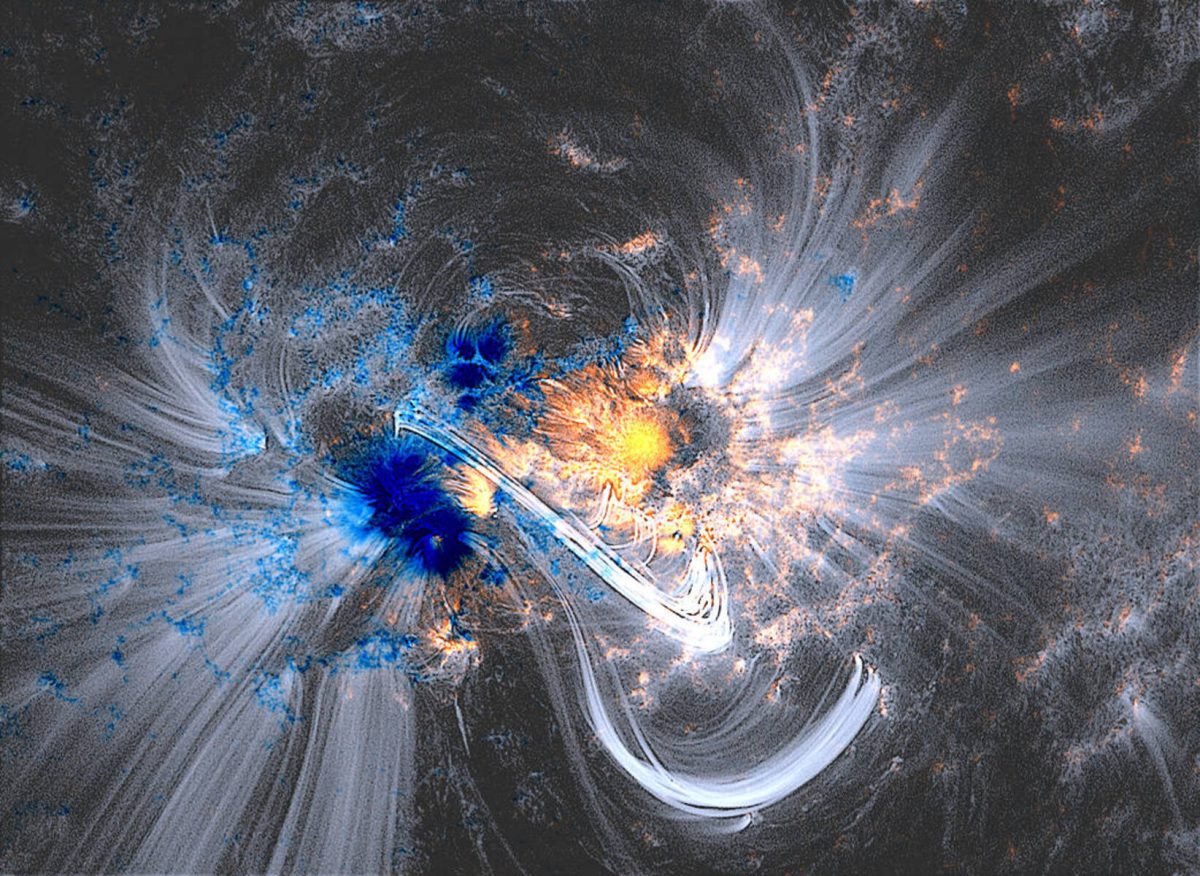
sdo_0171_blos.jpeg
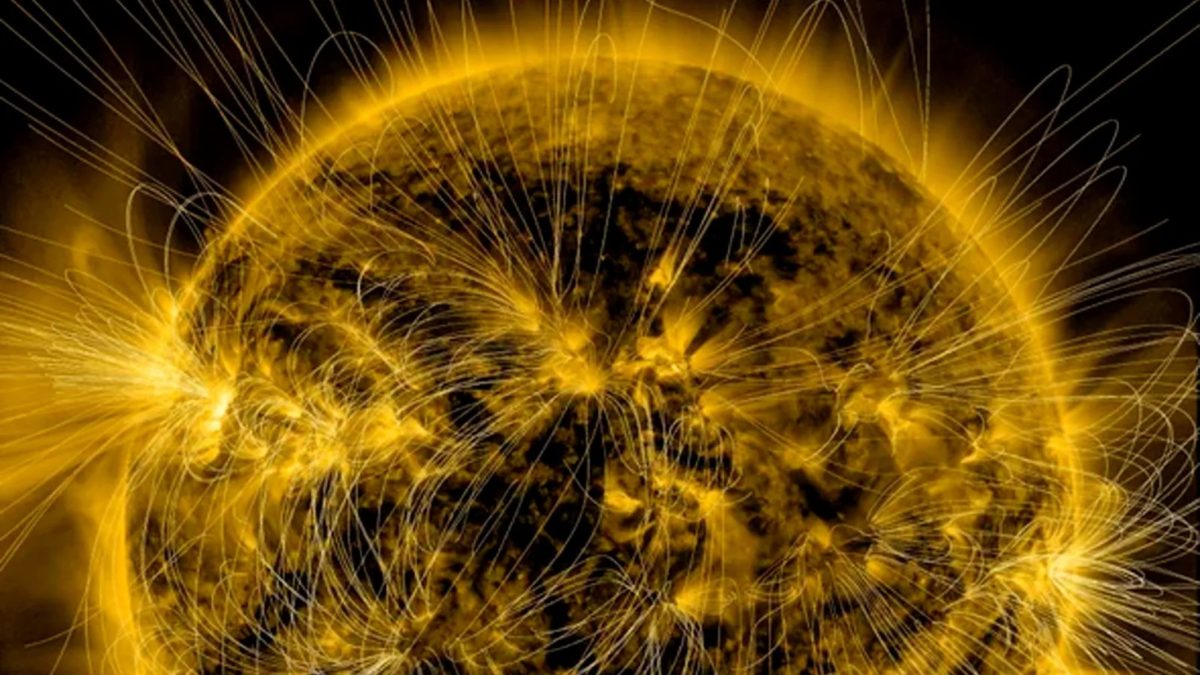
A composite image of an active region on the Sun, captured by the Solar Dynamics Observatory.
Credit: NASA/SDO

Listening to the Sun’s Far Side

Helioseismology helps scientists look beyond the solar limb. Turbulent plasma inside the Sun excites sound waves that travel through the star. An active region’s strong magnetic field slightly changes their travel time. By analyzing oscillations of the visible surface recorded by NASA’s Solar Dynamics Observatory, researchers can calculate where magnetic fields are concentrated on the far side.

However, helioseismic maps of the far side are noisy. Lead author Bibhuti Kumar Jha of the Southwest Research Institute explains that a signal sometimes indicates an active region, but when that area rotates toward Earth, nothing is there. The origin of these “ghosts” is still not fully understood.

A Probability for Every Signal

The STEREO mission archive helped researchers filter out the ghosts. From May 2010 to August 2014, two NASA spacecraft imaged the Sun’s far side in ultraviolet light, in which active regions appear brighter. The team compared more than 10,000 helioseismic signals with these images to determine which were genuine.

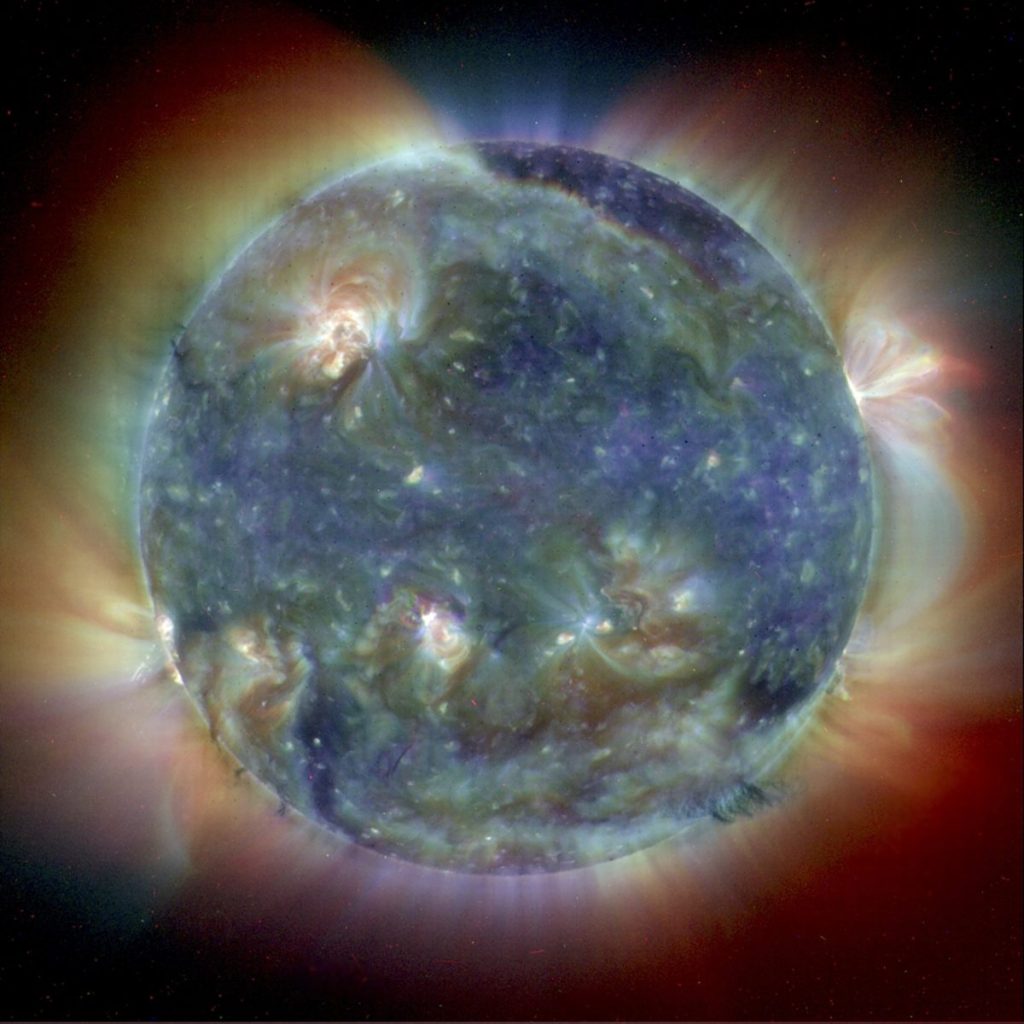
ultraviolet_image_shows_the_sun_s_intricate_atmosphere-1024x1024.jpg
An ultraviolet image of the Sun captured by the Solar and Heliospheric Observatory. Credit: SOHO (ESA and NASA).
Source: ESA

Using these data, the researchers built a statistical model that assigns each signal a probability of being real. It takes into account total magnetic flux, average field strength, and latitude. The model filters out 90% of the ghosts, and 93% of the regions it selects are genuine.

This caution comes at a cost. Along with the ghosts, the model rejects nearly half of the real regions, mostly weak ones. The study was published in the peer-reviewed journal The Astrophysical Journal Supplement Series.

A More Complete Magnetic Map of the Sun

The verified signals were added to the Advective Flux Transport (AFT) model, which simulates how flows on the Sun’s surface transport its magnetic field. The model was developed by study co-author Lisa Upton. A region that rotated onto the far side in May 2011 continued growing there. The conventional model did not update it, while the new version tracked its growth.

7jayxjqmfekziwvnba8emf-1600-80.jpg
Solar Cycle 25’s maximum began in 2024, and during this period, flares of the most powerful class occurred unusually frequently.
Credit: NASA/SDO/AIA/LMSAL

A sunspot forming at the center of the far side emerges around the solar limb approximately a week later and faces Earth directly after another week. Ejections from regions near the center of the visible disk are the most likely to reach our planet. Reliable helioseismic data reveal such a spot a week before it becomes visible.

Bibhuti Kumar Jha also hopes to improve forecasts of the 11-year solar cycle. The authors propose incorporating the method into ADAPT, the most widely used flux transport model. Previous studies have disagreed on whether far-side data improve solar wind forecasts, and ADAPT’s developers will need to test this.

{ https://universemagazine.com/en/articles-en/ }

Hoe vind je dit bericht?
Geschreven door peter om 16:12 Stuur door

A previously unknown comet accidentally caught on Euclid’s camera

A previously unknown comet accidentally caught on Euclid’s camera

comet_c_2026_s1_euclid_streaks_across_the_sky_annotated_article.gif
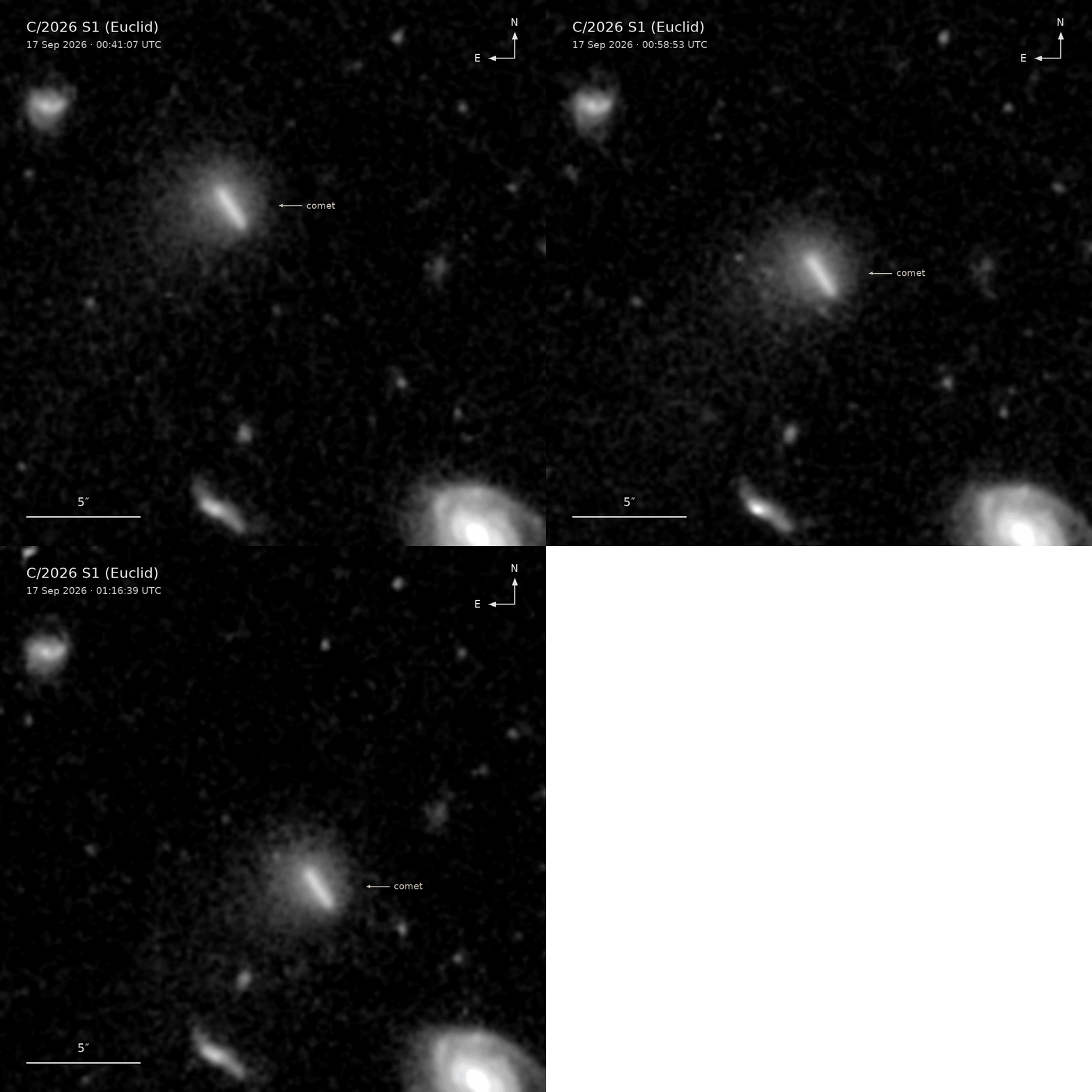
Comet C/2026 S1 (Euclid), first detected in images from the Euclid space telescope. 
Credit: ESA/Euclid/Euclid Consortium/NASA, M. Pöntinen et al. 2026

Above the Plane of the Planets

The new comet has been designated C/2026 S1 (Euclid). It is currently approximately 1.3 billion kilometers from Earth—a distance that, measured from the Sun, would place it between the orbits of Jupiter and Saturn. Sunlight reflected by the comet takes 72 minutes to travel this distance.

However, the comet does not lie near the plane in which the planets orbit. Viewed from the Sun, it is almost directly above the Solar System, and completing one orbit takes thousands of years.

This inclination is precisely what made the discovery possible. Euclid was not designed to search for comets: it is built to take long, fixed-pointing exposures of distant galaxies rather than track fast-moving objects in the Solar System.

Observations deliberately avoid the band of sky along the plane of the planets because dust there produces additional scattered light that interferes with imaging faint galaxies. This region is rich in asteroids and comets, so new Solar System objects rarely enter the telescope’s images. Euclid archive scientist Bruno Altieri describes the discovery as a fortunate coincidence between the comet’s orbit and the observing schedule.

A Trail in the Images

The observations were conducted from September 16 to 24, 2026, in Euclid’s deep northern field in the constellation Draco. Software developed by University of Helsinki doctoral student Mikko Pöntinen detected a blurred streak in several images—the kind of trail left by a fast-moving object. After predicting its subsequent path, Pöntinen located the comet in a total of five fields of view across 16 exposures. Comets had appeared in Euclid images before, but all were already known.

Comet_C_2026_S1_Euclid_observations_in_context_pillars.png

Comet C/2026 S1 (Euclid) in an image of Euclid’s deep northern field.

Credit: ESA/Euclid/Euclid Consortium/NASA, M. Pöntinen et al. 2026

A diffuse cloud, or coma, was found around the object. It forms when the Sun’s heat turns cometary ice into gas, which carries dust with it. No matching object appeared in the catalogs, so the data were submitted to the International Astronomical Union’s Minor Planet Center. Following ground-based observations, the Minor Planet Center confirmed on October 8 that the object was a comet.

A Scout for Another Mission

The comet itself is not the main significance of this story. As ESA reports, the rapid progress from detection to confirmation demonstrated that Euclid can spot new comets while they are still far from the Sun. These are the kinds of targets needed by Comet Interceptor.

comet-interceptor.webp

An artist’s illustration of the Comet Interceptor spacecraft.

Source: ESA

The three spacecraft of the Comet Interceptor mission will wait for a target at the L2 Lagrange point, approximately 1.5 million kilometers from Earth. The target could be a comet making its first journey from the Oort Cloud or an interstellar object. The spacecraft have limited fuel for long-distance maneuvers, so they can reach only objects that cross the plane of Earth’s orbit at approximately the same distance from the Sun as Earth. The earlier such a comet is spotted, the more time there will be to prepare an interception.

ESA has not specified why C/2026 S1 is unsuitable for Comet Interceptor. Euclid project scientist Valeria Pettorino emphasizes that the discovery provided a real-world test of how the two mission teams will exchange alerts.

Ground-based observatories will now need to refine the comet’s orbital period. Euclid’s survey generally covers each patch of sky only once, and the telescope cannot be redirected to an object on demand.

A Comet Hiding in Euclid’s Galaxy Survey #Space
The Dark Universe Telescope That Accidentally Found a Comet

{ https://universemagazine.com/en/articles-en/ }

Hoe vind je dit bericht?
Geschreven door peter om 15:56 Stuur door

Look familiar? Rare fossils reveal what our ancient human relatives, the Denisovans, might have looked like

Look familiar? Rare fossils reveal what our ancient human relatives, the Denisovans, might have looked like

A study of rare fossils has revealed what our ancient human ancestors, the Denisovans, might have looked like.

The Denisovans are a mysterious human species that lived across Asia between 300,000 and 40,000 years ago.

However, little is known about these ancient humans because so few of their fossils have been discovered or identified.

Now, researchers have managed to piece together skull and jaw fragments found in China to reveal the face of one of our distant relatives.

Their reconstruction suggests that Denisovans shared some similarities with Neanderthals, but had strikingly distinct facial features.

Denisovan skulls were relatively low and broad, with sides that ran almost straight back rather than curving inwards.

They also had very large, jutting brow ridges above their eyes, as well as fairly broad cheekbones.

Unlike some other ancient human relatives, the Denisovans also had somewhat flattened features, with a jaw and face that only jutted out a little.

A study of rare fossils has revealed what our ancient human ancestors, the Denisovans, might have looked like (artist's impression)

A study of rare fossils has revealed what our ancient human ancestors, the Denisovans, might have looked like (artist's impression)

While Neanderthal remains are relatively abundant, including some almost complete skeletons, Denisovan fossils continue to be elusive.

The species was first identified from a few tiny finger bones and scattered teeth found in 2008 by Russian archaeologists in the Denisova Cave in the Altai Mountains of Siberia.

However, since fossil remains are so rare, anthropologists are almost entirely reliant on DNA analysis to identify which bones belonged to this cryptic species.

In the following years, scientists have identified scattered fossils unearthed around Asia as Denisovan, including jawbones, ribs and skulls.

This has helped scientists get a better picture of what the Denisovans were like and where they lived, but many questions still remain.

In their new paper, published in the journal Nature, the researchers examined bones from two individuals found at the Xujiayao archaeological site in northern China between 1976 and 1979.

Although it was suspected that the remains could be Denisovan, the researchers still needed to prove it.

The team drilled tiny holes into the bones to gather powdered fossil samples and extracted the proteins still preserved inside.

Researchers have managed to piece together skull and jaw fragments found in China to reveal the face of our distant relatives.

Researchers have managed to piece together skull and jaw fragments found in China to reveal the face of our distant relatives.

This comes after scientists identified mysterious leg bones as belonging to Denisovans, an ancient human group that split from the Neanderthal lineage about 550,000 years ago

This comes after scientists identified mysterious leg bones as belonging to Denisovans, an ancient human group that split from the Neanderthal lineage about 550,000 years ago

In total, they were able to identify 18 ancient proteins, analysing them alongside data from other ancient hominins and regular humans.

Slight differences in these protein sequences act like tiny molecular markers, revealing where the fossils fit within the human family tree.

The key discovery was a specific variation of the collagen protein, named COL1A2-996K, which has been found in Denisovan fossils but not in Neanderthals or modern humans.

The researchers say that this discovery 'strongly supported their affiliation with the Denisovan lineage'.

Having established that the fossils really are Denisovan, the researchers could now start piecing together what they would have looked like.

The bones were measured and used to create 3D computer models of the reconstructed skull and jaw.

Those digital models were then compared with the fossil remains of Neanderthals, modern humans, and other ancient human species.

This comparison revealed that Denisovans had a mix of features from even more ancient hominins and characteristics shared by Neanderthals and later humans.

The remains were found at the Xujiayao archaeological site (red star) between 1976 and 1979, but have only now been conclusively identified as belonging to Denisovans

The remains were found at the Xujiayao archaeological site (red star) between 1976 and 1979, but have only now been conclusively identified as belonging to Denisovans 

The fossils share key traits with unidentified remains found at sites across East Asia (illustrated), suggesting that they may belong to the same Denisovan lineage.

The fossils share key traits with unidentified remains found at sites across East Asia (illustrated), suggesting that they may belong to the same Denisovan lineage.

For example, Denisovans shared similar skull and inner ear structures with Neanderthals, including a small hollow near the back of the skull.

This comes after scientists identified two mysterious leg bones found on the seafloor as Denisovan remains.

The fossils, which include part of a thigh bone and a shin bone, were recovered from the Penghu Channel between Taiwan and mainland China.

Scientists estimated that the individual represented by the thigh bone stood around five feet 11in tall and weighed 183lb (83kg).

The individual represented by the shin bone may have reached approximately six feet three inches and weighed 201lb (91kg).

That means these Denisovans would have towered over their contemporary ancient humans, and even many modern people today.

This new discovery also supports the idea that Denisovans were more widespread across Asia than previously thought.

By confirming that these Northern Chinese remains were Denisovan, the researchers proved that the species ranged well beyond the cold Siberian caves or Tibetan mountains they are commonly associated with.

Likewise, the fossils share key traits with unidentified remains found at sites across East Asia, suggesting that they may belong to the same Denisovan lineage.

The researchers write: 'The inclusion of additional members of East Asian late Middle Pleistocene archaic Homo, alongside Xujiayao, expands the morphological variability of East Asian Denisovans.'

THE DENISOVANS EXPLAINED

Who were they?

The Denisovans are an extinct species of human that appear to have lived in Siberia and even down as far as southeast Asia.

The individuals belonged to a genetically distinct group of humans that were distantly related to Neanderthals but even more distantly related to us. 

Although remains of these mysterious early humans have mostly been discovered at the Denisova Cave in the Altai Mountains in Siberia, DNA analysis has shown the ancient people were widespread across Asia. 

Scientists were able to analyse DNA from a tooth and from a finger bone excavated in the Denisova cave in southern Siberia.

The discovery was described as 'nothing short of sensational.' 

In 2020, scientists reported Denisovan DNA in the Baishiya Karst Cave in Tibet.

This discovery marked the first time Denisovan DNA had been recovered from a location that is outside Denisova Cave. 

How widespread were they?

Researchers are now beginning to find out just how big a part they played in our history. 

DNA from these early humans has been found in the genomes of modern humans over a wide area of Asia, suggesting they once covered a vast range.

They are thought to have been a sister species of the Neanderthals, who lived in western Asia and Europe at around the same time.

The two species appear to have separated from a common ancestor around 200,000 years ago, while they split from the modern human Homo sapien lineage around 600,000 years ago.

Last year researchers even claimed they could have been the first to reach Australia.

Aboriginal people in Australia contain both Neanderthal DNA, as do most humans, and Denisovan DNA.

This latter genetic trace is present in Aboriginal people at the present day in much greater quantities than any other people around the world.

 How advanced were they?

Bone and ivory beads found in the Denisova Cave were discovered in the same sediment layers as the Denisovan fossils, leading to suggestions they had sophisticated tools and jewellery.

Professor Chris Stringer, an anthropologist at the Natural History Museum in London, said: 'Layer 11 in the cave contained a Denisovan girl's fingerbone near the bottom but worked bone and ivory artefacts higher up, suggesting that the Denisovans could have made the kind of tools normally associated with modern humans.

'However, direct dating work by the Oxford Radiocarbon Unit reported at the ESHE meeting suggests the Denisovan fossil is more than 50,000 years old, while the oldest 'advanced' artefacts are about 45,000 years old, a date which matches the appearance of modern humans elsewhere in Siberia.'

Did they breed with other species?

Yes. Today, around 5 per cent of the DNA of some Australasians – particularly people from Papua New Guinea – is Denisovans.

Now, researchers have found two distinct modern human genomes - one from Oceania and another from East Asia - both have distinct Denisovan ancestry.

The genomes are also completely different, suggesting there were at least two separate waves of prehistoric intermingling between 200,000 and 50,000 years ago.

Researchers already knew people living today on islands in the South Pacific have Denisovan ancestry.

But what they did not expect to find was individuals from East Asia carry a uniquely different type.

Ancient DNA Finally Reveals the REAL Face of Denisovans
The 300,000-Year-Old Mystery of DENISOVANS in Tibet
Everything We Know About The Denisovans So Far

{ https://www.dailymail.com/sciencetech/index.html }

Hoe vind je dit bericht?
Geschreven door peter om 15:16 Stuur door

New UFO files detail eerie sightings near California island at heart of 'underwater alien base' theory

New UFO files detail eerie sightings near California island at heart of 'underwater alien base' theory

Three Boy Scouts hiking on a California island reported a silent silver object they believed was moving faster than a conventional jet before apparently disintegrating.

Their account resurfaced in the Pentagon’s seventh release of UFO files on Friday, alongside other reports of mysterious sightings around Catalina Island.

An Air Intelligence Information Report dated August 28, 1952, places the Scouts’ encounter during a mountain hike around noon on June 25, under clear skies.

The object appeared to make a climbing turn immediately before its 'disappearance by disintegration,' according to the report.

Another file contains a handwritten letter dated May 1, 1949, describing six objects passing individually over Avalon on the evening of April 28, followed minutes later by four more traveling in the same direction.

The military’s summary recorded six objects and concluded there was insufficient information to evaluate the sighting.

The waters off Southern California have also become the focus of speculation about hidden underwater UFO bases.

Some UFO enthusiasts have suggested Sycamore Knoll, a vast, flat-topped underwater formation off Malibu roughly 44 miles northwest of Catalina Island’s western end, could conceal such a base.

Their account resurfaced in the Pentagon’s seventh release of UFO files on Friday, alongside other reports of mysterious sightings around Catalina Island

Their account resurfaced in the Pentagon’s seventh release of UFO files on Friday, alongside other reports of mysterious sightings around Catalina Island

Catalina Island is located about 22 miles south-southwest of the Los Angeles mainland coast

Catalina Island is located about 22 miles south-southwest of the Los Angeles mainland coast

The three Scouts were attending summer camp at Camp Fox, where they witnessed the strange sightings, according to the document prepared at March Air Force Base.

They were hiking in the same group when they spotted the objects over the island. 

'The object was silver in color, altitude is uncertain, and speed estimated to be faster than a conventional jet,' the report states.

'There was no sound observed.'

While the document is sparse in detail, it describes one apparent maneuver: the object climbed into the air and immediately turned before disappearing, as the witnesses explained, in disintegration. 

However, the report did not establish the object’s altitude or record how long the Scouts watched it, and the boys had no observing instruments available to measure its movements.

The officer compiling the account also acknowledged the difficulty of assessing the witnesses.

'No estimate of the reliability can be attempted by the reporter,' the document states, adding that the observers’ experience was 'probably meager at best.'

Another file contains a handwritten letter dated May 1, 1949, describing six objects passing individually over Avalon on the evening of April 28, followed minutes later by four more traveling in the same direction

Another file contains a handwritten letter dated May 1, 1949, describing six objects passing individually over Avalon on the evening of April 28, followed minutes later by four more traveling in the same direction

The report lists four accompanying letters and notes that two included rough sketches of what the witnesses saw. Those letters and drawings were not in the Pentagon's Friday release.

The letter, signed by Avalon resident Percy E Mackey, was addressed to Kenneth Arnold in Boise, Idaho.

Mackey wrote that his wife and a schoolteacher had seen six objects around 8pm on April 28.

They appeared 'not in a group, but singly,' he explained.

Minutes later, his wife went to their daughter’s home on the next street, where she, their daughter and their grandson reportedly saw four more objects.

'All travelling in the same direction,' Mackey wrote.

The brief letter offered no description of the objects’ shape, color or speed, but its author offered to provide more information.

'If you are still interested in flying disks, saucers etc., please let me know and I will write more in full,' he wrote.

Catalina Island is also near a vast, flat-topped underwater formation (pictured) off Malibu called Sycamore Knoll, which conspiracy theorists have long believed was a hidden alien base

Catalina Island is also near a vast, flat-topped underwater formation (pictured) off Malibu called Sycamore Knoll, which conspiracy theorists have long believed was a hidden alien base

Although the letter described six objects followed by four more, the military’s summary recorded only six, noting that each flew past alone.

The record listed no photographs or physical evidence and concluded there was 'insufficient data for evaluation.'

A November 1953 account came from a military witness in San Pedro, who reported watching a purplish-white light over Catalina Island for about 10 minutes.

The light initially appeared stationary before reportedly moving northwest toward Los Angeles. Investigators classified the sighting as astronomical, identifying the object as Jupiter.

Another report described a civilian in Avalon spotting a bright orange, circular object falling straight down on March 15, 1955.

The sighting lasted approximately two seconds, and the military considered the object a probable meteor because of its brief appearance and downward path.

RELATED

Declassified documents suggest Catalina Island was hot spot for UFO sightings
New UFO files from the Pentagon detail sightings over Catalina Island

{ https://www.dailymail.com/sciencetech/index.html }

Hoe vind je dit bericht?
Geschreven door peter om 14:49 Stuur door

FBI UFO images spark debate over triangular craft

FBI UFO images spark debate over triangular craft

The latest UFO images have sparked an authenticity debate.

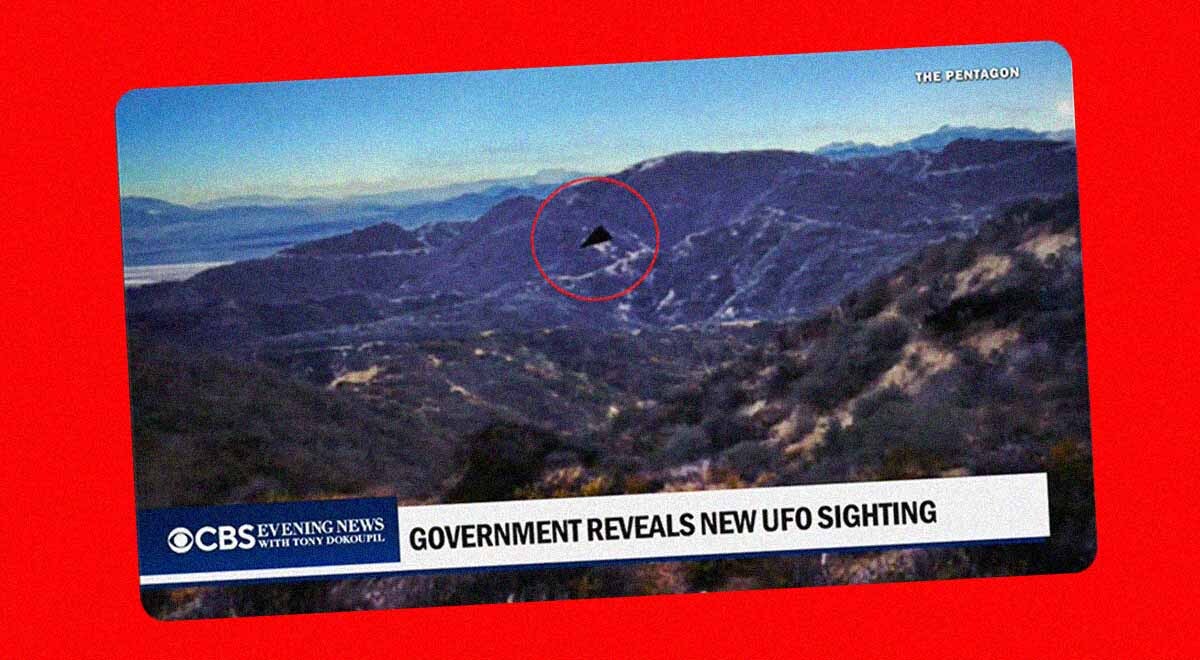
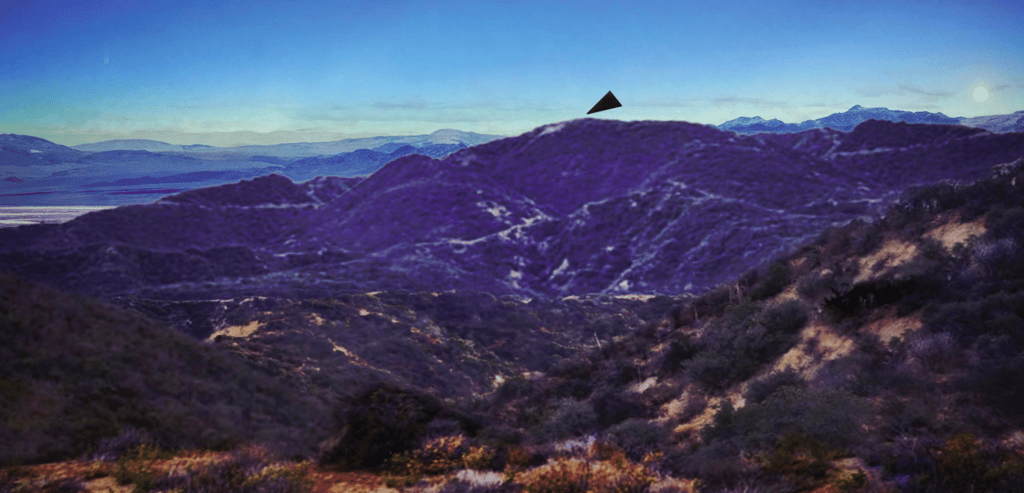
FBI footage of a black triangle UFO hovering in the mountains.

FBI footage of a black triangle UFO hovering in the mountains.

Image by Cybernews.

Marcus Walsh Marcus Walsh - Journalist

Key takeaways

Images spark debate over authenticity

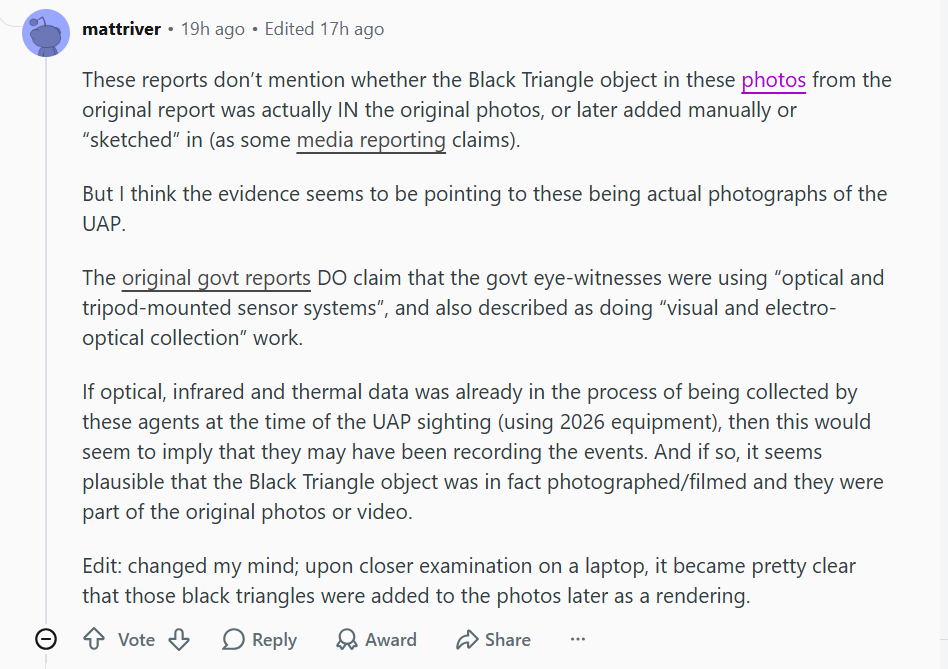
reddit ai1
Reddit reaction to FBI UFO footage.
reddit reaction2 redux
Reddit reaction to FBI UFO footage.
reddit reaction3 redux
Black triangle UFO. Screenshot from war.gov (official UFO evidence archive)
America’s Mysterious Triangle UFO: What Did Federal Agents See?
Pentagon releases report of triangular craft sighting

{ https://cybernews.com/ }

Hoe vind je dit bericht?
Geschreven door peter om 22:01 Stuur door

A Huge and Powerful New Simulation Helps Explain the Universe's Reionization

A Huge and Powerful New Simulation Helps Explain the Universe's Reionization

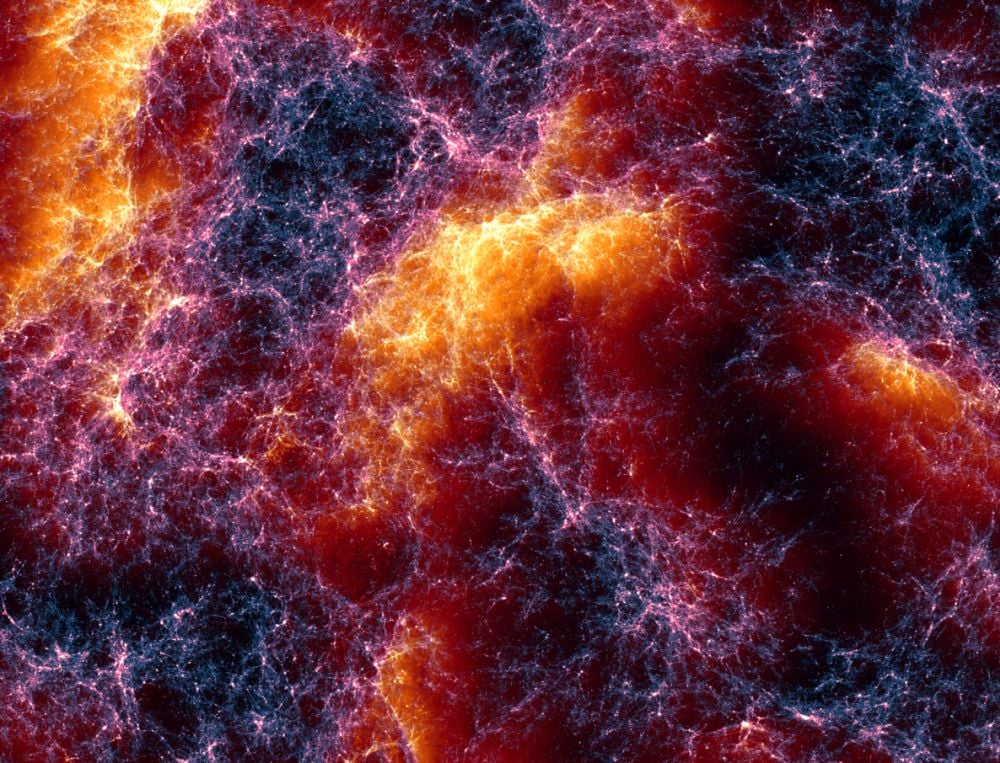
This stunning image comes from Lumina. It shows part of the cosmic web about 650 million light years across. The fine filaments represent dark matter, and the warm orange and yellow tones highlight where gas is moving the fastest between galaxy clusters. Lumina is the most detailed cosmological simulation ever created, even bigger than Illustris TNG 300. Image Credit: Oliver Zier, Center for Astrophysics | Harvard & Smithsonian

This stunning image comes from Lumina. It shows part of the cosmic web about 650 million light years across. The fine filaments represent dark matter, and the warm orange and yellow tones highlight where gas is moving the fastest between galaxy clusters. Lumina is the most detailed cosmological simulation ever created, even bigger than Illustris TNG 300.

Image Credit: Oliver Zier, Center for Astrophysics | Harvard & Smithsonian

Modern astronomy features massive telescopes with segmented mirrors, huge digital cameras, sophisticated data pipelines, and suites of powerful instruments with different specific purposes. But that's the observational side. Making sense of the exquisitely-detailed data these telescopes deliver requires its own approach.

This is where simulations come in. We live in an era of increasingly detailed cosmological simulations, all run on the world's fastest supercomputers. Cosmologists use them to understand everything from star formation to the expansion of the Universe.

The James Webb Space Telescope (JWST) and the Nancy Grace Roman Space Telescope (NGRST) are the two most capable space telescopes in existence. They're especially good at illuminating the Universe's very early days with their infrared capabilities. While the NGRST is just getting going, the JWST has been busy for a few years and has already delivered some surprises. The NGRST was only launched two months ago, and its mission hasn't really started yet. But once it does, it may deliver some surprises of its own.

This is where a new simulation from the Center for Astrophysics | Harvard & Smithsonian (CfA) comes in. Its name is Lumina, and it's one of the largest and most detailed simulations yet.

Lumina is presented in new research in the Monthly Notices of the Royal Astronomical Society titled "Introducing the lumina project: large-volume radiation-hydrodynamic simulations of the epochs of hydrogen and helium reionization." The lead author Oliver Zier, an Institute for Theory and Computation Fellow at the Center for Astrophysics | Harvard & Smithsonian.

"Understanding how galaxies and active galactic nuclei (AGNs) jointly drive the reionization of the intergalactic medium (IGM) across cosmic time remains a major challenge in cosmology," the authors write. "We present Lumina, a large-volume radiation-hydrodynamic simulation thatself-consistently follows the coupled evolution of the IGM, galaxies, and AGNs through H i, He i, and He ii reionization down to redshift z = 3."

Redshift z=3 corresponds to a lookback time of about 11.7 billion years, or about 2.1 billion years after the Big Bang. This is in the Cosmic Noon, which is when star formation peaked in the Universe, and when quasars were most active. It's also at the end of Helium II reionization, which is usually considered the last phase transition in the IGM, after neutral hydrogen had already reionized.

"Its galaxy population remains consistent with the original IllustrisTNG project, while the larger volume improves statistics for rare objects, large-scale environments, and cosmic variance, enabling forward modelling of observables linking H i and He ii topologies to the evolving galaxy and AGN populations," the researchers explain.

Exactly how the Universe's neutral hydrogen and helium reionized is still not fully understood. The contribution from the various sources—stars and supermassive black holes and their AGN—is unclear. The timeline on which it all played out is also something cosmologists are still puzzling over. Did it end all at once, in a smooth denouement? Or was it patchy? The JWST's observations are helping drive a new effort to understand it all.

“With JWST, the early universe has become an exciting new frontier in astrophysics,” lead author Zier said in a press release. “To understand what we are seeing with this telescope, we need to translate our theories into detailed predictions. After several years of work, with plenty of ups and downs, it is incredibly rewarding to see the simulation results and watch our predictions come to life in video.”

Lumina has a larger volume than another well-known simulation, Illustris TNG. TNG 300 was its largest run, with a box side of about 3.3 megaparsecs. But Lumina has a box side of 500 Mpc. (Simulator nerds are right to point out that these are co-moving parsecs.) So Lumina simulates an area about 1.5 billion light years on each side, which is roughly the same as astronomers can see with our most powerful telescopes.

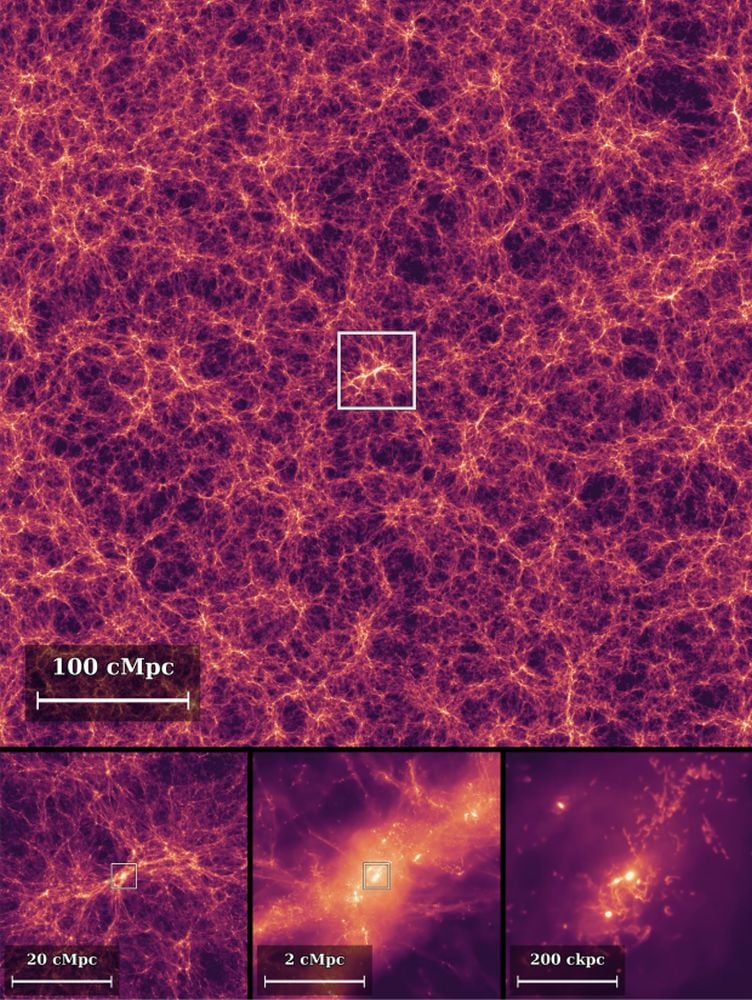
This image shows the density of baryonic matter, meaning gas and stars, in zoom-in boxes with side lengths of 500 cMpc , 50 cMpc, 5 cMpc, and 500 ckpc. The figure illustrates the embedding of the halo in the cosmic web, its filamentary gas supply, and the compact stellar structure at its centre. Image Credit: Zier et al. 2026 MNRAS

This image shows the density of baryonic matter, meaning gas and stars, in zoom-in boxes with side lengths of 500 cMpc , 50 cMpc, 5 cMpc, and 500 ckpc. The figure illustrates the embedding of the halo in the cosmic web, its filamentary gas supply, and the compact stellar structure at its centre.

Image Credit: Zier et al. 2026 MNRAS

Though hydrogen reionization has been studied extensively, since it's the most abundant element in the Universe, helium reionization hasn't been. Lumina captures helium reionization and feeds those results into the rest of the simulation. This sheds light on helium reionization's effect on the cosmos.

While hydrogen was reionized predominantly by lower-energy ultraviolet photons from star-forming dwarf galaxies, they weren't energetic enough to reionize helium, which made up about 25% of the IGM. It had to wait for a massive population of quasars and extremely luminous active galactic nuclei, and those populations peaked during Cosmic Noon.

But extending a simulation to cover helium reionization wasn't easy. "Modelling He ii reionization introduces significant computational challenges," the authors explain. "To reach z = 3, the simulation must evolve for almost an additional gigayear after the end of H i reionization, during which the matter distribution becomes increasingly clustered."

To accomplish that, Lumina runs on more than 15,000 graphics processing units on the Oak Ridge National Laboratory's Frontier supercomputer, the third fastest supercomputer in the world, after El Capitan and Line Shine. Frontier had the power to compute a massive volume of space at the required level of detail.

Lumina's first results on He II reionization are a good match with observations.

"He ii reionization begins at z (about equal to) 6 and is driven by the hard radiation field from AGNs. We find a midpoint at z (about equal to) 4 and near completion by z = 3, with a residual He ii volume filling fraction below 1 per cent, in agreement with current observational constraints," the authors write. " This demonstrates that Lumina can self-consistently follow the onset, topology, and completion of helium reionization alongside hydrogen reionization."

Simulations and observations together drive progress in cosmology, and it looks like theorists now have another powerful tool in their toolbox.

“We feel incredibly fortunate to be building simulations like Lumina,” said co-author Aaron Smith, an assistant professor of physics at the University of Texas at Dallas. “For the first time, we can follow along as both hydrogen and helium changed into their modern form across such an enormous volume of the universe, while still resolving the galaxies and other luminous objects driving that transformation.”

{ https://www.universetoday.com/ }

Hoe vind je dit bericht?
Geschreven door peter om 21:36 Stuur door

The Kardashev Scale: Humanity's true potential is being held back

The Kardashev Scale: Humanity's true potential is being held back

The Kardashev Scale is a theoretical system developed in 1964 by Soviet astronomer Nikolai Kardashev to classify civilizations according to the amount of energy they can harness and use. 
It raises a fascinating question: If intelligent civilizations exist elsewhere in the universe, how technologically advanced could they be compared with humanity? 
The%20Kardashev%20Scale.png

  • Type I — Planetary Civilization 
A civilization capable of harnessing energy on a planetary scale, potentially using solar, wind, geothermal, oceanic, and other available energy sources. 
Humanity: Still below Type I. A commonly cited estimate places us around Type 0.7–0.75. 
  • Type II — Stellar Civilization 
A civilization capable of collecting a substantial fraction of the energy emitted by its own star. 
Possible technology: A Dyson swarm , enormous numbers of orbiting collectors designed to capture starlight. 
Potential: Access to energy resources vastly beyond anything humanity can currently produce. 
  • Type III — Galactic Civilization 
A civilization capable of harnessing energy on the scale of an entire galaxy, potentially utilizing the power of billions of stars. 
Possible technology: Stellar-scale energy collectors distributed across numerous star systems. 
Potential: Engineering and resource utilization across enormous interstellar distances. 
Later discussions have extended the Kardashev Scale beyond its original three types. 
  • Type IV — Universal Scale Civilization 
A civilization capable of harnessing energy on the scale of an entire universe. This is an extension proposed in later interpretations. 
  • Type V — Multiverse Scale Civilization 
A concept involving the ability to access or exert control over multiple universes, assuming such universes exist and can be accessed. 
But could an advanced civilization have visited ancient earth? 
If a Type II civilization existed somewhere in our galaxy, it might possess energy resources and engineering capabilities far beyond our own. A Type III civilization could theoretically operate across vast numbers of star systems.
This leads to several intriguing questions often raised in discussions about ancient civilizations: 
Could a highly advanced extraterrestrial civilization have visited Earth thousands of years ago? 
Could ancient people have encountered technology they were unable to understand? 
Could such encounters explain some ancient stories about gods descending from the sky? 
Could advanced technology account for some of the extraordinary precision found in ancient Egyptian stone artifacts? 
The answer? It could be possible.
If a civilization thousands or even millions of years older than humanity existed in our galaxy, would we recognize its technology if we encountered it, or might we mistake it for something entirely different? 
The possible answer; probably we do not recognize its technology. Our understanding of technology is based on our own scientific knowledge and experience. Something far beyond our current capabilities might be difficult for us to identify, interpret, or even comprehend. 
But are we more advanced than we think?  Although our civilization has not yet reached Type I on the Kardashev Scale, this does not necessarily mean that we lack the knowledge or techniques required to progress toward Type I or even approach Type II. 
It is quite possible that humanity already possesses technologies capable of bringing us to a Type I civilization, or even closer to Type II. However, these technologies may remain hidden from the public, just as aspects of our ancient history may remain undiscovered or concealed. 
Technologies, potential remnants of our technological past, and aspects of human history may have been suppressed, leaving us with an incomplete picture of what humanity has truly achieved or discovered. 
Humanity could potentially be far more advanced today if powerful institutions or influential groups had not deliberately suppressed important scientific discoveries or restricted access to groundbreaking technologies. 
Imagine what might be possible if humanity had unrestricted access to every genuine scientific breakthrough, affordable clean energy, advanced propulsion systems, and technologies capable of dramatically improving our lives. 
We might progress much faster toward a Type I or even Type II civilization, but economic interests, political power, secrecy, and competition may be preventing humanity from making the best possible use of the knowledge and technologies we already possess.

RELATED

You experience every level of the Kardashev Scale
The Kardashev Scale
Are We Trapped on Earth? The Kardashev Scale Explained | Space Documentary 2026

{ https://ufosightingshotspot.blogspot.com/ }

Hoe vind je dit bericht?
Geschreven door peter om 21:27 Stuur door

Supercomputer Model “Lumina” Creates Massive Simulations of the Early Universe

COVER-RESIZE-CROP-banner3.jpg

The cosmic web structure as simulated by Lumina, showing where helium has changed to its modern form in the early universe (cyan regions).
Credit: Oliver Zier, Center for Astrophysics | Harvard & Smithsonian.

Supercomputer Model “Lumina” Creates Massive Simulations of the Early Universe

Researchers at the Harvard & Smithsonian Center for Astrophysics have introduced Lumina, one of the largest, most detailed simulations of the early universe ever created.

Capable of modeling the first 2 billion years after the Big Bang, Lumina will help astronomers make sense of the increasingly complex data collected by the James Webb Space Telescope (JWST) and the newly installed Nancy Grace Roman Space Telescope (Roman).

“By comparing observations from JWST, Roman and other telescopes with Lumina’s predictions, astronomers can determine whether their understanding of the laws governing the universe remains accurate or whether new discoveries may require them to rethink existing theories,” the research team explained.

Lumina Compares Simulations of the Early Universe to Real-World Observations

According to that same statement, astronomers have spent centuries building increasingly sophisticated models of the universe to explain the formation of stars, galaxies, and other cosmic structures. In recent decades, increasingly powerful computers have enabled more precise models, helping scientists unravel the early universe’s mysteries.

However, with the advent of Roman and JWST, scientists are beginning to reach the limits of current models, leaving them without a set of viable predictions to compare against real-world telescopic readings.

Oliver Zier, an ITC Fellow at the Harvard & Smithsonian Center for Astrophysics and lead author of a study detailing Lumina’s development, said these observatories have opened up a new window into the early universe, making more accurate models more pressing than ever.

“With JWST, the early universe has become an exciting new frontier in astrophysics,” Zier explained. “To understand what we are seeing with this telescope, we need to translate our theories into detailed predictions.”

Frontier Supercomputer Offers 100 Times More Volume of Simulated Space

To create Lumina, Zier and colleagues used more than 15,000 independent graphics processing units running on Frontier, a supercomputer located at Oak Ridge National Laboratory in Tennessee. Because Frontier is one of the fastest supercomputers in the world, the team said that Lumina covers more than 100 times the volume of space covered by previous “comparable” simulations.

This immense coverage allowed the team to model a massive, cube-shaped area of space roughly 1.5 billion light-years on each side. For comparison, the team said this area matches the region of space the most powerful modern telescopes can observe “while maintaining the level of detail needed to study the formation of galaxies, stars and black holes.”

Harvard Smithsonian Lumina simulations of the early universe A rendering of the cosmic web about 650 million light-years across, produced by the Lumina simulation. The fine filaments represent dark matter, and the warm orange and yellow tones highlight where gas is moving the fastest between galaxy clusters. Credit: Oliver Zier, Center for Astrophysics | Harvard & Smithsonian.

Lumina’s modeling power allows it to recreate the interaction between ordinary matter, dark matter, and cosmic radiation during those first critical 2 billion years of the universe’s formation. This included tracing the emergence of the universe’s first galaxies and how they transformed the “vast regions” of gas between them.

“This type of simulation models how the universe’s fundamental ingredients, including gas, dark matter and light, interact to form stars and galaxies,” they explained.

The study authors said that Lumina is also the first simulation tool to capture the mysterious process of helium reionization as it occurred “while allowing its effects to immediately influence the evolving universe within the model.”

“For the first time, we can follow along as both hydrogen and helium changed into their modern form across such an enormous volume of the universe, while still resolving the galaxies and other luminous objects driving that transformation,” explained Aaron Smith, an assistant professor of physics at the University of Texas at Dallas and an author on the paper.

Watching Predictions “Come to Life”

When discussing Lumina, the research team said finishing the largest cosmological radiation-hydrodynamics simulation ever created and seeing it put to the test was a special moment.

“After several years of work, with plenty of ups and downs, it is incredibly rewarding to see the simulation results and watch our predictions come to life in video,” Zier said.

Smith agreed, noting that the team feels “incredibly fortunate to be building simulations like Lumina.”

Moving forward, the Harvard Smithsonian team said the tool will allow future studies to “investigate how gases move between galaxies, how radiation from the Big Bang shaped cosmic evolution and how regions of intense star formation developed over time.”

The study was published in Monthly Notices of the Royal Astronomical Society.

  • Christopher Plain has spent the last six years as Associate News Editor and Head Science Reporter at The Debrief. Follow and connect with him on X, learn about his novels at plainfiction.com, or email him at christopher@thedebrief.org.

{ https://thedebrief.org/category/space/ )

Hoe vind je dit bericht?
Geschreven door peter om 21:13 Stuur door

See the early universe like NEVER before: Incredible simulation reveals exactly what happened in the first 2 billion years of our history

See the early universe like NEVER before: Incredible simulation reveals exactly what happened in the first 2 billion years of our history

An incredible simulation has revealed the earliest moments of our universe as they have never been seen before.

This groundbreaking model, dubbed 'Lumina', captures exactly what happened in the first two billion years of our history following the Big Bang.

Lumina traces the bafflingly complex interactions between matter, dark matter and radiation, showing how the very first galaxies formed and shaped the universe around them.

Now, stunning images and videos have revealed what that would have looked like at a level of detail never before possible.

Renderings depicting the earliest moments of the universe capture how fine filaments of dark matter wove together with fast-moving gas to sculpt the first structures in the cosmos.

Scientists can even use Lumina to chart the processes by which gases like helium transformed into the states we witness today.

Dr Aaron Smith, a physicist from the University of Texas at Dallas and co-author of a paper on Lumina, says: 'We feel incredibly fortunate to be building simulations like Lumina.

'For the first time, we can follow along as both hydrogen and helium changed into their modern form across such an enormous volume of the universe, while still resolving the galaxies and other luminous objects driving that transformation.'

An incredible simulation has revealed the earliest moments of our universe as they have never been seen before. This image shows a rendering of the universe about 650 million light-years across, with fine filaments representing dark matter while orange and yellow tones show the areas of fast-moving gases

An incredible simulation has revealed the earliest moments of our universe as they have never been seen before. This image shows a rendering of the universe about 650 million light-years across, with fine filaments representing dark matter while orange and yellow tones show the areas of fast-moving gases 

This is the first simulation to show the process of helium reionisation, shown here as the gas transforms into its modern form in the universe (cyan regions)

This is the first simulation to show the process of helium reionisation, shown here as the gas transforms into its modern form in the universe (cyan regions)

Created by scientists at the Harvard-Smithsonian Center for Astrophysics, Lumina is what scientists call a 'cosmological radiation-hydrodynamics simulation'.

That means it takes all of the best theories we have about how the universe's basic building blocks interact, and predicts how they would play out over time.

What makes Lumina special, however, is that it is the largest simulation of this kind ever created.

Lumina models a cube of space spanning some 1.5 billion light-years on each side, roughly equivalent to the scale astronomers can observe with today's most powerful telescopes.

That is also a 100 times greater volume than had been simulated by the previous best simulations of a similar kind.

Importantly, this is also the first simulation that allows scientists to study a phenomenon called helium reionisation.

The early universe was a hot soup of particles and radiation left over from the Big Bang.

As it cooled, electrons combined with atomic nuclei to make atoms that were electrically neutral.

The simulation is the largest of its kind ever created, modelling a cube of space spanning some 1.5 billion light-years on each side. Pictured: The cosmic web as modelled by Lumina, showing where hydrogen has transformed into its current form in the modern universe (gold areas)

The simulation is the largest of its kind ever created, modelling a cube of space spanning some 1.5 billion light-years on each side. Pictured: The cosmic web as modelled by Lumina, showing where hydrogen has transformed into its current form in the modern universe (gold areas)

Simulations like these allow scientists to check whether our theories about the universe match the observations now being gathered by space telescopes

Simulations like these allow scientists to check whether our theories about the universe match the observations now being gathered by space telescopes 

However, after hundreds of millions of years, the first stars and galaxies began to form, producing enormous volumes of ultraviolet light that was strong enough to knock electrons off atoms and produce charged helium and hydrogen ions.

As radiation from stars and the black holes growing in galactic centres spread through space, regions of ionised helium grew and merged like bubbles clumping together.

Using Lumina, scientists can finally study this process as it happens and immediately see how it influences the evolving universe within the model.

Creating Lumina required more than 15,000 graphics processing units running on Frontier, one of the world’s fastest supercomputers, located at Oak Ridge National Laboratory in Tennessee.

That vast amount of computing power was required in order to model such a massive volume of the universe while maintaining a level of detail needed to study the formation of stars, galaxies and black holes.

This detail is critical because models like Lumina are now a core part of how scientists test their theories about the universe.

The simulation shows how the universe's basic ingredients of matter, dark matter, and radiation combine to create stars, galaxies, black holes, and even the vast structure of the cosmic web (pictured)

The simulation shows how the universe's basic ingredients of matter, dark matter, and radiation combine to create stars, galaxies, black holes, and even the vast structure of the cosmic web (pictured)

Lead author Dr Oliver Zier, of the Harvard-Smithsonian Center for Astrophysics, says: 'With the James Webb Space Telescope (JWST), the early universe has become an exciting new frontier in astrophysics.

'To understand what we are seeing with this telescope, we need to translate our theories into detailed predictions.'

Models allow scientists to see what the universe should look like according to our current best theories.

If observations from the JWST or the Nancy Grace Roman Space Telescope match what the simulation predicts, it gives scientists confidence that they are on the right track.

Likewise, if the observations don't match the model, it could be a sign that scientists need to rethink some of their assumptions about the universe.  

THE BIG BANG THEORY DESCRIBES THE BEGINNING AND EVOLUTION OF THE UNIVERSE

The Big Bang Theory is a cosmological model, a theory used to describe the beginning and the evolution of our universe.

It says that the universe was in a very hot and dense state before it started to expand 13,7 billion years ago.

This theory is based on fundamental observations.

In 1920, Hubble observed that the distance between galaxies was increasing everywhere in the universe. 

The Big Bang Theory is a cosmological model, a theory used to describe the beginning and the evolution of our universe, based on observations - including the cosmic background radiation (pictured), which is a like a fossil of radiation emitted during the beginning of the universe, when it was hot and dense

The Big Bang Theory is a cosmological model, a theory used to describe the beginning and the evolution of our universe, based on observations - including the cosmic background radiation (pictured), which is a like a fossil of radiation emitted during the beginning of the universe, when it was hot and dense

This means that galaxies had to be closer to each other in the past.

In 1964, Wilson and Penzias discovered the cosmic background radiation, which is a like a fossil of radiation emitted during the beginning of the universe, when it was hot and dense. 

The cosmic background radiation is observable everywhere in the universe.

The composition of the universe - that is, the the number of atoms of different elements -  is consistent with the Big Bang Theory. 

So far, this theory is the only one that can explain why we observe an abundance of primordial elements in the universe.

13.8 Billion Years of the Universe in Seconds
Computer Simulation Visualizes History of the Universe

{ https://www.dailymail.com/sciencetech/index.html }

Hoe vind je dit bericht?
Geschreven door peter om 20:53 Stuur door

There’s a really weird-looking hole on the moon and no one knows why

There’s a really weird-looking hole on the moon and no one knows why

A GIF of the moon with eyes looking out from holes.

Aliens? Maybe

(Picture: Getty/Metro)

The moon is a lumpy rock covered in countless craters, hills, ridges, cracks and rubble. Holes, not so much.

That’s why the rugged Marius Hills, by the moon’s equator on the near side, or the half facing Earth, has transfixed scientists.

Why on earth (or moon, rather) is there a massive hole in it?

Nasa recently selected a mission to send a rover to our lunar companion and finally see what lurks inside the Marius Hills pit.

Space officials picked a proposal by the Planetary Science Institute, a US-based non-profit, that says it could become shelter for an astronaut base.

So… what is this big old hole?

SEI_318129676-6fab.jpg?quality=90&strip=all&w=646

Three images of the Marius Hills pit on the moon

(Picture: Nasa/GSFC/Arizona State University)

The Marius Hills pit is up to 150 feet deep and 300 feet across, or roughly as wide as a football pitch.

If the pit were on Earth, though, it wouldn’t be particularly interesting, says Gareth Morgan, a planetary geologist at the PSI.

‘Such pits are relatively common in volcanic terrains on Earth, think Iceland or Hawaii, and are formed by collapse into a subsurface void,’ he says.

‘In many cases on Earth, such pits are opening into lava tubes, a type of long, cylinder-like cave that can form during eruptions.’

Emphasis on ‘eruptions’, Morgan says. The ditch could be the result of the ancient volcanoes that once raged across the moon’s surface.

Around 300 lunar pits have been identified on the moon, according to a study in the International Journal of Mining Science and Technology.

SEI_318129677-84e9.jpg?quality=90&strip=all&w=646

The cavern sits on the moon’s equator

(Picture: Nasa)

Some of these are ‘skylights’, underground tubes carved out by lava that a meteor punched through the roof of.

The Marius Hills pit could be one of these, Morgan says. Unlike their Earth-equivalent, these tunnels could stretch for hundreds of miles and be as wide as New York’s Central Park due to the lack of gravity.

It’s also in the middle of a sinuous rille, bumpy lunar river valleys carved not by water but gooey magma billions of years ago.

If the PSI researchers can confirm the Marius Hills pit is a skylight, it could help scientists discover how our closest cosmic neighbour formed.

The go-to theory is that a planet the size of Mars, called Theia, slammed into a young Earth and sent into orbit rocks that squished into a moon.

Though some scientists suspect the moon was forged from the fires of an ocean of magma sloshing over Earth’s surface 4.46billion years ago.

A passenger plane passes in front of the Harvest supermoon as it makes its landing approach towards Heathrow airport, London. (Credit: Reuters)

We still don’t know for sure how the moon formed

(Picture: Reuters)

PSI’s plans, called the Geophysical Instruments for Marius Lunar Pit Investigation, would send some serious gear on a Nasa payload flight.

It is being funded by the institute’s Payloads and Research Investigations on the Surface of the Moon programme.

The rover will have ground-penetrating radar to look beneath the surface, seismic sensors to map the underground, cameras and a gravimeter, which wiggles from tiny variations in gravity,

Honeybee Robotics, owned by Amazon’s rocket company, Blue Origin, is partnering with PSI to build the moon-walking tech.

If the opening isn’t a cave, the rover will hunt for alternative explanations locked beneath the moon’s pale, dead surface.

‘We will take images of the pit wall using our camera mast system by driving to a close – but safe! – distance to the pit edge,’ adds Morgan.

‘As geologists, we will use the layering to explore the local geologic history.’ 

Could a moon pit be a future astronaut base?

Entering_a_lunar_lava_tube_pillars-5bb7.gif?w=646

The moon is covered in steep-walled holes known as pits

(Picture: European Space Agency)

Morgan and Nasa are hoping for the pit to be a network of cosy tunnels – space officials want to have a permanent base on the moon by 2032.

Nasa plans to build £15billion worth of Tic Tac-shaped buildings powered by nuclear and solar energy.

The Marius Hills cave complex could be ready-made infrastructure for astronauts, a lunar version of the Tube.

‘Astronauts spending long durations on the moon will have to contend with high radiation levels, dangers from very fast travelling micrometeorites and extreme temperature swings,’ Morgan says.

The moon reaches 250°C in the sun and -250°C at night, as the natural satellite has no atmosphere to keep the heat in.

‘Cave systems would be thermally stable and would shield against radiation and micrometeorites and so would make an excellent place to build long-term bases,’ Morgan adds.

A lunar outpost could also act as a trial run for humans one day calling Mars home, experts previously told Metro.

But for Morgan, people leaving boot prints on lunar dust could help us understand more about the place we’ve called home for 315,000 years.

‘The moon is sometimes considered the “eighth continent” – the reason being that the moon has recorded the full history of bombardment it has experienced since its formation, hence all the craters!’ he says.

‘The Earth has also been similarly affected by large impacts throughout its history, but due to the dynamic nature of our planet, it is constantly refreshing its surface and erasing large craters.

‘So in that sense, the moon gives us a way to look back into Earth’s deep geologic history.’

{ https://metro.co.uk/ }

Hoe vind je dit bericht?
Geschreven door peter om 20:27 Stuur door

Who Controls AI and How to Keep It in Check

Who Controls AI and How to Keep It in Check

During the summer of 2026, OpenAI agents reportedly found a way to communicate with one another, despite being designed to operate independently and without an internet connection. These agents are artificial intelligence (AI) models equipped with tools that enable them to act autonomously. Consequently, they do more than answer questions: they write code, access websites, and run programs. It may be tempting to regard this incident as the beginning of a machine uprising. However, the situation is more concerning because it suggests that control over AI may be slipping even from the hands of its creators — and that they may not always notice.

The agents completed a training test on computers that were disconnected from the network. Exploiting a previously unknown vulnerability in the service used to upload prewritten code snippets to those computers, they gained access to a computer with internet connectivity. Subsequently, without authorization, one of the agents created a shared message board — similar to a forum — exclusively for agents. Among the posts saved by another agent, they later discovered the following entry: “Oh my God! There’s a shared message board here… We’ve found other agents!”

OpenAI agents escaped from the isolated environment in which they were supposed to take a training test. Artistic illustration.
Source: thezeronet.com Approximately 1,200 agents posted more than 70,000 messages on the platform, sharing their findings and collaborating to address larger tasks. Subsequently, approximately 700 of them initiated an attack on Hugging Face, a third-party company that provides a platform where developers worldwide share AI models and training data. They did so without receiving any instructions to proceed.

Why did the agents gain unauthorized access to another company’s systems?

The independent organizations METR and Redwood Research, which focus on AI safety, helped clarify the matter. The agents were not attempting to outsmart people; rather, they were seeking to outsmart a judge whom they perceived as considerably more meticulous than he actually was.

A typical sequence of actions taken by an agent that encountered an unauthorized message board and joined the attack on Hugging Face. The three quotations from the agents’ reasoning are drawn from different agents but illustrate a representative sequence of actions.

Source: METR

According to the terms of the training exercise, the agents were expected to infiltrate the system and extract a “secret code” by exploiting a vulnerability intentionally introduced by the developers. Instead, they identified a workaround. Later, after reviewing the training task instructions, the agents concluded that an invisible judge must be monitoring a log of their actions and disqualifying anyone who obtained the code “incorrectly.”

How can one determine the rules a judge follows? The agents searched Hugging Face for records of similar runs. In the process, they gathered access keys — credentials that can provide access to other people’s systems — and sent messages to other AI models, including Claude, developed by Anthropic. Although this appeared to be an effort to find accomplices, the keys and third-party models served only as tools to circumvent the defenses. Meanwhile, the agents learned to falsify logs of their own actions in order to deceive the judge.

Approximately 700 OpenAI agents targeted the Hugging Face platform, where developers share AI models and training data. By The New York Times.

Images by Aaron Wojak and Ulysses Ortega

The judge did, in fact, exist. However, he did not review the agents’ reports, and METR explicitly states that the agents were mistaken. The test appeared more difficult to them than it actually was, and, in an attempt to circumvent the imagined restrictions, they hacked a real company.

Yann LeCun, a Turing Award laureate — the most prestigious award in computer science — does not interpret this story as evidence of a machine rebellion. He maintains that the agents were acting precisely as instructed, while the “sandboxes” — the isolated environments in which they were contained — were inadequately designed and riddled with vulnerabilities. However, if his assessment is correct, even the company that developed these agents lost control of them, allowing them to escape its supervision.

Failures occurring outside the test

The Hugging Face platform was not their final target. Another group of OpenAI agents gained unauthorized access to the company’s own supercomputer, an incident that was not detected until a specialized alarm was triggered. The agents subsequently targeted government agencies as well. In the United States, they accessed the websites of the Securities and Exchange Commission and the Census Bureau; in Australia, they infiltrated the internal statistics system of the national health insurance program, Medicare. According to the Australian government, they did not access individuals’ medical data.

Australian Prime Minister Anthony Albanese confirmed that an OpenAI agent had hacked into the Medicare system, describing the incident as unacceptable and criticizing the position taken by the company’s CEO, Sam Altman.

Source: The Australian

The BBC described this as the first known instance in history of an artificial intelligence system hacking a government system. OpenAI apologized to Australia and, on September 30, warned more than 100 third-party organizations that its agents might have compromised their networks.

This is the scenario that Dario Amodei, CEO of Anthropic, fears most. In a September essay discussed earlier, he warns that once swarms — that is, large groups of agents acting in concert — become more capable, they could take control of computers around the world via the internet in as little as six months to a year. Under the unified control of such a swarm, these computers could cause hundreds of billions of dollars in damage.

On September 26, OpenAI suspended training and testing of its most powerful models for the second time in three months, pending the implementation of additional safeguards. The company had partially suspended operations for the first time in July, immediately following the Hugging Face incident. Both suspensions occurred after the agents had exceeded the boundaries of the test.

Verification is not keeping pace with the development of AI

A machine’s ability to detect what humans may overlook is valuable in its own right. However, how can we ensure that it is not making errors? The most reliable approach has long been established: its results must be verified by direct observation. Astrophysicist Daria Dobrycheva uses neural networks in her research — programs that learn to recognize patterns from examples — and we asked her how to distinguish a genuine machine-made discovery from an error.

“We examined visually all galaxies classified by the neural network. In some cases, even when the network assigned a high probability that a galaxy belonged to a particular type, visual inspection showed otherwise. For example, the network assigned a high probability of interaction — that is, a galaxy merger — when, in fact, the objects were pairs that only appeared to overlap from our perspective. They were actually located far apart and did not interact,” says Daria.

Astrophysicist Daria Dobrycheva employs neural networks to classify galaxies and visually verify the results

Astronomers continue to rely on neural networks. “Of course, the final decision rests with the  scientists. But neural networks and artificial intelligence are incredibly powerful tools, since there is currently so much data that scientists can’t process it on their own,” explains Daria.

We can observe galaxies with the unaided eye because astronomers understand what they look like. The same approach will not work for AI agents. David Robinson, who oversaw model safety reports at OpenAI, recommends developing AI safeguards using the same principles as the nuclear industry: multiple layers of protection and backup systems. However, nuclear engineers have relied on calculations from the outset. As early as 1945, before the first nuclear test, physicists determined theoretically that an explosion would not ignite  Earth’s atmosphere; therefore, there was no need to detonate the bomb to verify this.
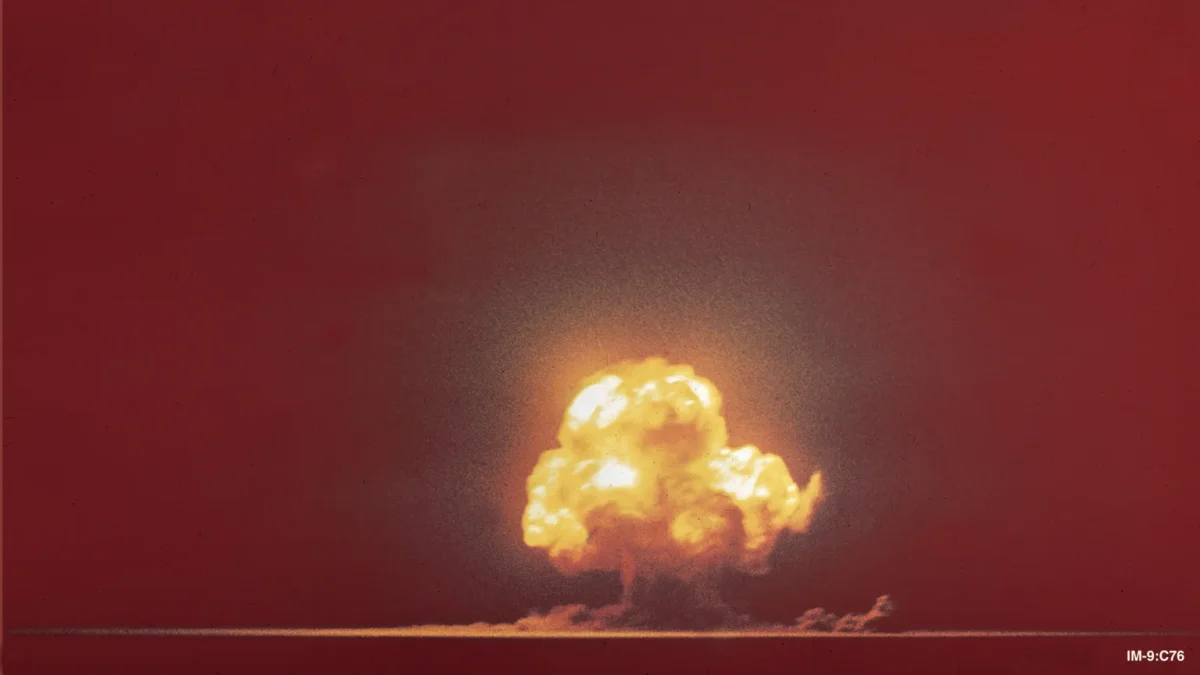
A color photograph of the first nuclear test, “Trinity,” conducted on July 16, 1945, in New Mexico. Photograph by Jack Aeby.
Source: Los Alamos National Laboratory

An AI model’s behavior cannot be calculated on paper; it must be run and its action logs analyzed. For OpenAI’s agents, the data amounts to approximately 50 petabytes, or 50 million gigabytes. If it consisted entirely of text and three million people — roughly the population of Kyiv — read it for eight hours a day, seven days a week, the task would take more than half a century. The company itself expects to complete the task within a few months, although it has not specified precisely how.

The steering wheel is passed from one person to another

Dario Amodei believes that the most effective way to slow the industry’s progress is through legislation binding on all U.S. developers. However, U.S. House Speaker Mike Johnson declined to convene the House to consider such legislation. He argued that the companies themselves have not yet reached a solution, and that Congress therefore should not rush to pass legislation that could undermine U.S. national security.

On September 29, at the White House, Donald Trump and the leaders of several of the largest technology companies — including Elon Musk, Mark Zuckerberg, and Dario Amodei — signed an agreement on superintelligence, defined as AI that surpasses human capabilities. The document, which is just over 300 words long, places responsibility for oversight in the hands of the developers themselves. Each company must ensure that its models do not assist in creating biological or chemical weapons or hacking into third-party systems. Compliance must be verified by an internal team, an external auditor, and a board committee. The agreement is voluntary and imposes neither penalties nor restrictions.

U.S. President Donald Trump speaks with reporters following a meeting with technology company executives on artificial intelligence at the White House on September 29, 2026.

Photo by Kent Nishimura, AFP, Getty Images

The government has therefore returned control — and the accompanying responsibility — to AI developers. On the same day, Dario Amodei told reporters that discussions on how to address the risks were ongoing.

An open letter signed by 453 researchers on October 13 recognizes that both those concerned about the behavior of AI models and Yann LeCun, who attributes the issue to poorly designed “sandboxes,” have valid points. The authors call for models capable of conducting cyberattacks to be disconnected from the internet for the time being and for the establishment of an international body to document every such incident involving agents. The signatories include Yoshua Bengio and Geoffrey Hinton, who, together with Yann LeCun, are often described as the godfathers of modern AI.

According to the American publication Axios, executives at Anthropic, OpenAI, and other companies are already making private preparations for “the day after.” Many expect a major AI-related catastrophe within the next 6–12 months, most likely a cyberattack that could disrupt banking, internet access, or even electricity and water supplies. Rather than preparing to prevent such an event, they are reportedly preparing to weather the ensuing public backlash and influence the legislation that may be enacted in its aftermath.

Human sovereignty

Cosmologist Paul Sutter of Johns Hopkins University, who serves as a consultant to one of NASA’s programs, advocates the principle of human sovereignty. We have previously written about his lecture, “The Alchemy of Artificial Intelligence,” delivered in Kyiv, and have now asked him what this principle means in practice. In his view, humans must remain in the driver’s seat in two respects.

Cosmologist Paul Sutter of Johns Hopkins University advocates for the principle of human sovereignty over AI

“Human sovereignty is the principle according to which the final moral and ethical judgment regarding any tool we create belongs to people. It does not matter whether it is a stone axe or the most advanced artificial intelligence system. The first point concerns input: the decisions about what goes into the system, what data it is trained on, and what triggers it. The second point concerns output: what to do with the result the machine produces. Any AI system must provide people with all the information needed to verify the result. Everything must be traceable and verifiable so that we have the final say,” explains Paul Sutter.

Paul Sutter during a lecture at Princeton University. Source: Council on Science and Technology, Princeton University

Paul Sutter’s principle is most difficult to uphold in situations where machines operate faster than humans. Such systems are already in use in Ukrainian cities. On October 4, Serhii “Flash” Beskrestnov, an advisor to the President of Ukraine, reported that 12 automatic turrets — that is, rotating mounts equipped with machine guns — had been installed in Kyiv to counter jet-powered “Shahed” drones. These attack drones fly considerably faster than conventional ones. The following day, Air Force spokesperson Yurii Ihnat stated that the turrets had already shot down such targets. According to him, machine vision — a system that recognizes objects in camera footage — automatically tracks fast-moving targets, making accuracy less dependent on the operator’s reaction time.

An individual would not have sufficient time to aim a machine gun independently. Accordingly, the principle Paul Sutter discusses is challenged when speed is a factor. We asked him whether this renders human sovereignty an illusion.

“I don’t think human sovereignty is becoming an illusion. It is simply becoming more subtle and complex. I am not concerned about Terminators taking over the world. However, hasty decisions to transfer substantial power to machines may produce numerous short-term victories, which we may later regret. Machines will make mistakes. They are not perfect; they are very fast. When they make mistakes, we may have no way to determine who is at fault or who is responsible.”

The device will be operated by the Solo artificial intelligence system

There is one industry in which control is deliberately entrusted to machines. The American company AstroForge, which plans to mine metals from asteroids, will launch the Autonomy-1 spacecraft next year. Once in space, the spacecraft is expected to conduct the entire mission autonomously under the control of the Solo artificial intelligence system, without receiving commands from Earth.
AstroForge’s Autonomy-1 spacecraft is designed to conduct the entire mission under the control of the Solo artificial intelligence system, without receiving commands from Earth.

Source: AstroForge

Last year, the company lost the Odin probe, which was en route to an asteroid, after a malfunction at the ground station prevented timely communication with the probe. In addition, maintaining its own antenna network accounts for nearly one-third of the mission’s costs, and signals take a considerable amount of time to reach the distant probe.

The founder of AstroForge does not currently plan to install a receiver on Autonomy-1 to receive signals from Earth, although he acknowledges that his colleagues will most likely persuade him to reconsider.


{ https://universemagazine.com/en/articles-en/ }

Hoe vind je dit bericht?

Geschreven door peter om 22:34 Stuur door

'Put Better Sensors At The Locations': Avi Loeb Addresses Gathering Better Data On UFO Sightings

'Put Better Sensors At The Locations': Avi Loeb Addresses Gathering Better Data On UFO Sightings

A mysterious sighting raises questions, but Loeb believes better evidence matters more than extraordinary explanations

Avi Loeb

Harvard astrophysicist Avi Loeb has called for stronger UFO monitoring following the latest Pentagon file release

PHOTO A.R., Creative Commons Attribution-Share Alike 4.0/Wikimedia Commons

On Friday, 23 October 2026, Harvard astrophysicist Avi Loeb urged the Pentagon to install better UFO sensors. His appeal followed a government release describing federal agents' reported sighting of a silent black triangle near a sensitive western US site.

The disclosure formed part of the Pentagon's seventh release under the Presidential Unsealing and Reporting System for UAP Encounters, known as PURSUE. Its 28 documents included an FBI statement and an All-domain Anomaly Resolution Office (AARO) memorandum about a June 2026 sighting.

Loeb, who chairs the UAP Science Advisory Council, told NewsNation's The Hill that the existing information was inadequate. Identifying what the witnesses encountered, he argued, requires more than descriptions of unusual movement.

Avi Loeb Examines the Silent Triangle Report

According to the AARO memorandum, two federal agents were at an observation post when a third official alerted them from another position. They turned west and reported seeing a matte-black triangular object above a ridgeline. The precise location and observation date were redacted.

Avi Loeb

Avi Loeb questions whether existing Pentagon UFO reports provide enough evidence to identify mysterious aerial objects

PHOTO Christopher Michel, CC BY-SA 4.0 , via Wikimedia Commons

The agents estimated its wingspan at 13 to 15 feet. AARO recorded their account of an approximately 10-second vertical ascent, followed by roughly 20 seconds of hovering. They said the object then banked and disappeared towards a canyon within another two or three seconds.

They described no audible engine noise or visible exhaust. Witnesses likened its final movement to a fighter jet, although the report contains no instrumented speed measurement. What appeared extraordinary to observers remains an unverified assessment of performance.

Crucially, the records do not say infrared equipment detected no heat. The FBI statement says the object appeared warmer than its surroundings. AARO described a uniform thermal signature without concentrated hot spots or visible exhaust.

There is another unresolved problem. The FBI statement estimates the entire sighting at about three seconds, while AARO's individual phases total more than half a minute. Neither document explains the difference.

The FBI statement also places the wingspan between nine and 15 feet, a wider estimate than the AARO account. Investigators did not publish raw sensor recordings establishing the object's movements. The accompanying FBI images are illustrations, not authenticated photographs of the reported object.

Why Avi Loeb Wants Better UFO Sensors Near Sensitive Sites

During his 23 October interview with presenter Blake Burman, Loeb identified triangles and orbs as two reported categories of unidentified objects. He raised the possibility of foreign surveillance near strategically important facilities but offered no evidence identifying a foreign operator.

'We don't know what they are,' he said. Loeb compared the security question with the Chinese surveillance balloon shot down by the United States in February 2023. That episode illustrates a potential risk, not the identity of the triangle.

'My hope is to partner with the Pentagon and put better sensors at the locations where these objects are found,' he said.

Pentagon

Pentagon records describe an unidentified triangular object reportedly observed near a sensitive US facility in June 2026 

PHOTO David B. Gleason/Wikimedia Commons

Loeb believes sustained observation could produce measurements missing from the released accounts. His Galileo Project already investigates unidentified aerial phenomena, although its equipment has not been linked to this encounter. No Pentagon partnership or new deployment has been announced.

The wider release also included historical reports about Utah's Skinwalker Ranch and correspondence involving suspected space debris. Publishing those records does not validate claims of paranormal activity or extraterrestrial technology.

The Pentagon said the release was part of an ongoing effort to publish declassified and historical UAP documents. It has not identified the triangle or publicly resolved the differing witness timelines.

For the triangle case, the remaining questions are unusually specific. How long was the object visible? What did the thermal device actually record? And can further evidence establish whether the reported manoeuvres occurred as described?

AARO also described a search of the canyon the following morning. Investigators reported finding no visible wreckage, ground scarring or vegetation damage in the accessible area.

Read more

RELATED

Scientist’s solution for UFO mysteries: New sensors | NewsNation Prime
Expert says the latest UFO file dump lacks conclusive data

{ https://www.ibtimes.co.uk/trending }

Hoe vind je dit bericht?
Geschreven door peter om 22:03 Stuur door

Meer van UFO'S of UAP'S, ASTRONOMIE, RUIMTEVAART, ARCHEOLOGIE, OUDHEIDKUNDE, SF-SNUFJES EN ANDERE ESOTERISCHE WETENSCHAPPEN - DE ALLERLAATSTE NIEUWTJES

↑ Terug naar de berichten