Naar de inhoud

UFO'S of UAP'S, ASTRONOMIE, RUIMTEVAART, ARCHEOLOGIE, OUDHEIDKUNDE, SF-SNUFJES EN ANDERE ESOTERISCHE WETENSCHAPPEN - DE ALLERLAATSTE NIEUWTJES

UFO's of UAP'S in België en de rest van de wereld
akke.beakke.be
Ontdek de Fascinerende Wereld van UFO's en UAP's: Jouw Bron voor Onthullende Informatie! Ben jij ook gefascineerd door het onbekende? Wil je meer weten over UFO's en UAP's, niet alleen in België, maar over de hele wereld? Dan ben je op de juiste plek! België: Het Kloppend Hart van UFO-onderzoek In België is BUFON (Belgisch UFO-Netwerk) dé autoriteit op het gebied van UFO-onderzoek. Voor betrouwbare en objectieve informatie over deze intrigerende fenomenen, bezoek je zeker onze Facebook-pagina en deze blog. Maar dat is nog niet alles! Ontdek ook het Belgisch UFO-meldpunt en Caelestia, twee organisaties die diepgaand onderzoek verrichten, al zijn ze soms kritisch of sceptisch. Nederland: Een Schat aan Informatie Voor onze Nederlandse buren is er de schitterende website www.ufowijzer.nl, beheerd door Paul Harmans. Deze site biedt een schat aan informatie en artikelen die je niet wilt missen! Internationaal: MUFON - De Wereldwijde Autoriteit Neem ook een kijkje bij MUFON (Mutual UFO Network Inc.), een gerenommeerde Amerikaanse UFO-vereniging met afdelingen in de VS en wereldwijd. MUFON is toegewijd aan de wetenschappelijke en analytische studie van het UFO-fenomeen, en hun maandelijkse tijdschrift, The MUFON UFO-Journal, is een must-read voor elke UFO-enthousiasteling. Bezoek hun website op www.mufon.com voor meer informatie. Samenwerking en Toekomstvisie Sinds 1 februari 2020 is Pieter niet alleen ex-president van BUFON, maar ook de voormalige nationale directeur van MUFON in Vlaanderen en Nederland. Dit creëert een sterke samenwerking met de Franse MUFON Reseau MUFON/EUROP, wat ons in staat stelt om nog meer waardevolle inzichten te delen. Let op: Nepprofielen en Nieuwe Groeperingen Pas op voor een nieuwe groepering die zich ook BUFON noemt, maar geen enkele connectie heeft met onze gevestigde organisatie. Hoewel zij de naam geregistreerd hebben, kunnen ze het rijke verleden en de expertise van onze groep niet evenaren. We wensen hen veel succes, maar we blijven de autoriteit in UFO-onderzoek! Blijf Op De Hoogte! Wil jij de laatste nieuwtjes over UFO's, ruimtevaart, archeologie, en meer? Volg ons dan en duik samen met ons in de fascinerende wereld van het onbekende! Sluit je aan bij de gemeenschap van nieuwsgierige geesten die net als jij verlangen naar antwoorden en avonturen in de sterren! Heb je vragen of wil je meer weten? Aarzel dan niet om contact met ons op te nemen! Samen ontrafelen we het mysterie van de lucht en daarbuiten.

The Tom Castello Dulce Base Hoax — John Lear, Tal LeVesque, Cherry Hinkle — New Mexico — 1979–2016 - PART III

The Tom Castello Dulce Base Hoax — John Lear, Tal LeVesque, Cherry Hinkle — New Mexico — 1979–2016 - PART III

The Five-Image “Costello Leak” Hoax — April 2014

By April 11, 2014, a group of five images was being circulated by In5D in an article titled “UFO ET Dulce Base Revealed From A Scientist Now In Hiding.”

The page claimed that the photographs had been smuggled from the underground facility by “Thomas Costello,” described as a Dulce security officer who had subsequently disappeared with his family.

The material was reposted by the Chromographics Institute on April 12, 2014, which credited the In5D article as its source.

No documented chain of custody connects the images to the evidence Castello was alleged to have removed from Dulce in 1979.


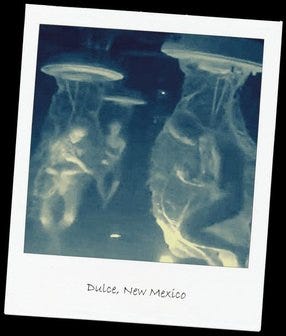
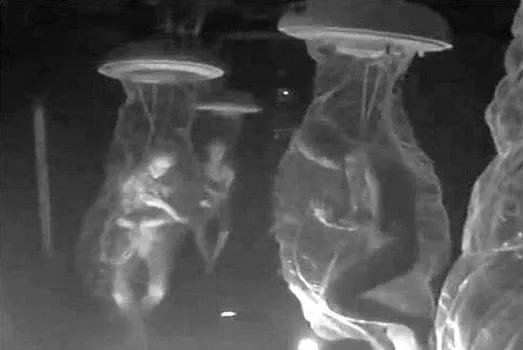
The Underlying Source Image of the “Costello Leak”

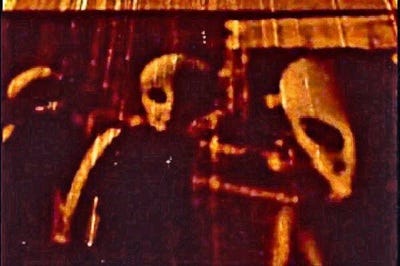
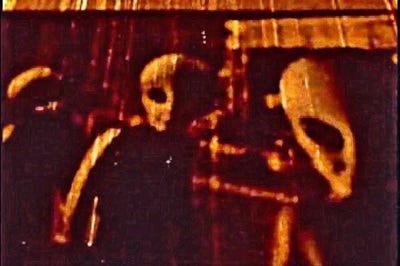
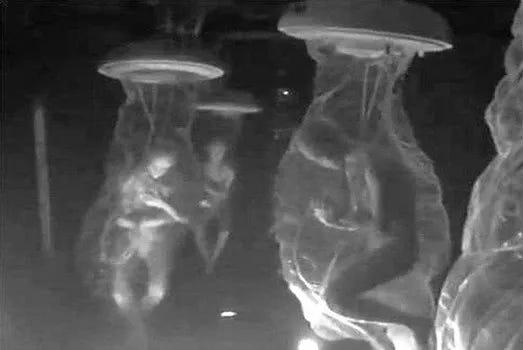
On April 1, 2016, John Greenewald of The Black Vault investigated one of the photographs circulating under the claim that it had been leaked from Dulce by Thomas Costello.

Greenewald traced the image to the 2000 science-fiction film The 6th Day, starring Arnold Schwarzenegger.

The positions of the suspended bodies in the alleged Dulce photograph correspond to the film scene.

Tal LeVesque’s Says it was a “Creation” — November 2015

During correspondence with researcher Adam Gorightly, LeVesque was questioned about the origins of the Thomas Castello material.

In November 2015, LeVesque stated that “TEC (Thomas Edwin Castello) is a creation” and said the alleged Castello interview had never taken place.

LeVesque described the interview as creative writing, saying that questions submitted for Castello had instead been answered by Cherry Hinkle as if she were Castello.

  • William F. Hamilton III and Tal LeVesque, “The Deep Dark Secret at Dulce,” UFO Universe, February–March 1991. Read the reproduced article

  • The Dulce Book, compiled material concerning the alleged Castello evidence packages and photographs. PDF

  • John Lear, Project Camelot — John Lear Tells All, April 2008. Project Camelot interview

  • AlienHub, “A terminally ill Thomas Edwin Castello speaks out,” October 2009. Original AlienHub thread

  • Danila85, Baksan Neutrino Observatory photographs, February 4, 2008. Original LiveJournal gallery

  • Chromographics Institute, “Regarding the Dulce, NM Base,” April 12, 2014. Original 2014 page

  • John Greenewald, “‘Leaked’ Underground Dulce Base Alien Photo by Thomas Costello,” The Black Vault, April 1, 2016. The Black Vault investigation

  • Adam Gorightly, Saucers, Spooks and Kooks: UFO Disinformation in the Age of Aquarius, 2021. Google Books entry

  • Norio Hayakawa, “Thomas E. Castello never existed, admitted the late Tal Levesque, originator of the Dulce Base myths,” April 23, 2021. Norio Hayakawa article

{ https://alienarchivist.substack.com/ }

Hoe vind je dit bericht?
Geschreven door peter om 18:44 Stuur door

Retired lawyer Robert Martinez discusses an unusual UAP-related client

Retired lawyer Robert Martinez discusses an unusual UAP-related client

Retired lawyer Robert Martinez discusses an unusual UAP-related client

Overview

In a recent episode of Reality Check, investigative journalist Ross Coulthart interviewed Robert Martinez, a retired attorney from Tucson, Arizona, about claims made by a former client who allegedly had access to highly classified U.S. government programs involving Unidentified Anomalous Phenomena (UAP). Martinez identified the client by the pseudonym “Dwayne Backer,” saying he represented him during an employment-discrimination case in the mid-1990s.

According to Martinez, Backer worked for decades at sensitive national-security facilities, including White Sands Missile Range and nearby Holloman Air Force Base in New Mexico. Backer reportedly claimed that his career began in 1947 and continued for nearly 50 years. The allegations, which have circulated widely among online UAP communities, remain unverified and have not been independently corroborated by documentary evidence presented in the interview.

Claims Concerning Roswell and Military Encounters

Martinez said Backer claimed to have seen photographs related to the 1947 Roswell incident, including images purportedly showing a crashed craft and non-human bodies. Backer allegedly maintained that the crash occurred several miles from the location identified in official accounts. The U.S. government has historically attributed the Roswell debris to a classified balloon project, while UAP advocates continue to dispute that explanation.

The former client also described what he characterized as a long-running “secret war” between U.S. military aircraft and unknown objects. Martinez said Backer believed numerous pilots and advanced jets had been lost during these encounters, with the incidents later classified as training accidents. In one reported episode, three aircraft sent to intercept a UAP allegedly received an unauthorized instruction to return to base. Ground controllers reportedly denied transmitting the order, an account Martinez presented as evidence of possible technological interference.

Abduction and Depopulation Allegations

Among the most controversial claims discussed was Backer’s assertion that some non-human entities were “good” while others were hostile. Martinez cited an alleged incident involving an Air Force pilot whose parachute was recovered with an empty harness, suggesting the pilot had disappeared during ejection. No independent records confirming that event were provided during the interview.

Backer also allegedly believed that certain entities considered Earth overpopulated and intended to reduce the human population. Martinez said his former client specifically mentioned pandemics as a possible method. The program offered no verified evidence linking any pandemic to non-human activity, and the claim remains speculative.

Alleged Suppression and Harassment

Martinez further described events he interpreted as efforts to intimidate him and suppress Backer’s testimony. He said a major Washington, D.C., law firm representing Backer’s employer sent him a letter highlighting the death penalty under the Espionage Act. Martinez also alleged that two unidentified men in dark suits entered his office while he was in court and stole a physical file containing notes about the case.

He recounted surviving a serious vehicle collision and described a separate incident involving his girlfriend, which he considered suspicious. Martinez connected these events with Backer’s death from a heart attack, reportedly occurring soon after Martinez met former Congressman Steve Schiff, a New Mexico lawmaker who had supported greater disclosure about Roswell. The interview also referenced Air Force safety investigator Alan Diehl and Harvard psychiatrist John Mack, although no direct evidence was presented tying their deaths or work to a coordinated suppression effort.

Martinez’s Position

Martinez told Coulthart that decades of reflection, combined with recent UAP disclosures, had strengthened his belief in Backer’s account. He said he would be willing to testify before Congress in a secure setting and identify corporations and individuals allegedly involved in the programs. The interview documents serious allegations, but it does not establish them as fact. Confirmation would require corroborating witnesses, official records, forensic evidence, or congressional investigation.

RELATED

 { https://usubjects.com/  }

Hoe vind je dit bericht?
Geschreven door peter om 18:11 Stuur door

USOs: The underwater mysteries that have baffled for centuries

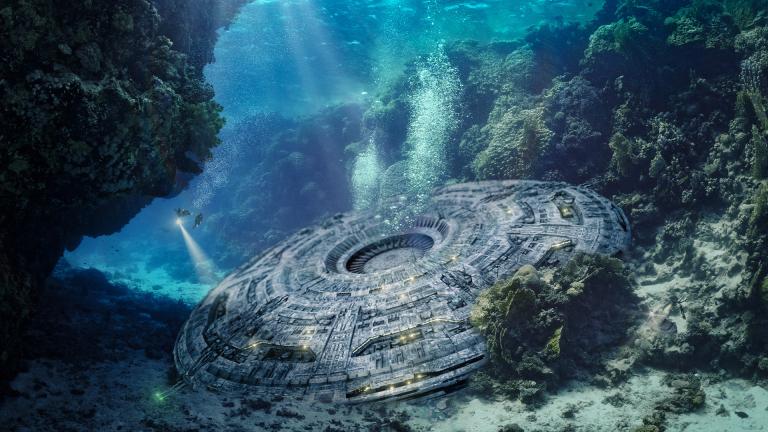
A flying saucer under the water

USOs: The underwater mysteries that have baffled for centuries

From Columbus’s mystery light to the Tic Tac incident, here’s the history of USOs, the underwater UFOs Bradley Walsh investigates in Out of This World.

Article written by:Craig Lenagha

Is the truth really ‘out there’? Quite possibly, but where exactly? You might be tempted to look to the skies. However, this could be the wrong place to look for those aliens. They’re probably not turning up in flying saucers, or even flying at all…

Rather, those little green men could be lurking deep under the sea. An odd choice of place for them to hang out? Not really, if you think about it. Though the ocean covers more than 70% of Earth’s surface, we humans have mapped less than a third of the global seafloor as of 2026.

This all leaves plenty of potential hiding places underwater for aliens eager to keep a sneaky eye on us. In the new Sky HISTORY series Out of This World, TV favourite Bradley Walsh investigates the phenomenon of USOs (unidentified submerged objects). What do the most famous USO cases tell us about what could really lie beneath the waves?

What is a USO?

As you likely already know, the acronym UFO is commonly used to refer to an unexplained aerial phenomenon. The similar acronym USO stands for ‘unidentified submerged objects’. A USO is an unexplained phenomenon detected either in the sea or emerging from it. This makes a USO essentially an aquatic version of a UFO.

Just like a UFO, a USO does not necessarily have to be extraterrestrial in origin. Indeed, many initially mysterious USOs may turn out to be familiar entities like fish, sharks and whales. It’s also possible that relatively uncharted stretches of the ocean are harbouring earthly sea creatures currently unknown to science.

This has not stopped ufologists from speculating that extraterrestrial visitors may also be in our waters. There’s even the frightening prospect of aliens setting up permanent underwater bases. In 2014, one roughly three-mile-wide formation on the seabed floor near California’s Malibu coast attracted suspicion due to its artificial, shelf-like appearance. Nonetheless, geological experts have insisted that this allegedly alien-built ‘anomaly’ could still easily be nature’s doing.

The surprisingly long history of USOs

If you’ve seen a USO, you can report it on the mobile app Enigma, which has logged over 11,000 such sightings off the US coast since 2022. Have USO incidences become more common in recent years? It’s easy to get that impression from the news, but it might just be that we’re becoming more adept at picking up on the phenomena.

Evidently, USO stories have been breaking cover for centuries, long before humans were strapping on scuba-diving gear to explore shipwrecks. While at sea in 1492, Christopher Columbus wrote in his journal about witnessing a peculiar light hovering above the surface of the sea. The explorer likened the sight to ‘a small wax candle rising and falling’.

The Japanese may even have had a close encounter with a seaborne alien in 1803. That’s when a spacecraft-like vessel bearing a feminine mermaid-like creature allegedly washed up on Japan’s eastern coast.

In 1825, Andrew Bloxam was on a sea voyage when he reportedly saw a large, luminous orb appearing to rise from the water. According to the English naturalist, the USO was so fiercely bright it resembled a ‘red-hot’ cannon shot.

The best-known USO cases

Since 2004, the US military has periodically spotted bizarre, lozenge-shaped USOs darting above (and into) seas just off the US mainland. The most famous such sighting is the 2004 ‘Tic Tac’ incident captured on infrared video and radar, which did not attract mainstream attention until 2017.

There’s also the curious case of the ‘Baltic Sea anomaly’, a spaceship-like structure found on the Baltic seabed in 2011. Though sceptics have dismissed it as simply an odd-looking rock, its unusually precise shape has drawn humorous comparisons to the Millennium Falcon from Star Wars.

  • A man and a woman sitting either side of a divided background which is yellow on the left and blue on the right

In one Out of This World episode, Bradley Walsh learns about the ‘ghost rockets’ seen in the skies of Scandinavian countries in 1946. These USOs resembled cigars and were seen falling into lakes. However, no debris from these USOs was ever definitively found at the bottom of these lakes, despite extensive searches that did uncover apparent impact pits.

Crucially, the ‘ghost rockets’ were seen shortly after the end of World War II. The Soviet Union, one of the victorious Allied powers, had only recently recovered German-made weapons. This sparked speculation that at least some of the ‘ghost rockets’ were actually V-1-type missiles being tested by the Soviets.

  • Want more eerie stories from the past? Sign up to the Sky HISTORY newsletter to dive into history’s strangest sightings. Every week, you’ll receive the latest articles, episodes and more delivered straight to your inbox.

RELATED

USO The Mysteries Uncovered: Unidentified Submerged Object Documentary
Deep Sea UFOs: The Mystery of USOs | Rare History Channel Documentary
The Underwater UFO Phenomena the Navy Can't Explain Deep Ocean Mysteries

{ https://www.history.co.uk/ }

Hoe vind je dit bericht?
Geschreven door peter om 16:12 Stuur door

Alien Disclosure: Pentagon Contractor Modelled Military-Documented UFO, UAP & USO Physics

Pentagon Contractor Used Fighter Jet Simulations to Model UFO Physics Under Secret Defence Program

Alien Disclosure: Pentagon Contractor Modelled Military-Documented UFO, UAP & USO Physics

The 141-page document, produced by Bigelow Aerospace Advanced Space Studies (BAASS) in November 2010, details the company’s analytical capabilities for studying UAPs and unidentified submerged objects (USOs) under DIA contract HHM402-08-C-0072.

The contract ran from 2008 to 2010 and tasked BAASS with building what the report described as “the largest known UAP performance and behavior Data Warehouse in the world,” alongside computational modelling tools capable of simulating the physics of reported encounters.

The report is part of the seventh release under the Presidential Unsealing and Reporting System for UAP Encounters (PURSUE). It’s designated DOW-UAP-D175.

Decades of military UFO research

The-UFO-Pattern-1024x568.webp

A collection of reported UFO types from DOW-UAP-D175.

The report traced the US military’s interest in unidentified aerial objects back to the 1940s, beginning with Project Sign in 1947, which was established by the US Air Force to investigate flying disc reports.

Project Sign gave way to Project Grudge and then to Project Blue Book, the longest-running of the military’s UFO programs, which operated from 1952 to 1970. Blue Book investigated 12,618 UFO sightings during its tenure, according to the BAASS report.

Of those sightings, 701 remained classified as “unidentified” at the program’s conclusion. The Condon Committee, a University of Colorado study commissioned by the Air Force, recommended in 1968 that the government discontinue formal UFO research, concluding that it had produced nothing of scientific value.

The DIA contract with BAASS represented a resumption of that research, decades later, with a focus on computational physics rather than field investigation alone.

Twelve technology focus areas

BAASS organised its research around twelve technology focus areas drawn from reported UAP characteristics: lift, propulsion, control, power generation, spatial-temporal translation, materials, configuration and structure, signature reduction, human interface, human effects, armament and “other.”

The report acknowledged that many UAP sightings could be attributed to conventional military aircraft. It specifically cited the SR-71 Blackbird, F-117 Nighthawk stealth fighter, B-2 Spirit bomber and X-45A unmanned combat air vehicle as platforms that had been misidentified as UAPs during their respective development and operational periods.

However, the report argued that a subset of incidents involved performance characteristics that could not be explained by known technology. It was this subset that BAASS focused its computational analysis on.

The 2004 Tic Tac encounter

Tic Tac and Spherical UAP renderings

The centrepiece of the BAASS report’s analytical work was a detailed examination of the November 2004 encounter between US Navy F/A-18 fighter jets and an unidentified object off the coast of Mexico, involving the USS Nimitz Carrier Strike Group.

The incident began on 10 November 2004, when the USS Princeton, an Aegis-class guided missile cruiser, detected anomalous aerial contacts on its SPY-1B radar system. The contacts appeared intermittently over several days, with objects descending rapidly from altitudes above 60,000 feet to as low as 50 feet before disappearing from radar.

On 14 November 2004, two F/A-18F Super Hornets were vectored to intercept one of the contacts. The lead pilot reported a visual sighting of a white, oblong object hovering over a patch of disturbed water.

The object was described as “solid white, smooth, with no edges” and approximately 46 feet long, roughly the size of the F/A-18 itself. Its shape was compared to a Tic Tac breath mint.

As the lead pilot descended to investigate, the object appeared to ascend towards the aircraft before accelerating away at high speed. A second pair of F/A-18s equipped with forward-looking infrared (FLIR) pods subsequently tracked the object, capturing video footage that would later become one of the most widely discussed pieces of UAP evidence in the public domain.

Forward-Looking Infrared (FLIR) Tic Tac imagery

The BAASS report included a DIA assessment of the incident that characterised the object’s performance in stark terms.

The Anomalous Aerial Vehicle (AAV) was no known aircraft or air vehicle currently in the inventory of the United States or any foreign nation,” the assessment stated.

The assessment further noted that the object demonstrated “advanced aerodynamic performance” with “no visible control surfaces, no visible means of propulsion and no visible exhaust.”

Speeds exceeding Mach 10

BAASS conducted a parametric velocity and acceleration analysis of the Tic Tac object based on radar tracking data and witness accounts. The results, presented in a table in the report, suggested the object reached speeds and acceleration rates far beyond those of any known aircraft.

At a conservative transit time estimate of five seconds, the analysis calculated the object’s velocity at Mach 10.7, with an acceleration of 75g. At a one-second transit time, the figures rose to Mach 53.8 and 375g. At half a second, the modelled speed reached Mach 107.5 with 750g of acceleration.

For context, the fastest crewed aircraft ever built, the SR-71 Blackbird, reached speeds of around Mach 3.3. Human pilots begin to lose consciousness at sustained accelerations above 9g.

The DIA assessment observed that the object had been tracked descending from above 60,000 feet to approximately 50 feet in a matter of seconds, and had been witnessed travelling from the encounter area to the carrier strike group’s combat air patrol point, a distance of roughly 60 miles, in under a minute.

Computational fluid dynamics modelling

To model the aerodynamic behaviour suggested by the Tic Tac encounter, BAASS used ANSYS Multiphysics, an industry-standard finite element analysis package (running on a dedicated 12-core HP server with 48GB RAM and 1TB of storage).

The firm created three-dimensional solid models of the Tic Tac geometry in SolidWorks and ran compressible fluid flow simulations using the ANSYS CFX module. These simulations modelled air pressure, temperature and Mach number contours around the object at various speeds, from 100 mph through to 1,500 mph.

The report noted that at speeds up to 500 mph, pressure, temperature and Mach number values increased gradually, with the most significant changes occurring at the front of the object. As speeds approached 700 mph, close to the speed of sound, the simulations showed pronounced shock formations in the pressure and Mach contours.

At 1,100 mph, the simulated temperature rose not only at the nose but also along the sides and in the wake of the object. Detached shock waves appeared in the simulations from 700 mph upward through to 1,500 mph.

“In the field of UAP studies, it is believed this preliminary analysis of the Tic Tac incident is the first of its kind to utilize a multi-industry standard Finite Element Analysis (FEA) code to perform computational studies,” the report stated.

BAASS performed extensive modelling to explain the military-documented behaviour of the 'Tic Tac.'

BAASS performed extensive modelling to explain the military-documented behaviour of the ‘Tic Tac.’

Flat-faced cylinder comparison

BAASS also modelled a right circular cylinder geometry for comparison, noting that while “it would seem counter intuitive to have a craft with a flat face pushing through the air,” there had been “many reports of objects of just this sort seen maneuvering in the skies.”

The cylinder simulations showed no significant aerodynamic lift advantages over the Tic Tac shape at any speed tested. The report concluded that both basic geometries served as a starting point for more complex simulations that could incorporate heat generation, electromagnetic effects and acoustics.

BAASS noted the simulations indicated that a sonic boom or vibration “may have been perturbated into the environment” at higher velocities, though it judged it “doubtful the aircrew would have felt a shock wave in the cockpit unless extremely close to the object while traveling at high rates of speed, which the fighter jets were not.”

The report characterised the work as demonstrating “in a basic model that FEA algorithms describing multiphysics can provide to be an invaluable tool in gaining insight into UAP flight characteristics and even possibly rule out improbable scenarios.”

Simulating a UAP entering water

A separate analysis modelled a disc-shaped UAP descending through the air and entering a body of water, a scenario relevant to the disturbed water observed during the Tic Tac encounter and to reports of unidentified submerged objects more broadly.

The simulation modelled a solid steel disc moving downward at five metres per second into water at 25 degrees Celsius. Three distinct phases were created: air, the solid UAP and water. The water surface sat approximately ten feet below the bottom of the disc.

The simulation ran for ten seconds in 0.2-second time steps, tracking pressure changes, volume fraction of water and fluid velocity as the disc penetrated the surface. Results showed the expected trend of increasing pressure with depth, and concentric ripple patterns spreading outward from the point of water entry.

BAASS described the scenario as illustrative of what ANSYS CFX could produce, noting that “a typical problem of this type when solved by hand, would have taken weeks if not longer.” The report suggested the tools could be extended to study heat transfer from a craft entering the atmosphere, wave generation during water impact at various speeds and the recreation of eyewitness observations.

Underwater acoustics and the Shag Harbour incident

The report dedicated a section to the acoustical analysis of spherical unidentified submerged objects, drawing on one of the few cases where a government agency formally acknowledged an encounter with an unidentified flying object entering water.

In 1967, a UFO was reported crashing into Shag Harbour, Nova Scotia. Witnesses described hovering, flashing orange lights before the object tilted at a 45-degree angle and entered the water, leaving a trail of yellow foam. At least eleven people reported seeing a low-flying, lit object heading toward the harbour.

“Multiple witnesses reported hearing a whistling sound ‘like a bomb,’ then a ‘whoosh,’ and finally a loud bang,” the report recounted. “Some reported a flash of light as the object entered the water.”

The Canadian Coast Guard was dispatched but found only yellow foam at the point of entry. The report noted that several military witnesses, including a diver involved in recovery efforts, claimed an alien spacecraft was responsible. The case was briefly investigated by a US Air Force UFO study, which offered no explanation.

BAASS used the incident as a basis for developing an acoustical analysis framework for USOs, proposing that such craft might “operate using some sort of electromagnetic frequency based propulsion system to control underwater ‘flight’ and to achieve incredible performance capabilities in velocity and acceleration.”

ANSYS modelling of trans-medium USO UAP disc

Some of BAASS’ ANSYS modelling of trans-medium USO UAP disc.

The acoustical modelling used a full harmonic simulation to analyse how a radiating sphere would propagate sound waves underwater. The analysis concluded that varying frequencies produced acoustic pressures that declined with distance following an inverse square law relationship.

“In the future, ships and submarines could possibly detect these pressure disturbances and a frequency of the mode of operation could be calculated with a known distance from the vessel,” the report stated.

Electromagnetic modelling and radar cross section

BAASS also explored the electromagnetic characteristics of spherical UAPs, noting that ANSYS Multiphysics included a full-wave electromagnetic solver capable of modelling resonant, propagating, radiation and scattering phenomena.

The report highlighted a recurring puzzle from UAP encounters: pilots reporting visual contact with objects that did not appear on radar.

“Many UAP have been reported across the globe. Pilots have reported seeing these craft in the air, but when asked for confirmation of other aircraft in the area, air traffic control reports nothing on radar,” the report observed.

To investigate this, BAASS conducted a radar cross section analysis of a 10-metre spherical metallic object with a one-metre dielectric coating. The analysis used a 300MHz ultrahigh frequency radar frequency, representative of a long-range military radar system.

The report compared typical radar cross sections across a range of objects and platforms, from insects and birds at the low end through cruise missiles, fighter jets, bombers, surface ships and aircraft carriers at the high end. It noted that the radar cross section of a stealth aircraft was “typically multiple orders of magnitude lower than a conventional plane and is often comparable to that of a small bird or large insect.”

The analysis found the FEA model to be mesh-independent, with the 25-element-per-wavelength model producing results consistent with the 50-element model. Normalised radar cross section values varied from 0 to 180 degrees, with the largest returns occurring at the point of incidence as expected.

The report concluded that “various shapes of UAPs may be evaluated for RCS and the resulting electric field due to an incidental radar wave is also attainable,” and that the information could be used to “determine the prominence of an object’s expected RCS and whether similar radar returns were received.”

Eleven databases in a single warehouse

Beyond computational modelling, BAASS built a data warehouse called Project Capella, comprising eleven databases that the report described as a “Six Layer Model for Anomalous Phenomena.” The warehouse was designed to catalogue and cross-reference UAP sighting data, witness reports and physical evidence.

BAASS also assembled a field investigation kit that included high-definition video cameras, night vision equipment, thermal imaging cameras, GPS devices, microscopes, radiation detectors and spectrum analysers. The equipment was intended for rapid deployment to UAP sighting locations for evidence collection.

The report listed five categories of commonly reported UAP shapes: saucer or disc, ellipsoidal or oval, cylindrical or cigar-shaped, sphere and triangle. Each shape was associated with distinct reported flight characteristics and capabilities.

A broader research agenda

The report’s summary made clear that BAASS viewed the computational analysis work as a starting point, not a conclusion. It described academic areas of concentration including computational fluid dynamics, heat transfer, nuclear engineering, electromagnetics, radio frequencies, theoretical and computational physics, biological sciences and chemistry.

“Theoretical and computational applications, as well as experimentation on components of non-conventional propulsion systems is under way to provide for future development of vehicles that are capable of operating in the atmosphere, under water and in space,” the report stated.

The goal, according to BAASS, was hypersonic flight that would provide “superior performance in its ability to reach intended targets, faster delivery of weapons, greater effective range and an engagement capability enabling employment of complex tactics against multiple targets across multiple domains.”

The report further stated that BAASS’s “acquired knowledge and capabilities are leading the way to quantum leaps in technology for travel in the atmosphere, space and under water, along with advances in armament and defense systems.”

Where analytical solutions did not exist or the geometry was too complex, the report concluded, “BAASS incorporates ANSYS Multiphysics to provide a powerful computational platform to solve large problems numerically, while combining and solving many different physical equations.”

The combination of computational software with field measurement equipment and historical databases of UAP events, the report argued, allowed BAASS “to utilize state of the art engineering techniques and tools to assess the operational capabilities of UAP and USOs.”

“A greater understanding of these objects will allow for an accurate threat assessment, as well as provide the physics behind the incredible performance attributes that some have displayed,” the report concluded.

The references section of the report was redacted under exemption 1843(a)(2), as were the names of BAASS personnel throughout the document.

  • Last Updated on October 28, 2026 by Nick Ross

Transportation Analyst: Pentagon releases 7th batch of UFO files
The Age of Disclosure: Who Actually Controls the UAP Secrets? | w/ Dan Farah | SSHQ

{ https://smbtech.au/category/features/ }

Hoe vind je dit bericht?
Geschreven door peter om 14:47 Stuur door

Amy Eskridge Claimed Secret Space Program Members Thanked Her for a Machine She Never Built

Amy Eskridge Secret Space Program

Amy Eskridge Claimed Secret Space Program Members Thanked Her for a Machine She Never Built

American researcher Amy Eskridge once claimed that several people who identified themselves as members of a secret space program had contacted her with a bizarre message. They were thanking her for inventing an advanced medical machine called a “3D holographic medpod,” even though she insisted that she had never built such a device.

Eskridge claimed she already knew how she would build the machine before these individuals approached her. She said several people independently repeated essentially the same story, leaving her confused about why strangers were crediting her with technology that did not yet exist.

Eskridge made these statements in a 2020 interview with Jeremy Rys, also known online as AlienScientist, and experimental propulsion researcher Mark Sokol. The discussion covered antigravity research, alleged secret space programs, future humans, ultraterrestrials, government surveillance, and her fears that certain people were trying to prevent her from releasing her research.

Amy Eskridge

Amy Eskridge

Although much of the attention surrounding Eskridge has focused on her claims about suppressed antigravity technology and the circumstances of her death in 2022, her account of the supposed secret space program participants remains one of the strangest parts of the interview.

Amy Catherine Eskridge was born on September 19, 1987, in Huntsville, Alabama, a city closely associated with America’s aerospace and military research. She graduated from the University of Alabama in Huntsville with a background in chemistry and biology and later became involved in research concerning gravity modification, advanced materials, propulsion, and other experimental technologies.

Her father, Richard Eskridge, was a retired NASA engineer, and the two worked together on projects involving unconventional propulsion research. She also co-founded the Institute for Exotic Science, an organization intended to support research into scientific ideas that she believed were being neglected or kept outside conventional academic institutions.

In the 2020 interview, Eskridge discussed what she described as encounters with people identifying themselves as “20-and-backers.” The term comes from a controversial secret space program narrative in which individuals allegedly serve for twenty years in classified off-world operations before being returned to Earth. Some versions of the story involve advanced spacecraft, hidden colonies, altered memories, and technology capable of manipulating time. None of these claims has been independently established, but they have circulated within UFO communities for years.

Eskridge said she had encountered several individuals making such claims through the internet. According to her, these people repeatedly approached her with an unusual expression of gratitude, thanking her for her service and for developing the same medical device. She could not understand why they were all referring to something she had never produced.

She recalled that they kept thanking her for creating the “3D holographic medpod.” In secret space program stories, such devices are described as futuristic medical chambers supposedly capable of scanning the human body, detecting diseases, repairing damaged tissues, and even regenerating organs using advanced technology. However, no machine with these extraordinary capabilities has been scientifically verified.

When Eskridge explained that she had not invented such a device, they continued speaking as though she had already completed the work. The repetition was what troubled her. She said approximately three to five people had told her similar things, and she could not understand why people who apparently did not know one another were giving her credit for the same invention.

The medpod claim became even more unusual when Eskridge explained that she had already developed an idea for how such a machine could be built. She insisted that she had worked out her intended approach before anyone contacted her to thank her.

During the conversation, Sokol also mentioned a person named Jeremiah who was reportedly developing something similar. He said they had previously discussed the project by telephone and that Jeremiah had shown Eskridge an early prototype associated with the concept.

However, the interview does not establish that a functioning holographic medical device existed or that the supposed secret space program participants possessed knowledge of future technology. Eskridge herself appeared disturbed by the repeated messages and eventually stopped communicating with the individuals because their behavior made her uncomfortable.

The story has an unusual connection to another subject discussed in the same interview: the possibility that some supposed extraterrestrial visitors might actually be humans from the future. However, Eskridge did not demonstrate that the people contacting her were time travelers, nor did she establish that they had participated in any classified space program. Her account was based on what these individuals told her and how she interpreted their behavior.

Long before the 2020 conversation, Eskridge had publicly expressed concerns about the history of antigravity research. On December 6, 2018, she delivered a presentation titled “A Historical Perspective on Anti-Gravity Technology” to the Huntsville Alabama L5 Society, commonly known as HAL5. The event took place at the Huntsville-Madison County Main Public Library and examined more than a century of unconventional propulsion ideas, including controversial experiments involving electricity, superconductors, and alleged gravity modification.

Among the researchers discussed in her presentation were physicists Ning Li and Eugene Podkletnov. Li had investigated theoretical relationships between superconductors and gravitational effects, while Podkletnov became known for controversial claims that rotating superconducting materials could produce a small reduction in an object’s apparent weight. Neither line of research has produced a generally accepted demonstration of controllable antigravity, but Eskridge believed certain experimental results deserved further investigation.

Her presentation questioned why some promising research appeared to disappear from public discussion after attracting institutional or government interest. She was particularly interested in the history of Ning Li, whose work during the 1990s had drawn attention because of its possible implications for propulsion. Li later established AC Gravity LLC and received a Defense Department research contract, after which public information about her experiments became limited. Li was sometimes described online as having mysteriously disappeared, although later reporting established that she remained in Alabama and died on July 27, 2021.

By 2020, Eskridge had developed much stronger opinions about the suppression of advanced technology. During her conversation with Rys and Sokol, she claimed that antigravity had already been independently discovered several times and that previous breakthroughs had been suppressed. She attributed part of this information to a man named Dan Cooper, whom she described as a contact associated with supposed secret space program stories.

According to Eskridge, Cooper told her that the National Security Agency possessed a list of five individuals who had independently discovered what people commonly call antigravity. In discussing the supposed list, she mentioned Nikola Tesla, Eugene Podkletnov, Ken Wheeler, Cooper himself, and her father, Richard Eskridge. Her recollection was sometimes uncertain, and she appeared to be combining information Cooper allegedly provided with her own interpretation of who the individuals might be.

She claimed Cooper had warned her that earlier discoveries had been suppressed but suggested that the situation might finally be changing. According to her account, some people wanted her to publish the research because they believed the technology should become public. Others, however, allegedly warned her that revealing it could cost her life. Eskridge described receiving completely opposite messages from different individuals, leaving her unsure whether powerful interests wanted the research released or permanently concealed.

One aspect of her scientific thinking rarely mentioned in discussions about her concerns was something she called “gravity chemistry.” Eskridge argued that if scientists could manipulate gravity or an unknown force associated with it, the applications might extend far beyond making spacecraft levitate. She believed such technology could potentially influence chemical reactions and allow researchers to break covalent bonds without requiring extremely high temperatures or pressures.

She explained that her father was primarily interested in propulsion, whereas her own chemistry background led her to imagine entirely different uses for the same hypothetical technology. She described the possibility of breaking chemical bonds at room temperature while using relatively little energy. Such an achievement, if physically possible, would have major implications for industrial chemistry and materials processing. However, the interview provided no experimental demonstration that gravitational manipulation could produce this effect, and the proposed mechanism remains speculative.

Another extraordinary part of the conversation involved physicist Hal Puthoff, a well-known figure in unconventional physics and UFO-related research. Puthoff has been associated with studies of remote viewing, advanced propulsion concepts, and later government-related investigations into unidentified aerial phenomena. Eskridge claimed that Puthoff had visited her family’s home in Huntsville three times through a connection involving an investor who was working with her father.

She explained that she had previously lived in Seattle, where she was involved in business activities concerning encrypted digital storage. During one visit home, she happened to be present when Puthoff came to the house. According to Eskridge, the two sat at her family’s dining room table while he discussed a concept she had not previously investigated: ultraterrestrials.

The idea was different from the conventional belief that UFO occupants are extraterrestrial visitors arriving from distant planets. Eskridge described ultraterrestrials as beings who might originate from Earth itself rather than somewhere else in the universe. She said they could look like ordinary human beings, making them potentially indistinguishable from the population around them. The implication was that an intelligence associated with UFOs might not need to travel across interstellar distances because its origins could be connected to Earth.

Eskridge then discussed another unusual theory involving two groups she called P-47 and P-52. She explained these designations as referring to humans approximately 47,000 and 52,000 years into the future. According to the story she described, a catastrophic event would occur in humanity’s future, killing much of the population while leaving separate groups of survivors.

Some people would supposedly retreat underground to escape the disaster, while others would survive on Earth’s surface. Over tens of thousands of years, the separate populations would follow different evolutionary paths, eventually producing forms of humanity that might appear extraordinary to people living today. Eskridge presented this as a possible explanation for the mysterious beings described in certain UFO accounts, although the recorded conversation does not establish that Puthoff personally introduced her to the specific P-47 and P-52 narrative.

She told Rys and Sokol that she had never even searched Google for alien information and claimed that much of what she knew about the subject came from conversations with people she had encountered through her family connections and scientific work.

She repeatedly emphasized that she had grown up surrounded by aerospace technology rather than UFO theories. Huntsville was home to NASA’s Marshall Space Flight Center, Redstone Arsenal, and numerous contractors involved in military and space systems. Her father had spent years working in that environment, and she believed this background had brought her into contact with unusual individuals and unfamiliar research ideas.

However, Eskridge’s growing interest in these subjects was accompanied by an increasingly disturbing set of personal experiences that she attributed to surveillance and intimidation. She claimed that people had repeatedly entered an apartment she previously shared with a boyfriend, apparently while both occupants were away. She described returning home on one occasion to find a USB charging cable cut in half, with one section still connected to a wall socket.

On another occasion, she said a bedroom window that had been left open was mysteriously closed when she returned home. She interpreted this as evidence that someone had entered the property and knew about a conversation she had previously had with her boyfriend. She also described finding Bluetooth headphones unplugged after leaving them charging, followed by discovering that someone appeared to have searched through her personal belongings.

Eskridge believed these incidents were deliberate attempts to frighten her. She also claimed that strangers were following her, that electronic communications were being compromised, and that some people were trying to extract information about her work.

She also described a Lexus whose license plates allegedly changed repeatedly, which she interpreted as evidence of organized surveillance. These events were presented as her personal experiences, but the recording does not provide independent evidence establishing who, if anyone, was responsible.

She also described being approached by individuals who allegedly offered financial support for experimental research but appeared more interested in obtaining technical information. Some, she believed, were using the possibility of investment to persuade researchers to reveal their ideas. Her distrust extended to certain people who had entered her personal life, although the allegations she made about their motives and affiliations have not been independently verified.

The pressure she described helps explain her unusual plan for releasing the research. At the beginning of the 2020 conversation, Eskridge discussed the possibility of publishing a scientific paper, arranging documentary coverage, and involving numerous online media outlets at approximately the same time. She wanted the information distributed widely enough that it could not easily be removed from public access.

She considered releasing a paper through an online archive rather than relying entirely on conventional academic publishing. She also discussed the possibility of involving filmmaker and UFO disclosure advocate Steven Greer, while considering how mainstream television coverage might help establish the significance of the work. Eskridge believed a coordinated release would attract public attention and make it more difficult for anyone to interfere with the information after publication.

Her concern was not limited to preserving research. She suggested that public visibility could offer some personal protection because the disappearance or death of a well-known researcher would be harder to ignore than the loss of someone working privately. She explained that the Institute for Exotic Science had partly been established to provide a recognizable public identity through which controversial research might eventually be released.

Despite those plans, no publicly available research paper has independently demonstrated the functioning antigravity technology Eskridge discussed. Her 2018 presentation remains an important record of her interests and the historical experiments she was investigating, but it was primarily a review of earlier work rather than a documented demonstration of a new gravity-modification device.

On June 11, 2022, Amy Eskridge died in Huntsville, Alabama, at the age of 34. Her family obituary, published later that month, remembered her as an intelligent and passionate researcher who questioned conventional scientific thinking and maintained an ambitious vision for future technology. Her death was reported as a suicide, although her earlier statements about threats subsequently became the subject of intense speculation within UFO and alternative-science communities.

The controversy gained renewed attention in 2026 as discussions about deceased and missing American researchers spread across social media and news outlets. Some commentators suggested that Eskridge’s death might be connected to her work, but her father, Richard Eskridge, publicly rejected that interpretation. In comments reported by NewsNation in April 2026, he stated that there was nothing suspicious about her death and pushed back against claims that she had been killed because of antigravity research.

Growing discussion on Amy Eskridge in 2026…

In April 2026, almost four years after her death, her name appeared among a growing list of American scientists and researchers whose deaths or disappearances were being publicly questioned. The renewed interest eventually reached the White House and FBI, which began examining whether any of the cases might be connected. However, investigators had not established a common explanation linking the individuals, and the review did not establish that Eskridge had been murdered or that her research was responsible for her death.

Another interesting development came in May 2026 when former Pentagon UFO official Luis Elizondo publicly confirmed that he had met Eskridge around 2018. During an interview on the UAP: Unidentified Alien Podcast, Elizondo recalled having dinner with her and her father in Huntsville, Alabama.

According to him, they believed people were trying to intimidate them over their antigravity research. He also revealed that Eskridge had offered to demonstrate the technology to him and his colleagues, but the demonstration never took place. Elizondo said he had wanted to help her and did not know why she had reportedly described him as evil.

Read also:

Around the same time, journalist Ross Coulthart revealed that he had communicated with Eskridge before her death and that she had claimed to have achieved a major breakthrough in antigravity technology. Coulthart believed her death deserved further investigation, although he acknowledged that the various missing and deceased scientists being discussed were not necessarily connected. His comments added another firsthand account of Eskridge speaking privately about a supposed breakthrough, but they did not establish whether such a discovery had actually been made.

Former British intelligence officer Franc Milburn also attracted attention after discussing messages he said Eskridge had sent him shortly before she died. According to Milburn, Eskridge repeatedly expressed fears about her safety and claimed that someone had targeted her with a directed-energy weapon. He said she had sent him photographs of injuries and warned that she would never take her own life. Milburn also claimed to have spoken with her approximately four hours before her death. His statements generated renewed discussion about the circumstances surrounding her final months, although the alleged attacks and their possible connection to her death have not been independently verified.

Her father, Richard Eskridge, publicly disagreed with suggestions that his daughter had been murdered because of her research. Speaking to NewsNation in April 2026, he said he did not believe her death was suspicious. Her family also pushed back against speculation surrounding the case, making clear that they did not accept the conspiracy theories spreading online.

 RELATED

She Discovered Anti-Gravity... Then Vanished

What Really Happened to "Missing Scientist" Amy Eskridge?
Amy Eskridge Warned ‘They Kill People’ Before Her Sudden Death | Anti-Gravity Research Exposed

{ https://howandwhys.com/ }

Hoe vind je dit bericht?
Geschreven door peter om 14:16 Stuur door

Astronomers Solve the Mystery of the Sun’s Spinning Plasma Jets

Astronomers Solve the Mystery of the Sun’s Spinning Plasma Jets

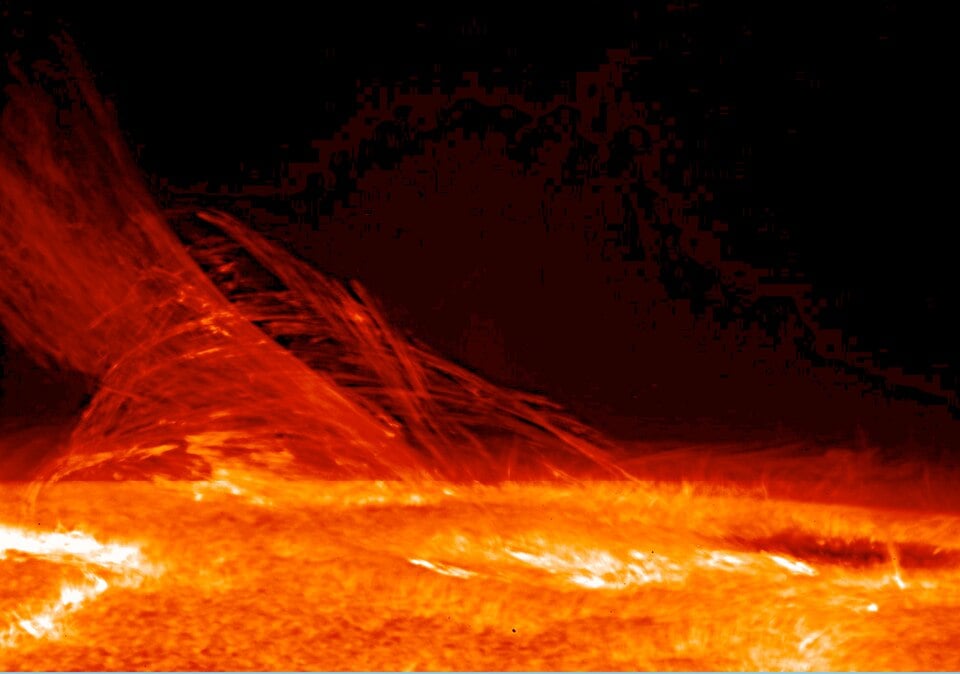
Image of a limb flare from Hinode. Credit - Hinode JAXA/NASA

7Image of a limb flare from Hinode. 

Credit - Hinode JAXA/NASA

The torrent of corona related discoveries keeps coming. Lately we’ve covered a variety of potential solutions to the “coronal heating problem” - why the Sun’s corona is so much hotter than its surface. Now, a paper led by a team of researchers from the University of Newcastle, Indian Institute for Astrophysics, and University of Sheffield, offers another answer - that we’ve been viewing the “spicules” that form in the lower solar atmosphere all wrong.

Spicules are spike-like geysers of plasma that shoot up into the solar atmosphere at tens of kilometers per second, eventually collapsing back down towards the surface after a few minutes. There are thought to be tens of thousands of these along the solar edge, and potentially millions of them at any given time across the entire surface of the Sun. Scientists have always treated them like miniature plasma tornados, with each individual “spike” acting as an individual.

The paper calls that into question. Instead of two dimensional spikes, it provides evidence that spicules might actually be an optical illusion created by complex three dimension “curtains” of plasma. They don’t operate as individual cylinders - they are in fact part of a rippling and folded magnetic sheet that acts like a vast atmospheric drape. From our perspective - which is essentially a two dimensional one only at the edge of the Sun, the overlapping folds create the illusion of a series of discrete, spinning jets.

Fraser talks about the highest ever resolution image taken of the Sun.

Unlike many of the other spicule-related discoveries we’ve reported on recently, this one didn’t come from new data from a new spacecraft, like Solar Orbiter or the Parker Solar Probe - it came from a simulation. The researchers used a computer simulation tool called Pencil Code to model the magnetohydrodynamics of the convection zone beneath the solar surface all the way up through the lower corona. One of the most notable features of that environment was the acoustic pounding, almost like a drum, that the churning granules of plasma beneath the Sun’s surface delivers to its atmosphere.

That pounding launches the equivalent of sound waves up into the atmosphere itself - though in this case, they are magnetohydrodynamic waves that directly follow magnetic field lines. As they travel higher, the gas surrounding them gets thinner, and they grow into huge bow shocks. When they eventually break, those shock waves blast part of the atmosphere upward, creating giant “curtains” of plasma thousands of kilometers into the Sun’s atmosphere.

Which all sounds very similar to what other research has already said about this process. This obviously wasn’t the first time someone has tried to model the connection between the Sun’s surface and atmosphere. One of the paper’s key findings was modeling what space observatories would actually see. From a top-down perspective, the plasma that was blasted up by these waves looks like a sheet arranged into accordion-like folds. But, if a telescope was looking at the edge of the Sun, the integration of those folds made it appear like a single line - a spicule. The spicules “movements” could even be understood as the curtains swaying and curling over time.

Video showing solar spicules, as seen by Hinode in 2007.
Credit - WebMaster Hinode YouTube Channel

Luckily, there was some real data that could back up these modeled findings. Instead of one of the newer spacecraft, the researchers turned to the Interface Region Imaging Spectrograph (IRIS) and the Hinode satellite, originally launched in 2013 and 2006 respectively. Data from both had shown spicules undergoing some bizarre motions. But when the data was lined up with simulated data from the model, those bizarre motions matched well with a curving, twisting curtain. It appeared that the vertical straws of the spicules could instead be a projection of a rumpled curtain.

But perhaps the more interesting discovery was of something that sounds very like spicules, but are actually a different phenomenon altogether. The researchers used automated vortex-detection algorithms on their model and found giant columns of rotating plasma that could stretch all the way out to the corona. However, unlike spicules, these are huge whirlpools hundreds of kilometers across, rotating at up to twenty kilometers per second. The scientists named them Coronal Swirling Conduits, or CoSCos.

CoSCos appear to come in two different types. One is created when magnetic field lines snap and break in the solar atmosphere. That snapping and breaking is a primary suspect in the coronal heating mystery, but obviously has a major impact on the surrounding Sun’s environment too. A second creation path is tied to the edges of the spicule curtains - they are much denser than the “void” that makes up most of the rest of the corona, causing huge pressure and density differences along their edges. That mismatch generates something called baroclinic vorticity - on Earth it’s equivalent to how ocean breezes colliding with warm air from farther inland can stir up coastal weather systems. But in fact, as the spicule curtains themselves begin to lose energy and float back down to the surface, the massive tornadoes they kicked up will actually pull them back up into the corona.

That is the pathway by which these spicule sheets contribute to the coronal heating problem. CoSCos pull spicular sheet plasma back up from the surface into the corona, powering the solar wind and providing energy that heats the area. Or at least that’s how it works in theory. Observations of rotating bunches of spicules from instruments like Hinode and IRIS affirm where CoSCos exist, showing that rotating spicules mark regions where these theoretical giant plasma tornadoes transport energy into the solar atmosphere. But there’s still a lot we don’t know about this process - maybe we’ll get some more insight from all of the fancy new solar observation equipment that is currently looking at our beloved star.

Learn More:

Watch the video to learn how scientists used a combination of computer simulations and observations to determine how spicules form.
Credits: NASA’s Goddard Space Flight Center/Joy Ng, producer
Download this video in HD formats from NASA Goddard’s Scientific Visualization Studio

{ https://www.universetoday.com/ }

Hoe vind je dit bericht?
Geschreven door peter om 13:49 Stuur door

Monster of the deep: 'Beautiful and horrifying' barreleye fish is filmed in 4K for the first time

Monster of the deep: 'Beautiful and horrifying' barreleye fish is filmed in 4K for the first time

A rarely seen barreleye fish has been filmed in 4K for the first time – with viewers calling the unusual creature 'beautiful and horrifying'. 

During a recent expedition off the coast of Central California, scientists from Monterey Bay Aquarium Research Institute encountered the fish approximately 1,970 feet (600 metres) underwater.

The barreleye fish – which has a transparent head – has only ever been seen 11 times before.

'Seeing a barreleye fish is a rare treat,' said senior scientist Steven Haddock.

'Crew from across the ship joined the science team in the control room, mesmerized by this remarkable animal. 

'Deep–sea animals capture the imagination, creating wonder and awe that we hope will inspire stewardship of the largest living space on Earth.'

A rarely seen barreleye fish has been filmed in 4K for the first time ¿ with viewers calling the unusual creature 'beautiful and horrifying'

A rarely seen barreleye fish has been filmed in 4K for the first time – with viewers calling the unusual creature 'beautiful and horrifying'

RELATED

MBARI researchers film rarely seen deep-sea barreleye fish in 4K
Scientists capture 1st-ever footage of Barreleye Fish in Atlantic

{ https://www.dailymail.com/sciencetech/index.html }

Hoe vind je dit bericht?
Geschreven door peter om 13:28 Stuur door

Mysterious pill-shaped UFO caught on camera by pilots flying above Middle America

Pilots flying over Ohio contacted air traffic control after spotting a strange object near their plane, only to be told nothing was registering on radar.

An account posted to the National UFO Reporting Center (NUFORC) on October 26 described a silver, pill-shaped UFO that appeared almost stationary as the aircraft approached.

One pilot captured a photograph of the object, which he described during a follow-up interview with NUFORC investigator Ben Hansen. The encounter occurred on August 16.

‘The surface was silver and highly reflective, like pure polished metal,’ reads the investigator’s report, which identified the pilot only as ‘J.’

‘J described the UAP as uniform, pill-shaped. There were no warps or creases on the surface, nor was it tapered at the bottom,' Hansen wrote.

The crew saw no other aircraft on their collision-warning system or flight-tracking app. According to the report, Cleveland Center air traffic controllers also told them no aircraft or unidentified objects were showing on radar.

J believed the object may have emerged from thunderstorm clouds the pilots were attempting to fly between.

He questioned whether a balloon could have survived those conditions, reporting that their own aircraft experienced engine icing and moderate turbulence after entering the clouds.

One pilot captured a photograph of the object, describing it as a silver, pill-shaped UFO that appeared almost stationary as the aircraft approached

One pilot captured a photograph of the object, describing it as a silver, pill-shaped UFO that appeared almost stationary as the aircraft approached

The NUFORC confirmed the Federal Aviation Administration (FAA) did not detect an object on radar and found no database matches for planned balloon launches.

'Coupled with the witness’s estimate that the object was at least 30 feet in height and uniformly shaped without tapering at the top or bottom, it presents some challenges to the balloon theory,'  Hansen said in the report.

At about 8pm ET, the pilots said they had reached 41,000 feet and were approaching a large thunderstorm, with clouds rising as high as 55,000 feet.

They dcided flying through a gap between the clouds was the safest route. 

That was when J spotted a strange object ahead of them, slightly above their plane. 

He initially reported that it was about five miles away, but later estimated the distance was closer to two or three miles. 

The pilots estimated that the object was flying at about 43,000 feet, traveling in the opposite direction and passing to their left. 

He initially wondered whether it was a weather balloon. However, its even shape, with no narrowing at the bottom, made him question that explanation.

The crew saw no other aircraft on their collision-warning system or flight-tracking app. According to the report, Cleveland Center air traffic controllers also told them no aircraft or unidentified objects were showing on radar

The crew saw no other aircraft on their collision-warning system or flight-tracking app. According to the report, Cleveland Center air traffic controllers also told them no aircraft or unidentified objects were showing on radar

NUFORC shared a CGI recreation of the UFO based on the witness's description

NUFORC shared a CGI recreation of the UFO based on the witness's description

Its surface looked like highly polished metal. J believed its brightness came from reflecting sunlight rather than producing its own light.

The encounter lasted about two minutes. Flight information he later supplied showed that their plane was traveling at roughly 380mph.

J took one photograph with his iPhone after the object had passed them. By then, he estimated it was about seven miles behind the aircraft. He stressed that his description came from seeing it much closer earlier in the encounter.

The pilot said the way they approached and passed the object reminded him of encounters with oncoming aircraft, reinforcing his impression that it was moving rather than floating in place.

article image

About a minute after first spotting it, he contacted Cleveland Center air traffic controllers to ask whether any aircraft or weather balloons were nearby.

Nothing appeared on the plane’s collision-warning system or the pilot’s flight-tracking app. According to J’s account, controllers also told the crew that nothing was showing on radar in the area where they saw the object.

The pilots continued watching it until it disappeared into the distance behind them.

NUFORC said the encounter raises wider questions about how authorities handle reports of unidentified objects near civilian aircraft.

The organization said there was no indication the FAA had referred this sighting to other agencies for a parallel investigation, arguing that potential aviation hazards deserve closer scrutiny.

It also highlighted an exchange in the audio recording in which an air traffic controller joked about the pilots submitting a NUFORC report, saying: ‘Make sure you include what color the alien was.’

NUFORC argued that such reactions reinforce the stigma surrounding UFO sightings and can discourage pilots from reporting encounters.

Even if an object ultimately proves to be a balloon, the organization said its presence in controlled airspace can raise safety concerns. 

Aircraft traveling at hundreds of miles per hour could suffer serious damage in a collision, while unidentified surveillance balloons could pose a national security threat.

{ https://www.dailymail.com/sciencetech/index.html }

Hoe vind je dit bericht?
Geschreven door peter om 13:13 Stuur door

US intelligence report offers first clear glimpse at top–secret Chinese spaceplane accused of releasing mysterious objects above Earth

US intelligence report offers first clear glimpse at top–secret Chinese spaceplane accused of releasing mysterious objects above Earth

A US intelligence report has offered the first clear glimpse at China's top–secret spaceplane.

The robotic Shenlong, or 'divine dragon' spacecraft has previously been seen releasing mysterious objects in Low–Earth Orbit (LEO).

Since its first mission in 2020, the mysterious plane has been the subject of intense observation by governments, space agencies and private companies.

However, until now, no one has seen more than a blurry photo of the light reflecting off its panels.

This first high–resolution image was released in the Defence Intelligence Agency's (DIA) latest Challenges to Security in Space report.

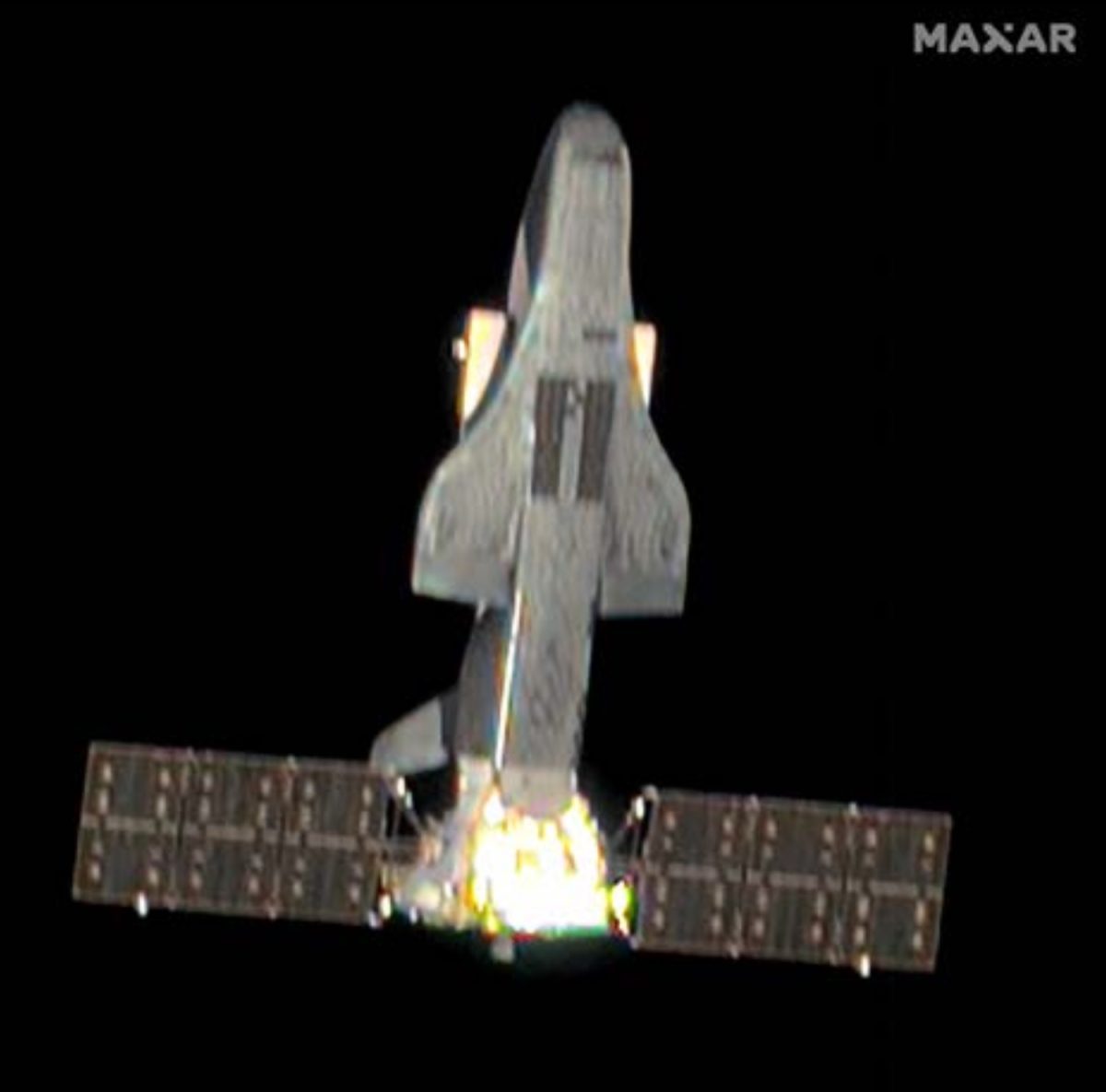
Buried in the 130–page document was a previously unseen image of the plane captured by Maxar Technologies, now Vantor, in 2024.

The report simply captions the image as a 'PRC [People's Republic of China] Spaceplane', adding that 'spaceplanes can launch into orbit to place objects in space or even test them and return to Earth'.

Oddly, neither the report nor caption mentioned that this was the first image of its kind or that it was previously classified, raising questions about why this image has now been revealed.

A US intelligence report has offered the first clear glimpse of China's top–secret Shelong, or 'divine dragon', spaceplane (pictured)

A US intelligence report has offered the first clear glimpse of China's top–secret Shelong, or 'divine dragon', spaceplane (pictured)

The image was captured by the intelligence company Vantor in 2024. It shows that the craft's payload doors are open and that it is docked with a secondary satellite

The image was captured by the intelligence company Vantor in 2024. It shows that the craft's payload doors are open and that it is docked with a secondary satellite 

Much like the American space shuttle, the Shenlong spaceplane is launched from Earth aboard a rocket, before entering orbit and landing like a plane. 

Its most recent mission began on February 7 this year, after it took off on a Long March 2F rocket from China's Jiuquan Satellite Launch Center.

However, China has remained exceptionally secretive about its experimental spaceplane and has not even released an official photo of the spacecraft.

This means this image is the first time the public has had a good chance to examine Shenlong and learn more about its potential capabilities.

Vantor, in an update on X, said: 'The report documents China’s expanding presence in space, including reusable space systems, and features Vantor’s WorldView Space imagery of a Chinese spaceplane in orbit in 2024.'

The company's annotated version of the photo describes the craft as PRC Test Spacecraft 3 and notes that it is 26ft long (8m).

The image also highlights that the payload bay doors are visible as partly open and that there is a secondary satellite docked on the rear.

This 32ft–wide (10m) satellite is likely to be a 'service module', a type of satellite that connects with spacecraft to provide them with additional power, propulsion or support systems.

Importantly, this photo also reveals what many experts had already anticipated: Shenlong is nearly identical to the US Space Force's own robotic spaceplane.

Originally developed as a NASA research project before being taken over by the Department of Defence, the US X–37 spaceplane is a remarkably similar reusable craft.

Previously, the best images of the mysterious plane have been blurry reflections from its panel. However, radar tracking has shown the plane releasing several mysterious objects in orbit

Previously, the best images of the mysterious plane have been blurry reflections from its panel. However, radar tracking has shown the plane releasing several mysterious objects in orbit  

What do we know about China's Shenlong spaceplane?

First launched: 2020

Number of orbital missions: 4

Total days in space: Over 800

Length: 26ft (8m)

Weight: Unknown

Payload capacity: Unknown  

Known capabilities: Docking with satellites, releasing payloads, and potentially collecting satellites. 

Since 2010, X–37B has flown seven missions and spent more than 2,000 days in space conducting secret missions.

Officially, X–37B is an 'experimental test program to demonstrate technologies for a reliable, reusable, uncrewed space test platform for the U.S. Air Force,' but its specific purposes are unknown.

However, what is now abundantly clear is the remarkable similarity between the older American spaceplane and its new Chinese counterpart.

Professor Jonathan McDowell, a satellite tracking expert from Durham University Space Research Centre, told the Daily Mail: 'The Chinese spaceplane is very similar to the X–37B, with a payload bay in the middle and a jettisonable service module with solar arrays at the back.

'The wings are slightly different, but the overall layout, down to the tilted rear fins, says to me that some important official in China went to the space folks with a picture of the X–37B and said, "build me one of these".'

However, despite these new images, many of the details concerning Shenlong and its functions remain unclear.

As the report notes, China has two named spaceplanes, Shenlong and Tengyun, meaning 'cloud rider', and it isn't necessarily clear which this image shows.

Likewise, the DIA simply noted that China has launched three spaceplane missions, one in 2020, the second in 2022, and a third beginning in 2023.

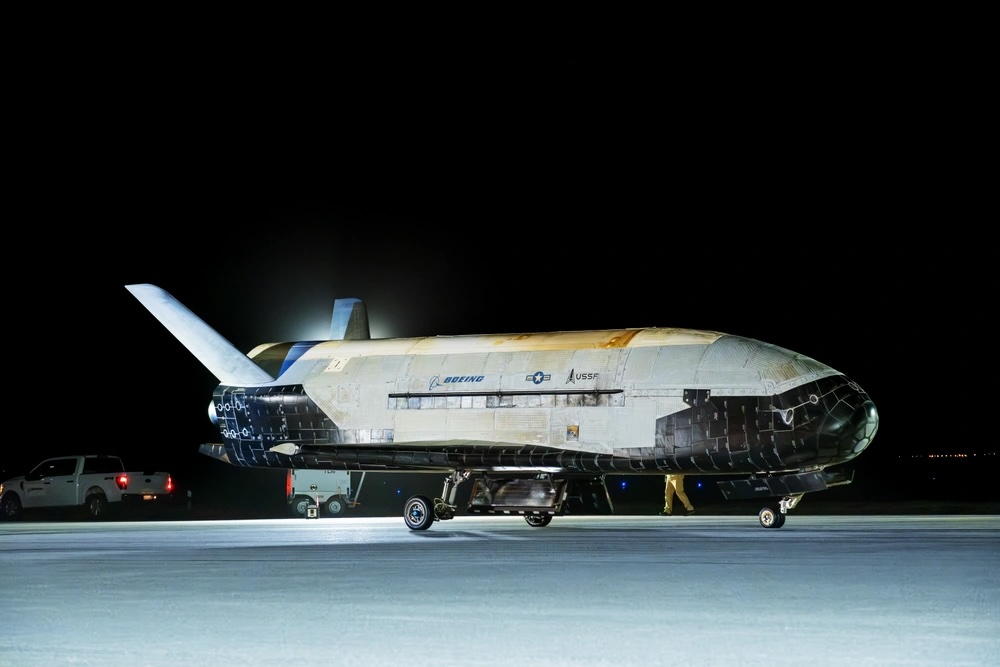
Experts say that the Shenlong spaceplane is extremely similar in design to the US Space Force's own robotic spaceplane, the X-38B (pictured)

Experts say that the Shenlong spaceplane is extremely similar in design to the US Space Force's own robotic spaceplane, the X–38B (pictured)

US-based space tracking firm Leo Labs previously spotted 'an unknown object in the vicinity of the Chinese Shenlong reusable spaceplane', suggesting that it may be releasing small satellites in Low Earth Orbit

US–based space tracking firm Leo Labs previously spotted 'an unknown object in the vicinity of the Chinese Shenlong reusable spaceplane', suggesting that it may be releasing small satellites in Low Earth Orbit 

We do not yet know whether these were all conducted by the same plane or whether China has multiple operational spaceplanes in orbit.

Most importantly, the DIA has not yet publicly speculated on what Shenlong has been doing in LEO over these years.

Previous radar tracking has captured Shenlong releasing nine unidentified payloads around Earth.

It is believed that these are small, simple satellites called cubesats, but their function remains unclear.

In 2026, Professor McDowell also observed that Shenlong appeared to release a satellite into orbit before returning to retrieve it several months later.

The new report also notes that, during its second mission in November 2022, the spaceplane came within 330ft (100m) of a smaller spacecraft, potentially capturing and re–releasing it.

'I suspect the vehicle also has a robot arm for deploying and retrieving satellites, but that is not visible on the photo,' Professor McDowell explains.

However, despite the alarm this incident caused, Professor McDowell believes the spaceplanes' function is simply to 'show they [China] can do a robotic mini shuttle'.

Experts suggest that the Shenlong spaceplane is designed to demonstrate China's capability to launch a robotic shuttle and to test technology in orbit. Pictured: An artistic render of the spaceplane

Experts suggest that the Shenlong spaceplane is designed to demonstrate China's capability to launch a robotic shuttle and to test technology in orbit. Pictured: An artistic render of the spaceplane

He adds that it would be 'good for testing new equipment in orbit and then returning it to Earth intact for refurbishment and reuse'.

These findings come as the US warns of a rapid growth in capabilities within China's military and civilian space program. 

Besides Shenlong, China has also revealed images of a planned cargo spaceplane called Haolong, set to serve the Tiangong Space Station.

Haolong is known to weigh around 7,000 kilograms, with a length of 32ft (10m) and a width of 24ft (8m) with its wings unfolded.

The DIA now warns that China's 'rapidly expanding space program' is second only to America's own in size and ability.

Since 2016, the number of space launches taking place each year has more than tripled from 22 to 93, and Beijing has started deploying nine times more satellites per year. 

Most worryingly, the NIA's report warns that China sees space as a 'strategic priority for military dominance'.

The report says: 'China has developed and will continue to advance weapons for use against satellites in orbit to disrupt, damage, and destroy other nations’ space capabilities.

China has also revealed plans for a commercial cargo spaceplane, dubbed Haolong, set to supply the Tiangong Space Station

China has also revealed plans for a commercial cargo spaceplane, dubbed Haolong, set to supply the Tiangong Space Station 

'China continues to research, develop, test, and deploy multiple types of counterspace weapons, including ground-based ASAT missile systems capable of destroying satellites.'

Despite decades of international consensus that space was off limits for direct military action, multiple nations are now aiming to weaponise Earth's orbit.

In September, US Air Force Secretary Troy Meink confirmed that the United States has 'on-orbit space control weapons capable of defending the Joint Force against hostile adversary action.'

This was the first time that the US has ever confirmed it has weapons stationed in space, raising concerns over a new space arms race. 

RELATED

China’s top secret space plane revealed in rare unclassified image
China's Super Secret Spaceplane Finally Revealed

{ https://www.dailymail.com/sciencetech/index.html }

Hoe vind je dit bericht?
Geschreven door peter om 12:54 Stuur door

U.S. intelligence reveals classified Chinese spaceplane in orbit

U.S. intelligence reveals classified Chinese spaceplane in orbit

The photograph shows delta wings, payload bay doors, a dark heat shield, and a service module with solar panels. The design largely mirrors the X-37B operated by the U.S. Space Force. The image was captured by a satellite belonging to Vantor, which was still known as Maxar in 2024.

The Pentagon released the full-resolution image on Monday, October 26, in a Defense Intelligence Agency report, according to Ars Technica. Vantor’s satellites photograph Earth for the U.S. military, but their telescopes can also be pointed at other objects in orbit when their paths cross. These encounters typically occur at extremely high relative speeds, providing opportunities to observe other countries’ classified spacecraft.

1000w_q95-1.jpeg

The American military spaceplane X-37B after landing at Vandenberg  Space Force Base in California. It is 9 meters long, approximately a quarter of the length of a Space Shuttle orbiter.

Credit: U.S. Space Force

What Is Known About the Spacecraft?

China has not disclosed its official name. In the West, the spaceplane is often called Shenlong, while Chinese state media refer to it only as a reusable experimental spacecraft. Like the X-37B, it launches under the fairing of a conventional rocket, operates in orbit as a satellite, and lands autonomously on a runway at the end of its mission.

Since 2020, China has conducted four such missions, the longest lasting about nine months. The fourth began on February 7, according to Reuters, and remains underway. The longest of the X-37B’s eight flights lasted two and a half years.

Why use such a spacecraft when conventional satellites exist? According to the intelligence assessment, their maneuverability makes spaceplanes better suited to certain tasks. They can also be returned to Earth, prepared, and launched again. During the current mission, the Chinese spacecraft released a small satellite in June and recaptured it in July, possibly using a robotic arm. The procedure was repeated in August and September, according to astrophysicist Jonathan McDowell’s analysis of publicly available orbital tracking data.

Weapons Against Satellites

China’s military likely considers directed-energy weapons an ideal means of targeting satellites because they can disable spacecraft either permanently or temporarily. China already possesses ground-based lasers capable of disrupting or damaging satellites in low orbits. By the end of the 2020s, it could have orbital systems and more powerful ground-based weapons capable of striking targets in higher orbits.

The report also mentions last year’s refueling of a Chinese satellite in geosynchronous orbit, at an altitude of approximately 36,000 kilometers. No other country had previously done this beyond low Earth orbit.

Russia is also developing its own orbital warfare program. In April, it deployed several small spacecraft near a radar satellite operated by the Finnish company ICEYE, which supplies imagery to Ukraine. According to U.S. officials, one of the Russian spacecraft approached within a few dozen meters of the ICEYE satellite in October before moving away.

ICEYE has been familiar to Ukrainians since 2022. That year, money raised by Ukrainians secured full access to one of its satellites for Ukraine’s Ministry of Defense, along with the ability to request imagery from the company’s other spacecraft. Radar satellites can observe Earth’s surface through clouds and at night, allowing military equipment to be tracked in any weather. As we previously reported, Ukraine’s Defense Intelligence identified more than 4,000 Russian targets using this imagery and used some of the images to guide missile and drone strikes.

China's Super Secret Spaceplane Finally Revealed
China Space Mystery: Shenlong Space Plane 'Deploys' Unknown Object In Earth's Orbit | WATCH
What China's Space Plane Just Dropped That the US Space Force Is Now Tracking

{ https://universemagazine.com/en/articles-en/ }

Hoe vind je dit bericht?
Geschreven door peter om 23:05 Stuur door

Ancient Comets Carried Organic Compounds, But They Didn't Survive Crashing Into Earth

Ancient Comets Carried Organic Compounds, But They Didn't Survive Crashing Into Earth

This artist's illustration shows an ancient comet smashing into the ancient Earth. Scientists have wondered if comets could have delivered life's essential building blocks to our young planet, since we now know that comets carry organic molecules important for prebiotic chemistry. But new research says this picture is unlikely. Image Credit: Scarlett White This artist's illustration shows an ancient comet smashing into the ancient Earth. Scientists have wondered if comets could have delivered life's essential building blocks to our young planet, since we now know that comets carry organic molecules important for prebiotic chemistry. But new research says this picture is unlikely. Image Credit: Scarlett White The appearance of life on Earth is still a mystery. It's constrained by a few factors; for instance, the Earth had to have cooled before life could get started, and there had to be some liquid water, the right chemicals, and an energy source. But most of the details are hidden in the deep past.

As science has progressed and our observing power has advanced, some pieces of evidence have emerged that carry tantalizing hints at the bigger picture of life appearing on Earth. Scientists have found that comets carry important organic compounds. That has led to the hypothesis that comets could have seeded Earth with chemistry that led to abiogenesis. These include the amino acid glycine, phosphorous, and hydrogen cyanide (HCN), a chemical compound of particular importance.

The ESA's Rosetta mission, which included the Philae Lander, visited the comet 67P/Churyumov–Gerasimenko in 2014 and detected glycine, an amino acid, and phosphorous, an organic chemical. Phosphorous is an important element in all living things, and is a critical part of DNA and RNA. These findings helped generate the idea that comets played a role in seeding the early Earth with the chemistry necessary for life. Image Credit: Spacecraft: ESA/ATG medialab; Comet: ESA/Rosetta/NavCam – CC BY-SA IGO 3.0; data: Altwegg et al. (2016). LICENCE: ESA Standard Licence

The ESA's Rosetta mission, which included the Philae Lander, visited the comet 67P/Churyumov–Gerasimenko in 2014 and detected glycine, an amino acid, and phosphorous, an organic chemical. Phosphorous is an important element in all living things, and is a critical part of DNA and RNA. These findings helped generate the idea that comets played a role in seeding the early Earth with the chemistry necessary for life.

 Image Credit: Spacecraft: ESA/ATG medialab; Comet: ESA/Rosetta/NavCam – CC BY-SA IGO 3.0; data: Altwegg et al. (2016). LICENCE: ESA Standard Licence

This hypothesis is not widely-accepted, but hasn't been conclusively disproven, either. We're in the early stages. But new research shows that it is unlikely that comets seeded Earth with the chemistry that led to life.

The research is titled "Cometary impacts an unlikely pathway towards the origins of life on Earth," and it's published in the journal Scientific Reports. The lead author is Dr. Richard Anslow from University of Cambridge’s Institute of Astronomy.

“It’s kind of a romantic idea, but our results suggest it’s highly unlikely.” - Dr. Richard Anslow, Institute of Astronomy, University of Cambridge.

"An early period of cometary bombardment has long been speculated to provide an important source of prebiotic feedstock molecules, required for the origins of life on Earth," the authors write. "In support of this interpretation, comets boast a rich diversity of volatile organic molecules, with many thought to be limiting for prebiotic chemistry."

"The origin of life on Earth presumably resulted from prebiotic chemistry, the synthesis of key molecular building blocks from an initial reservoir of reactive bioessential feedstock molecules," they continue. "Hydrogen cyanide (HCN) has emerged as a key feedstock molecule..." they state. HCN can drive high-energy reactions central to prebiotic synthesis.

But just because comets carry these molecules, and just because comets crashed into Earth, it doesn't follow that they were able to deliver organic molecules intact. Comet impacts are very energetic events that generate high temperatures. "Modelling studies suggest, however, that a significant proportion of these molecules will be destroyed during hypervelocity impact," the researchers write.

The researchers worked with simulations of comet impacts, discoveries about how comets interact with atmospheres, and dynamic modelling showing where short-period comets originate and how they evolve. They focused on HCN, since it plays such a critical role. The results do not support the cometary delivery idea.

The researchers say that the cometary bombardment didn't last long enough, and also that if any molecules did survive, there weren't enough of them.

"Taken together, the rapid decline in Earth’s cometary impact bombardment and the efficient destruction of fragile cometary organics indicate that the successful delivery of prebiotic feedstock molecules was an exceedingly rare event," the authors write.

“Historically, scientists thought that comets were important for the origin of life on Earth, because they carried carbon- and nitrogen-bearing molecules, so these giant space snowballs were almost like a ‘get out of jail free card’ that brought all the molecules a planet would need to seed life,” said lead author Anslow . “It’s kind of a romantic idea, but our results suggest it’s highly unlikely.”

The destruction of organic compounds in the impacts themselves the authors left to previous researchers. Previous work shows that the survivability of HCN has been overestimated. For example, a 2020 paper points out that only "the most favorable impacts (low impact angle, low velocity, small radius)" would not breach the temperature threshold that destroys HCN. Were there enough of those?

In this work the researchers focused on short-period comets. Not because long-period comets don't also carry the chemicals in question, but because short-period comets have substantially lower velocities, increasing the odds of the chemical surviving the impacts with Earth.

Their analysis showed that size matters. Smaller comets are likely to be torn apart as they enter the inner Solar System. The torque generated by their off-gassing introduces rotational istability that tears many of them apart. That reduces the overall number of comets that struck the ancient Earth.

Comets can break apart in spectacular displays as they approach the Sun, as shown in these Hubble images of Comet 73P/Schwassmann-Wachmann 3. Tidal forces can rip them apart, rapid rotation can destroy their nuclei, out-gassing can destroy them with eruptions, and thermal stresses can also cause their demise. Image Credit: NASA, ESA, H. Weaver (APL/JHU), M. Mutchler and Z. Levay (STScI). LICENCE: ESA Standard Licence

Comets can break apart in spectacular displays as they approach the Sun, as shown in these Hubble images of Comet 73P/Schwassmann-Wachmann 3. Tidal forces can rip them apart, rapid rotation can destroy their nuclei, out-gassing can destroy them with eruptions, and thermal stresses can also cause their demise.

Image Credit: NASA, ESA, H. Weaver (APL/JHU), M. Mutchler and Z. Levay (STScI). LICENCE: ESA Standard Licence

They also point out that many of the comets would've been destroyed after entering Earth's atmosphere, and never even reached the planet's surface. "The low density (i.e., high porosity) and weak mechanical strength of comets combine such that comets are particularly vulnerable to destruction during atmospheric passage," the authors explain. "Earth’s atmosphere therefore acts as a filter—preferentially destroying small and oblique comets—and thus, biasing the population of comets able to deliver prebiotic feedstock molecules to local surficial environments."

The cometary bombardment of Earth slowed to a crawl after about the first 500 million years of the planet's history, reflective of the fewer number of bodies travelling around in the chaotic young Solar System. Overall, this work shows that there were most likely only a handful of comets that could have delivered any HCN to Earth.

"On a global scale we find, in agreement with the results of Todd & Öberg, that comets are unable to deliver a prebiotically relevant concentration of HCN to the early Earth," the authors write. It takes more than a small amount of HCN to be relevant.

One idea says that comets not only delivered the critical HCN, but that the impacts created subterranean hydrothermal systems that could have brought HCN into an environment already conducive to abiogenesis.

This graphic shows how impacts can generate a hydrothermal system with conditions conducive to the appearance of life. If cometary HCN was delivered in sufficient quantities, it may have played a role in life appearing in these environments. Image Credit: Journal of Marine Science and Engineering (2026). DOI: 10.3390/jmse14050486

This graphic shows how impacts can generate a hydrothermal system with conditions conducive to the appearance of life. If cometary HCN was delivered in sufficient quantities, it may have played a role in life appearing in these environments.

Image Credit: Journal of Marine Science and Engineering (2026). DOI: 10.3390/jmse14050486

But Anslow and his co-researchers also discount that based on the rapid flow of water into the environment. "A salient outcome of high-velocity cometary impacts, irrespective of the delivery of HCN, is thus the rapid influx of local groundwater into the newly-formed crater-lake, rapidly diluting surviving cometary HCN below prebiotically relevant concentrations," they write.

So it doesn't look good for the cometary-delivery hypothesis.

“It would really have to be a one-in-a-million occurrence, because not only would you need an impact at just the right speed and just the right angle, you would also need everything to happen after that point, in terms of the concentration and the speed at which the chemical origins of life got going,” Anslow said in a press release. “We can’t rule out for certain that it happened that way. But it seems to be a really rare occurrence – at best, a one-off fluke.”

The researchers also examined if the same limitation for cometary delivery were true for Mars, which may have hosted life in the distant past.

"We find that cometary delivery is far more effective onto Mars," the authors write, despite a smaller number of impacts. "This efficiency is driven primarily by lower cometary impact velocities—a consequence of Mars’ lower escape velocity and larger semi-major axis—and Mars’ tenuous atmosphere," they explain. More smaller comets would survive compared to Earth, meaning a larger delivery of HCN. In fact, the rate of surviving comets at Mars is five times higher than for Earth.

"This simple comparison between the Solar System’s terrestrial planets suggests that, all else being equal, Mars would have been the more favourable target for the cometary delivery of prebiotic feedstock molecules, and if cometary delivery is an important prerequisite step for prebiotic chemistry, strengthens the possibility that life could have emerged on Mars," the authors write. But they caution that this is a best case scenario, and there are a host of other considerations that weaken the idea.

“This is not to say it definitely happened on Mars, of course, but suggests it would be unlikely if it happened on Earth and didn’t happen on Mars,” Anslow said. “Or the other, perhaps more likely, alternative, is that it didn’t happen on either planet.”

This is comet 67P/Churyumov–Gerasimenko, visited by the ESA's Rosetta mission and its Philae lander in 2015. It was taken from a distance of 86.6 km, only a few days before a much closer flyby. The Philae lander's COSAC and Ptolemy instruments detected sixteen organics on the comet's surface, including HCN and the amino acid glycine. Unfortunately, it's a big leap from finding these chemicals on a comet and them being delivered to Earth in enough quantities to contribute to the appearance of life. Image Credit: ESA/Rosetta/NavCam – CC BY-SA IGO 3.0. LICENCE: ESA Standard Licence

This is comet 67P/Churyumov–Gerasimenko, visited by the ESA's Rosetta mission and its Philae lander in 2015. It was taken from a distance of 86.6 km, only a few days before a much closer flyby. The Philae lander's COSAC and Ptolemy instruments detected sixteen organics on the comet's surface, including HCN and the amino acid glycine. Unfortunately, it's a big leap from finding these chemicals on a comet and them being delivered to Earth in enough quantities to contribute to the appearance of life.

Image Credit: ESA/Rosetta/NavCam – CC BY-SA IGO 3.0. LICENCE: ESA Standard Licence

There's no question that comets carry important organics in high enough concentrations to matter, but the successful delivery to Earth, at the right time, in the right concentrations, and in the right locations, is far more complicated. Many factors contribute to the unsuccessful delivery of cometary HCN to Earth.

"Although Solar System comets boast a rich diversity of volatile organic species—including crucially many prebiotic feedstock molecules in high concentration—we have shown via Monte Carlo simulation of Earth’s cometary bombardment that these comets were, on the whole, unable to deliver these fragile organic molecules to Earth’s surface intact," the researchers write.

So the mystery of how life started on Earth endures, and despite finding important chemicals like HCN on comets, and despite the tantalizing idea that they could have delivered it to Earth, detailed modelling shows how unlikely that was.

"To summarise, our results demonstrate that Earth’s cometary bombardment was unable to provide the concentrated reservoir of bioessential feedstock molecules required for synthetic prebiotic chemistry, challenging the long-held suggestion that cometary impacts may plausibly have played an important role in the origins of life on Earth," the researchers conclude.

RELATED

2000 Pound Rare Meteorite That Crashed Into New Jersey Home Reveals ‘Secrets of Life’s Origins’ |4K
12 Terrifying Things Scientists Found Hiding Inside Comets

{ https://www.universetoday.com/ }

Hoe vind je dit bericht?
Geschreven door peter om 22:43 Stuur door

1KM Tunnel Entrance To Underground Alien Base Found In Canada, Lets Talk To Aliens! Oct 28, 2026 UFO Sighting News. Date of discovery: October 28, 2026 Location of discovery: Ninavut, Canada Source map: https://nakarte.me/#m=11/77.03642/-

1KM Tunnel Entrance To Underground Alien Base Found In Canada, Lets Talk To Aliens! Oct 28, 2026 UFO Sighting News.UFO_Base.png

Date of discovery: October 28, 2026
Location of discovery: Ninavut, Canada
Source map: 
Hey check this out. I found an entrance to an underwater alien base and its in the most remote area of northern Canada that one could go. This entrance is already below the water level about 10 meters or more but the entrance itself is over 1km by 1km across. It's a huge tunnel for aliens to enter and exit totally sight unseen in such a remote area. Oh, and if they can use it...so could we! It's possible that we could make a remote control or robotic ai drone to go down and explore the tunnel and record any possible signs of an alien civilization and then return days later. Humans could never go that deep and survive without the alien tech...but human tech can do it. I say yes...it can be done...and direct communication between the public and aliens could take place this way. 
Scott C. Waring - UFO Sightings Daily
 

{{ https://www.ufosightingsdaily.com/ }

Hoe vind je dit bericht?
Geschreven door peter om 22:24 Stuur door

'Charred remains of Noah's Ark' discovered as researchers unearth burnt wood 30 feet underground

'Charred remains of Noah's Ark' discovered as researchers unearth burnt wood 30 feet underground

A vast, ship-shaped formation in eastern Turkey has long fueled speculation that the remains of Noah's Ark could lie hidden beneath its surface.

According to the Bible, the vessel sheltered Noah, his family and animals during a catastrophic flood, dated by some biblical chronologies to more than 4,300 years ago.

Now, researchers investigating the Durupınar Formation near Mount Ararat have reported finding charred wood underground, raising hopes that it could offer a clue to the biblical mystery. The samples have been sent for testing to establish their age and identify the type of wood.

Andrew Jones, founder of Noah's Ark Scans and vice president of the project, told the Daily Mail that both charred and uncharred wood had been recovered nearly 30 feet underground, adding that 'it is possible that we have found the charred remains of Noah's Ark.' 

He also acknowledged it might instead come from a shepherd's campfire 'he unwittingly decided to start while using the ark for shelter centuries ago.'

The team suggested the wood could have been burned deliberately or exposed to lightning or volcanic activity.

The discovery follows radar scans that Dr Khosrow Bakhtar, a veteran US defense scientist, said revealed patterns resembling chambers and corridors inside the roughly 515-foot-long formation.

'This is the most significant finding of 45 years of my career. It's not geologic related, because we masked all the geologic features,' Bakhtar said.

An international team are '100 percent confident' that the formation is a 'man-made object'

An international team are '100 percent confident' that the formation is a 'man-made object'

The wood's burned appearance has drawn particular interest because the Bible describes Noah being instructed to coat the ark inside and out with pitch, a waterproofing substance that can catch fire.

The team suggested that the burning may also have helped preserve the material, as charring can slow the breakdown of wood in soil.

If the samples eventually prove to be connected to the ark, a fire that damaged the vessel may have helped preserve traces of it.

The formation's location and boat-like outline have long fueled comparisons with the biblical account, which places the ark's resting place in the 'mountains of Ararat.'

The Durupınar Formation lies about 18 miles south of Mount Ararat, Turkey's highest peak.

Researchers also point to its roughly 515-foot length, which they say corresponds to the vessel described in Genesis. 

Using their conversion of biblical measurements, the ark would have measured approximately 515 feet long, 86 feet wide and 52 feet tall.

Two other major anomalies measured approximately 26 feet and 39 feet high, while another distinct underground feature stood about 23 feet high.

A radar scan of Turkey’s Durupınar Formation shows underground features that researchers interpret as possible buried passageways at the suspected Noah’s Ark site

A radar scan of Turkey's Durupınar Formation shows underground features that researchers interpret as possible buried passageways at the suspected Noah's Ark site

The team found pottery that they say predates what biblical scholars call the Great Flood. Pictured right is the Turkish archaeologist leading the project, Dr Cenker Atila from Sivas Cumhuriyet University

The team found pottery that they say predates what biblical scholars call the Great Flood. Pictured right is the Turkish archaeologist leading the project, Dr Cenker Atila from Sivas Cumhuriyet University

article image

At several locations, the radar detected a layer measuring 16 to 20 feet thick, approximately 16 feet beneath the surface.

The latest investigation builds on a 2019 radar survey that detected straight lines and angular patterns the team interpreted as possible walls, passageways and compartments.

In 2026, Bakhtar examined the formation using a more powerful radar system developed through US Air Force research, capable of reaching deeper underground.

The team reported detecting large underground boundaries and spaces that it interpreted as possible sediment-filled chambers, corridors and tunnels.

Five prominent features appeared to form a possible tunnel system stretching roughly 151 feet, with an average height of more than 14 feet.

Researchers also identified a thick underground layer that appeared to contain three separate sublayers, drawing comparisons with the Bible's description of an ark built with three decks.

'In our holy books, Noah's Ark had three levels; in our radar studies, we also identified a formation with three levels,' said Dr Cenker Atila, an archaeologist at Sivas Cumhuriyet University in Turkey.

The team claims it has '100 percent confirmed' that the formation is a 'man-made object' rather than a natural geological feature.

Jones, who has investigated the area for nearly 30 years, told the Daily Mail that neither radar surveys nor drilling inside the formation had detected limestone or solid bedrock.

A group of researchers think a formation in the Turkish mountains could be the remains of Noah's Ark

A group of researchers think a formation in the Turkish mountains could be the remains of Noah's Ark 

Further studies using infrared thermography (IRT) could show a ship-shaped hull under the soil

Further studies using infrared thermography (IRT) could show a ship-shaped hull under the soil

The radar captured 'a series of right angles' about 20 feet down, which researchers believe could be rooms that held animals on the ark

The radar captured 'a series of right angles' about 20 feet down, which researchers believe could be rooms that held animals on the ark

'This destroys the theory that the site is a solid limestone block shaped into a boat by glaciers and weathering after coming down the mountainside, and it also refutes the theory that this is bedrock around which mud flowed to form the shape,' he said.

However, ruling out those explanations would not, by itself, establish that the formation was built by people.

Radar readings are also not photographs of exposed rooms or passageways. They show how signals respond to different materials and boundaries underground, which must be physically examined to establish what produced them.

The team is using the scans to identify promising locations for further drilling.

Jones acknowledged that the findings have not definitively identified the formation as the biblical vessel.

'I firmly believe the Durupınar Formation represents the buried remains of Noah's Ark,' he said, describing the scans as a 'compelling new line of evidence' rather than definitive proof.

Lauren Witzke, director of marketing and fundraising for Noah's Ark Scans, said the formation's exposed upper section was deteriorating.

The team pulled samples from the ground, finding charred and uncharred pieces of wood, which have been sent for testing to determine their age

The team pulled samples from the ground, finding charred and uncharred pieces of wood, which have been sent for testing to determine their age 

'article image

The top, and most exposed, tier is decaying, and the hardened mudflow encasing the rims of the boat are basically the only thing holding it together,' she said.

Witzke said the lower sections appeared better preserved and suggested drilling may have reached a floor of petrified wood. Those descriptions remain the team's interpretation, with laboratory testing of the recovered samples still pending.

The team also reported finding pottery outside the formation dating from the Chalcolithic, or Copper Age, through the Iron Age.

Researchers said the artifacts indicate that people occupied or visited the mountainside over a long period and could help guide further archaeological work.

Witzke suggested some pottery might have been connected to supplies carried aboard the ark or used by Noah's family after leaving it. Jones acknowledged that pottery alone cannot establish either connection.

The Durupinar Formation lies about 18 miles south of Mount Ararat, Turkey's highest peak

The Durupinar Formation lies about 18 miles south of Mount Ararat, Turkey's highest peak

The site has attracted attention for decades. Local accounts say heavy rain and earthquakes exposed its unusual outline in 1948, when a Kurdish shepherd reportedly noticed it.

It gained wider recognition in 1959 after Turkish Army Captain İlhan Durupınar spotted its ship-like shape in aerial survey photographs.

Earlier investigators reported finding soil and rocks and concluded that the formation was natural. The current team argues that its new scans and recovered samples warrant further investigation.

'What excites me most about this phase is that we are transitioning from remote imaging to collecting physical samples deep within the site, allowing us to scientifically evaluate hypotheses that have been debated for decades,' Jones said.

RELATED

Did They Just Find WOOD Beneath the Noah's Ark Site?!

🚨ALERT: MASSIVE Noah’s Ark Discovery, They Found WOOD Deep Inside!

Scientists Went 60 Feet Inside Noah’s Ark — What They Found SHOCKED Everyone!

{ https://www.dailymail.com/sciencetech/index.html }

Hoe vind je dit bericht?
Geschreven door peter om 22:09 Stuur door

Robot wars in Leeds: Delivery company accuses British disability charity of 'selectively editing' videos showing its autonomous bots colliding with wheelchair users

A robot delivery company has accused a British disability charity of 'selectively editing' videos showing its autonomous bots colliding with wheelchair users. 

In a video posted in September, Living Streets claimed to show Starship Technologies' robots on the streets of Leeds, blocking the pavement and tripping over blind pedestrians. 

The charity alleged that these delivery bots are 'putting pedestrians at risk' and accused the robotics firm of operating in 'a legal grey area'.

However, Starship Technologies claims these clips have been manipulated and is now threatening to take Living Streets to the regulator if it fails to set the record straight. 

After seeing the campaign video, Starship Technologies compiled a dossier of camera and sensor data from the robots involved in the incidents.

It claims that the data shows the robot tried to modify its route and avoid the crash, but collided after the wheelchair user deliberately accelerated.

Likewise, Starship Technologies says its data showed a scene in which the wheelchair user appears to be blocked was caused by the person choosing to pass on the much narrower side, despite plenty of room being available. 

However, in yet another twist, Living Streets has now released the raw footage of the supposed collisions – and is sticking by its claim that the crash was not faked.

A robot delivery company has accused a British disability charity of 'selectively editing' videos showing its autonomous bots colliding with wheelchair users

A robot delivery company has accused a British disability charity of 'selectively editing' videos showing its autonomous bots colliding with wheelchair users

In a video posted in September, Living Streets claimed to show Starship Technologies robots on the streets of Leeds blocking the pavement and tripping over blind pedestrians

In a video posted in September, Living Streets claimed to show Starship Technologies robots on the streets of Leeds blocking the pavement and tripping over blind pedestrians

Starship Technologies alleges that it has written to Living Streets, offering to show them the data and correct the record.

And, if Living Streets doesn't agree, the company says it is willing to take them to the Charity Commission to correct the record.

Lisa Johnson, vice–president of Starship, told the Daily Mail: 'Their recent campaign video package is selectively edited and irresponsible, creating a misleading impression that robots are blocking or crowding wheelchair users.

'That is simply not the reality. If Living Streets zoomed out on that footage, the public would see just how much pavement space was actually available to safely pass.

Ms Johnson added: 'Our offer to Living Streets still stands. We want to work with them to make sure robot delivery works for everyone – including the disabled people who use and rely on robot deliveries in communities up and down the country.

'Across more than 11 million deliveries, our robots have shown that they are designed to give way to people, including wheelchair users. They demonstrated that again and again while Living Streets staged its ‘testing’ for the video. 

'We have raised a formal complaint with Living Streets and await their response. It would be more in sadness than anger if we referred them to the Charity Commission. Hopefully it won’t come to that, but they may leave us no choice.' 

However, the charity has now hit back against Starship Technologies, saying that the video had not been faked.

In the raw footage, after the robot bumps into the wheelchair user, the camera operator can be heard saying: 'Did it hit your legs? I thought it would have stopped.' 

Emily Green, 18, the wheelchair user in the film, told the Daily Mail: 'Starship claim I moved into their robot's path but dropped kerbs are placed there for the benefit of wheelchair users and I don't have the luxury of not using them.

Starship Technologies has hit back against the charity, claiming that the videos have been misleadingly edited to make their robots seem more of a nuisance than they really are

Starship Technologies has hit back against the charity, claiming that the videos have been misleadingly edited to make their robots seem more of a nuisance than they really are

In yet another twist, Living Streets has now released the original raw footage of the incident, claiming that they were not set up

In yet another twist, Living Streets has now released the original raw footage of the incident, claiming that they were not set up 

'The independence of young wheelchair users like myself is important, and worth fighting for. Robots should not take priority over my safety and mobility.'

Likewise, a Living Streets spokesperson told the Daily Mail: 'We have never claimed the interactions in our film were serendipitous but they do reflect how wheelchair users and blind pedestrians navigate our pavements. 

'Delivery robots on pavements present a significant risk to pedestrians and we make no apologies for highlighting it.

'These devices operate without any explicit laws governing their use – and in some cases, without consent from the local authority.'

Starship Technologies, meanwhile, claims it has been actively making improvements to how its robots interact with disabled pedestrians.

In an update posted in April this year, the company says that its robots can now recognise wheelchairs and mobility devices.

When a robot sees a wheelchair, its driving becomes more cautious and an additional layer of human oversight is brought in.

If the robot and wheelchair user meet on a narrow path, the robot will let them know that a human operator is taking over the controls, and the bot should be reversed out of the way.

In the raw footage, the camera operator appears to be surprised that the collision has occurred. Telling the wheelchair user, 'I thought it would have stopped'

In the raw footage, the camera operator appears to be surprised that the collision has occurred. Telling the wheelchair user, 'I thought it would have stopped'

Brian Dawson, 59, said a shopping bot rammed into his dog Pippa while they were walking on the pavement near a Co¿op branch in Milton Keynes, Buckinghamshire

Brian Dawson, 59, said a shopping bot rammed into his dog Pippa while they were walking on the pavement near a Co–op branch in Milton Keynes, Buckinghamshire 

Likewise, the company claims that it has been working to improve safety around blind pedestrians, but admits that programming the bots to spot canes has proved to be a challenge. 

However, this is not the first time that the safety of Starship Technologies delivery robots has been called into question.

Concerns were raised over the robots after one rammed into a German Shepherd in 2023.

Brian Dawson, 59, said a shopping bot rammed into his dog Pippa while they were walking on the pavement near a Co–op branch in Milton Keynes, Buckinghamshire.

Mr Dawson, a Tesco delivery driver, said it went on to ram him in the leg, causing him to kick the droid to remove it 'out of harm's way'. 

This year, Starship's robots were removed from the streets in Sheffield after Uber Eats pulled the plug on a pilot scheme just five months in.

During the short–lived trial, the robots were a constant target for vandalism and were frequently sprayed with graffiti.

Locals also complained that the autonomous vehicles 'got in the way' of pedestrians and carried an alarming number of cameras. 

Starship said that the trial had been paused after coming to a natural end, and insisted that the graffiti was not a contributing factor.  

Starship Technologies has been approached for additional comment.  

WHAT ARE STARSHIP TECHNOLOGIES' DELIVERY ROBOTS?

The San Francisco-based company was created by Skype's Ahti Heinla and Janus Friis in 2014.

The slow-moving delivery bots have already been operating across the world.

They have travelled more than 100,000 miles in testing mode in more than 100 cities in 20 different countries.

Unlike robots designed to resemble humans, Starship's bot is purely functional with a large compartment to hold deliveries, the equivalent size of two grocery bags.

Each six-wheeled 'ground drone' is completely self-driving.

Workers can drop a pin on a map (like Uber) to show their location and then select what food they want to order. 

Each vehicle is 55cm (22 inches) high by 70cm (28 inches) long.

It has a secured compartment where parcels with a maximum weight of 10kg (22 pounds) can be transported, accessible to consumers via a link generated by a smartphone app.

They have six wheels and can travel at speeds up to 4mph (6.4kmh) per hour.

They travel mainly on pavements, can go up curbs and operate in the rain and snow.  

The company has already been operating in a number of towns across England.

Delivery robots are in the way - you're the one who has to move' (UK) 1/Jul/2026

{ https://www.dailymail.com/sciencetech/index.html }

Hoe vind je dit bericht?
Geschreven door peter om 21:40 Stuur door

Where did Earth's water come from? Scientists make major breakthrough as they find our planet was completely DRY when it formed

Where did Earth's water come from? Scientists make major breakthrough as they find our planet was completely DRY when it formed

Scientists have made a major breakthrough in the search for the origin of Earth's water.

Earth's oceans are unique in the solar system and essential for life, but experts say that our planet wasn't always so blue.

In fact, researchers from the University of New Mexico say that the Earth may have been completely dry when it formed.

However, in a surprising new suggestion, the scientists claim our planet may have formed all the water we see today directly out of its rocky raw materials.

They suggest that rocky pebbles rained down from the sky during the young planet's early formation, reacting with the hydrogen–rich atmosphere.

Iron oxide in these rocks reacted with hydrogen under extreme heat to create water and pure iron that would go on to form the planet's metal core.

Based on the results of laboratory experiments, the researchers suggest that hundreds of oceans' worth of water could have been created in this way.

Co–author Professor Zachary Sharp, a planetary scientist from the University of New Mexico, says: 'Looking out over a large body of water, it is hard to imagine that that water may have been produced 4.5 billion years ago in a hell–like atmosphere, but it very well may have.'

Researchers say that Earth was once completely dry, but created its own water supply through the reactions between its hot atmosphere and falling 'pebbles' (artist's impression)

Researchers say that Earth was once completely dry, but created its own water supply through the reactions between its hot atmosphere and falling 'pebbles' (artist's impression) 

The fact that Earth is abundant in liquid water is hardly a novel observation, but it does raise a perplexing problem for astronomers.

Scientists believe Earth, and all the other planets in the solar system, formed out of a swirling ring of dust and rock called the protoplanetary disc.

Near to the centre of the disc, where the inner planets are today, the radiation from the sun was so powerful that water molecules would have mostly been blasted back into hydrogen and oxygen.

However, since water clearly does exist on Earth today, the puzzle is explaining where it came from.

'Previous ideas about the source of water to Earth rely on an external source, such as comets or meteorites,' says Professor Sharp.

These so–called 'icy pebbles' would have formed far out in the colder reaches of the solar system, and only came inwards towards Earth later on.

However, this would require Earth to be hit by an enormous number of comets in its early formation, which some experts find unlikely.

Instead, Professor Sharp and his co–authors propose that most of Earth's water was made on the planet itself out of rocky minerals and hydrogen.

As Earth formed, rocky silicate pebbles fell through a hot, hydrogen-rich atmosphere. The iron oxide contained inside these rocks reacted with the hydrogen to create water and pure metallic iron, which formed the planet's core (illustrated)

As Earth formed, rocky silicate pebbles fell through a hot, hydrogen–rich atmosphere. The iron oxide contained inside these rocks reacted with the hydrogen to create water and pure metallic iron, which formed the planet's core (illustrated) 

Many scientists now believe that the planet formed as small, rocky pebbles accumulated to form a larger planetary body – a process known as pebble accretion.

When the planet became big enough, it developed a hot, high–pressure hydrogen atmosphere that could react with iron oxide in the falling pebbles to make water.

To test this theory, the researchers heated rock samples at temperatures between 1,200°C and 1,400°C (2,190–2,550°F) in streams of hydrogen and, for comparison, helium.

In their paper, published in Nature Geoscience, they found that 80 per cent of the iron oxide in the samples held under a stream of hydrogen was converted into metallic iron, producing water within minutes.

No such reaction occurred in the samples held under helium, showing that the hot hydrogen atmosphere is key.

Professor Sharp says: 'We had suspected and hoped that we would produce iron metal and water in our reduction experiments, but we really had no way of knowing how fast and how much.

'We were quite surprised to find that extrapolation of our work suggests that hundreds of oceans' worth of water were likely produced in this way.'

This suggests that the 'pebble rain' could have been critical to the formation of life–giving oceans in Earth's early history.

To test this theory, scientists heated different silicate mineral samples to extreme temperatures and recorded whether they reacted to produce iron and water. Pictured: Rock samples seen under a scanning electron microscope after heating

To test this theory, scientists heated different silicate mineral samples to extreme temperatures and recorded whether they reacted to produce iron and water. Pictured: Rock samples seen under a scanning electron microscope after heating

However, it also has some big consequences for the search for alien life out among the stars.

Scientists think that many rocky planets formed via pebble accretion, meaning they would have the chance to undergo those same water–producing reactions.

Rather than waiting for water to arrive by chance in ice or water–rich minerals from space, a growing planet could simply generate its own oceans directly.

That means many more rocky, Earth–sized planets could have abundant liquid water than had previously been suspected.

'The idea of pebble accretion is still relatively new. It's only been around for the last decade. But it seems to solve many problems that exist with the existing paradigm for planet formation,' says Professor Sharp.

'And now we see that it also can explain why our planet is habitable. By extension, it is reasonable to expect that other Earth–sized bodies circling other stars would also have water and possibly life.'

KEY DISCOVERIES IN HUMANITY'S SEARCH FOR ALIEN LIFE

Discovery of pulsars

British astronomer Dame Jocelyn Bell Burnell was the first person to discover a pulsar in 1967 when she spotted a radio pulsar.

Since then other types of pulsars that emit X-rays and gamma rays have also been spotted.

Pulsars are essentially rotating, highly magnetised neutron stars but when they were first discovered it was believed they could have come from aliens.

'Wow!' radio signal

In 1977, an astronomer looking for alien life in the night sky above Ohio spotted a radio signal so powerful that he excitedly wrote 'Wow!' next to his data.

In 1977, an astronomer looking for alien life in the night sky above Ohio spotted a radio signal so powerful that he excitedly wrote 'Wow!' next to his data

In 1977, an astronomer looking for alien life in the night sky above Ohio spotted a radio signal so powerful that he excitedly wrote 'Wow!' next to his data

The 72-second blast, spotted by Dr Jerry Ehman through a radio telescope, came from Sagittarius but matched no known celestial object.

Conspiracy theorists have since claimed that the 'Wow! signal', which was 30 times stronger than background radiation, was a message from intelligent extraterrestrials.

Fossilised Martian microbes

In 1996 Nasa and the White House made the explosive announcement that the rock contained traces of Martian bugs.

The meteorite, catalogued as Allen Hills (ALH) 84001, crashed onto the frozen wastes of Antarctica 13,000 years ago and was recovered in 1984. 

Photographs were released showing elongated segmented objects that appeared strikingly lifelike.

Photographs were released showing elongated segmented objects that appeared strikingly lifelike (pictured)

Photographs were released showing elongated segmented objects that appeared strikingly lifelike (pictured)

However, the excitement did not last long. Other scientists questioned whether the meteorite samples were contaminated. 

They also argued that heat generated when the rock was blasted into space may have created mineral structures that could be mistaken for microfossils. 

Behaviour of Tabby's Star in 2005 

The star, otherwise known as KIC 8462852, is located 1,400 light years away and has baffled astronomers since being discovered in 2015.

It dims at a much faster rate than other stars, which some experts have suggested is a sign of aliens harnessing the energy of a star.

The star, otherwise known as KIC 8462852, is located 1,400 light years away and has baffled astonomers since being discovered in 2015 (artist's impression)

The star, otherwise known as KIC 8462852, is located 1,400 light years away and has baffled astonomers since being discovered in 2015 (artist's impression)

Recent studies have 'eliminated the possibility of an alien megastructure', and instead, suggests that a ring of dust could be causing the strange signals.

Exoplanets in the Goldilocks zone in 2017 

In February 2017 astronomers announced they had spotted a star system with planets that could support life just 39 light years away.

Seven Earth-like planets were discovered orbiting nearby dwarf star 'Trappist-1', and all of them could have water at their surface, one of the key components of life.

Three of the planets have such good conditions, that scientists say life may have already evolved on them. 

Researchers claim that they will know whether or not there is life on any of the planets within a decade, and said: 'This is just the beginning.' 

RELATED

Where Did Earth’s Water Come From? The Cosmic Journey of Our Oceans
Where Did Earth’s Water Really Come From?

{ https://www.dailymail.com/sciencetech/index.html }

Hoe vind je dit bericht?
Geschreven door peter om 21:22 Stuur door

Black Triangle UFO Report Describes Silent Flight, but Released FBI Images May Not Show the Actual Craft

Black Triangle UFO Report Describes Silent Flight, but Released FBI Images May Not Show the Actual Craft

FBI Images May Not Show Reported Black Triangle UFO

New Pentagon papers show a silent black triangle UFO giving off heat, but FBI images may be drawings

PHOTO Wesley Tingey/Unsplash

Armed federal agents tracked a mysterious black triangular object as it ascended silently above a darkened ridgeline before coming to a dead stop in mid-air, according to newly declassified United States government records.

The extraordinary encounter, documented in June 2026 and published on 23 October in the Pentagon's seventh public tranche of unidentified anomalous phenomena archives under Donald Trump's disclosure directive, includes testimony from multiple redacted law enforcement officers who monitored the object using thermal imaging equipment.

Investigators from the All-domain Anomaly Resolution Office (AARO) recorded that the craft climbed to roughly 300 feet above the terrain, lingered motionless for 20 seconds whilst emitting intense infrared heat, and then accelerated away in complete acoustic silence and with zero visible propulsion exhaust.

A comprehensive ground survey conducted across the adjacent canyon floor the following morning yielded no impact craters, scorched earth, or physical debris, leaving official investigators without physical evidence.

While the disclosures have prompted intense digital debate across aviation circles, defence analysts caution that the conceptual sketches included in the Federal Bureau of Investigation dossier are artistic witness impressions rather than verified photographic captures.

CBS News reported on 23 October 2026 that the released records included an FBI statement and an AARO memorandum concerning the encounter. The documents identify two primary interviewees and an additional corroborating witness, although their identities and the precise location remain redacted.

What the Black Triangle UFO Documents Actually Say

The AARO memorandum describes the object's movement as stopping 'instantaneously'. It also records the witnesses' account of complete acoustic silence during the high-velocity phase. The agents reportedly lost sight of the object after it accelerated away.

The memorandum states that a ground survey of the canyon drainage the following morning found no wreckage, ground scarring or vegetation damage. Investigators also recorded no visible impact signature, smoke or dust. These findings describe the reported search results and do not independently establish the object's identity.

Important details remain uncertain. The FBI statement and AARO memorandum differ in several respects, including the reported timing and duration of the sighting. Those discrepancies should be acknowledged rather than combined into a definitive chronology.

The released material does not establish that the object was extraterrestrial or that its reported movement exceeded the capabilities of known technology. The records document an unexplained observation, not a confirmed breakthrough in aviation or propulsion.

Why the FBI's Black Triangle UFO Images Are Being Questioned

The central controversy concerns the images accompanying the FBI file. CBS News reported that the FBI included illustrations depicting the reported encounter. The triangular shape shown in those images should therefore not be presented as a verified photograph of the craft itself.

That distinction has prompted discussion among UFO enthusiasts on Reddit's r/UFOs forum. Users debated whether the images represented original evidence or visual interpretations of the witnesses' descriptions. Individual comments, however, cannot establish the authenticity of the encounter.

The distinction matters because a government document can preserve a witness statement without independently confirming its contents. An illustration can help readers understand a reported sighting, but it cannot substitute for independently verifiable photographic, video or instrument data.

The Department of War's official UAP archive describes its collection as containing unresolved cases. It explains that a definitive determination may not be possible when the available information is insufficient.

The black triangle report therefore offers a detailed account of what witnesses said they observed, alongside illustrations that require careful interpretation. The released documents do not conclusively identify the object or establish its origin.

Defence researchers note that unexplained sightings frequently involve misidentified terrestrial surveillance drones, experimental military platforms, or optical illusions in low light.

Until independent sensor data or physical hardware emerges, the June 2026 ridgeline encounter remains classified as an unresolved aerial observation.

RELATED

The Silent Black Triangle: New Pentagon UFO Files Released in 2026
New Pentagon UFO Files Reveal a Silent Black Triangle | Mystery Uncovered
Black Triangle UFO Over US Military Base 2026 – Pentagon’s Latest Files

{ https://www.ibtimes.co.uk/ }

Hoe vind je dit bericht?
Geschreven door peter om 22:11 Stuur door

Baba Vanga's voorspelling voor 2027: de val van Poetin en een onbewoonbaar Europa - deel I

Baba Vanga's voorspelling voor 2027: de val van Poetin en een onbewoonbaar Europa - deel i

Wat voorspelt Baba Vanga dat er het komende jaar zal gebeuren?

© Getty Images

Al decennia lang wordt Baba Vanga gezien als degene die enkele van ’s werelds grootste gebeurtenissen heeft voorspeld. Van oorlogen en politieke onrust tot natuurrampen en technologische veranderingen: de Bulgaarse mystica, die in 1996 overleed, liet een uitgebreide verzameling profetieën na, waarin vaak naar specifieke jaren werd verwezen.

Nu 2026 zijn laatste maanden ingaat, worden sommige van die voorspellingen met hernieuwde belangstelling onder de loep genomen, en een belangrijke voorspelling voor 2027 zou wel eens haar grootste tot nu toe kunnen zijn.

Wat heeft Baba Vanga dan voorspeld voor 2027? Klik verder om erachter te komen.

Wie was Baba Vanga?

© Shutterstock

Wie was Baba Vanga?

Baba Vanga, geboren in 1911 als Vangeliya Pandeva Gushterova, was een mystica uit Bulgarije die bekend werd vanwege haar vermeende gave om de toekomst te zien. Ze stierf in 1996, maar haar naam is sindsdien beroemd geworden omdat sommige van haar voorspellingen ongelooflijk nauwkeurig zijn gebleken.

De tijdlijn

©Shutterstock

Heeft ze 9/11 echt voorspeld?

©Shutterstock

Heeft ze 9/11 echt voorspeld?

Een van haar beroemdste vermeende voorspellingen ging over haar 'Amerikaanse broeders' die zouden sneuvelen nadat ze waren aangevallen door 'stalen vogels'. Veel van haar trouwe fans hebben dit sindsdien in verband gebracht met de aanslagen van 11 september op de Twin Towers. 

De ramp met de onderzeeër Kursk

©Shutterstock

De ramp met de onderzeeër Kursk

Een ander bekend voorbeeld betreft de Russische onderzeeër Kursk, die in 2000 zonk, waarbij 118 mensen omkwamen. Vanga zou hebben voorspeld dat de Kursk zou zinken en dat de wereld zou rouwen.

De val van de Sovjet-Unie

©Shutterstock

De val van de Sovjet-Unie

Een andere voorspelling die vaak aan Baba Vanga wordt toegeschreven, is de ineenstorting van de Sovjet-Unie, die in december 1991 officieel werd ontbonden na jaren van politieke en economische onrust. 

De dood van prinses Diana

©Getty Images

De dood van prinses Diana

Een van de bekendste beweringen is dat Baba Vanga de dood van prinses Diana zou hebben voorspeld; ze zou tegen de mensen in haar omgeving hebben gezegd dat een jonge vrouw onder mysterieuze omstandigheden zou overlijden en dat de wereld om haar zou rouwen. 

Betwiste vorderingen

©Getty Images

Betwiste vorderingen

Diana kwam in 1997 op tragische wijze om het leven bij een auto-ongeluk in Parijs, Frankrijk, slechts een jaar na het overlijden van Vanga. Net als bij veel van haar voorspellingen is er echter geen geauthenticeerd bewijs dat deze tragedie precies degene is waarnaar zij verwees.

De Brexit en Obama

©Getty Images

De Brexit en Obama

Toch beweren velen nog steeds dat Vanga alles heeft voorspeld, van het presidentschap van Obama tot de Brexit. Een aantal van haar voorspellingen wordt toegeschreven aan het jaar 2026, en haar volgelingen geloven dat twee daarvan al zijn uitgekomen. 

Natuurrampen

©Getty Images

Natuurrampen

De eerste betrof een waarschuwing voor grote natuurrampen, die voorstanders in verband hebben gebracht met onder meer extreme weersomstandigheden zoals de overstromingen in Nepal en India, vulkaanuitbarstingen in Indonesië en Hawaï, en grote bosbranden over de hele wereld. 

Kunstmatige intelligentie

©Getty Images

Kunstmatige intelligentie

De tweede voorspelling waarvan velen denken dat deze zich al begint te ontvouwen, is de opkomst van kunstmatige intelligentie en de groeiende invloed daarvan op het menselijk leven. Dit voelde bijzonder relevant toen er in september 2026 nieuw onderzoek verscheen.

Profetieën die zich ontvouwen

©Getty Images

Profetieën die zich ontvouwen

AI-bedrijf Anthropic waarschuwde dat steeds krachtigere systemen de mensheid binnen het komende decennium mogelijk in gevaar zouden kunnen brengen, terwijl anderen hebben gewaarschuwd dat het voor mensen steeds moeilijker zou kunnen worden om de snel evoluerende systemen onder controle te houden.

Te verwachten voorspellingen

©Shutterstock

Te verwachten voorspellingen

Er zijn echter nog vijf ingrijpende voorspellingen die in 2026 moeten uitkomen en die mogelijk tot in 2027 zouden kunnen voortduren. De eerste, en misschien wel de somberste, is dat er in 2026 een verwoestend wereldwijd conflict zal uitbreken waarbij grote mogendheden betrokken zijn. 

De Derde Wereldoorlog

©Getty Images

De Derde Wereldoorlog

Moderne commentatoren brengen de profetie in verband met de steeds ingewikkelder wordende verhoudingen tussen Rusland, China en de VS, die zich in de loop van het jaar dreigen te ontvouwen.

Een economische crisis

©Getty Images

Een economische crisis

Een andere voorspelling waarschuwt voor ernstige financiële instabiliteit; in sommige versies wordt gesproken over problemen in het bankwezen, onrust op de markten en een bredere economische schok die zich op wereldschaal nog moet voordoen.

De transformatie van Rusland

©Getty Images

De transformatie van Rusland

Een andere bewering wijst op de val van het regime van Vladimir Poetin en de opkomst van een nieuwe leider. Een veel oudere bewering suggereerde ook dat Rusland een ingrijpende transformatie zou ondergaan en uiteindelijk zou uitgroeien tot een wereldmacht.

De buitenaardse wezens komen eraan

©Getty Images

De buitenaardse wezens komen eraan

Dan is er misschien wel de vreemdste voorspelling: dat de mensheid contact zal leggen met buitenaards leven. In sommige versies wordt zelfs beschreven hoe een enorm ruimteschip de atmosfeer van de aarde binnenkomt.

Voorspellingen voor 2027

©Shutterstock

Voorspellingen voor 2027
Naast deze opmerkelijke voorspellingen voor 2026, die zich heel goed zouden kunnen voortzetten in 2027, is er één profetie die specifiek betrekking heeft op het komende jaar, en het is een van Baba Vanga’s meest ongewone voorspellingen tot nu toe.

Supermensen

©Getty Images

Supermensen

In het verhaal wordt een mysterieuze ziekte of een genetisch experiment beschreven waardoor een kleine groep mensen over vermogens zou kunnen beschikken die ver boven het normale uitstijgen, waardoor in 2027 in feite een nieuwe generatie 'supermensen' zou ontstaan.

Wat zou dit kunnen betekenen?

©Getty Images

Wat zou dit kunnen betekenen?
In interpretaties van deze voorspelling worden deze supermensen beschreven als wezens die over van alles beschikken, variërend van buitengewone fysieke kracht en intelligentie tot een grotere weerstand tegen ziekten of andere vermogens die de normale menselijke grenzen te boven gaan.

Een transformatie van de mensheid

©Getty Images

Een transformatie van de mensheid
Als zelfs maar een klein aantal mensen daadwerkelijk in staat zou zijn om vermogens te ontwikkelen die de gewone menselijke grenzen te boven gaan, zou dat een transformatie betekenen die veel persoonlijker en ingrijpender is dan de wereldwijde gebeurtenissen die doorgaans met de voorspellingen van Vanga in verband worden gebracht.

Sciencefiction

©Shutterstock

Sciencefiction
Het klinkt misschien als sciencefiction, maar de moderne genetica heeft inmiddels terrein veroverd dat vroeger onmogelijk leek. Wetenschappers kunnen nu bijvoorbeeld specifieke genen aanpassen om bepaalde ziekten te behandelen.

{ https://www.starsinsider.com/nl }

Hoe vind je dit bericht?
Geschreven door peter om 21:27 Stuur door

Baba Vanga's voorspelling voor 2027: de val van Poetin en een onbewoonbaar Europa - deel ii

Baba Vanga's voorspelling voor 2027: de val van Poetin en een onbewoonbaar Europa - deel ii

Het somberste scenario

©Getty Images

Het somberste scenario
Als menselijke verbetering ooit mogelijk zou worden, zou de belangrijkste vraag daarom misschien niet zijn wat mensen zouden kunnen doen, maar wie er toegang toe zou hebben, aangezien dit een geheel nieuwe kloof binnen de mensheid zou kunnen veroorzaken.

De rol van AI

©Getty Images

De rol van AI
Daarnaast is er de kwestie van AI, die bij sommige zeer gespecialiseerde taken nu al beter presteert dan mensen. Onderzoekers ontwikkelen ook hersen-computerinterfaces die met behulp van AI neurale signalen omzetten in spraak, beweging en de besturing van machines.

Kunstmatige mensen

©Getty Images

Kunstmatige mensen
Dit opent dus de mogelijkheid dat mensen door technologie worden verbeterd in plaats van er simpelweg door te worden vervangen. Het resultaat zou uiteindelijk wel eens heel anders kunnen zijn dan het sciencefictionbeeld van een supermens.

Supermachines

©Getty Images

Supermachines
In plaats van dat iemand plotseling buitengewone krachten ontwikkelt, zou de transformatie kunnen voortkomen uit de samenwerking tussen mensen en steeds krachtigere AI, neurale implantaten en andere technologieën die de mogelijkheden van de hersenen en het lichaam uitbreiden.

Baba Vanga heeft zich al eerder vergist

©Shutterstock

Baba Vanga heeft zich al eerder vergist
Hoewel veel van deze voorspellingen misschien beangstigend lijken, is het belangrijk om te bedenken dat Baba Vanga zich al eerder heeft vergist. Een van haar vermeende misvattingen was haar voorspelling dat de Derde Wereldoorlog in 2010 zou uitbreken

De grote missers

©Shutterstock

De grote missers
Een ander zei dat Europa tegen 2016 bijna onbewoonbaar zou worden. Zij zou ook aan de basis hebben gestaan van een voorspelling dat een grote nucleaire ramp giftige gassen over heel Azië zou verspreiden.

Nog meer fouten

©Getty Images

Nog meer fouten
Een andere voorspelling zou hebben gesteld dat Barack Obama de laatste president van de VS zou worden, terwijl een andere beweerde dat er in 2023 buitenaardse wezens zouden arriveren en de aarde zouden aanvallen. Er was zelfs een vermeende voorspelling dat de Sovjet-Unie tegen 2025 zou worden hersteld.

Zeven voorspellingen die nog komen gaan

©Shutterstock

Zeven voorspellingen die nog komen gaan
Op dit moment zijn er zeven belangrijke voorspellingen die de overgang naar 2027 overschaduwen, en of een van deze voorspellingen een nieuwe ‘Baba Vanga-hit’ zal worden of gewoon zal worden toegevoegd aan de lange lijst van voorspellingen die nooit zijn uitgekomen, zal de tijd moeten uitwijzen.

Bronnen:

  • (History) (Metro)

'RELATED

🔮 2027: WHAT WILL HAPPEN TO THE WORLD? 🌍VANGA & NOSTRADAMUS’ MYSTERIOUS PREDICTIONS REVEALED! ⚠️
Baba Vanga 2027 Prophecy Claims Humans Could Gain Superpowers | WION Podcast
Something Is Approaching Earth — Baba Vanga’s Terrifying Prediction About 2027
BABA VANGA 2027: The "Silent Invasion" She Warned About (Nobody Listened)

{ https://www.starsinsider.com/nl }

Hoe vind je dit bericht?
Geschreven door peter om 21:26 Stuur door

Pentagon UFO Files Reveal Scouts' Claim of Disintegrating Silver Object Over California's Catalina Island

Pentagon UFO Files Reveal Scouts' Claim of Disintegrating Silver Object Over California's Catalina Island

Pentagon released files that preserve several historical reports of unexplained aerial sightings

UFO

Recently released Pentagon files include Boy Scouts' claim of disintegrating object over Catalina Island in 1952

 PHOTO Albert Antony/Unsplash

Three Boy Scouts reported witnessing a mysterious silver object moving rapidly across the sky above California's Catalina Island in 1952 before it appeared to break apart and disappear, according to declassified US government records released by the Pentagon.

The account is among several decades-old reports from the Southern California island featured in documents made public on 23 October. Although the records preserve descriptions of unusual aerial sightings, including 'flying saucers,' they do not provide evidence that the objects originated beyond Earth.

The records were included in the seventh release of historical unidentified anomalous phenomena files published by the US Department of War on 23 October 2026 under the Presidential Unsealing and Reporting System for UAP Encounters (PURSUE). The initiative began with an initial release on 8 May 2026.

Boy Scouts Describe High-Speed Silver Object

One of the 28 files released by the US government documents a report of an alleged sighting on 25 June 1952. Three Boy Scouts attending a summer camp at Camp Fox were hiking in the mountainous terrain of Santa Catalina Island. According to an Air Force intelligence report documenting their account, the boys described an object that was 'silver in color.'

The description also said the object's 'altitude is uncertain,' and that its speed was 'faster than a conventional jet.' The witnesses also reported seeing the object make an upward turn shortly before its 'disappearance by disintegration.'

The officer who prepared the report said no attempt had been made to assess the witnesses' reliability and described their experience as 'probably meager at best'. The document records the Scouts' account but does not independently establish what they saw.

Other Reports Documented

The Boy Scouts were not the only unexplained aerial observation associated with Catalina Island reported. The newly publicised records include a report of an observation on 16 November 1953, when an unidentified person saw a round object with a purplish-white appearance above the island.

According to the documentation, the object initially appeared motionless before travelling north-west towards Los Angeles over approximately 10 minutes. Two other reports described earlier and later observations.

In a letter dated May 1949, Avalon resident Percy Wackey relayed an account from his wife and another person who reportedly saw six objects over Catalina Island on 28 April that year. 'My wife and a school teacher saw six objects in the sky, not in a group, but singly,' the handwritten report read.

'A few minutes later after going to my daughter's home, on the next street and corresponding block, she and my daughter and my grandson saw four more. All traveling in the same direction,' the report added. An Air Force annotation indicated that the information was insufficient for evaluation, according to the report.

In another incident, dated 15 March 1955, Avalon resident Paul J. Carr reported seeing a bright orange object for approximately two seconds. The officer recording that observation considered an astronomical explanation possible and concluded that further investigation was unnecessary.

Pentagon Files Offer No Proof of Extraterrestrial Activity

The documents form part of the US government's effort to make historical records concerning unidentified anomalous phenomena, commonly known as UAPs or UFOs, publicly accessible. The Pentagon's official archive explains that some cases remain unresolved because investigators lack enough information to reach a definitive conclusion about what observers encountered.

An unresolved classification does not, by itself, indicate that an object was extraterrestrial or technologically advanced. In a 2024 historical review, the Pentagon's All-domain Anomaly Resolution Office reported finding no verifiable evidence that investigated UAP sightings represented extraterrestrial activity or that the US government possessed extraterrestrial technology.

The newly released records document several historical reports of unusual sightings over Catalina Island, but they do not establish the identity of the objects described by the witnesses. The Scouts' account remains unexplained in the material reviewed.

The Pentagon Just Released a 1952 UFO Case — 3 Boy Scouts Watched It Vanish

{ https://www.ibtimes.co.uk/trending }

Hoe vind je dit bericht?
Geschreven door peter om 18:35 Stuur door

“UFOs can travel faster than light.” Why physicists remain deeply skeptical

“UFOs can travel faster than light.” Why physicists remain deeply skeptical

Favour Frederick

https%3A%2F%2Fmedia.zenfs.com%2Fen%2Ffodmap_everyday_588%2F45cfefd465d93356ef4bd8552b8b68b2.jpg

Flying saucer

Some UFO reports describe objects accelerating so quickly that witnesses conclude they must be using technology far beyond anything humans possess. From there, an even more dramatic claim sometimes appears: perhaps these craft can travel faster than light. Physicists remain deeply skeptical because nothing reliably measured in a UAP case has demonstrated superluminal travel, and modern relativity places an extremely strong limit on how fast matter can move through space.

That does not mean physicists think every future propulsion idea is impossible. Wormholes, warped spacetime and other theoretical concepts appear in legitimate physics research, but none has been shown to provide a practical method for moving a spacecraft faster than light.

The first problem is therefore not explaining alien propulsion. It is establishing that any UFO has actually been measured moving anywhere close to light speed.

The speed of light is not just another engineering barrier

Einstein's special relativity treats the speed of light in a vacuum as a fundamental limit for ordinary matter. As an object with mass is accelerated closer to that speed, the energy required to continue accelerating it rises dramatically.

NASA gives the speed of light as roughly 670 million miles per hour and explains that particles with mass can approach it but cannot simply accelerate through it using ordinary propulsion. Its explanation describes particles reaching 99.9% of light speed without crossing the limit.

This is fundamentally different from breaking the sound barrier. Engineers overcame the sound barrier because it was not built into the structure of spacetime in the same way.

Takeaway: Faster-than-light travel would not merely require a more powerful engine. It would require physics operating in a way no spacecraft has ever demonstrated.

No verified UFO case has been measured traveling faster than light

Videos can make an object look extraordinarily fast, but apparent speed is not enough. Scientists need distance, time and trajectory before they can calculate a real velocity.

NASA says the limited quantity and quality of UAP data currently prevent firm scientific conclusions in many cases. It also states that there is no evidence showing UAP are extraterrestrial technology in its current assessment.

Government investigations have reached similar conclusions. Some objects remain unidentified, but no verified case has demonstrated a craft moving at or beyond light speed.

That creates an enormous gap between "this object appeared incredibly fast" and "this object violated relativity."

Takeaway: No scientifically verified UAP measurement has established faster-than-light motion, so the claim currently begins with speculation rather than measured performance.

Apparent extreme speed can come from perspective

Some UFO videos look dramatically faster than the object actually was moving. Motion parallax is one major reason, especially when the observer is inside a fast-moving aircraft.

AARO reconstructed the famous Puerto Rico UAP case and found that objects appearing to travel rapidly were actually drifting at roughly 3.6 meters per second, close to the local wind speed. The apparent speed resulted largely from the aircraft's movement and viewing geometry, according to its analysis.

Its analysis of the "Go Fast" video reached a similar conclusion: the object did not display anomalous performance, and motion parallax exaggerated its apparent speed.

These cases show how easily visual impressions can outrun physical measurements.

Takeaway: An object can appear extraordinarily fast on video without actually traveling at extraordinary speed, making precise geometry essential before invoking exotic physics.

Astronomy already contains things that appear faster than light

There is an important twist: astronomers sometimes measure apparent speeds greater than light without violating relativity. This phenomenon is called apparent superluminal motion.

NASA has observed astrophysical jets that appear to move several times faster than light. In one case involving material from a neutron-star collision, Hubble measurements produced an apparent speed of seven times light speed.

The material was not actually exceeding the cosmic speed limit. The geometry of a jet moving almost directly toward Earth at nearly light speed compressed the apparent timing of its motion, creating an illusion of superluminal travel. NASA explains the effect in its analysis.

That example is important for UFO discussions because even a measured apparent speed above light would need careful interpretation.

Takeaway: Physics already knows ways objects can appear faster than light without actually breaking the light-speed limit.

Wormholes would not technically make a spacecraft outrun light

Wormholes are often presented as one solution to interstellar travel. General relativity allows mathematical spacetime geometries that resemble shortcuts connecting distant locations.

A spacecraft using such a shortcut would not necessarily accelerate through local space faster than light. Instead, it would take a shorter path between two distant regions.

NASA describes a wormhole as a possible shortcut rather than ordinary faster-than-light movement in its discussion of speculative physics.

The problem is that scientists have never discovered a traversable wormhole, and theoretical versions often require unusual forms of matter or energy whose practical existence is uncertain.

Takeaway: Wormholes provide a mathematical way around distance rather than demonstrated faster-than-light propulsion, and there is no evidence UFOs use them.

Warp drives try to move spacetime instead of the spacecraft

Another famous possibility is the warp-drive idea. Instead of accelerating a spacecraft through space beyond light speed, the concept changes spacetime around the craft itself.

The best-known example is the Alcubierre metric, a solution to Einstein's equations proposing contraction of space ahead of a craft and expansion behind it.

In principle, this creates a loophole because the spacecraft remains locally below light speed even though the overall spacetime configuration could move it between distant points unusually quickly.

The difficulty is enormous. Proposed warp geometries have historically required exotic energy conditions, and no experiment has shown that humans—or anyone else—can build such a spacetime structure.

Takeaway: Warp drives are serious theoretical ideas, but they remain mathematical possibilities rather than demonstrated propulsion technology.

Faster-than-light travel creates problems with cause and effect

Relativity links space and time closely enough that faster-than-light communication can create more than a speed problem. Under some conditions, it can allow events to appear in an order that threatens ordinary causality.

In simplified terms, a faster-than-light signal could be viewed from certain reference frames as arriving before it was sent.

That creates familiar time-travel paradoxes and is one reason physicists treat superluminal travel with such caution.

A successful faster-than-light theory would therefore need to explain not only how the propulsion works but also why cause and effect remain logically consistent.

Takeaway: Faster-than-light travel could interfere with the normal order of cause and effect, making the problem much deeper than simply finding enough energy.

Witnesses cannot estimate extreme speeds accurately by eye

Claims that a UFO went from stationary to thousands of miles per hour almost instantly often come from eyewitness descriptions rather than complete instrument records. Human vision is not capable of measuring that kind of acceleration precisely.

Without knowing an object's distance and size, apparent motion can be badly misleading.

A nearby small object can cross someone's field of vision quickly and appear to be a large distant craft moving at enormous speed. An object disappearing can also be interpreted as sudden acceleration even if it simply dimmed, turned or moved outside the observer's viewing angle.

This does not mean witnesses are dishonest. It means extraordinary velocity requires instrumentation rather than visual impression.

Takeaway: Human observers can recognize unusual motion, but they cannot reliably calculate extreme speed without distance and timing measurements.

Some genuinely puzzling UAP reports still deserve investigation

Physicists being skeptical of faster-than-light UFOs does not mean every UAP has already been explained. AARO continues to publish cases where the available evidence is insufficient for a confident identification.

Its 2026 public archive includes reports of objects described by observers as unusually fast or unlike known aircraft, while also noting limitations in sensor quality and available data.

Those cases can be scientifically interesting without supporting superluminal travel.

The correct conclusion when evidence is incomplete is that the object remains unresolved, not that known physics has been broken.

Takeaway: An unexplained UFO may justify more investigation, but mystery alone cannot establish faster-than-light technology.

Interstellar travel would not necessarily require faster-than-light speed

Another reason the claim is unnecessary is that hypothetical extraterrestrial civilizations could reach other star systems without violating relativity at all. Robotic probes could travel for centuries or millennia at speeds well below light speed.

A sufficiently old civilization might also use autonomous machines that do not face human lifespan limitations.

Even spacecraft moving at a modest fraction of light speed could cross interstellar distances given enough time.

This means the possibility of extraterrestrial visitation does not logically require warp drives or faster-than-light engines.

Takeaway: Aliens could theoretically travel between stars without breaking the light-speed limit, especially using long-lived robotic probes.

What would convince physicists that a UFO had broken the limit?

https%3A%2F%2Fmedia.zenfs.com%2Fen%2Ffodmap_everyday_588%2Fa1d3238d1c16de254640c4205bc77ae4.jpg

Photo Credit: Deposit Photos

A convincing case would require several independent calibrated instruments measuring the same object's position and travel time while ruling out perspective effects, sensor errors and ordinary explanations.

The result would need to be reproducible or supported strongly enough that outside physicists could independently analyze the raw data.

Researchers would then need to determine if the motion truly represented matter traveling locally faster than light rather than a geometric effect like apparent superluminal motion.

Such evidence would represent one of the largest discoveries in modern physics.

Nothing in current UAP evidence reaches that standard.

The Real Reason Scientists Doubt Alien Visitors | Brian Greene

{ https://www.yahoo.com/news/ }

Hoe vind je dit bericht?
Geschreven door peter om 18:14 Stuur door

Meer van UFO'S of UAP'S, ASTRONOMIE, RUIMTEVAART, ARCHEOLOGIE, OUDHEIDKUNDE, SF-SNUFJES EN ANDERE ESOTERISCHE WETENSCHAPPEN - DE ALLERLAATSTE NIEUWTJES

↑ Terug naar de berichten