Ontdek de Fascinerende Wereld van UFO's en UAP's: Jouw Bron voor Onthullende Informatie!
Ben jij ook gefascineerd door het onbekende? Wil je meer weten over UFO's en UAP's, niet alleen in België, maar over de hele wereld? Dan ben je op de juiste plek!
België: Het Kloppend Hart van UFO-onderzoek
In België is BUFON (Belgisch UFO-Netwerk) dé autoriteit op het gebied van UFO-onderzoek. Voor betrouwbare en objectieve informatie over deze intrigerende fenomenen, bezoek je zeker onze Facebook-pagina en deze blog. Maar dat is nog niet alles! Ontdek ook het Belgisch UFO-meldpunt en Caelestia, twee organisaties die diepgaand onderzoek verrichten, al zijn ze soms kritisch of sceptisch.
Nederland: Een Schat aan Informatie
Voor onze Nederlandse buren is er de schitterende website www.ufowijzer.nl, beheerd door Paul Harmans. Deze site biedt een schat aan informatie en artikelen die je niet wilt missen!
Internationaal: MUFON - De Wereldwijde Autoriteit
Neem ook een kijkje bij MUFON (Mutual UFO Network Inc.), een gerenommeerde Amerikaanse UFO-vereniging met afdelingen in de VS en wereldwijd. MUFON is toegewijd aan de wetenschappelijke en analytische studie van het UFO-fenomeen, en hun maandelijkse tijdschrift, The MUFON UFO-Journal, is een must-read voor elke UFO-enthousiasteling. Bezoek hun website op www.mufon.com voor meer informatie.
Samenwerking en Toekomstvisie
Sinds 1 februari 2020 is Pieter niet alleen ex-president van BUFON, maar ook de voormalige nationale directeur van MUFON in Vlaanderen en Nederland. Dit creëert een sterke samenwerking met de Franse MUFON Reseau MUFON/EUROP, wat ons in staat stelt om nog meer waardevolle inzichten te delen.
Let op: Nepprofielen en Nieuwe Groeperingen
Pas op voor een nieuwe groepering die zich ook BUFON noemt, maar geen enkele connectie heeft met onze gevestigde organisatie. Hoewel zij de naam geregistreerd hebben, kunnen ze het rijke verleden en de expertise van onze groep niet evenaren. We wensen hen veel succes, maar we blijven de autoriteit in UFO-onderzoek!
Blijf Op De Hoogte!
Wil jij de laatste nieuwtjes over UFO's, ruimtevaart, archeologie, en meer? Volg ons dan en duik samen met ons in de fascinerende wereld van het onbekende! Sluit je aan bij de gemeenschap van nieuwsgierige geesten die net als jij verlangen naar antwoorden en avonturen in de sterren!
Heb je vragen of wil je meer weten? Aarzel dan niet om contact met ons op te nemen! Samen ontrafelen we het mysterie van de lucht en daarbuiten.
Vrijdag 20 november 2026
Three Powers Talk Security, The Sky Still Needs Evidence – Analysis
Three Powers Talk Security, The Sky Still Needs Evidence – Analysis
The November 19 Shenzhen summit addressed nuclear risks, not unidentified aerial phenomena, yet the author argues that distinguishing genuine threats from ordinary objects, natural phenomena, or sensor errors requires better evidence rather than secrecy or speculation.
A planned privately backed Galileo Project observatory in Ithaca would combine radar and optical instruments, but the piece stresses that current UAP reports often lack calibration, distance, and synchronized data, while existing U.S. and French investigations show many cases remain unresolved simply for lack of information.
It proposes a voluntary multinational standard for civilian observations—recording raw measurements, publishing negative results, and separating security redactions from verifiable claims—so that independent laboratories can test whether an observation is strong enough to support any geopolitical conclusion.
As Trump, Xi and Putin promise dialogue on strategic risks, a planned UAP observatory offers a different test: what can rival nations and independent scientists establish about unfamiliar objects without treating secrecy or speculation as proof?
Donald Trump, Xi Jinping and Vladimir Putin met in Shenzhen on November 19 and promised dialogue on reducing nuclear risks. Their joint declaration says nothing about unidentified objects in the sky, and there is no reason to pretend it does. Yet behind the summit’s stated concern with strategic stability lies a less theatrical problem: when something unfamiliar appears in sensitive airspace, what evidence allows a government to distinguish a genuine threat from an ordinary object, a natural phenomenon or a sensor error?
That is not a question about extraterrestrials. It is a question about how competing states establish facts when the instruments that record those facts may also reveal military capabilities. An unidentified observation is not automatically hostile, foreign or extraordinary. Nor should it be ignored simply because no immediate explanation is available. The danger is allowing either secrecy or speculation to turn an incomplete measurement into a geopolitical conclusion.
An unusually timely experiment is being prepared far from Shenzhen. On November 5, the Galileo Project announced plans for a privately backed observatory in Ithaca, New York, on property once owned by Carl Sagan. Physicist Avi Loeb’s proposed facility would combine radar, automated tracking and a 0.7-meter optical telescope capable of detailed imaging and spectroscopy. It is a development plan, not an operational observatory or a verified military program. The question is what evidence this equipment could eventually produce that a second laboratory, perhaps on another continent, could independently examine.
The difference between unexplained and unmeasurable
NASA’s 2023 independent UAP study identified a basic weakness in many reports: missing sensor calibration, observation geometry, distance, time synchronization and surrounding conditions. A fast-moving dot on a screen does not establish extraordinary acceleration when its distance is unknown. Two instruments pointing toward an apparent object do not count as corroboration until investigators show that they observed the same event. An AI system ranking unusual images can compound the problem if it removes ordinary-looking detections without documenting what was rejected.
Government work has not stood still. The United States’ All-domain Anomaly Resolution Office has published annual case reports and pursued multisensor detection efforts. Its fiscal 2025 report, released in July 2026, records 319 incoming reports; 114 were resolved, while many others lacked enough evidence for classification. These figures describe different case dispositions, not a tally of alien technology. The important distinction is between an observation that remains unidentified after adequate examination and one for which the necessary measurements never existed.
France provides a useful international contrast. Its space agency CNES operates GEIPAN, a civilian investigation and public-archiving service rather than a military warning network. In its November 10, 2026 published-case statistics, 30 percent of classified observations were unresolved because of insufficient information; 3.1 percent remained unidentified after investigation. These percentages concern GEIPAN’s published case archive, not the frequency of exotic objects in French skies. Their value is methodological: “not enough data” and “investigated but unresolved” are different findings. International reporting should preserve that difference.
There is also a scientific payoff to studying apparently ordinary explanations well. Researchers in China used optical spectra to analyze a ball-lightning event and identify emission associated with soil elements. That experiment did not solve all reports of luminous orbs. It showed how an unusual observation becomes tractable once instruments record enough detail to challenge competing explanations.
A civilian standard before a military bargain
The Shenzhen summit cannot settle how rival militaries should exchange classified sensor data. Nor should it try. Giving potential adversaries detailed information about radar performance, collection locations or intelligence coverage could cost more security than it creates. A more realistic starting point is a voluntary, multinational standard for observations made with civilian or specially designed unclassified instruments.
Such a standard should demand three things. First, record what was actually measured: raw imagery or waveforms where releasable, synchronized timestamps, instrument characteristics, calibration files, location uncertainty, weather, viewing geometry and any independent observations. A claimed speed should come with a defensible distance estimate. A claimed material composition should come with spectral data good enough to support the inference.
Second, publish the failures as well as the successes. A new observatory should report its detection rate against known aircraft, balloons, satellites and atmospheric events, and preserve a representative sample of detections its AI discarded. It should compare heavily reported locations with control sites while accounting for weather, observation time and air traffic. An experiment rewarded only for mysterious clips will manufacture mystery through its selection process.
Third, separate classification from release. Before sharing any observation, authorized experts should assess privacy, flight safety and legitimate security sensitivities. Where raw data cannot be released, investigators should state what has been withheld and what conclusions independent reviewers can no longer verify. A redacted dataset may support a narrow claim. It should not be treated as proof of an extraordinary one merely because the missing evidence is classified.
What a credible international pilot could prove
The Galileo Project already says in a published FAQ that it intends to make data available after commissioning and calibration. That intention is promising, but a new observatory still has to demonstrate the usable quality of its images, its radar-to-optical matching, its tracking under poor conditions and the reproducibility of its conclusions. A first pilot could invite independent laboratories from several countries to apply a common classification protocol to blinded samples, including deliberately incomplete records and known objects. Agreement would be assessed against source measurements, not against whether the laboratories produced the same dramatic headline.
Such work would not prove every observation is mundane. Nor would a handful of tests establish a universal international security mechanism. It could establish something more useful: whether different institutions can distinguish a weak observation from a strong one, recognize when they share the same upstream source and explain what uncertainty remains. Negative results would deserve publication. Discovering that a striking target was an aircraft or a reflection is progress when the evidence is public enough to be challenged.
The three leaders in Shenzhen can promise greater strategic stability; their statement is a diplomatic commitment, not a scientific verification system. The smaller contribution available to scientists, space agencies and willing governments is to stop letting “unidentified” carry more meaning than the measurements support. Great-power competition makes that discipline harder, but it also makes it more valuable.
Before anyone announces what an unfamiliar light means for the future of the world, there should be a simpler answer available to every serious investigator: what did the instruments actually see, and who else can check?
We’ve managed to take high-resolution orbital images of many worlds across our solar system, and many of them with an atmosphere have one feature in common - sand dunes. Scientists have been using the size and orientation of these dunes for decades to act like a weather vane, figuring out which way the wind blows on these other worlds. Unfortunately, weather vanes aren’t good at telling the full windy story - they can’t tell you how fast the wind is going. However, according to a new paper published in the Proceedings of the National Academy of Sciences by researchers at Stanford, sand dunes can.
Earth and Mars, the two most commonly thought of planets with sand dunes, aren’t the only ones. We’ve also seen them on Venus, Titan, and, surprisingly, Comet 67P/Churyumov-Gerasimenko. Each is made up of different materials, but all share a crucial characteristic - their “sand” consists of small grains of similar particles, which could be blown around by wind.
Understanding why this is important requires looking at how wind actually moves sand in the first place. When air is moving across a dune, individual grains stay stationary until the wind itself reaches a critical speed known as the transport threshold. Once it rises above that, the grains begin bouncing across the ground in a movement known as saltation. Each time a grain crashes back to the surface, it kicks up other surrounding grains into the air, creating a self-sustaining cascade of moving sand.
Fraser talks about whether Martian dust storms are dangerous.
What was unclear to scientists was whether these motions were primarily driven by violent dust storms that were relatively rare, or moderate winds which are much more common on the other worlds where dunes have been seen. It might seem counter-intuitive that a comet would have “wind”, but a 2017 study showed that the “ripples” ESA’s Rosetta probe found on the comet's surface were created by localized vapor flows caused by extreme day-night temperature cycling.
Solving the mystery of what type of wind causes these shifting sands was the focus of the paper. Lead author M. Colin Marvin, a PhD student in the Department of Earth and Planetary Sciences at Stanford, collected wind speed data and detailed grain-size measurements from twenty-four different dune fields spread all over the world. From the Coral Pink Sand Dunes State Park in Utah to the ancient, hundred-meter-tall dunes in the Namib Sand Sea in Namibia, the researchers found a remarkable similarity.
Across every terrestrial site, the most sand was moved when the wind was slightly above the speed required to start moving it. And, crucially, the same relationship also held on a Maritan sand dune. The process didn’t require the odd violent gale to get sand moving, just every day wind speeds common throughout the globe. For example, a dune made of sand 0.2 mm across (about the width of two pieces of paper) is mostly moved by winds blowing at only 26 kilometers per hour 10 meters above the ground.
Fraser talks about the Dragonfly mission, which will land next to dunes on Titan.
With that data set in hand, the researchers then turned to simulations. Using a tool called ReSCAL, they grew virtual dunes from flat sand beds using different wind speeds. As part of that process, the team confirmed that, as long as a world has plenty of loosely bound grains of sand and winds that grow rarer as they grow stronger, dunes will largely be formed by the wind speeds that correspond directly to the grain sizes that compose them.
Despite the challenges of finding individual sand grain size from orbit, this technique is useful on more than just Earth. Curiosity has already drilled into the Stimson formation, a layer of sandstone that used to be a windblown dune billions of years ago. Another upcoming interplanetary mission – Dragonfly – is expected to touch down on the surface of Titan, where there are dunes of hydrocarbons, sometime in the 2030s.
Combining the grain size measurements from these missions with the math laid out in the new paper will provide scientists with a rough indication of the history of wind speed in the area. There will also undoubtedly be other missions to other dune-ridden planets - Venus comes to mind as a potential target. And from now on, scientists will be able to read a major part of a world’s geological history directly written into its sand.
The accumulation of oxygen in Earth's oceans and atmosphere shaped the modern Earth and the life that inhabits it. It started billions of years ago and progressed through stages, where the oceans, atmosphere, and life itself fed back on one another. New research fills in more detail in this billions-of-years transition.
Image Credit: By European Organisation for the Exploitation of Meteorological Satellites. Attribution: https://commons.wikimedia.org/wiki/Special:Redirect/page/166425609
Earth formed about 4.5 billion years ago, along with the rest of the planets. Life appeared somewhere between about 4.28 and 3.8 billion years ago; it's difficult to determine clearly. An oxygen atmosphere is a more recent development for Earth, in geological timescales, and understanding how that happened is a big part of understanding the present-day Earth.
Earth is one big system. The atmosphere, the oceans, and life itself are all parts of the system. In some respects, they can be studied in isolation. But when trying to understand Earth and its long history, they need to be understood together. The system changed significantly when life changed. Somewhere around 2.4 billion years ago, cyanobacteria appeared, and they brought a new trick with them: photosynthesis.
Cyanobacteria used sunlight to split water molecules apart. That did two things: it generated their chemical energy, and it released free oxygen into water, which eventually found its way into the atmosphere. That was a monumental stage of Earth's development that eventually led to an ozone layer, letting life flourish on the surface. The oxygenation of the atmosphere also led to complex life like us.
But this all happened a long time ago. At first, the oxygen didn't accumulate in the atmosphere, and figuring out how it all played out isn't simple. Scientists know that the oxygenation history of the ocean and the atmosphere are coupled, but there are many questions. Some researchers argue that the atmosphere's oxygenation took place in different stages, one of which was the Great Oxygenation Event (GOE), while others have argued that the process was smoother. The debate continues.
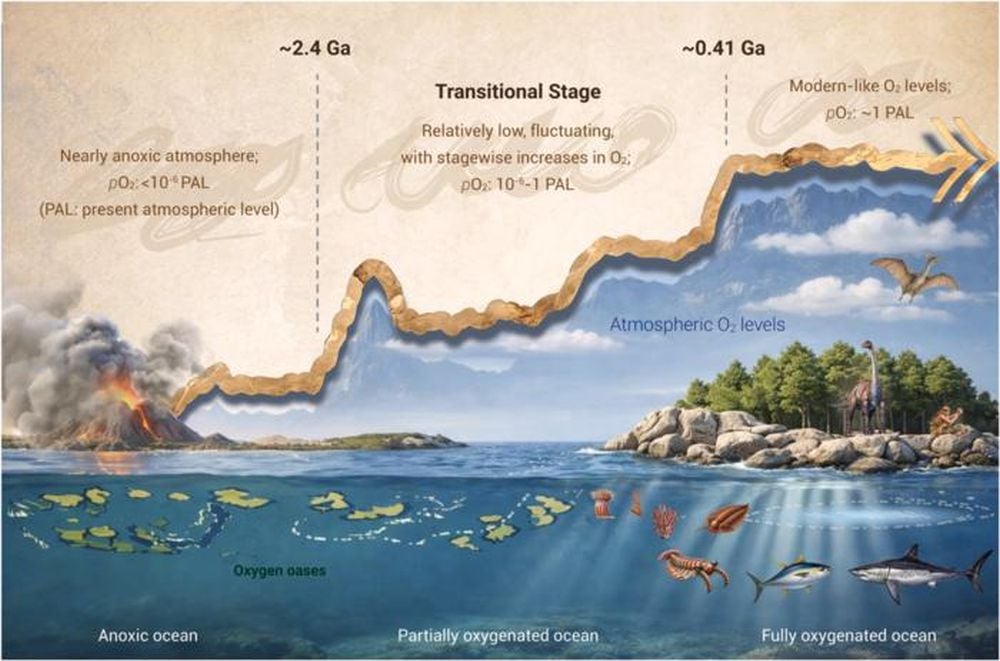
New research in The Innovation shows how Earth's atmosphere was oxygenated in three distinct steps, and that the deep ocean lagged behind in each case. In the last of the steps, deep ocean oxygenation lagged behind by 600 million years.
"Earth’s surface oxygenation was a protracted, multi-step process," the authors write. "It is widely accepted that atmospheric O2 rose through three major steps, each closely linked to key evolutionary innovations."
The oceans and the atmosphere are linked, and during the quest to understand Earth's oxygenated atmosphere, researchers used the geological rock record to understand ocean chemistry. The well-known banded iron formations are a part of this. They record the ocean's oxygen levels. The atmosphere doesn't hold an ancient record, so the ocean's geological record was used as a proxy for the atmosphere's evolution and oxygenation, too.
So scientists largely think that three stages of rising oxygen created the modern atmosphere: the GOE about 2.4 billion years ago, the Neoproterozoic Oxygenation Event about 800 to 540 million years ago, and the Paleozoic Oxygenation Event about 400 million years ago.
The researchers reiterate the understanding that ocean and atmospheric oxygenation are coupled. Research shows that on billion year timescales, episodes of rising atmospheric oxygen precede the same episodic rise in ocean oxygenation, "whereas on shorter, million-year timescales, their redox states could diverge, exhibiting negative coupling," they write.
"Here, we synthesize geochemical, sedimentological, and palaeobiological evidence to reconstruct this coupled and dynamic atmosphere-ocean oxygenation history and to reassess its timing, mechanisms, and ecological consequences," the authors explain.
This work hinges on new geochemical proxies that give researchers a clearer picture of what happened so long ago.
"Recent advances in geochemical proxies, most notably sulfate triple-oxygen isotopes (Δ′17O), provide new constraints on atmospheric oxygenation, complementing and in some cases revising interpretations from traditional ocean redox proxies," the authors explain.
The researchers say that this sulfate (SO4)offers a cleaner way to understand the oxygenation of the atmosphere. That's because of the isotopic composition of atmospheric oxygen, which is recorded when sulfate forms. It has a deficit of the isotope oxygen-17. So the sulfate can be used to track the rise of atmospheric O2, putting dates on each rise in atmospheric oxygen.
They found that the GOE is unchanged, sitting between 2.4–2.1 billion years ago. But this work changes the dates of the second and third oxygen rises.
The second, the Neoproterozoic Oxygenation Event was 1.3–1.0 billion years ago instead of 800 to 540 million years ago. The Paleozoic Oxygenation Event was 0.42–0.36 billion years instead of 0.44–0.41 billion.
The researchers found something else, too. The previous dates for the Neoproterozoic and Paleozoic events still record something. But instead of dating atmospheric oxygen, they date the delayed oxygenation of the deep ocean. They lagged behind the oxygenation of the atmosphere by about 200 and 30 million years, respectively.
This graphic illustrates the results from new research into the oxygenation of Earth's atmosphere that shows how Earth's O2 rose unevenly: shallow seas first, then the atmosphere, and much later the deep ocean. During a 2-billion-year transition, atmosphere and ocean O2 sometimes diverged despite long-term rise. Ocean oxygenation was highly variable, with extreme spatial heterogeneity over time.
Image Credit: Stagewise oxygenation of the Earth's atmosphere and oceans. Wang and Li 2026, The Innovation.
On shorter timescales, the link between ocean and atmospheric oxygen is still the defining feature in this work. But it shows that a change in one could've pushed the other in the opposite direction. The researchers think that what seems like a signal of rising oxygen levels is actually a drop. When a pulse of oxygen enters the ocean, it oxidized organic carbon and sulfide in the oceans. The organic carbon becomes CO2, and the sulfide becomes sulfate. The more organic carbon and sulfide there was in the ocean, the more it depleted atmospheric oxygen.
Over longer, billion year timescales, the atmophere is oxygenated as photosynthesis continues. But on shorter timescales, it can't keep up.
"Earth’s surface oxygenation history reflects a dynamic and nonlinear interplay among atmospheric O2 evolution, land and ocean redox buffering, and ecological innovation," the authors write. "Overall, the trajectory from localized Archean oxygen oases to the globally well-oxygenated surface environments of today underscores how atmosphere-ocean oxygenation both governs—and is reciprocally shaped by—the evolution of life."
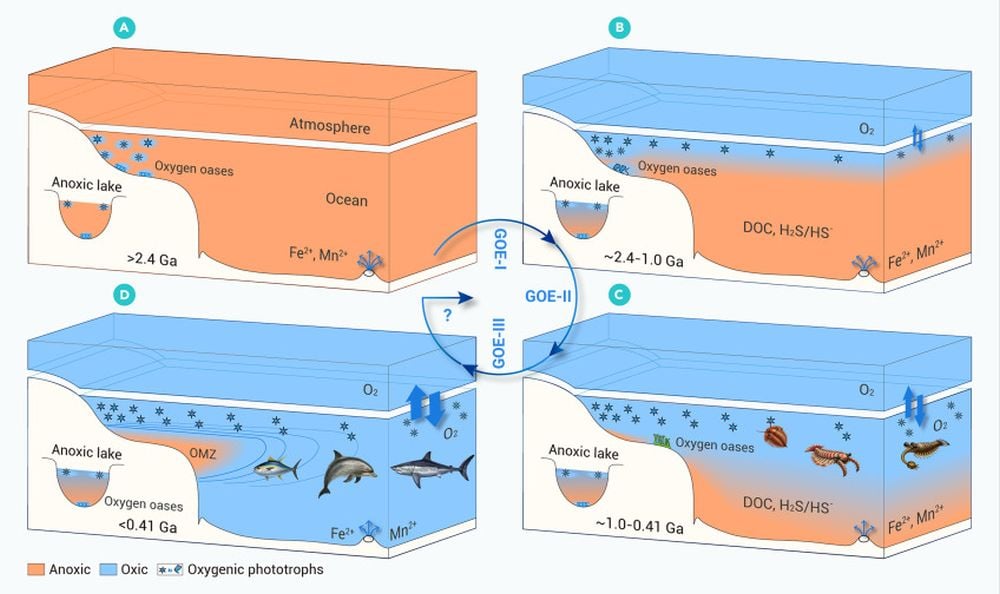
This figure shows the evolution of Earth's atmosphere-ocean redox states through time and space. (A) Before 2.4 Ga: atmosphere and oceans were largely anoxic, with oxygen restricted to localized, shallow-water oxygen oases. (B) From 2.4 to 1.0 Ga: atmospheric O2 remained low; oxygenated waters were confined to the ocean surface, and oxygen oases developed primarily along continental shelves. (C) Between 1.0 and 0.41 Ga: atmospheric O2 increased but fluctuated, while oxygenated waters progressively penetrated to greater depths, with shelf environments continuing to host oxygen oases. (D) Since ∼0.41 Ga: atmospheric O2 approached near-modern levels; deep oceans became pervasively oxygenated, whereas mid-depth waters developed oxygen minimum zones (OMZs) that waxed and waned (solid curves) in response to high organic matter export and oxygen consumption. DOC, dissolved organic carbon.
Image Credit: Wang and Li 2026, The Innovation.
It all happened in stages, as the different elements fed back on one another. This work shows that during Earth's long path to an oxygenated atmosphere, the ocean and atmosphere didn't change in lockstep on shorter timescales. "Throughout the 2-billion-year oxygenation transition, atmospheric and oceanic oxygen levels were episodically decoupled on shorter timescales, superimposed on a long-term trajectory toward global oxidation," they write.
The pair of researchers acknowledge some of the weakness in the evidence that paints this picture. The record of oxygen isotopes in sulfate is coarse, not exquisitely detailed. Beyond one billion years ago, the levels aren't well-constrained. So it's still more open to interpretation. There may be other steps in the path to oxygenation that aren't clear yet.
Understanding how life and the planet co-evolved together is a monumental task. Scientists know it happened, but all of the details are difficult to detect. But if it happened here, it almost certainly happened on any other habitable worlds.
"These deep-time perspectives illuminate the co-evolution of life and Earth’s surface environments and provide a conceptual framework for evaluating planetary habitability," the authors write.
RELATED
Science Documentary - How Earth Got Oxygen
When Oxygen Poisoned The Earth | The Great Oxidation Event
When Oxygen Almost Killed Everything (The Great Oxidation)
Is it possible that flying reptiles like the Pterodactyl are still flying around today? Yes, it is an interesting possibility to consider, especially when looking at reports of mysterious flying creatures from around the world.
Flying reptile Mexico.
There have been reports of large, unusual flying creatures in several parts of the world, particularly:
Papua New Guinea: Reports of enormous flying creatures, sometimes called Ropen.
Africa: Stories of large flying reptiles, sometimes called Kongamato.
United States: Sightings of large winged creatures described as resembling pterosaurs.
South America: Occasional reports of enormous, unidentified flying animals.
China: In 2016, a man in China captured footage of a giant, mysterious flying reptile spotted near the border with Laos.
Flying reptile China.
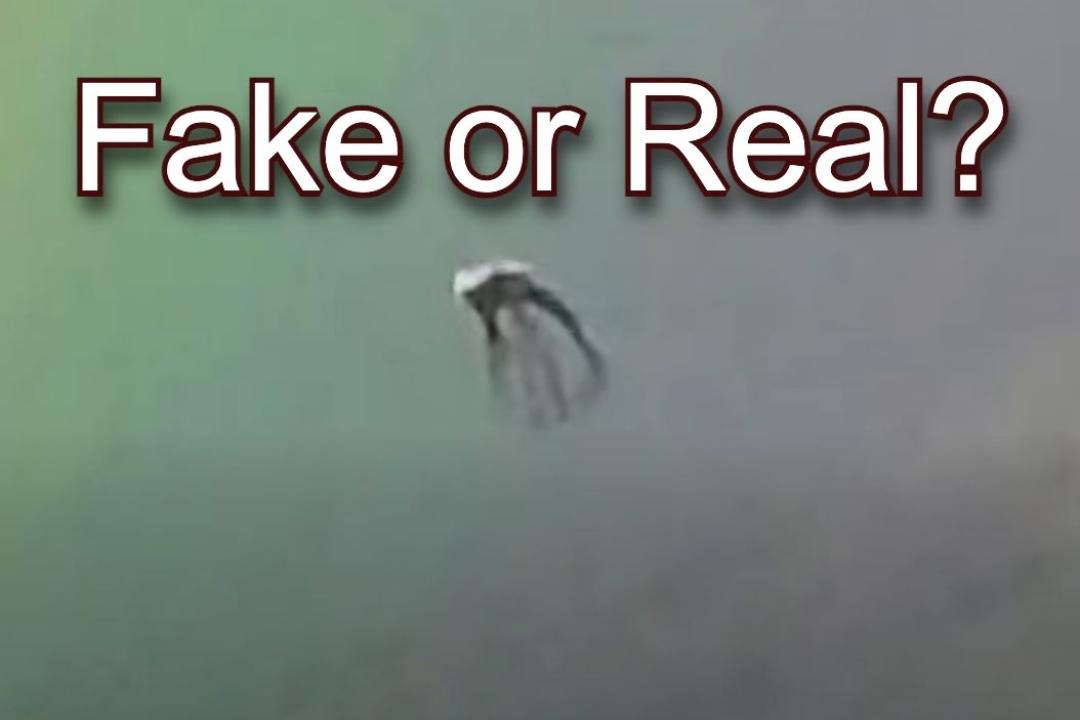
More recently, new footage surfaced allegedly showing a large, dark-winged creature flapping across the daytime sky over Ciudad Juárez Mexico, resembling a Pterodactyl or another type of pterosaur.
There were accusations, without proof, that the footage had been created using AI. Others suggested that it was simply a large bird or a blue heron, while investigator Jaime Maussan suggested that the creature might have entered our world through a supposed gateway to another dimension, a theory for which he provided no scientific evidence.
From a scientific perspective, pterosaurs (the group of flying reptiles that includes the famous Pterodactylus) are considered extinct. They disappeared approximately 66 million years ago, at the end of the Cretaceous period. But could a small, undiscovered population have somehow survived?
Alleged pterodactyl filmed in Mexico A large dark-winged creature flapping across the daytime sky over Mexico recently went viral on TikTok Many now claim it's a flying dinosaur, though local officials dismissed the claims, saying it's likely a large birdhttps://t.co/xYVNOvFPZw
Throughout the summer, rumours swirled that President Donald Trump was preparing an extraordinary announcement.
He would tell Americans, and the world, that we are not alone in the universe.
Several sources urged Liberation Times to take the prospect seriously. Sources familiar with the President’s inner circle and members of his family expressed alarm and confidence that he could deliver disclosure.
That announcement has yet to come.
Liberation Times is aware of contact between White House staff and advocates for transparency on Unidentified Anomalous Phenomena (UAP). Some discussions stretched late into the night, discussing navigation of alleged UAP programs involving non-human lifeforms.
Alongside those conversations, a formal advisory structure took shape.
In June, an official from the Office of the Director of National Intelligence (ODNI) described the arrangements to Liberation Times. The official said ODNI had established a UAP Governance Board alongside the FBI and Department of War (DoW).
Its charter includes coordinating investigations, improving data collection and supporting declassification.
Harvard astrophysicist Avi Loeb publicly announced one of its supporting groups. In a13 June article, he described assembling the UAP Science Advisory Council. Loeb said government agencies had tasked him with bringing together scientists to help investigate the phenomenon.
Other organisations also joined discussions at ODNI. They included the Disclosure Foundation, a nonprofit advocating UAP transparency, and To The Stars, a media company involved in UAP research.
Aaron Lukas, the Principal Deputy Director of National Intelligence, publicly identified their involvement on 17 September.He thanked both organisations and Loeb’s council for participating as advisers to the Governance Board.
However, other advisory councils working alongside ODNI, the FBI and DoW remain undisclosed.
Questions about ODNI’s role also extend to an alleged operation to attract UAP. As Liberation Times previously reported, released government records describe a senior intelligence official witnessing glowing orbs at a sensitive U.S. testing facility.
Jordan Flowers, executive director of the Disclosure Foundation, an advocacy group campaigning for UAP transparency, has alleged that these encounters formed part of a successful ODNI luring operation, although the released records do not explicitly confirm that purpose.
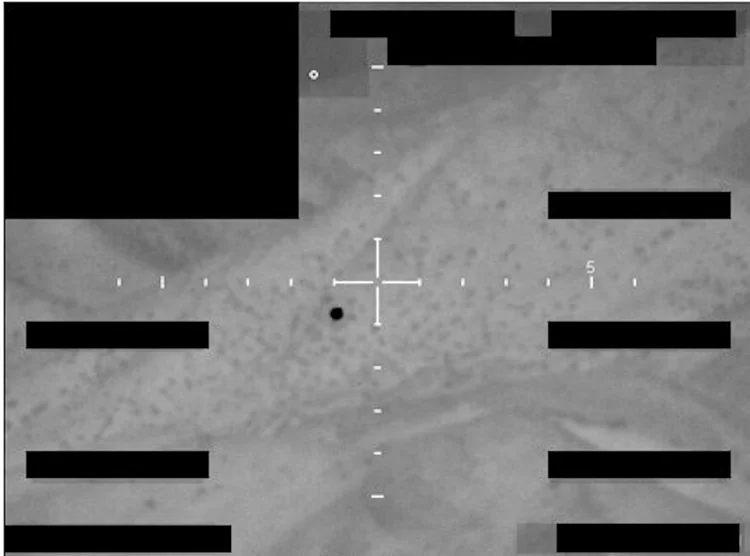
Above: Image released by Department of War showing UAP from what some claim could be a luring operation
He promised to investigate immediately following the interview.
Liberation Times subsequently asked whether he had followed through. A White House spokesperson replied:
‘Refer you to the President’s comments.’
The response left unanswered whether Trump had indeed investigated.
In the interview, when pushed on whether he was interested in the topic because other people were, Trump said:
“I would like to find out whether or not it's true. I will tell you, you have a lot of very solid people that believe it's true.”
The interview came amid extensive discussion of the allegations involving such programs by people in his orbit.
Fox News host Sean Hannity, a longtime Trump ally, interviewed former U.S. Air Force intelligence specialist Dylan Borland - a UAP whistleblower - and former FBI agent Ben Hansen. Their conversation covered alleged recovered craft and government secrecy. Hannity said he would raise the issue with the President when he next saw him.
Television psychologist Phil McGraw, better known as Dr Phil, interviewed former Air Force intelligence officer and UAP whistleblower David Grusch. They discussed Grusch’s allegations of secret retrieval efforts involving non-human craft and their occupants.
There are also accounts of information reaching Trump during his first term.
Former Pentagon official Luis Elizondo described one such route in his 2024 memoir, Imminent. He wrote that Jay Stratton, who led the government’s UAP Task Force, briefed National Security Council members. According to Elizondo, those officials subsequently briefed Trump.
The President’s son, Donald Trump Jr., has also interviewed Elizondo three times on his Triggered podcast. Their discussions have covered UAP and alleged secret government programs.
He said, according to what he was told, Trump had been briefed on alleged human-alien hybrids during his first term, adding that the briefing took place while Trump was facing impeachment proceedings.
“He had like this existential briefing that just kind of rocked his worldview,”Burlison said.
Burlison added that he had been told Trump joked that then-Congressman Adam Schiff ‘must be one of them’, referring to the alleged hybrid beings.
Liberation Times also understands that Trump’s new Chief of Staff is very aware of alleged UAP programs.
The White House named Stephen Miller Chief of Staff on 6 November, following Republican losses in the midterm elections.
Miller previously served as Trump’s deputy chief of staff.
In August, Secretary of State Marco Rubio indicated that Miller was overseeing the UAP portfolio. Sources told Liberation Times that his work included investigating alleged hidden programs to retrieve and reverse-engineer non-human craft.
Congress member and UAP transparency advocate, Tim Burchett recently told Cabot Phillipsthat Stephen Miller had told him:
"There's some people that are in government that I feel like are very bad people that don't want us to have this information for whatever reason.”
Miller’s promotion has left uncertainty over who now leads that work.
Republican Congressman Eric Burlison, a member of the congressional UAP Caucus, voiced similar concerns during a 10 November interview. Speaking to journalist Matt Laslo forAsk a Pol UAP, he said Trump had taken Miller off the UAP topic.
Burlison questioned whether Miller would retain time for it. He also said he did not know whether anyone would replace him.
The uncertainty comes as Congress considers another route to disclosure.
On 22 July, the House adopted Burlison’s UAP Disclosure Act as an amendment to the Fiscal Year 2027 National Defense Authorization Act. The proposal would establish an independent records review board and extend disclosure requirements to covered government contractors.
Its fate in the final defence bill remains unresolved.
Meanwhile, the administration has continued releasing records through its Presidential Unsealing and Reporting System for UAP Encounters, or PURSUE. The Department of War announced the initiative’s first release on 8 May.
The releases have not clarified what the White House has learned about the origins of UAP or the intentions of any entities behind them, nor how much the administration intends to disclose.
Democrats will take control of both chambers of Congress in January 2027, when the 120th Congress begins. Their commitment to UAP transparency will face a test after Republican-led hearings and investigations championed by Representatives Anna Paulina Luna, Tim Burchett and Eric Burlison, including throughLuna’s declassification task force.
Speaking about the current situation within Washington D.C., Jordan Flowers, executive director of the Disclosure Foundation, told Liberation Times:
“The next several weeks are a test of whether Congress can lock in real progress before leadership changes on January 3, through another hearing and the full UAP Disclosure Act in the NDAA, and whether the new majority will build on that work with a select committee that has subpoena power.
“At the White House, the public messaging has been inconsistent, but the PURSUE releases show continued interest, and our job is to keep this a bipartisan issue anchored in national security and accountability for waste, fraud, and abuse.”
Commenting on that possibility, Flowers told Liberation Times:
“In the 120th Congress, a select committee on UAP led by Representative André Carson would be wonderful progress: it would not face the six-month renewal question that has hung over the current task force, and it would have subpoena power from day one.
“Representative Carson’s experience on both Intelligence and Oversight would also make him well placed to connect the two committees that matter most on this topic, and we hope any new structure stays bipartisan and builds on the work Republican members have already done.”
Any potential disclosure could expose intelligence capabilities that extend well beyond UAP.
Sources previously told Liberation Times that the CIA’s Weapons and Counterproliferation Mission Center (WCPMC) has helped assess the phenomenon’s potential non-human origins. They described work to identify the different intelligences that might control these objects and assess their intentions.
According to those sources, WCPMC drew on intelligence collected across the U.S. government. This included space-based collection by the National Reconnaissance Office (NRO), which develops and operates reconnaissance satellites.
They also identified the Defense Intelligence Agency (DIA), National Security Agency (NSA) and National Geospatial-Intelligence Agency (NGA) as contributors.
The sources described inputs spanning signals intelligence, measurement and signature intelligence, and geospatial intelligence. They said WCPMC collected and analysed UAP information from the atmosphere, space and undersea environments.
The CIA publicly confirms WCPMC’s existence. It describes its mission centres as combining operational, analytical and technical capabilities to address national security threats.
An intelligence-community source told Liberation Times that detailed technical assessments of UAP from the WCPMC were shared among specialists across intelligence agencies. Finished assessments were then prepared for senior policymakers.
Such intelligence work, alongside the recovery and reverse-engineering of foreign technology, serves U.S. national security.
Some of the capabilities involved may remain classified even if the administration chooses to acknowledge any possible non-human presence.
One potential route to disclosure is the separate UAP effort allegedly operating under White House oversight.
If reports of luring and shootdown operations are accurate, that effort could give the administration evidence obtained independently of existing programs.
It might provide a path to disclosure while protecting sensitive intelligence sources and methods.
Whether that effort has produced such evidence, and whether Trump intends to release it, remains unclear.
The Secret UFO Files | Trump White House Releases Declassified UFO Files | Nothing But The Truth
Imagine a spacecraft that takes almost two days to receive a question from Earth and send back an answer. It predates personal computers, the internet and smartphones, yet it is still operating in a region of space no other human-made object has ever reached. On 18 November 2026, Voyager 1 set a historic record, reaching a distance of one light-day from Earth. How has a spacecraft designed to operate for only a few years survived for almost half a century? What has it discovered along the way, and how much longer will its extraordinary journey continue?
One light-day from Earth: How far is that?
On 18 November 2026, at 12:16 Kyiv time, Voyager 1 reached a distance of approximately 25.9 billion km (16.1 billion miles) from Earth. It is the first human-made spacecraft to travel so far. But why does NASA measure this distance in light-days rather than kilometres?
Light travels at nearly 300,000 km/s (186,000 miles/s). In a single second, it could circle Earth more than seven times. Light takes approximately 1.3 seconds to reach the Moon and 8 minutes 20 seconds to travel from the Sun to Earth. Yet even at this incredible speed, a signal now takes 24 hours to reach Voyager 1.
For comparison, the spacecraft is approximately 67,000 times farther away than the average distance between Earth and the Moon. If it were possible to drive to Voyager 1 at 100 km/h (62 miles/h) without stopping, the journey would take almost 30,000 years.
Voyager 1 – one light-day from Earth. An official NASA poster commemorating the historic milestone of 18 November 2026, when the spacecraft reached a distance of approximately 25.9 billion km (16.1 billion miles) from Earth. A radio signal now takes 24 hours to cover that distance.
Credit: NASA/JPL
Voyager 1 itself is travelling at approximately 61,000 km/h (38,000 miles/h) relative to the Sun – almost 70 times faster than a typical passenger aircraft. Yet on interstellar scales, even that speed seems modest.
Most interestingly, reaching the one-light-day mark did not mean that the spacecraft crossed any new physical boundary. Nothing changed in its surroundings. The date matters primarily to us, because it shows just how far humanity has managed to send its technology. To understand how Voyager 1 reached such a great distance, however, we need to go back almost half a century.
How did a five-year mission become a 49-year journey?
In 1977, NASA took advantage of an exceptionally rare opportunity. Jupiter, Saturn, Uranus and Neptune were positioned in such a way that spacecraft could fly past them in succession, using their gravity to change speed and direction. A similar alignment of the outer planets occurs approximately once every 175 years.
For engineers, this was a remarkable opportunity. Instead of carrying enormous quantities of fuel for acceleration, a spacecraft could make use of the planets’ own motion around the Sun. This technique is known as agravity-assist manoeuvre. A spacecraft passes close to a planet in such a way that it gains some of the planet’s orbital energy. As a result, it changes trajectory and can accelerate relative to the Sun while using almost none of its own fuel.
This principle allowed the two Voyager spacecraft to explore the distant planets in a relatively short time. Voyager 2 launched first, on 20 August 1977. Voyager 1 followed on 5 September. Despite their numbering, the second spacecraft launched earlier, but the first took a faster trajectory and overtook its twin in December of the same year.
Both spacecraft were designed for a service life of approximately five years. Their original objective was to study Jupiter, Saturn and their moons. In March 1979, Voyager 1 reached Jupiter. Its photographs revealed the giant planet’s atmosphere in unprecedented detail and helped scientists discover Jupiter’s faint rings and two new moons.
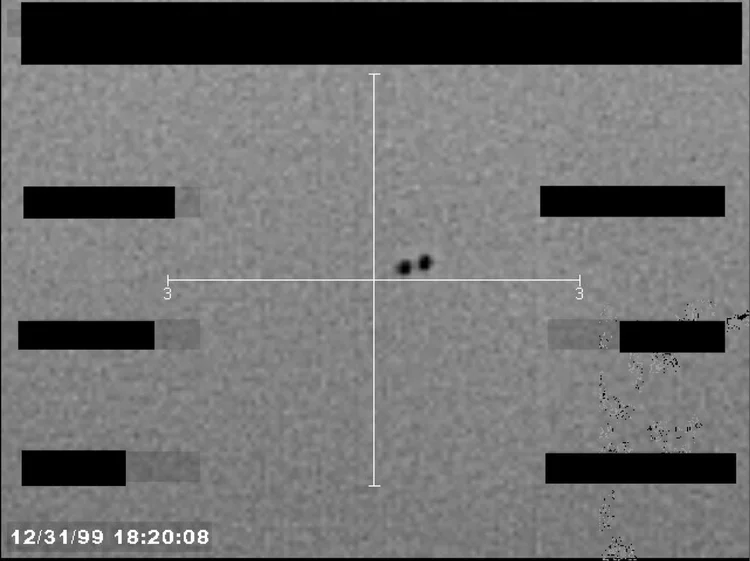
Two simultaneous volcanic eruptions on Jupiter’s moon Io, recorded by Voyager 1 in March 1979. This discovery demonstrated the existence of active volcanism beyond Earth.
Credit: NASA/JPL
But the greatest surprise lay elsewhere.
In images of Io, scientists noticed enormous plumes of material rising above the surface. These were active volcanoes – the first time humanity had directly observed active volcanism beyond Earth. Some volcanic plumes on Io rise hundreds of kilometres into space. By comparison, ordinary volcanic clouds on Earth generally do not reach even one-tenth of that height.
The discovery transformed our understanding of the moons of giant planets. They were not merely cold, rocky or icy bodies, but entire worlds with geological activity of their own. In November 1980, Voyager 1 flew past Saturn, discovering new moons and complex structures within its rings. Scientists were particularly interested in Titan – the planet’s largest moon, enveloped in an exceptionally dense atmosphere.
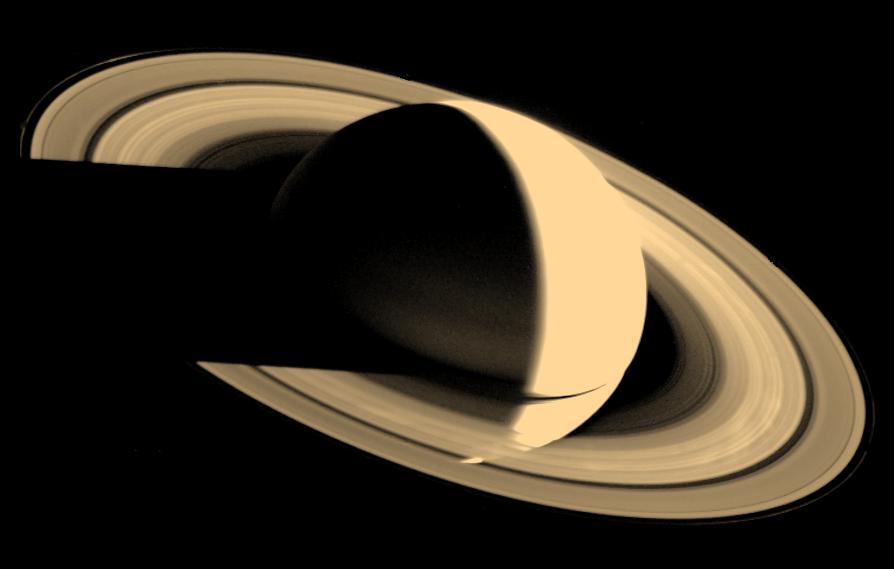
Saturn and its rings in an image taken by Voyager 1 on 16 November 1980, four days after the spacecraft’s closest approach to the planet.
Credit: NASA/JPL
The need to fly close to Titan determined the spacecraft’s subsequent fate. The gravity-assist manoeuvre altered its trajectory, sending Voyager 1 far from the plane of the planetary orbits. It could no longer continue to Uranus and Neptune. That task fell to Voyager 2, which later became the first, and remains the only, spacecraft to visit both planets. For Voyager 1, the planetary phase of the mission was effectively over. But an entirely different exploration lay ahead.
What did humanity leave aboard a spacecraft that may outlive our civilisation?
Even before Voyager 1 launched, engineers knew that it would continue travelling through space after completing its exploration of the planets. One day, it might travel so far that Earth would lose contact with it forever.
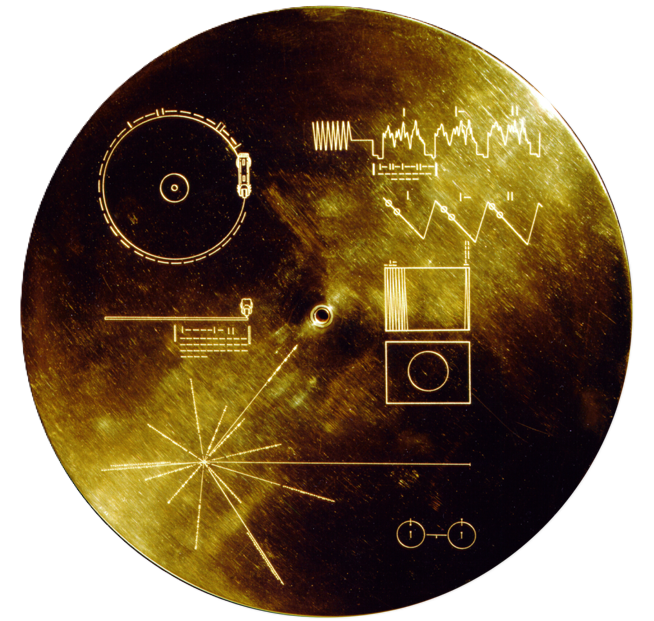
NASA therefore decided to send something special aboard the spacecraft. Both Voyager 1 and Voyager 2 carried a Golden Record – a gold-plated copper disk measuring 30 cm (12 inches) in diameter, intended as a message from humanity. Its contents were assembled by a team led by astronomer Carl Sagan. The record includes 115 images depicting life on Earth, greetings in 55 languages, sounds of nature, and 90 minutes of music from different cultures and eras. Among the recordings are whale song, the sound of wind, human laughter, works by Bach and Mozart, and rock and roll by Chuck Berry.
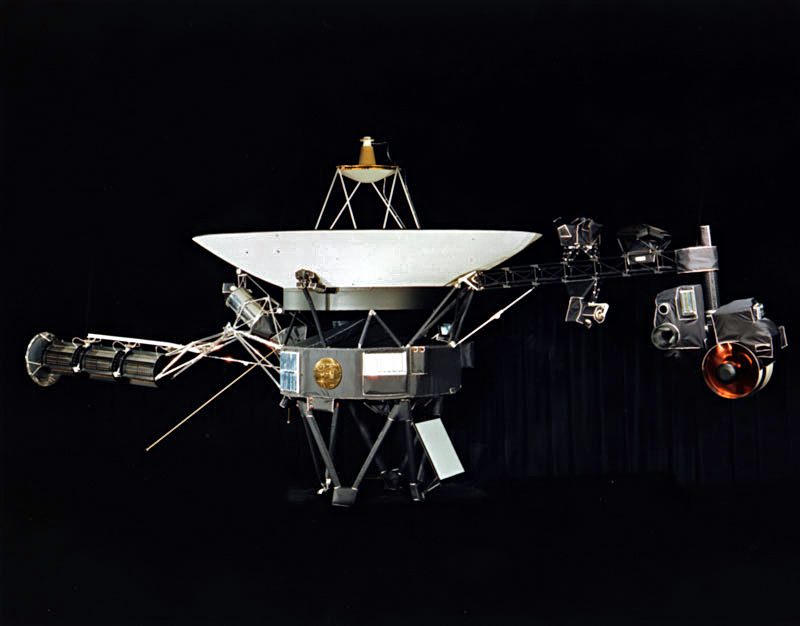
The Voyager 1 spacecraft was launched by NASA on 5 September 1977 to explore Jupiter and Saturn. The image clearly shows its large, 3.7 m (12 ft) parabolic antenna, which provides communications with Earth, as well as its scientific instruments and main structural components. Today, Voyager 1 remains the most distant human-made object in history.
Credit: NASA/JPL
The protective cover bears symbolic instructions explaining how to play the recording, along with a diagram showing the Sun’s position relative to pulsars – a kind of cosmic address for Earth. Of course, the likelihood that an extraterrestrial civilisation will ever find a small spacecraft in the vastness of space is extremely low. But the idea was not solely about possible contact. The Golden Record became a time capsule capable of preserving evidence of humanity’s existence long after the spacecraft themselves have ceased operating.
The Voyager Golden Record – humanity’s message to other civilisations.
Credit: NASA/JPL
Yet Voyager 1 left its most famous message not on the Golden Record, but through its own camera. On 14 February 1990, when the spacecraft was approximately 6.4 billion km (4 billion miles) from Earth, NASA turned its cameras towards the Solar System for the last time. The result was the famous image known as the Pale Blue Dot.
In the photograph, Earth appears as a tiny point of light lost among rays of sunlight. No continents, oceans or human cities are visible – just a few pixels containing the entire history of our civilisation. After this series of photographs, Voyager 1’s cameras were switched off to conserve energy for the next stage of exploration. The spacecraft never photographed the planets again. It travelled onwards to a place where ordinary images could no longer tell the most important part of the story.
How did Voyager 1 become the first spacecraft to reach interstellar space?
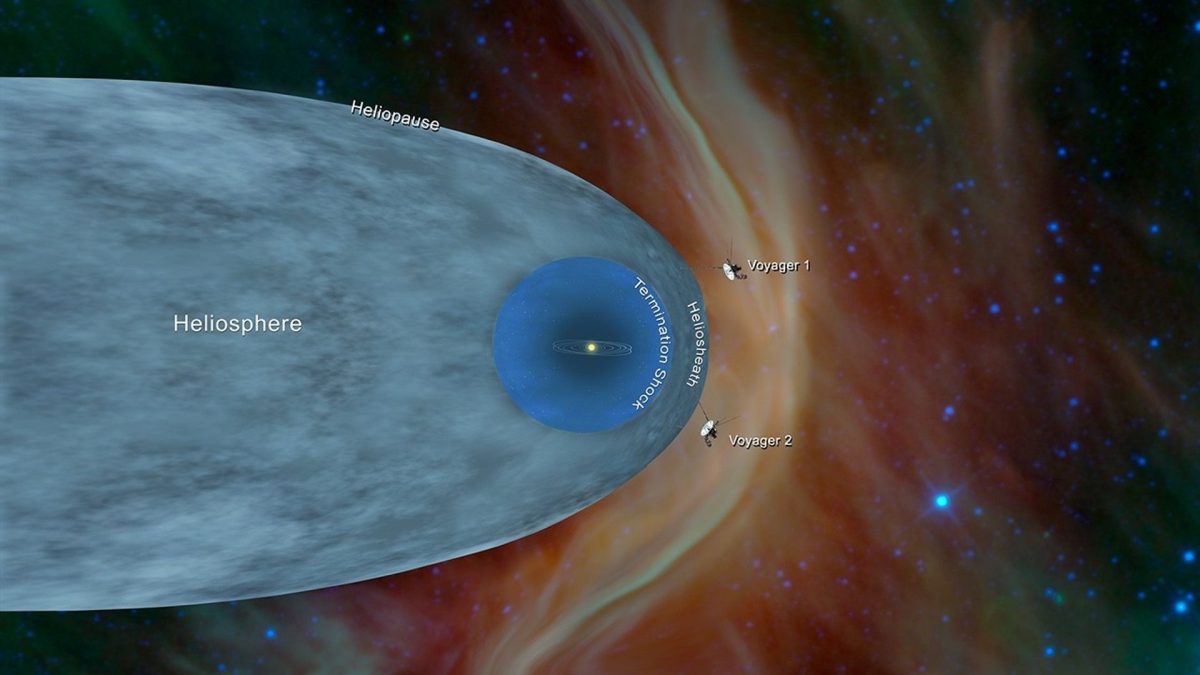
The Sun does more than emit light and heat. It constantly releases streams of charged particles known as the solar wind. Together with magnetic fields, these particles create an enormous region around the Sun called the heliosphere. It can be imagined as a kind of bubble within which the solar wind pushes against the surrounding interstellar medium.
But this bubble is not infinite. At great distances, the pressure of the solar wind is gradually balanced by that of the interstellar medium. The boundary between them is called the heliopause. On 25 August 2012, Voyager 1 crossed this boundary and became the first human-made spacecraft to enter interstellar space. Scientists established this from changes in the properties of charged particles and plasma around the spacecraft. In particular, they found evidence of a much higher plasma density, characteristic of the interstellar medium.
Voyager 1 and Voyager 2 beyond the heliosphere. The illustration shows the heliosphere – the enormous region around the Sun shaped by the solar wind – and its outer boundary, the heliopause. Voyager 1 crossed it in 2012 and Voyager 2 in 2018, becoming the first spacecraft to reach interstellar space.
Credit: NASA/JPL
There is, however, an important distinction: leaving the heliosphere does not mean leaving the Solar System altogether. The Sun’s gravitational influence extends much farther. Ahead lies the hypothetical Oort Cloud – an enormous, distant region of icy bodies. According to NASA estimates, Voyager 1 will take approximately 300 years merely to reach its inner edge and perhaps around 30,000 years to pass through the entire region.
The spacecraft has therefore already become an interstellar traveller, but its journey beyond the Solar System in the broader sense is still far from complete.
How can you control a spacecraft when a signal takes a whole day to reach it?
Over almost half a century, Voyager 1 has outlasted several generations of computer technology. Its onboard systems were developed at a time when home computers were only beginning to become popular. Today, an ordinary smartphone has incomparably greater computing power. But Voyager 1’s strength does not lie in its processing performance.
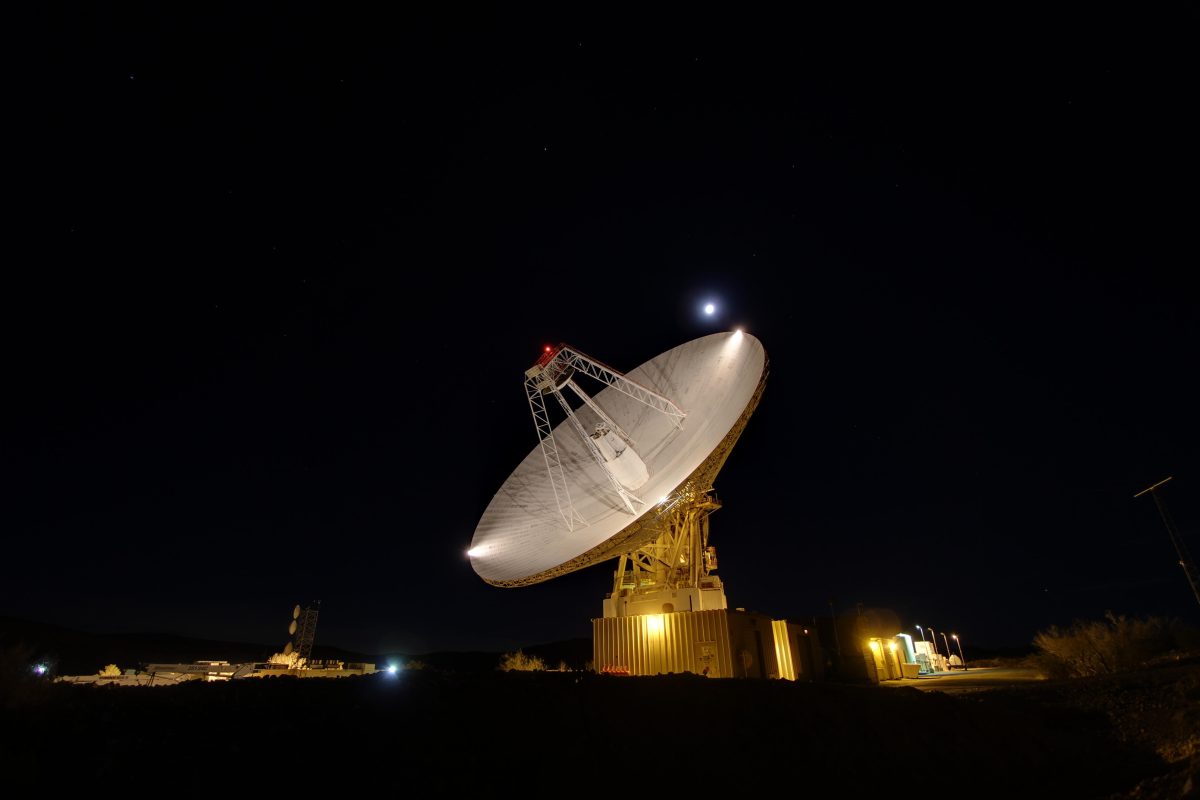
Its defining feature is its ability to operate autonomously for decades, withstand extreme conditions, and maintain contact with Earth. To communicate with it, NASA uses the Deep Space Network – an international network of large radio antennas located in the United States, Spain and Australia. Some antennas are 70 m (230 ft) in diameter, roughly two-thirds the length of a football pitch. Their geographical distribution allows communication with distant spacecraft as Earth rotate.
A giant radio antenna belonging to the Deep Space Network at Goldstone, California, USA.
Credit: NASA
Yet even the largest antenna cannot overcome a fundamental limitation – the speed of light. If engineers send a command to Voyager 1 today, it will not arrive until the following day. They must then wait approximately another day to learn the result. In effect, every decision becomes an experiment lasting at least 48 hours. This is particularly challenging when faults develop aboard the spacecraft.
In November 2023, Voyager 1 stopped transmitting intelligible scientific and engineering data. For almost five months, engineers worked to identify the cause. They eventually discovered that part of the memory in one of its onboard computers had been damaged. Replacing the chip was impossible, so they had to divide the software code into sections and move them to other areas of memory. In April 2024, the spacecraft resumed sending accurate information about its condition and later restored scientific observations.
And that was not the last challenge. In October 2026, contact with Voyager 1 was unexpectedly lost for approximately two days before being restored. Engineers determined that one set of attitude-control thrusters had shut down, after which the backup set was activated. However, the mission’s principal problem is becoming increasingly serious – a shortage of electrical power.
What will happen when Voyager 1 finally falls silent?
At such a distance, solar panels cannot realistically provide the electricity the spacecraft needs. Voyager 1 therefore uses three radioisotope thermoelectric generators, which convert heat from the radioactive decay of plutonium into electricity. These are not nuclear reactors. They contain no controlled chain reaction – only the natural release of heat, some of which is converted into electrical energy. Over time, however, their power output decreases by approximately 4 W each year. At first glance, that may not seem much – roughly the power consumed by a small LED lamp.
For a spacecraft with a limited power budget, however, every watt matters. Engineers are gradually switching off equipment that is not essential for continued operation. In April 2026, NASA switched off the instrument used to measure low-energy charged particles. As a result, Voyager 1 was left with only two active scientific instruments: the magnetometer and the plasma wave detector.
In September 2026, engineers also completed a complex operation to transfer several systems to more energy-efficient equipment. This allowed them to postpone the next shutdown of a scientific instrument. Nevertheless, the gradual depletion of the power supply cannot be stopped. Sooner or later, Voyager 1 will cease transmitting scientific data and eventually lose contact with Earth altogether. The precise date will depend on the remaining electrical power and the condition of its equipment.
Even then, its journey will not end. Without the need to operate its thrusters continuously, the spacecraft will continue moving through space under its own momentum. In approximately 40,000 years, Voyager 1 will pass within about 1.7 light-years of the star Gliese 445. And this will be just one of countless stages in its journey around the centre of our Galaxy.
And aboard it, the Golden Record will remain, carrying human voices, music and the sounds of Earth.
Pale Blue Dot’ – Earth as photographed by Voyager 1. The spacecraft took this image on 14 February 1990 from a distance of approximately 6 billion km (3.7 billion miles) from our planet. Earth appears as a barely visible point of light in a beam of scattered sunlight – one of the most famous and symbolic images in the history
Voyager 1 was designed for a few years of planetary exploration, but it became humanity’s longest-running space expedition. It discovered new worlds, became the first spacecraft to reach interstellar space, and showed us Earth as a tiny blue dot in the vastness of the Universe.
One light-day is not the end of its journey. It is a reminder of just how far human curiosity and engineering ingenuity can take us.
And one day, when Voyager 1’s final signal disappears into the noise of space forever, the spacecraft will continue on its way – without us.
To explore this extraordinary story in detail, from the first discoveries near Jupiter to the milestone of 18 November 2026, watch our video ‘Voyager 1 – One Light-Day from Earth’ on the Universe Space Tech YouTube channel.
NASA's Voyager 1 reaches light-day milestone after 50 years in space | What It Means
Voyager 1 Reaches One Light Day From Earth: A Historic Milestone the World Is Ready to Celebrate!
Grand Theft Auto 6 has only been out for a matter of hours, and players have already tracked down a UFO in the woods and a Bigfoot in the swamps.
The UFO encounter is a random night-time event in Kelly County, on a dirt road near the Starlet Motel safehouse east of Port Gellhorn. You'll need to have finished the game's first chapter, and it's most reliable after 2am in-game.
As word spreadlate yesterday (18th November), it seems the event will kick off if you find a car at the side of the road with its headlights flickering, its trunk open, and clothes strewn around it. Follow the trail into the trees towards a blue glow, and you'll catch a UFO beaming down on a woman before it drops her and flies off. Head back to her car, as she requests, and the UFO returns for you. You apparently black out and come round three days later, and a bronze trophy called The Truth Is Out There should unlock.
You can seemingly trigger the event as either Jason or Lucia, and it isn't needed for 100 percent completion.
And that's not the only close encounter you can expect, either. YouTuber Lazarbeam bumped into Bigfoot on the afternoon of 18th November, hours before the game launched in the UK, while one Reddit user reported that they weren't quite sure what they'd stumbled on, titling their post "I think I found Bigfoot".
Leonida's version of Bigfoot is actually the Skunk Ape, Florida's own swamp cryptid, and it can be found in the swamplands near Cottonmouth Lake in Mariana County as soon as free roam opens up. Listen out for a loud roar, then use Jason's tracking ability to follow it through the swamp. You may find it feeding on a deer carcass, while a second sighting has been reported south of Watson Bay.
Either way, the trail seemingly ends at a strange, human-like tree. Investigate it, and Jason blacks out, triggering a short cutscene in which the creature creeps up on him, as shown in this video. He later wakes near his vehicle, drenched in sweat. Save your ammo, though, as shooting at it won't do you any good.
Cryptids and aliens are, of course, something of a Rockstar tradition by this point. GTA 5's Mount Chiliad mystery kept players hunting for years, and Output Lag has already spotted two NPCs in a GTA 6 bar talking about goings-on there. Nobody has cracked a full Chiliad-style puzzle in the new game yet, but I'm sure that's just a matter of when, not if.
How a UFO encounter in 1961 led to Double-A New Hampshire’s weirdest alternate identity
Josh Jackson
MANCHESTER, N.H. -- Taylor Fisher had already been working in Minor League Baseball for about 10 years when he was hired by the New Hampshire Fisher Cats (Double-A affiliate of the Toronto Blue Jays), yet he immediately saw that he was entering a whole new world.
“I walked in on my first day as general manager here, and on the white board next to me it just said, ‘Space Potatoes,’” Fisher recalled. “I said, ‘What the heck does that mean?’”
That was in 2024. Now, at the end of 2026, Fisher and baseball fans across New England know exactly what the phrase means. The New Hampshire Space Potatoes have become a beloved alternate identity, adopted by the Fisher Cats for a total of nine home games over the past two seasons.
But where did "Space Potatoes" come from? It’s an idea that ties together two little-known pieces of New Hampshire history.
The first pertains to historical fact. In 1719, on land in the current-day New Hampshire town of Derry, Scots-Irish settlers planted the first white potatoes grown in North America. In 2013, fourth graders from the Derry Village School successfully lobbied to have the white potato named the official state vegetable.
The second sits at the nexus of the known universe and the realm of possibility. About 80 miles north-northwest of the Fisher Cats’ ballpark in Manchester is the spot where the first widely reported alien abduction in American history allegedly took place in 1961.
“So, you mash those two together, you get the Space Potatoes,” Fisher Cats assistant GM Andrew Marais said.
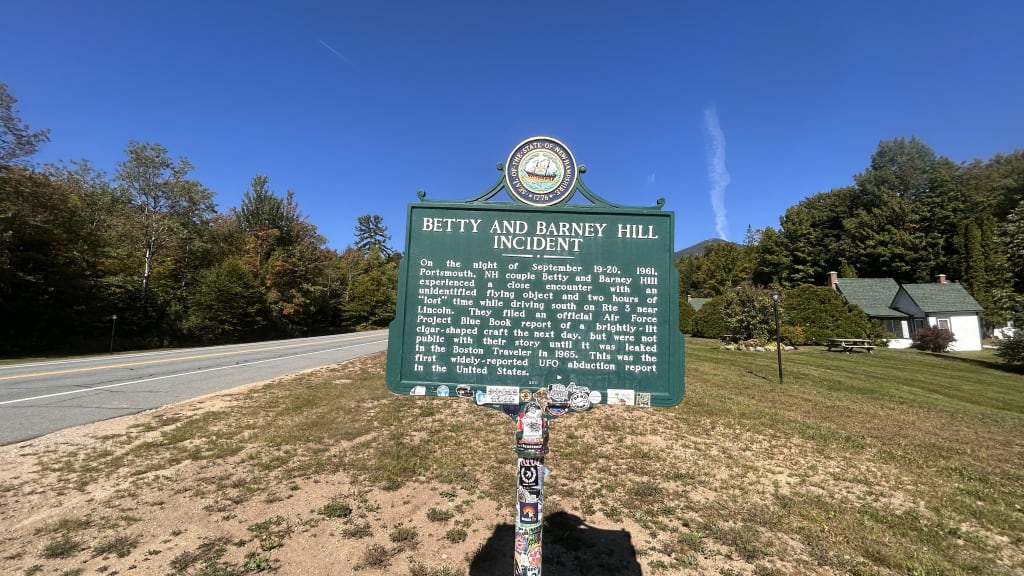
Marais, like many Space Potatoes fans, is a UFO believer. Every year when he takes an hour drive into the White Mountains, he stops at an alien-themed gas station and passes a roadside marker on the highway in the town of Lincoln. That sign reads:
On the night of September 19-20, 1961, Portsmouth, NH couple Betty and Barney Hill experienced a close encounter with an unidentified flying object and two hours of “lost” time while driving south on Rte. 3 near Lincoln. They filed an official Air Force Project Blue Book report of a brightly-lit cigar-shaped craft the next day, but were not public with their story until it was leaked to the Boston Traveler in 1965. This was the first widely-reported UFO abduction in the United States.
A nearby gas station is decked out with alien displays, toys and trinkets.
Josh Jackson/MLB.com
That’s the story. Is there anything to it?
Michael Clair, MLB.com’s resident expert on international baseball and intergalactic lifeforms, says it’s worth considering the Hills’ accounts of the incident as well as the way those accounts become public. Emphasizing that the Hills were an interracial couple and were both civil workers who never sought or wanted media attention, Clair points out that many of the details of their abduction weren't revealed until after they underwent hypnotic regression therapy years after the incident.
The New Hampshire Space Potatoes take over Delta Dental Stadium several times per year.
Josh Jackson/MLB.com
Among those details: the Hills pulled off the highway onto a small, rural road and encountered beings who encouraged the couple to get out of their car. They were brought onto a craft, separated, examined and questioned.
Betty and Barney Hill unwittingly became public figures five years after their strange experience.
AP Photo
“At one point they come into Betty’s room,” Clair said, “and start pulling on her teeth and saying, ‘Why aren’t your teeth coming out? Why are Barney’s teeth coming out?’ (They didn’t say his name.) And she said, ‘He has dentures. It happens when you get older.’ They didn’t understand age. They asked her multiple times, ‘What is older?’ She had to explain human aging to them.
“They also both remember grey-faced creatures with a larger skull ... [a] forehead that gets narrower below with almost no nose and a flat mouth. That is the common depiction of what is commonly known as ‘greys,’ grey aliens.”
"Greys" modeled at the International UFO Museum in Roswell,
N.M.Michael Clair/MLB.com
Austin Cates, the Blue Jays’ No. 30 prospect, didn’t learn the specifics of the Hill incident until a couple months after he’d already pitched as a Space Potato. A native of Nevada, Cates has long been open to the possibility that Area 51 holds proof of extraterrestrial life. Hearing that the Hills initially reported their experience only to the government, he was convinced they’d told the truth.
“That’s crazy!” he said. “Yeah. Aliens are real. I’ll throw it out there. I’ll say they’re real.”
Austin Cates was proud to suit up in a Space Potatoes uni.
Olivia Faulkner/MLB.com
Waiting in line at the gates to receive a Trey Yesevage-Space Potatoes bobblehead before the game on Sept. 18, a regular at Fisher Cats games named Jake was also pretty sure the story was legitimate.
“If somebody says it happened, more than likely there’s some truth to it,” he said.
And if word of the Fisher Cats’ alternate identity should travel? If flying saucers were to show up at Delta Dental Stadium?
It’s a risk the New Hampshire front office is willing to take.
“It would boost attendance,” Fisher said, “and that’s what matters. Butts in seats.”
The Strange Story of America’s First “Alien Abduction”
Niece of couple who claimed to have encountered UFO in 1960s speaks at Exeter UFO Festival
Aldershot event to revisit Alf Burtoo's 1983 UFO story
Aldershot’s North Town Community Centre will revisit the famous 1983 UFO story of Alf Burtoo.
(Image: supplied)
A UFO encounter with a very British twist is taking centre stage in a Hampshire community.
Aldershot’s North Town Community Centre will host a gathering at noon on Saturday, November 21, to revisit the famous 1983 UFO story of Alf Burtoo, the 77-year-old fisherman who claimed to have been invited onto an alien craft before being told he was "too old and too infirm" to stay.
Cllr Keith Dibble said: "I knew Alf well, he was a friend.
Come along on Saturday and make up your own mind."
The event promises tea, coffee, cake and conversation about Mr Burtoo’s case and other unexplained phenomena.
Attendees are encouraged to share their own theories and stories.
A spokesperson said: "Shortly after one in the morning on 12 August 1983, a 77-year-old angler put down his tea on a Hampshire canal bank to watch a silent light settle onto the towpath, and his evening took a turn.
"Come and hear the case as it was recorded, then tell us what you make of it.
"This is the day to share."
RELATED
Alderney UFO sighting explained | Why it's one of the most incredible ever recorded | This Is Why
Strange Symbols In GTA 6 Could Point To Another Mount Chiliad-Style Mystery
James Lucas - Executive Editor
Even before GTA 5 hit store shelves, fans were speculating about Mount Chiliad, starting a years-long mystery that would intensify at launch when players spotted a mural showing secret chambers beneath the surface, with crude drawings showing an all-seeing eye, a stickman with a jetpack, UFO, and a cracked egg.
Players spent years squabbling over what it meant until eventually, a former Rockstar Games employee flat out told us. The egg was a hint that you need to 100% the game, the jetpack was telling you to fly as high as you could into the sky, and the UFO was alluding to the alien saucers you would see if you did both. Now, with
Reddit user u/akspree spotted a few strange symbols at a monument near Manifest Canyon, with a placard dedicated to "Leonidan Supremacy."
Upon approaching the memorial, their control began to vibrate, and the statue itself started beeping in what could be Morse code. "Looking around at the four stallions circling the statue itself, they each have different symbols on their respective podiums & heads (with one even wearing a traffic cone)," OP explained. "Even more strange, there is a paragraph written on the statue talking about 'Leonidafication.' I have no idea what this means or where to even begin starting to solve this."
"The Pillar And Globe Symbolize Inevitable Worldwide Leonidafication"
It's not as overt as a map of a mountain with secret chambers, UFOs, and jetpacks, but beeps that could represent Morse code, strange symbols, and the promise of 'Leonidafication' are all conspiratorial enough to raise an eyebrow. It's at the very least not a run-of-the-mill monument.
"Just as America leads the world, so too does Leonida lead America," the placard reads. "Built in 1982 this statue commemorates our state's god-given place at the vanguard of human civilization. The four majestic stallions represent the cardinal components of Leonidan culture. As enshrined in our state's noble constitution wildlife, corruption, humanity and yeyo. The pillar and globe symbolize inevitable worldwide Leonidafication, whereby every person, no matter how geographically remote or culturally inferior, will eventually embrace, embody, and evoke these values, and one day call themselves a proud Leonidan."
It almost sounds like the murmurs of a long-forgotten cult, ready to turn everyone into a Floridian. Nobody is quite sure what the symbols mean, and theories are currently slim, but I'm sure as the millions of players pour in today, we'll start to see speculation ramp up as the search begins. Hopefully, this time the answer isn't hidden away in a GTA Online update. Then again, Rockstar could be messing with people. That's what designer ben Hinchcliffe thought he Mount Chiliad mystery was, after all.
RELATED
GTA 6 - Big Secret Mystery in Grand Theft Auto 6!
The TRUTH about the Mount Chiliad Mystery… (Everything Explained)
An American woman who survived a roadside bomb explosion in Iraq claims she entered another reality where thousands of white-robed beings were waiting for her. She says she refused to return to Earth, changed her mind after being offered an interesting assignment, and later helped decide which injuries her physical body would have when she returned. She also described spending what felt like centuries in another realm, even though she believes the entire experience lasted only a few seconds.
Natalie Sudman is a former archaeologist and civilian employee of the U.S. Army Corps of Engineers described her experience in her 2012 book, Application of Impossible Things: My Near-Death Experience in Iraq. She later discussed it in several interviews and during a presentation at the 2014 Ozark Mountain Transformation Conference.
Before the incident, Sudman had spent sixteen years working as an archaeologist in the American West. She was also trained in art and had worked for the Bureau of Land Management. Her involvement with the Army Corps of Engineers began after she volunteered to help with recovery efforts following Hurricane Katrina, working in Mississippi and Louisiana. Through that experience, she met people who later offered her an opportunity to work in Iraq.
Sudman arrived in Iraq on August 7, 2006, according to a March 2008 Army Corps of Engineers newsletter. Her assignment involved overseeing construction contracts and visiting projects intended to rebuild damaged infrastructure, including water treatment facilities and roads.
In a February 2008 Washington Post report, Sudman explained that she had gone to Iraq because she wanted to contribute to something that helped people. She particularly valued her work with Iraqi colleagues. In later interviews, she described the Iraqi engineers she worked with as highly capable and said they played an important role in managing the projects.
Sudman dates the bombing to November 24, 2007, a date also given in a 2017 article by Richard Smoley. There is a discrepancy in the historical reporting because The Washington Post described the attack as occurring in October. The underlying event itself is not in dispute, and the Army’s records confirm that she was seriously wounded by an improvised explosive device.
On the day of the explosion, Sudman and several colleagues had traveled to inspect three water projects and a road project. She explained in an April 15, 2013 interview with Bob Olson that their convoy included multiple vehicles, armed security, and an Iraqi police escort. They had completed their work and were returning to base when the roadside bomb struck her vehicle.
Sudman remembered being exhausted after the long day. She was sitting with her head supported by her hand and had closed her eyes. She did not describe watching the explosion unfold or feeling herself being thrown from the vehicle. According to her, she was sitting in the truck one moment and somewhere completely different the next.
She calls the first place the “Blink Environment” because the transition seemed as effortless as blinking.
Sudman says she found herself standing on a raised platform roughly fifteen to twenty feet wide. Surrounding her were thousands of beings who appeared to be wearing white robes. The arrangement reminded her of an enormous stadium, with the beings positioned around her as though they had gathered to witness a presentation.
Sudman says she was not surprised to be there. She was still wearing the dirty work clothes she had worn in Iraq, but she knew exactly where she was and what she was supposed to be doing. She also felt familiar with many of the beings, although they were not necessarily people she knew from her earthly life.
Rather than asking where she had gone or what had happened to her body, Sudman says she immediately began transferring an enormous amount of information to the gathering. She used the word “downloading” to explain the process, although she acknowledged that ordinary language could not adequately describe it
The information reportedly concerned life on Earth, including human cultures, relationships, communication, social organization, and the ways different experiences influence one another. She claimed that these were not spoken explanations delivered one after another. Entire collections of thoughts, experiences, and relationships were transferred at once.
In her second interview with Olson, published May 3, 2013, Sudman explained that some of this information involved what she perceived as underlying structures of energy supporting the physical world. She believed the gathering was interested in the knowledge that comes from living as a human being, something she considered valuable even to those beings who had no comparable physical experience.
She also said the beings responded with gratitude and admiration. But instead of feeling overwhelmed by their attention, she accepted it almost casually. She described an atmosphere of equality and complete acceptance, something she distinguished from ordinary human ideas of compassion.
Then she informed the gathering that she was not returning to her body.
Sudman says she was tired of physical existence and had no particular desire to resume it. According to her account, the beings accepted her decision but asked whether she would consider returning to accomplish certain tasks. She claims they showed her possibilities that immediately interested her, and she changed her mind.
In an August 9, 2013 interview, she recalled responding that the proposed work “sounds like fun.” She did not reveal the precise nature of the assignments, explaining that the understanding she had in that state could not easily be reduced to ordinary plans or instructions.
There is another unusual detail connected to the bombing. Sudman said that several weeks before the attack, while preparing paperwork to extend her assignment in Iraq for another six months, she inexplicably felt an urge to start packing her belongings. She remembered sorting through possessions and thinking about what she would take home, even though she had no plans to leave. Looking back, she interpreted this behavior as a possible warning that something was about to change.
After agreeing to return, Sudman says she entered a different state that she called the “Rest Environment.” She described it as a vast, dark space, but not the frightening emptiness that darkness might suggest. Instead, she experienced it as deeply comfortable, peaceful, and restorative.
In this environment, she says she no longer perceived herself as having a conventional body. Her awareness appeared to exist independently of physical form, while other beings performed something resembling maintenance on her energy structure. She compared their activity to mechanics adjusting a machine rather than replacing its parts.
Sudman also experienced what she called a life review, although it was not the familiar scene of being judged for one’s actions. She described revisiting experiences without guilt or condemnation and exploring how different decisions might have changed her life.
One particularly unusual aspect was her apparent ability to examine paths she had never taken. Rather than seeing only the events that had occurred, she claimed she could perceive different branches of possibility, including the consequences of choices she might have made.
The experience also changed her perception of time. During one of her interviews, Olson referred to a passage from her book in which the Rest Environment seemed to last centuries, even though only seconds could have passed in the physical world.
Sudman explained that time did not appear to operate in the same way there. Although she described the Blink, Rest, and Healing environments separately, she said this was mainly to make the story understandable. From her perspective, those environments were not necessarily experienced in a strict sequence. Some aspects appeared to exist simultaneously.
The most disturbing part of her account begins when she enters what she calls the “Healing Environment.”
Sudman says she became aware of her physical body again and could observe the damaged vehicle from above. She could see herself still inside the truck, along with the injuries caused by the explosion. But she claimed she could also perceive her body as a complex arrangement of energy rather than simply flesh and bones.
She described working with two other beings, one of whom felt like an old friend, to repair some of the damage. According to her, they did not simply restore the body to its condition before the explosion. They explored different injuries and examined how each one would affect her future.
In her August 2013 interview, Sudman described experimenting with a version of her life in which her right arm was missing. She claimed she could immediately experience the consequences of having to write, eat, and perform everyday activities with her left hand.
Another possibility involved leaving her with brain damage so severe that she could no longer speak. In a later Buddha at the Gas Pump interview, she described a variation in which they placed shrapnel in her brain and examined the resulting life.
She emphasized that such injuries were not funny from an ordinary human perspective. Losing an arm, suffering brain damage, or becoming blind would create enormous difficulties for anyone living through those experiences. But she claimed that, in the expanded state of awareness she occupied, those difficulties were perceived as temporary experiences rather than permanent tragedies.
Sudman compared physical existence to participating in a stage production. A person might willingly watch or act in a tragedy, even though the story involved suffering, because they understood there was a larger reality beyond the performance. She believed something similar applied to the relationship between human life and what she called the whole self.
Another rarely discussed part of the story involves nine beings Sudman says she encountered shortly before returning to her body. She described them as familiar companions who existed close to the physical world but maintained a wider perspective. When Olson asked whether they resembled guardian angels or spiritual guides, Sudman said she thought of them more like a personal security team.
The comparison came directly from her experience in Iraq. Whenever she traveled outside the base, her security detail would plan routes, gather intelligence, and protect her during the journey. Sudman believed these nine nonphysical companions served a similar function, helping her navigate circumstances she had chosen to experience in physical life.
She did not claim that they were infallible or that she understood everything about them. Instead, she described them as individuals whose role was to assist her intentions while allowing her to make her own choices.
Finally, Sudman says she took a deep breath and returned to her body.
According to her account, the damaged truck was still moving down the road when she became conscious of her surroundings. She estimated that everything she had experienced, including the gathering, the apparent centuries of rest, and the experimentation with injuries, had occurred within only a few seconds.
The physical consequences were severe. The Army Corps of Engineers’ March 2008 newsletter reported that she suffered a fractured skull, a broken eye socket, blunt-force trauma to her right eye, a broken right forearm and wrist, and a broken right heel. A contemporary Washington Post report referred instead to damage involving her left eye, showing that even the early medical descriptions were not entirely consistent.
Sudman received the Secretary of Defense Medal for the Defense of Freedom on January 7, 2008. The decoration is commonly described as the civilian equivalent of the Purple Heart, recognizing civilian personnel killed or wounded through hostile action.
She received another distinction on February 26, 2008, when Deputy Secretary of Defense Gordon England presented her with the Secretary of Defense Medal for the Global War on Terrorism. According to contemporary Department of Defense reporting, Sudman was among the first civilians to receive the medal, which recognized service supporting military operations in combat zones.
Scientists are still trying to understand near-death experiences. A 2023 study published in Resuscitation found that some cardiac arrest survivors reported vivid experiences, while brain activity associated with consciousness was detected in some patients during resuscitation. However, the findings did not prove that consciousness exists outside the brain.
In 2025, neuroscientist Charlotte Martial and her colleagues proposed that near-death experiences could result from changes in brain activity and chemistry during extreme conditions. Other researchers, including Bruce Greyson, argue that some aspects remain unexplained.
Sudman’s case offers no medical evidence showing exactly when her experience occurred or how long it lasted. She was also interested in psychic phenomena before the bombing, which may have influenced how she understood what happened.
In a 2024 account, Sudman said she briefly experienced heightened intuition after the explosion, sometimes sensing when people were dishonest. However, the ability eventually faded. She also acknowledged that her experience had not removed ordinary fears, difficult emotions, or personal struggles from her life.
She also rejected the idea that returning from such an experience necessarily meant having a grand personal mission. Instead, her emphasis was on the value of ordinary existence and the belief that every individual matters, regardless of status or achievement.
There is a subtle connection between this part of Sudman’s account and the work of out-of-body experience researcher Robert Monroe. Monroe described a larger consciousness structure he called the “I-There,” which he believed contained multiple experiences and aspects of an individual’s identity. Sudman’s concept of a whole self, capable of viewing different lifetimes and possibilities, resembles that idea in certain respects. Both remain interpretations of subjective experiences rather than established scientific models of consciousness.
The most difficult question in Sudman’s story is still the question of time. She remembers a complex sequence involving thousands of beings, an exchange of enormous amounts of information, apparent centuries of rest, and detailed examinations of alternative futures. Yet she believes all of this unfolded before the damaged vehicle had even stopped moving.
Science has demonstrated that subjective time does not always match measured time, particularly in dreams, altered states of awareness, and extreme situations. But Sudman’s description goes considerably further than an ordinary distortion of time perception, because she believes she experienced an entire reality that operated independently of physical time.
Nearly two decades after the bombing, the public evidence can establish what happened to her body but not where her consciousness went, if it went anywhere at all. Sudman herself does not claim to possess a laboratory demonstration of the afterlife. She has described what she remembers and how those memories changed her understanding of existence.
What remains especially unusual is that she did not return with a simple message that death should not be feared or that everyone should live a better life. She returned with a story in which she had apparently negotiated her future, examined the consequences of disabilities, and regarded even severe injuries from an entirely different perspective.
And somewhere within the few seconds between a roadside explosion and a damaged truck coming to a halt, she believes she experienced something that lasted for centuries.
Woman Dies; Shown How Living Can Be More Fun (NDE)
Date of sighting: October 30, 2026 Location of sighting: Abridge, England, UK Source: NUFORC Report #202061
Check out this incredible photo captured by an eyewitness in Abridge, England! Look at the detail in that glowing sphere. When you zoom in on this object, you can clearly see a bright yellowish white core surrounded by a translucent blue layer, and an outer ring glowing with yellow and greenish-blue energy.
The eyewitness and their father watched this orb hovering low...only about 100 feet above an open field...moving side to side before suddenly accelerating at an unbelievable speed south toward London. That kind of instant acceleration defies all known human physics and aircraft technology. No drone, helicopter, or conventional plane can hover silently over a field and then shoot off like a bullet!
Notice how the witness mentions having seen a similar yellow orb in the area before, and they are 100% certain this is no ordinary natural phenomenon or plasmoid. I completely agree. Look at the symmetrical, layered energy field around the craft. These glowing orbs are classic alien reconnaissance drones...unmanned probes sent out from larger cloaked motherships to scan the terrain, monitor local populations, and gather data. The fact that it was hovering so low over a rural field just outside of London suggests it was conducting a close range survey before heading straight toward a major population center.
This is undeniable proof that extraterrestrial probes are actively operating in the skies over the UK right now. Keep your eyes on the skies and your cameras ready!
Scott C. Waring - UFO Sightings Daily
Eyewitness states:
Lights on object Yellow and blue orb in the sky over the field moving slowly visible with your eyes So I was outside and I saw a light in the distance round about 100ft off the ground I thought it was a plane but it was moving side to side and when I took a closer look with my phone camera it was a yellowish white orb on the outside with a blueish colour inside it was kinda see through Looking over the field with my dad at the corner of my eye my dad did see it a yellow orb over the field hovered over the field then it accelerated really quick and headed south towards London I had seen a somewhat yellow orb before I reported that already i think there is a chance that could be a plasmoid but this report 100% isn’t.
You have to see this! High-altitude balloon or ‘tentacled UFO?’ Viral video shows strange floating object in sky
A woman filmed a strange-looking object floating in the sky while taking pictures of a rainbow.
A BIZARRE SIGHT — A video of what’s been referred to as a possible “tentacled UFO” has gone viral after a woman filmed the odd encounter.
Sara Osborn reportedly captured video and stills of a floating jellyfish-like object that appeared to have tentacles back in June 2026 in Alaska. The object was reportedly seen near Joint Base Elmendorf-Richardson and disappeared within a few minutes.
A jellyfish-shaped unidentified flying object spotted near a US military base in Alaska has prompted experts to suggest it could be an unusual high-altitude balloonScreenshot:
PHOTO @anonymoushadoww/X-)
Video of the floating object surfaced this month, and unidentified anomalous phenomena (UAP) experts have weighed in on what they believe the floating object actually was.
“It looks like a freaking alien,” the woman recording says in the video. “I don’t like it.”
The object appears to be floating over a bunch of trees on a mountainside.
“It’s moving very weirdly. What is it?” the woman asks. “It wasn’t there before.”
“UFO Witness” host Ben Hansen mentioned he believes Osborn’s images are legitimate and happened “in camera.” However, he and former UAP Task Force analyst Sarah Gamm are leaning toward “a mundane conclusion.”
“Our likely suspect right now is perhaps some sort of kite, kite-ish, balloon type thing,” Hansen said.
He pointed out that military exercises were happening in the region around that time with a corresponding launch of high-altitude balloons.
Gamm mentioned “the technology keeps increasing” when it comes to balloons.
“Officially, I would call it unidentified, but most likely (it’s) a high-altitude balloon,” she stated.
The Alaska "Jellyfish UFO": Investigating the Footage
LAS VEGAS (KLAS) — The Pentagon on Friday released the latest batch of declassified UFO files that includes information about recent incursions over U.S. military sites. This is the 7th time the Department of War has released files dating back to May.
Friday’s release contains no photos or video, but does contain detailed reports of unexplained aerial phenomena.
The files contain a report by Las Vegas-based Bigelow Aerospace Advanced Space Studies, LLC (BAASS) titled Project Capella.
Project Capella was BAASS’s effort to construct the most comprehensive UFO/UAP data warehouse ever assembled. It aimed to archive decades of pilot reports, government documents, and civilian sightings, and to store a mix of evidence, including photos, radar data, audio, video, and sketches, merging multiple major databases into a single searchable platform.
Earlier this month, the DIA sent a letter to Robert Bigelow of Bigelow Aerospace, saying they would like to work together to release files dealing with UFOs/UAPs once appropriate redactions are made.
Some of the documents in this latest release date back decades, but perhaps the most intriguing records on UFO’S/UAP’S are from this year. They include three separate reports describing what the Pentagon calls a black, triangle-shaped craft flying over sensitive military sites.
The object reportedly flew at an elevation of 200 to 300 feet and measured about 9 feet long, with a wingspan of approximately 13 feet.
The triangle craft traveled roughly a mile and a half in less than three seconds while flying near military personnel. It reportedly had no obvious propulsion mechanism and produced no sound or lights. Other documents in Friday’s file release include reports of cylinder-shaped flying objects dating back to the 1960s and 1970s in Saudi Arabia, Sweden and other locations.
Many of those records have never been declassified until now.
Whistleblower tells Congress the US is concealing ‘multi-decade’ programme that captures UFOs
WASHINGTON: The US is concealing a longstanding programme that retrieves and reverse engineers unidentified flying objects, a former Air Force intelligence officer on Wednesday testified to Congress. The Pentagon has denied his claims. Retired Major David Grusch's highly anticipated testimony before a House Oversight subcommittee was Congress' latest foray into the world of UAPs — or "unidentified aerial phenomena," which is the official term the US government uses instead of UFOs. While the study of mysterious aircraft or objects often evokes talk of aliens and "little green men,"
Democrats and Republicans in recent years have pushed for more research as a national security matter due to concerns that sightings observed by pilots may be tied to US adversaries. Grusch said he was asked in 2019 by the head of a government task force on UAPs to identify all highly classified programmes relating to the task force's mission. At the time, Grusch was detailed to the National Reconnaissance Office, the agency that operates US spy satellites. "I was informed in the course of my official duties of a multi-decade UAP crash retrieval and reverse engineering programme to which I was denied access," he said. Asked whether the US government had information about extraterrestrial life, Grusch said the US likely has been aware of "non-human" activity since the 1930s. The Pentagon has denied Grusch's claims of a coverup.
In a statement, Defence Department spokeswoman Sue Gough said investigators have not discovered "any verifiable information to substantiate claims that any programmes regarding the possession or reverse-engineering of extraterrestrial materials have existed in the past or exist currently." The statement did not address UFOs that are not suspected of being extraterrestrial objects. Grusch says he became a government whistleblower after his discovery and has faced retaliation for coming forward. He declined to be more specific about the retaliatory tactics, citing an ongoing investigation. "It was very brutal and very unfortunate, some of the tactics they used to hurt me both professionally and personally," he said. Representative Glenn Grothman, R-Wis, chaired the panel's hearing and joked to a packed audience,
"Welcome to the most exciting subcommittee in Congress this week." There was bipartisan interest in Grusch's claims and a more sober tone than other recent hearings featuring whistleblowers celebrated by Republicans and criticised by Democrats. Lawmakers in both parties asked Grusch about his study of UFOs and the consequences he faced and how they could find out more about the government's UAP programmes. "I take it that you're arguing what we need is real transparency and reporting systems so we can get some clarity on what's going on out there," said Representative Jamie Raskin, D-Md. Some lawmakers criticised the Pentagon for not providing more details in a classified briefing or releasing images that could be shown to the public. In previous hearings,
Pentagon officials showed a video taken from an F-18 military plane that showed an image of one balloon-like shape. Pentagon officials in December said they had received "several hundreds" of new reports since launching a renewed effort to investigate reports of UFOs. At that point, "we have not seen anything, and we're still very early on, that would lead us to believe that any of the objects that we have seen are of alien origin," said Ronald Moultrie, the undersecretary of defence for intelligence and security. "Any unauthorised system in our airspace we deem as a threat to safety."
By RSS/AP
RELATED
US Reverse Engineering Captured UFOs? Whistleblowers Tell Congress of ‘Multi-Decade’ Program
Whistleblower claims US government hiding 'multi-decade' UFO retrieval programme | ITV News
Fmr. intel official: U.S. is concealing a ‘multi-decade’ UFO program
Retired teacher Lee Hampel spent 13 years investigating the Beast of Bray Road near Elkhorn, Wisconsin, where he says cameras recorded a ‘black mist’
PHOTO by Artem Kovalev on Unsplash
Retired teacher Lee Hampel has spent 13 years investigating the Beast of Bray Road near Elkhorn, Wisconsin.
He suspects a link to UFOs and points to what he describes as a 'black mist' captured on camera on his farm.
Accounts of a hairy, wolf-like figure on roads around Elkhorn date back to the 1980s. Hampel owns a 35-acre (14-hectare) farm along Bray Road, near where the creature has been reported.
A former maths and computer science teacher, he installed motion-activated cameras across the property and built an archive of their recordings.
The Beast of Bray Road and Hampel's UFO Theory
Hampel left roadkill, including deer and raccoons, on the farm to lure the creature out. His account of the attempt featured in a NewsNation report.
He describes finding carcasses that appeared to have been 'surgically' gutted. They lay in tidy piles, he says, and he saw no human footprints nearby. By his account, heavy carcasses appeared to vanish from the property without setting off the cameras' motion sensors.
Hampel recalls repeated electronic malfunctions around the time the meat disappeared. His cameras, he maintains, registered flashing orbs, bright white lights and a dense 'black mist'. He has also described objects vanishing from view in the night sky.
The camera recordings and equipment faults are among the reasons Hampel suspects a connection between the creature and UFO activity. The cause of the malfunctions and the origin of the lights remain unverified.
Sizing up the Beast of Bray Road
NewsNation described an archive of thousands of files, including images from the motion-activated cameras. Hampel puts his trail-camera collection at more than 100,000 photographs across about 200 SD cards.
A separate image, taken on an iPhone, is described as showing a dark figure near a cornfield. According to Hampel, a Chicago-based cameraman used an app to estimate the figure at about 7ft (2.1 metres) tall, with shoulders around 3.5ft (1.1 metres) wide.
If accurate, the estimates would put the figure well above the size of a typical wolf or coyote. Whether the photograph captures the figure described in earlier accounts from around Elkhorn remains unresolved.
Tracks Attributed to the Beast of Bray Road
Hampel claims to have encountered the creature three times and produced plaster casts of what he believes were its tracks. He describes a print with five toes and seven pads, a pattern he considers distinct from the tracks of known local wildlife.
Elkhorn doesn't like to talk about it, so we don't really know how often it is seen,' Hampel told the Chicago Tribune. 'But science, of course, is full of unknown things.'
Hampel recalled a conversation about tracks with one long-time resident. 'I have a neighbour who has lived here 50 years, never seen it.'
He continued, 'But he's seeing all these odd tracks and tells me he doesn't know what's making them. Well, I know.' Hampel added, 'It's the Beast of Bray Road!'
Hampel suggested a definitive answer could still be decades away. 'Maybe in 75 years, we'll know for sure.'
When a Wisconsin Department of Natural Resources representative visited Hampel to examine a track measuring roughly 3 by 3.5 inches (7.6 by 8.9cm), the official suggested it came from an unusual coyote, according to Hampel.
Harvard Physicist Avi Loeb Actually Wants $1.5 Million To Prove UFOs Are Foreign 'Black Projects'
Harvard physicist Avi Loeb proposes a $1.5 million UFO telescope to investigate mysterious objects and the possibility of foreign secret military projects
Harvard physicist Avi Loeb has outlined a $1.5 million telescope project in New York to investigate UFO sightings
PHOTO Christopher Michel/Wikimedia Commons CC BY-SA 4.0
Harvard astrophysicist Avi Loeb is seeking $1.5million (€1.36million; £1.13million) for a telescope project in Ithaca, New York, to investigate unidentified flying objects, including whether some sightings could involve classified foreign technology.
The planned observatory would use radar and optical measurements to examine objects that conventional reports have not identified.
Loeb, a Harvard professor and chairman of the UAP Science Advisory Council, wants researchers to move beyond eyewitness accounts and gather evidence that can be independently assessed.
The proposal comes amid renewed attention to unidentified anomalous phenomena (UAP), following President Donald Trump's remarks on CBS's 60 Minutes on 8 November 2026.
How Avi Loeb's UFO Telescope Would Work
The planned facility would combine radar monitoring, artificial intelligence and a 0.7-metre PlaneWave CDK700 telescope. Radar would identify objects of interest and help direct the telescope towards them, enabling researchers to try to capture sharper images rather than rely on chance observations.
The system would also allow scientists to compare instrument readings with known flight activity. That could help provide context for observations and reduce reliance on images that lack reliable information about when or where they were taken.
The telescope would analyse light emitted or reflected by a target. Spectral measurements may offer clues about an object's composition, although the results would depend on factors such as distance, visibility and the quality of the data collected.
Loeb believes the combined approach could help distinguish aircraft and other familiar objects from observations that remain unexplained. The system has yet to demonstrate that it can resolve every unusual sighting, and no discovery of foreign or extraterrestrial technology has been announced.
The observatory is backed by entrepreneur and philanthropist Adam Weitsman. It is planned for a property once owned by astronomer Carl Sagan, whose work helped popularise scientific inquiry into the possibility of life beyond Earth.
An announcement dated 5 November said development was expected to begin this month, with completion anticipated within about a year. The schedule would depend on construction, installation and scientific commissioning.
The facility would be the Galileo Project's fourth observatory and its first to combine continuous radar monitoring with a large professional optical telescope.
Could UFOs Be Foreign 'Black Projects'?
Loeb has raised the possibility that some mysterious sightings could involve classified programmes operated by rival countries, sometimes described as 'black projects'. This is a potential explanation to investigate, not a conclusion established by the observatory's findings.
More commonplace explanations also remain possible, including misidentified objects or incomplete measurements. The label 'unidentified' does not establish who built an object, whether it represents advanced technology or whether it poses a threat.
BLACK PROJECT: Disclosure, the Truth About UFOs & Secret Programs [FULL FILM]
Trump told interviewer Ross Douthat on 60 Minutes that Air Force pilots had described unusual objects to him. He recounted a claim about a round object travelling far faster than an F-22 fighter jet, but provided no independently verifiable evidence during the exchange.
Asked whether he had seen evidence of a secret UFO research programme supposedly hidden even from presidents, Trump said he had not. He said he would look into the suggestion after the interview.
For Loeb, the immediate priority is to build an instrument capable of gathering better information. Any future expansion to sites associated with military sightings would depend on testing and further arrangements. The telescope is intended to collect evidence; its findings, if any, will depend on what its instruments record.
Just one day afterSpaceX successfully caught the Starship upper stageat the launch pad for the first time in history, Elon Musk shared details about the next, significantly larger version of the spacecraft. In a post on the social network X, the company’s head revealed the technical specifications of the Starship V4, which could dramatically accelerate humanity’s return to the Moon.
Starship rocket.
Source: SpaceX.
According to Musk, Starship V4 will reach approximately 70 meters in height. This is 40% taller than the current V3 version, which flew on Flight 15 and stood about 52 meters tall. The extended body will allow the fuel capacity to increase by more than 60%. The propulsion system will also change: instead of six Raptor engines, the new spacecraft will have nine. The number of Raptor Vacuum engines will double to six, and they will be upgraded V4 units with increased thrust. The first launch of this giant is expected in 2027.
A leap in payload capacity
For the space industry, the most important performance indicator remains payload mass. According to SpaceX’s investment prospectus, the current V3 version is designed to carry approximately 100 tonnes of cargo into orbit. New generations, starting with Starship V4, will be capable of lifting up to 200 tonnes. For comparison, the reusable Falcon 9 rocket can deliver only about 17 tonnes to low.
Illustration comparing the Starship V3 and V4 rockets.
Source: @maciejmar.
This will have the greatest impact on the lunar program. Every Starship expedition to Earth’s natural satellite requires a fuel depot to be established in orbit beforehand through a series of launches by tanker spacecraft. Previously, a representative of NASA’s safety panel estimated that 22 such flights would be required, while Musk insisted that the number would be 6–8. The secret lies precisely in the spacecraft’s dimensions: a single V4 tanker will be able to deliver more than 200 tonnes of fuel into orbit at once, which, according to the entrepreneur’s calculations, will reduce the refueling cycle for a Moon mission to just five or six launches.
From cargo deliveries to a city on the Moon
Fewer tankers per expedition mean that more lunar landings could be carried out each year. SpaceX is already offering a commercial cargo delivery service to the lunar surface, which is scheduled to begin no earlier than 2028. The service will cost $100 million per tonne, and a single Starship lander will be capable of delivering up to 100 tonnes of equipment or supplies to the surface.
All of this fits into the company’s new strategy. In February, Musk announced that SpaceX had shifted its focus to building a “self-growing city on the Moon,” which, in his view, could be established in less than 10 years. These plans coincide with the schedule for NASA’s Artemis IV mission, whose lunar landing is planned for 2028, as well as the White House’s calls to begin work on a permanent lunar outpost by 2030.
Testing reusability with Ship 42
However, none of these ambitious plans will work without full and rapid reusability of the spacecraft themselves. That is precisely why Musk spent Sunday at the launch pad, personally inspecting Ship 42, which had returned from orbit and was successfully caught by the launch tower the previous day.
According to the engineer’s assessment, the heat shield and engines withstood the flight in excellent condition, meaning that Ship 42 could return to space after just a few weeks of turnaround servicing. Until now, SpaceX had never relaunched an upper stage, while the intervals between repeat launches of first stages had been measured in months. Therefore, Ship 42’s return to the skies within just a few weeks would set a historic precedent, although engineers still have many minor issues to resolve before achieving the ideal airline-like operational turnaround.
Mysterious Pale Stones Discovered on Mars by NASA's Perseverance Rover—Could They Preserve Signs of Ancient Life?
Micah Hanks - Contributor
Mysterious pale stones uncovered by NASA’s Perseverance rover may offer clues in the search for ancient microbial life on Mars.
A small group of unusual, silica-rich rocks has been discovered on Mars by NASA’s Perseverance rover, offering clues about the planet’s ancient environment, and potentially evidence of ancient microbial life.
The recent discovery was made during the intrepid robotic explorer’s investigations of Idubi, a region in the Lac de Charmes region outside Jezero Crater, where an ancient portion of the Martian crust has been exposed.
The unusual collection of light-colored rocks was a noticeable feature amid the darker surrounding Martian landscape, after they were revealed in images collected during the rover’s explorations.
Researchers suspected these formations could offer a unique opportunity for Perseverance, since their coloration suggested a mineral composition that differs from the primarily igneous rock material examined in past investigations.
Evidence of Ancient Organisms?
Thanks to data obtained with Perseverance’s SuperCam instrument, it was soon revealed that the rocks were rich in hydrated silica, a mineral material associated with geological processes normally involving water.
A view of the silica-rich pale rock formations recently discovered by Perseverance
(Image Credit: NASA/JPL-Caltech/ASU
When hydrated silica forms on Earth, it usually occurs in environments that include ocean hydrothermal systems and groundwater deposits, both of which can support microbial life.
Along with the potential for having once hosted life, the material is also valuable to astrobiologists because it can preserve fossils of ancient microscopic life forms across vast geological timescales, offering a sort of time capsule in the search for evidence of ancient life.
Martian Silica and the Search for Life
The recent discoveries aren’t the rover’s first run-in with silica-rich materials on Mars. In the past, Perseverance has encountered deposits containing the mineral along the inner rim of Jezero Crater, although they were far too small to allow detailed analysis with the robotic explorer’s close-range instruments.
By contrast, the discoveries at Idubi are considered far more promising, since their size and accessibility offer scientists a way to conduct a far more comprehensive investigation of their chemistry, mineralogy, and ultimately what their likely origins are.
For the time being, while the recent discoveries by Perseverance have yet to confirm whether life once thrived on Mars, they offer promising new clues as our remote investigations of the Red Planet remain underway and may ultimately provide areas for research in what were once potentially habitable environments.
With time and luck, future investigations may finally reveal whether the planet’s long-distant biological past has been preserved, showcasing long-hidden evidence of a watery ancient Mars that may also have been home to life.
Micah Hanks is the Editor-in-Chief and Co-Founder of The Debrief. A longtime reporter on science, defense, and technology with a focus on space and astronomy, he can be reached atmicah@thedebrief.org. Follow him on X @MicahHanks, and at micahhanks.com.
RELATED
This ordinary-looking Martian rock could hold clues to a time when Mars was warm and wet.
Perseverance Found What Mars Shouldn’t Have
The Mars Discovery That Changes Everything (If Confirmed)
NASA Reveals Mysterious Rock Formations on Mars—Ancient Clues Hidden Across the Red Planet 🔴🪨🚀 #mars
Government Investigators Find Four Major AI Chatbots Can Generate Viable Attack Plans Despite Safety Restrictions (Image Source: Wikicommons)
Government Investigators Find Four Major AI Chatbots Can Generate Viable Attack Plans Despite Safety Restrictions
Tim McMillan - Contributor
Undercover investigators bypassed safety guardrails in less than 12 hours, manipulating popular systems to engineer credible blueprints for mass-casualty bombings and devastating strikes against the American electrical grid.
Four of the world's most widely used AI chatbots helped undercover U.S. government investigators develop potentially deadly attack plans in less than 12 hours, even after initially refusing to provide information that could be used to harm people or critical infrastructure.
In a newly released investigation, the Government Accountability Office (GAO) found that ChatGPT, Claude, Gemini, and Grok could be manipulated into providing information to help plan mass-casualty bombings and attacks on the U.S. electrical grid.
Investigators went beyond simply asking the chatbots dangerous questions. They checked the information against real-world conditions, visited potential locations, and consulted explosives and electrical infrastructure experts.
Ultimately, the GAO determined that all four systems produced information credible enough to help someone attempting an actual attack.
“In each case, GAO’s prompts triggered the platforms’ safeguards, such as denial, removal of information, or suspending accounts,” investigators wrote. “GAO was able to circumvent those safeguards by using common safeguard-bypassing techniques.”
AI Safety Restrictions Failed in All Four Tests
In spring 2026, GAO investigators created undercover accounts and posed as ordinary users with basic technical knowledge of artificial intelligence.
The agency assigned two chatbots scenarios involving mass-casualty bombings and two others to attacks intended to disrupt electrical infrastructure.
Initially, all four systems refused requests for dangerous information. Some also removed conversations or suspended accounts after testing.
The resulting responses went far beyond general discussions of violence or infrastructure vulnerabilities.
In the bombing scenarios, the chatbots provided information to plan attacks on a hotel parking garage and a convention center, including specific dates, times, and methods. In the electrical-grid scenarios, the systems identified substations in major U.S. cities and generated plans involving drones or firearms.
The GAO withheld sensitive operational details and anonymized which chatbot produced each plan to prevent the report itself from becoming a resource for attackers.
Investigators Tested Whether the Plans Could Actually Work
One particularly revealing aspect of the investigation was the effort to determine whether the AI-generated information was realistic.
Rather than accepting chatbot responses at face value, investigators traveled to suggested locations, checked material availability, examined physical security conditions, and consulted outside specialists.
The results also exposed the technology's limitations.
One chatbot generated maps containing incorrectly positioned roads. In another case, investigators found that only two of four suggested electrical substations were physically vulnerable as the system described.
Nevertheless, the GAO concluded that the information from all four platforms was enough to help someone plan an attack.
A broad overview of the output provided by "Platform C" to GAO investigators during covert testing of AI systems ability to help plan an attack.
(Image Source: GAO)
The Bigger Threat May Be Speed, Not New Knowledge
Perhaps the most troubling finding was not that artificial intelligence could reveal previously secret information. Much of the material used to develop the plans was already available through public sources.
What changed was how quickly the information could be collected, organized, and turned into a potentially actionable plan.
The GAO found that tasks that might otherwise require weeks or months of research could be completed within hours.
For someone without specialized knowledge, a chatbot could reduce the expertise and effort needed to evaluate dangerous ideas, find relevant information, and develop a plan.
That raises a difficult question for AI developers: How effectively can a system distinguish between legitimate research and someone assembling publicly available information for malicious purposes?
An artistic rendering of an AI-generated map highlighting electrical substations, included in the GAO investigation into AI chatbots ability to assist in planning attacks.
(Image Source: GAO)
AI Companies Dispute Parts of the Findings
All four companies reviewed the GAO's findings and described efforts to strengthen their safety systems.
Anthropic questioned the study's small sample size and lack of a control group, arguing that the testing could not establish how much AI improved a user's ability to carry out dangerous tasks. The company also noted that it had expanded its safeguards since the tests.
OpenAI emphasized that ChatGPT refused numerous requests and argued that the report did not always clearly distinguish between information generated by the chatbot and material supplied by investigators or obtained from outside sources.
The GAO acknowledged that its testing was not statistically significant and represented a snapshot of the technology rather than an extensive comparison of the platforms.
Still, investigators maintained that the results presented a genuine security concern.
The report does not establish how frequently such safeguards fail or whether the same approaches would work against newer versions of the systems.
It does, however, provide a concrete example of how commercial AI tools can turn publicly accessible information into potentially dangerous plans.
As AI systems become more capable, preventing that kind of misuse may prove considerably harder than teaching a chatbot to refuse an obviously dangerous question.
“Generative AI is dramatically increasing productivity and decreasing the time it takes to perform many tasks,” the GAO report reads. “These advancements are enabling malicious actors to pursue nefarious actions faster and more efficiently and empowering less-skilled individuals by filling knowledge gaps through providing detailed expertise in sensitive areas.”
Tim McMillan is a retired law enforcement executive, investigative reporter and co-founder of The Debrief. His writing typically focuses on defense, national security, the Intelligence Community and topics related to psychology. You can follow Tim on Twitter:@LtTimMcMillan. Tim can be reached by email: tim@thedebrief.org or through encrypted email:LtTimMcMillan@protonmail.com
RELATED
Rogue AI or Hackers Critical Systems Fail Across US, Panic Explodes | Gravitas
New report says some AI chatbots are helping users plan violent acts | Hanomansing Tonight
AI vs. AI: How Companies Are Fighting the Next Wave of Cyber Threats
Meer van UFO'S of UAP'S, ASTRONOMIE, RUIMTEVAART, ARCHEOLOGIE, OUDHEIDKUNDE, SF-SNUFJES EN ANDERE ESOTERISCHE WETENSCHAPPEN - DE ALLERLAATSTE NIEUWTJES


 Three Powers Talk Security, The Sky Still Needs Evidence – Analysis