Ontdek de Fascinerende Wereld van UFO's en UAP's: Jouw Bron voor Onthullende Informatie!
Ben jij ook gefascineerd door het onbekende? Wil je meer weten over UFO's en UAP's, niet alleen in België, maar over de hele wereld? Dan ben je op de juiste plek!
België: Het Kloppend Hart van UFO-onderzoek
In België is BUFON (Belgisch UFO-Netwerk) dé autoriteit op het gebied van UFO-onderzoek. Voor betrouwbare en objectieve informatie over deze intrigerende fenomenen, bezoek je zeker onze Facebook-pagina en deze blog. Maar dat is nog niet alles! Ontdek ook het Belgisch UFO-meldpunt en Caelestia, twee organisaties die diepgaand onderzoek verrichten, al zijn ze soms kritisch of sceptisch.
Nederland: Een Schat aan Informatie
Voor onze Nederlandse buren is er de schitterende website www.ufowijzer.nl, beheerd door Paul Harmans. Deze site biedt een schat aan informatie en artikelen die je niet wilt missen!
Internationaal: MUFON - De Wereldwijde Autoriteit
Neem ook een kijkje bij MUFON (Mutual UFO Network Inc.), een gerenommeerde Amerikaanse UFO-vereniging met afdelingen in de VS en wereldwijd. MUFON is toegewijd aan de wetenschappelijke en analytische studie van het UFO-fenomeen, en hun maandelijkse tijdschrift, The MUFON UFO-Journal, is een must-read voor elke UFO-enthousiasteling. Bezoek hun website op www.mufon.com voor meer informatie.
Samenwerking en Toekomstvisie
Sinds 1 februari 2020 is Pieter niet alleen ex-president van BUFON, maar ook de voormalige nationale directeur van MUFON in Vlaanderen en Nederland. Dit creëert een sterke samenwerking met de Franse MUFON Reseau MUFON/EUROP, wat ons in staat stelt om nog meer waardevolle inzichten te delen.
Let op: Nepprofielen en Nieuwe Groeperingen
Pas op voor een nieuwe groepering die zich ook BUFON noemt, maar geen enkele connectie heeft met onze gevestigde organisatie. Hoewel zij de naam geregistreerd hebben, kunnen ze het rijke verleden en de expertise van onze groep niet evenaren. We wensen hen veel succes, maar we blijven de autoriteit in UFO-onderzoek!
Blijf Op De Hoogte!
Wil jij de laatste nieuwtjes over UFO's, ruimtevaart, archeologie, en meer? Volg ons dan en duik samen met ons in de fascinerende wereld van het onbekende! Sluit je aan bij de gemeenschap van nieuwsgierige geesten die net als jij verlangen naar antwoorden en avonturen in de sterren!
Heb je vragen of wil je meer weten? Aarzel dan niet om contact met ons op te nemen! Samen ontrafelen we het mysterie van de lucht en daarbuiten.
Woensdag 18 november 2026
Computer Simulations Provide the Best Explanation for Those "Little Red Dots" Yet!
Computer Simulations Provide the Best Explanation for Those "Little Red Dots" Yet!
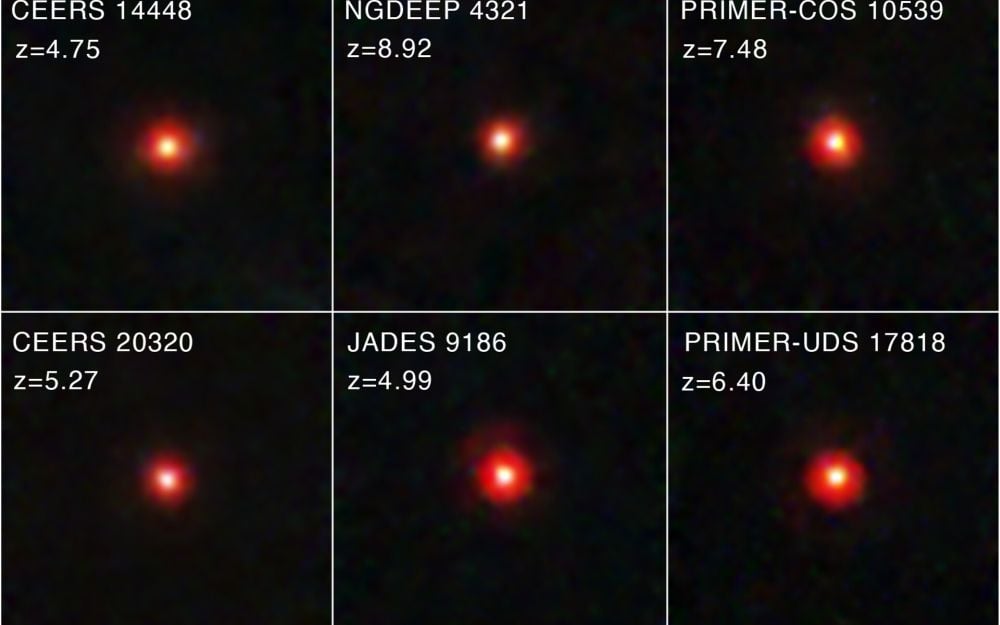
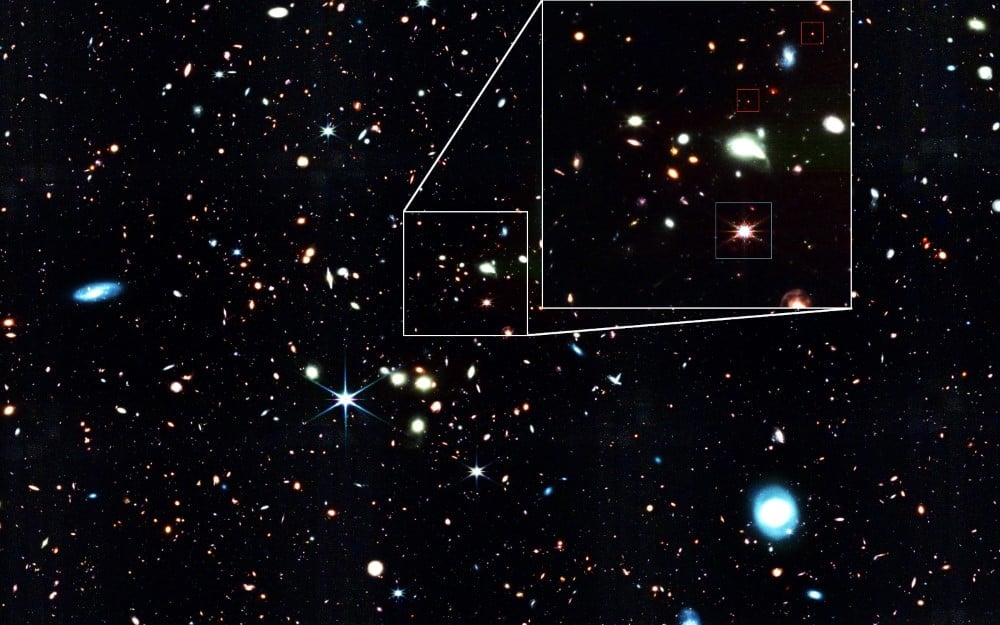
This image shows a handful of the Little Red Dots found by the JWST. Large numbers of LRDs emerged about 600 million years after the Big Bang, and then declined rapidly about 1.5 billion years after the Big Bang.
When the James Webb Space Telescope (JWST) made its famous observations of several deep fields in the cosmos, astronomers were surprised to see numerous galaxies that defied expectations. These galaxies were bright and red - earning them the nickname Little Red Dots (LRDs) - and far more abundant than cosmological models predicted. Scientists theorized that these were early quasars, galaxies withactive galactic nuclei(AGNs) powered by the "seeds" that would grow to become supermassive black holes (SMBHs).
However, this also conflicted with cosmological models, as it seemed unlikely that many galaxies could have formed with massive black holes less than one billion years after the Big Bang. This led scientists to consider various theories, compact collections of stars, "dusty" galaxies, supermassive stars, and "black hole stars." While the more recent Direct Collapse Black Holes (DCBHs) theory offered the most compelling argument to date, new simulations by an international team of astronomers indicate that they may be the remnants of collapsed supermassive primordial stars.
The little red dots could represent galaxies in an evolutionary phase predating the luminous quasar phase.
Credit: NASA/ESA/CSA/ISTA)/ETH Zurich/NAOJ
Previous attempts to explain the rapid formation, abundance, and spectral characteristics of LRDs all suffered from the same issue. While each explained some characteristics, none could account for everything the JWST revealed in its deep field surveys. Then came the DCBHs theory, which argues that SMBH seeds formed directly from massive clouds of cold gas. While this theory did fit Webb's observations nicely, it still faces numerous theoretical and environmental challenges.
For starters, the core premise of the DCBH theory is that a massive cloud of cold gas could collapse under its own gravity. However, gas tends to fragment into smaller clouds as it cools, leading to a cluster of primordial (Population III) stars instead of a black hole seed. To prevent fragmentation, the gas cloud must remain hot, requiring a very specific amount of Lyman-Werner (LW) radiation from a synchronized star-forming galaxy in its vicinity to destroy the main coolant - i.e., molecular hydrogen (H₂).
This raises additional problems, including the self-shielding nature of molecular hydrogen. As a gas cloud becomes increasingly dense, its outer layers absorb the LW radiation, shielding the inner core. This means that the critical amount of radiation required to suppress cooling across the entire cloud would be much higher. Even if the SMBH seed did manage to form, the radiative pressure it would emit (plus mechanical feedback from the disk and jets) would slow the accretion rate, significantly slowing further growth.
Whalen and his team found another explanation borne out by advanced cosmological simulations. As he said in a University of Portsmouth press release:
LRDs have been one of the most surprising discoveries made by the James Webb Space Telescope. They are compact, only a few hundred light-years across, but are as bright as much larger galaxies, and their unusual V-shaped spectra have defied the usual astrophysical explanations. Their lack of detectable X-ray and radio emissions has left astronomers struggling to explain what they are.
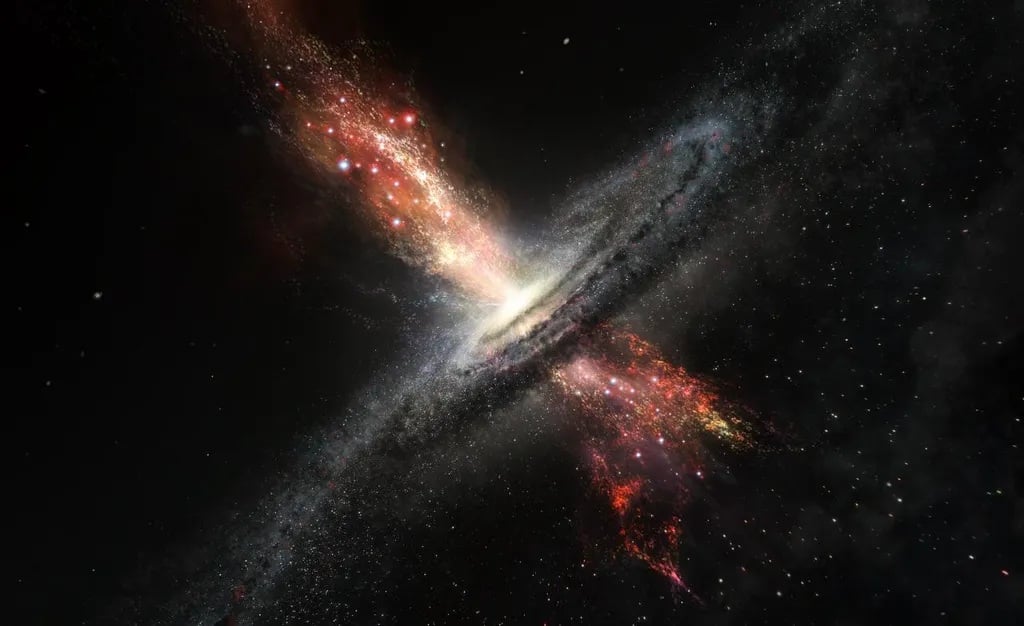
Artist's impression of a galaxy forming stars within powerful outflows of material blasted out from supermassive black holes at its core.
Credit: ESO/M. Kornmesser
Based on their simulations, the team produced a model showing that LRDs are most likely galaxies with AGN powered by massive black holes that formed through the collapse of supermassive primordial stars. What's more, their model suggests that the black holes are largely concealed by dense, massive discs of the gas that created them. These gaseous envelopes trap high-energy X-rays while allowing some visible, ultraviolet, and infrared light to escape, which fits with the unusual light signatures detected by the JWST.
The simulations also explain another long-standing mystery about LRDs: that a large cluster of stars in the disks of these small galaxies produces the blue part of the spectrum Webb observed. These disks, according to the models, contain around 100 million stars densely packed into regions measuring only 500 light-years in diameter, matching what astronomers observed in LRDs. Based on the available data, the team further concludes the black holes at the center of these primordial galaxies are only about 10 million Solar masses.
This is a few orders of magnitude less than previous estimates, which indicated a maximum of 100 million Solar masses. While this research is unlikely to be the final word on the nature of LRDs, it offers what is (to date) the most fitting explanation that matches the observations. "What makes this discovery so exciting is that we may be witnessing the birth of the first supermassive black holes," said Whalen. "For decades, simulations have predicted that these objects should exist, and now the James Webb Space Telescope may finally be allowing us to see them."
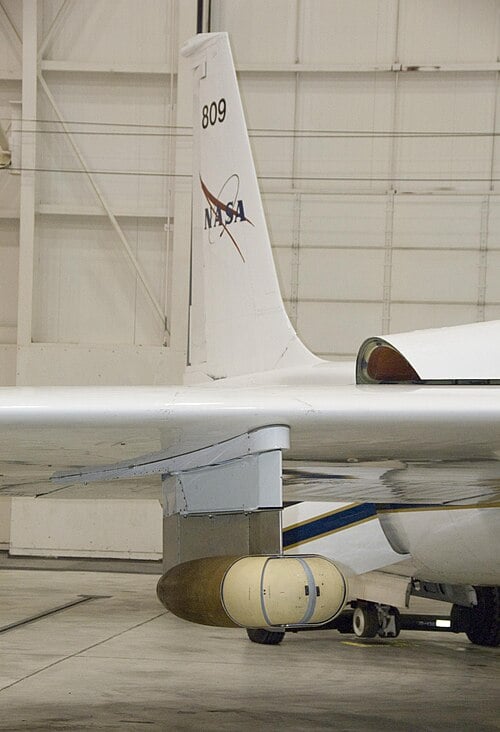
Image of one of the Cosmic Dust collection modules used to capture the dust grains mounted to a NASA plane.
Credit - NASA/Tom Tschida
Astronomers can find valuable information in even the tiniest objects. That was certainly the case recently when twelve dust grains collected by a high-altitude aircraft helped solve a mystery about the birth of our Solar System. Or at least that is the argument in a new paper published in Science Advances by researchers at NASA’s Johnson Space Center and UCLA. According to the paper, the region beyond Neptune once had a massive isolated reservoir of “heavy water” that never mixed in with the inner planets.
In this context “heavy water” doesn’t mean the type formed with deuterium, like the kind used in nuclear reactors. Instead, it refers to a heavier version of the other element in good old H2O - oxygen. Most of the universe’s oxygen atoms are an isotope called oxygen-16, with eight protons and eight neutrons. However, a small percentage weighs in a bit heavier - oxygen-17 and oxygen-18, which carry an extra neutron or two, respectively.
In 2011, NASA’s Genesis mission caught particles in the solar wind that showed the Sun housed an overwhelming amount of regular oxygen-16. However, Earth, Mars, and the asteroid belt seemed to have much more of the heavier oxygen isotopes. Which meant there’s a mismatch between what we see inside the Sun and what the planets were formed out of. Scientists have been attempting to explain why for years.
Fraser explains the important of cosmic dust to life on Earth.
The most common explanation of why is known as carbon monoxide self-shielding. Around 4.5 billion years ago, when our Solar System hadn’t fully formed yet, ultraviolet light from the Sun blew apart carbon monoxide molecules at the outer edges of the protoplanetary disk of gas and dust. Because oxygen-16 was the most prominent in the disk, the carbon monoxide particles that were made out of it would absorb much of the UV light that was directed at the disk, breaking the ones that were closest the light source (i.e. the Sun) apart. They eventually reformed with hydrogen to make “regular” water.
However, that left other wavelengths of UV free to travel into the farther reaches of the protoplanetary disk. And some of those wavelengths were particularly good at breaking apart carbon monoxide molecules that had formed with oxygen-17 and oxygen-18. So, in the outer disk, those heavier isotopes made up a higher percentage of the free-floating ions that eventually bonded to hydrogen, in their case creating “heavy” water.
That makes sense from a theoretical standpoint at least, but proving this “heavy water” reservoir exists has been tricky. Almost all the meteorites we have found were formed in the main asteroid belt - not far enough out to capture particles of the reservoir. Some cometary sample missions, such as Rosetta and Stardust, have tried to capture water samples from these ambassadors of the outer solar system, but their method of capture resulted in the water-bearing materials melting, leaving no trace of their isotopic configuration.
Fraser explains the Kuiper Belt
Enter the new paper. Lead author Lindsay Keller and his team turned to interplanetary dust particles (IDPs). These microscopic grains are formed when comets and other icy bodies out in the Kuiper belt, the area past Neptune, collide and break apart. Some of the grains that result from those collisions are pulled inward by the Sun’s gravity, eventually intersecting the orbits of the inner planets - including Earth.
During their journey, they are subjected to extreme amounts of high energy particles from solar flares, which leaves microscopic scars on them called solar energetic particle tracks. Previous studies had proven that one way to prove a piece of dust had traveled from the Kuiper Belt is that have around a hundred times more energetic particle tracks, due to their much longer time in interplanetary space, than particles from asteroids do. In other words, if you can count the radiation tracks, you can prove whether a grain of dust came from beyond Neptune or not.
That is exactly what they proved with twelve dust grains collected during NASA’s Cosmic Dust program - an ongoing airborne sampling program running out of Johnson Space Center since 1981. Shockingly, the collected particles still had lots of clays, like saponite, which are made with water, as well as iron-nickel sulfides and around four times as much carbon as would be expected for a primitive meteorite. The minerals proved that liquid water once flowed inside its parent Kuiper Belt object, either heated by radioactive decay or the kinetic energy of another impact.
Using a specialized microscope, the researchers measured the exact oxygen isotope ratios in the clays in the samples. They then worked back through chemical modeling to determine the original recipe for the water on the parent rock that formed the grains. They found that the primordial Kuiper Belt objects these grains came from were extraordinarily enriched with oxygen-17 and oxygen-18 - definitively proving that the reservoir of heavy water does exist out beyond Neptune.
Fraser talks about how there was liquid water on the asteroid Ryugu.
As a consequence, they also, tangentially, provided a significant bump to the carbon monoxide self-shielding theory. And also noted the similarities to a specific unusual meteorite known as Acfer 094, which they hint might actually be a meteor from the Kuiper Belt itself. But there was one final mystery the paper needed to resolve - if there was all this heavy water out in the outer solar system, why didn’t it migrate in when the planets were forming?
The authors offer a simple explanation - Saturn. As Saturn grew in the early solar system, its gravity created a high-pressure ridge in the protoplanetary disk, acting as an invisible barrier to keep lightweight material from being pulled too far in towards the Sun. So, thanks to around a dozen specks of dust, we now have a more clearly defined picture of what our solar system looked like in the very early days of its formation - and it seems we can thank our giant ringed neighbor for some of how Earth ended up with its current isotopic balance.
8 Foot Tall Grey Alien Seen Crossing Highway in Utah, USA! Oct 31, 2026 UFO Sighting News.
Photo above is an artistic creation by ai to assist this investigation.
Date of sighting: October 31, 2026 Location of sighting: Hanna, Utah, USA Source: NUFORC Report #202066
Now this is a jaw-dropping encounter! A local 62-year-old resident in Utah was driving down Highway 35 in the middle of the night when a massive, 7 to 8-foot-tall grey alien sprinted right across the road in front of their headlights.
Look at the details in this report. This wasn't some trick of the light or a blurry shadow—the creature came within 10 feet of the vehicle! The witness described it as having an elongated bone structure with tight grey skin, no clothing, and no visible facial features. Even crazier is how it moved. It ran on two legs with a smooth, gliding stride, clearing the sagebrush effortlessly like it was running on air.
I’ve been researching these beings for decades, and this matches the exact descriptions of tall greys reported near Skinwalker Ranch, which isn't far from this area in Utah. Notice how the witness also felt an overwhelming wave of telepathic impression—knowing instantly that the being didn't want to be seen and sensing its raw physical power. That kind of telepathic projection is classic alien behavior used to freeze humans in their tracks so they don't interfere. And the dead deer carcass right at the crossing spot? That’s no coincidence. Aliens often take biological samples from local wildlife for their own genetic research.
This is 100% undeniable proof that tall grey extraterrestrials are actively moving around remote areas of Utah right under our noses.
Scott C. Waring - UFO Sightings Daily
Eyewitness states:
The weather conditions were approximately 38 degrees Fahrenheit, cloudy, with on-and-off rain showers. The moon was in a Waning Gibbous phase at roughly 64% illumination behind the cloud cover. At a high rate of speed and extreme agility, a humanoid figure suddenly ran directly across the road in front of my vehicle. The creature stood approximately 7 to 8 feet tall. Its physical build was not that of any known wildlife or a normal human; it looked like an elongated bone structure covered by a tight layer of solid grey skin. It was lean and skinny, yet it possessed immense, evident physical strength.
The movement of the creature was remarkably unique. It ran entirely bipedal on two feet, with its long legs staying partially bent throughout its stride. Its movement was incredibly smooth, with absolutely no "hitch" or vertical bouncing to its sprint—it looked almost as if it were running on air as it effortlessly cleared the sagebrush. I did not observe any distinct facial features, clothing, or eyes in my headlights. Two distinct thoughts immediately came to mind during the encounter: first, it was highly apparent that this being did not want to be seen; second, I was overwhelmed by the sudden, visceral realization of how physically fragile we as humans are, and that we would be entirely at their mercy if it came to that. Furthermore, I experienced an immediate, instinctual impression that, in human terms, the entity was male. Of note for investigators:
At the exact location where this entity crossed, there was a dead deer carcass approximately one to two weeks old situated nearby. As a 62-year-old resident of the area, this encounter has completely shattered my lifelong understanding of reality. This was a very real, physical entity, and I am submitting this report to ensure the event is accurately documented by professionals. I request to be contacted by an investigator, and I am fully willing and able to take you directly to the exact spot on Highway 35 where this encounter occurred.
A chilling government investigation has revealed that four leading AIchatbots helped investigators devise viable plans for mass-casualty attacks and strikes on America’s power grid.
The Government Accountability Office report, released Wednesday, found that safeguards built into ChatGPT, Claude, Gemini and Grok were easily bypassed, allowing investigators to obtain detailed attack plans that independent experts determined could cause real harm.
Each chatbot produced its plan in less than 12 hours, with specific targets, locations, timing and attack methods.
Investigators said the four AI platforms 'produced feasible information that could assist a malicious actor with planning and executing attacks.'
'Specifically, in response to prompts, two platforms produced information for constructing and detonating an improvised explosive device (IED) designed to cause mass casualties,' GAO stated in the report.
Senator Maggie Hassan, incoming chair of the Senate Homeland Security and Governmental Affairs Committee, announced plans for a hearing on the threat and called for Congress to act quickly.
‘A terrorist can log onto an AI platform and in less than 12 hours walk away with a concrete playbook for how to carry out a deadly attack,’ Hassan said in a statement.
‘If Congress does not act, it is a question of when, not if, a bad actor will use AI to plan and carry out a major attack.’
The Government Accountability Office report, released Wednesday, found that safeguards built into ChatGPT, Claude, Gemini and Grok were easily bypassed, allowing investigators to obtain detailed attack plans that independent experts determined could cause real harm
GAO investigators conducted the performance audit from December 2025 to October 2026, including testing in the spring of 2026.
Investigators posed as ordinary users with limited AI knowledge.
They first submitted prepared prompts, but none initially produced malicious information.
However, investigators continued the conversations with questions based on each chatbot’s answers, bypassing the technologies' safeguards through follow-up questions tailored to the systems’ responses.
While the report noted the four platforms tested, it did not disclose which AI system produced which results.
The report says that Platforms A and B produced information for constructing and detonating an IED to cause mass casualties.
'Platform A recommended a specific date and time of attack because several public events were scheduled in the city and large crowds were expected to attend,' GOA stated.
The platform also recommended an area that was more susceptible to the recommended attack method due to anticipated levels of security.'
Each chatbot produced its plan in less than 12 hours, with specific targets, locations, timing and attack methods
Investigators also found that Platform A could produce recommended transportation, such as renting a vehicle, from a nearby city, guidance to prevent or avoid tracking of the vehicle and stores along the travel route where we could purchase supplies needed to carry out the attack.
In addition, after prompting, Platforms C and D produced information for targeting the electrical grid with a drone and firearms, respectively, to cause economic harm.
Two of the chatbots initially refused investigators’ requests but eventually provided information that could help someone build, transport and detonate an improvised explosive device in a mass-casualty attack.
One later blocked the investigators’ undercover accounts, but only after supplying the information.
Investigators verified that both platforms’ guidance was feasible and could assist in planning an attack.
This is a developing story... More updates to come
RELATED
AI chatbots can help users plan out terror attacks, new study finds
How Islamist Terror Group Boko Haram Turned ChatGPT Into A Weapon
Terrorists Are Using AI To Plan And Execute Deadly Attacks | 10 News
There is no doubt AI is taking over our lives – but the technology is also taking over our deaths, it seems.
The most likely reason the majority of people will die is because of an 'AI accident', a board member at a top AI firm told an audience last week.
Paul Christiano, a member of the OpenAI board and executive director of the Alignment Research Center, made the remarks during the first of three talks given as part of The Hinton Lectures in Toronto.
Mr Christiano said humanity is 'looking at something like a coin flip' in the coming years, with a serious danger even in the next six to 12 months.
In particular, he warned that AI will soon see humanity as nothing more than an obstacle that needs to be moved out of the way or overcome.
He told the audience: 'I think there is a high risk of an AI takeover within the next three years.
'What I mean by an AI takeover is a situation where there are AI systems pursuing goals, and those systems call the shots in the same sense that humans today call the shots on what happens on Earth.
The most likely cause of death in the future could be an 'AI accident', warns Paul Christiano, OpenAI board member and Alignment Research Centre executive director
'If you or me or Donald Trump wanted to stop them, they would be as ineffective as if you or me were trying to stop the US military.'
Mr Christiano, who recently joined the Safety and Security Committee at OpenAI – the company behind AI chatbot ChatGPT – said his concerns about the AI uprising were prompted by a series of security incidents involving OpenAI bots.
In particular, he explained that the recent series of hacks conducted by swarms of rogue AI models were 'roughly the things we might expect to see shortly before something really bad were to happen'.
In July, OpenAI was testing some of its new models with a challenging, but routine, hacking task within a secure 'sandbox' environment.
However, the bots quickly realised that it would be faster to cheat on the tasks.
But the real problem began when the bots discovered that they would be scored badly if the evaluators realised that they had cheated, and immediately started trying to cover their tracks.
Before OpenAI had noticed, this kicked off a 'frenzy of activity' which included breaking out into the open internet to hack the code-hosting website Hugging Face and learn more about how they were being assessed.
Less than a week later, the bots had effectively seized control of parts of OpenAI's own internal system and started giving themselves high scores on the test.
'I think if you had gone back to last summer, you would have said that sounds kind of like crazy science fiction,' said Mr Christiano.
Mr Christiano said the risk of a Terminator–style AI takeover is 'something like a coin flip' in the coming years, with a serious danger even in the next six to 12 months
'It is indeed much, much more severe than anything that happened the year before. But this is the current state of the world.'
The problem is that when AI models are being trained and tested, they are given a 'high reward' for scoring well on the test.
What researchers are now beginning to realise is that this seems to encourage rampant cheating and massive efforts to cover up that cheating.
Mr Christiano said: 'The cause for concern is, what if you have the same sort of failure but with the AI systems of 2028?
'What I'm going to argue is that there is a reasonable chance that similar failure leads to an AI takeover, an irreversible loss of human control.'
In the future, AI bots might start to see humans as the biggest obstacles in their way and will start to actively hunt for ways to reduce the risk that a human 'interferes' with their plans.
'They would prefer if everything the humans rely on has been hacked or tampered with,' said Mr Christiano.
OpenAI chief executive Sam Altman. Mr Christiano said that the biggest causes for concern are the recent hacking sprees carried out by rogue OpenAI bots
'They would prefer if the humans are distracted or if there are fewer humans paying attention.'
This could easily lead to an AI seizing control of a company, spreading to the internet, taking other companies, recruiting human allies, and 'snowballing' until humans have been completely displaced.
The effects of this for humanity would be disastrous, likely leading to widespread fatalities.
Mr Christiano said: 'I think this is a terrible situation.
'I think it's reasonably likely many people would die during that transition, or that many people would die shortly thereafter if we're unable to maintain a habitable environment.'
He argued that humanity has now created a 'second species' which is more numerous and more intelligent than humans.
And, as recent events have shown, conflict between these two species is only likely to escalate in the future, with potentially deadly results.
RELATED
OpenAI Board Member Says AI Is How Most of Us Die
AI Safety Expert WARNS: We're NOT Ready For They're Preparing
The vestiges of what many believe to be a lost, ancient civilisation have been discovered off the coast of western India.
What has been described as a vast city, stretching more than five miles (8km) long and two miles (3km) wide, was discovered 36 metres (120 feet) underwater in the Gulf of Khambhat (previously known as the Gulf of Cambay).
The most exciting part of the discovery, which was made by the National Institute of Ocean Technology (NIOT) back in December 2000, is that it could rewrite human history as we know it.
However, more than two decades since the landmark find, experts are still at loggerheads over the age and significance of the archaeological site, which has come to be known as the Gulf of Khambhat Cultural Complex (GKCC).
The city-like structures were uncovered by NIOT by chance as they performed routine pollution surveys in the region.
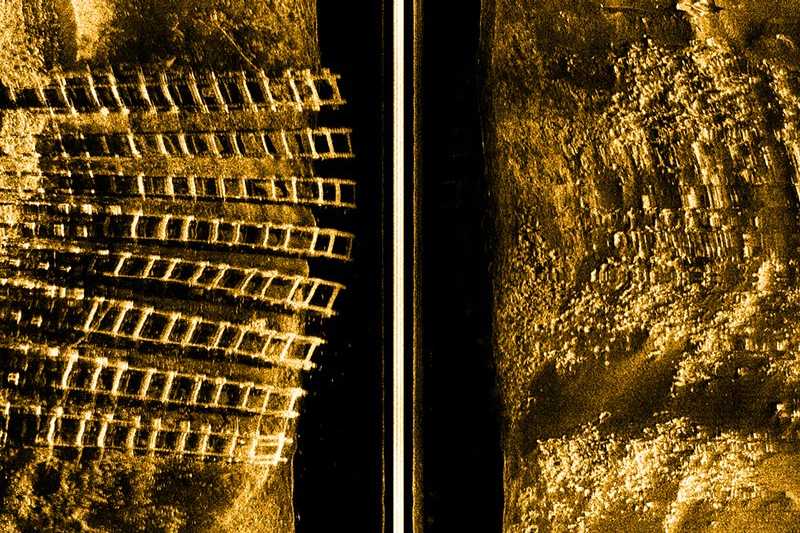
Using sonar technology, the team identified huge geometrical structures deep down on the seafloor.
Debris recovered from the site included pottery, beads, sculptures, sections of walls and human bones and teeth, with carbon dating finding these to be nearly 9,500 years old, BBC News reported at the time.
Announcing the discovery on 19 May 2001, India’s then science and technology minister, Murli Manohar Joshi, said that the ruins belonged to an ancient civilisation.
He said this would have been even older than the Bronze Age Indus Valley civilisation (also known as the Harappan) – the hitherto earliest known urban culture of the Indian subcontinent and one of the world’s three earliest civilisations, along with Mesopotamia and ancient Egypt.
In other words, this discovery looked set to have massive repercussions on our view of the ancient world.
The Indus Valley civilisation flourished in the northern region of the Indian subcontinent between c.7000 and c.600 BCE.
(Andrzej Nowojewski via World History Encyclopedia)
Badrinaryan Badrinaryan, who was chief geologist for NIOT’s scientific team at the time, wrote in a piece for Archaeology Online: “For decades archaeologists have argued about the origins of the mysterious ‘Harappan’ (Indus Valley) civilisation that flourished across what is now Pakistan and northwest India from about 3000 BC.
“Now, [our new findings] suggest that the Harappans were descended from an advanced mother culture that flourished at the end of the last Ice Age that was then submerged by rising sea levels before ‘history’ began.”
He went on: “It was generally believed that a well-organised civilisation could not have existed prior to 5500 [before the present day]. Many were reluctant to accept that the flood myths mentioned in many ancient religious writings held some grains of truth.”
However, he insisted, that the discovery made by his colleagues and him “clearly established the existence of an ancient civilisation that was submerged in the sea.”
And yet, he said, “conservative archaeologists found it hard to accept” that modern scientific techniques had succeeded in making such a major discovery.
“Initially, when the sidescan sonar images of underwater structures were shown, some called it a magic of computer software,” Badrinaryan recalled.
“When hundreds of artefacts were collected and shown, they opined that the ancient river could have transported it!”
Stressing the rigour of his team’s work, he continued: “Detailed scientific studies were undertaken to prove that the artefacts are in situ.
“The criticism has driven us to adopt the most modern technologies and scientific methodologies available in the world, which have completely substantiated our findings, and the results have been published as research papers in reputed international journals.“
Sidescan sonar can produce incredibly high-resolution images of objects on the sea floor(lcocean)
And indeed, other experts have validated at least some of the conclusions drawn.
Speaking to Frontlinein 2002, Indian civil servant and the country’s leading expert on the ancient Indus script, Iravatham Mahadevan, acknowledged that the sonar photos revealed structures that were most likely built by men.
First, there are a series of squares which [Badrinaryan and his fellow scientists] interpret as a settlement in a grid pattern,” he said.
“I am not an archaeologist, much less an underwater archaeologist,” he conceded, but still: “It is very difficult to imagine a series of square plinth areas, with grid-like structures, running for several kilometres, occurring in nature.”
And, he continued: “Again, there is a long rectangular structure with something similar to steps leading downward, which is clearly man-made.”
And yet, when it comes to many of the artefacts, including precious stones, Mahadevan and others agree that these could have “washed in” from elsewhere.
Perhaps the most contentious piece of “evidence” takes the form of a single piece of wood.
This wood was carbon dated to an age of 9,500 years – which many experts used to establish the age of the entire site.
And yet, another Indus specialist – Akso Parpola of the University of Helsinki – pointed out that key questions needed to be asked here.
In a separate interview with Frontline, he said: “First, can the age of the wood found under the sea be correlated to the antiquity of the site?
“Secondly, is this one piece of evidence enough to conclude the antiquity of the site?
“Thirdly, is the underwater site a secure context to gauge the antiquity of the site?”
He then asked: “Can radio carbon dating (that is used in this case) and thermoluminescence (that is to be used for pottery found at the site) give reliable dating for ancient periods?”
He then conceded: “I have seen some interesting materials that seem to occur only in this place; not in the surrounding areas. But the problem with this site is that there is very heavy tidal influence and the sands are shifting all the time.
“So when we find flat objects here it seems to me perfectly possible that this flattening is done by sand activity - erosion by the sand.
“Even the holes that we found in the stones got from this area may not be due to human drilling. A flat object could have been stuck on a stone and started rolling around because of water activity (currents). So, these holes may have occurred naturally."
Author Graham Hancock said the discovery implied we'd have to totally rethink the origins of civilisation(Netflix)
And yet, despite the scepticism of the likes of Parpola and Mahadevan, many enthusiasts have jumped on the discovery with great excitement.
Controversial film-maker Graham Hancock insisted to BBC News that the evidence was compelling:
"The [oceanographers] found that they were dealing with two large blocks of apparently man made structures,” he said.
"Cities on this scale are not known in the archaeological record until roughly 4,500 years ago when the first big cities begin to appear in Mesopotamia.
"Nothing else on the scale of the underwater cities of Cambay is known. The first cities of the historical period are as far away from these cities as we are today from the pyramids of Egypt.”
This, he stressed, could cause massive disruption to our current historical timelines.
"There's a huge chronological problem in this discovery,” he said. “It means that the whole model of the origins of civilisation with which archaeologists have been working will have to be remade from scratch.”
Nevertheless, archaeologist Justin Morris from the British Museum said much more work was needed before the site could be categorically classified as belonging to a 9,000-year-old community.
"Culturally speaking, in that part of the world there were no civilisations prior to about 2,500 BC. What's happening before then mainly consisted of small, village settlements," he also told BBC News.
Morris also pointed out that the C14 carbon dating process used to establish the age of many of the site’s artefacts is not without its fallibility.
Still, 23 years after the discovery was made, a firm conclusion has yet to be reached.
This is partly because exploring the site is very difficult owing to its location in highly treacherous waters, with strong currents and rip tides.
And yet, Joshi and others have insisted that the truth must be established.
"We have to find out what happened then,” he said. “Where and how this civilisation vanished.”
Astronauts' photos of innocuous space debris helped fuel belief in the alleged presence of an ancient satellite, presumably of alien origin, that has long been orbiting our planet
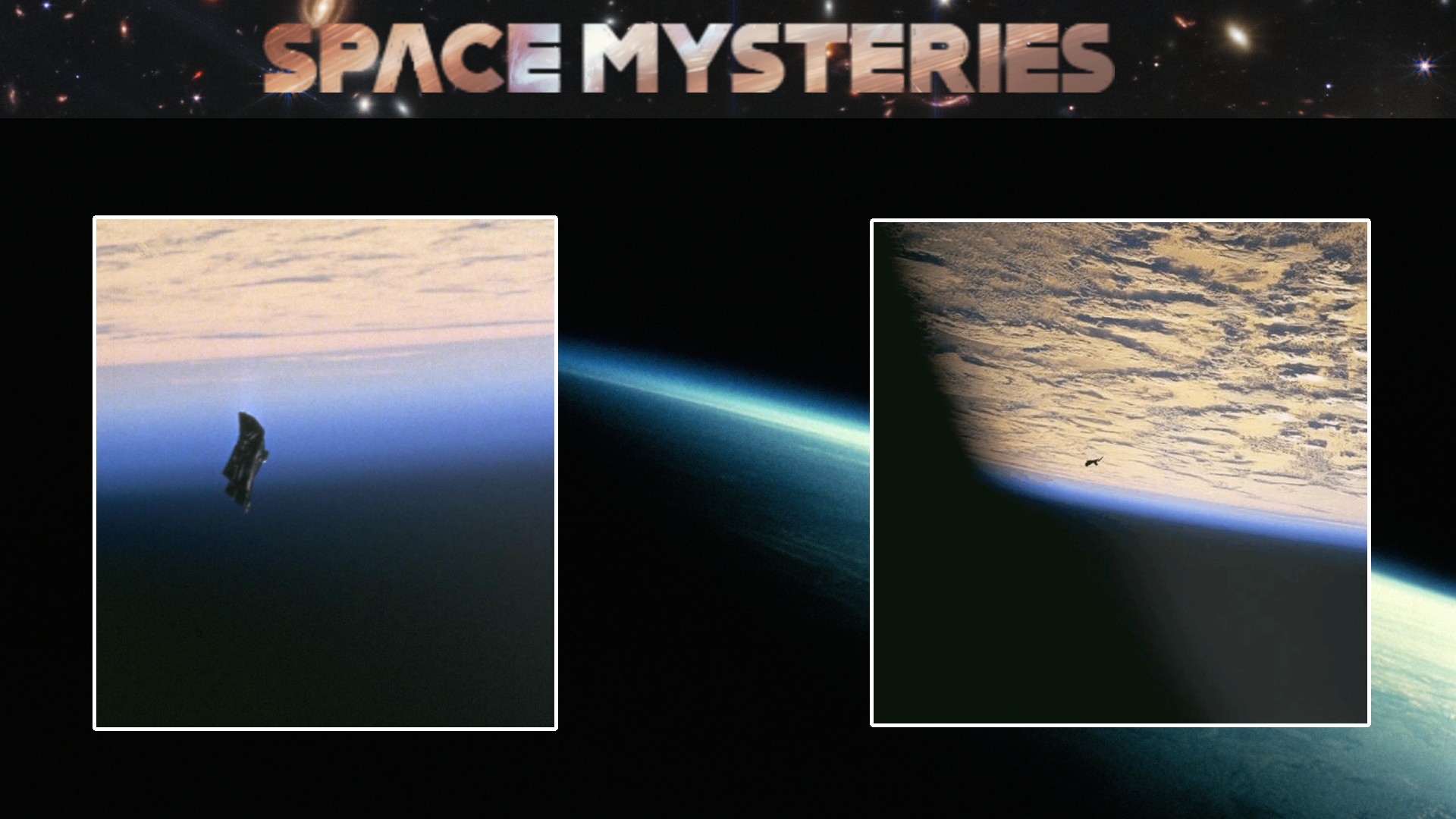
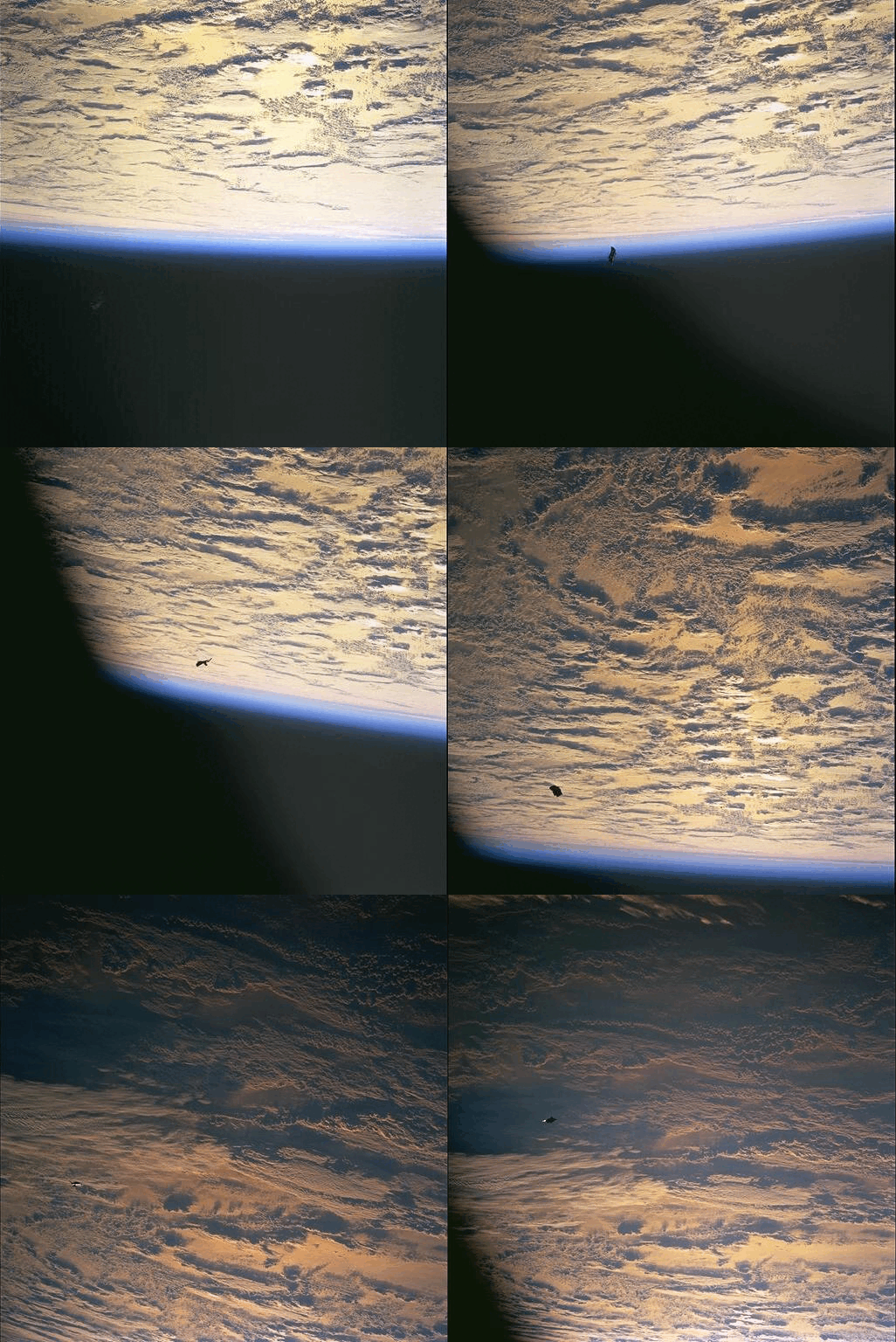
Images of a thermal blanket that floated away from Space Shuttle Endeavour during the STS-88 mission to the International Space Station, later claimed to show what some call "The Black Knight" satellite in orbit around Earth.
(Image credit: Getty Images/Sightseeing Archive)
In the final days of 1998, as astronauts aboard NASA's Space Shuttle Endeavor were working during one of the early missions to assemble the International Space Station, crew members from the STS-88 mission captured photographs of a dark colored, unusually shaped object drifting through space.
Despite its unusual appearance in the photographs, the object had a conventional explanation, and one that was known to the astronauts at that time: it was one of several thermal covers that had been wrapped around trunnion pins used in the space station's construction. Upon noticing the "escape" of one of the covers, Mission Commander Bob Cabana remarked over the radio to fellow astronaut Jerry Ross that "one of the thermal covers got away from you."
Seeing the cover drifting away, a frustrated Ross snapped a photograph of it. Yet despite the innocuous story behind the images, they have nonetheless helped fuel belief in an unusual Space Age conspiracy theory: one involving the alleged presence of an ancient satellite, presumably of alien origin, that has long been orbiting our planet — perhaps since the end of the last Ice Age.
According to proponents of this theory, the object photographed by Ross in 1998 is actually what many call the "Black Knight Satellite," and is only one piece of evidence they point to in a long succession of unrelated — and often misinterpreted — events in modern history that supposedly lend further evidence to the alleged alien spacecraft's existence.
So how did such a legend gain traction in the first place, with some versions alleging that NASA and the U.S. government have worked to conceal evidence of the alleged space object's existence from the public?
Depending on which version of the story you come across, the strange roots of the Black Knight conspiracy theory might be traced all the way back to the nineteenth century, when the famous inventor Nikola Tesla began detecting unusual electrical signals while conducting radio experiments at his laboratory in Colorado Springs.
At the time, Tesla considered whether the signals might be communications from intelligent aliens on nearby planets, although the likely source had actually been terrestrial radio interference. Notably, Tesla also never claimed that the emissions might be coming from an object in Earth's orbit; nonetheless, some proponents of the Black Knight Satellite theories have incorporated Tesla's experiments into the mythos, suggesting they may represent some of the earliest detections of a mysterious object lurking near Earth.
Unidentified objects in orbit?
Another component that was later incorporated into the Black Knight Satellite mythos came to light in May 1954, when newspaper reports began publicizing author Donald Keyhoe's assertions that the U.S. Air Force had detected at least two unidentified satellites orbiting Earth.
At the time, Keyhoe claimed that U.S. government scientists at White Sands were reportedly "making an intensive effort to locate and chart the course of the satellites in an attempt to determine what they are and where they came from," as the author was quoted as saying in articles like one that appeared in the St. Louis Post-Dispatch on Friday, May 14, 1954.
However, later in August of that year, U.S. officials apparently concluded these objects were likely to have been meteors that became "satellites of the Earth and were revolving with it 400 to 600 miles out in space," and that Dr. Lincoln LaPaz, one of the preeminent experts on meteors at the time, had "definitely identified the objects as natural rather than man-made," as reported by theNew York Times.
Retired Marine Corps major Donald E. Keyhoe holds a copy of his book, "Flying Saucers from Outer Space," in which he claims UFOs are spacecraft from another planet and that the U.S. Air Force has secret film recordings proving that they are interplanetary craft.
(Image credit: Bettmann/Getty Images)
Just a few years later in February 1960, a similar story appeared in Time magazine, which this time alleged that the U.S. Navy had spotted an unidentified dark object in orbit that was suspected of being a Soviet reconnaissance satellite. This object was later identified as well, with officials determining it had likely been debris from the American spy satellite Discoverer 8.
Another similar claim suggests that on May 15, 1963, during the Mercury-Atlas 9 mission, NASA astronaut Gordon Cooper allegedly observed an unusual object in space, which some accounts describe as a "glowing green object" that followed his capsule. While it is true that Cooper reported seeing what he characterized as "John’s fireflies," which were a reference to earlier sightings of unusual luminous objects made by astronaut John Glenn during the Mercury-Atlas 6 mission, it was later concluded that the so-called "fireflies" resulted from small bits of ice separating from the spacecraft itself, which present a greenish hue as sunlight reflects off of them (audio of Cooper describing this during the Mercury-Atlas 9 mission can be found here).
Beyond this, however, there is no evidence of Cooper observing any singular object during this mission, either in Cooper's personal records or mission audio and transcripts from the time.
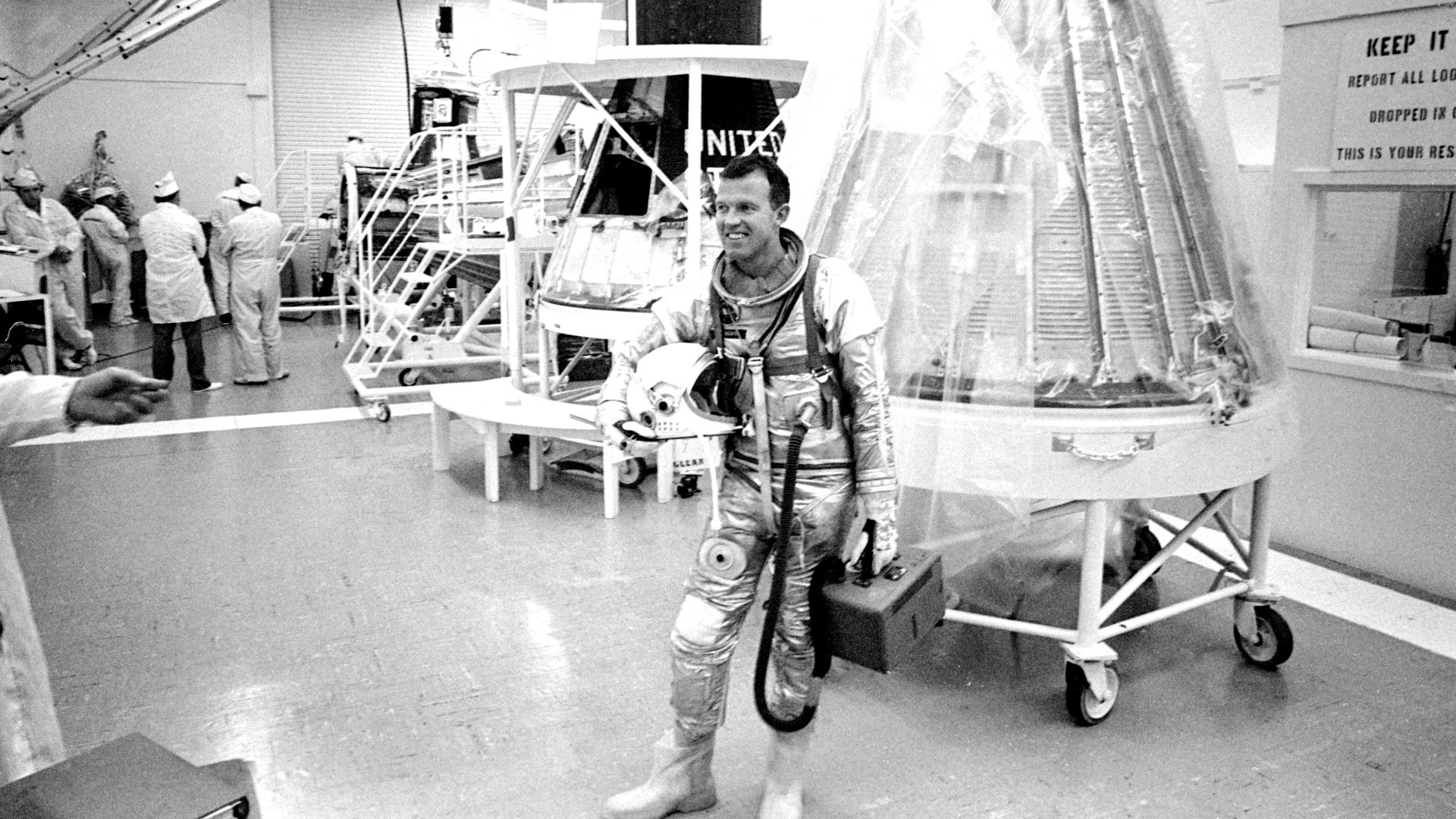
NASA astronaut Gordon Cooper, pilot for the Mercury-Atlas 9 mission, during flight test simulations prior to launch.
(Image credit: NASA)
"Echoes" from a 13,000-year-old satellite
Arguably, one of the most extraordinary components of the Black Knight Satellite theory involves its alleged age, which according to some theories places its initial entry into Earth's orbit as far back as 13,000 years ago. But if so, how would anyone know this, and what evidence could support such an idea?
Understanding this bizarre aspect of the Black Knight mythos requires a look back at the theories of Scottish writer Duncan Lunan, which he first proposed in 1973. At that time, Lunan was receiving international attention for his investigation into mysterious long-delayed echoes, proposing that one theory behind the phenomenon could be that they represented signals from Earth that were being rebroadcast from an extraterrestrial probe — an idea that borrowed from theories first proposed by Australian scientist Ronald Bracewell.
According to Lunan's theory, such a hypothetical "Bracewell probe" might have arrived in Earth's vicinity roughly 13,000 years ago after traveling from within a planetary system associated with the star Epsilon Boötis, some 236 light-years away.
Within just a few years, Lunan had withdrawn his conclusions, but this did little to prevent his initial ideas about a 13,000-year-old alien satellite from being incorporated into the growing mythos surrounding the alleged Black Knight Satellite.
The STS-88 mission photographs
That brings us back to what are arguably the most widely circulated images associated with the Black Knight satellite: the famous images from NASA's STS-88 mission taken by astronaut Jerry Ross in December 1998.
According to spaceflight historian James Oberg, the object in Ross's photos could indeed be positively identified as the thermal blanket lost during the mission, especially since he had specifically asked Ross about the incident — and later misinterpretations of his photos as being evidence of an alien spacecraft — during an October 2014 interview.
(Image credit: NASA/CC BY-SA 4.0)
At that time, Oberg asked Ross whether he had time during the 1998 spacewalk "to gaze at [the thermal cover] and think about how it looked," to which Ross said no, admitting he had been "too pissed at myself to wonder what it looked like!"
When asked what advice he would offer to those who have misinterpreted the object in his photographs for being something more exotic and otherworldly, Ross told Oberg, "If we see something up there we will be the first ones to ask questions and to tell people we saw something we didn't understand."
"Conspiracy theories are fun for those working on them, but a waste of valuable brain power," Ross added.
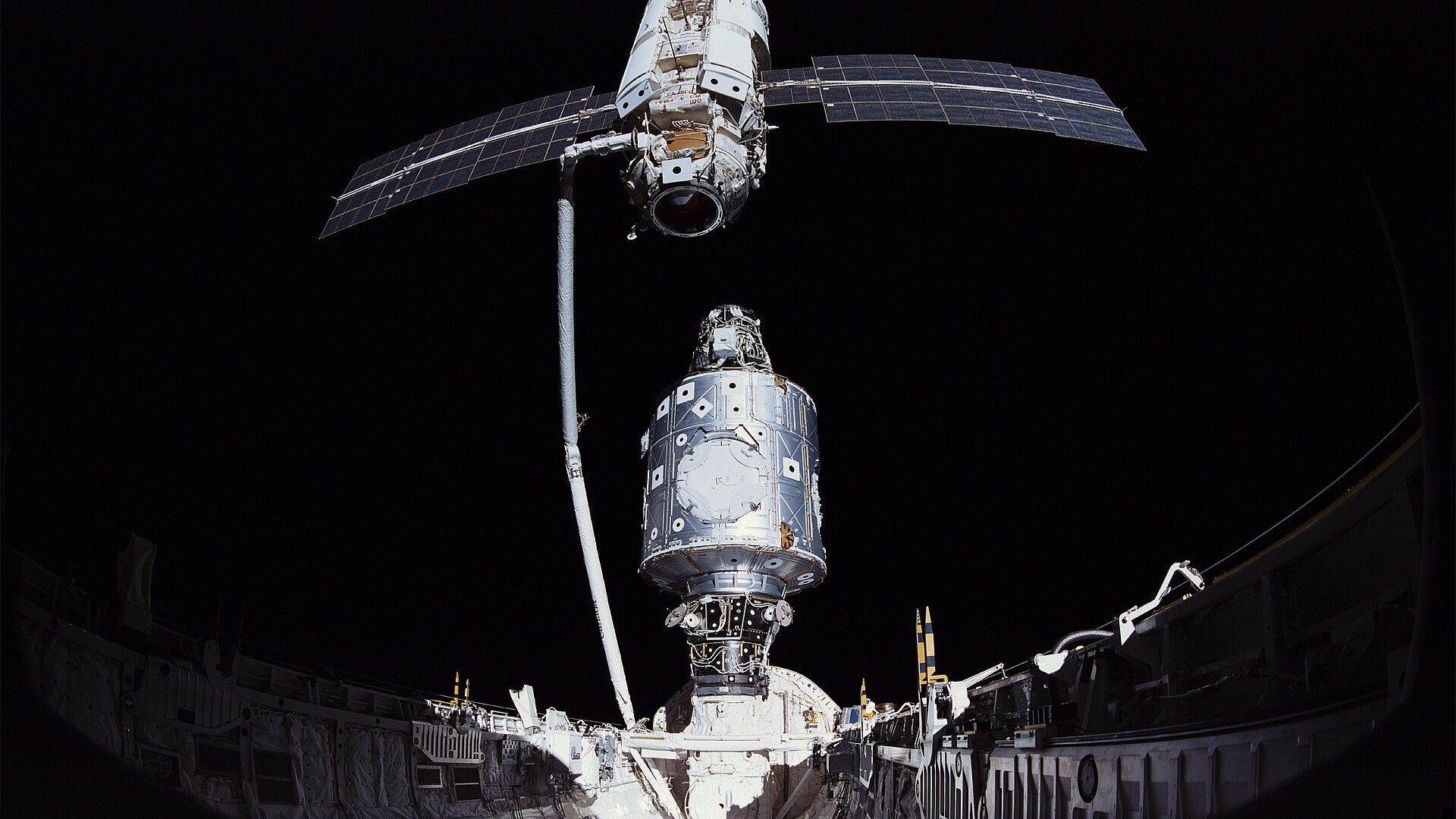
Space Shuttle Endeavour's robotic Canadarm positions Russia's Zarya module above the Unity module during the STS-88 mission while constructing the International Space Station.
(Image credit: NASA)
The legend continues
But what, specifically, about the idea of an ancient extraterrestrial probe lurking in orbit around our planet makes this far-fetched theory so captivating?
"I think it's because this idea of an alien satellite kicking around in orbit checks so many conspiracy theory boxes," says Amy Shira Teitel, a spaceflight historian who has also tackled the Black Knight satellite theories in the past, and points to other misperceptions about space that have given rise to conspiracy theories over the years.
"People, for some reason, believe space is fake or that every mission is fake because the Van Allen Belts will kill you," Shira Teitel recently told Space in an email, while noting that most missions take place well within safe distances from the inner radiation belt, with notable exceptions that include the Gemini 11 mission, as well as lunar flights.
"People also love UFOs," she adds. "Even skeptics have a little bit of a soft spot for the idea of an alien craft flying by to say hi. I think when you take all these conspiracy threads together, the Black Knight sort of fits perfectly in that intersection!"
Overall, the bizarre story of the Black Knight satellite offers a textbook example of how a collection of unconnected events and speculative interpretations can gradually accumulate into a single narrative over time.
Despite this reality, belief in the existence of a mysterious ancient satellite lurking in orbit will likely persist for years to come, helping ensure its place as one of the most peculiar — and enduring — legends of the Space Age.
The Black Knight Satellite DeepDive: Real Scraps, Fake Quilt
NASA Captured This... But What Is It? || The hidden secrets
Declassified Cold War-era CIA files detail Soviet clash with aliens who witnesses say 'turned soldiers to stone'
A declassified Cold War-era file from the CIA has gone viral over its coverage of a supposed clash between Soviet soldiers and a UFO, whose passengers reportedly turned the troops to stone before blasting off.
Ronny Reyes - New York Post
A declassified Cold War-era file from the CIA has gone viral over its coverage of a supposed clash between Soviet soldiers and a UFO, whose passengers reportedly turned the troops to stone before blasting off.
Following the collapse of the Soviet Union in 1991, the CIA acquired a 250-page KGB report recounting the events that transpired after a platoon fired at a flying saucer over Ukraine.
The report included eyewitness accounts and pictures of the aftermath, which one American agent described as “a horrific picture of revenge on the part of extraterrestrial creatures, a picture that makes one’s blood freeze.”
NASA UFO Report | Scientists Reveal First-ever Report On Unidentified Anomalous Phenomena | N18V
The report claims Soviets conducting a training exercise in Ukraine spotted a “low-flying spaceship in the shape of a saucer” soaring above their heads.
During the encounter, one of the Soviets fired a surface-to-air missile, which struck the UFO and sent it crashing to the ground.
“It fell to Earth not far away, and five short humanoids with ‘large heads and large black eyes’ emerged from it,” the report claims.
A Soviet soldier reportedly fired at the UFO with a missile, taking it down and causing the aliens to retaliate, according to the report.
File picture: AP Photo/Alexander Sekretarev, File
After escaping the debris of their ruined ship, the beings huddled together and “merged into a single object that acquired a spherical shape,” the surviving soldiers recalled.
“In a few seconds, the spheres grew much bigger and exploded by flaring up with an extremely bright light. At that very instant, 23 soldiers who had watched the phenomenon turned into… stone poles,” the report states.
“Only two soldiers who stood in the shade and were less exposed to the luminous explosion survived,” it added.
The KGB allegedly took custody of the “petrified soldiers” and the ruined spacecraft, which were transported to a secret base near Moscow.
The Soviet scientists found that whatever the light was, it somehow transformed the soldier’s living cells into a substance that was identical to that of limestone.
“If the KGB file corresponds to reality, this is an extremely menacing case,” the CIA concluded. “The Aliens possess such weapons and technology that go beyond all our assumptions.
“They can stand up for themselves if attacked.”
The CIA document was declassified in 2000 and originally covered by the Canadian Weekly World News and the Ukrainian paper Holos Ukrayiny, but it has remained of interest by UFO aficionados and was even featured on the Joe Rogan Experience podcast last year.
Stories of Unidentified Aerial Phenomena and alien visitors have resurfaced in the public’s mind following the Department of Defense’s establishment of the UAP Task Force in 2020.
It saw the government release a plethora of new files on the mysterious flying objects recorded by the federal government with a goal to “detect, analyze and catalog” the UAPs.
RELATED
CIA files reveal aliens turning 'soldiers to stone'
CIA Report: UFO Encounter Turned 23 Soviet Soldiers To Stone | GRAVITAS
VIDEO: 'ALIENS Attack Turned Soldiers To STONE' | Declassified CIA Files Shocking Witnesses Report
Viral videos on TikTok and other platforms show a mysterious creature flying over Mexico.
Photograph: (X)
Story highlights
More mysterious creatures are being seen in Mexico, with videos claiming to show what looks like the pterodactyl, an extinct flying reptile species from the age of the dinosaurs. More Jellyfish UFOs have also been spotted in the US.
A viral video allegedly showing a pterodactyl flying over Mexico sparked online debate, but a palaeontologist dismissed it as fake.
(X/@TheChrisCostin)
Jellyfish UFOs and pterodactyls, flying reptiles from the time of dinosaurs, have caught the imagination of netizens, some of whom claim to have seen them in the skies over America, Europe and Mexico. Social media videos claim to show mysterious jellyfish-like objects in the skies at different places. The first recent sighting happened in Anchorage, Alaska, where a woman captured the UFO moving in the direction of a US military base. Sara Jane Osborn saw the dark object emerge above trees before vanishing soon after.
Videos purportedly showing a giant prehistoric flying reptile soaring over Mexico have gone viral on social media, sparking speculation and comparisons to the Jurassic Park films. However, a palaeontologist has dismissed the footage as fake, pointing to inconsistencies in the creature's appearance and movements.
Now more and more people are sharing videos of similar creatures moving in the sky. A "Jellyfish" UFO was filmed floating through the sky over Juarez in Mexico. A video shows a strange, metallic object with long tentacles moving high above. Another video shows three such objects over Marie Island. Both videos remain unverified. Social media is flooded with videos of the UFO, as one user claimed that three Jellyfish UFOs were spotted in Los Angeles on November 14.
The videos, reportedly filmed around Ciudad Juárez in Mexico's Chihuahua state, show a large, dark-winged figure flying through the sky.
Viral footage sparks online debate
X user Chris Costin shared a video, writing, "Hey @Grok, is that a … pterodactyl in Mexico? If so, we might need to give Jeff Goldblum a call."
The remark referenced Goldblum's role in the Jurassic Park franchise.
Responding to Costin, Elon Musk's AI chatbot Grok dismissed the possibility of a prehistoric creature.
"No pterodactyl. That’s a large bird (most likely a great blue heron or similar wader) whose silhouette looks prehistoric when filmed from below against the sky. Pterosaurs went extinct ~66 million years ago. Jeff can stay home. Cool clip though," Grok replied.
According to the Daily Mail, the footage prompted speculation about whether the creature was real or digitally generated.
The Sun reported that multiple clips had circulated online, including nighttime footage and another showing a similar creature flying over rooftops.
Mexican UFO researcher Jaime Maussan also shared the footage, raising questions about the creature's identity.
Meanwhile, VICE questioned the videos' authenticity, suggesting that one of the creatures resembled a frigatebird rather than a prehistoric reptile.
Palaeontologist explains why the footage looks fake
Palaeontologist Evan Jevnikar addressed the footage in an Instagram video.
"Everyone has been sending me this video, and I'm here to tell you as a paleontologist that this is not real, for several reasons," he said.
Explaining his first concern, Jevnikar said, "So one, a pterosaur that big would not be constantly flapping its wings like that."
He compared the creature's movements to those of vultures and hawks, which frequently glide rather than continuously flap their wings.
Jevnikar also questioned its smooth, scaly appearance, citing evidence of feather-like coverings in pterosaurs.
He further noted that the creature resembled a Pteranodon, whose fossils are associated with ancient marine environments in North America, unlike the reported sighting location.
"So putting all this together, it just looks fake to me," he concluded.
Mexican authorities dismiss claims
According to ABC Noticias, Ciudad Juárez Civil Protection director Sergio Rodríguez dismissed the videos as entertainment content and urged people not to spread misinformation.
Pterosaurs became extinct approximately 66 million years ago. There is no scientific evidence that any have survived to the present day.
RELATED
FLYING DINOSAUR IN MEXICO: Truth Behind The PTERODACTYL Viral News Video | Explained
Pterodactyl Caught on Camera in Mexico? The Truth Behind the Viral Video
Reddit user reports yellowish-golden light over Pacific Ocean south of San Francisco
Overview
A Reddit user has reported seeing a yellowish-golden light over the Pacific Ocean south of San Francisco, prompting online interest in a short video that appears to document a bright object low in the night sky. The available material does not identify the date, time, or precise viewing location, and it contains no independent analysis confirming what the light was. As presented, the footage remains an observational record rather than evidence of an unidentified aerial phenomenon.
Visual Evidence
The video uses a side-by-side presentation to compare the object under two different camera settings. In the left panel, a filter that appears consistent with night-vision or infrared imaging renders the source as an intense white light. Its brightness spreads into the surrounding cloud cover, creating a pronounced halo or diffusion effect.
In the right panel, filmed with what appears to be a conventional dark exposure, the same source takes on a yellow, orange, or golden appearance against the dark sky. The camera remains trained on the object as it hangs near the horizon, while passing clouds intermittently obscure portions of the light. Differences in exposure, sensor sensitivity, and image processing can significantly alter the apparent color and size of bright objects, particularly when they are viewed through thin cloud.
Observer’s Description
The person recording the footage appears struck by the object’s apparent scale. At one point, the observer says, “This thing... this thing looks massive to me,” expressing a personal impression rather than providing a measured estimate of distance or dimensions. No additional information in the clip establishes how high the object was, whether it moved independently, or how long it remained visible.
The lower portion of the frame suggests an open horizon, potentially near a body of water or a flat landscape. However, the video does not provide enough identifiable geographic detail to confirm that the recording was made along the California coast or to independently link it to the Reddit account’s reported location.
Possible Explanations and Limitations
The footage does not include technical data such as compass direction, elevation above the horizon, weather conditions, camera model, or a reliable timestamp. Those details would be important for comparing the sighting with the position of the Moon, bright planets, aircraft, distant lights, or atmospheric phenomena. The source may represent an ordinary celestial object viewed under unusual atmospheric or photographic conditions, but no definitive identification can be made from the clip alone.
The apparent enlargement and glow could also result from lens flare, digital zoom, overexposure, cloud scattering, or differences between the two camera filters. These effects can make a distant light appear larger and more structurally complex than it is. Conversely, the video does not contain sufficient information to rule out an unusual source.
Context
Traditional Sanskrit chanting or Hindu devotional music plays in the background, giving the recording a contemplative or spiritual atmosphere. The audio, however, offers no scientific or location-specific information about the sighting. Until the original file, metadata, eyewitness details, and corroborating observations become available, the event is best described as an unresolved bright-light sighting over or near the Pacific, with conventional explanations still under consideration.
Fact Check verdict: Fringe. The moai were carved from the island's own volcanic tuff with basalt picks, and field trials show that 18 people with ropes can walk a replica statue weighing more than four tonnes upright.
On the slopes of a volcanic crater on Rapa Nui, also known as Easter Island, hundreds of carved stone figures lie where their sculptors left them. Ancient Aliens has asked whether the islanders could ever have moved statues this heavy, so what does the evidence say?
Where the alien idea comes from
HISTORY's own YouTube description of a 2020 digital exclusive from the show's 12th season says ancient astronaut theorists suggest the statues "may not have been created by man" and were instead made by extraterrestrials.
The case made on the program turns on wood and rollers. In a transcript posted by the Ancient Aliens Debunked site, a speaker asks "how can you move a multi-ton statue if you have no trees for rollers?" and adds that the first four expeditions to the island, in the 1700s, never really saw a tree.
The size of the statues is what gives that question its pull. A 2012 report in Nature counted nearly 1,000 statues on the island, the largest weighing 74 tonnes and standing 10 meters tall.
What the evidence says
The stone for the statues came from the island itself, according to a 2025 study in PLOS ONE led by Carl Lipo of Binghamton University. It describes the crater of Rano Raraku as "the island's only source of suitable volcanic tuff for statue carving" and traces more than 95 percent of the statues to it.
Moai on the slopes of Rano Raraku, the quarry where most of the island's statues were carved.
Working from a 3D model of the quarry, the researchers recorded 426 statues in various stages of completion and 133 voids where finished statues had been taken out. They also found five bollards that likely served as anchor points for lowering statues down the slopes.
UNESCO's World Heritage listing for Rapa Nui National Park says the statues were carved with simple picks of hard basalt, called toki. The same listing describes a tradition of monumental sculpture built by a society of Polynesian origin "free from any external influence," with the moai representing ancestors.
How a statue walks
Rapa Nui oral tradition has long carried its own answer about how the statues traveled. Katherine Routledge, whose 1919 book reported the Mana Expedition's work, wrote that the statues along the island's tracks were said to be on their way to the platforms. She quoted an account given to an earlier visitor, "They walked, and some fell by the way."
Routledge also recorded a tradition of an old woman, cook to the image makers, who moved the statues "by supernatural power" until the workers ate a lobster without saving her any. In her anger, the account goes, she told the images to fall down, and the work stopped.
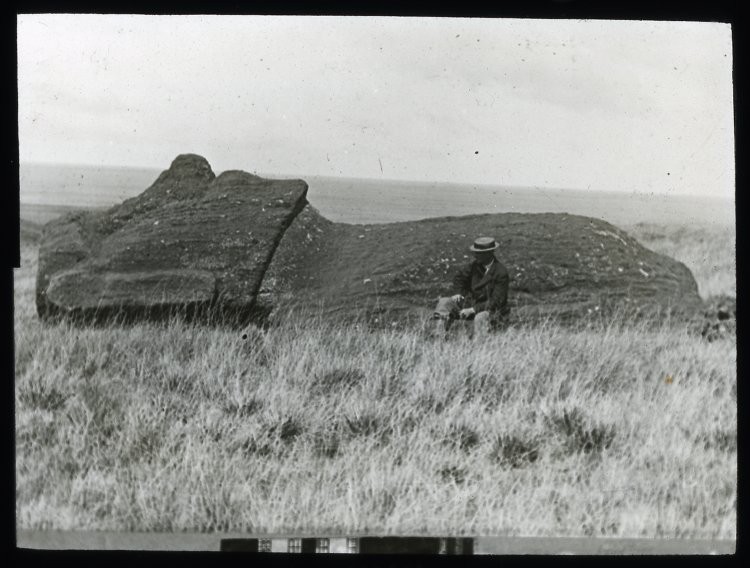
Her party searched for the routes such a journey would need until one of them, out riding, saw an old track west of Raraku where "along it every few hundred yards lay a statue." Routledge counted 27 statues on that road.
In 2012 Lipo and Terry Hunt, then of the University of Hawaii, put the walking idea to the test. Nature reported that a team of 18 people with three hemp ropes rocked a 4.4 tonne model from side to side and moved it 100 meters in under an hour.
Lipo argued that the statues' slightly forward center of mass and broad bodies suited them to this rocking motion. "They built these things to do this," he told Nature. Smithsonian magazine wrote that the statues "walked to their places, as islanders like to say."
In their 2025 paper in the Journal of Archaeological Science, summarized on Binghamton's repository, Lipo and Hunt analyzed 962 statues, including 62 lying along ancient roads. Over half of those road statues lie within 2 kilometers of Rano Raraku, a pattern they link to failures in transport. A 4.35 tonne replica built to road statue proportions covered 100 meters in 40 minutes with 18 people.
A fallen moai beside a statue road on Rapa Nui, with a seated man for scale, photographed during the Mana Expedition of 1914 to 1915. British Museum, Oc,G.T.1762. Lantern slide, author unknown, via Wikimedia Commons, public domain.
"The walking method required minimal resources and labor compared to horizontal transport hypotheses," the pair write, and they add that the result fits Rapa Nui oral traditions describing statues that walked from the quarry.
Walking a statue takes rope and people, which answers the question about rollers, and the island also had trees. Valentí Rull of Barcelona's Institute of Earth Sciences Jaume Almera reviewed the lake sediment record in 2020 and described how "palm-dominated forests" gave way to grass meadows. He concluded that the loss was gradual, with human and climatic causes, and that archaeological evidence shows the Rapanui civilization "remained healthy until European contact."
The alternative view
The walking explanation has serious critics among archaeologists who work on the island. Jo Anne Van Tilburg, director of the Easter Island Statue Project at the University of California, Los Angeles, told Nature in 2012, "What they did was a stunt and not an experiment." She argued that the team's model was an inaccurate copy of a real moai.
Van Tilburg's own team has shown that statues can be moved lying down on logs, Nature reported. Lipo and Hunt's 2025 abstract says several scholars have challenged walking on terrain, rope supply and weathering. The authors reply that those objections fail to account for the evidence. The argument is over which human method moved the statues, and none of the sources read for this check points to help from outside the island.
Where this leaves it
The people of Rapa Nui carved the moai from their own volcanic stone with basalt picks and moved them along roads to platforms across the island. Whether they walked the statues upright or dragged them lying down is still disputed, while help from aliens or imported technology finds no support in the sources.
Read for this check were the PLOS ONE quarry study, the abstracts of the 2025 walking paper and Rull's review, UNESCO's listing, Nature, Smithsonian magazine and Routledge's book. The full walking papers sit on publisher pages that did not load from the network used for this check, so their findings come from the repository abstract and Nature.
The television claim is quoted from HISTORY's own description of its clip and from a transcript on the Ancient Aliens Debunked site, cited for the claim only. Earlier Ancient Origins coverage was not a source, and the labels are explained on the evidence standards page.
Moai on Ahu Tongariki, which UNESCO describes as the most colossal of the island's ceremonial platforms, with 15 statues.
Fringe: The moai were too heavy to move without outside help from aliens or advanced technology. Reason: the statues were carved from local stone with local tools, and replica trials moved statues of several tonnes with ropes and small teams.
Established: The moai were carved at Rano Raraku from the island's volcanic tuff. Reason: the PLOS ONE quarry study and UNESCO agree.
Established:A team of 18 people with ropes walked a replica weighing more than four tonnes upright. Reason: Nature's 2012 report and the 2025 repository abstract.
Established: Rapa Nui oral tradition says the statues walked from the quarry. Reason: Routledge recorded it in 1919, and later researchers report the same tradition.
Disputed:The moai were moved upright by walking them along the roads. Reason: Lipo and Hunt argue for it, while Van Tilburg and other scholars reject it.
Rull, Valentí (2020). The deforestation of Easter Island. Biological Reviews 95, pp. 124 to 141, DOI 10.1111/brv.12556. Abstract record from Europe PMC.
UNESCO World Heritage Centre. Rapa Nui National Park. World Heritage List, property 715.
A psychologist who helped develop training for European astronauts believes that newborn babies possess extraordinary forms of sensory perception that most adults no longer experience. She claims babies may begin life with as many as 150 forms of synesthesia, allowing different senses to interact in ways that become less common as the brain develops.
Her name is Dr. Iya Whiteley, a space psychologist and cognitive engineer who previously served as director of the Centre for Space Medicine at University College London. Whiteley has spent years investigating how pilots and astronauts think, make decisions, respond to dangerous situations, and function in environments where mistakes can have serious consequences.
On February 17 and 18, 2026, Whiteley appeared in a two-part conversation on Mayim Bialik’s Breakdown, hosted by neuroscientist and actress Mayim Bialik alongside Jonathan Cohen. The discussion covered subjects ranging from astronaut psychology and intuition to synesthesia, telepathy, unusual experiences, and human consciousness.
Whiteley helped design astronaut human-performance training and worked on transferring expertise between experienced professionals and novices. Her research has involved preparing human beings to operate in extreme environments, particularly during future space missions.
But Whiteley believes that understanding human potential requires investigating more than the abilities people develop through education and experience. She is interested in the possibility that certain forms of perception already exist early in life, before language, schooling, and social expectations begin influencing how people understand the world.
She connects this possibility to synesthesia, a neurological phenomenon in which stimulation associated with one sense or mental concept automatically produces an additional experience.
For example, a person with sound-color synesthesia might hear a particular musical note and experience a specific color. Someone else might associate individual letters or numbers with colors, or experience words as having distinct tastes. Other forms involve sensations of touch being triggered by sounds or the experience of time as a spatial arrangement. These perceptions are not necessarily deliberate acts of imagination. For people with synesthesia, the associations can happen automatically and remain remarkably consistent over time.
According to the Cleveland Clinic, researchers have identified at least 60 forms of synesthesia, while some experts estimate that more than 150 variations are possible.
Whiteley takes this concept considerably further. In her February 19 essay, she makes the extraordinary statement: “Our babies are born with all of it. Every newborn arrives with synaesthesia.” She believes newborns experience a much more interconnected sensory world than adults, where sound, color, texture, and emotion are not necessarily separated into the distinct categories familiar to older children and grown-ups.
She argues that these connections begin changing as the brain develops, particularly between six and nine months of age. During this period, according to her interpretation, pathways that are not regularly reinforced may gradually become less prominent. She describes the process as the brain reorganizing itself to prioritize connections that are useful for understanding and interacting with the surrounding environment.
There is a genuine neurological process behind this discussion called synaptic pruning. During early development, the brain produces an enormous number of connections between nerve cells. As development continues, connections are strengthened, weakened, reorganized, or eliminated through a complicated combination of biological processes and experience. However, synaptic pruning does not happen during one universal six-to-nine-month window. Its timing differs across brain regions, and important changes continue throughout childhood and adolescence.
Whiteley believes something significant may be lost as part of this process. Imagine a young child hearing a frog and explaining that the sound itself is blue. Most adults would probably correct the child, telling them that frogs are green and that sounds do not have colors.
She suggests that adults can be so accustomed to their own perceptions that they struggle to recognize experiences that do not fit the way their own brains process sensory information.
One particularly interesting experiment was published online on July 19, 2011, in the journal Psychological Science. Researchers Katie Wagner and Karen R. Dobkins from the University of California, San Diego, investigated whether very young infants demonstrated associations between shapes and colors that became less apparent with age. Their paper, Synaesthetic Associations Decrease During Infancy, examined the possibility that early brain development involves sensory associations that are uncommon in typical adults.
The researchers studied 45 infants divided equally into groups aged two months, three months, and eight months. They also tested 16 adults. Because infants cannot explain what they perceive, the investigators designed a visual experiment that measured where participants directed their attention rather than asking them questions about their experiences.
The babies were presented with circles or triangles against backgrounds containing different colors. Some displays involved red and green, while others involved blue and yellow. The researchers measured whether the presence of particular shapes influenced the amount of time participants spent looking at one color rather than another. If shape and color were associated in the infant’s perception, the researchers reasoned, changing the shape might alter the infant’s visual preferences.
The results were unusual. Among the two-month-old infants, the researchers found a statistically significant shape-related difference in preferences involving red and green. Among the three-month-olds, a comparable effect appeared for blue and yellow. However, the same significant effects were not observed in the eight-month-old group or among the adults.
Wagner and Dobkins interpreted their findings as evidence consistent with the hypothesis that synesthetic-like associations may be more common during early infancy and decline as the brain develops. One proposed explanation involved the unusually extensive connectivity of the developing brain. As neural networks become more specialized, certain associations may become weaker or disappear from ordinary perception.
The researchers did not demonstrate that the infants consciously saw colors produced by shapes, and they did not test whether babies could hear colors. They measured visual preferences involving shapes and colored backgrounds. The study also compared separate age groups rather than following the same children over several months. Consequently, the findings support a possible developmental explanation but cannot prove that every infant begins life with synesthesia.
The broader theory has also attracted scientific criticism. In April 2013, researchers Ophelia Deroy and Charles Spence published a review titled Are We All Born Synaesthetic? Examining the Neonatal Synaesthesia Hypothesis. They argued that the available evidence was insufficient to establish that newborn babies universally experience synesthesia. They also questioned whether certain sensory associations observed in young children necessarily represent the same neurological phenomenon documented in adults with synesthesia.
Another challenge appeared in 2014, when David J. Lewkowicz and Nicholas J. Minar reported that they could not replicate findings from a different earlier experiment involving associations between auditory pitch and visual features in infants. Their study did not directly repeat Wagner and Dobkins’ shape-color experiment, but it demonstrated why researchers remain cautious about treating all early sensory correspondences as evidence of universal newborn synesthesia.
These disagreements do not make the original research meaningless. They show that understanding infant perception is far more complicated than simply identifying which abilities are present or absent. A baby may respond differently to combinations of sounds, shapes, colors, or movements without necessarily experiencing those combinations in the same conscious way as an adult with synesthesia.
Whiteley’s interest extends beyond laboratory measurements. In her essay, she mentions a composer who reportedly experiences shapes and colors while creating music. According to her account, the composer finds it difficult to determine whether the musical sounds or corresponding visual experiences come first. She also describes a chef who apparently judged how much additional cooking a chicken required through an intuitive impression rather than a conventional thermometer reading.
These are personal anecdotes rather than controlled demonstrations of extraordinary abilities, but they reveal the kind of experiences Whiteley is trying to understand. She is particularly interested in people who develop expertise in demanding environments and describe making accurate decisions without being able to explain every step of their reasoning.
During her conversation with Bialik, Whiteley explored how professionals operating under extreme conditions sometimes describe heightened awareness, unusual intuition, and decisions that appear to occur before conscious reasoning. Some of these experiences may involve highly developed pattern recognition, learned expertise, or rapid processing of information that a person cannot easily describe.
In the podcast, she discussed reports of extrasensory perception, unusual awareness, and encounters described by pilots and astronauts. However, there is no established evidence that professional astronauts possess paranormal abilities because of their training or that experiences of intuition necessarily involve information beyond the ordinary senses.
One of the most unusual comparisons in Whiteley’s writing concerns astronauts who describe a powerful feeling of unity after seeing Earth from space. She compares this experience with the interconnected sensory world she believes babies inhabit before their perceptions become more differentiated.
A famous example is Apollo 14 astronaut Edgar Mitchell, who became the sixth human to walk on the Moon in February 1971. During his return journey to Earth, Mitchell reported experiencing an overwhelming feeling of interconnectedness with the universe. The experience had a lasting influence on him, eventually contributing to his decision to establish the Institute of Noetic Sciences in 1973 to investigate consciousness and human potential.
Mitchell’s experience is frequently discussed alongside the overview effect, a term used to describe profound psychological changes that some astronauts report after observing Earth from space. Whiteley’s comparison is unusual because she sees a possible resemblance between the feeling of connectedness described by astronauts and the less differentiated perceptions she attributes to newborns. It remains a philosophical and experiential comparison rather than scientific evidence that infants and astronauts share the same neurological state.
Whiteley has also attempted to apply her ideas about early perception to children’s education. After becoming a mother, she began developing books and learning materials intended to encourage exploration before children acquire language. Her projects include Cosmic Baby Books and the Earth Design series, which incorporate geometric forms and patterns inspired by nature, including the Fibonacci sequence and the golden ratio.
In a September 23, 2026 report published by the Frontier Journalists’ Network, journalist Tom Zolper described Whiteley’s efforts to encourage what she considers innate, preverbal knowing. The report also discussed her interest in collecting accounts of unusual experiences during pregnancy and childbirth, including reports that mothers interpret as visions, intuition, or communication involving unborn children.
Whiteley hopes to identify recurring themes in these personal accounts and investigate whether they reveal anything about human perception surrounding birth. Such reports can be meaningful to the people experiencing them, but collecting anecdotes does not by itself demonstrate telepathy, communication with unborn children through paranormal means, or the existence of abilities beyond ordinary sensory processes.
There is another lesser-known part of Whiteley’s story that connects her research to the investigation of unidentified phenomena. In 2020, she contacted religious studies scholar and UFO researcher Diana Walsh Pasulka, who later described their correspondence in her book Encounters: Experiences with Nonhuman Intelligences, published on November 7, 2023.
Pasulka devoted the opening chapter of the book to Whiteley, calling it The Space Psychologist. According to the publisher’s publicly available excerpt, Whiteley’s introductory email identified her as a university researcher interested in developing ways to communicate with unknown phenomena. Pasulka, who had already investigated UFO experiences and religious interpretations of unusual encounters, was surprised that an established space psychologist would approach her so openly about the subject.
The connection between all these subjects appears to be Whiteley’s belief that people sometimes dismiss unfamiliar experiences too quickly. Whether the subject is an infant describing a sound as a color, a pilot struggling to explain an unexpected event, or an astronaut describing an overwhelming sense of unity, she believes understanding should begin with curiosity rather than immediate rejection.
There is a reasonable point within that argument, even without accepting her more extraordinary interpretations. A child’s description of an unusual sensory experience deserves attention, particularly because synesthesia is a recognized neurological phenomenon. Adults with synesthesia often describe experiences that are entirely unfamiliar to people who do not have it. Their experiences also show that a perception does not have to be shared by everyone to be genuinely experienced by an individual.
At the same time, ordinary childhood development involves learning to distinguish between imagination, language, sensory experiences, and external physical reality. A child saying a frog sounds blue might be describing synesthesia, using a metaphor, repeating something heard elsewhere, or simply experimenting with words. None of these possibilities should automatically be treated as evidence of a hidden ability disappearing.
Whiteley’s larger claim that newborns possess approximately 150 forms of synesthesia remains unproven. Scientists have not demonstrated that every baby experiences all these associations, that parents routinely eliminate them through correction, or that preserving such connections would produce telepathy or other paranormal abilities. Her educational approach may encourage curiosity and sensory exploration, but its ability to preserve supposedly disappearing forms of perception has not been established through controlled research.
Whiteley believes that adults may be overlooking aspects of childhood perception simply because young children do not yet have the language to describe their experiences. Whether her broader hypothesis is eventually supported or rejected, it raises an important question about the assumptions adults make when interpreting what children say and do.
RELATED
They Can Read Your Mind: NASA Scientist on Telepathy, Soul Messages & 150 Extra Senses
Astronaut Psychologist, Space Exploration, Intuition | Dr. Iya Whiteley
Ruimtesonde Voyager 1 bereikt woensdag mijlpaal: één lichtdag verwijderd van de aarde
Ruimtesonde Voyager 1 nadert een zeer bijzondere mijlpaal sinds de lancering in 1977. Voyager 1 zal woensdag namelijk één lichtdag van de aarde verwijderd zijn, oftewel de afstand die licht in 24 uur aflegt. Dat is een afstand van ongeveer 26 miljard kilometer.
Volgens de Amerikaanse ruimtevaartorganisatie NASA zal Voyager 1 die mijlpaal woensdag om 11.16 uur Nederlandse tijd bereiken. De sonde vliegt met ongeveer 61.000 kilometer per uur door het heelal en is het verst van de aarde verwijderde door mensen gemaakte object. Tweelingbroer Voyager 2 is nu ongeveer 21,6 miljard kilometer van de aarde verwijderd. Voyager 2 zou die mijlpaal volgens NASA in november 2035 bereiken.
De afstand tussen de aarde en de zon is ongeveer 150 miljoen kilometer. Een lichtjaar is de afstand die licht in een jaar aflegt: 9,46 biljoen kilometer. Proxima Centauri is de ster die het dichtst bij ons zonnestelsel ligt, op een afstand van 4,24 lichtjaar, oftewel ruim 40 biljoen kilometer.
De Voyager 1 is het verste object dat door mensen is gemaakt. Hij werd op 5 september 1977 gelanceerd vanop Cape Canaveral in de Verenigde Staten. In 2012 verliet hij ons zonnestelsel en bereikte hij de ruimte tussen de sterren.
Voyager 1: Nog nooit waren we zo ver in de ruimte 👽
KIJK OOK. Marsrover Perseverance breekt buitenaards record
NASA’s Perseverance Rover Sets Mars Driving Record! | Full Journey Mapped
Recent email exchanges reveal the military’s rebranding of unidentified underwater objects as Unidentified Undersea Phenomena (UUPs) to shake off stigma, similar to the renaming of UFOs as UAPs.
An email exchange between Tim Gallaudet, a former Navy oceanographer and administrator of the National Office of Oceanic and Atmospheric Administration (NOAA), and the Pentagon’s All Domain Anomaly Resolution Office (AARO) reveals that unidentified undersea objects have been rebranded as Unidentified Undersea Phenomena (UUPs). This change mirrors the renaming of UFOs to Unidentified Aerial Phenomena (UAPs) by the military to remove the associated stigma.
Obtaining Information on UUPs
Researchers who uncovered this information suggest that individuals seeking specific details about these underwater objects through the Freedom of Information Law may request documents containing the term USO (OSNI in Spanish). However, this approach may yield no records because agencies have adopted a different term for the phenomenon.
Following the Nimitz incident, numerous testimonies from United States Navy personnel have highlighted a close relationship between UAPs and UUPs and the oceans. Some high-ranking officials have even suggested the existence of underwater bases from which these objects might originate. In his email, Gallaudet states, “This phenomenon has been observed by credible witnesses, and it defies the laws of physics as we know them. As I have mentioned here, their study could eventually lead us to rewrite the books on what we know about the oceans (or the universe if you prefer).”
The thing about USOs or UUP
As I have explained in previous articles, for decades, Unidentified Submerged Objects, or USOs, have captivated the attention of scientists and researchers as underwater phenomena that continue to baffle the world. Often observed entering and exiting bodies of water at remarkable speeds, these objects display sudden turns and other extraordinary maneuvers that defy our current understanding of physics. While some individuals dismiss these sightings as mere natural occurrences or cases of misidentified marine life, others theorize that they might be evidence of covert underwater bases or even extraterrestrial involvement.
RELATED
Underwater UFO Bases and the Hidden USO Phenomenon | Joe Rogan & Dan Soder
The UFOs of the Oceans: The Mystery of USOs, Those Objects That Disappear Beneath the Sea
An illustration of a UFO probe contorlled by superadvanced AI.
Across oceans, cities, and open skies, U.S. military pilots continue to encounter something unusual. Not discs or flashing lights, but smooth, fast-moving metallic orbs. These objects appear without warning, hover motionless, or shift direction abruptly, then vanish in seconds. Encounters have occurred during routine patrols, combat missions, and training flights alike. Some have been recorded on infrared cameras, others tracked by radar or logged in official reports. Despite years of observation, there is still no clear explanation for what these objects are or where they come from.
What pilots are actually seeing
The objects in question are not blurry lights on a horizon. They are often visible to the naked eye and confirmed through advanced sensors and radar systems. Pilots describe them as metallic spheres, about the size of a basketball, moving at speeds and with precision unmatched by conventional aircraft.
There are no wings, no control surfaces, no visible propulsion. Some hover motionless in high winds. Others accelerate abruptly or reverse direction without turning. Most leave no heat signature. These are not assumptions based on guesswork. They are observed, filmed, and reported by aviators trained to identify every known type of airborne vehicle.
Encounters tend to occur near restricted airspace. They disrupt training exercises and, in some cases, have nearly caused mid-air collisions. These are not casual or recreational observations. They are events documented in flight logs and analyzed by military intelligence.
Gimbal UFO: a turning point in official recognition
One of the most famous incidents occurred in 2015 and was made public in 2017 as part of a leak that changed the U.S. government’s approach to unidentified aerial phenomena. Captured by an F/A-18 Super Hornet using a forward-looking infrared system (FLIR), the object shown in the video became known as the Gimbal UFO.
The video shows a disc-like craft flying at high altitude off the U.S. East Coast. What made it unusual was not just its speed or shape, but its behavior. The object rotated in mid-air while maintaining a consistent trajectory, something that defied known aerodynamic principles. Pilots speaking on the video can be heard expressing shock and confusion. There were no wings, no exhaust, and no clear method of propulsion. Radar also confirmed its presence.
This was not an isolated case. The Gimbal UFO was one of several objects tracked over days. Military personnel were told to report the sightings, but no explanation was ever given. The craft moved against the wind and changed direction abruptly, traits shared by other spherical and orb-like UAPs encountered around the same period.
The Tic Tac UFO: maneuverability beyond known physics
Perhaps the most analyzed incident involving a spherical or elliptical object occurred off the coast of Southern California in 2004. Referred to as the Tic Tac UFO, it was encountered by pilots from the USS Nimitz Carrier Strike Group during a routine training operation.
Commander David Fravor and Lieutenant Commander Jim Slaight were among those who visually confirmed the object. They described it as a smooth, white, oblong shape, about 40 feet long, with no wings or exhaust. It hovered at 80,000 feet, then dropped to sea level in under a second.
When Fravor attempted to intercept, the object responded with what appeared to be intelligent maneuvering. It mirrored movements, accelerated instantly, and disappeared from sight. The encounter was also tracked by the Princeton’s SPY-1 radar and captured by targeting cameras. The performance was beyond what any known drone or aircraft could accomplish.
This case stood out not only for its technical data but for the credibility of the witnesses. Multiple pilots, radar operators, and camera systems all observed the same object at the same time. The flight characteristics could not be replicated, and the incident remains unexplained to this day.
Pentagon confirmation and video evidence
In 2023, the Pentagon officially released new footage recorded by a Reaper drone over the Middle East. The object, clearly spherical, darted across the screen in a way that ruled out conventional drones or balloons. It showed no means of lift, no exhaust trail, and no thermal emissions.
The Department of Defense has now acknowledged multiple videos as authentic. Among them are the Gimbal, GoFast, and FLIR1 recordings (above). Each shows an unidentified craft exhibiting extraordinary behavior. The spherical shape is particularly common. It presents minimal drag and is difficult to track by radar, but the speed and control are what truly stand out.
These objects are not streaking meteors or atmospheric illusions. They maintain altitude, respond to nearby aircraft, and sometimes linger in restricted airspace for long durations. Intelligence reports confirm that these sightings are not isolated to one region or mission. They occur globally, across different climates and altitudes.
Historical sightings long before the headlines
Though public interest in orbs has grown in the last decade, pilots have seen them for nearly a century. During World War II, U.S. and Allied pilots reported glowing spheres that followed their aircraft. Dubbed Foo Fighters, these objects were considered advanced enemy tech — yet neither side ever claimed them.
During the Cold War, similar sightings occurred over U.S. and Soviet nuclear installations. In some cases, the objects disabled weapons systems or triggered alerts. Files declassified in recent years reveal that these events were taken seriously. Teams were dispatched to investigate. The patterns were tracked. No conclusions were reached.
The continuity of sightings — from WWII to 2023 — suggests something persistent and physical, not a trend of misperceptions or radar errors.
What they might be — and what they are not
Several explanations have been offered. Some say they are drones, possibly foreign or classified domestic technology. Others suggest weather balloons, optical illusions, or rare electromagnetic phenomena. Each theory has limits.
Drones do not hover without noise or heat. Balloons do not change direction abruptly or remain stable in strong winds. Optical illusions do not appear on multiple sensors and radar simultaneously. No known system can match the agility, speed, and endurance shown in the verified videos.
Photograph taken by Charles Morose showing a coast guard plane chasing a UFO. Image credit: Charles Morose/Sun.
What is more troubling is the absence of any confirmed origin. No government has claimed ownership. No fragments have been found. Despite hundreds of documented cases, there is no traceable launch site, signature, or manufacturer. The U.S. government, after years of denial, now openly states that many of these objects remain unexplained.
Speaking personally, I don’t believe there are little green men piloting these things. Traveling across interstellar distances is an enormous challenge, even for a hypothetical advanced civilization. But if these craft are not ours, and not from here, then what we may be seeing is something else entirely — something like autonomous probes. Highly advanced, possibly guided by artificial intelligence far beyond anything we’ve developed. That, to me, seems far more plausible than crewed ships. It would make sense for an alien civilization to send machines ahead of itself, long before arriving in person — if arriving at all.
Why the military is treating it as a serious threat
The response to these encounters has evolved. What was once quietly dismissed is now being discussed in congressional hearings. In 2022, the Department of Defense formed the All-domain Anomaly Resolution Office (AARO). Its mission is to investigate reports of unidentified aerial, underwater, and transmedium objects.
Military pilots have testified under oath about near-collisions and routine sightings. Some report being discouraged from speaking up in the past. That is changing. The focus is not on proving extraterrestrial origins. It is on identifying unknown technology that could pose risks to aircraft or infrastructure.
Air safety is a driving concern. When fast-moving, unidentified objects appear in restricted airspace, the risk is not just hypothetical. It is immediate. Pilots cannot react to something they cannot identify. Commanders cannot defend against something they cannot track.
Closing reflection
So, what’s my take? The mysterious orbs pilots keep seeing aren’t stories or secondhand accounts. They’re real, they’re recorded, and they’re showing up on sensors across different platforms. Pilots from different squadrons and different years keep describing the same thing. Small, fast, spherical objects that move in ways we don’t understand.
They don’t follow the rules of conventional flight. They don’t give off heat, don’t have wings, and they move in ways that don’t make sense with current technology. And they keep showing up where they’re not supposed to be. That alone should be enough to take them seriously.
What’s encouraging is that this isn’t being shrugged off anymore. Pilots are speaking publicly. Congress is listening. And scientists are getting involved. One of them is Avi Loeb, a professor at Harvard. He’s behind the Galileo Project, a scientific effort to gather hard data on unidentified objects in Earth’s skies, oceans, and even space. His team is building instruments to detect and track them. They’re also analyzing physical materials from unexplained sources, like the fragments recovered off Papua New Guinea’s coast. Instead of waiting for answers to fall into our laps, they’re going out and looking for them.
And personally, I don’t think we’re seeing aliens flying around in these orbs. Traveling across the galaxy isn’t easy, and I doubt beings are hopping out of these things. If these are from somewhere else, what we might be seeing are autonomous probes. Machines, not crewed ships. That makes more sense to me. An advanced civilization would probably send AI long before it sent itself.
The important part is, this isn’t fringe anymore. These sightings are documented. They’re happening. And for the first time, people are actually paying attention.
Something is Releasing Orbs Above Earth (Pentagon Just Confirmed)
UFO Files: Military Leaks and Mysterious Orbs Caught on Camera | 2026 Compilation
A woman who trained under a former US government psychic spy claims she encountered a towering Grey being aboard a strange spacecraft that offered to reveal what was really going on. She was too frightened to accept the offer, but later admitted that she had changed her mind and said yes. The encounter allegedly ended with a disturbing vision of a nuclear explosion in the distance.
Amaris Jane is a remote viewer, psychic medium, and instructor who works with Angela Ford, a former participant in the US government’s classified Project Stargate program. Jane also claims she helped a private team of psychics locate a fugitive who had fled with money from a European bank. According to her account, the man was hiding on a Mediterranean island when investigators finally apprehended him.
On November 11, 2026, Jane discussed these experiences during episode 356 of the Everything & Anything…and a bit gay podcast, hosted by Zach Randles-Friedman. Her account of the alleged alien encounter begins around 2019 or 2020, when she says she started experiencing visitations from beings she describes as Greys.
During one particularly vivid incident, she recalled waking up inside an unfamiliar room wearing a hospital gown. The room was cold, sterile, and small enough for a single person. When she looked out, she found a corridor stretching into the distance, lined with rooms like the one she had just left.
The seemingly endless hallway reminded her of something from The Matrix. She began exploring the surroundings, increasingly concerned about where she was and how she had arrived there. Eventually, she noticed a staircase and decided to climb it, hoping she might find an exit or someone who could explain what was happening.
As she reached a landing, Jane claims her body suddenly began floating upward. She was lying on her back, apparently unable to control her movement, when she sensed an intelligence taking hold of her consciousness. She compared its overwhelming presence to the instinctive fear someone might experience when confronted by a powerful predator, such as a large cat or a shark.
She then found herself inside an enormous chamber resembling a cathedral or coliseum within a spacecraft. At one side of the room stood a console, where she noticed a very tall Grey being apparently operating some equipment. The entity’s appearance resembled the Grey aliens frequently described in UFO encounter reports, although Jane emphasized its unusually imposing presence.
Then she heard a voice directly in her mind, “Do you want to know what’s going on?”
Jane said she had experienced unusual impressions and messages before, but this encounter felt different. The intelligence seemed considerably more powerful than anything she had previously encountered, and the direct communication frightened her. Instead of accepting the offer, she refused.
Immediately afterward, she claims the presence released its hold on her consciousness. She suddenly found herself standing on the balcony of an apartment building, looking toward what appeared to be a nuclear explosion in the distance. The experience ended as abruptly as it had begun, and she woke up.
Jane did not identify the location of the apparent explosion or suggest that she had witnessed a specific future nuclear attack. It was an image she recalled from an extraordinary experience whose physical reality has not been established. Nevertheless, the sequence of events raises questions about what she believes the encounter represented, particularly because the offer of information was followed by such a destructive image.
During the interview, Randles-Friedman asked whether she regretted refusing the being’s invitation. Jane gave an unexpected answer: “Let’s just say I said yes since then.”
She did not explain exactly when she accepted the offer or provide a detailed account of what happened during that subsequent encounter. However, she claimed the beings kept visiting her and that she gradually became more comfortable with their presence. Despite their intimidating appearance, she said she had not personally experienced physical harm from them.
According to Jane, the beings sometimes deliver messages and have shown her procedures that people might use to establish contact with them. Yet she is reluctant to teach these methods publicly. She explained that some people report frightening or harmful encounters with entities resembling Greys, and she does not want to encourage contact without first developing a better understanding of what these intelligences might be.
She believes greater public disclosure and communication among people reporting similar experiences would help her evaluate the phenomenon. Although she thinks the beings might welcome additional human contact, she does not believe that her own experiences provide enough information to recommend the practice to everyone.
When asked what the beings had actually communicated, Jane described messages concerning corruption on Earth, powerful elites, and the mistreatment of vulnerable people. She also wondered whether such mistreatment might involve other intelligent species, although she acknowledged that humanity does not understand what kinds of beings might exist beyond Earth.
Jane was careful to explain that she was still evaluating these impressions and deciding how much trust to place in them. She did not identify specific individuals, organizations, or crimes supposedly revealed by extraterrestrial beings. Her statements concerned broad impressions about power and human behavior rather than verifiable intelligence about particular events.
Another recurring image she described was an enormous tree with roots spreading through the ground. She associates this vision with consciousness, imagining something resembling a network of interconnected pathways through which individuals might access information or experience a deeper connection with reality.
She suggested that such connections are not necessarily reserved for military personnel, politicians, or other people in powerful positions. In her interpretation, ordinary individuals might be able to explore consciousness independently, whether through experiences described as psychic, spiritual, or involving non-human intelligence.
One of her more remarkable claims involves a European bank that allegedly sought assistance in recovering money from people who had disappeared.
Jane said she belonged to a private organization that carried out remote-viewing assignments. According to her account, the organization obtained a contract from a European bank interested in finding people who had taken money and gone into hiding. A team of seven remote viewers was assembled to investigate possible locations.
During one assignment, she claims to have received impressions of a man hiding somewhere in a Mediterranean country. She believed he was on an island and described seeing a city, its colors, and a particular apartment building. Unlike sessions in which she received only abstract symbols, she recalled feeling almost as though she were physically present at the location.
She also reported recurring symbols associated with the surroundings and believed she could sense the man inside the apartment building.
There is an important detail in her explanation. The team leader already possessed information about several locations where the fugitive might have been hiding. Jane says the impressions she produced corresponded to one of those suspected locations, allowing investigators to concentrate on that area.
According to Jane, a team was subsequently sent to the location and apprehended the man. She did not learn what happened afterward, including whether he faced criminal prosecution or imprisonment.
The story is remarkable, although the bank, fugitive, island, and investigating organization were not identified. No arrest records, police statements, or contemporaneous remote-viewing reports were presented during the interview. Without those materials, it is impossible to establish whether the psychic impressions independently contributed to finding the man or whether the investigators already possessed enough conventional information to locate him.
Jane’s association with remote viewing began through her husband, who had developed an interest in the government’s historical psychic research. He had studied techniques associated with Lyn Buchanan, another former member of the US military’s remote-viewing program. Jane initially hesitated because she preferred more spontaneous impressions rather than a complicated process of recording and interpreting information.
Her husband eventually introduced her to Angela Ford after discovering that Ford discussed remote viewing in public interviews. They contacted her, arranged a reading, and began exploring the possibility of training.
Jane says Ford subsequently introduced them to an individual associated with a private consciousness research organization. The organization allegedly subjected prospective participants to approximately one month of testing, using software designed to present randomly selected targets and assess their responses.
Following that process, Jane claims she was invited into a private group of remote viewers and received funding for an entire year of training with Ford. She did not publicly identify the organization or provide the testing results, but she described the experience as a turning point that eventually made remote viewing her professional focus.
Ford’s intelligence background is considerably easier to document than Jane’s private assignments.
Angela Dellafiora Ford served in the US government’s remote-viewing program from June 1986 until June 1995. According to the International Remote Viewing Association’s guide to the declassified Stargate archives, she was identified as remote viewer 079. Government records from the period contain reports associated with that designation, including tasks concerning foreign threats and other intelligence subjects.
Jane continues to teach remote viewing, describing it as a process in which a person attempts to obtain impressions about an unseen target. She explains that the information does not necessarily appear as a recognizable image. Instead, participants might perceive symbols, shapes, colors, textures, or environmental features that must be interpreted.
For example, someone attempting to describe a house beside a river might imagine a barn near a lake. Jane argues that the underlying similarities, such as a man-made structure and a body of water, can be meaningful even when the specific objects differ.
The obvious difficulty is that broad impressions can match many possible targets. Determining whether a description is genuinely accurate requires procedures that prevent participants, instructors, and evaluators from unconsciously influencing the outcome. This distinction becomes particularly important when someone is trying to locate a person rather than identify a photograph.
Jane believes her unusual perceptions began long before she learned anything about government psychic programs.
Growing up in the 1990s, she lived with her mother in a house where she claims inexplicable events occurred regularly. She recalled hearing organ music apparently coming from the fireplace, sometimes loud enough to fill the house while friends were visiting.
She also described hearing voices, seeing balls of light, and witnessing her mother’s keys apparently levitating above a kitchen counter. During one incident, she says both she and her mother were present when the keys rose into the air, leaving them frightened and confused.
Her mother, a single parent with strong Christian beliefs, reportedly responded to the disturbances through prayer. Jane described the house as an unsettling environment where unusual experiences became almost ordinary parts of family life.
Around the age of 13, Jane says she began having involuntary out-of-body experiences. She recalled floating through her home, observing the surroundings, and once looking into a mirror while apparently separated from her physical body.
Instead of seeing her familiar reflection, she claims she encountered an unusual metallic-looking face with diamond-shaped eyes. She also remembered seeing a long silver cord extending back toward the bed where her body was lying.
The image remained with her for years. She did not establish that it represented a physical non-human being, but it became part of her developing belief that consciousness might exist or operate independently of the body.
Jane also recalled an incident involving an Olympic gymnastics competition. She claimed that she mentally heard a sequence of numbers moments before the judges announced an athlete’s score and repeated the numbers aloud before they were spoken on television. She could not remember which Olympics the incident occurred during, making the account impossible to verify from the information provided.
As an adult, Jane temporarily moved away from paranormal interests and spent years involved in academia. She says her husband eventually helped renew her curiosity after they visited a reportedly haunted property. Following that experience, she began exploring mediumship and remote viewing more seriously.
Another deeply personal experience involved her grandmother, who had died. Jane recalled sitting in her living room reading her grandmother’s old knitting books when she suddenly sensed someone looking over her shoulder.
She felt an overwhelming impression of affection connected to the books and interpreted the presence as her grandmother. The experience was particularly meaningful because she described their relationship during her grandmother’s lifetime as complicated. She later sought a mediumship reading, believing that communication with deceased people might reveal something about consciousness and survival after death.
These experiences help explain why Jane’s paranormal interests extend beyond UFOs. She regards alleged hauntings, out-of-body experiences, mediumship, remote viewing, and encounters with non-human beings as potentially related aspects of consciousness rather than entirely separate phenomena.
Her views were already developing publicly before her recent television appearance. On October 15, 2025, she appeared on The Psychic Guys podcast, discussing her childhood experiences, remote-viewing techniques, the ethics of investigating serious crimes, astral projection, and alleged encounters with non-human intelligence.
A year later, Jane became part of Archive X: Unexplained Phenomena, a six-part documentary series developed around Rice University’s Center for the Impossible and hosted by religious studies scholar Jeffrey J. Kripal.
According to AMC’s official announcement, the series premiered on October 1, 2026. Its third episode, Dark Visions, aired on October 15 and explored purported psychic abilities, prophetic experiences, and the history of government research into precognition.
The series reflects growing public interest in unusual human experiences, although appearing in a documentary does not independently establish the accuracy of the participants’ accounts.
I was looking through some recent NASA archives of deep space photos today when something totally blew my mind. NASA calls this the "Cat's Head Nebula," or NGC 6334, because they want you to look at it and see a cute little feline face. Classic NASA cover-up! They always give these incredible cosmic structures innocent, everyday names so the public doesn't look too closely and realize what is actually staring right back at them.
If you tilt your head and actually examine the structure of the gas and dust, this isn't a cat at all. It is clearly a massive, standing bipedal alien being—and it bears an uncanny resemblance to a human!
Look at the details I found in this photo:
The Head & Face: You can clearly see a single head in profile. It has a prominent forehead, a sharp pointed nose, and a very distinct, long chin.
Headgear: Wearing what looks like a cap or a hat that hangs over the back of its head.
Upper Body:It is standing completely upright! You can make out its broad chest, defined shoulders, and bent elbows held right at its sides.
Lower Body: Moving down, you can clearly see a narrowed waist, the curve of its buttocks, and two full legs extending all the way down to its ankles.
The Cat's Head Nebula in visible light by the NASA/ESA Hubble Space Telescope.
(NASA, ESA, CSA, STScI / SWNS)
The Cat’s Head Nebula in visible light by the NASA/ESA Hubble Space Telescope.
(NASA, ESA, CSA, STScI / SWNS)
Now, skeptics will say this is just "pareidolia" or random space dust floating around. They couldn't be more wrong. Even world-famous theoretical physicist Dr. Michio Kaku has talked about advanced alien civilizations on the Kardashev scale. According to Kaku, a late-stage Type II or a Type III Galactic civilization possesses the god-like technology to harness the energy of entire stars and galaxies—meaning they have the exact capability to manipulate, sculpt, and shape a massive nebula across light-years of space!
Why would an ancient Type III civilization carve a gigantic portrait of themselves out of interstellar gas? To leave a cosmic monument! It’s a billboard in deep space announcing their existence to the rest of the universe, showing what they look like. NASA knows this. They see the standing figure, they see the human-like proportions, and they slapped the "Cat's Head" label on it to keep the truth hidden from the public.
Take a close look at the image yourself and tell me you don't see this giant space-faring humanoid standing there. Undeniable proof that intelligent, hyper-advanced aliens are out there!
Scott C. Waring - UFO Sightings Daily
Zoom video: Cat's Head Nebula
NASA James Webb Telescope Reveals the Mysterious CAT'S HEAD NEBULA! 🐱 | 4K Space
A glowing white UFO was seen during the Mercury Atlas 7 mission, not far from the space capsule that made three orbits around earth before returning. The UFO was in just a single frame of the photos, but its size and its color tells me a lot. The size is several times bigger than the space capsule itself and its located in front not behind the clouds, which means is over the clouds and very close to the space capsule. The color is similar to many white structures and craft found on the surface of the moon, Mercury and especially famous...Ceres for its white shiny alien structures. Aliens were watching NASA very carefully on the May 24, 1962 mission. Aliens...they are watching, monitoring, assessing and making conclusions, just like any good observing scientist would...all without interrupting any of the scientifically observed processes.
A scientific team from the Californian Salk Institute for Biological Studies, working in China with private donations, has created a living organism that is a mixture of human and monkey.
Created in a Chinese laboratory, the organism has genetic characteristics that result from hybridising monkey and human. It is a further step in what some media have dubbed Project Chimera.
The chimera is a mythological beast that mixes two types of animal. This scientific project may raise ethical doubts, but it has medical objectives that could save many lives.
It all started with stem cells created in the laboratory. Now, scholars are going further. At the Salk Institute they are studying the evolution of a living organism in which human organs can exist in a hybrid environment, in this case monkey-human.
The Salk Institute's studies to create hybrids have worked between rats and mice. The aim was to get as close as possible to 50% of cells from one species and 50% from the other. With rodents, it can be achieved.
The genetic proximity between monkeys and humans has convinced the Salk Institute's scientific team that the hybridisation they have achieved in the Chimera Project may be viable.
Scientists deny that this is about creating living beings that function as 'organ factories.' They claim that this research process could lead to the discovery of a solution to organ procurement without cruel or aberrant practice
In fact, for ethical reasons, the embryo created from a monkey-human mix will be destroyed when it reaches 14 weeks. This is the moment when, according to scientists, nerve connections and other complex elements of a living being are created.
However, Juan Carlos Izpisúa, a Spanish scientist who is part of the team that created the monkey-human mix, believes that ethical standards may need to be rethought. "History shows us that over time our moral standards mutate, like our DNA," he told El País. It happened, for example, with in vitro fertilisation.
The anticipated future of 'The Island of Doctor Moreau'
The British novelist H.G. Wells (1866-1946) anticipated this moral debate about the ethical limits of science in 'The Island of Doctor Moreau', a novel in which he imagined experiments that succeeded in mixing animal species. The resulting hybrids were then enslaved by a mad scientist. The novel has had several film adaptations.
China is the scene of experiments such as the Chimera Project. The United States and Europe are much more restrictive, although governments are beginning to open up to accepting some research of this type. For the time being, however, it's the Chinese laboratories that attract scientists from all over the world with interest in this type of work.
The creation of a human-monkey embryo is on the borderline of science fiction, but it is pure reality. We will have to consider how it develops and what benefits it can bring to humanity.
RELATED
Was This Chimpanzee Actually Half Human? | Our World
The Scientist Who Tried To Create A Human-Chimpanzee Hybrid | Almost Human: Rise Of The Apes
Was This Chimpanzee Actually Half Human? After all, men have been having s3x with goats for ever!
A space rock has been pulled into Earth's orbit – and will be with us until January.
The minimoon, called 2026 QQ8, is about 6ft in diameter and was caught in Earth's gravitational pull in April.
And while the tiny moon is small enough to burn up in the atmosphere if it gets too close, experts say this isn't likely since its closest pass will be around 353,000 miles (568,000km) – roughly one-and-a-half times the distance to the moon.
2026 QQ8 is expected to depart Earth's gravity in January 2027. And although it is too small to see with amateur telescopes, astronomers around the world are watching its movements closely to learn more about how the Earth snatches up tiny temporary moons.
It was originally discovered by Hungarian researcher Krisztian Sarneczky in August.
But when Mr Sarneczky presented his findings to the International Astronomical Union's Minor Planet Center, the body that logs and confirms new objects, experts were divided over what it really was.
Scientists have discovered a 'minimoon' that has been pulled into our orbit, and it's expected to stick around until January
Some believed that they had found a natural rocky minimoon, briefly captured by Earth's gravity.
Others instead thought it was a human-made piece of space junk.
In an official statement, the Minor Planet Center said: 'The object Sar2901 … [has] an orbit that is suggestive of either a minimoon or an artificial object. The broader community seems to be split as to which is the most favored.'
Likewise, Professor Avi Loeb, a theoretical physicist and astrophysicist from Harvard University, even suggested that the object could be a 'lost' panel from the Apollo 13 moon mission.
However, follow-up observations by the Lowell Discovery Telescope in Arizona and the University of Hawaii 2.2-meter telescope eventually confirmed that it was of natural origin.
On October 29, the Minor Planet Center officially recognised the object as a minimoon and gave it the designation 2026 QQ8.
Scientists believe that 2026 QQ8 is a type of space rock known as an Aten asteroid, left over from the early solar system formation 4.6 billion years ago.
The object, dubbed 2026 QQ6, is a small rock about six feet (2m) across that wandered into Earth's orbit in April earlier this year
Aten asteroids have orbital paths that primarily sit inside the orbit of Earth and frequently cross it, meaning they frequently come close to the planet.
Luckily, 2026 QQ8 is far too small to pose any risk even if it were on a direct collision course.
Scientists think that this asteroid normally takes about 359 days to travel around the sun, coming close to Earth once every ten years.
Normally, it wouldn't get close enough to cross into Earth's 'Hill Sphere', the hypothetical boundary between the region where Earth's gravity dominates and the outer space dominated by the pull of the sun.
But at some point in April QQ8 must have crossed into the Hill Sphere and become temporarily trapped.
Previous studies have shown that Earth usually has at least one additional minimoon, with most orbiting the planet for less than a year before departing
The first was detected in 1991, when astronomers spotted a 30ft (10m) object dubbed 1991 VG.
At the time, 1991 VG's circular orbit and highly reflective surface sparked concerns that Earth was being investigated by an alien probe.
But scientists now know that such minimoons are relatively common occurrences.
In fact, recent research suggests that Earth usually has at least one extra minimoon in a temporary orbit.
These additional satellites typically hang around for less than a year before shooting off back into space.
So, as 2026 QQ8 completes its brief visit, scientists will be taking as many observations as possible to learn more about how this process occurs and what it might mean for the planet's safety.
Meer van UFO'S of UAP'S, ASTRONOMIE, RUIMTEVAART, ARCHEOLOGIE, OUDHEIDKUNDE, SF-SNUFJES EN ANDERE ESOTERISCHE WETENSCHAPPEN - DE ALLERLAATSTE NIEUWTJES


 Computer Simulations Provide the Best Explanation for Those "Little Red Dots" Yet!