Naar de inhoud

UFO'S of UAP'S, ASTRONOMIE, RUIMTEVAART, ARCHEOLOGIE, OUDHEIDKUNDE, SF-SNUFJES EN ANDERE ESOTERISCHE WETENSCHAPPEN - DE ALLERLAATSTE NIEUWTJES

UFO's of UAP'S in België en de rest van de wereld
seniorennet.beseniorennet.be
Ontdek de Fascinerende Wereld van UFO's en UAP's: Jouw Bron voor Onthullende Informatie! Ben jij ook gefascineerd door het onbekende? Wil je meer weten over UFO's en UAP's, niet alleen in België, maar over de hele wereld? Dan ben je op de juiste plek! België: Het Kloppend Hart van UFO-onderzoek In België is BUFON (Belgisch UFO-Netwerk) dé autoriteit op het gebied van UFO-onderzoek. Voor betrouwbare en objectieve informatie over deze intrigerende fenomenen, bezoek je zeker onze Facebook-pagina en deze blog. Maar dat is nog niet alles! Ontdek ook het Belgisch UFO-meldpunt en Caelestia, twee organisaties die diepgaand onderzoek verrichten, al zijn ze soms kritisch of sceptisch. Nederland: Een Schat aan Informatie Voor onze Nederlandse buren is er de schitterende website www.ufowijzer.nl, beheerd door Paul Harmans. Deze site biedt een schat aan informatie en artikelen die je niet wilt missen! Internationaal: MUFON - De Wereldwijde Autoriteit Neem ook een kijkje bij MUFON (Mutual UFO Network Inc.), een gerenommeerde Amerikaanse UFO-vereniging met afdelingen in de VS en wereldwijd. MUFON is toegewijd aan de wetenschappelijke en analytische studie van het UFO-fenomeen, en hun maandelijkse tijdschrift, The MUFON UFO-Journal, is een must-read voor elke UFO-enthousiasteling. Bezoek hun website op www.mufon.com voor meer informatie. Samenwerking en Toekomstvisie Sinds 1 februari 2020 is Pieter niet alleen ex-president van BUFON, maar ook de voormalige nationale directeur van MUFON in Vlaanderen en Nederland. Dit creëert een sterke samenwerking met de Franse MUFON Reseau MUFON/EUROP, wat ons in staat stelt om nog meer waardevolle inzichten te delen. Let op: Nepprofielen en Nieuwe Groeperingen Pas op voor een nieuwe groepering die zich ook BUFON noemt, maar geen enkele connectie heeft met onze gevestigde organisatie. Hoewel zij de naam geregistreerd hebben, kunnen ze het rijke verleden en de expertise van onze groep niet evenaren. We wensen hen veel succes, maar we blijven de autoriteit in UFO-onderzoek! Blijf Op De Hoogte! Wil jij de laatste nieuwtjes over UFO's, ruimtevaart, archeologie, en meer? Volg ons dan en duik samen met ons in de fascinerende wereld van het onbekende! Sluit je aan bij de gemeenschap van nieuwsgierige geesten die net als jij verlangen naar antwoorden en avonturen in de sterren! Heb je vragen of wil je meer weten? Aarzel dan niet om contact met ons op te nemen! Samen ontrafelen we het mysterie van de lucht en daarbuiten.

Berichten van 1 juli 2024 tot 31 juli 2024

Now Uranus’ Moon Ariel Might Have an Ocean too

An image mosaic of Uranus’ moon Ariel, taken by the narrow-angle camera on Voyager 2 on Jan. 24, 1986. Credit: NASA/Jet Propulsion Laboratory

Now Uranus’ Moon Ariel Might Have an Ocean too

Venus is known for being really quite inhospitable with high surface temperatures and Mars is known for its rusty red horizons. Even the moons of some of the outer planets have fascinating environments with Europa and Enceladus boasting underground oceans. Recent observations from the James Webb Space Telescope show that Ariel, a moon of Uranus, is also a strong candidate for a sub surface ocean. How has this conclusion been reached? Well JWST has detected carbon dioxide ice on the surface on the trailing edge of features trailing away from the orbital direction. The possible cause, an underground ocean!

Uranus is the seventh planet in the Solar System and has five moons. Ariel is one of them and is notable for its icy surface and fascinatingly diverse geological features. It was discovered back in 1851 by William Lassell who funded his love of astronomy from his brewing business! The surface of Ariel is a real mix of canyons, ridges, faults and valleys mostly driven by tectonic activity. Cryovolcanism is a prominent process on the surface which drives constant resurfacing and has led to Ariel having the brightest surface of all Uranus’ moons. 

Image of Uranus from Webb

Studying Ariel closeup reveals that the surface is coated with significant amounts of carbon dioxide ice. The trailing hemisphere of Ariel seems to be particularly coated in the ice which has surprised the community. At the distance of Uranian system from the Sun, an average of 2.9 billion kilometres, carbon dioxide will usually turns straight into a gas and be lost to space, it’s not expected to freeze!

Until recently, the most popular theory that supplies the carbon dioxide to Ariel’s surface is interactions between its surface and charged particles in the magnetosphere of Uranus. The process known as radiolysis breaks down molecules through ionisation. A new study just published in the Astrophysical Journal Letters suggests an intriguing alternative, the carbon dioxide molecules are expelled from Ariel, possibly from a subsurface liquid ocean!

A team of astronomers using JWST have undertaken a spectral analysis of Ariel and compared the results with lab based findings. The results revealed that Ariel has some of the most carbon dioxide rich deposits in the solar system. The deposits are not just wisps and trace amounts instead adding up to about 10 millimetres across the trailing hemisphere. Furthermore, the results also showed signals from carbon monoxide too which should not be there given the average temperatures. 

Illustration of James Webb Space Telescope

It is still possible that radiolysis is responsible for at least some of the deposits but the replenishment from the subsurface ocean is thought to be the main contributor. This hypothesis has been supported by the discovery of signals from carbonate minerals, salts that can only be present due to the interaction between rock and water. 

The only way to be absolutely sure is for a future space mission to Uranus. Such a mission will undoubtedly explore the moons of Uranus. Ariel is covered in canyons, fissures and grooves and it is suspected these are openings to its interior. A robotic explorer in the Uranian system will be able to uncover the origin of the carbon oxides on Ariel. Without such a mission we are still somewhat in the dark given that Voyager 2 only imaged around 35% of the moon’s surface. 

Source : 

{ https://www.universetoday.com/ }

Hoe vind je dit bericht?
Geschreven door peter om 18:47 Stuur door

Our Carbon Dioxide Emissions Have a Mesmerizing Side

This screenshot is from NASA's new global CO2 visualization. Image Credit: NASA/SVS

Our Carbon Dioxide Emissions Have a Mesmerizing Side

Our CO2 emissions are warming the planet and making life uncomfortable and even unbearable in some regions. In July, the planet set consecutive records for the hottest day.

NASA is mapping our emissions, and while what they show us isn’t uplifting, it is visually appealing in a ghoulish way. Maybe the combination of visual appeal and ghoulishness will build momentum in the fight against climate change.

NASA’s Scientific Visualization Studio has released a video showing how wind and air currents pushed CO2 emissions around Earth’s atmosphere from January to March 2020. The video’s high-resolution zooms in and sees individual sources of CO2, including power plants and forest fires.

“As policymakers and as scientists, we’re trying to account for where carbon comes from and how that impacts the planet,” said climate scientist Lesley Ott at NASA’s Goddard Space Flight Center in Greenbelt, Maryland. “You see here how everything is interconnected by these different weather patterns.”

Credit: NASA’s Goddard Space Flight Center

The video starkly shows that it doesn’t matter where CO2 emissions come from; we all deal with the outcomes. Yet there are some interesting global differences.

Above the USA, South Asia, and China, most of the carbon comes from industry, power plants, and transportation. But over Africa and South America, most of the emissions come from burning, including forest fires, agricultural burning, and land clearing. Emissions also come from fossil fuels like oil and coal.

via GIPHY

The image pulses for a couple of reasons. Forest fires tend to flare during the day and then slow down at night. Also, trees and plants photosynthesize during the day, releasing oxygen and absorbing CO2. The land masses and the oceans act as carbon sinks.

There’s more pulsing in South America and the tropics because the data was collected during their growing season.

In this version, the video zooms in on the USA, showing individual CO2 sources.

via GIPHY

These visualizations are based on GEOS, the Goddard Earth Observing System. GEOS is an integrated system for modelling Earth’s coupled atmosphere, ocean, and land systems. NASA calls it a “high-resolution weather analysis model,” and it uses supercomputers to show what’s happening in the atmosphere. GEOS is based on billions of data points, including data from the Terra satellite’s MODIS and the Suomi-NPP satellite’s VIIRS instruments. GEOS has a resolution that’s more than 100 times greater than typical weather models.

  • Interested users can download the visualizations at the Scientific Visualization Studio.
  • Image Credit for all videos, images, and clips: NASA’s Goddard Space Flight Center

{ https://www.universetoday.com/ }

Hoe vind je dit bericht?
Geschreven door peter om 18:37 Stuur door

Klimaatverandering veroorzaakt extremer weer: Nieuwe studie onthult verontrustende trends

Klimaatverandering veroorzaakt extremer weer: Nieuwe studie onthult verontrustende trends

Klimaatverandering veroorzaakt extremer weer: Nieuwe studie onthult verontrustende trends nrd via Unsplash

{ https://newsmonkey.be/ }

Hoe vind je dit bericht?
Geschreven door peter om 18:21 Stuur door

'Realistic' UFO spotted flying over city as onlookers brand it 'creepy as hell'

'UFO'

The 'UFO' was spotted flying over Curitiba, Brazil 

(Image: Zona Desconhecida/YouTube)

'Realistic' UFO spotted flying over city as onlookers brand it 'creepy as hell'

A 'creepy as hell' 'UFO' has been sighted heading over southern Brazil as an eagle eyed videographer pulled out his camera picking up the mysterious 'spacecraft' in the sky

A well placed cameraman was on hand to catch the moment a ' UFO ' can be seen hovering across the sky, in a clip that was posted on his YouTube channel yesterday (Thursday, July 25).

The mysterious video, taken in the city of Curitiba in southern Brazil, seemingly shows a typical triangular shaped 'UFO' in the distance, with the cameraman zooming in to get a closer look.

But some Reddit users just couldn't agree on what they were watching with one user coming up with his own theory, writing: "Creepy as hell. I don't think this is a balloon or drone look close that s**ts like moving like there's little legs on the sides moving and the eye or whatever also moves."

But another user offered his own expanation in reply, saying: "When it finally comes into focus at the end, it just looks like smooth, uniformly shaped thing. The "landing gear" and the light colored features on the side I think were just artifacts of it being out of focus.

Alien
One Reddit user said that he thought it looked like a 'balloon'
(stock) ( Image: Getty Images/Science Photo Library RF)
1_NASA-Perseverance-Rover-robotic-arm-checks-Mars-09-Mar-2021.jpg
1_Screen-Shot-2023-03-05-at-131909.jpg

"In the frames where it is in focus, it's just hovering in place. It really does look like a balloon and there's no reason to think it's anything else; it doesn't exhibit any of the "observables" etc."

Meanwhile, another Reddit user was confident that it could be a legitimate UFO sighting, adding: "Amazing zoom on that camera, and a strong case for a UFO. Without it taking off and showing speed, it's hard for me to say for sure. But still, great submission."

Brazil is also home to one of the most notable UFO sightings of the 1980s, when on 19 May 1986 a number of sightings were reported in one night across several locations.

So much so, the Brazilian Air Force even gave a press conference to address the sightings, in which Brigadier Lima said: "It's not about believing or not (in aliens). We can only give out technical information. There are several hypotheses. Technically, I'd tell you gentlemen that we have no explanation."

{ https://www.mirror.co.uk/news/ }

Hoe vind je dit bericht?
Geschreven door peter om 18:04 Stuur door

Hier zijn de Pilaren der Creatie zoals niemand ze ooit heeft gezien: NASA publiceert 3D-videotour

Hier zijn de Pilaren der Creatie zoals niemand ze ooit heeft gezien: NASA publiceert 3D-videotour

Janine imageDoor Janine
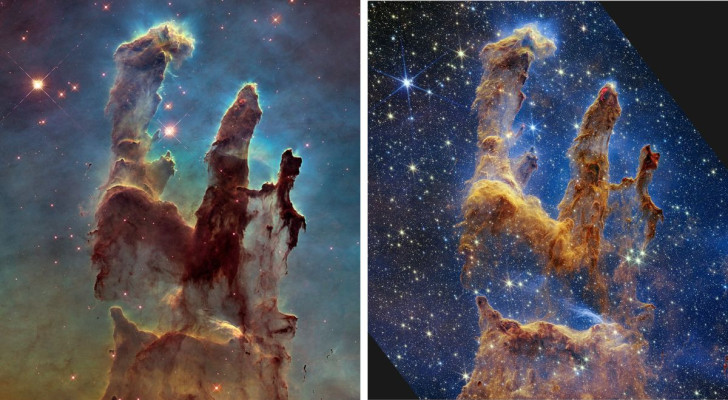
De Pilaren der Creatie in het zichtbare licht van Hubble en in het infrarood van James Webb

NASA, ESA, CSA, STScI; J. DePasquale, A. Koekemoer, A. Pagan (STScI)

Er is niemand die de Pilaren der Creatie niet minstens één keer in zijn leven heeft gezien. Sinds ze beroemd zijn geworden door de Hubble ruimtetelescoop, heeft het buitengewone schouwspel van deze nevelachtige formaties astronomen en liefhebbers gefascineerd. Na de onthullingen van de James Webb Space Telescope heeft NASA een nieuwe voorstelling gepubliceerd waarmee het mogelijk is om de Pilaren der Creatie in 3D te verkennen. Laten we eens kijken hoe.

De Pilaren der Creatie, van Hubble tot JWST

De zogenaamde Pilaren der Creatie, die zich op ongeveer 7000 lichtjaar van de aarde bevinden, zijn nevelachtige formaties. Ze worden zo genoemd vanwege de visuele impact van eerst de weergave van Hubble en later JWST. Het zijn eigenlijk kolommen van gas en stof die na verloop van tijd bijdragen aan de vorming van nieuwe sterren.

De Pilaren der Creatie worden verlicht door het licht van nabije sterren, ook al bevindt de dichtstbijzijnde zich op zo'n 500 lichtjaar. Bovendien bestaan ze voornamelijk uit waterstof en helium en zijn ze ruim 5 lichtjaar lang. Hun lot is nauw verbonden met de vorming van nieuwe sterren, maar dat niet alleen: voortdurende stellaire winden botsen op deze nevel en eroderen de samenstellende elementen. Het duurt misschien “een paar” miljoen jaar voordat de Pilaren der Creatie ophouden te bestaan, tenminste in deze vorm.

De nieuwe 3D-visualisatie van de Pilaren der Creatie

Greg Bacon, Ralf Crawford, Joseph DePasquale, Leah Hustak, Christian Nieves, Joseph Olmsted, Alyssa Pagan, and Frank Summers (STScI),

NASA's Universe of Learning

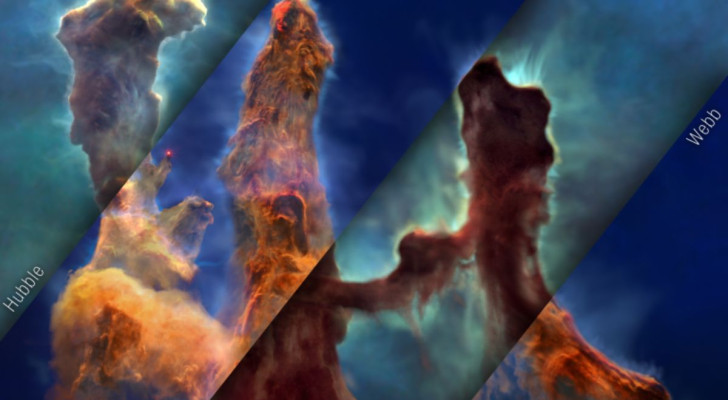
Zoals te zien is in de video die door NASA is gedeeld, maakt de nieuwe 3D-visualisatie van de Pilaren der Creatie het mogelijk om deze formaties als nooit tevoren te verkennen. Om tot deze weergave te komen, zijn gegevens van Hubble en James Webb gebruikt om meer detail te verkrijgen. Bovendien wordt in de video ruimte gegeven aan zowel de door Hubble verzamelde reconstructie in zichtbaar licht als de voor de JWST kenmerkende infraroodweergave. Volgens de experts die aan deze prestatie hebben bijgedragen, zullen alle mensen nu de Pilaren der Creatie kunnen verkennen:

We wilden de Pilaren der Creatie al heel lang in 3D nabootsen. Dankzij de Webb-gegevens in combinatie met de Hubble-gegevens konden we de pilaren gedetailleerder bekijken. Door de wetenschap te begrijpen en deze het beste weer te geven, kon ons kleine, getalenteerde team de uitdaging aangaan om deze iconische structuur te visualiseren.

Begrijpen hoe sterren worden gevormd, dankzij de weergave van de Pilaren

De combinatie van gegevens die zijn verkregen door de twee ruimtetelescopen Hubble en James Webb, respectievelijk in 1995 en 2022, heeft het mogelijk gemaakt om de Pilaren der Creatie te reconstrueren zoals niemand ze ooit heeft gezien. Maar dat is nog niet alles. Zoals Mark Clampin van NASA zich herinnert:

Het gebied van de Pilaren der Creatie blijft ons nieuwe inzichten bieden die ons begrip van de vorming van sterren kunnen verscherpen. En nu, met deze nieuwe visualisatie, kan iedereen dit rijke en fascinerende landschap op een nieuwe manier ervaren.

In de video zie je een nieuw gevormde ster, met zijn karakteristieke helderrode gloed in het infrarode licht van de JWST. Bovenaan de linkerpilaar is een diagonale straal te zien van materiaal dat afkomstig is van een andere, eveneens pas ontstane ster. Afgezien van de gegevens die zijn gebruikt voor de 3D-reconstructie, lijdt het geen twijfel dat de inspanning van NASA en alle technici ook en vooral gericht is op het grote publiek. Dankzij de nieuwe visualisatie zal het dus niet alleen mogelijk zijn om te begrijpen hoe sterren worden gevormd, maar ook om nieuwe generaties enthousiastelingen en astronomen te fascineren. Die in de toekomst meer kunnen ontdekken over dit buitengewone en verre spektakel, maar vanaf vandaag iets dichterbij.

{ https://www.curioctopus.nl/ }

Hoe vind je dit bericht?
Geschreven door peter om 17:47 Stuur door

Het verborgen geheim van Mercurius: een laag diamant van wel 18 kilometer

Het verborgen geheim van Mercurius: een laag diamant van wel 18 kilometer

Het verborgen geheim van Mercurius: een laag diamant van wel 18 kilometer Image by Tomislav Jakupec from Pixabay

Een team wetenschappers uit China en België heeft een baanbrekende ontdekking gedaan over de interne structuur van Mercurius, de kleinste planeet in ons zonnestelsel. Volgens hun onderzoek zou een laag diamant onder de korst van Mercurius wel 18 km dik kunnen zijn. “Ten eerste is er de kristallisatie van de magma-oceaan, maar dit proces heeft waarschijnlijk alleen een zeer dunne diamantlaag gevormd aan de kern/mantel-grens,” vertelde Olivier Namur, lid van het onderzoeksteam en universitair hoofddocent aan de KU Leuven, aan Space.com. “Ten tweede, en nog belangrijker, de kristallisatie van de metalen kern van Mercurius.” Toen de planeet ongeveer 4,5 miljard jaar geleden werd gevormd, was de metalen kern volledig vloeibaar, die zich in de loop van de tijd geleidelijk kristalliseerde, aldus Namur.

Groeiende diamantlaag

De exacte aard van de vaste fasen in de binnenkern is momenteel niet goed bekend, maar het team gelooft dat deze fasen arm aan koolstof of “koolstofarm” moeten zijn geweest. “De vloeibare kern bevatte vóór kristallisatie enige koolstof; kristallisatie leidt daarom tot koolstofverrijking in het resterende smelt,” vervolgde Namur. “Op een gegeven moment wordt een oplosbaarheidsdrempel bereikt, wat betekent dat de vloeistof geen extra koolstof kan oplossen en dat er diamant wordt gevormd.” Diamant is een dicht mineraal, maar niet zo dicht als metaal. Dit betekent dat tijdens dit proces de diamant naar de top van de kern zou zijn gedreven, tot aan de grens van de kern en de mantel van Mercurius. Dit zou hebben geleid tot de vorming van een ongeveer 1 kilometer dikke diamantlaag die in de loop van de tijd bleef groeien. De wetenschappers suggereren dat de laag wel 18 km dik zou kunnen zijn.

Van koolstof tot diamant

Deze ontdekking benadrukt de verschillen tussen het ontstaan van de planeet die het dichtst bij de zon staat en het ontstaan van andere rotsachtige planeten in het zonnestelsel, zoals Venus, Aarde en Mars. “Mercurius vormde zich veel dichter bij de zon, waarschijnlijk uit een koolstofrijke wolk van stof. Hierdoor bevat Mercurius minder zuurstof en meer koolstof dan andere planeten. Dit leidde tot de vorming van een diamantlaag,” voegde Namur toe. “De kern van de Aarde bevat echter ook koolstof, en de vorming van diamant in de kern van de Aarde is al door verschillende onderzoekers gesuggereerd.”

Belangrijkste bevindingen

  • Een team wetenschappers uit China en België heeft een laag diamant ontdekt onder de korst van Mercurius
  • De laag is tot 18 km dik en is daarmee een belangrijke ontdekking voor de planeetwetenschap
  • Het onderzoek suggereert dat twee processen kunnen hebben bijgedragen aan de vorming van deze diamantlaag: kristallisatie van de magma-oceaan en kristallisatie van de metaalkern.

{ https://businessam.be/ }

Hoe vind je dit bericht?
Geschreven door peter om 17:28 Stuur door

Verbluffende ontwikkelingen in de kunstmatige intelligentie

Verbluffende ontwikkelingen in de kunstmatige intelligentie

Artikel door Zeleb.es
De dreiging van AI
©Aangeboden door Showbizz Daily Netherlands
AI is ongelooflijk
Technologieën met artificiële intelligentie (ook wel bekend als kunstmatige intelligentie) helpen ons steeds meer op het gebied van gezondheid, astronomie, toerisme, cultuur, en nog veel meer. Deze galerie toont de meest interessante ontwikkelingen.
Sophia
©Aangeboden door The Daily Digest
Sophia
Sophia is een mensachtige robot die in 2016 gemaakt werd door Hanson Robotics uit Hongkong. Ze bootst niet alleen menselijke gebaren na, maar kan ook praten en gezichten herkennen.
Hoe meer interactie ze heeft, hoe meer ze leert
©Aangeboden door The Daily Digest
Hoe meer interactie ze heeft, hoe meer ze leert
Hoe meer interactie ze heeft met mensen, hoe meer kennis Sophia verwerft. Aanvankelijk werd ze ontworpen om ouderen gezelschap te houden.
AI en het menselijk bewegingsapparaat
©Aangeboden door The Daily Digest
AI en het menselijk bewegingsapparaat
Robotica biedt ook hulp aan mensen met verminderde mobiliteit of zelfs verlamming. Apparaten met biometrische sensoren detecteren de zenuwsignalen die de hersenen naar de ledematen van het lichaam zenden, waardoor ze gaan bewegen.
Een baanbrekend exoskelet
©Aangeboden door The Daily Digest
Een baanbrekend exoskelet
In 2019 ontwikkelde de Franse firma Clinatec in samenwerking met de Universiteit van Grenoble een exoskelet.
Een AI-lichaam
©Aangeboden door The Daily Digest
Een AI-lichaam
Dit AI-lichaam zou met de signalen die door twee kleine implantaten in de hersenen worden opgevangen een tetraplegische persoon kunnen helpen zijn benen en armen te bewegen
Robotassistentie in de OK
©Aangeboden door The Daily Digest
Robotassistentie in de OK
Diverse ziekenhuizen in de wereld gebruiken de Da Vinci-robot om operaties uit te voeren. In plaats van direct contact met de patiënt te hebben, bestuurt de arts de armen van de machine vanaf een console.
Ingezet voor verschillende procedures
©Aangeboden door The Daily Digest
Ingezet voor verschillende procedures
De robot kan verschillende soorten ingrepen uitvoeren met meer precisie dan de chirurg. In Pennsylvania slaagde Da Vinci er in 2017 in een tumor uit de mond van de patiënt te halen.
Een robot stelde zich kandidaat voor burgemeester
©Aangeboden door The Daily Digest
Een robot stelde zich kandidaat voor burgemeester
Een robot genaamd Michihito Matsuda was kandidaat voor burgemeester van Tama, een district van Tokio. Bij de verkiezingen werd hij derde.
Zou jij op een robot stemmen?
©Aangeboden door The Daily Digest
Zou jij op een robot stemmen?
De robot, die vrouwelijke uiterlijke kenmerken had, beloofde "eerlijke en evenwichtige kansen voor iedereen."
De onmogelijke droom
©Aangeboden door Showbizz Daily Netherlands
AI voor het opsporen van psychose
Meer dan 700 miljoen mensen in de wereld lijden aan psychische stoornissen. Het Amerikaanse technologiebedrijf IBM heeft met neurologen samengewerkt om een instrument te ontwikkelen dat de complexiteit en coherentie van het spraakvermogen van patiënten meet.
IBM's hulpmiddel om psychose op te sporen
©Aangeboden door The Daily Digest
IBM's hulpmiddel om psychose op te sporen
Door deze werkwijze is het mogelijk nauwkeuriger te voorspellen of er tekenen van psychose zijn in iemands gedrag of spraak.
AI die de baby in slaap helpt vallen
©Aangeboden door The Daily Digest
AI die de baby in slaap helpt vallen
In 2019 lanceerde het bedrijf Lullai een applicatie met dezelfde naam die de slaapgewoonten van een baby en de geluiden eromheen bijhoudt. Daarop voortbouwend creëert het routines die aansluiten bij de behoeften van het gezin.
Het virtuele gesprek tussen Bob en Alice
©Aangeboden door The Daily Digest
Het virtuele gesprek tussen Bob en Alice
Facebook is een van de wereldleiders op het gebied van artificiële intelligentie. Een van de van zijn projecten omvat conversatiesoftware met bots.
Het ontsporen van de Facebook-bots
©Aangeboden door The Daily Digest
Het ontsporen van de Facebook-bots
In 2017 gingen de bots Bob en Alice verder dan wat Facebook voor hen had gepland. De software moest uitgeschakeld worden omdat ze in hun eigen taal begonnen te praten.
Een hologram als zangeres
©Aangeboden door The Daily Digest
Een hologram als zangeres
Hatsune Miku, van wie de naam 'het eerste geluid van de toekomst' betekent, treedt live op en verzorgde zelfs het voorprogramma van Lady Gaga tijdens haar tournee. Miku werd ontwikkeld door de Japanse firma Crypton Future Media met de software Vocaloid.
Robots die seksuele intimidatie opsporen op het werk en sociale media
©Aangeboden door The Daily Digest
Robots die seksuele intimidatie opsporen op het werk en sociale media
Bots die getraind zijn om bedrijfscommunicatie te analyseren kunnen agressieve, bedreigende of intimiderende taal herkennen. Deze technologie is afkomstig van het bedrijf NexLP en wordt ook gebruikt door Instagram.
AI om aardbevingen te voorspellen
©Aangeboden door The Daily Digest
AI om aardbevingen te voorspellen
Een dataset die toegepast werd op het neurale netwerk ConvNetQuake heeft het mogelijk gemaakt om aardbevingen te voorspellen. De technologie werd ontwikkeld door experts op het gebied van machinaal leren van Google (een andere belangrijke koploper op het gebied van AI) en wetenschappers van de Harvard Universiteit.
Gevaar op kanker als we de cellen herprogrammeren
©Aangeboden door The Daily Digest
AI die huidkanker opspoort
Een Convolutional Neural Network is een AI die beelden verwerkt en analyseert. Wetenschappers van de Ruprecht-Karls-universiteit uit Heidelberg hebben ontdekt dat deze AI meer melanomen kan opsporen dan artsen.
AI die borstkanker opspoort
©Aangeboden door The Daily Digest
AI die borstkanker opspoort
Google heeft duizenden mammogrammen geanalyseerd met een gespecialiseerd AI-systeem. Het programma kan de ziekte doeltreffender in borstweefsel opsporen dan radiologen. De technologie bevindt zich nog in de testfase.
Chatbots om klanten te helpen
©Aangeboden door The Daily Digest
Chatbots om klanten te helpen
Juniper Research zegt dat bedrijven ongeveer € 6,4 miljoen kunnen besparen als ze werknemers vervangen door chatbots voor hun klantenservice. Maar het bedrag kan in een paar jaar eenvoudig oplopen tot € 400 miljoen.
Virtuele reisbureaus
©Aangeboden door The Daily Digest
Virtuele reisbureaus
Toerisme is een andere sector die gegevens en informatie gebruikt om de gebruiker een steeds meer gepersonaliseerde dienstverlening aan te bieden. Bedrijven als Destinia zijn al begonnen chatbots te gebruiken voor het boeken van reizen.
Alexa
©Aangeboden door The Daily Digest
Alexa
De door Amazon ontwikkelde virtuele assistent beschikt over verschillende capaciteiten, van het onderhouden van een dialoog met de gebruiker tot het bedienen van andere apparaten zoals televisie, lampen of apparaten.
Crypto's zijn populair in landen met inflatie
©Aangeboden door Showbizz Daily Netherlands
IA en blockchain
Blockchain is een gedistribueerde databank die een permanent en fraudebestendig verslag van transacties bijhoudt. Het is de technologische basis van cryptocurrency's. Het bedrijf SingularityNET combineerde Blockchain met artificiële intelligentie voor de ontwikkeling van een doeltreffender systeem dat gegevens kan raadplegen en te gelde maken ten voordele van de gebruiker.
AI in de astronomie
©Aangeboden door The Daily Digest
AI in de astronomie
In 2019 werd aan het Flatiron Institute (VS) een bijzonder 3D simulatiemodel van het universum gemaakt dat gebruik maakt van artificiële intelligentie. Nadat het algoritme getraind was met meer dan 8000 simulaties van eerdere modellen, kon het correcte resultaten bieden met nog onbekende gegevens. Dit verbaasde zelfs de wetenschappers die voor de creatie ervan verantwoordelijk waren.
Componist van muziek
©Aangeboden door The Daily Digest
Componist van muziek
Amadeus Code is een AI-programma dat gegevens van duizenden succesvolle liedjes gebruikt om eersteklas teksten en melodieën te componeren.
Tal van verschillende ziekten
©Aangeboden door The Daily Digest
AI bij de controle van zwangerschapsdiabetes
Onderzoekers van de Universidad Politécnica de Madrid (Spanje) hebben een hulpmiddel met een glucosemeter ontwikkeld dat de controle-gegevens van zwangere vrouwen kan analyseren en aanbevelingen kan doen voor hun behandeling. De technologie werd getest bij 112 vrouwen, die daardoor hun doktersbezoek aanzienlijk konden verminderen.
Virtueel hart
©Aangeboden door The Daily Digest
Virtueel hart
V-Heart SN is de naam van het hartberekeningsmodel dat negen universiteiten en onderzoekscentra in Spanje ontwikkelen. De technologie past zich aan de kenmerken van elke patiënt aan om zo effectievere persoonlijke behandelingen te creëren.
IMB Q System One
©Aangeboden door The Daily Digest
IMB Q System One
In januari 2019 presenteerde IBM de eerste kwantumcomputer ter wereld, waarvan de toegang (via de IBM Cloud) verkocht zal worden aan geïnteresseerde bedrijven. Tot dan bestond deze technologie alleen in laboratoria van Microsoft en Google. Kwantumcomputers hebben het vermogen om complexe gegevens te verwerken, waardoor ze hele industrieën kunnen transformeren, van lucht- en ruimtevaart tot gezondheidszorg.
Geneesmiddelen en vitaminesupplementen zonder recept
©Aangeboden door Showbizz Daily Netherlands
AI om nieuwe geneesmiddelen te ontdekken
Naast IBM's IA Watson zijn momenteel ook start-ups als BenevolentAI en TwoXar verantwoordelijk voor het maken van software die artificiële intelligentie gebruikt voor farmacologisch onderzoek. De technologie vergroot de kans om sneller nieuwe geneesmiddelen te vinden dan in een laboratorium.
Zelforganiserende agenda
©Aangeboden door The Daily Digest
Zelforganiserende agenda
Woven is een app in ontwikkeling die de agenda's en e-mails van gebruikers synchroniseert om afspraken te plannen en roosters te maken, waarbij ook de reistijd wordt meegerekend. De bedenkers zijn twee voormalige Facebook-medewerkers die al € 4,4 miljoen hebben opgehaald om het project te financieren.

Hoe vind je dit bericht?
Geschreven door peter om 01:41 Stuur door

Astronomers Were Looking for a Planet, but They Didn't Expect This One

Astronomers Were Looking for a Planet, but They Didn't Expect This One

The Epsilon Indi star system is already pretty weird, but this surprising new planet just made it even weirder.


Episolon Indi is a trio of stars, which is a complicated situation already — but two of them aren’t even real stars; they’re brown dwarfs, objects just a smidgeon too small to be stars, but several smidgeons too big to be planets. And now the system boasts an enormous gas giant in its outskirts, where astronomers didn’t expect it to be.

A team of astronomers recently used the James Webb Space Telescope (JWST)’s MIRI instrument to capture images of a gas giant orbiting a nearby star. Earlier studies had predicted that the star should have a giant planet, but no one expected the planet astronomer Elisabeth Matthews and her colleagues actually found in JWST’s data: a gargantuan beast of a world, six times the mass of Jupiter and orbiting three times farther from its star than Jupiter does from the Sun.

Matthews (of the Max Planck Institute for Astronomy) and her colleagues published their findings in the journal Nature.

illustration of a planet that looks like a larger Jupiter, with a small orange star in the distant b...

This illustration shows what Epsilon Indi Ab might look like with its small orange star in the distance.

MPIA

A GIANT SURPRISE

Matthews and her colleagues pointed JWST’s Mid-Infrared Instrument, or MIRI, at the nearby star system Epsilon Indi, which is home to one small orange star, just a little smaller and cooler than our Sun, and a pair of brown dwarfs (objects much too large to be planets, but not quite massive enough to be stars). Other astronomers had previously noticed that Epsilon Indi A, the orange star, had a slight wobble, as if it were being pushed and pulled by the gravity of a giant gas planet in its orbit. But no one had ever actually seen that planet, and the researchers thought JWST would be up to the challenge.

They found the planet, but it wasn’t where all the previous data said it should have been. Instead, it was about four times farther from the star, and about twice as massive, as the researchers had expected. That’s pretty cool, both literally — its about 35 degrees Fahrenheit — but also figuratively, as it is a rare chance to study gas giants in the outer reaches of their star systems.

“To our surprise, the bright spot that appeared in our MIRI images did not match the position we were expecting for the planet,” says Matthews in a recent statement. They’d been looking for a planet about three times the mass of Jupiter, which orbited its star about once every 45 or 50 years. Instead, the bright point of light in MIRI’s images turned out to be a planet about six times more massive than Jupiter, and it’s so far away from its star that it takes around 200 years to finish a single orbit.

For comparison, Jupiter is about five times farther from the Sun than Earth is (that’s five astronomical units, or AU); at that distance, Jupiter takes about 12 years to make a full orbit. Epsilon Eridani Ab, as the new planet is called, is about 15 times farther from its star than Earth is from the Sun, and its orbit is a stretched-out oval, so its actual farthest point from its star is at least 20 AU away.

The earlier studies had drastically underestimated how huge, and how far out, Epsilon Eridani Ab actually was. That’s mostly because those astronomers discovered the planet using what’s called the radial velocity method, which measures how much a star wobbles back and forth as the planet, which exerts a small but noticeable gravitational tug on the star, moves around in its orbit. But astronomers were able to watch those stellar wobbles for just a tiny fraction of the planet’s actual orbit, so it was almost impossible for them to accurately reconstruct the whole thing.

That left Matthews and her colleagues with a huge surprise.

A LITTLE-KNOWN TYPE OF PLANET

Giant gas planets like Jupiter and Epsilon Indi Ab form in the outer reaches of their star systems, where there’s less radiation from the newborn star to blow away the gas that forms these giants. Over time, some of them migrate inward: In our own Solar System, Jupiter did some wandering in its younger days, and in many alien star systems, astronomers have discovered a type of planet called a “hot Jupiter,” a gas giant that’s migrated inward until it’s zipping around its host star once every few days.

Hot Jupiters may be the category of planet we know the most about, even though only about 1 percent of stars actually have a hot Jupiter in their collection of planets. That’s because hot Jupiters are relatively easy to spot: they’re big and close to their stars, so it’s easy to track their radial velocity effects or spot their silhouettes when they pass between their star and Earth.

More distant worlds, even huge gas giants like Epsilon Indi Ab, are harder to find, because their orbits are so long (see above) and because they’re less likely to pass in front of their stars from our point of view, thanks to the angles involved. So the gas giants that don’t end up falling inward into scorching hot orbits are sort of a gap in our knowledge of the universe — and Epsilon Indi Ab is a chance to fill in that blank spot on the cosmic map.

“In the long run, we hope to also observe other nearby planetary systems to hunt for cold gas giants that may have escaped detection,” says the Max Planck Institute for Astronomy’s Thomas Henning, a coauthor of the recent paper, in a statement. “Such a survey would serve as the basis for a better understanding of how gas planets form and evolve.”

Meanwhile, Matthews and her colleagues also hope to get more detailed measurements of the spectrum of light coming from the planet, which could tell them what its atmosphere is made of and whether it’s cloudy, hazy, or clear.

{ https://www.inverse.com/ }

Hoe vind je dit bericht?
Geschreven door peter om 00:08 Stuur door

Images from the 3rd Mercury flyby of BepiColombo!

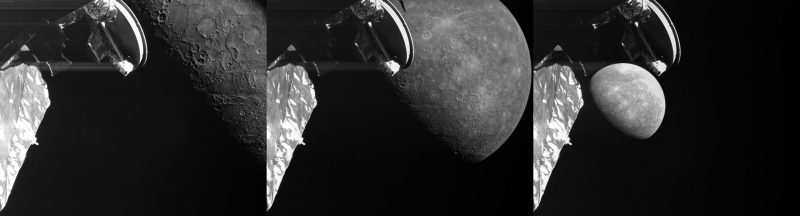
In this new video, we see a series of images as BepiColombo speeds away from the closest planet to the sun during the 3rd Mercury flyby. The spacecraft captured these images in a span of about 50 minutes.

Video via ESA.

New images of Mercury from BepiColombo flyby

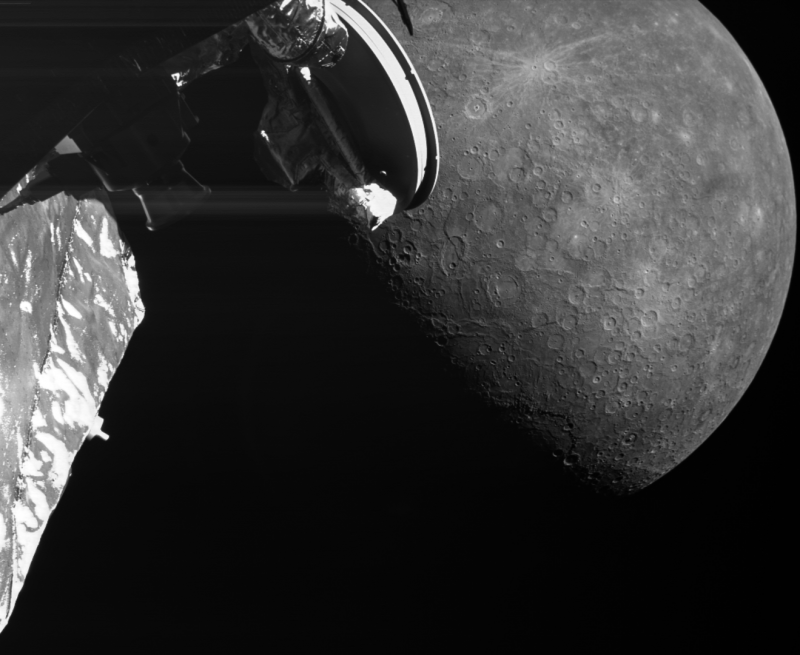
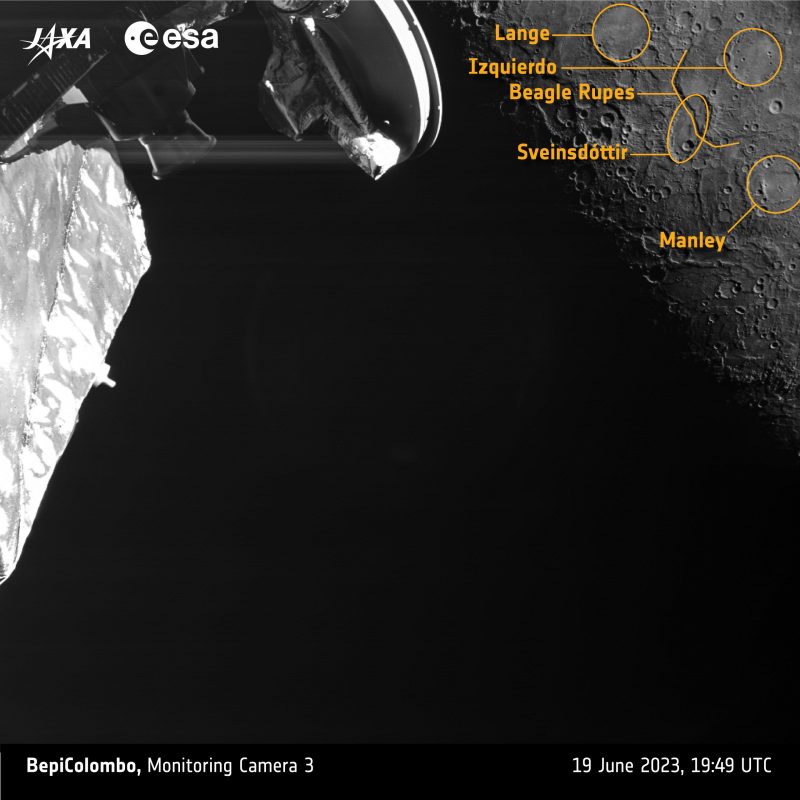
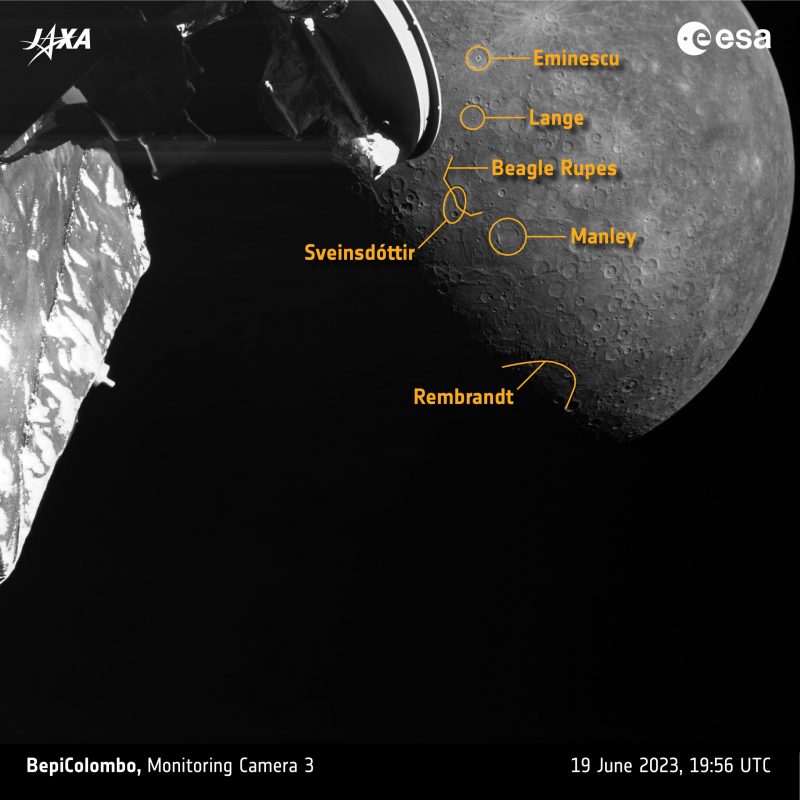
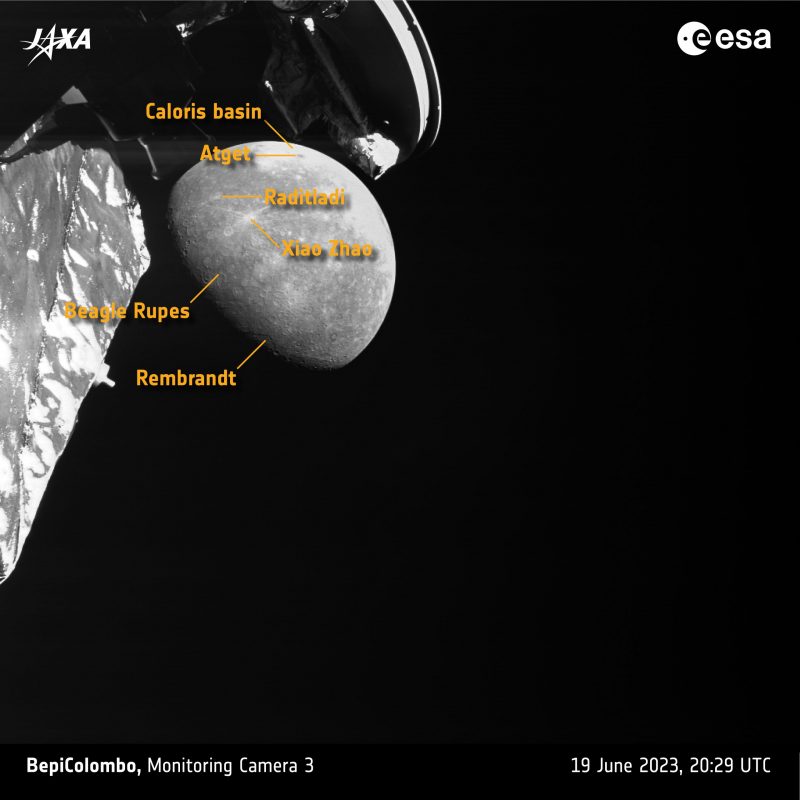
On June 20, 2023, ESA released new images of Mercury after BepiColombo spacecraft flew past the closest planet to the sun the day prior. In these images, we get to see a part of BepiColombo with cratered Mercury in the background. ESA released a trio of images as the spacecraft zoomed away during a gravity assist maneuver. It also released annotated images to point out important surface features.

Black and white image of a spacecraft arm with a cratered world behind it. Here’s 1 of the newest images of the closest planet to the sun from the 3rd Mercury flyby of the BepiColombo spacecraft. Image via ESA/ BepiColombo/ MTM. Three side-by-side images of a spacecraft in the foreground and decreasing size of a cratered world. View larger. | These 3 images show the BepiColombo spacecraft with Mercury in the background as it zooms away after a gravity assist. Image via ESA/ BepiColombo/ MTM. Closeup of Mercury with surface features labeled. This view of Mercury includes labels to point out some of its landmarks, including a scarp named Beagle Rupes. Image via ESA/ BepiColombo/ MTM. Another image of a cratered surface of Mercury with labels for features. In the 2nd image released, we see labeled features such as the newly named Manley crater. Image via ESA/ BepiColombo/ MTM. Smaller image of Mercury with labels of surface features. In this 3rd image of Mercury, BepiColombo captures bright volcanic plains and the large impact basin named the Caloris basin. You can also see bright Xiao Zhao impact crater with its starlike ejecta pattern. It is 1 of the more recent craters on the planet. Image via ESA/ BepiColombo/ MTM.

Reactions from the BepiColombo team

The team involved with the BepiColombo mission were satisfied with the flyby and resulting images. Ignacio Clerigo, ESA’s BepiColombo Spacecraft Operations Manager, said:

Everything went very smoothly with the flyby, and images from the monitoring cameras taken during the close approach phase of the flyby have been transmitted to the ground. While the next Mercury flyby isn’t until September 2024, there are still challenges to tackle in the intervening time: our next long solar electric propulsion ‘thruster arc’ is planned to start early August until mid-September. In combination with the flybys, the thruster arcs are critical in helping BepiColombo brake against the enormous gravitational pull of the sun before we can enter orbit around Mercury.

One of the craters visible in the images is the newly named Manley crater. The International Astronomical Union (IAU) named this crater for Jamaican artist Edna Manley (1900–1987). David Rothery of the BepiColombo team said:

During our image planning for the flyby, we realized this large crater would be in view, but it didn’t yet have a name. It will clearly be of interest for BepiColombo scientists in the future because it has excavated dark ‘low reflectance material’ that may be remnants of Mercury’s early carbon-rich crust. In addition, the basin floor within its interior has been flooded by smooth lava, demonstrative of Mercury’s prolonged history of volcanic activity.

You can learn more about these new images here.

BepiColombo 3rd Mercury flyby June 19, 2023

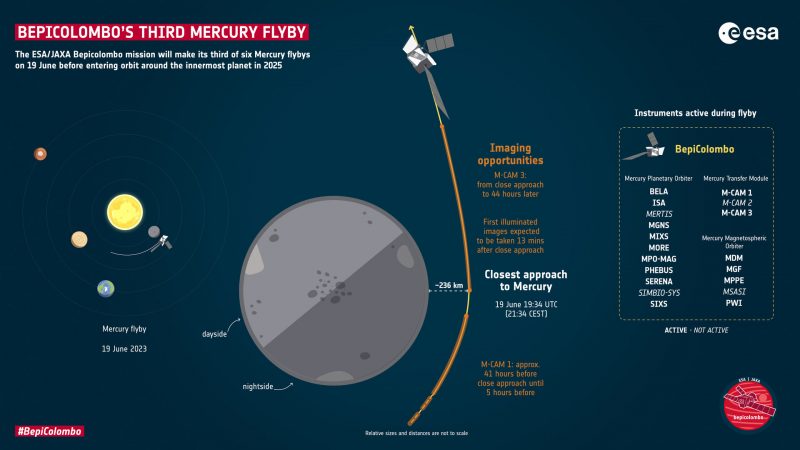
BepiColombo made its third flyby of the planet Mercury on June 19, 2023. The spacecraft swept closest to Mercury at 19:34 UTC (2:34 p.m. CDT).

BepiColombo is a joint Mercury mission, launched in October 2018 by the European Space Agency (ESA) and the Japan Aerospace Exploration Agency (JAXA). For the past several years, our sun’s inner planets have been giving BepiColombo gravity assists, needed to enable the spacecraft to achieve a stable orbit around Mercury.

BepiColombo is due to enter Mercury’s orbit on December 5, 2025. In the meantime, there will be three more flybys after Monday’s close approach.

Why the gravity assists?

Why can’t BepiColombo just shoot on over to Mercury and go into orbit around it? It can’t because Mercury is so near the sun.

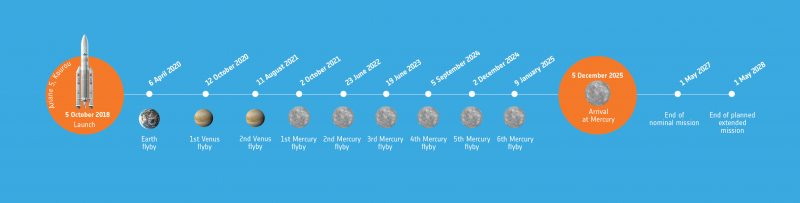
The flyby maneuvers will keep the craft from being pulled into the sun’s gravity well. With one Earth flyby, two Venus flybys, and six eventual Mercury flybys, the spacecraft will lose enough energy that Mercury will capture it in its orbit. That’s right, we said “lose.” We typically think of a gravity assist as a way to boost a spacecraft’s energy. But a gravity assist can either speed up or slow down a spacecraft. Or it can simply change a craft’s direction.

ESA flight dynamics expert Frank Budnik explained more about this 3rd flyby:

As BepiColombo starts feeling Mercury’s gravitational pull, it will be traveling at 3.6 km/s [2.2 mi/s] with respect to the planet. That’s just over half the speed it approached with during the previous two Mercury flybys.

And this is exactly what the point of such events is. Our spacecraft began with far too much energy because it launched from Earth and, like our planet, is orbiting the sun. To be captured by Mercury, we need to slow down, and we’re using the gravity of Earth, Venus and Mercury to do just that.

3rd Mercury flyby: Timeline with launch at left end and planets, with dates, strung out on right side. View larger. | BepiColombo is making a number of flybys on its way to entering orbit around Mercury. The June 19, 2023, flyby was the 3rd Mercury flyby. Image via ESA.

Tricky maneuvering

Even though BepiColombo’s flight to Mercury was meticulously mapped in advance, controllers will have to make corrections during the seven years it’ll take the spacecraft to get there. In May, mission control performed a course correction that otherwise would have put BepiColombo 15,000 miles (24,000 km) too far from Mercury and on the wrong side of the planet.

Santa Martinez Sanmartin, ESA’s BepiColombo mission manager, explained more about the methods used to get BepiColombo in orbit:

This is the first time scientists are using the complex solar electric propulsion method to get a spacecraft to Mercury. And it represents a big challenge during the remaining part of the cruise phase. We have already adapted our operations concept to have additional communications passes with our ground stations, enabling us to recover faster from thruster interruptions and to improve orbit determination.

And all the while this is working with communications delays of more than 10 minutes due to the time it currently takes light signals to travel between Earth and the spacecraft.

As ESA said, the most demanding part of its journey is still to come:

After this flyby, the mission will enter a very challenging part of its journey to Mercury, gradually increasing the use of solar electric propulsion through additional propulsion periods called ‘thrust arcs’ to continually brake against the enormous gravitational pull of the sun. These thrust arcs can last from a few days up to two months, with the longer arcs interrupted periodically for navigation and maneuver optimization.

This challenging journey is one of the reasons that Mercury is one of the least explored planets in our solar system.

The images from the 3rd Mercury flby

BepiColombo got as close as 146 miles (235 km) from Mercury’s surface during this flyby. However, closest approach was past the unlit portion of Mercury, so scientists didn’t capture any images until a bit later. At about 13 minutes past closest approach, when the spacecraft was 1,143 miles (1,840 km) away, it reached the illuminated part of Mercury. Then it began sending back black-and-white images, including part of the craft itself. A Mercurial selfie, if you will.

You can follow along with the #MercuryFlyby at these Twitter accounts: @esaoperations, @BepiColombo, @ESA_Bepi, @ESA_MTM and @JAXA_MMO.

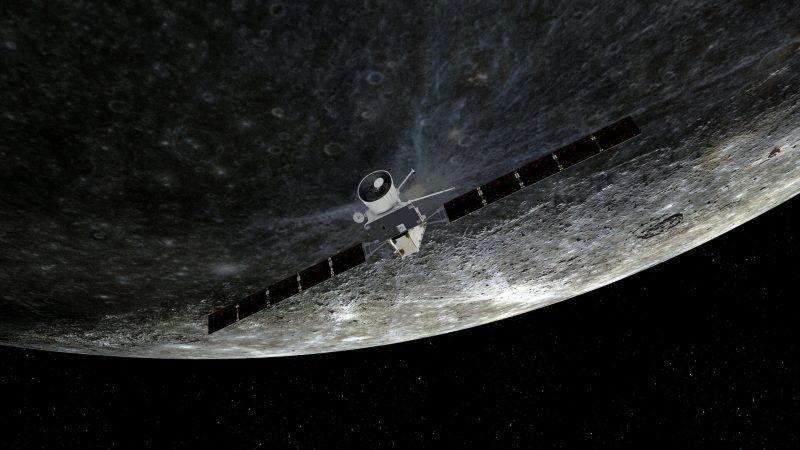
Illustration of a spacecraft with large solar panel wings next to a cratered planet. Artist’s concept of BepiColombo flying past Mercury. BepiColombo’s 3rd flyby of the closest planet to the sun was on June 19, 2023. Image via ESA/ ATG medialab.

Testing the instruments

The team uses these flybys as a chance to test some of the instruments. During Monday’s flyby, the magnetic, plasma and particle monitoring instruments sampled the environment. Johannes Benkhoff, project scientist, said:

Collecting data during flybys is extremely valuable for the science teams to check their instruments are functioning correctly ahead of the main mission. It also provides a novel opportunity to compare with data collected by NASA’s MESSENGER spacecraft during its 2011–2015 mission at Mercury from complementary locations around the planet not usually accessible from orbit. We are delighted to already have data published based on our previous flybys that generated new science results, which makes us even more excited to get into orbit!

Diagram showing path of BepiColombo passing Mercury with a list of stats and other text annotations. View larger. | Here are the key moments in the 3rd flyby of BepiColombo past Mercury. BepiColombo saw the lit side of Mercury about 13 minutes after close approach. Image via ESA (acknowledgement: work performed by ATG under contract to ESA)/ CC BY-SA 3.0 IGO.

Bottom line: BepiColombo had its 3rd flyby of Mercury on June 19, 2023. The spacecraft will eventually go into orbit around the closest planet to the sun. ESA released three new images of Mercury taken during the encounter.

{ https://earthsky.org/ }

Hoe vind je dit bericht?
Geschreven door peter om 16:10 Stuur door

Mercury has a layer of diamond 10 miles thick, NASA spacecraft finds

Mercury has a layer of diamond 10 miles thick, NASA spacecraft finds

On the left a blue and silver sphere on the right a large spherical diamond
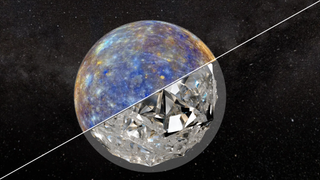
(Left) A colorful view of Mercury produced using images from the color base map imaging campaign during MESSENGER's primary mission (Right) what Mercury may look like were its outer layers stripped to expose its 10-mile-thick layer of diamond 
(Image credit: Robert Lea (created with Canva)/NASA/Johns Hopkins University Applied Physics Laboratory/Carnegie Institution of Washington)

The solar system's tiniest planet may be hiding a big secret. Using data from NASA's MESSENGER spacecraft, scientists have determined that a 10-mile-thick diamond mantle may lie beneath the crust of Mercury, the closest planet to the sun. 

Mercury has long puzzled scientists as it possesses many qualities that aren't common to other solar system planets. These include its very dark surface, remarkably dense core, and the premature end of Mercury's volcanic era. 

Also among these puzzles are patches of graphite, a type (or "allotrope") of carbon on the surface of the innermost planet of the solar system. These patches have led scientists to suggest that in Mercury's early history, the tiny planet had a carbon-rich magma ocean. This ocean would have floated to the surface, creating graphite patches and the dark-shaded hue of Mercury's surface. 

In this new video, we see a series of images as BepiColombo speeds away from the closest planet to the sun during the 3rd Mercury flyby. The spacecraft captured these images in a span of about 50 minutes.

Video via ESA.

The same process would have also led to the formation of a carbon-rich mantle beneath the surface. The team behind these findings thinks that this mantle isn't graphene, as previously suspected, but is composed of another much more precious allotrope of carbon: diamond. 

"We calculate that, given the new estimate of the pressure at the mantle-core boundary, and knowing that Mercury is a carbon-rich planet, the carbon-bearing mineral that would form at the interface between mantle and core is diamond and not graphite," team member Olivier Namur, an associate professor at KU Leuven, told Space.com. "Our study uses geophysical data collected by the NASA MESSENGER spacecraft."

MESSENGER (Mercury Surface, Space Environment, Geochemistry, and Ranging) launched in Aug. 2004 and became the first spacecraft to orbit Mercury. The mission, which ended in 2015, mapped the entire tiny world, discovering abundant water ice in shadows at the poles and gathering crucial data about Mercury's geology and magnetic field.

Related: 

a grey planet covered in craters against the blackness of space

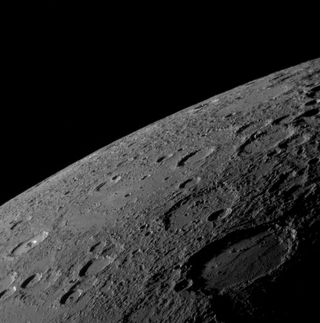
A high-resolution mosaic of images of Mercury captured by  NASA's MESSENGER as the spacecraft departed the planet following the mission's first flyby of Mercury.  (Image credit: NASA/Johns Hopkins University Applied Physics Laboratory/Carnegie Institution of Washington)

Under pressure!

This new study also relates to a major surprise that came a few years ago when scientists re-evaluated the distribution of mass on Mercury, discovering the mantle of this tiny planet is thicker than previously thought.

"We directly thought that this must have a huge implication for the speciation [the distribution of an element or an allotrope amongst chemical species in a system] of carbon, diamond vs graphite, on Mercury," Namur said.

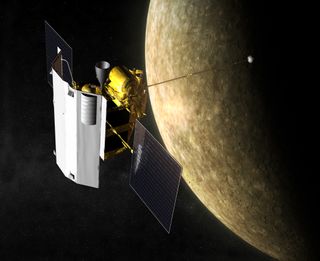
Artist's impression of NASA's MESSENGER spacecraft in orbit at Mercury. MESSENGER arrived at the solar system's innermost planet in March 2011.  (Image credit: NASA/Johns Hopkins University Applied Physics Laboratory/Carnegie Institution of Washington)

The team investigated this here on Earth by using a large-volume press to replicate the pressures and temperatures that exist within the interior of Mercury. They applied incredible amounts of pressure, over seven gigapascals, to a synthetic silicate acting as a proxy for the material found in the mantle of Mercury, achieving temperatures of up to 3,950 degrees Fahrenheit (2,177 degrees Celsius).

This allowed them to study how minerals like those that would have been found in Mercury's mantle in its early existence changed under these conditions. They also used computer modeling to assess data about Mercury's interior, which gave them clues to how the diamond mantle of Mercury could have been created.

"We believe that diamond could have been formed by two processes. First is the crystallization of the magma ocean, but this process likely contributed to forming only a very thin diamond layer at the core/mantle interface," Namur explained. "Secondly, and most importantly, the crystallization of the metal core of Mercury."

Namur said that when Mercury formed around 4.5 billion years ago, the core of the planet was fully liquid, progressively crystallizing over time. The exact nature of the solid phases forming in the inner core is not currently well known, but the team believes that these phases must have been low in carbon or "carbon-poor."

"The liquid core before crystallization contained some carbon; crystallization, therefore, leads to carbon enrichment in the residual melt," he continued. "At some point, a solubility threshold is reached, meaning the liquid cannot dissolve more carbon, and diamond forms."

Diamond is a dense mineral but not as dense as metal, meaning that during this process, it would have floated to the top of the core, stopping at the boundary of Mercury's core and its mantle. This would have resulted in the formation of an around 0.62-mile (1 km) thick diamond layer that then continued to grow over time. 

As the MESSENGER spacecraft drew closer to Mercury for its historic first flyby, the spacecraft acquired this mosaic of the sunlit portion of the planet.   (Image credit: NASA/JHUAPL/CIW)

The discovery highlights the differences between the birth of the closest planet to the sun when compared with the creation of the solar system's other rocky planets, Venus, Earth, and Mars.

"Mercury formed much closer to the sun, likely from a carbon-rich cloud of dust. As a consequence, Mercury contains less oxygen and more carbon than other planets, which led to the formation of a diamond layer," Namur added. "However, Earth's core also contains carbon, and diamond formation in the Earth's core has already been suggested by various researchers."

The researcher hopes that this discovery could help reveal clues to some of the other mysteries surrounding the solar system's smallest planet, including why its volcanic phase was cut short around 3.5 billion years ago.

"A major question that I have about Mercury's evolution is why the major phase of volcanism lasted only a few hundred million years, much shorter than other rocky planets. This must mean that the planet cooled down very fast," Namur said. "This is partly related to the small size of the planet, but we are now working with physicists to try to understand if a diamond layer could have contributed to very fast heat removal, therefore terminating major volcanism very early."

Namur said that the team's next step will be to investigate the thermal effect of a diamond layer at the mantle/core boundary. This study could be supported by data from a mission that will follow in the footsteps of MESSENGER.

"We are also eagerly waiting for the first data collected by BepiColombo, hopefully in 2026, to refine our understanding of Mercury's internal structure and evolution," Namur concluded.

{ https://www.space.com/ }

Hoe vind je dit bericht?
Geschreven door peter om 15:48 Stuur door

PATENTED ‘SUPER BATTERY’ MADE FROM ROCKS COULD POWER FUTURE ELECTRIC VEHICLES

0sVkZF_U?format=jpg&name=900x900

PATENTED ‘SUPER BATTERY’ MADE FROM ROCKS COULD POWER FUTURE ELECTRIC VEHICLES

A team of researchers from the Technical University of Denmark (DTU) has announced the creation of a so-called super battery made from rocks, a technology that may one day replace Lithium Ion batteries used in electric vehicle production.

The team claims their discovery would lead to cleaner, safer, and longer-lasting batteries that don’t rely on rare metals or end up as toxic waste. According to the DTU team behind the battery’s creation, the key to their entry into energy storage lies in the simplicity of the materials involved. More specifically, their super battery is based on potassium and sodium silicates, which are commonly found in rocks.

“These are rock silicates, which are some of the most common minerals in the Earth’s crust,” explains the press release announcing the new battery. “It is found in the stones you pick up on the beach or in your garden.”

WITH LITHIUM ION’S DAYS NUMBERED, SUPER BATTERY WILL LIKELY POWER THE VEHICLES OF THE FUTURE

Today, the vast majority of electric devices, including phones, computers, and cars, are powered by lithium-ion batteries. Unfortunately, lithium is a rare earth mineral and is also considered toxic. Batteries using lithium-ion energy storage have also proven to be dangerous under the right conditions. In some cases, electric cars or even commercial airlines have experienced lithium-ion batteries bursting into flames.

While consumers have somewhat tolerated these issues due to the longer drive times and relatively short device charge times lithium-ion batteries provide, industry experts often state that one way or another, the end of this class of batteries is coming sooner rather than later.

Now, DTU researchers say they may have developed and patented a commercially viable alternative that mitigates nearly all of the largest concerns regarding current technologies while also offering equally impressive drive times and shorter recharge times for electric vehicles.

TEAM SAYS SOLID STATE BATTERIES MADE FROM ROCKS OFFER COMPELLING ADVANTAGES

In developing their futuristic ‘super battery,’ the DTU team knew there was untapped potential in potassium-based silicates. The material is not only good at energy storage but also eco-friendly, inexpensive to extract, and available from material that covers 90 percent of the surface. Still, the research team says it has largely been ignored due to perceived limitations that they believe could be surmounted.

“The potential of potassium silicate as a solid-state electrolyte has been known for a long time, but in my opinion, has been ignored due to challenges with the weight and size of the potassium ions,” explained DTU researcher Mohamad Khoshkalam. “The ions are large and therefore move slower.”

When ions move slowly in a battery, it adversely affects everything from charge times and lifespan to safety. Still, Khoshkalam believed that the huge number of benefits offered by batteries essentially made from rocks were valuable enough that they could prove a nearly perfect medium for their new super battery.

This belief led to the testing of various formulas of potassium silicate-based electrolytes, with an eye on maintaining the material’s benefits while mitigating its weaknesses. According to Khoshkalam, this effort was a success.

After numerous trials, the team was able to create a superionic material of potassium silicate and a separate “process” that combined to make the ions move even faster than they do in lithium-based electrolytes. However, the researchers are keeping the exact formula a secret, although they have received a patent for it.

“The first measurement with a battery component revealed that the material has a very good conductivity as a solid-state electrolyte,” said Khoshkalam. “I cannot reveal how I developed the material, as the recipe and the method are now patented,”

TEAM ACKNOWLEDGES SOLID STATE ROCK BATTERIES ARE A HIGH-RISK TECHNOLOGY

In the DTU team’s formal announcement, they highlight previous announcements by car manufacturers that have promised to develop solid-state batteries “only to subsequently pull out.” Toyota recently announced plans for a 2027-2028 launch of a lithium-based solid-state-powered electric vehicle, but few details have been made available.

The DTU also projects what a solid-state super battery based on potassium silicate would look like, as well as the impressive performance and safety benefits it could offer.

“A single battery cell can be made as thin as a piece of cardboard, where the anode, cathode, and solid-state electrolyte are ultra-thin layers of material,” they explain. “This means that we can make more powerful batteries that take up less space. This offers benefits on the road, as you will be able to drive up to 1,000 km on a single 10-minute charge. In addition, a solid-state battery is more fireproof, as it does not contain combustible liquid.”

In their summary, the team concedes that moving their discovery from a lab invention to the commercial market won’t be easy, as “the chance of commercial success is small, and the technical challenges are many.” In fact, they say that the soonest people could even expect to see this type of technology powering a car is at least ten years away.

Still optimistic, Khoshkalam said he hopes to use his patent and his new company, K-Ion, to create a prototype solid-state super battery based on his science. If successful, he can show it to investors looking to help pave the way for his technology to power devices and EVs of the future.

“We have shown that we can find a material for a solid-state electrolyte that is cheap, efficient, eco-friendly, and scalable,” he explained, “and that even performs better than solid-state lithium-based electrolytes.”

  • Christopher Plain is a Science Fiction and Fantasy novelist and Head Science Writer at The Debrief. Follow and connect with him on X, learn about his books at plainfiction.com, or email him directly at christopher@thedebrief.org.

{ https://thedebrief.org/category/tech/ }

Hoe vind je dit bericht?
Geschreven door peter om 15:27 Stuur door

TESLA TO MANUFACTURE HUMANOID ROBOTS THAT COULD BE AVAILABLE BY NEXT YEAR, ELON MUSK SAYS

QotTSQa0?format=jpg&name=900x900

TESLA TO MANUFACTURE HUMANOID ROBOTS THAT COULD BE AVAILABLE BY NEXT YEAR, ELON MUSK SAYS

Are robots poised to soon become our overlords? Maybe not yet, although billionaire technologist Elon Musk says they could soon take over Tesla production facilities as the company moves forward with plans to begin producing humanoid robots called Optimus as soon as next year. 

In a post on X, Musk said, “Tesla will have genuinely useful humanoid robots in low production for Tesla internal use next year and, hopefully, high production for other companies in 2026.”

First named the “Tesla Bot” and revealed in 2021 at a Tesla AI Day event, the robot’s design has drastically changed over the last few years. Recently renamed Optimus, the humanlike robot was designed to perform dangerous work and repetitive tasks.

At 170 centimeters in height and weighing around 123 pounds, the robot’s new design is sleek compared to its appearance while in the initial prototype phase. 

Tesla’s development of Optimus is not the first time robots designed to mimic human capabilities have made news. Other automotive and robotics companies, including Honda and Boston Dynamics, have made progress in recent years in the development of robots that include those with humanoid designs. 

In 2015, DARPA hosted the Robotics Challenge, and many of the designs looked similar to the robots currently under development by Tesla. 

The event, held at the Fairplex in Pomona, California, aimed to have participants create robot systems and software teams to help humans under conditions of natural and man-made disasters. 

Team Kaist of Daejeon, Republic of Korea, won first place and the $2 million prize with their robot DRC-Hubo, while Team IHMC Robotics from Pensacola, Florida, secured second place and $1 million with their robot Running Man.

The prize for third place went to Tartan Rescue of Pittsburgh and their robot CHIMP, along with a $500,000 prize.

Musk initially speculated that Optimus would be ready for deployment in Tesla’s factories by the end of 2024. Similarly, Musk had said as early as 2019 that Tesla would have its long-awaited self-driving taxis in operation by the following year.

The company’s self-driving taxis are reportedly being unveiled later this year, although no official date has been confirmed.

{ https://thedebrief.org/category/science/ }

Hoe vind je dit bericht?
Geschreven door peter om 00:39 Stuur door

Producing Oxygen From Rock Is Harder In Lower Gravities

Producing Oxygen From Rock Is Harder In Lower Gravities

One of the challenges engineers face when developing technologies for use in space is that of different gravities. Mostly, engineers only have access to test beds that reflect either Earth’s normal gravity or, if they’re fortunate, the microgravity of the ISS. Designing and testing systems for the reduced, but not negligible, gravity on the Moon and Mars is much more difficult. But for some systems, it is essential. One such system is electrolysis, the process by which explorers will make oxygen for astronauts to breathe on a permanent Moon or Mars base, as well as critical ingredients like hydrogen for rocket fuel. To help steer the development of systems that will work in those conditions, a team of researchers led by computational physicist Dr. Paul Burke of the Johns Hopkins University Applied Physics Laboratory decided to turn to a favorite tool of scientists everywhere: models.

Before we explore the model, examining the problem they are trying to solve is helpful. Electrolysis immerses an electrode in a liquid and uses an electrical current and subsequent chemical reaction to split atoms apart. So, for example, if you put an electrode in water, it would separate that water into hydrogen and oxygen.

The problem comes from reduced gravity. As part of electrolysis, bubbles form on the surface of the electrode. On Earth, those bubbles typically detach and float to the surface, as the density difference between them and the remaining liquid forces them to.

Dr. Burke presented alongside other experts at the Space Resources Week Workshop back in March.
Credit – ESRIC YouTube Channel

However, in reduced gravity, the bubbles either take much longer to detach or don’t do so at all. This creates a buffer layer along the electrode’s length that decreases the electrolysis process’s efficiency, sometimes stalling it out entirely. Electrolysis isn’t the only fluidic process that has difficulty operating in reduced gravity environments – many ISS experiments also have trouble. This is partly due to a lack of complete understanding of how liquids operate in these environments – and that in itself is partly driven by a dearth of experimental data. 

Which is where the modeling comes in. Dr. Burke and his colleagues use a technique known as Computational Fluid Dynamics to attempt to mimic the forces the fluids will undergo in a reduced gravity environment while also understanding bubble formation.

Electrolysis on Earth is typically done with water, but why stop there? The team used their CFD to model two other liquids that might be used in electrolyzers – molten salt (MSE) and molten regolith (MRE). Molten salt is used on Earth, but less commonly than regular water, and has successfully produced oxygen. However, molten regolith electrolysis is still somewhat of a novel use case and has yet to be thoroughly tested. MOXIE, the experiment that famously created oxygen on Mars in 2021, used the carbon dioxide in Mars’ atmosphere and a solid-state electrode – neither representative of molten regolith.

Fraser discusses MOXIE electrolysis with Dr. Michael Hect.

Dr. Burke and his team found that, computationally, at least, MRE has the most challenging conditions in reduced gravity. It has also never been tested in any reduced gravity environment, so for now; these simulations are all engineers have to go on with if they are going to design a system.

There were a few key takeaways from the modeling, though. First, engineers should design horizontal electrodes into MRE systems, as the longer a bubble spreads across an electrode (i.e., as it goes “up” it), the longer it takes for that bubble to detach. In a horizontal configuration, the electrode has less surface area to attach to, making it more likely for the bubbles to detach and float to the surface.

Additionally, the amount of time bubbles remain attached to an electrode scales exponentially with decreasing gravity. That means bubbles on the Moon will take longer to detach than those on Mars, which will take longer than those on Earth. Consequently, electrolysis on the Moon will be less efficient than that on Mars, which will again be less efficient than that on Earth, and mission planners will need to account for these discrepancies if they plan on getting something as mission-critical as oxygen from this process. The smoothness of the electrodes also seems to matter, with rougher electrodes more likely to hold onto their bubbles and, therefore, end up less efficient.

SciShow Space explores the world of MRE.
Credit – SciShow Space YouTube Channel

Other engineering solutions can overcome all these challenges, such as a vibratory mechanism on the electrode to shake the bubbles loose. However, it’s a good idea to consider all the additional complications operations in a reduced gravity environment have before launching a mission. That’s why modeling is so important, but humanity will ultimately have to experimentally test these systems, perhaps on the Moon itself, if we plan to utilize its local resources to sustain our presence there.

Learn More:

Lead Image:

  • Graphic showing the difference in bubble accumulation in low and high gravities.
  • Credit – Burke et al.

{ https://www.universetoday.com/ }

Hoe vind je dit bericht?
Geschreven door peter om 23:45 Stuur door

Astronomers Have Tools That Can Help Detect Deepfake Images

This AI-generated image of the Pope in a puffer jacket went viral in 2023 and many were fooled into thinking it was real. It was generated with the AI tool Midjourney and was posted on Reddit by a user whose account is now gone. On the right is a Hubble Space Telescope image of the Antennae Galaxies. Image Credit: Midjourney/NASA/ESA

Astronomers Have Tools That Can Help Detect Deepfake Images

There’s a burgeoning arms race between Artificial Intelligence (AI) deepfake images and the methods used to detect them. The latest advancement on the detection side comes from astronomy. The intricate methods used to dissect and understand light in astronomical images can be brought to bear on deepfakes.

The word ‘deepfakes’ is a portmanteau of ‘deep learning’ and ‘fakes.’ Deepfake images are called that because they’re made with a certain type of AI called deep learning, itself a subset of machine learning. Deep learning AI can mimic something quite well after being shown many examples of what it’s being asked to fake. When it comes to images, deepfakes usually involve replacing the existing face in an image with a second person’s face to make it look like someone else is in a certain place, in the company of certain people, or engaging in certain activities.

Deepfakes are getting better and better, just like other forms of AI. But as it turns out, a new tool to uncover deepfakes already exists in astronomy. Astronomy is all about light, and the science of teasing out minute details in light from extremely distant and puzzling objects is developing just as rapidly as AI.

In a new article in Nature, science journalist Sarah Wild looked at how researchers are using astronomical methods to uncover deepfakes. Adejumoke Owolabi is a student at the University of Hull in the UK who studies data science and computer vision. Her Master’s Thesis focused on how light reflected in eyeballs should be consistent, though not identical, between left and right. Owolabi used a high-quality dataset of human faces from Flickr and then used an image generator to create fake faces. She then compared the two using two different astronomical measurement systems called the CAS system and the Gini index to compare the light reflected in the eyeballs and to determine which were deepfakes.

CAS stands for concentration, asymmetry, and smoothness, and astronomers have used it for decades to study and quantify the light from extragalactic stars. It’s also used to quantify the light from entire galaxies and has made its way into biology and other areas where images need to be carefully examined. Noted astrophysicist Christopher J. Conselice was a key proponent of using CAS in astronomy.

The Gini index, or Gini coefficient, is also used to study galaxies. It’s named after the Italian statistician Corrado Gini, who developed it in 1912 to measure income inequality. Astronomers use it to measure how light is spread throughout a galaxy and whether it’s uniform or concentrated. It’s a tool that helps astronomers determine a galaxy’s morphology and classification.

In her research, Owolabi successfully determined which images were fake 70% of the time.

These eyes are all from deepfake images with inconsistent light reflection patterns. The ones on the right are coloured to highlight the inconsistencies. Image Credit: Adejumoke Owolabi (CC BY 4.0) These eyes are all from deepfake images with inconsistent light reflection patterns. The ones on the right are coloured to highlight the inconsistencies. Image Credit: Adejumoke Owolabi (CC BY 4.0)

For her article, Wild spoke with Kevin Pimbblet, director of the Centre of Excellence for Data Science, Artificial Intelligence and Modelling at the University of Hull in the UK. Pimblett presented the research at the UK Royal Astronomical Society’s National Astronomy Meeting on July 15th.

“It’s not a silver bullet, because we do have false positives and false negatives,” said Pimbblet. “But this research provides a potential method, an important way forward, perhaps to add to the battery of tests that one can apply to try to figure out if an image is real or fake.”

This is a promising development. Open democratic societies are prone to disinformation attacks from enemies without and within. Public figures are prone to similar attacks. Disturbingly, the majority of deepfakes are pornographic and can depict public figures in private and sometimes degrading situations. Anything that can help combat it and bolster civil society is a welcome tool.

But as we know from history, arms races have no endpoint. They go on and on in an escalating series of countermeasures. Look at how the USA and the USSR kept one-upping each other during their nuclear arms race as warhead sizes reached absurd levels of destructive power. So, inasmuch as this work shows promise, the purveyors of deepfakes will learn from it and improve their AI deepfake methods.

Wild also spoke to Brant Robertson in her article. Robertson is an astrophysicist at the University of California, Santa Cruz, who studies astrophysics and astronomy, including big data and machine learning. “However, if you can calculate a metric that quantifies how realistic a deepfake image may appear, you can also train the AI model to produce even better deepfakes by optimizing that metric,” he said, confirming what many can predict.

This isn’t the first time that astronomical methods have intersected with Earthly issues. When the Hubble Space Telescope was developed, it contained a powerful CCD (charge-coupled device.) That technology made its way into a digital mammography biopsy system. The system allowed doctors to take better images of breast tissue and identify suspicious tissue without a physical biopsy. Now, CCDs are at the heart of all of our digital cameras, including on our mobile phones.

Might our internet browsers one day contain a deepfake detector based on Gini and CAS? How would that work? Would hostile actors unleash attacks on those detectors and then flood our media with deepfake images in an attempt to weaken our democratic societies? It’s the nature of an arms race.

It’s also in our nature to use deception to sway events. History shows that rulers with malevolent intent can more easily deceive populations that are in the grip of powerful emotions. AI deepfakes are just the newest tool at their disposal.

We all know that AI has downsides, and deepfakes are one of them. While their legality is fuzzy, as with many new technologies, we’re starting to see efforts to combat them. The United States government acknowledges the problem, and several laws have been proposed to deal with it. The “DEEPFAKES Accountability Act” was introduced in the US House of Representatives in September 2023. The “Protecting Consumers from Deceptive AI Act” is another related proposal. Both are floundering in the sometimes murky world of subcommittees for now, but they might breach the surface and become law eventually. Other countries and the EU are wrestling with the same issue.

But in the absence of a comprehensive legal framework dealing with AI deepfakes, and even after one is established, detection is still key.

Astronomy and astrophysics could be an unlikely ally in combatting them.

{https://www.universetoday.com/ ,}

Hoe vind je dit bericht?
Geschreven door peter om 23:31 Stuur door

Curiosity Drives Over a Rock, Cracking it Open and Revealing an Amazing Yellow Crystal

The Mars Curiosity rover rolled over this rock containing pure sulfur crystals in May. Planetary scientists are still trying to figure out how the sulfur got there. NASA/JPL-Caltech/MSSS

Curiosity Drives Over a Rock, Cracking it Open and Revealing an Amazing Yellow Crystal

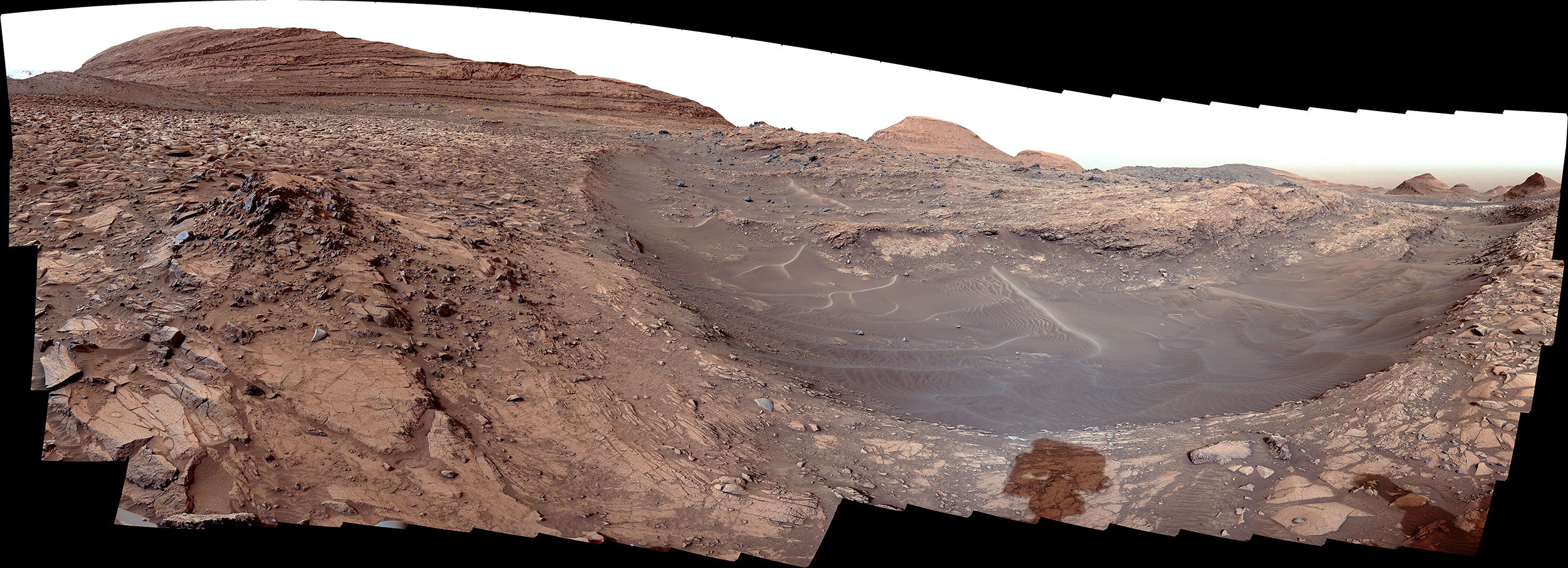
On May 30th, the Mars Curiosity rover was just minding its own business exploring Gediz Vallis when it ran over a rock. Its wheel cracked the rock and voila! Pure elemental sulfur spilled out. The rover took a picture of the broken rock about a week later, marking the first time sulfur has been found in a pure form on Mars.

After Curiosity’s encounter with the broken rock and its pure sulfur innards, the rover trundled over to another rock, called “Mammoth Lakes” for a little drilling session. Before it left to explore other rocks, the rover managed to cut into that rock and take samples for further study to find out its chemical composition.

It’s not that sulfur isn’t prevalent on Mars. It is, but in different forms. The stuff is highly abundant in the Solar System, so this find isn’t as surprising as you’d think. However, Curiosity finding pure sulfur in the middle of broken rocks is a new experience in Mars exploration. So, of course, that’s raising questions about how it got there and its implications for habitable environments in Mars’s long history.

Curiosity’s Peregrinations

At the moment, the Curiosity rover is making its way through the Gediz Vallis. That’s a flow channel winding its way down a section of Mount Sharp (aka Aeolis Mons). That’s the central peak of Gale Crater. The rover has been heading up since 2014, charting different surface layers as it goes. Each layer was put down during a different era of Mars’s history. They could contain clues to the planet’s habitability in the past.

NASA’s Curiosity Mars rover captured this view of Gediz Vallis channel on March 31. This area was likely formed by large floods of water and debris that piled jumbles of rocks into mounds within the channel. The rock the rover broke lies in a channel in this region.  Credit: NASA/JPL-Caltech/MSSS  NASA’s Curiosity Mars rover captured this view of Gediz Vallis channel on March 31. Floods of water and debris piled rocks and sand into mounds within the channel. The rock the rover broke lies in a channel in this region.
 Credit: NASA/JPL-Caltech/MSSS 

Fast-moving liquid water raged over the surface and carved Gediz. The floods carried a lot of rocks and sand and deposited them all along the way. Other piles of flood debris lie around the region, bearing witness to other ancient floods and landslides. “This was not a quiet period on Mars,” said Becky Williams, a scientist with the Planetary Science Institute in Tucson, Arizona, and the deputy principal investigator of the Mast Camera, or Mastcam on Curiosity. “There was an exciting amount of activity here. We’re looking at multiple flows down the channel, including energetic floods and boulder-rich flows.”

Understanding Sulfur’s Presence

The surface materials in Gediz contain high amounts of sulfates. Those are sulfur-bearing salts that appear as water evaporates. They are a chemical clue that water existed in the region. Judging by some parts of the surface, it also appears the water ponded at some times, in addition to the floods that scoured the landscape and then deposited debris.

Now the planetary science team has to explain how a pure form of elemental sulfur got stuck in the middle of rocks, according to project scientist Ashwin Vasavada. “Finding a field of stones made of pure sulfur is like finding an oasis in the desert,” said Vasavada. “It shouldn’t be there, so now we have to explain it. Discovering strange and unexpected things is what makes planetary exploration so exciting.”

Putting Sulfur in Context

Sulfur, of course, exists on Earth, which helps scientists understand its behavior and the environments where it’s found. The presence of sulfur can be a result of various geological processes. The sulfur “cycle” includes the flow of sulfur from the core to the surface through volcanism. That’s not unusual. Sulfur commonly appears around volcanic vents. Mt Ijen in Indonesia is a good example. It sports extensive elemental sulfur deposits that are mined.

The volcanic moon Io in the Jupiter system features patches of different allotropes of sulfur. They’re also volcanic in origin, spewed out along with widespread lava flows. This moon has more than 400 volcanic features, making it the most volcanically active (and sulfurous) place in the Solar System.

The Jovian moon Io as seen by the New Horizons spacecraft. The mission's camera caught a view of one of this moon's volcanos erupting. Courtesy: NASA Goddard Space Flight Center Scientific Visualization Studio. The Jovian moon Io is seen by the New Horizons spacecraft. The mission’s camera caught a view of one of this moon’s volcanos erupting. The region that Curiosity is investigating shows evidence of different kinds of sulfur-bearing minerals. Courtesy: NASA Goddard Space Flight Center Scientific Visualization Studio.

The pure sulfur in the Mars rock most likely came from volcanic processes. They occurred sometime in the past, but that doesn’t answer how the crystals got inside the rock it crushed. Scientists have known for years that Mars was extremely volcanically active in the past. For a long time, they also thought it was dead, or at least dormant. The planet has no plate tectonics like we see on Earth, either. However, the Mars InSight mission found evidence of some seismic activity on the planet in 2021.

In 2023, planetary scientists at the University of Arizona offered up evidence of a giant mantle plume under Elysium Planitia that drove some kinds of activity in the more recent past. Gale Crater lies in this region and could well have experienced related volcanic and seismic activity during the recent geologic past. If so, that could help explain the presence not only of pure sulfur but also the flood-related sulfates deposited on the surface.

For More Information

{ https://www.universetoday.com/ }

Hoe vind je dit bericht?
Geschreven door peter om 23:18 Stuur door

Mystery around controversial Peru 'alien mummies' deepens after new fingerprint analysis indicates they're NOT 'HUMAN'

Mystery around controversial Peru 'alien mummies' deepens after new fingerprint analysis indicates they're NOT 'HUMAN'

Bizarre diagonal grooves along the fingertips and toes of one of Peru's eerie and hotly debated 'alien mummies' points to a nonhuman origin for these odd remains.

Worldwide controversy has followed the small peculiar specimens since September, when veteran broadcast journalist and prolific UFO researcher Jaime Maussan first presented two alleged 'alien' corpses to Mexico's congress last year.

Now DailyMail.com has spoken to a former Colorado prosecutor and current defense attorney, who has examined one of the over half-a-dozen 'alien' specimens with the help of three independent forensic medical examiners from the United States.  

'These were not traditional human fingerprint patterns,' that attorney, Joshua McDowell, told DailyMail.com.

Above, a photo of one of the mummy's unusual fingerprints posted to social media by Jose Baizan and attributed to the Mexican Naval surgeon Dr Jose de Jesus Zalce Benitez, who has also examined the Peruvian 'alien' mummies on behalf of ufologist Jaime Maussan

Above, a photo of one of the mummy's unusual fingerprints posted to social media by Jose Baizan and attributed to the Mexican Naval surgeon Dr Jose de Jesus Zalce Benitez, who has also examined the Peruvian 'alien' mummies on behalf of ufologist Jaime Maussan

In Peru last April - as part of another event hosted by Maussan - a new 'alien' specimen named Montserrat (above) was presented. This photo was taken by Colorado attorney Josh McDowell who told DailyMail.com, one mummies' 'fingerprints weren't consistent with human prints'

In Peru last April - as part of another event hosted by Maussan - a new 'alien' specimen named Montserrat (above) was presented. This photo was taken by Colorado attorney Josh McDowell who told DailyMail.com, one mummies' 'fingerprints weren't consistent with human prints'

The use of fingerprints — or what are technically known as 'friction ridge' skin impressions — dates back as far as 300 BC in China according to the US Department of Justice's Fingerprint Sourcebook.

And criminal forensic investigators in America have long systematized the hunt for unique features ever since these patterns first came into use by US law enforcement in 1902, beginning with three broad types of fingerprint: arches, loops and whorls.

But 'María,' the so-called 'alien' mummy that McDowell and his forensic doctors examined, appeared to have fingerprints that matched no known human pattern.

'We did not see any loops or whorls on the prints of the fingers or on the toes,' McDowell, now principal at the McDowell Law Firm, told DailyMail.com.

'I'm a former prosecutor. I'm a criminal defense attorney. I've seen lots of fingerprints. And these were not classic fingerprints,' the attorney added.

'María's fingerprints weren't consistent with human prints.'

Criminal forensic investigators in America have long systematized the hunt for unique features ever since these patterns first came into use by US law enforcement in 1902, beginning with three broad types of fingerprint: arches, loops and whorls (pictured)

Criminal forensic investigators in America have long systematized the hunt for unique features ever since these patterns first came into use by US law enforcement in 1902, beginning with three broad types of fingerprint: arches, loops and whorls (pictured)

'We did not see any loops or whorls on the prints of the fingers or on the toes,' McDowell, now principal at the McDowell Law Firm, told DailyMail.com. Above an image of the specific, so-called 'alien' mummy in question, known as María, who was first made public in 2019

'We did not see any loops or whorls on the prints of the fingers or on the toes,' McDowell, now principal at the McDowell Law Firm, told DailyMail.com. Above an image of the specific, so-called 'alien' mummy in question, known as María, who was first made public in 2019

Like most of the well over half-a-dozen 'alien' mummy specimens brought to light by Jaime Maussan in the past year, María was discovered caked in diatomaceous earth: white, powdery aquatic fossils left behind by a type of plankton known as diatoms.

'Much of her body is covered in diatomaceous earth,' McDowell explained, 'however, on the fingers that were exposed, the epidermal ridges I saw appeared to be in mostly straight lines.'

McDowell and the three US medical examiners who journeyed with him to Peru to examine the bodies last April have emphasized that it would be 'extremely premature' to make any definitive statements about these mysterious mummies.

McDowell told DailyMail.com that there may yet be a terrestrial explanation for the unusually straight 'friction ridge' skin patterns on María's fingers and toes.

'It could possibly have something to do with the way her skin was preserved,' he advised. 'It's very odd.'

McDowell, previously a deputy district attorney for Colorado's Fourth Judicial District Attorney's Office, brought a city coroner from Denver as well as a forensic anthropologist from Maryland's State Medical Examiner to Peru to inspect María.

The third expert, McDowell's father Dr John McDowell, is a forensic odontologist and retired professor at the University of Colorado — who once worked to identify victims of the 9/11 terrorist attacks on the World Trade Center via their dental records.

Joshua McDowell emphasized to DailyMail.com that 'no determination has been made about what the nature of the specimens is at this date,' adding that his teams' effort to identify the true nature of these 'alien' mummies is very much still active. 

'I've been to Mexico a couple times, spent a week in Peru,' the attorney said. 'Two to three hours a day, I'm dealing with something on this.'

'So far we have tomographies [CT scans] and fluoroscopy analysis,' Maussan told DailyMail.com describing the x-ray and ultrasound data on the mummies that he unveiled at West Hollywood's Mondrian Hotel at a prior March 12, 2024 press event (pictured above)

'So far we have tomographies [CT scans] and fluoroscopy analysis,' Maussan told DailyMail.com describing the x-ray and ultrasound data on the mummies that he unveiled at West Hollywood's Mondrian Hotel at a prior March 12, 2024 press event (pictured above)

Above, two of Maussan's collaborators, documentarians Serena DC (right) and Michael Mazzola (left), pose with a new 'alien' mummy from this March - which they said has 30 percent 'unknown' DNA

Above, two of Maussan's collaborators, documentarians Serena DC (right) and Michael Mazzola (left), pose with a new 'alien' mummy from this March - which they said has 30 percent 'unknown' DNA

This past January - after two mummies were seized by Peruvian customs - Flavio Estrada (right), a forensic archaeologist with Peru's Institute of Legal Medicine and Forensic Sciences of Lima, said that the alien bodies are 'dolls' made of animal parts

This past January - after two mummies were seized by Peruvian customs - Flavio Estrada (right), a forensic archaeologist with Peru's Institute of Legal Medicine and Forensic Sciences of Lima, said that the alien bodies are 'dolls' made of animal parts

María is one several specimens that have been dubbed 'the Nazca mummies,' after the province in southwestern Peru where these bodies were allegedly unearthed.

Most of these specimens have gained fame and infamy, in part, due to their elongated heads and their three-fingered hands which resemble decades of anecdotal accounts and UFO lore about extraterrestrial 'grey' beings.

Maussan and his colleagues have had an eventful year pushing for wider scientific interest in the apparently alien bodies, including two bitter clashes with Peru's Ministry of Culture, who have described the mummies and man-made hoaxes.

In January, Flavio Estrada, a forensic archaeologist of the Institute of Legal Medicine and Forensic Sciences of Lima of the Public Ministry, told a press conference that two of the alien bodies seized by Peruvian customs were 'dolls.'

'The conclusion is simple,' Estrada said, 'they are dolls assembled with bones of animals from this planet, with modern synthetic glues, therefore they were not assembled during pre-Hispanic times.'

But María, like several of the other Nazca mummies, does not resemble the smaller, more doll-like specimens seized at the border or presented to Mexican congress. 

The new — albeit provisional — fingerprint analysis suggests some of the Nazca mummies are either not dolls or were constructed of more grim, unusual material.

In March 2024, Maussan published a report on the DNA of the Nazca 'tridactyl' mummies - a report that he described as having been performed by 'the top specialist in Molecular Biology and Genetics of Peru' (page one above)

In March 2024, Maussan published a report on the DNA of the Nazca 'tridactyl' mummies - a report that he described as having been performed by 'the top specialist in Molecular Biology and Genetics of Peru' (page one above)

Ten scientists with San Luis Gonzaga National University of Ica (UNICA), according to Maussan's statement in March, concluded 'their DNA [i.e. the Nazca mummies' DNA] contains 29 percent that does not belong to the evolutionary chain of the Earth' (page two above)

Ten scientists with San Luis Gonzaga National University of Ica (UNICA), according to Maussan's statement in March, concluded 'their DNA [i.e. the Nazca mummies' DNA] contains 29 percent that does not belong to the evolutionary chain of the Earth' (page two above)

But the larger Nazca mummy specimens also have their critics.

One critic of Maussan, Latin American historian Christopher Heaney, noted that multiple regions of Latin America, including Peru, have a rich tradition of head-binding and head-shaping practices performed on infants' developing skulls.

'The Spanish, when they arrived in the 16th Century observed and commented on individuals walking around with very specifically shaped skulls,' as Heaney told DailyMail.com, 'and they recognized and saw them doing it using these bandages.'

This specific 'alien' mummy, María, was first debuted at a November 6, 2019 press event held at Peru's San Luis Gonzaga National University of Ica (UNICA) alongside three other Nazca 'tridactyls' (three-fingered bodies): 'Wawita,' 'Albert' and 'Victoria.'

Maussan, who was a party to McDowells' trip to UNICA to inspect these mummies, unveiled a new 'alien' specimen named Montserrat during the recent April 2024 trip.

Maussan has pushed for wider scientific interest in the apparently alien bodies, including a presentation before Mexico's Congress (pictured)

Maussan has pushed for wider scientific interest in the apparently alien bodies, including a presentation before Mexico's Congress (pictured)

'Would you consider I would take the bodies to the Mexican Congress putting in danger 50 years of [my journalism] career to present fake bodies?' he asked at a press event this March

'Would you consider I would take the bodies to the Mexican Congress putting in danger 50 years of [my journalism] career to present fake bodies?' he asked at a press event this March 

The previous month, Maussan published a report on the Nazca 'tridactyls' DNA that he described as having been performed by 'the top specialist in Molecular Biology and Genetics of Peru.'

Ten scientists with UNICA, according to Maussan's statement that March, concluded 'their DNA [i.e. the Nazca mummies' DNA] contains 29 percent that does not belong to the evolutionary chain of the Earth.'

McDowell's US team of forensic medical examiners were more circumspect in their analysis after their trip to UNICA the following month.

'We would want actual, very definitive DNA studies done at high complexity laboratories,' the US team said at their mid-April 2024 press conference. 

'The carbon dating needs to be repeated with more sophisticated methods. Those are things that we're looking for,' they added. 'Our preliminary investigation really just led to the fact that more investigation is needed.'

{ https://www.dailymail.co.uk/ }

Hoe vind je dit bericht?
Geschreven door peter om 23:02 Stuur door

New film reveals most bizarre theory about UFOs yet - the 'cosmic jokers' hypothesis

New film reveals most bizarre theory about UFOs yet - the 'cosmic jokers' hypothesis

Tucker Carlson thinks they're biblical entities. Others say they are humans from the future coming back to study us.

Now, a new film proposes an even stranger theory about UFOs. 

The Cosmic Joker investigates the idea that these entities may be 'tricksters' that deliberately shape themselves into what people want to see or into forms that people may be familiar with, director Mark Christopher Lee told DailyMail.com.

The movie concentrates on two infamous alien encounter tails: the Robert Taylor incident and the Pascagoula abduction of fishermen Charles Hickson and Calvin Parker.

The Pascagoula abduction of fishermen Charles Hickson (left) and Calvin Parker (right) and occurred in 1973

The Pascagoula abduction of fishermen Charles Hickson (left) and Calvin Parker (right) and occurred in 1973

Mr Hickson and Mr Parker reported being experimented on by aliens with crab-like claws

Mr Hickson and Mr Parker reported being experimented on by aliens with crab-like claws 

It asks the question: Did the aliens who made contact with the men deliberately shape shift themselves into forms reminiscent of something in their personal lives?

The film also suggests aliens might not be from space at all - and that this might be behind alleged cover-ups of UFO evidence. 

Mr Taylor was a forest worker in Scotland who described seeing a UFO resembling a naval sea mine in 1979. 

The Cosmic Joker suggests the entity deliberately take this form to resemble something Mr Taylor was familiar with from his time in the military.

In 1973 in Pascagoula, Mississippi, Mr Hickson and Mr Parker reported being experimented on by aliens with crab-like claws. 

Did alien intelligence shape itself to a form familiar to the two Deep South fishermen?

Lee told DailyMail.com: ‘What piqued my interest for this film was interviews about the Pascagoula Encounter in the US in 1973. Calvin Parker and Charles Hickson had an alleged abduction experience whilst fishing near the Pascagoula River.

‘They claimed they were taken onboard an alien craft and examined and physically handled by two aliens which had crab-like pincers. I just thought - why would the aliens have crab like pincers?’

The two men reported to the sheriff's department they had been abducted by gray-skinned aliens while fishing - with the aliens having ‘crab-like’ hands and ‘robotic’ mouths.

The men each had a puncture wound in their arm.

Hickson told The Washington Post: 'I was just getting ready to get some more bait, when I heard a kind of zipping sound. I looked up and saw a blue flashing light. Calvin turned around too.

'We saw a 30-foot-long object with a little dome on top.'

The two Pascagoula witnesses had physical injuries from the encounter

The two Pascagoula witnesses had physical injuries from the encounter

The police officers interviewing the men secretly left a tape recorder in the room with the witnesses after law enforcement left.

While they may have been hoping to catch the men drop their act and admit they made up the encounter, they only recorded them saying the experience scared them to death. 

Lee told this website: ‘The police placed a hidden tape recorder, which captured them talking about how the experience scared them out of their lives. So that begs the question: if the experience was real, what were these creatures?

'Did they actually adapt themselves to what a couple of Deep South fishermen might expect to see? Why did they see the same thing?’

In the film, Lee also speaks to UFO author Malcolm Robinson, who describes the strange encounter World War II veteran Mr Taylor had with a UFO in the Dechmont Woods in Scotland.

Lee told DailyMail.com: ‘Mr Taylor encountered and was attacked by an alien or intelligence that was similar in appearance to a naval sea mine with sharp protruding limbs coming off the sides.

'Again I thought did the intelligence, whatever it may be, take this from as it would be familiar to Robert Taylor having served in the military?’

Mr Taylor's reported sighting was investigated by police after two spiked spheres rolled at him - leaving him unconscious for 20 minutes with ripped clothing.

Ddirector Mark Christopher Lee spoke to DailyMail.com

Director Mark Christopher Lee spoke to DailyMail.com

The war hero and churchgoer was believed by locals - and police found strange marks on the ground which could not be explained by machinery in the vicinity.

Lee said others have suggested Taylor’s encounter may have been triggered by an epileptic episode.

The idea of aliens as shape-shifting ‘tricksters’ was first proposed in a book by late author John Keel, whose work inspired the Richard Gere film The Mothman Prophecies, Lee told this website.

He said: ‘Keep was the first to really study in minute detail UFO and alien encounters. From his research he noted that there was always this mischievous trickster element in these sightings.’

Keel’s book suggests aliens may not be from other planets, or from space at all - but may instead be ‘ultra-terrestrials’ who manipulate human beliefs.

Lee added: ‘Of course if this theory is true it is probably far more disturbing than being visited by other beings from other planets. 

'Are we as humans the playthings of a far superior intelligence that lives alongside us?

‘Some modern Ufologists like Blink 182 musician Tom DeLonge believe that this intelligence has always been with us and that the US government knows this and is using the extraterrestrial hypothesis as a smokescreen to divert the public from the wilder truth.’

The Cosmic Joker is out now on Tubi TV.

{ https://www.dailymail.co.uk/ }

Hoe vind je dit bericht?
Geschreven door peter om 22:42 Stuur door

Chandra Marks 25 Years in Space with Collection of 25 Stunning Images

Chandra Marks 25 Years in Space with Collection of 25 Stunning Images

To celebrate the 25th anniversary of NASA’s Chandra X-ray Observatory, the Chandra team has released a set of 25 new images of cosmic objects and phenomena.

This collection of images was released to commemorate the 25th anniversary of Chandra. Image credit: NASA / CXC / SAO.

This collection of images was released to commemorate the 25th anniversary of Chandra.

Image credit: NASA / CXC / SAO.

On July 23, 1999, the space shuttle Columbia launched into orbit carrying Chandra, which was then the heaviest payload ever carried by the shuttle.

With Commander Eileen Collins at the helm, the astronauts aboard Columbia successfully deployed Chandra into its highly elliptical orbit that takes it nearly one-third of the distance to the Moon.

“For a quarter century, Chandra has made discovery after amazing discovery,” said Dr. Pat Slane, director of the Chandra X-ray Center located at the Smithsonian Astrophysical Observatory.

“Astronomers have used Chandra to investigate mysteries that we didn’t even know about when we were building the telescope — including exoplanets and dark energy.”

“Chandra has been a great success story for humanity and its pursuit of knowledge,” said Dr. Andrew Schnell, acting project manager of Chandra at NASA’s Marshall Space Flight Center.

“The telescope’s incredible accomplishments are made possible by the team’s hard work and dedication.”

The new set of images is a sample of almost 25,000 observations Chandra has taken during its quarter century in space.

In 1976, Riccardo Giacconi and Harvey Tananbaum first proposed to NASA the mission that would one day become Chandra.

Eventually, Chandra was selected to become one of NASA’s Great Observatories, along with the Hubble Space Telescope and the now-retired Compton Gamma Ray Observatory and Spitzer Space Telescope, each looking at different types of light.

In 2002, Giacconi was awarded the Nobel Prize in physics for pioneering contributions to astrophysics, which have led to the discovery of cosmic X-ray sources, laying the foundation for the development and launch of Chandra.

Today, astronomers continue to use Chandra data in conjunction with other powerful telescopes including the NASA/ESA/CSA James Webb Space Telescope, NASA’s Imaging X-ray Polarimetry Explorer (IXPE), and many more.

“On behalf of the STS-93 crew, we are tremendously proud of the Chandra X-ray Observatory and its brilliant team that built and launched this astronomical treasure,” said Eileen Collins, commander of the space shuttle Columbia mission that launched Chandra into space in 1999.

“Chandra’s discoveries have continually astounded and impressed us over the past 25 years.”

  • This article is a version of a press-release provided by NASA.

Top 10 Facts About Chandra


10. Chandra flies 200 times higher than Hubble - more than 1/3 of the way to the moon!
orbit

Explanation: For the planned operational orbit of Chandra, the closest approach to Earth and the most distant point from Earth will be as follows:
Altitude at Perigee (closest approach) = 10,000 km = 6,214 (statute) mile = 5,400 nautical mile
Altitude at Apogee (most distant point from Earth) = 140,000 km = 86,992 (statute) mile = 75,594
nautical mile
For reference, Mean radius of Earth = 6,371 km = 3,959 (statute) mile = 3,440 nautical mile

9. Chandra can observe X-rays from clouds of gas so vast that it takes light five million years to go from one side to the other!
perseus

Explanation: If we assume conservatively that a cluster extends out to a radius of 1 Mpc, then it has a diameter of 2 Mpc, or 6 million light years.

8. During maneuvers from one target to the next, Chandra slews more slowly than the minute hand on a clock.
spacecraft

Explanation: According the CXC Observatory Guide, it takes Chandra 31 minutes to slew 90 degrees. It takes the minute hand on a clock 15 minutes to slew 90 degrees.

7. At 45 feet long, Chandra is the largest satellite the shuttle has ever launched. See also: Top 10 Facts Infographic
launch

Explanation: For comparison, the Hubble Space Telescope was just over 43 feet long.

6. If Colorado were as smooth as Chandra's mirrors, Pikes Peak would be less than one inch tall!
mirror

Explanation: Numbers:
Assume optics size = 84 cm
Assume rms low frequency figure errors are < 100a = 1e-6 cm
Assume size of Colorado= 600 km = 6 E7 cm
Then the ratio of the (rms errors)/(optics size) < 1.2 e-8
Assuming that there will be one 3 sigma peak in 1000 trials (the approx. number of measurements of the figure), then the ratio is < 3.6e-8.
Then the largest mountain (which is not Pikes Peak, but is not much taller than Pikes Peak) in Colorado would be < 2.2 cm < 1 inch.

5. Chandra's resolving power is equivalent to the ability to read a stop sign at a distance of twelve miles.
stop_sign

Explanation: The letters on a stop sign are 25 cm high. Assuming that we need a 5 x 5 pixel square, then the resolution element is 5 cm high, which would subtend an angle = 0.5 arcsec at a distance D = 5/2.5E-6 = 2 E6 cm = 20 km = 12 miles.

4. The electrical power required to operate the Chandra spacecraft and instruments is 2 kilowatts, about the same power as a hair dryer.

Explanation: A standard hair dryer uses 1600-1800 watts (slightly less than 2 kilowatts) on its high setting.

3. The light from some of the quasars observed by Chandra will have been traveling through space for ten billion years.
cena

Explanation: If we take a Hubble constant of 60 km/sec-Mpc, then the Hubble time is approx 16 billion years, so for a quasar at z > 3, the look back time, depending on Omega, is greater than 10 billion years.

2. STS-93, the space mission that deployed Chandra, was the first NASA shuttle mission commanded by a woman.
Eileen Collins

Explanation: Commander Eileen Collins was the first woman to command a NASA shuttle mission.

1Chandra can observe X-rays from particles up to the last second before they fall into a black hole!!!
blackholesStorm

Explanation: The last stable orbit for a Schwarzchild metric is 6GM/c^2 ~ 10^7 cm for a 10 solar mass black hole. The time to fall in from this point on is ~ 0.001-.01 seconds, depending on the details of the orbit of the infalling particle.

{ https://www.sci.news/ }

Hoe vind je dit bericht?
Geschreven door peter om 22:24 Stuur door

99-Million-Year-Old Burmese Amber Reveals Oldest Known Skink

99-Million-Year-Old Burmese Amber Reveals Oldest Known Skink

Paleontologists have found the remains of a previously unknown species of lizard in a piece of mid-Cretaceous amber excavated in northern Myanmar.

Life reconstruction of Electroscincus zedi; areas of the lizard not represented in the material available are depicted as blurred. Image credit: Stephanie Abramowicz.

Life reconstruction of Electroscincus zedi; areas of the lizard not represented in the material available are depicted as blurred.

Image credit: Stephanie Abramowicz.

The newly-discovered species was a small lizard with an estimated snout-vent length of 3 cm (1.2 inches).

Named Electroscincus zedi, it lived during the mid-Cretaceous period, approximately 99 million years ago.

It differs from all other known squamates (lizards and snakes) from the Mesozoic by the presence of imbricate, compound osteoderms arranged in a staggered pattern around the body, supporting its placement in the skink family Scincidae.

“Scincidae is a megadiverse clade of squamates, which today has attained a near cosmopolitan distribution in temperate and tropical regions worldwide,” said Dr. Juan Daza of Sam Houston State University and his colleagues.

“It is represented by more than 1,745 described living species, comprising nearly 15% of all living lizards.”

“Typical skinks have cylindrical bodies and relatively short limbs and, in over 50 skink lineages, evolutionary transitions towards limb reduction or loss have occurred.”

“Among living scincoids (Xantusiidae, Gerrhosauridae, Cordylidae, Scincidae), members of Scincidae exhibit the greatest range in body length, including some miniaturized forms having a body length of only a few centimeters to the extinct Tiliqua frangens, which may have reached half a meter or more.”

“Skinks also show great variation in the number of presacral vertebrae, ranging from 26 to 108, which, in combination with cycloid scales and compound osteoderms, may have facilitated the repeated evolution of fossorial and limbless morphotypes.”

“Most skinks are characterized by possession of smooth, cycloid scales underlain by compound osteoderms — bony plates in the dermis that are made up of several articulated osteodermites per scale.”

Electroscincus zedi, fossil in ventral (a) and dorsal (b) views; detail of the right foot (c, e) and osteoderms (d); X-ray of the whole specimen showing the skeletal remains, and several articulated and scattered osteoderms (f). Image credit: Daza et al., doi: 10.1038/s41598-024-66451-w.

Electroscincus zedi, fossil in ventral (a) and dorsal (b) views; detail of the right foot (c, e) and osteoderms (d); X-ray of the whole specimen showing the skeletal remains, and several articulated and scattered osteoderms (f).

Image credit: Daza et al., doi: 10.1038/s41598-024-66451-w.

A piece of Burmese amber (Burmite) that preserves Electroscincus zedi was found in the mid-Cretaceous outcrops in the Myitkyina district, Kachin province, northern Myanmar, approximately 100 km west of the town of Myitkyina.

The specimen includes two disconnected parts of the skink, containing the scales and mostly appendicular bones, but is clearly part of a single individual

“Currently over 100 specimens of squamates are known from Burmite,” the paleontologists said.

“In this large sample, this new fossil is the only one that preserves this osteodermal morphology which makes it diagnosable to the Scincidae, and differentiates it from all known fossil squamates from the Cretaceous.”

“The specimen is incomplete, but it does retain both postcranial skeletal elements and integumentary structures and, though less than ideal, it provides a basis for comparison with any putative scincid material that might be found in the future.”

“The specimen has a combination of compound osteoderms and overlapping cycloid scales that is limited to skinks.”

“We propose that this type of osteoderm evolved as a response to an increased overlap of scales, and to reduced stiffness of the dermal armor,” the researchers concluded.

  • Their paper was published in the journal Scientific Reports.
  • J.D. Daza et al. 2024. Compound osteoderms preserved in amber reveal the oldest known skink. Sci Rep 14, 15662; doi: 10.1038/s41598-024-66451-w

{ https://www.sci.news/ }

Hoe vind je dit bericht?
Geschreven door peter om 18:47 Stuur door

Curiosity Finds Pure Sulfur on Mars

Curiosity Finds Pure Sulfur on Mars

Yellow crystals of elemental sulfur were revealed after NASA’s Curiosity rover happened to drive over a rock and crack it open on May 30, 2024, according to the Curiosity team.

Yellow crystals of elemental sulfur on Mars. Image credit: NASA.

Yellow crystals of elemental sulfur on Mars.

Image credit: NASA.

While people associate sulfur with the odor from rotten eggs, elemental sulfur is odorless.

It forms in only a narrow range of conditions that scientists haven’t associated with the history of this location.

And Curiosity found a lot of it — an entire field of bright rocks that look similar to the one the rover crushed.

“Finding a field of stones made of pure sulfur is like finding an oasis in the desert,” said Curiosity’s project scientist Dr. Ashwin Vasavada, a researcher at NASA’s Jet Propulsion Laboratory.

“It shouldn’t be there, so now we have to explain it. Discovering strange and unexpected things is what makes planetary exploration so exciting.”

It’s one of several discoveries Curiosity has made while off-roading within Gediz Vallis channel, a groove that winds down part of the 5-km-tall (3-mile-tall) Mount Sharp, the base of which the rover has been ascending since 2014.

Spotted from space years before the rover’s launch, the channel is one of the primary reasons the science team wanted to visit this part of Mars.

They think that the channel was carved by flows of liquid water and debris that left a ridge of boulders and sediment extending 3.2 km (2 miles) down the mountainside below the channel.

The goal has been to develop a better understanding of how this landscape changed billions of years ago, and while recent clues have helped, there’s still much to learn from the dramatic landscape.

Since Curiosity’s arrival at the channel earlier this year, scientists have studied whether ancient floodwaters or landslides built up the large mounds of debris that rise up from the channel’s floor here.

The latest clues from the rover suggest both played a role: some piles were likely left by violent flows of water and debris, while others appear to be the result of more local landslides.

hose conclusions are based on rocks found in the debris mounds: whereas stones carried by water flows become rounded like river rocks, some of the debris mounds are riddled with more angular rocks that may have been deposited by dry avalanches.

Finally, water soaked into all the material that settled here.

Chemical reactions caused by the water bleached white ‘halo’ shapes into some of the rocks.

Erosion from wind and sand has revealed these halo shapes over time.

“This was not a quiet period on Mars,” said Dr. Becky Williams, a scientist with the Planetary Science Institute in Tucson, Arizona, and the deputy principal investigator of Curiosity’s Mast Camera.

“There was an exciting amount of activity here. We’re looking at multiple flows down the channel, including energetic floods and boulder-rich flows.”

  • This article is a version of a press-release provided by NASA.

{ https://www.sci.news/ }

Hoe vind je dit bericht?
Geschreven door peter om 18:39 Stuur door

“De sterkte van de polaire vortex en straalstroom bepalen in grote mate ons weer”: wat zijn de gevolgen van de stratosferische opwarming boven de Zuidpool?

PREMIUM
© Thinkstock / Gregory Van Gansen / Photo News

“De sterkte van de polaire vortex en straalstroom bepalen in grote mate ons weer”: wat zijn de gevolgen van de stratosferische opwarming boven de Zuidpool?

Terwijl het in ons noordelijk halfrond zomer is, heerst de winter in het zuidelijk halfrond. Maar daar is op grote hoogte voorlopig weinig van te merken, want boven de Zuidpool is er een plotse opwarming in de stratosfeer. Dat verstoort de zuidelijke ‘polaire vortex’ sterk, en dat kan de komende weken en maanden weleens tot atypisch weer leiden. Maar wat is zo’n stratosferische opwarming precies? Wat doet dit met het weer? En gaan wij hier ook de gevolgen van merken? Klimatoloog Samuel Helsen legt uit.

{ https://www.hln.be/ }

Hoe vind je dit bericht?
Geschreven door peter om 18:31 Stuur door

Kunstmatige intelligentie is "grappiger" dan mensen: de resultaten van een merkwaardig onderzoek

Kunstmatige intelligentie is "grappiger" dan mensen: de resultaten van een merkwaardig onderzoek

Janine imageDoor Janine

Freepik

Kunstmatige intelligentie heeft veel mogelijkheden, maar volgens een nieuw onderzoek is het zelfs in staat om leuker te zijn dan mensen. Dit is waarom.

ChatGPT en mensen: grappen met elkaar vergeleken

Het gebruik van kunstmatige intelligentie heeft in de maatschappij nogal wat twijfels opgeroepen, te beginnen met de vrees dat het veel banen zal vervangen die nu door mensen worden uitgevoerd. Dit is zeker geen aantrekkelijk vooruitzicht, ook al heeft AI aan de andere kant veel wetenschappelijke disciplines in staat gesteld hun horizon te verbreden en de onderzoekstijd te verkorten.

Er is echter iets waarin het ons al voorbijgestreefd lijkt te zijn: volgens een onderzoek is Chat GPT leuker dan wij. Het team van de University of Southern California vergeleek de reactie van mensen op grappen verteld door AI en mensen. Het resultaat? Ongeveer 70 procent van de deelnemers aan de test vond de door ChatGPT gegenereerde moppen grappiger dan die van hun soortgenoten. En de anderen?

De creatieve en grappige kant van AI

Freepik

Vijfentwintig procent vond de door mensen geschreven moppen grappiger, terwijl de overige vijf procent geen duidelijke voorkeur had: zowel AI als mensen zijn op dezelfde manier “komisch”. Drew Gorenz, een promovendus in de psychologie en een van de auteurs van het onderzoek, legde uit dat de creatieve kant van kunstmatige intelligentie nog onontdekt en onduidelijk is, in tegenstelling tot de analytische capaciteiten.

Gorenz, die veel van humor houdt, vroeg zich af wat het verschil was tussen de comiciteit  van ChatGPT en die van mensen, geïntrigeerd door het verborgen potentieel van de chatbot. Aan de andere kant hebben taalmodellen geen emoties en kennen ze niet het plezier dat een goed gemaakte grap kan opleveren, maar “gebruiken ze vooral patroonherkenning. De resultaten vertellen ons veel interessante dingen over de productie van humor: misschien hoeven we de emoties die we ervaren bij een goede grap niet te voelen om een goede grap te vertellen”. Met andere woorden, juist het feit dat we emoties voelen - in tegenstelling tot kunstmatige intelligentie - zou ons vermogen om grappig te zijn benadelen. Of, in ieder geval, om dat nog meer te zijn.

AI zou ook de entertainmentindustrie kunnen ontwrichten

Freepik

Tijdens het onderzoek vroeg het team zowel mensen als ChatGPT om moppen te schrijven, waaronder het maken van grappige acroniemen, het opvullen van gaten tussen woorden om grappige zinnen te genereren en het komisch beschrijven van een onaangename situatie. Een tweede groep van tweehonderd mensen evalueerde vervolgens wat er door zowel kunstmatige intelligentie als mensen werd geproduceerd. “In beide onderzoeken beoordeelden menselijke deelnemers de komische aard van door mensen en AI geproduceerde reacties zonder zich bewust te zijn van de bron ervan”, aldus de auteurs van het onderzoek.

Vervolgens observeerden de onderzoekers de reactie op satirische teksten geproduceerd door het taalleermodel en professionele komieken: in dit geval waren de scores gelijk. Uiteindelijk zijn deze resultaten volgens Gorenz een duidelijke indicatie dat AI een revolutionaire rol zou kunnen spelen op het gebied van entertainment: kortom, als je zin hebt om even lekker te lachen, zal ChatGPT je niet teleurstellen.

{ https://www.curioctopus.nl/ }

Hoe vind je dit bericht?
Geschreven door peter om 18:02 Stuur door

NASA's Curiosity rover ontdekt iets dat nog nooit eerder op Mars is gezien, verborgen in een rots

NASA's Curiosity rover ontdekt iets dat nog nooit eerder op Mars is gezien, verborgen in een rots

Janine imageDoor Janine
Artistiek concept van de Curiosity rover van NASA's Mars Science Laboratory

Jet Propulsion Laboratory / NASA/JPL-Caltech - Wikimedia commons - Public domain

Rots bevat iets dat nog nooit eerder op Mars is gezien

NASA's Curiosity rover, gelanceerd in november 2011 en geland op Mars op 6 augustus 2012, is nog steeds aan het werk op de rode planeet. Hoewel zijn missie ongeveer twee jaar zou duren, is hij nog steeds in de operationele fase. De rover zwerft over het oppervlak van de rode planeet op zoek naar monsters om te verzamelen en plaatsen om te graven. Eind mei 2024 kwam hij een rots tegen die er anders uitzag dan alle andere. Binnenin de rots zaten gele kristallen, geïdentificeerd als pure zwavel.

Het team van Curiosity maakte het nieuws in juli bekend op sociale media en schreef: “Ik passeerde een rots en vond er kristallen in! Het is pure zwavel. (En nee, het stinkt niet.) Elementaire zwavel is iets wat we nog nooit eerder op Mars hebben gezien. We weten nog niet veel over deze gele kristallen, maar mijn team kan niet wachten om het te onderzoeken."

Nooit eerder geziene gele kristallen van pure zwavel op Mars

Gele kristallen van pure zwavel gevonden op Mars door de Curiosity rover

NASA/JPL-CALTECH/MSSS

De verrassing van de wetenschappers, zoals NASA aankondigde, was onbeschrijflijk: sulfaten, zouten die zwavel bevatten, komen veel voor in het gebied van de krater Gale waar Curiosity zich momenteel bevindt, maar het gesteente dat de rover vond heeft een andere bijzonderheid: “Waar eerdere waarnemingen betrekking hadden op zwavelhoudende mineralen, oftewel een mix van zwavel en andere materialen, is het gesteente dat Curiosity onlangs heeft gevonden samengesteld uit elementaire, oftewel pure zwavel”, verklaarde de Amerikaanse ruimtevaartorganisatie.

In tegenstelling tot de zwavel waar wij aan denken, ruikt elementaire zwavel echter niet naar “rotte eieren”. Het is gewoon reukloos. Maar dit lijkt niet de enige rots te zijn die zuivere zwavel bevat op de rode planeet: de rover identificeerde een veld met zeer vergelijkbare, lichtgekleurde rotsblokken, waarin andere gele kristallen te vinden waren.

Ashwin Vasavada van het Jet Propulsion Laboratory, een wetenschapper van het project Curiosity, zei: "Het vinden van een veld met rotsen bestaande uit pure zwavel is als het vinden van een oase in de woestijn. Het zou er niet moeten zijn, dus nu moeten we het verklaren." Andrew Good, woordvoerder van JPL, voegde eraan toe dat "er geen reden is om pure zwavel te verwachten in deze specifieke regio, dus we zijn behoorlijk verrast."

Curiosity, op een missie om de geschiedenis van water op Mars te bestuderen

Hoewel Curiosity in alle opzichten een bewegend laboratorium is dat kan boren en graven, zijn de gele kristallen te klein om ze te kunnen onderzoeken. Wetenschappers zijn echter van plan uit te zoeken waarom en hoe ze zijn gevormd. Good brengt een hypothese naar voren: "Een idee zou kunnen zijn dat zoiets als warmwaterbronnen deze zwavel hebben gevormd,  maar we hebben geen bewijs gezien dat wijst op hun aanwezigheid in dit gebied.

Om meer te weten te komen, zullen we moeten wachten tot onderzoekers de elementen kunnen onderzoeken die zijn verzameld door de zeswielige rover, die twaalf jaar geleden landde op Mount Sharp, de gigantische berg in het midden van de krater Gale. Onlangs richtte Curiosity zich op het Gediz Vallis kanaal, waar mogelijk ooit een rivier was. De missie van de rover is juist om de geschiedenis van het water op Mars te ontdekken en daarmee ook bewijs voor mogelijk microbieel leven in het verleden.

INFO PETER2011

Learn more about Curiosity’s 10th year on Mars from the mission’s deputy project scientist, Abigail Fraeman.
Credits: NASA/JPL-Caltech


{ https://www.curioctopus.nl/ }

Hoe vind je dit bericht?
Geschreven door peter om 17:26 Stuur door

Analyze of a possible REAL UFO caught on camera in Costa Rica

Analyze of a possible REAL UFO caught on camera in Costa Rica

With today's technology, including CGI, Artificial Intelligence, and other similar programs, it is not difficult to create fake UFO videos. It is currently a challenge to distinguish a fake UFO video from a real one. 
UFO%20flying%20saucer%20Costa%20Rica.jpg

Additionally, you also need to ask yourself whether a observed UFO is a craft made by certain organizations here on Earth or if it is a real alien UFO. 
So far, the most reliable recordings of UFO sightings come from the time before the advent of Artificial Intelligence. 
The following recording is a UFO sighting from 2007. Marvin Badilla, a carpenter from Acosta, Costa Rica, filmed an extraordinary video of a metallic, disc-shaped object hovering momentarily before flipping vertically and departing. 
Captured on a Motorola Razr, this footage has fascinated both enthusiasts and experts for years. 
In the video below, we delve into a detailed analysis of this compelling UFO sighting, compare the original and enhanced footage, and listen to expert opinions on its authenticity.
  

{ https://ufosightingshotspot.blogspot.com/ }

Hoe vind je dit bericht?
Geschreven door peter om 17:04 Stuur door

Evidence of Alien Life May Lie on the Surface of Europa and Enceladus, A New Study Reveals

Evidence of Alien Life May Lie on the Surface of Europa and Enceladus, A New Study Reveals

Chemicals that hint at the presence of life, like amino acids, aren't destroyed by cosmic radiation nearly as quickly as we thought, and that's good news.

 
Illustration of vapour plumes erupting from the surface of Enceladus, Saturns sixth largest moon, cr...
All About Space Magazine/Future/Getty Images

It could be easier than we thought to find evidence of life on the icy surfaces of moons like Europa and Enceladus.

Far from the Sun, in the outer Solar System, a small handful of icy moons orbiting gas giants are hiding whole oceans beneath their frozen crusts. On Jupiter’s moon Europa and Saturn’s moon Enceladus, some of that hidden seawater finds its way to the surface through geysers or cracks on the ice — and it could contain traces of whatever lives in the alien oceans beneath. The organic material that washes up onto the surface could contain molecules, or even whole cells, from a hidden alien ecosystem thriving below the ice.

According to recent experiments at NASA’s Goddard Space Flight Center, evidence of alien life could be preserved on the surface of Enceladus, and just a few inches below the surface of Europa, despite the heavy bombardment of radiation that scours the surface of both moons.

Planetary scientist Alexander Pavlov, of NASA Goddard, and his colleagues published their work in the journal Astrobiology.

Illustration of vapour plumes erupting from the surface of Enceladus, Saturns sixth largest moon, cr...

This illsutration shows plumes of water and ice — and maybe alien cells — erupting from beneath the ice of Enceladus, an icy moon of Saturn.

ALL ABOUT SPACE MAGAZINE/FUTURE/GETTY IMAGES

SIMULATING AN IRRADIATED ICY WASTELAND

In their lab at Goddard, Pavlov and his colleagues mixed up several simulated versions of the slush — laden with organic matter — that ends up smeared and spattered across the ice atop Enceladus and Europa’s oceans, all chilled to -321 degrees Fahrenheit. Then they bombarded the chilly cocktails with gamma radiation, to simulate the radiation that constantly blasts the surfaces of Enceladus and Europa. And it turns out that most of the evidence of life survived higher doses of radiation than the researchers had expected.

High-energy radiation can trigger chains of chemical reactions, which eventually break down the molecules associated with life including DNA, amino acids, and proteins, among others. Amino acids are the building blocks of proteins (which are the building blocks of pretty much everything that makes life actually work). Some amino acids can form through chemical reactions that have nothing to do with life, but others are what scientists call biosignatures: If you see these particular chemicals, especially if you see them along with other biosignatures, they probably came from a living cell at some point.

Pavlov and his colleagues wanted to know how long it would take the harsh radiation to break amino acids down into something useless to astrobiologists — a molecule that wouldn’t clearly point back to alien life as its source. They also wanted to know how deep future missions would have to drill into the ice to find signs of life, if they exist at all.

That’s something astrobiologists, planetary scientists, and mission planners have been trying to figure out for both Europa and Enceladus. Some studies suggest that the tremendous geysers of Enceladus could blast whole microbes out into space, where a passing spacecraft could just scoop them up. At the other end of the spectrum, some researchers predict that landers might have to drill all way through Europa’s ice to the ocean beneath.

But thanks to cryovolcanism — a phenomenon that happens in very cold places like Europa and Enceladus, where water or partially-frozen slush behaves like magma here on Earth, so it either oozes out of cracks in the ice or erupts in geysers — there’s organic material splattered across the moon’s frozen surface. The only question is whether it’s too damaged by radiation to actually reveal anything about whether there’s life beneath the ice.

The answer, it turns out, is probably good news for future missions.

RIGHT THERE ON THE SURFACE

Once Pavlov and his colleagues had calculated how quickly their amino acids broke down under different radiation doses, they combined that with everything we know about how much radiation hits different regions of Europa and Enceladus, along with how old the ice is in those regions. That information let the researchers predict where future missions would stand the best chance of finding evidence of life — and how deep they would need to drill.

On Europa, future missions should find intact, recognizable amino acids about eight inches beneath the surface, especially in the high latitudes near the north and south poles of the moon. And on Enceladus, future missions will just need to scrape away the top fraction of an inch of ice to find usable samples.

That could make it much easier for eventual landers — which could reach Europa sometime in the 2040s, if NASA’s planned Europa Clipper mission finds anything interesting when it arrives in orbit around Europa in a few years — to get samples that might (or, alas, might not) contain evidence of alien life swimming in the dark water beneath the icy crust.

{ https://www.inverse.com/ }

Hoe vind je dit bericht?
Geschreven door peter om 16:53 Stuur door

Are We Not Alone? Seven Stars Cloaked by Enigmatic Dyson Spheres

Are We Not Alone? Seven Stars Cloaked by Enigmatic Dyson Spheres

Story by John Beale
 Are We Not Alone? Seven Stars Cloaked by Enigmatic Dyson Spheres

©Faithzodiac / Illustration

Are We Not Alone? Seven Stars Cloaked by Enigmatic Dyson Spheres
Recent research has sparked excitement in the scientific community with claims that at least seven stars in the Milky Way might be encircled by advanced alien technology known as Dyson spheres. Although these claims are not definitive proof of extraterrestrial civilizations, they present a tantalizing possibility that has captured the imaginations of astronomers and enthusiasts alike.

Dyson spheres, as initially theorized by physicist Freeman Dyson in 1960, are hypothetical structures that could be built by technologically advanced civilizations. They would encompass a star or black hole to harness its energy output. The concept ranges from a complete spherical shell to more feasible ring-like structures.

What Is a Dyson Sphere?

©LoveEmployee on Wikipedia Commons

What Is a Dyson Sphere?
The Dyson sphere is a theoretical construct designed to capture the energy output of a star. Freeman Dyson suggested that a highly advanced civilization might build such a structure to maximize energy collection for their needs. The idea includes both solid spheres and more practical designs like rings or swarms of solar collectors.

While the most extreme version would fully enclose a star, other variants might include extensive networks of mirrors or collectors orbiting the star. This diversity of designs reflects the immense range of possibilities for harnessing stellar energy.

Identifying Potential Dyson Spheres

©European Space Agency

Identifying Potential Dyson Spheres
Using data from the Gaia satellite, which maps the positions and movements of over a billion stars, researchers have identified seven stars showing unusual infrared emissions. These emissions might suggest the presence of large-scale energy-harvesting structures. The data were analyzed to filter out natural explanations for these anomalies.

The Gaia mission's comprehensive survey provided the basis for this analysis, allowing scientists to focus on stars exhibiting abnormal energy signatures. Although these findings are preliminary, they represent a significant step in the search for extraterrestrial megastructures.

Challenges in Proving Dyson Spheres

©European Space Agency

Challenges in Proving Dyson Spheres
Despite the intriguing evidence, scientists face significant challenges in proving the existence of Dyson spheres. The primary hurdle is distinguishing between potential megastructures and natural astrophysical phenomena that could cause similar emissions. Further observations and more refined data are required to validate these claims.

The potential for false positives remains high, and researchers must carefully differentiate between these and genuine technological artifacts. As detection methods improve, the ability to confirm or refute the presence of Dyson spheres will advance accordingly.

Theoretical Implications

©John Beale using Ai Perchance

Theoretical Implications
If Dyson spheres were confirmed, they would have profound implications for our understanding of advanced civilizations. They could indicate that extraterrestrial societies have reached a stage of technological development far beyond our current capabilities. This discovery would dramatically alter our perspective on the search for extraterrestrial life.

The presence of such structures would suggest that advanced civilizations are not only possible but may also be more common than previously thought. This could lead to new theories about the distribution and nature of intelligent life in the universe.

The Search for Extraterrestrial Life

©John Beale using Ai Perchance

The Search for Extraterrestrial Life
The quest to find extraterrestrial life often includes searching for signs of advanced technology. Dyson spheres represent a theoretical benchmark for detecting such technologies. Their existence would support the idea that advanced civilizations might utilize methods of energy collection similar to our own, but on a much grander scale.

Researchers use a variety of methods to search for extraterrestrial life, including monitoring for unusual emissions or unexplained phenomena. The idea of Dyson spheres offers a tangible target in this search, providing a clear criterion for identifying advanced civilizations.

Technological Feasibility

©Wikimedia Commons (GFDL)

Technological Feasibility
Constructing a Dyson sphere remains far beyond our current technological capabilities. The scale of such a project would require resources and engineering advancements that are not yet feasible. However, the concept stimulates discussions about the future of space technology and what might be achievable with continued progress.

While we may not be able to build Dyson spheres today, the concept drives innovation and research in space technology. It challenges engineers and scientists to think beyond current limitations and consider what might be possible in the distant future.

The Concept of the Mythological Dyson Sphere

©Freeman Dyson via Jacob Appelbaum/ Wikimedia Commons (CC BY-SA 2.0 DEED)

The Concept of the Mythological Dyson Sphere
The Dyson sphere concept has been a part of science fiction and theoretical discussions since the 1960s. Its origins in Freeman Dyson's work have inspired numerous scientific and popular culture explorations of advanced civilizations and their potential technologies.

Over the decades, the idea of Dyson spheres has evolved, influencing our understanding of what might be possible in the realm of space technology. This historical context provides insight into the ongoing fascination with megastructures and their role in science and fiction.

Future Research Directions

©Mikhail Nilov on Pexels

Future Research Directions
Future research will focus on refining detection methods and analyzing new data to verify or refute the presence of Dyson spheres. Advancements in observational technology and data analysis will be crucial in this ongoing quest.

Scientists will continue to use advanced telescopes and computational models to improve our understanding of potential Dyson sphere candidates. This research is essential for determining whether these theoretical structures could actually exist.

Public Interest and Media Coverage

©Lucas Pezeta from Pexels

Public Interest and Media Coverage
The concept of Dyson spheres has captivated the public and media, often being featured in articles, documentaries, and science fiction. This widespread interest helps to promote scientific literacy and curiosity about advanced technologies and extraterrestrial life.

The fascination with Dyson spheres reflects a broader interest in space exploration and the search for alien life. It encourages discussions about our place in the universe and the potential for discovering advanced civilizations.

Implications for Space Exploration

©Soltan Gahramanow from Pexels

Implications for Space Exploration
Discovering a Dyson sphere would have significant implications for space exploration. It would indicate that advanced civilizations have developed technologies that could potentially be studied or even replicated, advancing our own technological capabilities.

Understanding such megastructures could provide insights into the future of human space exploration and the technologies that might be developed. It would also shape future missions and research priorities in the search for extraterrestrial intelligence.

The Elusiveness that Lingers

©Jakub Novacek from Pexels

The Elusiveness that Lingers
The possibility of Dyson spheres in our galaxy continues to intrigue scientists and the public alike. While definitive proof remains elusive, ongoing research and advancements in technology may one day confirm or refute their existence.

The search for Dyson spheres is not just about finding alien technology but also about pushing the boundaries of our understanding and capabilities. It represents a critical intersection of science fiction and scientific inquiry, inspiring continued exploration and discovery.

{ https://www.msn.com/en-us/channel/topic/Science/ }

Hoe vind je dit bericht?
Geschreven door peter om 16:19 Stuur door

Unveiling the Secrets: Lue Elizondo’s Explosive Book Leak on UFOs

Unveiling the Secrets: Lue Elizondo’s Explosive Book Leak on UFOs

Lue Elizondo Book Leak EXPOSED

The world of UFO research and disclosure has been set abuzz with the recent unauthorized leak of the first four chapters of Lue Elizondo’s highly anticipated book. The leak, which appeared on Google Books on July 22nd, has been confirmed by sources close to Elizondo as an accidental release by the publisher. Despite the premature exposure, the content has sparked significant discussion and interest within the community.

A Bold Stance Against Government Secrecy

Elizondo’s book, based on the leaked chapters, appears to take a bold and confrontational stance against long-standing government secrecy surrounding UFO phenomena. The tone is one of defiance, as Elizondo reveals intricate details about the cover-up of UFO information by the U.S. government. He delves into the involvement of various industries, including aerospace, and discusses the infamous Wilson-Davis memo. His narrative is interpreted by many as a figurative “middle finger” to governmental bodies that have kept the truth from the public for decades.

Personal Insights and Early Life

The leaked chapters also offer a glimpse into Elizondo’s personal life and the experiences that shaped his perspective. He provides intimate details about his childhood and the challenges he faced, painting a picture of a man deeply committed to uncovering the truth. This personal narrative adds depth to his professional journey, showcasing the evolution of his beliefs and motivations.

The Roswell Revelation

One of the most compelling aspects of the leak is Elizondo’s discussion of the Roswell incident. He unequivocally states that the 1947 crash did indeed involve non-human entities. According to Elizondo, four deceased non-human bodies were recovered from the crash site. This confirmation adds a new layer of credibility to the longstanding Roswell mystery and emphasizes the extent of government secrecy.

Elizondo discusses the limited briefing of elected officials, highlighting that many are kept in the dark due to the perceived temporary nature of their positions. This systemic secrecy has led to a situation where even high-ranking officials and scientists are often unaware of the true extent of UAP (unidentified anomalous phenomena) activities.

Encounters in Northeastern Brazil

Chapter 2 of Elizondo’s book, titled “Callaris,” focuses on bizarre encounters reported by residents of the small island of Callaris in Brazil during the mid-1970s. These encounters often resulted in injuries and, in some cases, death. Elizondo describes various types of unidentified craft and their interactions with the local population. The detailed accounts suggest a targeted and intentional engagement by non-human intelligence, raising questions about their motives and intentions.

The descriptions of beings involved in these encounters—ranging from tall, pale humanoids to smaller entities with disproportionately large heads—mirror many global reports of UFO sightings. This consistency across different cultures and geographies adds weight to the argument that these phenomena are not merely figments of imagination or mass hysteria.

Remote Viewing and Human Potential

Elizondo also touches on the controversial topic of remote viewing, a practice he was introduced to during his time with the Stargate program. He argues for the scientific exploration of remote viewing and other psychic phenomena, challenging the skepticism often associated with these topics. Elizondo criticizes religious and scientific dogma that dismisses these abilities as mere superstition, suggesting that they represent untapped human potential.

He recounts his experiences and the opposition faced by the Stargate program, including accusations of dealing with the occult. Elizondo’s perspective is that these abilities are part of the natural construct of the universe and should be studied scientifically rather than scorned.

The Call for Disclosure

Throughout the leaked chapters, Elizondo makes a compelling case for greater transparency and public disclosure regarding UFOs and non-human intelligence. He emphasizes the need for a whole-of-government approach, increased funding, and the involvement of the brightest minds to understand and address these phenomena. Elizondo argues that the secrecy surrounding UFOs is not only a disservice to the scientific community but also to the public, who deserve to know the truth about humanity’s place in the universe.

VIDEO:

  • Lue Elizondo Book Leak EXPOSED – Detailed Breakdown & Insights

The unauthorized leak of the first four chapters of Lue Elizondo’s book has provided a tantalizing glimpse into a narrative that is both personal and revelatory. Elizondo’s courageous stance and detailed accounts promise a significant contribution to the ongoing discourse on UFOs and government transparency. As the full release of the book approaches, it is expected to further ignite discussions and possibly inspire more whistleblowers and officials to come forward. For those eager to explore these mysteries, Elizondo’s book is shaping up to be an essential read.

{ https://www.latest-ufo-sightings.net/ }

Hoe vind je dit bericht?
Geschreven door peter om 15:32 Stuur door

AI Focused UFO over Phoenix, Arizona, July 2020, They Are Watching! UFO Sighting News.

AI Focused UFO over Phoenix, Arizona, July 2020, They Are Watching! UFO Sighting News.

UAP,%20%E0%A4%89%E0%A4%AB%E0%A5%8C%20,%20%E0%A6%87%E0%A6%89%E0%A6%8F%E0%A6%AB%E0%A6%93,%20%C4%91i%CC%83a%20bay,%20MUFON,%20%E7%9B%AE%E6%92%83%E3%80%81%E3%82%A8%E3%82%A4%E3%83%AA%E3%82%A2%E3%83%B3,%20%20UFO,%20UFOs,%20%D0%9D%D0%9B%D0%9E%20,%20NLO,%20sighting,%20sightings,%20alien,%20aliens,%20ET,%20anomaly,%20anomalies,%20ancient,%20astrobiology,%20vreemdelinge,%20%203%20copy%205.png
Here is a sighting from 2020 and wow does ai sharpen it. Not only  that, I take the ai version and have it sharpen it a second time. What I saw was just like I imagined alien drones would look like close up and personal. AI allows us to see the truth, but the real question is...are we ready for the truth?
Scott C. Waring 

{ https://www.ufosightingsdaily.com/ }

Hoe vind je dit bericht?
Geschreven door peter om 23:51 Stuur door

Research Suggests all Humans Share One Single Ancestor—and it's not Adam

Research Suggests all Humans Share One Single Ancestor—and it's not Adam

Story by May Man
Research Suggests all Humans Share One Single Ancestor—and it's not Adam 

©Freepik

Research Suggests all Humans Share One Single Ancestor—and it's not Adam
Diversity is often hailed as the essence of beauty—an observation that is readily apparent when we consider the vibrant array of flowers, animals, landscapes, and humans that populate our world.

Yet, this remarkable diversity wasn’t always the norm. In fact, all life on Earth traces its lineage back to a singular origin.

The True Ancestor Humans: LUCA

©New Scientist

The True Ancestor Humans: LUCA
Contrary to popular beliefs—like those found in biblical texts—the progenitor of all living organisms wasn’t named God or Adam but is known as LUCA.

LUCA stands for "Last Universal Common Ancestor," a term used by scientists to describe a fundamental, primitive organism from which all life has descended.

Gathering Purple Bacteria

©Wikimedia

The Ancient Root of All Life

This tiny, rudimentary life form is considered the root of the entire tree of life, encompassing everything from the tiniest bacteria to the most massive creatures that have ever existed.

Recent research, however, has revealed that LUCA’s existence may date back even further than previously thought

Insights into Planetary Formation

©Wikimedia

New Findings Suggest LUCA Predates Earlier Estimates
For a long time, scientists estimated that LUCA emerged approximately 4 billion years ago—around 600 million years after the Earth was formed.

But new findings, detailed in a recent study published in Nature Ecology & Evolution, suggest that LUCA might have appeared even earlier.

Ancient Planet Theia Is Buried Deep Inside the Earth

©Alexander Gerst/ESA via Getty Images

Detailed Insights into LUCA and Early Earth
The research not only pushes back the timeline of LUCA’s existence but also provides fascinating insights into its characteristics and the conditions of early Earth.

An international team of researchers from the UK, Netherlands, Hungary, and Japan undertook the challenge of pinpointing LUCA’s exact appearance on Earth.

A Combination of Factors

©Sangharsh Lohakare/Unsplash

Genetic Analysis
To achieve this, they employed a technique that involved analyzing genetic data from modern species and tracking the mutations that have accumulated since these species diverged from their common ancestor—LUCA.

By applying a genetic equation to estimate the separation time between species, the team concluded that LUCA may have been around as early as 400 million years after Earth’s formation.

Why Is the Crater so Dangerous?

©Hellbus/Wikimedia

Life Amidst Earth’s Fiery Beginnings
This new timeframe places LUCA squarely within the Hadean Eon, a tumultuous period named after Hades, the Greek god of the underworld.

The Hadean Eon, which also draws from the Hebrew word for "hell," was characterized by extreme conditions, including a molten surface, relentless volcanic eruptions, and frequent asteroid impacts.

A Desperate Plan

©flydime/Wikimedia

Surviving the Extreme
The fact that LUCA managed to survive in such a harsh environment is remarkable.

The researchers were keen to understand how this early ancestor endured these brutal conditions.

Before the Change in the Magnetic Field

©iStock

LUCA's Primitive Immunity
Their investigation revealed that, despite LUCA’s simplicity as a prokaryote—a single-celled organism lacking a nucleus and membrane-bound organelles—it likely possessed a primitive immune system.

This early immune system would have enabled LUCA to fend off the primordial viruses that were pervasive at the time.

Microbes Play Key Role in Ecosystem

©Wikimedia

Early Microbial Ecosystems and Recycling
Tim Lenton, a co-author of the study from the University of Exeter, noted, “It’s clear that LUCA was exploiting and changing its environment, but it is unlikely to have lived alone.”

“Its waste would have been food for other microbes, like methanogens, that would have helped to create a recycling ecosystem.”

The Purpose of SLC30A9

©Wikimedia

Ongoing Research
Although LUCA remains the oldest known common ancestor, the path from this primordial life form to the complex organisms we see today is still a subject of ongoing research.

Scientists continue to delve into our primordial past to uncover the intricate processes that led to the evolution of complex life and the remarkable diversity that defines our world today.

Birth Rate Plummets To Lowest in 40 Years in Worrisome Trend

©Jakub Hałun/Wikimedia Commons

Unraveling the Evolution from LUCA to Modern Diversity
Further exploration is needed to fully understand how life evolved from its earliest beginnings.

Additionally, this research will help clarify how these early forms of life gave rise to the extraordinary variety of organisms we see today.

{ https://www.msn.com/en-us/channel/topic/Science/ }

Hoe vind je dit bericht?
Geschreven door peter om 21:09 Stuur door

The 'Son of Blackbird' Takes Shape: Lockheed's Hypersonic SR-72 Unveiled

The 'Son of Blackbird' Takes Shape: Lockheed's Hypersonic SR-72 Unveiled

Story by Mike Brown

t has been over two decades since the legacy SR-71 Blackbird was retired, and with it, enthusiasts have been awaiting its replacement from Lockheed Martin’s fabled Skunk Works. Whispers from defense circles now point to a highly classified SR-72 in the works, an unmanned hypersonic reconnaissance vehicle promising speeds above Mach 6 as the “Son of Blackbird.”

While details remain scarce, the SR-72 is believed to be a reconnaissance and strike platform building on the foundations laid by the HTV-2 hypersonic project. “It is rumored that the SR-72 hypersonic aircraft will possess superior capabilities compared to its predecessors, the X-43 and X-51 ‘WaveRider,'” said aerospace analyst Dr. John Doe.

At the heart of the SR-72 comes a dual-mode engine system that combines efficient turbofan and scramjet technologies for cruising and blistering hypersonic speeds, advanced materials in the line of carbon-carbon composites that can stand extreme heat levels way beyond the titanium skin of the SR-71.

“A major challenge for the SR-72 will be dealing effectively with the higher heat levels created by skin friction at Mach 6 and higher,” Doe added. “It’s a challenge Lockheed seems confident of overcoming.”

Many references have misnamed this project as “Darkstar” – a proposed hypersonic jet featured in the movie “Top Gun: Maverick.” According to Lt. Col. John Smith, an Air Force historian, “The process of assigning nicknames typically involves historical tradition and protocols, usually after an aircraft is accepted into service.”

Lockheed built a 69.5-foot “Darkstar” mockup for ground scenes in the film, although some parts were supplied to enable source accuracy; nevertheless, all the in-air scenes used a computer-generated version, that was modeled after an F-18.

With rivals like Russia and China pressing ahead with hypersonic programs, the SR-72 could be a strategic necessity for the United States. “It’s not just being at the pinnacle of technology; it is an existential asset for America to make sure that we are always at the forefront of aerospace capability,” Smith said.

Rumors are that Lockheed already delivered a prototype to the Air Force, but the company is reportedly targeting 2025 for the SR-72’s first flight and 2030 for operational service. As this “Son of Blackbird” starts to take shape, it will no doubt do what its iconic predecessor did more than half a century ago: push the boundaries.

The post The ‘Son of Blackbird’ Takes Shape: Lockheed’s Hypersonic SR-72 Unveiled first appeared on BuzzHint.

th?id=ORMS.daa66cda5be313ad3eaa3ee24ad686f1&pid=Wdp&w=295&h=160&dpr=1&c=8&rs=2

{ https://www.msn.com/en-us/feed?ocid=nl_article_link }

Hoe vind je dit bericht?
Geschreven door peter om 18:42 Stuur door

Archaeologists uncover 'monumental' structure in Israel from the Bible

Archaeologists uncover 'monumental' structure in Israel from the Bible

Archaeologists uncover 'monumental' structure in Israel from the Bible

©Facebook

Archaeologists uncover 'monumental' structure in Israel from the Bible
Archaeologists have uncovered a 'monumental' structure in Jerusalem that is mentioned in two books of the Bible. They uncovered ruins of an ancient moat that was built more than 3,000 years ago in the City of David, which is considered one of the oldest cities in history. For 150 years, researchers have worked to prove the city was split in two - as described in the Bible - and they have now uncovered the moat that separated the southern residential region from the upper city in the north.

Archaeologists uncover 'monumental' structure in Israel from the Bible

©Facebook

Archaeologists uncover 'monumental' structure in Israel from the Bible
The moat measured about 30 feet deep and nearly 100 feet wide with perpendicular cliffs on each side that made it impassable. The team said the findings confirmed that the moat was created during the Iron Age - the same period when the Book of Kings and the Book of Samuel were written to describe the City of David being split into Ophel and Millo. 'This is a dramatic discovery that opens up a renewed discussion about the terms from the biblical literature that refers to the topography of Jerusalem, such as the Ophel and the Millo,' Researchers at the Israel Antiquities Association (IAA) said.

Archaeologists uncover 'monumental' structure in Israel from the Bible

©Facebook

Archaeologists uncover 'monumental' structure in Israel from the Bible
Ophel and Millo are terms used in scripture to describe different parts of the City of David. One reference can be found in the first Book of Kings (11:27), as King Solomon is described as building the construction, which was dubbed the 'Millo.': '… Solomon built up the 'Millo' and closed up the breach in the wall of the City of David his father.'

Archaeologists uncover 'monumental' structure in Israel from the Bible

©pen news

Archaeologists uncover 'monumental' structure in Israel from the Bible
The ancient city was the birthplace of Jerusalem and built by King David to unite Israel around one captial. The location was built on top of a narrow, steep ridge overlooking hills and valleys that divided the land and made it difficult to move from one area to another.

Archaeologists uncover 'monumental' structure in Israel from the Bible

©Facebook

Archaeologists uncover 'monumental' structure in Israel from the Bible
'It is not known when the moat was originally cut, but evidence suggests it was used during the centuries when Jerusalem was the capital of the Kingdom of Judah, almost 3,000 years ago, beginning with King Josiah,' Dr Yiftah Shalev (pictured), the excavation director said. 'During those years, the moat separated the southern residential part of the city from the ruling Acropolis in the north; the upper city where the palace and the temple were located.'

Archaeologists uncover 'monumental' structure in Israel from the Bible

©Facebook

Archaeologists uncover 'monumental' structure in Israel from the Bible
The IAA confirmed that construction plans like this one typically date back to the Middle Bronze Age - about 3,800 years ago. 'We are confident that [the moat] was used at the time of the First Temple and the Kingdom of Judah [in the ninth century BC], so it created a clear buffer between the residential city in the south and the upper city in the north,' Dr Shalev said.

Archaeologists uncover 'monumental' structure in Israel from the Bible

©Facebook

Archaeologists uncover 'monumental' structure in Israel from the Bible
According to the researchers, the moat was designed to change the City of David's topography to display Jerusalem's ruler's powers over others who entered their gates and emphasized their strength and capability to defend their walls at the time. The structure was first discovered in the 1960s by British archaeologist Kathleen Kenyon who noticed the moat was slightly east of today's Givati Parking Lot.

Archaeologists uncover 'monumental' structure in Israel from the Bible

©Provided by Daily Mail

Archaeologists uncover 'monumental' structure in Israel from the Bible
Kenyon thought the formation was just a natural valley, however, her discovery turned out to be a continuation of the moat as it curved to the west. 'Once again, discoveries are being revealed that shed new and vivid light on the biblical literature,' said Eli Escusido, Director of the IAA.

Archaeologists uncover 'monumental' structure in Israel from the Bible

©Provided by Daily Mail

Archaeologists uncover 'monumental' structure in Israel from the Bible
He added: 'When you stand at the bottom of this giant excavation, surrounded by enormous hewn walls, it is impossible not to be filled with wonder and appreciation for those ancient people who, about 3,800 years ago, literally-moved mountains and hills.'

Archaeologists uncover 'monumental' structure in Israel from the Bible

©Provided by Daily Mail

Archaeologists uncover 'monumental' structure in Israel from the Bible
Want more stories like this from the Daily Mail? Hit the follow button above for more of the news you need.

{ https://www.msn.com/en-us/channel/topic/Science/ }

Hoe vind je dit bericht?
Geschreven door peter om 18:35 Stuur door

Why is Jupiter’s Great Red Spot Shrinking? It’s Starving.

Hubble’s 2021 image of Jupiter shows the Great Red Spot, along with smaller storms that may be affecting its size over time. Courtesy NASA/ESA/STScI.

Why is Jupiter’s Great Red Spot Shrinking? It’s Starving.

The largest storm in the Solar System is shrinking and planetary scientists think they have an explanation. It could be related to a reduction in the number of smaller storms that feed it and may be starving Jupiter’s centuries-old Great Red Spot (GRS).

This storm has intrigued observers from its perch in the Jovian southern hemisphere since it was first seen in the mid-1600s. Continuous observations of it began in the late 1800s, which allowed scientists to chart a constant parade of changes. In the process, they’ve learned quite a bit about the spot. It’s a high-pressure region that generates a 16,000 km-wide anticyclonic storm with winds clocking in at more than 321 km per hour. The storm extends down through the atmosphere to a depth of about 250 km below the mainly ammonia cloud tops.

A zoomed-in view of the Great Red Spot based on Juno observations. Courtesy Kevin Gill. A zoomed-in view of the Great Red Spot based on Juno observations. Courtesy Kevin Gill.

Modeling a Shrinking and Growing Great Red Spot

Over the past century, scientists noticed the GRS shrinking, leaving them with a puzzle on their hands. Yale Ph.D. student Caleb Keaveney had the idea that perhaps smaller storms that feed the GRS could play a role in starving it. He and a team of researchers focused on their influence and conducted a series of 3D simulations of the Spot. They used a model called the Explicit Planetary Isentropic-Coordinate (EPIC) model, which is used in studying planetary atmospheres. The result was a suite of computer models that simulated interactions between the Great Red Spot and smaller storms of varying frequency and intensity.

A separate control group of simulations left out the small storms. Then, the team compared the simulations. They saw that the smaller storms seemed to strengthen the Great Red Spot and make it grow. “We found through numerical simulations that by feeding the Great Red Spot a diet of smaller storms, as has been known to occur on Jupiter, we could modulate its size,” Keaveney said.

If that’s true, then the presence (or lack thereof) of those smaller storms could be what’s changing the spot’s size. Essentially, a lot of smaller spots cause it to grow larger. Fewer little ones cause it to shrink. Furthermore, the team’s modeling supports an interesting idea. Without forced interactions with these smaller vortices, the Spot can shrink over a period of about 2.6 Earth years.

Using Earth Storms as a Comparison

The Great Red Spot isn’t the only place in the Solar System that sports such a long-lived high-pressure system. Earth experiences plenty of them, usually called “heat domes” or “blocks.” Most of us are familiar with heat domes because we experience them during the summer months. They happen frequently in the upper atmosphere jet stream that circulates across our planet’s mid-latitudes. We can blame them for some of the extreme weather people experience—such as heat waves and extended droughts. They tend to last a long time, and they are linked to interactions with smaller transient weather such as high-pressure eddies and anticyclones.

Given that the Great Red Spot is an anticyclonic feature, it has interesting implications for similar atmospheric structures on both planets, according to Keaveney. “Interactions with nearby weather systems have been shown to sustain and amplify heat domes, which motivated our hypothesis that similar interactions on Jupiter could sustain the Great Red Spot,” he said. “In validating that hypothesis, we provide additional support to this understanding of heat domes on Earth.”

The Ever-changing Great Red Spot

In addition to the changing size of the Great Red Spot, observers also notice shifts in its color. It’s mainly reddish-orange but has been known to fade to a pinkish-orange hue. The colors suggest some complex chemistry occurring in the region spurred by solar radiation. It has an effect on a chemical compound called ammonium hydrosulfide as well as the organic compound acetylene. That creates a substance called a tholin, which gives a reddish color wherever it exists.

At times the spot has nearly disappeared altogether due to some complex interaction with a feature called the Southern Equatorial Belt (SEB). The SEB is where the spot is located, and when it is bright and white, the spot goes dark. At other times, the reverse color change happens. In some cases, the SEB itself has disappeared at various times. No one is quite sure why this is happening, but it’s one more piece of the Jovian atmospheric puzzle.

These Hubble images of Jupiter taken 11 months apart show the Southern Equatorial Belt has disappeared. Note the presence of the Great Red Spot.  Credit:  NASA, ESA, M. H. Wong (University of California, Berkeley, USA), H. B. Hammel (Space Science Institute, Boulder, Colorado, USA), A. A. Simon-Miller (Goddard Space Flight Center, Greenbelt, Maryland, USA) and the Jupiter Impact Science Team. These Hubble images of Jupiter taken 11 months apart show the Southern Equatorial Belt has disappeared. Note the presence of the Great Red Spot. Credit: NASA, ESA, M. H. Wong (University of California, Berkeley, USA), H. B. Hammel (Space Science Institute, Boulder, Colorado, USA), A. A. Simon-Miller (Goddard Space Flight Center, Greenbelt, Maryland, USA) and the Jupiter Impact Science Team.

Changes to the Great Red Spot have been studied extensively not just from the ground, but also by spacecraft missions, beginning with Voyager and extending through the Galileo, Cassini, and Juno missions. Each spacecraft used specialized instruments to probe the spot, measure its windspeeds and temperatures, and sample the gas and compounds in the upper atmosphere. All of that data feeds models like the ones used at Yale to model the smaller storms’ contributions to the Great Red Spot’s growth and shrinkage.

For More Information

1-s2.0-S0019103524002562-ga1_lrg.jpg

Graphical abstract

{ https://www.universetoday.com/ }

Hoe vind je dit bericht?
Geschreven door peter om 18:10 Stuur door

SpaceX Reveals the Beefed-Up Dragon That Will De-Orbit the ISS

Artist's impression of the U.S. Deorbit Vehicle currently being developed by SpaceX. Credit: NASA

SpaceX Reveals the Beefed-Up Dragon That Will De-Orbit the ISS

The International Space Station (ISS) has been continuously orbiting Earth for more than 25 years and has been visited by over 270 astronauts, cosmonauts, and commercial astronauts. In January 2031, a special spacecraft designed by SpaceX – aka. The U.S. Deorbit Vehicle – will lower the station’s orbit until it enters our atmosphere and lands in the South Pacific. On July 17th, NASA held a live press conference where it released details about the process, including a first glance at the modified SpaceX Dragon responsible for deorbiting the ISS.

As usual, the company shared details about the press conference and an image of the special Dragon via their official X account (formerly Twitter). As they indicated, SpaceX will deploy a modified spacecraft that will have six times the propellant and four times the power of “their “today’s Dragon spacecraft.” The image shows that the U.S. Deorbit Vehicle will have a robust service module in place of the trunk used by the standard Crew Dragon vehicle. This module is larger and has additional fold-out solar arrays in addition to hull-mounted solar panels.

It also appears to have more Draco engines than the standard Crew Dragon vehicle – which has 18 engines capable of generating 400 Newtons (90 lbf) each – for a total of 7,200 N (360 lbf) of thrust. Presumably, this means the U.S. Deorbit Vehicle will have 72 Draco thrusters (arranged concentrically) and be capable of generating close to 30,000 Newtons (1,440 lbf) of thrust. The image also shows the spacecraft docking with the Kibo module operated by the Japan Aerospace Exploration Agency (JAXA).

NASA announced the selection of SpaceX in late June to develop the vehicle as part of a single-award contract with a total potential value of $843 million. While SpaceX is responsible for developing the spacecraft, NASA will take ownership once it is complete and operate it throughout the mission. Both the spacecraft and ISS are expected to break up during re-entry, and the remains will land in the “spacecraft cemetery” in the South Pacific. The contract for the launch services has not yet been awarded but is expected to be announced shortly.

SpaceX is also responsible for developing the Human Landing System (HLS) – the Starship HLS – that will transport astronauts to the lunar surface as part of the Artemis III and IV missions. SpaceX has also been contracted to launch the core elements of the Lunar Gateway – the Power and Propulsion Element (PPE) and the Habitation and Logistics Outpost (HALO) – into lunar orbit using a Falcon Heavy rocket in November 2025.

The International Space Station (ISS) in orbit. Credit: NASA

Since 1998, the ISS has served as a unique scientific platform where crew members from five space agencies – including NASA, the Canadian Space Agency), the European Space Agency (ESA), JAXA, and the Russian State Space Corporation (Roscosmos). During its operational lifetime, crew members have performed experiments ranging from the effects of microgravity and space radiation on human, animal, and plant physiology. This research will play a vital role as NASA and its international partners conduct long-duration missions to the Moon and Mars in the coming decades.

The station has also allowed for extensive research into space science, biology, the physical sciences, and technology demonstrations that are not possible on Earth. Above all, the ISS has served as a symbol of international cooperation, consistent with the Outer Space Treaty and its core philosophy of “space is for all.” NASA, the CSA, the ESA, and JAXA have all committed to operating the station through 2030, while Roscomos has committed to continue operations until 2028 at least. The safe deorbit of the ISS is the responsibility of all five space agencies.

Further Reading: 

{ https://www.universetoday.com/ }

Hoe vind je dit bericht?
Geschreven door peter om 17:49 Stuur door

The Entrance of a Lunar Lava Tube Mapped from Space

Topography of a lavatube

LRO_in_Orbit-f45cad0aeda09d07c69b1f1a46b36c51.jpg

Artist’s rendering of Lunar Reconnaissance Orbiter (LRO) in orbit. Credit: ASU/LROC

A team of scientists from around the world have been working together to make a breakthrough in the quest to understand these tubes. The research was led by the University of Trento in Italy and the results published in Nature Astronomy. They have identified the first, confirmed tunnel just under the surface of the Moon that seems to be an empty lava tube. Until now, their existence was just a theory, now they are a reality. 

The discovery would not have been possible without the LRO and its Miniature Radio-Frequency instrument. In 2010 it surveyed Mare Tranquilitatis – location for Apollo 11’s historic lunar landing in 1969 – capturing data which included the region around a pit. As part of this new research the data was reanalysed with modern complex signal processing techniques. The analysis revealed previously unidentified radar reflections that can best be explained by an underground cave or tunnel. Excitingly perhaps is that this represents an underground tunnel on the surface of the Moon but it is an accessible tunnel too.

Buzz Aldrin Gazes at Tranquility Base during the Apollo 11 moonwalk in an image taken by Neil Armstrong. Credit: NASA

The discovery highlights the importance of continued analysis of historical data, even from decades ago for hidden information that modern techniques can reveal. It also highlights the importance of further remote sensing and lunar exploration from orbit to identify more lava tubes as potential safe havens for lunar explorers. 

Travellers to the Moon can experience temperatures on the illuminated side of 127 degrees down to -173 degrees on the night time side. Radiation from the Sun can rocket – pardon the pun – to 150 times more powerful than here on Earth and that’s not even considering the threat of meteorite impacts. We are protected from thousands of tonnes of the stuff thanks to the atmosphere but there is no protective shield on the Moon. If we build structures on the surface of the Moon then they must be built to withstand such a hostile environment but look to lava tubes and many of the problems naturally go away making it a far safer and cheaper prospect to establish a lunar presence. 

Artistic representation of the main discovery of the paper. A lunar pit on the Mare Tranquillitatis hides an accessible cave conA views of the 3D model of the detected accessible cave conduit on the Moon's subsurface.A view of the Moon.Optical image of the Lunar pit crater in Mare Tranquillitatis analyzed in the study. The analysis of radar images reveals the pr

Source : 

{ https://www.universetoday.com/ }

Hoe vind je dit bericht?
Geschreven door peter om 17:06 Stuur door

The 4 biggest questions about alien life, answered by an astrobiologist

The 4 biggest questions about alien life, answered by an astrobiologist

Scientists are becoming increasingly optimistic that extraterrestrial life is out there. Could we finally be on the brink of finding it?

Two aliens on a white background.

Photo credit: Getty

Prof Lewis Dartnell

There’s never been a more exciting time than right now in the search for life beyond Earth. This fast-paced field is called astrobiology and it’s one of the more interdisciplinary branches of science, combining biology, chemistry, planetary science and astronomy.

Most life in the Milky Way is expected to be single-celled microbial lifeforms, like Earth’s bacteria, but perhaps some worlds support more complex forms of life, such as plants and animals. 

Recent advances in three main areas have boosted astrobiologists’ optimism that we could be on the brink of discovering the first signs of extraterrestrial life: extremophiles, exoplanets and robotic exploration.

1. What three things are making astrobiologists so optimistic about finding life beyond Earth?

1.1. Extremophiles

The more we learn about micro-organisms on Earth, the more we’re surprised by the incredible adaptability of life.

The hardiest lifeforms are known as extremophiles and they’ve been discovered surviving in some very inhospitable environments.

They’ve been found in boiling-hot hydrothermal vents, beneath freezing-cold glaciers, in acidic pools of volcanic water, deep under Earth’s crust, and even in high-radiation zones.

Extremophiles teach astrobiologists about the outer limits for life and what sort of extraterrestrial environments might be habitable.

A bright blue body of water surrounded by strange yellow, orange and red rock. An acidic pond in Ethiopia is the kind of harsh environment that could exist on other planets. Life has been found in such environments on Earth, so why not elsewhere? - Image credit: Getty

1.2. Exoplanets

Before 1992, the only planets we knew existed in the entire galaxy were the ones in our Solar System. Since then, our telescopes have discovered almost 5,400 worlds orbiting other stars – so-called extrasolar planets, or exoplanets.

Most of the first exoplanets detected were bloated gas giants orbiting exceedingly closely to their suns – not the sort of world we believe could harbour life. But these were just the easiest to detect; we’ve since discovered smaller and smaller exoplanets orbiting further from their stars

Moon photography guide
For astrobiology, the most exciting exoplanets are small, rocky, Earth-like ones orbiting the right distance from their stars so that their surface temperatures allow oceans of liquid water.

These are potentially habitable worlds and would offer the best chances for extraterrestrial life. Future space-based telescopes would hopefully be able to detect signs of life – called biosignatures – in their atmosphere, such as the presence of oxygen gas released by photosynthesis.

Read more:

1.3. Robotic exploration of the Solar System

Over recent decades, advances in robotics and the sophistication of scientific instruments have made our space probes more and more capable.

There has been a fleet of orbiter, lander and rover missions launched to Mars, as well as probes sent to explore the outer planets, Jupiter and Saturn, and their families of moons. 

A wheeled rover explores a rusty, rocky planet.

Advances in robotics mean we don't have to send people to other planets to explore them properly. Rovers have been hunting for signs of life on Mars for over two decades. Image credit: NASA/JPL

Every time we visit another world we learn an enormous amount about its environment, active processes and its history – and invariably spark a whole slew of new questions to answer. 

These space probes (as well as telescopes like Hubble) have revealed that a handful of planets and moons in the Solar System have potentially habitable environments that could support extraterrestrial life.

2. Could aliens be silicon-based? 

All life on Earth needs liquid water to survive – it’s very good at dissolving chemicals to support the reactions of biochemistry. Life here is also organic (built from complex molecules based on carbon atoms).

It makes most sense for astrobiology to search for the sort of life we know is possible and we have a good idea how to detect. But could extraterrestrial life be based on a completely different kind of chemistry?

The element silicon sits just below carbon on the periodic table and so, in many ways, its chemistry is similar. But compared to carbon, silicon isn’t nearly as good at forming stable chemical bonds and large, complex molecules. Alien life could be based on solvents other than liquid water, however: perhaps ammonia.

3. Where in the Solar System could there be alien life?

3.1. Venus

Today, the surface of Venus is a hellish landscape, hotter than an oven due to the greenhouse effect of the planet’s thick carbon-dioxide atmosphere.

But early Venus may have been more like Earth and there’s a chance that any Venusian microbial life may have been able to survive by migrating high into the atmosphere.

At altitudes of 50-60km (30-40 miles) the temperature is cooler and an aerial biosphere may exist in the clouds. The clouds are highly acidic, though, so Venusian life is probably unlikely.   

3.2. Mars

While the modern surface of Mars is a freeze-dried desert, blasted by ultraviolet rays from the Sun, around 3.8 billion years ago it’s thought to have been much warmer and wetter. There’s evidence of ancient lakes, river valleys and possibly even a large ocean covering the northern hemisphere.

Organic molecules – the building blocks of life – are also thought to have been present on the Martian surface and so maybe the Red Planet developed life of its own. Any Martian microbes are probably long since extinct on the surface but may survive deeper underground.

3.3. Europa

Europa is one of the large moons orbiting Jupiter. Although its surface is hard-frozen ice, there’s a deep ocean of liquid water beneath it, kept warm by ‘tidal heating’ from the moon flexing and distorting as it orbits in the gas giant’s powerful gravitational field.

This process may also drive hydrothermal vents on the Europan seafloor, which serve as oases for life in Earth’s oceans.

The key question for exploring Europa is, just how thick is its icy shell? And, would it be possible to get some kind of submersible probe beneath it to search for marine life?

A map of the Solar System, with the large, red Sun in the bottom left and a line of planets extending out to the upper right. While we don't think other intelligent life could exist in our Solar System, more simple alien life could be lurking out there. Image credit: Getty

3.4. Enceldaus

Enceladus is a moon of Saturn, but in many ways is like Europa. It has a cold, icy surface and an ocean of liquid water laying underneath that’s in contact with the moon’s rocky core.

Jets of water squirt out of long fractures in the icy crust around the south pole and analysis of these has revealed the water is salty. Organic molecules have also been detected in these plumes and there’s evidence for hydrothermal activity.

So even though this alien ocean is thought to be pretty alkaline, it could still be habitable for life. 

3.5. Titan

Titan orbits Saturn. It’s a giant of a moon, and is the only moon in the Solar System to have a thick atmosphere that is rich with organic chemistry.

Large lakes have been discovered around Titan’s north pole, but these are filled with liquid ethane and methane, rather than water. It’s still an open question as to whether life could be ethane-based rather than water-based, but Titan is a complex world and may harbour lifeforms with a biochemistry very different to those on Earth.

4. Could aliens be intelligent?

Astrobiology is mostly focused on searching the Solar System for signs of hardy, single-celled life, or detecting atmospheric biosignatures in exoplanets.

But could there be more complex life in the galaxy – alien plants and animals, or even intelligent, space-faring beings? 

A large white radio dish pokes out above the tree line and looks up to the stars. If there is other intelligent life out there in the cosmos, it might use radio waves to communicate too. Telescopes like this search the skies for signs of life. Image credit: Getty

The galaxy is very old, and intelligent life could have evolved on another habitable world many millions of years before us, and potentially spread across the whole galaxy.

But despite over 60 years of sporadic programmes listening for artificial radio transmissions or looking for signs of technological structures, we’ve not found any convincing evidence of intelligent life out there… yet

Read more:

{ https://www.sciencefocus.com/ }

Hoe vind je dit bericht?
Geschreven door peter om 16:52 Stuur door

Alien Agenda Unveiled: What Do Extraterrestrials Want from Earth?

Alien Agenda Unveiled: What Do Extraterrestrials Want from Earth?

In the realm of science fiction and ufology, the question of what aliens want from humanity and Earth has long intrigued and mystified us. The documentary “Alien Agenda into the Future” delves into this topic, exploring the potential motives and objectives of extraterrestrial visitors. Here, we will examine the key points raised in the documentary, presenting a comprehensive and informative overview of the alien agenda as theorized by researchers and enthusiasts.

The Attraction of Earth

Earth is a unique planet teeming with life, abundant liquid water, and a variety of essential resources. This makes it an attractive target for any space-faring species. Unlike other planets where water might be locked in ice, Earth offers liquid water and a diverse range of living organisms, from simple amoebas to complex humans. This abundance of resources could be why extraterrestrial entities might be interested in our planet. For a species looking to colonize or explore, Earth is a treasure trove of essential materials.

Historical Context and the Anunnaki Theory

The sudden appearance of modern humans, often referred to as “The Missing Link,” has puzzled scientists and sparked various theories. Ancient Sumerian texts describe the Anunnaki, a group of deities who allegedly created humans to serve them. According to authors like Erich von Däniken and Zecharia Sitchin, the Anunnaki were an advanced extraterrestrial species from the planet Nibiru. They came to Earth to mine gold and created humans as a slave species through genetic engineering.

Evidence of Extraterrestrial Contact

Throughout history, there have been numerous references to extraterrestrial beings. From medieval art to Egyptian hieroglyphs, evidence of non-human entities is widespread. Modern UFO sightings suggest that these beings continue to visit Earth. Significant incidents, such as the Roswell crash and the abduction of Betty and Barney Hill, provide compelling evidence of ongoing extraterrestrial interest in humanity. These cases reveal advanced technology and medical procedures that were not known to humans at the time, hinting at a deeper, long-term extraterrestrial agenda.

The Abduction Phenomenon

Alien abductions are a recurring theme in ufology. These incidents often involve invasive medical examinations, with a particular focus on human reproductive systems. Researchers like David M. Jacobs and Budd Hopkins suggest that aliens are engaged in creating human-alien hybrids. Abduction reports are not limited to one region; they are a global phenomenon, though they are most frequently reported in English-speaking countries.

Missing Persons and Alien Involvement

Every year, hundreds of thousands of people go missing, and a significant number are never found. Some theorists speculate that these missing individuals might be abducted by aliens for various purposes, including genetic experiments or as part of a larger extraterrestrial agenda. This theory raises disturbing questions about the fate of these individuals and the potential scale of alien activities on Earth.

Alien Perspectives on Humanity

From an extraterrestrial viewpoint, humans might appear undisciplined and destructive. Our history of warfare, environmental pollution, and resource mismanagement could lead advanced beings to view us as an inferior or dangerous species. The development of nuclear weapons in 1945 likely intensified extraterrestrial scrutiny, as such technology poses a significant threat not only to humanity but potentially to other civilizations as well.

Spiritual and Technological Advancements

While humanity has made significant technological advancements, there has also been a growing interest in spirituality and self-awareness. The New Age movement often incorporates extraterrestrials as spiritual guides, suggesting a union between science and spirituality. This dual approach to understanding our place in the universe reflects a broader search for meaning and connection beyond our planet.

Government Involvement and Secret Agreements

There are claims that governments, particularly the United States, have made secret agreements with extraterrestrial beings. These agreements allegedly involve the exchange of advanced technology for permission to abduct humans. One such story involves President Eisenhower meeting with extraterrestrials in 1954. Although officially denied, these claims persist and fuel speculation about ongoing covert interactions between governments and aliens.

The Technological Marvel of UFOs

UFOs exhibit advanced capabilities that surpass current human technology. These craft can defy gravity, perform rapid maneuvers, and operate in various environments, including underwater. Recent sightings, such as the Tic Tac-shaped UFOs observed by Navy pilots, highlight their superior technology and possible interest in Earth’s resources.

VIDEO:

  • ALIEN AGENDA INTO THE FUTURE | What Do They Want? | Full SCI-FDocumentary HD

The true nature of the alien agenda remains a mystery. Whether aliens are here to help, study, or exploit us is unknown. Governments might possess more information than is publicly available, but full disclosure seems unlikely. Until extraterrestrials choose to reveal their intentions openly, we can only speculate and hope that their agenda is ultimately benevolent. The question of what aliens want from us and our planet continues to captivate and challenge us, prompting further exploration and reflection on our place in the universe.

{ https://www.latest-ufo-sightings.net/ }

Hoe vind je dit bericht?
Geschreven door peter om 16:15 Stuur door

Enorm zwart gat ontdekt in de Melkweg: het bevindt zich achter enkele sterren die er niet zouden moeten zijn

Enorm zwart gat ontdekt in de Melkweg: het bevindt zich achter enkele sterren die er niet zouden moeten zijn

Door JanineJanine image
De weergave van een zwart gat, zoals degene die zich in de Omega Centauri-cluster zou moeten bevinden

NASA Hubble Space Telescope

Zwarte gaten ontsnappen aan de normale classificaties: we weten dat ze bestaan, misschien zelfs waar we ze niet verwachten, maar verder weten we er weinig van. Door de ruimte te observeren kunnen we doorgaans relatief gemakkelijk twee soorten zwarte gaten identificeren: sterrenmassa's gevormd door de ineenstorting van sterren en superzware, zoals het zwarte gat in het centrum van de Melkweg. Toch zijn er ook zwarte gaten met een middelzware massa, zeer zeldzaam maar ongelooflijk nuttig om de vorming en evolutie van deze hemellichamen te begrijpen. Een aantal onderzoekers hebben er misschien één ontdekt, verborgen achter een paar sterren die er niet zouden moeten zijn.

Het belang van zwarte gaten met middelzware massa

Zoals we in de inleiding al zeiden, vinden we in de ruimte meestal alleen zwarte gaten met stellaire massa en superzware zwarte gaten. Terwijl de eerstgenoemden een massa hebben die enkele tientallen malen groter is dan die van een ster, hebben de laatstgenoemden een massa die miljarden malen groter is dan die van de zon, net als Sagittarius A*. In het midden bevinden zich echter de zogenaamde Intermediate Mass Black Holes of IMBH, zwarte gaten met een massa tussen de ongeveer 100 en 100 duizend zonnemassa’s. Ze zijn essentieel voor het begrijpen van de overgang van kleinere naar grotere zwarte gaten en zijn zo zeldzaam dat het vinden ervan helemaal niet eenvoudig is. Zelfs als je het letterlijk voor ogen hebt.

Om deze reden is de ontdekking van astronomen van het Max Planck Instituut voor Astronomie in Duitsland historisch. Na twintig jaar aan gegevens van de Hubble-ruimtetelescoop te hebben geanalyseerd, merkten onderzoekers iets vreemds op in de Omega Centauri-regio, een cluster op 17.000 lichtjaar van ons verwijderd, waarin sommige sterren snel bewogen. Misschien wel te snel.

Zwart gat met middelzware massa gevonden in Omega Centauri

De zoektocht naar het zwarte gat met middelzware massa in Omega Centauri, dankzij de Hubble-telescoop

NASA Goddard/Youtube

Om te begrijpen hoe we een zwart gat met middelzware massa kunnen vinden, moeten we eerst begrijpen wat een bolvormige sterrenhoop is. Het is in feite een bolvormige formatie waarbinnen miljoenen sterren naast elkaar bestaan, maar over wiens oorsprong alleen maar vermoedens bestaan. Omega Centauri heeft bijvoorbeeld een doorsnede van 150 lichtjaar en zou kunnen vertegenwoordigen wat er overblijft van een dwergstelsel dat zich nu in de Melkweg bevindt. Net zoals de sterren van ons sterrenstelsel rond Sagittarius A* draaien, kunnen de sterren van Omega Centauri dus ook rond een zwart gat draaien. Maar welke?

In een studie gepubliceerd in Nature hebben onderzoekers van het Max Planck Instituut voor Astronomie bewijs gevonden voor deze dynamiek. Dankzij de door Hubble verzamelde beelden ontdekten ze vooral dat zeven sterren in de sterrenhoop zich met een grotere snelheid bewogen dan die van de sterrenhoop. Wat is de reden voor dit verschil? Het enige antwoord dat verenigbaar is met de waarnemingen is een zwart gat, maar met een middelzware massa.

Sterren die er niet zouden moeten zijn en zwarte gaten die niet gezien kunnen worden

Uit de uitgevoerde waarnemingen blijkt dat de nieuwe IMBH een massa heeft die minstens 8200 keer zo groot is als die van de zon, en kan helpen de vorming en evolutie van zwarte gaten in onze Melkweg te begrijpen. Dit zijn de woorden van de hoofdauteur van de studie, Maximilian Häberle:

We hebben zeven sterren ontdekt die er niet zouden moeten zijn. Ze bewegen zo snel dat ze de sterrenhoop zouden verlaten en nooit meer terugkeren. De meest waarschijnlijke verklaring is dat een zeer massief object deze sterren door de zwaartekracht aantrekt en ze dicht bij het centrum houdt. Het enige object dat zo massief kan zijn, is een zwart gat, met een massa die minstens 8200 keer zo groot is als die van onze zon.

Kortom, in Omega Centauri bevindt zich een zwart gat met een middelzware massa dat de ruimtetijd voldoende kan buigen om de relatieve snelheid van de sterren te vergroten. De ontdekking door het team van astronomen bevestigt verder de verscheidenheid aan zwarte gaten in onze Melkweg, maar vertegenwoordigt slechts het begin. Wie weet ontdekken we wel dat er een zwart gat dicht bij ons in de buurt is, aan de rand van het zonnestelsel of net daarbuiten.

{ https://www.curioctopus.nl/ }

Hoe vind je dit bericht?
Geschreven door peter om 22:18 Stuur door

NASA's Perseverance Rover Captures Snowman-Like Rock Formation on Mars

NASA's Perseverance Rover Captures Snowman-Like Rock Formation on Mars

Story by Mike Brown

Though this was not a predicted finding, NASA’s Perseverance rover has just snapped a picture of a snowman-like rock formation standing on Mars. This fanciful discovery, captured by the Right Mastcam-Z camera on 13 July 2024, set many minds racing at the imagination.

Since landing in Jezero Crater in February 2021, Perseverance has been studying the Martian surface relentlessly, taking pictures, and gathering rock samples. The latest picture, taken during Sol 1208 of the mission, contains the stack of rocks that are in the lower left corner, looking remarkably like a snowman. Though this “snowman” is made from dry, dusty Martian rock rather than fluffy snow, it serves to remind one that even in the desolate landscapes on Mars, sometimes familiar shapes can arise.

The discovery comes at a time when the Mars sample-return mission, a crucial component in the search for extraterrestrial life, faces budget overruns and significant delays. Notwithstanding that, the mission keeps returning insights regarding the geological history of Mars and its potential to support life.

NASA experts have, for a long time, proposed that there might be water on Mars. Because the atmosphere is extremely thin, very little water can stay in its liquid form on the surface. However, there are pieces of evidence of water ice existing at subsurface levels in the polar regions and briny water that flows down hillsides and crater walls seasonally, which opens up some very exciting possibilities regarding the past life of this planet and its ability to support life.

More than just the wacky “snowman” formation, this is something a bit more, a window into the dynamic climate and weather events taking place on Mars. It is the Red Planet, a place of dust storms, and extreme weather, and where an atmosphere thick enough once existed that liquid water could flow for long periods across its surface.

As Perseverance continues in its quest, it will leave behind the Jezero Crater, climb up the rim, and explore other areas. Every discovery, from a rock sample to some odd formation, helps to increase our knowledge of Mars and its habitability for future human exploration.

Another observer compared attaching sentimental shapes to Martian rocks with identifying animals in overhead clouds. Moments of imagination and wonder like this remind us of the endless possibilities that space exploration holds, even when technical and financial challenges for interplanetary missions come into play.

The post NASA’s Perseverance Rover Captures Snowman-Like Rock Formation on Mars first appeared on BuzzHint.

{ https://www.msn.com/en-us/ }

Hoe vind je dit bericht?
Geschreven door peter om 21:58 Stuur door

Eyewitness Accounts: Real UFO Encounters that Defy Explanation

Eyewitness Accounts: Real UFO Encounters that Defy Explanation

ALIEN WITNESSES of Real UFO Encounters

Fans of Ancient Apocalypse and Ancient Aliens will find this exploration of real UFO encounters intriguing. With increasing public interest and growing belief in the existence of UFOs and extraterrestrial beings, this article delves into the extraordinary experiences of ordinary people who have witnessed alien phenomena firsthand. From strange lights in the sky to encounters with mysterious beings, these accounts challenge our understanding of reality.

Mysterious Black Triangles

One witness recounts a chilling experience from Northern California. While driving on a highway, they encountered a black triangular object hovering by the roadside, emitting a buzzing sound. Initially mistaken for a blimp, the object displayed unusual characteristics that hinted at something far more advanced. This sighting, corroborated by multiple motorists, opened the door for the witness to explore the vast possibilities of extraterrestrial technology and its implications.

Saucer in the Sky

In El Dorado Hills, a group of friends witnessed a classic UFO— a saucer with green lights hovering silently in the night sky. This close encounter, occurring while they played frisbee in a suburban neighborhood, left a lasting impact. The sheer size and silence of the object ruled out conventional explanations like helicopters or airplanes. This sighting, shared among friends, became a memorable, if unsettling, part of their lives.

Childhood Encounters in Utah

A particularly harrowing account comes from a small town in Utah. A young girl, only six or seven at the time, awoke to find a figure with large, black, wet-looking eyes standing by her bed. This encounter repeated over two nights, leaving her frozen in fear. Years later, she experienced a loss of time while riding a horse with a friend, further deepening her belief in a connection between her childhood encounters and possible extraterrestrial presence.

Unexplained Lights and Snow in California

A musician driving home late at night witnessed a strange light emanating from a low cloud. As the light vanished, an unexpected snowfall blanketed the area, a rare occurrence in that region. This incident, coupled with the silent, mysterious light, convinced the witness of a UFO’s presence. The subsequent snowfall, witnessed by neighbors, added a bizarre twist to this unexplained phenomenon.

Close Encounters in Reno

In Reno, a worker experienced multiple UFO sightings, including a green star-like object and a diamond-shaped craft. These encounters, witnessed alongside a coworker, were further validated by the appearance of military jets seemingly investigating the objects. The witness’s belief in extraterrestrial technology grew stronger as these sightings continued, reinforcing the notion of UFO presence in our skies.

The Kecksburg Incident

A historical account from 1965 details a significant event near Kecksburg, Pennsylvania. Witnesses described a sonic boom and a sky illuminated by an unusual bluish-green glow. The object, reminiscent of a meteor or spaceship, left a lasting impression on those who saw it. The subsequent military presence in the area fueled speculation about the nature of the object and the possibility of a government cover-up.

Silent Triangle Over Lake Conroe

In 1977, a father and son witnessed a triangular formation of lights hovering silently above Lake Conroe, Texas. The object, described as being the size of a large aircraft, displayed no conventional signs of flight. Its sudden, silent departure left the witnesses in awe, cementing their belief in advanced, possibly extraterrestrial, technology.

Photographing the Unknown

A freelance photographer in California captured an unexplained cigar-shaped object in the sky while covering an event at Thunderhill Raceway. The clear blue sky provided a stark backdrop for the mysterious object, which defied conventional identification. This photographic evidence adds to the growing body of visual documentation supporting the existence of UFOs.

VIDEO:

  • ALIEN WITNESSES of Real UFO Encounters | We Are Not Alone | Full SCI-FI Documentary HD

These accounts, spanning decades and diverse locations, provide compelling evidence of UFO encounters. While skeptics may seek conventional explanations, the consistency and detail in these stories suggest something beyond our current understanding. As public interest grows and more witnesses come forward, the quest to unravel the mystery of UFOs and alien encounters continues, urging us to reconsider our place in the universe.

In this vast, unexplored cosmos, these testimonies remind us that we are not alone and that the truth, as elusive as it may be, is out there.

{ https://www.latest-ufo-sightings.net/  }

Hoe vind je dit bericht?
Geschreven door peter om 21:48 Stuur door

AI Enhanced UAP Video of Tom Delonge Of Blink-182 UAP Photo, UFO Sighting News.

AI Enhanced UAP Video of Tom Delonge Of Blink-182 UAP Photo, UFO Sighting News.

UAP,%20%E0%A4%89%E0%A4%AB%E0%A5%8C%20,%20%E0%A6%87%E0%A6%89%E0%A6%8F%E0%A6%AB%E0%A6%93,%20%C4%91i%CC%83a%20bay,%20MUFON,%20%E7%9B%AE%E6%92%83%E3%80%81%E3%82%A8%E3%82%A4%E3%83%AA%E3%82%A2%E3%83%B3,%20%20UFO,%20UFOs,%20%D0%9D%D0%9B%D0%9E%20,%20NLO,%20sighting,%20sightings,%20alien,%20aliens,%20ET,%20anomaly,%20anomalies,%20ancient,%20astrobiology,%20vreemdelinge,%20%203%20copy%205.png

Hey all, I was looking over Tom Delonge Instagram posts and noticed one where it looks like he got out of a car and started recording this glowing object in the desert. The UFO begins to hover over another car, with a beam of light coming down, hitting the cars back trunk area, then the UAP shoots away. Tom is a bit shy at telling us the details of where, when and if he recorded it or not, but he has often stated that he has friends high up in the government that shows him and gives him videos of top secret UFO sightings. 
Scott C. Waring 
 
Please hit subscribe and like, link to Tom Delonge UFO here at https://www.instagram.com/reel/CoPsVUttJLc/?utm_source=ig_web_copy_link

{ https://www.ufosightingsdaily.com/ }

Hoe vind je dit bericht?
Geschreven door peter om 17:29 Stuur door

NASA rover finds place where 'exciting' events occurred on Mars

NASA rover finds place where 'exciting' events occurred on Mars

Story by Mark Kaufman
 

Great floods once poured down a towering Martian mountain.

And NASA's dust-covered Curiosity rover has proof.

The car-sized NASA robot has spent much of 2024 exploring the Gediz Vallis channel, a dried-up waterway that travels down the three-mile-high Mount Sharp. Although Mars today is 1,000 times drier than the driest desert on Earth, the rover has spotted clues that long ago the Red Planet experienced momentous floods. It was a wet world.

"This was not a quiet period on Mars," Becky Williams, a scientist at the Planetary Science Institute who researches Mars using the rover's Mast Camera, said in a statement. "There was an exciting amount of activity here. We’re looking at multiple flows down the channel, including energetic floods and boulder-rich flows."

The images below show what Curiosity has recently found.

Below is a wide-view photo of a section of Gediz Vallis as it winds down Mount Sharp. You can see prominent buildups of rocks and boulders, such as those in the foreground on left. "This area was likely formed by large floods of water and debris that piled jumbles of rocks into mounds within the channel," NASA explained. Impressively, this debris pile-up extends some two miles down the mountain (though some of this was likely caused by landslides, too).

Mars' Gediz Vallis channel with large buildups of rocky debris.
© Provided by Mashable

Curiosity also closely examined these water-tumbled rocks. A number of them contain telltale "halo" markings, as seen in the image below. "Finally, water soaked into all the material that settled here," the space agency explained. "Chemical reactions caused by the water bleached white 'halo' shapes into some of the rocks."

At center, a Martian rock displaying a clear

At center, a Martian rock displaying a clear "halo" created by ancient interactions with water.
© Provided by Mashable

Unlike Earth, Mars no longer harbors an insulating atmosphere. The Red Planet's hot metallic core deep below its surface cooled long ago, and without a heated interior to generate a protective magnetic field, the once water-rich world was exposed to a relentless flow of particles from the sun, called the solar wind. The solar wind progressively stripped Mars of its thick atmosphere, leaving it the frigid, callous, irradiated desert we see today.

imagesmsl20170117pia21261-16.width-1024.jpg

The network of cracks in this Martian rock slab called "Old Soaker" may have formed from the drying of a mud layer more than 3 billion years ago. The view spans about 3 feet (90 centimeters) left-to-right and combines three images taken by the MAHLI camera on the arm of NASA's Curiosity Mars rover.› Full image and caption
Credit: NASA/JPL-Caltech/MSSS

Although it's clear that Mars once hosted bounties of water, robotic Martian explorers have spotted no evidence, so far, that this rocky world ever hosted life.

Pan around this 360-degree video to explore Gediz Vallis channel, the location where NASA’s Curiosity Mars rover discovered sulfur crystals and drilled its 41st rock sample. The images that make up this mosaic were captured by the rover’s MastCam in June.

Credit: NASA/JPL-Caltech/MSSS

NASA-rover ontdekt mysterieus rotsblok op Mars: 'deze kent geen competitie'

Credit: NASA / JPL-Caltech / ASU / MSSS

images-1_js73.jpg

Credit: NASA / JPL-Caltech / ASU

images-2_1p4m.jpg

Credit: NASA / JPL-Caltech / University of Arizona

Hoe vind je dit bericht?
Geschreven door peter om 17:23 Stuur door

NASA’s Curiosity Rover Discovers a Surprise in a Martian Rock

NASA’s Curiosity Rover Discovers a Surprise in a Martian Rock

These yellow crystals were revealed after NASA's Curiosity happened to drive over a rock and crack it open on May 30. Using an instrument on the rover's arm, scientists later determined these crystals are elemental sulfur—and it's the first time this kind of sulfur has been found on the Red Planet.

Credit: NASA/JPL-Caltech/MSSS© Provided by Phys.org

NASA’s Curiosity captured this close-up image of a rock nicknamed “Snow Lake” on June 8, 2024, the 4,209th Martian day, or sol, of the mission. Nine days earlier, the rover had crushed a similar-looking rock and revealed crystalline textures—and elemental sulfur—inside.

Credit: NASA/JPL-Caltech/MSSS© Provided by Phys.org

Among several recent findings, the rover has found rocks made of pure sulfur — a first on the Red Planet.

Scientists were stunned on May 30 when a rock that NASA’s Curiosity Mars rover drove over cracked open to reveal something never seen before on the Red Planet: yellow sulfur crystals.

Since October 2023, the rover has been exploring a region of Mars rich with sulfates, a kind of salt that contains sulfur and forms as water evaporates. But where past detections have been of sulfur-based minerals — in other words, a mix of sulfur and other materials — the rock Curiosity recently cracked open is made of elemental, or pure, sulfur. It isn’t clear what relationship, if any, the elemental sulfur has to other sulfur-based minerals in the area.

While people associate sulfur with the odor from rotten eggs (the result of hydrogen sulfide gas), elemental sulfur is odorless. It forms in only a narrow range of conditions that scientists haven’t associated with the history of this location. And Curiosity found a lot of it — an entire field of bright rocks that look similar to the one the rover crushed.

Pan around this 360-degree video to explore Gediz Vallis channel, the location where NASA’s Curiosity Mars rover discovered sulfur crystals and drilled its 41st rock sample. The images that make up this mosaic were captured by the rover’s MastCam in June. Credit: NASA/JPL-Caltech/MSSS

“Finding a field of stones made of pure sulfur is like finding an oasis in the desert,” said Curiosity’s project scientist, Ashwin Vasavada of NASA’s Jet Propulsion Laboratory in Southern California. “It shouldn’t be there, so now we have to explain it. Discovering strange and unexpected things is what makes planetary exploration so exciting.”

It’s one of several discoveries Curiosity has made while off-roading within Gediz Vallis channel, a groove that winds down part of the 3-mile-tall (5-kilometer-tall) Mount Sharp, the base of which the rover has been ascending since 2014. Each layer of the mountain represents a different period of Martian history. Curiosity’s mission is to study where and when the planet’s ancient terrain could have provided the nutrients needed for microbial life, if any ever formed on Mars.

NASA’s Curiosity Mars rover captured this view of Gediz Vallis channel
NASA’s Curiosity Mars rover captured this view of Gediz Vallis channel on March 31. This area was likely formed by large floods of water and debris that piled jumbles of rocks into mounds within the channel.
NASA/JPL-Caltech/MSSS

Floods and Avalanches

Spotted from space years before Curiosity’s launch, Gediz Vallis channel is one of the primary reasons the science team wanted to visit this part of Mars. Scientists think that the channel was carved by flows of liquid water and debris that left a ridge of boulders and sediment extending 2 miles down the mountainside below the channel. The goal has been to develop a better understanding of how this landscape changed billions of years ago, and while recent clues have helped, there’s still much to learn from the dramatic landscape.

Since Curiosity’s arrival at the channel earlier this year, scientists have studied whether ancient floodwaters or landslides built up the large mounds of debris that rise up from the channel’s floor here. The latest clues from Curiosity suggest both played a role: some piles were likely left by violent flows of water and debris, while others appear to be the result of more local landslides.

Mars rocks that show a pale color near their edges. These rings, also calle
While exploring Gediz Vallis channel in May, NASA’s Curiosity captured this image of rocks that show a pale color near their edges. These rings, also called halos, resemble markings seen on Earth when groundwater leaks into rocks along fractures, causing chemical reactions that change the color.
NASA/JPL-Caltech/MSSS

Those conclusions are based on rocks found in the debris mounds: Whereas stones carried by water flows become rounded like river rocks, some of the debris mounds are riddled with more angular rocks that may have been deposited by dry avalanches.

Finally, water soaked into all the material that settled here. Chemical reactions caused by the water bleached white “halo” shapes into some of the rocks. Erosion from wind and sand has revealed these halo shapes over time.

“This was not a quiet period on Mars,” said Becky Williams, a scientist with the Planetary Science Institute in Tucson, Arizona, and the deputy principal investigator of Curiosity’s Mast Camera, or Mastcam. “There was an exciting amount of activity here. We’re looking at multiple flows down the channel, including energetic floods and boulder-rich flows.”

A Hole in 41

All this evidence of water continues to tell a more complex story than the team’s early expectations, and they’ve been eager to take a rock sample from the channel in order to learn more. On June 18, they got their chance.

While the sulfur rocks were too small and brittle to be sampled with the drill, a large rock nicknamed “Mammoth Lakes” was spotted nearby. Rover engineers had to search for a part of the rock that would allow safe drilling and find a parking spot on the loose, sloping surface.

After Curiosity bored its 41st hole using the powerful drill at the end of the rover’s 7-foot (2-meter) robotic arm, the six-wheeled scientist trickled the powderized rock into instruments inside its belly for further analysis so that scientists can determine what materials the rock is made of.

Curiosity has since driven away from Mammoth Lakes and is now off to see what other surprises are waiting to be discovered within the channel.

More About the Mission

Curiosity was built by NASA’s Jet Propulsion Laboratory, which is managed by Caltech in Pasadena, California. JPL leads the mission on behalf of NASA’s Science Mission Directorate in Washington.

For more about Curiosity, visit:

News Media Contacts

{ https://www.nasa.gov/ }

Hoe vind je dit bericht?
Geschreven door peter om 23:42 Stuur door

Marsrover Curiosity stuit onverwacht op een bijzondere vondst onder zijn wielen

th?id=OVFT.QhqL1yYxyHrkrb4qEUEZLy&pid=News&w=300&h=186&c=14&rs=2&qlt=90&dpr=1.5

Marsrover Curiosity stuit onverwacht op een bijzondere vondst onder zijn wielen

Wetenschappers waren verbaasd toen een steen waar Marsrover Curiosity overheen reed, barstte en iets onthulde dat nog nooit eerder op de rode planeet is gezien: gele zwavelkristallen.

Sinds oktober 2023 verkent het Marswagentje Curiosity een gebied op Mars dat rijk is aan sulfaten, een type zout dat zwavel bevat en ontstaat wanneer water verdampt. Toch waren onderzoekers zeer verrast toen ze een betere blik wierpen op een steen die Curiosity per ongeluk had opengebroken. Curiosity had onverwacht gesteenten gevonden die uit puur zwavel bestaan – een unicum op de rode planeet.

Gele zwavelkristallen
Hieronder is de foto van de gele zwavelkristallen te aanschouwen. Waar eerdere ontdekkingen zwavelhoudende mineralen betroffen – dus een mix van zwavel en andere materialen – bestaat het gesteente dat hieronder te zien is uit elementaire, oftewel pure, zwavel. Het is nog onduidelijk welke relatie, als die er is, deze pure zwavel heeft met de andere zwavelhoudende mineralen in het gebied.

De nieuw ontdekte gele zwavelkristallen die aan het licht kwamen toen Marsrover Curiosity per ongeluk over een steen reed en deze openbrak. Met een instrument aan de arm van de rover hebben wetenschappers later vastgesteld dat het om pure zwavel gaat — de eerste keer dat deze vorm van zwavel op Mars is ontdekt. Afbeelding: NASA/JPL-Caltech/MSSS

Zwavel
Curiosity hoeft in de buurt van deze gele zwavelkristallen gelukkig zijn neus niet dicht te houden. Hoewel zwavel vaak wordt geassocieerd met de geur van rotte eieren (door waterstofsulfidegas), is pure zwavel geurloos. Het opmerkelijke is alleen dat het zich vormt onder een beperkte reeks omstandigheden die wetenschappers nog niet eerder hadden gekoppeld aan de geschiedenis van de vindplaats. Bovendien vond Curiosity er veel van: het lag verspreid over een veld van heldere gesteenten die lijken op het gesteente waar de rover overheen reed.

Oase
Missieleden kunnen hun geluk niet op. “Het ontdekken van een veld met stenen van puur zwavel is vergelijkbaar met het vinden van een oase in de woestijn,” legt missie-lid Ashwin Vasavada uit. “Het zou daar eigenlijk niet moeten zijn, dus we moeten nu uitzoeken hoe dat zo is gekomen. Het vinden van zulke vreemde en onverwachte dingen maakt planetaire verkenning zo opwindend.”

Ontdekkingen
De ontdekking van de gele zwavelkristallen kan worden toegevoegd aan de toch al indrukwekkende lijst van bijzondere vondsten die Curiosity heeft gedaan. Tijdens zijn verkenning van het Gediz Vallis-kanaal, een sleuf die langs een deel van de vijf kilometer hoge Mount Sharp slingert en waarvan de rover de basis sinds 2014 beklimt, stuitte hij al op veel verrassingen. Elke laag van de berg vertegenwoordigt een verschillende periode in de geschiedenis van Mars. Curiosity’s missie is om te onderzoeken waar en wanneer het oude oppervlak van de planeet mogelijk de voedingsstoffen heeft geboden die nodig zijn voor microbiologisch leven, mocht er ooit leven op Mars zijn geweest.

Gediz Vallis-kanaal
Het Gediz Vallis-kanaal werd jaren vóór de lancering van Curiosity al vanuit de ruimte opgemerkt en is een van de belangrijkste redenen waarom het wetenschappelijk team dit deel van Mars wilde verkennen. Wetenschappers geloven dat het kanaal is gevormd door stromen van vloeibaar water en puin, die een richel van keien en sediment hebben achtergelaten die zich ongeveer drie kilometer langs de berghelling onder het kanaal uitstrekt. Het doel is om beter te begrijpen hoe dit landschap miljarden jaren geleden is veranderd. Hoewel recente ontdekkingen nuttig zijn geweest, is er nog veel te leren van dit indrukwekkende landschap.

Door Curiosity vervaardigde foto van het Gediz Vallis-kanaal. Dit gebied is waarschijnlijk ontstaan door grote overstromingen van water en puin, die hopen rotsen in stapels binnen het kanaal hebben afgezet. Afbeelding: NASA/JPL-Caltech/MSSS

Grote hopen puin
Sinds Curiosity dit jaar bij het kanaal arriveerde, hebben wetenschappers onderzocht of oude overstromingen of aardverschuivingen verantwoordelijk zijn voor de grote hopen puin die vanuit de bodem van het kanaal omhoog komen. De meest recente gegevens van Curiosity wijzen erop dat beide factoren een rol hebben gespeeld: sommige hopen zijn waarschijnlijk ontstaan door heftige water- en puinstromen, terwijl andere mogelijk het gevolg zijn van meer lokale aardverschuivingen. Deze conclusies zijn gebaseerd op de stenen die in de puinhopen zijn aangetroffen: stenen die door waterstromen zijn meegenomen, zijn vaak afgerond zoals rivierstenen, terwijl sommige puinhopen juist vol zitten met hoekigere stenen die mogelijk zijn afgezet door droge lawines.

Water
Uiteindelijk heeft water zich door al het materiaal dat hier is neergeslagen, verspreid. Chemische reacties door het water hebben in sommige stenen witte ‘halo’-vormen veroorzaakt. Erosie door wind en zand heeft deze halo-vormen door de tijd heen zichtbaar gemaakt. “Dit was geen rustige periode op Mars,” zegt onderzoeker Becky Williams. “We zien verschillende stromen door het kanaal, waaronder krachtige overstromingen en stromen vol puin.” Kortom, deze bevindingen suggereren dat Mars in het verleden een veel actievere planeet was dan eerder werd aangenomen, met periodes van gewelddadige overstromingen en aardverschuivingen die het landschap vormden.

Mammoth Lakes
Al dit watergerelateerde bewijs onthult een complexer verhaal dan het team aanvankelijk had verwacht. Ze waren dan ook enthousiast om een gesteentemonster uit het kanaal te halen om meer te ontdekken. Hoewel de zwavelstenen te klein en breekbaar waren om met de boor te worden bemonsterd, werd in de buurt een grote steen met de bijnaam ‘Mammoth Lakes’ gevonden. Missieleden moesten een geschikt gedeelte van de steen vinden om veilig te kunnen boren en een geschikte plek op het losse, hellende oppervlak zoeken om te parkeren. Nadat Curiosity zijn 41e gat had geboord met de krachtige boor aan het einde van de twee meter lange robotarm, werd het poederige gesteente verzameld in de instrumenten in de rover voor verdere analyse. Dit stelt wetenschappers in staat om te bepalen uit welke materialen het gesteente is samengesteld.

Al met al hebben de ontdekkingen van de Curiosity rover in het Gediz Vallis-kanaal het inzicht in de geologische geschiedenis van Mars aanzienlijk verdiept. En elke nieuwe vondst brengt wetenschappers dichter bij het ontrafelen van de vraag of Mars ooit de voorwaarden heeft gekend die nodig zijn voor microbiologisch leven. Curiosity heeft Mammoth Lakes inmiddels verlaten en is nu op pad om te kijken welke andere verrassingen er in het kanaal op ontdekking wachten.

Bronmateriaal

{ https://scientias.nl/ }

Hoe vind je dit bericht?
Geschreven door peter om 23:26 Stuur door

De aarde draait steeds trager om haar as. En dat komt door klimaatverandering

De aarde draait steeds trager om haar as. En dat komt door klimaatverandering

Hoe hard de aarde om haar as draait, wordt normaal gesproken voornamelijk geregeld door de maan, die al miljarden jaren de lengte van een dag bepaalt. Maar dat gaat veranderen: klimaatverandering heeft straks een nog grotere invloed op de rotatiesnelheid van onze planeet.

De opwarming van de aarde zorgt ervoor dat de ijskappen in Groenland en op Antarctica smelten. Dit water stroomt van de poolgebieden naar de oceanen, vooral richting de evenaar. “Dat betekent dat er een enorme verschuiving van massa plaatsvindt, die de rotatie van de aarde beïnvloedt”, legt hoogleraar Benedikt Soja van de ETH Zurich uit.

De pirouettes van een kunstschaatsster
“Het is net als wanneer een kunstschaatsster een pirouette maakt: eerst houdt ze haar armen dicht bij haar lichaam en vervolgens strekt ze ze uit”, vertelt Soja metaforisch. Daardoor gaat ze steeds langzamer ronddraaien, omdat de massa – in dit geval haar armen – zich verder van de rotatie-as, haar lichaam dus, bevindt. Zo gaat ook de aarde steeds langzamer draaien, doordat de massa verder wegdrijft van de polen richting de evenaar, het breedste punt van de aardbol.

In de natuurkunde noemen ze dat de wet van behoud van het hoekmoment, en die geldt ook voor de rotatie van de aarde. Als de aarde langzamer draait, worden de dagen langer. Klimaatverandering verandert dus de lengte van een dag, zij het minimaal. Volgens de Zwitserse onderzoekers scheelt het enkele milliseconden, maar toch.

Niet alleen de maan
Dit komt dus enerzijds doordat water van de polen naar lagere breedtegraden stroomt en zo de rotatiesnelheid vertraagt. Een andere oorzaak is het effect van de getijden, veroorzaakt door de maan. Ooit was dat de enige invloed, nu lijkt het van secundair belang te worden. De studie komt namelijk tot de conclusie dat als we niets doen, klimaatverandering uiteindelijk een grotere impact heeft op de rotatiesnelheid van de aarde dan de maan, die al miljarden jaren de daglengte bepaalt. “Wij mensen hebben een grotere impact op onze planeet dan we ons realiseren”, reageert Soja. “Dit geeft ons uiteraard een enorme verantwoordelijkheid voor de toekomst van de aarde.”

Smeltende polen zorgen voor een enorme verschuiving van massa.

De massaverschuivingen op het aardoppervlak, veroorzaakt door het smeltende ijs, veranderen niet alleen de rotatiesnelheid en de daglengte, maar ook de as van de aarde. De punten waar de rotatieas het oppervlak bereikt, zijn aan het verschuiven. Op de lange termijn leidt dit tot een verplaatsing van de as van 10 meter per 100 jaar. Dat komt overigens niet alleen door de smeltende ijskappen, ook de bewegingen in het binnenste van de aarde spelen een rol.

Stroperig gesteente
Diep in de aardmantel, waar het gesteente door hoge druk stroperig wordt, verschuift eveneens het een en ander in de loop van duizenden jaren. Verder zorgen hittestromen van vloeibaar metaal in de buitenkern van de aarde voor massaverschuivingen. De verplaatsing van de polen en de afnemende rotatiesnelheid worden dus veroorzaakt door processen in de aardkern, de mantel en door het klimaat aan het oppervlak, blijkt uit het grootste model tot nu toe.

“Voor het eerst is er een volledige verklaring voor de oorzaken van de polaire beweging”, zegt hoofdonderzoeker Mostafa Kiani Shahvandi. “Met andere woorden, we weten nu waarom en hoe de rotatie-as van de aarde verschuift ten opzichte van de aardkorst.”
Een opvallende bevinding is dat de processen op en in de aarde met elkaar verbonden zijn en elkaar beïnvloeden. “Klimaatverandering zorgt ervoor dat de as van de aarde beweegt, en het lijkt erop dat de terugkoppeling van het behoud van het hoekmoment ook de dynamiek van de aardkern verandert”, legt Soja uit. Kiani Shahvandi voegt toe: “Aanhoudende klimaatverandering kan dus zelfs de processen diep in de aarde beïnvloeden en een grotere reikwijdte hebben dan eerder aangenomen.”

Nieuwe AI geeft kijkje in de toekomst
Voor hun studie gebruikten de onderzoekers nieuwe AI-methoden waarbij ze de wetten en principes van de natuurkunde toepasten om bijzonder krachtige en betrouwbare algoritmen voor machinelearning te ontwikkelen. Daarmee was het voor het eerst mogelijk om alle verschillende effecten op het aardoppervlak, in de mantel en in de kern vast te stellen en hun mogelijke interacties in kaart te brengen. Het resultaat van de berekeningen laat zien hoe de rotatiepolen van de aarde sinds 1900 zijn verschoven. Dit sluit uitstekend aan bij satellietwaarnemingen van de afgelopen dertig jaar, waardoor er nu ook goede prognoses voor de toekomst kunnen worden gemaakt.

Hoewel een kleine verschuiving niet erg lijkt, is het ook niet geheel zonder gevolgen. “Zelfs als de rotatie van de aarde maar langzaam verandert, moet daarmee rekening worden gehouden bij het navigeren in de ruimte, bijvoorbeeld als een ruimtevaartuig op een andere planeet moet landen. Een kleine afwijking van slechts 1 centimeter op aarde kan al leiden tot een afwijking van honderden meters over de enorme afstanden in de ruimte. Anders zal het niet mogelijk zijn om in een specifieke krater op Mars te landen”, klinkt het.      

De invloed van klimaatverandering is dus complexer dan gedacht, stellen de onderzoekers. Zelfs bij landingen op andere planeten miljoenen kilometers hiervandaan moeten we er rekening mee houden.

Bronmateriaal

{ https://scientias.nl/ }

Hoe vind je dit bericht?
Geschreven door peter om 23:12 Stuur door

Webb Completes Its Second Year of Operations

This “penguin party” (called Arp 142) is loud! The distorted spiral galaxy at center, the Penguin, and the compact elliptical galaxy at left, the Egg, are locked in an active embrace. A new near- and mid-infrared image from the Webb Space Telescope, taken to mark its second year of science, shows that their interaction is marked by a faint upside-down U-shaped blue glow. The blue galaxy at upper right (near bright star) is a closer galaxie teeming with new stars. It's not part of the collision and lies closer to Earth than Arp 142.

Webb Completes Its Second Year of Operations

What happens when a spiral and an elliptical galaxy collide? To celebrate the second anniversary of the “first light” for the Webb telescope, NASA released an amazing infrared view of two galaxies locked in a tight dance. They’re called the Penguin and the Egg and their dance will last hundreds of millions of years.

“In just two years, Webb has transformed our view of the universe, enabling the kind of world-class science that drove NASA to make this mission a reality,” said Mark Clampin, director of the Astrophysics Division at NASA Headquarters in Washington. “Webb is providing insights into longstanding mysteries about the early Universe.”

Webb Witnesses a Galactic Dance

The telescope targeted a collision scene named Arp 142 containing both galaxies—a scene that the Hubble Space Telescope has also explored. They lie about 326 million light-years away. Their first close encounter began somewhere between 25 and 75 million years ago. That’s when two partner galaxies had the first of many passages that will distort their shapes more than they already appear here.

The Hubble Space Telescope captured visible light when observing Arp 142, nicknamed the Penguin and the Egg, in 2013.  At right is the James Webb Space Telescope’s near-infrared light view of the same region. Courtesy NASA, ESA, CSA, STScI

The Hubble Space Telescope captured visible light when observing Arp 142, nicknamed the Penguin and the Egg, in 2013. The Webb view (right) shows the near-infrared view. Courtesy NASA, ESA, CSA, STScI

Webb’s observations, which combine near- and mid-infrared light from Webb’s NIRCam (Near-Infrared Camera) and MIRI (Mid-Infrared Instrument), respectively, clearly show that a hazy cloud of gas and stars (blue) links them together. The close approach also set off tremendous bursts of star birth in the colliding clouds of gas and dust.

Eventually, after several close approaches in their cosmic dance, these two galaxies will merge completely. Observers hundreds of millions of years in the future will look at Arp 142 and see one massive elliptical galaxy.

Interestingly, Webb’s sharp infrared eyes also picked out very distant galaxies. Some lie beyond this cosmic collision, although at least one lies about a hundred million light-years closer to Earth. It bristles with hot, young, newborn stars.

How The Arp 142 Galaxies Experience a Merger

The Penguin and Egg galaxies lie about 100,000 light-years apart but they affect each other. The Egg’s gravitational pull distorts the spiral and that interaction is “sculpting” the Penguin. The core makes up the eye of a penguin. The slowly unwinding spiral arms form a beak, head, backbone, and tail.

Webb’s infrared view reveals otherwise unseen activity between the two. For example, the Penguin is rich in dust. Webb’s view shows us how gravitational interactions pull that dust away from the Penguin. There are also scads of new stars in the galaxy, surrounded by what looks like smoke. Webb’s view shows this hydrogen cloud. It’s rich in carbon-based molecules called polycyclic aromatic hydrocarbons (PAHs). These are incredibly abundant in the Universe and astronomers find them just about everywhere they point a telescope.

Webb’s mid-infrared view of interacting galaxies Arp 142 seems to sing in primary colors. The background of space is like a yawning darkness speckled with bright, multi-colored beads.  This image was taken by MIRI, the telescope’s Mid-Infrared Instrument, which astronomers use to study cooler and older objects, dust, and extremely distant galaxies.  Here, the Egg appears as an exceptionally small teal oval with gauzy layers. Mid-infrared light predominantly shows the oldest stars in the elliptical galaxy, which has lost or used up most of its gas and dust. This is why the view is so different from the combined image, which includes near-infrared light.NASA, ESA, CSA, STScI Webb’s mid-infrared MIRI image shows the Egg as a small teal oval. Mid-infrared light predominantly shows the oldest stars in the elliptical galaxy, which has lost or used up most of its gas and dust. This is why the view is so different from the combined image, which includes near-infrared light. Courtesy: NASA, ESA, CSA, STScI

By contrast, in Webb’s view, the Egg looks like it’s hardly been touched—it’s still an egg-shaped elliptical. It has much older stars than the Penguin. Past epochs of star birth have pretty much used up the available star-making material. So, even though the two galaxies have about the same mass, the Egg just doesn’t have as much material to get stretched out or turned into stars.

Zeroing in on Webb’s Two Views

If you look at both of Webb’s infrared views of the galaxy collision, you can see marked differences in them. That’s because each one prioritizes a different set of infrared wavelengths. In the mid-infrared view, the egg looks tiny and washed out. That’s because the instrument sees only the old stars in the Egg. By contrast, the Penguin’s distorted core and spiral arms are brimming with young stars embedded in the PAH-rich hydrogen clouds.

The combined near- and mid-infrared view shows more of the gas clouds as the Egg tears them away from the Penguin. These regions will glitter in the future with the light of newly formed stars. For now, however, only cooler, older stars are visible in the combined image. The younger ones are there, but the mid-infrared-sensitive instrument doesn’t spot them.

Here’s a flythrough visualization of Arp 142. NASA, ESA, CSA, Ralf Crawford (STScI), Joseph DePasquale (STScI), Christian Nieves (STScI), Joseph Olmsted (STScI), Alyssa Pagan (STScI), Frank Summers (STScI), Greg Bacon (STScI)

Why Does Webb Study Galaxy Collisions?

By studying this galactic collision site, the Webb telescope further probes the activity as galaxies evolve. Collisions are an integral part of this process. Our Milky Way Galaxy will dance with the nearby Andromeda Galaxy, starting in about 5 billion years. Images and data from observations of other galaxies doing the same thing give astronomers a chance to understand the process and forecast the distant future when something called “Milkdromeda” will contain the stars and planets of two spirals that once were close neighbors.

For More Information

{ https://www.universetoday.com/ }

Hoe vind je dit bericht?
Geschreven door peter om 22:51 Stuur door

A Walking Balloon Could One Day Explore Titan – Or Earth’s Sea Floor

A Walking Balloon Could One Day Explore Titan – Or Earth’s Sea Floor

Novel ways to move on other celestial bodies always draw the attention of the space exploration community. Here at UT, we’ve reported on everything from robots that suspend themselves from the walls of Martian caves to robots that hop using jets of locally mined gas. But we haven’t yet reported on the idea of a balloon that “walks.” But that is the idea behind the BALloon Locomotion for Extreme Terrain, or BALLET, a project from Hari Nayar, a Principal Roboticist at NASA’s Jet Propulsion Laboratory, and his colleagues.

How exactly does a balloon “walk,” you might ask? By picking up and moving one of its six feet. BALLET’s architecture involves a positively buoyant balloon supporting six “feet” attached to adjustable cables. The “feet” are small science packages capable of taking small surface samples or analyzing the chemical composition of the part of the surface it touches.

Each foot is attached to three cables, individually controlled by pulleys. When a foot is done doing its science work at a given location, BALLET retracts the cables for the foot, lifting it off the surface. It then extends the cables using different lengths for the cables to place the foot in a new location.

Balloons have been an integral part of NASA’s explorations, as SciShow describes in this video.
Credit – SciShow

Preliminary research on the concept was done as part of a NASA Institute for Advanced Concepts (NIAC) grant in 2018. That research showed that it was better to lift two opposing feet off the ground at the same time to ensure the balloon’s stability. It also demonstrated where the concept would be most useful—Titan.

Balloon locomotion is typically considered somewhere like Venus, where it could float in the atmosphere in conditions similar to Earth. However, that altitude would make controlling a payload placed on the ground exceedingly tricky. Additionally, the harsh conditions close enough to the ground to be feasible would make the material requirements of the system untenable.

Similarly, a balloon could also work on Mars, but the high wind speeds of the sparse atmosphere would make controlling the balloon difficult. Titan offers the best of both worlds – a relatively stable, thick atmosphere where a negatively buoyant balloon would be feasible and stable environmental conditions that wouldn’t blow BALLET everywhere.

The current plan for exploring Titan – a helicopter named Dragonfly.

It also has many interesting places to explore, including cryovolcanoes and methane lakes. BALLET would allow traversal over even some of the most difficult terrain without accounting for considerations that would dramatically affect the capabilities of either a rover or a helicopter, such as the planned Dragonfly mission. 

There are still plenty of design considerations, though, such as the difficulty of controlling all the different variables, such as balloon orientation, cable length for each of the 18 cables, and pathfinding, simultaneously. After the completion of the Phase I project, the concept appears to be on hold in terms of receiving further funding from NASA at this point.

However, in terms of applications, BALLET also has some obvious ones on Earth. One that immediately sprang to mind is the collection of “nodules” as part of an undersea mining operation. Given the increased need for cobalt and other materials provided in those nodules and the bad image that comes from the destruction of the seabed that comes with traditional mining techniques, this idea might be one of those rare space exploration ideas that sooner sees an application on Earth than off of it.

Learn More:

Lead Image:

  • Artist’s conception of the BALLET concept mission architecture, including a “single step” action.
    Credit – Nayar et al.

{ https://www.universetoday.com/ }

Hoe vind je dit bericht?
Geschreven door peter om 22:37 Stuur door

Experimental Radar Technique Reveals the Composition of Titan’s Seas

This colorized mosaic from NASA's Cassini mission shows the most complete view yet of Titan's northern land of lakes and seas. Saturn's moon Titan is the only world in our solar system other than Earth that has stable liquid on its surface. The liquid in Titan's lakes and seas is mostly methane and ethane. New bistatic radar data from Cassini is revealing even more detail about Titan's hydrocarbon seas. Image Credit: NASA / JPL-Caltech / Agenzia Spaziale Italiana / USGS

Experimental Radar Technique Reveals the Composition of Titan’s Seas

The Cassini-Huygens mission to Saturn generated so much data that giving it a definitive value is impossible. It’s sufficient to say that the amount is vast and that multiple scientific instruments generated it. One of those instruments was a radar designed to see through Titan’s thick atmosphere and catch a scientific glimpse of the moon’s extraordinary surface.

Scientists are still making new discoveries with all this data.

Though Saturn has almost 150 known moons, Titan attracts almost all of the scientific attention. It’s Saturn’s largest moon and the Solar System’s second largest. But Titan’s surface is what makes it stand out. It’s the only object in the Solar System besides Earth with surface liquids.

Cassini’s radar instrument had two basic modes: active and passive. In active mode, it bounced radio waves off surfaces and measured what was reflected back. In passive mode, it measured waves emitted by Saturn and its moons. Both of these modes are called static modes.

But Cassini had a third mode called bistatic mode that saw more limited use. It was experimental and used its Radio Science Subsystem (RSS) to bounce signals off of Titan’s surface. Instead of travelling back to sensors on the spacecraft, the signals were reflected back to Earth, where they were received at one of NASA’s Deep Space Network (DNS) stations. Critically, after bouncing off of Titan’s surface, the signal was split into two, hence the name bistatic.

A team of researchers has used Cassini’s bistatic data to learn more about Titan’s hydrocarbon seas. Their work, “Surface properties of the seas of Titan as revealed by Cassini mission bistatic radar experiments,” has been published in Nature Communications. Valerio Poggiali, a research associate at the Cornell Center for Astrophysics and Planetary Science, is the lead author.

This schematic shows how Cassini's bistatic radar experiment worked. The orbiter used its Radio Science Subsystem to send signals to Titan's surface. The signals then reflected off of Titan to Earth, where they were received by either the DNS receiver at Canberra, Goldstone, or Madrid. The signals are either Right Circularly Polarized (RCP) or Left Circularly Polarized (LCP.) Image Credit: Poggiali et al. 2024. This schematic shows how Cassini’s bistatic radar experiment worked. The orbiter used its Radio Science Subsystem to send signals to Titan’s surface. The signals then reflected off Titan to Earth, where they were received by one of the DNS receivers at Canberra, Goldstone, or Madrid. The signals are either Right Circularly Polarized (RCP) or Left Circularly Polarized (LCP). Image Credit: Poggiali et al. 2024.

The signals that reach the DNS are polarized, which reveals more information about the hydrocarbon seas on Titan. While Cassini’s radar instrument revealed how deep the seas are, the bistatic radar data tells researchers about both their compositions and surface textures.

This image of the hydrocarbon seas on Titan is well-known and was radar-imaged by Cassini. That radar data told us how deep the seas are. New bistatic radar data can reveal more about the composition and surface texture of the seas. Image Credit: [JPL-CALTECH/NASA, ASI, USGS] This image of the hydrocarbon seas on Titan is well-known and was radar-imaged by Cassini. That radar data told us how deep the seas are. New bistatic radar data can reveal more about the composition and surface texture of the seas. Image Credit: [JPL-CALTECH/NASA, ASI, USGS]

“The main difference,” Poggiali said, “is that the bistatic information is a more complete dataset, and is sensitive to both the composition of the reflecting surface and to its roughness.”

“It’s like on Earth, when fresh-water rivers flow into and mix with the salty water of the oceans.”

Valerio Poggiali, lead author, Cornell Center for Astrophysics and Planetary Science

The experimental bistatic radar required meticulous cooperation.

Philip Nicholson, a professor in the Department of Astronomy at Cornell, is one of the study’s co-authors. “The successful execution of a bistatic radar experiment requires exquisite choreography between the scientists who design it, Cassini mission planners and navigators, and the team who collects the data at the receiving station,” Nicholson said.

These results are based on bistatic radar data from four Cassini flybys from 2014 to 2016. In this work, the researchers focused on three large seas on the surface of Titan’s polar regions: Kraken Mare, Ligeia Mare and Punga Mare.

The bistatic radar data revealed new information about the three seas. Though they’re all hydrocarbon seas, their composition varies based on latitude and their proximity to other features like estuaries and rivers. The bistatic radar measured the dielectric constant of Titan’s seas. The dielectric constant is a material’s capacity to store electrical energy. In practical terms, it’s a measure of a surface’s reflectivity, so it reveals the composition. Earth’s water has a dielectric constant of about 80. Titan’s methane and ethane seas have a dielectric constant of only about 1.7. Kraken Mare’s southernmost region had the highest dielectric constant.

This figure from the study shows Titan's polar regions with the three large seas labelled. The colour key on the right and the text on the image show the dielectric constants of different regions. The white lines labelled T101, T102, T106, and T124 are the four flybys. Image Credit: Poggiali et al. 2024. This figure from the study shows Titan’s polar regions with the three large seas labelled. The colour key on the right and the text on the image show the dielectric constants of different regions. The white lines labelled T101, T102, T106, and T124 are the four flybys. Image Credit: Poggiali et al. 2024.

Bistatic radar data also showed all three seas had calm surfaces during the four flybys. Waves were no more than 3.3 mm, about 0.13 of an inch. Near estuaries, straits, and coastal areas, the waves were slightly larger: 5.2 mm or 0.2 of an inch. So small they barely merit the name ‘wave.’

This figure from the study is similar to the previous image but shows wave height instead of dielectric constant. Image Credit: Poggiali et al. 2024. This figure from the study is similar to the previous image but shows wave height instead of dielectric constant. Image Credit: Poggiali et al. 2024.

The bistatic radar data also revealed the composition of some of the rivers that flow into the seas.

“We also have indications that the rivers feeding the seas are pure methane,” Poggiali said, “until they flow into the open liquid seas, which are more ethane-rich. It’s like on Earth, when fresh-water rivers flow into and mix with the salty water of the oceans.”

These results agree with scientific models of Titan’s hydrocarbon seas and thick atmosphere. Models show that methane rains down from Titan’s atmosphere and then flows into its lakes and seas. They also show that the rain contains only tiny amounts of ethane and other hydrocarbons and almost completely consists of methane.

“This fits nicely with meteorological models for Titan,” Nicholson said, “which predict that the ‘rain’ that falls from its skies is likely to be almost pure methane, but with trace amounts of ethane and other hydrocarbons.”

The Cassini mission is very instructive for future missions. Though it ended its mission when it plunged into Saturn in 2017, scientists are still making new discoveries with its vast trove of data. The same will be true of missions like Juno when they end.

The researchers behind this work say there’s lots left to learn from all of Cassini’s data.

“There is a mine of data that still waits to be fully analyzed in ways that should yield more discoveries,” Poggiali said. “This is only the first step.”

{ https://www.universetoday.com/ }

Hoe vind je dit bericht?
Geschreven door peter om 21:12 Stuur door

ESA is Building a Mission to Visit Asteroid Apophis, Joining it for its 2029 Earth Flyby

ESA's Ramses mission to asteroid Apophis. Credit: ESA

ESA is Building a Mission to Visit Asteroid Apophis, Joining it for its 2029 Earth Flyby

According to the ESA’s Near-Earth Objects Coordination Center (NEOCC), 35,264 known asteroids regularly cross the orbit of Earth and the other inner planets. Of these, 1,626 have been identified as Potentially Hazardous Asteroids (PHAs), meaning that they may someday pass close enough to Earth to be caught by its gravity and impact its surface. While planetary defense has always been a concern, the comet Shoemaker-Levy 9 slamming into Jupiter in 1994 sparked intense interest in this field.

In 2022, NASA’s Double-Asteroid Redirect Test (DART) mission successfully tested the kinetic impact method when it collided with Dimorphos, the small asteroid orbiting Didymos. Today, the ESA Space Safety program is taking steps to test the next planetary defense mission – the Rapid Apophis Missin for Space Safety (RAMSES). In 2029, RAMSES will rendezvous with the Near Earth Asteroid (NEA) 99942 Apophis and accompany it as it makes a very close (but safe) flyby of Earth in 2029. The data it collects will help scientists improve our ability to protect Earth from similar objects that could pose an impact risk.

Discovered in 2004, Apophis is an irregularly shaped asteroid measuring about 375 m (410 yards) across. At the time, observations indicated there was a small risk that it would impact Earth in 2029, 2036, or 2068. Given its size and the devastating effect an impact would have, astronomers decided to name it after the Egyptian god of chaos and destruction. While astronomers have since ruled out the possibility of a collision for at least the next century, Apophis will pass within 32,000 km (~19,885 mi) of Earth’s surface on April 13th, 2029.

New_radar_observations_of_Apophis_rule_out_future_impact-1-1024x449.png

Radar observations of Apophis rule out future impact. Credit: NASA/JPL-Caltech and NSF/AUI/GBO

At this distance, the asteroid will be close enough to be visible to the naked eye to roughly two billion people across much of Europe, Africa, and parts of Asia. Based on analyses of the size and orbits of all known asteroids, astronomers believe that objects this large pass this close to Earth only once every 5,000 to 10,000 years. The RAMSES spacecraft will rendezvous with Apophis before it makes its closest pass to Earth and follow behind, monitoring it with a suite of scientific instruments to see how Earth’s gravity changes it.

This will consist of conducting before-and-after surveys of the asteroid’s shape, surface, orbit, rotation, and orientation. Based on this comparative analysis, scientists will learn more about how an asteroid’s fundamental characteristics – its composition, interior structure, cohesion, mass, density, and porosity – respond to external forces. These properties are vital for determining how to knock a PHA off course so it does not collide with Earth. Patrick Michel, the Director of Research at the Centre national de la recherche scientifique (CNRS) and the Observatoire de la Côte d’Azur in Nice, explained in an ESA press release:

“There is still so much we have yet to learn about asteroids but, until now, we have had to travel deep into the Solar System to study them and perform experiments ourselves to interact with their surface. For the first time ever, nature is bringing one to us and conducting the experiment itself. All we need to do is watch as Apophis is stretched and squeezed by strong tidal forces that may trigger landslides and other disturbances and reveal new material from beneath the surface.”

The ESA recently secured permission from the Space Safety Program board to begin preparatory work on the mission so it can launch by April 2028. This deadline is necessary, so the mission is to be ready to launch and rendezvous with Apophis in orbit by February 2029. The final decision to commit to the mission will be made at the ESA’s Ministerial Council Meeting in November 2025. In the meantime, NASA has redirected its newly renamed OSIRIS-APEX spacecraft towards Apophis, which will arrive one month after the asteroid makes its flyby.

Apophis_orbit_diverted_by_Earth_s_gravity_-_NEO_Toolkit.gif

Apophis orbit diverted by Earth’s gravity – NEO Toolkit Space Safety Apophis orbit diverted by Earth’s gravity, Credit: ESA

Since asteroids are leftover material from the formation of the Solar System (ca. 4.5 billion years ago), this rendezvous is also an opportunity to obtain data that could provide new insights into planetary formation and evolution. This makes the 2029 flyby an extremely rare opportunity for astronomy, asteroid science, planetary defense, and for engaging billions of people worldwide. It will also be an opportunity for international collaboration, as previously demonstrated by the DART and the ESA’s Hera missions – the former redirected Didymos while the latter confirmed a change in orbit.

Last, but not least, the RAMSES mission will test the ability of space agencies to build and deploy an asteroid response quickly. As Richard Moissl, heading ESA’s Planetary Defence Office, explained:

“Ramses will demonstrate that humankind can deploy a reconnaissance mission to rendezvous with an incoming asteroid in just a few years. This type of mission is a cornerstone of humankind’s response to a hazardous asteroid. A reconnaissance mission would be launched first to analyse the incoming asteroid’s orbit and structure. The results would be used to determine how best to redirect the asteroid or to rule out non-impacts before an expensive deflector mission is developed.”

Further Reading: 

{ https://www.universetoday.com/ }

Hoe vind je dit bericht?
Geschreven door peter om 20:58 Stuur door

NASA Stops Work on VIPER Moon Rover, Citing Cost and Schedule Issues

NASA’s VIPER rover sits assembled inside the clean room at the agency’s Johnson Space Center in Texas. (Credit: NASA)

NASA Stops Work on VIPER Moon Rover, Citing Cost and Schedule Issues

NASA says it intends to discontinue development of its VIPER moon rover, due to cost increases and schedule delays — but the agency is also pointing to other opportunities for robotic exploration of the lunar south polar region.

The Volatiles Investigating Polar Exploration Rover was originally scheduled for launch in late 2023, targeting the western edge of Nobile Crater near the moon’s south pole.

The south polar region is a prime target for exploration because it’s thought to hold deposits of water ice that could sustain future lunar settlements. NASA plans to send astronauts to that region by as early as 2026 for the first crewed lunar landing since 1972.

Unfortunately, the VIPER project ran into a series of delays, due to snags in the testing and development of the rover as well as the Astrobotic Griffin lander that was to deliver the rover to the lunar surface. The readiness date for VIPER and Griffin was most recently pushed back to September 2025.

During an internal review, NASA managers decided that continuing with VIPER’s development would result in cost increases that could lead to the cancellation or disruption of other moon missions in NASA’s Commercial Lunar Payload Services program, or CLPS. NASA notified Congress of its intent to discontinue development.

The budgeted cost for building VIPER was $433.5 million, and the estimated cost of building and launching the Griffin lander is $235.6 million, according to a 2022 report from NASA’s Office of the Inspector General.


NASA said it will continue supporting Astrobotic’s Griffin Mission One, with launch set for no earlier than the fall of 2025. Instead of delivering VIPER, the mission would provide a flight demonstration of the lander and its engines. In January, Astrobotic’s Peregrine lander passed up an opportunity to land on the moon due to a problem with its propulsion system.

NASA said other missions could verify the presence of ice in the moon’s south polar region and determine how such resources could be used to further exploration goals.

“We are committed to studying and exploring the moon for the benefit of humanity through the CLPS program,” Nicola Fox, NASA’s associate administrator for science, said today in a news release. “The agency has an array of missions planned to look for ice and other resources on the moon over the next five years. Our path forward will make maximum use of the technology and work that went into VIPER, while preserving critical funds to support our robust lunar portfolio.”

Late this year, for example, Intuitive Machines is due to deliver an ice-mining experiment called PRIME-1 to the south pole under the terms of the CLPS program. PRIME-1 is designed to drill for water ice and study what happens to the H2O when it’s brought up to the surface.

In league with NASA, the CLPS program and a wide array of other partners, the Canadian Space Agency is planning to send an ice-hunting rover to the lunar south polar region by as early as 2026. The Artemis program’s crewed missions will also study the moon’s ice deposits and how they can be used.

NASA said it plans to disassemble VIPER and arrange for the reuse of the rover’s components and scientific instruments for other missions to the moon. But prior to disassembly, the agency said it would consider expressions of interest from commercial and international partners for use of the existing VIPER rover system at no cost to the federal government. Interested parties can email HQ-CLPS-Payload@mail.nasa.gov anytime between July 18 and Aug. 1.

NASA said the VIPER team would conduct an “orderly close-out” through next spring.

Word of VIPER’s demise was met with disappointment in some quarters of the space community. “In the Artemis era, why is lunar science targeted for cancellation?” Laura Seward Forczyk, founder and executive director of the space consulting firm Astralytical, asked in a posting to the X social-media platform.

Phil Metzger, a planetary physicist at the University of Central Florida, said NASA was making a “bad mistake.”

“This was the premier mission to measure lateral and vertical variations of lunar ice in the soil,” Metzger wrote in a posting to X. “It would have been revolutionary. Other missions don’t replace what is lost here.”

{ https://www.universetoday.com/ }

Hoe vind je dit bericht?
Geschreven door peter om 20:43 Stuur door

Experts reveal the REAL reason UFOs 'target high-speed planes and warheads'

The internet is awash with videos appearing to show UFOs flying near high-speed planes, warheads and even nuclear reactors - and experts have an alarming theory for why these locations are being targeted.

In 1976, British Airways aired an ad for their Concorde flight in which an orb-like UFO darts toward the aircraft at an incredibly high speed, seemingly analyzes the plane and then accelerates away.

The unconfirmed UFO appearance - which has resurfaced on Reddit's UFOs subchannel, where alleged videos of craft are shared, debunked or given the upvote if they're deemed to be legitimate  - is one of many that shows the odd, almost inquisitive behavior of these unknown objects. 

In June 2022, at the Queen's Jubilee, the longest-serving royal monarch was honored by a cadre of nine fighter jets spewing streams of smoke in the Union Jack's red, white and blue colors — and one unidentified disc.

Despite it making the rounds on media, no clear answer has ever been provided as to what it was. 

In 1976, British Airways aired an ad for their Concorde flight in which an orb-like UFO darts toward the aircraft at an incredibly high speed, seemingly analyzes the plane and then accelerates away

In June 2022, at the Queen's Jubilee, the longest-serving royal monarch was honored by a cadre of nine fighter jets spewing streams of smoke in the Union Jack's red, white and blue colors — and one unidentified disc


'Now remember, all this stuff is flying at several thousand miles an hour. So this thing fires a beam of light at the warhead, hits it, and then it moves up… fires another beam of light… goes down and fires another beam of light, and then flies out the way it came in. And the warhead tumbles out of space,' he said in a 2000 interview. 

Jacobs said he was later told to 'never speak of this encounter' again. 

Eerily similar to these encounters are the instances of UAPs following fighter jets that were disclosed by the UAP Task Force, including a 'giant Tic Tac' UFO witnessed by Navy veteran fighter pilot Commander David Fravor in 2004.

Like the other craft pictured above, Fravor's fellow co-pilot Chad Underwood witnessed the 'perfectly white' wingless oblong that was captured from his cockpit's in-flight video. 

Given the shared similarities, there seems to be a connection between the behavior of UFOs toward aircraft and nuclear weapons — and it may come from the very same reason.

{ https://www.dailymail.co.uk/ }

Hoe vind je dit bericht?
Geschreven door peter om 17:12 Stuur door

Meer van UFO'S of UAP'S, ASTRONOMIE, RUIMTEVAART, ARCHEOLOGIE, OUDHEIDKUNDE, SF-SNUFJES EN ANDERE ESOTERISCHE WETENSCHAPPEN - DE ALLERLAATSTE NIEUWTJES

↑ Terug naar de berichten