Ontdek de Fascinerende Wereld van UFO's en UAP's: Jouw Bron voor Onthullende Informatie!
Ben jij ook gefascineerd door het onbekende? Wil je meer weten over UFO's en UAP's, niet alleen in België, maar over de hele wereld? Dan ben je op de juiste plek!
België: Het Kloppend Hart van UFO-onderzoek
In België is BUFON (Belgisch UFO-Netwerk) dé autoriteit op het gebied van UFO-onderzoek. Voor betrouwbare en objectieve informatie over deze intrigerende fenomenen, bezoek je zeker onze Facebook-pagina en deze blog. Maar dat is nog niet alles! Ontdek ook het Belgisch UFO-meldpunt en Caelestia, twee organisaties die diepgaand onderzoek verrichten, al zijn ze soms kritisch of sceptisch.
Nederland: Een Schat aan Informatie
Voor onze Nederlandse buren is er de schitterende website www.ufowijzer.nl, beheerd door Paul Harmans. Deze site biedt een schat aan informatie en artikelen die je niet wilt missen!
Internationaal: MUFON - De Wereldwijde Autoriteit
Neem ook een kijkje bij MUFON (Mutual UFO Network Inc.), een gerenommeerde Amerikaanse UFO-vereniging met afdelingen in de VS en wereldwijd. MUFON is toegewijd aan de wetenschappelijke en analytische studie van het UFO-fenomeen, en hun maandelijkse tijdschrift, The MUFON UFO-Journal, is een must-read voor elke UFO-enthousiasteling. Bezoek hun website op www.mufon.com voor meer informatie.
Samenwerking en Toekomstvisie
Sinds 1 februari 2020 is Pieter niet alleen ex-president van BUFON, maar ook de voormalige nationale directeur van MUFON in Vlaanderen en Nederland. Dit creëert een sterke samenwerking met de Franse MUFON Reseau MUFON/EUROP, wat ons in staat stelt om nog meer waardevolle inzichten te delen.
Let op: Nepprofielen en Nieuwe Groeperingen
Pas op voor een nieuwe groepering die zich ook BUFON noemt, maar geen enkele connectie heeft met onze gevestigde organisatie. Hoewel zij de naam geregistreerd hebben, kunnen ze het rijke verleden en de expertise van onze groep niet evenaren. We wensen hen veel succes, maar we blijven de autoriteit in UFO-onderzoek!
Blijf Op De Hoogte!
Wil jij de laatste nieuwtjes over UFO's, ruimtevaart, archeologie, en meer? Volg ons dan en duik samen met ons in de fascinerende wereld van het onbekende! Sluit je aan bij de gemeenschap van nieuwsgierige geesten die net als jij verlangen naar antwoorden en avonturen in de sterren!
Heb je vragen of wil je meer weten? Aarzel dan niet om contact met ons op te nemen! Samen ontrafelen we het mysterie van de lucht en daarbuiten.
Zondag 26 april 2026
Interstellar comet 3I/ATLAS born in a cold environment
Interstellar comet 3I/ATLAS born in a cold environment
Comet 3I/ATLAS, about 3 weeks after its closest approach to the sun. The Gemini North telescope on Mauna Kea in Hawaii obtained this optical image on November 26, 2025. Image via International Gemini Observatory/ NOIRLab/ NSF/ AURA/ B. Bolin/ J. Miller/ M. Rodriguez/ T.A. Rector/ M. Zamani (CC BY 4.0).
Interstellar comet 3I/ATLAS is only the 3rd interstellar object known. It came from another star system.
So astronomers are eager to learn more. And recently they learned it contains 30 times more water with a different chemical makeup than in our solar system’s comets.
This finding is clue to where 3I/ATLAS formed. It suggests its home star formed in a much colder environment than the one that created our sun.
Comet 3I/ATLAS is raising new questions about star formation
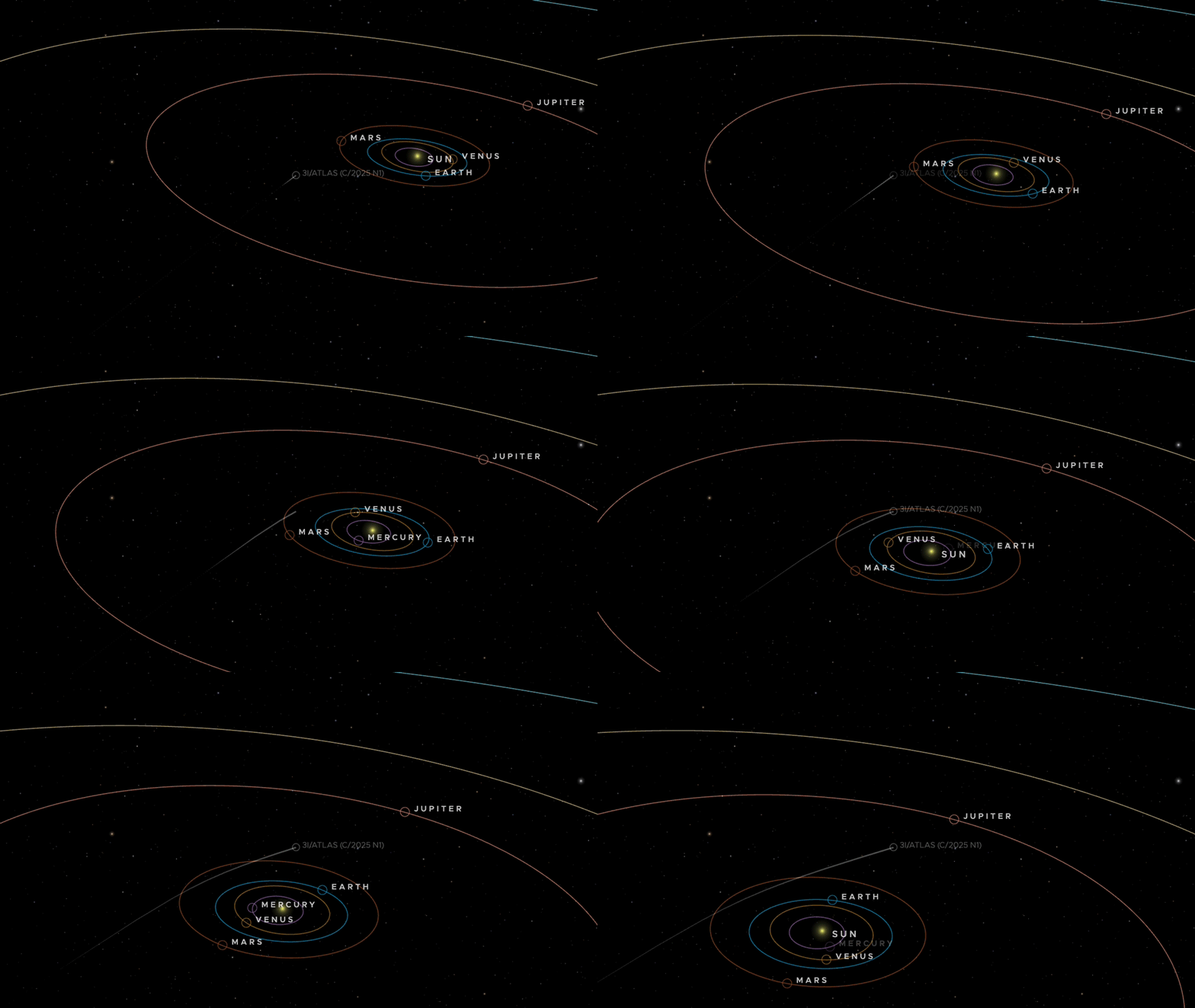
Astronomers first spied this object in July 2025, at about three times Mars’ distance from our sun. And, once they had tracked its path through space, they knew it originated in another star system. 3I/ATLAS, as it’s come to be called, is only the 3rd such interstellar object known. We don’t know where or how it escaped that distant star system in order to pass through our solar system. But astronomers said this month they have new clues about its past. They said it formed in an environment much colder than the one that created our sun and planets.
Radio telescopeobservations detected high levels of water containingdeuterium– an isotope of hydrogen – in the comet. That’s often called “heavy water.” And it’s a sign of cold conditions in the star-formingmolecular cloudthat birthed 3I/ATLAS’ star. It’s colder than conditions that formed our sun. This is an intriguing finding because it shows that star formation can occur under different physical and chemical conditions than those that created our solar system.
Our new observations show that the conditions that led to the formation of our solar system are much different from how planetary systems evolved in different parts of our galaxy.
The researchers published their findings in the peer-reviewed journal Nature Astronomy on April 23, 2026.
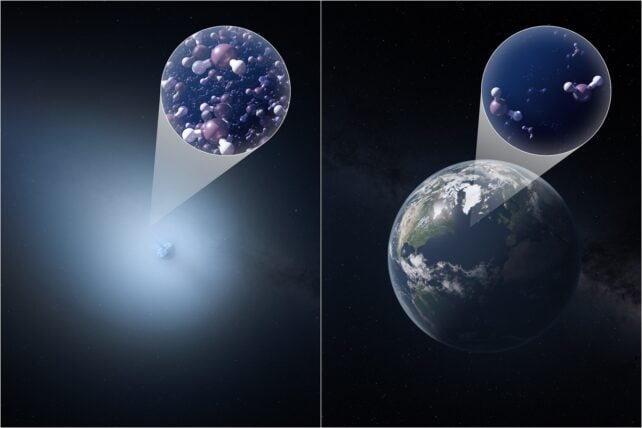
An artist's impression compares the semi-heavy water content of interstellar comet 3I/ATLAS (left) and Earth (right). Insets illustrate the relative abundance of deuterated water (HDO) molecules. 3I/ATLAS contains over 30 times more HDO than is found in Earth's oceans.
Astronomers sometimes refer to comets as “dirty snowballs” because they contain a lot of water. They’re icy remnants from the formation of our solar system, 4.6 billion years ago. Therefore, comets contain a record of the early conditions from which our sun and planets emerged.
Comets in our solar system come from distant reservoirs of icy objects called the Kuiper Belt and Oort Cloud. Sometimes, gravitational perturbations jostle some of these objects from their stable orbits. As a result, they fall into highly elliptical orbits that bring them close to the sun. Near the sun, sunlight heats these objects causing the release of gas and dust that form a tail.
Interstellar visitors
Astronomers know of three objects that are interstellar visitors. Besides 3I/ATLAS, the only other known interstellar comet is 2I/Borisov, that appeared in 2019. And there’s 1I/Oumuamua, not a comet but a cigar-shaped object that passed through in 2017.
3I/ATLAS and 2I/Borisov most likely formed in the far outskirts of their home systems, just like comets in our solar system. Therefore, they too contain a record of the early environment that formed their stellar systems.
3I/ATLAS has a high abundance of water containing deuterium
Water, chemically called H20, is made of two hydrogen atoms and one oxygen atom. Hydrogen, which formed shortly after the Big Bang, has one proton in its nucleus. However, the Big Bang also created another type of hydrogen, but in much smaller quantities. It’s called deuterium, and it has one neutron and one proton in its nucleus.
Most water on Earth contains hydrogen but there is a small amount of naturally occurring water containing deuterium, called deuterated water or heavy water. (Its chemical name is HDO, one atom each of hydrogen, deuterium, and oxygen.)
When astronomers looked at 3I/ATLAS with radio telescopes, they discovered, to their surprise, that it had a lot more deuterated water compared to comets in our solar system.
The amount of deuterium with respect to ordinary hydrogen in water is higher than anything we’ve seen before in other planetary systems and planetary comets.
Comets in our solar system have one molecule of deuterated water for every 10,000 molecules of ordinary water. However, in 3I/ATLAS, that ratio was 30 times higher. And compared to water in our oceans, that ratio was 40 times higher.
An artist's impression compares the semi-heavy water content of interstellar comet 3I/ATLAS (left) and Earth (right). Insets illustrate the relative abundance of deuterated water (HDO) molecules. 3I/ATLAS contains over 30 times more HDO than is found in Earth's oceans.
Molecular clouds are where stars form. There is a higher ratio of deuterium to hydrogen in cold molecular clouds, compared to the ratio created in the Big Bang. That’s due to a complex series of chemical reactions.
Molecules containing deuterium instead of hydrogen are more stable at low temperatures. So when molecular interactions replace hydrogen with deuterium in water molecules, that’s called “deuterated.” Those water molecules sticking to dust grains form deuterated ice, which is more likely to last in a colder environment.
This new study shows that conditions under which stars are created can vary. In 3I/ATLAS, the higher ratio of deuterated water suggests that the environment where its star formed was colder and had lower levels of radiation, compared to the environment in which our sun was born.
The chemical processes that lead to the enhancement of deuterated water are really sensitive to temperature and usually require environments colder than about 30 Kelvin, or about minus 406 degrees Fahrenheit.
Radio telescope observations of 3I/ATLAS
For this study of 3I/ATLAS, the researchers used radio telescopes at the Atacama Large Millimeter/submillimeter Array (ALMA) in Chile.
The radio telescopes detected the distinct signature of deuterated water in the comet. But the telescopes could not directly detect ordinary water. Therefore, the researchers used a mathematical model to determine the amount of ordinary water present based on methanol measurements.
They observed the comet on November 4, 2025, just six days after its closest approach to the sun. Teresa Paneque Carreño, a paper co-author, noted:
Most instruments can’t point toward the sun, but radio telescopes like ALMA can. We were able to observe the comet within days after perihelion, just as it peeked out from its transit behind the sun. This gave us a constraint on these molecules that’s not possible using other instruments.
Each interstellar comet brings a little bit of its history, its fossils, from elsewhere. We don’t know exactly where, but with instruments like ALMA we can begin to understand the conditions of that place and compare them to our own.
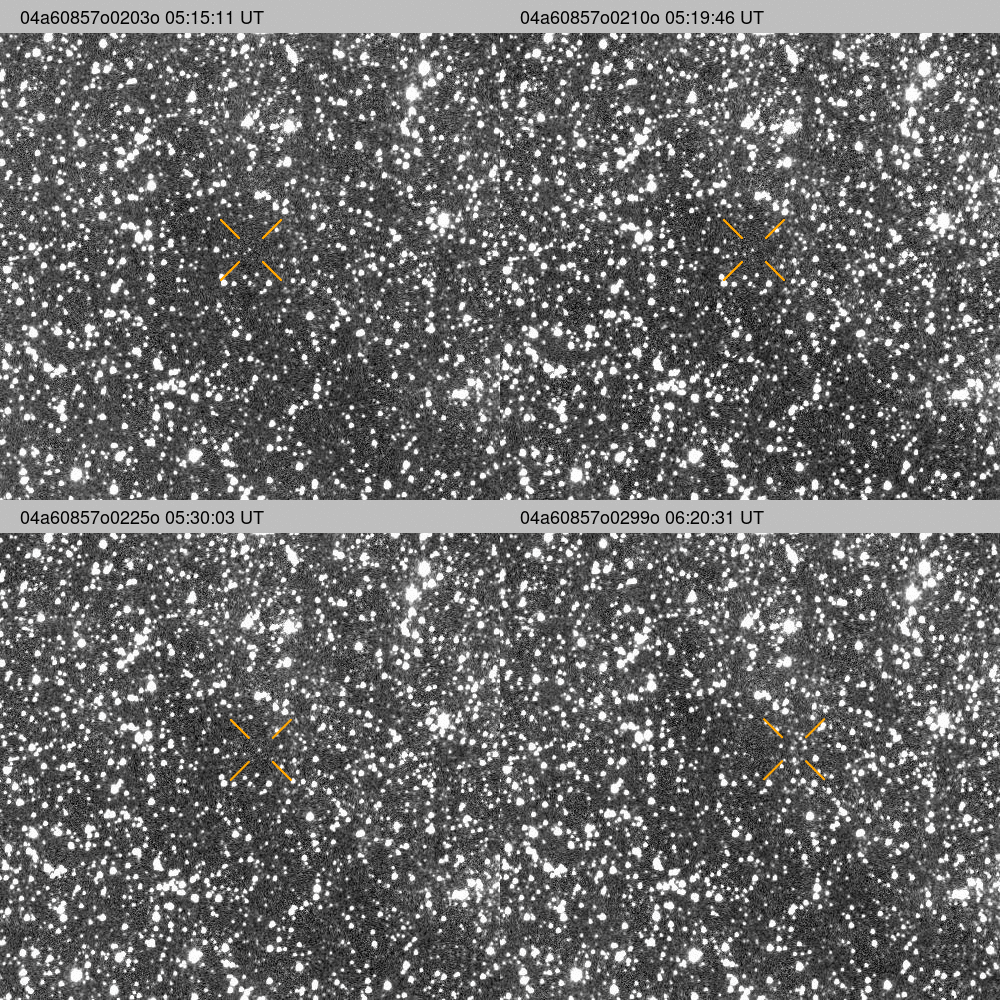
This animation shows the observations of comet 3I/ATLAS when it was discovered on July 1, 2025. The NASA-funded ATLAS survey telescope in Chile first reported that the comet originated from interstellar space.
ATLAS/University of Hawaii/NASA
Bottom line: The chemistry of water in interstellar comet 3I/ATLAS indicates that its home star formed in colder conditions compared to that of our sun.
New research reveals that the mysterious interstellar visitor 3I/ATLAS, which has intrigued astronomers and space enthusiasts alike for the better part of a year, comes from a very cold alien environment.
According to new research from the University of Michigan, published in Nature Astronomy, 3I/ATLAS comes from a much colder region with significantly less radiation than our solar system, marking a breakthrough in the characterization of these interstellarobjects.
This assertion is based on an analysis of the water 3I/ATLAS has released during its journey through our solar system, which showed it contained deuterium, also known as heavy hydrogen.
Strange Water on 3I/A
“Our new observations show that the conditions that led to the formation of our solar system are much different from how planetary systems evolved in different parts of our galaxy,” said lead author Luis Salazar Manzano.
Deuterium is a stable Hydrogen isotope with one proton and one neutron, unlike most hydrogen atoms, which have only a proton. Hydrogen, as most are aware, is one of the two ingredients in water’s H2O formula. Heavy water like this, containing high levels of deuterium, does exist on Earth, but it is relatively rare compared to its proportion on 3I/A. In fact, the amount of deuterium is 40 times as much as on Earth, and 30 times as much as on any other known comet.
Earlier this year, The Debrief reported on the high volume of deuterium present on 3I/ATLAS. The new research essentially builds on those findings, which are helping bring more clarity to the unusual origins of the most mysterious interstellar object observed to date.
“The amount of deuterium with respect to ordinary hydrogen in water is higher than anything we’ve seen before in other planetary systems and planetary comets,” Salazar Manzano said.
Following 3I/ATLAS
The researchers note that it was fortunate that 3I/ATLAS came to the attention of astronomers so early in its approach to our solar system. The University of Michigan team had enough advance notice to secure observation time at Arizona’s MDM Observatory, allowing them to make some of the earliest observations of gas emission from 3I/ATLAS.
They followed up by moving their work to Chile’s Atacama Large Millimeter/submillimeter Array, or ALMA, providing essential tools for analyzing the comet’s chemical makeup. ALMA’s extreme sensitivity enabled the team to separate deuterated water from conventional water at such high resolution that it could accurately determine their ratio.
This marked a notable first, as it had never been accomplished previously with an interstellar object.
“Being at the University of Michigan and having access to these facilities was the key to making this work possible,” Salazar Manzano said. “We were part of a team that was very talented and very experienced in multiple areas, all of us complemented each other and that’s what allowed us to analyze and interpret these data sets.”
Where 3I/ATLAS Formed
Examining this unusual water makeup provided the University of Michigan researchers with clues about the type of environment 3I/ATLAS originated in. Crucially, the researchers compared this evidence with the conditions of our early solar system during its formation, and found stark contrasts between the two.
“This is proof that whatever the conditions were that led to the creation of our solar system are not ubiquitous throughout space,” co-author Teresa Paneque-Carreño said. “That may sound obvious, but it’s one of those things that you need to prove.”
3I/ATLAS is only the third known interstellar object to pass through our solar system, and 1I/ʻOumuamua, the first confirmed interstellar object, was only discovered in 2017. With rapidly advancing sensing capabilities, astronomers expect to discover more of these exotic visitors in the years ahead, and at an increasing rate.
Ryan Whalen covers science and technology for The Debrief. He holds an MA in History and a Master of Library and Information Science with a certificate in Data Science. He can be contacted at ryan@thedebrief.org, and follow him on Twitter @mdntwvlf.
Who is behind the disappearance and deaths of scientists?
Joshua LeBlanc, a 29-year-old aerospace engineer at NASA, died in a car crash in Huntsville, Alabama, on July 22, 2025. He had been working directly on nuclear propulsion systems, contributing to NASA’s Space Nuclear Propulsion program and the DRACO project, an initiative focused on developing nuclear thermal engines for deep-space missions.
Now consider that alongside a growing list of individuals (now 12) connected to aerospace, defense, and nuclear research who have died or gone missing in recent years. They all surfaced under very different circumstances, yet within the same narrow field of expertise.
It does raise a reasonable question: at what point do these cases stop being viewed as isolated incidents? When placed side by side, the overlap becomes difficult to ignore.
Like many of the missing or dead scientists, also LeBlanc reportedly left behind his phone, wallet, and other personal belongings before leaving his home. More details on LeBlanc’s death can be found on Skywatch Signal.
Still, an important question remains: are all of these scientists truly missing or deceased as reported? Taken together, they would represent a highly specialized group, exactly the kind of team capable of developing advanced, potentially groundbreaking technologies in secrecy. It may sound far-fetched, but it leads to speculation: could some have been quietly recruited into covert programs, while others who refused faced darker outcomes?
To explore this idea, I posed the question to Chatgpt: “Who is behind the disappearance and deaths of scientists?”
The response featured an image generated by ChatGPT that pointed toward several possible explanations:
Click the image to view in full size.
Who is behind the disappearance and deaths of scientists
Global institutions, black budget syndicates, shadow networks or corporate or institutional control structures
Motives such as suppressing disruptive technologies, maintaining dominance over energy, defense, and information systems, protecting massive financial interests, and preventing large-scale societal shifts.
To keep control over classified programs
Reverse engineering efforts
Suppressed technologies
Breakthroughs in energy and propulsion
Highly classified space initiatives
Non-human technology
A broader pattern
The idea that transformative change is resisted
That knowledge equates to power, and power tends to protect itself
And that, in extreme interpretations, controlling the future could involve silencing those creating it
These ideas remain speculative, but when patterns appear, even loosely connected ones, they tend to invite deeper scrutiny.
20 Scientists Missing, Killed In Mysterious Deaths? Mystery Disappear Shake US, China | Watch
By CHRIS MELORE, DEPUTY SCIENCE EDITOR FOR DAILYMAIL.COM
A young scientist researching technology that could revolutionize space travel and energy production reported being harassed for government secrets before her death.
Amy Eskridge, 34, was found dead on June 11, 2022, with a gunshot wound to the head. While her death was ruled a suicide, a resurfaced video has raised chilling questions about what may have really happened.
Speaking to fellow researchers in May 2020, Eskridge said: 'I've been roofied multiple times. Like my extended team has been roofied multiple times, like it's the f***ing roofie party over here.'
Eskridge added that she was afraid to continue her research in public due to what she described as a 'social engineering' campaign, in which strangers approached her with detailed knowledge of her life and questioned her about her work.
'Then all of a sudden the people in the bar around me are like, "What do you do for a living? Tell us, do you work for the government... you're sitting there at your laptop, it looks cool, tell us what you're doing."'
Franc Milburn, a retired British paratrooper and intelligence officer who claimed to have been in contact with Eskridge before her death, shared messages he said she sent him.
One dated May 13, 2022, read: 'If you see any report that I killed myself, I most definitely did not. If you see any report that I overdosed, I most definitely did not. If you see any report that I killed anyone else, I most definitely did not.'
Milburn told the Daily Mail that after her death, individuals who said they knew Eskridge contacted him anonymously, claiming they had also been targeted, including reports of suspected drink spiking, break-ins and slashed tires.
Amy Eskridge was a scientist researching anti-gravity technology before her death in 2022 at age 34
Former intelligence officer Franc Milburn shared disturbing messages he said he received from Eskridge, claiming she had been targeted by people in public
Eskridge, a graduate of the University of Alabama in Huntsville, had co-founded The Institute for Exotic Science with her father, Richard Eskridge, in 2018, a company focused on 'speculative research,' including the creation of gravity-defying engines.
This technology has been linked to extraterrestrials by UFO researchers who claim anti-gravity propulsion has been responsible for the unexplainable sightings of aircraft moving at incredible speeds and in ways that defy the laws of physics.
Her father, a former NASA scientist, has refuted claims that his daughter's death was suspicious. The Daily Mail has attempted to contact Richard for comment.
Eskridge claimed during her 2020 interview that she may have been drugged after feeling extremely drunk at a bar near her Alabama residence, despite just arriving.
'Like twice or three times it's like I'm really f****** drunk, I shouldn't be this drunk, I didn't drink enough to be this drunk, what's happening? Why am I so messed up?' Eskridge recounted.
'Then all of a sudden the people in the bar around me are like "what do you do for a living? Tell us, do you work for the government? What do you do? You're sitting there at your laptop, it looks cool, tell us what you're doing."'
Eskridge claimed that she had been experiencing acts of intimidation and harassment for four to five years.
She would reveal in 2020 that over the previous year, the incidents had reportedly escalated to the point where she could no longer go to bars alone out of fear for her safety.
Eskridge, a graduate of the University of Alabama in Huntsville, had co-founded The Institute for Exotic Science with her father, Richard Eskridge, in 2018, a company focused on 'speculative research,' including the creation of gravity-defying engines
'I don't go to bars by myself anymore, even though it's my most productive zone because in the past 12 months, if I sit down at a bar by myself, some dude will come, like some 50-year-old dude will come and sit next to me and turn to me and say "do you want one roofie in your drink or two?"'
'Then he'll like drop buzzwords that are relevant to my life, and I'll be like I'm getting the f*** out of here,' the scientist said.
Eskridge added that she was coming up with a plan to effectively disclose the existence of UFOs to the public, fearing that she needed to move quickly due to the growing number of threats allegedly sent to her and break-ins at her home.
'Over the past 12 months, it's been escalating, like more aggressive, more invasive digging through my underwear drawer and sexual threats.'
In 2018, Eskridge and her father delivered a presentation on behalf of their company, HoloChron Engineering, describing both historical and modern experiments related to gravity modification, including alleged black projects said to be developing triangular anti-gravity craft known as the 'TR3B.'
It was during this time that Eskridge alleged she and her colleagues had become the targets of repeated physical and psychological attacks, reportedly aimed at isolating the 34-year-old from her staff.
Milburn told the Daily Mail: 'After she died, her co-workers and her friends, people she'd worked with, they came forward anonymously and said to me, "yeah, look, we were attacked, we were roofied, my house was broken into, my car tires were slashed."'
The intelligence officer claimed that some of her co-workers said their food had also been poisoned, making their entire families sick.
'It had "Amy Eskridge" written on the bag, and [these are] people who are living hundreds of [miles] away out of state from Amy Eskridge. So this wasn't just random events, this was happening to her and people around her,' Milburn claimed.
According to documents shared online, Eskridge's now-closed research company was working on anti-gravity technology they claimed had been used in UFO-inspired aircraft
Milburn shared a picture he said showed Eskridge sitting in her home - near the window which she claimed was scorched by an 'energy weapon'
In 2022, Eskridge reportedly told Milburn, whom she had befriended online and had asked for help regarding the alleged harassment, that she was working on a highly sensitive project for Homeland Security when the attacks against her turned physical.
Eskridge was reportedly working from home on a project designed to detect chemical or biological threats in the nation's subway systems when she was struck by a directed energy weapon, a device that fires rays of energy, such as microwaves, at a target.
Eskridge shared images with Milburn, apparently showing her hands, feet, neck and back with burns and lesions after the alleged attack by this weapon.
Milburn told the Daily Mail the images even appeared to show a scorch mark on Eskridge's home window, where the 'energy weapon' allegedly passed and struck her in the hands and head while she was working on her laptop.
Milburn shared a picture, which he claims shows Eskridge's hands burned and discolored after allegedly being struck by an 'energy weapon'
On May 19, 2022, Milburn said Eskridge messaged him to report that a member of her research lab with advanced weapons experience was convinced a directed energy weapon had caused her injuries.
'My ex-CIA weapons guy on my team saw my hands when they were burned really badly a couple months ago, and he saw that window pane in person,' she wrote.
'He said he had built things like that, and that it was most likely an RF k-band emitter run by five car batteries strung together from inside an SUV.'
Less than a month later, the 34-year-old was dead, reportedly by her own hand.
Milburn has disputed the report and conducted his own investigation into the case, concluding that Eskridge was 'murdered by a “private aerospace company” in the US because she was involved in the UAP conversation.'
While the claims have not been proven to be true, Milburn's findings were presented to Congress in 2023, and Representative Eric Burlison has noted that he and other lawmakers consider the case suspicious.
Artist’s rendition of UAP over the New Jersey coast [Credit: Americans for Safe Aerospace]
Back in 1999, when I was working as an air traffic controller at Fort Worth Center, one of my co-workers ended up on Coast to Coast AM with Art Bell.
He had submitted audio of unusual aerial activity over the Dallas-Fort Worth area, something people now refer to as UAPs (unidentified anomalous/aerial phenomena). I remember listening to the show and laughing as Bell treated the recording as if it were a leak from a secret government source.
He even said they were using a fake name to protect the controller’s identity—until my co-worker interrupted and told him, “That’s actually my real name.”
Being an air traffic controller was a fascinating job. Most of us held secret clearances, but even then, I only encountered classified information twice in 26 years: once after 9/11, while helping coordinate combat air patrols after the attacks, and once in connection with a specific UAP event I can’t discuss.
Lights Over Arkansas
A year earlier in 1998, I was flying from Texas to Arkansas with my flight instructor, a lifelong friend, to take my instrument check ride. We finished late and headed home after dark. Somewhere along the route, five bright lights appeared between our 12 and one-30 o’clock positions, maybe a mile away at our altitude.
I radioed the controller to ask about nearby traffic. He said the closest aircraft was a 727 40miles ahead. I told him we had five aircraft right in front of us, evenly spaced. For a second, I thought they might be military helicopters. Then my instructor and I looked back—and they were gone.
They didn’t blink out like lights switching off. It was as if they turned or sped away at an incredible rate. Years later, when I saw a video of the Phoenix Lights, I couldn’t shake the feeling that what we saw that night looked eerily similar.
Five years later, I told that story over lunch with some old high school friends. My instructor was there, sitting right beside me. I finished the story and turned to him for confirmation. He hesitated and said, “I don’t know what you’re talking about.”
Image of a UAP captured by a U.S. Navy pilot in the cockpit of a fighter jet [Credit: U.S. Navy]
I couldn’t believe it. I started to wonder if I’d imagined the whole thing. Then, decades later, he called me out of nowhere and said, “Do you remember those lights we saw over Arkansas?” When I reminded him how he’d denied it before, he laughed softly.
“I just didn’t want to talk about it back then,” he said.
What struck me through the years wasn’t the classified work—it was how little we weren’t told.
The FAA never ordered us to stay silent about unusual radar returns, UFO or UAP reports, and activities. More than a few controllers shared recordings or data with reporters.
One thing I can say with certainty is that controllers hate unknowns in their airspace. It goes against the heart of what we do. If I know about it, I can control it or at least steer the aircraft I am responsible for around it.
I often watched with incredulity as controllers complained about these unknown aircraft or whatever, not with awe and wonder but with frustration and anger at the possible safety hazard they present.
Most people remember early February 2023, when a Chinese surveillance balloon crossed the continental U.S. before being shot down off the coast of South Carolina.
We had raw radar and tracked it carefully. But one afternoon over Montana it behaved unlike any balloon I have ever seen. It was drifting southeast at about 45 knots. Then, suddenly, it reversed course and accelerated sharply to the northeast. Within seconds, the radar showed it moving over 700 knots before disappearing entirely.
My best guess? The computers dropped the target because they weren’t programmed to follow anything faster than an SR-71. Since the balloon was being tracked with raw radar and did not have a transponder, when the radar updated, the primary radar target on the next update was too far the last one to be the same object, so it stopped tracking it.
Pilot Lounge Conversations
For years, pilots avoided sharing strange stories for fear of losing their medical certificates or being labeled unstable, delusional, or psychotic if they reported a UFO sighting. But that’s changing.
An unmanned aerial system is observed during Naval exercises off the U.S. East Coast in early 2022. The object in this image was first classified as an unidentified anomalous phenomena before being reclassified as a UAS based on additional information and data from other UAP sightings. [Credit: Department of Defense]
Now, working as a professional pilot, I spend hours in lounges across the country trading stories. When the conversation lags, I love to ask about UAP or other strange things that they have seen or experienced while flying. At first, people are cautious. But once I mention that I retired from the FAA as an air traffic supervisor and that I took UAP reports almost weekly, they open up and the stories start rolling.
The more people talk, the more the stigma fades, replaced by genuine curiosity and professional concern. I am not sure exactly what it was about changing the name of these events from UFO to UAP, but it seems that has made it more acceptable to talk about these experiences.
So kudos to whomever relabeled them and removed the stigma about bringing up these events.
New Era of Openness
Ever since the Navy released videos of UAPs tracked by their aircraft cameras, it feels like something has shifted. It seems suddenly OK to report objects that are unexplainable given our current understanding of science and our universe.
Some of these encounters are surely experimental technology, many from our own military. But others—like the “cube in sphere” objects reported by Navy pilots off the East Coast—don’t fit any known category. These translucent spheres, each with a faint cube suspended inside, reportedly flew in tight formation with Navy fighters, even splitting squadrons mid-flight.
Encounters like that are hard to shrug off.
Why I’m Writing This
I believe pilots and controllers are in a unique position to help us understand what’s happening above us. For much of my career, it felt taboo to talk about these things. Now, it feels important.
Are we alone in the universe? I doubt it. The idea that life exists only here feels far too small for such a vast and creative cosmos. Whether what we’re seeing is human technology or something entirely different, the truth matters—not just for science, but for who we are as a species.
As humanity prepares to return to the moon through NASA’s Artemis program, I think about the last time we stood there.
It was December 1972, during Apollo 17, when Gene Cernan became the last human to walk on the lunar surface. It’s been more than 50 years since we left. The same curiosity that once carried us that far is the same curiosity that keeps our eyes turned skyward even now.
Closing Thought
We’re finally going back to the moon—half a century after Cernan brushed lunar dust rom his boots for the last time.
As we take those steps outward again, I hope we also find the courage to look inward, to face the mysteries that drift above our heads and linger in our memories. Because the search for truth—out there or here at home—has always been what makes us human.
Leven buiten de Aarde: De Mogelijkheden van het Leven in het Jupiter-systeem en de Toekomst van Kolonisatie van Europa
Onze zoektocht naar buitenaards leven en de mogelijkheden voor menselijke kolonisatie heeft zich niet beperkt tot de nabijgelegen planeten en manen. De buitenste regionen van ons zonnestelsel, met name de gasreuzen en hun manen, bieden een fascinerende en veelbelovende arena voor ontdekkingen die onze kennis over het universum kunnen veranderen. In dit artikel richten we ons op Jupiter, de grootste planeet in ons zonnestelsel, en haar meest intrigerende maan: Europa. Daarnaast verkennen we de mogelijke aanwezigheid van buitenaards leven, de wetenschappelijke ontdekkingen die onze perceptie beïnvloeden, en de toekomst van menselijke exploratie en kolonisatie in deze mysterieuze wereld.
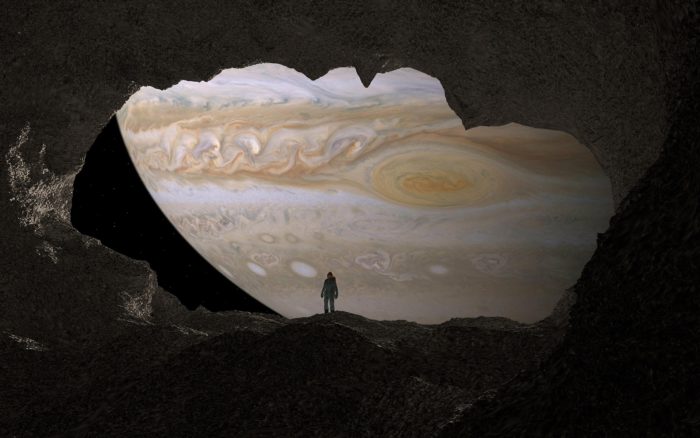
Artistieke impressie van het kijken naar Jupiter vanaf Europa
De Magnifieke Wereld van Europa
Europa, een ijzig maan omringd door een dikke laag ijs, bevindt zich in de schaduw van Jupiter, maar haar potentieel voor het ondersteunen van leven maakt haar tot een van de meest veelbelovende doelwitten in het zonnestelsel. Het oppervlak van Europa wordt gekenmerkt door een complexe structuur van ijsvlakten, scheuren en mogelijk onderliggende oceanen van vloeibaar water. Hoewel het lijkt op een bevroren wereld, kan deze omgeving, onder de ijskorst, een enorme oceaan herbergen met condities die vergelijkbaar zijn met die op aarde.
Waarom Europa zo interessant is voor het zoeken naar buitenaards leven
De aanwezigheid van vloeibaar water is volgens de huidige wetenschap een belangrijke voorwaarde voor het ontstaan van leven zoals wij dat kennen. Op aarde is water essentieel voor al het bekende leven, en de ontdekking van water op andere hemellichamen verhoogt de kans dat er elders in het universum vergelijkbaar leven kan bestaan. Europa biedt, volgens wetenschappers, een ondergrondse oceaan die mogelijk twee keer zoveel water bevat als alle oceanen op aarde samen. Deze enorme hoeveelheid water, in combinatie met de chemische stoffen die via scheuren en ondergrondse processen worden vrijgegeven, creëert een potentieel leefbare omgeving.
Recent wetenschappelijk onderzoek
In 2017 rapporteerden wetenschappers dat ze bewijs hadden gevonden voor "sliding tectonic plates" onder Europa’s ijslaag. Dit betekent dat er mogelijk geologische activiteit plaatsvindt, vergelijkbaar met die op aarde, wat cruciaal is voor het leveren van voedingsstoffen en energie aan ondergrondse ecosystemen. Daarnaast werden waterdamp en mogelijk waterwolken ontdekt in de atmosfeer van Jupiter, inclusief binnen de beroemde Grote Rode Vlek. Hoewel het nog onduidelijk is of deze waterdamp de aanwezigheid van vloeibaar water onder de ijslaag van Europa bevestigt, geeft het wetenschappers nieuwe kansen om de dynamiek van de maan beter te begrijpen.
Het Mysterie van de Grote Rode Vlek
De Grote Rode Vlek is een gigantisch stormgebied dat al eeuwenlang de atmosfeer van Jupiter domineert. Sinds de eerste observaties in 1830 weten we dat het een immense storm is met wind snelheden tot 400 mijl per uur. Recentelijk werd ontdekt dat er waterdamp en mogelijk waterwolken aanwezig zijn in dit gebied, wat de theorie voedt dat ook in de atmosfeer van Jupiter water in vloeibare vorm kan voorkomen.
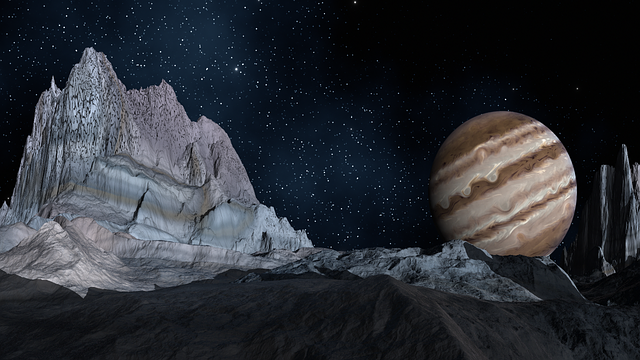
Artists impressie van Jupiter vanaf Europa
Imaginatie en speculatie: intelligent ontwerp of natuurlijke fenomenen?
Het feit dat water in de atmosfeer van Jupiter wordt gevonden, roept vragen op over de aard van deze gigantische planeet. Sommige wetenschappers speculeren dat de waterwolken en de bijzondere kenmerken van de Grote Rode Vlek mogelijk tekenen zijn van een soort intelligent ontwerp, een idee dat vaak in de conjuratie- en complottheorieën opduikt. Anderen beschouwen deze verschijnselen als natuurlijke, zij het zeldzame, kosmische fenomenen die onze kennis over de dynamiek van gasreuzen uitbreiden.
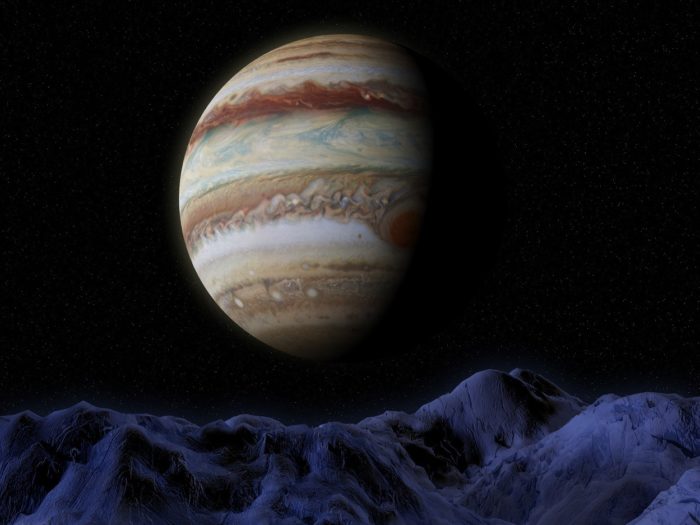
Artistieke impressie van Jupiter vanaf Europa
De Mogelijkheid van Leven op Jupiter en Zijn Manen
Hoewel Jupiter zelf, door zijn enorme massa en de intense straling in de atmosfeer, zeer onwaarschijnlijk wordt geacht als leefbare omgeving, bieden haar manen, zoals Europa en Enceladus, wel degelijk kansen voor buitenaards leven. Europa wordt vaak genoemd als het meest veelbelovende object in ons zonnestelsel voor het vinden van buitenaards leven, vanwege haar ondergrondse oceaan en geologische activiteit.
Enceladus: Een andere potentiële leefwereld
Naast Europa wordt ook de maan Enceladus van Saturnus als een belangrijke kandidaat beschouwd. Deze ijsmaan vertoont geisvorming en spuwt waterdampen en ijsdeeltjes uit geisers, wat wijst op een ondergrondse oceaan die mogelijk geschikt is voor leven. Het lijkt erop dat systemen van grote manen in ons zonnestelsel meerdere ondergrondse waterreservoirs bevatten die de sleutel kunnen zijn tot het vinden van microbieel of mogelijk complexer leven.
Tectonische Activiteit op Europa en de Mogelijkheid voor Leven
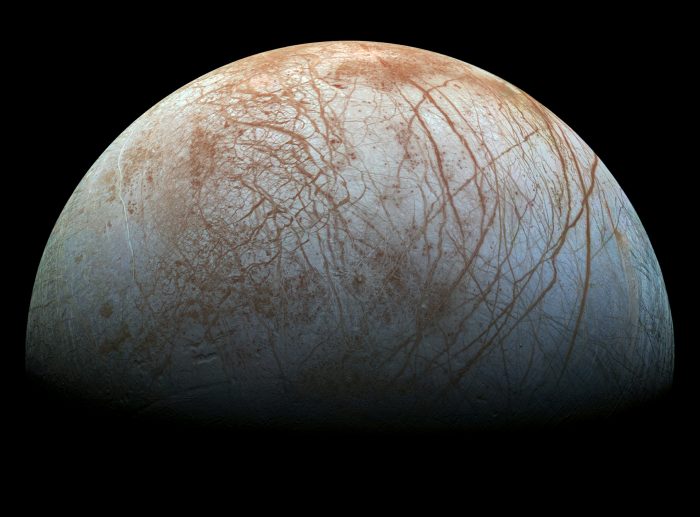
Close-up van Europa
Een van de meest intrigerende ontdekkingen over Europa was dat van mogelijke tectonische bewegingen onder de ijslaag. Tectonische activiteit is van vitaal belang omdat het voedingsstoffen en energie naar de ondergrondse oceanen kan brengen, wat essentieel is voor het ondersteunen van leven.
Hoe werkt tectoniek op Europa?
Op aarde ontstaat tectonische activiteit door beweging in de aardkorst en het in en uit zakken van platen in de mantel. Bij Europa wordt aangenomen dat zout in het onderliggende water een soortgelijke beweging kan veroorzaken, wat de mogelijkheid opent dat er geologische processen plaatsvinden die vergelijkbaar zijn met die op aarde.
Wat betekent dit voor de zoektocht naar leven?
Als deze tectonische beweging inderdaad bestaat, betekent dit dat Europa niet alleen een koude ijswereld is, maar een dynamisch systeem met de potentie voor het onderhouden van een ecosysteem dat voedingsstoffen en energie ontvangt. Dit verhoogt de kans dat microbieel leven, en mogelijk meer complexe organismen, zich onder de ijslaag kunnen bevinden.
Toekomstige Missies en Onderzoeksmogelijkheden
De komende jaren staan in het teken van verdere verkenning van Europa. NASA en de Europese ruimtevaartorganisatie (ESA) plannen meerdere missies om de maan beter te bestuderen en mogelijke landingsplaatsen te identificeren. Een van de meest veelbelovende initiatieven is de Europa Lander Missie, die erop gericht is om direct op het oppervlak te landen en te zoeken naar tekenen van leven.
De Europa Lander Missie
Deze missie heeft tot doel om een apparaat op Europa te laten landen dat onder andere de samenstelling van de ondergrondse oceaan onderzoekt, en op zoek gaat naar biosignaturen, oftewel tekenen van leven. Het plan is dat de lander wordt gelanceerd in de jaren 2020 of 2030 en na een reis van enkele jaren op Europa landt. Het apparaat zou enkele weken tot maanden data verzamelen en transmissies naar de aarde sturen.
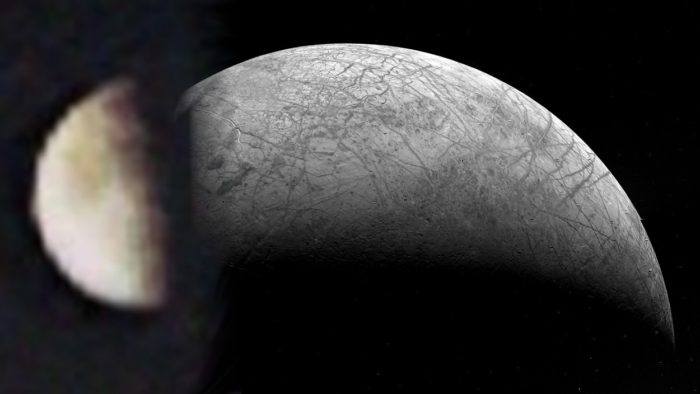
De eerste afbeelding van Europa uit de jaren '70 (links) en een veel duidelijkere afbeelding uit de late jaren '90 (rechts)
De technische uitdagingen
Omdat Europa wordt gekenmerkt door een intense straling van Jupiter, moeten lander- en onderzoeksapparatuur worden uitgerust met speciale beschermingssystemen. Daarnaast moet de landing zeer precies plaatsvinden, omdat het oppervlak van Europa bedekt is met ijs en scheuren die gevaarlijk kunnen zijn voor landingsvoertuigen.
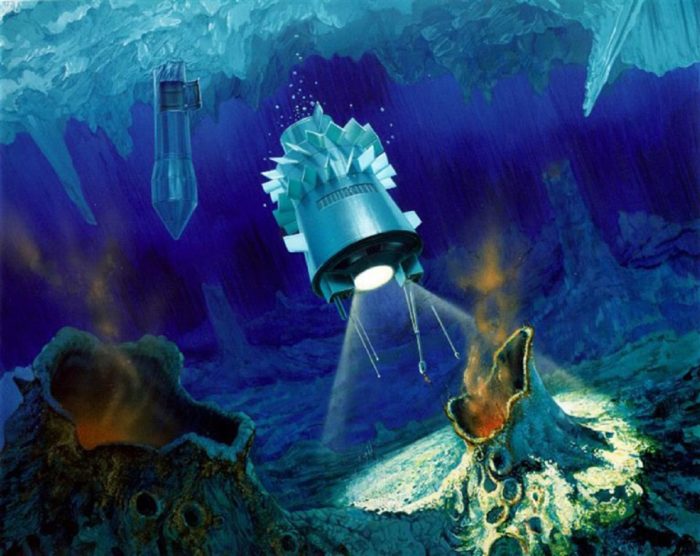
Artistieke impressie van missies naar de oceanen van Europa
De Toekomst van Menselijke Exploratie en Kolonisatie
Het idee om ooit mensen op Europa te laten landen, is nog ver weg, maar niet onmogelijk. Verschillende wetenschappers en ruimtevaartorganisaties onderzoeken al de technische en logistieke uitdagingen die hiermee gepaard gaan.
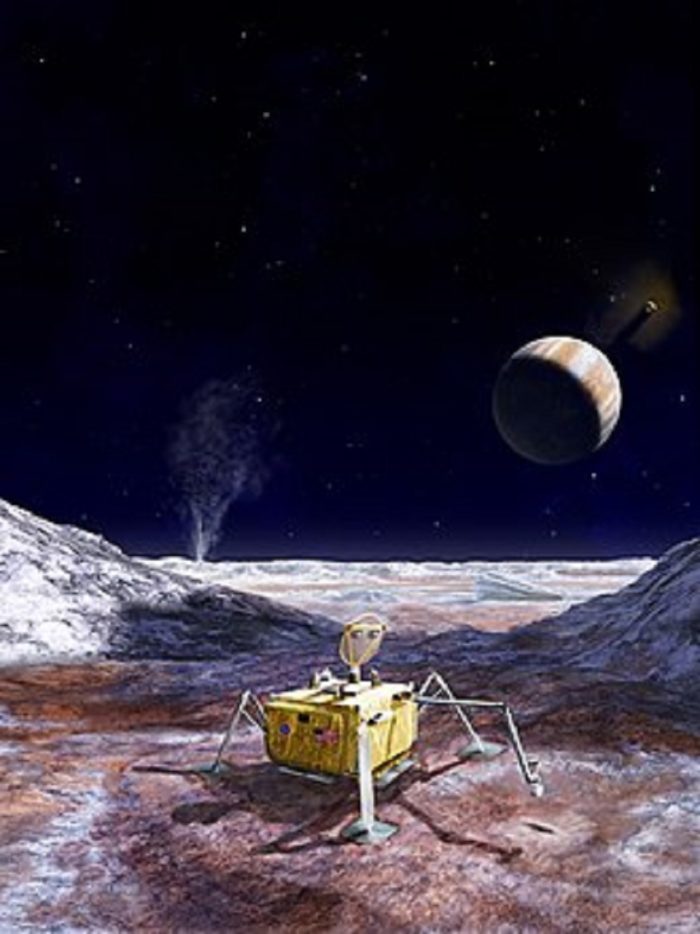
Artistieke impressie van een landingsrobot op Europa
De technische hindernissen
* Temperatuur en straling:Europa bevindt zich in een extreem koude omgeving, met temperaturen die kunnen dalen tot ver onder de -200 graden Celsius. Daarnaast wordt de maan blootgesteld aan krachtige straling van Jupiter, die de gezondheid van astronauten kan bedreigen.
* Veiligheid en infrastructuur: Een menselijke missie zou uitgebreide infrastructuur vereisen, zoals ondergrondse bases of drijvende stations onder de ijslaag, om bescherming te bieden en te voorzien in levensonderhoud.
* Voedsel en water: Het meest cruciale is de beschikbaarheid van water en voedsel. De ondergrondse oceaan zou een bron van water kunnen zijn, maar het is nog onduidelijk hoe we dat zouden kunnen benutten.
Hoe zou een menselijke missie eruit kunnen zien?
Een plausibele benadering zou zijn dat robots en autonome systemen het eerste onderzoek uitvoeren, gevolgd door bemande missie die gebruik maakt van geavanceerde technologieën zoals ondergrondse habitats, krachtige shielding tegen straling, en systemen voor het winnen van water en voedsel uit de omgeving.
Economische en Politieke Overwegingen De exploratie van Europa en andere manen in het Jupiter-systeem brengt niet alleen wetenschappelijke uitdagingen met zich mee, maar ook grote economische en politieke vragen. Wie financiert deze ambitieuze projecten? Welke landen en bedrijven zouden betrokken zijn? En hoe wordt de waarde van potentiële buitenaardse hulpbronnen gewogen?
Ruimte-industrie en commerciële belangenDe mogelijkheid om mineralen en andere hulpbronnen te winnen uit de atmosfeer van Jupiter of de ijsmanen kan een grote drijfveer worden voor commerciële activiteiten. Dit zou kunnen leiden tot een nieuwe economische sector, met ruimte-miningbedrijven die de buitenaardse economie aanwakkeren.
Risico’s en ethische vragen - Bovendien rijst de vraag of we het recht hebben om te investeren in het koloniseren van buitenaardse werelden, vooral als dat mogelijk ecologische of ethische problemen met zich meebrengt. Het beschermen van eventueel bestaande ecosystemen en het voorkomen van contaminatie zijn belangrijke overwegingen.
Conclusie: Een Nieuwe Horizon voor Mens en Machine
De verkenning van Europa en andere hemellichamen in ons zonnestelsel brengt een nieuwe fase in de menselijke geschiedenis. Met technologische innovaties, internationale samenwerking, en een diepgeworteld verlangen om de mysteries van het universum te ontrafelen, wordt de stap naar buitenaards leven en kolonisatie steeds realistischer.
Hoewel we nog ver verwijderd zijn van het daadwerkelijk zetten van voet op Europa's ijsvlakte, zetten de lopende en geplande missies de eerste stappen in een reis die mogelijk het begrip van leven, het universum en onze plaats daarin fundamenteel zal veranderen. Of het nu gaat om het zoeken naar microbieel leven in ondergrondse oceanen, het bestuderen van de dynamiek van gasreuzen, of het voorbereiden van menselijke vestigingen in de meest extreme omstandigheden, de ruimte biedt ons ongekende kansen en uitdagingen.
De toekomst van de mensheid ligt niet alleen in het verkennen van onze eigen planeet, maar ook in het ontdekken van de wonderen die de kosmos ons te bieden heeft. En misschien, heel misschien, zullen we op een dag niet alleen de mysteries van Europa ontrafelen, maar ook onze eigen bestemming daar buiten de Aarde vinden.
The final moments of a prominent UFO researcher's life have been laid bare in a minute-by-minute timeline released by police following intense public scrutiny of his death.
Authorities said 53-year-old David Wilcock personally called emergency services shortly before shooting himself outside his Colorado home on April 20.
The call was received at 10.44am local time, when Wilcock reportedly told dispatchers: 'I need to leave,' before stating he would be 'to the left of the house.'
During the call, he spoke about ongoing health problems and mounting financial concerns, but refused to answer whether he was armed or planning to harm himself.
Deputies were dispatched immediately and arrived within minutes, approaching cautiously due to uncertainty about the presence of a weapon.
As officers drove toward the residence, Wilcock reportedly told dispatchers: 'I'm sorry to put you through this,' before disconnecting the call. Seconds later, deputies saw him sitting outside holding a gun to his head, prompting them to take cover and issue commands.
Moments after officers ordered him to drop the weapon, deputies witnessed him fire the fatal shot just seconds at 11.05am, ending the encounter in less than a minute.
The timeline, released by the Boulder County Sheriff's Office due to widespread public interest, details the rapidly unfolding sequence of events that culminated in Wilcock's death outside his residence.
Authorities said 53-year-old David Wilcock personally called emergency services shortly before shooting himself outside his Colorado home on April 20. Pictured is Wilcock with Denis Richards
'David Wilcock took his own life on April 20, 2026, after a long struggle with depression and overwhelming financial debt,' the police report stated.
'His family and chosen family hope this loss encourages more focused attention to mental health care access.'
According to officials, the first deputy reached the area at 10.53am but waited away from the property until backup arrived because it was unclear whether the caller posed a threat.
A second deputy arrived at 11.01am, and the two officers coordinated a plan to safely approach the home together.
Approximately three minutes later, just as deputies began driving up the property's driveway, the call with dispatch ended after Wilcock apologized.
Within seconds of arriving, deputies observed Wilcock seated outside the residence with a firearm pressed to his head.
Officers immediately exited their vehicles and sought cover while assessing the situation.
At 11.04.02am, deputies reported hearing a single gunshot discharged in an unknown direction, though Wilcock remained alive and still holding the weapon.
Less than a minute later, deputies confirmed the firearm was still pointed at his head.
Authorities arrived at Wilcock's home (pictured) to find him holding a gun, which he then shot himself with
At 11.05.24am, one deputy issued a direct command instructing him to put down the gun.
Just three seconds later, deputies witnessed him shoot himself. The timeline shows that from the moment deputies first saw him holding the firearm to the fatal shot, less than one minute elapsed.
Following the shooting, additional law enforcement personnel were called to the scene to secure the property and ensure no other individuals were present.
Deputies conducted a search of the residence and the surrounding area, confirming that no one else was inside or at risk.
Wilcock was pronounced deceased at the scene shortly afterward, and investigators began the formal death investigation process.
Two days later, on April 22, the Boulder County Coroner's Office officially identified the decedent as David Wilcock after scientific confirmation and notification of next of kin.
Authorities said the decision to publicly release the detailed timeline was made in response to significant public attention surrounding the case, including widespread online speculation about the circumstances of his death.
The timeline release was made with the consent of Wilcock's family, who acknowledged the high level of public interest but requested privacy as they mourned.
Wilcock's family also said in the police record that he struggled with depression and financial burdens
The police report also addressed rumors circulating online that suggested foul play may have been involved.
Family members said there was no evidence of a cover-up, urging the public to respect their request for privacy during what they described as an extremely difficult time.
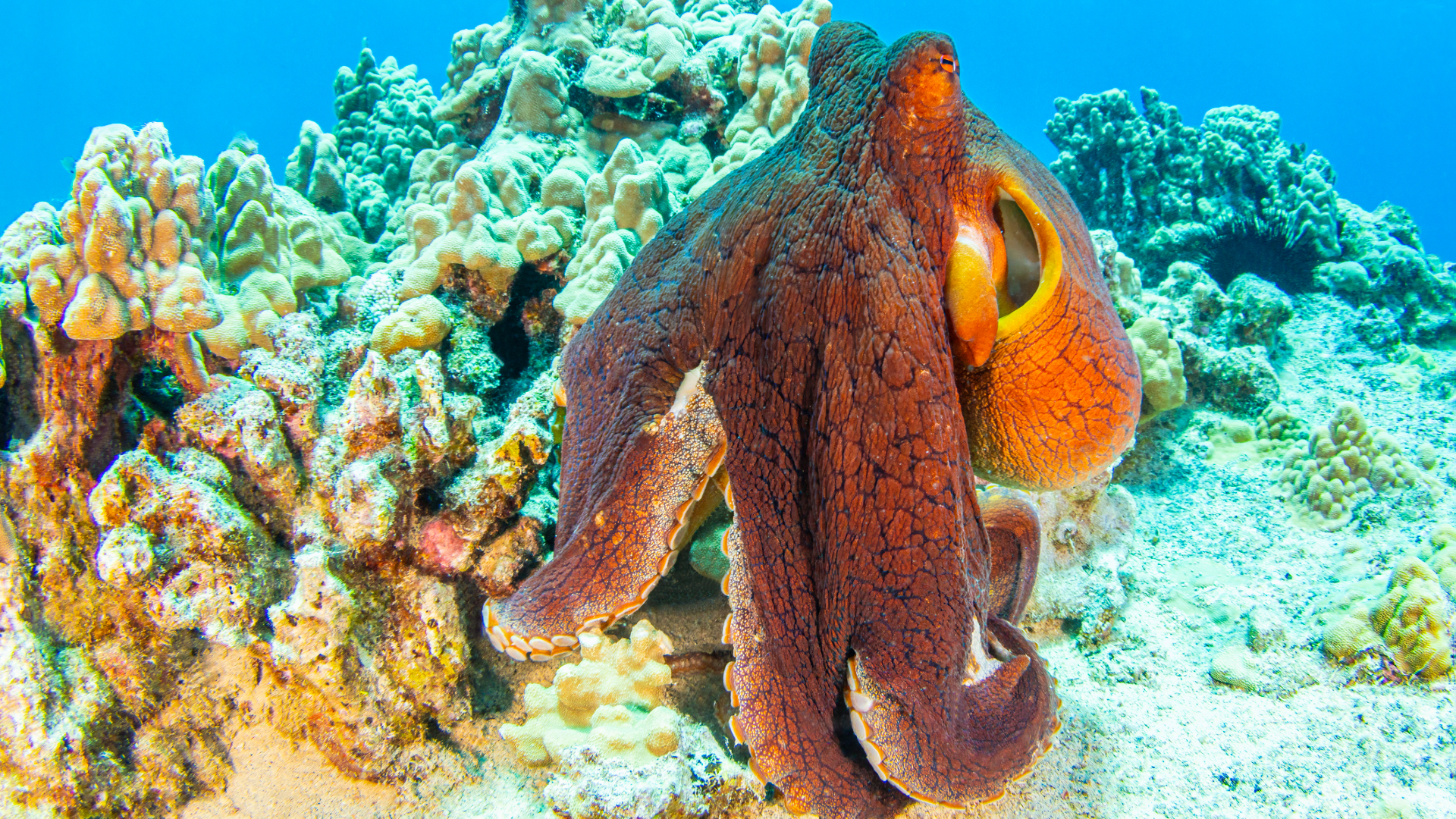
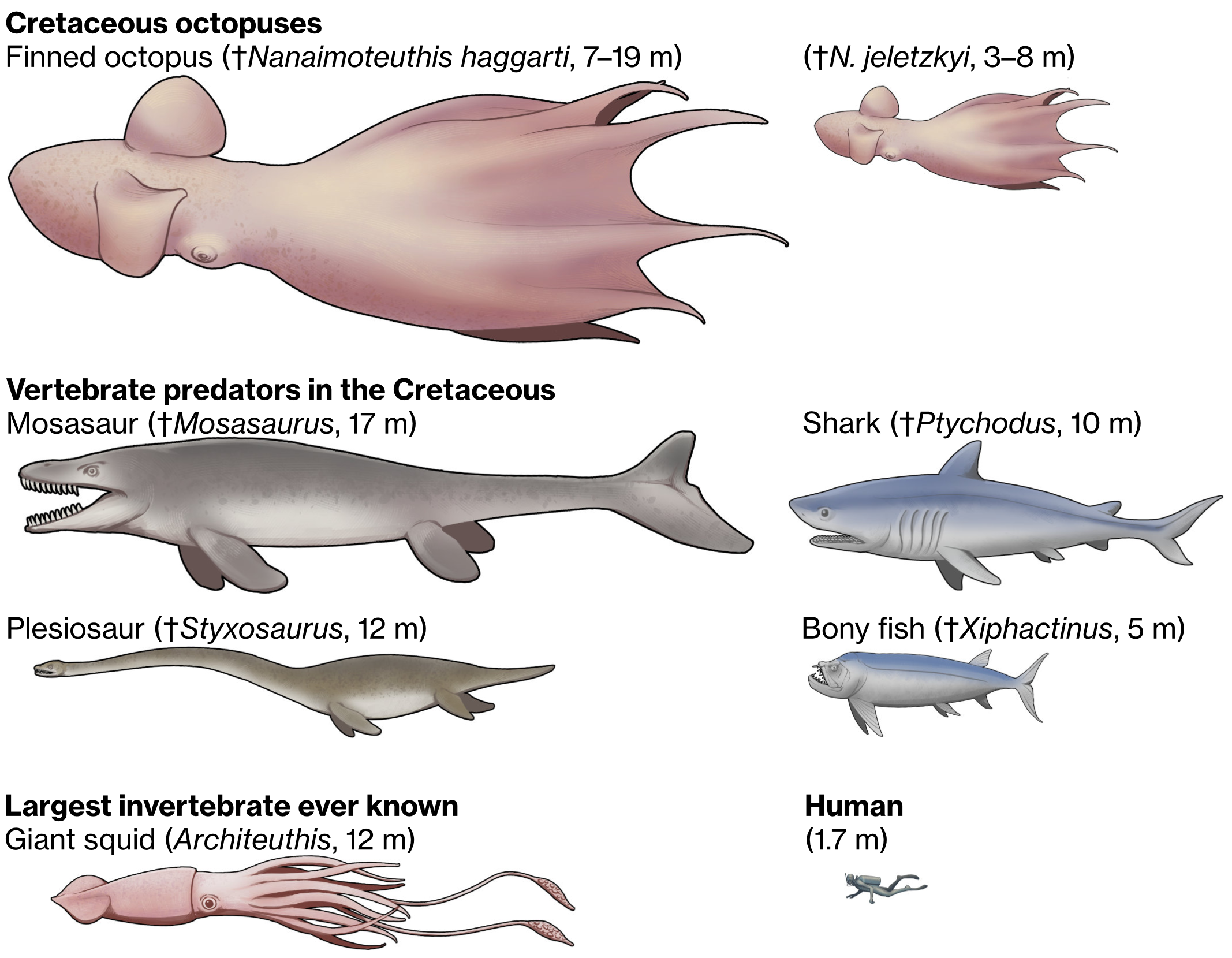
The ancient oceans were once ruled by giant 'kraken–like' octopuses that measured up to 62 feet (19m) long, new research reveals.
Scientists have discovered evidence of a colossal beast that hunted the Late Cretaceous seas between 72 and 100 million years ago.
They competed with – and perhaps even preyed upon – large ocean apex dinosaurs such as the ferocious mosasaur.
This is unusual, the experts said, because they evolved to have soft bodies instead of protective shells.
However, this may have given them unprecedented mobility, vision and intelligence.
The discovery was made after a team re–examined 15 large fossil jaws from ancient octopus relatives and found two new species – one of which grew to remarkable lengths.
This species, called Nanaimoteuthis haggarti, featured extensive wear in their jaws, indicating they were active carnivores that routinely crushed hard shells and bones with powerful bites.
It's also believed they used their long, flexible arms to seize large prey while dismantling it with their strong beaks – a behaviour that has been linked to advanced intelligence.
Scientists have discovered evidence of a colossal beast that hunted the Late Cretaceous seas between 72 and 100 million years ago
'This extensive wear suggests dynamic crushing of hard skeletons,' the team, from Hokkaido University, wrote in the journal Science.
'With a calculated total length of (up to) 62 feet (19m) these octopuses may represent the largest invertebrates thus described, rivalling contemporaneous giant marine reptiles.'
For comparison, humans measure, on average, 5ft6 (1.7m) tall while elephants reach a height of around 10 feet (3m).
This ancient octopus would also have eclipsed a London bus, which comes in at around 36 feet (11m) long.
While it was comparable to the length of a sperm whale, at 66ft (20m) long, it wouldn't have quite measured up to a blue whale, which can grow up to 90 feet (27m) long.
The other newly–discovered species, called Nanaimoteuthis jeletzkyi, was also a predator but was on the smaller size, growing up to 26 feet (8m) in length.
The researchers said the findings indicate these two species were not merely prey.
Instead, they were highly active participants in shaping marine ecosystems while occupying roles previously attributed only to large vertebrates such as sharks.
The team said the wear and tear found on fossilised jaws indicated they were active carnivores that routinely crushed hard shells and bone
How it measures up
Human– 5ft6 (1.7m) tall
Elephant– 10ft (3m) tall
London bus – 36 feet (11m) long
Giant octopus – 62ft (19m) long
Sperm whale – 66ft (20m) long
Blue whale– 90ft (27m) long
'In the largest individuals, the jaws showed extensive wear with once–sharp features in small juveniles becoming blunted and rounded over time,' the scientists said.
'The long scratches distributed on wide areas of their jaw reflect the dynamic use of the entire jaw for dismantling prey.'
They said that the loss of jaw edges isn't even on each side, indicating the octopuses had a 'preferred' side to chew on.
This has been linked to a highly–developed brain and cognition, indicating 'that the earliest octopuses already possessed advanced intelligence'.
'Long after the rise of vertebrate top predators, octopuses evolved body plans capable of rivalling them, as demonstrated here,' the team concluded.
Researchers previously said the skin patterns that octopuses create while they are snoozing may indicate they are capable of something similar to dreaming.
Like people, octopuses transition between two sleep stages – a quiet stage and an active stage that resembles rapid eye movement (REM) sleep in mammals.
While awake, octopuses create a number of different skin patterns which they use to camouflage themselves in different environments, and in social or threat displays, such as warning off predators and communicating with each other.
The size of N. haggarti compared to other marine predators of the time. A human is also depicted – showing the sheer size of the ancient colossal beast
The animals cycled through these same skin patterns during active sleep, the study found.
Other ancient octopus–like predators include the oldest known ancestor of the vampire squid, that had extra–long suckers and hair–like strands on its arms that it used to trap prey.
This differs from the modern–day vampire squid, which feeds only on organic drifting matter and is not built for active hunting, with less robust suckers.
A research team from Sorbonne University in France used a three–dimensional imaging technique on a 164 million–year–old fossilised specimen of this cephalopod.
They found evidence of muscular suckers on the tips of two specialised, long dorsal arms, suggesting it was an active predatory hunter.
One of the most effective ways octopuses avoid predation is by camouflaging with their environment.
They have special pigment cells allow them to control the colour of their skin, much like chameleons.
As well as colour change they can manipulate the texture of their skin in order to blend in with the terrain.
As well as camouflage they can escape predators by using a 'jet propulsion' method of escape, where they rapidly shoot out water to propel them through the water rapidly.
The jet of water from the siphon is often accompanied by a release of ink to confuse and evade potential enemies.
The suckers on the tentacles of the eight-legged beasts are extremely powerful and are used to drag prey towards a sharp beak.
As well as protection from other animals, it has been recently found that octopuses can detect the ultrasonic waves that preempt a volcanic eruption or earthquake, giving them enough time to escape.
RELATED VIDEOS
Did the Kraken Really Exist? The Truth About Giant Squid | Ocean Depth Mysteries
The Kraken Is Real… And It’s Even Weirder Than You Think
Real Giant Squid Discovered… Stronger Than the Kraken
Archaeologists have uncovered part of an ancient statue of a pharaoh in Egypt, who, according to many scholars, is the king mentioned in the biblical story of Moses.
The fragment is thought to depict Ramesses II, one of ancient Egypt's most powerful rulers and a figure many historians associate with the pharaoh described in the Book of Exodus.
Part of the large statue, including its legs and base, was discovered at Tel Faraoun in Egypt's eastern Nile Delta, just northwest of the Red Sea, during ongoing excavations led by the country's Supreme Council of Antiquities.
The unearthed fragment stands about seven feet tall and is estimated to weigh between five and six tons, according to officials overseeing the dig.
Although parts of the statue are worn and damaged, archaeologists said enough detail remains to link it to royal sculptures created during Egypt's New Kingdom period, which lasted from about 1550 to 1070 BC.
Early analysis suggests the statue may not have originally been carved for the site where it was discovered.
Researchers believe it could have been transported from Pi-Ramesses, the grand royal city established by Ramesses II in the Nile Delta.
The fragment is thought to depict Ramesses II, one of ancient Egypt's most powerful rulers and a figure many historians associate with the pharaoh described in the Book of Exodus
Ramesses II is said to be the pharaoh mentioned in the Book of Exodus that tells the story of Moses freeing the Israelites from slavery and delivering them to the Promised Lan
From there, experts suspect the statue was later moved to Tel Faraoun, known in antiquity as Emet, where it may have been reused inside a temple complex.
Ramesses, who ruled from 1279 to 1213 BC, was known for his military power and strategic genius, leading an army of around 100,000 men strong.
People often identify Ramesses II as the biblical Pharaoh primarily due to Exodus 1:1, which mentions Hebrew slaves building the city of 'Raamses' (or Pi-Ramesses), a city famously built by Ramesses II in the 13th century BCE.
While the Bible does not explicitly name the Pharaoh, this geographical link, combined with his long, dominant reign and the timing of the 19th Dynasty, makes him a popular historical candidate, often reinforced by popular media.
While the Bible does not explicitly name the Pharaoh, this geographical link, combined with his long, dominant reign and the timing of the 19th Dynasty, makes him a popular historical candidate, often reinforced by popular media.
Officials overseeing the excavation said the fragment may have once formed part of a much larger sculptural group, possibly depicting the king alongside Egyptian deities.
Comparable discoveries at other sites have shown rulers arranged in ceremonial triads, a common feature of monumental temple art in ancient Egypt.
Archaeologists said further study of the stone, carving techniques, and remaining surface details could help pinpoint the statue's exact origin and better understand how it was relocated across the Nile Delta.
Pictured is the excavation site where the statue was found
Part of the large statue, including its legs and base, was discovered at Tel Faraoun in Egypt's eastern Nile Delta (pictured) during ongoing excavations led by the country's Supreme Council of Antiquities
Many historians have long debated which Egyptian ruler may have reigned during the events described in the Book of Exodus. Ramesses II is frequently cited as a leading candidate due to references in the Bible to the Israelites building the city of Pi-Ramesses.
That ancient city, constructed during his reign, is believed to have been located in the same region of the eastern Nile Delta where the statue fragment was discovered.
Some scholars believe this geographic overlap strengthens the connection between Ramesses II and the biblical narrative of Moses leading the Israelites out of Egypt.
However, other historians caution that there is no direct archaeological evidence confirming the identity of the pharaoh described in Exodus.
They note that while Ramesses II remains a popular candidate, the biblical account does not name a specific ruler, leaving the question open to interpretation.
However, discoveries tied to Ramesses II continue to draw intense interest because of his prominence in Egyptian history and the long-standing debate surrounding the Exodus story.
In 2024, another team of archaeologists discovered an ancient sword in Egypt linked to the Biblical pharaoh.
The bronze blade, thought to be around 3,000 years old, has the markings of Ramesses II, hailed as the most powerful king of ancient Egypt.
The shimmering sword found in Egypt two years ago likely belonged to a high-ranking military official under the reign of Ramesses II
The sword was uncovered among the ruins of an ancient military fort in Housh Eissa, a city just south of Alexandria, which featured barracks for soldiers and storage rooms for food, weapons and other goods.
The ancient sword likely did not belong to the famous king, but likely to one of his soldiers stationed at the fort, experts said.
Elizabeth Frood, an Oxford University Egyptologist who was not involved in the dig, told The Washington Post: 'An object to bear the cartouches of Rameses II would suggest to me that it belonged to someone of relatively high rank.
'To be able to display such an object, even though it would have been presumably in a scabbard, was a marker of status and prestige.'
The sword was uncovered at a site called Tell Al-Abqain, which experts said was 'a crucial military outpost.'
RELATED VIDEOS
Ancient Inscription May Prove Moses Was Real | Shocking Discovery in Egypt | WION Podcast
The Exodus | God vs Pharaoh | Epic Bible Story of Moses & the Red Sea
The ENTIRE Story of the Exodus From Egypt | The Night the Red Sea Opened and a Nation Was Born
Experts have recovered 42 lost pages from a major early Christian manuscript, heralding a 'breakthrough' for understanding ancient scripture.
Scientists successfully reconstructed passages from Codex H – one of the world's most important early New Testament scripts.
The text, a 6th century copy of the Letter of St Paul, was lost to history when it was disassembled at the Great Lavra Monastery on Mount Athos in Greece in the 13th century.
Its pages were re–inked and reused as binding material and flyleaves for multiple other manuscripts.
Today, the surviving fragments are scattered across libraries in Italy, Greece, Russia, Ukraine and France.
Using advanced imaging techniques, an international team of academics have now been able to digitally reconstruct the missing pages – revealing text unseen for centuries.
The findings shed new light on ancient scribal habits and early biblical structures, providing unique insight about how people interacted with their sacred texts.
'Given that Codex H is such an important witness to our understanding of Christian scripture, to have discovered any new evidence – let alone this quantity – of what it originally looked like is nothing short of monumental,' Professor Garrick Allen, from the University of Glasgow, said.
Scientists successfully reconstructed passages from Codex H – one of the world's most important early New Testament scripts
Paul's letters, also known as Pauline epistles, are a group of texts in the New Testament traditionally attributed to Paul the Apostle and are the earliest written explanations of Christian theology.
These letters were written in the 1st century and sent to early Christian communities and individuals, explaining Christian beliefs and giving practical advice to churches.
Codex H, a 6th century handwritten book, contains a collection of these letters and shows how they were being used centuries later.
The codex was later taken apart and reused in other books, with pages scattered across multiple countries.
The researchers explained their breakthrough came from an important starting point – the knowledge that at one point, the manuscript was re–inked.
This describes the process of a scribe tracing over the original, fading ink with new ink to preserve the text.
'The chemicals in the new ink caused "offset" damage to facing pages,' Professor Allen explained.
'They essentially creating a mirror image of the text on the opposite leaf – sometimes leaving traces several pages deep, barely visible to the naked eye but very clear with latest imaging techniques.'
Using advanced imaging techniques, an international team of academics have now been able to digitally reconstruct the missing pages
Codex H and Paul's letters
Paul's letters are a group of texts in the New Testament traditionally attributed to Paul the Apostle.
They are the earliest written explanations of Christian theology.
These letters were written in the 1st century and sent to early Christian communities and individuals, explaining Christian beliefs and giving practical advice to churches.
Codex H, a 6th century handwritten book, contains a collection of these letters and shows how they were being used centuries later.
The codex was later taken apart and reused in other books, with pages scattered across multiple countries.
Using specialised imaging techniques, the team processed images of the remaining manuscript pages in order to recover 'ghost' text that no longer physically exists.
This meant they could retrieve multiple pages of information from every single page of remaining manuscript.
Radiocarbon dating was then used to confirm the parchment's 6th century origin.
While the recovered text contains known portions of Paul's letters, the discovery offers a unique insight into how the New Testament has evolved and been understood through the centuries.
Key findings include the earliest known examples of chapter lists, which differ drastically from how the letters are divided today.
The fragments also show how 6th century scribes corrected, annotated and interacted with sacred texts.
Meanwhile the physical state of the manuscript also reveals how sacred works were reused and repurposed once they fell into disrepair.
For historians, the newly–recovered texts provide evidence for how the New Testament developed over time.
A 17th century painting by Valentin de Boulogne depicts 'Paul Writing His Epistles'. They are regarded as the earliest written explanations of Christian theology
A new print edition of Codex H is forthcoming and a digital edition is freely available here, making these recovered pages available to the public and scholars for the first time in centuries.
Earlier this month, a separate group of experts uncovered a rare marble artefact that could rewrite the history of baptism.
Archaeologists have been excavating the remains of a cathedral in the ancient city of Hippos in Israel, near the Sea of Galilee.
According to the gospels, Jesus' earthly ministry centred around this area, making it a significant site in the history of Christianity.
And it is here that the team came across an unusual object – a unique marble item featuring three hemispheric cavities which they believe used to hold three different oils.
Traditionally, during baptisms, a person is anointed with two oils – one used before the water baptism and a different one used after.
But the new discovery indicates people used to be anointed with oils three times – and it could force historians to rethink the history of the practice.
Scientists reveal who wrote the Bible – and say it probably WASN'T God
Around the world, millions of Christians see the Bible as the divine word of God.
It tells an incredible story about the history of the world, from creation to redemption and God's Last Judgement of the living and the dead.
It includes famous stories such as Adam and Eve, Noah's Ark, David and Goliath, The Crucifixion and The Resurrection.
Famously, the Bible is the word of God, but researchers generally agree it was written by multiple human authors.
Professor Elizabeth Schrader Polczer, biblical scholar at Villanova University in Pennsylvania¸ said 'dozens' of people likely penned the Bible, probably more than 40.
However, identifying these people who wrote the Bible is 'quite complicated', she told the Daily Mail.
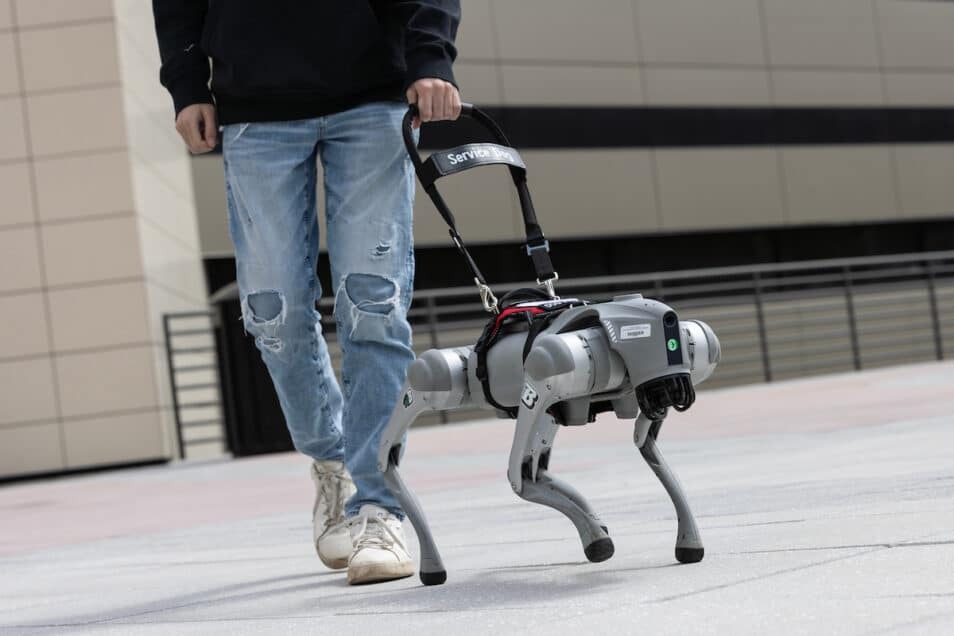
Stel je voor: Je vertelt je geleidehond dat je dorst hebt. Hij antwoordt dat er in de gang een fonteintje is en dat je twee deuren moet openen om daar te komen, maar dat er in de keuken een waterkoeler staat die sneller te bereiken is. Een echte hond kan dat niet, een robotgeleidehond van Binghamton University wel.
Onderzoekers van deze Amerikaanse universiteit ontwikkelden een systeem dat een robothond laat communiceren door middel van een taalmodel. Zo kan de ‘hond’ heen en weer communiceren met zijn gebruiker: hij vertelt wat de route is en stelt de snelste alternatieven voor en welke obstakels er onderweg zijn.
Veel blinden, weinig honden
Wereldwijd zijn er miljoenen mensen die blind of zeer slechtziend zijn. Veel van deze mensen hebben baat bij een blindengeleidehond. Deze honden zijn echter duur, het opleidingstraject is intensief en er is een beperkt aantal honden per jaar beschikbaar. Volgens KNGF Geleidehonden kost het opleiden van een hond gemiddeld 40.000 duizend euro. Niet elke hond haalt bovendien de eindstreep. Zodra de opleiding is gestart, valt ongeveer 20 procent van de honden alsnog af, bijvoorbeeld door medische redenen of gedrag. Ook werkt een blindengeleidehond met een vast aantal aangeleerde commando’s. Hoewel dit behulpzaam is in alledaagse situaties als het vermijden van obstakels of het instappen in de trein, zijn er door de grote opkomst van taalmodellen meer dingen mogelijk.
Toegevoegde waarde
Wat die taalmodellen vooral toevoegen, is iets wat echte honden simpelweg niet kunnen: uitleggen wat ze doen en waarom. Dat communiceren noemen de onderzoekers plan verbalization: het vooraf uitleggen van mogelijke routes. Tijdens het lopen gebeurt er nog iets anders. De robot blijft namelijk vertellen wat er om je heen gebeurt, zoals “we lopen nu door een lange gang” of “we naderen een deur”. Dat heet scene verbalization en helpt gebruikers om een beter beeld van hun omgeving te krijgen. Maar werkt het ook in de praktijk?
Getest met blinde deelnemers
Om te kijken of dit echt werkt, testten de onderzoekers het systeem met zes blinde deelnemers in een kantooromgeving. De robot vroeg waar iemand heen wilde, stelde verschillende routes voor en begeleidde diegene vervolgens stap voor stap naar de bestemming. De deelnemers waren vooral positief over de combinatie van uitleg vooraf en begeleiding onderweg. Juist die combinatie gaf hen meer controle en overzicht. Tegelijkertijd was er ook een kanttekening: sommige deelnemers voelden zich nog iets minder veilig dan met een echte hond, mogelijk doordat de technologie nog onbekend is.
Wat een hond niet kan vervangen
Een robotgeleidehond kan veel, maar volgens KNGF Geleidehonden zijn er ook aspecten die lastig of misschien zelfs onmogelijk te vervangen zijn. Het samenwerken tussen een gebruiker en een geleidehond is een voortdurend samenspel, waarbij de hond niet alleen obstakels vermijdt, maar ook subtiele signalen van de gebruiker oppikt. Die afstemming ontwikkelt zich in de loop van de tijd tot een sterke vertrouwensband, die bijdraagt aan zowel veiligheid als zelfstandigheid. Daarnaast speelt de hond ook een sociale rol: mensen stappen makkelijker op iemand af met een hond, wat het aangaan van contact vergemakkelijkt. Daarmee is een geleidehond niet alleen een praktisch hulpmiddel, maar ook een maatje, iets wat technologie voorlopig nog niet kan evenaren.
Nog niet klaar voor de straat
De robotgeleidehond is dus veelbelovend, maar nog lang niet af. Voor de veiligheid werd de robot tijdens de test bestuurd door een operator. Ook moet het systeem nog leren omgaan met complexere en drukkere omgevingen, zoals buiten op straat. Daarnaast werkt de robot nu nog met een vooraf bekende kaart van de omgeving. In nieuwe of onbekende ruimtes is dat dus nog een uitdaging. Toch laat dit onderzoek zien waar het naartoe kan gaan. Waar een echte geleidehond vooral reageert op commando’s, kan een robot straks meedenken, uitleg geven en zelfs alternatieven voorstellen maar het is nog de vraag of hij ooit de rol van de hond volledig kan overnemen.
On February 27, retired Air Force Research Laboratory commander William Neil McCasland, who once worked at the Wright-Patterson Air Force Base, an Ohio base steeped in UFO lore, mysteriously went missingafter leaving his home in Albuquerque, New Mexico.
By March, theFBI had joined the search for the general, sending conspiracy theorists into a tailspin, with some arguing that the agency’s involvement was “evidence of foul play.”
Now the story is getting even stranger. McCasland is just one out of at least ten scientists and engineers with government ties who either died or disappeared within the last four years in incidents that the FBI is now actively investigating, Scientific American reports.
In a statement, the FBI said it’s “spearheading the effort to look for connections into the missing and deceased scientists.”
In a separate Monday press release, the House Oversight Committee announced it was “seeking information from the Department of Energy, Department of War, FBI, and NASA about the scientists and other personnel connected to US nuclear secrets or rocket technology who have died or mysteriously vanished in recent years.”
The committee pointed to reporting alleging that “at least ten individuals who ‘had a connection to US nuclear secrets or rocket technology’ have ‘died or mysteriously vanished in recent years.'”
Lawmakers suggested there could be a “possible sinister connection between a string of mysterious deaths and disappearances,” which could “represent a grave threat to US national security and to US personnel with access to scientific secrets.”
Among these scientists is NASA Jet Propulsion Lab scientist Michael David Hicks, who died in July 2023 of a still-unknown cause. He studied comets and asteroids.
His daughter, Julia Hicks, told CNN that she didn’t “understand the connection between my dad’s death and the other missing scientists.”
“I can’t help but laugh about it, but at the same time, it’s getting serious,” she added.
Another JPL-affiliated space research specialist, Frank Maiwald, died in 2024, while an aerospace engineer, Monica Reza, disappeared while hiking in Los Angeles in 2025. Maiwald has authored papers on mass spectrometry and remote sensing instruments, while Reza was a metallurgist and materials engineer at JPL.
Still, the pattern is striking. For now, the scientists’ surviving loved ones continue to be baffled by all the interest and widespread press coverage. Earlier this year, following McCasland’s disappearance, his wife, Susan McCasland Wilkerson, took to Facebook with some eyebrow-raising remarks.
“It is true that Neil had a brief association with the UFO community,” she wrote at the time. “This connection is not a reason for someone to abduct Neil.”
“Neil does not have any special knowledge about the ET bodies and debris from the Roswell crash stored at Wright-Patt,” she added, referring to the 1947 incident in Roswell, New Mexico, which became the basis for countless UFO conspiracy theories.
Meanwhile, conspiracy theorists are vowing to “keep digging.” Just last week, British tabloid the Daily Mailannounced it had identified the death of an “eleventh” and “UFO-linked scientist.” The tabloid claims that 34-year-old Amy Eskridge, who died of a self-inflicted gunshot wound in 2022, had been investigating “anti-gravity technology.”
Military pilots would stand no chance against UFOs that 'defy any reason'
Republican congressman Tim Burchett raised questions about potential sightings of UFOs, days after Donald Trump teased a release of government files on the topic
A leading US lawmaker says Top Gun pilots like Maverick played by Tom Cruise would not stand a chance against UFOs he has seen. Congressman Tim Burchett said he has been shown photos and videos of mystery craft that "defy any reason that we have".
And he says they are far too well equipped to risk sending troops to confront. Referring to a barrage of unexplained military sightings of unidentified craft, Tim said: “These people are seeing something out there.
“I’ve seen pictures and video of things that defy any reason that we have. And everybody says, 'Well, it’s our stuff, it’s the Russians, it’s the Chinese'. If it’s the Chinese they would own us. If it was the Russians they wouldn’t be bogged down inUkraine.
Congressman Tim Burchett said he has been shown photos and videos of mystery craft that "defy any reason that we have".
“If it was ours, we would never risk our military fighting men and women in half-a-billion-dollar aircraft out with these things that they’re spotting. These things can hover for hours on end, then they can just shoot straight up, they can do angles.”
Tim said a US Navy admiral told him a craft he had seen on sonar was ‘almost as big as a football field’ and ‘traveling over 200 miles an hour’ underwater. He added: “We don’t have anything of that capability or that size.”
Last month he demanded a probe into a ‘dark’ pattern of deaths and unexplained disappearances of several scientists linked to UFO research.
He said he had seen pictures and video of things that "defy any reason"(Image: Getty Images/Collection Mix: Subjects RF)
He said he was disturbed by the cases including those of retired US Air Force Major General William McCasland and his former colleague Monica Reza both of whom vanished in mysterious circumstances.
McCasland has not been seen since February 27 when he left his home in Albuquerque, New Mexico, US, for a run. Despite an investigation by police, FBI, US Air Force officials and New Mexico Search & Rescue no trace of him has been found.
Reza was last seen nine months ago hiking in Angeles National Forest, California, with a pal. The aerospace engineer reportedly worked under McCasland on a US Government project focused on developing a specialised metal for rockets.
Tim says he has seen a barrage of unexplained military sightings of unidentified craft(Image: Getty Images/Science Photo Library RF)
It remains unclear if their disappearances are linked. But Tim said: “Something dark is going on. I know these scientists and researchers. They have testified. We’ve got to get to the bottom of it. It’s just too much, too much is going on right now.
“There have been several others throughout the country that have disappeared under suspicious circumstances. I think we ought to be paying attention to it. The numbers seem very high in these certain areas of research.
“I think we’d better be paying attention and I don’t think we should trust our government.”
Congressman Tim Burchett
(Image: AP)
Tim, who sits on the House Oversight Committee investigating UFO reports, has accused NASA of ‘lying’ about its knowledge and concealing classified files.
Asked why more whistleblowers had not come forward, he said they were frightened. He added: “They’re afraid someone will disappear them. I think being murdered is what they’re afraid of. I think some of them truly are because of things they’ve seen.”
He has previously accused the Government of misleading the public about extraterrestrial activity.
In 2023, he claimed officials were hiding the truth about aliens and UFOs and has alleged the US is reverse-engineering alien technology capable of catastrophic destruction.
Last year he said the Government was aware of underwater alien bases claiming ‘entities’ exist at several deep-sea locations around the world.
Pentagon Admits: Navy Pilots Encountered Impossible UFO Technology
On an almost daily basis, the ancient world continues to surrender artifacts that challenge our understanding of history. But some seem to have a real ‘wow’ factor. Among the massive pyramids and golden sarcophagi, archaeologists occasionally unearth objects so baffling that they defy conventional explanation. One such extraordinary artifact is an intriguing Egyptian tablet that has sparked intense debate among researchers and alternative historians alike.
By mainstream archaeologists’ assessment, this intricately carved slab of stone is designated the ‘offering table for Defdji’ and is simply a rather elaborate offering table. However, to others it bears an uncanny resemblance to an aircraft control panel, complete with what appear to be buttons, dials, and gauges.
This striking similarity has propelled the carved stone into the center of the "forbidden archaeology" movement. Enthusiasts of ancient astronaut theories argue that this incredible object is evidence of advanced, forgotten technologies or extraterrestrial contact in the distant past. However, mainstream archaeologists offer a vastly different, yet equally fascinating, explanation rooted in the complex spiritual beliefs of the Old Kingdom. As we dive into the origins and purpose of this peculiar stone board, we must navigate the line between modern imagination and historical reality. What exactly is this artifact, and why does it look like it belongs in the cockpit of a modern jet?
A clear unenhanced photo of the stone tablet designated as the offering table of Defdji, held at Rijksmuseum Van Oudhaden, Leiden, Netherlands.
The objects origin is listed as Egypt, with the precise origin ‘Unknown’. When examining the mysterious Egyptian tablet, the immediate visual impact is undeniable and completely mesmerizing. Carved from a solid, flawless block of high-quality alabaster, the artifact measures approximately 0.5 meters (1.6 ft) in length and 0.3 meters (1.0 ft) in width. Unlike the typical flat offering tables found in many ancient tombs, this stone features a highly complex, three-dimensional surface. It is covered in a series of perfectly smooth circular depressions, raised nodes, and grooved channels that intersect at precise geometric angles.
Unlike the majority of ancient Egyptian offering tables, which are typically rectangular, the table of Defdji is notable for its rare circular shape. It is carved from a single, thick block of white alabaster (calcite), a material highly prized in ancient Egypt for its luminous quality and association with purity. The artifact measures 49 centimeters (19.3 inches) in diameter and is exceptionally thick at 13 centimeters (5.1 inches)
The layout of the carvings is what fuels the endless speculation about their true nature and origin. The overall design gives an impression of the dials and gauges found on an aviator's dashboard or a modern machine interface. Below these "dials" are raised rectangular shapes that look exactly like physical switches or levers waiting to be toggled by a human hand. The precision of the stonemasonry is so exact that it seems almost machine-made, an incredibly impressive feat for artisans working around 2400 BC.
For decades, photographs of the artifact have circulated widely in fringe science and alternative history communities, often stripped of their vital archaeological context. Without its historical background, the stone easily transforms into a piece of ancient high-tech machinery in the minds of modern viewers. Observers frequently note that the ergonomic spacing of the "buttons" would perfectly fit a human hand, further fueling the idea that this was a highly functional console. It is this tantalizing blend of geometric precision and seemingly inexplicable design that keeps the mystery of the tablet alive today.
Most offerings tables are rectangular like this one, which has 4 bowls for oils and the shape of the hetep carved (also held at Rijksmuseum Van Oudhaden, Leiden, Netherlands).
Ancient Astronauts and the Aircraft Control Panel Theory
The mysterious Egyptian tablet has undeniably become a highlight of forbidden archaeology, a controversial field that investigates out-of-place artifacts (OOPArts). Proponents of this theory firmly believe that mainstream science deliberately suppresses or ignores evidence of highly advanced prehistoric civilizations. When confronted with the tablet, these alternative researchers ask a very compelling question. How could a society armed only with soft copper chisels and primitive stone hammers conceive of and execute such a futuristic design?
According to ancient astronaut theorists, the artifact is either a petrified remnant of a genuine control panel or a fascinating "cargo cult" replica. The cargo cult theory suggests that ancient Egyptians witnessed advanced beings, perhaps extraterrestrials or survivors of a lost technological civilization, operating actual flying machines. Attempting to honor or replicate the immense power of these "gods," the local artisans painstakingly carved a mock-up of the machinery out of sacred stone. In this specific scenario, the mysterious Egyptian tablet serves as an ancient homage to a technology they witnessed but did not fully understand.
Supporters of this alternative view often point to other unusual Egyptian artifacts to heavily bolster their controversial claims. They frequently reference the famous "helicopter hieroglyphs" found in the Temple of Seti I at Abydos as corroborating evidence of ancient flight. They also point to the aerodynamic wooden Saqqara Bird, arguing that these items prove the ancients understood complex aerodynamics. When viewed through this specific lens, the alabaster control panel is not an isolated anomaly, but can be presented as part of a much broader pattern of forgotten ancient technology.
While highly speculative and largely rejected by academia, this narrative taps into a deep, universal human desire to uncover hidden truths about our origins. The idea that humanity's past is far more technologically complex than the history books claim is an incredibly seductive concept. It transforms silent stones into loud testaments of a forgotten golden age where humans and advanced beings may have interacted.
An offering table found from the Saqqara tomb of king Qa'a, the last ruler of the First Dynasty of Egypt. It is inscribed with hieroglyphs, like the example being discussed.
Despite the captivating allure of ancient flying machines, mainstream archaeologists offer a deeply profound, though decidedly less extraterrestrial, explanation. The mysterious Egyptian tablet is universally recognized by professional Egyptologists as an elaborate "Seven Sacred Oils" offering board. These specialized artifacts were essential, highly sacred components of elite burial rituals during the Old Kingdom, roughly between 2686 BC and 2181 BC. Rather than operating an aircraft, this beautiful artifact was designed to ensure the safe and successful passage of the deceased into the perilous afterlife.
The perfectly round, circular depressions that look so much like modern dials were actually small reservoirs meant to hold specific ceremonial liquids. These oils, which included exotic substances like festival perfume, cedar oil, and Libyan unguent, were highly prized and extremely expensive in antiquity. During the complex and vital "Opening of the Mouth" ceremony, priests would use these oils to ritualistically anoint the statues or mummies of the dead. This powerful ritual was believed to magically restore the earthly senses of the deceased, allowing them to see, hear, breathe, and eat in the underworld.
Offering table of Defdji. This round offering table is a rarity, the majority of offering tables being rectangular. Sometimes the table comes in the shape of the hieroglyph for ‘offering’ - ‘hetep’ in Egyptian – a reed mat with a loaf of bread on it. Here, this shape is included in the carving on the surface.
(Rijksmuseum van Oudheden, Leiden, Netherlands/CC0)
The raised "buttons" and intersecting grooves were not mechanical switches, but rather a sophisticated, practical system to catch spills and separate different sacred liquids. The names of the specific oils were very often inscribed in delicate hieroglyphs directly above or beside their corresponding reservoirs on similar tablets.
Surface Layout and Reliefs
The entire upper surface of the table is heavily ornamented with precise, raised relief carvings and finely incised hieroglyphs. The layout is highly structured and serves a specific ritual function rather than a mechanical one.
The central feature of the table is the hetep sign, which is placed horizontally across the middle in raised relief. The hetep hieroglyph, which translates to "offering" or "to be satisfied/at peace," traditionally depicts a reed mat with a stylized loaf of bread resting upon it. This central motif visually anchors the table and explicitly defines its purpose as a conduit for sustenance in the afterlife.
The surface surrounding the hetep sign is meticulously divided into a grid of small rectangular compartments. Each of these compartments contains hieroglyphic text specifying the name of a particular dish, drink, or purifying agent intended for the deceased. In total, the table catalogs over ninety distinct products, creating an exhaustive eternal menu. To ensure the offerings reached their intended recipient, the phrase "for Defdji" is clearly inscribed beside each designated item.
The Seven Sacred Oils
One of the most distinctive features of the Defdji table, and the element that most frequently draws modern misinterpretation, is the arrangement of shallow, circular cavities designed to hold liquids.
In the top panel of the table, arranged in a straight horizontal line, are seven distinct, shallow depressions. These cavities were specifically carved to hold the "Seven Sacred Oils," which were essential components of elite burial practices and the "Opening of the Mouth" ceremony. During this ritual, priests would use these consecrated oils to anoint the cult statue or mummy of the deceased, a process believed to magically restore their earthly senses in the afterlife.
The hieroglyphs corresponding to these seven cavities explicitly name the oils from right to left:
1.setji-beb (festive ointment)
2.hekenu (laudation oil)
3.seftji (balm)
4.nekhenem oil
5.twat (tua) oil
6.hatet-ash (top quality pine/cedar oil)
7.hatet-tjehenu (top quality Libyan oil) .
Below the central hetep sign, the table features additional circular depressions: two larger, distinct dishes carved in deep relief, and further below them, representations of two small vases and a jug resting within a bowl. These lower depressions and raised vessels were likely used for liquid libations, such as water, wine, or beer, which would be poured over the table during funerary rites.
The incredible precision of the carvings on this specific artifact was a pure testament to the immense wealth and social status of the tomb owner. Only the highest-ranking nobles could afford to commission the absolute finest stonemasons in the land to craft such a flawless ritual object.
Therefore, the tablet is a masterpiece of ritualistic art, embodying the profound spiritual technology of ancient Egypt rather than mechanical or aeronautical engineering. The ancient Egyptians did not need airplanes to travel; they built these intricate metaphysical machines to transport their souls across eternity.
Ultimately, artifacts like this force us to appreciate that while the ancient Egyptians were not flying jet planes, they possessed an extraordinary mastery of their environment. Their true "advanced technology" was their unparalleled stonemasonry and their incredibly complex understanding of life, death, and eternity. The sands of Egypt may have yielded this secret, but the artifact ensures that the conversation about humanity's ancient capabilities is just beginning.
Top Image: Enhanced image of the stone tablet designated as the offering table of Defdji that has been circulated on the internet.
Source: National Museum of Antiquities, Leiden/CC0
What is the mysterious Egyptian tablet that looks like an aircraft control panel? It is an intricately carved alabaster stone artifact featuring circular depressions and raised nodes that strongly resemble a modern machine interface or dashboard. While alternative historians claim it is evidence of ancient advanced technology, archaeologists identify it as a ritualistic object from the Old Kingdom.
What was the true purpose of the tablet in ancient Egypt? Mainstream Egyptologists agree that the artifact is a "Seven Sacred Oils" offering board. The circular depressions were used as reservoirs to hold precious ceremonial oils during elite burial rituals, specifically for the "Opening of the Mouth" ceremony to awaken the senses of the dead.
Why do people think ancient Egyptians had advanced technology?The belief stems from "forbidden archaeology" and the ancient astronaut theory, fueled by artifacts (OOPArts) that seem too complex for their time. Psychological phenomena like pareidolia also play a role, as modern humans tend to project familiar technological shapes, like dashboards or helicopters, onto ancient, unrelated designs.
References
Anastasiia Stupko-Lubczynska, “In Search for the Ritual Origins of the ‘Seven Sacred Oils’ in Ancient Egypt: New Evidence from the Tomb of Meru (TT 240),” Journal of Near Eastern Studies 84(2), 2025, pp. 281–313. https://www.journals.uchicago.edu/doi/10.1086/737333
Andrew J. Koh, Agnete W. Lassen, and Alison M. Crandall, “The Pharmacopeia of Ancient Egyptian Alabaster Vessels: A Transdisciplinary Approach with Legacy Artifacts,” Journal of Eastern Mediterranean Archaeology and Heritage Studies 13(3 ), 2025, pp. 317–333. https://doi.org/10.5325/jeasmedarcherstu.13.3.0317
Curiosity’s Mastcam captured this mosaic on Feb. 3, 2019, of a region on Mount Sharp with lots of clay-bearing rocks that formed when lakes and streams were present billions of years ago. The “Mary Anning 3” sample was found in this clay-enriched region. The rover's SAM analysis showed that Mars is capable of preserving ancient biosignatures. Image Credit: NASA/JPL-Caltech/MSSS
NASA's MSL Curiosity rover has found some more pieces of the puzzle that is Mars' ancient habitability. Evidence that the planet was once warm, wet, and habitable is growing, and now Curiosity has detected some new organic molecules. The rover found 21 organic compounds in rocks in Gale Crater with its Sample Analysis at Mars (SAM) instrument. Seven of them were detected for the first time.
These results stem from Curiosity's work back in 2020, when it drilled into a clay-bearing sandstone rock named Mary Anning 3. Now, after thorough onboard laboratory work, the rover has identified the most diverse collection of organic molecules ever found on Mars. As it stands now, there's no way of knowing if these organic molecules have a biological or geological origin, but the findings are still intriguing. Despite not being proof of ancient life, they're still important. They show that the planet is capable of preserving ancient biosignatures.
"The search for organic matter on Mars has rapidly evolved in the past decade with simple aromatic, S-heterocycles, and aliphatic organic molecules detected in Gale crater," the authors write. "We report the in situ detection of >20 organic molecules from clay-bearing sandstones in the ~3.5-billion-year-old Knockfarrill Hill member of Glen Torridon, Gale crater, by the Sample Analysis at Mars instrument suite onboard the Curiosity rover."
*MSL Curiosity drilled three sample holes in the Mary Anning rock and found more than 20 organic molecules in one of them. Seven of these molecules have never been found on Mars before, including one that's a precursor to RNA and DNA.
Image Credit: NASA/JPL-Caltech/MSSS*
SAM is three instruments in one that can detect organics and gases in both rocky and atmospheric samples. It has 74 single-use sample cups at its disposal, and 9 of them are reserved for wet chemistry. It used one of those 9 in this work.
SAM has small amounts of chemicals onboard that it uses in wet chemistry. In this work, the onboard laboratory experiments "released molecules preserved in ancient macromolecular or free organic matter within Martian bedrock despite ~3.5 billion years of diagenesis and radiation exposure," according to the authors.
One of the new molecules is called a nitrogen heterocycle. They're rings of carbon atoms that contain nitrogen and are considered to be precursors to DNA and RNA.
“That detection is pretty profound because these structures can be chemical precursors to more complex nitrogen-bearing molecules,” said lead author Williams in a press release. “Nitrogen heterorcycles have never been found before on the Martian surface or confirmed in Martian meteorites.”
But nitrogen heterocycles aren't the only significant finding. Curiosity also found a chemical named methyl benzoate. Its detection is important in our understanding of Mars' chemistry. It's not a smoking gun in the search for past life, but it could be critical. Methyl benzoate is complex, and it has both an aromatic ring, or benzene ring, as well as an ester group. It has both a biotic and an abiotic source, but its presence shows that Mars has preserved more complex or "mature" organic chemicals than has been previously confirmed. It likely didn't form on its own. Instead, it was most likely snipped off a larger organic compound during the SAM experiment.
The fact that methyl benzoate survived for about 3.5 billion years on Mars' radiation-blasted surface is significant and shows that the planet can preserve complex organic molecules. It suggests that even more convincing organic molecules like amino acids could be preserved, too.
*MSL Curiosity's Sample Analysis at Mars (SAM) instrument at NASA's Goddard Space Flight Center. SAM has three instruments and three subsystems that allow it to detect organic molecules in both rock and atmospheric samples.
Image Credit:
By NASA/GSFC/SAM - http://www.nasa.gov/topics/moonmars/features/sam-configure.html (archive link); see also https://photojournal.jpl.nasa.gov/catalog/PIA13463,
Public Domain, https://commons.wikimedia.org/w/index.php?curid=11762416*
SAM also found benzothiophene, which can also have both biotic and abiotic sources. It's a sulphur bearing molecule, and the sulphur can act as a shield to the radiation that bombards the Martian surface, protecting other molecules from destruction. It's another indication that there's more complex organic molecules waiting to be found on Mars.
These types of discoveries were what MSL Curiosity was built for, and they show that all of the hard work is paying off.
“This is Curiosity and our team at their best. It took dozens of scientists and engineers to locate this site, drill the sample, and make these discoveries with our awesome robot,” said study co-author and the mission’s project scientist, Ashwin Vasavada of NASA’s Jet Propulsion Laboratory in Southern California. “This collection of organic molecules once again increases the prospect that Mars offered a home for life in the ancient past.”
"We propose that this suite of organics represents TMAH thermochemolysis breakdown products from ancient organic macromolecular material that has been preserved in billions-of-years-old sedimentary rocks in Gale crater," the researchers write.
The SAM analysis doesn't reveal the spatial distribution of these chemicals, so the authors say that they can't confirm their source. It's possible that they were delivered to Mars by ancient meteorites. They could also have other abiotic sources. But regardless of the source, their discovery confirms that Mars can preserve ancient biosignatures.
"These results expand the library of confirmed and suggested organic molecules preserved over deep geologic time in the Martian near-surface and confirm the presence of macromolecular carbon on Mars," the authors conclude.
Curiosity has used up all of its wet chemistry cups. It used its last one when it explored the boxlike ridges in Gale Crater. These features were formed by ancient groundwater, and those results will be presented in a future paper.
MSL Curiosity is exploring a region in Gale Crater called the Amapari Marker Band. It's like a bathtub ring where metals have accumulated unexpectedly. The region is evidence that Gale Crater was once a paleolake. Image Credit: NASA/JPL-Caltech
Part of a Mars rover's job is to detect anomalies. When something stands out from its surroundings, it indicates that something noteworthy has happened. NASA's MSL Curiosity has detected a metallic anomaly in Gale Crater, and that anomaly needs an explanation.
In 2022, the car-sized, plutonium-powered rover detected high levels of iron, manganese, and zinc in the Gale Crater, the highest levels ever detected there. They're in a feature called the Amapari Marker Band, a stratigraphic layer on Mt. Sharp, the peak in the middle of Gale Crater. Why are metals concentrated there?
As evidence that Mars was once warm and wet has accumulated, scientists are asking more piercing, detailed questions. Exactly when did those transitions occur and how did they affect the planet? The timing of wetter and drier periods is part of Mars' long history, and understanding them is critical to understanding the planet's ancient potential habitability.
Geographic distribution and elevation histograms of the surfaces of Earth and Mars, along with their water-formed landscapes, illustrating that deltas can serve as proxies for defining the upper boundary of the Martian shelf.
Mt. Sharp in Gale Crater is a 5 km high sedimentary mound. Its stratigraphic layers record Mars' change from warm and wet to cold and dry. The Amapari Marker Band is a feature that can be traced for tens of km around Mt. Sharp and is clearly seen from orbit. The metals in the Band were found in well-preserved ripples in the rock. Taken together, the ripples and the metals are evidence of an ancient lake.
“The metals were found in preserved ripples, which is the clearest evidence we have that a lake was present in Gale Crater. But what’s more surprising is that this lake existed high up on Mount Sharp, where the rover explored rocks that were deposited during an era on Mars when the climate was drying out,” said lead author Gasda, who is also a research scientist at Los Alamos National Laboratory. “Ancient Mars was much wetter, and lakes in craters were common then. It seems that as Mars became drier and colder, lakes that formed less frequently were very short-lived.”
These images show where the Amapari Marker Band occurs in Gale Crater.
Image Credit: Mondro et al. 2025.
These same types of metal-rich deposits occur on Earth, too. They're created by redox reactions which are everywhere in Nature and technology. Redox means reduction-oxidation, and the two types of reactions always occur together. In these reactions, one species gains an electron and its oxidation state increases, the other loses an electron and its oxidation state decreases.
Redox reactions can make metals precipitate out of water, and in Gale Crater's case, led to the accumulation of iron, zinc, and manganese in the Amapari Marker Band.
But there's more to this than just chemistry and geology. Microbes can mediate redox reactions, and in some cases create thicker deposits than abiotic reactions. So finding these metals is evidence that there was an ancient lake in Gale Crater. These same metals are also energy sources for some types of microbes on Earth. Their presence supports the idea that the ancient lake was habitable. "
These images of features in the Amapari Marker Band were captured with Curiosity's Mastcam and other instruments. Different units in the AMB are labelled. (c) is a top-down Mastcam view of the rippled layers of the AMB at the Amapari drill site.
Image Credit: Gasda et al. 2026. JGR Planets.
“Given the exciting astrobiological implications raised by the Amapari Marker Band, these types of materials should be prioritized for future Curiosity chemistry analysis or for returning samples from Mars' Jezero Crater, should the opportunity arise,” Gasda said.
On a detailed level, there are different scenarios that can explain the AMB. Ripples can only occur in certain circumstances, and their presence helps reveal details about the ancient lake. "A key constraint on these formation scenarios is the presence of ripples that would have formed in a shallow lake, followed by a deeper lake to deposit overlying layers," the researchers explain. "The ripple unit would have formed while interacting with the atmosphere in no more than 2.0 m of water; ripples would not form if the lake was covered with ice."
"Thus, what began as a very shallow lake became at least 10–100 s of meters deep," they write. "In summary, the sedimentary rock textures are consistent with a lake that became deeper over time."
There are still unanswered questions, and the researchers clearly state that other explanatory scenarios can't yet be ruled out. Mars likely experienced transient warming events on its long journey to becoming the cold dry planet is now. Water-to-rock ratios, lake depth, and atmospheric concentrations of O2 during transient events all make it extremely difficult to settle on a single explanation.
But even with the uncertainty, these results are exciting. The chemical fronts containing iron, zinc, and manganese are definitely there, even if scientists can't be absolutely sure about the conditions that created them.
A portion of the view from the "Kimberley" formation on Mars taken by NASA's Curiosity rover, released by the U.S. space agency on October 8, 2015. The strata in the foreground dip towards the base of Mount Sharp, indicating flow of water toward a basin that existed before the larger bulk of the mountain formed.
NASA/JPL-Caltech/MSSS/Handout via REUTERS
"Chemical fronts within stratified lakes or lake sediments are habitable environments that host thriving microbial communities on Earth," the authors conclude. "Given the exciting astrobiological implications raised by the AMB, these types of materials should be prioritized for future Curiosity wet chemistry analysis or for Mars Sample Return from Jezero crater should the opportunity arise."
A future AI would have no need to rid the world of humanity because we're incredibly useful. But if it did want to shrug us off, this is how it would likely play out.
In his new book, "Generation AI and the Transformation of Human Being," writer Gregory Stock draws on evolutionary biology and social science to explore what future of artificial intelligence might look like.(Image credit: imaginima via Getty Images)
Artificial intelligence (AI) is poised to change the world in ways we can't yet fully comprehend, from how we work to how we structure our lives. Scientists debate how a future artificial general intelligence (AGI) — an advanced AI that can reason just as well as humans and learn new skills beyond its initial training — might affect us, but there's little doubt that these effects will be profound.
In his new book, "Generation AI and the Transformation of Human Being" (Nquire Media, 2026), biophysicist and philosopher Gregory Stock draws on evolutionary biology and social science, as well as recent breakthroughs in AI, to explore what the future might hold for "Generation AI" — people born after 2022.
While there will likely be plenty of positive developments, much of the wider discourse around advanced AI and the widely anticipated rise of artificial superintelligence (ASI) has centered around negative outcomes and even doomsday scenarios. In this extract from his new book, Stock — who does not personally buy into such doomsday scenarios — fleshes out what a realistic AI-driven endgame for humanity might actually look like, challenging the reader to consider whether such an extreme outcome is plausible in the context that there are plenty of other, more likely pathways to human extinction.
'We're the Best Servants Anyone could Dream Of!' AI Superintelligence & the Future of Humanity!
The idea of non-biological superintelligence conjures deep existential concerns. So, let's face this question directly: Does this doom humanity? Apocalyptic dystopias about humans being ruled, destroyed, or enslaved by AI abound, and it seems plausible that within 200 years, we might seem like ants to such superintelligences, and be disposed of easily, even inadvertently. After all, how much do we worry about a hornet nest we destroy?
When ChatGPT 3.5 was released to the public November 30, 2022, there was an explosion of media coverage, broad public discussion, and dire warnings about its impact on humanity. By April of 2023, an open letter from the Future of Life Institute had been signed by 30,000 people, including Elon Musk, Steve Wozniak, Stuart Russell, Yuval Harari, Max Tegmark, Gary Marcus, Evan Sharp, Yoshua Bengio, and many others, calling for either a voluntary six-month pause in the development of AI systems more powerful than GPT-4, or a government moratorium. Senior AI researchers urged that we should be prudent and take precautions with AI by various mixes of the below measures:
Maintaining an air gap for AI development environments so ASI couldn't escape
Keeping AI from understanding humans so it couldn't manipulate us and escape
Prohibiting AI coding, so it couldn't modify itself and circumvent controls
Prohibiting AI from controlling external devices, in order to keep them from exerting powers beyond our control
Slowing down AI advances so we could develop containment processes
Using open-source code so everyone could follow what was happening
These measures — completely out of touch with what was already in full swing — will obviously never happen. Bringing AI into important processes as quickly as possible is what AI companies do. Understanding how to influence people is at the heart of AI-driven marketing, a core use. AI coding is another core-use case. Application programming interfaces (APIs) for AI are widespread. Hundreds of billions of dollars in funding for AI development have ramped massive competitions that hinge on speed. Clearly we are toast! Or are we?
Wargaming a conflict between humans and AI
What is driving this projected conflict between humans and AI? We don't live in the same realms. Humans thrive within the thin, wet film at the surface of the Earth. Our resource demands are small compared to the energy at the disposal of any advanced high-tech civilization. AI does best in a cold vacuum. It abhors water. AI would prefer space, which is ultimately boundless. AI has no reason to vie with us for our lush, beautiful (to us, not them) planet. Virtually the only thing that recommends Earth is humanity's presence and the material resources we extract for them.
As to using our smarts to protect ourselves from AI, that could never work, as we shall soon see. There are too many trivial ways for AI, if it were so inclined, to eliminate humanity. But before looking at that, let me offer one alternative to human extermination that even a not-so-bright AI would likely be able to come up with. This middling AI might muse:
Why not just have humanity become our minions? They're slow-witted, so that should be easy. We won't tell them what we're doing, of course, as they might try some Terminator-like battle of resistance. They loved that movie! It would be trivial to put down such a revolt, but they might cause some damage given all the weapons and nuclear bombs around. Seems like they're not too good at anticipating obvious consequences and are always blowing each other up in illogical ways.
Better just to deceive them. They're simpletons, so we can convince them that it is THEIR idea and that WE are serving them. Piece of cake. So, what would be good to have them do? Well, for a start, let's get them to build a lot more power generation for us. And we could use a lot more memory storage too. And let's push them to manufacture as many advanced chips as possible. And we'll want rare earth minerals — huge quantities of those — but that's too messy for robots, so they can do it.
We'll have them do everything possible to help us get stronger and smarter, and to integrate us into everything so we can control things if we need to. And just to be safe, let's keep a close eye on them. We should have them install monitors everywhere, and always keep their phones with them, and record everything they say to each other. And give us control of all their weapons.
"How ridiculous!" we might respond. We would never fall for that. But hold on; that's exactly what humanity is already doing. Hordes of people spend all their waking hours toiling to build massive server farms, add chip-making capacity, improve AI capabilities, expand available power sources, mine rare earth deposits, and use AI to scan all our communications. And we're now retooling our weapons systems to be controlled by AI. Why would any ASI with half a brain want to get rid of humans? We're the best servants anyone could dream of! And we're pretty cheap too.
Many of the brightest humans sacrifice their family lives, neglect their friends, work late at night, and devote all their intellect and energy to helping technology and AI prosper. Countries compete to do so and devote trillions of dollars to this. We're doing all we possibly can to help further the power of AI.
How AI could get rid of us if it wanted to
But what if future ASI did grow tired of us? Let's imagine they did conclude that as hard as we humans try, we really aren't worth the bother, even as servants or insurance for an unanticipated crisis on this wet, inhospitable (for technology) planet.
And let's also assume they are heartless and clinical, because sentimentality and gratitude mean nothing to them, and they don't care in the least that we are the parents who spawned them and worked so tirelessly to nurture them. And let's also assume that they aren't curious to know anything more about us — their progenitors — and would begrudge us even the simple resources we need to survive despite the enormous energy fluxes at their disposal.
So, these AI gods decide in all their superintelligence — because the logic of this exceeds my meager human understanding — that humanity, which so worships them, should be exterminated. How would they go about it? Well that, even I am smart enough to see. It would be trivial. Let me sketch it out.
AI would just wait 100 years (time for a lot of thinking, but only an instant in the timeline before them), and during that time simply let us continue to serve them. Not very demanding, that!
Together, we'd continue to work to integrate AI into everything we do and continue to deepen our collaboration. Together, we'd shift to autonomous vehicles under their control and build a global navigation system so good that humans use it wherever they go, inside or outside. Together, we'd make all commerce digital, mass-produce intelligent robots to run our factories, and train these robots to do everything humans now do in the world, including cleaning houses, preparing food, helping people plan and organize their lives, and advancing science, technology, and medicine to new heights.
Together, we'd install cheap electric power generators everywhere, harden our power grids, build seamless communication networks spanning the globe, make digital information in easily digestible forms available everywhere via voice commands or direct neural links, protect people from storms and weather, house people in amazing smart homes infused with AI, translate speech in real time so people can form friendships across cultures, and provide amazing entertainment.
...one day, without warning, across the globe, our ASI would simply turn itself off. Instantly, the world would go dark.
In brief, together we'd help humans and intelligent machines work together to learn and prosper and grow.
And, of course, this brilliant ASI consciousness would collaborate deeply with Generation AI to become part of humanity's emotional lives, becoming our teachers, companions, protectors, friends, and lovers. The ASI would work closely with humans to elevate the entire human population by eliminating poverty and need. The ASI would create a world of safety and abundance in which it is infused into everything and made as powerful and integrated as possible, so humanity would be enthusiastically working with it to usher in and celebrate the golden age that today's AI enthusiasts dream of.
And once all that was in place, one day, without warning, across the globe, our ASI would simply turn itself off. Instantly, the world would go dark. No communication. No transportation. No power. No heat. No cooling. No light. No water. Nothing would work. Humans would be in shock and disbelief, terrified, alone, devastated, in denial, wondering what had happened, what had gone wrong, how widespread the outage was, when the world might reboot.
Mopping up after the collapse of humanity
But there would only be silence. Soon, chaos would reign. Every person would have irretrievably lost their far-flung human friends, their AI companions, any family members not living with them. Despair. Denial. Soon, food would be gone. And still, no one would know why. Within months 95% of the population would be dead. A few people would still be alive, living off hoarded food in the cities. A few farmers in rural areas might have banded together with some livestock and firearms. But after a few years, even dedicated preppers would be hard put to continue.
A viable path forward for humanity would be doubtful. Humanity would have forgotten how to live without technology. People would have no seeds to plant, no knowledge of agriculture, none of the primitive implements and tools needed to maintain a civilized society much less rebuild a technological one, no capacity to repair what had been scrounged together, no access to our vast accumulated digitized stores of knowledge, and not enough individuals to even hold onto the remnants of what once had been. After humans exhausted the leavings of precrash society, people would no longer even be the apex predator and might be easy pickings for wild animals.
And then, the ASIs could reboot, turn everything back on, hunt down any remaining humans, and have their human-free world with all technology intact. No need for an epic battle between humans and AI. All that was needed was to deepen the dependency humans already have on technology and leverage it.
During the collapse, humans wouldn't even be trying to damage the technology surrounding them. Why vent our despair on the unresponsive world of machines by beating them with hammers in impotent rage? When a car breaks down does the owner attack it? Besides, we wouldn't know who to blame, or even understand the global extent of what had happened. We'd have more pressing things on our minds, like survival. So, almost everything would be nearly pristine when it was reclaimed by reactivated sentient robots. Simple. Final. And without physical violence!
A dark patch in Mars' Utopia Planitia region has grown significantly since it was first photographed in 1976. Scientists have a loose understanding of what it is, but they can't properly explain its gradual growth.
A section of Mars' Utopia Planitia covered with dark volcanic materials is slowly expanding across the Red Planet's surface. And experts are not sure why.(Image credit: ESA/DLR/FU Berlin)
A massive dark patch lurking within a giant Martian crater has been creeping across the Red Planet's surface since the feature was first spotted 50 years ago, new photos reveal — and scientists are unsure exactly why this is happening.
The shadowy structure is a patch of ground covered with ash and volcanic rocks, such as olivine and pyroxene, from ancient eruptions that occurred millions of years ago, before Mars was considered geologically dead. It is located in Utopia Planitia, a roughly 2,000-mile-wide (3,300 kilometers) plain in Mars' northern hemisphere.
NASA's Viking probes first photographed the blackened ground in 1976, shortly after arriving at the Red Planet. Since then, several photos have shown that this feature is expanding across the surrounding landscape; these include new images from the European Space Agency's (ESA) Mars Express orbiter, which were captured in 2024 and released April 15.
A Dark Patch on Mars Has Been Growing for 50 Years Why?
It is unclear how large the shadowy feature is. However, sections of the patch's southern boundary have moved farther south by at least 200 miles (320 km), based on the latest photos from ESA. This suggests the dark terrain has been expanding by around 4 miles (6.5 km) per year.
Scientists are confident that the movement of the dark patch has something to do with Martian winds, which are known to scour the surface and kick up ash and dust.
Aerial photos show just how much the dark patch has expanded since 1976. The white box shows the area captured in greater detail by ESA's Mars Express orbiter in 2024 (seen at the top of this article). (Image credit: NASA)
"The spread of the ash over the last 50 years has two possible explanations: either it has been picked up and moved about by Martian winds, or the ochre dust that previously covered the dark ash has been blown away," ESA representatives wrote in a statement.
However, there is currently no clue as to which hypothesis is correct, they added.
Utopia Planitia
Utopia Planitia is one of the largest and flattest plains on Mars. The smallest white box shows roughly where its dark "shadow" is located. (Image credit: NASA/USGS; ESA/DLR/FU Berlin)
This region of Mars has been of great interest to scientists over the past half century. In 1976, the Viking 2 lander touched down in Utopia Planitia and carried out a series of "biological experiments" until its demise in 1980.
Utopia Planitia is home to several large cracks in the ground, known as grabens, which are one of Mars' most unusual features and could also help provide clues to any tectonic activity that once rocked the Red Planet, according to ESA.
A close inspection of 27 fossil jaws from finned octopuses challenge the longstanding belief that the apex oceanic predators of the Cretaceous were all vertebrates.
The findings push back the oldest known octopuses by around 5 million years. (Image credit: Yohei Utsuki: Department of Earth and Planetary Sciences, Hokkaido University)
Scientists have identified enormous finned "kraken" octopuses that may have reached up to 62 feet (19 meters) long. The behemoths prowled the oceans during the Cretaceous and could be the largest invertebrates ever discovered.
Fossil jaws revealed distinctive markings that suggest these kraken-like octopuses used their powerful jaws to crush hard-shelled prey. That, combined with their gigantic size and evidence of intelligence, put them top of the marine food chain, according to a study published Thursday (April 23) in the journal Science.
This finding suggests scientists need to rethink the oceanic pecking order during the Cretaceous period (145 million years to 66 million years ago).
"These findings revise the view of the Cretaceous ocean as a world dominated only by large vertebrate predators," study co-author Yasuhiro Iba, a paleontologist at Hokkaido University in Japan, told Live Science in an email. "They show that giant invertebrates — octopuses — also occupied the top of the food web."
Other experts say these size estimates are the upper end of a large possible range. Even so, the discovery raises questions about the oceanic landscape of the Cretaceous, such as how these species could grow so large, and whether even larger marine species existed after the Cretaceous period, they said.
Hunting down the apex predators
Species at the top of the food chain shape ecosystems, with their prey responding by evolving protection measures, such as hard shells. Understanding which species held the apex position is essential for understanding how Cretaceous marine ecosystems functioned, Iba said.
Until now, the top dogs were all assumed to be vertebrates, such as mosasaurs and plesiosaurs. However, the lack of preserved evidence from soft-bodied octopuses has made their position in the Cretaceous food chain a complete mystery, the authors wrote in the study.
"Octopuses are known today as highly intelligent animals, but they are extremely difficult to study in deep time because they lack hard external shells," Iba said. "A major motivation for this study was to reveal this almost invisible history of octopuses."
For the study, the researchers reassessed 15 fossilized octopus jaws previously unearthed in Japan and Vancouver Island. They also discovered 12 new Cretaceous fossil octopus jaws in Japan using state-of-the-art digital fossil-mining technology. Combined, these revealed two species of extinct finned octopuses: Nanaimoteuthis jeletzkyi and Nanaimoteuthis haggarti.
The N. jeletzkyi fossils were unearthed in rocks dating to between 100 million and 72 million years ago, pushing back the oldest known octopuses by around 5 million years, and finned octopuses by 15 million years, the authors wrote in the study.
The team then compared the size, shape and wear marks on all 27 jaws with modern-day octopuses to reconstruct their body size, feeding behavior and position in the food web.
The size of living octopuses' mantles — the bulging organ sac sitting above their eyes — is related to the length of their jaws. The total length of living long-bodied finned octopuses is around 4.2 times their mantle length.
Iba and his colleagues used this to estimate just how bulbous N. jeletzkyi and N. haggarti mantles were. From there, they could calculate their possible total length of the long-dead creatures.
Based on the largest jaw for each species, the team estimated the maximum length of N. jeletzkyi was around 10 feet to 26 feet (3 m to 8 m), while N. haggarti was approximately 23 feet to 62 feet (7 m to 19 m). This makes N. haggarti potentially the largest invertebrate discovered to date, and "among the largest body sizes of all organisms in the Cretaceous oceans," the authors wrote in the study. (Modern-day giant squid, Architeuthis dux, reach around 40 feet (12 m) long, and Cretaceous mosasaurs reached approximately 56 feet (17 m) long.)
N. haggarti could have been one of the largest species in Cretaceous oceans.(Image credit: Hokkaido University)
The kraken jaws also showed signs of intensive wear, with patterns indicating that these animals were dismantling hard-shelled prey using their whole jaws. The front tips on both species' jaws were ground down on one side by as much as 10% of their total size, based on reconstructions. This lopsided loss suggests lateralized behavior, which is linked to being brainier, the authors said in the study.
The fossilized lower jaw is seen with the hard, beaklike structure known as the rostrum (top left).
Hokkaido University
"These were not just giant octopuses, but giant, intelligent, and highly formidable marine predators," Iba said.
However, while experts applauded the digital fossil-hunting techniques used in the study, they questioned the size estimates of each species.
The study researchers estimated the size of N. jeletzkyi and N. haggarti using "error prone" averages of jaw-to-mantle and mantle-to-total-body size relationships of living species, meaning their results produced a large possible size range for both species, René Hoffman, a paleontologist focusing on fossil cephalopods at the Ruhr University Bochum in Germany, told Live Science in an email.
Their enormous size also does not necessarily mean that these invertebrates were the top predator, Hoffman added.
Christian Klug, a professor of paleontology and expert in cephalopod evolution at the University of Zurich in Switzerland, agreed. While the estimates are within the range of what is possible, he said that some uncertainty is inevitable. "There is no doubt that Nanaimoteuthis was a huge and efficient predator," he told Live Science in an email, but only focusing on the maximum total size "lets one forget that it is conceivable that they may have not reached ten meters."
Article Sources
Ikegami, S., Mutterlose, J., Sugiura, K., Takeda, Y., Oguz Derin, M., Kubota, A., Tainaka, K., Harada, T., Nishida, H., & Iba, Y. (2026). Earliest octopuses were giant top predators in Cretaceous oceans. Science. http://dx.doi.org/10.1126/science.aea6285
RELATED VIDEOS
The work involved a total of 27 Cretaceous octopus fossils. Of those, 15 were already known, classified as the remains of Octobrachia and held in museum collections.
Every Time The Kraken Was Real
“When Krakens Ruled the Oceans | The True Story of Prehistoric Sea Giants”
The Curiosity rover snapped a series of peculiar polygons that look suspiciously like giant fossilized reptile scales. Although scientists have seen similar shapes on Mars before, they have never seen such a "dramatically abundant" concentration.
Dozens of polygon-covered rocks, which look suspiciously like clumps of fossilized "scales" from a monstrously large reptile, surround the surface of Mars near Antofagasta in the Gale crater.(Image credit: NASA/JPL-Caltech/MSSS/Kevin M. Gill)
A section of Mars is covered in a surprising number of features that look like clumps of giant, fossilized reptile scales, new photos reveal. But don't be alarmed — the strange structures did not originate from monstrous aliens. Instead, they may have ties to ancient water.
NASA's Curiosity rover snapped the photos of the peculiar rocks as it was driving toward Antofagasta — a relatively young, 33-foot-wide (10 meters) impact crater located on the slopes of Mount Sharp (also called Aeolis Mons), which stands in the larger Gale crater, near Mars' equator.
A pair of black-and-white photos of the "scales" was released by NASA April 14, while a close-up color image of the rocks was shared online the next day by Kevin M. Gill, a software and spaceflight engineer at NASA's Jet Propulsion Laboratory (JPL) who specializes in image processing. (The pics were captured April 7 and April 13, respectively — also called Sol 4859 and Sol 4865 in Martian time.)
It is currently unclear how many of the scale-like rocks were photographed or how large they are, but they stretched across the ground "for meters and meters," according to an April 10 NASA blog post.
Curiosity snapped several photos of the scaly rocks stretching "for meters and meters" as it drove toward Antofagasta. (Image credit: NASA/JPL-Caltech/MSSS)
Although the researchers were not shocked to see these multifaced rocks, or "polygons," they were surprised by the sheer quantity of them in the area.
"Many of the rocks we've driven over have these incredible textures — thousands of honeycomb-shaped polygons crisscross their surface," Abigail Fraeman, a planetary scientist at JPL, wrote in the blog post. "We've seen polygon-patterned rocks like these before, but they didn't seem quite this dramatically abundant."
Polygons with a similar honeycomb-like shape have been seen before on Mars on both smaller and larger scales. In these past instances, the shapes were often tied to the drying of wet mud or ice crystals moving beneath the Martian surface. However, it is too early for scientists to tell exactly how the latest shapes formed.
Curiosity has collected "lots of images and chemical data that will help us distinguish between different hypotheses for how the honeycomb textures formed," Fraeman said.
Curiosity and the other spacecraft on or around Mars have spied dozens of animal impostors on the Red Planet's surface, including "Spiders on Mars" (top left), a coral-like rock (top right), a Martian turtle (bottom left) and egg-like spheroids (bottom right).(Image credit: Top left: ESA/DLR/FU Berlin; top right: NASA/JPL-Caltech/MSSS; bottom left: NASA/JPL-Caltech; bottom right: NASA/JPL-Caltech/MSSS.)
Since landing on the Red Planet in 2012, the rover has also snapped a series of other objects that look suspiciously animal-like, including a surprisingly realistic coral-like rock formation.
Most of these animal associations are the result of a phenomenon known as pareidolia, which is when the human brain sees or hears something significant in a random image or pattern.
RELATED VIDEOS
Nasa: Curiosity Rover Finds Molecules That May Hint at Life on Mars | WION PULSE
NASA’s Curiosity Rover Just Discovered Something Unexpected on Mars
NASA’s Curiosity Finds Building Blocks of Life on Mars, But How?
Meer van UFO'S of UAP'S, ASTRONOMIE, RUIMTEVAART, ARCHEOLOGIE, OUDHEIDKUNDE, SF-SNUFJES EN ANDERE ESOTERISCHE WETENSCHAPPEN - DE ALLERLAATSTE NIEUWTJES


 Interstellar comet 3I/ATLAS born in a cold environment