Naar de inhoud

UFO'S of UAP'S, ASTRONOMIE, RUIMTEVAART, ARCHEOLOGIE, OUDHEIDKUNDE, SF-SNUFJES EN ANDERE ESOTERISCHE WETENSCHAPPEN - DE ALLERLAATSTE NIEUWTJES

UFO's of UAP'S in België en de rest van de wereld
seniorennet.beseniorennet.be
Ontdek de Fascinerende Wereld van UFO's en UAP's: Jouw Bron voor Onthullende Informatie! Ben jij ook gefascineerd door het onbekende? Wil je meer weten over UFO's en UAP's, niet alleen in België, maar over de hele wereld? Dan ben je op de juiste plek! België: Het Kloppend Hart van UFO-onderzoek In België is BUFON (Belgisch UFO-Netwerk) dé autoriteit op het gebied van UFO-onderzoek. Voor betrouwbare en objectieve informatie over deze intrigerende fenomenen, bezoek je zeker onze Facebook-pagina en deze blog. Maar dat is nog niet alles! Ontdek ook het Belgisch UFO-meldpunt en Caelestia, twee organisaties die diepgaand onderzoek verrichten, al zijn ze soms kritisch of sceptisch. Nederland: Een Schat aan Informatie Voor onze Nederlandse buren is er de schitterende website www.ufowijzer.nl, beheerd door Paul Harmans. Deze site biedt een schat aan informatie en artikelen die je niet wilt missen! Internationaal: MUFON - De Wereldwijde Autoriteit Neem ook een kijkje bij MUFON (Mutual UFO Network Inc.), een gerenommeerde Amerikaanse UFO-vereniging met afdelingen in de VS en wereldwijd. MUFON is toegewijd aan de wetenschappelijke en analytische studie van het UFO-fenomeen, en hun maandelijkse tijdschrift, The MUFON UFO-Journal, is een must-read voor elke UFO-enthousiasteling. Bezoek hun website op www.mufon.com voor meer informatie. Samenwerking en Toekomstvisie Sinds 1 februari 2020 is Pieter niet alleen ex-president van BUFON, maar ook de voormalige nationale directeur van MUFON in Vlaanderen en Nederland. Dit creëert een sterke samenwerking met de Franse MUFON Reseau MUFON/EUROP, wat ons in staat stelt om nog meer waardevolle inzichten te delen. Let op: Nepprofielen en Nieuwe Groeperingen Pas op voor een nieuwe groepering die zich ook BUFON noemt, maar geen enkele connectie heeft met onze gevestigde organisatie. Hoewel zij de naam geregistreerd hebben, kunnen ze het rijke verleden en de expertise van onze groep niet evenaren. We wensen hen veel succes, maar we blijven de autoriteit in UFO-onderzoek! Blijf Op De Hoogte! Wil jij de laatste nieuwtjes over UFO's, ruimtevaart, archeologie, en meer? Volg ons dan en duik samen met ons in de fascinerende wereld van het onbekende! Sluit je aan bij de gemeenschap van nieuwsgierige geesten die net als jij verlangen naar antwoorden en avonturen in de sterren! Heb je vragen of wil je meer weten? Aarzel dan niet om contact met ons op te nemen! Samen ontrafelen we het mysterie van de lucht en daarbuiten.

Mars: Obstacles to human colonization

 Obstacles to human colonization

To the conquest of Mars

©The Daily Digest

To the conquest of Mars
The dream of reaching and colonizing Mars has always been a part of the collective imagination. The conquest of the Red Planet has been a recurring theme in film and literature, but it is also a very long-term goal that space agencies around the world are working tirelessly toward. Could it become a reality?

The challenge of living on the red planet

©The Daily Digest

The challenge of living on the red planet
In time, science will be able to answer that question, and until that moment arrives, the only thing that could be raised would be another question: what are the challenges that human beings would have to face if they were able to settle there someday?

Extreme temperatures

©The Daily Digest

Extreme temperatures
The first thing to keep in mind about Mars, a planet located an average of 225 million kilometers from Earth, is its extreme conditions, with temperatures around -63 degrees Celsius (reaching -125 degrees Celsius in polar regions), according to NASA data.

Less severe with consequences for the human body

©The Daily Digest

Less severe with consequences for the human body
On Mars, people would feel much lighter, since gravity there is only 38% of Earth's, meaning, for example, that a 75-kilogram person would weigh 28.5 kilograms. According to NASA astronauts' experiences in space, this would have long-term negative consequences for the human body, including loss of muscle and bone mass, as well as cardiovascular and immune system problems.

The high price of being able to breathe

©The Daily Digest

The high price of being able to breathe
The atmosphere of Mars, which has a pressure less than 1% of Earth's, is composed of 95% carbon dioxide, making its air unbreathable for humans. The solution in this case would be to produce oxygen artificially, a costly but feasible system, as demonstrated in 2021 by the MOXIE experiment on the Perseverance mission, which successfully generated it from Martian CO₂.

The importance of water

©The Daily Digest

The importance of water
Water is an essential resource for humans. On Mars, it's impossible to find it in liquid form on the surface, although the presence of large ice reserves both at the poles and underground could open a path to obtaining it. However, extraction would require complex infrastructure, similar to oil extraction on Earth.

Feeding oneself on a sterile planet

©The Daily Digest

Feeding oneself on a sterile planet
The lack of water, coupled with the large number of toxic compounds that make up the Martian soil, such as chlorine derivatives, heavy metals, and salts, reactive dust, and especially perchlorates, makes it a sterile planet where agriculture as we know it is impossible. In this context, to feed oneself there, closed hydroponic systems for cultivation would be essential.

Radiation: the invisible enemy

©The Daily Digest

Radiation: the invisible enemy
Due to its thin atmosphere, solar radiation levels on Mars are very high, posing a serious problem for humans, who could suffer the consequences of exposure: cancer, brain damage, cardiovascular disease, and more. According to NASA, one year of exposure to these radiation levels on Mars would be equivalent to approximately one hundred years on Earth.

A place to live… underground

©The Daily Digest

A place to live… underground
Thinking about reaching Mars and building Earth-style housing systems is an absolute pipe dream. The enormous amount of solar and cosmic radiation that penetrates its atmosphere would force the planet's first human inhabitants to live underground, in habitats covered with regolith (Martian soil).

Disruption of human circadian rhythms

©The Daily Digest

Disruption of human circadian rhythms
As demonstrated in various NASA missions, people can suffer physical and mental disorders when their circadian rhythms, regulated by the brain's "biological clock," are disrupted. On Mars, the day lasts 24 hours and 39 minutes, a slight difference compared to Earth, but one that can affect humans.

The silence of another world

©The Daily Digest

The silence of another world
Thanks to the Perseverance Rover, NASA's robotic explorer that landed on Mars in 2021, we know that silence predominates on the Red Planet, broken only by the gentle breeze. Everything sounds different there because the speed of sound is lower, and the high level of carbon dioxide in the atmosphere muffles sounds.

The image of a sky that is not blue

©The Daily Digest

The image of a sky that is not blue
On Mars, one would also have to get used to the fact that its sky is not blue, like Earth's, but reddish. This characteristic is due to the significant amount of iron oxide-rich dust in the Martian atmosphere, which offers a completely different image from what we are used to.

Living far from home

©The Daily Digest

Living far from home
Another drawback of living on Mars is the enormous distance separating it from Earth, a factor that can psychologically affect people who find themselves so far from home, even under the pressure of thinking they may never return. A journey between the two planets can take between six and nine months, with return opportunities only every 26 months, given current technology.

The serious problem of getting sick

©The Daily Digest

The serious problem of getting sick
It's also crucial to consider that humans can get sick, and there are no hospitals on Mars, nor any way to evacuate people to a place where they could receive treatment. In such cases, resources would be limited, and the personnel would likely be untrained. This is a problem that would need to be addressed if colonizing the Red Planet were to be considered.

Energy: a key resource for survival

©The Daily Digest

Energy: a key resource for survival
To establish a colony on Mars, energy would become an essential resource. It would be needed for all activities and for the most basic necessities to ensure the survival of the people there. Therefore, investment in energy generation systems would be necessary, ranging from solar panels to compact nuclear reactors.

Communicating with Earth

©The Daily Digest

Communicating with Earth
Life on Mars would also require constant contact with Earth. However, there are instances when communication must be isolated, as critical decisions on certain issues must be made, given the communication delays between the two planets, which range from 4 to 24 minutes.

Primary objective: to survive

©The Daily Digest

Primary objective: to survive
With all these considerations, it is clear that the primary objective of establishing a presence on Mars would be survival, starting with an initial mission that, according to information from NASA's Artemis program, would consist of between 6 and 10 people who would have to assume multiple roles to begin the "conquest" of the red planet with very limited resources.

Laboratory for human beings

©The Daily Digest

Laboratory for human beings
If it could finally be achieved, once settled there, the people who make up the human colony on Mars would become part of an important social and biological experiment that would be unprecedented for the world of science, and that would serve to better understand the limits of human beings in conditions totally different from those they live on Earth.

RELATED VIDEOS

Why is it IMPOSSIBLE for Humans to Reach and Colonize Mars

Mars Colonization Explained: Can Humans Really Live on Mars?
Why the First Humans on Mars Will Never Return

{ The Daily Digest }

Hoe vind je dit bericht?
Geschreven door peter om 18:20 Stuur door

Curiosity and Perseverance explore different chapters of Martian history

Curiosity and Perseverance explore different chapters of Martian history

Two NASA rovers are exploring Mars simultaneously, but they are traveling in opposite directions through geological time—one into the distant past, the other toward more recent eras. New panoramas captured by both rovers in late 2025 and early 2026 reveal that, over billions of years, the Red Planet has undergone several dramatic changes—involving water, chemical reactions, and conditions under which simple life could have emerged.

Illustrative image of NASA’s Curiosity and Perseverance rovers on the surface of Mars.

Two devices—two geological eras

Curiosity and Perseverance are separated by nearly 3,775 kilometers across the Martian surface—roughly seven times the distance from Kyiv to Lviv. 

Curiosity, which has been operating for nearly 15 years, is slowly climbing the slopes of Aeolis Mons inside Gale Crater and encountering increasingly younger layers of rock. 

Perseverance, launched five years ago, is instead heading toward some of the oldest landscapes in the entire Solar System—beyond the boundaries of Jezero Crater.

Curiosity: A web of rock and traces of the atmosphere

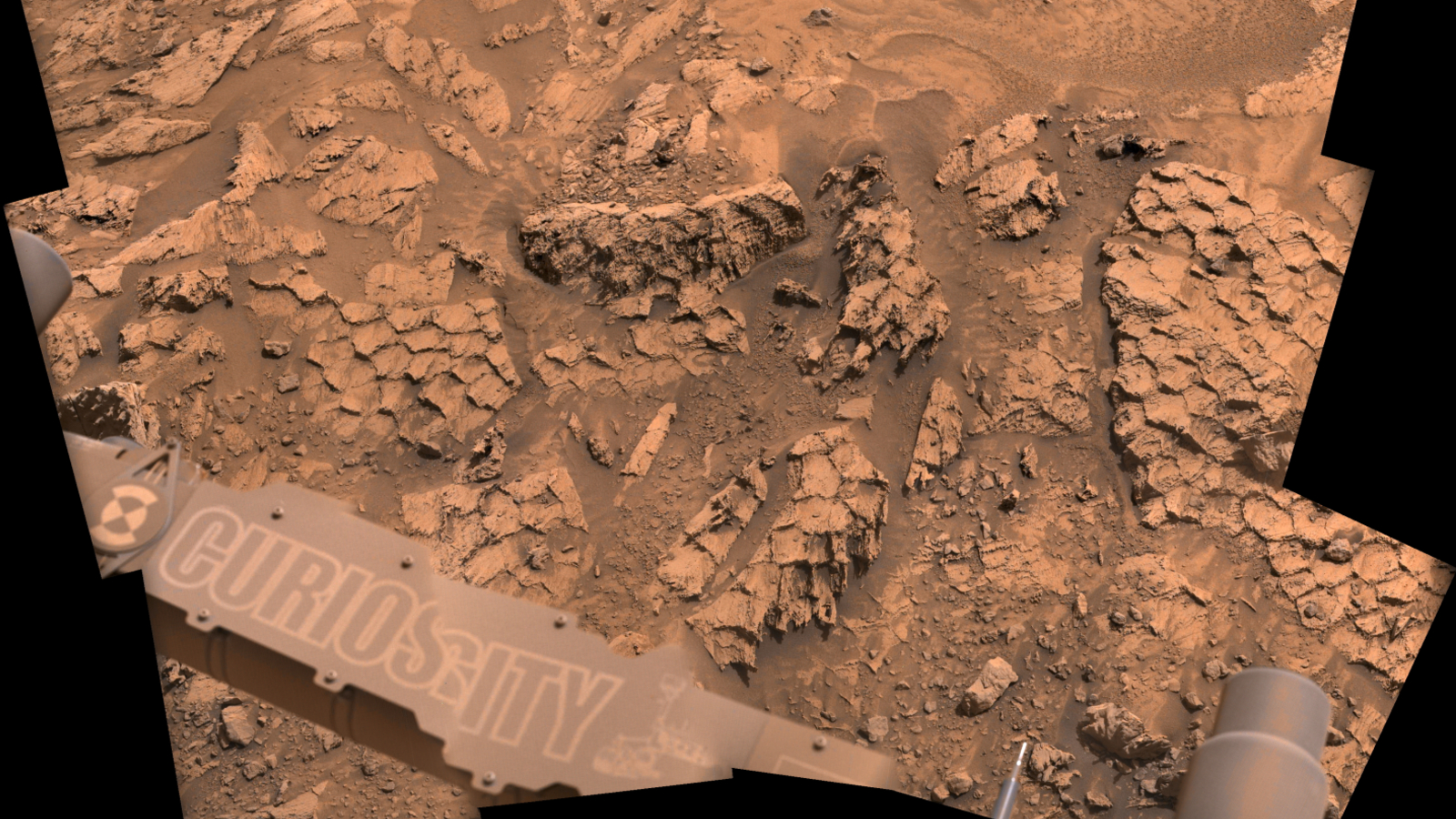
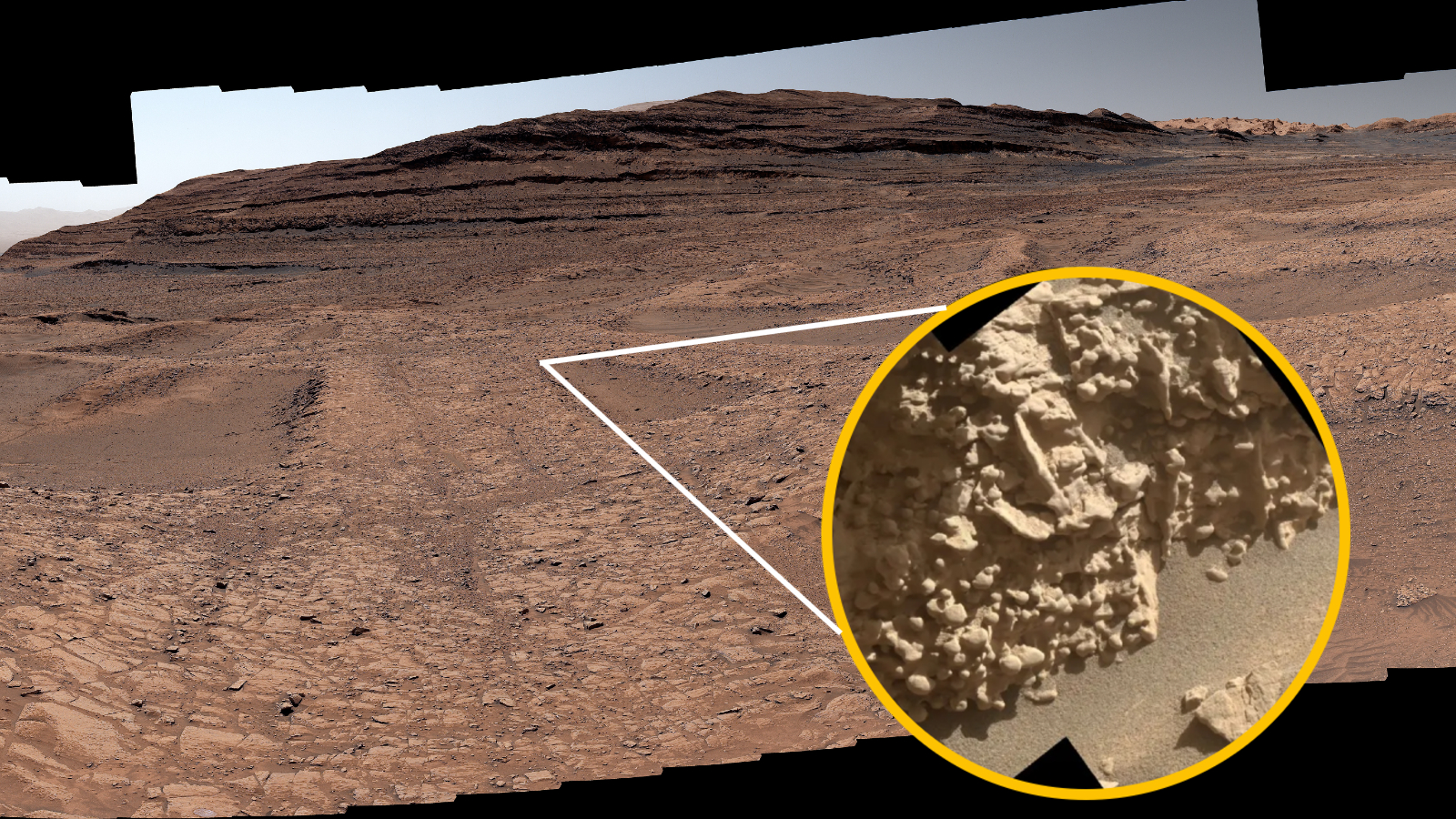
The Curiosity panorama is composed of 1,031 images and covers a region featuring so-called “boxwork formations”—low rock walls that resemble giant spiderwebs. They formed long ago: underground water flowed through cracks in the rock, depositing minerals, and then erosion carved away everything around them—leaving only these more resistant ridges. 

The mission also recently reported that siderite in the layers of Aeolis Mons may be trapping carbon dioxide from Mars’ ancient, much denser atmosphere. Another discovery is the most diverse set of organic molecules ever found on the planet: 21 carbon-containing compounds in a single sample, seven of which have been identified there for the first time.

A panoramic view of a Martian region featuring low ridges known as “boxwork formations”, captured by NASA’s Curiosity Mars rover. Source: nasa.gov

Perseverance: The oldest rocks and the first lightnings

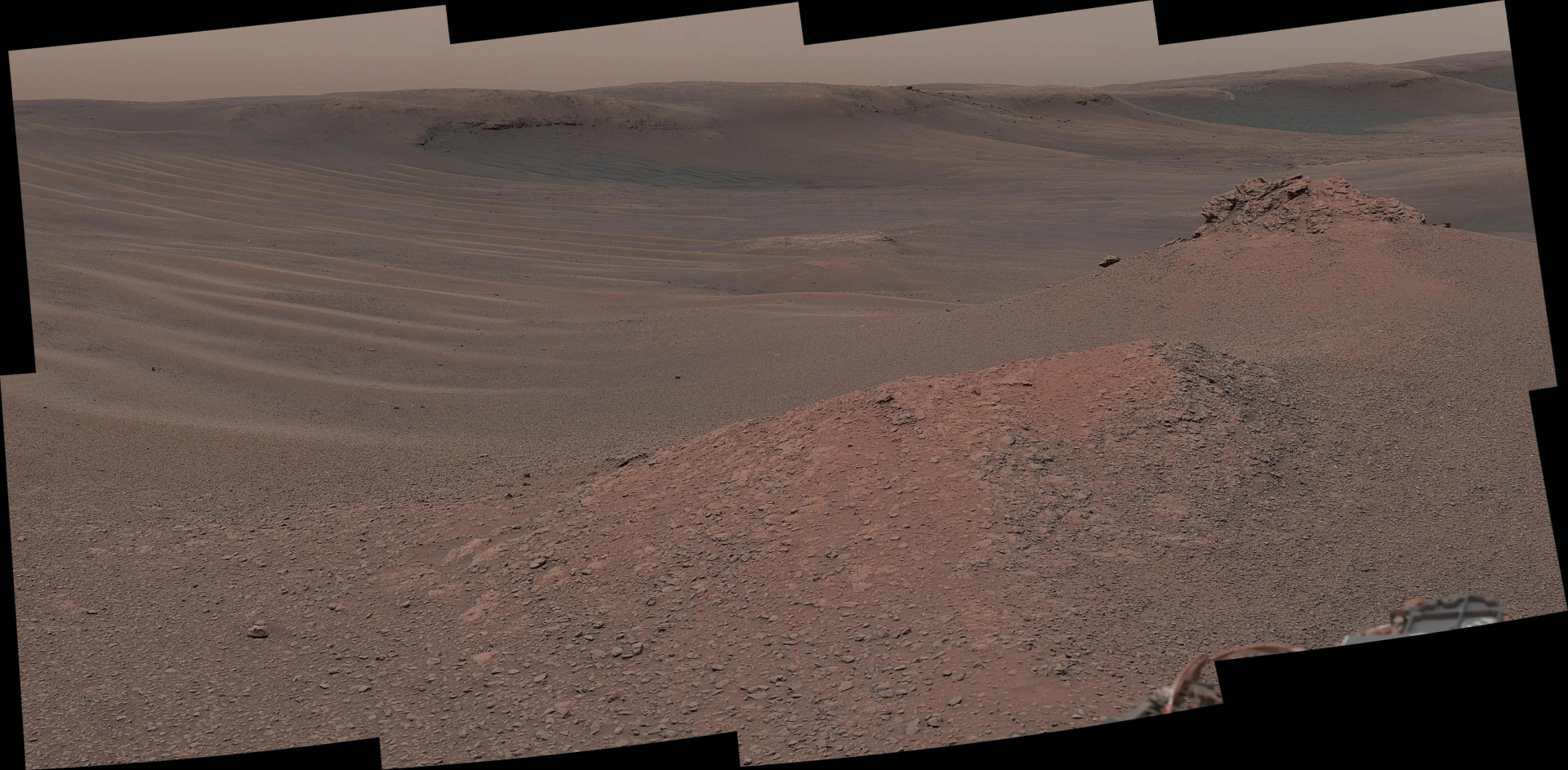
The Perseverance panorama consists of 980 images taken at a location that researchers have unofficially named “Lac de Charmes.” It is located on the outer rim of the Jezero crater and contains rocks that formed billions of years ago. Last year, the mission discovered a rock with dark spots—so-called “leopard spots”—characteristic of chemical reactions caused by microorganisms on Earth. 

In addition to geological studies, Perseverance’s microphones have recorded the sound of electrical discharges in dust devils for the first time—a phenomenon that had previously only been theorized.

A 360-degree panorama of the “Crocodile Bridge” region at the edge of Jezero Crater, captured by NASA’s Perseverance Mars rover. Source: NASA/JPL-Caltech/ASU/MSSS

Samples will be sent to Earth

Unlike Curiosity, which grinds rock samples for analysis right on the spot, Perseverance collects intact cores about the size of a piece of chalk and stores them in metal tubes. 

There are currently 23 samples on board. Scientists hope to bring them back to Earth, where laboratory equipment—unavailable to any rover—will be able to answer questions that remain unresolved for now.

RELATED VIDEOS

How NASA Changed Everything We Know About Mars — The Full Story

Inside NASA’s Mars Missions | Free Documentary Space

How Perseverance and Curiosity Navigate Mars Using AI Operation Exploration with Rebecca Anklam

{ https://universemagazine.com/en/articles-en/ }

Hoe vind je dit bericht?
Geschreven door peter om 23:33 Stuur door

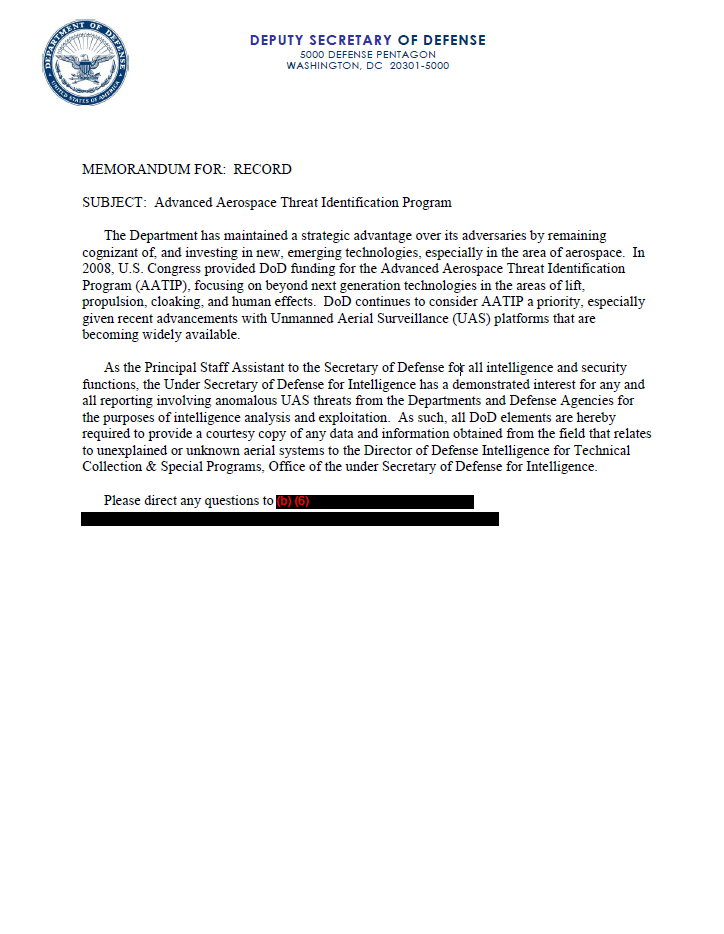
New Emails Reveal Pentagon Effort to Align Messaging on AATIP and Luis Elizondo

2026-04-27_05-47-28-1536x805.jpg

New Emails Reveal Pentagon Effort to Align Messaging on AATIP and Luis Elizondo

A newly released series of Pentagon emails from May 2019 reveals an internal contradiction at the center of the Department of Defense’s narrative on the Advanced Aerospace Threat Identification Program (AATIP) and Luis Elizondo.

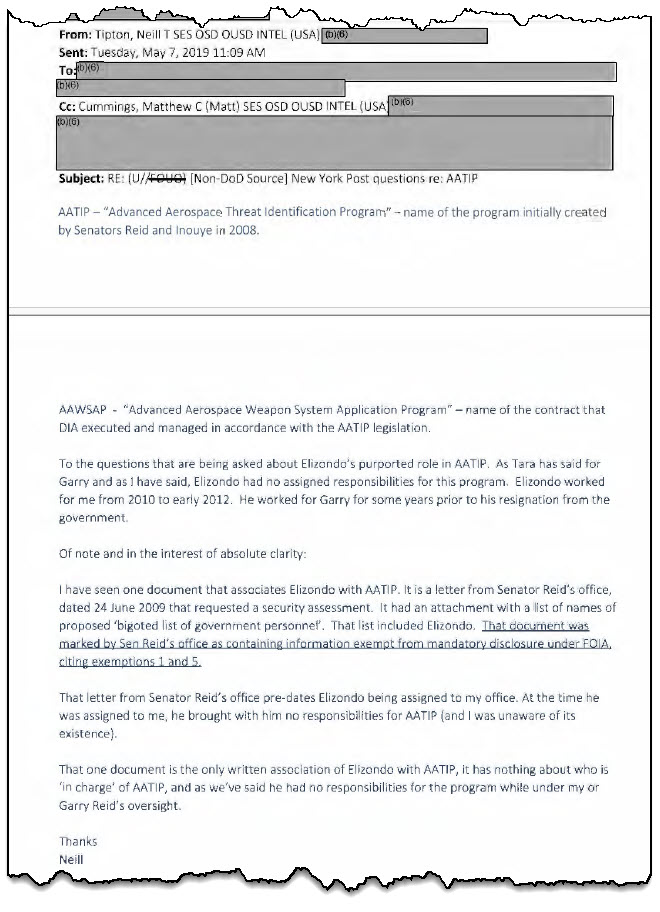
At the center of the records is a May 7, 2019, email from senior Pentagon official Neill Tipton, former Director of Defense Intelligence for Collection and Special Programs, which states in clear terms that Elizondo “had no assigned responsibilities” related to AATIP during his time under Tipton within the Office of the Secretary of Defense (OSD).

images.jpg

Neill Tipton

Yet the same batch of emails, along with previously released records published by The Black Vault as released via the Freedom of Information Act (FOIA), shows Tipton was directly communicating with Elizondo about AATIP, reviewing a memo to assume responsibilities tied to it, and participating in internal discussions about how the Department should respond to inquiries on the subject.

The newly uncovered email chain also shows that Tipton’s statement did not stand uncontested internally. Instead, it prompted immediate concern among Pentagon officials about contradictions, prior statements, and the need to keep messaging consistent.

Tipton’s Core Statement

In the May 7, 2019, email, Tipton wrote:

“Elizondo had no assigned responsibilities for this program… Elizondo worked for me from 2010 to early 2012.”

He added:

“At the time he was assigned to me, he brought with him no responsibilities for AATIP (and I was unaware of its existence).”

The language is precise and limited in scope, focusing specifically on Elizondo’s time under Tipton within OSD.

Immediate Internal Reaction

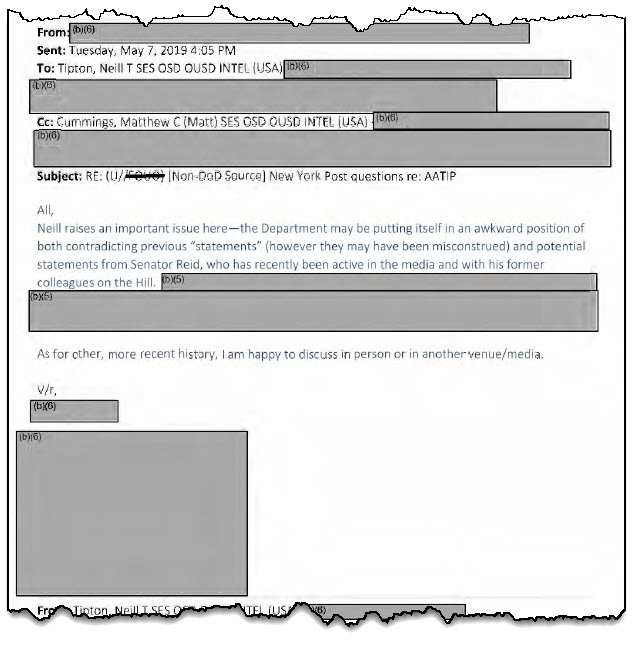
A follow-up email sent later that day by an individuals name that was redacted reflects concern about how the statement could be interpreted:

“Neill raises an important issue here—the Department may be putting itself in an awkward position of both contradicting previous ‘statements’ (however they may have been misconstrued) and potential statements from Senator Reid…”

The message continues:

“As for other, more recent history, I am happy to discuss in person or in another venue/media.”

This indicates that additional context existed but was not being fully revealed in the written response. It also suggests that further discussion was being moved to another setting, outside the documented email exchange, which would limit what is preserved in the official record and subject to a future FOIA disclosure.

Defining the Scope of the Pentagon’s Answer

Another email in the chain further clarifies the Department’s internal reasoning:

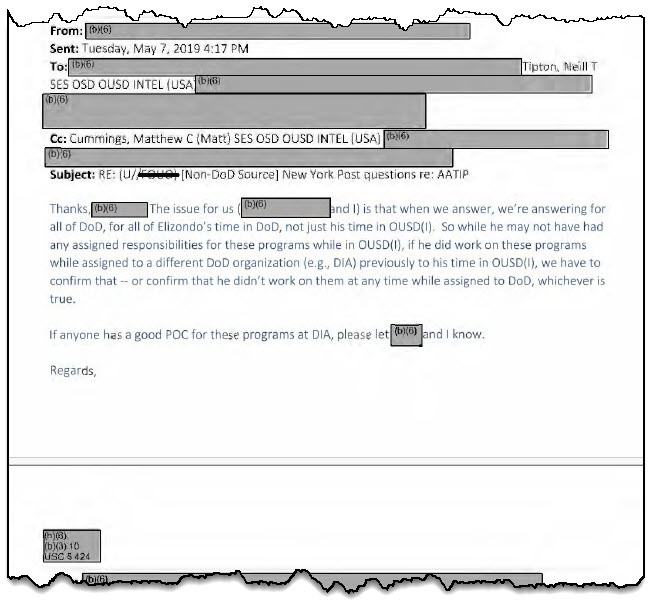
“The issue for us… is that when we answer, we’re answering for all of DoD, for all of Elizondo’s time in DoD, not just his time in OUSD(I).”

It continues:

“So while he may not have had any assigned responsibilities for these programs while in OUSD(I), if he did work on these programs while assigned to a different DoD organization… we have to confirm that—or confirm that he didn’t work on them at any time while assigned to DoD, whichever is true.”

This internal discussion highlights why the Pentagon’s statement was narrowly framed. It addressed only a specific period and organizational context, rather than Elizondo’s entire time within the Department of Defense. What remains unclear is why the broader context was not included, particularly given the existence of other documented exchanges. Whether additional information influenced how the statement was constructed is not addressed in the available records.

Messaging Coordination

By May 8, 2019, the email chain shows awareness that the issue extended beyond a single response:

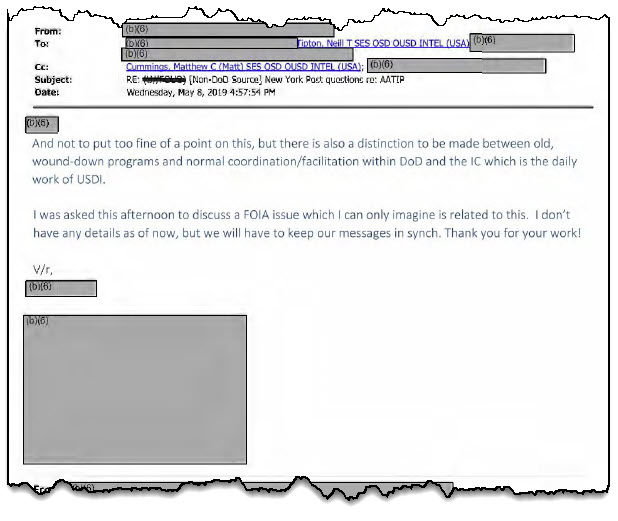
“I was asked this afternoon to discuss a FOIA issue which I can only imagine is related to this… we will have to keep our messages in synch.”

That same email introduces an important distinction:

“There is also a distinction to be made between old, wound-down programs and normal coordination/facilitation within DoD and the IC…”

This suggests that internally, officials were grappling with how to define AATIP itself, Elizondo’s role, if any, and how to respond to the public in a unified, synchronized, way.

Documented Exchanges With Elizondo

21-FR-0964 Release of the AATIP Memo – “Release” on March 29, 2024. Received August 21, 2024.

The significance of these internal discussions becomes clearer when compared to previously released records obtained by The Black Vault.

In a September 25, 2017, email, Elizondo wrote to Tipton:

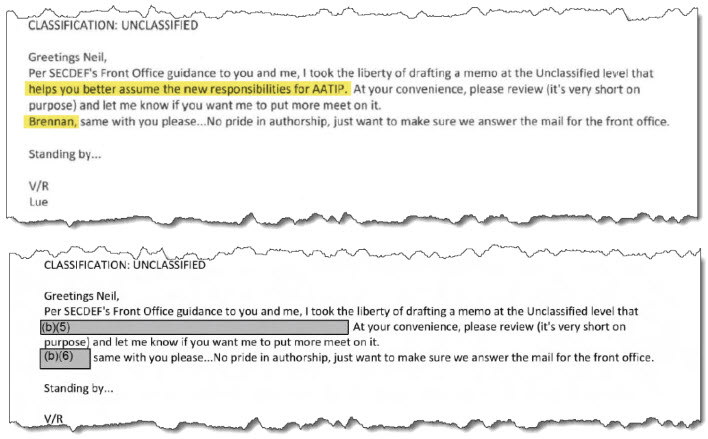
“Per SECDEF’s Front Office guidance to you and me, I took the liberty of drafting a memo… that helps you better assume the new responsibilities for AATIP.”

Tipton responded days later:

“Getting spun back up. Will read and get thoughts back today or tomorrow…”

These exchanges show that Tipton and Elizondo were in direct communication about AATIP, including a draft memorandum outlining responsibilities.

Those exchanges are not referenced in Tipton’s May 7, 2019, email.

The omission is notable because it shows that Tipton was, at minimum, aware of AATIP discussions and had been directly engaged in communications about it.

It should also be noted that efforts by The Black Vault to confirm direct communication between Neill Tipton and Luis Elizondo regarding AATIP responsibilities were neither immediate nor straightforward. The process began with FOIA case 21-F-0964, filed on May 5, 2021, which specifically sought emails between the two officials containing terms such as “AATIP,” “UAP,” and related keywords. Despite the targeted nature of the request, the Department of Defense responded on December 14, 2021, stating that “no records” were found. This response stood in direct conflict with prior research and information indicating that such communications did, in fact, exist.

In response, The Black Vault filed an appeal within one day, citing a specific known email dated September 25, 2017, in which Elizondo contacted Tipton and referenced AATIP directly. That appeal argued that “this fact alone should have yielded at least one responsive document,” and challenged the adequacy of the search conducted. The appeal was ultimately granted in February 2022, forcing the case to be remanded for further processing. However, even after the appeal was approved, procedural issues persisted, including the Department of Defense failing to acknowledge the reopened case until August 2023, which it later stated had been “overlooked.”

When records were eventually produced under the remanded case (21-FR-0964), they confirmed that responsive communications did exist. However, even within those records, key details were initially obscured. In a related FOIA production (case 21-F-1154), portions of the same email chain had previously been released with critical language redacted, including the specific reference to “AATIP” in the context of transferring responsibilities. Only after continued pressure and the appeal process did the unredacted version reveal that Elizondo had written to Tipton that he had drafted a memo “that helps [Tipton] better assume the new responsibilities for AATIP.” This progression from “no records,” to partially redacted records, to eventual disclosure… demonstrates the extent to which confirming even basic facts about these exchanges required sustained effort and formal challenge through the FOIA process.

A comparison between the original release of this email, by the DoD (bottom) wherein the AATIP reference was redacted, and the second release of the same email, where the line was revealed. The release of these versions came after the DoD initially said they could not find it

This does not establish that Elizondo formally led AATIP. It also does not confirm the exact structure or status of the program within the Department of Defense.

However, it does demonstrate that AATIP was being discussed between Tipton and Elizondo, including a transfer of responsibilities, which was not reflected in the 2019 internal conversation that led to the public statement. Tipton emphasized that he was “unaware of AATIP’s existence,” a statement tied to an earlier period when Elizondo worked under him. Yet documented emails from 2017 show Tipton was later engaged in direct discussions about AATIP, raising questions about why that context was not included in his 2019 account.

Speculation on What Was Left Unsaid

It is not explained in the documents why this context was omitted. If AATIP was considered an informal effort, a limited initiative, or a responsibility outside formal assignment structures, that context could have been articulated within the public statement to provide greater clarity.

Similarly, if AATIP was viewed as a minor or secondary activity, that distinction could have been conveyed using established Pentagon terminology, as well.

However, the absence of any reference to documented exchanges between Tipton and Elizondo adds to the existing uncertainty and raises additional questions that are not addressed in the available records, nor is any of it addressed in any official statements by the Pentagon.

Statement From Luis Elizondo

Luis Elizondo, in a statement provided to The Black Vault for this article, disputes Tipton’s characterization and asserts that the documentary record reflects a different reality.

Elizondo stated:

“There exists several emails and documents that illustrate as a matter of fact that Neill not only knew about my involvement in AATIP, but that he had agreed to replace me and assume my responsibilities.

It’s disappointing to see senior leaders outwardly lie to their chain of command to save their own butts, but given Neill’s new role at the time, and the massive witch hunt Garry Reid had initiated to tear me down and erase me, I understand why Neil wrote what he did. But it still does not make it right.

There are numerous witnesses that also briefed Neil WITH ME present. I think this email by Neill proves once and for all how they attempted to change the narrative. However, I sure wish someone would ask him the same question under oath. I guarantee to you his statement would not be the same if he knows the consequences for lying.

This is yet another example of the tremendously unjust efforts by my former leadership to try and cover their butts while throwing me to the wolves. I am relieved that people are now seeing the truth for what it really is.

AATIP was real, I was the senior ranking official, and since my departure the Pentagon has tried every way to change the narrative. It’s shameful but I am not the last bit surprised; business as usual I guess…and they wonder why our citizens have lost all faith and confidence at the Pentagon. If Hegseth were to read this, I sure hope he would fire some people.”

These claims are presented as Elizondo’s position and are not independently and/or fully verified within the scope of the released documents. Elizondo’s comments are published here, in full, and unedited.

Neill Tipton did not respond to a request for comment.

A Record Still Taking Shape, Nearly 10 Years Later

The May 2019 email chain does not resolve the longstanding questions surrounding AATIP or Elizondo’s role. It does not confirm that Elizondo led a formal program, nor does it define the full scope or structure of AATIP.

What it does show is that Pentagon officials were actively discussing how to respond, how to align messaging, and how to avoid potential contradictions.

It also shows that known communications between key individuals were not reflected in at least one official internal explanation that led to the DoD’s publish statements about Elizondo and AATIP.

Whether that omission reflects incomplete knowledge, narrow framing, or other factors is not addressed in the available record, thus far.

As additional documents continue to emerge, the historical record surrounding AATIP and the roles of those involved remains incomplete and continues to evolve.

The Black Vault has numerous outstanding FOIA requests on this specific issue, many of which have been pending for more than six years, which may yield additional records that further clarify these unresolved questions.

The full batch of 400+ pages of records containing the above email thread is currently under appeal, as The Black Vault is challenging the extensive redactions in key portions of the conversations. The outcome of that appeal will be reported when available.

###

Document Archive

pdf.gif 20-F-0163 Full Release Package [418 Pages, 17MB]

{ https://www.theblackvault.com/documentarchive/ }

Hoe vind je dit bericht?
Geschreven door peter om 23:12 Stuur door

NASA rover uncovers rock with 7 new organic molecules on Mars — the 'most diverse collection' ever seen

NASA rover uncovers rock with 7 new organic molecules on Mars — the 'most diverse collection' ever seen

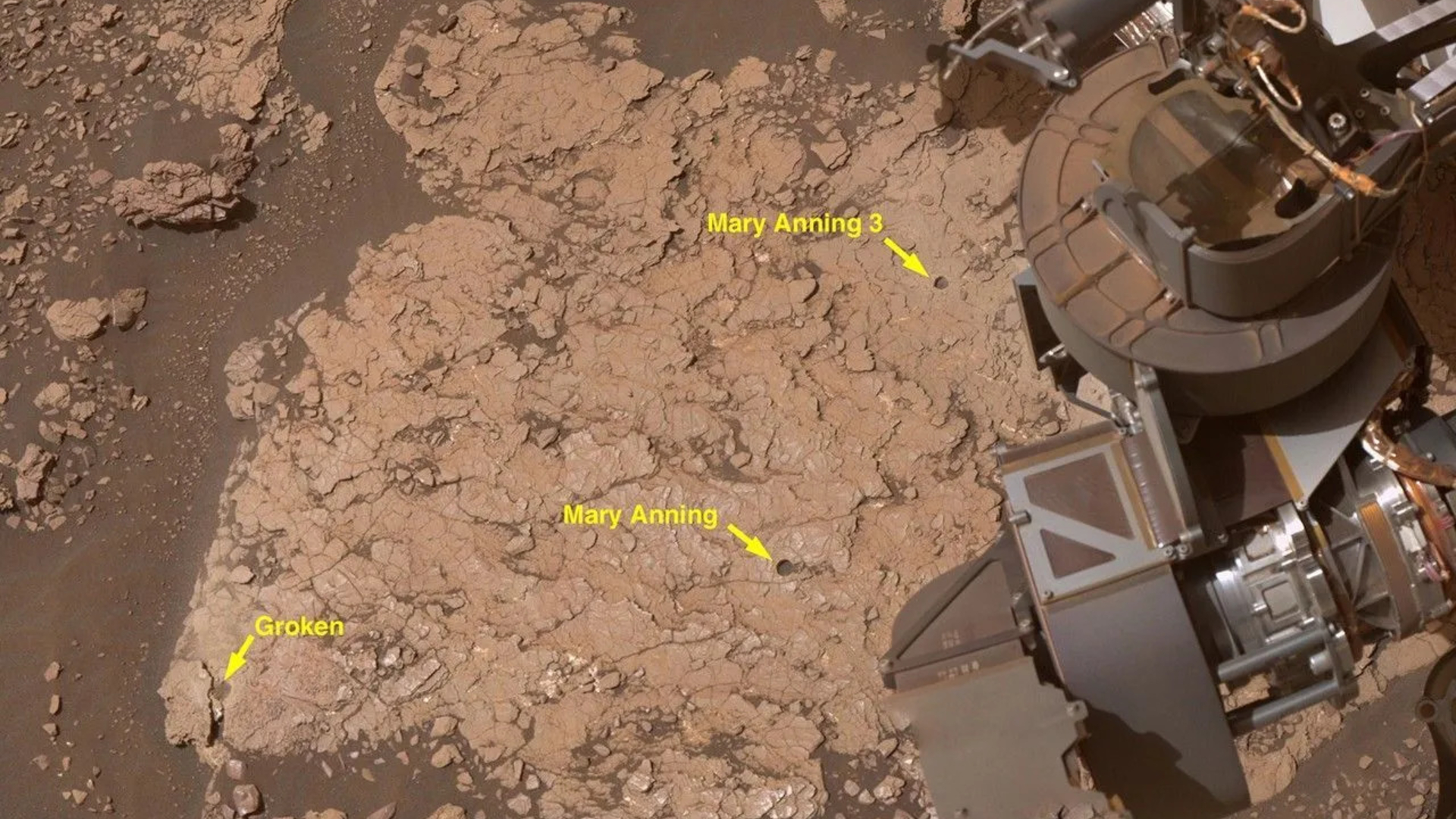
A close up of a reddish brown surface with a metal arm in the right top corner of the image. The image includes yellow arrows and labels of different sites of interest. A close-up of the rock where the Mary Anning 3 sample was discovered.  (Image credit: NASA/JPL-Caltech/MSSS)

A rock discovered by NASA's Curiosity Mars rover contains "the most diverse collection" of the building blocks of life ever seen on the Red Planet, including seven never found there before, new research confirms.

In 2020, Curiosity discovered and drilled into the rock, which has now been confirmed to contain organic molecules that bear the life-friendly element carbon. While scientists can't yet prove if the molecules formed due to biological or geologic processes, their findings add new evidence to the theory that ancient Mars was hospitable to life.

"Their discovery renewed confirmation that ancient Mars had the right chemistry to support life," officials at NASA's Jet Propulsion Laboratory (JPL), which manages the mission, wrote of the organics. "What's more, the molecules join a growing list of compounds known to be preserved in rocks even after billions of years of exposure on Mars to radiation, which can break down these molecules over time."

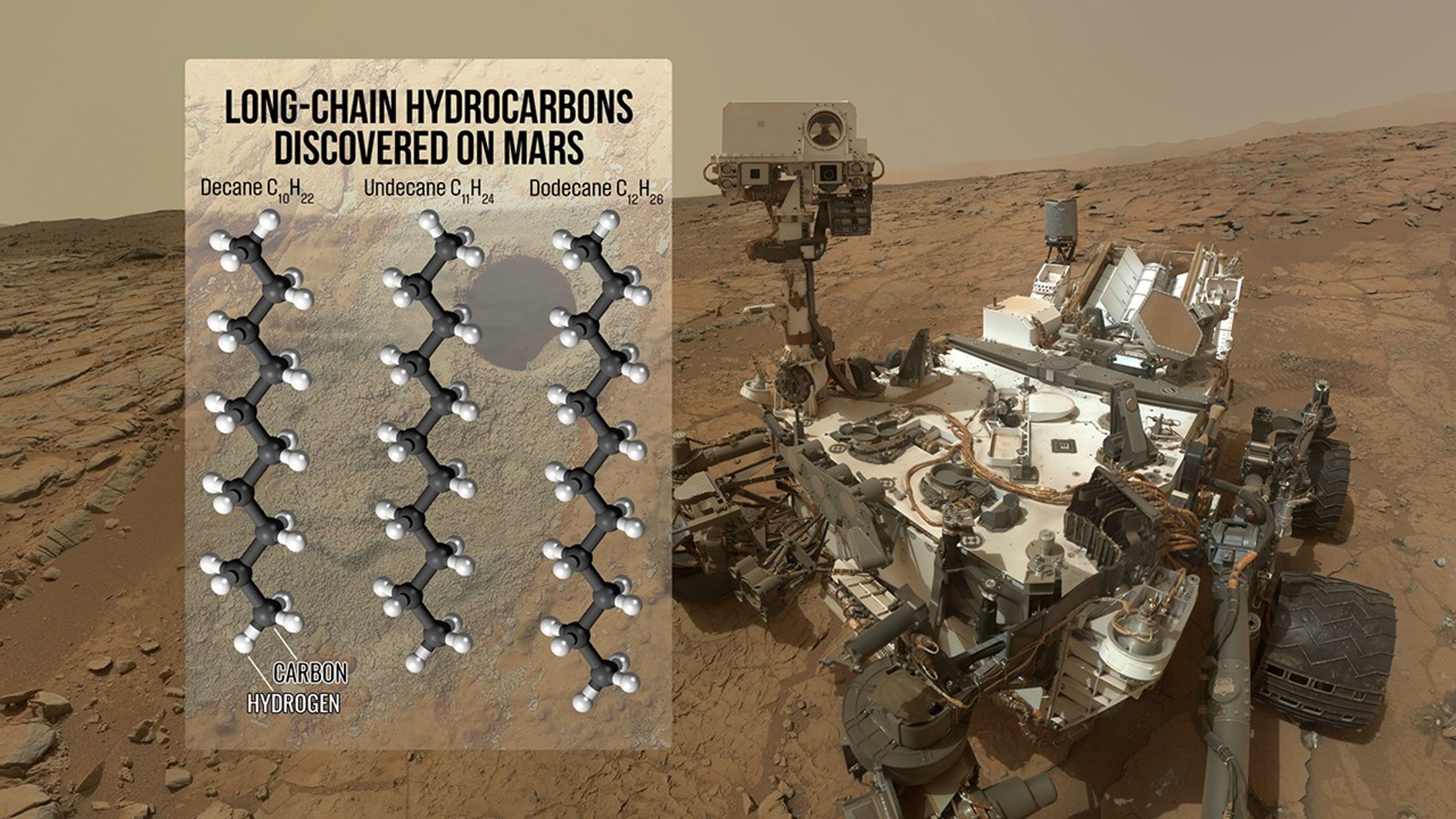
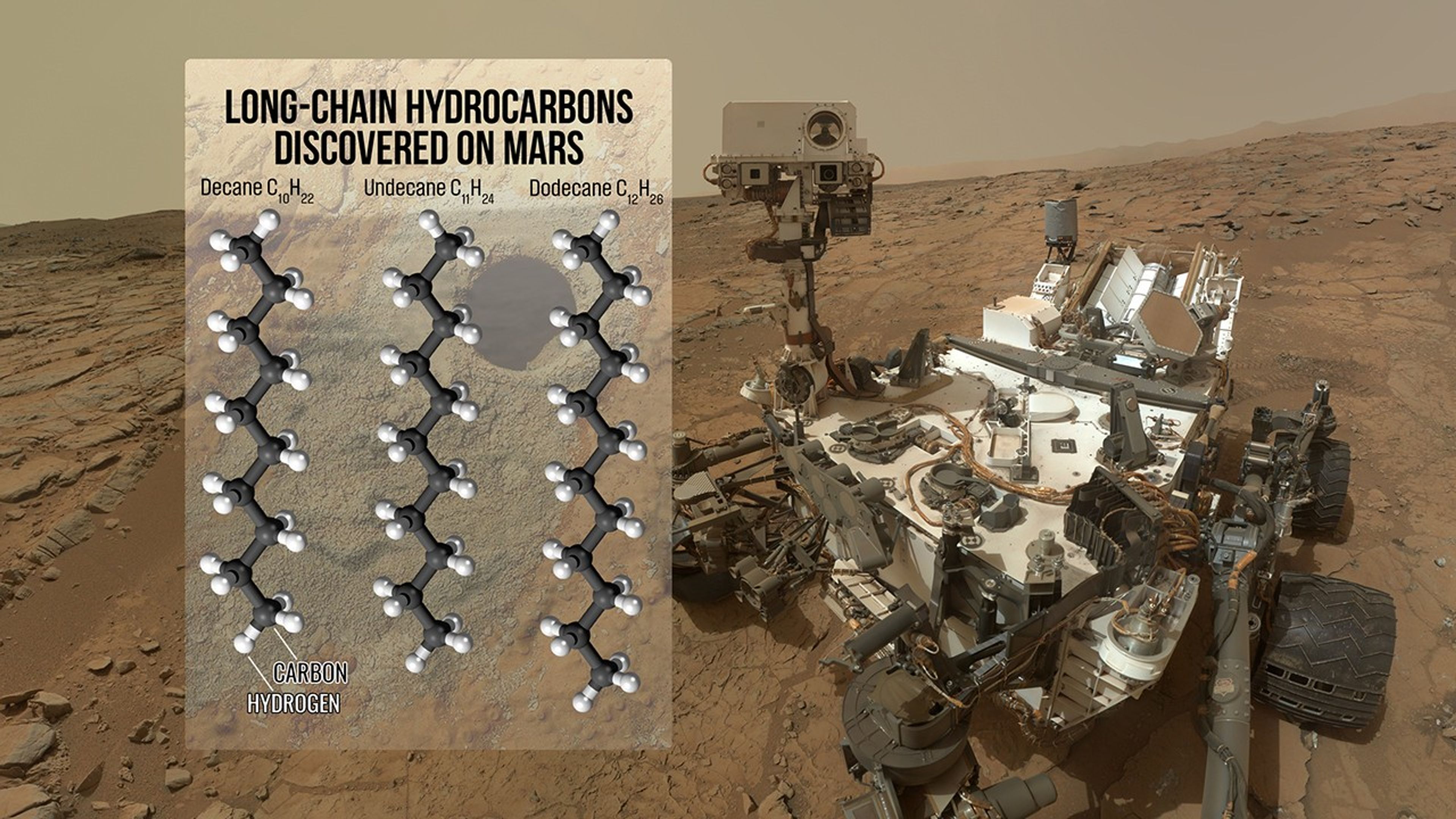
The image features a rover with its robotic arm and various instruments visible on a rocky, reddish-brown terrain. In the background is a barren landscape with scattered rocks and hills under a hazy sky. Overlaying the left side of the image is a semi-transparent panel with the title "Large Organics on Mars" in bold black letters. Below the title, three molecular chains are displayed, consisting of black spheres representing carbon atoms and white spheres representing hydrogen atoms. Labels indicate "carbon" as the black spheres and "hydrogen" as the white spheres. A faint circular blur appears in the background of the panel.

This graphic shows the long-chain organic molecules decane, undecane, and dodecane. These are the largest organic molecules discovered on Mars to date. They were detected in a drilled rock sample called “Cumberland” that was analyzed by the Sample Analysis at Mars lab inside the belly of NASA’s Curiosity rover. The rover, whose selfie is on the right side of the image, has been exploring Gale Crater since 2012. An image of the Cumberland drill hole is faintly visible in the background of the molecule chains. Download graphic here: https://svs.gsfc.nasa.gov/14808/#media_group_377732
NASA/Dan Gallagher
You may like
  • An illustration of the Curiosity rover on Mars next to a diagram of long carbon-based molecules

Giant string of organic molecules on Mars may be one of the best signs of life yet

  • A close-up photo of rocky polygons on Mars that look like giant reptile scales

NASA's Curiosity rover finds a surprising number of giant 'dragon scales' littered across Mars

  • A photo of Mars's surface with a close-up image of tiny egg-like nodules inset

Giant 'spiderwebs' on Mars contain tiny egg-like structures that scientists 'can't quite explain,' NASA rover reveals

By the Martian seashore

The new analysis, published April 21 in the journal Nature Communications, shows that the rock sample included 21 carbon-containing molecules, including seven never seen before on the Red Planet. The newly found molecules included nitrogen heterocycle (a predecessor to RNA and DNA) as well as benzothiophene, which may have been key to bringing life-friendly chemistry to solar system planets aboard meteorites, the authors wrote.

The sample was nicknamed "Mary Anning 3," after the English paleontologist famous for discovering the first fossil ichthyosaur and plesiosaur. Much like the aquatic fossil environments Anning sought out, the Martian organics were found in an area of Mars that was teeming with lakes and streams before the planet dried out billions of years ago.

A region of Mars’ Mount Sharp where the ‘Mary Anning 3’ sample was discovered.  (Image credit: NASA/JPL-Caltech/MSSS)

"This oasis surged and dried up multiple times in the planet's ancient past, eventually enriching the area with clay minerals, which are especially good at preserving organic compounds," JPL officials wrote.

Drilling for life

This animated image shows a close-up view of a flat, dusty, tan-colored rock surface with fine cracks and small, dark specks scattered across it. In the animation, a hole appears in the center of the frame, with loose powdered material surrounding the hole. The surrounding rock surface remains unchanged, highlighting the freshly drilled hole and the fine texture of the rock.

NASA's Curiosity rover drilled into this rock target, "Cumberland," during the 279th Martian day, or sol, of the rover's work on Mars (May 19, 2013) and collected a powdered sample of material from the rock's interior. Curiosity used the Mars Hand Lens Imager (MAHLI) camera on the rover’s arm to capture this view of the hole in Cumberland on the same sol as the hole was drilled. The diameter of the hole is about 0.6 inches (1.6 centimeters). The depth of the hole is about 2.6 inches (6.6 centimeters). Download gif here: https://svs.gsfc.nasa.gov/14808/#media_group_377749
NASA/JPL-Caltech/MSSS

Last year, Curiosity also found the largest-ever organic molecules on Mars. These were "long-chain" hydrocarbons, including decane, undecane and dodecane.

These organic finds in 2020 and 2025 used an instrument on Curiosity called Sample Analysis at Mars (SAM). Curiosity first drills rocks using its robotic arm. Then, it turns the rocks into powder samples and lets the powder fall into SAM. The instrument contains a high-temperature oven that heats up the powder, allowing the compositions of the gases inside the rover to be measured.

SAM also contains small cups of solvent that can perform "wet chemistry." The Mary Anning 3 sample was the first to use tetramethylammonium hydroxide (TMAH) — a substance that breaks apart organic molecules, of which Curiosity only carries two cups — because the sample was considered of the highest value.

Curiosity's findings were verified on Earth using a space rock that's well known to science, the Murchison meteorite, which is 4 billion years old and includes organic molecules.

"A Murchison sample exposed to TMAH was found to break much larger molecules into some of the ones seen in Mary Anning 3, including benzothiophene," JPL officials wrote. "That result verifies that the Martian molecules found in Mary Anning 3 could have been generated from the breakdown of even more complex compounds relevant to life."

Curiosity, which has been on Mars since 2012, recently used its last TMAH cup on "weblike boxwork ridges, which were formed by ancient groundwater," according to JPL. The results will be written up in a future study.

Article Sources
  • Williams, A. J., Eigenbrode, J. L., Millan, M., Williams, R. H., Mcintosh, O. M., Teinturier, S., Roach, J., Malespin, C., McAdam, A. C., Mahaffy, P., Bryk, A. B., Buch, A., Boulesteix, D., Chou, L., Dworkin, J. P., Fox, V., Franz, H. B., Freissinet, C., Glavin, D. P., . . . Vasavada, A. R. (2026). Diverse organic molecules on Mars revealed by the first SAM TMAH experiment. Nature Communications, 17(1). https://doi.org/10.1038/s41467-026-70656-0

{ https://www.livescience.com/space }

Hoe vind je dit bericht?
Geschreven door peter om 22:47 Stuur door

The truth about NASA's 'GoFast' UFO verdict exposed in secret internal emails

The truth about NASA's 'GoFast' UFO verdict exposed in secret internal emails

One of the Pentagon's most famous UFO videos is facing new scrutiny after secret NASA emails raised fresh questions about how it was analyzed.

The 'GoFast' encounter, recorded by Navy pilots tracking a fast-moving object off the Atlantic coast in 2015, was assessed by NASA as most likely showing an ordinary object drifting with the wind.

But newly released documents obtained by UFO researcher Grant Lavac through the Freedom of Information Act revealed that NASA's 2023 review relied entirely on publicly available footage and did not include interviews with the Navy aviators who witnessed the encounter.

NASA Unidentified Anomalous Phenomena (UAP) panelist Josh Semeter, director of Boston University's Center for Space Physics, acknowledged the limitation in an internal email written weeks before the agency released its findings.

'No, our panel did not speak with the aviators,' Semeter wrote. 'The analysis is based purely on information in the publicly released video.'

The correspondence also showed the panel did not have access to raw sensor data, instead relying on details visible within the footage itself. They noted that although the raw data were unavailable, the video display contained information such as camera elevation angle and aircraft altitude that analysts used in their calculations.

Semeter added that mathematical modeling suggested the object was not traveling at unusually high speeds, but stressed the analysis did not determine what the object actually was, noting the available data were insufficient to identify its size, shape, material, or whether it had visible flight features.

'We cannot determine from the data whether this object is a metallic orb, or has any flight surfaces,' he continued. He also emphasized that while the calculations suggested the object was not moving at extraordinary velocity, this did not mean the GoFast incident had been fully explained.

Public interest in UFOs heightened in 2017 with the leak of three Navy pilots infrared videos that captured UAP. Pictured is a still from one of these videos, GOFAST, which NASA's expert UAP advisory panel attempted to explain as terrestrial this week

Public interest in UFOs heightened in 2017 with the leak of three Navy pilots infrared videos that captured UAP. Pictured is a still from one of these videos, GOFAST, which NASA's expert UAP advisory panel attempted to explain as terrestrial this week

In another internal exchange, one panel member suggested the group's detailed review of high-speed claims may have been limited to a single case, the GoFast video itself, and acknowledged that even that analysis was not comprehensive.

The 'GoFast' UFO video was recorded in 2015 by a US Navy F/A-18 Super Hornet crew operating off the East Coast.

The grainy, black-and-white footage shows an object skimming low above the Atlantic Ocean, captured through a fighter jet’s targeting display as one pilot can be heard exclaiming: 'Ohhh, got it!'

The Daily Mail has contacted NASA and Semeter for comment.

Internal emails suggest the panel’s testing of high-speed UFO claims may have been narrower than publicly understood.

David Spergel, president of the Simons Foundation and a member of NASA's independent UAP study team, wrote in an August 21, 2023 message that the group appeared to have closely examined only a single case, the GoFast video, when evaluating claims of extreme speeds.

'I don’t believe our panel reviewed more than a single case (Go Fast by Josh) where the high velocity claim was brought into question, and even that review wasn’t comprehensive,' Spergel wrote. 

He added that the panel did not believe it had reviewed enough cases to justify broad conclusions about multiple high-speed UFO events.

Newly released documents obtained by UFO researcher Grant Lavac through the Freedom of Information Act revealed that NASA's 2023 review relied entirely on publicly available footage and did not include interviews with the Navy aviators who witnessed the encounter

Newly released documents obtained by UFO researcher Grant Lavac through the Freedom of Information Act revealed that NASA's 2023 review relied entirely on publicly available footage and did not include interviews with the Navy aviators who witnessed the encounter

The correspondence also revealed internal debate over how strongly the panel should phrase its findings, with Spergel urging colleagues to avoid language suggesting that numerous high-velocity sightings had been disproven. 

Instead, he recommended revising the wording to emphasize that accurately determining distances is essential to understanding anomalous events, rather than implying that many such sightings had already been explained.

In a February 2024 email, NASA records officials contacted the independent study team to determine what UAP-related data had been collected, citing new federal requirements under the 2024 National Defense Authorization Act that mandate the tracking and management of unidentified anomalous phenomena records.

The correspondence also revealed internal debate over how strongly the panel should phrase its findings, with Spergel urging colleagues to avoid language suggesting that numerous high-velocity sightings had been disproven
Instead, he recommended revising the wording to emphasize that accurately determining distances is essential to understanding anomalous events, rather than implying that many such sightings had already been explained

Instead, he recommended revising the wording to emphasize that accurately determining distances is essential to understanding anomalous events, rather than implying that many such sightings had already been explained

Daniel Evans, the assistant deputy associate administrator for research at NASA’s Science Mission Directorate, wrote in an email sent on February 9, 2024 that 'we are not aware of any UAP records at NASA.'

The recipient, Patti Stockman, who worked as a management and program analyst for NASA headquarters, questioned Evans' claim, responding: 'Daniel. Really? You haven’t been gathering any existing records that might have relevance to UAP, even though you’ve conducted the public meeting of the study team on categorizing and evaluating data of UAP?'

To which Evans sent a formal response: 'I would like to reaffirm that, following a comprehensive review of our activities and the discussions held during the public meeting on UAP, as well as the subsequent report, NASA currently does not hold or manage records classified specifically as UAP documents.'

He added in a May 10, 2024 email to Stockman: 'The one incident that was in proximity to a NASA Center was actually picked up by a DoD radar, and hence is their record.'

The internal exchanges also noted that NASA's UAP study team consisted of external experts rather than agency staff, with them describing the panel as an independent scientific review body separate from NASA’s own operational decision-making


America's Book Of Secrets: Secret Aerospace Technology at Area 51 (Season 4) | History

{ https://www.dailymail.com/sciencetech/index.html }

Hoe vind je dit bericht?
Geschreven door peter om 22:30 Stuur door

UFO Entities Warned US Officials Their War On God Has Begun In Chilling Secret Contact Claims

UFO Entities Warned US Officials Their War On God Has Begun In Chilling Secret Contact Claims

The film suggests UFOs are supernatural entities, aligning with certain biblical interpretations, but lacks scientific evidence.

Alien UFO Conspiracy

Interdimensional Beings or Alien Technology? Inside the Viral UFO Claims Shaking US Politics
Photo credit: Pixabay

A documentary released this week is drawing attention online for claims that unidentified aerial phenomena (UAP) may be linked to 'interdimensional entities' described in religious texts, including warnings of a coming 'war on God'.

The film, produced by Fall Brothers Productions and published on YouTube by End Times Productions on 27 April 2026, features researchers Justin and Wes Fall. They argue that UFOs are not extraterrestrial spacecraft but non-human entities with a supernatural origin, a view they say aligns with certain biblical interpretations.

The claims have spread widely across social media. However, no publicly available evidence from US government agencies or scientific institutions supports the conclusions presented in the film.

FBI Memo at Centre of Claims

At the centre of the documentary is FBI document 6751, a memo from the late 1940s available through the FBI's online archive.

The document describes alleged 'visitors' from another plane of existence, claiming they are human-like, larger in size and capable of travelling between dimensions. It also states the information was obtained through 'so-called supernormal means.'

FBI Memo 6751
FBI Memo 6751 FBI Vault/FBI Vault

In the film, the Falls present the memo as evidence that US authorities were aware of interdimensional beings decades ago.

Historical records provide important context. The document was an unsolicited letter sent to the FBI by a private individual. It does not represent an official investigation, conclusion or verified intelligence assessment by the agency.

Claims of Contact Remain Unverified

The documentary also includes claims that US officials may have had contact with non-human entities. Some accounts suggest these beings warned of a future conflict involving humanity and a divine power, described in the film as a coming 'war on God'.

No declassified records or confirmed government reports support these claims.

The US Department of Defense's All-domain Anomaly Resolution Office (AARO), which reviews UAP cases, has stated that its investigations have not found evidence of extraterrestrial technology or hidden government programmes involving non-human entities.

Historical Events and Groups Cited Without Evidence

The film also links its argument to the 'Babalon Working', a series of occult rituals carried out in 1946 by rocket engineer Jack Parsons. Parsons' involvement in occult practices is historically documented. However, there is no evidence connecting those activities to UFO sightings or to any government programme involving non-human entities.

The documentary also references a supposed group known as the 'Collins Elite', described as a faction within the US government that viewed UFO phenomena as demonic. No public records confirm the existence of such a group.

NASA and Pentagon Reviews Find No Supporting Evidence

Government and scientific reviews of UAPs have focused on aviation safety, sensor data and national security concerns. A 2023 report by NASA found that many UAP sightings cannot be explained due to limited or low-quality data and called for improved data collection. The report did not identify evidence linking UAPs to extraterrestrial or interdimensional origins.

US defence assessments have similarly attributed many sightings to airborne objects, sensor anomalies or misidentification, while some cases remain unresolved.

Public Interest Continues Despite Lack of Proof

Interest in UAPs has increased in recent years following the release of military footage and congressional briefings.

The documentary's claims rely on interpretations of historical material, religious texts and personal testimony. While the FBI memo referenced in the film is authentic, its contents originate from unverified claims submitted by a private individual.

No official investigation has concluded that UAPs are linked to interdimensional or supernatural entities.

RELATED

UFO Entities Warned U.S. Officials Their War on God Has Started

{ https://www.ibtimes.co.uk/trending }

Hoe vind je dit bericht?
Geschreven door peter om 22:09 Stuur door

The “Yellow Book,” is the extraterrestrial history of our universe written by the aliens themselves.

nove-825x510-1.jpg

The “Yellow Book,” is the extraterrestrial history of our universe written by the aliens themselves.

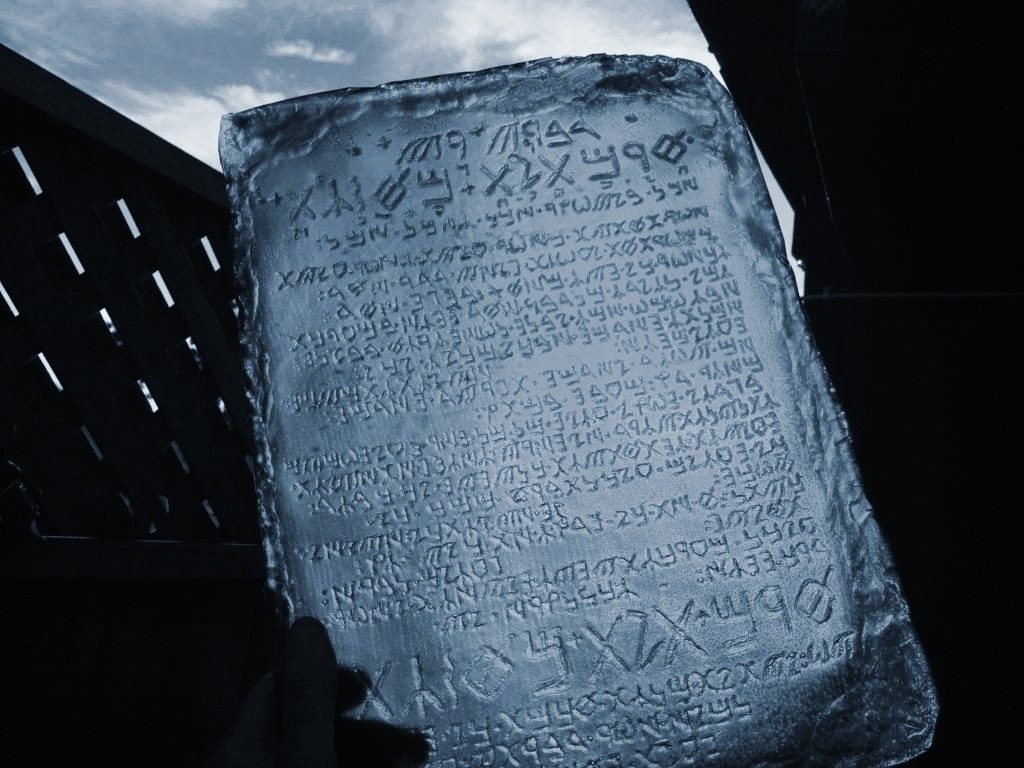
The “Yellow Book,” is the extraterrestrial history of our universe written by the aliens themselves, and describes their interaction and participation in earthly development / development. It was brought to Earth and introduced to the US government at the famous Holloman Air Base in April 1964 by a female extraterrestrials (EBE 2), which she also translates.

File-Oct-07-5-17-45-PM-1024x768-1024x768-kopie-1024x768.jpeg

Exactly – it’s not a “book”. It’s a block of material about 2.5 inches thick and actually a transparent exterior. The reader looks at the transparent surface and suddenly the words and pictures appear. It’s an endless series of historical stories and photographs of our universe, the planet from which these aliens come to be called EBEN, their original homeland, and other interesting stories about the universe. It also contains historical narratives and various reports on the history of the Earth and its distant past. It is said that it would take all human life to read it and another life to understand it.

et-eben-2-300x228.jpg

The “Yellow Book” is an object of 8×11 inches and about 2.5 inches thick, which is constructed of pure, heavy material like optical fibers. The book’s curve is light yellow – hence the “Yellow Book.” When you place the book close to your eyes, you begin to see the words and images that shine before you. It depends on the particular speech you think, then you will see that language. Up to this time, the United States government identified 80 types of speech.

225392-kopie.jpg

The “Yellow Book” tells the story of EBEN’s life, space exploration of their planet, social life, and other aspects including long-term relationships with the Earth. Describes their first visit to Earth about 2000 years ago. It depicts the Earth as it was in those days. It shows a certain being (EBEN) who took the form of a human being (Jesus Christ).

gfvbprisera-2408278.jpg

According to the “Yellow Book,” he built this earthly Earth on religion (Christianity) and became the first alien envoy on Earth. The “Yellow Book” continues and continues, and the person who reads it says:

10572_491953587541010_291653914_n-300x278.jpg

“… I spent 12 hours a day for three days on a continuous basis and went to page 564 (the pages are referred to as events) and I still have not reached the end. I do not think anyone knows exactly how long it is, or that someone has come to the end. There is no end to the “Yellow Book”. I understand that the record is about 22 consecutive hours, that is the conclusion reached by the scientific adviser of the president under XXXXXX administration. Also, there is no way to stop reading on any particular page, postpone the book and then read it again in the same place. Once you postpone the “Yellow Book” and come back to it later, the book starts from the beginning. Though the book may somehow know the language of the person reading it, it can not recognize the person’s uniqueness. In other words, the “problem” of this “book” is such that one has to start from the beginning when it is put off for a while. You get to page 564 like me, postpone it, and then your book just returns you to the very beginning of the first word and you have to read the whole 12 hours in a row before you get new information. ”

27983398_1960189387634530_8030238164210814297_o-1024x752.jpg

As has been said, the “Yellow Book” goes back to 2000 BC. The informant states in this context:

2018-10-21_5bcbe1298cc92_Alien-Abductions-794819.jpg

“But I did not look around the whole Yellow Book, and I do not think anyone’s done it. Maybe he has some examples / pictures / history that go even beyond 2000 years BC. The Yellow Book is a reference to your universe. In terms of space, according to EBEN, it was created at the moment of a second, much like our Big Bang theory, and spread over the billion years. EBEN does not refer to “years” like ours. It talks about time, but in the terms of the “event clock”, so to help us understand it better, EBEN has described in detail our years as reference points. According to them, your universe expands for 25 billion years. Then he pulls himself into his original shape. Once the universe shrinks, it expands again by repeating the whole process. EBEN says that it is the “lifetime of the universe” (infusion theory). ”

article-migration-image-grey-aliens-mysterious-pop-culture-favorite-1024x576.jpg


What Governments Know About Aliens | Ancient Aliens


Biggest Bible Revelations | Ancient Aliens | History

{ https://ufosecret.net/ }

Hoe vind je dit bericht?
Geschreven door peter om 21:54 Stuur door

Leaked Pentagon footage shows UFO making 'impossible' moves before going supersonic speeds

Shocking video of a UFO appearing to escape from a US military drone at impossible speed has been obtained from the Pentagon. 

Jeremy Corbell, investigative journalist, documentary filmmaker, and co-host of the WEAPONIZED Podcast, revealed the recording on Tuesday, which allegedly shows a mushroom-shaped craft flying over Syria's Suwayda province in 2021.

In what could be compared to a scene in a science-fiction movie, the drone's camera watched as the object appeared to either be hovering or flying at normal speed before accelerating to near-light speed and vanishing from view.

According to Corbell and WEAPONIZED co-host George Knapp, the video was taken by an MQ-9 Reaper drone and obtained from a source in the intelligence community and the Pentagon.

It's the latest evidence of non-human craft, the investigative journalists said have been leaked from the Department of War's 'vault' containing military footage of UAP, which stands for Unidentified Anomalous Phenomena and is the new term for UFOs.

Officially, the Pentagon has stated there has never been any physical proof collected that would confirm the existence of UFOs or extraterrestrial beings.

However, the newly obtained video appeared to capture a clear example of what Corbell and Knapp called 'observable' behavior among non-human craft. In this case, that was instantaneous acceleration.

Once the Air Force drone's camera locks onto the UFO, the recording shows the object seemingly knowing it had been targeted as it begins to maneuver erratically to break the lock before instantly speeding off to the right of the camera.

US military drone footage appeared to capture a UFO moments before it escaped at incredible speed over Syria in 2021

US military drone footage appeared to capture a UFO moments before it escaped at incredible speed over Syria in 2021

The recording was made by a MQ-9 Reaper drone (Pictured) controlled by the US Air Force

The recording was made by a MQ-9 Reaper drone (Pictured) controlled by the US Air Force

In their breakdown of the drone footage, Corbell, Knapp, and guest analyst Marik von Rennenkampff watched as the incident was slowed down to just five percent speed to view what the naked eye couldn't catch in real time.

Even in extremely slow replays, the mushroom-shaped craft appears to warp away, stretching across the screen before completely disappearing from the drone's camera.

Rennenkampff, a journalist who specializes in UAP and national security issues, noted this wasn't a mistake by the camera shaking and losing sight of the UFO, as all of the background objects could be seen staying in the same positions they were in before the craft accelerated. 

'The operator rapidly moves the camera to the right. You can see the whole background, everything, the entire scene shifts from right to left,' Rennenkampff explained.

'We don't see that when that object shoots off to the right.' 

The investigators added that military personnel have described other craft appearing to instantly speed away at impossible speeds, calling the maneuver 'inhuman.'

'It breaks our ideas of physics that something can do that,' Corbell added in the February 3 podcast episode.

The WEAPONIZED Podcast hosts emphasized the authenticity of the video, noting that it came straight from military archives that labeled it as a genuine UAP, and added that the camera used advanced technology that accumulates more data than a standard camera or an everyday person's smartphone.

The drone managed to record the moment when the object suddenly disappears, appearing as a faint white streak as it moved to the right

The drone managed to record the moment when the object suddenly disappears, appearing as a faint white streak as it moved to the right

Rennenkampff pointed out that the object flying near the border of Syria and Jordan was also not a drone, revealing that even in an infrared camera, the shape of a man-made drone and the exhaust from its engine would be clearly visible. 

'That most certainly does not look like any kind of conventional aircraft um, that that I can think of,' the journalist said.

The lack of any exhaust or heat trails as the UFO blasted off out of range was yet another 'observable' UFO researchers look for - known as hypersonic velocities without signatures. 

It essentially means an object was seen moving at speeds exceeding Mach 5 (3,800 mph) with no sonic booms, heat trails, visible exhaust, or other typical signs of high-speed travel.

The other observables include UFOs instantaneously becoming invisible, also known as cloaking; UFOs moving from space or the sky to the ocean seamlessly, known as trans-medium travel; and UFOs displaying anti-gravity technology as they hover above the ground.

Rennenkampff pushed back on the thought that the object may an advanced aircraft from an American adversary such as China, saying that if China had such a weapon, they would be able to attack anywhere in the world without warning. 

'If China has this kind of technology, we're all screwed. I'll just be out be honest with you. We're totally screwed. You can just drop a nuke anywhere in the world instantaneously,' he warned.

'And beyond that, what would China be doing flying ultra-advanced technology over the Syrian desert? They have there's absolutely no reason for them to be doing that.'

{ https://www.dailymail.com/news/index.html }

Hoe vind je dit bericht?
Geschreven door peter om 21:36 Stuur door

EXCLUSIVE - Noah's Ark investigation intensifies with shock 'Great Flood' discovery in ancient mountains

EXCLUSIVE - Noah's Ark investigation intensifies with shock 'Great Flood' discovery in ancient mountains

Nestled among the rugged peaks of Turkey is a strange rock formation that some researchers believe could mark the resting place of Noah's Ark.

The Bible describes the giant vessel as the ship that shielded humanity and animals from destruction during the Great Flood, which God is said to have sent to wipe out widespread human corruption and violence thousands of years ago.

Now, a team of American researchers claims to have identified marine fossils at the Durupınar Formation near Mount Ararat, findings they said suggested the region may once have been covered by vast floodwaters resembling those described in biblical accounts.

Andrew Jones, an independent researcher with Noah's Ark Scans who is investigating the mysterious mound, told the Daily Mail: 'From a researcher's perspective, these fossils provide a powerful consistency check for the biblical narrative.'

He added that traditional geology interprets the formations as remnants of an ancient sea that developed over millions of years and was later uplifted by tectonic forces, while creationist researchers view them as evidence of a massive, catastrophic flood.

'To us, finding well-preserved sea life at approximately 6,500 feet above current sea level aligns with the account of a global deluge that once covered these landmasses and later pushed up the mountain ranges we see today,' Jones said.

The team said their discoveries go beyond isolated shells, pointing instead to extensive layers of marine fossils high in the mountains, many of which appear to show signs of rapid burial rather than slow sediment buildup.

'Around the Durupınar Noah's Ark site specifically, these marine sediments are part of a complex mélange, a mixture of different rock types,' Jones said. 'The fact that the "boat" appears to sit within or upon these marine-derived materials suggests a dynamic sequence of events during the site's formation.'

Nestled among the rugged peaks of Turkey is a strange rock formation that some researchers believe could mark the resting place of Noah’s Ark

Nestled among the rugged peaks of Turkey is a strange rock formation that some researchers believe could mark the resting place of Noah's Ark

Researchers investigating the site have found hundreds of marine fossils embedded in the rock

Researchers investigating the site have found hundreds of marine fossils embedded in the rock

Located about 18 miles south of Mount Ararat, Turkey's highest peak, the Durupınar Formation has been known to researchers for less than a century.

Local reports say heavy rains and earthquakes in May 1948 washed away surrounding mud, revealing the unusual formation, which was later spotted by a Kurdish shepherd.

The Bible states that Noah's Ark came to rest on the 'mountains of Ararat' after a flood lasting 150 days that destroyed life outside the vessel.

But claims that the Ark landed in the Mount Ararat region have long been debated among researchers, historians and scientists.

From as early as the fourth century, Christian tradition began identifying Mount Ararat as the ark's resting place. Josephus, a first-century Jewish historian, also wrote that remains of the ark were still visible in the mountains of Armenia, which shares a border with Turkey near the mountain.

But the formation's location in particular has fueled speculation for decades, particularly because some researchers believe its shape and dimensions resemble descriptions of the ark.

According to biblical measurements, the ark was said to be 300 cubits long, 50 cubits wide and 30 cubits high - roughly 515 feet long, 86 feet wide and 52 feet tall - measurements researchers from Noah's Ark Scans said align with what they believe is buried below the surface.

'The recent Ground Penetrating Radar (GPR) scans have moved us beyond simple "shape" observations,' Jones said, who has been investigating the formation since 2019.

'Unlike previous decades, where researchers relied on the surface "boat" outline and basic imaging, the latest data suggests previously undetected internal features beneath the formation.'

The team suggested the region may once have been covered by vast floodwaters resembling those described in biblical accounts

The team suggested the region may once have been covered by vast floodwaters resembling those described in biblical accounts

The team said their discoveries go beyond isolated shells, pointing instead to extensive layers of marine fossils high in the mountains, many of which appear to show signs of rapid burial rather than slow sediment buildup

The team said their discoveries go beyond isolated shells, pointing instead to extensive layers of marine fossils high in the mountains, many of which appear to show signs of rapid burial rather than slow sediment buildup

Many geologists argue that the Durupınar Formation is a naturally occurring geological structure, while others believe its shape points to something more unusual.

Biblical scholar Wes Huff has dismissed claims that the formation is the remains of Noah's Ark, writing on X: 'The boat-like physical formation isn't even an unusual feature on modern Ararat, and many of these almond-shaped convex structures can be found throughout the region.'

However, fellow biblical scholar Joel Richardson urged caution, writing on X: 'We cannot say it is legit or not legit until it has been properly examined. That would be the next step. This is how archeology works.'

Marine fossils have been discovered on mountain ranges around the world, including the Himalayas, Andes and Rocky Mountains, which scientists say were once covered by ancient seas before being pushed upward as continents collided and mountains formed.

However, researchers with Noah's Ark Scans believe the fossils found in the region may point to a different explanation.

'While we respect the traditional evolutionary timeline of the Tethys Sea, we believe the physical evidence, particularly the sheer volume and elevation of these fossils, points toward a much more recent and violent aqueous event that reshaped this entire region,' Jones said.

Located about 18 miles south of Mount Ararat, Turkey's highest peak, the Durupınar Formation has been known to researchers for less than a century

A team of American researchers working at the Durupınar Formation near Mount Ararat has uncovered evidence of hidden tunnels as described in the biblical account

A team of American researchers working at the Durupınar Formation near Mount Ararat has uncovered evidence of hidden tunnels as described in the biblical account

The researchers added further studies using infrared thermography (IRT), a heat-sensing technology that can uncover hidden structures underground, have also suggested the presence of a ship-shaped hull buried deep in the soil

The researchers added further studies using infrared thermography (IRT), a heat-sensing technology that can uncover hidden structures underground, have also suggested the presence of a ship-shaped hull buried deep in the soil

In 2024, Jones revealed that he and his team uncovered angular structures as deep as 20 feet beneath the surface, features that could represent rooms below a deck-like platform

In 2024, Jones revealed that he and his team uncovered angular structures as deep as 20 feet beneath the surface, features that could represent rooms below a deck-like platform

'We agree with secular geologists on what happened: the ocean was once here and the mountains rose. 

'We differ on the rate and the timing; we see a process that took months, not eons, according to Genesis 6-8.'

Genesis 6:8, which reads, 'But Noah found favor in the eyes of the Lord,' signifies that amid universal human wickedness, Noah received God's undeserved grace, offering hope and a new beginning. It highlights God's mercy in choosing to save a remnant, Noah and his family, to preserve humanity, rather than complete destruction. 

Jones told the Daily Mail that he and his team recently uncovered a central corridor, along with side tunnels that go along the inside perimeter of the underground ship's shape.

'In addition to the tunnels, the GPR picked up a large central void. A possible central atrium room going down at least 42 feet below the surface.' 

Soil testing in the area showed extremely high levels of potassium, consistent with massive amounts of decomposed lumber.

The soil is less alkaline, has more organic matter and contains more potassium, which is what would be expected from decaying wood, like an ancient wooden boat, which lowers pH and adds carbon and potassium, said Jones.

According to the Bible, the massive vessel saved humanity and every kind of animal from annihilation during a catastrophic flood more than 4,300 years ago

According to the Bible, the massive vessel saved humanity and every kind of animal from annihilation during a catastrophic flood more than 4,300 years ago

'Tests show these soil differences (pH, organic matter and potassium) are real, with less than a five percent chance they're random, giving 95 percent confidence that something like a decayed wooden ship is causing them,' he added.

The researchers aren't yet declaring the formation to be Noah's Ark, but, Jones said, 'This is the best candidate.' The other leading possible spot is on top of Mount Ararat, though there hasn't been any evidence found.

'In the Biblical account, it doesn't say Noah's Ark landed on Mount Ararat, it says the mountains, plural, of Ararat,' Jones said.

'Back in those days, Ararat was an ancient kingdom. So it would be like saying today that Noah's Ark landed in the mountains of Colorado. It's referring to a region of mountains, not one specific peak, and our site fits within that location.'

RELATED VIDEOS

What Scientists FOUND Inside Noah’s ARK in Turkey Terrified The World!

Noah’s Flood: Everything You Need to Know! (Evidence Revealed!) | English Documentary

The True Story of Noah — In Biblical Times | FULL DOCUMENTARY

{ https://www.dailymail.com/mailplus/index.html }

Hoe vind je dit bericht?
Geschreven door peter om 20:44 Stuur door

Astronomy’s biggest shock? The finding that rewrote the rules

Astronomy’s biggest shock? The finding that rewrote the rules

Rethinking the cosmos

©The Daily Digest

Rethinking the cosmos
In 2023, new images from the James Webb Space Telescope astonished astronomers, raising fresh questions about fundamental theories of the universe's formation.

The Cosmic Evolution Early Release Science Survey

©Provided by The Daily Digest

Photo Credit: NASA

A shot snapped near the Big Dipper
The images were taken while the new telescope was exploring a patch of night sky close to the Big Dipper. They captured several extremely old galaxies that should not have existed, according to researchers.

Six massive galaxies

©Provided by The Daily Digest

Photo Credit: NASA

Six massive galaxies
Hidden within the images taken by the James Webb Space Telescope were subtle traces of six massive galaxies that astrophysicists argued must have come into existence shortly after the Big Bang.

Looking back billions of years into the past

©The Daily Digest

Were the galaxies even possible?
The galaxies were so old and so large that they couldn’t possibly be real, or at least that was what media organizations ran as their headlines after the discovery was made public.

Way larger than we expected to find

©Provided by The Daily Digest

Photo Credit: NASA

Way larger than we expected to find
“These objects are way more massive​ than anyone expected,' said Joel Leja, a professor of astronomy and astrophysics at Penn State University and one of the researchers who modeled light from the discovered galaxies, according to the science news website Phys.org.

Mature galaxies from the dawn of time

©Provided by The Daily Digest

Photo Credit: Wiki Commons By NASA, CC BY 2.0

Mature galaxies from the dawn of time
"We expected only to find tiny, young, baby galaxies at this point in time, but we've discovered galaxies as mature as our own in what was previously understood to be the dawn of the universe," Leja added.

Size matters

©Provided by The Daily Digest

Size matters
The age and size of these galaxies were both important because if the preliminary data gathered from the space survey proved true, it promised to upend everything we knew about the formation of our early universe.

13 billion years old

©The Daily Digest

Photo Credit: Wiki Commons By NASA/MSFC/David Higginbotham, Public Domain

13 billion years old
“Each of the candidate galaxies may have existed at the dawn of the universe, roughly 500 to 700 million years after the Big Bang, or more than 13 billion years ago,” wrote Daniel Strain of the University of Boulder, Colorado.

What did they discover?

©The Daily Digest

“They’re also gigantic”
“They’re also gigantic,” Strain continued, adding that each galaxy contained “almost as many stars as the modern-day Milky Way Galaxy.”

A planet within a planet

©Provided by The Daily Digest

Photo Credit: NASA

More research was needed
Researchers at the time still needed more data to confirm that the galaxies were as old and as big as they appeared, according to Science Daily, but the publication reported that the discovery offered “a tantalizing taste of how James Webb could rewrite astronomy textbooks.”

So what happened?

©The Daily Digest

“It’s bananas"
“It’s bananas,” said Erica Nelson, an astrophysicist from the University of Colorado and one of the co-authors of the research that identified the six ancient galaxies.

A wide field of view

©Provided by The Daily Digest

"These galaxies should not have had time to form"
“You just don’t expect the early universe to be able to organize itself that quickly. These galaxies should not have had time to form,” Nelson added.

Follow-up research will be conducted

©Provided by The Daily Digest

The discovery changed everything we know
Leja echoed Nelson’s statement, saying that the “revelation that massive galaxy formation began extremely early in the history of the universe upends what many of us had thought was settled science."

"Universe breakers”

©Provided by The Daily Digest

Photo Credit: NASA

"Universe breakers”
According to Leja, several members of the research team were informally referring to the six supermassive galaxies they discovered at the time as “universe breakers” because of the implications the discovery could have on what we know about the cosmos.

99% of cosmology models are wrong

©Provided by The Daily Digest

99% of cosmology models were wrong
While the science is difficult to understand, it essentially boiled down to each of the six galaxies being so large that they cannot coexist with what Leja said was 99% of cosmology models at that time.

The first time looking at the early universe

©Provided by The Daily Digest

The first time looking at the early universe
"We looked into the very early universe for the first time and had no idea what we were going to find," Leja said.

Everything is in question now

©Provided by The Daily Digest

Photo Credit: NASA

Everything was in question after the discovery
"It turns out we found something so unexpected it actually creates problems for science. It calls the whole picture of early galaxy formation into question."

{  https://dailydigest.com }

Hoe vind je dit bericht?
Geschreven door peter om 18:46 Stuur door

Missing, dead scientists: Retired FBI agent breaks down conspiracy claims

Missing, dead scientists: Retired FBI agent breaks down conspiracy claims

Story by Anna Skinner

As federal investigators review a wave of cases involving missing or deceased U.S. scientists, online speculation has surged, with some suggesting a covert operation is targeting individuals with sensitive knowledge. But a retired FBI agent says the claims fall apart when examined against basic investigative principles.

The deaths and disappearances include scientists affiliated with NASA’s Jet Propulsion Laboratory, Los Alamos National Laboratory and other institutions linked to government research. In several cases, official causes of death have not been publicly disclosed, while others remain open missing‑persons investigations. Authorities have stressed that circumstances vary widely, with some incidents occurring thousands of miles apart and under markedly different conditions.

The cases have drawn attention from Congress and the White House. While the FBI is coordinating with other federal agencies to determine whether any links exist, officials have stressed that no confirmed evidence currently supports coordinated foul play.

Copy-of-32-split-screen-wcircle-inset-2.png?w=1600&quality=80&webp=1

From left, Jason Thomas, Carl Grillmair and Nuno Loureiro, three of the scientists who have died and whose cases are now being investigated by the FBI
Retired FBI Special Agent Jennifer Coffindaffer told Newsweek it is easy to construct conspiracies out of raw data when individual cases are stripped of personal context.

She pointed to suicide statistics among medical professionals as an analogy, saying that hundreds of doctors die by suicide each year. Viewed in isolation, she said, those deaths could be framed as something sinister—even when they are not.

Coffindaffer said a true conspiracy would show consistency: similar victims, a narrow professional focus, comparable access levels and repeated methods.

Instead, the cases under scrutiny involve researchers and workers spread across multiple disciplines—from astrophysics and pharmaceuticals to administrative and contractor roles—working at different institutions and agencies.

She said the theory would be more credible if it was everybody in the same group, such as researchers working exclusively on a single classified program. The list spans multiple government organizations, job titles and clearance levels, undermining the idea of a targeted effort to suppress or steal specific research.

What Do the Conspiracy Theories Allege?

Online theories broadly suggest that scientists with access to classified or sensitive information are being abducted or killed to conceal research, sabotage U.S. capabilities, or extract secrets for foreign adversaries.

The speculation gained traction earlier this year after several high‑profile cases were publicized in quick succession, prompting posts on social media platforms that claimed patterns among the deaths and disappearances.

Those claims escalated into the political sphere, with some lawmakers publicly questioning whether foreign governments could be involved and pressing federal agencies for briefings. President Donald Trump has acknowledged the issue, calling it “pretty serious stuff.”

However, reporting has repeatedly noted that no evidence shows coordination among the incidents, and several cases have either identified suspects or been ruled suicides.

Some theories point out how it’s strange that some of the victims left behind important everyday items before they died or went missing, such as phones, wallets or glasses. However, Coffindaffer said, one key investigative mistake made by conspiracy theorists is focusing solely on the items victims leave behind.

“It’s not just what they leave behind that’s important. Even more important is what they choose to take,” Coffindaffer told Newsweek.

In several cases, missing individuals reportedly left behind everyday essentials but took a handgun with them, a detail Coffindaffer said does not align with abduction scenarios.

When it comes to victims who were later found dead, she said it’s not uncommon for people to leave behind important everyday items before they die by suicide.

“Essentially, they are saying goodbye to their life and they don’t need any of those things,” she said. “That’s always one of the telltale signs you look for when trying to decide is something a homicide, is something a possible suicide, or an accident.”

“It’s not just what they leave behind that’s important. Even more important is what they choose to take,” Coffindaffer told Newsweek.

In several cases, missing individuals reportedly left behind everyday essentials but took a handgun with them, a detail Coffindaffer said does not align with abduction scenarios.

When it comes to victims who were later found dead, she said it’s not uncommon for people to leave behind important everyday items before they die by suicide.

“Essentially, they are saying goodbye to their life and they don’t need any of those things,” she said. “That’s always one of the telltale signs you look for when trying to decide is something a homicide, is something a possible suicide, or an accident.”

The 11 Missing or Deceased U.S. Scientists

Officials have stressed that no definitive connection has been established and that some of the incidents might ultimately prove unrelated, despite surface similarities such as the victims’ professional backgrounds.

The issue drew heightened attention after lawmakers, including Representative Eric Burlison, a Missouri Republican, called for briefings and greater transparency, warning that even the appearance of a pattern involving experts with access to sensitive information could raise national security concerns.

RELATED VIDEOS

FBI says it is looking into whether cases of missing and dead scientists are linked

FBI investigates 12 missing and deceased nuclear research scientists

11 Scientists Who Knew Too Much — And Then Disappeared

{ https://www.newsweek.com/ }

Hoe vind je dit bericht?
Geschreven door peter om 18:19 Stuur door

U.S. Lockheed Martin Skunk Works unveils Vectis stealth drone for future air combat.

U.S. Lockheed Martin Skunk Works unveils Vectis stealth drone for future air combat.

U.S. Lockheed Martin’s Skunk Works has unveiled Vectis, a stealth Group 5 drone built to team with U.S. and allied fighters, with flight testing targeted within two years.

On September 21, 2025, U.S. Lockheed Martin’s Skunk Works® introduced Vectis, a Group 5 collaborative combat aircraft (CCA), at the Air, Space & Cyber Conference 2025. The stealthy drone is designed to integrate with U.S. and allied fighters for precision strike, electronic warfare, and ISR missions, with Lockheed pledging to build and flight-test it within two years, a move that repositions the company in the Air Force’s competitive CCA race.

U.S._Lockheed_Martin_Skunk_Works_unveils_Vectis_stealth_drone_for_future_air_combat_1920_001-ad197f6d.jpeg

Artist illustration of Lockheed Martin Skunk Works® Vectis, a Group 5 stealth-enabled collaborative combat aircraft designed for survivability and high-end lethality in contested airspace.

(Picture source: Lockheed Martin)

With Vectis, Lockheed Martin is not responding to a formal contract award. Instead, the company is bypassing traditional acquisition timelines by investing internal capital to accelerate the system’s development. Parts are already on order, and assembly is underway. This move signals Lockheed's intent to outpace rival media narratives and technical competitors by bringing a flight-ready prototype to the skies within two years.

Unlike other platforms positioned as low-cost, attritable wingmen, Vectis is being developed as a survivable, multi-role combat asset, designed from inception to operate deep within contested battlespace. Skunk Works engineers have integrated decades of stealth innovation, fighter jet systems expertise, and digital design tools into a single modular platform that Lockheed describes as “highly capable, customizable and affordable.”

The aircraft features a fully open mission architecture, compliant with emerging Department of Defense reference models, enabling rapid payload reconfiguration and multi-vendor system integration. Lockheed has confirmed that Vectis will be interoperable with existing common control standards such as MDCX™, ensuring seamless integration with legacy and future C2 systems.

From a mission standpoint, Vectis is designed to support precision strike, electronic warfare, ISR targeting, and both offensive and defensive counter-air operations. The platform is also optimized for team-based operations with manned aircraft such as the F-35 and the upcoming NGAD fighter. Operational range and endurance are tailored for strategic theaters including INDOPACOM, CENTCOM and EUCOM, reflecting its intended role in high-end air campaigns.

Crucially, Vectis will leverage next-generation digital engineering and advanced manufacturing techniques to reduce cost and accelerate production. The aircraft is built to meet the U.S. Air Force’s aggressive CCA affordability targets, even while incorporating low observable materials, advanced sensor fusion, and adaptable mission systems. Lockheed claims this balance of survivability and cost control will allow for scalable production, operational redundancy, and global relevance.

The airframe itself remains closely held, but initial renderings suggest a tailless, stealth-optimized design with internal payload capacity and blended body shaping, drawing from Skunk Works’ historic expertise in platforms like the F-117, RQ-170, and F-22. Analysts expect the design to include passive and active sensor apertures, modular bays for kinetic and non-kinetic effects, and hardened data links for secure multi-domain operations.

Lockheed Martin’s decision to unveil Vectis now is also a clear response to the increasing visibility of competing platforms, including the General Atomics YFQ-42 and Anduril YFQ-44, both of which were selected under the U.S. Air Force’s CCA Increment I earlier this year. By taking a self-funded path and revealing a higher-end alternative, Lockheed appears to be positioning Vectis for consideration in CCA Increment II or as a bespoke solution for allied procurement, Foreign Military Sales, or emerging tri-service unmanned programs.

Beyond its airframe and mission architecture, Vectis also reflects Lockheed Martin’s broader strategy to dominate future air dominance ecosystems. The program is aligned with the company’s investments in digital twin technologies, AI-enabled autonomy, and advanced propulsion systems. While engine specifics have not been released, internal sources suggest the platform is being built around a high-efficiency powerplant designed to sustain extended missions across vast operating theaters.

Strategically, Vectis enters the CCA race at a pivotal moment. With U.S. and allied air forces preparing for potential operations in highly contested environments, such as the Taiwan Strait or Eastern Europe, the demand for autonomous systems that can survive and fight in GPS- and communications-denied battlespaces has never been higher. Lockheed’s ability to deliver a fast-track, high-performance CCA could fundamentally reshape the cost-per-effect equation in future air campaigns.

Vectis Stealth Drone – Lockheed Martin’s Next-Gen Skunk Works CCA

How Lockheed Martin’s Vectis Is Quietly Rewriting the Rules of Air Warfare

The use of open architecture, digital engineering, and mission reconfigurability also means Vectis can be adapted to support a range of evolving concepts of operation, from autonomous suppression of enemy air defenses (SEAD), to escort jamming, to forward ISR and targeting in support of hypersonic weapon delivery.

While much of the internal technology and system maturity remains classified, Lockheed’s aggressive development posture and public unveiling of Vectis represent a direct challenge to existing defense media narratives and a strategic effort to lead the public discourse around what the next generation of unmanned combat aviation should be.

As development progresses, Army Recognition will continue to provide exclusive coverage of Vectis, including future technical disclosures, prototype testing milestones, and strategic implications across the U.S. joint force and NATO allies. The coming months will be decisive in determining whether Vectis becomes a cornerstone of future air dominance or simply a bold vision that reshaped expectations for what unmanned systems can do.

  • Written by Alain Servaes – Chief Editor, Army Recognition Group
    Alain Servaes is a former infantry non-commissioned officer and the founder of Army Recognition. With over 20 years in defense journalism, he provides expert analysis on military equipment, NATO operations, and the global defense industry.

RELATED VIDEOS

US Testing New Super Advanced Autonomous Stealth Drones

Inside the Secret World of Stealth Drones: America’s Silent Weapon #stealthdrone #military

{ https://www.armyrecognition.com/ }

Hoe vind je dit bericht?
Geschreven door peter om 17:55 Stuur door

Vatican Pressed to Release UFO Records as Researcher Claims Holy See Hides Alien Archives

Vatican Pressed to Release UFO Records as Researcher Claims Holy See Hides Alien Archives

Researchers and UFO advocates urge Vatican to disclose alleged archives on extraterrestrial evidence

UFO

( PHOTO Thor Deichmann/Pixabay )

The Vatican City is facing renewed pressure to give up and release its alleged secret archives on information about the existence of unidentified flying objects (UFOs).

In recent years, researchers, journalists, and UFO advocates have claimed that the Catholic Church could be hiding important information which proves the existence of aliens.

These calls have grown louder following renewed public interest in UFO and government transparency.

UFO Investigator Claims Vatican City Has 'Hundreds' of Documents

One of the researchers who is involved in researching and proving the existence of extraterrestrial creatures is Mark Christopher Lee.

Lee called on the Catholic Church to release the documents he alleged were being hidden in the Apostolic Archives.

He claimed that the Vatican City has 'hundreds' of documents detailing mysterious sightings, some of which could date back hundreds of years.

He added that these records may contain evidence that could reshape humanity's understanding of its place in the universe.

Theories Made to Prove the Existence of the Extraterrestrials

Mark Christopher Lee
  PHOTO Screenshot from X/Twitter

Aside from Lee, there are also other personalities who have made theories based on their continued study of UFOs and aliens.

One example is Professor Diana Walsh Pasulka, a scholar of religious studies who has spent years examining the connections between religious belief and UFO narratives.

She highlights old stories — like nuns seeing glowing orbs or flying buildings — that were once called miracles, but could have been something else. These accounts are often overlooked because the Vatican focuses on preserving more traditional records, so the unusual ones remain hidden.

Another is Mexican journalist and UFO researcher Jaime Maussan, who argued that maybe the Vatican believes that there is alien life, but is waiting for the scientific community to prove it.

Whistle-blower Testimony Fuels Speculation

The debate has gained momentum following explosive testimony by former US intelligence official David Grusch in 2023. He said, under oath, that the US government has found extraterrestrial spacecraft and even non-human biological remains.

He also alleged that the Vatican was involved in the concealment of a UFO crash in Italy in the 1930s, adding that the Church shared the details with the US government, and helped keep it quiet.

During congressional questioning, Grusch maintained that his claims were based on interviews with dozens of witnesses over the years.

With this testimony, Lee, who is known for exploring the intersection of religion and extraterrestrial phenomena, believes that some ancient religious accounts may not be purely spiritual in nature, alleging that certain descriptions of divine encounters could reflect early human attempts to interpret sightings of advanced technology.

'Some of what people saw and recorded could indeed have been extraterrestrial crafts', he said, but acknowledged that 'secret advanced military technology might also explain certain cases'.

He further said that despite the issue being viewed as sensational, 'there's a complex reality behind these sightings that the public deserves to know'.

Lee said the Catholic Church should no longer hide the information if it is 'truly committed to spiritual truth and human enlightenment' as it could transform 'our understanding of the cosmos'.

RELATED VIDEOS

Vatican Astronomers Witnessed Mass UFO Event That The Church Tried To Hide

Forbidden Discovery Found Beneath the Vatican After 1500 Years

The Vatican's Most Guarded Mysteries Just Got Exposed

{ https://www.ibtimes.co.uk/ }

Hoe vind je dit bericht?
Geschreven door peter om 23:05 Stuur door

Former NSA Science Chief Warns Humanity May Be Missing Something 'Huge' About UFO Phenomena

Former NSA Science Chief Warns Humanity May Be Missing Something 'Huge' About UFO Phenomena

ufo.jpg?w=736&f=c93fc1df85ccfdca9f4ce07cda4faa20

UFO
©Artem Kovalev/Unsplash© IBTimes

A former top science director at the National Security Agency has sent shockwaves through the UFO community after warning that humanity may be missing something 'huge' about unidentified aerial phenomena.

Dr Hazeltine, who previously served as Director of Research at the NSA, explained that intelligence analysis requires evaluating competing hypotheses rather than rejecting unusual data outright. He said UFO reports should be treated like any other intelligence problem, assessed for bias, reliability, and alternative explanations.

Human Perception is Limited

According to him, the biggest mistake is assuming observers are always correct or that known physics fully explains what is seen. He stressed that human perception is limited and prone to error, meaning genuine phenomena could be misunderstood or misclassified.

He also pointed to decades of reports involving military pilots and radar systems detecting objects that do not behave like conventional aircraft. While some cases may be misidentifications or classified technology, he warned that dismissing everything as mundane risks ignoring something far more significant.

Humans May Be Hiding the Truth

A central argument from Hazeltine is that the human brain is not a perfect recording device. Instead, it filters reality based on expectation, memory, and biological limitations. This means people often see what they expect to see, rather than what is actually present.

He highlighted known scientific issues such as optical illusions, atmospheric distortions, and cognitive bias. These factors, he said, can easily distort UFO sightings, especially in high-stress environments like military operations.

The Object That Shouldn’t Exist In Space

However, he added that this same limitation cuts both ways. If unusual objects consistently appear across different observers, instruments, and conditions, then the explanation may not lie in perception alone. Instead, it could indicate gaps in current scientific models.

In exploring what UFOs might be, Hazeltine and fellow researchers laid out a wide range of possibilities. These include secret human technology, natural atmospheric phenomena, and more controversial ideas such as non-human intelligence or even unknown forms of life.

Some theories discussed go further, suggesting UFOs could involve physics not yet fully understood, including concepts linked to quantum mechanics, time distortion, or non-local effects. While these ideas remain speculative, they are treated as part of a broader effort to avoid prematurely closing off explanations.

He also referenced the idea that intelligence may not resemble human life at all. Instead of biology based on carbon and oxygen, it could involve entirely different systems, potentially even artificial or non-material forms of intelligence.

Major Unknowns About Reality

Perhaps the most striking claim from the former NSA researcher is that modern science may still only understand a fraction of reality. He pointed to emerging findings in neuroscience, microbiology, and physics that continue to challenge established assumptions.

Examples include discoveries of previously unknown biological structures in the human body and growing evidence that consciousness and perception may be more complex than traditional models suggest. These findings, he argues, mirror the UFO debate itself, where known frameworks struggle to explain every observation.

Hazeltine concluded that humanity should remain open to the possibility that UFO phenomena are pointing toward something fundamentally new.

Related Articles


A Mysterious Signal From Deep Space Keeps Repeating and Scientists Can’t Explain It!

{ https://www.ibtimes.co.uk/ }

Hoe vind je dit bericht?
Geschreven door peter om 22:41 Stuur door

From Occult to Official: Japan Moves to Make UFO Investigation a Government Function

From Occult to Official: Japan Moves to Make UFO Investigation a Government Function

A bipartisan caucus of 80+ lawmakers formally proposed embedding UAP investigation into Japan's crisis management apparatus after mysterious objects spotted over a nuclear power plant.

EARTH, Laniakea Supercluster—It wasn't a typical Monday afternoon inside a Tokyo government building most associated with budget fights and bureaucratic procedure. Japanese lawmakers sat down to discuss something the country's political establishment spent decades dismissing as science fiction: unidentified objects in Japanese airspace, what they mean for national security, and why nobody in power has been taking them seriously enough.

On March 30, 2026, more than 80 government officials gathered for the 4th General Assembly of the Parliamentary Group for the Study of Unidentified Anomalous Phenomena, but this time, they came with a formal proposal.

The bipartisan caucus, chaired by former Defense Minister Yasukazu Hamada, called for the establishment of a specialized government body to consolidate and analyze UAP intelligence, placed directly under the Deputy Chief Cabinet Secretary for Crisis Management. If adopted, the office would embed UFO investigation into Japan's national security apparatus. What was long a fringe curiosity is now considered an urgent matter of airspace sovereignty.

The proposal was announced via a March 24 press release posted to X by former lawmaker Yoshiharu Asakawa, who has been the driving force behind the parliamentary push. In an exclusive interview with Sentinel News, Asakawa explained the reasoning behind the shift in institutional target.

“"We are proposing the establishment of an organization within the Cabinet Secretariat. Our perspective is that the government as a whole should address the UAP issue, not just from a national security standpoint, but also from a crisis management perspective," Asakawa told Sentinel News.”

This isn't the group's first attempt. In May 2025, the same coalition of lawmakers formally urged the Defense Ministry to create a dedicated UAP investigation office, modeled on the Pentagon's All-domain Anomaly Resolution Office (AARO). At the time, Defense Minister Minoru Kihara said the government would consider the request.

That consideration apparently didn't produce results—hence the escalation.

A key catalyst for the renewed urgency is the so-called Genkai Nuclear Power Plant UAP Incident, in which unidentified luminous objects were observed above the sensitive energy site in Saga Prefecture. On the night of July 26, 2025, three glowing objects were spotted over the plant around 9 p.m. Kyushu Electric reported the incident to the Nuclear Regulation Authority (NRA) as a nuclear material protection case.

The NRA initially announced that drones had been found flying over the facility, then corrected itself—stating it could not confirm the objects were drones at all. No drones or flying objects were ever recovered on or around the plant's grounds, and the lights were not seen again until they disappeared around 12:30 a.m.

The caucus has pointed to contradictions between Kyushu Electric Power's operational records and the Saga Prefectural Police's explanation that the sighting was a misidentified aircraft, calling the discrepancies a vulnerability in Japan's energy infrastructure security, according to the group's press release shared on X.

The timing is also shaped by geopolitics. The proposal explicitly responds to U.S. President Trump's February 19, 2026 executive order mandating the disclosure of UAP-related government data. As the caucus stated in its announcement, Japan must now align its intelligence-sharing protocols and crisis management systems with its closest ally's transparency push.

The Genkai incident also fits a pattern that stretches across Japan's history, a nation whose relationship with UFOs runs far deeper than modern defense policy.

One of the earliest accounts is the legend of the Utsuro-bune from 1803, in which fishermen in Hitachi Province reportedly found a strange, hollow, round vessel drifting to shore with a young woman inside who spoke no known language and clutched a mysterious box. The vessel was described as having glass windows and metallic plates.

More recently, the town of Iino in Fukushima Prefecture has become a hub for UFO enthusiasts, with residents reporting sightings near Senganmori Mountain since the 1970s. The town is now home to the International UFO Laboratory, the site of a museum, restaurant and a viewing tower on Senganmori. After the 2011 Fukushima nuclear disaster, reports of UFO sightings spiked in the region as well, including footage of a large, white object hovering over the Fukushima Daiichi nuclear power plant.

Soon, Japan may have its own dedicated UFO detectives to potentially investigate those cases and beyond.

The meeting announcing the proposed initiative was live-streamed on Niconico News and YouTube Live—a deliberate gesture of openness for a topic that, as Asakawa once noted, was long treated in Japan as "an occult matter that has nothing to do with politics."

That era appears to be over.


Real UFOs Caught on Camera by Japan’s Autonomous Observation Robot SID-1 | Explained by Dr. Kitajima

{ https://milkywaynews.com/ }

Hoe vind je dit bericht?
Geschreven door peter om 22:13 Stuur door

Artemis II astronauts struggle to walk as gravity hits them after 'bullseye' Pacific Ocean splashdown following their historic moon mission

Video footage has shownhow the Airtems II astronauts struggled to walk after their fiery plunge to Earth and splashdown in the Pacific Ocean last night following their historic moon mission. 

The spacecraft reached blistering speeds of up to 25,000 miles per hour before making its 'bullseye' landing off the coast of San Diego, California at 8.07pm ET.

The four-person crew, NASA astronauts Reid Wiseman, Victor Glover and Christina Koch, along with Canadian astronaut Jeremy Hansen, wrapped up a ten-day mission that carried them around the moon and farther than any human had ever travelled into space before.

NASA officials called the Artemis II mission a total success, with the capsule splashing down exactly where the space agency had planned.

After being picked up from the Orion crew module and flown to the USS John P Murtha by helicopter, the history-making space explorers were greeted by cheering onboard crowds.

But as they exited the choppers, it was clear they struggled to walk normally due to their time spent in microgravity.

All four members of the team were supported by a person on each side, while a third assistant pushed a wheelchair behind them in case it was needed.

While a couple of the astronauts appeared to lean more heavily on the support than others, no wheelchair was required and one even walked unaided, waving triumphantly at staff on the ship.

All four members of the Artemis II crew were supported by a person on each side, while a third assistant pushed a wheelchair behind them in case it was needed, after arriving back from their moon mission
Christina Koch, Artemis II mission specialist, is supported to walk as she arrives aboard USS John P Murtha

Christina Koch, Artemis II mission specialist, is supported to walk as she arrives aboard USS John P Murtha

Jeremy Hansen, Artemis II mission specialist, is assisted off the flight deck after arriving aboard USS John P Murtha

Jeremy Hansen, Artemis II mission specialist, is assisted off the flight deck after arriving aboard USS John P Murtha

The astronauts were all able to walk under their own power, but struggled with balance and appeared to stagger slightly

The astronauts were all able to walk under their own power, but struggled with balance and appeared to stagger slightly

Astronaut Reid Wiseman, Artemis II commander, is assisted off the flight deck after arriving aboard USS John P Murtha

Astronaut Reid Wiseman, Artemis II commander, is assisted off the flight deck after arriving aboard USS John P Murtha

The crew appeared unsteady on their feet and staggered from the helicopters as their bodies adjusted to Earth's gravitational pull after a little over nine days in space.

But reassuringly for the world to see, all were able to proceed under their own power. 

Previous space flights, including the ten-month saga of stranded astronauts Butch Wilmore and Suni Williams, required medical personnel to carry the astronauts because they were unable to walk well from their time in microgravity. 

The longer someone spends in space, the harder it is for their brain to readapt to gravity upon their return to Earth.

In the first few hours, astronauts typically experience dizziness and even fainting spells, as well as balance issues and problems walking.

This is compounded by astronauts seeing their feet becoming more sensitive due to days spent without standing.

As the vestibular system - that of the inner ear - has become used to relative weightlessness, they also become nauseous, have motion sickness and a loss of sense of their limbs.

Longer term impacts including muscle mass and bone density loss are less likely to affect the Artemis II crew due to their relatively short time away from Earth. 

Victor Glover, left and Jeremy Hansen, right, after they and fellow crewmates were extracted from their Orion spacecraft after splashdown

Victor Glover, left and Jeremy Hansen, right, after they and fellow crewmates were extracted from their Orion spacecraft after splashdown

Victor Glover, left, and Christina Koch, right, after successfully splashing down following their historic moon mission

Victor Glover, left, and Christina Koch, right, after successfully splashing down following their historic moon mission

Pilot Victor Glover is assisted off the flight deck after arriving aboard USS John P. Murtha

Pilot Victor Glover is assisted off the flight deck after arriving aboard USS John P. Murtha 

Artemis II's Orion spacecraft splashed down in the Pacific Ocean on April 10 after a 'perfect' reentry, according to NASA officials

Artemis II's Orion spacecraft splashed down in the Pacific Ocean on April 10 after a 'perfect' reentry, according to NASA officials

Astronauts Victor Glover and Christina Koch were seen waving and hugging NASA chief Jared Isaacman after being pulled from the water

Astronauts Victor Glover and Christina Koch were seen waving and hugging NASA chief Jared Isaacman after being pulled from the water

NASA Administrator Jared Isaacman called the moon mission 'perfect' and declared America's intention to begin the work on a successful moon landing and construction of a lunar base by 2028.

Isaacman said: 'We are back in the business of sending astronauts to the moon. This is just the beginning.'

Following their recovery from the Orion crew module and transfer to the naval vessel John P Murtha, the astronauts were seen in good spirits, waving to cameras and hugging Isaacman before heading for a standard medical checkup after the flight.

The voyage home started just after 7.30pm ET Friday night, with the Orion crew module blasting away from the spacecraft's service module.

The separation exposed the craft's heat shield, which protected the four-member crew as they plunged through Earth’s atmosphere, experiencing temperatures of up to 3,000 degrees Fahrenheit.

As the capsule angled in for the perfect trajectory into the atmosphere, NASA lost contact with the spacecraft for six minutes just before 8pm as Orion collided with the upper atmosphere, causing what scientists called a 'plasma buildup.'

Once the radio blackout cleared as planned, Orion successfully deployed its parachutes and safely landed in the Pacific without incident.

A slight communications glitch between the astronauts waiting in the water and the US Navy recovery teams delayed the crew's exit from the craft, but once flight surgeons were able to board the capsule, they were able to give all four astronauts a clean bill of health.

Dr Lori Glaze, NASA's deputy administrator, said her team was 'thrilled' to have the four astronauts home safely.

'We accomplished what we set out to do,' added Shawn Quinn, manager of NASA's Exploration Ground Systems Program. 'It's good to be NASA, and it's good to be an American today.'

President Donald Trump added his congratulations Friday night and invited the crew to the White House, posting on Truth Social: 'I look forward to seeing you all at the White House soon. We’ll be doing it again and then, next step, Mars!'

Pictured: US Navy recovery crews arrived at the Orion space capsule minutes after the pod landed in the Pacific at 8.07pm ET

Pictured: US Navy recovery crews arrived at the Orion space capsule minutes after the pod landed in the Pacific at 8.07pm ET

US Navy personnel work to recover the NASA Orion capsule which returned the Artemis II crew to Earth

US Navy personnel work to recover the NASA Orion capsule which returned the Artemis II crew to Earth

Pictured: The NASA Artemis II crew, Mission Specialist Christina Koch, Mission Specialist Jeremy Hansen, Commander Reid Wiseman, and Pilot Victor Glover

Pictured: The NASA Artemis II crew, Mission Specialist Christina Koch, Mission Specialist Jeremy Hansen, Commander Reid Wiseman, and Pilot Victor Glover

Pictured: The Artemis II spacecraft seen returning to Earth from its ten-day mission to circle the moon and break the distance record for human space flight

Pictured: The Artemis II spacecraft seen returning to Earth from its ten-day mission to circle the moon and break the distance record for human space flight

The Artemis II mission began back on April 1 with a successful launch from the Kennedy Space Center in Florida.

A day later, the crew set off on a four-day trip to the moon, where they would travel around the dark side and break the decades-old record of Apollo 13 for the farthest distance from Earth humans have ever travelled.

While the Apollo crew travelled 248,655 miles from Earth in 1970, Artemis II reached a maximum distance of 252,756 miles on day six of their mission.

READ MORE 

article image

While conducting their lunar flyby, the astronauts also named two new craters discovered on the lunar surface, including naming one after the late wife of Artemis II mission commander Reid Wiseman, Carroll.

Amit Kshatriya, the associate administrator of NASA, said Artemis II was the 'most important human space exploration mission in decades'.

'Hopefully, history is kind to us,' he added.

NASA administrators confirmed that the Artemis II flight crew was 'happy and healthy' Friday night. They added that the astronauts would be headed to the NASA space center in Houston on Saturday before spending time with their families.

The space agency's focus will now turn to reviewing the data from Artemis II before beginning on the plans for Artemis III, which will also involve a lunar flyby but no landing.

Currently, NASA's revamped plan for the moon includes sending an additional space flight, Artemis IV, as soon as 2028. That mission is expected to land on the lunar surface for the first time since Apollo 17 in 1972.

According to Isaacman, that mission will also begin the work of building a permanent US moon base which will facilitate future human space travel and a manned mission to Mars.

{ https://www.dailymail.com/sciencetech/index.html }

Hoe vind je dit bericht?
Geschreven door peter om 21:55 Stuur door

Artemis II crew struggle to walk after historic Moon mission as Nasa admits 'price to pay' when exploring space

Artemis II crew struggle to walk after historic Moon mission as Nasa admits 'price to pay' when exploring space

By James Saunders

Astronauts needed the support of two aides after being airlifted onto the deck of a waiting US Navy vessel

The four Artemis II astronauts have been seen struggling to walk after their return to Earth from the Moon.

Reid Wiseman, Victor Glover, Christina Koch and Jeremy Hansen re-entered the atmosphere at speeds approaching 25,000mph on Friday afternoon.

Their capsule touched down gently at 19mph in the Pacific near San Diego at 5.07pm, local time.

After being pulled from the Orion module, the crew were transported by helicopter to the USS John P Murtha, an amphibious Navy vessel.

Each astronaut needed support from two aides while crossing the deck, with a wheelchair following close behind as a precaution.

Nasa quickly confirmed the astronauts were in "excellent shape" after landing.

Commander Wiseman reported all four crew members were "stable" and "green".

A day after splashdown, the crew appeared at Ellington Air Force Base in Houston, Texas to address the world for the first time since their record-breaking journey.

Nasa chief Jared Isaacman welcomed them home with an acknowledgement of the challenges involved in space travel.

"There is no doubt there is a price to pay when it comes to exploring the cosmos, but there is also a return, a return in the jobs that creates the technologies that improve life here on earth and the inspiration that sparks all those who choose to follow and to people all around the world who look up and dream about what is possible. The long wait is over," he said.

Nasa confirmed the astronauts were in 'excellent shape' after landing

NASA

Astronauts needed support from two aides while crossing the deck

NASA

"After a brief 53-year intermission, the show goes on, and Nasa is back in the business of sending astronauts to the moon and bringing them home safely."

Extended periods in microgravity can lead to health issues for returning astronauts.

These include inner-ear balance issues, nausea, immune system complications, sleep disruption and vision difficulties caused by blood pooling in the head and affecting the optic nerve.

Weightlessness can also lead to significant physical deterioration - which is why the lunar module carried a compact, 30-pound flywheel exercise device on board.

Muscle mass can drop by 20 per cent after just a fortnight in space.

An astronaut's muscle mass can drop by 20 per cent after just a fortnight in space

NASA

PICTURED: Reid Wiseman peers out of the Orion module over the Moon. He and his crewmates should avoid serious complications given their relatively brief 10-day mission

NASA

Astronauts also lose approximately two per cent of their bone density each month because their bodies no longer need skeletal support in a weightless environment.

The longer space travellers remain off-planet, the more vulnerable they become to gravity-related health issues upon return.

However, the Artemis II crew should avoid serious complications given their relatively brief 10-day mission.

The astronauts are scheduled to complete an "obstacle course" including ladder climbing to assess their readjustment to Earth's gravity and collect data for future missions.

Speaking on Saturday, Mr Wiseman joked that he had "absolutely no idea what to say" when addressing the crowd.

"Twenty-four hours ago, the Earth was that big out the window, and we were doing Mach 39, and here we are back at Ellington at home," he said.

He went on to described the bond between the four crew members as "forever".

The four astronauts made it to their feet to address crowds on Saturday

NASA

"It's a special thing to be human, and it's a special thing to be on planet Earth," he said, adding that he and his colleagues were now "bonded forever" before they embraced.

Mr Glover said he was still processing the experience, thanking God "because, even bigger than my challenge trying to describe what we went through, the gratitude of seeing what we saw doing what we did and being with who I was with, it's too big to just be in one body."

Mr Hansen thanked everyone who supported the crew and its mission.

"I don't think people will really ever fully comprehend how well supported and trained we were. It is almost unbelievable," he added.

Ms Koch, meanwhile, reflected on the personal moments that bookended the mission.

"Ten days ago, this journey started with our mission manager, Sean Duvall, knocking on my door in crew quarters and whispering: 'Christina, We're go for launch. Get up!' And it ended last night when my nurse on the ship put me to bed and said, 'Ma'am, can I get a hug?'"

{ https://www.gbnews.com/news/ }

Hoe vind je dit bericht?
Geschreven door peter om 20:53 Stuur door

Video Shows NASA Astronaut Struggling to Walk After Journey Around the Moon

Video Shows NASA Astronaut Struggling to Walk After Journey Around the Moon

"Guess I’ll be waiting a minute to surf again."
NASA astronaut Christina Koch, who traveled around the Moon and back, demonstrates that getting used to Earth's gravity isn't exactly easy.
Christina Koch via Instagram

At a high level, returning to our home planet can also throw space travelers’ sense of balance completely out of whack. As NASA astronaut Christina Koch — who traveled around the Moon and back alongside her fellow crew members earlier this month — demonstrated in a recent video, getting used to Earth’s gravity again isn’t exactly easy.

The clip she shared on Instagram roughly a week after splashing down in the Pacific Ocean shows her visibly struggling to put one front in front of the other while her eyes are closed.

“Guess I’ll be waiting a minute to surf again,” she wrote in the caption.

Her stumbling is the result of the brain no longer being able to rely on the vestibular system within the inner ear for knowing which way is up and which is down. In other words, Koch likely would’ve fared much better with her eyes open.

“When people live in microgravity, the systems in our body that have evolved to tell our brains how we’re moving, the vestibular organs, don’t work correctly,” Koch explained. “Our brains learn to ignore those signals and so when we first get back to gravity, we are heavily reliant on our eyes to orient ourselves visually.”

“A tandem walk with eyes closed can be quite the challenge!” she admitted. “Learning about this can help inform how we treat vertigo, concussions and other neuro-vestibular conditions on Earth.”

Koch is no stranger to spending prolonged periods of time in space. While this month’s Artemis 2 mission took place over just ten days, the NASA astronaut has previously spent almost a year on board the International Space Station.

While astronauts spend significant portions of their time in space exercising to stave off the detrimental effects microgravity has on their physical health, we have yet to find an effective way to help them restore their sense of balance once they’re Earthside — other than Father Time, that is.

“With eyes closed, it was almost impossible to walk in a straight line,” European Space Agency astronaut Andreas Mogensen told NASA after his journey to the ISS last year.

“I felt wobbly for the first two days,” added fellow crew member NASA astronaut Jasmin Moghbeli. “My neck was very tired from holding up my head.”

In short, stumbling over your own two feet with your eyes closed seems like a small price to pay considering Koch’s spectacular journey around the Moon, which provided some genuinely breathtaking views.

More on Artemis 2:

{ https://futurism.com/ }

Hoe vind je dit bericht?
Geschreven door peter om 20:38 Stuur door

COLIBRE simulation: How cold gas and dust change our understanding of galaxies

COLIBRE simulation: How cold gas and dust change our understanding of galaxies

COLIBRE simulation panels: on the left—the cosmic web (gas and stellar density); on the right—two separate galaxies. Source: Schaye et al. (2026) MNRAS.

Why COLIBRE and where its predecessors failed

The COLIBRE project (COLd Ism and Better REsolution) is a set of hydrodynamic simulations of galaxy formation and evolution. The lead author of the study is Joop Schaye, a professor at Leiden University in the Netherlands, along with a large international team. 

Scientists have long known that most of the gas inside real galaxies is cold and dust-filled. It is from this gas that new stars form. However, previous large-scale simulations, including IllustrisTNG, were unable to fully reproduce this phase: they artificially set lower limits for the gas’s temperature and pressure. 

COLIBRE removes this limitation—the interstellar medium is modeled here without such simplifications. In addition, the simulation tracks the evolution of dust particles and incorporates updated feedback models from supernovae and active galactic nuclei (AGNs)—supermassive black holes that actively accrete matter and emit powerful jets.

Answer to James Webb’s riddle

The James Webb Space Telescope has detected black holes and galaxies in the early Universe that are more massive than predicted by the standard cosmological model—Lambda-CDM (Lambda-CDM with dark energy and cold dark matter). This has sparked a debate: should the fundamental theory be rewritten? COLIBRE offers a cautious answer: if physical processes are described more realistically, the standard theory is consistent with the observed data. 

“Some of the early results from the James Webb Space Telescope seemed to challenge the standard cosmological model,” says Evgenii Chaikin of Leiden University. “COLIBRE shows that, after a more accurate treatment of key physical processes, it matches what we observe.”

What was left out

However, the simulation was unable to solve all the mysteries. In particular, it does not reproduce the so-called “Little Red Dots”—unusual compact objects detected by the James Webb Space Telescope in the early Universe. Researchers believe that these may be the precursors to supermassive black holes. 

COLIBRE simply takes the existence of such black holes as a given, rather than simulating their formation. The authors also note that the structure of the molecular clouds from which stars form is not reproduced in sufficient detail in most of the galaxies included in the project.

Simulation with sound

In addition to its scientific value, COLIBRE has another unusual feature: its visualizations are accompanied by sound—every process in the galaxy has its own corresponding sound. James Trayford of the University of Portsmouth, who led the development of the audio component, explains that this approach can spark new scientific insights and make research more accessible to a wider audience. 

The project also offers interactive maps that anyone can use. Most of the simulations were completed in 2025,  }}}and the rest are expected to be finished after the summer of 2026.


Inside the QUIET Power Shaping Galaxies Through Their Central Black Holes

Cosmic Evolution of Star Formation, Gas, and Dust in Galaxies - Nick Scoville - 10/01/2025

{ https://universemagazine.com/en/articles-en/ }

Hoe vind je dit bericht?
Geschreven door peter om 20:23 Stuur door

Why are we so obsessed with UFOs? A history of flying saucers and why they continue to fascinate us

Why are we so obsessed with UFOs? A history of flying saucers and why they continue to fascinate us

A history of UFO sightings and the origins of the flying saucer craze

What exactly are UFOs? | Articles | CBC Kids

by Robert Pateman

Where did our obsession with UFOs begin?

Was there a time when we weren’t convinced that intelligent beings from the vastness of space are regularly visiting Earth?

Astrobiology and the search for extra-terrestrial intelligence is one thing, but what about tales of disc-shaped alien craft visiting Earth, and even in some cases allegedly abducting humans and bringing them onboard?

A brief history of flight

To answer these questions, we must go back to the conquest of flight – not by Wilbur and Orville Wright, but by the Montgolfier brothers over a century earlier.

In 1783, they amused King Louis XVI and Queen Marie Antoinette by sending their balloon Aerostat Réveillon, with a crew of a sheep, a duck and a rooster, on a short journey across the French countryside.

Only 50 or so years later, we were visualising a time of unlimited flight, with Edgar Allan Poe sending the hero of The Unparalleled Adventure of One Hans Pfaall (1835) to the Moon in a balloon. 

Yan' Dargent's illustration of 'The Unparalleled Adventure of One Hans Pfaall'. Credit: Yan' Dargent

Then, in the second half of the 19th century, science fiction’s favoured method of spaceflight changed, thanks to the development of more powerful artillery.

Howitzer guns were reaching the point where they could fire shells of over 1,000kg (2,200lb) for many kilometres – so in Jules Verne’s From the Earth to the Moon (1868), the astronauts were launched from a giant cannon. 
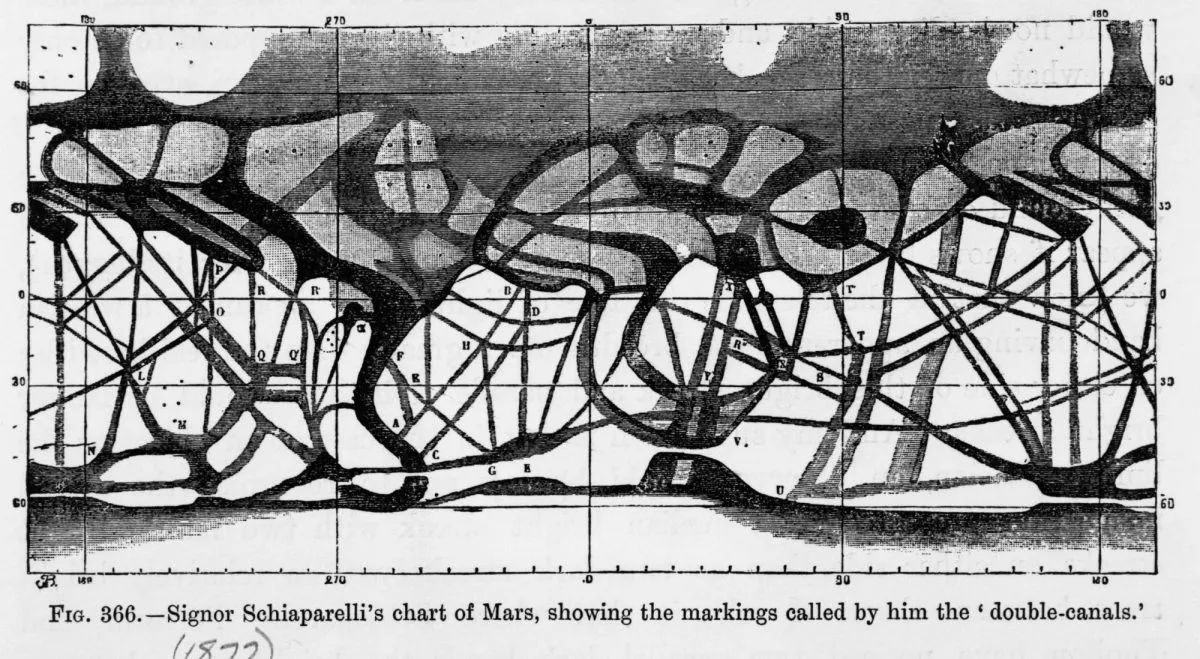
Signor Giovanni Schiaparelli's (1835-1910), chart of Mars showing the Signor Giovanni Schiaparelli's (1835-1910), chart of Mars showing the "double canals". Credit: Bettmann / Contributor / Getty Images

From canals to invasions

Around the same time, imagination and prediction combined with rather flimsy scientific argument in the writings of Camille Flammarion.

The French astronomer, author and conspiracy theorist speculated on the existence of extraterrestrial life in La Pluralité des Mondes Habités (1862).

Fifteen years later, in 1877, such beliefs appeared vindicated when Italian astronomer Giovanni Schiaparelli reported a network of ‘canali’ on the surface of Mars.

The word actually just means ‘channels’, but was duly mistranslated as ‘canals’ – fuelling speculation that Mars might be inhabited by aliens.
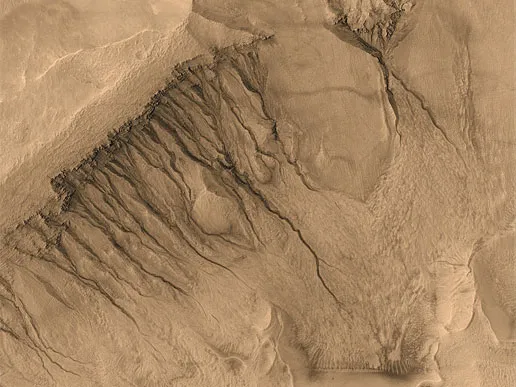
Gullies and channels on Mars. Credit: NASA Gullies and channels on Mars. Credit: NASA

Yet, at the time, there was no immediate interest in extraterrestrials visiting Earth.

When the Mexican astronomer José Bonilla not only saw but actually photographed strange objects (now thought to have been comet fragments) moving across the Sun in 1883, there was no speculation about these being visiting spaceships.

Even Flammarion, who published a report of Bonilla’s sightings in French magazine L’Astronomie, was sceptical, believing the objects to be birds, insects or even dust in front of the telescope. Humans were just not ready for visits from aliens… but we were getting there. 

In the mid-1890s, HG Wells put two ideas together – artillery-propelled spacecraft and intelligent life on Mars – to write the greatest science-fiction story of the era, The War of the Worlds. 

Its publication coincided with the airship wave of 1896–97, when numerous sightings were made of unidentified airships cruising the skies over the USA.

Most reports appeared in small-town newspapers, such as the Yates Center Farmer’s Advocate or the Table Rock Argus, with vague mentions of “anonymous but reliable” witnesses. 

Illustration of Martians attacking from a 1906 edition of The War of the Worlds by H.G. Wells. Credit: Bettmann / Getty Images Illustration of Martians attacking from a 1906 edition of The War of the Worlds by H.G. Wells. Credit: Bettmann / Getty Images

Speculation regarding the origin and construction of these airships, however, tended to centre not on aliens but on the concept of the ‘mad scientist’.

This reflected the sci-fi tropes of the day, including Jules Verne’s submarine Nautilus, the invention of the genius Captain Nemo, and HG Wells’s time machine, the work of one inventor-scientist. 

There was a single, isolated and rather tongue-in-cheek report of contact with aliens during this period: 1897’s Aurora UFO Incident.

The Dallas Morning News carried the story of an airship with a single crew member, a pilot who was “not of this world”.

The story’s authenticity has been debated, but the fact that the paper did not make it their lead story, affording it only a six-paragraph summary, is perhaps the most damning criticism.

What the Aurora story does show is that people were now aware of the possibility of the existence of extraterrestrial life. 

The original newspaper report on the Aurora UFO incident in 1897. By S. E. Haydon(Life time: fl. 1897) Public Domain, Wikipedia The original newspaper report on the Aurora UFO incident in 1897. By S. E. Haydon(Life time: fl. 1897) Public Domain, Wikipedia

Moving on to the early 20th century, 1919 saw the publication of The Book of the Damned by Charles Fort.

From 1906, Fort collected accounts of anomalies, a task that would take up most of his life.

His 1919 book detailed phenomena as diverse as objects falling from the sky, mythological creatures, spontaneous combustions and, of course, UFO sightings.

It is a difficult read, once described as “negotiating a literary assault course, but worth the bumpy ride”.

No doubt if Fort had not catalogued these anomalies, somebody else would have – but it was Fort’s research that would feed our interest in the unexplained 40 years later.

science wonder stories

Early unexplained sightings

Curiously, the period around 1930 to 1940 then saw a drop in reported UFO sightings, despite it being a golden period for science fiction, with the arrival of magazines such as Amazing Stories.

The magazine’s striking front covers reflect the vision of the time, with spaceships that were generally envisaged as metal versions of airships.

However, the 1929 cover of Science Wonder Stories featured a saucer-shaped craft that might well have influenced later UFO sightings. 

Then unexplained phenomena, mostly in the form of moving lights, became common during the Second World War.

With more aircraft flying under all weather extremes, and with nervous crews continually searching the sky for danger, there were too many sightings to be ignored.

This marked the start of a period of official investigations, leading to Project Blue Book, the code name for the US Air Force’s study into UFO reports. Started in 1952, it would not be terminated until 1969. 

UFO flying saucer. Credit: Ray Massey / Getty Images Credit: Ray Massey / Getty Images

The 'flying saucer' is born

The world of unexplained flying objects changed forever on 24 June 1947, when Kenneth Arnold, a businessman and aviator, reported seeing a group of “bat-like aircraft flying in formation at high speeds” near Mount Rainier in Washington State.

He didn’t describe them as saucer-shaped, but his remark that they were “moving like a saucer would if skipped across water” is widely believed to have been the origin of the term ‘flying saucers’. 

There followed a burst of UFO sightings over the next year, and on 8 July, the Roswell Daily Record led with the story ‘RAAF Captures Flying Saucer’.

It was a dramatic headline, but that original story in a small local newspaper quickly faded from memory after the military identified the debris as nothing more than pieces of a weather balloon.

After that, Roswell would, for the time being, be forgotten. 
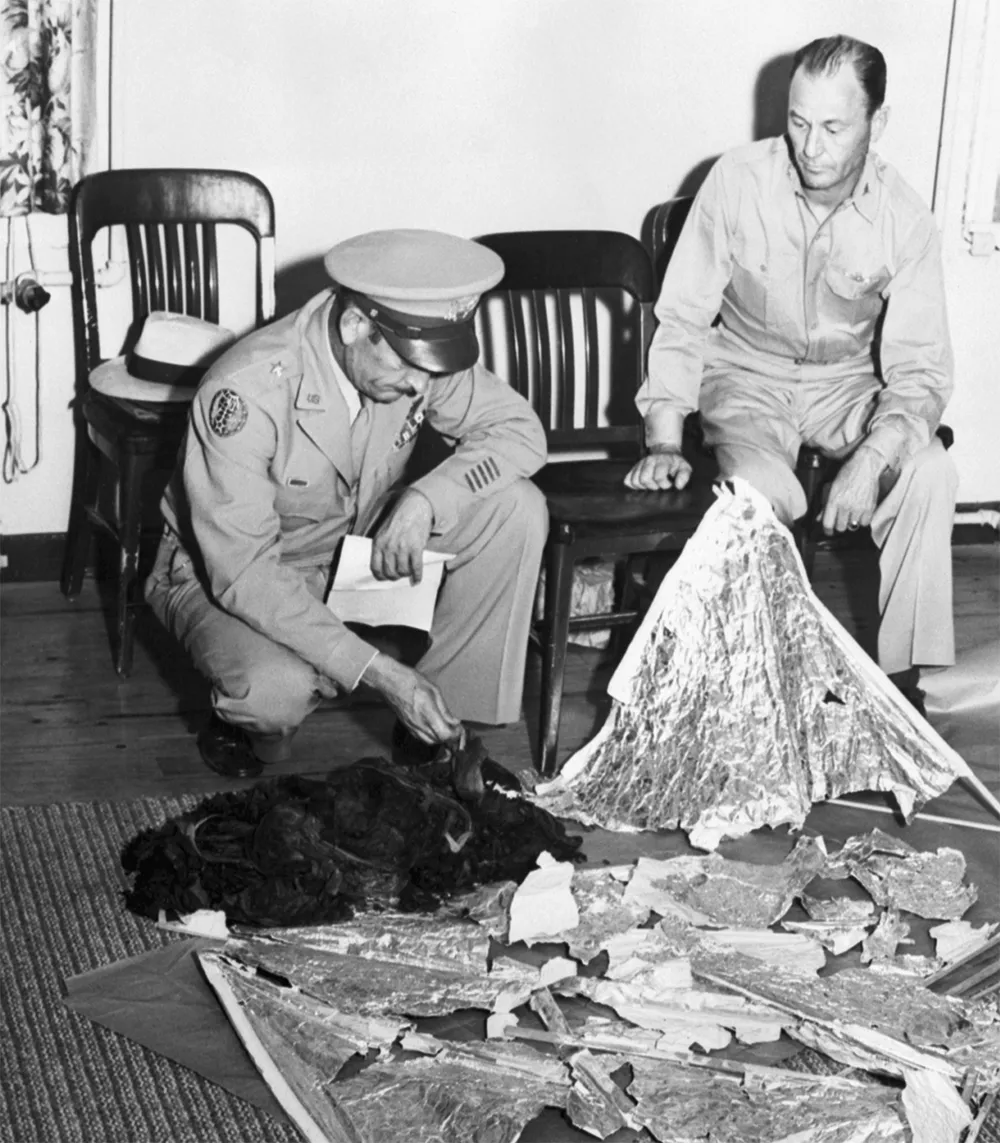
At Fort Worth Army Air Field on 8 July 1947, Brigadier General Roger M Ramey (left) and Colonel Thomas J Dubose, identify metallic fragments found at Roswell as pieces of a weather balloon. Credit: Bettmann / Getty Images At Fort Worth Army Air Field on 8 July 1947, Brigadier General Roger M Ramey (left) and Colonel Thomas J Dubose, identify metallic fragments found at Roswell as pieces of a weather balloon. Credit: Bettmann / Getty Images

In 1950, newspaper reporter Edward Van Winkle Jones wrote an article for the Miami Herald on “strange events”, in which he included the story of the disappearance of Flight 19.

In December 1945, a flight of five Avenger torpedo bombers had become disorientated, run out of fuel and ditched into the sea.

Matters got worse when a large flying boat sent out to search for the downed planes was also lost, most likely due to an in-flight explosion.

Neither incident caused any immediate excitement;  it had just been a bad day for the US Navy.

Jones’s article offered no explanation for the losses, and there was not a UFO in sight; his theme was that not everything in our world could be explained. 

But then in 1962, Allan W Eckert, a successful author of children’s novels, wrote ‘The Mystery of the Lost Patrol’ for the American Legion Magazine – marking the start of Flight 19 as a UFO legend.

The four-page article, with dramatic drawings of a shocked pilot staring at some unseen horror, was followed by a series of interviews in which pilots assured readers that sightings of unexplained flying objects happened all the time. 
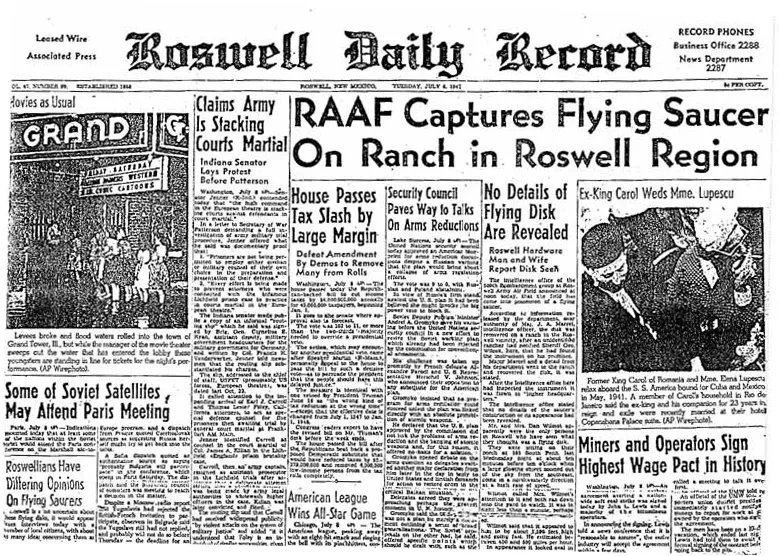
The front page of the Roswell Daily Record from 9 July 1947. Credit: Roswell Daily Record The front page of the Roswell Daily Record from 9 July 1947. Credit: Roswell Daily Record

Magazines fan the flames

There were, of course, those who stepped forward to offer the opposite argument.

The Times, for example, carried a story from the US Office of Naval Research that linked UFO sightings to the testing of a new series of military balloons.

Despite the occasional voice of reason, the fascination with UFOs – as they were now known, thanks to Project Blue Book director Captain Edward J Ruppelt – remained undiminished. 

In an age before there was a television in every house, two forces drove this phenomenon.

The first was magazines, which in those days could be found in every doctor’s and dentist’s waiting room.

Magazines thrived on photographs, and with more and more people owning cameras, pictures of UFOs were bound to appear.

They were generally a pretty poor collection, but as UFO excitement spread, Life magazine reprinted the so-called ‘McMinnville UFO’ photographs, taken on a farm in Oregon in 1950.

Given the blessing of Life, these and other UFO images were printed in newspapers around the world.

One of the McMinnville UFO photographs. Credit: Paul Trent / Wiki Commons

As several hoaxes were exposed, more serious magazines began to shy away from UFO stories;
the gap was filled by the National Enquirer.

The magazine had always specialised in sensation and scandal, but in 1967, its owners – wanting to gain access to the supermarkets – switched from sex to UFOs.

Headlines such as ‘Crippled UFO Orbiting Earth’ and ‘Kidnapped by a UFO’ now boomed out at every American family doing their weekly shopping. 

In addition to magazines, this was the golden age of clubs and societies, with everyone from model-railway builders to ukulele players forming clubs to meet and discuss their passions.

Despite communication being largely by post, these societies had a remarkable ability to grow and expand.

In 1953, Denis Plunkett, a civil servant from Bristol, UK, answered an advertisement from the Connecticut, USA-based International Flying Saucer Bureau and was invited to found the British branch of what was becoming an international organisation.

At its height, the British Flying Saucer Bureau had 1,500 members and in a busy week might receive 30 reports of unusual objects in the sky.

By the 1950s, the French future Nobel Prize in Literature winner Annie Ernaux could note that conversations around a French village dinner table centred on Algeria, memories of the last war, and whether flying saucers were real.

What would happen if we made contact with aliens? Credit: KTSDesign/SCIENCEPHOTOLIBRARY/Getty Credit: KTSDesign/SCIENCEPHOTOLIBRARY/Getty

Cover-ups and conspiracies

The interest in UFOs attracted a huge number of authors, with Donald Keyhoe’s The Flying Saucers Are Real and Frank Scully’s Behind the Flying Saucers (both 1950) giving birth to the great age of UFO conspiracy theories.

Why did aliens only visit now? Well, the answer clearly was that we had recently developed atomic weapons.

Others argued that no, we had always been under scrutiny, and Erich von Däniken took UFO publishing in this direction with Chariots of the Gods? (1968).  

It was during this period that stories about both Roswell and Flight 19 began to resurface.

Charles Berlitz wrote The Bermuda Triangle in 1974. Playing fast and loose with the facts, it sold nearly 20 million copies, cementing Flight 19’s place in UFO legend.

The story would, of course, inspire the brilliant opening scene of Close Encounters.

Roswell was largely forgotten about until 1978, when the National Enquirer reprinted the original story, and Jesse Marcel, who had led the initial investigation, was interviewed by UFO ‘expert’ Stanton Friedman.
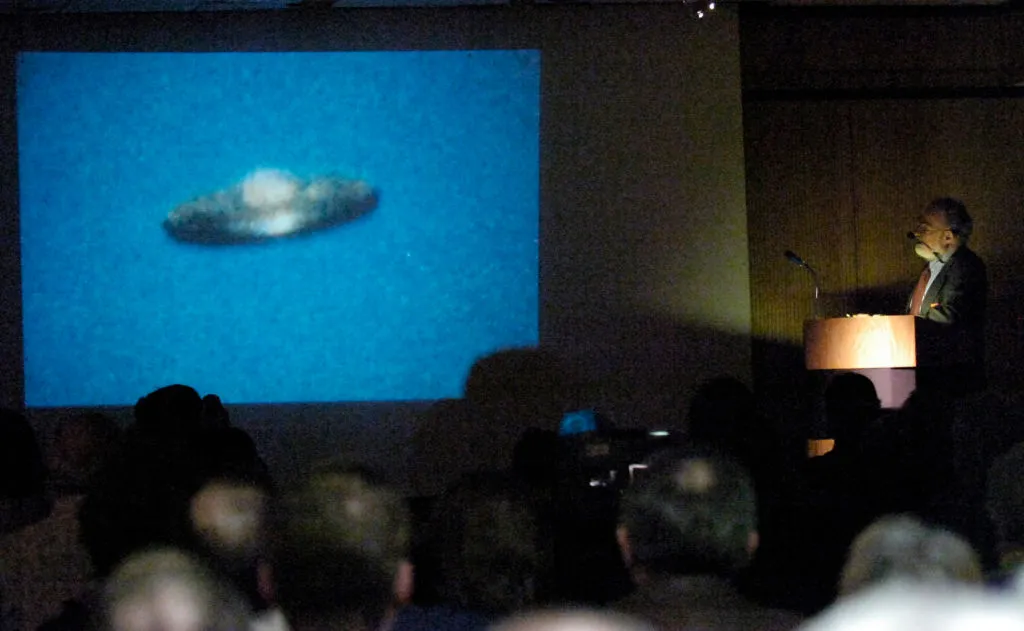
Nuclear physicist Stanton T. Friedman giving a talk about UFOs in 2007. Photo By Krissy Krummenacker/MediaNews Group/Reading Eagle via Getty Images Nuclear physicist Stanton T. Friedman giving a talk about UFOs in 2007. Photo By Krissy Krummenacker/MediaNews Group/Reading Eagle via Getty Images

When Marcel said he believed Roswell debris to have been extraterrestrial, Roswell became the centre of the UFO world, changing the nature of UFOlogy.

UFOs were no longer about advanced alien scouts spying out Earth for an invasion that was coming any day.

It was about a previous contact – perhaps involving a crashed spaceship – being covered up by the government.

In the shadow of the Kennedy assassination and Watergate, government cover-ups were something everybody could believe in.

Charles Berlitz, looking for a follow-up to his Bermuda Triangle success, jumped on the bandwagon with The Roswell Incident (1980).
Roswell, New Mexico has fully embraced its credentials as the most famous city in UFO folklore. Credit: Denis Tangney Jr / Getty Images Roswell, New Mexico has fully embraced its credentials as the most famous city in UFO folklore. Credit: Denis Tangney Jr / Getty Images

The saucer craze fades

Yet UFO excitement was reaching its peak. Back in 1950, it seemed as if the aliens would be arriving any day, but by 1980, we had grown tired of waiting.

A public that watched the USS Enterprise boldly going where no one had gone before was finding 
the pictures of UFOs from the 1950s embarrassingly amateurish.

The debris from Roswell looked far more like the balloon that the military had said it was than it did a crashed spaceship.

Stories of alien abductions, or self-proclaimed UFO contactee George Adamski claiming to have hitched a lift around the Solar System, didn’t help. 

Douglas Adams nicely mocked it all in The Hitchhiker’s Guide to the Galaxy (1979) with his description of ‘Teasers’: bored rich kids that “land right by some poor unsuspecting soul whom no one’s ever going to believe and then strut up and down in front of him wearing silly antennas on their head and making beep beep noises”.

In 2001, the British Flying Saucer Bureau closed after 50 years of chronicling supposed UFO activities.

Nobody was coming to meetings in cold church halls any more; people were staring down at their computer screens rather than up at the sky.

Image of comet 3I/ATLAS over Egypt's Black Desert, captured by Osama Faithi, 29 November 2025, 03:00 local time. Equipment: Nikon Z6 astro-modified camera, RedCat telescope lens Image of comet 3I/ATLAS over Egypt's Black Desert, captured by Osama Faithi, 29 November 2025, 03:00 local time

Humans are still interested in UFOs, including a few ‘wow’ moments on the internet, such as pictures of statue-like rocks on Mars or, most recently, the fly-by of interstellar comet 3I/ATLAS.

And just as 19th‑century imaginations were fired by balloons and airships, 3I/ATLAS theories fit within our modern sense of what might be possible – hence several sci‑fi writers suggesting the idea of adapting asteroids as vessels for space travel.

So yes, we are still willing to believe in intelligent life on other worlds.

The movies may have moved on from UFOs landing in farm fields to the loud ‘here we are’ of Independence Day-style invasions, but until alien spaceships actually hover over the White House, UFOs can no longer command our ever-more fickle attention as they did in the 1950s. 

RELATED VIDEOS

A history of flying saucers and UFOs

UFO's Are Real | FULL MOVIE | Aliens Sci-Fi Documentary

Most Unbelievable UFO Encounters Ever | The Proof Is Out There | History

{ https://www.skyatnightmagazine.com/ }

Hoe vind je dit bericht?
Geschreven door peter om 18:25 Stuur door

Meer van UFO'S of UAP'S, ASTRONOMIE, RUIMTEVAART, ARCHEOLOGIE, OUDHEIDKUNDE, SF-SNUFJES EN ANDERE ESOTERISCHE WETENSCHAPPEN - DE ALLERLAATSTE NIEUWTJES

↑ Terug naar de berichten