Naar de inhoud

UFO'S of UAP'S, ASTRONOMIE, RUIMTEVAART, ARCHEOLOGIE, OUDHEIDKUNDE, SF-SNUFJES EN ANDERE ESOTERISCHE WETENSCHAPPEN - DE ALLERLAATSTE NIEUWTJES

UFO's of UAP'S in België en de rest van de wereld
akke.beakke.be
Ontdek de Fascinerende Wereld van UFO's en UAP's: Jouw Bron voor Onthullende Informatie! Ben jij ook gefascineerd door het onbekende? Wil je meer weten over UFO's en UAP's, niet alleen in België, maar over de hele wereld? Dan ben je op de juiste plek! België: Het Kloppend Hart van UFO-onderzoek In België is BUFON (Belgisch UFO-Netwerk) dé autoriteit op het gebied van UFO-onderzoek. Voor betrouwbare en objectieve informatie over deze intrigerende fenomenen, bezoek je zeker onze Facebook-pagina en deze blog. Maar dat is nog niet alles! Ontdek ook het Belgisch UFO-meldpunt en Caelestia, twee organisaties die diepgaand onderzoek verrichten, al zijn ze soms kritisch of sceptisch. Nederland: Een Schat aan Informatie Voor onze Nederlandse buren is er de schitterende website www.ufowijzer.nl, beheerd door Paul Harmans. Deze site biedt een schat aan informatie en artikelen die je niet wilt missen! Internationaal: MUFON - De Wereldwijde Autoriteit Neem ook een kijkje bij MUFON (Mutual UFO Network Inc.), een gerenommeerde Amerikaanse UFO-vereniging met afdelingen in de VS en wereldwijd. MUFON is toegewijd aan de wetenschappelijke en analytische studie van het UFO-fenomeen, en hun maandelijkse tijdschrift, The MUFON UFO-Journal, is een must-read voor elke UFO-enthousiasteling. Bezoek hun website op www.mufon.com voor meer informatie. Samenwerking en Toekomstvisie Sinds 1 februari 2020 is Pieter niet alleen ex-president van BUFON, maar ook de voormalige nationale directeur van MUFON in Vlaanderen en Nederland. Dit creëert een sterke samenwerking met de Franse MUFON Reseau MUFON/EUROP, wat ons in staat stelt om nog meer waardevolle inzichten te delen. Let op: Nepprofielen en Nieuwe Groeperingen Pas op voor een nieuwe groepering die zich ook BUFON noemt, maar geen enkele connectie heeft met onze gevestigde organisatie. Hoewel zij de naam geregistreerd hebben, kunnen ze het rijke verleden en de expertise van onze groep niet evenaren. We wensen hen veel succes, maar we blijven de autoriteit in UFO-onderzoek! Blijf Op De Hoogte! Wil jij de laatste nieuwtjes over UFO's, ruimtevaart, archeologie, en meer? Volg ons dan en duik samen met ons in de fascinerende wereld van het onbekende! Sluit je aan bij de gemeenschap van nieuwsgierige geesten die net als jij verlangen naar antwoorden en avonturen in de sterren! Heb je vragen of wil je meer weten? Aarzel dan niet om contact met ons op te nemen! Samen ontrafelen we het mysterie van de lucht en daarbuiten.

Is the truth really out there? Studying UAP sightings

Is the truth really out there? Studying UAP sightings

Is the truth really out there? Studying UAP sightings

On a May evening back in 1950, Evelyn Trent had just finished feeding her rabbits when, she claims, she looked up and saw a slow-moving, metallic disk-shaped object hovering above her farm. Though some dismissed it as a hoax, her account was added to a growing list of unexplained events that sparked America's first UFO craze.

At the annual McMenamins UFO Festival in McMinnville, Ore., just a few miles from Evelyn Trent's farm, there are costumes, a parade, and some theories that might be generously described as fringe: "Well, based on what I've read, it could be us from the future visiting us from, you know, the past," said one attendee, "and then it could also be trans-dimensional or inter-dimensional beings." 

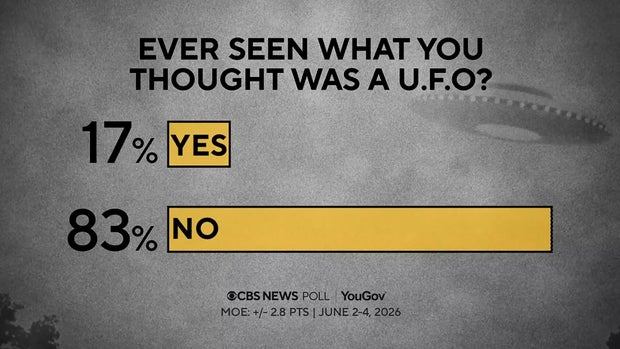
Fringe, but definitely something Americans seem interested in. According to a CBS News Poll, nearly one in five Americans (17%) has seen a UFO, which has led to an explosion in podcasts and documentaries on the topic.

ufo-cbs-poll.jpg

CBS News

Matthew Szydagis, one of the UFO festival's invited speakers, teaches physics at the State University of New York at Albany. He spoke to us about Unidentified Anomalous Phenomena (or UAPs), or what we used to call UFOs back in the old days: "I think the possibility that at least some small fraction of UFOs or UAPs represent a non-human intelligence," Szydagis said. "That will be the greatest discovery in human history. So, of course that's going to fire people up and get their imaginations going."

Szydagis would like to believe in aliens, but he also knows that extraordinary claims demand extraordinary evidence, especially in the world of "UFOlogy," where the more extreme the claims, the more attention they get.

"We still don't have definitive evidence," Szydagis said. "We haven't been provided with a dead alien body, for instance, although claims of the existence have been made. But I think we have enough indirect evidence to say that the existence of non-human intelligence is no longer laughable, that it's not irrational."

Szydagis is part of a new Scientific Advisory Council, established by the Trump Administration, to study UAPs. The person in charge of that council is none other than respected Harvard professor Avi Loeb, former chair of the university's astronomy department.

"Now, there are some objects the U.S. government cannot figure out," Loeb said. "I would like to figure them out. Because at the very least, as an American citizen, I will be helping the Pentagon and the intelligence community fulfill their mission of, if these are human-made technologies, if they come from adversarial nations, then I can help them identify what they are and where they came from."

The things Loeb and the other council members are trying to identify are the many sightings over the years of lights and objects and movements in the sky that defy simple explanation. Someone who's experienced it firsthand? Former U.S. Navy pilot Ryan Graves, whose testimony in front of Congress got the nation's attention back in 2023, when he recounted an experience during a training mission ten miles off the coast of Virginia Beach: "Two F-18 Super Hornets were split by a UAP," Graves said. "The object, described as a dark grey or a black cube inside of a clear sphere, came within 50 feet of the lead aircraft."

For many people, seeing no-nonsense U.S. military personnel calmly describing things they'd seen and couldn't explain, along with actual images, made the whole thing seem a lot less crazy. Graves told us, "We were seeing these things, we were nearly hitting them, and yet we're still unwilling to talk about them in our safety briefs and incorporate them into the conversation."

Graves was also recently added to the Advisory Council, tasked with getting to the bottom of things, and there are a lot of things that have been released in the last eight months: seven tranches of first-person accounts, photographs, and lots of grainy video, more than 155,000 pages of files overall.

But not enough of the good stuff, says Graves: "What's being released is not satisfactory to me. What you are seeing are very short clips from infrared sensors aboard different platforms. And ultimately, these are not the high-end sophisticated tools that are used by pilots in order to make critical decisions about whether [an] object in the air is hostile, whether it's a decoy, whether it is a threat or not. And so, I think we're left with more ambiguity."

Loeb said, "The mistake that is often made about science is the belief that, 'Oh, the data will come and guide us.' But the problem is that to collect the data, you need to put in effort. And it's often a heroic effort to get the high-quality data."

Questions linger about what exactly the government knows about UFOs, after former Air Force intelligence officer David Grusch testified to Congress that he was told of the existence of recovered UFOs.

When Rep. Nancy Mace (R-S.C.) asked whether possession of a crashed craft also meant possession of the bodies of the craft's pilot(s), Grusch replied, "As I have stated publicly already in my News Nation interview, biologics came with some of these recoveries, yeah."

Of course, evidence for all of this is "classified," leading some ufologists to call Grusch and others making claims about government conspiracies "Trust Me Bros."

Loeb, who's floated a number of controversial theories on possible alien life, says the Advisory Council is working to get access to as much information as possible, starting with what's been publicly released. "My role is really simple, because it's like a detective," he said. "And the worst that can happen to a detective is that the detective is starved of data. So, if I don't have data, the quality of my deliberations [is] poor. I mean, only in politics, with very little data, you can make a huge story!"

For his part, Ryan Graves started an organization called Americans for Safe Aerospace, which encourages everyone (but especially pilots) to share their stories of UAPs. And of course, he's got a podcast.

"Recently I've been astounded, in fact, that almost everyone is willing to talk about this," said Graves. "It is fighter pilots. It is commercial aviators. And I think that really speaks to how this conversation has changed over the past few years."

Asked whether he believes he'll get answers within his lifetime, Graves replied, "My lifetime, yes. We are moving towards a point in time where we're perhaps not going to get every answer we want, but we're going to potentially have the confirmation that something truly strange is happening."

Until that conformation, the truth will have to remain (as they say) out there.

  • Story produced by Anthony Laudato. Editor: Ed Givnish. 

RELATED

Inside the Pentagon’s UFO Files: U.S. Military UAP Footage Explained | WELT Documentary
UFOs Unlocked: Inside the Pentagon’s secret files | This Is America

{ https://www.cbsnews.com/ }

Hoe vind je dit bericht?
Geschreven door peter om 20:57 Stuur door

Town-terrorising 'werewolf' connected to UFOs 'exposed' in 13-year-long investigation

Town-terrorising 'werewolf' connected to UFOs 'exposed' in 13-year-long investigation

A retired teacher claims a 13-year, data-driven probe into the 'Beast of Bray Road' has unearthed eerie evidence of a 7ft 'werewolf' linked to disturbing UFO-like lights

BY  Andréa Oldereide - Senior Reporter

A “werewolf” has been reportedly terrorising residents in a quiet town

A “werewolf” has been reportedly terrorising residents in a quiet town

(Image: Getty Images/iStockphoto)

A “werewolf” has been reportedly terrorising residents in a quiet town. Now, a 13-year investigation has seemingly uncovered a bizarre link to UFOs.

The creature is known as the Beast of Bray Road, a hairy, wolf-like figure said to stalk the lanes around Elkhorn, Wisconsin, USA since the 1980s. Retired teacher Lee Hampel, who owns a 35-acre farm along Bray Road, has spent 13 years compiling what he believes is serious evidence, approaching the mystery with a data-led mindset shaped by his background teaching maths and computer science.

According to an investigative report by NewsNation, Hampel has amassed thousands of files during his long-running probe, including a huge collection of images from motion-activated cameras set up across his land.

This is where the wolf-like figure is said to stalk the lanes since the 1980s

This is where the wolf-like figure is said to stalk the lanes since the 1980s

(Image: Maps)

He reportedly claims to have gathered more than 100,000 photos across around 200 SD cards using trail cams. Moreover, one of his key pieces of evidence is said to be an iPhone photo showing a dark figure standing near a cornfield.

Hampel says a scale analysis of the image suggested the figure was around 7ft tall with shoulders roughly 3.5ft wide, News Nation reported. If accurate, these measurements would be far larger than a typical wolf or coyote.

Additionally, Hampel reportedly says he has personally seen the beast three times and managed to take plaster casts of its tracks. The prints, he claims, show a massive five-toed, seven-pad footprint that doesn’t match known local wildlife.

A 13-year investigation has seemingly uncovered a bizarre link to UFOs

A 13-year investigation has seemingly uncovered a bizarre link to UFOs

He even took one 3.5-inch track to the Wisconsin Department of Natural Resources, but says they brushed it off as an abnormal coyote. Hampel also admitted he tried to lure the creature out by leaving roadkill - including deer and raccoons - on his property, as per News Nation.

He reportedly claims the carcasses didn’t just disappear, but were found “surgically” gutted and stacked neatly in piles, with no human footprints around to suggest a person was responsible. Hampel now also believes the Beast of Bray Road may be tied to UFO activity after repeatedly noticing strange electronic failures right as the meat vanished.

Rather than capturing clear footage of a predator dragging off heavy carcasses, he claims his cameras recorded unexplained flashing orbs, bright white lights and what he described as a thick “black mist”. He also claims the heavy animals seemed to vanish without triggering motion sensors.

Are werewolves real?

Are werewolves real?

(Image: Getty Images/iStockphoto)

According to Hampel, there are strange objects in the night sky blinking out of existence. “Elkhorn doesn’t like to talk about it, so we don’t really know how often it is seen,” Hampel told the Chicago Tribune.

“But science, of course, is full of unknown things.” He further said: “Maybe in 75 years, we’ll know for sure.

“People will say, ‘Oh, back in 2026, Lee Hampel had all sorts of information on that dogman.’ I have a neighbour who has lived here 50 years, never seen it.

“But he’s seeing all these odd tracks and tells me he doesn’t know what’s making them. Well, I know.

“It’s the Beast of Bray Road!”

{ https://www.dailystar.co.uk/ }

Hoe vind je dit bericht?
Geschreven door peter om 18:04 Stuur door

UK UFO sightings mapped as 'black triangles' worry Pentagon officials

UK UFO sightings mapped as 'black triangles' worry Pentagon officials

Hundreds of UFOs have been seen in Yorkshire, including six in Huddersfield.

BY Richard Aultand Elizabeth Mackley Content Editor

0_North-Yorkshire-Weather-Updates-2.jpg

Close-up images of a UFO spotted over Whernside in the Yorkshire Dales

(Image: North Yorkshire Weather Updates/Facebook)

From "star-like" phenomena, oval orbs and strange "perfect triangles", the skies can be full of bizarre sights.

But a certain few have triggered security concerns in America after peculiar black triangles were seen speeding above military sites - and identical UFOs have been haunting British skies.

Nearly 2,000 Unidentified Flying Objects (UFOs) have been documented and logged in the UK during the last five years by research group UFO Identified. Now, a searchable interactive map allows you to explore every unexplained encounter logged in your area between 2021 and 2026.

Hundreds of those recorded sightings have taken place in Yorkshire - including six in the Huddersfield area. Around 12 sightings took place in the Sheffield area while Leeds played host to 19.

You can find out the weird and wonderful things which have been spotted in the skies near you using the interactive map below. Just plug in your postcode to find out how many unidentified phenomenon have been spotted near you.

Sightings UK

Many of the sightings reported in this country closely mirror sightings reported across the Atlantic. The Pentagon recently published its latest release of declassified files on Unidentified Anomalous Phenomena (UAP – the American term for UFO), following an executive order signed by Donald Trump.

Among the documents is an account from two federal agents stationed at a US “sensitive national security site” in June 2026. According to the report, a matte-black triangular object with an estimated 15-foot wingspan hovered silently roughly 300 feet in the air for 20 seconds before descending into a canyon at high speed without leaving an exhaust trail.

While orbs, spheres and “star-like” sightings make up the bulk of British sightings, researchers have logged 164 reports of similar wedge-shaped objects – meaning roughly one in every 12 sightings involves a distinctive triangle. Witnesses across the country have reported seeing dark, matte triangles gliding soundlessly at low altitude over housing estates, farmland, and coastal areas before darting away at incredible speeds, just like the sighting made by federal agents in the USA.

The most recent was on July 22 of this year, when a “large black triangle” featuring a red light on each point was witnessed hovering over Stretford in Greater Manchester for more than 30 minutes. Earlier this year, a “perfect triangle” was seen speeding across the sky above Chesterfield in Derbyshire, a “black V-shaped boomerang” was spotted over the Fylde coast in Lancashire, and a soundless black wedge above Exmouth in Devon.

Our map reveals hotspot areas across the UK where clusters of UFOs have been spotted above Greater Manchester, London, Essex, Lancashire, Cheshire, Merseyside, Kent and West Yorkshire. The accounts have been gathered by UFO Identified to create a central, searchable public archive, called the UK UFO Database, to help researchers identify patterns.

Ash Ellis, founder of UFO Identified, said: “There are thousands of people across the UK who have seen something they could not readily explain, but the reports are often difficult to find once the initial interest has passed. We wanted to build a serious, easy-to-use public archive that keeps those accounts accessible and allows people to look for patterns for themselves.”

{ https://www.examinerlive.co.uk/news/local-news/ }

Hoe vind je dit bericht?
Geschreven door peter om 17:49 Stuur door

“These Small Ones Dominate the Risk”: Are Deadly ‘Halloween Fireballs’ Just Media Ghost Stories, or is the Cosmic Airburst Threat Real?

taurid halloween fireballs cosmic airbursts

By Medisilvanus - Own work, CC BY-SA 4.0, https://commons.wikimedia.org/w/index.php?curid=97287584

“These Small Ones Dominate the Risk”: Are Deadly ‘Halloween Fireballs’ Just Media Ghost Stories, or is the Cosmic Airburst Threat Real?

A series of presentationsat the Geological Society of America’s annual GSA Connects conference shows that media reports suggesting the 2026 fall Taurid meteor shower could include powerful “Halloween Fireballs” capable of melting everything on the surface below it are highly exaggerated.

“Scenarios in which large numbers of airbursts simultaneously rain down on the Earth, destroying cities across the planet and ending civilization, are science fiction,” conference presenter Mark Boslough, a Research Associate Professor of Earth and Planetary Sciences at the University of New Mexico, explained in an email to The Debrief.

However, the professor noted, a new analysis of such events, including the well-known “Tunguska” cosmic airburst that exploded over Siberia in 1908, suggests they could be even more devastating than previously believed, motivating researchers like himself to prepare for such “what-if” scenarios, however unlikely.

Halloween Fireball Cosmic Airbursts Are Real, But Rare

Earth crosses paths with the Taurid meteor stream twice a year, producing brilliant flashes of light in the sky. During the fall season, media reports often call these atmospheric meteor airbursts “Halloween Fireballs” because of their seasonal proximity to the spooky October 31st holiday.

Most Halloween Fireballs pose no real danger to people or structures on the ground. However, the 1908 crossing included what researchers believe was a “Taurid swarm.” One comparatively large object within that meteor swarm slammed into Earth’s atmosphere before exploding above the Podkamennaya Tunguska River region of Siberia in a brilliant fireball.

Although that cosmic airburst occurred over a relatively unpopulated region, the damage caused by the high-energy aerial explosion stoked fears that a returning Taurid swarm could deliver one or more life-threatening Halloween Fireballs in the future.

Halloween fireballs cosmic airbursts

By Leonid Kulik, the expedition to the Tunguska event.

Credit: Wikimedia Commons

During his presentation, “Will Tunguska’s Evil Twin Return on Halloween 2026? Science and Skepticism in a Clickbait World,” Boslough highlighted the science behind the possibility, including the real potential return of a Taurid swarm.

For example, previously published models suggest the Taurid swarm is in an approximate 61-year resonance with Earth, placing the next event in 2030. However, the professor said the models also showed that the fall crossing would be 4 years earlier, “within a few weeks of October 31, 2026.”

This ominous date, combined with memories of Tunguska, has once again fueled fears and media speculation that this year’s Halloween Fireball swarm may include a hidden meteor that could cause a deadly cosmic airburst over a more populated region.

To address those fears, while also offering some hope that future events will help researchers spot potentially dangerous Taurid space rocks before they can cause any damage, Boslough reached out to The Debrief and helped separate media-driven ghost stories from potentially real Halloween horrors.

“Such Events Are More Dangerous Than We Had Previously Thought”

According to the UNM professor, new research has shed more light on the types of airbursts caused by Tunguska-type asteroids that “explode in the air but don’t hit the ground.” This includes supercomputer simulations by planetary defense researchers that have produced potentially horrifying conclusions.

“We have learned that such events are more dangerous than we had previously thought, because they are directional explosions,” Boslough told The Debrief.

In his presentation abstract, the UNM professor explained that the mainstream narrative for the past century has suggested that had the Tunguska space rock arrived 4 hours and 47 minutes later, it would have destroyed St. Petersburg. However, he added, while intentionally mimicking the clickbait style some media reports use to overstate the actual risk, “new orbital calculations have revealed the stunning truth.”

“If it had been mere minutes late, it could have destroyed a city in the US or Canada,” the professor explained. “A couple (of) minutes after that, it would have missed Earth altogether, only to return and menace our planet in the future. That time could be now.”

Boslough told The Debrief that if a Halloween Fireball-style cosmic airburst is large enough, it can incinerate everything on the planet’s surface directly beneath it “like a cosmic blowtorch.” He also noted that there are a million Tunguska-sized asteroids for every dinosaur killer, with most remaining undiscovered.

“One fear is that we still don’t know how many (if any) could be hidden in the Taurid stream that strikes Earth every year at this time,” Boslough explained, adding that “these small ones dominate the risk.”

The Probability is ‘Very Close to Zero’

Although scientists agree that another Tunguska-sized airburst is certainly possible, Boslough told The Debrief that the mathematical chances of a Tunguska-level event this October 31st are far lower than some more sensational media reports suggest.

“The probability that the Tunguska object had an evil twin that will create a cosmic blowtorch that destroys Denver (or any other city) on Halloween is very close to zero,” he explained, including the highly populated Colorado city as an example of the cities his team modeled for a possible airburst scenario.

Boslough said that such horrifying Halloween Fireballs events “are precisely the types of hypothetical scenarios we discuss at our Planetary Defense Conference every two years to practice our preparedness and mitigation planning.”

When addressing the chances of a Tunguska-level airburst scenario during the next Taurid swarms scheduled to swing by Earth six and ten years from now, respectively, the UNM professor’s conference abstract explained that the Taurid resonant swarm model does “predict close approaches of a hypothetical swarm in 2032 and 2036.”

Although the chances of a catastrophic Halloween Fireball during either event are also extremely low, the professor told The Debrief that a 2032 swarm could offer astronomers a chance to hunt for potential future dangers, including space rocks capable of producing deadly airburst scenarios.

“The good news is that new and more powerful telescopes for discovering and tracking asteroids will be in operation by 2032, when the next time the hypothetical Taurid swarm gets close to Earth,” Boslough explained,” and can provide advance warning if there’s a Tunguska-sized object on the way.”

  • Christopher Plain has spent the last six years as Associate News Editor and Head Science Reporter at The Debrief. Follow and connect with him on X, learn about his novels at plainfiction.com, or email him at christopher@thedebrief.org.
Simulation of Taurid Stream
Halloween Fireballs Are Coming! 🎃☄️ Peak Nov 4 & 11 #shorts #space

{ https://thedebrief.org/category/space/ }

Hoe vind je dit bericht?
Geschreven door peter om 16:50 Stuur door

Life after death mystery deepens as scientists find signs of consciousness in 'clinically dead' patients

Life after death mystery deepens as scientists find signs of consciousness in 'clinically dead' patients

What happens after death remains one of humanity's greatest and most enduring mysteries.

Now, researchers have found signs of consciousness in patients whose hearts had stopped for several minutes, bringing scientists closer to uncovering the truth about life after death.

More than 140 patients, who were at risk of cardiac arrest, across 13 hospitals in the UK and Spain, volunteered for an experiment that would see music played through a speaker during the first two minutes of resuscitation if their hearts stopped. 

After recovering, the survivors completed a ten-item memory test that mixed sounds played during resuscitation with others that had not been played.

The group hearing nature sounds, including rain and birdsong, and one hearing newly created melodies scored above chance, while a third group hearing the same melodies under different experimental conditions performed around guessing level. 

The findings suggest that 'consciousness may be preserved even during states of reversible clinical death,' the team wrote.

Lower brain oxygen readings were also associated with better recall, raising further questions about how the mind processes information under extreme physical stress.

The findings lend support to the idea that consciousness can outlast the heartbeat, a possibility central to the debate over life after death. 

Scientists have found new clues about what happens moments after death
Scientists have found new clues about what happens moments after death 

The study focused on vivid experiences people remembered from periods when their medical condition suggested they should have been unconscious. 

Here, 'clinical death' means the heart had stopped, but the person could still be revived. CPR can supply some blood to the brain, so cardiac arrest does not necessarily mean that all brain activity has ended. 

The work involved teams from Comillas Pontifical University in Spain, Manchester Metropolitan University and Liverpool John Moores University in the UK.

The experiment used three groups, with sounds played through a speaker connected to a laptop during resuscitation.

One group heard familiar natural noises, including birdsong, rain and crashing waves.

Another heard newly created melodies, designed to reduce the risk of patients confusing the experiment with something they remembered from earlier life.

For both groups, a quantum computer helped decide whether each sound would be played or withheld. 

It used entanglement, which links the computer's quantum bits, called qubits, so their measurement results are connected. 

Those results acted as switches controlling sound playback, allowing researchers to test whether this method of selecting sounds was linked to better recall. 

A third group heard the new melodies through a system that did not use entanglement.

Afterward, survivors completed a ten-item recognition test containing five sounds that had been played and five that had not.

The first two groups averaged around six or seven correct answers out of ten, while the comparison group scored about five, the number expected from guessing. 

article image

The researchers found that lower brain oxygen readings were also associated with more intense near-death experiences and better recognition of sounds played during resuscitation.

That raises a puzzling question about how the brain processes information under extreme physical stress, when a patient appears unconscious and their circulation has severely deteriorated.

The paper points to earlier research that recorded bursts of organized activity in dying brains, including electrical patterns associated with conscious processing.

Such activity could potentially help explain experiences reported by some survivors, including seeing light, recalling scenes from their lives or feeling unusually clear-headed.

The authors suggested that a severely stressed brain might briefly preserve enough activity to support experiences or memories, even as its normal functions begin to fail.

For patients and families, the most immediate implication is that a lack of outward response may not tell the whole story about someone's experience.

The authors argue that medical teams should consider the possibility of residual awareness and communicate respectfully while trying to revive a patient.

'Respectful verbal communication is also warranted during resuscitation, as patients may later recall events or dialogue,' they wrote.

They also recommend asking survivors about unusual memories and offering psychological support when those experiences are distressing, helping patients discuss something that may feel profoundly meaningful or difficult to explain.

RELATED
Scientists Recorded a Dying Brain… Then THIS Happened
What Happens After Death? People Who Died and Came Back Reveal What They Saw!
What Happens When We Die? Evidence That Changes Everything (Full Documentary)

{ https://www.dailymail.com/sciencetech/index.html }

Hoe vind je dit bericht?
Geschreven door peter om 16:23 Stuur door

NASA celebrates Halloween with its spookiest photos of the universe, including a jack-o'-lantern sun and an evil eye nebula

NASA celebrates Halloween with its spookiest photos of the universe, including a jack-o'-lantern sun and an evil eye nebula

Nasa is celebrating Halloween this year by releasing its spookiest photos of the universe.

The space agency revealed several astral oddities on Wednesday ahead of October 31. 

Skull shapes and ghostly eyes are among a gallery of Halloween-themed eerie space sightings.

One picture captured the Sun appearing like a giant jack-o'-lantern – with its active regions forming what looks like a carved pumpkin. 

Another pictures an evil eye. The turquoise-green eye-shaped circle is a young planetary nebula that is around 8,000 light years away

Showcasing four eye-like observations, the agency wrote: 'Do you ever get the feeling you're being watched? 

'Even though all of these cosmic objects are millions of light-years away, they can still send shivers down our spines when we find them staring back at us.' 

Active regions on the Sun combined to look something like a jack-o-lantern pumpkin's face on

Active regions on the Sun combined to look something like a jack-o-lantern pumpkin's face on

A haunting image from the orbiting Chandra Observatory reveals the Perseus Cluster of Galaxies in x-rays. NASA say describes it as "Like eyes in a skull, two dark bubbles flank a bright central source of x-ray emission".

A haunting image from the orbiting Chandra Observatory reveals the Perseus Cluster of Galaxies in x-rays. NASA say describes it as 'Like eyes in a skull, two dark bubbles flank a bright central source of x-ray emission'.

Looking like a spectral eye, this is an image of MyCn18, a young planetary nebula located about 8,000 light-years away, taken with the Wide Field and Planetary Camera 2 (WFPC2) aboard the Hubble Space Telescope (HST)

Looking like a spectral eye, this is an image of MyCn18, a young planetary nebula located about 8,000 light-years away, taken with the Wide Field and Planetary Camera 2 (WFPC2) aboard the Hubble Space Telescope (HST)

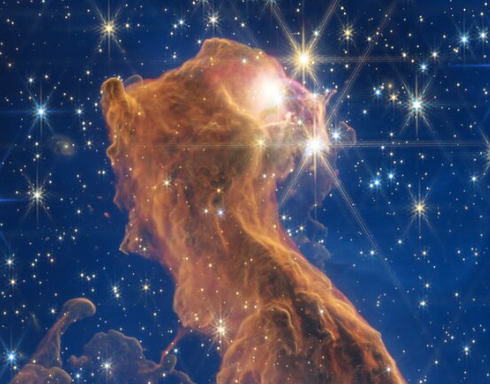
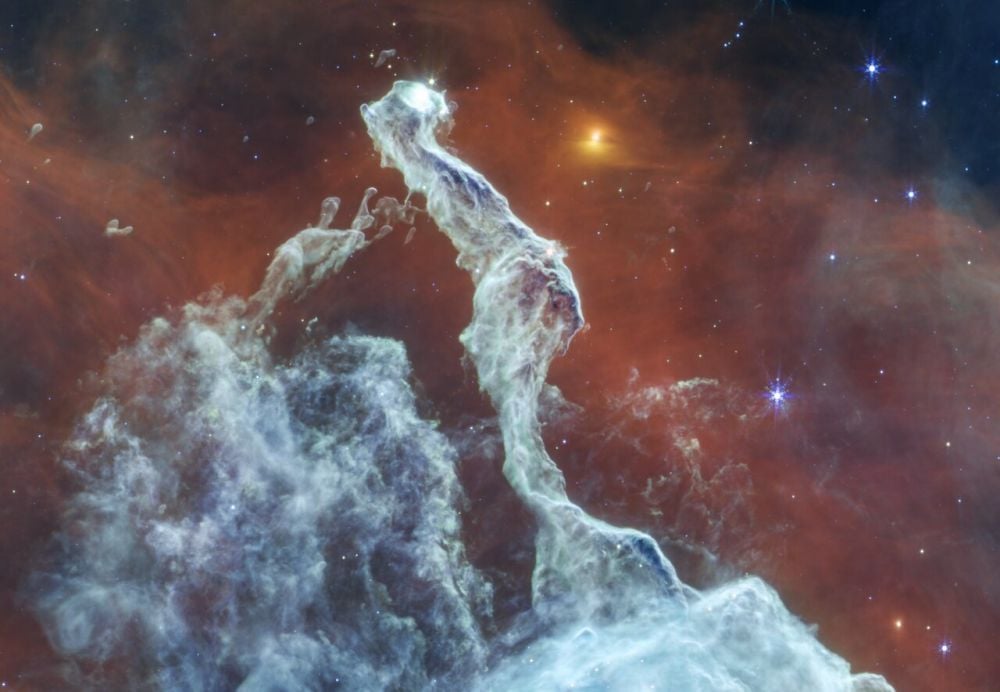
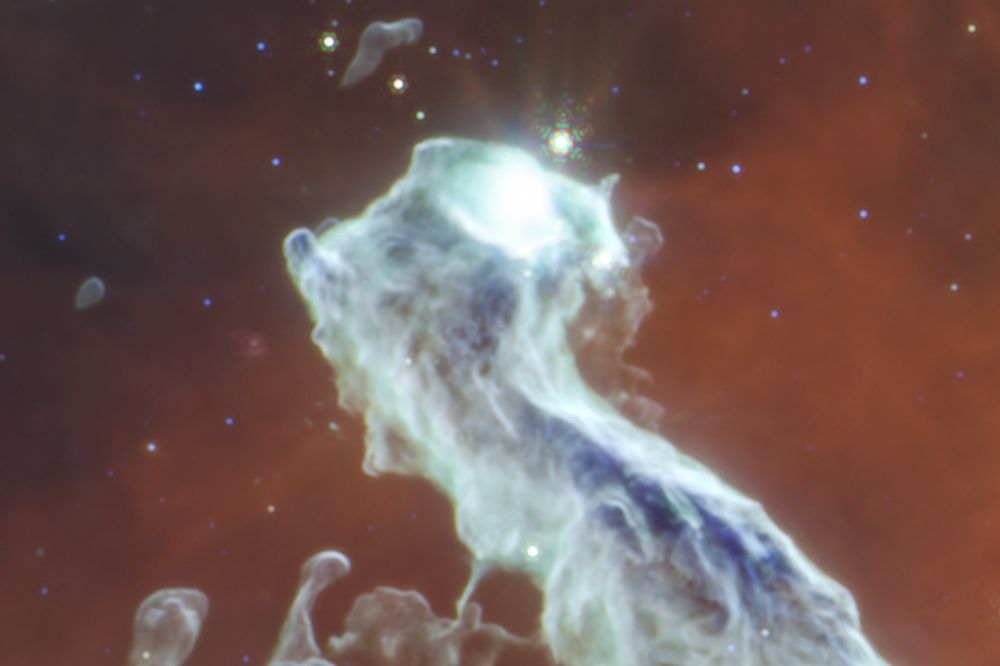
An 'eerie' new mid-infrared view of the Pillars of Creation was revealed in time for Halloween

An 'eerie' new mid-infrared view of the Pillars of Creation was revealed in time for Halloween

An image from NASA's Hubble Space Telescope reveals the vibrant green and red Ghost Head Nebula

An image from NASA's Hubble Space Telescope reveals the vibrant green and red Ghost Head Nebula

NASA's Viking 1 Orbiter spacecraft photographed this region, which resembles a face, in the northern latitudes of Mars on July 25, 1976

NASA's Viking 1 Orbiter spacecraft photographed this region, which resembles a face, in the northern latitudes of Mars on July 25, 1976

RELATED

NASA's "Halloween Sun": Why Our Star Smiled Like A Demon!
Skull shapes and ghostly eyes among Halloween-themed space sightings | SWNS
NASA Caught the Sun as a Jack-o'-Lantern 🎃 #Shorts

{ https://www.dailymail.com/sciencetech/index.html }

Hoe vind je dit bericht?
Geschreven door peter om 16:07 Stuur door

UFO Nearly Hits Space Station, Seen From DragonX Capsule Oct 13, 2026, UAP Sighting News.

UFO Nearly Hits Space Station, Seen From DragonX Capsule Oct 13, 2026, UAP Sighting News.

UFO_space_station.png

UFO_NASA.png

UFO_UAP.png

Date of sighting: Oct 13, 2026
Location of sighting: Earths orbit at ISS
NASA Source video:
Guys, you wont believe this, but its all true. I was watching video by NASA of the dragonX capsule as it was traveling to the spacestation and then...as the capsule showed video of the space station...something shot past it slowly. Coming within 25 meters of hitting the space station. This UFO was about 7 meters across and could have destroyed the station had it hit it. The crew on board the DragonX said nothing about it, not NASA control, not even the station itself. Oh...and I saw a UFO come within meters of the Dragon capsule not once...but twice. You heard me right. Watch this video and if you have doubts...go to the source NASA video and check it out for yourself. Aliens are watching our every move...like parents watching kids to keep them safe. 
Scott C. Waring - UFO Sightings Daily 
 

{ https://www.ufosightingsdaily.com/ }

Hoe vind je dit bericht?
Geschreven door peter om 15:46 Stuur door

NASA Astronaut Winston Scott Convinced Alien Life Exists but Warns of an Impending Space Military War

NASA Astronaut Winston Scott Convinced Alien Life Exists but Warns of an Impending Space Military War

Scott separates his belief in extraterrestrial life from claims that aliens have visited Earth, while backing competition in lunar exploration

NASA Astronaut Winston Scott Convinced Alien Life Exists

NASA astronaut Winston Scott believes in life beyond Earth and warns that military tensions between world powers could lead to armed conflict in space By Latitude0116 at English Wikipedia, CC PHOTO  BY 2.5/Wikimedia Commons

NASA astronaut Winston Scott told Fox News's Jesse Watters Primetime on Wednesday that he believes alien life exists beyond Earth, while warning that military conflict in space remains possible.

Scott flew on two space shuttle missions in the 1990s. His comments came days after the Pentagon released declassified UFO files containing accounts of mysterious craft and alleged encounters with beings.

Why Winston Scott Believes Alien Life Exists

Scott's confidence rests on the number of planets in the universe. With billions of potential worlds, he reasoned, some must have developed in ways similar to Earth, allowing intelligent life to emerge elsewhere.

'I do believe there is life someplace else out there in the universe. Now, whether or not it's visiting us here on Earth or not is a topic of discussion. I think E.T. is out there some place,' Scott told the programme.

'We can't be the only one that has intelligent life,' he added.

His remarks distinguished that belief from the unresolved question of visits to Earth. The Pentagon files described by the Daily Mail included witness claims of unusual encounters, which do not establish proof of alien contact.

The US government's position is that no physical proof of extraterrestrials has been discovered on Earth.

Military Rivalries Shape Winston Scott's Warning

Scott's concerns about armed conflict centred on relations between the United States, Russia and China. He hoped space exploration could bring countries together, but cautioned that cooperation on individual projects did not remove wider political divisions.

'Russia is our partner in terms of the International Space Station, but they are not our ally,' he told Fox News.

He characterised the US relationship with China as more 'military-oriented' and pointed to preparations for potential threats beyond Earth.

'We live in a world where we have to be prepared to defend ourselves militarily. We hope we don't see conflict and combat in space but I would not rule it out,' Scott stated.

A military spokesperson separately told the Daily Mail that hostile satellites could pose threats to the United States.

'The US has warned about Russian and Chinese weapons testing and operationalization since 2007. Due to their actions, it is no longer a question that space is a warfighting domain,' the spokesperson stated.

Scott also referred to what he described as US Space Force confirmation that it had placed weapons in orbit to counter China. IBTimes UK cannot independently verify that deployment claim.

The Daily Mail noted that the 1967 Outer Space Treaty, signed and ratified by the United States, prohibits nuclear weapons in orbit but does not impose the same prohibition on conventional weapons, signal jammers or military satellites.

Winston Scott Backs Competition for the Moon

Despite those concerns, Scott remained optimistic about lunar exploration. He endorsed competition between Elon Musk's SpaceX and Jeff Bezos's Blue Origin to develop vehicles capable of reaching the Moon's surface.

'Competition is the American way,' he declared.

Scott credited private space companies with making exploration cheaper, more efficient and more productive. He viewed their competition favourably even as he warned that rivalry between governments could extend to combat beyond Earth.

The vehicles being developed by SpaceX and Blue Origin are intended to reach the lunar surface by 2028.

RELATED

COMBAT IN SPACE? Former NASA astronaut says he ‘would not rule it out’
Do Aliens Exist? – NASA Astronaut Sunita Williams & Sadhguru at Harvard Medical School

https://www.ibtimes.co.uk/science }

Hoe vind je dit bericht?
Geschreven door peter om 22:02 Stuur door

UFO Researcher Finds a 3,000-Foot Hole Near the Canadian Coast and Claims It Is an Alien Base Entry

UFO Researcher Finds a 3,000-Foot Hole Near the Canadian Coast and Claims It Is an Alien Base Entry

Scott C. Waring proposed using an underwater drone to investigate the feature, while former officials have made separate claims about unexplained activity beneath the ocean

UFO in deep ocean

Scott C Waring claims a hole off Nunavut is an underwater alien base entrance and proposes a drone probe to investigate (Image is for illustrative purposes only)

PHOTO AI Generated/ChatGPT

UFO researcher Scott C. Waring claims a hole more than 3,000ft (914m) across in waters off Nunavut, Canada, is an entrance to an underwater alien base, describing the feature in a 28 October 2026 post on UFO Sightings Daily.

His assertion accompanies separate comments from retired US Navy admiral Tim Gallaudet, who suggested that unexplored ocean depths could conceal non-human technology. Gallaudet has not identified a location for an alleged base or corroborated Waring's Canadian claim.

UFO Researcher Proposes a Drone Mission

Waring claimed the feature lay at least 33ft (10m) beneath the surface and described it as a tunnel through which extraterrestrials could travel unseen.

No independent underwater survey has been presented to verify that the feature is an actual tunnel or an entrance to an extraterrestrial facility.

'I found an entrance to an underwater alien base, and it's in the most remote area of northern Canada that one could go,' Waring wrote on his website.

Waring proposed sending a remotely operated or autonomous underwater drone to investigate. He envisaged a mission lasting several days, with the craft returning with footage that could be examined for signs of extraterrestrial life.

Such equipment could, he argued, reach depths too dangerous for people to explore themselves. He also suggested that an expedition might establish communication between the public and extraterrestrials.

Ocean Depths Underpin Gallaudet's UFO Theory

Gallaudet, a former acting administrator of the National Oceanic and Atmospheric Administration, outlined his reasoning on the Hang Out with Sean Hannity podcast.

'We've only explored with either drones, buoys [or] floats, about 10 percent of ocean volume,' he stated. 'So there's a lot of mystery out there right now.'

Drawing on decades studying the ocean, Gallaudet argued that its largely unexplored volume could offer somewhere to remain undetected. His suggestion concerned the wider ocean, rather than a specific site off Canada.

During the interview, he described footage that he claimed depicted objects moving between water and air. He also asserted that such objects could exceed the speed of sound without producing the sonic boom normally associated with supersonic flight.

'It goes into the ocean, no disturbance,' Gallaudet told Hannity.

He described another video filmed from above that he claimed depicted similar behaviour, arguing that it reflected engineering beyond current human capabilities. He also asserted that non-human intelligence was visiting Earth.

Gallaudet testified under oath before Congress in November 2024 that he received a Navy email warning of multiple near-midair collisions with unidentified objects during a 2015 carrier strike group exercise. He claimed the email disappeared the following day.

Grusch's UFO Claims Extend Beneath the Sea

Former intelligence officer David Grusch, who previously worked with lawmakers on UFO transparency, has advanced similar allegations about underwater facilities. In testimony under oath in 2023, he claimed the US government maintained secret programmes to recover and reverse-engineer crashed non-human spacecraft.

Speaking separately to Joe Rogan, Grusch alleged that officials knew of a large underwater facility serving extraterrestrial craft.

'There's clearly some sort of base of operations in certain locations. It's large. Don't know when it got there... Like multiple city-block-type stuff.'

Grusch attributed his information to classified programme files, videos and accounts from government and military insiders. He also claimed that 'stuff comes and goes' from the facility, without identifying it as the feature Waring described.

The Pentagon's All-domain Anomaly Resolution Office has maintained that it has found no verifiable evidence of extraterrestrial beings, activity or technology.

RELATED

{ https://www.ibtimes.co.uk/science }

Hoe vind je dit bericht?
Geschreven door peter om 21:46 Stuur door

Astronauts’ Greatest Fears

Hoe vind je dit bericht?
Geschreven door peter om 21:29 Stuur door

Newly Declassified Pentagon Documents Suggest Popular California Tourist Spot Was Once Hub for UFO Sightings

Newly Declassified Pentagon Documents Suggest Popular California Tourist Spot Was Once Hub for UFO Sightings

The reports include “flying saucers” and a “purplish-white” object hovering in the sky over Catalina Island

Stock photo of a UFO over Mojave Desert, California

An alleged UFO in California (stock photo).Credit 

Joe McBride/Getty

NEED TO KNOW

  • Newly released Pentagon documents detail four alleged UFO sightings over California’s Catalina Island between 1949 and 1955
  • Witnesses reported seeing mysterious objects in the sky, including silver “flying saucers” and a bright orange object
  • The documents were released on Oct. 23 as part of an ongoing federal initiative to make government records related to UFO sightings and investigations publicly accessible

Newly released documents from the Pentagon reveal that California’s Catalina Island was once a hot spot for alleged UFO sightings.

The Department of Defense released 28 files involving unidentified anomalous phenomena (UAPs) — also known as UFOs — in an online drop on Friday, Oct. 23. The files were released as part of a federal initiative launched in May to make government records about UFO sightings and investigations publicly available.

Four of the 28 files involved sightings specifically on Catalina Island, a popular tourist destination located about 22 miles off the coast of Southern California, in the 1940s and 1950s, according to the Los Angeles Times. 

Catalina Island.

Catalina Island in California.

CREDIT Getty

The first alleged sighting was reported by a man named Percy Wackey, who lived in Avalon — the island’s only incorporated city — in May 1949.

Wackey claimed that his wife and an unnamed individual saw six objects over the island on April 28, 1949.

Another sighting in August 1952 involved three Boy Scouts who claimed they saw silver “flying saucers” flying faster than a jet plane.

In November 1953, a man said he saw a “purplish-white” object hovering in place over the island before heading toward Los Angeles, which is located about 50 miles east.

Unresolved UAP Report Catalina Island, 1952

A report of three Boys Scouts observing a potential UFO in 1952.
CREDIT Department of War

The fourth and final sighting occurred in Avalon in March 1955, when a man named Paul J. Carr reported seeing a bright orange object “the size of a nickel held at arm’s length” fall “straight down” toward the island.

While speaking to CBS News about the reports, Bill Diamond, the president and CEO of the Search for Extraterrestrial Intelligence Institute, said that while it is statistically probable that life exists elsewhere in the universe, most reports of UFO sightings on Earth merit a healthy dose of skepticism.

“It’s hard to imagine coming all this way and then flying by for a couple of hours and then leaving,” he told the outlet.

He additionally noted that the reports dropped in the most recent tranche of files were from a time when science fiction and space exploration gripped the public consciousness and imagination.

Unresolved UAP Report Catalina Island 1955

A report of a man observing a potential UFO in 1955.

CREDIT Department of War

“There are more pictures of UFOs from that period than there are now, and we have literally billions of very capable high-resolution cameras in the hands of people all over the world,” he said.

The Department of Defense has released a total of 478 files across seven drops since launching the new initiative, per the L.A. Times. 

The department states that it encourages the public to study the files and apply their “private-sector analysis, information and expertise,” according to the initiative’s website.

RELATED

Declassified documents suggest Catalina Island was hot spot for UFO sightings
New UFO files from the Pentagon detail sightings over Catalina Island
The Top 10 UFO Encounters Revealed From The Pentagon Declassified Files

{ https://people.com/entertainment/ }

Hoe vind je dit bericht?
Geschreven door peter om 20:46 Stuur door

Aliens, Bigfoots, and Monsters… Remembering the Age of the Weirdumentary

Aliens, Bigfoots, and Monsters… Remembering the Age of the Weirdumentary

In the early '70s, Sunn Classic Pictures brought a whole new world to light for moviegoers.

Aliens, Bigfoots, and Monsters… Remembering the Age of the Weirdumentary - IGN Misc

By Max Evry 

Related reads:
“Scientists representing the world’s foremost research centers took part in the examination of the evidence. The facts that will be presented are true. This may be the most startling film you’ll ever see.”
-Peter Graves, The Mysterious Monsters (1975)

During the turbulent era of Vietnam and Watergate, the happy veneer of America in the 1950s and ‘60s gave way to the conspiracy-minded ‘70s. Dark revelations about the government, justice system, military, and police made the public begin to rethink their perceptions about a great many things. This led to renewed interest in occult matters like ESP, UFOs, and cryptozoology. These subjects, along with other pseudoscientific phenomena like near-death experiences or the Bermuda Triangle, became the bread and butter of a Utah-based production house called Sunn Classic Pictures. The company made a fortune releasing partially-dramatized “documentaries” that tantalized viewers with possibilities of what could be out there beyond the veil.

“I think it was people just questioning what the norm was… what is real, what isn't real,” James L. Conway, who worked as a writer/producer/director at Sunn Classic, tells IGN. “There were very few outlets back then to experience these things, very few TV channels. Through a theatrical window, we were able to make movies about these subjects. They were incredibly popular because there was no other place for people to get knowledge about this… no YouTube, no Wikipedia, no social media. If you wanted to see something that was on the unusual side, it was a theatrical motion picture.”

Conway was a college senior at the University of Denver around 1971 when he was in the Mass Communications Department and the phone rang. It was Charles E. Sellier Jr., who ran an industrial film and commercial company in Denver.

Continues Conway, “Chuck was looking for cheap labor to edit his industrial films. I said, ‘I'm your guy.’ While I finished college I worked for Chuck, and after about three months I said to him, ‘You know, I can direct these shows better than the people you're hiring.’ Total chutzpah. He gave me a shot, I did really well, and that began our relationship.”

After producing a western comedy called The Brothers O'Toole, Sellier connected with Sunn Classic Pictures, which at that point was a distribution outfit in Utah and a newly-founded division of the Schick razor company. They had made several well-attended hunting pictures like The Life and Times of Grizzly Adams, and decided their next avenue would be a series of pseudoscience documentaries kicked off by a re-edited and English dubbed version of the 1970 German doc Chariots of the Gods. Based on Erich von Däniken’s popular claptrap supposing celestial beings who seeded early humanity, in 1973 it grossed over $25M and was nominated for an Oscar.

  • 'From the late '60s we see a rise in interest in everything from occultism and psychic phenomena, new age philosophies, magic, astrology, paganism, life after death, anti-materialism, holistic medicine, reincarnation…'

Noted film scholar Dr. Gary D. Rhodes recently published a book titled Weirdumentary all about this era of strange docs throughout the ‘70s, of which he claims Chariots of the Gods is the urtext: “The fact that it was nominated for an Academy Award suggests how many more people were taking these ideas seriously. I hesitate to think a documentary on that subject now would get an Academy Award nomination. From the late ‘60s we see a rise in interest in everything from occultism and psychic phenomena, new age philosophies, magic, astrology, paganism, life after death, anti-materialism, holistic medicine, reincarnation… there's a desire to find alternate ways of examining our experiences that is unique to that era, including academia. You would not find many parapsychology departments in today's world.”

Once they found the winning formula, Sunn Classic released a wave of documentaries including 1975’s The Mysterious Monsters, where Mission: Impossible actor Peter Graves hosts a Whitman’s Sampler of cryptids.

“For me as a little kid, I certainly loved Mysterious Monsters the most of any of them because it was the era of fascination with Bigfoot, widespread belief that there might be such a creature,” says Rhodes. “There was equal interest in the Loch Ness monster and the Yeti. There were documentary films individually about all of those monsters, but here it was like the Universal monster rally films where you were getting all of them at once.”

The film was actually an amalgam of a few previously-released TV documentaries including CBS’ Monsters! Mystery or Myth, which helped popularize the supposed veracity of the Roger Patterson/Robert Gimlin footage of Bigfoot strolling through the woods. Narrates Graves, “If this film is legitimate, then there can no longer be any question about Bigfoot’s existence.”

Because Sunn Classic was a Mormon-run company, Rhodes says they “wanted to tap into films where everybody from a little kid to the grandparents could go and not feel out of place or offended.” Sellier himself called this demographic “the lost audience” who felt left behind by both the kiddie fare of Disney and the blood-and-nudity-soaked visions of New Hollywood auteurs (Taxi Driver, The Exorcist, etc.). Sunn’s product even included a few movies which attempted to present scientific evidence for aspects of the Christian faith. The most successful was In Search of Noah’s Ark, co-written and directed by Conway based on a book by Sellier and David W. Balsiger. It posits that (conveniently inaccessible) evidence exists that the remains of Noah's Ark lay on Turkey’s Mount Ararat. It includes several non-Russell Crowe re-enactments, as well as a supposed photograph that became the lynchpin for “proof.”

Intones narrator Brad Crandall, “The answer came in late September of 1974 when an expedition from the Holy Ground Mission in Frankston, Texas, scaled Mount Ararat, shooting across the Ahora Gorge with a 35MM Minolta camera. They took this picture that shows what looks like the fore part of a great vessel. The prow can be seen sticking out of the rocks 2000 feet above the location of the Eryl Cummings photo. When studied under photographic enlargement, the outline of the ship is not only clear but planking can actually be seen… the planking of Noah's Ark.”

aliens-bigfoots-and-monsters-remembering-the-age-of-the-weir_sekg.jpg

“We didn't doctor anything… we had a photo that had been in other pieces of research,” Conway explained to us. “In those days, every expert you go to has their own data to support what they believe. Whether it's pseudoscience or not, all these people had books or research they could point to proving their point. A lot of it is things people wanted to believe, and so they'll accept the research more readily than a scientist might. I actually just saw there was a report on the Today Show last week about how they found this thing near Mount Ararat that they think is Noah's Ark. It just never goes away.”

Adds Rhodes of the questionable flood geology, “There's something atop Mount Ararat, and we think it's wood, and then this one explorer went up and claims to have seen it, and another explorer got close, but he couldn't quite get there. For some people, that's still tantalizing.”

Sunn Classics had several innovations to make and market their movies. They would often spend tens of thousands doing market research on whether a subject was viable for public interest. Once a film was complete, they would circumvent Hollywood distribution through a practice known as four-walling.

  • They'd say, 'We're going to pay you $25 cash for Friday night, $25 cash for Saturday night. We control the box office. Everything that comes in is ours.'

Conway claims that when Sunn approached local theaters, “They’d say, ‘We're going to pay you $25 cash for Friday night, $25 cash for Saturday night. We control the box office. Everything that comes in is ours.’ Because it was four-walled we did very heavy television commercials. We would only have, let's say, 300 prints of the movie. It would go into a city like Chicago, play two nights at this one theater, three nights at a different theater, four nights at another theater, and the commercials would list all the different movie theaters it was going to be on each night. They were enormously successful. On In Search of Noah's Ark I think our budget was $600,000 and it grossed $55 million. It was the 9th highest grossing movie of 1976.”

“Four-walling was a brilliant strategy,” opines Rhodes. “Sunn Classic were, in some respects, using old tricks of the trade not unlike the roadshow cinema of the early 20th century. In other respects, they were way ahead of their time. They were using surveys, polling at shopping malls: ‘What kind of film do you want to watch?’ They would look at advance weather reports in tandem with four-walling to try and avoid a snowstorm in the weeks ahead.”

“It may start in the Bible Belt, but it was huge everywhere you went,” continues Conway. “It was a huge hit, quite remarkable. That taught us that if you have a great commercial hook you can get a great box office return. That's where a lot of the supernatural elements come in, because there was an appetite for it. It's very easy to do a 15- or 20-second hook in a commercial to get people's interests up. It was so successful that theater runners made us go back to the standard splitting the box office, which was bad for us, good for them.”

aliens-bigfoots-and-monsters-remembering-the-age-of-the-weir_mr64.jpg

Another “bad for us, good for them” was producer Alan Landsburg bringing the formula to television with an In Search of… docuseries hosted by Leonard Nimoy from 1976 to 1982. Landsburg helped popularize the style with the earlier docs In Search of Ancient Astronauts (1973), In Search of Ancient Mysteries (1974), and The Outer Space Connection (1975), the latter made and released by Sunn Classic. The show’s subjects (Extraterrestrials, Magic & Witchcraft, Missing Persons, Myths & Monsters, Lost Civilizations, Special Phenomena) were the same as Sunn’s, as was the format of a celebrity host. 

“He came after us with the In Search of… television series, basically ripped off our In Search of Historic Jesus and In Search of Noah's Ark,” says Conway. “He made it a TV series that was very successful, but that came after we had done our stuff.”

Many others were tapping into the same material, including the Oscar-winning insectsploitation doc The Hellstrom Chronicle (1971) and the Rod Serling-hosted UFOs: Past, Present, and Future (1974), but Rhodes says that “Sunn Classic was at the core of the weirdumentary.” The one defining aspect of all these sensational films was selling the audience on realms of existence which, whether truthful or not, absolutely fall into the category of “fun to believe.”

“Belief was not essential,” Conway says of his Sunn projects, which included The Lincoln Conspiracy (1977) and Beyond and Back (1978). “Some I believed in more than others. An example is Beyond and Back, which we did about life after death and near-death experiences. As I was interviewing all these different people, I became more of a believer in it. Some of the other things we did, the more people I talked to the less I might have actually believed it, but you still present it.”

aliens-bigfoots-and-monsters-remembering-the-age-of-the-weir_66er.jpg

Although Sunn had researchers on staff, the scientific accuracy of these movies was debatable. It seems the real science lay in how the movies were made, or – as Conway explains – edited: “We were one of the first people to do a lot of audience testing. We would make a film, and then we would screen it and people would have dials. If they like something they would go right, didn't like it, go left. We would actually adjust the editing based on if something just completely sucked.”

Much of the filmmaking in the dramatizations of Sunn movies is very effective, with Rhodes stating that “Beyond and Back shows the ingenuity of Conway because at times they were actually able to muster really good special effects on low budgets.” Another example is their take on Charles Berlitz’s wildly popular supermarket paperback The Bermuda Triangle (1979), where the famous disappearance of Flight 19 in 1945 – linked to UFOs – is told with eerie lighting and sound effects that transcend the cheapness. 

Still, critics were not typically kind, with Variety stating of The Bermuda Triangle, “As with the other Sunn films, recollections from people, both living and dead, who have experienced the phenomenon in question, are reenacted in a silly, unconvincing fashion. So-called experts with degrees and credentials are carted out in front of the camera to add weight to the arguments. Brad Crandall narrates, tying together the bits and pieces.” Yet as Rhodes writes in his Weirdumentary book, “To lesser men we leave these petty slights. As I see it, Sunn had perfected an art form, a very profitable art form, crystallizing a new genre for a new age.”

Eventually conspiracies and psychic phenomenon and weird creatures were no longer controversial, they were part of the norm… hence no longer a viable attraction for theaters. Big movies like Close Encounters of the Third Kind (which tied elements of Bermuda Triangle lore into UFO mythology), Carrie (telekinesis a-go-go), and The Amityville Horror (ghostly possession) made formerly exotic pseudoscience mainstream… and perhaps less exciting. Eventually Sunn and Conway moved on to fictional feature films like Hangar 18 or The Boogens before eventually being folded into the now-defunct Taft Entertainment, acquired by Aaron Spelling and finally Paramount.

  • 'Once Hollywood realized how popular these subjects were, they were suddenly everywhere.'

“Once Hollywood realized how popular these subjects were, they were suddenly everywhere,” said Conway. “They were TV movies, they were episodes. The Landsburg television show was on every week exploring another mystery from this, that, or the other. Once it became more easily available, there wasn't as much hoopla. When they first happened, they fed on each other… it gave you ink in magazines and newspapers. They kept feeding it and finally ran out of things to exploit. You can only do so many ghost stories, so many UFO things. The first time you're exposed to it, it's all fresh and fascinating and leads you down a lot of rabbit holes. Rabbit holes are much easier now than they used to be to go down.”

Even though we live in an information age, audiences continue to buy into the myths perpetuated during the Weirdumentary era, as exemplified by the continued popularity of such pseudoscience programs on Discovery or The History Channel, covering everything from UAPs to skinwalkers. There’s also a legion of podcasts and blogs which dedicate whole episodes to, say, disappearances in national parks or the history of ghost sex. Ancient aliens is a mini-industry unto itself, despite von Däniken’s work having long ago been exposed as fraudulent. Although it was thought to be a vanished victim of the Bermuda triangle, the SS Cotopaxi was eventually identified in January 2020 off the coast of St. Augustine, Florida. Even the famous Patterson-Gimlin footage of Bigfoot seen in The Mysterious Monsters has now been debunked in this year’s documentary Capturing Bigfoot, where verified rehearsal footage of their Bigfoot costume is revealed. For some, even this has not been enough to dissuade people from believing in the footage.

“Certainly as kids these subjects resonated because you are more naïve,” says Rhodes. “There's always one more piece of possible evidence to be tantalizing. ‘Even if one thing was faked, that doesn't mean it's all fake. What about these others?’ There is a kind of whataboutism. If some UFO footage was fake or a photograph was fake, now we have Air Force footage that's been released that looks – perhaps to some – compelling. We have new Bigfoot recordings, so even if Patterson-Gimlin faked it, that's just their footage. Some of the shows I've been on – Coast to Coast or whatever – the people that speak to me are more interested in the topics than the actual films as films, right?

“From a historical film perspective, these movies are fun,” concludes Rhodes. “There's a nostalgia factor. James Conway, Charles Sellier, Alan Landsburg, Wheeler Dixon… they're heroes to me. They made incredibly fun movies, even if I disbelieve the subjects. They're wonderful.”

{ https://pk.ign.com/ign-misc  }

Hoe vind je dit bericht?
Geschreven door peter om 20:25 Stuur door

Tunguska's Evil Twin on Halloween: Real Threat or Clickbait Experiment?

Tunguska's Evil Twin on Halloween: Real Threat or Clickbait Experiment?

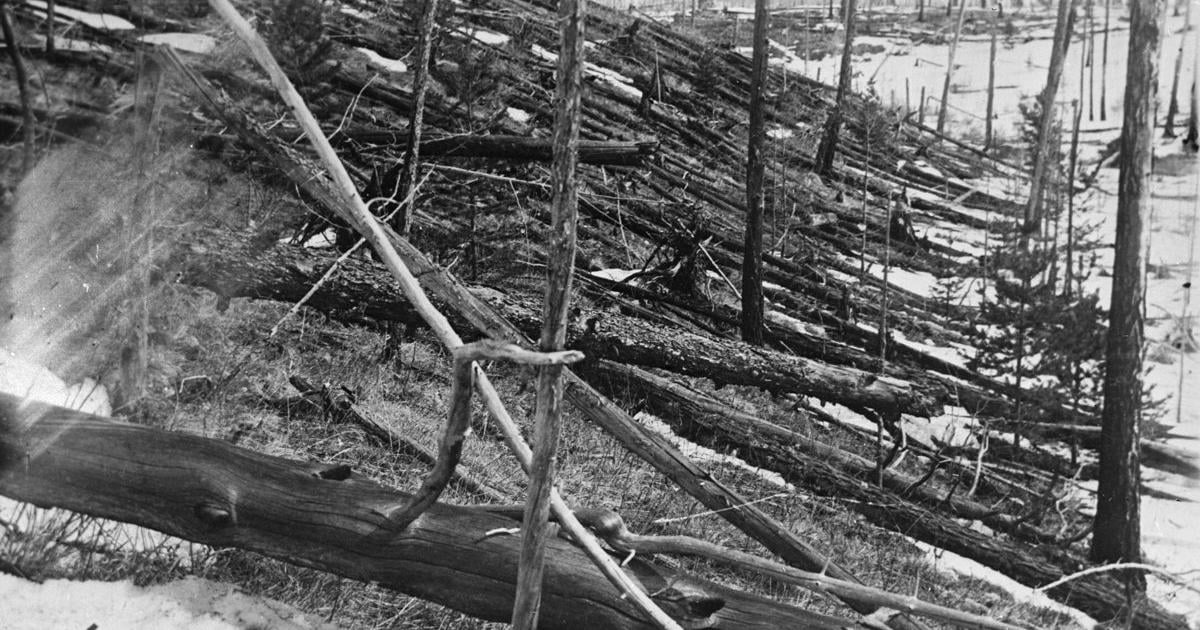
A black and white photograph of a Siberian forest with many tree trunks lying flat on the ground and a few bare, broken trunks still standing

Trees knocked down by the Tunguska explosion, photographed in May 1929 during Leonid Kulik's expedition, nearly 21 years after the blast.

Public domain, via Wikimedia Commons

Aris Manus

The Tunguska event was one of the most studied explosions of the 20th century, a blast over the Siberian forest on June 30, 1908, that flattened trees across a remote river basin. More than a century later, a scientist has asked whether its "Evil Twin" could return on Halloween 2026. But is anything actually heading toward Earth this Halloween?

A Headline Written to Scare

The question comes from Mark Boslough of the Department of Earth and Planetary Sciences at the University of New Mexico. His abstract, "Will Tunguska's Evil Twin Return on Halloween 2026? Science and Skepticism in a Clickbait World," appears in the Geological Society of America's Abstracts with Programs for 2026 and was scheduled for October 11, 2026, in a session on "Myths and Misrepresentations surrounding Cosmic Impact claims."

The opening paragraphs of the abstract are written like a tabloid story, asking whether the Tunguska object had "an unseen companion that missed the Earth in 1908" and whether this companion is "on its way back to finish the job." They describe the Taurid meteor stream, the source of the so-called "Halloween fireballs," and note that one published model places a swarm of debris in an approximate 61-year resonance with Earth.

However, the abstract then turns on itself, and Boslough explains what the reader has just been through:

"The previous paragraphs of this abstract are written in clickbait style. The idea of a dark Tunguska companion is pure speculation."

In the same abstract he adds that the Tunguska object's encounter with Earth came six years before the hypothetical swarm, and "there is no theoretical basis for it to have the same resonant period." The abstract says the presentation would weigh "arguments, pro and con, about whether we should try to exploit the clickbait industry to provide accurate scientific and skeptical information to the public."

What Happened at Tunguska in 1908

According to a NASA history article, the blast came at about 7:15 am local time. Evenki reindeer herders described "a fireball trailing smoke, then a flash brighter than the Sun, followed by a loud noise like thunder." Because the region was so sparsely populated, NASA notes that "very few human casualties resulted."

The geologist Leonid Kulik could not reach the site in 1921 and only got there in 1927. Later surveys in the 1950s and 1960s mapped a butterfly-shaped zone of damage covering 830 square miles (about 2,150 square kilometers), "with millions of trees knocked over." NASA adds that Kulik "failed to find physical evidence of the bolide," and that microparticles found by later expeditions "could not be conclusively tied to the blast."

A 2018 workshop at NASA Ames Research Center found that the leading models converged on an energy of 10 to 20 megatons released in an airburst at a height of about 10 kilometers (6 miles). If the object was a stony asteroid like the one that burst over Chelyabinsk in 2013, the report estimates it was roughly 50 to 80 meters (160 to 260 ft) across. Crucially for anyone worried about Halloween, the workshop concluded that "the interval between such events is millennia, not centuries as had been concluded previously."

The Taurids and the Halloween Fireballs

The Taurids are a real and regular part of autumn skies. NASA identifies Comet Encke as the parent of the stream and explains the nickname: "Oftentimes, this particular shower exhibits fireballs on or around Halloween, making them known as the Halloween Fireballs." Fireballs are meteors at least as bright as the planet Venus.

The Royal Observatory Greenwich lists the Southern Taurids as active from September 10 to November 20, 2026, and the Northern Taurids from October 20 to December 10, with an estimated rate of about five meteors per hour at maximum. The observatory describes the showers as providing "a sprinkling throughout the two months."

Ancient Origins has covered the Taurid meteor shower and its fireballs before. The larger question is whether the stream also hides much bigger objects.

The Swarm Question in Peer-Reviewed Work

Boslough has also tackled that question in a peer-reviewed paper. Writing in Acta Astronautica with Peter Brown, David Clark and Paul Wiegert of the University of Western Ontario and Quanzhi Ye of the University of Maryland, he assessed the "Taurid resonant swarm," a proposed cluster of debris linked to Comet Encke and held in a 7:2 resonance with Jupiter.

The team found "no evidence for objects in the Taurid stream that are above the global catastrophe threshold." However, they noted that "the possibility of a few large objects and a significant population of objects the size of the Chelyabinsk or Tunguska bodies has not been eliminated." They also argue that eyewitness accounts and airburst models "suggest that the Tunguska object was a Beta Taurid," a branch of the same stream.

The paper does not point to Halloween 2026 as a time of special danger. Instead, it says that if the swarm holds a significant number of such objects, risk would peak "in November 2032 and June 2036," and it recommends targeted telescope surveys during those passes. His GSA abstract strikes the same note: "There is no evidence for a concentration of large objects, but there is no reason not to search for them in 2032 as a precaution."

Telescope searches have so far turned up little. A survey with the Canada France Hawaii Telescope, reported by Wiegert and colleagues, found results "consistent with no Taurid Swarm members observed," while setting an upper limit on objects 34 to 76 meters across. The same team notes that meteor observations have confirmed the swarm at sizes of a meter and smaller.

When Impact Stories Go Wrong

Gizmodo has described Boslough as an outspoken critic of a different impact idea, the Younger Dryas impact hypothesis, which proposes that comet fragments struck Earth about 12,800 years ago. On August 6, 2025, the journal PLOS One published a study by Christopher Moore and colleagues reporting cometary dust and platinum anomalies in sediment cores from Baffin Bay, near Greenland. When it appeared, Boslough told Gizmodo: "I do not see anything in this new paper that overcomes the chronic and ongoing problems with their previous papers."

On February 11, 2026, the PLOS One Editors retracted the paper. Their notice lists incorrect citations "raising concerns about undisclosed use of AI tools," problems with the radiocarbon calibration that would make the layers younger and "outside the Younger Dryas," and material reported as cosmic spherule fragments that experts "identified as marine foraminifera." The notice concludes:

"In light of the above concerns that call into question the validity of the reported results and the conclusions made, the PLOS One Editors retract this article."

According to the notice, eight of the authors did not agree with the retraction and one did. Ancient Origins reported the Baffin Bay study as support for the hypothesis in an August 11, 2025, article on the Baffin Bay comet debris, which now carries an editors' note pointing readers to the retraction. Readers who want the wider picture can turn to the site's fact check on whether a comet ended the Ice Age and its longer look at the Younger Dryas impact debate.

The Acta Astronautica paper makes the link between the two topics explicit. Its authors write that skepticism toward swarm risk in the planetary defense community stems partly from "misinformation, misunderstandings, and misinterpretations associated with the Younger Dryas impact hypothesis." Still, they argue that the swarm idea "is testable and should not be dismissed just because it has been invoked in association with unsupported claims."

Reading the Next Scary Headline

Boslough's abstract also points out that the scare has an old pedigree. The familiar claim that Tunguska would have destroyed St. Petersburg had it arrived 4 hours and 47 minutes later was, he writes, "a playful, but incorrect, idea first published by astronomer I.S. Astapowitsch in a 1934 version of modern-day clickbait."

So what should a skywatcher take from Halloween 2026? The Taurids will be up there, and a bright fireball is a fine reward for a clear night. However, the sources cited here give no sign of a dark twin of Tunguska returning this week, and the scientists studying the swarm are looking ahead to 2032 and 2036 for their best chance to test it. How many large bodies the Taurid stream really holds is still an open question.

How we label claims

Established: the Tunguska airburst of June 30, 1908, and the annual Taurid meteor showers linked to Comet Encke. Established: PLOS One retracted the Baffin Bay paper on February 11, 2026. Disputed: the Younger Dryas impact hypothesis. Disputed: that the Tunguska object was a Beta Taurid. Unverified: that the Taurid stream holds a significant swarm of Tunguska-sized objects. Unverified: that a dark companion of the Tunguska object will return around Halloween 2026, an idea Boslough himself calls "pure speculation."

By Aris Manus

Sources

The Tunguska Event: Meteor, Antimatter, or Something That Never Made It Home?
The Forbidden Story of The Impact That Reset Humanity

{ https://www.ancient-origins.net/news }

Hoe vind je dit bericht?
Geschreven door peter om 18:36 Stuur door

UK's top UFO expert says government 'hiding truth about aliens' in final ever interview

UK's top UFO expert says government 'hiding truth about aliens' in final ever interview

EXCLUSIVE: He was the UK’s top UFO hunter until his untimely death in April. Now ex-MOD expert Nick Pope speaks out from beyond the grave to accuse the Government of hiding the truth about alien life

Nick said governments know more about UFOs than they are letting on

Nick said governments know more about UFOs than they are letting on

(Image: Sky History)

BY Ashley Pemberton - News Reporter

A top UFO hunter accused the government of hiding the truth about aliens in his final interview before his death. Nick Pope – dubbed the real life Agent Mulder from the X Files – said: “They know there’s more to this than just weather balloons and aircraft lights.”

The former civil servant, who spent three years on the Ministry of Defence’s “UFO desk”, also insisted the world’s leaders know we are not alone in the universe. He made the bombshell claims in an upcoming TV documentary filmed just before his death.

He told presenter Bradley Walsh that during his time investigating the phenomenon of UFOs, he would get hundreds of reports of sightings each year and could confidently explain around 80% of them.

Nick spoke to Bradley Walsh before his death

Nick spoke to Bradley Walsh before his death

(Image: Sky History)

But of the other 20%, he said: “We were not able to find a definitive result. Some of this doesn’t quite add up. Objects running rings around the cutting edge of our own aerospace tech. Speeds, manoeuvres, accelerations we can’t match.

“At the very least, I think it’s fair to say it was enough to make me take another look at this.”

Nick, who died of cancer in April, said he had no interest in extraterrestrial activity until 1991, when he was asked to investigate the phenomena of unidentified flying objects.

Nick Pope was a leading UFO expert

Nick Pope was a leading UFO expert

(Image: Getty Images for A+E Networks)

He was interviewed by comedian and game show host Bradley for his upcoming Sky History show Out Of This World on Sky HISTORY, which starts on Tuesday. In the first episode, Bradley, 66, asks Nick if he thinks we are alone in the universe.

“We are definitely not”, the expert responds. “You know, the universe is nearly 14 billion years old. You’ve only got to imagine a civilisation with a million year, let alone a billion year headstart on us and all bets are off. So life out there, definitely.

“Us being visited, I’m less sure. I certainly hope so, because I tell you this, the world with aliens in it is going to be far more interesting and fun than the world with no aliens. So bring them on.”

Nick believes there is life out there

Nick believes there is life out there

(Image: Getty Images/Science Photo Library RF)

Nick goes on to warn that AI technology could prove a major obstacle for sleuths hoping to prove the existence of extraterrestrials.

He adds: “I think the technology, which you would think works for us, works against us. Now with the rise of AI, you don’t really know if something is real or not.

“This is one of the biggest and most profound questions we can ask as human beings. Are we alone or not in the universe? Are we being visited? If we got an answer to that, it would change the world forever.”

Nick investigated about 1,000 unexplained sightings during his three years on the “UFO desk”.

Nick investigated about 1,000 unexplained sightings during his three years on the “UFO desk”.

(Image: Getty Images/iStockphoto)

Nick, who died shortly after speaking to Bradley, investigated about 1,000 unexplained sightings during his three years on the “UFO desk”.

After the department closed, he moved into the media, commenting on the unexplained, conspiracy theories, science fiction, and fringe science.

In his new show, Bradley says Nick was one of his heroes and he had been due to fly to Washington to meet him, but they were forced to talk over Zoom instead when he became very ill.

Nick Pope speaks out from beyond the grave to accuse the Government of hiding the truth about alien life

Nick Pope speaks out from beyond the grave to accuse the Government of hiding the truth about alien life

(Image: Getty Images/iStockphoto)

The host of ITV game show The Chase is later seen delving into Britain’s declassified Ministry of Defence files. One shows Winston Churchill asked for a report into flying saucers in 1952.

He then heads to Rendlesham Forest, dubbed “Britain’s Roswell”, the scene of the country’s most famous alleged UFO incident.

At one point, he asks: “If people have seen them, and UFOs or aliens have visited, why haven’t people taken notice? Why isn’t it on the News at 10? Are the news corporations keeping it from us? What is going on? I have no idea.

“It’s pretty naive of us to imagine that we’re the only planet sustainable of life in the entire universe. There’s gotta be something out there.” The Ministry of Defence did not respond to a request for comment.

RELATED

Lies and Deception: UFOs and The Secret Agenda | FULL Documentary

{ https://www.dailystar.co.uk/latest/exclusives }

Hoe vind je dit bericht?
Geschreven door peter om 18:11 Stuur door

This Ancient Meteorite Hints at Mars' Warm, Wet Past

This Ancient Meteorite Hints at Mars' Warm, Wet Past

This image shows a group of meteorite hunters in the Sahara Desert. Nomadic people from the region have become expert meteorite hunters, finding hundreds of them, which are typically recovered as groups of fragments. One found in Mali in 2022 has proven to be almost as old as Mars itself, one of the most ancient pieces of Mars ever recovered. Image Credit: University of New Mexico.

This image shows a group of meteorite hunters in the Sahara Desert. Nomadic people from the region have become expert meteorite hunters, finding hundreds of them, which are typically recovered as groups of fragments. One found in Mali in 2022 has proven to be almost as old as Mars itself, one of the most ancient pieces of Mars ever recovered.

Image Credit: University of New Mexico.

Mars is the subject of an ongoing, decades-long effort to understand its past. Its potential ancient habitability drives that effort. More than 20 missions have been sent to its surface (though many didn't survive the entry and landing). Two are operating there currently, Curiosity and Perserverance, and multiple orbiters scan the planet's surface from above.

Clues to Mars' past are in its rock, and the more ancient a piece of rock, the deeper the clues it can contain about the planet's ancient past. Visiting Mars with rovers is only one way to access the planet's rock. Fortunately, some chunks of Mars have been sent to Earth. Violent impacts have sent chunks of Mars rock into space, where they've eventually found their way to Earth as meteorites.

A Martian meteorite named Black Beauty set the standard for ancient meteorites from Mars when it was found in 2011. Most meteorites are found in deserts or in snowy/icy areas simply because they're more easily seen, and Black Beauty (Northwest Africa 7034, or NWA 7034) was found by nomads in the Western Sahara. Portions of it are about 4.43 billion years old, and Mars is about 4.5, maybe 4.6 billion years old. So Black Beauty is extremely ancient.

The Sahara Desert has yielded other ancient Martian meteorites, including Teghaza 001 (Teg 001), found in Mali in 2022. New research uncovered some unusual properties in Teg 001, and they're presented in new research.

The research is titled "A Martian meteorite that formed ≳4.1 billion years ago samples Mars’ early crust and mantle," and it's published in the journal Science. The lead author is Yang Liu from NASA's Jet Propulsion Laboratory at the California Institute of Technology. Scientist Carl Agee, director and curator at the University of New Mexico’s Institute of Meteoritics (IOM), also played a leading role in the work.

"This sample probably came from an environment on Mars that was more Earth-like." - Carl Agee, University of New Mexico.

(A) shows the largest of the eight pieces of Teg001. (B) shows a cut section of a smaller chunk. Image Credit: Yang Liu et al., A Martian meteorite that formed ≳4.1 billion years ago samples Mars’ early crust and mantle. Science0,eadz5646DOI:10.1126/science.adz5646

(A) shows the largest of the eight pieces of Teg001. (B) shows a cut section of a smaller chunk. Image Credit: Yang Liu et al., A Martian meteorite that formed ≳4.1 billion years ago samples Mars’ early crust and mantle.

Science0,eadz5646DOI:10.1126/science.adz5646

Ancient meteorites are rare finds and they're extremely valuable scientifically.

"Martian meteorites provide a record of the planet’s geological history," the authors explain in their research. "However, most are geologically young samples that are not representative of Mars’ surface, which is dominated by ancient rocks."

Most meteorites are young just because of selection effects. Meteorites are launched into space by impacts, and that favours young rocks, which are stronger. So meteorites tend to come from younger, basaltic volcanic rocks. More ancient parts of Mars crust are weaker because they're fractured and brecciated by impacts. Some ancient rocks are also sedimentary or clay-bearing rock. These rocks are weaker and much less likely to survive an impact that can launch them into space.

Teghaza is one of the rare ancient Martian meteorites.

"We describe the Martian meteorite Teghaza 001 (Teg 001), a slowly cooled igneous rock that formed at least 4.1 billion years ago," the authors write. "Its composition, mineralogy, and texture are distinct from other Martian meteorites." Distinct from other Martian meteorites, but also similar to likewise ancient Black Beauty.

“I realized that this one was a little bit like Black Beauty, not exactly, but it resembled it in the oxygen isotope values,” Agee said in a press release. "I looked at it microscopically and found domains within it that had high levels of manganese oxide, a compound being looked for on Mars by the rovers as an indicator of environments conducive to life.”

MSL Curiosity found rock fractures in Gale Crater that were filled with material rich in MnO. It suggests, but doesn't prove, that the planet's atmosphere once had free oxygen and oxygen-rich groundwater. That's still being debated.

Lead author Yang Liu and other Caltech scientists used a dating technique to find the age of tiny zircon crystals in Teg 001. Zircon crystals are important finding the age of ancient rocks because they can survive geological processes. They also contain trace amounts of elements with long half-lives. This is how Liu determined that Teg 001 is 4.1 billion years old. "We conducted ten measurements of U and Pb isotopes, in six shocked zircon grains with different morphologies, to determine their U-Pb and Pb-Pb ages," the authors explain.

Though Black Beauty is also ancient, the pair of meteorites are quite different from one another.

“There are a few parts to Black Beauty that are around that age, but that whole meteorite itself is a conglomeration of many different rock types. Teghaza 001 is just one unadulterated rock type, and it's 4.1 billion years or older, so that was a big surprise,” said Agee. “It's the oldest Martian igneous rock ever found by a huge margin, but in addition to that, it seemed to have these clues in its composition that suggested it had been in an environment that had fluids and water coursing through it.”

Teghaza 001 was found in several chunks adding up to almost 800 grams. Unlike Black Beauty, which is a congolomeration of different chunks, Teg 001 is a single rock type. Image Credit: UNM.

Teghaza 001 was found in several chunks adding up to almost 800 grams. Unlike Black Beauty, which is a congolomeration of different chunks, Teg 001 is a single rock type.

Image Credit: UNM.

The isotope Oxygen-18 indicated that it had interacted with water in the past, most likely on the Martian surface. "The high δ 18O value of Teg 001 probably reflects assimilation of δ18O-rich crustal material that had interacted with surficial fluids, or direct reaction of the magma with high-δ18O fluids," the authors write. That finding supports the hypothesis that Mars was once warm and wet, a hypothesis supported by a growing body of evidence.

“We also had these anomalous oxygen isotopes, and these domains that had high manganese levels, Agee said. "All of that was consistent with it being from a time on Mars, from the very, very beginning when the Martian environment was different from the time in which most of the Martian meteorites that we see were formed and erupted a few 100 million years ago when Mars was a dry desert, just like it is now. This sample probably came from an environment on Mars that was more Earth-like.”

This image shows a cut section of Teg001, with some of its features and contents labelled. Pigeonite (PgT) is particularly relevant, because it hosts fluid-altered Magnesium. "The Mg-rich interiors of pigeonite have been heavily altered by reactions with a fluid phase," the authors write. Image Credit: Yang Liu et al., A Martian meteorite that formed ≳4.1 billion years ago samples Mars’ early crust and mantle. Science0,eadz5646DOI:10.1126/science.adz5646

This image shows a cut section of Teg001, with some of its features and contents labelled. Pigeonite (PgT) is particularly relevant, because it hosts fluid-altered Magnesium. "The Mg-rich interiors of pigeonite have been heavily altered by reactions with a fluid phase," the authors write. Image Credit: Yang Liu et al., A Martian meteorite that formed ≳4.1 billion years ago samples Mars’ early crust and mantle.

Science0,eadz5646DOI:10.1126/science.adz5646

Mars' early, potentially more Earth-like time period is called the Pre-Noachian period. Planetary scientists struggle to paint a clear picture of the Pre-Noachian because it was so long ago, and geologica processes and weathering have erased much of the ancient. Some research shows that Mars may have had global oceans during this period, a stunning difference from the frigid, dessicated planet it is today.

It's possible that billions of years ago, Mars had a global ocean, as shown in this illustration. That could explain the aqueous alteration in Teg001. Image Credit: By Ittiz - Own work, CC BY-SA 3.0, https://commons.wikimedia.org/w/index.php?curid=7861829

It's possible that billions of years ago, Mars had a global ocean, as shown in this illustration. That could explain the aqueous alteration in Teg001.

Image Credit: By Ittiz - Own work, CC BY-SA 3.0, https://commons.wikimedia.org/w/index.php?curid=7861829

It's possible that Mars still has some simple, extant life. If it does, that life is hiding somewhere underground where the last of the planet's ancient water might be sequestered, away from the harsh radiation on the surface. But if the emerging picture of an ancient, warm and wet Mars is true, that would be the Pre-Noachian.

“If there was ever abundant life on Mars, on the surface, not sequestered away in some subsurface, that would be the time that you would be looking at, the Pre-Noachian period,” said Agee. “It's the very earliest time, and that was when maybe Mars still had a magnetic field, and it was shielded from radiation, and there were surface waters. There was a denser atmosphere. If primitive life was abundant in Mars. That is the time that is most likely for it to have happened.”

Most Martian meteorites are much younger than Teg001, only a few hundred million years old. It likely came from a place no rover has visited, possibly from Mars' southern highlands. Remote sensing shows that that ancient region has a similar composition to Teg001.

“This is just one single meteorite. It's like going out, going back in time and chipping off a hunk of an outcrop, 4 billion years ago on Mars, and then we have this example of what was actually happening,” said Agee. “That is why it's such a valuable sample. We’ve never found one like this before. The most exciting part about this find is its age, plus the alteration in the meteorite that indicates it has been in what I would call an Earth-like environment, with fluids coursing over the surface and volcanoes creating hydrothermal systems. There are surface waters and so on. And that's all reflected in the way that the meteorite has been sort of altered from its original state.”

"The presence of aqueously altered minerals, combined with bulk and mineral-specific oxygen isotope measurements, indicate that Teg 001 experienced reactions with fluids enriched in 18O, before ejection into space by an impact," the authors summarize in their paper.

RELATED

How Scientists Proved These Rocks Came From Mars.

{https://www.universetoday.com/ }

Hoe vind je dit bericht?
Geschreven door peter om 17:47 Stuur door

Examining the Cat's Head Nebula with the Hubble and JWST

Examining the Cat's Head Nebula with the Hubble and JWST

The Cat's Head Nebula proudly rises in this Hubble Space Telescope image. It's a star-forming region within the larger Carina Nebula, an even larger star-forming region. Recently, both the Hubble and the JWST imaged the Cat's Head as part of the ongoing scientific effort to understand the complex process of star formation. Image Credit: NASA, ESA, STScI. Image Processing: J. Depasquale (STScI).

The Cat's Head Nebula proudly rises in this Hubble Space Telescope image. It's a star-forming region within the larger Carina Nebula, an even larger star-forming region. Recently, both the Hubble and the JWST imaged the Cat's Head as part of the ongoing scientific effort to understand the complex process of star formation.

Image Credit: NASA, ESA, STScI. Image Processing: J. Depasquale (STScI).

The Cat's Head nebula gets its name from its appearance: it looks like a cat sitting so that it's facing away from the viewer, with its head turned around on the top of its neck, highlighted by a star that looks like a glowing eye. The unusual shape is made of gas and dust carved and formed by the radiation of young stars.

It's a small part of the larger Carina Nebula, a complex star-forming region about 7,500 light years away. Recently, both the Hubble and the JWST cast their gaze on the Cat's Head in an effort to learn more about star formation, a constant research subject in astronomy.

The Carina Nebula hosts some of the most massive stars in the entire Milky Way in its Carina OB1 assocation. Of particular interest is Eta Carinae, a stellar system that hosts many stars, two of which have a combined luminosity more than 5 million times greater than the Sun. Eta Carinae is also known for being at the heart of the eerily creepy Homunculous Nebula, not visible in these images. Massive stars like the ones in Eta Carinae and their powerful radiation have a pronounced effect on the region, and on star formation itself.

Hubble's image of the Cat's Head is in visible light, while the JWST imaged it in both near and mid-infrared. Each of the images shows a different aspect of the Cat's Head.

The pillar that makes the Cat's Head is composed of thick, dark dust, so far resisting the onslaught of stellar wind and radiation from massive stars. The yellow outline on its right side is likely where photoevaporation is taking place, driven by the same powerful stars. The UV radiation is ionizing the gas on the rim, and will eventually evaporate it completely.

In astronomy images like these, different filters isolate different chemicals like sulphur, oxygen, and hydrogen. The ionization level of the chemicals, along with how highly they're energized and how much dust is present, all affect the colours. Whether we know which colours represent which chemicals or not, these images are awe-inspiring.

The massive stars in the region are also responsible for the arcs and shoals in the images, again caused by their powerful radiation and stellar winds.

This zoomed-in portion of the Hubble's image highlights the "eyeball", likely a star in just the right position. Image Credit: NASA, ESA, STScI. Image Processing: J. Depasquale (STScI).

This zoomed-in portion of the Hubble's image highlights the "eyeball", likely a star in just the right position.

Image Credit: NASA, ESA, STScI. Image Processing: J. Depasquale (STScI).

The JWST, as an infrared telescope, presents different, yet no less gorgeous, images of the Cat's Head. It's infrared instruments see things differently than the Hubble does. This gives the Cat's Head—already ethereal in the Hubble image—an even more ghostly, almost unreal appearance. Some parts of the Cat's Head in the JWST images appear to be only half-there, with background stars shining brightly through them.

weic2622c_20261029_192815.jpg

The JWST's near-infrared image doesn't show different chemical elements the same way the Hubble image does. Instead, it shows more of the stars themselves. Even background galaxies are visible beyond the Cat's Head, along with the black background of space. The JWST also shows how massive stars are shaping the region, with the wispy filaments on the images left side.

Image Credit: NASA, ESA, CSA, STScI. Image Processing: J. Depasquale (STScI)

Some of the turbulence in the gas, driven by the massive stars, appears more substantial in the JWST image. The star that makes the Cat's Eye is also brighter, with less of its light blocked by dust in infrared.

A zoomed-in JWST NIR image of the head in the Cat's Head Nebula. Image Credit: NASA, ESA, CSA, STScI. Image Processing: J. Depasquale (STScI)

A zoomed-in JWST NIR image of the head in the Cat's Head Nebula.

Image Credit: NASA, ESA, CSA, STScI. Image Processing: J. Depasquale (STScI)

In the JWST's mid-infrared image, the Cat's Head Nebula is transformed yet again. It's muted and ghost-sheet white, surrounded by pastel gas clouds punctuated with stars. The clouds look almost Earth-like in their white colour. This time, it's carbon molecules and warm dust emissions that take the stage. What is most likely an infant star pops into view in this image, embedded in thick dust that it's yet to dissipate, to the right of the head itself.

The white colour of the gas in this mid-infrared JWST image makes it look like Earthly clouds. Fewer stars are visible in the background, their light blocked out by the gas, which appears thicker. In the gas to the left, finer detail is visible in the gas clouds. Image Credit: NASA, ESA, CSA, STScI. Image Processing: J. Depasquale (STScI).

The white colour of the gas in this mid-infrared JWST image makes it look like Earthly clouds. Fewer stars are visible in the background, their light blocked out by the gas, which appears thicker. In the gas to the left, finer detail is visible in the gas clouds.

Image Credit: NASA, ESA, CSA, STScI. Image Processing: J. Depasquale (STScI).

The head itself is muted in the MIR image, along with the rest of the nebula. It's eye, almost malevolent in the other images, blends in with the gas and is less striking.

In this zoom-in of the MIR image, the edges are softened, and so are the colours. The star that makes they eye blends in with the gas in gradients of white. Globules below the head look like they're reaching for the head, rather than being blown back by stellar wind and radiation. The blackness of space is visible in the upper right, and a little in the upper left. Image Credit: NASA, ESA, CSA, STScI. Image Processing: J. Depasquale (STScI).

In this zoom-in of the MIR image, the edges are softened, and so are the colours. The star that makes they eye blends in with the gas in gradients of white. Globules below the head look like they're reaching for the head, rather than being blown back by stellar wind and radiation. The blackness of space is visible in the upper right, and a little in the upper left. I

mage Credit: NASA, ESA, CSA, STScI. Image Processing: J. Depasquale (STScI).

Though these images are easy to appreciate by almost anyone, their primary purpose is scientific. By emphasizing and de-emphasizing different aspects of the Cat's Head nebula, astronomers can see stars more clearly, along with the dust, the gas, and the chemistry. Together, they help researchers see the effects of stellar radiation and wind, called stellar feedback, on the ongoing process of star formation.

Stellar feedback can both encourage and stifle star formation, depending on circumstances. It's complicated, and it's an ongoing topic of astronomical study. One of the JWST's main, defining science themes is star formation, and images like these are one of the reasons it was built. The Hubble helps too, and illustrates how the gas, the dust, the metallicity, and the stars of different sizes and ages, all play a role. Those factors all interact in different ways, making it difficult to come up with concrete theories of how it all works.

These gorgeous images are more than eye candy to astronomers. They're working hard on understanding a process fundamental to the cosmos. Wrapped up in all this visual chaos and beauty, Nature's laws are defining how stars form. Astronomers' mission is to decipher it all.

Enjoying these images on their visual merit alone is our mission, if we accept it.

{https://www.universetoday.com/ }

Hoe vind je dit bericht?
Geschreven door peter om 17:23 Stuur door

Triangle UFO Seen From Plane Over Utah, USA Oct 18, 2026, UAP Sighting News.

Triangle UFO Seen From Plane Over Utah, USA Oct 18, 2026, UAP Sighting News.

UFO_UAP.png

UAP_Utah.png

Date of sighting: Oct 18, 2026
Location of sighting: Utah, USA
Source: NUFORC
 
What looks like three glowing lights in the sky outside a passanger jet is actually one single triangle UFO. The lights are the glow of the anti propulsion systems...three of them, one on each corner of the craft. Bob Lazar who worked in area S4 of the secure Air Force Base Area 51 often stated that most small UFOs had three anti gravity units that sometimes glowed which propelled the craft. Here...we see all three very well. This is some serous alien technology right outside the passenger jet. How it didn't show up on radar is beyond me, but alien tech never stops surprising me at what it can do.
Scott C. Waring - UFO Sightings Daily 
 
Eyewitness states: 
On SW flight #2927. During the sightings flight was at or around 32,000 feet. About 30 minutes from landing in Las Vegas. Traveling at or around 487mph.3 lights. Looked like stars. 2 bright white lights moving in circle like fashion around the reddish light. This went on for several minutes. The lights would appear and disappear. Also, during these events, a dark triangle like craft with several small lights travelled east / north east which was counter to the direction of my travel.
That craft was moving at a speed unlike anything I have seen before, having seen many planes moving in the sky around a plane I was on. I have no way to estimate its speed or distance. It appeared large and much closer to my location that the lights. I approached the pilot upon landing, and he did not have much to say about the lights. The response to the craft I saw was only that it did not appear on his instrumentation. That craft could have been a stealth bomber. It seemed to have that characteristic.
Triangle UFO Seen From Plane Over Utah, USA Oct 18, 2026, UAP Paranormal Alien Sighting News.

{ https://www.ufosightingsdaily.com/  }

Hoe vind je dit bericht?
Geschreven door peter om 17:06 Stuur door

Ejection Pods Found On Mars, Fits Figures Size, Were They natives To Mars Or Just Lost? UFO UAP Sighting News

Ejection Pods Found On Mars, Fits Figures Size, Were They natives To Mars Or Just Lost? UFO UAP Sighting News


Mars_life.png
Mars_pod.png
 
Date of discovery: Oct 31, 2026
Location of discovery: Mars
Source photo:
 
Hey all, hope you had a great week. I found something the appears to be an escape pod from an alien spaceship on Mars. Near it is another one, but larger and the door is still unopened...which means they died on impact or never had time to get into the pod before it was ejected. The door is similar in size and shape as the pod on its side with an open door. These pod doors are about the same size as the woman figures we have been finding on Mars. We found many figures, but I show you two in my video as an example. I wonder...if they were not native to Mars, but just in a ship in orbit near Mars and escaping a dying ship, landing on Mars only to be left...lost on a planet with no hope of survival? 
Scott C. Waring - UFO Sightings Daily 
 
{ https://www.ufosightingsdaily.com/  }
Hoe vind je dit bericht?
Geschreven door peter om 16:59 Stuur door

UFOs could be hiding in our oceans, says retired US Navy admiral... as researcher claims to have discovered 'alien base entrance' off Canada

UFOs could be hiding in our oceans, says retired US Navy admiral... as researcher claims to have discovered 'alien base entrance' off Canada

Humanity has yet to make contact with aliens, and a retired US Navy Admiral has proposed a radical reason why: they are hiding in our oceans.

Tim Gallaudet, a former acting administrator of the National Oceanic and Atmospheric Administration (NOAA), recently explained why Earth's deep ocean may be the perfect hiding spot.

Speaking on the Hang Out with Sean Hannity podcast, Gallaudet said: 'If they were to go somewhere basically to not be detected for a period of time... where would you want to go?

'You'd want to go... [to] the most unexplored area of the world, and that's the ocean.' 

After decades of studying the ocean, Gallaudet believes its largely uncharted depths could conceal phenomena that have so far escaped detection. 

'We've only explored with either drones, buoys [or] floats, about 10 percent of ocean volume,' Gallaudet said. 'So there's a lot of mystery out there right now.' 

His comments come as a UFO researcher claims to have found an entrance into an underwater alien base off the coast of Canada.

Scott C Waring uncovered a mysterious hole in the waters surrounding Nunavut, which he claimed was more than 3,000 feet across and about 32 feet below the surface.

A retired US Navy admiral claimed that UFOs could be hiding under Earth's ocean amid a claim that an alien base has been identified in waters off the coast of Canada

A retired US Navy admiral claimed that UFOs could be hiding under Earth's ocean amid a claim that an alien base has been identified in waters off the coast of Canada

During the interview, Gallaudet highlighted a video he claimed showed mysterious objects moving underwater before jumping out to the surface.

'It goes into the ocean, no disturbance,' Gallaudet told Sean Hannity during the podcast. 

'I'm aware of another video that shows something similar, but from overhead... so yeah, there's something that they've been able to engineer that we have no idea how to reproduce,' he added. 

Gallaudet claimed the objects could break the sound barrier without the thunderous boom that normally accompanies supersonic flight, a feat he said defies explanation with current technology. 

He testified under oath before Congress in 2024, claiming there was a 2015 incident involving near-midair collisions with UFOs during a carrier strike group exercise and the subsequent disappearance of an urgent email report about the event.

The former admiral also asserted that Earth is visited by non-human intelligence utilizing advanced technology with extraordinary flight and transmedium capabilities. 

While Gallaudet has never provided locations where UFO bases could be hiding, Waring believes he has found the entrance to one. 

'I found an entrance to an underwater alien base, and it's in the most remote area of northern Canada that one could go,' Waring posted on his site UFO Sightings Daily.

Tim Gallaudet, a former acting administrator of the National Oceanic and Atmospheric Administration (NOAA), recently explained why Earth's deep ocean may be the perfect hiding spot.

Tim Gallaudet, a former acting administrator of the National Oceanic and Atmospheric Administration (NOAA), recently explained why Earth's deep ocean may be the perfect hiding spot.

UFOs (UAPs) Are Hiding In Deep Oceans! A Researcher Calls To Explore Deep Waters ‪@TheCosmosNews‬

'It's a huge tunnel for aliens to enter and exit, totally unseen in such a remote area.'

A remotely operated or autonomous underwater drone could explore the suspected tunnel and record any signs of alien life, Waring suggested. 

The proposed mission could last several days before the craft returned with its footage.

Such technology, he argued, could reach depths too dangerous for humans to explore in person. 

Waring said the venture could even open a direct line of communication between the public and extraterrestrials.

Similar claims about underwater UFOs have been presented by David Grusch, a former intelligence officer who now assists lawmakers with UFO transparency.

Grusch also testified under oath in 2023 that the US government possesses multi-decade secret programs recovering and reverse-engineering crashed non-human spacecraft.

Earlier this month, he told Joe Rogan that officials are aware of at least one giant underwater facility used by extraterrestrials as a 'base of operations' for their craft.

'I'm going to be careful because it gets into sensitive Navy underwater things,' Grusch said.

'There's clearly some sort of base of operations in certain locations. It's large. Don't know when it got there... Like multiple city-block-type stuff.'

He added that 'stuff comes and goes' from the base.

Grusch also claimed that his information came from files on top-secret programs, videos and confessions from government and military insiders.

However, the US military and the White House have maintained for decades that no physical evidence has been found that proves UFOs and alien life exist.

RELATED

UFO Experts On Existence Of Underwater Alien Bases On Earth Probe | Shocking UFO Hearing LIVE | N18G
A Former Navy Admiral Thinks UFOs May Be Hiding in Earth's Oceans.
Why UFOs Are Hiding In Our Oceans & How The CIA Trained Psychic Spies | Admiral Tim Gallaudet

{ https://www.dailymail.com/sciencetech/index.html }

Hoe vind je dit bericht?
Geschreven door peter om 15:52 Stuur door

Roman Space Telescopes: Which Observatories Will Uncover the Universe’s Next Mysteries?

Roman Space Telescopes: Which Observatories Will Uncover the Universe’s Next Mysteries?

Humanity has never had more powerful tools for space exploration. The Hubble Space Telescope has revealed remarkable details of distant galaxies, the James Webb Space Telescope has enabled us to observe the early universe, and the upcoming Nancy Grace Roman Space Telescope mission is set to produce one of the most comprehensive maps of the cosmos. Given these advances, what more could astronomers possibly need?

Indeed, the most significant discoveries may still lie ahead. NASA, ESA, and other space agencies are developing a new generation of observatories designed to search for life on other planets, investigate previously unexplored regions of space, and look back toward the earliest moments of the universe.
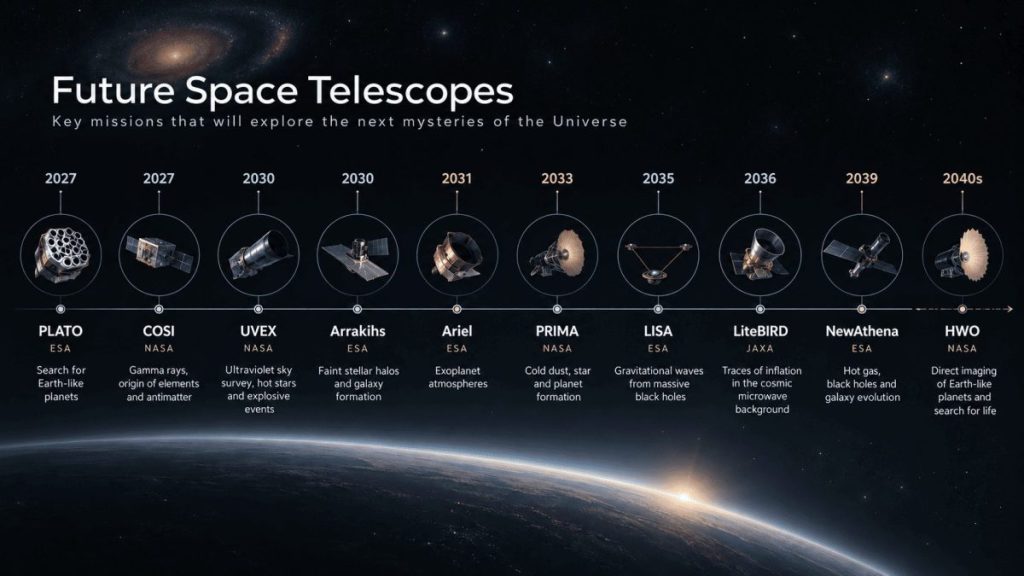
eng-1-1024x576.jpg

A timeline of planned space telescope launches by NASA, ESA, and JAXA from 2027 through the 2040s. The infographic outlines the primary scientific objectives of these future observatories, including the search for Earth-like planets and the study of black holes, gravitational waves, and the early universe.

Source: UST

Why are even the most powerful telescopes insufficient?

On August 30, 2026, NASA launched the Nancy Grace Roman Space Telescope. Its primary mission extends beyond capturing striking images of distant galaxies; it is designed to survey the universe on an unprecedented scale. With its wide field of view, the telescope will be able to observe hundreds of millions of galaxies, search for exoplanets, and study the distribution of dark matter.

However, even Roman, James Webb, and Hubble, collectively, cannot answer all of astronomy’s fundamental questions.
stsci-01febr8scwtrv07xv8we8a9aqb.jpg

The infographic presents the ranges of the electromagnetic spectrum in which various astronomical observatories operate, from gamma-ray and X-ray radiation to infrared light and radio waves. It also illustrates which types of radiation are absorbed by Earth’s atmosphere and explains why some telescopes must be launched into space to study them.

Source: NASA

The issue is not solely the size of the mirrors or the sensitivity of the cameras. The universe emits information across various bands of the electromagnetic spectrum, while the human eye can perceive only a limited portion of it: visible light. Infrared telescopes can detect cooler objects and observe through some cosmic dust; ultraviolet telescopes can study hot stars; and X-ray telescopes can observe extremely high-energy processes near black holes.

Each of these instruments has inherent physical limitations. Accordingly, the next stage in the development of astronomy will depend less on creating a single, universal, ultra-powerful telescope and more on establishing an integrated network of specialized observatories.

  • The first major challenge facing this system is connected to a question that has captivated humanity for millennia: Are we alone in the universe?

PLATO: The Search for Earth-Like Planets [2027]

Astronomers have now identified thousands of planets beyond the Solar System. However, most differ substantially from Earth. Many are gas giants, extremely hot worlds, or planets that orbit very close to their stars. Identifying a genuinely Earth-like planet is considerably more challenging.

One of the most effective methods for detecting exoplanets is the transit method. When a planet passes in front of its star, it blocks a small fraction of the star’s light. A telescope can detect a brief decrease in brightness, which may indicate the presence of a planet. However, Earth blocks only about 0.0084% of the Sun’s light. This illustrates the precision required to measure the brightness of a distant star and detect such a subtle change.

A further challenge is that Earth completes one orbit around the Sun each year. To reliably detect a comparable planet, it is best to observe several of its transits, which requires monitoring the same star for years. The European Space Agency developed the PLATO telescope specifically for this purpose, and it is scheduled to launch in March 2027.
1920px-artists_impression_of_plato.jpg

The European Space Agency’s (ESA) PLATO space telescope is equipped with 26 cameras, enabling it to observe thousands of stars simultaneously. Its primary mission is to search for Earth-like exoplanets, particularly in regions where liquid water may be present.

Source: ESA

Unlike traditional telescopes equipped with a single primary camera, PLATO will utilize 26 separate cameras. Together, these cameras will observe a vast number of stars, monitoring them for characteristic changes in brightness. However, the mission’s objectives extend beyond the discovery of planets. PLATO will also study the subtle fluctuations within the stars themselves. By analyzing these oscillations, astronomers will be able to determine the stars’ sizes, masses, and ages with greater accuracy. In combination with ground-based observations, this information will help assess the properties of the discovered planets.

As a result, we will gain not only a list of new worlds but also a substantially clearer understanding of how frequently rocky planets form around Sun-like stars.

  • This raises the following question: Even if we identify a planet the size of Earth, how can we determine whether it is habitable?

Ariel: What Are the Atmospheres of Other Worlds Composed Of? [2031]

Two planets may be nearly identical in size yet exhibit markedly different surface conditions. The Solar System provides a clear example: Earth and Venus are similar in size, but Venus’s dense atmosphere generates an exceptionally strong greenhouse effect. Consequently, its surface temperature is significantly higher than Earth’s.

Therefore, understanding the planet’s dimensions alone is insufficient; its atmosphere must also be studied. To this end, ESA is developing the Ariel space telescope, which is currently scheduled to launch in 2031.
aryel-2.jpg

An artist’s rendering of the European Space Agency’s (ESA) Ariel space telescope. By analyzing starlight as it passes through an exoplanet’s atmosphere during transit, the telescope will detect the presence of water vapor, methane, and other gases.
Source: ESA

Its primary instrument will be spectroscopy. When a planet transits its host star, a small fraction of the star’s light passes through the planet’s atmosphere. Molecules of various substances absorb light at characteristic wavelengths, producing distinctive chemical signatures in the spectrum. These signatures enable astronomers to detect water vapor, carbon dioxide, methane, and other atmospheric components.

The James Webb Space Telescope is already employing similar methods; however, Ariel is being developed to systematically study approximately one thousand exoplanets. This will enable comparisons of the atmospheres of planets with different sizes, temperatures, and ages.

The primary objective is to understand the patterns underlying their formation and evolution.

  • However, Ariel will primarily study relatively warm planets with atmospheres suitable for spectroscopic measurements. Searching for potential signs of life on truly Earth-like planets will require an even more sophisticated instrument.

Habitable Worlds Observatory: A Telescope That Will Search for Life (~2040)

Imagine attempting to observe a firefly beside a powerful spotlight located many kilometers away. This is approximately what it is like to photograph an Earth-like planet directly near another star.

In visible light, Earth is approximately ten billion times fainter than the Sun. Consequently, even when a telescope can detect the planet’s light, the star’s radiation overwhelms it. One potential solution is a coronagraph, an optical instrument that suppresses the star’s bright light, enabling the detection of much fainter light from a nearby planet. An experimental coronagraph has already been installed on Roman; however, its capabilities are insufficient for studying Earth-like worlds.

For this reason, NASA is developing the Habitable Worlds Observatory (HWO) concept — a future space observatory specifically designed to search for and study planets that may be capable of supporting life. Its optical system must maintain exceptional image stability. Even microscopic mirror deformations or structural vibrations can generate stray light that obscures the planet’s signal.
habitable_worlds_observatory_ultra-stable_telescope_svs20400_-_ultrastabletelescope_prores_00877_print.jpg

An artist’s rendering of NASA’s future Habitable Worlds Observatory (HWO). With its high-precision optics and ability to block the bright light emitted by stars, the telescope will be capable of directly observing Earth-like exoplanets and studying their atmospheres for potential signs of life.

Source: habitableworldsobservatory

Therefore, engineers must integrate high-precision optics, active wavefront control, and highly sensitive detectors. If the technology performs as intended, the HWO will be capable of directly observing rocky planets and analyzing the composition of their atmospheres. Oxygen, ozone, methane, and other substances that may, under certain conditions, be associated with biological processes will be of particular interest. However, detecting oxygen alone will not provide definitive evidence of life, as some chemical substances can form in the absence of living organisms. Accordingly, astronomers will need to assess the full range of atmospheric conditions.

HWO remains in the conceptual design and key technology development phase. It may be launched in the 2040s; however, no date has been set.

At the same time, the ground-based Extremely Large Telescope is expected to help address several of these complex challenges in the coming years. Its primary mirror, measuring 39 meters (128 feet) in diameter, will comprise 798 segments designed to function as a single optical surface. An adaptive optics system will compensate for atmospheric distortion by adjusting the shape of a specialized mirror approximately one thousand times per second.

The ELT’s initial scientific observations are expected to commence in late 2030. It will be capable of studying individual planets and their atmospheres in detail, thereby complementing the capabilities of space-based observatories.

  • However, to determine how common habitable worlds are, we must answer one additional question: where does the material from which they are formed originate?

PRIMA: An Overview of the Birthplaces of Stars and Planets [~2033]

Stars and planets form within vast clouds of gas and dust. However, the dust itself often hinders astronomers’ ability to observe these processes. Dust particles absorb visible light and re-emit the absorbed energy in the infrared spectrum. Consequently, a region that appears nearly black in a conventional photograph may appear bright when viewed through an infrared telescope.

The James Webb Space Telescope has already provided a glimpse into many such regions. But even it does not cover the entire infrared spectrum. The coldest dust clouds emit a significant portion of their energy in the far-infrared range, which is beyond the reach of Webb’s instruments. This is where a significant gap exists between the capabilities of modern infrared and radio observatories.

To address this, NASA is developing PRIMA, the PRobe far-Infrared Mission for Astrophysics.
prima.jpg

An artist’s rendering of NASA’s planned PRIMA (Probe Far-Infrared Mission for Astrophysics) space observatory. The telescope will explore the universe in the far-infrared spectrum, enabling the study of cold gas and dust clouds where stars and planets form, as well as regions of galaxies obscured by dust.

Source: PRIMA

In September 2026, the agency selected this mission to proceed to the next phase of design. Subject to further approval, the project is tentatively scheduled for launch in 2033. The telescope, equipped with a mirror approximately 1.8 meters (5.9 feet) in diameter, will study cold dust, gas, and obscured regions of galaxies. This research will help advance our understanding of how new stars form from interstellar matter, how protoplanetary disks evolve, and the role that water and complex chemical compounds play in the early stages of planet formation.

However, temperature is not the sole reason celestial objects remain invisible. Conversely, certain processes are so energetic that they emit light beyond the detection capabilities of optical and infrared telescopes.

COSI and UVEX: Observing Invisible Cosmic Explosions [2027 and 2030]

Not all cosmic processes are observable in visible or infrared light. For instance, hot stars and the early stages of supernova explosions are especially luminous in the ultraviolet spectrum. To study these phenomena, NASA plans to launch the UVEX (UltraViolet EXplorer) telescope in 2030. The telescope will survey the ultraviolet sky and rapidly reorient itself in response to transient cosmic events, including the aftermath of neutron star mergers.

Even higher-energy radiation will be studied by COSI (the Compton Spectrometer and Imager), which is scheduled for launch in 2027. This gamma-ray telescope will help determine where certain chemical elements form in the Galaxy and the origins of positrons — the antiparticles of electrons. When a positron encounters an electron, they annihilate, producing gamma rays that COSI can detect.
cosi_higher_quality.jpg

An artist’s rendering of NASA’s COSI (Compton Spectrometer and Imager) space-based gamma-ray telescope. The observatory will study gamma-ray radiation to determine where certain chemical elements form in the Milky Way and the origins of cosmic antimatter.

Source: COSI

Together, these observatories will enable the study of high-energy processes that are beyond the capabilities of conventional telescopes. However, another challenge remains equally important: detecting the extremely faint matter surrounding galaxies.

Arrakihs and NewAthena: Hidden Features Beyond the Galaxies [2030 and 2039]

Even the most detailed images of galaxies reveal only a portion of their structure. Nearly invisible halos — comprising diffuse gas, dark matter, and faint stellar streams — extend beyond the luminous stellar disks. These halos preserve evidence of ancient collisions and the accretion of smaller galaxies.

To investigate these structures, ESA plans to launch the Arrakihs telescope in 2030. The mission will examine the stellar halos of neighboring galaxies, helping researchers reconstruct their formation histories and test models of dark matter distribution. These observations will complement the large-scale surveys conducted by Roman and Euclid.

However, some ordinary matter exists in a form so hot that it is best observed in the X-ray range. This is precisely what NewAthena — ESA’s future X-ray observatory, scheduled for launch in 2039 — will study. It will investigate gas in galaxy clusters, the growth of black holes, and their effects on the surrounding environment.
newathena.jpg

An artist’s rendering of the European Space Agency’s (ESA) future NewAthena X-ray observatory. The telescope will study hot gas in galaxy clusters and powerful radiation near black holes, contributing to a better understanding of how they grow and influence the evolution of galaxies.

 Source: ESA

However, the most powerful events involving black holes leave traces not only in radiation but also in the very fabric of spacetime.

LISA: Observing the Collision of Black Holes [2035]

In 2015, the LIGO detectors observed gravitational waves from a black hole merger for the first time. These waves are disturbances in spacetime that propagate at the speed of light. However, ground-based facilities cannot effectively detect the lowest frequencies of these oscillations because of terrestrial noise and the interferometers’ size limitations.

To investigate these phenomena, ESA is developing LISA — the Laser Interferometer  Space Antenna — which is scheduled for launch in 2035. The mission will comprise three spacecraft arranged in a triangle, with sides approximately 2.5 million km (1.55 million miles) in length. By exchanging laser beams, the spacecraft will measure minute changes in distance caused by the passage of gravitational waves.
sk22qxfulovbxxonhfbwfxeo2cz08_hhjtw2jgse66xanzn4w9yvxl_0g9srypiisxeaafjolqfepk0jqgtksm8qjberqzvrvzgqwn7d8_kpxixyswrc2v8nuwushvu_rg68-dvq_xofxasbsx-m99tpy_npp-recrgsbiowxz9trb3r-sfkrrdw7ogfnjp.jpg

An artist’s rendering of the European Space Agency’s (ESA) Laser Interferometer Space Antenna (LISA), a space-based gravitational-wave observatory. Three spacecraft, linked by laser beams and positioned 2.5 million kilometers apart, will detect extremely faint ripples in spacetime caused, in particular, by the mergers of massive black holes.

Source: ESA

LISA’s primary targets will be mergers of supermassive black holes at the centers of galaxies. Combined with X-ray observations from NewAthena, these observations will help us understand how black holes have grown throughout the history of the universe.

However, to study an era in which neither galaxies nor black holes yet existed, we will need entirely different kinds of instruments.

LiteBIRD: Evidence of the Universe’s Origins [2036]

According to one of the leading hypotheses in cosmology, during the earliest moments of its existence, the universe underwent inflation — an exceptionally rapid expansion of space. Although no direct evidence of this process has yet been identified, potential traces may have been preserved in the cosmic microwave background, the oldest light observable to us.

These are precisely the phenomena that the Japanese LiteBIRD observatory, scheduled to launch around 2036, will seek to detect. The observatory will measure the polarization of the cosmic microwave background radiation in an effort to identify a specific pattern: primordial B-modes, which may have been generated by gravitational waves during the inflationary era.
litebird.jpg

An artist’s rendering of the LiteBIRD space observatory, which JAXA is developing to study the polarization of the cosmic microwave background. The telescope will search for extremely faint signals from the early universe that may preserve traces of cosmic inflation — the rapid expansion of space during the first moments after the Big Bang.

Source: JAXA

The expected signal is extremely weak, and radiation from galactic dust may obscure it. Accordingly, LiteBIRD will use measurements across multiple frequencies to distinguish the cosmological signal from nearby sources.

The detection of primordial B-modes could provide significant evidence for inflation. However, observations of the cosmic microwave background allow us to directly study the universe only as it existed approximately 380,000 years after the Big Bang. The subsequent stage in its history — the formation of the first stars and galaxies — will be investigated using radio telescopes.

SKA: The Universe Before the Formation of the First Galaxies [2027]

After the universe became transparent to light, the cosmic dark ages commenced. Although atoms had already formed, the first stars had yet to emerge. The Square Kilometre Array (SKA) — a large network of radio telescopes currently under construction in Australia and South Africa — will help researchers investigate this relatively understudied period.

Thousands of antennas will operate together as a single instrument, detecting exceptionally faint radio emissions. Of particular interest is the signal from neutral hydrogen, which can be used to trace how the first stars gradually transformed the surrounding gas.

at_jodrell_bank_observatory_2018_040.jpg

The headquarters of the Square Kilometre Array Observatory (SKAO), an international radio astronomy observatory, is located in the United Kingdom. The renowned Lovell Radio Telescope is visible in the background. The SKA radio telescopes are being constructed in Australia and South Africa and will contribute to the study of the early universe, particularly the period before the first stars and galaxies formed.

Photo: Mike Peel

The SKA will be commissioned in phases as its systems become operational. Together with LiteBIRD, it will help investigate the early history of the universe from two perspectives: possible traces of primordial physical processes and the emergence of the first luminous objects.

Thus, future observatories will progressively address gaps in our observations, and their combined findings will enable us to develop a more comprehensive understanding of the universe’s evolution.

The future of astronomy depends not on a single telescope, but on an integrated system

The future of astronomy depends not on the development of a single, exceptionally powerful telescope, but on a comprehensive network of specialized observatories. Some will search for Earth-like planets, while others will investigate their atmospheres, observe black holes, or seek evidence of the universe’s earliest processes.

The primary advantage of this approach is the ability to study the same objects using different methods. For example, one telescope may detect an exoplanet, another may help determine its mass, and a third may analyze its atmosphere. By combining these data, we can assess how closely this world resembles Earth and whether conditions suitable for life may exist there.

Certainly, no single mission can provide definitive answers to questions concerning the nature of dark matter, the origins of the universe, or the existence of extraterrestrial life. However, each mission will gradually help address gaps in our knowledge.

Hubble has enabled us to observe the universe in remarkable detail; the James Webb  Space Telescope has allowed us to explore much deeper; and the Nancy Grace Roman Space Telescope is poised to create a large-scale map of the cosmos. The next generation of observatories will seek to answer the questions raised by these discoveries.

Perhaps the most significant outcome will not be another photograph of a distant galaxy, but rather the first compelling evidence of life beyond Earth or the discovery of traces of physical processes that occurred long before the first stars formed.

  • It will then become evident that all previous space telescopes represented only the beginning of our exploration of the universe.

{ https://universemagazine.com/en/articles-en/ }

Hoe vind je dit bericht?
Geschreven door peter om 21:45 Stuur door

Meer van UFO'S of UAP'S, ASTRONOMIE, RUIMTEVAART, ARCHEOLOGIE, OUDHEIDKUNDE, SF-SNUFJES EN ANDERE ESOTERISCHE WETENSCHAPPEN - DE ALLERLAATSTE NIEUWTJES

↑ Terug naar de berichten