Ontdek de Fascinerende Wereld van UFO's en UAP's: Jouw Bron voor Onthullende Informatie!
Ben jij ook gefascineerd door het onbekende? Wil je meer weten over UFO's en UAP's, niet alleen in België, maar over de hele wereld? Dan ben je op de juiste plek!
België: Het Kloppend Hart van UFO-onderzoek
In België is BUFON (Belgisch UFO-Netwerk) dé autoriteit op het gebied van UFO-onderzoek. Voor betrouwbare en objectieve informatie over deze intrigerende fenomenen, bezoek je zeker onze Facebook-pagina en deze blog. Maar dat is nog niet alles! Ontdek ook het Belgisch UFO-meldpunt en Caelestia, twee organisaties die diepgaand onderzoek verrichten, al zijn ze soms kritisch of sceptisch.
Nederland: Een Schat aan Informatie
Voor onze Nederlandse buren is er de schitterende website www.ufowijzer.nl, beheerd door Paul Harmans. Deze site biedt een schat aan informatie en artikelen die je niet wilt missen!
Internationaal: MUFON - De Wereldwijde Autoriteit
Neem ook een kijkje bij MUFON (Mutual UFO Network Inc.), een gerenommeerde Amerikaanse UFO-vereniging met afdelingen in de VS en wereldwijd. MUFON is toegewijd aan de wetenschappelijke en analytische studie van het UFO-fenomeen, en hun maandelijkse tijdschrift, The MUFON UFO-Journal, is een must-read voor elke UFO-enthousiasteling. Bezoek hun website op www.mufon.com voor meer informatie.
Samenwerking en Toekomstvisie
Sinds 1 februari 2020 is Pieter niet alleen ex-president van BUFON, maar ook de voormalige nationale directeur van MUFON in Vlaanderen en Nederland. Dit creëert een sterke samenwerking met de Franse MUFON Reseau MUFON/EUROP, wat ons in staat stelt om nog meer waardevolle inzichten te delen.
Let op: Nepprofielen en Nieuwe Groeperingen
Pas op voor een nieuwe groepering die zich ook BUFON noemt, maar geen enkele connectie heeft met onze gevestigde organisatie. Hoewel zij de naam geregistreerd hebben, kunnen ze het rijke verleden en de expertise van onze groep niet evenaren. We wensen hen veel succes, maar we blijven de autoriteit in UFO-onderzoek!
Blijf Op De Hoogte!
Wil jij de laatste nieuwtjes over UFO's, ruimtevaart, archeologie, en meer? Volg ons dan en duik samen met ons in de fascinerende wereld van het onbekende! Sluit je aan bij de gemeenschap van nieuwsgierige geesten die net als jij verlangen naar antwoorden en avonturen in de sterren!
Heb je vragen of wil je meer weten? Aarzel dan niet om contact met ons op te nemen! Samen ontrafelen we het mysterie van de lucht en daarbuiten.
Alaska: A Whole Town Witness UFO Circling Over Them
The people of Seward, Alaska saw some strange things happening over 30 years ago when a big spaceship circled their town for hours with intense lights.
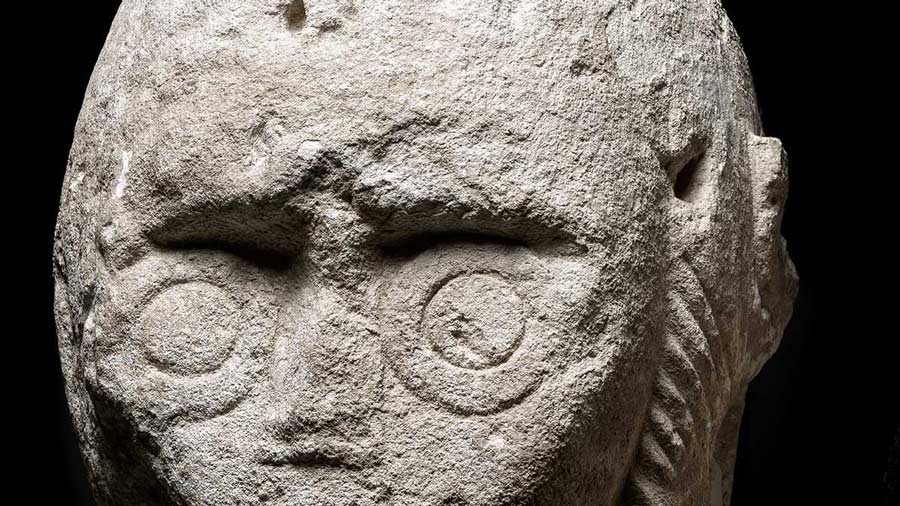
Two More Disc-eyed Giants of Mont’e Prama Found in Sardinia!
Their purpose is currently unknown, but two more disc-eyed giants of Mont’e Prama have been unearthed on Sardinia. The Mont’e Prama Iron Age burial necropolis on the Italian island of Sardinia has for the last 50 years been the source of a great archaeological mystery. The site was first discovered by local farmers in March 1974 on farmland near Mont'e Prama, in the commune of Cabras, in central-western Sardinia, Italy. It was here that the so-called “Giants of Mont'e Prama” were discovered. This collection of ancient stone giant sculptures, with large disc-eyes, are also known as “boxer statues.”
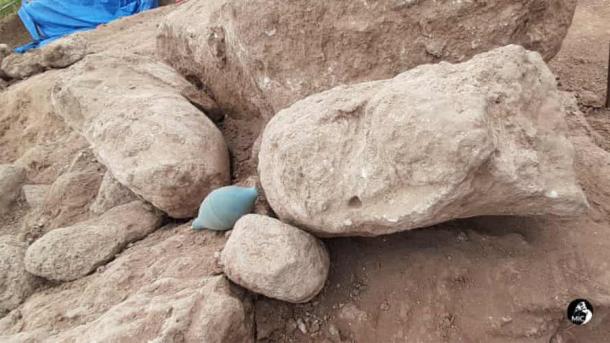
The head of one of the newly found boxers is here on the right, with a visible chin and thick broken neck.
While it is understood that the giants of Mont’e Prama were created by people by the Nuragic culture of ancient Sardinia, the purpose of these gargantuan monuments is currently unknown. However, on Saturday afternoon, Italy’s Ministry of Culture announced that “two more giant naked torsos” had been identified by researchers at Mont’e Prama. In this instance, the two giants were covered with a large shield which has allowed the researchers to date them precisely to between 950 to 730 BC.
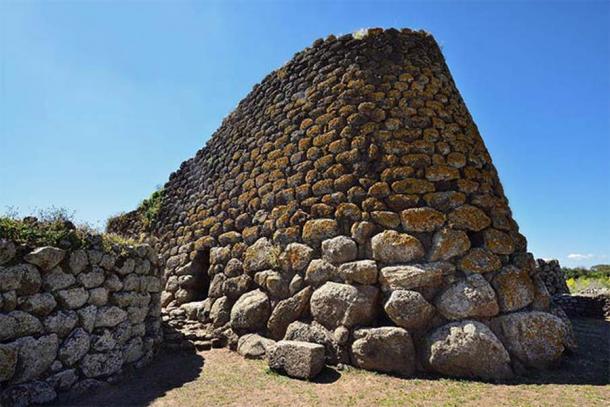
Emerging in the Early Bronze Age, Nuragic civilization derives its name from Sardinia’s “ nuraghe,” which are stone fortresses with high towers. Most of these structures were raised around 1800 BC and today no less than 7,000 nuraghes are peppered across the ancient Sardinian landscape. It was from these stone forts that the Nuragic people defended their rule over Sardinia until the 2nd century AD.
Many of you will already have noticed that the Sardinian nuraghe resembles, and perhaps functioned similarly to, the 2nd century Pictish brochs of northern Scotland. Day to day these stone towers housed community chiefs and their families, and they became community shelters for people and animals while under attack from rivalling tribes and foreign invaders.
Italy’s Cultural Minister, Dario Franceschini, said the two giant stone torsos are officially called “Cavalupo-type boxers,” which means they are either warriors, archers or boxers with shields and armed gloves. The culture ministry’s superintendent for southern Sardinia, Monica Stochino, said the statues are made of limestone which is soft and fragile. Therefore, the site archaeologists now need more time to excavate the two huge torsos from the surrounding sediment which has set like clay.
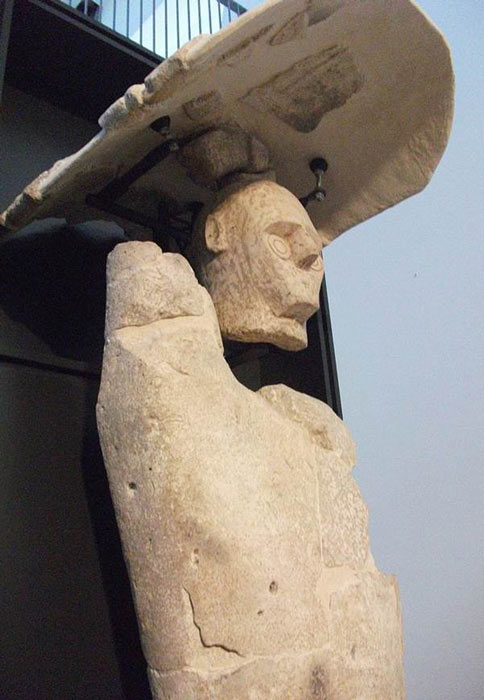
Some of the giants of Mont’e Prama had curved stone shields over their heads and this was also true of both of the recently discovered giants.
An article in Arkeonews explains that since the site’s discovery in 1974 “thousands of fragments” of giant human figures have been recovered at Mont’e Prama. While their original purpose remains veiled in mystery, so far, archaeologists have reassembled about 40 statues and while no one is complete each measures over 2 meters (6.56 feet) tall. Furthermore, they all represent warriors, archers, or nuraghe boxers.
Giant Warriors, Archers, and Boxers
Archaeologists believe the giant’s disc-shaped eyes and eastern-style garments probably depicted Nuragic cultural mythological heroes who were buried to symbolically guard the sepulchral site . However, other archaeologists consider the statues as representing deities from the Nuragic pantheon. However, these two interpretations are relatively limited and don’t consider inspiration from the land of the living first.
Polynesian Easter Island , formerly known as Rapa Nui , is famed for its monumental giant statues called moai which were created during the 13th-16th centuries. According to writer Jo Anne Van Tilburg these carved human figures with oversize heads are believed to be “the living faces ( aringa ora ) of deified ancestors ( aringa ora ata tepuna )”. Perhaps the giants of Mont’e Prama, Sardinia also reflect the bodies and faces of the ancestors who taught them how to survive on an ocean locked island?
We will never know for sure what the large-eyed giants represented, but as long as archaeologists continue to excavate at Mont’e Prama in Sardinia it is only a matter of time before more statues will surface, adding to the emerging army of giants.
Top image: Two more stone giants of Mont’e Prama from the Iron Age have been unearthed in Sardinia. Source: mont’e prama
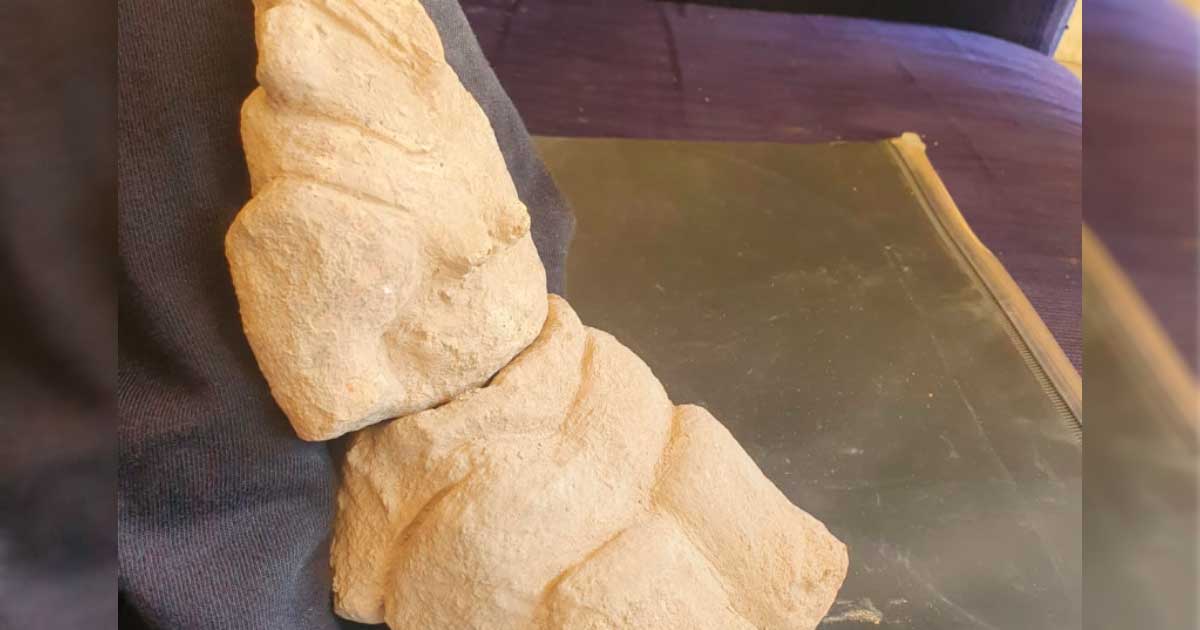
An 8,000-year-old "Mother Goddess" figurine has been uncovered at a Neolithic site in Israel. Why then, does she have “coffee-shaped” eyes?
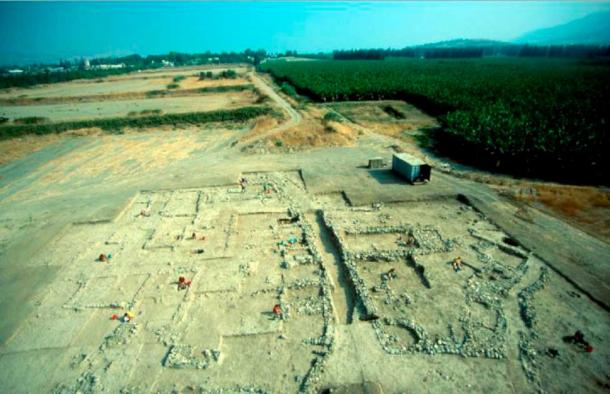
Located at the foot of the Golan Heights in the Jordan Valley area of north-eastern Israel, the Sha'ar HaGolan kibbutz archaeological site is situated less than 1 km (2/3 of a mile) from the border with Jordan. It was here that archaeologists recently unearthed the broken 20-centimeter (7.87 inch) long figurine.
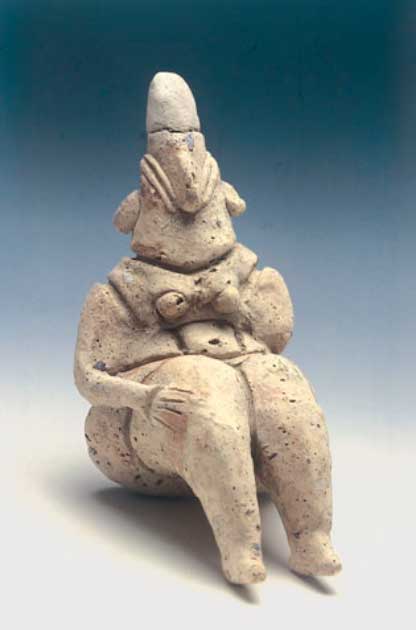
Dating back 8,000 years, this 'Mother Goddess' figurine was created by the Yarmukian culture. While Israeli archaeologists are describing the goddess as having “coffee-bean” shaped eyes, she has nothing to do with coffee. In fact, coffee can be traced to the mid-15th century in Yemen . So what then does this ancient mistress of the Levantine otherworld represent?
Red Is The Color Of Love, And Sex
The Neolithic Yarmukian culture of the ancient Levant is regarded as the first culture in prehistoric Israel. This attribution is given because Yarmukians were the first people in Levant to make clay pottery. And, similarly to later Neolithic groups in Ireland and Scotland, Yarmukian ceramics feature lozenge, herringbone and linear diagonal lines and patterns.
Judea district archaeologist Anna Eirikh-Rose from Israeli Antiquity Authority serves as co-director of the dig at Sha'ar HaGolan kibbutz and she told J-Post the 20-centimeter goddess figurine was excavated next to the wall of a house covered with “a red bottomed bracelet.” Depending on agricultural success and the fertilization of people and animals for sustained survival, Yarmukians worshipped a “ Mother Goddess ” and red, like in most ancient cultures, represented fertility and all things sexual/reproductive.
The Largest Mother Goddess Ever Discovered In Israel
The Museum of Yarmukian Culture at the kibbutz archaeological site exhibits all of the artifacts recovered from this vast 20-hectare Neolithic excavation zone. The site was first excavated in 1949, and again in 2004. At these previous excavations researchers identified planned streets, courtyards and houses, as well as smaller mother goddess figurines with incised pebble faces, and further so-called “eye figurines.”
The dig’s current co-director, Dr. Julien Vieugue, describes the newly excavated goddess figurine as “a large, seated woman with big hips, a unique pointed hat and what is known as ‘coffee-bean’ eyes and a big nose.” She has one hand on her hip and the other is under her breast. Vieugue said the artifact represents one of the “largest examples'' of the goddess figurine ever found from the Yarmukian culture.”
A Cult Fertility Icon, Or A Recognized State Goddess
While many similar Yarmukian sites have been identified in the Levant, by a long shot, Sha’ar Hagolan is the largest and the most probable center of Yarmukian culture. Eirikh-Rose says that 8,000 years ago the inhabitants of Sha’ar Hagolan began mass-producing pottery. Now, it’s the primary goal of the archaeologists to better understand the “origin and mechanism of development of the pottery production” at the site.
Eirikh-Rose said the figurine was created by wrapping and layering clay around a central cylindrical core. The archaeologist added that it was anything but easy to make. The artifact is currently undergoing residue analysis which will eventually reveal what type of clay was used to make the goddess idol. Ultimately the researchers aim to find out if this particular Mother Goddess was a cultic icon, or a deity from an already established religion.
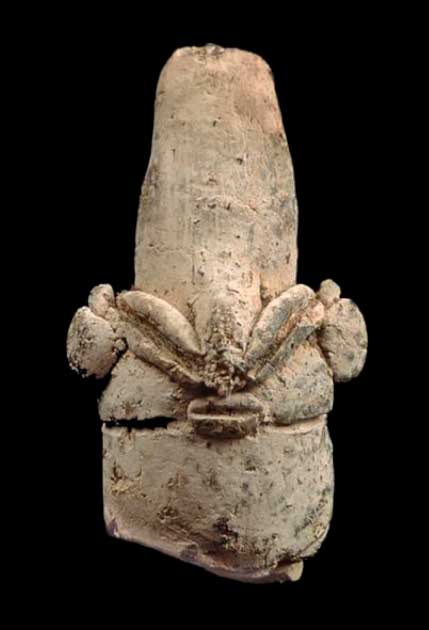
A close up of the head of one of the Yarmukian figures, showing the ‘coffee bean eyes’ shape.
Returning To Those Problematic “Coffee-Bean” Shaped Eyes
We should finish this piece with a return to the figurine’s so-called “coffee-bean” shaped eyes. One could perhaps better understand this “coffee-bean” reference to the symbolism of the figurine had it been discovered at a medieval Yemen site, or in 17th century South America where the Mother Goddess was worshipped as “ Pachamama” - the World-Mother and controller of fertility.
For the sake of clarity, Israeli archaeologists should perhaps change the name “coffee” to what the eyes actually represent. They should be called “wheat or barley-shaped eyes,” for these two details represent the unplanted wheat or barley kernel, and the promise of new life tomorrow.
Top image: 8,000-year-old Mother Goddess figurine excavated at Sha’ar HaGolan, Israel Source: Anna Eirikh-Rose / Jerusalem Post
NASA’s Webb Reveals Steamy Atmosphere of Distant Planet in Detail
Webb’s enormous mirror, precise instruments joined forces to capture most detailed measurements of starlight filtering through atmosphere of a planet outside our solar system to date
The spectrum of light – which contains information about the makeup of a planetary atmosphere 1,150 light-years away – reveals distinct signature of water
The strength of the signal that Webb detected hints at the significant role the telescope will play in the search for potentially habitable planets in coming years
Webb’s powerful new view also shows evidence of haze and clouds that previous studies of this planet did not detect
NASA’s James Webb Space Telescope has captured the distinct signature of water, along with evidence for clouds and haze, in the atmosphere surrounding a hot, puffy gas giant planet orbiting a distant Sun-like star.
The observation, which reveals the presence of specific gas molecules based on tiny decreases in the brightness of precise colors of light, is the most detailed of its kind to date, demonstrating Webb’s unprecedented ability to analyze atmospheres hundreds of light-years away.
While the Hubble Space Telescope has analyzed numerous exoplanet atmospheres over the past two decades, capturing the first clear detection of water in 2013, Webb’s immediate and more detailed observation marks a giant leap forward in the quest to characterize potentially habitable planets beyond Earth.
WASP-96 b is one of more than 5,000 confirmed exoplanets in the Milky Way. Located roughly 1,150 light-years away in the southern-sky constellation Phoenix, it represents a type of gas giant that has no direct analog in our solar system. With a mass less than half that of Jupiter and a diameter 1.2 times greater, WASP-96 b is much puffier than any planet orbiting our Sun. And with a temperature greater than 1000°F, it is significantly hotter. WASP-96 b orbits extremely close to its Sun-like star, just one-ninth of the distance between Mercury and the Sun, completing one circuit every 3½ Earth-days.
The combination of large size, short orbital period, puffy atmosphere, and lack of contaminating light from objects nearby in the sky makes WASP-96 b an ideal target for atmospheric observations.
On June 21, Webb’s Near-Infrared Imager and Slitless Spectrograph (NIRISS) measured light from the WASP-96 system for 6.4 hours as the planet moved across the star. The result is a light curve showing the overall dimming of starlight during the transit, and a transmission spectrum revealing the brightness change of individual wavelengths of infrared light between 0.6 and 2.8 microns.
While the light curve confirms properties of the planet that had already been determined from other observations – the existence, size, and orbit of the planet – the transmission spectrum reveals previously hidden details of the atmosphere: the unambiguous signature of water, indications of haze, and evidence of clouds that were thought not to exist based on prior observations.
A transmission spectrum is made by comparing starlight filtered through a planet’s atmosphere as it moves across the star to the unfiltered starlight detected when the planet is beside the star. Researchers are able to detect and measure the abundances of key gases in a planet’s atmosphere based on the absorption pattern – the locations and heights of peaks on the graph. In the same way that people have distinctive fingerprints and DNA sequences, atoms and molecules have characteristic patterns of wavelengths that they absorb.
The spectrum of WASP-96 b captured by NIRISS is not only the most detailed near-infrared transmission spectrum of an exoplanet atmosphere captured to date, but it also covers a remarkably wide range of wavelengths, including visible red light and a portion of the spectrum that has not previously been accessible from other telescopes (wavelengths longer than 1.6 microns). This part of the spectrum is particularly sensitive to water as well as other key molecules like oxygen, methane, and carbon dioxide, which are not immediately obvious in the WASP-96 b spectrum but which should be detectable in other exoplanets planned for observation by Webb.
Researchers will be able to use the spectrum to measure the amount of water vapor in the atmosphere, constrain the abundance of various elements like carbon and oxygen, and estimate the temperature of the atmosphere with depth. They can then use this information to make inferences about the overall make-up of the planet, as well as how, when, and where it formed. The blue line on the graph is a best-fit model that takes into account the data, the known properties of WASP-96 b and its star (e.g., size, mass, temperature), and assumed characteristics of the atmosphere.
The exceptional detail and clarity of these measurements is possible because of Webb’s state-of-the-art design. Its 270-square-foot gold-coated mirror collects infrared light efficiently. Its precision spectrographs spread light out into rainbows of thousands of infrared colors. And its sensitive infrared detectors measure extremely subtle differences in brightness. NIRISS is able to detect color differences of only about one thousandth of a micron (the difference between green and yellow is about 50 microns), and differences in the brightness between those colors of a few hundred parts per million.
In addition, Webb’s extreme stability and its orbital location around Lagrange Point 2 roughly a million miles away from the contaminating effects of Earth’s atmosphere makes for an uninterrupted view and clean data that can be analyzed relatively quickly.
The extraordinarily detailed spectrum – made by simultaneously analyzing 280 individual spectra captured over the observation – provides just a hint of what Webb has in store for exoplanet research. Over the coming year, researchers will use spectroscopy to analyze the surfaces and atmospheres of several dozen exoplanets, from small rocky planets to gas- and ice-rich giants. Nearly one-quarter of Webb’s Cycle 1 observation time is allocated to studying exoplanets and the materials that form them.
This NIRISS observation demonstrates that Webb has the power to characterize the atmospheres of exoplanets—including those of potentially habitable planets—in exquisite detail.
Image credit: NASA, ESA, CSA, and STScI
The James Webb Space Telescope is the world's premier space science observatory. Webb will solve mysteries in our solar system, look beyond to distant worlds around other stars, and probe the mysterious structures and origins of our universe and our place in it. Webb is an international program led by NASA with its partners, ESA (European Space Agency) and CSA (Canadian Space Agency).
NASA Headquarters oversees the mission for the agency’s Science Mission Directorate. NASA’s Goddard Space Flight Centerin Greenbelt, Maryland, manages Webb for the agency and oversees work on the mission performed by the Space Telescope Science Institute, Northrop Grumman, and other mission partners. In addition to Goddard, several NASA centers contributed to the project, including the agency’s Johnson Space Center in Houston; Jet Propulsion Laboratory (JPL) in Southern California; Marshall Space Flight Center in Huntsville, Alabama; Ames Research Center in California’s Silicon Valley; and others.
NIRISS was contributed by the Canadian Space Agency. The instrument was designed and built by Honeywell in collaboration with the Université de Montréal and the National Research Council Canada.
Download full-resolution, uncompressed versions and supporting visuals of this and other "Webb First Images" from the Space Telescope Science Institute:
SPECTACULAIR: DIT ZIJN DE FOTO’S VAN DE JAMES WEBB-TELESCOOP (WE KIJKEN 13 MILJARD JAAR TERUG IN DE TIJD)
Jeannette Kras
Daar zijn ze dan: de eerste vijf kleurenfoto’s van de James Webb-telescoop. De opvolger van Hubble stelt niet teleur. De afbeeldingen, waarmee je ’13 miljard jaar terug in de tijd kunt kijken’, zijn indrukwekkend.
NASA lanceerde op eerste kerstdag vorig jaar samen met het Europese en Canadese Ruimteagentschap (de ESA en de CSA) de James Webb-ruimtetelescoop, die de ‘verste en scherpste infraroodbeelden van het vroege universum’ kan maken. James Webb produceert niet alleen vele malen scherpere foto’s dan zijn voorganger Hubble, maar doet dat ook veel sneller.
Revolutionair “De James Webb-telescoop gaat ons zo veel antwoorden geven. Zelfs antwoorden op vragen die we nog niet eens kennen”, vertelt Günther Hasing, wetenschapsdirecteur van de ESA, enthousiast tijdens de onthulling van de foto’s. Josef Aschbacher, directeur-generaal van de ESA vult aan: “De ontwikkeling van de James Webb-telescoop is meer dan alleen wetenschap. Het is bovenal een fantastische samenwerking van internationale ruimtevaartorganisaties.”
“De nieuwe James Webb-telescoop is revolutionair, een enorme sprong voorwaarts”, vindt ook NASA-topman Bill Nelson. “We gaan dingen zien, die ik nooit voor mogelijk had gehouden. Met de infraroodtechnologie kijken we dwars door stofwolken heen naar sterrenstelsels en zwarte gaten. Het heelal is 13,8 miljard jaar oud. Wij kunnen nu 13,5 miljard jaar terug in de tijd kijken. Dit licht heeft al die tijd met 300.000 kilometer per uur door het heelal gereisd en valt nu op onze nieuwe telescoop. Onvoorstelbaar, maar waar.”
Nederlands tintje De feestelijke onthulling van de foto’s heeft ook een Nederlands tintje. Hoogleraar Moleculaire Astrofysica Ewine van Dishoeck (Sterrewacht Leiden, NOVA) vertelt tijdens een persbijeenkomst dat NOVA (de Nederlandse Onderzoeksschool Voor Astronomie) een bijdrage heeft geleverd aan de hardware van het MIRI (Mid-Infrared Instrument). Dit is een camera en een spectrograaf die middellange tot lange infraroodstraling observeert. MIRI neemt in het bijzonder licht van langere golflengtes waar. “Het was een spannend moment of MIRI wel koud zou worden. Anders zouden we alleen maar ruis kunnen meten”, vertelt Van Dishoeck. “Dat dat lukte, was voor ons een enorme mijlpaal.” NOVA was verantwoordelijk voor de hoofdoptiek van de MIRI-spectrometer. Ook onder meer TNO werkte mee.
Een zandkorrel Met hulp van MIRI konden de eerste foto’s tot stand komen, waarvan de Amerikaanse president Joe Biden gisteren de eerste al onthulde. “Deze afbeelding omvat een deel van het heelal ter grootte van een zandkorrel op armlengte. Het is een piepkleine splinter van het enorme universum”, zei Bill Nelson van de NASA. “Deze missie is mogelijk gemaakt door menselijk vernuft.” Het publiek over de hele wereld was onder de indruk van het beeld van dat verre cluster van sterrenstelsels.
Wetenschap met het blote oog Maar zijn zulke foto’s nu enkel voor het publiek mooi of hebben sterrenkundigen er ook echt wat aan? De aanwezige wetenschappers op de persbijeenkomst stellen dat die foto’s ook voor de wetenschap van grote waarde zijn. “Voor je een spectrum kunt nemen, moet je het eerst vinden. Daar zijn die beelden wel voor nodig”, aldus Paul van der Werf, hoogleraar Extragalactische Astrofysica bij de Sterrewacht van de Universiteit Leiden. “Je moet een gebied aan de hemel afzoeken, daar zijn die beelden absoluut noodzakelijk voor. Ze moeten zo gevoelig en groot mogelijk zijn. Dat het een mooi plaatje is, is mooi meegenomen, maar dat is natuurlijk niet waarom we het doen. Er zijn duidelijke wetenschappelijke redenen, zeker met diepe velden (deep fields). Je moet de context hebben. Je kunt niet zomaar je spectrum op een punt richten en weten wat er aan de hand is.” Spectra zijn (elektromagnetische) golven, die worden opgepikt door de telescoop, die ze weer omzet in beeld. Van Dishoeck vult aan: “Het is een multi-color-image. Dan kun je direct met je oog al wetenschap doen. Als je een plaatje neemt in verschillende kleuren geeft dat al een heleboel informatie.”
De foto’s Maar waar het vandaag om draait, zijn natuurlijk de foto’s zelf. “De vijf foto’s zijn het resultaat van een week scannen door de Webb-ruimtetelescoop. Over een week hebben we dubbel zoveel data en foto’s. Dit gaat het hele jaar zo door”, klinkt het verheugd.
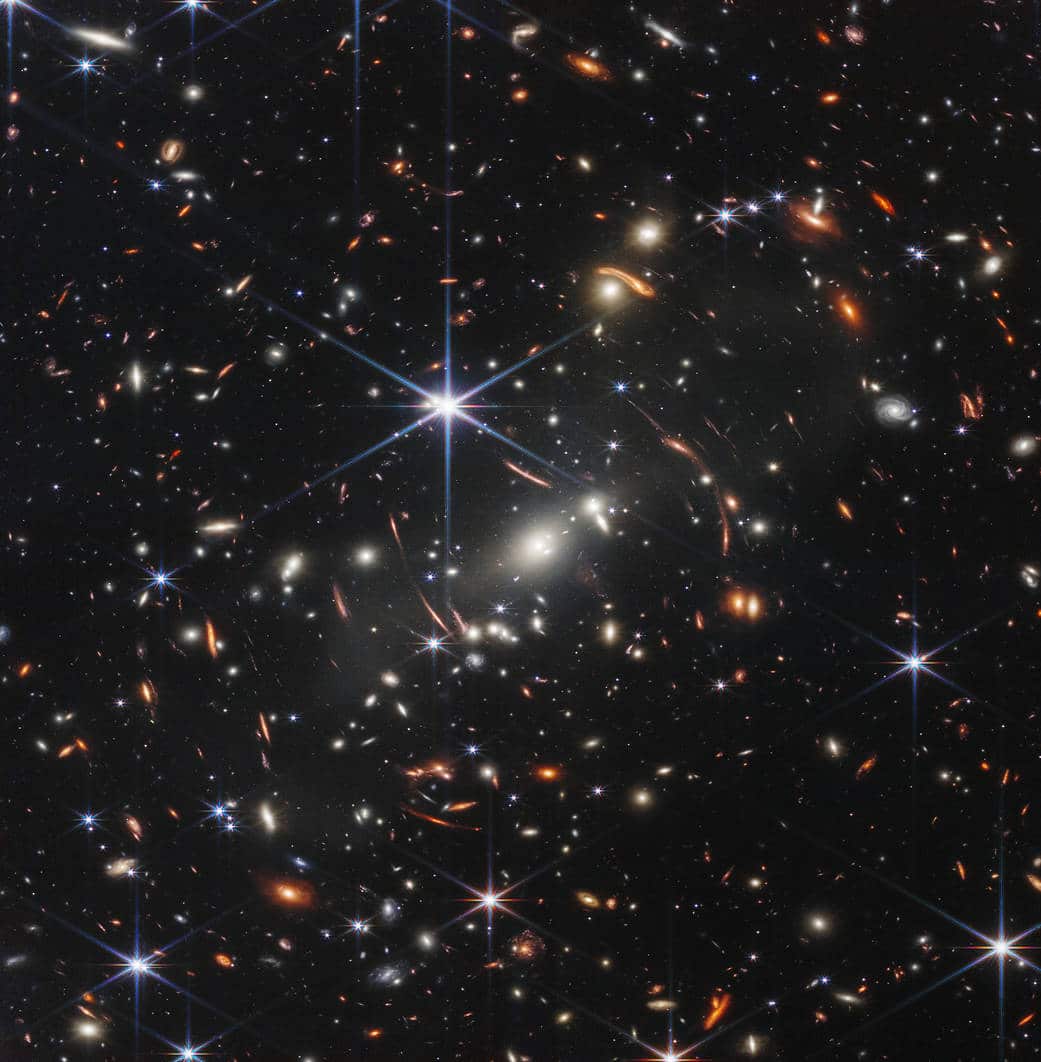
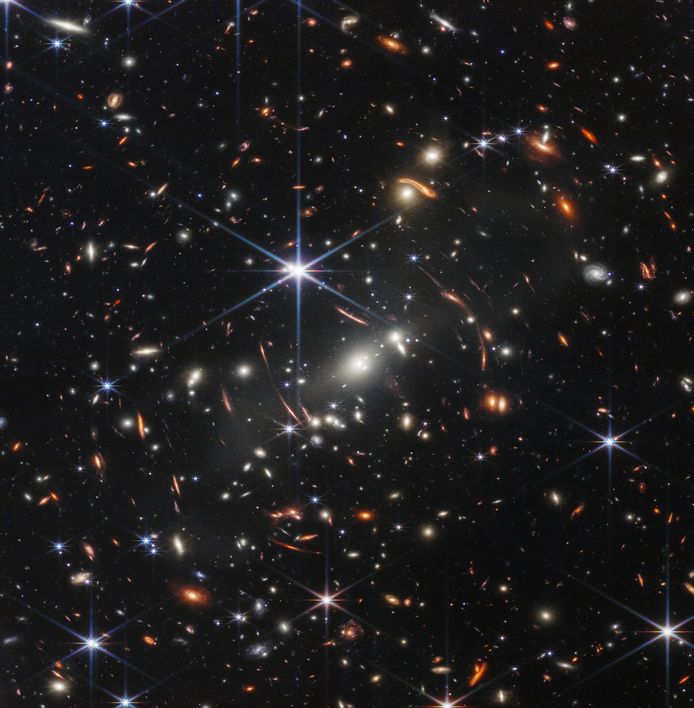
SMACS 0723 Over de eerste foto, van SMACS 0723, schreven we vanochtend al. De afbeelding toont een cluster van sterrenstelsels, zoals het er 4,6 miljard jaar geleden uitzag. De totale massa van alles wat in dit cluster aanwezig is, zorgt voor een kromming van het licht als ware het een vergrootglas: het licht van veel verder gelegen, zwakkere sterrenstelsels wordt erdoor vergroot. Het beeld werd in 12,5 uur gemaakt door NIRCam, de camera van James Webb. De sterrenstelsels op de foto stralen licht uit dat in sommige gevallen 13 miljard jaar oud is. Daarmee zijn het de oudste objecten die ooit zijn vastgelegd.
Foto: NASA, ESA, CSA, en STScI
De Carinanevel Hieronder zie je een spiksplinternieuwe afbeelding van de Carinanevel, die 7600 lichtjaar van de aarde is verwijderd. In NGC3372, zoals de nevel officieel heet, staan twee van de zwaarste en helderste sterren van het melkwegstelsel.
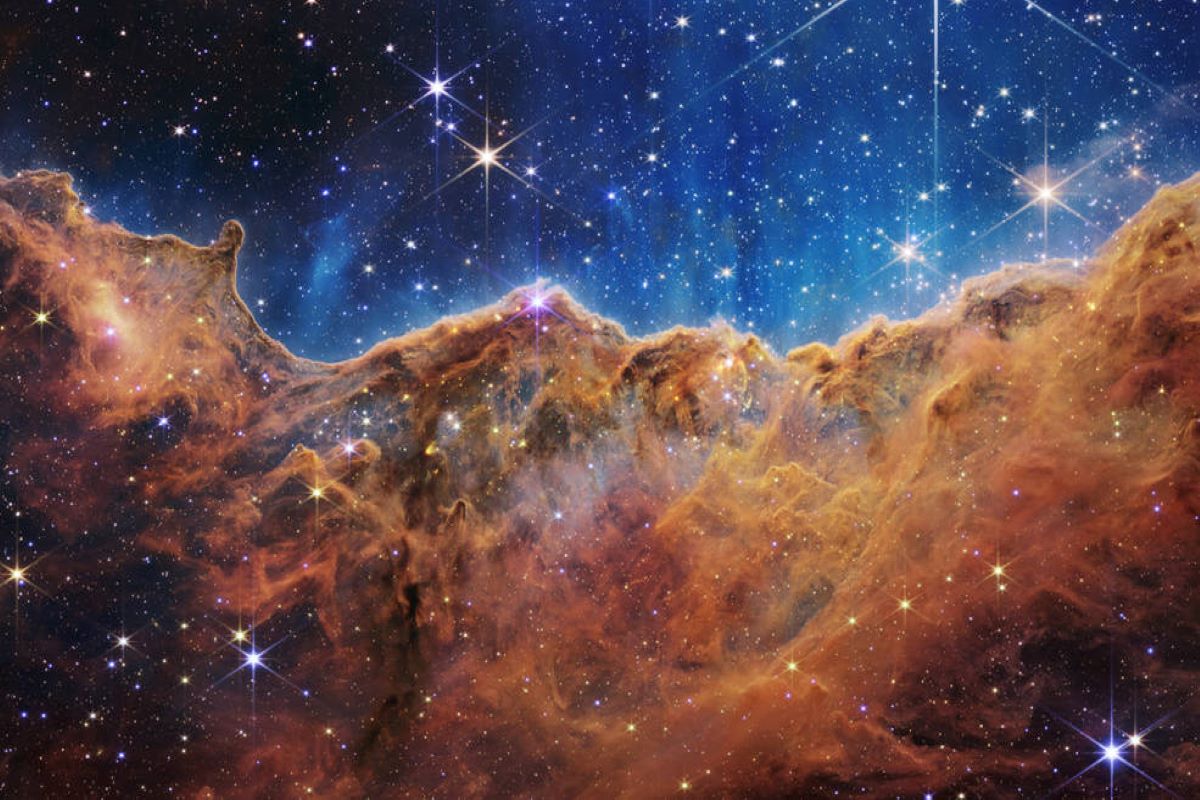
De Webb-telescoop laat de Carinanevel zien als nooit tevoren. Vele sterren die nooit eerder zijn waargenomen, staan nu scherp op de foto. We zien jonge sterren die gaswolken uitstoten. Er is veel gas en stof te zien, waar nieuwe sterren worden gevormd. Elk stipje op de foto is een ster, net als onze zon. Hubble maakte al prachtige foto’s van de Carinanevel, maar de Webb maakt er een nog veel gedetailleerder en mooier plaatje van.
Foto: NASA, ESA, CSA, en STScI
WASP-96b James Webb maakte ook een spectrum van exoplaneet WASP-96b. Deze planeet staat op 1150 lichtjaar van de aarde en draait in iets minder dan 3,5 dag om zijn moederster. Bijzonder is dat de atmosfeer van de exoplaneet wolkenvrij is. De exoplaneet is ongeveer net zo groot als Jupiter en erg heet. Spectrumanalyse van deze planeet maakt duidelijk dat er veel water aanwezig is in de vorm van waterdamp.
Exoplaneet WASP 96b
foto: NASA, ESA, CSA, en STScI
NGC 3132 Op 2000 lichtjaar van de aarde vinden we een planetaire nevel, die in het Engels ook wel Eight-burst Nebula wordt genoemd. De nevel (een groeiende gaswolk rond een stervende ster) breidt zich momenteel uit met 14,5 kilometer per seconde. Webb geeft astronomen een schat aan nieuwe informatie over de samenstelling van planetaire nevels zoals NGC 3132. Uit wat voor moleculen is deze gigantische gaswolk bijvoorbeeld opgebouwd?
foto: NASA, ESA, CSA, en STScI
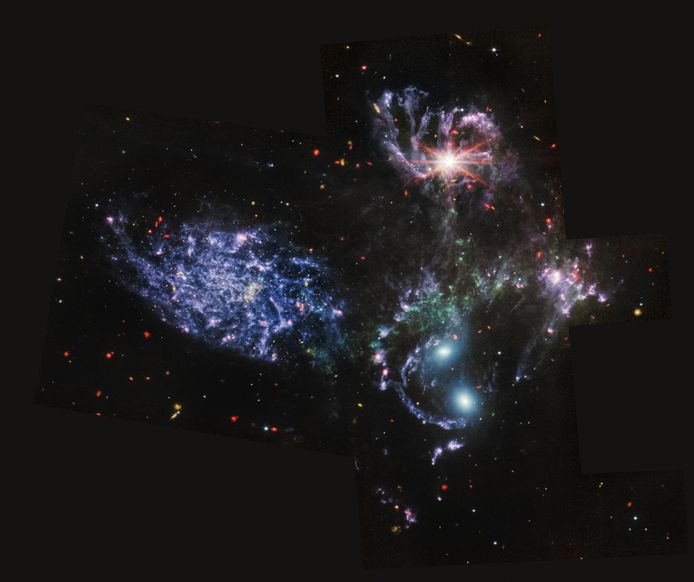
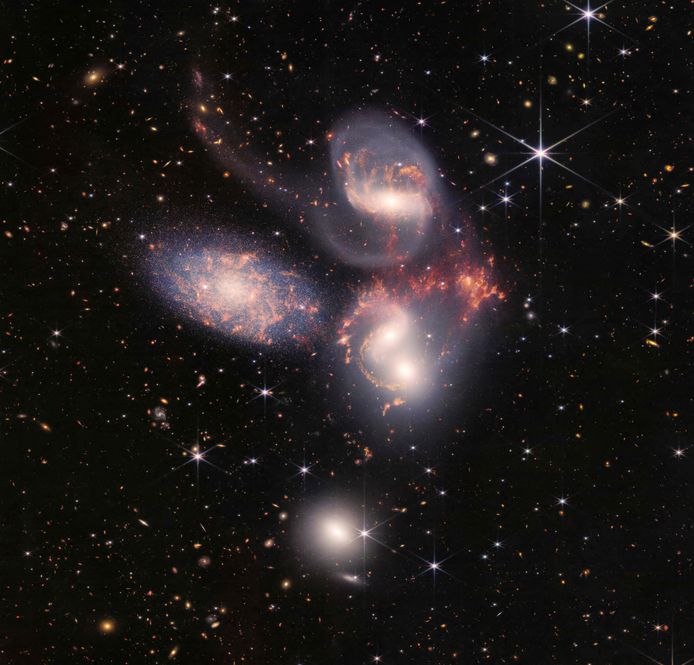
Kwintet van Stephan Dit is een groep sterrenstelsels in het sterrenbeeld Pegasus. Het dichtstbijzijnde is NGC 7320C op 39 miljoen lichtjaar afstand. De overige vier sterrenstelsels liggen veel verder weg, namelijk op 290 miljoen lichtjaar van de aarde. Er is een actief zwart gat in deze foto verscholen. De moleculaire stoffen die in de buurt rondvliegen, kunnen worden geïdentificeerd door spectrumanalyse van de Webb-telescoop.
It was meant to be a momentous celebration of decades of research coming to fruition.
We really can't overstate how important it was when NASA unveiled the first stunning set of images from its uber-expensive James Webb Space Telescope, a day decades in the making.
But while the results were indeed absolutely mind blowing, we wish we could say the same thing about the livestream itself.
In true NASA fashion, the space agency's announcement was a hot mess — to put it lightly — with host astronomer Michelle Thaller visibly struggling to keep the show rolling and coherent.
Ironic
Twitter users were quick to catch on to the irony.
"Deploying a giant infrared space telescope: easy," SpaceNews senior writer Jeff Foust tweeted. "Coordination multiple video feeds worldwide: not so easy."
For much of the hour-long presentation, Thaller struggled to transition from one section of the presentation to the next, often interrupted by swelling music at inopportune of times.
On more than one occasion, audio feeds from NASA HQ didn't cut out, allowing us to get glimpses of panicked technicians struggling to keep the show together. At another moment, we could hear what sounded like the voices of audio techs loudly whispering on a hot mic.
Who's There?
Audio feeds from remote teams around the world were basically nonexistent until the presentation was already well underway. With the absence of their microphone feeds, Thaller was left to awkwardly breathe into her microphone while we got to watch some of the brightest minds in astronomy sheepishly stare into the camera.
NASA's solution — they clearly saw this IT travesty coming from a mile away — was to have a backup crew of experts ready to personally run Thaller through the images in the studio. But even this backup plan posed a bit of a challenge.
In short, NASA's "superstar media producers," as Thaller referred to them at the end of the stream, should probably go back to the drawing board.
Good thing scientists don't have to rely on NASA livestreams to do their work — if so, the Webb would probably be a smoldering wreck on the launchpad.
NASA toont nieuwe spectaculaire beelden van James Webb-telescoop: bekijk ze hier
NASA heeft nieuwe beelden vrijgegeven van de James Webb-ruimtetelescoop. De indrukwekkende beelden volgen op de historische eerste kleurenfoto van de telescoop, die gisterenavond al werd gedeeld door de Amerikaanse ruimtevaartorganisatie. Bekijk hieronder de spectaculaire beelden.
Op de nieuwe beelden zien we onder meer Stephan’s Quintet, een visuele groepering van vijf sterrenstelsels, in een heel nieuw licht. Het is het grootste beeld dat de telescoop tot nu toe heeft gemaakt, ongeveer zo groot als een vijfde van de diameter van de maan. Het bevat meer dan 150 miljoen pixels en is opgebouwd uit bijna 1.000 afzonderlijke beeldbestanden.
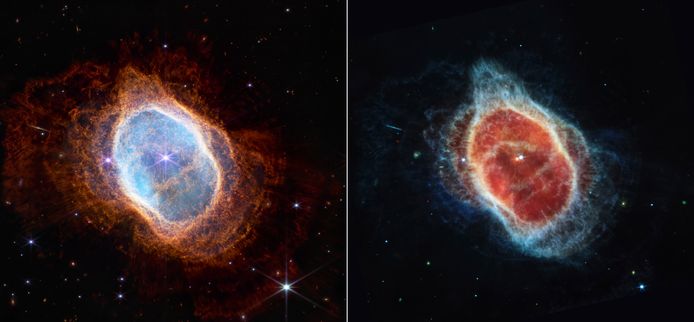
De ‘zuidelijke Ringnevel’, gefotografeerd door twee Webb-instrumenten (links door Nircam op wat kortere golflengten en rechts door Miri op langere golflengten), is een langzaam uitdijende schil van sterrengas op een afstand van ongeveer 2.000 lichtjaar (één lichtjaar is zo’n 9,5 biljoen kilometer).
De nevel is duizenden jaren geleden uitgestoten door de stervende ster in het centrum. In zo’n afkoelende nevel ontstaan minuscule stofdeeltjes en verschillende moleculen, waaronder koolwaterstofverbindingen die aan de basis liggen van het leven. Over een kleine vijf miljard jaar zal ook onze eigen zon opzwellen tot een rode reuzenster en net zo’n uitdijende nevel het heelal in blazen.
Het lijken oranje-blauwe penseelstreken op een impressionistisch schilderij, maar het zijn wervelende gas- en stofwolken in de Carinanevel, op 7.600 lichtjaar afstand. In de koude, stoffige krochten van dit nevelcomplex ontstaan nieuwe, zware sterren; een geboorteproces dat door Webb in detail bestudeerd kan worden, omdat infrarode straling dwars door de meeste stofwolken heendringt.
Net als op de andere Webb-foto’s zijn de kleuren niet echt (het menselijk oog kan geen infrarode straling waarnemen); met verschillende kleuren worden verschillende infrarode golflengten in beeld gebracht.
‘Stephan’s Quintet' heet deze groep van vijf sterrenstelsels op 290 miljoen lichtjaar afstand, naar de Franse astronoom Édouard Stephan, die het groepje in 1877 ontdekte. Vier van de vijf stelsels zijn gevangen in een onderlinge zwaartekrachtdans. Getijdenkrachten leiden tot schokgolven en het ontstaan van talloze nieuwe sterren in losgerukte en weggeslingerde slierten van gas en stof, die op de infrarode Webb-foto’s goed zichtbaar zijn.
De eerste foto van de nieuwe James Webb Space Telescope (JWST) is gisteren vrijgegeven. De Amerikaanse president Joe Biden deelde maandagavond rond 23 uur Belgische tijd de eerste kleurenafbeelding van duizenden sterrenstelsels die miljarden jaren oud zijn. “De James Webb-telescoop gaat ons veel leren over het universum, bijvoorbeeld over wat er net na de big bang gebeurde”, vertelt wetenschapsexpert Martijn Peters in de studio van HLN LIVE.
De JWST werd op kerstdag 2021 de ruimte in gestuurd en legde daarna een afstand van 1,5 miljoen kilometer af. De telescoop kon deze foto vastleggen na een intens proces van afstellen en configureren. Zo moesten de kenmerkende gouden spiegels van de telescoop in de ruimte uitgevouwen worden en stuk per stuk in de juiste hoek worden gezet. De instrumenten werden bovendien afgekoeld, één ervan tot een temperatuur van 266 graden Celsius onder nul.
“Nieuwe kijk op ons universum”
Als eerste test werd de James Webb gericht op een stukje hemel dat de naam SMACS 0723 draagt. “Nu kijken we naar een stukje aan de hemel dat ongeveer een zandkorreltje groot lijkt en daarin zien we plots duizenden sterrenstelsels verschijnen”, vertelt Peters bij HLN LIVE.
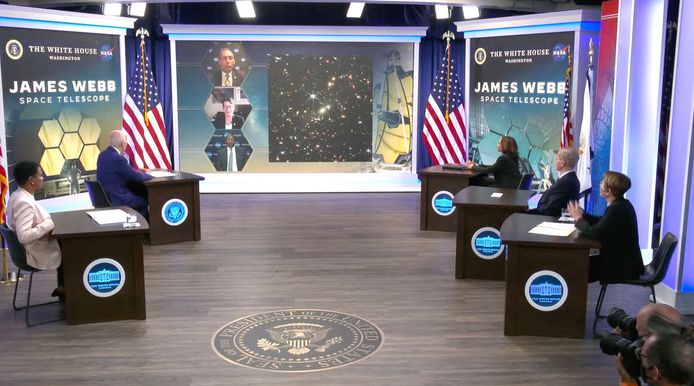
Het waren de Amerikaanse president Joe Biden en vicepresident Kamala Harris die dit eerste beeld van de Webb-telescoop onthulden tijdens een persconferentie. Biden noemde het beeld en het werk van de telescoop “een nieuwe kijk op ons universum”.
Sterrenstelsels die nooit eerder werden waargenomen
SMACS 0723 bevat sterrenstelsels die zo massief zijn dat ze licht afbuigen. Daardoor zijn er objecten te zien die nog verder verwijderd liggen van ons. SMACS 0723 is vanop de zuidelijke hemisfeer van onze planeet (en dus niet vanuit België) te zien in het sterrenbeeld Vliegende Vis of Volans.
Vele van de duizenden sterrenstelsels die te zien zijn op de foto werden voor het eerst vastgelegd door de JWST. Het gaat in sommige gevallen om de zwakste infrarode straling die we ooit hebben waargenomen. De foto is een samenstelling van verschillende beelden die de JWST heeft vastgelegd op verschillende golflengtes. Het resultaat was een composiet in grijswaarden, die met filters werden ingekleurd.
“Grote impact binnen de wetenschap”
Dat de JWST succesvol gelanceerd en ingesteld werd zonder al te veel problemen, is op zich al een mirakel te noemen. Wat we vanaf nu dankzij de ruimtetelescoop kunnen waarnemen, zal voor een hoop nieuwe kennis zorgen. “Alle wetenschappelijke data gaat binnenkort vrijgegeven worden en onderzoekers gaan er los op gaan. Ze gaan het gebruiken om te achterhalen wat daar gebeurt, hoe bepaalde sterren zich vormen en wat er gebeurde na de oerknal. Er gaat massaal veel onderzoek gedaan worden op deze data”, vertelt Peters.
De JWST kan ook licht waarnemen dat bijna net zou oud is als het universum zelf. “Dat konden we met de Hubble-telescoop niet waarnemen, maar wel met de speciale instrumenten van de James Webb-telescoop”, aldus Peters.
Daarnaast zullen we naar de geboorte van sterren kunnen kijken, maar ook naar planeten rond andere sterren dan onze zon. Dat kan helpen in de zoektocht naar leven op andere plaatsen, vertelt onze wetenschapsexpert: “We gaan ook kunnen te weten komen of planeten atmosferen hebben die leefbaar zijn en of er de bouwstenen aanwezig zijn voor leven.”
Sterrenkundigen zijn opgetogen over de eerste beelden. “Het is fantastisch spannend allemaal, en ook heel emotioneel”, aldus Ewine van Dishoeck van de Sterrewacht in Leiden. Van Dishoeck is de Europese hoofdonderzoeker van Miri, een van de waarnemingsinstrumenten van Webb.
Opvolger van Hubble-ruimtetelescoop
De JWST is honderd keer gevoeliger dan de beroemde ruimtetelescoop Hubble, die zijn einde nadert. De James Webb kan zo licht detecteren dat één miljard jaar ouder is dan wat de Hubble kon vastleggen. Ook vallen er verschillende objecten te onderscheiden die op foto’s van de Hubble eruit zagen als één object.
Om dit eerste beeld te creëren, verzamelde de Webb-telescoop gedurende 12,5 uur licht van verschillende golflengten. De Hubble had weken de tijd nodig om foto’s te maken van de SMACS 0723-cluster aan sterrenstelsels.
De James Webb heeft achttien zeshoekige spiegels die aan elkaar zitten, maar los van elkaar kunnen bewegen om scherp te stellen. De spiegel is gemaakt van beryllium, met daarbovenop een miniem laagje goud van 100 nanometer dik. Dat is duizend keer zo dun als een menselijk haar of een vel papier. Beryllium is een onedel metaal dat licht en sterk is en goed bestand tegen extreme kou. Het goud zorgt ervoor dat de spiegel beter in staat is infrarood licht te zien.
Het Amerikaans-Europees-Canadese project kost in totaal ongeveer 8 miljard euro. James Webb zou tot 20 jaar operationeel kunnen blijven.
They’re Here! Check out the First Images from the James Webb Space Telescope!
This is it! Today, people worldwide were treated to the first images acquired by James Webb! After years of delays, we are finally seeing the sharpest images of the Universe taken by the most powerful telescope ever deployed. The world was given a sneak peek yesterday when President Biden, VP Kamala Harris, NASA Administrator Bill Nelson, and other NASA officials released the deepest and sharpest infrared image of the Universe to date. But at 10:30 Eastern (07:30 Pacific), all the remaining first images were released!
The event was live-streamed by NASA TV, took place at NASA Goddard Spaceflight Center, and featured live streams from partner institutes in Canada, Europe, and across the U.S. This allowed the science teams that were responsible for the images to present them and explain how they illustrate the different science operations the JWST will perform throughout its mission.
Deep Field
The first image, Deep Field SMACS 0723, was presented by Jane Rigby, the Operations Project Scientist for the JWST mission. This image, which was revealed yesterday, showed a massive galaxy cluster and the gravitational lenses they produced (which magnified fainter galaxies in the distance). As Rigby explained, the images show galaxies as they appeared 13 billion years ago and spectra obtained by Webb‘s Near-Infrared Spectrograph (NIRSpec).
The Deep Field SMACS 0723 image taken by the James Webb Space Telescope. Credit: NASA/ESA/CSA/STScI
Another interesting tidbit was the speed at which Webb acquired this image and the spectra, which took mere hours. For comparison, Rigby explained that it took Hubble weeks to obtain a deep field image of this same galaxy cluster. The depth, detail, and speed with which Webb acquired this image showcase how the observatory is a fitting successor to the venerable Hubble and builds on its incredible legacy!
Exoplanet Atmosphere
The second image consisted of spectra obtained by Webb’sNear InfraRed Imager and Slitless Spectrograph (NIRISS) from WASP-96b, a hot gas giant located about 1,000 light-years away. The Canadian Space Agency (CSA), which provides the NIRISS instrument, was originally intended to present the image. Due to a technical issue, the presentation was made by Knicole Colón, NASA’s Deputy Project Science for Exoplanet Science at NASA Goddard.
The spectrographic image shows the composition of WASP-9b’s atmosphere, which showed a significant amount of water vapor. As Colón explained, the data was obtained during a transit, when WASP-96b passed in front of its star (relative to Webb’s position). As light passed through the atmosphere, Webb characterized it using its advanced spectrographs. This image effectively showcases how Webb will characterize the atmospheres of planets, be they beyond the Solar System or inside it.
A transmission spectrum based on data acquired by Webb’s Near-Infrared Imager and Slitless Spectrograph (NIRISS). Credit: NASA/ESA/CSA/STScI
“A Dying Star”
Next was the side-by-image of the Southern Ring planetary nebula presented by the Space Telescope Science Institute (STSI). The image shows the expanding cloud of gas surrounding a dying star (located approximately 2,000 light-years away from Earth) as it appeared to both the NIRCam and MIRI. The resulting images provide the most detailed view of this iconic nebula and the stellar remnant at its core – and in multiple wavelengths.
In the NIRCam image, a white dwarf appears to the lower left of the central white dwarf (which is much brighter) and is partially hidden by a diffraction spike. The same star appears brighter, larger, and redder in the Mid-Infrared Instrument (MIRI) image, a visual effect caused by the thick layers of dust enshrouding the star. An easter egg was a background galaxy visible on the far left side of the image (seen through a relatively thin patch of nebular dust).
This side-by-side comparison shows observations of the Southern Ring Nebula in near-infrared light, at left, and mid-infrared light, at right, from NASA’sWebb Telescope. Credit: NASA/ESA/CSA/STScI
Infrared Galaxies
The fourth image was a composite of Stephan’s Quintet, a compact galaxy group located 290 million light-years away in the constellation Pegasus. Presented by the ESA science team at Europe’s Spaceport, the image beautifully illustrates the composition and tidal interactions of four galaxies in the process of merging. It was obtained by the Near-Infrared Spectrograph (NIRSpec) and MIRI instruments, which captured light in multiple wavelengths and provided never-before-seen details about this galaxy group.
These include sparkling clusters of millions of young stars, starburst regions where new stars have just formed, and sweeping tails of gas, dust, and stars being pulled back and forth by the gravitational interaction of the galaxies. Most dramatically, Webb‘s MIRI instrument also captured the huge shock waves (the red and gold region surrounding the central pair of galaxies) produced by NGC 7318B smashing through the cluster.
A mosaic of Stephan’s Quintet captured by Webb’s Near-Infrared Camera (NIRCam) and Mid-Infrared Instrument (MIRI). Credit: NASA/ESA/CSA/STScI
Star Birth
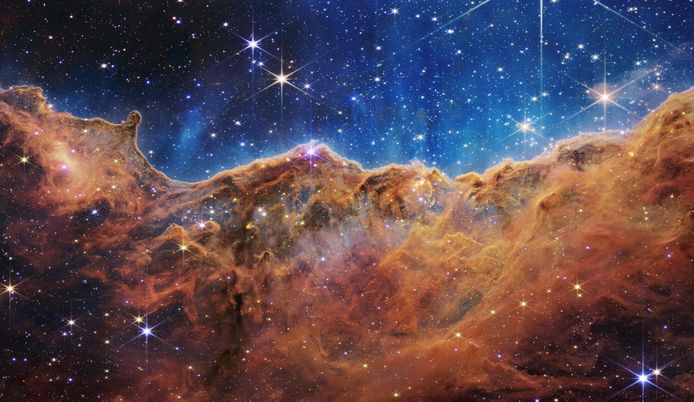
Amber Straughn, the Deputy Project Scientist for the JWST mission at NASA Goddard, presented the fifth and final image. The image features the Carina Nebula, one of the largest and brightest nebulae in the sky, located about 7,600 light-years away in the southern constellation Carina. Once again, this nebula was previously observed by Hubble, which provided a breathtaking look at a prominent star-forming region. But thanks to Webb‘s superior infrared imaging capabilities, this new image captures details that were previously invisible to astronomers.
For starters, there’s the central feature known as the “cosmic cliff,” which looks like a craggy mountainside. This is, in reality, the edge of the gigantic gaseous cavity carved within the nebula by the intense ultraviolet radiation and stellar winds from the extremely massive, hot, young stars located in the center of the bubble (at the top of the image). This image also reveals previously-unseen newborn stars, a more detailed look at the gas and dust of the nebula, and the interaction between solar wind and gas clouds.
Thanks to the crisp resolution and unparalleled sensitivity of Webb‘s Near-Infrared Camera (NIRCam), this image is already providing fresh insight into how “stellar nurseries” work and how new stars are born.
Image of the Carina Nebula (NGC 3324) captured by Webb’s Near-Infrared Camera (NIRCam), Credit: NASA/ESA/CSA/STScI
****************************
The development of this next-generation telescope officially began in 1996 as an intended successor to the Hubble Space Telescope (HST). These efforts were largely motivated by the success of the Hubble Deep Fields campaign, which provided the deepest views of the Universe to date. They were further motivated by the Cosmic Background Explorer (COBE), which mapped the Cosmic Microwave Background (CMB) from 1989 to 1993. In short, these two surveys allowed astronomers to observe the early Universe and how it all began with the Big Bang.
Now they wanted to see what happened in-between, which included the formation of the first stars and galaxies and how they evolved into the large-scale cosmic structures we see today. After a redesign, multiple tests, delays, cost overruns, and the COVID pandemic, Webb finally launched from Europe’s Spaceport in French Guyana on Christmas Day in 2021. Once it reached orbit, the mission team spent weeks unfolding its sunshield, deploying and aligning its primary mirror, cooling the observatory to operational temperature, and navigating Webb to its orbit – about 1.5 million km (930,000 mi) from Earth.
Since then, the JWST has been conducting science operations and observing different cosmic objects and phenomena. These images provide a good preview of what we can expect in the coming years as more and more images are released. The event wrapped up with Administrator Bill Nelson praising the teams responsible for James Webb and the international cooperation that made it possible. He finished by repeating the words of the late and great Carl Sagan:
“Somewhere, something incredible is waiting to be known.”
New James Webb Space Telescope Images Will Bring You To Tears July 2022
NASA has a provided a tantalizing teaser photo ahead of the highly-anticipated release next week of the first deep-space images from the James Webb Telescope — an instrument so powerful it can peer back into the origins of the universe. The $10 billion observatory — launched in December last year and now orbiting the Sun a million miles (1.5 million kilometers) away from Earth — can look where no telescope has looked before thanks to its enormous primary mirror and instruments that focus on infrared, allowing it to peer through dust and gas.
The first fully formed pictures are set for release on July 12, but NASA provided an engineering test photo on Wednesday — the result of 72 exposures over 32 hours that shows a set of distant stars and galaxies. The image has some “rough-around-the-edges” qualities, NASA said in a statement, but is still “among the deepest images of the universe ever taken” and offers a “tantalizing glimpse” at what will be revealed in the coming weeks, months, and years. “When this image was taken, I was thrilled to clearly see all the detailed structure in these faint galaxies,” said Neil Rowlands, program scientist for Webb´s Fine Guidance Sensor at Honeywell Aerospace.
Jane Rigby, Webb´s operations scientist at NASA´s Goddard Space Flight Center, said the “faintest blobs in this image are exactly the types of faint galaxies that Webb will study in its first year of science operations.” NASA administrator Bill Nelson said last week that Webb is able to gaze further into the cosmos than any telescope before it. “It´s going to explore objects in the solar system and atmospheres of exoplanets orbiting other stars, giving us clues as to whether potentially their atmospheres are similar to our own,” he said. “It may answer some questions that we have: Where do we come from? What more is out there? Who are we?
And of course, it´s going to answer some questions that we don´t even know what the questions are.” Webb´s infrared capabilities allow it to see back in time to the Big Bang, which happened 13.8 billion years ago. Because the Universe is expanding, light from the earliest stars shifts from the ultraviolet and visible wavelengths it was emitted in, to longer infrared wavelengths — which Webb is equipped to detect at an unprecedented resolution. At present, the earliest cosmological observations date to within 330 million years of the Big Bang, but with Webb´s capacities, astronomers believe they will easily break the record.
SpaceX's Starship booster is engulfed in an enormous FIREBALL during disastrous test – and it may delay Elon Musk's plans for the $216 million rocket's first orbital flight
SpaceX booster rocket burst into flames at the firm's facility in Boca Chica, Texas
SpaceX CEO Elon Musk said on Twitter that the explosive incident was 'not good'
It's likely a setback to Musk's aim of launching his Starship into orbit this summer
SpaceX's Starship booster rocket was engulfed in an enormous fireball during a disastrous ground test on Monday evening.
The booster rocket, developed by Elon Musk's SpaceX for its next-generation Starship spacecraft, burst into flames at the firm's facility in Boca Chica, Texas.
Footage shows a powerful fireball engulfing the bottom of the rocket and sending splinters flying, and dramatically shaking the camera's point of view.
Monday's unfortunate explosion may delay plans for the $216 million rocket's first orbital flight, which was tentatively scheduled for this summer.
SpaceX's futuristic, bullet-shaped stainless steel Starship has been selected by NASA for the recently-delayed Artemis missions to the Moon later this decade.
SpaceX's Starship booster rocket was engulfed in an enormous fireball during a disastrous ground test on Monday
Footage shows a powerful fireball engulfing the bottom of the rocket and sending splinters flying. The ground test took place at SpaceX's facility in Boca Chica, Texas
STARSHIP AND SUPER HEAVY LAUNCHER
SpaceX Starship is made up of two stages, the Super Heavy booster and the Starship vehicle on top.
Super Heavy fires and gives Starship the boost it needs to reach orbit.
Once in space, Starship separates and continues its journey, while Super Heavy returns to land on the ground.
It is designed to be a reusable launch vehicle that could put humans on Mars, according to founder Elon Musk.
SpaceX is planning to carry humans using a two-stage spacecraft composed of Starship (the passenger-carrying section) and the Super Heavy rocket booster.
The firm still has work to do on construction of the $216 million Starship, previously known as 'BFR', although it has been testing out launching Starship prototypes into the air and landing them.
SpaceX was conducting a ground test of the Super Heavy booster when it exploded at around 16:20 CT (22:20 BST) on Monday.
A livestream was being recorded by the website NASA Spaceflight when the explosion took place.
The booster remained standing upright, bolted to a test gantry afterward. There was no immediate indication of injuries, although black smoke spewed from the area of the test pad an hour after the incident.
SpaceX boss Elon Musk said on Twitter: 'Yeah, actually not good. Team is assessing damage.'
Musk also said the issue was to do with the 'spin tests' of the 33 Raptor engines, powered by cryogenic liquid methane and liquid oxygen.
SpaceX flows high-pressure gas through the engines' turbines to power the Super Heavy booster.
The failure came in the midst of a dayslong static fire test campaign in Boca Chica, Texas, of the booster, equipped with an array of 33 Raptor engines for use in an upcoming uncrewed orbital test flight SpaceX hoped to launch later this year
Musk said cryogenic fuel is an 'added challenge'.
'It evaporates to create fuel-air explosion risk in a partially oxygen atmosphere like Earth,' he said on Twitter.
'Going forward, we won't do a spin start test with all 33 engines at once,' Musk also tweeted.
MailOnline contacted SpaceX and the US Federal Aviation Administration (FAA) for an official comment.
An FAA spokesperson replied: 'The FAA is in close contact with SpaceX as the company looks into the fire that occurred as part of its Super Heavy booster rocket development.
'The law limits the FAA’s safety oversight to protecting the public during scheduled launch and reentry operations. Yesterday’s event does not fall under the agency’s jurisdiction.'
The booster remained standing upright, bolted to a test gantry afterward. There was no immediate indication of injuries, although black smoke spewed from the area of the test pad an hour after the incident
A livestream was being recorded by the website NASA Spaceflight when the explosion took place. SpaceX boss Elon Musk posted in reply to NASA Spaceflight on Twitter: 'Yeah, actually not good. Team is assessing damage'
Starship, which will stand 394 feet (120 metres) tall when mated with its super-heavy first-stage booster, is the company's next-generation launch vehicle at the centre of Musk's ambitions to make human space travel more affordable and routine.
An upcoming uncrewed orbital test flight of Starship was anticipated to launch this summer, although a delay now seems likely.
In late 2020 and early 2021, SpaceX lost four prototypes of the Starship itself in a series of high-altitude test launches when the return landing attempts ended in explosions.
The Starship prototype finally made a safe touchdown after a high altitude flight test in May 2021.
Elon Musk (pictured) had hoped Starship's first flight into orbit would come in the first month of 2022
Musk had previously said the first orbital launch of Starship would 'hopefully' happen in January 'or perhaps February' 2022 and could be followed by 12 or more launches throughout the rest of the year.
'There's a lot of risk associated with this first launch,' Musk told the US government's National Academies last November.
'So I would not say that it is likely to be successful, but I think we will make a lot of progress.'
After a dozen or so orbital test flights next year, SpaceX then would start launching valuable satellites and other payloads to orbit on Starships in 2023, he said.
Musk also said his firm has built a 'factory for making a lot of these vehicles'.
'This is not a case of just one or two, we're aiming to make a great many [Starships],' he told National Academies' members. 'Ultimately, in order for life to become multiplanetary, we'll need maybe a thousand ships.'
Musk thinks a natural or manmade disaster will eventually bring about the end of civilization, necessitating the relocation to another planet – Mars 'being the only realistic option', he said.
This could be a pandemic worse than Covid-19, continually decreasing birth rates, nuclear Armageddon or perhaps a direct hit by a killer comet 'that takes out a continent'.
SPACEX'S STARSHIP TO GO TO THE MOON
SpaceX's HLS Starship will include the company's tested Raptor engines, along with pulling inspiration from the Falcon and Dragon vehicles' designs.
It will feature a spacious cabin and two airlocks for astronaut moonwalks.
Work started on designing the lunar vehicle in May 2020 and work will now begin to fully build it thanks to a NASA $2.89 billion contract.
The initial contact covers an uncrewed demonstration mission, and a crewed lunar landing in 2024.
It is also planned future lunar landings will be made using Starship HLS.
It is equipped with a complement of thrusters used on the final descent and takeoff from the surface of the moon.
The final design will have a 100 day loiter capability in lunar orbit allowing for more trips to the lunar surface.
It also is designed to carry extra propellant to allow for an emergency ascent from the moon.
Meer van UFO'S of UAP'S, ASTRONOMIE, RUIMTEVAART, ARCHEOLOGIE, OUDHEIDKUNDE, SF-SNUFJES EN ANDERE ESOTERISCHE WETENSCHAPPEN - DE ALLERLAATSTE NIEUWTJES


 Alaska: A Whole Town Witness UFO Circling Over Them







 Elon Musk hits back at claims his Starlink satellites are...
 SpaceX marks 100th TIME it has re-flown a Falcon 9: Rocket...
 Will Starship fly this month? SpaceX transports Ship 24 to...
 SpaceX's Starship Super Heavy rocket, which is the world's...


