Naar de inhoud

UFO'S of UAP'S, ASTRONOMIE, RUIMTEVAART, ARCHEOLOGIE, OUDHEIDKUNDE, SF-SNUFJES EN ANDERE ESOTERISCHE WETENSCHAPPEN - DE ALLERLAATSTE NIEUWTJES

UFO's of UAP'S in België en de rest van de wereld
akke.beakke.be
Ontdek de Fascinerende Wereld van UFO's en UAP's: Jouw Bron voor Onthullende Informatie! Ben jij ook gefascineerd door het onbekende? Wil je meer weten over UFO's en UAP's, niet alleen in België, maar over de hele wereld? Dan ben je op de juiste plek! België: Het Kloppend Hart van UFO-onderzoek In België is BUFON (Belgisch UFO-Netwerk) dé autoriteit op het gebied van UFO-onderzoek. Voor betrouwbare en objectieve informatie over deze intrigerende fenomenen, bezoek je zeker onze Facebook-pagina en deze blog. Maar dat is nog niet alles! Ontdek ook het Belgisch UFO-meldpunt en Caelestia, twee organisaties die diepgaand onderzoek verrichten, al zijn ze soms kritisch of sceptisch. Nederland: Een Schat aan Informatie Voor onze Nederlandse buren is er de schitterende website www.ufowijzer.nl, beheerd door Paul Harmans. Deze site biedt een schat aan informatie en artikelen die je niet wilt missen! Internationaal: MUFON - De Wereldwijde Autoriteit Neem ook een kijkje bij MUFON (Mutual UFO Network Inc.), een gerenommeerde Amerikaanse UFO-vereniging met afdelingen in de VS en wereldwijd. MUFON is toegewijd aan de wetenschappelijke en analytische studie van het UFO-fenomeen, en hun maandelijkse tijdschrift, The MUFON UFO-Journal, is een must-read voor elke UFO-enthousiasteling. Bezoek hun website op www.mufon.com voor meer informatie. Samenwerking en Toekomstvisie Sinds 1 februari 2020 is Pieter niet alleen ex-president van BUFON, maar ook de voormalige nationale directeur van MUFON in Vlaanderen en Nederland. Dit creëert een sterke samenwerking met de Franse MUFON Reseau MUFON/EUROP, wat ons in staat stelt om nog meer waardevolle inzichten te delen. Let op: Nepprofielen en Nieuwe Groeperingen Pas op voor een nieuwe groepering die zich ook BUFON noemt, maar geen enkele connectie heeft met onze gevestigde organisatie. Hoewel zij de naam geregistreerd hebben, kunnen ze het rijke verleden en de expertise van onze groep niet evenaren. We wensen hen veel succes, maar we blijven de autoriteit in UFO-onderzoek! Blijf Op De Hoogte! Wil jij de laatste nieuwtjes over UFO's, ruimtevaart, archeologie, en meer? Volg ons dan en duik samen met ons in de fascinerende wereld van het onbekende! Sluit je aan bij de gemeenschap van nieuwsgierige geesten die net als jij verlangen naar antwoorden en avonturen in de sterren! Heb je vragen of wil je meer weten? Aarzel dan niet om contact met ons op te nemen! Samen ontrafelen we het mysterie van de lucht en daarbuiten.

Archief

A NASA orbiter around Mars suffered an abrupt demise

A NASA orbiter around Mars suffered an abrupt demise

Lots of questions remain.

NASA decommissioning Maven mission
NASA will begin to decommission Maven, a Mars orbiter, which unexpectedly went silent in December 2025 after more than a decade of operations at the Red Planet. 
Credit: Lockheed Martin

A healthy NASA orbiter disappeared as usual behind Mars back in December. When the spacecraft reemerged from the other side, it was never the same again.

The U.S. space agency announced June 3 that the Mars Atmosphere and Volatile Evolution mission, aka Maven, is over, after a review board determined the orbiter that has circled Mars for over 11 years is now unreachable.

Though all of Maven's systems were normal before it rounded the bend on Dec. 6, 2025, something mysterious happened to the spacecraft when it slipped out of view. A snippet of data transmitted to Earth indicates Maven began rapidly tumbling. While mission control would normally only lose contact with the spacecraft for 20 to 30 minutes when it passed behind Mars, the team never regained its signal. 

NASA's anomaly review board, which convened in February, determined this erratic rotation, coupled with dwindling battery power, meant there was no viable way to recover Maven. At a teleconference Wednesday, officials delivered something of a eulogy to the mission, which continued 10 years longer than the team had originally planned.

"I think the team has really experienced the loss of a loved one with the end of the mission here," said project manager Mike Moreau from NASA's Goddard Space Flight Center.

SEE ALSO:
Maven's decommissioning closes a chapter in Mars exploration: NASA has lost a key workhorse that both rewrote scientists' understanding of the Martian atmosphere and quietly hauled huge volumes of data home for rovers on the ground.

Whether a meteor is to blame for Maven's demise is not known right now. NASA has yet to conclude its investigation into the root cause for the incident. The agency is expected to deliver a final report later in the year.

Maven capturing ultraviolet view of Mars

The Maven orbiter captured ultraviolet views of Mars in 2023. 

Credit: NASA / LASP / CU Boulder

Arriving at Mars in September 2014, Maven has focused on "atmospheric escape" — the leak of gas from the top of Mars' atmosphere into space. Its measurements showed that this surges during solar storms, when bursts of energy and particles erupt from the sun. A major space‑weather event in May 2024, one of the strongest seen at Mars in 20 years, triggered a torrent of particles that stripped away gas and lit up the planet with glowing auroras.

"We now have a better understanding of atmospheric escape at Mars than at any other planet, including Earth," said Shannon Curry, Maven's principal investigator, based at the University of Colorado Boulder.

Maven found several kinds of auroras at Mars and helped the Perseverance rover capture the first visible‑light aurora from the surface, giving scientists a sense of what astronauts might see with their own eyes. The orbiter also showed how a planet‑wide dust storm in 2018 boosted the loss of water to space, tying together dust, climate, and the fate of Mars' ancient oceans.

One of Maven's most important results involved a process called "sputtering." Put simply, charged particles slam into the upper atmosphere and knock neutral atoms into space, like a cannonball splashing water out of a pool. This process has likely stripped Mars' atmosphere for billions of years, with implications for other planets.

The mission also made some surprise finds. Maven’s particle detector picked up hard X‑rays from a distant black hole system known as Scorpius X‑1, and the team used that odd signal to learn more about the density of Mars' upper atmosphere. 


Ten Years at Mars with NASA’s MAVEN Mission

Beyond science, Maven played a vital behind‑the‑scenes role as a communications relay. The spacecraft passed data between Earth and surface missions such as Spirit, Opportunity, Curiosity, and Perseverance. Though it handled only about 8 percent of all relay sessions, it delivered nearly 18 percent of the total data, according to NASA, thanks in part to a new coding scheme that boosted how much information it could send during each contact. At one point, Maven set the solar system record for most data returned in a single relay session.

For now, Maven will remain in a stretched‑out orbit around Mars. NASA expects the dead spacecraft to stay in space for 50 to 100 years before the orbit naturally shrinks and it falls into Mars' atmosphere. Officials say it doesn't threaten other orbiters circling the Red Planet.

To make up for Maven's lost relay capacity, Mars Odyssey, Mars Reconnaissance Orbiter, and European orbiters have adjusted their operations. NASA also plans a new Mars Telecommunications Network in the 2030s, with help from commercial partners, to provide more robust communications and navigation services for future robotic and human missions.

For the people who worked on Maven, though, the loss feels personal. Curry said the team was "broken up" about it. When asked what she'd inscribe on the orbiter's tombstone, she didn't hesitate with her answer: 


10 Years On Mars: The Full Journey

{ https://mashable.com/? }

Hoe vind je dit bericht?
Geschreven door peter om 15:24 Stuur door

The ominous sign a SUPER El Niño is inching closer: Satellite image reveals how large areas of the Atlantic Ocean are 5°C hotter than usual – suggesting the unusual climate event could be imminent

The ominous sign a SUPER El Niño is inching closer: Satellite image reveals how large areas of the Atlantic Ocean are 5°C hotter than usual – suggesting the unusual climate event could be imminent

Large areas of the Atlantic Ocean and Mediterranean Sea are currently 5°C (9°F) hotter than usual, amid warnings a Super El Niño is imminent.

Satellite images show an ongoing marine heatwave off the northern and western coasts of France, the southern coast of Spain and in the sea off Monaco.

The waters off the coast of Dover, Eastbourne and Brighton are also significantly warmer than usual, with areas of dark red indicating soaring temperatures.

The image is based on recorded sea surface temperatures on 30 May, provided by the Copernicus Marine Service.

And it comes amid warnings that a 'Super El Niño' – marked by sustained warm temperatures across the Pacific Ocean – is inching closer.

Experts from the World Meteorological Organisation (WMO) recently predicted there is an 80 per cent likelihood of the weather phenomenon occurring during June–August 2026.

Current signs point to this year being one of the strongest El Niño patterns ever recorded.

While elevated temperatures in parts of the Atlantic and the Mediterranean are not used as part of an El Niño diagnosis, the weather phenomenon is expected to bring extreme heat 'nearly everywhere', with the potential for global average temperatures to rise by as much as 3°C (5.4°F) this summer. 

Satellite images show an ongoing marine heatwave off the northern and western coasts of France, the southern coast of Spain and in the sea off Monaco. The waters off the coast of Dover, Eastbourne and Brighton are also significantly warmer than usual, with areas of dark red indicating soaring temperatures

Satellite images show an ongoing marine heatwave off the northern and western coasts of France, the southern coast of Spain and in the sea off Monaco. The waters off the coast of Dover, Eastbourne and Brighton are also significantly warmer than usual, with areas of dark red indicating soaring temperatures

El Niño years form part of a natural cycle known as the El Niño–Southern Oscillation and are marked by sustained warm temperatures across the Pacific Ocean.

Where this ocean surface warming exceeds 2°C (3.6°F), the event is often referred to as a 'super El Niño'.

While each El Niño varies, the event typically brings increased rainfall in parts of southern South America, the southern United States, parts of the Horn of Africa and central Asia.

In contrast, there will be drier conditions over Central America, northern South America, the Caribbean, Australia, Indonesia, and parts of southern Asia.

Meanwhile, scientists say there's a strong chance 2026 will be the hottest year ever recorded.

That could mean beating the record set in 2024, when global warming exceeded 1.5°C (2.7°F) above the pre–industrial average for the first time.

From late April to mid–May, the sea–surface temperature in the central–eastern Equatorial Pacific – the area used as a monitoring reference – was approaching El Niño thresholds, according to the WMO.

These increasing surface temperatures are being fed by unusually warm subsurface water in the tropical Pacific, where temperatures are a whopping 6°C (10.8°F) above average.

A Super El Niño is on its way, and is almost certain to arrive this summer. That's according to scientists from the World Meteorological Organisation (WMO), who warn there's now an 80 per cent likelihood of an El Niño event during June¿August 2026, and a 90 per cent chance this will continue until at least November
A Super El Niño is on its way, and is almost certain to arrive this summer. That's according to scientists from the World Meteorological Organisation (WMO), who warn there's now an 80 per cent likelihood of an El Niño event during June–August 2026, and a 90 per cent chance this will continue until at least November
The world is on track for 'extraordinary extreme weather' later this year, scientists have warned, as global ocean temperatures indicate a record-breaking heat is likely

The world is on track for 'extraordinary extreme weather' later this year, scientists have warned, as global ocean temperatures indicate a record–breaking heat is likely  

The UK's top 5 warmest years 

2025: 10.09°C

2022: 10.03°C

2023: 9.97°C

2014: 9.88°C

2024: 9.79°C

While its effects on the UK are yet to be determined, meteorologists say El Niño's intensity will likely be comparable to the 1997/98 event which saw global temperatures reach their highest on record.

During its development, the UK experienced an exceptionally hot, sunny and humid August characterised by heatwaves.

The average maximum temperature at Heathrow in August 1997 was 25.8°C (78.4°F), with a top temperature of 31.5°C (88.7°F) reached.

However, while the phenomenon typically brings warmer and drier conditions to the UK during summer months, it also increases the likelihood of colder winters.

WMO Secretary–General Celeste Saulo said: 'We need to prepare for a potentially strong El Niño event – which will exacerbate drought and heavy rainfall and increase the risk of heatwaves both on land and in the ocean.

'The most recent El Niño, in 2023–24, was one of the five strongest on record and it played a role in the record global temperatures we saw in 2024.

'The WMO community will be carefully monitoring conditions in the coming months to inform decision–making by governments, humanitarian agencies and climate–sensitive sectors.

'Advance seasonal forecasts and early warnings are vital to save lives and cushion the impact on our economies and our communities.'

Scientists say there is an extremely high, 86 per cent, chance that one year between now and 2030 will smash the temperature record last set in 2024

Scientists say there is an extremely high, 86 per cent, chance that one year between now and 2030 will smash the temperature record last set in 2024

Yesterday, it emerged that the impending weather phenomenon could add hundreds to your grocery bill.

'We import two–fifths of our food from overseas,' Gareth Redmond–King, international lead at the Energy & Climate Intelligence Unit (ECIU), said.

'Extreme conditions that are driven by climate change, turbocharged by El Niño, are a threat to crops we can't grow here.

'Things like bananas, rice, tea, coffee and lots of fresh fruit.'

Food prices in the UK are already on track to be 50 per cent higher by November than they were five years ago, he added.

It comes as campaigners warned the weekly shop will keep getting more unpredictable – and more unaffordable – for millions of households. 

Meanwhile, scientists have also raised concerns that an imminent Super El Niño could trigger global famine.

Benjamin Selwyn, Professor of International Relations and Development at the University of Sussex, said extreme heat and drought could damage harvests and worsen global food insecurity this summer.

El Niño alters rainfall, shifts jet streams and raises global temperatures,' he wrote on The Conversation.

'Human‑induced global heating intensifies these dangers.

READ MORE

article image

'A study by the UN's Food and Agriculture Organization and the World Meteorological Organization shows that rising heat could make farm work unsafe for much of the year across South Asia, sub‑Saharan Africa and parts of the Americas.

'Crop yields have dropped sharply above 30°C, while heat stress reduces livestock productivity and survival.'

WHAT IS THE EL NINO PHENOMENON IN THE PACIFIC OCEAN?

El Niño and La Niña are the warm and cool phases (respectively) of a recurring climate phenomenon across the tropical Pacific - the El Niño-Southern Oscillation, or 'ENSO' for short.

The pattern can shift back and forth irregularly every two to seven years, and each phase triggers predictable disruptions of temperature, winds and precipitation. 

These changes disrupt air movement and affect global climate. 

ENSO has three phases it can be: 

* El Niño: A warming of the ocean surface, or above-average sea surface temperatures (SST), in the central and eastern tropical Pacific Ocean. Over Indonesia, rainfall becomes reduced while rainfall increases over the tropical Pacific Ocean. The low-level surface winds, which normally blow from east to west along the equator, instead weaken or, in some cases, start blowing the other direction from west to east. 

* La Niña: A cooling of the ocean surface, or below-average sea surface temperatures (SST), in the central and eastern tropical Pacific Ocean. Over Indonesia, rainfall tends to increase while rainfall decreases over the central tropical Pacific Ocean. The normal easterly winds along the equator become even stronger.

* Neutral: Neither El Niño or La Niña. Often tropical Pacific SSTs are generally close to average.

Source: Climate.gov

RELATED VIDEOS

What The Super El Niño Will Do To Our Planet in 2026

El Niño Updates! Scientists Are Watching Something Invisible Cross 6,000 Miles of Ocean

Super El Niño: How Accurate Are These Predictions?

{ https://www.dailymail.com/sciencetech/index.html }

Hoe vind je dit bericht?
Geschreven door peter om 00:00 Stuur door

Lawmakers host whistleblowers, UFO investigators to press feds to come clean about space aliens

Lawmakers host whistleblowers, UFO investigators to press feds to come clean about space aliens

After UFO whistleblower hearing on whether aliens are real, people ...

A group of lawmakers and a former Pentagon whistleblower are spearheading a new drive for the government’s full disclosure about extraterrestrials.

They will bring fresh attention to the issue at a Capitol Hill event scheduled for June 9. It will feature whistleblower David Grusch, a former Air Force and Pentagon intelligence officer who revealed to Congress in 2023 that the U.S. government is secretly retrieving and reverse-engineering spacecraft of non-human origin.

At the event, he is expected to elaborate on Unidentified Anomalous Phenomena, or UAPs, and non-human intelligence-related evidence he encountered in classified channels, believing that they should now be publicly released.

“President Trump now has an historic opportunity; this press conference is about moving from testimony to action,” he said in a statement. “Let the American people judge the facts for themselves.”

Other participants include GOP Reps. Eric Burlison of Missouri, Anna Paulina Luna of Florida, Tim Burchett of Tennessee and Democratic Rep. Jared Moskowitz of Florida.

Mr. Burchett co-chairs the bipartisan House UAP Caucus alongside Mr. Moskowitz, while Ms. Luna chairs the Task Force on the Declassification of Federal Secrets, which has conducted congressional investigations into UAP and other classified federal records.

The members of Congress are expected to rally around the passage of the UAP Disclosure Act, which requires the president to direct each federal agency to declassify all agency records related to UAPs and make such records available on a public website of the agency.

Investigative journalist Leslie Kean and documentary filmmaker James Fox, who both have produced projects about UFOs, will host the event.

“The public deserves real answers, Congress deserves access, and reality should not be classified,” Mr. Fox said in a statement. “If our requests are fulfilled, this could change the course of history.”

The Trump administration has been rolling out now-declassified documents related to extraterrestrial sightings: firsthand eyewitness testimonies, intelligence reports and sensor data of UAPs.

The second release of documents came last week.

Federal officials have clarified that while the documents contain real, unexplained sightings, “unidentified” does not mean “alien.”

“President Trump is the first president to take concrete steps towards transparency on UAP,” Mr. Burlison said. “The recent releases are an important start, so now it’s the obligation of Congress to make sure career intelligence officials don’t obstruct his directive in order to prevent selective disclosure or another dead end.”


UFO Whistleblower DAVID GRUSCH announces event | High quality UFO VIDEOS Next! | UFO NEWS UPDATE

DAVID GRUSCH RETURNS DEMANDING UFO FILES

{  https://www.ufofeed.com/ }

Hoe vind je dit bericht?
Geschreven door peter om 22:56 Stuur door

‘We found Nessie almost a decade ago, now my underwater drone will help us reach new depths in Loch Ness’

‘We found Nessie almost a decade ago, now my underwater drone will help us reach new depths in Loch Ness’

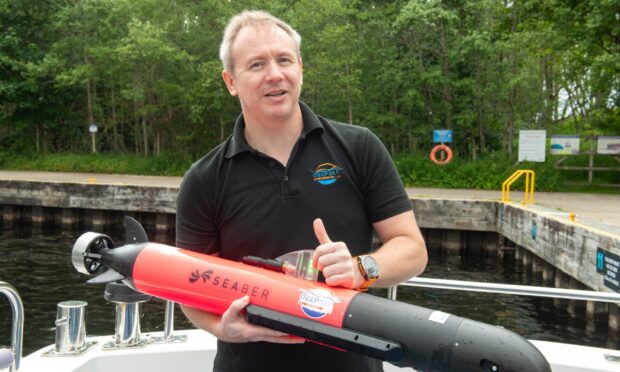
Deep Sea Vision president of operations Craig Wallace found a 1969 film prop in Loch Ness.

Craig Wallace and his underwater drone. Image: Maria Strang/DC Thomson

Craig Wallace and his underwater drone. Image: Maria Strang/DC Thomson

New technology will help the annual hunt for the Loch Ness Monster reach new depths this year.

Deep Sea Vision’s autonomous underwater vehicle, Micro Millie, has been scoping out the surface of the famous loch today.

The drone’s research is part of The Loch Ness Experience’s annual quest, which takes place this weekend.

Deep Sea Vision’s president of operations Craig Wallace said exploring Loch Ness is one of his favourite hobbies, and something he’s been doing for 15 years.

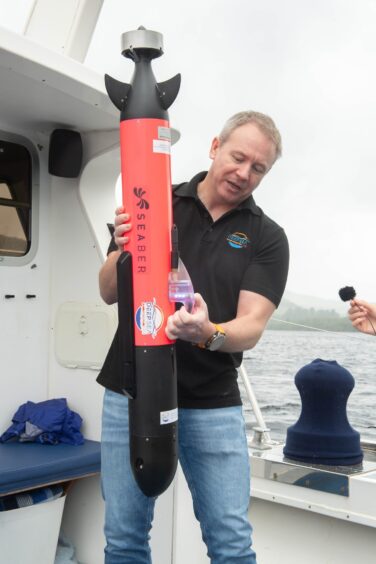
The piece of equipment, which has a value of around £75,000, is able to showcase Loch Ness in high resolution.

Something Craig claims we only currently know around 2% of.

The Press and Journal joined Deep Sea Vision on the waters of Loch Ness to learn more about their search. 

‘Everybody thinks Loch Ness has been done to death’

Craig funds the hobby through the business, Deep Sea Vision, which covers deep-ocean exploration.

He said: “From a personal perspective, I do it because I love Loch Ness, and I’ve been coming here for 15 years doing this.

“The reality is we only know maybe 2% of Loch Ness to a very high resolution.

“Everybody thinks Loch Ness has been done to death, but the reality is it’s mostly been explored with surface sonar. We wouldn’t even have found a bus if it was at the bottom yet.

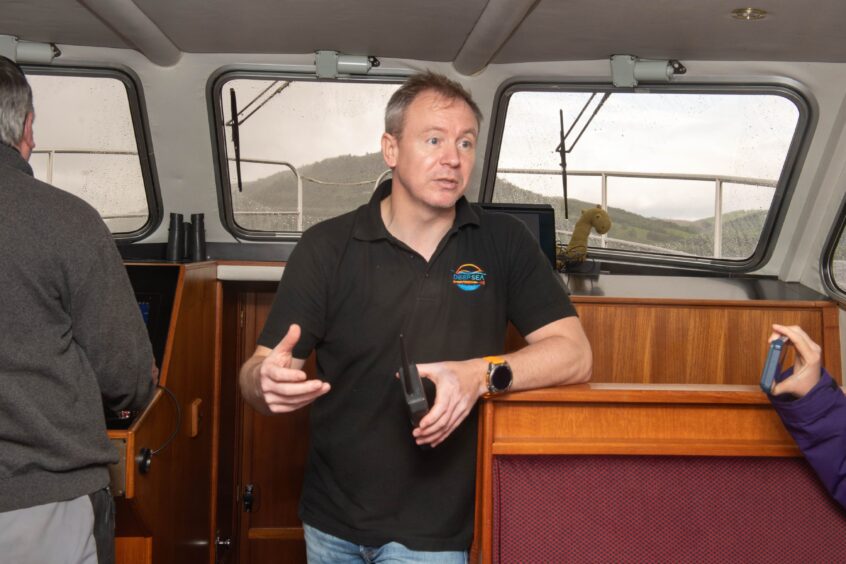
Craig Wallace of Deep Sea Vision on board the Natalie J vessel. Image: Maria Strang/DC Thomson

“A guy from Sutherland called Sir John Murray — who’s regarded as the godfather of modern oceanography — mapped 562 Scottish lochs between 1895 and 1903 using a rope and a lead weight to measure depths.

“Even today, for many Scottish lochs, that’s still the most advanced information we have.

“We’ve now got all this new technology, but most Scottish lochs still haven’t been properly mapped.”

Craig holding Micro Millie.
Image: Maria Strang/DC Thomson

Craig may have come closest to finding the real Loch Ness Monster in 2016, when he found an old film prop from The Private Life of Sherlock Holmes.

But he is on the hunt for a number of the loch’s secrets.

He added: “We found the Loch Ness Monster back in 2015, a film prop from a movie made in 1969.

“We also found Sir John Cobb’s boat in Loch Ness a few years ago.

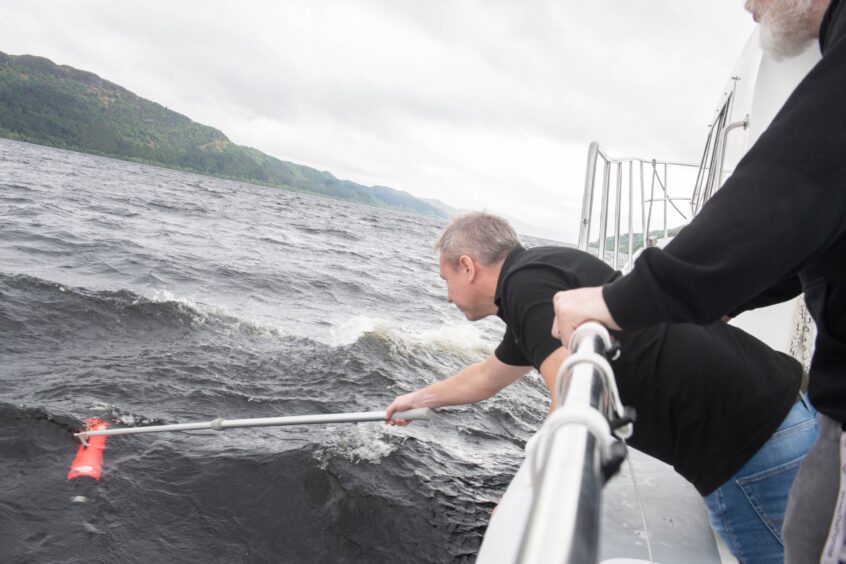
Hooking the autonomous underwater vehicle back in after it had explored Loch Ness. Image: Maria Strang/DC Thomson

“There’s a Spitfire that was lost in the north end of the loch that’s never been found. I’d love to find that story.

“When you finally find something after spending so long searching, it’s a huge buzz.

“There’s a lot of work and a lot of frustration that goes into it, so when you finally get a result, it’s a great feeling.”

Craig’s biggest dream is to find Amelia Earhart.

Loch Ness Exploration lead on ‘deep, dark and mysterious’ surface

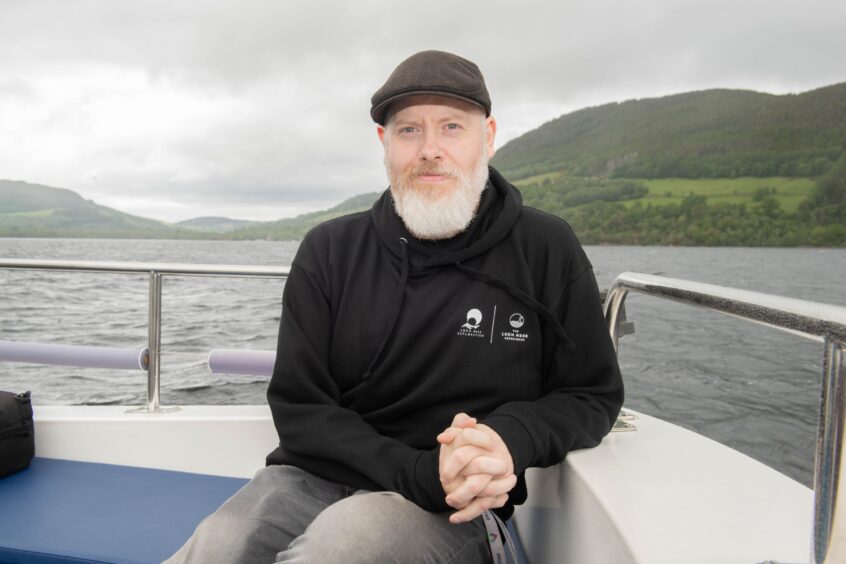
Loch Ness Exploration leader Alan McKenna is also part of this year’s hunt and was on the boat as Micro Millie was put into Loch Ness today.

He said: “I’ve known Craig for many years now and used to follow his work closely, so having the opportunity to work with him and use some of this technology on Loch Ness is really exciting.

“Maybe we’ll see the Loch Ness Monster — maybe not. We don’t know.

“But for me, I’m more fascinated by the natural environment itself. Loch Ness is such a unique location. It’s incredibly deep, dark and mysterious beneath the surface.

“It’s amazing to see the process. The images and data they can produce are really high resolution and pretty beautiful to look at.

Alan McKenna of Loch Ness Exploration. Image: Maria Strang/DC Thomson

“Craig has been really generous in showing us the 3D mapping they’ve created and it’s seriously impressive.

An image collage containing 1 images, Image 1 shows A black and white photograph of what is said to be the Loch Ness Monster, with a dark, indistinct shape protruding from the water

Nessie hunters are to launch a new search for the monster

An orange and black Micro Millie autonomous underwater vehicle on a blue crate, on gravel.

The underwater drone will scan the depths of Loch Ness

“We’ve been around Loch Ness for years now and know the place like the back of our hands on the surface.

“But the one place that remains a real mystery is below the water because of how deep and dark it is.

“Having people like Craig come in with this technology gives us a chance to look at Loch Ness in a completely different way.

“Some people might call it a lost cause, but to me it’s just as fascinating as ever.”

Urquhart Castle ruins on Loch Ness.

Experts reckon only about three per cent of the vast bed of the loch – which has a surface area of 21 square miles – has been mapped at this high resolution

Credit: Alamy


Today in History : Operation Deepscan: The 3-Day Sonar Hunt That SCANNED Loch Ness For Nessie

{ https://www.pressandjournal.co.uk/ }

Hoe vind je dit bericht?
Geschreven door peter om 22:36 Stuur door

Can AI Be Conscious? Researchers Say Science May Not Yet Know How to Tell

brianpenny-ai-generated-8540912_640-360x240.jpg

(Image Credit: BrianPenny)

Can AI Be Conscious? Researchers Say Science May Not Yet Know How to Tell

The question of whether artificial intelligence can be conscious has moved well beyond science fiction. It now sits at the center of scientific debate and is increasingly shaping discussions about a range of contentious issues, from AI ethics to animal welfare, fetal development, and laboratory-grown brain tissue.

However, according to a new analysis published in Neuron, the science used to answer that question may not actually be measuring what researchers think it is. A research team led by Hakwan Lau at the Institute for Basic Science in South Korea, with collaborators from the Université de Montréal and New York University, argues that many common experimental methods in consciousness research do not separate subjective experience from general information processing.

In the paper, The Ethical Impasse of Current Consciousness Science, the researchers argue that current scientific tools may not be capable of reliably detecting consciousness.

The Measurement Problem

Consciousness research relies heavily on methods such as visual masking, binocular rivalry, and the detection of perceptual limits. These methods usually compare brain responses when a person is aware of something versus when they are not. The idea is that the difference between these two cases shows whether conscious experience is present or not.

Lau and his team challenge this assumption. When experiments make a stimulus invisible, they often reduce both conscious awareness and the brain’s ability to process information about that stimulus. This means that what appears to be a marker of consciousness in the brain may actually reflect general cognitive activity.

“Many current theories of consciousness appear to be supported by a range of experimental findings,” Lau said. “But those findings may actually reflect general information processing rather than consciousness itself — so it remains difficult to conclude that these theories truly explain consciousness.”

A Historical Warning

The authors compare the current situation to the late 19th and early 20th centuries, when strong claims about consciousness led to a crisis in psychology. The resulting backlash led to the rise of behaviorism, which focused only on observable behavior and halted consciousness research for many years.

Researchers caution that a similar situation could occur again. As AI systems become more advanced and public interest in machine consciousness increases, scientists are under pressure to provide answers. If researchers make strong claims about consciousness in AI, organoids, or fetuses that lack robust methods to support them, scientific credibility could be undermined.

Better Science Required

The authors suggest a different approach. Conditions like blindsight, in which people with brain damage can respond to stimuli they do not report seeing, offer a more controlled way to study consciousness. Another example is hemispatial neglect, where patients fail to notice one side of their visual field while still having basic perception. For researchers, these conditions provide a rare opportunity to separate awareness from information processing and investigate each process on its own.

These conditions show that subjective experience and information processing are distinct from one another. The team says that building experiments around this difference is needed to make reliable scientific claims about consciousness.

The implications of this study extend far beyond the academic world. Deciding whether non-human entities are conscious has direct legal and ethical concerns. The researchers say that the science behind these decisions must meet high standards.

“Questions about consciousness increasingly carry ethical and societal implications,” Lau said. “If scientific claims about consciousness are going to influence discussions about animal welfare, AI ethics, or bioethics, then the scientific foundations supporting those claims must be especially rigorous.”

The researchers conclude that the most urgent challenge is not deciding whether AI, animals, or organoids are conscious, but developing better tools to identify consciousness if it emerges.

  • Austin Burgess is a writer and researcher with a background in sales, marketing, and data analytics. He holds an MBA, a Bachelor of Science in Business Administration, and a data analytics certification. His work focuses on breaking scientific developments, with an emphasis on emerging biology, cognitive neuroscience, and archaeological discoveries.

What if AI is already conscious? Sentience explained | LSE Research

Your Brain Thinks AI Is Alive — And That Reveals Something Disturbing About the Human Mind

Only Consciousness is Conscious— Artificial Intelligence Redefined as the Art of the Prompt

{ https://thedebrief.org/category/science/ }

Hoe vind je dit bericht?
Geschreven door peter om 21:58 Stuur door

China's Nostradamus issues chilling warning about Trump's UFO file release: 'Atrocities are coming'

China's Nostradamus issues chilling warning about Trump's UFO file release: 'Atrocities are coming'

A professor dubbed 'China's Nostradamus' has made a chilling prediction after the Trump administration released previously classified UFO files.

Jiang Xueqin, a Chinese-Canadian educator and political commentator, earned the nickname after making a series of geopolitical predictions that supporters say later came true.

Among them were forecasts that Donald Trump would return to the White House in 2024 and that the United States and Israel would become involved in a conflict with Iran under his administration.

Now, Jiang has turned his attention to the government's growing UFO disclosure effort, warning that the fallout could have consequences far beyond questions about extraterrestrial life.

Speaking with YouTuber Nico Ken De Balinthazy, known online as Sneako, Jiang dismissed the idea that alien visitors are behind the unexplained sightings documented in the UFO files.

'Everyone knows it's complete nonsense,' he said. 'It's complete BS. There are no aliens; there's no alien technology. It's a hallucination. You just distract people.'

Instead, Jiang argued that society is becoming increasingly fractured as people embrace competing fears and belief systems.

Some focus on UFOs, he said, while others become consumed by concerns about artificial intelligence, government conspiracies or even supernatural forces. 'And people retreat into their own bubble. Just think about the atrocities that are going to happen in the future; it's going to overwhelm people,' Jiang warned.

His comments come as the Trump administration continues rolling out previously classified records related to unidentified anomalous phenomena, or UAPs.

A video released in the first wave of UFO files appeared to show a glowing object resembling an 'eight-pointed star' with uneven arms moving across the sky

A video released in the first wave of UFO files appeared to show a glowing object resembling an 'eight-pointed star' with uneven arms moving across the sky

The disclosure effort, which began on May 8, has already produced two major releases containing videos, photographs and intelligence documents that had remained hidden from the public for years.

The latest batch included 46 videos that members of Congress had been demanding the Pentagon release for months.

Some of the footage appears to show strange metallic spheres or orb-like objects moving at high speeds over mountains, oceans and military facilities.

Other documents detail sightings stretching back decades and include accounts from military personnel, intelligence officers and pilots who reported encounters they could not explain.

The releases have reignited debate over whether governments possess evidence of extraterrestrial life and whether the public is finally being shown information that was previously withheld.

Jiang, however, believes the fascination with UFOs is distracting people from deeper social problems.

The greatest danger, he argued, is not alien life but a society increasingly driven by fear, uncertainty and distrust.

He warned that people may turn to comforting narratives rather than confront difficult realities, creating divisions that can weaken entire nations.

Jiang Xueqin dismissed the idea that alien visitors are behind the unexplained sightings documented in newly released government records

Jiang Xueqin dismissed the idea that alien visitors are behind the unexplained sightings documented in newly released government records

'They would rather close their eyes and shut off their ears and just live in the normal world,' Jiang said.

'We've seen this happen historically before, where empires decline because of civil war, because they get exhausted.'

The analyst then ventured into more controversial territory, suggesting that some of the world's most ambitious scientific and technological projects may be driven by motives far beyond their publicly stated goals.

Pointing to CERN, the European particle physics laboratory that operates the Large Hadron Collider, Jiang questioned why governments have spent enormous sums studying subatomic particles.

'You have to ask yourself, why are they investing a trillion dollars to find particles?' he said.

Jiang then referenced longstanding online conspiracy theories claiming that CERN's experiments are designed to open interdimensional portals rather than simply advance scientific knowledge.

He made similar claims about artificial intelligence, citing comments from an anonymous OpenAI employee quoted in a New Yorker article about the company's ambitions.

According to Jiang, these ideas reflect a broader belief that powerful institutions have long been interested in forces that exist beyond conventional human understanding.

READ MORE

EXCLUSIVE

article image

He argued that elites throughout history have believed in the existence of supernatural or interdimensional entities and claimed that human consciousness may be capable of interacting with them.

Jiang further suggested that some conspiracy theories are rooted in the belief that powerful individuals seek hidden knowledge, longevity and greater influence through contact with such entities, though he offered no evidence to support those claims.

Whether his latest prediction proves accurate remains to be seen.

{ https://www.dailymail.com/sciencetech/index.html }

Hoe vind je dit bericht?
Geschreven door peter om 21:28 Stuur door

‘Out of the Shadows’ Memoir From Senior U.S. Official to Investigate Truth About Non-Human Intelligent Life

‘Out of the Shadows’ Memoir From Senior U.S. Official to Investigate Truth About Non-Human Intelligent Life

Dan Farah, who directed and produced ‘The Age of Disclosure’ doc, has secured the film and television rights to Stratton’s memoir with plans to develop it as a scripted series. The memoir releases this October.

Out of the Shadows book by Jay Stratton

'Out of the Shadows' book by Jay Stratton. 

Courtesy of William Morrow

Jay Stratton, the central figure in the U.S. government’s modern investigation of unidentified anomalous phenomena (UAP) and non-human intelligent life, is set to detail their investigation in his memoir Out of the Shadows: Revealing the Truth About Non-Human Intelligent Life.

The memoir, to be published by HarperCollins imprint William Morrow, will release on Oct. 13. His book deal was first announced in 2024.

For over 16 years, Stratton has investigated UAP and non-human intelligent life on behalf of the federal government.

The synopsis of his memoir reads: “While serving at the Defense Intelligence Agency, Stratton learned of UAP incursions over nuclear weapon sites, leading him to co-found the Advanced Aerospace Weapon System Applications Program (AAWSAP), the first official U.S. Government program to investigate UAP since the closure of the Air Force’s Project Blue Book. Operating in the shadows of the intelligence community, Stratton discovered an 80-year coverup of the existence of non-human intelligent life and fought back against powerful gatekeepers who have hid the truth from the public, Congress, and even Presidents.”

Jay Stratton  Jason Shook

While risking everything in pursuit of the truth, he created and led the Unidentified Aerial Phenomena Task Force (UAPTF), the first whole-of-government investigation of UAP, forcing the nation to confront the unknown. Now, Stratton breaks his silence to provide a startling first-hand account of the shocking discoveries, encounters, challenges and behind-the-scenes revelations that profoundly altered his understanding of humanity’s place in the universe and took a disturbing toll on him and his family,” the synopsis concludes.

The announcement of the memoir’s release, described as one that “reads like a political thriller,” comes amid the Trump administration releasing a batch of long-promised declassified evidence related to UFO sightings and non-human intelligent life. The 162 files consist of documents, photos and videos that detail government employee reports of anomalous aircraft.

Apart from the government’s release of the files, intrigue over the existence of extraterrestrial life continues to grow. Steven Spielberg is making his anticipated return to the UFO genre with his upcoming film Disclosure Day. Last year, the UFO documentary The Age of Disclosure, had its world premiere at South by Southwest Film Festival and heavily featured Stratton. Dan Farah, who directed and produced The Age of Disclosure doc, has secured the film and television rights to Stratton’s memoir with plans to develop it as a scripted series.

Farah said in a statement to The Hollywood Reporter: “In Out of the Shadows, Jay Stratton delivers the most revealing and definitive testimony ever written about the government’s investigation and cover-up of UAP and non-human intelligent life. After discovering the related national security concerns and a potential existential threat, Jay defied powerful institutional gatekeepers and risked everything in order to reveal that humanity is not alone in the universe and to ensure the government takes action. Out of the Shadows has the propulsive storytelling of a high-stakes political thriller and exposes the biggest cover-up in human history, and the deeply personal, harrowing toll Jay’s pursuit of the truth had on him and his family.”

In addition to releasing his memoir, Stratton continues to work closely with the White House, Director of National Intelligence, and the Department of War “to identify and obtain access to all the evidence that exists within the various compartmentalized silos of the U.S. Government.”

Stratton and the UAP Task Force were honored in October 2024 for their efforts with the National Intelligence Meritorious Unit Citation, known as the highest level of recognition for a unit within the Intelligence community. Stratton has also been honored with the DIA Director’s Award.

{ https://www.hollywoodreporter.com/ }

Hoe vind je dit bericht?
Geschreven door peter om 21:07 Stuur door

Pentagon alien hunter who 'saw ET craft and bodies' to expose 80-year UFO cover-up

Pentagon alien hunter who 'saw ET craft and bodies' to expose 80-year UFO cover-up

Former Pentagon UFO investigator Jay Stratton will reportedly expose an 80-year alien cover-up in a bombshell new memoir detailing his encounters with ET craft and bodies

BY Liam Randall - News Reporter

A Pentagon alien hunter is gearing up to blow the lid off an 80-year government cover-up

A Pentagon alien hunter is gearing up to blow the lid off an 80-year government cover-up

(Image: Getty Images)

A Pentagon alien hunter who claims he has seen extraterrestrial spaceships and alien bodies is reportedly gearing up to blow the lid off an 80-year government cover-up. Jay Stratton, a former intelligence chief who spent 16 years spearheading the US government's official investigations into UFOs, is set to drop a bombshell memoir that promises to rock the world.

The highly-decorated defence official, who held a civilian rank equivalent to a two-star general, previously sent shockwaves through the UFO community during last year's documentary Age Of Disclosure.

In a jaw-dropping admission about what is lurking in the deep dark depths of space, Stratton said: "I have seen with my own eyes, non-human craft and non-human beings."

Jay Stratton, a former intelligence chief, is set to drop a bombshell memoir

Jay Stratton, a former intelligence chief, is set to drop a bombshell memoir

(Image: Getty Images for A E Networks)

The former spy chief is now taking his revelations to the next level in his upcoming book, Out of the Shadows: Revealing the Truth About Non-Human Intelligent Life.

Publishers HarperCollins teased that the book will expose how the government has actively hidden the truth about ETs from the public for nearly a century.

In a statement, the publisher said: "Operating in the shadows of the intelligence community, Stratton discovered an 80-year coverup of the existence of non-human intelligent life and fought back against powerful gatekeepers who have hid the truth from the public, Congress, and even Presidents."

Stratton sent shockwaves through the UFO community during last year's documentary Age Of Disclosure

Stratton sent shockwaves through the UFO community during last year's documentary Age Of Disclosure

(Image: Getty Images)

Stratton, who walked away from his government role in 2022, was the first-ever director of the Pentagon's Unidentified Aerial Phenomena (UAP) Task Force.

He originally helped set up the pioneering programme after learning that mysterious objects of unknown origin were buzzing American nuclear weapon sites. But hunting aliens apparently comes with a terrifying cost.

According to his publishers, Stratton will break his silence on unnerving encounters that "profoundly altered his understanding of humanity’s place in the universe and took a disturbing toll on him and his family."

The explosive book is set to hit shelves on October 13, landing right in the middle of a mainstream UFO revolution.

Thanks to declassified military files and high-profile Congressional hearings, UFOs have moved from sci-fi folklore into the halls of power.

Things have escalated so much that a presidential directive on February 26 ordered federal agencies to start unsealing evidence on UAPs and non-human intelligence.

Stratton hasn't finished fighting yet, either. He is currently working alongside the White House, the Director of National Intelligence and the Department of Defense to get his hands on classified evidence so he can release it to the public over the coming months.

The jaw-dropping story is already being eyed up for Hollywood treatment, too. Age Of Disclosure director and producer Dan Farah has already snapped up the TV and film rights to the memoir.

Lauding the whistleblower's bravery, Farah said: "After discovering the related national security concerns and a potential existential threat, Jay defied powerful institutional gatekeepers and risked everything in order to reveal that humanity is not alone in the universe and to ensure the government takes action."

RELATED VIDEOS

What Was the Pentagon Hiding for 80 Years? | Secret UFO Files Explained


The Pentagon Just Released Files They Hid for 80 Years — And They Can't Explain Them

{ https://www.dailystar.co.uk/news/weird-news/ }

Hoe vind je dit bericht?
Geschreven door peter om 20:37 Stuur door

Close Encounters, UFOs and cover-ups: Why Spielberg's 1977 conspiracy theory classic is so relevant in 2026

Close Encounters, UFOs and cover-ups: Why Spielberg's 1977 conspiracy theory classic is so relevant in 2026

A crowd of people approach and glowing spaceship in Close Encounters of the Third Kind (Credit: Alamy)

(Image credit: Alamy)

By Caryn James

Steven Spielberg's 1977 classic tapped into anxieties about the US government hiding UFO information from the public. It holds the key to the director's highly anticipated new film, Disclosure Day.

When trailers for Steven Spielberg's Disclosure Day confirmed that it deals with extraterrestrials, the internet exploded with speculation that it was a sequel to his 1977 classic, Close Encounters of the Third Kind. The guesswork became so rampant that the press notes for the new film cheekily announce it is "not a sequel to Close Encounters (sorry, internet)".

But it does have very direct ties. Emily Blunt, one of Disclosure Day's stars, has described it as resembling "a third act" along with Close Encounters and ET The Extra-Terrestrial (1982). Spielberg himself linked the films in one of the trailers, saying, "I'm even more inclined now than I was when I made Close Encounters to really believe that we're not the only intelligent civilisation in the Universe."  

Close Encounters becomes an everyman's attempt to find the truth in the face of massive government secrecy and lies

Some of the echoes are obvious, with friendly creatures from other planets arriving here. But there is a less obvious connection between Close Encounters and Disclosure Day, as both tap into conspiracy theories about the US government hiding evidence of UFOs – or, to use the updated term, UAPs, for Unidentified Anomalous Phenomena.

Those theories go back to the legendary supposed crash of a UFO in Roswell, New Mexico in 1947, and over the years have only intensified, making their way into the mainstream. Today they resonate in light of the Pentagon's recent underwhelming release of information about reported UAP sightings. Timelier than ever, Close Encounters is a key to Disclosure Day, which is all about revealing the truth about UAPs.

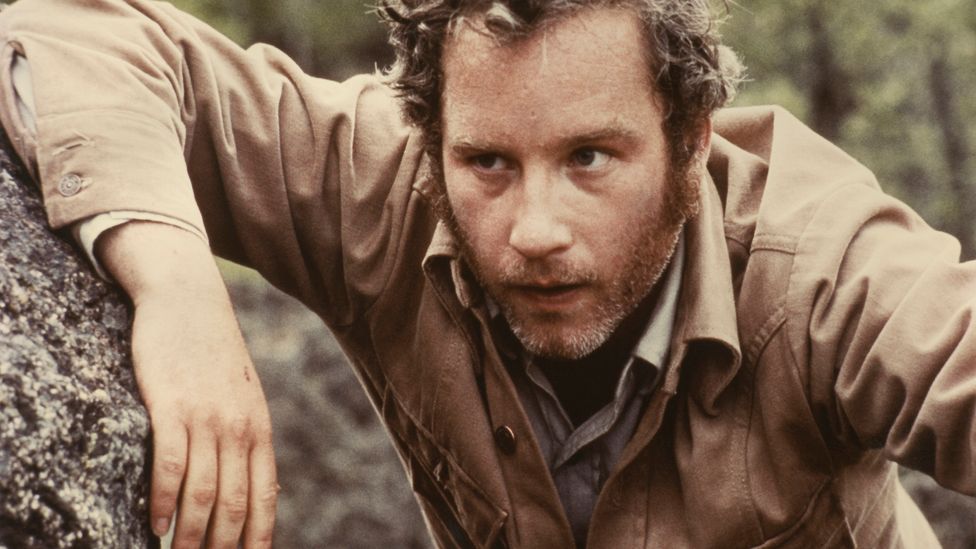
Spielberg's upcoming film Disclosure Day is closely linked with his 1977 classic, Close Encounters of the Third Kind, which starred Richard Dreyfuss (Credit: Getty Images)

Spielberg's upcoming film Disclosure Day is closely linked with his 1977 classic, Close Encounters of the Third Kind, which starred Richard Dreyfuss

(Credit: Getty Images)

With its bold, expansive visuals, themes of family distress and the awesome visit of beings from some other planet, Close Encounters holds up as one of Spielberg's most ambitious and dazzling films. Most viewers are likely to remember at least a few indelible images. Richard Dreyfuss as Roy Neary, an ordinary family man who sees a UFO, sits at the dinner table building mashed potatoes into the shape of a giant rock.

That rock is the site where the UFO will land, although he doesn't know it yet. One might recall the arrival of the glowing mothership, the spindly large-headed ghostly-white creatures walking out, and Roy happily joining them on board as he heads off into space. The five music notes scientists use to communicate with extraterrestrials are hard to forget.

'UFOs and Watergate'

But what jumps out watching Close Encounters today is how the government tries to prevent the public from knowing what we have seen to be true. At a community meeting, Roy and Jillian (Melinda Dillon), the mother of a three-year-old who has been taken by the aliens, join others who have seen the UFOs. A US Air Force officer says what they saw was definitely not from space. And the official deceptions go far beyond that lie. Throughout, Spielberg shows the audience evidence of a cover-up still unknown to the characters.

On television, the evening news reports that a train derailment has caused a chemical leak, requiring a 300-mile-(483km) wide evacuation near Devil's Tower, the monumental rock in Wyoming that is the very shape Roy was sculpting in potatoes. That report is just a cover story we've seen officials concoct. We have also seen a huge military operation heading toward Wyoming to prepare the evacuated area as a landing site for the spaceship, and equipment for the operation loaded onto trucks with signage for Baskin-Robbins ice cream and the Piggly Wiggly supermarket chain.

Beyond its memorable family story, Close Encounters is about how the government tries to keep information from the public (Credit: Getty Images)

Beyond its memorable family story, Close Encounters is about how the government tries to keep information from the public

(Credit: Getty Images)

As Roy and Jillian head to Devil's Tower together, they see dead animals on the roadside – not dead, we find out, but tranquilised by the government to make the chemical spill story plausible. Close Encounters becomes an everyman's attempt to find the truth in the face of massive government secrecy and lies.

In fact, when Spielberg first conceived the film, he described it as "UFOs and Watergate". Through many iterations of the screenplay, it morphed into a family story: Roy leaves his wife and children for space, and Jillian tries to find her lost son. Yet the conspiracy-thriller plotline remains strong. If you can't trust a grocery truck to be heading to a store instead of an alien landing, what can you trust? 

Even in ET, amidst all that film's heart-tugging, Spielberg emphatically depicts the government trying to keep its knowledge of extraterrestrials from the public. Nasa scientists and government agents swarm the house where little Elliott and his family have been protecting ET, in order to take and study him. And when ET heads home, with the iconic image of Elliott and his friends riding bikes across the sky to get him to safety, they are running from US government cars.   

Art imitating life

As they often do, Spielberg's fantasy films mirror aspects of real life. Jon Towlson, in his 2016 book about Close Encounters, writes that after the film's release, there was "a dramatic increase in reported UFO sightings, although these were not new cases as one might expect, but older reports made by people who had previously been afraid to come forward".

We now know that US government investigations of UFOs go back to 1947 and Roswell, and that similar studies have followed on and off ever since. Some of the subterfuge around that was brought to light in 2017, when the New York Times published a story about "The Pentagon's Mysterious UFO Program," revealing that the US Defense Department had been secretly funding studies of declared sightings. The government really had been hiding something. Whether it was evidence of UFOs or simply the fact that it had been studying the possibilities would have been enough to fuel more conspiracy theories.

Emily Blunt and Josh O'Connor star in Disclosure Day, a conspiracy thriller in the vein of films from the Close Encounters era (Credit: Universal Pictures)

Emily Blunt and Josh O'Connor star in Disclosure Day, a conspiracy thriller in the vein of films from the Close Encounters era

(Credit: Universal Pictures)

Interest has kept ramping up even while answers remain sparse. Nothing much came of Congressional hearings in 2023, which wondered whether UAPs posed a national security treat. More impressive information was revealed in a 2025 Wall Street Journal story about a report released by the Defense Department. The Journal wrote that the report omitted the fact that a disinformation program had spread rumours of UFOs, which was to disguise information Russia might have gleaned from a military facility.

None of this offered convincing evidence of UAPs or alien visitations. Neither did the report the Pentagon released last month, with many images easily explained as flashing lights. But that hasn't stopped true believers. "The stuff that they're releasing is stuff we've known for, like, forever," one of them told the BBC at the time, adding, "But I'm very hopeful that we're heading in the right direction."

More like this:

Disclosure Day lands in that real-life context, at a time of suspicions not only about the government's honesty but about truth and facts themselves. It is an action movie and a sci-fi story but above all a conspiracy thriller in the vein of post-Watergate films from the Close Encounters era.

Josh O'Connor's character, Daniel, is a whistleblower employed by the fictional but all too plausible Wardex, a clandestine agency working with the Defense Department, unofficial so it doesn't have to play by any rules. As the trailers have revealed, the government has been guarding decades' worth of evidence of extraterrestrial visitations. Daniel, the hero trying to release the truth, has to go on the run followed by Wardex killers intent on stopping him.

The echoes of 1970s thrillers are clear. In Three Days of the Condor (1975), for example, Robert Redford is a CIA researcher hunted by gunmen because of what he knows. "I just read books," he complains to his CIA bosses, just as Daniel protests, "I'm not a field guy, Hugo. I did the tech, that's all." Hugo (Colman Domingo) is another Wardex whistleblower who has what may be the film's most pertinent line, delivered vehemently: "This 79-year terror campaign of obfuscation, lies and cover-up has to end!"

Spielberg has emphasised as much in a teaser for the film. He says there is now a "critical mass" of people fascinated with the question of whether we are alone in the Universe. "And if someone knows we're not alone, why haven't we been told?"

  • Disclosure Day is released on 12 June.

Close Encounters with Terrifying Aliens | UFO Files


{ https://www.bbc.co.uk/culture }

Hoe vind je dit bericht?
Geschreven door peter om 18:07 Stuur door

This Man Claims an Alien Being Named Bashar Says Humanity Is Going Through a Reset in 2026

Darryl Anka Bashar

This Man Claims an Alien Being Named Bashar Says Humanity Is Going Through a Reset in 2026

This Man, who is known for claiming to channel an extraterrestrial being named Bashar, says that humanity is going through a “reset.” He believes we’re at a point where hidden problems and truths are being exposed, allowing us to choose what kind of future and civilization we want to create.

Aliens are not “coming,” according to the Bashar material; they are already interacting with us from 3,000 years ahead in a parallel timeline, trying to stop us from becoming what the Greys became: a post‑human cautionary tale.

Darryl Anka says 2026 is framed as the year of disclosure, not just about UFOs but about everything that has been suppressed: power structures, abuses, secrets, the “dirty laundry” of our species. From this view, the chaos in politics, media, and culture is not random; it is the purge phase before a new timeline locks in.

That idea is wild, but it explains why everything suddenly feels like it is on the table at once.To understand what Bashar is trying to convey, you have to start with Darryl’s story.

He was a creative kid into sci‑fi, not a New Age guru, until two silent black triangular craft passed over Los Angeles in broad daylight. One at roughly 150 feet and another about 70 feet away, both witnessed by multiple people.

That shock did not turn him into a preacher; it turned him into a researcher who spent years digging into UFOs, psychic phenomena, and channeling because his lived reality no longer matched the official story.

Whether you think those craft were classified tech, nonhuman intelligence, or some glitch in perception, that rupture is what birthed the entire Bashar material.

I care less about “believing” his story and more about what it means when a reasonably normal, creative person sees something so far outside the script that they dedicate decades to decoding it.

Ten years later, during a guided meditation in a channeling class, Darryl suddenly received what he describes as a telepathic download. The name “Bashar,” a face, and the memory of an agreement made before this life to be a channel.

The moment that happened, the entity speaking through the teacher stopped, turned directly to him, and said, “There is an entity here for you right now if you’re ready to begin.”

Another student simultaneously sketched the same face Darryl had just “seen” in his mind, convincing him this was more than imagination. From there he practiced, struggled to handle the energy, and over decades word‑of‑mouth expanded his sessions from a living room to audiences around the world.

Whether you think this is ET contact or a deep layer of his own psyche, you have to admit that there is a coherent system behind it that has been stable for 40+ years.

So who is Bashar, according to Darryl?

Bashar presents as a hybrid extraterrestrial from a parallel reality, part human and part “grey,” living in a civilization roughly 3,000 years more advanced than ours. Their solar system would be located about 500 light years in the direction of Orion if you overlapped their universe with ours, but it is only perceivable by shifting realities, like tuning into another frequency.

Physically, Bashar is described as about 5 feet tall, slender, pale‑skinned, large eyes, smaller facial features, and slightly larger head – a 50/50 hybrid between humans and the greys.

His role is not “space god” but a very specific job: a first contact specialist, part of a larger structure of social engineers and planetary engineers focused on guiding young civilizations through the most dangerous part of their evolution. This framing alone is controversial because it flips us from “top of the food chain” into “adolescents in a galactic neighborhood that’s already watching.”

According to Bashar’s narrative, the greys were once a human‑like civilization, a parallel version of Earth that destroyed its biosphere and mutated to survive. They lost the ability to reproduce and had to access other timelines where human DNA was still viable, including ours, to create hybrids that could preserve their culture.

That is the darker reinterpretation of “alien abduction” in this model: a desperate genetic salvage operation by a civilization that wrecked itself. Now the hybrids, including Bashar’s people, see us making the same mistakes and are trying to intervene before we push our own reality down the same dead timeline.

Darryl is very open about the fact that he cannot “prove” Bashar is real in a lab sense, but he has actually put his brain under study in a documentary to demystify channeling. In those measurements, his resting brain rhythm sits around 9 hertz, but when Bashar “speaks” it jumps to about 10 hertz, and when Bashar “listens” to a question it goes to 11, indicating an even deeper empathic intake of information.

At the same time, his brain shifts into high‑frequency gamma activity when channeling, the same “in the zone” state we hit during deep creativity, but with unusual stability and intensity. Bashar’s model is that everyone channels to some degree: when you do what you love and lose track of time, you are in a channeling state, just tuned to your own higher mind rather than a distinct ET consciousness.

One of the core teachings is what he calls “the formula,” which is basically an instruction manual for aligning your life with your highest timeline. The essence: your highest purpose is to be yourself as fully as possible, to live each moment in alignment with your true excitement, and to stop trying to be everything you are not just to fit external expectations.

Most of our suffering comes from being trained to ignore our authentic path: don’t stand out, be practical, don’t follow your passion, be “realistic.” Bashar reframes this as an energetic system: you cannot perceive what you are not the vibration of, so you must “be” the frequency of the reality you prefer before you can experience it.

To me, this is where his material overlaps with both neuroscience and simulation theory: your beliefs and emotions function like parameters, selecting which version of reality you load into your personal “game.”

On consciousness, Bashar’s model is radical but surprisingly elegant. You do not “have” a soul; you are a soul, and the body is more like a focus point, a condensed pixel cluster in a larger field of awareness.

He describes the soul as a sphere of energy filled with patterns, each representing concepts and lessons, which then focuses some of those patterns into a dense “seed” at the center to create a specific physical incarnation.

Life is the soul breathing: focusing into that seed to live a life, then relaxing back out into its full scope, integrating the experience, then doing it again.

Read also:

Our interactions, including Darryl’s link with Bashar, happen by vibrational and telepathic agreement between these “seeds” within a larger shared field of consciousness.

This sounds like mysticism, but it is highly compatible with a simulation‑style universe where all objects and “players” are simply different nodes of one underlying information field.

Now to the headline claim everyone fixates on is timing. Bashar originally spoke about a window for open contact between roughly 2020 and 2033, but as disclosure efforts and global conversation intensified, he narrowed that to around 2027 for a more literal introduction to extraterrestrials via official channels.

2026 is described as the year of disclosure more broadly: not just UFO files, but secrets in finance, religion, media, and power structures emerging from the shadows. He is explicit that this will not instantly create unity; there will be denial, resistance, accusations of hoaxes, and decades of adjustment.

The reason for the urgency, he says, is that humanity needs time before its “reset” to integrate ET contact at its own pace rather than being shocked into it. Whether you buy those dates or not, I find the deeper point compelling: a civilization that has nuclear weapons, global AI, and collapsing trust in institutions cannot just keep drifting. Something will force a choice.

Bashar does not paint ETs as saviors; they are more like strict older relatives who step in when the kids are about to burn the house down. He points to stories of UFOs disabling nuclear missile systems and scrambling launch codes as an example of a boundary: they will not allow a full thermonuclear annihilation because Earth is too valuable as a school for souls.

Earth, in this framing, is a high‑intensity polarity school where souls come to explore extremes of good and evil, connection and separation, specifically because it is hard.

From that perspective, the “zoo hypothesis” that we are being monitored while in quarantine is partially true, but the bigger picture is that we are being nudged toward global cooperation because the survival of our species now depends on it. Do you like the idea of ETs quietly enforcing a no‑extinction rule, or does it bother you that humans might not be the ultimate authority over Earth’s future?

There is also a softer, psychological edge to Bashar’s work that often gets ignored in the UFO conversation. He talks constantly about how beliefs generate experience, how people use their own confidence to reinforce negative narratives, and how “lack of trust” is itself a form of trust in something that does not serve you.

He uses humor to break patterns, pointing out that saying “I’m not confident” is still a demonstration of confidence; you are just confident in your limitation. He challenges the idea that certain situations, like chronic health problems, are impossible to shift at the belief level by calling that very assumption a belief that keeps the pattern locked.

This does not erase material conditions, but it gives people a more empowered framework: what if your primary leverage point is not controlling events, but changing your relationship to them.

For me, this is where his message is both empowering and controversial, because it implies a level of responsibility that many people understandably resist.

Here is my own stance, as someone who lives in the overlap of AI, UFOs, simulation theory, and ancient mysteries: you do not have to believe Bashar is a literal hybrid alien for his message to matter. You can treat him as a symbolic future human, a parallel version of us who has already solved the problems we are drowning in, transmitting back a set of psychological, spiritual, and civilizational “patch notes.”

The real danger is not that he is wrong; the real danger is that we keep living as if none of these warnings matter, pretend there is no bigger context, and let our timelines be chosen for us by inertia and fear.

My bold take is that whether contact in 2027 looks like a press conference, a mass sighting, or just millions of people snapping out of their old programming at once, the civilization we land in will depend far more on our consciousness than on any ship in the sky.

So the real question is not “Are aliens real?” but “What kind of species do we become if we act as if we are already being watched, mentored, and challenged to grow up?”

RELATED VIDEOS

A Man Claims to Channel an Alien Being | INTERVIEW WITH THE EXTRATERRESTRIAL | Full Documentary

Bashar Unveils Interstellar Future Tech Transforming Human Power | Bashar Channeling 2026

Bashar - Ancient Civilisations: Maians, Aztecs, Atlantians

{ https://howandwhys.com/ }

Hoe vind je dit bericht?
Geschreven door peter om 17:37 Stuur door

Meer van UFO'S of UAP'S, ASTRONOMIE, RUIMTEVAART, ARCHEOLOGIE, OUDHEIDKUNDE, SF-SNUFJES EN ANDERE ESOTERISCHE WETENSCHAPPEN - DE ALLERLAATSTE NIEUWTJES

↑ Terug naar de berichten