Naar de inhoud

UFO'S of UAP'S, ASTRONOMIE, RUIMTEVAART, ARCHEOLOGIE, OUDHEIDKUNDE, SF-SNUFJES EN ANDERE ESOTERISCHE WETENSCHAPPEN - DE ALLERLAATSTE NIEUWTJES

UFO's of UAP'S in België en de rest van de wereld
akke.beakke.be
Ontdek de Fascinerende Wereld van UFO's en UAP's: Jouw Bron voor Onthullende Informatie! Ben jij ook gefascineerd door het onbekende? Wil je meer weten over UFO's en UAP's, niet alleen in België, maar over de hele wereld? Dan ben je op de juiste plek! België: Het Kloppend Hart van UFO-onderzoek In België is BUFON (Belgisch UFO-Netwerk) dé autoriteit op het gebied van UFO-onderzoek. Voor betrouwbare en objectieve informatie over deze intrigerende fenomenen, bezoek je zeker onze Facebook-pagina en deze blog. Maar dat is nog niet alles! Ontdek ook het Belgisch UFO-meldpunt en Caelestia, twee organisaties die diepgaand onderzoek verrichten, al zijn ze soms kritisch of sceptisch. Nederland: Een Schat aan Informatie Voor onze Nederlandse buren is er de schitterende website www.ufowijzer.nl, beheerd door Paul Harmans. Deze site biedt een schat aan informatie en artikelen die je niet wilt missen! Internationaal: MUFON - De Wereldwijde Autoriteit Neem ook een kijkje bij MUFON (Mutual UFO Network Inc.), een gerenommeerde Amerikaanse UFO-vereniging met afdelingen in de VS en wereldwijd. MUFON is toegewijd aan de wetenschappelijke en analytische studie van het UFO-fenomeen, en hun maandelijkse tijdschrift, The MUFON UFO-Journal, is een must-read voor elke UFO-enthousiasteling. Bezoek hun website op www.mufon.com voor meer informatie. Samenwerking en Toekomstvisie Sinds 1 februari 2020 is Pieter niet alleen ex-president van BUFON, maar ook de voormalige nationale directeur van MUFON in Vlaanderen en Nederland. Dit creëert een sterke samenwerking met de Franse MUFON Reseau MUFON/EUROP, wat ons in staat stelt om nog meer waardevolle inzichten te delen. Let op: Nepprofielen en Nieuwe Groeperingen Pas op voor een nieuwe groepering die zich ook BUFON noemt, maar geen enkele connectie heeft met onze gevestigde organisatie. Hoewel zij de naam geregistreerd hebben, kunnen ze het rijke verleden en de expertise van onze groep niet evenaren. We wensen hen veel succes, maar we blijven de autoriteit in UFO-onderzoek! Blijf Op De Hoogte! Wil jij de laatste nieuwtjes over UFO's, ruimtevaart, archeologie, en meer? Volg ons dan en duik samen met ons in de fascinerende wereld van het onbekende! Sluit je aan bij de gemeenschap van nieuwsgierige geesten die net als jij verlangen naar antwoorden en avonturen in de sterren! Heb je vragen of wil je meer weten? Aarzel dan niet om contact met ons op te nemen! Samen ontrafelen we het mysterie van de lucht en daarbuiten.

Archief

First missing scientist is found dead a year after vanishing as bizarre circumstances of her death are revealed

First missing scientist is found dead a year after vanishing as bizarre circumstances of her death are revealed

The body of a missing nuclear lab employee has been discovered, 11 months after she mysteriously walked out of her home and vanished without a trace. 

New Mexico State Police announced that they positively identified the remains of Melissa Casias, 54, who was last seen alive on June 26, 2025.

Her body was found in the McGaffey Ridge area of the Carson National Forest, approximately six miles from the last place Casias was seen walking before being declared missing.

Police said a hiker in the forest made the discovery and that a handgun was found alongside the body. Casias's cause of death and when she died have yet to be determined by the Office of the Medical Investigator in New Mexico.

Casias was an administrative assistant at the Los Alamos National Laboratory (LANL), a facility founded by the famed Manhattan Project during the Second World War. It has been tied to nuclear weapons research ever since.

Her disappearance has been linked to a string of deaths and missing person cases involving US scientists and government employees who worked at highly secretive facilities and allegedly had knowledge of sensitive topics tied to national security.

The circumstances surrounding Casias's case were even more disturbing, as the wife and mother wiped all records from her phones before leaving them and her identification behind and walking out of her home in Ranchos de Taos last June.

It remains unclear how long Casias's body was in the forest before it was discovered, despite the area being part of a large US Forest Service restoration project where crews have been working regularly since December 2025. 

Melissa Casias worked at the Los Alamos National Laboratory, a long-running nuclear research facility, before disappearing on June 26, 2025

Melissa Casias worked at the Los Alamos National Laboratory, a long-running nuclear research facility, before disappearing on June 26, 2025

New Mexico State Police have stated that the body of Melissa Casias was found alongside a handgun in the McGaffey Ridge area of the Carson National Forest (Pictured)

New Mexico State Police have stated that the body of Melissa Casias was found alongside a handgun in the McGaffey Ridge area of the Carson National Forest (Pictured)

The New Mexico State Police told the Daily Mail that investigators are still examining the scene where the body was found and are attempting to trace the gun's origins, but it could take days before those answers are revealed.

At this time, it is unclear if Casias owned a handgun or if there is any indication as to who the weapon found near her body belonged to. 

Former FBI Assistant Director Chris Swecker told the Daily Mail in March he was concerned her disappearance was part of a much larger pattern involving individuals who had access to top secret government research.

Swecker explained that Casias's work at LANL may have made her a target for abduction, since an administrative assistant often has access to the same sensitive files their supervisors have.

'In a classified lab, or just a high clearance lab, they would basically be in the know on what's going on,' Swecker said. 'And it wouldn't be the first time their administrative assistant has been targeted.'

However, the woman's family and private investigators have disputed how much access Casias really had, claiming that the LANL employee lost her security clearance due to financial troubles she and her husband were having.

Casias vanished after dropping off her husband, another LANL employee, at the facility that morning, approximately 70 miles from their home.

That was when Casias's behavior allegedly became unusual, as she claimed she would need to return home after forgetting the badge needed to access the nuclear lab. 

Casias was last seen walking alone in New Mexico after dropping off her husband at work at Los Alamos National Laboratory, but not reporting for work herself.

Casias was last seen walking alone in New Mexico after dropping off her husband at work at Los Alamos National Laboratory, but not reporting for work herself

According to her husband, Mark, a superintendent at the lab, Casias had the security badge with her when she dropped him off that morning, as she would have needed the badge to get past the security checkpoints.

When Casias arrived in Ranchos de Taos, the couple's daughter, Sierra, reportedly told investigators that her mother visited the teen's place of work to drop off a sandwich and then said she planned to work from home after forgetting the badge.

article image

Despite what Casias reportedly told both her daughter and husband, she returned home to drop off her work and personal phones, which the family would later find inside the house, wiped clean.

Specifically, the device showed that someone performed a factory reset on both devices, clearing all records of whom Casias may have been in contact with before vanishing.

Surveillance cameras last spotted Casias walking alone eastward on State Road 518, roughly three miles from her home, around 2.20pm local time.

The area inside Carson National Forest where her body was discovered is just five to six miles away from that state road.

In 2023, the US Forest Service approved the McGaffey Forest and Rio Grande del Rancho Watershed Restoration Project.

The project covers about 30,000 acres south of Taos, including the McGaffey Ridge area where Casias was found. Its goal is to restore forest health through tree thinning, timber harvesting, and prescribed fire to reduce wildfire risk and improve watersheds.

Workers began entering the area for active work in December 2025, starting with timber harvesting and thinning in partnership with the State of New Mexico.

Pictured: Workers harvesting timber within Carson National Forest. It is unclear how long Casias's body was in the park before being discovered

Pictured: Workers harvesting timber within Carson National Forest. It is unclear how long Casias's body was in the park before being discovered

Casias was one of four missing people with links to US defense and nuclear programs

Casias was one of four missing people with links to US defense and nuclear programs

Three other individuals in New Mexico with a connection to US nuclear facilities disappeared under identical circumstances over the last year.

Fellow LANL employee Anthony Chavez, 79, worked at the lab until his retirement in 2017, although his role there has not been made clear. He vanished without a trace after walking out of his home on May 4, 2025, just seven weeks before Casias.

Meanwhile, Steven Garcia, 48, vanished without a trace on August 28, 2025. He was last seen leaving his Albuquerque, New Mexico, home on foot, carrying only a handgun and no identification.

An anonymous source told the Daily Mail that Garcia was a government contractor working for the Kansas City National Security Campus (KCNSC), a major facility in Albuquerque that plays a key behind-the-scenes role in America's national defense.

The mysterious disappearances came to light after retired Air Force General William Neil McCasland vanished from his New Mexico home in February. 

The general had previously been in charge of the Air Force Research Lab, which worked closely together on national security projects, especially research involving America's nuclear capabilities, with these labs.

'That entire mission runs out of Kirtland Air Force Base. A big part of it, including the technology and the production of the technology that they use, is all built in Albuquerque. So McCasland would have absolutely known and been to these facilities,' a source revealed.

McCasland's military career and the bases he oversaw have been tied to Casias, Chavez, Garcia and missing NASA scientist Monica Reza.

The White House has tasked the FBI with looking into all of these disappearances, but the agency has not released a detailed report on their findings to this point. 

{ https://www.dailymail.com/sciencetech/index.html }

Hoe vind je dit bericht?
Geschreven door peter om 20:36 Stuur door

Space boffin breaks silence on 'UFO' spotted soaring out of erupting volcano

Space boffin breaks silence on 'UFO' spotted soaring out of erupting volcano

Harvard physicist Avi Loeb has lifted the lid on the 'glowing orb' seen rising from an erupting volcano in the Philippines after a meteor flash left onlookers stunned

A mysterious glowing orb rises from an exploding volcano

An expert has weighed in after a mysterious glowing orb appeared from an exploding volcano

(Image: afarTV/YouTube)

BY Liam Randall - News Reporter

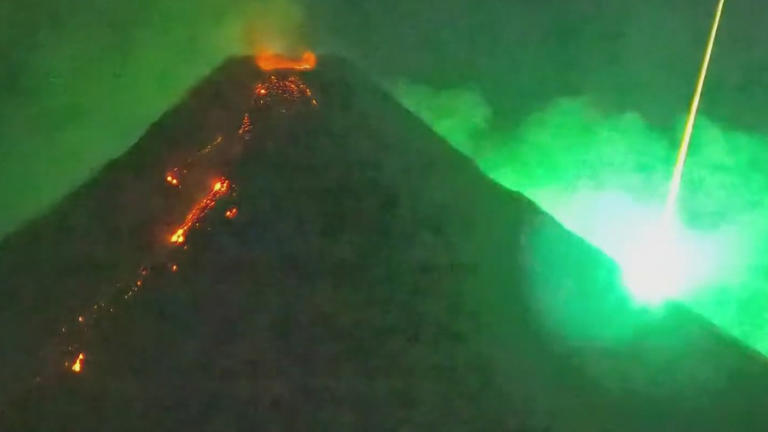
A Harvard boffin has weighed in on the moment a mysterious glowing orb appeared to launch itself out of an exploding volcano right after a meteor strike. Mind-boggling footage captured a green fireball tearing through the night sky behind Mount Mayon - one of the planet's most volatile peaks located in the Philippines.

The stunning cosmic event kicked off at around 10.30pm on May 25 and was caught from multiple angles by cameras monitoring the peak.

But the real mystery began just after the space rock flashed by. As glowing orange lava oozed down the mountainside, a small, luminous white speck was spotted lifting off into the heavens in clips shared by afarTV.

Abraham 'Avi' Loeb, a Harvard University astrophysicist

Harvard's Avi Loeb has poured cold water on the alien theories

(Image: Anadolu Agency/Getty Images)

The spooky clip sent internet sleuths into overdrive, with many convinced they had just witnessed a bona fide UFO departure. However, top theoretical physicist Avi Loeb has poured cold water on the alien theories.

Speaking to NewsNation Prime, the Ivy League professor said: "The light coming up is most likely the glint from a satellite reflecting sunlight. There are more than 10,000 communications satellites moving around the Earth, so it's not very unlikely to see such a thing."

According to the space expert, skywatchers simply caught a spectacular, one-in-a-million coincidental optical illusion.

Mount Mayon spews lava during an eruption near Legazpi city

Mount Mayon in the Philippines is one of the planet's most volatile peaks

(Image: AFP via Getty Images)

The celestial display left nearby residents absolutely terrified. One panicked local from the town of Los Baños admitted they "thought it was a missile because of how bright it was."

They added: "It burned bright green and white for less than a second before it disappeared into the clouds." At first, the Philippine Institute of Volcanology and Seismology (PHIVOLCS) triggered alarm bells by claiming their tech had caught the meteor "striking the northern slopes of Mayon Volcano".

But after a deeper look at the data, the agency backtracked, confirming the cosmic boulder actually vaporised harmlessly in mid-air.

Taking to X (formerly Twitter), PHIVOLCS posted: "Our review of seismic, infrasound and additional camera footages around the volcano indicate that the meteor disintegrated while in the atmosphere and did not strike the slopes of Mayon, contrary to our initial post." Had the fiery rock actually smashed into the volcano, it would have left a massive, undeniable scar.

And while the timing looks like a miracle, the odds of a meteor crossing paths with Mount Mayon are actually higher than you'd think. The notorious Luzon-based peak is the most active volcano in the Philippines and one of the most dangerous on Earth.

By the time the green fireball turned up, the volcano had been continuously oozing lava for 140 straight days, meaning multiple cameras had already been rolling around the clock for months.


Fireball UFO crashes into volcano! And then...something really amazing happens!

{ https://www.dailystar.co.uk/latest/ufo }

Hoe vind je dit bericht?
Geschreven door peter om 17:36 Stuur door

‘The truth is still out there’

 ‘The truth is still out there’

“LOOK at that thing, dude. My gosh. There’s a whole fleet of them. They’re all going against the wind … look at that thing. It’s rotating.” While this may sound like a scene from a sci-fi film, these were the voices of US Navy aviators reacting to an object detected by military sensors, in footage later known as Gimbal. The Pentagon formally released that video, along with two others, in 2020, confirming that they showed what it described as unidentified aerial phenomena.

X Files The Truth is Out There remastered wallpaper - Album on Imgur

In May 2026, the Pentagon began releasing more declassified UAP material in batches throu­­gh the Presidential Unsealing and Report­ing System for UAP Encounters, known as PURSUE — hundreds of files and more than 50 videos, including historical records of “green orbs”, “discs” and “fireballs”, as well as newer military-linked footage. This, in its simplest form, is known as the unidentified anomalous phenomena.

‘UAP’ is the modern bureaucratic term for what the world once called Unidentified Flying Objects, UFOs. The shift in language is deliberate. UFO came carrying decades of cultural baggage: flying saucers, little green men, crashed discs, secret hangars, conspiracy radio and late-night documentaries. The term ‘UAP’ gives the state a way to talk about the mystery without surrendering to the mythology.

But the public does not hear it that way. For UAP enthusiasts, an object trained pilots cannot identify, detected by military systems, moving against the wind or rotating in unusual ways, is not a neutral bureaucratic category. It is the oldest question in a new form: are we alone? And, perhaps, for good reason.

The existence of UAPs does not automatically mean they are alien. It means they are unresolved.

For decades, the question of UFOs, now UAPs, was made ridiculous before it was examined. The official history of UFO inquiry is full of this contradiction. Governments investigated sightings because they could not ignore them, but often spoke about them as if only the foolish would take them seriously. The infamous ‘Project Blue Book’, the US Air Force’s programme to study and debunk UFOs, became the symbol of this uneasy posture: investigate the unknown, but reassure the public that nothing extraordinary is happening, all the while hundreds of those sightings or cases remained ‘unexplained’. This is the strange irony of the alien question.

Hollywood has spent more than half a century making extraterrestrial life profitable. We are culturally fluent in fictional aliens, yet when real pilots, soldiers, radar operators or civilians describe something strange in the sky, the same culture suddenly becomes embarrassed. With all of the newly declassified files, that ridicule is now becoming harder to sustain.

Yet as UAPs have moved from the margins into congressional hearings, official reports and military disclosure, the official position has remained cautious. The Pentagon has released videos and records, while its All-Domain Anomaly Resolution Office, or AARO, continues to examine cases. Nasa, too, has entered the conversation, arguing for better data, better sensors and less stigma. Yet both remain careful: they acknowledge that some cases are unresolved, while Nasa’s independent study team has stated that there is no conclusive evidence in peer-reviewed scientific literature suggesting an extraterrestrial origin for UAPs, and that many cases remain difficult to resolve because the data is often incomplete, inconsistent or not collected scientifically.

This is where the debate often polarises. One side treats every unexplained sighting as evidence of alien visitation. The other treats every mention of aliens as foolish claims. But both positions are oversimplified. The more honest position is harder. UAPs exist in the limited but important sense that there are sightings, sensor records, and official cases that remain unidentified. That does not automatically mean they are alien. It means they are unresolved. The difference matters.

There is a ladder of probability. At the bottom are ordinary explanations: aircraft, balloons, birds, drones, satellites, debris, weather effects, optical illusions, camera artefacts and sensor errors. Many UAP cases eventually fall here. A distant object may appear impossibly fast because of camera angle; a sensor may misread distance; a pilot may misjudge size or speed. A classified aircraft may be unknown to the observer but not to the state.

Higher up are more troubling possibilities: advanced surveillance systems, experimental military technology, unknown atmospheric phenomena, or limits in our sensors and perception. Only then does one arrive at the most dramatic explanation: non-human technology. That explanation is not impossible. It is simply not yet proven.

The strongest argument for taking UAPs seriously is not that they prove aliens. It is that serious institutions now admit that some cases cannot be fully explained with the data available. That alone is significant.

This is also why the release of Pentagon files should not be mistaken for an admission of first contact. A government disclosure is not the cinematic moment where the state finally confesses that visitors have arrived. It is more likely controlled transparency: a response to congressional pressure, public mistrust, national security uncertainty, and decades of secrecy.

The alien question survives because both sides have something to explain. The believers must explain why there is still no public, verifiable physical evidence of extraterrestrial technology. The sceptics must explain why trained observers, military systems, and official institutions keep encountering cases that cannot be dismissed as fantasy. Between those two failures is where the real mystery lives.

So, the million-dollar question: are we really alone?

The universe is too vast for certainty to belong only to sceptics. It would be arrogant to assume life emerged only once, on one small planet, around one ordinary star. But it would also be careless to turn every unknown light in the sky into a visitor from another world.

Even as a lifelong ‘believer’ and a UAP enthusiast who has consumed everything from official press conferences to Netflix documentaries on the subject, I suspect first contact may not arrive as a Spielberg-style landing on Earth. It may come more quietly: from one of Nasa’s missions to Europa, hidden in the chemistry of an ocean beneath ice.

  • The writer is the founder of Media Matters for Democracy.
  • Published in Dawn, June 1st, 2026

{ https://www.dawn.com/ }

Hoe vind je dit bericht?
Geschreven door peter om 17:21 Stuur door

This German Scientist Claims Advanced Civilizations May Survive Only About 5,000 Years Before Dying Out

Sabine-Hossenfelder-1-1-420x280.jpg

This German Scientist Claims Advanced Civilizations May Survive Only About 5,000 Years Before Dying Out

This German scientist says that if the new  math is right, a technological civilization may only last about 5,000 years on average before it dies out. Physicist Sabine Hossenfelder explains a pretty unsettling idea: if the Fermi paradox is taken seriously, technological civilizations in our galaxy may usually last only about 5,000 years before they go silent, collapse, or stop being detectable.

Sabine is saying that the universe may not be full of long-lived alien empires at all; instead, most advanced species may be short-lived and disappear before they can spread far or talk for very long.

What the Fermi paradox means

The Fermi paradox asks a very direct question: if the universe is so old and so huge, why have we not seen any clear sign of alien civilizations yet? Sabine frames it as a mystery about silence, not just about aliens existing somewhere. The basic logic is simple: if intelligent life were common and long-lasting, some civilization should probably have left signals, probes, or some other trace by now.

The new paper she discusses turns that question around. Instead of asking how many alien civilizations exist, it asks how long a civilization can survive if we still hear nothing from anyone else. That change sounds small, but it leads to a much darker conclusion than many people expect.

The Drake equation angle

Sabine explains that the starting point is the Drake equation, which estimates how many communicating technological civilizations may exist in the Milky Way. The equation combines factors like how many suitable planets there are, how often life begins, how often intelligence appears, how often it becomes technological, and how long that technological phase lasts. The paper uses optimistic values for the first parts of that equation, and then solves for the last part: lifetime.

That is how the authors arrive at the shocking number of roughly 5,000 years. In other words, if life and intelligence are fairly common, then civilizations may not stay technologically active for very long before they vanish or become undetectable. Sabine emphasizes that this is not a prophecy, but a  mathematical upper bound based on the silence we observe.

Why 5,000 years matters

Five thousand years is tiny on cosmic timescales. The Milky Way is billions of years old, and radio signals can cross the galaxy in about 100,000 years, so a civilization that survives and broadcasts for much longer than that should, in principle, have been noticed by now. The absence of any clear detection makes the result feel depressing, because it implies that long-lived alien civilizations may be rare.

The unsettling part is that 5,000 years is also not that far beyond human  history. Our technological civilization is only a few hundred years old, so if the paper is even roughly right, we may still be in a very early and fragile phase. Sabine’s point is not that humanity is doomed tomorrow, but that the window for advanced civilization may be much smaller than people imagine

Three possible explanations

Sabine lays out three broad reasons why civilizations might go dark so quickly. The first is self-destruction: war, pandemics, ecological collapse, or misuse of technology could wipe out a civilization before it spreads widely. This is the most disturbing possibility, because it suggests intelligence may create the tools for its own undoing.

The second possibility is that some unknown external hazard is killing civilizations. That could mean things like more frequent supernovae, hidden cosmic dangers, or other risks we do not yet understand well enough. Sabine says this is possible, but she seems less convinced by it than by the idea that civilizations destroy themselves or fail to stabilize.

The third explanation is stranger: civilizations may survive, but simply stop caring about outward expansion or communication. They might retreat into virtual reality, post-scarcity comfort, or some other state where space exploration becomes irrelevant. In that case, the universe may still be full of advanced beings, but they would not look like the classic radio-broadcasting aliens people expect.

Read also:

The great filter idea

This discussion connects to the idea of the Great Filter, which is the notion that somewhere between a habitable planet and a galaxy-spanning civilization, there is one extremely hard step almost nobody gets past. Sabine says the filter may not be the origin of life itself, because life’s chemical beginnings may be more common than once thought. Instead, the hard part may come later, when a species must become intelligent, technologically capable, and coordinated enough to survive its own progress.

That is where her comments get especially blunt. She suggests that human beings may not even be smart enough to clear that bar safely on our own. Her implication is that artificial intelligence may help us, but it could also make the situation more dangerous if not handled well.

Her main disagreement

Sabine does not fully agree with the paper’s most pessimistic interpretation. Her main disagreement is about communication technology. The paper assumes other civilizations would use electromagnetic signals like radio, the same sort of thing we search for with SETI, but Sabine thinks that may be far too human-centered.

She argues that an advanced species might use a completely different method, possibly even faster-than-light communication if such a thing is physically possible. If that is true, then we might be surrounded by alien signals and simply not have the right technology to detect them. Her joke is that Earth could be sitting inside a cosmic broadband stream while humans listen on the wrong channel.

Why this feels shocking

What makes her explanation shocking is not just the number 5,000. It is the wider message behind it: technological civilization may be common, but short-lived; intelligence may not guarantee survival; and silence might reflect fragility rather than loneliness. That is a much harsher lesson than the comforting idea that aliens are out there and just too far away.

At the same time, Sabine does not present the paper as a final answer. She treats it as a useful but limited argument, because it depends on optimistic assumptions about how often life appears and what kind of signals civilizations use. So the real takeaway is not “aliens are impossible,” but “our assumptions about aliens may be much too narrow”.

RELATED VIDEOS


The war that Ended the Ancient World

We Are NOT the First Civilization on Earth - 2026 Documentary Scientists Tried to Ban!

If Humans Are The 7th Civilization, What Happened To The Other 6?

{ https://howandwhys.com/ }

Hoe vind je dit bericht?
Geschreven door peter om 16:44 Stuur door

Inside Dan Burisch’s Claim That J‑Rods (Grey-Type) Were Actually Sick Time‑Travelling Humans

Dan Burisch’s J‑Rod story

Inside Dan Burisch’s Claim That J‑Rods (Grey-Type) Were Actually Sick Time‑Travelling Humans

A controversial UFO whistleblower once claimed that, while working at S-4 near Area 51, he treated a sick extraterrestrial who told him it was actually human, just from a different timeline.

Dan Burisch’s J‑Rod story, if even 5% true, is terrifying for what it implies about us. On the surface, it’s a lab story: a government biologist recruited in the 80s, cleared into a facility near Area 51, assigned to work on a non‑human being in a pressurized sphere under “Project Aquarius.” Underneath, it’s a theory of our future, our past, and how reality itself might work

Let’s break down Dan’s story! 👽

Dan Burisch introduced himself as a trained microbiologist with a PhD who claims he was recruited into a “Project Aquarius” at an S-4 facility to work on a captured non‑human being called ‘J‑Rod.’

Yeah, same facility where Bob Lazar claimed to work. He said he knew Lazar personally and that Lazar was involved in reverse-engineering alien craft at S-4 while Burisch was working on J-Rod.

The official story he said he was given at first: J‑Rod was an alien from the Zeta Reticuli system, about 15 light-years away, recovered from a UFO crash near Kingman, Arizona, in the early 1960s. Later, he claimed he learned a much stranger explanation. He said J‑Rod was actually a future human from a different timeline, a descendant of us who had evolved into a small, gray‑like being with a large head, big black eyes, and strong telepathic abilities.

According to Burisch, J‑Rods aren’t a separate species from a distant star. They’re future humans (about 3.5 feet tall) from a divergent timeline who took a different evolutionary path: small bodies, large heads, telepathic “VR‑like” minds, and a catastrophic genetic disease linked to their own technological choices.

He said J‑Rod lived inside a pressurized “clean sphere” because of its unusual biology. Here’s the part that always sticks with me: he described the J‑Rod streaming whole experiences into his mind.

Not just images, but 3D geometry, advanced math, memories of a wife, and environments that feel fully immersive, like being dropped into a conscious simulation. It’s a native “mental metaverse.”

Doesn’t this sound a lot like what we’re trying to build with brain‑computer interfaces and AI right now: compressing information into dense, multimodal packets and pushing them directly into perception. The difference is they do it organically; we do it with silicon and code.

The dark twist is the biology

Burisch said their DNA is warped (triplex supercoils, prion‑like elements, antifreeze glycoproteins), and they suffer from a neuropathy where signals die at the synapse and myelin breaks down. Their nervous system is also the control interface for their craft. When the body fails, the ship crashes.

That’s almost an allegory for us: the more we fuse our nervous systems with machines, the more any bug in the “wetware” becomes a catastrophic system failure. He said the J‑Rod could project advanced mathematics into his mind using both equations and three‑dimensional shapes, like cubes merging and transforming, to teach him concepts almost like teaching a child group theory.

This suggests a consciousness interface that combines math, geometry, and emotion in one stream. In the J‑Rod story, the bio‑tech marriage gives them god‑level capabilities… and also the seeds of their extinction.

In Burisch’s testimony, the J‑Rod suffered from a kind of advanced neuropathy. Because of this, its muscles waste away, its movements become clumsy and “floppy,” and it feels strong, constant pain, especially when touched or when doctors take samples from its body.

Burisch said his job was to take hundreds of aspiration samples from the J‑Rod’s nervous system to diagnose and try to treat its disease. He described a system that used an aspirative “avulsion” device, basically high‑tech suction biopsies.

From these telepathic sessions, Burisch said he learned that J‑Rod’s people had used time  travel and wormhole‑type technology (Einstein‑Rosen bridges) to visit different eras of Earth. He said they were involved in a “timeline paradox,” where future humans tried to change past events to avoid a catastrophe that damaged their evolution.

He said he didn’t just work in a random black project. He claimed he was under the authority of Majestic‑12 (MJ‑12) and a higher policy group called the Committee of the Majority, which allegedly managed long‑term strategy on UFOs, ETs, and timeline issues.

Inside that environment, Burisch said his work with J‑Rod wasn’t just biology. It was tied to a treaty system, including something he called the T9 treaty, which supposedly managed relations with different non‑human groups. J‑Rod, he said, was not in the privileged category and was treated more like a lab animal than a diplomat.

The most abstract piece was the “doctrine for the convergent timeline paradox” (DCTP). He said he was given partial access to this doctrine in exchange for sharing what J‑Rod showed him telepathically. He claimed future humans had already altered the past (our present), creating multiple time streams that needed to “converge” without ripping reality apart.

Read also:

Burisch described taking nearly 300 aspiration samples from J‑Rod’s nervous system, watching it cry from pain yet still cooperate. He said J‑Rod called itself “captive” and was deeply depressed, while he felt both joy in the contact and guilt over the procedures.

Later, he said this experience pushed him toward a more spiritual outlook.

There is a great Reddit post where people dug into his background. They found references to a real person born Danny Benjamin Crain in 1964, with a history in biology, but his claimed PhD and some high‑level roles were disputed or not verifiable through normal academic and institutional records. This fueled a long controversy over whether he was an insider, a fantasist, or a mix of both.

There were also “Project Aquarius” documents and books that repeated his narrative: S‑4 facility, J‑Rod as a Kingman crash survivor, and detailed descriptions of the clean sphere, telepathic sessions, and advanced math and physics. But again, none of this came with hard, independent proof, no photos, no official files acknowledged by governments.

Later, Burisch also talked about a secret technology called Project Looking Glass. He said this was a machine that could show possible future timelines, like a “time screen” that let people see different outcomes before they happened.

According to Dan, what they saw with Looking Glass matched what J‑Rods had warned about: financial crises, conflicts, and a big “roadblock” around the year 2012 where timelines seemed to merge and the future became hard to read. He said some powerful people used this tech to try to protect their own power.

But again, none of this was confirmed by public evidence. Project Looking Glass, just like J‑Rod and Project Aquarius, stayed in the zone of claims, interviews, and documents without official proof.

From my perspective, his story was very detailed, technically flavored, and consistent within itself, which made it compelling to many. At the same time, it stayed just outside the line where mainstream verification could happen. That ambiguity is exactly where UFO myths usually live.

Whether literal or not, the Burisch/J‑Rod narrative acted like a mirror. It reflected fears about secret programs, ethics of experimentation, and the dangers of merging biology, technology, and “timeline engineering” without public consent. It also gave people a way to imagine that our descendants might be watching us, judging our choices.

So when you ask “who was Dan Burisch actually?”, you get three answers:

  • a man with a complicated, partly checkable past;
  • a storyteller at the center of a passionate belief community;
  • a symbol of how badly we want a hidden plan behind history. The literal truth may never be settled.

The more interesting question is: why do stories like his feel more satisfying than the idea that no one is in control at all?

RELATED VIDEOS

The Alien who lived at Area 51, From UFO Crash to Area 51: The J-Rod Legend

Dan Burisch: Aliens, Timelines & Government Secrets

The Astonishing Story of Dan Burisch, S4 & "J-Rod"

{ https://howandwhys.com/ }

Hoe vind je dit bericht?
Geschreven door peter om 16:40 Stuur door

The crashed UFO that vanished from the seafloor near Lummi Island

The crashed UFO that vanished from the seafloor near Lummi Island

The Lummi Island UFO crash is one of the Pacific Northwest's lesser-known but most intriguing UFO stories. It allegedly occurred near Lummi Island on the night of July 27, 1984, in the waters between Lummi Island and Eliza Island in Washington State. 
Lummi%20Island%20UFO%20crash.png

According to reports, two fishermen aboard a vessel called the 'Steeva Ten' witnessed a bright orange-white object streaking across the sky. The object was described as a fiery ball trailing sparks before plunging into the waters near Lummi Island. Witnesses reported a massive splash and unusual light effects. 
The incident quickly attracted attention because some observers claimed the object did not behave like a normal meteor. Several reports suggested it appeared controlled or changed direction before entering the water. 
Months later, local diver Dominic Papetti organized expeditions to search the seabed where the object allegedly entered the water. Divers claimed they located a strange object resting on the bottom and described it as a large metallic disc-like structure, even one reported feeling a hum through his boots while standing on it. What made the story more mysterious is that later dives reportedly failed to relocate the object. 
Drawing on Coast Guard records, local news reports, and later witness testimony, Dolan explores the possibility that the Lummi Island incident may represent one of the rarest cases in USO history, a genuine underwater retrieval event.
  

RELATED VIDEOS

THE WATERY ROSWELL - The Lummi Island UFO Incident - Matthew Thuney

UFOs, The Maury Island Incident Film behind-the-scenes, BUFO, & More with Antaeus CEO John White! 🛸

{ https://ufosightingshotspot.blogspot.com/ }

Hoe vind je dit bericht?
Geschreven door peter om 15:39 Stuur door

Mysterious rising light after meteor strike? Avi Loeb has explanation - NewsNation

Mysterious rising light after meteor strike? Avi Loeb has explanation - NewsNation

Overview

A viral video captured a bright, green‑hued meteor streaking across the sky and apparently striking near the active Mayon volcano on Luzon, Philippines. The footage, posted by Afar.TV, shows a fireball colliding with the volcano’s plume, followed seconds later by a luminous point that appears to rise from the impact zone. The dramatic sequence quickly sparked online speculation about a possible unidentified aerial phenomenon (UAP) or even extraterrestrial technology.

This screen grab from AfarTV video shows the moment a meteor strikes in the vicinity of an active volcano in the Philippines.(Afar.TV)

This screen grab from AfarTV video shows the moment a meteor strikes in the vicinity of an active volcano in the Philippines.

(Afar.TV)

What the Video Shows

The clip, recorded on May 26 2026, depicts a meteor entering the atmosphere over Mayon, a volcano known for its near‑perfect cone and frequent eruptions. As the meteoroid penetrates the dense volcanic ash, it leaves a vivid green trail before exploding in a flash of light. Within a few moments, a smaller, steadily bright object emerges from the fireball’s aftermath, moving upward against the darkening sky. The video’s high‑definition frame rate and the volcano’s glowing lava flow have contributed to its rapid spread across social media platforms.


Mysterious light after meteor strike: Avi Loeb has explanation | NewsNation Prime

Scientific Explanation

Harvard University astrophysicist Avi Loeb, director of the Galileo Project—a research program that systematically searches for technological signatures of non‑human origin—provided a grounded interpretation on “NewsNation Prime.” Loeb argued that the rising light is most likely a glint from a satellite reflecting sunlight, not a piece of alien hardware.

“There are more than 10,000 communications satellites moving around the Earth, so it’s not very unlikely to see such a thing,” Loeb said.

He noted that the geometry of the scene—sunlight striking a satellite’s solar panels at a shallow angle—can produce a brief, intense flash that mimics a rising object when captured from a ground‑based perspective. This explanation fits within established orbital mechanics and atmospheric optics, requiring no departure from known physics.

Expert Commentary

Supporting Loeb’s assessment, Peter Brown, a planetary‑impact physicist at Western University in Ontario, told The New York Times that the meteor itself likely disintegrated completely in the atmosphere.

“It is possible, but not likely, this produced a meteorite. My bet, particularly given the prominent trail, would be nothing survived.”

Brown’s analysis underscores that meteoroids entering Earth’s atmosphere at high velocity often vaporize, especially when encountering dense volcanic ash, which can enhance ablation. The combination of rapid deceleration and intense heating makes the survival of solid fragments improbable.

Context and Broader Implications

The incident arrives at a time when public interest in UAPs is heightened, following recent governmental reports and increased media coverage of anomalous aerial observations. The Galileo Project, founded by Loeb in 2021, aims to apply rigorous scientific methodology to such reports, distinguishing between genuine technosignatures and mundane explanations.

In this case, the convergence of three independent factors—a meteor, an active volcanic plume, and a passing satellite—created a perfect visual illusion. The episode illustrates the challenges of interpreting fleeting, low‑resolution footage and reinforces the need for multi‑sensor verification (radar, spectroscopic analysis, and satellite tracking) before assigning extraordinary causes.

Conclusion

While the glowing ascent captured after the Mayon meteor strike offers an eye‑catching visual, the consensus among leading scientists is that it reflects ordinary atmospheric and orbital phenomena. Avi Loeb’s satellite‑glint hypothesis, bolstered by Peter Brown’s impact analysis, demonstrates how conventional physics can account for seemingly mysterious events. As the search for genuine extraterrestrial technosignatures continues, episodes like this serve as a reminder that rigorous, evidence‑based inquiry remains the most reliable path to understanding our sky.

{ https://usubjects.com/ }

Hoe vind je dit bericht?
Geschreven door peter om 22:17 Stuur door

Human-shaped object in US military UFO files intrigues Chinese expert

Human-shaped object in US military UFO files intrigues Chinese expert

Chinese researcher says the files released by US government contain images and video but lack the hard data needed for further research

A screen capture from the US declassified UFO files: DOW-UAP-PR059 “NAG UAP 1 Jun 20”, shows a “human-shaped” object. Photo: Handout

Ling Xinin Ohio

Amid a flurry of interest in newly declassified US government UFO files, a Chinese researcher has expressed intrigue in an apparent video of a fast-moving, human-shaped object.
Zhang Nan, a Beijing-based researcher into unidentified anomalous phenomena (UAP), said he was particularly fascinated by a nearly five-minute video, captured by a sky-facing US military infrared sensor in Florida in 2020.

In the footage labelled “NAG UAP 1 Jun 20”, a humanoid-like shape hovered for a long time before abruptly moving to a distant location outside the frame.

Are aliens among us? Michio Kaku on UFOs and China-US space race | Talking Post with Yonden Lhatoo

“Assuming this wasn’t a sensor glitch and that we are looking at an actual, instantaneous displacement, AI-assisted analyses suggest the object’s acceleration could have exceeded 600g – or 600 times the force of gravity on Earth’s surface,” Zhang said.

To put that into perspective, human pilots typically black out at around 12g, and the most durable drones max out near 30g, he said.

“A manoeuvre surpassing 600g is far beyond the limits of any known modern aircraft or living organism.”

However, given that the object lacked any visible propulsion system and appeared to change shape as it moved, he said that an object exceeding 600g “cannot be completely ruled out”.

While Zhang said he found the latest batch of UFO files from the US Department of Defence far more intriguing than the older, grainier images the Pentagon previously released, he pointed out a major hurdle for the scientific community: a lack of hard data.

{ https://www.scmp.com/news/china? }

Hoe vind je dit bericht?
Geschreven door peter om 22:02 Stuur door

The Pentagon’s Silver Sphere Mystery Just Got Stranger

The Pentagon’s Silver Sphere Mystery Just Got Stranger

UFOSpheres1.jpg-.jpg 

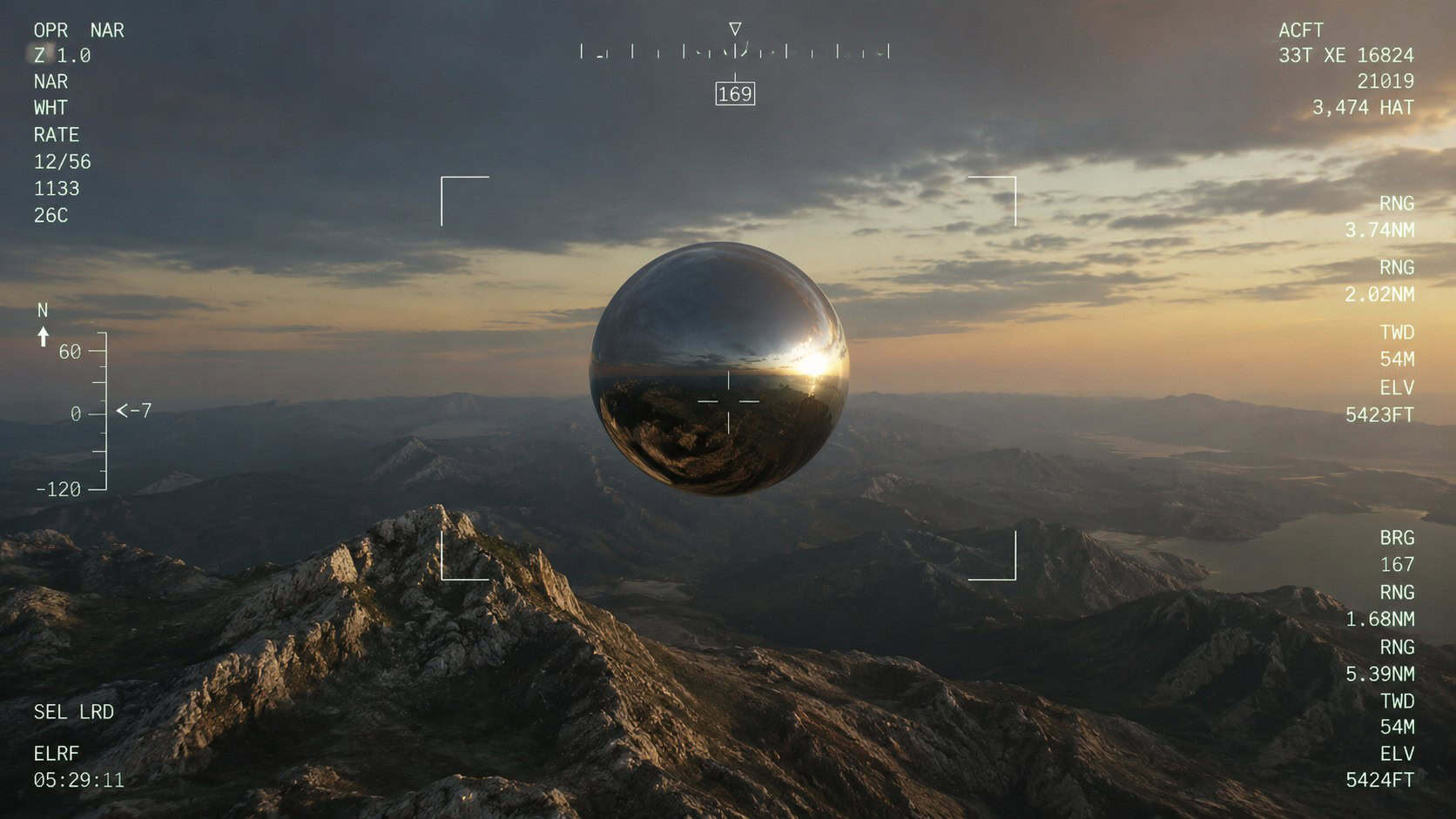
An artist’s rendering of a metallic silver sphere based on descriptions from military reports and declassified Pentagon UAP investigations. U.S. officials have not identified the objects and continue to classify several incidents as unresolved.

WASHINGTON DC - For decades, UFO sightings were easy for skeptics to dismiss.

A blurry photo. A shaky video. A witness who swore they saw something extraordinary.

But what happens when the U.S. military sees it too?

Newly released Pentagon files and videos have once again thrust a mysterious object into the spotlight: a smooth metallic silver sphere that appears to move through the sky without wings, rotors, exhaust, or any visible means of propulsion.

Even more intriguing, government investigators still can’t fully explain what it is.

That uncertainty has fueled renewed public fascination.

See The Evidence For Yourself

Readers who want to examine the government’s findings firsthand can review many of the videos, images and reports released by the Pentagon’s All-domain Anomaly Resolution Office (AARO) and NASA.

* Pentagon AARO UAP Archive:
https://www.aaro.mil/UAP-Cases/Official-UAP-Imagery/

* Pentagon UAP Records Center:
https://www.aaro.mil/UAP-Records/

* NASA UAP Research Program:
https://science.nasa.gov/uap/

* NASA Independent UAP Study Report:
https://science.nasa.gov/wp-content/uploads/2023/09/uap-independent-study-team-final-report.pdf

Readers are encouraged to review the evidence and draw their own conclusions.

UFOSpheres2.jpg-.jpeg?resize=831%2C416&ssl=1

Newly released Pentagon files show mysterious metallic spheres that investigators still can’t explain, renewing debate over one of the most persistent UFO mysteries of the modern era.

The Return Of The Silver Spheres

The reports are part of an ongoing effort by the Pentagon’s All-domain Anomaly Resolution Office, which investigates what are now known as Unidentified Anomalous Phenomena, or UAPs.

While officials stress there is no evidence these objects are extraterrestrial, several cases remain officially unresolved.

Among the most discussed cases are reports of metallic orb-shaped objects captured by military sensors operating in various regions around the world.

Unlike the classic flying saucer image popularized in movies and television, these objects are remarkably simple in appearance.

Witnesses describe smooth metallic spheres that reflect sunlight like polished chrome. Military videos show objects maintaining stable flight while displaying no obvious signs of conventional propulsion.

One declassified case involved a metallic sphere tracked by military sensors over a remote region. Another captured an orb-like object moving across the sky while analysts struggled to determine its origin.

The Pentagon has not identified the objects as foreign technology, experimental U.S. aircraft, weather phenomena, or commercial drones.

Instead, they remain classified as unresolved.

NASA And Pentagon Officials Take The Mystery Seriously

Interest in metallic spheres intensified in 2023 when NASA and Pentagon officials publicly discussed orb-shaped UAPs during hearings and briefings.

At the time, officials noted that metallic spheres represented one of the most frequently reported categories of unexplained aerial phenomena.

Investigators emphasized that most sightings eventually receive conventional explanations. Yet a small percentage continue to resist easy answers due to limited data, unusual flight characteristics, or a lack of corroborating evidence.

That distinction is important.

An unexplained object is not proof of extraterrestrial visitors.

It is simply an observation that investigators have not yet been able to fully explain.

Why The Mystery Persists

The silver spheres have become something of a recurring character in the modern UFO story.

They continue appearing in military reports, pilot observations, radar tracks and sensor recordings.

Skeptics argue many sightings likely involve balloons, camera artifacts, atmospheric effects or misunderstood objects viewed under unusual conditions.

Believers counter that some incidents involve multiple sensors, trained military observers and tracking systems specifically designed to identify airborne threats.

Both sides agree on one point:

More data is needed.

The Pentagon itself has repeatedly stated that the vast majority of cases do not provide enough information to determine exactly what was observed.

That uncertainty leaves room for both scientific investigation and public speculation.

Why Technology Readers Should Care

For technology enthusiasts, the story is less about little green men and more about the limits of modern surveillance technology.

The objects have been observed by some of the most sophisticated sensor systems ever developed, including advanced military radar, infrared imaging systems, aircraft sensors and intelligence-gathering platforms.

If the objects ultimately prove to be advanced drones, foreign technology, atmospheric phenomena or sensor anomalies, the findings could improve future detection systems and aerospace intelligence capabilities.

If they turn out to be something entirely different, the implications could be even more significant.

Either way, investigators are still searching for answers.

The Bigger Question

Whether the silver spheres ultimately prove to be advanced drones, unusual atmospheric phenomena, classified technology, sensor errors or something entirely unexpected, the story highlights a fascinating reality.

Despite satellites, artificial intelligence, advanced radar systems and some of the most sophisticated surveillance networks ever built, there are still objects that occasionally appear in the sky and defy immediate explanation.

That doesn’t mean aliens are visiting Earth.

But it does mean that even in an age of unprecedented technology, mysteries remain.

And for now, the Pentagon’s silver spheres remain one of the most intriguing mysteries still floating above us.

For technology enthusiasts, the story is less about little green men and more about sensor systems, artificial intelligence, advanced drones, aerospace technology and the limits of modern surveillance. The silver spheres may ultimately prove to be something mundane—or something entirely new. Either way, investigators are still searching for answers.

Editor’s Note

The Pentagon, NASA and AARO have repeatedly stated that none of the released videos or images constitute proof of extraterrestrial technology. Many cases remain unexplained because investigators lack sufficient sensor data, image quality or corroborating evidence to determine the objects’ origin. The objects remain officially classified as unidentified, not alien.

RELATED

8,000 UFO Spheres Over U.S. Bases?! Pentagon Baffled as Metallic Orbs Multiply | Atlas Probe Theory

wait...the air force just shot down a ufo and released the footage today

Nov 20, 2024 - Why Are Metallic Spheres Most Common UFO Shapes Reported?

{ https://mitechnews.com/category/news/ }

Hoe vind je dit bericht?
Geschreven door peter om 21:52 Stuur door

Secrets of the Baltic Sea Anomaly: UFO or Hoax?

Secrets of the Baltic Sea Anomaly: UFO or Hoax?

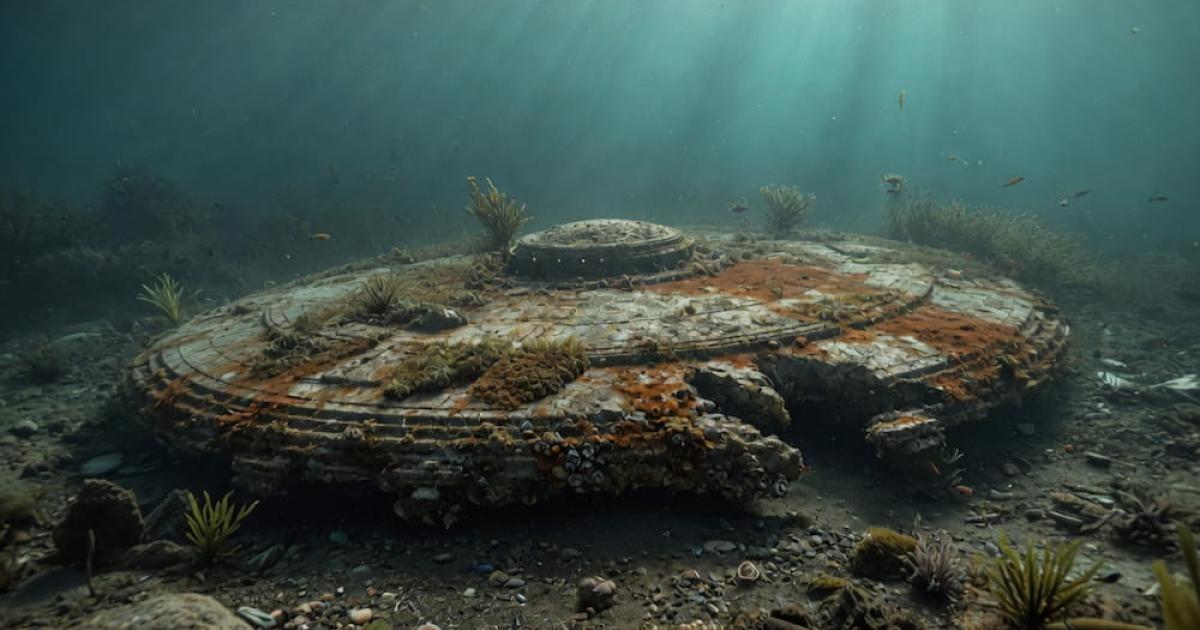
This photorealistic illustration depicts the mysterious circular object on the Baltic Sea floor, heavily encrusted and eroded as if it has rested there for millions of years. The image is an artistic rendering based on descriptions and scans from the Ocean X expedition.

The ocean floor is a realm of eternal darkness, holding secrets that often challenge our understanding of history and science. Among the most hotly debated underwater mysteries of the 21st century is the Baltic Sea Anomaly. First detected by sonar, this bizarre, circular formation resting on the murky seabed sparked massive global interest and immediate speculation. Could it be a sunken extraterrestrial spacecraft, an elaborate natural hoax, or perhaps a relic of a forgotten human civilization?

When the first grainy sonar images emerged, the shape was instantly compared to the Millennium Falcon from Star Wars. The internet exploded with theories ranging from crashed UFOs to secret World War II anti-submarine devices. Yet, as modern marine geologists and archaeologists continue to map the depths of the Baltic basin, a far more complex and grounded truth is beginning to surface. The reality of what lies beneath the waves may not involve aliens, but it is no less fascinating.

Discovering the Baltic Sea Anomaly

The story began in 2011 when the Swedish treasure-hunting team, Ocean X, was scanning the seabed for old shipwrecks. Instead of a wooden hull, their sonar pinged a massive, strangely geometric object resting at a depth of roughly 295 feet (90 meters). The structure measured an impressive 200 feet (61 meters) in diameter and appeared to be elevated off the seabed on a pillar-like formation. It featured rigid lines, apparent right angles, and what looked like a drag mark or runway trailing behind it.

Overview map of the Western Baltic Sea.

Overview map of the Western Baltic Sea. Bathymetric data taken from the Global Multi-Resolution Topography (GMRT) synthesis.

(Geerson et al./CC BY-SA 2.5)

Diving down to investigate the object proved incredibly difficult due to the freezing, pitch-black conditions of the Baltic waters. When divers finally reached the structure, they reported equipment malfunctions and a total loss of visibility, adding fuel to the supernatural fire. However, they managed to recover stone samples from the site. These samples were dark, burnt-looking rocks that seemed entirely out of place on the sandy bottom of the ocean.

Despite the initial hype, the scientific community remained highly skeptical of the extraterrestrial claims. Experts pointed out that the Baltic Sea is notoriously difficult to scan accurately. The unique salinity gradients and temperature shifts in the water can severely distort sonar readings, often making natural geological formations look artificial. As more data was collected, the mystery began to shift from the realm of science fiction back into the realm of natural science.

Geological Reality or Alien Artifacts?

Recent studies have provided crucial insights into how perfectly circular or highly anomalous structures can form naturally on the ocean floor. A 2023 geological review by Li et al. demonstrated that various biological and geological processes, such as fluid expulsion and gas venting, can create incredibly precise geometric shapes in the seabed. When combined with the unique glacial history of Northern Europe, the "spaceship" theory begins to sink rapidly.

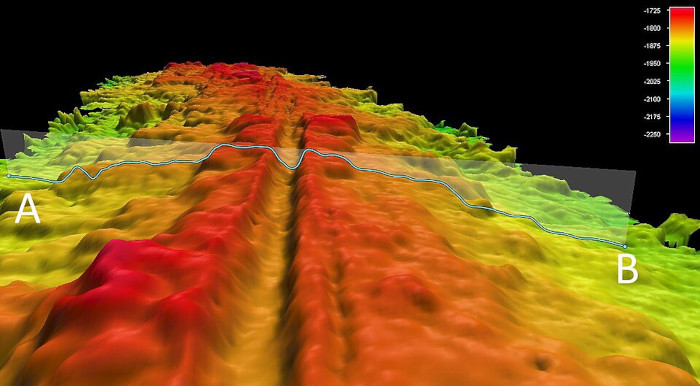
A high-resolution multibeam echosounder bathymetry scan revealing complex seabed morphology.

Example of a high-resolution multibeam echosounder bathymetry scan (Western Galapagos Rift) revealing complex seabed morphology. Recent studies utilizing this exact advanced sonar technology in the Baltic Sea have proven that the ocean floor is heavily littered with bizarre, naturally occurring moraines that easily trick standard scanning equipment.

NOAA Photo Library/CC BY 2.0)

During the last Ice Age, massive glaciers carved their way across the region, grinding rocks and trapping volcanic debris within the ice. As the ice melted around 9000 BC, it deposited these massive, out-of-place boulders, known as glacial erratics, into the newly formed Baltic Sea basin. The dark, metallic-looking stones recovered by Ocean X were identified by geologists as basalt and granite, common materials deposited by retreating glaciers.

Furthermore, a 2024 study by Feldens utilizing high-resolution multibeam echosounder bathymetry mapped the complex glacial morphology of the Baltic Sea. The research confirmed that the seabed is littered with bizarre, naturally occurring moraines and deposited rock formations that can easily trick standard sonar equipment. The Baltic Sea Anomaly is widely considered by geologists to be a remarkable, yet entirely natural, glacial deposit rather than a crashed alien vessel.

The Stone Age Megastructures Connection

While the anomaly itself might be a natural rock formation, the idea of finding massive, artificial structures at the bottom of the Baltic Sea is not actually fiction. In early 2024, an astonishing discovery shattered our understanding of ancient European history. Researchers led by Jacob Geersen published findings in the Proceedings of the National Academy of Sciences (PNAS) detailing a massive, 11,000-year-old artificial stone wall found entirely submerged in the western Baltic Sea.

The coast of the Bay of Mecklenburg in the southwestern Baltic Sea.

The coast of the Bay of Mecklenburg in the southwestern Baltic Sea. Just off this shore lies the submerged landscape where archaeologists recently discovered the 11,000-year-old Stone Age megastructure, a remnant of a time when the entire basin was dry land. 

(CC BY-SA 4.0/Jasmin Flad)

This incredible megastructure, stretching nearly 3,200 feet (975 meters) long, was constructed by Stone Age hunter-gatherers long before the region flooded. It was built using thousands of carefully placed stones to create a drive lane for hunting reindeer herds. This revelation proves that the Baltic basin was once a dry, populated landscape where ancient humans actively engaged in monumental construction projects. The discovery of genuine submerged megastructures completely changes the context of the region. It highlights why marine archaeologists are so eager to scan the seabed, even if they occasionally chase shadows like the famous anomaly. While we may not have found an ancient spaceship, we have found definitive proof that the sunken landscapes of the Baltic hide the lost architectural achievements of our earliest ancestors

Unraveling the Mysteries of the Deep

Ultimately, the phenomenon serves as a powerful reminder of how easily our imaginations can be captured by the unknown. The blurry sonar scans allowed people to project their wildest sci-fi fantasies onto a pile of glacial rocks. Yet, the rigorous scientific method, utilizing advanced bathymetry, geological sampling, and peer-reviewed analysis, has slowly chipped away at the myth to reveal a more grounded reality.

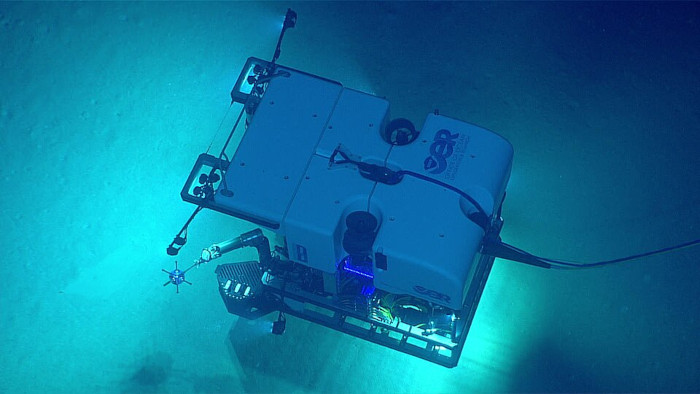
A remotely operated vehicle (ROV) equipped with high-powered lights and cameras is descending into the uncharted depths.

A remotely operated vehicle (ROV) equipped with high-powered lights and cameras is descending into the uncharted depths. As this technology continues to map the ocean floor, marine archaeologists are bound to uncover more sunken mysteries, whether they be natural geological wonders or genuine artifacts of lost civilizations. 

(NOAA Ocean Exploration & Research from USA/CC BY-SA 2.0)

Nature is entirely capable of creating shapes that appear designed, and the chaotic forces of the Ice Age left behind a seabed that continues to confuse even modern technology. However, as the genuine discovery of the Stone Age megastructure proves, the truth hidden in the deep ocean is often far more fascinating than any internet hoax. The waters of Northern Europe remain a vital frontier for historical exploration.

Even if the Baltic Sea Anomaly is just a fascinating trick of glacial geology, it succeeded in drawing global attention to the uncharted depths. As remote-operated vehicles and advanced multibeam sonar continue to map the ocean floor, we are bound to uncover more sunken mysteries. Whether those mysteries turn out to be natural wonders or genuine artifacts of lost civilizations, the deep sea will never stop surprising us.

  • Top Image: This photorealistic illustration depicts the mysterious circular object on the Baltic Sea floor, heavily encrusted and eroded as if it has rested there for millions of years. The image is an artistic rendering based on descriptions and scans from the Ocean X expedition.

By Marius Albertsen

FAQs

What is the Baltic Sea Anomaly? It is a 200-foot (61-meter) circular rock formation discovered on the floor of the Baltic Sea in 2011 by a treasure-hunting team. Its strange shape, resembling a science-fiction spaceship on sonar, led to widespread speculation that it was a sunken UFO or an ancient artificial structure.

Did scientists prove the anomaly is an alien spaceship? No. Geologists and marine scientists have concluded that the structure is a natural geological formation. It is highly likely a glacial erratic, a massive deposit of rocks, including basalt and granite, left behind by melting glaciers at the end of the last Ice Age.

Are there real ancient structures at the bottom of the Baltic Sea? Yes! In 2024, scientists discovered a massive, 11,000-year-old artificial stone wall stretching nearly 3,200 feet (975 meters) underwater in the western Baltic. It was built by Stone Age hunter-gatherers to corral reindeer before the sea levels rose and flooded the region.

References

RELATED VIDEOS

Baltic Sea UFO: What Did They Really Find? Expert Analysis

Why Does the Baltic Anomaly Look So Strange?

The Baltic Sea Anomaly Was Found in 2011 — What They Found Shouldn't Exist

Experts Finally Solved the Baltic Sea Anomaly — The Truth Is Worse Than We Thought
Hoe vind je dit bericht?
Geschreven door peter om 21:30 Stuur door

Meer van UFO'S of UAP'S, ASTRONOMIE, RUIMTEVAART, ARCHEOLOGIE, OUDHEIDKUNDE, SF-SNUFJES EN ANDERE ESOTERISCHE WETENSCHAPPEN - DE ALLERLAATSTE NIEUWTJES

↑ Terug naar de berichten