Naar de inhoud

UFO'S of UAP'S, ASTRONOMIE, RUIMTEVAART, ARCHEOLOGIE, OUDHEIDKUNDE, SF-SNUFJES EN ANDERE ESOTERISCHE WETENSCHAPPEN - DE ALLERLAATSTE NIEUWTJES

UFO's of UAP'S in België en de rest van de wereld
akke.beakke.be
Ontdek de Fascinerende Wereld van UFO's en UAP's: Jouw Bron voor Onthullende Informatie! Ben jij ook gefascineerd door het onbekende? Wil je meer weten over UFO's en UAP's, niet alleen in België, maar over de hele wereld? Dan ben je op de juiste plek! België: Het Kloppend Hart van UFO-onderzoek In België is BUFON (Belgisch UFO-Netwerk) dé autoriteit op het gebied van UFO-onderzoek. Voor betrouwbare en objectieve informatie over deze intrigerende fenomenen, bezoek je zeker onze Facebook-pagina en deze blog. Maar dat is nog niet alles! Ontdek ook het Belgisch UFO-meldpunt en Caelestia, twee organisaties die diepgaand onderzoek verrichten, al zijn ze soms kritisch of sceptisch. Nederland: Een Schat aan Informatie Voor onze Nederlandse buren is er de schitterende website www.ufowijzer.nl, beheerd door Paul Harmans. Deze site biedt een schat aan informatie en artikelen die je niet wilt missen! Internationaal: MUFON - De Wereldwijde Autoriteit Neem ook een kijkje bij MUFON (Mutual UFO Network Inc.), een gerenommeerde Amerikaanse UFO-vereniging met afdelingen in de VS en wereldwijd. MUFON is toegewijd aan de wetenschappelijke en analytische studie van het UFO-fenomeen, en hun maandelijkse tijdschrift, The MUFON UFO-Journal, is een must-read voor elke UFO-enthousiasteling. Bezoek hun website op www.mufon.com voor meer informatie. Samenwerking en Toekomstvisie Sinds 1 februari 2020 is Pieter niet alleen ex-president van BUFON, maar ook de voormalige nationale directeur van MUFON in Vlaanderen en Nederland. Dit creëert een sterke samenwerking met de Franse MUFON Reseau MUFON/EUROP, wat ons in staat stelt om nog meer waardevolle inzichten te delen. Let op: Nepprofielen en Nieuwe Groeperingen Pas op voor een nieuwe groepering die zich ook BUFON noemt, maar geen enkele connectie heeft met onze gevestigde organisatie. Hoewel zij de naam geregistreerd hebben, kunnen ze het rijke verleden en de expertise van onze groep niet evenaren. We wensen hen veel succes, maar we blijven de autoriteit in UFO-onderzoek! Blijf Op De Hoogte! Wil jij de laatste nieuwtjes over UFO's, ruimtevaart, archeologie, en meer? Volg ons dan en duik samen met ons in de fascinerende wereld van het onbekende! Sluit je aan bij de gemeenschap van nieuwsgierige geesten die net als jij verlangen naar antwoorden en avonturen in de sterren! Heb je vragen of wil je meer weten? Aarzel dan niet om contact met ons op te nemen! Samen ontrafelen we het mysterie van de lucht en daarbuiten.

Archief

'God of chaos' asteroid will be visible with the naked eye, NASA says

'God of chaos' asteroid will be visible with the naked eye, NASA says

JULIA JACOBO
An illustration shows OSRIS-APEX as it watches the asteroid Apophis skim Earth in 2029

An illustration shows NASA's OSRIS-APEX spacecraft as it watches the asteroid Apophis zoom past Earth in April 2029. 

(Image credit: Robert Lea/NASA)

A rare asteroid will soon be visible to the naked eye in a rare celestial event, according to astronomers.

Asteroid 99942 Apophis – named after the Egyptian deity of chaos, darkness and fire – is expected to safely pass close to Earth on April 13, 2029, according to NASA.

NASA - PHOTO: Near-Earth asteroid Apophis is a potentially hazardous asteroid that will safely pass close to Earth on April 13, 2029.

The asteroid will pass within roughly 20,000 miles of Earth – nearly 12 times closer than the moon's average distance from Earth, and closer than many satellites in geosynchronous orbit – making it one one of the closest approaches ever recorded for an object if its size and a "very rare event," according to NASA.

The approach will be visible to observers on the ground in the Eastern Hemisphere, weather permitting, according to NASA. It will be close enough that sky-watchers won't need a telescope or binoculars to see it, astronomers say.

When Apophis was first discovered in 2004, it was labeled a potentially hazardous asteroid because of the possibility that it could impact Earth in 2029, 2036 or 2068, according to NASA.

After closely tracking the asteroid and its orbit using optical telescopes and ground-based radar, astronomers are now confident that there is no risk of Apophis impacting Earth for at least 100 years.

ESA - Science Office - PHOTO: On April 13, 2029, Apophis will pass less than 32,000 km from Earth’s surface.

The Earth's gravitational pull could change the asteroid's orbit around the sun as it passes in 2029, making the orbit slightly larger or the orbital period slightly longer, but the risk of impact with Earth will remain the same, NASA says. Its close passage will also afford astronomers around the world the opportunity to learn more about the asteroid.

Apophis is the Greek name for the Egyptian god known as Apep. The name was proposed by the astronomers who discovered the asteroid: Roy Tucker, David Tholen and Fabrizio Bernardi of the Kitt Peak National Observatory near Tucson, Arizona.

NASA/JPL-Caltech and NSF/AUI/GBO - PHOTO: These images of asteroid Apophis were recorded in March 2021 by radio antennas at the Deep Space Network’s Goldstone complex in California and the Green Bank Telescope in West Virginia.

The asteroid is a relic of the early solar system from about 4.6 billion years ago, made of leftover raw material that was never part of a planet or moon, according to NASA. Though its exact size and shape is unknown, it has a mean diameter of about 1,115 feet and a long axis of at least 1,480 feet.

Apophis' surface is weathered due to eons of exposure to space weather, including solar wind and cosmic rays, according to the Massachusetts Institute of Technology.

Observatories around the world and in space will observe the asteroid's historic approach to Earth in order to better understand its physical properties.

Smith Collection/gado via Getty Images - PHOTO: Egyptian Snake-God Apep (Apophis)

NASA has redirected a spacecraft to rendezvous with Apophis shortly after its close approach in 2029, while the European Space Agency is sending a spacecraft to study it.

When the April 2029 flyby occurs, Apophis will become a member of the "Apollo" group, the family of asteroids that cross Earth's orbit but that themselves have orbits around the sun that are wider than the Earth's, according to the ESA.


The God of Chaos Asteroid Apophis is coming April 13 2029

THE END OF EARTH ☠️🔥 Apophis Will Pass Shockingly Close in 2029 #spacefacts #universe

{ https://www.yahoo.com/news/ }

Hoe vind je dit bericht?
Geschreven door peter om 16:04 Stuur door

Artemis II isn’t the farthest human spaceflight, and it’s not even close

Artemis II isn’t the farthest human spaceflight, and it’s not even close

Joseph Shavit
f31d5d51daf98f52981f801e8c90622a
Artist impression of Artemis II: Orion and its European Service Module as they separate from the second stage of NASA's Space Launch System rocket, the Interim Cryogenic Propulsion Stage (ICPS).
(CREDIT: ESA-D. Ducros)

Artemis II, NASA’s first crewed mission of the Artemis era, sent four astronauts on a sweeping journey around the Moon before bringing them safely back to Earth. The mission carried the crew farther from Earth than any humans had traveled before, using a free-return trajectory that looped around the Moon and set up a fiery return through Earth’s atmosphere. It ended with Orion splashing down in the Pacific Ocean after nearly 11 days in space, closing out a mission designed to test the spacecraft, its life-support systems, and the agency’s readiness for future lunar expeditions.

According to NASA, the mission reached a maximum distance of 252,760 miles from Earth, passed within about 4,070 miles of the lunar surface, and covered 695,081 miles from launch to splashdown. By the measure of how far humans had ever gotten from home, Artemis II set a new record.

That is not the same record as longest trip.

A simple everyday comparison helps. A former job might have been 20 miles from your house. A new one could sit only 10 miles away. But if the route to the closer job snakes through bad roads and detours, your odometer might still rack up 30 miles. The closer destination becomes the longer drive.

Artemis II trajectory showing the crewed spacecraft’s journey from Earth around the Moon. (CREDIT: Canadian Space Agency)
Artemis II trajectory showing the crewed spacecraft’s journey from Earth around the Moon.
(CREDIT: Canadian Space Agency)

That is essentially what happened here.

One kind of distance, not every kind

Artemis II went farther outward than any earlier crewed mission. It headed toward the Moon, looped around it, and came back to Earth. So when NASA describes it as the farthest human spaceflight, the claim holds up, but in a very specific sense. Artemis II set the record for maximum distance from Earth, not for total miles traveled.

That distinction matters because another lunar mission still leads in NASA’s own mileage totals.

Apollo 17, the final crewed Moon landing mission, lasted 12 days, 13 hours, and 52 minutes, according to NASA’s mission page. It spent 75 hours on the lunar surface, completed 75 revolutions, and traveled 1,484,933.8 miles. Artemis II’s published total was 695,081 miles.

By NASA’s own figures, Apollo 17 covered a little more than twice as much ground.

The gap is striking, especially since Artemis II just set the record for getting farthest from Earth. The explanation is less mysterious than it first sounds. Artemis II flew by the Moon. Apollo 17 got there and did much more.

Where Apollo 17 built its lead

Once Apollo 17 reached the Moon, the mission did not simply swing around and head home. It entered lunar operations, circled the Moon again and again, landed, remained on the surface for more than three days, launched back into space, and then returned to Earth.

Apollo 17 astronaut Gene Cernan, the last man on the moon, is seen here on the lunar surface in December 1972. (CREDIT: NASA)
Apollo 17 astronaut Gene Cernan, the last man on the moon, is seen here on the lunar surface in December 1972.
(CREDIT: NASA)

NASA’s public mission page does not break that 1.48 million-mile total into a detailed accounting. Still, it provides enough to explain why Apollo 17’s number climbs so much higher than Artemis II’s.

The biggest clue is the 75 revolutions.

A rough geometric estimate helps show the scale. A low orbit around the Moon runs a little more than 7,000 miles per lap. Over 75 revolutions, that alone adds up to more than 500,000 miles. Then come the descent to the surface, the ascent back to orbit, and the other local maneuvers near the Moon.

That estimate is not an official NASA breakdown. It is a back-of-the-envelope way to understand the mission profile. Even so, it points in the same direction as the published totals. Apollo 17 racked up its extra miles because it spent far longer operating in the Moon’s neighborhood.

Artemis II did not.

It went out, looped around, and came back.

A bigger frame changes the leaderboard

There is also another way to think about travel in space, though it is separate from NASA’s official mission-mileage totals.

NASA says Earth sits about 93 million miles from the Sun and takes 365.25 days to complete one orbit. (CREDIT: Wikimedia / CC BY-SA 4.0)
NASA says Earth sits about 93 million miles from the Sun and takes 365.25 days to complete one orbit.
(CREDIT: Wikimedia / CC BY-SA 4.0)

NASA says Earth sits about 93 million miles from the Sun and takes 365.25 days to complete one orbit. That works out to roughly 1.61 million miles of travel per day around the Sun. By that measure, every crewed mission is also being carried through space by the motion of the Earth-Moon system.

Using that frame, Apollo 17’s 12.58-day mission corresponds to roughly 20.2 million miles of solar-orbit travel. Artemis II’s 10.98-day mission comes out to about 17.6 million miles.

Those are not NASA’s official mission-distance numbers. They are separate calculations based on NASA’s Earth-orbit facts and the length of each mission. They help clarify what NASA’s published totals are measuring, and what they are not.

Apollo 17’s official 1,484,933.8 miles and Artemis II’s official 695,081 miles make the most sense in the Earth-Moon flight frame. If solar motion were part of the official count, both totals would be dramatically larger.

That point cuts both ways. It means solar motion is real, but it does not explain why Apollo 17 beats Artemis II in NASA’s official numbers. That advantage still comes from what Apollo 17 did around the Moon.

The stations run away with it

Once the frame widens to include the Sun, lunar missions stop looking like the mileage champions.

Long-duration space stations take over almost immediately.

The ISS as seen from Space Shuttle Atlantis during STS-132, pictured in May 2010. (CREDIT: Wikimedia / CC BY-SA 4.0)
The ISS as seen from Space Shuttle Atlantis during STS-132, pictured in May 2010.
(CREDIT: Wikimedia / CC BY-SA 4.0)

The reason is simple. If Earth moves about 1.6 million miles per day around the Sun, then any occupied station is also covering that distance day after day, week after week, year after year. On top of that, the station is circling Earth the whole time.

By this method, the International Space Station sits in a category of its own. NASA says the ISS has been continuously occupied since November 2, 2000 and travels around Earth at about 17,500 miles per hour. From November 2, 2000 to April 13, 2026, that uninterrupted human presence spans about 9,293 days. Earth’s motion around the Sun over that stretch adds up to about 14.86 billion miles. The station’s own orbit adds about 3.90 billion miles. Together, that comes to roughly 18.76 billion miles traveled while humans were aboard.

Mir also leaves the lunar missions far behind by the same method. NASA says human occupancy resumed in September 1989 and continued without interruption for 10 years, until August 1999. NASA also says Mir traveled at an average speed of 17,885 miles per hour. Over that inhabited stretch, Earth’s motion around the Sun accounts for about 5.84 billion miles, while Mir’s orbit adds another 1.57 billion. Combined, that comes to about 7.41 billion miles.

Even Skylab looks surprisingly strong once the calculation changes. NASA says its three crewed stays lasted 28 days, 59 days, and 84 days. NASA also says Skylab orbited at about 435 kilometers altitude and completed one orbit every 93 minutes. Using solar motion plus Skylab’s own movement around Earth, the three inhabited stays work out to about 56.3 million miles, 118.6 million miles, and 168.9 million miles.

These are estimate-based totals, not official NASA mileage tallies. They combine Earth’s orbit around the Sun with each station’s orbit around Earth, and they count only periods when humans were continuously aboard. That makes them useful for comparison, but not interchangeable with NASA’s official mission-distance figures.

Practical implications

What this really changes is the language around space records.

Artemis II holds the record for the greatest distance from Earth ever reached by humans. Apollo 17, using NASA’s own mission totals, traveled many more miles. In a wider Sun-centered frame, long-occupied stations overwhelm both of them.

That does not shrink Artemis II’s achievement. It sharpens it.

The mission took humans farther from Earth than any mission before it. But farthest from home and longest trip are not the same measurement, and space makes that difference impossible to ignore.

The original story “Artemis II isn’t the farthest human spaceflight, and it’s not even close” is published in The Brighter Side of News.

Related Stories
RELATED

It's official! Artemis 2 breaks Apollo 13 distance record - Farthest-ever humans from Earth
Hoe vind je dit bericht?
Geschreven door peter om 15:36 Stuur door

Subaru telescope captures comet 3I/ATLAS composition change

Subaru telescope captures comet 3I/ATLAS composition change

Subaru telescope captures comet 3I/ATLAS composition change

Interstellar comet 3I/ATLAS (C/2025 N1) captured by the Subaru Telescope on December 13, 2025 (Hawaii-Aleutian Standard Time). This image was created by combining three different wavelengths: V-band (550 nanometers, depicted in blue), R-band (660 nanometers, depicted in green), and I-band (805 nanometers, depicted in red). Credit: NAOJ

The Subaru Telescope observed the interstellar comet 3I/ATLAS on January 7, 2026, after it made its closest approach to the sun. By observing colors in the coma around the comet, astronomers could estimate the ratio of carbon dioxide to water. This ratio is much lower than that inferred from earlier observations by space telescopes. These findings suggest that the chemistry of the coma is evolving over time and offers clues to the structure of comet 3I/ATLAS. The work appears in The Astronomical Journal.

Comet 3I/ATLAS (C/2025 N1) has garnered much attention as a comet which originated outside of the solar system. A research group led by Yoshiharu Shinnaka of the Koyama Space Science Institute, Kyoto Sangyo University, used the Subaru Telescope to observe comet 3I/ATLAS after perihelion, the comet's closest approach to the sun. The team applied analytical methods and expertise accumulated through investigations of solar system comets to the data.

From this analysis, the team was able to estimate the ratio of carbon dioxide (CO2) to water (H2O) in the coma, the cloud of gas around the nucleus of the comet. Because the gas in the coma comes from the nucleus, the coma composition provides hints to the composition of the nucleus.

Thanks to its notoriety, 3I/ATLAS had already been observed by space telescopes prior to perihelion. The CO2/H2O ratio calculated from the Subaru Telescope data was lower than the ratio suggested by the space telescope data. This change is consistent with the idea that the composition of the nucleus's interior differs from that of the exterior, and as 3I/ATLAS heated up during its pass by the sun, gas started to escape from different parts of the nucleus.

Shinnaka comments, "With the full-scale operation of survey telescopes in the coming years, many more interstellar objects are expected to be discovered. By applying the observational and analytical techniques we have developed through studies of solar system comets to interstellar objects, we can now directly compare comets hailing from both inside and outside the solar system and explore differences in their composition and evolution.

"Through studies of such objects, we hope to gain a deeper understanding of how planetesimals and planets formed in a wide variety of stellar systems, including our own solar system."

Publication details

Journal information: 

RELATED VIDEOS

FINALLY! 3I Atlas nucleus photographed by James Webb, and an astonishing discovery is made!

Comet 3I ATLAS Did Something We Never Expected — I Took a Picture

Avi Loeb: Scientists find ‘alien-like’ water on 3I/ATLAS comet | ChicagoLIVE

{ https://phys.org/space-news/ }

Hoe vind je dit bericht?
Geschreven door peter om 15:19 Stuur door

Rep. Luna, Lawmakers Demand UFO Videos by April 14

dc2cee_fefc0ab0fa4c45b8a5c42150caaa78c8~mv2.png

Rep. Luna, Lawmakers Demand UFO Videos by April 14

By Sandy Fitzgerald

Lawmakers are giving War Department Secretary Pete Hegseth and other federal agencies until April 14 to turn over dozens of classified UFO videos while warning the unidentified objects could pose a threat to U.S. military operations.


Lawmaker asks Hegseth to release UAP videos citing national security concerns

Rep. Anna Paulina Luna, R-Fla., sent a letter to Hegseth requesting 46 specific Unidentified Anomalous Phenomena (UAP) videos, and said in a statement that the lack of disclosure "regarding the very real threat" posed by the objects being near U.S. restricted airspace is "concerning," The Daily Mail reported Wednesday. 

"The presence of UAPs in and around the sensitive airspaces of U.S. military installations poses a threat to the security of the armed forces and their readiness," Luna said.

Lawmakers are seeking footage of encounters recorded by the military that shows spherical, cigar-shaped, and Tic Tac-like objects observed over war zones, oceans, and restricted airspace.

Some of the clips reportedly show formations near Iran and Syria, incidents near U.S. bases and airports, and a 2023 shootdown over Lake Huron.


Who is US Defence Secretary Pete Hegseth? | BBC Americast

The videos could help identify patterns of activity near sensitive sites and assess whether the objects present a national security risk, lawmakers say.

Luna chairs the House Federal Secrets Task Force, which is investigating UAP sightings, declassifying federal records, and working with whistleblowers.

She said the panel has received incomplete responses from the All-domain Anomaly Resolution Office, or AARO, which is tasked with analyzing such incidents.

The letter follows a September 2025 hearing in which whistleblowers told lawmakers that additional UAP video records exist.

Congressional Letter

Congressional Letter

Among the requested materials is footage labeled "Spherical UAP over AFG in and out of clouds, 11/23/20," reportedly recorded during a reconnaissance mission near the Afghanistan-Pakistan border.

Investigative journalists Jeremy Corbell and George Knapp previously released portions of that video.

Other clips were captured by fighter jets, drones and surveillance aircraft operating in regions including the Persian Gulf, Afghanistan, and the East China Sea.

In several cases, multiple objects were tracked moving at high speeds simultaneously, raising concerns about coordinated activity.

Officials have warned the unidentified craft could be conducting surveillance, testing U.S. defenses, or interfering with aircraft, posing risks to pilots and military readiness.

The push for disclosure comes after President Donald Trump ordered the release of government files related to UAPs and extraterrestrial phenomena on Feb. 19.

Florida Rep. Luna Demands of 40 Secret UAP Videos - WIOD

Hegseth said in February that the War Department is working to comply with the order.

"I did not have that on my bingo card at all," Hegseth said at the time. "We've got our people working on it right now. We're going to be in full compliance with that executive order, eager to provide that for the president."

He added that he does not yet know how long it will take to review and release all relevant materials.

Sandy Fitzgerald ✉

Sandy Fitzgerald has more than three decades in journalism and serves as a general assignment writer for Newsmax covering news, media, and politics. 

{ https://www.newsmax.com/ }

Hoe vind je dit bericht?
Geschreven door peter om 23:54 Stuur door

Artemis II mission encountered Microsoft glitches in deep space

Artemis II mission encountered Microsoft glitches in deep space

Even if you’re hundreds of thousands of kilometers away from Earth aboard the Orion spacecraft, that doesn’t guarantee you’ll be spared the everyday problems familiar to every office worker. During the live broadcast of the Artemis II mission, viewers witnessed not only majestic scenery but also a humorous—albeit somewhat stressful—moment: the astronauts’ struggle with Microsoft software.

NASA astronaut and Artemis II mission commander Reid Wiseman looks out the window of the Orion spacecraft. The Outlook illustration was added to the lower display “as a joke”; in reality, telemetry was displayed there, and the software glitch actually occurred on a Windows-based tablet. Photo: NASA

Attentive social media users, particularly on BlueSky, noticed an unexpected exchange between the crew and Mission Control in Houston. Instead of reporting on orbital parameters, Commander Reid Wiseman was forced to complain about glitches with his email.

About 13 hours into the flight, Wiseman reported, “I see that I have two instances of Microsoft Outlook running, and neither of them is working.” The phrase instantly went viral. Users joked that sending people to the moon is difficult, but making them use Outlook while they’re there is downright cruel.

NASA astronaut and Artemis II mission commander Reid Wiseman. Photo: NASA

The problem was so serious that specialists on Earth had to connect to the spacecraft’s systems remotely to “resurrect” the email client. An hour later, the problem was resolved, even though the program continued to display an “offline” status—a phenomenon NASA experts described as “expected behavior.”

Why use Windows in space?

To many readers, the presence of ordinary commercial software on board a multibillion-dollar spacecraft may seem strange. However, this is part of the COTS (Commercial Off-The-Shelf) strategy.

A “selfie” of the Orion spacecraft returning to Earth after a lunar flyby as part of the Artemis II mission. Photo: NASA

It is important to understand that Orion’s mission-critical flight systems rely on specialized, radiation-resistant hardware and unique software that has undergone years of testing. However, for everyday tasks—such as checking schedules, writing personal letters to family, or reading instructions—astronauts use standard Windows tablets and laptops. This allows the crew to work in a familiar interface without tying up the resources of the main onboard computers for administrative tasks.

Battle with the toilet

While searching for information about Microsoft Outlook in the broadcast, the researchers stumbled upon another, more physiological problem facing the mission. Almost at the very start of the flight, a warning light indicating a malfunction in the waste disposal system (UWMS) lit up on the control panel.

In this photo, astronaut Christina Koch is illuminated by a screen inside the darkened Orion spacecraft on the third day of the Artemis II mission. To the right, Canadian Space Agency astronaut Jeremy Hansen looks out one of the windows. Source: NASA

As it turned out later, the urine drain fan jammed two hours after takeoff. In microgravity, this is not merely an inconvenience but a serious technical hazard: without forced airflow, the liquid does not flow into the collection container but instead begins to scatter chaotically throughout the cabin.

Fortunately, one of the astronauts had experience as a maintenance engineer; he managed to reach the mechanism and manually clear the jam. NASA confirmed that the system had resumed operation, but the incident served as yet another reminder that in space, even the slightest fan malfunction can turn a triumphant mission into an ordeal of endurance.

RELATED VIDEOS


The Artemis 2 "Dead Zone" Incident: What They Found at 252,756 Miles

Artemis II Astronauts Got a Microsoft Outlook Error in Space — Michio Kaku Explains

NASA Artemis II Faces Critical Digital Glitch in Deep Space Systems

{ https://universemagazine.com/en/articles-en/ }

Hoe vind je dit bericht?
Geschreven door peter om 23:33 Stuur door

The Zhamanshin Impact Event Was Likely Much More Destructive Than Thought


The Zhamanshin Impact Event Was Likely Much More Destructive Than Thought

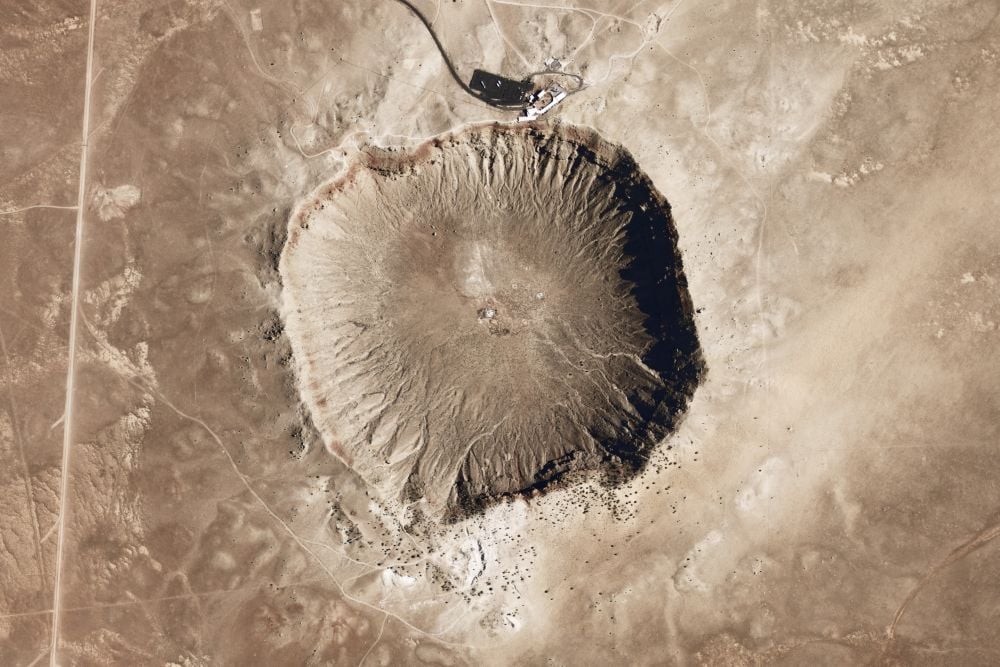
The Meteor Crater or Barringer Crater in Arizona is only about 50,000 years old and is the most well-preserved crater on Earth. Ancient craters like the Zhamanshin crater in Kazakhstan are far less well-preserved, and measuring its actual size is challenging becuase it was created almost one million years ago. New research shows that the Zhamanshin crater could be twice as large as thought, and far more destructive. Image Credit: By National Map Seamless Server - NASA Earth Observatory, Public Domain, https://commons.wikimedia.org/w/index.php?curid=7549781

The Meteor Crater or Barringer Crater in Arizona is only about 50,000 years old and is the most well-preserved crater on Earth. Ancient craters like the Zhamanshin crater in Kazakhstan are far less well-preserved, and measuring its actual size is challenging becuase it was created almost one million years ago. New research shows that the Zhamanshin crater could be twice as large as thought, and far more destructive. Image Credit: By National Map Seamless Server - NASA Earth Observatory, Public Domain, https://commons.wikimedia.org/w/index.php?curid=7549781

Earth and the course of life on Earth have been shaped by impacts. Scientists have uncovered links between massive impacts and changes in climate that altered the planet forever. But the further scientists look into the past to try to understand these changes, the more difficult it is to link them together.

Impact craters don't retain their shapes for long on Earth. When examining ancient craters, researchers are dealing with degraded structures that don't reveal all of the impactor's secrets. Impactor size, angle of impact, velocity, even the composition of the impactor can all change a crater's shape, making it difficult to determine how energetic the impact was, and impact energy is critical to understanding how impacts shaped life on Earth.

The Zhamanshin impact crater in Kazakhstan is believed to be the most recent hypervelocity cratering impact event. The impactor struck Earth around 900,000 years ago during the Pleistocene. It may have caused a nuclear winter, but scientists think it wasn't powerful enough to trigger a mass extinction.

The Zhamanshin crater is visible on the surface and measures about 14 km in diameter. The belief that it was not powerful enough to cause an extreme aftermath is based largely on that crater size. But new research is casting doubt on that measurement, which in turn casts doubt on the effects of the impact. Could the Zhamanshin impact have triggered more powerful changes than thought?

The new research is titled "The Zhamanshin Impact Event: Potential Implications for Environmental Responses and Biological Linkages on Earth and Beyond." It's been submitted to the Planetary Science Journal, and is currently available at arxiv.org. The lead author is James Garvin from the Sciences and Exploration Directorate at NASA's Goddard Space Flight Center.

There are a handful of complex impact craters from the last 1 million years, and they're all degraded to different degress by erosion. "Zhamanshin is the youngest (< 0.90 Ma) and likely best-preserved complex impact structure known within the Earth record within the past one million years," the authors write.

The Zhamanshin impact crater is located in Kazakhstan. Image Credit: Garvin et al. 2026. PSJ.

The Zhamanshin impact crater is located in Kazakhstan.

Image Credit: Garvin et al. 2026. PSJ.

It may seem difficult to get the size of an impact crater wrong, especially one that was created only 900,000 years ago. But lead author Garvin has been arguing for years that some craters, including Zhamanshin, are actually multi-ringed craters with outer rings at large distances from the easily visible inner rings. These rings don't pop out of the landscape in visual images, but remote-sensing techniques like LiDAR can detect them.

"Analysis designed to reduce uncertainty in the dimensions of the Zhamanshin structure employing high resolution topography demonstrated that it likely generated a ~ 26.5 km diameter multi-ring crater," the authors write. "This is at least two times larger than the current best estimates."

The researchers measured the elevation of small peaks in the area around the main crater to determine the size of the outer rings.

The top row shows measurements of small peaks in the region around the main crater. The middle row shows different ring solutions. The bottom panel shows the final apparent outer ring solution. Image Credit: Garvin et al. 2026. PSJ.

The top row shows measurements of small peaks in the region around the main crater. The middle row shows different ring solutions. The bottom panel shows the final apparent outer ring solution.

Image Credit: Garvin et al. 2026. PSJ.

They also used five different types of Digital Elevation Models (DEM) from LiDAR and other data sources to determine the diameter of the entire crater.

This is the highest spatial resolution elevation data available for the Zhamanshin impact region. The red dotted line shows the predicted outer ring of the crater. Image Credit: Garvin et al. 2026. PSJ.

This is the highest spatial resolution elevation data available for the Zhamanshin impact region. The red dotted line shows the predicted outer ring of the crater.

Image Credit: Garvin et al. 2026. PSJ.

Size matters in craters because it's directly linked to impact energy. If Zhamanshin is two times larger than thought, then its impact energy and effect on Earth were also far more pronounced.

"Using a range of accepted impactor sizes, velocities, compositions, and angles of impact, such impacts typically yield kinetic energies of impact over 240,000 Megatons (TNT)," the researchers explain. The combined explosive power of both WW2 atomic bombs was only about 35 kilotons.

That puts the Zhamanshin impact in the same category as other more energetic explosions throughout Earth's history, like the eruptions that occurred in the Yellowstone Caldera. These events were powerful enough to create global climate impacts. "The factor of two discrepancy in the dimensions of Zhamanshin increases the kinetic energy yield by factors of 7-10, with significantly larger environmental consequences," the researchers write.

An oblique view of the crater DEM. The solid red line indicates the 12.5 km inner ring diameter. The dotted red line indicates the 26.4-26.8 km predicted outer ring. Image Credit: Garvin et al. 2026. PSJ.

An oblique view of the crater DEM. The solid red line indicates the 12.5 km inner ring diameter. The dotted red line indicates the 26.4-26.8 km predicted outer ring.

Image Credit: Garvin et al. 2026. PSJ.

In the researchers' view, it's critical to examine Zhamanshin in this context, since it could be responsible for abrupt climate changes with biological consequences that happened around 900,000 years ago. "Quantitative study of Earth’s hypervelocity impacts is essential as they could have affected plant and animal populations amidst various environmental challenges during periods of known climate variations," Garvin and his colleagues explain.

The issue is that Zhamanshin's outer rings are not clearly visible. Previous research by Garvin and others has shown that the crater has been modified by erosion. Research also shows that the outer ring region is covered in loess. Loess is wind-blown silt that formed during the last ice age as glaciers ground rocks into dust. The loess is obscuring the full extent of the crater's outer rings, according to this research.

"The deposition of widespread loess atop the landscape further subdues its relief in comparison to other contemporaneous complex craters," the authors explain. Runoff from the nearby Aral Sea could also help explain why the crater's full extent has been difficult to discern.

So if the Zhamanshin impact was far more powerful than thought, what does that mean for our understanding of Earth at the time?

"The environmental consequences of a ~ 26.5 km diameter impact cratering event in the ~ 870,000 (± 20,000) yr (BCE) time interval of Earth history (early Middle Pleistocene Transition) have not previously been considered," the authors write. "The duration of the post-impact events and whether they were of consequence to regional (or beyond) biological systems is not known nor established at this time."

The authors write that further analysis of climate records from this time period involving pollen, spores, and even fossilized plankton, could discover any biological effects from the Zhamanshin impact. "The terrestrial impact record for the past one million years is of known consequence to the evolution of biological systems on Earth and additional efforts to unravel its incomplete history are compelling, considering key goals associated with planetary protection of Earth," the researchers explain.

Researchers have uncovered changes on Earth following the Zhamanshin impact. The impact occurred during the Mid-Pleistocene Transition, when the behavior of Earth's glaciers changed significantly. The two may be linked, but as of now there's no direct evidence connecting them via cause and effect. "The duration of the post impact events and whether they were of consequence to regional (or beyond) biological systems is not known nor established at this time," the authors write.

As the climate changes, the landscape changes. Climate, landscape, and biological changes are all interrelated, something that won't surprise Universe Today readers. While impactors from space have an external source, once they impact Earth, they become part of these interrelating cycles and cause-effect relationships. Where exactly Zhamanshin fits in isn't clear, but if it was so much more powerful than originally thought, it must have played a role.

"These initial results, while suggestive, require follow on research in the form of regional geophysical surveys like those conducted at complex impact structures such as Haughton and others including the Ries impact event at ~ 14.8 Ma," the authors write.

If these results lead to a better understanding of actual impact crater sizes, then the results also apply to other planets.

"Extending this work to the most recent multi-ringed complex impact events on Mars is another fertile area of research to be considered in an astrobiological context and in support of NASA’s Moon to Mars exploration priorities," the authors conclude.


T
op 10 Largest Craters on Earth | Vredefort, Chicxulub & More 🌍💥 #rankedreality #viral #short

{ https://www.universetoday.com/ }

Hoe vind je dit bericht?
Geschreven door peter om 22:23 Stuur door

1.5 Mile Long UFO Docked In Crater On Earths Moon, UFO Sightings Daily

1.5 Mile Long UFO Docked In Crater On Earths Moon, UFO Sightings Daily

UFO_moon.png

Date of discovery: April 13, 2026
Location of discovery: Earths Moon
Coordinates: 24.1° S / 127.8° E
NASA source: 
 
Hey all, I just found this today, it's 100% new to me. Although I have reported other similar size UFOs years ago, but the NASA coordinates for that one are a bit different, but in the general area close by. I found a 1.5 mile long UFO on Earths moon in an old Apollo 17 NASA archive. The UFO is docked at its nose are upon the edge of the crater and the rest of the ship is floating above the ground. The ship is really large and closely resembles the Star Trek Voyager ship. The material the ship is made of is a whitish shiny white, and as most of you have heard, white UFOs are in the majority in UFO reports worldwide. The UFO is sitting on the edge of Mare Serenitatis, which is an area explored by Apollo 17 and for good reason, who wouldn't want to explore, record data, video, take samples and possibly salvage this 1.5 mile long alien ship full of delicious ET tech? I know I would. 
 
Scott C. Waring - UFO Sightings Daily 
 
PS, This UFO coordinates: 24.1° S / 127.8° E 
Back in 2011 I found a bigger one at: 22° S / 128.5° E 
 
See how close they are? There is an alien docking station in this area on the moon. Here is the link to the 2011 post with its photos and NASA source: 
UAP%20on%20moon.jpg

ship%20on%20moon.png

UAP-moon.png

unknown.png
RELATED

Aliens and Astronauts UFOs on the Moon | UFO ENCOUNTERS

{ https://www.ufosightingsdaily.com/ }

Hoe vind je dit bericht?
Geschreven door peter om 22:09 Stuur door

Egypt's Great Pyramid history shattered as new 'evidence' reveals how the ancient structure was really built

Egypt's Great Pyramid history shattered as new 'evidence' reveals how the ancient structure was really built

The mystery of how Egypt’s Great Pyramid was built may finally be solved.

For decades, experts have struggled to explain how ancient workers lifted and positioned millions of huge stone blocks - some weighing up to 15 tons - without modern machinery. No written records reveal how they did it.

Now, a new study suggests the Pyramid of Khufu was built using a hidden spiral ramp running inside the structure.

Computer scientist Vicente Luis Rosell Roig believes workers used an ‘edge ramp’ - a sloping path along the pyramid’s outer edges that was gradually covered as each new layer was added.

Instead of relying on massive external ramps, this would have allowed workers to move stones steadily upward, one level at a time.

The scale of the project is staggering. The pyramid stretches around 755 feet along each side of its base and rises to about 481 feet.

Historians estimate it was built from roughly 2.3 million stone blocks - a feat that required extraordinary planning and coordination during Pharaoh Khufu’s reign.

The new model also sheds light on how long the construction may have taken.

The construction of Egypt's Great Pyramid has long baffled archaeologists, with no surviving ancient texts explaining how its massive stone blocks were lifted and assembled so quickly

Simulations suggest blocks could have been placed every four to six minutes - a fast, consistent pace.

At that rate, the pyramid could have been completed in just 14 to 21 years.

When quarrying, transport, and breaks for workers are factored in, the total timeline rises to around 20 to 27 years, in line with existing estimates.

Crucially, the theory could also explain why mysterious empty spaces have been detected inside the pyramid. It suggests parts of the hidden ramp could still be inside.

'Old Kingdom technology precluded iron tools, wheeled heavy transport, and compound pulleys, but allowed copper chisels, water-lubricated sledges, ropes, levers, earthen works, and Nile barges,' Rosell Roig said in a study in NPJ Heritage Science, published in March 2026.

'Accordingly, we bound ramp slope, lane width/clearance, and friction, and evaluate the dispatch headway (time between placing successive blocks) required to satisfy the 20–27-year window, encoding these constraints as model parameters.'

For centuries, experts have debated how ancient builders managed to raise such massive materials with limited technology while maintaining the pyramid's precise geometry.

Many earlier ramp theories struggled to explain how construction could continue efficiently without creating obstacles or requiring vast amounts of additional material.

Now, a new study proposes that the Pyramid of Khufu may have been built using a sophisticated hidden ramp system capable of moving stone blocks every few minutes

Now, a new study proposes that the Pyramid of Khufu may have been built using a sophisticated hidden ramp system capable of moving stone blocks every few minutes

Rosell Roig's research aimed to address these challenges by combining multiple forms of analysis into a single system.

According to the study, he built a computer model that simulated how stones were moved and how the structure stayed stable as it rose layer by layer.

At the center of the system is the ramp itself, a gradual path built into the pyramid's outer structure rather than relying on massive external ramps.

article image

Sections of the outer stone layers were temporarily left open to form the upward path, then filled in as work progressed, removing visible evidence of the ramp once construction was complete.

Rosell Roig described this method as 'a helical path formed by omitting and backfilling perimeter courses,' allowing the ramp to rise alongside the structure.

Timing proved to be one of the most important elements of the study. The model calculated that maintaining steady block placement intervals would allow construction to proceed within realistic historical timeframes.

When expanded to include additional logistical steps such as quarrying stone and transporting materials along the Nile, the overall construction window increased but remained consistent with accepted estimates.

Structural stability was another major focus, with staged finite-element analysis used to simulate the pressure created as each new layer of stone was added to the growing monument. 

The results showed that 'stresses and settlements remain within plausible limits for Old Kingdom limestone under self-weight,' indicating the structure could support its own immense mass throughout construction.

The model was also tested against physical observations already detected inside the pyramid. Imaging technology has revealed unexplained internal spaces, and the study found that the proposed ramp geometry corresponds with those features.

This design would have allowed workers to move stone blocks steadily upward without constructing massive external ramps that would have required enormous amounts of additional material

This design would have allowed workers to move stone blocks steadily upward without constructing massive external ramps that would have required enormous amounts of additional material

That alignment suggests the voids may not be accidental gaps, but structural elements created as part of the building process.

A key strength of the model is its ability to be tested. Rather than offering an unprovable idea, the research outlines measurable physical markers that archaeologists could investigate.

These include 'falsifiable predictions (edge-fill signatures, corner wear),' referring to specific patterns expected where ramps were filled in or where heavy traffic would have caused repeated wear.

According to Rosell Roig, the model helps solve several long-standing questions about how the pyramid was constructed efficiently without leaving visible traces.

He wrote that the system 'helps reconcile throughput, survey access, and zero-footprint closure,' meaning it allows construction to remain efficient while preserving the pyramid's final appearance.

By combining logistics, geometry and structural modeling into a single framework, the study presents what it describes as a workable construction pathway grounded in measurable constraints.

If future archaeological investigations confirm the predicted physical evidence, the findings could reshape modern understanding of how one of the world's most famous monuments was built, not through brute force alone, but through careful planning, engineering precision and a construction method designed to disappear into the finished structure itself.

RELATED VIDEOS


How the Egyptians Built the Great Pyramid of Giza with 2.3 Million Stone Blocks

The Great Pyramid: How Did They Really Build It?

Inside the Great Pyramid! Evidence That Changes Everything About Ancient Egypt. AI Reconstruction

{ https://www.dailymail.co.uk/sciencetech/index.html }

Hoe vind je dit bericht?
Geschreven door peter om 21:53 Stuur door

'Welcome home!' Watch the heartwarming moment the recovery crew opened Integrity's hatch after NASA's Artemis II astronauts splashed down following their historic moon mission

Footage has revealed the heartwarming moment a recovery crew opened Integrity's hatch, waving and smiling as they greeted NASA's astronauts following their historic moon mission.

The team arrived back on Earth in the early hours of Saturday after completing a 10–day journey that took them 252,756 miles (406,771 km) from home.

Their spacecraft reached blistering speeds of up to 25,000 miles per hour as it burned through the atmosphere.

Parachutes were deployed to slow its descent before it splashed down in the Pacific Ocean off the coast of San Diego, California.

A recovery team raced to the capsule, with a newly–released video showing them popping open the hatch and climbing inside to greet Reid Wiseman, Victor Glover, Christina Koch and Jeremy Hansen.

They could be heard shouting 'welcome home' as they gave fist bumps to the crew, who beamed with joy after returning to Earth.

Commander Wiseman shared the video on social media with the caption: 'Jesse, Steve, Laddy and Vlad…such an incredible feeling to welcome you aboard Integrity after a nearly 700,000–mile journey.

'Forever thankful for your service to our crew and the nation.'

Footage has revealed the heartwarming moment a recovery crew opened Integrity's hatch, waving and smiling as they greeted NASA's astronauts following their historic moon mission

Footage has revealed the heartwarming moment a recovery crew opened Integrity's hatch, waving and smiling as they greeted NASA's astronauts following their historic moon mission 

Pilot Victor Glover had a huge smile on his face as he fist¿bumped one of the rescue team members

Pilot Victor Glover had a huge smile on his face as he fist–bumped one of the rescue team members

The splashdown marked the end of a 10–day journey that took the crew around the moon and farther than any humans have ever travelled in space.

NASA officials called the Artemis II mission a total success, with the capsule splashing down exactly where the space agency had planned.

Re–entry to Earth's atmosphere began just after 12:30am (UK time) on Saturday morning, with the Orion crew module blasting away from the spacecraft's service module.

The separation exposed the craft's heat shield, which protected the astronauts as they plunged through Earth's atmosphere, experiencing temperatures up to 2,760°C – just under half the surface temperature of the sun.

At this point, mission control lost contact with the spacecraft for six minutes as Orion collided with the upper atmosphere, causing what scientists called a 'plasma buildup.'

Once the radio blackout cleared as planned, Orion successfully deployed its parachutes and safely landed in the Pacific without incident.

A slight communications glitch between the astronauts waiting in the water and the US Navy recovery teams delayed the crew's exit from the craft.

But once flight surgeons were able to board the capsule, they were able to give all four astronauts a clean bill of health.

Delighted viewers said the video had brought them to tears. Pictures: Mission specialist Christina Koch

Delighted viewers said the video had brought them to tears. Pictures: Mission specialist Christina Koch

The video provides a different perspective to this one previously released, which shows the rescue team extracting the astronauts from the capsule

The video provides a different perspective to this one previously released, which shows the rescue team extracting the astronauts from the capsule

Victor Glover, left, and Christina Koch, right, after successfully splashing down following their historic moon mission

Victor Glover, left, and Christina Koch, right, after successfully splashing down following their historic moon mission

The rescue team could be heard shouting 'four green' as they opened the hatch, indicating that all four astronauts appeared healthy and well.

Delighted viewers have commented on the clip, with one remarking: 'Best unboxing video I've ever seen!'

Another said: 'Look at the astronauts waiting so cutely. And you can tell the recovery crew have the bets vibes!'

And someone else added: '"Welcome home" are actually such beautiful words.'

Once they had been recovered from the Orion module, the crew were examined by doctors on the John P Murtha, the naval vessel that was sent to pick them up.

All four astronauts were able to walk by themselves, in stark contrast to previous long–duration space flights where crew had to be carried by medical personnel.

They were then flown ashore by helicopter and taken to NASA's Johnson Space Center in Houston to be reunited with their families.

Dr Lori Glaze, NASA's deputy administrator, said her team was 'thrilled' to have the four astronauts home safely.

Shawn Quinn, manager of NASA's Exploration Ground Systems Program, added: 'We accomplished what we set out to do. It's good to be NASA, and it's good to be an American today.'

President Donald Trump added his congratulations Friday night and invited the crew to the White House.

'I look forward to seeing you all at the White House soon,' he posted on Truth Social. 'We'll be doing it again and then, next step, Mars!'

The Artemis II mission began back on April 1 with a successful launch from the Kennedy Space Center in Florida.

article image

After orbiting Earth the crew set off on a four–day trip to the moon, where they would travel around the dark side and break the decades–old record of Apollo 13 for the farthest distance from Earth humans have ever travelled.

While the Apollo crew travelled 248,655 miles from Earth in 1970, Artemis II reached a maximum distance of 252,756 miles on day six of their mission.

While conducting their lunar flyby, the astronauts also named two new craters discovered on the lunar surface – including one Carroll after the late wife of mission commander Wiseman.

Amit Kshatriya, the associate administrator of NASA, said Artemis II was the 'most important human space exploration mission in decades.'

Artemis II: Key facts

Launch date: April 1

Mission objective: To complete a lunar flyby, passing the 'dark side' of the moon and test systems for a future lunar landing.

Total distance to travel: 620,000 miles (one million km)

Mission duration: 10 days 

Estimated total cost: $44billion (£32.5billion)

* NASA Space Launch System rocket: $23.8billion (£17.6billion)

* Orion deep–space spacecraft: $20.4billion (£15billion)

Crew: 

+ Commander Reid Wiseman

+ Pilot Victor Glover

+ Mission Specialist Christina Koch

+ Mission Specialist Jeremy Hansen

Mission Stages:

1. Launch from Kennedy Space Centre Launch Pad 39B

2. Manoeuvre in orbit to raise the perigee using the Cryogenic Propulsion Stage

3. Burn to raise apogee using the Cryogenic Propulsion Stage

4. Detach from Cryogenic Propulsion Stage and perform translunar injection

5. Fly to the moon over four days

6. Complete lunar flyby at a maximum altitude of 5,523 miles (8,889 km) above the moon's surface

7. Return to Earth over four days

8. Separate the crew module from the European Service Module and the crew module adapter

9. Splashdown in the Pacific Ocean  


Recovery team opens Artemis II hatch as astronauts splash down off San Diego coast

'Welcome home'New video shows recovery team reaching Artemis II crew after splashdown#shorts

{ https://www.dailymail.co.uk/sciencetech/index.html }

Hoe vind je dit bericht?
Geschreven door peter om 21:35 Stuur door

The sun is tearing an asteroid to pieces, and Earth is now flying through the fallout

The sun is tearing an asteroid to pieces, and Earth is now flying through the fallout

This composite image shows the 2019 Geminid meteors and a meteorite-dropping fireball captured by a camera on La Palma island, Spain. Credit: Global Meteor Network.

Across Earth, every night, thousands of automated stargazers are waiting to take pictures of shooting stars. I am one of the scientists who study these meteors.

Most movies and news alerts focus on large asteroids that could destroy Earth. And your phone notifies you every few months that an object nine washing machines wide is going to just narrowly skim past. However, the small dust and rubble that enter our atmosphere daily tell an equally interesting story.

My planetary science colleagues and I use camera observations of the night sky to better understand dust, car-sized asteroids and debris from comets in our solar system.

In a study published in March 2026 in the The Astrophysical Journal , I searched through millions of meteor observations collected by all-sky camera networks based in Canada, Japan, California and Europe and found a small, recently formed cluster. The 282 meteors associated with this cluster tell the story of an asteroid that got a little too close to the sun.

Meteor formation

When a sand-sized crumb of space rock hits our atmosphere, it heats up almost instantly, vaporizing its surface layer and turning it into an electrically charged gas. The whole fragment starts to glow—this is what we call a meteor. If the object is larger, like a boulder, and brighter, it's called a bolide or a fireball. On average, these objects hit our atmosphere going over 15 miles per second. For small dust or sand-sized objects, the whole process lasts only a fraction of a second before they completely disappear.

Most of these sand-sized fragments in the solar system originate from comets—cold, icy objects from the outer reaches of the solar system. As comets pass by the sun, their icy components turn to gas, releasing tons of dust. This is why comets are often called "dirty snowballs" and appear fuzzy in telescopic images.

Asteroids, on the other hand, are leftovers from the early solar system that formed closer to the sun. They are dry and rocky, and do not have the same ices that give comets their characteristic tails.


Humanity’s First Comet Landing – The 67P footage

What does it mean to be active?

Astronomers call an asteroid or comet "active" when it sheds dust, gas or larger fragments. This activity is caused by some external force on the object in space, like heat from the sun, a small impact, or when asteroids spin too fast and fly apart.

Understanding and identifying activity helps scientists better understand how these objects change over time.

For comets, sublimation of ices—when solid ice turns directly into gas, skipping the liquid phase—is the primary culprit. However, for asteroids, the reason for activity can vary greatly.

For example, NASA's OSIRIS-REx mission, which launched into space to study an asteroid named Bennu, saw activity from its surface, with heat stress and small impacts among the leading explanations.

Other sources for asteroid activity include breakup when an asteroid spins too fast, tidal forces ripping apart asteroids during close encounters with a planet, or gas release.

Researchers most commonly search for activity using telescopes. Astronomers can look for a "tail" or fuzziness around the object. This tail is a clear sign that there is gas and dust around the body. But there is another way to search for activity—meteor showers.

I found a new meteor shower, and it comes from an asteroid getting broken down by the sun

The near-Earth asteroid Bennu (approximately 550 yards wide) ejected particles from its surface, which were observed by NASA’s OSIRIS-REx spacecraft.

Credit: NASA/Goddard/University of Arizona/Lockheed Martin

Finding hidden asteroids via meteor showers

The most famous active asteroid is 3200 Phaethon. It is the parent body of the Geminid meteor shower that occurs every year in mid-December. During past close approaches with the sun, Phaethon released vast amounts of dust and larger fragments. These morsels of Phaethon have spread out along its entire orbit over time, leading to the present Geminid meteor stream.

Each meteor shower we observe occurs when Earth passes through one of these debris streams. So if astronomers can detect meteor showers, they can also be used to find active objects in space.

At first, debris shed by an asteroid or comet travels closely together. Imagine squeezing a single drop of food dye into a moving stream of water: Initially, the dye stays in a tight, concentrated cloud. But as it flows, the water's swirling currents pull at the dye, causing it to spread out and fade.

In space, the gravitational tugs from passing planets act like those currents. They pull on the individual meteor fragments in slightly different ways, causing the once-tight stream to gradually drift apart until it completely dilutes into the background dust of our solar system.

I found a new meteor shower, and it comes from an asteroid getting broken down by the sun

This diagram shows the radiant—the point in the night sky from which meteors of the newly discovered shower appear to originate.

Credit: Patrick Shober—NASA JSC

The discovery of a rock-comet

In a study published in March 2026 in the Astrophysical Journal, I used millions of observations of meteors to search for recent, unknown activity from asteroids near Earth. I found one clear cluster of 282 meteors that stood out.

What makes this discovery so exciting is that we are essentially witnessing a hidden asteroid being baked to bits. This newly confirmed meteor stream follows an extreme orbit that plunges almost five times closer to the sun than Earth does.

Based on how these meteors break apart when they hit our atmosphere, we can tell they are moderately fragile, but tougher than stuff from comets. This finding tells us that intense solar heat is literally cracking the asteroid's surface, baking out trapped gases and causing it to crumble. This is likely a major source of past Phaethon activity and the main reason the meteorites on Earth are so diverse.

The search for the source

Why does finding a hidden, crumbling asteroid matter? Meteor observations act as a uniquely sensitive probe that lets us study objects that are completely invisible to traditional telescopes.

Beyond solving astronomical mysteries, analyzing this debris helps us understand the physical evolution of asteroids and comets in our solar system. More importantly, it reveals hidden populations of near-Earth asteroids, which is vital information for planetary defense.

The new meteor shower's parent asteroid remains elusive. However, NASA's NEO Surveyor mission, launching in 2027, offers a promising solution. This space telescope, dedicated to planetary defense and the discovery of dark, hazardous, sun-approaching asteroids, will be the ideal tool for searching for the shower's origin.

Publication details
  • Patrick M. Shober, Asteroidal Activity among Meteor Datasets: Confirmed New "Rock-comet" Stream and Search for a Tidal-disruption Signature, The Astrophysical Journal (2026). DOI: 10.3847/1538-4357/ae4bde

Journal information: 


Sounds of comet 67P #spacemusic #astronomy #solarsystem #space #universe #comet #67p
Hoe vind je dit bericht?
Geschreven door peter om 21:35 Stuur door

Meer van UFO'S of UAP'S, ASTRONOMIE, RUIMTEVAART, ARCHEOLOGIE, OUDHEIDKUNDE, SF-SNUFJES EN ANDERE ESOTERISCHE WETENSCHAPPEN - DE ALLERLAATSTE NIEUWTJES

↑ Terug naar de berichten