Naar de inhoud

UFO'S of UAP'S, ASTRONOMIE, RUIMTEVAART, ARCHEOLOGIE, OUDHEIDKUNDE, SF-SNUFJES EN ANDERE ESOTERISCHE WETENSCHAPPEN - DE ALLERLAATSTE NIEUWTJES

UFO's of UAP'S in België en de rest van de wereld
akke.beakke.be
Ontdek de Fascinerende Wereld van UFO's en UAP's: Jouw Bron voor Onthullende Informatie! Ben jij ook gefascineerd door het onbekende? Wil je meer weten over UFO's en UAP's, niet alleen in België, maar over de hele wereld? Dan ben je op de juiste plek! België: Het Kloppend Hart van UFO-onderzoek In België is BUFON (Belgisch UFO-Netwerk) dé autoriteit op het gebied van UFO-onderzoek. Voor betrouwbare en objectieve informatie over deze intrigerende fenomenen, bezoek je zeker onze Facebook-pagina en deze blog. Maar dat is nog niet alles! Ontdek ook het Belgisch UFO-meldpunt en Caelestia, twee organisaties die diepgaand onderzoek verrichten, al zijn ze soms kritisch of sceptisch. Nederland: Een Schat aan Informatie Voor onze Nederlandse buren is er de schitterende website www.ufowijzer.nl, beheerd door Paul Harmans. Deze site biedt een schat aan informatie en artikelen die je niet wilt missen! Internationaal: MUFON - De Wereldwijde Autoriteit Neem ook een kijkje bij MUFON (Mutual UFO Network Inc.), een gerenommeerde Amerikaanse UFO-vereniging met afdelingen in de VS en wereldwijd. MUFON is toegewijd aan de wetenschappelijke en analytische studie van het UFO-fenomeen, en hun maandelijkse tijdschrift, The MUFON UFO-Journal, is een must-read voor elke UFO-enthousiasteling. Bezoek hun website op www.mufon.com voor meer informatie. Samenwerking en Toekomstvisie Sinds 1 februari 2020 is Pieter niet alleen ex-president van BUFON, maar ook de voormalige nationale directeur van MUFON in Vlaanderen en Nederland. Dit creëert een sterke samenwerking met de Franse MUFON Reseau MUFON/EUROP, wat ons in staat stelt om nog meer waardevolle inzichten te delen. Let op: Nepprofielen en Nieuwe Groeperingen Pas op voor een nieuwe groepering die zich ook BUFON noemt, maar geen enkele connectie heeft met onze gevestigde organisatie. Hoewel zij de naam geregistreerd hebben, kunnen ze het rijke verleden en de expertise van onze groep niet evenaren. We wensen hen veel succes, maar we blijven de autoriteit in UFO-onderzoek! Blijf Op De Hoogte! Wil jij de laatste nieuwtjes over UFO's, ruimtevaart, archeologie, en meer? Volg ons dan en duik samen met ons in de fascinerende wereld van het onbekende! Sluit je aan bij de gemeenschap van nieuwsgierige geesten die net als jij verlangen naar antwoorden en avonturen in de sterren! Heb je vragen of wil je meer weten? Aarzel dan niet om contact met ons op te nemen! Samen ontrafelen we het mysterie van de lucht en daarbuiten.

Archief

Japan’s Moon Lander Touches Down, But Power Problem Mars Its Mission

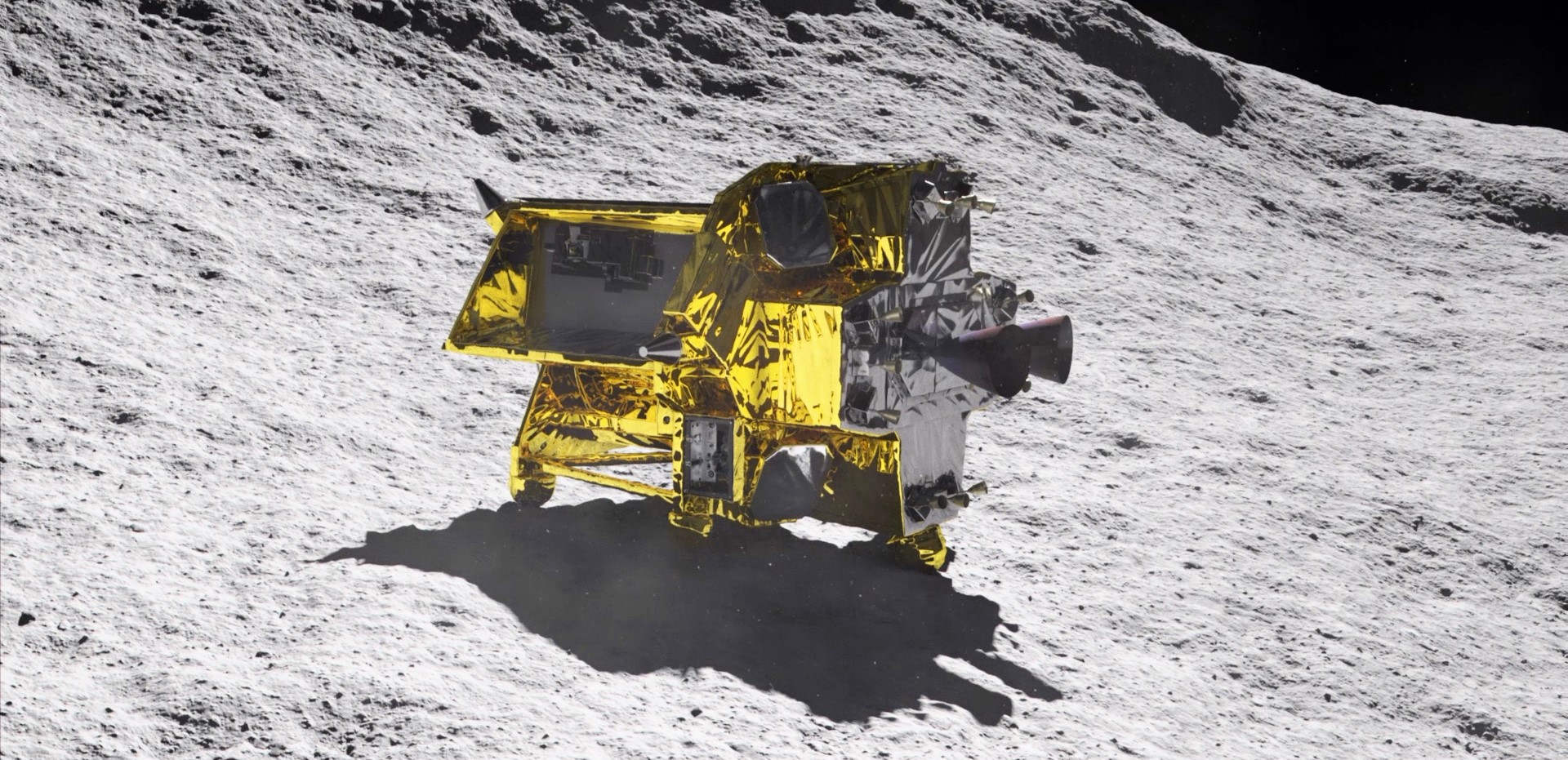
Illustration: SLIM lander on the moon

An artist's conception shows Japan's SLIM lander on the moon. (ISAS / JAXA Illustration)

Japan’s Moon Lander Touches Down, But Power Problem Mars Its Mission

Japan has become the fifth nation to land a functioning robot on the moon, but the mission could fall short of complete success due to a problem with the lander’s power-generating solar cells.

The Smart Lander for Investigating Moon, or SLIM, was launched along with an X-ray space telescope called XRISM from Japan’s Tanegashima Space Center in early September — and after weeks of in-space maneuvers, SLIM touched down today at 1520 GMT (10:20 a.m. ET Jan. 19, or 12:20 a.m. JST Jan. 20).

The Japan Aerospace Exploration Agency reported that the landing was successful. During a news briefing, Hiroshi Kuninaka, director general of JAXA’s Institute of Space and Astronautical Science, said the achievement marked “a major milestone” in Japan’s effort to send spacecraft to the moon, and eventually to Mars.

Kuninaka said SLIM was able to communicate with Earth and respond to commands. “However, it seems that the solar cells are not generating electricity at this point in time,” he said. “And since we are not able to generate electricity, the operation is being done using batteries alone.”

Mission controllers prioritized efforts to transmit the data stored on the lander back to Earth before the batteries ran out. SLIM was expected to lose power within hours if the solar panel problem couldn’t be fixed.

Kuninaka said the problem could have arisen because the solar cells weren’t properly aligned toward the sun. “We are trying to analyze the data that we’re gathering at this point in time and analyzing the status,” he said.

The lander was designed to make a precision touchdown near Shioli Crater, in a region of the moon not far from where the Apollo 11 and Apollo 16 landings took place more than 50 years ago. SLIM’s objective was to land within 100 meters (330 feet) of the targeted landing spot. The plan for an ultra-accurate moonshot explains why SLIM came to be called “Moon Sniper.” Kuninaka said mission managers would need “a little more time” to confirm how close SLIM came to the target.

He also said two mini-rovers, known as LEV-1 and LEV-2, were successfully deployed during SLIM’s descent to the surface. LEV-1 is built to capture imagery and record temperature and radiation levels as it hops around the surface. LEV-2 has the shape of a deformable sphere, and is designed to roll around the surface to take pictures.

“If LEV-1 and LEV-2 are functioning properly, then SLIM’s photos and images have been taken by LEV-1 and LEV-2. I believe such data is now being sent to us,” Kuninaka said.

Despite the power problem, SLIM’s successful landing was a welcome development for JAXA’s space exploration program. It added Japan to a short list of countries that have guided robotic spacecraft to soft landings on the moon — a list that also includes the U.S., Russia, China and India.

Other recent developments have demonstrated that putting a robot on the moon isn’t easy. This week, for example, Astrobotic’s Peregrine lunar lander fell back to Earth after a propellant leak ruled out a moon landing.

Last year, a different type of commercial lander — built by a Japanese startup called ispace — failed during its descent to the lunar surface. Russia’s Luna-25 mission also ended with a crash landing on the moon last year. In 2022, a Japanese mini-probe called Omotenashi failed to function after its deployment during NASA’s Artemis 1 moon mission. And in 2019, the Israeli-built Beresheet moon probe failed to stick its landing.

In contrast, India’s Chandrayaan-3 lander/rover mission and China’s Chang’e missions stand out as notable successes in the recent wave of moon exploration efforts.

{  https://www.universetoday.com/  }

Hoe vind je dit bericht?
Geschreven door peter om 21:01 Stuur door

What Future Propulsion Technologies Should NASA Invest In?

11773.jpg

What Future Propulsion Technologies Should NASA Invest In?

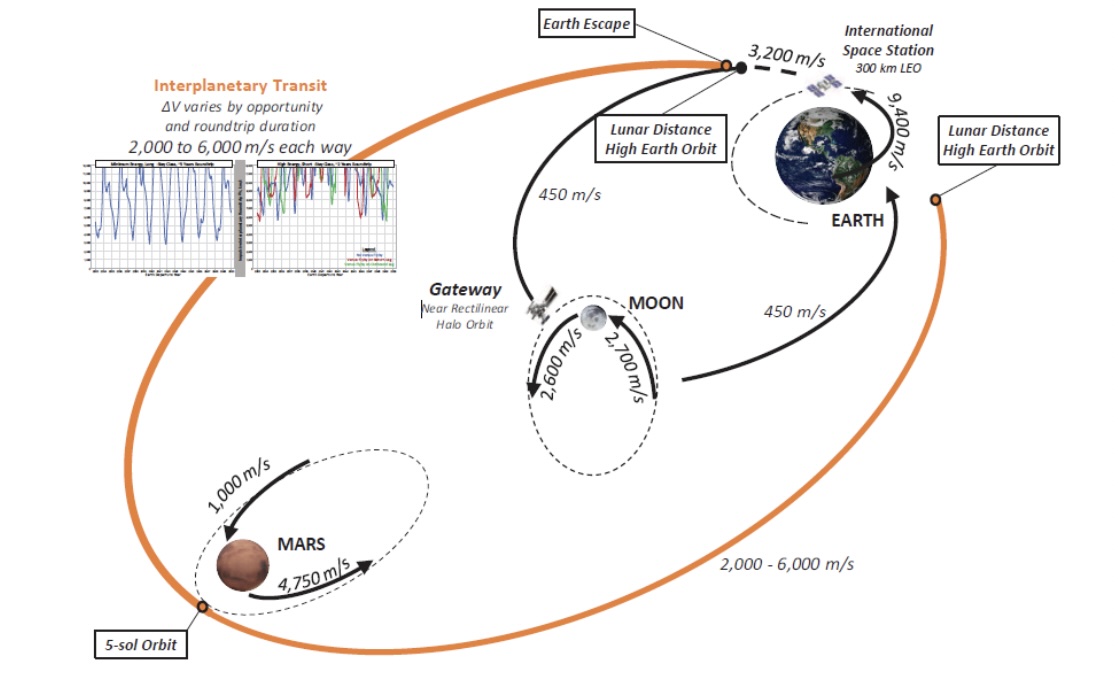
Researchers consistently complain about how difficult it is to fund breakthrough research. Most funding agencies, especially governmental ones, think funding incremental, evolutionary technological steps is the way to go, as it has the most significant immediate payback. But longer-term, higher-risk research is necessary to provide those incremental steps 20-30 years in the future. And in some cases, they are required to underpin completely new things that other researchers want to do.

That is the case with space propulsion systems. Current mature technologies, mainly derived from chemical rockets, cannot provide the necessary force to allow for a gravitational lens telescope out in the Oort cloud, an interstellar probe, or a round trip to Mars that would take less than a year. But other technologies on the horizon could if only we spent more time and resources developing them. So a group of  NASA and DoE engineers recently released a paper detailing some of those and where they think America’s space agency should direct its funding when developing new propulsion systems.

At the beginning of the paper, the authors lament that there hasn’t been any large-scale NASA investment in breakthrough propulsion technologies since the 1970s. And they’re right; the last significant effort was the Nuclear Engine for Rocket Vehicle Application (NERVA) project, which wound down in the 1970s. Despite the lack of prototyping, plenty of ideas were put forward then. Just none have made them into hardware.

Novel propulsion systems are always fun to talk about – as Fraser proves int his interview.

Those ideas can be broadly categorized into four different groups of systems: chemical propulsion, nuclear thermal propulsion, solar electric propulsion (SEP), and nuclear electric propulsion (NEP). The rest of the study aimed to determine what if any, significant advancements could be made in those four systems that could lead to them lowering the round-trip time to Mars to less than one year.

The authors discard chemical propulsion and nuclear thermal propulsion, stating that they are simply not cut out for the rapid technological changes that could enable their use for these game-changing propulsion systems. Chemical propulsion suffers from “the tyranny of the rocket equation,” as Isaac Arthur puts it. But nuclear thermal propulsion suffers from the same underlying problem – they must carry too much weight in propellants to be viable for truly ground-breaking speed increases.

That leaves solar electric propulsion and nuclear electric propulsion. The authors break down the current state-of-the-art technologies for each technology and calculate the weight per kilowatt of energy they produce. Neither looks particularly promising at the state of the art – with NEP coming in at 51 kg/kWe and various solar arrays that could drive a SEP system ranging from 5 kg/kWe up to 22.73 kWe. None of those weight/power tradeoffs would result in anything approaching a sub-one-year time to Mars.

Ion engines could potentially be scaled to the point where we could get to Mars quickly – if we fund them enough.

But why stop there? The authors do a deep dive into potential technologies on the horizon, ranging from materials to photovoltaics, that could dramatically impact those calculated ratios. The paper concludes with “transformative” technologies that could decrease the kg/kWe to below one. In that case, an extensive enough power system can reasonably transport humans to Mars in between 50 and 100 days. 

The researchers also looked at some early-stage propulsion concepts from NASA’s Institute for Advanced Concepts – including the ever-popular “pulsed nuclear” propulsion system, where a nuclear explosion is intentionally initiated behind the spacecraft to push it forward. These technologies are too early to be included in a deep-dive analysis, but they could lead to some promising alternative technologies.

To invest in those alternative technologies, the authors suggest NASA commit 1% of its Space Nuclear Propulsion budget to developing breakthrough technologies. At $45 million for FY2023, the whole budget isn’t exactly breaking the bank, and a mere $450,000 probably wouldn’t make too big of waves in the industry. But, it is undoubtedly better than what is currently allotted toward maturing these transformative propulsion technologies.

Learn More:

Lead Image:

  • Mars/Lunar Transfer Orbits
  • Credit – Dankanich et al.

{  https://www.universetoday.com/  }

Hoe vind je dit bericht?
Geschreven door peter om 20:43 Stuur door

Early Galaxies Looked Nothing Like What We See Today

galaxy.jpeg

Though an estimated 100 million black holes roam among the stars in our Milky Way galaxy, astronomers have never identified an isolated black hole – until now. Following six years of meticulous observations, NASA’s Hubble Space Telescope has provided, for the first time ever, strong evidence for a lone black hole plying interstellar space. The black hole that was detected lies about 5,000 light-years away, in the Carina-Sagittarius spiral arm of our galaxy. However, its discovery allows astronomers to estimate, statistically, that the nearest isolated black hole to Earth might be as close as 80 light-years. Black holes are born from rare, monstrous stars (less than one-thousandth of the galaxy’s stellar population) that are at least 20 times more massive than our Sun. These stars explode as supernovae, and the remnant core is crushed by gravity into a black hole. Because the self-detonation is not perfectly symmetrical, the black hole may get a kick, and go careening through our galaxy like a blasted cannonball. Hubble can’t photograph the wayward black hole because it doesn’t emit any light, but instead swallows all radiation due to its intense gravitational pull. Instead, Hubble measurements capture the ghostly gravitational footprint of how the stealthy black hole warps space, which then deflects starlight from anything that momentarily lines up exactly behind it. Ground-based telescopes, which monitor the brightness of millions of stars in the rich star fields in the direction of the central bulge of our Milky Way, look for the tell-tale sudden brightening of one of them when a massive object passes between us and the star. Then Hubble follows up on the most interesting such events. Kailash Sahu of the Space Telescope Science Institute in Baltimore, Maryland, along with his team, made the discovery in a survey designed to find just such isolated black holes. The warping of space due to the gravity of a foreground object passing in front of a star located far behind it will momentarily bend and amplify the light of the background star as it passes in front of it. The phenomenon, called gravitational microlensing, is used to study stars and exoplanets in the approximately 20,000 events seen so far inside our galaxy. The signature of a foreground black hole stands out as unique among other microlensing events. The very intense gravity of the black hole will stretch out the duration of the lensing event for over 200 days. Also, If the intervening object was instead a foreground star, it would cause a transient color change in the starlight as measured because the light from the foreground and background stars would momentarily be blended together. But no color change was seen in the black hole event. Next, Hubble was used to measure the amount of deflection of the background star’s image by the black hole. Hubble is capable of the extraordinary precision needed for such measurements. The star’s image was offset from where it normally would be by two milliarcseconds. That’s equivalent to measuring the diameter of a 25-cent coin in Los Angeles as seen from New York City. This astrometric microlensing technique provided information on the mass, distance, and velocity of the black hole. The amount of deflection by the black hole’s intense warping of space allowed Sahu’s team to estimate it weighs seven solar masses. The isolated black hole is traveling across the galaxy at 90,000 miles per hour (fast enough to travel from Earth to the moon in less than three hours). That’s faster than most of the other neighboring stars in that region of our galaxy. “Astrometric microlensing in conceptually simple but observationally very tough,” said Sahu. “It is the only technique for identifying isolated black holes.” When the black hole passed in front of a background star located 28,000 light-years away in the galactic bulge, the starlight coming toward Earth was amplified for a duration of 265 days as the black hole passed by. However, it took several years of Hubble observations to follow how the background star’s position appeared to be deflected by the bending of light by the foreground black hole. The existence of stellar-mass black holes has been known since the early 1970’s, but all of them—until now—are found in binary star systems. Gas from the companion star falls into the black hole, and is heated to such high temperatures that it emits X rays. About two dozen black holes have had their masses measured in X-ray binaries through their gravitational effect on their companions. Black hole masses in X-ray binaries inside our galaxy range from 5 to 20 solar masses. Black holes detected in other galaxies by gravitational waves from mergers between black holes and companion objects have been as high as 90 solar masses. “Detections of isolated black holes will provide new insights into the population of these objects in our Milky Way,” said Sahu. He expects that his program will uncover more free-roaming black holes inside our galaxy. But it is a needle-in-a-haystack search. The prediction is that only one in 1500 microlensing events are caused by isolated black holes. NASA’s upcoming Nancy Grace Roman Space Telescope will discover several thousand microlensing events out of which many are expected to be black holes, and the deflections will be measured with very high accuracy. In a 1916 paper on general relativity, Albert Einstein predicted that his theory could be tested by observing the sun’s gravity offsetting the apparent position of a background star. This was tested by astronomer Arthur Eddington during a solar eclipse on May 29, 1919. Eddington measured a background star being offset by 2 arc seconds, validating Einstein’s theories. Both scientists could hardly have imagined that over a century later this same technique would be used – with unimaginable precision of a thousandfold better — to look for black holes across the galaxy.

Early Galaxies Looked Nothing Like What We See Today

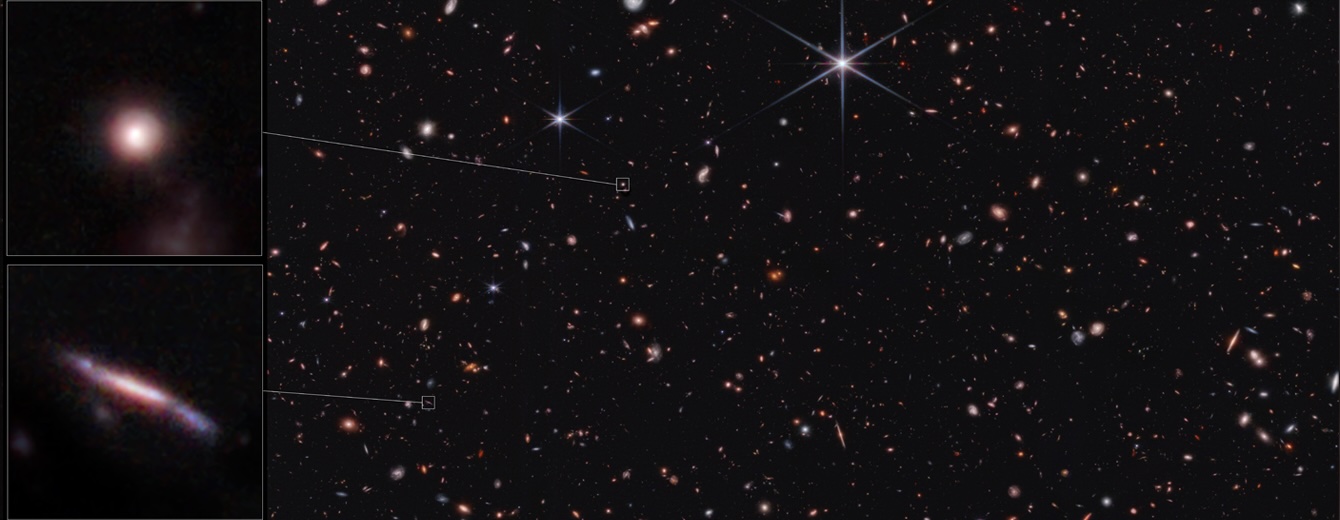
Talk to anyone about galaxies and it often conjurs up images of spiral or elliptical galaxie. Thanks to a survey by the James Webb Space Telescope it seems the early Universe was full of galaxies of different shapes. In the first 6 billion years up to 80% of the galaxies were flat, surfboard like. But that’s not it, there were others like pool noodles too, yet why they looked so different back then is a mystery.

Galaxies were  first identified back in the 17th Century by French astronomer Charles Messier. He was a comet hunter who identified a number of fuzzy objects which he realised were not comets. He catalogued them in his famous catalogue of deep sky objects but it wasn’t until Edwin Hubble measure the distances to some of them in the 1920’s that they were recognised as galaxies. 

The bluish-white spiral galaxy NGC 1376 hangs delicately in the cold vacuum of space. Credit: NASA, ESA, and the Hubble Heritage Team (STScI/AURA)

Analysing images from the JWST survey known as the Cosmic Evolution Early Release Science Survey, the team studied galaxies from a time when the universe was between 600 million and 6 billion years old. To their surprise they did not see the usual cosmic zoo of galaxies like spiral, elliptical and irregular galaxies. Instead they found that between 50 and 80% of the galaxies seem to be glattened in two dimensions.

Illustration of James Webb Space Telescope

Instead, the team found galaxies shaped like surfboards, pool noodles, frisbees and volleyballs. Among these new types, the surfboard shape was most common with the least common being the volleyball, sphere shaped galaxies. Interestingly too they foudn that the frisbee and noodle shaped galaxies became more common in the later era around 6 billion years. 

The mass of the early galaxies seemed to be far less than the mass of galaxies we see today. It seems they had far less time to grow when compared to today’s galaxies which are far more massive. The team would have not been able to complete their work without the incredible sensitivity and resolution of the JWST.

The paper was authored by Viraj Pandya, a NASA Hubble Fellow at Columbia University.  They went further to explore what category our own Milky Way galaxy would fall into if we could hop in a time machine and wind back time. They concluded it was likely to have been surfboard shaped galaxy, not too dissimilar to the spiral structure familiar to us today.

We have learned lots about galaxies over the years and images from Hubble has most certainly helped.  The latest set of images from JWST have shown us that we still have lots to learn and as we delve deeper and deeper into space and further and further back into time we are only just starting to scratch the surface. 

Source : 

{  https://www.universetoday.com/  }  

Hoe vind je dit bericht?
Geschreven door peter om 20:32 Stuur door

The Ice Sheet on Mars is Even Thicker Than Previously Believed

11957.jpg

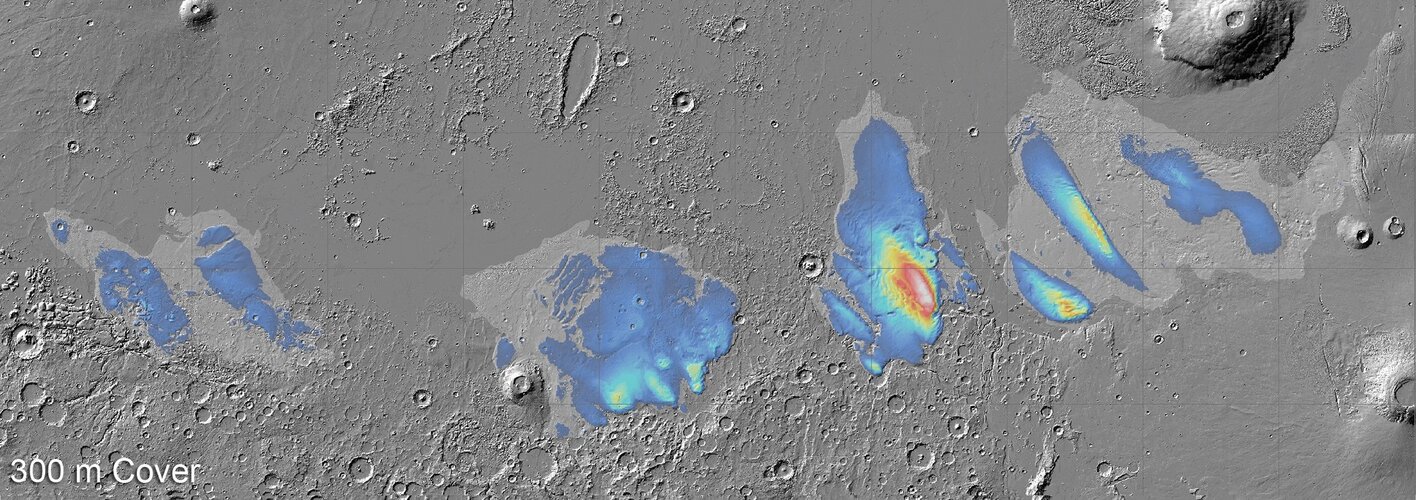
Map of potential ice thickness in Mars’s Medusae Fossae Formation (MFF). Credit: ESA.

The Ice Sheet on Mars is Even Thicker Than Previously Believed

Maybe Mars isn’t as dry as we thought. ESA’s Mars Express has revealed new details about a region near Mars’ equator that could contain a massive deposit of water ice several kilometers deep. If it is indeed ice, there is enough of it in this one deposit that if melted, water would cover the entire planet up to 2.7 meters (almost 9 feet) deep.

But ice is just one explanation for the unusual features detected by the orbital spacecraft. Another is that this is a giant pile of dust several kilometers deep — although the dust would still need to have some ice mixed in.

Mars Express has been orbiting Mars since December of 2003 and back in 2007, the spacecraft studied the Medusae Fossae Formation (MFF), a large geological formation that includes wind-sculpted ridges and grooves, abrupt mesas, interspersed with smooth and gently undulating areas. The region extends intermittently for more than 5,000 km (3,100 miles) along the equator of Mars, extending from just south of Olympus Mons to Apollinaris Patera, with a smaller additional region closer to Gale Crater, where the Curiosity rover is exploring.

This image shows a height map of the Martian surface, with lowest land in blue and highest in white. Standing at an impressive 22 km, Olympus Mons is the tallest volcano in the entire Solar System. The Medusae Fossae Formation (MFF) is shown near the equator Credit: ESA

Various spacecraft in addition to Mars Express, such as NASA’s Mars Global Surveyor and Mars Odyssey, have also detected subsurface ice, as much as 2.5 km (1.5 miles) deep.

Now, new data from Mars Express suggest layers of water ice stretching even further underground – the most water ever found in this part of the planet.

“We’ve explored the MFF again using newer data from Mars Express’s MARSIS radar, and found the deposits to be even thicker than we thought: up to 3.7 km (2.3 miles) thick,” said Thomas Watters of the Smithsonian Institution, USA, lead author of both the new research and the initial 2007 study, in an ESA press release. “Excitingly, the radar signals match what we’d expect to see from layered ice, and are similar to the signals we see from Mars’s polar caps, which we know to be very ice rich.”

Watters and his team say that if melted, the ice contained within the MFF would cover the entire planet in a layer of water 1.5 to 2.7 m deep, enough to fill Earth’s Red Sea.

An isolated hill in the Medusae Fossae Formation. The effect of wind erosion on this hill is evident by its streamlined shape. Credit: High Resolution Stereo Camera/European Space Agency

But MFF’s windswept landscapes contains one of the most extensive deposits of dust on Mars, which is possibly the biggest single source of dust on Mars. Some studies determined the strange features in this landscape could have been formed by explosive volcanoes.

In the 2007 observations with Mars Express, the radar data showed the MFF to be relatively transparent to radar and low in density – two characteristics which would reveal icy deposits. However, scientists couldn’t rule out a drier possibility: that the features are actually giant accumulations of windblown dust, volcanic ash or sediment.

But the beauty of long-lasting spacecraft is that it provides the opportunity for multiple observations of a single region on Mars over many years, providing additional follow-up data for study.   

At the top is an image of Mars’s surface. A white line crosses the surface diagonally, with a black arrow coming down from the white line to point at a graph below. The graph shows the shape of the surface and subsurface. It indicates that under the surface is a thin layer of dry sediments then a thick layer of ice deposit. The x axis of the graph shows distance, indicating that the diagonal white line covers a distance of 1000 km. The y axis of the graph sho ws elevation, indicating that the ice deposit is up to 3000 m thick. Credit: CReSIS/KU/Smithsonian Institution.

“Here’s where the new radar data comes in! Given how deep it is, if the MFF was simply a giant pile of dust, we’d expect it to become compacted under its own weight,” said co-author Andrea Cicchetti of the National Institute for Astrophysics, Italy. “This would create something far denser than what we actually see with MARSIS. And when we modelled how different ice-free materials would behave, nothing reproduced the properties of the MFF – we need ice.”

The new results instead suggest layers of dust and ice, all topped by a protective layer of dry dust or ash several hundred meters thick.

We do know that massive stores of ice near the equator could not have formed in the planet’s present climate.

“This latest analysis challenges our understanding of the Medusae Fossae Formation, and raises as many questions as answers,” says Colin Wilson, ESA project scientist for Mars Express and the ESA ExoMars Trace Gas Orbiter (TGO). “How long ago did these ice deposits form, and what was Mars like at that time? If confirmed to be water ice, these massive deposits would change our understanding of Mars climate history. Any reservoir of ancient water would be a fascinating target for human or robotic exploration.”

If this does turn out to be large stores of water ice, the MFF deposits would be an incredibly valuable resource for any future human exploration of Mars. These types of missions would need to land near the planet’s equator, due to landing constraints, and resources like abundant solar power, and more moderate temperatures. The presence of equatorial water ice could provide a steady supply of water for a future base on Mars.

Further reading: 

{ https://www.universetoday.com/ }

Hoe vind je dit bericht?
Geschreven door peter om 19:27 Stuur door

US government responds to 'jellyfish UFO' filmed over base before submerging into water

US government responds to 'jellyfish UFO' filmed over base before submerging into water

Footage recently emerged showing a 'jellyfish UFO' supposedly flying over a US military base in Iraq in 2018 - and now the Pentagon has issued a statement in response

Jellyfish UFO

The 'jellyfish' UFO, supposedly filmed in Iraq in 2018 

(Image: @JeremyCorbell/Twitter)

The US government has issued a statement in response to a video showing what has been dubbed the "jellyfish" UFO.

The video was shared by journalist Jeremy Corbell and appears to show a jellyfish-shaped object floating over a military base.

Corbell claims it was recorded over a US base in Iraq and dates back to 2018. He also said the object was officially designated as an "unidentified aerial phenomenon" (UAP) by the Pentagon.

READ MORE: 

the object was officially designated as an "unidentified aerial phenomenon" (UAP) by the Pentagon

Corbell claims the object was officially designated as a UAP by the Pentagon 

(Image: @JeremyCorbell/Twitter)

Corbell said on X/Twitter: "An incursion by an object of unknown origin was filmed at a United States joint operations base in Iraq. The object was designated UAP (Unidentified Anomalous Phenomena), and was tracked for a durational period. The object moved through a sensitive military installation - and eventually traversed over a body of water, where it actuated a controlled descent - submerging into the water.

"After an observational period of about seventeen minutes - the UAP re-emerged from the body of water and shot-off at an extreme rate of speed - beyond the optical scope of the observation platform. The origin, intent and capability of the Anomalous Aerial Vehicle remains unknown. Official designation remains UAP."

The US Department of Defence has now responded, but refused to share details on "material that may have been leaked". The statement from spokeswoman Sue Gough reads: "We do not comment on the authenticity of alleged DOD material that may have been leaked. DOD takes public interest in unidentified anomalous phenomena seriously and is committed to openness and accountability to the American people.

"This commitment must be balanced with the department’s obligation to protect sensitive information, sources, and methods. To that end, AARO will provide updates to the public via its website as it resolves UAP cases, including sharing the analytic approach and method used for each case, as well as imagery, when approved for public release."

The Pentagon refused to share details on 'material that may have been leaked'

The Pentagon refused to share details on 'material that may have been leaked' (Image: @JeremyCorbell/Twitter)

The Pentagon has previously released other videos leaked by Corbell and confirmed they were UAPs

Expert Ross Coulthart, special correspondent for NewsNation, said the Pentagon's response this time around was "very revealing for what it doesn't say".

"It doesn’t reveal a categorical denial," he told the news station. "It’s the last resort of governments and intelligence services when they don’t want to answer a question." He added that the video has proved to be a "very big issue" for the Pentagon.

READ NEXT:

{ https://www.dailystar.co.uk/ }

Hoe vind je dit bericht?
Geschreven door peter om 23:37 Stuur door

Webb Detects Oldest Black Hole Yet Known

Webb Detects Oldest Black Hole Yet Known

Astronomers using the NASA/ESA/CSA James Webb Space Telescope have detected a small and vigorous black hole in GN-z11, an exceptionally luminous galaxy that existed just 420 million years after the Big Bang, more than 13 billion years ago. That this black hole with a mass of a few million solar masses even exists so early in the Universe challenges current assumptions about how black holes form and grow.

GN-z11, shown in the inset, is seen as it was 13.4 billion years in the past, just 400 million years after the Big Bang. Image credit: NASA / ESA / P. Oesch, Yale University / G. Brammer, STScI / P. van Dokkum, Yale University / G. Illingworth, University of California, Santa Cruz.

GN-z11, shown in the inset, is seen as it was 13.4 billion years in the past, just 400 million years after the Big Bang.

Image credit: NASA / ESA / P. Oesch, Yale University / G. Brammer, STScI / P. van Dokkum, Yale University / G. Illingworth, University of California, Santa Cruz.

Astronomers believe that the supermassive black holes found at the centre of galaxies like the Milky Way grew to their current size over billions of years.

But the size of this newly-discovered black hole suggests that they might form in other ways: they might be ‘born big’ or they can eat matter at a rate that’s five times higher than had been thought possible.

According to standard models, supermassive black holes form from the remnants of dead stars, which collapse and may form a black hole about a hundred times the mass of the Sun

If it grew in an expected way, this newly-detected black hole would take about a billion years to grow to its observed size.

However, the Universe was not yet a billion years old when this black hole was detected.

“It’s very early in the Universe to see a black hole this massive, so we’ve got to consider other ways they might form,” said Dr. Roberto Maiolino, an astronomer at the University of Cambridge.

“Very early galaxies were extremely gas-rich, so they would have been like a buffet for black holes.”

Like all black holes, the young black hole in GN-z11 is accreting material from its host galaxy to fuel its growth.

Yet, this ancient black hole is found to gobble matter much more vigorously than its siblings at later epochs.

GN-z11 is a compact galaxy, about one hundred times smaller than the Milky Way, but the black hole is likely harming its development.

When black holes consume too much gas, it pushes the gas away like an ultra-fast wind.

This ‘wind’ could stop the process of star formation, slowly killing the galaxy, but it will also kill the black hole itself, as it would also cut off the black hole’s source of ‘food.’

“It’s a new era: the giant leap in sensitivity, especially in the infrared, is like upgrading from Galileo’s telescope to a modern telescope overnight,” Dr. Maiolino said.

“Before Webb came online, I thought maybe the Universe isn’t so interesting when you go beyond what we could see with the NASA/ESA Hubble Space Telescope.”

“But that hasn’t been the case at all: the Universe has been quite generous in what it’s showing us, and this is just the beginning.”

“The sensitivity of Webb means that even older black holes may be found in the coming months and years,” he added.

“We are hoping to use future observations from Webb to try to find smaller ‘seeds’ of black holes, which may help them untangle the different ways that black holes might form: whether they start out large or they grow fast.”

  • A paper on the findings was published in the journal Nature.
  • R. Maiolino et al. A small and vigorous black hole in the early Universe. Nature, published online January 17, 2023; doi: 10.1038/s41586-024-07052-5

{ https://www.sci.news/ }

Hoe vind je dit bericht?
Geschreven door peter om 22:31 Stuur door

Wetenschappers ontdekken alleroudste zwarte gat tot nu toe (en dat leidt direct tot hoofdbrekens)

Wetenschappers ontdekken alleroudste zwarte gat tot nu toe (en dat leidt direct tot hoofdbrekens)

e4606ed6-8919-97fa-15a0-78786e326f63.jpg

Want volgens ons huidige begrip omtrent het ontstaan en de evolutie van zwarte gaten zou dit exemplaar eigenlijk niet moeten bestaan.

Dat is te lezen in het blad Nature. De studie handelt over een zwart gat dat wetenschappers met behulp van ruimtetelescoop James Webb hebben ontdekt. Het zwarte gat dateert uit de periode kort na de oerknal; de astronomen zien het zoals het er slechts 400 miljoen jaar na het ontstaan van het universum uitzag. En daarmee gaat het zwarte gat de boeken in als het oudste zwarte gat dat astronomen tot op heden hebben gedetecteerd.

Hoofdbrekens
Wat opvalt, is dat dit zwarte gat, dat al zo kort na de oerknal moet zijn ontstaan, vrij zwaar is: enkele miljoenen keren zwaarder dan onze zon. En dat leidt toch wel tot hoofdbrekens bij astronomen. Aangenomen wordt namelijk dat dergelijke superzware zwarte gaten – zoals we die vandaag de dag ook in het hart van onze eigen Melkweg vinden – miljarden jaren nodig hebben om zo zwaar te worden (zie kader). Maar zoveel tijd heeft het superzware zwarte gat dat nu in het jonge universum is ontdekt overduidelijk niet gehad. “Dus we moeten andere manieren gaan bedenken waarop superzware zwarte gaten kunnen ontstaan,” concludeert onderzoeker Roberto Maiolina nuchter.

Het ontstaan van superzware zwarte gaten
Superzware zwarte gaten zijn zwarte gaten met een massa die honderdduizenden, miljoenen of zelfs miljarden keren groter is dan de massa van onze zon. Volgens de huidige standaardmodellen zien dergelijke zware zwarte gaten het levenslicht wanneer zware sterren aan het einde van hun leven ineenstorten. Een dergelijke gebeurtenis zou resulteren in een zwart gat dat ‘slechts’ enkele honderden malen zwaarder is dan onze zon. Maar gaandeweg kan zo’n zwart gat – bijvoorbeeld door omringende materie op te slokken – steeds zwaarder worden en uiteindelijk uitgroeien tot een superzwaar zwart gat. Maar dat kost tijd. Zo zou het zwarte gat dat wetenschappers nu met behulp van James Webb in het jonge universum hebben ontdekt, volgens deze theorie zo’n 1 miljard jaar nodig hebben gehad om zijn huidige massa te verkrijgen. Maar dat klopt duidelijk niet, want het zwarte gat was 400 miljoen jaar na de oerknal al superzwaar.

De ontdekking van dit superzware zwarte gat in het jonge universum dwingt wetenschappers duidelijk om na te gaan denken over andere manieren waarop superzware zwarte gaten kunnen ontstaan of evolueren. Misschien zijn sommige superzware zwarte gaten bijvoorbeeld bij hun ‘geboorte’ al wel groter dan tot voor kort voor mogelijk werd gehouden. Een andere mogelijkheid is dat sommige superzware zwarte gaten gewoon veel sneller kunnen groeien dan onderzoekers dachten.

Hongerig
Dat het zwarte gat dat wetenschappers nu gedetecteerd hebben, hongerig is, staat vast (zie kader). Onderzoek heeft namelijk al uitgewezen dat het zwarte gat veel sneller materie opslokt dan zwarte gaten in latere tijden.

Hongerig zwart gat
Het zwarte gat is misschien wel één van de meest mysterieuze en fascinerende fenomenen in het universum. Door de intense zwaartekracht van zwarte gaten kan niets aan hun greep ontsnappen. Zelfs licht niet. Hierdoor zijn zwarte gaten volslagen donker en in feite dus onzichtbaar. Dat wetenschappers ze toch kunnen detecteren, is te danken aan het feit dat de intense zwaartekracht van zo’n zwart gat van invloed is op de omgeving. Zo is het zwarte gat dat wetenschappers nu in het jonge universum hebben ontdekt, druk bezig om materie (gas) naar zich toe te trekken. Alvorens dat gas daadwerkelijk in het zwarte gat verdwijnt, begeeft het zich in een baan rond het zwarte gat en vormt daar een zogenoemde accretieschijf. Het gas in die schijf wordt heel heet en begint te gloeien. En die gloed hebben onderzoekers nu met James Webb gedetecteerd. En uit die gloed kunnen ze afleiden dat zich hier een zwart gat bevindt (dat vrij druk bezig is om gas naar zich toe te trekken).

In eerste instantie zorgt die vraatzucht ervoor dat het zwarte gat lekker kan groeien. Maar op lange termijn kan de zucht naar meer dit zwarte gat zomaar fataal worden, zo merken de onderzoekers op. Want als het zwarte gat te veel gas consumeert, gaat deze ook krachtige ‘winden’ – in feite een uitstroom van straling en geladen deeltjes – produceren die gas juist van het zwarte gat vandaan duwen. En daarmee duwt het zwarte gat zijn ‘voedsel’ als het ware weg, waardoor het zichzelf langzaam uithongert. Ook op het sterrenstelsel waar het zwarte gat deel van uitmaakt, heeft dit proces overigens een enorme impact. Want de krachtige ‘winden’ die het zwarte gat genereert, remmen de stervorming. Hierdoor worden er minder nieuwe sterren geboren, ‘vergrijst’ het sterrenstelsel en sterft het uiteindelijk een langzame dood.

Vervolgonderzoek
Hoewel er dus aanwijzingen zijn dat het zwarte gat dat onderzoekers nu in het jonge universum hebben gevonden, actief en ook vrij snel aan het eten is, is daarmee zeker nog niet helemaal te verklaren hoe het zwarte gat in zo’n korte tijd zo zwaar is geworden. Meer onderzoek is nodig om uit te vogelen hoe een superzwaar zwart gat zo vroeg in de ontstaansgeschiedenis van ons universum kan bestaan. James Webb kan daar zeker bij helpen, zo verwacht Maiolino. Met deze zeer scherpe en gevoelige telescoop is een nieuw tijdperk in de astronomie aangebroken, zo stelt hij. “Voor Webb online kwam dacht ik dat het universum dat voorbij het gezichtsveld van ruimtetelescoop Hubble ligt, misschien niet zo interessant zou zijn. Maar dat blijkt helemaal niet het geval te zijn.”

Maiolino denkt dat James Webb gevoelig genoeg is om in de komende maanden en jaren nóg oudere zwarte gaten te spotten. Oftewel: zwarte gaten die nog korter na de oerknal zijn ontstaan. De hoop is dat James Webb daarbij ook op superzware zwarte gaten in wording (of in de groei) stuit en zo meer inzicht kan gaan geven in hoe sommige zwarte gaten in verbazingwekkend weinig tijd superzwaar kunnen worden.

Bronmateriaal

{ https://scientias.nl/ }

Hoe vind je dit bericht?
Geschreven door peter om 22:22 Stuur door

Er was vermoedelijk veel langer vloeibaar water op Mars dan gedacht (maar wel met tussenpozen)

Er was vermoedelijk veel langer vloeibaar water op Mars dan gedacht (maar wel met tussenpozen)

42ac3f70-7c6a-f326-dd4e-72dee2cc2f71.jpg

Tegenwoordig kunnen we ons nauwelijks voorstellen dat er op Mars ooit rivieren stroomden. Maar de dorre, rode planeet zag er lang geleden heel anders uit. Astronomen hebben nu in kaart gebracht hoe lang het duurde voor dit water de Martiaanse valleien kon vormen.

“Mars is nu één grote woestijn, maar zijn oppervlak zit vol met bewijs dat er vroeger stromend water was. Er zijn bijvoorbeeld een soort rivierbeddingen zichtbaar. Hoe lang het duurde voor deze valleien zijn gevormd, zegt iets over de leefbaarheid op het vroege Mars, aangezien lange periodes van stabiel vloeibaar water meer bevorderlijk zijn voor leven”, zegt onderzoeker Alexander Morgan van het Planetary Science Institute in Tucson, Arizona.

De kraters als bewijs
De valleien op Mars zijn meer dan 3 miljard jaar geleden ontstaan en vormen al lange tijd zo ongeveer het sterkste bewijs dat er ooit vloeibaar water was op de rode planeet. Eerdere studies toonden al aan dat er minstens tienduizenden jaren aan erosie nodig was voor er sprake was van zoiets als valleien, maar het aantal keer dat er water doorheen stroomde en dus de totale periode waarin de rivierbeddingen zich konden vormen, is nooit vastgesteld.

Om daar achter te komen keek Morgan naar de kraters op de rode planeet. “Ik gebruikte kraters die voor en na de valleisystemen zijn ontstaan om grenzen te kunnen stellen aan de periode waarin deze systemen zijn gevormd, dus deze nieuwe resultaten leveren een bovengrens van de tijdschaal op, waarin de Martiaanse valleien actief waren”, legt de wetenschapper uit. Hij komt tot een periode van honderden miljoenen jaren. “Uitgaande van wat we weten over de erosie op het vroege Mars, wijzen langere tijdschalen erop dat de condities die rivieren mogelijk maken alleen met grote tussenpozen bestonden, waarbij lange droge periodes werden afgewisseld met korte episodes van stromend water.”

Water May Have Flowed Intermittently in Martian Valleys for Hundreds of Millions of Years

Een valleinetwerk op Mars met rood en blauw omcirkeld de kraters. De kraters in blauw zijn van voor de valleien ontstonden en de rode zijn van erna. Afbeelding: MOLA MEGDR, NASA/USGS; THEMIS mosaic, ASU/NASA/USGS; CTX, NASA/MSSS.

Twee kampen
Wetenschappers die het vroege Mars bestuderen zijn het overigens niet allemaal met elkaar eens. Er zijn twee kampen: de ene groep gaat ervan uit dat het er toen warm en nat was met een oceaan. Anderen denken dat het er koud en ijzig was met grote ijskappen. “In de afgelopen tien jaar zijn we er achter gekomen dat deze beschrijvingen veel te algemeen zijn. Het is niet echt logisch om te proberen om honderden miljoenen jaren aan klimaatgeschiedenis samen te vatten in twee woorden”, aldus Morgan.

Zoals er op de vroege Aarde ook ijstijden werden afgewisseld met warmere periodes, was ook op Mars het klimaat niet altijd hetzelfde. “Net als op onze planeet was Mars vroeger complex en varieerden de omstandigheden waardoor oppervlaktewater kon ontstaan. De Aarde heeft in zijn geschiedenis enorme klimaatveranderingen doorgemaakt. Twintigduizend jaar geleden nog lag wat nu Chicago is onder een halve kilometer ijs. Zo kwamen en gingen waarschijnlijk ook de omstandigheden die nodig waren voor stromend water op Mars”, legt de planeetwetenschapper uit.

Beetje warmte nodig
De resultaten wijzen uit dat de rivieren op Mars maar heel langzaam erodeerden, vergelijkbaar met delen van de Atacama-woestijn in Chili. Een verklaring daarvoor is dat de erosie mogelijk werd tegengehouden door grote stenen in de rivierbedding, die niet verder afgebroken konden worden. Een andere verklaring is dat de rivieren erg onregelmatig stroomden, misschien maar 0,001 procent van de tijd. De rivieren op Mars zouden dan een groot deel van de tijd kurkdroog zijn geweest, maar actiever worden tijdens vulkanische activiteit of als de planeet dichterbij de zon stond, waardoor het er warmer werd. Dit soort lange termijnveranderingen kennen we ook op Aarde. Hier worden ze Milankovitch-cycli genoemd. Ze zijn bijvoorbeeld verantwoordelijk voor de laatste ijstijden op onze planeet.

“Op de korte termijn wordt de stroming van rivieren bepaald door neerslag of sneeuw die smelt. Maar over langere periodes worden ook de rivieren op Aarde beïnvloed door klimaatverandering”, legt de wetenschapper uit. “20.000 jaar geleden bijvoorbeeld waren er grote meren en rivieren in wat nu Nevada is. Martiaanse rivieren zouden op dezelfde manier hebben bestaan met variaties op de korte termijn door stormen of neerslag en op de lange termijn door veranderingen in de rotatie van de planeet en wijzigingen in zijn baan rond de zon.”

Wat zijn Milankovitch-cycli?
Milankovitch-cycli zijn periodieke veranderingen van het klimaat doordat de baan van de Aarde en de positie ten opzichte van de zon ieder jaar een klein beetje verandert. Daardoor komt er meer of minder zonlicht op de Aarde, wat invloed heeft op de temperatuur.

Bronmateriaal

{ https://scientias.nl/ }

Hoe vind je dit bericht?
Geschreven door peter om 22:09 Stuur door

Wetenschappers ontdekken bizar – en onverklaarbaar – grote structuur in de ruimte

Wetenschappers ontdekken bizar – en onverklaarbaar – grote structuur in de ruimte

8189ad36-e5fe-363f-98fb-3ea851d230e0.jpg

De structuur – die voorlopig de veelzeggende naam ‘The Big Ring on the Sky‘ heeft gekregen – heeft een diameter van ongeveer 1,3 miljard(!) lichtjaar en een omtrek van 4 miljard lichtjaar.

De bizar grote structuur bestaat onder meer uit sterrenstelsels en is ontdekt door een studente aan de University of Central Lancashire, Alexia Lopez. Met de ontdekking van The Big Ring on the Sky is ze op een groot kosmologisch mysterie gestuit. Want structuren zo groot als The Big Ring on the Sky zouden eigenlijk – volgens de huidige theorieën – niet moeten bestaan.

Er is meer
Wat het nog een tikje meer bizar maakt, is dat The Big Ring on the Sky niet de eerste bizar grote structuur is die Lopez ontdekt heeft. Twee jaar eerder ontdekte de studente namelijk al de Giant Arc on the Sky; een object dat 3,3 miljard lichtjaar breed is. En om het allemaal nog vreemder te maken, bevinden zowel The Big Ring on the Sky als de Giant Arc on the Sky zich in hetzelfde deel van het universum; ze bevinden zich op ongeveer dezelfde afstand van de aarde, in dezelfde tijd en staan slechts op 12 graden afstand van elkaar aan de hemel.

Deze artistieke impressie laat zien hoe de Big Ring (blauw) en de Giant Arc (rood) er aan de hemel uit zouden zien. De Big Ring is onlangs ontdekt en lijkt zo op een bijna perfect ringvormige verzameling sterrenstelsels, maar volgens onderzoek van Lopez heeft de structuur in werkelijkheid een meer kurkentrekker-achtige vorm waar we van de aarde gezien in kijken. Beide structuren bevinden zich op dezelfde afstand van ons; op zo’n 9,2 miljard lichtjaar. Het betekent dat ze beiden bestonden toen het universum nog vrij jong was. Afbeelding: Stellarium.

Onverklaarbaar
“Geen van deze twee ultragrote structuren is met ons huidige begrip van het universum gemakkelijk te verklaren,” aldus Lopez. “En hun ultragrote omvang, opvallende vorm en het feit dat ze relatief dicht bij elkaar staan, moet ons iets belangrijks vertellen. Maar wat precies?”

Kosmologisch Principe
Het is een raadsel. Allereerst natuurlijk omdat structuren van deze omvang volgens de huidige theorieën niet zouden moeten bestaan. Zo is daar het Kosmologisch Principe dat dicteert dat het universum isotroop en homogeen is. Volgens dit principe ziet het heelal er in alle richtingen hetzelfde uit en heeft het op iedere plek ook dezelfde eigenschappen. “Het Kosmologisch Principe neemt aan dat het deel van het universum dat we kunnen zien een vrij goed beeld geeft van wat we in de rest van het universum mogen verwachten aan te treffen. We verwachten dus dat materie als we het universum op een grotere schaal bekijken op een vergelijkbare manier verdeeld is.” Volgens dit principe ligt het niet in de lijn der verwachtingen om op één plek in het universum veel grotere structuren aan te treffen dan elders denkbaar worden geacht. Laat staan dat wetenschappers verwachten er twee te vinden, in hetzelfde deel van het heelal.

Limiet overschreden
“Kosmologen hebben berekend dat de huidige theoretische limiet die aan de omvang van structuren gesteld kan worden, 1,2 miljard lichtjaar is,” vertelt Lopez. “Maar beide structuren zijn veel groter: De Giant Arc is bijna drie keer groter en de omtrek van de Big Ring is vergelijkbaar met de lengte van de Giant Arc. Afgaand op de huidige kosmologische theorieën hadden we niet verwacht dat structuren op deze schaal konden bestaan,” concludeert Lopez. En nu blijken er dus twee te zijn. “De Big Ring en de Giant Arc zijn twee enorme structuren en zelfs kosmologische buren, wat bijzonder fascinerend is.”

Hoe het bestaan van beide enorme structuren verklaard moeten worden, is dus volstrekt onduidelijk. “De identificatie van twee uitzonderlijke, ultragrote structuren die zo dicht bij elkaar staan, doet vermoeden dat ze samen een nog uitzonderlijke kosmologisch systeem vormen,” aldus Lopez, die de ontdekking van de Big Ring vorige week aankondigde tijdens een bijeenkomst van de American Astronomical Society. “De Big Ring en de Giant Arc vormen – zowel individueel als samen – een groot kosmologisch mysterie.”

Bronmateriaal

{ https://scientias.nl/ }

Hoe vind je dit bericht?
Geschreven door peter om 21:47 Stuur door

WILL SCIENTISTS SOON CONFIRM THE EXISTENCE OF ALIEN LIFE?

WILL SCIENTISTS SOON CONFIRM THE EXISTENCE OF ALIEN LIFE?

g0SByzIi?format=jpg&name=900x900

(Credit: NASA/Unsplash)

Welcome to this week’s installment of The Intelligence Brief… here within the first weeks of 2024, we are already hearing about tantalizing hints that a major scientific discovery may be on the way. In our analysis, we’ll be looking at 1) why many experts seem very certain that the discovery of alien life will be confirmed sometime in 2024, 2) what we know about the potential evidence currently in-hand, and 3) why some aren’t so sure that it’s aliens… but there is more than enough reason to remain open to the possibility.

  • QUOTE OF THE WEEK

“Two possibilities exist: either we are alone in the universe or we are not. Both are equally terrifying.”

– ARTHUR C. CLARKE

Latest News: In recent coverage from The Debrief, Tim McMillan reports on how the World Economic Forum’s 2024 Global Threats Report identifies misinformation and disinformation as the top global risk, highlighting urgent need for action. Elsewhere, the United States Space Force has charged Microsoft with designing a cutting-edge space simulation program to train Guardians. You’ll find links to all our recent stories and other items at the end of this newsletter. 

Podcasts: In podcasts from The Debrief, this week on The Micah Hanks Program I provide a complete breakdown of what we know about the recent classified briefing lawmakers on Capitol Hill received from members of the Intelligence Community about UAP. Elsewhere, on The Debrief Weekly Report, MJ, Steph, and Kenna Castleberry look at blue light technology that can help you fall asleep, why you probably hate vegetables, and new research into dark energy. You can get all of The Debrief’s podcasts by heading over to our Podcasts Page.

Video News: In the latest installment of Rebelliously Curious, Chrissy Newton is joined by Paul Root Wolpe as they delve into the world of genetic engineering and the fascinating intersection of science, ethics, and the future of life. Also, check out the latest episode of Ask Dr. Chance and all the other great content from The Debrief on our official YouTube Channel.

And now, it’s time that we shift our attention over to one of the most tantalizing questions humans have ever asked about the universe and our place in it… and whether an answer could finally be on the horizon.

ALIEN MUSINGS

“Have we just discovered aliens?” read the title of an eye-grabbing piece published by The Spectator on January 8, 2024.

Quoting respected members of the scientific community that included UK astrophysicists Maggie Aderin-Pocock and Becky Smethurst, as well as astronaut Tim Peake, all of whom seemed to strongly allude to a discovery currently still on the path toward peer review

“I think we are going to get a paper that claims to have strong evidence for a biosignature in an exoplanet’s atmosphere very, very soon,” Smethurst was quoted saying. “Let’s just say it’s on my bingo card for 2024.”
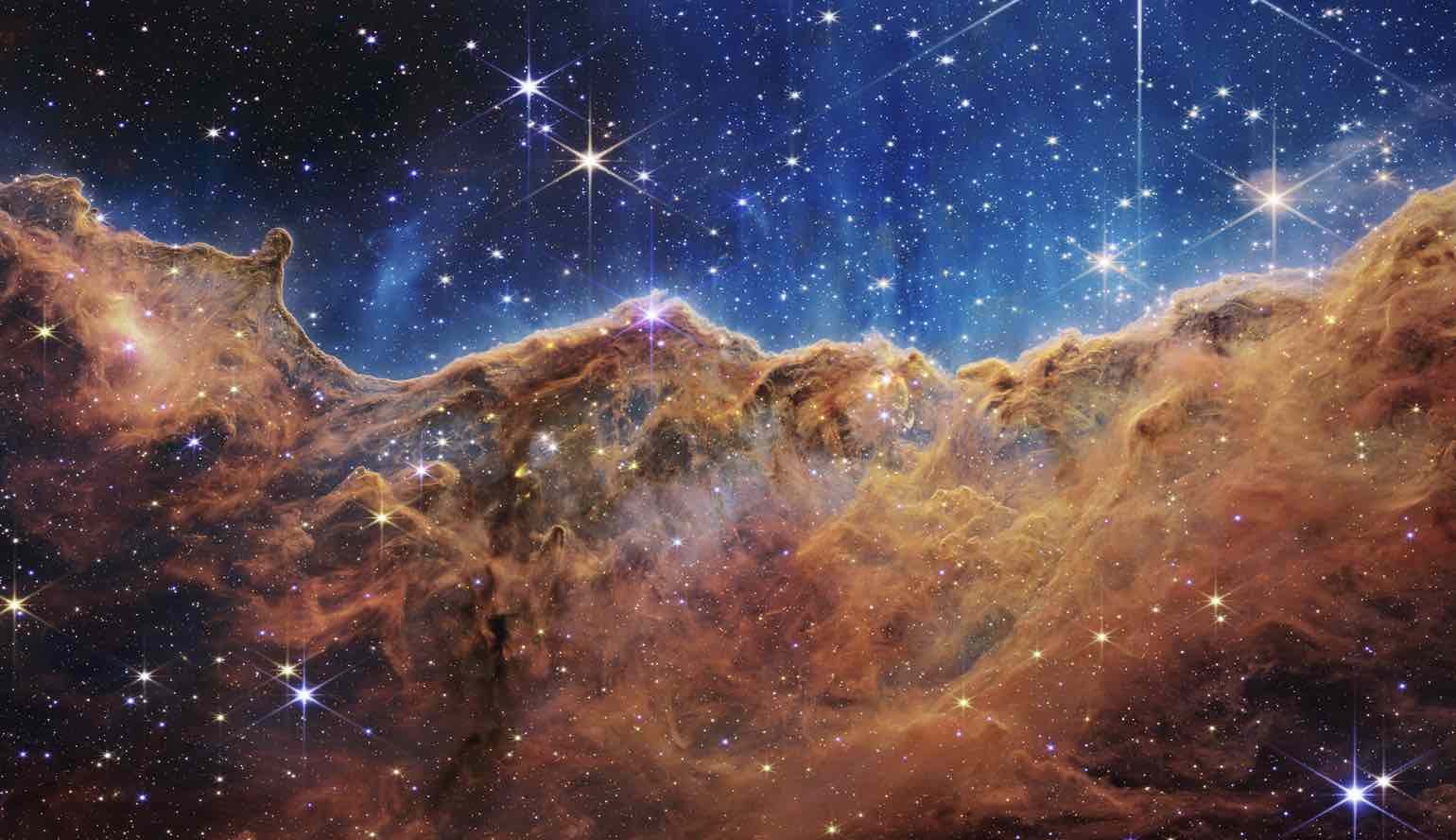
(NASA/STScI/James Webb telescope)

(NASA/STScI/James Webb telescope)

Peake had been even less ambiguous while speaking during a CNBC interview in the first days of the new year, where he said the prospects that alien life might have been discovered were looking increasingly good.

“Potentially, the James Webb telescope may have already found [it],” though also emphasizing that nothing conclusive had been released yet since scientists involved in the prospective discovery “don’t want to release or confirm those results until they can be entirely sure,” though adding cryptically that “we found a planet that seems to be giving off strong signals of biological life.”

In other words, if these observations are what they appear to be, then it seems like there’s a good chance that we may already be on course for a tremendous discovery this year; one that could potentially offer the most convincing evidence to date that life may exist on worlds beyond our own.

A POSSIBLE BIOSIGNATURE OF ALIEN LIFE?

In the Spectator article, author Sean Thomas offered that the intriguing series of statements “suggests they are referring to the same thing: namely a scientific paper, probably British in origin… which will provide firm evidence of alien life on an exoplanet”.

Thomas sensibly guesses that the discovery—if such a discovery has indeed been made—will involve biosignatures detected in the atmosphere of an alien world that strongly points to the presence of conditions where life could thrive.

“These biosignatures might be combinations of methane and oxygen, or methane and CO2, and so on,” Thomas wrote, adding that speculations (apart from his own) were already being aired on social media, where UAP enthusiasts were already “claiming that this is merely stage one of ‘disclosure’,” and part of a bigger role-out we’re all destined to see in the months ahead as the powers that be finally clue the rest of us in on the reality that we are not alone.

However, as promising as the collection of cryptic statements curated by Thomas for The Spectator article had been, it wasn’t long before others were chiming in with what seemed to be far less enthusiasm about the idea that a revelation about strong evidence supporting the existence of alien life was on the near horizon.

LIFE ON DISTANT WORLDS? NOT YET… WELL, SORT OF

Wasting no time weighing in on the matter, Eric Berger, the stalwart senior space editor at Ars Technica, was quick to pour some cold water on the alien life claims.

Reaching out to NASA about whether its James Webb Space Telescope had indeed made a discovery involving tantalizing biosignatures, Berger reported that the answer was essentially no, “But it was not a hard no.”

According to Knicole Colón, deputy project scientist for exoplanet science with the James Webb Space Telescope team, “JWST has not found definitive evidence of life on an exoplanet,” but it appears to be anticipated that observations made by the telescope could lead to “the initial identification of potential biosignatures that could make habitability more or less likely for a given exoplanet.”
alien life

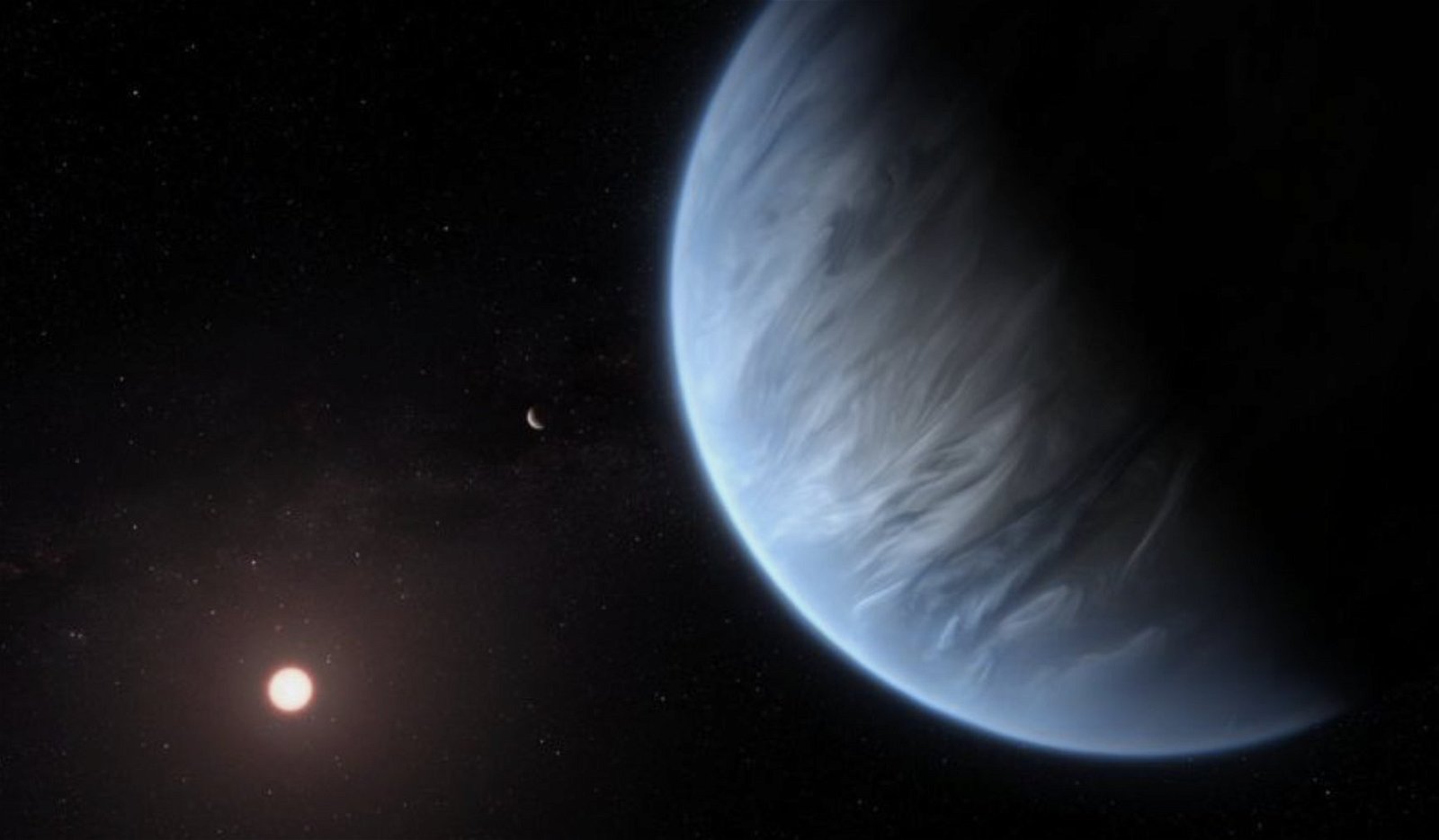
Artist’s rendering of K2-18 b, an exoplanet suspected of being a location where alien life may soon be discovered

(Credit: ESA/Hubble/M. Kornmesser).

Adding a touch of context to the admittedly vague statement, Berger mused that “Colón is certainly referring to K2-18 b, an exoplanet 8.6 times as massive as Earth that is 120 light years from our Solar System,” an exoplanet which is likely to possess oceans similar to ours, and an atmosphere rich in hydrogen and, even more intriguing, dimethyl sulfide.

Why is the presence of dimethyl sulfide of such interest? Primarily because it is a compound that, as far as any Earthling know, is only produced in the presence of living organisms. So even in the absence of definitive proof of life on another world, if dimethyl sulfide has been found on K2-18 b, it’s the surest bet we currently have in terms of places where alien life is likely to be found… and that discovery—if confirmed—would truly be a game changer.

So while the answer to the question “have we just discovered aliens?” officially still remains inconclusive, it is certainly sounding like much closer to being “maybe” than a flat-out “no”… and if the current speculations we’re seeing are any indication, then 2024 is indeed already shaping up to be a historic year in terms of our understanding of the universe, our place in it, and answers to some of the greatest questions we have about the cosmos.

That concludes this week’s installment of The Intelligence Brief. You can read past editions of The Intelligence Brief at our website, or if you found this installment online, don’t forget to subscribe and get future email editions from us here. Also, if you have a tip or other information you’d like to send along directly to me, you can email me at micah [@] thedebrief [dot] org, or Tweet at me @MicahHanks.

{ https://thedebrief.org/ }

Hoe vind je dit bericht?
Geschreven door peter om 21:15 Stuur door

Meer van UFO'S of UAP'S, ASTRONOMIE, RUIMTEVAART, ARCHEOLOGIE, OUDHEIDKUNDE, SF-SNUFJES EN ANDERE ESOTERISCHE WETENSCHAPPEN - DE ALLERLAATSTE NIEUWTJES

↑ Terug naar de berichten