Ontdek de Fascinerende Wereld van UFO's en UAP's: Jouw Bron voor Onthullende Informatie!
Ben jij ook gefascineerd door het onbekende? Wil je meer weten over UFO's en UAP's, niet alleen in België, maar over de hele wereld? Dan ben je op de juiste plek!
België: Het Kloppend Hart van UFO-onderzoek
In België is BUFON (Belgisch UFO-Netwerk) dé autoriteit op het gebied van UFO-onderzoek. Voor betrouwbare en objectieve informatie over deze intrigerende fenomenen, bezoek je zeker onze Facebook-pagina en deze blog. Maar dat is nog niet alles! Ontdek ook het Belgisch UFO-meldpunt en Caelestia, twee organisaties die diepgaand onderzoek verrichten, al zijn ze soms kritisch of sceptisch.
Nederland: Een Schat aan Informatie
Voor onze Nederlandse buren is er de schitterende website www.ufowijzer.nl, beheerd door Paul Harmans. Deze site biedt een schat aan informatie en artikelen die je niet wilt missen!
Internationaal: MUFON - De Wereldwijde Autoriteit
Neem ook een kijkje bij MUFON (Mutual UFO Network Inc.), een gerenommeerde Amerikaanse UFO-vereniging met afdelingen in de VS en wereldwijd. MUFON is toegewijd aan de wetenschappelijke en analytische studie van het UFO-fenomeen, en hun maandelijkse tijdschrift, The MUFON UFO-Journal, is een must-read voor elke UFO-enthousiasteling. Bezoek hun website op www.mufon.com voor meer informatie.
Samenwerking en Toekomstvisie
Sinds 1 februari 2020 is Pieter niet alleen ex-president van BUFON, maar ook de voormalige nationale directeur van MUFON in Vlaanderen en Nederland. Dit creëert een sterke samenwerking met de Franse MUFON Reseau MUFON/EUROP, wat ons in staat stelt om nog meer waardevolle inzichten te delen.
Let op: Nepprofielen en Nieuwe Groeperingen
Pas op voor een nieuwe groepering die zich ook BUFON noemt, maar geen enkele connectie heeft met onze gevestigde organisatie. Hoewel zij de naam geregistreerd hebben, kunnen ze het rijke verleden en de expertise van onze groep niet evenaren. We wensen hen veel succes, maar we blijven de autoriteit in UFO-onderzoek!
Blijf Op De Hoogte!
Wil jij de laatste nieuwtjes over UFO's, ruimtevaart, archeologie, en meer? Volg ons dan en duik samen met ons in de fascinerende wereld van het onbekende! Sluit je aan bij de gemeenschap van nieuwsgierige geesten die net als jij verlangen naar antwoorden en avonturen in de sterren!
Heb je vragen of wil je meer weten? Aarzel dan niet om contact met ons op te nemen! Samen ontrafelen we het mysterie van de lucht en daarbuiten.
Stanford Professor Dr. Gary Nolan has recently been interviewed by The Debrief, hosted by Chrissy Newton where he talked about various topics: from his field of work to UAPs. He has been one of the faces of UFO phenomena after his research on the brains of contactees. However, there is more hidden information Dr. Nolan has shared in his recent interviews that provides a new perspective in looking at the UFO reality, which is more than just flying alien crafts.
Dr. Nolan, an immunologist at Stanford, is the author of more than 300 research articles and the holder of 40 patents in the United States. In addition to this, he has been recognized by Stanford University as one of the top 25 inventors in the institution’s history. Therefore, his participation in UFOlogy would bring some factual things to the field of study.
During his 90-minute interview (check the video below) with Chrissy Newton, he discussed his thoughts on the UAP topic going political along with his work on finding physical evidence of an area in the brain where an individual’s intuitive capabilities could potentially be located. Interestingly, Dr. Nolan began by sharing his personal alien-UFO encounter at an early age. He recalled interacting with phenomena three times in his life.
[His first interaction]“Well, it was at a house that my parents had first bought when after we moved here to the States. It was basically little guys in the bedroom and I remember calling out to my brother. I didn’t understand how it could be like two or three of him and then faces in the window and things like that. I mean other than just memories of them being in the room and being a little scared… it wasn’t until actually almost 30 years later that I found out from my brother that he had also seen things.”
[His second interaction] “At our second house, I was a paper boy and going between one house and another. Early in the morning, I saw something over my head. I mean it was not just like Far Over My Head it was like 30-40 feet just at the top of the trees. I can’t say that it was exactly saucer-shaped because all I saw really were the lights and kind of a vague outline against the sky. Because the lights were so bright um and but it was I didn’t know what it was I mean I saw it go over um it was silent. I mean at best it could have been a balloon but I don’t know any balloons that are traveling at tree height.”
[His third interaction] “I was a graduate student here at Stanford. I was in a used bookstore and buying science fiction books. I came across two books one was by John Mack and the other was byWhitley Strieber. I remember just seeing the cover and realizing that was a face that I had seen when I was a kid looking through the window or in the bedroom. The thing about the window, it was like six or seven feet off the ground. There was something very tall hovering. I remember just all the hair on my body stood on end when I saw it and I dropped the book because it was like how does this guy know what I saw. I knew nothing about the whole UFO Arena. I mean I read science fiction but I’d never read about alien abductions or any of that kind of stuff.”
Next, Newton discusses the work he has done researching the basal ganglia and caudate putamen regions of the brain, and he eventually gets into the conversation on the highly functioning breeding group of humans [based on objective evidence of highly dense neural connections within those particular regions]. Those areas of the brain are involved in motor control, planning, intuition, anticipation, and downstream executive function.
This is the “brain within the brain” responsible for higher-order processing. Humans with enhanced connections in these regions have highly advanced forms of intuition and can prepare the body for events before it happens. The work he has done involves case studies on military personnel (and others), who have encountered UAPs, and collecting raw data using physical brain scans of those individuals.
The density of the above-mentioned regions in those individuals (savants, highly trained, CEOs of companies, etc) was overdeveloped compared to normal. The feature is present in 1/100 or 1/200 individuals. He stated the chances are astronomically small that two people with these enhanced features randomly come together, and in these cases, they have formed breeding pairs of individuals with these enhanced brain features. He states that over time (within 100,000 years), this would develop into a different race of humans.
Later on in the conversation, he makes a reference to the CIA’s remote viewing program, which was headed up by Dr. Hal Puthoff, and explains that the goal of the study was for individuals to concentrate on the “remote view” signal rather than the overlay that their brains put onto the signal. The results of his MRIs show that he has these areas of his brain that are elevated. A highly-skilled meditator may be able to tune out all of the background “noise” in order to concentrate solely on the “signal.”
The studies done 60 years later have confirmed the findings of an individual who “intuited” the true function of the caudate putamen. Dr. Nolan says that everyone within the relevant government knows “something” (ET/Interdimensional etc.) is here. The beings here are placeholders/interaction icons, basically biological androids (he said this in a prior interview as well), designed to interact with humans and shape humanity by another external intelligence.
The problem is that the phenomenon seems to be many distinct things rather than just extraterrestrial beings, as opposed to being more complicated than just that. He gives the illustration that there could be eight distinct groups that do not necessarily agree with one another, with some of these groups considering humans to be a resource while others consider us to be something that needs to be protected. Someone at a high level in the military is either using the UAP technology and attempting to comprehend it, or they are scared that if the rest of the world has it, it would diminish their own authority.
Dr. Nolan stated in another interview with Event Horizon that Life may have started elsewhere and came here according to some models. He gives examples of atoms of elements present here that actually originated from explosions of other stars/meteorites etc. He states that life in the universe may be based on DNA if the theory of panspermia is correct.
[Interestingly, he is stating this because the verified CIA individual John Ramirez claimed several months ago in an interview that we are related to the ETs and are a result of a genetic manipulation. Luis Elizondo (the official CIA head of the UAP program, currently the contractor for the actual US Space Force) has indicated this thought in his interviews as well, and this ties into his comment that from their understanding, we are part of “mankinds” in plural, multiple forms of humanity present either here, extratemporally (time travelers), or in the cosmos].
On August 21, 2022, Dr. Nolan had an interview with Ross Coulthart on the Australian channel 7News, where he discussed his role in working with the government on analyzing and studying individuals that encountered UFOs. According to Nolan, there is a group of people that were involved in recovering UFO debris for secret government programs, and these individuals will soon be coming forward to reveal what they know. (Source)
Nobel Prize nominee Professor Garry Nolan stated he “knows” there has been an “active cover-up” by authorities. He said: “I’ve spoken to the people who are about to come out and whistle-blow on it.” Coulthart noted that the Department of Defense (DoD) has recently announced the creation of a new office dedicated to studying Unidentified Aerial Phenomena (UAP) or UFOs, and that an analysis will be conducted starting from 1947 onwards – the date of Roswell.
“When you say that the government has been involved in a coverup, do you think they’ve been hiding it all this time?” Coulthart asked. “Oh yes. I know it’s a fact because I’ve spoken to important people who are about to come out and whistleblow on it,” Nolan replied. “And there has been an active coverup. Just look at what the Department of Defense (DoD) recently announced. They announced an office to study the phenomenon. Putting money aside, they say they will start the study from 1947.”
“Which is incredible. That’s the date of Roswell,” Coulthart said. “Yes, 1947. And we want a list of every operation they did to misinform and misinform the public,” Nolan added. He stated that there are individuals who were involved in the retrieval of UFO debris, and subsequent secret government programs would soon come forward to reveal what they know, putting an end to one of the biggest cover-ups in modern history.
In addition to this,Jim Semivan, a former CIA officer, made a surprising comment in which he said, “there’s a whole other reality that surrounds us that we just simply don’t have the ability to observe or connect with.” He fiercely said that non-human intelligence is living with humans on Earth. “There’s an entity out there! There’s some kind of non-human intelligence that’s living with us on this F**KING planet,” Semivan said.
It all had started a few years before the “Space Race” began between the two rival nations: the USA and Soviets. The world was stunned by the daily UFO sightings, and stories of alien contact flushed newspapers. It was the era of two types of people: the first one was groups of like-minded people, for example, engineers, scientists, and inventors who dismissed any alien contact and flying saucers’ stories, while the second ones were the contactees who also claimed to had been in the UFOs. These groups never aligned with each other, but Wilbert Brockhouse Smith (1910-1962), a Canadian engineer was the only line of connection between these two groups.
Mr. Smith worked as a senior radio engineer for the Canadian government’s Department of Transport in the late 1940s and 50s. He was the reason behind the radio communication between Canada and the United States at that time. Very few people know that Mr. Smith convinced the Canadian government to establish a program to monitor the UFOs that eventually detects the strange aerial phenomenon which, according to him, was not earthly. While asking Americans about the existence of UFOs, he received a reply from them that the US government had put this subject at their uppermost concern, and it was even more top secret than the atomic bomb.
“One of the most important things I had to realize was that we are not alone. The human race in the form of man extends throughout the universe and is incredibly ancient. Also, its appearance in physical form is but one of its many manifestations along the path of progress. This planet has been colonized many times by people from elsewhere and our present human race are blood brothers of these people. Is it any wonder that they are interested in us,” Wilbert Smith said.
Wilbert Brockhouse Smith (1910-1962) Credit: Grant Cameron
Besides, according to researcher Grant Cameron, Mr. Smith played a major role in establishing Radio Ottawa used by Canadian spies and also for tracking secret Soviet communications.
In 1950, the Canadian UFO study program Project Magnet was established by Transport Canada under the supervision of Mr. Smith. The government funded the project for four years, but he received informal funding after. In 1952, he set up an observatory at Shirley’s Bay to study the findings of UFO sightings under Project Magnet. He had a personal interest in geo-magnetism, which made him conclude that the UFOs were of extraterrestrial origin, propelled by magnetic forces, and actually from parallel universes.
Mr. Smith said: “It is my opinion that the people from elsewhere choose all sorts of methods to make contact with us, and their technology and understanding being much better than ours, they can use methods which we find quite incomprehensible.”
Interestingly, he believed that the UFOs were controlled through physic powers, and such statements embarrassed the Department of Transport. In 1952, when the great UFO wave hit the media, Mr. Smith claimed that the United States Air Force shot down a UFO near Washington, D.C, recovered its piece and let him borrow it. When asked if he had returned the piece to the USAF, he replied that it went to a much more highly secret group (It was neither FBI nor CIA), which identity he could not disclose.
Surprisingly, Mr. Smith was also a firm believer in aliens. In 1961, he gave a speech at the Vancouver Area UFO Club, where he claimed to had been in contact with aliens, referring to them as “the boys topside.” Furthermore, he said that the aliens had explained to him that the speed of light is not constant, and time works differently in the universe, not chronological ticking that people can imagine on Earth, but a “field function” that changed throughout the universe, and which could be altered. (Source
Their ships as he was told, were supported on the Earth’s gravitational field. The fields surrounding their ships, he added, created areas that reduced areas that weakened the strength of objects that came into contact with them, accounting for the destruction of earthly military craft that flew too close to them. This explained, among other phenomena, the May 1956 crash of a military jet into the Villa St. Louis convent in Orleans — the jet, Smith said, flew into a “very strong vortex of reduced binding,” causing it to break apart.
When nuclear explosions happened, he added, similar unstable vortices were formed. His unnamed friend, who had also been in communication with “these people from outside,” claimed to have spoken with one of them, Tyla, a garbage collector whose duty was to clean up the radioactive messes left by such man-made explosions. Tyla, according to Smith, grabbed the stuff, transported it onboard his ship, rendered it inactive, and then dumped it in a remote location on Earth. Tyla reportedly told a friend in 1948 that he would dump his next load near Ottawa at an appropriate moment so that many people could observe it.
On November 21, 1950, Mr. Smith wrote a memo that was classified as “Top Secret” but later, it was recovered from the Archives of the University of Ottawa. According to the memo, the Canadian government was serious about UFOs and had been building a secret technology using oceanic radiation, atmospheric radioactivity, and geo-magnetism. He further wrote that his work in geomagnetic and the energy on which flying saucers operate was connected. (Source)
By summarizing sightings reported in 1952, Mr. Smith reported that UFOs were “a hundred feet or more in diameter; they can travel at speeds of several thousand miles per hour; they can reach altitudes well above those which should support conventional aircraft or balloons, and ample power and force seem to be available for all required maneuvers.”
Project Magnet was discontinued just a few days afterward. Ottawa Journal reported that scientists insist, “there is no proof flying saucers exist but they honorably admit there is no proof that all the strange and wandering objects reported in the sky are freaks of imagination or atmosphere.”
Before his death from cancer, Mr. Smith had asked his wife to hide all his research and sensitive files, as he was afraid that they would get into the wrong hands. “They will be coming to ransack all my work,” Smith proclaimed. He died on December 27, 1962, and as he predicted soon after that, the Soviets, Americans, and Canadians approached his wife. (Source)
The hunt for habitable exoplanets has taken a new turn with a groundbreaking discovery made by an international team of scientists from the University of Birmingham (UK), the Massachusetts Institute of Technology (MIT), and others. The team has formulated a novel technique to locate planets that could potentially harbor life, using an analysis of carbon dioxide (CO2) levels in their atmospheres and comparing these values with those of neighboring planets.
The new study, published in Nature Astronomy, offers an unprecedented scope in determining the presence of life far beyond our own solar system.
Traditionally, planets within the ‘habitable zone’ – dubbed the ‘Goldilocks zone’ – have been the prime suspect for potentially habitable planets. However, the ability to confirm the existence of liquid water on these celestial bodies has remained elusive, despite theoretical paradigms.
In an innovative transition, scientists have now devised a ‘habitability signature,’ a discernible marker that can reliably indicate the presence of liquid water on a planet. Prior to this development, the best method we had was the detection of a water ‘glint’ – the faint reflection of starlight off a planet’s liquid surface. However, this signature proved too weak for current observational facilities to pick up, making this new method a timely discovery.
Professor Amaury Triaud of the University of Birmingham, co-lead on the study, shed light on the significance of the approach and its practical feasibility.
“Measuring the amount of carbon dioxide in a planet’s atmosphere is fairly easy, as CO2 is a strong absorber in the infrared. By comparing the CO2 levels across different planets’ atmospheres, we can isolate those with oceans and thereby identify planets more likely to be able to support life,” explained Triaud.
The researchers suggest looking for planets that have lower levels of carbon in their atmospheres compared to other planets in the same system. The presence of lower carbon could indicate the presence of significant amounts of liquid water, plate tectonics, and/or biomass (material from living organisms), all of which are considered important for supporting life as we know it.
The wavelength at which carbon dioxide is best detected is at 4.3 micrometers, which falls in a spectral “sweet spot” where there is minimal noise and interference from clouds or atmospheric haze. Because of this, the researchers believe that using the James Webb Space Telescope (JWST), the detection of this “carbon depletion” could be used as an indicator of a planet’s habitability.
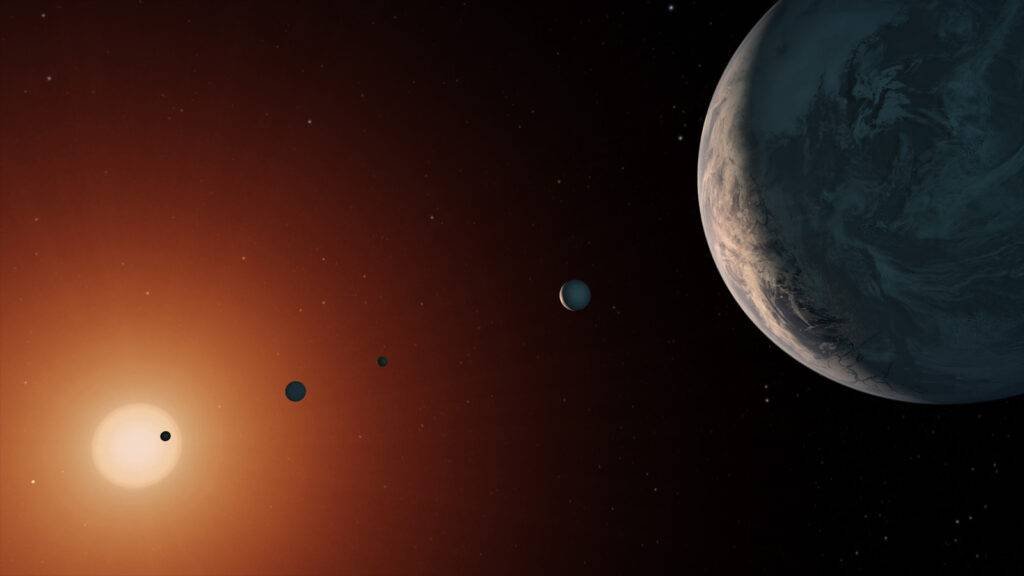
Trappist-1 System is often looked at as a candidate for a solar system with exoplanets harboring alien life
(Image: NASA/JPL-Caltech).
The strategy involves a few steps, starting with detecting an atmosphere around suitable terrestrial planets for about 10 transits (i.e., when the star’s brightness dips as the planet passes in front of it), then determining if there is low carbon in about 40 transits, and finally measuring ozone levels in about 100 transits to differentiate whether the low carbon levels are due to the presence of water or biomass.
The researchers suggest that this new concept of carbon depletion could serve as an effective signature for habitability and is adaptable for next-generation direct-imaging telescopes. This development potentially ushers in a new era in the search for habitable planets, enabling scientists to focus their efforts on celestial bodies more likely to harbor conditions supportive of life.
This method’s implications extend beyond locating habitable planets and venture into the realm of understanding environmental tipping points, acting as markers that urge us to consider the impending climate crisis on Earth in a new light.
Dr. Julien de Wit from MIT points out that the method could act as both a biosignature as well as a habitability signature. The method acknowledges that biology captures carbon dioxide on Earth, life forms account for 20% of the total captured CO2. Following this logic, the presence of oxygen, which can transform into detectable ozone, in tandem with CO2 could indicate not only habitability but also the existence of life.
Underscoring the practicality of the approach, de Wit noted that this method could work with existing telescopes. This finding offers renewed hope for the scientific community, who had begun to resign themselves to the idea that even major telescopes such as the JWST would be unable to detect life on exoplanets.
Looking ahead, the research team plans to detect atmospheric carbon dioxide compositions on a range of exoplanets, identifying those with oceans on their surfaces, and prioritizing further observations of those that could potentially support life.
MJ Banias is a journalist who covers security and technology. He is the host of The Debrief Weekly Report. You can email MJ at mj@thedebrief.org or follow him on Twitter @mjbanias.
President Biden’s Cosmic Companions: Alleged UFO Sighting Near Air Force One
In an era where the sky is no longer the limit, an intriguing event has captured the public’s imagination and scholarly interest alike: a potential Unidentified Flying Object (UFO) sighting near President Joe Biden’s Air Force One. This high-profile incident has sparked discussions and debates across the globe, prompting renowned Harvard Professor of Science, Dr. Avi Loeb, to weigh in with his expert perspective.
The Curious Case of the Presidential Encounter
As President Biden embarked on a fundraising trip to Los Angeles, eyewitnesses near LAX reported an unusual sight—a white or silver spear-like object hovering close to the presidential aircraft. This was not your everyday aerial traffic; it was something that defied immediate explanation, a sighting that whispers the age-old question: are we alone in the universe?
Dr. Avi Loeb’s Scientific Quest
Dr. Avi Loeb, a respected physicist and a vanguard in the search for extraterrestrial intelligence, offers a scientific yet open-minded approach to this mystery. With a career dedicated to unraveling the secrets of the cosmos, Dr. Loeb suggests that while the fundamental question is whether the object is man-made or extraterrestrial, we must start by assuming it’s terrestrial and then prove otherwise. He emphasizes the need for better data and scientific instrumentation, rather than relying on mere sightings, to make definitive conclusions.
The Spectrum of Possibilities
From the human-made to the extraterrestrial, the potential explanations for this UFO are as vast as the universe itself. Dr. Loeb speaks of the numerous objects monitored through the Galileo Project Observatory at Harvard University, highlighting the importance of careful analysis to distinguish between natural phenomena and something truly otherworldly. He doesn’t dismiss the notion that even a single extraterrestrial object, if confirmed, would have profound implications for humanity.
The Search Continues
The quest for understanding doesn’t stop at mere speculation. Dr. Loeb’s scientific endeavors, including searching for materials from interstellar objects in the ocean, demonstrate an unwavering commitment to uncovering the truth. The discovery of unique, never-before-seen materials near the path of an interstellar meteor suggests that there’s much more to learn about our universe and potentially, our neighbors within it.
VIDEO:
The Hill – President Biden’s EXTRATERRESTRIAL New Friends. Potential UFO Spotted Near Air Force One
While the incident near Air Force One remains shrouded in mystery, it serves as a reminder of our enduring fascination with the unknown. As Dr. Loeb and other scientists continue their vigilant search for answers, we’re reminded of our place in the vast cosmos. Each sighting, each anomaly, brings us closer to understanding whether Earth’s story is unique or just one of many in the galactic tapestry.
In the end, the sighting near President Biden’s Air Force One opens more than just the skies; it opens our minds to the infinite possibilities that lie beyond our blue planet. As we delve into the unknown, let’s remember that the search for extraterrestrial life is not just about finding others—it’s about understanding who we are in the grand scheme of the universe.
So, keep your eyes on the skies and your mind open to the endless wonders above. The nextUFO sightingmight just redefine our place in the cosmos.
Eleven years ago, gene therapy — where defective genes are snipped out of DNA and replaced with healthy ones — became a household name. A landmark paper proved that scientists could precisely manipulate DNA in ways previously thought unimaginable using CRISPR-Cas9, an editing tool adapted from the immune system found in some bacteria. Almost overnight, the idea of designer babies, kill-switch mosquitoes, and cancer-off buttons stormed into mainstream imagination.
Since then, gene therapy has experienced a complete renaissance, culminating this past November and early December when medical regulators in the U.K. and U.S. officially approved Casgevy, the first CRISPR-based gene therapy for treating two blood disorders: sickle cell anemia and beta-thalassemia (in the U.S., the new therapy has yet to be approved for the latter).
Casgevy is emblematic of gene therapy’s rapidly shifting expectations and direction. Numerous clinical trials are now underway across the globe, and we will undoubtedly see more and more gene-editing-based treatments making the approval list, changing the lives of countless individuals living with intractable health conditions and diseases.
“The future [of gene therapy] is very bright,” Kevin Davies, the executive editor of The CRISPR Journal and author of Editing Humanity: The CRISPR Revolution and the New Era of Genome Editing, tells Inverse. “But I don’t don’t think anybody in the field wants to get too complacent because it was less than 25 years ago that we were riding a similar initial wave of enthusiasm for the technology.”
It’s true. Long before the Human Genome Project would ever decode a DNA sequence, ambitious scientists were spurred by advances in biotechnology and the early success of initial human trials. In 1990, then-4-year-old Ashanti DeSilva became the first person to be successfully treated with gene therapy. The treatment, a precursor of sorts to CRISPR-based gene therapy, cured her of a rare immune-related genetic disorder.
But those high hopes of tweaking genes to prevent or treat disease were suddenly dashed when, in 1999, a teenager named Jesse Gelsinger, who had a rare metabolic disorder, died within four days of receiving an experimental gene therapy at the University of Pennsylvania. In response, the U.S. Food and Drug Administration (FDA) suspended the university’s entire gene therapy program — which had been the largest in the world at the time — and launched investigations into 69 other gene therapy trials that were underway across the United States. Years later, when CRISPR entered the world, enthusiasm rose again — and here we are.
So what will this new wave — Gene Therapy 2.0, if you will — look like? Certainly, a promising frontier for tackling not only rare but common diseases and exquisitely precise gene-editing tools. With it, though, will come side effects, including exorbitant prices, barriers to access, and a lingering, gigantic cause for concern because once you edit an embryo, there’s no turning back. Here’s what 2024 and beyond has in store for our gene-edited future.
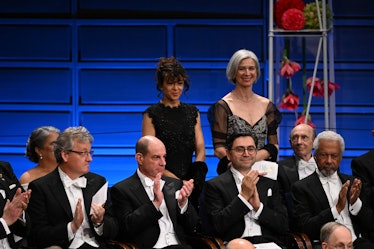
Emmanuelle Charpentier and Jennifer A Doudna share the 2020 Nobel Prize in Chemistry for their research into CRISPR.
JONATHAN NACKSTRAND/AFP/GETTY IMAGES
BETTER EDITING
In the early years of genetic therapy, scientists didn’t have many tools at their disposal to fix a gene (or genes) at the heart of a disease, Shoukhrat Mitalipov, director of Oregon Health and Science University’s Center for Embryonic Cell and Gene Therapy, tells Inverse.
If someone’s disease was due to a gene mutation or loss, Mitalipov says the fix was to introduce a synthetic, albeit normal copy of that gene with a virus stripped of its infectiousness but still retaining the ability to add new genetic information into DNA. With this new addition, a cell could then make a functional protein. While these essentially viral Ubers remain part of the gene therapy toolkit, the discovery and development of CRISPR-Cas9 gave scientists a more precise grip on the genetic engineering steering wheel.
CRISPR, or clustered regularly interspaced short palindromic repeats, originate from bacteria and archaea and is used by these microorganisms as an immune defense against viruses called phages. The CRISPR system also includes specialized enzymes called CRISPR-associated proteins (or Cas). Together, they look through and remove any genetic sequences that may have been inserted by a sneaky phage or other invader, keeping the microorganism safe from infection.
In 2012, researchers Jennifer Doudna and Emmanuelle Charpentier published a groundbreaking study detailing a novel CRISPR-Cas9 system they programmed to cut specific sites in isolated DNA. This was done using strands of RNA — a molecule that is like a working copy of DNA, containing the direct instructions for protein-making — guiding CRISPR-Cas9 to a specific genetic sequence.
Krishanu Saha, a bioengineer at the University of Wisconsin–Madison whose lab is working on gene therapies for treating blindness, says the precision allowed by CRISPR-Cas9’s programmability is its singular selling point.
“Traditional gene therapy, which we call gene augmentation, is essentially flooding the cell with extra copies of a normal gene; in some cases, this doesn’t work,” Saha tells Inverse. “We found in a few cases, it’s really important to destroy the mutant copy of the [gene] or fix the underlying mutation and that’s where you have to have the precision of CRISPR to go in and specifically do that.”
CRISPR has a unique drawback, however. When it goes in to patch up the bit of DNA as instructed, it does so by fracturing both strands of the DNA double helix. A cell is left to repair the breaks on its own, ideally using the synthetic DNA offered by the CRISPR-Cas9 system. But because it’s a klutzy repairperson, the cell may also introduce errors such as inserting or deleting DNA.
This is why the focus of the next generation of gene editing tools is to try to minimize, as much as possible, the risk of new mutations, says Mitalipov.
These tools include base editing, where specific base pairs — the building blocks of DNA — are swapped out without requiring a double-stranded break. Base editing was used in a recent gene therapy clinical trial treating individuals with a genetic form of high cholesterol called familial hypercholesterolemia. The gene-editing technique, which is based on CRISPR, was developed in 2016 by Harvard University’s David Liu, considered a founding pioneer of CRISPR.
Another CRISPR-based tool is a leveled-up version of base editing. Called prime editing (also co-invented by Liu), it can swap base pairs in addition to inserting and deleting without double-breaking the DNA helix.
More recently, a gene-editing tool called NICER developed by researchers in Japan is said to create little single-strand nicks that didn’t seem to cause mutations, according to a September 2023 Nature Communications study.
Despite the appeal of finer precision and avoiding inadvertent mutations, Mitalipov and Saha say it’s unlikely the original CRISPR-Cas9 system will be ousted or replaced entirely by these newer gene editors.
“Basically, you would have to look at the specific gene mutation and then decide what would be the best — it could be base or prime editing,” says Mitalipov. “So far, prime editing hasn’t been widely used. There’s only one or two labs [doing research] and nothing commercially available. So, it remains to be seen if [prime editing] is really going to be applicable.”
A laboratory staff works at Genethon, a non-profit gene therapy R&D organization in Evry, France.
ERIC PIERMONT/AFP/GETTY IMAGES
MORE TARGETS
CRISPR-based gene therapies are being devised to treat all sorts of conditions and disorders, from neurological to autoimmune and cancers. Currently, the only FDA-approved therapy using CRISPR is Casgevy; others on the market, such as Luxturna for people with a rare genetic defect that often leads to blindness and Zolgensma for treating spinal muscular atrophy, use a disabled virus bearing a normal version of the target gene to cells.
Currently, the focus is treating disorders or diseases caused by mutations in single genes in somatic cells (the body’s non-reproductive cells). This route makes it easier to identify and target relatively straightforward biological mechanisms than cracking at multiple genes acting in complex and sometimes unpredictable ways with which tinkering may lead to unintended, potentially life-threatening consequences. Understandably, since the late 1990s, there’s been a reasonably high regulatory bar for the research a gene therapy requires to meet FDA approval.
However, that doesn’t mean more genetically complex diseases are off the table. Editing multiple genes is quite possible and regularly done with transgenic animals (as well as plants), says Saha. Attempting this engineering feat for human health will take extensive research to uncover the genetic pathways and interactions involved and figuring out how to safely target all these genes with minimal off-target effects.
In the future, we may see gene therapies used increasingly for common health problems, not only rare genetic diseases, says Mitalipov and Saha. For example, a recent clinical trial in people with familial hypercholesterolemia found that one gene therapy targeting a mutated gene behind the build-up of bad cholesterol slashed cholesterol levels on par with similar-acting pharmaceutical drugs. These findings offer a tantalizing glimpse of an exciting beginning for gene therapy within preventative medicine, promising that someday, a simple edit in your genome may protect you against high cholesterol and blood pressure or any other commonplace ailments.
THERAPIES FOR ALL
There’s another barrier that could ultimately prevent even the safest, most promising gene therapy from seeing the light of clinical day: cost. Luxturna, for example, was reported at a whopping $425,000 per eye back in 2018. It’s a bit of a bargain compared to the average million-dollar price tag for emerging gene therapies such as Casgevy, the gene therapy for sickle-cell anemia/beta-thalassemia. The gene therapy market itself was valued at $1.46 billion in 2020 and is estimated to reach over $5 billion by 2028, according to a report by Polaris Market Research.
“How do we get the pricing down is an outrageously important and unsolvable question,” says Davies of The CRISPR Journal. “Some will point to ‘Well, it’s early days, and as more of these therapies get approved, we start to see competition and prices drop’... but we see when companies get a monopoly on something, they seem more than willing to take advantage of the situation.”
Saha says there’s an active discussion within the scientific community about how to make gene therapy equitable within the low- and middle-income countries that make up the Global South. But how gene therapy accessibility will play out in the coming years is yet to be seen.
“One of the key questions in our analysis is, who’s at the table making these decisions? It’s a fairly easy critique to say that the people in the room are not representative in various ways, perhaps Global North versus Global South, socioeconomic, scientific expertise versus the lay public,” says Saha. “There are important questions about power and democracy and whose knowledge should drive policymaking that needs to be settled. I think the deliberation and the process are as important as the end set of guidelines or policies.”
Then there’s the dreaded ethical prophecy augured by science fiction in films like Gattaca, set in a world where genetic engineering and socioeconomic status go hand in hand. Both before and after the infamous incident involving Chinese scientist He Jiankui creating the world’s first CRISPR-edited human babies with a gene for HIV immunity, there have been strict worldwide regulations on any gene editing research involving embryos.
But scientists like Mitalipov are looking into using CRISPR to potentially adjust an embryo’s risk for disease. His own research at OHSU involves gene-editing germline cells — or reproductive cells that pass on genetic information to the offspring — in what Mitalipov calls “IVF gene therapy.”
He says such a technique could help improve the success of embryo implantation during IVF by creating stronger, more viable embryos. Mitalipov acknowledges, however, that there needs to be a robust regulatory framework in place before we can ever truly consider genetically engineered babies.
“In terms of regulation, we have to focus only on those 10,000 gene defects we know today that cause human disease,” says Mitalipov. “It could be easily mandated that gene therapies in embryos have to be towards severe disease in children.”
But that, and the rest of gene therapy’s optimistically bright future, remains hedged with abundant yet much-warranted caution.
Mysterious Manuscripts: The Fascinating Story of Ancient Bibles (Video)
Ancient religious texts have always been a source of fascination and intrigue, offering a glimpse into the beliefs and customs of people from bygone eras. A collection of mysterious and ancient Bibles at the Smithsonian's Freer Gallery of Art, has been the subject of intense interest among scholars and enthusiasts alike. These Bibles, made from animal skin, date back to a pivotal period in the history of Christianity, when the religion was transitioning from an underground cult to a more normative one. The manuscripts have been carefully preserved over the years, and their display provides a unique opportunity to gain insights into the beliefs and practices of early Christians.
Among the most significant discoveries is the freer Logie, a verse that follows the last chapter of the book of Mark, which occurs in no other known gospel in the world. The origins of this verse remain shrouded in mystery, but it has caused quite a stir among scholars. While carbon-14 dating is a possible scientific method to date these manuscripts, the danger of destroying them has made the task more challenging. While scholars continue to debate the origins and significance of this text, its discovery highlights the importance of these ancient manuscripts in helping us understand the evolution of Christianity and its place in the wider world.
New research aims to shed light on the puzzling winds on Titan, Saturn's largest moon, whose mysterious weather patterns have puzzled astronomers for decades.
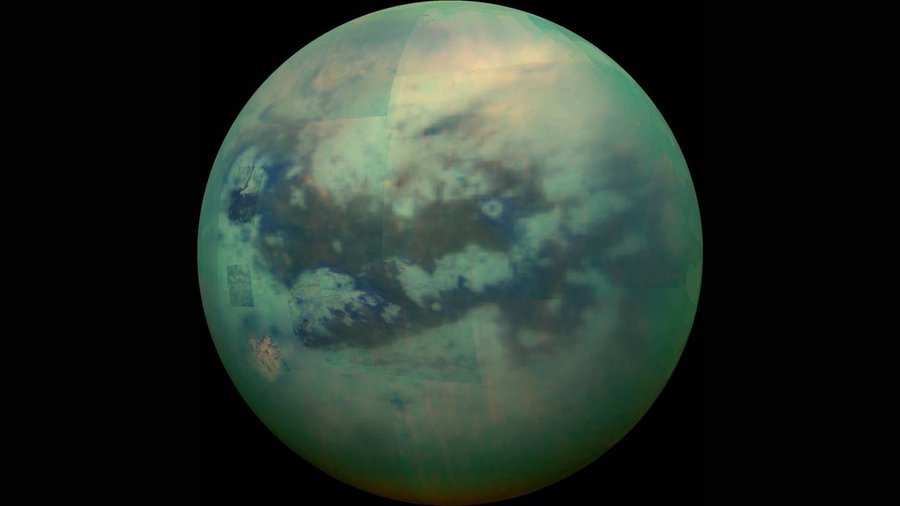
This composite image shows an infrared view of Saturn's moon Titan from NASA's Cassini spacecraft, acquired during the mission's "T-114" flyby on Nov. 13, 2015.
(Image credit: NASA/JPL-Caltech/University of Arizona)
New research is shedding light on peculiar winds swirling on Saturn's largest moon, Titan, whose mysterious weather patterns have puzzled astronomers for decades.
The answers may help to explain how Titan became the only moon in the solar system that still hosts a planet-like atmosphere, researchers say.
Astronomers have long known that seasons on Titan — each of which lasts nearly 7.5 Earth years — affect the moon's winds. But they haven't been able to pin down the speeds of those winds; two related studies, done nearly 30 years apart, have led to contradictory findings.
Now, astronomers are revisiting this decades-old mystery with updated telescopes. The paradoxical findings from past research might have resulted from incorrect assumptions about the data or instrument limitations, or it may just be that "there's something basic that we don't understand," Eliot Young, a principal scientist at the Southwest Research Institute in Texas, said in a statement.
Titan has a thick, smog-like atmosphere that reaches 370 miles (600 kilometers) into space and is 95% nitrogen with a sprinkle of organic molecules. Winds on the moon encircle it in just a day, repeatedly carrying currents of warm air from lower altitudes to the moon's poles, as if blowing on what NASA calls a high-speed conveyor belt.
In 1989, astronomers found that Titan's winds are slowest near its equator and fastest at midlatitudes in both the northern and southern hemispheres. This was revealed thanks to a chance alignment of a star behind Titan that allowed astronomers to study how the star's dimming light filtered through the moon's atmosphere, which helped them interpret wind speeds.
In 2016, a different team used ground-based telescopes to study how the light beamed by molecules in the atmosphere changed with shifting wind speeds and directions. The findings from this method revealed the opposite: The winds were fastest near Titan's equator and slowest at its lower latitudes.
Because there's a nearly three-decade gap between the two sets of observations, astronomers think different seasons on Titan may have led to the dramatic wind changes between both studies. Also, the 1989 research studied winds circling in the middle layers of the moon's atmosphere, while the more recent research focused on winds in the upper layers, which also may explain the varying wind speeds, the astronomers said.
"Just like on Earth, the winds on Titan are different at different altitudes and also change with seasons," Juan Lora, an assistant professor of Earth and planetary sciences at Yale University, told Space.com in an email. "And both of these likely explain why the observations don't agree perfectly with each other."
To get to the bottom of this discrepancy, a group of scientists has collected new data about Titan's winds using both methods at the same time. Last year, the team used eight telescopes in the United States and South America to observe two chance alignments of Earth, Titan and faraway bright stars.
In September 2022, four telescopes in Hawaii — including NASA's Infrared Telescope Facility and the Keck Observatory — watched as the star, 2MASS 21312124-1602427, snuck behind Titan. In November of the same year, a different star called 2MASS 21292356-1611056 slid behind Titan. Data from this event was collected by four more telescopes in Chile, including the Very Large Telescope and the Atacama Large Millimeter/submillimeter Array (ALMA).
An artist's impression of the 'light curve' produced by a star passing behind Titan. The spike at the center of the light curve represents the central flash produced by Titan's atmosphere acting as a lens and refracting the starlight toward a single focal point. (Image credit: NASA/ESA/C.Carreau)
The team is still comparing data from both observations and expects the results to be ready later this year. So far, ALMA observations already show evidence of speedy winds parallel to Titan's equator, Martin Cordiner, a planetary science researcher at NASA's Goddard Space Flight Center in Maryland whose team first identified the discrepancy in 2021, told Space.com.
The researchers behind the latest study said they were just in time to capture valuable data about Titan's winds before the 2025 northern autumnal equinox, when both of the moon's hemispheres will briefly receive equal sunlight before its northern hemisphere points more directly toward the sun. During this time, Titan's winds will reverse directions and start flowing from north to south — a change that has sprouted powerful dust storms in the past, according to the journal Nature.
"Titan is amazingly similar to Earth in many ways, but it's also alien and often surprising — teasing out which of these applies to individual phenomena as we observe them is one of the fun bits about this research for me," Lora told Space.com.
Military chiefs plan to fight aliens with nukes and lasers in 'extraterrestrial' war
Army chiefs may be at war with beings from beyond the stars in a matter of 'two or three decades' according to a top expert believing new weapons are needed to fight extraterrestrial.
But they would have to develop new weapons, vehicles and moon bases to take on hostile ETs.
The opening page states: "The United States may be called upon to wage extra-terrestrial warfare within the next two to three decades.
"This paper explores the implications of this requirement for the US Army and proposes a program of studies that will enable the Army to meet this requirement."
Expert Philip Mantle says weapons for dealing with extraterrestrials is not a bad idea(Image: Jam Press)
The 20-page document first appeared on eBay and had no information other than the title and a price tag of £800,000 ($1million).
But it has now been declassified and released to researcher John Greenwald, who runs the Black Vault website, under terms of the Freedom of Information Act.
Any future war with aliens would occur in space, on Mars, moons and asteroids in our solar system, according to Robert C Suggs, who wrote the report.
The secret paper states military bases could be set up on "natural satellites" starting with our Moon to carry out exploration and surveillance.
And new weaponry such as lasers would be used to combat the alien threat.
The document for mass destruction appeared with a hefty price tag on it (stock)(Image: Getty Images/iStockphoto)
The report said: "Direct energy weapons such as lasers seem to offer outstanding possibilities for space weaponry but much further research is required to increase the power of these devices and reduce the size of the components to manageable proportions for warfare."
Other firepower would be considered including using rockets and nuclear missiles.
"Nuclear weapons are generally agreed to have good potential for space application yet their employment may be restrained by a number of factors such as the effect of nuclear radiation on communication and sensing devices," the report adds.
It also called for special space suits to be developed to protect against radiation during a potential alien conflict.
The document was drawn up in June 1965 – four years before Neil Armstrong stepped foot on the Moon.
All-out war with beings from beyond the stars could be in 'two or three decades'(Image: Getty Images/iStockphoto)
It calls for a number of "substantive projects" to be launched to "develop the organisation, equipment and doctrine that will be ultimately required in the 1970-1980 time period".
Philip Mantle, 63, a former director of investigations for the British UFO Research Association, said: "We have been open to alien invasion stories in print and on film since who knows when so it cannot surprise anyone that the US authorities put these ideas in writing if nothing else.
"Added to this we know that our fragile planet has in the past been hit by large comets and meteorites so maybe this was in their planning as well, saving us from a destructive asteroid.
"The last time such an incident happened was of course in Tunguska, Russia, in 1908.
"If such a thing happened today over a built-up area, then the casualty list could well be in the millions. Perhaps it’s not such a bad idea to have such a space weapons system after all?"
For the latest breaking news and stories from across the globe from the Daily Star, sign up for our newsletter by clicking here.
What are UFOs? The question that has been buzzing for decades might not have a simple explanation. From alien spaceships to interdimensional crafts, these mysterious objects are associated with various strange phenomena. There are a number of whistleblowers who have claimed that the U.S. government possesses UFO materials retrieved from crash sites, but the exact nature of these materials is not known.
UFO filmmaker Jeremy Corbell claims: “UFOs are real, and we’re no closer to understanding what a UFO truly is, who operates them, where they are from, what their intent is, or what they represent to humankind. So when the public in general sees that on the news, it’s like, “Okay, yeah, we all kind of thought that because we’re seeing them. Thanks, government, but nothing’s really answered.”
Corbell has discussed various theories surrounding UAPs/UFO phenomena with Steve-O on his podcast. He put forward ideas on what UFOs could manifest. Apart from interplanetary spacecraft, terrestrial, non-terrestrial, or interdimensional objects, Corbell introduced a new term to explain UFOs, which is “extratemporal.” He explained that many scientists working on UFO-related projects believe these crafts utilize gravitational propulsion, a technology we have yet to fully understand. Manipulating gravity could distort time and space, suggesting that these crafts might originate from another time; hence, the term is “extratemporal.”
Corbell noted that when it comes to duplicating or reverse-engineering these non-human technologies, our current understanding of science is not up to that mark. Corbell mentions that one of the significant challenges in understanding UFOs is the limitations of our material science. He explains that attempts at reverse engineering UFO materials or craft are hindered because our material science has not advanced enough to replicate these materials accurately.
“These craft can move; they call it transmedium. From space through air without a sonic boom, they can move at speed and into the sea without disturbance, without slowing down. That’s transmedium. So the idea of how do they do that with physics? Some people say, ‘Well, the craft’s skin, you know, it’s like hydrophobic; when you go in, it just slips in.’ But really what we’re seeing is objects that appear to move in ways that our physics understands; we just can’t replicate gravitational fields,” Corbell says.
Corbell explains that some people think UFOs might be using things like time travel or manipulating gravity to achieve these unusual movements. He mentions the idea that if they can control gravity somehow, they could create a kind of force field around their craft that makes them move in ways that we cannot explain with our current science.
Corbell also talks about the way UFOs can move from space into the Earth’s atmosphere or even underwater without making a sound or causing disturbances. He suggests that this could be related to their ability to control gravity, allowing them to smoothly transition between different environments.
Skin of the UFO is alive
Steve-O expresses his view that the distinction between craft and biologics in the UFO phenomenon is not entirely clear to him. He suggests that it might be more accurate to consider that the boundary between what is traditionally thought of as a craft and a biological entity is blurry. He implies that the craft themselves might have some form of biological elements.
Corbell agrees with this perspective and mentions that many military personnel who have had close encounters with UFOs often report a strange characteristic about the craft’s “skin.” According to these reports, the craft’s exterior appears to exhibit signs of intelligence and liveliness. Corbell notes that this observation is puzzling, especially to engineers who are accustomed to thinking of machines as non-biological entities.
Corbell further explores the idea that these UFOs may be so integrated with biological elements that they could be considered a form of biology as we understand it, even though they are still functional craft capable of carrying things.
Some of these UFOs appear to be piloted by what Corbell refers to as artificial intelligence, essentially acting like drones. Others seem to carry occupants, which they refer to as “biologics” or biological entities. However, they entertain the idea that even these occupants could be some form of cybernetic organisms with synthetic flesh, essentially functioning as autonomous AI beings.
Israeli Psychic Uri Geller, who is often misjudged on social media for his bizarre posts, was a part of CIA secret programs where his abilities were used in the area of “mind projection” and possibly for national security purposes. A declassified CIA document revealed information about the “Project Stargate” that was focused on remote viewing.
He played an important role in the CIA investigation into ESP and psychokinesis. In one experiment for the CIA, Geller was isolated in a room to draw the same picture that had been drawn by another person in another room. He drew a picture of a square with diagonals. In 2017, the CIA released some 12 million pages of records, revealing details about Project Stargate.
One of Geller’s least-known claims is about working with NASA. He got acquainted with Apollo 14 astronaut Edgar Mitchell and later, the two became friends. He was then asked by Mitchell to meet a legendary German-born American aerospace engineer Wernher von Braun.
Geller said Kennedy argued to bring him to the US so that they could use his mind. Along with his brother-in-law Shipi Shtrang, Geller visited NASA’s Goddard Space Flight Center in Maryland. While being there, Geller gave his secret spy camera to Shtrang which he used later to take photographs of Geller, Mitchell, von Braun, and more.
Geller claimed that he could not believe his eyes as he was shown extraterrestrial evidence at the Goddard Space Flight Center. During their meeting, Von Braun doubted Geller. “He said he heard about my powers and told me that if he took his wedding ring off his finger and put it in the palm of his hand and I’d be able to bend it while it’s there, he’d believe me,” Geller recounted. “And I did – completely.”
After that, Geller was shown a piece of metal at Von Braun’s office. “It was metallic, smooth, pearl-like, with rainbow reflective ‘skin.’ When I held it I sensed vibrations. It felt like it was breathing… as if it was alive. Von Braun said I was right – and that it was from a crashed UFO,” he explained. He never found out where this metal had come from. “UFOs/UAPS are not just nuts and bolt craft,” Geller posts on X (formerly Twitter).
With Curt Jaimungal on his Theories of Everything (TOE) podcast in 2021, former AATIP head Luis Elizondo carefully hinted that “potentially” the U.S. government had acquired otherworldly biological samples. He also suggested that the government has images of UAPs that appear to show beings inside them.
“Have there potentially been biological samples recovered?” Curt asked. ELizondo replied: “Yes. I’m not going to expound on that… and be careful when I say that. I’m being purposely very open and vague at the same time, right? What does that mean? Well, it means what it means.”
Besides, when asked if there are photos that show occupants inside “craft,” Elizondo said: “There are some very compelling photos out there that seem to show something inside, some sort of occupancy, And I’ll leave it at that, because it gets really murky, much beyond that.
And there’s a lot that can be speculated. And so I try to avoid speculation as much as possible. But yes, I’ve spoken to enough people with firsthand knowledge that not only report the crafts that we know exists, but potentially some sort of intelligence inside these vehicles.”
Why isn’t this topic being discussed by everyone on the planet? Is it feasible that the majority of people are disregarding this news, even if they are aware of it? At what point does the truth and its mind-boggling consequences become too conspicuous to overlook?
Former intelligence officer David Grusch also testified in July 2023 UAP hearings that the U.S. has recovered non-human “biologics” from alleged crash sites, which further bolsters Corbell and Geller’s claims that the craft’s skin or its occupants exhibit signs of intelligence and liveliness.
Ufo-meldpunt kreeg in 2023 iets meer waarnemingen binnen
Het Belgische ufo-meldpunt heeft vorig jaar 223 meldingen binnengekregen. Dat is een kleine stijging in vergelijking met 2022, toen er 217 waarnemingen waren. Meldingen van planeten of sterren staan bovenaan de lijst, maar ook waarnemingen die als lichtspot (skytracer) konden verklaard worden, zitten in de lift.
Veertig keer ging het bij een ufo-melding om een planeet of een ster. Dat is een aanzienlijke stijging tegenover vorig jaar. Het aantal ufo-meldingen dat in 2023 veroorzaakt werd door lichtspots/skytracers (23), is ook gestegen. Bij meldingen die onvoldoende gegevens bevatten voor nader onderzoek, was er dan weer een dalende trend (39).
Andere verklaringen voor meldingen waren onder meer satellieten/ISS (33), vliegtuig/helikopter (31), meteoor/ruimteschroot (7), vogel/insect (6), drone (5).
De provincie Antwerpen is in 2023 duidelijke koploper met 61 observaties.
Hoewel het meldpunt Belgisch is, ontvangt het bijna uitsluitend waarnemingen uit Vlaanderen omdat de site Nederlandstalig is. “Er is een samenwerking met het Franstalige Cobeps (Comité Belge pour l’Etude des Phénomènes Spatiaux), waarbij deze zich voornamelijk op Franstalige getuigenissen toelegt”, zo legt Frederick Delaere van het ufo-meldpunt uit. Bij Cobeps werden in 2023 48 waarnemingen gerapporteerd.
info peter2011
Het volledige jaarverslag 2023 kan u downloaden via:
Meer van UFO'S of UAP'S, ASTRONOMIE, RUIMTEVAART, ARCHEOLOGIE, OUDHEIDKUNDE, SF-SNUFJES EN ANDERE ESOTERISCHE WETENSCHAPPEN - DE ALLERLAATSTE NIEUWTJES


 Stanford Top Scientist Had Three Alien-UFO Encounters, Said He Saw Grey E.T.s