Naar de inhoud

UFO'S of UAP'S, ASTRONOMIE, RUIMTEVAART, ARCHEOLOGIE, OUDHEIDKUNDE, SF-SNUFJES EN ANDERE ESOTERISCHE WETENSCHAPPEN - DE ALLERLAATSTE NIEUWTJES

UFO's of UAP'S in België en de rest van de wereld
akke.beakke.be
Ontdek de Fascinerende Wereld van UFO's en UAP's: Jouw Bron voor Onthullende Informatie! Ben jij ook gefascineerd door het onbekende? Wil je meer weten over UFO's en UAP's, niet alleen in België, maar over de hele wereld? Dan ben je op de juiste plek! België: Het Kloppend Hart van UFO-onderzoek In België is BUFON (Belgisch UFO-Netwerk) dé autoriteit op het gebied van UFO-onderzoek. Voor betrouwbare en objectieve informatie over deze intrigerende fenomenen, bezoek je zeker onze Facebook-pagina en deze blog. Maar dat is nog niet alles! Ontdek ook het Belgisch UFO-meldpunt en Caelestia, twee organisaties die diepgaand onderzoek verrichten, al zijn ze soms kritisch of sceptisch. Nederland: Een Schat aan Informatie Voor onze Nederlandse buren is er de schitterende website www.ufowijzer.nl, beheerd door Paul Harmans. Deze site biedt een schat aan informatie en artikelen die je niet wilt missen! Internationaal: MUFON - De Wereldwijde Autoriteit Neem ook een kijkje bij MUFON (Mutual UFO Network Inc.), een gerenommeerde Amerikaanse UFO-vereniging met afdelingen in de VS en wereldwijd. MUFON is toegewijd aan de wetenschappelijke en analytische studie van het UFO-fenomeen, en hun maandelijkse tijdschrift, The MUFON UFO-Journal, is een must-read voor elke UFO-enthousiasteling. Bezoek hun website op www.mufon.com voor meer informatie. Samenwerking en Toekomstvisie Sinds 1 februari 2020 is Pieter niet alleen ex-president van BUFON, maar ook de voormalige nationale directeur van MUFON in Vlaanderen en Nederland. Dit creëert een sterke samenwerking met de Franse MUFON Reseau MUFON/EUROP, wat ons in staat stelt om nog meer waardevolle inzichten te delen. Let op: Nepprofielen en Nieuwe Groeperingen Pas op voor een nieuwe groepering die zich ook BUFON noemt, maar geen enkele connectie heeft met onze gevestigde organisatie. Hoewel zij de naam geregistreerd hebben, kunnen ze het rijke verleden en de expertise van onze groep niet evenaren. We wensen hen veel succes, maar we blijven de autoriteit in UFO-onderzoek! Blijf Op De Hoogte! Wil jij de laatste nieuwtjes over UFO's, ruimtevaart, archeologie, en meer? Volg ons dan en duik samen met ons in de fascinerende wereld van het onbekende! Sluit je aan bij de gemeenschap van nieuwsgierige geesten die net als jij verlangen naar antwoorden en avonturen in de sterren! Heb je vragen of wil je meer weten? Aarzel dan niet om contact met ons op te nemen! Samen ontrafelen we het mysterie van de lucht en daarbuiten.

Archief

THE TOP 5 SCIENCE AND TECH TOPICS THAT MAKE 2023 A YEAR TO REMEMBER

mfp1x0ge?format=jpg&name=900x900

Image: DALL-E/ChatGPT

THE TOP 5 SCIENCE AND TECH TOPICS THAT MAKE 2023 A YEAR TO REMEMBER

At The Debrief, we cover a lot of science and technology news that feels like it’s being ripped from the script of a science fiction movie. So, here is a quick top 5 list of some of our favorite stories, scientific movements, and technological developments from 2023. 

1. ADVANCEMENTS IN ARTIFICIAL INTELLIGENCE

The year saw explosive growth in generative AI (gen AI) tools. 2023 was very much the year of AI. Entire companies and jobs have shifted to an AI-based model. AI high performers, defined as organizations attributing at least 20% of their EBIT to AI adoption, were at the forefront of adopting gen AI tools. The business disruption from gen AI was significant, leading to workforce changes and large reskilling efforts. With their nearly human-like creativity or their ability to decode ancient long-lost text, AI has altered how we live and work. And while the dystopian hell world where machines take over and murder all of us in our sleep is still a ways away, there are definitely security risks with this new technology whether it is from errors in the system and cybersecurity. Suffice it to say, we have crossed a threshold and we will just have to see how far this rabbit hole goes (A Matrix pun…AI…get it?).

2. EXOPLANETS, EXOPLANETS EVERYWHERE…

NASA’s James Webb Space Telescope confirmed its first exoplanet, LHS 475 b, an Earth-sized planet in January of this year, and the hunt for planets in the cosmos has not slowed down. This discovery opens the door to studying rocky planet atmospheres and brings us closer to understanding Earth-like worlds outside our solar system. A few months later, the James Webb spotted another planet called GJ 1214 b and then another, TOI 1680 b, and then K2 18 b …well, the list keeps going. Hunting new distant planets aside, some spectacular discoveries around the Trappist-1 solar system have also been made, including some curious “ghost signals” that made headlines. We even discovered “exomoons” that didn’t turn out to be moons at all! If space is the final frontier, we are only getting closer to it, and learning what’s out there.

k2-18b

This illustration shows what exoplanet K2-18 b could look like based on science data. K2-18 b, an exoplanet 8.6 times as massive as Earth, orbits the cool dwarf star K2-18 in the habitable zone and lies 120 light years from Earth.
(Image Source: NASA, ESA, CSA, Joseph Olmsted (STScI))

3. A QUANTUM LEAP IN COMPUTING

IBM announced a breakthrough with its quantum computer, which for the first time produced accurate results at a scale of 100+ qubits, outperforming leading classical simulations. But this wasn’t all. Google made some claims that it had achieved “quantum supremacy,” though critics point out it still has a way to go. A lab at the University of Bristol says that it created a mini-wormhole using quantum computers, and even DARPA says it is developing some novel synthetic materials that will make quantum computers not only faster, but cooler…so you don’t need giant freezers to keep your quantum computer from making the leap into some other dimension (that’s a joke, they just break).

4. FUSION ENERGY IS SO HOT RIGHT NOW

The US Department of Energy’s National Ignition Facility (NIF) achieved a significant milestone by compressing atoms to initiate nuclear fusion, generating more energy than consumed at the very end of 2022. This was a major step towards developing nuclear fusion as a clean energy source. The NIF, costing $3.5 billion and located at Lawrence Livermore National Laboratory, conducted successful ignition shots, producing record amounts of fusion energy. Things did not slow down in 2023. The Department of Energy began testing new materials for fusion reactors, and a global network of nations completed the construction of the largest fusion reactor in Japan. And while the public is still unsure about the technology, the safe and very environmentally friendly fusion energy may just be our next handhold up the Kardashev Scale. Level 1…here we come!


5. THE EXISTENTIAL CLIMATE CHANGE THREAT

Global conflicts, war, and disease are tragic concepts that humans have to face on a daily basis, and when it comes to our future on this planet, climate change is our greatest challenge. Now, while humans often act like tribal monkeys fighting over power or land or wealth, there are a few shining beacons of hope. Whether it is a plan to de-extinct some species to restore ancient ecosystems, or to develop novel technology like artificial photosynthesis or rain panels, our drive to survive has made 2023 a benchmark year. 

The year 2023 marked a watershed moment in science and technology, characterized by groundbreaking achievements across multiple domains. From the rapid evolution and adoption of generative AI to the pivotal discoveries of exoplanets, each advancement has contributed to a profound shift in our understanding and capabilities. Quantum computing breakthroughs brought us closer to solving complex problems that were once beyond our grasp, while strides in fusion energy research signaled a promising future for sustainable power. Ongoing research into climate change continued to shed light on one of the most pressing challenges of our time. Collectively, these developments not only epitomize the ingenuity and perseverance of the scientific community but also underscore the potential of technology to reshape our world, offering hope and new possibilities for the years ahead.

As we enter into 2024, The Debrief will be here to cover all the groundbreaking science and technology news from the frontiers of knowledge. 

 { https://thedebrief.org/category/science/ }

Hoe vind je dit bericht?
Geschreven door peter om 21:11 Stuur door

This Is Clearest UFO Photo Ever Released That Shows Typical Alien Craft

Clearest UFO Photograph Ever Taken in Costa Rica

This Is Clearest UFO Photo Ever Released That Shows Typical Alien Craft

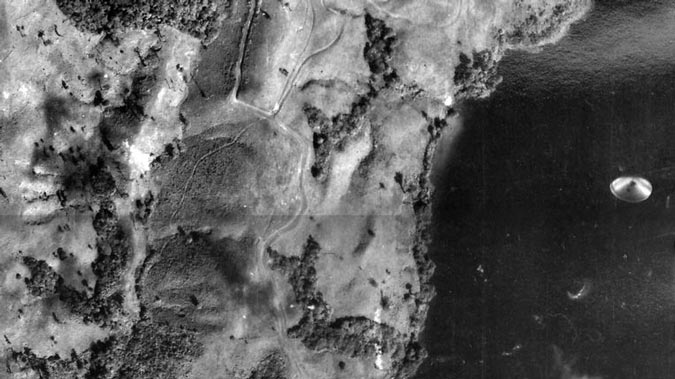
On September 4, 1971, members of the Instituto Geográfico Nacional (National Geographic Institute) took photographs above Lake Cote for the Costa Rican governmental company that provides electricity and telecommunication services. The photographs were taken for the construction of a hydroelectric dam near lake Arenal, when the mapping agency members accidentally captured a UFO in their high-resolution camera that was mounted on the plane, pointing downwards. The photograph is considered to be the clearest and best UFO photograph ever taken.

Sergio Loaiza, Juan Bravo and Francisco Reyes were flying in a Canadian-made Areo-Commander model F680 piloted by Omar Arias, and Loaiza was in charge of aerial photography that day. They were flying above Costa Rica with a 100-pound map-making camera when Loaiza captured a photograph of a metallic disc like a typical alien “flying saucer” that can be seen flying between the F680 aircraft and the ground.

They were flying at 10,000 feet, mapping the landscape beneath with the high-resolution camera that was programmed to take photos every 20 seconds. While reviewing the negatives, Loaiza could not believe his eyes. He even said that they were completely banned from talking about it. According to UFO researcher Oscar Sierra, the photographs were analyzed in the USA and France and found to be 100% real. (Source)

The object can only be seen in the photograph in frame number #300 in the sequence, and there is no indication of it in either the frame of film that came before it or the one that was taken immediately after it. Due to the film stock and the quality of the camera, the image was incredibly clear. This object was not in either the frame before it (#299) or the frame after it (#301).

Costa Rica UFOs

UFO photograph Taken in Costa Rica on September 1971

During the actual flight, the captain and his three crew members did not witness anything, and neither did the other passengers. It is estimated that the UFO was anywhere between 120 and 220 feet across, but the actual width would have depended on the object’s exact altitude.

New York Times writer and author Leslie Kean revealed that she has a framed copy of the photo taken at Lake Cote in the May 10, 2021 issue of The New Yorker by Gideon Lewis-Kraus. The article states, “…On the wall behind her desk, there is a framed black-and-white image that looks like a sonogram of a Frisbee. The photograph was given to her, along with chain-of-custody documentation, by contacts in the Costa Rican government; in her estimation, it is the finest image of a U.F.O. ever made public.”

On the New Yorker Radio Hour, she said: “I love this photo. It’s probably the best photograph of a UFO ever taken. It was taken in the 70s from a government mapping plane in Costa Rica which had a camera strapped on the bottom of the plane and it was like going over the terrain. There was this disc object and you clearly see the sun reflecting off this round object that’s got a little dot on the top and what’s important about it is that it was a government photo. There’s a clear chain of custody. It’s always been in possession of the Costa Rican government so you know it’s authentic and it’s completely unexplained.” (Source)

Read also:

In 1985, computer scientist and astronomer Dr. Jacques Vallee obtained a copy of the negative and circulated it to his contacts in the United States government and at a California tech company. However, none of them helped Dr. Vallee in analyzing the negative.

Eventually, in December 1987, Vallee took it to Dr. Richard Haines in San Francisco. Haines was a retired aerospace engineer who had worked for NASA, and Vallee knew him. The photo was scanned, blown up, and looked at. Haines’ first focus was on the lighting. In 1989, Vallee and Haines wrote a “Photo Analysis of an Aerial Disc Over Costa Rica” for the Journal of Scientific Exploration. The 19-page report concluded: (Source)

“In summary, our analyses have suggested that an unidentified, opaque, aerial object was captured on film at a maximum distance of 10,000 feet. There are no visible means of lift or propulsion and no surface markings other than dark regions that appear to be nonrandom… There is no indication that the image is the product of a double exposure or a deliberate fabrication.”

There has always been speculation as to whether the craft had just emerged from or was about to enter Lake Cote. There are numerous local stories concerning UFOs emerging from the water. But it is impossible to understand the path of the craft because it only appeared in one frame #300. The original negative has been kept by the Costa Rican government, and it may be found in the country’s National Archive. There are copies available, such as the one that Vallee and Haines analyzed.

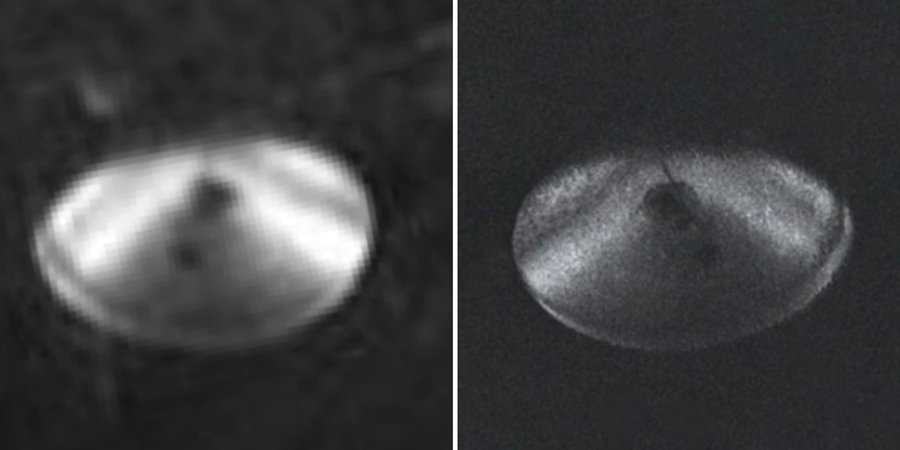
Loaiza’s UFO photograph has never been explained, despite the fact that UFO skeptics have thoroughly examined it. UAP Media, a UK-based UFO research company has got a brand fresh ultra-high resolution drum scan of the original photograph.

Clearest UFO Photograph Ever Taken

Comparison of old and new crops of the Lake Cote image (old on left, new on right). via UAP Media UK
  • Graeme Rendall – Author of UFOs Before Roswell and Flying Saucer Fever: “It’s a really intriguing photograph, and one which totally captures the imagination. I’m always impressed as to how “right” it looks. As to its veracity, though, I can’t say, but I’d love it to be true. It definitely looks a lot more convincing than a lot of other images I’ve seen over the years. I’d have to leave it to the photo analysis experts to pronounce sentence on it though.”
  • Vinnie Adams – member of UAP Media: “After looking into the case, reading about the circumstances surrounding what was seen from that aeroplane that day, and reading the analysis done previously by Dr. Jacques Vallée, it does come across as a very compelling case. The fact that after 50 years it still hasn’t been conclusively proven or debunked is very interesting. Now that we have this high-resolution drum scanned version of the image, hopefully it might reignite interest in the case and lead to further analysis and some sort of conclusion.”
  • Luis Elizondo – Former director of AATIP: “Although I was not around during this incident, pilot reports of smooth, shiny, lenticular craft are not new. In fact, even to this day, pilots, both civilian and military, along with their aircrew, continue to witness these types of craft and oftentimes displaying performance capabilities well beyond state of the art. Thankfully, some of these newer incidents are finding their way to Congress due to the courage of our fine men and women in uniform. During my time in AATIP, these incidents were surprisingly common.”
  • Jeremy Corbell – Filmmaker: “As we search for meaning behind the UFO presence, it’s important that we remember we are more effective collectively when perusing analysis. Historic images like this one from Costa Rica still have stories to tell, and new insights are sometimes just around the corner. If we can socially democratize and crowdsource our search for answers – we will arrive closer to the truth than if we simply wait for further confirmation from our governments. I’m elated higher fidelity imagery continues to emerge, especially when it allows us to get a glimpse into our UFO past. Makes one wonder what other UFO evidence is lurking in boxes or files that have remained elusive until now. I’m confident that more and more people will be coming forward with valuable insight and evidence in the near future.”

{ https://www.howandwhys.com/ }

Hoe vind je dit bericht?
Geschreven door peter om 20:56 Stuur door

Alien Invasion! The 11 Most Gripping Alien and UAP Events Of 2023

Alien Invasion! The 11 Most Gripping Alien and UAP Events Of 2023

It’s never aliens... until it is.

There’s nothing like a little trouble at home to make you look for greener pastures. And green or not, aliens were everywhere in 2023. Well, at least in the news.

From Unidentified Anomalous Phenomena (UAP, the classy new way to talk about UFOs) to the Search for Extraterrestrial Intelligence (SETI) and all the way to tiny molecules clinging to frozen dust grains in interstellar space, the eyes of experts and the public were looking for life elsewhere.

The biggest alien stories — at least the most popular — came from military releases of data, hinting at cover-ups (or just ill-prepared government officials). But the most important — at least by our reckoning — were those that were steeped in science, offering hints of what life might look like outside of our planet, and where to find it. If you really do want to turn over that rock, that is.

Here, ranked from 11 to 1 by their chances of introducing us to real alien life, are the top alien and UAP events of 2023 that remind us the truth really is out there.

11. NASA RELEASED A GRIPPING REPORT ON UAPS

A resolved UAP sighting. The dot in the middle, and two dots that appeared to move in tandem with th...

A resolved UAP sighting. The dot in the middle, and two dots that appeared to move in tandem with the central dot are airplanes waiting to land. 

AARO/NASA TV

In September, ASA released its much-anticipated report on Unidentified Anomalous Phenomena, and the agency says some of the sightings — between 16 and 40 out of roughly 800 — just can’t be explained — but Inverse spoke to experts, and it turns out the problem might just be that we don't have enough information. Most UAP reports come from sensors designed to guide weapons to objects, not gather detailed data about them, so it’s easy for fairly mundane objects to look bizarre when viewed through these sensors — or so says NASA.

Meanwhile, Inverse argues that the agency still needs a dedicated UAP office to take the investigation mainstream.

10. ... AND SO DID THE DEPARTMENT OF DEFENSE.

The Department of Defense also published its own UAP report in January 2023, admitting that it has investigated more than 500 cases of possible UAP. Of those, more than a quarter were (of course) weather balloons; to be fair to DoD, weather stations in the U.S. alone launch 240 balloons every day. But according to a Pentagon spokesperson, “Some of these uncharacterized UAP appear to have demonstrated unusual flight characteristics or performance capabilities, and require further analysis.”

But don’t worry; experts tell Inverse that the military probably couldn’t pull off an alien cover-up. Swarms of commercial satellites, along with ubiquitous smartphones and social media — not to mention political pressure — would make it almost impossible to keep the cat in the bag for long.

“I still strongly maintain that alien visitation is not something that could be kept secret. The size of such a secret is just too big,” wrote SETI researcher Seth Shostak in a July 2023 essay for the SETI Institute.

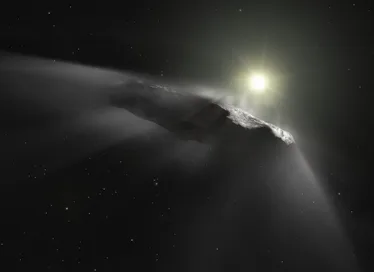
9. THE MYSTERIES OF OUMUAMUA WERE UNVEILED.

illustration of a long, thin rock venting a fan-shaped cloud of pale gas, with a yellow sun in the d...

This artist’s illustration shows Oumuamua venting gas as the Sun heats it, although no such venting was actually visible to astronomers.

ESA

Speaking of UAP, a chunk of interstellar debris called ‘Oumuamua caused a stir when it passed through our Solar system a few years ago — and an even bigger uproar when it seemed to accelerate under its own power, without leaving a tail like a comet. This year, a study suggested a possible explanation. Spoiler alert: It’s definitely not aliens.

8. WE CRAFTED A DECENT IDEA OF WHAT ALIEN SPACECRAFT COULD LOOK LIKE

A space station wheel orbiting planet Earth. The space station wheel is a habitat that a human crew can live for extended periods of time. 

COREY FORD/STOCKTREK IMAGES/STOCKTREK IMAGES/GETTY IMAGES

One team of SETI researchers did some math and suggested that if an alien probe ever does visit our Solar System, it’s likely to be a zippy high-tech model, not an alien version of the Voyager probes.

7. ... AND ALSO WHAT CELESTIAL SIGNS MIGHT POINT US TO ALIEN CIVILIZATIONS.

An illustration of a futuristic sci-fi city on a ring planet. 

EDUARD MUZHEVSKYI / SCIENCE PHOTO LIBRARY/SCIENCE PHOTO LIBRARY/GETTY IMAGES

SETI researchers also proposed some ways we might be able to spot high-tech alien civilizations from a distance — and some really wild ways the aliens might make themselves known to the rest of the universe, such as rearranging an entire star system into a cosmic “Kilroy Was Here” sign.

Other telltale signs to look for around distant stars include giant megastructures, built to siphon off mass and prolong the life of a dying star or the gleam of starlight on sprawling alien cities. But it may be easier to just look for pollution in a distant world’s atmosphere.

6. WE RULED OUT A WHOLE LOT OF HABITABLE PLANETS FOR INTELLIGENT LIFE

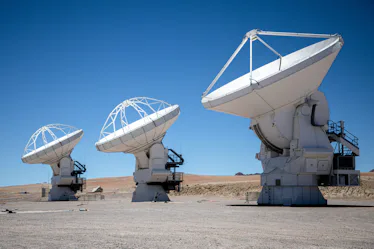
ATACAMA DESERT, CHILE - OCTOBER 28: The Atacama Large Millimeter/submillimeter Array (ALMA) radio te...

Humans wouldn’t be able to search for extraterrestrial intelligence today if our ancestors hadn’t learned to harness fire around a million years ago. 

ANADOLU AGENCY/ANADOLU AGENCY/GETTY IMAGES

None of that advanced alien technology is likely to happen in a world without a lot of oxygen in its atmosphere, though. One study this year pointed out that unless about sixteen percent of the atmosphere is made of oxygen, you can’t start a fire. And without fire, you can’t work metals, cook food, or signal to distant alien civilizations.

5. ... AND LEARNED ALIENS PROBABLY WON’T THINK TOO FONDLY OF OUR INTELLIGENCE.

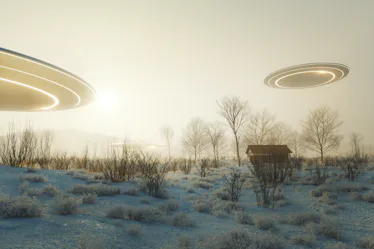
UFOs flying over winter landscape. 3D generated image.

GREMLIN/E+/GETTY IMAGES

If intelligent, technologically advanced aliens are out there, they may not recognize us as intelligent. That could be good news because it means they may not see us as a threat — and they may even think we need protection, according to one 2023 study. If the first aliens we contact are vastly more advanced than we are — or just very different — they may not realize we're sentient. That means they probably won't see us as a threat to galactic peace, which needs to be eliminated posthaste. But the jury's out on whether these hypothetical aliens might turn Earth into a nature preserve or treat us with callous indifference.

4. ALIEN LIFE, INTELLIGENT OR NOT, IS PROBABLY QUITE COMMON

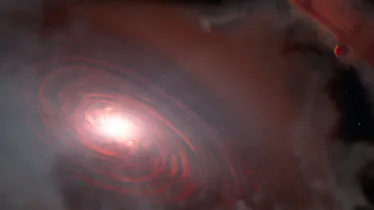
Left of center, a bright light source illuminates a surrounding disc colored dusky red. The disc is...

An artist’s depiction of the star PDS 70 and its inner disk. The haze represents the water vapor. In the top right of the image appears an exoplanet. 

NASA, ESA, CSA, J. OLMSTED (STSCI)

Alien encounters may be worth thinking about. It turns out that the basic ingredients for life are everywhere.

This year, astronomers found water vapor amid the rocky building blocks of a planetary system. Another team found some important chemical building blocks of organic chemistry clinging to dust grains in a cold cloud of interstellar gas. Elsewhere in the universe, astronomers found the amino acid tryptophan in one star-forming nebula, and a chemical essential for kickstarting the growth of complex organic molecules in another.

A few decades ago, we thought the chemicals involved in building cells and making them work might be rare in the universe, but now it looks like many of those ingredients could be part of the standard starter pack for new star systems. And that means life may — eventually — turn out to be more common than we ever dared to hope.

3. ... AND K2-18B IS A GREAT PLACE TO LOOK FOR IT.

a large blue planet in the foreground with a small red star in the background

This artist’s illustration shows what K2-18b might look like, with its dim red star in the background.

NASA, ESA, CSA, JOSEPH OLMSTED (STSCI)

One team of astronomers says they’ve found an ocean world orbiting a distant star, called K2-18b — and its atmosphere may contain evidence of life somewhere in that alien ocean. Even the researchers who studied the planet with the James Webb Space Telescope (JWST) aren’t convinced, though. It’s going to take more data to settle the debate, but the possibility is intriguing.

2. TRAPPIST-1 OFFERS EXPERTS HOPE AND FRUSTRATION.

photo of several planets passing in front of a dim red star, with a larger planet in the foreground

The star and six of the planets as they would appear from the vantage point of the fifth outermost planet, Trappist-1f. All of the planets and the Sun are to scale. One of the worlds is seen transiting in front of the star.

MARK GARLICK/SCIENCE PHOTO LIBRARY/SCIENCE PHOTO LIBRARY/GETTY IMAGES

Another swirl of debate, also fueled by JWST observations, is centered on the TRAPPIST-1 system. Home to at least seven rocky planets, three of which are in the habitable zone, TRAPPIST-1 is a hotspot for hopeful astrobiologists.

Earlier this year, JWST revealed that the system’s innermost two worlds — TRAPPIST-1b and TRAPPIST-1c — look like airless rocks, although it’s possible they just have really thin atmospheres. Neither of those planets is in the habitable zone, but many astronomers took the news as a discouraging sign that the star TRAPPIST-1 might have swept away the atmospheres of all its closest planets, including the potentially habitable ones. But others say it’s too soon to give up hope.

1. BUT DO WE NEED TO LOOK THAT FAR? ALIEN LIFE MIGHT BE RIGHT HERE IN OUR BACKYARD.

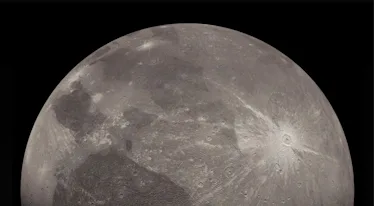
A grayscale moon with a cracked icy surface on a black background.

The Juno spacecraft’s Junocam instrument captured this detailed photo of Jupiter’s icy moon Ganymede during a June 2021 flyby.

NASA

Closer to home, several studies this year show that Jupiter’s icy moons look extremely promising for alien life, or at least habitability, in a part of our Solar System that we used to consider totally uninhabitable.

NASA’s JUNO spacecraft spotted salt and organic molecules splattered across the icy surface of Jupiter’s moon Ganymede, and JWST revealed frozen carbon dioxide on the surface of Europa. Both moons are hiding vast, dark oceans beneath their thick, icy exteriors, and finding those chemicals on the surface suggests two important things: one, material from the ocean can reach the surface, where it might be easier for us to study. And two, those ice-covered alien oceans seem to have chemistry that could support life as we know it.

Meanwhile, another study suggested that every star system could host at least one Europa-like planet with an ocean hidden beneath an icy outer layer.

The truth is out there, all right — and it may be closer than we ever thought.

{ https://www.inverse.com/ }

Hoe vind je dit bericht?
Geschreven door peter om 20:34 Stuur door

Photos: Top species discoveries from 2023

Photos: Top species discoveries from 2023

Hoe vind je dit bericht?
Geschreven door peter om 18:20 Stuur door

Japan's SLIM spacecraft enters lunar orbit, sets up historic moon landing attempt

Japan's SLIM spacecraft enters lunar orbit, sets up historic moon landing attempt

Story by Ethan Brown

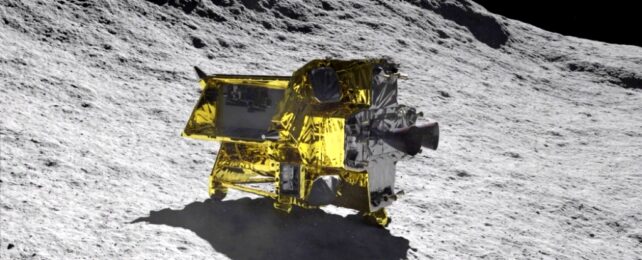
Japan is on track to become the fifth country to land a probe on the Moon, after its SLIM spacecraft successfully entered lunar orbit on Dec. 24. The $100m mission, dubbed the “moon sniper”, aims to demonstrate Tokyo’s ability to land a lightweight, low-cost spacecraft on the Moon with high precision.

The SLIM spacecraft is expected to land within 100m of a location near the Shioli crater, on the near side of the Moon. The landing attempt is scheduled for Jan. 19, after the spacecraft spends a month circling the Moon. This would mark a historic moment for Japan, as a successful touchdown would join the ranks of the United States, Russia, China, and India, who have previously achieved the feat of landing a probe on the Moon.

The SLIM mission is part of Japan’s ambitious space exploration efforts, which include sending a rover to explore the lunar surface, collecting samples from an asteroid, and participating in the Artemis program to return humans to the Moon. The mission also showcases Japan’s technological prowess and innovation, as the SLIM spacecraft is designed to be smaller, lighter, and cheaper than previous lunar landers.

The SLIM spacecraft weighs only 130kg, compared to the 1,500kg of China’s Chang’e-4 lander, which landed on the far side of the Moon in 2019. The SLIM spacecraft also costs only $100m, a fraction of the $1.3bn budget of India’s Chandrayaan-2 mission, which failed to land on the Moon in 2019. The SLIM spacecraft is equipped with advanced navigation and guidance systems, which allow it to autonomously adjust its trajectory and attitude during the landing process.

The launch of SLIM was carried out by a Mitsubishi Heavy Industries H-2A rocket, which also carried the X-Ray Imaging and Spectroscopy Mission (XRISM) satellite. The XRISM is a joint project between the Japanese, American, and European space agencies. The satellite, containing a telescope the size of a bus, has parted ways with the lunar lander to orbit around the Earth. It will now begin studying space phenomena such as black holes.

The successful launch and lunar orbit entry of SLIM follow a series of failures over the past year. Last November, JAXA lost contact with its OMOTENASHI spacecraft and aborted the Moon landing mission. More recently in April, a private Japanese start-up, iSpace, failed to land its Hakuto-R lander after it too lost contact with the spacecraft. Two test rocket launches have also failed this year.

The SLIM mission represents a significant step forward in Japan’s space exploration efforts. The mission’s success so far demonstrates the country’s resilience and determination in the face of previous setbacks. As the world watches, the upcoming moon landing attempt is set to be a pivotal moment in space exploration history.

Golden Lunar Lander On Moon

Artist's impression of the lunar explorer on the Moon. 

(JAXA)

Relevant articles:

{ https://trendydigests.com/ }

Hoe vind je dit bericht?
Geschreven door peter om 17:42 Stuur door

Japan Probe Enters Lunar Orbit Ahead of Historic Moon Landing

Japan Probe Enters Lunar Orbit Ahead of Historic Moon Landing

By AFP

Japan's SLIM space probe entered the Moon's orbit on Monday in a major step towards the country's first successful lunar landing, expected next month.

The Smart Lander for Investigating Moon (SLIM) is nicknamed the "Moon Sniper" because it is designed to land within 100 metres (328 feet) of a specific target on the lunar surface.

If successful, the touchdown would make Japan only the fifth country to have successfully landed a probe on the Moon, after the United States, Russia, China and India.

On Monday, SLIM "successfully entered the moon's orbit at 04:51 pm Japan time" (0751 GMT), the Japan Aerospace Exploration Agency (JAXA) said in a statement released Monday evening.

"Its trajectory shift was achieved as originally planned, and there is nothing out of the ordinary about the probe's conditions," the agency said.

The lander's descent towards the moon is expected to start around 12:00 am Japan time on January 20, with its landing on the surface scheduled for 20 minutes later, JAXA said.

The H-IIA rocket lifted off in September from the southern island of Tanegashima carrying the lander, after three postponements linked to bad weather.

JAXA said this month that the mission would be an "unprecedentedly high precision landing" on the Moon.

The lander is equipped with a spherical probe that was developed with a toy company.

Slightly bigger than a tennis ball, it can change its shape to move on the lunar surface.

Compared to previous probes that landed "a few or 10-plus kilometres" away from targets, SLIM's purported margin of error of under 100 metres suggests a level of accuracy once thought impossible, thanks to the culmination of a 20-year effort by researchers, according to JAXA.

With the advance of technology, demand is growing to pinpoint targets like craters and rocks on the lunar surface, Shinichiro Sakai, JAXA's SLIM project manager, told reporters this month.

"Gone are the days when merely exploring 'somewhere on the moon' was desired," he said.

Hopes are also high that SLIM's exactitude will make sampling of lunar permafrost easier, bringing scientists a step closer to uncovering the mystery around water resources on the moon, Sakai added.

Japanese missions have failed twice – one public and one private.

Last year, the country unsuccessfully sent a lunar probe named Omotenashi as part of the United States' Artemis 1 mission.

In April, Japanese startup ispace tried in vain to become the first private company to land on the Moon, losing communication with its craft after what it described as a "hard landing".

{ https://www.sciencealert.com/ }

Hoe vind je dit bericht?
Geschreven door peter om 17:23 Stuur door

THE JAMES WEBB SPACE TELESCOPE HAS CHANGED OUR VIEW OF THE COSMOS IN 2023. HERE ARE SOME OF THIS YEAR’S BEST IMAGES AND GREATEST DISCOVERIES.

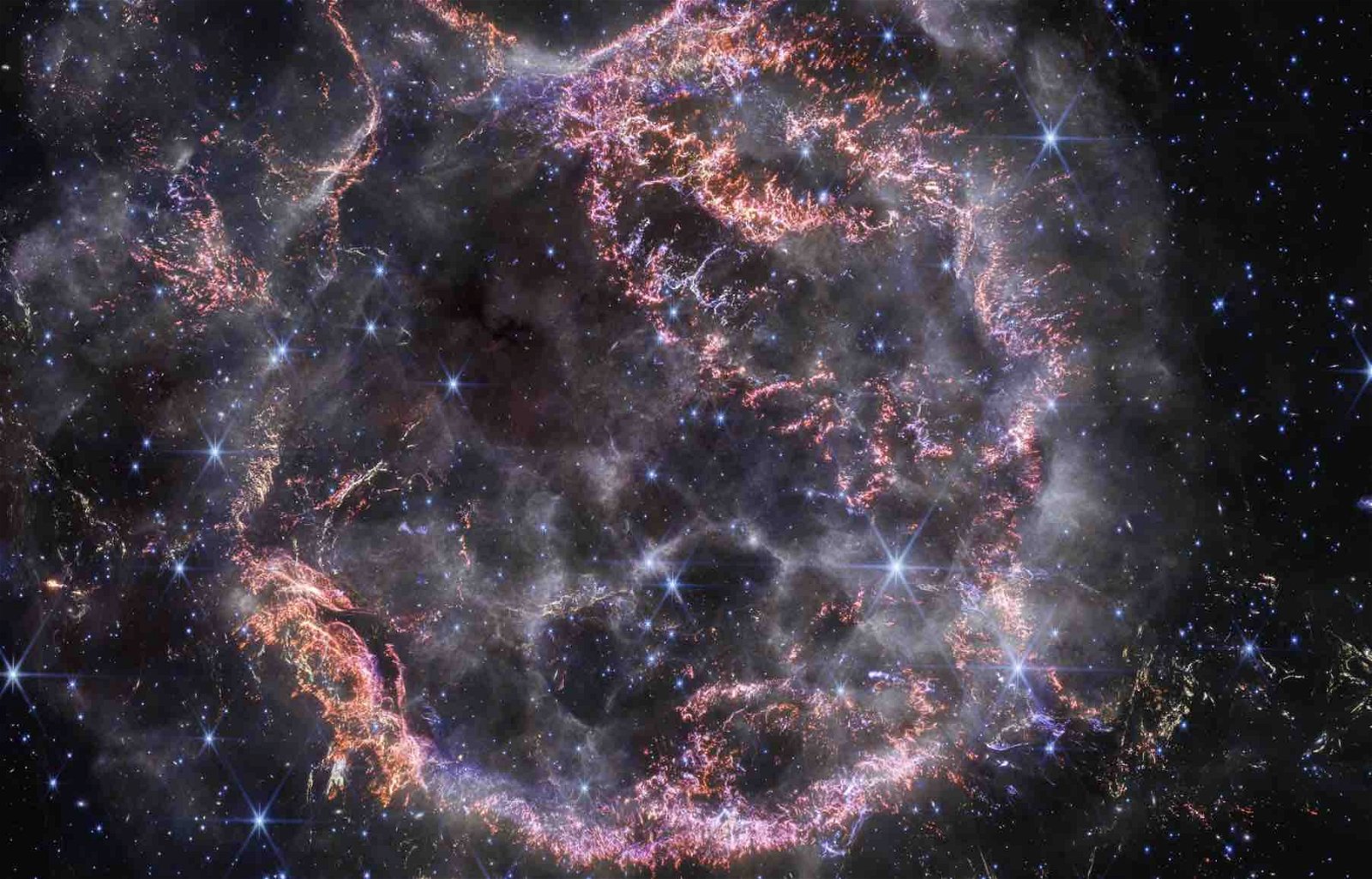
NIRCam Image of Cassiopeia A
(NASA/ESA)

THE JAMES WEBB SPACE TELESCOPE HAS CHANGED OUR VIEW OF THE COSMOS IN 2023. HERE ARE SOME OF THIS YEAR’S BEST IMAGES AND GREATEST DISCOVERIES.

Since its launch last year, NASA’s James Webb Space Telescope has repeatedly proven itself to be an incredible asset in the search for answers to many of the lingering questions about our universe.

Having offered some of the most stunning imagery of the distant universe ever collected, NASA has said the telescope “has delivered on its promise of revealing the universe like never before in its first year of science operations.”

Looking back on a year of groundbreaking discoveries and breathtaking imagery Webb has brought to the world, here are some of the key highlights brought to us by Webb in 2023 that have expanded our view of the cosmos.

JAMES WEBB SPACE TELESCOPE CONFIRMS ITS FIRST EXOPLANET

In January, a team of researchers led by Kevin Stevenson and Jacob Lustig-Yaeger confirmed the discovery of an exoplanet with help from the James Webb Space Telescope. Formally named LHS 475 b, the discovery was made following a careful review of a series of targets of interest from NASA’s Transiting Exoplanet Survey Satellite (TESS).
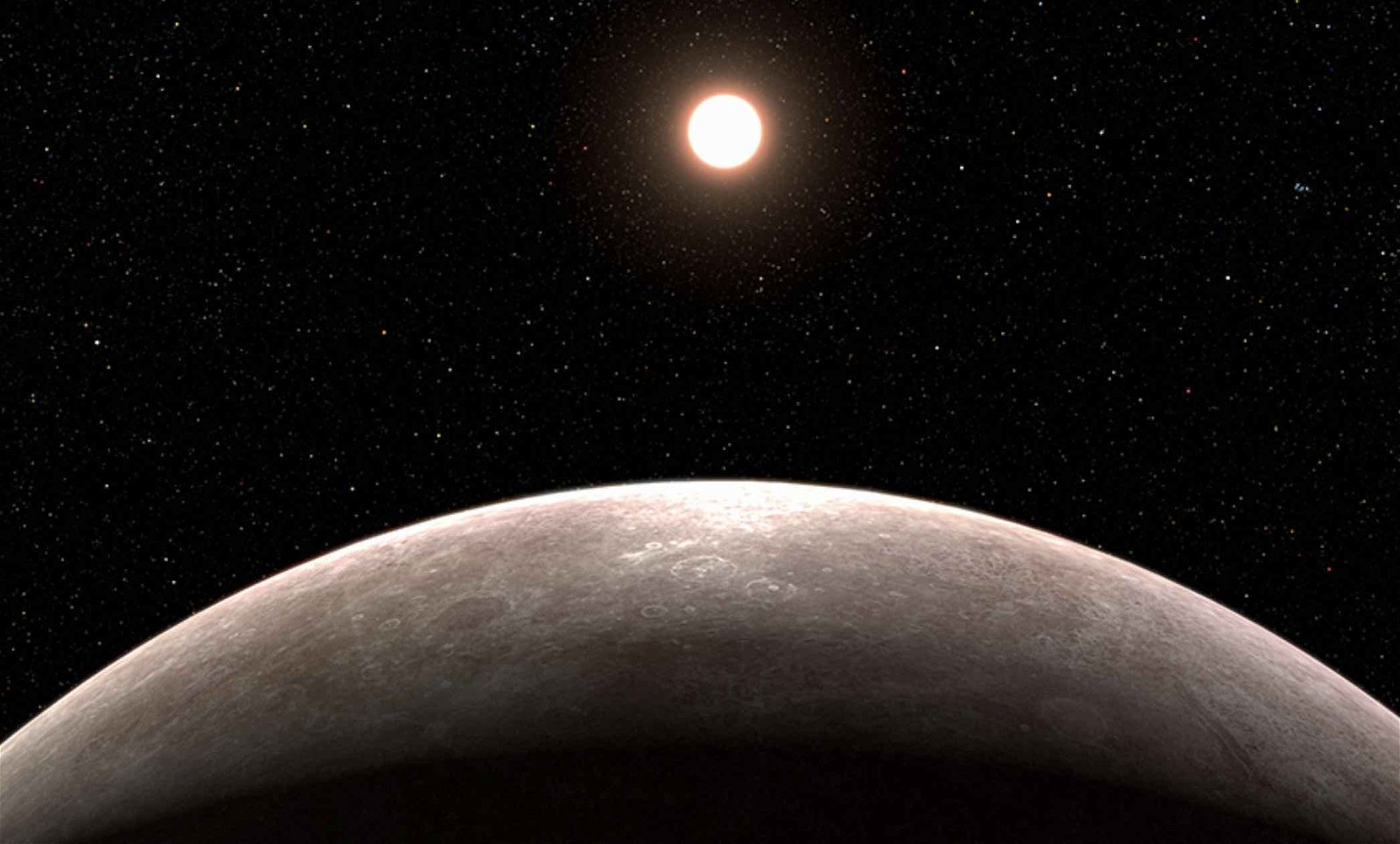
LHS 475 b

Artist’s concept of Exoplanet LHS 475 b and Its Star (Credit: NASA, ESA, CSA, Leah Hustak (STScI)).

The telescope’s powerful Near-Infrared Spectrograph (NIRSpec) succeeded in obtaining imagery of the exoplanet throughout just two of its transit observations.

“There is no question that the planet is there,” said Lustig-Yaeger. “The fact that it is also a small, rocky planet is impressive for the observatory.” Mark Clampin, Astrophysics Division director at NASA Headquarters in Washington, added that the detection of “an Earth-size, rocky planet open the door to many future possibilities for studying rocky planet atmospheres with Webb.”

WEBB GETS GRITTY WITH VIEW OF A REMOTE CLOUDY PLANET

In March, NASA unveiled new features about the atmosphere of a distant planet 40 light-years away from Earth, which included the swirling sandstorms in its scorching atmosphere.

The planet, designated VHS 1256 b, is located within a relatively young triple brown dwarf system approximately 40 light years away, orbiting a pair of stars over 10,000 years, which are roughly four times farther from it than the distance between the Sun and Pluto.

sandstorms

(Credit: NASA, ESA, CSA, Joseph Olmsted)

The James Webb Space Telescope was able to reveal the presence of silicate clouds blanketing the alien world, along with its rising and mixing atmosphere, which confirmed that silicate dust grains of varying sizes are present within the clouds encircling VHS 1256 b, resulting in scorching hot sandstorms that blanket the alien world.

WEBB FINDS WATER, AND MUCH MORE WHILE OBSERVING AN ASTEROID

In May, Webb’s NIRSpec (Near-Infrared Spectrograph) instrument helped astronomers make the first detection of water vapor in the vicinity of a comet in the main asteroid belt, confirming that water ice from the early solar system can be preserved there.
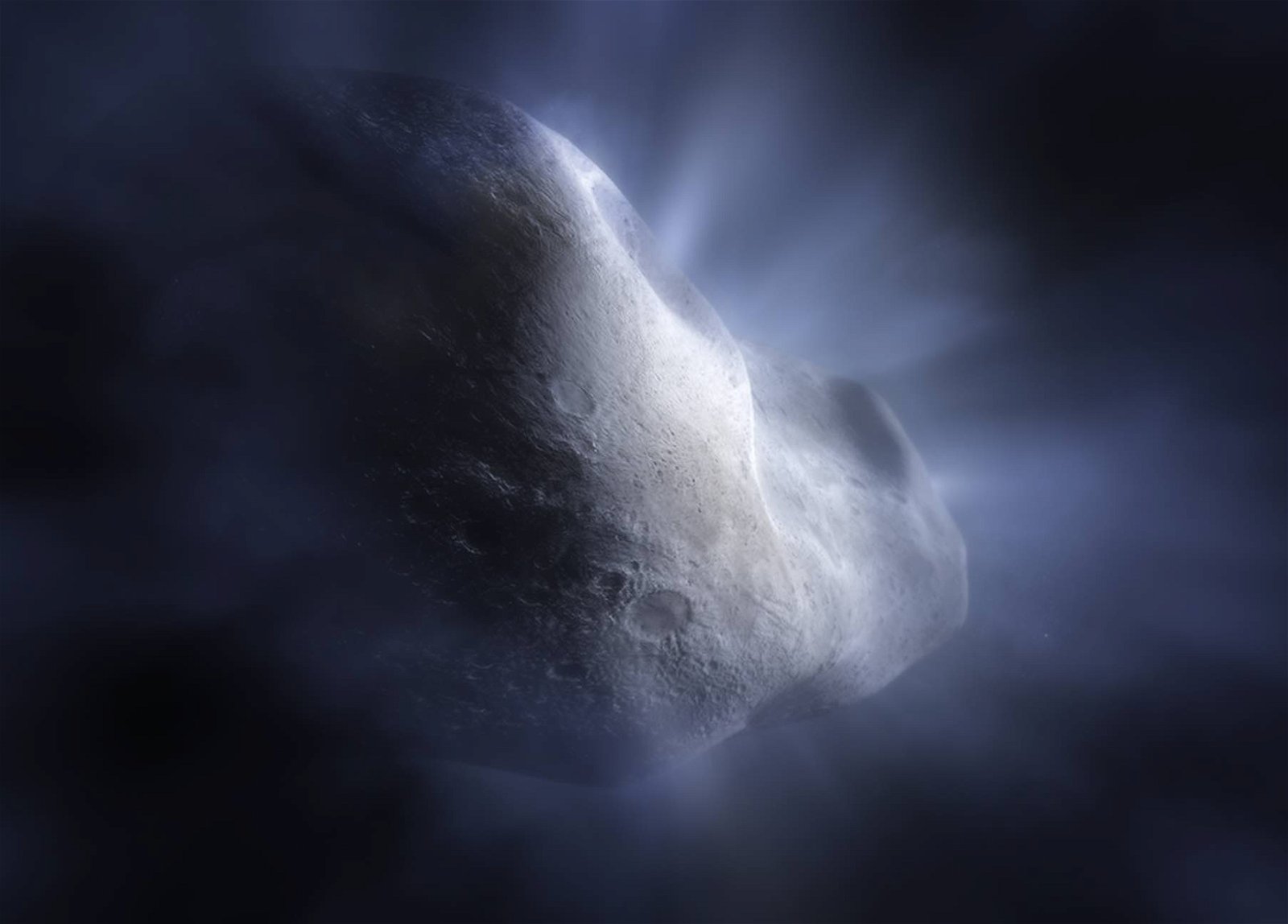
Comet 238P/Read

Artist’s Concept of Comet 238P/Read (Credit: NASA/ESA).

Curiously, the detection of water vapor was made in the absence of any sign of carbon dioxide, presenting new questions for astronomers involved with the discovery.

Stefanie Milam, Webb’s deputy project scientist for planetary science and the co-author of a study on the discovery, said her team’s observations help to unravel “the history of water distribution in the solar system,” adding that it “will help us to understand other planetary systems, and if they could be on their way to hosting an Earth-like planet.”

WEBB SPOTS EERIE RINGS SURROUNDING A STAR

Astronomers attempting to study the first asteroid belt ever seen beyond our solar system using Webb’s Mid-Infrared Instrument (MIRI) discovered far more than they went looking for this year, which included a series of glowing discs encircling the star Fomalhaut.
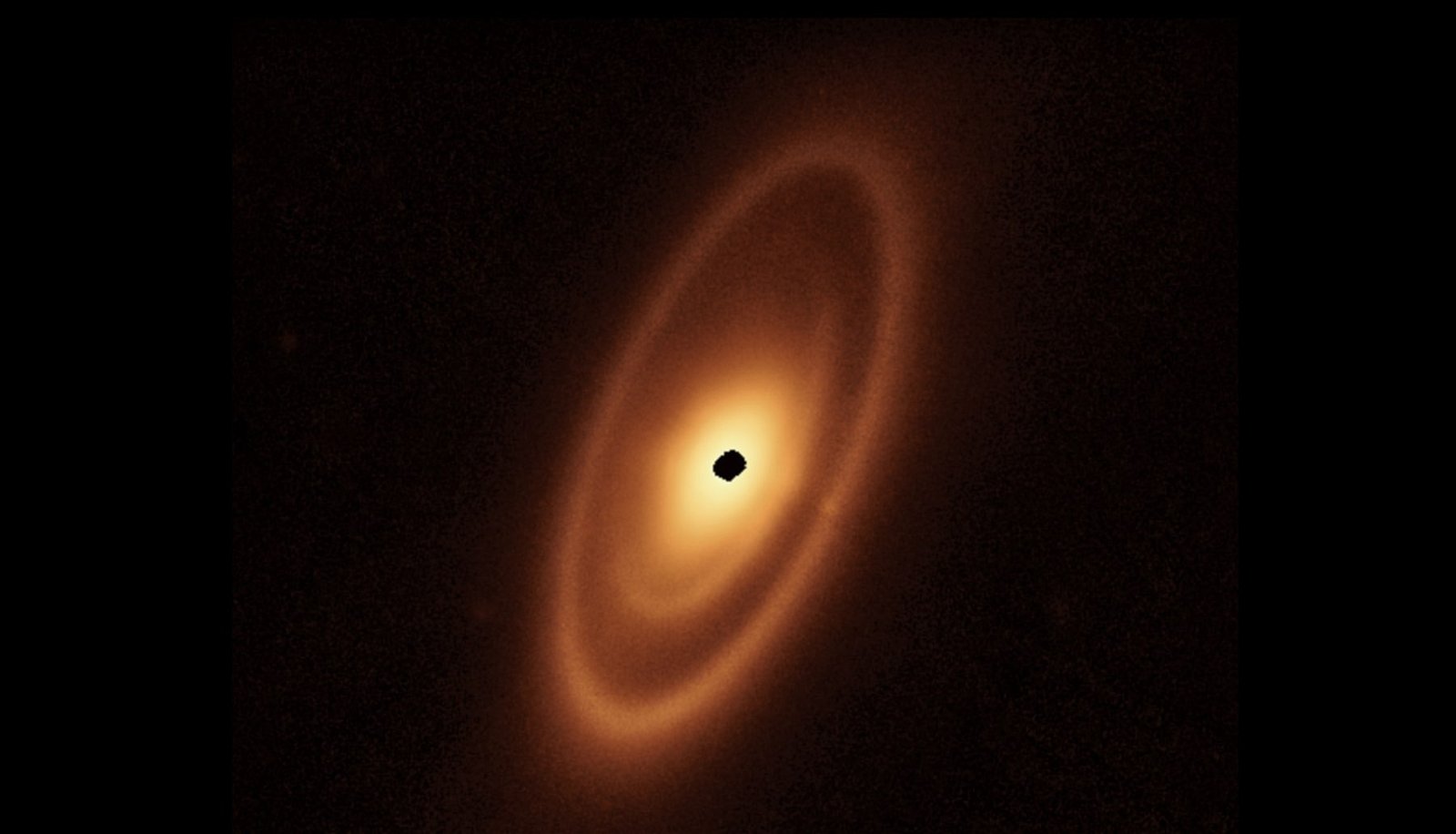
Fomalhaut

Fomalhaut, as seen by Webb

(NASA, ESA, CSA, A. Gáspár, University of Arizona, A. Pagan).

According to NASA’s Jet Propulsion Lab (JPL), a trio of nested belts was detected around the star, sprawling as much as 14 billion miles outward into the surrounding space.

The brightest star visible in the “Southern Fish” constellation Piscis Austrinis, Fomalhaut is a relatively young class A star located around 25 light-years from Earth’s Sun.

WEBB CELEBRATES ITS ANNIVERSARY BY PEERING INTO THE OPHIUCHI CLOUD COMPLEX

In celebration of the anniversary of its launch in 2022, in July NASA released images obtained by the telescope featuring a nursery for star formation, located in an area of interstellar clouds consisting of different nebulae within the Ophiuchus constellation some 390 light years from Earth, known as the Rho Ophiuchi cloud complex.

Released on July 12, the image represented more than just a snapshot of the nearest region to Earth where stellar formation occurs; at less than 400 light years away, there are no stars in the foreground obstructing Webb’s view of Pho Ophiuchi, meaning that the imagery provides some of the greatest clarity and depth of any infrared view of the cosmos any human-made telescope has ever obtained of the distant universe.

Rho Ophiuchi

The Rho Ophiuchi cloud complex, as captured in imagery by the James Webb Space Telescope marking its first year in operation (Credit: NASA/JWST).

The imagery prompted Nicola Fox, associate administrator of NASA’s Science Mission Directorate, to call them “a breathtaking treasure trove of images and science that will last for decades,” adding that Webb’s sharp eye has “given us a more intricate understanding of galaxies, stars, and the atmospheres of planets outside of our solar system than ever before, laying the groundwork for NASA to lead the world in a new era of scientific discovery and the search for habitable worlds.”

JAMES WEBB SPACE TELESCOPE OFFERS A NEW LOOK AT AN ICONIC SUPERNOVA

In August, Webb’s NIRCam managed to obtain new imagery of the Large Magellanic Cloud, providing astronomers with potentially crucial information not only about this iconic celestial object, but also about the development of supernovae.

Officially designated SN 1987A, this supernova within the Large Magellanic Cloud has long appealed to astronomers since its discovery in 1987, presenting an ideal target for viewing at gamma-ray and radio wavelengths.
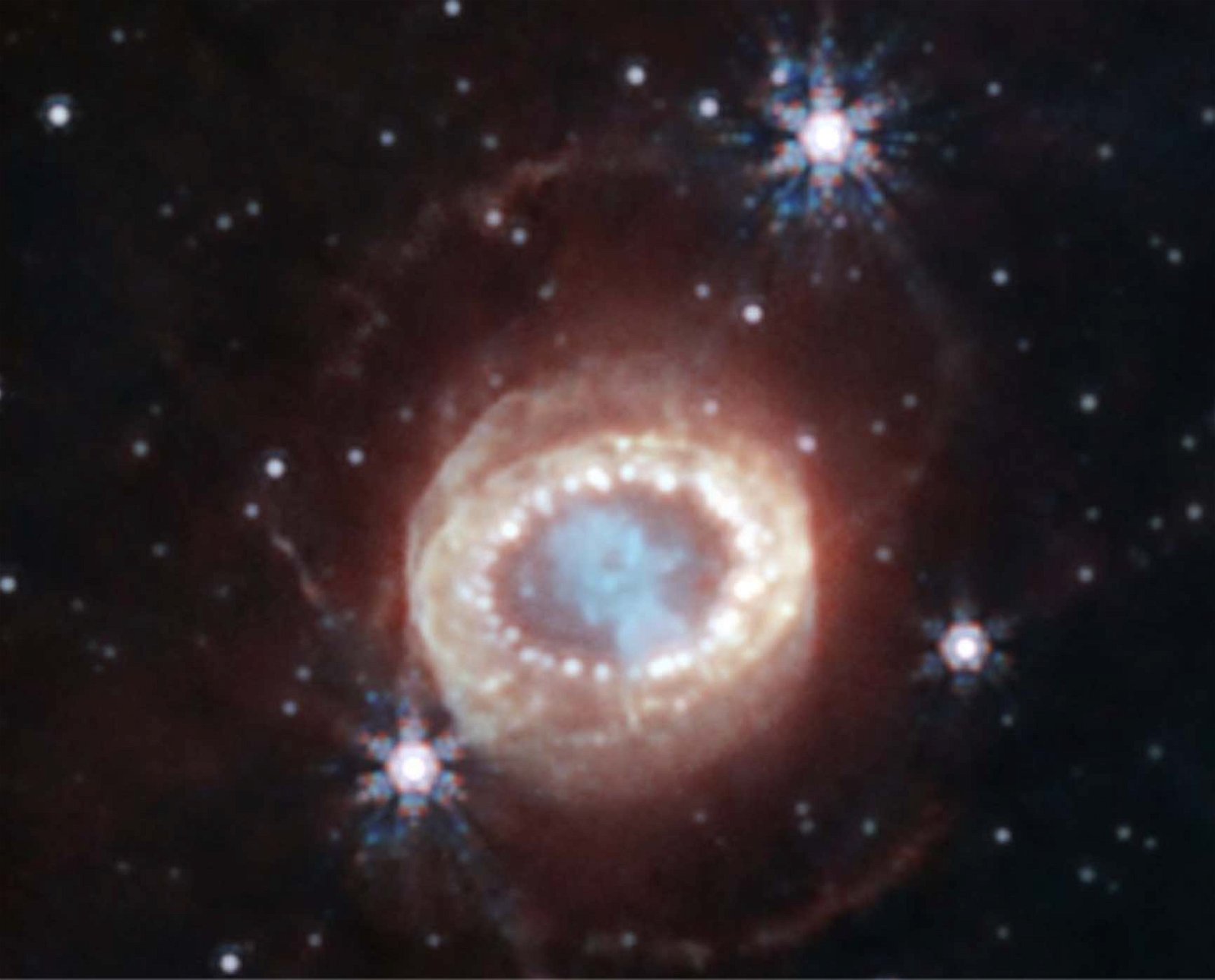
Supernova 1987A

Supernova 1987A

(Credit: NASA/ESA/JWST)

In the imagery obtained earlier this year, a central structure resembling a keyhole was detected within the heart of the supernovae. “This center is packed with clumpy gas and dust ejected by the supernova explosion,” read a NASA statement, which added that the dust within it is “so dense that even near-infrared light that Webb detects can’t penetrate it.” Of course, that didn’t prevent Webb from obtaining some of the most striking imagery ever obtained of the object.

MYSTERIOUS BRIGHTNESS AT THE COSMIC DAWN IS FINALLY SOLVED

New simulations produced by a Northwestern University-led team of astrophysicists in October helped to solve the riddle of why galaxies appeared too bright in the James Webb Space Telescope’s (JWST) initial images of the universe’s earliest galaxies.
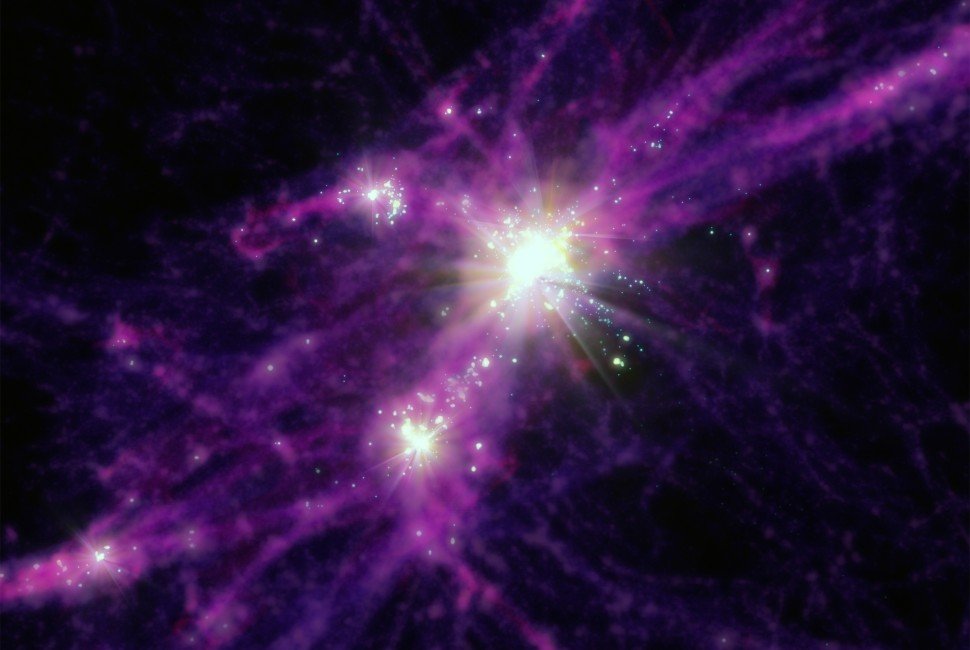
James Webb Space Telescope

Artist’s concept of early starbursting galaxies

(Credit: Aaron M. Geller, Northwestern, CIERA + IT-RCDS)

The Northwestern team found that the galaxies weren’t as massive as the imagery seemed to convey, and that even galaxies possessing less mass can glow as brightly as more massive ones, due to the presence of brilliant bursts created with the birth of new stars, in findings that align with the standard model of cosmology.

WEBB EXOPLANET DISCOVERY MAY “RESHAPE OUR UNDERSTANDING” OF PLANETARY EVOLUTION 

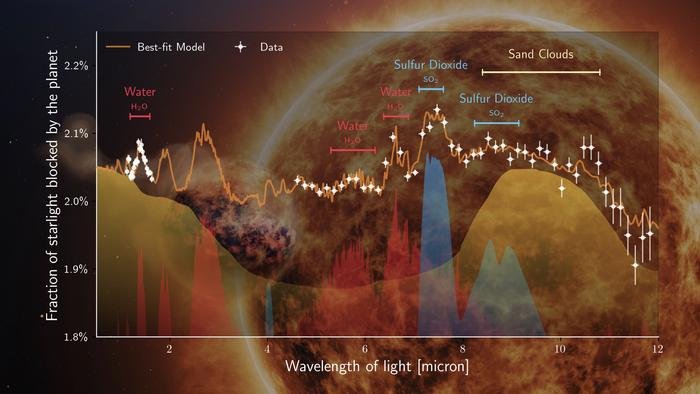
In November, astronomers reported that the James Webb Space Telescope (JWST) succeeded in detecting water vapor, sand clouds, and sulfur dioxide in the atmosphere of the exoplanet WASP-107b.
Low-Res_SPECTRUM_combinded.jpeg

A transmission spectrum of the warm Neptune exoplanet WASP-107b, captured by the Low Resolution Spectrometer (LRS) of the Mid InfraRed Instrument (MIRI) on board JWST, reveals evidence for water vapour, sulfur dioxide, and silicate (sand) clouds in the planet’s atmosphere.

(Image: Michiel Min / European MIRI EXO GTO team / ESA / NASA; Klaas Verpoest (LUCA School of Arts, Belgium)

The discovery, led by a team of European astronomers from Belgium’s KU Leuven University, revealed the presence of water vapor, sulfur dioxide, and silicate sand clouds while notably lacking methane, a common greenhouse gas​, around the exoplanet.

JAMES WEBB SPACE TELESCOPE UNVEILS URANUS IN WAYS NEVER BEFORE SEEN

In December, NASA released stunning new enhanced imagery of the ice giant Uranus, in a series of updated images captured by its premiere space observatory earlier this year.

The seventh planet from the Sun in our solar system, Uranus possesses a striking bluish green color, caused by its atmosphere composed primarily of helium and hydrogen, which the new imagery captured by the James Webb Space Telescope showcases in remarkable clarity, along with several of the planet’s twenty-seven known satellites.

Uranus

The newly enhanced versions of imagery depicting Uranus, were originally obtained earlier this year by the James Webb Space Telescope

(Credit: NASA/ESA/JWST).

The new image was based on enhancements of a two-color version of the same view of Uranus released earlier in 2023, which employs additional wavelength coverage that allows more details to be revealed in the latest versions.

With the many incredible discoveries Webb has made throughout 2023, the future is looking bright for NASA’s premier space observatory, and we can certainly expect more remarkable views of the cosmos from Webb as we head into 2024.

Micah Hanks is the Editor-in-Chief and Co-Founder of The Debrief. He can be reached by email at micah@thedebrief.org. Follow his work at micahhanks.com and on X: @MicahHanks.

{ https://thedebrief.org/category/science/  }

Hoe vind je dit bericht?
Geschreven door peter om 17:13 Stuur door

2023: The year UFOs descended on Washington, DC (but not like you'd expect)

2023: The year UFOs descended on Washington, DC (but not like you'd expect)

the white dome of the u.s. capitol building is lit up at night

Venus and Jupiter shine to the left of the United States Capitol dome. 
(Image credit: Getty Images/Philip Yabut)

For those who follow news related to anomalous flying objects, 2023 will be remembered as the year UFOs came to Washington, D.C.

Not in the way we'd all like, though. No, there were no Tic-Tac-shaped UFOs landing on the White House lawn or big black triangles hovering silently in the air above it. Instead, there were new bureaucratic offices and government websites created, pieces of dense legislation deliberated over, and hearings. Lots of hearings.

Throughout the pockets of social media that are most vocal about UFOs, many thought that this year would finally bring about disclosure, the revelation of UFO-related truth in which the U.S. government would finally fess up and reveal what it has allegedly been covering up about unidentified, physics-defying craft and their possible occupants for at least seven decades.

But disclosure didn't happen. While many sensational claims were made that would, if true, indeed bring about ontological shock and a rethinking of our place in the universe, in the end none of these was substantiated with little more than hearsay. As is tradition.

Related: 

Government reports and Chinese balloons

The big UFO year began on Jan. 12, when the Pentagon's Office of the Director of National Intelligence (ODNI) released its long-awaited "2022 Annual Report on Unidentified Aerial Phenomena." The report, produced by the All-domain Anomaly Resolution Office (AARO) that was established in July 2022, included over 500 reports of unidentified anomalous phenomena, or UAP, a new term that describes unidentified objects or phenomena in the air, under water, in space or that appear to travel between them.

The much-anticipated report analyzed the reports, finding only 171 that remained  "uncharacterized," or unidentified. "Some of these uncharacterized UAP appear to have demonstrated unusual flight characteristics or performance capabilities, and require further analysis," the report stated. Ultimately, while the report was unable to reach any broad conclusions about UFOs/UAP, it found that many of these sightings "continue to represent a hazard to flight safety and pose a possible adversary collection threat," meaning they could possibly be related to foreign spy activities. 

Just a few weeks later, on Feb. 1, UFOs took center stage in both Washington D.C. and the news cycle when a large white orb was spotted floating over Montana. The object turned out to be a massive high-altitude balloon operated by China. The appearance of such a brazen intelligence-gathering aircraft caused an international stir, and China's Ministry of Foreign Affairs eventually issued an apology.

The balloon was eventually shot down off the coast of South Carolina on Feb. 5 and recovered by the U.S. military. In the weeks that followed, several other UFOs were shot down over the northern United States and Canada, some of which were never recovered and remain unidentified to this day  —  at least publicly. 

Soon after, The New York Times reported that similar balloons had intruded in American airspace between 2017 and 2021 and that military and governmental leaders were unaware of them in some cases because they were initially mischaracterized as UAP. "Balloons account for many of the unexplained incidents the Navy and other military services have tracked in recent years. The previous incidents, like other unexplained events, were handed over to a Pentagon task force charged with investigating UFOs and other aerial phenomena," the Times wrote in its report. "As the Pentagon and intelligence agencies stepped up efforts over the past two years to find explanations for many of those incidents, officials reclassified some events as Chinese spy balloons."

Sailors assigned to Explosive Ordnance Disposal Group 2 recover a high-altitude Chinese surveillance balloon off the coast of Myrtle Beach, South Carolina on Feb. 5, 2023.  (Image credit: U.S. Navy Photo by Mass Communication Specialist 1st Class Tyler Thompson)

The furor over the Chinese spy events continued through the early spring, leading up to the first public testimony of the director of the Pentagon's All-domain Anomaly Resolution Office on April 19, 2023. During that testimony, Sean Kirkpatrick, AARO's first director, told members of the United States Senate Committee on Armed Services at a hearing in Washington, D.C. that, despite the rather sensational claims in mainstream and social media concerning possible alien visitation of Earth, his office found "no credible evidence thus far of extraterrestrial activity, off-world technology or objects that defy the known laws of physics." 

Instead, most UAP cases "demonstrate mundane characteristics of balloons, [uncrewed] aerial systems, clutter, natural phenomena or other readily explainable sources," Kirkpatrick told the armed services committee.  

The next month, NASA held the first public meeting of its independent UAP study group at the agency's headquarters in Washington, D.C. NASA commissioned the group in 2022 to help examine data related to unidentified anomalous phenomena and make recommendations on how the agency might better contribute to the topic. 

During the meeting held on May 31, group members laid out a roadmap for how U.S. government agencies can "use the tools of science to evaluate and categorize the nature of UAPs going forward," said Nicki Fox, associate administrator for NASA's Science Mission Directorate. 

While many different potential approaches for accomplishing this were described and discussed, ultimately the group, like AARO before it, reached the conclusion that UAP will remain mysterious without better data. "To make the claim that we've seen something that is evidence of non-human intelligence, it would require extraordinary evidence," said astrophysicist David Spergel, chair of the study group and former member of the NASA Advisory Council. "And we have not seen that. I think that's important to make clear. "

Still, the public and governmental interest in UFOs by this point had reached such a height that two U.S. Senators, Majority Leader Chuck Schumer (D-NY) and Senator Mike Rounds (R-SD), introduced a bill known as the Unidentified Anomalous Phenomena (UAP) Disclosure Act of 2023, or the Schumer-Rounds amendment, which called for the public release of U.S. government records related to UFOs and/or UAP. 

"For decades, many Americans have been fascinated by objects mysterious and unexplained, and it’s long past time they get some answers," Schumer said in a statement accompanying the bill. "The American public has a right to learn about technologies of unknown origins, non-human intelligence, and unexplainable phenomena. We are not only working to declassify what the government has previously learned about these phenomena but to create a pipeline for future research to be made public."

Senate Majority Leader Charles Schumer (D-NY) and Sen. Mike Rounds (R-SD) talk to reporters after meeting with U.S. President Joe Biden at the White House on Oct. 31, 2023 in Washington, D.C.  (Image credit: Chip Somodevilla/Getty Images)

Allegations get wilder

Undoubtedly, the most out-of-this world UFO event of 2023 came two months after NASA's UAP study group meeting when, on July 26, three former U.S. military personnel testified to the U.S. House of Representatives' Subcommittee on National Security at the Border and Foreign Affairs. Two of the witnesses, Ryan Graves and David Fravor, are former U.S. Navy aviators who had previously reported highly publicized encounters with unknown objects in military training airspace that have become touchstones for the UFO community in terms of credible sightings from reputable, trained witnesses.

But it was the third witness at the July hearing that caused the biggest stir. That witness, David Grusch, a decorated U.S. military combat veteran and former Pentagon intelligence officer, told the subcommittee that the U.S. government has operated a "multi-decade UAP crash retrieval and reverse-engineering program," along with a disinformation campaign to keep the public in the dark.

Grusch would go on to state to the subcommittee that "biologics came with some of these recoveries" and that these "biologics" were "non-human," according to individuals with direct knowledge of these crash recovery programs that he had spoken with during his time in the intelligence community.

Naturally, a media feeding frenzy ensued, and Grusch has since become a regular talking head on the podcast circuit and television news programs. Evidence for his claims has yet to surface.

Ryan Graves, executive director of Americans for Safe Aerospace, David Grusch, former National Reconnaissance Officer Representative of Unidentified Anomalous Phenomena Task Force at the U.S. Department of Defense, and Retired Navy Commander David Fravor are sworn-in during a House Oversight Committee hearing titled 'Unidentified Anomalous Phenomena: Implications on National Security, Public Safety, and Government Transparency' on Capitol Hill July 26, 2023 in Washington, D.C.   (Image credit: Tom Williams/CQ-Roll Call, Inc via Getty Images)

A month later, on Aug. 31, the Pentagon's AARO office quietly unveiled an official government website through which U.S. government personnel can report UFO/UAP sightings "in the vicinity of national security areas" such as military bases or other U.S. government sites. 

NASA's UAP study team would then go on to release a written report on Sept. 14 that reached similar conclusions to AARO director Kirkpatrick's testimony in April. "The top takeaway from the study is that there is a lot more to learn," NASA Administrator Bill Nelson said during a teleconference held after the agency released the report. "The NASA independent study team did not find any evidence that UAP have an extraterrestrial origin, but we don't know what these UAP are."

The year in UFOs would ultimately end not with a bang, but with a whimper, when in December the U.S. Congress approved legislation containing a portion of the Schumer-Rounds language that ordered that some government records related to UAP must be released. 

However, many UFO disclosure proponents felt that the final version of the Schumer-Rounds amendment was far weaker than what was originally proposed. 

"The most important components of the Schumer-Rounds language were dropped  — an independent Senate-confirmed review board with subpoena power, professional staff to search out records, and other serious resources," Douglas Dean Johnson, an independent researcher who writes on various aspects relating to UAP, told Space.com. "What is being enacted instead is a modest mechanism that is far less likely to result in the location, extraction and disclosure of important UAP-related records that may be tightly held or even long forgotten."

All of this has happened before. All of this will happen again.

For those who have followed the UFO topic for a significant amount of time, none of these developments should feel new. The U.S. government has commissioned and/or conducted several UFO studies in the past, many of which reached similar conclusions as those reported by federal studies and agencies in 2023. 

So, yes, while UFOs came to Washington in 2023, ultimately they left the same way they came: Shrouded in mystery, tainted by sensationalism, and wrapped in the jingoistic and sometimes paranoid language of national security. The U.S. government, at least outwardly, appears no closer to solving the UFO enigma or revealing what it may know about these phenomena to the American public. 

Yet, anyway. Many of those behind the current disclosure movement assure us that despite the legislative setbacks, the fight for the truth  —  if it's out there  —  is just beginning.

Here's hoping we see that big black triangle over the White House in 2024.

{ https://www.space.com/ }

Hoe vind je dit bericht?
Geschreven door peter om 16:38 Stuur door

Stop Believing Global Governments Will Ever Reveal Their UFO/UAP Data. It Ain’t Gonna Happen In 2024

Stop Believing Global Governments Will Ever Reveal Their UFO/UAP Data. It Ain’t Gonna Happen In 2024

US-POLITICS-CONGRESS-UFO

(Photo by Brendan SMIALOWSKI / AFP) (Photo by BRENDAN SMIALOWSKI/AFP via Getty Images)

KAY SMYTHE - NEWS AND COMMENTARY WRITER

If we learned anything in 2023, it’s that we need to stop trusting global government leaders and lawmakers when they tell us they’re working on UFO/UAP disclosure.

Every year, for as long as most of us can remember, the U.S. government has promised some type of conclusive UFO/UAP disclosure. We know global governments have been collecting data on unidentified phenomena for more than 80 years, but in all this time, the general public has never been given even a hint of explanation as to what these things are.

This past year, 2023, that was supposed to change, with lawmakers like Republican Tennessee Rep. Tim Burchett and Democratic Senate Majority Leader Chuck Schumer seemingly aligned on the need for the Pentagon to release information the American taxpayer is funding them to collect on UFOs. But when the final draft of the National Defense Authorization Act (NDAA) hit headlines, all of the promises by Burchett, Schumer and basically every single person perpetuating the UFO conspiracy was ignored.

Not only is the government refusing to release the information, but they made a rule where the president can literally classify anything he wants about those things whizzing around in our skies.

We were introduced to a big new face in the UFO psyop of 2023: former intelligence officer David Grusch. According to Grusch, he’s seen a bunch of “un-American” things related to aliens and made a series of sweeping claims about the U.S. government having alien crafts.

What has Grusch done to confirm his claims? Absolutely nothing. He’s brought zero physical evidence to support his statements, said some of the claims came from secondary sources and decided to tease “firsthand information” he claims to have instead of just releasing it. He’s about as convincing as those two “alien bodies” apparently recovered in Peru.

But that didn’t stop lawmakers from putting him front and center at a series of far-too-convenient government hearings. 

Then there’s Harvard professor Avi Loeb, who managed to recover a piece of meteorite that he believes is an ancient piece of alien technology. None of this has been confirmed yet, but at least Loeb spent the year trying to find concrete evidence to back up a career’s worth of claims that UFOs are actually aliens.

The two weirdest stories about aliens and 2023 came from India and the U.S. Back in November, the Indian Air Force (IAF) scrambled two Rafale fighter jets because some weird orb was hanging out over Manipur’s Imphal airport. The entire place was shut down until the thing disappeared around sunset. 

In December, right after the government absolutely screwed us on UFO disclosure, they had the audacity to push a video of a UFO allegedly flying over President Joe Biden while he traveled in Air Force 1 to Los Angeles.

In my opinion, this is the most laughably staged story of the year. Apparently, we’re supposed to believe that a livestream video caught three different UFOs hovering around the most protected aircraft in the world back in October and no one noticed until December? How effing stupid do you think we are? 

My official response to all things UFO in 2024 will be “okay bud,” with so much sarcasm you could butter your bread with it. Even if Democratic California Gov. Gavin Newsom rips his face off and reveals himself to be a lizard alien person, I still won’t believe it.

Why would anyone believe the same lie told for more than 80 years? Surely we’re better than that, fam. Or perhaps all of these things are just Chinese spy balloons.

{ https://dailycaller.com/ }

Hoe vind je dit bericht?
Geschreven door peter om 16:19 Stuur door

Unveiling the Ancient Mysteries: UFO Sightings and Aboriginal Lore

UFO Sightings and Aboriginal Lore

In the vast, sun-scorched expanses of Australia, the Aboriginal people hold the title for the most ancient continuous culture on Earth. Their traditions and stories, passed down through an unbroken line of oral history, stretch back an astonishing 70,000 years. Among these ancient narratives are intriguing tales and rock paintings that hint at a connection between Australian Aborigines and otherworldly beings — a relationship so old it predates written history.

Unearthing the Connection: Ancient Rock Art and Lore

The Aboriginal rock paintings, scattered across the rugged Australian landscape, are not just artworks; they are a window into the past. Some of these depict humanoid figures with features not typical of humans; elongated bodies, oversized heads, and large, almond-shaped eyes. These figures, known traditionally as “Wandjina” or “Sky Beings,” have sparked debates among ufologists and historians alike. Could these images be one of the earliest representations of UFO sightings and extraterrestrial visitors in human history?

The Dreamtime: A Cosmic Chronicle

The Aborigines refer to the time of creation as “The Dreamtime,” a sacred era when mythical beings roamed the Earth and shaped the world. The stories from this time, rich with references to celestial spirits and sky gods, bear a striking resemblance to modern-day UFO and alien encounters. This profound connection suggests that the Aboriginal people might not have been just passive observers but active participants in a cosmic dialogue spanning thousands of years.

VIDEO:

  • Australia’s UFO Secrets | Full Alien UFO Documentary | UFOs Down Under – Unsealed Alien Files | TUU

https://youtu.be/WRlX2Sh4Xbs

Modern Implications: Bridging Ancient Lore with Today’s UFO Sightings

Today, the term “UFO sightings” often conjures images of mysterious aircraft in contemporary settings. However, when viewed through the lens of Aboriginal history, these sightings are not just modern phenomena but part of a much larger, deeper story. By understanding the Aboriginal perspective, we gain insight into how these ancient experiences shaped their culture and spirituality and how they might inform our current understanding of the UFO phenomenon.

https://www.youtube.com/watch?v=8vUg4cb2yZI

{ https://www.latest-ufo-sightings.net/ }

Hoe vind je dit bericht?
Geschreven door peter om 16:02 Stuur door

Meer van UFO'S of UAP'S, ASTRONOMIE, RUIMTEVAART, ARCHEOLOGIE, OUDHEIDKUNDE, SF-SNUFJES EN ANDERE ESOTERISCHE WETENSCHAPPEN - DE ALLERLAATSTE NIEUWTJES

↑ Terug naar de berichten