Ontdek de Fascinerende Wereld van UFO's en UAP's: Jouw Bron voor Onthullende Informatie!
Ben jij ook gefascineerd door het onbekende? Wil je meer weten over UFO's en UAP's, niet alleen in België, maar over de hele wereld? Dan ben je op de juiste plek!
België: Het Kloppend Hart van UFO-onderzoek
In België is BUFON (Belgisch UFO-Netwerk) dé autoriteit op het gebied van UFO-onderzoek. Voor betrouwbare en objectieve informatie over deze intrigerende fenomenen, bezoek je zeker onze Facebook-pagina en deze blog. Maar dat is nog niet alles! Ontdek ook het Belgisch UFO-meldpunt en Caelestia, twee organisaties die diepgaand onderzoek verrichten, al zijn ze soms kritisch of sceptisch.
Nederland: Een Schat aan Informatie
Voor onze Nederlandse buren is er de schitterende website www.ufowijzer.nl, beheerd door Paul Harmans. Deze site biedt een schat aan informatie en artikelen die je niet wilt missen!
Internationaal: MUFON - De Wereldwijde Autoriteit
Neem ook een kijkje bij MUFON (Mutual UFO Network Inc.), een gerenommeerde Amerikaanse UFO-vereniging met afdelingen in de VS en wereldwijd. MUFON is toegewijd aan de wetenschappelijke en analytische studie van het UFO-fenomeen, en hun maandelijkse tijdschrift, The MUFON UFO-Journal, is een must-read voor elke UFO-enthousiasteling. Bezoek hun website op www.mufon.com voor meer informatie.
Samenwerking en Toekomstvisie
Sinds 1 februari 2020 is Pieter niet alleen ex-president van BUFON, maar ook de voormalige nationale directeur van MUFON in Vlaanderen en Nederland. Dit creëert een sterke samenwerking met de Franse MUFON Reseau MUFON/EUROP, wat ons in staat stelt om nog meer waardevolle inzichten te delen.
Let op: Nepprofielen en Nieuwe Groeperingen
Pas op voor een nieuwe groepering die zich ook BUFON noemt, maar geen enkele connectie heeft met onze gevestigde organisatie. Hoewel zij de naam geregistreerd hebben, kunnen ze het rijke verleden en de expertise van onze groep niet evenaren. We wensen hen veel succes, maar we blijven de autoriteit in UFO-onderzoek!
Blijf Op De Hoogte!
Wil jij de laatste nieuwtjes over UFO's, ruimtevaart, archeologie, en meer? Volg ons dan en duik samen met ons in de fascinerende wereld van het onbekende! Sluit je aan bij de gemeenschap van nieuwsgierige geesten die net als jij verlangen naar antwoorden en avonturen in de sterren!
Heb je vragen of wil je meer weten? Aarzel dan niet om contact met ons op te nemen! Samen ontrafelen we het mysterie van de lucht en daarbuiten.
10 More Strange Sea Creatures Found by ROVs in the Deep Pacific
The deep Pacific, including the waters of and close to Hawaii, are home to an extraordinary and sometimes bizarre array of marine fauna: these are 10 more odd deep ocean creatures from the Pacific found around Hawaii, the Johnston Atoll, and specific locations such as the North Pioneer Ridge and Mid Karin Guyot.
The UFO Crash At Roswell | Full Documentary
Cover-ups and conspiracies… what really happened that night in Roswell, 1947. Those brave enough, share their personal experiences of this synonymous incident. This documentary re-examines the happenings of the supposed UFO encounter, with accounts from Jesse Marcel, Frankie Rowe and Walter Haut. Was it a weather balloon that crashed in new mexico? Or was it something more.
One Hour Of Mind-Blowing Scientific Hypotheses On Extraterrestrial Life
In this video, we explore humanity's longstanding fascination with the possibility of alien life, tracing back to ancient civilizations. We examine the Fermi Paradox, questioning why we haven't encountered extraterrestrial beings despite high probabilities. The Drake Equation's methodology for estimating the number of potential civilizations in our galaxy is detailed. We also discuss the Kardashev Scale for classifying alien civilizations and the concept of the Great Silence, addressing the lack of alien signals.
Additionally, theories like the Great Filter, Rare Earth, Cosmic Quarantine, and Dark Forest hypotheses are explored, each offering unique perspectives on the existence and detectability of alien life. Finally, the potential of the James Webb Space Telescope in unveiling signs of extraterrestrial existence is highlighted, raising the possibility that discovering alien life might be imminent.
When Did Humans First Consider The Possibility Of Alien Life? When did humans begin contemplating the existence of life beyond Earth and how have historical and cultural perspectives shaped our understanding of extraterrestrial life?
What Is The Historical Background Of The Fermi Paradox? What is the Fermi Paradox and how does it challenge our expectations of extraterrestrial life, given its formulation and historical development?
How does the Drake Equation estimate the number of civilizations in our galaxy? What is the Drake Equation and how does it use various factors to estimate the number of potential alien civilizations in our galaxy?
How Is The Kardashev Scale Used To Classify Alien Civilizations? What is the Kardashev Scale and how does it categorize different levels of civilization based on their energy consumption and technological advancement?
What Is The Great Silence?Why Are There No Signs From Alien Civilizations?
What does the term 'Great Silence' refer to in the search for extraterrestrial life and what are some of the main theories explaining why we haven't found signs of alien civilizations?
What Is The Great Filter Hypothesis, And Can We Survive It? What is the Great Filter Hypothesis in the context of extraterrestrial life and what are its implications for the future of human civilization and our chances of surviving potential cosmic challenges?
What Is The Rare Earth Hypothesis?Is Complex Life Uncommon In The Universe? What does the Rare Earth Hypothesis propose about the rarity of life in the universe and how does it challenge the notion that complex life is common in the cosmos?
What Is The Cosmic Quarantine Hypothesis? Is Planet Earth A “Zoo” For Aliens? What is the Cosmic Quarantine Hypothesis and how does it suggest that Earth might be deliberately isolated or observed by advanced civilizations?
What Is The Dark Forest Hypothesis?Are Aliens Intentionally Avoiding Contact With Us?What is the Dark Forest Hypothesis and how does it explain the potential reasons for aliens avoiding contact with human civilization?
How Could The James Webb Space Telescope Detect Signs of Alien Life? What capabilities does the James Webb Space Telescope have in detecting signs of life on distant planets and what are the scientific community's expectations regarding its role in astrobiology?
Is It Only A Matter Of Time Before We Find Alien Life? What advancements in technology and scientific efforts are bringing us closer to discovering extraterrestrial life, and what could be the implications of such a discovery?
10 Mile Alien Base On Moon, Google Moon Map, UFO Sighting News.
Click to enlarge.
Click to enlarge.
Above photo shows full view of crater and its name in orange letters.
Date of discovery: January 8, 2012 by me,
but republished Nov 24, 2023 Location of discovery: Earth's Moon Google Moon: 49°54'5.25"N 142°37'43.85"E
Since the diameter of De Moraes crater (orange words near base in photo) is about 45-46 km across, we can assume since the alien structure covers 1/3 of that crater, then the alien base is 15-15.3 km across or 9.32 miles or 564.1 yards across.
I was looking over some moon maps as many of you know I like to do and I came across an unusual building near De Moraes crater. This crater is located on the northern part of the moon's far side. This object looks like a moon base of some sorts and has definite shapes that tell us it was designed by aliens. Most likely this object could also move from place to place, landing where convenient. I took three screenshots on my Galaxy Note and the moon map program is downloadable for free called "Moon Maps." It is a 2D atlas that uses Clementine mission photos and Lunar Orbiter mission photos.
Crashed UFO with 'Android' beings inside that were still alive
I recently watched intelligence officer David Grusch's nearly 3-hour UFO discussion with Joe Rogan. In this video, Chris Lehto goes through all his notes, analyzing Grusch's revelations about the secret crash retrieval programs, the double-digit recovered craft, and the government harassment he says he endured when he tried exposing this shocking coverup.
There are double- digit craft numbers and double digit biologics in various forms. Mike Herrera said we've captured two to three is what he said per year. My guess is over 30 years if you capture two to three per year they have about 60 to 90 recoveries, just imagine that.
Not only the US has a UAP task force but behind the scenes they have been engaged with China and Russia who have their own crash retrievals, yet the UFO crashes that have occurred in other countries over the years, like the 1933 UFO crash in Italy.
The UFO that crashed in Italy in 1933 was actually a dish-shaped around 10 to 20 feet craft but no bodies were found at 1933 crash site. It should be mentioned that Pope P. 12th was involved and after the craft was recovered it was sent back to the US by Franklin D Roosevelt.
Or the UFO that crashed off the coast of Perth Australia on 1981. Besides the US, Japan along with France and Australia were involved in the retrieval of the craft.
They hauled up the UFO from the ocean with 2 entities inside that were alive. They were extracted and kept them alive, transferred to Perth then transferred to Hawaii then to Area 51 where the Air Force took control.
Like the 1933 Italy UFO, this UFO also ended up in the US and it is not surprise that this event disappeared from the records.
Talking about some bodies that they found, it is said that they are Androids. Created biologics, but maybe it's not biological in the sense that we think of biologics.
With all the secret UFO retrieval programs over the world, I think they're not sharing it because it will be a huge blow to the governments of the world when the public knows that governments have lied for years about the existence of UFO retrieval programs as well as that they have recovered UFOs not from this world, including entities whether biological or Android.
If you want an in-depth breakdown of this landmark interview's key insights, strap in for unfiltered notes and commentary.
Breaking News: Grusch Confirms UFO Recoveries with ‘Android’ Beings Still Alive Inside!
In a world where the unknown beckons with its mysterious allure, UFO sightings stand as a testament to humanity’s unquenchable curiosity about the cosmos. The recent groundbreaking revelations in the domain of unidentified flying objects have not only captivated the public imagination but have also sparked a renewed interest in extraterrestrial phenomena. This article delves into the depths of these revelations, unearthing insights that challenge our understanding of the universe.
The David Grusch Revelation: A Turning Point in UFO Research
The intelligence officer David Grusch‘s near 3-hour discussion with popular host Joe Rogan marks a pivotal moment in UFO discourse. Grusch’s revelations about secret crash retrieval programs and the recovery of extraterrestrial crafts in double digits have sent shockwaves through the community of UFO enthusiasts and skeptics alike. His account of government harassment faced in the wake of attempting to expose this coverup adds a layer of intrigue to the already complex narrative of UFO sightings.
Global Involvement and Historical Context
It’s not just the United States that’s entangled in the web of UFO mysteries. Countries like China and Russia, along with France, Japan, and Australia, have their own tales of UFO recoveries, suggesting a global engagement in understanding these celestial visitors. Historic incidents like the 1933 UFO crash in Italy and the 1981 incident off the coast of Perth, Australia, highlight a long-standing global interest in these phenomena. These events, coupled with claims of recovered extraterrestrial entities, both biological and android, intensify the enigma surrounding UFO sightings.
The Implications of Disclosure
The implications of governments worldwide admitting to the existence and retrieval of UFOs are vast. Such an admission would not only confirm the presence of otherworldly technology but also challenge the very foundations of our understanding of life and technology. The idea that governments have been withholding information about extraterrestrial life for decades, if not longer, raises questions about transparency and the public’s right to know.
Looking to the Future
As we stand at the precipice of potentially monumental disclosures, the future of UFO research seems more promising than ever. The pursuit of truth in this field is not just about satisfying curiosity; it’s about expanding our knowledge of the universe and our place within it. The ongoing research and discussions surrounding UFO sightings continue to push the boundaries of the known world, inviting us to look beyond and question the reality we’ve come to accept.
VIDEO:
Chris Lehto – Grusch Confirms Double Digit UFO Recoveries!
The revelations about UFO sightings and recoveries challenge us to rethink our understanding of the universe and our place in it. As we continue to unravel the mysteries of these sightings, we move closer to possibly the most significant discovery in human history – the confirmation of extraterrestrial life.
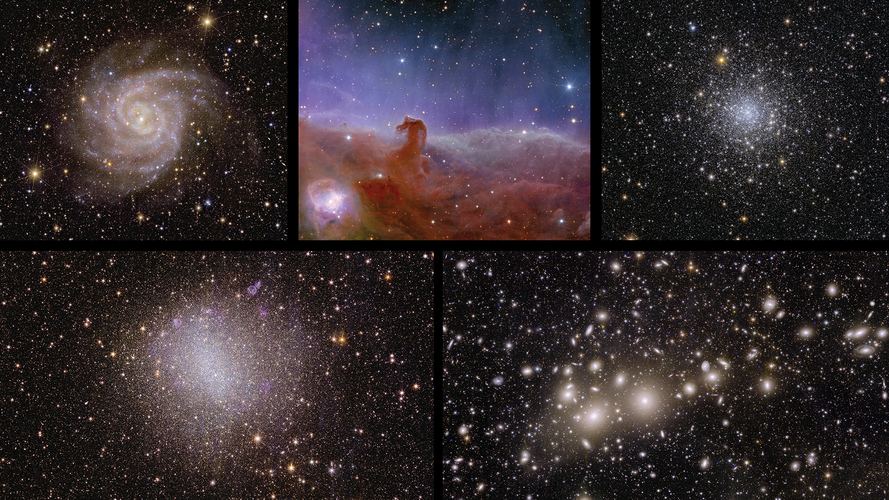
Many a space enthusiast first became interested in the topic when they saw some astounding picture taken by one of the world’s great telescopes and began to get a sense of scale of the universe. This author personally remembers the first time he saw Hubble’s Ultra Deep Field – arguably the image that has changed his life more than any other. Given the massive size of the universe, there are always more incredible pictures to be taken, and now humanity has a new tool for that task. Euclid, the European Space Agency’s dark matter/energy hunter, has released its first set of images – and they are absolutely mesmerizing.
One of the most breathtaking is something equivalent to the famous Ultra Deep Field shot. Except in this case, Euclid decided to concentrate on the Perseus Cluster, a group of over 1,000 galaxies located about 240 million light years away from us. It’s one of the most massive known structures in the universe and will undoubtedly shed some insights into the nature of dark matter and how it affects galaxy formation.
But even more impressively, the shot of the cluster also contains around 100,000 additional galaxies in the background, some as far as 10 billion light years away from us. So look again at those little dots in the background – each of those is a galaxy, and while it might not be quite as big as the Milky Way, it is still likely comprised of hundreds of millions of stars. If that doesn’t provide some sense of scale of the universe, it’s unclear what would be able to.
Video showing off some of the new images from Euclid.Credit – European Space Agency YouTube Channel
Closer to home, there are some images of more familiar-looking objects. One, known as IC 342, is a spiral galaxy that looks suspiciously like the Milky Way if we were able to see it from the top. It’s also known as the “Hidden Galaxy,” but Euclid’s infrared imaging system makes it pop in the newly released picture.
Globular clusters are also of particular interest in hunting for dark matter, and Euclid’s first crop of images contained one of NGC 6397, the second closest globular cluster to Earth. At only 7800 light years distant, it’s only a short hop in astronomical terms, but Euclid has allowed us to see it as never before by capturing an image of the entire cluster in a single observation – no other telescope developed so far can do that.
But possibly one of the author’s personal favorites of this set of images is a new rendition of one of the most famous structures in all of space. Euclid’s capture of the Horsehead Nebula is stunning and ethereal in its sharpness and quality. Part of Euclid’s mission will be to collect information about Jupiter-sized planets being created in this star-forming region. But taking a fantastic picture is a nice bonus, if for no other reason than the aesthetics.
Fraser interviews a Euclid project scientist who goes into details about the plans for the mission.
There are several other fascinating images in the first round, including a type of galaxy called an “irregular dwarf,” which looks more like a diffuse shell of light rather than the spiral or other structures we typically associate with galaxies. ESA also released a video showing a series of captured images, and they probably have more sitting on the telescopes’ data banks as we speak.
However, we might have to wait a little while before they are released. Euclid is currently at the Earth-Sun Lagrange 2 point, and its operators are starting up systems and testing them out. They currently plan on starting full scientific observations in early 2024 and release the data from those observations once a year. With about six years of data expected as part of the mission, expect plenty more stunning photos to come out of this new telescope over the coming years.
Composite image of a series of new pictures from Euclid. Credit – ESA/Euclid/Euclid Consortium/NASA, image processing by J.-C. Cuillandre (CEA Paris-Saclay), G. Anselmi, CC BY-SA 3.0 IGO
How NASA Keeps Ingenuity Going After More than 50 Flights
More information is always better when it comes to publicly funded space exploration projects. So it’s welcome when a NASA engineer takes time out of the assuredly busy work lives to provide an update on everyone’s favorite helicopter on Mars. Ingenuity has been having a rough few months, and a new article entitled “The Long Wait,” posted by Travis Brown, Chief Engineer on the Ingenuity project, on NASA’s website, provides a good amount of detail as to why.
The problems started when Ingenuity took off for flight #52 on April 26th. When the helicopter landed, it was out of range Perseverance, its rover companion, and the helicopter’s radio link back to its controllers on Earth. This was intentional, but it meant that Ingenuity’s minders didn’t know whether the flight had been completed successfully.
Dr. Brown explains why the team would intentionally choose to land the helicopter out of range of Perseverance and details the four main mission priorities for the helicopter’s secondary mission. Unsurprisingly, the number one priority is: don’t mess up Perseverance. The rover is currently collecting interesting samples for the now-endangered Mars Sample Return mission, which, assuming it still goes ahead, will see those samples eventually return to Earth.
Fraser describes Ingenuity’s long silence, among other topics.
If Ingenuity accidentally interferes with that process, needless to say, the NASA brass would be upset. The helicopter’s handlers have decided that the best way for it is to stay well ahead of the rover and let it catch up to them, which is what it was trying to do with Flight #52.
Unfortunately, part of Perseverance’s mission is flexibility, and its own project team can make the call as to where they want the rover to go next. After Ingenuity’s flight, the rover team decided not to stick to the planned path that would take it near the helicopter in a few days but instead take a long way around to do some exciting science elsewhere. When Perseverance did move back into range, 61 days had passed where the helicopter had been patiently waiting for it.
When Ingenuity could finally transmit its images back, the science team was excited as it had landed on a group of pebbles that had never before been seen on the Martian surface. Another flight was planned immediately, with this one intended to scout the immediate area for any other interesting geological features for Perseverance to look at.
NASA released a video to celebrate Ingenuity’s 50th flight. Credit – NASA Jet Propulsion Laboratory YouTube Channel
That’s where the second problem came up. During Ingenuity’s flight #53, a never-before-seen error forced the helicopter to land unexpectedly, what Dr. Brown describes as a time desynchronization between a camera that keeps track of ground features and other sensors tied to its inertial guidance system. Any engineer who has worked with multiple systems can tell you how difficult timing synchronization timing can be, so the guidance system was right to shut the system down for machine safety. Still, it means that Ingenuity was once again grounded without being able to fulfill a potentially interesting mission objective.
While Ingenuity was recovering from its unexpected landing, Perseverance caught up to the helicopter, making it redundant to provide scientific data since the superior instruments on the rover were now on station. Luckily, that freed the helicopter up for a brief flight #54, where it tested its systems out again and then returned to its scouting duties with flight #55 shortly afterward, with no attendant synchronization problems.
Remember that the original mission plan for Ingenuity lasted for 30 days and three flights. It is now on day 979 and has completed 66 flights in total. That is astounding for such a tiny machine on such a remote planet, and congratulations to Dr. Brown and his team. May they be able to overcome many more obstacles and complete many more flights.
Gamma-ray Bursts: Harvesting Knowledge From the Universe's Most Powerful Explosions
The most powerful events in the known universe – gamma-ray bursts (GRBs) – are short-lived outbursts of the highest-energy light. They can erupt with a quintillion (a 10 followed by 18 zeros) times the luminosity of our Sun. Now thought to announce the births of new black holes, they were discovered by accident.
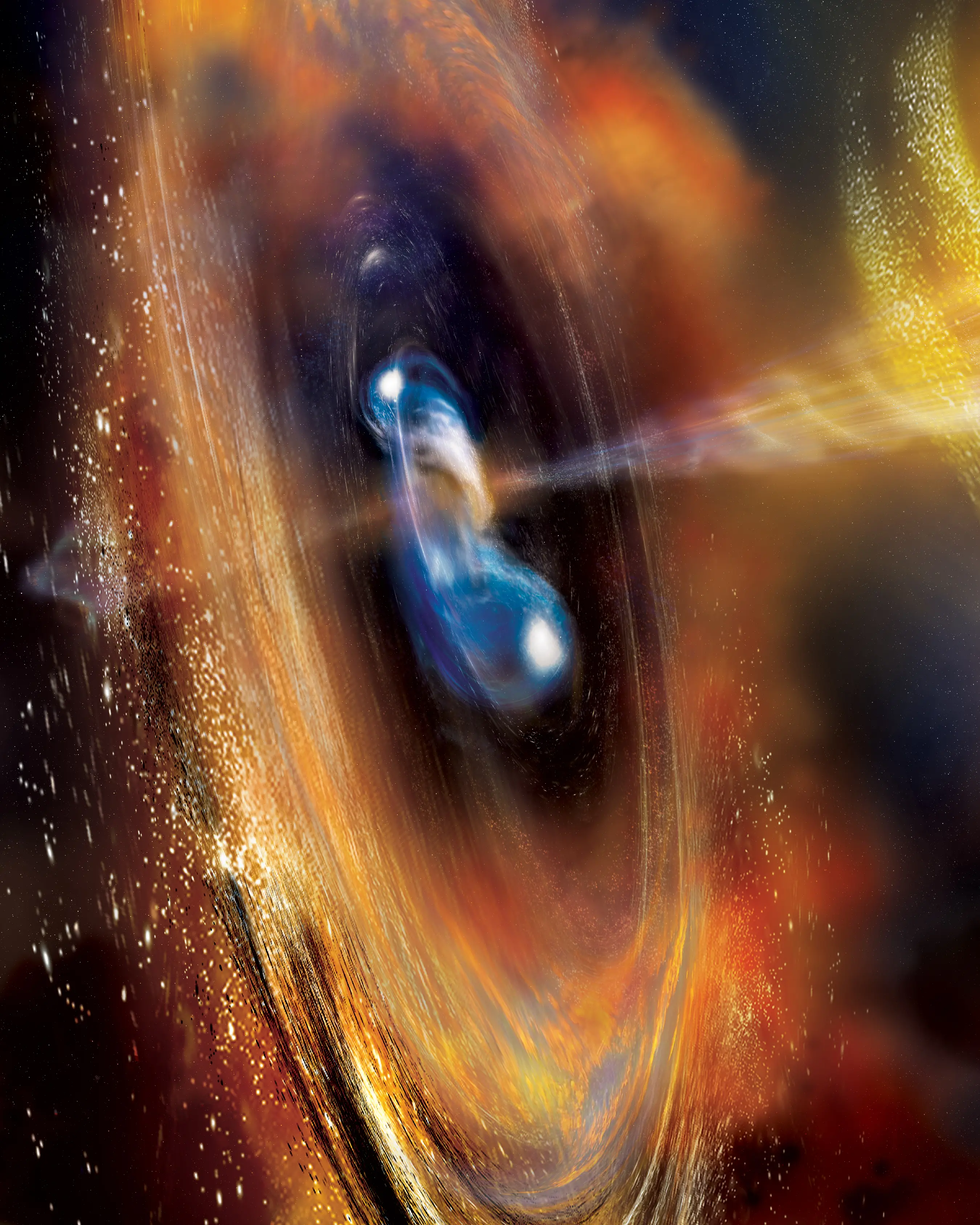
Two neutron stars begin to merge in this artist’s concept, blasting jets of high-speed particles. Collision events like this one create short gamma-ray bursts. Credit: NASA’s Goddard Space Flight Center/ A. Simonnet, Sonoma State University
The backstory takes us to 1963, when the U.S. Air Force launched the Vela satellites to detect gamma rays from banned nuclear weapons tests. The United States had just signed a treaty with the United Kingdom and the Soviet Union to prohibit tests within Earth’s atmosphere, and the Vela satellites ensured all parties’ compliance. Instead, the satellites stumbled upon 16 gamma-ray events. By 1973, scientists could rule out that both Earth and the Sun were the sources of these brilliant eruptions. That’s when astronomers at Los Alamos National Laboratory published the first paper announcing these bursts originate beyond our solar system. Scientists at NASA’s Goddard Space Flight Center quickly confirmed the results through an X-ray detector on the IMP 6 satellite. It would take another two decades and contributions from the Italian Space Agency’s BeppoSax and NASA’s Compton Gamma-Ray Observatory to show that these outbursts occur far beyond our Milky Way galaxy, are evenly distributed across the sky, and are extraordinarily powerful. The closest GRB on record occurred more than 100 million light-years away.
Though discovered by chance, GRBs have proven invaluable for today’s researchers. These flashes of light are rich with insight on phenomena like the end of life of very massive stars or the formation of black holes in distant galaxies.
Still, there are plenty of scientific gems left to discover. In 2017, GRBs were first linked to gravitational waves – ripples in the fabric of space-time – steering us toward a better understanding of the how these events work.
The Long and Short of GRBs
Astronomers separate GRBs into two main classes: short (where the initial burst of gamma rays lasts less than two seconds) and long events (lasting two seconds or longer).
Shorter bursts also produce fewer gamma rays overall, which lead researchers to hypothesize that the two classes originated from different progenitor systems.
Astronomers now associate short bursts with the collision of either two neutron stars or a neutron star and a black hole, resulting in a black hole and a short-lived explosion. Short GRBs are sometimes followed by kilonovae, light produced by the radioactive decay of chemical elements. That decay generates even heavier elements, like gold, silver, and platinum.
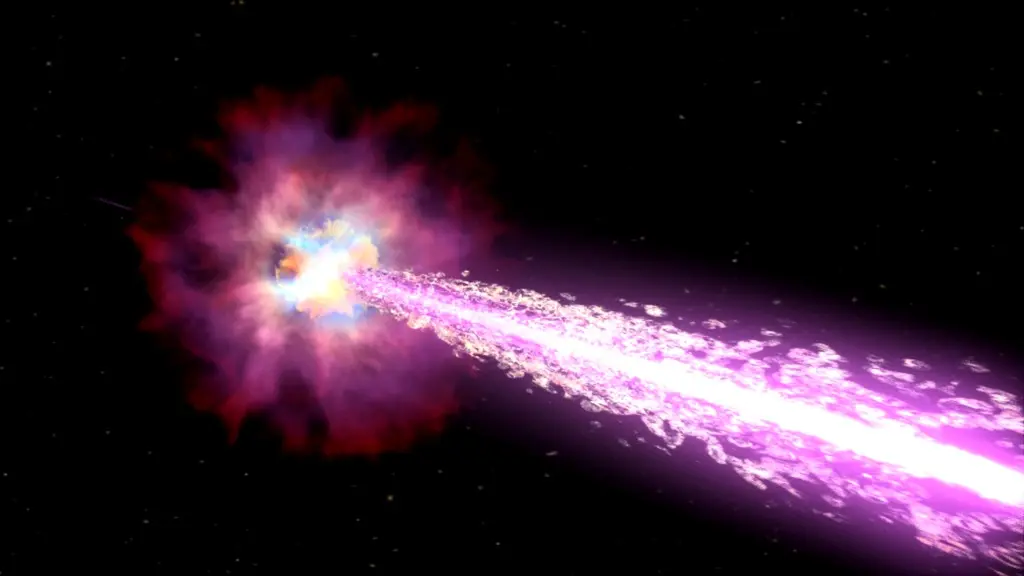
Long bursts are linked to the explosive deaths of massive stars. When a high-mass star runs out of nuclear fuel, its core collapses and then rebounds, driving a shock wave outward through the star. Astronomers see this explosion as a supernova. The core may form a either a neutron star or a black hole.
In both classes, the newly born black hole beams jets in opposite directions. The jets, made of particles accelerated to near the speed of light, pierce through and eventually interact with the surrounding material, emitting gamma rays when they do.
As a high-mass star explodes in this artist’s concept, it produces a jet of high-energy particles. We see GRBs when such gets point almost directly at Earth. Credit: NASA/Swift/Cruz deWilde
This broad outline isn’t the last word, though. The more GRBs astronomers study, the more likely they’ll encounter events that challenge current classifications.
In August 2020, NASA’s Fermi Gamma-ray Space Telescope tracked down a second-long burst named GRB 200826A, over 6 billion light-years away. It should have fallen within the short-burst class, triggered by mergers of compact objects. However, other characteristics of this event – like the supernova it created – suggested it originated from the collapse of a massive star. Astronomers think this burst may have fizzled out before it could reach the duration typical of long bursts.
Fermi and NASA’s Neil Gehrels Swift Observatory captured its opposite number, GRB 211211A in December 2021. Located a billion light-years away, the burst lasted for about a minute. While this makes it a long GRB, it was followed by a kilonova, which suggests it was triggered by a merger. Some researchers attribute this burst’s oddities to a neutron star merging with a black hole partner.
As astronomers discover more bursts lasting several hours, there may still be a new class in the making: ultra-long GRBs. The energy created by the death of a high-mass star likely can’t sustain a burst for this long, so scientists must look to different origins.
Some think ultra-long bursts occur from newborn magnetars – neutron stars with rapid rotation rates and magnetic fields a thousand times stronger than average. Others say this new class calls for the power of the universe’s largest stellar residents, blue supergiants. Researchers continue to explore ultra-long GRBs.
Afterglows Shedding New Light
While gamma rays are the most energetic form of light, they certainly aren’t the easiest to spot. Our eyes see only a narrow band of the electromagnetic spectrum. Studying any light outside that range, like gamma rays, hinges tightly on the instruments our scientists and engineers develop. This need for technology, alongside GRBs’ already fleeting nature, made bursts more difficult to study in early years.
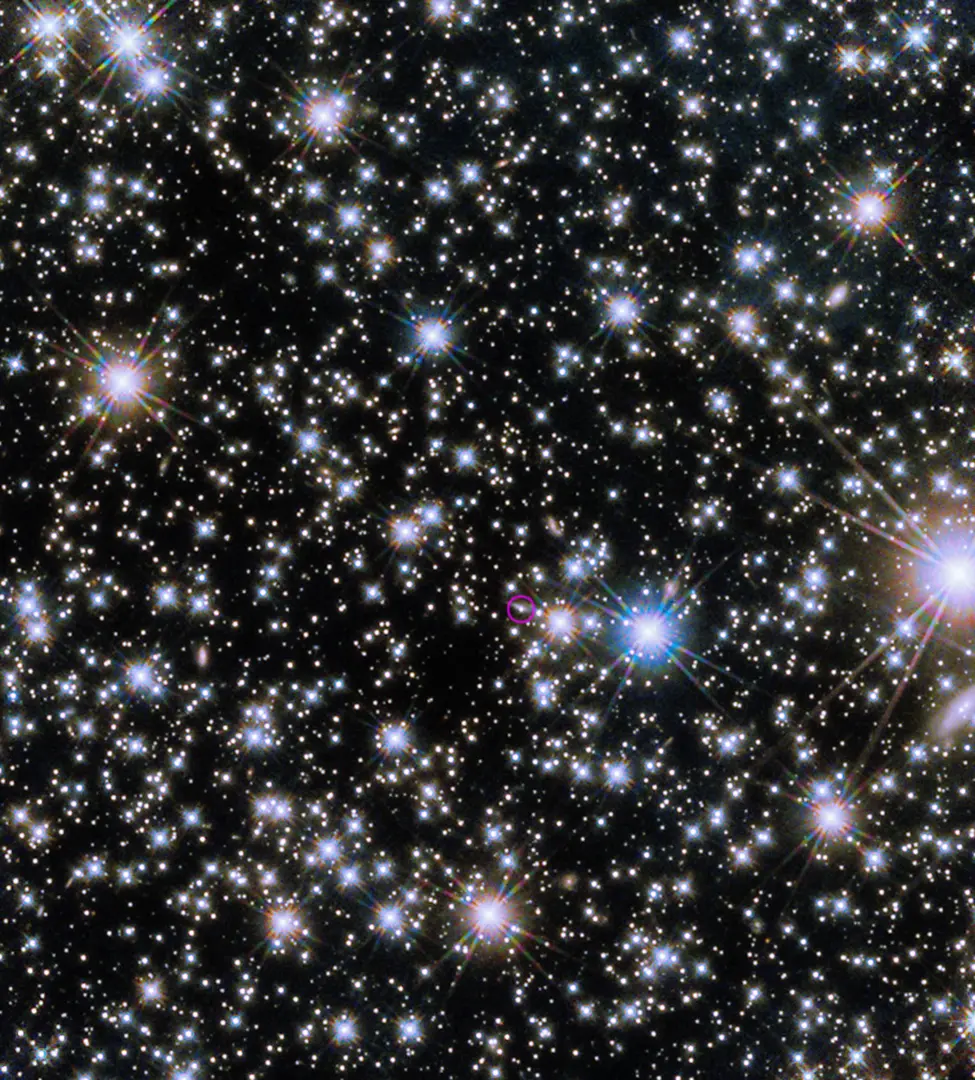
The Hubble Space Telescope’s Wide Field Camera 3 revealed the infrared afterglow (circled) of GRB 221009A and its host galaxy, seen nearly edge-on as a sliver of light extending to upper left from the burst.
Credit: NASA, ESA, CSA, STScI, A. Levan (Radboud University); Image Processing: Gladys Kober
GRB afterglows occur when material in the jets interact with surrounding gas.
Afterglows emit radio, infrared, optical, UV, X-ray, as well as gamma-ray light, which provides more data about the original burst. Afterglows also linger for hours to days (or even years) longer than their initial explosion, creating more opportunities for discovery.
Studying afterglows became key to deducing the driving forces behind different bursts. In long bursts, as the afterglow dims, scientists eventually see the source brighten again as the underlying supernova becomes detectable.
Because afterglows last for such a long time and emit light large telescopes can detect, astronomers can pinpoint their locations and identify their host galaxies. This helps them determine more about bursts, including how far away they are.
Although light is the universe’s fastest traveler, it can’t reach us instantaneously. By the time we detect a burst, millions to billions of years may have passed, allowing us to probe some of the early universe through distant afterglows.
Bursting With Discovery
Despite the expansive research conducted so far, our understanding of GRBs is far from complete. Each new discovery adds new facets to scientists’ gamma-ray burst models.
Fermi and Swift discovered one of these revolutionary events in 2022 with GRB 221009A, a burst so bright it temporarily blinded most space-based gamma-ray instruments. A GRB of this magnitude is predicted to occur once every 10,000 years, making it likely the highest-luminosity event witnessed by human civilization. Astronomers accordingly dubbed it the brightest of all time – or the BOAT.
This is one of the nearest long burst ever seen at the time of its discovery, offering scientists a closer look at the inner workings of not only GRBs, but also the structure of the Milky Way. By peering into the BOAT, they’ve discovered radio waves missing in other models and traced X-ray reflections to map out our galaxy’s hidden dust clouds.
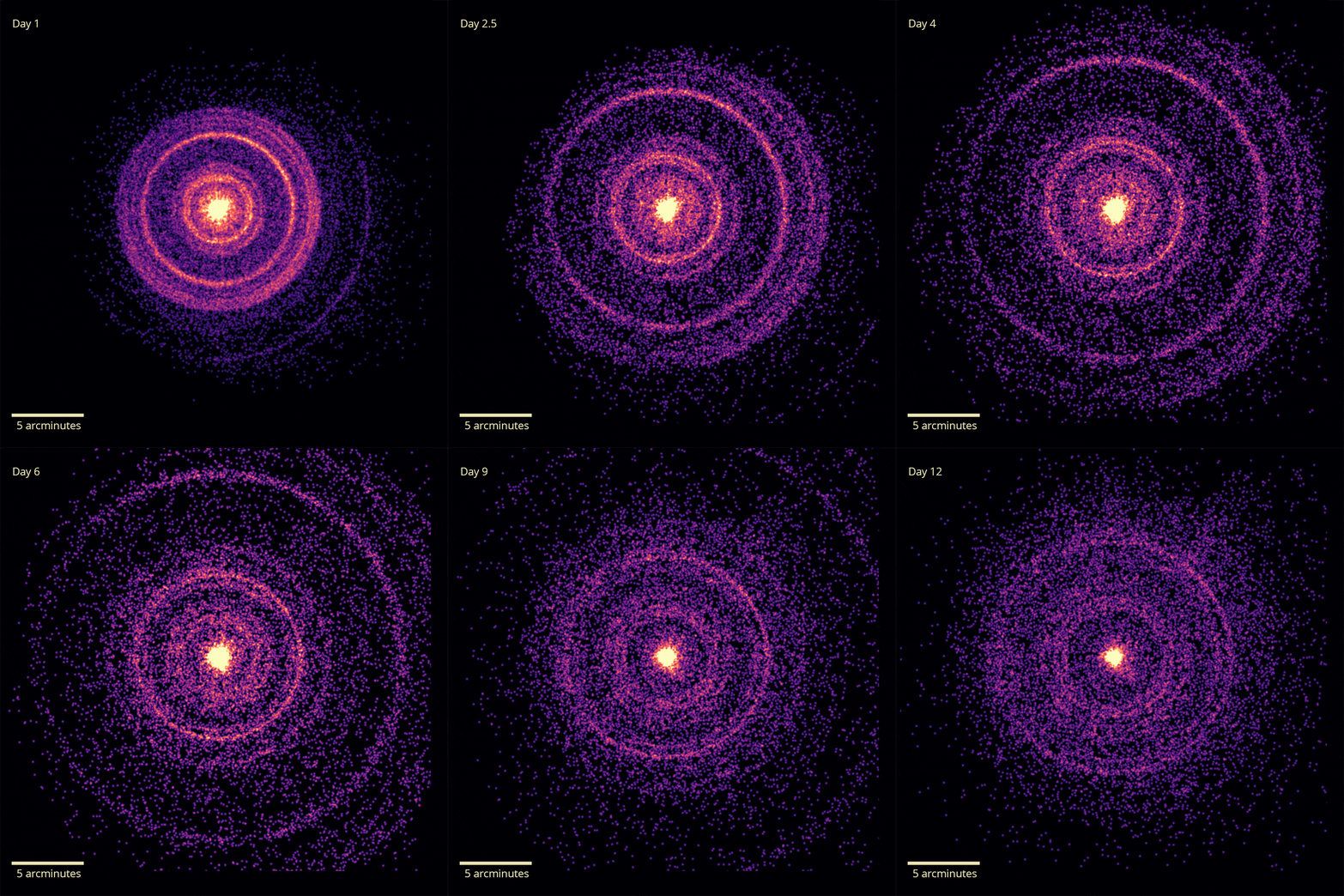
NASA’s Neil Gehrels Swift Observatory detected X-rays from the initial flash of GRB 221009A for weeks as dust in our galaxy scattered the light back to us, shown here in arbitrary colors. Credit: NASA/Swift/A. Beardmore (University of Leicester)
GRBs also connect us to one of the universe’s most sought-after messengers. Gravitational waves are invisible distortions of space-time, born from cataclysmic events like neutron-star collisions. Think of space-time as the universe’s all-encompassing blanket, with gravitational waves as ripples wafting through the material.
In 2017, Fermi spotted the gamma-ray flash of a neutron-star merger just 1.7 seconds after gravitational waves were detected from the same source. After traveling 130 million light-years, the gravitational waves reached Earth narrowly before the gamma rays, proving gravitational waves travel at the speed of light.
Scientists had never detected light and gravitational waves’ joint journey all the way to Earth. These messengers combined paint a more vivid picture of merging neutron stars.
With continued research, our ever-evolving knowledge of GRBs could unravel the unseen fabric of our universe. But the actual burst is just the tip of the iceberg. An endless bounty of information looms just beneath the surface, ready for the harvest.
Later dubbed the Oh-My-God particle, the cosmic ray’s energy shocked astrophysicists. Nothing in our Galaxy had the power to produce it, and the particle had more energy than was theoretically possible for cosmic rays traveling to Earth from other galaxies.
Led by the University of Utah and the University of Tokyo, the Telescope Array has since observed more than 30 ultra-high-energy cosmic rays, though none approaching the Oh-My-God-level energy. No observations have yet revealed their origin or how they are able to travel to the Earth.
On May 27, 2021, the Telescope Array experiment detected the second-highest extreme-energy cosmic ray.
At 2.4*1020 eV, the energy of this single subatomic particle is equivalent to dropping a brick on your toe from waist height.
The Telescope Array consists of 507 surface detector stations arranged in a square grid that covers 700 km2 outside of Delta, Utah.
The event triggered 23 detectors at the north-west region of the Telescope Array, splashing across 48 km2.
Its arrival direction appeared to be from the Local Void, an empty area of space bordering the Milky Way Galaxy.
“The particles are so high energy, they shouldn’t be affected by galactic and extra-galactic magnetic fields,” said Dr. John Matthews, Telescope Array co-spokesperson at the University of Utah.
“You should be able to point to where they come from in the sky.”
“But in the case of the Oh-My-God particle and this new particle, you trace its trajectory to its source and there’s nothing high energy enough to have produced it.”
“That’s the mystery of this — what the heck is going on?”
The researchers named it the Amaterasu particle after the Sun goddess in Japanese mythology.
The Oh-My-God and the Amaterasu particles were detected using different observation techniques, confirming that while rare, these ultra-high energy events are real.
“These events seem like they’re coming from completely different places in the sky. It’s not like there’s one mysterious source,” said University of Utah’s Professor John Belz.
“It could be defects in the structure of spacetime, colliding cosmic strings. I mean, I’m just spit-balling crazy ideas that people are coming up with because there’s not a conventional explanation.”
Ultra-high-energy cosmic rays must exceed 5*1019 eV. This means that a single subatomic particle carries the same kinetic energy as a major league pitcher’s fast ball and has tens of millions of times more energy than any human-made particle accelerator can achieve.
Astrophysicists calculated this theoretical limit, known as the Greisen-Zatsepin-Kuzmin (GZK) cutoff, as the maximum energy a proton can hold traveling over long distances before the effect of interactions of the microwave background radiation take their energy.
Known source candidates, such as active galactic nuclei or black holes with accretion disks emitting particle jets, tend to be more than 160 million light-years away from Earth.
The new particle’s 2.4*1020 eV and the Oh-My-God particle’s 3.2*1020 eV easily surpass the cutoff.
The scientists also analyzed cosmic ray composition for clues of its origins: heavier particles, like iron nuclei, have more charge and are more susceptible to bending in a magnetic field than lighter particles made of protons from a hydrogen atom.
The new particle is likely a proton.
Particle physics dictates that a cosmic ray with energy beyond the GZK cutoff is too powerful for the microwave background to distort its path, but back tracing its trajectory points towards empty space.
“Maybe magnetic fields are stronger than we thought, but that disagrees with other observations that show they’re not strong enough to produce significant curvature at these ten-to-the-twentieth electron volt energies. It’s a real mystery,” Professor Belz said.
Robert Bigelow, founder of Bigelow Aerospace Says Out Of Body Experience Can Be Induced," UFO Sighting News.
Here is something I have never seen before, but pertains to the old CIA files of them using remote viewing to see alien activities and structures on other planets and moons in our solar system. Billionaire Robert Bigelow, states that a general told him about some experiments that created out of body experiences using an astronaut G-Lock, which is like a fast spinning arm with a chair. This is real science and it defies all scientific explanations. But one day, science will recognize it and it will no longer be in the shadows.
UFO orbs are most often seen near aircraft, not because it's interesting, but because it's the only thing in the sky near them that they can scan and observe closely. Here we see a one meter metallic orb, similar to those seen in recently US government released videos. Orbs can both be controlled by an AI thats almost godlike, and it can be controlled manually by an alien or AI species on a far away planet.
Oh, and the eyewitness states, he felt compelled to watch, orbs and UFOs do have telepathic tech that can both read your thoughts from up to a mile away or more and it can also send you messages. If it ever happens to you, you will 100% understand. Yes, its happened to me and I still am amazed by my own experience. Meditation can call them to you, if you are focused for 15 minutes or more, alone and hold still, so they can pinpoint your exact location. Send them a greetings, "Welcome my brothers and sisters in the sky, we are all one, I am honored to know you are there." And go from there on your own. Good luck.
Scott C. Waring
Eyewitness states:
"A sphere makes an excessively close approach to an airplane about to land in Costa Rica. This is a demonstration of the versatility of these objects. We received a mental command to record the aircraft and that we would see a surprise."
Meer van UFO'S of UAP'S, ASTRONOMIE, RUIMTEVAART, ARCHEOLOGIE, OUDHEIDKUNDE, SF-SNUFJES EN ANDERE ESOTERISCHE WETENSCHAPPEN - DE ALLERLAATSTE NIEUWTJES


 LATEST UFO SIGHTINGS AND VIDEOS - 25 /11/2023