Naar de inhoud

UFO'S of UAP'S, ASTRONOMIE, RUIMTEVAART, ARCHEOLOGIE, OUDHEIDKUNDE, SF-SNUFJES EN ANDERE ESOTERISCHE WETENSCHAPPEN - DE ALLERLAATSTE NIEUWTJES

UFO's of UAP'S in België en de rest van de wereld
akke.beakke.be
Ontdek de Fascinerende Wereld van UFO's en UAP's: Jouw Bron voor Onthullende Informatie! Ben jij ook gefascineerd door het onbekende? Wil je meer weten over UFO's en UAP's, niet alleen in België, maar over de hele wereld? Dan ben je op de juiste plek! België: Het Kloppend Hart van UFO-onderzoek In België is BUFON (Belgisch UFO-Netwerk) dé autoriteit op het gebied van UFO-onderzoek. Voor betrouwbare en objectieve informatie over deze intrigerende fenomenen, bezoek je zeker onze Facebook-pagina en deze blog. Maar dat is nog niet alles! Ontdek ook het Belgisch UFO-meldpunt en Caelestia, twee organisaties die diepgaand onderzoek verrichten, al zijn ze soms kritisch of sceptisch. Nederland: Een Schat aan Informatie Voor onze Nederlandse buren is er de schitterende website www.ufowijzer.nl, beheerd door Paul Harmans. Deze site biedt een schat aan informatie en artikelen die je niet wilt missen! Internationaal: MUFON - De Wereldwijde Autoriteit Neem ook een kijkje bij MUFON (Mutual UFO Network Inc.), een gerenommeerde Amerikaanse UFO-vereniging met afdelingen in de VS en wereldwijd. MUFON is toegewijd aan de wetenschappelijke en analytische studie van het UFO-fenomeen, en hun maandelijkse tijdschrift, The MUFON UFO-Journal, is een must-read voor elke UFO-enthousiasteling. Bezoek hun website op www.mufon.com voor meer informatie. Samenwerking en Toekomstvisie Sinds 1 februari 2020 is Pieter niet alleen ex-president van BUFON, maar ook de voormalige nationale directeur van MUFON in Vlaanderen en Nederland. Dit creëert een sterke samenwerking met de Franse MUFON Reseau MUFON/EUROP, wat ons in staat stelt om nog meer waardevolle inzichten te delen. Let op: Nepprofielen en Nieuwe Groeperingen Pas op voor een nieuwe groepering die zich ook BUFON noemt, maar geen enkele connectie heeft met onze gevestigde organisatie. Hoewel zij de naam geregistreerd hebben, kunnen ze het rijke verleden en de expertise van onze groep niet evenaren. We wensen hen veel succes, maar we blijven de autoriteit in UFO-onderzoek! Blijf Op De Hoogte! Wil jij de laatste nieuwtjes over UFO's, ruimtevaart, archeologie, en meer? Volg ons dan en duik samen met ons in de fascinerende wereld van het onbekende! Sluit je aan bij de gemeenschap van nieuwsgierige geesten die net als jij verlangen naar antwoorden en avonturen in de sterren! Heb je vragen of wil je meer weten? Aarzel dan niet om contact met ons op te nemen! Samen ontrafelen we het mysterie van de lucht en daarbuiten.

Archief

Woman Abducted by Reptilian Alien

Woman Abducted by Reptilian Alien
Woman Abducted by Reptilian Alien
In the quaint town of Hove, England, 2008, the eerie silence of the night was pierced by an incident that might sound like the stuff of science fiction but was claimed as a lived experience by 20-year-old Charmaine D’Rozario-Saytch. This experience raises thought-provoking questions about our world and our place in the universe.

Charmaine’s story begins like any other night, with her deep in sleep, nestled comfortably in her bed. But as the night progressed, she encountered what she describes as a chilling sight – a reptilian humanoid figure looming over her. This wasn’t a figment of her imagination nor a dream. It was her reality.

She recounts being led to an underground cave, surrounded by a group of these reptilian beings. What followed was an extraordinary transformation. Charmaine claims she underwent a physical metamorphosis, watching in bewilderment and astonishment as her smooth skin turned to scales, and she grew a tail, changing from a human into a reptilian form. The very essence of her human identity seemingly altered in those moments.

But the story doesn’t end here. Charmaine asserts that her abductors revealed a startling piece of information: humans might be the result of extraterrestrial genetic manipulation. Not all, but specific groups, throughout our history, have been visited and genetically altered by different extraterrestrial races. If this assertion holds any weight, it leads us to wonder, are we truly alone in this vast universe?

Linda Moulton Howe, a noted investigator in the realm of unexplained phenomena, believes the presence of these alien entities might be tied to territorial conflicts among different extraterrestrial civilizations. These conflicts might have repercussions that impact not just these advanced beings but also the very life they’ve supposedly created or manipulated.

Video:

  • Woman Abducted by Reptilian Alien (Season 14) | Ancient Aliens | The UnXplained Zone
The very nature of these stories and theories challenges our preconceived notions about religion and ancient prophecies. Ancient texts from various religious traditions speak of divine figures returning to Earth. Could these be misinterpretations or signs pointing towards the return of extraterrestrial entities? Giorgio Tsoukalos, a prominent figure in the study of ancient astronauts, posits that these promises of return might not be of divine nature, but extraterrestrial.

As we stand at the cusp of possibly one of the most transformative eras in human history, the question that looms large is whether we’re prepared for the potential revelation of our cosmic neighbors. Will they emerge from the shadows, or are they just figments of our collective imaginations, fueled by our innate desire to not be alone in this vast expanse of the universe?

{ https://www.latest-ufo-sightings.net/ }

Hoe vind je dit bericht?
Geschreven door peter om 00:34 Stuur door

NASA’s Juno-missie detecteert organische stoffen op de gigantische maan Ganymede van Jupiter

NASA’s Juno-missie detecteert organische stoffen op de gigantische maan Ganymede van Jupiter

 Claudia Vogel 

NASA’s Juno-missie detecteert organische stoffen op de gigantische maan Ganymede van Jupiter

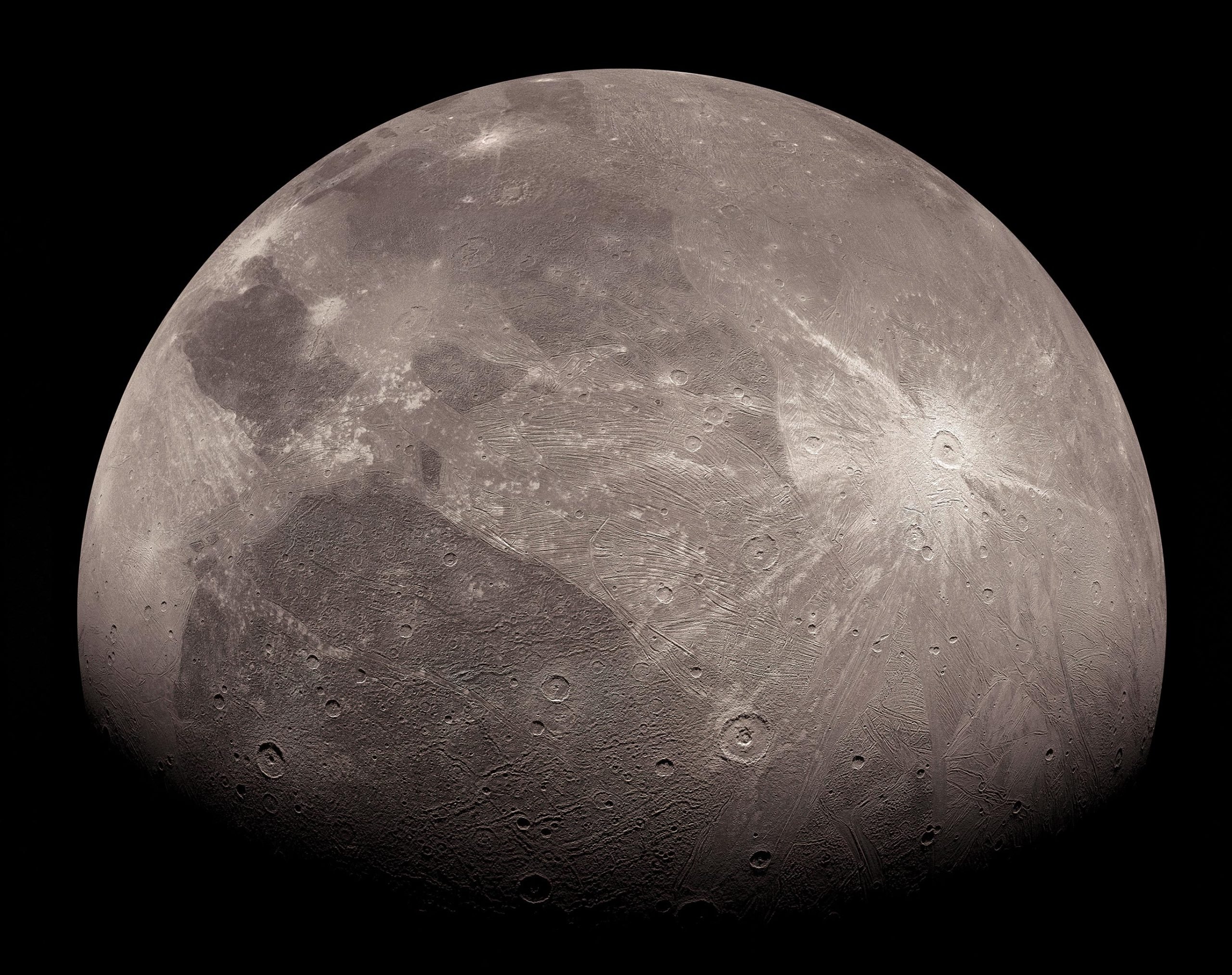
Deze verbeterde afbeelding van Jupiters maan Ganymedes werd verkregen door de JunoCam-imager aan boord van NASA’s Juno-ruimtevaartuig tijdens de vlucht van de missie op 7 juni 2021 langs de ijzige maan. Gegevens van deze pas werden gebruikt om de aanwezigheid van zouten en organische materialen op Ganymedes te detecteren.

Beeldcredits: NASA/JPL-Caltech/SwRI/MSSS/Kalleheikki Kannisto © CC BY

Gegevens verzameld door NASAJuno’s missie suggereert dat het zoute verleden mogelijk aan de oppervlakte komt JupiterDe grootste maan.

NASA’s Juno-missie ontdekte minerale zouten en organische verbindingen op het oppervlak van Jupiters maan Ganymede. Gegevens voor deze ontdekking werden verzameld door de Jovian InfraRed Auroral Mapper (JIRAM) spectrometer aan boord van het ruimtevaartuig tijdens een vlucht langs de ijzige maan. De resultaten, die wetenschappers zouden kunnen helpen de oorsprong van Ganymede en de samenstelling van zijn diepe oceanen beter te begrijpen, werden op 30 oktober in het tijdschrift gepubliceerd. Natuur astronomie.

Ganymedes, groter dan de planeet Mercurius, is de grootste manen van Jupiter en is lange tijd van groot belang geweest voor wetenschappers vanwege de enorme binnenoceaan van water verborgen onder de ijskoude korst. Eerdere spectroscopische waarnemingen door NASA’s Galileo-ruimtevaartuig, de Hubble-ruimtetelescoop en de Very Large Telescope van het European Southern Observatory hebben de aanwezigheid van zouten en organische materialen aangetoond, maar de ruimtelijke resolutie van die waarnemingen was te laag om vast te stellen.

Op 7 juni 2021 kwam NASA’s Juno-ruimtevaartuig dichter bij Jupiters met ijs bedekte maan Ganymede dan enig ruimtevaartuig in meer dan twintig jaar. Minder dan een dag later maakte Juno zijn 34ste scheervlucht langs Jupiter. Deze animatie biedt een ‘ruimtevaartuigkapitein’-weergave van elke vlucht. Voor beide werelden werden JunoCam-beelden orthografisch geprojecteerd op een digitale bol en gebruikt om vluchtanimaties te maken. Er zijn kunstmatige frames toegevoegd om benaderings- en vertrekbeelden van zowel Ganymede als Jupiter te bieden. Krediet: NASA/Laboratorium voor straalaandrijving-California Institute of Technology/SwRI/MSSS

Juno’s nauwe benadering en de resultaten ervan

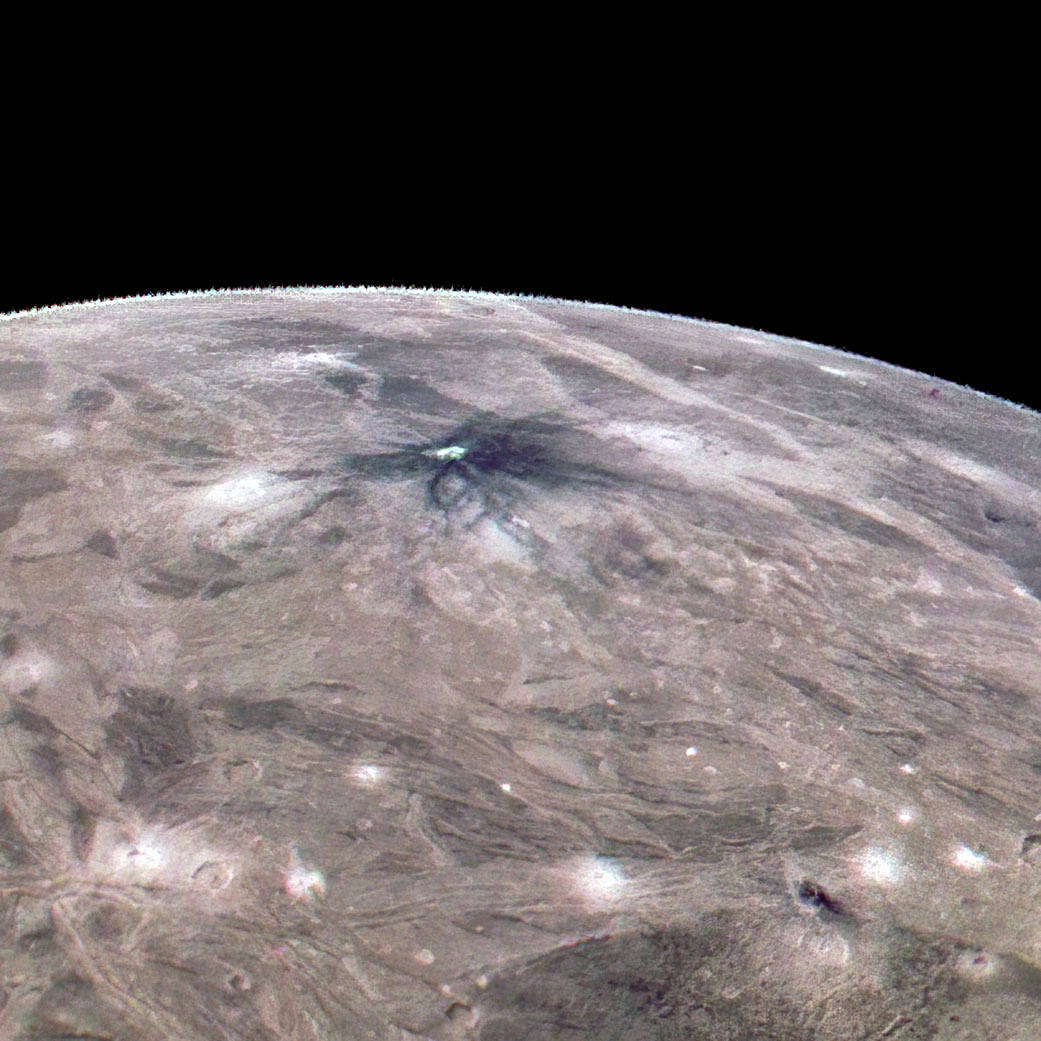
Op 7 juni 2021 vloog Juno over Ganymede (zie video hierboven) op een hoogte van minstens 650 mijl (1.046 kilometer). Kort na het tijdstip van de dichtste nadering maakte het JIRAM-instrument infraroodbeelden en infraroodspectra (in wezen chemische vingerafdrukken van materialen, gebaseerd op de manier waarop ze licht reflecteren) van het oppervlak van de maan. JIRAM, gebouwd door de Italiaanse ruimtevaartorganisatie Agenzia Spaziale Italiana, is ontworpen om infrarood licht (onzichtbaar voor het blote oog) op te vangen dat diep uit Jupiter komt, om de weerlaag te onderzoeken tot een diepte van 30 tot 45 mijl (50 tot 70 mijl). kilometer) hieronder. Gasreuzenwolken. Maar het instrument is ook gebruikt om inzicht te geven in de topografie van de manen Io, Europa, Ganymede en Callisto (gezamenlijk bekend als Satelliet). Manen van Galilea Voor hun ontdekker Galileo).

Ganymede

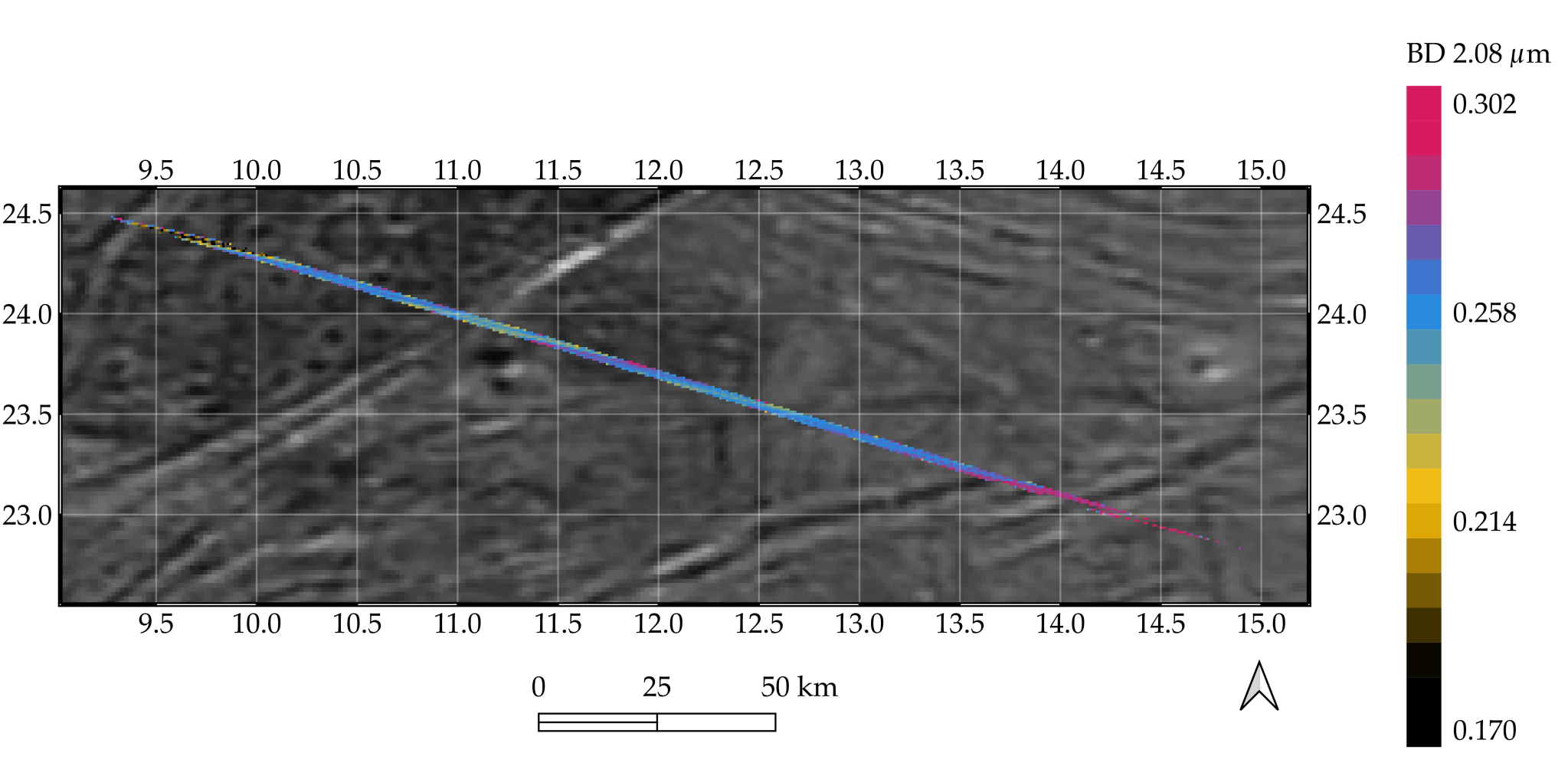
Verwerkte gegevens van de Jovian InfraRed Auroral Mapper (JIRAM) spectrometer aan boord van NASA’s Juno-missie worden over een mozaïek van optische beelden van de Galileo- en Voyager-ruimtevaartuigen van het agentschap heen gelegd die het gegroefde terrein op Jupiters maan Ganymede tonen.

Afbeelding tegoed: NASA/JPL-Caltech/SwRI/ASI/INAF/JIRAM/Brown University

Ontdek andere Joviaanse werelden

Eerdere modellen van het magnetische veld van Ganymedes hebben vastgesteld dat het equatoriale gebied van de maan, tot ongeveer 40 graden noorderbreedte, beschermd is tegen energetische elektronen- en zware ionenbombardementen veroorzaakt door Het helse magnetische veld van Jupiter. Het is bekend dat de aanwezigheid van deze deeltjesstromen een negatieve invloed heeft op zouten en organisch materiaal.

Tijdens de vlucht van juni 2021 besloeg JIRAM een smal bereik van breedtegraden (10°N tot 30°N) en een groter bereik van lengtegraden (35°O tot 40°O) op het naar Jupiter gerichte halfrond.

“We vonden de grootste overvloed aan zouten en organische materialen in Donker en helder terrein “Op breedtegraden waar het magnetische veld beschermt”, zegt hoofdonderzoeker Scott Bolton van de Juno-missie van het Southwest Research Institute in San Antonio. “Dit suggereert dat we de overblijfselen zien van een diepe oceaanpekel die de oppervlakte van deze bevroren wereld heeft bereikt.”

Processed data from the Jovian InfraRed Auroral Mapper (JIRAM) spectrometer

Verwerkte gegevens van de Jovian InfraRed Auroral Mapper (JIRAM) spectrometer aan boord van NASA's Juno-missie worden over een mozaïek van optische beelden van de Galileo- en Voyager-ruimtevaartuigen van het agentschap heen gelegd die gegroefd terrein op Jupiters maan Ganymede tonen.
NASA/JPL-Caltech/SwRI/ASI/INAF/JIRAM/Brown University

Ganymedes is niet de enige ondergrondse wereld waar Juno doorheen ging. De maan Europa, waarvan men denkt dat deze een oceaan onder zijn ijskoude korst heeft, kwam ook onder de aandacht van Juno, eerst in oktober 2021 (zie afbeelding hierboven) en vervolgens in september 2022. En nu krijgt Io de flyby-behandeling. De volgende nadering van deze met vulkanen gevulde wereld is gepland voor 30 december, wanneer het ruimtevaartuig een bereik zal bereiken van binnen 932 mijl (1.500 kilometer) van het oppervlak van Io.

Referentie:

  • “Zouten en organische stoffen op het oppervlak van Ganymede gecontroleerd door de JIRAM-spectrometer aan boord van Juno” door Federico Tosi, Alessandro Mora, Alessandra Cofano, Francesca Zambon, Christopher R. Glenn, Mauro Ciarniello, Jonathan I. Lunin, Giuseppe Piccione, Cristina Bellacci, Roberto Sordini, Alberto Adriani, Scott J. Bolton, Candace J. Hansen, Tom A. Nordheim, Alessandro Moirano, Livio Agostini, Francesca Altieri, Sean M. Brooks, Andrea Cicchetti, Bianca Maria Dinelli, Davide Grassi, Alessandra Migliorini, Maria Luisa Morricone, Raffaella Nochesi, Pietro Scarica, Giuseppe Sindoni, Stefania Stefani en Diego Torini, 30 oktober , 2023, Natuur astronomie.
    doi: 10.1038/s41550-023-02107-5

NASA’s Jet Propulsion Laboratory (JPL), een divisie van het California Institute of Technology in Pasadena, Californië, beheert de Juno-missie voor hoofdonderzoeker Scott Bolton van het Southwest Research Institute in San Antonio. Juno maakt deel uit van NASA’s New Frontiers Program, dat wordt beheerd in het Marshall Space Flight Center van NASA in Huntsville, Alabama, voor het Science Mission Directorate van het agentschap in Washington. De Italiaanse ruimtevaartorganisatie (ASI) financierde de Jovian InfraRed Auroral Mapper. Lockheed Martin Space in Denver bouwde en exploiteert het ruimtevaartuig.

{ https://koninkrijksrelaties.nu/ }

Hoe vind je dit bericht?
Geschreven door peter om 23:52 Stuur door

NASA’s Sonde Detecteert Zouten en Organische Verbindingen op de Grootste Maan van Jupiter

NASA’s Sonde Detecteert Zouten en Organische Verbindingen op de Grootste Maan van Jupiter

NASA’s Sonde Detecteert Zouten en Organische Verbindingen op de Grootste Maan van Jupiter (NASA/JPL- Caltech/SwRI/MSSS/Kalleheikki Kannisto (CC BY))

NASA’s Sonde Detecteert Zouten en Organische Verbindingen op de Grootste Maan van Jupiter

(NASA/JPL- Caltech/SwRI/MSSS/Kalleheikki Kannisto (CC BY))© Aangeboden door Tech Break

In een nieuwe verkenning heeft Juno, een sonde van de NASA, een belangrijke ontdekking gedaan door mineralen en organische verbindingen op het oppervlak van de grootste maan van Jupiter en de grootste in ons zonnestelsel, Ganymedes, te observeren.

Deze gegevens werden verzameld tijdens een scheervlucht van de sonde dicht bij de bevroren maan en onthulden de aanwezigheid van ammoniumzouten, gehydrateerd natriumchloride, natriumbicarbonaat en mogelijke alifatische aldehyden, wat suggereert dat Ganymedes deze materialen tijdens zijn vorming heeft kunnen accumuleren. Deze ontdekking biedt waardevolle inzichten in de oorsprong van de maan en de samenstelling van zijn diepe oceaan.

Informatie verzameld door Juno onthulde ook dat gebieden beschermd door het magnetische veld van Jupiter de hoogste concentraties van zouten en organische verbindingen vertoonden. Deze bevinding draagt bij aan het begrip van de processen die Ganymedes in de loop van de tijd hebben gevormd en aan mogelijke oceanische omgevingen op andere hemellichamen.

Ganymedes is de grootste maan van Jupiter en staat bekend om het herbergen van een intern oceaan onder zijn bevroren korst, wat het tot een interessant onderzoeksobject maakt voor wetenschappers.

{ http://techbreak.ig.com.br/ }

Hoe vind je dit bericht?
Geschreven door peter om 23:03 Stuur door

Study: Asteroid Impact-Generated Dust Played Key Role in Dinosaur-Killing Mass Extinction

Asteroid Impact-Generated Dust Played Key Role in Dinosaur-Killing Mass Extinction

About 66 million years ago, a massive asteroid crashed into Earth near the site of the small town of Chicxulub in what is now Mexico. The impact eradicated roughly 75% of the animal and plant species on Earth, including whole groups like non-avian dinosaurs and ammonites. Fine silicate dust from pulverized rock generated by the impact played a dominant role in global climate cooling and the disruption of photosynthesis following the event, according to new research.

This painting depicts an asteroid slamming into tropical, shallow seas of the sulfur-rich Yucatan Peninsula in what is today southeast Mexico. The aftermath of this immense asteroid collision, which occurred approximately 65 million years ago, is believed to have caused the extinction of the dinosaurs and many other species on Earth. Shown in this painting are pterodactyls, flying reptiles with wingspans of up to 50 feet, gliding above low tropical clouds. Image credit: Donald E. Davis / NASA.

This painting depicts an asteroid slamming into tropical, shallow seas of the sulfur-rich Yucatan Peninsula in what is today southeast Mexico. The aftermath of this immense asteroid collision, which occurred approximately 65 million years ago, is believed to have caused the extinction of the dinosaurs and many other species on Earth. Shown in this painting are pterodactyls, flying reptiles with wingspans of up to 50 feet, gliding above low tropical clouds.

Image credit: Donald E. Davis / NASA.

The Chicxulub impact has long been thought to have triggered a global winter 66 million years ago, which led to the demise of the dinosaurs and around 75% of species on Earth.

However, what effect the various types of debris ejected from the crater had on the climate is debated, and exactly what caused the mass extinction remains unclear.

Previous research has suggested that sulfur released during the impact and soot from post-impact wildfires constituted the main drivers of an impact winter, but the size of silicate dust particles ejected into the atmosphere has not been considered to be a major contributor.

“The Chicxulub asteroid impact event 66 million years ago showcases a unique opportunity to examine the rate, magnitude and mechanisms of extreme and abrupt climate change in Earth’s history,” said Dr. Cem Berk Senel, a researcher at the Royal Observatory of Belgium and Vrije Universiteit Brussel, and his colleagues.

“The 45-60° inclined impact of a 10- to 15-km-sized carbonaceous chondrite on the Yucatán Peninsula in Mexico triggered a chain reaction of events ultimately responsible for the end-Cretaceous mass extinction and the demise of 75% of species, including the iconic non-avian dinosaurs.”

“Yet the climatic consequences of the various debris injected into the atmosphere following the Chicxulub impact remain unclear, and the exact killing mechanisms of the mass extinction remain poorly constrained.”

To evaluate the roles of sulfur, soot and silicate dust on the post-impact climate, Dr. Senel and co-authors produced paleoclimate simulations based on an analysis of fine-grained material emplaced at a well-preserved impact deposit from a site in North Dakota, the United States.

They found that the size distribution of silicate debris (approximately 0.8-8 micrometers) revealed a larger contribution of fine dust than previously appreciated.

They inputted the measured size distribution into a climate model and estimated that such fine dust could have remained in the atmosphere for up to 15 years after the event, contributing to global cooling the Earth’s surface by as much as 15 degrees Celsius.

They suggest that dust-induced changes in solar radiation may also have shut down photosynthesis for almost two years post-impact.

“Our simulations of the atmospheric injection of such a plume of micrometer-sized silicate dust suggest a long atmospheric lifetime of 15 years, contributing to a global-average surface temperature falling by as much as 15 degrees Celsius,” the authors said.

“Simulated changes in photosynthetic active solar radiation support a dust-induced photosynthetic shut-down for almost 2 years post-impact.”

“We suggest that, together with additional cooling contributions from soot and sulfur, this is consistent with the catastrophic collapse of primary productivity in the aftermath of the Chicxulub impact.”

The results appear in the journal Nature Geoscience.

  • C.B. Senel et al. Chicxulub impact winter sustained by fine silicate dust. Nat. Geosci, published online October 30, 2023; doi: 10.1038/s41561-023-01290-4

{ https://www.sci.news/ }

Hoe vind je dit bericht?
Geschreven door peter om 00:40 Stuur door

The Intriguing Tales Behind UFO Sightings: Real Accounts from Abductees

The Intriguing Tales Behind UFO Sightings: Real Accounts from Abductees

Five tales of alien abduction

UFO sightings have fascinated humans for decades. From mysterious lights in the night sky to tales of alien abductions, these unexplained phenomena continue to capture our imagination. In an age of technology and extensive space exploration, the stories behind UFO sightings have become more compelling than ever.

Drawing Insights from the Abductees:

The documentary “Abductees” by Paul Vester delves deep into the experiences of those who claim to have been abducted by extraterrestrial beings. These aren’t just mere tales but are accounts formed from interviews, hypnotic regression tapes, and the original drawings of abductees like Linda Cortile and Rusty Hudson.

Visual Representations of the Encounters:

A striking element of these tales is the artwork that originates from the very individuals who experienced these encounters. Often, therapists and investigators ask abductees to sketch what they witnessed, and these drawings serve as the primary means to visualize their experiences. These aren’t just rudimentary sketches but vivid portrayals of their memories. The emphasis on the eyes of the extraterrestrial beings is a recurring theme. Many describe them as akin to 1950s Italian wraparound sunglasses. These depictions aren’t just for investigators; they offer a therapeutic outlet for the abductees.

Beyond the Visual – The Emotional Depth:

The emotional depth of these accounts is haunting. One abductee recounted the sheer force of telepathic communication, likening it to a radio turned too loud. Another speaks of the terrifying ordeal, describing the feeling of pressure around the kidneys and the strange sensation that followed.

The Power of Memory:

These memories, often suppressed or distorted, sometimes need hypnotic regression to surface. Some abductees remember certain aspects of the experience clearly, while others recall their encounters in fragmented sequences. The struggle between distinguishing reality from dreams becomes a significant aspect of their tales.

VIDEO:

In a world increasingly driven by logic and science, stories of UFO sightings and alleged abductions offer a tantalizing glimpse into the unknown. As we continue our quest for understanding, it is essential to listen, analyze, and respect these narratives. After all, in the vast expanse of the universe, can we truly claim to be alone?

RELATED VIDEOS

{ https://www.latest-ufo-sightings.net/ }

Hoe vind je dit bericht?
Geschreven door peter om 21:19 Stuur door

LATEST UFO SIGHTINGS (VIDEOS) - 31/10/2023

LATEST UFO SIGHTINGS (VIDEOS) - 31/10/2023

anomalous lights

The Most Spectacular UFO Photo Ever Captured

Two young chefs decided to go out for a walk after a tiresome shift at the Pitlochry Hotel on the outskirts of Cairngorms National Park in Scotland.
It was 9:00pm. The air was fresh, and the light was dwindling steadily. The two mates drove some miles to Calvine, close to the edge of the Cairngorms, where they began a walk across the hills.

Suddenly, up in the skies, they saw a strange-looking, diamond-shaped object over 100 feet long. It hovered above them as if searching for something.

The puzzled men went straight to the bushes to hide, but they kept watching. The mysterious flying object stayed there. Then, two British fighters passed through the area as if nothing had happened.

Strangely enough, one returned as if the pilot had seen that strange flying object. The frightened chefs desperately took some pictures of the flying object with a camera.

The UFO violently flew vertically and disappeared above the sky.
It was never seen again, but the two cooks had evidence of what they had witnessed. And it would take a long time to unravel the mystery of what it was.

RELATED

NEW: Gov't UFO report finds 'concerning high speeds' & 'unusual maneuverability' in recovered crafts

Ancient Aliens: UFO Witnesses THREATENED By Men in Black (Season 2)

A pilot flies alongside flying saucers, but is threatened by mysterious men to keep quiet about his experience. See more in this scene from Season 2, Episode 4, "Extraterrestrial Close Encounters."

Did Bob Lazar Work On Restricted Alien Spacecrafts

Did Bob Lazar work on restricted alien spacecrafts? Or was he just a sensational fake who made up stories about secret government projects? In this video, we'll investigate the mystery surrounding Bob Lazar and see what evidence exists to support or refute his claims.

{ https://www.youtube.com/ }

Hoe vind je dit bericht?
Geschreven door peter om 20:42 Stuur door

The Crab Reveals Its Secrets To JWST

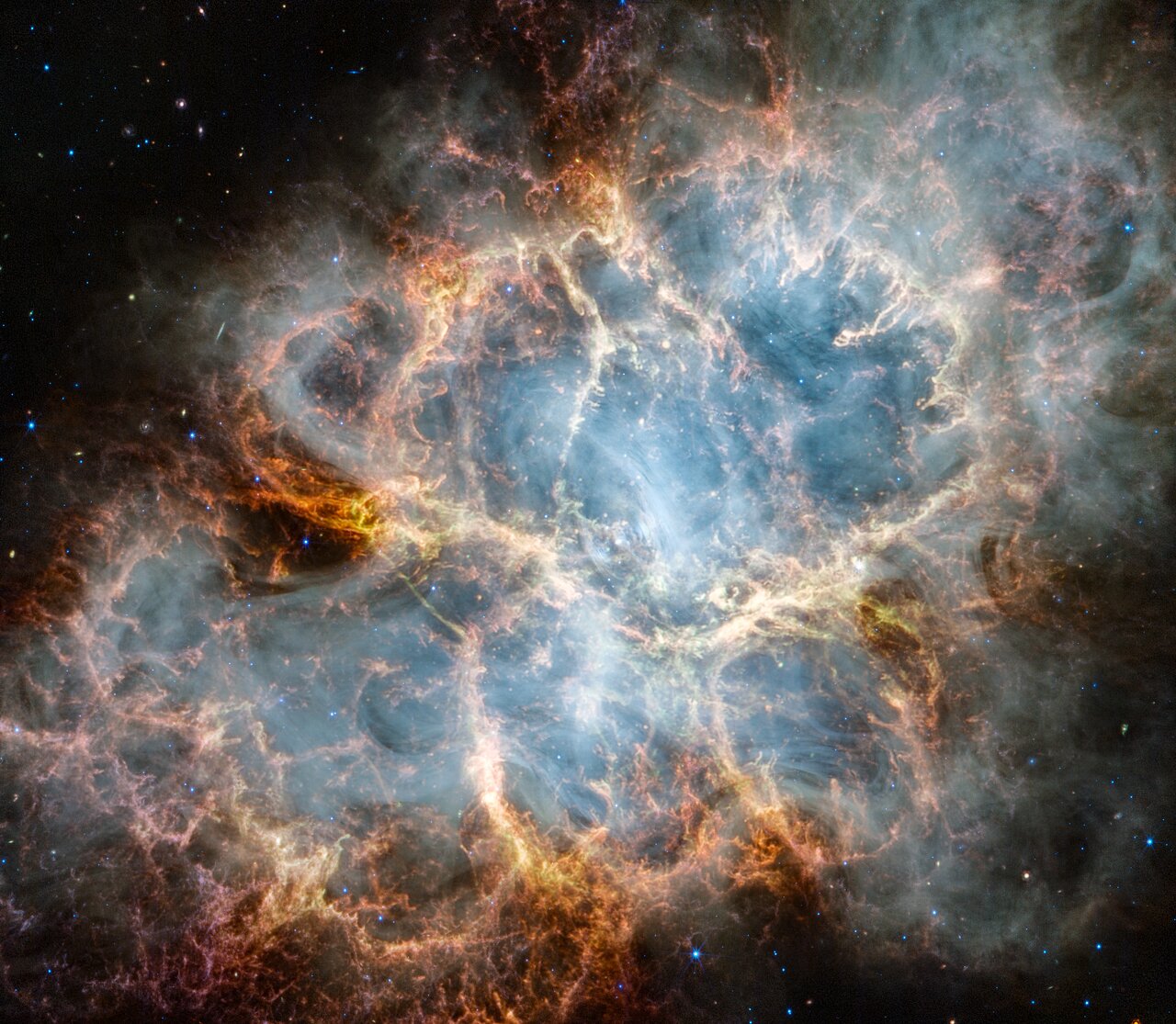
The NASA/ESA/CSA James Webb Space Telescope has gazed at the Crab Nebula in the search for answers about the supernova remnant’s origins. Webb’s NIRCam (Near-Infrared Camera) and MIRI (Mid-Infrared Instrument) have revealed new details in infrared light. Similar to the Hubble optical wavelength image released in 2005, with Webb the remnant appears to consist of a crisp, cage-like structure of fluffy red-orange filaments of gas that trace doubly ionised sulphur (sulphur III). Within the remnant’s interior, yellow-white and green fluffy ridges form large-scale loop-like structures, which represent areas where dust particles reside. The area is composed of translucent, milky material. This material is emitting synchrotron radiation, which is emitted across the electromagnetic spectrum but becomes particularly vibrant thanks to Webb’s sensitivity and spatial resolution. It is generated by particles accelerated to extremely high speeds as they wind around magnetic field lines. The synchrotron radiation can be traced throughout the majority of the Crab Nebula’s interior. Locate the wisps that follow a ripple-like pattern in the middle. In the centre of this ring-like structure is a bright white dot: a rapidly rotating neutron star. Further out from the core, follow the thin white ribbons of the radiation. The curvy wisps are closely grouped together, following different directions that mimic the structure of the pulsar’s magnetic field. Note how certain gas filaments are bluer in colour. These areas contain singly ionised iron (iron II). [Image description: An oval nebula with a complex structure against a black background. On the oval's exterior lie curtains of glowing red and orange fluffy material. Interior to this outer shell lie large-scale loops of mottled filaments of yellow-white and green, studded with clumps and knots. Translucent thin ribbons of smoky white lie within the remnant’s interior, brightest toward its centre.]

The Crab Nebula by JWST. Credit: NASA/ESA/JWST

The Crab Reveals Its Secrets To JWST

The Crab Nebula – otherwise known as the first object on Charles Messier’s list of non-cometary objects or M1 for short – has never really failed to visually underwhelm me! I have spent countless hours hunting down this example of a supernova remnant and found myself wondering why I have bothered. Yet here I am, after decades of looking at it, and I still find it one of the most intriguing objects in the sky.

Never has this interest been piqued more than right now after another mirror-smashing beauty of an image from the James Webb Space Telescope, and it’s already found its way to my mobile phone wallpaper!

The NASA/ESA/CSA James Webb telescope was launched back in December 2021, and from its position 1.5 million km away, it orbits the Sun, giving us a brand new window out into the Universe. Using its Near-Infrared Camera (NIRCAM) and the Mid-Infrared Instrument (MIRI) JWST has been exploring the Crab Nebula, the remains of a star whose explosion was recorded back in 1054. The object, which is 6,500 light years away, can be seen in small amateur telescopes and is without doubt one of the most studied supernova remnants of all. 

Despite being the target of many, many observations, there are still plenty of unanswered questions about the nature of the star that exploded, the mechanics of the explosion itself, and the composition of the ejecta.  Using JWSTs infrared capabilities, the image of the Crab reveals red/orange filaments of dust around the central region. The filaments weave an intricate pattern over the whole nebula, but it’s the core that has received more attention. 

Compare and contrast the Hubble version on the left with the new, Webb version on the right. Credit: NASA, ESA, CSA, STScI, T. Temim (Princeton University)

It has been known that there is a pulsar at the core of the nebula, and it’s this pulsar that is the true remains of the progenitor star.  When it went ‘supernova,’ the core collapsed to form the ultra-dense rotating object that, if you happen to be in the right place in space (hey, that rhymes), then you will see a pulse of radiation as it rotates. The infrared images from JWST reveal synchrotron emissions, which are a direct result of the rapidly rotating pulsar.  As the pulsar rotates, the magnetic field accelerates particles in the nebula to astonishingly high speeds such that they emit synchrotron radiation. As a fabulously lucky quirk of nature, the radiation is particularly obvious in infrared, making it ideal for JWST. 

Not only has JWST detected synchrotron radiation, but it has also mapped out locations of dust particles and even… locations where dust particles are forming. It’s fabulous to think that an object that was discovered almost a thousand years ago is still surprising us. That’s one of the things I love about astronomy: you think you have seen it all, but there is always more to learn.  Over the coming years, teams of astronomers using both HST and JWST will continue to probe the depths of the Crab Nebula, and maybe one day, all of its secrets will finally be revealed. 

Source:

{ https://www.universetoday.com/ }

Hoe vind je dit bericht?
Geschreven door peter om 01:03 Stuur door

EXCLUSIVE: FBI agents visit scientists building flying saucer at Falcon Space lab in New Jersey - and reveal they are part of 'X-Files like' government UFO investigation

EXCLUSIVE: FBI agents visit scientists building flying saucer at Falcon Space lab in New Jersey - and reveal they are part of 'X-Files like' government UFO investigation

  • Mark Sokol, 35, told DailyMail.com FBI agents showed up at his New Jersey lab last Friday and revealed they had been 'tasked with investigating' UFOs
  • The scientist, the founder of Falcon Space Lab in Hawthorne, said the feds told them they had received a tip about 'enriched uranium' being used at the site
  • CCTV shared with DailyMail.com shows the two FBI agents flashing their badges and interviewing the inventor as well as pacing outside with a Geiger counter 

FBI agents visited a New Jersey lab where scientists are trying to build a flying saucer – after they received a report of dangerous uranium being used on site.

Mark Sokol, founder of the Falcon Space laboratory in Hawthorne, New Jersey, told DailyMail.com he was shocked when two federal agents showed up at his shop last Friday.

Sokol said the more senior of the two agents told him they had been tasked by Bureau bosses with looking into Unidentified Anomalous Phenomena (UAP), the government term for UFOs – making him a kind of real-life Fox Mulder from the classic show The X-Files.

They didn't find any dangerous uranium, Sokol said, but were intrigued by the experiments going on at Falcon Space.

Sokol, 35, and his colleagues are attempting to use nuclear physics to make objects weightless, the first step towards building a functioning flying saucer.

CCTV shared with DailyMail.com shows two FBI agents grilling scientist Mark Sokol during a surprise visit to his lab in Hawthorne, New Jersey on October 20

CCTV shared with DailyMail.com shows two FBI agents grilling scientist Mark Sokol during a surprise visit to his lab in Hawthorne, New Jersey on October 20 

Scientists and inventors are trying to build their own gravity-defying flying saucer in the Falcon Space laboratory in New Jersey

Scientists and inventors are trying to build their own gravity-defying flying saucer in the Falcon Space laboratory in New Jersey

Sokol explained he and his colleagues have been working on experiments to make objects weightless ¿ the first step towards building a functioning flying saucer ¿ using this foil-lined Faraday cage that managed to reduce an object's weight by 17.8%

Sokol explained he and his colleagues have been working on experiments to make objects weightless – the first step towards building a functioning flying saucer – using this foil-lined Faraday cage that managed to reduce an object's weight by 17.8%

Sokol told DailyMail.com his goal is to figure out the technology behind these objects, which some believe to be extraterrestrial craft.

CCTV shared with DailyMail.com shows the two FBI agents flashing their badges and interviewing the inventor as well as pacing outside with a Geiger counter – a device used to detect radiation – which showed no harmful radiation at the lab, he said.

'They showed up on Friday right around noon,' Sokol said. 'They flashed their badges, said ''FBI'', and asked if we had any enriched uranium.

'I laughed and told them no. One said that we're not in trouble and he wanted to come back at some point and pick my brain about UAPs because he's been tasked by the FBI, in investigating UAPs or UFOs.'

But if the senior agent is a real-life version of David Duchovny's Mulder, his partner didn't quite measure up to Gillian Anderson's Dana Scully.

Sokol said the more junior of the pair was fresh-faced and ‘probably in his early 20s’. 

'They said they got a tipoff that I have enriched uranium. The only uranium we have here is a little piece that I got off Amazon to check our Geiger counter to make sure it's working.'

A spokeswoman for the FBI field office in Newark, New Jersey, told DailyMail.com: 'We receive information from the public each day through various reporting mechanisms. 

Left to right: Jatin Parmar, Tom Butler, Mark Sokol, Wayne Ojala all working on an experiment at their lab in Hawthorne

Left to right: Jatin Parmar, Tom Butler, Mark Sokol, Wayne Ojala all working on an experiment at their lab in Hawthorne

Members of the Falcon Space laboratory plot their experiments to replicate UFO technology such as anti-gravity

Members of the Falcon Space laboratory plot their experiments to replicate UFO technology such as anti-gravity

Falcon Space was founded by Mark Sokol, who turned his battery manufacturing laboratory into a hub for scientists and inventors trying to crack the problem of anti-gravity

Falcon Space was founded by Mark Sokol, who turned his battery manufacturing laboratory into a hub for scientists and inventors trying to crack the problem of anti-gravity

'In general, when we get information about a situation involving illegal and dangerous radiological or hazardous materials, our agents investigate it.'

The spokeswoman did not comment on whether their FBI office had a designated agent for UFO-related cases.

Sokol described his lab as a bootstrapped community of scientists, engineers, and inventors hoping to crack anti-gravity, warp drives, and other futuristic technologies.

They are funded by donations and a few private investors passionate about the topic.

'We're researching UFO propulsion, trying to figure out propellant-less propulsion concepts that have been theorized to work throughout the years,' he said.

'There's lots of papers and patents that have been put out. But we're a lab where we actually put those theories to the test.'

Some of their experiments test the theory that objects' mass comes from the jumbled directions in which the subatomic particles of their atoms spin. 

If you can get those tiny parts to spin in the same direction, it will make them weightless, so the theory goes.

'We've seen up to 17.8% weight loss in one experiment,' Sokol said. 

He believes once they can get above 90%, they'll be able to make a floating saucer.

Lab cofounder Jeremy Rys runs their YouTube channel Alien Scientist, where they post videos of their experiments and scientific discussions at their regular online 'Alternative Propulsion Engineering Conference'. 

Lab cofounder Jeremy Rys said he was skeptical of the FBI visitors, noting that the senior agent had a background in financial crime investigations unrelated to X-Files-type probes

Lab cofounder Jeremy Rys said he was skeptical of the FBI visitors, noting that the senior agent had a background in financial crime investigations unrelated to X-Files-type probes

The agents appeared to be real-life versions of FBI special agents Fox Mulder, played by David Duchovny and Dana Scully, played by Gillian Anderson, from the hit sci-fi series The X-Files

The agents appeared to be real-life versions of FBI special agents Fox Mulder, played by David Duchovny and Dana Scully, played by Gillian Anderson, from the hit sci-fi series The X-Files

Rys was skeptical of the FBI visitors, noting that the senior agent had a background in financial crime investigations unrelated to X-Files-type probes.

'They said they were interested in UAP and the kind of stuff he was doing at the lab. It could be a shoe in the door,' he said.

'Maybe they're trying to trick Mark into opening up more because they know it's his passion.

'If you lie to federal investigators in any way, even just telling them the time on a broken clock, they can later put charges against you.'

Though the government has not officially confirmed it is using FBI agents to conduct UFO-related investigations on the ground X-Files-style, there are several hints that this is the case.

In a presentation by Sean Kirkpatrick, director of the Pentagon's All-domain Anomaly Resolution Office (AARO) in January, the DOJ was listed as one of the agency's 'key partners'

In a presentation by Sean Kirkpatrick, director of the Pentagon's All-domain Anomaly Resolution Office (AARO) in January, the DOJ was listed as one of the agency's 'key partners' 

A 2021 law which created the latest incarnation of the Pentagon's UFO investigation office 'AARO' also ordered it to 'rapidly respond to, and conduct field investigations of, incidents involving unidentified aerial phenomena under the direction of the head of the Office'.

At a conference on January 11 this year, AARO director Dr. Sean Kirkpatrick presented a slide deck which listed the Department of Justice, ultimately responsible for the FBI, as one of its 'key partners and stakeholders'.

Kirkpatrick, a decorated physicist and intelligence official, also included one intriguing bullet point on his slides suggesting that AARO aimed to 'recover' downed UAP.

The slide said his office is involved in 'UAP detection, tracking, mitigation, and recovery'.

The US government has itself tried to build craft resembling classic flying saucers, though official records show it achieved little success.

In the 1950s the US Air Force hired a Canadian contractor to help it try to build a supersonic flying saucer.

DailyMail.com obtained a slides from Kirkpatrick's January 11 presentation which showed the steps AARO was taking to ensure UAP 'are effectively and efficiently detected, tracked, analyzed, and managed'

DailyMail.com obtained a slides from Kirkpatrick's January 11 presentation which showed the steps AARO was taking to ensure UAP 'are effectively and efficiently detected, tracked, analyzed, and managed'

Kirkpatrick's presentation warned of 'threats to the immediate safety of US citizens and Government facilities'

Kirkpatrick's presentation warned of 'threats to the immediate safety of US citizens and Government facilities'

Documents from the venture, codenamed Project 1794, were declassified in 2012, and include schematics that look like they come right out of a science fiction movie.

According to papers published by the National Archives, the saucer was designed to fly 'between Mach 3 and Mach 4, a ceiling of over 100,000 ft. and a maximum range with allowances of about 1,000 nautical miles'.

Despite indications of initial success at a relatively low cost, the project fizzled out after engineers apparently failed to get the craft flying higher than a few feet.

From 2015 to 2017 the US Navy filed for a series of patents for futuristic inventions including a triangular-shaped 'hybrid aerospace underwater craft' and a 'craft using an inertial mass reduction device' – or anti-gravity.

The supposed inventor, Dr. Salvatore Pais, boasted in the patent of possible 'extreme speeds' by his vehicle and the potential to 'engineer the fabric of our reality at the most fundamental level'.

But other physicists criticized the filings for their lack of specific technical details and allegedly nonsensical pseudoscience terms – fueling theories that the patents could just be propaganda to confuse America's adversaries.

The Navy told US engineering news site The Drive that they spent three years and $508,000 on the project, but ended it in September 2019 after failing to prove Dr. Pais' proposed science.

'No further research has been conducted, and the project has not transitioned to any other government or civilian organization,' a spokesperson for the Naval Air Warfare Center Aircraft Division told the site in 2021.

{ https://www.dailymail.co.uk/ }

Hoe vind je dit bericht?
Geschreven door peter om 23:43 Stuur door

What's the best evidence we've found for alien life?

What's the best evidence we've found for alien life?

An illustration of a green and blue planet in space with light shining on it.
An artist's impression of an undiscovered alien world. 
(Image credit: Dottedhippo via Getty Images)

We've all wondered whether we're alone in the universe, and with potentially habitable planets, strange space signals and UFO hearings hitting the headlines, it's starting to feel like we're on the cusp of a major extraterrestrial discovery. But what's the best scientific evidence we've found for the existence of alien life?

The sobering reality is that there isn't any yet. There's no scientific evidence for aliens in the declassified UFO videos, in mutilated cows whose injuries are blamed on extraterrestrial activities or in purported alien bodies. Nor is there any such evidence in the formal academic research. Live Science checked in with experts to make sure.

"There's just no evidence right now," Professor Sara Seager, an astrophysicist and planetary scientist at the Massachusetts Institute of Technology and author of "The Smallest Lights in the Universe: A Memoir" (Crown, 2020), told Live Science.

Nikku Madhusudhan, a professor of astrophysics and exoplanetary science at the University of Cambridge, gave a similar response, saying, "I don't think we have clear evidence just yet of any kind for alien life."

There is, however, good reason to hold out hope that the evidence will eventually come, even if it isn't personally delivered by a little green man.

Related: What would colors look like on other planets?

Madhusudhan told Live Science that "there are hints here and there" and "there is evidence for habitable conditions." In other words, there are signs that certain planets and moons could harbor life, but we haven't found evidence of life in these places yet.

There may be hundreds of millions of habitable planets in our galaxy alone. Scientists consider planets capable of hosting life if they sit in the so-called habitable zone, the distance from a star where it's possible for a rocky planet to have liquid water on the surface, an essential ingredient for life on Earth. Planets and moons outside of the habitable zone aren't necessarily inhospitable to life either. For example, Jupiter's moon Europa isn't in the sun's habitable zone, but has a saltwater ocean beneath its icy crust that may be able to host life.

Researchers are looking inside and outside of our solar system for signs of life. Madhusudhan led a study, published in October 2023 in The Astrophysical Journal Letters, that detected hints of an ocean on a planet called K2-18 b, located more than 100 light-years away. Their data also suggested "potential signs" of dimethyl sulfide, a chemical that, as far as we know, is produced only by life on Earth.

"That is very tentative," he said. "We don't know if it is present or not, but we do see it in the data at some level."

That potential sign of alien life will be subject to further studies and may be refuted. Regardless, Madhusudhan said he wouldn't be surprised if we found evidence for extraterrestrial microbial life within the next decade. "I'd be very surprised if there is no life out there of any kind," he added.

Seager believes we'd confirm the existence of alien life only with sample-return missions — collecting samples from another planet or moon and bringing them back to Earth for study, in-situ measurements or "incredibly futuristic" technology, like a solar gravitational lens telescope, a theoretical instrument that would use the sun's gravity to magnify light from distant planets.

"With all the tools we have now, or that we could build with enough money, it's sample return, because I don't see anything else being definitive," Seager said.

Seager was part of a 2020 study published in the journal Nature Astronomy that reported the "apparent presence" of phosphine gas — a potential signature of life — on Venus. The research has been debated in the scientific community since.

Researchers will argue about whether potential life signatures detected on other planets are real, and then whether those signatures are accurate, and then whether those signatures are actually caused by life, which they currently won't be able to prove without collecting samples, according to Seager.

However, she's confident that scientists will find more signs of water and oceans that could indicate habitability, as well as gases that might be due to life. "I think that's enough to keep this generation's long search moving forward," she said.

Keep in mind that space is incredibly vast. It would take humans more than a million years to visit K2-18 b with traditional rocket propulsion. Even sending our fastest probe to the nearest known exoplanet, Proxima Centauri b, would take thousands of years. The planets and moons within our solar system are right on our doorstep by comparison, with probe travel times ranging from some years to mere months.

{ https://www.livescience.com/ }

Hoe vind je dit bericht?
Geschreven door peter om 23:00 Stuur door

UFO Sightings: The Mysterious Patterns in New England’s Skies

UFO Sightings: The Mysterious Patterns in New England’s Skies

Shocking Alien Encounter at America

The endless tapestry of the night sky has always captivated humanity. From ancient seafarers navigating by the constellations to contemporary astronauts jetting toward the moon and beyond, we’ve forever been enchanted by the vastness above. But every so often, amid that vastness, something unusual appears that cannot be easily explained. These are the phenomena we commonly label as UFO sightings.

For enthusiasts and skeptics alike, UFO sightings are not just mere claims; they present a riddle that science and society are racing to decipher. And nowhere is this truer than in New England, a region that has become a hotspot for mysterious aerial activities.

The New England Enigma

The heart of New England holds tales of magnetic anomalies, intriguing patterns, and a history of sightings that date back decades. A recent investigation by Melissa, combined with Ben Hansen’s exploration in Fairfield, Connecticut, sheds light on some of the most eerie UFO encounters America has ever seen.

Historical accounts from the late 1950s reveal an incident involving Lieutenant Colonel Frank Woolley, who reported seeing a white object floating in the Hartford sky for a staggering 45 minutes. But this was just the beginning. As years rolled on, sightings grew in frequency, with reports of strange lights and unknown flying objects coming from various parts of New England.

A Magnetic Attraction?

With each account, researchers have tried to discern patterns or explanations. Recent discoveries suggest that our very solar system may contain magnetic bubbles that could act as beacons for extraterrestrial beings. Could these magnetic thoroughfares be directing UFOs straight to Earth?

Brian Bowden, a UFO and paranormal researcher with over 40 years of experience, believes that the area’s magnetic anomalies might offer a clue. NASA’s recent finding of magnetic bubbles in our solar system, which some theorists suggest might act as a pathway for extraterrestrial visitors, only adds to the intrigue.

The Evolution of UFOs

It’s not just the number of sightings that’s fascinating but the evolution of these unidentified flying objects. While the typical “flying saucer” dominated reports in earlier decades, the recent trend points to orange objects that change color or large, shape-shifting crafts. This transformation leads to a thought-provoking question: Are the visitors upgrading their vehicles just as we upgrade ours?

VIDEO:

  • Shocking Alien Encounter at America| UFO Witness|Discovery Channel

While the enigma of UFO sightings remains, one thing is clear: People are more aware of their surroundings, looking up more often, and reporting anomalies with greater frequency. As science continues its pursuit of the unknown, it’s essential to keep an open mind and continue searching for the truth hidden in the skies.

RELATED

{ https://www.latest-ufo-sightings.net/ }

Hoe vind je dit bericht?
Geschreven door peter om 21:26 Stuur door

Meer van UFO'S of UAP'S, ASTRONOMIE, RUIMTEVAART, ARCHEOLOGIE, OUDHEIDKUNDE, SF-SNUFJES EN ANDERE ESOTERISCHE WETENSCHAPPEN - DE ALLERLAATSTE NIEUWTJES

↑ Terug naar de berichten