Ontdek de Fascinerende Wereld van UFO's en UAP's: Jouw Bron voor Onthullende Informatie!
Ben jij ook gefascineerd door het onbekende? Wil je meer weten over UFO's en UAP's, niet alleen in België, maar over de hele wereld? Dan ben je op de juiste plek!
België: Het Kloppend Hart van UFO-onderzoek
In België is BUFON (Belgisch UFO-Netwerk) dé autoriteit op het gebied van UFO-onderzoek. Voor betrouwbare en objectieve informatie over deze intrigerende fenomenen, bezoek je zeker onze Facebook-pagina en deze blog. Maar dat is nog niet alles! Ontdek ook het Belgisch UFO-meldpunt en Caelestia, twee organisaties die diepgaand onderzoek verrichten, al zijn ze soms kritisch of sceptisch.
Nederland: Een Schat aan Informatie
Voor onze Nederlandse buren is er de schitterende website www.ufowijzer.nl, beheerd door Paul Harmans. Deze site biedt een schat aan informatie en artikelen die je niet wilt missen!
Internationaal: MUFON - De Wereldwijde Autoriteit
Neem ook een kijkje bij MUFON (Mutual UFO Network Inc.), een gerenommeerde Amerikaanse UFO-vereniging met afdelingen in de VS en wereldwijd. MUFON is toegewijd aan de wetenschappelijke en analytische studie van het UFO-fenomeen, en hun maandelijkse tijdschrift, The MUFON UFO-Journal, is een must-read voor elke UFO-enthousiasteling. Bezoek hun website op www.mufon.com voor meer informatie.
Samenwerking en Toekomstvisie
Sinds 1 februari 2020 is Pieter niet alleen ex-president van BUFON, maar ook de voormalige nationale directeur van MUFON in Vlaanderen en Nederland. Dit creëert een sterke samenwerking met de Franse MUFON Reseau MUFON/EUROP, wat ons in staat stelt om nog meer waardevolle inzichten te delen.
Let op: Nepprofielen en Nieuwe Groeperingen
Pas op voor een nieuwe groepering die zich ook BUFON noemt, maar geen enkele connectie heeft met onze gevestigde organisatie. Hoewel zij de naam geregistreerd hebben, kunnen ze het rijke verleden en de expertise van onze groep niet evenaren. We wensen hen veel succes, maar we blijven de autoriteit in UFO-onderzoek!
Blijf Op De Hoogte!
Wil jij de laatste nieuwtjes over UFO's, ruimtevaart, archeologie, en meer? Volg ons dan en duik samen met ons in de fascinerende wereld van het onbekende! Sluit je aan bij de gemeenschap van nieuwsgierige geesten die net als jij verlangen naar antwoorden en avonturen in de sterren!
Heb je vragen of wil je meer weten? Aarzel dan niet om contact met ons op te nemen! Samen ontrafelen we het mysterie van de lucht en daarbuiten.
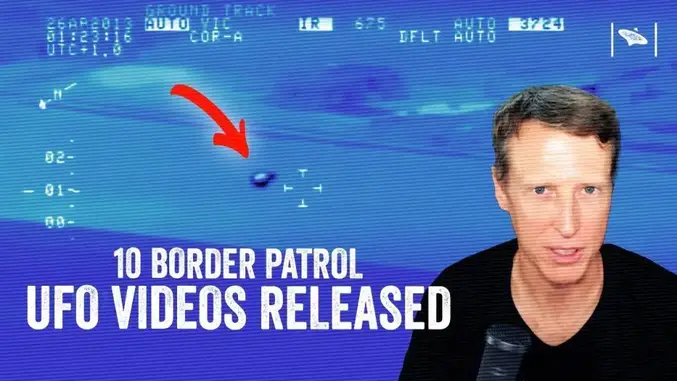
Pilot Examines Border Patrol’s Classified UFO Videos
The Modern Era of UFO Sightings
UFO sightings have been part and parcel of modern folklore. But in recent times, they’ve transcended from mere campfire tales to subjects of rigorous investigation and debate.
One prominent figure who has significantly contributed to this dialogue is Chris Lehto, an ex-fighter pilot. Lehto delved deep into a series of videos released by the US Customs and Border Protection, providing an analytical lens only a seasoned aviator could offer. His insights have stirred discussions, raising more questions about these inexplicable aerial events.
Bob Thompson: The Unsung Hero Behind the Revelations
While many UFO enthusiasts were preoccupied with speculations and theories, it was Bob Thompson, a paramedic and Border Patrol agent, who played a pivotal role in the release of these pivotal UFO videos. Thompson’s endeavors highlight how individuals from varying professions can collaboratively push the boundaries of our knowledge.
Decoding the Aerial Enigma
Among the most debated videos is one dubbed the “rubber duck”, an unidentified object whose true nature remains a mystery. Another series of footage features the A10 aircraft in close proximity to unidentified aerial phenomena, sparking curiosity about the potential interplay between known human-made machinery and the unknown.
VIDEO:
Pilot Analyzes Border Patrol’s Secret UFO Footage
Chris Lehto’s assessments, coupled with available data, emphasize the need for a more informed dialogue on the topic. As more government videos and reports become public, the narrative surrounding UFO sightings is bound to evolve.
The Bigger Picture
UFO sightings may be just the tip of the iceberg in our quest to understand our place in the vast cosmos. Each sighting, report, and analysis adds a piece to this cosmic puzzle. As we collectively gaze upwards, one can’t help but wonder: what other secrets do the heavens hold?
The unveiling of these videos is a testament to human curiosity and perseverance. As technology advances and our understanding deepens, the boundary between the known and unknown will continue to blur.
Fighter pilot analyzes Border Patrol's secret UFO Footage
The U.S. Customs and Border Protection has recently made public infrared records related to Unidentified Aerial Phenomena (UFO/UAP).
A comprehensive analysis of these records has been undertaken by Chris Lehto, a retired fighter pilot and a dedicated investigator of UAP. In his examination, Lehto delves into 10 UAP videos obtained from the U.S. Customs and Border Protection, offering viewers valuable insights.
He dissects each video to provide essential context and explores potential explanations for the observed phenomena. His attention is particularly focused on key footage, including the intriguing "Rubber Duck" video, A-10 engagement videos, and notable incidents like La Bruja and Aguadilla.
Furthermore, Lehto sheds light on the crucial role played by paramedic and Border Patrol agent Bob Thompson in the release of these videos. Thompson's involvement underscores the collaborative effort involving individuals from various professional backgrounds in bringing these records to the public domain.
The insights provided by experts like Chris Lehto contribute to a more informed and nuanced dialogue on the subject.
In the age where technology reigns supreme and our skies are constantly monitored by satellites, the intrigue surrounding UFO sightings remains undiminished. For decades, unidentified flying objects have captured the imagination of many, fueling countless conspiracy theories. But in a fascinating turn of events, NASA – an institution centered on scientific exploration – is delving into the realm of the unknown, specifically the Unidentified Aerial Phenomena (UAP).
For those new to the term, UAPs are essentially UFO sightings backed by some credible pieces of evidence. The approach to these phenomena has evolved over the years, often straddling the line between skepticism and genuine curiosity.
Dr. Thomas Zurbuchen, a former NASA official, voiced that the solution to these sightings isn’t necessarily to create a dedicated UAP program, but to incorporate it into NASA’s existing research strategies. This isn’t the first time NASA has assimilated such an approach. A few years back, the search for technosignatures, such as scanning for alien radio signals, was embedded into NASA’s research framework. This move came in the wake of a bill that deemed the search for extraterrestrial life as one of NASA’s key objectives.
However, embracing UAP research isn’t just about quenching mankind’s thirst for the unknown. For NASA, it is also an opportunity to incorporate artificial intelligence into its analysis toolkit. The unpredictable nature of UAPs brings with it the challenge of diving deep, adopting high-risk, and potentially high-impact research methods.
In an endeavor to truly understand and possibly decode theUAP enigma, NASA has leaned towards the use of Earth-observing satellites and the Vera C. Rubin Observatory. Furthermore, the space agency is harnessing the power of crowdsourcing and AI to identify patterns in UAP reports.
One intriguing aspect, revealing the global reach of the UFO phenomenon, is the so-called ‘Chinese balloon incident’. This involved unusual objects seen around U.S. Navy planes, particularly in the Pacific. The rapid advancements in drone technology, as evidenced in recent global events, have further highlighted the pressing need to understand, document, and possibly demystify UAPs.
What’s particularly enthralling is NASA’s interest in launching a phone app geared towards recording UAPs. This app aims to document sightings in a manner that produces valuable data while minimizing the chances of false reports. Such an initiative not only democratizes the process but also reduces the conspiracy haze that often shrouds UFO sightings.
In conclusion, as our quest for understanding the universe deepens, institutions like NASA are embracing the challenge, marrying cutting-edge technology with human curiosity. And who knows? The next big UFO sighting might just be decoded using an app on your smartphone!
NASA’s Bennu Asteroid Sample Contains Carbon, Water
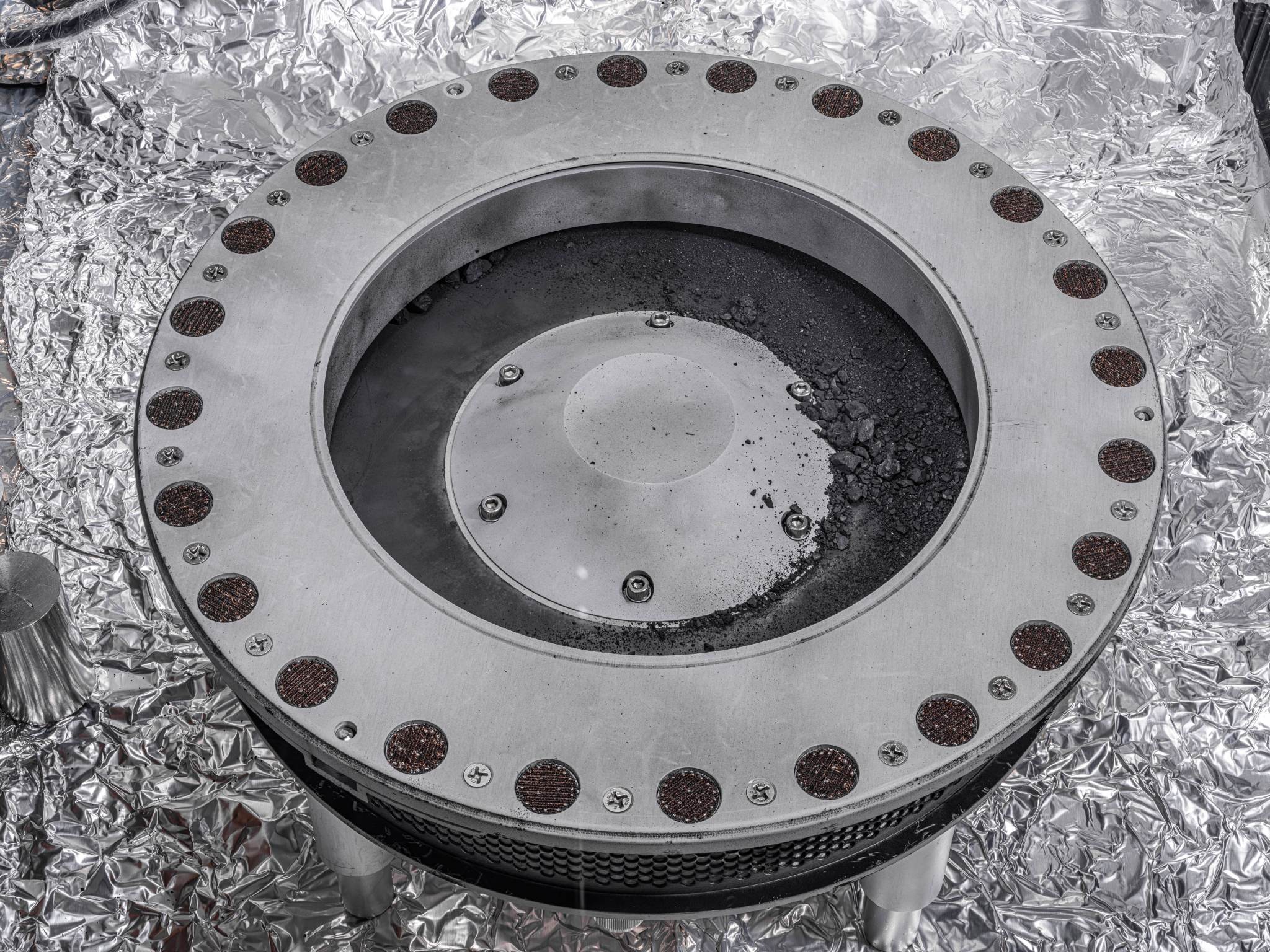
A view of the outside of the OSIRIS-REx sample collector. Sample material from asteroid Bennu can be seen on the middle right. Scientists have found evidence of both carbon and water in initial analysis of this material. The bulk of the sample is located inside.
Photo: NASA/Erika Blumenfeld & Joseph Aebersold
Abbey A. Donaldson
Initial studies of the 4.5-billion-year-old asteroid Bennu sample collected in space and brought to Earth by NASA show evidence of high-carbon content and water, which together could indicate the building blocks of life on Earth may be found in the rock. NASA made the news Wednesday from its Johnson Space Center in Houston where leadership and scientists showed off the asteroid material for the first time since it landed in September.
This finding was part of a preliminary assessment of NASA’s OSIRIS-REx (Origins, Spectral Interpretation, Resource Identification and Security – Regolith Explorer) science team.
“The OSIRIS-REx sample is the biggest carbon-rich asteroid sample ever delivered to Earth and will help scientists investigate the origins of life on our own planet for generations to come,” said NASA Administrator Bill Nelson. “Almost everything we do at NASA seeks to answer questions about who we are and where we come from. NASA missions like OSIRIS-REx will improve our understanding of asteroids that could threaten Earth while giving us a glimpse into what lies beyond. The sample has made it back to Earth, but there is still so much science to come – science like we’ve never seen before.”
Although more work is needed to understand the nature of the carbon compounds found, the initial discovery bodes well for future analyses of the asteroid sample. The secrets held within the rocks and dust from the asteroid will be studied for decades to come, offering insights into how our solar system was formed, how the precursor materials to life may have been seeded on Earth, and what precautions need to be taken to avoid asteroid collisions with our home planet.
Bonus sample material
The goal of the OSIRIS-REx sample collection was 60 grams of asteroid material. Curation experts at NASA Johnson, working in new clean rooms built especially for the mission, have spent 10 days so far carefully disassembling the sample return hardware to obtain a glimpse at the bulk sample within. When the science canister lid was first opened, scientists discovered bonus asteroid material covering the outside of the collector head, canister lid, and base. There was so much extra material it slowed down the careful process of collecting and containing the primary sample.
“Our labs were ready for whatever Bennu had in store for us,” said Vanessa Wyche, director, NASA Johnson. “We’ve had scientists and engineers working side-by-side for years to develop specialized gloveboxes and tools to keep the asteroid material pristine and to curate the samples so researchers now and decades from now can study this precious gift from the cosmos.”
Within the first two weeks, scientists performed “quick-look” analyses of that initial material, collecting images from a scanning electron microscope, infrared measurements, X-ray diffraction, and chemical element analysis. X-ray computed tomography was also used to produce a 3D computer model of one of the particles, highlighting its diverse interior. This early glimpse provided the evidence of abundant carbon and water in the sample.
“As we peer into the ancient secrets preserved within the dust and rocks of asteroid Bennu, we are unlocking a time capsule that offers us profound insights into the origins of our solar system,” said Dante Lauretta, OSIRIS-REx principal investigator, University of Arizona, Tucson. “The bounty of carbon-rich material and the abundant presence of water-bearing clay minerals are just the tip of the cosmic iceberg. These discoveries, made possible through years of dedicated collaboration and cutting-edge science, propel us on a journey to understand not only our celestial neighborhood but also the potential for life’s beginnings. With each revelation from Bennu, we draw closer to unraveling the mysteries of our cosmic heritage.”
For the next two years, the mission’s science team will continue characterizing the samples and conduct the analysis needed to meet the mission’s science goals. NASA will preserve at least 70% of the sample at Johnson for further research by scientists worldwide, including future generations of scientists. As part of OSIRIS-REx’s science program, a cohort of more than 200 scientists around the world will explore the regolith’s properties, including researchers from many U.S. institutions, NASA partners JAXA (Japan Aerospace Exploration Agency), CSA (Canadian Space Agency), and other scientists from around the world. Additional samples will also be loaned later this fall to the Smithsonian Institution, Space Center Houston, and the University of Arizona for public display.
NASA’s Goddard Space Flight Center in Greenbelt, Maryland, provides overall mission management, systems engineering, and the safety and mission assurance for OSIRIS-REx. Lauretta, the principal investigator, leads the science team and the mission’s science observation planning and data processing. Lockheed Martin Space in Littleton, Colorado, built the spacecraft, provided flight operations, and was responsible for capsule recovery. Goddard and KinetX Aerospace were responsible for navigating the OSIRIS-REx spacecraft. Curation for OSIRIS-REx, including processing the sample when it arrived on Earth, is taking place at NASA Johnson.
OSIRIS-REx is the third mission in NASA’s New Frontiers Program, managed by NASA’s Marshall Space Flight Center in Huntsville, Alabama, for the Science Mission Directorate at NASA Headquarters in Washington.
Find more information about NASA’s OSIRIS-REx mission at:
Zoals wetenschappers hadden gehoopt, blijkt dat de asteroïde Bennu water en koolstof bevat. Dat kondigt de Amerikaanse ruimtevaartorganisatie NASA aan, die in het Johnson Space Centre beelden toonde van monsters die mee naar de aarde zijn teruggebracht.
"Water en koolstofmoleculen zijn precies het soort materiaal dat we wilden vinden", vertelde NASA-baas Bill Nelson tijdens een evenement in Houston. "Dit zijn cruciale elementen in de vorming van onze eigen planeet, en ze gaan ons helpen bij het bepalen van de oorsprong van de elementen die tot leven geleid zouden kunnen hebben.
De ruimtesonde OSIRIS-REx slaagde erin in 2020 een monster te nemen van Bennu en de capsule keerde iets meer dan twee weken geleden succesvol terug naar de aarde en landde in de Amerikaanse woestijn.
Sindsdien probeert NASA met nauwgezette processen de capsule te openen. Het is de grootste verzameling buitenaards gruis die ooit naar de aarde is gebracht. Omdat er veel materiaal buiten het verzamelcompartiment is gevonden, is het hoofdvak van de capsule zelf nog niet geopend, verklaarde Eileen Stansbery, hoofdwetenschapper bij het Johnson Space Centre. Ze voegde eraan toe dat ze hun tijd zullen nemen voor de analyses.
Voordat de capsule landde, schatte de Amerikaanse ruimtevaartorganisatie dat het gelukt was om ongeveer 250 gram materiaal van de asteroïde Bennu te verzamelen, veel meer dan twee eerdere Japanse missies naar andere asteroïden.
Met de stof van planetoïde Bennu kan meer onderzoek worden gedaan naar ons zonnestelsel.
"It's beautiful, it really is - certainly what we've seen of it so far," said Dr Ashley King.
The UK scientist was in a select group to put first eyes and instruments on the rocky samples that have just been brought back from asteroid Bennu.
The materials, scooped up by a US space agency (Nasa) mission and returned to Earth 17 days ago, are currently being examined in a special lab in Texas.
"We've confirmed we went to the right asteroid," Dr King told BBC News.
The three-day analysis by the Natural History Museum (NHM) expert and five others on the "Quick Look" team showed the black, extraterrestrial powder to be rich in carbon and water-laden minerals.
That's a great sign. There's a theory that carbon-rich (organic), water-rich asteroids similar to Bennu may have been involved in delivering key components to the young Earth system some 4.5 billion years ago. It's potentially how we got the water in our oceans and some of the compounds that were necessary to kick-start life.
The asteroid samples will be used to test these ideas.
"We're trying to find out who we are, what we are, where we came from. What is our place in this vastness called the Universe?" said Nasa Administrator Bill Nelson during a briefing at the Johnson Space Center, where the dedicated lab is housed.
Ashley King: "We've confirmed we went to the right asteroid
Although it's evident the mission has returned an "abundance of sample", scientists are still not sure precisely how much of Bennu they actually have in their possession.
The sample canister which landed in the Utah desert on 24 September has been opened but the inner chamber used by the Osiris-Rex spacecraft to store the asteroid fragments for the journey home has yet to be fully emptied of its contents and weighed.
The mission team thinks it has about 250 grams (9oz) in total. It will take a few more days' careful disassembly to corroborate this estimate.
To perform their initial experiments, Dr King and colleagues used particles that had been spilled from the inner chamber - or Tag-Sam (Touch And Go Sample Acquisition Mechanism) as it's known. This fine Bennu dust coats all the canister's enclosing surfaces.
"When they took the lid off the sample canister, it just revealed this black powder everywhere. It was incredible; it was so exciting," Dr King recalled.
"We were sitting at the time and everybody just stood up and started pointing at the screen. It meant we had lots to play with for the 'quick look'. It made our job easier."
IMAGE SOURCE,NASA
Image caption,
When the sample canister was opened, a black dust coated all surfaces
The dust was put in an electron microscope, subjected to X-ray diffraction and infrared spectroscopy techniques and scanned by a computed tomography (CT) machine.
One of the key findings is the presence of that carbon. Lots of it. Close to 5% by weight.
"That's a big deal. When the data came back, there were scientists on the team going 'Wow, oh my God!' said Dr Daniel Galvin, an analyst from Nasa's Goddard Space Flight Center. The quick look team detected both carbonates and more complex organics.
Osiris-Rex principal investigator Dr Dante Lauretta highlighted the samples' water content held in clay minerals.
"They have water locked inside their crystal structure," the cosmochemist from the University of Arizona explained.
"I want to stop and think about what that means. That water - that is how we think water got to the Earth. The reason that Earth is a habitable world - that we have oceans and lakes and rivers and rain - is because clay minerals, like the ones we're seeing from Bennu, landed on Earth 4.5 billion years ago."
IMAGE SOURCE,NASA
Image caption,
A CT scan enables scientists to construct a 3D model of particles and see inside them (Scalebar = 1mm)
The Osiris-Rex spacecraft picked up the Bennu materials in October 2020, using a daring manoeuvre to approach and then "high-five" the asteroid - an operation performed while 330 million km (205 million miles) from Earth.
It then took almost three years, for the Nasa probe to come home and drop off its precious cargo at a restricted military test range a couple of hours' drive west of Salt Lake City.
Once the full sample is extracted, a portion of it will be shared with researchers worldwide. About 100 milligrams is expected to come to the UK to be further worked on by Dr King's department at the NHM, and by collaborators at the Open, Oxford and Manchester universities.
The Osiris-Rex teams aim to have a raft of studies completed in time to report at the Lunar and Planetary Science Conference (LPSC) in March. Two major overview papers are also expected to be published at the same time in the journal Meteoritics & Planetary Science.
IMAGE SOURCE,NASA
Image caption,
The Osiris-Rex spacecraft delivered the Bennu samples to the Utah desert in a capsule
Op de planetoïde Bennu is water en koolstof gevonden. Dat blijkt uit de eerste resultaten van bodemstalen die ruimtevaartorganisatie NASA op de ruimterots verzamelde. Het gruis is vorige maand in een capsule naar de aarde gebracht en wordt nu onderzocht. Wetenschappers hopen dat de bevindingen ons kunnen helpen begrijpen hoe het leven op aarde is ontstaan. NASA heeft vandaag de eerste foto's van de stalen en de eerste resultaten van het onderzoek wereldkundig gemaakt.
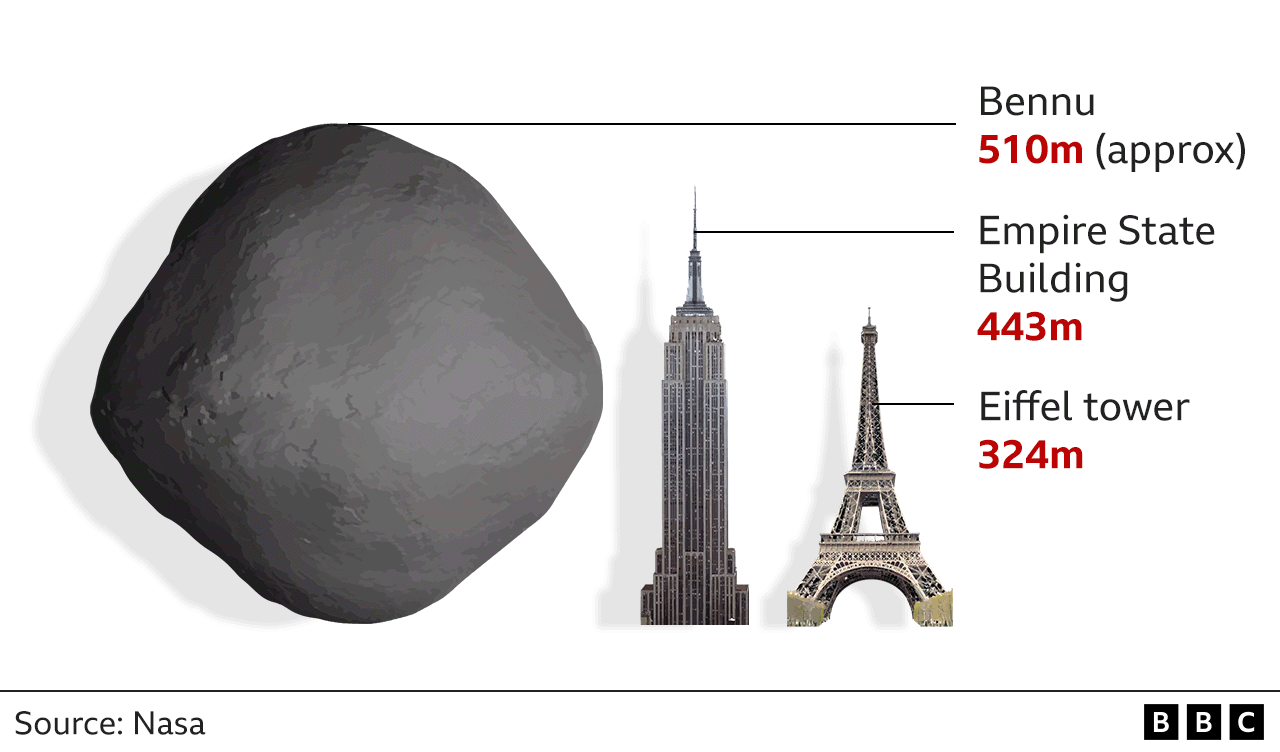
NASA heeft de eerste monsters getoond van de bodemstalen van een asteroïde van meer dan 4 miljard jaar oud. De stalen werden drie jaar geleden verzameld op een asteroïde met een doorsnede van meer dan 500 meter die rond de zon draait. Vorige maand heeft ruimtesonde Osiris-Rex tijdens een scheervlucht langs de aarde de stalen veilig in de woestijn in de Amerikaanse staat Utah gedropt.
Tijdens een persconferentie heeft NASA vandaag foto's vrijgegeven van het zwarte gruis dat werd verzameld én de eerste onderzoeksresultaten van de deeltjes wereldkundig gemaakt. Die resultaten bevestigen wat de onderzoekers al dachten. De asteroïde bevat water- en koolstofmolecules.
"Dit zijn cruciale elementen in de vorming van onze eigen planeet", zegt NASA-baas Bill Nelson. "Ze gaan ons helpen om de oorsprong te bepalen van de elementen die hier tot leven zouden kunnen hebben geleid."
"Wetenschappelijke schat"
Er wordt geschat dat tijdens de missie zo'n 250 gram aan bodemstalen van Bennu is verzameld, maar de exacte hoeveelheid kennen we nog niet. De capsule werd namelijk nog niet geopend, omdat er zoveel zwart stof en steentjes aan de buitenkant van de capsule zijn blijven hangen dat de wetenschappers zich daar eerst uitgebreid over ontfermen.
"We nemen onze tijd om alles methodisch te verwerken en goed voor elk stukje Bennu te zorgen", legt Eileen Stansbery, hoofdwetenschapper bij het Johnson Space Center uit. "Dit is nu al wetenschappelijke schat," voegt de leidende wetenschapper van de missie, Dante Lauretta van de Universiteit van Arizona, eraan toe.
"Wetenschappelijke schat": NASA deelt eerste foto's en onderzoeksresultaten van bodemstalen van asteroïde van meer dan 4 miljard jaar oud
In space, the dead sometimes speak — and sometimes they scream.
Massive stars end their short, blazing lives in tremendous stellar explosions called supernovae, and they sometimes leave behind dense, highly magnetized balls of neutrons called magnetars. And for reasons that astronomers don’t yet fully understand, sometimes a magnetar lets out a short but powerful shriek. Astronomers call these Fast Radio Bursts, or FRBs: very intense blasts of radio waves that last just a few milliseconds.
Astronomers have observed thousands of these strange radio signals over the last few years, and most of them seem to be one-off events: a brief burst of radio waves from a dead star, and the rest is silence. Only a small, fascinating handful of FRBs actually repeat, or so it seems. In a recent study, a team of astronomers led by McGill University astronomer Bridget Andersen suggest that many more FRBs — maybe even all of them — may repeat, if only we would listen long enough.
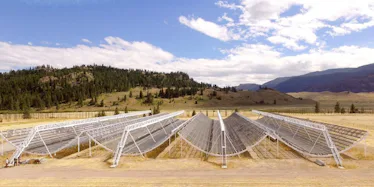
CHIME’s oddly-shaped antennas can scan the whole northern sky once a day.
MCGILL UNIVERSITY
HIDDEN IN THE DATA
Andersen and her colleagues recently combed through years of data from the Canadian Hydrogen Intensity Mapping Experiment, or CHIME, a radio telescope in British Columbia that scans the entire northern sky every day. They were searching for repeating FRBs that might have gotten buried in the data because their signals arrived so far apart that they escaped astronomers’ attention. To find them, Andersen and her colleagues looked for signals from the same part of the sky, even if they were far apart in time, using new statistical methods to help work out whether they were seeing a repeating FRB or just two unrelated FRBs that happened to come from the same direction.
“We can now accurately calculate the probability that two or more bursts coming from similar locations are not just a coincidence,” says co-author Ziggy Pleunis, an astronomer at the University of Toronto.
The astronomers identified 25 repeating FRBs in the CHIME data. That means that astronomers have now heard at least 50 FRBs repeat their chilling cries — that’s out of the thousands that have been recorded so far. But Andersen and her colleagues say we may just need to listen longer.
SOLVING AN ASTRONOMICAL PUZZLE
Computer artwork showing the magnetic field (lines) around a magnetar. A magnetar is a type of neutron star with an incredibly strong magnetic field (a million billion times stronger than that of the Earth), which is formed when certain stars undergo supernova explosions.
MARK GARLICK/SCIENCE PHOTO LIBRARY/SCIENCE PHOTO LIBRARY/GETTY IMAGES
Astronomers have detected thousands of FRBs in recent years, but that doesn’t add up to knowing much about them. So far, fewer than sixty FRBs have been traced back to their host galaxies, and thirty of those were only announced earlier this year. (Nearly all FRBs come from galaxies far, far away; astronomers have only ever detected one inside our own Milky Way.) And while it’s generally agreed that FRBs come from magnetars, the exact mechanics behind them remain a puzzle waiting to be solved. Some FRBs may come from different sources, too, according to the team that traced thirty of them to their host galaxies back in January.
And whether or not those signals repeat could offer a clue. So far, the small number of FRBs that repeat seem to have a different length and cover a different range of radio frequencies than the one-off FRBs. That leads some astronomers to suggest that repeaters and one-offs might actually be two different types of FRBs, with two different explanations.
Andersen and her colleagues now have a different idea.
“Many apparently one-off bursts have simply not yet been observed long enough for a second burst from the source to be detected,” says Pleunis.
Some of the repeating FRBs they found buried in CHIME data held their silence for a long time between repeats, crying out less than once in every week of observing time. That means that unless astronomers are willing to keep listening to the same patch of sky for days or weeks at a time — a risky gamble in a field where telescope time is in high demand — a repeating burst might end up looking like a one-off. It’s even possible that all FRBs may repeat… eventually.
Differences in radio frequency and the length of the signal may still point to more than one origin for these weird cosmic signals, though. When it comes to FRBs, questions still abound, and astronomers can only answer them with more data.
On July 28, 2011, former astronaut and scientist Brian O’Leary passed away shortly after making a big statement. When the United States space agency NASA selected its sixth group of astronauts in August 1967, he was selected to be a member of that group. O’Leary had been a member of Princeton University’s physics faculty for many years. According to him, there is substantial evidence indicating that Earth is being visited by extraterrestrial beings. He claimed that advanced civilizations arrived on earth a very long time ago and that these civilizations employ technology that are founded on consciousness.
“There is much evidence that we have been contacted by aliens, and that these civilizations have been visiting us for a very long time, their appearance may be bizarre from any traditional Western materialistic point of view. These visitors use consciousness-influencing technologies – the toroid and use co-rotating magnetic disks for their propulsion systems, which appear to be the common denominator of the UFO phenomenon,”— Dr. Brian O’Leary on Thrive Movement
Dr. Brian O’Leary was born on January 27, 1940. Unfortunately, he was diagnosed with intestinal cancer and died of a heart attack. In August 1967, he was one of the astronauts chosen by NASA to participate in the sixth group of astronauts. The people that made up this team were commonly referred to as the scientist-astronauts. Dr. O’Leary attended Williams College and earned a bachelor of arts degree in physics in 1961. He then attended the University of California at Berkeley and earned a doctor of philosophy degree in astronomy in 1967.
NASA selected Brian O’Leary as a scientist-astronaut in 1967, for a potential manned mission to Mars. Image via New York Post
He was a fellow of the American Association for the Advancement of Science and secretary of the Planetology Section of the American Geophysical Union. In addition, he led the Asteroidal Resources Group for the NASA Ames Summer Study on Space Settlements. He was a founding board member of the International Association for New Science and the New Energy Movement’s first president. He was a fellow at the World Innovation Foundation and a Princeton University physics professor.
After O’Leary quit NASA, Carl Sagan invited him to lecture at Cornell University in 1968. He stayed there as an astronomy research associate from 1968 to 1969 and as an assistant professor from 1969 to 1971. He looked into lunar mascons while he was at Cornell. During the 1970–1971 academic year, O’Leary worked as a visiting researcher at the California Institute of Technology. He was the deputy team leader of the Mariner 10 Venus-Mercury TV Science Team. NASA recognized the team’s efforts by presenting them with a group accomplishment award.
During a live interview with Kerry Cassidy of Project Camelot, he shared some fascinating insights regarding Carl Sagan. O’Leary and Sagan had been friends for a number of years, but when O’Leary decided to leave Cornell, they had a falling out. (Source)
Following his departure, O’Leary began to explore some of Carl’s work. He claimed that the iconic “Face” at Cydonia on Mars, which was photographed by Viking in 1975 and resembled a human face, was altered by Sagan before being released to the public: “It was very, very disappointing to me, because not only was Carl wrong, he also fudged data. He published a picture of the ‘Face’ in Parade Magazine, a popular article, saying that the ‘Face’ was just a natural formation, but he doctored the picture to make it not look like a face.”
In May 1990, O’Leary released a paper titled “Analysis of Images of the Face on Mars and Possible Intelligent Origin,” which only further demonstrated his skepticism. It was published in the Journal of the British Interplanetary Society, Vol.43 No.5. O’Leary also went on the record and stated:
“I began to realize, just directly from the scientific point of view, not only hearsay, that this man was colluding with NASA, that there might be more to this than before… Carl was on a committee with a number of notable people. There was a report issued by the Brookings Institution in 1961 — and that’s about when I knew Carl, during those years; the ’60s mostly was when I worked closely with him — that he and this other group said: Well, if any ETs ever showed up on the Earth, it has to be covered up. That’s the only way we’re going to be able to manage this, because if we can’t, then it would be too much of a culture shock.”
On the 18th of September, 1994, Dr. O’Leary said during the International Forum on New Science in Fort Collins in Colorado: “A secret group within the U.S. government keeps the masses for nearly 50 years away at about UFOs and extraterrestrial contact. We have contact with extraterrestrial civilizations. This information is probably obscured by an elite group within the CIA, NSA and DIA. This small group knows well the secrets to keep. Watergate and the Iran-Contra affair are child compared to this cosmic Watergate about UFOs, aliens, mind control, genetic engineering, free energy and antigravity.”
O’Leary suggested not only the existence of an extraterrestrial presence on Earth, but also the existence of a face on Mars. He also penned the introduction to Steven Greer’s book Hidden Truth, Forbidden Knowledge. The book is about repressed alien technologies such as free energy, anti-gravity, and extraterrestrial presence on Earth.
“There is a serious possibility that we are being visited and have been visited for many years by people from outer space, by other civilizations. Who they are, where they are from, and what they want should be the subject of rigorous scientific investigation and not be the subject of ‘rubishing’ by tabloid newspapers.” (source) – Lord Admiral Hill-Norton, Former Chief of Defence Staff, 5 Star Admiral of the Royal Navy, Chairman of the NATO Military Committee
“Intelligent beings from other star systems have been and are visiting our planet Earth. They are variously referred to as Visitors, Others, Star People, Et’s, etc…They are visiting Earth now; this is not a matter of conjecture or wistful thinking. – Theodor C. Loder III, Phd, Professor Emeritus of Earth Sciences, University of New Hampshire (source)
“Aliens are living among us and that it is likely at least two of them are working with the U.S. government. Decades ago, visitors from other plants warned us about where we were headed and offered to help. But instead, we, or at least some of us, interpreted their visits as a threat, and decided to shoot first and ask questions after…Because I know that they are. As a matter of fact, they’ve been visiting our planet for thousands of years.” – Paul Hellyer, Former Canadian Defense Minister (source)
My people tell of Star People who came to us many generations ago. The Star people brought spiritual teachings and stories and maps of the cosmos and they offered these freely. They were kind, loving, and set a great example. When they left us, my people say there was a loneliness like no other.” – Richard Wagamese, Ojibway Author (source)
Documentary filmmaker Jeremy Corbell has stunned UFO enthusiasts with his piece of evidence on the phenomenon and information he received while studying UFOs. He is the one who shared the video footage showing the UFO as a transmedium vehicle. Additionally, he says that UFOs and aliens are just a small part of a larger reality along with other interesting and eye-opening statements in an extensive interview with Theories of Everything with Curt Jaimungal.
Jeremy Kenyon Lockyer Corbell is an American contemporary artist and investigative filmmaker based in Los Angeles, California. He did extensive research on nanotechnology, aerospace exploration, and exotic propulsion systems, as well as an in-depth examination into the life and discoveries of the enigmatic “Godfather of Conspiracy” John Lear.
Corbell has documented the surgical removal of alleged off-world alien implants, and has filmed NASA’s analysis of anomalous materials alleged to be physical evidence of extraterrestrial nano-technology from UFO landing sites. He has obtained deathbed confessions from former CIA and government intelligence officials who claim to expose the truth about UFOs and the worldwide coverup of the ultimate truth.
Jeremy Corbell with former Pentagon UFO official Luis Elizondo.
Corbell released the film “Bob Lazar: Area 51 & Flying Saucers” on Netflix, adding credibility to Lazar’s case. Moreover, his 2-hour interview with Curt Jaimungal discussed dozens of topics that added great information to the UAP/UFO phenomena. In 2021, he leaked a film of the US Navy photographed & filmed “spherical” shaped UFOs & advanced transmedium vehicles. In the footage shared by filmmaker and UFO enthusiast Jeremy Corbell, a flying object can be seen disappearing into the water off California.
In this interview, he covers a variety of controversial subjects including the release of the Tic-Tac videos by the government, possible government disinformation campaigns, and the claims of Bob Lazar that he once worked on backward engineering an alien craft.
UFOs and Aliens Just Small Part of ‘Larger Reality’
Corbell asserted in the interview that aliens and UFOs are a small part of a much larger reality of this mysterious and mind-boggling phenomenon.
He said:
“UFOs appear to be part of a larger phenomenon meaning UFOs are kind of an auxiliary implication of a much larger reality. So this idea that what we’re seeing are machines from other planets. I’m unconvinced what we may be seeing is an alternate reality. You know maybe it is something closer to dimensional travel.
There seems to be another version of reality that is occurring and that somehow once they pop through into our reality. And this is not just from a cursory look at the ufo phenomenon, this is from talking with thousands of close encounter eyewitnesses who tell me that this is something bigger than just flying machines.
To give you an example at Skinwalker Ranch. The report is that a piece of the sky opened up like a tear and out of this came “Beings” came “Craft.” So, UFOs is a symptom, it’s part of this alternate reality, The phenomenon as I call it. But it’s not just about UFOs represent this phenomenon.
I know this to be true that Skinwalker ranch is the best example of this because you have UFO phenomena. But you also have cattle mutilation which is often associated with lights in the sky. So, cattle mutilation is something a concrete example.
Cattle mutilation, Is this a UFO phenomenon or a government experiment, or is this a private corporation that’s going around mutilating these cows and draining their blood in the dead of the night? Nobody has ever been caught during these cattle mutilations.
They are the same across the board. They’re drained of blood. The farmers and people that are cattle ranchers see UFOs oftentimes during these mutilations so I can’t separate them.”
American billionaire Robert Bigelow shared his personal experiences and losses that prompted his interest in life after death, as well as UFOs. He talked about possible links between consciousness research and UFOs. He also talked about the risks of trying to establish communications with the unknown.
“That’s been mainly what I’ve been doing except for the skinwalker ranch thing for 20 years as the space world has been huge in my life to pursue the legitimate parochial kind of you know using fire engines rockets to get you there. We didn’t expect anything like this to happen and so there this is different. This is the holy grail and is different than the second holy grail. If the second one is ‘Beings’ (E.T.), then the first one: Is there any part of your consciousness that survives your bodily death? That’s a big deal. That’s a huge story. That’s gigantic.”
Dr. Travis Taylor’s Statement On Skinwalker Ranch
Dr. Taylor joined businessman Brandon Fugals’s team at Fugals’s infamous Skinwalker ranch three years ago and firmly believed he would be able to resolve the ranch’s assorted mysteries in short order. But the longer he stayed, the stranger things became. In his interview with investigative journalist George Knapp, he said: “You know, I had never seen a UFO until I got out there. Now, I have seen more UFOs now than you can count.” (Source)
In the surprisingly candid and wide-ranging interview, Dr. Taylor shared his opinions about the role of science in the pursuit of the unknown, his personal experiences with strange phenomena on Skinwalker Ranch, the physical effects of close encounter cases, and the mysterious “hitchhiker effect” that multiple UFO/paranormal eyewitnesses have reported.
In his opinion, this unexplained phenomenon can be different for people in regards to their brain activity. Hypothetically speaking, he said that the phenomenon can be connected with different planes in the universe. He added that he could go along with the idea of a portal but was not sure. He believes it is bizarre but there is some truth to it.
Meer van UFO'S of UAP'S, ASTRONOMIE, RUIMTEVAART, ARCHEOLOGIE, OUDHEIDKUNDE, SF-SNUFJES EN ANDERE ESOTERISCHE WETENSCHAPPEN - DE ALLERLAATSTE NIEUWTJES


 Pilot Examines Border Patrol’s Classified UFO Videos