Naar de inhoud

UFO'S of UAP'S, ASTRONOMIE, RUIMTEVAART, ARCHEOLOGIE, OUDHEIDKUNDE, SF-SNUFJES EN ANDERE ESOTERISCHE WETENSCHAPPEN - DE ALLERLAATSTE NIEUWTJES

UFO's of UAP'S in België en de rest van de wereld
akke.beakke.be
Ontdek de Fascinerende Wereld van UFO's en UAP's: Jouw Bron voor Onthullende Informatie! Ben jij ook gefascineerd door het onbekende? Wil je meer weten over UFO's en UAP's, niet alleen in België, maar over de hele wereld? Dan ben je op de juiste plek! België: Het Kloppend Hart van UFO-onderzoek In België is BUFON (Belgisch UFO-Netwerk) dé autoriteit op het gebied van UFO-onderzoek. Voor betrouwbare en objectieve informatie over deze intrigerende fenomenen, bezoek je zeker onze Facebook-pagina en deze blog. Maar dat is nog niet alles! Ontdek ook het Belgisch UFO-meldpunt en Caelestia, twee organisaties die diepgaand onderzoek verrichten, al zijn ze soms kritisch of sceptisch. Nederland: Een Schat aan Informatie Voor onze Nederlandse buren is er de schitterende website www.ufowijzer.nl, beheerd door Paul Harmans. Deze site biedt een schat aan informatie en artikelen die je niet wilt missen! Internationaal: MUFON - De Wereldwijde Autoriteit Neem ook een kijkje bij MUFON (Mutual UFO Network Inc.), een gerenommeerde Amerikaanse UFO-vereniging met afdelingen in de VS en wereldwijd. MUFON is toegewijd aan de wetenschappelijke en analytische studie van het UFO-fenomeen, en hun maandelijkse tijdschrift, The MUFON UFO-Journal, is een must-read voor elke UFO-enthousiasteling. Bezoek hun website op www.mufon.com voor meer informatie. Samenwerking en Toekomstvisie Sinds 1 februari 2020 is Pieter niet alleen ex-president van BUFON, maar ook de voormalige nationale directeur van MUFON in Vlaanderen en Nederland. Dit creëert een sterke samenwerking met de Franse MUFON Reseau MUFON/EUROP, wat ons in staat stelt om nog meer waardevolle inzichten te delen. Let op: Nepprofielen en Nieuwe Groeperingen Pas op voor een nieuwe groepering die zich ook BUFON noemt, maar geen enkele connectie heeft met onze gevestigde organisatie. Hoewel zij de naam geregistreerd hebben, kunnen ze het rijke verleden en de expertise van onze groep niet evenaren. We wensen hen veel succes, maar we blijven de autoriteit in UFO-onderzoek! Blijf Op De Hoogte! Wil jij de laatste nieuwtjes over UFO's, ruimtevaart, archeologie, en meer? Volg ons dan en duik samen met ons in de fascinerende wereld van het onbekende! Sluit je aan bij de gemeenschap van nieuwsgierige geesten die net als jij verlangen naar antwoorden en avonturen in de sterren! Heb je vragen of wil je meer weten? Aarzel dan niet om contact met ons op te nemen! Samen ontrafelen we het mysterie van de lucht en daarbuiten.

Archief

Dinosaurussen toch niet uitgestorven door meteorietinslag? Computermodellen ondersteunen vulkaantheorie

Dinosaurussen toch niet uitgestorven door meteorietinslag? Computermodellen ondersteunen vulkaantheorie

298c3e31-6a35-5cd3-f533-300d4e83801f.jpg

Het is een van de raadselachtigste massa-extincties die de Aarde heeft gekend: hoe konden die grote en machtige dinosaurussen 66 miljoen jaar geleden in één klap worden weggevaagd? En niet alleen de dino’s, driekwart van het leven op Aarde verdween. Was het een meteorietinslag of toch een vulkaanuitbarsting, die op dramatische wijze een einde maakte aan het Krijt?

Onderzoekers besloten zich er eens niet zelf mee te bemoeien, maar een computer het werk te laten opknappen. En dat leidde tot een verrassende uitkomst: niet de asteroïde, maar de uitbarsting van de Deccan Traps zou het leven op Aarde fataal zijn geworden. Rond de overgang van het Krijt naar het Tertiair barstte het westen van India open over een oppervlakte van 500.000 vierkante kilometer. De vulkaanuitbarstingen hielden een miljoen jaar aan, waardoor er enorme hoeveelheden CO2 in de lucht belandden en de Aarde snel opwarmde. Het gebied van de Deccan Traps bestaat uit een laag van 2 kilometer dikke gestolde basalten.

Vulkaan versus meteoriet
Volgens de laatste theorie vormden deze vulkaanuitbarstingen de voorzet, waarna de meteoriet de genadeklap was. Het puin en stof in de lucht na de inslag blokkeerde het zonlicht waardoor het zo’n tien jaar lang koud en donker werd op Aarde, wat tot de uitsterving van een groot aantal soorten kan hebben geleid. Maar zeker weten doen we het niet.

Dus misschien kan een computermodel uitsluitsel bieden. “In plaats van te zeggen: ‘laten we de vulkanen de schuld geven en uitleggen waarom’ of ‘laten we de asteroïde de schuld geven en uitleggen waarom’, was het doel om zo min mogelijk menselijke input of vooroordelen te hebben”, zegt rekenkundig geoloog Alexander Cox van het Amerikaanse Dartmouth College.

Boringen in de diepzee
Het idee was om bij het bewijs te beginnen, want dat is er: bij boringen in diepzeesedimenten zijn geologische resten gevonden die wijzen op dodelijke hoeveelheden gas in de atmosfeer en in de oceanen, met name CO2 en zwaveldioxide. Maar die gassen kunnen net zo goed afkomstig zijn van de vulkaanuitbarstingen als van de meteorietinslag, aangezien daardoor rotsen zijn verbrand op het oppervlak van de Aarde, redeneren de onderzoekers.

Speciaal wiskundig model
Om te ontrafelen hoe groot de bijdrage was van beide rampen, hebben ze een specifiek statistisch model gebruikt: de Markov-keten Monte Carlo-methode (voor de liefhebbers). Deze methode berekent systematisch de kans op verschillende emissiescenario’s van de diverse bronnen. De oplossing ontstaat, doordat de resultaten van de simulaties steeds dichterbij de geologische observaties komen. Wat de bevindingen extra sterk maakt, is dat de onderzoekers maar liefst 128 verschillende processors parallel simulaties lieten draaien. “Alle processoren vergeleken daarna hoe ze het deden aan het eind van elke simulatie, zoals klasgenoten hun antwoorden vergelijken”, aldus Cox. Zo konden berekeningen die normaal wel een jaar duren in een paar dagen worden uitgevoerd.

Foraminiferen
De gegevens waren afkomstig uit drie kernen die gedrild zijn in diepzeesedimenten, allemaal daterend van 67 tot 65 miljoen jaar geleden. In die sedimenten zijn foraminiferen gevonden, micro-organismen waarvan de schaal verschillende isotopen van koolstof en zuurstof bevat. Dit kun je zien als een afspiegeling van de chemische samenstelling van de oceaan in die periode. Daarom kun je het gebruiken als een proxy om bijvoorbeeld de temperatuur in die tijd af te leiden of hoeveel diertjes er in de oceanen leefden en hoeveel koolstof er heen en weer ging tussen de atmosfeer, de oceaan en het land.

En de computersimulaties leverden iets interessants op: de hoeveelheid gas die in de atmosfeer werd gespuwd door de vulkanen was genoeg voor de temperatuurverandering en koolstofcyclus, zoals die is af te leiden uit de foraminiferen in de drilkernen. En de asteroïde, die de enorme Chicxulub-krater vormde in wat nu Mexico is, produceerde waarschijnlijk niet zo’n enorme piek in koolstof- of zwaveldioxide als gedacht, blijkt verder uit de analyse.

Niet overtuigd
Maar veel wetenschappers zijn nog niet helemaal overtuigd dat deze computerberekening nu voor eens en voor altijd het antwoord is op een vraag die onderzoekers al decennia bezighoudt. “Het is een elegante manier om dit probleem op te lossen”, reageert geochemicus Sierra Petersen van de University of Michigan. “Een model op deze manier gebruiken, geeft de vrijheid om tot een consensus te komen, waarbij rekening is gehouden met vele data. Maar, zoals met elk model, hangt de output af van de input.” Volgens Petersen zijn foraminiferen niet de ideale proxy om vroegere temperaturen uit af te leiden. De zuurstofisotopenratio’s kunnen niet alleen door temperatuur veranderen maar ook door de samenstelling van het zeewater. Verschillende temperatuur-proxy’s leiden waarschijnlijk tot verschillende patronen van vrijkomend gas, zoals die worden gereproduceerd door de modellen, legt Petersen verder uit.

Ook heeft ze kritiek op de conclusie uit de studie. “Het is nogal een stap om te stellen dat deze studie aantoont dat de meteorietinslag de extinctie niet heeft veroorzaakt. Ik denk dat enkel wordt aangetoond dat er bij de inslag niet zoveel gas vrijkwam.” Maar de asteroïde kan nog steeds op een andere manier een dodelijke impact hebben gehad. Zo kwamen er grote wolken van roet en stof in de lucht. Eerder onderzoek stelde dat daardoor het zonlicht dat de Aarde bereikte mogelijk met wel 20 procent afnam, waardoor het steenkoud werd en vele dieren en planten stierven.

Toch een stapje dichterbij
Hoewel deze studie dus een interessante toevoeging is in het debat over het einde van het dinotijdperk biedt hij wederom geen uitsluitsel in de discussie ‘vulkaanuitbarsting versus meteorietinslag’, maar misschien is het wel weer een puntje erbij voor de vulkaantheorie.

Bronmateriaal

{ https://scientias.nl/ }

Hoe vind je dit bericht?
Geschreven door peter om 01:01 Stuur door

Monsterachtige ijsberg ter grootte van Luxemburg blijkt – al smeltende – iets heel bijzonders met de omringende oceaan te hebben gedaan

Monsterachtige ijsberg ter grootte van Luxemburg blijkt – al smeltende – iets heel bijzonders met de omringende oceaan te hebben gedaan

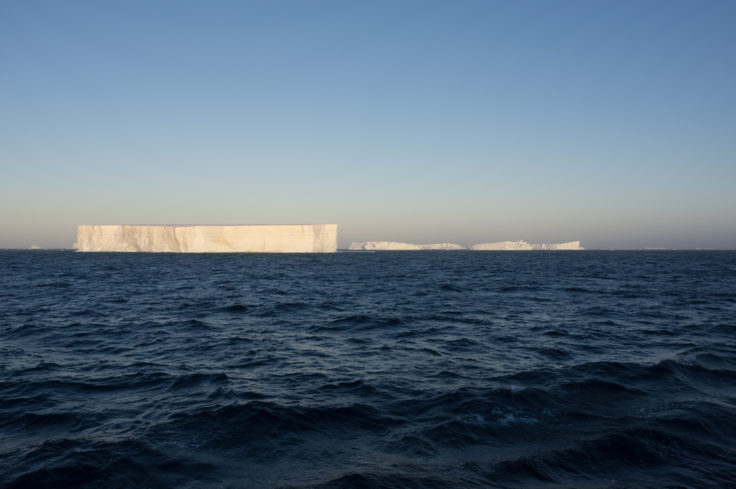
54d5cd24-bf47-688a-d375-0b584c2f4f90.jpg

Grote opwinding onder wetenschappers als in 2017 voor de kust van Antarctica een monsterachtige ijsberg het levenslicht ziet. De ijsberg dobbert jarenlang rond en vindt uiteindelijk pas in 2020 zijn Waterloo. En nu blijkt ook die ondergang van de machtige ijsberg behoorlijk opwindend te zijn (geweest).

Want in een nieuw onderzoek – verschenen in het blad Geophysical Research Letters – schrijven wetenschappers dat de ijsberg – terwijl deze ten onder ging – een enorme impact had op zijn directe omgeving. Zo blijkt de ijsberg er eigenhandig voor gezorgd te hebben dat de oppervlaktetemperatuur van de Zuidelijke Oceaan lokaal met maar liefst 4,5 graad afnam. En ook het zoutgehalte liep door toedoen van de smeltende ijsberg met meer dan 60 procent terug. Het zijn grote veranderingen; groter dan alle andere veranderingen die wetenschappers ooit in reactie op een smeltende ijsberg hebben waargenomen.

Als een riviermonding in open zee
“De A68-ijsberg was één van de grootste en best bestudeerde ijsbergen ooit,” vertelt onderzoeker Roseanne Smith. “Toen deze uiteen begon te vallen, was het een beetje alsof er een enorme riviermonding in de open oceaan was geïnstalleerd die koud, zoet water in de bovenste laag van de oceaan pompte.”

Over A68
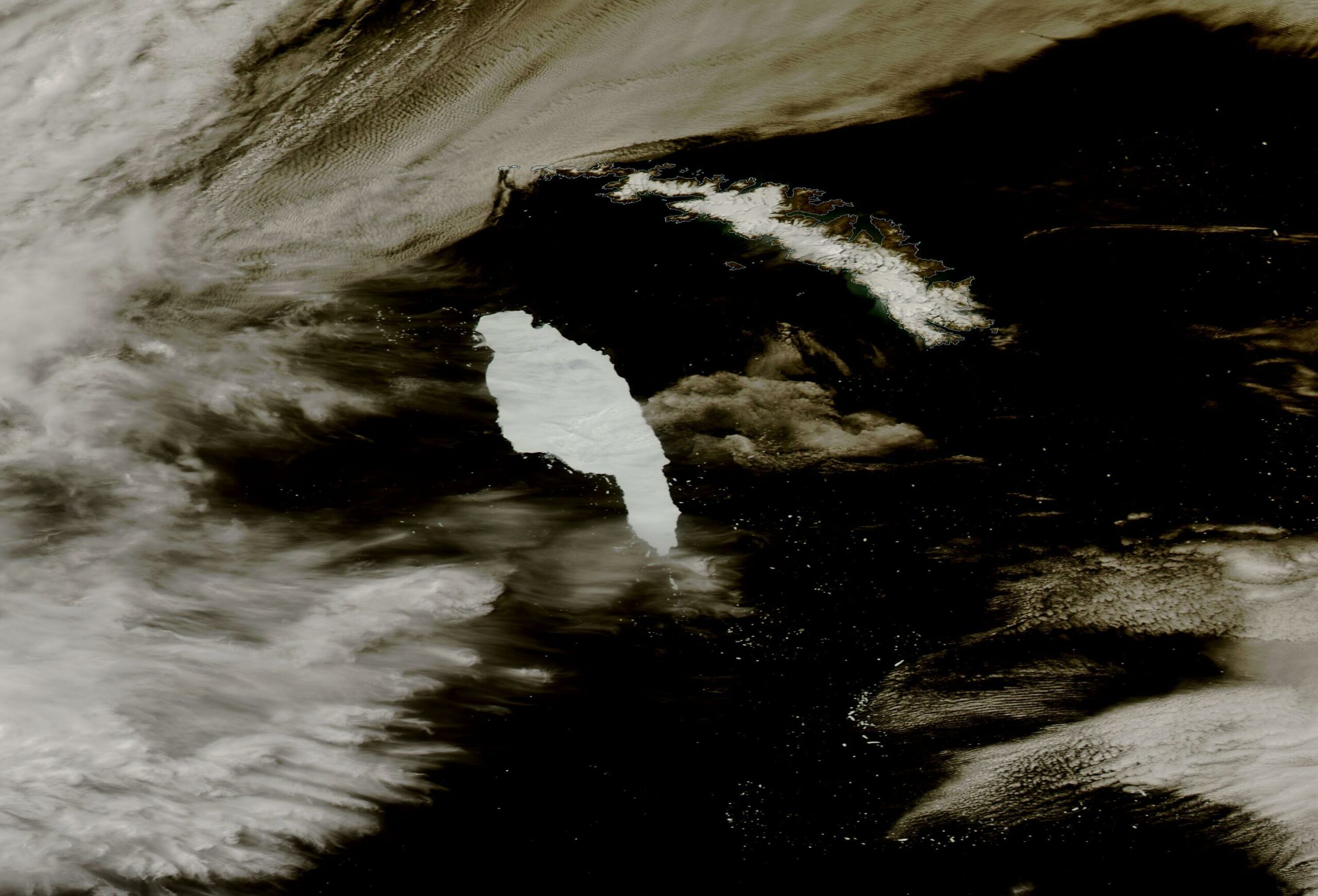
De ijsberg waar het onderzoek van Smith en collega’s om draait, ontstond in 2017, toen een enorm stuk ijs van de Larsen C-ijsplaat voor de kust van Antarctica, afbrak. In eerste instantie was de resulterende ijsberg ongeveer net zo groot als de provincie Gelderland. Naarmate de tijd verstreek, braken er echter steeds meer stukken ijs van de ijsberg af. En in 2020 was deze nog ongeveer zo groot als Luxemburg. Rond diezelfde tijd had A68 – al dobberend – ook al een flinke afstand afgelegd en stevende deze af op het nagenoeg onbewoonde eiland Zuid-Georgië. En daar begint de ijsberg in datzelfde jaar uiteen te vallen en – al smeltend – enorme hoeveelheden koud, zoet water in een relatief klein deel van de oceaan te brengen. Wetenschappers zitten er bovenop; met behulp van satellieten observeren ze de smeltende ijsberg en hoe deze de bovenste centimeters van de Zuidelijke Oceaan lokaal beïnvloedt. Het resulteert in de ontdekking van ongeëvenaarde, lokale afwijkingen in de temperatuur en het zoutgehalte van de oceaan, zo is in het blad Geophysical Research Letters te lezen.

De reis van A68, van Antarctica naar Zuid-Georgië. Afbeelding: ESA.

Fytoplankton
Het roept natuurlijk de vraag op in hoeverre die veranderingen ook de bewoners van die wateren hebben geraakt. Dat is op dit moment lastig te zeggen, vertelt Smith aan Scientias.nl. “A68 heeft waarschijnlijk de grootste directe invloed gehad op de onderste regionen van de voedselketen, oftewel op microalgen of fytoplankton – die aan het oppervlak van de oceaan leven. Elke soort is aan specifieke omstandigheden – waaronder een bepaalde watertemperatuur en een bepaald zoutgehalte – aangepast. Dus een verandering in die omstandigheden – zoals ontstaat wanneer een enorme ijsberg koud, zoet water in de nabijheid dumpt – is waarschijnlijk van invloed op een breed scala aan verschillende fytoplanktonsoorten in dit gebied.” Als je het zo bekijkt, lijkt de smeltende ijsberg dus slecht nieuws voor fytoplankton – en mogelijk ook de organismen hogerop in de voedselketen die voor hun overleving (grotendeels) van fytoplankton afhankelijk zijn.

Complex verhaal
Maar het is een stuk gecompliceerder dan dat, vertelt Smith. Want zo’n smeltende ijsberg kan fytoplankton inderdaad het leven zuur maken door de temperatuur en het zoutgehalte van hun oude vertrouwde oceaan tijdelijk te veranderen. Maar tegelijkertijd kan de ijsberg de groei van (andere) fytoplanktonsoorten ook weer bevorderen. “Het smeltwater van de ijsberg is rijk aan opgelost ijzer en ijzer is iets wat de Zuidelijke Oceaan door de bank genomen mist. Dus ijsbergen kunnen de oceaan als het ware ‘bemesten’.” En zo de groei van fytoplankton stimuleren. “Dus als we kijken naar de gigantische ijsberg A68 en het smelten en ineenstorten daarvan voor de kust van Zuid-Georgië, in de zomer van 2020/2021, was die gebeurtenis dan goed nieuws voor algen? Dat is lastig te zeggen. Er groeit van nature namelijk ‘s zomers al veel fytoplankton in de wateren rond Zuid-Georgië. Voor nu wijzen satellietdata er echter voorzichtig op dat het fytoplankton in sommige gebieden toenam en in andere iets afnam.”

Tegelijkertijd kan op dit moment ook niet worden uitgesloten dat de smeltende ijsberg de omringende oceaan niet alleen op ijzer, maar ook op fytoplankton getrakteerd heeft. “Het is mogelijk dat de ijsberg zelf ook fytoplanktonsoorten herbergde die normaliter niet zo noordelijk voorkomen,” vertelt Smith. “Die soorten kunnen tijdens het smelten van de ijsberg zijn ontsnapt en in de wateren rond Zuid-Georgië zijn gaan groeien, omdat ze het wel prettig vinden in dat koude, zoete smeltwater dat rond hen vrijkwam.” Het is iets wat onderzoekers in eerdere studies naar andere (kleinere) smeltende ijsbergen wel hebben zien gebeuren. Maar of ook A68 fytoplankton meevoerde, is nog niet bewezen. “We hebben simpelweg te weinig bewijs om nu te zeggen dat dat het geval is. Ook kunnen we nog niet zeggen of het netto effect van de ijsberg op het ecosysteem van Zuid-Georgië nu positief of negatief was. Daar worden de komende maanden en jaren nog wel studies over gepubliceerd,” verwacht Smith. “Want er zijn in die tijd (dat de ijsberg smolt, red.) veel watermonsters verzameld en die worden nu nog onderzocht.” Wordt vervolgd dus.

Enorme afstand
Wat we ondertussen wél zeker weten, is dat de impact van de ijsberg ook verder reikte dan de directe omgeving van Zuid-Georgië. Het koude, zoete smeltwater werd namelijk door stromingen in oostelijke richting van het eiland weggevoerd. En niet zo’n klein eindje ook. “Wat mij het meest heeft verrast, was de enorme afstand waarover de smeltwaterpluim van A68 verspreid werd,” vertelt Smith. “Voor A68 hadden we al vastgesteld dat temperatuurdalingen en veranderingen in het zoutgehalte van het water aan het oppervlak van de oceaan zelfs op tientallen kilometers afstand van de rand van de ijsberg nog gedetecteerd konden worden. Dat komt doordat het smeltwater door lokale stromingen wordt weggevoerd. Maar in het geval van A68 was het echt een heel ander verhaal: de pluim bestaande uit koel, zoet smeltwater werd over een enorme afstand weggevoerd. Op een gegeven moment was deze pluim zelfs meer dan 1000 kilometer lang! Dat is ongeveer de afstand tussen Parijs en Wenen!”

Heldenrol voor satellieten
De enige reden dat onderzoekers überhaupt in staat waren om de enorme afstand waarover het smeltwater verspreid werd, vast te stellen, is dat ze gebruik maakten van satellietdata. “In de meeste eerdere studies naar smeltwaterpluimen van ijsbergen werd gebruik gemaakt van sensoren op schepen of boeien, maar je zou heel veel schepen en heel veel tijd (en dus ook heel veel geld) nodig hebben om op die manier de omvang van de smeltwaterpluim van A68 te meten. Alleen dankzij satellietdata is het ons gelukt om de volledige lengte en distributie ervan over een periode van meerdere maanden vast te stellen.”

Dat het smeltwater zo ver werd weggevoerd, betekent ook dat de impact die het smeltwater eventueel op fytoplankton nabij Zuid-Georgië had, in ieder geval tijdelijk was. “Het is onwaarschijnlijk dat de impact van het smeltwater na de winter van 2021 nog door de fytoplankton gevoeld werd,” stelt Smith. “De ijsberg was in april 2021 (oftewel tijdens de herfst op het zuidelijk halfrond, red.) volledig weggesmolten en het resterende koude, zoete smeltwater was toen door stromingen al bij Zuid-Georgië weggevoerd. Tegen het aanbreken van de lente was alles rond Zuid-Georgië waarschijnlijk weer als vanouds.”

Groeven in de zeebodem
Is er dan anno 2023 niets meer dat ons herinnert aan het ontstaan en de ondergang van de machtige ijsberg A68? Zeker wel! “Daarvoor moeten we echter onder het ruwe, stormachtige oppervlak van de oceaan duiken, richting de bodem rond Zuid-Georgië,” vertelt Smith. “Het is gebruikelijk dat grote ijsbergen over de bodem van de zeebodem schuren als ze door relatief ondiep kustwater bewegen.” Het resulteert in blijvende groeven in de zeebodem. Ook beïnvloedt het alles wat op die zeebodem leeft. “Als ijsbergen over de zeebodem schuren, bulldozeren ze het fragiele ecosysteem op die zeebodem en dat kan erin resulteren dat meer dan 98 procent van de lokale dieren en planten sterft. Het kan vervolgens ook lang (in de orde van jaren) duren voor dat ecosysteem weer hersteld is.” Zuid-Georgië heeft al veel ijsbergen door haar kustwateren zien reizen, dus de zeebodem herbergt heel wat groeven die daarvan blijvend getuigen. “Van A68 wordt vermoed dat deze de zeebodem ten zuiden van Zuid-Georgië half december heeft geraakt,” vertelt Smith. En daarmee is het leven op de zeebodem mogelijk zodanig aangetast dat het wel even duurt voor het zich weer hersteld heeft. En de zeebodem zelf is in dat scenario sowieso voorgoed enkele groeven rijker.

Het onderzoek naar de impact die monsterachtige ijsbergen op de lokale oceaan en ecosystemen hebben, is belangrijk. Want de verwachting is dat we in de nabije toekomst veel meer van deze grote ijsbergen zullen zien ontstaan. “Klimaatmodellen laten zien dat een verdere opwarming van de atmosfeer en oceaan door broeikasgassen de stabiliteit van de vele ijsplaten rond Antarctica aantast. Als die ijsplaten uiteenvallen, kunnen ze in korte tijd veel grote ijsbergen in de Zuidelijke Oceaan loslaten,” legt Smith uit. “Meer ijsbergen betekent ook dat meer met ijzer verrijkt zoetwater de Zuidelijke Oceaan bereikt. En dat resulteert in een afnemend zoutgehalte en meer stratificatie in de bovenste delen van de oceaan, oftewel: die bovenste lagen gaan zich moeilijker mengen met diepere waterlagen.” Dat laatste heeft alles te maken met het feit dat zoet water een geringere dichtheid heeft dan zout water en dus minder makkelijk zinkt. “Het kan verschillende effecten hebben,” gaat Smith verder. Zo zorgt de stratificatie van het water ervoor dat oppervlaktewater moeilijker naar grote diepte zinkt. “En dat is belangrijk, omdat het zinken van dat oppervlaktewater helpt bij de opslag van koolstof en warmte in de diepere delen van de oceaan.” Daarnaast kan het smeltwater ook van invloed zijn op de aangroei van zee-ijs, zo verwachten de onderzoekers. “En dat is belangrijk, omdat zee-ijs helpt om de energie van de zon te reflecteren en minder zee-ijs betekent dus dat er meer zonne-energie (en dus warmte) wordt geabsorbeerd (en vice versa).” En ten slotte kunnen ijsbergen dus ook nog eens op verschillende manieren hun stempel drukken op lokale ecosystemen. “Welk van deze effecten het meest dominant zal zijn, is lastig te zeggen,” erkent Smith. “Maar als de frequentie waarmee grote ijsbergen ontstaan, substantieel toeneemt, kan het zijn dat de tijdelijke invloeden die elke individuele ijsberg heeft, zich gaan opstapelen en resulteren in grotere, langer aanhoudende en meer wijdverspreide veranderingen in de Zuidelijke Oceaan, met gevolgen voor zee-ijs, de groei van fytoplankton en het zinken van oppervlaktewater.”

A body of water next to the ocean

The melting of the supergiant iceberg A-68 had a huge impact on the ocean around South Georgia, in sub-Antarctica,_Povl Abrahamsen, BAS

A satellite image of an iceberg

A68 near South Georgia on 14.12.20 –

Credit NASA MODIS (Worldview snapshot) (1)

Bronmateriaal

{ https://scientias.nl/ }

Hoe vind je dit bericht?
Geschreven door peter om 00:41 Stuur door

Webb Telescope Reveals An Ancient Universe Packed with Oddly-Bright Galaxies, Puzzling Astronomers

c97fa2a5-9388-4c37-ae9f-67a6897966e5-fire_jwst_ageller_4k.jpg?w=400&h=300&fit=crop&crop=faces&auto=format%2Ccompress

Webb Telescope Reveals An Ancient Universe Packed with Oddly-Bright Galaxies, Puzzling Astronomers

Astronomers are seeing the cosmos as it once was.

Mysterious light appears in the images pulled from the depths of the universe using the James Webb Space Telescope (JWST). And now, it finally has an explanation.

JWST, the next-generation observatory from NASA, the European Space Agency, and the Canadian Space Agency, is able to view infrared light like never before. Infrared reveals visible light that has been stretched by the universe as it expands and which has poured out from the farthest reaches of space across billions of light-years. Once this light reaches Earth, astronomers can see the cosmos as it once was.

They haven't seen anything like JWST’s images before, which first went public in July 2022. But, they had good guesses about what they’d find.

However, one particular characteristic of the ancient galaxies appearing before them left many stumped. Although astronomers know very little about Cosmic Dawn, the 100 million years to 1 billion years after the Big Bang, when the universe sprouted its first stars and galaxies, they did not expect to see galaxies shining as bright as they see in the telescopic images. Rohan Naidu, a NASA Hubble Fellow at the Massachusetts Institute of Technology, even told Quanta Magazine that the galaxies were “stupidly bright.”

WHY ARE THE ANCIENT GALAXIES SO BRIGHT?

Their luminosities were so shocking that some physicists questioned the standard model of cosmology, which describes how the universe has evolved since the Big Bang.

The issue is that, usually, bright galaxies mean big galaxies. “But because these galaxies formed at cosmic dawn, not enough time has passed since the Big Bang,” Claude-André Faucher-Giguère, associate professor of physics and astronomy at Northwestern University in Illinois and an author of a new paper, says in a statement describing the study. “How could these massive galaxies assemble so quickly?”

A research team led by Guochao Sun, a postdoctoral fellow at Northwestern, found an explanation: bursts of formation. They published their findings on Tuesday in the journal Astrophysical Journal Letters.

“If star formation happens in bursts, it will emit flashes of light. That is why we see several very bright galaxies,” Sun said in a Northwestern University statement describing the study.

The young galaxies, which the statement called “too bright, too massive, and too mature to have formed so soon after the Big Bang,” may just plain and simply be bursting with new stars.

Unlike modern galaxies, which form stars at a steady rate, the early galaxies seed a process known as bursty star formation. “So-called bursty star formation occurs when stars form in an alternating pattern — many stars at once, followed by millions of years of very few new stars and then many stars again,” according to the statement.

Now that the JWST imagery begins to make more sense, astronomers can use its sensitive instruments to investigate other cosmic mysteries.

{ https://www.inverse.com/ }

Hoe vind je dit bericht?
Geschreven door peter om 00:15 Stuur door

Geoscientists Discover Massive Undersea Water Reservoir Off New Zealand’s Coast

Geoscientists Discover Massive Undersea Water Reservoir Off New Zealand’s Coast

Revealed by 3D seismic imaging, the newly-discovered water reservoir lies 3.2 km (2 miles) under the ocean floor off the coast of New Zealand, where it may be dampening a major earthquake fault that faces the country’s North Island. The fault is known for producing slow-motion earthquakes, called slow slip events. These can release pent-up tectonic pressure harmlessly over days and weeks.

3D seismic imaging and ocean drilling at the Hikurangi margin reveal a widespread and previously unknown fluid reservoir within the extensively hydrated (up to 47 vol % water) volcanic upper crust of the subducting Hikurangi Plateau large igneous province. Image credit: Gase et al., doi: 10.1126/sciadv.adh0150.

3D seismic imaging and ocean drilling at the Hikurangi margin reveal a widespread and previously unknown fluid reservoir within the extensively hydrated (up to 47 vol % water) volcanic upper crust of the subducting Hikurangi Plateau large igneous province.

Image credit: Gase et al., doi: 10.1126/sciadv.adh0150.

“Many slow slip earthquakes are thought to be linked to buried water,” said Dr. Andrew Gase, a postdoctoral researcher at the University of Texas.

“However, until now there was no direct geologic evidence to suggest such a large water reservoir existed at this particular New Zealand fault.”

“We can’t yet see deep enough to know exactly the effect on the fault, but we can see that the amount of water that’s going down here is actually much higher than normal.”

The site where Dr. Gase and colleagues found the water is part of a vast volcanic province that formed when a plume of lava the size of the United States breached the Earth’s surface in the Pacific Ocean 125 million years ago.

The event was one of the Earth’s largest known volcanic eruptions and rumbled on for several million years.

The study authors used seismic scans to build a 3D picture of the ancient volcanic plateau in which they saw thick, layered sediments surrounding buried volcanoes.

They ran lab experiments on drill core samples of the volcanic rock and found that water made up nearly half of its volume.

The seismic image of the Hikurangi Plateau reveals details about the Earth’s interior and what it’s made of. The blue-green layer under the yellow line shows water buried within rocks Image credit: Gase et al., doi: 10.1126/sciadv.adh0150.

The seismic image of the Hikurangi Plateau reveals details about the Earth’s interior and what it’s made of. The blue-green layer under the yellow line shows water buried within rocks

Image credit: Gase et al., doi: 10.1126/sciadv.adh0150.

“Normal ocean crust, once it gets to be about 7 or 10 million years old should contain much less water,” Dr. Gase said.

“The ocean crust in the seismic scans was ten times as old, but it had remained much wetter.”

“The shallow seas where the eruptions took place eroded some of the volcanoes into a porous, broken-up rock that stored water like an aquifer as it was buried. Over time, the rock and rock fragments transformed into clay, locking in even more water.”

The finding is important because scientists think that underground water pressure may be a key ingredient in creating conditions that release tectonic stress via slow slip earthquakes.

This usually happens when water-rich sediments are buried with the fault, trapping the water underground. However, the New Zealand fault contains little of this typical ocean sediment.

Instead, the researchers think the ancient volcanoes and the transformed rocks — now clays — are carrying large volumes of water down as they’re swallowed by the fault.

“The findings suggest that other earthquake faults around the globe could be in similar situations,” said Professor Demian Saffer, a researcher at the University of Texas.

“It’s a really clear illustration of the correlation between fluids and the style of tectonic fault movement — including earthquake behavior.”

“This is something that we’ve hypothesized from lab experiments, and is predicted by some computer simulations, but there are very few clear field experiments to test this at the scale of a tectonic plate.”

The study appears in the journal Science Advances.

  • Andrew C. Gase et al. 2023. Subducting volcaniclastic-rich upper crust supplies fluids for shallow megathrust and slow slip. Science Advances 9 (33); doi: 10.1126/sciadv.adh0150

{ https://www.sci.news/ }

Hoe vind je dit bericht?
Geschreven door peter om 21:48 Stuur door

Researchers Find Two Extraterrestrial Minerals in El Ali Meteorite

Researchers Find Two Extraterrestrial Minerals in El Ali Meteorite

The El Ali meteorite, a 15.2-ton iron meteorite found in 2020 near the tiny town of El Ali in Somalia, contains at least two new minerals: elaliite and elkinstantonite.

This sample of the El Ali meteorite contains two new minerals: elaliite and elkinstantonite. Image credit: Nick Gessler / Duke University.

This sample of the El Ali meteorite contains two new minerals: elaliite and elkinstantonite.

Image credit: Nick Gessler / Duke University.

“Whenever you find a new mineral, it means that the actual geological conditions, the chemistry of the rock, was different than what’s been found before,” said University of Alberta’s Professor Chris Herd.

“That’s what makes this exciting: in this particular meteorite you have two officially described minerals that are new to science.”

The two minerals, elaliite and elkinstantonite, came from a 70-g slice that was sent to the University of Alberta for classification, and there already appears to be a potential third mineral under consideration.

“If researchers were to obtain more samples from the massive meteorite, there’s a chance that even more might be found,” Professor Herd said.

Professor Herd and his colleagues from the University of Alberta, the University of California, Los Angeles and Caltech classified the El Ali as an ‘Iron, IAB complex’ meteorite, one of over 350 in that particular category.

“The very first day University of Alberta’s Dr. Andrew Locock did some analyses, he said, ‘You’ve got at least two new minerals in there.’ That was phenomenal. Most of the time it takes a lot more work than that to say there’s a new mineral,” Professor Herd said.

“The rapid identification was possible because the two minerals had been synthetically created before, so he was able to match the composition of the newly discovered natural minerals with their human-made counterparts.”

The scientists are continuing to examine the new minerals to determine what they can tell us about the conditions in the meteorite when it formed.

“That’s my expertise — how you tease out the geologic processes and the geologic history of the asteroid this rock was once part of,” Professor Herd said.

“I never thought I’d be involved in describing brand new minerals just by virtue of working on a meteorite.”

“Any new mineral discoveries could possibly yield exciting new uses down the line,” he said.

“Whenever there’s a new material that’s known, material scientists are interested too because of the potential uses in a wide range of things in society.”

“While the future of the El Ali meteorite remains uncertain, we’ve received news that it appears to have been moved to China in search of a potential buyer.”

“It remains to be seen whether additional samples will be available for scientific purposes.”

He described the findings on November 21 at the Space Exploration Symposium 2022 (SES 2022).

  • Chris Herd. The El Ali Meteorite: Ancient History and New Minerals. SES 2022

RELATED

{ https://www.sci.news/ }

Hoe vind je dit bericht?
Geschreven door peter om 21:35 Stuur door

This day in History, Pilot encounters giant pyramid-shaped UFO over Pelotas, Brazil, Oct 5, 1996, UFO Sighting News.

This day in History, Pilot encounters giant pyramid-shaped UFO over Pelotas, Brazil, Oct 5, 1996, UFO Sighting News.

UFO,%20UFOs,%20sighting,%20sightings,%20alien,%20aliens,%20ET,%20waarneming,%20vreemdelinge.png

ET,%20UFO,%20UFOs,%20sighting,%20sightings,%20alien,%20aliens,%20W56,%20%20top%20secret,%20astronomy,%20classified,%20ESA,%20UN,%20CNN,%20CNBC,%20.png

Perhaps the most impressive UFO story told during the recent Brazilian World UFO Forum was that of Haraldo Westendorf, who made news headlines a year ago when he allegedly flew his private plane within a few dozen meters of an enormous unidentified flying object.

Westendorf is 40 years old, a father of three children and a successful businessman. He is also an avid private pilot rated for acrobatic flying.

The following account is based directly on his one-hour presentation at the Brazilian UFO conference, which included several detailed illustrations. Westendorf says he took off in his single-engine Piper Apache [correction: the plane was actually an Embraer EMB-712, the Brazilian version of the Piper Cherokee Archer II] from the city of Pelotas near the southernmost tip of Brazil on the morning of November 5, 1996. It was to be a routine recreational flight of the kind he takes for fun whenever time allows. On this occasion, he had been in the air only about 12 minutes and was flying at an altitude of 5,000 feet over a large lake some five miles southeast of Pelotas when he saw ahead of him an enormous aerial object. The time was about 10:30 a.m. He radioed the Pelotas tower to learn if they could see the object from the ground.

They confirmed that the object was visible to them and asked him for a close-range report. Westendorf then decided to fly as close as he could. Westendorf emphasizes that he did not believe in UFOs and says this accounts for his initial willingness to fly close to the object. He didn't know he might be in danger. When he got close to the object, he realized that in his twenty years of piloting experience he had never seen or heard of anything like it. Since he had done stunt training in the United States and had also flown in France, he had become acquainted with some very advanced and exotic aircraft.

But he knew that this was not an airplane. Westendorf showed several detailed color drawings of the object, with his own plane drawn to scale alongside it. He describes the object as a faceted cone, flat on the bottom with a rounded point on top. On each of the eight or ten sloping side panels were three large bulges, like triangle-shaped bay windows on the side of a house -- but they did not look like windows. The entire surface was brown in color. The structure was about 70 meters (225 feet) high and about 100 meters (325 feet) in diameter, big enough to fill nearly an entire soccer field if landed. His own plane, less than 6 meters wide, was tiny by comparison. Westendorf says he spent about 12 to 14 minutes in close proximity to the object, trying to see as much as he could. Although the Pelotas air tower does not have radar, he believes the airport radar at Curitiba (nearly 450 nautical miles northeast of his position) tracked the whole encounter. However, officials at Curitiba deny this (see below). The object was spinning around slowly and moving southeast toward the nearby seacoast at a speed of about 60 nautical miles per hour. Westendorf managed to fly entirely around the base of the object three times. At one point, he says, his wingtip came within about 40 meters of the object. After his third lap around the object, Westendorf noticed that the rounded top seemed to disappear, leaving what looked like an open hole at the top. Then he saw, emerging from inside the object, a classic flying saucer. It rose sideways, its long axis vertical until it cleared the top of the larger object, then tipped down to assume its normal orientation and departed at tremendous speed. Westendorf said that this saucer was about 10 meters in diameter, or nearly twice as wide as his own plane, and he thinks it flew away at more than Mach 10. The saucer showed no indication of noticing Westendorf's presence nearby. As soon as the saucer disappeared, Westendorf decided to try to fly over the top of the object. Brazilian media later reported that he wanted to fly his plane into the interior of the object, but he says he never even considered that. He only hoped for a peek through the opening. To get more altitude, he flew his plane several hundred meters away from the object, turned around and began a steep climb. He noticed that the object was now rotating much faster. Then he saw brilliant beams of red light shoot from the top of the object toward the sky. He quickly abandoned his plan to fly over the top. Then, to his amazement, the object rose straight up at tremendous speed. For the first time, Westendorf was scared, because he believed the object's rapid acceleration might produce a shock wave of turbulence that could overwhelm his own plane.

As a trained pilot, he knew that air traffic controllers recommend staying at least three minutes behind a large aircraft to avoid such turbulence. He estimated that the unidentified object probably weighed at least three times as much as a 747 jumbo jet, so its shock wave should be huge -- and he was only a few hundred meters away. He quickly began emergency procedures in case his plane went into a spin or a stall. But to his surprise, he did not encounter any turbulence.

RELATED VIDEOS

{ https://www.ufosightingsdaily.com }

Hoe vind je dit bericht?
Geschreven door peter om 18:31 Stuur door

Former Sheriff Recounts Cigar-Shaped UFO Encounter Near Rattlesnake Butte

Former Sheriff Recounts Cigar-Shaped UFO Encounter Near Rattlesnake Butte

Rattlesnake Butte UFO

In the vast world of UFO sightings, stories range from mildly interesting to downright unbelievable. The Pearson Case, as it came to be known, is a captivating tale that comes from a place of authenticity and has managed to stay largely under the radar.

Early one morning, near the mysterious backdrop of Rattlesnake Butte, a family’s regular morning routine took an unexpected turn. The mother, as was her habit, prepared coffee and stood by the kitchen window. The view she usually admired, the one of Rattlesnake Butte situated some distance away, held a different spectacle that day. Hovering close to the Butte was a colossal cigar-shaped mothership. It remained steady in a subtle depression on the landscape, and smaller saucer-like crafts flew around it, entering and exiting the mothership’s belly.

Awakened by the spectacle, the husband joined the watch. The couple observed this bewildering scene for approximately half an hour. They eventually decided to alert a retired sheriff, who, intrigued by the vague call, rushed to the scene. Although the ship had left by the time he arrived, he did get a comprehensive account from the couple. They provided explicit details and labeled it as a “cigar-shaped Mothership,” with the smaller crafts entering and exiting it.

What lends credibility to this account is the nature of the eyewitnesses. These were simple farm folk with no apparent reason to fabricate such a tale. The sheriff, who interviewed them, felt confident in their honesty, emphasizing the depth and authenticity of their account. The sighting remains a unique and unforgettable memory for those involved, echoing the sentiment, “I wish you’d come back. That’d be quite a view.”

While UFO sightings are not uncommon, cases like these – grounded in genuine human experiences and witnessed by reliable individuals – make for truly fascinating tales. With the Pearson Case, we are reminded that sometimes, the most unbelievable stories are the ones that ring true.

RELATED

{ https://www.latest-ufo-sightings.net/ }

Hoe vind je dit bericht?
Geschreven door peter om 18:14 Stuur door

New AI algorithm can detect signs of life with 90% accuracy. Scientists want to send it to Mars

New AI algorithm can detect signs of life with 90% accuracy. Scientists want to send it to Mars

A robotic arm is seen in the foreground. In the background is the barren land of Mars with manually drawn lines to denote different areas.
The robotic arm of NASA's Perseverance rover is visible in this image used by the AI4Mars project. Users outline and identify different rock and landscape features to help train an artificial intelligence algorithm that will help improve the capabilities of Mars rovers. 
(Image credit: NASA)

Can machines sniff out the presence of life on other planets? Well, to some extent, they already are. 

Sensors onboard spacecraft exploring other worlds have the capability to detect molecules indicative of alien life. Yet, organic molecules that hint at intriguing biological processes are known to degrade over time, making their presence difficult for current technology to spot. 

But now, a newly developed method based on artificial intelligence (AI) is capable of detecting subtle differences in molecular patterns that indicate biological signals — even in samples hundreds of millions of years old. Better yet, the mechanism offers results with 90% accuracy, according to new research. 

In the future, this AI system could be embedded in smarter sensors on robotic space explorers, including landers and rovers on the moon and Mars, as well as within spacecraft circling potentially habitable worlds like Enceladus and Europa.

"We began with the idea that the chemistry of life differs fundamentally from that of the inanimate world; that there are 'chemical rules of life' that influence the diversity and distribution of biomolecules," Robert Hazen, a scientist at the Carnegie Institution for Science in Washington D.C. and  co-author of the new study, said in a statement. "If we could deduce those rules, we can use them to guide our efforts to model life's origins or to detect subtle signs of life on other worlds."

Related: 

The new method relies on the premise that chemical processes that govern the formation and functioning of biomolecules differ fundamentally from those in abiotic molecules, in that biomolecules (like amino acids) hold on to information about the chemical processes that made them. This is likely to hold true for alien life, too, according to the new study. 

On any world, life may produce and use higher quantities of a select few compounds to function on a daily basis. This would differentiate them from abiotic systems — and it is these differences that can be spotted and quantified with AI, the researchers said in the statement.

The team first trained the machine learning algorithm with 134 samples, of which 59 were biotic and 75 were abiotic. Next, to validate the algorithm, the data was randomly split into a training set and a test set. The AI method successfully identified biotic samples from living things like shells, teeth, bones, rice, human hair as well as from ancient life preserved in certain fossilized fragments made of things like coal, oil and amber. 

The tool also identified abiotic samples including chemicals like amino acids that were created in a lab as well as carbon-rich meteorites, according to the new study. 

Almost immediately, the new AI method can be used to study the 3.5 billion-year-old rocks in the Pilbara region in Western Australia, where the world's oldest fossils are thought to exist. First found in 1993, these rocks were thought to be fossilized remains of microbes akin to cyanobacteria, which were the first living organisms to produce oxygen on Earth. 

If confirmed, the bacteria's presence so early in Earth's history would mean the planet was friendly towards thriving life much earlier than previously thought. However, those findings have remained controversial, as research repeatedly pointed out that the evidence can also be due to pure geological processes having nothing to do with ancient life. Perhaps AI holds the answer.

This research is described in a paper published Monday (Sept. 25) in the journal Proceedings of the National Academy of Sciences.

{ https://www.space.com/ }

Hoe vind je dit bericht?
Geschreven door peter om 00:44 Stuur door

2006 Chicago O’Hare UFO Sighting: 22ft Long Alien Craft Witnessed by Many

2006 O'Hare International Airport UFO sighting

2006 Chicago O’Hare UFO Sighting: 22ft Long Alien Craft Witnessed by Many

The UFO event over Chicago’s O’Hare Airport in 2006 is one of the most intriguing UFO sightings in recent history. Despite being unremarkable as far as UFO sightings go, the reaction of the airline and the Federal Aviation Administration (FAA) was anything but ordinary, suggesting some type of cover-up between the implicated authorities.

On November 7, 2006, United Airlines Flight 446 was preparing to depart from O’Hare International to North Carolina when a dozen of airline employees, including mechanics and pilots, spotted a gray and metallic saucer-like object hovering above Gate C17 of the United terminal. The object remained there for several minutes before flying off into the clouds at an unnatural speed. This event was captured in official FAA audio recordings, with a United controller and a colleague discussing the sighting.

The disc was estimated to be at least 22 feet in diameter and hovered around 1,500 feet off the ground, below a heavy cloud cover at 1,900 feet. One grounded pilot announced his sightings over the radio, alerting a taxi mechanic and several other pilots to the presence of the object. At least two grounded pilots were able to lean out of their cockpit windows and see the object in great detail.

The story of the O’Hare UFO incident went almost completely unnoticed until the Chicago Tribune published an article on December 31, 2006, nearly two months after the incident. The story became the highest-hitting article in the website’s history, and other news outlets picked up the story as well.

Jon Hilkevitch, a transportation reporter with the Chicago Tribune, started interviewing the witnesses. Initially, both the FAA and United Airlines denied any knowledge of the event but were forced to admit that this was a lie when an audio tape was leaked to the press that captured a United Airlines radio conversation on the date of the event.

The FAA supervisor identified as “Sue” was asking several controllers at O’Hare if they had seen a flying disc over gate C-17. They initially laughed off the question, but she called back 15 minutes later to confirm that several pilots had seen the disc and that one had captured a photograph of it. Unfortunately, this alleged photograph has never s

The tape also recorded the control tower operators warning outgoing planes of the UFO and advising them to be cautious. Even in the wake of the tape, United Airlines and the FAA continued to brush off the incident. The airline prohibited any employees from discussing the incident with the media.

However, after the Chicago Tribune article compelled them to address the situation, a spokesperson from the FAA claimed that the alleged disc was nothing but the reflection of airport lights off the low cloud cover. However, this explanation was unconvincing, as the sighting occurred in daylight, before any of the airport’s lights were turned on.

Read also:

Despite the assertions of several credible witnesses, the airline and the FAA declined to investigate the matter further and wrote it off as a rare weather phenomenon known as a fallstreak or “hole-punch cloud.” However, Mark Rodeghier, the director for the Center for UFO Studies Scientific Director, did not accept this explanation and stated:

“It’s an unknown object over O’Hare, and it’s seen by official personnel and does United or the FAA take it seriously? Of course not, they have zero interest because UFOs can’t exist. But how can you not worry about something hovering over an airport after 9/11? It doesn’t make sense.”

This explanation did not stand up to reason too, as journalist Leslie Kean soon discovered. Hole-punched clouds form, when ice crystals from higher clouds fall down through a lower cloud shelf, punch a hole in it, and evaporate in the warm air below, only forming in below-freezing temperatures. The air at the altitude of the sighting on the day in question was 53 degrees Fahrenheit, which was above freezing.

Despite the FAA’s lack of interest in the O’Hare UFO incident, an independent investigation group called NARC conducted their own research. The team of former NASA scientists, pilots, meteorologists, and aerospace engineers, among others, prepared a 154-page report that confirmed the presence of a physical object over O’Hare. The report stated that the object’s maneuvers could not be explained by conventional means and advised the FAA to launch their own investigation. However, to this day, the FAA has not acted upon this recommendation. (Source)

2006 Chicago O’Hare UFO Sighting

Joe Abegg, Captain at United, says “The employees that I talked to about the sighting accepted it as real.”

“There have been documented cases where safety appears to have been implicated, and more and more we are coming to the point of view that we are dealing with an intelligent phenomenon. We must be proactive before an aircraft goes down,” said Richard Haines, a former chief of the Space Human Factors Office at NASA’s Ames Research Center.

The reaction of the airline and the FAA in the aftermath of the incident suggests some type of cover-up between the implicated authorities. The airline prohibited its employees from sharing the details of the incident, and the FAA provided unconvincing explanations for the UFO sighting, such as the reflection of airport lights off low cloud cover or a misidentified weather phenomenon. These explanations were quickly debunked by journalists and independent investigators.

Jon Hilkevitch emphasized how unusual it is for the FAA to ignore such a significant UFO sighting. The FAA has launched investigations for far less extraordinary incidents, such as spilled coffee pots and airport aisles. This lack of interest in the O’Hare UFO incident raises questions about the extent of government involvement in hiding the truth about UFOs from the public.

The taxi mechanic described Chicago’s O’Hare UFO as follows:

“The craft appeared to be hovering right below the ceiling of the cloud cover (about 700 or 800 feet). The cloud ceiling that day was 1900 feet. The top of the craft was clearly outlined as a very dark gray material, but the bottom and the edges of the craft were hazy like when you see the mirage-like surface of the road on a hot day.

The other interesting observation was that after the craft accelerated straight up (observed by other witnesses), there was a hole punched in the clouds. The hole in the clouds was about the same size as the unidentified craft. It looked like a cookie cutter hole stamped out of dough ‘very similar in size’ to the craft. The hole stayed for a little while and then dissipated into the overcast clouds. The sighting lasted about 20 minutes from the time of the first radio call to the time when the mechanic and witness parked the Boeing 777 that he was taxiing across the airport.”

Reddit user Buddy_Felcher describes what he saw during the 2006 O’Hare Airport UFO sighting:

“I was working at American Airlines as a ramp service clerk at O’Hare when that thing came. I saw it, and only one other coworker saw it as well. And nobody believed me even after other airline workers said they saw it too. Until I heard other people saw it everyone had me convinced I was crazy…

Have you ever seen the movie flight of the navigator? That’s what it sort of looked like but also kind of like it was a chrome bubble of air or like the way invisible people in movies look when it’s raining on them. I only saw the latter part of it being there, the guy I worked with said it was solid grey at first and then changed to what I saw.” (Source)

RELATED

{ https://www.howandwhys.com/ }

Hoe vind je dit bericht?
Geschreven door peter om 00:34 Stuur door

This Martian Mesa Was Once The Center Of Alien Conspiracy Theories — The Real Explanation Is Even Weirder

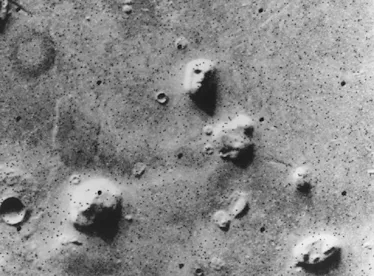
aerial grayscale photo of rock formations on Mars, one of which looks like a face

This Martian Mesa Was Once The Center Of Alien Conspiracy Theories — The Real Explanation Is Even Weirder

There's no face on Mars, but the psychology behind the optical illusion may also have helped humans become artists.

A nameless mesa in a strange Martian landscape once stood at the center of a swirl of alien conspiracy theories.

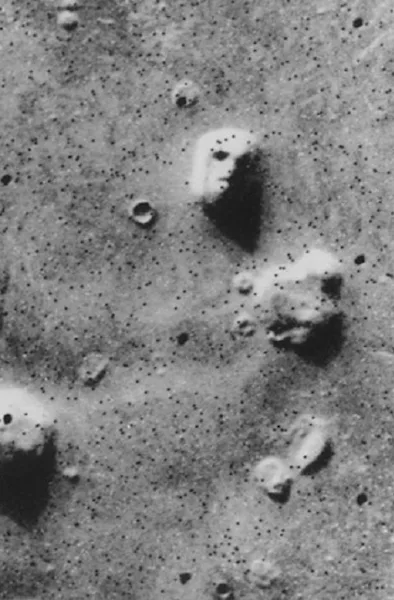
In a low-resolution snapshot from NASA’s Viking 1 spacecraft, taken in 1976, the brightly lit ridges and darkly shadowed dips in the terrain atop the mesa formed a weirdly compelling optical illusion: a grim, black-eyed face staring back at us from Mars. Conspiracy theorists insisted the mesa must have been the work of alien sculptors. But it turns out that if you see the mesa in more detail and in different lighting, the stark contrasts of light and shadow that originally formed the face completely disappear.

But the “face on Mars” is a great example of the same phenomenon that may once have inspired early humans to draw some of the first art on cave walls here on Earth.

aerial grayscale photo of rock formations on Mars, one of which looks like a face

Spot the face! (That’s a hilarious joke, because an imaging error caused this photo to be spotted with little black specks.)

NASA

FACE? OFF.

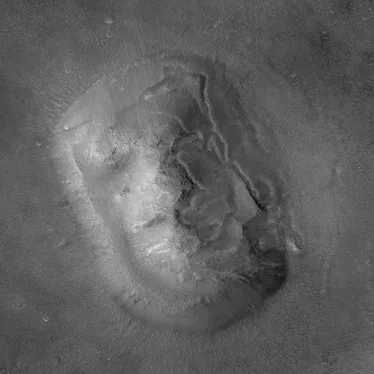
The SETI Institute recently shared a blast from the past: an image from NASA’s Mars Global Surveyor satellite, which snapped an image of the famous “Mars face,” revealing a discouraging lack of alien megaliths or slumbering giants.

In the original image, from Viking 1, with a low resolution of about 164 feet per pixel, the mesa shows up in stark patterns of light and shadow, creating the illusion of dark eyes in a pale face – one that looks unsettlingly like a death mask.

But seen in more detail at 6.6 feet per pixel, and with the Sun shining down from a different angle in the Martian sky, the facial features came into focus as weathered ridges of rock. If you know what you’re looking for, you can still trace the outline of the illusion on the top of the mesa and think to yourself, “Okay, I see how that weird dip in the ground looks like an eye in the right lighting,” but it’s also easy to tell the face isn’t really there.

This is the same mesa from the Viking 1 image, shown in much higher resolution (and with the sunlight coming from the lower left instead of the upper left). The face vanishes!

NASA

Nobody carved this two-mile-long mesa into the shape of a very spooky face. It’s just an example of a very ancient quirk of the human mind called pareidola. The phrase refers to our tendency to see faces and other familiar shapes in random patterns, like clouds, rock formations, or the stars in the night sky.

A recent study, published last week in the Cambridge Archaeological Journal, suggested that paraidolia may have provided some of the inspiration for humanity’s first artworks on cave walls. Archaeologist Izzy Wisher and her colleagues found that more than half the Paleolithic images drawn on cave walls in northern Spain — some dating back 40,000 years — included natural features of the cave wall in the shapes they depicted. A curved section of rock, viewed in a flickering firelight at just the right angle, might look like a bison’s back, and that image might have inspired an ancient person to draw the rest of the animal, for example.

“However, whilst our study showed that pareidolia did have some influence on the cave artists, this was not always the case, giving us a fascinating insight into the work of these early painters,” says Wisher in a recent statement. “It seems to us that their art may have been part of a ‘creative conversation’ with the cave walls, where they both took inspiration from what they saw in the cracks and shapes of the cave wall but also used their own creativity.”

There’s still another famous face on Mars: a smiley face traced by mountain ranges in Galle Crater (not to be confused with Gale Crater, home of NASA’s Curiosity Rover) and made famous in The Watchmen. That one is really there, but the iconic smiley face is a great example of pareidolia in its own right, since the mind is managing to make a face out of two dots and a curved line.

And if you’re still wondering how we connected The Watchmen, ancient cave art, and an optical illusion on Mars, the word you may be looking for is apophenia.

RELATED

{ https://www.inverse.com/ }

Hoe vind je dit bericht?
Geschreven door peter om 23:56 Stuur door

Meer van UFO'S of UAP'S, ASTRONOMIE, RUIMTEVAART, ARCHEOLOGIE, OUDHEIDKUNDE, SF-SNUFJES EN ANDERE ESOTERISCHE WETENSCHAPPEN - DE ALLERLAATSTE NIEUWTJES

↑ Terug naar de berichten