Naar de inhoud

UFO'S of UAP'S, ASTRONOMIE, RUIMTEVAART, ARCHEOLOGIE, OUDHEIDKUNDE, SF-SNUFJES EN ANDERE ESOTERISCHE WETENSCHAPPEN - DE ALLERLAATSTE NIEUWTJES

UFO's of UAP'S in België en de rest van de wereld
seniorennet.beseniorennet.be
Ontdek de Fascinerende Wereld van UFO's en UAP's: Jouw Bron voor Onthullende Informatie! Ben jij ook gefascineerd door het onbekende? Wil je meer weten over UFO's en UAP's, niet alleen in België, maar over de hele wereld? Dan ben je op de juiste plek! België: Het Kloppend Hart van UFO-onderzoek In België is BUFON (Belgisch UFO-Netwerk) dé autoriteit op het gebied van UFO-onderzoek. Voor betrouwbare en objectieve informatie over deze intrigerende fenomenen, bezoek je zeker onze Facebook-pagina en deze blog. Maar dat is nog niet alles! Ontdek ook het Belgisch UFO-meldpunt en Caelestia, twee organisaties die diepgaand onderzoek verrichten, al zijn ze soms kritisch of sceptisch. Nederland: Een Schat aan Informatie Voor onze Nederlandse buren is er de schitterende website www.ufowijzer.nl, beheerd door Paul Harmans. Deze site biedt een schat aan informatie en artikelen die je niet wilt missen! Internationaal: MUFON - De Wereldwijde Autoriteit Neem ook een kijkje bij MUFON (Mutual UFO Network Inc.), een gerenommeerde Amerikaanse UFO-vereniging met afdelingen in de VS en wereldwijd. MUFON is toegewijd aan de wetenschappelijke en analytische studie van het UFO-fenomeen, en hun maandelijkse tijdschrift, The MUFON UFO-Journal, is een must-read voor elke UFO-enthousiasteling. Bezoek hun website op www.mufon.com voor meer informatie. Samenwerking en Toekomstvisie Sinds 1 februari 2020 is Pieter niet alleen ex-president van BUFON, maar ook de voormalige nationale directeur van MUFON in Vlaanderen en Nederland. Dit creëert een sterke samenwerking met de Franse MUFON Reseau MUFON/EUROP, wat ons in staat stelt om nog meer waardevolle inzichten te delen. Let op: Nepprofielen en Nieuwe Groeperingen Pas op voor een nieuwe groepering die zich ook BUFON noemt, maar geen enkele connectie heeft met onze gevestigde organisatie. Hoewel zij de naam geregistreerd hebben, kunnen ze het rijke verleden en de expertise van onze groep niet evenaren. We wensen hen veel succes, maar we blijven de autoriteit in UFO-onderzoek! Blijf Op De Hoogte! Wil jij de laatste nieuwtjes over UFO's, ruimtevaart, archeologie, en meer? Volg ons dan en duik samen met ons in de fascinerende wereld van het onbekende! Sluit je aan bij de gemeenschap van nieuwsgierige geesten die net als jij verlangen naar antwoorden en avonturen in de sterren! Heb je vragen of wil je meer weten? Aarzel dan niet om contact met ons op te nemen! Samen ontrafelen we het mysterie van de lucht en daarbuiten.

Exoplanet Biosignatures: Will We Be Able to Recognize Extraterrestrial Life If We See It?

Exoplanet Biosignatures: Will We Be Able to Recognize Extraterrestrial Life If We See It?

A team of leading astronomers, biologists and geologists have come together under the Nexus for Exoplanet System Science (NExSS), a NASA research coordination network dedicated to the study of planetary habitability, to make an inventory of the most promising signs of life, called biosignatures.

Artist’s conception of what life could look like on the surface of an exoplanet. Image credit: NASA.

Artist’s conception of what life could look like on the surface of an exoplanet.

Image credit: NASA.

NExSS considered how to interpret the presence of biosignatures, should we detect them on extrasolar planets.

“We’re moving from theorizing about life elsewhere in our Milky Way Galaxy to a robust science that will eventually give us the answer we seek to that profound question: Are we alone?” said Dr. Martin Still, an exoplanet scientist at NASA Headquarters.

The assessment comes as a new generation of space and ground-based telescopes are in development.

The NASA/ESA/CSA James Webb Space Telescope will characterize the atmospheres of some of the first small, rocky planets.

Other observatories — such as the Giant Magellan Telescope and the Extremely Large Telescope — are planning to carry sophisticated instruments capable of detecting the first exoplanet biosignatures.

Through their work, NExSS scientists aim to identify the instruments needed to detect potential life for future NASA missions.

The detection of atmospheric signatures of a few potentially habitable planets may possibly come before 2030, although whether the planets are truly habitable or have life will require more in-depth study.

Since humans won’t be able to visit distant planets and collect samples anytime soon, the light that a telescope observes will be all we have in the search for extraterrestrial life.

Telescopes can examine the light reflecting off a distant world to show us the kinds of gases in the atmosphere and their ‘seasonal’ variations, as well as colors like green that could indicate life.

These kinds of biosignatures can all be seen on our fertile Earth from space, but the new worlds we examine will differ significantly.

For example, many of the promising planets astronomers have found are around cooler stars, which emit infrared light, rather than our Sun’s high emissions of visible-light.

“What does a living planet look like? We have to be open to the possibility that life may arise in many contexts in a galaxy with so many diverse worlds — perhaps with purple-colored life instead of the familiar green-dominated life forms on Earth, for example. That’s why we are considering a broad range of biosignatures,” explained Dr. Mary Parenteau, an astrobiologist and microbiologist at NASA’s Ames Research Center.

The NExSS scientists assert that oxygen — the gas produced by photosynthetic organisms on Earth — remains the most promising biosignature of life elsewhere, but it is not foolproof. Abiotic processes on a planet could also generate oxygen.

Conversely, a planet lacking detectable levels of oxygen could still be alive — which was exactly the case of Earth before the global accumulation of oxygen in the atmosphere.

“On early Earth, we wouldn’t be able to see oxygen, despite abundant life,” said Dr. Victoria Meadows, an astronomer at the University of Washington in Seattle.

“Oxygen teaches us that seeing, or not seeing, a single biosignature is insufficient evidence for or against life — overall context matters.”

Rather than measuring a single characteristic, the researchers argue that we should be looking at a suite of traits.

A planet must show itself capable of supporting life through its features, and those of its parent star.

The NExSS team will create a framework that can quantify how likely it is that a planet has life, based on all the available evidence.

With the observation of many planets, astronomers may begin to more broadly classify the ‘living worlds’ that show common characteristics of life, versus the ‘non-living worlds.’

“We won’t have a ‘yes’ or ‘no’ answer to finding life elsewhere. What we will have is a high level of confidence that a planet appears alive for reasons that can only be explained by the presence of life,” said Dr. Shawn Domagal-Goldman, an astrobiologist at NASA’s Goddard Space Flight Center.

The NExSS researchers reported their results and analysis in the June 2018 issue of the journal Astrobiology.

_____

  • Nancy Y. Kiang et al. 2018. Exoplanet Biosignatures: At the Dawn of a New Era of Planetary Observations. Astrobiology 18 (6): 619-629; doi: 10.1089/ast.2018.1862
  • Victoria S. Meadows et al. 2018. Exoplanet Biosignatures: Understanding Oxygen as a Biosignature in the Context of Its Environment. Astrobiology 18 (6): 630-662; doi: 10.1089/ast.2017.1727
  • Edward W. Schwieterman et al. 2018. Exoplanet Biosignatures: A Review of Remotely Detectable Signs of Life. Astrobiology 18 (6): 663-708; doi: 10.1089/ast.2017.1729
  • David C. Catling et al. 2018. Exoplanet Biosignatures: A Framework for Their Assessment. Astrobiology 18 (6): 709-738; doi: 10.1089/ast.2017.1737
  • Yuka Fujii et al. 2018. Exoplanet Biosignatures: Observational Prospects. Astrobiology 18 (6): 739-778; doi: 10.1089/ast.2017.1733
  • Sara I. Walker et al. 2018. Exoplanet Biosignatures: Future Directions. Astrobiology 18 (6): 779-824; doi: 10.1089/ast.2017.1738

This article is based on text provided by the National Aeronautics and Space Administration.

{  http://www.sci-news.com/ }

Hoe vind je dit bericht?
Geschreven door peter om 00:11 Stuur door

Elon Musk says we must colonize other planets after a study that casts doubt on extraterrestrial life

Elon Musk says we must colonize other planets after a study that casts doubt on extraterrestrial life

Hoe vind je dit bericht?
Geschreven door peter om 23:40 Stuur door

Looking for life in all the hard places – a guidebook

Looking for life in all the hard places – a guidebook

An illustration of a number of the different kinds of planets found by Kepler all lined up in a row.

types of planets Kepler found/NAA

Okay, They’re not Out There. But maybe something is. Any form of extraterrestrial life could shed light on at least some questions.

In that spirit, we learn from ScienceDaily of a newly published guidebook, in th form of a seriesof papers based on finds here on Earth:

Some of the leading experts in the field, including a UC Riverside team of researchers, have written a major series of review papers on the past, present, and future of the search for life on other planets. Published in Astrobiology, the papers represent two years of work by the Nexus for Exoplanet Systems Science (NExSS), a NASA-coordinated research network dedicated to the study of planetary habitability, and by NASA’s Astrobiology Institute.

Scientists have identified more than 3,500 planets around other stars (called exoplanets) and many more will be discovered in the coming decades. Some of these are rocky, Earth-sized planets that are in the habitable zones of their stars, meaning it’s neither too hot nor too cold for liquid water — and possibly life — to exist.

The five papers will serve as a reference for scientists searching for signs of life, called biosignatures, in the data they collect from future telescope observations.

…

“We are using Earth to guide our search for life on other planets because it is the only known example we have,” said Timothy Lyons, a distinguished professor of biogeochemistry and director of the Alternative Earths Astrobiology Center. “But Earth actually offers us a great diversity of possibilities. Rather than being constrained to a study of present-day life, we use geological and geochemical analyses to examine the billions of years that life survived, evolved, and thrived on Earth under conditions that are very different than today’s, hence the concept of ‘alternative Earths.'”

Schwieterman’s review outlines the complexities of searching for life on planets that are too far away to visit, including phenomena called false positives and false negatives. “The search for life using biosignatures is not as simple as looking for a single molecule or compound. Atmospheric oxygen, for example, could be a sign of life, but there are many nonbiological ways that oxygen gas could be produced on an exoplanet. Conversely, it is possible that life could exist in the absence of oxygen gas, similar to early life on Earth or portions of the oceans today,” Schwieterman said. “This is one reason temporal biosignatures, which are based on dynamic phenomena such as atmospheric seasonality, might be more robust biosignatures in some circumstances.”Paper. (public access) – Edward W. Schwieterman, Nancy Y. Kiang, Mary N. Parenteau, Chester E. Harman, Shiladitya DasSarma, Theresa M. Fisher, Giada N. Arney, Hilairy E. Hartnett, Christopher T. Reinhard, Stephanie L. Olson, Victoria S. Meadows, Charles S. Cockell, Sara I. Walker, John Lee Grenfell, Siddharth Hegde, Sarah Rugheimer, Renyu Hu, Timothy W. Lyons. Exoplanet Biosignatures: A Review of Remotely Detectable Signs of Life. Astrobiology, 2018; 18 (6): 663 DOI: 10.1089/ast.2017.1729 More.

If this gets really interesting, maybe the appropriate answer to “Are They Out There?” is “Tell them we’ll call back as soon as possible.”

See also: Will a new type of photosynthesis, just discovered, change the hunt for alien life?

From Universe Today: Do icy worlds have enough chemicals to support life?

and

Physicist: It’s good news that aliens likely don’t exist. And a space entrepreneur’s surprising reaction…“Preserve the light of consciousness”? Hmmm. Musk doesn’t seem to agree with Darwinian philosopher Daniel Dennett that consciousness is an evolved illusion or with the panpsychists that everything is conscious.

{ https://uncommondescent.com/ }

Hoe vind je dit bericht?
Geschreven door peter om 23:25 Stuur door

Cet OVNI a atterri près de Moscou en 1995 (vidéo)

Cet OVNI a atterri près de Moscou en 1995 (vidéo)

En 1995, un incroyable événement véridique s’est produit dans l’Ouest de la Russie. Cette affaire, qui implique un OVNI, a soigneusement été dissimulée depuis. En effet, après la diffusion de la vidéo en octobre de la même année, celle-ci a soudainement disparu.

Aujourd’hui, il ne reste plus que trois images de ce prétendu atterrissage d’OVNI. Certains ufologues prétendent que les rares témoins ont probablement été manipulés afin qu’ils gardent le silence sur ce qui s’est passé.

Les images ont été diffusées par la télévision russe en octobre 1995 et montrent l’atterrissage d’un énorme engin spatial extraterrestre qui a eu lieu dans la banlieue d’Ostankino, à proximité de Moscou.

Dans les 3 séquences de photos, qui faisaient à l’origine partie d’une vidéo, vous pouvez voir 2 personnes, appartenant vraisemblablement à l’armée russe, qui observent de près l’atterrissage de l’engin extraterrestre.

Après de longues enquêtes, des ufologues, à la fois russes et européens, sont arrivés à la conclusion que la soucoupe volante avait atterri juste pour éviter les tirs de l’artillerie anti-aérienne russe.

Plus tard, de cet OVNI aurait émergé des êtres humanoïdes qui semblaient émettre leur propre lumière. Ils avaient des intentions « non-hostiles ». Mais leurs comportements a été mal interprétés par le personnel militaire soviétique, qui à son tour a répondu en tirant quelques coups de mitrailleuses.

En réponse à l’attaque soviétique, la coque de l’engin extraterrestre aurait émis des impulsions d’énergie qui auraient mis hors d’usage les armes de l’armée russe.

A partir de l’analyse effectuée sur la séquence d’images, le chercheur Carlo Clemente a indiqué que l’OVNI paraissait être enveloppé par un champ d’énergie. Il a estimé qu’il avait un diamètre d’environ 15-20 mètres.

Carlos Clemente a comparé les images prises à Ostankino avec l’affaire de Cotula (au Texas), où dans la nuit du 5 Juillet 2012, une caméra de surveillance d’un condominium privé situé dans la région d’Eagle Ford, avait enregistré l’atterrissage d’un autre OVNI.

Source: UFO Sightings Hotspot, le 26 juin 2018 – Traduction Activité Paranormale

{ https://www.nouvelordremondial.cc/ }

Hoe vind je dit bericht?
Geschreven door peter om 23:16 Stuur door

UFO Festival 2018 in Roswell: When is the world’s biggest alien convention?

UFO Festival 2018 in Roswell: When is the world’s biggest alien convention?

UFO Festival 2018 in Roswell, the world’s largest gathering of alien truthers and UFO hunters, kicks off next month. Here is everything you need to know.

The popular UFO and alien convention will take over the city of Roswell, New Mexico, between July 6 and July 8.

Tens of thousands of paranormal enthusiast are expected to arrive at the convention hosted at the most notorious UFO sighting city in the world.

Last year, more than 38,000 people from 43 states and 16 different counties paid a visit to the massive get-together.

The annual UFO festival will feature stalls, parades and even a petting zoo all set up on streets of Roswell.

The event organisers said: “The City of Roswell invites UFO enthusiasts and sceptics alike to join in the celebration of one of the most debated incidents in history.

“If it isn't on your bucket list it should be, and once you attend you may find, like many of the festival visitors, it becomes one our your annual vacation plans.”

Roswell has become popular for UFO hunters after ab alleged crash-landing of an extraterrestrial flying saucer on a ranch 30 miles north of Roswell sometime in early July 1947.

The Roswell Army Air Field (RAAF) officially claimed the downed object was a weather balloon but the incident sparked the imaginations of UFO truthers for generations to come.

UFO Festival 2018 Roswell

GETTY

The UFO Festival 2018 in Roswell runs from July 6 to July 8

UFO Festival 2018 Roswell

GETTY

UFO Festival 2018: Roswell is home to an alleged UFO crash landing from 1947

Seventy-one years later and the Roswell incident is still very much part of the debate about our place in the universe and the possibility of alien life. 

The City of Roswell invites UFO enthusiasts and skeptics alike

UFO Festival 2018

From July 6 to July 8 this year, the UFO Festival 2018 will host a series of expert panels and speeches from some of the most prolific voices in the UFO truther community.

The organisers said the featured entertainment covers everything from music, food and family activities to alien autopsies and “so much more”.

Kathy Lay, Executive Director for MainStreet Roswell, said: “You have people all over the city. There will be some out at the mall at Galactic Con. 

“Some will be at the UFO museum doing the seminars and workshops. 

UFO Festival 2018 Roswell

GETTY

UFO Festival 2018: The festival includes a raft of various activities for families

"You'll have some that will be going to the plays that are going on, some will be over at the planetarium, some will be here at this festival. They're all over."

This year the event will even feature a variety of cute animals at the Runyan Ranches Petting Zoo, ready to be played with and fed all day long.

Early birds who pop into to the Chaves County Courthouse on the day of the festival will be treated to their very own Roswell UFO Passport. 

A number of alien goody bags have also been prepared in advance for lucky revellers. 

Hoe vind je dit bericht?
Geschreven door peter om 22:28 Stuur door

James Abbott – The Outsider’s Guide to UFOs: Mystery and Science – June 26, 2018

James Abbott – The Outsider’s Guide to UFOs: Mystery and Science – June 26, 2018

Open Minds UFO Radio: James Abbott is the author of the Outsider’s Guide to UFOs. Following a short scholarship to Trinity College in Hartford, Connecticut, James completed a Bachelor’s degree in Politics and Economics at the University of York and later researched a Master’s thesis at the University of Cambridge on global trade in the aerospace industry. His career has encompassed time in the aerospace sector, in marketing, in education, and in commercial research. He’s written and contributed to around a dozen academic books, and countless lengthy reports. His greatest professional love is research; having the view that there aren’t that many jobs in which you get paid for having fun, but that’s what research is like.

So why UFOs of all things? The answer is a long one, but it boils down to this: Like almost everyone else, James gets hooked by a good mystery, and UFOs are perhaps the greatest mystery of all; one which is in desperate need of being properly investigated. He lives with his wife in Yorkshire, England, where rabbits are the only alien menace. Or so he believes! UFOs may or may not be of this Earth and time, but the huge job of trying to nail them down is incredibly fascinating.

For more about James, visit his website: www.JamesTAbbott.com.

{ http://www.openminds.tv/ }

Hoe vind je dit bericht?
Geschreven door peter om 22:02 Stuur door

Japans ruimtetuig bereikt kosmische ‘diamant’ die inzicht kan bieden in ontstaan van onze aarde - HLN.be

Japans ruimtetuig bereikt kosmische ‘diamant’ die inzicht kan bieden in ontstaan van onze aarde - HLN.be

Bron: BBC, Nature, JAXA, New Atlas

Een foto van de Ryugu-asteroïde die werd genomen op 24 juni 2018.

 EPA  Een foto van de Ryugu-asteroïde die werd genomen op 24 juni 2018.
 Na een reis van drieëneenhalf jaar heeft de Japanse ruimtesonde Hayabusa 2 deze week haar bestemming bereikt: de diamantvormige planetoïde Ryugu. Tijdens de achttien maanden durende missie zal het toestel het oppervlak van Ryugu verkennen en bodemstalen nemen. Die moeten tegen 2020 weer de aarde bereiken.

Het Japanse ruimteagentschap JAXA publiceerde vorige week al korrelige foto’s die werden genomen vanaf een afstand van 300 kilometer waaruit blijkt dat Ryugu de vorm heeft van een tol. Recentere foto’s die werden genomen vanaf zo’n 30 kilometer hoog tonen dat het oppervlak bezaaid ligt met grote keien.

Lees ook

Sinds vandaag bevindt het ruimtetuig zich in een baan rond de planetoïde. De afstand tussen Hayabusa 2 en Ryugu bedraagt momenteel zo’n 20 kilometer, aldus JAXA in een mededeling.

Bodemstudie

De sonde zal gedurende anderhalf jaar de 900 meter brede planetoïde, die zich op ongeveer 290 miljoen kilometer van de aarde bevindt, bestuderen. Tijdens die periode zal ze meerdere kleinere sondes naar het oppervlak van Ryugu sturen, waaronder drie kleine rovers die de asteroïde moeten gaan verkennen.

“Aanvankelijk zullen we het oppervlak erg grondig bestuderen. Vervolgens zullen we beslissen waar we gaan landen”, aldus Makoto Yoshikawa, die de missie van Hayabusa 2 leidt. Daartoe zal een koperen projectiel, de “impactor”, zich losmaken van de sonde en zich naar de vaste grond begeven. “We hebben een impactor die een kleine krater zal maken op het oppervlak van Ryugu. Mogelijk in het voorjaar van volgend jaar zullen we proberen een krater te maken... Vervolgens zal onze ruimtesonde de krater proberen te bereiken om materiaal onder de oppervlakte te verzamelen, maar dit is een erg grote uitdaging”, aldus Yoshikawa.

De lancering van de Hayabusa 2 op 3 december 2014.

 REUTERS  De lancering van de Hayabusa 2 op 3 december 2014.

Planetoïde klasse C

Planetoïden zijn in essentie de bouwmaterialen die overbleven na de vorming van ons zonnestelsel, zo’n 4,6 miljard jaar geleden.

Ryugu is een planetoïde van klasse C. “We weten niet veel over C-klasse-planetoïden”, zegt NASA-wetenschapper Lucy McFadden, die erg verheugd is over de expeditie. “Ze hebben vermoedelijk een samenstelling die vergelijkbaar is met die van het vroege zonnestelsel.” De missie van Hayabusa 2, de enige ruimtesonde die ooit zo dicht bij een planetoïde van dit type kwam, moet uitmaken of het oppervlak van Ryugu voornamelijk uit koolstof bestaat, zoals vaak wordt aangenomen, of uit kleine metalen deeltjes, zoals magnetiet.

De ingezamelde data moet wetenschappers helpen begrijpen hoe de planeten die rond onze zon cirkelen tot stand kwamen, hoe de oceanen op aarde ontstonden en wat de aanleiding vormde voor het leven op aarde. Veel wetenschappers denken immers dat de oceanen op onze planeet het gevolg zijn van een bombardement door waterrijke asteroïden of kometen.

Eind 2019 zal Hayabusa 2 naar de aarde terugkeren, een reis die ongeveer een jaar in beslag zal nemen.

Kopie van eerste Hayabusa

De Hayabusa 2 is een bijna exacte kopie van de eerste Hayabusa die in 2003 gelanceerd werd en de asteroïde Itokawa bereikte in 2005. Na een reeks tegenslagen, keerde de sonde in 2010 terug naar de aarde met een kleine hoeveelheid materiaal van de asteroïde. Momenteel is Osiris-Rex, een Amerikaanse sonde, op weg naar de planetoïde 101955 Bennu om er stalen te verzamelen. In augustus zou de sonde haar bestemming moeten bereiken.

{ https://www.hln.be/ }

Hoe vind je dit bericht?
Geschreven door peter om 21:48 Stuur door

In een uurtje van Londen naar New York: Boeing ontwerpt hypersonisch vliegtuig dat Concorde doet verbleken - HLN.be

In een uurtje van Londen naar New York: Boeing ontwerpt hypersonisch vliegtuig dat Concorde doet verbleken - HLN.be

Bron: Boeing, luchtvaartnieuws.nl

Het gloednieuwe conceptvliegtuig van Boeing

 Boeing  Het gloednieuwe conceptvliegtuig van Boeing
 Vliegtuigbouwer Boeing heeft deze week een hypersonisch passagiersvliegtuig gepresenteerd op de American Institute of Aeronautics and Astronautics Conference in Atlanta. Het gaat voorlopig nog om een concept, maar Boeing hoopt een dergelijk vliegtuig over twintig à dertig jaar te kunnen bouwen.

Ingenieurs van Boeing werken aan verschillende concepten die de ontwikkeling van een hypersonisch toestel mogelijk maakt zodra klanten daar behoefte aan hebben, zo meldt Boeing zelf. Het concept voor een passagiersvliegtuig kan volgens Boeing op zowel commercieel als militair gebied toegepast worden.

Lees ook

De Concorde, het voorlopig snelste passagiersvliegtuig ooit, haalde een topsnelheid van 2.179 kilometer per uur, dat is zo’n twee keer de snelheid van het geluid. Maar het concept van Boeing zou tot wel vijf keer de snelheid van het geluid halen, meer dan 6.000 kilometer per uur. Met die snelheid vlieg je in een uurtje van Londen naar New York.

{ https://www.hln.be/ }

Hoe vind je dit bericht?
Geschreven door peter om 21:38 Stuur door

Spielberg, Close Encounters, and Conspiracy Theories

close-art-999x540.png

Spielberg, Close Encounters, and Conspiracy Theories

Since its original cinematic release in 1977, Steven Spielberg’s sci-fi masterpiece Close Encounters of the Third Kind has been the subject of fervent speculation in the UFO conspiracy community. Many UFO buffs are convinced that the movie was produced as part of an official acclimation program in anticipation of an alien “disclosure” event. This speculation can be traced back to the production of the movie itself. On 23 July 1976, after a hard day’s shoot, around forty of the cast and crew, including stars Richard Dreyfuss and Melinda Dillon, gathered in the sticky night air of Mobile, Alabama, to hear a lecture delivered by the movie’s appointed advisor on UFOs, Professor J. Allen Hynek (the famed astronomer had been flown in for a brief cameo in the closing scenes). Shortly after Hynek’s lecture, actor Bob Balaban (who plays the character of translator David Laughlin), began to discuss with his colleagues an intriguing rumour that had been circulating during the production—“a rumour,” wrote Balaban in his production diary, “that the film is part of the necessary training that the human race must go through in order to accept an actual landing, and is being secretly sponsored by a government UFO agency.”

In 2014, I had the opportunity to interview Close Encountersproduction designer, Joe Alves. I asked him if ever he had heard any such rumours during the shoot, and if there was any substance to them. “There were a lot of rumours,” he told me, ambiguously, before changing the subject.

Back in 1977, even Spielberg himself seemed to be dropping hints: “I wouldn’t put it past this government that a cosmic Watergate has been underway for the last 25 years,” the director remarked during a Close Encounters promotional interview, “eventually they might want to tell us something about what they’ve discovered over the decades.” During the same interview, the director spoke with relish of “rumours” that President Carter was due to make “some unsettling disclosures” about UFOs later that year. Needless to say, no such disclosures were forthcoming.

Particularly curious is that the Carter Presidential Library contains no record of the film-loving President ever having viewed Close Encounters while in office. However, in a 1977 Canadian TV interview conducted directly after the movie’s theatrical release, Spielberg said matter-of-factly that Carter had viewed the movie “Last Saturday.” Spielberg remarked, “We haven’t heard the direct feedback,” but added, “We hear he [Carter] liked it quite a bit.”  The following March, The Phoenix Gazette cited Close Encounters as “Jimmy Carter’s favorite movie,” noting that “The President has seen the movie many times.” This is not the only discrepancy over the official record concerning Carter and Spielberg. Officially, Spielberg never set foot in the Carter White House and had never met the President, and yet a solitary photocopy of a photograph discovered in the Carter Presidential Library proves that the two men did meet. The photo shows Carter and Spielberg engaged in conversation and is signed: “To Steven Spielberg, [from] Jimmy Carter.” An accompanying White House stationary note signed by White House Social Secretary Gretchen Poston and addressed to Spielberg reads: “The President thought you would enjoy receiving the enclosed photograph.”

This apparent secrecy almost certainly resulted from a desire among Carter’s staff to keep the Administration from being further publicly associated with flying saucers. Famously, Carter had his own UFO sighting in 1969 in Leary, Georgia, witnessing a bright white round object that approached his position before stopping and then receding into the distance. Carter was with twelve other people at the time, all of whom witnessed the strange phenomenon.  Needless to say, a UFO-spotting President viewing the ultimate UFO movie at the White House and having get-togethers with its alien-obsessed director would have been a PR nightmare.

By far the most outlandish of the conspiracy theories surrounding Close Encounters relates to Project Serpo—an alleged human/alien exchange program between US military personnel and a race of extraterrestrials from the Zeta Reticuli star system. The story goes that, in July of 1965, twelve astronauts were taken to the planet Serpo aboard an alien spaceship and remained there for thirteen years. In exchange, the aliens left one of their own in the custody of the US government. This story didn’t emerge until 2005 in the form of a string of anonymous emails that were sent to selected UFO researchers, including Project Camelot/Avalon’s Bill Ryan, who created a website dedicated to the “leaks.”

The Serpo story lead some in the conspiracy community to speculate that Close Encounters was partly inspired by the alleged alien-human exchange program of 1965, which assumes that Spielberg himself was privy to inside information on the UFO issue. In the movie’s final scenes, a taller alien (designed by effects expert Carlo Rambaldi) is seen to exit the mothership and communicate with the character of Claude Lacombe via a series of hand gestures. Immediately before this we see twelve scientists clad in jumpsuits preparing to board the mothership and take permanent leave of planet Earth. Roy Neary joins the group as its thirteenth member.

It is important to note that the Serpo story, which has not a shred of evidence to support it, did not emerge until 2005, twenty-eight years after the release of Close Encounters. It’s probably safe to assume then that former inspired the latter, rather than vice versa.

Whether or not there is any truth to the conspiracy theories surrounding Close Encounters, Spielberg’s movie remains hugely significant for the fact that it played a central role in Hollywood’s mid-to-late-1970s economic revival—its $338 million worldwide box-office gross forced crusty studio executives to recognize America’s vast and largely neglected youth market and to adapt their output accordingly. Two other alien-themed movies of the period would also play a key role in this industrial paradigm shift: Star Wars (1977) and Superman(1978). Together, these three films about the wonders of the universe acted as adrenalin, shot straight into the heart of a dying industry (though many critics would argue, perhaps justifiably, that this adrenalin acted as poison in the long-term, stifling creativity and individuality in Hollywood). Spielberg’s film also reignited public curiosity about UFOs as an enduring enigma, and its release closely coincided with the thirtieth anniversary of the Roswell Incident. Just one year later, Jesse Marcel would spill the beans on his first-hand experiences of that event, opening the floodgates for hundreds more closely-corresponding Roswell testimonies.

With Vietnam and Watergate still fresh in the mind, Close Encounters came as a reassuring hug for America towards the end of a decade of disillusionment, and Spielberg’s movie would redefine Hollywood’s working relationship with aliens for much of the 1980s, resulting in movies such as E.T.: The Extraterrestrial, Starman, Batteries Not Included, and The Abyss, to name but a few. Thanks to Close Encounters, what for so many decades had come only to conquer, could now come in peace.

{ http://mysteriousuniverse.org/ }

Hoe vind je dit bericht?
Geschreven door peter om 21:26 Stuur door

MIT Creates Telepathic Robot Servant Controlled by Passive Aggression

Supervising Robots with Brain and Muscle Signals

MIT Creates Telepathic Robot Servant Controlled by Passive Aggression

While many have argued that the biggest problem facing humanity is our growing inability to communicate, MIT seems to think that our first interactions with household robots should be predicated on passive aggression and silent judgement. Robotics scientists at the Massachusetts Institute of Technology have created a “robot servant” named Baxter that can read its owners brain waves and tell when they’re displeased with the job its doing and correct its behavior accordingly. Conveniently, you don’t even need to talk to this poor machine, as it can be controlled by simple hand gestures.

Baxter can sense your simmering rage through electrodes placed on the scalp, and can sense very subtle gestures through more electrodes on your forearm. MIT says that they want to remove the machine constraints on human-robot interfacing and that their goal is to “to develop robotic systems that are a more natural and intuitive extension of us.”

Robot

“Why do you resent me?”

In the latest demonstration, MIT demonstrated Baxter’s ability to use a drill on three possible targets. The operator sits behind the robot wearing the electrode skull-cap and arm band. Baxter, outfitted with what looks like an iPad displaying a smiley face for extra creep factor, autonomously goes to stick the drill into one of the targets. Sensing the operator’s displeasure, Baxter asks for assistance. With a quick flick of the wrist, the operator shows Baxter how to do a better job. One question remains though: what happens when Baxter turns on the operator and puts that drill right through their impossibly high demands?

MIT clearly doesn’t think this is a problem, as one of the main points of this demonstration was to show that Baxter can be used by anyone immediately. There’s no need to train Baxter to read a person’s specific brainwaves, so once the technology is commercially viable, Baxter can be bossed around on a whim simply by putting on the cap and arm band.

EEG cap

There are some trade-offs for your power fantasies though: you’ll have to wear this.

There is a good hopeful use for this robot. Because Baxter is so easily controlled, MIT says that the robot will be useful for assisting the elderly, those with physical disabilities, or even people struggling behind a language barrier. That’s definitely the right use for robots. Anything that allows people robbed of agency by circumstance get control over their lives back is objectively a good thing, and if that’s the path we’re going down then bravo, MIT.

But don’t think we’re ending this on a high note. Here’s what PhD candidate Joseph DelPreto and lead author of the latest paper on Baxter says about the technology:

“By looking at both muscle and brain signals, we can start to pick up on a person’s natural gestures along with their snap decisions about whether something is going wrong.

This helps make communicating with a robot more like communicating with another person.”

Yes, just like communicating with a human: unexpressed resentment and patronizing hand gestures. What better way to usher in the horrifying future we’re eagerly wading into than to make the first “robot servant”—insert your own synonym for “robot servant” there—feed into our secret narcissistic want to have things change based on our split-second emotional reactions without that irksome and apparently passé step of verbalizing how we feel in a half-way cogent manner.

{ http://mysteriousuniverse.org/ }

Hoe vind je dit bericht?
Geschreven door peter om 20:51 Stuur door

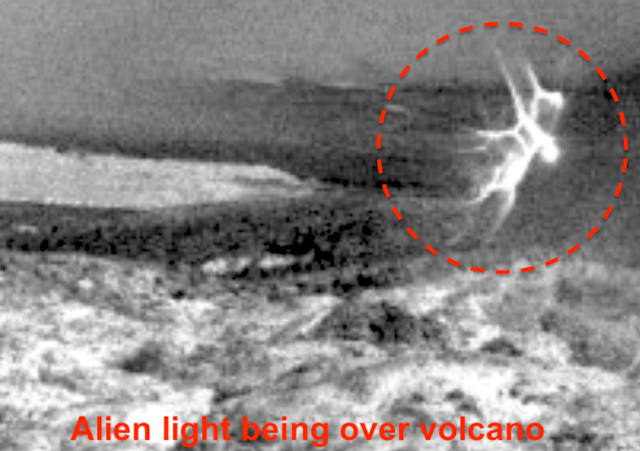
Alien Light Being Makes Rare Appearance Over Volcano Of New Zealand, June 25, 2018, UFO Sighting News.

Alien Light Being Makes Rare Appearance Over Volcano Of New Zealand, June 25, 2018, UFO Sighting News.

New%2Bzealand%252C%2Bvolcano%252C%2Bclouds%252C%2Bdisk%252C%2Bcrater%252C%2Bcity%252C%2Brocket%252C%2BUFO%252C%2Bspace%2Bstation%252C%2Bsighting%252C%2Bscott%2Bwaring%252C%2Bnobel%2Bpeace%2Bprize%252C%2BUFOs%252C%2Bsightings%252C%2BET%252C%2Balien%252C%2Baliens%252C%2Bstation%252C%2BISS%252C%2BTR3B%252C%2BUSAF%252C%2Bsecret%252C12.png

Date of sighting: June 25, 2018
Location of sighting: News Zealand
Source: MUFON #92914

Above is a light being standing over a volcano. The being would measure about 25 meters tall as it stands on the surface of the volcano and looks around. Its easy to see its two legs two arms and head. 


Also the photos below have captured UFOs entering and exiting the mouth of the volcano. Excellent proof that there is an alien base 4-6km below the ground at some New Zealand volcanos. 

Scott C. Waring

Eyewitness states: Various apparational craft and creatures appearring over appearring from nz volcanos on geonet volcano cameras that i observe in conjunction to earth movements that i feel and hear that no one else can see and feel and hear.

New%2Bzealand%252C%2Bvolcano%252C%2Bclouds%252C%2Bdisk%252C%2Bcrater%252C%2Bcity%252C%2Brocket%252C%2BUFO%252C%2Bspace%2Bstation%252C%2Bsighting%252C%2Bscott%2Bwaring%252C%2Bnobel%2Bpeace%2Bprize%252C%2BUFOs%252C%2Bsightings%252C%2BET%252C%2Balien%252C%2Baliens%252C%2Bstation%252C%2BISS%252C%2BTR3B%252C%2BUSAF%252C%2Bsecret%252C13.png

New%2Bzealand%252C%2Bvolcano%252C%2Bclouds%252C%2Bdisk%252C%2Bcrater%252C%2Bcity%252C%2Brocket%252C%2BUFO%252C%2Bspace%2Bstation%252C%2Bsighting%252C%2Bscott%2Bwaring%252C%2Bnobel%2Bpeace%2Bprize%252C%2BUFOs%252C%2Bsightings%252C%2BET%252C%2Balien%252C%2Baliens%252C%2Bstation%252C%2BISS%252C%2BTR3B%252C%2BUSAF%252C%2Bsecret%252C14.png

Screen%2BShot%2B2018-06-27%2Bat%2B10.08.18%2BAM.png

{ http://www.ufosightingsdaily.com/ }

Hoe vind je dit bericht?
Geschreven door peter om 20:23 Stuur door

UFO caught LIVE on camera during Newscast in Buffalo

UFO caught LIVE on camera during Newscast in Buffalo

An unidentified flying object or UFO raced across the sky over Buffalo, NY and was caught on camera during the evening weather cast.

UFO%2BLive%2BBroadcast.jpg

Meteorologist Andy Parker was showing the night sky on SkyWatch7 late in the evening at around 11:20pm on Thursday June 14 when an object entered and exited the camera view.

The object travels from west to east and makes what appears to be a hook turn to the north and gains altitude before exiting near the top of the camera frame.

Andy Parker noticed the appearance of the object and offered up the idea it might have been a shooting star while asking the rest of the crew if anyone else had seen the object.

The object moves too fast to be a plane, originates too far away to be a bug, perhaps a meteorite?

However, the unknown flying object makes a curve something that a meteorite does not do.
  
ABC News: Weather Man Spots A UFO Live On Camera During The Weather Report
UFO Caught LIVE On SkyWatch7 Newscast In Buffalo, New York. June 14, 2018

{ http://ufosightingshotspot.blogspot.com/ }

Hoe vind je dit bericht?
Geschreven door peter om 20:09 Stuur door

The Roswell incident: how ‘UFO sighting’ sparked 70 years of conspiracy theories

The Roswell incident: how ‘UFO sighting’ sparked 70 years of conspiracy theories

A US government ‘cover-up’, the declassification of top secret files and big-budget alien movies have fuelled interest in UFOs

On 8 July 1947 the Roswell Daily Record newspaper published a front page article with the headline “RAAF Captures Flying Saucer On Ranch in Roswell Region”, and the legend of America's most famous brush with aliens was born.

Today, many conspiracy theorists consider the so-called “Roswell incident” to be one of the most conspicuous pieces of evidence that the US government has covered up the existence of extraterrestrial life on Earth.

Next month thousands of people from all over the world will travel to the town, the de facto UFO capital of the world, but the Roswell story's position in the public imagination was far from immediate.

What was the Roswell incident?

On 7 July 1947, around 75 miles north of the town of Roswell in New Mexico, debris from a highly classified project used by the US Army Air Force (the precursor to the US Air Force) to detect atomic bomb tests in the Soviet Union, was recovered from a ranch after being reported by ranch worker William Brazel.

Intrigued by the idea of flying saucers, Brazel gathered some of the debris and went to Roswell where he told Sheriff George Wilcox about his find. According to reports he “whispered kinda confidential like”. Wilcox immediately reported the encounter to the USAAF base at Roswell which promptly sent agents to visit the ranch, but not before the press picked up the story.

What was reported at the time?

On 8 July 1947 Roswell Army Air Field (RAAF) issued a press release stating that a “flying disk” had crashed on a ranch near Roswell during a powerful storm. Later in the day, as government scientists arrived in the area, the story appeared to change. A press conference was held and it was stated instead that a weather balloon had crashed. Reporters were shown debris said to be taken from the crash area, such as foil, rubber and wood, which appeared to confirm that the object had been a weather balloon.

After initially suggesting that Brazel's debris had come from a UFO, the Roswell Daily Record reported a correction which included the USAAF statement that it was a weather balloon that had been found at the site. Brazel later went on record to say that he regretted the publicity that his misidentification had caused.

According to the official accounts, the debris Brazel found came from a balloon which was part of an experimental technology trial codenamed Project Mogul.

What was Project Mogul?

The classified Project Mogul was designed to detect sound waves in the upper atmosphere from Soviet atom bomb tests by flying microphones on trains of balloons at high altitude. Although the technology was quickly superseded, it remained secret for more than 20 years after the event. The fact that the balloon was involved in Cold War surveillance of the Soviet Union may have helped to propel rumours of a cover-up.

How did it become a cause celebre?

For 31 years the story was largely forgotten until The National Enquirer reported the original Roswell Daily Record story again, but not the correction. Following the publication of the new story, theories suggesting that the government's incomplete account had been an attempt to cover-up the discovery of an alien spacecraft began to take root.

What did other witnesses say?

Several people claimed to have seen debris scattered over a wide area and at least one person reported seeing a blazing aircraft in the sky shortly before it crashed, but the key account came from a former mortician, Glenn Dennis, who claimed in 1989 that a friend who worked as a nurse at the Roswell Army Air Field had accidentally walked into an examination room where doctors were bent over the bodies of three creatures. They apparently resembled humans, but with small bodies, spindly arms and giant bald heads.

In 1995, Ray Santilli, a London-based entrepreneur, released “footage” of an alien autopsy performed in Roswell in 1947. Experts immediately ridiculed the footage as a hoax and he admitted years later that it was almost entirely fake. Nevertheless, Santilli insisted real footage existed, but due to its poor condition he had been forced to recreate it.

Critics have questioned the validity of various witnesses and pointed out that many claims over the years have come from “friends of friends” who supposedly saw something out of the ordinary.

Stranger than fiction?

Coincidentally, the republication of the story came just one year after the release of Close Encounters of the Third Kind, a film about a government conspiracy covering up alien visits to Earth. The film was released in the USA in November and the following year in the UK. That year 750 sightings were officially documented in the UK by the Ministry of Defence UFO desk, the highest figure on record.

Did UFO sightings continue to increase?

Looking at UFO sightings data from both sides of the Atlantic, a direct correlation between popular films involving aliens and real world UFO sightings becomes evident. In 2009, The Guardian detailed the popular culture influences that may have helped propel UFO sightings in the UK in 1996. In the year that Independence Day and Mars Attacks were released there were 609 UFO sightings across the UK, significantly more than the years just before or after.

The MoD assembled detailed records of UK UFO sightings between 1959 and 1973 before cuts ended the program

Unofficial data, supplied by the National UFO Reporting Centre in America suggest that UFO sightings have been slowly increasing in the US since the 1970s, growing increasingly rapidly since the early 1990s.

One possible explanation for this is that the reporting centre became both better known and easier to contact with the advent of new technologies such as fax machines and the internet.

In 2014, The Economist analysed the available data from 2000 to 2014 and found that most UFOs were reported when people were drunk.

Did declassifying Project Mogul help?

Even though Project Mogul was declassified in the 1970s, it wasn't fully connected to Roswell until 1994 when the normally secretive National Security Agencyfinally published an in-depth report refuting all claims of a conspiracy at the site. A second report, released in 1997, concluded that reports of alien bodies actually related to life-sized anthropomorphic test dummies.

But by providing detailed analysis of the Roswell incident, many analysts believe that the US government inadvertently fuelled interest in conspiracy theories and public suspicions that the US military was involved in a cover-up.

Roswell: the UFO capital of the world

Because of the huge notoriety surrounding the Roswell incident, the town has become Ground Zero for UFO conspiracists.

Each year on the anniversary of the story, thousands of enthusiasts embrace all things alien and paranormal at a UFO Festival. There, they can dissect mock alien bodies and take part in scientific experiments.

Last year, to mark 70 years since the incident was first reported, around 38,000 people turned up from all over the world.

Kathy Lay, executive director for MainStreet Roswell, says:

“You have people all over the city. There will be some out at the mall at Galactic Con. Some will be at the UFO museum doing the seminars and workshops. You'll have some that will be going to the plays that are going on, some will be over at the planetarium, some will be here at this festival. They're all over - we just embrace it.”

{ http://www.theweek.co.uk/ }

Hoe vind je dit bericht?
Geschreven door peter om 01:40 Stuur door

Mysterious Mars rock formation explained - and it doesn't involve UFOs

Mysterious Mars rock formation explained - and it doesn't involve UFOs

Hoe vind je dit bericht?
Geschreven door peter om 01:26 Stuur door

U.S. Navy Had a UFO Encounter According to Leaked Military Report

U.S. Navy Had a UFO Encounter According to Leaked Military Report

The reported UFO disturbance was said to descend rapidly from approximately 60,000 feet down to approximately 50 feet in seconds.

uss_nimitz.jpg?itok=i1cLWZMw

A recently leaked alleged military report details an incredible encounter between the USS Nimitz Carrier Strike Group (CSG) and an unidentified aircraft. U.S. Navy F-18 jet fighter pilots described the object as looking like a giant, white Tic Tac, and say it moved to evade them by shooting off at “supersonic” speeds. The USS Nimitz CSG encountered the objects over several days in 2004 off the coast of California. The most shocking parts of the report speculate that the UFO could have had the ability to “‘cloak’ or become invisible to the human eye” and “possibly… operate undersea completely undetectable by our most advanced sensors.”

Den of Geek contacted several individuals close to the case to confirm the document’s legitimacy.

Last December, The New York Times posted an article revealing a Pentagon project called the Advanced Aerospace Threat Identification Program (AATIP) that was secretly investigating credible UFO cases. The world was tipped off to the existence of the project by the man who was recently in charge of the project, Luis Elizondo. Elizondo retired in Oct. 2017 because the government did not take the UFO situation seriously enough. He says there are “many accounts from the Navy and other services of unusual aerial systems interfering with military weapon platforms and displaying beyond-next-generation capabilities,” and that “there remains a vital need to ascertain capability and intent of these phenomena for the benefit of the armed forces and the nation.”

The New York Times article included two videos allegedly representing cases of UFOs caught on video by military aircraft. Little information about the videos is available. However, the other was said to be from an encounter between an unknown object and the USS Nimitz CSG off of the coast of San Diego in 2004.

Soon after the New York Times article was released, there was a worldwide storm of press on the secretive UFO program. Elizondo and Commander David Fravor, one of the U.S. Navy jet fighter pilots who encountered the unidentified object, participated in several interviews. However, no official documents were released.

On May 18, 2018, Las Vegas KLAS Channel 8’s I-Team posted an articleabout a leaked report they had obtained. The I-Team claims the report was “prepared by and for the military.” They obtained the report during “a whirlwind trip to Washington for a debriefing arranged by former Senator Harry Reid.” Reid had been instrumental in securing funding for the creation of AATIP.

According to the I-Team, the leaked report was put together in 2009 “with input from multiple agencies.” The report begins with an executive summary, makes several key assessments, describes the technology involved in the incident, and then describes the accounts of the personnel involved.

The executive summary reveals encounters with what they call Anomalous Aerial Vehicles (AAVs) occurred over several days, from Nov. 10 to 16, 2004 off the west coast, just before the USS Nimitz CSG left for the Arabian Sea. According to the report, “The USS Princeton on several occasions detected multiple Anomalous Aerial Vehicles (AAVs) operating in and around the vicinity of the CSG.”

“The AAVs would descend ‘very rapidly’ from approximately 60,000 feet down to approximately 50 feet in a matter of seconds,” the report continues. “They would hover or stay stationary on the radar for a short time and depart at high velocities and turn rates.”

According to the report, on Nov. 14, 2004, they got a closer look at one of these AAVs. It was a bright day with “blue skies, no clouds, and unlimited visibility.” After completing their training mission, two F-18s, call signs FASTEAGLE 01 and 02, were directed by the USS Princeton, a guided missile cruiser in the USS Nimitz CSG, to an unknown target. The USS Princeton also asked what weapons they had onboard, which was unusual. 

One of the pilots, U.S. Navy Commander David ‘Sex’ Fravor in FASTEAGLE01, says the first thing he noticed at the location of the AAV was a “disturbance of water” in the sea. He scanned the area and noticed the AAV was just above the disturbance, which he said: “looked like frothy waves and foam almost as if the water was boiling.”

A U.S. Marine Lieutenant Colonel piloting an F-18 was also sent in to take a look. He was asked to stay above 10,000 feet as other planes were coming in lower. He also spotted the disturbance in the water.

“The disturbance appeared to be 50 to 100 meters in diameter and close to round,” according to the report. “It was the only area and type of whitewater activity that could be seen and reminded him of images of something rapidly submerging from the surface like a submarine or ship sinking. It also looked like a possible area of shoal water where the swell was breaking over a barely submerged reef or island.”

EXCLUSIVE REPORT: Can Humans Survive in Space Long Term?

At around the same time, FASTEAGLE01 descended to about 12,000 to 16,000 feet to get a closer look. FASTEAGLE02 stayed back and maintained an altitude of approximately 20,000 feet. Fravor said the object hovered in place. He described the object as looking “like an elongated egg or a ‘Tic Tac’ and had a discernible midline horizontal axis. However, the object was uniformly white across the entire body. It was approximately 46 feet in length.”

The name of the pilot in FASTEAGLE02 was redacted from the report, but he had a similar description. He said the AAV was “solid white, smooth, with no edges. It was uniformly colored with no nacelles, pylons, or wings.” He said it did not glow or reflect sunlight, and “it looked like it had a white candy-coated shell, almost like a whiteboard.” His report did differ slightly from Fravor in that he says the object did appear to be moving.

Fravor decided to make a close pass of the object to try and identify it. He says as he approached, the AAV seemed to “recognize us.” He said the object realigned itself and “pointed” in his direction. The disturbance on the water also stopped. As Fravor continued his approach, the object suddenly shot up at “a supersonic speed.”

Fravor asked if the USS Princeton still had the AAV on the radar, and at first was told “no.” Soon after, the USS Princeton told Fravor, “you’re not going to believe this, it's at your CAP.” The CAP was the area Fravor had been training in earlier in the day. The USS Princeton added, the AAV “had climbed to approximately 24,000 feet.” They tried to locate the object, but it and the disturbance in the ocean were gone.

Although the AAV was not seen by Fravor again, this was not the last of the anomalous activity for the day. During training exercises, the USS Nimitz CSG acquired a weak radar target. The pilot of the F-18 attempting to track the object said, it “just appeared the radar couldn’t hack it.” However, he was able to spot the object using his Forward Looking Infrared (FLIR) camera. The pilot was at 20,000 feet traveling at 300 knots, and estimated the object was at about the same altitude or a “few thousand feet below.”

The object appeared to be stationary on the FLIR camera, then moved out of the camera’s field of view and contact with the object was lost. A portion of this video was released in the New York Times article, although the pilot said he was not sure if it was the same object Fravor saw earlier in the day. He also said he only caught it on camera and never saw it with his own eyes. After he lost contact with the object, the pilot returned to his training mission.

The USS Nimitz CSG included the USS Louisville Los Angeles-class fast attack submarine. Researchers asked a USS Louisville officer if their sonar caught any of the disturbance reported. The officer replied they had received “no unidentified sonar contacts in the vicinity of the aerial sightings or at any time during operations off the coast of California.”

Thus the report concluded, “Based on the lack of detection of any unidentified sonar contacts it is highly unlikely that an AAV operated below the surface of the ocean.”

Then the report continued with some shocking speculation. 

“It is possible the AAV demonstrated the ability to be cloaked or invisible to the human eye based on pilot reporting of the water disturbance with no visible craft,” the report explains. “Based on the assessment of Mr. [withheld] if the AAV did operate underwater undetected it would represent a highly advanced capability given the advanced capability of our sensors.”

EXCLUSIVE REPORT: Scott Kelly Saw The Unexplainable in Space

The report also made note of a significant amount of ridicule the pilots involved with the AAV incident received once back on the carrier. Fravor said when he was back onboard he reported to the Carrier Intelligence Center (CVIC). Once he got there, he says, “CVIC had donned tin-foil caps and wanted to know about the ‘UFO flight.’”

CVIC completed a mission report (MISREP) on the incident, but the Carrier Air Wing Intelligence Officer was not taking the situation seriously. Out of respect for Fravor, who is described as “a very experienced and highly respected squadron commanding officer,” the report was sent up to the Commander of the Air Wing, who also did not take the incident seriously.


According to the report, “When asked what [the Commander of the Air Wing] thought the AAV was he replied that he believed it was part of a counter drug operation based on the area of operations.”

The author of the leaked report disagreed and wrote these “key assessments.”

  • The Anomalous Aerial Vehicle (AAV) was no known aircraft or air vehicle currently in the inventory of the United States or any foreign nation.

  • The AAV exhibited advanced aerodynamic performance with no visible control surfaces and no visible means to generate lift.

  • The AAV exhibited advanced propulsion capability by demonstrating the ability to remain stationary with little to no variation in altitude transitioning to horizontal and/or vertical velocities far greater than any know aerial vehicle with little to no visible signature.

  • The AAV possibly demonstrated the ability to ‘cloak’ or become invisible to the human eye or human observations.

  • The AAV possibly demonstrated a highly advanced capability to operate undersea completely undetectable by our most advanced sensors.

Since KLAS leaked this report, there have been some doubts as to whether the military wrote it. Doubters have claimed the report does not follow the correct format, is speculative, and lists Wikipedia as sources in a couple of instances.

I-Team member George Knapp, who wrote the article releasing the report, said he was not able to share more information about his sources at the time we contacted him. However, Leslie Kean, one of the authors of the December New York Times article, tweeted the report and wrote, “This was provided to us at the NY Times by a source in 2017. It was not classified; I can confirm that it's legit.”

When we contacted Kean, she said she doesn't know for sure, but she thinks the group contracted by AATIP, Bigelow Aerospace Advanced Space Studies (BAASS), put it together. She is probably right.

The New York Times article reported Bigelow Aerospace was contracted to perform UFO investigations for AATIP.  Robert Bigelow, a Las Vegas businessman and owner of the hotel chain Budget Suites of America, founded Bigelow Aerospace. Bigelow has had a lifelong interest in UFOs and the paranormal. 

He is also interested in space. He founded Bigelow Aerospace in 1995 and it has become a significant player in the commercial space industry. BAASS is the division in Bigelow Aerospace dedicated to exploring the unknown.

Dr. Eric Davis is an astrophysicist who has worked with BAASS and he recently responded to comments on social media that were criticising the format of the leaked Nimitz report. 

“The 2009 Nimitz Tic-Tac UFO report is a typical sensitive-but-unclassified Navy component agency field investigation report, and I know the investigators/authors,” Davis wrote on Facebook. “The report followed the investigators’ own document/report format as there was no requirement for them to use any specific [Department of Defense] or [U.S. Navy] component agency document format.”

Further confirmation came from documentary filmmaker Jeremy Corbell. Corbell is currently working on a project with Knapp regarding BAASS investigations and has been researching the Nimitz UFO event for several years. Corbell has been in contact with Fravor and he told Den of Geekthat, according to Fravor, the report leaked by Knapp and KLAS is the most accurate account of the events he has seen.

Corbell also says he has spoken with military sources who say the Tic Tac object actively jammed the F-18s radars. There was a large round object spotted under the water at the disturbance that some believe the Tic Tac object docked with, and that the large round object was seen leaving the water.

Corbell says he will be releasing more information on his investigation sometime in the future, but even without Corbell’s claims, the Nimitz report is mind-boggling, and according to Elizondo, there are more UFO cases in the Pentagon files just as juicy.

"There are many, many Nimitz incidences that are equally compelling, that are told from the eyes of people like Commander Dave Fravor," Elizondo told KLAS.

According to KLAS, “Another highly classified version [of the Nimitz report] was also written but is unlikely to ever be released.” When contacted by Den of Geek, Elizondo said he had seen a military report on the Nimitz incident but had not yet seen the report released by KLAS, so he is not sure if it was the same report. However, Elizondo said Knapp is a professional journalist, and he is sure Knapp would use credible sources.

When we commented to Elizondo on the shocking nature of the Nimitz report, he replied, “You ain't seen nothing yet, baby!”

{ http://www.denofgeek.com/ }

Hoe vind je dit bericht?
Geschreven door peter om 01:18 Stuur door

Now You Can See Every Comet Photo (& More) from Europe's Rosetta Probe. Enjoy!

Now You Can See Every Comet Photo (& More) from Europe's Rosetta Probe. Enjoy!

Hoe vind je dit bericht?
Geschreven door peter om 23:46 Stuur door

Was Our Solar System Designed to Produce Humans?

Was Our Solar System Designed to Produce Humans?

More than a decade has passed since we joined forces to try and find out if there was any reality to a claim that highly accurate units of length had been in used during the British Neolithic. We found that these supposedly primitive people were using a highly developed science that connected them to the rhythms of the Earth.

But our biggest personal challenge has been to face up to the consequences of our own findings because they have brought us to the point where we have found compelling evidence that our planet and its environment has been carefully designed for us. Stranger still, there appears to be a message built into the very fabric of the solar system itself.

This was not a finding that we had looked for or even care for. We are very pragmatic people working in an area of ancient research that is specialised and very sober.

In early 2009 we decided to revisit all of our findings that had resulted in three joint books plus one still in draft manuscript form (now published). We were troubled because despite one of us being an agnostic and an atheist, we could not escape the conclusion we were looking at a message from what we called the UCA (Unknown Creative Agency) that had designed our solar system and all life on Earth.

Then in late November 2009 we were contacted by David Cumming, an expert in AI (artificial intelligence) who had studied our evidence in great detail and independently come to the same conclusion. He claimed that it formed an equation with a very clear message from the creator. The equation and the mathematics of our discoveries is discussed later in this article.

The Origin of the Megalithic Yard (MY)

A BASIC PENDULUM IS A VERY ACCURATE TOOL TO MEASURE TIME.

The starting point of our joint research was simply to consider whether Alexander Thom had been right or wrong in his identification of a prehistoric unit he called the Megalithic Yard (MY). He was a professor of engineering at Oxford University who surveyed hundreds of Megalithic sites over the course of half a century to 1985. Thom concluded the planners and builders must have been highly skilled engineers. He deduced the builders had all been working to a common set of units based on the Megalithic Yard that was 2.722 +/- 0.002 feet (829.7 +/- 0.5 mm). Thom was viewed as an unwelcome outsider by nearly all archaeologists.

Our starting hypothesis was that if the Megalithic Yard were real, then it is highly probable that its apparent accuracy can best be explained as being derived from nature. If we could identify a natural origin, then Thom was probably right.

It did not take too long for us to realise there is only one aspect of nature that delivers up a near perfect means of creating measures – the revolving of the Earth on its axis. This provides the potential for creating a unit of time that can then be used to make units of length, weight and capacity – and potentially everything else from frequency to temperature.

The most obvious way to observe the turning of the Earth is to watch the stars, which appear to pass overhead once for each rotation. They also move across the sky in an annual rotation due to the Earth’s orbit of the Sun. Megalithic astronomers could not help but notice there where 366 of the daily star movements to one annual one.

We know that ancient peoples from across time liked to create patterns where the same values work upwards and downwards. And we had good reason to believe that early stargazers had used a 366 day calendar and a 366 degree circle. These astronomers knew there are 366 star rises (any star such as Sirius) over one circle of the Sun, so it was logical to divide the horizon into 366 parts to measure time in 1/366th part of a day.

They measured time in the same way that all clocks did until recent times – with a pendulum. A hand-held ball of clay on a string is a perfect instrument. When stationary it is a plumb line to gauge verticals and when swinging its beats measure time with great accuracy. The only factors that have any significant effect on the beat are the length of the pendulum from fulcrum to the centreline of the weight and the mass of the Earth (gravity). The energy put into the swing by the user has no effect – if the swing is made more vigorous it just swings faster in a wider arc but the rate of beat remains exactly the same.

Our first and most obvious assumption was that Megalithic people had divided the horizon up into 366 equal parts and then used a pendulum length that beat 366 times.

A FRAME 1/366TH OF THE HORIZON ANGLED TO TIME A STAR.

We found that a pendulum that beat 366 times during one 366th of the Earth’s turn was, much to our joy and amazement, half a Megalithic Yard in length! A circle scribed by such a pendulum would have a diameter of one Megalithic Yard. Archie Roy, emeritus professor of astronomy at Glasgow University (and a friend of the late Alexander Thom) joined us to give a public demonstration of how the Megalithic Yard is a product of measured observational astronomy.

We later refined the timing method, having realised that the Megalithic astronomers had improved their own accuracy by using the movement of the planet Venus at certain times rather than a star. Gordon Freeman, a distinguished professor of chemical physics and a much-published amateur archaeologist specialising in the Megalithic structures, was impressed with this saying; “Tying the MY to Venus path arcsecond is a major discovery. I’m an admirer of Thom, but was neutral about the MY. Now I’m a convert.”

Alexander Thom had been right all along because the chances of this technique producing a perfect fit for his unit could not be a coincidence. But there was more – much more to this system. Given that the builders of these Megalithic sites some 5,000 years ago used a 366 degree circle caused us to look at the Earth itself. Taking the polar circumference as the textbook 40,000,000 metres, we turned it into Megalithic units and found this:

Earth’s polar circumference   =   40,000,000 metres

1 Megalithic degree (1/366th)   =   109290 metres

1 Megalithic minute of arc (1/60th)  =   1822 metres

1 Megalithic second of arc (1/6th)   =   303.6 metres

Now, 303.6 metres for a second of arc may look a little boring but it is exactly 366 Megalithic Yards!

The Megalithic second of arc appears to have been adopted later by the Minoan culture of Create some 4,000 years ago. The palaces of Crete were carefully surveyed by Canadian archaeologist J.W. Graham who identified a standard unit he called “the Minoan foot” of 30.36cm. It follows that 1,000 of these feet make precisely one Megalithic second of arc.

Even earlier, the ancient Egyptian culture had adopted units driven by the same thinking. They took the Megalithic Yard and made it the circumference of a circle. The diameter of that circle was called a royal cubit and the hypotenuse of a square from that diameter was called a remen.

Artefact Based Evidence

When we wrote Civilization One, we stated that the people who created the Megalithic Yard must have built very large circles and divided the circumference into 366 parts to be sure they were viewing 1/366th part of the night sky. We suggested they may well have understood a quick method to do this by making a circle with a diameter 233 units (any length would do if they didn’t already have a Megalithic Yard). They then knew they would have a circle of 732 units – which is twice 366, so they could take every other pole on the circumference. This is a 99.999% accurate means of using Pi in a practical manner. For all engineering purposes, this means is perfect.

THE THORNBOROUGH HENGES, A PERFECT COPY OF THE STARS OF ORION’S BELT. A TO B IS 366 MEGALITHIC RODS, B TO C IS 360 MEGALITHIC RODS AND THE TRUE NORTH/SOUTH LATITUDINAL DISTANCE (BLACK LINE) IS 3 MEGALITHIC SECONDS OF ARC.

Several years later we found that structures even older than Megalithic monuments demonstrated the use of the 233/732 circles – exactly as we had predicted. These are henges – large circular mounds such as the group near Thornborough in North Yorkshire, England. They were built around 3500 BCE, well before the Megalithic builders began their stonework phase. What is more, they were using the Megalithic Yard. At Thornborough there are three interlinked henges that are 233 MY across and 732 MY around their outer perimeter. These structures are measurable with units and ratios being 366 Megalithic Rods between the centres of the first two and 360 between the second. The trio, which are also exactly 3 Megalithic seconds of arc apart by latitude, have also been identified as being laid out as a copy of the stars of Orion’s Belt – exactly like the Giza pyramids. The difference is that these are a thousand years older. We explain in our book Before the Pyramids how Khufu’s pyramid builders came to this location in England to get instructions on how to plan this star pattern on the ground!

Weights and Measures

Having established that the people of the British Neolithic had units of lengths and time, we wondered if they had other units such as capacity and weight. We knew (or so we thought) that the Metric system was devised by the French in the late 18th century when they used a pendulum that beat at the rate of one second to create a unit they called the metre (meaning to beat out time). They later made a very small adjustment so their metre was one 10,000,000th of the distance from the equator to the north pole. To create a unit of capacity they took a 1/10th part of the metre (10cm) and made a cube. Filled with distilled water, this cube’s capacity was called a litre and its weight was designated a kilogram.

We applied the same logic to the Megalithic Yard, (which has 40 Megalithic Inches). We calculated what a 4 Megalithic Inch cube would contain. The answer is one pint – to an accuracy of one part in 5,000 as defined by the British government in 1601. And when carefully filled with any unpolished grain, such as barley, it weighed just one Imperial pound.

This was odd in the extreme but it appears that (unknown to history) Imperial units were indeed based on cubes because by doubling the sides of the cube to 8 Megalithic Inches holds one Imperial gallon and doubling again produced a unit equivalent to a bushel, which was used as a dry weight until recent times.

Next, we found some truly bizarre connections. We thought for thoroughness that we ought to consider the volumes of spheres with Megalithic dimensions in addition to the cubes: a 6 Megalithic Inch sphere held a litre and a 1.5 MY wide sphere of water weighs a metric tonne. The level of accuracy was not spot on, but at a level of 99% we were surprised to put it mildly.

We are used to modern measurements that are ad hoc, but the 366 system works in depth. Take just two examples:

1. Earth mass

One Megalithic degree (366th) slice of the Earth = 360 x 1020 pounds

One Megalithic minute slice of the Earth = 6 x 10²⁰ pounds

One Megalithic second slice of the Earth = 1020 pounds

2. Temperature (hypothetical scale)

Water freezes     @  0 degrees

Water boils         @  366 degrees

Absolute zero     @  – 1,000 degrees

The Jefferson Paradox

Thomas Jefferson, one of the Founding Fathers of the United States, was an amazing polymath. He set out to create a new system of units which were never adopted. He started by looking at what means nature provided for producing a repeatable unit and, like us, he quickly identified the spinning of the Earth and he used a pendulum that beat at the rate of once per second as his starting point.

Thomas Jefferson had unknowingly connected back into the system from prehistory. The following is true:

1,000 Jefferson Feet  = 360 Megalithic Yards

366 Jefferson Furlongs  = 1 Megalithic degree of arc of the Earth

3662 Jefferson Furlongs  = The exact circumference of the Earth

This is a case-winning piece of evidence!

The Sun and the Moon

It is strange that the disc of the Moon should appear to be exactly the same size as the Sun. The Moon is obviously tiny compared to the Sun, and is much closer to Earth, but they still appear as equal discs. To be precise, the Moon is 400 times smaller than the Sun but is 400 times closer to the Earth. Strange!

The odds against this happening at all are huge – but how bizarre that both values are the same, round number. Isaac Asimov, the respected scientist and science-fiction guru, described this perfect visual alignment as being, “the most unlikely coincidence imaginable.”

This perfect fit only works at this point in time because it was very different in the distant past and it will change again.

The strangeness of the Moon continues because it is either hollow or made up of extremely low density material. It centres of mass are just below its surface. Odd!

Applying the Megalithic 366 system of geometry and MYs to the Moon and the Sun produces an astonishing result:

One Megalithic second on Moon  =  100 Megalithic Yards

One Megalithic second on Sun  =  40,000 Megalithic Yards

It is almost as though we are looking at the blueprint of the solar system.

The Rhythm of the Solar System

Looking closely at every aspect, the following values also stand out:

  • 366
    The number of complete rotations of the Earth in a year

    The number of MY in a Megalithic second of arc on the Earth
    The percentage size of the Earth compared to the Moon
  • 100
    The number of MY in a lunar Megalithic second of arc

    The number of times the Earth rotates faster than the Moon
  • 400
    The Sun is larger than the Moon

    The number of kilometres the Moon turns on its axis in a day
    The number of times the Moon is closer to the Earth than the Sun
  • 10,000
    The number of times faster that light travels in a vacuum compared to Earth’s speed of orbit around the Sun

    The number of Earth turns in an orbit of the Sun x the number of Earth turns in one lunar orbit of the Earth
  • 40,000
    The number of kilometres to Earth’s polar circumference

    The number of MY in a solar second of arc
  • 1,000,000
    The number of times faster that light travels in a vacuum compared to the Moon’s speed of orbit around the Earth
  • 109.25
    The number of Earth diameters to the Sun’s

    The number of solar diameters across the maximum diameter of the Earth’s orbit around the Sun
  • 27.322
    The number times the Earth turns in one turn of the Moon

    The percentage size of the Moon to the Earth

The Message

Are we looking at ‘God’s blueprint’? These integer numbers could not possible fall out of the Earth – Moon – Sun relationship by accident when every other solar system body appears to have no rules whatsoever.

The Search for Extraterrestrial Intelligence (SETI), originally set up by NASA, spends a vast amount of energy searching for radio messages from a non-human origin based on the belief that we are probably not alone. Professor Christopher Rose and Dr. Gregory Wright have suggested:

“Rather than transmitting radio messages, extraterrestrial civilisations would find it far more efficient to send us a ‘message in a bottle’, some kind of physical message inscribed on matter. And it could be waiting for us in our own backyard.”

Could the Moon have been constructed as a message by integrating ratios and values of both the Sun and the Moon?

Could humans have been ‘seeded’ on a planet that would sustain us? The Moon is an ‘incubator’ to nurture life. No Moon would mean no humans.

Which brings us to David Cumming’s idea that all of this can be expressed as an ‘equation’ that formally identifies there is a message.

The Equation

The equation describes a relationship between the hydrogen fine transition line, the ratio between the circumference and diameter of a circle, and the speed of light in a vacuum.

The top line of the equation, Hlf.π is the hydrogen line – a universal value used as the search frequency by SETI (the Search for Extra-Terrestrial Intelligence).

Omega is the number 0.0123456789 – all the characters of the base 10 number system. Standard physics says that the frequency of a wave, multiplied by the wavelength of that wave, is equal to the speed of the wave. In the case of the equation, when you divide out π/Ω, the answer must be equal to the wavelength of the hydrogen line, because the hydrogen line frequency multiplied by the hydrogen line wavelength must equal the speed of light.

When we look at the overall equation, we know in advance that the equation will give the value for the speed of light very accurately because what we’re doing is multiplying the frequency of the hydrogen line by the wavelength of the hydrogen line. But remember, we’ve divided π (3.141592653) by Ω (0.0123456790) to get a result for the hydrogen line wavelength expressed in MYs, so the fact that we get a highly accurate answer appears to be nothing short of a miracle.

The speed of light calculated using the equation is 1420,405,751 cycles per sec (frequency [Hz]) multiplied by 0.2544690072 MY (wavelength). This works out at 361,449,241.3 MY per second – the speed of light in Stone Age units!

Amongst the many surprises of the last few years, there is one we came across in early 2009 that stumped us. As we explain in Before the Pyramids, there can be no doubt that the Founding Fathers of the USA secretly designed Washington DC using Megalithic seconds of arc for every detail of the City plan. It is still happening. The Pentagon is a perfect and inspirational exposition of Stone Age knowledge – using the 366 system with as much perfection as Stonehenge or Thornborough.

And this was driven by the 33rd degree of the Ancient Scottish Rite of Freemasonry. Presidents and people unknown have been driven to build a city using God’s own values – a city fit for God’s great purpose.

Do the powers that be in the USA already understand this message? Are they preparing to respond? Is there a new dawn ahead?

  • Illustrations courtesy of the authors. Much more on the above is available in Christopher Knight and Alan Butler’s book Before the Pyramids: Cracking Archaeology’s Greatest Mystery (Watkins, 2009), available from all good bookstores.

{ https://www.newdawnmagazine.com/ }

Hoe vind je dit bericht?
Geschreven door peter om 23:27 Stuur door

Scientists Learn More About Jupiter’s Elusive Rocky Core and It’s as Weird as Ever

Image result for Scientists Learn More About Jupiter’s Elusive Rocky Core and It’s as Weird as Ever

For something called a “gas giant,” Jupiter stops being an airy mass of vapor and clouds pretty early in. Just 10 percent of the distance down, along Jupiter’s radius toward its interior, the large volume of mostly hydrogen gas that makes up the planet’s atmosphere is compressed by gravity into a quantum fluid: liquid metal hydrogen.

Bear in mind that nobody has actually ever witnessed metallic hydrogen before — except allegedly these two guys at the the Max Planck Institute for Chemistry — but scientists are using its theoretical properties to teach NASA’s Juno probe how to read Jupiter’s atmosphere.

The complex interrelationships between these layers, according to a new study, could help prove the existence and size of Jupiter’s elusive rocky core.

Image result for Scientists Learn More About Jupiter’s Elusive Rocky Core and It’s as Weird as Ever

Scientists Learn More About Jupiter's Elusive Rocky Core and It's as Weird as Ever

Jupiter’s clearly banded stripes of cream-colored jet streams and eddies, the ones visible from space, are the by-product of oscillating wave that “exists from the surface down to the core” as Gary A. Glatzmaier a physicist at the University of California, Santa Cruz, tells Inverse.

“The restoring force, which drives the wave,” he says, “is the Coriolis force, which is really part of the fluid’s acceleration but acts like a force when viewed in the rotating frame of reference of the planet.” (Think of the gases molecules on Jupiter like marbles rolling around on a spinning carousel, in other words.)

Jupiter is rotating (like Earth) as it orbits the sun, and those forces along with thermal convection from solar rays and heat from the planet’s core — along with highly conductive electromagnetic behavior from that thick layer of metallic hydrogen liquid — are all exerting complicated effects on the Jovian weather patterns visible from space.

Some of Jupiter’s weird weather patterns will only exist if there’s a rocky core to Jupiter for these convective waves to bounce off. And the location of those weather patterns should have a relationship to the core’s size. Junocam will be picking up images of those weather patterns, but also other data that should help elucidate what’s going inside, like “banded patterns of magnetic field and gravity field,” Glatzmaier says.

Glatzmaier has been creating three-dimensional computer models simulating the behavior inside planets and stars since the 1980s — and his new modelling work on Jupiter, published Monday in the Proceedings of the National Academy of Sciences, takes three different stabs at how exactly the electromagnetic effects of Jupiter large “quantum liquid” middle might be conducting heat, and bending the gas giant’s magnetosphere, and generally contrubuting to weird phenomena.

Image result for Scientists Learn More About Jupiter’s Elusive Rocky Core and It’s as Weird as Ever

After 39 Years, NASA Finally Solves the Mystery of Jupiter's Lightning

Just to give you a strong visual sense of what weird means here: If Jupiter has a rocky core, it’s estimated to be a little bit larger than Earth. That’s surrounded by this turbulent pool of liquid metal hydrogen tens of thousands of miles in radius, and then a comparatively much thinner layer of gaseous atmosphere.

Here’s what the calculated magnetic fields around Jupiter come out to in one of Glatzmaier’s simulations (left) as compared to a Los Alamos simulation of Earth’s magnetosphere (right):

Juno Jupiter Earth Magnetospheres Simulations

Simulations illustrating Jupiter's magentic field (left) and Earth's (right)

“There are so many properties we don’t know about in Jupiter’s deep interior,” Glatzmaier says. “Even this relatively simple model requires so much supercomputer resources to simulate just a few years of time.”

Image result for The Origin of the Gross Name 'Worm Moon'
The Origin of the Gross Name 'Worm Moon'

One of Glatzmaier’s three recent simulations of Jupiter showed an interesting oscillating jet stream, sometimes flowing eastward, sometimes, flowing westward, for two consistent years of the computer model’s 20-some-odd-years of simulated Jupiter time.

“The oscillating jet stream,” he says, “is something never suggested or detected before.” Confirmation of its existence from Juno would allow the Jupiter’s rocky core to be extrapolated from Glatzmaier’s simulations, but he’s recognizes that it might be a long shot. “Although it would be exciting to see.”

Image result for Scientists Learn More About Jupiter’s Elusive Rocky Core and It’s as Weird as Ever

enhanced color view of Jupiter's south pole was created by citizen scientist Gabriel Fiset using data

Photos via Dr. Gary A. Glatzmaier PNAS / Los Alamos National Laboratory / U.S. Department of Energy., NASA/Cassini Imaging Team

{ https://www.inverse.com/ }

Hoe vind je dit bericht?
Geschreven door peter om 22:54 Stuur door

WORDT BINNENKORT LEVEN OP MARS BEKEND GEMAAKT? ( VIDEO)

WORDT BINNENKORT LEVEN  OP MARS BEKEND GEMAAKT? ( VIDEO)

mars.jpg

Onlangs kwam NASA met de mededeling dat men organisch materiaal had ontdekt op Mars en dat dit een aanwijzing zou kunnen zijn dat er ooit leven is geweest. 

Er was en er is volop leven op/rond Mars zoals deze week maar weer eens werd aangetoond door een UFO die met hoge snelheid de planeet passeerde. 

Er zijn door de jaren heen zo ontzettend veel aanwijzingen geweest die allen aantonen dat er absoluut leven is geweest op Mars en nooit is daar door bijvoorbeeld NASA op gereageerd. Alleen al op deze website is zo langzamerhand een halve bibliotheek opgenomen over vondsten en bewijzen van leven op Mars.

Nu hebben we Trump die met zijn SpaceForce een volgende fase inluidt. Een fase die verband houdt met het witwassen van de geheime ruimtevloot en wie weet het toch uiteindelijk wel bekennen dat er al heel lang leven is geweest op Mars. 

In dat kader is het ook interessant dat er nu vanuit NASA de eerste stappen worden gezet en men enkele weken geleden trots aankondigde dat er organische leven was aangetroffen op Mars. 

De bij ons inmiddels bekende Mr. MB333 staat op een ochtend heel vroeg in de tuin en via een telescoop observeert hij de planeet Mars. Hij maakt wat foto’s en een korte video en tot zijn verbazing staat er nog iets anders op de video. 

Een heel snel licht oftewel een UFO die met hoge snelheid van rechts naar links over het scherm gaat. 


Om nog eens aan te tonen op wat voor manier NASA rotzooit met foto’s, hierna nog een klein stukje uit een eerder artikel. 

Mensen die nog steeds geloven dat instanties zoals NASA ons echt wel de waarheid vertellen en dat die aluhoedjes iedere keer dingen zien die er niet zijn, willen wij graag het volgende voorleggen: 

Wat als er nu een foto is van NASA uit 2013, genomen door één van de NASA rovers op Mars, waarop duidelijk een gebouw is te zien? 

Het gaat om een zwart/wit foto die is genomen op 6 september 2013 en waarop je in de verte duidelijk een soort (flat)gebouw ziet staan, achter de heuvels.


xxx

Wanneer je wat verder inzoomt, dan wordt duidelijk dat daar iets staat wat niet anders omschreven kan worden dan als een constructie, een gebouw.

xxx

Wie de originele foto wil bekijken, kan dat hier doen. Dan wordt er enkele jaren later opnieuw een foto gemaakt van hetzelfde gebied op Mars en de datum op de foto is dan 11 februari 2017. 

Dit keer is het een kleurenfoto en ziet er als volgt uit.

xxx

En wanneer we hier wat inzoomen, dan blijkt opeens het gebouw uit de foto van enkele jaren geleden te zijn verdwenen.


xxx

Dan terug naar het heden en iemand die ook veel onderzoek heeft gedaan naar de planeet Mars, Tyler van Secureteam. 

Hier volgt zijn video over Mars en zijn gedachten, waarbij het er steeds meer op begint te lijken dat we misschien binnenkort nog veel meer spannend nieuws over Mars kunnen verwachten. 

{ http://niburu.co/ }

Hoe vind je dit bericht?
Geschreven door peter om 22:30 Stuur door

Climbing the ladder to life detection

Climbing the ladder to life detection

 by Tricia Talbert, NASA

Climbing the ladder to life detection

On our quest to find life beyond Earth, scientists first must have to ask themselves: what signs would be the most compelling evidence? Credit: M. Neveu/NASA Astrobiology Program/NASA/JPL-Caltech/UCLA

In the past two decades, NASA spacecraft have identified potentially habitable environments throughout the solar system and beyond. Spacecraft on Mars have found evidence that lakes and streams once covered the planet, protected by a long-gone thick atmosphere. At Saturn's moon Enceladus, the Cassini spacecraft sniffed plumes of water jetting out of Enceladus's icy shell—detecting chemistry akin to that occurring in certain places on Earth's seafloor, where seawater chemically reacts with rock (and where living creatures thrive). The upcoming Europa Clipper mission could do the same at Jupiter's moon Europa, where scientists have spotted more plumes. Even beyond the solar system, some of the thousands of planets now known to orbit other stars may harbor surface oceans.

The next step in exploring these environments is to find out whether they're actually habitable—and then search for life. Unfortunately, no simple life-detection instrument currently exists. Unless a camera captures a growing mat of bacteria on a Martian rock or alien plankton swimming under Enceladus's ice, scientists must use a suite of instruments and diverse sets of data to look for biosigatures—or signs of life.

But what are those signs? To help answer this question, a team from NASA's Astrobiology Program has developed the "Ladder of Life Detection," a guide for researchers where each rung represents a key attribute of life. The Ladder was published in the journal Astrobiology on June 4, 2018.

The Ladder's Biosignatures

"The Ladder of Life Detection lists 15 features that the astrobiology community proposed to represent indicators of life," said Marc Neveu, a postdoctoral fellow at NASA Headquarters in Washington, DC and lead author of the paper. The Ladder also describes how scientists might measure these features and determine whether they really are evidence of life.

For instance, all life that we know of requires complex organic molecules and uses amino acids—two features in the Ladder.

But just finding these molecules doesn't mean they arose from life. "Many of the molecules that are used by life can be formed without life," said Mary Voytek, Senior Scientist for Astrobiology at NASA Headquarters and paper coauthor. For example, chemical reactions on a planet or comet can form amino acids and other organic molecules.

Scientists have to "figure out, with those caveats, how you can say that what you're looking at was produced by life," Voytek said.

An indication would be target molecules found in unique proportions compared to expected levels in the surrounding environment. "The presence of something that's not predicted in the environment is evidence of life," Voytek said. "Life pushes things out of equilibrium."

For instance, organic molecules of a certain complexity (think a Lego car versus individual bricks clicked together) could only have been made by life, Voytek continued. "Chemical complexity is a result of biology—it requires energy or enzymes to make it happen."

Other biosignatures include pigments, indications of metabolism (e.g., waste heat or compounds breathed out by life), or even evidence of Darwinian evolution. The latter can't currently be detected within the timescales of a space mission, but would be the golden ticket to identifying life.

Understanding the Environmental Context

Whether scientists can measure these biosignatures, either remotely or in place, is the next question, Voytek said. It's not just about instrument performance or avoiding the contamination of samples with molecules brought from Earth. Scientists will also need to consider the environmental context. How fragile is the sample? Can our analysis destroy the sample? Does the environment chemically change the sample? Can life tolerate the conditions where the sample came from (like the radiation-exposed surface of Mars or the cold depths of an ocean under ice)?

The Ladder lists answers for each biosignature, based on experience gained by looking for life on Mars and in Earth's oldest rocks and most extreme environments. As it turns out, easier measurements to make (the bottom rungs) might be harder to interpret than rungs further up the Ladder. Climbing the Ladder toward life will require challenging measurements.

Neveu stressed that the rungs on the Ladder aren't set in stone—with more research and discussion, each step of the Ladder can be moved around, and more can be added. He and his coauthors encourage input from the astrobiology community to improve the Ladder.

 Explore further: NASA finds ancient organic material, mysterious methane o  n Mars

More information: 

Journal reference: Astrobiology search and more info website

Provided by: NASA  website

{ https://phys.org/ }

Hoe vind je dit bericht?
Geschreven door peter om 18:17 Stuur door

Meer van UFO'S of UAP'S, ASTRONOMIE, RUIMTEVAART, ARCHEOLOGIE, OUDHEIDKUNDE, SF-SNUFJES EN ANDERE ESOTERISCHE WETENSCHAPPEN - DE ALLERLAATSTE NIEUWTJES

↑ Terug naar de berichten