Ontdek de Fascinerende Wereld van UFO's en UAP's: Jouw Bron voor Onthullende Informatie!
Ben jij ook gefascineerd door het onbekende? Wil je meer weten over UFO's en UAP's, niet alleen in België, maar over de hele wereld? Dan ben je op de juiste plek!
België: Het Kloppend Hart van UFO-onderzoek
In België is BUFON (Belgisch UFO-Netwerk) dé autoriteit op het gebied van UFO-onderzoek. Voor betrouwbare en objectieve informatie over deze intrigerende fenomenen, bezoek je zeker onze Facebook-pagina en deze blog. Maar dat is nog niet alles! Ontdek ook het Belgisch UFO-meldpunt en Caelestia, twee organisaties die diepgaand onderzoek verrichten, al zijn ze soms kritisch of sceptisch.
Nederland: Een Schat aan Informatie
Voor onze Nederlandse buren is er de schitterende website www.ufowijzer.nl, beheerd door Paul Harmans. Deze site biedt een schat aan informatie en artikelen die je niet wilt missen!
Internationaal: MUFON - De Wereldwijde Autoriteit
Neem ook een kijkje bij MUFON (Mutual UFO Network Inc.), een gerenommeerde Amerikaanse UFO-vereniging met afdelingen in de VS en wereldwijd. MUFON is toegewijd aan de wetenschappelijke en analytische studie van het UFO-fenomeen, en hun maandelijkse tijdschrift, The MUFON UFO-Journal, is een must-read voor elke UFO-enthousiasteling. Bezoek hun website op www.mufon.com voor meer informatie.
Samenwerking en Toekomstvisie
Sinds 1 februari 2020 is Pieter niet alleen ex-president van BUFON, maar ook de voormalige nationale directeur van MUFON in Vlaanderen en Nederland. Dit creëert een sterke samenwerking met de Franse MUFON Reseau MUFON/EUROP, wat ons in staat stelt om nog meer waardevolle inzichten te delen.
Let op: Nepprofielen en Nieuwe Groeperingen
Pas op voor een nieuwe groepering die zich ook BUFON noemt, maar geen enkele connectie heeft met onze gevestigde organisatie. Hoewel zij de naam geregistreerd hebben, kunnen ze het rijke verleden en de expertise van onze groep niet evenaren. We wensen hen veel succes, maar we blijven de autoriteit in UFO-onderzoek!
Blijf Op De Hoogte!
Wil jij de laatste nieuwtjes over UFO's, ruimtevaart, archeologie, en meer? Volg ons dan en duik samen met ons in de fascinerende wereld van het onbekende! Sluit je aan bij de gemeenschap van nieuwsgierige geesten die net als jij verlangen naar antwoorden en avonturen in de sterren!
Heb je vragen of wil je meer weten? Aarzel dan niet om contact met ons op te nemen! Samen ontrafelen we het mysterie van de lucht en daarbuiten.
Zondag 28 oktober 2018
This Week's Top Space Stories!
This Week's Top Space Stories!
By Doris Elin Salazar, Space.com Contributor
Photo Credit: Jeremy Harbeck/NASA
The Week's Top Space Stories
A mission began its seven-year journey to Mercury, scientists found the smallest known cannibal galaxy and a NASA scientist saw rectangular-shaped icebergs in Antarctica. These are just some of this week's top stories from Space.com.
Photo Credit: NASA/JPL illustration
1. NASA will stop trying to contact silent rover
The Opportunity Mars rover has been silent for 4 months, and NASA will soon end active efforts to contact the robot. Opportunity entered low-power mode following a major Martian dust storm that blocked out the sun and kept the rover from recharging on solar power.
Two researchers detected the smallest known case of a galaxy eating another galaxy. In a new paper published on Oct. 11, the team found two different types of stars within a small nearby galaxy, and this was a sign that it had previously "eaten" a smaller neighbor.
NASA's Chandra X-ray Observatory went into "safe mode" last week because of a glitch. But this week, the space agency announced that Chandra's science operations got going again on Sunday (Oct. 21), after mission team members established a new configuration for the piece of the space telescope that had the glitch.
A picture of a rectangular-shaped iceberg recently went viral. The "tabular iceberg" came about when it and others calved off the Larsen C ice shelf in Antarctica and NASA scientist Jeremy Harbeck took an image of some such icebergs during an Oct. 16 research flight over the frigid continent.
Scientists are now wondering if the features seen on the surface of Europa by NASA's Hubble Space Telescope were signs of water vapor, or not. Recently, researchers looked through existing data to find the heat signals of the hot sources that would support geysers on Jupiter's moon.
Life before green plants may have been purple, so alien life might be the same color. A new research paper argues that early life on Earth could have been purple, so that means if scientists are looking for biosignatures on distant worlds, they perhaps should start looking for signs of lavender life as well.
Mercury is the destination of a joint Japanese-European mission that just launched from French Guiana. On Oct. 19 (Oct. 20 GMT) the BepiColombo mission took off and began its seven-year journey to the planet closest to the sun, and when it arrives it will separate into two spacecraft and circle Mercury for a year.
Photo Credit: NASA, ESA, the Hubble Heritage (STScI/AURA)-ESA/Hubble Collaboration, and A. Evans
(University of Virginia, Charlottesville/NRAO/Stony Brook University)
8. Signs of many gargantuan mergers spotted
A new study suggests that supermassive black holes — which can be the mass of millions of stars — probably collide and combine frequently. In 24 of the 33 objects the team studied, a particular signature appeared which is consistent with the existence of black holes tugging at each other.
At a meeting of the U.S. National Space Council on Oct. 23, NASA chief Jim Bridenstine said a new crew should launch up to the space station in December despite the Oct. 11 failure of a Russian Soyuz crew capsule during flight. That crew would consist of NASA astronaut Anne McClain, cosmonaut Oleg Kononenko and the Canadian Space Agency's David Saint-Jacques.
NASA's OSIRIS-REx mission is currently approaching its subject: asteroid Bennu. To ensure that the spacecraft doesn't crash into the potential dust plumes or tiny moons from Bennu or a neighbor, mission scientists conducted safety scans.
The experimental military base Tonopah Test Range in southwestern Nevada is shown in this 2017 Google Earth view, before a recent update.
Credit: Google Earth
Satellite imagery of an experimental military base that was missing from Google Maps for years is now available … but you'll have to go to New York City to see it.
Engineer Dhruv Mehrotra, a resident at the technology and art nonprofit Eyebeam, and writer Brendan Byrne leased the swatch of satellite imagery from the company Apollo Mapping for $1,984.50, after noticing that Google Maps hadn't updated an area over the Tonopah Test Range in southwestern Nevada for eight years.
The leased imagery can be shown only to people within Mehrotra and Byrne's "company," so the pair hosted an event yesterday (Oct. 25) called "Internal Use Only" to showcase the bird's-eye view of the experimental military installment. Visitors had to sign paperwork declaring themselves temporary employees of Eyebeam in order to legally see the satellite shot. [15 Secretive Places You Can Now See on Google Earth (And 3 You Can't)
Mehrotra and Byrne originally suspected government censorship when they learned that users of Google Maps were seeing 8-year-old imagery when they scrolled over Tonopah. According to a Google spokesperson who contacted Motherboard after Mehrotra and Byrne published their article, there was no censorship involved, but rather uninterest. The company licenses its imagery from third- party providers, and updates based on where users tend to browse.) The company has since updated Maps, and the aerial view of the test zone now dates to October 2017, they wrote on Motherboard. According to the Google Earth blog, most of the country's satellite imagery is updated roughly every three years, with the area in Nevada containing Tonopah Test Range an exception that "seems to have been missed."
The pair's project highlights the quilted nature of Google Maps. Some of the mapping program's imagery is aerial photography, taken from planes or helicopters, Mehrotra and Byrne wrote. Over military bases, where airspace is tightly controlled, Google tends to get imagery from private satellite companies instead.
The Tonopah Test Range is about 70 miles (110 kilometers) from Area 51, another military installment famous for UFO sightings and alien myths. According to Sandia National Laboratories, the range is used to test a variety of weapons and planes. Tonopah, according to Jalopnik, was where the slim-winged F-117, the first "stealth" aircraft in the U.S. military, was developed.
According to data from the National UFO Reporting Center, UFO sightings around the world have reached an all-time high. Statistics show individuals in the US are more likely to witness a UFO
The sci-fi series "The X-Files" popularized the saying "the truth is out there." And in the past 15 years, thousands of UFO sightings across the United States show a lot of people are still looking.
A new list of the top cities in the U.S. that have had UFO sightings from 2001-2015 has been published, with Phoenix topping the list, according to a story in the Syracuse New Times.
The data is pulled from the book "UFO Sightings Desk Reference: United States of America 2001-2015," written by Cheryl Costa and Linda Miller Costa. Published in March 2017, the book compiles "data and analysis for 100,000+ sightings of unidentified flying objects reported by individuals during the first 15 years of the 21st century."
Costa noted that Phoenix may be the most prevalent place in the U.S. for UFO sightings, perhaps due to the Phoenix Lights phenomena two decades ago.
In 1997, there were two events that occurred in Phoenix, Arizona, and Sonora, Mexico. Thousands of witnesses say they saw a formation of five lights in a V-shape, producing no sound and a triangular formation of lights. The U.S Air Force claimed the second group of lights were flares dropped from a A-10 Warthog aircraft.
In addition to Phoenix, Las Vegas, Seattle, Chicago and Portland round out the top five cities on the list.
Below is the list of 25 most sightings across U.S. cities.
DIEREN Wetenschappers aan boord van E/V Nautilus, een schip dat wordt ingezet voor wetenschappelijk onderzoek, hebben met een op afstand bestuurde onderzeeër beelden gemaakt van een spookachtige octopus met doorzichtige vinnen, die lijken op flapperende oren zoals die van Disneyfiguurtje Dumbo de olifant.
De onderzoekers verkenden de Davidson Seamount, een onderzeese vulkaan op zo’n 130 kilometer voor de kust van Californië, toen dinsdag plots dit mysterieuze zeewezen verscheen, tot verrukking van de onderzoekers die hun enthousiasme hoorbaar niet kunnen onderdrukken.
Volgens Chad King, hoofdwetenschapper van de Nautilus, was het een unieke ervaring om de 60 centimeter lange octopus tegen te komen. “Het is erg bijzonder om er eentje in leven te zien. Zoiets zie je niet elke dag”, zegt hij. “Het is geen zeldzame soort, maar het is zeldzaam om er eentje tegen te komen. De kans is klein, omdat we op een klein plekje in de diepe oceaan zitten.”
Deze octopussen van het geslacht Grimpoteuthis, die omwille van hun bijzondere vinnen ook Dumbo-octopussen worden genoemd, leven in de Atlantische en Stille Oceaan op een diepte van zo’n 3.000 à 4.000 meter, waardoor ze moeilijk te bestuderen zijn. De meerderheid van hun dagen zweven de dieren net boven de zeebodem. Hier jagen ze op prooien als schaal-, schelpdieren en wormen en leggen ze hun eitjes.
Hoewel ze er schattig uitzien, zijn deze octopussen geen doetjes: wanneer ze een prooi te pakken krijgen, vormen ze met hun lichaam een ballon rondom de prooi om haar zo te verorberen.
Geheime tunnels en kamer ontdekt onder Mexicaanse piramide. Is dit een doorgang naar de onderwereld?
Onder de Piramide van de Maan in de stad Teotihuacan in Mexico is een nieuwe tunnel gevonden die leidt naar een geheime kamer.
De vondst is gedaan door onderzoekers van het Mexicaanse Nationaal Instituut voor Antropologie en Geschiedenis (INAH).
Projectleider Veronica Ortega zei dat in de tunnel mogelijk begrafenisrituelen hebben plaatsgevonden die verband houden met de onderwereld.
Doorgang
Met behulp van scans hebben de onderzoekers de locatie van de tunnels en de kamer kunnen achterhalen. Nu moeten ze nog zien te ontdekken hoe ze de kamer het beste kunnen bestreden.
Ze denken dat de ‘doorgang naar de onderwereld’ onverklaarbare vervormde schedels en andere vreemde voorwerpen zal bevatten.
De Piramide van de Maan is de op één na grootste piramide in Mexico. De Piramide van de Zon is de grootste.
Maya’s
Gedacht wordt dat Teotihuacan rond 100 voor Christus is gebouwd door de Tolteken.
Ortega lichtte toe dat tijdens eerdere opgravingen skeletten zijn gevonden met vreemd gevormde schedels, net als in het leefgebied van de Maya’s.
Andere ingang
De tunnel bevindt zich op een diepte van acht meter en is gelegen aan de zuidkant van de piramide. Waarschijnlijk is er ook nog een andere ingang aan de oostkant.
Experts zeiden eerder dat de tunnels mogelijk geassocieerd kunnen worden met heilige waterstromen en de onderwereld.
VREEMDE LUCHTEN ZOALS MEN DIE NOG NOOIT ZAG ( VIDEO )
Het komt steeds vaker voor dat mensen vreemde luchten zien en daarbij opmerken dat ze nog nooit zoiets hebben gezien.
Het komt voor in alle delen van de wereld en de kleuren rood en paars beginnen steeds vaker voor te komen.
Alles wat de mainstream media doen is bijzondere kwesties afserveren als niets bijzonders, maar zonder daar een goede verklaring voor te (kunnen) geven.
We hebben gezien hoe ze uit pure noodzaak dan maar nieuwe wolkensoorten verzinnen waar je bij staat, maar feit is dat onze grootouders dergelijke luchten niet zagen.
Naarmate er meer vreemde luchten te zien zijn, zal het moeilijker worden om ook daar weer een geloofwaardige verklaring voor te kunnen vinden.
Bovenstaande zijn slechts enkele voorbeelden van het soort luchten zoals die door mensen worden waargenomen. Niet alleen zijn ze vreemd en onwerkelijk, men krijgt er ook een akelig gevoel bij.
Ze worden vaak omschreven als "scary skies", angstaanjagende luchten.
Het is niet helemaal waar dat dit soort luchten niet eerder zijn voorgekomen, maar dan moeten we wel ver terug in de tijd, tot ver voor het begin van onze jaartelling.
Tenslotte zullen wij allemaal in onze genen ergens de ervaring hebben opgeslagen van een eerdere passage van Nibiru, bijgenaamd de Verwoester. Een gebeurtenis die uitgebreid staat beschreven in de Kolbrin bijbel zoals wij al eerder berichtten:
“De donkere dagen begonnen met het laatste bezoek van de Verwoester en dit werd voorspeld door vreemde tekenen aan de hemel. Alle mensen werden stil en liepen rond met een bleek gelaat.
Angst nam de bevolking in haar grip en vrouwen werden door die angst onvruchtbaar. Ze konden niet zwanger worden en degene die het wel werden verloren hun kind.
De dagen van stilte werden gevolgd door een tijd waarbij trompetgeschal en doordringende hoge tonen werden gehoord in de hemelen en de mensen werden net zo bang als een kudde zonder herder.
De doden waren niet langer heilig en werden in het water gegooid. De pakhuizen waren volgestouwd met graan en niemand verbouwde nog wat. Het vee werd alleen gelaten en zwierf rond en dwaalde naar vreemde weiden. Hun geblaat werd genegeerd en men slachtte het vee van de buurman.
Niemand bezat nog iets. De openbare registers werden heen en weer geschoven en vernietigd. En niemand wist meer wie er slaaf waren en wie meester. De plaag waarde door het land, de rivier was bloedrood en overal was bloed. Zij die dronken van de rivier moesten onmiddellijk overgeven. Het stof beet zich vast in de huid van zowel mens als dier.
Door de gloed van de Verwoester was de aarde gehuld in een roodachtig licht. Het land was platgeslagen en verwoest door enorme hagelstenen die neer beukten op alles wat stond. Ze kwamen naar beneden in hete buien en achter hen aan kwam een soort vreemd gloeiend vuur dat over de aarde liep.
De vis in de rivieren stierf, wormen, insecten en reptielen sprongen omhoog vanuit de aarde. De duisternis van een lange nacht spreidde een zwarte mantel over de aarde waardoor iedere lichtstraal werd gedoofd. Niemand wist wanneer het dag of wanneer het nacht was want de zon wierp geen schaduw".
Dat was toen. Nu zijn de eerste tekenen zoals die in de Kolbrin bijbel worden beschreven voor eenieder duidelijk zichtbaar.
De maker van de onderstaande video noemt de verschijnselen die zich de afgelopen maand voordeden op onze aarde dan ook niet voor niets: Something strange is going on, the end of the earth”. Dat zal het niet worden want ook vorige keren waren er mensen die het hebben overleefd.
Heftig zal het wel zijn, een soort complete “reset” van onze planeet en alles wat er nu op leeft.
The strange night in a Welsh field involving 'huge UFO lights, explosions and military planes'
By Robert Dalling / Wales Online Senior Reporter
Wales' 'Roswell' is still fascinating UFO hunters two years later
A cold winter's night in south Wales back on February 26, 2016, was anything but ordinary in one Welsh town, some say.
In a scene worthy of an episode of the X-Files, multiple witnesses reported seeing a huge UFO and other lights - along with military planes, helicopters, a chase, explosions, shaken buildings, damaged trees and wreckage in Pentyrch.
An apache helicopter landing with its cockpit on fire, weird snow, and mystery men in white overalls were other reported sightings.
The activity was explained by the authorities as an Armed Forces exercise known as 'Chameleon', as was reported at the time .
But many still believe it was something out of this world, claiming to have spotted unidentified lights which did not conform to the normal idea of a military aircraft.
It echoes one of the most famous alleged UFO incidents of all time at a ranch in Roswell, New Mexico, when the US military is claimed to have captured a crashed flying saucer. The military has always said it was simply a conventional weather balloon.
'It was no exercise'
Recalling the events of that day more than two years ago, one witness, Caz Clarke said she could "categorically state it was no exercise".
"I will take a lie detector anywhere for anyone but what I witnessed will stay with me for the rest of my life," she said.
"What is more, the military knew they were coming and had a spotter plane in the air for two days waiting for 'the event'.
"When it came, four planes chased the "green" object whilst the spotter plane circled approximately six red oval objects, which formed a pyramid shape. Several red spheres hovered silently above the fields until the helicopters came."
Another witness, Mike Henbury, claims to have seen a red pulsing light, followed by two more to form a triangle descending from the clouds.
Mr Henbury said: "It looked very large indeed. I don't think it touched down totally but about 10 to 12 feet from the ground it lit up fully, showing the full outline of it, then it dimmed down."
A computer generated image of one of the sights allegedly seen on the night
(Image: Michael Hopkins)
The lights glowed different colours, including orange, according to witnesses
(Image: Michael Hopkins)
He added that black, red and green orbs emerged from it "as if they were dancing and moulding into one pulsing from red to green slowly".
Witnesses told the Swansea UFO Network they spotted a red light to the west above, and beyond the line of trees that marked the field's western extremity.
It was followed by other red lights that formed the outer edges of a huge triangle standing upright, tilted to the right, with a convex, rather than straight lower edge.
They said they did not see it 'arrive' but rather it just appeared in front of them, with a suggestion it travelled inter-dimensionally.
A small green-lighted object emerged from the top of the large structure, witnesses claimed, adding that the lights were so bright it was difficult to see their individual shape.
A line drawing by Caz Clarke of what she claims to have witnessed
(Image: Caz Clarke)
Witnesses explained that a the green object emerged from the top of the large one, four military planes arrived, two from the direction of RAF St Athan and two from the direction of Cardiff.
The green object flashed or strobed three times and headed off to the north-west towards Llantrisant and the aircraft chased it, they claimed.
It has also been recalled how the apache helicopters approached low across the fields from the south, in a pyramid formation. They were so low that the witnesses could see the grass being disturbed beneath them.
Swansea UFO Network's Emlyn Williams, Steve Drewson and Mike Maunder who recently paid a visit to Pentyrch.
(Image: Adrian White)
Another image from the recent visit to Pentyrch
(Image: Swansea UFO Network)
The large object then dipped to the right, turning on its axis, witness accounts claimed, adding that it descended below the tree line, but due to the trees having no leaves, the witnesses could see through them, and that as the object was turning on its axis, it was descending into the field to the north of where it had initially appeared.
As the object neared the ground, the bright red lights towards the bottom of the craft became brighter and changed to street-light orange. They gave off so much light that the sides of the craft were illuminated, showing a pyramid shape to it.
They told the UFO Network members that the lowest lights became really bright, almost white/orange, and released several fingers of light arcing down to the ground, like coloured lightning.
The red lights then went out and the large object was no longer visible.
The location of Wales' 'Roswell'
Garth Mountain is marked by the red pin on this Google Maps aerial image
(Image: Google Maps)
Pentyrch lies on the southern slope of Garth Mountain, known locally as 'The Garth'.
The summit is just above the village to the north and is surmounted by a bronze age burial mound, on top of which is a trig-point at 1,007 feet.
Swansea UFO Network recently visited the spot of the sighting, guided by Caz Clarke.
'Something unusual happened there'
The group claimed to have discovered electromagnetic residue which they said was evidence something unnatural occurred.
Swansea UFO Network's Emlyn Williams
(Image: Adrian White)
"We went up to the top of Garth Mountain itself which gave a good view and you can see right across where it took place," Swansea UFO network co-founder Emlyn Williams said.
"We went to the site and there is a strong EM residue in the core location to the place the UFOs were spotted. It's physical evidence something unusual happened there."
Swansea UFO Network said it was always looking for new reports of UFO sightings, and encouraged anyone with information to contact them via their website, http://www.sufon.co.uk
The long, thin, white cloud has been seen extending west of a Martian volcano since September 13. It looks as if it could be volcanic, yet it isn’t. Here’s what’s going on.
A curious elongated cloud, extending west of the Arsia Mons volcano on Mars, seen in a Mars Express image taken October 10, 2018.
The European Space Agency (ESA) said on October 25, 2018, that its Mars Express spacecraft has acquired hundreds of images over a period of weeks of a curious cloud on Mars. ESA has tracked the cloud since September 13, as it hovers in the vicinity of the 12-mile-high (20-km-high) Arsia Mons volcano, close to Mars’ equator.
It looks and sounds as if this cloud could be volcanic, doesn’t it? Yet that would be highly unlikely, since scientists have never detected any form of volcanic activity on Mars; it appears to be a geologically dead world. ESA said the cloud isn’t volcanic. Instead, it’s driven by ordinary meteorological conditions, not unlike those found on Earth. ESA explained:
In spite of its location, this atmospheric feature is not linked to volcanic activity but is rather a water ice cloud driven by the influence of the volcano’s leeward [downwind] slope on the air flow – something that scientists call an orographic or lee cloud – and a regular phenomenon in this region.
The cloud on September 21, 2018, via ESA/Mars Express.
The cloud extends about 900 miles (1,500 km) west of the volcano. As a comparison, the cone-shaped volcano has a diameter of about 155 miles (250 km); you can see a view of the region with labels here.
Mars experienced its northern winter solstice on October 16, bringing winter into Mars’ Northern Hemisphere and summer to its Southern Hemisphere. ESA said:
In the months leading up to this solstice, most cloud activity disappears over big volcanoes like Arsia Mons; its summit is covered with clouds throughout the rest of the Martian year.
However, a seasonally recurrent water ice cloud, like the one shown in this image, is known to form along the southwest flank of this volcano – it was previously observed by Mars Express and other missions in 2009, 2012 and 2015.
The cloud’s appearance varies throughout the Martian day, growing in length during local morning downwind of the volcano, almost parallel to the equator, and reaching such an impressive size that could make it visible even to telescopes on Earth.
The formation of water ice clouds is sensitive to the amount of dust present in the atmosphere. These images, obtained after the major dust storm that engulfed the entire planet in June and July, will provide important information on the effect of dust on the cloud development and on its variability throughout the year.
The cloud on September 17, 2018, via ESA/Mars Express.
Bottom line: ESA’s Mars Express spacecraft has acquired hundreds of images of a curious elongated cloud on Mars, on the leeward or downwind side of a volcano.
Photographic plates going back to 1890 are providing new clues as to whether a distant exoplanet has a giant ring system, more than 100 times wider than Saturn’s.
Artist’s concept of how large the rings of exoplanet J1407b would appear in our sky, if they were placed around Saturn. For comparison, notice the crescent moon on the right side of the image.
Image via M. Kenworthy/Leiden University.
Rings around space bodies in our solar system are common. Saturn is perhaps best-known for its majestic ring system. Jupiter, Uranus and Neptune all have rings as well. Even an asteroid – 10199 Chariklo – was found, in 2014, to have its own rings. But what about planets in other solar systems? As astronomers have found, giant planets are also common around other stars. It would stand to reason that some of those exoplanets should have rings. Detecting them wouldn’t be easy, since the planets are so far away and only are recently themselves detectable by modern technologies. But this month (October 15, 2018) astronomers said they’re now closer to determining if one particular candidate planet – orbiting the star J1407 – really does have rings, or not.
J1407 is a sunlike star, 460 light-years from Earth, in the direction of our constellation Centaurus. The star is only about 16 million years old, a baby in astronomical terms. In 2007, the star exhibited an odd series of eclipses that researchers said might be caused by a planet with a giant ring system. They labeled the planet J1407b.
If it exists, and if it does have rings, this planet’s ring system would be more than 100 times wider in expanse than Saturn’s.
J1407 hasn’t undergone an eclipse since 2007. Astronomers said this month they’ve now performed a new analysis of hundreds of photographic plates acquired between 1890 and 2007, and that analysis showed no other eclipses, either. Robin Mentel at Leiden University led the new research, which is published in the peer-reviewed journal Astronomy and Astrophysics.
Does the new work mean J1407b doesn’t exist? Or that it doesn’t have rings? Keep reading …
Old photographic plate from June 28, 1948, showing the star J1407 (circled in green), along with three other reference stars.
Image via R. T. Mentel et al.
The idea that a planet with giant rings might be responsible for the eclipses was first proposed by Matthew Kenworthy and other researchers in 2015. In 2016, their work showed that the rings would need to move against the orbital direction of the planet in order to remain stable.
No more eclipses were found in the plates between 1890 and 2007, but, these astronomers say, that doesn’t mean the planet, or its rings, don’t exist. They said it’s possible they missed an eclipse, since there are gaps in the data. Or maybe – if no eclipse took place – that negative finding helps narrow down the possible planet’s distance from its star and the length of its orbit.
If the planet really is there, Mentel and his colleagues said, the team’s calculation show that the next eclipse of the star should occur in either 2021 or 2024.
Mentel studied 490 photographic plates that had J1407 on them, the oldest being the Harvard DASCH survey from 1890. He compared the brightness of the star with two other equally bright stars close by. If the star J1407 was obscured at some point, it would appear to be fainter than the two nearby stars. As it turned out, Mentel did not detect any eclipses, even after he compared J1407 with a third star that was just as dim as an eclipsing J1407.
Artist’s concept of the possible giant ring system around the planet J1407b.
So how strong is the evidence for a ringed planet orbiting this star? It’s strong, and that’s why astronomers are looking so hard at this. As Kenworthy explained in 2015:
The details that we see in the light curve are incredible. The eclipse lasted several weeks, but you see rapid changes on time scales tens of minutes as a result of fine structures in the rings. The star is too far away to take immediate rings true, but we could based on the rapid brightness variations in the star light make a model of the ring system. If we put the rings around Saturn, we could at night seen from Earth, many times larger than the full moon.
There is probably at least a ground mass of material in the rings present, and more material may be in the satellites that provide the substructure of the ring.
Saturn with its majestic ring system.
Image via NASA.
Kenworthy also noted that there may even be a moon within the rings, after finding evidence for a hole in the ring system:
One obvious explanation is that a moon formed in this place, just as the holes are caused in Saturn’s ring structure by the moons.
If the rings are confirmed, they suggest that ring systems – like giant planets – are common in our Milky Way galaxy, including some systems that would dwarf Saturn’s rings. With astronomers now estimating billions of exoplanets in our galaxy alone, there could be many ringed worlds out there!
Bottom line: Whether J1407 actually has a planet with giant rings still isn’t known for sure, but astronomers are getting closer to an answer. Confirmation may have to wait until 2021 or 2024, when, astronomers calculate, another eclipse of the host star by the ring system might occur.
UFO Expert Says NASA Will Discover Alien Life After About 5 Years
A government UFO investigator believes NASA could be less than ten years from discovering extraterrestrial life. He thinks that the space agency is on the right track.
Nick Pope, who formerly a Ministry of Defence UFO report investigator, believes NASA will discover aliens in the next 5 to 10 years.
The UFO expert says NASA will likely find proof of alien microbes or plants within the solar system.
However, the discovery of intelligent alien life could be the crowning glory for the American space agency.
The news comes after a group of 17 scientists urged the US space agency to search for extraterrestrial biosignatures on all of its future missions in space.
However, Mr Pope said that it was only a matter of time before efforts of NASA yield positive results.
He stated that discovering microbial or simple plant/animal life beyond our planet would be amazing, but the real prize would be finding other civilisations out there.
He claimed that NASA put more resources into finding technosignatures than biosignatures. He firmly thinks that it is only a matter of time before scientists find alien life, about five to ten years from now.
While Mr Pope thinks giving much attention to technosignatures is sensible but finding for biosignatures should never stop and should not ignore UFO data.
He also urges the space agency to prepare beforehand for the potential dangers associated with alien life discovery such as alien viruses and harmful bacteria as well as the possibility of hostile civilisations.
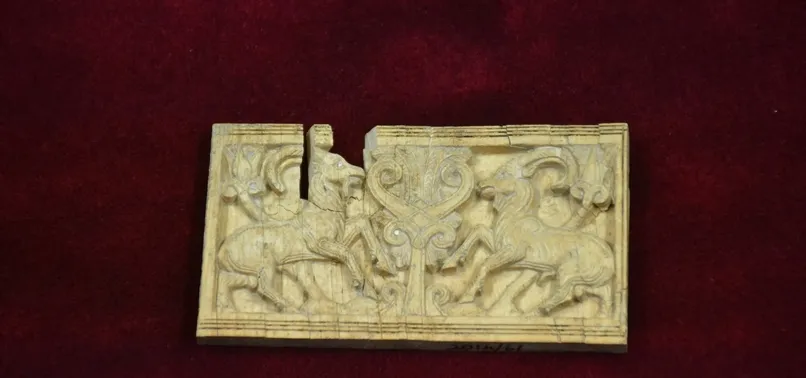
A 3,200-year-old ivory tablet, which has been called a “unique artifact,” has been discovered in Turkey and archaeologists believe that it may have originally come from Assyria. The tablet, which has been dated to around 1,200 BC, is 4.3 by 8.1 centimeters (1.6 by 3.1 inches), with a thickness that has been measured at 0.8 cm (0.3 inches).
As the Daily Sabah has reported, the ancient artifact that was found at the Archaeological Site of Arslantepe two years ago has now been thoroughly studied by archaeologists, and Professor Marcelle Frangipane of the Sapienza University of Rome explained, “The ivory tablet is a very important finding, as it was found for the first time here.”
Describing the artwork that decorates the ivory tablet, Professor Frangipane noted that two goat figures and a tree-like plant can be spotted on the artifact and that while it may have originally been made in Turkey, it is very likely to have originated Assyria judging by its design
“There are two goat figures and there is a plant, like a tree, between these figures. There are decorational motives around the tablet. These motives were mostly used by Assyrians in Syria. The tablet may be coming from Assyria, or may have been made here.”
DAILY SABAH✔@DailySabah
3,200-year-old ivory tablet found in Turkey’s eastern Malatya province has potential links to ancient Mesopotamian kingdom Assyria, excavation team sayshttp://sabahdai.ly/8sZK1s
3,200-year-old artifact linked to Assyria found in eastern Turkey
An ivory tablet dating back 3,200 years was found in eastern Turkey's Malatya province, giving clues on a potential link between Assyria and the region,...
According to Professor Frangipane, the carvings fashioned on the ivory tablet also bear a strong resemblance to similar artifacts that archeologists have discovered in both Syria and Iraq, and suggested that it may have once been used as a furniture decoration. However, at this time no link has been established between the artifact and these countries, and it may be that the artwork itself was prevalent at this time in different regions and that trade may have also influenced the art on the tablet.
“It might be a decoration of furniture. It is a beautiful work of art and it is important for the history of the mound. It is the same with the motives in Syria, Iraq and Nemrut [in southeastern Adiyaman]; there may be a trade relation between them.”
Excitingly, however, an ivory tablet of this kind has never been discovered in Turkey before, and Professor Frangipane has said that “these kinds of artifacts are found in Syria and Mesopotamia, but it is a unique piece for here.”
Excavations have been ongoing in the Arslantepe region of Turkey since 1961 and have been performed in a partnership between the Turkish Culture and Tourism Ministry and the Italian Archaeological Expedition of the Sapienza University of Rome. This area was once the birthplace of many great civilizations, including the Hittites, Romans, and Byzantines, so it makes sense that numerous ancient artifacts would be found here.
Now that the 3,200-year-old ivory tablet found in Turkey has been examined, it will be up to archaeologists to determine whether it is, in fact, Assyrian after all.
Video footage shows the bizarre anomaly that was spotted during NASA’s live feed from space.
It shows a strange grey object appearing to float above Earth.
The article appears to be shaped like an aircraft and moving south, though some believe it could be stationary on top of a mountain or the Luobubozhen facility in China.
But the person behind the camera even speculates a figure can be made out inside the UFO.
“I think it is some sort of craft”
Anonymous source
“The craft has 90 degree sharp angles and looks to be intelligently designed," they said.
“I think it is some sort of craft, but cannot work out whether it is on the ground, or flying.
“If it's on the ground its huge.”
According to the person who captured it, who wishes to remain anonymous, the clip shows: “A craft with a doorway and a being inside.”
They said: "At first I thought it was a cloud, but now I'm convinced its much more."
YOUTUBE
BIZARRE: What could it be?
The footage was captured in September 2017, but only shared on October 1 this year.
It was shared on YouTube channel MrMBB333 yesterday and has already racked up more than 55,000 hits.
“No chance that is on the ground – looks like it's in the air,” one viewer claimed.
A research team has documented a volcanic eruption in the western Pacific Ocean that’s deeper below the ocean surface than Mount Rainier’s height above sea level.
Researchers used remotely operated vehicles to explore the deep waters of the Mariana Trench.
A team of researchers has documented a recent volcanic eruption in the western Pacific Ocean about 2.8 miles (4.5 km) below the ocean surface that they describe as the deepest known eruption on Earth – deeper below the ocean surface than Mount Rainier’s height above sea level.
The researchers say the eruption probably happened between 2013-2015 on the Mariana back-arc, a zone of the sea floor with active volcanoes in the Pacific Ocean’s Mariana Trench. The Mariana Trench is the deepest part of the earth’s oceans, and the deepest location of the earth itself. It’s located just east of the 14 Mariana Islands near Japan. It was created by ocean-to-ocean subduction, a phenomenon in which a tectonic plate topped by oceanic crust is subducted beneath another plate also topped by oceanic crust.
Bill Chadwick is a marine geologist at Oregon State University and lead author on the study, published October 23, 2018 in the peer-reviewed journal Frontiers in Earth Science. Chadwick said in a statement:
We know that most of the world’s volcanic activity actually takes place in the ocean, but most of it goes undetected and unseen. That is because undersea quakes associated with volcanism are usually small, and most of the instrumentation is far away on land.
Many of these areas are deep and don’t leave any clues on the surface. That makes submarine eruptions very elusive.
The Mariana back-arc eruption was first discovered in December 2015 by cameras aboard an autonomous underwater vehicle. Photos revealed the presence of a pristine dark, glassy lava flow on the seafloor with no sediment cover. Venting of milky hydrothermal vent fluid indicated that the lava flow was still warm, and therefore very young.
Fresh lava from the sea floor.
Image via Oregon State University.
Data indicated that there had been major depth changes in the area between surveys in 2013 and 2015, the researchers said, which is consistent with an eruption. The new lava flows stretched over an area about 4.5 miles (7.2 km) long and ranged in thickness between 130-450 feet (40-137 meters).
The scientists returned in April and December of 2016 and used two remotely operated vehicles to explore the site. The new observations showed a rapidly declining hydrothermal system on the lava flows, suggesting the eruption had taken place only months before its discovery the previous year. Chadwick said:
Typically after an eruption, there is heat released and venting for a few years and organisms will colonize the vents, creating a new ecosystem. But after a while, the system cools down and the mobile organisms will leave. There was still some venting, but it had obviously greatly declined.
Bottom line: An undersea volcanic eruption discovered in the Pacific Ocean’s Mariana Trench is the deepest known.
Life on...? Why NASA Wants to Send Humans to This Mysterious Planet
SpaceX may be looking to life on Mars, but NASA has different plans in mind.
By Gareth Dorrian and Ian Whittaker, The Conversation
Popular science fiction of the early 20th century depicted Venus as some kind of wonderland of pleasantly warm temperatures, forests, swamps, and even dinosaurs. In 1950, the Hayden Planetarium at the American Natural History Museum were soliciting reservations for the first space tourism mission, well before the modern era of Blue Origins, SpaceX, and Virgin Galactic. All you had to do was supply your address and tick the box for your preferred destination, which included Venus
Today, Venus is unlikely to be a dream destination for aspiring space tourists. As revealed by numerous missions in the last few decades, rather than being a paradise, the planet is a hellish world of infernal temperatures, a corrosive toxic atmosphere, and crushing pressures at the surface. Despite this, NASA is currently working on a conceptual manned mission to Venus, named the High Altitude Venus Operational Concept — (HAVOC).
But how is such a mission even possible? Temperatures on the planet’s surface (about 460 degrees C) are in fact hotter than Mercury, even though Venus is roughly double the distance from the sun. This is higher than the melting point of many metals including bismuth and lead, which may even fall as “snow” onto the higher mountain peaks. The surface is a barren, rocky landscape consisting of vast plains of basaltic rock dotted with volcanic features, and several continent-scale mountainous regions.
It is also geologically young, having undergone catastrophic resurfacing events. Such extreme events are caused by the build-up of heat below the surface, eventually causing it to melt, release heat, and re-solidify. Certainly a scary prospect for any visitors.
Venus was once an Earth twin.
Hovering in the Atmosphere
Luckily, the idea behind NASA’s new mission is not to land people on the inhospitable surface, but to use the dense atmosphere as a base for exploration. No actual date for a HAVOC type mission has been publicly announced yet. This mission is a long-term plan and will rely on small test missions to be successful first. Such a mission is actually possible, right now, with current technology. The plan is to use airships which can stay aloft in the upper atmosphere for extended periods of time.
As surprising as it may seem, the upper atmosphere of Venus is the most Earth-like location in the solar system. Between altitudes of 50km and 60km, the pressure and temperature can be compared to regions of the Earth’s lower atmosphere. The atmospheric pressure in the Venusian atmosphere at 55km is about half that of the pressure at sea level on Earth. In fact, you would be fine without a pressure suit, as this is roughly equivalent to the air pressure you would encounter at the summit of Mount Kilimanjaro. Nor would you need to insulate yourself, as the temperature here ranges between 20 degrees C and 30 degrees C.
The atmosphere above this altitude is also dense enough to protect astronauts from ionizing radiation from space. The closer proximity of the sun provides an even greater abundance of available solar radiation than on Earth, which can be used to generate power (approximately 1.4 times greater).
The conceptual airship would float around the planet, being blown by the wind. It could, usefully, be filled with a breathable gas mixture such as oxygen and nitrogen, providing buoyancy. This is possible because breathable air is less dense than the Venusian atmosphere and, as result, would be a lifting gas.
The Venusian atmosphere is comprised of 97 percent carbon dioxide, about 3 percent nitrogen, and trace amounts of other gases. It famously contains a sprinkling of sulphuric acid, which forms dense clouds and is a major contributor to its visible brightness when viewed from Earth. In fact, the planet reflects some 75 percent of the light that falls onto it from the sun. This highly reflective cloud layer exists between 45km and 65km, with a haze of sulphuric acid droplets underneath down to about 30km. As such, an airship design would need to be resistant to the corrosive effect of this acid.
Luckily, we already have the technology required to overcome the problem of acidity. Several commercially available materials, including Teflon and a number of plastics, have a high acidic resistance and could be used for the outer envelope of the airship. Considering all these factors, conceivably, you could go for a walk on a platform outside the airship, carrying only your air supply and wearing a chemical hazard suit.
Life on Venus?
The surface of Venus has been mapped from orbit by radar on the US Magellan mission. However, only a few locations on the surface have ever been visited, by the series of Venera missions of Soviet probes in the late 1970s. These probes returned the first — and so far only — images of the Venusian surface. Certainly surface conditions seem utterly inhospitable to any kind of life.
Venus as seen by Magellan.
The upper atmosphere is a different story, however. Certain kinds of extremophile organisms already exist on Earth which could withstand the conditions in the atmosphere at the altitude at which HAVOC would fly. Species such as Acidianus infernus can be found in highly acidic volcanic lakes in Iceland and Italy. Airborne microbes have also been found to exist in Earth’s clouds. None of this proves that life exists in the Venusian atmosphere, but it is a possibility that it could be investigated by a mission like HAVOC.
The current climatic conditions and composition of the atmosphere are the result of a runaway greenhouse effect (an extreme greenhouse effect that cannot be reversed), which transformed the planet from a hospitable Earth-like “twin” world in its early history. While we do not currently expect Earth to undergo a similarly extreme scenario, it does demonstrate that dramatic changes to a planetary climate can happen when certain physical conditions arise.
By testing our current climate models using the extremes seen on Venus, we can more accurately determine how various climate forcing effects can lead to dramatic changes. Venus, therefore, provides us with a means to test the extremes of our current climate modeling, with all the inherent implications for the ecological health of our own planet.
We still know relatively little about Venus despite it being our nearest planetary neighbor. Ultimately, learning how two very similar planets can have such different pasts will help us understand the evolution of the solar system and perhaps even that of other star systems.
Des OVNI filmés dans la province de Overijssel, aux Pays-Bas
Le jeudi 27 septembre 2018 vers 19h30, des OVNI ont été repérés au-dessus de Broekland et de Sint Jansklooster, deux villes situées dans la province de Overijssel, aux Pays-Bas.
Deux témoins sont parvenus à filmer ces objets volants non identifiés. Mais quelle est l’origine de ces engins ?
Les boules de lumière semblaient flotter et s’éteindre lentement. Selon les observateurs, ces objets étaient parfaitement ronds et émettaient des éclairs de lumière très brillants.
Le site Internet ufomeldpunt.nl a publié deux vidéos de ce phénomène. Selon cette organisation, ces lumières ressemblaient plus ou moins à des fusées éclairantes.
Du 17 septembre au 22 octobre, un exercice militaire géant, baptisé Falcon Autumn, a eu lieu dans une grande partie des Pays-Bas. Esther Broekman, conseillère en communications du Commandement des hélicoptères de défense, a annoncé qu’il pourrait s’agir de soi-disantes fusées éclairantes.
« Cette semaine était la première semaine de vol et jeudi soir, nous avons utilisé ce que l’on appelle des fusées éclairantes », a déclaré Esther.« Mais je veux faire un commentaire à ce sujet. Nous en avons lancé dans la région du Veluwe, la question est de savoir si ces fusées pouvaient être vues d’en haut jusqu’à Broekland et St. Jansklooster. Cette lumière devait être très éloignée. »
Cette histoire demeure énigmatique malgré cette explication plausible.
A former military veteran shares his testimony regarding the crash of a large extraterrestrial craft in Peru that occurred approximately a decade ago. There were beings inside of the craft, still alive.
Reflect On:
What does the black budget world know? Reflect on the implications of a completely transparent world, with no secrecy. Information is our birthright.
There exists a shadowy government with its own Air Force, its own Navy, its own fundraising mechanism, and the ability to pursue its own ideas of the national interest, free from all checks and balances, and free from the law itself. (source)
Millions of pages of declassified documents, witness testimony from thousands of credible people from all branches of global militaries, intelligence agencies and more, not to mention electrooptical data (radar trackings, videos etc), have ‘outed’ the UFO phenomenon within the mainstream world. The topic is also becoming less taboo within academia; some universities even offer courses related to the study of these mysterious objects. The extraterrestrial hypothesis, which represents one explanation for the UFO phenomenon, has enormous amounts of credibility behind it. According to many–astronauts, military personnel, and high ranking politicians–we are not alone, and never have been.
There are unidentified flying objects. That is, there are a hard core of cases–perhaps 20 to 30 percent in different studies–for which there is no explanation. We can only imagine what purpose lies behind the activities of these quiet, harmlessly cruising objects that time and again approach the Earth. The most likely explanation, it seems to me, is that they are simply watching what we are up to.(Mead)
A recently retired professor and historian, Dr. David M. Jacobs, makes a great point when it comes to these things. He muses that if this is all false, and there are no such things, then “we have found the most important thing ever in the history of neurology, brain function, cognition…” In other words, he is saying that this is real, and many people who have been labelled as “crazy” aren’t so crazy after all. He made these comments in a video embedded in this article I published about him earlier.
With the amount of credibility that comes from previous statements of established people within the military, witness testimony has taken on more importance. There are those out there who refuse to acknowledge witness testimony as anything significant, which at this point is borderline crazy. We have a verified phenomenon here, and a lot of testimony comes from those who have been involved in many of the incidents that have already been established via official documentation.
Examples Of Witness Testimony
This document from the Project Bluebook files is quite extraordinary, but what is more extraordinary is the live testimony given by one of the people mentioned in that document, Navy commander pilot Graham Bethune. You can watch his testimony of this incident here, where he says he learned that a certain object was extraterrestrial from “the boys upstairs.”
When it comes to extraterrestrial incidents, one common theme is the crash retrieval of UFOs. It’s been discussed within UFO lore for decades, and stories from ‘credible’ people tell of multiple downed UFOs. It’s certinly not just limited to the Roswell incident. Dr. David Clarke is an investigative journalist, reader and lecturer at Sheffield Hallam University in England. He was also the curator for The National Archives UFO project from 2008–13, and regularly comments in national and international media on UFOs.
He pointed out some of the latest examples, using documents from the national archives that reveal how the Royal Air Force (RAF) expressed great interest in finding UFOs to help come up with new and innovative ways to combat their enemies. Apparently, they were gathering evidence that other nations had collected this technology. Having been an avid researcher into the field myself for more than a decade, I can say that stories of multiple retrievals and crash retrievals of unknown aerial objects are abundant.
Even though they have been partly censored they can’t conceal the fact the UK military were interested in capturing UFO technology or what they coyly refer to as ‘novel weapon technology’…And the files reveal they were desperate to capture this technology – wherever it came from – before the Russians or the Chinese got hold of it first….Although this was 1997, Russia was still regarded as an undefeated enemy with a weapons programme regarded as a threat to the West.
Here’s a great quote from former Candian Defense Minister Paul Hellyer, which gives us an idea regarding the protocol to deal with these unknown objects:
“Decades ago, visitors from other planets warned us about where we were headed and offered to help. But instead, we, or at least some of us, interpreted their visits as a threat, and decided to shoot first and ask questions after.” (source)
Another classic example would be the CIA keeping tabs on developments in Germany, as explained by this document, which looked into “a German newspaper” that “recently published an interview with George Klein, famous engineer and aircraft expert, describing the experimental construction of ‘flying saucers’ carried out by him from 1941 to 1945.” How did they study these flying saucers? Were they from crashes?
You might be saying to yourself, “a civilization travelling through a sea of stars would not be susceptible to human interference.” I would say that’s incorrect, if you’ve studied anything at all about the black budget, you would know that we ourselves are pretty advanced. Perhaps some civilizations have never experienced such violence and are not prepared? Perhaps the concept of “military” doesn’t exist within some civilizations, or perhaps some civilizations have weaponry that’s on par with ours. Perhaps some of our weaponry is alien technology?
We have, indeed, been contacted — perhaps even visited — by extraterrestrial beings, and the US government, in collusion with the other national powers of the Earth, is determined to keep this information from the general public.”
Victor Marchetti, former special assistant to the Deputy Director of the Central Intelligence Agency (Second Look, Volume 1, No 7, Washington, DC, May, 1979)
Below is a video of Lance Corporal Jonathan Weygandt, one of hunderds of verified military personnel that have been interviewed by Dr. Steve Greer, the man behind the release of the recent documentary “Unacknowledged.” He tells of a situation regarding a UFO crash retrieval in Peru, with extraterrestrial beings who were telepathically asking him to help them get out of there. Eventually, black ops stepped in, reprimanded him, and did whatever it is they do with these crafts and bodies.
Based on my research and reading of the lore, they are studied for scientific purposes and, in some cases, kept ‘prisoner’ for communication (Interfacing) purposes. But going that deep is simply speculation.
“Yes there have been crashed craft, and bodies recovered”
– Dr. Edgar Mitchell, Apollo 14 astronaut.
The Takeaway
There are many rabbit holes you can go down, but the point is, it’s ok to listen to these stories with an open mind, given who these people are, the consistency of their stories and the number of stories that are coming from people with similar backgrounds. The movement is growing and eventually, we will all experience something that will change humanity forever. The implications of this are huge, and it’s great that it’s no longer taboo.
There are huge lessons here, from technology to metaphysical and spiritual implications and more. It’s a lot for humanity to handle, and perhaps that’s why we’re seeing a slow and gradual process of disclosure. Sure, special powerful interest groups may be benefiting from the secrecy, and are possibly looking to capitalize on disclosure as well, but contact goes beyond us. It’s a lesson that can expand our consciousness, and ultimately, the human population is in charge of when we choose to ‘make contact’ in an open way, because right now, it seems everything is so secretive and behind the scenes, when really what we need is full-blown transparency.
A message to those “within”: quit using ‘national security’ to justify secrecy. We need to become an open and connected global community, not one like the New World Order proposes, but one based on the interests of all of humanity and our planet. We can thrive together in cooperation, not competition. We do not need to label or demonize extraterrestrials.
We should not bracket UFOs with angels, archangels, devils and demons. But this is just what we’re doing when we ask whether people believe in UFOs; as if their existence were an article of faith. Do people believe in the sun or the moon, or the changing seasons, or the chairs they’re sitting on? When we want to understand something strange, something previously unknown to anyone, we have to begin with an entirely different set of questions. What is it? How does it work? Are their recurrent regularities? Beginning in this way, with an open mind, people can take a hard look at all the evidence.
One month from today, Mars will welcome a new robotic resident that seeks to probe the planet's innards.
NASA's InSight lander is scheduled to touch down just north of the Martian equator on the afternoon of Nov. 26, bringing a nearly seven-month space trek to an end. InSight launched, along with the two tiny Mars Cube One (MarCO) cubesats, atop a United Launch Alliance Atlas V rocket from California's Vandenberg Air Force Base on May 5.
One month from today, Mars will welcome a new robotic resident that seeks to probe the planet's innards.
Artist's illustration of NASA's InSight lander at work on the Martian surface.
Credit: NASA/JPL-Caltech
The solar-powered spacecraft will barrel into the Martian atmosphere at 14,100 mph (22,700 km/h), then deploy a big parachute to slow its descent. As the lander nears the surface, it will pop free of its back shell and parachute, touching down softly with the aid of 12 descent engines about 6 minutes after getting its first taste of Mars' air.
That touchdown will come on a high-elevation equatorial plain called Elysium Planitia, a mere 370 miles (600 kilometers) from Gale Crater, where NASA's car-size Curiosity rover landed in August 2012.
Elysium Planitia is "as flat and boring a spot as any on Mars," NASA officials wrote in a statement Wednesday (Oct. 24). And that's why the InSight team chose to land there — for safety's sake.
At Elysium, "there's less to crash into, fewer rocks to land on and lots of sunlight to power the spacecraft," NASA officials added. "The fact that InSight doesn't use much power and should have plenty of sunlight at Mars' equator means it can provide lots of data for scientists to study."
InSight won't be investigating surface features, so the "boring" part is no drawback. The lander totes a burrowing heat probe and a suite of superprecise seismometers; observations by both instruments should reveal a great deal about the Red Planet's internal structure and composition, mission team members have said.
In addition, InSight (whose name is short for "Interior Exploration using Seismic Investigations, Geodesy and Heat Transport") will perform a radio-science experiment using its communications gear. This work will track the tiny wobbles of Mars' rotational axis, revealing details about the size and composition of the planet's core.
The various data gathered by the $850 million InSight mission over its roughly two Earth-years of operation should help scientists better understand how rocky planets form and evolve, NASA officials have said.
NASA's InSight lander will touch down Nov. 26, 2018, on Elysium Planitia, just north of Mars' equator.
Credit: NASA/JPL-Caltech
And about the MarCO twins: Those briefcase-size spacecraft are embarked on a demonstration mission, which aims to show that cubesats can indeed explore deep space. Things are going well so far. One of the twins recently beamed home a photo of Mars — the first Red Planet image ever captured by a cubesat.
The MarCO craft will also attempt to beam home to Earth data from InSight during the lander's touchdown attempt on Nov. 26. But this is not a crucial responsibility for the duo; other NASA spacecraft, such as the venerable Mars Reconnaissance Orbiter, will do this relay work as well.
Mike Wall's book about the search for alien life, "Out There," will be published on Nov. 13 by Grand Central Publishing.
Saturn's moon Dione as seen by the Cassini mission in 2012.
Credit: NASA/JPL-Caltech/Space Science Institute
Scientists studying Saturn's moon Dione spotted weird stripes that they now believe could be caused by material falling onto the moon's surface.
The new research is based on data gathered by NASA's Cassini mission, which ended last fall. In photographs taken by the spacecraft before it was destroyed, a pair of scientists saw long, narrow, bright stripes across the surface of Dione — which looked eerily like similar features already identified on another of Saturn's moons, Rhea.
On Dione, they're weirdly parallel and look fairly young, and they're only found along the middle swath of the moon. "Their orientation, parallel to the equator, and linearity are unlike anything else we've seen in the solar system," co-author Alex Patthoff, a geologist at the Planetary Science Institute, a nonprofit research center, said in a statement released by the institution.
So he and his co-author tried to figure out whether they were caused by some sort of geological activity on Dione itself or by an external phenomenon acting on the little moon. To do so, they ran through a list of possible explanations for the features: Maybe boulders are rolling across the surface and leaving traces of their journey. Maybe the surface is split and the parts are rubbing against each other, like tectonic plates here on Earth. Maybe the streaks are shooting out from the sites of large impacts that shocked the moon.
But the only explanation they tried that actually matched what they saw on Dione's surface was that material is slowly falling onto the moon from Saturn's rings, nearby moons or passing comets.
Those explanations suggest that if scientists can get a better look at the features, they may be able to learn something about how plausible it might be to find life on Dione — or on worlds like it.
The research is described in a paper published Oct. 15 in the journal Geophysical Research Letters.
WATCH THE SKIES: WHAT WE SHOULD BE ASKING ABOUT U.F.O.S
On June 1947 Kenneth Arnold, a business man and civilian pilot from Boise Idaho, was using his private plane to aid in the search for a missing military C-47 cargo plane near Mount Rainier in Washington State, when he sighted nine aircraft of a type he could not identify. Having been a pilot for many years, he became curious and turned to follow the unusual craft. He described them as being chevron shaped, silver in color, and flying in a motion reminiscent of a “saucer being skipped across the water”.
Arnold dutifully reported his encounter, and his story was picked up by the world press. Misquoting Arnold, the press coined the term ‘flying saucer,’ despite the fact that Arnold’s saucer analogy was used to describe the way the objects moved, not their shape. This was the beginning of what is now called UFOlogy: the study of unidentified flying objects, or UFOs. The topic of UFOs has been the subject of tremendous ridicule and less than friendly humor. Those people who claim to have seen such objects are often suspected of mental illness, or of outright dishonesty. Yet despite this stigma, people, many of them holding positions of great responsibility, still report encountering such phenomenon. While quantifiable, tangible evidence has not yet been produced, one thing is certain: the UFO phenomenon cannot be explained away in its entirety. While it is certain that the UFO mythos has become a commercialized farce, it is also true that many well credentialed scientists and political leaders have risked considerable damage to their careers and reputations because they investigated, and in some cases, continue to investigate UFOs and related issues. Perhaps the two most prominent examples of this are the late Doctor John Mack and former Congressman Stephen Schiff. Mack, a tenured professor and Doctor of psychiatry at Harvard University Medical School, investigated the phenomenon of UFO abduction for over a decade, and published several books on the subject before his death in 2004. Doctor Mack concluded that the patients that believed that they had been abducted by UFO occupants were, for the most part, “…sane and well adjusted individuals who had experienced something real”. Schiff, during his term as Congressman from New Mexico, personally petitioned the Defense Department, Central Intelligence Agency, the National Archives, and the General Accounting Office for any and all material relating to UFOs. Schiff also publicly supported groups as Citizens Against UFO Secrecy. (C.A.U.S.) Despite over 40 years of receiving reports, including over twenty years of official government interest in UFOs under three different project names, (Projects Sign, Grudge, and Bluebook) Schiff received only thirty pages of information, much of which was censored. Given the Government’s propensity for record keeping, one would think that there would be hundreds of pages of eyewitness reports alone. These two prominent citizens had everything to lose and nothing gain by investigating UFOs. They did so because they believed that the phenomenon, science fiction and fantasy aside, merited investigation if for no other reason than its sheer scope. Additionally, while the United States government has been less than forthcoming about UFOs, the governments of Belgium and France have been more candid. The French in particular have been transparent in their investigation of UFOs, publishing a ninety page report entitled The 1999 French Report on UFOs and Defense. This report says, in its conclusion, “The physical reality of UFOs, under the control of intelligent beings, is a very reasonable conclusion, although not proven.” Although this report was prepared as private venture, the authors were all former or active members of the French Institute for Advance Studies on National Defense, (the French equivalent of the United States Military’s War Colleges) and was the product of ten years of studying the UFOs incidents in which physical evidence was present, and the eye-witnesses were of the highest credibility. The report was given to French President Jacques Chirac who suggested it be made public. The importance of this report cannot be understated. It concluded that it was scientifically plausible for UFOs to be real, physical objects, and they could be piloted intelligently. The authors of the report are not UFO enthusiast or persons of questionably character they are prominent members of the French scientific and defense apparatus who felt that if there was any validity to even some UFO reports, French national security could be at risk. The understandable reluctance for the average person to believe UFO accounts is continuously reinforced by popular culture, which makes great fun of UFO enthusiasts. However, reports continue to be made despite the ridicule that is sure to follow such reporting, and mountains of UFO photos and video footage continue to accumulate. Is it reasonable to believe that every report and all the photographic evidence taken since 1947 are all either misidentified phenomenon or hoaxes? Is it not more reasonable to assume that at least some of these instances are real phenomenon that are, as yet, unexplained. No one with any credibility can categorically state that UFOs are extraterrestrial in origin. However it is equally incredible that the phenomenon itself is entirely fabricated or imagined. Something is happening in the skies, or possibly with the human psyche, which has yet to be explained. Rather UFOs are purely psychological (but no less real) manifestations, misunderstood atmospheric anomalies, experimental terrestrial aircraft, or an extra-solar spacecraft, the phenomenon exist; it is real, and should be studied seriously. UFO debunkers and skeptics will argue that pressing problems such a global hunger, fatal diseases, and environmental issues are more deserving of precious research dollars than a subject as fanciful as UFOs. They point to the fact that an overwhelming percentage of investgated UFO sightings have been explained as natural phenomenon or misidentified conventional aircraft. These are valid points. However, the UFO question needs to be looked at in a different light. Let us say that all UFO sightings, even the five or ten percent that have not been explained despite intense scientific inquiry, are indeed not extra-terrestrial craft. Let us concede that people are seeing something explainable by natural and scientific laws. Let also concede that the vast majority of people who report UFOs are honest, sane people that actually saw something, or believed sincerely that they did. Since the number of sighting reports number well into the thousands each year, and since even the most hardened skeptic will concede that not all of those thousands who report UFO incidents can be hoaxers, then is it not in our best interest to find out what these people are seeing and why? If it is an as yet unidentified psychological phenomenon occurring in thousands of people (including airline and military pilots, police officers and military personnel, and public officials including Presidents Jimmy Carter and Ronald Reagan) then does it not have to be worthy of study?
In the case of the abduction phenomenon, the alleged abductees (also called by the more politically correct term 'experiencers') report extreme traumatization, and often seek psychological help. If these people have a mental disorder that has yet to be diagnosed correctly, or an unknown variation of an identified disorder, then they cannot receive proper treatment until that disorder is identified. Further, some abductees have been victimized by charlatans claiming to be legitimate therapists, but who have no credentials whatsoever. Many times, these charlatans dabble in hypnotherapy, and mind altering drugs to help abductees ‘remember’ an abduction experience, but actually use those methods to further damage the alleged abductees' mental health. Another, more likely, explanation put forth for UFO sightings is the misidentification of experimental aircraft. However, since many sightings occur over heavily populated areas of the United States (as in Hudson Valley, New York sightings that occurred repeatedly throughout the 1980s) one must ask why secret military vehicles would be tested where thousands of people would be sure to observe them? If experimental vehicles are being tested in populated areas and, as is claimed, local air traffic controllers truly know nothing about such tests, then there must be a great danger to the public due to possible aircraft collisions if nothing else. Also consider that such experimental aircraft are funded by taxpayer dollars. Even acknowledging the need for secrecy in the interest of national security, there still must be some accountability for the fear, confusion, and wasted resources that accompany UFO reports if they are, indeed, caused by experimental aircraft. In summation, even if all supernatural aspects of the UFO question are ignored or dismissed, the question itself still exists, and has direct bearing on the lives of many honest and loyal American citizens. Is it right to belittle these people and marginalize them because they have seen and reported something they cannot explain, or because they have a view of the universe that does not agree with convention? I submit that if we allow them to be marginalized, we cannot help but marginalize ourselves.
Meer van UFO'S of UAP'S, ASTRONOMIE, RUIMTEVAART, ARCHEOLOGIE, OUDHEIDKUNDE, SF-SNUFJES EN ANDERE ESOTERISCHE WETENSCHAPPEN - DE ALLERLAATSTE NIEUWTJES




 This Week's Top Space Stories!