Twisting through the valley is a Martian dust devil, seen by @MarsRovers Opportunity: http://go.nasa.gov/1RLAhDN



 3D Printing Is Going to Space


If you’re a nerd like me, the image of a half-constructed, almost skeletal second Death Star from Return of the Jedi is permanently lodged in your brain as one of the most majestically ominous creations in all of cinema.
George Lucas’ vision of building massive superstructures directly in outer space is iconic, but it’s hardly the first of its kind. The idea of manufacturing whole spacecraft or space stations that never touch Earth, that are fabricated and assembled directly out in the void where they will be operating, is one of humanity’s oldest science fiction dreams, dating back to antiquity, before the genre of sci-fi as we know it was even invented.
But now, outer space manufacturing is about to become a reality, albeit at a much smaller scale than the Death Star. The real-life Florida startup Made in Space recently won a $73.7 million contract from NASA to use, over the next three years, what’s essentially an advanced space-grade 3D printer to print out wings for a spacecraft while it orbits Earth.
Made in Space is pursuing something altogether more ambitious: producing whole new pieces of working equipment from raw materials in outer space — and doing so in a matter of days.
“We’re focused on the industrialization of space and moving the means of production into space,” said Justin Kugler, vice president of advanced programs and concepts at Made in Space, in a phone interview with OneZero.
To be clear, humanity has already gotten fairly good at assembling stuff in space — connecting one craft or piece of equipment to another using specialized tools, computers, physics, and robotics. That’s how the International Space Station and orbital laboratories from China and Russia were all put together over the years. But Made in Space is pursuing something altogether more ambitious and trickier: actually producing whole new pieces of working equipment from raw materials in outer space—and doing so in a matter of days.
Made in Space was founded nearly a decade ago in Silicon Valley by a quartet of entrepreneurial dudes: Aaron Kemmer, Jason Dunn, Mike Chen, and Michael Snyder. They were all part of some of the first graduate studies programs offered by Singularity University, a “benefit corporation” focused on nurturing advanced technologies that will move humanity toward the technology singularity, started by entrepreneur Peter Diamandis and futurist Ray Kurzweil.
Fittingly, given its lofty origins, Made in Space’s ultimate goal is that its 3D-printing-like technology will eventually be used to construct entire space settlements, cities even, at relatively lower cost than would be possible if those same structures were built on the ground first and then launched into space. (You’re paying a lot more for rocket fuel in those cases.)
The way Kugler describes it, using Made in Space’s technology, you’ll be able to launch small spacecraft and satellites that, once in orbit, could autonomously create the kinds of equipment normally restricted to larger, heavier satellites, at least when limited to traditional, Earth-bound production processes.
“You’re talking tens of millions [of dollars] compared to hundreds of millions,” said Kugler, referring to the cost savings Made in Space is envisioning.
NASA, whose funding yo-yos quite dramatically year over year, obviously sees the appeal of the cost-savings aspect of Made in Space’s approach.
“The benefit to the taxpayer is more efficient and affordable spacecraft and space vehicle designs that are not overdesigned (for launch) and that do not require the hardware needed to deploy the spacecraft into a usable configuration,” said Dayna Ise, a program executive at NASA’s Space Technology Mission Directorate division, in an emailed statement.
That same Made in Space tech could and likely will be used to build space weaponry and battle stations — though hopefully not on the mass-destruction scale of the Death Star. Northrop Grumman — the aerospace and defense contractor that makes the Global Hawk military drone, among other weaponry — is one of Made in Space’s key business partners.
First, though, there needs to be a working proof-of-concept of the idea, which is coming soon.
In 2022 or shortly thereafter, a rocket made by the aptly named company Rocket Lab Electron will launch from New Zealand and release Made in Space’s smaller spacecraft, the Archinaut One, which is about the size of a small refrigerator that you’d see in a college student’s dorm room.
It’s a cylindrical craft with some complicated-looking equipment strapped to the side and two tiny solar arrays sprouting on opposite sides like square robotic bat wings. But the relatively benign appearance hides some groundbreaking technology onboard. Archinaut One will carry its own additive manufacturing facility.
Additive manufacturing refers to a wide range of technologies and building processes, among them 3D printing, that all share in common the ability to fabricate objects with relatively high precision by applying layers of material on top of one another, adding them together to form a more complex object.
Desktop 3D printers have been around for years, sold by the likes of MakerBot (a subsidiary of Stratasys) and XYZprinting.
Made in Space has already built a printer slightly larger than these desktop models. In 2014, the company launched it aboard a SpaceX Dragon commercial cargo vessel, which it sent, along with some mice, to the International Space Station.
That printer, which Made in Space called a zero-gravity printer, printed more than a dozen items and ended up serving as the basis for all of its subsequent technology. It was succeeded by Made in Space’s more advanced additive manufacturing facility printer (AMF printer), launched to the space station in 2016 and since used to print more than 100 different tools, including everything from specialized wrenches to finger splints for astronauts. (They’re prone to injuring their fingers on all the finicky equipment aboard the space station.)
Now Made in Space plans to take the success of that very same technology and run a variation of it outside of the space station—in the even more inhospitable vacuum of space, on the side of the free-flying Archinaut One spacecraft. After decoupling from the Rocket Lab rocket, the Archinaut One will enter low-earth orbit (LEO to space industry folks, defined by NASA as the first 100 to 200 miles of space above Earth’s surface) and begin circling our home planet more than 11 times per day.
A few days later, the Archinaut One will conduct the historic, first-ever free-flying additive manufacturing demonstration in space, using a spool of polymer filament to print two 32-foot-long (64 feet total) semirigid beams extending from either side of the spacecraft.
The beams will be much larger than those the Archinaut One could otherwise support if it were relying on traditional space assembly methods, such as bringing them folded up into space from Earth, and will be used to act as a kind of scaffolding for long solar arrays that extend outward. “Like Venetian blinds,” according to Kugler.
Robotic arms will weave the electrical junctions through the solar arrays and connect them back into the spacecraft, providing working power. And all of this will happen automatically, controlled by software algorithms, with humans overseeing it back on the ground in Texas and Florida.
“Space being a difficult and unusual medium is 90% of the challenge we face,” Kugler told OneZero.
Although Made in Space likes to brag that it doesn’t have any competition when it comes to its specific space-grade additive manufacturing systems, the commercial space industry at large is broadly focused on developing technologies to reduce the weight, cost, and time it takes to put craft into orbit and beyond.
SpaceX has its impressively successful Falcon reusable rockets, while other companies, including Virgin Galactic and Sierra Nevada, are working on private reusable space shuttle–type craft. Bigelow Aerospace, the company founded by billionaire hotel magnate and UFO aficionado Robert Bigelow, has launched an inflatable human habitat to the space station and proven that the concept — using fabric lighter than traditional spacecraft materials to construct tentlike rooms in orbit — is viable for reducing weight at launch and, therefore, rocket fuel and cost.
These companies all face the same challenges humanity has encountered since we first started shooting rockets up into the sky—namely, that beyond Earth’s atmosphere is an inhospitable environment for pretty much everything, even strong materials like metal and plastic.
There’s the strong force of gravity exerted on the payload of a rocket launch, then all the speed and motion to get objects into space, and once they get there, they typically move at thousands of miles per hour. The atmosphere also helps protect objects on Earth from a number of damaging space forces, like debris, cosmic radiation, and the more unfiltered radiation and heat of the sun. So, designing systems that work in space requires solving for problems in physics, math, chemistry, electromagnetism, thermodynamics, computation, and materials science, among other disciplines.
In many ways, space is fundamentally opposed to the kinds of finicky and delicate 3D-printing processes that companies have developed for Earth, with extremely precise and even fragile moving parts.
Fortunately for Made in Space, its employees have already managed to solve some of the fundamentals. The company says it prudently designed its zero-gravity additive manufacturing to work in a wide range of differing gravity environments, from “more than one G to negative G,” according to Kugler — that is, gravity both stronger and weaker than what’s felt on Earth’s surface.
“For the future of building deep-space transit vehicles that will take people to far-off destinations and land, this is vital technology.”
In fact, even though the Archinaut One demo will be the first of its kind, it may be easier in some ways to accomplish than Made in Space’s previous feat of putting a printer aboard the space station, where it was more prone to jostling and other interference (“perturbations,” as Kugler calls them) from the astronauts going about their tasks, such as running on the space station treadmill.
If the company can pull off this demo, what’s next?
“In the near term, we can directly apply the tech from the Archinaut One to making small satellites that have larger, more efficient solar arrays or larger, more efficient active arrays, like antennas, reflectors, laser arrays,” Kugler said.
Made in Space thinks that within a few years after that, it will be able to build solar collection stations that can beam power to other spacecraft or customers down on Earth.
NASA, for one, is bullish on using Made in Space’s technology to create human-crewed spacecraft. “The timeline depends on a variety of factors, but the in-space robotic manufacturing and assembly capability could be matured to this level within the next decade,” Ise said.
“For the future of building cities in space and deep-space transit vehicles that will take people to far-off destinations and land, this is vital technology,” Kugler went on. “We will need a couple of miracles between now and then, but it’s possible.”
Made in Space isn’t talking up the potential for its technology to be used in Death Star–like superweapons—or any smaller weapons, for that matter. But it is open to developing craft and technology that can be used by the U.S. military.
Asked about the possibility of using the technology for defense purposes, Made in Space spokesperson Austin Jordan provided the following statement via email: “Our vision is that Made in Space will continue to be a close partner to the U.S. government across both defense and civil organizations. As it relates to national security and defense, in-space assembly and manufacturing capabilities could address key national security space priorities, including improving asset resilience, enhancing satellite capabilities, and providing rapid-response equipment. I think innovative technology platforms like Archinaut One will open up the playbook for us to engage with various agencies within the defense community to incorporate these capabilities into future missions.”
It may take a while, but if Made in Space’s visions pan out at all close to how the company hopes, future generations may look at the Death Star scenes in Star Wars as more realistic — perhaps worryingly so — than George Lucas could have ever anticipated.
India’s first attempt to land on the moon appears to have failed
India's Chandrayaan 2 spacecraft (illustrated) searched for the Vikram lander from orbit. Chandrayaan 2 will continue observing the moon for about a year.
ISRO
By
The sun is setting on India’s first attempted lunar landing. As night fell over the lunar south pole on September 20, scientists’ hopes that the solar-powered Vikram lander would contact Earth before the end of one lunar day have been dashed.
Officials at the Indian space agency ISRO reportedly believe that the Vikram lander died on impact with the lunar surface on September 6. The probe lost contact shortly before it was meant to touch down near the moon’s south pole (SN: 9/6/19), according to the Times of India.
Still, there was hope that Vikram or its onboard rover would perk up and reestablish contact. ISRO spent two weeks — the equivalent of one lunar day — trying to communicate with Vikram. The lander and its rover, Pragyan, were designed to last one lunar day before the lack of sunlight and cold temperatures shut them down.
ISRO said that its Chandrayaan 2 orbiter took pictures on September 10 showing the lander lying flat or tilted on its side. Those images, however, were not publicly released.
NASA’s Lunar Reconnaissance Orbiter also flew over the landing site on September 17. But “lunar local time was near dusk; large shadows covered much of the area,” the space agency said in an e-mail. “The exact location of the lander was not known, so the lander may not be in the camera field of view.” NASA said that it would search again on October 14, when the sun is higher in the lunar sky.
After the sun completely sets on Vikram’s landing site, temperatures there will drop to about –180° Celsius for another two weeks. The solar-powered lander’s electronics are not expected to survive the frigid night.
ISRO has yet to put out an official statement. But the Times of India reported on September 20 that the team analyzing the mission’s failure believes that it was caused by an error in the spacecraft’s automatic landing program. The newspaper quoted an unnamed scientist as saying that the lander may have started spinning on its way to the lunar surface so that thrusters meant to slow the descent instead accelerated it.
Scientists use drones to probe earthly dust devils, with an eye toward Mars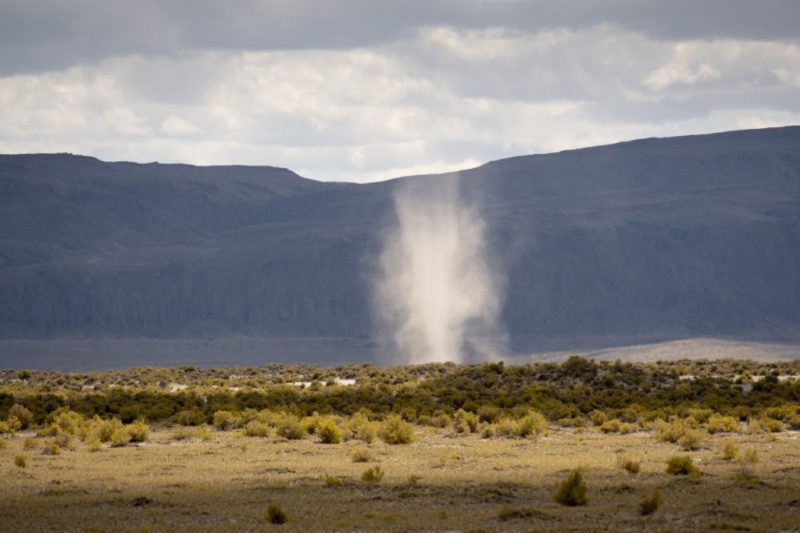
Dust devils are common are common on Earth, but ubiquitous on Mars, a desert world. Scientists are using drones carrying cameras and other instruments to gain new insights.
The video above shows scientists’ encounter with a dust devil in May 2019, in the Alvord Desert in southeastern Oregon. These scientists – members of the Boise State Dust Devil Collaboration – have been flying drones through active dust devils, in part to understand earthly dust devils better, and also to understand dust devils on Earth’s neighbor planet, Mars.
Physicist Brian Jackson of Boise State University said in a statement:
Dust devils, while common in arid climates on Earth, are ubiquitous on Mars, where they may be responsible for much of the planet’s haze that helps heat its atmosphere. Dust devils have been observed from landers the ground and from orbiting spacecraft all over the surface of Mars. A better understanding of dust devils on Earth will help scientists understand their influence on Mars’ climate.
In the video above, acquired with a drone, you can see how the drone tilts and drops once inside the dust devil. It’s also fun to see the drone chase the dust devil as it moves away. Jackson reported on these May 2019 observations via drone on September 19, 2019, at a joint meeting of the European Planetary Science Congress and the AAS Division for Planetary Sciences in Geneva, Switzerland. He said the drone struggled as air pressure dropped inside the dust devil. Camille M. Carlisle of SkyandTelescope.com, who apparently heard Jackson speak at the meeting, explained:
The pressure drop matches what’s expected for the wind speed twirling round the dust devil’s funnel.
Yet, Jackson said, despite the fact that dust devils have been studied for decades, scientists still aren’t entirely clear on the physics of how dust devils lift dust into the atmosphere. He said:
When we compare theoretical predictions of how much dust a devil should lift to how much it does lift, the numbers just don’t add up.
That’s why Jackson’s team thought of the drones to study dust devils. The drones carry not just cameras, but also other lightweight instruments, including pressure and temperature loggers. They measure the structures of the dust devil while taking particle samples to determine how much material the dust devil is carrying.
Dust devil research in the Alvord desert of Eastern Oregon.
Image via J. Kelly/B. Jackson/Europlanet.
In summer 2017, Jackson and his team were awarded a grant from the NASA Idaho Space Grant Consortium to launch drones into dust devils. In 2018, they also received a three-year, $217,000 grant from NASA’s Solar System Workings Program. Why is NASA interested in dust devils? These scientists explained:
NASA currently has three active rovers on Mars, two of which are powered by solar panels. Martian dust has been a concern, falling on the panels and reducing the amount of energy generated, and the static charges that can build up in the dust devils may pose a hazard to electrical equipment deployed on Mars.
And why drones? The scientists said:
Previous studies of Martian dust devils have relied on passive sampling of the profiles via meteorology packages on landed spacecraft. Past studies of terrestrial devils have employed more active sampling (instrumented vehicles or manned aircraft) but have been limited to near-surface or relatively high-altitude sampling.
Drones promise a new and powerful platform from which to sample dust devils at a variety of altitudes. Measurements made aloft are more directly relevant for evaluating the dust that is injected into the atmosphere.
NASA may have dust on its mind since the official demise of its Mars Opportunity rover earlier this year. Opportunity – fondly nicknamed Oppy – was built to last 90 days, but spent 15 years exploring Mars, until a Mars-wide dust storm hit in June 2018. The rover relied on solar power. Its solar panels are now thought to be blanketed with dust. Engineers in the Space Flight Operations Facility at NASA’s Jet Propulsion Laboratory sent more than a thousand commands to Mars throughout this past fall and early winter, in an attempt to restore contact with the rover. It didn’t work. The rover sits silent on Mars’ surface now, in Mars’ Perseverance Valley.
The tweet below, from 2016, offers a particularly beautiful and poignant view of the Opportunity rover in relationship to a Mars dust devil.
 NASA ✔@NASA
Twisting through the valley is a Martian dust devil, seen by @MarsRovers Opportunity: http://go.nasa.gov/1RLAhDN
If you want more about Mars’ dust devils, check out the video below. The navigation cameras aboard NASA’s Curiosity Mars rover captured images of a few of them moving dust across Gale Crater in 2017. Dust devils result from sunshine warming the ground, prompting convective rising of air. All the dust devils in the video below were seen in a southward direction from the rover. Timing is accelerated and contrast has been modified to make frame-to-frame changes easier to see.
Area 51 bestormen? Ans Hoornweg 'weet' al lang wat er daar gebeurt
Wat gebeurt er precies in het geheimzinnige ‘Area 51’? Twee Nederlandse Youtubers reisden er speciaal voor af naar Amerika en werden opgepakt. Niet nodig, want Ans Hoornweg heeft het allemaal al gehoord van de aliens zelf.
Over Ans later meer, maar eerst: waar komt die plotse aandacht voor Area 51 nu eigenlijk vandaan?
Rond de streng verboden en zwaarbeveiligde militaire basis in Nevada hangt al decennia een hardnekkige zweem van geheimzinnigheid. Wat er zich binnen de hekken van het afgeschermde terrein afspeelt, houdt mensen al generaties bezig.
Zo wordt er gefluisterd dat in 1947 een vliegende schotel zou zijn neergestort. Ook zouden er illegale experimenten worden uitgevoerd op buitenaardse wezens.
Om voor eens en voor altijd te weten wat er in Area 51 gebeurt, willen mensen het gebied vrijdag bestormen. Een oproep daartoe gaat viraal op Facebook en wordt overspoeld met reacties.
De lokale autoriteiten maken zich ernstig zorgen over het aanstaande ‘evenement’ en waarschuwen iedereen om niet in de buurt van het geheime terrein te komen. De Amerikaanse overheid doet de geruchten steevast af als onzin.
Daar gelooft de 77-jarige Ans Hoornweg dus helemaal niets van. Sterker nog, ze weet dat het niet waar is. Man bijt hond sprak de vrouw, die al van kinds af aan ‘contact’ heeft met ruimtewezens. “Ik ben zelf een alien geweest”, verklaart ze.
Ans is namelijk ‘geïncarneerd’ vanaf een andere planeet en heeft sinds haar kindertijd goed contact met een speciale vriend, die toevallig in Area 51 gevangen wordt gehouden. “Dat wezen is daar binnen.”
En zoals mensen met elkaar praten, laten buitenaardse wezens elkaar dingen weten via beelden. Zo heeft Ans als kind al ‘gezien’ wat er zich in het complex afspeelt. “Ik ben er niet naartoe gevlogen. Nee, ik heb mijn zesde zintuig.”
Wat kan haar vriend vertellen over de geruchten over ruimteschepen en aliens? “Wat ik kan zien is dat ze daar gecrashte ufo’s hebben. Ook hebben ze buitenaards wezens in hun bezit die ze gevangen houden.”
Tekst loopt verder onder de foto
Ans vindt het verschrikkelijk wat haar vriend moet doorstaan, maar voelt zich machteloos. “Wat kan ik doen?” Buitenaardse beschavingen zijn volgens haar dan ook blij met de aandacht, zodat ‘alles’ naar buiten kan komen.
Inmiddels zijn de eerste bestormers gezien in het afgelegen gebied op zo’n 130 kilometer van gokstad Las Vegas. Mensen zijn met campers gekomen omdat er in de wijde omtrek geen hotels zijn.
Ze houden feestjes bij de geheime militaire basis. De politie houdt er rekening mee dat er weleens 30.000 mensen zouden kunnen komen.
Youtubers Govert Sweep (21) en Ties Granzier (20) besloten vorige week al een kijkje te nemen en moesten dat bekopen met een paar dagen cel en een boete van 4500 dollar. Ze vlogen vrijdag terug naar Brussel.
Ans is vol lof over de Nederlanders. “De jongens die het op de kaart gezet hebben, ja geweldig. Dat vind ik echt fantastisch. Die jongelui hebben we nodig.”
Het hele verhaal van Ans kun je bovenaan dit artikel bekijken. Het begint na vijftien seconden.
Wat ik kan zien is dat ze daar gecrashte UFO’s hebben. Deze vrouw zegt te weten wat er gebeurt in het geheimzinnige Area 51De aangekondigde ‘bestorming’ van de militaire basis Area 51 in de Amerikaanse staat Nevada is rustig verlopen, zo laat de politie weten.
Er zijn enkele mensen opgepakt vanwege het betreden van het terrein rond de basis, wat streng verboden is.
Zo’n twee miljoen mensen hadden zich opgegeven voor een Facebookevenement om de basis te bestormen. Uiteindelijk zijn slechts enkele duizenden op komen dagen.
Sommige mensen beweren dat er op het terrein UFO’s en buitenaardse wezens zijn.
Eén van hen is de 77-jarige Ans Hoornweg. Tegen Man bijt hond zegt ze al haar hele leven contact te hebben met ruimtewezens.
Die zouden haar als kind al hebben laten zien wat er gebeurt in Area 51.
“Wat ik kan zien is dat ze daar gecrashte UFO’s hebben,” zegt Hoornweg. “Ook hebben ze buitenaardse wezens in hun bezit die ze gevangen houden.”
Ze vertelt verder dat buitenaardse beschavingen blij zijn dat Area 51 zo in de openbaarheid komt.
Daarnaast vindt ze het fantastisch dat twee populaire Nederlandse YouTubers de basis op de kaart gezet hebben.
Ties Granzier en Govert Sweep werden vorige week opgepakt voor het betreden van Area 51.
Ze hadden camera’s, een laptop en een drone bij zich om opnames van het gebied te maken.
[Hart van Nederland]
Astronoom suggereert dat er buitenaardse ruimtesondes in ons zonnestelsel zijn. Hier moeten we gaan zoeken
Bevinden zich op asteroïden nabij de aarde buitenaardse ruimteschepen die onze planeet al lange tijd monitoren? Hierover heeft astronoom James Benford van Microwave Sciences in Californië een paper gepubliceerd in The Astronomical Journal.
Het gaat hierbij om asteroïden die net als de aarde in een baan om de zon draaien. Deze objecten komen ieder jaar zeer dicht in de buurt van de aarde.
Om die reden zouden ze door buitenaardse beschavingen kunnen worden gebruikt om de aarde in de gaten te houden.
Buitenaardse sondes zouden op deze manier aan het zicht worden onttrokken en de asteroïden bieden toegang tot zonne-energie.
Ze zouden vele duizenden jaren operationeel kunnen blijven.
Volgens dr. Benford kunnen ze lang geleden naar de aarde zijn gestuurd om onze planeet te observeren.
“Ze kunnen al dan niet reageren op signalen, afhankelijk van de motieven van de aliens,” zegt de astronoom.
Hij denkt dat de sondes waarschijnlijk onbemand zijn, zoals onze eigen Voyager en New Horizons.
“Wellicht luisteren de sondes naar ons en wachten ze totdat wij er één hebben gevonden,” aldus Benford.
Als we zo’n sonde vinden, zal hij actief worden, denkt de astronoom.
Volgens Benford is het van groot belang om in onze eigen kosmische achtertuin te zoeken naar oude, buitenaardse ruimteschepen.
Hij is vooral geïnteresseerd in een asteroïde met de naam 2016 HO3, die op 27 april 2016 is ontdekt.
De Chinese ruimtevaartorganisatie CNSA hoopt in 2024 een sonde naar de asteroïde te sturen.
[Forbes]
The Unusual Secret of Latest UFO Footage
The Unusual Secret of Latest UFO Footage
New Questions About Latest UFO Footage
You may observe the footage below. You may inspect the footage below. You may see the footage below. You’re in a position to take a look at the footage below. Footage of a large shadow moving over the crowd stays in the movie.
You are able to take a look at the video below. The video can be seen on the TTS Academy Community of Interest site by click on this link. The quick video below, for instance, is merely one of several contemporary sightings.
You may actually watch videos all day long for many years about aliens. You may have a look at the video below. The quick video below, for example, is just one of several contemporary sightings.
Some reports state it is a ping, but others claim it is a beep. They state it’s a ping, while some claim it’s a beep. They state it is a ping, though some claim it is a beep.
You’re in a position to have a peek at the footage below. You might have a look at the footage below. It’s possible to have a look at the footage below. It’s possible that you have a look at the footage below. You may have a look at the footage below. You may have a look at the footage below.
The simple truth is the origin of Chinese people is a complex conundrum. Maybe it is really out there. It is that they do. It is a bit shaky because of the simple fact the witness had to use full-zoom to concentrate on the craft. The truth is that they do. Currently there are lots of hoax out there. What You should Know About Latest UFO Footage You might actually watch videos all day long for several years about aliens.
You may have a look at the video below. You’re in a position to have a look at the video below. You can have a look at the video below. You have the ability to look at the video below. You’re prepared to have a peek at the video below. It’s possible to have a peek at the video below.
UFOs are observed through telescopes. At times, however, they cannot be identified due to the minimal quality of evidence associated with their sightings. Throughout that time period, there were two triangle UFOs sighted in the identical website. Throughout that time frame, there were two triangle UFOs sighted in exactly the same site.
My sighting only lasted lots of seconds. The sighting itself, in spite of the corroborative sightings, isn’t hard to dismiss by itself. It’s quite easy to comprehend why there are a lot of UFO sightings. It’s very simple to comprehend why there are a great deal of UFO sightings. Now, UFO sighting has been a matter of amusement rather than a concern, though there are ample evidences about their scary general appearance. Today, UFO sighting has been an issue of amusement in the place of a concern, although there are ample evidences about their scary look. Many reported UFO sightings actually wind up being something as easy as a balloon.
UFOs are frequently associated with aliens and conspiracy theories. They are frequently associated with aliens and conspiracy theories. Sometimes, however, they cannot be identified because of the low quality of evidence related to their sightings. Throughout that time period, there were two triangle UFOs sighted in the exact same site.
Source:
Mysterious Supposedly Real Photos of Shadow People
One interesting and increasingly talked about area of the world of the paranormal is the Shadow Person. These are often described as vaguely humanoid entities of pure black, variously as either well-defined or more amorphous and cloud-like, which are usually only glimpsed in the periphery of vision and are known to conjure up waves of irrational fear. They have been speculated as being everything from demons, to interdimensional interlopers, to earth spirits or even angels, and they are commonly accepted as being a separate phenomena from regular ghosts. Considering their fleeting nature, evasiveness, and seeming aversion to be witnessed head-on, there has been very little photographic evidence put forward towards their existence, but on occasion some images come out that seem to be in keeping with the idea of Shadow People. While inconclusive and often blurry or vague, thee photographs offer a glimpse into a poorly understood realm of the paranormal, and here we will look at some of the more famous and indeed controversial such photos of Shadow People.
One treasure trove of shadow people reports is the notorious Waverly Hills Sanatorium, in Louisville, Kentucky, in the United States. Opened in 1910, it was originally envisioned as a hospital for tuberculosis patients during an outbreak in the region at the time. Considering its secretive operations and the pall of death cast over it, it quickly became the center of rumors of human experimentation, mistreatment, suffering, and death, and by the time it closed in 1961 around 64,000 people were said to have died here in horrifying circumstances. Considering this, it is already ripe for tales of hauntings, and it is supposedly quite imbued with all manner of spirits, some of the most often seen being the mysterious Shadow People. One well-circulated photo of one of these entities was released after a tour of the facility in 2014, during which a woman took a picture of an empty area and noticed this image when the film was developed.

Waverly Hills Sanatorium photo
Another visitor was investigating the old sanatorium by himself when he snapped a photo of a room full of old equipment. The image shows what appears to be some sort of shadowy figure looming in the foreground, and the photographer insists that he was alone at the time. What do you think?

Waverly Hills Sanatorium photo
Speaking of haunted tuberculosis hospitals, we also have the Lima Tuberculosis Hospital in Allen County, Ohio, which closed in 1972 and has remained abandoned ever since. The former hospital has become infamous for its various hauntings, including reports of shadow people, which are said to follow visitors about, mostly only visible in the periphery of the vision and only briefly witnessed before flickering away. Yet on occasion there have been some photos taken of these mysterious figures, and one of them was taken by an urban explorer who didn’t notice what he had captured on film until much later.

Lima Tuberculosis Hospital photo
One location that seems to be absolutely infested with Shadow People entities is Lawler Ford Road, in Glencoe, Missouri. Built in the 1860s, it has over the years accrued a long list of strange lore, such as ghost lights and persistent reports of Shadow People, and such is its odd legacy that the road is more commonly known as “Zombie Road.” Reports of shadowy entities lurking in the wilderness here are numerous, and some of them have allegedly been captured on film. One of the more striking of these is an image taken by Tom Halstead, of the paranormal investigator group “Paranormal Taskforce,” who in 2005 took this eerie photo of a whole procession of purported Shadow People milling about in the tree-line apparently staring at him. Halstead has been adamant that there were no other people there at the time, and that the whole area was surrounded by water, due to a high water level of the river, yet the figures just sort of melted away. The picture was featured in the documentary Legacy of Shadows.

Zombie Road Shadow People
Halstead returned to the area in 2006, when he took another anomalous photo at a bridge in the area well known for its paranormal phenomena. The photo in this case is a bit less defined, but also seems to show some sort of black, vaguely humanoid figure at close range to the camera. It is a strange image to be sure, making one wonder if it is real or just a photography trick.

Zombie Road Shadow Person photo
Other supposedly haunted places have their own alleged photos of Shadow People, such as the famously haunted RMS Queen Mary, which was in its glory days a British ocean liner that largely sailed about the North Atlantic Ocean before being retired in 1967. The vessel was then sailed to the port of Long Beach, California, where it became a hotel and tourist attraction and has gained a reputation for being intensely haunted ever since. One of the many paranormal phenomena reported from here is, you guessed it, Shadow People. Indeed, one of the best photos of a supposed Shadow Person ever taken was snapped here, and you can see it below. Is this just a trick of lighting, or what?

The Queen Mary photo
Another rather famous image of a purported Shadow Person was taken at the former Moundsville Prison, in West Virginia. Between its years of operation spanning from 1866 to its closing in 1995, this was the final destination for all manner of some of society’s worst offenders, many of whom spent their last days on earth here. Murders, riots, and suffering were rampant here, and it is perhaps no surprise that the location should be insanely haunted. Many types of apparitions have been sighted here, including Shadow People, said to come here to feed off the negative energy, and photos of strange things are not uncommon at all. One such picture was taken by Polly Gear, of the Mountaineer Paranormal Group, and seems to show a black figure lurking at the end of a hallway, even though Gear has insisted that no one was there at the time. What is it?

Moundsville Prison Shadow Person photo
One figure that the Shadow People seem to be prone to taking is that of the “Hat Man,” a black figure with a hat perched upon its head that is seen in many far flung cases. The Hat Man has been sighted all over the place, and has indeed become a paranormal phenomenon all unto itself, and while there has rarely been any photographic proof of it there has been some. In 2011, a family visited Trentham Cottage, in Port Arthur, Australia, which is a former prison facility and convict settlement, when they took a random photograph of a doorway. At the time there was nothing there, but when they looked at the photos later they could see an anomalous entity clearly wearing a hat standing there. What is it and why did it appear in this picture?

Trentham Cottage Hat Man photo
It is often the case that these figures are not noticed in these pictures until later, with the photographer not aware that anything is awry until they are shocked to see what they have captured when looking through their photographs. Another instance of this comes from a photographer who was taking pics of the 4th Street Bridge, in Los Angeles, staying there with a friend for around 20 minutes. When they went through the photographs later they were surprised to find a rather curious figure standing up within the shadows peering down at them. The location is supposedly impossible to get up to, and one wonders just what this figure is.

4th Street Bridge Shadow Person photo
As with all photographic evidence of supposed paranormal phenomena, these images are far from proving anything. They are inconclusive, perhaps able to be faked, and only serve to fuel speculation on the existence of these mysteries. Yet they nevertheless provide a rare glimpse into the specific phenomena of Shadow People, which are often considered to be the most elusive and mysteries of entities. Whether any of these photographs actually show these apparitions in action I leave for you the reader to decide, and whether there is anything to it or not they are bizarre glimpses into a particularly odd area of the paranormal all the same.
Mystery as Area 51 'cops' pick up woman who stormed barrier to enter secret base
The old lady is thought to be the only person who actually "stormed" the secretive military 'alien' base
An "old" lady has been filmed storming Area 51 during an internet organised event that saw millions arranging to storm the highly classified base.
Area-51 became flooded with alien truth-seekers on a mission to uncover so-called extraterrestrial sightings on Friday.
Matthew Carswell@Leche_frioSo like some old lady ACTUALLY stormed #area51
Witnesses claim the old woman was "picked up" by two trucks as she walked across the desert.
Her current whereabouts and her identity remain unknown.
For decades, conspiracy theorists have believed the highly-classified Homey Airbase in the Mojave Desert, Nevada, US, holds extraterrestrial life-forms.
Official reports suggest experimental aircraft and black project weapon systems are tested there, but conspiracists remain unconvinced.

Earlier this year, more than two million people signed up to an internet event arranging to storm Area 5, billed "Storm Area 51, They Can't Stop All of Us" in a whacky bid to "see them aliens".
And while the event was labelled a fail a video has since emerged of a woman ignoring security barriers and walking into the base.
However, unlike the planned event to “Naruto run” to the entrance, the woman was filmed simply strolling in.
The clip shows crowds of onlookers flooding to the security barriers in shock as the woman begins her attempt.
One person seemingly asks onlooking security guards: "Hey, are you guys going to do anything about that?"
To which someone replies: "Eventually." "Eventually?" the man asks, laughing.
Someone else adds: "I didn't think they'd actually do it."
Before shouting to her: "Don't do it, don't do it."
But she ignored the pleads and was seen ducking under a final barrier featuring a large "stop" sign.

Witnesses can be heard saying: "Oh my god, oh know. She's still going.
"Good luck.
"She gives no f**ks."
According to Twitter user Matthew Carswell, who posted the video on Saturday, state authorities were out of their jurisdiction and unable to step in considering it’s a federal base.
The eyewitness said the woman was instead picked up by two trucks about “half a mile in”.
He speculated she had probably been arrested as a result.
Lincoln County Sheriff Kerry Lee said only 150 people travelled closer to the base itself and just 75 actually approached the gates.
Another group of 40 people gathered at a different gate.
At this stage, it is the only report of anyone actually attempting to “storm” the government site.
It comes after a US airforce general warned that Area 51 has "secrets that deserve to be protected".
One Woman Actually Stormed Area 51 — Is She Still Alive or On Earth?
It’s the greatest paranormal/ufology/conspiracy event of the century — if not perhaps ever – so it’s only fitting that it ends today in … disappointment? Unfortunately, that’s the news from Area 51 this weekend where what started out as “Storm Area 51, They Can’t Stop All of Us” became a 2 million-persons-coming extravaganza which downsized into a couple of music festivals after another storm of warnings, lawsuits, folds, fauxs and fallacies and then reached a peep of a climax as an estimated 3,000 people showed up, around five people got arrested and no one actually stormed Area 51.
Except one woman.
“So like some old lady ACTUALLY stormed #area51.”
That’s the headline on a tweet by Matthew Carswell (@Leche_frio) which showed a video of what appears to be the only person to actually step around the barrier, cross the border, and storm Area 51 on this iconic/ironic weekend. OK, “storm” may be an exaggeration as it appears she walked in very slowly – perhaps out of caution or perhaps because she’s an “old lady.” (You can watch the video for yourself on Twitter or here.)
Matthew Carswell@Leche_frioSo like some old lady ACTUALLY stormed #area51

Hold my hand until we get inside the ship.
“Don’t do it, don’t do it!”
Needless to say (why else would we be doing this story?), she did it. Matthew Carswell (@Leche_frio) recorded the woman for about 45 seconds, showing her approach the secure facility’s back gate, dip under it and begin walking towards … what? Aliens? Men in Black? Security guards? Stealth bombers? (OK, they apologized for that one.)
“She gives no f–ks.”
Well, that’s obvious … although hard to tell because we never see her face. In fact, what’s more interesting is that Carswell pans the scene and we see a number of police officers watching her enter as well. After being asked too many times, he posted the answer on Twitter.
1. The cops couldn’t go after her since they were only state cops and it’s a federal base.”
2. She got scooped up by 2 trucks like half a mile in
3. No I don’t know what happened to her but I can assume she’s jail
That last assumption was confirmed by the Reno Gazette, where Lincoln County Sheriff Kerry Lee revealed that the person was a 60-year-old woman (no identity given) and:
“She told us she was going to trespass. It was something she wanted to do, and she walked across.”

And?
The Reno Gazette says “the California woman now faces a trespassing charge and a $1,000 fine.”
They should have taken up a collection to pay the fine, court coasts, lawyer fees, etc. for the only person brave (or dumb) enough to do what began as a rallying cry just a few weeks ago:
“Storm Area 51, They Can’t Stop All of Us”
They were right … they didn’t.
Ancient Alien Probes May Hide on Near-Earth Asteroids, According to Astronomer
What if we’ve been silently observed by an alien civilization since humanity’s genesis? A new idea put forth by astronomer Dr. James Benford in a paper published in the Astronomical Journal this week suggests that our search for alien intelligence should focus on the “co-orbital” asteroids that orbit the sun in a similar pattern to Earth. Benford suggests that these asteroids would provide perfect observation decks on which aliens may have stationed robotic probes, laying dormant since ancient times. He argues that these co-orbitals should be a primary target for SETI, the Search for Extraterrestrial Intelligence. He also suggests that if we look at these asteroids and do not find evidence of ancient alien probes than it tells us something else: we’re well and truly alone and no one cares about us.
Now that might be a pretty big assumption to make. After all, there’s the whole fallacy of thinking that an alien intelligence would come up with the same plans, tactics, and techniques as an Earth-bound descendant of chimpanzees would. But it’s clear that Benford is right about one thing at least—if aliens did have a long-term observation strategy, co-orbital asteroids would be perfect staging areas.
Dr. James Benford calls these potential probes “lurkers.” They would be small probes that have remained hidden and unnoticed for thousands of years, watching us, or perhaps waiting for a signal to turn on and begin watching us. A news release covering Benford’s new paper says:
“They may respond to an intentional signal and may not, depending on unknown alien motivations. Lurkers would likely be robotic, like our own Voyager and New Horizons probes.”

“Co-orbitals” are a recently discovered group of asteroids that orbit the sun at similar rates to Earth, thereby staying at roughly the same distance from our planet. If aliens had stationed probes on these asteroids they would have a constant source of solar energy and and a secure, hidden, and stable place from which to observe us. Regardless if aliens use technology remotely similar to ours or not, the physical laws of the universe would still apply. Everything needs energy, and in the void of space solar energy is probably the best bet regardless of what the probe actually looks like. Benford says that probes hanging out on co-orbitals could possibly sustain themselves for many thousands of years.
Benford says that if we did find an alien probe on one of these co-orbitals we could simply photograph it and send it the photograph with a message saying “we see you.” And sure, that’s a pretty creepy thing to do, but so is spying on a whole species for all of their evolutionary history. It’s only fair.
But if we don’t find one, Benford says that it would be strong evidence that we truly are alone. He says:
“If we find nothing there, this gives us a profound result: no one has come to look at the life of the Earth, which has been evident in our atmosphere in spectral lines over interstellar distances for over a billion years.”

Would we even recognize evidence of an alien civilization if we saw it?
But it has to be said, what if they just did something else? Sure co-orbitals would be perfect places to stage an observation from, but many people who have been told there’s a perfect way to do something end up doing it a completely different way, to varying degrees of success. Jumping straight to “well if it’s not there, in that specific spot, then that means it doesn’t exist anywhere else” is pretty ludicrous. That sounds like what I say about my car keys when I’m grumpy in the morning. But that’s a problem with looking for alien intelligence. We don’t know what it looks like, and we don’t know how it thinks. Assuming that it behaves exactly like Earth primates, when there’s a whole universe of infinite possibility seems a little bit small minded. But of course, that’s coming from someone who is 100% sure his car keys got eaten by a black hole at least three times per week.
White UFOs Circle Apartments In Spain, Video, UFO Sighting News.
White UFOs Circle Apartments In Spain, Video, UFO Sighting News.
 UFO Fleet Passes Over Brazil On Sept 2019, Video, UFO Sighting News.

UFO Fleet Passes Over Brazil On Sept 2019, Video, UFO Sighting News.
 Ancient ET Base Found In Antartica! UFO Sighting News.

Ancient ET Base Found In Antartica! UFO Sighting News.
 Are Aliens Living Amongst Us?

 A Visit to Watery Super-Earth Alien Planet K2-18 b Would Be Super-Strange

The alien planet K2-18 b would be a truly exotic vacation destination.
Two research teams just announced the detection of water vapor in the air of K2-18 b, a "super-Earth" that lies about 110 light-years from our planet. This is a landmark discovery, because the alien world is potentially habitable, apparently orbiting its star at the right distance for liquid water to exist on the planetary surface.
But this doesn't mean that K2-18 b is Earth-like; in fact, the two worlds are quite different. K2-18 b is about 2.3 times wider than Earth and eight times more massive, for example, and it orbits a red dwarf, a star much smaller and dimmer than our own sun.
So, what would a trip to K2-18 b be like? Very long, for starters — it would take more than a million years to get there using traditional rocket propulsion. But let's put matters of practicality aside. What would you see on the surface of this world? What would you experience?
It's tough to say, unfortunately. For starters, K2-18 b, which was discovered in 2015, orbits relatively close to its host star, completing one lap every 33 Earth days. So, the planet could be tidally locked, always showing one face to the red dwarf, just as Earth's moon always shows us its near side. If that's the case, then K2-18 b would have a day side and a night side, with a strip of permanent twilight separating the two.
But we don't know if that's the case, and the uncertainty continues from there.
This artist's impression shows the planet K2-18b, its host star and an accompanying planet in this system.
One of the research teams, led by Angelos Tsiaras of University College London's Centre for Space Exochemistry Data (CSED), determined that water vapor makes up between 0.01% and 50% of K2-18 b's atmosphere. With such a big range, it's tough to characterize the exoplanet; it could be completely flooded, for instance, or a world with lakes and oceans but lots of exposed land, study team members said.
The other research group, led by Björn Benneke of the Institute for Research on Exoplanets at the Université de Montréal, posited another scenario. These scientists suggested that K2-18 b consists of a planetary core surrounded by a huge, hydrogen-dominated atmosphere that contains mere smidges of water vapor. Such a world wouldn't have a surface, at least not the kind we're used to here on Earth.
Tsiaras and his colleagues published their results yesterday (Sept. 11) in the journal Nature Astronomy. Benneke's team has posted its paper to the online preprint site arXiv.org; the study has not yet been peer-reviewed.
The planet's temperature is also uncertain. Tsiaras' team estimated a surface temperature of between minus 100 and 116 degrees Fahrenheit (minus 73 to 47 degrees Celsius). That means the surface could, on average, be colder than Antarctica or hotter than Earth's most blistering deserts.
K2-18 b's gravitational pull is better understood, because we know the planet's mass and diameter. If most of the exoplanet is solid rock and ice, a visitor to the world's surface would feel 37% heavier than he or she feels on Earth. (K2-18 b's higher mass is mostly offset by its greater size in this regard, because the gravitational force decreases with the square of the distance from a planet's center.)
The picture would be more complicated if K2-18 b is mostly atmosphere, as envisioned by Benneke's team. In that case, the gravitational pull you'd feel would depend on the size of the planet's core. But the force of that pull wouldn't really matter from your perspective; the massive atmosphere would generate such high pressures that you'd be squished wherever you tried to stand.
But if you could survive, and if you could see through that atmosphere, you'd be treated to some memorable vistas.
During a teleconference with reporters Tuesday (Sept. 10), Tsiaras pointed out that K2-18 b has a sibling that orbits closer to the host star. From the surface of K2-18 b, this other planet might look like Venus does in Earth's sky, Tsiaras said.
And then there's the star itself, which would look quite different from our own sun.
"You would see a red star rather than an orange-yellow one," Ingo Waldmann of CSED, a member of Tsiaras' team, said during the telecon.
Red dwarfs tend to be more active than sunlike stars, more frequently unleashing powerful flares. K2-18 b's parent star is quiescent by red dwarf standards, Waldmann said, but the star may still bathe the planet in higher quantities of damaging ultraviolet radiation than we're used to.
"For life on Earth, that would be bad — we'd all get cancer relatively quickly," Waldmann said. "But, you know, life there may have evolved differently. So, it's hard to tell."
Mike Wall's book about the search for alien life, "Out There" (Grand Central Publishing, 2018; illustrated by Karl Tate), is out now. Follow him on Twitter @michaeldwall. Follow us on Twitter @Spacedotcom or Facebook.
Water detected on distant super-Earth planet with potential to host alien life
Alien discovery breakthrough as UK scientists detect water on distant super-Earth planet
(Image: SWNS)
Water vapour has been detected on a super-Earth known as K2-18b, located about 110 light years away. And its temperatures make it potentially habitable for alien life. The exoplanet was first spotted in 2015 by Nasa's Kepler spacecraft but analysis of data has revealed new details that have not been seen on a super-Earth before.
K2-18b is classed as a super-Earth because it is bigger than our Earth - twice as big in fact, as well as eight times heavier.
Current equipment is only able to determine basic factors such as distance, mass and temperature but sophisticated tools developed at University College London have been able to translate existing data from the Hubble Space Telescope to make sense of the unique molecule signatures of water vapour.
K2-18b is too far away for astronomers to see, but they can look at how starlight is filtered through the planet's atmosphere as it passes around its own sun, called K2-18.
The planet is a lot closer to its star than Earth is to the Sun, meaning it only takes around 33 days to transit.

It's the only planet outside our solar system that we know has the correct temperature, an atmosphere and water
First author Dr Angelos Tsiaras said: "It's the only planet outside our solar system that we know has the correct temperature, an atmosphere and water.
”Of course, K2-18b is not a second Earth, because it is a planet that is much bigger, has a different atmospheric composition. It's orbiting a completely different star, so it doesn't look like Earth.
"The search for habitable planets, it's very exciting, but it's here to always remind us that this (Earth) is our only home and it's probably out of the question if we will be able to travel to other planets."
Although the planet sits in the habitable zone, scientists say that instruments available at present are not able to determine any signs of life.

It will also require many more observations to be sure that it is a habitable planet.
Scientists, who have published their findings in the Nature Astronomy journal after more than a year of work, believe the water content could be as low as 0.01 percent or as high as 50 percent.
Co-author Dr Ingo Waldmann said: “We don't know how much water there is; however, what these models clearly say is that there is an atmosphere and that there is water there.”
Researchers do not think K2-18b is the only super-Earth like this and expect to find others with similar characteristics among more than 4,000 exoplanets that have already been discovered.
They hope that newer technology, such as the James Webb Space Telescope due to launch in March 2021, will be able to unlock more secrets beyond our solar system.
Dr Tsiaras added: "We are looking forward to the next generation of telescopes and go even further.”
Co-author Professor Giovanna Tinetti said: "Our discovery makes K2-18b one of the most interesting targets for future study."
This Ridiculously Speedy Star Might Be Running Away from a Rare, Unproven Type of Black Hole
Astronomers have discovered a bright, young star that is running away from home. Why? What did the star's parents do to deserve this? According to a study published Aug. 6 in the journal Astronomy & Astrophysics, it's nobody's fault; it seems the young star simply fell in with the wrong crowd — namely, a very hungry black hole.
The star, which is named PG 1610+062, was first observed hurtling across the sky in a 1986 star survey, though little attention has been paid to the stellar renegade's story since then. In the present study, astronomers working at the W. M. Keck Observatory atop Hawaii's Mauna Kea volcano took the closest-ever look at the runaway. They confirmed it is one of the fastest stars ever seen shooting out of the Milky Way's galactic disk.
The team calculated the star's velocity to be about 1.2 million mph (2 million km/h), which isn't quite enough to escape the bonds of the galaxy's gravity, but fast enough for it to be able to leave the star's home solar system in the cosmic dust.
There are a few different processes that explain how a star can get booted out of its home system, and they usually involve binary partnerships — that is, two stars orbiting around a common center of mass. If one member of the pair were to theoretically disappear — say, by exploding in a supernova or getting swallowed up by a supermassive black hole —the remaining star might get such a sudden, energetic kick in the pants that it would slingshot straight out of its home system, or even out of its home galaxy entirely.
The case of PG 1610+062 may be a bit unusual though, the researchers wrote. Judging by the star's mass, velocity and likely origin (the team traced it to the Sagittarius spiral arm of the galaxy), it seems unlikely that the star ever came close enough to the supermassive black hole at the center of our galaxy to see its partner star gobbled up.
Rather, the star's fast-but-not-too-fast movement seems to suggest that it had a run-in with a mid-mass black hole — that is, a black hole with hundreds to hundreds of thousands of times the mass of the sun (as opposed to a stellar black hole, which can have up to about 20 suns' worth of mass, or a supermassive black hole, which can be millions or billions of times the sun's mass, according to NASA).
Scientists have never found convincing evidence that mid-mass black holes exist in our galaxy. This stellar runaway still isn't hard proof of their existence, but it does strengthen the case that mid-mass black holes could be out there, the researchers wrote. Now, "the race is on to actually find them," lead study author Andreas Irrgang, an astronomer at the Friedrich-Alexander University of Erlangen-Nuremberg in Germany, said in a statement.
Originally published on Live Science.
A RUNAWAY STAR IS ESCAPING A BLACK HOLE AT 1.2 MILLION MPH
Back in the 1980s, astronomers spotted a runaway star speeding across the night sky at upwards of 1.2 million miles per hour.
Now, decades later, scientists say they’ve finally figured out which pocket of the galaxy the star once called home — and what it’s fleeing from: a giant black hole.
The star, dubbed PG1610+062, has probably spent all this time escaping from a black hole, Live Science reports. Or, more technically, it likely passed near a mid-mass black hole and got whipped off course by its gravitational pull, like a galactic slingshot.
There’s something slightly off about that explanation, though. Namely, a black hole with the mid-range mass needed to launch the star at this particular speed has never been observed within the Milky Way, according to a press release about the research.
The scientists calculated that the supermassive black hole at the center of our galaxy couldn’t be responsible for the star’s wild ride — the numbers simply don’t add up unless the black hole is considerably smaller.
In other words, there may be undetected monstrous black holes lurking in the Milky Way.
“Now, PG1610+062 may provide evidence that [mid-mass black holes] could indeed exist in our galaxy,” Friedrich-Alexander University of Erlangen-Nuremberg astronomer Andreas Irrgang said in the press release. “The race is on to actually find them.”
There could be up to 10 billion Earth-like planets in our galaxy alone
Our galaxy could be littered with warm, watery planets like Earth.
That’s the conclusion of researchers at Penn State University, who used data from NASA’s Kepler telescope to estimate the number of Earth-like planets in the Milky Way.
Their results, published in The Astronomical Journal this week, suggest that an Earth-like planet orbits one in every four Sun-like stars. Totalled up, that means there could be up to 10 billion Earth-like worlds in our home galaxy.
The estimate is an important step in the search for alien life, since any potential life on other planets would most likely be found on an Earth-like world warm enough to hold liquid water.
So a better understanding of the potential number of Earth-like planets in the galaxy can inform projects like the Wide-Field Infrared Survey Telescope, which will launch into space in the mid 2020s and hunt for signs of oxygen and water vapour on distant planets.
“We get a lot more return on our investment if we know when and where to look,” Eric Ford, a professor of astrophysics and co-author of the new study, told Business Insider.
Ford’s team defined an Earth-like planet as being anywhere from three-quarters to one-and-a-half times the size of Earth, and orbiting its star every 237 to 500 days.
That’s presumably within the star’s habitable zone – the “range of orbital distances at which the planets could support liquid water on their surfaces,” as Ford described it in a press release.
“For astronomers who are trying to figure out what is a good design for the next major space observatory, this piece of information is an integral part of that planning process,” he said.
The researchers’ estimate is based on data from NASA’s Kepler space telescope. Launched in 2009, the telescope used what’s known as the transit method to find worlds outside our Solar System. It watched over 530,000 stars for tiny dips in a star’s brightness that could be caused by a planet passing in front of it – transits, in other words.
This work transformed our understanding of the galaxy. Kepler found more than 2,600 exoplanets, revealed that there are more planets than stars in the Milky Way, and gave researchers new insight into the diversity of planet types.
The telescope also allowed scientists to confirm for the first time that many exoplanets are similar to Earth.
The telescope retired last year after it ran out of fuel, but passed the planet-hunting torch to the Transiting Exoplanet Survey Satellite (TESS), which launched in April 2018.
Overall, Kepler’s results suggested that 20 percent to 50 percent of the stars visible in the night sky had Earth-like planets in their habitable zones.
But Ford’s team didn’t want to estimate the number of Earth-like planets in the galaxy based solely on the exoplanets Kepler found, because the transit method is only good at detecting large planets close to their stars (since they block out more light).
It’s not great, however, at finding small planets farther from their stars. Plus, Kepler’s method was biased toward small, dim stars about one third the mass of our Sun.
So to estimate how many planets Kepler might have missed, the researchers created computer simulations of hypothetical universes of stars and planets, based on a combination of Kepler’s planet catalogue and a survey of our galaxy’s stars from the European Space Agency’s Gaia spacecraft.
Then the researchers’ program “observed” those stars as Kepler would have.
The simulation gave the scientists a sense of how many exoplanets in each hypothetical universe Kepler would have detected, and which kinds.
They could then compare that data to what the real Kepler telescope detected in our universe to estimate the abundance of Earth-sized planets in the habitable zones of Sun-like stars.
“There are significant uncertainties in what range of stars you label ‘Sun-like,’ what range of orbital distances you consider to be ‘in the habitable zone,’ what range of planet sizes you consider to be ‘Earth-like,'” Ford said.
“Given those uncertainties, both 5 and 10 billion are reasonable estimates.”
The next step in the search for alien life is to study potentially habitable planets to figure out what they’re made of.
“Scientists are particularly interested in searching for biomarkers – molecules indicative of life – in the atmospheres of roughly Earth-size planets,” Ford said.
Even if a planet is in a star’s habitable zone, it still needs a substantial atmosphere to trap enough heat to sustain liquid water on its surface. Scientists can calculate the composition of an exoplanet’s atmosphere by measuring how its star’s light behaves as it passes through.
This is where Ford’s research comes into play: If Earth-like worlds are abundant, there could be enough of them close by for NASA scientists to study with a smaller, cheaper telescope. If all the Earth-y worlds are far away, though, NASA would need to rely on more far-reaching telescopes.
The researchers recommended that future space missions plan for a range of possible incidences of Earth-like planets – between one for every 33 Sun-like stars and one for every two sun-like stars.
“One of the important things here is not just giving a single number but understanding the range of possibilities,” Ford said. “So that people who have to make decisions could hope for the best and plan for the worst and still be able to come up with a solid scientific strategy.”