Ontdek de Fascinerende Wereld van UFO's en UAP's: Jouw Bron voor Onthullende Informatie!
Ben jij ook gefascineerd door het onbekende? Wil je meer weten over UFO's en UAP's, niet alleen in België, maar over de hele wereld? Dan ben je op de juiste plek!
België: Het Kloppend Hart van UFO-onderzoek
In België is BUFON (Belgisch UFO-Netwerk) dé autoriteit op het gebied van UFO-onderzoek. Voor betrouwbare en objectieve informatie over deze intrigerende fenomenen, bezoek je zeker onze Facebook-pagina en deze blog. Maar dat is nog niet alles! Ontdek ook het Belgisch UFO-meldpunt en Caelestia, twee organisaties die diepgaand onderzoek verrichten, al zijn ze soms kritisch of sceptisch.
Nederland: Een Schat aan Informatie
Voor onze Nederlandse buren is er de schitterende website www.ufowijzer.nl, beheerd door Paul Harmans. Deze site biedt een schat aan informatie en artikelen die je niet wilt missen!
Internationaal: MUFON - De Wereldwijde Autoriteit
Neem ook een kijkje bij MUFON (Mutual UFO Network Inc.), een gerenommeerde Amerikaanse UFO-vereniging met afdelingen in de VS en wereldwijd. MUFON is toegewijd aan de wetenschappelijke en analytische studie van het UFO-fenomeen, en hun maandelijkse tijdschrift, The MUFON UFO-Journal, is een must-read voor elke UFO-enthousiasteling. Bezoek hun website op www.mufon.com voor meer informatie.
Samenwerking en Toekomstvisie
Sinds 1 februari 2020 is Pieter niet alleen ex-president van BUFON, maar ook de voormalige nationale directeur van MUFON in Vlaanderen en Nederland. Dit creëert een sterke samenwerking met de Franse MUFON Reseau MUFON/EUROP, wat ons in staat stelt om nog meer waardevolle inzichten te delen.
Let op: Nepprofielen en Nieuwe Groeperingen
Pas op voor een nieuwe groepering die zich ook BUFON noemt, maar geen enkele connectie heeft met onze gevestigde organisatie. Hoewel zij de naam geregistreerd hebben, kunnen ze het rijke verleden en de expertise van onze groep niet evenaren. We wensen hen veel succes, maar we blijven de autoriteit in UFO-onderzoek!
Blijf Op De Hoogte!
Wil jij de laatste nieuwtjes over UFO's, ruimtevaart, archeologie, en meer? Volg ons dan en duik samen met ons in de fascinerende wereld van het onbekende! Sluit je aan bij de gemeenschap van nieuwsgierige geesten die net als jij verlangen naar antwoorden en avonturen in de sterren!
Heb je vragen of wil je meer weten? Aarzel dan niet om contact met ons op te nemen! Samen ontrafelen we het mysterie van de lucht en daarbuiten.
Donderdag 2 april 2020
They Are Out There!
They Are Out There!
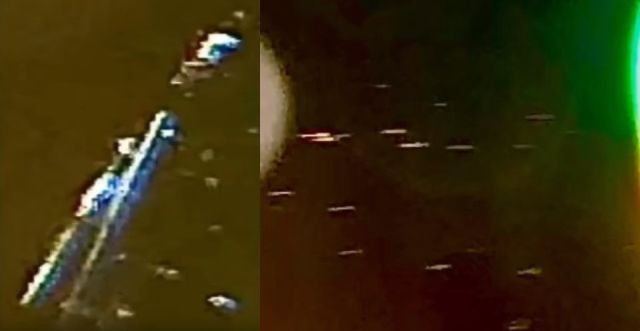
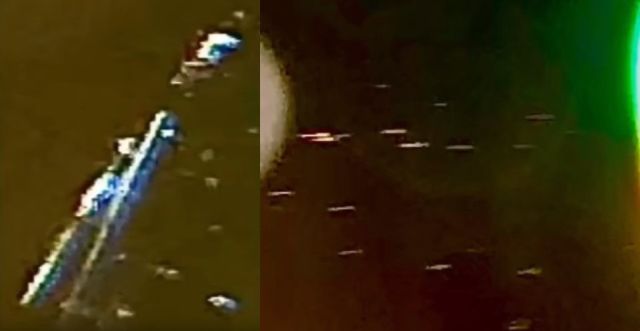
With the on going UFO activity above earth captured on the ISS live feed for the last two months, now Gina Colvin Hill from Salem, Indiana wants to share some images taken on March 24, 2020 showing numerous ufo ships in the sky.
Gina has used different filters to capture these ships otherwise you don't see them since most of them are cloaked.
Netizens Baffled After Watching UFO With Wings in the Sky Above Arizona
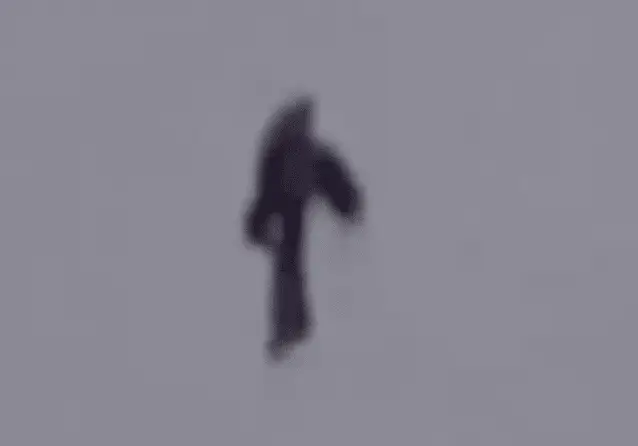
Netizens were out of words to describe a UFO with wings hovering in the skies above Arizona. YouTube user Ballee18 posted the UFO sighting video to YouTube on 22 March. According to the video uploader, the sighting happened near Ahwatukee urban village in Phoenix. Conspiracy channel mavi777 shared the video, and it eventually went viral.
The sighting comes after multiple UFOs were observed in different areas of the US. In one such event, YouTube username Denspion caught video of three red orbs hovering over Washington.
Social media users have made various explanations, with some saying that the so-called UFO in the sky could be a human who’s practicing extreme social or physical distancing to avoid contracting the COVID-19. Other netizens suggesting the video shows a flying human-made possible with a jet pack.
However, other social media users believed that the hovering human figure could be a sign of space alien life. A few users thought it was an alien drone, but many others thought it was some kind of hovering craft, suggesting that we’re not alone.
What do you think of the mysterious hovering figure? A kite, jetpack, or extreme social distancing? Let us know in the comment section.
Want to build the largest radio telescope to fly in space? Here's an easier technique: Design sixtiny satellites to fly in formation and work together.
That's the approach of a NASA's new Sun Radio Interferometer Space Experiment (SunRISE) mission, which is scheduled to launch no earlier than July 2023. SunRISE aims to help scientists understand the complex relationship between the sun's activity and a host of dangerous phenomena around Earth called space weather. The mission selection comes amid a burst of solar science and an emphasis on missions that incorporate space-weather prediction into plans for human spaceflight beyond low Earth orbit.
"We are so pleased to add a new mission to our fleet of spacecraft that help us better understand the sun, as well as how our star influences the space environment between planets," Nicky Fox, director of NASA's Heliophysics Division, said in a NASA statement. "The more we know about how the sun erupts with space weather events, the more we can mitigate their effects on spacecraft and astronauts."
Scientists have watched the sun fling energy and material toward Earth in outbursts, and they have also seen the impacts that such events can have on orbiting satellites, particularly on communication and navigation instruments. But scientists don't yet understand the nitty-gritty details of the connection between solar outbursts and space weather phenomena well enough to predict space weather.
If all goes well, the $63-million SunRISE mission should help to bridge that gap.
The six telescopes that make up the mission are tailored to study the radio waves that the sun ejects during solar particle outbursts. In particular, SunRISE will target outbursts called coronal mass ejections, which can throw massive amounts of plasma, the soup of charged particles that makes up the sun, across the solar system.
The toaster-sized satellites will spread out across about 6 miles (10 kilometers), orbiting Earth at an altitude of 22,000 miles (35,000 km). That orbit will keep SunRISE well above the ionosphere, which blocks radio waves of the relevant frequencies from reaching Earth.
An artist's depiction of one of the SunRISE satellites. (Image
credit: NASA/JPL-Caltech)
From that perch, the flock of cubesats should be able to map the influence of the sun's magnetic field across space. They should also be able to gather the data scientists need to understand how different parts of a coronal mass ejection dramatically speed up and which such events are accompanied by bursts of radiation, which are vital clues for space-weather prediction.
"We can see a solar flare start, and a coronal mass ejection start lifting off from the sun, but we don't know if it is going to produce high energy particle radiation, and we don't know if that high energy particle radiation is going to reach Earth," Justin Kasper, a space scientist at the University of Michigan who leads the mission, said in a university statement. "One reason why is we can't see the particles being accelerated. We just see them when they arrive at the spacecraft, which isn't much of a warning."
That situation is inconvenient when it comes to satellites, but downright dangerous when it comes to humans venturing beyond the safety of Earth, hence the impetus to better understand space weather.
"Knowing which part of a coronal mass ejection is responsible for producing the particle radiation will help us understand how the acceleration happens," Kasper said. "It could also result in a unique warning system for whether an event will both produce radiation and release that radiation towards Earth or spacefaring astronauts."
In episodes 7 and 8 of "Cosmos: Possible Worlds," host Neil deGrasse Tyson explores themes of science as an instrument of hope and tenacity, and as a means by which the human race can realize its true potential.
Episode 7, titled "Search for Intelligent Life," focuses specifically on first contact and the search for intelligent life in the vastness of the cosmos. Are humans ready to make first contact with other intelligent beings? Is our technology even sophisticated enough to detect communication signals from another world?
Beneath China's Five-hundred-meter Aperture Spherical Telescope (FAST) teems an underground network, the product of enduring collaboration among fungi, plants, bacteria and animals: the mycelium. (Image credit: Cosmos Studios)
Tyson points out that we've only had the technology to detect radio signals for a little over a century, making FAST a truly monumental achievement. FAST has already detected a number of pulsars — or compact stellar corpses — and will continue to search for gravitational waves and signs of extraterrestrial intelligence, among other data it collects.
However, there's an intricate global communications network hidden here on Earth that we've only just become aware of. Tyson turns our attention to a "hidden matrix … the creation of an enduring collaboration among fungi, plants, bacteria and animals." He's referring to the mycelium, a complex network of threadlike filaments that forms the functional structure of a fungus and extends to other species, such as trees. These hauntingly beautiful hyphae, or the branching filaments that make up the mycelium, illustrated in the show by special effects to interweave in the soil beneath our feet, reveal the forests' complex and interlinked nature.
"Who are we to search for alien intelligence when we can't even recognize or respect the consciousness all around us, or even beneath our feet," Tyson says, strolling through the forest on top of the soil that's protecting the mycelium beneath his feet. Still, conversations with different worlds, Tyson says, will be done in the language of science.
"Cosmos" host Neil deGrasse Tyson enters the Palace of Life, an imaginary place of ancient towers hidden by the mists of time and enshrouded in myth. Here, he moves into its largest, most ancient realm, to walk among the life at the bottom of the sea. (Image credit: Cosmos Studios)
"The symbolic language of the scientist, mathematician and engineer avoid those things that are lost in translation from one culture to another," Tyson says, explaining that this type of language is more precise and less open to misinterpretation. If we find extraterrestrial intelligent life, will we be communicating with them in a language that resembles a computer programming language, built on the binary code?
"First contact" with intelligent life (on Earth)
Humans have actually already made "first contact" with other intelligent life that communicates through equations and a symbolic language, Tyson points out: bees. Insects in general have played an instrumental role in the development of the natural world, mostly by spreading pollen. Each grain of pollen has been"sculpted differently by evolution — each a novel strategy for survival, sharpened by vast expanses of time, " Tyson says.
Insects are as much a part of the Earth's history as the earth itself; The "great Ordovician biodiversity event," when our world began to change as plants and insects left the sea and began to make the land their home, occurred approximately 480 million years ago (or Dec. 20 on Tyson's "cosmic calendar," where the Big Bang marks New Year's Day). The world Tyson describes is an alien one; giant mushrooms tower over trees that only grew a few feet tall, and insects ruled the skies, undisturbed by other winged creatures.
In the Palace of Life, "Cosmos" host Neil deGrasse Tyson encounters Saccorhytus coronarius. When it lived, 550 million years ago, the species was microscopic. But now, it looms large. This creature is the earliest common ancestor we've yet found, a physical connection we share with almost every animal on Earth. (Image credit: Cosmos Studios)
It was Austrian ethologist Karl von Frisch who unlocked the secrets of bee behavior in the early 20th century. "For thousands of years, bees have been symbols of mindless industry … shackled to the dreary roles assigned to them by nature," says Tyson, but von Frisch found in his studies that bees lead much more complex lives. They communicate through mathematical equations expressed in their movements, appearing to the untrained eye to be little more than a waggle, but in reality can be an incredibly accurate set of coordinates to a food source meters away.
Tyson calls this a "first contact story" because bees and humans evolved on very different trajectories, and yet both species risked everything and chose the unknown; it's as if there were an unwritten code common to bees and human beings driving those ambitions. This echoes the work of legendary scientist Charles Darwin, who realized if all life is related, certain philosophical implications had to follow. Darwin realized we are "surrounded by other ways of being alive and conscious," Tyson says, and that science had the potential to expand our capacity for empathy and compassion.
"The Sacrifice of Cassini"
Building on those themes of compassion and ambition, episode 8, "The Sacrifice of Cassini," chronicles tales of sacrifice and reveals the little-seen sentimentality and emotion that often accompany our greatest scientific endeavors. The episode honors the efforts and sacrifices of scientists Giovanni Cassini, Galileo Galilei, Christiaan Huygens, and Alexander Shargei, among others.
The episode opens with Tyson's recap of the Cassini-Huygens mission, a joint effort between NASA and the European Space Agency that launched Oct. 15, 1997. The spacecraft would embark on an epic voyage that would last more than two decades and culminate in a final, fatal mission of self-destruction by flying itself into Saturn's atmosphere in 2017.
Spacecraft sent to the outermost regions of our solar system, like Cassini, have brought back valuable data. Researchers are especially interested in any information about the mysterious ringed planets, which puzzled early planetary scientists like Galileo. These ring systems have been notoriously difficult to detect; Galileo's early research on Saturn had him believe the planet had two symmetrical moons, which we now know to be Saturn's rings. What would Galileo say if he could see Saturn as we see it now through the eyes of powerful scientific instruments?
Why do some worlds have rings, and others don't? Here, we imagine what our own planet would look like with a ring system. (Image credit: Cosmos Studios)
NASA's Voyager 2 spacecraft and Cassini also sent back valuable data about the atmospheres and other physical properties of our cosmic neighbors, like the elusive Uranus. Without Voyager 2, we wouldn't know about the planet's long summers and winters, or that while Uranus doesn't generate any internal heat and the outer edges of its atmosphere is hotter than 500 degrees Fahrenheit (260 degrees Celsius), Uranus also has the coldest clouds in the solar system, nearly 400 degrees Fahrenheit (240 degrees Celsius) below zero.
Interestingly, as Tyson reviews Giovanni Cassini's early life in what is now Italy, he notes that the Italian scientist began his career as an astrologer; a pseudoscientist. Louis XIV of France, the "Sun King," who would be the first monarch to recognize the power of science and the opportunities it afforded national security, would play a pivotal role in Cassini's career development. It was Louis XIV, who established the Paris Observatory — a scientific powerhouse — and who gave Cassini the tools he needed to pursue his research.
Gravity has a big bag of tricks, none lovelier than the ring systems of worlds. (Image credit: Cosmos Studios)
Cassini's observations of Saturn and its moons would have an enduring effect on the scientific world among his other accomplishments, like having discovered Jupiter's Great Red Spot (independently from Robert Hooke) and having calculated the length of a day on Mars; he was only off by 3 minutes.
Cassini's work on Saturn also greatly furthered human beings' knowledge on the planet at the time; he was the first to know Saturn's rings were composed of natural satellites orbiting the planet, and that there were gaps between them. Decades later, a bus-size 12,000-lb. (5,400 kilograms) spacecraft, sent on a years-long voyage to that same celestial body, would be named in his memory.
The scientists who worked closely with the Cassini-Huygens spacecraft, some of them since the very beginning, undoubtedly became emotional as it completed its final mission, as did spectators around the world who witnessed its final moments.
The probe's travails, however, cannot compare to the pain and tragedy of scientist and visionary Oleksandr Shargei, a forgotten pioneer of spaceflight. Shargei was orphaned at a young age and, while studying engineering at a university in Saint Petersburg, Russia, was drafted to the army to serve the Russian Empire in World War I. After the Russian Revolution, when the Bolsheviks overthrew the government, he changed his name to Yuri Kondratyuk out of fear for his life.
In 1926, Kondratyuk self-published a manuscript on rocket motion and space colonization, which would end up capturing the attention of an engineer working on the Apollo program, John Houbolt, decades later. Houbolt's updating of Kondratyuk's theories convinced NASA to select the lunar orbit rendezvous flight plan for Apollo, and to win the Space Race.
NASA engineer John Houbolt, as seen in 1962, shows on a blackboard his lunar orbit rendezvous (LOR) concept for landing on the moon. (Image credit: NASA)
Seeing footage from Apollo 11 in the episode elicits a sentimental feeling as it dawns on us that we're witnessing Kondratyuk's dreams become reality, and that his dreams are still coming true to this day; even the Cassini mission used gravity assist maneuvers, also conceived by Kondratyuk, to explore the Saturn system.
The final scene of the episode is of Kondratyuk's childhood home — a place where he endured much tragedy in his early years, and sought refuge in physics books. It was also here that Apollo 11 astronaut Neil Armstrong made a pilgrimage after his historic flight to the moon, to honor the man who made that voyage possible.
"There are all kinds of stories in the struggle to understand the cosmos," Tyson reflects. "Sometimes your dreams die with you, but sometimes the scientists of another age pick them up and take them to the moon, and far beyond."
"Cosmos" airs on the National Geographic channel on Mondays at 8 p.m. ET/9 p.m. CT and will be reprised on the Fox television network this summer.
Mars Curiosity sends back one giant Martian panorama…and (maybe) a clue of past life
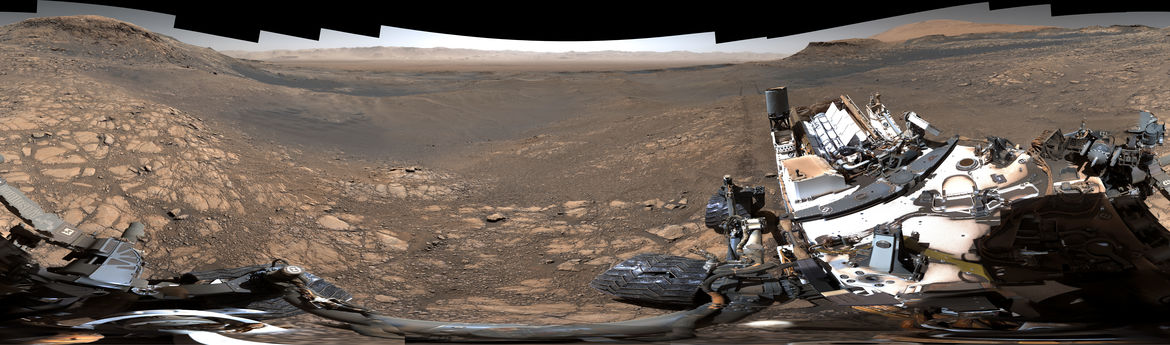
The Curiosity rover’s extended stay on Mars has proven to be one of NASA’s biggest recent success stories. More than seven years after its arrival at the Bradbury landing site on the Martian surface, Curiosity has just sent back the largest, most detailed panoramic image ever of the Red Planet’s landscape … along with an intriguing new discovery that could yield fresh insights into whether Mars has ever harbored microbial life.
Between Nov. 24 and Dec. 1 of last year, NASA’s Jet Propulsion Laboratory captured what the agency describes as the “highest-resolution panorama yet of the Martian surface,” compositing more than 1,000 individual images taken by the telephoto zoom lens on Curiosity’s Mast Camera. The image below is actually the lower-resolution version of the two that NASA has made available; a higher-res version (which omits the rover from the picture, thanks to the extra zoom on the telephoto) is available as 2.43-gigabyte download on the NASA/JPL host page.
NASA also shared a super-informative video highlighting just how much landscape detail the new image contains, zooming in on deep-field features like the rim of the crater that Curiosity calls home; as well as the exposed remnants of the Greenheugh Pediment — “a vast sheet of rock draped over the side of a mountain.”
Credit: NASA/JPL-Caltech/MSSS
NASA Jet Propulsion Laboratory on YouTube
Early chemical analysis of another Curiosity discovery — the presence in Martian soil of organic compounds called thiophenes — also has researchers speculating that the compounds could suggest that living bacteria once had a foothold on the Red Planet. According toWashington State Universityastrobiologist Dirk Schulze‑Makuch, part of an international team assessing the data, scientists typically associate thiophenes here on Earth with the breakdown of once-living organisms, though their presence on Mars may have other explanations that can’t yet be ruled out.
“We identified several biological pathways for thiophenes that seem more likely than chemical ones, but we still need proof,” he explained. “If you find thiophenes on Earth, then you would think they are biological, but on Mars, of course, the bar to prove that has to be quite a bit higher.”
Researchers speculate that Mars’ warmer, wetter conditions 3 billion years ago may have harbored the conditions necessary for microbes to thrive, although they say the data are still insufficient to rule out other explanations for the thiophenes’ presence — including chemical reactions from past meteor impacts, or other super-hot events that might have caused the “thermochemical sulfate reduction” process required for the unique compounds to form.
While Curiosity’s data-collecting abilities limit researchers’ ability to pinpoint the still-elusive answer, this year’s scheduled launch of the Rosalind Franklin rover should end up offering more details. The new rover “will be carrying a Mars Organic Molecule Analyzer, or MOMA, which uses a less destructive analyzing method that will allow for the collection of larger molecules,” reports WSU News.
Interview with HISTORY's Travis Taylor: The Secret of Skinwalker Ranch
Photo by History Copyright 2020
For the first time ever, HISTORY is gaining full, unprecedented access to one of the most infamous and secretive hotspots of paranormal and UFO-related activities on earth, Skinwalker Ranch, in a new one-hour nonfiction series, "The Secret of Skinwalker Ranch" premiering Tuesday, March 31 at 10PM ET/PT. Few have ever gained official access to Skinwalker Ranch, and none have ever been able to bring cameras onto the property for a television series, until now.
I had the opportunity to interview Dr. Travis Taylor, the lead astrophysicist of "The Secret of Skinwalker Ranch" about his journey and his experience investigating the unexplained phenomena in Utah's Uinta Basin. Scientific research, tribal legends, and the unexplained converge at Skinwalker Ranch that you must see to believe.
Photo by History Copyright 2020
WATM: Why and how were you chosen for this project?
Dr. Travis Taylor: Well, first of all for the why and the how I don't know what you know about me or how much you've read of my bio and that sort of thing. I have a PhD and a dual disciplinary degree in electrical engineering and physics called optical science of engineering - it's basically quantum physics. I have another PhD in aerospace engineering, building and designing spacecraft and rockets. I have a Master's degree in astronomy. I have a Master's degree in physics. I have a Master's degree in mechanical and aerospace engineering. I have a Bachelor's degree in electrical engineering. Since I was 17, I'm 51 now, I've published about two dozen referee journal articles and well-respected peer review physics, and optics and military defense type journals.
As far as I know, I'm the only person besides my co-author of the book who has taken the idea seriously and written a textbook and a detailed examination on how we would defend the planet if we were actually invaded by aliens. Different types of invasions and what our military approach should and could be. In fact, I'm the only one who teaches from that text on the topic to the Air Force officer's space school at Maxwell Air Force base. Now, I do that pretty much yearly and have for a while.
My background has been building spacecraft, rockets and high-energy laser weapons and things like that for DOD for a long time. I also am a science fiction writer and have written twenty-something best-selling science fiction novels, mostly military hard science fiction. With that background in mind, I was invited to start doing TV shows in the early 2000s which led to the next TV show and the next TV show and so on. When HISTORY and Prometheus were approached by the new billionaire owner of the Ranch to do an investigation, they said, "Well you need someone who is an experimentalist and who also is experienced with talking on TV and we recommend this guy."
And that's how that happened.
WATM: What was the first thing that stuck out to you about this investigation when you joined the team of researchers?
Travis Taylor: Well, when the invitation came to me to become a part of the investigation team and to lead the experiment portion of the research, at first I was very skeptical of the phenomena on the ranch being real or being some natural phenomena that maybe causes hallucinations, or unnatural phenomena that causes actual phenomena like lights in the sky or maybe there was a classified defense project. At no time did I think that I was going to find strange, unexplainable physical phenomena at least from the start. That was my philosophy or my thought going into it. But I did have an open mind that, hey, what if I find something that is unexplainable?
WATM: How was evidence gathered of the phenomena at the Ranch?
Travis Taylor: The way we approached it is, we had scientific instrumentation and sensors -- as many as we could afford based on the budget we had -- spread about the ranch that were collecting data continuously, 24/7. We also had security cameras placed in certain locations to give us as much of a full view of the ranch as possible that were running 24/7. Plus we had game cameras placed in locations that we could move if we thought there was a need to move them. We collected all this information and we went through the video and data pretty much on a daily basis. Plus, there was also multiple cameramen, camera crews and camera sites set up continuously throughout the investigation.
Photo by History Copyright 2020
WATM: Based on the evidence that you have gathered, what are your thoughts on why this phenomena specifically happens at Skinwalker Ranch?
Dr. Travis Taylor: That is an excellent question and we ask ourselves this all the time. Now, the first thing that I will say is that when the team and I talk about this, in no way do we believe that our man-made farming fences along the border of the 500 acres is keeping out any super, you know, physics hyper paranormal -- whatever you guys want to call it, phenomenon within the borders of the ranch. In fact, people in the local in Fort Duchenne, Roosevelt and the other town that's nearby, are all the time reporting phenomena occurring outside of the boundaries of the ranch. Now, that being said, if you look at the Uintah Basin on Google Earth, to me it looks like an ancient meteor impact crater. It looks like it came from the east to the west at a low inclination. And that's what splattered the salt flats to the west of the Uintah Basin.
There's Gilsonite all around the Uintah Basin which typically is only found in a meteor impact crater, plus all of the petroleum that is underneath the Uintah Basin. There are a lot of geologists and natural physicists now beginning to think that impact craters cause a phenomena that creates petroleum. If you look at this impact crater, the ranch is dead center give or take but it's pretty much dead center. Perhaps [it has] something to do with the bowl shape of the basin or whatever caused the basin, made this the central or the nexus for whatever the activity might be.
Photo by History Copyright 2020
WATM: Would the government hide the evidence of extraterrestrials? What impact would that have on the population if they did or did not disclose evidence?
Dr. Travis Taylor: I honestly don't believe the Brookings Report. I don't think that people are going to go nuts. What does an invasion of something that's invisible do to society? Well guess what it makes it's all go hide in our houses and be afraid to touch anybody. That's exactly what's happening right now, as an alien invasion, with this COVID-19. Well I'm not saying the virus is from outer space.
What I'm saying is it's alien to us and we're having to defend it in the way that we figure out how to defend it. If there were an alien invasion, we'd have to figure out what type of invasion it were and then how to - what type it was and then go from there. It could be a bazillion possibilities on the type of invasion.
I don't believe in big conspiracies. There's no way that humans are adept enough and trust each other enough to create conspiracies so large it would take hundreds and hundreds of people to maintain it. Now there is the possibility that things have been classified for national security reasons.
At such time when it could be disclosed and not reveal a national security advantage, then I could see that taking place but what's it going to do to the general public? Most people, the general public, believe there are aliens anyway. I don't think it's going to do anything except assure them -- I'll tell you what it will do to politics: it will improve the funding for programs to do research like the AATIP program, or like advanced spacecraft technology or like advanced spacesuit technology. Why all of our soldiers don't have Iron Man suits I can't explain that. We should be - that should be one of the biggest defense projects we have.
But we don't spend any money on it. So that's the things that will change is where we're spending our money based on what we think the threats are. That's all I think disclosure will do. The everyday person, I think, they'll just say 'I knew it all along, I told you so.'
Photo by History Copyright 2020
WATM: Is it possible that the phenomena observed is man-made, such as Top Secret weapons testing?
Dr. Travis Taylor: So, as a person who does weapons testing for his day job, I can tell you that would be so highly crazy illegal [and] that it's nonsense. There would be people in jail. What I observed the first day on the ranch, we had a long discussion that if what we were observing was man-made. [What if] someone was violating federal laws and [what we would do] - we needed to alert the authorities if we could prove it was man-made. Then from that point on I realized what we were measuring was impossible even for mankind to make. At that point is when I dropped that line of discussion because I realized just flat out mankind was not doing what we are doing and it's probably a skeptics coping mechanism because I did it too.
The first conclusion to an odd strange thing is 'Oh that's a classified government program' and 'Oh they're doing human testing' honestly like, you know, there were programs that the CIA did back in the 60s and 70s that I don't think they're proud of and where people were involved in those experiments. [So, if] you look at it nowadays, we realize now that you can't do that and you won't get away with it forever and somebody will go to jail. I just am thoroughly convinced that this is not some top-secret weapons testing program on people or whatever. Number one: there's no site nearby that is doing that type of work and number two: they would eventually get caught and go to jail. There is oversight committees on classified programs in Congress and in the Senate. Eventually somebody would say, 'Wait a minute you all can't do that.'
Photo by History Copyright 2020
WATM: Okay, so now that we know that there isn't a government conspiracy or illegal weapons testing -- What is happening at Skinwalker Ranch?
Dr. Travis Taylor: So I'm not going to tell you what evidence was observed and what phenomena were observed because and, you know, it would be spoilers for the show. What I will tell you is yes, when you watch the show and you see the evidence we acquired that is scientifically verifiable, you're going to be blown away because I was. I'm still amazed to this day and still have a hard time believing what I saw.
You can watch the new one-hour nonfiction series "The Secret of Skinwalker Ranch" premiering Today, Tuesday, March 31 at 10PM ET/PT.
Antarctica Was a Lush Rainforest 90M Years Ago, Scientists Discover
An ancient sediment core revealed a shocking discovery: pollen and spores, indicating a long-lost rainforest that was shrouded in perpetual darkness for months at a time.
Antarctica is the most remote and barren continent on Earth; a land where only the hardiest creatures can survive the punishing year-round conditions. But dial the clock back by 90 million years to the age of dinosaurs, and this icy landscape transforms into a lush temperate rainforest that somehow braved months of perpetual darkness.
The story of this ancient Antarctic rainforest is written in sediment buried 25 meters under the seafloor off Pine Island Glacier, according to a study published on Wednesday in Nature. The fossils preserved in an ultra-rare core represent the first glimpse of Cretaceous ecosystems at latitudes this far south, just 500 miles from the South Pole.
“It is definitely the southernmost Cretaceous evidence ever recovered on the planet,” said lead author Johann Klages, a geologist at the Alfred Wegener Institute Helmholtz Centre for Polar and Marine Research, in a call. “We were the first ones to ever drill there in that environment.”
Klages and his colleagues obtained the core during a 2017 expedition of the research vessel Polarstern, but the extraction process was not easy. The specialized drilling machine used to penetrate the seafloor required several days to pull out each new core, and all it seemed to be reaching was quartzitic sandstone layers bereft of fossils.
THE MEBO SEABED DRILLING SYSTEM ON RV POLARSTERN.
IMAGE: JP KLAGES, AWI
Meanwhile, ice sheets from the nearby island began advancing toward the sample site, threatening to slice the cord between the drill and the vessel. Before evacuating the area to prevent the loss of expensive equipment, Klages and his colleagues decided to take one last three-meter core.
Unlike the light-colored sandstone, this core was dark, suggesting it was rich in organic materials. “We immediately saw that something special was going on,” recalled Klages. “We saw these amazing, pristine, complete, dense networks of fossil roots in the core connected down to the core base.”
“If you go to the forest in front of your house, or somewhere, and you drill a hole, you would get something very similar,” he said. “It was full of pollen and spores and really diverse assemblages.”
Over the past three years, the team has meticulously examined the core and unraveled incredible new details about the rainforest that once blanketed Antarctica. The pristine condition of these plant fossils demonstrates that this was a swampy ecosystem of conifer trees that may have looked like the rainforests of modern New Zealand.
Based on comparisons with similar Cretaceous biomes found much farther north, dinosaurs may well have roamed through this biodiverse Antarctic landscape. “It’s very likely that there were insects and dinosaurs and all of that there too,” Klages said, “but we can’t say for sure because we did not find anything like that. We only can say a lot of stuff about the paleobotany that we found in the core.”
Remarkably, these forests were located at a southern latitude of 82°, which means they would have been plunged into total darkness for about four months of each year. Modern rainforests rely on perpetual sunlight to survive, but this bygone ecosystem had to switch to another source of energy for the long, black winter.
ARTIST CONCEPT OF ANCIENT RAINFOREST.
IMAGE: ALFRED-WEGENER-INSTITUT/J. MCKAY
That fuel may have been supplied by extraordinarily high levels of atmospheric carbon dioxide, which could have staved the forests over until the return of the Sun. In fact, the discovery of this rainforest strongly suggests that CO2 levels in this era were higher than previously assumed, perhaps reaching 1,680 parts per million (ppm). For reference, our current CO2 levels are just above 400 ppm, though they are rapidly rising due to human activity.
These high CO2 levels imply that Cretaceous Earth was warmer than expected, and that no ice cover existed at the South Pole. Klages and his colleagues estimate that the mean annual temperature in the rainforest was about 12°C, with summer temperatures averaging around 19°C.
“It really was that warm,” Klages said. “That amazed us, of course, but also the climate modelers because no one expected such extreme values very close to the South Pole."
"We are quite confident now in saying that there was no ice present, that Antarctica was completely vegetated, and that we had very high CO2 concentrations.”
The research offers a rare chance to imagine this strange Antarctic forestland, but it also contains lessons for our modern warming world. For instance, Klages and his colleagues modelled what would happen if the current version of Earth had the same CO2 levels, and found that our planet’s polar ice cover reflects too much sunlight to result in the same high global temperatures.
“The presence of an ice sheet makes a huge difference, even if you have very high CO2 concentrations,” Klages said. “That is really important for us to know, and to think about how we can better preserve ice sheets.”
“We need to look into these extreme climates that happened on the planet already, because they show us what a greenhouse climate looks like,” he concluded. “We are definitely in an interesting time because if we continue what we’re doing right now, then it could lead into something that we can’t control anymore.”
WETENSCHAP & PLANEET Wetenschappers hebben sporen van coniferen en boomvarens ontdekt op dieptes tot 30 meter onder de oceaanbodem dicht bij West-Antarctica - de overblijfselen van een regenwoud van 90 miljoen jaar geleden. Het woud groeide in het midden van het Krijt, het tijdperk van de dinosaurussen, zei het in Duitsland gebaseerde Alfred-Wegener-Institut (AWI), verwijzend naar een studie die woensdag in het vakblad Nature verscheen.
“We waren heel verrast door de ontdekking”, zei de hoofdauteur van de studie, AWI-geoloog Johann Klages. Volgens de bevindingen lag de gemiddelde jaartemperatuur op Antarctica in die tijd rond de 12 graden Celsius. “Dit bevestigt dat Antarctica ijsvrij moet zijn geweest”, aldus Klages. Tot dusver was dit enkel een veronderstelling. “We weten enkel dat het Krijt een van de warmste periodes ooit was, maar we hadden geen bewijs van het gebied bij de Zuidpool.”
Uit analyses bleek dat de concentratie aan koolstofdioxide in de atmosfeer veel hoger was dan aanvankelijk verondersteld. “De studie illustreert het grote potentieel van het broeikasgas kooldioxide als energieleverancier en de afkoelende eigenschappen van de ijslagen van vandaag”, benadrukte Klages. Waarom het klimaat later afkoelde, trachten de vorsers nog uit te zoeken.
If there is one thing that anybody can assure you of, it is this. When it comes to travelling within India, you will never ever complain of boredom. This is one country that is filled to bursting with lots of fun experiences, some of which border on the bizarre! Yes, since India is steeped in superstition, there are a couple of things that may seem strange or bizarre to a non-residential citizen. However, there are other fun and unusual places in India things that you will see when you choose to travel across the country. The Taj Mahal and the Konark temple are all definite must-visits. But those are places everybody visits in India. So, why not veer off the beaten track sometimes?
Possible meteor impact leaving huge crater and destroys over 100 houses in Akure, Nigeria
Earlier in March, the National Aeronautics and Space Administration (NASA) announced that an asteroid would fly over Earth. This asteroid is referred to as large and potentially dangerous.
The asteroid named 2012 XA133 was set to pass Earth on Thursday March 26th (March 27th in Nigeria) at a speed of 53,000 mph. However, with a note of confirmation, NASA said the Earth would not be affected.
“When objects close to the Earth revolve around the sun, near-Earth objects can come close to Earth.
Note that the "astronomical" corridor can be very far away from a human point of view: millions or even tens of millions of kilometers.
However, the Nigerians in Akure were on alert in the early hours of March 28, after hearing a loud explosion which shook the entire town of Akure, which led to the destruction of over 100 buildings, school, churches in the city's Eleyowo community located 1 km from Accor airport.
Amid speculation about the noise, the governor said that it was a truck carrying explosives that exploded, but experts led by Adepelumi Adekunle, a professor of geophysics and earthquake engineering at Obafemi Awolowo University, said the explosion was caused by a natural phenomenon, possible a meteor or at least a part of an asteroid or meteor which impacted the location from “an angle of 43 degrees leaving a crater 21m diameter and 7.8m depth.
Adekunle added there was no evidence of a buried vehicle, buried ordinance or explosives from the site, and that “foreign rocks and strange metallic objects” were found within the crater.
The fact that' strange metallic objects' have also been found within the crater, the question arises whether it was indeed a meteor or something extraterrestrial.
DAYTIME VIDEO: UFO caught on tape over Sacramento, California 29-Mar-2020
Check out this amazing new footage of a bright unidentified flying object hovering in the sky above Sacramento, California. It was recorded on 29th March 2020 and submitted to us through our Facebook page.
Glowing orbs over Laguna beach, California 31-Mar-2020
Here’s one new footage of a bright orbs hovering in the sky above Laguna beach, California on 31st March 2020.
Witness report:
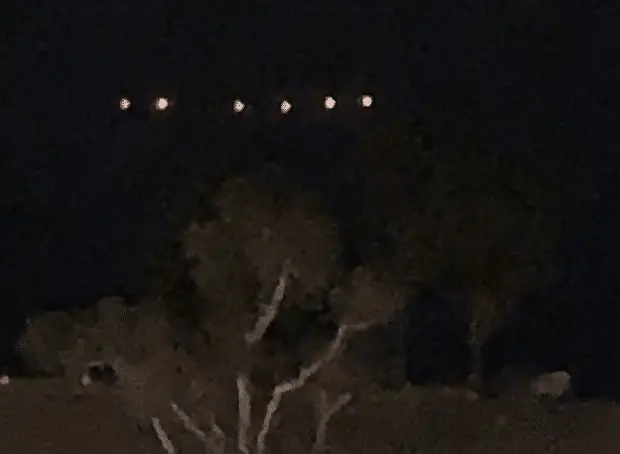
set of four glowing orbs that became seven appeared in a straight line above the water offshore. Out walking our dogs on the streets of North Laguna Beach. Very quiet out with most observing the stay at home rules. Looked out to the water and notice 4 bright glowing objects above the water. The slowly the number increased one by one until at one point there were seven. Then they started to fade out one by one until there were none left. I thought at first that someone had shot some flares off from a boat but all the objects matinee a straight line. We observed them for around 10-15 minutes and then walked back home. We took pictures and have video.
Stratolaunch plans to provide hypersonic test flights for a variety of customers.
Stratolaunch's Talon-A, shown here in an artist's concept, is one of several new hypersonic vehicles to be launched from the company's massive carrier plane, the world's largest aircraft.
Stratolaunch has found another use for the biggest airplane ever built.
The company, which Microsoft co-founder Paul Allen established in 2011, originally planned to launch satellites using the aircraft, which has a wingspan of 385 feet (117 meters). But Allen died in October 2018 and Stratolaunch was sold last year, raising questions about the company's future.
Some of those questions have now been answered. Stratolaunch's website now reveals that the company has reinvented itself as a builder, tester and operator of hypersonic vehicles — those that can travel at least five times the speed of sound, or Mach 5.
"Our hypersonic testbeds will serve as a catalyst in sparking a renaissance in hypersonic technologies for our government, the commercial sector and academia," Stratolaunch CEO W. Jean Floyd said in a statement on the company website.
The huge plane is key to this new mission, hauling vehicles aloft to test various payloads in the extreme environments imposed by hypersonic flight. Those vehicles will include Stratolaunch's Talon-A, a 28-foot-long (8.5 m), 6,000-lb. (2,722 kilograms) reusable craft capable of reaching Mach 6.
Stratolaunch's rocket carrier plane, the largest aircraft ever built, takes off from the Mojave Air and Space Port in Mojave, California during its first test flight on April 13, 2019. (Image credit: Stratolaunch Systems)
Talon-A "will conduct long-duration flight at high Mach, and glide back for an autonomous, horizontal landing on a conventional runway," Stratolaunch'sdescription of the craftstates. "It will also be capable of autonomous takeoff, under its own power, via a conventional runway."
The huge dual-fuselage plane — which used to be called Roc, but is now apparently known as the Stratolaunch Carrier — will be able to haul three Talon-As aloft at a time, allowing the collection of lots of data, company representatives said.
Talon-A isn't the end of the envisioned road for Stratolaunch, however. The company is also developing the Talon-Z, about which it divulges little on the website, and another vehicle called Black Ice, which could end up flying some very interesting and ambitious missions, if everything goes according to Stratolaunch's plan.
"Black Ice is a fully reusable space plane that enables advanced on-orbit capabilities and cargo return," the company's website reads. "Initial designs optimized for cargo launch, with a follow-on variant capable of transporting crew."
Black Ice doesn't come completely out of left field. In August 2018, before Allen's death, Stratolaunch announced plans to use four different satellite-launching vehicles with the huge aircraft, including an orbital space plane.
The Stratolaunch Carrier has just one flight under its belt, a 2.5-hour test flight that took place in April 2019.
The water buried deep within Mars likely came from at least two very different sources long ago, a new study suggests.
"These two different sources of water in Mars' interior might be telling us something about the kinds of objects that were available to coalesce into the inner, rocky planets," Jessica Barnes, an assistant professor of planetary sciences in the University of Arizona Lunar and Planetary Laboratory, said in a statement.
"This context is also important for understanding the past habitability and astrobiology of Mars," Barnes added.
The famed Mars meteorite ALH84001. (Image credit: NASA)
Barnes and her colleagues analyzed two Mars meteorites: Northwest Africa (NWA) 7034, also known as Black Beauty, and Allan Hills 84001 (ALH84001), probably the most famous Red Planet rock of all time. In the mid-1990s, a team of researchers announced that they'd found compelling evidence of Martian life in ALH84001. Most other scientists were not convinced, and the claim remains controversial, and debated, to this day.
Barnes and her team determined the hydrogen-isotope compositions of Black Beauty and ALH84001, which interacted with water in the Martian crust about 1.5 billion years ago and 3.9 billion years ago, respectively.
Isotopes are versions of an element that have different numbers of neutrons in their atomic nuclei. For example, the hydrogen in "normal" water has no neutrons in its nucleus, whereas the hydrogen in deuterium, or "heavy water," has one.
Studies of Mars meteorites over the years have found a wide variety of hydrogen-isotope ratios. But, in the new study, which was published online Monday (March 30) in the journal Nature Geoscience, Barnes and her team found that Black Beauty and ALH84001 have very similar amounts of normal versus heavy hydrogen.
That ratio is roughly the same as that observed for much younger rocks, suggesting that not much has changed, hydrogen-isotope wise, for the past 4r billion years or so on Mars. In addition, the isotope ratio is about halfway between that seen in crustal rocks here on Earth and the ratio observed in the Martian atmosphere, which has a lot more heavy hydrogen.
The Martian atmosphere is so "fractionated" because charged particles from the sun have preferentially blown the lighter normal hydrogen into space, scientists say.
"We thought, OK, this is interesting, but also kind of weird," Barnes said of the new results. "How do we explain this dichotomy where the Martian atmosphere is being fractionated, but the crust is basically staying the same over geological time?"
Researchers have long thought that Mars' mantle — the thick rock layer beneath the thin crust — sports a similar hydrogen-isotope ratio to that of Earth. So, the variability in isotope ratios seen in Mars meteorites was chalked up to terrestrial contamination or alteration by the Red Planet's atmosphere as the rocks, blasted free by powerful impacts, barreled outward toward space, Barnes said. (Crustal rocks should be similar to mantle rocks, after all; the crust is made of material from the interior that made it to the surface, cooled and solidified.)
But the presumed mantle similarities between Mars and Earth are inferred from one study of a meteorite thought to originate in the Red Planet's mantle, the researchers said. And it may be time for a rethink.
"Martian meteorites basically plot all over the place, and so trying to figure out what these samples are actually telling us about water in the mantle of Mars has historically been a challenge," Barnes said. "The fact that our data for the crust was so different prompted us to go back through the scientific literature and scrutinize the data."
This analysis revealed that two different types of Martian volcanic rocks, enriched shergottites and depleted shergottites, have different hydrogen-isotope ratios. These rocks probably represent different source material, the researchers said — different reservoirs of water in the Martian interior.
"Consequently, these features may have been inherited from the primary building blocks that constructed Mars, implying that the Martian mantle has almost always been heterogeneous because it was poorly mixed during accretion, differentiation and its subsequent thermochemical evolution," the researchers wrote in the new study.
If this is true, then, unlike Earth and the moon, Mars probably did not feature a global ocean of liquid rock shortly after its birth. A global magma ocean would have mixed everything together, erasing the distinct isotope signatures, the researchers said.
Posted by Andy Briggs in ASTRONOMY ESSENTIALS | SPACE
Dark matter doesn’t emit light. It can’t be directly observed with any of the existing tools of astronomers. Yet astrophysicists believe that it and dark energy make up most of the mass of the cosmos. What dark matter is, and what it isn’t. here.
Since the 1930s, astrophysicists have been trying to explain why the visible material in galaxies can’t account for how galaxies are shaped, or how they behave. They believe a form of dark or invisible matter pervades our universe, but they still don’t know what this dark matter might be.
Dark matter is a mysterious substance thought to compose perhaps about 27% of the makeup of the universe. What is it? It’s a bit easier to say what it isn’t.
It isn’t ordinary atoms – the building blocks of our own bodies and all we see around us – because atoms make up only somewhere around 5% of the universe, according to a cosmological model called the Lambda Cold Dark Matter Model (aka the Lambda-CDM model, or sometimes just the Standard Model).
Dark matter isn’t the same thing as dark energy, which makes up some 68% of the universe, according to the Standard Model.
Dark matter is invisible; it doesn’t emit, reflect or absorb light or any type of electromagnetic radiation such as X-rays or radio waves. Thus, dark matter is undetectable directly, as all of our observations of the universe, apart from the detection of gravitational waves, involve capturing electromagnetic radiation in our telescopes.
Yet dark matter does interact with ordinary matter. It exhibits measurable gravitational effects on large structures in the universe such as galaxies and galaxy clusters. Because of this, astronomers are able to make maps of the distribution of dark matter in the universe, even though they cannot see it directly.
They do this by measuring the effect dark matter has on ordinary matter, through gravity.
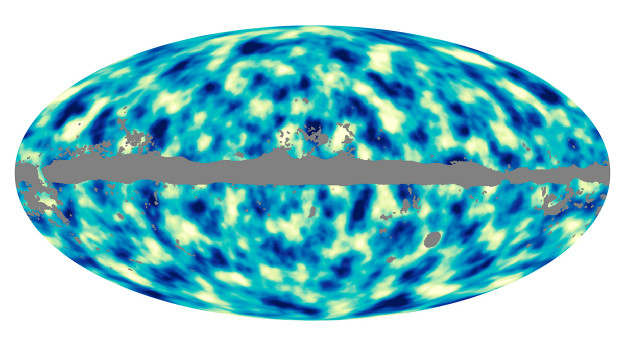
This all-sky image – released in 2013 – shows the distribution of dark matter across the entire history of the universe as seen projected on the sky. It’s based on data collected with the European Space Agency’s Planck satellite. Dark blue areas represent regions that are denser than their surroundings. Bright areas represent less dense regions. The gray portions of the image correspond to patches of the sky where foreground emission, mainly from the Milky Way but also from nearby galaxies, prevents cosmologists from seeing clearly.
There is currently a huge international effort to identify the nature of dark matter. Bringing an armory of advanced technology to bear on the problem, astronomers have designed ever-more complex and sensitive detectors to tease out the identity of this mysterious substance.
Dark matter might consist of an as yet unidentified subatomic particle of a type completely different from what scientists call baryonic matter – that’s just ordinary matter, the stuff we see all around us – which is made of ordinary atoms built of protons and neutrons.
The list of candidate subatomic particles breaks down into a few groups: there are the WIMPs (Weakly Interacting Massive Particles), a class of particles thought to have been produced in the early universe. Astronomers believe that WIMPs might self-annihilate when colliding with each other, so they have searched the skies for telltale traces of events such as the release of neutrinos or gamma rays. So far, they’ve found nothing. In addition, although a theory called supersymmetry predicts the existence of particles with the same properties as WIMPs, repeated searches to find the particles directly have also found nothing, and experiments at the Large Hadron Collider to detect the expected presence of supersymmetry have completely failed to find it.
Several different types of detector have been used to detect WIMPs. The general idea is that very occasionally, a WIMP might collide with an ordinary atom and release a faint flash of light, which can be detected. The most sensitive detector built to date is XENON1T, which consists of a 10-meter cylinder containing 3.2 tons of liquid xenon, surrounded by photomultipliers to detect and amplify the incredibly faint flashes from these rare interactions. As of July 2019, when the detector was decommissioned to pave the way for a more sensitive instrument, the XENONnT, no collisions between WIMPs and the xenon atoms had been seen.
Although WIMPs have long been the favored candidate for dark matter, they’re not the only candidates. The failure to find WIMPs, and the attendant frustration with not being able to account for a significant percentage of the universe’s mass, has led many scientists to look at possible alternatives.
At the moment, a hypothetical particle called the axion is receiving much attention. As well as being a strong candidate for dark matter, the existence of axions is also thought to provide the answers to a few other persistent questions in physics such as the Strong CP Problem.
Astronomer Fritz Zwicky first predicted the existence of dark matter in the 1930s following his observations of the Coma galaxy cluster.
The idea that there might be things in the universe which are invisible to us, that emit no light, has a long history going back hundreds of years to the days of Newton. With the discovery of so-called “dark nebulae” – clouds of interstellar dust blocking the light from background stars – and Pierre Laplace’s 18th-century speculations about objects which might swallow light, later to become known as black holes, astronomers came to accept the existence of a so-called “dark universe.”
But in modern times, it was astronomer Fritz Zwicky, in the 1930s, who made the first observations of what we now call dark matter. His 1933 observations of the Coma Cluster of galaxies seemed to indicated it has a mass 500 times more than that previously calculated by Edwin Hubble. Furthermore, this extra mass seemed to be completely invisible. Although Zwicky’s observations were initially met with much skepticism, they were later confirmed by other groups of astronomers.
Thirty years later, astronomer Vera Rubin provided a huge piece of evidence for the existence of dark matter. She discovered that the centers of galaxies rotate at the same speed as their extremities, whereas, of course, they should rotate faster. Think of a vinyl LP on a record deck: its center rotates faster than its edge. That’s what logic dictates we should see in galaxies too. But we do not. The only way to explain this is if the whole galaxy is only the center of some much larger structure, as if it is only the label on the LP so to speak, causing the galaxy to have a consistent rotation speed from center to edge.
Vera Rubin, following Zwicky, postulated that the missing structure in galaxies is dark matter. Her ideas were met with much resistance from the astronomical community, but her observations have been confirmed and are seen today as pivotal proof of the existence of dark matter. In honor of this crucial and historic piece of detective work toward establishing the existence of dark matter, the revolutionary Large Synoptic Survey Telescope, currently under construction in Chile and scheduled to see first light next year, was recently renamed the Vera C. Rubin Observatory.
Dark matter pioneer Vera Rubin (1928-2016). This image – taken at Lowell Observatory – is from 1965.
Some astronomers have tried to negate the need the existence of dark matter altogether by postulating something called Modified Newtonian dynamics (MOND). The idea behind this is that gravity behaves differently over long distances to what it does locally, and this difference of behavior explains phenomena such as galaxy rotation curves which we attribute to dark matter. Although MOND has its supporters, while it can account for the rotation curve of an individual galaxy, current versions of MOND simply cannot account for the behavior and movement of matter in large structures such as galaxy clusters and, in its current form, is thought unable to completely account for the existence of dark matter. That is to say, gravity does behave in the same way at all scales of distance. Most versions of MOND, on the other hand, have two versions of gravity, the weaker one occurring in regions of low mass concentration such as in the outskirts of galaxies. However, it is not inconceivable that some new version of MOND in the future might yet account for dark matter.
Although some astronomers believe we will establish the nature of dark matter in the near future, the search so far has proved fruitless, and we know that the universe often springs surprises on us so that nothing can be taken for granted.
The approach astronomers are taking is to eliminate those particles which cannot be dark matter, in the hope we will be left with the one which is.
It remains to be seen if this approach is the correct one.
Bottom line: Dark matter makes up some 27% of the universe according to astronomical theories. It cannot be seen or detected directly via the existing tools of astronomers, but its effect can be measured via its gravitational pull on ordinary matter.
Dark energy is one of the great unsolved mysteries of cosmology. It’s now thought to make up 68% of everything in the universe.
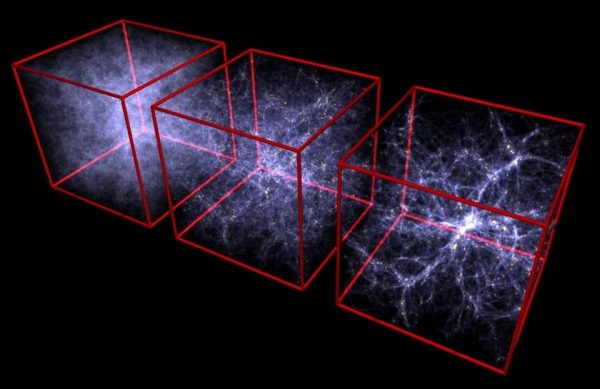
Illustration showing snapshots from a simulation by astrophysicist Volker Springel of the Max Planck Institute in Germany. It represents the growth of cosmic structure (galaxies and voids) when the universe was 0.9 billion, 3.2 billion and 13.7 billion years old (now).
Dark energy is the name given to the mysterious force that’s causing the rate of expansion of our universe to accelerate over time, rather than to slow down. That’s contrary to what one might expect from a universe that began in a Big Bang. Astronomers in the 20th century learned the universe is expanding. They thought the expansion might continue forever, or eventually – if the universe had enough mass and therefore enough self-gravity – reverse and cause a Big Crunch. Now, in early 21st century cosmology, that idea has evolved. The universe is seen as expanding faster today than billions of years ago. What could be causing the rate of expansion to increase? Astronomers now sometimes speak of a repulsive force as a possible way to understand it.
Up until the late 1990s, most cosmologists believed the universe did not have enough mass to cause a Big Crunch. In particular, data acquired by the 2dF Galaxy Redshift Survey and the Sloan Digital Sky Survey seemed to confirm the universe would expand forever, albeit at an ever-slowing rate as the universe’s own mass and own gravity tried to pull it back.
The first indication of something revolutionary about to be discovered came in 1998 during a survey of Type 1A supernovae. These massive explosions of dying giant stars are extremely useful to astronomers because they always output the same amount of light, and can therefore be used as so-called “standard candles” to calculate distances in the cosmos. This is a very simple idea. Think of fireflies at night: they all shine with the same instrinsic brightness. By measuring how bright they are from where you are, you can calculate their distance.
The 1998 survey was being carried out by two international group of astronomers including Americans Adam Riess and Saul Perlmutter, and Brian Schmidt in Australia. Using eight telescopes worldwide, their aim was to use the distance of Type 1A supernovae to calculate the expansion rate of the universe, known as the Hubble Constant (although in reality, as the rate of expansion of the universe varies with time, it is technically not a constant).
The results of the survey were astonishing. Distant supernovae which exploded when the universe was only 2/3 of its current age were much fainter than they should have been, and were thus much further away. The implication of this was that the universe had expanded much faster than it should have done, if current ideas were correct.
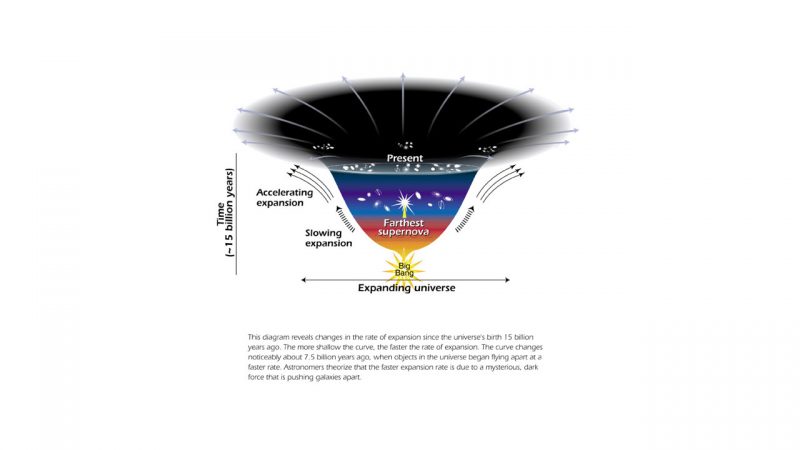
This diagram reveals changes in the rate of expansion since the universe’s birth 15 billion years ago. The more shallow the curve, the faster the rate of expansion. The curve changes noticeably about 7.5 billion years ago, when objects in the universe began flying apart at a faster rate. Astronomers theorize that the faster expansion rate is due to a mysterious, dark force: dark energy.
Met with much skepticism in the astronomical community when these results were revealed, the observations were soon replicated by other teams and other methods. By the turn of the millennium, it was becoming clear that the expansion of the universe is not, as was commonly believed, slowing down. It is actually accelerating.
Even more strangely, the expansion had been deaccelerating, as one would expect, until seven or eight billion years after the Big Bang. But then, for reasons completely unknown, a mysterious “anti-gravity force” started to dominate, overcoming the brake that gravity was placing on the expansion, which then reversed its slowdown and started to accelerate.
You can imagine how shocking this revelation was to astronomers and cosmologists.
The force responsible for this acceleration was dubbed dark energy by scientists. In this case, dark means unknown rather than literally dark, as is the case with dark matter. It should be noted that dark energy and dark matter are completely unrelated phenomena. Read more: What is dark matter?
To add to the mystery, the properties of this strange dark energy seem to match Einstein’s cosmological constant, sometimes called his fudge factor and later described by Einstein himself as the greatest professional blunder of his life. Einstein detested the idea of an expanding universe, preferring the static one postulated by steady-state cosmology, which was popular in the early 20th century. He invented an anti-gravity force, of undefined origin, to counteract the observed expansion of the universe, which would result in a non-expanding universe. However, Einstein later retracted this idea, which was not supported by observations.
Dark energy is one of the great unsolved mysteries of cosmology. It is now thought to make up 68% of everything in the universe, with normal, so-called “baryonic” matter – every bit of matter we can actually see – comprising a mere 5%, with the rest consisting of dark matter, another huge cosmic mystery.
Dark energy does behave like Einstein’s anti-gravity force, but its nature and origin remain unknown. One of its greatest mysteries is why dark energy started to dominate the rate of expansion of the universe at a particular point in time billions of years after the Big Bang. If it exists now, why wasn’t it there all along?
The physics of dark energy are highly speculative. One idea which has gained ground in recent years is that dark energy resembles a force known as “quintessence,” which is a relative of the Higgs Field. But as yet there is no observational evidence to support or discount this.
Cosmologists also have no idea if dark energy will continue to accelerate the universe’s expansion forever, leading to a scenario, far in the future, where the acceleration will overcome the forces that hold the universe together and literally tear all matter in the cosmos apart, in a nightmare scenario known as the Big Rip.
There are several current and future space missions and ground-based surveys which will investigate the nature of dark energy, including NASA’s orbiting WFIRST telescope and the international Dark Energy Survey, based in Chile.
It is hoped that soon we will arrive at a greater understanding of this mysterious force, which is having such an influence over the future of the cosmos, but to gain that understanding we need to sketch out a far more complete history of the universe. However, the archaeology of 13.7 billion years is extremely difficult and time-consuming, with so many ancient strata in that history missing or indistinct, so we cannot expect any sudden revelations.
Bottom line: The universe is expanding faster than older theories predicted. Dark energy, one of the great unsolved mysteries of cosmology, may cause its accelerating expansion. Dark energy is now thought to make up 68% of everything in the universe.
An international team of scientists has identified three new species of toothed pterosaurs – flying reptiles of the Cretaceous period, some 100 million years ago – that lived in an ancient river ecosystem in the African Sahara.
The new pterosaurs, described in a study published in the February 19, 2020, in the journal Cretaceous Research, were identified from chunks of jaws and teeth found in a geological formation in Morocco called the Kem Kem Beds. University of Portsmouth paleontologist David Martill is a study co-author. He told The Guardian:
These flying predators soared above a world dominated by predators, including crocodile-like hunters and carnivorous dinosaurs. Interestingly, herbivores such as sauropods and ornithischian dinosaurs are rare.
Many of the predators, including the toothed pterosaurs, preyed on a superabundance of fish.
For such large animals, they would have weighed very little. Their wingspans were around 10 to 13 feet [3 to 4 meters], with their bones almost paper-thin and full of air, very similar to birds. This allowed these awesome creatures to reach incredible sizes and still be able to take off and soar the skies.
Pterosaurs hunted from the air, using a set of large spike-like teeth to grab their prey. Large pterosaurs such as these would have been able to forage over hundreds of miles, with fossil evidence suggesting they flew between South America and Africa, similar to present-day birds such as condors and albatrosses, the researchers said.
Bottom line: Three new species of pterosaurs – flying reptiles – discovered.
For decades, numerous nations, all around the world, have done their utmost to try and harness the mysterious powers of the mind and utilize them as tools of nothing less than espionage. Sometimes, as we shall soon see, digging into matters of the mind can get one killed. Extra-sensory perception (ESP), clairvoyance, precognition, and astral-projection have all been utilized by the CIA, the KGB, and British Intelligence on more than a few occasions. As astonishing as it may sound, the world of psychic 007’s is all too real. It’s a subject that has been researched, with varying degrees of success, for decades. The earliest indications of serious interest on the part of the U.S. Government in the field of psychic phenomena are described in a formerly classified CIA document written in 1977 by Dr. Kenneth A. Kress – then an engineer with the CIA’s Office of Technical Services – and titled Parapsychology in Intelligence.
According to Kress:
“Anecdotal reports of extrasensory perception capabilities have reached U.S. national security agencies at least since World War II, when Hitler was said to rely on astrologers and seers. Suggestions for military applications of ESP continued to be received after World War II. In 1952, the Department of Defense was lectured on the possible usefulness of extrasensory perception in psychological warfare. In 1961, the CIA’s Office of Technical Services became interested in the claims of ESP. Technical project officers soon contacted Stephen I. Abrams, the Director of the Parapsychological Laboratory, Oxford University, England. Under the auspices of Project ULTRA, Abrams prepared a review article which claimed ESP was demonstrated but not understood or controllable.” Kress added: “The report was read with interest but produced no further action for another decade.”
Indeed, it was in the early 1970s that the research began in earnest (although, the FBI got involved in a strange affair in the 1950s). In April 1972, Dr. Russell Targ, a laser physicist with a personal interest in parapsychology and the power of the human mind, met with CIA personnel from the Office of Strategic Intelligence, specifically to discuss paranormal phenomena. Of paramount concern to the CIA was the fact that Targ informed them that the Soviet Union was deeply involved in researching psychic phenomena, mental telepathy and ESP. It did not take the CIA long to realize that the purpose of the Soviet research was to determine if ESP could be used as a tool of espionage. It was this realization that galvanized the CIA into action. As the Kress report stated, in 1973: “The Office of Technical Services funded a $50,000 expanded effort in parapsychology.”
The initial studies utilized a variety of people who were carefully and secretly brought into the project, and who demonstrated a whole range of seemingly paranormal skills. Those same skills could not be reliably replicated on every occasion, however. As evidence of this, Kenneth Kress informed his superiors that, “One subject, by mental effort, apparently caused an increase in temperature; the action could not be duplicated by the second subject. The second subject was able to reproduce, with impressive accuracy, information inside sealed envelopes. Under identical conditions, the first subject could reproduce nothing.” Similarly, some government-sponsored psychics in the period from 1973 to 1974 located secret missile installations in the Soviet Union, found terrorist groups in the Middle East, and successfully remote viewed the interior of the Chinese Embassy in Washington, D.C. Others, meanwhile, provided data that was sketchy and, at times, simply wrong. And it was the continuing rate of success versus the frequency of failure that led to heated debate within the CIA about the overall relevancy and validity of the project.
In Parapsychology in Intelligence, Kenneth Kress confirmed this. After the CIA’s remote viewing team attempted to broaden the range of its operation and secure extra funding in mid-1973, said Kress: “I was told not to increase the scope of the project and not to anticipate any follow-on in this area. The project was too sensitive and potentially embarrassing.” Despite this, the CIA’s research continued, with many of its advances due to a skilled remote-viewer named Pat Price, who had achieved a number of extraordinary successes in the field of ESP, including successfully remotely viewing a sensitive installation that fell under the auspices of the National Security Agency and psychically penetrating missile sites in Libya. Price’s sudden and untimely death from a heart attack in 1975 indirectly led the CIA – according to the official story, at least – to minimize its research into psychic espionage.
Tim Rifat, who has deeply studied the world of top secret, governmental research into psychic spying, says of Pat Price’s death: “It was alleged at the time that the Soviets poisoned Price. It would have been a top priority for the KGB to eliminate Price as his phenomenal remote-viewing abilities would have posed a significant danger to the USSR’s paranormal warfare buildup. He may also have been the victim of an elite group of Russian psi-warriors trained to remotely kill enemies of the Soviet Union.” Murder or just a heart-attack? Who knows?
It gets weirder: In his 1997 book Remote Viewers, Jim Schnabel told the story of the U.S. Intelligence community’s involvement in the controversial issue of psychic spying that largely began in the early-to-mid 1970s. Commenting on the skills of a talented remote-viewer in relation to matters of a UFO nature, one Pat Price, Schnabel noted Price was of the opinion that “…Alaska’s Mount Hayes, the jewel of a glacial range northeast of Anchorage, housed one of the aliens’ largest bases.” According to Pat Price, the aliens that lived deep inside Mount Hayes were very human looking, differing only in their heart, lungs, blood, and eyes. Ominously, he added that the aliens use “thought transfer for motor control of us.” Price added: “The site has also been responsible for strange activity and malfunction of U.S. and Soviet space objects.”
They say that breaking up is hard to do (OK, Neil Sedaka said it) but apparently it’s not so for what was believed to be a hardy comet known as 2I/Borisov which traveled to our solar system all the way from another one and did a flyby of the Sun in December 2019. Polish astronomers tracking the interstellar comet noticed two unexpected bursts of light from 2I/Borisov this month and are afraid it means the little space rock that could may be on its last leg … or tail … and could break up soon. Was it something we said?
“The total brightness increase is thus about 0.7 mag in 5 days between UT 2020 March 4.3 and 9.3. This behavior is strongly indicative of an ongoing nucleus fragmentation.”
2I/Borisov in its better days.
(NASA)
Sounding like car mechanics trying to baffle you with BS when what they really mean is that your Buick is in a bad way, astronomers from the Jagiellonian University in Krakow and the University of Warsaw wrote in The Astronomer’s Telegram that they’re seeing evidence that 2I/Borisov is disintegrating and may not make it out of the solar system, let alone back home or to another star. They are part of the OGLE (Optical Gravitational Lensing Experiment) project which searches for extrasolar planets, dark matter and galactic anomalies and is considered to be Poland’s greatest contribution to the field of astronomy since Copernicus.
“For Solar System comets, it is known that dynamically new comets are 10 times more likely to disintegrate than short-period comets, presumably due to their pristine state and weaker structural strength.”
According to Science Alert, the breakup isn’t exactly a surprise. 2I/Borisov acts like long-period or dynamically new comets from the Oort cloud, which travel much farther than the short-period comets from the Kuiper belt. Apparently, making those short 200-year orbits around the Sun toughen up these short-term comets, allowing them to do a tight turn around the Sun and live to tell the other Kuiper belt comets about it. Of course, being astronomers, the Polish 2I/Borisov team sees a silver lining in this comet’s cloud of cosmic dust and melting ice.
“As the comet disintegrates, observations of its spectrum will reveal its internal chemistry, including its nucleus. It’s an excellent opportunity to study the comet’s guts, and compare it to our Solar System comets, to see how similar or different they are.”
One last look.
As with all relationships, there’s always something to learn from the breakup. It’s the comet’s fault, not ours. Even if there wasn’t a breakup, it’s still gone for good, so there’s no sense in being blue or begging for it to stay. There’s always another one coming soon.
Not much of an inspiration for a song, but Neil didn’t have many hits after “Breaking Up Is Hard To Do” either.
EUROPEAN Space Agency (ESA) researchers have discovered that urine could be key to creating liveable human habitats on the Moon.
If humans want to live on the lunar surface they'll need shelter but will likely rely on local resources to make it.
The substance relies on a component called urea, found in urineCredit: CNSA
Space agencies across the globe have their sights set on colonising the Moon.
Scientists at the ESA have found that urea, a component of urine, could help them do this.
They found that when urea is mixed with lunar material, a kind of 'Moon concrete' is formed.
The researchers used a 3D printer to create cylinders of the new substances.
Space agencies have their sights set on colonising the MoonCredit: CNSA
After several tests they found that their urea-based 'Moon concrete' could support heavy weight and even got stronger over time.
This meant that it was able to stay in the desired shape.
The samples also remained fairly stable once heated to 80°C (176.0 °F).
Resistance was tested during eight freeze-thaw cycles, similar to those that occur on the Moon.
3D printing
Study researcher Ramón Pamies, a professor at the Polytechnic University of Cartagena in Spain, said: "To make the geopolymer concrete that will be used on the Moon, the idea is to use what is there: regolith [loose material from the Moon’s surface] and the water from the ice present in some areas.
"But moreover, with this study we have seen that a waste product, such as the urine of the personnel who occupy the moon bases, could also be used.
"The two main components of this body fluid are water and urea, a molecule that allows the hydrogen bonds to be broken and, therefore, reduces the viscosities of many aqueous mixtures."
Researcher Lena Kjøniksen added: "We have not yet investigated how the urea would be extracted from the urine, as we are assessing whether this would really be necessary, because perhaps its other components could also be used to form the geopolymer concrete.
"The actual water in the urine could be used for the mixture, together with that which can be obtained on the Moon, or a combination of both."
Nasa plans to send its next astronauts to the Moon by 2024.
Earlier this year it was revealed that Nasa scientists are working on a bizarre mushroom Moon and Mars base project.
This could see lunar homes for astronauts being built onsite out of living fungi.
The researchers have been conducting tests to determine if they could successfully grow mycelia fungus in outer space soil.
If the research goes to plan, future astronauts may be growing their own out of this world homes without the need to carry heavy and expensive building materials.
This could make it much easier and cheaper to colonise the Moon and even Mars.
The scientists have listed other advantages of using mushroom for structures including the fact it can grow and repair itself, is fire retardant and a good insulator.
Nasa also said that the fungi has higher bend strength than reinforced concrete so would be good for moulding into solid designs.
The Moon – our closest neighbour explained
Here's what you need to know...
The Moon is a natural satellite – a space-faring body that orbits a planet
It's Earth's only natural satellite, and is the fifth biggest in the Solar System
The Moon measures 2,158 miles across, roughly 0.27 times the diameter of Earth
Temperatures on the Moon range from minus 173 degrees Celcius to 260 degrees Celcius
Experts assumed the Moon was another planet, until Nicolaus Copernicus outlined his theory about our Solar System in 1543
It was eventually assigned to a "class" after Galileo discovered four moons orbiting Jupiter in 1610
The Moon is believed to have formed around 4.51billion years ago
The strength of its gravitational field is about a sixth of Earth's gravity
Earth and the Moon have "synchronous rotation", which means we always see the same side of the Moon – hence the phrase "dark side of the Moon"
The Moon's surface is actually dark, but appears bright in the sky due to its reflective ground
During a solar eclipse, the Moon covers the Sun almost completely. Both objects appear a similar size in the sky because the Sun is both 400 times larger and farther
The first spacecraft to reach the Moon was in 1959, as part of the Soviet Union's Lunar program
The first manned orbital mission was Nasa's Apollo 8 in 1968
And the first manned lunar landing was in 1969, as part of the Apollo 11 mission
In other space news, Space Force has successfully launched its first mission since its establishment as a US military service.
The Hubble Space Telescope has revealed new data about what may be the most powerful cosmic storm in the universe.
Meer van UFO'S of UAP'S, ASTRONOMIE, RUIMTEVAART, ARCHEOLOGIE, OUDHEIDKUNDE, SF-SNUFJES EN ANDERE ESOTERISCHE WETENSCHAPPEN - DE ALLERLAATSTE NIEUWTJES


 They Are Out There!