Ontdek de Fascinerende Wereld van UFO's en UAP's: Jouw Bron voor Onthullende Informatie!
Ben jij ook gefascineerd door het onbekende? Wil je meer weten over UFO's en UAP's, niet alleen in België, maar over de hele wereld? Dan ben je op de juiste plek!
België: Het Kloppend Hart van UFO-onderzoek
In België is BUFON (Belgisch UFO-Netwerk) dé autoriteit op het gebied van UFO-onderzoek. Voor betrouwbare en objectieve informatie over deze intrigerende fenomenen, bezoek je zeker onze Facebook-pagina en deze blog. Maar dat is nog niet alles! Ontdek ook het Belgisch UFO-meldpunt en Caelestia, twee organisaties die diepgaand onderzoek verrichten, al zijn ze soms kritisch of sceptisch.
Nederland: Een Schat aan Informatie
Voor onze Nederlandse buren is er de schitterende website www.ufowijzer.nl, beheerd door Paul Harmans. Deze site biedt een schat aan informatie en artikelen die je niet wilt missen!
Internationaal: MUFON - De Wereldwijde Autoriteit
Neem ook een kijkje bij MUFON (Mutual UFO Network Inc.), een gerenommeerde Amerikaanse UFO-vereniging met afdelingen in de VS en wereldwijd. MUFON is toegewijd aan de wetenschappelijke en analytische studie van het UFO-fenomeen, en hun maandelijkse tijdschrift, The MUFON UFO-Journal, is een must-read voor elke UFO-enthousiasteling. Bezoek hun website op www.mufon.com voor meer informatie.
Samenwerking en Toekomstvisie
Sinds 1 februari 2020 is Pieter niet alleen ex-president van BUFON, maar ook de voormalige nationale directeur van MUFON in Vlaanderen en Nederland. Dit creëert een sterke samenwerking met de Franse MUFON Reseau MUFON/EUROP, wat ons in staat stelt om nog meer waardevolle inzichten te delen.
Let op: Nepprofielen en Nieuwe Groeperingen
Pas op voor een nieuwe groepering die zich ook BUFON noemt, maar geen enkele connectie heeft met onze gevestigde organisatie. Hoewel zij de naam geregistreerd hebben, kunnen ze het rijke verleden en de expertise van onze groep niet evenaren. We wensen hen veel succes, maar we blijven de autoriteit in UFO-onderzoek!
Blijf Op De Hoogte!
Wil jij de laatste nieuwtjes over UFO's, ruimtevaart, archeologie, en meer? Volg ons dan en duik samen met ons in de fascinerende wereld van het onbekende! Sluit je aan bij de gemeenschap van nieuwsgierige geesten die net als jij verlangen naar antwoorden en avonturen in de sterren!
Heb je vragen of wil je meer weten? Aarzel dan niet om contact met ons op te nemen! Samen ontrafelen we het mysterie van de lucht en daarbuiten.
Zondag 14 maart 2021
There Should be About 7 Interstellar Objects Passing Through the Inner Solar System Every Year
There Should be About 7 Interstellar Objects Passing Through the Inner Solar System Every Year
InOctober 19th, 2017, the first interstellar object ever detected flew past Earth on its way out of the Solar System. Less than two years later, a second object was detected, an easily-identified interstellar comet designated as 2I/Borisov. The appearance of these two objects verified earlier theoretical work that concluded that interstellar objects (ISOs) regularly enter our Solar System.
The question of how often this happens has been the subject of considerable research since then. According to a new study led by researchers from the Initiative for Interstellar Studies (i4is), roughly 7 ISOs enter our Solar System every year and follow predictable orbits while they are here. This research could allow us to send a spacecraft to rendezvous with one of these objects in the near future.
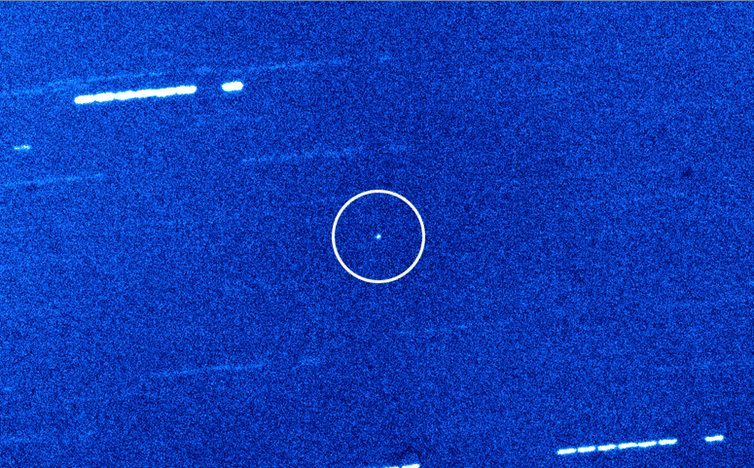
Oumuamua as it appeared using the William Herschel Telescope on the night of October 29. Queen’s University Belfast/William Herschel Telescope
The study of ‘Oumuamua in October of 2017 set off a revolution in astronomy and the study of celestial objects. Not only was this an object that had formed in another star system, but its arrival and detection implied a large population of such objects. The detection of 2I/Borisov in 2019 confirmed what many astronomers already suspected – that ISOs enter our Solar System on a pretty regular basis.
In addition to being a physicist with the i4is (and the lead author on the study), Marshall Eubanks is the Chief Scientist of Space Initiatives Inc. and CEO of Asteroid Initiatives LLC. As he told Universe Today via email, the discovery of ‘Oumuamua and 2I/Borisov is significant in a way that cannot be understated:
“[J]ust by proving that they exist, it has had a profound impact, creating a field of study almost from nothing (a field that funding authorities are just beginning to recognize). Interstellar Objects provide us with the opportunity to study, and in the future literally touch, exobodies decades before the earliest possible missions to even the nearest stars, such as Proxima Centauri.”
This led to multiple proposals for missions that could rendezvous with future ISOs that were spotted passing through our system. One such proposal was Project Lyra, which researchers from the i4is shared in a 2017 study (with support from Asteroid Initiatives LLC). There’s also the ESA’s Comet Interceptor mission, which they plan to launch in 2029 to rendezvous with a long-period comet.
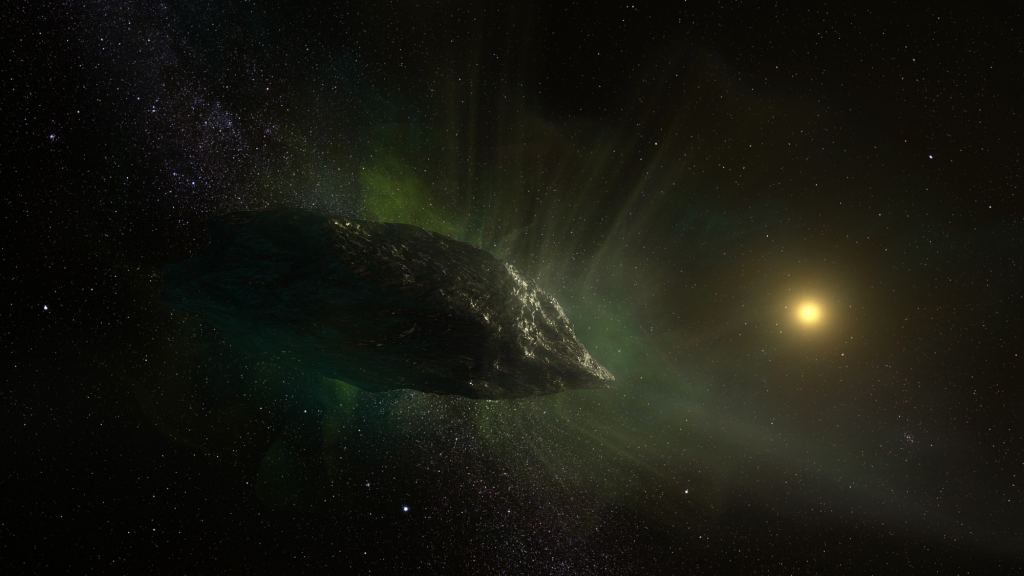
Artist’s impression of the interstellar object, `Oumuamua, experiencing outgassing as it leaves our Solar System. Credit: ESA/Hubble, NASA, ESO, M. Kornmesser
“We started working on potential missions to interstellar objects in 2017, right after the discovery of ‘Oumuamua and we initially rather focused on chasing that specific object, in contrast to Seligman & Laughlin, who focused on ISOs that might be discovered in the future,” said Eubanks. “The Comet Interceptor mission would fall into a similar category (build-and-wait).”
Given that ISOs formed in another star system, the opportunity to study them up close would offer scientists insight into the conditions that are present there. In fact, the study of ISOs is the next best thing to sending interstellar probes to neighboring star systems. Of course, any such mission entails a lot of technical challenges, not to mention the need for advance warning. As Eubanks explained:
“There are two basic types of missions here – plan and wait, or launch and wait, missions, such as the ESA Comet Interceptor, and chase missions, such as would be needed to reach 1I/’Oumuamua. It is very unlikely that any chase missions will be able to rendezvous with a retreating ISO – these will almost certainly be restricted to fast flybys. Rendezvous missions, missions to match velocities and orbit or land the ISO, will need advance warning.”
To illustrate, when astronomers first became aware of ‘Oumuamua, it was only after the object had already made its closest approach to the Sun (aka. perihelion passage) and made a close pass by Earth. Because of this, observers had only 11 days to conduct observations as it made its way out of the Solar System and was beyond the reach of their instruments.
Artist’s impression of 2I/Borisov beyond our Solar System. Credit: NRAO/AUI/NSF, S. Dagnello
In the case of 2I/Borisov, amateur astronomer and telescope-maker Gennadiy Borisov caught sight of it on August 30th, 2019, roughly three months before it reached perihelion (December 8th, 2019). But for future missions to rendezvous with them, it is imperative to know as much as possible about how often ISOs arrive and how fast they are traveling when they do.
For the sake of their study, Eubanks and his colleagues sought to place better constraints on these two variables. To do this, they began by taking into account how an interstellar object’s velocity is influenced by the local standard of rest (LSR) – the mean motion of stars, gas, and dust in the Milky Way in the vicinity of the Sun:
“We assume that ISOs come from or are formed with stars and their planetary systems, and that after they are on their own they share the same galactic dynamics as stars do. We use the two known ISOs, 1I/’Oumuamua and 2I/Borisov, and the efficiency of past and current astronomical surveys to estimate the number of these objects in the galaxy, and stellar velocity estimates from the Gaia mission to estimate the velocity spread we should expect.”
What they found was that in an average year, the Solar System would be visited by up to 7 ISOs that are asteroid-like. Meanwhile, objects like 2I/Borisov (comets) would be rarer, appearing around once every 10 to 20 years. They further found that many of these objects would be moving at velocities greater that of ‘Oumuamua – which was moving at over 26 km/s before and after picking up a boost from the Sun.
Swarm of laser-sail spacecraft leaving the solar system. Credit: Adrian Mann
Knowing these parameters will help scientists prepare for possible rendezvous missions with ISOs, something which Eubanks and his colleagues covered in more detail in a previous study – “Interstellar Now! Missions to Explore Nearby Interstellar Objects.” As Universe Today reported at the time of its release, the study addressed a wider range of potential ISOs and the feasibility of reaching them.
In the meantime, this latest study provides basic information that will support the planning and implementation of these missions. In addition to Project Lyra and the ESA’s Comet Interceptor, there are numerous proposals for spacecraft that could rendezvous with interstellar objects (or even make the interstellar journey themselves).
These include Project Dragonfly, a small spacecraft and laser sail that was the subject of a conceptual design study hosted by the Initiative for Interstellar Studies (i4iS) in 2013. Another is Breakthrough Starshot, a concept put forward by Yuri Milner and Breakthrough Initiatives that also calls for a tiny spacecraft to be sent to Alpha Centauri using a lightsail and a powerful laser array.
This proposal has been articulated in recent years by Prof. Abraham Loeb and Prof. Manasvi Lingam. Whereas Leob is the founder of the ITC and Chair of the Starshot Advisory Committee, Lingham is a longtime researcher with the ITC and a co-author on the “Interstellar Now!” and this latest paper. In addition to going interstellar, these concepts have been proposed as a possible way of “chasing objects” that enter our Solar System.
One way or another, we will be peaking at other star systems soon! And knowing how to intercept and study the objects they periodically kick our way is a good way to start!
Dr Steven Greer: This Is How We Stage UFO & Alien False Flag Events
Dr. Steven Greer reveals startling information about the government briefing on UFOs and the control of information. Secret government programs on UFO technology is now being passed out to defence contractors. Thousands of people have been already briefed on the subject of extraterrestrials and their craft but can never talk about it, but slowly the truths are being leaked to the general public. The biggest global change has to take place.
Steven Greer reveals the technology and tactics used to create events that appear to be aliens or UFOs but are highly sophisticated false-flag events. This can include staging scenarios that appear to be UFO crash landings, alien abductions, strange implants or psychic attacks.
UFO Sighting Of 2 Long Craft Over Clovis, California 3-10-2021, MUFON.
Date of sighting: 3-10-2021 Location of sighting: Clovis, California, USA Source: MUFON
Now, I went through this video and I saw something moving past the lens...then I realized...its rain. This is more proof that what the eyewitness said is true. He said he saw the UFO during a storm. And actually there are two of them. I have to admit, I'm a bit stumped by this one. He said he didn't see the UFO till later when he reviewed the video. But the digital eye is more perfect and can sometimes record cloaked objects, where the human eye is flawed and weak. Excellent proof aliens are over California.
Scott C. Waring - Taiwan
Eyewitness states:
I did not see the object when i was recording as i was watching the top and right leading edges of the thunderstorm looking for rotation. that is why i was panning round. sorry. only after i reviewed the video did i see the object just appear, hover, then blink and disappear. i immediately tried to debunk it. i was shooting through the patio door, right up against it, and no lights nor tv were on behind me. i had turned those off because of the lightning in the area before i went to look for funnel clouds. the video is all i have.
UFO Crash In Sverdlovsk, Russia 1969, Secret KGB UFO Files, UFO Sighting News.
Date of discovery: 1969 Location of discovery: Sverdlovsk, Russia
I first learned about this crash about 10-13 years ago. I posted the raw film footage onto my channel, but decided to repost it today to remind people of the incident. If we refuse to learn from this kind of evidence, then...there is no point moving forward at all. Because this is real, 100% fact.
The details of a Russian Crash on or about 1969 are few, because of the high level of secrecy of its subject. This case comes from the "Secret KGB Files," which were reportedly smuggled out of the former Soviet Union. Reportedly, $10,000 was paid for the information. The details of these secret files were first offered to the general public on 9-13-98 as part of a TNT special titled "The Secret UFO Files of the KGB." The show featured extraordinary film and still photographs of the UFO recovery, and also a portion of autopsy film on part of an alien body.
The event itself, according to the KGB files, occurred in the state of Sverdlovsky, which was formerly Yekatrinburg of the USSR. The crash story follows a familiar pattern normally associated with this type of report. The fiery crash of an unknown object occurred in March 1969. The site was secured by the Russian military, and one dead alien was found in the wreckage. The remains of the craft and alien were brought to a secure location, and the alien body was autopsied. Both still and moving pictures were taken of the craft, its retrieval, and the alien autopsy. The autopsy shows only an alien torso and arm. From the size of the body parts, the alien would have been an extremely small being.
The footage at the crash site is 100% authentic at least on several points. The truck in the film is a circa 1950 model ZIS151, which has not been used by the military for quite some time, and the truck would have been difficult to find to stage a hoax with. Other elements of the film do not exhibit any obvious signs of a hoax, as to the movement of the soldiers, the timing of the film as to shadows, and the UFO itself.
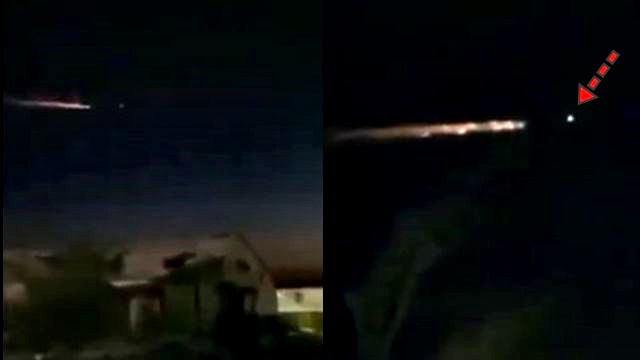
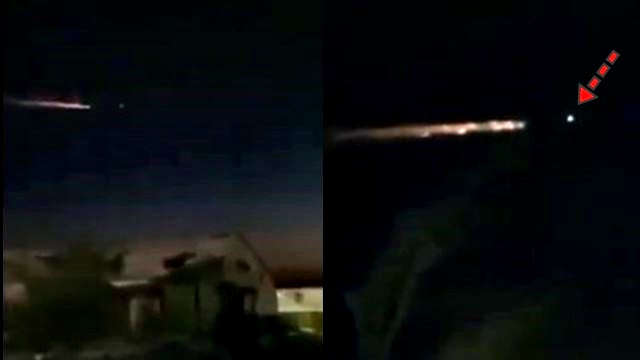
Strange burning object moves through the sky over Ust-Nera in Yakutia (video)
According to the Siberian Times, a large chunk of space debris, a spent upper stage Fregat rocket used to launch the Meteor-M satellite in 2009 filmed on March 12, 2021 over the village of Ust-Nera in Yakutia, some 870 kilometers northeast of the republic's capital Yakutsk.
But they are not sure if it was indeed the used Frigate upper stage rocket or something else.
Remarkable, an unknown bright sphere can be seen in front of the burning object..
Ons zonnestelsel kreeg aliens op bezoek, stelt astronoom Avi Loeb
Volgens Harvard-professor Avi Loeb hebben buitenaardse wezens het zonnestelsel al bezocht. Dat meent hij in alle ernst. In een nieuw boek licht hij niet alleen zijn opmerkelijke hypothese toe, maar wijst hij ook op een crisis in de wetenschappen. ‘Mijn werk is niet mainstream, maar onderzoek naar de snaartheorie of het multiversum is dat wel? Dat is al te gek.’
Avi Loeb schuwt de controverse niet. De productieve astrofysicus van Harvard University verrichte zowel pionierswerk als provocerend onderzoek naar zwarte gaten, uitbarstingen van gammastraling, het prille universum en andere standaardthema's uit de astronomie. Al meer dan tien jaar verdiept hij zich ook in een meer omstreden onderwerp: buitenaardse wezens en hoe je die opspoort.
Tot voor kort was zijn meest spraakmakende wapenfeit rond dat laatste zijn betrokkenheid bij Breakthrough Starshot, een project gefinancierd door Silicon Valley-miljardair Yuri Milner, dat lichtzeilen – ultradunne lasergestuurde reflecterende ruimtetuigen – met hoge snelheid op ruimtereis naar nabijgelegen sterren wil sturen.
Maar in het najaar van 2017 kwam daar verandering in. Overal ter wereld verdrongen astronomen zich om de raadselachtige interstellaire bezoeker te bestuderen die heel even binnen het bereik van hun telescopen was gekomen, de allereerste ooit waargenomen.
De ontdekkers van het object noemden het 'Oumuamua, een Hawaïaans woord dat zoveel betekent als 'boodschapper die van ver komt'. Vroeg onderzoek toonde aan dat deze ruimtepassant verschillende eigenschappen had die een eenvoudige natuurlijke verklaring lastig maakten. De vorm van 'Oumuamua, een soort sigaar of pannenkoek van honderd meter lang, leek in niets op bekende asteroïden of kometen. Ook de helderheid was totaal anders. 'Oumuamua bleek minstens tien keer meer licht te weerkaatsen dan typische ruimterotsen uit ons zonnestelsel. Dit hemellichaam glimde zo hard dat het aan gepolijst metaal deed denken.
Heel vreemd was ook dat het object, toen het voorbij de zon dook en wegstoof, bijzonder hard versnelde. Die versnelling viel niet te verklaren door de afnemende zwaartekracht van de zon alleen. We zien zulke versnellingen wel bij ordinaire kometen: ze ontstaan door het stuwende effect van de verdampende gassen, die wegschieten wanneer het zonlicht hun ijzige oppervlakte opwarmt. Maar rond 'Oumuamua namen astronomen geen tekenen van dat soort stuwing waar.
De volgens Loeb meest plausibele verklaring is even voor de hand liggend als spectaculair: de merkwaardige versnelling die 'Oumuamua maakt zou perfect logisch zijn als het object een lichtzeil zou zijn. Misschien is het wel een overblijfsel van een of andere galactische cultuur die al lang is verdwenen. Door zijn jarenlange zoektocht naar mogelijke bewijzen voor kosmische beschavingen ergens in het heelal raakte Loeb er steeds meer van overtuigd dat 'Oumuamua zo'n bewijs was. Dit object had óns gevonden.
Bij zijn korte passage in 2017 beschreef ‘Oumuamua een L-vormig traject doorheen ons zonnestelsel.
In het najaar van 2018 publiceerde Loeb samen met Shmuel Bialy, een postdoctoraatsonderzoeker aan Harvard, een paper in Astrophysical Journal Letters. Daarin betoogden zij dat 'Oumuamua niets minder was dan het eerste contact van de mensheid met een artefact van buitenaardse intelligentie.
De paper scoorde bij journalisten, maar kon de meeste van Loebs collega-astrobiologen niet bekoren. Zij vinden 'Oumuamua evenzeer merkwaardig, maar klasseren de eigenschappen toch binnen de natuurlijke fenomenen. Iets anders beweren is volgens hen op z’n best tactloos en op z’n slechtst destructief. Dit onderzoeksdomein kampt al lang met de stigma’s van ontvoeringen door ufo’s en aliens, terwijl het een legitieme plaats binnen de wetenschappen verdient.
Loeb brengt zijn verhaal nu ook naar een breder publiek met Extraterrestrial: The First Sign of Intelligent Life Beyond Earth. Het boek vertelt niet alleen het levensverhaal van de auteur maar buigt zich ook over de fundamentele mysteries van 'Oumuamua. Een gesprek over zijn controversiële hypothese en de crisis die de wetenschap volgens hem doormaakt.
Avi Loeb
Abraham Loeb (°1962) is een Israëlisch-Amerikaans theoretisch fysicus, gespecialiseerd in astrofysica en kosmologie. Hij is hoogleraar aan Harvard University, waar hij het Black Hole Initiative oprichtte. Voorts zit hij in de adviesraad van het Breakthrough Starshot-project van de Israëlisch-Russische miljardair Yuri Milner, dat ruim- tevaartuigen met lichtzeilen naar sterren wil bren- gen. In 2012 selecteerde het magazine Time Loeb als een van de vijfentwintig meest invloedrijke per- sonen in de astronomie. Hij schreef acht boeken.
Hoe gaat het?
‘Goed, al slaap ik te weinig om te kunnen ingaan op alle persaanvragen. Om 1.50 u 's nachts en om 3 u 's ochtends had ik noog interviews. Tel daar nog heel wat televisieoptredens bij. De komende weken moet ik zo'n honderd podcastinterviews doen. Ik heb al lange gesprekken gehad met Lex Fridman en Joe Rogan voor hun shows. Zoiets heb ik nog nooit meegemaakt, de interesse voor mijn boek is enorm. De voorbije weken ben ik door tien filmmakers en producers uit Hollywood gecontacteerd! (Lacht:) Als hier een film van komt, wil ik door Brad Pitt gespeeld worden.’
De gelijkenis is treffend. Gezien uw productiviteit heb ik altijd al de indruk gehad dat u nooit veel slaapt.
‘Gewoonlijk sta ik elke ochtend om vijf uur op en ga ik joggen. Het is prachtig als er buiten nog niemand is – alleen ik en de vogels, eenden en konijnen. Door de pandemie zijn de voorbije tien maanden inderdaad de productiefste uit mijn carrière geweest. Ik hoef niet naar het werk te pendelen. Ik heb geen afspraken met massa's mensen. En het belangrijkste: ik hoef me niet bezig te houden met alle foute uitspraken van anderen!’
Over één ding zijn we het alvast eens: in de wetenschappen moeten we eerlijk met elkaar omgaan. Dat zeg ik omdat u in uw boek beweert dat u niet in de schijnwerpers wil staan en niet geïnteresseerd bent in zelfpromotie. Hoe rijmt u dat met dit gesprek?
‘Met de pers praten is belangrijk, omdat ik op die manier mijn boodschap, die anders niet zoveel aandacht zou krijgen, met een breed publiek kan delen.’
Wat is uw boodschap precies? Ik vermoed dat u het niet alleen over 'Oumuamua wil hebben.
‘Mijn boodschap is dat het tegenwoordig niet meer zo goed gesteld is met de gezondheid van de wetenschappelijke wereld. Al te veel wetenschappers worden nu in de eerste plaats gedreven door hun ego, door eretitels en awards, of door hun neigen om aan collega’s te demonstreren hoe slim ze wel niet zijn. Zij behandelen wetenschap meer als een monoloog over zichzelf dan als een dialoog met de natuur. Ze bouwen echokamers met studenten en postdocs die hun mantra's herhalen, zodat hun stem steeds luider klinkt en hun imago wordt gepromoot. Dat is niet het doel van wetenschap. De essentie van wetenschap is proberen de wereld te begrijpen. Dat is bedoeld als leerervaring, waarbij je onderweg risico's neemt en fouten maakt. Als je in de frontlinie staat, kun je nooit op voorhand zeggen welke weg vooruit de juiste is. Dat leer je alleen door feedback uit experimenten.’
‘Snaartheorie, het multiversum: tegenwoordig houden gerenommeerde wetenschappers zich te veel bezig met zaken die niet te toetsen zijn’
‘Zo komen we bij het volgende actuele probleem in de wetenschap: mensen worden niet alleen door de verkeerde motivatie gedreven, maar laten zich ook niet meer leiden door bewijzen. Bewijzen houden je bescheiden, omdat je iets voorspelt en dat toetst, waarop de bewijzen soms aantonen dat je fout zit. Vandaag houden heel wat gerenommeerde wetenschappers zich echter bezig met wiskundige gymnastiek over allerlei zaken die niet te toetsen zijn: snaartheorie, het multiversum, zelfs de theorie van de kosmische inflatie. Ooit vroeg ik aan Alan Guth, de bedenker van die theorie, of kosmische inflatie falsifieerbaar is. Waarop hij antwoordde dat dat een dwaze vraag was, omdat er voor alle mogelijke kosmologische data die een experiment kan opleveren altijd wel een inflatiemodel is dat hierbij past. En daarom bevindt inflatie zich in een heel sterke positie, omdat het alles kan verklaren. Ik zie dat net als een zwakke positie, omdat de theorie van alles soms een theorie van niets is. Misschien is er wel geen verschil tussen die twee.’
‘Die bubbel van imaginaire dingen voelt voor mij als trippen op drugs: je kunt high worden en je inbeelden dat je rijker bent dan Elon Musk. Je kunt je daar geweldig bij voelen en er met je vrienden over praten. En als je in een grote gelijkgezinde gemeenschap zit, kunnen jullie elkaar steunen en respecteren, en elkaar met awards belonen – fantastisch, toch? Het is pas wanneer je je geld wil opvragen en effectief wil spenderen dat je beseft dat je eigenlijk niets hebt. Experimenten kunnen dienen als reality check, net zoals naar de bankautomaat gaan. Die toetsing is essentieel in de wetenschappen – voorspellingen doen die getoetst kunnen worden en waarbij je iets op het spel zet – omdat we anders nooit iets nieuws leren. Ik denk dat dit niet meer voldoende erkend wordt.’
Speculeren over de snaartheorie en multiversums is slecht, maar speculeren over buitenaardse beschavingen en hun artefacten die door het zonnestelsel passeren mag wel? Je kunt toch ook zeggen dat een beroep doen op 'aliens' alles kan verklaren?
‘Het verschil is dat je voor dat laatste voorspellingen kunt doen die je kunt toetsen; deze speculaties komen vanuit een voorzichtig-conservatieve positie.’
‘Als 'Oumuamua één van de vele objecten zou zijn die zich op een willekeurige baan voortbewegen, dan kun je wel schatten dat we heel binnenkort elke maand nog gemiddeld één ander dergelijk object zullen vinden, zodra de Vera C. Rubin Observatory (spiegeltelescoop met immense digitale camera onder constructie in Chili, red.) online gaat. We kunnen een systeem van instrumenten uitbouwen die de hemel afspeuren, en die ook in staat zijn om te reageren wanneer zulke objecten naderen. Zo kunnen we foto’s nemen zodra ze binnenkomen, in plaats van ze achterna te zitten wanneer ze weer weggaan, want ze bewegen heel snel. Bovendien hoeft niet al het werk in de ruimte te gebeuren: je kunt ook denken aan meteoren van interstellaire oorsprong en daarnaar op zoek gaan. Als je er dan ergens een vindt die op het aardoppervlak aan zijn eind is gekomen, kun je die misschien zelfs met je eigen handen onderzoeken.’
‘Mensen vragen mij waarom ik al die media-aandacht krijg. De enige reden is dat mijn collega's hun gezond verstand niet gebruiken’
‘Mensen vragen mij waarom ik al die media-aandacht krijg. De enige reden daarvoor is dat mijn collega's hun gezond verstand niet gebruiken. Plaats de snaartheorie en multiversums eens tegenover wat ik en vele anderen zeggen, gebaseerd op data van de Kepler-missie van NASA: ruwweg de helft van de zonachtige sterren in de Melkweg heeft een planeet met ongeveer dezelfde grootte als de aarde. Die planeten bevinden zich bovendien op ongeveer dezelfde afstand van de aarde tegenover de zon. Vloeibar water op het oppervlak en de chemie van het leven zoals wij dat kennen, zijn dus mogelijk. Als je miljarden keren de dobbelstenen over het leven in de Melkweg gooit, hoe groot is de kans dan dat we alleen zijn? Hoogstwaarschijnlijk is die miniem. Zeggen dat je een soortgelijke uitkomst krijgt als je soortgelijke omstandigheden voorziet, is volgens mij het meest conservatieve standpunt denkbaar.’
‘Mijn werk is niet mainstream, maar onderzoek naar de snaartheorie of het multiversum is dat wel? Dat is al te gek’
‘Ik zou dan verwachten dat de meeste mensen dit onderschrijven, mij omhelzen en zeggen: ‘Fantastisch, Avi, je hebt gelijk. We zouden naar die dingen moeten kijken omdat zij heel waarschijnlijk zijn.’ In de plaats zie ik een tegenreactie die getuigt van een dolgedraaid intellectueel kompas. Hou kun je anders verklaren dat er aan extra dimensies van de snaartheorie of het multiversum gewerkt wordt, terwijl er geen enkele aanwijzing is voor hun bestaan? Maar dát wordt dus als mainstream beschouwd? Dat is al te gek.’
‘Vandaag zie ik astronomen praten over toekomstige telescopen die miljarden kosten. Hun belangrijkste motivatie: leven vinden door in de atmosfeer van exoplaneten naar zuurstof te zoeken. Maar als je naar de eerste 2 miljard jaar van de aarde kijkt, zie je dat onze planeet niet veel zuurstof in zijn atmosfeer had, terwijl er toch al veel microbieel leven was. En zelfs als er zuurstof is, kan die ook afkomstig zijn van natuurlijke processen, zoals het uiteenvallen van watermolecules. Dus zelfs als je al die miljarden uitgeeft en zuurstof vindt, dan nog zullen mensen daar eeuwig over blijven redetwisten. Kijk maar hoeveel discussie er is over de mogelijke vondst van fosfine op Venus, een heel ongewone molecule in vergelijking met zuurstof.’
‘Mijn punt is dat je met dezelfde instrumenten en zonder extra investeringen eigenlijk sluitend bewijs kunt vinden voor leven, intelligentie en technologie. Wat zou dat bewijs kunnen zijn? Industriële vervuiling in de atmosfeer. Je zou kunnen zoeken naar chloorfluorkoolstofverbindingen (cfk's), de complexe molecules die enkel op aarde worden geproduceerd voor koelinstallaties. Als je die op een andere planeet zou vinden, weet je dat die molecule onmogelijk op een natuurlijke manier geproduceerd kon worden. Dan zou je een onweerlegbaar bewijs hebben dat er leven – en meer – heeft bestaan.’
‘Wat is dus het probleem met zeggen dat zoeken naar industriële vervuiling de moeite loont? Is dit niet gewoon een psychologische barrière die sommige wetenschappers tegenhoudt om toe te geven dat zij eigenlijk willen dat de zoektocht naar technologische signalen van buitenaardse beschavingen een randfenomeen blijft, met heel weinig fondsen? Ik vind dat we van dit soort zaken een prioriteit moeten maken. Het zou zelfs conservatief zijn om te doen, want het zou ons de meeste informatie opleveren over het bestaan van buitenaards leven. Toch doen we nu precies het omgekeerde.’
De LSS-telescoop aan het Vera C. Rubin Observatory in Chili zal tien jaar lang om de zoveel nachten de hemel fotograferen.
Geloven dat 'Oumuamua een buitenaards artefact is, kan volgens u leiden tot een revolutie in de ruimtewetenschappen. De focus zou dan komen te liggen op de zogeheten search for extraterrestrial intelligence (SETI). Maar uw critici zeggen dat u meer kwaad dan goed doet. U zit in een van de populairste podcasts ter wereld, die van Joe Rogan. Hij staat erom bekend foute informatie in zijn podcasts te verspreiden. Waar trekt u de grens voor publieke optredens die het risico op hoongelach verhogen en zo alle vooruitgang van SETI dwarsbomen?
‘In grote lijnen financiert het publiek de wetenschappen. En dat publiek is bijzonder geïnteresseerd in de zoektocht naar buitenaards leven. Als wetenschappers door het publiek gesteund worden, hoe durven zij die vraag dan uit de weg te gaan, terwijl zij daar met de technologieën die ze ontwikkelen wél kunnen op ingaan?’
‘Er zijn natuurlijk sciencefictionverhalen over aliens en heel veel ongegronde ufomeldingen. Stel dat er wat literatuur zou bestaan over de magische eigenschappen van covid-19 die niet gestoeld zijn op de realiteit. Zou dat dan betekenen dat wetenschappers niet aan een vaccin voor deze pandemie moeten werken? Natuurlijk niet! Ik beschouw de zoektocht naar tekenen van buitenaardse technologie niet als iets anders dan de zoektocht naar de aard van zwarte materie. We hebben honderden miljoenen dollars geïnvesteerd in speuren naar massieve partikels die zwak interageren, omdat het belangrijke kandidaten zijn voor zwarte materie. Tot dusver heeft dat niets opgeleverd. Dat betekent niet dat al die investeringen een verspilling waren. Doodlopende sporen horen nu eenmaal bij de wetenschappelijke methode.’
‘In de wetenschappen worden we verondersteld om alles open op tafel te gooien, wat de risico’s ook inhouden. We kunnen ideeën niet zomaar uit de weg gaan gewoon omdat we vrezen voor de discussie die erover zou ontstaan. Want ook dat houdt grote risico's in. Het zou hetzelfde zijn als Galileo verbieden iets te zeggen over de aarde die rond de zon draait, of om door een telescoop te kijken, omdat dat gevaarlijk is voor de op dat moment heersende filosofie. We hebben een open dialoog tussen wetenschappers nodig, waarbij mensen verschillende opvattingen voorstellen en we de bewijzen laten bepalen wat er klopt. In de context van 'Oumuamua zeg ik dat de beschikbare bewijzen doen vermoeden dat dit specifieke object artificieel is. De manier om dat te testen is om meer voorbeelden van hetzelfde te vinden en die te onderzoeken. Zo eenvoudig is dat.’
‘Hoe kun je die situatie veranderen? Volgens mij is het antwoord: door ze zoveel mogelijk naar het grote publiek te brengen.’
In uw boek linkt u uw openheid over 'Oumuamua aan een zinsnede, een ethos dat u tijdens uw dienstplicht voor het Israëlische leger leerde: ‘Je lichaam op de prikkeldraad leggen.’ Persoonlijke offers brengen voor het grotere goed. Moet u voor dit doel dan een martelaar zijn? Heeft u hierdoor vrienden of respect verloren?
‘Niemand heeft me agressief aangevallen of zo. Maar misschien praten mensen wel achter mijn rug. Dat lijkt me logischer, gezien mijn leidende posities. Maar ik weet het dus niet. Ik laat nul sporen achter op sociale media. Al moet ik waarschijnlijk zeggen dat de critici die zich het luidst met giftige opmerkingen op Twitter of elders laten horen vrij middelmatige wetenschappers zijn. De meeste goede wetenschappers zouden zich niet op die manier gedragen – zij zouden argumenten formuleren voor of tegen mijn beweringen en dat zou volstaan. Gemene opmerkingen hebben weinig zin, behalve dat het mij niet zou verbazen dat veel van die critici, diep vanbinnen, eigenlijk wel geïntrigeerd zijn door de idee dat 'Oumuamua artificieel is. Maar dat willen ze niet toegeven. Dus verkondigen ze met veel lawaai het tegenovergestelde.’
‘Waarom zoeken we op planeten altijd naar zuurstof en niet naar tekenen van industriële vervuiling? Dat zou onweerlegbaar bewijs vormen’
‘Helaas verschilt mijn situatie van die van jonge postdoc-onderzoekers met wie ik heb gewerkt, omdat zij voor een job moeten solliciteren. Ik ben er zeker ven dat zij al benaderd werden met 'kijk, dit is gevaarlijk voor je', waarop zij elk onderzoek staakten dat ook maar ergens in die richting ging. Dat verbaast mij niet. Als je een vijandige intellectuele cultuur creëert, waarin SETI niet wordt gewaardeerd, zullen verstandige jonge mensen die weg ook niet inslaan. Maar je kunt niet op het gazon stappen en dan klagen dat het gras niet groeit op de plek waar je staat. Houd briljante onderzoekers niet tegen om zich in te zetten voor SETI en dan te zeggen: ‘Kijk, we vinden niets. SETI is een mislukking!’’
‘Dit alles betekent niet dat álle ruimtewetenschappen zich met hetzelfde moeten bezighouden. Kijk maar eens naar de commerciële wereld van Bell Labs vroeger of Google nu: zij moedigen hun personeel aan en laten hen vernieuwende 'onrendabele' research te doen, die dus niet meteen tot concrete winst leidt. Maar als je naar de academische wereld kijkt, zie je dat zij conservatiever zijn dan de commerciële sector. Dat klopt niet.’
Kwatongen zouden kunnen zeggen dat u vooral hard probeert om rijke weldoeners, zoals Yuri Milner, gunstig te stemmen. U bent ook adviseur van zijn Breakthrough Initiatives-programma, dat onderzoek financiert verwant aan SETI en lichtzeilen.
‘Het klopt voor mij – en voor iedereen, denk ik – dat mijn verbeelding begrensd wordt door wat ik weet. Ik kan niet ontkennen dat mijn betrokkenheid bij Breakthrough hier een invloed had. Ik was het die het lichtzeil (voorgesteld door natuurkundige Philip Lubin, red.) in de eerste plaats aan Yuri Milner suggereerde als concept voor een interstellair ruimtetuig. Het zat dus in mijn woordenschat en bijgevolg stelde ik me dit voor toegepast op 'Oumuamua. Nu kun je je afvragen of dat geen bevooroordeelde visie is. Maar ze komt regelmatig voor in de fysica en in SETI. In het kader van SETI zijn we de hemel beginnen afspeuren met radiosignalen zodra we die radiotechnologie hadden ontwikkeld. Hetzelfde voor lasers. Zodra je aan een bepaalde technologie werkt, is het heel normaal dat je denkt dat die misschien al ergens bestaat en zoek je ernaar.’
‘Ik ontken dus niet dat de reden waarom het lichtzeilconcept in mijn hoofd zat was dat ik er eerder al had aan gewerkt. Maar dat heeft niets te maken met pogingen om Yuri aan te sporen. Waarom zou ik dat op die manier doen, als ik hem op elk moment ook gewoon rechtstreeks kan benaderen om mijn visie te verdedigen? Mijn werk over 'Oumuamua werd ook niet gecoördineerd of gefinancierd door Breakthrough Initiatives. Zij hebben geen persberichten over mijn ideeën verspreid. Integendeel, misschien zijn ze zelfs ongerust. Omdat ze hun eigen reputatie moeten bewaken enzovoort. Ik heb over het thema geen enkele steun of communicatie met hen gehad. Ik heb 'Oumuamua niet gebruikt als een of ander politiek vehikel in het kader van Breakthrough. Dat heeft niets met mijn motivatie te maken.’
Wat komt er voor u na dit? Heeft u plannen?
‘Ik heb net mijn voorzitterschap van het departement astronomie aan Harvard neergelegd. Ik kan nu dus inderdaad naar de volgende fase overgaan. De vraag is: wat wordt die? Een andere leidende positie zou wel aanlokkelijk zijn, omdat ik zou kunnen proberen de realiteit anders vorm te geven dan vele anderen. Zoiets zou ik niet aan mij voorbij kunnen laten gaan. Maar misschien krijg ik geen aanbiedingen meer door mijn opvattingen over ‘Oumuamua. In dit geval zou ik meer boeken schrijven, meer onderzoek doen en nog steeds elke ochtend gaan joggen.’
ALLE GERELATEERDE VIDEO'S, zijn uitgekozen en gepost door peter2011 - taal Engels gesproken
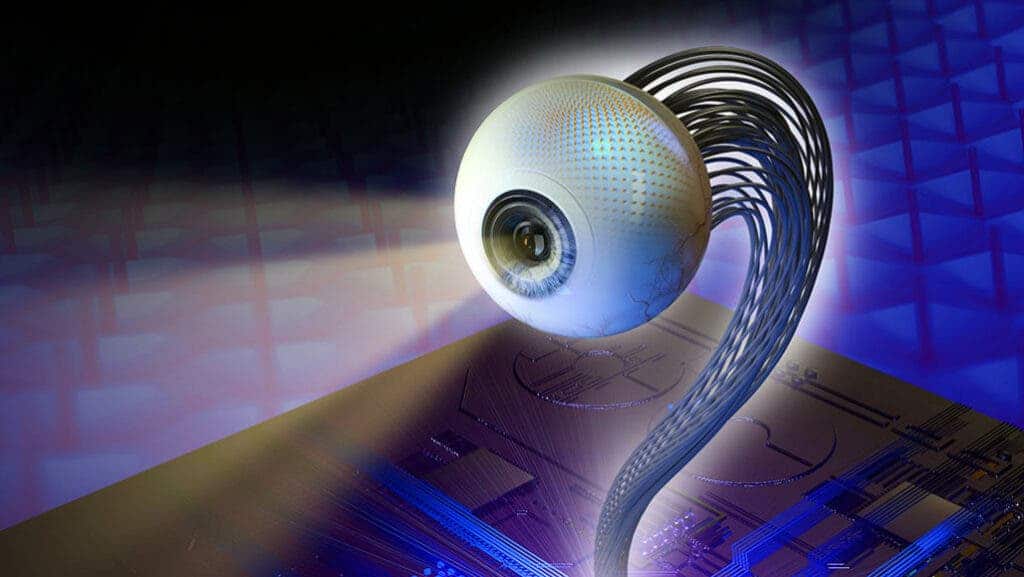
Researchers have devised an artificial eye that mimics the structure of the human eye, which has important applications in robotics, scientific measurements, as well as cyborg-like prosthetics that restore vision.
Artist impression of an artifcial eye. Credit: Yaying Xu.
The proof-of-concept, which was recently described in the journal Nature by a team led by Zhiyong Fan from the Hong Kong University of Science and Technology, is about as sensitive to light at its natural counterpart. What’s more, it even has a faster reaction time than the real thing (30 to 40 milliseconds, rather than 40 to 150 milliseconds).
The human eye is nothing short of spectacular — and much of what it’s capable of doing is owed to the dome-shaped retina, an area at the back of the eyeball that is littered in light-detecting cells.
There are around ten million photoreceptor cells per square centimeter, enabling a wide field of view and excellent resolution that has yet to be replicated by any man-made technology.
For many years, scientists have sought to replicate these characteristics in synthetic eyeballs. However, such efforts proved extremely challenging due to the inherent difficulties in mimicking the shape and composition of the human retina.
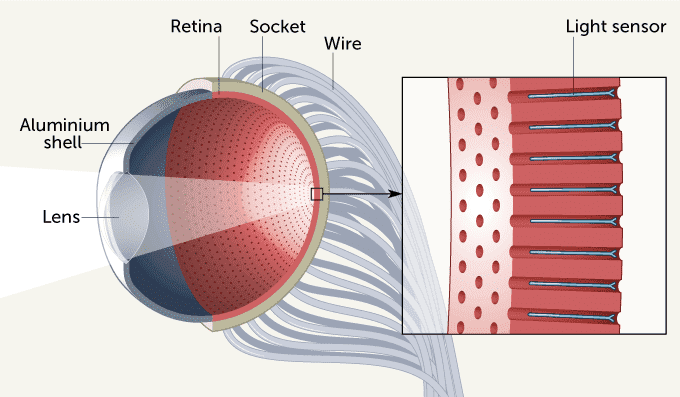
Fan and colleagues devised a hemispherical artificial retina, measuring only two centimeters in diameter and containing densely packed, light-sensitive nanowires made from a perovskite — a promising material that is very popular in solar cell manufacturing. The purpose of these nanowires is to mimic the photoreceptors of the human eye.
Schemtic of the artificial eye. Credit: H. JIANG/NATURE 2020.
The artificial eye’s hollow center is filled with a conductive fluid, whereas the human eye is filled with a clear gel called vitreous humour.
In an experiment, the artificial eye was hooked up to a computer and could “see” by reconstructing the letters ‘E’, ‘I’, and ‘Y’.
However, this is a far cry from the capabilities of the biological eye. The array consists of just 100 pixels, where each pixel corresponds to three nanowires.
This is a proof of concept, though, and Fan is confident that his design can be scaled so that the artificial eye can obtain a resolution ever higher than the human eye. According to Fan and colleagues, the density of nanowire can be enhanced to cover ten times the number of photoreceptors in the human eye.
Each nanowire could theoretically function as a small solar cell, which means that artificial eyes might not require an external power source as the researchers’ device currently requires.
The researchers envision applications in scientific measurements and advanced robotics. But, theoretically, the artificial eye could also be connected to an optic nerve, enabling the brain to process information received from the device like it would with a real eye. This latter prospect, however, is years and years away — but the prospect is still incredibly exciting.
The For All Moonkind Moon Registry catalogs all of the robotic and human missions that left items on the surface. (Image credit: For All Moonkind via collectSPACE.com)
The moon may be devoid of humans (at least for now), but there is plenty of humanity to be found strewn across the lunar surface. A new website catalogs the human heritage items that were left behind on the moon, for posterity and for the public to reference.
The Moon Registry, presented by For All Moonkind, celebrates the sites and hardware that can now be found on Earth's natural satellite. The free resource provides overviews of every robotic and human mission that made contact with the moon, including details on the objects related to those excursions that also remain there today — from commemorative medallions and flags to rovers and scientific experiments.
"The history of humans on the moon belongs to everyone on Earth," Michelle Hanlon, co-founder of For All Moonkind, a non-profit organization dedicated to protecting human heritage in space, said in a statement. "We are working to obtain international recognition and protection for sites in space that have universal historic value. As part of that effort, we want to make sure the details of humanity's incredible journey to space — past, present and future — are accessible to all."
Launched on Thursday (March 11), the For All Moonkind Moon Registry contains entries for both robotic and crewed missions to the moon dating back more than 50 years. Each record has a brief description and photographs about the mission, as well can a section for related items.
For example, each of the Apollo moon landings has an entry for the lunar module descent stage that brought the astronauts to the surface, as well as an area to list the individual equipment and mementos that the crew members left behind.
"Visiting the moon was an incredible privilege and experience," said Apollo 16 lunar module pilot Charlie Duke, the tenth person to walk on the moon. "I can't wait for someone to go back and find the picture of my family that I left behind. In the meantime, the For All Moonkind Moon Registry is a spectacular resource. It's one small way to share this accomplishment of humanity with humanity."
A work in process, the Moon Registry invites crowdsourcing to correct any errors, contribute technical details and provide information regarding future missions. The site is also collecting personal stories from the people who made contributions to space exploration and, specifically, the flights to the moon.
"An interactive registry for all the material on the moon introduced by human activity is a worthy cause, without a doubt," said Apollo 17 astronaut and geologistHarrison Schmitt, who flew on the last Apollo mission to land humans on the lunar surface in 1972.
Mission entries in the For All Moonkind Moon Registry include the details about the spacecraft and related items that were left on the lunar surface, like Charlie Duke's family photo. (Image credit: For All Moonkind via collectSPACE.com)
Designed by creative director Bernie Hogya, the Moon Registry is initially intended to serve as an educational resource and outreach tool for For All Moonkind. The platform, however, can also support a variety of services for historians, engineers, archaeologists and future lunar enterprises.
"When you consider how important history is as a compass for our future, it's shocking to realize how inaccessible it is," said James Hansen, historian and the author of "First Man," the authorized biography of astronaut Neil Armstrong. "The For All Moonkind Moon Registry is like an all-access pass to the history of human activity on the moon."
"Even better, the crowdsourcing function will allow the people who worked on missions like Luna and Apollo to connect directly with the very students who will be inspired by their work to develop innovative solutions we cannot yet even comprehend," said Hansen.
Follow collectSPACE.com on Facebook and on Twitter at @collectSPACE. Copyright 2021 collectSPACE.com. All rights reserved.
Scientists think they've spied an alien world that lost its atmosphere — then conjured itself a new one.
That's according to a new analysis of Hubble Space Telescope observations gathered in 2017 of a planet dubbed GJ 1132 b. The world tightly orbits a red dwarf star located about 41 light-years from Earth, completing one circle every 1.5 Earth days and soaking up lots of stellar radiation in the process. And now, scientists think they see signs of a secondary atmosphere, one that was born of the exoplanet itself long after the planet formed.
"It's super exciting because we believe the atmosphere that we see now was regenerated, so it could be a secondary atmosphere," study co-author Raissa Estrela, an exoplanet scientist at NASA's Jet Propulsion Laboratory (JPL) in California, said in a statement.
An artist's depiction of the exoplanet GJ 1132 b, which orbits a red dwarf star about 41 light-years away from Earth and may sport lava continuously oozing up from cracks in its crust. (Image credit: NASA, ESA, and R. Hurt (IPAC/Caltech))
"We first thought that these highly irradiated planets could be pretty boring because we believed that they lost their atmospheres," Estrela said. "But we looked at existing observations of this planet with Hubble and said, 'Oh no, there is an atmosphere there.'"
An atmosphere is a tricky thing to hang onto. Earth's is held fast to the planet, mostly by our magnetic field, but other worlds aren't so lucky. Mars once had a thick atmosphere, for example, but most of it was stripped away after the planet lost its global magnetic field about 4 billion years ago.
Something similar can happen with exoplanets. Scientists think the result is sometimes dramatic, rapidly turning gassy planets smaller than Neptune into bare worlds.
This atmospheric loss can produce a planet about the same size as Earth, but one with a very different history than that of our home world. "How many terrestrial planets don't begin as terrestrials?" Mark Swain, lead author of the new research and an exoplanet scientist at JPL, said in the same statement.
The researchers think that GJ 1132 b took things one step further. After the planet lost its hydrogen- and helium-rich basic atmosphere, it became a bare world. But the Hubble observations suggest that, today, GJ 1132 b is swathed in a mix of hydrogen, hydrogen cyanide, methane, and aerosol-rich haze that may resemble Earth's smog.
To understand what's happening in the system, the scientists are eyeing GJ 1132 b's close relationship with its star, which tugs the world enough to keep the same side of the planet facing toward it at all times, mimicking how the moon orbits Earth.
An infographic compares the surface of GJ 1132 b with that of Earth and Saturn's largest moon, Titan. Both GJ 1132 b and Titan offer strange parallels and stranger differences to Earth. (Image credit: NASA/JPL-Caltech/Lizbeth B. De La Torre)
But because of the particulars of the planet's orbit, the researchers suspect that in this case, the star pulls strongly enough on GJ 1132 b to dramatically heat the planet. The result could be a volcanically active world, the researchers concluded.
The strange atmosphere, then, could be born of gases leaching out of molten rock in the planet. In particular, the scientists paint a portrait of a molten world covered in a thin crust that may be cracked like an eggshell. Such cracks, created by the tug of the star on the planet, would allow gas to seep out, creating a second atmosphere.
The scientists hope that NASA's powerful James Webb Space Telescope, currently scheduled to launch this fall, will be able to see the surface of GJ 1132 b in infrared light, which is tied to temperature.
"If there are magma pools or volcanism going on, those areas will be hotter," Swain said. "That will generate more emission, and so they'll be looking potentially at the actual geologic activity — which is exciting!"
The research is described in a study that has been accepted by The Astronomical Journal; a pre-publication version is available at arXiv.org.
Email Meghan Bartels at mbartels@space.com or follow her on Twitter @meghanbartels. Follow uson Twitter @Spacedotcom and on Facebook.
"There is no threat of a collision with our planet now or for centuries to come."
The largest asteroid to zoom past Earth this year will do so on March 21, NASA says.
Astronomers will get a valuable opportunity to observe a space rock up close as asteroid 2001 FO32 swoops past our home planet on March 21, but the rock won't come closer than 1.25 million miles (2 million kilometers), NASA's Jet Propulsion Laboratory announced today (March 11) in a statement.
"There is no threat of a collision with our planet now or for centuries to come," the statement read.
This image shows the path of the asteroid 2001 FO32, which will fly safely by Earth on March 21, 2021. (Image credit: NASA/JPL-Caltech)
"We know the orbital path of 2001 FO32 around the sun very accurately, since it was discovered 20 years ago and has been tracked ever since," Paul Chodas, director of the Center for Near Earth Object Studies (CNEOS), which is managed by JPL, said in the same statement. "There is no chance the asteroid will get any closer to Earth than 1.25 million miles."
The asteroid, which is estimated to be 1,300 feet to 2,230 feet (440 to 680 meters) wide, will zoom past us at a whopping 77,000 mph (124,00 kph), which is faster than most asteroids travel near Earth. Its unusual speed is due to its elongated and highly inclined orbit around the sun, according to JPL. As the rock nears the inner solar system, it picks up speed before whipping back around toward deep space before turning back towards the sun, orbiting once every 810 days.
The rock is deemed a "potentially hazardous asteroid," or PHA, by the CNEOS. The CNEOS monitors PHAs like 2001 FO32 using ground-based radar and telescopes, tracking their movement in case they get close enough to Earth to pose an impact risk.
While the asteroid orbits the sun once about every 2.25 years, 2001 FO32 won't come this close to our planet again until 2052, when it will pass by at 1.75 million miles (2.8 million km), according to JPL.
Although the upcoming "close" pass doesn't pose a risk for those of us living on planet Earth, the flyby does provide an opportunity for astronomers to get a good look at 2001 FO32.
The proximity will allow astronomers to better observe the asteroid's size and brightness and give them a better idea of its composition, essentially doing "geology with a telescope," Vishnu Reddy, an associate professor at the University of Arizona’s Lunar and Planetary Laboratory in Tucson, said in the same JPL statement.
Now, while professional astronomers are planning their observations for the flyby with telescopes like NASA's Infrared Telescope Facility (IRTF) in Hawaii, "amateur astronomers in the Southern Hemisphere and at low northern latitudes should be able to see this asteroid using moderate-size telescopes with apertures of at least 8 inches in the nights leading up to closest approach, but they will probably need star charts to find it," Chodas said.
Email Chelsea Gohd at cgohd@space.com or follow her on Twitter @chelsea_gohd. Follow us on Twitter @Spacedotcom and on Facebook.
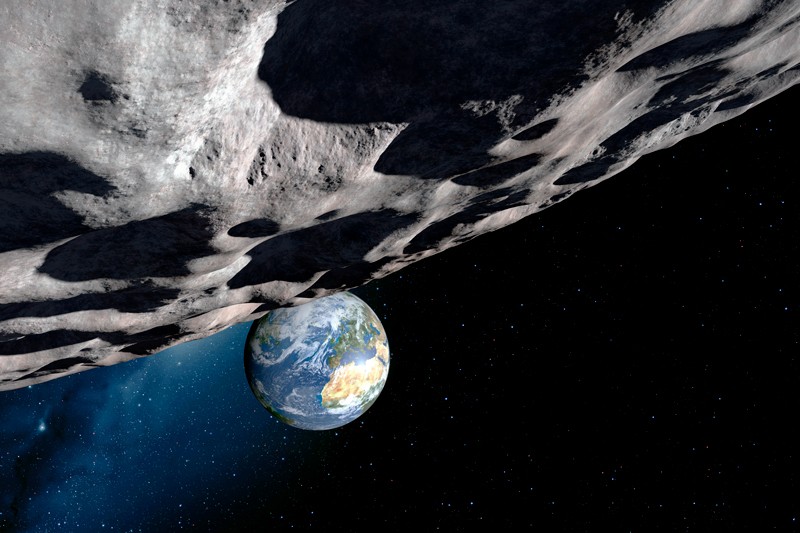
The near-Earth asteroid Apophis (artist’s impression) will fly within 40,000 kilometres of the planet in 2029 — much closer than it came this month.
Credit: Detlev van Ravensway/SPL
A 340-metre-wide space rock named Apophis whizzed safely past Earth on 6 March. The next time it returns, in 2029, won’t be so uneventful: Apophis will come within 40,000 kilometres of the planet, skimming just above the region where some high-flying satellites orbit. It will be the first time that astronomers will be able to watch such a big asteroid pass so close to us.
Last week’s fly-by gave scientists a chance to test the worldwide planetary defence system, in which astronomers quickly assess the chances of an asteroid hitting Earth as they follow its path across the night sky. “It’s a fire drill with a real asteroid,” says Vishnu Reddy, a planetary scientist at the University of Arizona in Tucson who coordinated the observing campaign.
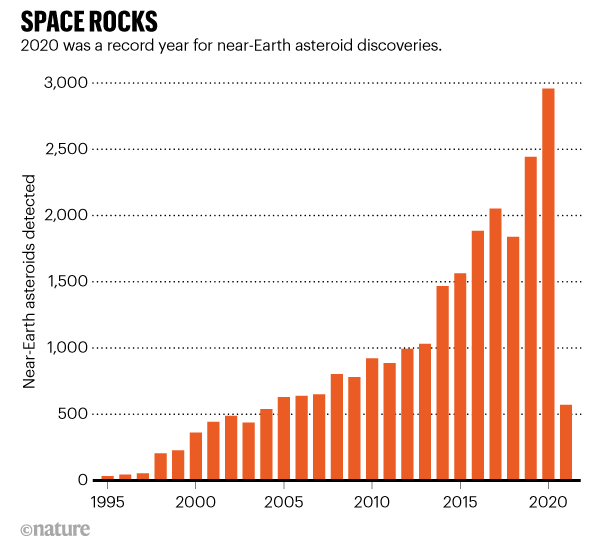
The Apophis fly-by highlights how much astronomers have learnt about near-Earth asteroids — and how much they still have to learn. Since 1998, when NASA kicked off the biggest search for near-Earth asteroids, scientists have detected more than 25,000 of them. And 2020 turned out to be a record year for discoveries. Despite the COVID-19 pandemic interrupting many of the surveys, astronomers catalogued 2,958 previously unknown near-Earth asteroids over the course of the year (see ‘Space rocks’).
Source: NASA Center for Near Earth Object Studies
A large number came from the Catalina Sky Survey, which uses three telescopes in Arizona to hunt for threatening space rocks. Operations closed briefly last spring because of the pandemic, and a wildfire in June caused a longer closure, yet the Catalina survey still discovered 1,548 near-Earth objects. These included a rare ‘minimoon’ named 2020 CD3, a tiny asteroid less than 3 metres in diameter that had been temporarily captured by Earth’s gravity. The minimoon broke away from Earth’s pull last April.
Another batch of discoveries last year — 1,152 — came from the Pan-STARRS survey telescopes in Hawaii. The finds included an object named 2020 SO, which turned out to be not an asteroid, but a leftover rocket booster that had been looping around in space since it helped to launch a NASA mission to the Moon in 1966.
Close calls
Some of the asteroids discovered last year came close to Earth — at least 107 of them passed the planet at a distance less than that of the Moon. Last year’s close shaves included the tiny asteroid 2020 QG, which skimmed just 2,950 kilometres above the Indian Ocean in August. That made it the closest known approach — a record broken just three months later by another small object, 2020 VT4. That one passed less than 400 kilometres from the planet, and wasn’t spotted until 15 hours after it had whizzed by. Had it hit, it would probably have broken apart in Earth’s atmosphere.
All of these discoveries are making astronomers more conscious of the billiard-ball nature of the Solar System, where plenty of asteroids ping around in the space near Earth. The recent push to observe Apophis highlights how astronomers around the world can work together to assess the threat posed by asteroids, says Reddy. “It’s been a huge international effort,” he says, “and a lot of fun.” By the time Apophis comes around again, in eight years’ time, scientists will have an even more detailed census of threatening space rocks.
Obviously, as the name implies, nobody knows who or what was piloting the flying objects, or where they came from, but we may have more information in roughly three months.
Harvard University astrophysicist Avi Loeb doesn’t require any further evidence to arrive at his conclusion that aliens are real, and his confidence comes via the 2017 sighting of an unusual object that was travelling through the solar system.
It was dubbed ʻOumuamua, and shaped “like a 100-metre-long cigar or pancake”, meaning it didn’t resemble any known asteroid or comet, and was seen travelling at a speed “faster than could be explained by our star’s waning gravitational grip alone”.
Mutliple plausible explanations for this were shot down, and then Loeb came along from way out of left field, reports Scientific American:
To Loeb, the most plausible explanation was as obvious as it was sensational: taken together with its possibly pancakelike shape and high reflectivity, ‘Oumuamua’s anomalous acceleration made perfect sense if the object was in fact a light sail—perhaps a derelict from some long-expired galactic culture.
Primed by years spent pondering how we might someday find evidence of cosmic civilizations in the sky’s depths, he became increasingly convinced that, with ‘Oumuamua, the evidence had instead found us.
In late 2018 Loeb and his co-author Shmuel Bialy, a Harvard postdoctoral fellow, published a paper in the Astrophysical Journal Letters arguing that ‘Oumuamua had been nothing less than humanity’s first contact with an artifact of extraterrestrial intelligence.
He outlines his theory and its profound implications: for science, for religion, and for the future of our planet. A mind-bending journey through the furthest reaches of science, space-time, and the human imagination, Extraterrestrial challenges readers to aim for the stars-and to think critically about what’s out there, no matter how strange it seems.
Cue The X-Files music.
There’s a series Netflix should snap up. I wonder if it holds up?
OK, back to Loeb, who has given a score of interviews to drum up interest around his book.
One that keeps things relatively simple is the interview he gave to VICE News, which, if you want to know more about how he arrived at the alien hypothesis, is worth watching:
Watch a Harvard Professor Explain Why He Thinks Aliens Visited Us Already
Most scientists think the first interstellar visitor to our solar system has a natural explanation. Harvard professor Avi Loeb makes the case for an alien origin.
In October 2017, scientists spotted an interstellar object in our solar system for the first time in history. Named ‘Oumuamua after the Hawaiian word for “scout,” the bizarre visitor was detected as it passed by Earth on a rapid trajectory that was consistent with an origin outside our own solar neighborhood.
The discovery of ‘Oumuamua was an immensely exciting milestone, though it was traveling so quickly that observatories were only able to keep their sights on it for a few brief weeks before the object exited the solar system. Those observations revealed that this interstellar interloper had many odd characteristics, such as extreme dimensions and unexpected brightness.
Most scientists think ‘Oumuamua was a space rock from another star system, albeit a rather weird one, but Harvard professor Avi Loeb has proposed that the object could have an artificial origin. In his new book Extraterrestrial: The First Sign of Intelligent Life Beyond Earth, Loeb makes his case that the object could be an alien artifact.
“We don’t really know because we don’t have enough evidence,” Loeb said in a VICE News interview, regarding the exact nature of ‘Oumuamua. However, he speculated that the object could be a piece of “space trash” or a spacecraft not unlike the probes that humans have sent, or are sending, into interstellar space, such as NASA’s Voyager 1, Voyager 2, and New Horizons missions.
Loeb is an outlier in this opinion; the vast majority of the scientific community thinks ‘Oumuamua has a natural origin. Some have proposed that the object could be a splinter of a distant planet, a hunk of frozen hydrogen, or a dusty cloud of debris. The uncertainty over its nature stems from the short observational period that was available to study it, which has left scientists of all persuasions with many more questions than answers.
Fortunately, ‘Oumuamua will not be the last interstellar object to grace our solar system. An interstellar comet named 21/Borisov was discovered in 2019, and next-generation observatories are expected to spot many more of these outsiders, which will help to provide context for all of the mysteries that ‘Oumuamua left in its wake.
“The key to doing science is to get as much evidence as possible because it can guide you,” Loeb said. “Sometimes nature’s imagination is greater than ours.”
The range of types of UFO encounters is wide, and for the most part they tend to inspire awe and wonder as to what could be behind it all. Yet, in some cases this awe turns to dread and even terror, as it seems that not all UFO phenomena are friendly in nature. Within the annals of UFO incidents there are some that inspire dread and a definite sense of foreboding, and one of these is certainly the time aliens apparently invaded a small island in Brazil.
Beginning in the spring of 1977 a very strange and ominous phenomenon began at a little known place called Colares Island, in the remote Brazilian region of Pará. Frightened locals began to report an intense amount of UFO activity in the skies, describing all manner of luminous spheres, glowing orbs, balls of fire, saucers, cigar shaped metallic objects, and more, but what really stood out was how aggressive these objects seemed to be. There were numerous reports that these unidentified objects were actively chasing and attacking people, shooting vivid thin rays of light that would leave injuries such as burns or holes in the skin, as well as other instances when they were reported as approaching to actually suck blood from victims. In many cases the beams projected were described as being “always sharply defined, directed with perfect precision towards any target – houses, people, boats, trees, even the Brazilian Air Force’s helicopters deployed over the island during the investigations.”
Some of the accounts were quite spectacular, as with a boat full of fishermen near Ilha dos Caranguejos who would claim that an intense ball of light had positioned itself over their boat and fired off beams at them, burning several of them and even supposedly killing a man. Another such such frightening report would come from a local man named Carlos Cardoso de Paula, who says one evening an orb of light entered his room and tried to get blood from him. He says of his surreal experience:
Everybody else was asleep. I was just still having my last smoke when suddenly a ball of fire entered our house up near the ridgepole of the gable. It started shooting round and round the room, and then finally came right close to my hammock. It ran up my right leg as far as the knee (without touching my skin). I watched with much curiosity as it then moved across to the other leg. Then I started to feel feeble and sleepy. My cigarette fell from my hand and I came to and let out a yell. The fireball quickly vanished and everybody woke up. I think it had been searching for a vein in my body but didn’t manage to do so. As its brightness grew, I felt a sort of heat coming from it.
Many of the people targeted by these mysterious lights described a wide range of negative physical injuries and effects, such as fainting, nausea, tremors, migraines, giddiness, shortness of breath, muscle weakness, burns, anemia, bruising, blistering, perforations in the skin, paralysis, searing pain, and blood loss. In fact, terrified residents were so convinced that the lights were trying to suck their blood that the phenomena were being called the Chupa-Chupa, or “sucker suckers.” In the meantime, hospitals were soon experiencing a deluge of people claiming to have been attacked by the UFOs. Also odd was that many of the patients were found to indeed be missing blood, and their blood tests also showed certain anomalies common to all of them such as anemia and dehydration, and it was all quite baffling for medical personnel. One local doctor Wellaide Cecim Carvalho would explain of these patients:
All of them had suffered lesions to the face or the thoracic area. The lesions began with intense reddening of the skin in the affected area. The injuries varied in extension. First it started with an intense reddishness in the hit area, known as hiperemia. Later, the skin of the affected region started to fall (alopecia) and days later the skin peeled off. Later the hair would fall out and the skin would turn black. There was no pain, only a slight warmth. One also noticed small puncture marks in the skin. The victims were men and women of varying ages, without any pattern. With the increase of hurt people, I started to give more attention each time in the existing injuries. I saw things that do not exist in my medical books.
In most of these inexplicable cases, the strange symptoms would linger for days or even weeks, requiring hospitalization, and others would not recover at all, with some deaths even reported. In the meantime, reports kept flooding in nightly, increasing in intensity as the months went on, until by August of that year it is estimated that thousands of people all over the island had either seen or been chased or assaulted by the mystery UFOs, which seemed to always come from the north and in some cases were described as detaching from a “mother ship” or even coming from below the waters of Marajo Bay. People were in a hysteria, afraid to go out at night and huddling into large groups where they sought safety in numbers. Some people would light bonfires or launch armed patrols in an effort to scare the Chupa-Chupas away, and it was eerily quiet on the streets, as noise was thought to lure the hungry UFOs in. One local mayor would say of the tense situation:
Yes, indeed I can tell you, there wasn’t a moment of peace. The people were terrified by that “Chupa-Chupa” affair. I even managed to see one of the injured victims myself – Dona Mirota, a lady who was receiving medical treatment at the Health Clinic. The people were terrified because this beam of night light had already assaulted several people. The whole community was packed in only three houses, praying, sometimes singing some religious songs!
There were even reports of people apparently seeing the actual occupants of these craft, who were apparently quite hostile. One local resident named Claudomira Paixao claimed to have had just such an encounter after waking one evening to find everything bathed in a greenish glow, which would steadily become red. It was at that point that she realized it was a beam being directed right at her, and she then saw something very weird indeed, of which she says:
In one of these days, after midnight, I woke up because of a strong flash, a sort of focused bright green light ray that came down from the top roof to my left chest. I tried to shout, but my voice did not function. I felt an exquisite heat… Later, that beam of light diminished and I saw that I was burnt. I could see a creature, like a man, wearing a jumpsuit just like a dive suit. He pointed it at me, and the object shone three times, striking my chest during the three occasions, almost in the same place, it was hot, it wounded me, it seemed that I had needles pierced at all three points. I was terrified, I could not move my legs! It was hot, and it hurt. It was like a needle stick. My health never came back to be the same since that night.
Of course, considering that these reports and the panic they caused were becoming national news it was only a matter of time before the military would be drawn to this remote locale. In late October of 1977, the Brazilian Air Force would launch an investigation under Captain Uyrange Bolivar Soares Nogueira de Hollanda Lima, which would take it even further into the realm of the bizarre. They would investigate the injuries of the victims, gain eyewitness accounts, and even collect a good amount of purported photographic evidence of the phenomena. Even weirder is that during the military presence on the island it would be alleged that that even the Air Force would come under attack by the lights, one such incident of which one resident Sra. Alba Câmara Vilhena would say:
On one occasion some people saw one of the craft. It was round, and all luminous. Just at that moment, a helicopter of the F.A.B. (Brazilian Air Force) was flying quite near to our house. Then we saw the UFO direct a very powerful beam on to the helicopter, obliging it to land on the São Pedro Airfield. That happened at about 8.00 pm one evening. The helicopters that appeared from time to time, bringing materials and personnel, attempted to chase the UFOs but without much success. Indeed, on the contrary, it was the UFOs that chased them!
The military would do its study and then pack up and leave in January of 1978 without offering the populace any sort of explanation, and labelling the whole investigation as classified. At the time there seemed to be some efforts to explain it all away as weather balloons or atmospheric phenomena, but this was obviously not really bought by the people who claimed to have been attacked by the craft and left with injuries. There seemed to have been some cover-up going on, and making this all the more sinister was that Captain Hollanda would turn up dead three months later, allegedly by suicide, although no further details were given, making some wonder if this was really a suicide or not. After 1978 the incidents would die down, but not stop with sporadic accounts coming in throughout the decades since. What was going on here? It is all so spectacular and dramatic that one is left to wonder just what all of this entails. Were these actual UFOs, and if so what did they want and why did they attack people? Was there a government cover-up? Or was this all just mass hysteria and seeing things? Without a doubt, the “Cloares Invasion” remains a very harrowing, and yet remarkably obscure case of the darker side of UFO encounters.
Mysterious Alien Woman Arrival On Brazilian Island & Beginning Of UFO Sightings In 1970s
The second country with the most UFO sightings and alien encounters after the US is Brazil. Very few of us know about the “Operation Saucer” also known as Operação Prato carried out by the Brazilian Air Force under the command of Colonel Uyrangê Hollanda to investigate the series of UFO sightings that happened in the mid-1970s that included attacks by light rays. Before the beginning of all these, a mysterious woman arrived at Ilha do Meio, situated in the Brazilian State of Pará.
Researcher Vitorio Peret recalled that in 1975, a woman named Elizabeth Quimine Berger arrived in Urumajó, now Augusto Corrêa. Her intention was to purchase lands on the Island of Meio, located 200 km from the city. She was a white blonde with blue eyes. The woman claimed to be a divorcee and a fashion designer by profession. Interestingly, according to locals, she was very short, only 132 cm. She was born in Switzerland, had an English passport, and was a resident of Paris.
Researcher Vitorio Peret was involved in Operation Saucer when the Brazilian Army learned facts related to extraterrestrials in the 70s
There was one boatman named João Olaya, who could carry travelers across the island. She got acquainted with him and asked him to take her to the island where she offered the locals to sell their lands to her in exchange for good cash. At first, the locals had no intention to sell their properties to some strange foreign woman. But later, she offered them a huge amount of money and bought plots on the island. Soon, she purchased all other properties near to her previous purchases. Although she became the owner of many lands, the mysterious woman used to spend very little time there as she was mostly out of the island.
Ilha do Meio via Google maps
In some time, the local fishermen and other people started spotting strange lights over the island, and this sparked a rumor that the woman was an extraterrestrial. Some fishermen reported seeing her taking a group of white people with blond hair (around 40-50) to the island. She also used to buy large quantities of fish (around 400 kg of fish) every month from the local fishermen.
Illustration of Ilha do Meio report sightings of UFOs
According to the reports, the locals saw a white ball of lights that looked like “small moons” that landed on the island. What’s more, at the time when the UFO sightings began in the area, Berger was reportedly seen going out in the middle of the night. Some boatman who had access to traveling to the island once followed her and saw her walking on the water without any clothes. The woman became popular among the locals after such details. Some of them even complained to the police about it.
She was questioned by the police three times but was always released as they had never found any strong evidence against her related to the strange light phenomenon. Colonel Uyrangê Hollanda became aware of the strange resident and suspected that she had been feeding guerrillas, as they said that she regularly was seen with dozens of men.
Photographs of bright lights in the sky, taken by officials during Operation Saucer
Only when she was on the island, strange cylindrical lights and objects, looking like probes, appeared and evolved at night. The colonel searched her place and was surprised. The house had no windows, no doors, no dishes, no furniture. Just a bed and two chairs, Peret said.
Peret recalled that an American arrived on the island in 1975 when there were already reports of the phenomena that affected the North and Northeast regions of Brazil. Some people were hit by beams of light, including that caused burns. This American claimed to be a commercial pilot who joined NASA and appeared on Mosqueiro Island amid evidence of extraterrestrial activities in the area.
“His neighbors on the island reported that he had very modern equipment for the time and in relation to what was in the region, such as a structure for radio communication that did not even exist in Belém, and even a notebook, something unthinkable for the time. his was the fastest in the region and he never bought anything on the island. Not even a loaf. Twice a week, he went out on a speedboat and came back with groceries,” said Peret.
Peret was suspicious of the NASA interference in Operation Saucer because when the room of that man was searched, his walls were full of formulas, and images of space and rockets were found on the site where his house was. He died on the island in 1982.
Meanwhile, when Berger was arrested the third time, she was escorted by four policemen but vanished soon after she asked to go to the bathroom. It is shocking that she could disappear from the bathroom which had only one door and a small window.
According to Ufologist Moacyr de Mendonça de Uchôa, she was seen dressed as a nurse in Los Angeles 1985/1986 Earthquakes, helping the wounded. Interpol tried to track her but failed. Later, she was seen in South Korea. Later, the police found out that her passport fake, and Elisabeth Queminet Berger was a Swiss woman who died in 1937.
It is one of the unsolved mysteries that still astonishes people. There is a theory that she was either an extraterrestrial or a time traveler who traveled to Earth for some business but had to go due to too much interference by the Brazilian officials.
The Prophet Mohammed described seeing it, 17th century astronomer Cassini studied it, and now Danish scientists working for NASA say they’ve cracked the mystery of ‘false dawns’ and it’s down to Martian dust leaking into space.
Also known as ‘zodiac light’, the false dawn phenomenon is a band of light that appears just after sunset and is at its brightest for people living in the northern hemisphere in March and April. In the southern hemisphere, the effect is most notable after sunset in the late summer and brightest before sunrise.
Scientists had thought it was caused by dust in space that came from asteroids and comets as it was illuminated and reflected by the Sun. Now, Danish researchers who designed the navigational system on NASA’s Juno mission to Jupiter say the dust particles actually hail originally from Mars.
The team from the Technical University of Denmark had designed and placed four cameras to be used to navigate the Juno orbiter for its launch in August 2011. The craft has been orbiting Jupiter since 2016.
While traveling to the gas giant, the orbiter passed through a dust storm - but only now have the researchers had a chance to analyze the findings. The dust particles hit Juno with force but were too small to be initially picked up on the cameras.
Professor John Leif Jorgensen, who co-authored a study in the scientific journal of Geophysical Research published online on Tuesday, told TV2 that there were so many small objects, it looked as if someone had shaken a tablecloth full of bread crumbs out the window. His team found at least 23,000 pieces when they analyzed the recordings.
The team calculated that because of where the material hit Juno along its journey to Jupiter, it had to be dust escaping from the gravitational field of the red planet.
If you’ve ever rolled out of bed before dawn – or rolled home at that time – and were surprised to see the sky lit up in a strange way without any hint of the sun creeping up over the horizon, you were most likely witnessing an appropriately named phenomena known as a “false dawn.” If the light looks triangular, you’re not hallucinating (OK, you might be, but that’s your problem) – that’s the shape it takes. And if you’re afraid to tell anyone else because they might think you’re crazy, they probably already do – but you’re in good company … the ‘false dawn’ has been reported pre-Columbian Mesoamericans, astronomers as early as the 1600s and even the prophet Muhammed. They all asked the same question you probably did: “What IS that?” Good news – unlike them, you’re about to find out … and it’s not of this Earth.
“The Zodiacal light is sunlight reflected by dust in the inner solar system. Variations in the Zodiacal light with ecliptic latitude reveal discrete bands of dust orbiting near the ecliptic plane. The Juno spacecraft, in transit from earth to Jupiter, recorded a sufficient number of impacts with this dust to characterize their distribution in space for the first time.”
Juno
In a new study published in the journal Geophysical Research Letters, Danish astronomers led by Professor John Leif Jørgensen from the Technical University of Denmark dug deeper into photographs taken in 2016 by advanced Danish cameras onboard the Juno spacecraft as it approached Jupiter. That’s when Juno unexpectedly encountered a dust storm which was invisible to the cameras but hit Juno with such force that they knocked particles off of the surface of the craft. And not just a few – a count by Jørgensen’s team found at least 23,000 small pieces.
The dust itself was not a surprise – there is an elliptical plane of dust throughout the solar system, as the study notes. And it has been speculated that the ‘false dawn’ phenomena – called Zodiacal light by astronomers – was caused by this dust reflecting sunlight. However, Juno gave the astronomers the first chance to identify where the dust came from – and the answer shocked them
“The radial distribution of the dust suggests a primary source of dust with the orbital elements (inclination and eccentricity) of Mars, scattered into a secondary population at higher inclination to the ecliptic.”
Up until now, astronomers speculated that this dust came from asteroids and comets traveling through the solar system. In fact, the cameras were on Juno to look at asteroids, not dust. Once they knew what it was, they realized the distribution matched the dust around Mars – another planetary mystery, as dust can’t escape the gravitational field of Earth because the atmosphere traps it. Mars has a thin, dry atmosphere and its gravitational field is very weak, but the team can’t explain how so much of its dust escapes – especially to Earth where it helps create false dawns in the spring in the Northern Hemisphere and in the late fall in the Southern Hemisphere.
“The IDP environment recorded by Juno on its journey to Jupiter has potentially significant implications for the design and qualification of space flight hardware as well as mission design.”
While the ‘false dawn’ discovery was interesting, the team was concerned about the impact of the interplanetary dust particles (IDP) from Mars on Juno – the reason why they could see it. Juno was solar-powered, but its solar array was strong enough to survive the impacts. Next generation solar-powered deep space crafts will have ultra‐thin, flexible solar arrays. Will they survive?
There’s something to ponder during your next false dawn.
David Wilcock: Ancient Lost Knowledge... The Earth's Cycle and Hidden Meanings
David Wilcock: Ancient Lost Knowledge… The Earth’s Cycle and Hidden Meanings
David Wilcock maps out the three 3rd density cycles which have shaped the history of intelligent life on Earth. The first cycle, with Lemuria, degraded as many different off-world cultures did not integrate well. Thus, this first cycle was a failure. The second cycle came and went quietly with few ascensions. As we approach the end of the third cycle, are we doomed to repeat the mistakes that have locked humanity in 3rd density? David examines these cycles in association with Atlantis and ancient texts from around the world.
Meer van UFO'S of UAP'S, ASTRONOMIE, RUIMTEVAART, ARCHEOLOGIE, OUDHEIDKUNDE, SF-SNUFJES EN ANDERE ESOTERISCHE WETENSCHAPPEN - DE ALLERLAATSTE NIEUWTJES


 There Should be About 7 Interstellar Objects Passing Through the Inner Solar System Every Year