Ontdek de Fascinerende Wereld van UFO's en UAP's: Jouw Bron voor Onthullende Informatie!
Ben jij ook gefascineerd door het onbekende? Wil je meer weten over UFO's en UAP's, niet alleen in België, maar over de hele wereld? Dan ben je op de juiste plek!
België: Het Kloppend Hart van UFO-onderzoek
In België is BUFON (Belgisch UFO-Netwerk) dé autoriteit op het gebied van UFO-onderzoek. Voor betrouwbare en objectieve informatie over deze intrigerende fenomenen, bezoek je zeker onze Facebook-pagina en deze blog. Maar dat is nog niet alles! Ontdek ook het Belgisch UFO-meldpunt en Caelestia, twee organisaties die diepgaand onderzoek verrichten, al zijn ze soms kritisch of sceptisch.
Nederland: Een Schat aan Informatie
Voor onze Nederlandse buren is er de schitterende website www.ufowijzer.nl, beheerd door Paul Harmans. Deze site biedt een schat aan informatie en artikelen die je niet wilt missen!
Internationaal: MUFON - De Wereldwijde Autoriteit
Neem ook een kijkje bij MUFON (Mutual UFO Network Inc.), een gerenommeerde Amerikaanse UFO-vereniging met afdelingen in de VS en wereldwijd. MUFON is toegewijd aan de wetenschappelijke en analytische studie van het UFO-fenomeen, en hun maandelijkse tijdschrift, The MUFON UFO-Journal, is een must-read voor elke UFO-enthousiasteling. Bezoek hun website op www.mufon.com voor meer informatie.
Samenwerking en Toekomstvisie
Sinds 1 februari 2020 is Pieter niet alleen ex-president van BUFON, maar ook de voormalige nationale directeur van MUFON in Vlaanderen en Nederland. Dit creëert een sterke samenwerking met de Franse MUFON Reseau MUFON/EUROP, wat ons in staat stelt om nog meer waardevolle inzichten te delen.
Let op: Nepprofielen en Nieuwe Groeperingen
Pas op voor een nieuwe groepering die zich ook BUFON noemt, maar geen enkele connectie heeft met onze gevestigde organisatie. Hoewel zij de naam geregistreerd hebben, kunnen ze het rijke verleden en de expertise van onze groep niet evenaren. We wensen hen veel succes, maar we blijven de autoriteit in UFO-onderzoek!
Blijf Op De Hoogte!
Wil jij de laatste nieuwtjes over UFO's, ruimtevaart, archeologie, en meer? Volg ons dan en duik samen met ons in de fascinerende wereld van het onbekende! Sluit je aan bij de gemeenschap van nieuwsgierige geesten die net als jij verlangen naar antwoorden en avonturen in de sterren!
Heb je vragen of wil je meer weten? Aarzel dan niet om contact met ons op te nemen! Samen ontrafelen we het mysterie van de lucht en daarbuiten.
Donderdag 23 juni 2022
Explore - From Space to Sound
Explore - From Space to Sound
Ever wondered what the music of the spheres would sound like? Hubble brings us cosmic sights, but these astronomical marvels can be experienced with other senses as well. Through data sonification, the same digital data that gets translated into images is transformed into sound.
Elements of the image, like brightness and position, are assigned pitches and volumes. Each translation below begins on the left side of the image and moves to the right. No sound can travel in space, but sonifications provide a new way of experiencing and conceptualizing data. Sonifications allow the audience, including blind and visually impaired communities, to “listen” to astronomical images and explore their data.
NGC 1300
The majestic barred spiral galaxy NGC 1300’s arms hold blue clusters of young stars, pink clouds of star formation, and dark lanes of dust. NGC 1300 is considered to be prototypical of barred spiral galaxies. Barred spirals differ from normal spiral galaxies in that the arms of the galaxy do not spiral all the way into the center, but are connected to the two ends of a straight bar of stars containing the nucleus at its center. In this image, blue and red supergiant stars, star clusters, and star-forming regions are well resolved by Hubble across the spiral arms, and dust lanes trace out fine structures in the disk and bar. Numerous more distant galaxies are visible in the background, and are seen even through the densest regions of NGC 1300.
To represent this image with sound, scientists assigned louder volume to brighter light. Light farther from the center is pitched higher as a counterclockwise radar scans across the galaxy. NGC 1300 resides nearly 70 million light-years away in the constellation Eridanus.
Credits: Image: NASA, ESA, and The Hubble Heritage Team (STScI/AURA); Acknowledgment: P. Knezek (WIYN); Sonification: SYSTEM Sounds (M. Russo, A. Santaguida)
Studied by scientists for decades, the black hole in Messier 87 (M87) gained celebrity status after the first release from the Event Horizon Telescope (EHT) project in 2019. This sonification does not feature the EHT data, but rather looks at data from other telescopes that observed M87 on much wider scales at roughly the same time. This image of a jet emerging from the nucleus of M87 contains three panels that feature: X-rays from the Chandra X-ray Observatory, visible light from Hubble, and radio waves from the Atacama Large Millimeter Array in Chile. The brightest region of the image is where the black hole is found, and the structure ejecting from it is the jet, produced by material falling onto the black hole. The sonification scans across the three-tiered image, with each wavelength mapped to a different range of audible tones. Radio waves are mapped to the lowest tones, visible data to medium tones, and X-rays to the highest tones. The brightest part of the image corresponds to the loudest portion of the sonification, which is where astronomers find the 6.5-billion solar mass black hole.
Credits: X-ray (Chandra): NASA/CXC/SAO; Optical (Hubble): NASA/ESA/STScI; Radio (ALMA): ESO/NAOJ/NRAO; Sonification: NASA/CXC/SAO/K.Arcand, SYSTEM Sounds (M. Russo, A. Santaguida)
Welcome to one of the most active galaxies in our cosmic neighborhood, NGC 1569. This starburst galaxy creates stars at a rate 100 times faster than in our own galaxy, the Milky Way! Scientists represented information in this Hubble image with sound to create a beautiful sonification with a bottom to top scan. Brighter light is higher pitched and louder. The three color channels used to process this image are each given their own pitch range, with red representing lower pitches, green in medium pitches, and blue in high pitches.
Credits: NASA, ESA, the Hubble Heritage Team (STScI/AURA), and A. Aloisi (STScI/ESA); Sonification: SYSTEM Sounds (M. Russo, A. Santaguida)
Stretching over 100,000 light-years across, the galaxy dubbed Hoag’s Object is slightly larger than our own home galaxy, the Milky Way. The blue ring is dominated by clusters of young, massive stars, while the yellow nucleus consists of mostly older stars. In this sonification, a clockwise radar scan transforms data in the image into sound. Bright light is represented with louder volume, and light farther from the center is higher-pitched.
Credits: NASA and The Hubble Heritage Team (STScI/AURA); Acknowledgment: Ray A. Lucas (STScI/AURA); Sonification: SYSTEM Sounds (M. Russo, A. Santaguida)
In this Hubble image, a super-hot, massive star is blowing an enormous bubble into space. Fittingly named the Bubble Nebula, this beautiful cosmic object is roughly seven light-years across and resides 7,100 light-years from Earth.
Scanned from top to bottom, color is mapped to pitch in this sonification of the nebula. The bright blue of the bubble can be heard as higher pitches; the red and orange regions’ lower pitches are heard most clearly at the beginning on the left and in the top half of the bubble in the middle. Brightness controls the volume and stars are represented by chimes
Credits: NASA, ESA, and the Hubble Heritage Team (STScI/AURA); Sonification: SYSTEM Sounds (M. Russo, A. Santaguida)
This spectacular Hubble image of the Butterfly Nebula shows a colorful view of star death. The "wings" of the butterfly are regions of gas heated to more than 36,000° F (about 20,000° C) that are tearing across space at more than 600,000 miles an hour (966,000 kph)!
Vertical position is mapped to pitch – meaning that light towards the top of the image is higher pitched. The nebula is played on strings and synthetic tones, while stars are represented by digital harp. Brightness controls the volume, and the tilted hourglass orientation of the nebula produces an overall rising motion, with the prominent iron-rich jet producing a quick rise near the center.
Credits: NASA, ESA, and the Hubble SM4 ERO Team; Sonification: SYSTEM Sounds (M. Russo, A. Santaguida)
About 5,000 light-years from Earth, the stunning nebula NGC 2392 formed after the demise of a star like our Sun. The fuzzy outer region of this nebula is a disk of material embellished with a ring of comet-shaped objects, with their tails streaming away from the central, dying star. The inner nebula's bright central region that resembles a ball of twine is really a bubble of material being blown into space by the central star's intense "wind" of high-speed material.
In this sonification, the image is scanned clockwise like a radar. The radius is mapped to pitch, so light farther from the center is higher pitched. The outline of the nebula’s shell can be heard in the rising and falling of pitch, punctuated by its spokes. Brightness controls the volume.
Credits: NASA, Andrew Fruchter and the ERO Team (Sylvia Baggett [STScI], Richard Hook [ST-ECF], Zoltan Levay [STScI]);Sonification: SYSTEM Sounds (M. Russo, A. Santaguida)
The Crab Nebula is the expanding remnant of a supernova that occurred in 1054 A.D. Modern telescopes have captured its enduring engine powered by a quickly spinning neutron star that formed when a massive star collapsed. The combination of rapid rotation and a strong magnetic field generates jets of matter and anti-matter flowing away from its poles, and winds outward from its equator.
For the translation of these data into sound, which pans left to right, each wavelength of light has been paired with a different family of instruments. X-rays from Chandra X-ray Observatory (blue and white) are brass, optical light data from Hubble Space Telescope (purple) are strings, and infrared data from Spitzer (pink) can be heard in the woodwinds. In each case, light received towards the top of the image is played as higher pitched notes and brighter light is played louder.
Credits: NASA/CXC/SAO/K.Arcand; Sonification: SYSTEM Sounds (M. Russo, A. Santaguida)
The center of our Milky Way galaxy houses a massive black hole surrounded by a dense nest of stars and bright clouds. This image combines observations from the Hubble, Chandra, and Spitzer space observatories, and shows energetic regions of starbirth, hundreds of thousands of stars, glowing dust clouds, and intense activity near the galactic core.
The light of objects located towards the top of the image is pitched higher, while the intensity of the light controls the volume. Stars and compact sources are converted to individual notes while extended clouds of gas and dust produce an evolving drone. A crescendo happens at the lower right of the image. This is where the 4-million-solar-mass supermassive black hole at the center of the galaxy resides, and where the clouds of gas and dust are the brightest. For more information on this sonification, visit the Chandra Observatory's sonification page
Credits: X-ray: NASA/CXC/SAO; Optical: NASA/STScI; IR: NASA/JPL-Caltech; Sonification: NASA/CXC/SAO/K. Arcand, M. Russo & A. Santaguida
Another few Weeks of Observations Could Tell us if the Wow! Signal Repeats
In the decades-long search for extraterrestrial intelligence, there has never been confirmed evidence of an alien signal. There have, however, been a few tantalizing mysteries. Perhaps the greatest of these is known as the Wow Signal.
Observed on 15 August 1977 by the Big Ear radio telescope at Ohio University, the signal was a strong, continuous, narrow band radio signal lasting at least 72 seconds. Our knowledge of the signal is limited given the design of Big Ear. Rather than being able to track radio signals like most modern radio telescopes, Big Ear was set to a particular elevation and relied on Earth’s rotation to scan across the sky. The reason the Wow Signal lasts 72 seconds is because that’s how long it took the source to sweep across Big Ear’s observation range.
Big Ear was also a passive telescope. Astronomers simply set it up, and it would run on its own, recording the strength of signals as it goes. Because of this, the signal was only discovered days after the event when recorded observations were reviewed. By the time astronomers could go back to observe the source, the event was long over.
An aerial view of the Big Ear telescope. Credit: Bigear.org / NAAPO
But despite having just one observation, the Wow Signal is considered the strongest candidate for an extraterrestrial signal. Several natural origins have been proposed, but all of them are a bit lacking. The most basic idea is that the signal was of terrestrial origin, perhaps a plane passing overhead, or a radio signal scattered off space debris. But a plane wouldn’t be in range for more than 72 seconds, and there is no record of such a flight. A scattered signal is possible, but the strength of the signal would be unusual, and the frequency of the Wow Signal is within a range where transmissions are restricted.
Several years ago it was proposed that the signal might have been caused by comets that were near the observed area of the sky, but this has since been disproven. While two comets were close to the source location, they weren’t really within the observed range. And comets aren’t likely to emit such a strong narrowband signal.
One interesting aspect of the signal is that its frequency was very close to that of the so-called 21-centimeter line. This is a faint radio emission caused by neutral hydrogen in the universe. Because hydrogen is the most common element in the cosmos, any radio astronomers in the universe would make observations at that frequency. If you wanted to get the attention of alien astronomers, a strong signal near that frequency would be a good way to do it.
Plot of signal strength vs time of the Wow! signal on August 15, 1977. Credit: Maksim Rossomakhin
Given the tantalizing nature of the Wow Signal, there have been several attempts at repeat observations. Several radio telescopes have been aimed at the source over the years, but to no luck. Every observation in that area since has turned up nothing. So what’s an astronomer to do? Well, one way to tackle the problem is to look at what your observations exclude. That’s the idea behind a recent paper on the arxiv.
In this work, the authors argue that the source could be some kind of stochastic repeater. Most repeating sources are periodic. Things like variable stars or fast radio bursts can have a predictable variability. Astronomers have considered this idea, and have made observations that rule out a source with a regular periodicity. A stochastic repeater is a bit different. Rather than having a measurable period, stochastic repeaters repeat somewhat randomly. A good example would be earthquakes. We know where they generally happen, know they will happen again, but predicting exactly when is nigh on impossible. Astrophysical processes can be stochastic in a similar way.
Applying Bayesian statistics to a likely outcome. Credit: Wikipedia
On the face of it, this seems like a silly idea. We’ve never seen the Wow Signal repeat, and we’ve proved it can’t be repeating periodically, but maybe it’s been repeating non-randomly such that we’ve never observed it. It sounds like the authors are arguing that it must be a non-random repeater because we’ve never observed it repeat. But the idea isn’t as silly as it sounds. The authors look at when an unobserved burst might have occurred, and apply Bayesian statistics to calculate when a future burst might occur.
Bayesian statistics is subtle but powerful. It’s more than just calculating the odds of a likely event. It looks at the pattern of events to predict specific outcomes. It takes into account not just how often something has occurred, but how those events changed over time. So, knowing of one burst event, and knowing when other burst events haven’t occurred, the authors calculate the times at which future events are most likely. This is good to know since we can now specifically observe the regions during the most likely event periods. If the Wow Signal was a stochastic repeater, then we’ll likely catch a new event. If we don’t see another event, we can rule out stochastic repeaters as a likely cause.
Mysterious hole on the ocean floor off California's coast
On the sea bottom off the coast of central California lies a vast field of mysterious pockmarks.
The field spans about 1,300 square kilometers and there are approximately 5,200 of these strange pits, which on average measure about 175 meters and 5 m deep.
No one knows how these mystery holes appeared, but they likely made their first appearance 400,000 years ago, according to research.
Here Greg Bishop relates the stories behind some of the most famous individuals claiming to have had ongoing communications with alien entities. They include George Adamski, George Van Tassel, Orfeo Angelucci, George Hunt Williamson, Ruth Norman, Allen Noonan, and Paulina Peavy. The conversation also explores the psychic abilities of Ted Owens and Uri Geller, ostensibly associated with UFOs. The sociological and psychological dimensions of this movement are explored.
Sanxingdui Excavation Pits Reveal Sophisticated Ancient Civilization
An advanced 3,000-year-old Chinese culture, whose existence was not known about until the 1980s, has been further revealed by recent excavations. Apparently, the existence of the highly developed southwest Chinese Sanxingdui civilization, in Sichuan province, was omitted from official records, despite hundreds of years of flourishing development! On Monday last, at the Sanxingdui ruins, Chinese archaeologists reported that they have unearthed a treasure trove of artifacts across six sacrificial pits, as reported by the Chinese state news agency Xinhua.
Unprecedented Finds from the Sanxingdui Civilization Site
Since October 2020, the number of artifacts and relics recovered from the Sanxingdui site have reached an astounding total of 13,000.
In the latest Sanxingdui excavations, an area of 1,834 square meters (19,741 square feet) was explored in the sacrificial pit area. The entire sacrificial pit area covers an area of almost 13,000 square meters (139,931 square feet)!
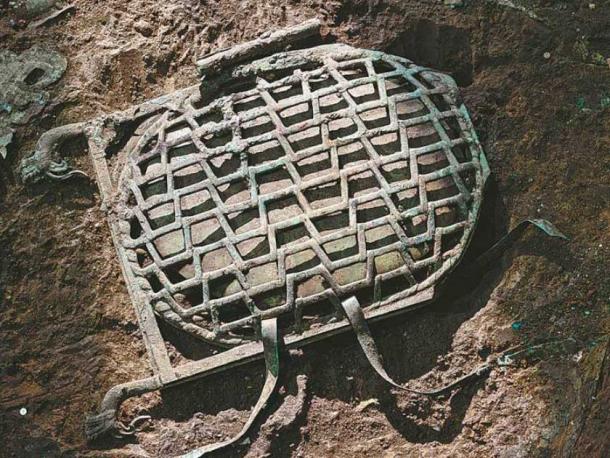
The latest major find was a bronze box decorated with jade. The box had a turtle-back shaped top made of bronze and jade, with turquoise jade embellishments. It also had four dragon-head handles and a few streamers and was likely wrapped in silk and offered as burial sacrifice.
The Sanxingdui bronze chest was described as an “unprecedented discovery” by Li Haichao, a professor at Sichuan University, who is in charge of one of the excavation teams. He added that while the functionality of the vessel remains in doubt “we can assume that ancient people treasured it.”
The latest major find at the Sanxingdui site was a bronze box decorated with jade. The box had a turtle-back shaped top made of bronze and jade, with turquoise jade embellishments. It was likely wrapped in silk and offered as burial sacrifice.
All in all, archaeologists have found 3,155 relatively intact relics at the sacrificial pit site, including 1,238 pieces of bronzeware, 543 gold, and 565 jade artifacts.
A stunning crowned, bronze statue with a snake’s body was also found. According to Ran Honglin, director of the Sanxingdui cultural relics and archaeology research institute, the snake body statue was the most important recent find of all, writes the Global Times .
The bronze statue consists of three distinct sections, with the snake’s body occupying the middle. The figure’s hands are propped up on a bronze drinking vessel called a lei, sitting on a square pedestal. Overall, it is an image of a man with characteristics specific to the Shu kingdom, particularly the protruding eyes. On his head, a vermilion painted zun can be seen, which is the name of another kind of Chinese bronze drinking vessel. Strangely enough, the man’s nose is a pig’s nose.
Such a complex and well-imagined artifact can only point to a vivid imagination and visions of a mystical world by the Sanxingdui people, according to associate professor Zhao Hao from Peking University. He was in charge of the excavations at pit #8, where the pig-nosed bronze statue was found, according to the South China Morning Post .
Among the other recent significant finds, a bronze altar depicting a sacrificial scene that is nearly a meter (3.3 feet) tall was also found in one of the pits. This altar also provides new evidence of the immortal world perspective of the Sanxingdui Shu people. The altar was divided into three sections: the bottom part is a platform featuring beautiful hollow patterns. A muscular person is sitting in the center of each of the three sections from top to bottom.
These nearly 3,000-year-old Sanxingdui bronze heads with gold foil masks look like modern art and say a lot about the advanced metallurgy skills of the Shu people of Sanxingdui.
The Astounding Craftsmanship of Almost-forgotten Sanxingdui
The quality and craftsmanship of the finds at the Sanxingdui ruins indicate a high degree of cultural advancement and sophistication, adding to the mystery and intrigue of this virtually “unknown” civilization.
Sanxingdui, literally meaning Three Star Mound, was accidentally discovered in 1986. And multiple artifact dating has revealed that this civilization existed nearly 3,300 years ago!
The Sanxingdui civilization is viewed to be the same as the ancient kingdom of Shu. In the last two years, Ancient Origins has reported more than once on the finds emerging from this almost-lost Chinese civilization. To date, researchers have remarked on incredible metallurgy skills of the Shu people.
In a recent round of carbon dating on 200 relics, most of the pits were found to be from 1131 to 1012 BC, probably from the late Shang dynasty which lasted from the 16th to the 11th century BC. However, pit number 5 and 6 at the Sanxingdui site were dated to after the Shang dynasty period.
"We had never seen something like these, and we even don't know how to describe their patterns or shapes in short words," Honglin said. "It's also confusing for us to speculate how they were used before further studies. But these artifacts feature a mixture of typical local styles of cultural relics as well as those from the Central China Plains at that time. It demonstrates through close communications, the ancient Shu culture became a key part in early Chinese civilization."
Honglin has also pointed out that these relics are significant for comprehending the diverse nature of Chinese culture and unity in its early days. Full Chinese unification only happened in the Han dynasty (from 202 BC onwards).
The latest round of discoveries at Sanxingdui proves that China was a melting pot of civilizations. For example, the zun drinking vessel motif found on one of the recently unearthed artifacts at Sanxingdui was virtually unknown in the Shu kingdom but dominant in China’s Zhongyuan Central Plains region. Clearly, the zun was a motif borrowed from another civilization as is common in melting pot periods.
Sanxingdui field excavation work is slated for completion in October 2022. However, before that date many more artifacts will be found, telling us more about the roots of the monolithic Chinese civilization we know today.
Top image: Just one of the stunning metal-crafted artifacts recently found in a small portion of the sacrificial pits area at the Sanxingdui site in southwestern China, which had been almost lost to time until the 1980s.
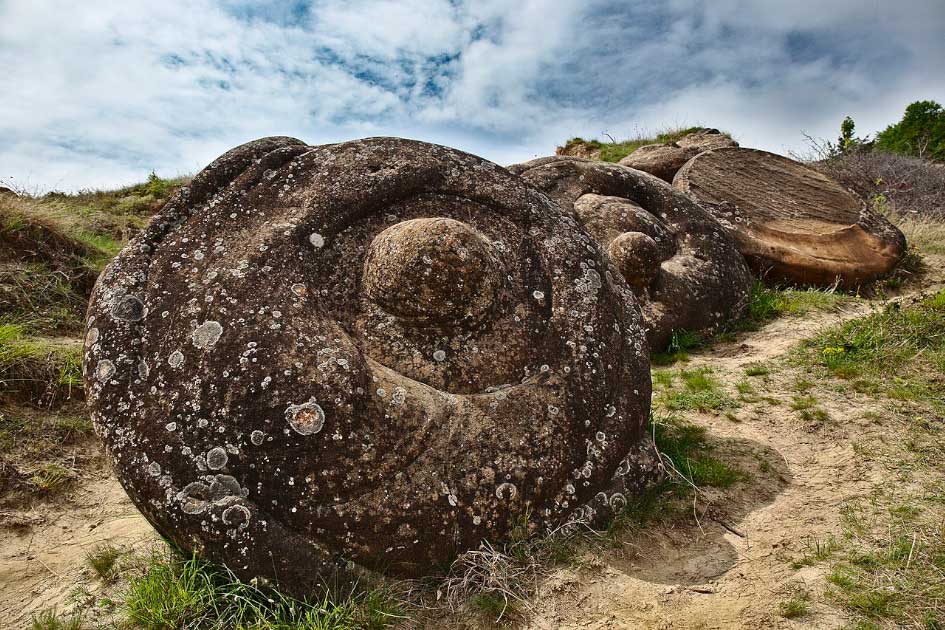
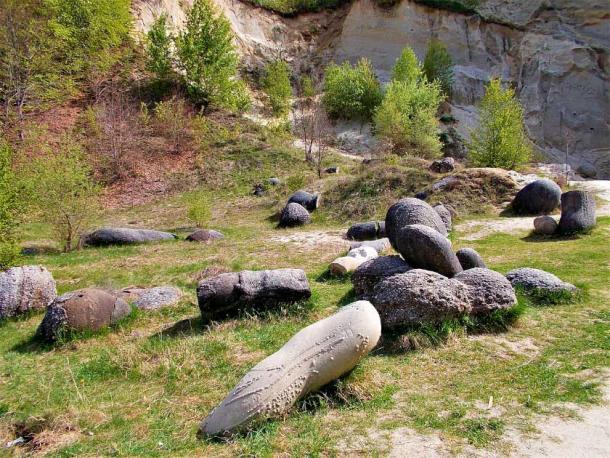
A spectacular example of the mysterious “living and moving” trovants of Romania, a rare and complex geological formation.
Source: Nicu Buculei / CC BY-SA 3.0
Romania’s Enigmatic Trovants: Living Rocks That Grow and Move!
Roughly six million years ago, paleo-earthquakes created a type of geological phenomenon called trovants. They are also known as the stones of Costesti, after their most famous location in Romania, or the “living stones.” Romania’s rare trovants were formed under highly complex circumstances involving seismic shifts, sand sediment in rivers and rain, and lots of time. And the locals of Costesti, Romania consider them to be alive! Having witnessed them grow, expand, and move over generations the Romanians have turned the trovants into local legends and myths. For geologists, trovants have long been a captivating mystery.
What are Trovants?
Trovants are made up of a hard stone center surrounded by sandstone and vary in size from extremely small and pebble-like trovants to stones weighing several tons. Although most trovants are made from sandstone originally, geologists have also found some made from gravel or gritstone. Trovants are an incredibly exciting and unique type of rock formation found within specific areas of Romania.
How are Trovants Formed?
The name trovant is a synonym from the German word “ Sandsteinkonkretionen” meaning “cemented sand,” which explains how these rocks are made. Trovants can only be formed when sand accrues with sandstone deposits around a hard stone core and is cemented by water that has a high concentration of calcium carbonate . This mixture melds together to make these truly fascinating rocks known by locals as the “growing stones.”
What makes them so exciting is that the locals have witnessed them grow and multiply over the years. Due to the elements it takes for these rocks to be formed, they go through an unusual process that makes the rocks appear to grow and move.
These trovants or living and moving geological formations are located near Ulmet in the Buzăului Mountains of Romania.
Do These Strange Geological Formations Really Grow?
The answer is yes, for all intents and purpose they do grow, but trovants grow in a very specific, unique way.
When there is unusually heavy rainfall in the areas trovants are found, they tend to absorb minerals in the rain. Along with the formation of the sand and sandstone deposits already present as the shell of the rock, a chemical reaction begins putting immense pressure on the inside of the trovant.
This pressure from a chemical reaction expands the trovant outwards from its core towards its outer crust, making the rock itself grow. On the surface of the rocks, small deposits are pushed outwards adding to the rockface, leading to their name “the growing stones.”
Overall, trovant growth is a rather slow process and the rate of growth is only around 4-5 centimeters (1.6-2 inches) in 1,000 years.
But over the millions of years the rocks have been “growing” some truly beautiful and particularly interesting formations have been created.
Bubbles or Boulders: What do Trovants Look Like?
Trovants tend to be spherical due to the seismic activity they have experienced and rather smooth individually, not unlike rocks that are shaped by erosion. However, trovants are different because the opposite process is what gives the rocks their unique appearance. The trovants look like bubbles some of them with platforms that look like they are growing from a root system. These trovants tend to be fixed in place.
Over the years geologists have cut open numerous trovants to see what they are made of and found that not unlike tree rings, these geological formations also have multiple ringed, elliptical layers inside. This is because the rocks effectively grow through bubbling outwards when rained on. And under those conditions they pick up further deposits of sand from their area and continue to “grow” slowly over years. This explains the layers the geologists noticed within the trovants they cut open.
Trovants on the move in Romania’s Trovants Museum Natural Reserve?
One other interesting thing about trovants is that they move. I’m sure you have heard of the moving rocks of Death Valley. No? Well, you should look into it if you like mysterious rocks.
Trovants also move, albeit super slowly, but they do travel to some extent. Because these rocks are picking up surrounding sand when it rains, they are effectively changing the landscape and creating a path for themselves that allows them to dislodge and move small distances over significant periods of time.
Tourism and protection
Due to the fascinating nature of trovants they have become a tourist attraction within Romania. To give protection to these rocks “The Trovants Museum Natural Reserve” was created in 2004.
The rocks are so unique that they have come under the protection of UNESCO and have a foundation to protect them from the issues tourism can cause to public archaeological and geological sites. In the past, the locals often sold the smaller trovants to tourists, which in the long term could cause a problem to the trovant landscape.
Although found in over 20 places in Romania some trovants have only been discovered after the sand has been taken from the area for building tombs and making souvenirs.
Conclusion
So trovants aren’t technically alive, this isn’t some horror movie waiting to happen. However, these rocks do change over exceptionally long periods of time.
Although not strictly alive, trovants have some characteristics of something that is living. Although not sentient, these rocks do grow and move.
It is not surprising that they have become the stuff of myth to the locals over the centuries. They are the closest thing to living we can consider rock to be and have been around much longer than any human on the planet, thus having encountered more “life” than all of us!
Top image:A spectacular example of the mysterious “living and moving” trovants of Romania, a rare and complex geological formation.
290 miljoen jaar oude fossielen van bomen gevonden in Brazilië
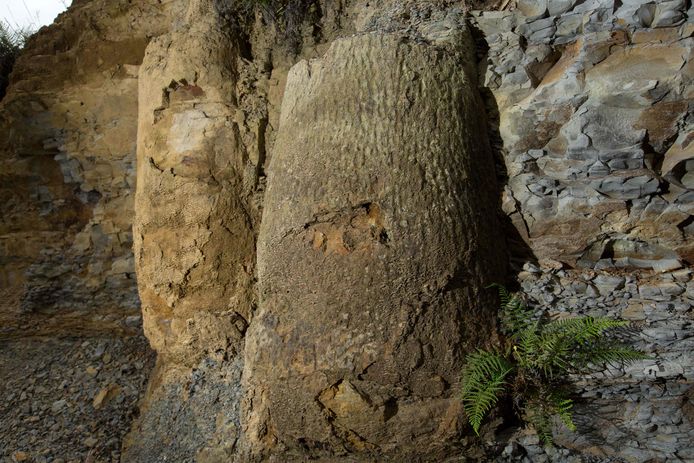
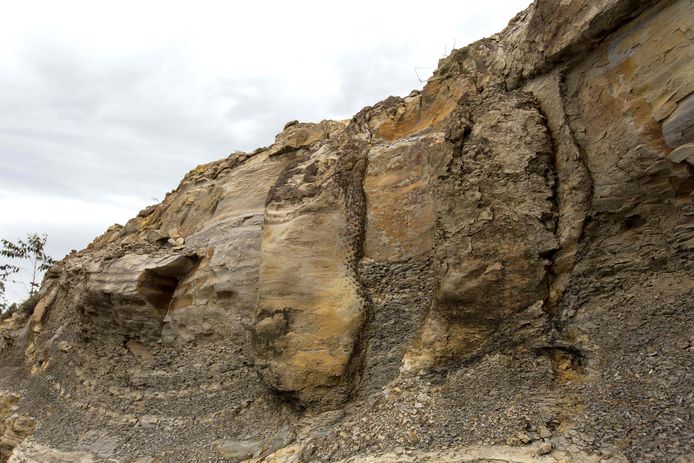
Wetenschappers hebben in de zuidelijke Braziliaanse deelstaat Paraná fossielen van bomen gevonden die naar schatting 290 miljoen jaar oud zijn. Het gaat om een bos van 164 fossielen van een uitgestorven soort lycofyten, die zich voortplanten via sporen.
Het gefossiliseerde bos werd eind 2018 per ongeluk ontdekt, bij een geologisch onderzoek voor de aanleg van een weg naar een fabriek. Daarna startten wetenschappers van de universiteiten van Paraná, Rio Grande do Sul (zuidelijke Braziliaanse deelstaat) en de universiteit van Californië in Davis (VS) een onderzoek. De resultaten van dit onderzoek verschenen in februari in het vaktijdschrift “Palaeogeography, Palaeoclimatology, Palaeoecology”.
Volgens Thammy Mottin, geoloog van de universiteit van Paraná, is het “de belangrijkste ontdekking in het zuidelijke halfrond” wat de hoeveelheid en de staat van de fossielen betreft. Eerder deden wetenschappers al gelijkaardige ontdekkingen in het zuidelijke halfrond, met name in Rio Grande do Sul en in Argentijns Patagonië, maar daar ging het om kleinere vondsten.
De fossielen zijn “een venster naar het verleden” voor het bestuderen van de evolutie van planten. “Deze planten, waarvan de leeftijd op 290 miljoen jaar is geschat, zijn zeer primitieve levensvormen in de geschiedenis”, aldus Mottin. “Het bos, dat groeide in de buurt van waar nu de plaats Ortigueira ligt, toont hoe de eerste planten zich hebben verspreid, hoe ze verdeeld waren in de ruimte en hoe hun interacties waren met andere levensvormen”.
The earliest mention of asteroid mining might be in a story from 1898 titled “Edison’s Conquest of Mars,” by Garrett Serviss. In that story, Martians attack Earth, killing tens of thousands and destroying New York City. Earth retaliates and sends an armada to Mars. While travelling, the armada comes across an asteroid that the Martians are mining. The asteroid is a rubble pile of gold nuggets.
A conversation breaks out among the crew.
“Phew! Won’t we be rich?” exclaimed a voice.
“How are we going to dig it and get it back to earth?” asked another.
“Carry it in your pockets,” said one.
“No need of staking claims here,” remarked another. “There is enough for everybody.”
Their conversation was a prescient hint of things to come.
The idea to mine asteroids incubated in the background until more modern times, when the realities of the space-faring age brought the idea into focus.
Starting in the 2000s, asteroid mining—or at least its potential—gained momentum. Private companies were starting to send spacecraft into Earth orbit, though it was tentative at first. People started to wonder about mining asteroids. Who owned them? How could it be done?
Japan’s Hayabusa brought a sample of asteroid Itokawa back to Earth in 2010. Wealthy people formed companies with the intent to mine asteroids. In 2015, the US Congress passed the Space Act that gave US companies the right to mine asteroids and other bodies in space, though it stopped short of claiming sovereignty over any bodies in space.
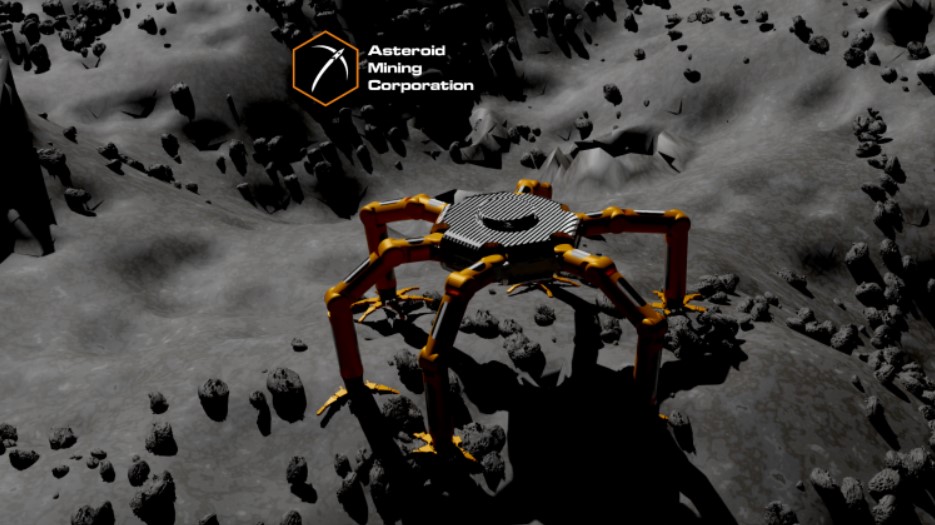
Companies popped up and talked about mining asteroids. They calculated the value of asteroids and started developing robotic explorers to operate on asteroids. One company called the Asteroid Mining Corporation worked with a Japanese University to develop the Space Capable Asteroid Robotic Explorers (SCAR-E).
An illustration of SCAR-E, the Space Capable Asteroid Robotic Explorers being developed by AMC and Tohoku University. Image Credit: AMC/Tohoku University.
The initial fervour of the past couple of decades has died down, but the idea is still there. And as our knowledge of asteroids grows and our space-flight capabilities advance, the idea of asteroid mining will never disappear.
There are a number of reasons why asteroid mining is desirable. The materials in asteroids represent an enormous financial value, which always attracts capitalist activities. Some materials needed for our modern technological devices are in short supply on Earth but are available on asteroids. And mining on Earth carries an environmental burden that mining on dead asteroids doesn’t.
One day asteroid mining might be possible, profitable, or even necessary. We’re not there yet, but scientists are still thinking ahead about how it could work, even though there are a whole host of obstacles in the way. We’re accustomed to spacecraft being launched on far-flung missions into the Solar System. But space travel is complicated, risky, and expensive. Even sampling asteroids is challenging.
Artist concept of NASA’s OSIRIS-REx spacecraft as it readies itself to touch the surface of asteroid Bennu. Asteroid sampling is only in its infancy, so asteroid mining is barely past conception. Credits: NASA/Goddard/University of Arizona
How can asteroid mining be brought out of the realm of science fiction and into reality?
In a new paper, a trio of researchers suggest that some of the obstacles could be overcome by using Mars orbit as a base of operations.
NEO asteroids are not the target. Their number and their value are limited. At some point in our asteroid-mining, space-faring future, we’ll want to develop the asteroids in the main belt between Mars and Jupiter. There’s nearly-immeasurable wealth and resources there. The asteroid Davida alone may be worth 27 quintillion US dollars. One calculation says there’s $100 billion dollars in mineral wealth for every person on Earth in the main asteroid belt.
This poster shows 42 of the largest objects in the asteroid belt, located between Mars and Jupiter (orbits not to scale). The images in the outermost circle of this infographic were captured with the Spectro-Polarimetric High-contrast Exoplanet REsearch (SPHERE) instrument on ESO’s Very Large Telescope. The asteroid sample features 39 objects larger than 100 kilometres in diameter, including 20 larger than 200 kilometres. The poster highlights a few of the objects, including Ceres (the largest asteroid in the belt), Urania (the smallest one imaged), Kalliope (the densest imaged) and Lutetia, which was visited by the European Space Agency’s Rosetta mission. Image Credit: ESO
The main obstacle, according to the paper, is the energy required to reach the main belt and rendezvous with asteroids. In spaceflight that energy is quantified as Delta V, where V is velocity and Delta is change. Launching and maneuvering require changes in delta-v, and those changes require energy. “Most MBAs are energetically too hard to reach with present technology from low Earth orbit. An alternative is to use Mars orbit as a base from which to conduct MBA research, prospecting, and mining.”
Even the easiest-to-reach MBA is difficult to reach from Low Earth Orbit (LEO) because of the delta-v. The Near-Earth Asteroids are much easier to reach in comparison. It requires “… a minimum delta-v ~7 km s-1 to rendezvous from low Earth orbit (LEO) with the easiest to reach MBA, compared with ~4 km s-1 needed for the easiest to reach near-Earth asteroids (NEOs) from low Earth orbit.”
It follows that reaching MBAs is easier if you start from Mars orbit. The delta-v will be far lower. The difference between ~7 km s-1 and ~4 km s-1 might not sound like much, but the fuel requirements scale exponentially with delta-v.
The team wrote some code that allows them to find the delta-v needed to reach and rendezvous with any asteroid in the main belt from either Earth or Mars orbit. For Mars, they use Phobos’ orbit, which is about 9,000 km (5,600 miles) above the planet, and for Earth they used LEO. “We used PARC (Python Asteroid Rendezvous Code) to investigate whether Phobos-like orbits around Mars at altitudes of ~9000 km are more energetically favourable and useful locations from which to dispatch missions to MBAs.”
The short answer is “Yes they are.”
This figure from the paper compares the delta-v needed to reach asteroids from LEO (top) to the delta-v needed to reach asteroids from Mars Phobos Orbit (bottom.) Image Credit: Taylor et al. 2022.
The available mass in the MAB and the MC (Mars Crosser) asteroid populations dwarfs that of the NEO asteroids. So in terms of large-scale delta-v needed to reach more resources, the Phobos Mars Orbit idea wins again. “Most known MBAs + MCs are bigger than the largest NEO, (1036) Ganymed, at ~50 km diameter. Therefore, the accessible mass of MBAs + MCs increases more quickly than an equivalent number of NEOs at a given delta-v requirement.”
This figure from the study shows the distribution of accessible asteroid mass in MBAs + MCs and NEOs from LEO and PMO. Image Credit: Taylor et al. 2022.
In the figure above, the large asteroids Ceres, Pallas, and Vesta skew the results a little. They require a large delta-v to reach, though it’s still lower from PMO than from LEO. “But operationally it is the low delta-v tails that are of particular interest,” the authors write.
The authors point out that for a particular delta-v, more MAB material is accessible from PMO. In fact, it’s not even close. “We find that PMO provides access to ~7 x 10¹⁵ tonnes of material within ?v -1,” they write. Over 99.9% of that material is in MABs and MCs, while the insignificant remainder is in LEOs. On the other hand, “From LEO, only ~3 x 10⁶ tonnes of material are accessible within ?v -1 and are entirely found in NEOs.”
Of course, there’s more to mining MBAs from Mars Phobos Orbit than just the ?v required to get there. The effort to even get equipment to MPO requires fuel and resources and time. The authors acknowledge that, and emphasize that their study is focused on reaching asteroid resources from an already established base. There are all kinds of other variables depending on the mass of the equipment sent to asteroids, where and how it’ll be processed, what will be done with the waste, and where the extracted resources will go.
The Asteroid Psyche is an m-type asteroid, meaning it contains higher proportions of metals like iron and nickel than other classes of asteroids. Its varied surface suggests a dynamic history, which could include metallic eruptions, asteroid-shaking impacts, and a lost rocky mantle. NASA’s Psyche mission should reach Psyche in 2026. Data from that mission will tell us more about the mineral value of asteroids in the MAB. Image Credit: Screenshot courtesy of NASA
One team of researchers can’t answer all these questions. Their paper simply shows how it takes fewer resources to reach the bulk of the Solar System’s asteroidal material from MPO than it does from LEO. Whether or not asteroid mining ever makes sense depends on a whole bunch of factors.
That’s where the Phobos delta-v penalty comes in. It’s the price a spacecraft pays to maneuver in and out of orbit around Mars. The planet’s gravity well extracts its own price.
“Whether the Phobos delta-v penalty is economically disadvantageous depends on the masses to be moved, both of raw and beneficiated (refined) ore, and of mining and processing equipment,” the authors explain. “If the beneficiating equipment is massive then the simplified raw material gathering spacecraft that will undertake the Phobos to asteroid journey may be of significantly lower mass.”
Mining the MAB wouldn’t happen in a vacuum (sorry.) Facilities on Mars would likely be part of the endeavour. Maybe the structural materials in the asteroids, like iron, would be used to manufacture other facilities in the MAB or in Mars orbit. But none of these considerations changes the raw fact that more MAB material is within reach from MPO than from LEO. “We find that there is a far larger population of known asteroids accessible to current technology from Phobos orbit than from low Earth orbit, by a factor of 300 in number and a factor 109 in mass for a delta-v of 4 km s-1,” the paper concludes.
Phobos itself could play an advantageous role, according to the authors.
“Phobos is a convenient site for emplacing massive ore-refining equipment. Phobos has properties that aid in extracting ore from raw asteroid material, as it provides some gravity, an inertial platform, and radiation shielding. Phobos may then serve as a useful forward operating base for the exploration and mining of the Main Belt.”
The ESA’s Mars Express Orbiter captured this image of the Martian moon Phobos. The authors of a new study suggest Phobos could be a base of operations for mining in the asteroid belt. Credits: ESA/DLR/FU Berlin (G. Neukum)
If this idea ever comes to fruition, then it’s likely that Mars itself will be a part of it. “The presence of large-scale operations in Mars orbit may also lead to routine access to Mars’ surface,” they write.
The rest is left to our imaginations. Would human beings lead the mining operation? If so, then Mars could act as a kind of lifeboat in case of problems. Evacuating a damaged mining spacecraft and landing on Mars, where we can extract oxygen, fuel, and water, and store food and other supplies, seems like a natural emergency backup plan.
Or maybe there’d be very little need for flesh and blood humans. Maybe robots could do most of the work. Robotic technology is growing in leaps and bounds and there’s no reason to think it won’t keep advancing.
Asteroid mining is really in-situ resource utilization writ large. If humanity is ever going to expand out into the Solar System, the resources in the MAB will play a role. Only time will reveal exactly what that role is.
Newly Found Black Hole Eats One Earth Per Second! - Mr. Scientific Must Video
Astronomers have detected the fastest-growing black hole. The new supermassive black hole is known as J1144. J1144 is 3 billion times more massive than the sun, it swallows up an Earth-size chunk of matter every second
Sagittarius A* is located at the center of our galaxy, it has a diameter of 44 million kilometers. J1144 is not only 500 times bigger than Sagittarius A*, but also 7,000 times brighter than our entire galaxy.
Astronomers believe that something catastrophic happened long time ago. Perhaps two big galaxies crashed into each other merging the Black holes located at their center. Also funneling a whole lot of material towards it.
New Linda Moulton Howe: Tall White Aliens Are Our Allies & Hybrid Greys & Blonde Nordics
TOPICS: Which E.T.s Claim They Are Closest Genetically to Human Descendants? US Space Force – USS Curtis LeMay – USS Hoyt Vandenberg, “tip of the spear” – USS Roscoe Hillenkoetter – Tall Nordics near Sirius A & Sirius B – Tall White Pales live near 82 G Eridani where numerous earth-like planets reside Inside US Space Force source details interactions with humans Linda’s brother Jim Moulton fallen ill, but recovering at home Highly placed source:
Original greys are very ancient race spanning millions of years Blonde Nordics are oldest race from Sirius B system Tall whites or “tall pales” working with us from “Creech Air Force Base” near Las Vegas, – Working on Security Access Protocols Hybrid greys “Our true allies are the tall whites” “Nordic types claim we humans are their closest descendants” “..directly related” “These 3 et species occupy the majority” “I don’t believe we originated from Earth” “Alliances exist…Eliminating the Trantalod insect..species”
“AI biological cloned Grey are…abducting humans and other species” “Temporal technology..used by Trantaloid species” USS Hoyt Vandenberg stationed in Procyon system USS Roscoe Hillenkoetter investigating radio signal source We have had teleportation since 1971 The main purpose of Apollo was to investigate alien sites
Secrets of The Black Knight Satellite, Its Sending a Signal & Its Been Decoded, Billy Carson via Leak Project
Awesome talk. William, Son of Cars, is such an interesting guy. His genuine enthusiasm and intelligence is really endearing, and his endless energy even gives Rex a run for his money. I gotta see this documentary. One thing confused me though – if it’s been seen to make course corrections on multiple occasions, implying it’s still functioning, then why is it sending signals to where Epsilon Bootes used to be 13000 years ago? Wouldn’t it be updating that star’s location? Or… maybe we’re wrong about our calculations? Richard Wilson
UFO Fleet Over Queens, New York On June 19, 2022, UFO Sighting News.
Date of sighting: June 19, 2022
Location of sighting: Queens, New York, USA Source: MUFON
A person was driving along the southbound in New York when she noticed a fleet of glowing objects in the distance. UFOs do visit New York frequently. For instance on Aug 23, 1974 singer John Lennon and his wife were in the penthouse apartment patio when they noticed some strange lights hovering in place not far off. New York...it attracts all intelligent species...the biggest city in America. Even aliens want to visit.
Scott C. Waring - Taiwan
Eyewitness states:
Traveling over Whitestone bridge southbound, ufo spotted in western sky 6-8 stationary very bright objects in a cluster. The objects would then change formation in the blink of an eye. One object moved diagonally while others stayed stationary.
Black Craft Over Parker, Colorado On June 9, 2022, Video, UFO Sighting News.
Date of sighting: June 9, 2022
Location of sighting: Parker, Colorado, USA Source: MUFON
A person was parked and noticed a black object moving about the sky over Colorado last week. The object was silent and moving about as if it were watching the cars on the road below. Colorado is notorious for its UFO sightings, but 95% of them are of a white sphere craft. This is highly rare in the area. Most UFOs come and go from the Rocky mountain ridges, where there are several entrances to a tunnel that leads to an underground base about 5km below the base of the mountains.
Scott C. Waring - Taiwan
Eyewitness states:
My apologies for the camera shaking. I zoomed in on an iPhone and the sun was in my face so I was pointing my phone not knowing if I was actually capturing anything on camera. This object hovered for minutes before going straight south, then up and down. After another few minutes of hovering, it went straight west at very high speeds.
Strange phenomenon appears in the skies over US and New Zealand
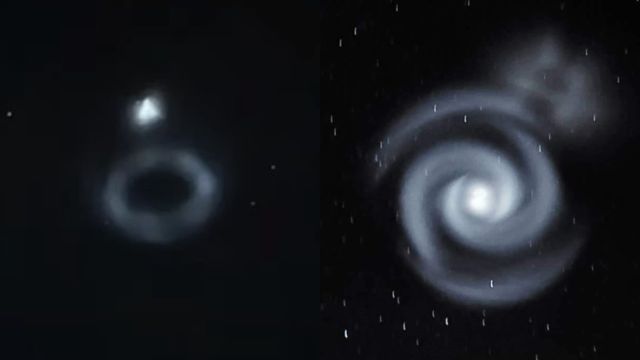
On Sunday morning, June 19th, SpaceX launched a Falcon 9 rocket from Cape Canaveral (0427 UT) carrying a Globalstar communications satellite. Within hours, people around the world started seeing strange things in the sky.
Almost two hours after launch, the upper stage of the Falcon 9 rocket deployed the Globalstar satellite; the smoke ring Wood saw was the "puff" of separation. At the time, the rocket was more than 1100 km high, so people were able to see it across much of North America.
An hour after the smoke ring, things got really strange. Sky watchers in New Zealand saw this:
Image credit: Twinkle Dark Sky Tours.
Photographer Alasdair Burns of Twinkle Dark Sky Tours on Stewart Island said to Spaceweather, "It looked like a beautiful galaxy, it was a very slowly rotating spiral that started small and gradually expanded."
There has been much discussion on the web about a covert payload hitchhiking on this Falcon 9 rocket. Analysts believe that a clandestine satellite may have been released about 10.5 minutes after launch.
Former U.S. government insiders brought together by rock star Tom DeLonge team up to reveal what the government knows about UFOs. This groundbreaking effort is led by Luis “Lue” Elizondo. See more in Season 1, Episode 1, “The UFO Insiders.”
SpaceX launches three Falcon 9 rockets in 36 hours
SpaceX has successfully completed three Falcon 9 launches in just over 36 hours, highlighting the company’s continuous push towards ever-higher launch cadences in 2022.
In February, shortly after a NASA oversight panelist revealed that SpaceX was targeting 52 launches in 2022, CEO Elon Musk confirmed that the company’s goal was for “Falcon [to] launch about once a week” throughout the year. In October 2020, continuing a tradition of extremely ambitious SpaceX launch cadence targets, Musk had also tweeted that “a lot of improvements” would need to be made to achieve his goal of 48 launches – an average of four launches per month – in 2021. Ultimately, SpaceX fell well short of that target, but did set a new annual record of 31 launches in one year, breaking its 2020 record of 26 launches by about 20%. However, perhaps even more important than the new record was the fact that SpaceX was able to complete six launches in four weeks at the end of 2021.
That impressive and unexpected achievement would turn out to be an explicit sign of things to come in 2022.
SpaceX’s successful completion of three launches in 36.5 hours is merely an extension of that feat. In the same four-week period at the end of 2021, SpaceX completed three of those six launches in 69 hours. Two months later, SpaceX did it again, launching three Falcon 9 rockets from all three of its Falcon launch pads in 67 hours.
More importantly, SpaceX has also managed to sustain an average cadence of more than one Falcon launch per week throughout the first half of 2022, completing its 26th launch of the year on June 19th with another two launches planned before the end of the month. SpaceX has actually sustained that cadence for even longer. Beginning on November 24th, 2021, SpaceX has now completed 32 Falcon 9 launches in less than seven months.
The company’s latest hat-trick or triple-header began on Friday, June 17th, when Falcon 9 booster B1060 lifted off at 12:09 pm EDT from SpaceX’s NASA Kennedy Space Center LC-39A pad, helped carry another 53 Starlink V1.5 satellites into space, and became the first Falcon booster to launch and land 13 times. Starlink 4-19 was also SpaceX’s 49th dedicated Starlink launch, SpaceX’s 50th consecutively successful Falcon booster landing, and 100th successful Falcon booster reuse.
Falcon 9 B1060 lifts off for the 13th time.(Richard Angle)
22 hours later, a second Falcon 9 rocket lifted off from SpaceX’s Vandenberg Space Force Base SLC-4E pad at 7:19 am PDT, Saturday, June 18th carrying the first of three SARah radar satellites for Germany and an unspecified number of rideshare payloads. For the third time this year, booster B1071 successfully boosted back to shore and touched down at SLC-4E’s LZ-4 landing pad shortly after liftoff.
Fog made Falcon 9’s SARah-1 launch virtually invisible, but the landing was not. (SpaceX)
Finally, at 12:27 am EDT on Sunday, June 19th, a third Falcon 9 rocket lifted off from SpaceX’s Cape Canaveral Space Force Station LC-40 pad carrying a single spare Globalstar-2 communications satellite and, apparently, several secret rideshare payloads. Falcon 9’s Globalstar launch occurred just over 14 hours after SARah-1, breaking SpaceX’s record time between two orbital launches.
Falcon 9’s 3rd launch in 36 hours.(Richard Angle)
Globalstar FM15 was also SpaceX’s 26th launch of 2022, averaging one launch every 6.5 days in the first half of the year. June isn’t over, however, and SpaceX still has plans to launch Starlink 4-21 on June 25th and the SES-22 geostationary communications satellite on June 28th. If both launches avoid delays, SpaceX will end the first half of 2022 with 28 successful orbital launches. Perhaps even more significantly, after another two launches in the last days of June, SpaceX will have launched 17 times in a single quarter – equivalent to 68 launches per year if sustained for four quarters. In the history of spaceflight, a single rocket family has never successfully launched more than 61 times in one year.
A week after rolling a different ‘test tank’ from its South Texas Starship factory to nearby launch and test facilities, SpaceX has moved a second test tank to the pad.
Hearkening back to a period in 2020 where SpaceX built and tested six different Starship test tanks in a period of six months, the company appears to be preparing to test another batch of tanks in the hopes of qualifying Super Hea
vy booster design changes and clearing the way for a significant upgrade to all Starship tank domes. The sequencing of the latest tank raises some questions, however.
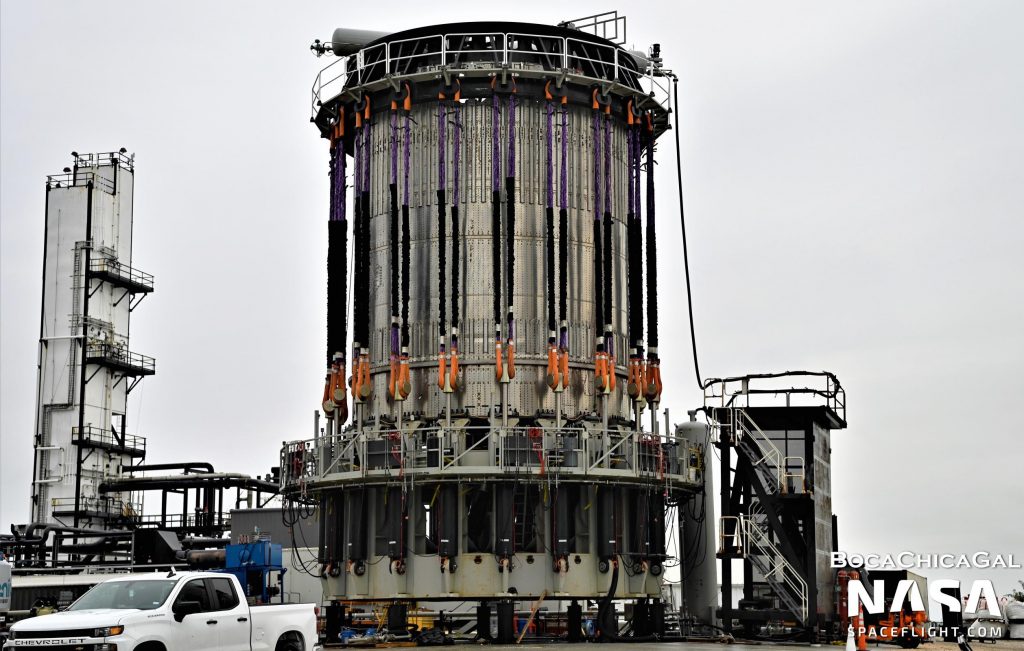
The top of the structural test machine aka “Can Crusher” was lifted onto test tank B7.1 today.
Known unofficially as the “EDOME” tank in reference to a cryptic label on the side of one of its halves, the first new test tank’s purpose is much more cut and dry. While its steel rings appear to be unchanged from current Starship and Super Heavy prototypes, the tank’s two domes share almost nothing in common with the dozens of domes SpaceX has built and tested over the last three years of development. The new domes are much simpler and should be easier to manufacture than the domes SpaceX is familiar with. Thanks to their more spherical shape, they should also be more efficient, allowing future Starship tanks to store a bit more propellant while taking up the same amount of vertical space. SpaceX has yet to begin testing the EDOME tank since its June 8th rollout and does not appear to be much closer to starting 12 days later.
On June 16th, SpaceX rolled a second test tank to the launch site, which eventually joined the EDOME tank at a staging area that used to be a Starship landing pad. Whereas the EDOME tank is more of a generic test article, the second tank – known as B7.1 – is specifically designed to test Super Heavy booster design changes.
B7.1 is a bit like a miniature Super Heavy. Its three-ring top section is mostly similar to the top section of a booster and is reinforced with dozens of external stringers. Oddly, it is missing cutouts for grid fins, and the tank’s forward dome does not have the reaction frame those hypothetical grid fins would anchor to. On the tank’s bottom half, the same stringers are present, and the tank features a new design that squeezes four slightly shorter rings into the same height as three. The Super Heavy thrust dome those rings enclose is also a new design that expands the number of central Raptor engines from 9 to 13.
It’s unsurprising that SpaceX wants to test those significant design changes. SpaceX did technically conduct a similar test in mid-2021 with a test tank known as BN2.1, but that tank featured a thrust dome with room for 9 older Raptors that would have generated about ~1700 tons of thrust. B7.1’s testing will go a step further than BN2.1 and use a structural test stand that should allow SpaceX to simulate the compressive forces Super Heavy boosters might experience in flight, adding another dimension of stress on top of the 13 hydraulic rams that will simultaneously subject the test tank to the equivalent of ~3000 tons (~6.6M lbf) of thrust.
What is surprising, however, is the fact that SpaceX has waited so long to build and test a tank like B7.1. SpaceX has already completed an entire Super Heavy booster (B7) with all the design changes B7.1 is meant will test and recently installed 33 new Raptor 2 engines on that prototype. A second upgraded booster, B8, is also nearly finished. In that sense, B7.1 is quite unusual and feels more like a reluctant afterthought than part of a methodical development process. If B7.1 suffers an unintentional failure during testing, SpaceX could be forced to abandon two nearly-finished Super Heavy boosters, wasting months of assembly and testing and rendering prototypes that are likely worth tens of millions of dollars all but useless.
B2.1 demonstrates how the ‘can crusher’ uses giant ropes and hydraulics to apply immense compressive forces to Starship tank prototypes. (NASASpaceflight – bocachicagal)
The design changes B7.1 is meant to test are not exactly radical, but it’s still unclear why SpaceX has chosen to conduct those tests after building two entire Super Heavy boosters. Earlier on in Starship development, SpaceX regularly used test tanks to qualify significant design changes before applying those changes to full prototypes, limiting the amount of resources that could be wasted on any unproven prototype. Thankfully, Super Heavy Booster 7 may have already completed similar Raptor thrust simulation tests on the same test stand B7.1 was recently installed on, meaning that SpaceX’s confidence may have been well-placed. However, if the first use of the ‘can crusher’ stand on a Super Heavy test tank finds any problems or ends in failure, B7 and B8 could still be easily rendered unusable or incapable of flight, significantly delaying Starship’s first orbital launch attempt.
Lately, SpaceX has been focused on preparing Starship S24 and Super Heavy B7 for static fire tests that could eventually qualify the pair to support the first orbital test flight. It’s not clear if or when SpaceX will be able to set aside time and evacuate Starbase’s busy orbital launch site to test B7.1 or the EDOME tank.
Astronomers Watched a “Near-Sun” Comet Disintegrate as it Flew too Close to the Sun
Comets that venture close to the Sun can transform into something beautiful, but sometimes they encounter incineration if they get too close. Of the various types of comets that orbit close to the Sun, astronomers had never seen the destruction of the type classified as “near-Sun” comets. But thanks to a variety of telescopes on summit of Mauna Kea in Hawai?i, scientists have now captured images of a periodic rocky near-Sun comet breaking apart. They say the disintegration of this comet could help explain the scarcity of such periodic near-Sun comets.
Astronomers have certainly witnessed other types of comets disintegrating in the solar corona. For example, early this year — after putting on a spectacular show — Comet Leonard broke apart after perihelion (its closest point to the Sun) in January, 2022. Comet Leonard was considered a Sun-grazing comet, the most commonly known comets that make close passes of the Sun. The Solar and Heliospheric Observatory (SOHO) spacecraft has detected about 4,000 Sun-grazers since it launched in 1995.
But there are also near-Sun, Sun-skirters and Sun-divers. However, the nomenclature and difference between them all is not clearly defined, says Karl Battams, from the US Naval Research Laboratory in Washington DC. Battams tracks Sun-grazing comets with data from SOHO, particularly those that belong to the ‘Kreutz’ family of comets, named after Heinrich Kreutz, a nineteenth-century astronomer who calculated many of their orbits.
It’s hard to make out, but the dot in the cross-hairs is a comet streaming toward the Sun. This image is from 2015, and the comet is the 3,000th one discovered by SOHO since it was launched. Image: SOHO/ESA/NASA
“There’s no clearly defined separation between what we would classify as a near-Sun versus Sun-grazing comet,” Battams said via email. But he was part of a group of astronomers that drafted some guidelines in a 2018 survey paper.
They proposed clear definitions for comets, based on how close they get to the Sun: near-Sun comets should encompass all objects that come within the orbit of Mercury, about .3 AU. Sunskirters are defined as objects that pass within 33 solar radii of the Sun’s center, equal to half of Mercury’s perihelion distance, and the commonly-used phrase Sun-grazers to be objects that reach perihelion within 3.45 solar radii. Finally, comets with orbits that intersect the solar photosphere are termed Sun-divers.
But, says Battams, the definitions can still be confusing because all Sun-grazing comets are near-Sun comets, but not all near-Sun comets are Sun-grazing comets.
The near-Sun comet that was recently observed while breaking apart, named 323P/SOHO, is a short-period ‘near-Sun’ (but NOT Sun-grazing) comet that experienced a different environment to the Kreutz Sun-grazers.
Near-Sun object 323P/SOHO observed by the Subaru Telescope on December 21, 2020 (left) and CFHT on February 11, 2021 (right). 323P/SOHO on its way to perihelion is seen as a point source in the center of the left image; after the perihelion, the comet has developed a long narrow tail as seen in the right image. (Credit: Subaru Telescope/CFHT/Man-To Hui/David Tholen)
“Instead of plunging deep into the corona and getting ripped apart or vaporized,” said Battams, “it has been getting slowly baked with repeated passes in a toasty environment, leading to a slow-but-steady demise. Probably many of the non-Kreutz that SOHO sees are undergoing this process, but this is the first time we’ve been able to definitely say that this is what’s happening.”
Battams, who was not involved in the ground-based study of this comet, said this first- of-its-kind observations for this class of comet is an important result for telling us about the evolution and end stage of comets in that “near-Sun” region. An outstanding question is that there are far fewer observed near-Sun objects than models show there should be.
Comet 323P/SOHO was discovered in 1999 with SOHO, and is a relatively small comet, with a nucleus of only about 172 meters (560 ft) in diameter. It rotates quickly, at 0.522 hr., the most rapid rotation of every known comet in the Solar System. Its orbital period is just over four years, so it has come close to the Sun several times. Plus, on its final pass, it came perilously close to the Sun, with a perihelion of only 0.04 astronomical units. While a larger comet could perhaps survive such a close approach, smaller comets that come that close are skirting with eventual doom.
Because comets like 323P pass so close to the Sun, they are difficult to spot and observe. To study this object, an international group of astronomers from Macau, the US, Germany, Taiwan, and Canada used multiple telescopes including the Subaru Telescope, the Canada France Hawaii Telescope (CFHT), the Gemini North telescope, Lowell’s Discovery Telescope, as well as the Hubble Space Telescope.
Convex shape model of the nucleus of 323P/SOHO in three orthogonal views. The left and middle panels show edge-on views of the nucleus that are 90° apart from each other, with its spin axis (the Z-axis) pointing upwards, while the nucleus is viewed in a pole-on configuration (the line of sight along the negative Z direction) in the right panel. Credit:Man-To Hui/David Tholen)
Observations with the Surbaru telescope, which has a wide field of view, marked the first time 323P/SOHO was captured by a ground-based telescope. With this data, the researchers were able to better constrain the orbit, and they knew where to point the other telescopes when 323P/SOHO started to move away from the Sun again.
To their surprise the researchers found that 323P/SOHO had changed remarkably during perihelion. In the Subaru Telescope data, 323P/SOHO was just a dot.
“However, in our post-perihelion observations, it developed a long, narrow tail mimicking a disintegrating cometary debris cloud,” the authors wrote in their paper.
They also found that 323P/SOHO’s color is unlike anything else in the Solar System. They says observations of other near-Sun comets are needed to see if they also share these traits.
The researchers said they believe that the intense radiation from the Sun caused parts of the comet to break off due to thermal fracturing, similar to how ice cubes crack when you pour a hot drink over them. This mass loss mechanism could help explain what happens to near-Sun comets and why there are so few of them.
The researchers hope to spot whatever remains of the comet on its next perihelion in order to learn more about it. But it will likely plunge into the Sun on one of the next close passes.
Meer van UFO'S of UAP'S, ASTRONOMIE, RUIMTEVAART, ARCHEOLOGIE, OUDHEIDKUNDE, SF-SNUFJES EN ANDERE ESOTERISCHE WETENSCHAPPEN - DE ALLERLAATSTE NIEUWTJES


 Explore - From Space to Sound










.jpg)
(45).jpg)