Ontdek de Fascinerende Wereld van UFO's en UAP's: Jouw Bron voor Onthullende Informatie!
Ben jij ook gefascineerd door het onbekende? Wil je meer weten over UFO's en UAP's, niet alleen in België, maar over de hele wereld? Dan ben je op de juiste plek!
België: Het Kloppend Hart van UFO-onderzoek
In België is BUFON (Belgisch UFO-Netwerk) dé autoriteit op het gebied van UFO-onderzoek. Voor betrouwbare en objectieve informatie over deze intrigerende fenomenen, bezoek je zeker onze Facebook-pagina en deze blog. Maar dat is nog niet alles! Ontdek ook het Belgisch UFO-meldpunt en Caelestia, twee organisaties die diepgaand onderzoek verrichten, al zijn ze soms kritisch of sceptisch.
Nederland: Een Schat aan Informatie
Voor onze Nederlandse buren is er de schitterende website www.ufowijzer.nl, beheerd door Paul Harmans. Deze site biedt een schat aan informatie en artikelen die je niet wilt missen!
Internationaal: MUFON - De Wereldwijde Autoriteit
Neem ook een kijkje bij MUFON (Mutual UFO Network Inc.), een gerenommeerde Amerikaanse UFO-vereniging met afdelingen in de VS en wereldwijd. MUFON is toegewijd aan de wetenschappelijke en analytische studie van het UFO-fenomeen, en hun maandelijkse tijdschrift, The MUFON UFO-Journal, is een must-read voor elke UFO-enthousiasteling. Bezoek hun website op www.mufon.com voor meer informatie.
Samenwerking en Toekomstvisie
Sinds 1 februari 2020 is Pieter niet alleen ex-president van BUFON, maar ook de voormalige nationale directeur van MUFON in Vlaanderen en Nederland. Dit creëert een sterke samenwerking met de Franse MUFON Reseau MUFON/EUROP, wat ons in staat stelt om nog meer waardevolle inzichten te delen.
Let op: Nepprofielen en Nieuwe Groeperingen
Pas op voor een nieuwe groepering die zich ook BUFON noemt, maar geen enkele connectie heeft met onze gevestigde organisatie. Hoewel zij de naam geregistreerd hebben, kunnen ze het rijke verleden en de expertise van onze groep niet evenaren. We wensen hen veel succes, maar we blijven de autoriteit in UFO-onderzoek!
Blijf Op De Hoogte!
Wil jij de laatste nieuwtjes over UFO's, ruimtevaart, archeologie, en meer? Volg ons dan en duik samen met ons in de fascinerende wereld van het onbekende! Sluit je aan bij de gemeenschap van nieuwsgierige geesten die net als jij verlangen naar antwoorden en avonturen in de sterren!
Heb je vragen of wil je meer weten? Aarzel dan niet om contact met ons op te nemen! Samen ontrafelen we het mysterie van de lucht en daarbuiten.
Dinsdag 8 november 2022
LATEST ASTRONOMY VIDEOS
LATEST ASTRONOMY VIDEOS
Cosmic Wonders
The Bubble Nebula: Winds & Radiation from a Massive Star
Crab Nebula, probably the most intensely studied bright nebula, in the constellation Taurus, about 6,500 light-years from Earth.
Roughly 10 light-years in diameter, it is assumed to be the remnant of a supernova observed by Chinese and other astronomers first on July 4, 1054.
The supernova was visible in daylight for 23 and at night for almost 2 years.
In 1758 it was the first object listed (M1) in Charles Messier’s catalog of nebulous objects.
It acquired its name, suggested by its form, in the mid-19th century. In 1921 it was discovered to be still expanding; the present rate is about 1,100 km (700 miles) per second.
The Crab is one of the few astronomical objects from which radiation has been detected over the entire measurable spectrum, from radio waves through infrared and visible wavelengths to ultraviolet, X-rays, and gamma rays.
In the late 1960s the Crab pulsar ,thought to be the collapsed remnant of the supernova was discovered near the centre of the nebula.
The pulsar, which flashes in radio, visible, X-ray, and gamma-ray wavelengths at 30 times per second, provides the energy that allows the nebula to glow.
Classes of nebulae
All nebulae observed in the Milky Way Galaxy are forms of interstellar matter—namely, the gas between the stars that is almost always accompanied by solid grains of cosmic dust
Their appearance differs widely, depending not only on the temperature and density of the material observed but also on how the material is spatially situated with respect to the observer.
Their chemical composition, however, is fairly uniform; it corresponds to the composition of the universe in general in that approximately 90 percent of the constituent atoms are hydrogen and nearly all the rest are helium, with oxygen, carbon, neon, nitrogen, and the other elements together making up about two atoms per thousand.
On the basis of appearance, nebulae can be divided into two broad classes: dark nebulae and bright nebulae.
Dark nebulae appear as irregularly shaped black patches in the sky and blot out the light of the stars that lie beyond them.
Bright nebulae appear as faintly luminous glowing surfaces; they either emit their own light or reflect the light of nearby stars.
Dark nebulae are very dense and cold molecular clouds; they contain about half of all interstellar material.
Bright nebulae are comparatively dense clouds of gas within the diffuse interstellar medium. They have several subclasses: (1) reflection nebulae, (2) H II regions, (3) diffuse ionized gas, (4) planetary nebulae, and (5) supernova remnants.
Reflection nebulae reflect the light of a nearby star from their constituent dust grains. The gas of reflection nebulae is cold, and such objects would be seen as dark nebulae if it were not for the nearby light source.H II regions are clouds of hydrogen ionized (separated into positive H+ ions and free electrons) by a neighboring hot star.
Diffuse ionized gas, so pervasive among the nebular clouds, is a major component of the Galaxy.
Planetary nebulae are ejected from stars that are dying but are not massive enough to become supernovae—namely, red giant stars.
Supernova remnants are the clouds of gas expanding at speeds of hundreds or even thousands of kilometres per second from comparatively recent explosions of massive stars.
If a supernova remnant is younger than a few thousand years, it may be assumed that the gas in the nebula was mostly ejected by the exploded star.
Otherwise, the nebula would consist chiefly of interstellar gas that has been swept up by the expanding remnant of older objects.
Meet The Solar Ring: A Proposed Spacecraft That Will Have a Panoramic View of the Sun
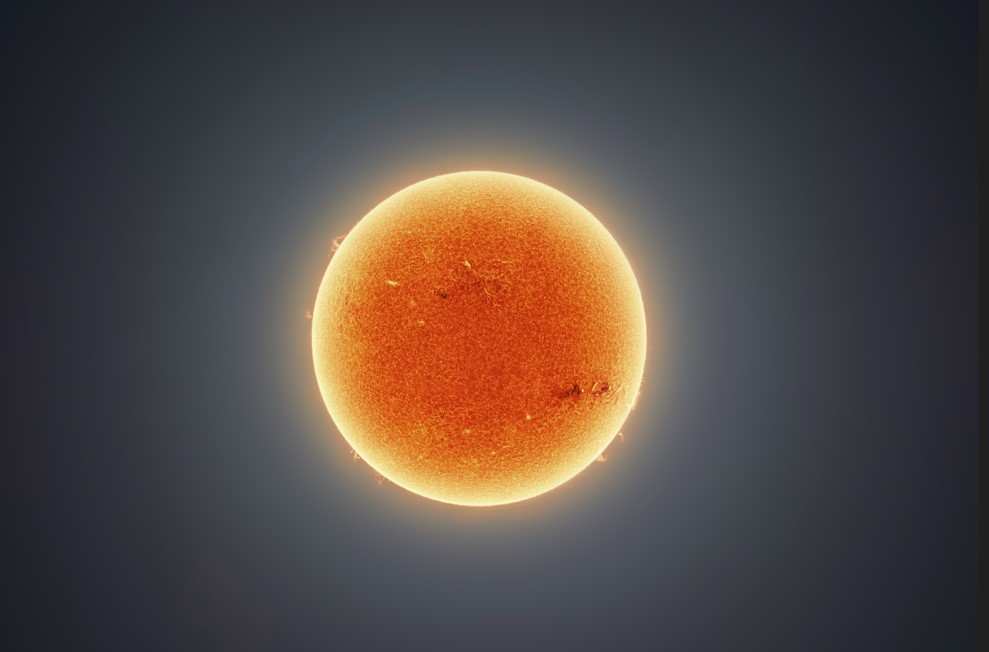
The Sun is active, dynamic, and occasionally violent. Unfortunately our view of the Sun is limited to a small handful of orbiting satellites and ground-based observatories. The Solar Ring is new proposal that hopes to radically change that picture by launching a trio of satellites around the Sun to give continuous, 360° panoramic images in real time. The observatory could revolutionize our understanding of our parent star.
A 300 megapixel photo of our Sun, taken by using a specially modified telescope, compiling over 150,000 individual images.
Credit and copyright: Andrew McCarthy.
Despite being the closest star to us, we still lack an understanding of most of the physics of the Sun. While we understand the general picture – that the Sun is powered by fusion reactions, and the energy circulates its way to the surface and is released in the form of radiation – we don’t know the details. In particular, we do not understand mysteries like the origins of the 11-year sunspot cycle, the incredibly high temperature of the Sun’s corona, or how solar flares and coronal mass ejections take place.
Our information about the Sun is limited because we can only capture snapshots of it here and there with orbiting satellites and ground-based observatories. Oftentimes interesting activities start on the surface of the Sun facing away from any of our observatories, and by the time we catch it hours later we don’t know how it started. And other times we can see a process begin to ramp up but then miss its full evolution as the Sun rotates away from our view.
To solve this a team of astronomers propose the Solar Ring. The Solar Ring is a fleet of three spacecraft that will all orbit around the Sun. They will be separated from each other by 120° and be fitted with identical instruments. This way their overlapping fields of view will make it impossible for us to miss anything happening on the surface.
Among the many kinds of observations that the astronomers behind the Solar Ring hope to perform, one involves a technique called reverberation mapping. By carefully mapping the velocity of gas on the surface of the Sun, they can measure vibrations and pulsations. These kinds of “sunquakes” give astronomers rich information about what is happening within deeper layers, much like how earthquakes tell us about the core and mantle of the Earth.
The Solar Ring will also be able to catch the beginnings of a solar flare or an eruption event no matter where it happens on the Sun, providing even more early warning for space weather. These kinds of plasma storms can disrupt satellites and even affect electrical systems on the Earth’s surface, so the more warning the better.
The astronomers behind the Solar Ring hope that with more complete coverage of the Sun that we will be able to develop a better understanding of the complex nature of its surface, its interior, and its corona.
Video shared by littlespacemochi on reddit, recorded on November 5, 2022 in southern Brazil. Source (video) : www.pordosolguaiba.com.br
RELATED
Scientists Just Dropped A Camera In The Deepest Hole In Antarctica & Found A Terrifying Secret
Our planet is home to millions of old and new species, some of which we have discovered while the rest are yet to be found. Scientists and even common people discover new species every single day, on land and in the vast oceans covering a major part of Earth. Despite the continuous efforts and expeditions, these oceans remain the least explored part of the planet.
Right now, we know very little about what lies in the darkest corners of these immense water bodies. Especially the water that has remained covered by thick ice sheets for hundreds of thousands of years in Antarctica. But in the last few decades, experts have drilled holes in this ice and attempted to get a glimpse of what lies underneath. And what they've found is mind boggling to say the least. The icy continent is home to unique ecosystems that are poorly understood and creatures we have never seen before. But this wasn't always the case, previously researchers thought it was just a lifeless wasteland and only a few micrograms were able to survive in the harsh climate of Antarctica. But now, with powerful drilling methods, researchers have been able to penetrate the icy surface and explore the waters below it. One such exploratory effort conducted by the Ice Cube Observatory brought them face to face with a massive and frightening creature that could be an entirely new species
RELATED
Massive, Unidentified Objects 300 Miles Wide Have Been Detected By NASA
Massive, Unidentified Objects 300 Miles Wide Have Been Detected By NASA. Astronomers have spent decades looking for objects from outside our own solar system. What would essentially be interstellar visitors from an alien star system. To no avail. But it is when all hope seems to be lost, that some of the most marvelous things happen. It was something like that for these astronomers. After decades of finding absolutely nothing, something completely unexpected happened. Two objects arrived, at once.
12 Strangest Mysteries Of The Ancient Egyptian Sphinx
The Sphinx of Egypt is one of the most famous ancient sculptures in the world, but how much do you really know about it? In fact, how much does anybody really know about it? There’s far more to the Sphinx than most people imagine, and you probably won’t even realise how much about it you don’t know until you’ve finished watching this video!
James Webb Telescope's SHOCKING Discovery of City Lights!
NASA researchers had no idea what they were getting into when they launched the cutting-edge James Webb space telescope on December 25, 2021, from the Guiana Space Center. Astronomers had hoped to find signs of extraterrestrial life in the atmospheres of far-off planets and galaxies, but little did they know that the first images from the JWST would completely change how we view the universe.
JWST has just revolutionized our way of exploring the universe. The president Joe Biden has called JWST a new window into the history of our universe.
NASA Administrator Bill Nelson had claimed that humanity would soon have access to a completely new perspective on the universe that is unlike anything we have ever seen. Today, we'll examine the data the James Webb Space Telescope has given us to determine whether the strange light is a sign of life or the possibility of life on a planet orbiting an entirely different star. But before we continue please spare some time to subscribe to the channel and press the bell icon.
From ECETI Ranch to Pentagon – The Most intriguing UFO Cases & Hotspots (Coast to Coast AM)
Craig Campobasso, a filmmaker and UFO expert, discussed some of the most interesting cases and places where people have spotted the mysterious objects. One particular area is the ECETI Ranch in Trout Lake, Washington. According to Campobasso, people have reported seeing multiple UFOs flying in the sky at night.
He also talked about the strange activity that occurred at the Bradshaw Ranch near the town of Sedona, Arizona. The area has been described as a portal for various creatures and entities. He also talked about the legend of an alien named Valiant Thor, who allegedly stayed in the Pentagon’s underground apartment during the 1950s.
He also talked about cases such as the Aurora, Texas, and the Shag Harbour Incident. During the show’s last half-hour, George interviewed Brad Steiger, a paranormal author and investigator.
USS Nimitz Witness Tells His Story For The First Time
The USS Nimitz is known for its infamous “Tic-Tac Incident”. However, ten years prior, Kevin Thomas witnessed an entirely different and more significant event.
This is Probably the Last Picture we’ll see From InSight on Mars
It’s almost time to say goodbye to another Martian friend. Plenty of missions to the Red Planet have gone silent for the last time, some after many successful years of data collection and some after a brief free-fall as a fireball. We will soon add another Martian explorer to that ever-growing list – InSight might have sent its final image home.
The image itself is similar to hundreds of others that the probe has been sending back to Earth for the last four years. In the center of the image is the craft’s seismometer, which has been focusing on collecting data about Marquakes and whose data has been used in dozens of papers. In this image, though, it is noticeably covered in the fine red dust that blankets everything on the Red Planet.
That dust is also covering InSight’s power source. Its solar panels have been getting collectively more covered and, therefore, able to provide less and less power to the lander itself. Unfortunately, InSight also had either the good or bad luck to be located in an area of general calm for Martian dust devils. While they might be difficult for the instruments themselves to handle while they are happening, dust devils also do a remarkably good job at cleaning off solar panels covered in dust.
In another recent image, InSight uses its robotic arms to scratch away some of the regolith surrounding it. Credit – NASA / JPL-Caltech
Another fact in the growing dust accumulation was a design decision the InSight team made back at the project’s inception. Various methods can help remove dust from solar panels. Compressed air and wiper blades similar to those found on cars are two of the most common. But InSight’s engineers decided not to include any such system on their probe.
Making those kinds of decisions is one of the hardest parts of engineering. Dust removal systems add weight, and therefore cost more money, both in their design and also in the cost of getting them to Mars. Launch costs still take up a significant amount of a project’s budget, so every system is scrutinized to see whether it is truly necessary. In the case of Insight, the team determined a dust removal system was not.
There was one crucial factor that led to that decision – the relatively short expected mission duration of Insight as a whole. It was only planned to last one Earth year. It ended up lasting four.
JPL video discussing the accomplishments of InSight. Credit – NASA JPL YouTube Channel
So even without a dust removal system, the mission outperformed its original expectations. And Insight has solidified its standing as one of the most prolific Martian probes up to this point. Its data has been the basis of dozens of papers, and we have come to understand everything from the presence (or lack therefore) of liquid water around the lander to finding some magma in the same area.
Such data would make any scientific team proud, and those involved with Insight have had plenty of time to see the end coming. UT first reported on its power problems back in May. But, while it has continued going strong for the last six months, it might soon be time to say a final goodbye to the Interior Exploration using Seismic Investigations, Geodesy, and Heat Transport mission. It will not be forgotten and might even be brought back to life someday when humans finally tread on the landscape that so far only it has seen.
Want a Sneak Peek From NASA’s Lucy Mission? Here are Some Photos it Took of the Moon During its Flyby
We reported a few weeks ago about an Earth gravity assist flyby for the Lucy mission. Around the same as the spacecraft took a dip closer to Earth than the ISS, it took some fantastic pictures of our nearest neighbor – the Moon. After some processing, those pictures are available for inspection or gawking, as the case may be.
Lucy took three separate pictures, ranging from 6.5 hours to about 8 hours after it flew past the Earth. Each was taken with the Lucy LOng Range Reconnaissance Imager, also called L’LORRI. And they are absolutely breathtaking.
The first covers an area of the Moon known as the Lunar Central Highlands, which is most likely well-known to most lunar observers. Located near the “center of the last quarter of the moon,” according to a NASA press release, there are some prominent craters in the 1200 sq km image, including Arzachel, with its characteristic sub-impacts, near the center of the picture.
“Terminator Mosaic” image captured by Lucy. Credit – NASA/Goddard/SwRI/JHU-APL/Tod R. Lauer (NOIRLab)
L’LORRI next turned its camera to take a composite shot of the whole Moon from top to bottom. Called a “terminator mosaic” in the press release, it shows a combination of the other two main images Lucy took on its journey past. Some craters clearly stand out, such as Copernicus, which shows as much brighter than other craters on the left side of the image.
Finally, Lucy took an image of Mare Imbrium, which includes the Apollo 15 landing site, in the bottom right corner. Other features include the Apennine mountains, named after the famous range in Italy, and Mare Imbrium itself, which is an ancient impact basin. The image covers a total of 1000 sq km.
To create these images, Lucy mission scientists used several compositing techniques, including stitching together multiple images – the terminator image and the Central Highlands image were crafted from five and ten individual images, respectively. The Mare Imbrium image, on the other hand, was captured with only one.
Image of Mare Imbrium on the Moon, as taken by Lucy. Credit – NASA/Goddard/SwRI/JHU-APL/Tod R. Lauer (NOIRLab)
Scaling is essential to understand in the images as well – each pixel of the image constitutes between 1.1 km and 1.3 km of area. Also, each image was taken while Lucy was between 230,000 to 260,000 km away from the Moon.
These images are a testament both to how close Lucy got to the Moon, the sensitivity of its instruments, and the technical aptitude of its science team. Taking pictures of the Moon isn’t Lucy’s first priority, but it will still be a few years before it reaches its final destination – the Trojan asteroids on the outer edges of the Jupiter system. In the meantime, we might be able to see even more amazing pictures, either of Earth or the Moon, as Lucy still has two more close encounter gravity assists in its near future.
The Perfect Tidal Tail Connects These two Galaxies Seen by Hubble
Sometimes it’s tempting to imagine a supernatural hand behind the arrangement of celestial bodies. But the Universe is big, huge even, and nature’s flow presents many fascinations.
So it is with the galactic triplet Arp 248, an arrangement of interacting galaxies that’s both visually and scientifically fascinating.
Arp 248 is a trio of small interacting galaxies around 200 million light-years away in the constellation Virgo. The image shows two of Arp 248’s galaxies flanking another smaller unrelated galaxy in the background. The galaxies are connected by a stream of stars, gas, and dust, created as the galaxies tug on one another gravitationally.
Arp 248 is also known as Wild’s Triplet, after astronomer Paul Wild (1923–2008), who studied the trio in the early 1950s. Image Credit: By Credit Line and Copyright Adam Block/Mount Lemmon SkyCenter/University of Arizona – http://www.caelumobservatory.com/gallery/wilds.shtml, CC BY-SA 3.0 us, https://commons.wikimedia.org/w/index.php?curid=20540032
Astronomers call the streams “tidal tails.” When dusty and gas-rich galaxies like Arp 248 merge, the merger frequently forms tails. The tails are made of material from the outer spiral disks of the merging galaxies, and they host active star formation indicated by blue.
The top image is from an observing project examining two collections of unusual galaxies involving Halton Arp. Arp was an American astronomer who created the Atlas of Peculiar Galaxies in 1966. The Atlas contains 338 galaxies chosen for their unusual shapes. He intended for it to highlight the variety of peculiar structures that galaxies take.
The Universe is full of galaxies whose shape has been altered by interactions and mergers. This is Centaurus A, an elliptical galaxy that merged with a spiral galaxy around 300 million years ago. The merger created the dark dust lane, which is not usually a feature of elliptical galaxies. The merger also formed a spiral of gases in Centaurus A’s core. Image Credit: ESA
We now know these galaxies take such strange shapes because they’re interacting and potentially merging. Arp disagreed with that interpretation and said the unusual forms were due to ejections. But in any case, Arp realized astronomers weren’t very knowledgeable about how galaxies change over time, and he intended that astronomers could use his Atlas to study galaxy evolution.
The second collection of unusual galaxies in the observing project is called A Catalogue of Southern Peculiar Galaxies and Associations. It was published in 1987 by Arp and his colleague Barry Madore. The Catalogue contains 25 different varieties of objects, including galaxies with tails.
Astronomers have expanded their knowledge of interacting galaxies, and galaxy mergers since the Atlas and the Catalogue were published. We know that mergers play an important role in galaxy evolution.
Interacting galaxies are found throughout the Universe, sometimes as dramatic collisions that trigger bursts of star formation, on other occasions as stealthy mergers that result in new galaxies. These images are from a series of 59 images of colliding galaxies released from archived raw images from the NASA/ESA Hubble Space Telescope. Image Credit: NASA/ESA/STScI
As astronomers study interacting galaxies in more detail, they’re uncovering a new class of objects that they call “intergalactic star-forming objects” (ISFOs.) ISFOs are a broad class of objects that capture the different types that form when galaxies interact. ISFOs can form due to tidal interactions and the ram-sweeping of material from interacting galaxies. They can also develop due to the inflow of gas and dust to the tails and through a combination of all these processes. ISFOs can range in mass from super star clusters to what astronomers call “tidal dwarf galaxies” (TDGs.) A 2012 paper based on the Sloan Digital Sky Survey estimated that about 6% of dwarf galaxies could have tidal origins.
This image shows NGC7252, a peculiar galaxy formed from a merger between two galaxies over a billion years ago. The white circles highlight the locations of two tidal dwarf galaxies (TDGs) forming in the tails. Researchers think that about 6% of dwarf galaxies are TDGs. Image Credit: Frederic Bournaud/Pierre-Alain Duc.
ISFOs are often bound gravitationally to the galaxies, but how many stay bound and for how long is still an open question. Sometimes material from the tidal streams will flow back into the galaxies, triggering more star formation. The leftover material from all this interaction enriches the interstellar medium with dust and metals.
Astronomers now think that about 25% of galaxies are currently merging with other galaxies. Even more of them are interacting gravitationally, if not merging, according to the Harvard Center for Astrophysics. Our Milky Way galaxy is evidence of this, as it cannibalized gas and even stars from the Magellanic Clouds and the Sagittarius Dwarf Galaxy. And in several billions of years, the Milky Way and the Andromeda Galaxy will merge. Who knows what behemoth might arise from that event?
This series of photo illustrations shows the predicted merger between our Milky Way galaxy and the neighbouring Andromeda galaxy. Credit: NASA; ESA; Z. Levay and R. van der Marel, STScI; T. Hallas, and A. Mellinger
How supermassive black holes (SMBHs) grow so massive is also an open area of inquiry. Astrophysicists know that mergers are part of SMBH’s growth process, but there’s a lot they don’t know.
The James Webb Space Telescope captured this image of Stephan’s Quintet. It’s a fivesome of galaxies, four interacting, and the fifth is only visually associated. The left-most galaxy is NGC7320 which is well in the foreground of the other four. The image is a composite of almost 1,000 separate images. The four stars and their interactions produce tails, regions of active star formation, glittering regions containing millions of young stars, and shock waves from NGC 7318B as it bullies its way through the cluster. NGC 7318B is the top one in the pair of galaxies closest together. Image Credit: NASA, ESA, CSA, and STScI
The Hubble Space Telescope’s Advanced Camera for Surveys (ACS) scrutinized this assortment of unusual interacting galaxies to lay the groundwork for more detailed study in the future. The Hubble will examine some of these targets with its other instruments, and so will the James Webb Space Telescope and ALMA. Observing time on these telescopes is always in high demand, so this project will help astronomers allocate time better.
Hubble saw Multiple Light Echoes Reflecting off Rings of Dust From a Supernova Explosion
When stars reach the end of their life cycle, they experience gravitational collapse at their centers and explode in a fiery burst (a supernova). This causes them to shed their outer layers and sends an intense burst of light and high-energy short-wavelength radiation (like X-rays and gamma-rays) out in all directions. This process also creates cosmic rays, which consist of protons and atomic nuclei that are accelerated to close to the speed of light. And on rare occasions, supernovae can also create “light echoes,” rings of light that spread out from the site of the original explosion.
These echoes will appear months to years after the supernova occurs as light from the explosion interacts with the layers of dust in the vicinity. Using the Hubble Space Telescope (HST), an international team of astronomers was able to document the emergence and evolution of multiple light echoes (LEs). The team traced these echoes to a stripped-envelope supernova (SN 2016adj) located in the central dust lane of Centaurus A, a galaxy located 10 to 16 million light-years away in the constellation of Centaurus.
The core and subsequent layers of a dying star. Each layer has been left over from millions of years of fusing each subsequent element into the next one. Credit: Wikimedia
The SN 2016adj supernova was first seen in 2016 and took place in the well-studied galaxy of Centaurus A. This type of supernova (stripped-envelop) refers to the fact that the star undergoing collapse has already blown away its outer hydrogen envelope and was surrounded by an outer helium layer before exploding. Despite its relative proximity, there is still considerable debate about this galaxy’s fundamental properties and proper distance. Astronomers are still unsure if it is a lenticular or giant elliptical galaxy and estimate its distance at 10 to 16 billion light-years from Earth.
In the five and a half years since SN2016adj was discovered, astronomers have watched the area around the supernova as it slowly faded. Using images from Hubble, Stritzinger and his colleagues created a short video that shows the supernova fading and the evolution of the light echoes that followed. The gif video (shown below) shows the progression throughout a one-thousand, nine-hundred, and eleven-day period. This includes the light from the original explosion visibly fading, followed by the appearance of an illuminated ring that expands slowly outwards.
The data set is remarkable and enabled us to produce impressive colored images and animations that exhibit the evolution of the light echoes over the five years that followed. It is a rare phenomenon previously documented with only a handful of other supernovae. As Prof. Stritzinger said in a recent UCD Research News release:
“Centaurus A is full of dust lanes, and when the sideways spreading light from the supernova hit these dusty areas over time, they lit up further and further away from the original supernova position, creating a series of expanding rings of emission called light echoes. The variations in these rings during the years of observation enable researchers to probe the layout of the dust lanes in the galaxy near the explosion. The data suggests that they consist of columns of dust with large holes in between, resembling a chunk of Swiss cheese.”
A short gif-video, showing first the supernova explosion at the very centre. Credit: University College Dublin
Gif-video of the HST images acquired of SN 2016adj. Credit: HST/NASA/Caltech-JPL/Stritzinger et al. (2022)
Based on their observations, astronomers estimate that the blast wave created by the explosion moved outwards at over 10,000 km per second (36 million km/h; 22.37 million mph). Ahead of this wave is the intense flash of light released from the supernova, which is absorbed by the clouds of dust and gas thrown off by the supernova explosion, which caused the expanding rings of light captured in these images. These events are particularly interesting to astronomers since they are how the Universe was seeded with heavy elements like carbon, oxygen, and iron.
The abundance of these elements led to the formation of the first planet roughly thirteen billion years ago and the eventual emergence of life. As co-author Dr. Stephen Lawrence of Hofstra University said:
“A good everyday analogy is to imagine the finale of a fireworks show – the bright burst of light from a shell at the end of the show will light up the smoke from earlier shells that is still lingering in the area. By comparing a series of photographs taken over several minutes, you could measure all sorts of information that is not directly related to the most recent explosion that is lighting up the scene, things like how many shells had previously exploded, how opaque is the smoke from a given shell, or how fast and in what direction was the wind blowing.”
These observations were immensely significant since only four distinct light echoes from four different dust sheets have been observed so far. Looking ahead, the team hopes to conduct follow-up observations with Hubble, hoping that more light rings will emerge. They also hope to obtain spectra from the light echoes, which will reveal the dust clouds’ composition and the supernova’s chemical makeup. In the meantime, these results show how the venerable Hubble can still make major discoveries over thirty years later. As co-author Dr. Morgan Fraser of the UCD School of Physics:
“While the James Webb Space Telescope has drawn much attention, its predecessor Hubble continues to provide incredible images of the Universe. HST has now been observing the sky for over three decades, so we can find things like this light echo that evolve slowly over many years.”
All stars are composed of mostly hydrogen and helium, but most stars also have measurable amounts of heavier elements, which astronomers lump into the category of “metals.” Our Sun has more metals than most stars because the nebula from which it formed was the remnant debris of earlier stars. These were in turn children of even earlier stars, and so on. Generally, each new generation of stars has a bit more metal than the last. The very first stars, those born from the primordial hydrogen and helium of the cosmos, had almost no metal in them. We’ve never seen one of these primordial stars, but with the power of the Webb and a bit of luck, we might catch a glimpse of them soon.
One way to determine the amount of metal a star has is by comparing the ratio of iron in its atmosphere compared to helium, known as [Fe/He]. This metallicity number is usually expressed on a logarithmic scale, where the Sun’s metallicity is set to zero. Stars are then set into populations based on this number. Any star with a metallicity of at least -1 (meaning it has at least 10% of that of the Sun) is a Population I star. Stars with lower metallicity are Population II stars, and the very first stars with no observable metals would be Population III stars.
In the Milky Way, Population I stars are typically found within the galactic plane and spiral arms, while Population II stars are mostly in a more diffuse halo of stars surrounding the galaxy. This makes sense, since stars form within the gas and dust of spiral arms, and can drift away from the galactic plane as they age. Other than the fact that Population II stars are usually billions of years older than the Sun, they are broadly similar to younger stars.
The first generation of stars is thought to have been very different. The more metal a star has the more dense it can be. A star such as the Sun is more compact than a Population III star, and therefore doesn’t need as much mass to shine so brightly. Since the first stars were made only of hydrogen and helium, we think they were massive stars that lived short but very luminous lives. They likely formed during the first few hundred million years of the universe, and died within a few tens of million years or less. The only way we can see their light is by peering into the deepest reaches of space. Even the brightest galaxy of Population III stars would be very dim as seen from Earth. But are they too dim for the almighty Webb to observe?
A Population III star compared to our Sun. Credit: STScI
That’s the question this recent study tried to answer. The team simulated both the intensity and spectrum of first-generation stars to determine how they might appear within an early galaxy, then compared this to the capability of the Webb Space Telescope. They found that if Webb had a direct, unobstructed view of a bright primordial galaxy, it would still be too dim for Webb to see. But if a particularly large primordial galaxy happens to be located behind a large closer galaxy, gravitational lensing could magnify and brighten the distant galaxy’s light to a point where Webb could detect it.
In other words, we are on the frustrating edge of being able to detect first-generation stars. If things are lined up just so, and we can separate the spectra of the first-generation galaxy from the closer galaxy, then we have a chance. That may sound disappointing, but astronomers are skilled and clever, so there’s reason to hope that in time we will see light from the grandmothers of all stars
Extraterrestrial Genetic Engineering of two human genotypes began 400,000 years ago
Peter Moon discusses a recent trip to Romania where he conducted research related to the Translyvania Rising book series. In the first part of the interview he focuses on what was discovered at a Cioclovina Cave, which he states has clear evidence of being a powerful time reactor. He believes the cave takes special significance during the 20 year planetary biorythm associated with the Montauk Project, which next occurs on 2023.
In the latter portion of the interview, Moon focuses on Book VI of the series: Forgotten Genesis where humanity's genetic origins is revealed. Moon covers how holographic records are accessed by the series protagonist Radu Cinamar who is helped in understanding humanity's origins by beings associated with an underground civilization called Apellos.
Moon elaborates on Cinamar's information about two human genotypes being created from which Sirians could incarnate on Earth, and a worker race would serve them.
The first genotype called E N L would possess more extraterrestrial genetics and thereby have greater psychic and mental abilities. In contrast, the second genotype, E N K would be more robust and better suited for living in Earth conditions. Moon discusses the Sirian geneticist Tenekau (aka Enki) responsible for creating the two human genotypes, which could be mixed to create a long lived hybrid species as discussed in ancient texts such as the King's List and Manetho's history of Egypt.
This day in UFO history: Travis Walton was abducted by aliens
Travis Walton was abducted on 5th November 1975 and was missing for 5 days. So on these days, 47 years ago, he was on alien’s spaceship.
On November 5, 1975, Travis Walton was supposed to be working his usual shift in Apache-Sitgreaves National Forest in Arizona. Little did he know that he would suddenly experience something that he’ll never forget.
After a long day of work, Travis and his six crew members were on their way home when they suddenly noticed a mysterious glow in the trees. As they continued driving, they eventually saw that the light was coming from a structure.
After seeing an object that he initially thought was a UFO, Travis decided to approach it as it was still hovering in the clearing. However, moments after he made his approach, he was suddenly struck by a bright bluish-green light. He was sent flying backward by the beam of light.
Witnesses claimed that a massive beam of light appeared in the sky and completely lit up the forest. It was compared to a bolt of lightning and a flame.
The crew’s manager, Mike Rogers, immediately left the area as the other members of the group were still stunned by what they saw. The other crew members then went back to the area to try and help Travis. However, they were surprised to see that he was still missing.
After looking for several minutes, the crew could not find Travis. They then contacted the local sheriff. They told him that a flying saucer carried their friend Travis. To prove their case, the sheriff and Mike Rogers, a UFO expert, conducted a search of the area.
The six of his coworkers were then accused of murder. Even though there were no other explanations as to what happened to Travis, Mike Rogers and the others stuck to their story. They claimed that they saw a UFO shoot a beam at Travis before it disappeared.
The exact details of what happened after Travis was hit by the flying saucer remain unclear. However, through a hypnosis session conducted by Dr. James Harder in the 1970s, the rest of the story was revealed. During the session, which was attended by several doctors and psychiatrists, Harder discussed the case with Travis and his psychiatrist. According to Harder, the evidence presented in the case is as valid as it would be in an American court.
According to Travis, he blacked out after he was hit by the beam of light. He claims that he felt a “numbing shock.” The next thing that he could remember was waking up in an oddly shaped room. He said that as he opened his eyes, he saw three creatures standing over him.
According to Walton, he was held down by a device that was placed over his chest. He then tried to scare the creatures by waving an object around. He claims that the creatures were about four to five feet tall and had enlarged heads.
Travis described the alleged beings as having large brown eyes and wearing orange jumpsuits. They were similar to the descriptions given by other witnesses.
After the creatures left, Travis wandered around the room. He soon found himself inside a room that looked like a planetarium. Two more beings then approached him and took him to another location. He believes that he was transported from the scout ship he was in. He recalls these beings putting a mask over his face, which caused him to black out. However, beyond that, he has no recollection of what happened to him.
Initially, the case of Travis Walton was regarded as a missing person. For several days, the authorities in Arizona conducted a search for him using helicopters and scent dogs. The search, which was the most extensive in the state’s history, ended when Walton was found.
On November 10, 1975, Travis was found lying on the side of the road. He said that he woke up to realize that a metallic mirror-like object was flying above him. He immediately ran to get help. He then called his family after he found a phone booth in Heber, Arizona.
The phone booth Travis used to call for help
Upon being found, Travis was taken to a hospital, where he was diagnosed with a wound on his right arm. He also lost a significant amount of weight. Five of the six witnesses who were interviewed during the investigation passed their polygraph tests. One of the witnesses, Alan Dalis, refused to participate in the test after he argued with Travis the morning of the incident.
Medical records indicated that no drugs were found in his system, and he passed a lie detector test. Travis eventually came back with faint memories of being visited by aliens and being accidentally shown a star system from the cockpit of the spaceship. He believes that the beam hit him in the chest and head, and it killed him. He also believes that he was transported to the spaceship to be revived.
It has been widely believed that if Travis had been lost or hiding in the forest, he would have probably died at night. Temperatures at that time reached around 8 degrees Fahrenheit.
Chapter 1 - 0:12 - Glowing Orbs in the Gulf of Mexico?
Chapter 2 - 05:10 - Pyramid-Shaped UFOs over the Pacific Ocean
Chapter 3 - 10:08 - Two Silver Spinning Discs across Montana Sky
Chapter 4 - 15:45 - Unknown Aircraft Flying Over Nevada Test Site
Chapter 5 - 21:15 - Unidentified Submerged Object Spotted by USS Omaha
Chapter 6 - 26:37 - Large Bright Beam in Mongolian Sky
Watch all new episodes of The Proof Is Out There on Fridays at 10/9c, and stay up to date on all of your favorite The HISTORY Channel shows at http://history.com/schedule.
Mysterious Satellite Captured on Camera: The UnXplained (Season 3)
While constructing the international space station, astronauts capture a strange object on camera, which raises suspicions around the world. See more in this clip from Season 3, "The Search For Extraterrestrial Life."
Monstrous "Moth Man" Terrifies West Virginia Town | Ancient Aliens
A young couple encounters a large winged creature that soon ignites terror in a small town, see more in this clip from Season 1, "Aliens and Strange Creatures."
Ancient Aliens: SECRET UNDERWATER ALIEN BASE FOUND (Season 6) | History
Documented eyewitness accounts of strange UFO activity at the Solomon Islands has led to a theory that an underwater alien base is present, in this clip from Season 6, "Aliens and Forbidden Islands."
UFO SPOTTED IN NORWAY *Real Footage* | The Proof Is Out There
After ruling out several ideas, these mysterious lights above Norway have investigators stumped, in this scene from Season 3, Episode 1 of The Proof Is Out There.
TOP 5 UFO SIGHTINGS | The Proof is Out There
These 5 UFO sightings are so out of the ordinary that it's difficult to make sense of them. Check them out in this The Proof Is Out There compilation.
Pilot Shares Videos Of Strange UFO Sightings In Skies Over The US
Pilot Shares Videos Of Strange UFO Sightings In Skies Over The US
Top 10 Creepiest Things Caught on Underwater Cameras
These underwater shots will freak you out! For this list, we’ll be looking at the eeriest and most unsettling visuals that have been recorded in oceans and lakes. Our countdown includes Mystery Creature, Train Graveyard, A Human Skeleton, and more! Which of these creeps you out the most? Let us know in the comments below!
The Pyramid of Djedefre at Abu Rawash: The pyramid of Djedefre is a pyramid built as a burial for the pharaoh Djedefre, in Abu Rawash, 8 kilometers from Giza ( Egypt ), in the 26th century BC.
It the most northerly pyramid in Egypt, and it has been in ruins since ancient times. Other pharaohs of the Fourth Dynasty began the construction of Djedefre but remained unfinished.
It is believed that the pharaoh chose this hill and set his tomb there to be closer to Ra, god of the Sun.
But there is more, because until the end of the 20th century archaeologists did not know if the pyramid was finished or had been unfinished.
In the first case, the top of the pyramid would have been the highest in Egypt (220 meters above sea level, between 8 and 20 meters above the original top of the Great Pyramid of Khufu) and its current state would be fruit of the destruction and reuse of the stones for later constructions from Roman times onwards.
This seems to be the most likely scenario, as the latest excavations found that the funerary complex around the monument was completed and was active until long after the pharaoh’s death, which would not make sense if the pyramid had never been completed.
What is known for sure is that its construction began around the year 2580 BC by order of Pharaoh Djedefre, son and successor of Khufu.
The pyramid is on a hill overlooking the Giza plateau (hence its altitude could have been higher than that of the Great Pyramid, despite its smaller size similar to that of Menkaure).
The reasons why this place was chosen as well as those for the reduction of the size of the building are unknown, although some researchers point to theological reasons, since Djedefre was the first pharaoh to bear the title of son of Ra.
It was first explored in 1840 by John Shae Perring (who between 1837 and 1842 excavated Giza using gunpowder), who would be followed by other researchers such as Flinders Petrie and Émile Gaston Chassinat.
The most extensive excavation of the complex began in 1995 by a Franco-Swiss team led by Michel Valloggia.
The original length of its base was 106.2 meters, which at a 52-degree angle of inclination (similar to the Pyramid of Khufu) would have given the structure a height of 67 meters.
To save material, time and labor, the hill was used, which made up 44 percent of the total volume of the pyramid.
It is significant that the burial chamber is not inside the pyramid as it used to be, but below it, at a depth of 21 meters, and in its lower part it has depressions that indicate that it housed a sarcophagus and a canopic chest, just like the Pyramid of Khafre.
In inscriptions found in the pit the name of the pyramid appeared, which translates as Djedefre covered with stars or as Djedefre belongs to the firmament.
Émile Chassinat, during his excavations between 1901 and 1924, found numerous fragments of statues of Pharaoh Djedefre (including four heads) and of members of his family, his sons Baka, Hernet, Setka, Neferhetepes and Queen Hetepheres II.
Most of these fragments are kept today in the Louvre, the Museum of Egyptian Art in Munich, and the Cairo Museum.
Original measurements of the Pyramid of Djedefre
Remains of the pyramid of Djedefre
Ramp down to the burial chamber, pyramid of Djedefre
Astronomers are captivated by brightest flash ever seen
by Issam AHMED
This picture provided by NASA on October 14, 2022 shows the Swift’s X-Ray Telescope capturing the afterglow of GRB 221009A about an hour after it was first detected.
Astronomers have observed the brightest flash of light ever seen, from an event that occurred 2.4 billion light years from Earth and was likely triggered by the formation of a black hole.
The burst of gamma-rays—the most intense form of electromagnetic radiation—was first detected by orbiting telescopes on October 9, and its afterglow is still being watched by scientists across the world.
Astrophysicist Brendan O'Connor told AFP that gamma-ray bursts that last hundreds of seconds, as occurred on Sunday, are thought to be caused by dying massive stars, greater than 30 times bigger than our Sun.
The star explodes in a supernova, collapses into a black hole, then matter forms in a disk around the black hole, falls inside, and is spewed out in a jet of energy that travels at 99.99 percent the speed of light.
The flash released photons carrying a record 18 teraelectronvolts of energy—that's 18 with 12 zeros behind it—and it has impacted long wave radio communications in Earth's ionosphere.
"It's really breaking records, both in the amount of photons, and the energy of the photons that are reaching us," said O'Connor, who used infrared instruments on the Gemini South telescope in Chile to take fresh observations early Friday.
"Something this bright, this nearby, is really a once-in-a-century event," he added.
Gamma-ray research first began in the 1960s when US satellites designed to detect whether the Soviet Union was detonating bombs in space ending up finding such bursts originating from outside the Milky Way.
"Gamma-ray bursts in general release the same amount of energy that our Sun produces over its entire lifetime in the span of a few seconds—and this event is the brightest gamma ray burst," said O'Connor.
This gamma-ray burst, known as GRB 221009A, was first spotted by telescopes including NASA's Fermi Gamma-ray Space Telescope, Neil Gehrels Swift Observatory, and Wind spacecraft on Sunday morning Eastern time.
This picture provided by Noirlab on October 14, 2022 shows record-breaking Gamma-Ray bursting caught with Gemini South in Chile.
1.9 billion-year-old movie
It originated from the direction of the constellation Sagitta, and traveled an estimated 1.9 billion years to reach Earth—less than the current dis$$tance of its starting point, because the universe is expanding.
Observing the event now is like watching a 1.9 billion-year-old recording of those events unfold before us, giving astronomers a rare opportunity to glean new insights into things like black hole formation.
"That's what makes this sort of science so addictive—you get this adrenaline rush when these things happen," said O'Connor, who is affiliated with the University of Maryland and George Washington University.
Over the coming weeks, he and others will continue watching for the signatures of supernovas at optical and infrared wavelengths, to confirm that their hypothesis about the origins of the flash are correct, and that the event conforms to known physics.
Unfortunately, while the initial burst may have been visible to amateur astronomers, it has since faded out of their view.
Supernova explosions are also predicted to be responsible for producing heavy elements—such as gold, platinum, uranium—and astronomers will also be on the hunt for their signatures.
Astrophysicists have written in the past that the sheer power of gamma-ray bursts could cause extinction level events here on Earth.
But O'Connor pointed out that because the jets of energy are very tightly focused, and aren't likely to arise in our galaxy, this scenario is not something we should worry much about.
A group of astronomers has become star-struck at the brightest flash of light that has ever been seen, probably caused by a black hole forming.
On October 9, astronomers’ telescopes detected what is now considered to be the brightest flash of light ever observed.
The Swift’s X-Ray Telescope captured the afterglow of GRB 221009A an hour after it was first detected. NASA published the image.
Researchers say that the flash of light lasted for hundreds of seconds and was a burst of gamma rays likely caused by a collapsing star that transformed into a black hole. Notably, when a star explodes in a supernova, it can collapse into a black hole, and the leftover matter from the explosion then forms an accretion disk around the black hole. This matter eventually falls inside of the black hole and causes a large jet of energy to be shot out at speeds close to the speed of light. Some instances of this gamma-ray jet have reached 99.99% the speed of light.
Furthermore, the flash of light released photons that carried a record 18 teraelectronvolts of energy, which is 18 with 12 zeros behind it. Such power was even felt on Earth, with reports indicating that long-wave radio communications in Earth’s ionosphere have been impacted by the flash. Astrophysicist Brendan O’Connor recently spoke to AFP and explained that he took observations of the event last Friday and found that the event itself occurred 2.4 billion light years away from Earth.
“It’s really breaking records, both in the amount of photons, and the energy of the photons that are reaching us. Something this bright, this nearby, is really a once-in-a-century event.
Gamma-ray bursts in general release the same amount of energy that our Sun produces over its entire lifetime in the span of a few seconds-and this event is the brightest gamma ray burst,” said O’Connor.
For more information on this story, check out this link here.
Nikola Tesla's Terrifying Invention Has Just Been Revealed In Old Documents Nov 2022
We idolize our tech heroes in this era of technological obsession. The leaders of the technology sector are treated like rock stars, and their announcements of cutting-edge technology are heard by billions of people worldwide. The Serbian inventor Nikola Tesla, who held nearly 300 patents and was in charge of such ground-breaking technology as the alternating current, was one of the first tech icons.
Nikola Tesla, a Serbian-American engineer and physicist made numerous advances in the generation, transmission, and use of electric power. He invented the first alternating current motor and pioneered the development of AC generation and transmission technology.
Despite his notoriety and respect, he never succeeded in turning his innumerable inventions into long- term financial success, unlike Thomas Edison, his main rival and former employer. In this video, we’ll tell you about Nikola Tesla’s last message and his prediction to future generations revealed in old documents.
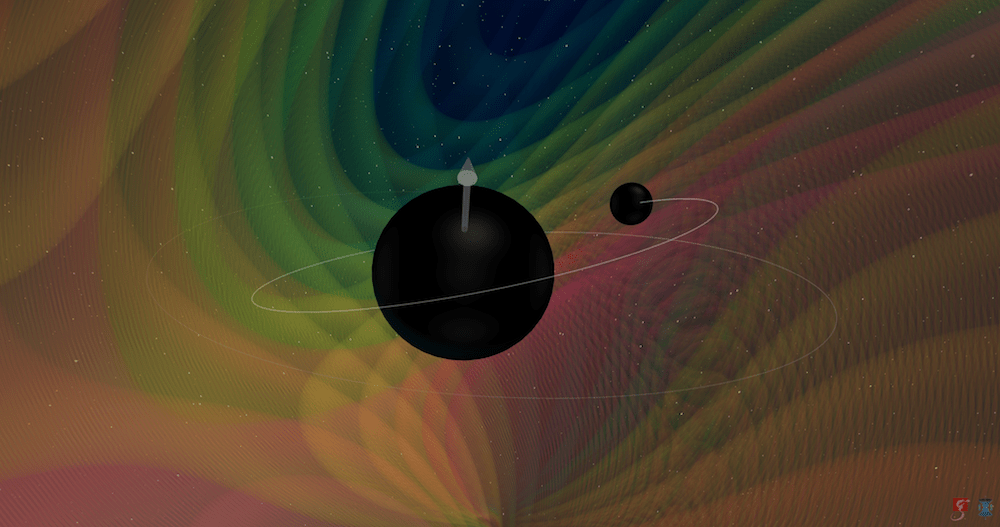
Ever since astronomers first detected ultra high energy neutrinos coming from random directions in space, they have not been able to figure out what generates them. But a new hypothesis suggests an unlikely source: the mergers of black holes.
Neutrinos are extremely ghostly particles. The carry no electric charge and they interact only rarely with normal matter through the weak nuclear force. Trillions of neutrinos pass through every square centimeter of your body every single second. So it takes truly enormous observatories to capture them. The largest of all is the IceCube Neutrino Observatory, which is a series of detectors sunk into the Antarctic ice sheet at the South Pole. Occasionally a neutrino will strike a molecule of water ice and lead to a flash of light that the observatory can detect.
While IceCube has seen countless events over the years, a few stand out. Some neutrinos are exceedingly energetic – so energetic that it’s difficult to come up with plausible scenarios that could generate them.
At the other end of the spectrum, perhaps the most powerful objects in the universe are black holes. Their intense gravity can tear apart stars and even power the formation of jets that can blast tens of thousands of light years into space.
So new research suggests that black holes may be responsible for the highest energy neutrinos. However, this can’t work with black holes in isolation Instead the black holes must be surrounded by an electrically charged plasma. That plasma will swirl around the black hole forming an accretion disk. Incredibly strong magnetic and electric fields in the accretion disk can wind their way around the black hole and send material flowing outwards in the form of a jet.
When two black holes merge this changes the direction of the jet, and occasionally the jets can get a boost from the gravitational energy released by the merger.
The authors of the new study suggests that if conditions are just right, the enhancement of the jet during a merger can power insanely high energetic neutrinos.
To match the observed numbers of high-energy neutrinos that IceCube has detected, the authors suggest that these black holes don’t have to merge all that often. If the neutrinos are powered by mergers of supermassive black holes, then they only need to collide between every 100,000 and 10 million years in every cubic gigaparsec of volume. If instead the neutrinos are powered by stellar mass black hole mergers, then they only need to happen 10 to 100 times every year in every cubic gigaparsec of volume.
These are promising numbers because the results sit within the expected range of merger rates of both stellar mass black holes and supermassive black holes. So as mechanisms go, it’s plausible. Only more observations will be able to tell, and hopefully astronomers will be able to pinpoint a source of these extremely energetic exotic particles.
Commercial Airline Pilots Record More UFOs Over Brazil and Colorado and a Politician Fears a UFO Collision
If you are not yet convinced that commercial airline pilots – not military pilots – are in the best position to spot and record real UFOs, these recent events may convince you otherwise. After a number of pilots for Azul Brazilian Airlines reported UFOs over the state of Santa Catarina in far southeastern Brazil, more pilots from Azul and pilots from the low-cost airline Gol Linhas Aéreas Inteligentes are reporting additional sightings. In the U.S., a professional pilot for over 40 years with over 28,000 hours of flight time reports seeing a fleet of UFOs making strange maneuvers over Colorado, while others report sightings over Oklahoma. Proving some in positions of power and political influence are concerned about commercial airline encounters with UFOs, US Congressman Tim Burchett reveals he is convinced a collision is inevitable and will happen soon. Is it time for a commercial pilots UFO conference? Would their airlines allow it … anticipating the fear it could perpetrate amongst the flying public? Should Congress – or the White House or the Pentagon – demand it?
What are these pilots seeing?
“A new report of sightings of lights in the airspace of southern Brazil has emerged again with pilots from Azul and now also from Gol. As reported here , last week Azul pilots reported to Air Traffic Control agencies that they spotted unknown lights moving in the sky over southern Brazil. The lights would have a random pattern, moving and disappearing sometimes, in a formation that does not match any current aircraft, creating rumors that it would be a UFO - Unidentified Flying Object. Here, again, the lights would have appeared, now seen by four Azul flights and one by GOL Linhas Aéreas.”
As reported last week by Mysterious Universe, on October 22, 2022, Azul flight 4517 was approaching its destination of the Salgado Filho Porto Alegre International Airport on the Atlantic coast when its pilots reported seeing a UFO making strange movements – audio of the encounter was recorded and uploaded to YouTube. This week, AEROIN, the largest aviation website in Brazil and Latin America, reveals (in Portuguese) that four Azul flights and one GOL airliner saw a similar UFOs on the night of October 31 -- audio captured by the Youtube channel “Câmera Aeroporto Salgado Filho BrAmigos” which broadcasts live the movement at Porto Alegre International Airport and air traffic control in the region, was uploaded on November 1 (watch it here). According to AEROIN, “All 5 pilots were instructed to call the Air Defense Command and report the incident, a standard procedure in this type of occurrence.” While the Câmera Aeroporto Salgado Filho BrAmigos channel gives a detailed description of the encounters, it offers no explanation. The same is true at AEROIN.
"The whole event started about Midnight EST in the Colorado area. We were heading west on about an 85* heading at 35,000 ft going 078 Mach around 540 mph. The entire event started just to the right of the Big Dipper with a falling star traveling multiple thousands of miles/hr and immediately after, the craft appeared. First one was a larger one, then a smaller one that came from the left to meet up, then the original moved back to the left where they finally stopped moving for over an hr. The large craft stayed in one spot as the other 2 moved around. The final video shows them in a triangle which lasted about 20mins. We were given a new heading to the left and lost site for the remainder of the night on 10/19/22."
Meanwhile, in the U.S., documentary filmmaker and UFO investigator Jeremy Corbell released a video taken by an experienced commercial pilot on October 19, 2022, while flying over Colorado. The pilot remained anonymous for fear over his job – despite having 42 years of experience. This sighting (watch the video here) follows others reported here this month by multiple commercial pilots who claimed to see UFOs traveling in oval “racetrack” loops over the Pacific.
Moving on to Oklahoma …
“The flight officer who responded to the transmission over the radio just repeated what Air Traffic Control told him, “please be on the lookout for any strange activity you see in the area, and if so report back to us. We’ve gotten dispatched from several pilots about UFO-like objects flying around in the surrounding areas.”
Liberation Times reports that multiple commercial aircraft encountered unidentified aerial phenomena on October 2, 2022, over Oklahoma – incidents that left one experienced crew member “scared speechless.” In a video uploaded to YouTube (see it here), the crew of an American Airlines flight sounded reassured that they weren’t the only ones seeing the UAPs -- “Alright, then we’re not crazy then, I think,” – and speculated that they could be related to Whiteman Air Force Base in nearby Warrensburg, Missouri. However, air traffic control pointed out that the UAP was in the wrong direction. A Delta pilot is heard doubting this is a military plane:
“Unless they’re doing 360s with their lights on, I don’t know what else it is.”
An anonymous flight attendant said other flight attendants saw this and other UAPs and a pilot was overheard commenting:
“Yea, there’s definitely something else out here with us, plenty of pilots have witnessed it and I come from a military background so I’ve always known about it.”
That leads to the question: Who else knows about it? One person who does is US Representative from Tennessee Tim Burchett, who has been calling for more UAP disclosure by the Department of Defense and has doubts about the Pentagon’s UFO briefings. Burchett recently told The Daily Star he is especially concerned about the safety of military and commercial airline pilots with military backgrounds.
"Plenty of military pilots have reported UAP encounters that have no logical explanation. Some of them have warned it was only a matter of time before an aircraft got into a mid-air collision with an unexplained object. Yet despite these warnings and reports the first standardized reporting structure wasn’t established until 2019. Our government has been surprisingly quiet about the topic for many decades despite the many reports."
How close is too close?
Burchett is in a position where he can at least influence, if not change, the policies of the U.S. government in regards to UFO encounters by military and commercial pilots. The late Senate Majority Leader Harry Reid is a good example of a U.S. politician who had an impact on UFO investigations – helping to finance the original secret task force researching UAP encounters. Perhaps Tim Burchett could take up where Reid left off.
As always, it is sad and disconcerting that experienced pilots – both military and commercial – are not respected when they come forward with their ever-growing numbers of UFO encounters. They have videos and other witnesses and they’ve discussed the encounters with other pilots and with air traffic controllers. From the tone of their audio reports, they are concerned for the safety of their passengers and crews. Why isn’t their government?
Is it only a matter of time before a plane and a UFO collide? Must we have tragedy in order to have progress?
Meer van UFO'S of UAP'S, ASTRONOMIE, RUIMTEVAART, ARCHEOLOGIE, OUDHEIDKUNDE, SF-SNUFJES EN ANDERE ESOTERISCHE WETENSCHAPPEN - DE ALLERLAATSTE NIEUWTJES


 LATEST ASTRONOMY VIDEOS