In some cases, it seems as if possible alien intelligences have left behind artifacts far in the past or in certain far-off locations of this world for inscrutable reasons we cannot fathom and were perhaps not meant to. One of these is surely a strange structure found on the bottom of the Antarctica seas, in a place that is about as inhospitable to life as anywhere on the planet, where creatures eke by a living in the dark cold, and which was found by chance and which has incited discussion to this day.
In the 1960s, Antarctica might as well have been an alien world. It was a faraway, isolated, frigid land largely inhospitable to life as we know it, and although we still don’t know much about this continent today, at that time is was like another planet unto itself. In order to do research in the forbidding region, the National Science Foundation of the United States in 1962 created an elaborate, technologically advanced floating laboratory called the USNS Eltanin, which was the world's first dedicated Antarctic research vessel and tasked with exploring Antarctica and surrounding waters over a four-year period, at the time in waters just about uncharted as the furthest reaches of the solar system. While they made many findings and shed light on our knowledge of the region, they would also uncover things out there in those secluded depths that would go on to propel themselves into truly great mysteries.

On August 29, 1964, the USNS Eltanin was engaged in photographing the ocean floor 1,000 miles west of Cape Horn with a cable mounted camera at a depth of approximately 3,904 meters (13,500 feet) when they made a remarkable find. There along the mostly bleak and barren bottom they managed to snap pictures of a very strange structure, which stood upright at 2 feet high in the middle of nowhere on the lifeless seabed and with its symmetrical nodules, spokes and protrusions ending in a spherical top, it looked very much like an elaborate artificial radio antenna array. It was surely an unexpected thing to find down there, an anomaly, and when it the photographs were picked up and released by the New Zealand Herald on December 5, 1964, the puzzling images immediately caught the attention of UFOlogists and Fortean researchers, who would dub it “The Eltanin Antenna” and claim that it was an out of place alien artifact put there in that remote location for inscrutable purposes. The object would be excitedly discussed and debated for years, with famed paranormal writer Brad Steiger in 1968 calling it “an astonishing piece of machinery... very much like the cross between a TV antenna and a telemetry antenna.”
Theories swirled at the time, ranging that it was a piece that had simply fallen off a boat, to more conspiratorial theories such as that it was a secret Russian project, to more fringe ideas that it was the doing of aliens. Others suggested that it was perhaps some type of undiscovered plant life, but marine biologists were skeptical of this, as there was no sunlight down there to support it, and one biologist, a Dr. Thomas Hopkins, would say of it:
I wouldn’t like to say the thing is man-made because this brings up the problem of how one would get it there ... But it’s fairly symmetrical and the offshoots are all 90 degrees apart. This is why it has been argued over for so long.
In the end, no one knew, and since it was so far under the surface in one of the most hostile and inaccessible environments on earth there was no way to reach it again and no efforts made to try and relocate it. In the meantime, the bizarre object made the rounds in numerous UFO and paranormal publications, including SAGA Magazine, The INFO Journal, and Fortean Times, a habitat in which it often seemed to pick up added details and conjecture that really muddied the waters as to trying to figure out what was actually going on and what it really was. At the time it was aggressively pushed by many writers, in particular Steiger, as a true anomaly and possibly alien artifact, but in more recent years the story has picked up more mundane possibilities. One of the most popular of these was the suggestion that what is seen in the images is a type of deep sea carnivorous sponge called Cladorhiza concrescens, which was discovered in 1888 by Alexander Agassiz and was described in the initial report:
It somewhat resembles a space-age microwave antenna, with a long stem ending in ramifying roots, sunk deeply into the mud. The stem has nodes with four to six club-like appendages. They evidently cover like bushes extensive tracts of the bottom.
This seems like a very rational approach to the mystery, but there have been arguments against this idea. One is that the crew of the USNS Eltanin, with their crew of scientists and marine biologists, did not come to that conclusion on their own. Another is that this species of sponge is known to exist in large colonies, where as this object was solitary out on a desert of nothingness. There is also the fact that when compared to photos of Cladorhiza concrescens, the Eltanin Antenna does not seem to completely match, looking somewhat different, especially in that it is obviously more symmetrical, regimented, and even in form than one would expect one of these sponges to be. Details like this have made sure that the Eltanin Antenna has remained discussed and debated to this day, with many proponents of the idea that it is indeed an anomalous artifact placed there by either nefarious human organizations or aliens, for purposes ranging from measuring fault activity to mind control.
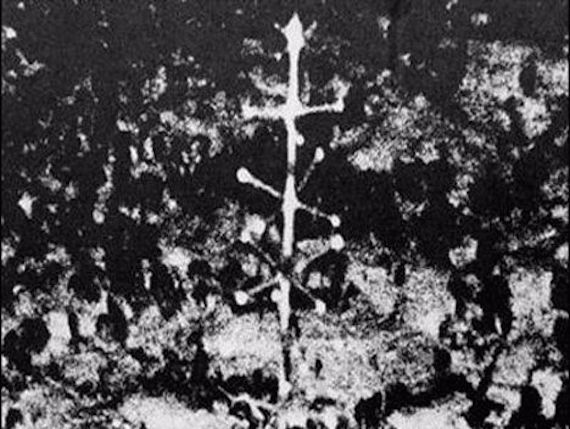
The mysterious antenna
There is really no way to know what this strange artifact was when looking at it based solely on a few photographs. It could really be anything, although no one explanation has really seemed to satisfy everyone at this point. Was this just some anomalous sea sponge that managed to find its way out there on its own? Or was it something else entirely? Whatever the case may be, no one has found the original Eltanin Antenna since, and we will probably never know the full answer.
Many supposed alien artifacts are linked to ancient civilizations, and truly one of the great lost and mysterious civilizations of the earth is the Inca Empire of the Andes Mountains of Peru. At its most powerful and illustrious during the 14th and 15th centuries, the Inca Empire at one point stretched over a vast area encompassing parts of Ecuador and as far south as Chile. For centuries this great civilization thrived, only to melt away into history with the coming of the gold-hungry Spanish conquistadors and fade away into the mists of time, leaving behind no record of their culture and way of life and making them one of the most enigmatic of ancient empires. Yet, for all of their mysteries some are more pronounced than others, with outlandish artifacts for with purposes unknown uncovered at times., and one of the more baffling of these is a monolithic stone which we are nowhere near figuring out.
Although the Incas left behind no written record for us to draw from, what they did leave are vast structures that remain standing strong centuries later. From temples, to citadels, to strongholds, massive walls, and roads, these ancient structures made use of enormous stones somehow moved to these locations and placed perfectly straight without any mortar and through methods we still don’t understand fully. In addition to these architectural mysteries the people of the Inca era also left behind other oddities that pop up from time to time, which serve to pose more questions than answers. One of these lies in the province Abancay in the region Apurímac in Peru, and has been wreathed in mystery ever since its discovery.
The site is called Sayhuite, thought to have perhaps once been the site of a grand gold covered temple devoted to the worship of water, and here is a rather bizarre artifact looking quite out of place. Called the Sayhuite Monolith, it is an enormous boulder measuring 6.5 feet long and about 13 feet wide, which sits atop a raised platform upon a terraced hill called the Concacha Hill, but more bizarre than its sheer size is what is engraved upon it. The entirety of the upper surface of the rock is adorned with over 200 carvings and engravings of various zoomorphic and geological figures, including reptiles, jaguars, monkeys, shellfish, frogs, crabs, birds, terraces, ponds, rivers, tunnels, streets, stairways, channels, buildings, and irrigation canals, and many others, as well as numerous geometric figures, all incredibly intricately crafted in painstaking detail.
It is a breathtaking piece of artistic mastery for its day, but the thing is we have no idea of what its purpose is, exactly where it originated, or even it was the Incas who made it at all. One of the problems is that there is very little else remaining from the Inca Empire at this particular site, no frame of reference to give it. We do know that it is not a natural outcropping, and it is made of material not sourced from the immediate area, but it is unclear where it was moved from or if this was even its original intended resting place. That is about all we know for sure, and no one is quite sure who made it or why.
As to the carvings, your guess is as good as anyone’s, and their significance depends largely on who you ask. One popular theory is that this was once an Inca temple devoted to the worship of water deities, which would have in its day been full of grand, gold coated columns and featuring the monolith as some sort of object of religious significance. However, this is far from the only idea floating around. Another theory is that the stone was used as a way of developing and testing the intricacies of water flow for public water projects and irrigation systems, supported somewhat by evidence that the engravings show signs of having been altered, modified, and updated over the centuries, perhaps to test out different water paths on the topographical model. Other ideas include that the monolith is a map to a lost city or even a map of the Inca Empire, a model of the universe, or even an alien artifact. In the ends no one knows, and although the site is popular with tourists, we are no closer to understanding it all, its history lost to time, just one more piece of the puzzle of a time long lost to us.
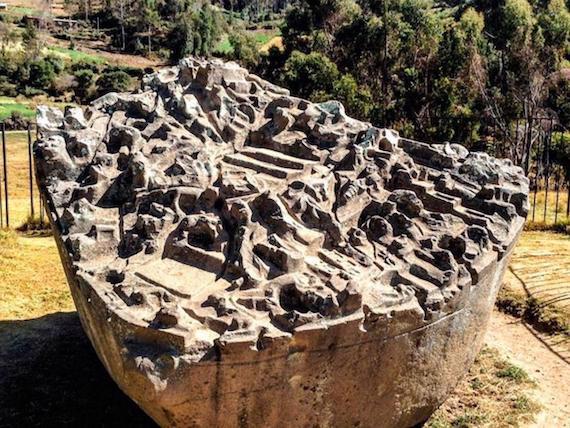
Sayhuite Monolith
Indeed, the ancient world very often seems to be almost something from an alien realm. Full of unanswered questions and inscrutable, indecipherable ruins, we are often left without answers to what these people were up to, our view to the past obscured and hazy. The ancients often left behind various enigmas that we struggle to understand and which seem to taunt us through the centuries, and another one of these is a mysterious disc uncovered in Greece, which is full of strange cryptic symbols and for which we have no answer, and which may be from powers beyond our world.
In July of 1908, an Italian archeologist by the name of Luigi Pernier was doing an excavation at the Old Palace of Minoan Phaistos, a mysterious Bronze Age archaeological site dating from 1900 to 1700 BC on the south coast of the island of the Greek island of Crete. There in the dank dark in an ancient basement of the palace he unearthed a small clay disc that had lain down in the dark for untold centuries, which upon inspection would capture the imagination and turn out to be one of the most mysterious and hotly debated archeological oddities ever uncovered in Greece.
Measuring from 15.8 to 16.5cm in diameter and 1.6 to 2.1cm in thickness, seemingly handmade from fired, baked clay, it is a truly curious little artifact. The disc holds etched upon both sides of it a spiral pattern of hand drawn lines within which a total of 45 different strange symbols are set in groups demarcated by vertical lines for a total of 242 symbols in all, each one apparently individually stamped into the clay before it was fired and in some cases showing evidence of having been erased and re-stamped. These symbols are largely pictographic in nature, featuring human figures, faces, animals such as fish, dolphins or cattle, boats, and plants and trees, as well as less discernible cryptic symbols. In addition to these symbols, there are what appear to be hand drawn dashes, slashes, and dotted bars throughout. Besides being an odd find, the thing about these various symbols is that, although they are all arranged as an obvious message, they represent no known language or writing system. It resembles none of the forms of writing found in Bronze Age Crete, called hieroglyphic, Linear A and Linear B, and archeologists have no idea what they say or why they were arranged in spirals on this lone disc.
Some things about what has come to be known as the Phaistos Disc are mostly largely agreed upon. It is mostly accepted as probably being Cretan in origin quite possibly a version of the Minoan language, and likely dates back to from 1850 to 1550 BC. It is also mostly believed that because many of the symbols seem to be arranged to face the right towards the outer edge of the disc, it is thought that it should be read clockwise from the center outwards. On the outer edge of the disc is a clearly delineated straight line marked with five or six points that is agreed by most to be the intended starting point for reading it all. That is pretty much where any agreement ends, and the disc, its origins, and the meaning of its enigmatic symbols have been discussed and debated ever since its discovery.
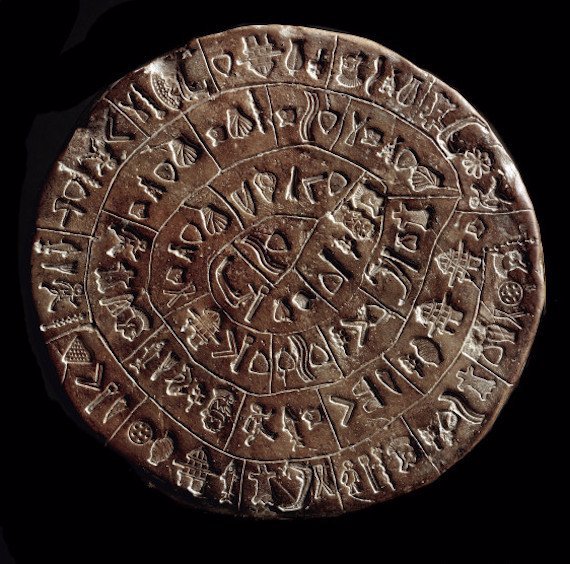
The Phaistos Disc
When trying to decipher the meaning of this oddity, there has been pointed out that the total number of different symbols are too few to represent a purely pictographic system of writing, that is in which one image is one word, but too many to be an alphabet system, meaning it is probably what is called a "syllabary." This would mean that each different symbol represents a separate syllable of the language, and each of the groups of symbols would make up one word. However, if this is the case it should be expected that there would be an even distribution of the symbols through the text, but there are wild imbalances between them on the disc, and also considering that the symbols are grouped in mostly groups of 3 to 7, it seems strange that the language would be so syllable heavy. This has led to another idea, which is that the mysterious writing system could be some combination of pictographs and syllabaries, but no one really knows for sure.
As to the significance of the disc, theories have varied considerably. Ideas include that it is a prayer, hymn or a religious chant, sacred text, magic inscription, a spell or curse, a simple letter, ritual, game, funerary record, almanac, court list, political treaty, a geometric theorem, list of soldiers, or even a nursery rhyme or musical notes, and of course that it was left by aliens. As you can see, no one really has a clue, and it could be anything. One idea that has been floated around is that the disc is not real at all, but rather a more modern forgery and hoax. It was for a while a subject of some debate, only fueled by the Greek Ministry of Culture refusal to let anyone test it because they deem it to be a national treasure that would be damaged if it were to be analyzed. If it is a forgery, then the main culprit is seen as probably being Luigi Pernier, in order to make a name for himself and step out from the shadows of other more famous archeologists also working in Crete at the time. After all, what better way to get the field’s attention than a mysterious disc with some inscrutable ancient language no one had ever seen before? However, it is common for governments to refuse to have artifacts tested out of fear of damaging them, and the majority of archeologists both in Greece and beyond are of the general consensus that it is authentic. What it actually is and what it signifies is another story altogether.
One of the most frustrating things is that since the symbols came from individual stamps, someone spent the time to make the actual die for each symbol, yet none of these die have been found. It would also imply that these discs were meant to be mass produced, yet as of yet, none other has been found. This is a problem, because without other similar examples of this mystery writing or a Rosetta Stone-type finding, there is simply not enough context to derive any meaning from it. There have been numerous claims over the years that the disc has been solved and translated, but these are unconfirmed, with little chance of a concrete confirmation in the absence of a comparison to other inscriptions. The fact is, despite the various claims of decoding the mysterious writing, it remains a perplexing unsolved mystery.
Equally as perplexing and controversial is a discovery allegedly made in 1938 in the Baian-Kara-ula mountains on the border of China and Tibet, by Chinese archeologist and professor Chi Pu Tei. His expedition purportedly came across an underground network of tunnels, caves, and caverns that seemed to have been artificially excavated, leaving smooth glazed walls suggesting some immense heat had been used. Tei claimed that within this strange subterranean world they had found pictograms carved into the walls, which depicted star systems, the sun, and the moon, and even more bizarrely graves that supposedly held the remains of tiny humanoids measuring about 4 feet tall and with outsized heads. Perhaps even stranger were the objects they found half buried in the earth all around them.

The Baian-Kara-ula mountains
The objects in question were a series of over 700 perfectly circular discs measuring up to a foot across, and which were said to have two grooves that emanated out from a perfectly round, 3/4" hole in the center to form a double spiral. Within the spirals were claimed to be minuscule hieroglyphics of an unknown type, so small that they were barely visible to the naked eye, and which required a magnifying glass to make out in any significant detail. Although this would have been seen as a monumental discovery, the discs allegedly found themselves locked away in storage at Beijing university for decades until 1962, when Chinese archeologist Tsum Um Nui supposedly took a look at them and the story would get even more bizarre still.
After careful analysis of the discs, this Tsum Um Nui claimed that he had actually managed to decipher them, and that they told an epic tale and often tragic tale of visitors from the stars. According to Nui, the discs spoke of a spaceship that had crashed into the mountains carrying a contingent of alien beings called the Dropa. The crash smashed the ship beyond their ability to repair, and so these mysterious beings had been forced to find refuge in the mountains and adapt to life on Earth, creating the tunnels and caverns in the process. The discs even supposedly give the harrowing account of some of these Dropa being mercilessly slaughtered by the Han Chinese.
It sounds completely absurd, and the general scientific community agreed, refusing to publish Nui’s paper on the matter and generally looking upon his claims with raised eyebrows and outright disdain. According to some accounts, the archeologist was even forbidden from even talking about the discs anymore after that, but the whole weird tale caught the attention of Russian scientist W. Saitsew, who apparently acquired some of the discs and studied them himself in 1968. Saitsew allegedly found the composition of the discs to be quite odd, comprised of a strange mix of cobalt and other metals that made the surface nearly impenetrably hard and deepening the mystery of the hieroglyphs etched upon them. He also claimed to have discovered that when placed on a specialized turntable the discs hummed and oscillated as if they had once held an electrical charge or served as conductors of some type.
It is unclear what happened to what have come to be known as the Dropa Discs after this, and Tsum Um Nui himself allegedly fled China to Japan, where he vanished into obscurity. We are left with very little to go on, and indeed there is much to cast doubt on whether the Dropa Discs ever even existed at all. For one there are no discs now to examine, with the estimated 712 discs all allegedly disappearing over the years. There is also rather suspiciously a lack of any photographic documentation of them at all. The only supposed photographs of the Dropa Discs were purportedly taken by the Austrian engineer Ernst Wegerer, who apparently located two of the discs during a visit to the Banpo Museum in Xi'an, Shaanxi Province in 1974. However, the photographs are fairly controversial and the discs themselves are obscured by camera flash.
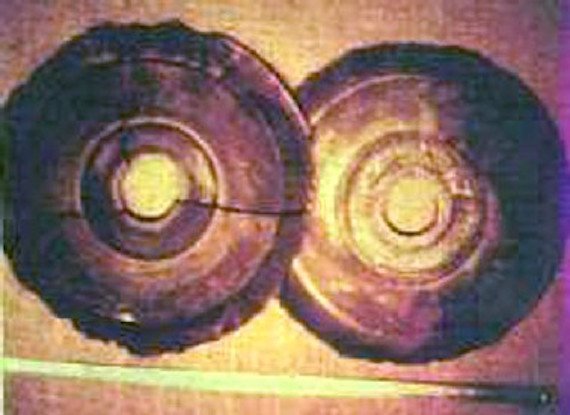
Supposed photo of the Dropa Discs
Other damning evidence against the existence of the Dropa Discs is that there are no real official scientific papers written on them, with only the writings of Tsum Um Nui, the Russian scientists, and some second or third hand accounts to go on, and these are of questionable veracity at best. In fact, Tsum Um Nui appears to have no mention in any university or academic institution as an archeologist, and indeed it has been pointed out that Tsum Um Nui isn’t even a real Chinese name at all. There are likewise no official museum records to show that such discs were ever within their collections, nor is there any official documentation of the Chi Pu Tei expedition that supposedly found them in the first place, and indeed there is no way to know if it ever happened at all. Considering such a lack of any concrete evidence, if the Dropa Discs ever did exist then the Chinese have gone through great efforts to cover it all up. Perhaps more likely is that this is an intriguing archeological urban legend that has sort of taken up a life of its own. Regardless, these mysterious discs crafted by unknown hands have continued to be discussed and debated to this day.
More recently, in 1961 a group of friends in Olancha, California were looking for geodes when they found within one of them a modern spark of all things, and allegedly a geologist estimated the object as being 500,000 years old. In October of 1996 a group of researchers in the Kaluga region of western Russia located a screw complete with the fully formed head and nut embedded within rock that was found to be 300 to 350 million years old. Examination by various scientists showed that the object is most certainly artificial, but as to how it got into that rock no one knows. Was this an alien artifact, time travelers, or what, and perhaps more pressing, what would aliens need with spark plugs anyway? The answers remain vague.
Some other anomalous ancient artifacts are a little harder to adequately classify, and defy easy categorization. In 1885, a strange object was found by an iron smelter at a foundry in Vocklabruck, Austria. There, within a block of solid coal, was discovered a perfectly-formed cuboid object of what seemed to be iron or some other type of metal, measuring 2.64 by 2.64 by 1.85 inches and weighing 1.73 pounds, its purpose unknown. The outlandish cube-like object was sent to the Salzburg Museum, where it was analyzed by the Austrian physicist Karl Gurls and found to be made not of iron, but rather of a strange alloy composing steel and nickel, although it would later be deemed to be actually made of a forged iron.
Further analysis showed that the object, whatever it was, was too precise in shape and made of too refined a metal to have been caused by any known naturally occurring phenomenon such as a meteorite strike, and was most likely machine-tooled and even probably just a part of a larger device or mechanism, although what type no one knows. What has come to be known as the Salzburg Cube or the Wolfsegg Iron has apparently been studied by scientists at the Geological Institute of Austria, who have also come to the conclusion that it seems to indeed be indeed artificial, and the object has even been featured in an 1886 edition of the scientific journal Nature, as well as an 1887 issue of the French journal L’Astronomie.

What was this strange object and how did it get within a chunk of coal dating to tens of millions of years ago? Was it truly a manufactured object, and if so what sort of enigmatic mechanism did it once belong to? It is difficult to tell for sure, as the Salzburg Cube has since disappeared completely, leaving only these vague 19th century reports behind. It might have been lost, misplaced, mislabeled, or filed away in some darkened backroom of a museum collection somewhere gathering dust, perhaps even stolen for unknown reasons. We only know for sure that it did exist, but without modern scientific analysis we will probably never know for sure what it was. Mysterious technology of the ancients, aliens in prehistory, time travelers, or unknown natural phenomena? Who knows?
Other purported alien artifacts seem to have been dropped off or left behind during UFO encounters. On November 11, 1956, a Stig Ekberg and Harry Sjoberg were driving on the Island of Vaddo, Sweden, about 90 kilometers north-northwest of Stockholm, when they noticed up ahead a bright object that looked like a flattened sphere, measuring around 8 meters wide and 3 meters high. The object seemed as if it was about to fly past them, but it then suddenly made a sharp turned and headed directly towards them, and as it did their car’s engine mysteriously coughed, sputtered, and died. The object then came down to hover right near the road, and it was described as being so bright that “even a barn, half a kilometer away, was visible as if the sun was shining.” It then proceeded to maintain a position just one meter off of the ground, and as the frightened men looked on it started to glow brighter, and the air was filled with a smell like “ozone and smoldering insulation.”
After 10 minutes of this, the object lifted up and sped off in the direction from which it had come, and as it did the vehicle sprang back to life. The curious witnesses then went to where the thing had been hovering to find that the grass had been flattened and singed. Even weirder than this was that there was a shiny object on the ground that turned out to be a “three-sided piece of metal about the size of a matchbox,” and which was hot to the touch and heavier than it looked. The men collected the strange artifact and had it analyzed at the SAAB airline manufacturing company, who came to the conclusion that it was constructed of tungsten carbide and cobalt, and was definitely an artificially manufactured object and not some naturally occurring rock of any known kind, although it had no discernible conventional use. It is unclear what happened to this object after this, and we are left to wonder what it was. Was it something dropped by the UFO, and if so what was it? Who knows?

The following year, in September of 1957, Ibrahim Sued, a columnist for the Rio de Janeiro newspaper O Globo, received a letter from a witness who claimed to have seen a "flying disk" explode over the beach at Ubatuba, in Sao Paulo Province, Brazil, and that as it did it had “rained down” metal pieces. Within the envelope the letter came in were several strips of a dull gray metallic material which seemed to be scorched or oxidized somewhat, smooth but with a noticeable amount of wear and tear, and which were all dusted with a fine film of a powdered substance that somewhat resembled burnt charcoal residue, all of which had apparently been dropped by the UFO. The letter would read:
Dear Mr. Ibrahim Sued.
As a faithful reader of your column, and an admirer of yours, I wish to give you, as a newspaperman, a “scoop” concerning flying discs. If you believe that they are real, of course. I didn’t believe anything said or published about them. But just a few days ago I was forced to change my mind. I was fishing together with various friends, at a place close to the town of Ubatuba, Sao Paulo, when I sighted a flying disc! It approached the beach at unbelievable speed and an accident, in other words, a crash into the sea, seemed imminent. At the last moment, however, when it seemed it was almost striking the waters, it made a sharp turn upward and climbed rapidly on a fantastic impulse. Astonished, we followed the spectacle with our eyes, when we saw the disc explode in flames. It disintegrated into thousands of fiery fragments, which fell sparkling with magnificent brightness. They looked like fireworks, despite the time of the accident, at noon, that is, at midday. Most of the fragments, almost all, fell into the sea. But a number of small pieces fell close to the beach and we picked up a large amount of this material—which was light as paper. I am enclosing a sample of it. I don’t know anyone that could be trusted to whom I could send it for analysis. I never read about a flying disk being found, or about fragments or parts of a disk that had been picked up. Unless the finding was made by military authorities and the whole thing kept as a top-secret subject. I am certain the matter will be of great interest to the brilliant columnist and I am sending two copies of this letter—to the newspaper and to your home address.
Not knowing what to do with the letter and its mysterious samples, Sued merely printed the letter in the newspaper out of curiosity, then put the mysterious pieces of weird metal aside and sort of ignored them until he was contacted by a Olavo T. Fontes, a Rio physician and Brazilian representative of the Aerial Phenomena Research Organization (A.P.R.O), who had heard of the letter through its publication in the paper. Fontes came out to Brazil and took a closer look at the samples, coming to the initial conclusion that one was cracked and had fissures suggesting that it had been forcefully blown off of a larger object, and it was surmised that the whitish substance was the result of the pieces being subjected to an intense heat. Sued offered to release the strange pieces to Fontes, who took them off to be analyzed further at the Mineral Production Laboratory. Fontes himself would say of the objects in a report to the Aerial Phenomenon Research Organization (APRO) in Tucson, Arizona:
I saw the samples sent by the unidentified correspondent—three small pieces of a dull-gray solid substance that appeared to be a metal of some sort. Their surfaces were not smooth and polished, but quite irregular and apparently strongly oxidized. The surface of one of the samples was shot through with almost microscopic cracks. The surfaces of all samples were covered in scattered areas with a whitish material. These whitish smears of a powdered substance appeared as a thin layer. The fine, dry powder was adherent but could be displaced easily with the nail. Mr. Sued said the material appeared to be lead at first sight—because of the gray color—but I could see that it could not be lead … the material was light … almost as light as paper.
They were then sent through a battery of tests, where they were found to be composed of 99.99% pure magnesium. The Air Force allegedly received one of the samples, but it was unfortunately accidentally destroyed as it was being prepped for analysis. They requested another sample, but since one of the other pieces had also been destroyed by the testing done on it there was only one fragment left and they were unwilling to part with it, instead locking it away in a safe. In 1967, the A.P.R.O. grudgingly allowed the piece to be taken in for analysis, but this would prove to be inconclusive and produce conflicting results, with one lab saying that the magnesium was not as pure as originally claimed and “not as pure as magnesium specimens readily available in the 1950s,” whereas another stated that the piece was produced through a “process that was unknown when the fragments were recovered.” Ultimately the sample was just too small to really tell much, and it created more questions than answers, leaving it as an anomalous mystery. University of Arizona metallurgical engineer Walter W. Walker would say of the fragment:
All chemical analyses to date have not verified the extraterrestriality of the Ubatuba magnesium.... Considering the poor pedigree of the Ubatuba physical evidence, a hoax cannot be ruled out... [though] nothing unequivocally identifying the material as terrestrial was found either. If one accepts that it is possible that a flying saucer has a soft, weak, technically pure, unalloyed, cast magnesium fuselage, then the metallographic evidence is consistent. The surface scale, the oxide intrusion into the grain boundaries and, particularly, the subscale from internal oxidation all suggest that the magnesium was exposed to the Earth’s atmosphere at elevated temperatures. The white Mg(OH)2 coating is consistent with the burning fragments falling into the ocean.... In summary, after all these years, I consider the Ubatuba magnesium fragment as unusual material of still unknown origin.
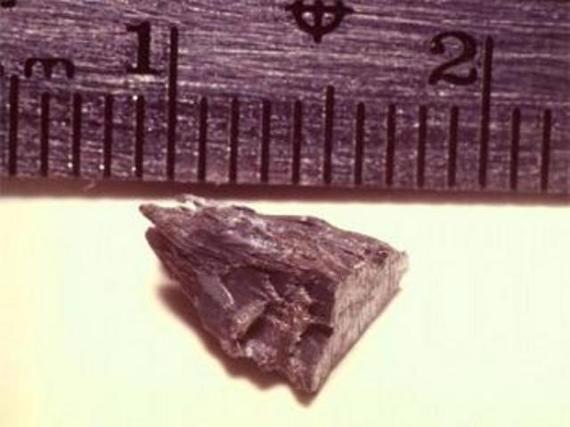
The Ubatuba fragment
Unfortunately, further analysis has done little to shed any more light on the fragments, and have been unable to conclusively prove whether they were of extraterrestrial origins or proof of aliens, and the Journal of Scientific Exploration would say in an abstract on their paper on the matter:
A sample from the Ubatuba fragment collected in Brazil in 1957 was tested with the intent of examining the isotope ratios of its primary element, magnesium, and the trace elements strontium, barium, copper, and zinc. As background, the history of chemical testing of the Ubatuba fragments during the 1960s-1980s at multiple labs with varying capabilities is reviewed and then the remainder of the paper examines recent tests completed in 2017 and 2018 that for the first time used HR-ICPMS techniques to look at the isotopic ratios of the minor constituents as well as the primary magnesium component of the sample. The magnesium isotope ratios were found to fall within terrestrial limits while the results on the isotope ratios of the trace elements were inconclusive. Recommendations are made for improving the process of examining the trace elements.
We are left to wonder how much veracity the case has, and just what exactly those mysterious fragments were, if anything. What do the results mean? There is no way to really know, because there is nothing left to test that we know of. Who sent the letter and was he for real? Again, a mystery. In the end, with the inconsistency of the test results, the lack of any remaining fragments, and the completely anonymous identity of the writer of the letter there is no way to be sure, making it a case that will no doubt serve to fuel debate and speculation for some time to come.
In August of 1964, a Mr. Raimo Blomqvist was at his parents’ summer cottage at Kallavesi Lake, Finland, when he noticed a “strange, colorful light ball” come down from the clouds. As it drew nearer he could see that it was oval in shape, but it was glowing too brightly for him to see any real details to it. The strange anomalous object then hovered over some shallow water nearby and apparently dropped something, which made a sound like “hot metal touching cold water” when it hit the surface. The UFO then rose high into the air and shot off into the clouds. He then went to where the object had dropped and found an odd looking stone 3 or 4 cm in length and with five layers to it. When the strange artifact was analyzed by a lab, it was found to be mostly made of iron, but there were also small amounts of other materials such as copper, zinc, magnesium, mangan, zirkonium, vanadium, titanium and crom. They also determined that the stone had been in a temperature of 650-800 degrees Celsius for a long time. Once again, it is unclear what happened to this object. What was this thing?

From the 1970s is a case from Suonenjoki, in Central Finland, where on March 16 of that year a Mr. Reijo Kolehmainen made a stunning discovery near his property after witnessing UFO activity for several days, claiming that he had found several spots where the mysterious object had landed and left behind various artifacts. A report in the APRO Bulletin, Vol. 28, No. 5, Nov. 1979, says of what happened:
Three landing trace areas were found around Mr. Reijo Kolehmainen’s home in February, 1979. At 6:50 a.m. on February 2, 1979 a 2.5 meter crater was found in the snow at a distance of 5 meters from the house. The snow had melted all the way to the ground in the center of the crater. Strange red liquid, pieces of metal, and later a metallic cup were found within the crater. The red liquid smelled of vinegar. At 8:00 a.m. the police came. They photographed the area and took some samples.
In another case from the 70s, late in the evening of February 5, 1979 the Kolehmainen family heard a shooting sound. One constable later revealed he had seen a strange light phenomenon at the same time. On the following morning a bigger crater was found in the snow at a distance of 10 meters from the house. Similar things were again found. Later the police came to have a new look at the area. The police suggested that perhaps someone had thrown a home-made bomb in the Kolehmainen yard. However, the Kolehmainens stated that nobody has any reason to throw bombs at them. On the morning of February 21, 1979 a third landing trace area was found. This time there were three holes in the yard. Red liquid and pieces of metal were once again found in the landing trace. However, no metallic cup was found this time. There was no snow on the electric wires above the holes, but there was lots of snow on similar wires elsewhere. The Kolehmainens didn’t want any publicity, but the news leaked to the press from acquaintances. About ten articles were published by the press about the events. The UFO was encountered by several other witnesses in the area over the course of several weeks, but this is the only report that mentions it leaving any sort of physical evidence behind. Very bizarre, indeed.
Perhaps one of the more well-known cases of an alleged alien artifact left behind supposedly occurred in 1985, in the area of Grand Junction, Colorado. One evening in 1985, a man named Bob White was driving with a friend on their way from Denver to Las Vegas. At the time, White was asleep and his friend at the wheel, watching the hypnotic lane lines flicker by as they meandered through the remote wasteland between Grand Junction, Colorado and the Utah border. Here was a place in which there was not another soul for miles around, a moonscape of rocky desert that expanded out past the illumination of the headlights in a vast expanse of nothingness, and it would have been a rather dull drive until a weird series of events began to play out that made the evening a bit more exciting.
At around 2:30 a.m., White was jolted awake by his friend. Wiping the sleepiness from his eyes and watching the nighttime desert streak by outside, he at first couldn’t figure out why his friend had woken him. It wasn’t his turn to be at the wheel and nothing at first seemed out of place, the car smoothly rolling along, but his friend was in a state of agitation. When White asked what was going on, his companion frantically pointed off towards the horizon, and it was then that he could see a strange light off in the distance, which did not look like an airplane. The light steadily grew in size and brightness until it was blinding, turning the desert night into day, and White would say of what happened:
The light was about the size of a full harvest moon. As we got closer, it grew larger. When we were a few hundred yards from it, I turned off the ignition and we coasted up close to it. It was huge, the size of a very big barn. I got out of the car for a better look. For some unknown reason, Jan turned on the headlights, and this light went up in the sky as fast as my eyes could follow it. What I saw, was not of this Earth. Then I saw another small light, bright orange with a tinge of yellow, white, and blue falling from it. After this, the larger object rose into the air rapidly, joined with an even larger object, a sort of "mother ship," and the whole of it shot off into the night, leaving the two frightened men there alone in the dark desert once again to try and process what they had just seen. Overcome with curiosity, White started hiking off through the scrub through the wilderness towards where he estimated the smaller object had fallen, making his way up an incline to find a groove in the ground, which he estimates as having been around 18 inches deep and 9 inches wide. Within this groove was a glowing object, about 7-1/2 inches long and shaped like a teardrop, still too hot to get anywhere near and apparently made of some kind of metal. White waited until it had cooled down enough to touch, and then brought it back to the car, stashing it into the trunk.

Colorado wilderness
White, who claims to have never believed in UFOs before this incident, was baffled as to what the object could possibly be, but did not know who to turn to for help or what to do with it. He kept it locked in a safe deposit box to keep it safe, and in the meantime travelled about trying to raise interest in his discovery, travelling to conferences and trying to get the object tested. He even opened his Museum of the Unexplained, which would hold the object high as its main attraction. In 1996, a small sample of the object was finally tested by the New Mexico Institute of Mining and Technology, which didn’t come to any firm conclusions, but did have this to say:
The metallurgical analysis was pretty mundane. We didn't find any evidence that it was extraterrestrial. Now you can make the argument that we didn't spend $1 million and look at every conceivable option. We didn't cover every base.
A second laboratory came to a similar conclusion, deflating hope that this was an alien device or piece of spaceship. Undeterred and convinced of the object’s otherworldly nature, White decided to keep trying, sending in samples to the Los Alamos National Laboratory, New Mexico Tech, and the Geosciences Research Division of the Scripps Institute in La Jolla, California, for more thorough analyses. One of White’s partners, a Dr. Robert Gibbons, a former scientist with NASA, would say of the results of these further tests:
We recently came across scientific data that linked Bob's object with the planet Mars. Isotope abundance ratio tests were performed on Bob's object in May, 1999 in La Jolla, CA and the numbers are virtually the same as obtained from Martian meteorite samples. The ratio of isotopes of Strontium for the QUE 94201 meteorite found in Antarctica in 1994 was 0.701. The ratio of isotopes of Strontium for Bob's object was 0.712. The ratio of isotopes of Strontium for the Shergotty meteorite found India in 1865 was 0.723. Bob's object is right in the middle of two proven Martian meteorites!
So, what does this all mean? Well, the most rational explanation is that this is exactly what the object is: a meteorite. This could also explain the strange sighting the two men had had to some degree, although it doesn’t explain the presence of the massive UFO they had supposedly seen or the “mothership” it attached to before speeding off into the night. Other ideas are that they saw debris from a satellite falling, or some naturally occurring celestial phenomenon, and that the weird object he found was completely unrelated. Then there is the possibility that this is all just a hoax. All of these possibilities White strongly denied. He never tried to get rich off of his findings, and whatever he did find out there in the desert, he certainly seemed to have at least truly believed it was real, once saying of his crusade to get the object recognized:
This is the most difficult thing I’ve ever done in my life. I'm 73 years old. I don't have much longer. What I'd like to see before I'm gone is the national media get their heads out of the sand. I'd like to see the national media and everybody else realize that what I have is real. I don't know what I have to do to prove this is the truth. You can't make this stuff up.
He would continue to adamantly stick to his story and defend his strange discovery all the way up to his death in 2009, but the object would stay locked away in his museum, where it remains to this day. What exactly did he find out there in the desert on that fateful night? Is this a piece of meteorite, space debris, just a weird-looking rock, a hoax, or something else? As of yet, there is no proof that the object is anything more mysterious than a rock or meteorite, but it is still a pretty odd story all the same, and managed to get a lot of attention in its time as a piece of possible physical evidence from a UFO.
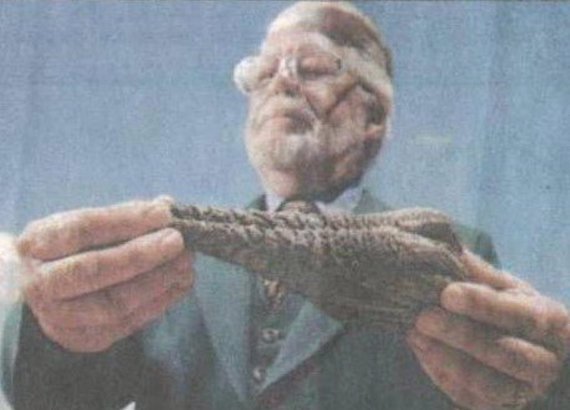
Bob White and his alien fragment
In the meantime, the object is kept under carefully secured conditions, with motion detectors, closed-circuit TV, and window and door alarms protect it at all times, and the object never spends the night at the same place two nights in a row. Most skeptics say it is just a piece of space debris from a meteor or a satellite, but it has never been conclusively proven to be one thing or another. In the end, that is what we are let with on all of these cases, more questions than answers. Despite these supposed pieces of physical evidence of alien spacecraft, there just doesn't seem to be any way to completely verify any of it, with the samples either disappearing or producing mixed results, at best. What is going on here and why have these strange objects turned up? What does it all mean? We may never know for sure.
One very well-known account of such a bizarre object was found by chance in the U.S. State of Florida by an unsuspecting family. A perfect sphere with various unusual properties, it has gone on to fuel talk of all manner of UFO theories and conspiracy rumors, and remains an enigma to this day. On March 26,1974, a raging brush fire had swept through the 88-acre property of the Betz family, on Fort George Island, Florida, leaving a vast swath of burnt and blackened land behind. As Antoine and Jerri Betz, accompanied by their 21-year-old son Terry, surveyed the damage they came through a grove of trees that had been completely incinerated by the fire, yet sitting there in the middle of what would have been an inferno was a metallic sphere of some sort, approximately the size of a bowling ball, shining there in the sunlight and seemingly untouched and not affected in the least by the fire that had torn through. In fact, it was found to be completely smooth, polished, and without a single blemish upon it except for a small triangular shape carefully etched within the metal, and it was apparently without any scratch or scorch mark on it.
It was an incredibly odd thing to see sitting there all shiny and polished in the middle of all the charred and scorched earth, and the baffled family tried to figure out what it could possibly be. They considered that it may have been a downed satellite or something that had been dropped from a plane, but then why was there no sign of damage upon it at all? They then came to the conclusion that it was an old relic cannonball from some forgotten battle in centuries past, but the lack of any rust or signs of age didn’t seem to fit. Curious, they loaded it into their truck and hauled it back to their home to take a better look, and this is when things would get even more bizarre.
{ https://mysteriousuniverse.org/ }


 Why Quantum Mechanics Defies Physics