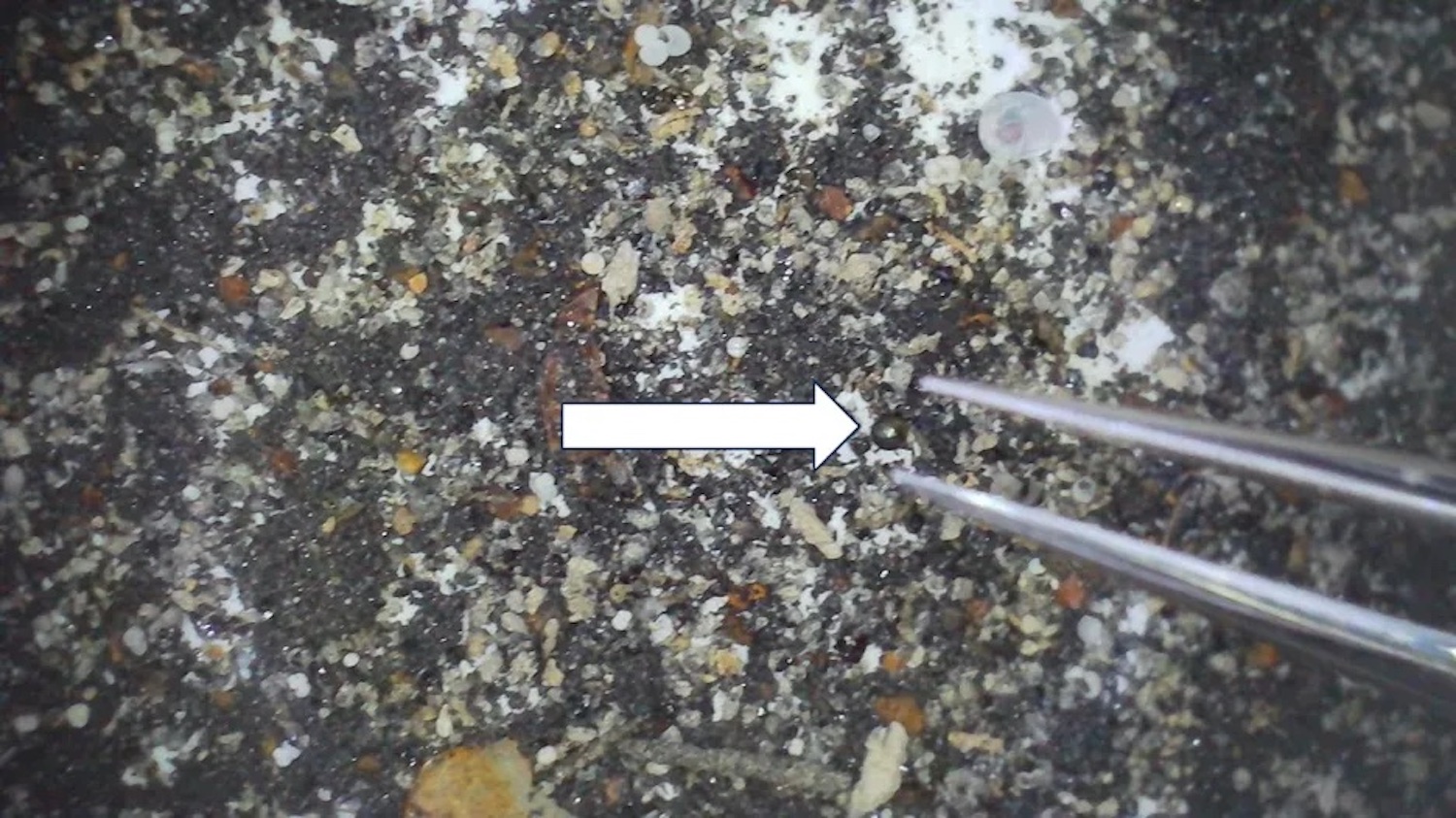
During the summer of 1952, the United States was on high alert as UFO sightings over the nation’s capital were making frequent headlines. Buried amid the otherworldly clamor occupying the minds of Americans around that time, an obscure report conveyed that one of the objects—a small, glowing disc—was pursued and shot at by a military aircraft, blasting off a fragment that fell into a field near Washington D.C., which a naval officer later retrieved.
More than a decade later, an official government-funded scientific inquiry into UFOs—or what the United States government now calls unidentified anomalous phenomena (UAP)—would investigate the incident, ultimately determining claims involving the 1952 UFO incident were unlikely to be true.
Without question, the notion that a fragment might have been recovered after a shoot-out with a flying saucer in the 1950s offers a textbook example of what most would call a dubious claim. Yet a deeper look into this Cold War-era rumor reveals, surprisingly, that there could potentially be more to this odd story than past assessments would seem to indicate.
However, you would never have gleaned that from reading the latest report issued by the U.S. Defense Department’s official UAP investigative office.
Last week, the All-domain Anomaly Resolution Office (AARO) released a long-awaited historical report on its findings involving the United States government’s involvement with UAP and related programs since the end of World War II.
In the report, AARO investigators maintained the U.S. federal government’s longstanding position that it has never found any convincing evidence of extraterrestrial technologies operating near Earth, nor of any secret programs involving the acquisition or reverse engineering of crashed exotic technologies that have remained hidden from Congress.
The report was met with heavy criticism following its publication, partly due to a number of errors it was revealed to contain. Despite this, there were also a few intriguing inclusions made by AARO’s investigators, based on their relevance to the question of whether UAP materials have ever crashed on Earth and been studied.
One of these appears in a section of the AARO report that discusses the University of Colorado UFO Project, more commonly called the Condon Committee, a U.S. Air Force-funded evaluation of cases that were collected under its long-running Project Blue Book investigations that studied UFOs during the 1950s and 1960s.
According to AARO’s recent report, the Colorado scientific panel, led by American physicist Edward U. Condon, “investigated a claim made by radio broadcaster Frank Edwards in a 1966 book that a piece of a UFO was recovered near Washington, D.C. in the summer of 1952 during the spike in UFO sightings over the U.S. Capitol in July and August.”
The account in question appeared in Edward’s book Flying Saucers: Serious Business, of which AARO’s investigators recount that Edwards “claimed that a USN jet fired on a two-foot diameter glowing disc and dislodged a one-pound fragment that was recovered by a ground team.” At the time of their study, the Condon Committee’s investigators inquired about the incident with Project Blue Book, who told the University of Colorado team that they were unaware of the purported 1952 incident.

Above: Excerpt from Frank Edwards’ 1966 book, Flying Saucers: Serious Business, where the author discussed the alleged 1952 UFO incident.
“The USAF and USN found no incident report of weapons engagement with a UFO that summer, no USN aircraft were present, and the retired officer who was the original source of the claim had retired before the summer of 1952, when the event allegedly occurred,” the AARO report’s summary reads.
The report then attributes another claim to Edwards, this time involving fragments from a UFO that were loaned by the United States to the Canadian government. “It is not clear if this claim was linked to the alleged Washington, D.C. incident,” the AARO report’s authors state, adding that “The Condon panel determined that these claims most likely were false.”
The reason any connections between the 1952 UFO incident and Frank Edwards’ claims of a flying saucer fragment being loaned to the Canadian government remained unclear to AARO’s investigators is probably very simple. In likelihood, their investigation of these claims took them no further than the Condon Committee’s report (as evidenced by the relevant source citations found at the end of AARO’s document). Indeed, the two events are connected, as a deeper examination of the literature regarding this alleged 1952 incident readily reveals.
Additionally, much like other assertions that appeared in the recent AARO report, some of the facts about this case have been misrepresented. However, this may not be entirely the fault of AARO’s team in this instance; a closer look at this case also reveals how much of the confusion arises from the Condon Committee’s original investigation, and problems involving their main source for the claims.
THE CONDON COMMITTEE’S CONFUSION
In the late 1960s, under contract No. 44620-67-C-0035 with the United States Air Force, the University of Colorado conducted an extensive analysis of UAP incidents collected by Project Blue Book, which resulted in the publication of its findings in a lengthy report titled Scientific Study of Unidentified Flying Objects.
Despite the title of the Condon Committee’s report, many viewed it as being anything but a truly scientific evaluation of existing data on aerial mysteries. As British physicist Peter Sturrock later noted in his analysis of the Condon Committee’s findings, “most case studies were conducted by junior staff, the senior staff took little part, and the director took no part, in these investigations.” Additionally, after concerns were raised by some of the Committee’s members over apparent biases and other issues they identified with its leadership, several either resigned or were dismissed, resulting in the final report being partly assembled by staff who had only joined the project as it neared completion.

Above: Original title from John G. Fuller’s article, “Flying Saucer Fiasco,” published in Look Magazine, May 14, 1968
(Credit: CIA CREST/Public Domain/Fair Use).
The saga of the 1952 UFO shoot-down over Washington was addressed in a section of the Condon Committee’s final report titled “Parts of UFOs, or UFO Equipment,” where the Colorado team’s investigators wrote that “Representatives of Air Force Project Blue Book claimed no knowledge of the disc fragment discussed by Edwards, who claimed the successful search for this fragment was confirmed by Lt. Cdr. Frank Thompson of the U.S. Navy.”
“The fragment, said to have been dislodged by gunfire from a Navy jet, reportedly fell to the ground, where it was found, still glowing, an hour later by U.S. military ground search crews,” the Committee’s report states. “Reports of UFO events over Washington, D.C., in 1952 contain no reference to such a gunfire incident,” they add, though noting that had the fragment ever really existed “and was classified ‘Secret’ as was claimed, its existence and whereabouts would not necessarily be revealed to this project.”
On the outside chance that such an incident might have occurred, the Committee’s members reached out to U.S. Air Force headquarters for clarification. A response came from J.W. Clinton “by direction of the Chief of Information, Department of the Navy,” who indicated that a search of all Navy records revealed no documentation related to the purported incident, nor could they find any records involving the retrieval of fragments at any time that were believed to have come from a UFO.
That wasn’t the only damning revelation that came from a search of the Navy’s records. “Perhaps more significant, however, were the facts that Navy records of the year 1952 carried only one Frank Thompson, an individual who had retired from active duty several years before 1952 with the rank of lieutenant, not lieutenant commander,” the Condon Committee’s report states. In addition to this, the Committee’s investigators were told that it was unlikely that U.S. Navy aircraft would have participated in any shoot downs of objects over the nation’s capital, since in doing so they “would have been usurping an Air Force function if they had been present over Washington, D. C., as interceptors.”
“The incident is not beyond the realm of possibility,” Clinton nonetheless conceded to the Colorado team, though ultimately concluding that the incident was “very highly unlikely” given the jurisdictional issues limiting any Navy aircraft’s involvement.
Although Clinton had admitted that the incident reported by Edwards might at least have been possible, the fact that there had been no evidence of a “Frank Thompson” with the rank of lieutenant commander in active service at the time seemed to pour cold water on Edwards’ claims.
However, a closer look at Edwards’ sources for this account reveals something that may help to clarify the matter, since it turns out the name of the Lieutenant Commander in question was not “Frank Thompson” at all.
In the relevant chapter of Flying Saucers: Serious Business, Edwards states that one of his sources regarding the 1952 affair had been an earlier book from 1955 by Major Donald E. Keyhoe, titled The Flying Saucer Conspiracy. In Edwards’ book, he even provides the page number (272) for Keyhoe’s account of the incident, a review of which helps to shed some light on the situation.
“I also listed a recent report given me by Lieutenant Commander Frank Thomas,” Keyhoe wrote in his brief account of the 1952 incident, immediately revealing that the “Frank Thompson” Edwards had been referencing was, in fact, instead a Lieutenant Commander Frank Thomas.

Above: Excerpt from Donald Keyhoe’s 1955 book, later cited by Frank Edwards, where the actual name of Keyhoe’s source is shown as “Frank Thomas.” Edwards mistakenly wrote this individual’s name as “Frank Thompson” in his 1966 book.
“According to Thomas, a peculiar object had fallen near Washington during the mass saucer sightings in 1952,” Keyhoe writes. “Retrieved by a naval officer, it was later analyzed by the Bureau of Standards.”
Keyhoe goes on to describe the object, noting that “one side of it was flat with odd markings, as if it had been milled. During tests the unknown substance proved to be fire-resistant. But the analysis, Thomas said, had failed to determine whether it was an artificially constructed object or a fragment of some unknown type of meteorite.”
Keyhoe concluded the brief account by adding that “Afterward the object had been sent to W. B. Smith at Ottawa for further analysis by Project Magnet engineers.”
One must wonder whether the Condon Committee might have had better success locating the Lieutenant Commander in question if only they had asked the Navy to search for Frank Thomas, rather than Frank Thompson, as Edwards later mistakenly spelled the individual’s name.
However, further adding to the confusion is the fact that nowhere in the original account written by Keyhoe is it stated that the fragment was dislodged from the UAP during the purported 1952 incident by fire from an aircraft. In Keyhoe’s account, the author only conveys that “a peculiar object had fallen near Washington during the mass saucer sightings in 1952,” though adding that it was “Retrieved by a naval officer.”
Although Edwards initially only referred to a “military jet” in his retelling of the account in 1966, later in the same chapter he makes passing references to “the fragment collected by gunfire from that Navy jet.” It seems likely that Edwards had merely inferred that a Navy jet had been involved; confusion that may have stemmed from his misreading, again, of Keyhoe’s original account involving a “naval officer” who retrieved the fragment, as well as his primary source, a USN lieutenant commander.
Based on this, it would appear the insinuation that a Navy jet had been involved was another error made by Edwards, which ultimately the Condon Committee’s investigators relied on without attempting to validate the author’s sources. Add to this the fact that they had the wrong name of the alleged lieutenant commander they were looking for, and it becomes quite clear why the Navy was unable to corroborate any of the details in Edwards’ 1966 account.
THE WILBERT SMITH INTERVIEW
Although the recent AARO historical report only provides a cursory summary of the alleged 1952 incident based primarily on the Condon Committee’s findings (which, as demonstrated above, were doomed to fail from the outset based on inaccuracies in Frank Edwards’ account), there is still more to this bizarre story of alleged UAP debris. Much of this involves the Canadian engineer and UFO researcher Wilbert Smith, who eventually received the alleged flying saucer fragment according to Keyhoe’s original 1955 narrative.
A Canadian Department of Transport engineer, Smith ran Project Magnet, a UFO investigative effort that formally ran out of the Canadian government from December 1950 until mid-1954, although Smith’s informal studies involving UFOs continued for many years after the project ended.
“Smith assessed that UFOs were of extraterrestrial origin and that they flew by magnetism,” the recent AARO historical report states in a summary of Project Magnet that appears in a section addressing Foreign and Academic Investigatory Efforts. “Smith believed he was in personal contact with extraterrestrial beings through telepathy and ‘tensor beams’,” AARO’s investigators add, noting that in a 1961 interview Smith had “claimed that in 1952, the USAF lent him a piece of a UFO to study. He also claimed it was composed of magnesium orthosilicate.”
A rather revealing transcript of this interview with Smith appeared in Edwards’ 1966 book, based on a recording supplied to the author by Ohio-based researchers C.W. Fitch and George Popovitch, who conducted the 1961 interview. At one point while speaking with Smith, Fitch asked Smith about his association with the retired U.S. Navy Admiral Herbert B. Knowles, to whom Smith had reportedly shown the fragment of the saucer that the U.S. government had loaned him:
FITCH: You’re a friend of Admiral Knowles, Mr. Smith? [Rear Admiral H. B. Knowles, U.S. Navy, Retired.]
SMITH: Oh, yes. Admiral Knowles and I have been very good friends for many years.
FITCH: I have been told by a mutual friend that in 1952 you showed Admiral Knowles a piece of a flying saucer. Is that statement correct, sir?
SMITH: Yes. It is correct. I visited with Admiral Knowles and I had with me a piece which had been shot from a small flying saucer near Washington in July of that year—1952. I showed it to the Admiral. It was a piece of metal about twice the size of your thumb which had been loaned to me for a very short time by your Air Force.
FITCH: Is this the only piece you have handled which definitely had been part of a UFO, Mr. Smith?
SMITH: No. I’ve handled several of these pieces of hardware.
FITCH: In what way, if any, do they differ from materials with which we are familiar?
SMITH: As a general thing they differ only in that they are much harder than our materials.
FITCH: What about this particular piece from that UFO near Washington . . . did it differ from conventional materials? Was there anything unusual about it, sir?
SMITH: Well, the story behind it is this: The pilot was chasing a glowing disc about two feet in diameter—
FITCH: Pardon me, sir. But did you say two feet . . . ?
SMITH: That is correct. I was informed that the disc was glowing and was about two feet in diameter. A glowing chunk flew off and the pilot saw it glowing all the way to the ground. He radioed his report and a ground party hurried to the scene. The thing was still glowing when they found it an hour later. The entire piece weighed about a pound. The segment that was loaned to me was about one third of that. It had been sawed off.
FITCH: What did the analysis show?
SMITH: There was iron rust—the thing was in reality a matrix of magnesium orthosilicate. The matrix had great numbers—thousands—of I5-micron spheres scattered through it.
Fitch then questioned Smith about the whereabouts of the sample the U.S. Air Force had loaned him, to which he responded by providing the following very intriguing remarks:
FITCH: You say that you had to return it—did you return it to the Air Force, Mr. Smith?
SMITH: Not the Air Force. Much higher than that.
FITCH: The Central Intelligence Agency?
SMITH: [Chuckles] I’m sorry, gentlemen, but I don’t care to go beyond that point. I can say to you that it went to the hands of a highly classified group. You will have to solve that problem—their identity—for yourselves.
Smith’s insinuations about “a highly classified group” within the United States government that the alleged UFO fragment had been returned to is certainly intriguing, although for more reasons than merely those which are immediately obvious. Another has to do with a memorandum dated November 21, 1950, addressed to the Canadian Controller of Telecommunications, in which Smith discussed inquiries he made at the Canadian Embassy in Washington shortly after acquiring a copy of author Frank Scully’s book Behind the Flying Saucers, an early book on UFOs that recounted a dubious story involving the alleged crash of a flying saucer near Aztec, New Mexico (the incident was later deemed to have been a hoax).
Smith’s 1950 memo included a series of intriguing remarks that eventually became widely discussed in UFO circles, following the rediscovery of the memorandum in the Canadian National Archives decades later. Specifically, Smith stated that:
I made discreet enquiries [sic] through the Canadian Embassy staff in Washington who were able to obtain for me the following information:
- The [UFO] matter is the most highly classified subject in the United States Government, rating higher even than the H-bomb.
- Flying saucers exist.
- Their modus operandi is unknown but concentrated effort is being made by a small group headed by Doctor Vannevar Bush.
- The entire matter is considered by the United States authorities to be of tremendous significance.
The entire 1950 memorandum can be read online via the Computer UFO Network here, and a scan of the original 1950 Smith memorandum can be found here via Metabunk, with an additional lengthy thread discussing Smith and his involvement with early UFO research available here.
The reference to Vannevar Bush in the 1950 memorandum is noteworthy, particularly because Bush’s name would later appear in an infamous series of documents sent to filmmaker Jaime Shandera in 1984, which consisted of briefing papers describing “Operation Majestic 12,” an alleged secret U.S. investigation into UFOs and extraterrestrials that began in the aftermath of the supposed crash said to have occurred at Roswell, New Mexico, in 1947. The Majestic 12 documents, as they have since become known, also later appeared in British researcher Timothy Good’s book Above Top Secret.
Despite a few intriguing references from over the years like the one in the Smith memorandum, no evidence verifying the existence of “Operation Majestic 12” has ever surfaced. The documents were deemed to be hoaxes in a series of separate investigations, including one conducted by the Federal Bureau of Investigation, which concluded the documents were “completely bogus.”
 A page from the FBI’s copies of the alleged Majestic 12 documents, which they deemed to have been faked
(Credit: FBI).
It is worth noting that in the recent AARO report’s summary of the Condon Committee’s findings regarding the alleged 1952 saucer fragment affair, the AARO authors state that Frank Edwards “claimed that Dr. Vannevar Bush, a prominent inventor, defense industry scientist, and founder of the National Science Foundation, led the effort to study the fragment.” The citation given for this in the AARO report, number 49, lists “The Condon Report” (Scientific Study of Unidentified Flying Objects) as the source for this, although a search of both the PDF linked to by the AARO report’s authors, as well as an online text version of the Condon Report, reveals no references to Vannevar Bush. This could represent another error on the part of AARO’s investigators, who may have mistakenly attributed Wilbert Smith’s alleged knowledge that a “concentrated effort is being made by a small group headed by Doctor Vannevar Bush,” as stated in the 1950 memorandum, with details in the Condon Committee’s final report.
THE LETTER FROM REAR ADMIRAL KNOWLES
There is a final addendum to the story of the 1952 Washington saucer fragment, which involves testimony from the man who was allegedly shown the sample of the object while it was in Smith’s possession. As conveyed earlier in the transcript of C.W. Fitch and George Popovitch’s interview with Wilbert Smith, the latter had confirmed his friendship with U.S. Navy Rear Admiral Herbert B. Knowles, an individual with whom Fitch also corresponded about the alleged 1952 UFO incident.
In the March 1986 edition of Just Cause, the newsletter of the FOIA activist group Citizens Against UFO Secrecy (CAUS), a letter provided to the editor, Barry Greenwood, from none other than C.W. Fitch lent additional corroboration to the story of the saucer sample Wilbert Smith claimed the U.S. Air Force had loaned him in the 1950s.
“We must thank long-time UFO investigator C. Wesley Fitch for the following information, which CAUS regards as of great historical interest to our subject,” an entry at the end of the newsletter stated. “Fitch is one of a shrinking group of researchers who knew many of the pioneers of UFOlogy. We regard ourselves as fortunate that he chose to give this impressive little tid-bit to us.”
The item in question had been a series of then-25-year-old correspondences shared with CAUS, revealing “that former Navy Rear Admiral Herbert B. Knowles was involved in the examination of fragments of a UFO shot at over Washington, D.C. in 1952.” As it turned out, in addition to recording the interview where Wilbert Smith acknowledged his friendship with Admiral Knowles, Fitch had also corresponded with Knowles about the saucer fragment Smith claimed to have shown him while on loan from the United States.
As explained in the CAUS newsletter, Fitch, a member of the National Investigations Committee on Aerial Phenomena (NICAP) had been told by one of the organization’s board members, the Reverend Albert Baller, about a visit he received from Admiral Knowles (also a board member of NICAP at the time) during which the two men discussed UFOs. Throughout their discussion at Baller’s home, Knowles recounted how he was allowed to examine the purported UFO fragment in Smith’s possession, which he said had been shot off a small glowing disk in 1952.
Fitch managed to track down Admiral Knowles, who at the time (1961) had been living in Eliot, Maine, and wrote to him asking for confirmation as to whether he had indeed examined the alleged saucer fragment. In a response dated August 27, 1961, Knowles wrote back to Fitch, divulging the following intriguing account of his recollections about the visit with Smith:
Yes, I have had a piece of a small disc in my hands. It was shown me by Mr. Wilbert Smith (address given- Ed.). At that time (1952), Mr. Smith was heading the “Flying Saucer” research of the Canadian government and working in very close cooperation with our authorities in Washington, D.C. He is still very much interested in this matter and does independent research. The Canadian Govt. has “officially” abandoned the project.
To the best of my recollection the object was shot down by a plane and seen to fall in the yard of a farmer across the river in Virginia. Upon searching the area several pieces were found, one of which was turned over to Mr . Smith for independent research. In one of his trips down to see me he brought the piece along for my inspection.
It was a chunk of amorphous metal-like structure, brownish in color where broken, with a curved edge indicating the whole thing to have been not over 2′ in diam. The edge was rounded in cross section, perhaps a quarter inch thick and obviously swelled to a considerably greater thickness at the center. The outer surface was smooth but not polished, and at the broken sections there were obviously iron particles and even evidence of iron rust. I would say that the weight was somewhat lighter than if of solid iron, but it was not extremely light.
Mr. Smith told me that a chemical test had been made of the piece at hand, that iron had been found in it but little if anything else could be identified.
Concluding his account, the retired Admiral then asserted his belief that the fragment he examined had belonged to a “remotely-controlled observation disc,” the likes of which have been “seen many times, most often in the vicinity of defense installations.”
A follow-up letter from Knowles, dated October 11, 1961, included a sketch of the alleged UFO fragment, a version of which was redrawn and included in the CAUS newsletter based on faded originals provided to Fitch (see below).
 Above: Reconstructed drawing which appeared in the March 1986 CAUS newsletter
(Credit: Barry Greenwood/Fair Use).
CONCLUSIONS
As a deeper analysis into this alleged 1952 incident has revealed, the DoD’s recent investigations into the matter amounted to little more than a rehashing of the flawed conclusions of the Condon Committee from decades ago, whose investigators, as we have now seen, relied on incorrect data provided in a popular book on UFOs from the 1960s as the basis for their investigations.
Thus, to briefly summarize:
- AARO’s recent historical report features a short entry on the University of Colorado UFO Project (i.e., the Condon Committee) and its findings, including its investigation into claims made in a 1966 book by Frank Edwards involving a fragment allegedly shot off a UFO by a U.S. Navy aircraft near Washington, D.C., in 1952.
- While the Condon Committee determined the incident had likely never occurred, the information used as the basis for its investigations had been incorrect details from Edwards’ book, resulting from his probable misreading of information in an earlier 1955 book by author Donald Keyhoe. The Condon Committee’s investigators seemingly did not scrutinize this information before providing it to the U.S. Navy, which, understandably, was unable to verify the erroneous claims.
- AARO’s report attributes unverified claims involving American defense industry scientist Dr. Vannevar Bush to statements from Frank Edwards in 1966, although his book published that year makes no references to Bush, nor does the Condon Committee’s final report, which AARO cites as its source for this assertion in its recent report. It seems likely that a possible origin for the claims involving Bush may have been a 1950 memorandum attributed to Wilbert Smith, who was allegedly loaned a portion of the UFO fragment by the U.S. Air Force two years later.
- A recording of a 1961 interview the Ohio-based researcher C.W. Fitch conducted with Smith, partially transcribed in Edwards’ 1966 book, details Smith’s recollections about the purported UFO fragment he was loaned and insinuated that it was returned to a “highly classified group” within the United States government. Additional correspondences between Fitch and Rear Admiral Herbert B. Knowles from 1961, and later supplied to the activist organization CAUS, confirmed that Knowles had been shown the object during a meeting with Smith in 1952, corroborating Smith’s claims of having once had the fragment in his possession.
If the AARO report had indeed conducted an “exhaustive analysis” of U.S. government records associated with UAP, one would expect they would have also easily spotted errors in the publicly accessible resources like the Condon Committee report, as well as Frank Edwards’ 1966 account involving the alleged UFO fragment from 1952.
Instead, as indicated by AARO’s contention that “it is not clear” whether the alleged 1952 incident had been associated with claims that the Canadian government was loaned a sample from a UFO, it is hard to see past the fact that the AARO’s investigators performed little more than a cursory examination of the 1952 UFO case… just like the Condon Committee had done decades ago. Thus, one wonders: what else might they have overlooked?
This all may seem inconsequential to some, especially since the present analysis alone cannot “prove” that a fragment was indeed blasted off a small, drone-like UFO near Washington in 1952. However, what this analysis does help to illustrate, taken alongside the numerous other factual errors within AARO’s recent report, is that questions regarding the merit of AARO’s broader historical investigations are indeed warranted. It is also not impossible that, if such problems as those addressed here were taken into further consideration by AARO in advance of the publication of Volume II of its historical report, perhaps they may be better equipped to satisfactorily resolve some of these lingering questions.
Altogether, maybe these decades-old claims about a fragment shot off of a flying saucer, which past studies (and more recent ones) have claimed “were most likely false,” should warrant further attention after all.
And if nothing else, perhaps, given such considerations, we can better understand why many Americans remain skeptical about their government’s latest proclamations regarding the long-reviled subject of UFOs.
{ https://thedebrief.org/ }


 Baba Vanga's 2024 predictions🔮 And We All Know They Will Come True, UFO Sighting News.